• No categories

Politics Blog

The Supreme Court and same-sex marriage

114

Keep in mind that I’m not a lawyer and the news just broke. But it seems unlikely to me that the US Supreme Court would have taken up two key cases involving same-sex marraige just to rule narrowly on questions like standing. Which means at least four of the nine justices (and it could be a mix of liberal and conservative ones) think the Court should make a defining statement about marriage equality in the United States.

Courts are political. The Supreme Court is supremely political. That’s just reality. And ever since Lawrence v. Texas, the Court has been moving toward full acceptance of LGBT people:

The Supreme Court invalidated the Texas law but also went further by explicitly overruling Bowers – the significance of which was not lost on dissenting Justice Antonin Scalia, who presciently complained that the ruling “leaves on pretty shaky grounds state laws limiting marriage to opposite-sex couples.” Indeed it does.

And it’s hard to imagine that the Supreme Court could possibly, in 2012, make a broad statement against gay marriage. I just don’t see it happening. I think Scalia will fulminate, but a majority of the Court will rule in the spring that lesbian and gay people have a fundamental right to marry.

You read it here first.

UPDATE: HuffPo’s legal eagle disagrees with me, saying a pro-same-sex marriage ruling would be too “bold.” I think he’s wrong; the vast majority of Americans under 40 have no problem with same-sex marriage, and in a few years, anything other than a “bold” decision will look embarassingly dumb.

2012: Don’t call it the Apocalypse

17

There’s been growing media coverage of the widely anticipated 12/21/2012 date – which marks the end of the Mayan Long Count calendar, a rare Winter Solstice galactic alignment, and associated New Age predictions – with journalists and skeptics scoffing at doomsday predictions that it will trigger the apocalypse.

Yet as I’ve researched the prophecies, predictions, and possibilities associated with 2012, it seems that the only significant people offering up such end-of-days views are those seeking to mock them, shoot them down, or whip up hysteria. And nobody is feeling more frustration over this straw man media hype than author/researcher John Major Jenkins, who has written more about the significance of this date than anyone.

Before Jenkins would even let me interview him, he had me read the “Guide to 2012” that he prepared for those interested in writing about the subject, which he begins by reinforcing the accuracy of the 12/21/2012 date and clarifying its significance. “The doomsday assumption is not found in Maya tradition,” wrote Jenkins, who has researched the subject for 25 years and written nearly a dozen books on Mayan cosmology and beliefs. “The evidence indicates that Maya concept for cycle endings (such as 2012) is transformation and renewal.”

That idea – that we’re leaving an age focused on competition and consumption and entering an era of greater cooperation and connection – has been emphasized by everyone that I’ve interviewed on the concept. That includes New Age authors, a professor who studied Mayan folklore, political activists seeking a shift now to avoid real ecological and economic catastrophes later, and astrologers focused on the alignment of the earth, sun, and dark center of the Milky Way for the first time in 13,000 years (when that alignment occurred on the Summer Solstice, double that period for the last time it appeared this way on the longest night of the year, which some view as a more significant catalyst for change).

“I feel like the collective has been unable to receive the basic message I’ve been trying to give,” Jenkins told me, a hint of irritation in his voice as he recounted his painstaking research into Mayan artifacts and beliefs, the significance of which lies largely with their connection to the natural world that many modern people have lost. “That doesn’t seem to be what the collective wants or what the mainstream media want to say.”

Jenkins expresses almost equal frustration with those who seek to discredit or misrepresent his work as he does with those who have appropriated it for their own political or self-aggrandizing purposes. “We don’t know what’s going to happen,” he said. “We’ve been filtering 2012 through this kind of Nostradamus lens.”

Yet beyond his main point of simply understanding and honoring the Mayan people, Jenkins does hope that people use this moment as a prompt to create a transformation in global consciousness: “The challenge is for us to engage in and participate in the world in a more sustainable way and get past the domination mode.” And by “moment,” Jenkins and others emphasize that 12/21/2012 is the peak of moment lasting weeks, months, or years, depending on people’s perspectives.

Rob Brezsny, the San Rafael resident whose down-to-earth Free Will Astrology column has been printed in alt-weeklies throughout the country for decades, told us he respects Jenkins’ work and sympathizes with his current plight. “He gets it from both sides,” Brezsny said, noting how Jenkins gets attacked by both the skeptics and true believers.

Brenzsny is also a little skeptical about all the hype and focused hope surrounding 2012 – mostly because he thinks such magical thinking discounts the need for the long, hard work involved in either spiritual or political transformations – but he does believe in the importance of markers and rituals like those associated with the 12/21/2012 date.

“I think most people these days understand that how the world proceeds is through spectacles,” Brezsny told me. “The activists believe this may be a good moment, a good excuse to have a transformational ritual and to take advantage of this time. We need transformational rituals…Rituals have been a way to marshal our emotional and spiritual resources.”

Both Jenkins and Brezsny acknowledge the difficulty, even the danger, of relying too much on this moment to spark the sociopolitical renewal the world needs. “It’s a complex phenomenon as far as cultural change, and the recognition that things need to be done differently,” Jenkins said.

Yet Brezsny said that to achieve the kind of fundamental transformation that humans need to address issues like global warming and the mass extinctions now underway, that begins with a personal awakening and realization of our connection to one another and the planet. We need to set aside our egos and selfish desires, listen to one another, regain our connection to the natural world, and learn to work together. As Brezsny said, “For me, so much of what the revolution is about is how we treat each other moment to moment.”

These are just two of the dozens of sources that I’ve been interviewing about the 2012 predictions and possibilities, which I’ll take an in-depth look at from a variety of perspectives for the Guardian’s long Dec. 19 cover story (we’ll also include listings and other resources for how to spend that much-anticipated moment, such as the World Unity 2012 online hub).

Then I’ll be traveling through Mayan country in the Yucatan from Dec. 17-23, interviewing fellow pilgrims and wisdom keepers, visiting Tulum and other significant sites, and attending the Synthesis Festival in Chichen Itza, Mexico (and perhaps the Day Zero Festival in Playa del Carmen), so I hope you’ll follow along with my regular postings on this site. See you on the other side.

Why the anti-leaks bill is so scary

12

If a bill that is now before the US Senate were in place in 2005, none of us would know about the CIA’s secret offshore prisons. There’s a lot of other secret stuff that never would have made it into print, too.

And the really scary thing is that Sen. Dianne Feinstein is pushing this, and only one member of the Senate Intelligence Committee, Ron Wyden (D-Oregon) voted against it — and if if weren’t for his single-handed moves to block the measure, it would probably already be law.

I think Len Downie has one of the best arguments against the measure:

The most troubling provision in the bill would prohibit all contact with the news media or “any person affiliated with the media” by any intelligence officials other than an agency’s director, deputy director or “specifically designated” public affairs officers — all of whom are political appointees. That could limit the flow of intelligence information to what political appointees decide to tell reporters, in “authorized leaks,” for political purposes. Reporters could be cut off from more knowledgeable and impartial career analysts, such as those who disclosed, in the run-up to the Iraq war, their doubts about Bush administration claims of Iraqi weapons of mass destruction. This prohibition “would make everyday reporting about everyday intelligence activities practically impossible,” Jack Goldsmith told me. “It would promote opportunistic spinning by the executive branch, which is already a problem.”

In other words, more official misinformation, more spinning that gets us into more wars — and now way to counter it.


Could we really fix Prop. 13?

17

Is it really possible? Could California be on the path to repair the damage of Prop. 13? Would Jerry go along?

You wouldn’t think so — it’s been talked about for so long and so little has happened. But it’s an all new year in Sacramento, and the era of Republican dominancy-by-minority is over (in fact, the era when Republicans will have any role at all in state government is pretty much over), and already, some changes are in the works.

Assemblymember Tom Ammiano notes:

 “Prop. 13 is not the untouchable third-rail anymore. It’s more like the bad guy with the mustache who has tied California to the rails with the fiscal train wreck coming.”

Ammiano is introducing legislation to change the way Prop. 13 is interpreted — to stop corporations for using loopholes to get around paying higher taxes after commercial property changes hands. But the polls now suggest the voters might be willing to do more — the Public Policy Institute suggests that a sizable majority of Californians would like to see a split-role measure approved. That alone would provide billions of dollars in revenue for public schools.

By a 57-36% margin, voters responded positively when asked this question: Under Proposition 13, residential and commercial property taxes are both strictly limited. What do you think about having commercial properties taxed according to their current market value? Do you favor or oppose this proposal? Democrats favor the idea 66-26% and independents like the prospect 58-36%. Even Republicans are evenly divided 47-48%. Voters aged 18-34, who represent the future, favor the idea 65-28% but the idea is also popular among the most reliable voters, those 55 and older, by 56-39%. Splitting the tax roll is a popular idea in every region of the state, among men and women equally and especially among Asians (65-26%) and Latinos (58-36%) but also among whites (56-38%).

Now: That’s before the commercial property industry and every major landowning corporation in the state pours about $50 million into a campaign to defeat any whisper of a split-roll. But we all know that big-money campaigns don’t always win in California — and right now, the guv is a pretty popular guy. So if he got behind a split-roll measure, and every progressive and labor group in the state (and most local elected officials) did, too, it would be at the very least a level playing field.

That, alone, would change California more than anything else the Legislature or the governor could do. It’s out there; it’s possible. I wouldn’t try in 2013, but 2014 is looking pretty good.


San Francisco’s slippery slope is chafing

71

By Nato Green

This week, the San Francisco Board of Supervisors passed a ban on public nudity on a party line vote. By “party line,” I mean the Supes voting against nudity are the ones who never go to parties with lines of coke or conga lines. I’m not saying every single one of the progressive supervisors could be found in the naked suntan lotion massage yurt at Burning Man, just that it’s conceivable.

The ban was proposed by District 8 Supervisor Scott Wiener, and supported by the “moderates,” who are Very Serious about sensible governance. First of all, anyone who ever made fun of Supervisor Eric Mar’s happy meal ban owes him an apology. Second, obviously all other problems in the City have been solved, which has freed up the Supes to kowtow to the whims of the gayeoisie.

People are worried about the effects of aggressive nudity on children, but fortunately we’ve gentrified all the families out of the City. Now we’ll have to export nudists to Solano County if we want kids subjected to them. At any rate, during a nippy San Francisco winter it’s vitally important for children to learn about shrinkage.

Nudity doesn’t necessarily harm children. I grew up in San Francisco. In the ’70s. Naked people were everywhere, bare and unshaven. I didn’t see a fully-clothed adult until I was nine. I didn’t see nakedness as sexual, so much as simply covered in naked. Partly because then, as now, the specific naked people were not easy on the eyes. Not to promote normative body images, but if Christina Hendricks and Ryan Gosling showed up naked, the ensuing celebration by all sexualities would make the Giants Victory Parade look like a tupperware party.

Worst of all, nudity was banned in the Castro. If there’s one neighborhood that arguably draws its spirit from the brandishing of genitalia, it’s the Castro. Harvey Milk did not march so his grandchildren could sequester the penis. It’s almost as if the City wanted to abolish hippies sitting on the sidewalk in the Haight-Ashbury. (Damn you, sit/lie.)

If we’re going to ban sitting on the sidewalk in the Haight and nudity in the Castro, here are more options for possible legislation to achieve the goal of draining our neighborhoods of their distinguishing features.

We should also ban:

  1. Bernal Heights—dykes with dogs.

  2. Mission—fixed-gear bicycles, ironic mustaches, and salvadoreños.

  3. Marina—entitlement.

  4. Richmond—Irish pubs with actual Irish people.

  5. Noe Valley—strollers and handmade baby food.

  6. Western Addition—Black people. Whoops. Too late.

Comedian Nato Green (writer for “Totally Biased with W. Kamau Bell” on FX) headlines the San Francisco Punchline December 19 and 20. Tweet him @natogreen

No surprise: The Chron hates Ammiano’s homeless bill

67

Why should I be surprised? Assemblymember Tom Ammiano tried to introduce a bill providing some basic human rights for homeless people, and the Chron lashes out with a nasty editorial that misses the entire point.

Ammiano’s AB 5 was crafted with the help of homeless advocacy groups, and it’s really not that radical a proposal. It would simply guarantee some basic human rights to people who don’t have a permanent place to live. It would, for example, forbid employment discrimination against homeless people in employment, public services and voting. It would enshrine in law the right of all people to use public space, including as a place to rest, and would establish that 24-hour access to bathrooms and showers is a basic human right.It would protect the rights of homeless children to attend school. It would guarantee homeless people cited under laws that could lead to criminal sanctions the right to a lawyer.

It would also bar local authorities from forcing people into shelters or other programs without their consent and would guarantee equal treatment from law-enforcement.

Oh, and it would prevent local laws that bar homeless people from occupying vehicles that are legally parked, and precent authorities from taking away the personal property of homeless people.

But to read the Chron’s editorial, you’d think the world was coming to an end:

A bill that asserts an individual’s right to urinate, sleep and panhandle wherever he wants is neither compassionate nor wise. To pass it would be to surrender our streets and parks to misery, chaos and squalor.

Misery, chaos and squalor? Whoa. As if the lives of homeless people are not already, in many cases, marked by those characteristics.

And really, the bill doesn’t talk about the right to “urinate wherever he wants;” it mandates that cities provide accessible bathroom facilities so people don’t have to urinate on the streets. “It’s not a good idea or even healthy to have a law that says you can piss or shit wherever you want,” Pauld Boden, director of the Western Regional Advocacy Project, told me. “So having 24-hour access to hygiene centers is a way better alternative.”

But of course, Boden said, opponents of the law “are going to try to make it all about urination and defecation. It’s a way to dehumanize people.”

I don’t understand what’s wrong with asserting that homeless people have the same human rights as the rest of us. If this undermines bad laws like sit-lie and care not cash, so be it; in a rich state, we can and should do better. (But even the Chron’s own reporter says the bill won’t undermine SF’s sit-lie law).

Ammiano’s moving forward with the bill, expecting amendments and open to discussion. But as far as the Chron’s editorial goes, he told me” “It reminds me of Robin Williams’ comment about a bad review he got ” ‘I was going to have a chicken shit on it, but that would be redundant.;”

UPDATE: If you want to see a comparison of the current anti-homeless laws to the “ugly laws,” the Jim Crow laws and a lot of other stuff we all now agree was wrong, check it out here (pdf)

Sorry, Chuck — HANC eviction hasn’t happened

14

The eviction of the Haight Asbury Neighborhood Council’s recycling center, which critics of the center said was scheduled to take place Dec. 5, hasn’t happened – and it’s entirely possible that the center could keep operating for several more weeks.

At the end of the day Wednesday, the doors were open, the center was continuing business as usual – and the office of Sheriff Ross Mirkarimi, who is charged with carrying out the eviction, was telling reporters that Dec. 5 was never a firm deadline.

Kathy Gorwood, Mirkarimi’s chief of staff, told us that the law gives tenants five days from the service of an eviction notice before any law-enforcement action can take place. “But that’s not a legal mandate that we evict on the sixth day,” she said.

The notice was served Nov. 30.

Gorwood said all evictions are planned with officer safety, tenant hardships and staff scheduling in mind – and on Dec. 5, the sheriff wasn’t ready to move.

“We surveyed the property, the sheriff personally surveyed the property,” she said. “We can’t say, and we don’t say, when an eviction will take place.”

Gorwood said Mirkarimi wasn’t defying the law or refusing to carry out the eviction. But since there are likely to be protests, possibly civil disobedience, the deputies need to be prepared and the schedule set carefully.

Mirkarimi has a history of supporting HANC. As a former supervisor of District 5, which includes the Haight, he voted to urge SF Rec and Park to and find a solution to keep the center in Golden Gate Park. The vote was nonbinding. He clearly wants to avoid a nasty confrontation, and if he can find a way to work out a voluntary move-out, it’s likely he’ll take the time to negotiate it.

For the past ten years, The Department of Recreation and Parks has aggressively sought to oust HANC.  Finally, this fall, Rec-Park filed an eviction through the City Attorney’s Office
Interestingly, the “Notice to Vacate” served on the center was signed off by the City Attorney’s Office on September 14, 2012. However, the actual eviction date that SF Rec and Park requested was December 5, 2012.

Why wait three months to evict a center that Rec-Park has been trying to get rid of for a decade?

Jack Fong, a spokesperson for the City Attorney’s office, declined to say if there were any procedural or administrative reasons that an eviction notice given to the sheriff in September would take three months to go through.

We called Phil Ginsburg, director of Rec and Parks, and Sarah Ballard, its spokesperson, to ask about the time disparity. We did not hear back from them before press time.

But you don’t need to be a genius to figure it out — just look at what was happening in November. Ginsburg was pushing Proposition B, which secured $195 million in bonds to shore up neglected playgrounds and open spaces in San Francisco’s parks. The measure needed a two-thirds vote – and Rec-Park was nervous about any bad publicity.

The measure passed by a landslide. Butousting HANC, eliminating a revenue stream for the poor, the homeless, and working class people, would have been bad publicity leading up the November election.

The Small Business Commission is scrambling to notify businesses in the area of their possible new role without the recycling center — they could all either become mini-recycling centers, or
face a $100 a day charge from the state of California
.

Exactly how and when the commission will reach out to those affected will be discussed at the Small Business Commission’s December 10 meeting.

Regina Dick-Endrizzi, the executive director of the Small Business Commission, told us that one business in the SOMA, which she declined to name, faced three months worth of the $100-a-
day charge for not buying back recyclables from the state while trying to navigate applying for an exemption. Even after being granted the exemption, that’s a $9,000 charge, which for a small
liquor store or grocer is not chump change.

There’s a precedent for a San Francisco sheriff refusing to carry out an eviction notice. Sheriff Richard Hongisto, who later served on the board of supervisors for three terms, famously
refused to evict the Filipino and Chinese elderly tenants of the International Hotel in 1976. The scandal was even the subject of a documentary, “The Fall of the I-Hotel.

The International Hotel was sold to developers who were going to cast the elderly tenants out onto the street. News outlets as far flung as the New York and LA times wrote about the
mass eviction, and many consider it a black eye on San Francisco to this day.

In January 1977, Hongisto was jailed for five days for his refusal to evict the tenants. Eventually, he relented, leading a team of SWAT and other officers to clear the hotel of
protesters, and even swung an ax himself to bust open the hotel.

But this is a different situation: Mirkarimi hasn’t refused to follow the law, and in fact, Gorwood said that he has every intention of carrying out the eviction. The law, Mark Nicco, assistant counsel to the sheriff, told us, only says that an eviction has to happen in a timely manner – and there’s no definition of what that might be.

So if Ginsburg or the mayor think Mirkarimi is dragging his feet, the only recourse would be for Rec-Park to go to court and seek a judge’s order compelling the sheriff to evict the center in a stated period of time. All of which could take weeks.

So for the moment, HANC is still in business, Mirkarimi is avoiding an ugly eviction scene – and there’s still a chance for Rec-Park to come to its senses. But we’re not taking bets.

Additional reporting by Tim Redmond

What did the mayor know?

35

So let’s get this straight:

Three lawsuits have been filed against the head of the Housing Authority. Some 30 staffers have complained about Alvarez to senior mayoral staffers. The HA even hired former City Attorney Louise Renne to investigate problems with Alvarez.

And Mayor Lee says he wasn’t aware of the problems?

This is the kind of thing that used to happen under Willie Brown — the mayor would hire cronies for top dollar, and defend them and brush aside charges of misbehavior. And I hate to see the same style happening under Lee.

Clearly, the two are pals, and I understand the urge to stand by your friends in public life, and at this point, we just have allegations — maybe none of it is true, and maybe Renne will find that everything is just grand over at the Housing Authority. But the mayor ought to at least express concern.

And if this was all really happening without his knowledge, then his staff isn’t doing a very good job of keeping him informed.

Either way, not a good scene in Room 200.

Free Muni for youth a rare progressive victory

18

The left isn’t winning all that much these days, but Sup. David Campos had a huge victory with the passage of a plan to offer free Muni to some 40,000 low-income kids. The challenges aren’t over — it’s still not clear, for example, how the actual clipper cards will be distributed — but this is a big step forward.

And it didn’t come easily. Campos worked with a coalition of low-income advocates that refused to give up despite two years of setbacks.

“We were relentless, even when we lost,” Campos told me.

It’s no secret that I’ve supported this plan all along (I actually like free Muni for all youth). And I think we’ll get there. In the meantime, for low-income middle-school and high-school kids, most of whom don’t get school bus rides any more, this is a big deal. The price of taking Muni to school ($1 a day for youth fares) is a significant amount of money, particularly for families with several kids who are struggling to make rent and eat. Yeah, there are cheaper youth passes — but you have to go to a Muni office in the middle of the day and bring proof of your kid’s age and it’s a pain in the ass for working parents.

So now it’s up to the MTA to figure out how to make it easy for families, some of them with limited English proficiency and virtually no time to wait in lines at Muni offices, to take advantage of the program. “We’re going to spend a lot of time doing outreach,” Campos said. “We’re working with Muni and with community-based organizations. We’re going to make this as easy as possible.”

The obvious solution, in my mind, is to distribute the passes at public schools. The school district already has income information on the kids, through the free and reduced-price lunch program; in theory, all anyone would have to do is take that list, adjust it a bit (because the eligibility for lunches and Muni passes is a little different) and hand out the passes at middle-school and high-school campuses. (You’d miss low-income kids who go to parochial schools, and a few others, but SFUSD wouldn’t be the only provider, just the first.)

And it’s education-related, since most of these kids take Muni to and from school — or should.

Problem is, there are legal rules about the use of the lunch data (although there must be a way to get around it) and SFUSD doesn’t seem terribly interested. (More work, more hassles for an already overworked and underfunded district.) But you could station one Muni worker at each school to hand out the passes, right? Or Muni could use some of the outreach money to pay for the SFUSD staff time.

At any rate, those are details. The main point is that Campos and his allies managed to beat back the opposition and make this actually happen. Good job.

(Oh, and the same day, Sup. Jane Kim managed to get $1.7 million for the schools to help with graduation rates — without raiding the Rainy Day Fund. Two progressive wins and it’s only the 5th of December.)

Left-right punch knocks out increased development fees for Muni

148

A new and unusual coalition of nonprofit, religious, and corporate interests today killed a legislative effort to get more money for Muni through the Transit Impact Development Fee, which was going through its process of being reauthorized every five years and came to the Board of Supervisors today.

The San Francisco Municipal Transportation Agency was hoping to get millions of dollars more per year from the fee to help cover the increasing costs of Muni service, so the city last year commissioned a study establishing a nexus between new development projects and their impact on the public transit system as a way to set the fees developers would pay.

Using that study, Sup. Scott Wiener sponsored legislation that increased the cost per square foot of development for some business types – mostly notably hospitals, big retail and entertainment complexes, and Cultural/Institution/Education facilities – and ended the categorical exemption for nonprofit organizations.

Those who could be impacted by the increased fees banded together into an organization calling itself NOTT (Non-profits Opposed to the Transit Tax), a group that included the city’s major health care providers, religious institutions, and influential nonprofits such as Council of Community Housing Organizations and Chinatown Community Development Center.

“We are gravely concerned that elements of the forthcoming Transportation Sustainability Program (TSP), especially elimination of the non-profit fee exemption, have been selectively imbedded in the TIDF update legislation. Elimination of the non-profit exemption has not been considered through a thorough and transparent process and is not good public policy,” SF Chamber of Commerce President Steve Falk wrote in Nov. 27 letter to supervisors on behalf of the organization.

In the face of opposition from both downtown and progressive groups, and hoping to get SFMTA more money for its next budget cycle, Wiener appealed for support to sustainable transportation activists, who had mixed feelings on the legislation for reasons ranging from its exemption of parking garages and development in Mission Bay to its inclusion of organizations serving low-income communities.

So Sup. Sean Elsbernd – who spoke on behalf of Catholic schools and churches – was able to amend the legislation back to the status quo on a 9-2 vote, with only Wiener and Sup. Carmen Chu opposed (Sup. Christina Olague, who co-sponsored the measure with Wiener, even failed to support it in the end).

While that ends this effort for now, it is really only the first round of efforts that are just getting underway to find more funding for Muni, which is underfunded and at capacity on many lines, and implement the TSP when it is unveiled next year.

Ethics Commission wants to hide its own flaws

3

The Ethics Commission has serious problems. A detailed report by Board of Supervisors Budget Analyst Harvey Rose, comparing SF’s ethics rules and enfocement to that of Los Angeles, found a long list of ways that this city is falling short. The supervisors asked the commission to have a robust discussion of the findings and propose reforms.

Now Friends of Ethics, made up of a number of former commissioners, activists, and campaign-finance watchdogs, says that the commission is trying to hold a quick hearing that will gloss over much of the criticism of the Rose report. The group wants the hearing delayed until there’s a lot more time to bring a lot more people into the process.

Here’s the letter FOE sent over:

To the Ethics Commission and Staff:

Friends of Ethics is writing with objections and protests regarding the upcoming “Interested Persons” meetings scheduled for December 4 and 10, 2012.

The Commission notified “Candidates, Treasurers and Interested Persons” of meetings “to discuss recommendations of the Budget Analyst report (also known as the Harvey Rose report) comparing programs of the San Francisco Ethics Commission with those of the Los Angeles Ethics Commission.”

The notice was dated November 28, providing only three business days before the first meeting will take place.

The Friends of Ethics bases its protest and objections on the following facts, and by this memo, formally requests that Ethics postpone these meetings until February.

     The proposed Interested Persons meetings do not mention inclusion of a representative from the Board Budget Analyst office to present their report and to discuss its findings. Without their direct involvement, as well as the invited presence of Supervisor Campos who requested the Rose report, the Interested Persons meeting will have only the staff’s views of the report as a basis for discussion. We believe this fails to provide the direct interaction and communication that should be part of this process.

    Ethics was requested by the Board of Supervisors to conduct robust and inclusive outreach to all participants in San Francisco’s political life. Ethics provided Friends of Ethics with the list used to contact Interested Persons about this meeting. We believe the list provided is not an adequate outreach, includes no community-based organizations active in electoral politics, any of the chartered Democratic clubs or other partisan political organizations, or special focus organizations active in San Francisco elections. We believe the lack of an inclusive outreach as evidenced by this list denies the Commission of a full discussion of the issues and is weighted toward the regulated community. We are puzzled by the fact that many people who do receive the Interested Persons notices are not on the list provided by Ethics, and seek a clarification on whether additional lists were used that were not disclosed to us. We also note that the late Joe Lynn, while the Campaign Finance Officer for Ethics, not only conducted extensive outreaches for IP meetings, including contacting past treasurers and press and posting notices on local political blogs and chat boards, but also later informed Director St. Croix in writing about those practices for the purpose of encouraging the continuation of such outreach.

    Ethics provided insufficient time for a review and analysis of recommendations that are significant and meaningful for the operation and success of the Ethics Commission mission. We believe that Ethics has done the bare minimum of notice of a public meeting and failed to take a serious approach to this important issue. Providing notice three days before the meeting, particularly in the holiday period between Thanksgiving and the first of December, means that no organization has an opportunity to place this issue on their agenda for a discussion or to endorse comments to be provided to the Ethics Commission.

    Ethics prepared an agenda that omitted significant and critically important comparisons between the Los Angeles and San Francisco Ethics Commissions that were included in the Rose report. While Ethics did list specific recommendations from the Rose report, the report itself detailed a number of additional differences that are significant to the San Francisco political community as we know it, and that should be part of a discussion of the Rose report.

Among the omitted points are:

    Los Angeles has a private right of action for citizens to act when Ethics does not; in Los Angeles this can include penalties under a civil action. San Francisco has no such provision. We believe this is essential to meaningfully empower citizens to directly seek compliance with our laws.

    Los Angeles requires disclosure of contributors of $100 or more to groups making “third party” expenditures. San Francisco does not require public disclosure of this money stream. Disclosure of donors to third party committees would add transparency, particularly if this has become a strategy to allow city contractors to influence elections.

    Los Angeles prohibits contributions from those seeking permits, while San Francisco does not. Friends of Ethics has determined that over 90 percent of all City Hall lobbying involves permit decisions.

    Los Angeles prohibits commissioners from fundraising for candidates, while San Francisco does not. This is the heart of pay-to-play politics that infects city appointments as commissioners are often the first stop for fundraising on behalf of city elected officials. We note a recent case where a city commissioner hosted a fundraiser that included contributions from city employees from the same department. The candidate returned the contributions, recognizing that commissioners are prohibited from seeking contributions from city employees. However, this demonstrates the potential abuse and underscores that Los Angeles’ policy is a stronger and more easily enforced prohibition. We recommend it.

    Los Angeles prohibits fundraising from city contractors and those seeking city actions. San Francisco allows contractors to fundraise and serve on candidate finance committees, although they may not contribute their own funds. Currently San Francisco also does not require candidates to disclose the names of their Finance Committee members. However, we strongly prefer closing the loophole, as Los Angeles has done, by prohibiting city contractors and permit seekers from fundraising.

    Los Angeles requires a more robust disclosure of “paid by” notification on telephone messages when 200 or more people are called. San Francisco sets the threshold at 500 people. Therefore, “paid by” calls to members of political clubs during the endorsement process would be missed under San Francisco’s standard but included under LA’s standard.

    Los Angeles provides a “Guide for Contributors” that educates donors and reduces confusion on such issues as aggregate contribution limits, prohibitions on officers of organizations receiving city funds, and so forth. This is done at minimal cost and made available on the Internet with no printing or mailing costs. San Francisco does not provide a Guide. Instead, the Ethics staff has recommended that the Commission rewrite the law to overturn specific prohibitions, stating that contributors are confused about the rules. The best approach is Los Angeles, where an educational outreach to contributors is part of their program. We note that San Francisco provides guides and outreach to most others involved in political activities, including committee treasurers, candidates and others but does not include an educational outreach to donors.

    Los Angeles prohibits political contributions from being made at City Hall or other city offices, including offices rented with city funds. San Francisco allows contributions to take place in the mayor’s own office, supervisor’s offices, at Redevelopment, Planning, Port or other offices – in short, anywhere that a donor chooses to make a contribution. We believe allowing contributions to be made in the workplace of city officials undermines public confidence and is inconsistent with other restrictions on the use of city resources for political purposes.

    Los Angeles has a more robust view of what constitutes lobbying and includes attorneys who offer strategic advice even if they do not directly contact a city official. San Francisco does not require registering or disclosing clients from such attorneys involved in orchestrating a favorable result for a paying client. Attorneys who serve as committee treasurers also do not face the same level of public disclosure as lobbyists.

We believe this list of omitted topics, coupled with the unacceptable short timeframe provided for analysis and review by the political community, and the failure to provide adequate outreach, raises serious concerns that Ethics is not engaged in a serious effort to obtain the public’s views on its operations and policies based on the Harvey Rose report.

We further note that Ethics has not provided a public schedule of when it will complete a summary of the Interested Persons meeting and comments, or a schedule for consideration by the full Commission of any recommendations.

In addition, Friends of Ethics requests that the San Francisco Ethics Commission audio record the IP meetings regarding the Rose report and post the recordings on its website, as is done by the Los Angeles City Ethics Commission.  In the past, the San Francisco Ethics Commission made audio recordings of its IP meetings, though they were not posted online.  The Commission’s Directors later discontinued the audio recording altogether, which may have been motivated by valuing the privacy of attendees over public transparency.  Given that the Rose report IP meetings are about comparing San Francisco’s good government laws with Los Angeles’ to consider adopting improvements offered by Los Angeles, Friends of Ethics believes that the first improvement that San Francisco should adopt is the Los Angele set of standard practices for conducting IP meetings.  When it comes to the development of good government law and policy, the public’s right to know is paramount.  Therefore, Friends of Ethics requests that all future IP meetings held by the San Francisco Ethics Commission be audio recorded and the recordings promptly posted online.”

Our reasons for requesting a specific timetable for next steps is based on our observation of lengthy delays in staff action on issues even when raised by the Commission itself. We believe the political community will be unlikely to participate in a process that has no specific and public timetable for action but that could take more than a year to reappear.

For example:

    In July 2011, the Ethics Commission requested that staff draft proposals to close the loophole that allows committees seeking to draft a candidate to fall outside the normal reporting and disclosure requirements. However, staff did not produce a proposal until November 2012, 16 months later, and did so without an Interested Persons meeting to discuss their proposal.

    Also at the July 2011 meeting, the Ethics Commission requested that staff examine the loophole that prevented the Commission from acting in cases of Official Misconduct by a commissioner. Ethics staff still has not produced a proposal to close that loophole.

    Also in 2011, a Superior Court judge suggested that San Francisco adopt a policy prohibiting commissioners from recommending a specific lobbyist to parties seeking a contract or other decision from that commission. Ethics has not prepared any response to that suggestion.

    In June 2012, Rules Committee Chair Jane Kim requested that the Ethics Commission provide some information on the city’s Ethics laws in languages other than English, noting that the rules are as important to donors and committees as they are to the public. The Ethics Commission has taken no steps, including in the election just concluded.

Given this record, we believe that any public process to examine the Harvey Rose Report and build new recommendations must include proposed timelines for action if there is to be public confidence that this process is meaningful.

We also strongly recommend that the Ethics Commission set aside time to allow a full discussion before the Commission itself. We believe that such a discussion should not place a two-minute limit on public members making comments.

For the above reasons and cited facts, Friends of Ethics requests that the Interested Persons meeting on the Harvey Rose Report be postponed until February when the political community will have an opportunity to evaluate the proposals and endorse changes, that the Commission immediately engage in a more robust outreach effort that extends beyond the list provided by Ethics to us, that the conversation be broadened to include all topics of comparison between Los Angeles and San Francisco, and that a proposed timeline for a record of the Interested Persons meeting and action by the Commission be provided.

We submit this protest respectfully and with support for the work of the Commission and specifically for the thorough review of any steps that can improve the Commission and public confidence in our political process.

Signed:

Eileen Hansen, former Ethics Commissioner
Bob Planthold, former Ethics Commissioner
Paul Melbostad, former Ethics Commissioner
Sharyn Saslafsky, former Ethics Commissioner
Bob Dockendorff, former Ethics Commissioner
Joe Julian, former Ethics Commissioner
Oliver Luby, former Ethics Commission staffer
Aaron Peskin, past President, Board of Supervisors
Charles Marsteller, former SF Coordinator, Common Cause
Karen Babbitt, community advocate
Marc Saloman, community advocate
Larry Bush, Publisher, CitiReport


 

Alameda County’s spy drone

32

We all knew it was coming, but the ACLU has the docs to prove it’s about to start happening here: The Alameda County Sheriff’s Office is trying to buy a drone aircraft in part to spy on people.

Now: Sheriff Gregory Ahern has insisted in public statements and in communications to the Board of Supervisors that he wants to use said drone only for search and rescue missions, disaster response, and checking out things like wildfires. But the ACLU and the Electronic Frontier Foundation have documents they obtained under the California Public Records Act that show the sheriff intends to use the drone for “intelligence and information sharing” — oh, and to prevent terrorism. Which he’s not going to do by flying over wildfires and looking for lost kids.

The documents, which will be released in full Dec. 4 at a press conference on the steps of the County Administration Building, include a grant application to the state’s Emergency Management Agency which outlines the proposed uses. “Clearly, if the sheriff’s certification to Cal-EMA is true, his office intends to use the drone for surveillance and intelligence gathering, a purpose not clearly disclosed to the Board,” staff attorney Linda Lye notes in a letter to the supervisors.

There’s an item on the Dec. 4 board agenda giving the sheriff the ability to apply for and receive grants for the drone, and the ACLU, for very good reasons, wants the item continued until there can be some more discussion on this.

Here’s the thing about law-enforcement tools: You give the cops a weapon, they’re going to use it. Give ’em Tasers, they’ll zap people. Give ’em a spy drone, they’ll spy on us.

Can you imagine having a spy drone circling overhead when Occupy groups were meeting to discuss actions and tactics? You want it flying near the offices of political groups that the sheriff may consider a threat to public safety? You want it equipped with cameras and listening devices?

The county supervisors at this point have no policy positions on how a drone can be used, because they haven’t had to address it yet. But here it is — the sheriff has already solicited bids from suppliers, and is itching to get that spy baby up in the air. This whole thing needs to slow down.

In fact, state Sen. Alex Padilla (D-Pacoima) just introduced a bill to regulate drones in the state. “I am concerned because domestic drones have the potential to be used for surreptitious surveillance activities that infringe upon fundamental constitutional rights.  We must ensure that there are clear guidelines in place that protect the rights of all Californians,” Padilla says in a press release I just got in my email box.

Maybe the sheriff should hold off spending any money on this thing until there are state guidelines in place. At the very least, the county supervisors should hold off giving him approval until they have rules of their own — rules that specifically ban the use of the drone for spying. (Oh, and the flight logs need to be public records, so we can see what’s really going on with the eye in the sky.)


The missing element of the Renewable Energy study

36

Since San Francisco’s Local Agency Formation Commission is meeting Dec. 7 to talk about renewable energy, I went and read the 100-page report of the Mayor’s Task Force on Renewable Energy, which offers 39 different suggestions for meeting the goal of 100 renewable electricity in the city by 2020.

That’s a pretty ambitious goal. The guy who set it, Gavin Newsom, loved lofty, ambitious projects, particularly when he was never going to be the one to carry them out. So too here: Newsom announced the city’s goal in 2010, shortly before he left for the Lieutenant Governor’s Office. Ed Le convened the task force earlier this year, and the members, most of whom have legitimate qualifications for the job, got right to work.

The most important conclusion of the report: Yes, it’s financially and technologically feasible to generate all of San Francisco’s electricity from reneweable sources, and we can get their in a short eight years. One key element: More distributed generation — that is, the city needs to create financial and regulatory incentives for people to put solar panels on their roofs. In San Francisco, with sun much of the year (and small houses), a rooftop solar installation can pretty much power the average single-family home and can pick up a fair share of the load of the typical four-unit building.

But while the report gives a shout-out to CleanPowerSF, which will soon be offering 100 percent renewable energy service (for a slightly higher price), and talks about the need for the city to build its own renewable generation facilities, which have to be a part of the plan. But it has a glaring omission — it doesn’t once mention public power.

Why is that an omission? Because San Francisco is never getting to 100 percent renewables while Pacific Gas & Electric Co. still controls the grid.

Right now, with today’s technology, you can’t get close to 100 percent without a significant amount of distributed generation. Lots and lots of people have to generate their own power — at which point, they no longer need PG&E (except that, by law, the grid is the default storage battery, but that’s going to change soon, too). In simple terms, distributed generation puts private utilities out of business. So they won’t ever go for it, and will — quietly, behind the scenes — so everything possible to keep if from happening.

Likewise demand management, something the Renewable Energy Task Force discusses at length. San Francisco already gets about 40 percent of its electricity from the Hetch Hethcy hydro project; If the city could reduce its energy use by 20 percent, that’s 20 percent we don’t have to generate. And reducing use is way cheaper than building new generation facilities.

But why would PG&E want to sell less electricity? There are all sorts of state laws mandating efficiency, but no PG&E CEO is going to make that a big push; it costs the company money. A PG&E that sells 20 percent less electricity is a smaller PG&E, with smaller staff, smaller revenue, and smaller profits. 

That’s why the only way the key components of distributed generation and demand management are ever going to work is if San Francisco gets rid of PG&E and sets up a municipal system. Around the country, the munis are leading the way in renewables, because they have no stockholders to satisfy.

At least that ought to be part of the report, no?


Wiener charges blogger with taking potty photo

81

I don’t even know what to do with this except report it and tell you some background. Because it’s just strange, all around.

Short story: Sup. Scott Wiener’s pressing criminal charges against a blogger who tried to take a photo of him peeing in the City Hall men’s room.

Michael Petrelis, the mad-man blogger who once called me for several days straight in the middle of the night to scream “your wife has syphillis!” into the phone, was at City Hall Oct. 26 with gay Honduran activist Erick Martinez. At some point, he decided to go into the public restroom on the second floor — and noticed that Sup. Scott Wiener was in there, using the urinal.

Petrelis has been fighting with Wiener over a lot of issues, including the nudity ban and Wiener’s efforts to remove benches from the plaza at 18th and Castro, and on the issues, he’s been right. He has a history of demanding accountability from the LGBT power structure, sometimes in ways that are not exactly polite — but he’s still a valuable gadfly, and I’ve gotten over the insanity of the late-night calls (more on that below).

But in this case, Wiener was just trying to take a piss — and Petrelis lifted his phone and tried to take a picture. Wiener’s wiener, I guess. Supervisor taking a leak. I don’t know exactly what he was going after, but the phone didn’t work right and he couldn’t get the photo until Wiener had buttoned up his pants and moved over to the sink, where he was going to brush his teeth.

Instead, he saw Petrelis and picked up the brush and toothpaste and left — but not before the intrepid blogger snapped a pic, which wound up on the Petrelis Files blog. It’s not a terribly attractive or terribly scandalous photo; guy with a toothbrush. Whatever.
But Wiener was, well, pissed — and I don’t blame him. We were always taught that you can take journalistic photos without the subject’s permission in a place where people have no expectation of privacy; if there’s any place in the world where a reasonable person would expect privacy, the bathroom would seem to quality.

Wiener called the cops — or in this case, the Sheriff’s Office, since that’s who patrols City Hall.

Wiener’s been complaining (for no reason, really) about the way the deputy sheriffs have responded to the protests over his nudity ban (come on — the nudists really aren’t a threat to anyone). But he asked for an investigation, filed a statement, and got the department to take it seriously enough to bring the matter to the district attorney for possible prosecution.

And the DA has filed charges.

Petrelis surrendered and was booked Nov. 29 on suspicion of violating Penal Code Section 647 (j) 1, which is typically used to prosecute peeping Toms: “Any person who looks through a hole or opening, into, or otherwise views, by means of any instrumentality, including, but not limited to, a periscope, telescope, binoculars, camera, motion picture camera, camcorder, or mobile phone, the interior of a bedroom, bathroom, changing room, fitting room, dressing room, or tanning booth, or the interior of any other area in which the occupant has a reasonable expectation of privacy, with the intent to invade the privacy of a person or persons inside.”

Bail was initially set at $25,000, which is astonishingly high for this level of crime, but Petrelis and his lawyer, Derek St. Pierre, got it reduced and Petrelis was cited and released on his own recognizance.

Wiener’s not talking; his office sent over a statement detailing the facts of the case and stating that Petrelis … has political disagreements with me, has a history of inappropriate and harassing behavior.” Both of those facts are undeniably true.

St. Pierre, though, thinks this is a huge waste of criminal justice resources. “I’m surprised that the D.A.’s Office decided to charge this case,” he told me. “I don’t see this as illegal conduct.”

In fact, he said, “the most concerning part of the case is that Wiener references that face that they have political disagreements. That suggests to me that political differences are driving the supervisor’s concerns.”

Maybe — or maybe he thinks his privacy really was invaded, and that Petrelis needs to be held accountable, too. As I said, I can’t blame him; Petrelis was acting like a total asshole. You can fight with Wiener, as I often do, and you can make speeches and denounce and interrupt meetings at City Hall and do all manner of impolite protests, but Jesus — the guy deserves the right to take a pee in peace.

That said, I have to wonder: Is this really worth turning into a criminal case? Did Wiener really have to take it that far? Petrelis, who loves attention, isn’t going to back down. “We will be fighting this case,” St. Pierre told me, starting with an arraignment hearing Dec. 5, at which I can pretty much guarantee the plea will be “not guilty.”

So we might have a full-blown trial here, and (as a fan of restorative justice) I’m not so sure that the criminal courts are the best way to resolve this. You’d think they could go to Community Boards. Wiener could agree to personally lower the rainbow flag to half-staff every now and then and Petrelis could agree to clean pigeon shit off some newsracks. Or something.

Because I don’t imagine that even Wiener wants to take the stand in a public trial and face cross-examination by Petrelis. The only winners at that spectacle would be the reporters.

PS: I don’t even remember exactly why Petrelis started the late-night calls to my home phone; it was around the same time he was calling lots of other people. I think he was mad that the Guardian ran (or didn’t run) some kind of ad around the doctor who was in charge of STD control at the Department of Public Health. I think there was some report about syphillis among gay men in SF that Petrelis didn’t like. I just remember that my son was two years old and sick and we were having a hell of time getting him to sleep and just when he would finally nod off the phone would ring and Petrelis would yell at me about syphillis. I’d hang up and he’d call back ten seconds later and yell again. I finally paid the phone company $2 a month to block his calls.

I was not among those who sought a restraining order or went to the police; that’s not my style. I was furious, but I knew it would pass, and eventually it did.

So will this, Scott.

HANC evicted, but the poor recyclers could remain in the Haight

36

In a win for the gentrifiers of the Haight Ashbury, the Haight Ashbury Neighborhood Council’s (HANC) Recycling Center has been issued an official eviction notice, posted by the Sheriff’s Department, and is slated to be out on the street by this Wednesday, Dec. 5. But those who hoped this would rid the neighborhood of poor people recycling bottles and cans may be disappointed.

The HANC site in Golden Gate Park — which houses a community garden, native plant nursery, and recycling center — has been battling eviction pushed by the Mayor’s Office and mayoral appointees for nearly a decade. Previously, the city Recreation and Park Department pushed for HANC to leave, a stand reinforced by court rulings, but the eviction notice looks like the last nail in the coffin. The recycling center’s employees will lose their jobs just as the winter holiday season begins.

“The notion that they’d put people out of work before Christmas was horrendous,” said Ed Dunn, HANC’s director. The eviction caught him totally flat footed, as he had just last week given a tour to San Francisco officials interested in mediating the dispute.

“It seemed like there was growing awareness that we’re a public good,” Dunn said. “I guess that went nowhere.”

Deputies posted the eviction notice at HANC’s doors on Wednesday, Nov. 28. Susan Fahey, the Sheriff’s Department media relations officer, declined to discuss the details on how the department would handle the eviction, saying only that “we plan accordingly.”

And though some, like Chronicle columnist C.W. Nevius, are celebrating HANC’s demise, the unintended consequences should have all small businesses in the Haight Ashbury worried.

 State law requires that Californians have easy access to a “convenience zone,” basically somewhere nearby that they can sell the cans and bottles and get back the “redemption” fee charge to consumers. HANC served that purpose for a half mile radius around its location on Frederick, near Stanyan.

“My position is we have to understand the full potential of the decision we’re making,” Regina Dick-Endrizzi, director of San Francisco’s Office of Small Business, told us. Namely, that without HANC, two local grocers will have to pick up the slack and buy back the bottles and cans they sell.

“Whole Foods and Andronicos were serviced by HANC’s existence,” Dick-Endrizzi said. With HANC gone, “they will be required to buy back [bottles and cans] from local stores.”

The whole reason that HANC was being pushed out in the first place was due to a vocal few, like the Haight Ashbury Improvement Association, saying that HANC was a magnet to the homeless population and their shopping carts filled with bottles and cans. Now those same poor folks may take their business from Golden Gate Park to the Haight neighborhood itself, frequenting the local Whole Foods, defeating the whole purpose behind the opposition’s scorn for HANC.

But sometimes local grocery stores defy the state mandate, and instead choose to pay state fines, Dick-Endrizzi said. If they choose not to take recyclables, small businesses all over the Haight would be required to individually pay customers for their used recyclables.

If they don’t, small businesses could be fined as $100 a day under state law. A year gone without dealing with the issue could cripple a business, with fines up to $36,000.

When contacted, Whole Foods representative Adam Smith said that the company was aware of the issue and was still deciding on a course of action for the neighborhood.

Funding SFUSD’s graduation rescue

45

The San Francisco school district’s achievement gap exploded into the news when district officials learned that as many as 1,900 High School juniors — the vast majority of them students of color — aren’t on track to meet the new graduation standards.

It’s a crisis: The district several years ago mandated that every high school graduate complete the A to G classes required by the California State University system — essentially a requirement that every graduate be prepared for college. It was going to be a tough standard to meet — and that was before the state whacked $77 million out of the SFUSD budget.

Now, with the new standards on the books, the class of 2014 is nowhere near ready. The city’s laudatory 82 percent graduation rate is at risk — and more important, there’s a real possibility that hundreds of kids won’t get a high school diploma, which will severely damage their employment opportunities.

To make things worse, the district’s funding for after-school classes to help students who are behind catch up — known as “credit recovery” — is ending in December.

The statistics are alarming: More than 80 percent of African American kids and 70 percent of Latinos aren’t on track to graduate. And while Prop. 30 passed, preventing any more cuts, it doesn’t add to the district’s funding.

So Sup. Jane Kim is asking the city to pick up the $2.7 million tab for the credit recovery program, which makes perfect sense: If 1,900 kids don’t graduate from high school, the impacts on the city, from crime, unemployment, and social-service needs to homelessness, will vastly exceed that number. 

“It’s part of violence and crime prvention,” School Board member Sandra Fewer explained.

It’s also an issue of civic responsibility — we, as San Franciscans, can’t just let those kids fail. “Remember, these are the ones who stuck it out, who are really trying,” Kim told me. “They aren’t the drop-outs.”

There is, of course, the question of whether this is going to be an ongoing problem — what about the class of 2015? Fewer thinks the numbers will be a lot lower then: “”We’ve learned a lot,” she said. “We’ve had early warning indicators and I don’t think we’ll see these numbers again.”

Kim said that at first she thought the appropriation request would be noncontroversial — it is, after all, a fairly modest amount of money, and the city’s budget picture is improving. “We’re doing fairly well,” Kim said. “One of the promises of all this tech growth was that we’d get some more revenue, and I think we need to spread that wealth.”

But the Mayor’s Office and some of her colleagues weren’t ready to go along. So, as often happens in these situations, somebody found some fiscal magic — the Mayor’s Office folks “discovered” that the city had put an additional $1.5 million into the school district’s allocation from the Rainy Day Fund. Gee, maybe that could cover part of the cost.

Now it gets tricky.

The Rainy Day Fund, which Assemblymember Tom Ammiano created when he was supervisor, requires the city to set aside cash in flush years to use when times are tigher — and part of it goes to the school district. That money has been used in the past few years to prevent teacher layoffs. (Another whole crazy issue — the district has to issue layoff notices in the spring, and then rescind them, which sucks for everyone, but at least the Rainy Day Fund money has made most of the recissions possible).

So the teachers union isn’t thrilled with the idea of taking money that would prevent layoffs and using it for another worthy program. “We’re in support of the $2.7 million allocation,” union staffer Ken Tray told me. “We can’t fail these kids. But we’re afraid that the money that would go for this very good thing would lead to teacher layoffs.”

Sup. David Campos has concerns, too: “I think the Rainy Day Fund should stand on its own terms,” he said. “If any time something comes up we say let’s take it from the Rainy Day Fund, it can become a problem.”

He supports spending city money to help the students: “If it’s a crisis, we should handle it as a crisis.”

Which makes perfect sense to me. This IS a crisis, and Kim has properly identified a small amount of money for a one-time effort to address it, and in the end, her allocation would save the city way more than it costs. I can’t see why the mayor and the supervisors have to play games here; this is serious, serious stuff, and if the district thinks it can address it in a serious way for a modest amount of money at a time when the economy is picking up and the city budget is improving, why not just do it?

2012: Beginning of the End or a New Beginning

33

In recent months, I’ve been exploring the rabbit hole of 2012 prophecy and possibility, a beguiling mixture of myth, spirituality, and hope that humans will finally awaken to the global ecological and economic catastrophes we’re creating and make a fundamental shift in our approach, whether that’s sparked by cosmic energies or our own earthly intention.

When the Mayan calendar ends on Dec. 21 – a date that also marks the Winter Solstice and the peak of our alignment with the galactic center (Earth, sun, and the dark center of the Milky Way lining up for the first time in recorded human history) – it will be a day anticipated by millions of people around the world. Thanks to the modern amplification by pop culture and the Internet, it will be an unprecedented and potentially auspicious astrological, energetic, and cultural moment.

“The earth is being flooded with energies from the galactic center,” San Francisco Astrological Society President Linea Van Horn, who has been giving presentations for eight years on the significance of a cosmic alignment that occurs once every 26,000 years, told us. “That was the alignment that the Mayans were marking on their calendars.”

It isn’t just the Mayan Long Count calendar that indicates the current age is ending and a new one dawning. Some Aztec, Toltec, Indian, and Egyptian scholars and writer Terence McKenna (who used the I Ching to make the revelation in his book The Invisible Landscape) and various New Age authors have predicted we’re entering a new era, one many believe will be marked by enhanced human consciousness.

But one needn’t believe any of this to understand the pressing need for humans to wake the fuck up and start working together on issues ranging from global warming and the alarming decrease in the planet’s biodiversity to the many shortcomings of global capitalism and the escalating social unrest it’s creating. So why not use this grand mystical moment to spark that discussion, as many progressive activists and conscious community advocates have suggested.

“It allows us to have a stage for the question, a frame for the question. We have to ask very basic questions about our survival,” said Rev. Billy Talen, an artist/activist whose latest book, The End of the World, delves into the earth’s ecosystems reaching their tipping points. “We have the uncanny, mythic, prophetic calendar ending and beginning. And then we have scientists saying the same thing, so where does that leave you?”

There will be many epicenters and gathering points on Dec. 21, both real and virtual. Personally, I’m headed down into the heart of the Mayan empire to Chichen Itza, Mexico, where I’ll be attending the Synthesis Festival and doing daily dispatches through this website. Daniel Pinchbeck, author 2012: The Return of Quetzacoatl, will be in Egypt at The Great Convergence “celebrating the dawning of a new era.”

“Basically, we are going to have to have a rapid shift in global consciousness,” Pinchbeck told me, arguing that shift has already begun, as seen in movements from Arab Spring to Occupy Wall Street. “It is happening in terms of horizontal, peer-to-peer, cooperative movements with no top down hierarchy…We can make a much more rapid transition than most people realize.”

Both festivals, and many others around the world, will be heavily attended by people from the Bay Area, where many of the concepts behind transformational possibilities and alternative organizing models have incubated and evolved for decades. The organizers of Synthesis have also set up a World Unity 2012 online hub where people can participate with livestreams from where they are and join in conversation about what’s next.

“It’s probably one of the most pointed to and significant times ever,” said Synthesis Executive Producer Michael DiMartino, who has been leading tours of Mayan sites for almost 20 years, establishing a close working relationship with the Mayan community in Piste Pueblo adjacent to the pyramids at Chichen Itza that he’s tapping for this event. “We’re at a crossroads in human history – and the crossroads are self-preservation or self-destruction…We create the future. As we make our decisions, we create the future now.”

While DiMartino and other festival organizers believe in the spiritual and energetic possibilities of this moment, they emphasize that it is an opportunity to bring together people with a variety of worldviews and belief systems and have a conversation about how the global community of people can work together on solutions.

“Obviously, the planet has been getting out of balance and there is a need to go back to basics,” said Debra Giusti, founder of the Harmony Festival and author of Transforming Through 2012. “We need to get back to the values of the indigenous people, but in the modern context making use of our technology.”

As I’ve interviewed people about 2012, from true believers to skeptics, mystics to scientists, a common theme has been that nobody knows what this intriguing moment portends. They have their hopes and their fears, their doubts and their desires. I’ll be looking at the 2012 question from a variety of perspectives in my upcoming coverage, and I’m open to your suggestions and observations as well.

But for now, for me, I’m maintaining an open heart and an open mind. “There are more things in heaven and earth, Horatio, that are dreamt up in your philosophy,” Shakespeare’s Hamlet said, a statement for ages that our modern minds, so rational and cynical, too often forget.

Maybe this metaphysical moment will be the anticlimactic New Age equivalent of Y2K, or maybe it will be an important signpost on the road to global transformation in consciousness, or something in between. Whatever happens, it’s bound to be interesting, and I hope you’ll join me on this journey.

UC Berkeley has a new chancellor, but his raise is blasted by Gov. Brown

31

The University of California Board of Regents today approved the hiring of Columbia University Faculty Dean Nicholas Dirks as the new chancellor of UC Berkeley, a widely lauded selection, but one whose $50,000 pay increase over his predecessor was opposed and criticized by Gov. Jerry Brown and Lt. Gov. Gavin Newsom.

That $50,000 bump will be paid for by private donors through the university’s foundation, but the fact that Chancellor Dirks will be receiving a $487,000 annual salary and a bevy of perks from an underfunded university system that has put the squeeze on faculty and students in recent years still looks really bad.

During the conference call meeting, Brown said the big raise “does not fit within the spirit of servant leadership that I think will be required over the next several years,” according to an account by the Sacramento Bee.

Brown referred to the recent narrow passage of his tax package, Prop. 30, which helped avoid deep trigger cuts to education. “I’ve just come through a campaign where I’ve pledged the people that I will use their funds judiciously and with real stewardship, with prudence,” Brown reportedly said, later adding, “We are going to have to restrain this system in many, many of its elements and this will come with great resistance.”

Matt Haney, executive director of the UC Student Association, praised Brown’s stand. “We would echo those sentiments. At a time when students are paying more and getting less, and the people of California expect the UC to use its money on its most critical priorities, such as serving the students, it’s not the time to be giving more to those at the top,” Haney, who is also a newly elected member of the San Francisco Board of Education, told the Guardian.

Especially irksome to Haney is the fact that it didn’t appear Dirks really needed the extra money to bring him here, calling it a reflection of the mentality of the corporate titans that comprise the Board of Regents. “It’s another indication of the tone deafness of UC management and that’s a big concern,” Haney said. “It’s a reflection of a philosophy that’s problematic and that students have been critical of for a long time.”

While Haney acknowledges $50,000 isn’t a huge amount of money compared to the UC’s needs, he also said that this gesture is more than merely symbolic, noting that it feeds public perceptions that the UC is being wasteful and that could hurt the system’s ability to get needed resources from the Legislature or voters.

Brown also said that he wants the UC to demonstrate “greater efficiency, greater elegance, modesty.”

Dirks is a career academic and professor of anthropology and history, and you can see and hear from him in this You Tube video:

Supervisors approve nudity ban on close vote

139

Over the objections of progressive supervisors and under threats of a lawsuit from nudists and civil liberties advocates, the San Francisco Board of Supervisors today voted 6-5 to outlaw public nudity in the city. Supervisors voting against the ban were David Campos, Christina Olague, John Avalos, Eric Mar, and Jane Kim.

Sup. Scott Wiener, who sponsored the measure, cast it as a last resort to deal with what has become daily displays of nudity in the Castro district he represents (and most recently around City Hall as his legislation was being considering in committees), noting that, “Public nudity is part of San Francisco and is appropriate in some circumstances.” His legislation makes exceptions for permitted events such as the Folsom Street Fair and Bay-to-Breakers.

But Wiener said that “public nudity can go too far,” as he says it has over the last two years in the Castro’s Jane Warner Plaza, and that “freedom of expression and acceptance does not mean you can do whatever you want.”

Campos echoed some of the legal concerns that critics of the legislation have raised, noting that, “As a lawyer, I do worry about when you ban specific conduct and then you have exceptions to that.” He also questioned whether Wiener has done enough to try to mediate the increasingly divisive conflict he’s been having with the nudist community and whether this was an appropriate use of scarce police resources.

“I don’t believe we’re at the point of saying this becomes a priority over violent crime,” Campos said, noting that he’s been unable to get more police foot patrols to deal with a recent spate of violent crimes in the Mission, which shares a police station with the Castro.

Avalos said it was absurd to focus city resources on this victimless issue when the city is wrestling with far more serious problems, such as poverty and violence, and he played a clip from the film Catch 22 where a soldier goes naked to a ceremony to highlight that absurdity. “I will refuse to put on this fig leaf, I just can’t do it,” Avalos said.

Mar said he sympathized with Wiener’s concerns, but agreed with Campos that Wiener could have done more to mediate this situation before both sides dug in: “I really don’t think we need citywide legislation, particularly overbroad legislation, to deal with a problem isolated to one neighborhood.”

Wiener seemed stung by the comments and said he could cite example of each supervisor pushing resolutions or ordinances that dealt with similarly trivial issues, comparing it to refusing to deal with a constituent’s pothole complaint until that supervisor fixed Muni and solved the city’s housing problem. But Campos pushed back, calling the comparison ridiculous and saying there was no reason for a citywide ban to deal with such an isolated issue.

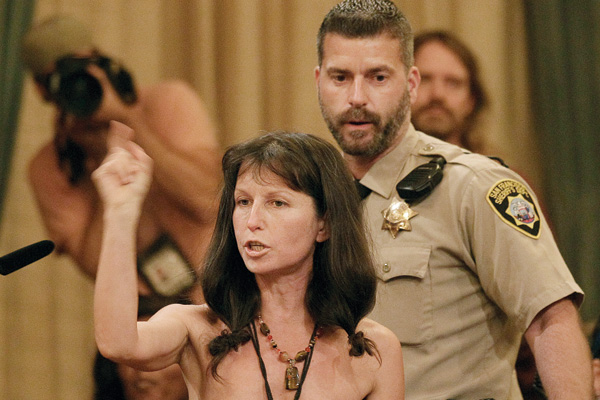
Nudists at the hearing reacted angrily to the approval and started to disrobe before President David Chiu ordered deputies to intervene and abruptly recessed the hearing. Now, it will likely be up to the courts to decide whether Wiener’s concerns about weiners can withstand legal scrutiny.

SF’s newest political pole gets a new name: Moderate progressives

101

A Daily Kos blogger known as Kurykh has posted an interesting and insightful “crash course in San Francisco politics,” in which he correctly identifies the tri-polar dynamic of local politics. Everyone knows the progressives (Ammiano, Avalos, the Guardian) and the so-called moderates (Wiener, Ma, the Chronicle), and so Kurykh dubs the rising third pole (Chiu, Kim, Mayor Lee) “moderate progressives.”

He calls them “the new kids on the block,” noting that they sided with progressives in 2008 but ushered in a new political reality by siding with the moderates in 2010, now serving essentially as the swing votes on major issues and projects.

“Like other progressives, they are pro-tenant and advocate for more social services to the poor. However, they have pro-business and pro-development tendencies and tend to focus on streamlining bureaucracy and effective government,” he wrote of the moderate progressives.

Personally, I think a more accurate label for this rising new power center is “neoliberal” (I just called them “liberals” in my own San Francisco political primer that I wrote a year ago), a political term describing the belief that any reforms or progress needs to be negotiated with capitalists and corporations instead of coming directly through taxes or regulations.

And I think it underestimates the influence that so-called “moderates” who are actually quite conservative when it come to finances and land use – people like Lee fundraiser Ron Conway and Planning Commissioner Michael Antonini – have in influencing Lee and shaping politics in the city.

But I welcome this contribution to helping San Franciscans understand the political dynamics that are governing this city.

Cabs v. Lyft et. al. isn’t just about tech

65

Of course the Chron portrays it as “The latest battle pitting disruptive high-tech innovators against old-school industries and regulators,” because that makes for good copy. It also puts the taxicab industry and the people who oversee it in the position of being dinosaurs fighting against an inevitable new world.

But seriously: This has so little to do with smart phones and apps and GPS systems. Those are tools that anyone can use, and the local cab companies ought to and will soon anyway.

What it’s about is the notion that there are such things as public utilities that ought to be regulated in a way that protects the public.

San Francisco decided as a city many, many years ago that you can’t just stick a sign on your car, call yourself a taxi and start charging people for rides. That’s fairly standard practice in American cities, where cabs are considered part of the transportation system — and are a service that, without regulation, is ripe for consumer fraud and safety problems.

Not to make too broad a case, but in California, you can’t just hang out a sign and call yourself a contractor and start applying for building permits. You need a license. You can’t just open a bank and start making loans, at any interest rate you want. You can’t call yourself a dentist and start pulling teeth, either. There are good reasons for these rules. (I suppose some day someone will suggest that surgeons should be chosen not by the AMA or by state licensing boards but by Yelp; some guy cuts off the wrong part of the body or kills someone on the operating table? Hey, he won’t get a good rep on social media and his prices will have to come down. But I don’t think that’s such an excellent idea.)

Even conservatives agree that there needs to be some form of business regulation — and when it comes to cabs in a major urban center, those regulations need to include safety tests and standards on the vehicles, safety checks for drivers (a DUI in the past three years will make you ineligible to drive a cab in SF), a system to regulate fares (so tourists who don’t speak English or understand US currency don’t get cheated) and, perhaps most important, an oversight system that allows people to complain about incompetent or dangerous drivers — and have those complaints investigated and addressed by a government agency.

The battle between the new high(er)-tech faux cabs and the existing industry is also being portrayed as selfish, entitled drivers not wanting to give up their piece of the game:

SideCar’s Paul, a onetime congressional policy analyst, said the issue might eventually work its way up to the governor’s office, which oversees the commission. “The PUC has an existing set of rules that were written for an era when communication technology was literally just a landline telephone, and they’re trying to shoehorn them into this new world,” he said. SideCar is also using social media to drive support of an online petition to the PUC. Within 24 hours, the petition at Change.org had more than 5,000 signatures. “Change always threatens incumbents,” wrote Tim O’Reilly, a Sebastopol business owner. “But some incumbents find ways to get government on their side and try to restrict competition.”

But let’s have a little perspective here. We’re not talking about (unregulated) musicians complaining about MP3 downloads and song-sharing or old-school (unregulated) newspaper publishers complaining that Craigslist took all the classified ads. We’re talking about an industry that is part of a public infrastructure and needs to fall under direct government supervision.

There are good reasons why San Francisco limits the number of cabs on the streets — and it’s not just industry corruption and influence. Too many cabs chasing too little money leads to bad behavior — and to bad drivers. You can’t get someone to drive a cab for so little money that they can’t pay the rent, and the lower the pay, the lower the quality of the drivers. There are excellent cab drivers in this town who have been doing the job for 20 years or more and know every address, every shortcut, every trick to get you there … but there won’t be many more of them if it becomes a business only for the young and the desperate.

Now: The city ought to have a centralized computerized dispatch system, with GPS on all the cars and an app to get the one that’s clsoes to you (and even more important, give you honest, real-time information about when the ride will arrive). These are technological changes that are coming, and that the city can mandate.

But you can’t just let anyone with a smart phone be a cab driver. That’s not innovation against old-school; that’s just good common sense.