• No categories

Politics Blog

Chiu’s committee assignments keep the moderates in charge

42

A week after engineering his unanimous re-election to an unprecedented third consecutive term as president of the Board of Supervisors, David Chiu today announced his assignments to board committees, placing fiscal conservatives into two of the most powerful posts and making himself a key swing vote on the Land Use Committee.

“I believe these committee assignments reflect a balanced approach and the diverse interests and talent of the supervisors,” Chiu said just after 4pm during the Roll Call portion of today’s meeting.

But some progressive activists were immediately grousing about some of the selections, which seem to reflect Chiu’s neoliberal approach to governance, preventing progressives from doing much to challenge development interests or the appointment of Establishment insiders to city commissions.

The Land Use Committee is perhaps the most powerful and impactful, particularly as the Warriors arena and other controversial waterfront developments and the CPMC hospital deal come to the board. Scott Wiener – a moderate who is already perhaps the most prolific supervisor – gains far more power as he is named to chair that committee. It is balanced out by Chiu and Sup. Jane Kim, both of whom have some progressive impulses on land use issues but also personal ambitions and a penchant for cutting deals. Developers have to be happy about this lineup.

Sup. Mark Farrell was named chair of the Budget Committee, succeeding Sup. Carmen Chu – a pair that are indisputably the most conservative supervisors on the board. While progressive Sups. Eric Mar and John Avalos will help balance out the permanent committee, their influence will be offset by the temporary members added during budget season: Sups. London Breed and Wiener.

That roster essentially puts Breed in the swing vote role, which should immediately give her some clout. Chiu’s defenders note that Budget’s balance of power is essentially status quo (with Breed now in the same swing vote role that Sup. Malia Cohen played) – and that the committee’s work last year was supported by labor and business interests alike.

Chiu is proposing to combine the Public Safety and City Operations & Neighborhood Services committees, naming Sup. David Campos as chair, Mar as vice-chair, and new Sup. Norman Yee as its third member. Yee, who nominated Chiu for president last week, was also rewarded with a chair on the Rules Committee – controlling appointments, it arguably the board’s third most influential committee after Land Use and Budget – with that committee filled out by Breed and Sup. Malia Cohen.

Speculation that Cohen and Kim would be rewarded for withdrawing their nominations as president before the vote last week don’t seem to have materialized in these appointments. Cohen was also named to the Government Operations Committee, along with Campos, which Sup. Carmen Chu will chair. That doesn’t give Cohen, who told us that she wanted to be on Land Use, much power.

Similarly, Kim was named chair of the City & School District Committee – nice, but not exactly a political launching pad – and Kim’s only real power on Land Use will come when Chiu is opposing some project, as he did with the controversial 8 Washington project that Kim and seven of her colleagues supported.

Aaron Peskin, Chiu’s predecessor as board president, said that he vaguely saw some semblance of Chiu’s claimed strategy of having conservative committee chairs balanced out by liberal majorities (although even that depends on how you define your terms). Yet Peskin questions that approach, and sees committees unlikely to really gel around good decisions or policies.

“It’s a recipe for dysfunction,” Peskin told us. “But it certainly will be fun to watch.”
Welcome to San Francisco’s ‘Internet of Things’

In this week’s issue of the Guardian, we spotlight a pair of pilot projects that introduce a new technology to San Francisco.

Using converted streetlights that can do a lot more than just illuminate city blocks, the San Francisco Public Utilities Commission (SFPUC) ultimately hopes to link a variety of city operations and infrastructure into a centralized, digitally integrated network. Proponents have pronounced the initiative to be an exciting venture into an “Internet of Things” paradigm, in which services are organized around real-time data sharing.

With the pilot projects that are described in greater depth in this week’s issue, the SFPUC is testing clusters of energy-efficient LED streetlights that are linked via a wireless network. These “smart” streetlights will initially be used to remotely read city-owned electric meters, and to transmit data from previously installed Municipal Transportation Agency-owned traffic cameras.

The pilots will test how well the “smart” streetlights can manage tasks such as electric vehicle charging monitoring, MTA traffic signal data transmission, “adaptive lighting” that can respond to conditions, and other functions.

But according to a request for proposals (RFP) issued last June by the SFPUC to seek applications for one of these pilots, the list of uses could grow. “Future needs for the secure wireless transmission of data throughout the city,” the RFP states, may include “gunshot monitoring,” “street surveillance,” or “public information broadcasts.”

Marketing pitches from the companies that develop these systems and ancillary services provide an idea of the broader visions that are being presented to city governments. Here’s a promotional video by IntelliStreets, a firm that applied to test out its product with the SFPUC pilot program, showcasing internal cameras and speakers that a city could opt to add in as part of the package. The SFPUC rejected IntelliStreets’ application.

Phillips, a lighting company that is working with Paradox Engineering on a pilot that’s currently up and running in San Francisco, has some bright ideas for municipal use of “intelligent outdoor lighting systems.” And even Oracle has a plan for cash-strapped city governments that could use its tailored data-management platform in combination with “intelligent” infrastructure, according to the marketing brochure.

The use of “intelligent” digital systems for urban infrastructure still remains largely in the realm of big ideas. And so far, the city’s process of introducing this whole concept to the public has barely gotten underway. The SFPUC has initiated some outreach efforts  – via newsletters issued by local police captains  – in neighborhoods where dimmable “adaptive lighting” would be tested in the forthcoming pilot program.

Depending on whether the SFPUC decides to pursue a broader implementation of the integrated streetlights based on the results of the pilots, the potential exists for these digitally connected systems to be used for monitoring everything from street parking, to traffic flows, to activity on the street. This means a great deal of information could be gathered from public space in real time – and that raises a host of questions.

“Technology can be used for good and for ill,” points out American Civil Liberties Union (ACLU) Staff Attorney Linda Lye. It’s important to ask questions from the outset, she added, to avoid a scenario where “you have a government deploying new technology for one purpose, and using it for other purposes.”

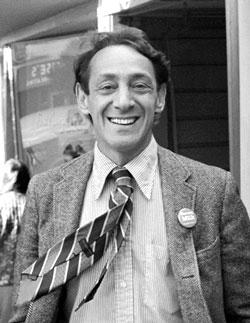
Harvey Milk airport!

83

First of all, it’s a great idea.

Major airports get named after people who have had a major impact on society (LaGuardia, Kennedy) or heros (Lt. Commander Edward O’Hare) and Harvey Milk was both. SFO is the gateway to the United States for millions of travelers, much as Kennedy is on the East Coast, and the idea that all of them would be potentially exposed to Milk’s life and legacy is wonderful.

Sup. Scott Wiener supports the idea, but says it will “spark a robust debate” about other people who have contributed to San Francisco, and I’ve heard the names Dianne Feinstein and Willie Brown mentioned. Both were bad mayors, both sold out the city to developers, both would be an embarassment — but that’s not the point. There are plenty of politicians like Feinstein and Brown in the world; there was only one Harvey Milk.

Thanks to Sup. Campos for the idea. I suspect it will get about 70 percent of the vote.

Herrera takes on restaurants that use bogus healthcare surcharges

66

City Attorney Dennis Herrera fired a warning shot across the bow of San Francisco restaurants that use a customer surcharge ostensibly to pay for employee health care – while in reality, many restaurateurs simply pocket the money and offer substandard health care options to employees – over the weekend when his office announced a settlement with Patxi’s Chicago Pizza.

The tone of the press release announcing the $320,000 settlement was generally positive, with Patxi’s claiming it was an innocent error and Herrera praising the owner’s cooperation in an agreement that improves the health care coverage of Patxi’s employees, compensates employees for the error, and ensures all surcharges tacked onto customers’ bills go to employee health care. Yet Herrera also included a warning to other restaurants.

“But today’s settlement should send a strong message that San Francisco is serious about making sure that restaurants keep their promises to their customers about health care surcharges. I look forward to announcing a larger, more global effort in the coming days to address this issue, to make sure health care surcharge money goes to the workers rather than being pocketed by business owners,” Herrera said in the release, signaling an effort to resolve with civil enforcement something that the political system has failed to do.

This became a hugely contentious issue in 2011 when the Golden Gate Restaurant Association (GGRA) and San Francisco Chamber of Commerce aggressively opposed reform legislation by Sup. David Campos that would have required that all surcharges be spent on health care and prevented employers from raiding health savings accounts at the end of each year. Mayor Ed Lee vetoed that measure but signed a watered down version by Sup. David Chiu – moves that Herrera criticized while running for mayor.

GGRA (whose Executive Director Rob Black didn’t return our call) aggressively fought the city’s Health Care Security Ordinance requirement that employers provide minimal health coverage to their workers, taking it all the way to the US Supreme Court. After losing that battle, many restaurants began adding a 3-5 percent surcharge of customers’ bills, even while offering employees what experts say is the worst form of health coverage, healthcare savings accounts, and often blocking their employees efforts to use them.

An investigative report in the Wall Street Journal showed how many San Francisco restaurants were essentially committing consumer fraud by pocketing the surcharges, elevating the issue, but the District Attorney’s Office has consistently refused to treat this as a criminal matter, despite calls for action by the Civil Grand Jury. So Herrera’s willingness to use civil sanctions, and his warning of more to come, was enthusiastically welcomed by Campos and other advocates.

“I’m very happy with what the City Attorney’s Office is doing,” Campos said. “It’s time for this kind of legal action.”

Campos had already pledged to reevaluate the issue later this year as data comes in about how the compromise regulations by Chiu and Lee are working, threatening to take it to the ballot if necessary and calling it an important issue for all San Franciscans.

“It’s not just about protecting workers and consumers, but also protecting businesses that play by the rules and comply with the law,” said Campos, noting that many restaurants have admirably refused to use the surcharge, shortchange their employees, or support GGRA’s litigation against the city. “It’s about fairness.”

Jerrry Brown and UC

34

So the guv is going to start showing up at UC and CSU board meetings, where he will be able to sit next to his pal Gavin Newsom. And he’s going to tell the administrators that they have to start getting serious about cost-cutting — as if they haven’t whacked billions out of their budgets in the past few years.

I’m with Jerry on one thing: The Number One, absolute, top priority of the institutions of higher education in this state has to be avoiding hikes in tuition and fees. In fact, I’d put a five-year moratorium on anything that would increase costs for students. It’s already too expensive to go to a state school, middle-class parents are getting priced out, and kids are graduating with so much debt that they’re financially paralyzed for years.

The promise of an affordable, quality college education that Jerry’s dad created in this state is gone, and it’s not coming back until the price of a four-year degree comes back into synch with what Californians can pay. (Yes: UC is still a huge bargain compared to private schools. But you can go to college in Canada for half the price of UC, even if you’re an American. If you’re a Canadian citizen, you can go to really great colleges for almost nothing. That’s the way California used to be.

And no question: There’s bloat at UC. Administrators make too much money. I refuse to believe that you have to pay such giant salaries to attract people who can run the schools.

But that’s a small part of the overall UC and CSU budget. And Brown has to understand that higher education isn’t like most businesses. The productivity increases that corporate America (and that many other parts of state government) have seen in the digital era don’t translate directly to colleges. A company can lay off lots of staff that did things like answer phones and replace them with (annoying) voice-mail robots, and accountants can work faster and machines can make cars better than (expensive) labor forces did. But it still takes one full human being to teach English Lit, and he or she can still only teach a certain number of students, and grade a certain number of papers. And if all the smartest physicists and electrical engineers want to go to work for Oracle or Google, you have to pay more to get them to get a few to pursue careers in academia.

Brown’s proposal seems to be online classes, which would allow one prof to reach thousands of students, without anyone showing up in a classroom. Nice idea, but teaching isn’t just giving a lecture. Sure, some classes work fine on the web, but a lot don’t and never will.

Seriously, guv: Would you rather have this bloody fight that could damage your dad’s enduring legacy, or go along with an oil severance tax?


The Chamber of Commerce becomes even more irrelevant

19

It’s been years since anyone really took the San Francisco Chamber of Commerce seriously as a political force. The verdict from the techies came in long ago; they do their own thing with their own money. Small business never got much out of the Chamber, and most of those folks have their own organizations. Even the big-business agenda was taken over for a while by the Commitee on JOBS. Then there’s SFSOS, Plan C and a bunch of other pro-business and anti-regulation groups. Rose Pak and her allies have their own Chamber of Commerce. You rarely hear anyone at City Hall worried about what the Old Chamber says or is doing.

Steve Falk, the current director, has softened the Chamber’s image a bit and tried to be somewhat diplomatic. But now this organization is about to go backwards.

If what Matier and Ross report is accurate, a former City Hall aide, former failed candidate for supervisor, and current director of the Golden Gate Restaurant Association may be the new chamber director. Rob Black seems to have a line at the top job after Wade Rose, an executive with Catholic Healthcare West, dropped out of the running:

We’re told some of the chamber’s big dogs – like the brokerage house Charles Schwab and Pacific Gas and Electric Co. – weren’t all that enamored of the soft-glove approach that Rose was promising to bring to his dealings with the San Francisco Board of Supervisors.

That jobes with what I’ve been hearing from local politicos, who’ve been saying that there were two candidates for the job — one very good and one very bad. Looks like the very good candidate (good by Chamber standards, anyway) is gone.

I don’t know Rose, but I do know that even this more moderate board of supes isn’t likely to take direction from what many see as an antidiluvean organization, a moribund old white men’s club with a ridiculous out-of-date agenda. Putting a person in charge who actually sought to build bridges (and who, by the way, might not have gone all-out for the new CPMC hospital) might have edged the Chamber back toward some sort of relevance.

But no: If Black gets the job, prepare for the Chamber to stick to its old ways, whine about everything the board does that’s even remotely progressive, issue report cards that nobody cares about — and waste its members dues. Great move.


Discord at City College as accreditation cliff nears

48

More than 300 City College of San Francisco (CCSF) faculty and supporters protested their chancellor’s “state of the school” address at CCSF’s Diego Rivera Theater on Friday (Jan.11) morning as the clock continues to tick down to March 15 — when the community college accrediting commission will decide the future of City College.

Teachers and administrators are now battling over the right way to meet the challenge of staying accredited. The administrators are trying desperately to “cut the fat,” and the teachers contend the baby is being thrown out with the bathwater.

As we’ve reported previously, CCSF’s new divide is over the use of the $14 million a year generated by the parcel tax voters created through Proposition A in November. The school’s administration still wants faculty to take an 8.8 percent pay cut, and already has over 70 faculty and staff “not being rehired” next semester. The school plans to use the money to shore up their fiscal reserves, one of the many sticking points the accrediting commission wanted them to adhere to in order to stay accredited and open.

The teachers see it differently. They volunteered and worked long hours, rallying and passing out flyers about Prop. A for months leading up to the election, with little to no financial support from administrators and the college’s Board of Trustees. They contend that Prop A’s language, which you can read online, specifically outlines that the money should be used to prevent layoffs — which the school has decided to do anyway.

The teachers, understandably, are upset.

“A lot of our teachers work really hard, and this is a slap in the face, frankly,” Greg Keech, the English as Second Language Department chair, said to faculty the day of the rally, outside the college’s Diego Rivera Theater.

The theater houses a giant, elaborate fresco, Diego Rivera’s World War II era mural “Pan-American Unity,” which depicts the 1940s working class laboring toward a common goal, a stark contrast to the college’s divisions. As the cries of the marchers echoed from just outside the door, CCSF’s chancellor Thelma Scott-Skillman stood at the theater’s main stage defending City College’s faculty pay cuts and recent layoffs.

“Over the years, CCSF has managed to serve far more students than they had resources available, a very laudable goal,” Scott-Skillman said to her audience of mostly faculty and staff. “However, harsher austerity measures unfortunately are being implemented to address this imbalance.”

The San Francisco Chronicle seems to think Scott-Skillman has a point, writing an editorial siding with the administration. If the Chronicle and the college’s leadership had their way, the teachers would just shut-up and take their medicine.

“I think the protest today was an unproductive response to a house that’s burning down,” Steve Ngo, the newly re-elected college trustee, told us. “We’re trying to put out the fire, and [faculty] are arguing about the drapes.”

But teachers have good reason to be worried. When a commission with the power to close your school holds a gun to your head and essentially says, “You have one year to implement drastic reforms at your college that will last years, or we’ll close you down,” yeah, of course teachers are going to be worried about the lasting affects on their careers and their students.

Some of those changes are happening already, teachers told us.

“People without academic expertise, who don’t know the field, will lead the departments,” said Kristina Whalen, the director of the speech department at CCSF. “Academic reorganization will have automotive and child development under the same dean — those fields aren’t related.”

The previous model had teachers elected from within their own departments who represented those departments, leading to at least 60 department chairs at CCSF. The college has since consolidated those positions, and is moving to hire a smaller number of deans to handle the same jobs. Faculty who have worked under deans at other colleges didn’t have many kind things to say about the experience.

“I’ve worked at other schools where you reported to a dean,” art teacher Andrew Leone told us as rally-goers marched and yelled behind around him. He’s worked at San Francisco State University, and USF, among other schools, he said.  “The dean has so many responsibilities, there’s no way they can deal with them all.”

The chairpersons at City College were more efficient at taking care of teachers’ needs, he said. Now, “they’re giving us a top down corporate model. They’re turning us into Wal-mart.”

Meanwhile, the tally of concessions made to keep the college open keeps piling up. More than 160 teachers have left the school due to retirement and attrition without being replaced, and more than 50 faculty members and 30 staff have been reported as being let go so far, according to data from the teacher’s union, AFT 2121. The union won’t know the full number of faculty not rehired until early March, and the total amount of “not rehired teachers,” can be hard to track. Additionally, three school sites, Castro, Presidio and Fort Mason, will close soon.

Despite the drastic measures being taken, Interim-Chancellor Scott-Skillman made the case that arguing about them is a moot point.

“This college represents a promise to the surrounding communities that this is a place of quality and opportunity to acquire higher education, “Scott-Skillman said. “Reality check:  unfortunately, we can no longer keep that promise for everyone.”

Trustee Ngo took it a step further, saying that the protest could hurt the school’s chances at keeping its accreditation, especially in light of CCSF asking the state for an extension to the March 15 deadline for accreditation.

“These protests are hurting our chance for an extension,” Ngo said. “If [the accrediting commission] sees protests of our interim chancellor, they’ll think that, chances are, these people aren’t ready for change.”

Ngo could be right. Notably, the accreditation commission’s evaluation report of the college, which is the guiding document of what the college has to fix, called out the school’s divisions: “Despite the unified commitment to the college mission, there exists a veil of distrust among the governance groups that manifests itself as an indirect resistance to board and administrative decision-making authority.”

Beyond just the teachers, at least one person was happy to see the protest. CCSF student Kitty Lui , 26, is a a few units shy of transferring to San Francisco State, and sees the cuts at City College as a threat to her education, she said.

“We need good jobs, especially here in SF, so we’re not living paycheck to paycheck,” Lui said. “It’s inspiring to see so many teachers here — it gives me hope.”

Estamos atentos: Photos and lessons from Friday’s anti-violence march in the Mission

36

It’s hard to say if the march of neighbors from the 16th Street BART station, to Valencia Street, to 24th Street, and back down Mission Street will stop attacks like the January 6th assault on 23rd and Guerrero Streets that inspired last Friday’s anti-violence demonstration and walk. But for a community that feels nervous about walking one’s own sidewalks at times due to an ongoing spate of sexual assaults, that wasn’t really the point. 

“No violence, no police! From the bathroom, to the streets!” went the crowd’s chant, led by an ambulatory drum circle past the 1,000 new restaurant seats on Valencia and the tourists snapping photos of the massive, swaying protest puppets above our heads. Making the violence visible? Check. A disempowering situation turned into a show of strength? Check.

Bilingual handmade signs, bodies made out of roses on the sidewalk at the 16th Street BART plaza, musical instruments, famous writers — that was how the Mission spoke its mind at the march. Information was passed around about the International Women’s Day protest in UN Plaza, and a bright orange “Manifesto for Safe Streets” called for the right to be on the street safely at any hour (head to Mission Mission to read the full manifesto.)

Events were kicked off by a rally at the BART station, where announcements about Impact Bay Area self-defense courses and safe cab services shared time with a poetry reading, a first-person testimonial from a local sexual assault survivor, and remarks by writer Rebecca Solnit, who recently moved to the neighborhood after living in Western Addition for decades. Solnit is working on a new book which examines the various permutations of violence against women today — the recent attack in India, football players and rape in Stuebenville, the Republican Party. 

Impact Bay Area passed out a flier with the following tips on how to stay safe in the streets. (Though we think these “10 Ways to Prevent Rape” would be way more effective):

Be alert: Using awareness and intuition are two of the best ways to keep yourself safe. Pay attention to where you are, and what is happening when you are out in public. Texting, looking at a smart phone, or even talking on the phone divides your attention and may prevent you from noticing important information. If your intuition tells you something is wrong, listen to it and take steps to get to a safe place (even if you can’t articulate why you feel like something is wrong.)

Use strong, confident body language: If someone sets off your internal alarms or gives you a bad feeling, don’t look away and don’t be afraid to make eye contact. Often we have the instinct to avoid eye contact for fear of provoking someone. A person with no bad intentions will not harm you because you look at him. On the other hand, someone who is looking for a victim will read you body language and by facing that person you send the message that you will not be an easy target. 

Use your voice: Your voice is one of your strongest self defense weapons. Not only did the neighbors hear her and open a window, scaring the man off, but yelling is a good way to start harnessing your adrenaline by breakign the common “freeze response.” If you don’t know what to say, you can just yell “NO!” as loud as you can. 

Fight back: Every situation is different and you must use your best judgement about whether to fight back. But don’t assume that you can’t fight if you don’t think of yourself as particularily strong. Adrenaline dramatically increases strength and speed. The element of surprise is also very important. Most assailants don’t expect their victims to fight back. The moment you start fighting back, you force that person to reassess their plan, and if they were looking for an easy victim you have shown that that’s not going to be you. 


Much weirdness at the City College Board

44

And you thought the election of the new old Board of Supervisors president was odd. Check out what happened with the Community College Board: After weeks of telling everyone in sight how horrible it would be if any of the three old-timers who helped screw up the school (Natalie Berg, Lawrence Wong and Anita Grier) got elected board prez, current board president John Rizzo won another term — with the support of Berg, Wong, and Grier. And left some of his progressive allies either scratching their heads or fuming.

The backstory: A couple of weeks ago, Rizzo got word that prog colleague Chris Jackson was considering supporting Grier for the top post. That would have given Grier the four votes she needed, since Berg, Wong and her all vote together most of the time. And it would have screwed the progressives, who managed with considerable effort to hold onto a one-vote majority at a critical time in the board’s history, while the college is trying to win reaccreditation. Why bother to win at the polls if you’re just going to turn control over to the other side? I mean, the GOP doesn’t vote for Nancy Pelosi for speaker.

So Rizzo asked former sup. Aaron Peskin, who remains one of the town’s most savvy political operators, to help out. Peskin put an immense amount of time into working out the details and cutting through the various interest-group problems. (Example: By tradition, the top vote-getter becomes board president. That would be Steve Ngo. But the teacher’s union is mad at Ngo because he wants to put more money into the school’s reserves even if it means laying off teachers. So Jackson, a longtime labor guy, couldn’t vote for him. Jackson had already told Grier he’d vote for her, so he’d have to be convinced to withdraw that promise. And on and on.) In the end, after a lot of wrangling (while trying to avoid the fact that the Brown Act prohibits the four progressives from talking to each other outside of a public meeting) Peskin managed to find a solution: Four people were willing to vote for newcomer Rafael Mandelman. Okay, that works.

The vote was Jan. 10. The night before, Berg called Rizzo to say that she didn’t want Mandelman, but would agreed to support … Rizzo. Presumably (she won’t take my phone calls so I don’t know for sure) she had already talked to, or was about to talk to, Grier and Wong to seal the deal. That, of course, would be a direct Brown Act problem, but nobody seems to care about the state’s landmark open-government law anyway (witness the BOS leadership fight, where everyone was talking to everyone else behind the scenes).

So Rizzo agrees that would be dandy, never tells his colleagues on the left — and when the vote goes down, he gets nominated by and re-elected with the support of the people he’s been bad-mouthing all over town for the past couple of weeks. In the end, the progs saw the handwriting on the wall and went along and made it unanimous.

I called Rizzo after the vote and he told me that he hadn’t expected Berg’s offer, but that “it avoided a fight at the meeting, and that’s a good thing for the state accreditors. It shows the board isn’t divided.” Actually, the board IS divided, and Rizzo has been part of that divide, and if the special trustee hasn’t figured that out yet, he’s not terribly observant.

He told me he should have given his allies a heads-up, but “that would have violated the Brown Act.” (Clue phone: The whole deal that re-elected him was a blatant violation of the Brown Act.)

Mandelman just joined the board, and wasn’t pushing for the top job, although he’d agreed to do it. So he’s not that upset. But he was a bit bemused when I talked to him. “To have the two-week shitstorm stirred up by John, who then forms a partnership with the people he’s despising, and not to tell any of us, is wierd,” Mandelman said.

Peskin’s more direct. “Politics is all about keeping your word,” he told me. “This is exactly not how you do politics.”


SFBOS grab bag: Diva Breed, Yee’s jig, delayed Chiu, and more

10

Now that the dust has settled from this week’s San Francisco Board of Supervisors inauguration and presidential vote, I thought I’d return to a few random gems that were still stuck in my notebook, waiting to see the light of day.

Under the heading of There’s a New Diva under the Dome, new D5 Sup. London Breed didn’t wait for the official noon inauguration prescribed by the City Charter to take her oath of office, instead holding a packed event at 10am in the North Light Court, where her oath was administered by a key supporter, Attorney General Kamala Harris.

“I held a swearing in earlier to be able to have a large crowd of supporters,” was how Breed explained it to her colleagues later, and it’s certainly true that attendance at the official event was limited by the size of the room. But it’s equally true that gathering a who’s who list of local power brokers to applaud Breed’s ascendance as a key swing vote sends the signal that she expects to be at the table when the big deals get cut.

President David Chiu, who is also no stranger to political power plays, sounded a tone of humble leadership after maneuvering himself with closed-door negotiations into an unprecedented third consecutive term as president, noting that there is still much more work to do.

In fact, Chiu said he was almost late for Breed’s event because, “my bike light got stolen, the Muni bus was late, and then I had a hard time catching a cab.”

Sup. Eric Mar revisited his reelection race last year with a huge understatement – “In my campaign, I had to do a little more work than my colleagues did.” – noting that he and his supporters overcame an unprecedented $1 million in spending against them: “We sent a strong message that the Richmond District is not for sale and never will be.”

Sup. John Avalos gave credit for his surprisingly easy reelection campaign to a unlikely but deserving source: journalist Chris Roberts, who uncovered evidence that Avalos challenger Leon Chow didn’t really live in the district, which he reported in SF Appeal, forcing Chow to withdraw from the race. Avalos called Roberts “an honorary member of our campaign.”

Meetings like this are often just dripping in sanctimony, and this one was no exception, so it was nice to see a moment of genuine child-like exuberance from new D7 Sup. Norman Yee, who at 63 is about twice as old as most of his colleagues. As he thanked supporters and laid out his goals, Yee suddenly seemed overcome by this opportunity, smiling broadly, doing a little jig, and declaring, “Darn, I’m excited!”

I was less impressed by the rambling mini-lecture that Cohen gave on the topic of leadership before she withdrew her nomination as president. “That’s what leadership is about, stepping forward, outside your comfort zone, and doing things,” said the supervisor with a scant legislative record as she quit the race for president before her colleagues were even given the chance to vote on what she said was the importance of having a women of color in charge. “Every person here has that leadership quality within them.”

From both supervisors and the general public, there were also a number of statements made about the history of the board presidency that were not quite right, particularly as it pertained to Cohen and Jane Kim nominating one another for president and the issue women of color being nominated for that slot.

So, for the record, the last time a woman of color (former D10 Sup. Sophie Maxwell) was nominated for board president was 10 years ago. The last time a woman served as president was Barbara Kaufman (1997-99). And the last time there was a woman of color serving as president was Doris Ward, who served from 1991 to mid-1992 when she left to become Assessor. Also, the last three-term president was John Molinari, who served from 1979-83 and ’85-’87.

The most colorful moment in public comment was when nudism activist Gypsy Taub came clad in homemade hat that urged people to oppose and recall Sup. Scott Wiener. But because Wiener had already said he wouldn’t accept a nomination as president, she turned her criticism on Chiu, who was also slammed by another leftist speaker who told supervisors, “If you can’t prevent David Chiu from being president, we deserve to be slaves.”

Finally, the meeting included an unremarkable speech by Mayor Ed Lee, who pledged to work with each supervisor and offered this unsupported claim, “We continue to make sure this city is successful for everyone.”

Cheap rent: A thing of the past

Surfed Craigslist for an apartment lately? Then you don’t need us to tell you that rent in San Francisco is too damn high. But what are the broader implications of this becoming a city where median asking rent is above $3,000?

Here’s an example. Today, District 11 Sup. John Avalos shared a story with the Guardian about his arrival to San Francisco in 1989. He had $1,000 to his name, enough to cover rent and a security deposit. He landed a job that paid just $8 an hour, but that was no big deal, since he split the rent for his $675-per-month, two-bedroom apartment in the Haight with a friend.

Translate those 1989 figures to 2013 dollars, and the dramatic rent increases the city has experienced really come into focus. With inflation factored in, that same two-bedroom apartment would cost $1,253 per month today. Noticed any Craigslist ads for two-bedroom apartments in the Haight going for $1,253 lately? (If so, be careful. It’s probably a scam.) Rents for such units hover closer to $4,000 these days.

Avalos joined his colleagues on the Board of Supervisors in highlighting issues of affordability at Tuesday’s meeting. “San Francisco needs to do something specifically to measure how people, particularly those on the bottom rung, are getting by in San Francisco,” he commented just prior to the vote for board presidency.

District 9 Sup. David Campos echoed this sentiment. “I want a city that works, but I want a city that works for everyone,” Campos said. “We have to work collectively to make sure that happens … We have great wealth in the city, but many people are being pushed out.”

The downside of Jerry Brown’s budget

9

The guv is quite proud of his new budget: He’s eliminated the chronic deficits, he’s giving some more money to the schools, and he’s vowing that the state will live “within its means.” Which sounds like no more taxes. And gee, just about everyone in Sacramento is singing Kumbaya; the praise is coming not just from Democrats but from Republicans.

But there’s a downside to the Brown budget: He has, to his credit, stopped the red ink, and he’s presenting things in a brilliant way that makes him look like the grownup the state has needed for many years — but he’s doing very little to replace the the money that services for the poor have lost in the past five years.

“At first blush, it has some good things,” Assemblymember Tom Ammiano told me. “But I don’t see restoration of the cuts for the disenfranchised.”

Ammiano is calling for closing Prop. 13 loopholes and passing an oil severance tax as part of the budget process. And with Democrats holding a two-thirds majority in both houses, those kinds of changes are possible. At the very least, it seems, the progressives ought to demand from Brown a plan to backfill what social service providers have lost. If it can’t all happen this year, it ought to be part of the future budget process.

State Sen. Mark Leno, who chairs the Senate Budget Commitee, was a bit more politic than Ammiano, but he also is concerned that the budget move the state forward:

“With the improvement of our fiscal outlook comes the opportunity to continue our work to restore California. While our recent efforts have focused largely on making cuts in the least harmful manner possible, we will now have more capacity to refine our work to improve essential programs and analyze the role of government and its effectiveness. I look forward to working with Governor Brown and my colleagues in the Legislature to evaluate this year’s budget to help ensure it is the best possible plan for a state on the mend.”

On the mend is right — because the state of California is in way worse shape than it was when Arnold Schwarzenegger took over and screwed things up, and the goal shoudn’t be to keep at a steady state that’s unacceptable. It ought to be returning California to its role as a leader in progressive policy. Sorry, Jerry: A balanced budget alone isn’t good enough.

Oh, and Californians United for a Reponsible Budget, which seeks to cut prison spending, points out that this budget is hardly tough on the bloated corrections budget:

The administration has deserted plans to shrink California’s over-sized prison population, ignoring clear messages from voters. The proposed budget increases prison spending $250 million including a $52 million General Fund increase, bringing the total Corrections budget over $11 billion. Despite the passage of Prop. 36 and continuing realignment,  It also projects an increase in the prison population by 2,262 people over the 2012 Budget Act projections. ”If the Governor believes that ‘we can’t pour more and more dollars down the rat hole of incarceration’ then why is he increasing spending on Corrections, planning for more prisoners rather than fewer and defying the demands of the Federal Court and the voters to further shrink the prison system?” asked Diana Zuñiga, Field Organizer for Californians United for a Responsible Budget.

It’s no surprise that the prison guards’ union is happy.

UPDATE: An analysis by Ammiano’s office shows a few other lowlights of the budget: It reduced AIDS Drug Assistance Program money by $16.9 million. It doesn’t restore any of the deep cuts to the state’s Welfare to Work Program. It cuts community college funding by tying state money to student completion, not student enrollment. It offers no additional funding for child care programs. It caps the number of courses students are allowed to take if they want to receive Cal Grants.

The Leg needs to take a hard look at this before it signs off on all these cuts.

Despite settlement, Wells Fargo still in housing activists’ crosshairs

Federal regulators cut a deal with 10 major banks to “speed up housing relief,” major news outlets reported earlier this week – but to exactly no one’s surprise, the amount promised to struggling homeowners is a pittance compared with the overwhelming losses sustained during the foreclosure crisis. National consumer advocates criticized the deal as a lost opportunity to demand some accountability from Wall Street. In San Francisco, neighborhood activists with Occupy Bernal dismissed the agreement as falling short and vowed to continue campaigning against Wells Fargo, a primary mortgage lender based in San Francisco and one of the 10 financial institutions to sign on. 

The bank settlement replaced a mandatory, independent foreclosure review process that financial institutions were required to take on following revelations of widespread abuses, like robo-signing. Created to benefit homeowners who faced foreclosure in the wake of these shady lending practices, the program was ultimately chalked up as a failure for being too slow, costly and ineffective. Not only did it reach just a tiny fraction of those eligible to file claims, said Bruce Mirken of the Greenlining Institute, but “as of the end of the year, nobody had actually gotten any money.”

Instead of continuing down that fraught path, big lenders such as Bank of America, Wells Fargo, JPMorgan Chase and others agreed to shell out $8.5 billion to settle the claims. Under a process that remains far from clear, payments are supposed to be distributed among 3.8 million struggling households nationwide – some of whom went through foreclosure in 2009 and 2010, and others currently in danger of losing their homes.

Local housing activists were cynical. “Wells Fargo and the other big banks have agreed to paying principal reductions and affordable permanent loan modifications about 20 times. They haven’t done it yet, and they’re not going to do it unless we make ’em,” said Buck Bagot, a neighborhood activist who has been organizing around foreclosure issues with Occupy Bernal. In San Francisco alone, more than 1,200 foreclosed properties turned up in a quick search on Trulia.com – many listed at prices exceeding $500,000.

The situation is far worse in the East Bay. From 2006 to 2011, one out of every 14 Oakland households faced foreclosure and had their property reverted back to the bank, according to data compiled by the Urban Strategies Council, an Oakland-based nonprofit working on anti-poverty issues. East Oakland was hit hardest, with data visualizations showing between 165 and 409 properties per census tract that had reverted back to lenders in 2008. (You can view detailed geographic foreclosure data compiled by the Council here.)

“The amount of wealth that has been sucked out of communities is astonishing,” said Mirken, of the Greenlining Institute, a Berkeley-based research advocacy organization focused on economic justice. “It’s not at all clear that the $8.5 billion is at all in relation to the trillions in wealth that was drained from communities in the foreclosure crisis.” In California there are currently 208,435 foreclosed homes up for sale, according to data recently accessed on housing tracking site RealtyTrac, with average price listings of around $273,000. The amount that stands to be gained by selling off bank-owned properties exceeds the total settlement payout by many orders of magnitude. 

Mirken said he was glad the banks are promising at least some form of relief to struggling homeowners, even if it’s small potatoes. “I’m not dismissing this as nothing,” he said. “But it feels like the response has never matched the scale of the problem.”

Meanwhile, some nationwide consumer advocates blasted the deal. “The capped pool of cash payments is wholly inadequate in light of the scale of the harm,” said Alys Cohen, staff attorney for the National Consumer Law Center. “If the reviews had been done right the first time, banks would have been on the hook to pay far more to homeowners, even though the planned scheme fell far short of full compensation.”

Occupy Bernal staged a protest at the Bayview branch of Wells Fargo several weeks ago in an effort to draw attention to abusive lending practices that disproportionately affected African American, Asian and Latino homeowners. Bagot told the Guardian there are more to come. As for the bank settlement deal, he scoffed: “These governmental chickens live in the chicken coop that’s run by the fox.”

CCSF teachers recruit students from BART/Muni stations

58

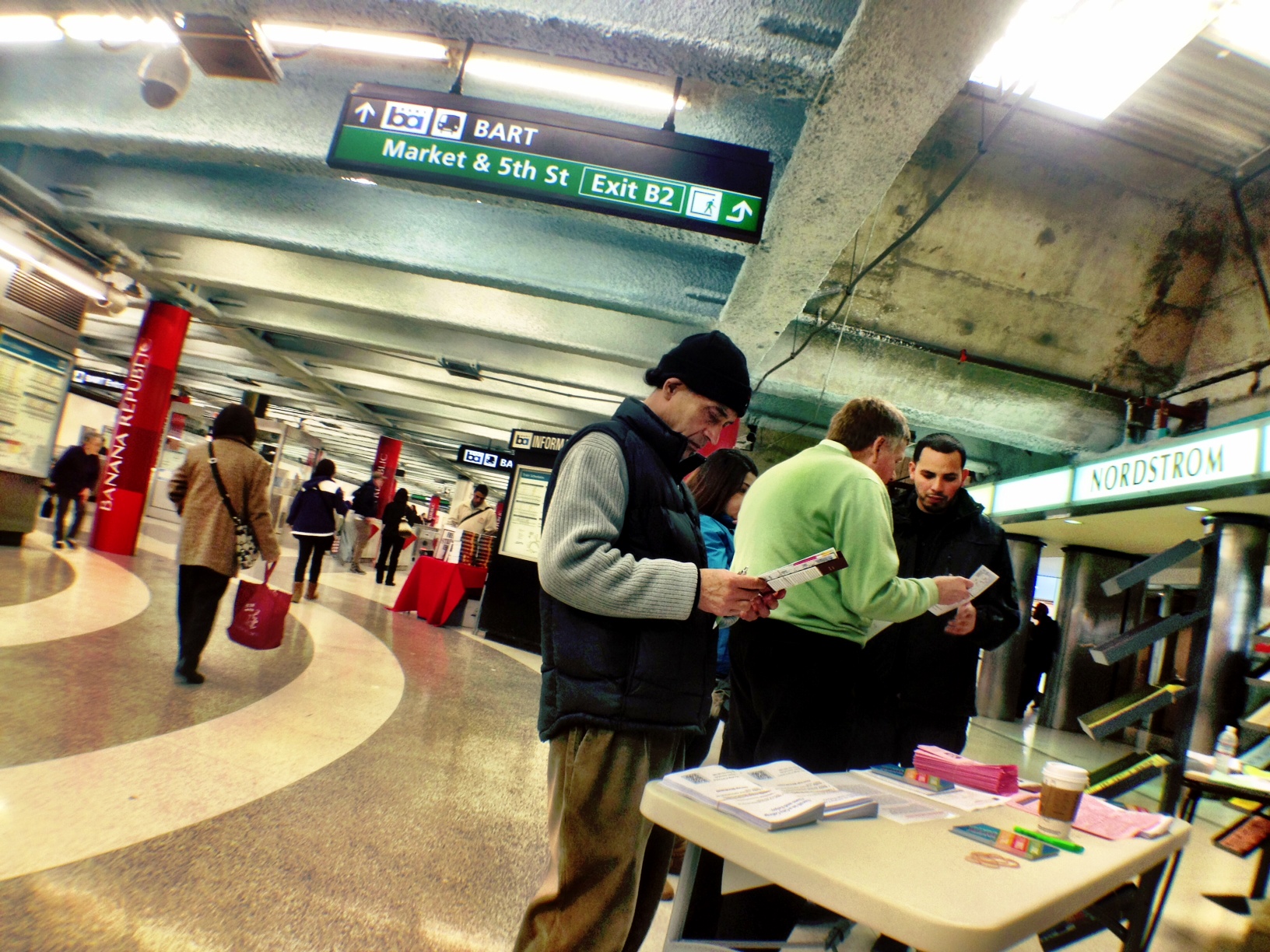
Walking through the Powell BART and Muni station, commuters are used to hearing the cries of a melange of musicians, crazies, and those with something to sell. Today and tomorrow though, commuters will hear something entirely different, as teachers cry “Enroll at City College! Enroll now!” through transit stations across San Francisco.

Teachers and faculty from the equally bedeviled and beloved school, City College of San Francisco, are out in force with flyers and laptops trying to shore up an enrollment deficit of 3,000 students. Today they’re at the Powell, Montgomery, and Embarcadero stations, handing out flyers and enrolling potential students on their laptops. Tomorrow, they’ll be at Civic Center, Mission, and Balboa street Muni and Bart stations doing the same.

The lack of student enrollment would deprive the school of $6.5 million dollars in state funding, which the school has responded to by cutting faculty and administrative salaries by 8.8 percent, and electing not to rehire, essentially letting go, 30-40 part time teachers, 18 part time counselors, and 30 clerical staff.

It’s no wonder these teachers are out on foot, enrolling as many folks as they can — and they say they’ve met with some success.

“I’ve been surprised how receptive people have been,” said Lizzie Brock, a basic skills English teacher at the college. Brock was on her feet handing out flyers for four hours, despite being about six months pregnant with her second child. “It’s a labor of love,” she said.

Though Brock only recently became a tenured teacher at the college, having taught there full-time for six years, she can’t afford to live in San Francisco on her salary from CCSF. She lives in Pacifica, commuting to the city to teach her classes.

Thomas Blair, a foreign language department head at CCSF who also teaches French, organized the two days of outreach. An older gentleman with snowy, neatly combed hair, and a kindly manner, he’s the last person you’d expect to sound the trumpets and gather 90 or so teachers to hit the pavement.

His passion for the college lies in these simple facts: he’s taught there for more than 30 years, and as a department head, he has a responsibility to all of the foreign language teachers at the college, and the thousands of students who open themselves to learning how to communicate with the world.

“I brought the table on the K with me all the way from Ocean Avenue,” Blair said. He thinks he has a pretty good chance of signing up new students from commuters, because those in the 30-55-year-old crowd are often the ones taking new languages at City College, he said. “The office workers are a very good segment for us now,” he said.

Guillermo Romero, a blueprint reading instructor at CCSF, was also there handing out flyers. Streams of people flew past Romero, but he was undeterred. Romero is confident that his classes will meet enrollment, simply because of his philosophy in teaching his class, he said.

Disfrutando euseñando, disfrutando aprendieindo,” Romero said. If you enjoy teaching, they’ll enjoy learning — and hopefully be back for more.

The Guardian, the Examiner, and the Weekly

115

As you can all imagine, I’m getting calls and emails, so let me clear it up: Yes, San Francisco Newspaper Co. has bought SF Weekly.

Yes, Todd Vogt is the co-owner of the Examiner, Guardian and now Weekly, but for the record, I am the editor and publisher of the Guardian.

No, there are no plans to merge the two weeklies or consolidate them or combine the editorial staffs. We will continue to do our best to be the progressive voice of San Francisco; the Weekly, I assume, will continue to do its own different thing.

And no, this doesn’t mean that I’m going to suddenly be BFFs with Joe Eskenazi. We have our view of things; he has his. I fervently believe that we will continue to disagree, and the city will be served by the ongoing debate. (Unless Joe comes to his senses and realizes that I’m always right.)


Feds downgrade troubled Housing Authority

9

The federal government has declared the San Francisco Housing Authority a “troubled” agency and dispatched agents to review the agency’s finances and management failures.

The team of experts from the Department of Housing and Urban Development arrived Jan. 7 and has begun poring over the SFHA’s books.

The federal decision came in an October 31 letter to the city’s Housing Authority Board, with a copy to Mayor Ed Lee.

“The Board of Commissioners of the San Francisco Housing Authority should take immediate action to identify the sources of the performance deficiencies and develop and implement a plan to recover” at an “acceptable level of performance,” wrote HUD in its letter.

The troubled ranking is further bad news for Executive Director Henry Alvarez, who was hired in 2008 to help steady the agency’s management. He has since faced allegations of mistreatment and discrimination by some of his top staff, including the agency’s lawyer. He is the target of three lawsuits by his staff.

In addition to the “troubled” status for public housing, SFHA already faced stepped up monitoring if its Section 8 program that provides rental assistance for program participants in privately owned units. The agency scored zero points in its section 8 program because it failed to submit its report.

San Francisco’s “troubled” status was due to low scores for management of the agency and its finances. On financials, SFHA scored five points out of a possible 30, and on management it scored 12 points out of a possible 25. On physical conditions, SFHA squeaked above the cut-off with 27 out of 40 points. The agency’s total score was 54 out of a possible 100.

The score was a drop from score of 75 the prior year. The SFHA explains the change as new scoring criteria by HUD. The looming issue is the lack of effective management at the agency’s top level.

The arrival of a HUD team this week for a week-long examination of the Housing Authority will produce a plan for the agency to correct its management and financial practices with a set of deadlines and specific actions. Failure to implement the plan can bring new consequences with even tighter oversight.

“HUD is at SFHA offices starting today,” said Bill Ford, SFHA attorney speaking for the agency on Monday. “They are reviewing the situation related to the Troubled status. That’s why they are here. They will help develop a plan to pull the agency out of Troubled status.”

The agency had managed to stay off the troubled list — a designation for those scoring under 60 out of 100 points–for the previous two years. A troubled status can make San Francisco ineligible to compete for special funding beyond what it receives by formula.

HUD scoring lags by several months after the agency’s year-end as local officials and federal officials go through appeals and responses before settling on a final outcome. The current troubled status is for the SFHA year that ended September 30, 2011.

SFHA scores for the year ending September 30, 2012 are tentatively estimated also to be in the troubled category or possibly a point or two higher to earn it a “substandard” ranking. Those results are expected shortly to be followed by additional appeals and reviews.

Some one out of 10 San Francisco households receive some form of federal housing aid, not including those who benefit from lower mortgage interest rates under FHA and other federal homeownership mortgage programs.

SFHA earned high marks in the credit market for its HOPESF program that aims to replace decrepit public housing and expand the number if units. That process involves to outside managers to develop and operate and does not rely on SFHA management.

Behind today’s unanimous vote for Chiu

37

For all the high-minded talk about diversity and working together on behalf of the public – and the relentless praising of their political colleagues and supporters – today’s unanimous re-election of David Chiu as president of the Board of Supervisors once again demonstrated that much of the people’s business is done behind closed doors.

As most of the supervisors acknowledged publicly or in comments to the Guardian, in recent days there was a flurry of meetings about the president vote among the supervisors, despite the prohibition in the state’s Brown Act against “seriatim meetings,” in which elected officials have serial meetings with each other until an quorum of supervisors has illegally discussed some topic.

How else could Malia Cohen, Jane Kim, and Scott Wiener – all hopefuls for the president’s seat who withdrew themselves from consideration before a vote was cast – have all known that Chiu had the votes he needed to win an unprecedented third consecutive term? But they did know, as they all told the Guardian.

“The reality was the support wasn’t there,” Cohen told reporters after the vote when asked why she withdrew her nomination just before the supervisors were about to vote, just after Kim had done the same thing, leaving Chiu as the sole nominee.

I asked whether she was promised anything in return for withdrawing from consideration, and Cohen said, “There’s always negotiations involved in everything, from committee assignments to appointment to regional bodies…The full story will come out later.”

Cohen even obliquely suggested that Chiu – who is known to have his sights set on Tom Ammiano’s Assembly seat, which comes open in two years – may not serve his full two years as president and that was part of the backroom discussions. In the more immediate future, Cohen said she wants to serve on the Land Use Committee, so don’t be surprised if Chiu appoints her as chair of that powerful body.

“It may seem like a small setback today, but it sets the stage for greater conversations going forward,” Cohen said of her decision to voluntarily step down.

Kim also told reporters that she knew Chiu had the votes – saying “we know there was broad support for David for another term” – and that the decision that she and Cohen made to nominate one another was mostly symbolic, intended to make a point about the need for women of color to be in leadership positions: “I thought it was important that we put the dialogue out there.”

Kim said she really appreciated the opportunity to speak with more fellow supervisors privately in the last few days than she had before. “All of this was last minute. There were really only discussions in the last three days,” Kim told me. “I got a good sense of people’s policies and priorities.” As for Kim’s priorities, she said she wants to serve on the Budget Committee, so don’t be surprised when Chiu names her as chair.

Wiener also told me that he realized a couple days ago that he didn’t have the votes but that Chiu did. “It would have been an honor to serve as board president, but it wasn’t in the cards,” Wiener said.

Some of what the cards showed was made clear as the nominations for president opened today and new Dist. 7 Sup. Norman Yee spoke first and nominated Chiu, thus making it clear that Kim probably didn’t have the six votes she needed. As former Sup. Chris Daly, a veteran vote counter, told me, “Norman Yee and Eric Mar could have made Jane Kim board president. They were the deciding bloc, but it would taken both of them.”

Yet Mar told us that he was caught off guard by how the voting unfolded today. “I was surprised that people dropped out before the vote,” he told me.

Yet he acknowledged that it was perhaps a smart move by the progressive supervisors, who voted against Chiu two years ago and were punished with bad committee assignments, to instead get behind Chiu now and hand him a unanimous victory.

“I think that was the hope when people dropped out. It would have been hard if they didn’t, but these negotiations [with Chiu over committee assignments] will go on over the next few days,” Mar said, noting that he will push for strong representation by supporters of labor and other progressive constituencies on key committees.

Asked about his negotiations with fellow supervisors, Chiu would only say, “My conversation with everyone was very consistent.” As for his pending decision on committee assignments, he told me, “We have a board that is very diverse and we’ll have committees that reflect that.”

During his speech in Board Chambers, Chiu talked about running the board in a way that would let each supervisor have her/his moments in the spotlight to provide leadership on issues they care about, comparing it to the San Francisco Giants and the contributions that so many players made to their World Series sweep.

“They took turns making the big plays,” Chiu said, going on to tick off the list of how he’ll help his colleagues shine. “Whether it’s Sup. Mar advocating for a healthy environment, Sup. Farrell addressing out looming health care costs, whether it’s Sup. Chu disciplining our budget, Sup. Breed getting the jobs that young people need, Sup. Kim making sure that all our kids graduate, Sup. Yee making sure that small businesses succeed, Sup. Wiener fighting for better transportation options, Sup. Campos fighting against wage theft, or Sup. Cohen curbing gun violence, and Sup. Avalos delivering on local hire, by the end of our season, if we’re going to help each other succeed in getting these things done, we are all going to win.”

Gascon, Adachi and conviction rates

25

Public Defender Jeff Adachi just released his annual report, and it’s impressive: According to the statistic his office complied, of the 60 felony trials handled by deputy public defenders, 62 percent resulted in acquittals or hung juries. That means that the office of District Attorney George Gascon has a trial conviction rate of just 38 percent when the DA’s office is up against the PD’s office.

That’s a pretty abyssmal conviction rate — and the DA’s office has a different spin. According to DA spokesperson Stephanie Ong Stillman, the overall conviction rate on felonies in 2012 was 67.7 percent. But that includes plea bargains, which officially count as a conviction; she didn’t dispute Adachi’s contention that public defenders win far more than half of their actual trials.

There are a couple of ways to interpret this. Not all criminal trials are handled by public defenders; the better-off defendants hire private counsel. And there’s an old assumtion in the world of criminal justice that rich people get better legal defense because they can hire high-priced private counsel.

But if the DA’s figure are accurate, it’s entirely possible — although nobody has the figures — that the San Francisco PD’s office actually does better in criminal trials than private law firms. Tamara Aparton, spokeperson for Adachi, said she has no data on that, but “I wouldn’t be surprised.”

And there’s no way to dispute the fact that low conviction rates indicate the DA is sending weak cases to trial. If criminal defendants are getting off more than half the time, either the cops are making very bad busts (true all too often) or the DA is trying cases that should have been settled.

Sunday metering begins in SF but few notice

15

Yesterday, after years of heated conflicts over the issue, San Francisco officially began charging motorists to use metered parking spaces between noon and 6pm on Sundays – and nobody seemed to notice.

For the first few weeks, parking control officers with the San Francisco Municipal Transportation Agency are going to be issuing warnings rather than expensive parking tickets. But as Streetsblog SF reported today, even that didn’t seem to be happen. Its street survey in the Haight and Mission districts found that most parkers didn’t pay, and they received no warnings that they were supposed to.

SFMTA spokespersons that didn’t respond to Streetsblog inquiries also haven’t responded to questions from the Guardian about what happened and how many warnings were issued (UPDATED BELOW).

Sunday metering is intended to create more parking turnover in busy commercial corridors and bolster the SFMTA’s budget, capturing more money for Muni. But for now, it seems that everyone involved is still trying to shake off their holiday hangovers and get up to speed.

UPDATE 5:45: SFMTA spokesperson Paul Rose just returned our call to say parking control officers were indeed busy issuing warnings yesterday. “We issued about 4,000 warnings yesterday. That’s part of getting the word out,” he said. As far as Streetsblog’s observations, he said it could have been a fluke of timing or the fact that meters don’t indicate when someone pre-pays or pays by cell phone. “In the Haight, specifically, we issued about 600 warnings, and about 1,000 in the Mission,” he said. In addition to the direct warnings, the SFMTA has been publicizing the Sunday metering on billboards and Muni posters, through merchant groups, in the media, and on the meters themselves. 

Enforcement with actual tickets begins on Jan. 27.

New school lunches: “awesome.”

15

There’s still a lot of controversy around SFUSD’s new school lunch program and how much it’s actually going to cost. But the early reports from Aptos Middle School are very, very positive. I received a text from my son today that says: “Tell the School Board that the new lunches are awesome.”

Much better than the previous fare.

So there’s some good news. 

Eviction of activist/gardener squatters follows HANC’s eviction

55

About 20 activist gardeners were thrown out of the old Haight Ashbury Neighborhood Council (HANC) Recycling Center space today, when Sheriff’s Department deputies and four park rangers surrounded the old HANC site and ordered them to leave.

It’s the second eviction on the same site this winter, as the recycling center that has been there for over 30 years before being ousted by city officials responding to neighborhood complaints about low-income recyclers. HANC was initially evicted on Dec. 27. In the wake of its closure, about 20 or so renegade gardeners set up a campground with their own urban gardening center in the space — with free seeds, soil, mulch and borrowable gardening tools for the community. 

The gardeners, wrapped in sleeping bags and inside tents, had a rude awakening this morning around 6am. At least 30 members of the Sheriff’s Department, led by Sheriff Ross Mirkarimi, announced that they were trespassing and had five minutes to leave. 

“It was right at sun-up, and I was in my sleeping bag,” said Joash Bekele, a 28 year old environmental activist. “We thought they were coming [yesterday], we were up all night — worrying that they’d come.”

They didn’t have long to gather their gear, and a lot of their tools were left in the now locked HANC site, said Ryan Rising, one of the key organizers of the group. Most importantly, they lost their newly built miniature greenhouse, which they constructed themselves.

“A lot of this is about food justice,” Rising said. It’s a better alternative to the community garden that the Recreation and Parks Department (RPD) plans to build in the space, he said, because it would encourage community input in everything they do. 

“It would be a neighborhood space,” he said. 

RPD officials did not respond to emails before press time (UPDATED BELOW).

The group is now out on the sidewalk beside HANC, on Frederick Street. Along the fence of the old recycling center sits bags of soil and mulch, books on gardening, and a sign that reads “Welcome to the Golden Gate Recology Center.” 

The now-evicted gardeners answered questions about gardening from passers by, and offered tips on sustainable cooking and gardening to anyone who happens by with a question.

The group of “renegade gardeners” are meeting tonight to discuss their next plan of action, which may include staying on the sidewalk outside HANC, or finding a new space altogether, Rising said. 

The Sheriffs Department didn’t reach us by press time for comment (UPDATED BELOW), nor did Mirkarimi. A park ranger at the site, William Ramil, said that the eviction was a peaceful, orderly one.

As Ramil described the scene, we stood outside the locked gate to HANC. Three cars pulled up, a Lexus, a Saturn, and a Honda Hybrid, all customers looking for the recycling center.

Andrew Herwitz, behind the wheel of the Saturn, was surprised to see HANC closed. “Having places that are community-run are so important,” he said.

He said he was heading to the Safeway on Market Street with his recycling now, begrudgingly.

UPDATE 1/7: Sheriff’s Department spokesperson Kathy Gorwood disputed reports that there were about 30 deputies at the scene, but confirmed that the evictions were peaceful and with no arrests made, declining further comment. RPD spokesperson Sarah Ballard told us, “The Department is pleased to be moving forward with the neighborhood-supported plan for a community garden at the site.”

Corporations and carpools

60

I absolutely love this story: A Marin activist named Jonathan Frieman, who runs a small nonprofit corporation (the JoMiJo Foundation) was driving in the carpool lane on highway 101 in Marin when he was stopped by a cop and given a $478 ticket. Ah, but Frieman insists he wasn’t driving alone; beside him in the car were the articles of incorporation and other relevant corporate paperwork for his foundation — and in the United States, corporations are considered people. In fact, the California Vehicle Code refers to “natural persons or corporations.”

So Frieman is challening his ticket in traffic court, and is willing to spend his own money to appeal the case as far as he can. He wants to force the courts to decide: If a corporation is a person, then it gets to ride with a driver in the carpool lane, and his ticket has to be dismissed. If it’s not a person, then maybe it can’t make political contributions.In fact, if a corporation isn’t a person, a whole lot of evil stuff might come to an end.

Could a traffic fine be the ticket to that ruling? Who knows — and at the very least, Frieman is helping point up the absurdity of the current state of the law.

This is no fluke, by the way: Frieman, a longtime community activist, has been looking for ways to challenge corporate personhood for more than a decade. He’s convened legal scholars, looked for avenues to challenge the notion that corporations have the same rights as the rest of us — and along the way, came up with this idea.

It’s taken a while because the California Highway Patrol hasn’t been all that vigilant. “I’ve been driving up and down 101 in the carpool lane with my corporate papers for years,” Frieman told me. “I never got a ticket until October 2.”

His first hearing is in Marin’s traffic court in San Rafael on Jan. 7.