In an announcement that could transform transportation policy in San Francisco, the startup company Lyft is prepared to take over some of the most crowded and dysfunctional Muni routes in San Francisco.
Mayor Ed Lee and the Municipal Transportation Agency have approved a plan that would turn the 38 Geary, 30 Stockton, and 14 Mission over to the tech startup, City Hall sources told us. The plan is still tentative and the Mayor’s Office is trying to keep it tightly under wraps until the financial details are complete.
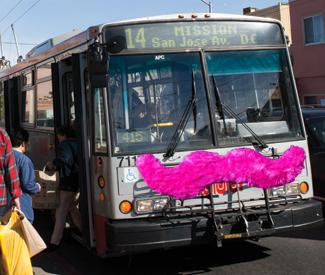
However, documents provided to the Guardian show that Lyft would buy at least 68 buses, including 12 articulated vehicles, at a price still to be negotiated. In exchange, the city would give the company – known for its pink mustaches on illegal taxi cabs – exclusive rights to operate on the heavily-used lines.
Lyft is developing an app that would allow customers not only to view approaching buses but to book specific seats for an additional price. Sensors in the bus seats will emit an electronic buzz to alert passengers that their seats had been purchased by someone else, warning them to vacate by the next stop. If the passengers remain, they will feel a sharp electric shock.
Lee’s office said the plan is similar to the market-based parking-meter program that raises the price of a space in times of heavy demand.
“The free market solves so many problems,” Christine Falvey, spokesperson for Lee, told us. “And it’s pretty clear that too many people who don’t really need to sit down or who are perfectly capable of waiting for a later conveyance are taking up space on the most crowded buses.”
Ron Conway, the venture capitalist who is Lee’s closest ally in the business community, will invest as much as $40 million in the new venture, Silicon Valley sources say. If the trial public-private partnership works, he’s prepared to raise money to buy out Muni and turn the city’s bus system into a private operation.
“You’ve got a captive market, and demand-based pricing is what’s happening these days,” Falvey said. “It’s just the next step.”
Now that human toll collectors have vanished from the Golden Gate Bridge, motorists can expect their license plate numbers to be recorded for fare collection. Yet one aspect of this shift to receive little ink in recent media reports is the privacy implications of the new electronic system.
Slowing without stopping may improve traffic flows, but it also means motorists’ movements are tracked by default. Databases logging bridge-crossings can be mined for information: Subpoenas for FasTrak and similar electronic toll collection systems are on the rise, even for purposes such as divorce cases.
As the Electronic Frontier Foundation’s Senior Staff Technologist Seth Schoen noted in a recent blog post: “All of the bridge’s electronic payment options track the identities of those paying the toll, and all represent a loss of privacy for visitors or commuters entering San Francisco by car.” (Full disclosure: Schoen is a friend and former coworker.)
As the Wall Street Journal noted last year, it’s part of a wider trend of privacy erosion: “Storing and studying people’s everyday activities, even the seemingly mundane, has become the default rather than the exception.”
As Airbnb continues to avoid making any public comment on the $1.8 million annual Transient Occupancy Tax obligation to the city that it appears to be dodging, with the complicity of the Mayor’s Office, Board of Supervisors President David Chiu is getting closer to introducing legislation to regulate so-called “shared housing” and holding public hearings on the issues it raises.
In addition to the tax issue, there are concerns that Airbnb, VRBO.com, and other Internet-based sites that facilitate short-term rentals of San Francisco apartments are increasingly being used to circumvent local tenant protections, often after evicting tenants from the apartments using the Ellis Act. That state law allows owners to leave the rental business and convert to other uses, and landlords can argue that Airbnb is a commercial use and not a residential use.
“I’ve been deep into a lot of these issues in my conversations with a lot of community stakeholders around Airbnb and the area of shareable housing and I’m hoping very soon to have a package of proposals in this area. And at that point, we’ll have public hearings on the topics that you describe,” Chiu told us when we asked about the tax and tenants issues.
Among those involved in Chiu’s negotiations with Airbnb is Ted Gullicksen, executive director of the San Francisco Tenants Union, who says the negotiations have been slow-going but he’s generally happy with how they’re proceeding and hopeful that the resulting legislation will rein in rampant current abuses of zoning, tax, and other regulations that city officials have been ignoring.
“All you have to do is sit in front of the computer for a few hours and you can identify a lot of the lawbreakers. But there’s no enforcement by the city,” he said, noting that the Tax Collector’s Office is the notable exception among city departments, such as the Planning and Building departments. “The taxes shouldn’t even be an issue because they’re illegal uses.”
For example, while landlords may be able to get around rental restrictions triggered by an Ellis Act eviction by calling the use for shared housing websites “commercial,” that’s usually a violation of local planning codes prohibiting commercial use of residential property. Chiu’s legislation approved late last year banning “hotelization,” in which entire apartment buildings are cleared of tenants and rented out on a short-term basis, allows nonprofit groups like the Tenants Union to help enforce the ban.
“We’ve been researching the buildings we want to go after with complaints and lawsuits,” Gullicksen said. “It’s a pretty widespread problem.”
He said the VRBO.com appears to be a bigger culprit in terms of being used by landlords to avoid tenant protections than Airbnb, whose hosts are evenly split between tenants and landlords. But as the biggest shared housing service in San Francisco, the tax issues are bigger for Airbnb and the city.
“We don’t mind the limited use of someone’s principal residence for short-term rental, where we’re concerned is about the whole buildings,” Gullicksen said.
Whether the issue is avoiding taxes or circumventing tenant protections, the complicated issues surrounding shared housing are long overdue for some public discussions and scrutiny, and it sounds like that’s what we’re see later this spring or summer.
I had lunch with my old friend Johnny Angel Wendell, a musician, actor, and radio personality in LA, who was up here on vacation (and to hype his new vinyl, “My Lesbian Friend,”) and we got to talking about the Supreme Court and same-sex marraige, and Johnny and I have agreed for years that this debate is essentially over. When 80 percent of people under 30 think same-sex marriage is fine, then it’s really only a matter of time before it’s legal and encouraged in every single state.
Johnny knows a lot of folks in talk radio, and a lot of them are on the right-wingy side of things, so he’s a dinosaur watcher, and he had this suggestion: The reason the right wing is all agitated about same-sex marraige, and really wants the Supreme Court to avoid saying that Prop. 8-style laws are all unConstitutional, is that these folks are starting to run out of divisive social issues. The “god, guns, and gays” approach doesn’t have the power it once did — and once that stuff goes away, then they’ll have to start talking about economic issues — where they will always lose.
Thomas Frank figured that out in What’s the Matter with Kansas — social issues have been driving working-class Americans to vote against their economic interests. Imagine if the next generation doesn’t care about gay marriage at all; then maybe those voters will think about taxes and wealth inequality and corporate power. And for a certain segment of American politics, that’s really frightening.
The headline on sfgate is about as brutal as you can get: “The coming homeless die-off.” But the brief story points to an alarming set of statistics: The median age of homeless people on the streets of US cities is now 53. The life expectancy for homeless people is 64. You get the point.
But here’s the key political element:
Social scientists say the median age has been steadily increasing for many years, supporting the “big bang” theory that many of today’s street people hit the gutter back in the 1980s era of recession and slashings of social programs.
Having lived through the Reagan Era, and worked with homeless people in the early 1980s at the Haight Ashbury Switchboard, I can tell you that makes perfect sense. Vast libraries of books have been written about the Reagan Era, but one of the things it represented was the end of major federal support for low-cost housing in cities — and the end of any concept of linking welfare payments to the cost of housing.
There were a lot of people living on General Assistance and SSI in San Francisco in the late 1970s, and most of them had homes. That’s because public assistance programs provided enough income to cover the rent on a cheap place. Between GA and food stamps, people who were, for whatever reason, unable to work wound up in crappy apartments and sometimes crappier SROs, but they weren’t on the streets.
Yes: Some of those people had serious substance-abuse issues. Yes: SSI and GA checks were going, in part, for drugs and booze. But even ignroing the notion that it’s much better for a drunk to have an SRO room than to be homeless, it’s also cheaper. San Francisco spends a fortune on homeless services, and if the feds (and the City and County) had indexed public assistance to the cost of housing (which happened pre-Reagan) the toll on the local taxpayers would almost certainly be lower.
So Reagan’s policies are now killing people on the streets of San Francisco. All these years later.
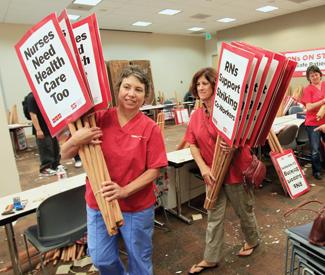
As we’ve reported, reaching a deal with its nurses seemed to be the last major hurdle for Sutter/CPMC to overcome before the community-labor coalition would fully support the compromise hospital deal that a city-CPMC negotiating team announced on March 5. The nurses helped force that hard-won deal in part by aggressively advocating for St. Luke’s Hospital to remain financially viable and open to the low-income community it serves.
“We are delighted to finally reach a contract deal. It’s been six years of a very contentious relationship,” Eileen Prendiville, a registered nurse who works at CPMC’s California Campus, told the Guardian. She said that the nurses are thrilled to have attained good job security and patient advocacy standards while ensuring St. Luke’s stays open. “Working with a coalition of labor and community, we were successful at changing the face of healthcare in San Francisco.”
Under a previous agreement reached last year between CPMC and the Mayor’s Office, St. Luke’s would have had just 80 beds and could have been closed if the corporations revenues sagged. But activists and the Board of Supervisors were able to kill it and force the corporations back to the bargaining table.
Sup. David Campos, who help negotiate the latest hospital deal, said he was “thrilled” to hear Sutter/CPMC reached a deal with CNA. “We’ve always said it’s really important as we finalize the agreement that there is protection for the workers,” Campos told us.
Board President David Chiu, another key negotiator in the recent deal, told us, “I’m tremendously excited that there’s finally an agreement between oru nurses and CPMC, and thank the parties for their hard work in reaching this point. Along with the agreement we recently arrived at for the new Cathedral Hill and St. Luke’s campuses, this is an important moment for our city’s health care futue.”
CPMC spokespersons didn’t immediately respond to our calls for comment, but we’ll update this post if and when we hear back. The CNA press release announcing the deal and its details follows:
Nurses Reach Agreement with Sutter California Pacific
RNs Hail Community Support, Decision to Keep St. Luke’s Open
Registered nurses at two San Francisco Sutter hospitals, California Pacific Medical Center and St. Luke’s Hospital, have, at long last, reached agreement with hospital officials on a new collective bargaining contract for the 800 RNs who work at the two facilities, the California Nurses Association said today.
The agreement expands patient protections, strengthens the nurses’ bargaining and job security rights, and provides for economic gains. It must still be ratified by CPMC and St. Luke’s nurses who will vote on the pact in membership meetings soon.
The RNs emphasized that they are especially pleased with the overall political and community framework, announced earlier this month, that preserves St. Luke’s after years of uncertainly and threats of closure for the historic hospital that serves a medically underserved community in San Francisco.
CNA Executive Director RoseAnn DeMoro praised the unity of the nurses over the long contract fight and the broad public support for nurses as critical to protecting St. Luke’s and winning a new agreement for the nurses.
“San Francisco nurses have worked extremely hard, with the widespread support of a very broad community coalition and the support of a number of community leaders, including members of the Board of Supervisors, to protect this vital community resource. We are proud of the efforts of everyone who has held the line for maintaining St. Luke’s,” DeMoro said.
For the first time, the RNs at both hospitals will be under one contract with equal job security and seniority rights. The pact includes safe patient handling provisions to stem patient falls and injuries to patients and nurses. Additionally it obligates the employer to provide for meal and rest breaks and stipulates that new technology not supplant RN professional judgment.
On economics, all the RNs will receive across the board pay increases of 6 percent over the next 34 months, as well as additional pay based on years of service in the San Francisco hospitals, at other Sutter facilities, and foreign nursing experience.
“We are delighted to finally reach a contract settlement with Sutter/CPMC,” said California Pacific campus RN Susan Blaschak RN. “Our contract provides for continued patient advocacy and will keep our professional nursing standards high for years to come.”
“The process has been tumultuous but in the end we had a vision and we were successful in performing the ultimate in patient advocacy – saving St Luke’s,” said Jane Sandoval, a St. Luke’s RN and CNA board member. “In addition, with our collective bargaining agreement we have preserved patient care standards, having a voice in that and in our professional integrity.”
“Working with a coalition of labor and community groups, we have been successful in changing the face of healthcare for San Francisco’s future. St Luke’s will not only remain open it will offer more healthcare services to residents in the community south of Market,” said Eileen Prendiville RN at the California Pacific campus of CPMC.
“Our contract settlement was also made possible by the strong support for the nurses by San Franciscans for Healthcare, Housing, Jobs and Justice as well as elected leaders who knew San Franciscans overall would be best served by a fair collective bargaining agreement,” said Sandoval.
CNA also calls on Sutter officials in its headquarters in Sacramento, and other Sutter regions to view the San Francisco agreement as a new opportunity to resolve outstanding contract fights with RNs in the East Bay and North Bay.
Nurses have now reached agreement with CNA-represented Sutter hospitals in the past nine months at Mills-Peninsula in Burlingame and San Mateo, Sutter Santa Rosa, Sutter Lakeside in Lakeport, and Sutter VNA in Santa Cruz.
Contracts remain unresolved at Alta Bates Summit in Berkeley and Oakland, Eden in Castro Valley and San Leandro, Sutter Delta in Antioch, Sutter Solano in Vallejo, and Sutter Novato.
“Every one of those disputes could also be resolved if those hospital’s officials would approach negotiations with a desire to stop the war on their nurses, remove unwarranted and punitive concessions demands, and show the community served by their hospitals that they desire a cooperative relationship with nurses based on therapeutic healing for their patients,” said Sandoval.
See an update to this story below. San Francisco Mayor Ed Lee has been having breakfast with CEOs to seek millions in funding for the America’s Cup, but the identities of those CEOs remain a mystery.
At a City Hall hearing two weeks ago, America’s Cup Organizing Committee chief Kyri McClellan told supervisors that Lee has been “putting an incredible amount of energy” into fundraising to cover city costs for the America’s Cup. As the yacht race draws closer, pressure is building around an anticipated funding shortfall that could deal a blow to city coffers.
McClellan told supervisors that Lee was “holding breakfasts with CEOs” to raise money. Encouragingly, she added, “people are responding.”
So, who are the CEOs? And how much have they agreed to contribute? So far, nobody has disclosed that information.
Shortly after the hearing, the Guardian submitted a public records request to Lee’s office seeking documentation on the fundraising breakfasts and records showing the names and affiliations of the CEOs.
In response, we received several pages from the mayor’s calendar. Entries show that Lee held half a dozen meetings concerning “economic development,” with no mention of the America’s Cup. The mayor had a meeting at Waterbar, a restaurant on the Embarcadero overlooking the Bay Bridge, on the morning of Jan. 25; he had another meeting there Feb. 1; he met at the Hotel Vitale on Feb. 22; met at City Hall on Feb. 28; had breakfast at the St. Regis Hotel on March 1, and had lunch with someone at Original Joe’s on March 4. But there was no information disclosing whom he met with.
After receiving the documents, the Guardian left multiple voicemails with the mayor’s press office asking for the identities of the CEOs. So far, nobody has responded.
The request also yielded a fundraising form that asks prospective donors to “join the 2013 America’s Cup San Francisco Host Committee.”
Donors could opt to become a “Legacy Benefactor” for committing to give or raise $5 million; a “Legacy Partner” for $2.5 million; a “Strategic Partner” for $1 million, a “Civic Champion” for $500,000, or a mere “Member” for $250,000. Donors with questions or who wished “to connect with Mayor Lee” could call Stephanie Roumeliotes, the form noted.
Roumeliotes is a prominent fundraiser and political strategist who provided financial consulting for the re-election campaigns of Senators Dianne Feinstein and Barbara Boxer. She was appointed to serve on the Golden Gate Concourse Authority, a part of the Recreation and Parks Department, by former Mayor Gavin Newsom.
A call to the number listed went to SGR Consulting, Roumeliotes’ firm. The receptionist declined to comment or to connect the Guardian with Roumeliotes, saying, “All press inquiries should be directed to the Mayor’s Office.”
UPDATE: We just received a voicemail from Christine Falvey, Mayor Lee’s press secretary, who told us “I don’t have a list of the attendees for those breakfasts. They were hosted by the America’s Cup Organizing Committee.” Which raises more questions, but in any case we placed a call to race organizers and will update again when we know more.
LGBT rights activists held a vigil outside the California Supreme Court building in San Francisco March 26 as part of several events launched in response to yesterday’s U.S. Supreme Court hearing on Proposition 8. Today, the court is considering the Defense of Marriage Act, a law that restricts federal marriage benefits for same-sex couples.
The slideshow features interviews with (in order of appearance) Justin Taylor, who said he was there to stand up for the rights of his mothers, who have been together for 16 years; Jackie Jolly, who said that for her the issue is about the underlying principle of equality; Thomas Coy, who teared up as he addressed the crowd and shared a memory of his husband, who passed away three years ago; and Trey Allen, who helped organize a rally and march on Monday and expressed hope that the Supreme Court would reach a favorable outcome at the end of June.
Photos, audio and slideshow by Rebecca Bowe
This evening, LGBT activists will return to 350 McAllister Street in San Francisco to hold a second vigil from 4 to 8 p.m.
According to studies, queer seniors are poorer than their straight counterparts. They’re half as likely to have health insurance, and two-thirds as likely to live alone. Not to mention facing discrimination in medical and social services, retirement homes, and nursing care facilities. So much for the “golden years.” Here in San Francisco, LGBT seniors face another grave threat: evictions. Many of our elderly live in rent-controlled apartments that are targeted by real-estate speculators and investors out to make big bucks turning them into tenancies-in-common.
With median rents close to $3,000 a month and vacancy rates low, the odds are pretty good that an evicted senior won’t find an affordable place in the city. For a senior with AIDS, an eviction is especially threatening since our city offers the best treatment and services. Studies show that people with AIDS who lose their apartments tend to die sooner, especially if they become homeless.
The only LGBT organization that actually addresses the housing needs of queer seniors is Open House. Its 110 units at 55 Laguna will be the first affordable queer senior housing development in the city. I hope it’s not the last. As for seniors with AIDS, there’s only one AIDS organization in the vast list of groups and services — the AIDS Housing Alliance — that actually finds housing for its clients. It was started by Brian Basinger, a gay man with AIDS, after he was evicted and his apartment was sold as a TIC.
No one knows how many LGBT seniors have been, and are being, evicted. Ditto for how many seniors with AIDS end up on the streets. We also don’t have stats on how many transgender seniors are victims of real estate greed or live in absolute terror of losing their homes.
The Rent Board doesn’t break down its eviction stats by sexual orientation or even age. The city’s homeless count doesn’t mention if someone’s queer or transgender. There is no way to determine how many LGBT seniors live in SROs or with life-threatening conditions such as mold or lack of heat. Or how many live in homes that have been — or are being — foreclosed.
That’s why the housing subcommittee of the city’s LGBT Aging Policy Task Force is holding a hearing into the housing needs and concerns of queer seniors. Information is power.
All LGBT seniors — housed and homeless — are invited to come testify about their housing issues. Whether they live in an SRO or a home that they own, whether they sleep in a shelter or a rent-controlled apartment, whether they’re in a subsidized unit or an illegal in-law, the subcommittee wants to hear from them about their concerns and needs.
The subcommittee will ultimately be making recommendations that will be included in a task force report on what the city can do to address LGBT issues. LGBT seniors deserve their golden years.
The hearing is Monday, April 1, 9am to 12 noon, room 416, City Hall. Written testimony accepted. For more info, call Tommi at 415-703-8634. Tommi Avicolli Mecca is a longtime queer and tenants rights/affordable housing activist who works for Housing Rights Committee. He is a member of the LGBT Aging Policy Task Force.
Thirteen years ago, the San Francisco Board of Supervisors enacted an ordinance designed to make city services more accessible to lesbian, gay, bisexual and transgender youth. Under Chapter 12N of the San Francisco Administrative Code, city departments must provide LGBT sensitivity training “to any employee or volunteer who has direct contact with youth.” It also applies to any collaborative youth service providers who receive $50,000 or more in city funding.
Fueled with great intentions, 12N is the letter of the law in a city known for its tolerance and forward-thinking, progressive values. “San Francisco is committed to ensuring that LGBTQ youth receive the same level of dignity and respect as granted to all residents when encountering city services and programs,” a statement on the Human Rights Commission website reads.
There’s only one problem. With the exception of one department, 12N has never actually been implemented.
Last week, Paul Monge-Rodriguez, a 23-year-old appointee to the San Francisco Youth Commission, approached the Harvey Milk LGBT Democratic Club to point out that 12N has never been put into practice.
“To this day, there’s only one city department in compliance, and that’s the Department of Public Health,” Monge-Rodriguez explained in an interview with the Guardian. Other major service providers include the Human Services Agency, the Department of Children Youth & their Families, and the Office of Economic and Workforce Development.
An effort to push implementation, led by the Youth Commission, the Human Rights Commission and LYRIC — a nonprofit organization addressing issues facing LGBT youth — is gaining traction. Sup. John Avalos called for a hearing; following Monge-Rodriguez’s presentation, the Milk Club voted to formally support the effort.
“We pass these laws, but then when it comes to putting it in action, we don’t always live up to the legislation,” Avalos told the Guardian. “Basically, the city hasn’t implemented the program in terms of providing training for city staff.”
Jodi Schwartz, executive director of LYRIC, argues that 12N implementation should involve collection of sexual orientation and transgender identity data so as to better inform agencies about the populations they serve. The San Francisco Unified School District is the only district nationwide that collects sexual orientation and gender identity data when studying risk behavior for middle and high school students — and the results of a 2011 SFUSD anonymous survey revealed an alarming number of suicide attempts reported among queer youth.
According to SFUSD’s suicide indicators analysis, more than a third of high school students and nearly half of middle school students who self-identified as transgender reported having attempted suicide at some point; meanwhile, about a third of middle school students and about 17 percent of high school students who identified as lesbian, gay or bisexual also reported having attempted suicide.
The data is based on extrapolations and assumes no overlap between transgender and LGB populations, and concrete data in this realm is generally difficult to obtain. But based on the SFUSD data, LYRIC estimated that more than 1,000 LGBT students in middle and high school had reported attempting suicide. It’s a disturbing figure to say the least. If other agencies begin collecting such data, Schwartz argues, “they’ll use it to inform their priorities as an institution.”
Youth Commissioner Mia Tu Mutch, 22, helped create a training video that was shown to city staff at the Department of Public Health as part of a pilot program to initiate the sensitivity training mandated under 12N.
“Some of the stories talked about trans people feeling unsafe or unwelcome by service providers,” she explained when asked about the video, which was not made publicly available. “One featured a gender-queer young person who felt more comfortable using gender-neutral terms, but the intake person went out of their way to use the wrong pronoun.”
Tu Mutch worked with LYRIC to create a Tumblr site, entitled 12N Now or Never, featuring photographs of queer youth holding up signs asking for immediate 12N implementation. Her own sign reads, “I need 12N because youth shouldn’t have to educate adults.” Another message, posted by a young person named Vincent, reads, “I need 12N because I don’t want my kids to be judged like I was.”
“I think it just speaks to the bureaucratic process,” David Miree, spokesperson for the Human Rights Commission, responded when asked about the long delay. “The great intentions were there to put it into an ordinance. But what had to happen was, there had to be someone, or some community, or some agency” to step in and make it happen.
Schwartz takes a different view on why so little has been done. “There’s a lack of political will,” she says, “to invest the resources to do the transformation that’s necessary.”
UPDATED A national campaign to ban the sale of disposal plastic water and soda bottles in our national parks – which is being actively opposed by Coca-Cola and others who bottle and sell water, that most basic of life-sustaining resources – has arrived in San Francisco as it targets Yosemite and the Golden Gate National Recreation Area.
Opatowski and a host of local supporters – including Board of Supervisors President David Chiu, Sierra Club Chapter Executive Director Michelle Meyer, and Hans Florine, who holds a world record for speed climbing in Yosemite – will rally tomorrow (Wed/27) at 10:30am in Crissy Field to publicize the campaign and hold a blind taste tasting comparing San Francisco tap water to bottled waters.
And we know who wins that one, right? San Franciscans are justifiably proud of our water, the best urban water in the country, arriving to us through what’s essentially a gravity-fed straw from the Hetch Hetchy Reservoir adjacent to Yosemite. Even though that project broke famed naturalist John Muir’s heart a century ago, it was a engineering marvel and enduring source of clean power and water that we voted overwhelmingly to protect in November when voters rejected a study of the sentimentalists’ dream of removing it.
But back to the issue at hand: activists say that selling single-use water bottles in the national parks in antithetical to environmental stewardship. Health advocates have made some progress in curtailing our addiction to soda, but those crafty soda companies responded by commodifying that which is available basically for free in every locality in the country. And they aren’t about to give up that market without a fight.
Coca-Cola – whose spokespeople haven’t yet returned out calls for comment – gives lots of money to the National Parks Foundation and has used that influence to stall efforts to have the National Parks Service ban bottled water. So the campaign is targetting individual regions, including the GGNRA, which seems well positioned to advance the cause.
Cheers to that.
UPDATE 3/27: American Beverage Association spokesperson Chuck Finnie issued a prepared statement to us that began, “Eliminating plastic bottles altogether isn’t the answer because it limits personal choice and doesn’t address the bigger picture. People should have the choice to decide how they drink water in a National Park — from a bottle of water, from a water fountain, or from a refillable container. While making that choice, they should be educated on the benefits of recycling and ways to do so.”
I wish the Chronicle luck at its experiment with a “paywall.” Once upon a time, we used to call that a “subscription” — that is, you pay money and someone delivers to you something worthwhile to read. Since nobody much likes to pay to read anything any more, it’s considered risky and a bit radical for a newspaper to charge money for access to the work that it pays a staff a fair amount of money to produce.
Let’s do the nice thing here, shall we, and set aside the question of whether the journalism the Chron produces is of such high quality that people ought to pay a premium for it. I have my gripes with the Chron, and always have, but seriously: Having a local newspaper that tells you what’s going on in town — even if it doesn’t always do it well — is worth a dollar a day. Which is what the print version costs.
Writers need to get paid. Reporters are necessary to the function of democracy, and if they can’t make a living doing the job, it’s not going to get done. Since most young people aren’t used to paying to read anything these days, the only option has been selling (more and more) ads.
That’s actually a model the alternative press has followed for decades, and it’s worked fine. In the days before cable, that’s how TV worked, too — it comes in free, and you pay for it by watching (annoying) ads.
But it’s a problem on the web, where ads don’t bring in the revenue they once did in print, so everyone’s scrambling to find a way to pay the bills. If you’re Markos over at Daily Kos, you build a huge, huge community that loves what you’re doing, and keep the staff fairly modest, and sell enough ads and bring in enough donations to pay for it all. If you’re Nick Denton’s Gawker Media Empire, you keep costs very low by hiring very limited staff (certainly not a lot of reporters) and sell ads ads ads everywhere, including “sponored posts.”
But if you’re the San Francisco Chronicle, with 280-plus reporters who need health care, and lots of editors and executives, and the Hearst Corp. demanding impossible profits, you’re kind of SOL.
Thus: Paywall.
These things don’t tend to work very well. Sfgate had a paywall for “premium content” years ago, and it just sort of faded away. The Wall Street Journal and the Business Times pubs get away with it, because people who read biz pubs are used to paying for information. I’m not sure how many truly loyal Chron readers there are who are willing to pay to read Matier and Ross and Chuck Nevius on the web. Most of those people already pay for a print subscription. The other problem is that it’s really unclear what the identities of the two sites, sfgate and sfchronicle, will be. They look different (sfgate looks like a newsy website, sfchronicle looks like a print newspaper), but where do you go every day for news? If you read sfgate, you’re missing stuff that only appears on sfchronicle, but if you read sfchronicle, you’re missing stuff that appears on sfgate. It’s not like you get a “premium” edition of the paper in one place; you have to check two sites to get your local news, not one.
So I don’t know; it’s going to take a lot of evolving to make this work. Again, I wish them luck; anyone who’s trying to find a way to keep paying a news staff deserves credit. But at this point, it seems like a pretty dubious plan.
Assemblymember Tom Ammiano’s new medical marijuana bill seems pretty straightforward. Almost everyone in the medpot biz thinks there ought to be some sort of statewide regulations for a growing industry that operates in a mish-mash of local jurisdictions with no overall rules. If nothing else, consumer-protection policies ought to be in place. And, of course, the more the dispensaries accept, and follow, reasonable regs, the easier it is to win the mainstream political support necessary to get the feds off all of our backs and ultimately follow Colorado and Washington.
All good, right?
So Ammiano, who has been on this issue for years, is proposing that the state’s Department of Alcoholic Beverage Control — which for all its problems has experience regulating mind-altering substances — draft and oversee medpot rules.
But the industry that makes a lot of money off the legalization of medicinal weed is famously fractured — and the politics of Sacramento are often nasty. Add in former San Francisco Mayor Willie Brown — who has his fingers in all sorts of business opportunities these days — and the story turns downright weird. Ammiano’s been talking about Califonria and pot for years. He proposed legalization before the other states did, but frankly, this current state Legislature’s never going to have that kind of courage.
But he continues on with the effort. Last year, he tried to put pot under the Department of Consumer Affairs, which clearly didn’t want it; his bill died in the state Senate.
Normally, when new regulations are proposed for an industry, the Legislature holds what’s called a Sunrise Hearing, to bring all the stakeholders into a room and talk about what issues ought to be addressed. So Ammiano a few months back asked for a hearing in the Senate Business, Professions, and Economic Development Committee. No problem, said the chair, Curren Price, a Los Angeles Democrat.
But in February, five days before the hearing was set, Curran called the whole thing off. Turns out that the Governor’s Office and the Attorney General’s Office wanted no part of it, so it was hard to round up the essential players. Also, Curran was running for an open LA City Council seat and probably didn’t want the publicity. As Ammiano said at the time, “What’s up with marijuana? You can’t even have a hearing?”
Even without a hearing, he’s moving a new bill, AB 473, which would create under ABC a Division of Medical Cannabis Regulation and Enforcement. The bill is modeled on a successful effort in Colorado that has kept the feds at bay. Washington is also putting marijuana regulation under its liquor control authority. “We’ve had not one federal intervention,” in Colorado, Matt Cook, a consultant who help write the rules in that state, said.
But just as Ammiano was preparing to line up support for his measure, another bill mysteriously appeared, in the state Senate. A “spot bill” with no actual content, the measure was set as a medical marijuana regulation placeholder. The authors: Senate President Darrell Steinberg and San Francisco’s Mark Leno.
Now: Leno’s been a big supporter of medical pot for years — but the bill wasn’t his idea. “Darrell told me he was going to do something about marijuana regulations, and he asked me if I would join him,” Leno told us.
What Leno didn’t know: Steinberg had been approached and asked to carry a bill by Willie Brown. Brown contacted the Senate president, sources tell us, and said that Ammiano was the wrong person to carry pot legislation.
Why? Who knows. Brown wouldn’t return my calls. But I can tell you with absolute certainty that Brown has been looking for ways to discredit Ammiano since 1999, when the then-supervisor challenged the mayor’s re-election in a legendary write-in campaign that galvanized the city’s left and created the momentum for the complete rejection of Brown’s politics and endorsed candidates a year later, in the first district elections.
And yes: Willie Brown carries a grudge. So it’s possible that he would go out of his way to make sure that Ammiano didn’t get credit for leading the way on what will evenutally be a huge sea chance in how California handles pot.
Now: This sort of thing isn’t viewed very highly in the hallowed halls of the state Leg, where people take their bills — and their history on issues — very seriously. Ammiano was furious, and talked to Steinberg, who (properly) apologized for stepping on his toes. Leno told us he had no intention of undermining his San Francisco colleague, that he had immense respect for Ammiano and all of his efforts, and that he wouldn’t move forward with any bill that didn’t have Ammiano’s input and support.
But it raises the question: Why is Brown even involved in medical marijuana? The only answer I can come up with is that he’s making money off it. Not as a dispensary owner or a grower, but as, in effect, a lobbyist.
When I heard Brown was messing around with the industry, I called Steve DeAngelo, who runs Harborside Health Center, the $22 million a year dispensary in Oakland. DeAngelo’s a promient leader on medical marijuana issues, and has built a respected business that pays taxes to Oakland, provides quality product, and is in many ways a model for what a dispensary should look like.
We talked for a while about Ammiano’s bill, and DeAngelo said he wants to be sure there’s community consensus. “The most important thing is that whatever passes addresses the issues and has broad supoprt in the industry,” he said. He agreed that regulation is needed, but stopped short of endorsing Ammiano’s bill, saying “there still needs to be further discussion.”
Then I asked him if he knew why Brown was talking to the state Senate president, and he told me:
“Willie Brown has been a political advisor to Harborside.”
I asked him if Harborside was paying Brown for his advice. He refused to say.
Okay then. But Brown doesn’t have much of a history of working on this issue pro bono, and is not known for serving as a “political advisor” (or doing much of anything else in the way of work) for free.
What does Brown think about the Ammiano bill? “He thinks,” DeAngelo said, “that it’s important it have a broad base of support.”
Willie Brown is not popular with the voters of California. His history of questionable (at best) ethics was among the reasons the voters approved terms limits for the Legislature. Hardly anyone on the left trusts him. A medical marijuana regulatory bill that has his fingerprints isn’t going to do much for “consensus” or “broad-based support.”
So maybe the best thing Brown could do for his client is stay the hell out of Sacramento.
When it comes to countering hate speech, there’s nothing like creative expression mixed with direct action. Activists affiliated with art collectives Bay Area Art Queers Unleashing Power (BAAQUP) and Street Cred declared yesterday to be “Hate Free Monday,” and celebrated by modifying hate speech ads recently plastered on Muni buses.
Purchased by the pro-Israeli American Freedom Defense Initiative (AFDI), the ads contain bigoted, inflammatory quotations directed at LGBT people, attributed to prominent Muslims. Although city officials have condemned the advertisements, they were nevertheless allowed to be displayed because Muni determined them to be within First Amendment guidelines.
Headed by conservative blogger Pamela Geller, AFDI has been deemed a hate group by the Southern Poverty Law Center and the Anti-Defamation League. Geller herself is the target of the activists’ handiwork.
“We believe that all public spaces, including public transit, should be welcoming and safe for all members of our community,” the artists, who did not give their names, wrote to the Guardian in a statement sent from baqupower@gmail.com. “The hate-filled messages purchased by Pamela Geller’s AFDI defame and vilify Muslims and are harmful and offensive to residents and visitors in San Francisco, both Muslim and non-Muslim. Since the city will not take action against these ads on city buses, we have.”
To read BAAQUP’s full description of the motivations behind their action, go here.
Their statement concludes: “As long as these advertising outrages continue to appear on our streets, we will continue to reconstitute them to reflect something more truthful, just, and ideally fabulous.”
The U.S. Supreme Court will hold back-to-back hearings this week as justices consider Prop 8 and the Defense of Marriage Act (DOMA), setting the stage for historic discussions concerning LGBT civil rights. Tonight, hundreds are expected to gather at Castro and Market streets for a 6:30 p.m. rally, followed by a march to City Hall. Prop 8, a state constitutional amendment banning same-sex marriage, passed in California with 52 percent of the vote in November of 2008. Challenges to the discriminatory law have been working through the court system ever since.
LGBT activists also plan to mark Tuesday and Wednesday evenings with vigils outside the California Supreme Court building. The vigils will coincide with about 150 events scheduled throughout the country, organized to demonstrate support for marriage equality.
Shortly after longtime gay rights activists Cleve Jones and David Mixner put out the call to local activists that the Supreme Court would be hearing arguments on Prop 8 and DOMA, Patrick Connors started helping to organize the rally, march and vigils in tandem with activists Greg Chasin, Billy Bradford, Aaron Baldwin and others, Connors said. Over the past several weeks, they’ve been posting fliers, Tweeting to get the word out and urging support for marriage equality as the historic twin hearings get underway in D.C.
“We’re cautiously optimistic that there will be hundreds of people in the Castro” for the Monday night rally, Connors told the Guardian. About 200 have also signalled interest in attending the vigils March 26 and 27.
San Francisco has been at the epicenter in the battle for marriage equality. Just after Prop 8 passed, it was immediately challenged in parallel court proceedings by same-sex couples and the city of San Francisco, with City Attorney Dennis Herrera leading the charge with support from other California municipalities.
Connors and his husband, Robert Dekoch, were initially married in February of 2004, but their marriage was invalidated after the California Supreme Court held that city officials lacked the authority to issue marriage licenses to same-sex couples. Following a subsequent court victory that opened the gates for same-sex couples to be married in San Francisco City Hall once again, Connors and Dekoch returned and were re-married in August of 2008.
Although Prop. 8 passed the following November, banning same-sex marriage, “our marriage, along with 18,000 others, is recognized by the state of California,” Connors explained. Yet their marriage still isn’t recognized at the federal level, so “there’s the potential of what could happen” during out-of-state travel, he said.
In May of 2009, Connors was arrested along with some 200 protesters who took to the streets following a California Supreme Court decision upholding Prop 8. “A whole bunch of us sat in the middle of Van Ness,” he recounted, “And blocked traffic for hours until the paddy wagons came.”
About half of the San Francisco Chronicle’s editorial staff were packed into their third floor conference room last Wednesday night. And according to people present, it wasn’t a news meeting or a press conference.
Angered over years of concessions, buyouts, lost pension, and sacrificed pay raises, the unionized reporters are organizing to fight steep increases in their health-care costs.
“Someone said they felt insulted,” Carl Hall, an officer with the Pacific Media Workers Guild local 39521, which represents the Chronicle in negotations with Hearst Corp., which owns the Chronicle, told me. He was in the room that night, asking Chronicle reporters for a plan of action. “So I asked, ‘how many other people feel that way?’ Just about every hand went up.”
Chronicle staffers have launched a social media campaign against Hearst Corp., which owns the paper, as they both butt heads at the bargaining table — the Chronicle demanding more health care contributions, and Hearst demanding staffers and reporters switch to a company-provided health care program.
The Chronicle’s employees currently get their health care through the Guild. The union bargains for healthcare directly with providers, and employees and Hearst all put into the pot.
In negotiations for the past year, Hearst and the Media Workers Guild haven’t been able to come to an agreement about the future of their plan. Hearst wants the Chronicle workers to ditch the Guild-provided health care and sign onto a traditional company health care plan, provided by Hearst. The switch would mean Chronicle workers would lose all health-care bargaining rights, and most employees would see a cost increase — some premiums going up from around $700 to as much as $3,000 a year, according to the Guild.
“Wealthy @HearstCorp wants to gut healthcare plan at @SFChronicle @SFGate. It’s a huge paycut!” tweeted Peter Fimrite, a city reporter at the Chronicle. Chron staffers are tweeting their frustration with Hearst to the hashtag “#makesussick” for the week, according to the Guild.
Adding up the reach of the reporters’ Twitter accounts, their tweets have reached at least 100,000 people so far. Chronicle staffers in support of the campaign changed all of their social media avatars into a red square, and are asking that supporters do the same.
There are more than 270 reporters at The Chronicle whose health care is on the line.
The battle for their health plans is coinciding with the first week of The Chronicle’s new paywall, with the newspaper asking readers for $14.99 a month to access news online through the newly designed website, SFChronicle.com.
Hearst offered a 1.5 percent pay raise along with the switch to company-provided health care, but employees would still end up losing money in the end, Chronicle staffers said. You can do the calculations yourself with a game the Media Workers Guild created, the “Hearst Health Care” game.
Though the details of the health plans are complex, particularly hard hit in Hearst’s proposals would be employees providing health care for their families. “Raising three young daughters, I’m exposed to every cold and virus you can imagine,” Chron photographer Mike Kepka wrote, in an open letter to Hearst. “Now, my rising healthcare costs are eating another hole in my paycheck — one that would get even bigger under Hearst’s proposed plan.”
Fortunately for Kepka, his wife is able to provide healthcare for his family, he wrote. But not everyone at The Chronicle is so fortunate.
As The Chronicle staffers rallied outside of their offices for health care on Mission Street last October, The Guardian spoke to Bernadette Fay, a Chronicle copy editor. She is the sole provider of health care to her family, she said.
Her husband is self employed, her 18-year-old daughter is in college, and her 12-year-old son is in middle school. They all depend on her for their health coverage.
“We’ve already tightened our belts at my house, as I know many families have — I take my lunch to work every day; my car is a 1993 Honda civic, and, yes, I ride my bike to work when I can,” she said. Fay is cutting back, but she and her fellow staffers aren’t seeing contributions rise from Hearst, who contribute $148 per employee — for employees with and without families alike. “Frankly, if the Kaiser family plan being offered by (Hearst) is the only option, I’m not sure what we’ll do.”
Hearst cancelled negotiations on the Chronicle’s Guild five separate times between the end of May and October 2, according to a timeline provided by the Pacific Media Workers Guild.
The Guild filed an unfair labor relations complaint with the National Labor Relations Board last November, alleging Hearst was not bargaining in good faith. The NLRB confirmed that it dismissed the case, but with a caveat. “The case is not closed per se– we issued a merit dismissal letter,” said Tim Peck, the assistant to the regional director of the San Francisco branch of the NLRB.
By the time the complaint reached the company’s desk, Hearst had stopped stalling and resumed negotations, rendering the complaint moot. But if Hearst engages in alleged stalling tactics again, Peck said, the old complaint could be reopened. “What it states is that the charge has merit.” The stalling tactic was likely used to push the Guild to the edge, Carl Hall told The Guardian. The Guild’s health-care reserve is running a deficit of around $100,000 a month, he said. Without increased contributions from Hearst, the fund will run out of money iin their reserve within the space of a year — rendering the Guild unable to bargain with health care providers for insurance.
Hearst corp. media representative Lisa Bagley declined to be interviewed, and the Hearst representative at the Chronicle, Marketing Director Michael Keith, said he was unable to discuss ongoing negotiations. “You’ve gotta ask, and I’ve gotta say no,” Keith said.
The Chronicle’s plight struck Alisa Messer, the president of City College of San Francisco’s union AFT 2121 with a note of irony. City College employees have been lambasted in the editorial pages of the Chronicle in the past few months as they negotiate for their part-timers to keep their health care — a rarity in California community colleges.
“We’ve frequently heard from administrators and The Chronicle that we shouldn’t have health care for our part-time employees,” Messer said. “But we know those are benefits that workers deserve and need — that shouldn’t be taken away from us, or workers at the Chronicle.”
The Guild also reached out to local San Francisco politicians to support Chronicle workers publicly, with Guild representative Kat Anderson speaking with aides from the Board of Supervisors, city insiders said. Supervisors Eric Mar, John Avalos, David Campos, London Breed and Mark Farrell, as well as the mayor, were contacted by The Guardian but did not get back to us by press time.
Hall said all options are on the table. “The idea of going on strike is a little far-fetched right now,” he said. “But if we can’t bargain in the next period of weeks or months at the negotiating table we’ll have to look at options, including those classic union tools.”
My story in this week’s Guardian about how Airbnb appears to be refusing to pay the hotel taxes it owes to the city has gotten a lot of attention. But I’m still getting stonewalled by representatives from the company and Mayor Ed Lee, who apparently refuses to take a public stand against corporate tax evasion, even when it means thousands of San Franciscans could get stuck with an unexpected tax bill.
How much money are we talking about? According to a study that Airbnb commissioned and publicized late last year, its hosts in San Francisco collect $12.7 million from their guests every year. That means that if the company was charging the 14 percent Transient Occupancy Tax – as the Tax Collector’s Office last year ruled that it must – it would be paying the city nearly $1.8 million annually.
But that doesn’t seem to be happening, although only Airbnb can say for sure, which is why its spokespeople have been dodging my questions for more than a week. As I reported, taxpayer privacy laws prevent city officials from disclosing how much individual businesses pay in local taxes, but we do know Airbnb doesn’t add the TOT to the online transactions it facilitates or specifically encourage its San Francisco hosts to collect the taxes (even though the tax codes make the hosts and Airbnb jointly responsible for this growing debt to city coffers). And with the company charging 6-12 percent per transaction, it’s a safe bet that it isn’t simply paying the taxes itself.
What makes this particular case of corporate tax dodging even more interesting is the fact that Mayor Lee has a close connection to this particular San Francisco-based corporation. Venture capitalist Ron Conway is a top investor in both Airbnb and Mayor Lee’s political campaigns, creating a potential conflict-of-interest in Room 200. Last year, Mayor Lee personally lobbied against the interpretation by the Tax Collector’s Office, and now he appears to be silently backing Airbnb’s resistance to paying its taxes.
Last week, when I was trying to get a comment for Lee spokesperson Francis Tsang on Airbnb’s apparent tax dodge, he replied, “It’s an incorrect assumption that Airbnb and hosts haven’t been paying any transient occupancy tax..” Of course, because of the taxpayer privacy laws, Tsang can’t actually support that statement and I responded by laying out the evidence that the city is getting stiffed by Airbnb.
Then, he and Airbnb simply stopped responding to my questions, even though I’ve made repeated inquiries and asked only whether Mayor Lee was willing to make a public statement calling for a major San Francisco corporation to meet its local tax obligations. And in the interests of fully transparency, I’ll close with the email that I sent to spokespersons for Airbnb and the Mayor’s Office on Wednesday as my story came out, along with their emails in case you want to push for answers yourself.
Since I couldn’t get responsive answers from any of you about why Airbnb isn’t collecting the Transient Occupancy Tax from its guests, I wanted to forward the link to my story on the topic in our latest issue (http://www.sfbg.com/2013/03/19/airbnb-isnt-sharing) and to let you know that I will continue covering this issue in the Guardian and our sister newspapers until you address it publicly.
Because of privacy laws that limit the Tax Collector’s Office from addressing this directly, only Airbnb can say whether they’re paying any of the hotel taxes that the city last year conclusively ruled that they owe. As I reported in my story, that tax obligation is shared jointly by Airbnb and its hosts, who don’t appear to have been warned of this by the company, making this an issue of consumer protection as well as corporate greed.
Will the Mayor’s Office make a public statement opposing tax evasion? Will it stand up for San Franciscans who may be unwittingly stuck with the tax bill by Airbnb? Or will Mayor Lee stick up for a tax-dodging corporation funded by the same billionaire that funds his political campaigns? And how will people feel about San Franciscans and the city treasury paying for his political ambitions?
These are all questions that I plan to air and explore in the Guardian, and I think that our readers and the general public deserve answers to those questions. If there are reasons why Airbnb guests aren’t being charged the TOT, some other arrangement that has been made, or some other complex reasons why Airbnb feels it can’t comply with last year’s ruling by the Tax Collector’s Office, I’ll be happy to hear it and let you make your case to our readers. But I don’t think that continuing to stonewall me is going to be a viable strategy for any of you. I hope to hear from you soon.
“It’s been difficult to pin down any kind of trend,” said Elizabeth Ancker, assistant program director at the nonprofit Compass Connecting Point, the group that manages the waiting list and helped find Bailey a shelter room. “We’re really just seeing more of everybody – every demographic, in every situation.”
No shit.
Of course there are more homeless families. The cost of housing is beyong the reach of even many full-time employed people, and anyone who lacks a sizable weekly paycheck is completely out of luck. When dozens of high-paid workers are competing for every single available apartment, there’s no room at all for anyone else.
And more and more families are losing their homes to eviction as landlords seek to cash in on the demand for tenancy-in-common units.
Gavin Newsom calls it “the burden of success.” But it’s not a burden for the successful; it’s a burden for those who are struggling — and this city has never asked the winners in the economic boom to pay a fair share to help those who are being displaced and hurt.
The city’s scrambling to find public-housing and nonprofit alternatives, but there aren’t anywhere near enough places to meet the need. And there won’t be, not for a long time, not without a whole lot more money. Building affordable housing is expensive and time-consuming.
The bottom line: In a crisis like this one, the cheapest affordable housing is existing affordable housing, and the best way to prevent homelessness and keep families off the streets is to prevent evictions and TIC/condo conversions. Why the Chron can’t figure that out is anyone’s guess.
Ever since the Guardian reported on recent firings and allegations of improper behavior by senior staff at the Fine Arts Museums of San Francisco (FAMSF), we’ve received a great deal of correspondence relating to the museums. The barbs continue to fly as current and former museum staff members describe an intimidating internal atmosphere within the city’s charitable trust departments, which Curator Emeritus Robert Flynn Johnson has termed “Orwellian dysfunction.” Just this afternoon, another letter arrived — with no return address.
Dated March 20, it was addressed to Richard Benefield, Deputy Director of the de Young. Here’s the text in full, with our own links inserted to clarify the issues the writer is referencing:
“What a ridiculous and absurd Dept. Head Meeting yesterday!
“Aside from the competent I.T. report … how could you expect even a singular response regarding the recent media attention when everyone in the room has been completely intimidated and muted into silence?
“You, sir, are operating with the same delusion as our board president.
“‘Orwellian Dysfunction’ doesn’t even begin to describe the underlying rage, resentment, and disloyalty among most of us still employed by this institution.”
The letter goes on to name three top-ranking museum staff members, calling them “the greatest threat to this museum’s future function and credibility. If Colin Bailey cannot swiftly address these problem individuals, provide the city and public with a transparent accounting of its operating budget, reinstate board president term limits, and modify the draconian time clock surveillance system for our once dedicated hourly workers, then its [sic] certain that the probing press will only continue.”
Additional recipients were listed as San Francisco Mayor Ed Lee; Colin Bailey (rumored to have been selected as the new director of the de Young); FAMSF Board of Trustees President Diane “Dede” Wilsey; San Francisco Chronicle reporter Jesse Hamlin (who managed to get Wilsey on the phone; she ignored Guardian requests for an interview); New York Times reporter Patricia Cohen and arts journalist Lee Rosenbaum.
The Guardian left a message for Ken Garcia, spokesperson for the museums, to share the contents of the letter and request comment. So far, he has not responded.
A new book by local historian William Issel explains the key role the Catholic Church played in funding and supporting progressive causes in 20th Century San Francisco, and Randy Shaw’s take on it is accurate: For a while, in the 1970s and 1980s, the Church funded a lot of the tenant advocacy and poverty work in this city. The other side of that is a piece of the debate over the new Pope that we’re not hearing much.
As John Paul II moved the Church to the right, he also shifted its focus — away from concerns with economic justice and towards issues like same-sex marraige and abortion (oh, and covering up sex crimes by priests). In the process, not only did vast numbers of Western Catholics start to lose faith in their church — the money and focus that used to help local activists fight for the poor went away.
The new Pope Francis I is known for his work on poverty — but not for his advocacy of progressive organizations that take that fight out of the pulpit and into the streets, where material good is done.
There’s a human cost to the conservatism of the Catholic Church, and it goes way beyond the altar.
Environmentalists opposing the Keystone XL oil pipeline are gearing up to protest in San Francisco’s wealthy Pacific Heights neighborhood on April 3, when President Barack Obama will dine with the city’s upper crust for a Democratic Party fundraiser.
Credo Action – the advocacy arm of telecom Credo Mobile – is mobilizing the protest in tandem with the Sierra Club, 350.org and Friends of the Earth. Credo Action political director Becky Bond says she expects around 1,000 protesters to turn out. Since the pipeline will traverse international boundaries, Obama has the power to reject permits for its construction, and environmentalists across the country are calling upon him to do so.
There have been protests outside the White House, but Bond says environmentalists’ goal is to follow the president wherever he goes to demonstrate Keystone XL opposition. “Everywhere he has a public appearance he’ll find protesters – even if he’s attending a [Democratic Congressional Campaign Committee] fundraiser in Pac Heights,” Bond told the Guardian. “Before we can get behind any part of his agenda, he needs to reject the Keystone XL pipeline. He doesn’t realize how much this will hurt him, both in his base and with his donors.”
According to a report in the Los Angeles Times, Obama will make two different stops in Pac Heights when he visits San Francisco early next month. The main attraction will be a $32,500-per-person dinner hosted by philanthropists Ann and Gordon Getty at their mansion, listed as 2870 Broadway on Credo Action’s event announcement. The Getty family fortune, as it happens, was originally derived from the oil industry.
Obama’s other fundraising stop, meanwhile, raises some interesting questions.
The LA Times reports that prior to dining with the Gettys, Obama will attend “a $5,000-per-person cocktail reception at the home of Kat Taylor and Tom Steyer, a former hedge fund manager.”
Steyer isn’t just any former hedge fund manager – he’s a billionaire and founder of Farallon Capital, one of the largest hedge funds in the world. Steyer is also a self-proclaimed environmentalist – he recently told the San Francisco Chronicle, “I believe global warming is the big moral issue of our time.”
He made headlines earlier this week when he pledged to fund an opposition campaign challenging Congressional representative Stephen Lynch, a Massachusetts Democrat running for Senate, because Lynch supports the Keystone XL pipeline. Perhaps Obama will get an earful on Keystone inside Steyer’s mansion as well as from protesters out on the street.
As a side note, Steyer’s grave concern about climate change apparently hasn’t always prevented him from investing in the fossil fuel industry. According to this report, Farallon Capital bought up 1.8 million shares of BP stock in August of 2011 – after the Deepwater Horizon oil spill utterly devastated the Gulf of Mexico.
Gavin Newsom sat down for an hour with Brian Edwards-Tiekert of KPFA’s Up Front, and the show is remarkable. Brian was a little less harsh than Steven Colbert, who (properly) said the Gavster’s new book, Citizenville, needs “a bullshit detector” and that “everything in there could be carved on a stone and put in someone’s garden,” but he did a great job putting Newsom’s book in the context of state and local politics and he tried valiently to pin the lite guv down — on anything.
Up Front is on at 7 am, and that’s a little early to start on the bourbon (even by my standards), but I was so tempted to do the Gavin Newsom Platitude Drinking Game … and fortunately, I linked to the recorded archive above to so you do it yourself tonight. Every time Newsom says “engagement,” take a shot. Everytime he says “robust,” take two. Don’t worry — when he talks about fracking, you’ll need to throw up anyway.
Newsom’s basic argument is that the public needs to get more involved in government, and that the generation just coming of political age is used to crowd-sourcing and peer-to-peer communication, and that technology can allow politicians to have “a real conversation with the public.” (Oh, and he talks about “transparency,” although his mayor administration was openly hostile to sunshine and public records.)
Whatever; that’s all fine, as far as it goes. Holding virtual “town hall” meetings is a nice idea; asking the public how to solve city and state problems makes good sense. Some people in office already do that.
But the notion that we can fix what he calls a “broken system” entirely by adopting private-sector models and using digital devices ignores (as Brian pointed out repeatedly) the reality of American politics. “Most of society’s problems,” the KPFA host noted, “are rooted in who has the power.”
There are tough issues that require not more “conversation” but real leadership — and strong stands. If Newsom had “crowdsourced” his decision on same-sex marriage back in 2004, it never would have happened.
Same goes for Prop. 13, prisons v. education, the state’s tax system — and the dramatic divide between the rich and the poor. That and the fact that the state doesn’t raise enough revenue in taxes on big business and the wealthy to provide decent services.
Brian notes that the state cut dental care for poor people; “either the money is there for dental care or it isn’t.” Newsom countered that there’s enough volunteer and private-sector help out there to solve all these sorts of problems that the government can’t pay for. He’s just wrong; there isn’t. You cut dental care and people’s teeth get worse and worse and some of them get very sick.
Then after ducking questions about Prop. 13, oil severance taxes, and tax policy in general (excpet to say that we need to expand sales taxes — the most regressive of all — to cover “services” — he got to fracking.
Brian asked him about the expansion of hydrofracking in California, and Newsom refused to come out against it. All he said was that “we’re not going to do anything that’s not done right.” Huh? There’s a “right” way to do fracking?
You want to throw up what’s left of your Newsom Platitude Drinking Game consumption at the very end, when he talks about the Twitter tax break and the cost of housing in San Francisco. His basic message? Bummer that it costs so much to live here. Not much we can do. “It’s a challenge,” he says, “that’s the burden of success.”
Victoria Rue, a female Roman Catholic Priest, leads a small community of renegade Catholic worshipers in San Francisco. Ordained by a trio of female Bishops on a boat on the St. Lawrence Seaway in 2005, she’s part of a growing international movement to dismantle the longstanding ban on female clergy and push the Catholic Church in a more liberal direction. Although Rue was excommunicated shortly after her ordination, she continues to consider herself a Catholic.
Contacted by the Guardian shortly after Pope Benedict stepped down last month, Rue said, “It’s just as much my church as [former Pope Benedict] Cardinal Ratzinger’s church.” She regarded his resignation as a welcome, if limited, opportunity to push the church in the direction of inclusivity.
But that’s a tall order to say the least; the Pope selection process is fundamentally flawed, Rue says, since “women are left out completely from the process.”
And while Rue said the selection of Pope Francis showed some sensitivity to the church’s changing constituency — “The fact that he is Argentinian is definitely a positive sign” — the newly chosen pope also pushed for legislation to ban gay marriage and gay adoption in Argentina. The church’s conservative values are entrenched: When it comes to LGBT rights, female priests, and contraception, the incoming Pope isn’t likely to budge.
“There is extremely limited hope for a new direction in the Church,” said Tom Piazza, a member of Sophia in Trinity, a San Francisco Roman Catholic church.
Piazza, who is in his 70s, says he grew up Catholic but felt alienated by the Church’s conservative tone — and local Catholics like him are increasingly at odds with the Roman Catholic Church. While it continues to champion conservative social mores, the majority of local Catholics now support gay marriage, according to a recent Field Poll.
The San Francisco Archdiocese is currently headed by Salvatore Cordileone, a major proponent of Prop 8. Cordileone served as the chairman of The United States Conference of Catholic Bishops’ subcommittee for the defense of marriage, and his appointment to the San Francisco Archdiocese was widely understood as an effort to rein in the city’s diverse Catholic community.
The ideological rift between parishioners and the hierarchy is most apparent at Most Holy Redeemer Church, in the Castro — home to San Francisco’s active gay-Catholic community. The parishioners at Most Holy Redeemer routinely clash with conservative church leadership. Bishop Cordileone has even suggested that the Church’s gay couples refrain from taking communion.
Father Brian Costello, the priest at Most Holy Redeemer, recently removed a picture of former Pope Benedict XVI from the Church after parishioners raised concerns about the Pope’s homophobic leanings. In a letter to the community, Costello expressed hope that with the selection of a new Pope, gay Catholics could work to “embrace the Pope and the Church, even when they don’t accept us.”
Jesuit Priest Donal Godfrey, author of Gays and Grays, a history of the gay Catholic community at Most Holy Redeemer, sees the ascension of Francis as a welcome opportunity to change the relationship between San Francisco’s Catholics and the church leadership.
“I want to get away from the dynamic of always getting put in our place. Instead of being smacked on the head and being told we are not good Catholics, we should create a space where we aren’t frightened to share our truths,” he told the Guardian.
At Sophia in Trinity, Rue echoes Godfrey’s concerns and hopes that the new Pope Francis will allow local Catholics to collaborate more closely in her community. “In the future, if a parish wants to work with a woman priest, maybe they won’t get their hand slapped by the Church hierarchy.”
Yes, your garbage rates are going up. As much as 23 percent, maybe. That’s what Recology, the local trash monopoly, announced March 15.
The rate hike isn’t as bad as some people expected, nor is it as high as earlier predictions. More important, the way the company charges for the three bins we all use is going to change rather profoundly: No more free recycling and compost bins, but you can save money if you cut back on the amount of unrecyclable crap you shouldn’t buy anyway that’s headed to the landfill.
Here’s how it’s going to work:
Instead of paying $27.31 a month flat rate for garbage service, every household (and every apartment unit) will pay a $5 a month fee, plus $2 for every standard-sized green (compost) bin and recycling (blue) bin. Then there’s a $25.51 charge for a 32-gallon black (landfill) bin.
You can downsize to a 20-gallon black bin and upsize your recycling and compost to 64 gallons (that’s a LOT of compost for a city dweller; dude, quit throwing so much food away) and the monthly tab would be $26.94 — a little less than what you pay today.
The idea is that the city has mandated Recology to reach the level of zero waste — that is, 100 percent diversion away from landfill — by 2020, which means there won’t be any black bins any more, and an economic model based on charging for a service that won’t exist isn’t going to work.
Plus, the cost of fuel is going up, labor costs continue to increase, etc. We all know the story.
We also know that Recology never has to bid on the lucrative deal to collect waste in the city, and recently defeated a ballot measure that would have required competitive bidding. And unlike garbage companies in other cities (and other companies like Comcast and PG&E, that do business on city streets), Recology pays no franchise fee.
To make the whole garbage thing more complicated, a group from Yuba County is suing to overturn the deal that will allow Recology to haul San Francisco landfill waste 125 miles north to the Ostrum Road landfill in Wheatland. It’s really complicated, but essentially Recology did have to bid on that part of the deal (since the waste hauling takes place out of the city), won the bid against Waste Management, Inc., and is going to be loading about 400,000 tons of waste onto a rail line out to Wheatland.
This is, if the San Francisco Superior Court doesn’t toss the deal on the grounds that the Environmental Impact Report wasn’t adequate.
The Yuba Group Against Garbage petition for an injunction will be argued March 27 — and in the meantime, the group, along with some San Francisco advocates, is calling for the city to re-open the bidding process. YuGAG, obviously, doesn’t want the Ostrum Road Landfill to expand. The group’s lawyer, Brigit S. Barnes, sent out a statement March 20 outlining here case:
By failing to conduct any environmental review prior to its decision to enter into a Facilitation Agreement with Recology San Francisco, the City violated procedures clearly defined by CEQA, the terms for its own Request for Proposal, and the City’s own Administrative Code. Approving the project prior to completing a satisfactory CEQA review amounts to a failure to proceed in a manner required by law. The City’s subsequent attempt to fix the CEQA violation by terminating the 10-year agreement with Recology is ineffective because the statutorily mandated order of actions [first to certify the EIR document and then to consider the project, including any essential mitigations] is reversed.
Waste Management Inc., tried unsuccessfully to block the deal; WMI, which runs the landfill in Alameda County, wants the city’s trash to continue going there, which isn’t a perfect option either (and WMI is hardly a flawless company). So garbage is a mess. What else is new.