• No categories

Politics Blog

San Francisco has a lot of money tied up in fossil fuels

The San Francisco Employees Retirement System has more than $113 million in holdings in Exxon Mobil. It’s a lucrative investment in a dirty business. On March 29, Exxon’s Pegasus Pipeline ruptured, spilling as much as 7,000 barrels of oil in a toxic slick that coated a residential Arkansas neighborhood and prompted the evacuation of 21 homes.

SFERS also has $60 million invested in Chevron, which has its own checkered history. Environmentalists have long shamed the oil giant for its “toxic legacy” in Ecuador, but closer to home it was recently fined nearly $1 million for workplace violations arising from last year’s Richmond Refinery blaze. That incident sent a column of toxic smoke skyward, and resulted in about 200 hospital visits for respiratory problems from the fumes.

Further down the list of SFERS’ public equities holdings in fossil fuels is $28 million in Royal Dutch Shell, a company whose name, in some circles, is synonymous with human rights abuses in Nigeria. (Shell was also tapped to administer San Francisco’s CleanPower SF program, but that’s another story.)

The retirement system also has about $18 million tied up in Occidental Petroleum, a major player in the fracking industry that was responsible for drilling 675 new oil wells in California in 2011 alone, according to industry data. The retirement system portfolio includes about $5.4 million in BP, the company responsible for the infamous Deepwater Horizon explosion and epic oil spill in the Gulf of Mexico three years ago.

And the city’s retirement portfolio includes more than $1.2 million in Arch Coal, one of the largest coal suppliers in the U.S., which has faced millions in fines for Clean Water Act violations and was sued for firing a miner who complained about unsafe working conditions.

SFERS provided the Guardian with details of its energy company holdings in response to a public records request.

Earlier today, the Budget and Finance Subcommittee of the San Francisco Board of Supervisors took up a resolution, introduced by Sup. John Avalos, to urge SFERS to divest from fossil fuel companies.

The resolution is nonbinding; even if it unanimously passes at the full Board in a couple weeks, SFERS is under no legal obligation to tweak its investment portfolio. But support for such a strategy is gaining momentum as major environmental organizations seek to bring the issue of climate change to the forefront.

Avalos’ resolution was inspired in part by 350.org, an organization that has sowed the seeds for divestment campaigns at 260 colleges and universities nationwide. Celebrated 350.org founder and environmental writer Bill McKibben is betting that the kids are going to win. His campaign hinges on the idea that the planet can only sustain combustion of another 565 gigatons of carbon before things really go off the rails climate-wise; the industry has five times as much in reserve.

Despite San Francisco’s green reputation, change is likely to happen slowly, if at all. According to numbers shared by Retirement Board executive director Jay Huish at the April 10 hearing, SFERS has a total of some $500 million tied up in companies that deal in dirty energy. That’s substantial, and there could be more on the private asset side. “We gave them a list of 200 fossil fuel companies” targeted by environmentalists because they hold underground carbon reserves, noted Avalos aide Jeremy Pollock. “They had stock in 81.”

Avalos’ divestment resolution cleared the way to proceed to the full board, but only after Sup. Mark Farrell requested a couple amendments.

Farrell asked to add language making it clear that the retirement board could receive a lower return on investment if went through with divestment, and inserted another clause to underscore the point that the Board resolution shouldn’t infringe upon SFERS’ “fiduciary responsibility.”

The resolution is expected to go to the full Board on April 23.
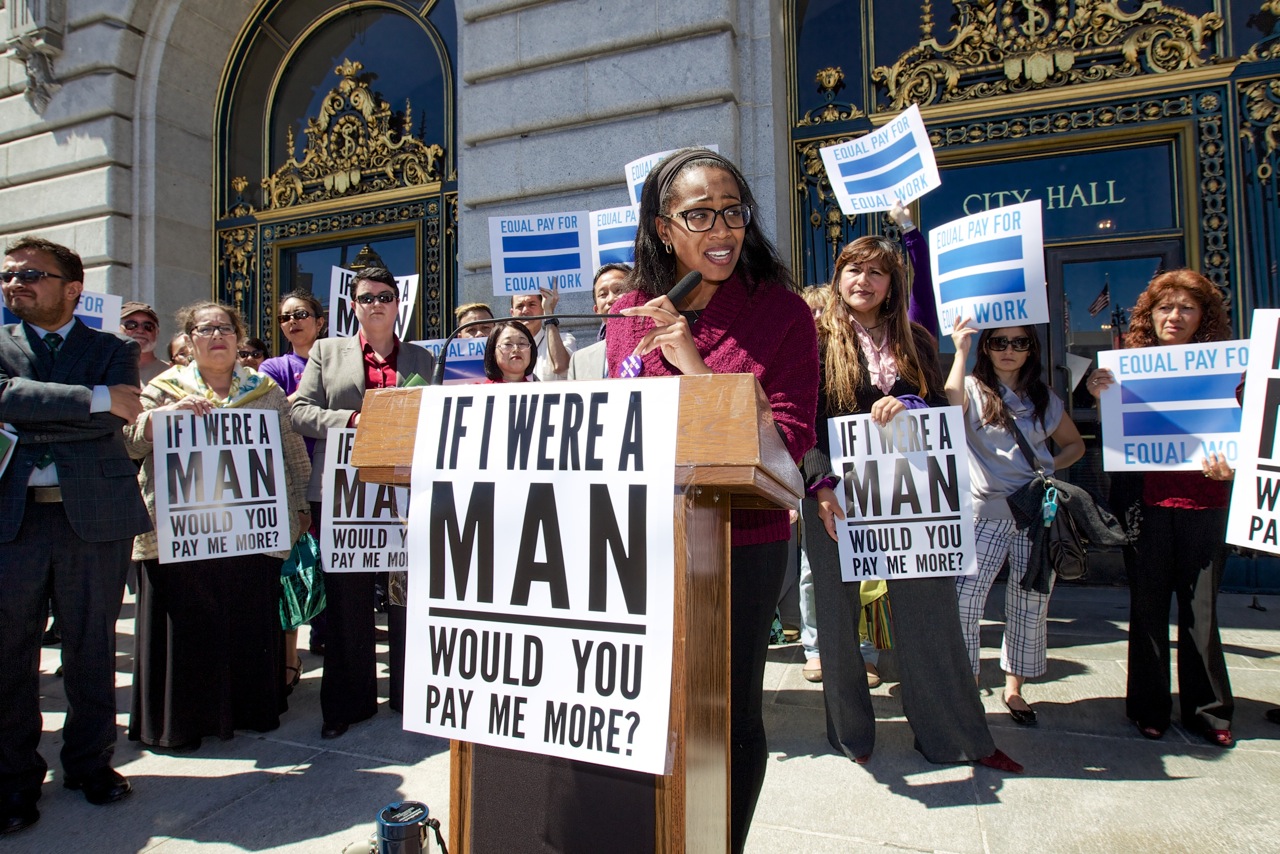
SF declares Pay Equity Day as it lowers salaries for women’s jobs

87

The Board of Supervisors today declared April 9 Pay Equity Day in San Francisco, in recognition of the persistent national gap between male and female financial compensation. But with the city locked in a dispute with SEIU Local 1021 over pay cuts to jobs dominated by women and workers of color, the day took on special local significance. Ahead of the declaration, union members, activists, and supervisors rallied in front of City Hall, chanting against San Francisco’s wage inequality and the general climate of fiscal austerity.

Women in San Francisco earn just 84 cents for every dollar paid to their male counterparts. Although this figure is slightly higher than the national average of 77 cents per dollar, the discrepancy represents a yearly wage gap of $9,968 per year, according to the National Partnership for Women and Families. At today’s press conference in front of City Hall, Sup. Malia Cohen called the gap “unconscionable in a country as wealthy as ours.”

Cohen was joined by Sups. David Chiu and David Campos, who both spoke out against gender-based wage gaps. “It is important for men to speak out,” Chui said. “It wasn’t women who made the decision for pay to be unequal.” Campos went a step further, promising to vote against any budget that further entrenches unequal pay. “I will not support any budget that reflect this discrepancy,” he said.

SEIU Local 1021, which represents over half of city employees, is currently locked in a budget dispute with the city over pay cuts that would adversely affect women and workers of color. The city Department of Human Resources has recommended that the city cut the salaries of 16 categories of city workers, including personnel clerks and nursing technicians, which are disproportionately females and workers of color. The dispute was recently sent to an arbitrator.

At today’s event, local SEIU leaders and the San Francisco Women’s Political Committee (SFWPC) continued to pressure the city to reconsider the salary cuts. SFWPC President Laura Hahn called persistent pay inequality “embarrassing.”

“If we can’t achieve it here in San Francisco where are we going to do it?” she asked.

Former Supervisor Chris Daly, who now works as political director for SEIU 1021, echoed Hahn’s concerns and charged that the proposal to cut pay for female-dominated categories calls into question the city’s long term commitment to pay equity.

“If you ask Mayor Lee if he supports wage equality, of course he will say yes,” Daly told us. “But in reality, his Department of Human Resources is rolling back progress.” Daly’s repeated requests for Mayor Lee to intervene in the wage-cut arbitration have not yet been answered.
But for the DHR, the recommended cuts have more to do with fiscal reality than gender equality. At a March 7th budget hearing, DHR director Micki Callahan said, “It would be improper to base any decision on demographics.”

She voiced concern over the “root causes” of pay discrepancy, but indicated that these issues fall outside the purview of her department. Spokespeople for the the DHR department have repeatedly assured us that the proposed budget cuts have nothing to do with gender, but rather reflect an effort to bring city salaries in line with market forces.

TRUST Act clears committee as immigration reform heats up nationally

It was late at night by the time New Latthivongskorn, then 22, finally started to make his way home from the University of California Berkeley campus after a long night of studying for midterm exams.  A third year molecular and cell biology major who was trying to keep up his grades in preparation for med school applications, Latthivongskorn said he noticed a man in a black hooded sweatshirt walking toward him as he approached his home. At first he didn’t think much of it – but just as he was about to unlock the door to his apartment, the young Thai student heard a voice. “Give me everything you’ve got,” the man commanded.

“I looked at him, and I looked down, and I saw a gun pointed straight at me,” Latthivongskorn recounted. Terrified, he tried to stay calm and simply cooperated; handing over his backpack and cell phone, silently feeling relieved that he hadn’t been carrying his laptop. Fortunately, Latthivongskorn was able to proceed into his apartment unscathed after the man who robbed him at gunpoint vanished down the street.

When his concerned housemate asked if he wanted to file a police report, Latthivongskorn faced a dilemma. “Yes, I wanted to report it,” he told the Guardian in a phone interview, “for me, but also for the community. That same man ended up mugging another individual later that night.”

But there was a problem. Latthivongskorn had moved with his family from Bangkok to Sacramento when he was just nine years old – and despite the fact that his entire life was rooted in California, he’d never obtained U.S. citizenship. Any interaction with police, he feared, could place him in jeopardy – even if he was approaching law enforcement as a crime victim.

“In the end, I couldn’t call,” he said. “What was going through my mind was thinking of all the sacrifices that my family had made for me … and I worked so hard to get to this point, and I’m still not there yet.” His decision not to report the armed robbery came down to “the simple fact that it could all end – that I could get deported.”

Fast-forward to today, and Latthivongskorn has graduated and earned a spot on the waitlist at Stanford while he awaits responses from a number of other med schools. He’s also active with ASPIRE, Asian Students Promoting Immigrant Rights through Education.

On April 9, he shared his experience of being mugged with California legislators at a hearing of the Public Safety Committee, and urged lawmakers to approve the TRUST Act.

Authored by Assembly Member Tom Ammiano, the bill seeks to “limit harmful deportations often stemming from trivial or discriminatory arrests,” according to a statement from Ammiano’s office.

As things stand, all arrestees have their fingerprints recorded and submitted to ICE, or U.S. Immigration and Customs Enforcement. Under the federal Secure Communities program, ICE can then direct local law enforcement to hold arrestees without bail, beyond the time they’d be detained under normal circumstances, for the purposes of immigration proceedings.

The idea is to hold and deport dangerous criminals, but in practice it’s proved problematic. “More than 90,000 Californians have been deported, with 70 percent not convicted of anything, or only of lesser crimes,” Ammiano’s office points out. “Some were never charged with crimes, and some were crime victims.”

The TRUST Act would “establish a statewide policy that says if the person has not been convicted of a serious or violent felony, they would no longer be held any longer than authorities would hold them otherwise,” explained Carlos Alcalá, a spokesperson for Ammiano. The idea is to draw a distinction between violent or serious offenders, and anyone else who could be swept up in the system and needlessly held without bail.

Also on hand to testify at the April 9 hearing was Ruth Montaño, a Bakersfield woman who was arrested and nearly deported after someone complained that her dog was barking too loud.

Alcalá recounted other horror stories that had made their way to the Capitol. There was the day laborer whose employer reported him to immigration authorities at the end of his shift when all he was expecting was a day’s wage, and the woman who was arrested outside of Walmart for trespassing – and nearly deported – for selling tamales. Then there were women who reported incidents of domestic violence only to be subjected to immigration proceedings (and their counterparts, who stayed mum about abuse because they feared deportation).

Members of the Public Safety Committee approved the TRUST Act 4-2, clearing the way for the bill to go to the floor of the Assembly as early as next week. An earlier version made its way to the desk of Gov. Jerry Brown last year, but was ultimately vetoed, leading to a revised version. “Because of last session’s history, we’re hoping to have more substantive discussions with the governor beforehand,” Alcalá told the Guardian.

The timing is significant. “Immigration changes are moving quickly at the national level,” Ammiano noted, “and California needs to make changes here to keep pace.”

Advocates expect a national proposal for immigration reform to be introduced in the Senate any day now, according to Jon Rodney of the California Immigrant Policy Center. West Coast activists are planning an event April 10 to mirror a mass rally and march for immigration reform planned in D.C.

In San Francisco, the march will begin outside Sen. Dianne Feinstein’s office on Post Street and then proceed to Civic Center, where a rally is planned for 5 p.m. Latthivongskorn plans to participate along with other organizers from ASPIRE, and a host of local and regional immigration reform advocates are getting involved.

Those joining the march “will carry 1,000 paper flowers,” Rodney said, “to represent 1,000 deportations that happen every day in the U.S. That’s one piece of Wednesday’s rally, is stopping deportations.”

Paying for the mayor’s China trip

20

You’d think the mayor would know better by now. After all the allegations of cronyism and undue influence, you’d think that he’d make sure everyone involved in his trip to China was playing by the rules. You’d think the last thing he would want is this.

Now: So far this is just a complaint, and noting has been proven. But still: It sure looks bad. And it’s entirely unnecessary.

If the mayor really belives that he needs to go to China to do the city’s business, why doesn’t he go on the city’s tab? Seriously: I would much rather that my tax dollars went for this trip than have the mayor inundated and unduly influenced by corrupt actors who want his ear. If he was going for fun and sightseeing, he could pay his own way; if he’s there, as his office says, on official business, then why is he taking private money?

When Dennis Herrera went to Washington DC for the Supreme Court hearing on same-sex marriage, the city paid his way. That’s appropriate: He’s directly involved in the case, as are some of his staffers. They were meeting with co-counsel, doing practice runs … working. He stayed at a midrange hotel at the government rate ($200 a night) and was allowed to spend a set per-diem on meals. That’s the same rules any city employee follows on official travel.

If you think he shouldn’t have gone (as Michael Petrelis clearly thinks), then that’s a political discussion. It’s appropriate to ask about it, to point out how much money was spent on the trip, to analyze his expenses, and to challenge him about it when he’s next running for office. But it’s not a corruption probe — and frankly, I’m happy that some corporate bond-counsel firm that wants the city’s legal business didn’t pay for the trip and send a lobbyist to hang out with Herrera the whole time.

The city sends people on trips. It’s fair to ask if they are an appropriate use of taxpayer money. But if the trip is worth taking, then the mayor should justify the expense — and not take corporate and lobbyist money instead.

Blue Angels grounding is a victory for sanity, safety, and peace

82

Finally, peace in our time. The Blue Angels’ annual Fleet Week assault on San Francisco has finally, blessedly, mercifully been canceled for 2013, the result of $85 billion in federal budget sequestration cuts divided equally between military expenditures and social service spending.

The Guardian has long called for the cancellation of this wasteful show of military might, citing its inherent danger to a dense urban area, wanton waste of resources and fossil fuels, disturbance of the peace and pets, glamourizing of war and its weapons, and its Soviet-style fetishizing of militarism.

But in the end – appropriately and a little ironically – it was conservative fiscal prudence that finally shot down the Blue Angels. The military is already the biggest item in the federal budget, a massive, unjustifiable expenditure caused by imperial over-reach and the bloat of crony capitalism and pork barrel politics. Spending millions more just to show off their toys over scenic San Francisco was the ridiculous cherry on top of that sloppy sundae.

Real people and the real economy are suffering real harm from reckless sequestration cuts to social programs that have been inflicted by the anti-government ideologues sent to DC by the plutocrats and their minions. To keep the Blue Angels flying high against that backdrop would have been simply obscene, and surely a sign of decadent late empire in decay.

This decision by the Navy to nix the Blue Angels is a small but significant sign of sanity in a country gone mad, and the Guardian proudly salutes this decision.

Class divisions in SF (sorta)

38

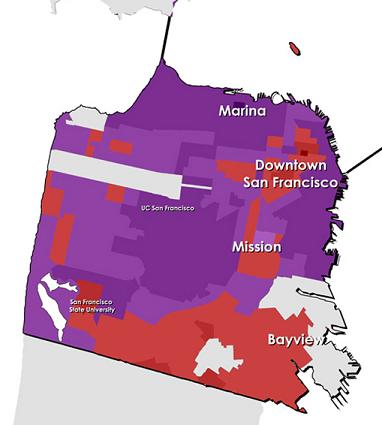
Richard Florida, who got famous creating the “creative class,” has a new series of maps out charting class structure in American cities — not on the basis of income or wealth but on the type of work people do. Sfist has a nice copy of the San Francisco version here. It shows, on the surface, that this city has virtually no “working class,” some “service class” and lots of “creative class.”

Overall, it’s a picture of a city in the late stages of terminal gentrification — but it’s also a bit misleading.

San Francisco long ago lost much of it’s traditional blue-collar work — manufacturing, production, distribution, and repair — although there’s still some left. What we don’t have is a lot of unionized blue-collar jobs (like the Port of Oakland offers). That’s pretty clear.

But unionized jobs that don’t require advanced degrees still exist in San Francisco — they’re just in the public sector. I suppose Muni drivers get defined as “service class” by Florida, but that’s really not accurate.

Nor is the notion that “creative class” people all make a lot of money. I suppose there are artists and musicians who are getting rich in San Francisco, but I don’t know any of them.

If anything, Florida’s approach just underscores the changes in the American economy in the past few decades. It doesn’t do much to help understand how the actual demographics of the city have changed, how wealth has become more concentrated and poverty more dire. So I don’t really get the point.

The Willits tree-sit fallout

76

I just spoke with state Sen. Noreen Evans, who represents the Willits area, about the forcible eviction of five tree-sitters — and by forcible, I mean firing projectiles (first reported as rubber bullets, later as bean bags) at a protester holding onto tree limbs 70 feet in the air. She’s not happy.

The Willits Weekly has been reporting in depth on this whole mess, and quotes an Evan statement:

I am shocked and dismayed at what seems to be an excessive use of force on unarmed protestors. Thus far, I feel Caltrans and CHP have been slow to respond to my questions and quick to act regarding the Bypass Project.

By the time we talked, she’d calmed down a bit and wasn’t ready to second-guess the CHP tactics. “I’m not in law-enforcement,” she said. “It could have been much worse.”

But she did say she was still furious about the timing of the raid. “The mayor of Willits has been trying to get information out of Caltrans, and has been having trouble, so I asked for a meeting. I wanted to know, is there some way they could handle this protest peacefully?

“I learned about the events half an hour before the Caltrans director was supposed to be in my office. I was not happy.”

Evans told me that Caltrans blamed the CHP — but the CHP wasn’t having it. “I called the commissioner of the CHP, who told me the order was given by Caltrans,” she said.

So the bulldozing continues — but this isn’t going away.


CycleSF event canceled, but RecPark gets paid anyway

115

Bicycling around San Francisco has become increasingly popular with both residents and tourists, but apparently that doesn’t mean people want to pay $40-75 for an organized ride around the city’s perimeter, even when the money goes to the San Francisco Recreation and Parks Department and the cause of putting more bike racks into the parks.

Despite a citywide ad campaign (for which I was one of several cyclists voluntarily photographed with our bikes) and aggressive social media effort, Jumping Fences – the company that also produces the San Francisco Marathon, which is set for June 16 – has canceled the CycleSF event it had planned for April 28, citing lower than anticipated demand.

The company had pledged $100,000 to RPD in connection with the event, which was to involve 13- and 26-mile rides through the city ending with a big party in the park, and the company announced that it would still be giving the department $25,000 despite “postponing” the event.

“We are disappointed Cycle SF has chosen to postpone their event. We are looking forward to working with them in the future on a family-friendly bicycle event,” said Connie Chan, spokesperson for the Recreation and Parks Department.

Jumping Fencing Marketing Director Joanna Reuland contended that “awareness was strong” surrounding the event and she wasn’t sure why it didn’t take off. “It had become clear that we weren’t going to make our promise so we thought it was probably best to just postpone the event,” Reuland told us.

Part of the problem might have been how cheap and easy it is to cycle around the city and the availability of free monthly group rides like Critical Mass and SF Bike Party. Apparently paying to bike around the city just doesn’t have the same demand as the San Francisco Marathon, which costs $35 for the 5K or $145 for the full marathon.

Some in the bike community also grumbled that the event was benefiting a city department about which many have decidedly mixed opinions, particularly given its closeness with corporate donors, rather than a bike advocacy organization such as the San Francisco Bicycle Coalition, whose 12,000-plus members organizers did little to directly target. What whatever it was, it is no more.

Mayor Lee’s trip to China raises questions of ethics and influence

86

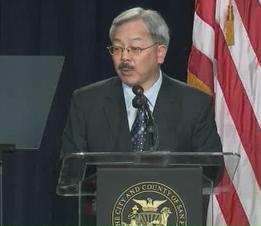
[UPDATED(x3)] Mayor Ed Lee barely had time to unpack from his recent political junket to Paris before he was off on his current trip to China – both of which were paid for and accompanied by some of his top political supporters and among the city’s most influential power brokers. No wonder Lee doesn’t have time to weigh in on Airbnb’s tax dodge, the condo conversion stalemate, or other important city issues.

Local good government advocate Charles Marsteller learned of the current China trip from Willie Brown’s column in Sunday’s San Francisco Chronicle, whose editors (including Editor Ward Bushee, who we’re still waiting to hear back from about this trip) consider it a “man about town” column immune from conflict-of-interest policies that normally require journalists to disclose who is paying them on the side.

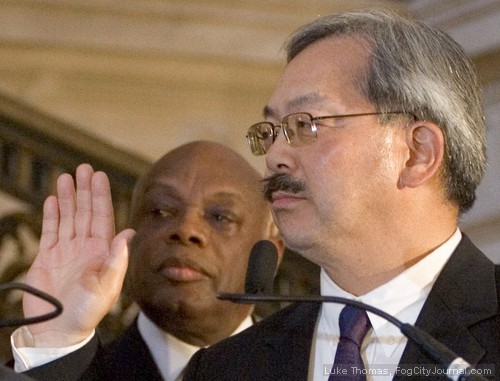
“I’m here with Mayor Ed Lee for my seventh official visit,” Brown cheerfully wrote, although readers were left to wonder just what official business Brown might be conducting with our mayor and his entourage. So, being an expert on political disclosure laws, Marsteller went down to the Ethics Commission to pull the Form SFEC-3.216(d) that state law requires elected officials to file before leaving on trips paid for by outside interests.

But it wasn’t there, so Marsteller filed an official complaint with the commission, telling us, “I did so to impress upon our Elected and other City Officials the need to properly report gifts in a timely way and in the manner as called for by State law and on the forms provided by the SF Ethics Commission.” 

When we contacted mayoral Press Secretary Christine Falvey, she forwarded us a copy of the form that should have been filed before the trip and told us, “I’m not going to answer the question about why we failed to file the appropriate forms with the Ethics Commission, as we worked closely with the City Attorney’s office to exceed reporting requirements by all appropriate deadlines.” [UPDATE: The time stamp on the form indicated it was filed on May 25, before the trip, even though it wasn’t publicly available at the Ethics Commission office when Marsteller went down to look for it].

The form indicates that Lee’s portion of the trip was paid for by the San Francisco Chinese Chamber of Commerce, whose influential leader Rose Pak conspired with Brown to get Lee appointed mayor more than two years ago. This is also the same Rose Pak who was admonished by the state’s Fair Political Practices Commission for illegally funding another political junket to China in 2009 with Sups. David Chiu and Eric Mar and then-Sup. Carmen Chu, who Lee appointed as Assessor earlier this year.

Those officials were forced to repay the expenses after the FPPC found that Pak, that time acting under the auspices of the Chinese New Year Festival Committee, was not allowed to make gifts exceeding $420 per official that year. “Please be advised that since the Chinese New Year Festival Committee is not an organization that falls under Section 501(c)(3) of the Internal Revenue Code, no public official may accept gifts of any type from this organization valued in excess of the applicable limit,” FPPC counsel Zachary Norton wrote in an Aug. 22, 2011 enforcement letter to Pak.

In other words, because this committee and “other 501(c)(6) chamber of commerce organization[s]” are in the business of actively lobbying top elected officials for favorable policies, rulings, and projects, they are barred by ethics law from giving them the gifts of big overseas political junkets. As Marsteller noted in his complaint letter, violations are punishable by fines of $5,000 per violation, or if they are “willful violations of the law” – which doing the same thing you were sanctioned for just two years ago certainly might be considered – the criminal penalties are $10,000 per violation or up to a year in jail.

Mayor Lee’s portion of the trip cost the Chamber $11,970, according to the form. But this time, to get around the FPPC restrictions, Pak seems to have passed the hat among various business elites to fund the trip. The mayor’s form shows that 41 people paid up to the current gift limit of $440 “to defray the cost of the mayor’s trip.”

They include Pak, Brown, four people from Kwan Wo Construction, three from American Pacific International Capital, two each from Boyett Construction, Young Electric, and Bel Builders, Harbor View Holdings Director Gorretti Lo Lui, and SF Immigration Rights Commissioner Sonya Molodetskaya – most of whom were also part of the trip’s 43-member delegation.

Among others who tagged along for the trip are Public Works Director Mohammed Nuru (who has a history of political corruption under Mayors Brown and Newsom and no clear business being on a Chinese trade delegation, but who doesn’t love a free trip?!), Kofi Bonner from Lennar Home Builders, Harlan Kelly with the SFPUC, Jay Xu with the Asian Art Museum, the wives of Lee and Bonner, Kandace Bender with San Francisco International Airport, and Mark Chandler with the Mayor’s Office of International Trade and Commerce.

It’s not clear who paid for those other public officials or even what they were doing there. [UPDATE: Department of Public Works spokesperson Rachel Gordon told us that Nuru paid for the trip himself, but that he’ll be studying China’s instrastructure, from its separated bikesways to greening of public rights-of-way, as well as meeting with Chinese businesses involved in the redevelopment of Hunter’s Point. “He’s been looking at a lot of the infrastructure in China,” Gordon said. “I expect a dozen if not more ideas when he returns.”] Then again, it also wasn’t clear why venture capitalist Ron Conway – Lee’s top campaign fundraiser and possible reason for publicly subsidizing big tech companies, including many that Conway funds – joined and helped sponsor Lee’s recent trip to Paris. This is just how business gets done in San Francisco.

“Willie Brown is the former Mayor of San Francisco,” Falvey told us when we asked why Brown was on the trip and what its purpose was. “The purpose of the trip is to promote San Francisco, its local manufacturing, cultural exchanges, he is signing an MOU and meeting with high level, new Chinese government officials.”

[UPDATE 4/5: Marsteller has withdrawn his complaint from the Ethics Commission alleging the mayor’s form wasn’t filed on time, but he and another citizen have filed separate complaints with the FPPC alleging the trip and its funding mechanism may violate the agency’s 2011 ruling against Pak.]

Live Shots: Keystone XL pipeline protest

8

Photos by Bowerbird Photography

SFBG’s Rebecca Bowe reported on the anti-pipeline protesters who greeted President Obama yesterday in the cold and fog. SFBG photographers from Bowerbird Photography were there as well. After the jump, Ariel of Bowerbird’s take on the scene. 

Young and old showed up Wednesday evening, shouting to have their voices heard over the polite clinking of knives and forks at a $32,500 a plate dinner organized for Pres. Obama at the Getty’s home in Pacific Heights. Whenever the President rolls into town, so many different lobbying groups come to raise their banners and clear their throats that it is easy to mistake the gathering for a traveling carnival of weirdness.

Yet, this time felt different. While various groups still made their causes known (and advocated for single payer health care, releasing Bradley Manning, and closing Guantanamo Bay), the overwhelming preponderance of protesters stood together in unity and urged Pres. Obama to prevent construction of the Keystone XL pipeline.

Even though the diversity in age, ethnicity and attire (yes, someone showed up wearing sequins and roller blades – this is San Francisco after all!) ranged wide, solidarity on this single issue was strong.  Both sides of the sidewalk shouted together against building the pipeline. Apparently, the oil supporters (if any), did not show.  Perhaps they found warm comfort in a limousine ride to a fancy dinner at the Getty residence.

Who knows? While the outcome of the fight for Pres. Obama’s ear is unknown, it is clear that hundreds of protesters shivering in the fog and cold got hoarse trying.

WTF, Chuck: Repeal the bottle bill?

22

Now, I thought we were all going to have to pay money to read the wisdom of C.W. Nevius, but here it is, for free, right on sfgate: Nevius is calling on California to repeal the “bottle bill,” the measure that requires a (modest) deposit on cans and bottles and that has been widely credited for making this one of the leading places in the world for recycling.

His argument: People are stealing recyclable material and selling it. This leads to drugs. (Seriously, this leads to drugs: “It hurts everybody,” says Adam Alberti, a spokesman for Recology, the city’s garbage collection firm. “We have heard reports of (scavengers) being paid in drugs instead of cash.”)

And, of course, criminal syndicates that underpay desperate people. The old Haight Asbury Recycling Center, which Chuck hated so much, demonstrated how the syndicate racket doesn’t have to work, since small-time individual bottle-pickers could get there without a truck and keep all the money. Oh, but that was also leading to drugs. So now it’s gone. Amazing, Chuck, the law of unintended consequences.

Anyway: Criminal syndicates aren’t a good thing. Wall Street, for example. Certain landlords and businesses that prey on the weak and don’t pay their taxes. Or the people who cheat their low-wage trash-diving workers.

But on the scale of all the things wrong in the world, and the city, this has to be pretty small-time. Because the bottom line for me is this:

The stuff is getting recycled.

That’s what we want, right? We don’t want bottles and cans in a landfill. From a strictly environmental viewpoint, it makes no difference if Recology picks the stuff up and makes money off it, or if a poor person picks up the stuff and makes money (except not in the Haight any more) or if some explotive syndicate hires people to pick the stuff up. It gets to the same place.

Again: Not supporting the criminal syndicates. Their workers should get fair pay, like all workers. Still, repealing the bottle bill seems like a pretty crazy way to address this modest problem.


Obama greeted with anti-pipeline protesters

Hundreds of protesters gathered in San Francisco’s upscale Pacific Heights neighborhood on April 3 to greet President Barack Obama with signs and chants opposing the Keystone XL pipeline. Nationwide, environmentalists have been pressuring the president in recent months to reject construction permits for the oil infrastructure project, which would transport oil to U.S. refineries from Canada’s Alberta tar sands.

The president was in San Francisco for a $32,500 per person Democratic Congressional Campaign Committee (DCCC) fundraiser at the mansion of San Francisco billionaires Gordon and Ann Getty, preceded by a $5,000 per person cocktail reception hosted at the Sea Cliff residence of Tom Steyer, a billionaire former hedge fund manager, and his wife Kat Taylor. Steyer and Taylor are vocal critics of the pipeline and have donated to environmental causes.

>>See more pics from the protest here.

Around 6 p.m., protesters gathered to parade past the rows of mansions, braving the chilly mist as they sang, chanted and waved signs opposing the pipeline. “If the environment were a bank, it would have been saved already,” one handmade cardboard sign read.

Police set up barricades to restrict access to the Getty residence, and when protesters spilled into the nearby intersection of Broadway and Divisadero, police officers stationed on the street with megaphones joined with motorcycle cops in urging the crowd backward onto the sidewalk, creating a tight squeeze.

Chants included phrases like, “What do we say to the president? No pipeline for the one percent!” And, “Hey, Obama, we don’t want no pipeline drama.” The action was organized by a host of prominent environmental organizations including 350.org, the Sierra Club, Friends of the Earth, Credo Action, and the Rainforest Action Network (RAN).

Guardian video by Rebecca Bowe

Just before the events got underway, the Guardian encountered Michael Klein, a major donor and former board chair of the radical environmental organization RAN. Klein, who said he’s served on the boards of other environmental organizations as well, is also a member of the DCCC – and he said he’s “really close” with Steyer, the billionaire environmentalist who was playing host to the president that evening.

“I know how Tom feels about it, and he’s not a supporter” of the Keystone XL pipeline, Klein told the Guardian. “This whole area is filled with so much ambivalence and contradiction. It’s a really complex area, and it’s not an easy situation politically for the president.”

Klein was dressed down in a windbreaker, standing on the sidewalk outside a stately residence where protesters, some of them from RAN, were beginning to congregate. Asked what brought him out to the protest that day, he responded, “I live here.”

Yet Klein had no plans to drop in on his neighbors, the Gettys, that night. “I was invited to the events,” he told the Guardian, but “I couldn’t go,” as a matter of principle. And besides, when it comes to fancy black-tie fundraising galas, “I don’t like those events anyway,” Klein said.

No progress in condo conversion standoff, despite the Chron’s spin

93

Perhaps it was just an unfunny April Fool’s Day joke or some wishful political spin, but the San Francisco Chronicle’s April 1 article about how tenancy-in-common owners and their political supporters are pushing legislation that would allow them to bypass the condo conversion lottery seriously misrepresented the city’s biggest current political standoff.

Nevermind the article’s over-the-top bias in favor of those poor, hard-luck TIC owners, like the featured Pacific Heights couple forced to raise their baby in a closet when all they really want to do is flip the apartment they bought for a profit. Or how the Chron all-but-ignored the fact that these TICs were rent-controlled apartments in a city where two-thirds of citizens rent. That kind of top-down view of the world is pretty typical for the Chron, even in its news stories, despite the paper’s strained claim to “objectivity.”

No, the article’s real sin was to get the basic facts wrong on where this political stalemate now stands, presenting the wishful spin of one side as if it were the latest news. Between the headline, “Owners seeking condo conversions may have shot” and the first deckhead, “Making progress” (which plays off this paragraph. “’I think we’re making progress in our discussions and negotiations,’ said [sponsoring Sup. Mark] Farrell, while noting the talks with tenant advocates, TIC owners, and real estate interests are ‘far from the finish line.’”) the article leaves the impression current negotiations may produce a compromise.

But the problem is that there aren’t any current negotiations between the two sides, and there haven’t been for weeks, according to tenant and other involved sources. In fact, they say there’s been no movement in this standoff since almost a month ago when I last reported that tenant groups and progressive supervisors were preparing a set of hostile amendments to the legislation.

They would allow a one-time condo lottery bypass for the nearly 2,500 TIC owners in the pipeline in exchange to shutting down the lottery for many years and preventing any conversions of rent-controlled apartments into condos until city builds a comparable amount of new affordable housing, and then probably restricting condo conversions to smaller buildings after that to protect large rent-controlled apartment buildings from real estate speculators.

That proposed compromise, which the article barely mentions before letting Farrell say “his legislation poses no threat to rent control,” would help the poor Pacific Heights couple at the center of the article. But the real estate industry and its conservative allies don’t really care about that couple as much as they do maintaining the flow of rental units into the real estate market, which is why the negotiations have broken down.

Instead, the Chron has Sup. London Breed – who is indeed a swing vote of the issue, but not one that tenant groups are counting on given how close she is to Plan C and the landlord lobby – citing a compromise proposal that would prevent the new condo owners from selling their properties for five years to discourage real estate speculation.

Perhaps that’s something the TIC owners and real estate interests that the article relies on think is a realistic compromise, but it’s not something that has been seriously discussed with tenant groups, mediating Sup. David Chiu, or the other interests that would be needed to pass this legislation.

Sara Shortt, the token tenant activist that the Chron talked to for the article, confirmed to us that there is no real compromise deal in the works and preventing the creation of new condos from existing apartments is a bottom-line issue that unites everyone who is now opposed to this legislation.

“The Plan C/Realtor etc. won’t concede on our key issue: restriction on future conversions in exchange for the bypass. We have given as much as we can give and they have given virtually nothing in return,” Shortt, executive director of the Housing Right Committee, told us by email.

Even Sup. Scott Wiener, who co-sponsors the legislation with Farrell, told us there has been “no change from before,” when negotiations broke down. But the legislation is on the April 15 agenda for the Land Use and Economic Development Committee – for the fifth time, with most hearings canceled because of the lack of negotiating progress.

If the Realtors and Plan C (which is dominated by real estate and banking interests) stick to their intransigent position – hurting this poor Pac Heights couple in the process, which the Chron fails to note – then tenants and progressive supervisors are likely to amend the legislation and call the bluff of those who claim this issue is simply about poor TIC owners stuck with shared mortgages.

Feds’ use of spy tools under scrutiny due to privacy concerns

If the FBI is trying to pinpoint the location of a suspect in your neighborhood, investigators could sweep up information from your mobile device just because you happen to be in proximity to their target. Civil liberties advocates are concerned that the practice is a major invasion of privacy.

The results of a Freedom of Information Act request filed by the Northern California chapter of the American Civil Liberties Union (ACLU) and the San Francisco Bay Guardian last year sheds new light on the federal government’s use of Stingrays, a surveillance technology that mimics a cellphone tower by automatically connecting with mobile devices in the area where a search is being conducted.

Stingray is a brand name, but the devices are sometimes called Triggerfish, digital analyzers, or cell site emulators. They’re known to technologists as IMSI catchers, meaning they can intercept a user’s International Mobile Subscriber Identity.

As the ACLU of Northern California noted recently in a blog post, Department of Justice emails obtained in response to the FOIA request, filed with the US Attorney’s Office of the Northern District of California, revealed that federal agents who sought authorization to conduct searches using this technology were “less than forthcoming” about what the devices actually do.

The issue stems from federal investigators’ request for a search warrant several years ago targeting Daniel Rigmaiden, a hacker accused of committing fraud. The search was authorized, but it seems agents never explained just how wide a net they intended to cast.

Because FBI agents used an IMSI catcher rather than, say, triangulation techniques that can utilize subscriber data to find their target, they were able to pinpoint Rigmaiden’s precise location – not only revealing that he was inside a Santa Clara apartment building, but sniffing down to the level of his exact unit. 

But when a search of this kind is conducted, a Stingray automatically connects with every other mobile device in the immediate vicinity that uses the same provider (in this case, Verizon). It works by masquerading as a cell phone tower, tricking mobile devices into automatically communicating with the spy device. So any other Verizon subscribers who happened to be nearby also had their information caught up in the FBI’s net.

There are various kinds of IMSI catchers, and some are capable of sweeping in the contents of communication, such as text messages. In the Rigmaiden case, investigators said were only able to access subscriber information. Investigators also reported that they “purged” unneeded data after the fact, according to ACLU staff attorney Linda Lye. But purging the data also makes it impossible to prove that the information of particular individuals was wrongfully swept up in a search. 

The FOIA request was filed in April of last year. Last July, after the government failed to provide the information, a lawsuit was filed to get the documents.  

The string of emails that was finally provided suggests that federal agents have been using this sort of technology in the field for some time, without clearly representing to judges that Stingrays can vacuum up third party communications data. Instead of being explicit on this point, agents from the Department of Justice merely stated that they wanted to use a mobile tracking device.

“It has recently come to my attention that many agents are still using [IMSI catchers] in the field although the pen register application does not make that explicit,” notes an internal Department of Justice email obtained through the FOIA request, referring to a different kind of search technique that is more narrowly targeted. 

Lye drilled down on this point in her blog post:

“The federal government was routinely using stingray technology in the field, but failing to ‘make that explicit’ in its applications to the court to engage in electronic surveillance. When the magistrate judges in the Northern District of California finally found out what was happening, they expressed ‘collective concerns,’ according to the emails. Notably, this email chain is dated May 2011, some three years after the Stingray’s use in Rigmaiden’s case – meaning the government was not ‘forthright’ in its applications to federal magistrate judges for at least three years.”

After battling for months in court in a separate proceeding, the ACLU of Northern California also succeeded in unsealing the Northern District DOJ orders that authorized use of the surveillance devices. Now, the civil liberties advocates are partnering with the Electronic Frontier Foundation and other groups to file an amicus brief concerning the constitutional implications of using a Stingray to collect evidence in the Rigmaiden case. “Their use implicates the privacy interests of the suspect, as well as untold numbers of third parties as to whom there is no probable cause,” the lawyers argue.

“When we read the orders, we were very, very surprised and troubled,” Lye noted in a recent conversation with the Guardian. “Because the government was arguing in the criminal proceeding in Rigmaiden, yes, we acknowledge that we’ve used this cell site emulator, and we’re even … acknowledging that the device is intrusive enough in the way it operates to constitute a search – which is a significant concession.”

For more on Stingrays, pick up next week’s issue of the SFBG.

Norquist exposes tax avoiders

12

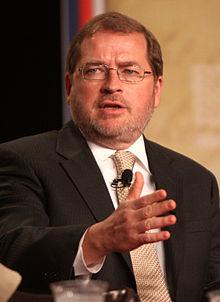
I’m not a big fan of Grover Norquist, who will be in town April 4 and who is so against taxes that he apparently would have refused to pay his share of the cost of World War II (back when the government actually asked taxpayers to pay for wars as they were being fought, instead of pretending they were free and borrowing money that future generations will have to repay). Michael Krasny, the host of Forum, had Norquist on April 2 and didn’t ask the guy if he would have cut the taxes used to fight the Axis Powers (there was even an “excess profits tax” on corporations during the war years).

But they did have some interesting back and forth about taxes, and Norquist made an interesting observation, one that I actually agree with. (Yes, trolls — I have found myself agreeing with Grover Norquist.)

Krasny asked him about the pledge that Bill Gates and Warren Buffett made to give away half of their wealth before they did. Krasny seemed to think this was a great thing. Norquist was fine with it, too, but he put it in context:

What the great philanthropists are actually doing is avoiding the estate tax.

By giving away their money to causes they choose, Gates and Buffett will prevent the US government from collecting taxes on that money when they die — meaning, in effect, that the very rich who go along with this plan are saying they would rather they choose the beneficiaries of their largesse than allow the elected officials who represent the public to have a hand in redistributing the wealth.

That’s the thing about philanthrophy — it’s a fine, of course, but it’s also a way for the very rich to decide what they want to fund — and in many cases we’re talking about museums and universities, not homeless shelters and indigent mental-health programs.

If we taxed Gates and Buffett at a reasonable level (and even Buffett says his taxes are way too low), then we might not be looking at cuts to in-home support services and other life-saving programs that the government “just can’t afford” these days. (Of course, if we hadn’t spent $2 trillion and counting on wars in Iraq and Afghanistan — or if we’d raised taxes to the level needed to pay for those wars, which would have meant an end to them, we wouldn’t be in such a deep fix anyway.)


GOP ‘dark wizard’ and Occupy ‘anti-leader’ to speak in SF on the same day

This coming Thursday, a central intellectual figure of the Occupy Wall Street movement will give a talk on “Austerity and its Discontents.” And across the city, at the very same time, powerful anti-tax lobbyist Grover Norquist will mix it up with an elite group of San Francisco Republicans (yes, they really do exist).

Graeber, an American anthropologist and anarchist who teaches at Goldsmiths, University of London, was dubbed “the anti-leader of Occupy Wall Street” in a Bloomberg BusinessWeek Magazine article published shortly after a determined band of committed activists staked a claim on Manhattan’s Zuccotti Park, kicking off the global Occupy movement. Graeber’s tome on wealth inequality, Debt: The First 5,000 Years, recounts the ages of human history through the lens of the indebted, vis-à-vis their creditors. The book helped give rise to Occupy activists’ famous chant: “We are the 99 Percent!”

Norquist hails from the polar opposite end of the political spectrum. An influential lobbyist who leads Americans for Tax Reform, he was once described as “the dark wizard of the Right’s anti-tax cult,” in the words of Arianna Huffington. The fiery conservative is most well known for his role as keeper of “the Pledge,” which essentially asks Republican lawmakers to swear that they will never, ever vote to raise taxes for any reason. 

The Thursday meet-and-greet, billed as “Cocktails with Grover Norquist,” is being hosted by the San Francisco Republican Party – a political body that barely registers as a blip as far as local elections are concerned, but apparently has enough clout to make it worthwhile for a famed operative like Norquist, whose group is based in D.C., to dip into San Francisco for a visit. The cocktail hour will be held at The City Club, a financial district venue. It costs $100.

Just as San Francisco Republicans sip cocktails and discreetly await the chance to engage Norquist in a few moments of powerful face-time, an audience of lefties will gather to hear Graeber’s studious analysis of global austerity measures and anarchist organizing tactics. Billed as a forum that’s free and open to the public, Graeber’s talk is being hosted by the Anthropology and Social Change Department of the California Institute for Integral Studies, located at 1453 Mission Street.

In a recent interview about the round of national budget cuts known as the sequester, Norquist told The Daily Beast: “I’m for the spending cuts. Just let them take effect. … The only thing worse than the sequester would be not reducing spending.”

And here’s Graeber’s take on the underlying economic climate that gave rise to the Occupy movement: “It’s becoming increasingly obvious that the real priority of those running the world for the last few decades has not been creating a viable form of capitalism, but rather, convincing us all that the current form of capitalism is the only conceivable economic system, so its flaws are irrelevant. … The economic crisis of the 1970s never really went away. It was fobbed off by cheap credit at home and massive plunder abroad – the latter, in the name of the ‘third world debt crisis.’ But the global south fought back. … The debt crisis has come home to Europe and North America, replete with the exact same approach: declare a financial crisis, appoint supposedly neutral technocrats to manage it, and then engage in an orgy of plunder in the name of ‘austerity.’”

Tree-sitter shot, 70 feet up, by CHP rubber bullet

55

Tree-sitting is nothing new. It’s happened all over California, going back decades. It’s a dangerous, but often effective protest tool that stops logging in its tracks.

Nobody with any official sanction is going to cut down a tree while there’s a human perched in it — and it’s been notoriously difficult for the authorities to remove people from platforms high above the forest.

And now, in Mendocino County, police response has entered a new phase.

California Highway Patrol officers April 2 began forcibly removing and arresting tree sitters trying to block Caltrans from clear-cutting an old-growth forest for the Willits Bypass. The tactics involved shooting at least one protester with a rubber bullet while he was 70 feet in the air.

The police used large-scale charry picker trucks to reach and “extract” the activists. Three have been removed so far; another two remain.

“We have reports of between three and nine bullets being fired,” Naomi Wagner, who is supporting the tree sitters, told me.

Matt Callaghan, who was on the scene when the arrests were made, said the man hit by the bullet, who goes by the name of Celsius, was “conscious and seemed okay when they got him down. He shouted that he was being taken to the hospital.”

Callaghan said that “there were also fists flying around up there. We were very concerned for the safety of everyone involved.”

No shit.

Why, exactly, would a rubber bullet be helpful in getting someone out of a tree? Isn’t there a pretty good chance the projectile could knock him to the ground (and his death)? Was this really necessary to build a road that fewer and fewer people in Willits seem to want?

I couldn’t reach anyone at the CHP, but Caltrans spokesperson Phil Frisbie confirmed to the Santa Rosa Press Democrat that “some less lethal means” were used on one of the tree sitters.

I’ll keep you posted as this develops. Seems like a lot of overkill for a simple trespass violation.


Behind the decision to accept cuts to in-home support services

29

For the last four years, advocates for those with disabilities have successfully fought to stave off the 20 percent cut in In-Home Support Services that then-Gov. Arnold Schwarzenegger had proposed to help balance California’s budget, each year winning legal injunctions preventing the cuts while the case wound it way through the federal court system.

Their main argument is that such deep cuts in these vital services would discriminate against disabled or elderly Californians by forcing them into nursing homes rather than allowing them to receive services at home, which they contended was a violation of the Americans with Disabilities Act (I discuss this and other systemic devaluing of caregiving in last week’s Guardian).

The Ninth Circuit of Appeals was set to hear the California case (Oster v. Lightbourne) on March 19, and the judges in this famously liberal San Francisco-based court had just ruled against Washington state’s effort to make similar cuts (MR v. Dreyfus) just over a year ago. But then, on the eve of that hearing, proponents in the case announced a settlement that will result in an 8 percent across-the-board to IHHS services (allowing a 3.6 percent cut made by Gov. Jerry Brown now and another 4.4 percent cut to go into effect July 1).

While disabilities rights groups and other opponents of the IHHS cuts issued public statements that put a happy face on the settlement, emphasizing that it had avoided much deeper cuts, many advocates privately grumbled about accepting still-deep cuts to this popular and important program. After all, these cuts will hurt the families of those with disabilities (it is often relatives who are paid as caregivers by the program) and likely result in greater long-term costs from nursing home care and more emergency room visits.

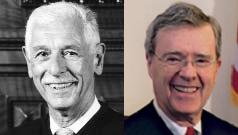
So why did they settle? Sources close to the case who don’t want to be identified say a big factor was that two of the three judges assigned to the case – Carlos Bea and Diarmuid O’Scannlain – are the most conservative on the Ninth Circuit bench and seemed likely to rule against the disability rights community. In other words, those with disabilities drew bad cards.

Bea was appointed to the Ninth Circuit in 2003 by then-President George W. Bush after serving more than 20 years as a San Francisco Superior Court Judge (appointed in 1990 by another fellow Republican, then-Gov. George Deukmejian), where he received poor marks from local attorneys, who said he was biased in favor of Big Business.

O’Scannlain was a founding member of the right-wing Young Americans for Freedom back in 1960, later serving as a tax attorney for Standard Oil. He was in private law practice and serving as chairman of the Oregon Republican Party in 1986 when then-President Ronald Reagan – whose presidential campaigns he had worked on – suddenly appointed him to the Ninth Circuit bench.

And if their histories and ideological leanings weren’t enough to tip the balance in favor of settling, there’s the fact that it was Bea who wrote a strong dissenting opinion in the MR v. Dreyfus case, dismissing the disability rights arguments completely.

He wrote: “Mind you this case does not involve the provision of certain social services to one group of disabled – those in nursing homes – but not to another group – the disabled residing at their own homes. No, the panel majority’s decision proceeds on the premise that the very reduction of social services currently provided the at-home disabled will risk their going to nursing home, and that such reduction therefore ‘discriminates’ against the at-home disabled, although not in favor of the disabled in nursing homes, or anyone else. But virtually everything the government does involves discrimination; it is in the nature of laws that they treat some people differently from others. This is not generally impermissible discrimination. Most government spending affects some groups more than others, but that doesn’t mean that the result in impermissible discrimination.”

He then rues the fact that “since the decision interprets and applies the ADA, it constitutes binding precedent in our nine Western states, with 20 percent of the nation’s population,” calling it a flawed decision that violates other court precedents with its “strained interpretation of the ADA.” Then, Bea goes on at length about how the state voluntarily and generously provided these in-homes services and says it should be allowed to suddenly withdraw them as well.

“To the contrary, this program is a flexible one: coverage is dependent in part on how much money the state has,” he wrote, later concluding by calling the majority opinion, “anti-democratic budgeting by judicial fiat.” Judge O’Scannlain is also a strong critic of “judicial activism,” which is often right-wing code for any rulings that expand the rights of society’s least powerful members, as opposed to the interests of the wealthy and powerful that they normally protect.

Yeah, I can see why disability right advocates might have wanted to cut their losses and settle the case.

DA’s office makeover may have skirted the rules

In a San Francisco Chronicle article published March 31, District Attorney George Gascon was quoted as saying he would not “even bother to defend” his decision to accept payments and in-kind donations for office furniture, valued at $26,445, from a roster of influential donors.

Although San Francisco’s top law enforcement official minimized the issue when questioned by reporters, it appears the DA may not have followed a number of state disclosure regulations when he accepted and reported the donation, which consists of a new glass-top desk and other trimmings to spruce up his executive office and the DA’s victim services lounge.

And the Guardian has learned that a formal complaint will be filed with the California Fair Political Practices Commission, a government accountability agency, alleging violations.

Charles Marsteller, a public ethics advocate and former co-coordinator of San Francisco Common Cause, sent the Guardian a copy of a complaint he intends to file with the FPPC, charging that Gascon either failed to properly disclose political contributions, or violated a gift limit imposed by state law.

“The District Attorney appears to be actively disregarding the applicable state law regarding the furniture payments,” a statement attached to Marsteller’s complaint notes.

Thirteen well-connected donors contributed payments toward the office set, with billionaire angel investor Ron Conway outspending the rest with a monetary contribution just shy of $10,000.

Other contributors, who gave between $1,000 and $2,000, included the Nibbi Brothers Contractors, who have worked on public housing renovations and other residential housing projects within San Francisco; Victor Makras, a member of the San Francisco Employees Retirement System board; Pius Lee, who previously served on the Police Commission; Charlotte Schultz, who holds the position of San Francisco’s Chief of Protocol, and Ryan Brooks, who formerly served on the city’s Public Utilities Commission.

The kind of disclosure form Gascon filed to report the new furniture, known as a behested payment report, is filed in cases where an elected official solicits a donation to a nonprofit entity or a government agency, and successfully secures a payment exceeding $5,000. In the case of governmental agencies, behested payments benefit a department as a whole, rather than any particular individual.

The fact that the donation was reported on a behested payment report, rather than a gift disclosure form, suggests that the new office furniture arrived only after Gascon requested it specifically, to benefit the DA office as a whole. But Marsteller’s complaint charges: “Since the furniture payments at issue were made for the benefit of Gascon’s own use, they would not constitute a behested payment that must be reported on Form 803.”

The complaint goes on to state that payments for Gascon’s furniture should either be counted as “contributions” or “gifts,” but not “behested payments.”

According to a memo prepared by the San Francisco City Attorney in 2008, department heads must obtain Board approval before accepting donations made to public agencies.

“Generally, the Board of Supervisors must approve, by resolution, any gift with a value greater than $10,000 before a City agency or department accepts such a gift,” according to a 2008 memo drafted by San Francisco Deputy City Attorney Jon Givner. The total value of the new office furniture is $26,445, but the funding was divided up among numerous donors, with payments submitted over the course of several months. Conway contributed $9,999 – exactly one dollar under the $10,000 disclosure threshold.

However, Gascon did not solicit Board approval before accepting the furniture payments. Instead, he submitted a resolution and memo to the Clerk of the Board on March 19, to be introduced at the April 2 Board meeting, seeking retroactive approval.

“Apparently, Gascon decided that he should seek to sanitize any violation of San Francisco’s Charter provision regarding acceptance of gifts by requesting retroactive approval,” Marsteller’s complaint suggests.

Reached on his cell phone and asked to comment for this story, Gascon told the Guardian that he was unable to answer questions at that time because a family member was undergoing surgery.

The 2008 memo from the City Attorney also states that city agencies “must report gifts worth more than $100 on the department’s website.” Visitors to the DA’s website will find a section on the “About” page, titled “Supporters of the San Francisco District Attorney’s Office,” which links to a PDF disclosing the donors’ names and individual gift amounts. However, a search on the Wayback Machine, a historical webpage snapshot service provided by the Internet Archive, shows that as of March 12, that disclosure section had not yet been created.

It’s possible that it was created as a result of questions raised. Larry Bush, who maintains a government watchdog news site called CitiReport, told the Guardian he began raising questions about the gift in March. Marsteller’s complaint is endorsed by Friends of Ethics, an ad hoc government accountability group that has also been scrutinizing the furniture payments.

Reached by phone, City Attorney spokesperson Matt Dorsey said he was unable to offer an official comment on the matter. “I wouldn’t be able to comment on, or even acknowledge whether, we gave advice or were asked for advice,” Dorsey told the Guardian.

Scholarship fund for poor college reject

17

The Bay Guardian Family Foundation has announced a special scholarship fundraising program to help Suzy Lee Weiss attend the college of her dreams.

Weiss, who slacked off four four years in High School watching The Real Housewives, revealed her plight in the Wall Street Journal, announcing that the elite schools of the US lied to her.

Colleges tell you, “Just be yourself.” That is great advice, as long as yourself has nine extracurriculars, six leadership positions, three varsity sports, killer SAT scores and two moms. Then by all means, be yourself! If you work at a local pizza shop and are the slowest person on the cross-country team, consider taking your business elsewhere.

The remarkable young woman, who in the course of fewer than 700 words manages to be homophobic, racist, and mean to her parents, has a Wall Street Journal career waiting for her — if she can just find a way to slide through a good college. Generations of American leaders have done it — and all they had that she lacks is a famous family and money.

We can’t fix her horrible family problems — her lack of a Tiger Mom, her parents falling asleep before she got home from whatever killer parties she was going to why her peers were studying late in the library and practicing classical piano — but somebody needs to give the kid some money.

Actually, there isn’t a Guardian Family Foundation, now that I think of it. Anyone want to help?

Pope announces evolution

1

Reflecting the growing political acceptance of same-sex marriage around the world, Pope Francis has unexpectedly announced that God’s position on the issue is “evolving.”

Speaking to reporters in the Vatican following Easter services, the recently installed Pope acknowledged his own personal history of expressing opposition to same-sex marriage as Archbishop of Buenos Aires Jorge Mario Bergoglio.

But as Pope, which church doctrine indicates has a direct line to God, Francis said he intends to carry out the new edict once God finalizes His decision, which He is expected to do in the coming weeks.

“God is all-knowing and all-powerful, and He has the right to change His mind,” Pope Francis said. “Even when it comes to evolution.

God’s apparent newfound openness to sanctifying same-sex marriage follows a similar position that President Barack Obama took last year when he announced his own “evolving” position on the issue and decided not to have the federal government continue defending the Defense of Marriage Act.

But unlike Obama, who has opted not to have the federal government proactively enforce the rights of people to marry whomever they choose, sources in the Vatican say that God and Pope Francis are considering a more aggressive stance on the issue. They say the Duo is considering allowing same-sex marriages in Catholic churches even in states and countries where it is now illegal.

“That would be big, the kind of move that only God could really make, politically speaking,” said the source, who asked to remain anonymous because he not authorized to speak to the press.

Pope Francis would not speculate on what may have changed God’s mind on the issue, although He is said be increasingly embarrassed by the intolerant statements of top Catholic officials and he’s worried about losing popular support among younger churchgoers who are more open to same-sex unions.

“Listen, the Book of Deuteronomy was written, what, almost 3,000 years ago?” our source said. “That’s a long time, positions have changed, and I think God recognizes that.”

Wiener to star in porn flick

22

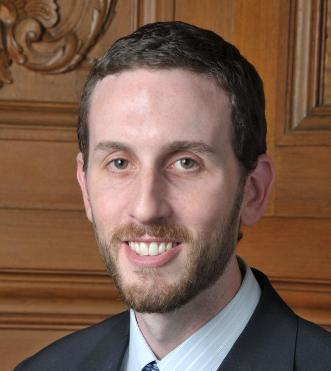
Supervisor Scott Wiener has signed a contract to star in a new porn film satirizing the city’s ban on nudity.

Variety reports that Wiener accepted a deal “in the mid three figures” to play the fictitious Supervisor Scott Cox in “Cover Up,” a film by the legendary Naked Sword productions.

Wiener replaces porn star Dale Cooper, who has left the film “to pursue other interests.”

The film, shot on location in the Castro, would violate the ban on public nudity that Wiener sponsored – but since the producers obatined permits, Wiener said, wieners are permitted.

“Besides,” he told us, “penises and anuses and perineums are good for business. And what’s good for business is good for San Francisco.”

Wiener, who is exceptionally tall and shuns the dating scene, said he expects his appearing in the film to jump-start his sex life. “A six-foot-six naked guy is, well, a six-foot-six naked guy, if you know what I mean,” Wiener told us. “And I think you do,” he added with a giggle.

Outtakes will soon be available at sfgov.org/nakedsupervisorwiener.

Archbishop announces nuptials

1

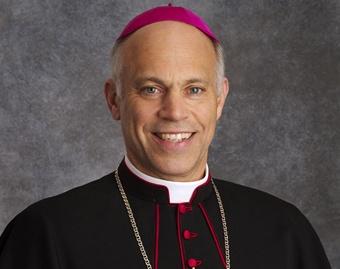
San Francisco Archbishop Salvatore Cordileone announced today that he would wed his longtime lover, Lupe, a tennis pro at the Bay Club.

“It will be a simple ceremony, as befits two humble servants in the eyes of our Lord,” George Wesolek, spokesman for the Archdiocese of  San Francisco, told us.

The marriage will take place in Connecticut, because same-sex nuptials are not at this point legal in California, Wesolek said. “Jesus casts a wide net, and we are happy to be able to include the Nutmeg State as part of our sister congregation — not that we are really sisters, which might suggest some sort of incest, which would be a sin,” he noted.

Cordileone has been an outspoken foe of same-sex marriage and has repeatedly argued that sex should only occur as part of  a procreative plan.  But Wesolek said the Catholic Church, which once sold tickets to free souls from purgatory and collaborated with the Nazis in World War II, has a history of moral flexibility.

“Plus, Lupe has a really cute ass,” he said.

 The couple plans to honeymoon in Argentina.