• No categories

Politics Blog

North Beach conflict-of-interest zone

It’s been over a year since North Beach’s Piazza Market closed its doors – but nothing has come along to take its place. The property, boasting 12,000 square feet at $4 per square foot, has attracted plenty of interest yet still remains empty.

“There’s been strong activity on the space – we’ve had several offers,” notes realtor Jeremy Blateis. “If there were less restrictions this place would have been sold already.”

According to Blateis, the place has not been leased to prospective renters because of zoning issues. Though the ad for the building says that it’s zoned for retail and restaurant use, potential owners would have to go through “lots of red tape” to have it used as a restaurant – which North Beach doesn’t have a shortage of.

This is where Claudine Cheng, recently resigned member of the Treasure Island Authority Board, comes in. According to a San Francisco Chronicle report, as a public figure she was paid money to influence decisions of city officers. And a company by the name of 627 Vallejo LLC – the owners of 627 Vallejo – paid Cheng $10,000 in hopes that she would smooth out the zoning situation.

According to the same report, she had been emailing Board of Supervisors President David Chiu seeking amendments to existing legislation in order to change the zoning of the area. Former Board President Aaron Peskin authored that legislation to prevent North Beach retail stores from being transformed into restaurants and chain stores.

Asked whether Chiu would have been open to a possible legislative amendment, legislative aide Judson True responded, “Supervisor Chiu would be open to making legislative changes that have community support,” but added that “the issue was whether or not Claudine Cheng was a lobbyist.” Judson noted that Chiu “also understands that there are laws that should match particular circumstances in neighborhoods like North Beach.”

Peskin, who filed complaints against her with the Ethics Commission and Fair Political Practices Commission, didn’t mince words.

“What she did was illegal,” Peskin said of Cheng’s decision to accept the $10,000. “What should fill 627 Vallejo is something that would further serve the community. Not another restaurant.”

SF water unaffected by wildfire – so far

The giant rim fire raging through Yosemite has tripled in size since Aug. 21, burning about 149,000 acres and approaching the vicinity of the Hetch Hetchy Reservoir, the source of San Francsico’s water supply, according to the San Francisco Public Utilities Commission.

In an update, the SFPUC noted that the city’s water system has not been impacted but is being closely monitored for changes to water quality.

“Currently, some ash has fallen onto the surface of the reservoir, but there has been no impact to the quality of water, which is being withdrawn from the reservoir at a depth of 260 feet,” The SFPUC noted in an update on Aug. 27. “All turbidity (the amount of suspended particles in the water) instrumentation continues to be within normal operating parameters.”

There has been no interruption to municipal electric service – although two hydroelectric powerhouses, Holm and Kirkwood, have been out of commission since last Monday due to the rim fire. Crews succeeded in making some repairs on Kirkwood Aug. 26 in preparation for power restoration.

The SFPUC has been making up the difference in power generation by tapping a power bank and making supplemental power purchases on the open market – a pricey alternative that’s cost the city around $600,000 so far, according to an Aug. 26 update.

A video of the rim fire shot from a Cal FIRE plane. The blaze has increased considerably in size since Aug. 22 when this footage was captured.

“Refeeding” is prison authorities’ new word for force-feeding

The practice of force-feeding inmates has a branding problem.

The issue first came to light after a U.S. District Judge last week granted the California Department of Rehabilitation and Corrections, or CDRC, the ability to feed inmates who are hunger striking even if they signed “Do Not Resuscitate” waivers, commonly known as DNR’s. The order called any DNR granted during the beginning of the hunger strike 50 days ago as invalid.

As the negotiations wind on, it’s looking more inevitable that the hunger strike holdouts will soon be near death. But when the prisons start force-feeding inmates, a whole new problem will arise: image.

The CDRC have given all the concessions they’re willing to give, they said, and if an inmate dies while fasting they’d become a martyr. At some point, the prisons may have to feed the inmates via liquid in an IV, or even via tubes.

The tubes are inserted through the nose and directly into their stomachs, and conjure images of alleged terrorists at Guantanamo Bay. 

In a video made by musician Mos Def, aka Yasiin Bey, Bey allowed himself to be force fed to bring attention to Guantanamo’s detainees. Bey is strapped to a chair, and a clear plastic tube is inserted through his nose as he screams, writhes, and begs for it to stop.

“The tube went in and the first part of it is not that bad, but then you get this burning,” he said in the video. “It starts to be like really unbearable, like something is reaching into the back of my brain…. I really couldn’t take it.”

For Mos Def, the feeding was brief. For inmates, the process can take two hours.

To address that issue the California Department of Corrections and Rehabilitation (CDCR) has taken to calling force feeding “refeeding,” which is term that already has a definition: feeding someone who has recently ended a fast. It has medical significance because a whole host of ailments can occur when someone who is ending a fast is fed the wrong foods, or fed too quickly. They can even die. 

But now the CDCR has used the word “refeeding” to mean feeding inmates who have already signed DNRs and are fed to prevent death. The word was in every major news report on the court’s recent decision, from Democracy Now to Al Jazeera.

“Refeeding” is the new force-feeding. 

Joyce Hayhoe, legislative director of California Correctional Health Care Services, wanted to make it clear that no one has been force-fed yet, and that refeeding was not force feeding.

“What I would like to say is we’re not force-feeding anybody,” she told the Guardian. “When doctors do not have a valid DNR, in the absence of any other information, when we have an inmate we cannot communicate with, we’re going to save their lives.”

But the sticking point in her statement is the word “valid,” advocates say. What is a valid DNR? The health care providers allege that some inmates began the hunger strike because of intimidation by senior gang members in the jails. Hayhoe said one inmate hid food so his fellow hunger strikers would not know, and that “implied something” to her.

There were 12,000 inmates who started the hunger strike on July 8, according to counts by the prisons themselves. Of those, it’s entirely conceivable that a few were coerced, said Dr. Ronald Ahnen, a politics professor at Saint Mary’s College focusing on prison reform.

“Is it possible some prisoners were coerced,” due to the sheer number of inmates involved, he said in an interview. But, “if you read the call from the hunger strike forward, and you heard from the reps in Pelican Bay (Prison), they have always stated emphatically and clearly that the hunger strike is voluntary. They have said no one should continue with the hunger strike longer than they were willing or able to do.”

Now the number of inmates in the hunger strike is down to 92, according to the CDRC. Of those, 41 have been on a hunger strike continuously since it began on July 8.

Hayhoe said there are only a handful of strikers with DNRs left, but would not reveal specific numbers. 

Ahnen, who is affiliated with the hunger strikers as a reform advocate but did not speak as their spokesperson, said that though those numbers have dwindled, they’re still significant.

“What amazes me is, 41 people who have been without food for 50 days. I think the major media is missing the importance of that,” he said. “When you think of the Irish hunger strike that we all think of from 1980, that’s 23 individuals who all died. We now have 42, risking their lives to have humane conditions in their confinement. Its very, very historic.”

Lost in the debate over food are the actual reasons for striking. The inmates have five core issues which you can see at their website here, but mostly they revolve around quality of life in Segregated Housing Units, commonly referred to as the SHU. The prisoners say it is solitary confinement, and they can be thrown in there easily by being told they have affiliations with gangs.

“I’ve had prisoners tell me their investigators say they can use any evidence and implicate anyone (as a gang member),” Ahnen said.

And the inmates have little recourse once they’ve been labeled a gang member and thrown in the SHU. Toshio Meronek covered this for Bay Guardian last month (“Hungry for Reform,” 7/3/13), saying it would take nearly 20 years to conduct reviews of the over 10,000 inmates presently held in solitary confinement in California.

In a statement circulated shortly after the CDCR’s on Thursday, State Senator Mark Leno wrote, “I have concerns that this review process is moving too slowly and I would like to see it accelerated.”

The hunger strike is one of the inmate’s last tools to reform that system. Now, in a cell that strips away most all human freedoms, “refeeding” may take away an inmate’s choice to die.

The federal judge’s decision to strip away that right reverberated across the world. The United Nations Special Rapporteur on torture, Juan E. Méndez, issued a statement saying “it is not acceptable to use threats of forced feeding or other types of physical or psychological coercion against individuals who have opted for the extreme recourse of a hunger strike.”

Hayhoe, from the prison’s health services, said there is some wiggle room in having your request to not be resuscitated honored.

“If a person has signed a DNR during the hunger strike, the best thing they can do is start having discussions with his primary care physician and expressing their need,” she said. The inmates have been sustained on Gatorade and vitamins, she said, and are not yet at the point of needing resuscitation.

Ahnen also clarified that the violent method of force-feeding may not be used. Another way to do it, he said, is to feed patients through an IV should they lapse into unconsciousness.

“This is a more likely scenario,” he said, but it is still force-feeding. Hayhoe said she would contact a doctor to see when each method would be used, but did not have the information immediately available.

These inmates are close to dehydration, close to organ failure, and close to death for their principles, Ahnen said, and now their political stand won’t be honored. They’ll be force-fed, no matter what terminology is used to describe it.

“Make no mistake about it, if a prisoner is being fed against their will, this is force feeding,” he said.

And with the flip of a word, the inmates have lost their right to die.

To learn see future actions on the hunger strike, visit http://prisonerhungerstrikesolidarity.wordpress.com/take-action-2/ .

How I learned to stop worrying and just trust Larry

8

As I leave for Burning Man, I wanted to share an article that I wrote for the on-playa BRC Weekly. Enjoy, and I’ll see you all on the on the other side:

This is as good as it gets, burners, right here and right now in beautiful, bountiful Black Rock City. And this is the way it’s always going be, year after year, like a dusty Groundhog Day on acid. Only the numbers and faces of the citizens and the things we create for one another will change.

It’s perfect, right? No reason to change a thing. What God (or, rather, Larry Harvey) has created, let no burner presume to alter.

That’s an idea that most burners seem to embrace, despite the beloved pastime of veteran burners to kvetch and celebrate some storied golden age, whether it be 1986, 1996, or 2006. We all just appreciate the chance to build a city for ourselves each year and the leaders of Burning Man for giving us that opportunity, again and again.

And I’m now joining those who accept Burning Man as it is, hereby officially dropping my struggles against Larry, Maid Marian, and the rest of Black Rock City LLC board to create some form of representative or democratic leadership for the Burning Man and its culture.

It’s been a lonely and frustrating crusade anyway, so I’m happy to be done with it (as I’m sure they are). I’ve been regularly covering Burning Man for my newspaper, the San Francisco Bay Guardian, since 2004. My reportage formed the basis of my book, The Tribes of Burning Man, which came out in 2011 just as the LLC board was being torn apart by internal divisions that they resolved by deciding to turn control of Burning Man over to a new nonprofit they were creating, The Burning Man Project.

“Why not act to change the world, a world that you won’t be in? And that’s what we want to do,” Larry told a roomful of grateful burners when he announced the plan in April 2011. “We want to get out of running Burning Man. We want to move on.”

The prospects of that change in leadership seemed exciting, and I imagined a council of veteran burners representing our community’s constituent communities – artists, DPW, sound camps, volunteers, art car makers, regional leaders, maybe the biggest villages – gathering around a table to plan the future of Burning Man. It might get messy, but things worth doing usually are.  

First, I took issue with Larry’s announced plans to create secret payouts for the six board members, but nobody except Chicken John seemed to care about that. The predominant view seemed to be that they had done us all a great service and they deserved whatever it was they wanted to pay themselves.

Fine, so then I publicly questioned the hand-picked nonprofit board, which seemed chosen for their fundraising ability more than the communities they represented. Again, no resonance, so I accepted it and moved on. Maybe money was what was important in the early stages, and new leadership would come later.

And I was totally willing to just let it go and move on, until earlier this year when I watched the new documentary, “Spark: A Burning Man Story,” which concludes with the claim “the organization is transitioning into a nonprofit to ‘gift’ the event back to the community.”

So I decided to plug back into covering Burning Man to check on the status of this gift with just a year to go until Larry had said that control of the event would be transferred to the new nonprofit. But rather than relaxing their grip on the event and entrusting it to the community, I learned that they consider their leadership “more important than ever,” as Marian put it.

Not only are The Burning Man Project board members still not representative of the overall community, but they have no authority over the event, which Larry wants to continue as is “without being unduly interfered with by the nonprofit organization.”

Sure, the LLC and its various fiefdoms can unilaterally change its contracts with artists, its policy on what kinds and how many art cars to license, its ticket pricing structure, and size of the city (the max population this year jumped to 68,000 from 60,000 last year), all without any input from the community. It can cut lucrative side deals with corporations and propagandists. But we can’t have the new nonprofit board making these sorts of decisions, that would be unthinkable. 

“The nonprofit is going well, and then we have to work out the terms of the relationship between the event and the nonprofit. We want the event to be protected from undue meddling and we want it to be a good fit,” Larry told me.

And when I wrote about these issues in the Guardian, where they were read by tens of thousands of people, few people seemed to care. Two articles I wrote on these issues this year got two online comments each, comparing to the 259 comments and vigorous public discussion that ensued after I wrote “Burning Man ticket fiasco creates uncertain future” in February of last year.

The lesson: as long as we can get to Black Rock City, we don’t really care who’s calling the shots. After all, it’s really all of us who create the city each year for our own enjoyment, and that’s what matters, not the six people who control the $23 million we all spent on tickets this year.

So I’m just going to enjoy myself this year and forever after, safe in the faith that “participation” and “radical self-reliance” are things I do in my own camp and immediate surroundings, and that the larger Burning Man project itself is in the same safe and benevolent hands that it’s always been and always will be.

Amen.


Manning contingent wins Pride award

25

Ah, the sweet rainbow flavor of comeuppance. As the fascinating and part-tragic, part-inspiring saga of Chelsea Manning continues to unfold, at least one portion of the struggle has reached a satisfying conclusion.

The disastrous move by this year’s Pride Board to negate the election of Bradley Manning as a community grand marshal in the parade — locking out press and protestors, canceling meetings, and kicking up a general shitstorm in the process — only served to bring out three blocks’ worth of marching supporters in the Bradley Manning Supprt Network Contingent this year. Now, that contingent has won the “Best Overall Pride Contingent Award,” voted on by the public.

Sorry, Pride Board :/

Here’s the press release from Grand Marshal, Not Court Martial, a related group:

This past June 30, the Bradley Manning Support Network (BMSN) marched for its third consecutive year in San Francisco’s Pride Parade.

The BMSN was the largest non-corporate contingent in this year’s parade and was named by judges, along with four other groups, as an “Absolutely Fabulous Marching Contingent.” In addition, at last night’s SF Pride’s Check Granting Party, it also won the award for “Absolutely Fabulous Overall Contingent.”

The vote for the “Absolutely Fabulous Overall Contingent” was put out to the community on SF Pride’s web site. BMSN was up against three other groups: Abada Capoeira, Bay Area Youth Summit, and Mormons for Marriage Equality.

The winning of these awards comes on the heels of a two-month debacle in which SF Pride rescinded the nomination of Bradley (now Chelsea) Manning as a Community Grand Marshal. Local LGBT and veteran activists held demonstrations and a teach-in (as well as a Community Meeting called by Pride at the urging of SF Supervisor David Campos) to try to get Manning reinstated.

The contingent featured former military strategist, 82 year old Daniel Ellsberg, who in 1971 leaked secret documents known as the Pentagon Papers to the New York Times. Ellsberg, adorned with a pink boa around his neck, was accompanied in the parade by his wife, Patricia.

Manning was sentenced this past Wednesday to 35 years in prison for releasing thousands of classified documents including the infamous “Collateral Murder” video, which shows a U.S. Army helicopter gunning down Iraqi civilians and two Reuters journalists. This sentence will automatically be sent to the Army Court of Criminal Appeals. Manning’s lawyer and numerous organizations are calling on President Obama to pardon Manning, who could be paroled after 10 years, three of which have already been served.

Following the sentencing, Manning issued a public statement declaring: “As I transition into this next phase of my life, I want everyone to know the real me. I am Chelsea Manning. I am a female. Given the way that I feel, and have felt since childhood, I want to begin hormone therapy as soon as possible. I hope that you will support me in this transition. I also request that, starting today, you refer to me by my new name and use the feminine pronoun (except in official mail to the confinement facility). I look forward to receiving letters from supporters and having the opportunity to write back.”    

The internet reacts to Sgt. Ernst’s bicyclist memorial tantrum

140

A memorial (and informational event) at the 6th and Folsom corner where bicyclist 24-year-old Amelie Le Moullac was fatally run over by a truck last week was interrupted by a tense confrontation with SFPD Sgt. Richard Ernst, when he showed up to block the bike lane with his cruiser to lecture the cyclists.

SFBC Executive Director Leah Shahum told the Guardian in a story Wednesday that SFPD Sgt. Richard Ernst showed up to make his apparent disdain for “you people,” bicyclists.

From that story: “He then told me explicitly that he ‘would not leave until’ I ‘understood’ that ‘it was the bicyclist’s fault.’ This was shocking to hear, as I was told just a day ago by Commander [Mikail] Ali that the case was still under investigation and no cause had yet been determined,” Shahum wrote in a report to the Office of Citizen Complaints. Below are a few reactions from the Twitterverse to Sgt. Ernst’s actions.

Below are a few reactions from the Twitterverse to Sgt. Ernst’s actions.  


Cyclist Patrick Traughber then rode a route spelling out the victim’s name, in tribute and memoriam. Special software tracked his route and displayed her name via the software. 

Cyclist Patrick Traughber rides a route to spell out the accident victim's name

Chronicle: Don’t question the City College takeover, just submit to the flawed ACCJC

71

I have very low expectations from editorials in the San Francisco Chronicle, which generally share a worldview with the Chamber of Commerce and carry water for some powerful Establishment figure or another. But today’s editorial on City Attorney Dennis Herrera’s lawsuit defending City College is so bad and illogical that it reads like an Onion parody of a Chronicle editorial.

Clearly put up to it by some of the most reactionary figures in the Mayor’s Office, Chronicle Editorial Page Editor John Diaz or one his lackeys parrot the submissive stance that Mayor Ed Lee has taken toward outsiders with corporatist agenda that have seized control of City College and sought to make a high-profile example of it.

“The city’s leaders should be calling for tough love, not coddling dysfunction. Fortunately, Mayor Ed Lee has done just that – but, regrettably, the city attorney is going in the opposite direct [sic],” the Chronicle wrote.

And by “tough love,” they apparently mean obedient and unquestioning compliance with an obscure accrediting agency’s demand that City College slash community-based curriculum; close facilities relied on by both students and local nonprofit groups; rip up contracts with faculty and force instructors to live on part-time wages; distill course offerings down to just what serve corporations, universities, and banking interests; and other aspects of an educational agenda that hasn’t been properly vetted in public hearings or approved by any elected body.

Herrera is to be applauded for pointing out the overreach and conflicts-of-interest on the Accrediting Commission of Community and Junior Colleges, which were also recently criticized by the US Department of Education. And we’re excited to see what Herrera uncovers during the discovery process in his lawsuit against a secretive, corporate-connected, document-shredding agency that broke its own internal rules in its treatment of City College.

The Chronicle graciously refers to these unavoidable facts in a brief paragraph, writing that the ACCJC “is not without flaws. It’s secretive, and its internal policies drew a rebuke from the U.S. Department of Education after City College faculty filed complaints about its conduct.”

But then it dimisses that and shows a suspicious incuriosity about why the ACCJC is being so secretive and what its agenda might be, instead doubling down on criticizing City College in a way that is so over-the-top that this fine institution is unrecognizable to anyone who is actually familiar with it, which Diaz and company clearly aren’t.   

“The needed changes include hiring a comptroller to organize financial controls, making sure students pay for classes, and overhauling a loose-fit governance system that puts faculty, students and staff in charge of operations with inadequate administrative controls. Lee has strongly endorsed an overhaul of City College’s ramshackle operations,” the Chronicle writes.

Unlike us here at the Guardian, where I’ve written two recent editorials in support of democracy and local control and critical of Lee and others who have been too quick to cooperate with the toppling of the locally elected Board of Trustees, the Chronicle apparently believe in more authoritarian methods of governance.

“The first repairs are now under way. The powers of the elected community college board are on hold, and a special trustee dispatched by state Community College Chancellor Brice Harris is in charge,” the Chronicle writes.

And as we report in our upcoming issue, that special trustee also has no interest in questioning the ACCJC’s process or methods or even allowing the public to review internal communications. It’s a shame that bootlickers like Lee and the Chronicle have sold out such an important local institution to their corporate masters, but luckily for San Francisco, Herrera, the California Federation of Teachers, the Guardian, other progressive media voices, and hundreds of our community partners aren’t giving up so easily, instead pushing for an open, truthful, democratic, and transparent discussion about City College’s mission and its future.

The other thing Chelsea Manning said, and more updates

By now, we all now that Pfc. Bradley Manning, who was sentenced to 35 years on Aug. 21 for leaking classified U.S. government documents, would like to enter the next phase of her life as a woman named Chelsea. “I want everyone to know the real me,” Manning said in a statement. “I am Chelsea Manning. I am a female.”

But the message on gender identity wasn’t Manning’s only public statement the day the sentencing was decided. There was also this, a heartfelt explanation of why the whistleblower did what she did, titled, “Sometimes you have to pay a heavy price to live in a free society.” Manning writes:

“It was not until I was in Iraq and reading secret military reports on a daily basis that I started to question the morality of what we were doing. It was at this time I realized in our efforts to meet this risk posed to us by the enemy, we have forgotten our humanity. We consciously elected to devalue human life both in Iraq and Afghanistan. When we engaged those that we perceived were the enemy, we sometimes killed innocent civilians. Whenever we killed innocent civilians, instead of accepting responsibility for our conduct, we elected to hide behind the veil of national security and classified information in order to avoid any public accountability.”

Meanwhile, Bay Area supporters who rallied for Manning at the San Francisco Pride Parade and every other juncture – including attending the trial in Fort Meade, gathering on the day verdict was announced and most recently launching a campaign calling for the WikiLeaker’s pardon – also gathered at Justin Hermann Plaza Aug. 21 in response to the sentence.

The SFPD and CCTV


Yesterday, we told you about CommunityCam, a new online mapping platform that displays surveillance camera locations throughout San Francisco. We’d placed a phone call to Sgt. Dennis Toomer of the San Francisco Police Department’s Media Relations Unit to ask whether SFPD has an eye toward collaboration on this effort, but didn’t hear back until after publishing the post. In a voice message, Toomer explained the manner in which SFPD utilizes CCTV footage to investigate crimes. He said:

“The SFPD does not own or operate any [permanently installed] cameras. There are some cameras throughout the city, but those are operated by the Department of Emergency Management. Consequently, we don’t monitor cameras either. At events like the Pride Parade, Bay to Breakers, we have put up our own cameras along the parade routes, or along the race routes, just for the purpose of deploying resources.

“As soon as the event is over, those cameras come back down, and we don’t store any kind of video footage. What we do is, we rely on the public, the commercial businesses, banks, stores, you name it, to provide us with video if a crime occurs in that area – but it’s not something that we monitor. We ask the public to provide us with any kind of video tape, or cameras or surveillance that they operate. We don’t maintain our own system. Again, the city cameras that are around in certain areas – like the Tenderloin, Bayview, I believe out in Ingleside – those are all operated and managed by DEM.”

Where the Uber meets the road 

We recently reported that Uber, the smartphone-enabled ride service that does not wish to be lumped in with rideshares or taxis, is facing a class action lawsuit from drivers who claim they were cheated out of hard-earned tips.

Uber spokesperson Andrew Noyes initially declined to comment, but has since emailed an official response (which does not actually contain any answers to the Guardian’s questions). Here is what Noyes had to say about the lawsuit, which Uber has not yet received:

“While we have not yet been served with this complaint, the allegations made against our company are entirely without merit and we will defend ourselves vigorously. Uber values its partners above all else and our technology platform has allowed thousands of drivers to generate an independent wage and build their own small businesses on their own time. Frivolous lawsuits like this cost valuable time, money and resources that are better spent making cities more accessible, opening up more possibilities for riders and providing more business for drivers.”

SF City Attorney Dennis Herrera sues to keep City College open

49

City Attorney Dennis Herrera filed a suit today to block City College of San Francisco’s accreditation agency from closing down the school.

The accreditation agency, the Association of California Community and Junior Colleges, moved to put City College on a sanction last July that would lead to its closure in exactly one year. Since then, enrollment at the college has plummeted and the school has been in the fight for its very existence. Now Herrera is saying that closure action was improper, unwarranted, and out of line with the agency’s prior actions.

Herrera’s suit alleges the ACCJC unlawfully allowed its advocacy and political bias to prejudice its evaluation of college accreditation standards, he said. “It is a matter of public record that the ACCJC has been an advocate to reshape the mission of California community colleges,” Herrera said, and that was the basis of his suit.

The ACCJC cannot be advocates for change in the higher education system, he said. “There’s a reason judges aren’t advocates and advocates aren’t judges,” he said. “Now we have no problem with the right of others to advocate an agenda against the open access mission… but we should have a problem with an entity charged with evaluation engages in political advocacy.”

Notably, the ACCJC wanted City College to shrink its mission, concentrating its money on students who could transfer easily to four year institutions from City College, which many advocates say would leave students learning trades, new English learners, and other disenfranchised students in the dust. You can see our coverage on that here.

Above: Text of Herrera’s suit and a press release with more information, courtesy of Sara Bloomberg, reporter for City College’s newspaper The Guardsman.


Herrera also filed an administrative action against the California Community College Board of Governors, saying they had abandoned their role as the check and balance on community colleges, and left it to a private institution that was unaccountable to the public (for full disclosure, I am named in Herrera’s suit on pages 16 and 18 for my role advocating against the Student Success Act of 2012 to the Board of Governors. I was a student at the time, not a professional reporter, and I have no personal stance on the future of the ACCJC). The Board of Governors oversees the 112 community colleges in California, the largest body of community colleges in the country. 

Alisa Messer, the faculty union president of City College, agreed that the Board of Governors should not be abdicating its policy and oversight role. 

“No outside, unaccountable agency should be making up its own rules or setting policy for our state’s colleges,” she said. 

City College Trustee Rafael Mandelman applauded action against the ACCJC.

“At this point I think it absolutely critical the ACCJC is not in the driver’s seat making these decisions, they’re not fit to do that,” he told the Guardian.

This past Tuesday City College submitted review documents to the ACCJC attesting to why it should be allowed to stay open and accredited, and Therese M. Stewart, the chief deputy city attorney, said that while they sent an order to ACCJC not to destroy documents, they had not yet obtained any documents yet. “We haven’t actually sought documents yet from the ACCJC, we asked them to not destroy documents so that we may seek them later,” she said. “Eventually we will get them.”

Memorial for cyclist marred by SFPD harassment

380

A memorial and informational event this morning at the 6th and Folsom corner where a bicyclist was fatally run over by a truck last week was marred by a tense and unsettling confrontation with an SFPD sergeant who showed up to block the bike lane with his cruiser, lecture the cyclists, and blame the victim.

The event was organized by the San Francisco Bicycle Coalition to raise awareness of the incident and that dangerous intersection and to call for the city to make improvements. It included friends and co-workers of 24-year-old Amelie Le Moullac, who was riding in the Folsom Street bike lane on the morning of Aug. 14 when an unidentified delivery truck driver turned right onto 6th Street, across her path, and ran her over.

SFPD Sgt. Dennis Toomer tells the Guardian that the department has completed the traffic incident report, information from which can only be shared with the parties involved, but that the investigation of the fatality is still ongoing and will be forwarded to the District Attorney’s Office for review once it’s done.

But SFBC Executive Director Leah Shahum said that SFPD Sgt. Richard Ernst, who showed up at the event a little before 9am, had already drawn his own conclusions about the crash and showed up to make his apparent disdain for “you people,” bicyclists, disturbingly clear.

Shahum said that she tried to be diplomatic with Ernst and asked him to please move his patrol car out of the bike lane and into an available parking space that was right next to it, saying that it presented an unnecessary hazard to bicyclists riding past.

But she said Ernst refused to do so for almost 10 minutes, telling the group that he has “a right” to leave his car than and that he was “making the point that bicyclists need to move around” cars parked in bike lanes, according to Shahum’s written account, which she prepared to file a report about the incident with the Office of Citizens Complaints.

“He then told me explicitly that he ‘would not leave until’ I ‘understood’ that ‘it was the bicyclist’s fault.’ This was shocking to hear, as I was told just a day ago by Commander [Mikail] Ali that the case was still under investigation and no cause had yet been determined,” Shahum wrote.

And apparently Ernst didn’t stop at denouncing Le Moullac for causing her own death, in front of people who are still mourning that death. Shahum said Ernst also blamed the other two bicyclist deaths in SF this year on the cyclists, and on “you people” in the SFBC for not teaching cyclists how to avoid cars.

“I told him the SF Bicycle Coalition does a significant amount of safety work educating people biking and driving about sharing the road, and that I’d be happy to share more information with him. I again urged him to move his car out of the bike lane. He again refused, saying it was his right and he wasn’t moving until I ‘understood,’” Shahum wrote.

Shahum said there were multiple witness to the incident, including three television reporters who were there to cover the event.

“In addition to the Sgt’s inappropriate and dangerous behavior of parking his car in the bike lane and blocking safe passage for people bicycling by, it was deeply upsetting to see him unnecessarily disrupt and add tension to what was already an emotional and difficult time for many people who lamented this sad loss of life,” Shahum wrote.

Asked about the actions and attitudes expressed today by Ernst, who we could not reach for comment, Sgt. Toomer told us he “cannot talk about personnel issues.”

Compounding Ernst’s insensitive and judgmental approach today, it also appears the SFPD may have failed to properly investigate this incident, which Shahum and the SFBC have been tracking closely, and she said the SFPD told her that there were no video surveillance tapes of the collision.

After today’s event, SFBC’s Marc Caswell decided to check in at businesses on the block to see if they had any video cameras aimed at the intersection, and he found an auto body business at the intersection whose workers said they did indeed have revealing footage of the crash that the SFPD hasn’t requested, but which SFBC today delivered to investigators.

“He had the time to come harass us as a memorial, but he didn’t have the time to see if anyone had footage of this incident. It’s very unsettled,” Shahum told us.

Whoever was ultimately at fault in this collision and others that have injured or killed bicyclists in San Francisco, today’s confrontation demonstrates an unacceptable and dangerous insensitivity and animosity toward bicyclists in San Francisco, which was also on display in the comments to the post that I wrote last week about the incident.

It’s fine to debate what happens on the streets of San Francisco, and you can even harbor resentments toward bicyclists and believe that we deserve your ire. But when you endanger people’s lives to make a point, or when you threaten violence against vulnerable road users, then you’ve gone too far.

Yes, let’s talk about what happens on the roads and how to improve behaviors, but let’s not forget our humanity in the process.  

One thousand surveillance cams in SF and counting

If you walk through densely populated commercial corridors on a regular basis, chances are you’re being recorded. Based on information compiled by CommunityCam, a data visualization project plotting the location of security cameras, there are at least 1,100 surveillance devices installed throughout San Francisco – and possibly many more.

Billed as a “community service initiative” designed to make neighborhoods safer, the CommunityCam platform was developed by VideoSurveillance.com, a proprietor of IP-connected CCTV systems that has served customers ranging from California Pacific Medical Center to Harvard University to Lockheed Martin.

The web-based platform reveals the precise locations of visible security cameras throughout the city, incorporating a crowd-sourcing component that allows anyone to plot the location of a camera.

San Francisco neighborhoods with the highest concentration of surveillance cameras include the Financial District, the areas around North Beach and Chinatown, and the Marina, the data shows. The vast majority of the cameras are privately owned, but the map plots all visible security cameras regardless of whether they’re operated by commercial interests or public agencies.

VideoSurveillance.com president Josh Daniels, a Portland resident who previously lived in San Francisco, launched the effort, which he described as an effort to improve public safety.

“The CommunityCam network of cameras gives community residents a way to investigate when an incident occurs,” Daniels said in an interview with the Guardian. Noting that accidents such as cyclist collisions or physical assaults were common in San Francisco streets, he said, “it’s just impossible to investigate these kinds of incidents in San Francisco” without the presence of security cameras. He called the project “a way to let people know that video surveillance can be used in very positive ways.”

While Daniels is not formally partnering with police, he described law enforcement as  “very interested in the locations of the cameras” and said he’d met with law enforcement groups in San Francisco as well as neighborhood groups, landlords, and building managers. He added that across the board, police agencies are “very strapped from a financial resources standpoint,” so his project can serve as a tool for those agencies without additional cost.

And collaboration with law enforcement could expand further down the road, Daniels said. “In the future there’s potential to expand the program and expand the services to give law enforcement access to privately held cameras,” Daniels said, “but that’s a long way off.” Media representatives from SFPD had not responded to the Guardian’s request for comment by press time.

While the CommunityCam platform introduces a new level of transparency to private security systems installed throughout the city, it also raises a number of questions. While it’s billed as a public safety program designed to illustrate the useful attributes of CCTV, CommunityCam also serves to illustrate the growing surveillance infrastructure in public space, a phenomenon that necessarily raises questions about the erosion of privacy in a hyper-connected world.

The early-stage data-mapping project also presents questions about how this tool could ultimately be developed and utilized, particularly if it’s used toward developing a broader or more centralized surveillance infrastructure. If public safety officials or private security entities use the data to identify gaps where public space isn’t being monitored, it could be used to justify the installation of still more cameras.

Earlier this year, the Guardian spotlighted San Francisco’s pilot project testing out “smart” streetlights that would be wired into a centralized IP-connected system, with possible future uses as street surveillance. We’ve also kept an eye on the San Francisco Police Department’s efforts to collect surveillance footage from local bars.

Privacy and civil liberties advocates have flagged concerns about the proliferation of CCTV cameras in public spaces. Privacy advocates focused on CCTV are particularly active in the UK, where studies suggest the average Londoner is caught on camera 300 times per day on average, and new technologies such as cameras that incorporate license plate readers have been adopted in smaller cities.

Daniels said he’s very familiar with these concerns, but was dismissive of the idea that security cameras in public space presented any sort of encroachment on personal privacy. “My own opinion is that I don’t believe I have an expectation to privacy in a public setting,” he said.

While Daniels noted that CommunityCam is the first-ever attempt to plot security cameras in an interactive online format, it’s not actually true. Last summer, European privacy activists who wished to draw attention to the proliferation of CCTV cameras led a game called “camspotting” in Brussels, part of an international activism effort known as “1984 Action Day.” After going out and logging camera locations, they plotted them on an online map.

Activists say a pair of Spades could beat culture and small business in the Mission

94

[UPDATE: The Board of Appeals last night voted to 3-2 that Jack Spade should be considered a formula retail business, short of the four-vote supermajority that activists needed to sustain their appeal.]

Progressive activists and small business owners in the Mission are trying to draw the line against the creep the of corporate chain stores — with their homegeneity and tendency to drive up commercial rents — and they’re drawing that line at the old Adobe Bookstore where the Jack Spade corporate clothing chain was trying to quietly sneak in.

“I’m strongly opposed because of its potential to destroy the culture of this area,” Michael Katz, owner of Katz Bagels across 16th Street from the site, told the Guardian. “If they start allowing chains to come, it will be one chain store after another.”

Katz has already been experiencing the flipside of these economic boom times, recently forced to close his shop on Mission Street near 2nd in SoMa because of rising rents and competition from both food trucks and corporate-backed competitors. Now, he’s fighting to defend his Mission District turf against deep-pocketed competitors.

“This will change the special personality of the 16th and Valencia corridors,” Katz said. “It’s turning it into a commodity.”

Katz is among the dozens of people planning to show up tomorrow for the San Francisco Board of Appeals’ hearing (Wed/21, 5:00 PM, City Hall Room 416) on the Jack Spade store. The Valencia Corridor Merchants’ Association is organizing the challenge to the legal standing of a building permit issued to Jack Spade by the Planning Department in June.

Last week, that same group of activists experienced a minor setback when the Board of Appeals denied a late filing request. Tomorrow, however, they’ll get the opportunity they were seeking to argue that the store is “formula retail” and needs to submit to a public hearing before being sanctioned by the Zoning Administrator to open a new Mission location.

Mission resident Kyle Smeallie has been working with the VCMA to oppose the mens’ clothier’s advances on 16th street. In the case of Jack Spade, the Planning Department has enforced only the narrowest definition of “formula retail” as a business with 11 or more locations, while failing to defend the broader spirit of the law.

Since Jack Spade is owned by Fifth & Pacific (aka Liz Claiborne), according to Smeallie, it is a corporate chain store. Though it indeed has only 10 locations, Jack Spade “has a complete imbalance of power and resources, which is exactly what the formula retail legislation aimed to remedy in the first place,” said Smeallie.

Fifth and Pacific also makes clear on its website the Jack Spade is an expanding chain: “Under Fifth & Pacific, Jack Spade has begun to spread its wings and is now poised for broader expansion. Although management would not disclose a precise volume breakdown, Fifth & Pacific’s CEO William L. McComb said on an earnings call last year that Jack Spade ‘can be a $100 million men’s business with very high margins.’”

That’s “margins” as in profit margins, meaning that this corporate chain can has an economies of scale that allows it to buy goods for cheap and sell them for whatever people will pay, which is an ever-increasing amount in the rapidly gentrifying Mission.  

Experts have advised the activists that their best approach is to argue that Kate Spade and Jack Spade are essentially the same store, with well over 11 locations nationwide, since corporate parentage is not explicitly prohibited in the formula retail legislation approved by voters in 2006.

“We’re going to make the case that, since it’s named Spade, it has benefitted from the association with Kate Spade,” Smeallie explained. “Legally, we have a case to say a Spade is Spade and they should be considered one and same.”

In the past, this strategy was successful in thwarting an effort by “Black Fleece by Brooks Brothers” to open a neighborhood location by claiming that it was, effectively, just another Brooks Brothers. In that case, however, the full name of the large-scale retailer was present in the subsidiary’s label.

Lawsuit alleges Uber unfairly withholds tips from drivers

A class action lawsuit filed against Uber, a tech-based service that connects riders to drivers and has filled San Francisco streets with sleek black town cars, alleges that the company is cheating its drivers out of tips.

The suit also charges that drivers have been misclassified as independent contractors under California law.

Uber’s website tells customers there is “no need to tip,” and drivers are prohibited from accepting any extra cash. The complaint alleges that “drivers do not receive the tips that are customary in the car service industry and that they would otherwise receive were it not for Uber’s communication to customers that they do not need to tip.”

The lawsuit was filed in San Francisco’s Northern District on Aug. 16. Attorney Shannon Liss-Riordan, of the Boston-based firm Lichten & Liss-Riordan, believes that by withholding tips “Uber is artificially trying to make the total price look lower – and in doing so, they’re hurting the drivers.”

Douglas O’Connor, who is named as a plaintiff in the lawsuit, said that when he started working as an Uber driver in San Francisco about 10 months ago, he was told not to accept tips because they were included in the service fees automatically charged to customers’ credit cards. But there’s nothing in his paycheck to indicate whether he has received a gratuity or for what amount, O’Connor said.

“For some of the drivers there has been a line item, but that line item that’s called the gratuity has not gone to the drivers,” Liss-Riordan explained. In those cases, it appears Uber takes half, she said. And in cases like O’Connor’s, “There is no separate gratuity that’s going to the drivers,” Liss-Riordan said, so the representation that any tip was included in the first place is “a lie.”

Liss-Riordan noted that Uber has even been known to send out “secret shoppers” who are directed to take Uber, offer cash tips, and report whether the drivers accepted the tips or declined with the explanation that the tips are included in the service fee, as they are instructed to.

Meanwhile, Uber recently required drivers to agree to revised contract terms, which is mandatory in order to continue their relationship with the ridesharing company. Buried in the fine print is an arbitration clause with a class action waiver. By agreeing to these terms – something Uber not only requires but makes exceptionally easy with the tap of a button on a smartphone – drivers are essentially giving up their rights to join a class action suit against the company. O’Connor noted that the contracts were sent out in English only, but English is not the first language of many Uber drivers.

“In order to opt out of this class action they have to send a hand-delivered letter to the general counsel of Uber in San Francisco,” Liss-Riordan pointed out. “We’re also trying to get the word out to Uber drivers that if they want to participate in this class action case and potentially recover their tips, they actually have to opt out of this arbitration clause.”

O’Connor said he drives between 30 and 70 hours a week, and would like to continue doing so in the long run. But without the additional income he feels he could be earning in tips, “I’m not going to be able to do it. It’s just so expensive to live in the San Francisco Bay Area.” He described what happened when a businessman he’d ferried to the airport offered to add an additional $10 to $15 onto his company credit card for exceptional customer service. He couldn’t, because Uber does not provide a mechanism for attaching an additional driver bonus onto the service fee. 

Asked if there was an estimate as to how much drivers could be losing in tips, Liss-Riordan said, “It adds up to a lot – for someone working there for over a year, you could be talking in the hundreds if not thousands of dollars.” And for the entire class of Uber drivers, who are estimated to number in the thousands across major U.S. cities, she noted that the total damages sought could end up being in the millions.

In addition to charging that Uber is “unjustly enriching” itself by collecting fees that are owed to drivers, the suit also claims that Uber drivers should be classified as employees under California law.  

“Under California law, there’s a multi-factor test to determine whether someone is an employee or an independent contractor and the test looks at things like … whether the workers’ services form the core part of what the business does,” Liss-Riordan explained. In this case, they do, she added: “If there were no drivers, there would be no Uber.”

As independent contractors, Uber drivers must pay for their own gas expenses and vehicle maintenance. They are not eligible for workers compensation or unemployment benefits in the event that they are terminated. Nor is Uber required to make any contributions toward its San Francisco drivers’ health care costs, since its drivers aren’t considered employees. The San Francisco Health Care Security Ordinance mandates that employers contribute toward healthcare for any employee working eight hours or more.

Liss-Riordan specializes in representing tipped employees. She prevailed in a lawsuit against American Airlines on behalf of skycaps who were prevented from receiving tips because the airline created a $2 fee for curbside check-in that led passengers to believe that gratuity was included.

Reached via email, Uber spokesperson Andrew Noyes declined to answer questions about the allegations raised in the complaint, nor would he explain why Uber required its drivers to agree to an arbitration clause waiving their rights to join a class action suit. Noyes declined to comment, saying the complaint had not yet been formally served.

O’Connor, meanwhile, said he agreed to be named as a plaintiff in the case “in order to improve working conditions for myself and my colleagues.” Asked if he was concerned whether this decision would affect his standing as an Uber driver, O’Connor shrugged it off. “I’m probably not going to get the employee driver of the month award,” he joked.

“Greyhound therapy” is wrong for Nevada, and San Francisco

22

It’s horribly inhumane and indefensible for Nevada to ship its mentally ill homeless to San Francisco, and City Attorney Dennis Herrera is right to go after that state with a lawsuit aimed at changing that policy and recovering the city’s costs, which he discussed today in a press release and San Francisco Chronicle article.

But San Francisco should have greater moral authority to make this stand than it does, thanks to the Homeward Bound program started by then-Mayor Gavin Newsom and continued by Mayor Ed Lee, a program that gives local homeless individuals a one-way bus ticket out of town.

The Chronicle took pains to say how different San Francisco’s exportation of its homeless is from Nevada’s, noting that we make sure our homeless are stable enough to travel alone and that there’s someone waiting for them on the other side before we send them to the bus station.

Sure, that’s better, but the basic concept is the same and it’s consistent with San Francisco basic approach toward much of its homeless population, for whom the city intentionally limits shelter beds and makes it difficult to get one and treats the resulting street population as a law enforcement issue.

Newsom was elected on his Care Not Cash promise to provide shelter and social services to the homeless, and it certainly did get many people who needed it into supportive housing. But the actual homeless problem is far worse and more systemic than that program (or feel-good gimmicks like Project Homeless Connect) can really address.

San Francisco should be leading the way in calling for this country to address the root causes of homelessness, as well as the related problems of poverty, exploitation of workers and natural resources, and a wasteful economic system that is cooking the planet and its biodiversity.

Instead, we’re leading the way in pushing unsustainable, technology-fueled economic growth with no regard for the byproducts of wealth generation by the privileged few, whether it be giving our homeless one-way bus tickets out of town, forcing our workers and nonprofits to seek reasonable rents elsewhere, undermining hard-won social compromises, or missing our own greenhouse gas reduction goals (today’s Examiner cover story).

We can — and we should — take greater responsibility for our city’s policies and prejudices and work to regain  the moral authority that we need to be an example for other cities and begin to advocate for needed reforms on the national and international levels.  

Attorneys debate toxic turf during Beach Chalet project opponents’ last stand

29

Opponents of a city plan to install artificial turf soccer fields and stadium lights at the Beach Chalet soccer fields in Golden Gate Park — after losing at every stage of the project’s approval process — had their day in court Friday, beginning what could be their last chance: to have a judge block the project.

“I wouldn’t be surprised if these were the most heavily scrutinized soccer fields in the country,” attorney James Emery, who is representing the city and the project, said as he started off his opening arguments to defeat the lawsuit.

Groups including the SF Coalition for Children’s Outdoor Play and the Sierra Club’s San Francisco Bay Chapter filed a lawsuit based on the claim that the city violated the California Environmental Quality Act when it chose to use what the plaintiffs lawyers describe as “toxic turf.”

The main argument on the plaintiff’s side was that the styrene-butadiene rubber (SBR) that will be used for the fields is inherently toxic. Other arguments included the lack of hybrid alternatives on the Environmental Impact Report conducted for the fields, as well as deletion of emails by a city department.

Plaintiffs attorney Vernon Grigg started off with the assertion that the SBR turf being used for the soccer fields is made from crushed up tires “that aren’t even allowed in a landfill without a permit,” and that the EIR failed to offer other alternatives such as carpet pad rubber or cork.

His co-counsel Richard Drury also pointed out that SBR turf has a 18.8 in a million chance of causing cancer, exceeding the significant threshold of 10 in a million the Bay Area Air Quality Management District (BAAQMD) adopted in 2010.

Attorney Scott Emblidge, another lawyer contracted by the city on the case, said that wasn’t a standard that the city has adopted, criticizing the oft-repeated point by saying, “San Francisco has not formally adopted significance standards, though they have said it 17 times in their opening brief.”

But Drury emphasized that the city is compelled by CEQA to consider a less toxic option. “There are no alternatives to less toxic turf,” Drury said. “It wouldn’t have been hard for them to do that — they just didn’t do it.”

But Emblidge said the EIR didn’t identify the turf choice as significantly toxic, a point Drury disputed.  

“The EIR does mention alternative forms, and does discuss alternative turf composition,” Drury said. “They consistently covered that there were significant health effects. There’s lots of speculation, but nothing that truly shows it.”

Other points were made that people within the Recreation and Parks Department were deleting emails related to the project, but coverage on that subject ran short as Judge Teri L. Jackson had to leave the court because of other engagements.

Attorneys for both sides are scheduleed to meet on Wednesday to be questioned further by Jackson.

Plan Bay Area takes legal punches from the left and right

45

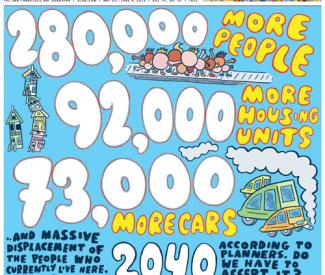
Plan Bay Area, the regional strategy to funnel future population growth into San Francisco and other big cities in order to combat climate change, is now being slammed with legal challenges from both sides of the ideological spetrum.

Those left-right punches could knock out a plan that critics called a schizophrenic attempt to accomplish competing goals with inadequate resources and resolve. For example, it created incentives to increase housing density along transit lines, but it did little to limit private automobile use, make that housing affordable by people who do use transit, or address the displacement of existing urban populations.

Earthjustice, Communities for a Better Environment, and the Sierra Club today filed a lawsuit in Alameda Couty Superior Court challenging Plan Bay Area’s recent approval by the Metropolitan Transportation Commission and the Association of Bay Area Governments.

That lawsuit follows one filed Friday with the same court by the Building Industry Association of the Bay Area. And those two suits follow another one filed Aug. 6 by the conservative Sacramento law firm Pacific Legal Foundation on behalf of a group calling itself Bay Area Citizens.

While that first lawsuit from the Tea Party crowd criticizes the very idea of regional planning and the validity of addressing global warming, these latest two lawsuits basically call out Plan Bay Area and its supporters for not going far enough to address the goals laid out in the plan.

Earthjustice and the community groups it works with criticize Plan Bay Area for disrupting Bay Area communities with an accelerated growth plan that doesn’t address environmental justice issues like those faced by West Oakland residents, whose air quality would be worsened by an influx of automobile traffic.   

 “The people of the Bay Area take pride in living in one of the most diverse, culturally and economically vibrant metropolitan areas in the world. We demand smart planning for growth—the kind that improves our quality of life, makes life easier and less expensive for residents all over the Bay Area, and allows our communities to thrive and grow,” Irene Gutierrez, Earthjustice associate attorney, said in a press release. “This requires responsible planning that reduces climate change pollution, plans for smart public transit growth, avoids toxic zones, and dirty and harmful air quality. Plan Bay Area does not achieve those goals. The people of the Bay Area deserve a much better plan.”

And Bay Area developers are focused on how the plan calls for more transit-oriented development without investing in the public infrastructure needed to serve it, criticizing the state legislation behind Plan Bay Area that relaxes the environmental studies of projects in transportation corridors.

“SB 375 calls on the Bay Area and other regions of California to integrate residential and transportation planning in ways that fully accommodate their housing need and in ways that allow for reduced reliance on and emissions from passenger vehicles,” said Bob Glover, executive officer of BIA | Bay Area. “Plan Bay Area is a cop out.  It neither plans for enough housing nor provides a reasonable path for developing it and therefore looks a lot more like a pulling up of the draw bridge than a sustainable communities strategy.”

To learn more about Plan Bay Area, you can read our May cover story, “Planning for Displacement,” or the coverage of a public forum that we and other groups sponsorerd.

RIP Jose Sarria, Empress I of SF, the Widow Norton

2

He led a life that spanned the full evolution of modern gay rights — and the mourning gowns will be fabulous. Jose Julio Sarria is dead at 90, all hail the Empress. 


America’s Cup organizers sell small-scale naming rights at Pier 27 to pay their debt to the city

0

The Port Commission has approved a proposal by the America’s Cup Organizing Committee (ACOC) to sell bricks, benches, and other assets at Pier 27 to offset budget shortfalls, but community activists fear that corporate naming rights are undermining plans for a public recreation space.

A presentation at the Tuesday meeting by Kyri McClellan, the former city staffer who now serves as CEO of the ACOC, and Mike Martin of the Office of Economic and Workforce Development outlined the sale of up to 1,000 bricks to be set in pathways and 72 benches to dot the Northeast Wharf Plaza, which will bear the names of donors. Benches will be priced at $25,000, which McClellan cited as the going rate at other high-profile locations throughout the city.

McClellan emphasized that “none of what we’re proposing today as a pilot program includes what may previously have been alluded to as naming rights for this particular park, the piers, or the buildings.”

Milo Hanke and Alex Walker of San Francisco Beautiful, a local advocacy organization, didn’t have a problem with the smaller scale elements of the ACOC proposal. “The tiles and the bricks that are being offered here for $150, $300, for instance,” Hanke told the crowd, “that’s a gratifying opportunity for ordinary citizens who have already invested in our port to volunteer to express additional support for this proud port.”

But Hanke and Walker expressed concern about bigger ticket items that McClellan addressed with less specificity. “We want to make sure that this is a thing that’s going to be place-making and not place-taking,” commented Walker.

In addition to bricks and benches, the wharf’s lawn and adjacent walkway, an open plaza area, and a point at the pier’s end are earmarked for recognition of donors. So too are an event space and an exterior concourse on the second floor of the James R. Herman Passenger Cruise Terminal, slated to open at Pier 27 next spring.

“Corporate naming rights,” explained Hanke, “come with an intangible cost and I think that, given San Franciscans’ historic aversion to excess commercialization of our public realm, corporate naming rights are well worth taking a bypass on.”

Diagrams presented by ACOC did not include detailed renderings of larger donor fulfillments or clarification as to whether recognition would be restricted to individual and foundational donors and off limits to more commercial interests. “There is concern,” said Hanke, “of a creeping naming rights program if large areas are named for corporations.”

Pulling in $500,000 to $2.5 million a piece, however, bigger structures may be the revenue drivers ACOC is desperately seeking. As part of its host agreement with San Francisco, the organization is obligated to help offset the city’s expenses incurred in event preparations and operations.

Luckily, the race’s outsized budget is expected to be less than the $32 million originally projected, due to the paltry number of teams competing (four at last count) and the resulting decrease in spectatorship. Still, the ACOC needs to come up with as much as $20 million – a debt burden that’s got Mayor Ed Lee personally stumping in the fundraising effort. The fundraising flop belies early promises that the city would make money hosting the event.

San Francisco voters approved Proposition B last November, authorizing the city to apply public funds towards repairs and redevelopment of recreational spaces. The fact that the Northeast Wharf Plaza was a named site in that bond measure isn’t the only reason community activists are demanding to know what assets on its piers are being auctioned off and who’s buying them.

According to Jon Golinger, a spokesman for the Northeast Waterfront Advisory Group, the San Francisco Waterfront Special Area Plan limited development on the Pier 27 plaza until a 2000 amendment lifted port restrictions in exchange for guarantees of public recreation areas.

Since then, “we’ve been paying close attention to this park. It’s particularly needed and a long time coming,” explained Golinger, who said there’s been no citizen review of the ACOC’s donor recognition program proposal.

Neighborhood organizations hope ACOC’s tag sale of infrastructure doesn’t torpedo use plans for land long ago promised as a public recreation area. Golinger would like to see features like a kids’ play area, a dog run, and exercise equipment for seniors included in the final design – whether or not they are lucrative to race organizers now.

“After the Cup is done in October, it should look, feel, and be used like a true public park,” Golinger said of the plaza. “This corner of town is the most densely packed part of San Francisco with the fewest recreation areas per capita…. [the plaza] should be part of the neighborhood as opposed to a corporate event venue.”

The promise of infrastructure improvements was one reason the city of San Francisco agreed to host the America’s Cup race in the first place. Residents are now left to hope that ACOC won’t forgo investments of lasting civic value for single-use vanity projects intended to float its budget deficit.

Concluding the discussion of the ACOC’s proposal on Tuesday, Port Commissioner Leslie Katz offered assurances that, “we’ll definitely oversee and be mindful of the aesthetics of anything going forward… This is not a selling off of the port, but really an opportunity to thank and acknowledge those that have allowed us to move forward.”

This opportunity, of course, assumes that donors actually surface. Mayoral spokesperson Christine Falvey said, “We will learn from [this] effort about how we can raise private dollars to improve our waterfront and engage city residents in the effort.”

If ACOC’s efforts to court private dollars from city residents aren’t fruitful, however, taxpayers-turned-debt-collectors may have no option but to sign former District 3 Supervisor Aaron Peskin’s online petition and to demand that America’s Cup billionaire defending champion Larry Ellison pick up the tab for his boat race all by himself.

Tragedies remind us to pay attention and share the roads

114

A pair of tragic news items involving bicyclists in San Francisco — one cyclist a victim, another a perpetrator — illustrates the need for all of us to slow down, pay attention, and safely and respectfully share the roadways of this crowded city.

The victim of yesterday’s fatal collision between a truck and bicyclist at Folsom and 6th Streets — in which the motorist turned right across the path of cyclist in a bike lane, but was inexplicably yet not surprisingly not cited by police — was today revealed to be 24-year-old Amelie Le Moullac.

Meanwhile, 37-year-old cyclist Chris Bucchere was today sentenced to 1,000 hours of community service and three years probation after pleading guilty to felony vehicular manslaughter after last year trying to beat a red light at Castro and Market streets and fatally striking elderly pedestrian Sutchi Hui.

“Motorists, pedestrians, and bicyclists must share the road in a responsible way because there are dire consequences when traffic laws are disregarded,” District Attorney George Gascon said today after Bucchere’s sentencing.

Both of these incidents were sad for all concerned, and they should remind us to be responsible and attentive travelers, a lesson that we could all use. Everyday on my bike commute home, I see motorists running red lights or darting heedlessly around obstacles, risking people’s lives to save seconds of their days; cyclists impatiently edging their way past pedestrians; and pedestrians stepping out into traffic without looking around them, often because they’re absorbed by their smartphones.

We’re all guilty of bad behavior on the roadways at times, myself included, so I’m not going to presume to stereotype any particular group of road users (I’ll leave that to the trolls). But when we hear about terrible tragedies like these, it’s good to take a moment to reflect on our own behavior and do what we can to civilly share our civic spaces, particularly when wielding the deadly weapons of a fast-moving bicycle or an automobile moving at any speed.  

SF Democratic Party opposes developers’ 8 Washington initiative

On Wed/14, members of the San Francisco Democratic County Central Committee voted 14-6 to oppose Proposition B, a San Francisco ballot measure backed by the developers of a luxury waterfront development project, 8 Washington. Ten DCCC members abstained, while two voted “no endorsement.” Prop. B seeks voter approval for the waterfront development, which has become a flashpoint in San Francisco politics.

The 134-unit condominium complex, which will offer units in the $5 million range, already won approval from the San Francisco Board of Supervisors last June. But 8 Washington developers launched the Prop. B initiative in response to Prop. C, a referendum backed by oppositional campaign “No Wall on the Waterfront.” In May, the DCCC made an early endorsement against Prop. C, essentially siding with project opponents in declaring opposition to 8 Washington.

It’s easy to get Props. B and C confused. The campaign against 8 Washington is called “No Wall on the Waterfront,” while the developer-backed campaign favoring construction has been dubbed “Open up the Waterfront.” From opponents’ perspective, it almost doesn’t matter if voters bother to sort out which is which. Now with the support of the DCCC, they are urging a “no” vote on each.

Last week we told you about a campaign video produced by 8 Washington developers that had attracted some controversy. Here’s a campaign video produced by 8 Washington opponents, featuring former San Francisco Mayor Art Agnos. The pitch makes sound like the San Francisco waterfront will morph into Miami Beach if 8 Washington moves forward. You have to admit it’s a stretch.

West Oakland hyper gentrification in the WSJ

Two stories on the theme of gentrification and displacement – a topic we at the Guardian have expended plenty of ink on – ran in major news outlets recently, showing how intense the Bay Area housing market pressure has become as it continues to be fueled by a rapid growth in high-salaried jobs in big tech.

Zeroing in on San Francisco, the LA Times turned an eye toward Mission District gentrification, illustrating the growing divide with a succinct comment overheard on a Muni bus: “I don’t know why old people ride Muni. If I were old, I’d just take Uber.”

And a Wall Street Journal article provides an eye-opening account of how REO Homes LLC is literally seeking to accelerate the gentrification process by “beautifying” West Oakland, an historic Black neighborhood that is home to predominantly low-income and working-class residents. (Note: The article may be behind a paywall.)

Minutes from downtown San Francisco via BART, West Oakland is dotted with Victorians and was hit with a wave of foreclosure during the economic crash, destabilizing the lives of many families who lost their homes.

REO is an investment firm helped along by San Francisco billionaire Tom Steyer, a well-connected venture capitalist (he even hosted a Democratic Party fundraiser with President Barack Obama at his Pacific Heights mansion earlier this year).

As the Journal’s Robbie Whelan reports, REO has been shelling out top dollar to spruce up not just its holdings, but residences nearby its West Oakland properties. In a rarely seen form of hyper-gentrification, the company has been planting trees, sprucing up homes (for free) of neighbors who aren’t in the market to sell or rent, mending fences, and making other improvements – all in an effort to lure higher-income residents to the neighborhood.

Since 2008, the height of the real-estate market crash, REO has acquired more than 200 homes in Oakland, Whelan reports, mostly in West Oakland. “Most houses cost around $200,000,” he writes, “and [founder Neill Sullivan] said he invests as much $100,000 to fix each one up.”

Real-estate agents have been marketing the neighborhood – which is no stranger to violent crime – to house-hunters as an affordable, nearby alternative to astronomically expensive San Francisco. Now that many people who weren’t able to keep up with mortgage payments have been forced out by foreclosure (see: robocalls, bungled loan modifications, foreclosure abuses), things are changing swiftly, as if by magic. Armed with cash, bankers are chasing away the blight and rolling out the welcome mat for up-and-comers who can’t swing it for that $3,000 one-bedroom in the city.

All of which will likely result in further displacement of Oakland residents who are barely holding on as it is. As Oakland councilwoman Desley Brooks told the Journal: “I’m not interested in finding housing for San Franciscans who can no longer afford San Francisco. I’m interested in helping people here in Oakland.”