• No categories

Politics Blog

Van Ness BRT moves forward, slowly, despite the need for rapid reforms

50

San Francisco today inched closer to finally creating a modern bus rapid transit system on Van Ness Avenue, nine years after it was officially proposed, although as we reported in last week’s paper, the city is still about five years away from actually completing it.

The San Francisco Municipal Transportation Agency Board of Directors today approved the project’s Environmental Impact Report, following up its approval last week by the San Francisco Transportation Authority, which has the same makeup as the Board of Supervisors.

Next, the $126 million project heads to the Federal Transportation Authority for approval of its environmental documents, after which it heads into a design phase and comes back for its project-level approvals, giving its motorist critics plenty of time to make mischief and undermine it.

In last week’s debut Street Fight column, Jason Henderson made equity arguments about how a project that will speed up Muni for tens of thousands of riders, and that it’s moving forward over the objections to losing 105 parking spaces, sparking an explosion of caustic comments.

In prepared comments about today’s vote, SFMTA head Ed Reiskin said, “The Van Ness BRT project will transform Van Ness for Muni drivers and for pedestrians, making travel a much more pleasant, safe, and efficient experience.” In his column, Henderson also added the descriptor “dignified,” which should be another goal on an underfunded system that is now busting at its seams.  

As much as motorists love to complain about government, or the “bike lobby,” or other perceived enemies of their convenience, San Francisco should be doing more to create pleasant, safe, efficient, and dignified service to the growing population that relies on Muni.

That will mean some more sacrifices by motorists, it will mean finally asking businesses to help pay for Muni improvements with a downtown transit assessment district (instead of moving in the opposite direction by expanding corporate welfare giveaways), and it will mean finally getting serious about improving the system, rapidly, rather than the nearly 15 years it is taking for this common sense improvement.


Wells Fargo lawsuit against city of Richmond dismissed

5

Richmond, 1, Wells Fargo, zip. 

In the first round of what may become a long and protracted legal battle, US Distict Judge Charles Breyer dismissed Wells Fargo’s lawsuit against the city of Richmond today, and the reason for dismissal was clear: nothing has happened yet. 

Wells Fargo’s suit attacked the constintutionality of Richmond’s plan to use eminent domain to seize about 600 mortgage loans, a controversial program meant to save residents from losing their homes. The judge pointed out that not only had Richmond not yet enacted the plan, but it hadn’t even been voted on by the Richmond City Council. 

In legalese, the case is not “yet ripe for adjudication.” Translation? You can’t sue someone for something that hasn’t happened, or may not ever happen, Breyer wrote in his decision. He also explained why he dismissed the case, rather than putting it in abeyance (a kind of “pause button” for cases).

“The Court further concludes that it must dismiss the case rather than hold it in abeyance,” he wrote. “Ripeness of these claims does not rest on contingent future events certain to occur, but rather on future events that may never occur. Because there is no point at which it will be determined that Plaintiffs’ claims are not ripe and will never become ripe, the matter could linger in abeyance for an indefinite period of time. Under these circumstances, a stay is not appropriate.”

Wells Fargo declined to comment on the decision, and a spokesperson referred us to legal counsel representing investors in the mortgage market (of which Wells Fargo is a trustee). Mayor Gayle McLaughlin also was unavailable for comment as she is out of the country on a business trip.

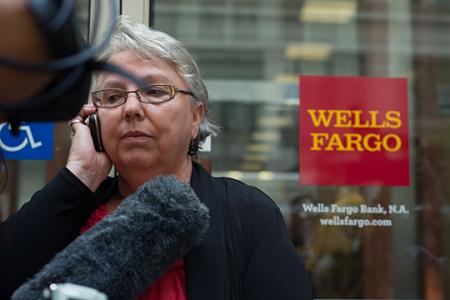
protesters march outside of Wells Fargo

Speaking to the Guardian a few weeks ago about her eminent domain plan, McLaughlin said she would be willing to battle Wells Fargo “all the way to the Supreme Court,” to defend the community of Richmond. And she may have to, as Wells Fargo does have the opportunity to appeal to a higher court. 

For clarification, Breyer did indicate in the hearing last week that he would seek abeyance or dismissal in the case, but did not issue his final decision until today.  

For our coverage of Richmond’s city council meeting where the plan was almost voted down by city councilmember Nathaniel Bates, click here. Look out for our full coverage of the newest in Richmond’s battle for homeowners in our September 18 issue, this Wednesday.  


Below is the full text of Breyer’s decision.

From America’s Flop to America’s Blowout — and we couldn’t be happier

131

New Zealand’s sailing team could win the America’s Cup this weekend after taking a 6-0 lead over the American team sponsored by Oracle and its billionaire CEO Larry Ellison, who made this elite sailing race even more prohibitively expensive than usual. And we at the Guardian couldn’t be happier for the Kiwis. Go New Zealand!

For years, we’ve been covering this sad spectacle, from the overhyped initial attendance and economic projections to the waterfront land grab and real estate swindle that Ellison and company tried to perpetrate on San Francisco to sticking city taxpayers with a big bill that Ellison should have footed himself to the episodes of cheating that caused international judges to dock Ellison’s team two points in the final (one of which is still yet to be assessed).

So we feel vindicated by this great act of karmic justice, to watch Ellison’s team not just losing badly, but being utterly blown out of the water by the straight-shooting team from Down Under, whose skipper has pledged to scale back future America’s Cups to make them cheaper and more accessible.

Frankly, watching the America’s Cup has been far less exciting than the speedy “NASCAR on water” that it was hyped as by organizers. This “sport” makes baseball seem riveting and fast-paced. But we’re thrilled to watch the grand finale, if only for the snicker.  


Advocates say solidarity is key to achieve real immigration reform

13

by Reed Nelson

When Lourdes Perez got off work in the recent past, she didn’t put her feet up. She said she couldn’t worry about dinner or her son’s extracurricular activities. All she could think about was her safety and the safety of her son.

Perez was trapped in an abusive relationship, and — like many other undocumented women in the Bay Area — felt that calling the police wasn’t an option. Perez doesn’t speak much English, making her an easy target for her abusive spouse and fearful of local authorities charged with protecting the abused. And that makes no sense.

But for an estimated 2.6 million undocumented Californians, things haven’t made sense in quite some time. Fear of deportation has forced many, like Perez, to try and go unnoticed day in and day out. Now, with federal immigration reform moving forward and policy initiatives at the local level aimed toward improving safety for undocumented survivors of domestic violence, advocates have finally seen some progress – yet immigrant rights advocates seem to agree that the work as being far from finished.

Dozens of community members turned out for a Sept. 12 event, “What’s Beyond DOMA in Immigration Reform? The Next Steps for Women & LGBTQ Communities,” hosted in San Francisco by Asian Students Promoting Immigrant Rights Through Education (ASPIRE) and API Equality Northern California.

The event marked the first time “we’ve had a round table or panel discussion that brings in so many different perspectives and community organizations,” co-host Sammie Wills noted.

In 1996, then-President Clinton signed a sweeping legislation banning safety-net access for millions of immigrants and refugees, according to panelist Gabriela Villareal, policy manager for the California Immigrant Policy Center. “[The law] basically barred [immigrants and refugees] from safety-net support for the first five years of them being here,” Villareal said.

But things have worsened since then. Much of the panel discussion focused on the draconian Secure Communities (S-Comm) — a shadowy partnership between the FBI and the U.S. Immigration and Customs Enforcement (ICE) that began in 2008, and has resulted in the deportations of 784 San Franciscans since 2010, according to data provided by the office of Sup. John Avalos.

A week before the forum, Avalos’ proposed Due Process for All ordinance received veto-proof supermajority support (8-3) from the San Francisco Board of Supervisors. An attempt to neutralize S-Comm at the local level, the legislation makes it illegal for law enforcement to detain undocumented citizens solely in response to immigration detainer requests issued by ICE under S-Comm.

Stacy Umezu, programs co-director at Community United Against Violence (CUAV), urged forum participants to contact state elected officials urging support for the TRUST Act, statewide legislation similar to Due Process for All which would bar police from detaining individuals solely in response to requests from federal immigration authorities.

In the meantime, activists are continuing to advocate for meaningful reform. Alex Aldana, part of the East Bay Immigrant Youth Coalition, for instance, found civil disobedience to be the most effective mode for change. “I’m undocumented and unafraid, queer and not ashamed,” Aldana said during the discussion.

Amy Lin, from Aspire, perhaps summed up the mission of this eclectic group best when she discussed her personal experience as a doubly marginalized individual. As part of the LGBTQ community and the undocumented community, she said, she is stigmatized by even those already marginalized.

Solidarity was key, she said. And by sticking together, she and the rest of the panelists hope to steer immigration reform toward the inclusive and fair plateau they’ve been seeking all along.

How far will $10 an hour stretch in 2016?

112

Earlier this week, just as media reports pointed out that America’s wealthiest 1 percent did better in 2012 than almost any other year in history, Gov. Jerry Brown came out in favor of a bill that would raise the state minimum wage to $10 an hour by 2016.

Last night, the Assembly approved the bill on a 51-25 vote, sending it onto the governor’s office. The development is almost certain to provoke howls from pro-business interests claiming it will wreak havoc on the economy. But what will it mean for minimum wage earners, whose take-home pay currently totals less than $300 a week for a full-time job?

Here are some statistics to put into perspective what it means to be a minimum wage earner in a world of rising costs and a widening gulf between top income earners and the rest.

  • The National Low Income Housing Coalition notes that a household must earn $25.78 per hour to afford fair market rent for a two-bedroom apartment without spending 30 percent of their income. Couples earning California’s current $8 minimum wage can muster only a combined $16 an hour before taxes.
  • Based on this map illustrating San Francisco’s gaping rent affordability gap, a minimum-wage earner (making the 2012 minimum wage of $10.24 an hour) would have to hold down at least 3.4 full-time jobs to rent a two-bedroom apartment at fair market rate – even in the city’s less expensive areas like the Bayview or the Excelsior.
  • Fast food workers around the country are aiming higher than the $10 per hour Californians may have to look forward to by 2016 – organized food service employees have been rallying to be paid $15 an hour, a rate they see as an actual livable wage. According to this nifty calculator created by the Daily Beast, using data from University of Massachusetts economists Jeanette Wicks-Lim and Robert Pollin, the cost of paying McDonald’s workers this much could be recovered by charging 22 cents more for a Big Mac.
  • Finally, it’s worth considering the growing wealth gap between the wealthiest one percent and the rest. From 2007 to 2009, average real income for the bottom 99 percent fell by 11.6 percent, the largest two-year decline since the Great Depression, according to to an analysis by UC Berkeley economist Emmanuel Saez. Meanwhile, the top 1 percent lost an even higher percentage in that time. But then, during the economic recovery from 2009 to 2011, the one percent saw their incomes increase by 11.2 percent, while incomes of the bottom 99 percent shrunk slightly. Then, in 2012, the top one percent scored a 19 percent increase, their collective earnings accounting for 22.5 percent of total U.S. income. As Matthew O’Brien writes in The Atlantic, “it’s the one percent’s economy, and we’re just living in it.”

Twelve years after BART train kills mechanic, lighting and electrical safety not improved

11

When BART maintenance workers train under safety instructor Saul Almanza, the most important thing they learn is this: your objective when you go to work is to come home. 

When he recites that mantra he remembers two BART engineers who were hit and killed by the trains whose tracks they were charged with repairing: Robert Rhodes in 2001, and James Strickland in 2008. Almanza imagines the dark tunnels, where the safe places to stand are small and the lighting is scarce. He thinks of Rhodes and Strickland every day.

As talks between BART labor unions and management resumed Sept. 9, negotiations over safety overhauls have stalled, representatives from SEIU Local 1021 said. On Sept. 11, union members on the negotiating team — which includes Almanza — released a chart of fines the transit agency had received from the California Occupational Safety and Health Administration, stemming from those accidents. 

The chart shows 20 citations from OSHA since 2001 that the unions said have been unaddressed. BART management, unsurprisingly, disputes this. The list shows incidents as minor as rain getting into a fare gate and as major as the two aforementioned deaths. All told, the safety fines add up to $192,375. 

spreadsheet documenting BART's safety violations

The complaints were also listed on the federal OSHA website, with additional details revealing that some of the investigations into the complaints were closed, contrary to the union’s claim. That doesn’t mean the underlying causes of the problems have been solved, though. Many of the problems persist, Almanza told us, endangering workers’ lives.

Those safety issues remain a sticking point in the negotiations between BART management and SEIU. 

BART spokesperson Rick Rice said the lighting issues that led to Rhodes’ death will soon be resolved. Strickland’s death was a separate issue, though, as dense vegetation blocked a driver’s line of sight led to the mechanic’s death. That was also addressed, Rice said. 

“Starting next year there’s $4.5 million allocated by the board to improve all the lighting,” Rice told the Guardian, he said other changes have also made the tunnels safer since the 2001 accident.

But Almanza said that while he’s heard that all before, he won’t believe it until he sees it in writing. So far, that hasn’t happened. 

“The only change that took place was they added signage to the location saying you can’t enter the area without ‘simple’ approval,” Almanza said. Simple approval is a process where the worker recites a waiver that absolves BART of fault should they be injured or die.  “They make you proclaim that you won’t interfere with operations, and it means if you delay something or die it’s your fault.”

Rhodes’ death in 2001 was a result of inadequate markings and lighting, he said, but Strickland’s death in 2008 was due to his being hidden behind tree ovegrowth. The union is asking for a dedicated grounds crew to cut back vegetation to improve visibility, hopefully saving lives in the process. BART management said progress was made on that point.

“Since the accident they’re referencing, there’s been extensive changes to the safety procedures and vegetation management,” Rice said. But Almanza told us those changes embedded groundskeepers with mechanics, and they started doing jobs that had nothing to do with groundskeeping. They weren’t even handed chainsaws for a year, he said. 

A train mechanic at the Hayward BART shop, Robert Bright, also told us he was worried about safety conditions for BART workers. In our previous coverage, “Tales from the Tracks,” he said he’s seen workers crushed under machinery and electrocuted due to lax safety conditions.

Almanza said BART’s resistance to making electric work safer is a prime example of their attitude toward safety. OSHA issued multiple citations requiring BART to change safety procedures for when mechanics work on or near the rails. 

“The third rail is electrified with a rubber blanket over it for protection,” Almanza explained. BART also uses a method of cutting power to the rail while a worker places a plastic board down to protect them from it. But the power could easily be turned back on, meaning electrocution or death for the workers. 

Electric third rail cover

This is the cover BART workers use when working on the third rail.

OSHA’s changes are simple enough, requiring trained electricians to shut off power to the third rails and remove power breakers before maintenance crews work on the tracks to prevent the power from accidentally being switched back on. Almanza said the procedure saves lives. 

But BART management has even paid its lawyers to resist the changes recommended by OSHA, documentation shows. 

>

Recent minutes from BART’s board of directors shows the board voted unanimously to retain legal services from law firm Glynn and Finley to “mount a vigorous defense” against the safety citations issued by OSHA, saying the recommended changes were unnecessary and would have little effect on safety. Meeting minutes show the directors don’t think it’s a necessary procedure, but Almanza contends that it’s a cost-saving measure, since electricians must be paid to remove the breakers.

“If this prohibition is implemented, it would drastically change the way BART performs maintenance operations with no anticipated improvement in safety,” according to meeting minutes. It went on to state that the procedure introduces additional safety risks, which Almanza denies. 

The board then moved to approve a $188,000 increase for legal services to challenge the OSHA changes — almost as much as the agency paid in fines for safety violations in the first place.

BART spokesperson Jim Allison said that by next week BART will look at the union’s proposals around safety and will respond to their concerns.

On its fifth anniversary, Sunday Streets offers a lesson in urban experimentation

48

It’s hard to believe that Sunday Streets — San Francisco’s version of the ciclovia, or temporary closure of streets to cars as a way of opening up more urban space for pedestrians, cyclists, skaters, performers, and loungers — is five years old. It’s even harder to believe that this family-friendly event was once controversial, especially feared by the businesses that now clamor to hold them in their neighborhoods.

But it was, and that’s a great reminder that ideas that disrupt the status quo and seem quite radical and unsettling can embody just what The City needs to feel like, well, a city, a place with people mix and mingle and get to know one another in the streets, strips that can become important social spaces and not simply conduits for cars.

“Sunday Streets provides the opportunity for recreation and activity in neighborhoods all across San Francisco,” Sunday Streets Director Susan King of Livable City told us. “Each community it’s in is helped with health and economic benefits and the easing of community cohesion.”

This Tuesday, Sept. 17, the folks from Sunday Streets will be hosting a fundraiser and celebration at Cityview, atop the Metreon, in honor of the hard work that has been put into various Sunday Streets events around the city throughout the years. The event will feature speeches, snacks, an open bar, a raffle, live entertainment, and other hoopla.

Among those being honored at the event will Lt. Gov. Gavin Newsom, who as mayor worked with alternative transportation activists from Livable City (the event’s main sponsor), the San Francisco Bicycle Coalition, and other groups — including a large contingent that attended the first ciclovia in the US, in Portland, during the Toward Carfree Cites conference in 2008 (which we at the Guardian covered) — to create Sunday Streets.

At the time, the business-friendly Newsom stood up to opposition from merchants in Fishermans Wharf and Pier 39, and both progressive and conservative supervisors looking for a way to tweak the mayor, to help become one of the first cities in the US adopt the ciclovia model that had been pioneered in Bogota, Columbia, and which has now spread to cities around the world.
“We really have to thank former Mayor Gavin Newsom for instigating Sunday Streets,” King said. “Without him, Sunday Streets in San Francisco wouldn’t exist.”

First hosted in the late summer of 2008, King has overseen Sunday Streets since its inception, hustling up fiscal sponsors and volunteer support like a whirling dervish the whole time. 

“There’s so much that goes into Sunday Streets,” King said. “I had no idea that it would get to where it is now.”

The anniversary event costs $50 and lasts from to 6 to 10 p.m. Proceeds will go to future Sunday Streets events.

This year there have been Sunday Streets in a handful of neighborhoods, making appearances in the Embarcadero, Mission, Bayview, Great Highway, Tenderloin, and Western Addition. There are two more Sunday Streets scheduled this year in the Excelsior (Sept. 29) and the Richmond (Oct. 27) districts.


Senate OKs Bay Bridge name change, lawsuit seeks to overturn it

28

The California Senate gave its blessing to the rename the western span of the Bay Bridge after former San Francisco Mayor Willie Brown on Sept. 12, blatantly disregarding mounting local opposition to the proposal. Since ACR 65 is a nonbinding resolution, Gov. Jerry Brown cannot veto it even though he went on record earlier this week saying the 77-year-old bridge should keep the same name it’s always had.

San Francisco Sens. Mark Leno and Leland Yee both voted in favor of the resolution.

The same day, Attorneys G. Whitney Leigh and Lee Hepner filed a complaint seeking injunctive relief to overturn the resolution on behalf of their client, good government advocate Bob Planthold.

At a press conference, Planthold said the lawsuit “has nothing to do with Willie,” but rather sought to remedy what he perceived as state lawmakers ignoring their own rules, a state of affairs he characterized as “Orwellian.” Here’s an excerpt of his comments to reporters:

For his part, Leigh questioned why Sacramento legislators were in such a rush to rename part of the Bay Bridge when construction of the eastern span had only just been completed, following long delays and overruns. “There is a shadiness and irregularity to this procedure,” he said.

The suit, directed at the California Senate and the Assembly and all the lawmakers responsible for pushing it through, alleges “arbitrary suspension and/or violation of legislative rules and policies” to fast track the legislation.

Specifically, Hepner said, lawmakers ignored an established timeline for introducing new proposals, instead allowing ACR 65 to be submitted four months after the formal deadline. Additionally, he said, the Senate Committee on Transportation and Housing was technically barred from meeting between Sept. 3 and 13 – a rule likely meant to keep lawmakers focused on more pressing issues, like approving 400+ bills before a Sept. 13 deadline – but nevertheless, ACR 65 passed out of that committee on Sept. 9 on an 8-1 vote.

Planthold previously served on the city’s Sunshine Ordinance Task Force and was previously an officer on the San Francisco Ethics Commission. Leigh is the former law partner of Matt Gonzalez, a former president of the San Francisco Board of Supervisors who joined two other former board presidents to formally call on Senate pro Tem Darrell Steinberg to stop the resolution from going forward.

Despite Gov. Brown’s opposition to renaming the Bay Bridge, it remains unclear exactly what he’ll do about it now that it has formally passed. In response to a query about whether he would take steps to halt implementation, spokesperson Evan Westrup responded in an email: “Got your message. Don’t expect we’ll be providing further comment today.”

Legislature approves Domestic Workers Bill of Rights, but will Brown sign it this time?

5

The California Legislature today gave final approval to the Domestic Workers Bill of Rights, legislation sponsored by Assemblymember Tom Ammiano (D-SF) to finally extend some labor rights to this largely female and immigrant workforce. Advocates are hopeful that Gov. Jerry Brown will sign it this time.

As we reported in a Guardian cover story in March, “Do we care?,” domestic and farm workers are the only two categories of employees exempted from federal labor law, and the caregiving professions are consistently undervalued in our economic and political systems. Last year, Brown vetoed the Domestic Workers Bill of Rights, expressing the concern that it might hurt the economy and cost jobs.

But advocates for the measure came back even stronger this year than last, and they recently accepted a set of amendments in the Senate that weaken the bill but may make it more palatable to Gov. Brown, including eliminating the requirement for rest and meal breaks and giving the measure a three-year sunset and commission to review its impacts.

“We’ve had discussions with the administration and we think we’re on the right track to get it signed,” Ammiano’s Press Secretary Carlos Alcala told the Guardian.

He emphasized that the bill still retains the requirement that domestic workers, who routinely work more than 40 hours per week, are entitled to overtime pay, something that Ammiano also emphasized in a prepared statement.

“This is a historic moment,” Ammiano said. “This now goes to the governor for his signature. That will give these workers, mostly women, the right to be paid fairly for overtime worked.”

Katie Joaquin, campaign coordinator the California Domestic Workers Coalition, said she’s excited to see the bill pass and hopeful that Brown will sign it this time.

“If he signs this bill, California would be the first state to give daily overtime rights to all domestic workers,” she said, referring to its requirement that domestic workers get overtime pay after working nine hours in a day, the same standard as now applies to live-in caregivers. 

While she said it was hard to accept some of the amendments, such as removing the requirement that domestic workers get uninterrupted time for a full night’s sleep, she said they were acceptable conditions for this initial reform measure. And she said the sunset provision could actual work in their favor: “We plan to take that as an opportunity to fight for even more.”

The bill, AB241, was approved by the Assembly today on a 48-25 vote to concur with the amendment made in the Senate. Gov. Brown has until Oct. 13 to sign it. 

Mayor Lee distorts reality in defending CleanPowerSF obstruction by his appointees

151

Mayor Ed Lee yesterday answered a series of five questions from the Board of Supervisors about CleanPowerSF, the renewable energy program it approved last year on a veto-proof 8-3 vote, but which three of Lee’s appointees on the San Francisco Public Utilities Commission are now blocking.

Lee reaffirmed his opposition to the program and support for the three commissioners who are refusing to approve a maximum rate for the program, while making a series of statements that were misleading, contradictory, and, according to Sup. John Avalos, some outright falsehoods.

CleanPowerSF would group tens of thousands of city residents into a renewable energy buying pool, a system called Community Choice Aggregation authorized by state legislation, which would compete against Pacific Gas & Electric’s illegal local monopoly. Initally, the energy would be purchased under a contract with Shell Energy, but the main goal of the program is to build city-owned renewable energy facilities by issuing revenue bonds supported by the program’s ratepayers.

Yet the program Lee described has little resemblance to CleanPowerSF — and his statements of support for the concept belie his longstanding opposition to the program and support for PG&E, whose union is leading the campaign to kill CleanPowerSF.

“I know that many members of the Board of Supervisors are upset,” Lee began in his first answer to similar questions posed by Sups. Eric Mar, David Chiu, London Breed, David Campos, and John Avalos, who all represent the odd-numbered districts whose turn it was to submit questions to the mayor for this month’s appearance.

Lee then explained that one of the duties of  the SFPUC is to protect ratepayers, which he called “the overriding concern they have when faced with any issue,” adding that, “The commission ultimately decided that the rate wasn’t a fair rate.”

Ironically, the top rate that the commission is being asked to approve in order to finally launch CleanPowerSF was just 11.5 cents per kilowatt-hour, only slightly more than current PG&E rates and a substantial reduction from the rate that was discussed last year when supervisors approved the program.

PG&E, Lee, and other critics of the program had attacked its high cost, so SFPUC staffers tweaked the program to allow the initial use of Renewable Energy Credits, which support the creation of renewable energy projects, rather than being purely juice directly from solar, wind, and other renewable sources, which is more expensive.

So Lee criticized that change as a departure from what the board approved last year, telling the supervisors that the program should be at least “95 percent renewable on day one,” saying that, “This is what a green power program should look like.”

Yet when it did look like that, Lee opposed it, something he didn’t mention yesterday. And yet he still made the argument that the SFPUC was simply exercising its fiduciary responsibility in blocking a program that has gotten cheaper than when the board approved it.

“The San Francisco Public Utilities Commission did its job in protecting ratepayers,” Lee said. “I agree with the majority of the PUC.”

So, on one hand, Lee said that CleanPowerSF has “gotten progressively more expensive as time goes on,” citing statements made years ago about the goal of trying to meet-or-beat PG&E’s rates, which have been subsidized by taxpayers over the years.

And when the program then got close to matching those rates, he criticized the use of RECs to get there, saying the climate change benefits “need to be real and tangible and not based on vague promises.”

Yet even city-commissioned studies have shown that San Francisco won’t meet its own greenhouse gas reduction goals without substantially changing the energy portfolio of city residents, and CleanPowerSF is the only plan on the table to get there, except for PG&E’s vague promises to offer more renewable energy in the future.

While Lee touted city efforts to improve the energy efficiency of commercial buildings and the recent launch of a regional bike share program — neither of which will come close to meeting city climate change goals — even he acknowledged the “need to expand our in-city renewable energy generation,” citing the $4 million SolarSF as an example.

But Lee never made reference to CleanPowerSF’s plan to build up to $1 billion in renewable energy projects whose impacts would be far more impactful. Instead, he said the program “creates no local jobs,” which wouldn’t be true during the buildout phase.

While praising PG&E, Lee also glossed over the fact that a majority of supervisors still support CleanPowerSF, and that the SFPUC vote was supposed to be on the rate and not these ancillary issues, raising fundamental democratic issues when three mayoral appointees can override the decision of elected supervisors who represent all city residents.

“When a final project is so vastly different than the original intent, the San Francisco Public Utilities Commission has to intervene,” Lee said.

Avalos called many of Lee’s statements “lies,” so I followed Mayor Lee back to his office after the hearing and we had the following conversation as several reporters from other media outlets listened in:   

SFBG: Supervisor Avalos just said that you’ve made a number of statements that are not factually accurate, and certainly misleading, including saying that the program has changed substantially. Given that you opposed the program initially, and you seem to make statements that criticize those changes, and clearly the majority still supports it, how can you make the argument that the PUC is acting against it because the program has changed?

Mayor Lee: Well, you know, I know that elements of this are somewhat complicated cause you have to actually read a lot of volumes of materials to understand the choice aggregation program, cause it has those three aspects and I would….

SFBG: As guidelines, not as rates….

Mayor Lee: I would point to those numbers that were discussed at the board and presented to the [SF] Public Utilities Commission, because that’s what I’m quoting from. I’m taking it, not from even verbiage, I’m taking it exactly from facts that were presented at the commission at the Board of Supervisors and I specifically lifted quotes from the board about their comments about local jobs and all the other things, so, I don’t think I’m inaccurate at all. I think I’m actually quite on point.

SFBG: But the rates have come down from when they approved it and you made it sound like the rates have gone up.

Mayor Lee: The rates were up and they came down in trade off with less green.

SFBG: Right…

Mayor Lee: That’s about the point I was trying to make is that we wanted these other goals to happen and they couldn’t happen cause people were trading off things in order to set the rates and that was going to become a bigger and bigger gap as to what the original goals were. That’s the way…

SFBG: But the board clearly wants this program. Why, as a matter of policy, as a matter of city procedure, why isn’t the elected body the one to make this decision, instead of your appointees?

Mayor Lee: Well, I think that’s the whole reason why they presented it to the Public Utilities Commission. They’re charter mandated to set these rates. It’s not just an automatic acceptance of what the board says. They also independently review what the board has said. And in their independent review, they said they had gone well beyond what they stated their goals were and so they couldn’t set the rates and still honor all the goals that the board was suggesting.

SFBG: But those rates are less than what the Board has approved. How can they be exercising fiscal oversight… I mean, it doesn’t make any sense.

Mayor Lee: I think we have a big disagreement there. They’re mandated by the charter to set those rates responsibly, not just to follow what the board has stated and so, in their independent review, they went and reviewed all the goals that the board has said and said ‘This is not the program that they have stated should be fulfilled.’

SFBG: Even though the majority of the Board of Supervisors disagree with that statement that you just made?

Mayor Lee: Well, you know, then again, are we not respecting peoples’ right to disagree over what is being done here?

SFBG: But your argument that the program changed from what they approved, a  majority is saying ‘that’s not true,’ that you’re misrepresenting that.

Mayor Lee: No, I don’t think that I’m misrepresenting that. I disagree with that.

SFBG: A majority of the Board of Supervisors who approved it says you are.

Mayor: Well, I disagree with that assessment.



Proposal to rename Bay Bridge draws controversy

50

The proposal to rename the western span of the Bay Bridge after former San Francisco Mayor Willie Brown is generating more controversy as it hurtles through the approval process in Sacramento, where lawmakers are staring down a Sept. 13 deadline before the legislative session ends.

Gov. Jerry Brown has expressed opposition to the idea, and the proposed name change prompted yet another scathing editorial from the San Francisco Chronicle. Former Mayor Brown, who also served as Assembly Speaker, publishes a weekly column in the Chronicle.

Chronicle columnists Matier and Ross reported Sept. 10 that Gov. Brown had met with Alice Huffman, a key supporter of the proposal and president of the California NAACP, about the proposed name change.

The partial renaming of the 77-year-old Bay Bridge has seen very little opposition in the state legislature, and backing from the NAACP might be a key reason why there has been such broad support from lawmakers. As it happens, Huffman has long been described as a friend of Willie Brown’s – she briefly worked for him when he was Assembly Speaker and later served as a political advisor, according to Los Angeles Times coverage.

Assembly Member Tom Ammiano opted to stay out of the fray and abstained from voting, a decision his spokesperson Carlos Alcalá explained by saying, “he’s hesitant to vote against it, because of course Willie Brown was a very important figure” in the California Legislature.

At the same time, Alcalá said Ammiano couldn’t support renaming the bridge, because “it has significant opposition,” and “he thought it was inappropriate to name it after a living person.”

Formal Assembly criteria states that clear community consensus must be in place when a major piece of public infrastructure is renamed. Yet in the case of the Willie L. Brown Jr. Bridge, no such consensus exists. 

On Aug. 29, former Board of Supervisors presidents Matt Gonzalez, Aaron Peskin and Quentin Kopp fired off an open letter to Senate pro Tem Darrell Steinberg in an attempt to halt the proposal from going any further. They urged him not to hear the resolution in the Senate Rules Committee, because the proposal appeared to conflict with Senate rules and “there exists significant concern in our community that naming the Bay Bridge for him is not appropriate.”

So far, the former elected officials haven’t gotten much in the way of a response.

“The state Senate has always been a club, and all those elected officials hope that someday things will be named after them,” Peskin told the Guardian. “I think they should name the old eastern span, that they’re demolishing, after him,” he added with a chuckle. “You know why? Because it’s old and crooked and a danger to society.”

Smartphones trigger rise in crime rate as new iPhone features a fingerprint lock

10

Violent crime is on the rise in the Bay Area and the San Francisco Police Department chalks it up to smartphone snatchers, a trend that is being countered by an initiative from the District Attorney’s Office and today’s announcement by Apple of a new iPhone that requires the owner’s fingerprint to unlock.

The FBI’s 2012 Uniform Crime Report, released in June, documented surges in crime in cities across the Bay Area, including Berkeley, Oakland, San Jose, and Richmond. In San Francisco, violent crime increased 7.5 percent in 2012 and property crime spiked 18.3 percent. In 2013, those figures have climbed another 10 and 12 percent, respectively.

Asked for an explanation of the recent trend, SFPD spokesperson Tracy Turner told us that it’s due in large part to “increases in the theft or robbery of cell phones.”

“I can’t think of any other expensive item that people walk around with in their hand in public,” she said. “They’re more available to everybody and yet they’re slightly more expensive.”

Turner also cautioned that it’s not just iPhones that thieves go after, but all types of smartphones and also, more recently, tablets. “Those are the kind of items that people are absorbed in while they’re in a public place and they’re easy targets,” she explained.

Nathan Rapport, a resident of the Lower Haight, had his iPhone, iPod, and wallet stolen shortly before midnight last Wednesday as he approached the intersection of 14th and Sanchez on foot.

“I sent a text probably a block away. Who knows if they saw the light down the street,” he speculated of the pair of thieves who drew a gun on him and demanded his possessions less than a minute later. The responding officers remarked that similar altercations often escalate, ending in physical harm to the victim.

“They said that they were surprised that it wasn’t more violent based on what they’ve been seeing lately in the neighborhood. It’s not usually just a snatch. You get pistol-whipped or there’s something else attached to it,” commented Rapport, who felt fortunate that, in his case, the incident “was strictly a business transaction.”

In San Francisco, “over 50 percent of daily robberies have to do with smartphones and up to 67 percent of robberies include mobile devices of any sort,” said SFPD Officer Danielle Newman.

District Attorney George Gascón has taken these statistics to heart in a newly crafted crime reduction strategy. He is co-chair of the Secure Our Smartphones Initiative, which has been endorsed by law enforcement agencies in 17 states.

In a June press release, the coalition wrote, “It’s time for manufacturers and carriers to put public safety before corporate profits” and he called on them to implement a “kill switch,” which could remotely disable phones reported stolen.

“Unlike other types of crimes, manufacturers and carriers have the ability to end the growing number of smartphone thefts with a technological solution,” the statement continued. A purloined phone’s value “would be equivalent to that of a paperweight. As a result, the incentive to steal them would be eliminated.”

At a hotly anticipated product launch this morning in Cupertino, Apple unveiled two new iPhone models. One, the 5C, is a budget design developed mainly for distribution in overseas markets and the other, 5S, includes fingerprint scan technology in the home button as a security measure. Industry analysts have been abuzz for weeks with speculation as to whether the newly impregnable button would be an innie or an outie.

As expected, the flashy new feature resulted in a minor anatomical change to Apple’s most popular product. Its rollout will have an even broader impact, however, as it alters the distribution of security across different countries and socio-economic classes. In its next major product development, perhaps Apple will take a cue from Gascón and put as much effort into democratizing safety as it does to democratizing its brand.


The NSA made the most boring and controversial Tumblr in the United States; also, best news reads on spying

11

Tumblr is a hub for social media literate millenials, a magical place for Doctor Who animated GIFs, reblogged Instagram photos of your lunch and an endless sea of porn. But Director of National Intelligence James Clapper has a new use for it: boilerplate press releases meant to stem the tide of negative news against the National Security Agency’s spying practices.

Here’s an excerpt from their Tumblr blog addressing their bad press: 

“While the specifics of how our intelligence agencies carry out this cryptanalytic mission have been kept secret, the fact that NSA’s mission includes deciphering enciphered communications is not a secret, and is not news. Indeed, NSA’s public website states that its mission includes leading ‘the U.S. Government in cryptology … in order to gain a decision advantage for the Nation and our allies.'”

Well of course it’s not news that the NSA spies on folks, that’s their purpose. But when the federal government can read the emails and digital records of ordinary citizens without so much as a constitutional please-and-thank you, something is definitely wrong. And thanks to a bombshell dropped by The UK Guardian, the New York Times and Pro Publica partnering to release Edward Snowden’s newest leak, we now know that the NSA can decrypt just about anything on the internet. 

And sometimes the NSA uses it to spy on their love interests. 

Luckily, there are folks who are on this. The Electronic Frontier Foundation just achieved a major victory by suing the government under the Freedom of Information Act, known as FOIA, to get their hands on documents related to the government’s secret interpretation of Section 215 of the Patriot Act, the law the NSA has used to justify searching through the digital lives of Americans. 

You can read more about their victory here.

The EFF is based in San Francisco, which of course means that there is a video of them at Comic-Con.

And the EFF even outlined ways citizens can help: 

“Faced with so much bad news, it’s easy to give in to privacy nihilism and despair. After all, if the NSA has found ways to decrypt a significant portion of encrypted online communications, why should we bother using encryption at all? But this massive disruption of communications infrastructure need not be tolerated. Here are some of the steps you can take to fight back:

  • Sign the petition to stop NSA spying. Let Congress know that It’s time for a full accounting of America’s secret spying programs—and an end to unconstitutional surveillance. If you are not in the US, please take the time to sign our international petition.
  • In addition to signing our petition, take the time to call your elected representative using the dedicated call line: 1-STOP-323-NSA (1-786-732-3672) to voice your opposition.
  • Use secure communications tools (read some useful tips by security expert Bruce Schneier). Your communications are still significantly more protected if you are using encrypted communications tools such as messaging over OTR or browsing the web usingHTTPS Everywhere than if you are sending your communications in the clear.
  • Finally, the engineers responsible for building our infrastructure can fight back by building and deploying better and more usable cryptosystems.

The NSA is attacking our secure communications on many fronts and we must oppose them using every method we have at our disposal. Engineers, policy makers, and netizens all have key roles to play in standing up to the unchecked surveillance state. The more we learn about the extent of the NSA’s abuses, the more important it is for us to take steps to take back our privacy. Don’t let the NSA’s attack on secure communications be the end game. Let it be a call to arms.”

Get educated, and bone up on the most recent news on the NSA’s spying tactics and policies:


Pro Publica, New York Times, Guardian UK  

Revealed: The NSA’s Secret Campaign to Crack, Undermine Internet Security

http://www.propublica.org/article/the-nsas-secret-campaign-to-crack-undermine-internet-encryption


Electronic Frontier Foundation

NSA Spying on Americans, Full timeline of events

https://www.eff.org/nsa-spying


Guardian.co.uk

The NSA Files — All UK Guardian stories on the NSA spying program

http://www.theguardian.com/world/the-nsa-files


And until everything gets better, I’m going to keep using Tumblr the way it was intended: reblogging GIFs of the best Doctor, David Tennant.

Screen shot of Doctor Who Tumblr post

Campos urges SF to explore using Richmond’s eminent domain plan

170

Sup. David Campos is urging the board of supervisors to explore using eminent domain to save San Francisco resident’s underwater mortgages, a plan pioneered by the city of Richmond and its mayor Gayle McLaughlin.

The plan uses the power of eminent domain to seize underwater mortgage loans from banks and investors, saving homeowners from being booted out onto the street when they’re behind on their ballooning payments. The plan is controversial and under attack by Wells Fargo and other Wall Street interests, which we explored in last week’s cover story, “Not For Sale.” They say that the plan puts money into the pockets of Richmond and Mortgage Resolution Partners, the group that engineered the plan. 

Campos plans to introduce his resolution at tomorrow’s board meeting, but importantly it only asks The City to explore whether or not the plan could work in San Francisco. The resolution would not enact a plan at this point in time.

At a press conference this morning, housing activists and Campos trumpeted the plan as a way to save the homes of San Franciscans. Often those targeted with predatory loans have been people of color, they noted. 

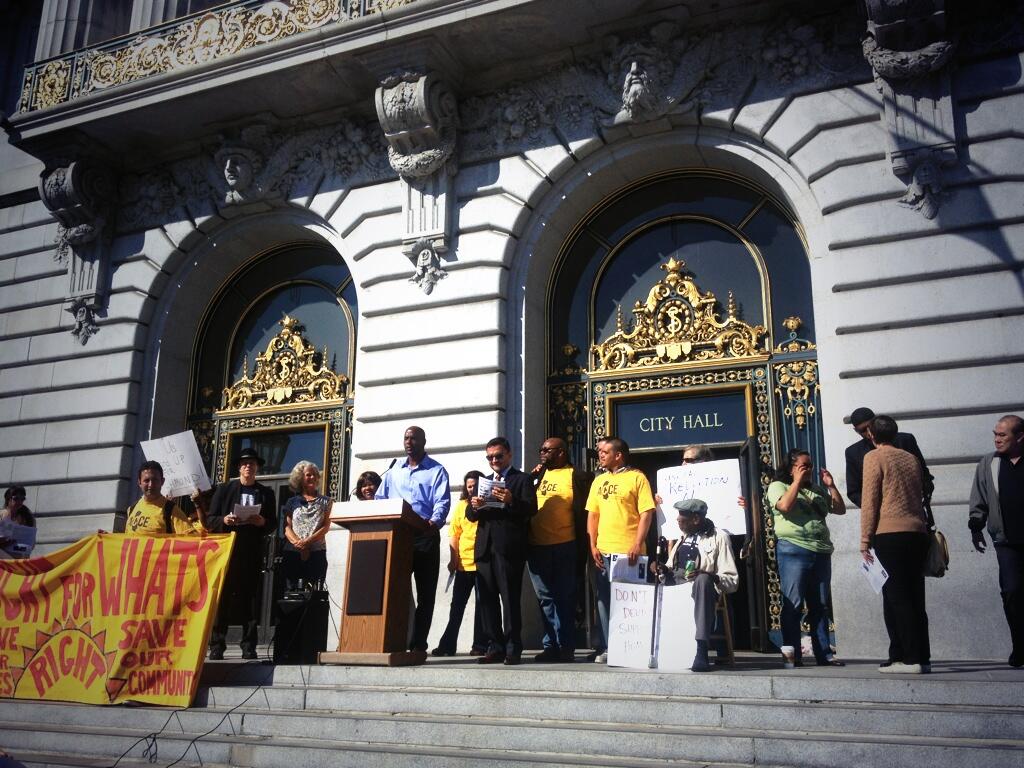
“Our strategies have been, lets be honest, ‘Let’s see what the federal government or the banking industry will do to help these folks,’” Campos said at the steps of City Hall. “We’ve waited long enough.”

Campos rattled off surprising numbers, saying 58 homeowners in his district alone had underwater mortgages at risk of foreclosure, and that 16 percent of homeowners in neighborhoods like Visitacion Valley were underwater. 

Bernal Heights homeowner and activist Ross Rhodes was there supporting the action.

“Dave (Campos) helped me save my home when I was getting nowhere with the banks but frustration,” Rhodes said. 

He was making his payments which were up to $3,500 a month, but while on disability and going through a divorce, it was tough. Campos got Rep. Nancy Pelosi’s office involved, and they talked to the banks on his behalf. In the end, he finally got a principal reduction and what he calls a “real good” modification. “I’m not asking for a handout, I’m asking for help,” he said. 

Now his payments are $1,600 a month. “It just shows the banks can do what they want to do, they control it all, they can work with if you if they want to.”

Campos’ resolution also proclaims San Francisco’s support for Richmond’s eminent domain effort.

The bank asked him why he went to Pelosi and Campos for help, instead of going through them. He was incredulous, as he’d been fighting for a principal reduction on his own for two years. “I’ve been trying to work with you for months,” he told them. “It took that political muscle to get you to move. I went through five different loan agents.” 

The victory made him a convert, going to rallies and speaking to help others suffering with their loans. 

The hounds are coming for Richmond though, and the political muscle needed to enact the controversial plan is at risk. 

Wells Fargo already filed suit against Richmond over its use of eminent domain, saying the plan puts money in the pockets of the city and would put a chill on investments. A Richmond bond with an A- rating was already rejected by Wall Street, finding no financiers, putting Richmond in a possible bind when it comes to public works projects. 

In response, Richmond councilmember Nathaniel Bates has a resolution for tomorrow’s Richmond city council meeting to stall the plan. If it’s voted in, Richmond will withdraw all the offers to buy underwater loans and withdraw the plan to use eminent domain to seize them. 

If Bates’ resolution is approved, the whole plan would tank. 

A petition from the Home Defenders League to sand with Richmond’s eminent domain effort has over 7,000 signatures. 

To contact Wells Fargo’s CEO yourself, follow the link here.

The Guardian wrote to the Mayor Ed Lee’s office to see if he is in support of Campos’ plan, but didn’t hear back before press time, which was admittedly quick. 

Update 2:20 pm: We asked supervisor Campos’ aide Hilary Ronen if San Francisco would be at risk for a lawsuit from Wells Fargo, similar to Richmond, if the city enacted an eminent domain plan. In response, she said “All that we’re doing is asking the city attorney’s office as well as the budget and legislative analyst, ‘if we did something similar, what does it look like? What are the financial risks for the city?’ This way we can make an educated assessment. After having that information he’ll have to balance what the risks are. We’re not there yet.”

Feds force pot clubs to deal in cash, then ban use of armored cars

22

In the US Drug Enforcement Administration’s latest attempt to smoke out medical marijuana dispensaries in the United States, the federal government agency made the decision to ban the use of armored cars by marijuana providers. Compounding that problem, over the last year banking companies, under pressure from the feds, have been refusing to do business with dispensaries, forcing them conduct all-cash transactions.

Dispensaries and their employees all around the Bay Area are being needlessly endangered by this decision. Businesses such as Oakland’s Harborside Health Center — which brings in about $30 million a year, according to co-founder and executive director Steve DeAngelo — stand to take a big hit.

“This decision puts my staff and I at risk,” DeAngelo told us. “People have been known to stake out the property, and having unarmored transport without a secured professional to the US Treasury makes the job even more dangerous.”

DeAngelo declined to comment on how his dispensary will transport money without armored cars. Others, such as Diane Goldstein, a retired lieutenant commander of the Redondo Beach police department and member of the organization Law Enforcement Against Prohibition, finds the decision to be downright unethical.

“It’s unethical in the sense that the DEA made the decision without considering the collateral damage that could be caused,” Goldstein said. “It endangers the people that have to transport large sums of money unprotected, law enforcement, and the community at large.”

But there is a glimmer of hope: the Department of Justice issued a memo last week that was a step forward in support of the federal government respecting states like Washington and Colorado where even recreational use of marijuana has been made legal by state ballot initiatives. The DOJ memo outlines enforcement policies such as not selling to minors or having revenue from dispensaries go to gangs or drug cartels.

“There is hope with the new memorandum released,” Dan Goldman, community liaison for the Green Cross in San Francisco said. “Though it does not directly apply to states where marijuana has not been legalized, it is a step forward.”

DeAngelo and others decried the memo as vague, but ultimately counted it as progress that may support a “large increase in momentum” in the plight for further legitimacy in the medical marijuana business.

But this clearly isn’t the first or last time DeAngelo and many other dispensaries have had the legality of their business questioned. Harborside has been locked in court battles since U.S. Attorney Melinda Haag made the move for a forfeiture proceeding for the businesses’ Oakland and San Jose properties last July. Last month federal magistrate Judge Maria Elena James granted a temporary halt to the forfeiture proceedings.

Is DeAngelo worried? “We’re in a holding pattern for the next two to two-and-a-half years,” DeAngelo said. “I’m positive that our business will continue to thrive just as it always does.”

In the meantime,  US Sen. Patrick Leahy (D-VT) has invited Attorney General Eric Holder to testify at a Sept. 10 hearing regarding whether the feds should be respecting state marijuana laws. 


Supervisors to grill Mayor Lee over CleanPowerSF sabotage

112

Mayor Ed Lee will be on the hot seat for his unqualified support of Pacific Gas & Electric Co. and his related opposition to the CleanPowerSF renewable energy program, which his appointees to the San Francisco Public Utilities Commission are trying to sabotage, when he shows up for the monthly mayoral question time at the Board of Supervisors meeting on Tuesday.

Hopefully the boring, scripted question time format that Lee created in collaboration with Board President David Chiu will finally give way to what the voters intended when they required the mayor to engage with the legislative branch: an actual, substantive, back-and-forth policy discussion meant to illuminate issues of public concern.

Because that’s what’s needed on this important issue. After more than a decade in the making, the board last year cast a historic vote to create the project on a veto-proof 8-3 vote. But the SFPUC is now refusing to set the maximum rate for the program, which should be a fairly technical and pro forma action, instead raising unrelated issues that the supervisors have already considered. In other words, unelected mayoral appointees have decided to veto a hard-won democratic gain, creating something akin to a constitutional crisis in a city that values public process and input. 

So for the first time ever, all the of the supervisors scheduled to ask questions (it rotates because odd- and even-numbered districts each month) have focused various aspects of a single important issue. Even though Lee has mastered the politicians’ dark art of speaking without saying anything, this one should still be a doozy as supervisors ask the following questions:

1. Mayor Lee – As you know, San Francisco has set ambitious goals to combat climate change. In many ways, the City is making great strides in this direction, from increasing bicycling, to pursuing zero waste goals, to hiring a new, excellent environmental policy advisor in Rodger Kim who has a strong background in environmental justice and community engagement. However, the Public Utilities Commission has repeatedly failed to set rates for CleanPowerSF, the most impactful local proposal yet designed to curb carbon emission. This program was adopted by the Board of Supervisors, the legislative body of the City. However, there are some allegations that your office is stalling its implementation. What specifically are you doing, as the City’s head executive, to implement this policy in a timely fashion? (Supervisor Mar, District 1)

2. Mr. Mayor, can you please outline your objections to the CleanPowerSF program as approved last year on an vote 8-3 by the Board of Supervisors? (Supervisor Chiu, District 3)

3. Recognizing the constraints imposed by state law, particularly with respect to opt-out provisions, how would a clean power program need to be structured in order for you to support it? Are you willing to work with the Board of Supervisors, and have your staff and commissioners work with the Board of Supervisors, to revise CleanPowerSF so that you can support it? Can we come to the table and make clean power a reality without any further delay? (Supervisor Breed, District 5)

4. The Board of Supervisors has been very supportive of CleanPowerSF. Do you think it is appropriate for a City Commission to go against the policy the Board of Supervisors set when it approved CleanPowerSF? (Supervisor Campos, District 9)

5. Days after the one-year anniversary of the 2010 PG&E San Bruno pipeline explosion, you called PG&E a “great local corporation” and a “great company that gets it.” However, the examples of PG&E’s immoral, illegal, and greedy behavior are legion:

– PG&E avoided admitting fault in the San Bruno explosion, failed to cooperate with the investigation, fought against paying a fair fine, and hopes to make ratepayers pay for the fine.

– PG&E’s current electric mix is only 20% California-certified renewable.

– Outages of PG&E-owned streetlights have increased over 400% in recent years, and PG&E wants to increase by $600,000 a year the amount it charges the City for streetlight maintenance without committing to improved service.

– Despite the fact that PG&E already has some of the highest electric rates in the country, PG&E is seeking to further increase rates in each of the next three years.

– While PG&E has proposed a new Green Tariff program, it remains only a vague proposal and there is no guarantee that it will ever be implemented.

– PG&E’s previous green campaigns-such as ClimateSmart and “Let’s Green This City”-have proven to be short lived and ineffective public relations stunts. Multiple public surveys conducted by the PUC to gauge the level of support for CleanPowerSF have all found that a substantial number of San Franciscans want the opportunity to pay a slight premium for a 100% renewable alternative to PG&E.

Why does your office continue to oppose providing City ratepayers with an alternative to PG&E’s monopoly by implementing CleanPowerSF? (Supervisor Avalos, District 11) 

California prisoners end hunger strike after Bay Area legislators call hearings

9

Bay Area legislators Tom Ammiano (D-SF) and Loni Hancock (D-Berkeley) — who chair the Assembly and Senate Public Safety Committees, respectively — played pivotal roles in today’s decision by California prison inmates to end their hunger strike after 60 days.

The legislators last week called for legislative hearings to consider implementing some of the reforms that the prisoners and their supporters have been calling for, including changes to solitary confinement policies that critics say amount to illegal torture under international law.

“I am relieved and gratified that the hunger strike has ended without further sacrifice or risk of human life,” Sen. Hancock said in a joint public statement with Ammiano. “The issues raised by the hunger strike are real – concerns about the use and conditions of solitary confinement in California’s prisons – and will not be ignored.”

“I’m happy that no one had to die in order to bring attention to these conditions,” Ammiano said. “The prisoners’ decision to take meals should be a relief to CDCR and the Brown administration, as well as to those who support the strikers.”

The question now is whether the legislative hearings, set for next month, can persuade the executive branch to finally take action, despite the fact that both Gov. Jerry Brown and the California Department of Corrections and Rehabilitation have taken a hard line on prison issues, even resisting federal court orders to reduce the population in the severely overcrowded prison system and to improve substandard health care.

Ammiano spokesperson Carlos Alcala told the Guardian that the end of the hunger strike could help end that stalemate: “Mr. Ammiano is hopeful that CDCR’s intransigence has been directed at negotiating under the hunger strike pressure, but that they will now be open to making some changes that are meaningful.”

CRCR head Jeffrey Beard issued a public statement saying, “We are pleased this dangerous strike has been called off before any inmates became seriously ill.”

Issac Ontiveros of the Oakland-based California Prisoner Hunger Strike Solidarity group said the hunger strike generated international attention and support, waking the public up to horrific conditions in the prisons and putting pressure on the CDCR to implement reforms.

“Their demands are legitimate and they are pointing out human rigths violations in California’s prisons,” Ontiveros told the Guardian, noting that Amnesty International and a long list of other groups are putting pressure on California to reform its prison practices. “What made them call off the strike was the political gains that they made…It was a thoughtful civil rights strategy.”

This latest hunger strike was called for and organized by prisoners in the “secure housing units,” aka solitary confinement cells, at the maximum security Pelican Bay State Prison, many of whom have gone years without meaningful human interaction. Court filings indicated that more than 400 prisoners have been locked up in solidary for more than a decade, despite the psychological harm that experts say such confinement causes.   

The prisoners today issued a long statement announcing the end of the hunger strike, which includes this excerpt: “To be clear, our Peaceful Protest of Resistance to our continuous subjection to decades of systemic state sanctioned torture via the system’s solitary confinement units is far from over. Our decision to suspend our third hunger strike in two years does not come lightly. This decision is especially difficult considering that most of our demands have not been met (despite nearly universal agreement that they are reasonable). The core group of prisoners has been, and remains 100% committed to seeing this protracted struggle for real reform through to a complete victory, even if it requires us to make the ultimate sacrifice.  With that said, we clarify this point by stating prisoner deaths are not the objective, we recognize such sacrifice is at times the only means to an end of fascist oppression.

“Our goal remains: force the powers that be to end their torture policies and practices in which serious physical and psychological harm is inflicted on tens of thousands of prisoners as well as our loved ones outside.  We also call for ending the related practices of using prisoners to promote the agenda of the police state by seeking to greatly expand the numbers of the working class poor warehoused in prisons, and particularly those of us held in solitary, based on psychological/social manipulation, and divisive tactics keeping prisoners fighting amongst each other. Those in power promote mass warehousing to justify more guards, more tax dollars for “security”, and spend mere pennies for rehabilitation — all of which demonstrates a failed penal system, high recidivism, and ultimately compromising public safety.”

Kim calls for hearing on how SFPD investigates cyclist fatalities UPDATED

72

UPDATED In the wake of revelations of shoddy and insensitive police work related to the Aug. 14 death of 24-year-old bicyclist Amelie Le Moullac, who was run over by a commercial truck driver who turned right across her path as she rode in a bike lane on Folsom Street at 6th Street, Sup. Jane Kim today called for a hearing on how the SFPD investigates cyclist fatalities.

The issue has lit up the Bay Guardian website with hundreds of reader comments after we wrote a series of blog posts and our “Anti-cyclist bias must stop” editorial, including our revelation that the SFPD failed to seek surveillance video of the crash even as its Sgt. Richard Ernst showed up at an Aug. 21 memorial to Le Moullac to denigrate cyclists and make unfounded statements about the fatal collision.

Police Chief Greg Suhr later apologized for Ernst’s behavior and the flawed investigation and said that surveillance video unearthed by cycling activists led to the conclusion by a police investigation that the driver who killed Le Moullac was at fault, according to Bay City News and SF Appeal, which also reported on Kim’s call for a hearing.

As we reported, motorists are rarely cited in collisions with cyclists or pedestrians, even when there’s a fatality involved and the motorist didn’t have the right-of-way, which appears to the case in Le Moullac’s death. The District Attorney’s Office, which did not immediately return a call from the Guardian, is considering whether to bring criminal charges in the case.

UPDATE: We just heard from DA’s Office spokesperson Stephanie Ong Stillman, who said, “The San Francisco Police Department has delivered a preliminary investigative package and we are in the process of reviewing it to determine what additional investigation is necessary.”

UPDATE 9/5 5pm: San Francisco Bicycle Coalition Executive Director Leah Shahum says she welcomes Kim’s hearings, which are long overdue. “We’re really thankful to Jane for bringing this forward,” Shahum told the Guardian, saying she hopes the hearing results in changes to how the SFPD investigates cyclist fatalilties. “We want to make sure there is ongoing accountability.”

She also said the San Francisco Municipal Transportation Agency has indicated to SFBC that it is working on near-term and long-term improvements on both Folsom and Howard streets, where cyclists in bike lanes must regularly contend to drivers cutting them off. The city does seem committed to a significant pilot of better bikeways there.”

Meanwhile, as the San Francisco Examiner reported today, Le Moullac’s family has filed a civil lawsuit against the driver who killed her, Gilberto Oriheaula Alcantar, as well as the company that he was driving for, Daylight Foods Inc., alleging that he was negligent in driving too fast and failing to pulled into the bike lane before making a right turn from Folsom onto 6th Street.

The Rim Fire and climate change

The monstrous blaze that swept through Yosemite and burned 237,841 acres was a record breaker. According to the latest statistics from Cal Fire, the Rim Fire was the fourth highest in the history of California, with a $77 million price tag. Thanks to the efforts of more than 4,000 firefighters and support personnel, the blaze was 80 percent contained as of the latest update on Sept. 4.

While the exact cause remains a mystery for now, it’s worth pointing out that the Rim Fire could not have reached such epic proportions if it hadn’t been for the dry conditions in place when the smoldering began. And as climate change continues to alter weather patterns across the Western United States, projected declines in precipitation and higher average temperatures will lead to more of the same conditions that give rise to hot destructive infernos.

Daniel Berlant, an information officer with Cal Fire, noted in a recent telephone interview that summers have been longer and hotter over the past decade, a trend that has coincided with a spike in wildfires.

According to Cal Fire statistics, there were 5,135 fires in California from January 1 through August 31 of this year. Over the same time span last year, there were 3,731 fires recorded. The five-year average is even lower, at 3,638.

Another troubling statistic: Seven out of the 10 largest wildfires in California history occurred in the last decade alone.

“What we’ve been seeing here in this past decade is longer summers – seven to eight days longer than normal,” Berlant explained. “There’s a correlation between a longer summer and more wildfires,” he continued, and when rainfall finally does arrive, it comes in at record lows, Berlant explained. Meanwhile, “The high temperatures evaporate more of the rain.”

Brush and vegetation that take in moisture from rainfall have a better chance at withstanding a fiery blaze, Berlant noted, but when things stay bone dry, the plants act as kindling that causes the blaze to burn hotter.

So as climate change continues to transform the natural landscapes of the West, costly raging wildfires might be what Californians have to look forward to. Find that depressing? Here’s a captivating YouTube time-lapse video to distract you.

Are Yee’s anti-tenant votes about courting contributions from landlords?

30

Sen. Leland Yee has never been a vote that renters could count on, from his days on the San Francisco Board of Supervisors to his representation of San Francisco’s westside in the California Legislature. But now that he’s preparing a statewide campaign for Secretary of State, tenant advocates say he’s more squirrely that ever.

They’ve been rankled by a couple of key Yee votes this year — and by Yee’s apparent unwillingness to engage with them or explain any concerns he might have — particularly Yee’s vote yesterday against legislation that would allow cities and counties to reinstate requirements that developers include some affordable rental units in their housing projects, which the California Supreme Court took away in 2009 with its infamous Palmer v. Los Angeles decision.

That legislation, Assembly Bill 1229, was narrowly approved by the California Senate yesterday despite an aggressive opposition campaign by landlords and developers who initially got overwise supportive Democrats to take a walk and abstain from voting, although tenants groups were finally able to stiffen enough spines to win passage. It now awaits the signature of Gov. Jerry Brown, who hasn’t yet taken a position on the measure.

“It directly overturns [the Supreme Court’s ruling on local inclusionary housing laws] and puts us right back where we were before the Palmer decision. It’s a hugely significant affordable rental housing measure,” Dean Preston, head of the statewide Tenants Together, told the Guardian.

But Yee, who provided the Guardian with a written statement in response to our questions, dismisses the bill’s significance: “SB 1229 is a piecemeal solution, offering a chance at lotteries in housing developments scattered randomly throughout the state. I’m proud to stand by my record of supporting effective legislation to provide affordable housing, supporting inclusionary housing and protecting rent control.”

Preston told us the statement “makes no sense and it doesn’t explain why he supported the same thing two years ago that he now opposes,” referring to Sen. Mark Leno’s SB 184, which died in the Senate two years ago.

But Preston did say that he’s happy to hear Yee explain himself, something that he’s been unwilling to do so far this year, including on his vote against Leno’s SB 603, who would have created sanctions for landlords that illegally withhold security deposits from their renters. It stalled in the Senate back in May.

“SB 603 would have invited lawsuits against landlords throughout the state, honest and otherwise, which would inevitably lead to property owners taking units off the market and driving up prices,” is how Yee now explains that vote to the Guardian.

But Preston said that explanation also doesn’t make sense, noting that Leno’s bill is already law in Alabama. “There’s no disincentive whatsoever for landlords to illegally withhold deposits,” Preston said, noting the he and other activists have fruitlessly tried for months to reach Yee on the issue. “It’s good to finally hear any explanation for his vote, months later.”

“There’s a pattern emerging with him where he won’t even explain his votes,” Preston said, noting that Yee “is running for statewide office and he’s trying to appeal to landlords and developers.”

Indeed, Yee will need to raise buckets of cash to reach a statewide audience, and he certainly understands who has the money these days. But Yee denies that he is carrying water for landlords, citing other pro-tenant votes: “I’ve always been proud to fight for tenants. Earlier this year, I cast the deciding vote for SB 391 which directs an estimated $720 million in state funds annually to the construction, rehabilitation and continued preservation of low and affordable affordable housing for everyone, families, seniors, veterans, people with disabilities, the unemployed, and the homeless. I spent years fighting for redevelopment agencies, one of only three Democrats to do so, which put a billion dollars a year into providing affordable housing throughout the state. These are programs that have been proven to be effective, an example of good results rather than just good intentions.”

UPDATE 3pm: Leno just returned our call from the floor of the Senate, where he said that Yee mischaracterized SB 603. “Those are the talking point of the industry and they’re just plain wrong,” Leno told us.

Leno said he modified the bill significantly to win support, including removing provisions that would have required landlords to keep deposits in separate accounts and pay interest on them. “All that remained is the penalty for a landlord that is was determined by the courts had illegally kept a deposit,” Leno told us. “And it still stalled. It’s the power of that lobby.”