Bay Guardian Archives

End the open primary experiment

21

EDITORIAL

This week’s primary election on June 3 occurred after Guardian press time for this issue, but there’s one conclusion that we can draw about it without even knowing the results: This is a pretty shabby form of democracy that few voters cared about. California’s experiment in open primaries is a disaster, and it’s time for a new model.

Turnout for this election was expected to hit historic lows, and for good reason: There was nothing of any real significance on this ballot, except perhaps for Proposition B on the San Francisco ballot, to require voter approval for height increases on waterfront development projects.

Even the hotly contested Assembly District 17 race between David Campos and David Chiu was simply a practice run for a rematch in November, thanks to an open primary system that sends the top two primary finishers, regardless of party, to the general election.

The system was approved by voters at Proposition 14 in 2010, placed on the ballot by then-Assemblymember Abel Maldonado as part of a deal with then-Gov. Arnold Schwarzenegger to break a budget stalemate caused by their fellow Republicans. Such horse-trading should have been a bad sign that this change wouldn’t live up to its idealistic hopes.

Its backers promised that it would favor more moderate candidates and reduce negative campaigning, but that hasn’t happened. Indeed, at press time it appeared Gov. Jerry Brown would be facing the most radically right-winger in the race, Tim Donnelly, in November.

What it has instead done is reduce the primary election to a boring and meaningless waste of time and money, turning off voters and creating low-turnout elections that are more prone to manipulation by wealthy special interests.

We at the Guardian are all for greater experimentation in our electoral models. We were big supporters of the ranked-choice voting system that is working well in San Francisco and Oakland. We support even more aggressive models for publicly financing campaigns and reducing the role on private money in electoral politics. Hell, we also support a proportional representation system and other wholesale transformations of our political system.

But while we’d love to see even more electoral experimentation, we also need to recognize when experiments are failing, as California’s open primary system now is. It’s time to try something new.


Alerts: June 4 – 10, 2014

0

WEDNESDAY 4


Transportation planning: District 8 open house

LGBT Center, 1800 Market, SF. sftransportation2030.com 5:30-7pm, free. District 8 Sup. Scott Wiener, representatives of the San Francisco Municipal Transportation Agency (SFMTA), and representatives from San Francisco Public Works will hold this District 8 community meeting about Transportation 2030, a strategic infrastructure investment program proposed for the November’s general election ballot. The night includes a presentation of the plan and a question and answer session.

THURSDAY 5


St. James Infirmary’s 15 year anniversary

Temple Nightclub, 540 Howard, SF. inticketing.com. 9pm-3am, $20 general admission. St. James Infirmary Presents its XV Dirty Dance Party Fundraiser. St. James Infirmary is the first occupational safety and health clinic for sex workers in the United States, providing free, confidential, nonjudgmental medical and social serves for current or former sex workers of all genders and sexual orientations and their partners. $40 VIP admission includes one free lap dance.

SATURDAY 7


Annual Fillmore summer kick-off fest

Hamilton Recreation Center, 1900 Geary, SF. noon-5pm, free. This year’s Grillin’ in the Mo’ will jump off with legendary blues singer Freddie Hughes (Bring My Baby Back) and the House of Hughes Band. The annual Fillmore Summer Fest Kick-Off is a free blues concert and family BBQ celebrating the start of summer events in the Fillmore District and summer enrichment programs for Western Addition youth. Grab some food, fly a kite, make gigantic bubbles, and enjoy some blues with Freddie Hughes and jazz by Fillmore’s own Bay Area Jazz Trio.

TUESDAY 10


Voices from the Edge

Mission Workshop, 40 Rondel Place, SF. tinyurl.com/voicedge. 6-9pm, free. This is a local arts and media showcase sponsored by Independent Arts & Media (IAM). Mix and mingle with local art and media makers, and celebrate the indy creative spirit IAM helps keep alive and well in San Francisco. Independent Arts & Media’s mission is to support independent, non-commercial arts and media projects and producers for the purpose of building community and civic participation, and facilitating cultural engagement and free expression. Featuring music, art, video, food, drink and community.


Good green: Lessons from the 4th annual SF Green Film Festival

0

I can count on my two hands the days it’s rained in San Francisco this year. You’d have to be living in a cave to not know that our city is having its worst drought in decades.

For that reason, the theme of the fourth annual San Francisco Green Film Festival is “Water in the West.” The festival, which began on Thu/29, is pushing us to reevaluate our relationship with water. As our state is faced with its worst drought since 1977, it is imminent that we answer the question on everyone’s minds: What is the future of water in California?

With over 60 films coming from 21 countries, the SFGFF is tackling our complicated relationship with water. Like a river flowing through the week-long festival, six feature films address this issue in varying ways: DamNation, Watermark, Come Hell or High Water: The Battle for Turkey Creek, The Great Flood, Lost Rivers, and Chinatown.

Yesterday’s centerpiece film at the Roxie Theater, Watermark, explores humans’ relationship with water, traveling to countries far beyond what most of us have experienced. The film, directed by Canadian documentary filmmaker Jennifer Baichwal and landscape photographer Edward Burtynsky, superimposes breathtaking aerial perspectives of water scenes from around the world. Watermark travels to the National Ice Laboratory in Greenland, the disturbing and daunting Xiluodu Dam in China, a heavily-polluted leather tannery in Bangladesh, a pilgrimage of 30 million people bathing in the Ganges river, and a parched, cracked desert in Mexico where the Colorado River used to run wild, among many other beautiful sites.

The film exposes the manifold layers of our water consumption and offers awe-inspiring cinematography but leaves something to be desired. With no narrator and minimal context, the documentary shows rather than tells. It excels visually, but flounders thematically. We see how the world consumes water for farming, for energy, for spiritual and recreational purposes and most importantly for survival but what does it all mean?

The Green Film Festival finds answers with a handful of other films. On Saturday night, Come Hell or High Water: The Battle for Turkey Creek was awarded the Green Tenacity Award for capturing the inspiring community fight for environmental justice in Mississippi. Over the weekend, the festival hosted two shorts showcases, several workshops, various panel discussions and nightly feature films, including a special 40th anniversary screening of Chinatown.

The event’s opening ceremony last Thursday night was fittingly held at the Aquarium of the Bay. It’s difficult to process the imminence of climate change with the majestical bay at fingertips length. But the opening night’s feature film DamNation drove the point home. The award winning documentary weaves together the ecological, political, economical and psychological implications of river dams. Focusing on the Pacific Northwest, the 87-minute film tracks the “era of dam removal.”

With nature-drenched cinematography and a candid narrator — co-director Ben Knight who admits in the first five minutes to his embarrassingly minimal knowledge on rivers dams when he signed onto the film — DamNation offers an excellent introduction to how the removal of river dams restore watershed ecosystems, revive fish migrations, improve water quality and the lives of adjacent communities and cultures. “The great beauty about wild fish is we don’t have to do a damned thing for them except leave them the hell alone,” says one of the activists in the film. At the end of the night, DamNation took home a 3-D printed award for Best Feature Film. The festival came full circle with Sunday night’s showing of The Great Flood, a film-music collaboration about the Mississippi River Flood of 1927, a catastrophe that prompted the “era of dams.”

The first leg of the Green Film Festival offered a wide array of perspectives about the green movement. Water is the world’s most precious resource and it affects all environmental issues from food security, healthy kids, and livable cities. The festival continues on with daily panel discussions and films promoting social change. Wednesday night’s Lost Rivers is the final installation of the six-part “Water in the West” theme. “Do you know what is hiding beneath our cities?” the film asks. Lost Rivers retraces history in search for disappeared rivers around the world. The film not only offers insight on how and why most rivers in major cities have disappeared today but also answers the question of whether we will see these rivers again.

Activism is rooted in community. For the fourth year, the Green Film Festival is engaging with the community through discussion and film. The community support in San Francisco is heartening. From the filled theaters to the community organizations who’ve partnered with this event: Earthjustice, American Rivers, Save the Bay, Restore the Delta and many others.

Water is invaluable to our daily lives but we treat water as an inexhaustible resource. The films showcased this week prove that this is not the case. Climate change is imminent and we are at the root of it. We can make a difference through education, engagement, activism, and our vote. And if you’re too lazy to do any of that, why not watch a film?

MONDAY JUNE 2

Seeds of Time + panel discussion with Sandy McLeod, director; Cary Fowler, agriculturalist; Greg Dalton, Climate One 

6pm, Roxie Theater


A Will for the Woods

8:30pm, Roxie Theater


TUESDAY JUNE 3

Free Screening: Thin Ice: The Inside Story of Climate Science

12pm, SF Public Library


Angel Azul  + panel discussion with Marcy Cravat, director

6pm, Roxie Theater


Uranium Drive-In

8:15pm, Roxie Theater


WEDNESDAY JUNE 4

Lost Rivers

6pm, Roxie Theater


Wrenched: The Legacy of the Monkey Wrench Gang + discussion with Ariana Garfinkel, archivist; David J. Cross, Earth First! photographer; Karen Pickett, activist; and other guest activists from the film.

8pm, Roxie Theater


Closing Night Wrap Party

10pm, Slate Bar

The 8 things that made BottleRock, well, BottleRock

0

I am surrounded by people with purple teeth, stained from too much red wine. These people are twisted beyond belief, screaming obscenities about forgotten 90s bands, while wine sloshes around in glasses suspended by those stupid-looking lanyard wine glass holders. I want to say to them, “Literally, handle your shit. Like, physically hold your glass of wine. You’re a grown up.” It’s like a bad summer picnic for rich winos…

Or at least that’s how I imagined BottleRock to be as we drove up from San Francisco blaring the Gin Blossoms. It was my first time at this particular festival and like everything, I imagined the weirdest possible outcome. While I was dead wrong about the particulars, it was right about something: this festival was strange as shit. Here are a few things that made Bottle Rock, well, Bottle Rock. 

1. Cargo shorts – There were A LOT of cargo shorts. Especially the first day. My friend Lauryn was right, the time machine had worked. But instead of a My So-Called Life fashion parade, it was more like all the style trends of the past 40 years muddled together with large dollop of not really trying. Cargo shorts are the vanguard of not really trying. While I appreciate their utilitarianism, how many things do you really need to hold? I know I sound like a San Francisco snob, but really…cargo shorts.  

cs

2. Middling bands – There were some really stellar, world-class acts at BottleRock. Outkast, The Cure, Weezer, TV on the Radio; these are the groups whose music helps not only define the moments of your lifetime but also whose existence has influenced the way music is created. That said, a lot of the bands who played over the weekend were probably as surprised as you were that they were booked. I wonder how many of them first said to their booking agent, “Are you fucking with me?” While groups like Smash Mouth, Third Eye Blind, The Spin Doctors, and Cracker all have one or two solid hits, festival-goers spent most of their sets fidgeting anxiously while muttering, “Dude, play the one song already.” We didn’t even get to stay long enough to find out if the Gin Blossoms played “Hey Jealousy” because well, The Cure was about to start. BottleRock was held where the Napa Town and Country Fair is held, which makes sense considering how many of the bands now play the fair circuit.

weezer
Weezer

3. The crowd was really well-behaved – Honestly, what a nice group of 40,000 people. I remember saying at one point, “Nobody gets arrested at this festival.” Anyone who’s spent time in large groups of drunk people knows that feeling of menace being in the air. Like when you walk out of a sports game at the opponents home field after your team just won. It’s that feeling of, “things could get ugly real fast”. Well there was none of that at BottleRock. You could’ve headbutted somebody’s child and they would probably have apologized to you. Well done, Napa. You sure bring out nice folks. Case in point: At one point my lady friend Ashley lost her phone and some well-meaning person found it and brought it to a security guard. Ashley had it back in less than an hour.      

cure
The Cure. Photo by Lauryn McCarthy.

4. The crowd was also kinda weak – At two different times during their incredible set, Andre 3000 and Big Boi, the principle members of Outkast, asked the crowed “Are you still with us?” [Ed note: this is embarrassing.] Outkast didn’t even come out for an encore. Maybe it’s because after two days of watching bands like Third Eye Blind, where the festival goers only knew one out of every six songs, they just weren’t emotionally equipped to handle a set this good. At this point they so yearned for something familiar that anytime Outkast strayed from their megahits, the crowd lost interest. I’m sorry, Andre and Big Boi. I was there with you the whole time. 

5. Matt and Kim make the world a better place – Seriously who knew that two people, a drum kit, and a synth could be so enthralling? Matt and Kim are the most fun band ever! I was never that into their recorded music, but after seeing them live, I want to start saving up now so I can afford to hire them to play my as-yet unborn child’s bar or bat mitzvah.

matt and kim
Matt and Kim

6. $20 glasses of wine – Yes, really. Glasses of wine were $20. Maybe that’s why everyone was so nice to each other, nobody could afford to get drunk.  

7. No place to stay and terrible traffic – One of the things that makes Napa so nice to visit, besides the whole being buzzed on wine samples thing, is that it’s a quaint and lovely little town. The problem with that is that when you have 40,000 people come in for the weekend it makes it really had for people to find a place to stay. This makes people stay in the Bay Area and commute each night, which in turn potentially puts a lot more intoxicated people on the road. There isn’t even shuttle service offered from San Francisco, Oakland, Berkeley etc. Even though we stayed with friends for the weekend, everything was so impacted that it took an hour an a half to get an Uber. These are all things that the organizers should take into account for next year.   

8. The strict 10pm curfew – Napa’s lovely quaintness also means that BottleRock has neighbors who hate everything about the festival. Somebody told me they saw a sign on a nearby house that basically said, “Hey Bottle Rock: Get the fuck out of here”. Thus there was a strict 10pm curfew that lead to both The Cure and Heart getting the plug pulled on them. I’m not saying anything instructive here about it, I’m just saying “bummer.”

If my snarkiness makes it seem like I hated the festival, I apologize. Overall BottleRock was a good time and has a lot of potential to get even better as the years progress. Until then, let’s all make an effort to rid the world of cargo shorts.  

Citizen Agnos comes on strong for Proposition B in support of his Athenian oath

3

By Bruce B. Brugmann  (with the complete  text of Art Agnos speech  to the  May 21 dinner of San Francisco Tomorrow)

When Art Agnos was sworn in as mayor in 1988, he used the Athenian Oath that was taken by young men reaching the age of majority in Athens 2000 years ago.  He shortened the oath (as many did) to say: “I promise…upon my honor…to leave my city better than I found it.”

For Agnos, a Greek steeped in Greek traditions, the oath was a serious matter. “At the heart of our vision,” Agnos said in his inaugural address, “ is a refusal to let San Francisco become an expensive enclave  that locks out the middle class, working families and the poor. At the center of our strategy is a belief in the basic right of people to decent jobs and housing.”  

Twenty-six years later, Citizen Agnos was working hard  in private life to leave his city better than he had found it. He led a citizens’ movement that stopped the monstrous 8 Washington project, knocked the Warriors off the piers, forced the Giants to lower their  highrise expectations,  and promoted Proposition  B that would stop  the Wall on the Waterfront and require a public vote on any increases  to current height limits on port property.

 And Agnos is having the time of his life doing all this, as he made clear in his remarks to San Francisco Tomorrow, the one organization in town that has been manning the barricades in every major Manhattanization battle all these years  on the waterfront and everywhere else.  He enjoys taking on Mayor Lee and “the high tech billionaire political network that wants to control city hall and fulfill their vision of who can live here and where.” And he must relish  the Chronicle’s C.W.Nevius and the paper’s editors and their self-immolating bouts of hysteria.  

Agnos gave a splendid speech and confirms that he really is our best ex-mayor. I particularly liked his point about the “power to decide” on development. “Today that power to decide is in a room In City Hall. I know that room. I have been in that room. 

“You know who is in there? It is the lobbyists,..the land use lawyers…the construction union representatives..the department directors..and other politicians. You know who is not in that room. You.Prop B changes that dynamic and puts you in the room that matters. No more ‘advisory committees’ that get  indulged and brushed off. No more ‘community outreach’ that is ignored. It will all matter.”

Yes, yes, yes, a thousand times yes, on B and stopping the Manhattanization of the waterfront. b3

Agnos remarks to San Francisco Tomorrow 

I am delighted to speak to the members and friends of SFT about the waterfront tonight…and a special shout out to Jane Morrison as one of the pioneer professional  women in the media… and one of the  finest Social Service Commissioners in our City’s history. I also welcome the opportunity to join you in honoring tonight’s unsung heroes…Becky Evans with whom I have worked closely over the past year and half …Tim Redmond  the conscience of the progressive community for the past 35 years…Sarah Short and Tommi Avicolli Mecca from the Housing Rights Committee who stand up every day for poor and working people who need a voice in our city.

Twenty-four years ago in 1990, I made one of the best decisions of my mayoralty when I listened to the progressive environmental voice of San Francisco and ordered the demolition of the Embarcadero Freeway. That freeway was not only a hideous blight but also a wall that separated the city from its waterfront. Hard to believe today…but it was a very controversial decision back then… just 3 years before…in 1987 the voters had defeated a proposal by Mayor Feinstein to demolish it. The Loma Prieta Earthquake gave us a chance to reconsider that idea in 1990. Despite opposition of 22,000 signatures on a petition to retrofit the damaged freeway… combined with intense lobbying from the downtown business community led by the Chamber of Commerce, North Beach, Fisherman’s Wharf and especially Chinatown…we convinced the Board of Supervisors to adopt our plan to demolish the freeway… by one vote.

And the rest is history…until today. 

After a period of superb improvements that include a restored Ferry Building…the Ball park… new public piers where one can walk further out into the bay than ever before in the history of this city… the 
Exploratorium…the soon to be opened Jim Herman Cruise Ship terminal…Brannan Wharf Park…there is a new threat. Private development plans that threaten to change the environment of what Herb Caen first called “our newest precious place” …not with an ugly concrete freeway wall…but with steel and glass hi-rises that are twice as tall.

Today…the availability of huge amounts of developer financing …combined with unprecedented influence in city hall and the oversight bodies of this city…the Waterfront has become the new gold coast of San Francisco. Politically connected developers seek to exploit magnificent public space with hi-rise, high profit developments that shut out the ordinary San Franciscan from our newest precious place. We love this city because it is a place where all of us have a claim to the best of it…no matter what our income…no matter that we are renter or homeowner…no matter what part of the city we come from.

And connected to that is the belief that waterfront public land is for all of us…not just those with the biggest bank account or most political influence. 

That was driven home in a recent call I had from a San Franciscan who complained about the high cost of housing for home ownership or rent…the high cost of Muni…museum admissions…even Golden Gate Bridge tours and on and on. When he finished with his list, I reminded him I was mayor 23 years ago and that there had been 4 mayors since me,  so why was he complaining to me?
“Because you are the only one I can reach!” he said.

Over the past few weeks…that message has stuck with me.  And I finally realized why. This is what many people in our city have been seeking… someone who will listen and understand. Someone who will listen…understands… and acts to protect our newest precious place…our restored waterfront. You see…it was not just about luxury high-rise condos at 8 Washington last year…It was not just a monstrous 
basketball arena on pier 30-32 with luxury high-rise condos and a hotel across the street on public land. It’s about the whole waterfront that belongs to the people of San Francisco…all 7 and half miles of it… from the Hyde Street Piers to India Basin. And it must be protected from the land use mistakes that can become irrevocable. 

This is not new to our time…8 Washington and the Warriors arena were not the first horrendous proposals…they were only the latest. Huge… out of scale… enormously profitable projects… fueled by exuberant boosterism from the Chamber of Commerce… have always surfaced on our waterfront. 50 years ago…my mentor in politics…then Supervisor Leo McCarthy said, “We must prevent a wall of high rise apartments along the waterfront…and we must stop the filling in of the SF bay as a part of a program to retain the things that have made this city attractive.” That was 1964…

In 2014…Former Board of Supervisors President Aaron Peskin said it best this way…”It seems like every 10 years…every generation has to stand up to some huge development that promises untold riches
  as it seeks to exploit the waterfront and our public access to it.” Public awareness first started with the construction of the 18 stories of Fontana towers east and west in 1963. That motivated then Assemblyman Casper Weinberger to lead public opposition and demand the first height limits… as well as put a stop to 5 more Fontana style buildings on the next block at Ghirardelli Square. This was the same Casper Weinberger who went on to become Secretary of HEW and Secretary of Defense under President Ronald Reagan.

In 1970 the Port Commission proposed to rip out the then “rotting piers” of piers 1 – 7 just north of the Ferry Building. They were to be replaced with 40 acres of fill (3 X Union Square) upon which a 1200-room hotel and a 2400 car garage would be built. It passed easily through Planning and the Board of Supervisors. When the proposal was rejected on 22 to 1 vote by BCDC, Mayor Alioto complained, “We just embalmed the rotting piers.” No… we didn’t …we saved them for the right project…and if one goes there today… they see it…the largest surviving renovated piers complex with restaurants, walk in cafes, port offices, free public docking space, water taxis and complete public access front and back. 

In 2002… that entire project was placed on the U.S. National Historic Register. But my favorite outrageous proposal from that time was the plan to demolish another set of “rotting piers” from the Ferry Building south to the Bay Bridge. And in place of those rotting piers… the plans called for more landfill to create a Ford dealership car lot with 5000 cars as well as a new Shopping center. That too…was stopped.

So now it’s our turn to make sure that we stop these all too frequent threats to the access and viability of our waterfront.

In the past 2 weeks…we have seen momentum grow to support locating the George Lucas Museum on piers 30-32 or the sea wall across the Embarcadero.I love the idea…but where would we be with that one be if a small band of waterfront neighbors and the Sierra Club had not had the courage to stand up to the Warriors and City Hall 2 years ago. Once again they used the all too familiar refrain of “rotting piers” as an impending catastrophe at piers 30-32.

Proposition B will help prevent mistakes before they happen. Most of all… Prop B will ensure protection of the port on more permanent basis by requiring a public vote on any increases to current height limits on Port property.All of the current planning approval processes will stay in place…Port Commission…Planning commission…Board of Permit Appeals…Board of Supervisors…will continue to do what they have always done. But if a waiver of current height limits along the waterfront is granted by any of those political bodies…it must be affirmed by a vote of the people. Prop B does not say Yes or No…it says Choice. It is that simple. The people of SF will make the final choice on height limit increases on port property. 

The idea of putting voters in charge of final approval is not new. In the past the people of San Francisco have voted for initiatives to approve a Children’s budget…a Library budget…retaining neighborhood fire stations… minimum police staffing… as well as require public authorization for new runway bay fill at our airport. And at the port itself… there have been approximately 18 ballot measures to make land use and policy decisions.

So…we are not talking about ballot box planning…we are talking about ballot box approval for waivers of existing height limits on public property. Opponents like Building Trades Council, Board of Realtors, 
and Chamber of Commerce are raising alarms that we will lose environment protections like CEQA by creating loopholes for developers. 
Astonishing! 

Prop B is sponsored by the Sierra Club…Tonight we honor Becky Evans of the Sierra Club who sponsored Proposition B. That same set of opponents are joined by city bureaucrats issuing “doomsday” reports stating that we will lose thousands of units of middle class housing… billions of dollars in port revenues…elimination of parks and open space on the waterfront. Astonishing!

These are the same bureaucrats who issued glowing reports a couple of years ago that the America’s Cup would mean billions in revenue for the port and the city. And they wanted to give Oracle’s Larry Ellison 66-year leases to develop on 5 of our port piers for that benefit! Now…how did THAT work out? So far…city hall will admit to $11 million dollars in known losses for the taxpayers.

Another opponent… SPUR says any kind of housing will make a difference and there are thousands in the pipe line… so don’t worry.
Astonishing!

We have not seen one stick of low income or affordable housing proposed on the waterfront since the 80s and 90s when Mayor Feinstein and I used waterfront land for that very purpose. Hundreds of low-income housing dwellings like Delancey Street and Steamboat Point Apartments…affordable and middle class housing like South Beach Marina apartments and Bayside village comprise an oasis of diversity and affordable housing in the midst of ultra expensive condos. For me…that was part of an inaugural promise made in January 1988…I said, “At the heart of our vision is a refusal to let San Francisco become an expensive enclave that locks out the middle class, working families and the poor. At the center of our strategy is a belief in the basic right of people to decent jobs and housing. 

Yes…that was the commitment on public land on the waterfront by 2 mayors of a recent era… but not today. Indeed…San Francisco has been rated the #1 least affordable city in America…including NY Manhattan. That is one of the many reasons we see middle class  people…as well as working poor…being forced to leave San Francisco for Oakland and elsewhere in the bay area. That reality was reinforced in the February 10, 2014 issue of Time Magazine…Mayor Lee said, “I don’t think we paid any attention to the middle class. I think everybody assumed the middle class was moving out.”

Today…An individual or family earning up to $120,000 per year …150 per cent of the median in this city… do not qualify for a mortgage and can’t afford the rent in one of the thousands of new housing units opening in the city. The Chronicle reported a couple of weeks ago that a working family of  3 who have lived in a rent-controlled studio apartment in the Mission is offered $50 K to leave. That is what the purely developer driven housing market offers. And that philosophy is reinforced by a planning commission whose chair was quoted in December 2013 issue of SF Magazine saying, “Mansions are as just as important as housing.”

Prop B changes that dynamic by putting the Citizen in the room with the “pay to play” power brokers. That is what it is all about my friends. Power.

Former SF city planning director and UC School of City Planning Professor…Alan Jacobs recently related what he called the Jacobs Truism of land economics: “Where political discretion is involved in land use decisions…the side that wins is the side with the most power. And that side is the side with the most money.” Prop B will ensure that if developers are going to spend a lot of money to get a height waiver on port property …the best place to spend it will be to involve, inform, and engage the citizen as to the merit of their request…not on the politicians.

Today that power to decide is in a room in City Hall. I know that room…I have been in that room. You know who is there? It is the lobbyists…the land use lawyers…the construction union representatives…the departmental directors… and other politicians. You know who is not in the room? YOU. The hope is that someone in that room remembers you. But if you really want your voice to be heard…you have to go to some departmental hearing or the Board of Supervisors…wait for 3 or 4 hours for your turn… and then get 2 minutes to make your case. Prop B changes that dynamic and puts you in the room that matters. No more “advisory committees” that get indulged and brushed off. No more “community outreach” that is ignored. 

It will all matter. That is why today there is no opposition from any waterfront developer…They get it. We are going to win. It is easy to see how the prospect of Prop B on the ballot this June has changed the dynamics of high-rise development along the waterfront. The Warriors have left and purchased a better location on private land in Mission Bay. The Giants have publicly announced that they will revise their plans with an eye to more appropriate height limits on port land. Forest City is moving with a ballot proposal to use Pier 70 to build new buildings of 9 stories…the same height as one of current historic buildings they will preserve on that site for artists.

The Pier 70 project will include 30 percent low-income…affordable and middle class housing on site… along with low-tech industries, office space and a water front promenade that stretches along the entire shoreline boundary. A good project that offers what the city needs will win an increase in height limits because it works for everybody. A bad one will not. My friends…I have completed my elected public service career. There will be no more elections for me.

And as I review my 40 years in public life…I am convinced of one fundamental truth. The power of the people should… and must… determine what kind of a city this will be. It must not be left to a high tech billionaire political network that wants to control city hall to fulfill their vision of who can live here and where. It starts with you… the people of this city’s neighborhoods… empowered to participate in the decisions that affect our future. You are the ones who must be vigilant and keep faith with values that make this city great. This city is stronger when we open our arms to all who want to be a part of it…to live and work in it…to be who they want to be…with whomever they want to be it with. Our dreams for this city are more powerful when they can be shared by all of us in our time…

We are the ones …here and now… who can create the climate to advance the San Francisco dream to the next generation. And the next opportunity to do that will be election day 
June 3. Thank you.

B3 note: The full Athenian oath: “We will never bring disgrace on this our City by an act of dishonesty or cowardice. We will fight for the ideals and Sacred Things of the City both alone and with many. We will revere and obey the City’s laws and will do our best to incite a like reverence and respect in those above us who are prone to annul them or set them at naught. We will strive unceasingly to quicken the public’s sense of civic duty. Thus, in all ways, we will transmit this City not only, not less, but greater and more beautiful than it was transmitted back to us.”  The National League of Cities publishes the oath and says it “was recited by the citizens of Athens, Greece, over 2,000 years ago. It is frequently referenced by civic leaders in modern times as a timeless code of civic responsibility.” 

(The Bruce blog is written and edited by Bruce B. Brugmann, editor at large of the San Francisco Bay Guardian. He is the former editor and co-founder and co-publisher of the Guardian with his wife Jean Dibble, 1966-2012. He can be reached at Bruoe@sfbg.com) 


THE GUARDIAN CLEAN SLATE

0

GOVERNOR
Jerry Brown

LIEUTENANT GOVERNOR
Gavin Newsom

SECRETARY OF STATE
Derek Kressman

CONTROLLER
Betty Yee

TREASURER
John Chiang

ATTORNEY GENERAL
Kamala Harris

INSURANCE COMMISSIONER
Dave JOnes

SUPERVISOR OF SCHOOLS
Tom Torlakson

BOARD OF EQUALIZATION
Fiona Ma

ASSEMBLY, DISTRICT 17
David Campos

ASSEMBLY, DISTRICT 19
Phil Ting

PROPOSITION 41
Yes

PROPOSITION 42
Yes

SF PROPOSITION A
Yes

SF PROPOSITION B
Yes

SF SUPERIOR COURT JUDGE
Daniel Flores

CONGRESS, DISTRICT 12
Nancy Pelosi

CONGRESS, DISTRICT 13
Barbara Lee

CONGRESS, DISTRICT 14
Jackie Speier

To read our full endorsements, click here.

Pink Mountaintops get weird at The Chapel

0

By Jordannah Elizabeth

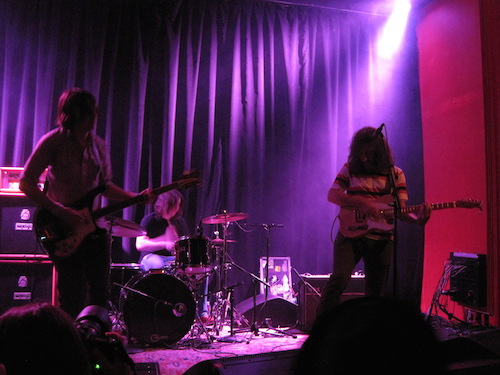
The Pink Mountaintops performed last night at The Chapel in the Mission District to a loyal crowd of friends and fans, who patiently waited for McBean and his new line up — which includes Dead Meadow’s Steven Kille, Will Scott, and Gregg Foreman of Cat Power — to take the stage.

McBean strolled through the venue with a peaceful flow in his step, but the night was colored by a dark undertone, thanks to a number of quiet quips that from McBean that mounted into a surprisingly violent climax at the show’s end.

“I don’t know, maybe it’s just that weird thing of life and pushing through it, the beauty of it, the sadness and the happiness of it,” McBean had said of his new album, Get Back, while he slowly sipped his first cocktail at the bar a few hours earlier. “The more you’re on the planet, the more amazing things will happen to you, and the more terrible things will happen to you, and you have to have the ability to constantly shake it off.”

pm

While the hazy, eerie atmosphere coated the venue, LA’s Giant Drag was able to play a sensually dark set of songs, completely appropriate for the early evening. The crowd slowly trickled in throughout the night, not quite filling the room, and people seemed to shift and cycle through the venue, never standing in one place for too long. There was never a moment where there was a complete loss of the crowd’s attention, but there was quiet level of distraction going on. Whether it was because everyone had a chance to drink was much as they could possibly consume by the time Pink Mountaintops stepped onto the stage or whether the band’s hazy wall of sound was slightly lost in translation was not really clear. (“Me and Kille are the drunks and Gregg and Will are the sober guys,” Mc Bean had noted earlier.)

After opening with “How Can We Get Free?” and a fresh song, “Ambulance City,” from the new album, Stephen McBean broke a string and took his time to service and tune his guitar while the rest of the lineup improvised a song. Steve Kille swayed back and forth across the stage with his signature dance that closely resembles a confident swagger. After McBean got his guitar back in order, the set became more coherent and solid. The band flowed through “Wheels,” “Plastic Man You’re the Devil,” and “The Second Summer of Love” and the crowd began settling in, planting their feet on the The Chapel’s floor, finally beginning to engage with the music they were hearing.

Gregg Foreman, who has played with McBean as a duo and the sparsest version on Pink Mountaintops, shined. His erratically blissful guitar playing sewed the rest of the band’s slightly eclectic instrumentation styles together. Kille and drummer, Steve Scott, are very different musicians. If not for Forman’s unique experimental psych guitar style, the band would have lacked an off-kilter characteristic that kept the crowd’s attention during the middle and end of the show.

pm

Everything seemed to flow peacefully as the show ended with the songs “New Teenage Mutilation,” “Sweet 69,” and “The Last Dance.” McBean played solo for the last song, and it was endearing and really lovely to watch — until McBean suddenly smashed his guitar over his amp, hurling it over his head several times until it cracked, ending the show on a strangely violent note.

The band had joined him on stage seconds before McBean attacked his guitar, and they put their instruments down just as quickly as they had picked them up after McBean walked past them leaving stage. The rest of Pink Mountaintops mingled with the crowd, seeming unaffected by McBean’s behavior, allowing their non-inner circle to slowly disperse from the evening’s odd occurrence. The show was weird, but the band is great.

LA siren BANKS enchants The Independent

1

On Wednesday night at The Independent, a sold-out crowd anxiously awaits the mysterious creature known as BANKS. Cloaked in layers of black fabric that fall to her ankles, the dark chanteuse struts deliberately to center stage, where a spotlight shines onto her pale face. The L.A.-based signer-songwriter seductively sets into the dark R&B track “Before I Ever Met You,” recalling instrumentals by The Weeknd, with whom she toured last year.

“Everyone knows I’m right about one thing,” she breathes into the microphone. The stunning singer pulls off her long sheer robe to reveal a sleeveless black leather top and black asymmetrical skirt. “You and I don’t work out,” she hums. Banks’ soft crooning overlays the sultry drum beats and rugged electric guitar of her two-person band.

The poised musician seamlessly swims through her set. She pulls her dark straight locks out of her face when she dances seductively to the emotional industrial tracks. At times, she slinks to the back of the stage, surreptitiously veiled behind the strobe light haze.

Despite her coyness, BANKS unveils intense vulnerability as she chants about love and loss. Her lyrics divulge an aching heart but also a fierce confidence. She plays with two personas: a shy soulful singer and a strong, fierce femme fatale.

banks

BANKS at The Independent. All photos by Laura B. Childs.

In heartfelt gratitude, the spiritual singer puts her hands together in prayer, thanking the crowd before diving into the entrancing anthem about women’s empowerment, “Goddess”— BANKS’ newest single and the title of her upcoming full-length. “You put her down, you liked her hopeless, to walk around, feeling unnoticed,” she begins in singsong, with unassuming sexiness. “You shoulda crowned her, cause she’s a goddess, you never got this.”

BANKS connects with the audience through her compelling no-bullshit lyrics. “Fucking with a goddess, and you get a little colder,” she sings before passionately throwing the middle finger in the air. The singer uses singing and songwriting as a means of empowerment during dark times. Her lyrics uncover haunting themes of heartbreak and separation; she first started writing music when she was 15 as a coping mechanism after her parents divorce.

The singer’s honesty is contagious as she reaches her hands out to the audience. She creates an candid connection as the crowd sings in harmony to “Brain.” The song begins with the priestess’ guttural moans about the games we play in the name of love. She repeats the sultry lyrics until the instrumental interlude. “I can see you struggling, boy don’t hurt your brain,” BANKS cries out to the crowd. She rocks back and forth on her black platform boots, twisting her wrists like a somber belly dancer.

banks

Twenty-five-year-old Jillian Banks — simply known as BANKS — got her beginnings on SoundCloud, like many of her peers. She has created a remarkable fan base online, released two EPs, Fall Over and London, and is finishing up a full-length album to be released in September. She is noted for her reluctance to use social media and conceals herself with entrancing tracks and haunting grey-scale music videos. She’s cited musical inspirations ranging from James Blake to Aaliyah.

“I get very nervous before shows,” says BANKS at the show. She sings covers backstage, she says, to feel more comfortable. At the mention of covers, the crowd goes nuts because they know she’s about to sing Aaliyah’s “Are You That Somebody.”

BANKS brings a sexy, come hither vibe to the 1997 single by the late R&B singer. In a stripped-down acoustic version, she unearths a powerful stage presence, luring her audience to her like a musical siren. Her honeyed voice feels slightly dangerous. “Boy, I’ve been watching you,” she sings. “Like a hawk in the sky that flies and you were my prey.”

Yes, she’s shrouded in mystery. Make no mistake, this mystery is deliberate. The California native strays away from overexposure and she always leaves you wanting more. But the enigmatic priestess doesn’t need to reveal all of her secrets. She’s opened her heart to us with her music. Her message is clear. She’s here to empower us, unshackle us from heartbreak, and liberate us from sadness. “You are all so perfect,” says BANKS to her fans in between songs, “and every woman is a goddess.”

banks


Elbow’s Craig Potter on iPads, tour fatigue, and hitting #1

4

By Andrew Blair

If you don’t know of Elbow by now, you should probably stop reading this and go spend some time under a tree, staring out into space, contemplating your existence up to this point. Unless, of course, you want to be brought up to speed and welcomed into a community of people who love the brooding baritone lyrical genius of lead singer Guy Garvey, sung over pulsing drums, spacey melodic piano, and topped off with anthemic triumphant sing-along choruses.

Manchster, England’s Elbow have quietly created an international following that stretches into the far corners of the globe (the band will be playing in Russia this week). Having recently released their sixth full-length album, The Take Off and Landing of Everything — which for the first time in their 20 year career debuted at #1 in their home territory of the UK — the band is now closing out a North American tour.

I had the pleasure of talking to keyboardist and arranger-producer Craig Potter before the band played a nearly sold out show at the Fox Theater, the second to last stop on a very successful North American Tour supporting their new LP.

San Francisco Bay Guardian How has the tour been thus far? Nearly every show has been sold out, and you just played the Sasquatch Festival. Any highlights? 

Craig Potter The tour has been really great, a huge success. We’ve been really happy, and the audiences have been really brilliant. Like you said, a lot of the shows have been sold out. It was really fun to sing “New York Morning” in New York; that was a highlight for us, I think.

https://www.youtube.com/watch?v=cqnIbueM5fE

SFBG This is your first time playing the Fox Theater. How do you like the venue? 

CP Oh wow, we just arrived actually. It is a beautiful room, big stage, really impressed with it so far.

SFBG So the new album debuted at #1 in the UK?

CP Yeah, we are very pleased about that. Our other albums have sold very well, but I don’t think we’ve ever got the #1 slot. We had a chance to [hit #1] with the last album, and it did really well in the first week, but it just so happened that Adele was selling millions every week so we kind of missed out. So this is our first one and we are very pleased.

SFBG Where did the majority of the songwriting happen for the album?

CP We are always writing a lot while we are on tour, and if we take big breaks it takes us awhile to get back into it. However, most of this album was written at home in Manchester. When we are home we all have different days off during the week. So what happened for this album was, we would get together with whoever was available, maybe one or two other band members, and work on the songs. Richard did a lot of the drums by himself, and we are all involved in the editing of the songs, but the lyrics are very much Guy’s lyrics.

SFBG There seems to be a travel or movement theme to a lot of the lyrics on this record, “New York Morning”  being one of the pillars of that theme. Was there something that Guy was going through that influenced the lyrical content of the songs?

CP Guy had recently broken up with a long time girlfriend and he was traveling to New York rather frequently, but the travel side of it is about touring as well. “New York Morning” is about Guy’s experiences there.

SFBG The song “Colour Fields” was created using mostly an iPad. Is that a process the band uses a lot?

CP There are loads of amazing apps out there and we don’t limit ourselves as far as hardware or technology — if it sounds good, it sounds good. The drum track for “Colour Fields” was created using an iPad.  There are lots of amazing things you can do with an iPad, so we definitely don’t shy away from it.

SFBG This being the second to last stop on this tour, are you all ready to go home, or being that it has been so successful, are you sad to see it end?

CP We try to keep these tours to about three weeks — by the time it gets to the end, it is nice to know you will be back home soon. Guy might give you a different answer, as he kind of is just getting going at this point and would like to see it continue a bit longer, but most of us have families now. I am certainly looking forward to going back.


The anti-sunshine gang intensifies its attacks on the Sunshine Ordinance Task Force in City Hall

15

By Bruce B. Brugmann   (with special sunshine vendetta chronology by Richard Knee) 

The Guardian story in the current issue demonstrates in 96 point tempo bold how important the glare of sunshine and publicity is in City Hall in keeping the public’s business public. Yet, the anti-sunshine gang in City Hall is intensifying  its savage attack on the Sunshine Ordinance Task Force.

The Sunshine Ordinance established the Sunshine Task Force to serve as the people’s court for hearing citizen complaints on public access, thus giving  citizens a way to get secret records, open secret meetings, and hold government officials accountable. It empowers citizens to be watchdogs on issues they care about.  It is the first and best ordinance of its kind in the country, if not in the world, and its effectiveness is shown by the fact that the anti-sunshine gang regularly tries  to bounce strong members and gut the task force.

Terry Francke, then the executive director of the California First Amendment Coalition and author of the ordinance, and I as a founder anticipated this problem in trhe early 1990s and put a mandate  into the original ordinance for the task force to have representatives from the local chapter of the Society of Professional Journalists (a journalist and media attorney) and the San Francisco League of Women Voters, two organizations with experience and tradition with open government issues. Later, the mandate included a representative from New America Media, to insure a member of color for the task force.

 I served for 10 years on the task force and then Mayor Willie Brown made the point about City Hall interference by targeting me for extinction.  He tried several times  to kick me off the task force.  I refused to budge, on the principle that neither the mayor nor any other city official should be able to arbitrarily kick off a member of the task force for doing his/her job. When Willie left office, I left the task force when my term was up  and the principle was intact.

Today, as Richard Knee writes in his timeline and chronology below, the principle is once again under city hall attack. Knee replaced me as the journalist representative  of SPJ and has served under fire  for a record 12 years. He writes that the latest attack is retaliation for a unanimous finding by the task force in September 2011 when Board President David Chiu and Supervisors Scott Wiener, Malia Cohen, and Eric Mar violated  local and state open meeting laws by ramming through the monstrous Park Merced redevelopment contract with 14 pages of amendments that Chiu slipped in “literally minutes” before the committee vote.

This was a historic task force vote in the public interest, and a historic vote for open government and for all the good causes. But instead it prompted a smear- dilute-and- ouster campaign by the Board of Supervisors, with timely assists from the city attorney’s office.  The ugly play by play follows. The good news is  that the sunshine forces inside and outside city hall are fighting back, hard and fast, and with a keen eye on all upcoming elections.   Stay tuned. On guard. :

 Special  chronology and timeline detailing the anti-sunshine gang attack on  the Sunshine Ordinance Task Force. By Richard Knee)

1. In April 2011, the Task Force voted to change its bylaws to declare that approval of substantive motions required “yes” votes from a simple majority of members present rather than a simple majority of all members, as long as a quorum was present. The quorum threshold remained at six. The bylaws change went against the advice of the city attorney’s office, which pointed to city Charter Sec. 4.104. Suzanne Cauthen and I cast dissenting votes on the bylaw change. David Snyder was absent from that meeting but made it clear that, reluctantly, he could find no reason to disagree with the city attorney’s opinion.

2. In September 2011, the Task Force voted, 8-0, to find that Board of Supervisors President David Chiu and Supervisors Eric Mar, Scott Wiener and Malia Cohen had violated the Sunshine Ordinance and the state’s open-meeting law (Brown Act). Mar, Wiener and Cohen served on the board’s Land Use and Economic Development Committee, which voted to recommend approval of a Parkmerced redevelopment contract. Literally minutes before the committee voted, Chiu introduced 14 pages of amendments to the contract. The deputy city attorney at the meeting opined that the amendments did not substantially alter the contract and therefore the description of the item on the meeting agenda was still apt and the committee could act on it. The full board approved the contract the same day.

Wiener tried to intimidate the Task Force from hearing the case. His legislative aide Gillian Gillette (now the mayor’s director of transportation policy) told us we had no business telling the board how to vote and that in taking up the matter, we would be overstepping our authority. Her tone of voice, facial expression and body language were clearly confrontational. We pushed back. Bruce Wolfe told her it was inappropriate to prejudge the Task Force’s vote before the hearing had begun. I told her that we were not interested in the LUED Committee’s or the board’s substantive vote on the contract, but we were concerned about the procedural aspect. A complaint alleging sunshine violations had been brought before us and we were duty-bound to hear it. I pointedly suggested she review the ordinance, especially Sec. 67.30, which defines the Task Force’s, duties, powers and composition. She skulked back to her seat, seething.

Chiu’s legislative aide Judson True told us that Chiu’s office had made a mad scramble to get the amendments printed and properly distributed to allow enough time for review by the supervisors and members of the public before the committee’s vote. He and Gillette, citing the city attorney’s opinion, reiterated that the committee and the board had followed proper procedure.

We were incredulous toward their claims that (a) 14 pages of amendments did not substantially alter the contract and (b) there was sufficient time to review the amendments before the committee’s vote. We consensed that there was no reason the committee could not have delayed its vote in order to allow adequate review time.

3. Wiener surreptitiously asked the Budget and Legislative Analyst in late 2011 to survey every city department on how much sunshine compliance was costing it. When we learned about it, Task Force Chair Hope Johnson sent a strongly worded letter objecting to the attempt at secrecy and to the form that the survey took; we felt many of the questions were vague or vacuous.

4. In May 2012, the Rules Committee (Jane Kim, Mark Farrell, David Campos) interviewed Task Force applicants. Committee members pointedly asked incumbents Suzanne Manneh (New America Media’s nominee), Allyson Washburn (League of Women Voters’ nominee), Hanley Chan, Jay Costa and Bruce Wolfe if it wouldn’t have been wise to follow the city attorney’s advice in order to avoid violating the Charter. They responded that while they deeply appreciated having a deputy city attorney at Task Force meetings and certainly gave due weight to the DCA’s counsel, such advice did not have the force of law, they had a right to disagree with it and they believed the bylaw change they had enacted in April 2011 did not violate the Charter.

The Rules Committee voted unanimously to recommend the appointments of newcomers Kitt Grant, David Sims, Chris Hyland and Louise Fischer, and returnee David Pilpel. Campos and Kim voted to recommend Wolfe’s reappointment; Farrell dissented.

Then, citing concerns about lack of “diversity,” Farrell and Kim said the Society of Professional Journalists, NAM and the LWV should have submitted multiple nominations for each of their designated seats. They pointed to language in ordinance Sec. 67.30(a) stipulating that the respective members “shall be appointed from … names” – and they emphasized the plural, “names” – “submitted by” the organizations. And the committee voted unanimously to continue those four appointments to the call of the chair.

It is important to note that this was the first time ever that the committee had made a multiple-nominations demand. Previously, the committee and the board had invariably accepted the single nominations from the three organizations.

The “diversity” argument was a smokescreen. They had already voted to bounce Chan, who is Chinese-American, and Manneh is a Palestinian-American fluent in Arabic and Spanish.

The truth was, they didn’t like the nominees. SPJ had nominated attorney Ben Rosenfeld and Westside Observer editor Doug Comstock. Both as a Task Force member and as a political consultant, Comstock had been a thorn in lots of local politicians’ and bureaucrats’ sides. And Manneh and Washburn had participated in the Task Force’s unanimous finding of violation against Chiu, Wiener, Mar and Cohen.

Upshot: By continuing those appointments, the committee and the board ensured that Manneh, Washburn and I would remain as “holdovers” and the SPJ-nominated attorney’s seat would stay vacant (Snyder had formally resigned). Manneh, citing an increased professional and academic workload, stepped aside a few months later, meaning two of the 11 seats were vacant, and it now took only four absences instead of five to kill a quorum.

5. At the subsequent meeting of the full board, after Campos moved to reappoint Wolfe, Wiener moved to replace his name with that of Todd David. In making his motion, Wiener delivered a scorching, mendacious attack on what was then the current Task Force. Details of the tirade are available on request. The board voted, 6-5, in favor of Wiener’s motion (ayes: Wiener, Chiu, Farrell, Cohen, Carmen Chu and Sean Elsbernd; noes: Campos, Kim, Mar, John Avalos and Christina Olague). The board then voted unanimously to appoint Grant, Sims, Hyland, Fischer, Pilpel and David.

6. Ordinance Sec. 67.30(a) stipulates that the Task Force shall at all times have at least one member with a physical disability. Wolfe was the only applicant in 2012 to meet that criterion. So when the board ousted him, the Task Force no longer had a physically disabled member. The city attorney advised the new Task Force that to take any actions before a new physically disabled member was appointed could land land the Task Force and its individual members in serious legal trouble. So the Task Force was sidelined for five months, finally resuming business in November 2012 following the appointment of Bruce Oka — who, by the way, is solidly pro-sunshine.

            7. After interviewing 12 of the 13 task force applicants on May 15, 2014, Rules Committee members Norman Yee and Katy Tang complained about a lack of racial/ethnic diversity among the candidates, but that didn’t stop them from voting to recommend the reappointments of members David, Fischer and Pilpel, all Anglos (Campos was absent). Nor were they deterred by the fact that David has missed six task force meetings since March 2013, including those of last January, February and April. They continued consideration of additional appointments to a future meeting, possibly June 5.

At the board meeting on May 20, Wiener repeated his slander of the 2012-14 task force and heaped praise on David, Fischer and Pilpel without offering a shred of corroborating evidence. The board voted to confirm their reappointments, again ignoring David’s porous attendance record.

8. To be seen: whether Rules and/or the board will continue insisting on multiple nominations, and whether it will move forward on other possible appointments. Including Grant’s resignation and the possibility of holdovers, there is a risk that as few as eight of the 11 seats will be filled, meaning three absences would kill a quorum. Sims is moving to Los Angeles but remaining as a holdover for the moment. If he resigns, that could pull the number of fill seats down to seven, meaning two absences would kill a quorum.

The foregoing commentary is strictly personal and not intended to reflect the views of any other individual or organization.

Respectfully submitted,

Richard Knee

Member (since July 2002) and past chairman of the Sunshine Ordinance Task Force

Member of the Society of Professional Journalists, Northern California Chapter, Freedom of Information Committee

San Francisco-based freelance journalist

(The Bruce blog is written and edited by Bruce B. Brugmann, editor at large of the San Francisco Bay Guardian. He is the former editor and co-founder and co-publisher of the Guardian with his wife Jean Dibble, 1966-2012). In San Francisco, the citizens are generally safe, except when the mayor is in his office and the board of supervisors is in session. You can quote me.  B3

Muni permanently locks up front facing seats, fearing lawsuits

51

Regular Muni riders have no doubt seen the wheelchair-accessible seats, located just in front of Muni’s middle door, snapped up in the upright position. A seat not for sitting, leading confused riders to wonder: why has Muni left these seats permanently upright?

The answer is actually pretty simple, if you follow the documents. Muni fears a lawsuit, and maybe with good reason. A warning from one manufacturer of Muni buses, New Flyer, has transit circles spooked.

The warning didn’t mention any lawsuits, but CalTIP, who insurers transit agencies across California (but not Muni), warned its members of potential lawsuits stemming from the forward facing seats:

In the summer of 2012, a CalTIP member experienced an incident where a passenger was thrown out of a first row front-facing flip-up seat (right side aisle seat) when the operator applied the brakes hard to avoid a collision with another vehicle. Although the passenger indicated at the time he was OK, he eventually filed an injury claim. The case closed with a total cost of approximately four times the average CalTIP loss rate.

New Flyer warned that three similar accidents occurred, though it did not mention lawsuits related to those incidents. In response, California transit agencies were recommended by  CalTIP, to disable the seats — and fast. 

Muni isn’t a member of CalTIP, but it followed suit all the same. Muni wrote last month that setting the seats upright is all about the safety:

You’ve probably noticed that on some of our buses, the first row of forward-facing seats are secured in their flipped-up position, with decals explaining they have been taken out of service for safety reasons.  These seats are not broken. They have been removed from use for your safety.

So when will the seats be fixed? They won’t, Muni said. The seating issue will end when the fleet is replaced in four to five years. Until then, enjoy the extra standing room. Or don’t.

Update 5/29: Paul Rose, a spokesperson for Muni, offered in an email last night, somewhat cryptically: “The solution will be on place in buses by June 16th. New buses are not affected.”

upright muni seats

Losing our religion: The Lost Church says farewell — for now

0

With all the tears shed and (Internet) ink spilled bemoaning the death of the Mission District at the hands of the tech bubble, it’s easy to forget lately that there actually are still artists here. There are people who give a shit about community here — even people who’ve dedicated their lives to building it.

Brett and Elizabeth Cline, who own the homey, intimate, lovingly decorated, and lovingly weird music venue/performance space The Lost Church, are two of those people. The couple (a longtime stage tech veteran and seamstress, respectively, who also play in the band Juanita and the Rabbit together) live behind the space, so it really makes perfect sense that it feels like someone’s very cool living room — a living room where Jonathan Richman and Sonny Smith sometimes drop by to play shows, and cheeky, demon- and Rolling Stones-inspired musical theater takes over at Christmas.)

Long story short: The place, housed in a delightfully unusual and storied David Ireland-designed building featuring windows intended for moon-viewing, is a gem. And now it’s trying to go legit. After a series of benefit shows starting tonight [Wed/28] through Saturday the 31st, the venue will close for renevations to expand the performance area and current 50-person, folding chair seating space into an additional 600 square feet on the building’s ground floor. The goal is to add an ADA-approved bathroom and entrance, as well as a kitchen for food service and an official ABC license, so, you know, that cold beer in your hand as you watch the sweetest, funkiest multi-media folk/punk/theatrical act you’ve ever seen will also be legit.

No official word on how long the venue will be closed, but the Clines are asking for any help they can get — ahem, passing the hat, if you will. You don’t even have to put on your Sunday best.

Meet the people who are getting forced out of San Francisco

The Anti-Eviction Mapping Project has come out with a number of visualization projects in the past year to document the trend of eviction in San Francisco, where rents have reached absurdly high levels and landlords have a greater incentive to oust longtime tenants.

Last year, the volunteer-based digital storytelling collective published a time-lapse visualization using San Francisco Rent Board data to plot Ellis Act evictions from the late-1990s to the present. It also published the names of landlords who were deemed to be serial evictors.

The collective’s latest digital storytelling project, a crowd-sourced map plotting narratives of displacement, goes beyond just data. Co-collaborators enter into longtime tenants’ homes, gaze into their lives, and dive into personal histories. The result is a tapestry of stories about the human beings who are departing from San Francisco due to eviction.

Much of the rhetoric around displacement trend and the lack of housing affordability in San Francisco has revolved around the idea of an endangered “soul of the city.” But that’s not an easy thing to conceptualize: How do we imagine the “soul” of a densely developed peninsula that’s home to more than 800,000 people, many with ties to far-flung nations, bound by city blocks and urban infrastructure?

This project might help define what’s meant by that “soul,” by describing San Francisco through the lens of individual experience. Yasmin (a former San Franciscan who now lives in Oakland) expresses nostalgia for the days when she would regularly encounter queer women on the corner of 19th and Valencia. Stewart (who was displaced from his home in the Castro, but was able to find new housing there) describes his initial arrival to San Francisco, at a time when the AIDS epidemic was in full force. Nancy (who was evicted from Folsom and Cesar Chavez) describes how people in her Mission neighborhood stopped making eye contact as the character, class, and aesthetic of the area changed.

Displacement can affect residents who are being forced out, or those who are in San Francisco to stay – and the project organizers have invited anyone to contribute. People can post to the website directly, using the geolocation function to tag the place they want to focus on. According to a notice sent out by the Anti-Eviction Mapping Project team, “this platform is intended for anyone to upload any story or anecdote that they observe or experience around gentrification. It does not have to be a loss of a home, though it could be.”

People who want to take part in the storytelling project can email narrativesofdisplacement@in.crowdmap.com, or send an SMS to 1-772-200-4233 with *narrativesofdisplacement in the message. 

Chiu mailer highlights Guardian praise, despite our Campos endorsement

22

Politics is dirty business, and I should never underestimate the willingness of politicians to turn any editorial praise they receive into an electoral advantage, distorting the context as needed, a lesson that I was reminded of this week.

Several Guardian readers have called me this week to complain about a mailer dropped on voters by the David Chiu for Assembly campaign, which includes long quotes from Chiu’s endorsements by the San Francisco Chronicle and Bay Area Reporter, as well as positive quotes from the Bay Guardian and San Francisco Examiner.

Although neither the Guardian nor the Examiner has endorsed Chiu — we enthusiastically endorsed David Campos in that race, while the Examiner is waiting until the fall rematch to do endorsements — our readers said the flyer left the impression that we had.

Chiu campaign spokesperson Nicole Derse disputes that view. “It definitely did not leave that impression,” she told me. “We were very clear about who has endorsed.” She said the Examiner and Guardian were included because “it’s important to highlight objective sources like newspapers.”

The Guardian quote was from a July 23, 2013 blog post in which I indeed wrote, “It is Chiu and his bustling office of top aides that have done most of the heavy legislation lifting this year, finding compromise solutions to some of the most vexing issues facing the city.”

It was certainly true at the time, although I received a lot criticism for what I wrote from the progressive community, which pointed out how Chiu had maneuvered himself into the swing vote position on key issues such as condo conversions and CEQA reform. And the compromises Chiu forged actually allowed fiscal conservatives to erode San Francisco’s standing as a progessive city while burgeoning his own political resume.

So I ran another blog post to air those concerns, and then we ran a hybrid of the two in the next week’s paper that closes with this line, “In the end, Chiu can be seen as an effective legislator, a centrist compromiser, or both. Perspective is everything in politics.” BTW, in that original post, I also noted that the Airbnb legislation Chiu was working on should challenge his political skills and reputation, and indeed it took many more months to introduce and has been met by a storm of criticism, becoming the marquee political fight of the summer at City Hall.

After that first post, I also heard from Campos and his supporters predicting that the Chiu campaign would use my well-meaning praise to convey support from the Guardian in a misleading way, a prophecy that has now proven prescient.

But I also think that Campos has done a good job at undermining Chiu’s greatest strength in this election, that of being an effective legislator, by hammering on the reality that things have gotten worse for the average San Francisco because Chiu and his allies have been most effective on behalf of the tech companies, landlords, and other rich and powerful interests that are undermining the city’s diversity, affordability, and progressive values.

“Effective for whom? That’s what’s important,” Campos told us during his endorsement interview, noting that, “Most people in San Francisco have been left behind and out of that prosperity.”

Chiu’s campaign counters by overtly and in whisper campaigns saying that progressives can’t be effective in Sacramento, blatantly overlooking the fact that the incumbent he’s running to replace, Tom Ammiano, has been both a consistent, trustworthy progressive, and an effective legislator who has gotten more bills signed than most of his colleagues, even as he takes on tough issues like reforms to Prop. 13 and prison conditions.

And Ammiano hasn’t just said good things about David Campos, his chosen successor — Ammiano has actually endorsed Campos. 

Hold ‘Steady’

0

arts@sfbg.com

DANCE Alonzo King’s The Steady Heart (which opened his spring season at YBCA May 21) is among his most dramatic and, thematically, most explicit works. It also just may be one of the finest he has yet created for his 11 Lines Ballet dancers, three of whom — David Harvey, Caroline Rocher, and Meredith Webster — will retire at the end of this season.

In many of King’s pieces, small, individualized sections accumulate into collage-like structures. There is always flow but not necessarily direction. Steady however, has a trajectory. It starts with a duet for Kara Wilkes and Robb Beresford; King closes the work with the whole ensemble evoking a timeless, pulsating, yet ever-changing cosmos. Lama Gyurme’s “The Lama’s Chant: Songs of Awakening” sets the tone for a huge finale with waves of dancers stumbling, falling, rolling, and rising. Webster streaked through them but was eventually absorbed into something larger than herself. With Axel Morgenthaler’s fluidly shifting light design, the dancers moved in and out of our vision with a screen descending on them right before the final curtain. The falling snow in the background, however, was something of a cliché.

Trying to find balance within the body and outside it is a theme that is fundamental to King’s thinking. In Steady it takes the concrete shape of a small, destructive figure (Anthony S. Finley) in a World War I uniform. We only see him twice but his existence, and what he represents, permeates all of Steady.

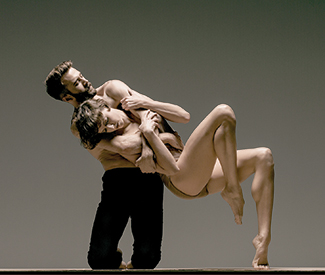
The sculpturally elaborate opening duet begins with simple touches by two young people, she in a pretty frock, he bare-chested and in jeans. Handholding evolves into an increasingly intricate and unrelenting struggle. Every body part from necks to limbs (Wilkes hangs off his and dips between Beresford’s legs) is brought into action. They reach, grab and shove; she sinks into his arms, he flips her overhead. Yet there is no sense of violence just a feeling of inevitability and, perhaps, a need to reach out as a process of self-definition. They communicated an Edenic innocence until the soldier figure pointed his gun at them.

Steady‘s middle section explodes into something dark and chaotic. With John Oswald’s score building into frightening intensity, the magisterial Courtney Henry with Rocher and Yujin Kim takes command of the stage. They stride, turn, and extend limbs; yet they also curl and embrace the ground. In a final image they call up Rodin’s three “Shades.”

An eloquently expressive solo for Babatunji, performed in silence, then cleared the air, with the dancer sinking, turning, and opening himself to space. A unison walking section felt calm until individuals broke out, most prominently the powerful Michael Montgomery’s whose whipping turns and isolations shook his body into spasms. David Harvey, with Webster, Wilkes and Kim, looked like catastrophe survivors. Bent over they dragged their broken bodies across the stage. Again and again, they forced themselves into upright positions to keep on struggling. At one point Harvey looked like a boxer responding to an unseen opponent’s thrusts and punches.

A second trio’s intent eluded me. The soldier from the opening section re-appeared against a white screen. He elicited a duet for Harvey and Kim in which he offered himself and a rolling stage light as support for the panic-stricken Kim, who never raised her gaze. In the follow-up, a darkly lit duet, Webster — she of the steady heart — repeatedly faced the soldier’s gun but, turning its nozzle away, shoved him into the wings.

Steady‘s dancers, including the three departing ones, shone at the top of their expressive abilities. They were well-supported by the beautifully chosen music, and Morgenthaler’s majestic employment of light and space.

The evening opened with excerpts from three earlier King choreographies: Klang (1996), The Radius of Convergence (2008), and Koto (2002). It was good to see the women in point shoes, a practice that King rarely makes use of these days. The first two works also played with the traditional ballet soloist-corps format. The most intriguing standalone came in Klang; it contrasted frozen unison images with high-energy individual dancing. In the male trio, Beresford’s strutting and pugnacious stances had an almost comic flavor to them, while the women’s slinking kicks and hip poses dripped with old-fashioned coyness.

The male quintet in Radius featured solos for each dancer with Montgomery the outside observer until he jumped into the assembled quartet’s arms. They finally left him flat on his back. Radius segued without a break into a section from Koto. An ensemble piece, it showcased Jeffrey Van Sciver, a tall reed-thin dancer in his second year with Lines. His whiplash turns and long leaps felt like a storm invading a placid world. Unfortunately, Miya Masaoka’s koto music on tape jarred. It sounded tinny and sharp. Besides, I missed seeing her perform live in that huge red Colleen Quen gown of hers.


Where evil grows

0

cheryl@sfbg.com

FILM For film fans, there’s a delight that comes from charting a talented director’s progress from obscurity to cult fame to “next-big-thing” status. I remember settling in to watch Jim Mickle’s 2010 breakout Stake Land (his first feature was 2006’s micro-budget creature feature Mulberry Street, which played multiple festivals on the genre circuit). I knew it was a vampire movie, a weary subject thanks to Twilight mania, but it soon became clear that Stake Land was not a by-the-numbers affair: Within the first five minutes, a crusty fang-slinger devours a human infant. “This is not a film to be fucked with,” I scribbled in my review, and filed away the name “Jim Mickle” for future consideration.

Last year, he returned with We Are What We Are, a remake of a Mexican chiller about cannibals fighting to keep their secret traditions alive despite pesky interference from the modern world. It was his third film with writing partner Nick Damici — also the lead in Mickle’s first two films, though he moved to a supporting role in We Are, which focused mostly on the teen sisters at its core. Set in rural upstate New York, We Are had its share of gore, but it also went deeper, teasing out a macabre and surprisingly detailed history of its flesh-eating family.

“To me, it’s more of a dark story about faith and religion,” he told me in an interview at the time. “I was much more interested in the girls’ story, and the story of a family trying to hold together after a tragic event.”

Now comes Mickle’s most accomplished film to date, and it’s even less overtly horror (though it contains a multitude of terrifying moments): Cold in July, a thriller ranging across East Texas, circa 1989. The script by Team Mickle-Damici is adapted from the novel by Joe R. Lansdale, who — buckle up, cultists — also penned the short story which spawned 2002’s Bubba Ho-Tep. That said, there are no supernatural elements afoot here; all darkness springs entirely from the coal-black hearts beating in its characters.

Well, some of its characters. Cold in July begins with a killing, but the trigger hand is attached to mild-mannered frame-store owner Richard Dane (Dexter‘s Michael C. Hall, rocking a splendid mullet). The masked man he shot was breaking into the Dane family home; Richard was just protecting his wife (Vinessa Shaw) and young son (Brogan Hall). That he accidentally, kinda, nailed the burglar — spraying brains everywhere, necessitating amusing later scenes of weary clean-up and furniture replacement — is breezed over by the police (including a cowboy-hatted Damici). “Sometimes, the good guy wins,” they assure him.

The good guy/bad guy dynamic is twisted, tested, and taken to extremes as Cold in July continues; it’s the sort of film best viewed without much knowledge of its plot twists, which are numerous and cleverly plotted. (Which is to say: You may read on, genre junkie, without fear of spoilers, because I don’t wanna ruin anyone’s viewing enjoyment.) The day after his run-in with vigilante justice, Richard realizes he’s the number one conversation topic in his small town, and his shiny local-hero status has attracted the attention of the dead robber’s father (Sam Shepard), just out of the clink and skilled in the art of Cape Fear-style menace.

What happens next is best left a surprise, though it does involve Don Johnson as a flamboyant, convertible-driving pig farmer; plenty more bloodshed; a meeting at a drive-in that just happens to be screening Night of the Living Dead (1968); and the line “You don’t wanna fuck with the Dixie Mafia.” Throughout, Cold in July expertly works its 1980s setting as both homage to and embodiment of the era’s gritty thrillers; its synth-heavy score and neo-noir lensing (by frequent Mickle collaborators Jeff Grace and Ryan Samul, respectively) and the casting of Wyatt Russell (son of Kurt; he was also in We Are What We Are) in a key role add to the feeling that Cold in July was crafted after much time spent in the church of St. John Carpenter. There’s humor, too, deployed with careful timing that doesn’t compromise the slow-burning tension that builds throughout — as when Richard celebrates some good news by headbanging to period-perfect power rock in his enormous, wood-paneled station wagon.

Most intriguingly, and for all its retro trappings, Cold in July offers a very modern exploration of masculinity via all of its leads, though Richard is obviously the embodiment of this theme. “I’ve been waiting for something big like this,” he says to his wife before slithering away on a secret road trip (she thinks he’s talking about landing an important new client). Unlike Viggo Mortensen’s secret gangster in 2005’s A History of Violence, which begins with a similar premise (family guy shoots someone in self-defense, opening a can of worms in the process), Richard has zero past aggression to draw on; dude’s got a history of mildness — with a heretoforth untapped curiosity about the wilder side of life awakened by a sudden bloody act. Once again, Mickle has delivered an unfuck-with-able film. Can’t wait to see what he does next. *


COLD IN JULY opens Fri/30 in Bay Area theaters.