Volumes

Silver Swans

2

When is the cover better than the original? When the original is by newbie/vitriolic web backlash victim Lana Del Rey, and the cover is a sensual send-up by seasoned San Francisco duo Silver Swans (silverswans.bandcamp.com). The local act split open the pop song — “Video Games” — slowed it down, and filled it with chilly synth floating below breathy vocals.

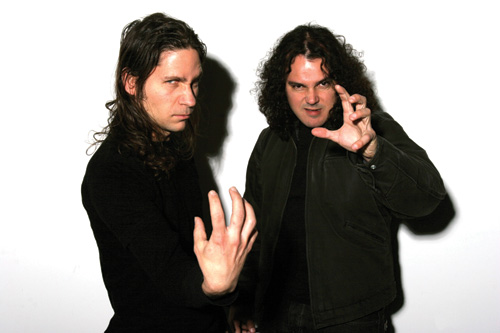
But we’re not here to debate Del Rey’s musical ability; we’re here to keep a glossy superhero eye on Silver Swans. Formed by Las Vegas-born vocalist Ann Yu and Jamaica-bred effects wizard-DJ Jon Waters in 2007, the band has delivered a lovely catalogue — most recently 2010’s Secrets EP and the upcoming LP Forever (Feb.7) — of heart-wrenching synth pop and shoulder-dancing, Manchester-evoking icy club rock. It’s high time they get their international due.

Description of sound: Someone else said it best: “tropical synths and stuttering 808s” wrapped in ambivalent romance and bittersweet longing.

Like most about the Bay Area music scene: The Bay Area music scene is both sophisticated yet charming. So many amazing bands come out of SF, yet you can still create your own place here and find people who appreciate what you do. In that sense, it’s still fresh here. The scene isn’t jaded and over-saturated, there’s charm and new inspiration everywhere.

What piece of music means the most to you and why: This is a hard one, so many songs have come into my life and forever changed me, the first mixtape I got had a song on it called “So Said Kay” by The Field Mice and I think I could have listened to that song on repeat for days reading into every lyric and just taking in the voice. It made me sad too, and just made me feel exactly what I wanted to feel at the time. It was one of the first songs to inspire me to write and also tap into that unknown territory where you don’t care about how unique or difficult a part is write, you just let yourself get carried away in the moment of the song itself and let it almost write itself.

Favorite local eatery and dish: El Metate Mexican Veggie burrito, the vegetables are roasted and always fresh. Everything there is delicious and on the cheap, right down to their alfajore cookies, I fully endorse the entire menu.

Who would you most like to tour with: Karin Dreijer Andersson — Jon and I are both admirers of everything she does. She is a true artist, and I get lost in her songs always.

Black Cobra

0

Last year was epic for Black Cobra (www.blackcobra.net); the duo toured with a reunited Kyuss Lives, closed out the night at Yerba Buena’s awesome art-meets-metal live show, and released Invernal. The album, full of pummeling hardcore, saw vinyl release last month on Southern Lord, thus kicking of another doomy year for the act that got together way back in 2004 when drummer Rafa Martinez (formerly of Acid King and Gammera) was living in LA and ex-Cavity guitarist Jason Landrian was in NYC.

Black Cobra essentially began by snail mail, each sending brutal bits of song across the country. Moving to San Francisco in 2007, the band evolution was complete. While Black Cobra on record sounds undeniably good, the band is at its very best when live, with polyrhythms, Martinez beating the shit out of the drums, and Landrian’s gravity-defying backbends. The next show will be a charmer, Valentine’s Day at the New Parish (8 p.m., $10–$13. 579 18th St., Oakl. www.thenewparish.com), the best way to confess to the dark lords, “Nothing Says I Love You Like Doom” (which happens to be the event’s title). Hopefully it’ll be touring with Black Sabbath by the end of this year.

Description of sound: Jason Landrian: Like an avalanche of barbed wire and rabid sharks.

Rafa Martinez: sounds like drinking the blood of your enemy.

What do you like most about the Bay Area music scene: JL: The size and variety. It’s not too big, but not too small and there is not just one type of band.

RM: Awesome bands, diverse crowds, cool clubs.

What piece of music means the most to you and why: JL: Master of Puppets by Metallica. This was a massive staple of my youth and a huge influence on my playing when I was first learning guitar.

RM: Der Ring des Nibelungen by Wagner. It was the soundtrack of my childhood.

Favorite local eatery and dish: JL: Cathead’s Barbecue. Cornmeal crusted tofu is killer!

RM: The Submarine Shop on West Portal. Italiano center sub with a Coke.

Who would you most like to tour with: JL: Black Sabbath

RM: Rush

Two clean energy tracks for SF

1

OPINION CleanPowerSF, San Francisco’s green electricity alternative to Pacific Gas and Electric Co., is set to launch this year. The program is following two parallel paths — one to build renewable energy in San Francisco and create thousands of local jobs, the other to purchase clean power from remote sources from Shell Energy.

While both tracks bring advantages, this bifurcated approach could end up serving only 30 percent of city residents. Fortunately, the city can easily improve the launch of CleanPowerSF by merging the two tracks.

Enacted by the Board of Supervisors and Mayor Gavin Newsom in 2004 and in 2007, CleanPowerSF is not a public-power program like Santa Clara’s Silicon Valley Power or Alameda Municipal Power. CleanPowerSF is a public-private partnership, much like the successful Marin Clean Energy, which can buy power in bulk from outside companies — and also generate its own renewable energy. PG&E still owns the transmission grid and will deliver electricity to customers, who then have the option of choosing between CleanPowerSF and PG&E.

The San Francisco Public Utilities Commission has embarked on a detailed analysis of PG&E electricity data to find out how much electricity is used in different parts of the city at different times of the day and how much it costs. That will pinpoint exactly where in San Francisco renewable energy should be built for the highest efficiency and lowest costs to ratepayers.

While this analysis is being conducted, the SFPUC plans to initiate the second track, offering ratepayers 100% renewable electricity purchased from Shell Energy North America. That will get CleanPowerSF up and running quickly — but would cost ratepayers between $6.70 and $54.50 more a month more than PG&E. As a result, the SFPUC estimates that as many as 70% of ratepayers could leave CleanPowerSF and go back to PG&E.

The SF PUC plans to offer CleanPowerSF to two-thirds of San Francisco customers — 230,000 residences — with as many as 155,000 opting out. Once these people opt out, they won’t be customers of the cheaper, locally produced, job-creating, green energy that will come later.

By comparison, only 20 percent of Marin Clean Energy customers opted out at initial rollout. That’s because Marin Clean Energy offers a 27 percent renewable energy option in addition to a higher-cost 100 percent green option. The “light-green” option is cheaper because it mixes in lower-cost, non-renewable electricity.

The PUC could keep more San Franciscans in CleanPowerSF by integrating the local generation and data analysis and purchasing tracks. First, it could include a cheaper light-green option like Marin’s. To determine what mix of renewable and non-renewable electricity would be cost-competitive with PG&E, the PUC would use the results from the first track, the analysis of electricity usage data, expected this spring. The Board of Supervisors could make these changes when it takes up the Shell contract this month or next.

In the past few months, CleanPowerSF has made much progress thanks to San Francisco Supervisor David Campos and Ed Harrington, general manager of the San Francisco Public Utilities Commission. The addition of a cost-competitive light-green option would enable CleanPowerSF to better compete with PG&E and keep more San Franciscans in the program — for the long term. That would significantly increase the number of new local jobs created and have a greater effect in fighting global climate change. It worked in Marin, and it can work in San Francisco as well..

John Rizzo is former chair of the Sierra Club Bay Area Chapter and current president of the San Francisco Community College Board


Future Twin

6

The two females in Future Twin (www.futuretwin.com) — Jean Yaste and Stephanie Rose — met one another in a moped gang called the Lockits, another member of the band was in a moped crew called Treats of the Loin; I’m not sure if you can concoct a greater back-story than that but I’d be hard-pressed to find one. And the San Francisco fivesome, which formed in December 2010 originally as a trio, makes the equivalent of moped rock on its debut EP cassette, Situation (which is also available for download, for those without a tape player). Released Jan. 31, Situation revs up with roaring guitar, and incorporates field recordings of gunshots and small engines such as lawnmowers and of course, mopeds, but veers from blunt roughness, instead leaning towards powerful girl group-style vocals and multi-part harmonies.

While the first release is a small one, the Mission-based band has chops, brains, and a clear bond. Though perhaps not tight enough to get all its members to a photoshoot — while the drummer Antonio “Tones” Roman-Alcala with strep throat made it, another Future Twin simply texted, “yo, just didn’t feel like going.” No matter, Future Twin celebrates the release of Situation at the Hemlock this Thu/2 (9 p.m., $6. 1131 Polk, SF. www.hemlocktavern.com).

Description of sound: Psychedelic farmageddon grandma rock.

What do you like most about the Bay Area music scene: The things we liked most was the Clarion Alley block party until the damn breeders built their precious condos next door and started their war on fun. These people need to be taken out and the “scene” will heal itself.

What piece of music means the most to you and why: Rap News Occupy 2012. Why? No reason.

Favorite local eatery and dish: Secret Spot has delicious bagels, fresh squeezed juice, and homegrown greens.

Who would you most like to tour with: Bill Murray (as a zombie) and Kool Keith (as himself).

The parking war

29

EDITORIAL When you talk about changing parking rules in San Francisco, you’re setting off the political equivalent of shooting war. Nobody wants more parking tickets, nobody wants more expensive parking meters, nobody wants to pay for parking that’s been free for years — and the Municipal Transportation Agency has, by most accounts, done a pretty poor job of selling its new parking management program.

That’s too bad, because the MTA proposals aren’t all bad. In fact, the agency is doing exactly the right thing by looking at a long-term citywide plan for altering the way people pay for and use on-street parking. If the bureaucrats at a city department that isn’t used to San Francisco’s often slow community-oriented planning process can shift their outreach efforts into a different gear, there’s no reason they can’t come up with a plan that most neighborhood residents and small businesses will support.

The MTA’s SFPark program uses high-tech meters that accept credit cards and change prices at different points of the day to maximize turnover on the streets. That’s actually good for local businesses — the less time people spend circling the block looking for a parking space, the more likely they are to stop and shop. Limiting the number of cars cruising for a space improves traffic flow. And parking for an hour or two at a meter is still much cheaper than parking in a garage.

But when the MTA announced that it was expanding SFPark into the Northeast Mission, Dogpatch, Potrero Hill and Mission Bay, the neighborhoods rebelled. Some of that was just anger over the prospect of meters being installed on streets that don’t have them. Some of it comes from the changing land use in areas that are increasingly both residential and commercial. Some of it comes from the intense development pressure in those areas.

But a lot of it was a legitimate response to a perception that the MTA was trying to ram the changes through without making a serious effort to work with the community. It’s not surprising — the MTA has been somewhat isolated from the politics of land use and planning in the city. So the staff isn’t used to the fact that San Francisco is a process-oriented place where a wide range of constituent groups want input before anything happens where they live or work.

The neighborhoods need to understand reality, too: The era of free parking in San Francisco is coming to an end. That’s a good thing — the city as a matter of policy should discourage the use of cars, and charging drivers for parking (and using that money to improve Muni) is an obvious solution. And the proposals aren’t that onerous: Paying 25 cents an hour for all-day parking where you work is hardly a terrible financing burden. (And let’s face it — the neighborhood parking stickers are way, way too cheap.)

But much of the southeast is badly served by transit and there are vehicle-intensive production, distribution and repair uses, and MTA needs to understand that. The agency has wisely delayed the program — and after its shown it can work with the neighborhoods, this sort of bold initiative will be possible.

Seventeen Evergreen

0

Seventeen Evergreen (www.seventeenevergreen.com) occasionally sounds like evil video game music to me. The San Francisco band consists of Caleb Pate and Nephi Evans, both writers-producers who sing and play drums, synths, and Asiatic stringed instruments among other contraptions. Though it has roots in garage, the duo mostly sticks to experimental psych-pop, and sometimes incorporates aggressive dance beats that lend to gaming — you can almost picture shattered gold rings falling through the sky in a winning ding-ding-ding during moments in the forthcoming Steady On, Scientist! LP (March 27, Lucky Number). The next show is Feb. 25 with Atlas Sound at Bimbo’s as part of Noise Pop (8 p.m., $20. 1025 Columbus, SF. www.bimbos365club.com).

The album standout is “Polarity Song,” with its catchy, repetitive hook and provocative lyrics. The song also was featured on the Psyentist EP, released last December and subsequently, there was a music video. While the EP and video by Terri Timely, which played up a rainbow of yarn spun thrift store monsters, were released last year to local acclaim, the full-length will be out in 2012, making it the perfect year for the band to reach its deserved position beside fellow danceable indie giants. After watching Seventeen Evergreen live last year, the phrase “embrace the polarity of life” was bumping about my brain for weeks. Undoubtedly, this will happen to you too.

Description of sound: Somewhere between zenith snowflake pop and psychedelic cave techno.

What do you like most about the Bay Area music scene: The Asian influence on the avant garde, the room for innovation, and the many different scenes which may or may not always celebrate the out-and-out sonic weirdness that this city has produced over the years.

What piece of music means the most to you and why: No one piece could ever answer this one so far, but last year Cass McCombs’ “County Line” was a favorite. “Golden Lady” by Stevie Wonder and nearly anything by Moondog come to mind as perennials.

Favorite local eatery and dish: So many options here but let’s nominate the Chilaquiles at the farmer’s market in the Ferry Building or a number of places in the Mission for the same.

Who would you most like to tour with: ELO.

Editor’s notes

13

tredmond@sfbg.com

I used to go to Grateful Dead shows at the Oakland Auditorium, which is now called the Kaiser Convention Center. One night I saw Bill Graham, the late concert promoter, ride a zip line from up near the ceiling to the stage in a giant paper mache joint called the “S.S. Columbian,” which looked like it was going to fall apart at any minute as he swung back and forth 50 feet over the crowd, trying to smile and wave in a bizarre promotional stunt that confused even the deadheads. I bet he shit his pants.

The place was a pretty good venue for a big concert, but it never worked out as a convention center, and the city shut it down in 2005. It needs seismic work and about $5 million in maintenance. It sits near Lake Merritt, on the edge of downtown Oakland, a giant empty building just waiting for something to happen to it.

It’s a perfect spot for an Occupy Oakland headquarters. I’m surprised it took the Occupy folks this long to figure it out.

Look: Oakland’s a working-class city, and it’s having severe financial problems, and sending hundreds of cops to arrest Occupy protesters is sucking up money that’s desperately needed for other things. Mayor Jean Quan complains that police were unable to respond to emergency calls in other parts of the city because they were all downtown dealing with the demonstration.

Understood — and it’s clear that the Oakland Police, whether the Occupy folks like it or not, are going to arrive in mass numbers to make sure that there’s no damage to local businesses or City Hall (where, oddly, there were no arrests, because the cops were elsewhere).

But the empty Kaiser Center, which isn’t even in the downtown center? Why bother?

Seriously: Why not just give it to Occupy Oakland? Tell the group that the city will strictly enforce fire and health codes, that the Occupy people will have to clean the place up and keep it clean, that they can’t damage the place … and hand over the keys?

It’s public property. Nobody using it now. Occupy might actually bring some excitement to the scene. If it became a center for political meetings and organizing, for education and performances, it could be a be a very positive thing.

Declare at truce in the Occupy wars. Let the cops go after murderers; give Occupy the vacant convention center. Nothing else is working. It’s worth a try.

Main Attrakionz

0

Why is Oakland’s Main Attrakionz (www.mainattrakionz.com) on the rise? It’s because everybody’s talking about it, and with good reason. Last year’s massive 808s & Dark Grapes II mixtape wowed the underground hip-hop world, and with every passing month the act — rapper-producer Squadda B and rapper Mondre M.A.N. — catches the attention of yet another publication, and yet another rising producer — there have been collaborations with A$AP Rocky, Clams Casino, Kool A.D. of Das Racist and Danny Brown, among others.

The cloud-rap duo got a write-up on the Guardian’s Noise blog in December in which writer Frances Capell effused, “Main Attrakionz is carving out its own place in hip-hop by pioneering a new sub-genre” and later, “a refreshing realness runs throughout Main Attrakionz’s lyrics.” In 2012 there will be solo mixtapes from both rappers, along with the collaborative effort Bossalini’s & Fooliyones. With all this skill and regard it’s easy to forget how young the crew really is, it got its start in high school — way back in 2007.

Description of sound: Really can’t describe it. All of our music sounds different.

What do you like most about the Bay Area music scene: The fact that only we know what they talking about.

What piece of music means the most to you and why: The beat to “Da Art of Storytellin” by Outkast featuring Slick Rick, produced by Mr. DJ. It just reminds me of my childhood staying up to watch Rap City countdown and the song was usually number one. Whenever I hear the beat, I think of the puppets in the video.

Favorite local eatery and dish: Buffet Fortuna in Downtown Oakland; chow fun noodles

Who would you most like to tour with: Lil Wayne; as far as performances go, he’s gotta be the top rapper who been performing 10+ years. I wanna learn how he stays ready and energetic for all these years.

Metal Mother

0

Like some sort of neon, acid-drenched wood nymph, Metal Mother’s (metalmother.bandcamp.com) Tara Tati wanders through the leafy, NSFW video for the haunting art-pop “Shake” off last year’s Bonfire Diaries and into the mind’s eye. In 2012, there will be a first trip to SXSW, more videos (yay!), a few remixes, and, fingers crossed, another full length out toward the end of this year. And as the shimmering Tati says, she’ll “Continue dismantling the mundane and mediocre thought systems that are ruling the planet.”

Tati and her band, which came together shortly after the release of Bonfire proved most theatrical of the Guardian photoshoot, with glittering headpieces and flexible posing. In setting up the right headspace for a photo Tati at one point explained, “I imagine we’re on a wind-torn beach in Scotland.” Appropriate given the band’s atmospheric sound. Before embarking on tour, Metal Mother will play Disco Volante on March 3 (347 14 St., Oakl. www.discovolanteoakland.com)

Description of sound: Post-apocalyptic-art-wave.

What do you like most about the Bay Area music scene: Oakland (where I live) has the feeling of being a fairly insulated city, and I think because it feels like we’re off the mainstream radar a bit, in combination with the massive artist population, there’s more support here for being ‘experimental’ and trying new things, than there is for being traditional. There’s this intense camaraderie, like it’s all for one and one for all, yet at the same time, there’s a crazy bullshit filter that really keeps us all in our most authentically creative place.

What piece of music means the most to you and why: The piece that’s recently gotten the most consistent play on my iPod is Sufjan Stevens’ latest album, Age of Adz. I’ve realized that most music that has lasting power for me usually has some symphonic, classical element to it, and he really nailed it with this album. Its masterfully produced; the arrangements are shockingly complex yet have this unyielding elegance that still gets me all emotional. To me, it’s a perfect blend of sweetness, humility, passion, and absurdity; there’s never a dull moment!

Favorite local eatery and dish: Tacubaya in Berkeley, all the vegetarian dishes are amazing. My favorite is probably the ‘seasonal vegetable’ tamales.

Who would you most like to tour with: It’s a tie between Sufjan Stevens and Bjork.

Dirty Ghosts

3

After her other bands naturally fizzled, Allyson Baker was done. “I was burnt,” says the hard-rocking guitarist, clad in her signature black leather jacket, with a rocker’s fringe of black bangs framing her face. Luckily for us, she got the rock’n’roll bug again around 2006, and picked up the pieces for a new project — Dirty Ghosts (www.dirtyghosts.com). Since then the act has gone through a dozen formations, with even more drummers, but one thing remains consistent: Baker herself, a Joan Jett-esque force on stage and off.

Over the past few years the singer-guitarist has recorded and rerecorded a core set of 10 songs, some with the digital help of her husband rapper Aesop Rock, others with session musicians and creative pals. She’ll finally release the full length LP Metal Moon (Last Gang Records) Feb. 21. A few days later (Feb. 23) she’ll play an unofficial album release show as part of Noise Pop’s 20th anniversary (9 p.m., $10–$20. Brick and Mortar, 1710 Mission, SF. www.brickandmortarmusic.com). The year is Baker’s for the taking.

http://www.youtube.com/watch?v=8GvupEc9oB0

Description of sound: 1960s funk, ’70s rock, ’80s new wave, ’00s R&B, good times/bad times.

What do you like most about the Bay Area music scene: I think this city has a musical history that’s one of the best and most unique, so even to able to exist in the place where that happened I think is pretty special.

What piece of music means the most to you and why: New Age by Chrome. It’s so simple and it’s got all of the elements. It’s perfect.

Favorite local eatery and dish: I don’t wanna be boring and say the super burrito at Cancún which is my real answer, so the margarita pizza at Una Pizza Napoletana

Who would you most like tour with: Swiftumz.

Dome rock

2

MUSIC “I don’t know if you’ve ever been in a geodesic dome,” says drummer-guitarist Andy Duvall, formerly of Zen Guerilla, and currently one third of the improvisational space rock outfit Carlton Melton. “But if you stand right in the middle, there’s a sweet spot.”

Carlton Melton records all its stripped down, lo-fi material in a dome house located a few hours north of here, though the three mainstays — Duvall, Rich Millman, and Clint Golden — call Oakland and San Francisco home. As for their process: “We just go up, hang out, and record all weekend. It’s very sloppy in many ways but I’ve always been a fan of slop. I think perfection can be a little boring.”

During recording other musician pals drop in and out. Live, the trio switches up the instrumentation mid-set. Duvall, a gifted, frenetic drummer influenced by Colm Ó Cíosóig of My Bloody Valentine among others (“[He’s] completely overlooked when people talk of their brilliance”), added guitar to his repertoire for Carlton Melton. The band will again show its live prowess locally this Saturday at El Rio.

In the few years since the vocal-less act formed in 2008 — I use “formed” tentatively, as it was more of a natural progression than the word implies — it’s released a cluster of DIY material on indie labels and its own, Mid-To-Late Records. There was the initial, 2008 “Live in Point Arena” CD-R, an Empty Shapes split LP, another split with Qumran Orphics and a few seven-inches on SF’s Valley King Records and the Irish Trensmat Records (which specializes in “transmitting drone, noise, oscillations and grooves”), both in 2011. In 2012 they’ll put out yet another long-player (already recorded), likely in spring, and are currently hammering out the details for a European tour.

Last year also saw the release of the swirling, spacey Country Ways LP, a record that begins with the 20-minute titular track, a slow-building stunner of dangling drums and psychedelic guitar with the irregular cosmic zap. A track that seemingly has no beginning or end, with the foggy vortex of pleasing chords hanging on for eternity, it’s trance-like, sensory, afferent. And something clicks when you remember they made this sound while cracking beers amongst friends over a few days in a specially-shaped structure.

The band actually came to be because of the dome. After Zen Guerrilla — a band that, should be noted, amassed many local fans and was a 2001 GOLDIES winner — split up in 2003, Millman was busy raising his two kids. Duvall was happily spending time with his girlfriend and their two cats, Gerard and Cheval. In 2008, Millman called Duvall, and asked if he’d want to start playing again. He agreed but it was mostly to jam with an old friend, the opposite of a definition band. The two, now both 44, who first began creating music together in 1990 when they lived in Delaware, talked to the owner of the dome and said “hey, we’re going to come up and bring some amps and make a bunch of noise at your place, do you mind?”

Back to that sweet spot — it naturally enriches sound. “If you’re talking, your voice just instantly amplifies. Same thing happens with music, you’re playing guitar and it’s just swirling around in the dome. It’s sort of ideal for psychedelic music.” says Duvall in a phonecall from his home in Oakland.

That first night up north was magic. They realized they needed name. Duvall, with all his genial charm recalls the conversation then whispers “Carlton Melton.” Melton was a cool guy he knew from junior high in Delaware, a real bad-ass. Strangely, Millman, who went to another school, also knew Melton in Delaware — they’d played one another in football. Years later, Duvall and Melton happen to meet another dude named Carlton Melton, and that last bit of coincidence seems to have sealed the name’s fate. “It’s bizarre but it really fits the band. I just hope the guy from Delaware’s not offended, because we named the band after him for all the right reasons.”

CARLTON MELTON

With Feral Ohms, and Glitter Wizard

Sat/28, 9 p.m., $8

El Rio

3158 Mission, SF

www.elriosf.com

What are people?

4

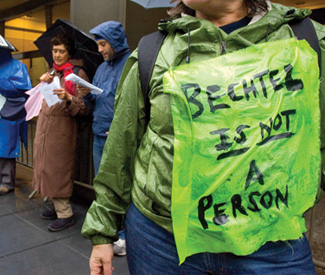
Protesters from the Occupy movement and beyond gathered in front of the Ninth Circuit Court of Appeals in San Francisco on Jan. 20, calling for the adoption of a 28th amendment to the U.S. Constitution aimed at refuting the idea that corporations should have the same rights as people, a legal doctrine know as corporate personhood.

The event was part of a day of action at courthouses around the country, seeking to raise public awareness about the unfettered influence of corporate money in U.S. elections and draw attention to the second anniversary of the landmark corporate personhood decision by U.S. Supreme Court, Citizens United vs the Federal Elections Commission.

“We are here not to protest, not to petition, and not to plead, but to proclaim a truth that should be self evident, even to the Supreme Court: Corporations are not people; money is not speech,” said Abraham Entin, of North Bay Move To Amend, addressing a crowd gathered at the courthouse. “Corporations work very hard to convince us that we cannot do without them and the products they produce. They tell us they are too big to fail, and that our survival is dependent on their survival … Occupy has changed all that.”

In a contentious 5-4 ruling handed down on Jan. 21, 2010, the Citizens United case solidified the legal framework that bequeaths corporations the same rights under the Constitution as real, living, breathing, U.S. citizens, and by merit of their First Amendment rights as citizens bars any restrictions placed on a corporation’s ability to spend money to influence elections.

When Republican presidential candidate Mitt Romney famously said on the campaign trail that “corporations are people, my friend, because corporations have people inside them,” he is reflecting the logic of the majority opinion in the Citizens United case. The court’s majority asserted that corporations are essentially an association of people and thus enjoy the same rights as individuals.

The court also claimed that it is impossible to distinguish between the corporate media outlets and other corporate speech, so all corporations should enjoy the free speech rights saved for the press. Furthermore, because journalists often have to spend money to achieve speech, money spent on messaging by all corporations represents protected speech.

Corporations, a relatively modern invention, aren’t actually discussed in the Constitution. But the notion of corporation personhood began around 1886 in the case of Santa Clara County v. Southern Pacific Railroad. What Citizens United did was equate corporate money spent to influence elections with protected political speech, upending attempts at election reforms and gutting the McCain-Feingold Act of 2002 that regulated federal election campaigns.

That corporations act to corrupt our democratic systems for their own profit is not conspiracy, it’s simply a byproduct of what they are. Corporations are legally obligated to act to maximize their profits for the benefit of their shareholders, otherwise their board and corporate officers are considered negligent of their obligations to their shareholders’ financial interests. Unlike journalists, whose professional credo calls for fairness and acting in the public interest, corporations are designed to act in their own interests.

As Justice John Paul Stevens wrote for the dissenting judges in Citizens United, “Corporations have no consciences, no beliefs, no feelings, no thoughts, no desires. Corporations help structure and facilitate the activities of human beings, to be sure, and their ‘personhood’ often serves as a useful legal fiction. But they are not themselves members of ‘We the People’ by whom and for whom our Constitution was established.”

The resulting flood of corporate money into election campaigns since the court’s ruling is delivered through an aqueduct known as the Super PAC (political action committee). In the wake of Citizens United, election spending by Super PACs in the 2010 midterm elections exceeded $300 million dollars, more spending than the overall spending in the previous five midterm elections combined.

Unlike donations to campaigns, which so far remain regulated, Super PAC money is spent directly by the Super PAC, and can be spent attacking as well as supporting candidates, leading to fears that corporations can exert influence on incumbents before a re-election campaigns by threatening to spend money attacking them in the upcoming election cycle.

“Corporations are human creations, state creations, legal entities … There is no reason we cannot limit their spending,” said Carlos Villarreal, executive director of the National Lawyers Guild’s Bay Area chapter. “Nonprofit organizations are limited in their political spending. Churches and charitable organizations are also limited in their spending. So why not for-profit corporations?”

Perhaps no group knows more about government limits to free speech than participants of the Occupy movement. Elastic restrictions on individual free speech and freedom of association rights spelled out in the First Amendment, resting on alleged risks to health and public safety, have led to Occupy encampments across the nation being restricted and evicted, at times enforced by brutal police crackdowns.

The right of the government to restrict individual and group speech that officials believe represents a clear and present danger was established by the Supreme Court in the 1919 Schenck v United States case — the famous “don’t yell fire in a crowded theater” case. What is not widely known is that this case was a re-examination of the famous 1917 Espionage Act. The “crowded theater” was our nation’s entry into World War I, and those being jailed for “yelling fire” were labor organizers and pacifists expressing their opposition to our entry into the war.

Relying on Schenck, courts have consistently defended restrictions on individual free speech when there is a compelling interest to public safety, the so-called “clear and present danger” standard. Villarreal and the crowd gathered before the Ninth Circuit asserted that corporate influence in our democratic processes represents a clear and present danger to society. “There is no more compelling interest than protecting democracy,” said Villarreal.

Despite the apparent double standard, legal experts say the courts action in the Citizens United case leaves a constitutional amendment as the only avenue left for regulating corporate money in elections and ending corporate personhood, but the movement to take on that Herculean task has already begun.

U.S. Sen. Bernie Sanders (I-VT) and Rep. Ted Deutch (D-FL) have introduced legislation proposing a 28th Amendment to the Constitution. While the language differs from another amendment presented by the group Move to Amend, it also takes aim at ending corporate personhood.

“Two years ago, the United States Supreme Court betrayed our Constitution and those who fought to ensure that its protections are enjoyed equally by all persons regardless of religion, race or gender, by engaging in an unabashed power-grab on behalf of corporate America,” Sanders wrote in a Jan. 20 Guardian(UK) column.

In Sanders’ home state of Vermont, the state Senate is also considering a resolution calling for a constitutional amendment against corporate personhood. A similar resolution, authored by Alix Rosenthal, was adopted by the San Francisco Democratic County Central Committee during a special meeting on Jan. 21. There was just one dissenting vote, and DCCC members say they plan to push for the state party organization to also adopt the stance.

The hurdles set forth to amend the U.S. Constitution, outlined in Article V, are substantial. In order for an amendment to even be considered, a super majority of both houses of Congress must initiate the process, or two-thirds of states must call for the amendment. Proposed amendments passing this threshold are then adopted only after three-quarters of state legislatures ratify the proposed amendment. But that difficult road is one the protesters said they are ready to travel. “We are here on a rainy day with warm hearts and wet feet. We are the 100 percent, the humans. No corporation has every experienced the thrill of wet feet,” said Gangs of America author Ted Nace. “We are the fools who go out on a wet day to fix a broken world. Eighty percent of the public want to fix this. That means we are halfway to our goal. What remains is organization, mobilization.”

Frilly werewolf

1

LIT “When you’ve lived so far like I have,” Christine Beatty’s wry voice came crackling through the phone as she drove to Las Vegas to play the slots, “you sometimes just have to catch your eye in the rearview mirror and laugh. I’ve led such a charmed life, really.”

Some doe-eyed Wisconsinite may have snagged the Miss America crown last week, but in terms of representing this nation’s glorious variousness, that tiara should be tucked neatly into Beatty’s glovebox. A transsexual activist, author, and good-time girl, Beatty just published her memoir, Not Your Average American Girl on her newly christened Glamazon Press (available at Modern Times bookstore in the Mission, www.mtbs.com). In it, she tells her story of growing up and discovering her inner self during a very turbulent time in Northern California, through the stoner 1970s to the economically rocky ’80s to our own time, when trans people have gained an unprecedented visibility yet still find themselves the targets of discrimination from both conservative quarters and other LGBTs.

“I started Glamazon Press because I want transwomen to have another outlet for expression that I think is lacking, ” Beatty said. “I feel that the Internet has brought us more visibility, but we’re still tucked under the wing of the gay movement, and maybe it’s time to move out. I don’t want to divorce the ‘T’ from LGBT, it’s been very politically beneficial in many ways. But we need to develop our own voice. There are situations unique to us — the surgery costs money, and we’re completely vulnerable in the work place from a legal viewpoint, if people employ us at all.”

In her memoir, a significant amount of valuable San Francisco history is unearthed. Not Your Average American Girl’s juiciest bits, for me, recall her life as a trans newbie in the Tenderloin in the ’80s, hanging out at the Spirit Club and embracing sex worker life — a period vividly evoked, the city seething with a grimy energy and sense of family, a lost drama of payphones, sex ads, and backrooms. And then she’s a ’90s rocker with her band Glamazon, the book also nailing the electrifying live scene of the time.

The most resonant parts, all recounted with a kind of surprised honesty, deal with Beatty’s deathly drug habit and recovery, her HIV diagnosis 25 years ago, and her journey into transwomanhood, something she approached with such unrelenting drive that her ex-wife and her mother became two of her biggest supporters, despite initial upset.

http://www.youtube.com/watch?v=mWziz4N6RUY

Even considering Beatty’s storytelling talents, however, it’s a wonder that Not Your Average American Girl exists at all. It meticulously recreates scenes from Beatty’s experiences using entries from the journals that she’s kept all her life. And really, if your mortal coil encompassed typical suburban mama’s boy, stoner hippie, macho soldier, undercover married cross-dresser (or “frilly werewolf”), Tenderloin call girl, recovering heroin addict, pioneering rock musician, and author-publisher, how legible would your diary be?

“When I went to write the book, I looked at these old journals and I was filled with gratitude,” Beatty said. “I was so scared, hopeless, resentful in parts. But I see how far I’ve come and I’m still alive. And I must have known I was going to survive — otherwise why the hell would I write all this down?”

Pay to park

62

The San Francisco Municipal Transportation Agency has hailed the success of its SFpark program — which uses high-tech meters and demand-variable pricing to manage on-street parking — noting that expired meter citations are down and meter revenue is up. The resulting 11 percent net increase in revenue  is all going to improve Muni. So transit improves, drivers get more spots and fewer tickets — everybody wins.

[CLARIFICATION (2/1): The new meters had an 11 percent net revenue increase compared to the old meters, but overall net revenues from citations and meters was still down by 3 percent.]

But the SFMTA has run into a hornet’s nest of opposition with its latest proposal to expand SFpark into the Northeast Mission District, Potrero Hill, Dogpatch, and Mission Bay, largely because the plan involves placing meters on streets where parking is now free. And even those who don’t object to paying for parking say the SFMTA has bungled this process.

The problem isn’t just what critics say are arrogance and dubious outreach efforts by agency officials. It may be that the SFMTA pursued too many goals at once, mixing them in ways that muddled the message. Or it may just be that charging for parking will always anger drivers, no matter how it’s proposed.

The agency wants to discourage driving — particularly cruising for parking, hence SFpark’s “Circle Less, Live More” slogan — to speed up Muni and reduce traffic congestion. But that also means charging for street parking so cars won’t just sit in those spaces, and that involves a complicated balancing act in mixed use neighborhoods.

Residents, many employers, and commuters want all-day street parking, preferably free and easy. But most business owners want enough parking turnover so their customers can find a spot. City policies call for prioritizing residents’ needs, and the SFMTA needs money to fund and expand Muni service.

Meeting all of those needs isn’t easy. But over the last couple of months, the SFMTA’s effort to expand its successful and popular SFpark program have managed to turn thousands of residents angrily against that program, the agency, and the proposition that people shouldn’t expect free parking.


COMMUNITY OUTRAGE

Architect John Lum and artist-designer Miranda Caroligne didn’t know each other a couple months ago, but now they’re helping to lead a movement that is uniting neighborhood groups in the Mission, Dogpatch, and Potrero Hill against the parking meter proposals.

“You have an agency that is not listening at all to the community. That’s fascism!” declares Lum. He’s actually an amiable and soft-spoken young guy who employs 10 people at his architecture firm near 17th and Capp streets, but this issue really gets his blood boiling.

And Lum isn’t alone, as the Jan. 13 public meeting before an SFMTA hearing officer showed. Not only did everyone who streamed to the microphone voice opposition to the proposals, but they usually did so in angry and accusatory ways, saying it would destroy businesses, punish the poor, and result in conditions that are simply unworkable and intolerable. And they said the SFMTA simply doesn’t care.

“If you’re a PDR business,” Caroligne said, referring to the Production, Distribution, and Repair businesses whose last bastion is some of the targeted areas, “you’re never going to get people to work at a place that doesn’t have parking…This proposal will push them out.”

There are myriad ways that the plans are flawed, say their critics: Meters were proposed on some residential streets in initial plans, despite SFMTA policies to the contrary; traffic surveys had too small a sampling and weren’t realistic; residential permit districts would be replaced by meters, or meters would be placed where districts might work better; transit service on Potrero Hill is too bad to expect people to use it; live-work spaces were inappropriately treated like retail outlets; and meters near the 22nd Street Caltrain station could actually discourage the use of public transit.

“There’s not that much disagreement, but where there is, it’s really important,” said Tony Kelly, president of the Potrero Boosters Neighborhood Association. “I’m someone who supports parking management, and I’m frustrated that the MTA is so tone deaf with this. We’ve been through a lot of fake public outreach efforts and this is looking like one of those.”

Janet Carpinelli, president of the Dogpatch Neighborhood Association, said her members feel like the SFMTA is ramming this through without regard for the needs or input of that neighborhood.

“The real issue is it’s a very big inconvenience to the businesses and residents in this neighborhood and it’s not really helping anything. It’s just a revenue grab by the MTA,” she said.

Potrero Hill resident Jim Wilkins was so outraged by the proposal to install meters along Pennsylvania Street outside his home that he started an online petition against the proposals that has so far garnered about 1,300 signatures. “We’re forming an organization to resist these proposals,” he told us.

Lum was already a member of the 17th Street Coalition, which formed in 2010 to oppose the renewal of a liquor license at the local Gas’n’Shop, but more recently organized opposition to the meter proposal. It attracted Caroligne, and now they’ve formed a new group, Northeast Mission Neighbors, which held a joint organizing meeting with the Dogpatch and Potrero groups on Jan. 23. They’re all determined to delay and modify the SFMTA’s proposal, which had been scheduled for adoption by the SFMTA Board of Directors Feb. 7.

Lum said the proposed changes are tough to accept: “I don’t think this is about free parking, it’s about living and working in a community with certain things and now those things are changing.”


CHANGE IS HARD

The biggest target of critics’ ire is Jay Primus, who runs the SFpark program for the SFMTA. He maintains that he’s done extensive outreach and gathered community input that has shaped the plans. “These are still proposals and nothing has been approved yet,” he told us.

For example, Wilkins told us his campaign continued even after the meters in front of his house were eliminated from the proposal last month. Primus also noted the proposed meters allow for all-day parking at just 25 cents an hour in most places, so it isn’t really such an inconvenience or financial hardship. And Primus just announced that the Feb. 7 hearing is being pushed back by at least two weeks to heed more community input.

But most of the opposition to the proposals isn’t surprising, and Primus thinks it comes more from the idea of charging for street parking than with the specifics of the proposal.

“Parking is always an emotional and delicate issue in San Francisco, as it is in most cities,” Primus said, citing protests against charging for parking going back to when the first meters were installed in 1947. “This has happened at every block that has gotten meters.”

But now, there are even more benefits and ease of use with modern meters, which motorists can pay with a credit card or even remotely. Variable pricing is also used to ensure more parking based on demand, although it’s being kept at a very low rate in areas where businesses or residents still need all-day parking.

“If people are opposed to paying 25 cents per hour, the lowest rate in the city, then they are opposed to paying for parking,” Primus said. He said it’s a matter of equity among citizens: “There’s nothing equitable about providing parking for free and asking people to pay $4 for a round trip Muni ride.”

That’s a notion that is echoed by others who say it’s time for motorists to start paying their fair share.

“Everybody wants something for nothing. We all want that. Nobody wants to pay for parking, not even me,” Don Shoup, the UCLA professor who wrote the influential book The High Cost of Free Parking, told us. He later added, “That whining you hear is the sound of change.”

At a time when governments are hurting for revenue to provide basic services — among them, maintaining extensive roadway systems for motorists whose taxes don’t come anywhere near covering their societal impacts — he said it just doesn’t make sense to continue subsidizing the storage of automobiles.

“San Francisco has some of the most valuable land on earth. You have expensive housing for people and free parking for cars. It’s not surprising that San Francisco has homeless people and traffic congestion,” Shoup said. “There was never a city that is so liberal about other people’s affairs and so conservative about its own affairs.”

But Shoup did agree with critics that the real goal of managing parking isn’t to discourage driving, although he applauds the SFpark program for using its increased revenue on public transit, which he thinks makes sense from a social justice perspective.

Jason Henderson, a professor of geography at San Francisco State and author of an upcoming book on the politics of parking and mobility, goes even further than Shoup in saying that San Francisco should use its parking policies to discourage driving. But at the very least, Henderson said it is counterproductive to offer free parking.

“The city is giving away valuable real estate with all of this free and underpriced curbside parking at a time when the city’s transportation infrastructure is crumbling and essential city services for parks, after school programs, and libraries are constantly being cut. And here we have thousands of acres of real estate just being given away,” Henderson told us.

“If anything, it needs to be done citywide so that it’s judicious and level, so that merchants won’t say that people won’t come to their neighborhood because they can go to a different neighborhood where there’s free parking.”

Primus said there is a particularly strong need to manage parking around Mission Bay and the North Mission, where much of the city’s growth is occurring.

“In a way, the SFMTA is catching up with the growth of the city. These are some of the last remaining areas that are residential-commercial mixed use areas with no parking management,” Primus said.

Kelly agrees that time has come, but he doesn’t think the SFMTA has helped its case, particularly given the emotions surrounding the issue and the need to maintain public support for improved transit service.

“They’ve been spending all their waking hours in the last couple years pissing people off over parking meters, do you really think people will then support their revenue proposals?” Kelly questioned.

Lum and Caroligne both said the SFMTA should have been willing to make the fundamental argument to people that the days of free parking are coming to an end.

“That’s where a lot of the anger is coming from, you’re doing this for all these reasons that don’t make sense and treating us like children,” Caroligne said, although she also added, “I agree with you that there would still be some outrage, even if the outreach had been better.”

Weed on wheels

9

steve@sfbg.com

CANNABIS CLUB GUIDE 2012 When we first created our detailed local Cannabis Club Guide two years ago — which you can find at www.sfbg.com/cannabisguide — it seemed as if the marijuana business had entered a golden age of openness and professionalism in San Francisco. But with a federal crackdown shuttering at least a half-dozen dispensaries in the Bay Area (Market Street Collective, Sanctuary, Mr. Nice Guy, Medithrive, Divinity Tree, Marin Alliance for Medical Marijuana) things have changed. Luckily for needy patients and stoners alike, San Francisco has always been a resourceful city, so those meddling feds have actually done very little to disrupt the free flow of the world’s best marijuana.

Even before the cannabis industry moved above ground and into brick-and-mortar storefronts, there were always pot delivery services here. Now they’re really proliferating, so we thought it was high time to add them to our guide. And once we delved into this realm, we found that it was every bit as civilized and professional as a visit to our friendly neighborhood dispensary — and perhaps even more convenient and cost-effective.

The process seems just as secure and legally compliant as it is at the clubs, with most reputable delivery services requiring that you become a member before accessing their products. That means sending them copies of your doctor’s recommendation and California ID, which can be even done from a photo on your smart phone. After the services verify you, you’re good to go.

We’re starting the guide with just a trio of the most high-profile delivery services, as well as a couple more dispensaries, but we’ll be adding to the online guide throughout the year, so check back frequently for more updates.


DELIVERIES


THE GREEN CROSS

This is one of San Francisco’s premier cannabis clubs, setting the standard for everyone else in terms of quality, professionalism, and advocacy for the industry. My sources had long been telling me that the Green Cross carries the best weed in the city — information validated by the long string of awards it accumulates at cannabis competitions. And founder Kevin Reed has been a passionate, high-profile leader in the community for years.

But I became even more impressed once I actually used the service. Its great website features the best descriptions of its nearly two dozen strains of lab-tested marijuana, including where and how it was grown, as well as products ranging from inexpensive pipes to eye drops. I settled on a $40 eighth of Blue Deliah, a sativa-dominant hybrid that looked both cheap and good.

Within about 30 minutes, the friendly delivery guy showed up at my apartment, handed me a white paper bag full of goodies, and charged me $35 with my new customer discount. Inside the bag, there was a grinder, a cool jar, rolling papers, a lighter and other Green Cross swag, a pot cookie, non-medicated munchies, an information packet, a receipt stuck to the inside of the bag — and a baggie of beautifully trimmed buds.

www.thegreencross.org

(415) 648-4420

Opened in 2004

Price: Low to average

Selection: Huge and high-quality

Delivery time: Super fast

Sketch factor: Very low

Access: Secure but easy to use


MEDITHRIVE

When Medithrive opened as a dispensary in my Mission District neighborhood, it became one of my favorite clubs, so I was disappointed to see it shut down by threats from the federal government late last year. But it immediately reinvented itself as a delivery-only club, and it still retains the friendly service and large selection that first endeared me to it.

“It’s definitely been a change for us, but if patients can handle the delivery thing, it ends up being better for everyone,” said the employee who took my order: the Apocalypse Medi-Mix, a mix of high-quality small buds (better for vaporizers) for $40 for four grams. And because I was a newbie to its delivery service, they threw in a free joint.

I called at 3 p.m. and was told to expect delivery between 4:15 p.m.-4:45 p.m. — and it actually showed up at 4 p.m. It wasn’t a problem because I was working at home all afternoon, but I can imagine such a long arrival window wouldn’t be ideal for some. And frankly, the buds were pretty dry, perhaps the result of not moving as much inventory as Medithrive is used to.

But on the whole, it’s still a solid dispensary and a very friendly staff that’s still worth using.

www.medithrive.com

(415) 562-MEDI

Opened in 2010

Price: Average with good deals

Selection: Large

Delivery time: Fast but uncertain

Sketch factor: Low

Access: Secure but easy to use


FOGGY DAZE DELIVERY

This place pops up prominently when people Google marijuana delivery services in San Francisco, but other parts of its operation don’t seem quite as tight as its search engine savvy. Even its readily available website, I learned while trying to order, has an outdated menu of available items. For what it actually offers, customers need to visit www.weedmaps.com, where the guy said the menu would quickly appear when I typed in “foggydaze,” but it didn’t.

Finally, I just asked him to recommend a good sativa strain, and he mentioned just two that they had in stock: Headband and Cheezle. Shooting in the dark, I went with an eighth of Cheezle for $45, and he offered me a new member gift of a joint or sample of equal or lesser priced weed. I opted for the joint because it just seemed easier at that point, particularly since my initial call went to voicemail and then I had to wait 45 minutes to get my information verified. An hour later (he said it would be 45 minutes), I had my weed.

Compared to the bad old days of ordering whatever my underground drug dealer had and jumping through whatever hoops he required, Foggy Daze is much better. But in the modern marijuana scene in this highly evolved city, Foggy Daze doesn’t quite measure up as is.

www.foggydazedelivery.com

(415) 200-7451

Price: Average

Selection: Small

Delivery time: OK, but slow on verification

Sketch factor: Medium

Access: Pretty good


DISPENSARIES


APOTHECARIUM

It was only a matter of time before someone had the idea to really emphasize excellent personal service with high-end products in an elegant environment — but the folks at Apothecarium have done it in a way that really sets them apart from the rest of the pack. This place is an experience more than just a place to score weed, much the same way adventurous bars like Alembic aren’t just about getting tipsy but appreciating just what a cocktail can become in the right hands.

Visitors to the Apothecarium are warmly greeted and seated in front of an extensive (and well-designed) menu, which an knowledgeable staffer patiently and enticingly walks you through, focusing exclusively on you and your needs. Once you finally find what you want, a large jar of your chosen buds emerge, and the employee uses long silver tweezers to place the prettiest ones on a display tray in front of you to inspect while he weighs out your choice of small or large buds with an air of showmanship.

2095 Market, SF.

(415) 500-2620

www.apothecariumsf.com

Buds weighed on purchase

Opened in 2011

Price: High to low (“compassionately priced” strains available)

Selection: Large, extremely informative menu available

Ambiance: Looks like a fancy hair salon, hardwood floors and patterned wallpaper

Smoke on site: No

Sketch factor: Low

Access/security: Secure but easy access


1944 OCEAN COLLECTIVE

Despite a somewhat forbidding waiting room, this neighborhood dispensary on a mellow stretch of Ingleside’s Ocean Avenue has a real family feel once you step onto the salesfloor.

I was in the market for edibles when I went to 1944, and chatted with the jocular sales staff about which available edible wouldn’t give me couch lock or paranoia — a fully-functioning treat, as it were. My budtender pointed me towards a sativa-based peanut butter cookie with high potency, and then made me feel OK about our difficulty making a decision. “We’re all stoners here,” he laughed.

Once you make your selection among the edibles, flowers, and tinctures on offer, head to the back of the low-glitz, comfortably appointed room to give your money at the cash register. Head back to the bud counter to pick up your selection — if you’re lucky you can grab a brownie bite, cup of tea, or apple from the buffet to assuage your munchies. There’s even a sign that announces the dispensary’s job counseling and resume writing classes. A somewhat cold exterior sure, but it belies a warm heart. (Reviewed by Caitlin Donohue)

1944 Ocean, SF.

(415) 239-4766

Buds weighed on purchase

Opened in 2004

Price: From cheap to high

Selection: Large

Ambiance: Comfortable seating, jovial staff, family feel

Smoke on site: No

Sketch factor: Forbidding waiting room, friendly inside

Access/security: Tight 

Find our full Cannabis Club Guide at www.sfbg.com/cannabisguide

Occupy is back — with horns and glitter

8

yael@sfbg.com

On Jan. 20, hundreds of activists converged on the Financial District in a day that showed a reinvigorated and energized Occupy movement.

The day of action was deemed “Occupy Wall Street West.” Despite pouring rain, the numbers swelled to 1,200 by early evening.

Critics have said that the Occupy movement is disorganized and lacks a clear message. Some have decried its supposed lack of unity. Others have even declared it dead.

But the broad coalition of community organizations that came together to send a message focused on the abuses of housing rights by corporations and the 1 percent sent a clear message:

The movement is very much alive.


A FULL SCHEDULE

Protesters packed the day with an impressive line-up of marches, pickets, flash mobs, blockades, and everything in between.

The action began at 6:30 a.m., when dozens chained and locked themselves together, blocking every entrance to Wells Fargo’s West Coast headquarters at 420 Montgomery Street. The bank didn’t open for business that morning.

Another group of protesters did the same thing at the Bank of America Building around the corner. A dozen blockaded one of the bank’s entrances from 8:30 a.m. to 6 p.m., preventing its opening. A group organized by Act Now to Stop War and End Racism (ANSWER) closed down the Bank of America branch at Powell and Market for several hours.

The Bank of America branch at Market and Main was also closed when activists turned it into “the Food Bank of America.” Several chained themselves for the door, while others set up a table serving donated food to hundreds of people.

Meanwhile, activists with the SF Housing Rights Coalition and Tenants Union occupied the offices of Fortress Investments, a hedge fund that has overseen the destruction of thousands of rent controlled apartments at Parkmerced. Direct actions also took place at the offices of Bechtel, Goldman Sachs, and Citicorp.

Hundreds picketed the Grand Hyatt at Union Square in solidarity with UNITE HERE Local 2 hotel workers.

A group of about 600 left from Justin Herman Plaza at noon and marched to offices of Fannie Mae, Wells Fargo, and the Immigration and Customs Enforcement Agency (ICE) in a protest meant to draw attention to housing and immigrant-rights issues.

“It’s not just a corporate problem. The government has been complicit in these abuses as well,” said Diana Masaca, one of the protest’s organizers.

More than 100 activists from People Organized to Win Employment Rights (POWER) and the Progressive Workers Alliance “occupied Muni,” riding Muni buses on Market Street with signs and chants demanding free transit for youth in San Francisco.

Another 200 participated in an “Occupy the Courts” action at the Ninth Circuit Court of Appeals, in protest of the Citizens United Supreme Court decision and corporate personhood.


GLITTER AND BRASS

Exhausted, soaked protesters managed to keep a festive spirit throughout the day, with colorful costumes, loud music, and glitter — lots of glitter.

The Horizontal Alliance of Very Organized Queers (HAVOQ) and Pride at Work brought the sparkly stuff, along with streamers and brightly colored umbrellas, to several different actions. Many painted protest slogans onto their umbrellas, proclaiming such sentiments as “I’ll show you trickle down” and “Not gay as in happy, queer as in fuck capitalism.”

According to protester Beja Alisheva, “HAVOQ is about bringing fabulosity to the movement with glitter, queerness, and pride. All day we’ve been showing solidarity between a lot of different types of oppression.”

There was also the Occupy Oakland party bus — a decked-out former AC transit bus — and carnival, a roving party that shut down intersections and bank entrances in its path while providing passengers a temporary respite from rain.

The Brass Liberation Orchestra, a radical marching band that has been energizing Bay Area protests for a decade, showed up in full force with trumpets, drums, trombones, and a weathered sousaphone.

The Interfaith Allies of Occupy also used horns to declare their message. About 30 participated in a mobile service, sounding traditional rams’ horns and declaring the need to “lift up human need and bring down corporate greed.”

Said Rabbi David J. Cooper of Kehela Community Synagogue in Oakland: “Leviticus 19 says, do not stand idly by in the face of your neighbor’s suffering. Well, we’re all neighbors here. Ninety-nine percent of us are suffering in some way, economically or spiritually. And maybe that number is 100 percent.”


FOCUS ON HOUSING

A coalition called Occupy SF Housing called for and organized the day of action, but the messages ranged from environmental to anti-war to immigrant rights.

Many groups did focus in on housing-related issues — and a takeover of a vacant hotel building stressed the urgency and need to house homeless San Francisco residents.

Housing protests included an anti wage-theft occupation led by the Filipino Community Center and the National Alliance for Filipino Concerns at the offices of CitiApartments, an action at the offices of Fortress Investments to demand a halt to predatory equity, and an “Occupy the Auction” demonstration in which protesters with Occupy Bernal stopped the day’s housing auction (at which foreclosed homes are sold) at City Hall.

“A lot of the displacement in this city is happening because of banks and because of things that are out of peoples’ control,” said Amitai Heller, a counselor with the San Francisco Tenants Union. “People will live in a rent controlled apartment for 20 years thinking that they have their retirement planned. A lot of the critiques of the movement are, if you couldn’t afford it you should move. But these people moved here knowing they could afford it because of our rent controls.”


LIBERATE THE COMMONS

Most of the early protests drew a few hundred people. But when the 5 p.m. convergence time rolled around, many people got off work and joined the march. A rally at Justin Herman Plaza brought about 600; by the time the march joined up with others at Bank of America on Montgomery and California, the numbers had doubled.

The evening’s demonstration, deemed “liberate the commons,” was also more radical than other tactics throughout the day; organizers hoped to break into and hold a vacant building, the 600-unit former Cathedral Hill Hotel at 1101 Van Ness.

When protesters arrived at the site, police were waiting for them. Wearing riot gear and reinforced by barricades, the cops successfully blocked the Geary entrance to the former hotel.

The darkness, rain, and uncertainty created a chaotic environment as protesters decided how to proceed. Some attempted to remove barricades; others chanted anti-police slogans.

Soon, cries of “Medic! We need a medic!” pierced the air. A dozen or so protesters had been pepper sprayed.

Police Information Officer Carlos Manfredi later claimed that the pepper spray was in response to “rocks, bottles and bricks” thrown by protesters. He also claimed that one officer was struck in the chest by a brick, and another “may have broken his hand.”

But I witnessed the entire incident, and I can say that no rocks, bottles or bricks were thrown at police.

When protesters opted to march down Van Ness, apparently towards City hall, several broke windows at a Bentley dealership at 999 Van Ness.

The march then turned around and headed back up Franklin, ending at the former hotel’s back entrance. There, it became clear that some protesters had successfully entered the building; they unfurled a banner from the roof reading “liberate the commons.”

Soon, many other protesters streamed into the building. They held it, with no police interference, for several hours.

Around 9:30, police entered the building and arrested three protesters for trespassing. About 15 others remained in the building, but left voluntarily by midnight.

This building has been a target of protest campaigns in San Francisco since it was purchased by California Pacific Medical Center, which closed the hotel in 2009. There are plans underway for a hospital to open at the site in 2015.

The project has been met with opposition from unions such as SEIU United Healthcare Workers West and UNITE HERE Local 2. The California Nurses Association (CNA) has also come out against the hospital proposal. In fact, it was the target of a CNA protest earlier in the day Jan. 20, when protesters created a “human billboard” reading “CPMC for the 1 percent.”

At a Jan.18 press conference, CNA member Pilar Schiavo said that at the former Cathedral Hill Hotel site, “A huge hospital is being planned with is being likened by Sutter to a five-star hotel. At the same time, Sutter is gutting St. Lukes Hospital, which is essential to providing healthcare for residents in the Mission, the Excelsior and Bayview- Hunter’s Point.”

Homes Not Jails, a group that finds housing for the homeless, often without regard to property rights, was crucial to planning the “Liberate the Commons’ protest. The group insists that the 30,000 vacant housing units in San Francisco should be used to shelter the city’s homeless, which they estimate at 10,000.


RAINY REBIRTH

Wet and cold conditions were not what Occupy SF Housing Coalition organizers had in mind they spent weeks planning Occupy Wall Street West, which was billed as the reemergence of the Occupy Movement in San Francisco for 2012.

Yet for many, the day was still a success.

“The rain’s a downer. But I think it speaks to the power of the movement, the fact that all these people are still out getting soaked,” said Heller on Jan. 20.

Perhaps hundreds of “fair-whether activists” did forgo the day’s events to stay out of the cold. If that’s the case, then occupy protesters with big plans for the spring should be pleased.

At this rate, it seems that Occupy will survive the winter- and emerge with renewed energy in 2012.


This article has been to corrected. We originally reported that a demonstration at the offices of Citi Apartments was led by the Chinese Progressive Association (CPA). In fact, it was led by the Filipino Community Center and the National Alliance for Filipino Concerns, and supported by a number of organizations including the Progressive Workers Alliance, of which CPA is a member organization. We regret the error.


Barrel-aged beauties

0

virginia@sfbg.com

APPETITE Here are two new barrel aged beauties worth seeking out, plus more to look forward to in 2012.

1512 SPIRITS BARREL-AGED 100% RYE

I’ve enthused about small production 1512 Spirits (www.1512spirits.com) rye before, crafted by Salvatore “Sal” Cimino with a unique custom still up in Santa Rosa. During the day you’ll find him giving shaves and cutting hair in his classic Nob Hill barbershop, at 1512 Pine Street (www.1512barbershop.com).

His brand new release is a barrel-aged 100 percent rye, just on the market in a very limited release ($59.99 per half-bottle) with the largest allocation available through K&L Wines, www.klwines.com. Ryes are (blessedly) flooding the market these days but only a handful are made from 100 percent rye and even less with the one-man attention that goes into 1512. Sal cautiously guards his process, not allowing anyone else present when distilling.

Whiskey fans may quibble about a $60 half bottle when they can get cheaper ryes (or higher-priced stand-outs like Thomas H. Handy Sazerac Rye, available at Cask, www.caskstore.com). But this rye is the opposite of high production whiskey. One tastes the hands-on care in each sip. Though 100 proof, it is bright, fresh, popping with apple, vanilla, pepper, a gentle rather than bracing spice, and a lingering complexity.

I had the privilege of tasting early batches of Cimino’s future releases, including a 105 proof poitín, or “poteen” in the States, a rare Irish spirit made in this case from potatoes. (The word poteen refers to small pot stills in which the liquor is historically made). Despite the use of potatoes, I would not liken this to potato vodka. Clear, bold and light, it evokes cucumber and summer, with the spirit of an eau de vie and robustness of a white whiskey. There’s nothing in the US quite like it. (Release is set for April.)

Also later in 2012, Cimino is releasing a bracing white wheat whiskey — with more than 70 percent wheat. (I sampled it at 120 proof, but it will be bottled closer to, or below, 100 proof.) For that proof, it’s awfully smooth, evoking surprising flavors from straight-up wheat bread to clean chocolate notes. Another unusual sip, it confirms that this Nob Hill barber is creating some of California’s — and yes, the country’s — more interesting, very small batch, historical spirits. Aged Rye $59.99

BOLS BARREL-AGED GENEVER

The classic Dutch spirit, Bols Genever (www.bolsgenever.nl), has been produced by the Lucas Bols company since 1575. Not many distilleries can boast such a heritage. Master distiller Piet Van Leijenhorst has crafted the spirit for more than 25 years. Genever is often referred to as the original gin that London dry and other gins descended from. It’s worlds apart from what we commonly call gin, more akin to whiskey in boldness but with its own unique, herbaceous profile.

In trying the new Bols Barrel-Aged Genever, which Esquire magazine just named best new liquor of 2011, I notice the complexity rises a few more notches. Made with traditional botanicals (like cloves, anise, hops, ginger, juniper, etc…), the genever is aged 18 months in French Limousin oak. Bottled in a grey, earthenware bottle, it is as striking visually as it is in flavor. It drinks bold with a silky texture — subtly sweet with vanilla honey, cinnamon spice, wood and pepper linger on the finish.

As with a good whiskey, I like to sip Bols Barrel-Aged Genever neat, pre- or post- dinner, but it also gives intriguing dimensions to classic cocktail greats like a Mint Julep or Manhattan (substitute whiskey for genever). Bottles are $49.99.


COCKTAIL INTELLIGENCE: FIFTH FLOOR DELIGHTS

Food and wine are the draws at gorgeous Fifth Floor (www.fifthfloorrestaurant.com), but bartender Brian Means, formerly of Zero Zero, has created singular cocktails worth a stop in the mellow lounge. Perhaps you’ll skip dinner entirely.

The unassuming Mr. Means creates some of the more promising recipes I’ve tasted from an up-and-coming crafter. As I judge multiple cocktail contests, his entries consistently exhibit a surprising level of sophistication, often placing high. He shakes (and stirs) with an unfussy hand, comprehending classic cocktail foundations, but varying off-path enough to keep it interesting.

Here are three of his cocktails I’d recommend, currently on the Fifth Floor menu:

Pink Elephant — Death’s Door (one of my favorite gins), with rosato vermouth, pineapple gomme syrup, orange bitters and smoked absinthe. Means doesn’t let the smoke overpower. Rather, it gives off a faint smoke aroma, hinting at brawn behind a delicate surface. Don’t judge it by its color.

Loretto Wrangler — Named after a key Kentucky bourbon town (home of Maker’s Mark, the Wrangler’s base spirit), Loretto Wrangler includes Cynar (Italian artichoke liqueur), Graham’s Six Grapes port, Dubonnet Rouge, and Bitter Truth chocolate bitters. It may sound like a lot of ingredients, but never fear. Playing like a classic, spirit-driven whiskey cocktail, it unfolds with layers of bitter, sweet, boozy, and — thanks to the choco bitters — meaty, goodness.

Spanish Maiden — El Tesoro blanco tequila and elderflower liqueur with a lemon twist makes for an obviously pleasing aperitif pre-dinner, right? Add in a dash of sherry and this bright refresher takes on depth and dimension, if ever so subtly, while still remaining stimulating and light. *

Subscribe to Virgina’s twice-monthly newsletter, The Perfect Spot, www.theperfectspotsf.com


A real SF tweet

0

le.chicken.farmer@gmail.com

CHEAP EATS I keep buying little plants and killing them. This makes me miss chickens, which are, in my experience, both easier to keep alive and more gratifying to kill. Now that they come from the grocery store, I cook more chickens than ever. Therefore, I would like to have fresh herbs in my kitchen. Therefore, I keep buying these little plants.

And killing them.

Luck would have it, I was in New Orleans when the 49ers beat the Saints. Did you see that? Both Coach and Wayway, with whom I was in constant textual contact that day, described hoots, honks, and general happiness in our neighborhood here. And that was before kick-off! I can imagine what it was like after.

Here there was dead-ass silence for a change. Except me and Hedgehog, who were writhing and screaming on our leather couch in front of our 50-inch flat screen plasmatic TV. Until we both wet our pants and had to jump in our Jacuzzi bathtub.

By our I mean someone else’s.

Except the pants.

Next day on KCBS John Madden called it the best game he ever saw — which is saying something, as he’s seen a lot of games. Me, I am not so prone to hyperbole. Either that or I am journalismically challenged by the old-fashionedest of lag times between my opinion of Things and publication. (Don’t worry; as we speak, Hedgehog is teaching me how to twit.)

Well, whatever happens(ed) with the rest of this football season, I want you to know where I’ll be watching the games next season, since in real life I don’t even own a TV, let alone a big flat plasmatic one .. .

At my new favorite restaurant: The Old Clam House!

Twenty-two years I’ve been living in and around this city, and for exactly that long have I been meaning to eat at The Old Clam House. It’s the oldest restaurant in San Francisco! In the same location! Since 1861!

To give you some idea of how long ago that is, think of it like this: 151 years.

Considering what all has gone down since then — the big earthquake, the other one, and Donte Whitner’s hit on Pierre Thomas — it’s amazing that even some of the Clam House is still standing. But the bar area is original, according to them. And from the photos you can tell that it is.

So that was where we sat. Checkerboard floor, wood trim, old-fangled ceiling tiles, and the Niners game on TV. Mind you, I had just played football, over at Crocker Amazon, so I probably didn’t smell very pretty. Or look nice.

In fact I was starving, cold, and frazzled. And my hamstring was gone, so I had to sit on ice. We ordered clams paella acini and Swiss chard with onions and bacon, and Hedgehog ordered something stiff to drink, because as hard as it is to play on my football team, I think it’s even harder to watch.

The paella was delicious, and in an unusual way: cioppino sauce, sausage, olives, cheddar cheese. And acini are little tiny pastas, between couscous and orzo. We’d have preferred rice, but it was good this way too. The clams were good, and plentiful, the sausage so-so, and the Swiss chard of course was great. (Bacon.)

As for the bread and butter, besides being pretty good breads and butters, I like it that they tell you on the menu not only where the bread comes from, but where the butter comes from: Acme and Strauss, respectively.

Butter does matter.

My favorite touch, however, was the little glass of warm clam broth with onions that they brought to our table first. That was a yummy, warming treat, and a very nice touch.

Plus I ordered a Coke and it came in a carafe.

But listen up, Mr. Madden: I totally agree. And for more up-to-date (and shorter) musings on sports, food, and Things, you can henceforth tweeter me at @lechickenfarmer. *

THE OLD CLAM HOUSE

Daily: 11 a.m.-10 p.m.

299 Bayshore Blvd., SF.

(415) 826-4880

AE/D/MC/V

Full bar

The best medicine

0

<P>arts@sfbg.com
<P>
<P><B>FILM</B> French actor Val&eacute;rie Donzelli made her first feature as writer-director with 2009’s <I>The Queen of Apples</I>, which trawled the film festival circuit for a couple of years &#151; eventually getting its title tweaked to <I>The Queen of Hearts</I> &#151; before making its unheralded U.S. debut at the 2010 Mill Valley Film Festival. It got a minor theatrical release in France and none at all here.
<P>All this goes to show that, contrary to all optimistic wisdom, not every film will find its audience. Not even when it is, in fact, the kind of movie that tends to win audience awards. <I>Queen</I> was endlessly energetic, quirky, and endearing, in the manner of 1960s independent films whose youthful makers needed to prove they could do every trick and break every rule in the book. It was charming despite being almost too cute for words, and a mite too pleased with itself. The slender story aimed for little more than charm: Donzelli played a hapless young Parisian flinging herself from one comically doomed love to another before winding up with Mr. Right, played (as were all the Mr. Wrongs) by J&eacute;r&eacute;mie Elka&iuml;m, who in 2000 was the unstable gay teen in S&eacute;bastien Lifshitz’s memorable <I>Come Undone</I>. <I>Queen</I> may have been uneven, but it was frequently so funny that hardly mattered.
<P>Obviously somebody noticed, however, since Donzelli is now back with a second feature she co-stars in, and co-wrote with, Elka&iuml;m. (Evidently other people like this team as well &#151; in the interim they got cast opposite one another in &Eacute;lise Gerard’s 2010 <I>Belleville-Tokyo</I>.) It’s even playing at a theater near you, at least for the next five minutes.
<P>Though more ambitious as (largely) a serious drama, <I>Declaration of War</I> reprises the same flaws as its predecessor, being over-stuffed with stylistic digressions, a little too eager to please at times. But once again it’s a very likable piece of work that largely works on its own terms.
<P>While <I>Queen </I>was primarily content to poke fun at the great French tradition of slender twentysomethings moping lovesick about Paris, <I>War </I>declares itself on something inherently humorless: a child’s grave illness. Juliette (Donzelli) meets Romeo (Elka&iuml;m) &#151; yep, that’s a bit much &#151; at a punk club, where his pogoing catches her eye. After a very 1960s montage of love al fresco (although they do not run through any flower fields), out pops the no less auspiciously named Adam, and all is well apart from some higher-than normal new-parent exhaustion issues related to the baby crying just about every waking moment.
<P>Eventually, however, Adam’s tendency to barf, cough, and tilt his head leftward while showing no interest in learning to walk raises suspicions confirmed by Dr. Prat (B&eacute;atrice De Sta&euml;l, who was also a standout as the heroine’s neurotic flatmate in <I>Queen</I>): little Adam has a brain tumor, and there’s a long uncertain road ahead that puts infinite strain on the young couple’s individual emotions, collective resources and future together.
<P>Even in this much more sober story context, Donzetti can’t resist cramming in every stylistic whim that comes to mind, from superimpositions to interior voices and multiple anonymous narrators, not excluding a bursting into song. The cost of her chasing after such spontaneity is that sometimes a gamble falls flat, calling attention to itself without adding anything, like the soundtrack choice of some overly gimmicky electronica when Juliette freaks out during her child’s CAT Scan. Eclecticism isn’t always an ideal tactic, especially when a subject like this one demands a certain groundedness.
<P>But many of her tactics work, finding humor in surprising places and refreshing some familiar devices of domestic tragedy. Donzetti has a very sure touch with actors; she and the ingratiating Elka&iuml;m work so well together that we don’t mind their characters remain in some ways underdeveloped. (In fact this seems somewhat intentional &#151; Juliette and Romeo plunge into serious commitment before they’re fully formed adults, and the script doesn’t spare them the odd outburst that’s childishly unflattering.) Much less melodramatic than its title would suggest, <I>Declaration of War </I>is uneven but full of life and ideas &#151; there’s room for Donzetti to refine her directorial instincts, but one hopes they stay a little messy. 
<B>DECLARATION OF WAR </B>opens Fri/27 in Bay Area theaters.