Tim Redmond

American Idol: Well, at least that’s over

1

How long does it take to tell 10 contestants that they’re in and 14 that they might have to go home? Particularly when there are no real surprises and pretty much everyone knows what’s going to happen? Wait! I just did it! About 11 seconds!

But no, this is American Idol 2011, where Ryan fucking Seacrest fucking Productions, Inc. has to drag every bit of drama out of every possible minute and extend things endlessly, to make time for more commercials and expand the cash machine that seems to be all that’s driving the show anymore. So we watched for an hour and a half — 90 minutes — before His Seacrestness was done breaking the news. (Ryan, Dawg: This isn’t the Oscars. The envelope thing was lame.) Much hugging (wait — if I go on Idol, can I hug J-lo?), much sadness, much joy — oh, the humanity!

Please, please, can we get back to the singing now?

I really have no gripes about the shakeout — the right people went through, the right ones went home, and the final 30 minutes, when six contestants sang for their (financial) lives, was great. All of them: great. Best talent pool ever.

I felt a little bad about Brett, but only because he loooks a lot like my friend Andy Ratshin looked in high school, and Andy went on to fame and fortune, of a sort.

Not happening on Idol, not for Brett. But I suspect many of the also-rans got the exposure they need to start getting real gigs. J-Lo was right — all of them belonged there.

If we can just get rid of the drawn-out nonsense now, It’s going to be a great season.


SFBG Radio: protecting obnoxious speech

13

In today’s episode, Johnny Angel and Johnny Venom talk about the Supreme Court, free speech, the asshole Fred Phelps — and why we have to stand up for the rights of people to be really, really obnoxious. Listen after the jump.

sfbgradio342011 by endorsements2010

A game of GOP chicken in Sacto

2

Will any Republicans crack and allow a vote on taxes in June? That’s what everyone in Sacramento is wondering, and the insiders I’ve talked to say they think it’s an even bet. Without a couple of GOP votes, Gov. Brown and the Legislature won’t have the two-thirds majority they need to put a measure before the voters that would stave of horrifying cuts.


But there’s plenty of backroom intrigue: Calitics points out that


The Republicans understand that there have to be some additional revenues.  They know that even they couldn’t come up with the full $25 Billion in cuts in any way that could possibly help them politically. But, on the other side, they are terrified of their own base.


So what they’re trying to do is force the Democrats to do it without a two-thirds majority. There are some tricky legal ways to maybe make that happen — to place the measure on the ballot with a simply majority vote — and it now looks as if the GOP is actually pushing that alternative. The idea: Accept taxes that they know the state needs — but blame the Democrats for it and keep the no-new-taxes types happy.


And the Assembly speaker isn’t going for it. From the Sacramento Bee:


“I know that Senator Dutton has suggested that there’s a way for us to do this as a simple majority effort. Had I proposed it, the Republicans would have been up in arms, saying that I was trying to thwart the will of the public,” Pérez said.


The Assembly speaker accused Republicans of “trying to abdicate their responsibility as elected officials” by suggesting that Democrats could decide the issue without Republican support.


Yep: That’s exactly what they’re doing.


The problem, of course, is that the Dems need the tax vote, too (and I think some of them actually care about the future of the state, which no Republicans do). Who’s going to blink first?


American Idol: The women struggled a bit

0

Not as great a night for the women, I have to say. The guys pretty much blew everyone away, but I only saw one Idol-class performance from the women, and I saw a lot of pretty weak stuff. The good news: Pia Toscano. The last one on stage, after the final commercial, just when I was trying to hustle the kids off to bed, and we just had to sit down and shut up and listen. Amazing; no props, no horrible background (those floating clouds just have to go), just a woman with an amazing voice hitting all the notes and holding the audience spellbound.

The bad news: Rachel Zevita. What was that? The maybe: Michael, my son who plays bass and loves heavy metal, and my daughter, who plays piano and loves Rhianna and Taylor Swift, both were into Kendra Chantelle. Me? Not so much. Okay, but nothing special.

Overall, bad song selection, too much hype and not enough delivery — and damn! Randy’s starting to channel his inner Simon. Harsh, Dawg. But you were right.

Tonight: I predict more pathos, more drawn-out drama about everyone’s childhood, lots of tears and very little singing.

The future of the San Francisco left

72

That, at least, was the title of the Milk Club forum March 1. Quite a panel, too: Sups. Avalos, Campos, Chiu, Kim and Mar. Tim Paulson from the Labor Council. Former Milk Club Prez Jef Sheehy. Tiny from Poor Magazine. And me.


I told the assembled that it was worth reminding ourselves how far we’ve come — when I started in this business, in 1982, Dianne Feinstein was mayor, there was exactly one reliable progressive on the Board of Supervisors (Harry Britt) and it was impossible for grassroots types without big gobs of money to get elected to high office. I’ve lived through Feinstein, Agnos, Jordan and Brown, all (until the end of the Brown Era) with at-large boards. It was awful trying to get anything good done; all we could do was fight to prevent the truly horrible from happening. Under Brown, as Sheehy noted, San Francisco politics was locked down, tight; the machine ruled, the Democratic Party was not a force for progressive issues and only a few exceptional leaders, like Tom Ammiano, kept the spirit alive.


Today, the very fact that five supervisors showed up at a Milk Club event to talk about progressive politics shows how district elections has transformed the city and how far we’ve come.


That said, we’ve still failed to make much progress on the most important issue of the day — the gap between the rich and the poor, the fact that this city has great povery and great wealth and the utterly unsustainable economic and tax system that has made us the most socially unequal society in the industrialized world.


Sheehy talked about the schools (both he and are are parents of kids in the public schools). Good schools, he said, are one of the most important socialequalizers; with a good education, poor kids have a chance. But while our local billionaires enjoy nice tax breaks, we’re starving the schools.


Kim talked abou the need for summer school and longer school years (I would add longer school days). These are things San Francisco can do — if we’re willing. “We’re talking about taxes,” Sheehy said, and he’s right.


In the past five years, I think we’ve cut about a billion dollars out of the General Fund, labor has given back more than $300 million — and we’ve raised $90 million in new taxes. Not good enough, not even close.


Yes, the bad economy is to blame for our fiscal problems, but so is the fact that we have a tax structure that systematically underfunds the public sector. (And yes, my conservative friends, cops shouldn’t retire with $250,000 a year pensions. Got it.)


Tiny made a strong statement about the essential problem facing the city when she asked, “who isn’t here?” She didn’t just mean that there were too many white people in the room (althought that was true); she meant that there were were too many working-class and poor people who can no longer live in San Francisco.


Sheehy was even more blunt: “In five years,” he said, looking out at the room, “none of us are going to be here.”
And my essential message to the crowd (and the elected officials on the panel) was: We don’t have to accept that. These are problmes we can address, right here in San Francisco. If we want to, we can shift the burden of paying the costs of society at least a little bit off the backs of the poor and middle class and onto the rich.


Nobody directly disagreed with me. In fact, Chiu announced that “income inequality is something all of us care about.”
How agressively he and others try to turn that concern into legislation will tell us something.


Two other interesting moments:


1. Every single person on the panel talked about how important Tom Ammiano was to the modern progressive movement. One by one, every panelists described the 1999 Ammiano for Mayor campaign as a defining moment in their lives and in the emergence of today’s progressive politics. Good to see the guy get the recognition he so richly deserves.


2. Campos, who was sitting next to Chiu, made a point of saying that there’s no longer a progressive majority on the board, and he pointed to the committee assignments that gave conservatives control of some key panels. Chiu responded: “At the end of the day, we have a progressive majority on the board that will serve as a backstop” to anything bad that comes out of committees.


It was curious; it sounded almost as if Chiu was disappointed in his own assignments. Why would you need a “backstop” if the committees were good in the first place?


So I called him the next day and asked him about it. First he said he thought the commitees were balanced and it was all going to be fine. But when I asked him directly — why not appoint progressive majorities on the key committees? — he responded:


“I wish the board presidency vote hadn’t turned out the way it did.”


In other words: If the progressives had all voted for Chiu, he wouldn’t have appointed conservatives to key posts of power. Instead, some progressives voted for Avalos, and Chiu won with the votes of Carmen Chu, Scott Wiener, Sean Elsbernd and Mark Farrell (along with Kim and Mar). The payback, the deal, the whatever you want to call it, means that bad decisions will be made at Land Use and Rules and maybe in the Budget Committee, and Chiu as much as admitted that the progressive majority will have to go to unusual lengths to undo them.


I know how politics works; I know you have to dance with the ones that brung you and all that. But it would be nice if every now and then someone would do something just because it was the right thing to do, and to hell with the political consequences.


I suppose that’s too much to ask.



SFBG Radio: The right’s agenda failed

15

Today Johnny has a profound revelation at the gym: For 30 years, the right wing in this country has had its way. Almost every part of the right’s economic and foreign-policy agenda — tax cuts for the rich, cuts in welfare, deregulation of financial institutions, dramatic increases in the military budget — has come to pass. We’ve seen, and we see today, the results of that agenda. It doesn’t work. So why does anyone still take it seriously? Listen after the jump.

IFoughtTheRightAndTheRightWon by endorsements2010

American Idol: The boys bring it

1

I’m not taking it all back (yet) cuz I still think all the tears and drama are stupid, but Ihave to say: the guys brought it last night. Not a single contestant truly sucked (except Jordan, who almost truly sucked, but he’s a jerk anyway). Some were absolutely spectacular. Doing Screamin’ Jay Hawkins on Idol is nuts, so much could go wrong — but Casey Abrams pulled of “I Put A Spell On You” in a way that seemed almost impossibly brilliant. I thought Steven Tyler was going to melt into a puddle, he was so blown away. Jennifer Lopez said he was sexy, which should pretty much leave him set for life. I loved Paul McDonald singing Maggie May. Good song selections everywhere. Tonight: The girls.    

Editor’s Notes

3

tredmond@sfbg.com

I’ve been trying to think of a good metaphor for the public-employee pension story, a way to explain what’s going on without making it so complicated that it becomes a battle of political slogans. Here’s what I’ve come up with.

Imagine you and your friends all work at a resort hotel, and you’ve been there a while, and you approach the boss and say it’s expensive to live in the area and you want a raise. But your boss isn’t handing out any more cash — he wants to hire his girlfriend for a cush job, and he wants a promotion in the resort chain, so he has to keep the bottom line tight.

But he can’t afford to lose the group of you, so he offers a deal: no raise, but you and your coworkers can eat lunch free at the resort restaurant. It’s a painless offer for him; the restaurant is booming, so much cash coming in that nobody will notice a few free meals. Still, it’s a benefit you didn’t have, so you accept.

Then a year passes, and resort traffic drops off, and the price of lunch food goes way up, and the guy who handles the books at the restaurant has been skimming and pocketing a big chunk of the proceeds — and suddenly, the free meals aren’t so free for your boss. So he starts pointing fingers at you, telling all the other diners that it’s unfair you get to eat free. The cry goes out: “No free lunch!” He starts to demand that you pay “your fair share.”

Now: you realize like everyone else that the resort is in financial trouble, and you’ve already accepted unpaid overtime and fewer work days. You also realize that a couple of your greedier friends have been taking extra sandwiches home in their pockets and they need to knock it off.

But the huge chain that owns the resort is still doing fine; the percentage profits off the top never change. No cuts there. And your free lunch isn’t “free”; it’s part of your pay. And you suspect that at some point, the economy will pick up and the restaurant will be flush again — and if you give up your benefit now, you’ll wind up with no raise and no lunch either.

But somehow, it’s all your fault. You are the ones bleeding the resort dry.

Look at it that way, and the picture is a little different.

Why does anyone still trust PG&E?

31

The Bay Citizen’s got a good report on how PG&E cobbled together the San Bruno gas pipe out of bits and pieces of whatever was around, and a nice liveblog of the NTSB hearing on the explosion. The message is pretty clear: PG&E is utterly unreliable, can’t keep track of its own records, doesn’t know what’s in its own system, can’t figure out why it doesn’t know what’s where and is still stumbling over the next steps:


11:59 a.m. PG&E’s Fassett: PG&E realizes it must “look further” into the manufacturing processes of “vintage” pipelines, such as the 1940s and 1950s segments of pipeline that ruptured beneath San Bruno


Um, and why hasn’t that process started already?


Look: This is a company that delivers natural gas through pipes that officials there must have known were old, of dubious quality (esp. the ones from the immediate post-War era) and dangerous. Yet nothing’s been done about it. There are more San Bruno’s out there — and even PG&E doesn’t know where.


This isn’t just corporate self-interest and greed. It’s utter, obvious, blatant incompetence. 


I remember an old joke that former Sup. Bill Maher — and avid PG&E ally — once told about public power. If the city runs the electrical system, he said, “when I hit the light switch my toilet will flush.” Ho ho ho. How about: Next time you turn on your stove, the entire street will blow up, killing 8 of your neighbors? Because that’s the level of buffoonery we’re talking about here.


It’s worth noting the Palo Alto — a city, a government agency — runs its own gas and electric utility, and not only do the pipes not explode, the system wins awards for safety and replaces its pipes well before the end of their projected lifespan. Palo Alto — a city, a government agency — knows what’s under its streets. The efficient private-sector company called PG&E can’t find its own files.


So you have to wonder why Mayor Ed Lee is still saying that it’s a bad idea to get rid of PG&E. Why, at this point, would anyone trust this bunch of idiots? How could any public power agency possibly be worse run? It’s not even an argument any more; PG&E has demonstrated that the private sector can be both greedy, corrupt AND an operational failure. The sooner they’re out of San Francisco, the better.


The Chronicle doesn’t like democracy

15

Remarkable editorial in the Chron today on the mayor’s race. The point seems to be that there are too many candidates:


If most of this herd stays in the race, no door knob, mail slot or voice-mail queue will be safe.


Too many people running for office. Too many choices for the voters. Imagine how awful that could be. And to what do we owe this tragic set of circumstances? Ranked-choice voting and public financing.


. Public financing and ranked-choice voting both won voter approval, though it’s fair to say that this season’s prospects were never imagined. Now comes the hard part of living with the results.


There’s nothing in the editorial that says why more democracy is bad, except that San Franciscans will get a lot of campaign fliers and voice mails. And I think the Chron is utterly wrong: this season’s prospects were exactly what supporters of those two progressive refroms had in mind.


Public financing means a wider range of candidates, with a wider range of perspectives, can enter the race. When it was all about who could raise the most money, nobody really had a prayer of getting elected without a million dollars — and there’s no way all eight of the current serious contenders could have raised that kind of money. So a candidate with less proven fundraising ability (say, David Chiu) would be pushed aside by someone like Leland Yee, who has been around longer, has statewide fundraising capability and brought in a huge war chest for his last Senate race. Without public financing, the race would come down to a small number of candidates; the voters would have fewer choices. The current system opens the election to a wider and more diverse group of candidates — that was the whole idea.


Same goes for RCV. Under the old system, some would be arguing that with three Asians in the race —  Yee, Chiu and Phil Ting — the Asian votes would be split and diluted and none of the three would win. With RCV, the opposite’s likely to happen — three Asian candidates means more Asian voter interest, and all three candidates benefit from that.


There may be more candidates; nothing wrong with that. Except that the San Francisco Chronicle doesn’t seem to like democracy.


John Ross memorial takes the streets

1

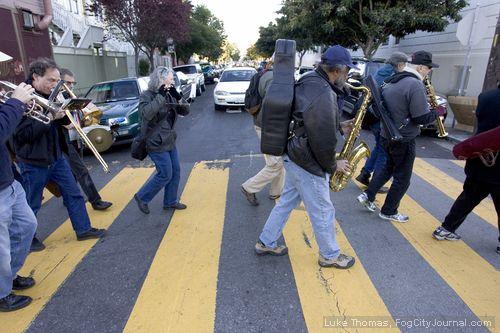
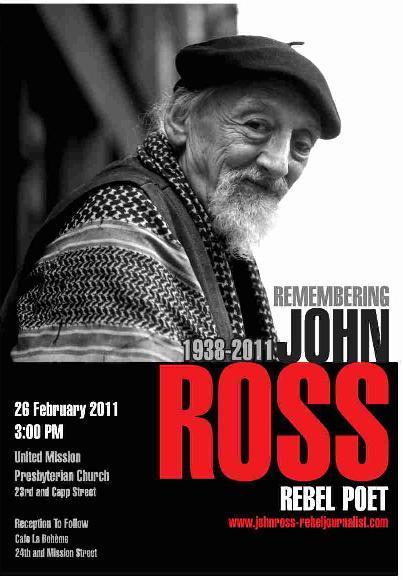
A standing-room-only crowd gathered at United Mission Presbyterian Church on 23rd and Capp Feb. 25th to remember Guardian correspondent and hell-raising investigative poet John Ross. John’s old friends Q.R. Hand, Hermann Bellinghausen, Frank Bardacke, Kevin Quigley and me spoke; his kids, Carla Ross-Allen and Dante Ross, gave moving remeberances. Then we marched through the Mission, led by the Musicians Action Group playing the Internationale. It was a perfect Ross moment: A few of the celebrants put pieces of yellow tape across their chests and stood in the streets halting traffic to the let the procession pass. A couple of confused bicycle cops went by, but took no action, which was good for all involved.


When we reached Cafe LaBoheme, the crowd took over much of 24th Street — but the air of fun and solidarity was so visible and loud that most of the cars simple stopped and waited patiently for room to crawl past. A wild, crazy anarchist funeral mob on the streets of San Francisco; we sent him off right.


PS: The generally nice obituary in the Chronicle described Ross as


“an author, poet, liberal activist and journalist who toiled against perceived injustice from the jungles of Chiapas, Mexico, to the baked streets of Baghdad.”


Which is wrong on two accounts. First of all, there was nothing “perceived” about the injustice Ross saw and wrote about; it was very real. But that’s just a daily paper trying to be objective in a way that turns out to be embarassing. More to the point, as his longtime friend Elizabeth Bell noted, calling Ross a “liberal”  is wildly inaccurate.


Here’s the letter she sent to the Chron:


Although some time has gone by since the Chronicle’s obituary of Bay Area activist and poet John Ross, I must correct a glaring inaccuracy–indeed, slander–that appears in the very first sentence of your otherwise adequate write-up.  John Ross was not at the time of his death, nor had he ever been, a “liberal.”  He was not a liberal-diaper baby, his pioneering refusal to serve in the Vietnam war was not the act of a liberal, nor was placing his body between Palestinian olive farmers and club-wielding Israelis.  His response to a Mexican journalist who asked his profession, “Soy comunista,” does not translate to “I’m a liberal.”  A raucous rebel and man of the people, Ross believed to his dying day that revolution in the United States was necessary and possible. A brief vocabulary lesson, Mr. Coté: Gavin Newsom is a liberal. John Ross was a liberal like a Molotov cocktail is a gin rickey.


SFBG Radio: North Africa, oil, and cotton

2

Today Johnny talks to economist Johnny Venom about the situation in North Africa and explains how there’s a surplus of oil right now in the United States, how the real price hike is going to be cotton — and how the revolutionary fervor is going to play out over the next few weeks. Listen after the jump.

sfbgradio2/28/2011 by endorsements2010

Worst American Idol ever

16

Ok, American Idol. I sat through four hours this week. And yeah, Randy is Randy and Steven Tyler is a rock god and J-Lo is so pretty it makes my teeth hurt, but:

I miss Simon. Because everytime somebody really mangled a song, he’d remind them that “this is a singing contest.”

That’s right: This is a show about singing. But not this year. This year it’s all Total Drama Island. The Pathos! The J-Lo weepfests! The tragedy, the crying, the terrible stories of people’s lives and awful interactions between mean and unpleasant contestants who kick the weak ones out of their groups! Oh, the reality of it all!

An entire episode was devoted to watching anxiety-wracked contestants walk down a surreal flying-saucer-style walkway onto a stage where the judges would try to make them think they were going home, only to let slip at the last moment that they get to come back for another round. Or maybe not. Tears of joy. Thrown chairs. A woman trying to dry hump Ryan Seacrest. And it never ends.

Note to the producers: This is not Survivor: San Andreas Fault. We want to hear the contestants perform. We’ll take the good and the bad, but please: No more of the ugly.

Reminder: John Ross memorial Sat Feb. 25

1

Friends and fans will gather Saturday Feb. 25 n the Mission to remember investigative poet and hell raiser John Ross. The festivities (and trust me, it will be festive) start at 3 pm at United Mission Presbyterian Church, 23rd and Capp. A jazz march to Cafe LaBoheme will start after the memorial. See you there.

SFBG Radio: Talking with Jim Goad

0

Today’s special treat: Johnny talks to Jim Goad, publisher of the short-lived ANSWER Me magazine, the subject of an obscenity trial in Washington in the 1990s, and the author of The Redneck Manifesto. Listen after the jump.

sfbgradio2242011 by endorsements2010

Ammiano takes on prison costs

9

Assemblymember Tom Ammiano (D-SF) is taking on a crucial, but challenging task: trying to cut down on the costs of the prison system by eliminating some expensive waste in two sensitive areas: Drugs and sex offenders.


His drug bill is pretty much a no-brainer, and has the support of a bunch of district attorneys, including Mendocino County D.A. David Eyster, support it. The bill, AB 1017, would allow local prosecutors to charge (non-medical) marijuana growers with either a felony or a misdemenaor, depending on the circumstances. Right now, any amount of illegal cultivation is automatically a felony. Eyster:


It makes no sense that unlawful possession of less than one ounce of marijuana is an infraction, that possession of more than an ounce of marijuana is a misdemeanor, that possession of methamphetamines may be charged as a misdemeanor, but that growing any amount of marijuana must be charged as a straight felony punishable by prison.


The difference could be millions of dollars saved by county prosecutors and the prison system.


The sex-offender bill is pretty simple, too — although the GOP will no doubt get all hissy about it. AB 625 would allow for a tiered approach to the registration of sex offenders. It’s based on a state report that point out how little sense it makes to keep nonviolent offenders who are highly unlikely to commit another sex crime under the same level of expensive, tight monitoring — for life — as high-risk offenders.


The truth, according to Rebecca Blanton, a senior policy analyst at the California Research Bureau, is that only 5% of all sex offenders released from prison are arrested for another sex crime. That means 95% never again get charged with any of the six categories of crimes that require lifetime registration and monitoring.


Now, that doesn’t mean that none of those people commit sex crimes and don’t get caught. Nor does it mean they are all model citizens — The state tracked 2,028 sex criminals released in 2005 and found that 113 comitteed another sex crime, and 110 committed another crime. The most common reason for them to be back in jail was parole violations (that’s true of almost every class of California offender, since almost anything can be a parole violation, including missing an appointment with your parole officer).


But only 6.3% of the sex offenders tracked in that three-year study were charged with a crime against another person.


Ammiano’s not trying to make life easy for sex criminals (that’s what the GOPers will no doubt say). But there’s ample quantitiative evidence to show that some offenders are far more likely to be a threat to society — and many others aren’t — yet the state spend the same amount of resources on every category. A tiered system (which exists in all but three other states) would allow California authorities to track more closely the dangerous folks and pay less attention to the ones who are highly unlikely to offend again. 


Ammiano:


With the skyrocketing costs of corrections in California, we need to base our management and enforcement of sex offenders on the research and data available rather than emotion.  This means focusing our efforts and resources on the most dangerous offenders to ensure that the registry achieves its primary goal – to keep our children and communities safe. 


Tom Tobin, co-chair of the Sex Offender Management Board:


California needs to modify its current policy and start devoting our limited resources to those individuals who pose the greatest risk of re-offending.  Common sense and solid research both agree that not all sex offenders pose the same degree of risk of re-offending.  Many pose very little risk.  Unless one accepts the myth that “all sex offenders are alike,” there can be no defensible justification for treating them all the same and requiring lifetime registration for each and every convicted sex offender.  This puts an increasing burden on law enforcement and does not make our communities any safer.


So lets see if the nutty law-and-order crowd in Sacto is willing to listen to facts and reason this time around.

The truth about pensions

23

David Cay Johnston, the Pulitzer-Prize-winning former New York Times reporter, has a brilliant piece on his blog about public-employee pensions. His basic point: the mainstream media, including his own former paper, have utterly missed the point about how pensions work:


[Wisconsin] Gov. Scott Walker says he wants state workers covered by collective bargaining agreements to “contribute more” to their pension and health insurance plans.

Accepting Gov. Walker’ s assertions as fact, and failing to check, created the impression that somehow the workers are getting something extra, a gift from taxpayers. They are not.

Out of every dollar that funds Wisconsin’ s pension and health insurance plans for state workers, 100 cents comes from the state workers.

How can that be? Because the “contributions” consist of money that employees chose to take as deferred wages – as pensions when they retire – rather than take immediately in cash. The same is true with the health care plan. If this were not so a serious crime would be taking place, the gift of public funds rather than payment for services.


Public employees (like the few employees in the private sector who still get pensions) bargain collectively for compensation packages. Some of that compensation comes in the form of deferred pay, which the employer puts aside into a pension fund. In San Francisco, some city employees several years ago, through negotiations, agreed to forego a pay raise and instead accept more deferred compensation; that is, the money they would have received in wages now goes into their pension fund.


When you say that those employees “contribute nothing” to their pensions, you’re not telling the truth:


The fact is that all of the money going into these plans belongs to the workers because it is part of the compensation of the state workers. The fact is that the state workers negotiate their total compensation, which they then divvy up between cash wages, paid vacations, health insurance and, yes, pensions. Since the Wisconsin government workers collectively bargained for their compensation, all of the compensation they have bargained for is part of their pay and thus only the workers contribute to the pension plan. This is an indisputable fact.  


More:


Thus, state workers are not being asked to simply “contribute more” to Wisconsin’ s retirement system (or as the argument goes, “pay their fair share” of retirement costs as do employees in Wisconsin’ s private sector who still have pensions and health insurance). They are being asked to accept a cut in their salaries so that the state of Wisconsin can use the money to fill the hole left by tax cuts and reduced audits of corporations in Wisconsin.


At the time that San Francisco officials agreed to use deferred compensation as a way to avoid pay raises, it was a politically easy decision: The stock market was booming, and the pension fund was making so much money from its investments that the city could in effect keep that money (the pay raises that would have gone to the employees) and use it to avoid tax increases or cuts somewhere else. Unless they were fools, the city officials who signed off on this deal knew, or should have known, that at some point the stock market would come back to Earth, and the city would have to pay the deferred compensation out of the General Fund.


Now: You can argue that those contracts were overly generous and should be renegotiated. You can argue that the city can’t afford to pay its workers as well as it once did and that they should take further pay cuts (beyond the half-billion or so they’ve already given back). I don’t entirely agree, but at least that’s an honest argument.


But to say that city workers aren’t contributing to their pension fund, or need to contribute more, is dishonest. For the newspapers to report that as fact is bad journalism.


Who’s next?

39

steve@sfbg.com and tredmond@sfbg.com

The seven serious candidates who have announced plans to run for mayor extends from moderate to conservative at this point, but it’s an unusual field for San Francisco: there is no clear progressive standard-bearer, and no clear downtown candidate.

But it probably won’t stay that way. Sources say others are likely to join the lackluster race in the coming months, and there’s a strong likelihood that some progressive candidate will decide to the take plunge.

Also unlike the last few mayor’s races, there appears to be no clear frontrunner — either in fundraising or in having a clear constituency base — a new dynamic that creates an unpredictability that will be exacerbated because this is the first contested mayor’s race using the ranked-choice voting system and public financing of candidates.

There was a weak field of challengers to Gavin Newsom in 2007 and no one qualified for public financing or presented a strong threat. But this time City Attorney Dennis Herrera and former Sup. Bevan Dufty already have indicated they will take public financing, and others are expected to follow suit.

In addition to Herrera and Dufty, the field includes Sen. Leland Yee, Assessor-Recorder Phil Ting, venture capitalist Joanna Rees, and former Sups. Tony Hall and Michela Alioto-Pier. Those close to Board President David Chiu also say he is “seriously considering” jumping into the race and talking to friends and supporters about that possibility now.

But so far none come from the progressive political community that has controlled the Board of Supervisors for the past decade. Although Chiu is the only candidate in the field to self-identify as a progressive, he has adopted a more moderate governing style that has frustrated many progressive activists and supervisors. So that leaves voters on the left without a candidate right now.

“If a credible progressive candidate doesn’t get into the race, then we’ll see the top-tier candidates — which so far Leland Yee and Dennis Herrera — try to make friends with progressive San Francisco. And it would appear they have a lot of work to do,” Aaron Peskin, the former board president who chairs the San Francisco Democratic Party, told us.

Both Yee and Herrera have taken some progressive positions, and Yee has consistently endorsed more progressive candidates than anyone else in the mayoral field, but they have also taken many positions that have alienated them from progressives. And both have been taking in lots of campaign cash from interests hostile to the progressive base of renters, environmentalists, and advocates for social and economic justice.

“Nobody who has put their hats in the ring is really exciting anyone, so there is plenty of room for new entrants,” Peskin said, noting the progressives are actively discussing who should run. Peskin wouldn’t identify whom they’re courting, but some of the names being dropped are Sups. John Avalos, Ross Mirkarimi, and David Campos, as well as former Sup. Chris Daly and Peskin.

But Mirkarimi shifted some of that talk this week when he announced that he intends to run to replace the retiring Mike Hennessey as sheriff.

Political consultant Jim Stearns, who is representing Yee, also expects others to get into the race. “I don’t think the field is complete yet. Historically, the strong self-identified progressive candidate has come in late or surged late, like [Tom] Ammiano and [Matt] Gonzalez,” Stearns said.

Ammiano launched his write-in mayoral bid in September 1999 and Gonzalez jumped into the race just before the filing deadline in August 2003, so there’s plenty of time for progressive candidates to get in. “It’s never too late in San Francisco,” Stearns said. And unlike those two races when the upstarts were seriously outspent by the well-heeled frontrunners, Stearns said this year’s field will likely be on a fairly even financial footing.

“It’s likely every candidate will have $1.5 million to $2 million to spend,” he said. That means the keys to the race are likely to be name ID with voters and “which campaign can do the most with the least dollars,” Stearns said.

Already, some of the candidates who will be running to the center are looking for progressive support. Yee, for example, has given substantial amounts of money to progressive groups and candidates and has endorsed progressives for office.

Yee told us he’s positioning himself as “the candidate of the regular folks of San Francisco — the people who are trying to raise their families and live in this city.” He added: “To the extent that the progressive agenda fits that, we’ll be part of it.”

But he already has the endorsement of the Building Trades Council, which has often been at war with progressives, particularly over development issues.

Yee said he hasn’t yet weighed in on the local budget, but he agreed that new revenue “shouldn’t be off the table.” He said he thinks the current pension reform discussions at City Hall, involving Mayor Ed Lee, Sup. Sean Elsbernd, financier Warren Hellman, and union representatives are “the right way to go.”

Herrera said he’s going to run on his record — which includes a long list of progressive legal actions (along with his gang injunctions, which a lot of progressives question). He also told us that he’s involved in the pension reform discussions but thinks that new revenue absolutely ought to be a part of the budget debate.

Mirkarimi runs for sheriff

2

tredmond@sfbg.com

Sup. Ross Mirkarimi filed preliminary papers to run for sheriff Feb. 22, altering the shape of the mayor’s race and giving progressives another shot at electing a candidate to citywide office.

His move also guarantees that law enforcement will be part of the discussion on the left this fall and it opens the door for a progressive sheriff to succeed retiring Mike Hennessey and continue the sorts of policies that have made him a national example of alternative ways to approach crime and punishment.

Mikarimi, a graduate of the San Francisco Police Academy and a former District Attorney’s Office investigator, has law enforcement experience and has made violent crime a key issue as a district supervisor. But he’s not part of the city’s public safety establishment.

“One of the greatest successes of Mike Hennessey was that he was an independent sheriff,” Mirkarimi told us. “That allowed him to take a progressive approach to his job.”

Mirkarimi had been talking about the job of sheriff for some time now, but he had been waiting to hear whether Hennessey would seek another term after 31 years on the job. When the sheriff announced last week that he was planning to retire, Mirkarimi moved quickly, contacting potential supporters and setting up a campaign plan.

The supervisor becomes the immediate front-runner in a race where there’s no other high-profile candidate. But that doesn’t mean he’s going to walk into the job — the last thing downtown wants is a progressive of Mirkarimi’s stature holding a high-profile citywide office that could be a springboard to a future run for mayor.

“This is going to be a top-of-the-ticket race,” Mirkarimi said. “We don’t want it to be a setback by losing the Hennessey legacy.”

Mirkarimi pushed hard for community policing as a supervisor, demanding more foot patrols in areas like the Western Addition, where the homicide rate was high. As sheriff, he told us, he would work to expand on Hennessey’s efforts at curbing recidivism.

“Eventually, almost everyone who’s incarcerated comes back to the community,” he said. “Our recidivism rate for the county jails is above 60 percent, and we have to work on reentry programs to lower that. It’s really about keeping communities safe.”

If a strong progressive gets into the mayor’s race — and somebody whom the left can support runs for district attorney — there’s the prospect of a slate of candidates who can work together, share resources, and mount a concerted campaign.

It’s likely Mirkarimi will get the support of at least five or six supervisors and other high-profile political figures. Hennessey hasn’t said anything about his successor, but if he supports Mirkarimi — which is entirely possible — the supervisor will be in strong position for November.

But the likelihood of at least one downtown-backed candidate, and possibly several law-enforcement types, in the race will make it challenging. With ranked-choice voting, Mirkarimi will not only have to win most of the first-place votes, but reach out beyond the progressive community to get enough seconds and thirds to hold on to victory.

But if he can pull it off, he’ll have done something no other solid progressive has done in years: win an open race for a citywide office.

The cushy life of a public-sector worker

1

You want to see how easy life is in those lucrative, unionized public-sector jobs that the governor of Wisconsin is going after? Isthmus, the alternative weekly in Madison, has a brilliant piece by a teacher who talks about what this battle is really about. Read it and tell me that this woman is overpaid and gets too many benefits. Go ahead. I can’t wait.

Wisconsin, unions, and defunding the left

21

Mother Jones mag this month has a GREAT story about the battle in Wisconsin, the history of unions and the Democratic Party, and the real aim of the move to bust public-sector unions. Writer Kevin Drum notes:

In the past, after all, liberal politicians did make it their business to advocate for the working and middle classes, and they worked that advocacy through the Democratic Party. But they largely stopped doing this in the ’70s, leaving the interests of corporations and the wealthy nearly unopposed. The story of how this happened is the key to understanding why the Obama era lasted less than two years.

He describes the history of the post-War era and the rise of the New Left, explains how the rift between big labor and the hippie/radical/antiwar folks culminated in the AFL-CIO refusing to endorse George McGovern in 1972, the decline of private-sector union membership and power and thed shift rightward of the Democratic Party.

At one point, he explains, unions were the only organized force with the resources to act as a counterforce to corporate America in political campaigns. Once that went away, the Dems had no choice:

In the real world, political parties need an institutional base. Parties need money. And parties need organizational muscle. The Republican Party gets the former from corporate sponsors and the latter from highly organized church-based groups. The Democratic Party, conversely, relied heavily on organized labor for both in the postwar era. So as unions increasingly withered beginning in the ’70s, the Democratic Party turned to the only other source of money and influence available in large-enough quantities to replace big labor: the business community.

You can blame the Sixties radicals for not understanding the importance of labor (and you’d be right). you can blame George Meany and the AFL-CIO folks for not realizing that those acid-abortion-gay rights folks were their real allies (and you’d be right). But in the end, the bad guys took advantage of the split, and of sweeping changes in the economy, and now we live in the most economically unequal society in the Western world. (Remember: Unions bring up wages and improve working conditions not just for their own members but for everyone else, too.)

So now the only major sector where organized labor is healthy and growing is the public sector — and that’s why the Republicans want to get rid of public-sector unions. In San Francisco, it’s often the case that the city employee unions (excluding police and fire) are the major donors to progressive causes — and are often the only institutional base with the kind of money to counter the Chamber of Commerce/Committee on JOBS/downtown developer bloc. Bust that up and you get corporate hegemony.


SFBG Radio: People power, from Libya to Wisconsin

8

In today’s episode, we talk about that remarkable moment when people realize that they aren’t alone — and that tends of thousands or maybe millions of their neighbors are willing to go out in the streets and do something about it. Listen after the jump.

sfbgradio2222011 by endorsements2010

Mirkarimi running for sheriff

17

Sup. Ross Mirkarimi is going to file papers today (Feb 22) to begin his campaign for sheriff.

Mirkarimi told us he wants to continue the progressive legacy of Mike Hennessey and to work to reduce recidivism. “Eventually, almost everyone who’s incarcerated comes back to the community,” he said, noting that more than 60 percent of people released from the county jail are re-arrested at some point. “We have to work on re-entry programs to lower that number,” he said. “It’s about keeping communities safe.”

Hennessey, long regarded as one of the city’s most progressive elected officials, has served as sheriff for 31 years. He’s been a national leader in progressive law-enforcement programs, and last year made headlines by fighting the federal mandate that local authorities turn over to immigration offices anyone arrested in the city without proper documentation. He announced recently that he won’t seek another term in November.

Since nobody else has announced an interest in the job — and nobody with Mirkarimi’s record and name recognition is even being mentioned — he becomes the instant front-runner. But it won’t be an easy campaign — the last thing downtown wants is another progressive in citywide office — particularly someone who, like Mirkarimi, could one day use the sheriff’s office as a platform to run for mayor.

Mirkarimi is a graduate of the San Francisco Police Academy and former investigator in the district attorney’s office. He’s been a champion of community policing and antiviolence programs — but as someone who has never been part of the local law-enforcement community, he comes to the race with political independence.

“One of the greatest successes of Mike Hennessey was that he was an independent sheriff,” Mirkarimi noted.

We’ll have more details in the Feb. 23 issue.