Tim Redmond

What small business owners care about

14

Since the mayor’s office still insists that any business-tax reform ought to be revenue-neutral, and since he and other continue to talk about the myth that a payroll tax hurts job growth, I found the latest Bank of America survey of local small business owners fascinating.

Here’s what the survey found: Small business owners are concerned about (1) the cost of healthcare (2) access to credit and (3) finding qualified employees. Local taxes aren’t even on the list.

Now, if you ask almost any business operator whether he or she would like to pay lower taxes, most will probably say, sure. And I agree that a gross receipts tax is a better way of spreading the burden around. But the notion that slightly raising business taxes would hinder job growth in any significant way isn’t supported by reality.

In fact, if you used higher taxes to improve the schools (and thus the education of the future workforce) it would do more to keep employers from leaving San Francisco than cutting taxes. If the state of California went to a single-payer health-care system — dramatically reducing the cost to employers — it would do more to attract jobs to this state than all the tax cuts in a Republican’s wet dreams.

And if Bank of America and Wells Fargo would start loaning money to small businesess, you’d see almost immediate job growth.

How’s that for a Small Business Week agenda?

Recology’s slate cards

8

Wow. Every single slate card I’ve seen so far for this election has been paid for at least in part by Recology, which is fighting a measure that would require competitive bidding on its garbage contract.

The Richmond Democratic Club. The Teacher’s Union. The SF Women’s Political Committee. The SF Democratic Party. The Milk Club. The Alice B. Toklas Club. I’m sure there are a few more out there. And every one has a big “No on A” ad on the back.

The good news is that a lot of these mailers list good candidates for the County Central Commitee, and getting their message out to more people helps. And this is nothing new — everyone looks to the people with money to fund slate cards, and Recology’s spending a lot of money this spring. And I’m confident that every one of these groups took a No on A position before they asked for slate-card money.

Still: You look at the pile and it looks like Recology owns San Francisco politics.

The GOP has no answer on the state budget

80

The Republican leaders in Sacramento have absolutely no solutions to the state budget problems. They’re against the guv’s tax plan for November, they’re against raising any new revenue, they have their facts completely wrong — and they have no alternatives to offer.

That’s not me ranting, that’s the factual evidence based on a fascinating radio interview featuring Senators Mark Leno, a Democrat who chairs the Budget Committee, and Republican Bill Emmerson, who is the committee vice-chair.

Leno is his usual reasonable self, saying that he knows there will be cuts and that the Democrats are going to try to figure out where and how best to make the reductions. Emmerson says:

1. That there have been “no serious cuts” in the past;

2. That the state budget is too big and growing;

3. That there should be no cuts to education;

4. That there are “places where we can make cuts,” but there are no specific proposals on the table; and

5. That all of this will magically work with no new revenue.

Leno points out that the state’s general fund was over $100 billion in 2008, that pre-recession it was projected that normal revenue growth and growth in cost of living and state needs would bring it to $125 billion by this year — and that the actual state budget is about $85 billion. That’s $40 billion less than it should be. There have already been massive cuts.

Emmerson wants to “fund education at last year’s level,” which is nice, but amounts to a cut since costs go up every year. And last year’s level was way below what it ought to be.

But beyond that, he has no suggestions at all of what programs he wants to cut.

I guess I shouldn’t be surprised.

Housing for the super rich approved, 8-3

111

The progressive movement and the battle for housing balance and economic justice in San Francisco got walloped May 15 when eight supervisors sided with a developer who wants to build condos for the massively rich on the waterfront.

I watched it all, minus a few minutes while I was putting the kids to bed, all seven and a half hours of testimony and discussion, winding up with a series of pro-developer voters a little after midnight. It was stunning: Opponents of the project came out in droves, many of them seniors, others tenant activists and neighbors. Former City Attorney Louise Renne, who is by no means an anti-development type or any sort of economic radical, led off the arguments in favor of scrapping the environmental impact report and denying the conditional use permit that are needed for 8 Washington to move forward. They brought up so many points that by the end there was nothing more to say: This meets no housing need in San Francisco, further screws up the city’s own mandates for a mix of affordable and market-rate housing, caters to the top half of the top half of the 1 percent, is too tall and bulky for the site, offers the city too little in community benefits and is one of the great development scams of our time.

Then the other side spoke — the city planners who defended the EIR and, briefly, developer Simon Snellgrove. His supporters lined up — and almost all of them talked about the same thing: Construction jobs. I get it, we need construction jobs — but is that a justification for such a bad project? As Sup. David Chiu pointed out, “apartment construction is booming.  There are 22,000 units under construction and 50,000 more in the pipeline.”

Both sides were organized, but only one paid people to show up: At least five people seated in the front row, wearing pro-8 Washington stickers, confirmed that they’d been paid $100 each — in cash — to show up. They didn’t even speak, leaving once they realized that they were misled about the project. One source heard a construction worker say he knew nothing about the project and had been bused in from Sacramento.

And after hearing all of that, the supervisors did what they clearly had decided to do long before a word of testimony was uttered.

The vote to overturn the EIR went like this: favoring the developer were Supervisors Mark Farrell, Jane Kim, Eric Mar, Christina Olague, Malia Cohen, Carmen Chu, Sean Elsbernd and Scott Wiener. Opposing the project were Chiu, John Avalos and David Campos.

Approving the conditional use went along the same voting lines. Chiu couldn’t even get a continuance after arguing that there was no report from the budget analyst and no financial information about whether this is a good deal for the city.

That’s the lineup: Eight votes for the 1 percent. Three votes for the rest of us. I haven’t seen anything this bad in years.

Some fascinating information came out of the discussion. Chiu made clear that the developer doesn’t need the height-limit increase to make a profit off the deal. He estimated that the total sales revenue from the project would be around $470 million and construction costs about $177 million. That’s a huge profit margin, even if you add in another $25 million for upfront soft costs.

Snellgrove’s lawyer, Mary Murphy, tried to duck the financial issues, talking around in circles. Evenutally Chiu got Snellgrove to respond, and he said the costs would be higher and his profit would only be about $80 million. “The capital markets require a high return on these projects,” he said.
Still: $80 million is a lot of money. And while Snellgrove and his allies love to talk about the $11 million in affordable housing money for the city, that’s about 2.3 percent of his total revenue. Which doesn’t sound quite as juicy.

Chiu raised another good question: “Should a condo that sells for $5 million pay the same affordable housing fees as one that sells for $500,000?”
Mar, who is usually a strong progressive, was the big surprise of the night, not only voting the wrong way but teeing up softball questions for the city planners to make the project sound better. It was as if he was reading from the developer’s talking points.

In the end, he said he saw “a lot of benefits from this project,” but promised to work with the developer to advocate for “less bulk and less height.” Olague said the same thing.

But even if it’s a little smaller, this will still be a completely misalignment of housing priorities, a project entirely for the very rich. That’s not going to change.

If anything, they should push for more affordable housing money — a whole lot more. Because what we’re getting is enough for maybe 25 or 30 units, which means 80 percent of the new housing related to this project will be for multimillionaires and 20 percent for everyone else. Keep that pattern going — and there are few signs that it’s about to change — and imagine what this city will be like in 20 years.

It’s not over, not yet: The actual development agreement and the height-limit changes still have to come to the board early in June. And if the mayor signs off on it, opponents are talking serious about a ballot referendum that would be before the voters in November — just when Olague, Mar, Avalos, Campos, and Chiu will be up for re-election.

Who’s running against Chris Daly?

8

I didn’t know former Sup. Chris Daly was running for state Assembly in the 19th District. Odd — I’ve been told he splits his time between Soma and Fairfield, but I had never heard anything about him moving to the West side of town.

But there he is, right on a flier produced by candidate Michael Breyer, who probably doesn’t deserve all the attention I’m giving him, but his campaign is so strange. First he’s for “old-fashioned San Francisco values” (whatever that means) — and now he’s running against Daly. Who, according to the latest data from the Department of Elections, isn’t in the race.

Breyer has a pic of Daly’s disembodied head surrounded by a happy meal, a goldfish and a Yellow Pages phonebook, three things that (other) supervisors have had issues with, mostly for very good reasons. Daly didn’t introduce the Happy Meal ban or the pet store legislation or the phone books limits; some of that happened after he left the board.

The flier compares Daly’s “Wild Antics” to “The Real San Francisco.” Which I guess is a conservative place “of old-fashioned neighborhood concerns.” (What — the west side of the city hasn’t changed in the past 40 years, since Breyer was a kid?)

Folks, please: Daly’s no longer in any public office. He was a good supervisor while he was there and willing to fight for his constituents. But now he owns a bar and works for a union. Aren’t we all getting tired of this shit?


The really bad news about the state budget

24

There’s no way to put a good spin on the new budget figures released by the Guv. No matter what happens in November, people who need help are going to get screwed in this state. Public schools will lose money. Health-care for the poor will be near collapse. Cities and counties will struggle to preserve the local safety nets. It’s just a disaster, and there’s no other way to look at it.

Of course, if we don’t approve Jerry’s tax plan in November, it will all be much, much worse. And he seems to be doing the right thing to promote the idea, making it clear just how deep the cuts will be and where they will hit.

But the tax plan is nowhere near enough, not even enough to keep the state at its current austerity level, much less to repair some of the damage and replace the funding that’s already been eliminated. And while the notion of cutting state workers back to a four-day week, or of mandatory furloughs, may sound better than cutting specific services, think about what it means:

First, all that money that the state workers give up will instantly disappear from the economy. Most of these folks aren’t wealthy, and they spend what they earn. That’s a hit to already-depressed demand. Then there’s the impact on the rest of us. Try getting an appointment at the DMV. (You think it’s bad now? Take away 20 percent of the employees.) Try getting a court date if you’ve been injured. (Oh, but if you’re a landlord, don’t worry — evictions won’t be slowed down at all.) This is going to be awful.

Here’s what I would say to Jerry: Push not only for your tax measure but to elect enough Democrats to pass taxes without going to the ballot. There’s no reason this current measure needs a vote of the public; the Legislature has every legal ability to pass all of those taxes. And if it weren’t for a handful of Republicans who drink the no-tax Kool Aide, it would be happening.

Closing a few corporate loopholes and instituting an oil-severance tax would solve much of the remaining deficit. Reinstating Schwarzenneger’s cuts to the vehicle license fee would solve the rest. And all of that can be done without a ballot fight.

The moderate Democrats in Sacto annoy me as much as the Republicans sometimes, but if Brown and Legistlative leaders make it clear that they’re helping candidates in swing districts, but that they expect them not to be obstructionist on taxes, there could be much better news in the years ahead.


What are “old-fashioned” SF values?

12

Michael Breyer, who has never held elective office in San Francisco and is running for state Assembly, is getting a fair amount of press — and although he has nowhere near the visibility of Assessor-Recorder Phil Ting, he has the support of Sen. Dianne Feinstein and may throw a boatload of money into the race. He’s already sent out one flier that features very little about him but a lot about his (more famous) family — his father, Steven Breyer, is a justice of the U.S. Supreme Court and his uncle, Charles Breyer, is a federal judge.

But here’s what intrigued me about the mail piece: It says that

“Sacramento needs a fresh perspective. It needs old-fashioned San Francisco values.”

What, exactly, are “old-fashioned San Francisco values?” One could certainly argue that the message harkens back to a day when the city was less diverse, less progressive, less open to the sometimes-radical ideas (remember this one?) that have changed the nation and the world. Of course, exploiting the workers and destroying the environment in the name of extracting riches was a famous SF value during the Gold Rush era; so was the Chinese Exclusion Act. On the other hand, resisting the Red Scare was a great traditional SF value in the 1950s, as were civil-rights sit-ins. Free love, free drugs and free lunch were vintage SF values a decade or so later. Labor struggles against capital are also a great San Francisco value.

So what, exactly, is Mr. Breyer talking about?

I called his campaign manager, Michael Terris, who wrote the piece, and asked him if Breyer was longing for a more conservative, less diverse era. “Not at all,” he said. “Old-fashioned values mean family, schools, neighborhoods, quality-of-life issues. Those are shared by the many diverse communities in the 19th District.” He added: “The West Side sees things a little differently.”

And while one of Breyer’s main issues is education, the great San Francisco value of taxing the wealthy to provide public services isn’t part of his platform. Although he does support Gov. Brown’s tax plan for November, he does not support amending Prop. 13 to shift the burden of taxation back to commercial property. He has the strong support of the Building Owners and Managers Association, which is all about keeping taxes low on huge commercial properties owned by vastly rich outfits.

So he clearly doesn’t share my old-fashioned San Francisco values. What about yours?

UPDATE: My mistake — Feinstein hasn’t endorsed Breyer. She supported him for D5 supervisor but is staying out of this race.


What the preservation vote says about the 2012 supervisors

64

UPDATE: Important update at the end of this story

What does it mean that a historic preservation law favored by developers and promoted by Sup. Scott Wiener passed the Board of Supervisors 8-3? Maybe nothing. Historic preservation is a strange poliltical issue, favored by some of the wealthy white homeowner types who love pretty buildings (and aren’t so good on other issues), and this thing was sold as a way to help low-income people and affordable housing. But the reality is that the Wiener measure will make it harder to declare historic districts, and thus will take away a tool that the left can use to stop uncontrolled commercial development. And remember: The affordable housing community wasn’t pushing this bill, and, for the most part, hasn’t had problems with historic preservation. The most progressive political club in the city, the Harvey Milk LGBT Democratic Club, came out strongly against the measure and urged Sup. Christina Olague, a co-sponsor, to oppose it:

We are extremely troubled that you appear to be buying into the flawed, bogus and self-serving arguments by SPUR and other supporters of this legislation that historic preservation is classist and leads to gentrification, interferes with the production of affordable housing and is a tool of San Francisco’s elite.  Nothing could be further from the truth.

There was a way to address the issues of low-income people in historic districts without making it harder to block inappropropriate development, but Wiener’s bill went much further. And while I respect Scott Wiener and find him accessible and straightforward, and I agree with him on some issues, he isn’t someone whose basic agenda promotes the interests of tenants or low-income people. His supporters are much more among the landlord class and the downtown folks. The San Francisco Chronicle, which is a conservative paper on economic and development issues, loved the legislation.

So what happened when this got to the Board? Only three people — the ones the Chron calls “the stalwart left flank of the Board” — voted no.

John Avalos, David Campos and Eric Mar. They are now the solid left flank, the ones who can be counted on to do the right thing on almost every issue. Once upon a time, there were six solid left votes. Now there are three.

What does this mean for the other key issues coming up, including CPMC, 8 Washington, and the city budget? Maybe nothing. As I say, this issue is complicated. Olague told me, for example, that she’s really worried about working-class people who can’t afford to comply with the increased regulations that come with historic districts. Her vote doesn’t mean she’s dropped out of the progressive camp, or that she (or Sups. Jane Kim and David Chiu) can’t be counted on in the future. I really want to believe that this was just an aberration, a vote where I’ll look back in the fall and say: Okay, we disagreed on that one, but nobody’s perfect

Still, it’s kind of depressing: The dependable progressive vote is down to three.

UPDATE/CORRECTION: I didn’t know when I posted this that Olague had spoken to the Milk Club leadership after the club’s statement went out and the club has since issued a correction:

Due to a misunderstanding, Supervisor Christine Olague’s position on the Historic Preservation Commission’s critical role in the life of San Franicsco was misrepresented in our weekly newsletter. Supervisor Olague is looking into ways to help continue Historic District status for the Queer community, the Filipino community in the South of Market area, and the Japantown area. She is specifically looking for wording that would help these plans remain viable and welcomes any questions on her position and on her plan. Our apologies to the Supervisor for this unfortunate mistake.

Obama’s evolution

58

Other than a few Mitt Romney supporters, most of us view evolution as a wonderful biological mechanism to which we owe our supposed higher intelligence. So Obama’s “evolution” from a foe to a supporter of same-sex marriage deserves tremendous praise. But before we go all ga-ga over the president, let’s remember:

He didn’t evolve on his own. In this case, the evolution needed a push, from generations of LGBT activists and supporters, who put the issue in front of the world, made it a basic matter of civil and human rights, and forced Obama to realize that he could no longer duck and had to take a stand.

Remember FRD’s famous statement to activists? “Now you have to make me do it.” That’s what happened here. Obama made the political calculation, of course, and it’s a good one — energizing his base is more important than angering a bunch of people who weren’t going to vote for him anyway. But there’s more to it, and I think Paul Hogarth has the right line:

Biden’s statement may have been the final trigger, but the LGBT movement deserves the credit – despite the odds – to hold firm on getting the President to take this historic stance. And it’s a lesson that other progressive constituencies should take heart in, as we strive to make Barack Obama the President we hoped he would be.

Let’s also remember that this really started in San Francisco, with an act of what I like to call civic disobedience. At the time, a lot of critics said that Mayor Gavin Newsom was hurting the Democratic Party by making a move before the rest of the nation was ready for it. But what he did eight years ago was force the rest of the nation to get ready for it — and the subsequent legalization of gay unions in a growing number of states has shown America what the Boston Phoenix referred to as “the utter, mundane normality” of same-sex marriage.

We all knew this moment was coming. The demographics can’t be denied. Almost everyone younger than 30, and most people younger than 40, supports same-sex marriage. The country is changing — in this case, in a very positive way — and Obama was risking being on the wrong side of history. Even the Republicans seem to get that — they’re running away from this issue as fast as they can.

So now it’s likely that L.A. Mayor Antonio Villaraigosa will have his way and the Democratic Party platform will have a same-sex marriage component. Romney will be on the defensive on a key social issue – a huge change from the past. The Supreme Court will be more likely to uphold Judge Vaughn Walker’s decision on Prop. 8 (yes, the high court is political and changes with the norms of society, sometimes slowly, but the president’s statement will have a clear impact.)

So this is huge — not just because of the impact but because of what it says about the power of progressive movements. Now let’s make the president raise taxes on the rich.


Housing for the rich moves forward — fast

39

A proposal to build the most expensive condos in San Francisco history will come before the Board of Supervisors May 15 — and then before the Port Commission May 16, and then before the Board’s Finance Committee May 16, a jumble of hearings and votes that may make it more difficult for critics to be heard.

The 8 Washington project will be one of the most critical votes the board will face in 2012 and will make a lasting statement about the city’s housing policy. And it’s on an odd fast track.

At the board’s May 15 meeting, the supervisors will consider an appeal to the certification of the project’s environmental impact report, and will vote on approving the conditional use authorization for the building complex. If either of those is rejected — that is, if project sponsor Simon Snellgrove can’t line up six votes to approve the EIR and the CU — then the whole thing goes down in flames. The project would still exist in theory, but in practice it would be another two years before it could come back again.

If both of those approvals get through, then the actual development agreement and the financial documents for the project come before the Port Commission the next day — May 16 — at a highly unusual special hearing set for 9am. That’s a tough time to get people to come out and speak against a project, but the Port says it’s necessary, and here’s why:

One hour later, at 10am, the board’s Budget and Finance Committee will consider the same thing. And the Port wants this to get through Budget and Finance before that panel is entirely consumed with the next city budget.

So there will be two nearly simultaneous hearings, both at City Hall, on the same topic, early in the morning. A little difficult for people who want to testify at both. What if the Port hearing goes on until, say, 11:30 or noon (there have been plenty of three-hour hearings on contentious land-use issues in this city)? What if the Budget Committee starts discussion on the item before the Port is through with it?

Brad Benson, the Port’s special projects director, told me that his agency was “in touch with the chair of the Budget Committee. We get the point that people can’t be in two places at the same time.” 

But still, it all seems awfully rushed — particularly since, according to project opponent Sue Hestor, the state Lands Commission also has to sign off on this, and that won’t happen until July.


Low taxes are bad for business

29

The teachers at San Francisco’s public schools are talking about going on strike. The contracts talks with the district are at an impasse. Things look bleak.

Well, they don’t look as bleak as things in Philadelphia, but that’s not really much in the way of good news.

Part of the issue: The district wants the teachers to accept up to nine furlough days next year. Even if the governor’s tax measure passes, four furlough days are still on the schedule.

The teachers are complaining — with good reason — that the forced days off and other concessions cost them money, as much as $5,000 a year. But there’s another issue here: Furlough days are horrible for working parents — and for the businesses that employ them.

Ron Leuty has a nice column on this in the San Francisco Business Times, which doesn’t let you read all the stories unless you subscribe, but here’s the gist:

For parents, SFUSD parents who already have barely managed through four furlough days each of the past two school years, nine each year becomes intolerable. That totals up to nearly two school weeks for which we must find some sort of childcare or one-day mini-camps — and it’s cash out of our pocket. Or it means time off. For businesses, that means lost productivity, down work time and employees who are paying more for — and worrying more about — childcare.

For low-income parents who have to miss a day’s work and a day’s pay every time the kids are out of school, it’s a serious economic issue. And the local businesses, particularly small businesses which aren’t equipped to deal with excess employee absenteeism, it’s a nightmare.

Leuty doesn’t place any blame or explain how we got to this situation, so I will: Prop. 13 (and later, Prop. 218) made it really hard to raise local taxes, and a handful of Republicans are making it hard to raise state taxes, so there’s not enough money for the schools. Americans today, particularly wealthy Americans and corporations, are taxed far less than they were for most of the century, certainly the post-War era.

Local business leaders love to talk about the value of public schools. I don’t think many serious people who have looked at the finances believe that the SFUSD is fat, bloated, or wasting a lot of money; these days, even the anti-government folks have to admit it’s a pretty lean operation.

So why won’t those business folks (and, for the matter, the Business Times) start campaigning for changes in Prop. 13 to allow communities to fund the schools and avoid these debilitating furlough days? What, is this problem supposed to get fixed by magic?


Wiener goes after historic preservation

40


Sup. Scott Wiener is pushing a bill that would make it more difficult to create historic districts in San Francisco, and it’s already cleared the Land Use and Economic Development Committee.

UPDATE: Milk Club calls on Sup. Olague to drop her support for the bill.

The measure hasn’t received a lot of news media attention, but it could have a far-reaching effect on development in San Francisco.

In essence, the Wiener bill amends two parts of the city planning code to tighten the requirements for designating a part of the city as a protected historic area — a designation that makes it harder to demolish or substantially alter buildings.
Developers and some property owners dislike the historic designation. Perservationists see it as a way to prevent the destruction of buildings and neigbhorhoods that are a part of the city’s heritage.

Classic example: In the 1980s, members of the Residential Builders Association were tearing down vintage Victorians in the Richmond district and replacing them with boxy, multi-unit apartments that were worth more money than a single-family home. The builders made a lot of quick cash; the city lost some elegant old houses that can never be replaced.

They couldn’t do that as easily in Alamo Square, which is a historic district.

On the other hand, the owners of those stately well-protected houses in these special districts have to go through increased Planning Department scrutiny any time they want to make any substantial alteration in the structure.

Context: Less than 1 percent of the developed part of San Francisco is currently in a historic district. It’s not a huge deal, and most people don’t pay any attention to this stuff.

But it’s important, and here’s why: One, this city doesn’t care enough about its past — but more important, preservation is a tool that can be used to prevent very bad things from happening.

If we’d had good historic preservation laws in the 1970s, the International Hotel could have been designated an historic structure and wouldn’t have been demolished. Same, possibly, for the Goodman Building. Preservation laws could have been used to fight some of the horrors of redevelopment, which mowed down African American and Filipino neighborhoods in the 1960s and 1970s.

Some of Wiener’s suggestions are relatively benign. He wants to exempt affordable housing units from the laws that apply to historic districts, and Sup. Christina Olague, his co-sponsor, wants an economic hardship exemption so that the owners of buildings, particularly in communities of color, can avoid expensive battles over minor repairs and alterations.

I’m fine with all of that. I’m all for it. Good idea. Although it’s not fair to say that this process was driven by a concern for affordable housing; I spoke to Peter Cohen, at the Council of Community Housing Organizations, and he told me that the idea didn’t come from his crew. Not one affordable housing activist showed up at the Land Use hearing to support the Wiener bill.

But the measure also adds more burdens to the process of designating an historic district. It mandates a written survey of all property owners and occupants in an area proposed for historic designation — an expensive and cumbersome thing that isn’t required for commercial development, demolitions, zoning changes, massive market-rate housing projects, full-on gentrification, or anything else that screws up neighborhoods.
It requires the Planning Commission to consider whether historic preservation conflicts with “the provision of housing to meet the city’s regional housing needs allocation,” which is odd because the commission didn’t consider that when it approved 8 Washington, which directly conflicts with the city’s housing needs allocation, or when it’s allowed 20,000 units of mostly high-end housing over the past decade without any provision for the proper corresponding amount of affordable housing.

In short, it gives opponents of historic preservation more ways to stop new protections. That’s going to make developers very happy.

I asked Wiener why he decided to do this, what the problem was that this law is meant to solve. His answer: There are lots of potential new historic districts (including where he lives, in the Duboce Park and Dolores Street areas) and he wants to be sure that there’s a “robust community process.” Excuse me, Supervisor: There’s a robust community process every time anyone does anything in this town, and designating a historic district is no different.

Also: “A lot of people believe that in some situations, historic preservation can be taken to the extremes. This is a real hot topic for the city.”

Now here’s where it gets interesting (and even more complicated). There’s a neighborhood group called the Mission Dolores Neighborhood Association that’s been trying for almost seven years to get the area between Market and 20, Valencia and Sanchez designated a historic district. Peter Lewis, a musician who has been leading the battle, told me that he got involved because developers were tearing down some important old buildings (a Willis Polk building on Dolores and 15th came down a few years ago) and he wanted to halt it.
The group’s got sophistication and resources — MDNA has raised $80,000 for the necessary studies and has been working the the Planning Department and the Historic Preservation Commission.

Wiener is opposed to the idea — particularly the concept of including the Dolores Street median (designed by John Mclaren, he of Golden Gate Park fame) and Dolores Park in the district. The median’s already a state landmark.

“He’s been very polite to us, but he’s made it clear he doesn’t want to see streets or parks included in any historic designation,” Lewis told me.
Why? Well, for one thing, the Planning Department is talking about building bulb-outs on Dolores as a traffic-calming measure. Historic designation for the median might make that more difficult. And Lewis opposes the bulb-outs for all the wrong reasons: “They just want to get people out of their cars,” he said, dismissively.

But really: Is this all worth pushing a measure that could undermine preservation and encourage demolitions and bad development all over the city? Is the current system really all that bad? Didn’t a measure to strengthen historic preservation (placed on the ballot with an 11-0 vote on the Board of Supervisors) just pass overwhelmingly two years ago?

Because it seems to me that this is a solution in search of a problem.

 

Should the Navy name a ship after Harvey Milk?

23

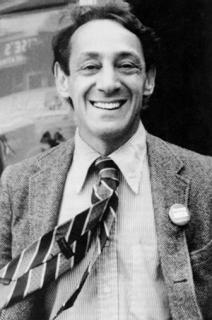
A Democratic Congressional rep. from San Diego thinks so.Rep. Bob Filner has asked the Secretary of the Navy, who has final say over such things, to name a warship the “U.S.S. Harvey Milk.” Milk served in the Navy during the Korean War. And Sup. Scott Wiener has introduced a resolution in support of the concept.

His press release:

Supervisor Wiener, who represents Milk’s old district on the Board of Supervisors, expressed excitement at the prospect of the christening:  “Harvey Milk was a visionary in our community and redefined what it means to be LGBT in public life.  Given Supervisor Milk’s extraordinary public service and military service to our country, I can think of no more fitting tribute than to name a naval vessel after him.” Retired Navy Commander Zoe Dunning, a leader in the repeal of Don’t Ask, Don’t Tell, agreed:  “Harvey Milk was proud of his Navy service. Similar to the USS Cesar Chavez, there should be a USS Harvey Milk to honor Milk’s leadership in the LGBT civil rights movement.” Anne Kronenberg, who served as one of Supervisor Milk’s legislative aides and who now serves as San Francisco’s Director of Emergency Management, noted that Milk would be smiling to hear about the effort to christen a ship in his name: “Harvey understood the importance of symbolism in the advancement of civil rights.  He also lived in an era when being out in the military was simply impossible. He’d be quite pleased that we are now in an era when not only can LGBT people be out in the military, but they can even have warships named after them. Times truly have changed.”

My friend and colleague Sandy Lange, who is the Guardian’s controller, agrees. Sandy was an officer in the Navy, and loved it, and got kicked out after the Naval Investigative Service followed her to a lesbian bar, long before even Don’t Ask, Don’t Tell. “This would be a great statement, to finally kick homophobia off the waves,” she told me.

Tommi Avicolli Mecca, who is also my friend, isn’t so sure. In a piece on Open Salon, he argues that Milk would be opposed to today’s military adventurism and that a warship isn’t a fitting memorial:

It’s one thing that gays can serve openly in the military. It’s another to attach the name of a queer progressive who opposed war to a military ship. It’s just not appropriate. It’s like naming a Christian church after him (Milk was a Jew and an atheist). Or a bomber plane after Gandhi.
 
What’s next? Recruitment ads in the gay newspapers featuring the Village People and/or hunky half-naked men? A pink heart medal for killing with a gay flair? A lavender box with a rainbow flag for our gay and lesbian corpses?  

Marke B., our managing editor, just wants to be sure that he’s involved in the interior design of the new ship, and that its sailors “open their legs for fleet week.”

Seriously — Avicolli Mecca thinks a better honor would be to make Milk’s birthday, May 22, a national holiday. Of course, Chavez (also a man of peace) has both a ship and a holiday.

I never met Harvey Milk — I arrived in San Francisco in 1981 — but I have to wonder what he’d think about a ship of war carrying his name.


Progressives party — together

6

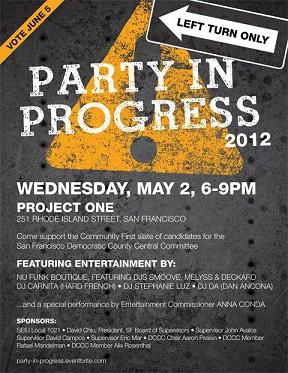
There are plenty of political fundraisers during campaign seasons, but this one will be especially interesting: The progressive slate for the Democratic County Central Committee is coming together for an event May 2 at 6 pm at Project One. The host committee includes outgoing chair Aaron Peskin and Sup. David Chiu, who have not always been on the best of terms — and Committee incumbent Alix Rosenthal, the main organizer of the event, who is also the organizer of what some see as a competing slate.

And that slate is having its own problems — involving clashes between some of the progressive women (Hene Kelley, who will no doubt be at the May 2 event) and some of the more moderate women (Hydra Mendoza, who won’t be there.) The party invite has a street sign saying “left turn only” — which is not at all what some of the people on Rosenthal’s other slate are thinking.

Rosenthal told us: “I personally think it’s remarkable that Aaron, Rafi [Mandelman], David Chiu, David Campos, Eric Mar, John Avalos and I are all on the host committee, given the rifts in the progressive movement of late.”

Yep. Everyone’s getting along. For one night, anyway.

Bizarre development: Lone guy in black mask throws bricks at Occupy crowd

9

Yael Chanoff reports from the scene of the Occupy building takeover with a really strange development:.

Police had put up barricades in front of 888 Turk, and many of the protesters were out of the building, but some were still inside. Then, after the front door was completely sealed, a lone man, his face covered by a black bandana, appeared on the roof. He held a brick in each hand, and after a dramatic pause, hurled one of the bricks into the crowd below. It struck a protester in the face, causing a bloody injury. Paramedics are on the scene.

The brick-thrower kept up the barrage, hitting another protester in the leg, then moved to an adjacent building and began throwing pipes, hitting a police car.

Hundreds of police arrived on the scene; The brick thrower apparently vanished.


An absolute must-read on taxes (by Stephen King)

10

A lot of things drive me crazy (people making a left turn on 16th and Bryant at 5 p.m., backing up traffic for an entire block; people who get to park in the midde of the street on Sunday because the cops don’t ticket churchgoers; politicians who say “I’ll take a look at that” as a way to duck a question, dog owners who leave piles of shit in the middle of the sidewalk… don’t get me started). But one of the worst, on top of my list, is the claim that wealthy people who think the rich don’t pay enough taxes should just write the government a check.

George W. Bush loved that one. Every time taxes on the rich came up, he’d say: “If you think your taxes are too low, the IRS takes checks and money orders.” You can pay online, too.

So what’s wrong with that argument? Why doesn’t Warren Buffett just pay the taxes he thinks he ought to, and stop complaining? Because taxes don’t work that way, that’s why. And one of the best essays on this critical point just appeared on the Daily Beast. The author of this gem, called “tax me, for F@%&’s sake” is an author, Steven King, who is also part of the 1 percent, a man whose knack for telling horror stories has made him very wealthy. And he has harsh words for just about everyone who tries to get away with suggesting that high taxes ought to be voluntary:

I’ve known rich people, and why not, since I’m one of them? The majority would rather douse their dicks with lighter fluid, strike a match, and dance around singing “Disco Inferno” than pay one more cent in taxes to Uncle Sugar. It’s true that some rich folks put at least some of their tax savings into charitable contributions. My wife and I give away roughly $4 million a year to libraries, local fire departments that need updated lifesaving equipment (Jaws of Life tools are always a popular request), schools, and a scattering of organizations that underwrite the arts. Warren Buffett does the same; so does Bill Gates; so does Steven Spielberg; so do the Koch brothers; so did the late Steve Jobs. All fine as far as it goes, but it doesn’t go far enough.

What charitable 1 percenters can’t do is assume responsibility—America’s national responsibilities: the care of its sick and its poor, the education of its young, the repair of its failing infrastructure, the repayment of its staggering war debts. Charity from the rich can’t fix global warming or lower the price of gasoline by one single red penny. That kind of salvation does not come from Mark Zuckerberg or Steve Ballmer saying, “OK, I’ll write a $2 million bonus check to the IRS.” That annoying responsibility stuff comes from three words that are anathema to the Tea Partiers: United American citizenry.

More:

Most rich folks paying 28 percent taxes do not give out another 28 percent of their income to charity. Most rich folks like to keep their dough. They don’t strip their bank accounts and investment portfolios. They keep them and then pass them on to their children, their children’s children. And what they do give away is—like the monies my wife and I donate—totally at their own discretion. That’s the rich-guy philosophy in a nutshell: don’t tell us how to use our money; we’ll tell you. The Koch brothers are right-wing creepazoids, but they’re giving right-wing creepazoids. Here’s an example: 68 million fine American dollars to Deerfield Academy. Which is great for Deerfield Academy. But it won’t do squat for cleaning up the oil spill in the Gulf of Mexico, where food fish are now showing up with black lesions. It won’t pay for stronger regulations to keep BP (or some other bunch of dipshit oil drillers) from doing it again. It won’t repair the levees surrounding New Orleans. It won’t improve education in Mississippi or Alabama. But what the hell—them li’l crackers ain’t never going to go to Deerfield Academy anyway. Fuck ’em if they can’t take a joke.

He skewers the idea that giving the rich more money creates jobs (“At the risk of repeating myself, here’s what rich folks do when they get richer: they invest. A lot of those investments are overseas, thanks to the anti-American business policies of the last four administrations.”) He explains why the GOP tries so hard to defend tax cuts (“They simply idolize the rich. Don’t ask me why; I don’t get it either, since most rich people are as boring as old, dead dog shit. The Mitch McConnells and John Boehners and Eric Cantors just can’t seem to help themselves. These guys and their right-wing supporters regard deep pockets like Christy Walton and Sheldon Adelson the way little girls regard Justin Bieber … which is to say, with wide eyes, slack jaws, and the drool of adoration dripping from their chins.”) And he warns that life might not be so pretty for the uber-rich if this trend continues:

Last year during the Occupy movement, the conservatives who oppose tax equality saw the first real ripples of discontent. Their response was either Marie Antoinette (“Let them eat cake”) or Ebenezer Scrooge (“Are there no prisons? Are there no workhouses?”). Short-sighted, gentlemen. Very short-sighted. If this situation isn’t fairly addressed, last year’s protests will just be the beginning. Scrooge changed his tune after the ghosts visited him. Marie Antoinette, on the other hand, lost her head.

Think about it.

Yes, think about it: A society that gets more and more economically unequal is a society that won’t be stable for long.


The two defining votes of 2012

38

The Board of Supervisors will be facing two votes in the next couple of months that will define this board, establish the extent of the mayor’s political clout — and potentially play a decisive role in the political futures of several board members.

Oh: They’ll also have a lasting impact on the future of this city.

I’m talking about 8 Washington and CPMC — one of them the most important vote on housing policy to come along in years, the other a profound decision that will change the face of the city and alter the health-care infrastructure for decades to come.

Both projects have cleared the Planning Commission, as expected. Neither can go forward without approval from a majority of the supervisors. And there will be intense downtown lobbying on both of them.

The 8 Washington project would create what developer Simon Snellgrove calls the most expensive condos ever built in San Francisco. A piece of waterfront property would become a gated community for the very, very rich, many of whom won’t even live here most of the time. If it’s approved, the economy won’t collapse, neighborhoods won’t be destroyed — but it will make a powerful statement about the city’s housing policy. The message: We build housing for the 1 percent. We are a city that caters only to one very tiny group of people. We are willing to let the needs of the few drive our policy over the needs of the many.

Face it: There is no shortage of housing for the people who will buy Snellgrove’s condos. There’s a severe shortage of housing for most of the people who actually work in San Francisco. And the city’s housing policy is so scewed up that it’s making things worse. That’s the message of 8 Washington.

Then there’s CPMC. California Pacific Medical Center wants to put a snazzy state-of-the art new medical center on Van Ness, which is all well and good. But the giant nonprofit Sutter Health, which operates CPMC, has been openly hostile to some of the city’s demands (for housing, transit and other environmental mitigiation) and the proposal that Mayor Ed Lee has signed off on is way out of balance. There’s not anything even close to a reasonable link between jobs and housing — which will impact the entire city. You bring in a lot of new workers and don’t help build enough housing for them and everyone’s rent goes up.

CPMC also wants to radically downsize St. Luke’s Hospital, the only full-service facility on the south side of town except for the overcrowded and overloaded SF General. Health care for a sizable part of the city will suffer.

This is a very big deal, and the Chamber of Commerce is pushing hard for the supes to approve it. A lot of labor and the entire affordable housing community is against it.

So put those two votes in front of a board where the progressive majority has been very shaky of late — and where Lee will be working hard to line up six votes — and you’ve got potential political dynamite. Supervisor John Avalos told me he has serious concerns about both projects. Sup. David Campos told me he feels the same way. Sup Eric Mar is unlikely to vote for 8 Washington and unlikely to oppose the health-care workers and the progressive leaders who want to block the CPMC deal and make Sutter come back with a better offer, but some elements of labor are pushing hard for 8 Washington and Mar is up for re-election in one of the city’s swing districts.

Sup. David Chiu is against 8 Washington. I’ve called Sups. Jane Kim and Christina Olague (who was not a fan of the project when she was on the Planning Commission) but they haven’t gotten back to me. Olague is running for re-election this fall in the city’s most progressive district, one that’s right on the edge of the CPMC project site; Kim’s district is on the other edge.

You can’t really count to six on either of these projects without getting Chiu and/or Kim and/or Olague. Chiu has no progressive opposition, but if he supports the CPMC deal, someone may decide to challenge him. If Olague supports either project, it will give her opponents plenty of fodder for the fall campaign (John Rizzo, who is running against her, told me he opposes both). If Olague opposes the two projects, it’s going to be much harder for anyone to run against her from the left since she will have demonstrated that she can stand up the mayor on tough issues.

I’ll let you know if I hear more.


Kids, dogs, and naked people in Dolores Park

5

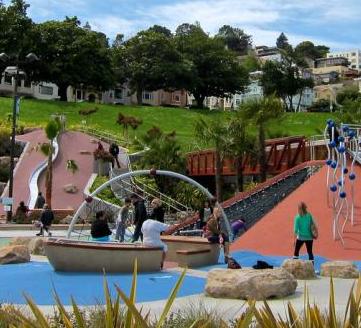
The interwebs are all buzzy over the notion that some parents might want a fence around the playground in Dolores Park. Uptown Almanac denounces the Dolores Park Brats. Sfist says it’s all a plot to undermine gay beach

Well: I have two kids and a dog, and all of us in some groupings or manifestations use Dolores Park, including the playground, the grass and the dog area, and I hate to see any nudity or semi-nudity go away because then I wouldn’t get to gawk at all the hot young people who otherwise would have no interest in being naked around an old man like me.

And really, it works just fine.

I’ve been going to DP for a couple of decades, first just with a dog then just with a kid and now with the whole pack, and I’ve never seen any problems. Yeah, a dog will wander into the playground every once in a while, but the dogs that get that far away from the (overwhelmingly responsible) owners tend to be friendly and harmless. If a toddler gets knocked over by a dog, that’s sad, but it’s really not all that sad; the playground surface is designed for kids to fall on it and kids get knocked over by other kids all the time. This is a big, crowded city; we coexist in the parks, and I’m amazed at how well the active park users normally get along.

But if you want to talk about fences (and I’m against fences in parks in general, tho the one at Civic Center makes sense) the thing to remember is that you should fence in kids, not fence out dogs.

I know that sounds awful, and I’m not advocating putting children on leashes (tho at the airport I’ve though about it a few times). But little kids need to be contained — that is, parents need to know where they are. If they’re at the DP playground, somebody needs to keep an eye on them because if they’re like my kids, they’ll get into someone’s picnic, the garbage, knock over someone’s wine bottle, step on a sleeping person’s face … you know, the things kids do. And unlike dogs, they rarely come when they’re called.

Once they’re a little older it gets a little better (and then it gets much, much worse), but at the young playground age, I worry less about dogs running in than kids running out.


Obama and state’s rights

8

So how many angry pot smokers (and how many of my libertarian-leaning blog trolls) are going to love this? The governors of four western states want to take control of federal land inside their borders, and they’re organizing to do it. Mostly a political stunt — the governors want to allow more mining, ranching, and drilling on public lands, and the feds are taking it a bit more slowly. And nothing new — we’ve had these western range wars for decades, and for decades Utah governors have insisted that the state ought to be making the decisions around the 66 percent of the total Utah land mass that’s owned by Washington.

There’s no doubt in my mind that the administration is doing the right thing by resisting — you can’t just take national parks and national forests and Bureau of Land Management land and turn it over to development-oriented states. Much of that was federal land before there were states. And it’s not as if the Interior Department is all pristine about it — there’s already far too much resource development on public property, and the public doesn’t get anywhere near enough money for it. Sometimes it’s so bad it’s nutty.

But Obama’s got a problem, and it’s called medical marijuana — and he’s doing the same dumb thing that presidents before him have done, and all it does is create allies for the far right. Hell, after the U.S. attorney started attacking dispensaries I was ready to seceed. Let’s take California and walk; we’re already the ninth largest economy in the world, and we pay far more in federal tax money than we get in federal benefits. The Sierra makes a pretty defensible permiter; who needs Washington?

Of course, I’m quite happy that Obama doesn’t want to let the nuts in Arizona and Alabama get away with their racist and oppressive anti-immigrant laws and I’m happy to argue (in those cases) that immigration is a federal issues and that states shouldn’t try to mess around with it.

Except that San Francisco is a sanctuary city, and we have our own policy, which is excellent and the feds should leave us alone. And when this city did same-sex marriage, in defiance of state law, that was one of the coolest things ever.

You see where I’m going here.

Both sides can raise this Constitutional stuff and argue state’s rights and a long list of other things, and any good law school professor can spend years talking and writing about the historical and legal issues. There are some things that should be left to the states, and some things that the federal government should do, and that is always evolving.

But really, a lot of this is about policy. Legal pot is a good thing. So is same-sex marraige. Crackdowns on immigration are bad. Drilling and mining on public land are a problem, whether it’s state land or federal land. Politics isn’t perfect, and I’m willing to take our victories where we can get them.

But when the president is inconsistent (he’s cracking down on medical marijuana in CA but not Colorado; he’s against the Arizona/Alabama laws but still his ICE trying to mess with SF’s Sanctuary City) and does things that make his allies and supporters (that’s us potheads) mad at him, then it’s easier for the governor of Utah to say the feds are on his land and should leave him alone. Just like the pot farms.


Why austerity sucks

8

European nations are starting to take some of the same steps that Republicans are suggesting for the US — reductions in the public sector, cuts in benefits, etc. And Joseph Stiglitz, an economist who actually knows what he’s talking about, argues that it’s a terrible idea — and that goes for the United States, too. Check out this fascinating interview.:

When you look at America, you have to concede that we have failed. Most Americans today are worse off than they were fifteen years ago. A full-time worker in the US is worse off today than he or she was 44 years ago. That is astounding – half a century of stagnation. The economic system is not delivering. It does not matter whether a few people at the top benefitted tremendously – when the majority of citizens are not better off, the economic system is not working.

More:

The European: What do you say to someone who argues thus: Demographic change and the end of the industrial age have made the welfare state financially unsustainable. We cannot expect to cut down on our debt without fundamentally reducing welfare costs in the long run.
Stiglitz: That is absurd. The question of social protection does not have to do with the structure of production. It has to do with social cohesion or solidarity. That is why I am also very critical of Draghi’s argument at the European Central Bank that social protection has to be undone. There are no grounds upon which to base that argument.

The thing about Stiglitz is that, unlike many academic economists, he’s been right most of the time over a stellar career. And he’s right now.