Tim Redmond

Big (Robot) Brother is watching you on Muni

20

So I’m not usually the paranoid type (I said usually), but this one is a little creepy: According to Fast Company, Muni is going to deploy a camera system that can detect criminal or potential terrorist behavior — without a human being.

Not clear what happens when the cameras find something suspicious (and anyone who rides Muni knows that “anomalous behavior” is pretty standard fare). But I sense this could cause some trouble when over-anxious cops hyped on terror-watching charge into the tunnel to grab some guy who’s pissing on the wall.

Unless the cameras decide that’s “normal.”


8 Washington isn’t getting much better

30

When the Board of Supervisors approved the environmental impact report for the most expensive condos in San Francisco history, several members of the board said they weren’t entirely happy with the project. Supervisors Christina Olague and Eric Mar both complained about the height and bulk and Olague said she wanted a parking fee.

So now the project is back, and just won approval at the Budget and Finance Commitee — with only a few minor changes. There’s no adjustment to the height and bulk, although the parking has been cut from 255 spaces to 200 and a 50-cent parking surcharge has been added. Sup. Jane Kim wants to be sure that the pool built in the new facility will be open to low-income youth.

But the city’s not getting a dime more than the $11 million in affordable housing money that developer Simon Snellgrove has already offered — despite the fact that the available financial evidence suggests Snellgrove and his partners will make more than $250 million on the deal. Sup John Avalos made clear that the city’s not getting enough out of this project.

So now it goes to the full board June 12 — and if things go according to the normal San Francisco pattern, the developer will get what he wants and the city will get screwed.

See, when you give developers the opening, they take advantage of it. When you let them over the first hurdle with and 8-3 vote, they get pretty confident that they’re going to win. So why would they compromise on more than few details? Why cut the height and bulk when you know you have the votes?

I respect what Eric Mar, Jane Kim and Christina Olague said about their votes on the EIR — but imagine if it had been a 6-5 vote? Snellgrove might have gotten the message that this wouldn’t be easy. He might be calling Olague and Mar and saying: How much less height? How much less bulk? How much more affordable housing? We might have wound up with a much better deal.

Every time — every single time — a developer presents what is supposed to be the last, best deal it’s a scam. Every time the city has said No, the developer has come back and sweetened the pot. That would have happened here, too.

But no. I predict no height and bulk adjustments, no additional affordable housing money — nothing more than what Budget and Finance already got. Which isn’t enough.

Oh, and by the way: Everyone here already knows that I oppose this project because it’s too much housing for rich people, which we don’t need in this city, and puts the city’s housing balance further out of whack. But if we’re going to sell off the waterfront for all the wrong reasons, we should at least get the best deal we can.

It’s the money, stupid

10

If you want to know what American politics looks like in a post-Citizens United world, check out the June 5 elections.

It’s not that this specific court case played a role in all of the key races — the tobacco industry could have spent $47 million to defeat a cigarette tax with or without Citizens United — but around the country, you saw the role that big money played in literally altering the political landscape.

Take Wisconsin. The national news media twist on this will call it a test of Obama’s field campaign and a referendum on labor, but it was really all about money. Walker and his big-biz allies raised $30 million, a lot of it through barely-regulated super PACs, and outspent Tom Barrett by more than 7-1.

In California, Prop. 29, which would have put a $1 tax on each pack of cigarettes to pay for cancer research, was way ahead in the polls, and I was pretty sure it was going to win handily — how can you vote against a tax on a product that kills people to fund a cure for the disease it causes? Prop. 29 had a 30-point lead a couple of months ago.

Then came the blitz — $47 million in TV ads, funded by a couple of big tobacco companies. The ads were classics of the type — misdirection and confusion aimed at getting people to vote No. And it worked: Prop. 29 is going down to a narrow defeat.

In San Francisco, Prop A, with little money and not much of a campaign, never had a serious chance. But the flood of Recology money made sure it never got even 25 percent of the vote (although if you asked people, outside of the campaign, whether the garbage contract should be put out to bid, most of them would say yes).

I think Recology money had an impact on the Democratic County Central Commitee, too; Recology paid for a lot of slate cards that promoted a lot of more moderate candidates. The company also paid for progressive slate cards (the Milk Club etc.), and I haven’t counted them all, but in the end, slate cards matter in the DCCC and they may have made the difference.

The local election was so low-turnout that it’s hard to draw any serious conclusions from it. But overall, money carried the day June 5 — and that’s a scary message.


Tobacco tax: It’s going to be way too close

19

About 25 percent of the vote in. 50.6 Yes, 49.4 No. Trending the wrong way. This is going to be very close.

I didn’t believe that the tobacco companies could beat this thing, and I thought the results from LA would push the Yes vote, but in LA county, Prop. 29 is losing. Odd to see the absentees more liberal than the election-day votes, but let’s remember: As the polls showed this getting closer, Big Tobacco threw more and more money into the strategic areas, and that’s clearly had an impact.

Wow. This could actually go down.

And if Californians aren’t going to tax cigarettes, which only about 12 percent of Californians even smoke, what does that say about the impact a big-money campaign could have against Gov. Brown’s tax measures in the fall?

Reading Ed Lee’s mind

15

Political reporters love to believe we can read politician’s minds; it makes us feel important. (And Lord knows, these days we need something to make us feel important.) So let me go way out on a limb here and tell you what Mayor Lee is thinking right now:

1. Gotta minimize Prop. B. It was an aberration, a bunch of rich Nimbys from Telegraph Hill, nothing more to see here. Certainly not a public referendum on my Rec-Park director, Phil Ginsburg, and his efforts to make money by renting out city parks for private events. No no no, just ignore it and maybe it will go away.

2. We won back the Democratic Party. Good move to take a page from Aaron Peskin’s book and run a bunch of elected officials and former elected officials with high name recognition in a low-turnout election. Bevan Dufty, who happens to work for me, would make an excellent chair; should be easy to make that happen.

3. What if we look at the DCCC race in the 17th District as a first-pass primary for the 2014 Assembly seat when Tom Ammiano — who’s just way too independent and won’t get with my program — is termed out? Hmmm … David Chiu, who I can mostly deal with, is in first place — but John Avalos and David Campos are more popular than my pal Scott Wiener. And if the progressives get behind Campos, he’ll be tough to beat. Hmmm….

4. That oddball Michael Breyer ran for Assembly pretending he was me. He even put out a mailer with my mustache on the front suggesting that he’ll be just like I am (except that he’s white and has no experience and no credible program and isn’t going to win). But he got a lot of votes with the Ed Lee card and I could totally control him. Can’t support him over Phil Ting, of course, but maybe I can get him some help behind the scenes.

5. This was an unusual election with radically low turnout. I know I can’t read too much into it. If the DCCC were on the ballot in November, or if there were a real presidential primary to bring people out to vote, the results would be very different. But still: All that new housing for rich people that my mentor Willie Brown and my friend Gavin Newsom got started seems to be having an impact. The city’s getting more conservative. Let’s just keep that one going and I’m home free.

6. What’s up with Lincecum? Damn those Padres.

Nah — the mayor’s too nice a guy to be thinking like that. Right?


Tobacco money showing its power

1

The tobacco companies spent very, very heavily in Southern California to defeat Prop. 29, and as more results come in, it’s clear that the tens of millions of dollars worth of misleading TV ads had an impact. The numbers are now very, very close. With 15 percent of the vote in, it’s 50.3 Yes, 49.7 No. Still mostly conservative areas; LA and San Francisco aren’t in the mix yet, and only half of Sacramento’s been counted. Still: This is way, way closer than I thought it would be.

80 percent reporting: You can take (most of) this to the bank

6

WIth 80 percent reporting, you can take this much to the bank:

Prop A is dead. Prop. B has won. The left will no longer control the local Democratic Party.

Phil Ting will have an actual race in November (although he won more votes than the conservative Dem and the Republican combined and will almost certainly win the seat).

The Padres beat the Giants, 6-5, with a walk-off home run in the ninth.

Hell of a night.

40 percent reporting: Not a lot of change

0

Witrh 40 percent of the precincts reporting, there’s been very little change in the results, which is surprising: Typically the absentees don’t reflect the election-day turnout. But Prop. A is still going down by huge margins, Prop. B is still winning (and at this point, that one’s probably in the bag, striking a blow against the privatization of public resources and offering a vote of no-confidence in the direction of the city’s Rec-Park department).

It appears likely that there will be an expensive November race for Assembly in D19, with the downtown-funded (but otherwise unknown) Democrat Michael Breyer who ran an almost-Republican campaign heading for a second-place finish against Assessor Phil Ting.

And there’s no change in the results for the DCCC.

I’m a little surprised (and disappointed) that Gabriel Haaland, a longtime incumbent, isn’t making the cut this time, and I’m surprised (and pleased) that newcomer Justin Morgan, a public-health physician, is still in the top 14 on the East Side. Zoe Dunning and Matt Dorsey, two very visible LGBT leaders (she on DADT, he on same-sex marriage) are running strong; Dorsey’s in the progressive camp, and Dunning, a former military officer, is more conservative. School Board member Hyrda Mendoza isn’t making the cut, either, which is odd for a citywide elected official.

At this point, it appears that theSF Democratic Party will be a more conservative organization than we’ve been used to over the past four years. At most, the progressives will have 14 or 15 votes out of 32 (24 elected and eight ex-officio). There are plenty of reasons for that, among them the retirement of some longtime progressive members (Aaron Peskin, Jane Morrison, Milton Marks); the redistricting that created a West Side district very few progressives could compete in — and the move by the more conservative elements of the party to run a slate that included Dufty and Cohen.

Things could still change; I could be wrong. But I don’t think I am.

Tobacco tax tightens up

0

Whoa — with 10 percent of the state reporting, the tobacco tax, Prop. 29, is tightening up. It’s now 51.3 yes, 48.7 no. But I’ve checked the counties that have reported in, and they’re mostly the no-tax conservative areas. Only 5 percent of Los Angeles is in, and San Francisco hasn’t even reported to the state yet. So not time to worry yet.

In CD2, Norman Solomon has pulled to within 2.5 points of the Republican in the race for second place and a slot on the November ballot. I think he’s going to pull it off.

Early SF results: No on A, Yes on B

5

The first results just got posted, and it’s a fairly large number of votes. More than 60,000 people voted by mail, and there’s enough to draw a few conclusions.

Prop. A, the measure that would have required competitive bidding for the city’s garbage contracts, is dead, losing in the early absentees 77-23. No surprise that it’s losing; getting 23 percent of the vote with no campaign to speak of up against the full might of Recology’s money and political connections is actually pretty impressive.

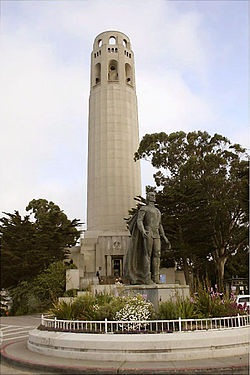
Prop. B, the Coit Tower measure, is winning, 55-45, which is a good place to be at this stage. I’d say it’s time for the Yes on B camp to start celebrating.

The DCCC early returns show a lot of what we expected — the elected officials and incumbents are doing well. David Chiu is in first, beating Scott Wiener, who is beating John Avalos. For what it’s worth.

After that, it’s Bevan Dufty, David Campos, former Sup. Leslie Katz and former state Sen. Carole Migden.

Interestingly, Matt Dorsey, an appointed incumbent facing the electorate for the first time, is ahead of Sup Malia Cohen. Rafael Mandleman, Zoe Dunning, Alix Rosenthal, Petra DeJesus, and Justin Morgan finish out the top 14 on the East Side.

Those are the early absentees, and the difference between Morgan and incumbent Gabriel Haaland, now in 18th place, is just 800 votes. So it will change.

Right now, the progressives have 9 of the 14 seats on the East Side, but only 4 of the 10 on the West Side, which won’t be enough to elect a progressive chair and ensure good endorsements in the fall. But the margins are so thin and it’s so early we can’t call it yet.

On the West Side of town, Assessor Phil Ting is comfortably in the lead for the 19th Assembly District, but newcomer Michael Breyer, a conservative Democrat who spent a ton of money, is edging Republican Matthew Del Carlo by two points, setting up the possibility that Ting will have to raise money and face off against Breyer in November.

Statewide results: Tobacco tax close, term-limits change leading

0

The statewide results are very early, very limited and most likely very conservative, because they represent only absentees that have come from the few counties already reporting. Here’s what I can draw from them: The change in term limits, Prop. 28 — promoted by opponents of the current term-limits law but described as reducing the amount of time a legislator can serve — is going to win handily. It’s ahead 66-34. It doens’t mean voters are turning against term limits (sadly); there wasn’t a huge campaign on either side, so it’s mostly about the actual ballot language, and the sponsors were careful to say it “limits legislators terms in office.” Still, it’s good news for people like San Francisco Assessor Phil Ting, who is likely to head up to Sacramento for the first time and will be eligible to serve in the Assembly for 12 years.

The cigarette tax is also winning, despite about $40 million in spending by the tobacco companies. That one’s closer — 53-47 — but since absentees are usually more conservative than election-day votes, that’s a good sign. If things hold up the way they normally do, the gap will widen and both measures will win handily.

In the Congressional D2 race, Jared Huffman is, as expected, well in the lead with more than 40 percent of the vote. The second-place Dem is Norman Solomon, but he’s trailing the top Republican, Daniel Roberts, by three points. If Solomon does well with today’s voters, he may wind up in the November final.


Two things to watch for in CA

1

There are two things that could be really significant around the state tonight (and no, I’m not talking about which liberal, balding Jewish man wins the primary in the San Fernando Valley, which will almost certainly be replayed in the fall). There’s a real chance that, thanks to redistricting, the Democrats could pick up enough seats to win a super-majority in the state Senate — meaning they could pass new taxes despite GOP recalcitrance. And while it’s unlikely that the Dems will get a two-thirds majority in the Assembly, there are a few Republicans out there who are starting to question the Grover Norquist line.

So what happens if, say, both houses approve an oil-severance tax or a restoration of the vehicle license fee? Will the Guv, who insisted in his campaign that he’d accept “no new taxes without a vote of the people” going to veto it? Seriously — is Jerry Brown going to veto an oil-severance tax?

Then there’s the Second Congressional District, where corporate Dem Jared Huffman is almost certainly going to come in first — but Norman Solomon, who is way closer politically to outgoing Rep. Lynn Woolsey, has a good chance of coming in second and making it to the November election. In which case the North Coast will see a classic fight between the left and the center of the Democratic Party, in one of the most progressive districts in the country — and it will attract national attention.

By the way: I’ve been checking out so many blogs tonight that I can’t remember where I saw this, but: The huge turnout in Wisconsin indicates that sharp political distinctions, clear-cut lines and hard fights, improve voter turnout. These cautious, don’t-take-risks pols shouldn’t be surprised that hardly anyone wants to vote for them.

Walker winning in Wisconsin — the fallout

30

AP is callling the Wisconsin election for Scott Walker, although the results will no doubt tighten up as the night goes on.  But this is a wake-up call — for all of us. It’s one of the first clear tests of what happens when you have unlimited corporate money flowing into an election (Walker outspent his opponent about 8-1) and it’s a sign of how bad things can get under Citizens United.

It’s also going to dampen the enthusiasm of labor activists for the Obama re-election. Already, commenters on DailyKos are calling for progressives not to support the Democratic Party this fall — and while that’s common and people mostly get over it, Obama has to start moving now to shore up labor support. We’re all for gay marraige, and that was a strong and much-needed (if also much-delayed) stand, but it’s not going to be enough.

There’s going to have to be a concerted effort to end the demonization of public-sector workers. This election just shows how it’s gotten out of control.


Turnout light in SF; eyes on Wisconsin

0

My usual limited polling sample — my precinct in Bernal Heights — suggests what everyone pretty much knew: Turnout in San Francisco will be very low. Control of the local Democratic Party, and its endorsements, will be determined by a small fraction of the eligible voters.

On the national front, since the presidential primaries are long over and California has long been irrelevant, everyone’s looking at Wisconsin, where the battle to recall Gov. Scott Walker will have national implications. Walker’s trying to survive by blaming public employees for the state’s economic woes; since he ended collective bargaining, he said today, the state budget is running a surplus and property taxes are down.

If by some chance he’s thrown out of office — and it doesn’t look good right now — labor will have one of its greatest victories in years. If he becomes the first governor in US history to survive a recall, he’ll portray it as a confirmation that the public supports his attack on unions. The right-wing types have poured millions into this race — and if they get their way, a lot of labor folks are going to be asking why President Obama (who will be in San Francisco to raise money at Clint Reilly’s office building June 6) didn’t make an appearance in Wisconsin.

Labor came in big for the president in 2008, and this one is hugely important — and the White House has been entirely missing in action. And he may have to answer for it if Walker survives and GOP governors across the country take up the call and attack public-sector unions as the start of a larger attack on organized labor.

In California, I don’t care how much money the tobacco companies spent — Prop. 29, the cigarette tax, is going to win. And I think the term-limits measure squeaks through, too. Locally, we all know that Prop. A will lose under a barrage of Recology money; I hope Prop. B survives the strange last-minute money blitz.

We may not know for days how the Democratic County Central Committee races are shaking out. If it’s close, and control of the panel hangs on a couple of tight races, the absentee votes that get counted over the next few days will make the difference.

We’ll be posting updates all evening.

The funny money against Prop. B

19

Credit where it’s due: My competitor and sometimes journalistic adversary Joe Eskenazi has a nice little piece on the weird money behind the campaign against Prop. B, a policy statement about the privatization of Coit Tower. He points out that such varied groups as the California Dental Association and the San Manuel Band of Mission Indians have coughed up money to protect the right of San Francisco officials to close Coit Tower to the public and rent it out for fancy corporate parties.

And how exactly did that happen?

Well, Eskenazi manages to tie Willie Brown into it. (He also calls this “Nimby against the Swells,” which isn’t quite fair — I don’t think the supporters of Prop. B are trying to keep anything out of their back yards. If anything, they want more noisy tourists and fewer quiet, subdued rich-people events. And I don’t think the “swells” are against it as much as the mayor, his Rec-Park director and big businesses that generally back the privatization of public resources.)

But there’s another interesting twist: I’m not sure the folks who gave to the Golden State Leadership Fund Political Action Committee, which is running a No on B independent expenditure, had any clue where their money was going.

Sure, the Chamber of Commerce and BOMA know what’s up, and it’s pretty clear why they like the idea of raising money for the parks by holding exclusive private events instead of by raising taxes. But the Indians? And the dentists? By what possible stretch do they care about a San Francisco ballot measure that has nothing to do with Native American rights or oral health?

Eskenazi may be right — maybe Brown called the Indians and asked, and they threw the money his way to help his buddy the mayor (while keeping the mayor’s fingers out of this particular political pie). But the Golden State Leadership PAC, through which all this money flowed, has been around for years and gives money to candidates all over the state. (It’s definately something of a slush fund for local races — files in the Secretary of State’s office show that in 2008, money from Pacific Gas and Electric Co. flowed in and out of the PAC as it ran a campaign against the San Francisco public-power measure, Prop. H. PAC money went to David Chiu, Phil Ting and Ed Lee for mayor.) It’s based in West Hollywood and the treasurer is a guy named William Molina.

I called the San Manuel Band of Mission Indians and the California Dental Association and asked them why there were helping fund a campaign against Prop. B in San Francisco. The press person at the dental group apparently had no idea what I was talking about and asked for more details about the contribution. I gave her the date and the PAC and I haven’t heard back.

The Indians didn’t seem to clear on Prop. B, either. Kenneth Shoji, a spokesperson for the group, told me by email:

The San Manuel Band of Mission Indians made a contribution of $25,000 to the Golden State Leadership Fund PAC with the expectation of helping to support candidate(s) for public office in the 2012 elections.  We do not control where or how the PAC might extend its support beyond that.

In other words: This Coit tower thing is news to us.

UPDATE: I got essentially the same message from the dentists. Alicia Malaby at the CDA writes:

 When an organization such as CalDPAC contributes to an independent expenditure committee, that committee may spend money on races and issues that CalDPAC supports, but may also spend money on other campaigns. CalDPAC does not control how those committees spend money, and in this case, CalDPAC has no interest in and no position on Proposition B.

UPDATE TWO: Ron Cottingham at PORAC just called me and said his group has no position on or interest in Prop. B. The money that went to the PAC was earmarked to support Rob Bonta for Assembly in the East Bay. Presumably the PAC folks keep track of such things.

Maybe not. Maybe Willie or someone else made a call. It happens all the time.  I mean, somebody clearly was raising money for this PAC, which right now isn’t doing a hell of a lot besides No on B in San Francisco. (Oh, I called Brown, too. He hasn’t called back. He never does. I still always try.)

Either way, it’s a classic San Francisco political story — and it reflects how muddy and corrupt local politics can still be, even in an era of electronic disclosure and ethics laws. Why, if the dentists and Indians don’t like Prop. B, didn’t they (or any of the others in the PAC) create a No on B committee, disclose who was behind it and let the voters know a little more about the real money trail? Why funnel all this cash through a little-known Southern California PAC?

And for that matter, why is there a sudden influx of late money in this race? Has the mayor and the Chamber types suddenly discovered that Prop. B might pass — and might set a precedent against future privatization efforts?

June 5 is Election Day. Vote early and often.


Trolls rejoice! Comments are back

17

We appear to have fixed the comments problem that was bedeviling us and frustrating all the great folks who are part of our blog community (and those trolls who just try to annoy everyone else). So come on back — the comments work, you can start calling me names again, and let the fun being anew!

Why is a NY real estate developer targeting Prop. 28?

5

Why is a New York real estate developer putting up more than half a million dollars to try to crush California’s term-limits reform initiative?

Seriously: Howard Rich and his family and associated companies have poured $654,880 into preventing state legislators from serving 12 years in one house. It’s a relatively modest change in the law, which now allows three terms in the Assembly and two in the Senate. Total amount of time as an elected legislator is actually reduced (since many Assembly members set their sights on the Senate almost as soon as they’re elected).

And 12 years is enough time to learn how the system works, to encourage longer-term thinking on the budget — and to reduce the role that paid lobbyists play in setting the legislative agenda.

Which may be why Mr. Rich, a libertarian and private-property-rights nut  who doesn’t like the “radical agenda of the left” and runs Americans for Limited Government, is willing to put up a relatively huge sum of cash for an election that’s happening on the other side of the country.

But it ought to give Californians pause — a guy like this is trying to dominate a low-turnout election in the interest of keeping Sacramento safe for big business. One more reason to get out and vote June 5.

SEIU deal could undermine progressive coalition

1

I stumbled on the oddest deal on a union-gossip website, but I’ve checked it out and it’s really happening — and it could be a total trainwreck for progressive politics in San Francisco.

The deal, still in draft form, is an “agreement on political unity” between SEIU Local 1021, one of the most progressive unions in the state and part of the voice of the left in San Francisco, and SEIU-UHW, a much more moderate union that has been taken over by the international. (One example of the tension between the two: Local 1021 has been and remains a strong supporter of Sup. John Avalos, and UHW leader Leon Chow is challenging him in District 11, something that even Randy Shaw, who increasingly disagrees with my politics, finds distasteful.) UHW has attacked the hotel workers union and split with most of the rest of labor around CPMC.

The way the deal would work is this: Both unions would choose a candidate. If they disagreed, the head of the international, Mary Kay Henry, would appoint a mediator to essentially break the tie. That person could unilaterally “direct the joint endorsment of one candidate.”

It would be a radical change — for the first time, the members of Local 1021 would cede final control of their endorsements to the international.

Ed Kinchley, a co-chair of Local 1021’s political action commitee, told me he finds the proposal troubling. “I’m not at all interested in having the international have a say in who we endorse,” he said. “Decisions about endorsements should be in the hands of our members.”

He said he’s all in favor of trying to find areas of agreement between the two SEIU locals — “but do I want to have something enforced on us if we can’t agree? No.”

The agreement specificially exempts the Avalos-Chow race and it calls for UHW to endorse Eric Mar and David Campos. Campos is basically unbeatable, so that doesn’t matter. The nod from UHW to Mar will be helpful to him.

But overall, this could dilute the progressive force of one of the most important voices in local politics. Local 1021 is more than just a city employee union; it’s a part of the progressive coalition, part of the left in this town. Forcing a joint endorsement with a union that is distinctly not part of the progressive coalition can only undermine Local 1021’s historical role.

And it’s odd; as the Stern Burger with Fries blog puts it:

If you’re Local 1021, why would you sign this deal? Local 1021 is a big political player in San Francisco with lots of members, money and foot soldiers. [UHW leader Dave] Regan has shown again and again that he’s hostile to the priorities of Local 1021’s members. Basically, he’s bedded down with the business community. So, if you’re [Local 1021’s Roxanne] Sanchez, why would you agree to this so-called “unity” deal? It hands over control of Local 1021’s political destiny to Regan and some SEIU bureaucrat in DC. Plus, when push comes to shove, everyone knows that [International head] Mary Kay Henry is going to back Regan over Sanchez. If Local 1021 accepts this deal, they’re basically declaring unilateral disarmament as far as their political future.

I couldn’t reach Sanchez and her phone isn’t taking messages. But I spoke with Chris Daly, the former supervisor and now Local 1021 political director, who told me he wasn’t there when the deal was negotiated. But he said “we’ve had many internal discussions on this” and that “the policy of speaking with one voice makes sense.”

When I told him I thought this was a progressive fumble, he said: “I disagree with your analysis.”

The proposal is scheduled to come before the SEIU 1021 COPE June 7.

Are California taxes fair?

5

Let’s start with an assumption that I think most sane (non-libertarian, non-right-wing-GOP) people agree on: A tax system ought to be based on ability to pay, ought to avoid as much as possible special-interest breaks and should avoid the appearance and the reality of unfairness.

So as Jerry Brown tries to convince voters to approve his fall tax measure that’s part income taxes on the rich and part sales taxes on everyone, how does the state add up? The California Budget Project, which is one of my favorite organizations ever, has a couple of reports out that shed some light on why half of Brown’s plan — taxes on the millionaires — makes sense, and the other half of it doesn’t.

You can read the two reports here. Let’s start with who pays the taxes:

Measured as a share of family income, California’s lowest-income families pay the most in taxes.

Yes, many individual rich people pay more in terms of gross dollars — but when they’re done and the taxes are turned over to the government, the poor have very little left, and the rich have plenty. In fact, even with higher income tax rates, the wealthiest Californians only paid 7.4 percent of their incomes on state and local taxes. They poorest paid 10.2 percent.

Part of that comes from the inherently regressive nature of sales taxes. Part of it comes from the way different types of income are taxed (poor people don’t tend to have a lot of dividend or capital-gains income, which is taxed less than the income you earn from working all day at a job). But overall, the picture suggests that the income taxes on the wealthiest aren’t high enough.

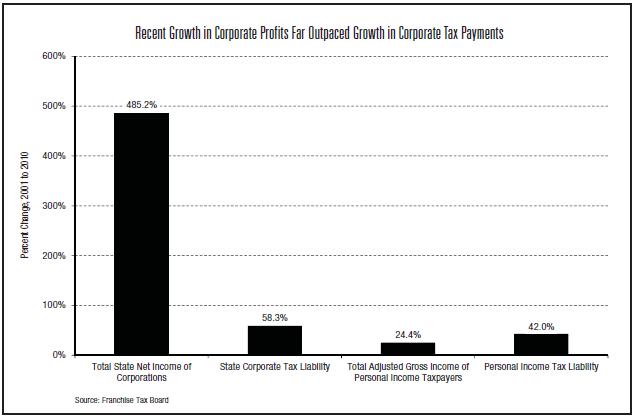
For all those types who complain that high taxes are hurting the state’s business climate, the report shows that California is pretty close to the national median in overall taxes. But it also notes that corporate income has soared relative to personal income: Over the past decade, the total reported taxable income of corporations in the state rose 485 percent. Total personal income rose 24 percent. Meanwhile, corporate tax liability rose only 58 percent, while personal liability rose 42 percent.

The result: Individual working people are paying more of the tax burden and corporations are paying less. (Unless you agree with Mitt Romney that “corporations are people.”)

Now let’s turn to the fairness report. It has some of the same data, but puts it in context:

California’s tax system is modestly regressive … [which] results from the relatively large share of income that lower-income households pay in the form of sales and excise taxes [and] the fact that low- and middle-income households spend all, or nearly all, of their incomes on necessities, including on many goods that are subject to tax.

I’m voting for the tax measure in November because the state desperately needs new revenue. But I say that recognizing that Brown’s proposal won’t do much of anything to address the basic unfairness of the way California raises the money to pay for state services.


FBI is scared of “black separatists”

0

The FBI is chasing “black separatist” groups and designating them as a potential threat — although there’s no evidence that any of the so-called separatist groups are actually a danger to national security — records obtained by the ACLU, the Asian Law Caucus and the Bay Guardian show.

The documents are the latest information we’ve received as a result of legal action demanding that the federal government reveal the extent of its domestic spying. Records released earlier this spring showed federal agents spying on mosques.

The docs released May 29 show that the FBI has identified two “separatist” groups — the New Black Panther Party and the Nation of Islam. The NBPP is hardly a powerhouse organization, to the extent that it even exists, and while the Southern Poverty Law Center points to its racist and antisemitic rantings, there is zero evidence that it’s part of a serious terrorist plot. As ACLU senior policy counsel Michael German notes:

Internet searches of “Black Separatist terrorism,” “Black Separatist bombing,” and “Black Separatist shooting” fail to bring up any recent incidents that could be fairly described as terrorist violence. No “Black Separatist” terrorist incidents are included in the FBI’s list of “Major Terrorism Cases: Past and Present,” nor on the more comprehensive list of terrorist attacks going back to 1980, which are detailed in an FBI report entitled “Terrorism 2002-2005.” While Black nationalist groups like the Black Panthers and the Black Liberation Army were certainly involved in political violence back in the 1970s, they no longer exist, and the last acts of violence attributed to either group were more than two decades ago.

Among the others of concern to the feds: The Black Hebrew Israelite Movement, whose members are a bit odd and maybe annoying — but terrorists?

Here’s the basic problem, according to the ACLU:

First, for the FBI to produce training programs that portray groups as violent threats based on old and misleading evidence and false associations is improper, and can only misdirect investigative resources. And because the groups highlighted have little in common save their racial identities, these flawed trainings will encourage racial profiling, rather than fact-based investigations. Second, the presentations’ focus on the unconventional ideologies of these modern groups tends to suggest a direct connection between belief and violence, which will again lead to inappropriate investigations based on First Amendment-protected activities rather than evidence of criminal conduct. Finally, even where these inappropriate investigations based on race and ideology fail to find evidence of violence, under its new rules the FBI may continue to pursue these groups under what it calls a “disruption strategy.”

Some of the latest documents show that the FBI is way, way out of touch with political reality. The records include a training memo on anarchists that waxes nostalgic about the anarchists of old, who were “highly dedicates to a specific cause/ideoogy” and “turn[ed] to criminal activity out of frustration.” Oh, but the kids these days? They’re just “criminals seeking an ideology to justify their activities” and “generally unorganized and reactive.”

Damn. They haven’t met the same anarchists I’ve met.

Oh, but there’s more. These crazy folks are “paranoid/security conscious” and “distrustful/resentful of authority figures.”

I wonder how many special agents it took to figure that out.

For some random reason, the section on anarchists includes a photo of a German antinuclear demonstration and apparently notes (much is blacked out) that you can find directions for making bombs on the Internet.

There’s also a training section on “The Chinese” which the ACLU notes is full of racial stereotypes. It includes things like “The Classic fighting over the bill for lunch and dinner” and “too many compliments may imply a romantic liason is desired. Be careful!” Among the sources the FBI cites for this info? “The Idiot’s Guide to Modern China.” Wow.

All I can say is: Your tax dollars, hard at work.

Sheriff’s wife talks to KGO-TV

28

KGO’s Dan Noyes flew to Caracas, Venezuela to interview the wife of embattled San Francisco Sheriff Ross Mirkarimi, and while her comments haven’t made anywhere near the media splash that most scraps of information on this sordid tale create, it’s very much worth watching the video. Check it out here.

Remember as you watch: Mirkarimi hasn’t been able to speak to his wife in months. The stay-away order prevents him from seeing her or phoning her or emailing her or contacting her in any way (except to coordinate his limited visits and skype calls with his son). It’s possible that the two of them came up with a joint story early on in the process, before the restraining order, but unless that happened, they’re both offering independent versions of the events.

And a lot of what Lopez says is consistent with a lot of what Mirkarimi says.

She tells Noyes that she was never afraid of her husband or fearful for their son. She says that she thought her neighbor, Ivory Madison, was an attorney and that the video — designed to be used in a possible future custody battle — would be confidential. (Madison’s lawyer disputes that.) She tells more or less the same tale of that New Year’s Eve that Mirkarimi does.

She also says there was no prior incidence of domestic violence — that her comments on the tape about “the second time” referred only to an earlier verbal argument about her travel to Venezuala.

Not defending Mirkarimi’s actions here (and no, trolls, I never have). Just saying that it’s important to hear his wife’s (presumably) unvarished version of events when we make judgments around whether he should keep his job. (The mayor never bothered to talk to Lopez before he filed official misconduct charges).

I don’t think the embattled sheriff was happy to hear his wife say that the couple may divorce, or that she may not return to San Francisco (the city, she says — justifiably — hasn’t been nice to her).

But I think the voice of Eliana Lopez has been missing too long in this whole political battle, and I’m glad to see she’s speaking out.

$3,000 an hour — is that fair?

51

Does anyone really think it’s ok for the average CEO to make so much more money than the average worker that a person earning the median income in this country would have to work 244 years to earn what the median CEO earns in a year?

I mean, I think $3,072 an hour is pretty excessive pay for anyone, but let’s give the conseratives their due: The person worked hard, and deserves to earn what the maket will pay him or her. If the typical worker in this country earned $500 an hour, that would be fine — the person at the top ought to earn more than his or her employees (at least, that the capitalist way) — but multiples of 244-1 are excessive an unstable.

Why not link CEO pay to the pay of the average worker? Why not say that no CEO can get more than 10 times (or even 20 times) what the lowest-paid person at that company makes? Nice incentive to pay your workers more.

Have at it, trolls.


The battle of 8 Washington

tredmond@sfbg.com

More than 100 people showed up May 15 to testify on a condominium development that involves only 134 units, but has become a symbol of the failure of San Francisco’s housing policy.

I didn’t count every single speaker, but it’s fair to say sentiment was about 2-1 against the 8 Washington project. Seniors, tenant advocates, and neighbors spoke of the excessive size and bulk of the complex, the precedent of upzoning the waterfront for the first time in half a century, the loss of the Golden Gateway Swim and Tennis Club — and, more important, the principle of using public land to build the most expensive condos in San Francisco history.

Ted Gullicksen, director of the San Francisco Tenants Union, calls it housing for the 1 percent, but it’s worse than that — it’s actually housing for the top half of the top half of the 1 percent, for the ultra-rich.

It is, even supervisors who voted in favor agreed, housing the city doesn’t need, catering to a population that doesn’t lack housing opportunities — and a project that puts the city even further out of compliance with its own affordable-housing goals.

And in the end, after more than seven hours of testimony, the board voted 8-3 in favor of the developer.

It was a defeat for progressive housing advocates and for Board President David Chiu — and it showed a schism on the board’s left flank that would have been unthinkable a few years ago. And it could also have significant implications for the fall supervisorial elections.

Sup. Jane Kim, usually an ally of Chiu, voted in favor of the project. Sup. Eric Mar, who almost always votes with the board’s left flank, supported it, too, as did Sup. Christina Olague, who is running for re-election in one of the city’s most progressive districts.

At the end of the night, only Sups. David Campos and John Avalos joined Chiu in attempting to derail 8 Washington.

The battle of 8 Washington isn’t over — the vote last week was to approve the environmental impact report and the conditional use permit, but the actual development agreement and rezoning of the site still requires board approval next month.

Both Mar and Olague said they were going to work with the developer to try to get the height and bulk of the 134-unit building reduced.

But a vote against the EIR or the CU would have killed the project, and the thumbs-up is a signal that opponents will have an upward struggle to change the minds of Olague, Kim, and Mar.


DEFINING VOTES

The 8 Washington project is one of a handful of defining votes that will happen over the next few months. The mayor’s proposal for a business tax reform that raises no new revenue, the budget, and the massive California Pacific Medical Center hospital project will force board members to take sides on controversial issues with heavy lobbying on both sides.

In fact, by some accounts, 8 Washington was a beneficiary of the much larger, more complicated — and frankly, more significant — CPMC development.

The building trades unions pushed furiously for 8 Washington, which isn’t surprising — the building trades tend to support almost anything that means jobs for their members and have often been in conflict with progressives over development. But the Hotel and Restaurant Employees Union joined the building trades and lined up the San Francisco Labor Council behind the deal.

And for progressive supervisors who are up for re-election and need union support — Olague and Mar, for example — defying the Labor Council on this one was tough. “Labor came out strong for this, and I respect that,” Olague told me. “That was a huge factor for me.”

She also said she’s not thrilled with the deal — “nobody’s jumping up and down. This was a hard one” — but she thinks she can get the developer to pay more fees, particularly for parking.

Kim isn’t facing re-election for another two years, and she told me her vote was all about the $11 million in affordable housing money that the developer will provide to the city. “I looked at the alternatives and I didn’t see anything that would provide any housing money at all,” she said. The money is enough to build perhaps 25 units of low- and moderate-income housing, and that’s a larger percentage than any other developer has offered, she said.

Which is true — although the available figures suggest that Simon Snellgrove, the lead project sponsor, could pay a lot more and still make a whopping profit. And the Council of Community Housing Organizations, which represents the city’s nonprofit affordable housing developers, didn’t support the deal and expressed serious reservations about it.

Several sources close to the lobbying effort told me that the message for the swing-vote supervisors was that labor wanted them to approve at least one of the two construction-job-creating developments. Opposing both CPMC and 8 Washington would have infuriated the unions, but by signing off on this one, the vulnerable supervisors might get a pass on turning down CMPC.

That’s an odd deal for labor, since CPMC is 10 times the size of 8 Washington and will involve far more jobs. But the nurses and operating engineers have been fighting with the health-care giant and there’s little chance that labor will close ranks behind the current hospital deal.

Labor excepted, the hearing was a classic of grassroots against astroturf. Some of the people who showed up and sat in the front row with pro-8 Washington stickers on later told us they had been paid $100 each to attend. Members of the San Francisco Planning and Urban Research Association, to which Snellgrove has donated substantial amounts of money in the past, showed up to promote the project.


BEHIND THE SCENES

But the real action was behind the scenes.

Among those pushing hard for the project were Chinese Chamber of Commerce consultant Rose Pak and community organizer David Ho.

Pak’s support comes after Snellgrove spent years courting the increasingly powerful Chinatown activist, who played a leading role in the effort that got Ed Lee into the Mayor’s Office. Snellgrove has traveled to China with her — and will no doubt be coughing up some money for Pak’s efforts to rebuild Chinese Hospital.

Ho was all over City Hall and was taking the point on the lobbying efforts. Right around midnight, when the final vote was approaching, he entered the board chamber and followed one of Kim’s aides, Matthias Mormino, to the rail where Mormino delivered some documents to the supervisor. Several people who observed the incident told us Ho appeared to be talking Kim in an animated fashion.

Kim told me she didn’t actually speak to Ho at that point, although she’d talked to him at other times about the project, and that “nothing he could have said would have changed anything I did at that point anyway.” Matier and Ross in the San Francisco Chronicle reported that Ho was heard outside afterward saying “don’t worry, she’s fine.”

Matier and Ross have twice mentioned that the project will benefit “Chinatown nonprofits,” but there’s nothing in any public development document to support that assertion.

Chiu told me that no Chinese community leaders called him to urge support for 8 Washington. The money that goes into the affordable housing fund could go to the Chinatown Community Development Corp., where Ho works, but it’s hardly automatic — that money will go into a city fund and can’t be earmarked for any neighborhood or organization.

CCDC director Norman Fong confirmed to me that CCDC wasn’t supporting the project. In fact, Cindy Wu, a CCDC staffer who serves on the city Planning Commission, voted against 8 Washington.

I couldn’t reach Ho to ask why he was working so hard on this deal. But one longtime political insider had a suggestion: “Sometimes it’s not about money, it’s about power. And if you want to have power, you need to win and prove you can win.”

Snellgrove will be sitting pretty if 8 Washington breaks ground. Since it’s a private deal (albeit in part on Port of San Francisco land) there’s no public record of how much money the developer stands to make. But Chiu pointed out during the meeting, and confirmed to me later by phone, that “there are only two data points we know.” One is that Snellgrow informed the Port that he expects to gross $470 million in revenue from selling the condos. The other is that construction costs are expected to come in at about $177 million. Even assuming $25 million in legal and other soft costs, that’s a huge profit margin.

And it suggests the he can well afford either to lower the heights — or, more important, to give the city a much sweeter benefits package. The affordable housing component could be tripled or quadrupled and Snellgrove’s development group would still realize far more return that even the most aggressive lenders demand.

Chiu said he’s disappointed but will continue working to improve the project. “While I was disappointed in the votes,” he said, “many of my colleagues expressed concerns about height, parking, and affordable housing fees that they can address in the upcoming project approvals.”

So what does this mean for the fall elections? It may not be a huge deal — the symbolism of 8 Washington is powerful, but if it’s built, it won’t, by itself, directly change the lives of people in Olague’s District 5 or Mar’s District 1. Certainly the vote on CPMC will have a larger, more lasting impact on the city. Labor’s support for Mar could be a huge factor, and his willingness to break with other progressives to give the building trades a favor could help him with money and organizing efforts. On the other hand, some of Olague’s opponents will use this to differentiate themselves from the incumbent. John Rizzo, who has been running in D5 for almost a year now, told me he strongly opposed 8 Washington. “It’s a clear-cut issue for me, the wrong project and a bad deal for the city.” London Breed, a challenger who is more conservative, told us: “I would not have supported this project,” she said, arguing that the zoning changes set a bad precedent for the waterfront. “There are so many reasons why it shouldn’t have happened,” she said. And while Mar is in a more centrist district, support from the left was critical in his last grassroots campaign. This won’t cost him votes against a more conservative opponent — but if it costs him enthusiasm, that could be just as bad.