Willie Brown

Why Question Time is boring

9

So Sup. Jane Kim isn’t sure Question Time is useful. And the press and some other board members think that, to quote Sup. John Avalos, it’s “deadening.”

Well, there’s a reason for that — the mayor doesn’t like the idea of appearing in an unscripted forum with board members, where he could face tough questions he doesn’t expect and engage in some real debate. And led by Board President David Chiu, the supervisors intentionally created a system that guarantees nothing valuable will happen.

The board sets the rules for Question Time. It’s in the law. And the mayor has to follow those rules.

The whole idea, when Sup. Chris Daly first brought this up, was to mandate that the chief executive interact with the board — and to provide an opportunity for the supervisors to engage in public discussion and debate with the occupant of an office that under Mayors Willie Brown and Gavin Newsom had become increasinly imperious.

Lee’s nowhere near as bad — but still, what Daly envisioned, and what the voters approved, was an open forum. Instead, we got a farce, a pre-scripted scene where the supervisors submit questions in advance, the mayor reads from a prepared answer, and there’s no follow-up or back-and-forth.

Yeah, it’s boring. No, it’s not useless. It’s just broken, because the supervisors didn’t have the guts to put into practice what the voters wanted. It’s simple: Change the rules. Get rid of the requirement that questions be sumitted in advance. Let the supervisors ask, challenge, debate, follow up. That would be a public service.

And the idea that the mayor can’t handle a few unscripted questions is insulting. Lee handles press conferences just fine. And I suspect the supes would be no worse than those wild, unpredictable hordes in the City Hall press corps.

Obama’s appeal to SF’s divided Left draws mixed reactions

26

President Barack Obama has a divided political base, as local Democrats who showed up at the Laborers Local 261 hall last night to hear his nomination acceptance speech were immediately reminded by leftist protesters. And despite the belief by some true believers that his speech won over its target audience, I have my doubts.

Courage to Resist and its allies from Code Pink, the Occupy movement, and other groups targeted this Democratic County Central Committee watch party (and 24 others around the country) with an appeal that Obama free Bradley Manning, the US soldier accused of turning over classified documents to Wikileaks who has been kept in solitary confinement for almost two years without trial.

“President Obama needs to live up to his promise to protect whistleblowers,” said Jeff Paterson, founder of Courage to Resist and himself a Gulf War resister (and coincidentally the ex-boyfriend of newly elected DCCC member Kat Anderson). For more on that protest, read this.

DCCC member Hene Kelly (and a phalanx of SFPD cops) helped keep the entrance clear – something the good-natured protesters didn’t seem to threaten – and said she understood their perspective: “They’re here because they have a right to ask President Obama to free Bradley Manning, and I agree with them.”

But inside, DCCC Chair Mary Jung wasn’t so happy about this rain on their parade, telling the Guardian that she supported the ideas behind Occupy but said, “I think the message is misdirected at us,” ticking off Democratic Party positions on same sex marriage, immigration reform, and other issues.

When I told her that the protest was actually about Manning, whose fate is pretty clearly in the hands of Obama and his appointees, she offered this hopeful assessment: “I would hope it’s going to work it’s way through the courts as it’s supposed to. There is a process.”

When I tried to get District Attorney George Gascon’s take on whether that process comports with normal legal and civil rights standards, he told us, “I have no opinion. I need to digest the information a little more.” (That was more than Willie Brown offered, with the former mayor, unregistered political lobbyist, and San Francisco Chronicle columnist responding to my questions with, “I’m a columnist. I don’t make comments to other newspapers,” after he gave a speech to the gathered Democrats.)

But it didn’t take Gascon long to digest Obama’s speech, telling us afterward, “I think he hit it out of park. If this doesn’t get the enthusiasm up, nothing will.”

Yet my reaction, and most that I’ve heard since then from people who listened to the speech, wasn’t quite so enthusiastic. Yes, Obama had some good lines, and yes, he fairly effectively countered many of the Republican misrepresentations of his record and ability to quickly turn around the failing economy he inherited. And yes, I think the substance and messaging were more progressive than his centrist acceptance speech of four years ago.

“Times have changed and so have I,” Obama declared at one point.

But this is a party that still shares the same basic paradigm as the Republican Party, this story of American exceptionalism, protected by noble military “heroes” and guided by altruistic virtues, working within an economic system that can just keep growing and expanding the prosperity of US citizens indefinitely – the kind of rhetoric that still drove the crowd to a jingoistic chant of “USA, USA, USA!” at one point.

Yet it was a crowd where not a single person in the local hall applauded or cheered for this line by Obama: “Our country only works when we accept our obligation to each other and future generations.” He’s right, but he’s also been running the country in a way that robs from future generations in many realms (debt, infrastructure, global warming, energy, education, etc.) and doesn’t address our obligation to the protesters out front and the valid perspective that they represent.

“There are many shades of blue in the Democratic Party. We’re all blue,” Jung told me.

Perhaps that true, because I felt a little blue coming away from this event, but maybe not in the sense that Jung intended.

Hate (and free) speech

20

How far can you push free speech? Is it okay for Muni to run ads that are utterly, inexcusably offensive to Arabs and Muslims in the name of political expression?

I’m pretty much always on the side of the First Amendment. And we were furious when a Bay Guardian ad campaign accusing then-mayor WIllie Brown of political corruption suddenly vanished from the sides of the local buses. It’s hard to seek government limitations on any political statement. But if the ads that appeared Aug. 7 on Muni aren’t over the line, they’re pretty close to it.

Here you have an organization described not only by the Southern Poverty Law Center but by the Anti-Defamation League as a hate group buying space on San Francisco buses for ads that effectively disparage a vast religious, ethnic and cultural community as “savages.” The campaign is obviously designed to get publicity; not that many San Franciscans are going to be convinced to join the American Freedom Defense Initiative. Nobody’s opinion on the Middle East will be swayed by this shit.

But this tiny cadre of loonies, led by Pamela Geller, who is really fucking scary, wants attention. In New York, the anti-Muslim group sued when the city tried to take down the same bus ads, and you know they’d love it if that happened here. Muni says it can’t legally pull the ads, which is probably true — although BART has a more restrictive policy.

It’s not just idle rhetoric — this stuff frightens people. “We’re hearing from people that they’re uncomfortable riding Muni,” Zahra Biloo, executive director of the Bay Area office of the Council on American-Islamic Relations, told me.

Obviously, you can’t run ads that enourage someone to engage in violence. Is dehumanizing people and calling them “savages” the same thing? Biloo thinks it’s pretty close: “It’s important for progressive cities to say, ‘not in our city,'” she said.

A change.org petition condemning the ads has more than 2,000 signatures.

On the other hand, I don’t want to give Geller the pleasure of suing San Francisco and making this into a Free Speech cause. Because that’s exactly what she wants, and probably the reason she bought the ads in the first place. So how about this: The supervisors pass a resolution denouncing the ad and the message, and Muni agrees to give CAIR the same number of ads, free, in the same locations (gee, maybe even on the other side of the same buses) to present an alternative message.

At least it’s a start.


Best of the Bay 2012 Readers Poll: City Living

2

BEST OF THE BAY 2012: READERS POLL

City Living


BEST STREET FAIR

Folsom Street Fair

www.folsomstreetfair.com


BEST HOTEL

Phoenix Hotel

601 Eddy, SF. (415) 776-1380, www.jdvhotels.com/phoenix


BEST TOURIST ATTRACTION

Golden Gate Bridge


BEST TOUR

Discovery Street Tours

www.discoverystreettours.com


BEST EVENT OR VENUE FOR KIDS

Exploratorium

3601 Lyon, SF.  (415) 397-5673, www.exploratorium.edu


BEST STARTUP COMPANY

BeatsMe

www.beatsme.fm


BEST OVERALL WEBSITE

FunCheap SF

www.funcheapsf.com


BEST NEWS WEBSITE

SF Gate

www.sfgate.com


BEST STYLE WEBSITE

Refinery 29

www.refinery29.com


BEST SEX WEBSITE

Kink.com

www.kink.com


BEST POLITICIAN

John Avalos


BEST POLITICIAN YOU LOVE TO HATE

Willie Brown


BEST NONPROFIT ORGANIZATION

Rocket Dog Rescue

www.rocketdogrescue.org


BEST ADULT EDUCATION

The Writing Salon

Various locations, www.writingsalons.com


BEST TV NEWSCASTER

Dana King of CBS


BEST LOCALLY PRODUCED TV SHOW

Check Please! Bay Area

www.blogs.kqed.org/checkplease


BEST RADIO STATION

KQED 

www.kqed.org


BEST RADIO DJ OR SHOW

Sarah and Vinnie of 97.3 Alice

www.radioalice.cbslocal.com/show/sarah-and-vinnie


BEST TATTOO PARLOR

Black and Blue Tattoo

381 Guerrero, SF. (415) 626-0770, www.blackandbluetattoo.com


BEST TATTOO ARTIST

Phillip Milic

(510) 834-2769, www.oldcrowtattoo.com


BEST LOCAL ANIMAL RESCUE

SF SPCA

www.sfspca.org


BEST DOG-WALKING SERVICE

Dog Tales Walking & Sitting Service

(415) 948-3840, www.dogtalesunleashed.com


BEST PET GROOMER

Bow Wow Meow

2150 Polk Street, SF. (415) 440-2845, www.bowwowmeow.net


BEST VETERINARIAN

Mission Pet Hospital

720 Valencia, SF. (415) 552-1969, www.missionpet.com


BEST DENTIST

Jennifer Creelman of Creelman Famer DDS

2191 Market, SF. (415) 255-0400, www.cfdds.com


BEST DOCTOR

Carl Bricca of Mercy Doctors Medical Group

1 Shrader, No. 640, SF. (415) 752-0100, www.mercydoctorsmedicalgroup.com


BEST PLUMBER

Ace Plumbing and Rooter

945 Taraval, No. 201, SF. (415) 824-6333, www.aceplumbingandrooter.com


BEST ELECTRICIAN

Ike’s Electric

3546 19th St., SF. (415) 861-6417, www.ikeselectric.com


BEST MOVING SERVICE

Delancey Street Moving and Trucking

600 Embarcadero, SF. (415) 512-5110, www.delanceystreetfoundation.org


BEST CLEANING SERVICE

Dirty Donnie’s Green Cleaning Services

(415) 505-7261, www.dirtydonniesgreenclean.com


BEST ALTERNATIVE HEALING

Jaden Rose Holistic Bodywork

(415) 939-7795, www.jadenroseholisticbodywork.com


BEST THERAPIST (TIE)

Nicolle Zapien

870 Market, SF. (415) 835-2195, www.nicollegottfriedzapien.com


Cameron Yarbrough of Couples Counseling San Francisco

383 Rhode Island, No. 201, SF. (415) 935-4249, www.cameronyarbrough.org


BEST CAR MECHANICS

Pat’s Garage

1090 26th St., SF. (415) 647-4500, www.patsgarage.com


BEST MOTORCYCLE REPAIR

Scuderia West

69 Duboce, SF. (415) 621-7223, www.scuderiawest.com


BEST BICYCLE REPAIR

Valencia Cyclery

1077 Valencia, SF. (415) 550-6601, www.valenciacyclery.com


BEST SHOE REPAIR (TIE)

Frank’s Shoe Repair

1619 Polk, SF. (415) 775-1694


Anthony’s Shoe Repair

340 Kearny, SF. (415) 781-1338


BEST TAILOR

Al’s Attire

1314 Grant, SF. (415) 693-9900, www.alsattire.com


BEST LAUNDROMAT

BrainWash

1122 Folsom, SF. (415) 431-9274, www.brainwash.com


BEST SALON

Carmichael Salon and Color Bar

166 Geary, SF. (415) 409-2353, www.carmichaelsalon.com


BEST HAIRSTYLIST

Rebekah Nummer of Carmichael Salon and Color Bar

166 Geary, SF. (415) 409-2353, www.rebekahnummer.com


BEST MASSAGE

Project Zen

325 Bay, SF. (415) 500-4777, www.projectzenmassage.com


BEST DAY SPA

Kabuki Springs and Spa

1750 Geary, SF. (415) 922-6000, www.kabukisprings.com


BEST GYM

Club One Fitness Centers

Various Bay Area locations, www.clubone.com


BEST PERSONAL TRAINER

Ace Morgan Fitness

(510) 459-8202, www.acemorganfitness.com


BEST YOGA STUDIO

Monkey Yoga Shala

3215 Lakeshore, Oakl. (510) 595-1330, www.monkeyyoga.com


BEST YOGA INSTRUCTOR

Tim Thompson of Monkey Yoga Shala

3215 Lakeshore, Oakl. (510) 595-1330, www.monkeyyoga.com


BEST AMATEUR SPORTS TEAM

Bay Area Derby Girls

www.bayareaderbygirls.com


BEST PUBLIC SPORTS FACILITY

AT&T Park

24 Willie Mays Plaza, SF. (415) 972-1800


BEST BEACH

Baker Beach


BEST PUBLIC PARK

Golden Gate Park

www.sfrecpark.org


BEST NATURE SPOT FOR PEOPLE WITH DISABILITIES

Golden Gate Park

www.sfrecpark.org


BEST CAMPGROUND

Angel Island

(415) 435-5390, www.angelisland.org


BEST CAMP FOR KIDS

Steve and Kate’s Camp

28 Liberty Ship, Sausalito. (415) 887-957, www.steveandkatescamp.com


BEST PARK FOR DOGS

Fort Funston


BEST SKATE SPOT

Golden Gate Park


BEST SURF SPOT

Ocean Beach


BEST PLACE TO WATCH THE SUNSET

Ocean Beach

Guardian Voices: There’s something happening here

25

There are distinct signs of the rebirth of a grassroots  balanced-growth  movement in San Francisco, and some small indication that it’s even beginning to shift, ever so slightly,  the politics of the Board of Supervisors.  This is very good news for the vast majority of San Franciscans.

First, a little history.

Land use and the approval of major development projects lie at the very heart of San Francisco politics. Developers and their allies (the building trades, contractors, bankers, architects, land-use lawyers, consultants, and  permit expeditors) are the primary source of political money for candidates for local office. Since the freeway and urban renewal fights of the 1960s, the very definition of  progressive  politics in San Francisco has been the attempt to build a political base of  residents to resist that money.  So-called moderates are simply the political extension of the pro-development lobby using its money to consolidate developer control of the public approval process.

In most cities, land-use issues — zoning, permits, urban design — is left to elites. Not so in San Francisco. Here, land use is talked about at neighborhood meetings and on street corners. The heart the reason is our compact size: 46.7 square miles, and the prohibition of filling in any more of the Bay to create new land. There is no vacant land in San Francisco. Any new major development almost always displaces something already there.  Development is a zero sum game, with winner and losers.  And the losers  leave town.

Land-use politics is about staying here — and that creates real interest among San Francisco residents.

The funding for major development in San Francisco has dramatically changed in the 45 years since the freeway and anti-urban-renewal fights of the mid-1960s. Back then, it was public sector money that fueled development. Yet, with that money, due to the actions of  progressive politicians like Phil and John Burton and George Moscone, came its own remedy: votes to not accept the public money for freeways (Moscone) and votes creating either laws that either prohibited displacement or funded legal assistance to the poor, empowering  them to stop government agencies through litigation (the Burtons at both the state and federal level).

Since the money for freeways and urban renewal was from the government, the focus of the early balanced growth  forces was on government itself, through massive lobbying campaigns to affect officials’ votes (the freeway fight), or the use of government-funded lawyers  to protect poor people’s  interests ( the WACO and TOOR lawsuits against redevelopment).

All of that changed starting in the 1970s, when Richard Nixon and later Ronald Reagan deregulated oversight of urban development by creating a system of  block grants and ended funding for legal assistance for the poor.  Large-scale development was effectively privatized, moving it from being designed, funded, and approved at public meetings by government officials following regulations to being designed and funded in private — and having a Kabuki-play-like public approval process with little real oversight. With the passage of Prop 13 in 1978, which limited the main source of local government revenue — property taxes — local governments became even more reliant on private developer money to create new revenue.

The popular response to this change in the development process in San Francisco was the emergence of a politics that relied on the old progressive-era reforms of the initiative, referendum, and recall. Through a series of initiatives, the community sought to impose regulations on the development process, culminating in the 1986 Proposition M, which actually limited the amount of high-rise office space developers could build, completely imposing the popular will over a supine set of local officials and politicians. Indeed, ten years earlier, again through the initiative processes, the very nature of the Board of Supervisors was changed from a developer-friendly at-large system to a district-election system. Hotly opposed by real estate and development interests, district elections in its brief three years of existence (repealed in the wake of the Moscone-Milk assassinations, even though they were both strong supporters of the system and their assassin opposed it…ironies abound in San Francisco politics) saw limits placed on condo conversions and the passage of rent control.

In each of these multi-year efforts, a citywide coalition was formed, including an ever-expanding set of communities and neighborhoods.  Common interests were defined that cut across race, class, and geography and issues of community (neighborhood) control and funding for essential services like Muni, affordable housing, childcare, and employment training were placed on the table – and developers had to address them if they wanted projects approved.

The point is that balanced growth came from community-based political forces, not elected officials.  Broad movements were built — in the end, encompassing elements of labor. These were victories won not by elected officials but by a popular movement.

In 2000, in the wake of  the dot-com bust, another balanced-growth measure, Prop. L, aimed at cutting then-Mayor Willie Brown’s power over development, was paired with the new district election system — and a broad coalition of forces including labor, community and neighborhood organizations won a major progressive victory.

Every candidate for supervisor who supported the balanced-growth measure won. Every candidate who opposed it and supported Brown lost. While Prop L narrowly lost, its policies and objectives were passed as ordinances by the new Board of Supervisors (banning live-work lofts, closing loopholes in the planning code, requiring neighborhood-based plans for the Mission, SOMA, and Potrero Hill).

But as is so often the case, the victory of 2000 led to the slow dissolution of the coalition that created it. Folks had won. Our supervisors could handle all these issues; we no longer had to. By the end of the term of the supervisors elected as the class of 2000, very little of that citywide coalition existed any more.

With the Great Recession of 2008, advances were rolled back.  Fees on local developers for affordable housing, childcare and transit were deferred in order to stimulate development.  A new era of “moderation” was announced by elected officials, led by Mayor Gavin Newsom. Desires to “attract and retain”  business saw new tax concessions in the name of “jobs” and a new willingness to use open space and public facilities for “private/public partnerships” was announced.

By 2012 any concept of balanced growth had been replaced with a new era of “cooperation” between city officials and developers.

Until recently, that is.

It should be clear to all that for the last four years, City Hall has been eager to approve any scheme presented by private developers — from the America’s Cup nonsense to highrise luxury condos on the waterfront. The siren song of the developers — more revenue if you approve our project — has been proven false again and again, as the revenue never really matches the real costs of these projects. The city’s essential services continue to shrink. Transit fees are too low to pay for the actual new costs of Muni. The affordable housing  fees are too little to actually meet the affordable housing needs of the new, poorly-paid workers employed in the retail and service industry that is always a part of these projects.

More and more of our parks and public open spaces are made available to private users, while few if any new public parks or open spaces are being created.  Indeed, the Department of Parks and Recreation often opposes new public parks — because it can’t maintain what it has.

So it is with fondness that these old eyes see the stirring of what appears to be the awakening political  giant of a new controlled-growth movement.

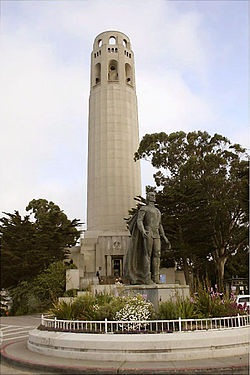
Here’s how it’s happening: The formation of a multi-neighborhood coalition to oppose fee increases at the Arboretum leads to a bigger coalition to oppose artificial turf  fields in western Golden Gate Park, which leads to an even-bigger coalition placing a policy statement against the privatization of Coit Tower on the ballot and winning.

These are important indications of a broad dissatisfaction with the endless private-public-partnership ( in which all the costs are public and all the profits are private) babble from Rec and Park.

The submission by a broad based coalition of more than 30,000 signatures to place the 8 Washington on the ballot — the first land-use referendum in decades — is an incredibly important achievement, and shows the popular sentiment against much of the City Hall happy talk about development on the waterfront.

But it was the unanimous ( yes, unanimous) vote by the Board of Supervisors last Tuesday to hold California Pacific Medical Center accountable for its constant shape shifting  on its massive project at Geary and Van Ness that shows, perhaps, the outline of the potential future of the balanced-growth movement in San Francisco.

Six supervisors stated their willingness to turn down the environmental impact report on the project unless Sutter/CPMC committed to a project that addressed not only the promise to keep St. Luke’s open for at least 20 years but also hired more San Franciscans, corrected the traffic nightmare predicted for Geary and Van Ness, provided more affordable housing for its own low-income new workforce, and committed  to cap the city’s health care costs as a result of CPMC’s market control the new project would create.

There is always the possibility that the two-week delay will go nowhere, but this kind of talk from this Board of Supervisors to a huge private developer simply has not occurred in the recent past.  No one from Room 200 showed up to twist supervisors’ arms in favor of Sutter.  Sutter was on its own and got rolled.

The coalition that fought Sutter to a standstill at the board, that defined the inadequacies of  the project listed by the supervisors, was a multi-neighborhood, multi-issues organization composed of community, neighborhoods, and labor. Middle class “Baja” Pacific Heights residents and low income seniors from Bernal Heights, non-profit affordable housing advocates and trade unionists, tenant organizers from the Tenderloin and Sierra Club members from the Haight-Ashbury; single moms from the Bayview and Filipino youth from the South of Market.

It was a San Francisco coalition, one that has been working together for nearly three years, blending issues, making concessions to one another and staying together.  A group like this with a set of demands such as these has not prevailed at City Hall for nearly a decade.  It still may not, indeed the chances are slim that its full demands will be achieved.

But this group moved the Board of Supervisors in a way not seen in years.  If the folks mobilized about our parks and the folks mobilized about our waterfront and the folks mobilized about CPMC get together, we have something very big happening. And it might be just in time to make a real difference.
It reminds me of an old saying: “ The people alone are the makers of world history.”

Trust the police?

11

yael@sfbg.com

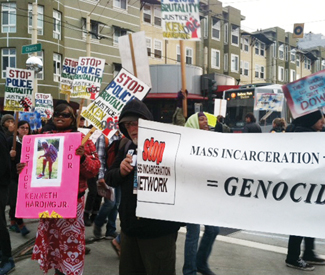
On July 16, 2011, Kenneth Harding Jr. lay bleeding on the ground. He was surrounded by San Francisco Police officers, who were in turn surrounded by neighbors and community members. The minutes ticked by and no ambulance arrived. After 28 minutes, Harding was dead at 19. The official story: after being stopped in a Muni fare check, Harding ran from police, drew a gun, and shot himself.

A year later, family members and community supporters maintain that the official story is a lie. A protest on his death’s anniversary this week shut down Muni service for an hour in his honor.

But protesters weren’t speaking of just Harding. Since he was killed by law enforcement officers, so were Charles Hill, Alan Blueford, and Derrick Gaines. All have led to varying degrees of protest that feed tensions between the cops and segments of the community.

Hill’s fatal shooting by a BART cop in San Francisco sparked last summer’s OpBART demonstrations, the energy from which flowed into early manifestations of the Bay Area’s Occupy movement, which was also marked by tense standoffs with cops that were followed by “fuck the police” marches throughout the Bay Area.

Despite such lingering tensions, Mayor Ed Lee recently suggested curbing gun violence by giving cops stop-and-frisk authority, a controversial idea that has been the subject of massive protest movements in New York City where what critics say is widespread racial profiling heightens tensions between police and communities of color.

Lee’s idea was widely criticized, triggering the Board of Supervisors to pass a resolution on July 10 criticizing the idea, urging Lee to abandon it, and saying it would destroy trust between the community and police.

There has always been tension in San Francisco between police and segments of the community, but a series of emotional, high-profile episodes and unsatisfying official responses over the last year has frayed that relationship even more than normal.


HARDING’S CASE

When Harding was killed, his mother Denika Chatman moved from Seattle to San Francisco. She wanted to convict the officers she believes murdered him. But the SFPD announced within weeks of the shooting that Harding had shot himself.

Now, Chatman and attorney John Burris have filed a federal lawsuit. “I know that it was murder,” she said. “I know his human rights had been violated.”

Chatman and other family members and friends maintain that when Harding was stopped while off-boarding the T train by SFPD officers and asked for proof of paying the $2 fair, he was unarmed. Harding ran, and those officers drew guns and shot him.

Police say that Harding had pulled out a gun as he ran and shot at police, prompting their return fire. They didn’t recover a gun at the scene, but after a weeklong “community effort,” police say a neighbor turned in a gun found at the scene.

The gun shot .38 caliber bullets, police reported—smaller than the .40 caliber bullets in a standard-issue SFPD weapon. The police crime lab then concluded Harding’s fatal wound was from a .38 caliber bullet, a finding confirmed later by the Office of the Medical Examiner.

A widely circulated video show’s Harding on the ground, bleeding to death, as police stand around him.

But as SFPD spokesperson Carlos Manfredi tells it, “The officers did not just stand around. Officers had just been involved in a violent confrontation, they were fearful for their lives…A hostile crowd began surrounding the officers.”

“It wasn’t until more officers arrived on scene to assist the primary officers and prevent them from being surrounded by a hostile crowd that could have potentially escalated the situation. Not to mention, the ambulance would not be able to enter a violent scene that could potentially put their lives at risk, until we feel it is safe,” he said. “Remember, the officers did not know if Harding was laying under the gun. Approaching an armed gunmen who was shooting at officers is extremely dangerous and life-threatening.”

But many say the police shouldn’t be afraid of the community it patrols. When Chatman moved to the Bay Area, she says, she found a community in Bayview-Hunters Point. She also found support in a movement against police violence, made up largely of grieving mothers.

When hundreds marched in San Francisco demanding that George Zimmerman be charged with murdering Trayvon Martin in Florida, Chatman joined other African American mothers in condemning police killings of their sons. Since Martin’s death, similar deaths have continued in the Bay Area.

Alan Blueford, 18, was killed May 6 in Oakland three weeks before he graduated high school. Derrrick Gaines was 15 when he was fatally shot June 5 in South San Francisco. Each case feeds anew the fears and resentments some communities feel toward the police.


POLICING THE COMMUNITY

Some Occupy reactions continued a tradition of a certain type of radical response to police: just get them out. For many, police are like foreign occupying forces in neighborhoods, afraid of locals they don’t understand and willing to shoot to kill in mildly threatening situations. Harding and Gaines were running away when they were shot; Blueford was allegedly wielding a screwdriver. In all these situations, shooting to wound likely would have sufficed for self-defense.

When asked how she would like to see police interact differently with Bayview-Hunters Point residents, Chatman didn’t see much potential. “Not at this point,” Chatman said. “There’s been too many murders. Things would have to change drastically. And the mayor trying to implement a stop and frisk? Kenny is a worst example of stop and frisk and racial profiling.”

Indeed, at the end of a tense year, Mayor Lee’s idea of adopting the stop-and-frisk tactics used in New York and Philadelphia has been met with intense dissent. Sup. Malia Cohen — whose District 10 includes Bayview-Hunters Point — and former Mayor Willie Brown, two of the mayor’s supporters, immediately came out against the idea.

“San Francisco should remain focused on community policing that values both law enforcement and building relationships with communities who live with gun violence. Anything less would undermine decades of hard work in building trust between local law enforcement and our neighborhoods,” she wrote in a San Francisco Chronicle op-ed.

Even the SFPD is wary of the idea.

“We are not passing stop and frisk,” Manfredi told the Guardian. “It’s not even an option on the table for the department. We’re using the same method we’ve been using this whole time: probable cause and reasonable suspicion.”


A TROUBLING PATTERN

The anniversary of Harding’s death comes a week after the Malcolm X Grassroots Movement released a highly circulated report that concluded an African American is killed by a police officer or someone “deputized to act in their name” every 40 hours.

“We call [the killings] ‘extrajudicial’,” the report notes, “because they happen without trial or any due process, against all international law and human rights conventions.” The report notes that only nine people have been charged in the 110 killings it looks at, and none convicted.

On paper, San Francisco isn’t having a particulary bad year. Manfredi said there have been “two officer-involved shootings and at least one was a fatality” so far in 2012. That’s compared to eight officer-involved shootings with three fatalities in 2011 and 14 officer-involved shootings with three fatalities in 2010.

But community perceptions and unease can linger for a long time when incidents don’t seem properly investigated or atoned for.

“It’s very alarming. Especially the rate that it’s happening at. And anybody is paying attention, they’re starting use all the same stories for all these young black teenage males that they’re murdering,” Chatman said.

Alan Blueford, 18, was killed by Oakland Police on May 6. He was confronted by police on suspicion of hiding a gun and ran away. Police first said he had drawn a gun and shot an officer as he ran; an investigation later revealed that the officer who was injured shot himself in the foot. There has been no evidence uncovered that Blueford had a gun.

A month later, Derrick Gaines, 15, was confronted by South San Francisco police, again for looking suspicious. Police say he ran away and drew a gun, and that they needed to fire in self-defense. At a community speak-out July 13, Gaines’ mother, Rachel Guido Red, said she had just received the coroner’s report. It’s conclusion? “Derrick was shot in the back.”

She related what she believes happened: “He was running. He was scared. He was tripped by the officer, and he didn’t have a chance to pick himself up because this man played judge, jury, and executioner.”

Over and over, police investigations clear the cops of wrongdoing, as an investigation of Hill’s shooting on a San Francisco BART platform recently did. Chatman said lawsuits like the one she filed are often the only way to seek justice.


DEMANDS FOR CHANGE

Chatman wants to see shoot-to-kill policies changed. “I would like to see a bill passed making these people responsible for murder,” she said. “And then maybe they’ll start going back to original ways, of maybe wounding somebody, firing a warning shot, or doing something to injure the person, instead of shooting to kill. Because now they all come with their guns drawn. How come every police man there has to shoot? Why do they all have to shoot? Why can’t one officer shoot, and just shoot to wound?”

Manfredi said the policy isn’t shoot-to-kill, but it isn’t shoot-to-wound either. Instead, it’s to aim for “center mass” (the torso area) and shoot until there is no longer a threat. “We never, ever had a shoot to kill policy,” he said. “We shoot to stop the threat. And once we assess the threat and realize there’s no longer a threat, then we stop.”

Sharen Hewitt, founder of the Community Leadership Academy and Emergency Response Project (CLAER) is also indignant about Harding’s murder. “I don’t think that I should pay for Kenneth Harding to be shot down in my streets because he didn’t have two dollars,” she said.

In her decade of work with CLAER, Hewitt has overseen many projects that improved conditions for families whose children were killed by police, from funding funerals for families who can’t pay to bury their dead to counseling for family members other than biological parents of murdered kids. CLAER also sends emergency responders to sites of murders.

“We thought it was important to deal with the immediacy of the homicide and provide support so we could mitigate the possibility of retaliation,” Hewitt said.

Hewitt also has ideas for how to increase trust in police. “They need to understand the nuances, so they see Johnny with the hoodie on and know, he’s a star quarterback. I’d like to see my cops, paid by my tax dollars, not going to Sonoma County to spend them. One day the officer might be out running and he’ll have a hood on, and he’ll understand the nuances of what people are going through,” Hewitt said. She also advocates for housing set-aside for police in every neighborhood, insuring that officers live in neighborhoods they patrol.

We asked Manfredi about this idea. “I’m a big proponent of having officers live in the community where they work, because then they can engage with the community,” he agreed. But, he said, “one of the major issues about San Francisco, the cost of living is extremely high. To buy a home out here, we’re talking in the millions of dollars. That’s just too expensive.”

He said that to make the idea work, the city would need to “implement some type of program or plan where they offer discounts for public officials so they can afford to live in the city.” He explained that even in less expensive areas like Bayview and Sunnydale, the cost of housing would be too high for police officers to raise a family.

The current entry-level salary for SFPD officers is $88,842 to $112,164. By comparison, the median household income in San Francisco is about $71,000. According to city-data.com, the median household income in Bayview is $47,147. In Sunnydale, Hewitt’s neighborhood, that figure is $33,641. “I would say, the police are part of the community,” Hewitt said. “And they must be held to community standards. What I’d like to do is make it part of common thought that they are perceived as community members.” She said the African American community has differing ideas on how to address police-related problem, but the tension is widely felt. “It’s not like the black community is monolithic,” she said, “although we are bearing the collective brunt.”


Guest opinion: RCV is good for progressives

52

Since San Francisco began using ranked choice voting in 2004 and public financing of campaigns in 2002, the city has been a leader in the types of political reform badly needed at state and national levels. People of color today have an unprecedented degree of representation and progressives are a dominant presence in city government. Elections are being decided in November, when turnout usually is highest, and the combination of public financing and deciding races in one election minimizes the impact of independent expenditures and Super PACs .

Yet progressive stalwart Calvin Welch, whose work we have long admired, recently authored a Bay Guardian oped against RCV. His charges against RCV are as wrong today as they were when he first made them 10 years ago when he opposed RCV on the ballot. And given the horrible Supreme Court ruling known as Citizens United, which has opened the floodgates on corporate campaign spending and did not exist when San Francisco last used separate runoff elections, returning to two elections is a direct threat to the future of San Francisco progressivism. 

The most serious of his claims is that RCV favors “moderate to conservative candidates” because “left-liberals do very well in run-off elections” since “in low-turnout elections, left-liberals vote more heavily than do conservatives.” He cites the 2000 supervisorial races and 2001 city attorney race, in which “the more liberal candidate for City Attorney, Dennis Herrera” bested “Chamber of Commerce functionary Jim Lazarus.” He asserts “that’s a verifiable San Francisco political fact.”

But San Francisco State University professor Richard DeLeon, author of the acclaimed book of Left Coast City about San Francisco politics, debunked that claim with real election data in his 2002 paper, “Do December runoffs help or hurt progressives?”

He found that in the November 2001 city attorney election, for every 100 voters who turned out in progressive precincts, 107 turned out in conservative precincts. But in the December 2001 runoff, for every 100 voters who turned out in the progressive precincts, 126 turned out in the conservative precincts, an 18 percent increase. Wrote DeLeon, “This dramatic increase in the ratio of conservative to progressive voters occurred despite (or perhaps because of) the 44 percent drop in voter turnout citywide between November and December.”

He continued: “If San Francisco had used [ranked choice voting] in November, Herrera most likely would have won by an even greater margin. In November, the liberal/progressive candidates for city attorney won a combined 60 percent of the vote…In the December runoff, however, Herrera won with only 52 percent of the vote. Thus, due to the proportionally greater decline in progressive voter turnout, Herrera probably lost approximately 8 percent of his potential vote, making the election close.”

DeLeon also rebutted Welch’s citation of the supervisorial races in 2000 as ones that demonstrated a progressive advantage in low-turnout runoffs, writing:

 “Progressive success that year was NOT due solely to a one-time surge in turnout among progressive voters…Many powerful forces converged in that election, not least the anti-Willie Brown backlash, the cresting of the dot-com invasion, and the return to district elections, which forced despised incumbents to stand trial before angry neighborhood electorates.”

DeLeon concluded:  “Based on the evidence presented, I conclude that December runoffs have hurt progressive voters, candidates and causes in the past and (absent same-day runoffs) will continue to do so in the future, even under district elections.”The Bay Guardian cited Professor DeLeon’s study in March 2002 (see  and scroll down to “A is OK”), and Mr. Welch is ignoring these results today just as he did then.

Certainly progressives haven’t won 100% of RCV elections — should any political perspective? — but they have done well nonetheless, electing  Bay Guardian-endorsed candidates like John Avalos, David Campos, Eric Mar, David Chiu and Ross Mirkarimi, despite those candidates not being incumbents. Other progressive incumbents first elected before RCV elections, like Aaron Peskin, Chris Daly, and others, were re-elected under RCV. And Mirkarimi was elected citywide in the sheriff’s race. On  the flip side, progressive Eileen Hansen most certainly would have beaten moderate Bevan Dufty in a November RCV contest for D8 supervisor; instead she lost in December after finishing first in November.

What’s actually at stake here is how we define progressivism. Since we began using RCV in 2004, 8 of the eleven members of the Board of Supervisors come from communities of color, a DOUBLING from pre-RCV days. At the citywide level, all seven officials elected by RCV come from communities of color. So out of the 18 elected officials in San Francisco, a whopping 15 out of 18 come from communities of color, the highest percentage for a major city in the United States.

The proposed repeal amendment would launch low-turnout September elections in San Francisco. In fact, the December 2001 city attorney race in which Welch cites as exemplary had a turnout of 15 percent of registered voters, the lowest in San Francisco’s history. New York City’s last September mayoral primary had a turnout of 11.4 percent. In Charlotte NC (population 750,000, similar to San Francisco) its last mayoral primary had a turnout of only 4.3 percent. Cincinnati had a September turnout of 15 percent, and Boston and Baltimore had September mayoral primaries with turnout in the low 20s. Many cities in Minnesota have September primaries with extremely low turnout; the two largest cities, Minneapolis and St. Paul, have switched to RCV largely to eliminate September primaries.

Research has demonstrated that voters in low turnout elections are disproportionately more conservative, whiter, older, and more affluent; those who don’t participate are people of color, young people, poor people — and progressives. So having a mayoral race in a low turnout September election has real consequences not only on voter turnout but on the demographics of the electorate.

While we share the priorities of Welch’s progressive economics, we believe progressivism must be more inclusive, especially if it wants to enjoy the support of these burgeoning demographics. While disappointed by the lack of progressive achievements of President Barack Obama, we still view the election of the first African American as president as a major progressive achievement.

Finally, we would assert that the ranked ballots used in RCV have been important for San Francisco democracy. Just look at the recent “top two” primary on June 5, and you can see the defects of the methods proposed to replace RCV. In many races across the state – including in the Marin County congressional race where progressive Democrat Norman Solomon lost by 0.2 percent — too many spoiler candidates split the field and candidates got into the top two with extremely low vote percentages, some as low as 15 percent of the vote. In one race where there was a Latino majority and a solid Democratic district, the Democrats ran so many candidates that the Democratic vote split and two white Republicans made the runoff with low vote percentages.

San Francisco risks such elections if we get rid of RCV. Think of the last mayoral election, and the choice for Asian voters if we used single-shot plurality voting instead of RCV. Which Asian candidate would they vote for with their single-shot vote — Lee, Chiu, Yee, Ting, Adachi? What kind of vote split might have occurred? And to avoid that, what kind of backroom dealing would have occurred BEFORE the election to keep that many candidates out of the race to prevent that vote-splitting?  We saw such vote splitting in the 2003 mayoral election as well, with various progressive candidates running and splitting the progressive vote. Going back to plurality elections would be damaging for constituencies that often run multiple candidates, such as the Asian and progressive communities.

RCV has been good for San Francisco, and we should keep it. For those who would like to see a runoff in mayoral races, Board president David Chiu has proposed a compromise that, while increasing the costs of running for mayor, is far better than the repeal measure for September elections. Chiu’s proposal would keep RCV to elect the mayor, but with a December runoff if no mayoral candidate won a majority of first rankings in November. The 2011 mayoral election would have gone to a runoff, with John Avalos as Ed Lee’s opponent.

San Francisco progressives should embrace a view of progressivism that is inclusive, promotes higher turnout and is based on a politics that is looking forward instead of backward to some golden age that never existed. Ranked choice voting and public financing are two parts of the puzzle for ensuring a vibrant progressivism.

Steven Hill led the campaign for ranked choice voting in San Francisco, and Matt Gonzalez was President of the Board of Supervisors and legislative author of the RCV charter amendment. See www.SFBetterElections.org for more information


Guardian Voices: Stop and Frisk didn’t work last time

5

Mayor Lee’s musings before the Chronicle editorial board, in which he revealed his thoughts about instituting a “stop and frisk” policy in San Francisco, set off a very quick negative responses from two of his high-profile supporters in the African American community, Willie Brown and Supervisor Malia Cohen. But that’s only part of the surprise the mayor will face if he pursues this policy.

It wasn’t a real good week for Mayor Lee, who seemed to repeatedly trip himself up:

— In  the chat about stop and frisk;
— In the admission at a Board of  Supervisors hearing by Sutter/CPMC that the economic modeling of the hospital chain’s proposed  project so undermined key elements of the deal that Mayor Lee demanded that it be redone;
— And in his testimony before the Ethics Commission on the Mirkarimi case that brought specific charges of  perjury he has yet to answer.

But the stop and frisk was the most sobering of the three, for it shows a fundamental misunderstanding of the very nature of the city that he seeks to govern and an astounding insensitivity to its not-too-distant past.

The last time stop and frisk was implemented by the San Francisco Police Department was in 1974, at the height of the “Zebra” murders during which, over a six-month period from the end of 1973 to the beginning of 1974, 16 whites were murdered and another six wounded (one of whopm was a young Art Agnos) in shootings using a similar caliber hand gun. What made sensational headlines was the fact that the six survivors all agreed that the shooters were  black. 

Mayor Joe Alioto, facing a steep decline in tourist visits to the city and a drumbeat of headlines, surprised eferyone by announcing a stop and frisk policy aimed at young Black males. Within the first week some 500 stops were made. Not a single Zebra suspect was found.

The San Francisco NAACP and ACLU quickly filed suit in Federal Court where the policy was banned as being un-Constitutional racial profiling. The Zebra case was broken using the time tested technique of offering a reward for information. An informant stepped up, and in the summer of 1974, four men were arrested based upon his information. In 1976 the four men were convicted –and the stop and frisk policy had nothing to do with either their arrest or conviction.  Nothing remained of the failed policy for 38 years.

What did remain was a deep and bitter memory of stop and frisk in the San Francisco African-American community — a memory neither Willie Brown nor Malia Cohen forgot.

If the mayor really believes that stop and frisk will work in the face of deep seated community resentment, based on actual local historic experience – for his remarks were all about “getting the guns” off the street in African American neighborhoods — then he has a profound misunderstanding of the nature of San Francisco.

San Francisco is perhaps one of the two or three most humanly diverse cities in North America. There is a bewildering mix of humans in our city, which confronts any policy based upon appearances — such as stop and frisk — with complexities that often render its actual use on the street ineffective. Simply stated, people are not as they seem in San Francisco, and many San Franciscans prefer to live no other way. Good cops understand this and work hard to learn who is who on the street. That’s called community policing and it often works in San Francisco.  

But many times it doesn’t. Let me tell you a personal story.

During the school year, I try to pick up my two grandsons, Jalius and Jacob, every Tuesday. We spend some time together walking from their school, George Peabody, in the Inner Richmond, to the 33 Stanyan bus stop at Clement and Arguello for a bus ride back to the Haight-Ashbury. We walk and talk and then wait for the bus and talk some more.

A few months ago, we were waiting for the bus, the boys sitting on the bench, me standing and talking. I noticed a cop across the street doing a foot patrol, talking to merchants and customers. He kept looking at us. He was Chinese and my grandsons are half Chinese.  Finally, he walked over to us and with a polite smile asked me why was I talking to these children.

I had an idea that was why he came over so I was expecting the question. I smiled back to him and said, proudly, “these are my grandsons, Jalius and Jacob”.  He looked at me and then turned to the boys and said “is he?” They said “yes” and he looked back at me and said “just doing my job,”  and turned and walked away.

And what a tough job it is as people are often other than they look in San Francisco. Old white men are not always what they seem, and young black men are not always what they seem, no matter how low they ware their pants. Policies based upon things being exactly as they appear will be overwhelmed by the human reality of the City of St. Francis.

There is a connection between people in this physically compact city of ours that forms a foundation for a common political outlook when it comes to personal and group rights and freedoms. San Francisco is a center-left city on matters of civil and human rights. Local elections have shown time after time that on civil and human rights the usual political divisions between the various parts of San Francisco don’t obtain. Trying to push a center-right stop and frisk policy on San Francisco will politically isolate Ed Lee, making all other parts of his agenda that much more difficult to accomplish. And as a city we need to get some big things done, quickly. Let’s move on, together, and get them done.

Brown, Pak, and Olague

38

Christina Olague was a great planning commissioner. I’ve always liked her, and when she was appointed we pointed out how strongly she was rooted in the progressive community.

Olague has strong progressive activist credentials, from working with the Mission Anti-Displacement Coalition to protect low-income renters during the last dot-com boom to her more recent community organizing for the Senior Action Network. She co-chaired the 2003 campaign that established the city’s minimum wage and has been actively involved in such progressive organizations as the Milk Club, Transit Riders Union, and the short-lived San Francisco People’s Organization.

She also served two terms on the Planning Commission — appointed by Board of Supervisors then-President Matt Gonzalez in 2004 and reappointed by then-President Aaron Peskin in 2008 — where she was known for doing her homework on complicated land use issues and usually landing on the progressive side of divided votes.

We’ve had some disagreements since she took office — particularly around 8 Washington. (I also disagreed with the Labor Council on that one, and only three of the supervisors agreed with me.) And it’s not the first time an elected official I supported turned around and infuriated me on a development vote.

I want Olague to succeed; I want her to come to us in the fall with a record that makes us want to endorse her for a full four-year term. She’s been talking seriously about violence in the district and about young people, predominantly African Americans, getting killed. I feel like she wants to do the right thing.

But her reelection effort is starting to feature some bad actors.

At a recent fundraiser in Chinatown, former Mayor Willie Brown, who ranks as one of the most corrupt public officials in modern San Francisco history and whose administration was a disaster for poor and working-class people (he once even said that poor people ought to just get out of town because this city is too expensive for them), stood up and made a speech, warmly endorsed Olague and said he would be with her “all the way.” Olague then thanked Rose Pak, the Chinatown power broker, for “all of her support over the last few months.”

This makes me nervous. And it hasn’t helped my nerves that I’ve been trying to talk to Olague about these issues for the last week, and she keeps avoiding the conversation by not returning calls or cutting conversations short when I do reach her.

Willie Brown, with his Chron column, has taken on this funny, warm, man-about-town persona, but when he was running City Hall, everything was about money. He cut deals right and left that destroyed communities and neighborhoods. He oversaw, aided and encouraged what we called the “Economic Cleansing of San Francisco.” Tens of thousands of working-class people, artist, writers, young people … were driven out of the city by a steamroller of gentrification — all with the mayor’s blessing.

Now he’s working as a private attorney, and last time we checked was getting $200,000 a year to represent PG&E. We have no idea what other big corporate clients he has or what he does for them — but it’s clearly not writing legal briefs and handling litigation. He gets paid for being a political fixer. For the bad guys.

And he’s going to be with Olague “all the way.”

Damn.

Why does the mayor appoint supervisors?

16

The Alameda County Board of Supervisors just found a replacement for Nadia Lockyer, who resigned in April (“amidst a drug and sex scandal,” the Chronicle notes, and you know how much journalists love to use that phrase). The four remaining members of the board deadlocked for a while, then settled on Union City Council member Richard Valle.

All of which makes me wonder, as I often do: Why does the Mayor of San Francisco get to fill vacancies on the Board of Supervisors?

Other county boards fill the vacancies themselves — and if you don’t think the SFBOS can handle that, remember that every two years the 11 contentious folks choose a president, and it doesn’t take more than a few hours, and not that long ago, they chose a mayor.

I don’t know any other situation where the executive gets to choose legislators. The governor doesn’t fill seats in the state Assembly. The president doesn’t fill vacancies in Congress. There’s an important balance of powers issue here, and it has played out to the detriment of democracy in the past. At one point, more than half of the sitting supervisors had been appointed by Mayor Willie Brown. There was no balance; the mayor called all the shots.

Imagine if, instead of the mayor secretly huddling with advisors and choosing a new supe, the Rules Committee took applications and nominations and then the full board, in open session, debated and discussed and voted. The outcome would reflect the much broader perspectives of 10 district supervisors — and the person chosen would owe a debt to all of his or her colleagues, not to the mayor.

You can make a good case that the mayor ought to fill vancancies in other elected offices (sheriff, city attorney, public defender etc.); those are, at least arguably, executive offices. Although I could also make the case that the 11 district-elected supervisors should make those calls.

But that’s a different issue. The clear and obvious anomaly here is that San Francisco’s chief executive gets to choose his own legislators in the event of a vacancy — and that’s just wrong.

Now, in Alameda if they can’t reach a decision, the governor steps in. In San Francisco, with 10 voting supes, it seems highly unlikely that we’d ever see a long-term deadlock, but the mayor could step in the break the tie in that case — or some other city official could, or you could come up with a dozen other solutions. The bottom line is that most of the time, as in Alameda, the board would come to if not a consensus, then a majority vote.

Who’s up for some Charter reform?


Reading Ed Lee’s mind

15

Political reporters love to believe we can read politician’s minds; it makes us feel important. (And Lord knows, these days we need something to make us feel important.) So let me go way out on a limb here and tell you what Mayor Lee is thinking right now:

1. Gotta minimize Prop. B. It was an aberration, a bunch of rich Nimbys from Telegraph Hill, nothing more to see here. Certainly not a public referendum on my Rec-Park director, Phil Ginsburg, and his efforts to make money by renting out city parks for private events. No no no, just ignore it and maybe it will go away.

2. We won back the Democratic Party. Good move to take a page from Aaron Peskin’s book and run a bunch of elected officials and former elected officials with high name recognition in a low-turnout election. Bevan Dufty, who happens to work for me, would make an excellent chair; should be easy to make that happen.

3. What if we look at the DCCC race in the 17th District as a first-pass primary for the 2014 Assembly seat when Tom Ammiano — who’s just way too independent and won’t get with my program — is termed out? Hmmm … David Chiu, who I can mostly deal with, is in first place — but John Avalos and David Campos are more popular than my pal Scott Wiener. And if the progressives get behind Campos, he’ll be tough to beat. Hmmm….

4. That oddball Michael Breyer ran for Assembly pretending he was me. He even put out a mailer with my mustache on the front suggesting that he’ll be just like I am (except that he’s white and has no experience and no credible program and isn’t going to win). But he got a lot of votes with the Ed Lee card and I could totally control him. Can’t support him over Phil Ting, of course, but maybe I can get him some help behind the scenes.

5. This was an unusual election with radically low turnout. I know I can’t read too much into it. If the DCCC were on the ballot in November, or if there were a real presidential primary to bring people out to vote, the results would be very different. But still: All that new housing for rich people that my mentor Willie Brown and my friend Gavin Newsom got started seems to be having an impact. The city’s getting more conservative. Let’s just keep that one going and I’m home free.

6. What’s up with Lincecum? Damn those Padres.

Nah — the mayor’s too nice a guy to be thinking like that. Right?


The funny money against Prop. B

19

Credit where it’s due: My competitor and sometimes journalistic adversary Joe Eskenazi has a nice little piece on the weird money behind the campaign against Prop. B, a policy statement about the privatization of Coit Tower. He points out that such varied groups as the California Dental Association and the San Manuel Band of Mission Indians have coughed up money to protect the right of San Francisco officials to close Coit Tower to the public and rent it out for fancy corporate parties.

And how exactly did that happen?

Well, Eskenazi manages to tie Willie Brown into it. (He also calls this “Nimby against the Swells,” which isn’t quite fair — I don’t think the supporters of Prop. B are trying to keep anything out of their back yards. If anything, they want more noisy tourists and fewer quiet, subdued rich-people events. And I don’t think the “swells” are against it as much as the mayor, his Rec-Park director and big businesses that generally back the privatization of public resources.)

But there’s another interesting twist: I’m not sure the folks who gave to the Golden State Leadership Fund Political Action Committee, which is running a No on B independent expenditure, had any clue where their money was going.

Sure, the Chamber of Commerce and BOMA know what’s up, and it’s pretty clear why they like the idea of raising money for the parks by holding exclusive private events instead of by raising taxes. But the Indians? And the dentists? By what possible stretch do they care about a San Francisco ballot measure that has nothing to do with Native American rights or oral health?

Eskenazi may be right — maybe Brown called the Indians and asked, and they threw the money his way to help his buddy the mayor (while keeping the mayor’s fingers out of this particular political pie). But the Golden State Leadership PAC, through which all this money flowed, has been around for years and gives money to candidates all over the state. (It’s definately something of a slush fund for local races — files in the Secretary of State’s office show that in 2008, money from Pacific Gas and Electric Co. flowed in and out of the PAC as it ran a campaign against the San Francisco public-power measure, Prop. H. PAC money went to David Chiu, Phil Ting and Ed Lee for mayor.) It’s based in West Hollywood and the treasurer is a guy named William Molina.

I called the San Manuel Band of Mission Indians and the California Dental Association and asked them why there were helping fund a campaign against Prop. B in San Francisco. The press person at the dental group apparently had no idea what I was talking about and asked for more details about the contribution. I gave her the date and the PAC and I haven’t heard back.

The Indians didn’t seem to clear on Prop. B, either. Kenneth Shoji, a spokesperson for the group, told me by email:

The San Manuel Band of Mission Indians made a contribution of $25,000 to the Golden State Leadership Fund PAC with the expectation of helping to support candidate(s) for public office in the 2012 elections.  We do not control where or how the PAC might extend its support beyond that.

In other words: This Coit tower thing is news to us.

UPDATE: I got essentially the same message from the dentists. Alicia Malaby at the CDA writes:

 When an organization such as CalDPAC contributes to an independent expenditure committee, that committee may spend money on races and issues that CalDPAC supports, but may also spend money on other campaigns. CalDPAC does not control how those committees spend money, and in this case, CalDPAC has no interest in and no position on Proposition B.

UPDATE TWO: Ron Cottingham at PORAC just called me and said his group has no position on or interest in Prop. B. The money that went to the PAC was earmarked to support Rob Bonta for Assembly in the East Bay. Presumably the PAC folks keep track of such things.

Maybe not. Maybe Willie or someone else made a call. It happens all the time.  I mean, somebody clearly was raising money for this PAC, which right now isn’t doing a hell of a lot besides No on B in San Francisco. (Oh, I called Brown, too. He hasn’t called back. He never does. I still always try.)

Either way, it’s a classic San Francisco political story — and it reflects how muddy and corrupt local politics can still be, even in an era of electronic disclosure and ethics laws. Why, if the dentists and Indians don’t like Prop. B, didn’t they (or any of the others in the PAC) create a No on B committee, disclose who was behind it and let the voters know a little more about the real money trail? Why funnel all this cash through a little-known Southern California PAC?

And for that matter, why is there a sudden influx of late money in this race? Has the mayor and the Chamber types suddenly discovered that Prop. B might pass — and might set a precedent against future privatization efforts?

June 5 is Election Day. Vote early and often.


Sunshine eclipsed

1

As an advocate for the passage of the San Francisco Sunshine Ordinance in the early 1990s, I felt obligated to take my first and only City Hall position and serve as a founding member of the Sunshine Ordinance Task Force. I served for l0 years and helped with many other good members to build the task force into a strong and respected agency for helping citizens get access to records and meetings and hold city officials accountable for suppressing access and information.

The task force is the first and best local sunshine task force of its kind in the country, if not the world. It is the only place where citizens can file an access complaint without an attorney or a fee and force a city official, including the mayor, to come before the task force for questioning and a ruling on whether they had violated sunshine laws. The task force lacked enforcement powers, but it still annoyed city officials, including Mayor Willie Brown.

In fact, Brown spent a good deal of time trying to kick me off the task force. He used one jolly maneuver after another, even getting an agent to make a phony complaint against me for violating the ordinance with an email (The complaint went nowhere). I refused to budge and decided to stay on until Brown left office—on the principle that neither the mayor nor anybody else from City Hall could arbitrarily kick members off the task force.

That principle held until about 3pm last Thursday (May 17) at the meeting of the Board of Supervisors Rules Committee to appoint candidates to the task force. At that meeting, without proper notice, advance warning, explanation, apology, or even a nice word or two, the supervisors suddenly turned a normal drowsy committee meeting into an unprecedented bloodbath for the task force and its independence. Sup. Mark Farrell played the heavy, Jane Kim was the facilitating chair, and David Campos was the reluctant third party, working together to bring Willie Brownism back at the task force with a vengeance.

The committee rejected four qualified candidates from three organizations who are mandated by the Sunshine Ordinance to choose representatives for the task force because of the organizations’ special open government credentials. (Doug Comstock, editor of the West of Twin Peaks Observer; Attorney Ben Rosenfeld from the Northern California chapter of Society of Professional Journalists, sponsor of the ordinance; Allyson Washburn from the League of Women Voters and Suzanne Manneh from America New Media.)

The committee without blushing asked the organizations to come up with a “list of names,” a whiff of grapeshot aimed at members and organizations who had served the public well for years. Who wants to go before the supervisors on a list of names for a bout of public character assassination? Meanwhile, while knocking off the qualified, knowledgeable candidates, the committee approved four neophytes without experience and then unanimously appointed David Pilpel, a former task force member known for delaying meetings with bursts of nitpicking. He almost always comes down on the side of City Hall and against citizens with their complaints.

Farrell also tried to bounce Bruce Wolfe, an excellent member, but Kim and Campos supported him and his name was sent on to the full board for approval.

Then, when Wolfe’s name got to the board on May 22, it was a repeat of Willie Brownism and this time to the max. Sup. Scott Wiener moved to amend the motion and substituted Todd David. Farrell seconded. The vote was 6-5, meaning that Willie Brownism wiped the sunshine slate clean of anybody who would raise a pesky question of city officials and the City Attorney’s Office.

The infamous votes against Wolfe: Wiener (ah, yes, the heir of the Harvey Milk and Harry Britt seat in the Castro), Farrell (where is Janet Reilly when we need her?), Malia Cohen (who comes from the Potrero Hill/Bay View/Hunters Point district that needs all the sunshine it can get in facing an Oklahoma-style land rush of development), David Chiu (who was reportedly angry over the unanimous task force opinion finding he violated the Sunshine Ordinance with late submission of documents before the controversial vote to redevelop Parkmerced), Carmen Chu and Sean Elsbernd (neighborhood supes way out in West Portal and the Sunset who almost always vote the downtown line at City Hall). The good votes for Wolfe: John Avalos, Eric Mar, Cristina Olague, Jane Kim, and David Campos.

Campos told me that the organization candidates were “eminently qualified,” that they should have been appointed, and that he would fight for them. He advised the organizations to “stand by their candidates.” He is urging that the issue of organization candidates come back to the next Rules Committee.

Rick Knee, SPJ’s mandated journalist on the task force surveying the carnage, said the supervisors’ actions stem “partly from a desire by some supervisors to sabotage the task force and ordinance itself, and partly from a vendetta by certain supervisors after the task force found several months ago that the board violated local and state open meeting laws when it railroaded some last minute changes to a contract on the Parkmerced development project without allowing sufficient time for public review and comment.”

Knee is right, and it isn’t just Parkmerced, but all the high-stakes development deals flowing through City Hall these days, with their advocates preferring to cut backroom deals rather than being subjected to the full scrutiny of the public and the task force.

James Chaffee, a former chair of the task force, watched the board proceedings with outrage and fired off a letter to all supervisors later that day. He charged that the board in sacking Wolfe violated the Sunshine Ordinance on several counts. Among them: the board changed the committee recommendation on Wolfe without allowing public comment and it passed over Wolfe even though the ordinance requires at least one member of the task force to be “physically handicapped.” That was Wolfe.

Thus, Chaffee wrote, the orchestrated coup was “the perfect example of a failure to follow the sunshine ordinance that led to the sort of problem that it was intended to forestall, namely the supervisors taking an action without being informed of what they are doing.  If Scott Weiner and David Chiu and the rest of the crew did not consider the citizens the enemy and exercize judgment about whether they were complying with the spirit of open government rather than just shaving off the letter of the law as closely as possible, this could have been avoided.”

Chaffee said he couldn’t tell if David was physically handicapped but he said nothing in his application for the task force nor was any disability apparent from the video of the rules committee meeting.

Chaffee said David’s  application showed he  was “self-employed as an investor, obtained a BA from Stanford in 1993, has never attended a task force meeting, and left the statement of his qualifications blank.”

Chaffee said, “It’s easy to see why Scott Wiener likes him. He said it would be a long road before he would go against the city attorney’s office and when it came to constitutional law, he would place the city attorney’s opinion above his own because the city attorney is an ‘expert.'”

I sent Chaffee’s letter and my Bruce Blog post ( “The return of Willie Brown to the Sunshine Task Force,” 5/21) to City Attorney Dennis Herrera for comment: How can his office sit by while the letter and spirit of the sunshine laws are being violated in the move to sabotage the sunshine ordinance and task force? I also sent Chaffee’s letter, with the Bruce blog, to the supervisors with similar questions: Why  are you violating the sunshine laws to kick out the best candidates? For their answers (coming)  and the latest on this evolving controversy, follow along at  www.sfbg.com/bruce.

There you have it:  the state of sunshine and open government in city hall in San Francisco in May of 2012. Todd David over Bruce Wolfe. David  Pilpel uber alles.  Five inexperienced candidates over five experienced candidates. David Pilpel uber alles. A city attorney who rolls over and over and over again. And a whiff of grapeshot for the three organizations mandated by the charter to have represenatives on the task force  because of their open government and public access credentials (the Northern California chapter of the Society of Professional Journalists, the League of Women Voters, and America New Media.)  On guard,  b3


The return of Willie Brownism to the sunshine task force

35

As an advocate for the passage of the  San Francisco sunshine ordinance and task force in the early 1990s, I felt obligated to take my first and only City Hall position and serve as a founding member of the task force. I served for l0 years and helped with many other good members to build the task force into a strong and respected agency  for helping citizens get access to records and meetings and hold city officials accountable for suppressing access.

The task force is the only place where citizens can file an access complaint without an attorney or a fee and force a city official, including the mayor, to come before the task force for questioning and a ruling on whether they had violated  sunshine laws, The task force lacked enforcement power, but it still annoyed of city officials, including Mayor Willie Brown.

In fact, Willie spent a good deal of time trying to kick me off the task force. He used one jolly  maneuver after another, even getting an agent to make a phony complaint against me for violating the ordinance with an email. (The complaint went nowhere.) I refused to budge and decided to stay on the task force until Willie left office—on the principle that that neither the mayor nor anybody else from City Hall could arbitrarily kick members off the task force. When Willie left office after two terms, I resigned with the hope that the Willie principle had been established.

The principle held, until last Thursday (May 17) when the board’s rules committee (Sup. Mark Farrell, Chair Jane Kim, and Sup. David Campos) brought Willie Brownism back to the task force with a vengeance. The committee moved to sabotage the task force by sacking or refusing to appoint four qualified candidates from three organizations who are mandated by the ordinance to choose representatives for the task force because of the organizations’ special open government  credentials. Their representatives served as experienced, knowledgeable members who were independent counters to nominees of supervisors who were often  promoting an anti-sunshine agenda. The committee asked the organizations to come up with more names. There was no explanation nor apology to the candidates nor to their organizations. It was a nasty slap at members and organizations that have served the task force well for years. And this arbitrary demand  will make  it virtually impossible for these organizations to come up with a “list of candidates” to run the supervisorial gauntlet.  Who wants to go before the supervisors on a list for a bout of public character assassination?

 Specifically, the committee:

+unanimously moved to sack the two incumbents (Allyson Washburn from the League of Women Voters) and Suzanne Manneh (California New Media.)  The League was mandated to name a representative because of its tradition and experience with good government and public access issues.  California New Media was mandated to name a member to insure there would always be a journalist of color on the task force.

+unanimously refused to seat two representatives from the Northern
California chapter of the Society of Professional Journalists, the sponsor of the ordinance with a long tradition in open government and First Amendment issues.  One SPJ  mandated  representative was for a journalist (Doug Comstock, editor of the West of Twin Peaks Observer, one of the best neighborhood papers in town and a former chair of the task force.) The second mandated seat was for an attorney (Ben Rosenfeld.)

+tried to knock out incumbent Bruce Wolfe on motion of Farrell, but Wolfe survived on a 2-l vote.   

+voted unanimously to approve David Pilpel, a former task force member who is known by observers for delaying meetings with is  bursts of lengthy nitpicking on almost every item.   He then usually votes against citizen complaints and for protecting  city officials on the basis of spotting   “onerous” burdens caused by the complaint

+voted unanimously for four new persons to the task force while sacking  and refusing to appoint able members with experience and expertise without a word of thanks. The four new members are “a “a bunch of neophytes,” according Rick Knee, outgoing SPJ member for 10 years.

Knee, a former task force chair surveying the carnage,  said that the committee’s actions stemmed “partly from a desire  by some supervisors to sabotage the task force and the ordinance itself, and partly from a vendetta by certain supervisors after the task force found several months ago that the board violated local and state open meeting laws when it railroaded some last minute changes to a contract on the Park Merced development project without allowing sufficient time for public service review and comment.” He noted that the developer “had slipped in a 14-page package of amendments at the llth hour”  to get board approval.

Knee said  that the rules committee is recommending sacking two incumbents and apparently hopes to sack two more. Farrell wanted to push out a fifth but was outvoted by Kim and Campos.  All five candidates, he said,  “have done excellent work, each brought a unique perspective and, while we had our share of disagreements among ourselves, all shared a passion for open government and for making sure that everyone who came before us got a fair hearing.”

Hanley Chan, an outgoing task force member,  backed up Knee’s point in an email. He  wrote that “I spoke with Sup. David Chiu and he told me that the rest of the supervisors will not appoint any incumbent, because we defied the city attorney’s opinion (the Park Merced  case). “”You should have made a right decision. I was told by the city attorney that it was legal, my aides explained it to the task force and you should have made a better judgment.'”  Chan said that the rules committee ouster move  was “retribution on how we voted that day.”  Chan said that “Bruce Wolfe and all the task force members made a wonderful argument and stuck to their guns.” The task force vote was a  unanimous 8-0 vote.The point: defy the supervisors and city attorney and the boys and girls in the back room and  get blasted off   the task force, bang, bang, bang, bang. 

The committee choreographed the move smoothly.  Farrell as the heavy  would make the move. Kim would agree and facilitate as chair. Campos would go along reluctantly. The deputy city attorney would be supine through the process  even though the supervisors were breaking precedent and misinterpreting the ordinance.  Sunshine candidates and advocates in the audience were furious and emails have been crackling back and forth ever since.

Campos later told me that he went along because he could see he didn’t have the votes. He said the organization’s candidates “were eminently qualified,” that they should have been appointed, and that he would fight for them. He said he would ask Kim’s office to set the issue for hearing at the next rules meeting or call for a special meeting. Kim did not return calls for comment.

I asked Campos what the organizations should do. “They should stand by their candidates,” he said.

I concur. The Society of Professional Journalists,  the League of Women Voters, and California New Media and their open government allies should stand by their candidates, lobby for them with the rules committee and the full board, and get out the word about this attempted coup in the most important court of all, the court of public opinion. Make this an election issue with all incumbents and candidates.  Let public officials know there are serious consequences to supporting Willie Brownism on the sunshine task force, the first and best local task force of its kind in the country if not the world.

The good news is that the rules committee has demonstrated, with its sneak attack,  the value of the task force for citizens and open government and why it is a San Francisco institution that needs to be saved and strengthened.  All of this  illustrates once again my  favorite axiom of mine. In San Francisco, the public is generally safe, except when the mayor is in his office and the supervisors are in session. b3


Editorial: The Mirkarimi case is an abomination

97

Editor’s note: And so the man who became interim  mayor on a false pretext and then lied his way through an election for a full term amid a sleazy mass of campaign irregularities and violations, has suspended Sheriff Ross Mirkarimi without pay and is now using the full power of the city attorney’s office to continue the Mirkarimi crucifixion. Without pay? The usual City Hall/cop practice is to suspend or put a city official on administrative leave with pay. Even Willie Brown, former mayor, Chronicle columnist and PG@ES lobbyist, says Mirkarimi should not have been suspended without pay. B3

EDITORIAL There’s only one way to say this: The official misconduct case against Sheriff Ross Mirkarimi has become a one-sided star-chamber proceeding that violates all the basic rules of fairness, decency, and due process.

Over the past few weeks, Mayor Ed Lee, acting through the City Attorney’s Office, has been collecting evidence and issuing subpoenas to force witnesses (including some who have only a peripheral involvement in the matter) to give testimony. The mayor is acting as if he’s prosecuting a murder case instead of conducting a hearing on whether an elected official should be thrown out of office for a misdemeanor.

And Mirkarimi and his lawyers have absolutely no ability to respond.

That’s right: The mayor and the city attorney have subpoena power. The defense in this case doesn’t.

If this were a criminal proceeding, in a real court, Mirkarimi would have the same ability to compel testimony as the mayor. And under the rules of discovery, he’d have the right to see all of the evidence compiled against him.

But because this in front of an Ethics Commission that hasn’t even adopted evidentiary rules, one side has all the rights, and the other side has none. That puts Mirkarimi at a terribly unfair disadvantage. You can argue all day about Mirkarimi’s conduct, but people charged with the worst horrific crimes have more legal protections than he does.

The Ethics Commission needs to immediately adopt rules that level the playing field — and the city attorney should insist on it. If there are going to be witnesses — and clearly the mayor is planning to present them — then Mirkarimi’s lawyers must be allowed to review those statements in advance, as they would in any trial. All evidence against the sheriff should be turned over to the defense, well in advance of the hearing. Until that happens, the mayor and the city attorney should put the inquiry on hold.

Because right now, the process is an abomination.

Guest opinion: It’s not about Mirkarimi, it’s about us

70

Virtually unmentioned in the torrent of words that have flowed over the Ross Mirkarimi false imprisonment, suspension and pending vote to determine his removal by the Board of Supervisors is any reference to what should now be the most important issue to be considered as the sad saga unfolds: the fact that Mirkarimi was, just four months before his removal, elected by a majority vote and his removal from office would simply set aside that vote, diminishing all of our cherished beliefs about “majority rule.”

Mirkarimi didn’t just win, he won big. He beat the second place candidate by nearly 19,000 votes, winning outright without the need for the magic of instant run-off. Mirkarimi got more first place votes than did Ed Lee (70,204 vs. 59,663). Moreover, Mirkarimi’s election was without controversy, complaint or charge of illegality, unlike Ed Lee’s, which resulted in a total of 25 misdemeanor convictions for illegal campaign contributions by a city contractor with a pending contact before a commission appointed by the mayor.

Since the 5-4 vote of the Supreme Court to give George Bush the election in 2000 after Al Gore won a majority of the popular vote, there has been a distressingly frequent willingness by the media to accept executive and judicial actions that set aside popular votes. The conservative governor of Michigan has simply taken over local governments that he deems financially “irresponsible” setting aside the votes of local residents. In California, a tiny minority of Republican legislators, elected by a comparative handful of voters, yearly stymie the overwhelmingly majority elected legislators, forcing deeply unpopular budget cuts — and the media simply goes along.

Majority rule, the very bedrock of representative democracy, seems unnervingly easy to set aside now days. Majority rule is our bedrock because it’s the only way in which our system has to define the political will of the people. Let’s be clear, the very City Charter that is being used to remove Mirkarimi from office rests on the power given by “the people of the City and County of San Francisco,” (Preamble to the Charter) and was itself adopted by a majority vote. Setting aside majority votes is a dangerous business for us all; it risks substituting the will of a few insiders for the will of the people.

The political riskiness of the move has been entirely incorrectly cast by the San Francisco Chronicle, the main voice to overturn the expressed will of the people. The Chronicle asserts the political risks as now falling on the supervisors who most vote to sustain the mayor’s action with nine votes. Indeed, the ace vote counter at the “Comical,” former Mayor Willie Brown, who went zero-for-ever in the last four years of his term in votes at the board, confidently predicts that the vote will be 11-zip to sustain the mayor because of the fear of voter retribution.

But facts indicate that “fear” will play the other way. Last November Mirkarimi won in six of the 11 supervisorial districts (D3, D5, D6, D8, D9 and D10) . In two of them (D8 and D10), he won more first-place votes than the current supervisor. In these same six districts he outpolled Ed Lee by some 18,000 votes. By what measure, other than the huffing and puffing of ex-Mayor Willie, C(onsistenly) W(rong) Nevius, and the two stooges, Matier and Ross, does any political risk fall on these supervisors to vote with their constituents?

Chances are nine votes will NOT be there and that Mirkarimi will remain sheriff, where the people put him.We will have gone through a divisive fight addressing none of our deep problems, Mayor Lee will squander the good will of the supervisors and voters for nothing and we will be exactly where we are now.

We have a way to remove Mirkarimi from office that is far better for our democracy. It’s one of the great inventions of the Progressive Era. It’s called recall, and it puts the matter where it should be: before the people. It’s really not about Mirkarimi anymore. Its about us, the meaning of our votes, and the responsibility of supervisors to understand in whose name they govern. All power to the people!

Calvin Welch lives, works and plays in San Francisco.

Brown says Lee shouldn’t have taken Mirkarimi’s pay away

53

As Mayor Ed Lee continues to duck questions about why he suspended Sheriff Ross Mirkarimi without pay or due process, even former Mayor Willie Brown – who helped elevate Lee into Room 200 – is second-guessing the decision and its legality.

In his Willie’s World column in Sunday’s San Francisco Chronicle, entitled “Ross Mirkarimi needs cash in struggle to keep his job,” Brown wrote, “And on the salary point, I agree with Mirkarimi: He should not be suspended without pay. He should continue to get paid unless and until he ultimately is found guilty of misconduct by the Board of Supervisors.”

The issue isn’t just one of fairness or of Lee trying to coerce Mirkarimi into resigning to avoid city hearings that will determine whether grabbing his wife’s arm during a New Year’s Eve conflict constitutes official misconduct, as Lee charges. It’s also a specific legal issue, particularly to lawyers like Brown.

Mirkarimi’s attorney, David Waggoner, said it’s not surprising to see Brown publicly undercutting the mayor on this issue. “He’s simply stating what the applicable law is on the subject,” Waggoner told us. In this case, it was the Supreme Court, hearing the case Skelly v. State Personnel Board in 1975, that said an executive can’t just unilaterally take away someone’s livelihood.

“If you’re going to fire public employees, you have to give them notice, you have to let them respond, you need to observe due process,” Waggoner said.

That’s one of three causes of action that Superior Court Judge Harold Kahn will consider in a hearing set for April 18 at 9:30 am, where Mirkarimi is asking the courts to reinstate him and restore his salary pending hearings before the Ethics Commission and Board of Supervisors that could take months.

Given the pressure being applied by anti-domestic violence groups and many mainstream media voices, Lee may have felt like he had to remove Mirkarimi and that he could just blame supervisors or the process if it didn’t work. But if the courts find Lee acted illegally while attempting to put supervisors in such an untenable position, it could be a serious blow to Lee’s reputation and governing authority.

UPDATE 5 PM: I also placed a call on the issue to former Mayor Art Agnos, who just back to me and he agreed that Lee acted in a way that was unfair and probably illegal. “I think it’s heavy-handed,” said Agnos, who has been supporting Mirkarimi through the ordeal.

Agnos noted that former Sheriff Richard Hongisto served several days in jail for contempt of court for refusing to carry out the evictions of International Hotel tenants, and he never had his pay docked or faced official misconduct charges. “And here, we see the sheriff being charged with something that occurred before he even took office, and it’s a low-grade misdemeanor that he accepted a plea deal on.”

According to Agnos, Mirkarimi told him that during his brief conversation with the mayor, he offered to tell his side of the story and have Lee talk to his wife, Eliana Lopez, as well, but the mayor wasn’t interested. “When you’re the mayor, you like to hear both sides before making a decision,” Agnos said. “But Lee wasn’t interested.”

Lee’s charges against Mirkarimi leave questions unaddressed

159

UPDATED BELOW WITH “RESPONSE” FROM LEE’S OFFICE: Sheriff Ross Mirkarimi was formally suspended today and served with “Written Charges of Official Misconduct” that for the first time outline why Mayor Ed Lee believes Mirkarimi should be removed from office, although they leave unaddressed many questions that Lee has been so far been avoiding answering.

The eight-page legal document prepared for Lee by the City Attorney’s Office briefly lays out the process (a hearing before the Ethics Commission, its recommendation, then action by the Board of Supervisors within 30 days thereafter) and the definition of official misconduct, focusing on this phrase: “conduct that falls below the standard of decency, good faith and right action impliedly required of all public officers.”

That vague language is fairly new and has never been considered or interpreted by any court, and the city acknowledges there are at least “two reasonable interpretations” of its meaning: “This phrase could be either (a) an example of misconduct that, by definition, relates to the duties of all public officers, or (b) an independent, alternative category of official misconduct that does not require a connection to an officer’s official.”

Lee’s attorneys argue that they don’t think a direct connection to an official’s duties is required, but they acknowledge that’s how it could be interpreted, so they try to make that connection as well, often by relying on evidence and testimony that hasn’t been vetted by the courts or by making connections likely to be challenged by Mirkarimi’s new attorney, David Waggoner.

The document recounts the “Wrongful Conduct by Sheriff Mirkarimi,” starting with his “acts of verbal and physical abuse against his wife, Eliana Lopez” on New Year’s Eve, continuing through the criminal charges filed against him on Jan. 13 with a focus on allegations that he dissuaded witnesses and “encouraged them to destroy evidence” and with his March 19 sentencing for false imprisonment, concluding the section with a reference to the newspaper quote from Don Wilson, president of the San Francisco Deputy Sheriff’s Association, that the plea had hurt morale in the department.

The DSA actively opposed Mirkarimi’s election, just as it did his predecessor and mentor, Michael Hennessey, in every contested election in the legendary progressive sheriff’s 32-year career, so it seems a little strange to rely on such a self-serving assessment. But that isn’t the only point that raises questions and potential challenges, particularly as they try to argue that Mirkarimi’s actions related to his official duties.

Part of Mirkarimi’s sentence included one day in jail, for which the judge said his booking qualified, meaning that he never actually was inside a cell. But Lee’s attorneys argue without explanation that, “Sheriff Mirkarimi’s one-day sentence to county jail undermines his ability to receive inmates and to supervise the County jails.” It certainly didn’t seem to for former Sheriff Dick Hongisto, who was jailed for several days after being held in contempt of court for refusing to carry out the International Hotel evictions, but who never faced sanctions from the mayor.

The first and seemingly strongest connection it makes between his actions and official duties listed was, “Sheriff Mirkarimi misused his office, and the status and authority it carries, for personal advantage when he stated to Ms. Lopez that he could win custody of their child because he was very powerful,” a charge taken from the videotaped testimony that Lopez gave to his neighbor Ivory Madison.

Lopez’s attorneys have noted that she made the video to paint Mirkarimi as abusive in case there was a custody battle, as she says on tape, and that she was seeking confidential legal help from Madison and never intended for it to be released. But her and Mirkarimi’s attempts to retrieve it are labeled in the charges as efforts to “encourage the destruction of evidence regarding criminal activity,” which they argue also relates to his duties as a law enforcement officer. This issue is likely to be a matter of serious debate during the Ethics Commission hearing.

Finally, the document argues that because the Sheriff’s Department can enforce protective orders in domestic violence cases and funds programs for domestic violence perpetrators – and because it sometimes interacts with the Adult Probation Department, given Mirkarimi’s three-year probation – that the charges directly relate to his official duties.

Clearly, these are complicated issues that raise a variety of questions, which is why it was disconcerting yesterday when Lee announced the charges to a room packed with journalists and refused to take any of our questions. City Attorney Dennis Herrera didn’t speak at all, simply standing behind Lee looking stone-faced and perhaps a bit uncomfortable.

Earlier today, I sent Lee and his Office of Communications a list of questions that I think he has a public obligation to address given the drastic action that he’s just taken against an elected official. I haven’t received a reply yet, but I’m including my comments here for you to consider as well:


I was disappointed that Mayor Lee took no questions during yesterday’s press conference, because I had several that I’m hoping you can address for a long story we’re writing on the Mirkarimi affair for our next issue. I’m hoping to get answers by the end of the workday on Friday.
– Will Mayor Lee release the memo he received from the City Attorney’s Office on Ross Mirkarimi and whether his crime rises to the level of official misconduct? [Note to reader: That advice memo is different than the charges I discuss above.] It is solely under Lee’s authority to waive attorney-client privilege and release the memo, as even Willie Brown urged him to do in his Chronicle column on Sunday. And if he won’t release it, can he explain why?
– Lee told reporters last week that he would explain why Mirkarimi’s action rise to the level of official misconduct if concluded they did, but Lee didn’t offer that explanation yesterday. Why does Lee believe actions that Mirkarimi took before assuming office, which were unconnected to his official duties, warrant his removal from office? Is Lee basing his decision primarily on the crime Mirkarimi committed on New Year’s Eve or his actions and statements since then? What specific actions or statements by Mirkarimi does the mayor believe rise to official misconduct?
– Why didn’t Lee consult with Eliana Lopez or her attorney before making this decision? None of the purported evidence in this case has been scrutinized by the courts as to its veracity or completeness (that would have happened at the trial). The only two people who know for sure what happened that night are Ross and Eliana, so why hasn’t Lee asked either of them what happened?
– Why did Lee set a 24-hour deadline for Mirkarimi to resign or be removed? Did Lee offer Mirkarimi anything in exchange for his resignation, such as another city job?
– Who did the mayor consult with about whether Mirkarimi should be removed before making this decision? Were any members of the DSA or SFPOA consulted? How about Rose Pak or other members of the business community? How about Michael Hennessey? Did he seek input and advice from John St. Croix or anyone from the Ethics Commission?
– It’s my understanding that the mayor wasn’t required to remove Mirkarimi from office without pay pending his official misconduct hearings, that Mirkarimi could have either remained in the job or been suspended with pay. Why did Lee feel a need to place this additional financial pressure on Mirkarimi to abandon the office that voters elected him to? Is he concerned about the impact of his decision on Eliana Lopez and Theo?
– Mayor Lee has prided himself on being someone focused on “getting things done” without creating unnecessary political distractions. So why does he want to drag out this distracting political drama for another few months? Why does he believe that it’s a good use of the city’s time and resources to be a forum for airing details of a sordid conflict that has proven to be a divisive issue? Is he worried about exposing the city to liability in a civil lawsuit if his charges against Mirkarimi are later found to be without merit?
– Does Lee intend for Vicki Hennessy to be the permanent replacement for Mirkarimi if the official misconduct charges are upheld? Will he take into account the will of the voters in electing Mirkarimi, someone who had pledged to uphold and continue the legacy of progressive leadership of the Sheriff’s Department as embodied by the long career of Michael Hennessey? Given that the DSA consistently opposed Hennessey at election time, and that in this election voters rejected the DSA’s choices, why is Lee substituting his own judgment and political preferences for those of San Francisco’s voters? Why did Lee feel a need to take preemptive action against Mirkarimi rather than simply allowing voters to launch a recall campaign, which is the typical remedy for removing politicians who have gone through some kind of public scandal?

UPDATE 3/26: Mayoral Press Secretary Christine Falvey told the Guardian that we would have answers to these questions by Friday, but then sent the following message as a response late Friday afternoon: “Steve, After looking at your questions, it seems Mayor Lee addressed much of this in his comments on Tuesday. After Sheriff Mirkarimi pleaded guilty to a crime of false imprisonment, Mayor Lee made a thorough review of the facts, reviewed his duties under the Charter and gave the Sheriff an opportunity to resign. When that did not happen, he moved to suspend the Sheriff. For any information regarding what is in the charges, I will refer you to the City Attorney’s office and their website that has all of the public documents posted.”

For the record, Lee has not addressed these questions nor made any public statements on whether he will release the advice memo (as even Willie Brown publicly urged him to do) or explained why he’s keeping that document secret. And we haven’t even had the opportunity to ask the mayor these questions directly because he hasn’t held any public events since announcing his decision to remove Mirkarimi.

Mayor Lee and high ethical standards

37

If Mayor Ed Lee thinks that a person who pled guilty to false imprisonment can’t do the job of San Francisco sheriff, he’s welcome to say that. He would hardly be alone in that position, and it’s one that a fair number of progressives support.

But I didn’t know whether to laugh or puke when I heard his statement on the suspension:

Sheriff Mirkarimi’s actions and confession of guilt clearly fall below these standards of decency and good faith, rightly required of all public officials.

“Standards of decency and good faith?” This from a mayor who lied repeatedly about his intentions to seek office. A mayor who promised that there were absolutely no conditions under which he would seek a full term as mayor. A mayor whose campaign has already led to money-laundering indictments. A mayor whose supporters appeared on camera to be illegally collecting ballots. A guy who was caught up in a really sleazy bid deal under Mayor Willie Brown. A politician whose closest allies are powerful people with very checkered ethics records.

I’m surprised I didn’t see Mohammed Nuru up there, too, talking about the great high ethical standards in the Mayor’s Office.

Look: You can argue that Mirkarimi doesn’t belong in law-enforcement, and you can argue that he should resign, and you can argue his fate all day, as people have been doing, mostly in good faith, on this here website. I never have defended Mirkarimi’s conduct, and I’m not going to start now.

But please: Ed Lee has no business talking about high standards of decency and good faith. By those rules, we could kick out a sizable part of his administration.

Editorial: Mayor Lee: Ease off Mirkarimi and help stop the foreclosure crisis

16

And so the downtown gang (Willie Brown/Rose Pak, PG&E, the Chamber, the big developers et al) used Ed Lee to outmaneuver the progressives and roll Lee into the job of “interim mayor” on condition Lee not run for mayor.  Then Lee kept lying for months about his intentions and saying over and over that he would not run for mayor–until the downtown gang convinced him to run as a way to further damage the progressives. And now, according to news reports, Mayor Lee is poised to file misconduct charges against Mirkarimi for his gulty plea of false imprisonment in the Mirkarimi domestic violence case.

This could lead to an explosive and polarizing scenario where the Board of Supervvisors, in an election year, would be asked to remove Mirkarimi, a former fellow supervisor and political ally, as sheriff or side with him on what has turned out to become a toxic political issue. This would affect at minimum Mar, Avalos, Campos, and Olague in the supervisors’ races and Mar, Avalos, and Campos in the upcoming Democratic County Central Committee race. It would also affect any candidate in any race that said a nice word about Mirkarimi.  If anybody thinks the mayor and the downtown gang would be unhappy with this prospect, think again. I recommend that Lee hold off on Mirkarimi, and work to uphold his position as a “unifier,” and not become a polarizer and promoter of media and City Hall circuses. Instead of taking on Mirkarimi and the progressives, he should concentrate on such important and timely issues as helping stop the foreclosure process on the thousands of homes facing foreclosure in San Francisco. More: he should go after the big foreclosure banks, starting with the Bank of America and its multi-million dollar short term cash account with the city, and  Wells Fargo, with its national headquarters here in town.b3

More than 1,000 homes in San Francisco are either in foreclosure or at the start of the process. Some 16,000 homeowners are underwater, and as many as 12,000 may face foreclosure in the next 12 months. A report by the Alliance of Californians for Community Empowerment shows that the city could lose $115 million from the reduced property taxes and the costs of carrying out evictions.

That’s a crisis — and while the mayor has no direct control over home foreclosures, he ought to be speaking out and joining the protesters who are fighting this cascade of often-fraudulent bank actions.

The problems are legion: An audit released in February by Assessor Phil Ting shows that more than 80 percent of the foreclosure notices filed in San Francisco contain at least one legal irregularity, and many contain multiple. Banks back-date documents, use faulty information, and in some cases clearly and directly break the law when they move to seize property — often because of bad-faith loans that were more the fault of the banks than the homeowners.

A group from Occupy Bernal, the well-organized, sophisticated operation that’s been intervening in foreclosures and evictions in the Southeast neighborhoods, visited us recently, and the stories we heard were alarming. Some told of bankers who promised to make loan modifications — then went ahead with foreclosure anyway. Some people spend weeks just trying to figure out who actually owns the mortgage — and while the financial institutions are ducking calls and hiding from responsibility, they’re moving forward to toss people out of their homes.

ACCE and Occupy Bernal have had some successes — they slowed down foreclosure actions, forced banks to come to the table and in some cases saved homes. But the activists are up against big corporations and big numbers — too many homes on the block, too many financial institutions, and not enough people and money.

The Ting report showed enough violations of law that we’ve already urged the city attorney and the district attorney to start taking action.

But we’ve heard little beyond silence from the office of Mayor Ed Lee.

Lee’s the city’s chief executive, the person who has to handle the financial fallout of the foreclosure crisis as well as the human impacts — families evicted from their homes have a high chance of winding up on the streets, putting additional pressure on already-stressed social services.

Besides, this is a tragedy — and a lot of the problem is simply unaccountable, unreachable financial institutions. If Occupy Bernal and ACCE, through volunteer organizing and community pressure, can prevent a fair number of evictions, think of what the mayor of San Francisco could do — just by speaking out.

Lee ought to show up at some of the Occupy Bernal actions, but that may be too much to ask. But it’s not too much to suggest that he publicly support the foreclosure fighters and call on the banks to work with local homeowners.

The city keeps its multibillion-dollar short-term cash accounts in institutions like Bank of America, which is responsible for more than 10 percent of all foreclosures in the city. Wells Fargo, with its headquarters right here in town, is responsible for 22 percent of the local foreclosures. Lee ought to let the banks know the city won’t keep doing business with bad actors.

With a little visibility, the mayor could help save hundreds, maybe thousands of families from facing homelessness. This crisis calls for leadership; where’s the mayor?

Why Mirkarimi pled guilty

103

Sheriff Ross Mirkarimi didn’t want to cop a plea. He knew the damage it  would cause to his political career and he was prepared to fight the charges. But when it became clear that he was losing every single motion around the admissibility of evidence, even when he and his attorney, Lidia Stiglich, were convinced they were right on the merits — and when it was clear from juror surveys that virtually everyone in town had read the salacious press accounts and it was impossible to find a neutral jury, he decided he had no choice.

That’s what people close to the sheriff told me shortly after Mirkarimi unexpectedly agreed to plead guilty to misdemeanor false imprisonment. It may seem an odd plea for a sheriff, but it was a way to get rid of the more serious charges. A domestic violence conviction would seriously interfere with Mirkarimi’s job — among other things, nobody with a DV rap can possess a gun — not that the sheriff of San Francisco needs to carry a gun, but in the law-enforcement world, domestic violence is (properly) taken very seriously.

The calls for the sheriff to resign have already started. An informal sfgate poll on the subject is already posted.

I talked to Mirkarimi shortly after he appeared in court, and he told me he has no plans to step down. “I wanted to resolve this matter and move forward with the important work of the department. And I terribly miss my family and I want to be re-united.”

That’s going to be tough — someone will probably try to mount a recall effort and every single detail that has come out so far in the news media will be repeated if and when he runs for re-election in three years. In politics, that’s a long time away — but these kinds of charges never disappear.

People close to the sheriff told me that that Mirkarimi was concerned that he couldn’t find a jury that hadn’t already convicted him in their minds. “The questionnaires were very clear,” one ally said. “Nearly everyone had read the newspapers and already had some kind of a negative opinion.”

Among other things, his friends said, Mirkarimi was concerned that  a former girlfriend, Christina Marie Flores, would be allowed to testify against him — despite what his team considered serious questions about her credibility.

Flores used to be my next-door neighbor and I’ve always been friendly with her. I was on her TV show once. But the news media accounts have essentially ignored a detail that was in one of Mirkarimi’s defense motions:  After they broke up, Flores sent Mirkarimi a hate poem in which she not-terribly subtly threatened to damage his political career.

I’m not going to quote all of the emails cited in the brief (breakup+email=bad news); suffice to say that until December, 2008, Flores was clearly in love with Mirkarimi and sending him passionate notes asking him to reconsider what was obviously a move by Mirkarimi to end the relationship. (And yeah, there were nude pictures that Mirkarimi was supposed to “enjoy when you miss me.” Gak.)

On Jan 2, 2009, the brief states, “having understood that the relationship with Mirkarimi was over, Flores sent Mirkarimi a lengthy hate poem. In startling contrast to her prior e-mails to Mirkarimi, Flores now called Mirkarami `the worst type of waste of air’ and said that there ‘are smarter and more handsome men BY FAR.’

“Flores ended the poem with the following:

So as 2009 rolls in and you roll out
I remember what my life was all about
Surrounded by so many of my friends
I am rich and happy with how my story ends

Except one thing.

I have never had the distinct pleasure
Of meeting such an idiot of such great measure
That freely let me know of things
That could unwind plans of what his political future brings

Yes, I do know those, some of whom you hate.
Who could have a say in your fate
And long friendships with some that you despise
That after the fact have opened my eyes.

What to do with the ball in my court …
Let us see what happens.”

Don’t know who “some of whom you hate” means, but Mirkarimi has had a contentious relationship the San Francisco Police Department. Flores is the daughter of a police officer and the ex-wife of another officer, who happens to be a domestic violence inspector.

Three years after that poem was written, when she heard about the DV allegations against Mirkarimi, she filed a police report alleging similar behavior. She also talked to two newspapers, the Chronicle and SF Weekly.

In her statement to the district attorney’s office, the brief states, “Flores conceded that she wanted to go public for personal reasons: ‘He said that that woman from Venuzuela (Lopez) knew about our relationship and it didn’t matter to her … which I think is a lie. And that’s probably why I’m here because I don’t think she knew.’”

Doesn’t mean that anything she claims about Mirkarimi was untrue. A woman who is mad at her ex-boyfriend for whatever still has every right to complain about domestic violence, even later; if she was physically abused, then what happened at other points in the relationship doesn’t change anything.
But it’s interesting that the daily papers, which reported freely on the prosecution’s side of this story, haven’t mentioned the equally fascinating (and tawdry) allegations in the defense brief.

It’s the kind of thing that, Mirkarimi’s allies say, made it hard to find a fair jury.

Judges these days go out of their way not to exclude evidence in DV cases, and the fact that this was such a high-profile political case made that even more dramatic. Ruling that the videotape of Mirkarimi’s wife crying and showing a bruise and the testimony of an ex-girlfriend who said he abused her inadmissible would most likely have forced the district attorney to drop the charges. Very few judges would want to take that risk.

So now Mirkarimi has to deal with the fallout, and it raises the question: Can the progressive community accept and once again support a sheriff who has all of this baggage? Is there anything Mirkarimi can do to convince his allies and the voters that either (a) the charges were overblown or (b) he’s learned from this, is going into counseling, is a changed person, and can seek political redemption?

The city forgave Gavin Newsom when he had sex with his close friend’s wife (after he allegedly went into treatment for alcohol abuse) and forgave Willie Brown when he impregnated a campaign fundraiser (because nobody cares about that sort of thing these days), but domestic violence is a very different deal. As it should be.

Any yet, some people are clearly willing to give him a chance. Alix Rosenthal, a longtime leader on women’s issues who supported Mirkarimi for sheriff, told me that she doesn’t think he should step down.

“I think this whole thing has been blown way out of proportion,” she said.

Mirkarimi, she noted, needs to publicly go into counseling with his wife (which he can’t do until the stay-away order is lifted — seriously, right now he can’t even go to counseling with his wife) and he needs to make it clear that he’s addressing anger-management issues. But she thinks he can still play a role in the progressive community.

There will be other progressives who disagree, and Mirkarimi will have to win them over. And all the while, the supporters of Chris Cunnie, the former Police Officers Association president who lost to Mirkarimi in the fall, aren’t going to let this go away quietly.

UPDATE: The Chron is already calling on Mayor Ed Lee to “investigate” the sheriff for misconduct. Investigate? As if there’s anything that hasn’t already become public? The real message is that the Chron wants Lee to try to get rid of Mirkarimi. And so it begins.