War

Theater Listings: September 18 – 24, 2013

0

Stage listings are compiled by Guardian staff. Performance times may change; call venues to confirm. Reviewers are Robert Avila, Rita Felciano, and Nicole Gluckstern. Submit items for the listings at listings@sfbg.com.

THEATER

OPENING

Beautiful: The Carole King Musical Curran Theatre, 445 Geary, SF; www.shnsf.com. $55-210. Opens Tue/24, 8pm. Runs Tue-Sat, 8pm (also Sat and Oct 9 and 16, 2pm); Sun, 2 and 7:30pm (no evening show Oct 13 or 20). Through Oct 20. Pre-Broadway premiere of the musical about the legendary songwriter.

Geezer Marsh San Francisco, 1062 Valencia, SF; www.themarsh.org. $25-50. Opens Wed/18, 8pm. Runs Wed-Thu, 8pm; Sat, 8:30pm. Through Oct 26. Geoff Hoyle’s hit solo show, a comedic meditation on aging, returns to the Marsh.

To Sleep and Dream Z Below, 470 Florida, SF; www.therhino.org. $15-30. Previews Thu/19-Sat/21, 8pm; Sun/22, 7pm. Opens Sept 25, 8pm. Runs Wed-Sat, 8pm; Sept 29, 7pm; Oct 6, 3pm. Through Oct 6. Theatre Rhinoceros performs writer-director John Fisher’s North Bay-set drama about the challenges of love.

The World’s Funniest Bubble Show Marsh San Francisco, 1062 Valencia, SF; www.themarsh.org. $8-11. Opens Sun/22, 11am. Runs Sun, 11am. Through Oct 27. Soapy, kid-friendly antics with Louis Pearl, aka “The Amazing Bubble Man.”

BAY AREA

The Tempest Pear Avenue Theatre, 1220 Pear, Mtn View; www.thepear.org. $10-35. Previews Thu/12, 8pm. Opens Sat/13, 8pm. Runs Thu-Sat, 8pm; Sun, 2pm. Through Oct 6. Pear Avenue Theatre performs Shakespeare’s play in a new staging by director Jeanie K. Smith.

ONGOING

Acid Test: The Many Incarnations of Ram Dass Marsh San Francisco, 1062 Valencia, SF; www.themarsh.org. $15-50. Fri, 8pm; Sat, 8:30pm. Through Oct 12. Playwright Lynne Kaufman invites you to take a trip with Richard Alpert, a.k.a. Ram Dass (Warren David Keith)—one of the big wigs of the psychedelic revolution and (with his classic book, Be Here Now) contemporary Eastern-looking spirituality—as he recounts times high and low in this thoughtful, funny, and sometimes unexpected biographical rumination on the quest for truth and meaning in a seemingly random life. Directed by Joel Mullennix, the narrative begins with Ram Dass today, in his Hawaiian home and partly paralyzed from a stroke, but Keith (one of the Bay Area’s best stage actors, who is predictably sure and engagingly multilayered in the role) soon shakes off the stiff arm and strained speech and springs to his feet to continue the narrative as the ideal self perhaps only transcendental consciousness and theater allow. Nevertheless, Kaufman’s fun-loving and extroverted Alpert is no saint and no model of perfection, which is the refreshing truth explored in the play. He’s a seeker still, ever imperfect and trying for perfection, or at least the wisdom of acceptance. As the privileged queer child of a wealthy Jewish lawyer and industrialist, Alpert was both insider and outsider from the get-go, and that tension and ambiguity make for an interesting angle on his life, including the complexities of his relationships with a homophobic Leary, for instance, and his conservative but ultimately loving father. Perfection aside, the beauty in the subject and the play is the subtle, shrewd cherishing of what remains unfinished. Note: review from an earlier run of this show. (Avila)

Band Fags! New Conservatory Theatre Center, 25 Van Ness, SF; www.nctcsf.org. $25-45. Wed-Sat, 8pm; Sun, 2pm. Through Oct 13. New Conservatory Theatre Center performs the West Coast premiere of Frank Anthony Polito’s coming-of-age tale, set in 1980s Detroit.

“Bay One Acts Festival” Tides Theatre, 533 Sutter, SF; www.bayoneacts.org. $20-40. Programs One and Two run in repertory Wed-Sun, 8pm. Through Oct 5. The 2013 BOA fest presents the world premieres of 13 short plays in partnership with 13 Bay Area theater companies.

BoomerAging: From LSD to OMG Marsh San Francisco, 1062 Valencia, SF; www.themarsh.org. $15-50. Tue, 8pm. Extended through Oct 29. Will Durst’s hit solo show looks at baby boomers grappling with life in the 21st century.

Buried Child Magic Theatre, Fort Mason Center, Bldg D, Third Flr, SF; www.magictheatre.org. $20-60. Tue, 7pm; Wed-Sat, 8pm; Sun, 2:30. Through Oct 6. Magic Theatre performs a revival of Sam Shepard’s Pulitzer-winning classic.

Foodies! The Musical Shelton Theater, 533 Sutter, SF; www.foodiesthemusical.com. $32-34. Fri-Sat, 8pm. Open-ended. AWAT Productions presents Morris Bobrow’s musical comedy revue all about food.

The Golden Dragon ACT’s Costume Shop, 1117 Market, SF; www.doitliveproductions.com. $15. Thu-Sat, 9:30pm. Through Sept 28. Do It Live! Productions presents Roland Schimmelpfennig’s tragicomic take on globalization, set in and around an Asian restaurant.

Hedwig and the Angry Inch Boxcar Theatre, 505 Natoma, SF; www.boxcartheatre.org. $27-43. Thu-Sat, 8pm. Open-ended. John Cameron Mitchell’s cult musical comes to life with director Nick A. Olivero’s ever-rotating cast.

Macbeth Fort Point, end of Marine Dr, Presidio of San Francisco, SF; www.weplayers.org. $30-60. Thu-Sun, 6pm. Through Oct 6. We Players perform the Shakespeare classic amid Fort Point’s Civil War-era fortress.

“San Francisco Fringe Festival” Exit Theatreplex, 156 Eddy, SF; www.sffringe.org. $12.99 or less (passes, $45-75). Through Sat/21. The 22nd SF Fringe presents 36 shows that explore the boundaries of theater and performance.

1776 ACT’s Geary Theater, 415 Geary, SF; www.act-sf.org. $20-160. Opens Thu/19, 8pm. Runs Tue-Sat, 8pm (also Wed and Sat, 2pm; Tue/24, show at 7pm); Sun, 2pm. Through Oct 6. American Conservatory Theater performs the West Coast premiere of Frank Galati’s new staging of the patriotic musical.

Sex and the City: LIVE! Rebel, 1760 Market, SF; trannyshack.com/sexandthecity. $25. Wed, 7 and 9pm. Open-ended. It seems a no-brainer. Not just the HBO series itself — that’s definitely missing some gray matter — but putting it onstage as a drag show. Mais naturellement! Why was Sex and the City not conceived of as a drag show in the first place? Making the sordid not exactly palatable but somehow, I don’t know, friendlier (and the canned a little cannier), Velvet Rage Productions mounts two verbatim episodes from the widely adored cable show, with Trannyshack’s Heklina in a smashing portrayal of SJP’s Carrie; D’Arcy Drollinger stealing much of the show as ever-randy Samantha (already more or less a gay man trapped in a woman’s body); Lady Bear as an endearingly out-to-lunch Miranda; and ever assured, quick-witted Trixxie Carr as pent-up Charlotte. There’s also a solid and enjoyable supporting cast courtesy of Cookie Dough, Jordan Wheeler, and Leigh Crow (as Mr. Big). That’s some heavyweight talent trodding the straining boards of bar Rebel’s tiny stage. The show’s still two-dimensional, even in 3D, but noticeably bigger than your 50″ plasma flat panel. (Avila)

The Shakespeare Bug Stage Werx Theatre, 446 Valencia, SF; www.killingmylobster.com. $15-30. Thu-Sun, 8pm. Through Sept 29. Killing My Lobster in association with PlayGround perform Ken Slattery’s world-premiere comedy.

BAY AREA

After the Revolution Aurora Theatre, 2081 Addison, Berk; www.auroratheatre.org. $32-60. Tue, 7pm; Wed-Sat, 8pm; Sun, 2 and 7pm. Extended through Oct 6. Aurora Theatre opens its 22nd season with the Bay Area premiere of Amy Herzog’s family drama.

All’s Well That Ends Well Forest Meadows Amphitheater, 890 Bella, Dominican University of California, San Rafael; www.marinshakespeare.org. $20-37.50. Presented in repertory Fri-Sun through Sept 28; visit website for performance schedule. Marin Shakespeare Company continues its outdoor season with the Bard’s classic romance.

Bonnie and Clyde Ashby Stage, 1901 Ashby, Berk; www.shotgunplayers.org. $20-35. Wed-Thu, 7pm; Fri-Sat, 8pm; Sun, 5pm. Through Sept 29. Amorous outlaws and Depression-era rebels Bonnie Parker (Megan Trout) and Clyde Barrow (Joe Estlack) remain compelling as heroes and tragic figures in playwright Adam Peck’s 2010 retelling, but it’s their quieter, frailer, more delicate moments in Mark Jackson’s robust, at times transcendent staging that prove most memorable in this Shotgun Players production. It’s a sign of Jackson’s sure intelligence as a director that he can let a moment happen here wordlessly, without recourse to cut-and-dry cues of one sort or another, as happens near the outset of the evening as Barrow and Parker arrive on the run at an abandoned barn. We study them in such moments, and they breathe, like nowhere else. It’s here in this barn that they rest, woo, tussle, and tease for the next 80 enthralling minutes — interrupted only by Barrow’s moment-by-moment delivery to us of their final violent moments alive, channeling a fate awaiting them just down the road. Embodying the play’s only characters, Trout and Estlack are outstanding, dynamic and utterly persuasive. They’d be worth seeing even if the play and production were half as good as they are. Having “chosen to live lives less ordinary,” it turns out to be their palpable vulnerability and wide-ranging yet ordinary yearnings that make them exceptional creatures. (Avila)

Can You Dig It? Back Down East 14th — the 60s and Beyond Marsh Berkeley, 2120 Allston, Berk; www.themarsh.org. $15-50. Sat, 8:30pm; Sun, 7pm. Through Oct 27. Don Reed’s new show offers more stories from his colorful upbringing in East Oakland in the 1960s and ’70s. More hilarious and heartfelt depictions of his exceptional parents, independent siblings, and his mostly African American but ethnically mixed working-class community — punctuated with period pop, Motown, and funk classics, to which Reed shimmies and spins with effortless grace. And of course there’s more too of the expert physical comedy and charm that made long-running hits of Reed’s last two solo shows, East 14th and The Kipling Hotel (both launched, like this newest, at the Marsh). Can You Dig It? reaches, for the most part, into the “early” early years, Reed’s grammar-school days, before the events depicted in East 14th or Kipling Hotel came to pass. But in nearly two hours of material, not all of it of equal value or impact, there’s inevitably some overlap and indeed some recycling. Reed, who also directs the show, may start whittling it down as the run continues. But, as is, there are at least 20 unnecessary minutes diluting the overall impact of the piece, which is thin on plot already — much more a series of often very enjoyable vignettes and some painful but largely unexplored observations, wrapped up at the end in a sentimental moral that, while sincere, feels rushed and inadequate. (Avila)

A Comedy of Errors Forest Meadows Amphitheater, 890 Bella, Dominican University of California, San Rafael; www.marinshakespeare.org. $20-37.50. Presented in repertory Fri-Sun through Sept 29; visit website for performance schedule. Marin Shakespeare Company presents a cowboy-themed spin on the Bard’s classic.

Ella, the Musical Center REPertory Company, 1601 Civic, Walnut Creek; (925) 943-SHOW. $37-64. Wed, 7:30pm; Thu-Sat, 8pm (also Sept 28 and Oct 12, 2:30pm); Sun, 2:30pm. Through Oct 12. Yvette Cason portrays the legendary Ella Fitzgerald in this Center REP presentation.

Woman in Black — A Ghost Play Douglas Morrison Theatre, 22311 N. Third St, Hayward; www.dmtonline.org. $10-29. Fri-Sat and Sept 26, 8pm (also Sat/21, 2pm); Sun, 2pm. Through Sept 29. Douglas Morrison Theatre performs Stephen Mallatratt’s adaptation of Susan Hill’s spooky story.

PERFORMANCE/DANCE

“Broadway Bingo” Feinstein’s at the Nikko, Hotel Nikko, 222 Mason, SF; www.feinsteinssf.com. Wed, 7-9pm. Ongoing. Free. Countess Katya Smirnoff-Skyy and Joe Wicht host this Broadway-flavored night of games and performance.

Caroline Lugo and Carolé Acuña’s Ballet Flamenco Peña Pachamama, 1630 Powell, SF; www.carolinalugo.com. Sat/21, Oct 6, 12, 20, and 26, 6:15pm. $15-19. Flamenco performance by the mother-daughter dance company, featuring live musicians.

Megan Hilty Venetian Room, Fairmont San Francisco, 950 Mason, SF; www.bayareacabaret.org. Sun/21, 8pm. $95. The Broadway and television (Smash) star headlines Bay Area Cabaret’s tenth anniversary season opening gala.

“Mission Position Live” Cinecave, 1034 Valencia, SF; www.missionpositionlive.com. Thu, 8pm. Ongoing. $10. Stand-up comedy with rotating performers.

“Monkey Gone to Heaven” CounterPULSE, 1310 Mission, SF; www.counterpulse.org. Thu/19-Sat/21, 8pm; Sun/22, 7pm. $20. EmSpace Dance performs the world premiere of a dance-theater work inspired by the relationship between primates and prayer.

“Okeanos Intimate” Aquarium of the Bay, Pier 39, SF; www.capacitor.org. Sat, 7pm. Through Sept 28. $20-30 (free aquarium ticket with show ticket). Choreographer Jodi Lomask and her company, Capacitor, revive 2012’s Okeanos — a cirque-dance piece exploring the wonder and fragility of our innate connection to the world’s oceans — in a special “intimate” version designed for the mid-size theater at Pier 39’s Aquarium of the Bay. The show, developed in collaboration with scientists and engineers, comes preceded by a short talk by a guest expert — for a recent Saturday performance it was a down-to-earth and truly fascinating local ecological history lesson by the Bay Institute’s Marc Holmes. In addition to its Cirque du Soleil-like blend of quasi-representational modern dance and circus acrobatics — powered by a synth-heavy blend of atmospheric pop music — Okeanos makes use of some stunning underwater photography and an intermittent narrative that includes testimonials from the likes of marine biologist and filmmaker Dr. Tierney Thys. The performers, including contortionists, also interact with some original physical properties hanging from the flies — a swirling vortex and a spherical shell — as they wrap and warp their bodies in a kind of metamorphic homage to the capacity and resiliency of evolution, the varied ingenuity of all life forms. If the movement vocabulary can seem limited at times, and too derivative, the show also feels a little cramped on the Aquarium Theater stage, whose proscenium arrangement does the piece few favors aesthetically. Nevertheless, the family-oriented Okeanos Intimate spurs a conversation with the ocean that is nothing if not urgent. (Avila)

“San Francisco Magic Parlor” Chancellor Hotel Union Square, 433 Powell, SF; www.sfmagicparlor.com. Thu-Sat, 8pm. Ongoing. $40. Magic vignettes with conjurer and storyteller Walt Anthony.

“San Francisco Stand-Up Comedy Competition: Preliminary Round” Jewish Community Center of San Francisco, 3200 California, SF; www.jccsf.org. Sat/21, 8pm. $25-35. Stand-up comedians battle it out.

“Union Square Live” Union Square, between Post, Geary, Powell, and Stockton, SF; www.unionsquarelive.org. Through Oct 9. Free. Music, dance, circus arts, film, and more; dates and times vary, so check website for the latest.

“Vak: Song of Becoming” Yerba Buena Center for the Arts, 701 Mission, SF; www.ybca.org. Fri/20-Sat/21, 8pm. $20-35. Composer and vocalist Ann Dyer performs a work inspired by Indian goddess Vak, “who creates the world through sound vibration.” The work features choreography by Erika Chong Shuch.

“The Video Game Monologues” Cartoon Art Museum, 655 Mission, SF; www.cartoonart.org. Thu/19, 5-8pm. $5 (suggested donation). Get a sneak preview of the show that’s drawn from real stories of gamers and game characters.

Xitlalli Danza Azteca San Francisco Botanical Gardens, Golden Gate Park (near Ninth Ave at Lincoln), SF; www.sfbotanicalgarden.org. Sat/21, noon-2pm. Free. The group performs traditional ritual Aztec dances to celebrate the blooming of the SF Botanical Garden’s Mesoamerican Cloud Forest Garden.

BAY AREA

“Bay Area Flamenco Festival” La Peña Cultural Center, 3105 Shattuck, Berk; www.bayareaflamencofestival.com. Sun/21, 8pm. $30-50. Gypsy flamenco icon Concha Vargas headlines the first weekend of this eighth annual festival. *


Film Listings: September 18 – 24, 2013

0

Film listings are edited by Cheryl Eddy. Reviewers are Kimberly Chun, Dennis Harvey, Lynn Rapoport, Sam Stander, and Sara Maria Vizcarrondo. For rep house showtimes, see Rep Clock.

OPENING

Battle of the Year That’s “battle” as in “dance battle.” And yes, it’s in 3D. (1:49)

Blue Caprice See “Highway to Hell.” (1:34) Roxie.

C.O.G. The first feature adapted from David Sedaris’ writing, Kyle Patrick Alvarez’s film captures his acerbic autobiographical comedy while eventually revealing the misfit pain hidden behind that wit. Tightly wound David (Jonathan Groff), on the run from problematic family relations and his sexual identity, takes the bus from East Coast grad school to rural Oregon — his uninhibited fellow passengers providing the first of many mortifications here en route. Having decided that seasonal work as an apple picker will somehow be liberating, he’s viewed with suspicion by mostly Mexican co-workers and his crabby boss (Dean Stockwell). More fateful kinda-sorta friendships are forged with a sexy forklift operator (Corey Stoll) and a born-again war vet (Denis O’Hare). Under the latter’s volatile tutelage, David briefly becomes a C.O.G. — meaning “child of God.” Balancing the caustic, absurd, and bittersweet, gradually making us care about an amusingly dislikable, prickly protagonist, this is a refreshingly offbeat narrative that pulls off a lot of tricky, ambivalent mood shifts. (1:37) Elmwood, Smith Rafael, Sundance Kabuki. (Harvey)

Herb and Dorothy 50X50 Building upon her 2008 doc Herb and Dorothy, Megumi Sasaki revisits elderly Manhattan couple Herb and Dorothy Vogel, art-world legends for amassing a jaw-dropping collection of contemporary art despite holding modest jobs and living an otherwise low-key lifestyle. (Out of necessity, they favored smaller works on paper — and whatever they bought had to fit into their one-bedroom apartment.) Remarkably, in 1992, they donated the majority of their highly valuable collection to the National Gallery of Art, but it was so vast that most of it was put into storage rather than displayed. Sasaki’s camera picks back up with the couple (Herb now in a wheelchair, with Dorothy doing most of the talking) as they work with the National Gallery to select 50 museums nationwide, each of which will receive 50 pieces of the collection. Though the film chats with some of the Vogels’ favorite artists (Richard Tuttle, notably, was initially angered by the idea of the collection being broken up), its most compelling segments are those that focus on Vogel exhibitions in relatively far-flung places, Hawaii and North Dakota included. Of particular interest: scenes in which museums without modern-art traditions help skeptical patrons engage with the art — a towering challenge since much of it appears to be of the deceptively simple, “I-could-have-done-that” variety. (1:25) Elmwood, Roxie. (Eddy)

Ip Man: The Final Fight Yep, it’s yet another take on kung-fu icon Ip Man, whose real-life legacy as Wing Chun’s greatest ambassador (tl;dr, he taught Bruce Lee) has translated into pop-culture stardom, most recently with Donnie Yen’s Ip Man series and Wong Kar-wai’s still-in-theaters The Grandmaster. Final Fight is directed by the prolific Herman Yau, and though it lacks the slickness of Ip Man or the high-art trappings of The Grandmaster, it does have one heavy weapon: Hong Kong superstar Anthony Wong. A less-charismatic actor might get lost in Yau’s hectic take on Ip’s later years; it’s chockablock with plot threads (union strikes, police corruption, health woes, romantic drama, brawls with rival martial-arts schools, scar-faced gangsters …) that battle for supremacy. But that’s not a problem for Wong, who calmly rises above the chaos, infusing even corny one-liners (“You can’t buy kung fu like a bowl of rice!”) with gravitas. (1:42) (Eddy)

Mademoiselle C Fabien Constant’s portrait of French fashion editor-professional muse-stylish person Carine Roitfeld may be unabashedly fawning, but it does offer the rest of us slobs a peek into the glamorous life. The film begins as Roitfeld leaves her job at Vogue Paris; there’s passing mention of her subsequent feud with Condé Nast as she readies her own luxury magazine start-up, CR Fashion Book, but the only conflicts the film lingers on are 1) when a model cancels last-minute and 2) when Roitfeld goes double over budget on her first issue. (Looking at the lavish photo shoots in action, with big-name photogs and supermodels aplenty, it’s not hard to see why.) Mostly, though this is a fun ride-along with Roitfeld in action: hanging with “Karl” (Lagerfeld) and “Tom” (Ford); swooning over her first grandchild; sneaking a little cell phone footage inside the Met Ball; allowing celebs like Sarah Jessica Parker and designer Joseph Altuzarra to suck up to her, etc. There’s also a funny moment when her art-dealer son, Vladimir, recalls that he was never allowed to wear sweatpants as a kid — and her daughter, fashion-person Julia, remembers her mother’s horror when she dared to wear Doc Martens. (1:30) Sundance Kabuki. (Eddy)

Museum Hours See “The Observer.” (1:46) Opera Plaza.

My Lucky Star Aspiring cartoonist Sophie (Ziyi Zhang) puts her romantic fantasies into her artwork — the bright spot in an otherwise dull life working in a Beijing call center and being hassled about her perma-single status by her mother and catty friends. As luck would have it, Sophie wins a trip to Singapore right when dreamy secret agent David (Leehom Wang) is dispatched there to recover the stolen “Lucky Star Diamond;” it doesn’t take long before our klutzy goofball stumbles into exactly the kind of adventure she’s been dreaming about. Romancing the Stone (1984) this ain’t, but Zhang, so often cast in brooding parts, is adorable, and occasional animated sequences add further enhancement to the silly James Bond/Charlie’s Angels-lite action. (1:53) (Eddy)

Prisoners Canadian director Denis Villeneuve (2010’s Incendies) guides a big-name cast through this thriller about a father (Hugh Jackman) frantically searching for his missing daughter with the help of a cop (Jake Gyllenhaal). (2:33) Four Star, Marina.

Salinger Documentary about the reclusive author of Catcher in the Rye. (2:00) Presidio.

Thanks for Sharing Mark Ruffalo, Gwyneth Paltrow, and Tim Robbins star in this comedy about sex addicts from the co-writer of 2010’s The Kids Are All Right. (1:52)

Wadjda The first-ever feature directed by a female Saudi Arabian follows a young Saudi girl who dreams of buying a bicycle. (1:37) Opera Plaza.

You Will Be My Son Set at a Bordeaux vineyard that’s been in the same family for generations, Gilles Legrand’s drama hides delightfully trashy drama beneath its highbrow exterior. Patriarch Paul de Marseul (Niels Arestrup of 2009’s A Prophet) treats his only son, Martin (Lorànt Deutsch) with utter contempt — think the relationship between Tywin and Tyrion Lannister on Game of Thrones, only with even more petty digs and insults. Still hopeful that he’ll inherit the estate someday, despite Papa Jackass’ loud proclamations about his “lack of palate,” Martin sees his future prospects crumble when dapper Philippe (Nicolas Bridet) blows into town, having left his California gig as “Coppola’s head winemaker” to care for his dying father, Paul’s longtime second-in-command François (Patrick Chesnais). Things go from terrible to utterly shitty when Paul decides Philippe is the answer to his prayers (see: title). Melodrama is the only recourse here, and the film’s over-the-top last act delivers some gasp-inducing (or guffaw-inducing, your choice) twists. Heading up a classy cast, Arestrup manages to make what could’ve been a one-note character into a villain with seemingly endless layers, each more vile than the last. (1:41) Opera Plaza. (Eddy)

ONGOING

Adore This glossy soap opera from director Anne Fontaine (2009’s Coco Before Chanel) and scenarist Christopher Hampton, adapted from a Doris Lessing novella, has had its title changed from Two Mothers — perhaps because under that name it was pretty much the most howled-at movie at Sundance this year. Lil (Naomi Watts) and Roz (Robin Wright) are lifelong best friends whose hunky surfer sons Ian (Xavier Samuel) and Tom (James Frecheville) are likewise best mates. Widow Lil runs a gallery and Roz has a husband (Ben Mendelsohn), but mostly the two women seem to lay around sipping wine on the decks of their adjacent oceanfront homes in Western Australia’s Perth, watching their sinewy offspring frolic in the waves. This upscale-lifestyle-magazine vision of having it all — complete with middle-aged female protagonists who look spectacularly youthful without any apparent effort — finds trouble in paradise when the ladies realize that something, in fact, is missing. That something turns out to be each other’s sons, in their beds. After very little hand-wringing this is accepted as the way things are meant to be — a MILF fantasy viewed through the distaff eyes — despite some trouble down the road. This outlandish basic concept might have worked for Lessing, but Fontaine’s solemn, gauzily romantic take only slightly muffles its inherent absurdity. (Imagine how creepy this ersatz women-finding-fulfillment-at-midlife saga would be if it were two older men boning each others’ daughters.) Lord knows it isn’t often that mainstream movies (this hardly plays as “art house”) focus on women over 40, and the actors give it their all. But you’ll wish they’d given it to a better vehicle instead. (1:50) Sundance Kabuki. (Harvey)

Afternoon Delight It takes about five seconds to suss that Kathryn Hahn is going to give a spectacular performance in Jill Soloway’s charming seriocomedy. Figuring to re-ignite husband Jeff’s (Josh Radnor) flagging libido by taking them both to a strip club, Rachel (Hahn) decides to take on as a home- and moral-improvement project big-haired, barely-adult stripper McKenna (Juno Temple). When the latter’s car slash-home is towed, bored Silver Lake housewife and mother Rachel invites the street child into their home. Eventually she’s restless enough to start accompanying McKenna on the latter’s professional “dates.” Afternoon Delight is a better movie than you’d expect — not so much a typical raunchy comedy as a depthed dramedy with a raunchy hook. It’s a notable representation of no-shame sex workerdom. It’s also funny, cute, and eventually very touching. Especially memorable: a ladies’ round-table discussion about abortion that drifts every which way. (1:42) Sundance Kabuki. (Harvey)

Blue Jasmine The good news about Blue Jasmine isn’t that it’s set in San Francisco, but that it’s Woody Allen’s best movie in years. Although some familiar characteristics are duly present, it’s not quite like anything he’s done before, and carries its essentially dramatic weight more effectively than he’s managed in at least a couple decades. Not long ago Jasmine (a fearless Cate Blanchett) was the quintessential Manhattan hostess, but that glittering bubble has burst — exactly how revealed in flashbacks that spring surprises up to the script’s end. She crawls to the West Coast to “start over” in the sole place available where she won’t be mortified by the pity of erstwhile society friends. That would be the SF apartment of Ginger (Sally Hawkins), a fellow adoptive sister who was always looked down on by comparison to pretty, clever Jasmine. Theirs is an uneasy alliance — but Ginger’s too big-hearted to say no. It’s somewhat disappointing that Blue Jasmine doesn’t really do much with San Francisco. Really, the film could take place anywhere — although setting it in a non-picture-postcard SF does bolster the film’s unsettled, unpredictable air. Without being an outright villain, Jasmine is one of the least likable characters to carry a major US film since Noah Baumbach’s underrated Margot at the Wedding (2007); the general plot shell, moreover, is strongly redolent of A Streetcar Named Desire. But whatever inspiration Allen took from prior works, Blue Jasmine is still distinctively his own invention. It’s frequently funny in throwaway performance bits, yet disturbing, even devastating in cumulative impact. (1:38) Balboa, Clay, Metreon, 1000 Van Ness. (Harvey)

Closed Circuit (1:36) 1000 Van Ness, SF Center, Sundance Kabuki.

Elysium By the year 2154, the one percent will all have left Earth’s polluted surface for Elysium, a luxurious space station where everyone has access to high-tech machines that can heal any wound or illness in a matter of seconds. Among the grimy masses in burned-out Los Angeles, where everyone speaks a mixture of Spanish and English, factory worker Max (Matt Damon) is trying to put his car-thief past behind him — and maybe pursue something with the childhood sweetheart (Alice Braga) he’s recently reconnected with. Meanwhile, up on Elysium, icy Secretary of Defense Delacourt (Jodie Foster, speaking in French and Old Hollywood-accented English) rages against immigration, even planning a government takeover to prevent any more “illegals” from slipping aboard. Naturally, the fates of Max and Delacourt will soon intertwine, with “brain to brain data transfers,” bionic exo-skeletons, futuristic guns, life-or-death needs for Elysium’s medical miracles, and some colorful interference by a sword-wielding creeper of a sleeper agent (Sharlto Copley) along the way. In his first feature since 2009’s apartheid-themed District 9, South African writer-director Neill Blomkamp once again turns to obvious allegory to guide his plot. If Elysium‘s message is a bit heavy-handed, it’s well-intentioned, and doesn’t take away from impressive visuals (mercifully rendered in 2D) or Damon’s committed performance. (2:00) Metreon, 1000 Van Ness, Sundance Kabuki. (Eddy)

The Family It’s hard to begrudge an acting monolith like Robert De Niro from cashing out in his golden years and essentially going gently into that good night amid a volley of mild yuks. And when his mobster-in-witness-protection Giovanni Manzoni takes a film-club stage in his Normandy hideout to hold forth on the veracity of Goodfellas (1990), you yearn to be right there in the fictional audience, watching De Niro’s Brooklyn gangster take on his cinematic past. That’s the most memorable moment of this comedy about an organized criminal on the lam with his violent, conniving family unit. Director-cowriter Luc Besson aims to lightly demonstrate that you can extract a family from the mob but you can’t expunge the mob from the family. There’s a $20 million bounty on Giovanni’s head, and it’s up to his keeper Stansfield (Tommy Lee Jones) to keep him and his kin quiet and undercover. But the latter has his hands full with Gio penning his memoirs, wife Maggie (Michelle Pfeiffer) blowing up the local supermarket, daughter Belle (Dianna Agron, wrapped in bows like a soft-focus fantasy nymphet) given to punishing schoolyard transgressors with severe beatings, and son Warren (John D’Leo) working all the angles in class. Besson plays the Manzoni family’s violence for chuckles, while painting the mob family’s mayhem with more ominous colors, making for a tonal clash that’s as jarring as some of his edits. The pleasure here comes with watching the actors at play: much like his character, De Niro is on the run from his career-making albeit punishing past, though if he keeps finding refuge in subpar fare, one wonders if his “meh” fellas will eventually outweigh the Goodfellas. (1:51) Metreon, 1000 Van Ness, Presidio, Sundance Kabuki, Vogue. (Chun)

Fruitvale Station By now you’ve heard of Fruitvale Station, the debut feature from Oakland-born filmmaker Ryan Coogler. With a cast that includes Academy Award winner Octavia Spencer and rising star Michael B. Jordan (The Wire, Friday Night Lights), the film premiered at the 2013 Sundance Film Festival, winning both the Audience Award and the Grand Jury Prize en route to being scooped up for distribition by the Weinstein Company. A few months later, Coogler, a USC film school grad who just turned 27, won Best First Film at Cannes. Accolades are nice, especially when paired with a massive PR push from a studio known for bringing home little gold men. But particularly in the Bay Area, the true story behind Fruitvale Station eclipses even the most glowing pre-release hype. The film opens with real footage captured by cell phones the night 22-year-old Oscar Grant was shot in the back by BART police, a tragedy that inspired multiple protests and grabbed national headlines. With its grim ending already revealed, Fruitvale Station backtracks to chart Oscar’s final hours, with a deeper flashback or two fleshing out the troubled past he was trying to overcome. Mostly, though, Fruitvale Station is very much a day in the life, with Oscar (Jordan, in a nuanced performance) dropping off his girlfriend at work, picking up supplies for a birthday party, texting friends about New Year’s Eve plans, and deciding not to follow through on a drug sale. Inevitably, much of what transpires is weighted with extra meaning — Oscar’s mother (Spencer) advising him to “just take the train” to San Francisco that night; Oscar’s tender interactions with his young daughter; the death of a friendly stray dog, hit by a car as BART thunders overhead. It’s a powerful, stripped-down portrait that belies Coogler’s rookie-filmmaker status. (1:24) Four Star. (Eddy)

Getaway (1:29) SF Center.

The Grandmaster The Grandmaster is dramatic auteur Wong Kar-Wai’s take on the life of kung-fu legend Ip Man — famously Bruce Lee’s teacher, and already the subject of a series of Donnie Yen actioners. This episodic treatment is punctuated by great fights and great tragedies, depicting Ip’s life and the Second Sino-Japanese War in broad strokes of martial arts tradition and personal conviction. Wong’s angsty, hyper stylized visuals lend an unusual focus to the Yuen Woo-Ping-choreographed fight scenes, but a listless lack of narrative momentum prevents the dramatic segments from being truly engaging. Abrupt editing in this shorter American cut suggests some connective tissue may be missing from certain sequences. Tony Leung’s performance is quietly powerful, but also a familiar caricature from other Wong films; this time, instead of a frustrated writer, he is a frustrated martial artist. Ziyi Zhang’s turn as the driven, devastated child of the Northern Chinese Grandmaster provides a worthy counterpoint. Another Wong cliché: the two end up sadly reminiscing in dark bars, far from the rhythm and poetry of their martial pursuits. (1:48) Four Star, Metreon, 1000 Van Ness, Sundance Kabuki. (Stander)

In a World… (1:33) Sundance Kabuki.

Insidious: Chapter 2 The bloodshot, terribly inflamed font of the opening title gives away director James Wan and co-writer and Saw series cohort Leigh Whannell’s intentions: welcome to their little love letter to Italian horror. The way an actor, carefully lit with ruby-red gels, is foregrounded amid jade greens and cobalt blues, the ghastly clown makeup, the silent movie glory of a gorgeous face frozen in terror, the fixation with 1981’s The Beyond — lovers of spaghetti shock will appreciate even a light application of these aspects, even if many others will be disappointed by this sequel riding a wee bit too closely on its financially successful predecessor’s coattails. Attempting to pick up exactly where 2011’s Insidious left off, Chapter 2 opens with a flashback to the childhood of demonically possessed Josh Lambert (Patrick Wilson), put into a trance by the young paranormal investigator Elise. Flash-forward to Elise’s corpse and the first of many terrified looks from Josh’s spouse Renai (Rose Byrne). She knows Josh killed Elise, but she can’t face reality — so instead she gets to face the forces of supernatural fantasy. Meanwhile Josh is busy forcing a fairy tale of normalcy down the rest of his family’s throats — all the while evoking a smooth-browed, unhinged caretaker of the Overlook Hotel. Subverting that fiction are son Dalton (Ty Simpkins), who’s fielding messages from the dead, and Josh’s mother Lorraine (Barbara Hershey), who sees apparitions in her creepy Victorian and looks for help in Elise’s old cohort Carl (Steve Coulter) and comic-relief ghost busters Specs (Whannell) and Tucker (Angus Sampson). Sure, there are a host of scares to be had, particularly those of the don’t-look-over-your-shoulder variety, but tribute or no, the derivativeness of the devices is dissatisfying. Those seeking wickedly imaginative death-dealing machinations, or even major shivers, will curse the feel-good PG-13 denouement. (1:30) Metreon, 1000 Van Ness. (Chun)

Instructions Not Included (1:55) Metreon.

Kick-Ass 2 Even an ass-kicking subversive take on superherodom runs the risk of getting its rump tested, toasted, roasted — and found wanting. Too bad the exhilaratingly smarty-pants, somewhat mean-spirited Kick-Ass (2010), the brighter spot in a year of superhero-questioning flicks (see also: Super), has gotten sucker-punched in all the most predictable ways in its latest incarnation. Dave, aka Kick-Ass (Aaron Taylor-Johnson), and Mindy, otherwise known as Hit-Girl (Chloë Grace Moretz), are only half-heartedly attempting to live normal lives: they’re training on the sly, mostly because Mindy’s new guardian, Detective Marcus Williams (Morris Chestnut), is determined to restore her childhood. Little does he realize that Mindy only comes alive when she pretends she’s battling ninjas at cheerleader tryouts — or is giving her skills a workout by unhanding, literally and gleefully, a robber. Kick-Ass is a little unnerved by her semi-psychotic enthusiasm for crushing bad guys, but he’s crushing, too, on Mindy, until Marcus catches her in the Hit-Girl act and grounds her in real life, where she has to deal with some really nasty characters: the most popular girls in school. So Kick-Ass hooks up with a motley team of would-be heroes inspired by his example, led Colonel Stars and Stripes (an almost unrecognizable Jim Carrey), while old frenemy Chris, aka Red Mist (Christopher Mintz-Plasse) begins to find his real calling — as a supervillain he dubs the Motherfucker — and starts to assemble his own gang of baddies. Unlike the first movie, which passed the whip-smart wisecracks around equally, Mintz-Plasse and enabler-bodyguard Javier (John Leguizamo) get most of the choice lines here. Otherwise, the vigilante action gets pretty grimly routine, in a roof-battling, punch-’em-up kind of way. A romance seems to be budding between our two young superfriends, but let’s skip part three — I’d rather read about it in the funny pages. (1:43) SF Center. (Chun)

Lee Daniels’ The Butler (1:53) Marina, 1000 Van Ness, SF Center, Sundance Kabuki.

The Mortal Instruments: City of Bones Adapted from the first volume of Cassandra Clare’s bestselling YA urban fantasy series, The Mortal Instruments: City of Bones follows young Clary Fray (Lily Collins) through her mother’s disappearance, the traumatic discovery of her supernatural heritage, and her induction into the violent demon-slaying world of Shadowhunters. This franchise-launching venture is unlikely to win any new converts with its flimsy acting, stilted humor, and clichéd action. It will probably also disappoint diehard fans, since it plays fast and loose with the mythology and plot of the novel, with crucial details and logical progressions left by the wayside for no clear reason. It’s never particularly awful — except for a few plot twists that fall wincingly, hilariously flat — but it’s hard to care about the perfectly coiffed, emotionally clueless protagonists. Fantastic character actors Jared Harris, Lena Headey, and Jonathan Rhys Meyers are all dismally underused, though at least Harris gets to exercise a bit of his vaguely irksome British charm. (2:00) SF Center. (Stander)

One Direction: This is Us Take them home? The girls shrieking at the opening minutes of One Direction: This Is Us are certainly raring to — though by the closing credits, they might feel as let down as a Zayn Malik fanatic who was convinced that he was definitely future husband material. Purporting to show us the real 1D, in 3D, no less, This Is Us instead vacillates like a boy band in search of critical credibility, playing at an “authorized” look behind the scenes while really preferring the safety of choreographed onstage moves by the self-confessed worst dancers in pop. So we get endless shots of Malik, Niall Horan, Liam Payne, Harry Styles, and Louis Tomlinson horsing around, hiding in trash bins, punking the road crew, jetting around the world, and accepting the adulation of innumerable screaming girls outside — interspersed with concert footage of the lads pouring their all into the poised and polished pop that has made them the greatest success story to come out of The X Factor. Too bad the music — including “What Makes You Beautiful” and “Live While We’re Young” — will bore anyone who’s not already a fan, while the 1D members’ well-filtered, featureless, and thoroughly innocuous on-screen personalities do little to dispel those yawns. Director Morgan Spurlock (2004’s Super Size Me) adds just a dollop of his own personality, in the way he fixates on the tearful fan response: he trots out an expert to talk about the chemical reaction coursing through the excitable listener’s system, and uses bits of animation to slightly puff up the boy’s live show. But generally as a co-producer, along with 1D mastermind Simon Cowell, Spurlock goes along with the pop whitewashing, sidestepping the touchy, newsy paths this biopic could have sallied down — for instance, Malik’s thoughts on being the only Muslim member of the biggest boy band in the world — and instead doing his best undermine that also-oh-so-hyped 3D format and make One Direction as tidily one dimensional as possible. (1:32) 1000 Van Ness. (Chun)

Our Nixon Cobbled together from previously unseen footage shot by some of Richard Nixon’s closest aides — the destined-for-infamy trio of H.R. Haldeman, John Ehrlichman, and Dwight Chapin — Penny Lane’s doc, which also uses Oval Office recordings and additional archival material (not to mention the best-ever use of Tracey Ullman’s 1983 pop confection “They Don’t Know”), offers a new perspective on Tricky Dick and White House life during his tumultuous reign. But while Our Nixon brings fresh perspective to notable moments like Nixon’s visit to China and Tricia Nixon’s lavish wedding, and peeks behind the public façade to reveal the “real” Nixon (hardly a spoiler: he’s shown to be bigoted and behind the times), the POTUS is just one of many figures in this inventive collage. The home movies themselves are the real stars here, filled with unguarded moments and shot for no reason other than personal documentation; as a result, and even taking Lane’s editing choices into account, Our Nixon feels thrillingly authentic. (1:25) Roxie. (Eddy)

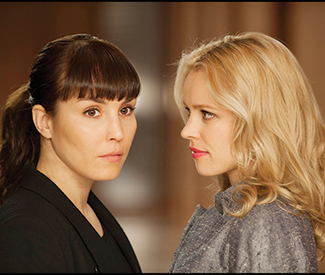
Passion The notion of Brian De Palma directing a remake of Alain Corneau’s 2010 hit Love Crime suggested camp guilty pleasure at the very least. The original film was a clever if implausible psychological thriller in which a corporate boss (Kristin Scott Thomas) and junior-executive protegee (Ludivine Sagnier) come to fatal comeuppance blows over a particularly cruel abuse of power in the name of love. It was a stereotypical girlfight par excellance, dressed up via reasonably smart treatment. You’d expect De Palma to ramp up the lurid and tawdry-violent aspects to delightfully tasteless degrees — but what’s most depressing about Passion is that the life has gone out even from his love of violence and sexploitation. It’s a tepid movie, and not even a stylish one. In contrast to Scott Thomas’ formidible strength through-negativity, Rachel McAdams’ villain is just another yuppie princess with a snit fit in store. Sagnier might well be the Gallic answer to Chloe Sevigny, yet her waxy inexpressiveness is still better than another horribly awkward English language performance (see: last year’s Prometheus) by Swedish star Noomi Rapace. Passion (which notably took a full year to secure any US release after a festival debut) commits a sin that De Palma has seldom attained: it is just dull. It promises titillation, yet real people and real sex are so plastic and cartooned here they seem the last call of an old-school playboy horndog who can’t get it up anymore. (1:42) Smith Rafael. (Harvey)

Planes Dane Cook voices a crop duster determined to prove he can do more than he was built for in Planes, the first Disney spin-off from a Pixar property. (Prior to the film’s title we see “From The World of Cars,” an indicator the film is an extension of a known universe — but also not quite from it.) And indeed, Planes resembles one of Pixar’s straight-to-DVD releases as it struggles for liftoff. Dreaming of speed, Dusty Crophopper (Cook) trains for the Wings Around the World race with his fuel-truck friend, Chug (Brad Garrett). A legacy playing Brewster McCloud and Wilbur Wright makes Stacy Keach a pitchy choice for Skipper, Dusty’s reluctant ex-military mentor. Charming cast choices buoy Planes somewhat, but those actors are feathers in a cap that hardly supports them — you watch the film fully aware of its toy potential: the race is a geography game; the planes are hobby sets; the cars will wind up. The story, about overcoming limitations, is in step with high-value parables Pixar proffers, though it feels shallower than usual. Perhaps toys are all Disney wants — although when Ishani (a sultry Priyanka Chopra) regrets an integrity-compromising choice she made in the race, and her pink cockpit lowers its eyes, you can feel Pixar leaning in. (1:32) Metreon, 1000 Van Ness. (Vizcarrondo)

Populaire Perhaps if it weren’t set in the 1950s, this would be the fluorescent-lit story of a soul-sucking data entry job and the office drone who supplements it with a moonlighting gig. But it is the ’50s — a cheery, upbeat version of the era — and director Régis Roinsard’s Populaire reflects its shiny glamour onto the transformation of small-town girl Rose Pamphyle (Déborah François) from an incompetent but feisty secretary with mad hunting-and-pecking skills into a celebrated and adored speed-typing champion. Her daffy boss, Louis Échard (Romain Duris), is a handsome young insurance salesman who bullies her (very charmingly) into competing against a vast secretarial pool in a series of hectic, nail-biting tourneys, which treat typing as a sporting event for perhaps the first time in cinematic history. (See also: scenes of Rose cranking up her physical endurance with daily jogs and cross-training at the piano.) The glamour slips a touch when Populaire starts to delve into psychological motivations to rationalize some of Louis’s more caddish maneuvers. But meanwhile, back in the arena, bets are made, words-per-minute stats are quoted by screaming, tearful fans in the bleachers, hearts are won and bruised, a jazz band performs that classic tune “Les Secrétaires Cha Cha Cha,” and we find ourselves rooting passionately for Rose to best the reigning champ’s 512(!)-wpm record. (1:51) Smith Rafael. (Rapoport)

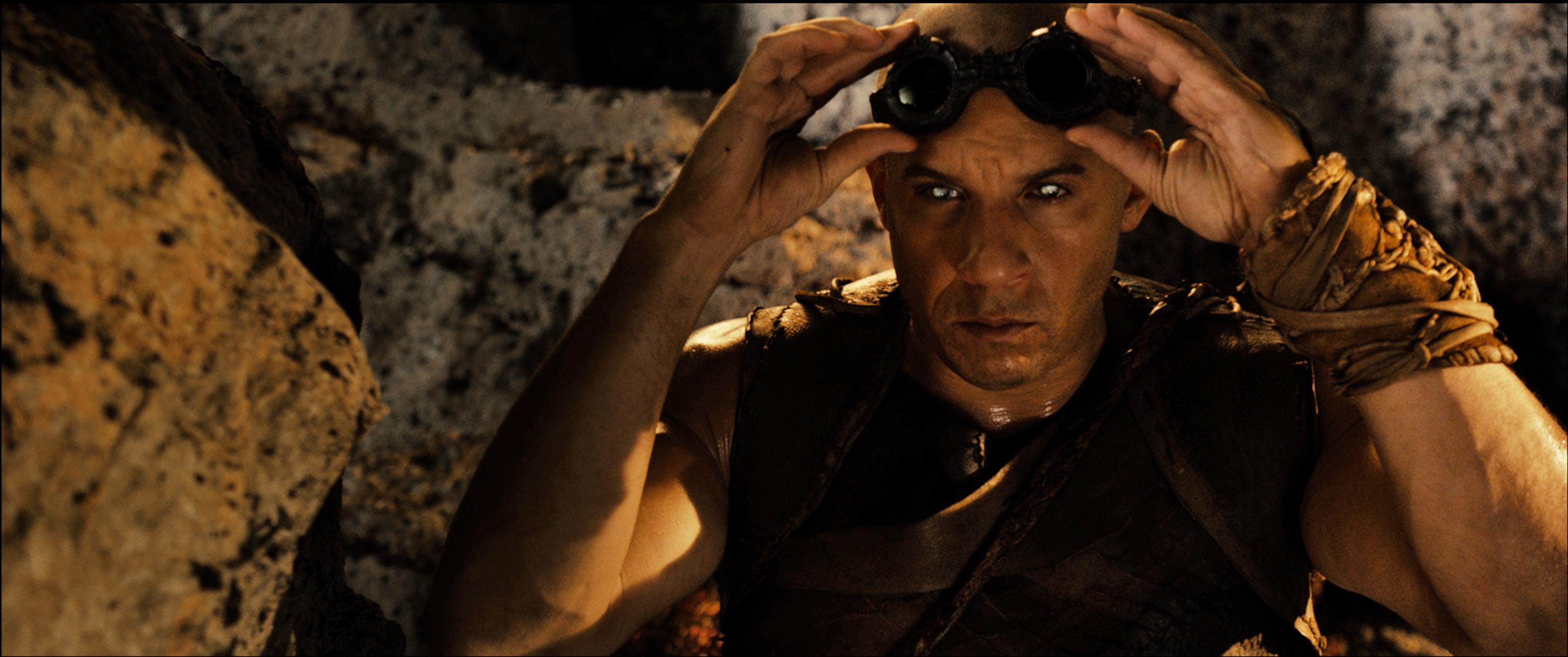
Riddick This is David Twohy’s third flick starring Vin Diesel as the titular misunderstood supercriminal. Aesthetically, it’s probably the most interesting of the lot, with a stylistic weirdness that evokes ’70s Eurocomix in the best way — a pleasing backdrop to what is essentially Diesel playing out the latest in a series of Dungeons & Dragons scenarios where he offers his wisecracking sci-fi take on Conan. Gone are the scares and stakes of Pitch Black (2000) or the cheeseball epic scale of The Chronicles of Riddick (2004); this is a no-nonsense action movie built on the premise that Riddick just can’t catch a break. He’s on the run again, targeted by two bands of ruthless mercenaries, on a planet threatened by an oncoming storm rather than Pitch Black‘s planet-wide night. One unfortunate element leaves a bitter taste: the lone female character in the movie, Dahl (Katee Sackhoff), is an underdeveloped cliché “Strong Female Character,” a violent, macho lesbian caricature who is the object of vile sexual aggression (sometimes played for laughs) from several other characters, including Riddick. (1:59) Metreon, 1000 Van Ness. (Stander)

Short Term 12 A favorite at multiple 2013 festivals (particularly SXSW, where it won multiple awards), Short Term 12 proves worthy of the hype, offering a gripping look at twentysomethings (led by Brie Larson, in a moving yet unshowy performance) who work with at-risk teens housed in a foster-care facility, where they’re cared for by a system that doesn’t always act with their best interests in mind. Though she’s a master of conflict resolution and tough love when it comes to her young chargers, Grace (Larson) hasn’t overcome her deeply troubled past, to the frustration of her devoted boyfriend and co-worker (John Gallagher, Jr.). The crazy everyday drama — kids mouthing off, attempting escape, etc. — is manageable enough, but two cases cut deep: Marcus (Keith Stanfield), an aspiring musician who grows increasingly anxious as his 18th birthday, when he’ll age out of foster care, approaches; and 16-year-old Jayden (Kaitlyn Dever), whose sullen attitude masks a dark home life that echoes Grace’s own experiences. Expanding his acclaimed 2008 short of the same name, writer-director Destin Daniel Cretton’s wrenchingly realistic tale achieves levels of emotional honesty not often captured by narrative cinema. He joins Fruitvale Station director Ryan Coogler as one of the year’s most exciting indie discoveries. (1:36) SF Center. (Eddy)

The Spectacular Now The title suggests a dreamy, fireworks-inflected celebration of life lived in the present tense, but in this depiction of a stalled-out high school senior’s last months of school, director James Ponsoldt (2012’s Smashed) opts for a more guarded, uneasy treatment. Charming, likable, underachieving, and bright enough to frustrate the adults in his corner, Sutter (Miles Teller, 2012’s Project X) has long since managed to turn aimlessness into a philosophical practice, having chosen the path of least resistance and alcohol-fueled unaccountability. His mother (Jennifer Jason Leigh), raising him solo since the departure of a father (Kyle Chandler) whose memories have acquired — for Sutter, at least — a blurry halo effect, describes him as full of both love and possible greatness, but he settles for the blessings of social fluidity and being an adept at the acquisition of beer for fellow underage drinkers. When he meets and becomes romantically involved with Aimee (Shailene Woodley), a sweet, unpolished classmate at the far reaches of his school’s social spectrum, it’s unclear whether the impact of their relationship will push him, or her, or both into a new trajectory, and the film tracks their progress with a watchful, solicitous eye. Adapted for the screen by Scott Neustadter and Michael H. Weber (2009’s 500 Days of Summer) from a novel by Tim Tharp, The Spectacular Now gives the quirky pop cuteness of Summer a wide berth, steering straight into the heart of awkward adolescent striving and mishap. (1:35) Balboa, Presidio, SF Center, Sundance Kabuki. (Rapoport)

This Is the End It’s a typical day in Los Angeles for Seth Rogen as This Is the End begins. Playing a version of himself, the comedian picks up pal and frequent co-star Jay Baruchel at the airport. Since Jay hates LA, Seth welcomes him with weed and candy, but all good vibes fizzle when Rogen suggests hitting up a party at James Franco’s new mansion. Wait, ugh, Franco? And Jonah Hill will be there? Nooo! Jay ain’t happy, but the revelry — chockablock with every Judd Apatow-blessed star in Hollywood, plus a few random inclusions (Rihanna?) — is great fun for the audience. And likewise for the actors: world, meet Michael Cera, naughty coke fiend. But stranger things are afoot in This Is the End. First, there’s a giant earthquake and a strange blue light that sucks passers-by into the sky. Then a fiery pit yawns in front of Casa Franco, gobbling up just about everyone in the cast who isn’t on the poster. Dudes! Is this the worst party ever — or the apocalypse? The film — co-written and directed by Rogen and longtime collaborator Evan Goldberg — relies heavily on Christian imagery to illustrate the endtimes; the fact that both men and much of their cast is Jewish, and therefore marked as doomed by Bible-thumpers, is part of the joke. But of course, This Is the End has a lot more to it than religious commentary; there’s also copious drug use, masturbation gags, urine-drinking, bromance, insult comedy, and all of the uber-meta in-jokes fans of its stars will appreciate. (1:46) Metreon, 1000 Van Ness, Presidio. (Eddy)

20 Feet From Stardom Singing the praises of those otherwise neglected backup vocalists who put the soul into that Wall of Sound, brought heft to “Young Americans,” and lent real fury to “Gimme Shelter,” 20 Feet From Stardom is doing the rock ‘n’ roll true believer’s good work. Director Morgan Neville follows a handful of mainly female, mostly African American backing vocal legends, charts their skewed career trajectories as they rake in major credits and keep working long after one-hit wonders are forgotten (the Waters family) but fail to make their name known to the public (Merry Clayton), grasp Grammy approval yet somehow fail to follow through (Lisa Fischer), and keep narrowly missing the prize (Judith Hill) as label recording budgets shrivel and the tastes, technology, and the industry shift. Neville gives these industry pros and soulful survivors in a rocked-out, sample-heavy, DIY world their due on many levels, covering the low-coverage minis, Concert for Bangladesh high points, gossipy rumors, and sheer love for the blend that those intertwined voices achieve. One wishes the director had done more than simply touch in the backup successes out there, like Luther Vandross, and dug deeper to break down the reasons Fischer succumbed to the sophomore slump. But one can’t deny the passion in the voices he’s chosen to follow — and the righteous belief the Neville clearly has in his subjects, especially when, like Hill, they are ready to pick themselves up and carry on after being told they’re not “the Voice.” (1:30) Smith Rafael. (Chun)

We’re the Millers After weekly doses on the flat-screen of Family Guy, Modern Family, and the like, it’s about time movieland’s family comedies got a little shot of subversion — the aim, it seems, of We’re the Millers. Scruffy dealer David (Jason Sudeikis) is shambling along — just a little wistful that he didn’t grow up and climb into the Suburban with the wife, two kids, and the steady 9-to-5 because he’s a bit lonely, much like the latchkey nerd Kenny (Will Poulter) who lives in his apartment building, and neighboring stripper Rose (Jennifer Aniston), who bites his head off at the mailbox. When David tries to be upstanding and help out crust punk runaway Casey (Emma Roberts), who’s getting roughed up for her iPhone, he instead falls prey to the robbers and sinks into a world of deep doo-doo with former college bud, and supplier of bud, Brad (Ed Helms). The only solution: play drug mule and transport a “smidge and a half” of weed across the Mexican-US border. David’s supposed cover: do the smuggling in an RV with a hired crew of randoms: Kenny, Casey, and Rose&sdquo; all posing as an ordinary family unit, the Millers. Yes, it’s that much of a stretch, but the smart-ass script is good for a few chortles, and the cast is game to go there with the incest, blow job, and wife-swapping jokes. Of course, no one ever states the obvious fact, all too apparent for Bay Area denizens, undermining the premise of We’re the Millers: who says dealers and strippers can’t be parents, decent or otherwise? We may not be the Millers, but we all know families aren’t what they used to be, if they ever really managed to hit those Leave It to Beaver standards. Fingers crossed for the cineplex — maybe movies are finally catching on. (1:49) 1000 Van Ness. (Chun)

The Wolverine James Mangold’s contribution to the X-Men film franchise sidesteps the dizzy ambition of 2009’s X-Men Origins: Wolverine and 2011’s X-Men: First Class, opting instead for a sleek, mostly smart genre piece. This movie takes its basics from the 1982 Wolverine series by Chris Claremont and Frank Miller, a stark dramatic comic, but can’t avoid the convoluted, bad sci-fi plot devices endemic to the X-Men films. The titular mutant with the healing factor and adamantium-laced skeleton travels to Tokyo, to say farewell to a dying man who he rescued at the bombing of Nagasaki. But the dying man’s sinister oncologist has other plans, sapping Wolverine of his healing powers as he faces off against ruthless yakuza and scads of ninjas. The movie’s finest moments come when Mangold pays attention to context, taking superhero or Western movie clichés and revamping them for the modern Tokyo setting, such as a thrilling duel on top of a speeding bullet train. Another highlight: Rila Fukushima’s refreshing turn as badass bodyguard Yukio. Oh, and stay for the credits. (2:06) Metreon. (Stander)

The World’s End The final film in Edgar Wright’s “Blood and Ice Cream Trilogy” finally arrives, and the TL:DR version is that while it’s not as good as 2004’s sublime zombie rom-com Shaun of the Dead, it’s better than 2007’s cops vs. serial killers yarn Hot Fuzz. That said, it’s still funnier than anything else in theaters lately. Simon Pegg returns to star and co-write (with Wright); this time, the script’s sinister bugaboo is an invasion of body snatchers — though (as usual) the conflict is really about the perils of refusing to actually become an adult, the even-greater perils of becoming a boring adult, and the importance of male friendships. Pegg plays rumpled fuck-up Gary, determined to reunite with the best friends he’s long since alienated for one more crack at their hometown’s “alcoholic mile,” a pub crawl that ends at the titular beer joint. The easy chemistry between Pegg and the rest of the cast (Nick Frost, Paddy Considine, Martin Freeman, and Eddie Marsan) elevates what’s essentially a predictable “one crazy night” tale, with a killer soundtrack of 1990s tunes, slang you’ll adopt for your own posse (“Let’s Boo-Boo!”), and enough hilarious fight scenes to challenge This is the End to a bro-down of apocalyptic proportions. (1:49) Metreon, 1000 Van Ness, Presidio. (Eddy)

You’re Next The hit of the 2011 Toronto Film Festival’s midnight section — and one that’s taken its sweet time getting to theaters — indie horror specialist (2010’s A Horrible Way to Die, 2007’s Pop Skull, 2012’s V/H/S) Adam Wingard’s feature isn’t really much more than a gussied-up slasher. But it’s got vigor, and violence, to spare. An already uncomfortable anniversary reunion for the wealthy Davison clan plus their children’s spouses gets a lot more so when dinner is interrupted by an arrow that sails through a window, right into someone’s flesh. Immediately a full on siege commences, with family members reacting with various degrees of panic, selfishness. and ingenuity, while an unknown number of animal-masked assailants prowl outside (and sometimes inside). Clearly fun for its all-star cast and crew of mumblecore-indie horror staples, yet preferring gallows’ humor to wink-wink camp, it’s a (very) bloody good ride. (1:36) SF Center. (Harvey) *


Fighting foreclosures

1

joe@sfbg.com

It will be a long war, but for now, Richmond is winning.

Two battles in the start of the city of Richmond’s war on foreclosures were fought and won in the past week. A US District Court of Appeals judge dismissed Wells Fargo’s lawsuit against Richmond’s controversial plan to use eminent domain to save residents with underwater mortgages (see “Not for sale,” Sept. 3). And Mayor Gayle McLaughlin successfully fought off legislation at the Richmond City Council to torpedo the plan before it started.

“I’m willing to go as high as the Supreme Court to settle this on behalf of our community,” McLaughlin told us. These are the first fledgling steps in that long fight, a fight McLaughlin calls a just cause.

Half of all mortgages in Richmond are underwater, and as homes get foreclosed upon, the problems stack up: blighted neighborhoods, declining property tax revenues, public employee layoffs, rising crime, and homeless families. To stem the tide of foreclosures, Richmond teamed with Mortgage Resolution Partners (MRP) to attempt to buy the loans of 624 underwater mortgages and allow the owners to keep their homes.

Richmond’s government sent out offers, and it is still waiting to hear back from the owners of the loans.

The controversy comes when the banks that hold the loans refuse to sell. In that case, Richmond would invoke the power of eminent domain to seize the mortgage loans.

Wells Fargo said in its lawsuit that this is a plan to line the pockets of MRP and the city of Richmond, a greedy and unconstitutional land grab. Eminent domain has never been used for this purpose, but as the judge noted in the lawsuit’s first hearing Sept. 12 in San Francisco, the plan has yet to be acted on.

“Okay, let’s end the suspense, I don’t believe (the case) is ripe for determination,” Judge Charles Breyer told the attorneys from Wells Fargo. “There are a series of steps that can or cannot take place…. If they do take place, that’s the time for the court to take a look at it.”

Breyer noted that if and when Richmond wanted to use eminent domain to seize mortgage loans, the council would need to file a resolution of necessity through state court. At that point, he could act.

On Sept. 16, the case was dismissed. Too little has happened, and it is entirely too early to make any decisions, Breyer said.

Stacey Leyton, a lawyer representing Richmond in the lawsuit, explained the judge’s decision plainly: “Courts are not supposed to review legislative actions before the (legislative body) has decided which action to take.”

The Guardian reached out to Wells Fargo but we were told that it had nothing to say beyond its court filings, and referred us to the investors in the loans, of which Wells Fargo is a trustee.

But why is Wells Fargo pushing so fast for the courts to intervene? The eminent domain plan could mean a possible loss of revenue for Wells Fargo and the investors it represents, sending chills down the spine of Wall Street, a representative of MRP said.

MRP founder John Vlahoplus told us the eminent domain tactic is powerful because for Wells Fargo, legally challenging every municipality in the United States is much tougher than paying off a few fat cats in Congress.

So the stakes are high: if Richmond wins the eminent domain battle, cities across the country could use the tactic to rescue underwater mortgages, and the families that would otherwise lose their homes, swinging the balance of power from Wall Street toward cities.

Score one for Richmond, and zip for Wells Fargo, so far.


LOCAL FRONT

But the real drama happened closer to home. Before Richmond could fight the enemies from without, it fought the enemies within.

On Sept. 10, Richmond’s controversial plan for preventing home foreclosures using eminent domain was almost torpedoed at the Richmond City Council meeting, where its members waged a nasty fight before more than 300 attendees.

Advocates for city intervention against the banks won when the council voted 5-2 against a resolution to rescind the city’s offer to purchase 624 underwater mortgages and halt any effort by the city to seize those mortgages through eminent domain.

A separate resolution by Mayor McLaughlin to establish a joint powers authority, uniting cities to battle litigation against the eminent domain plan, also passed.

Vice Mayor Courtland “Corky” Boozé and Councilmember Nathaniel Bates sponsored the resolution attacking the plan, and cast the only votes in its favor.

Boozé and Bates said the city risks bankruptcy if Well Fargo wins its lawsuit, putting Richmond’s financial solvency on the line, but their colleagues were dubious.

“My vote is not supposed to be if (Wall Street investors) are a bunch of jerks and I want to stick it to them,” Councilmember Jim Rogers said to the audience.

After the city laid off a third of the government’s workforce in lean economic years, Rogers has reason to worry. City Manager Bill Lindsay laid out the risks for those in the auditorium.

Because no city has ever tried this before, he said, no liability insurance exists for this kind of work, which MRP has acknowledged. “If you believe the potential loss (of a lawsuit) is catastrophic, it’s important to acknowledge that’s an issue,” he said.

He also said it was tough for the city go it alone as a single entity, explaining the need for a joint powers authority, which would build a coalition of cities against Wells Fargo and other litigants.

State law requires a supermajority of the council, five members, to back any eminent domain action and only at the time that it would take place, he said.

Hours of back and forth passed between the city manager and Boozé who, after some arguing, asked the audience in frustration, “Are 110,000 people worth fighting Wall Street for?”

The crowd roared its answer immediately: “YES!”

The ideological split of the audience was clear: Eminent domain supporters wore yellow shirts with a logo of the activist group Alliance of Californians for Community Empowerment, and those against wore red shirts branded “Stop Investor Greed.”

Those sporting the red shirts were mostly from the real estate industry, and in public comment they generally expressed that if someone were to lose their home, well, “so what?”

Lisa Johnson, clad in red, said, “My house is an investment, not a right.”

A representative from Richmond’s Council of Industries asked the mayor to reconsider the eminent domain plan, and to rescind the initiative.

Jerry Feagley, whose Feagley Realtors has sold homes since 1966, said the plan risks damaging all of Richmond’s ability to get credit. He was a seemingly mild-mannered man who is exactly who you’d picture if you think of a businessman from the ’50s, gray suit and all. “If this would go into effect, this would change loans in the entire country,” he said, passionately.

Well, that’s the idea, the supporters countered.

“I was at the March on Washington with Martin Luther King 50 years ago. Yes, I’m that old,” said one woman. She was bent over with age but spoke with volume. “That’s exactly what we have to do. We’re going to have to meet power with power and challenge the status quo.”

More than 50 supporters spoke at the podium. The meeting started at 7pm, and stretched on well past 1am. If there was one central theme to their sentiments, it was this: Richmond has hit rock bottom, and now is the time to fight back.

Councilmember Tom Butt put it in plain terms. “What we’re voting for is a giant game of chicken, and it’s clear two of my colleagues have blinked,” he said, referring to Boozé and Bates. “I’m not blinking.”

The council voted, and amid the turmoil and arguing and anger, the Boozé and Bates measure was rejected.

Having already lost once that night, Bates did not fare well when time came to vote on forming a joint powers authority. El Monte may be the first to join, McLaughlin said, which would help homeowners in need who are often people of color. Bates countered that McLaughlin should look out for “her people” and not try to use “his people” as a front for her legislation. “You don’t speak for my community,” he said, referring to African Americans. When another black council member, Jovanka Beckles, spoke up to thank her “white brothers and sisters” for joining in a fight for justice, Bates was uncompromising. “You are not African American,” he told her. Boozé also had words for the other dissenting African American Councilmember Jael Myrick. “One day you’ll have to stand up and be black,” he said. McLaughlin’s measure then passed 4-3, with council members Boozé, Bates and Rogers dissenting. The last remaining supporters waved their yellow flags and the dwindling crowd clad in yellow shirts left victorious, for now.

Pelosi defies history and her district

57

OPINION How is it that, despite deep congressional opposition to an American-led war on Syria, the representative for one of the nation’s most progressive districts, House Minority Leader Nancy Pelosi, has been among President Obama’s most ardent backers of war?

While Russia’s deal for Syria to turn over its chemical weapons offers a temporary pause in the march to war, the arrangement is fragile and Obama — with support from Pelosi — continues to threaten military action that could lead to a disastrous widening of bloodshed and chaos in Syria and beyond.

What’s particularly outrageous about the pro-war push from Pelosi and US Sens. Barbara Boxer and Dianne Feinstein, also from the Bay Area, is their willful dismissal of history. Did they somehow miss the well-documented memos on US wars and interventions? You know, the ones that list American lies on Iraq’s WMDs, provocations in Vietnam’s Gulf of Tonkin, and the long, long list of CIA-backed coups of democratically elected leaders in Iran, Guatemala, Chile, and beyond?

The nightmare in Syria needs an international solution—but given our ugly track record, how can anyone place faith in American-led military intervention?

This history offers a distressingly reliable prologue to the present. In Afghanistan and Iraq, the US expended vast amounts of blood and treasure attacking brutal thugs it supported for years. How can we expect different results from the same military-security state apparatus that has, for decades, undermined democracies, aided thugs and dictators, and trumped up wars based on lies? How can anyone believe that the US military and security state complex has suddenly found a veracity and moral center it has always profoundly lacked?

There is no question that international pressure and diplomacy must be brought to bear on Bassar al-Assad’s sickening Syrian regime, and that chemical weapons, and nukes for that matter, must be wiped off the planet. But the US has an unrivaled record of using these tools of mass killing, and has zero credibility as a force for peacemaking.

The hypocrisies Pelosi chooses to ignore run deeper. The US refuses to enforce the chemical weapons ban on Israel, for instance. And remember the saber-rattling last year over Iran’s nuclear program? Not a word about Israel’s nukes, not to mention America’s. Yet both Israel and the US have a well-documented history of outright aggression, where Iran has none.

The San Francisco Chronicle explained Pelosi’s war support as part of her Democratic Party leadership duties, quoting UC Berkeley professor Eric Schickler: “One of the jobs of the party’s leader is to support the president of your party, except under the most extenuating circumstances. If she didn’t have such liberal credentials already, she would be in much more vulnerable position.”

While party leadership and allegiance may be a factor, consider also that Pelosi, Boxer, and Feinstein take in far more dollars from pro-Israel lobbies than do their counterparts (Boxer got more than twice the Senate average, and Pelosi roughly six times the congressional average, according to research by MapLight and Open Secrets).

Despite some loud and colorful protests by Code Pink and other groups, it’s sadly true that Pelosi hasn’t been very vulnerable: San Francisco’s political leadership has done little to let her know how deeply out of step she is with her district.

In years past, the Board of Supervisors has passed resolutions opposing US military interventions; now, they and the Democratic County Central Committee are silent. Where is the outrage and pushback within Pelosi’s district? Pelosi’s hawkish stance on Syria follows her lamentable defense in July of the NSA spying program. In both cases, these are policies that Pelosi opposed and so many progressives protested vigorously when they were enacted by President George W. Bush. Where is the mass outrage now?

Stage listings

0

Stage listings are compiled by Guardian staff. Performance times may change; call venues to confirm. Reviewers are Robert Avila, Rita Felciano, and Nicole Gluckstern. Submit items for the listings at listings@sfbg.com.

THEATER

OPENING

Band Fags! New Conservatory Theatre Center, 25 Van Ness, SF; www.nctcsf.org. $25-45. Opens Fri/13, 8pm. Runs Wed-Sat, 8pm; Sun, 2pm. Through Oct 13. New Conservatory Theatre Center performs the West Coast premiere of Frank Anthony Polito’s coming-of-age tale, set in 1980s Detroit.

“Bay One Acts Festival” Tides Theatre, 533 Sutter, SF; www.bayoneacts.org. $20-40. Opens Sat/14, 8pm. Programs One and Two run in repertory Wed-Sun, 8pm. Through Oct 5. The 2013 BOA fest presents the world premieres of 13 short plays in partnership with 13 Bay Area theater companies.

Buried Child Magic Theatre, Fort Mason Center, Bldg D, Third Flr, SF; www.magictheatre.org. $20-60. Previews Wed/11-Sat/14, 8pm; Sun/15, 2:30pm; Mon/16, 7pm. Opens Tue/17, 8pm. Runs Tue, 7pm; Wed-Sat, 8pm; Sun, 2:30. Through Oct 6. Magic Theatre performs a revival of Sam Shepard’s Pulitzer-winning classic.

The Golden Dragon ACT’s Costume Shop, 1117 Market, SF; www.doitliveproductions.com. $15. Opens Fri/13, 9:30pm. Runs Thu-Sat, 9:30pm. Through Sept 28. Do It Live! Productions presents Roland Schimmelpfennig’s tragicomic take on globalization, set in and around an Asian restaurant.

1776 ACT’s Geary Theater, 415 Geary, SF; www.act-sf.org. $20-160. Previews Wed/11-Sat/14 and Tue/17, 8pm (also Sat/14, 2pm); Sun/15, 7pm. Opens Thu/19, 8pm. Runs Tue-Sat, 8pm (also Wed and Sat, 2pm; Sept 24, show at 7pm); Sun, 2pm. Through Oct 6. American Conservatory Theater performs the West Coast premiere of Frank Galati’s new staging of the patriotic musical.

The Shakespeare Bug Stage Werx Theatre, 446 Valencia, SF; www.killingmylobster.com. $15-30. Previews Thu/12-Fri/13, 8pm. Opens Sat/14, 8pm. Runs Thu-Sun, 8pm. Through Sept 29. Killing My Lobster in association with PlayGround perform Ken Slattery’s world-premiere comedy.

ONGOING

Acid Test: The Many Incarnations of Ram Dass Marsh San Francisco, 1062 Valencia, SF; www.themarsh.org. $15-50. Fri, 8pm; Sat, 8:30pm. Through Oct 12. Lynne Kaufman’s acclaimed play returns to the Marsh, with Warren David Keith reprising the titular role.

American Dream New Conservatory Theatre Center, 25 Van Ness, SF; www.nctcsf.org. $35-45. Wed/11-Sat/14, 8pm; Sun/15, 2pm. A recently divorced and recently out architect falls in love with his Spanish teacher — and tries to bring him from Mexico to California — in this world premiere by Brad Erickson at the New Conservatory Theatre Center.

BoomerAging: From LSD to OMG Marsh San Francisco, 1062 Valencia, SF; www.themarsh.org. $15-50. Tue, 8pm. Extended through Oct 29. Will Durst’s hit solo show looks at baby boomers grappling with life in the 21st century.

Foodies! The Musical Shelton Theater, 533 Sutter, SF; www.foodiesthemusical.com. $30-34. Fri-Sat, 8pm. Open-ended. AWAT Productions presents Morris Bobrow’s musical comedy revue all about food.

In Friendship: Stories By Zona Gale Z Below, 470 Florida, SF; www.zspace.org. $20-50. Wed/11-Thu/12, 7pm (also Wed/11, 3pm); Fri/13, 8pm. Word for Word performs Zona Gale’s “comedy of American manners.”

Hedwig and the Angry Inch Boxcar Theatre, 505 Natoma, SF; www.boxcartheatre.org. $27-43. Thu-Sat, 8pm. Open-ended. John Cameron Mitchell’s cult musical comes to life with director Nick A. Olivero’s ever-rotating cast.

Macbeth Fort Point, end of Marine Dr, Presidio of San Francisco, SF; www.weplayers.org. $30-60. Thu-Sun, 6pm. Through Oct 6. We Players perform the Shakespeare classic amid Fort Point’s Civil War-era fortress.

Macbeth Main Post Parade Ground Lawn, Presidio of San Francisco, SF; www.sfshakes.org. Free. Sat/14-Sun/15, 2pm. In its 31st season, Free Shakespeare in the Park also takes on one of the Bard’s major tragedies.

“San Francisco Fringe Festival” Exit Theatreplex, 156 Eddy, SF; www.sffringe.org. $12.99 or less (passes, $45-75). Through Sept 21. The 22nd SF Fringe presents 36 shows that explore the boundaries of theater and performance.

Sex and the City: LIVE! Rebel, 1760 Market, SF; trannyshack.com/sexandthecity. $25. Wed, 7 and 9pm. Open-ended. It seems a no-brainer. Not just the HBO series itself — that’s definitely missing some gray matter — but putting it onstage as a drag show. Mais naturellement! Why was Sex and the City not conceived of as a drag show in the first place? Making the sordid not exactly palatable but somehow, I don’t know, friendlier (and the canned a little cannier), Velvet Rage Productions mounts two verbatim episodes from the widely adored cable show, with Trannyshack’s Heklina in a smashing portrayal of SJP’s Carrie; D’Arcy Drollinger stealing much of the show as ever-randy Samantha (already more or less a gay man trapped in a woman’s body); Lady Bear as an endearingly out-to-lunch Miranda; and ever assured, quick-witted Trixxie Carr as pent-up Charlotte. There’s also a solid and enjoyable supporting cast courtesy of Cookie Dough, Jordan Wheeler, and Leigh Crow (as Mr. Big). That’s some heavyweight talent trodding the straining boards of bar Rebel’s tiny stage. The show’s still two-dimensional, even in 3D, but noticeably bigger than your 50″ plasma flat panel. (Avila)

BAY AREA

After the Revolution Aurora Theatre, 2081 Addison, Berk; www.auroratheatre.org. $32-60. Tue, 7pm; Wed-Sat, 8pm; Sun, 2 and 7pm. Extended through Oct 6. Aurora Theatre opens its 22nd season with the Bay Area premiere of Amy Herzog’s family drama.

Can You Dig It? Back Down East 14th — the 60s and Beyond Marsh Berkeley, 2120 Allston, Berk; www.themarsh.org. $15-50. Opens Sat/14, 8:30pm. Runs Sat, 8:30pm; Sun, 7pm. Through Oct 27. Don Reed’s new show offers more stories from his colorful upbringing in East Oakland in the 1960s and ’70s. More hilarious and heartfelt depictions of his exceptional parents, independent siblings, and his mostly African American but ethnically mixed working-class community — punctuated with period pop, Motown, and funk classics, to which Reed shimmies and spins with effortless grace. And of course there’s more too of the expert physical comedy and charm that made long-running hits of Reed’s last two solo shows, East 14th and The Kipling Hotel (both launched, like this newest, at the Marsh). Can You Dig It? reaches, for the most part, into the “early” early years, Reed’s grammar-school days, before the events depicted in East 14th or Kipling Hotel came to pass. But in nearly two hours of material, not all of it of equal value or impact, there’s inevitably some overlap and indeed some recycling. Reed, who also directs the show, may start whittling it down as the run continues. But, as is, there are at least 20 unnecessary minutes diluting the overall impact of the piece, which is thin on plot already — much more a series of often very enjoyable vignettes and some painful but largely unexplored observations, wrapped up at the end in a sentimental moral that, while sincere, feels rushed and inadequate. (Avila)

Ella, the Musical Center REPertory Company, 1601 Civic, Walnut Creek; (925) 943-SHOW. $37-64. Wed, 7:30pm; Thu-Sat, 8pm (also Sept 28 and Oct 12, 2:30pm); Sun, 2:30pm. Through Oct 12. Yvette Cason portrays the legendary Ella Fitzgerald in this Center REP presentation.

Good People Marin Theatre Company, 397 Miller, Mill Valley; www.marintheatre.org. $37-58. Wed/11, 7:30pm; Thu/12-Sat/14, 8pm (also Sat/14, 2pm); Sun/15, 2 and 7pm. Marin Theatre Company performs the Bay Area premiere of David Lindsay-Abaire’s Broadway triumph about class and poverty.

Orlando Live Oak Theatre, 1301 Shattuck, Berk; www.theatrefirst.com. $10-30. Thu/12-Sat/14, 8pm; Sun/15, 5pm. TheatreFIRST performs Sarah Ruhl’s gender-shifting comedy, which takes place over a span of 300 years.

PERFORMANCE/DANCE

“Broadway Bingo” Feinstein’s at the Nikko, Hotel Nikko, 222 Mason, SF; www.feinsteinssf.com. Wed, 7-9pm. Ongoing. Free. Countess Katya Smirnoff-Skyy and Joe Wicht host this Broadway-flavored night of games and performance.

Caroline Lugo and Carolé Acuña’s Ballet Flamenco Peña Pachamama, 1630 Powell, SF; www.carolinalugo.com. Sun/15, Sept 21, Oct 6, 12, 20, 26, 6:15pm. $15-19. Flamenco performance by the mother-daughter dance company, featuring live musicians.

“Dancing Poetry Festival” Florence Gould Theater, California Palace of the Legion of Honor, 100 34th Ave, F; (510) 235-0361. Sat/14, noon-4pm. $6-15. Now in its 20th year, this festival combines poetry and dance, with companies from across Northern California lending their talents.

“Faux Queen Pageant 2013: Sisters Grimm” Slim’s, 333 11th St, SF; www.slimspresents.com. Sat/14, 7pm. $20. “Drag Queens trapped in women’s bodies” compete for supremacy at this contest, a benefit for local charities including Mickaboo Companion Bird Rescue, SaveABunny, and Women Organized To Make Abuse Nonexistent, Inc.

“Here and Then” ODC Studio B, 351 Shotwell, SF; www.humanshakes.com. Sat/14-Sun/15, 8-9:30pm (no admission after 8:45pm). $17-20. Tim Rubel Human Shakes performs a dance installation dedicated to Harvey Milk and other human rights workers.

Kathleen Madigan Yoshi’s San Francisco, 1330 Fillmore, SF; www.yoshis.com. Sat/14, 8 and 10pm. $45. The comedian performs.

“Maestros of the Movies” Davies Symphony Hall, 201 Van Ness, SF; www.sfsymphony.org. Mon/16, 8pm. $15-152. John Williams conducts SF Symphony for this tribute to his iconic film scores. Frequent collaborator Steven Spielberg co-hosts the performance.

“A Match Made in Hell” Bindlestiff Studio, 185 Sixth St, SF; www.matchmadeinhellmusical.com. Fri/13-Sat/14, 8pm. $15-20. Max Weinbach’s original musical follows a couple brought together by the Devil.

“Mission Position Live” Cinecave, 1034 Valencia, SF; www.missionpositionlive.com. Thu, 8pm. Ongoing. $10. Stand-up comedy with rotating performers.

“Monkey Gone to Heaven” CounterPULSE, 1310 Mission, SF; www.counterpulse.org. Fri/13-Sat/14 and Sept 19-21, 8pm; Sun/15 and Sept 22, 7pm. $20. EmSpace Dance performs the world premiere of a dance-theater work inspired by the relationship between primates and prayer.

“Okeanos Intimate” Aquarium of the Bay, Pier 39, SF; www.capacitor.org. Sat, 7pm. Through Sept 28. $20-30 (free aquarium ticket with show ticket). Choreographer Jodi Lomask and her company, Capacitor, revive 2012’s Okeanos — a cirque-dance piece exploring the wonder and fragility of our innate connection to the world’s oceans — in a special “intimate” version designed for the mid-size theater at Pier 39’s Aquarium of the Bay. The show, developed in collaboration with scientists and engineers, comes preceded by a short talk by a guest expert — for a recent Saturday performance it was a down-to-earth and truly fascinating local ecological history lesson by the Bay Institute’s Marc Holmes. In addition to its Cirque du Soleil-like blend of quasi-representational modern dance and circus acrobatics — powered by a synth-heavy blend of atmospheric pop music — Okeanos makes use of some stunning underwater photography and an intermittent narrative that includes testimonials from the likes of marine biologist and filmmaker Dr. Tierney Thys. The performers, including contortionists, also interact with some original physical properties hanging from the flies — a swirling vortex and a spherical shell — as they wrap and warp their bodies in a kind of metamorphic homage to the capacity and resiliency of evolution, the varied ingenuity of all life forms. If the movement vocabulary can seem limited at times, and too derivative, the show also feels a little cramped on the Aquarium Theater stage, whose proscenium arrangement does the piece few favors aesthetically. Nevertheless, the family-oriented Okeanos Intimate spurs a conversation with the ocean that is nothing if not urgent. (Avila)

“Signaling Arcana” Z Space, 450 Florida, SF; www.cimimarie.com. Thu/11-Sat/14, 8pm (also Sat/14, 2pm); Sun/15, 5pm. $25. Cinematic shadow theater with 3D effects and original music from director-inventor Christine Marie and composter Dan Cantrell.

“Swingin’ Back Home” Feinstein’s at the Nikko, Hotel Nikko, 222 Mason, SF; www.ticketweb.com. Wed/11 and Fri/13, 8pm; Sat/14-Sun/15, 7pm. $30-65. Michael Feinstein performs his new tribute to popular songs. *


Film Listings

0

Film listings are edited by Cheryl Eddy. Reviewers are Kimberly Chun, Dennis Harvey, Lynn Rapoport, Sam Stander, and Sara Maria Vizcarrondo. For rep house showtimes, see Rep Clock.

OPENING

And While We Were Here This second collaboration between writer-director Kat Coiro and actor Kate Bosworth is a far cry from 2011’s oops-a-baby comedy Life Happens — owing, perhaps, to that film’s co-writer and co-star, Krysten Ritter. There’s no snarky, raunchy Ritter-ness in And While We Were Here, a drama about a brittle woman named Jane (Bosworth) whose marriage to a workaholic viola player (Iddo Goldberg) is more polite than passionate; their relationship has baggage that he’d prefer not to work through, despite the expanding tension between them. On a trip to Naples, Jane meets a free-spirited 19-year-old (Jamie Blackley) who sparks her interest; before long, it’s groove-reclaiming time. Alas, sun-dappled scenery can’t offset a familiar story — with themes heavily underlined by a subplot that has Jane listening to tapes of her grandmother (richly voiced by Claire Bloom) reminiscing about love and loss during wartime. Jane’s too self-centered to be particularly likable (to her husband, mid-argument: “You’re not curious about me!”), but Here deserves some backhanded props for gender-bending a tired plot device. Ready or not, the manic pixie dream boy has arrived. (1:23) Presidio. (Eddy)

The Family Luc Besson directs mob-comedy veterans Robert De Niro and Michelle Pfeiffer in this tale of a mafia family bumbling their way through their new, witness-protection-program lives. (1:51) Presidio, Shattuck, Vogue.

Insidious: Chapter 2 Hot off this summer’s The Conjuring, horror director James Wan turns in a sequel to his 2011 hit, also about a family with big-time paranormal problems. (1:30) California.

Our Nixon Cobbled together from previously unseen footage shot by some of Richard Nixon’s closest aides — the destined-for-infamy trio of H.R. Haldeman, John Ehrlichman, and Dwight Chapin — Penny Lane’s doc, which also uses Oval Office recordings and additional archival material (not to mention the best-ever use of Tracey Ullman’s 1983 pop confection “They Don’t Know”), offers a new perspective on Tricky Dick and White House life during his tumultuous reign. But while Our Nixon brings fresh perspective to notable moments like Nixon’s visit to China and Tricia Nixon’s lavish wedding, and peeks behind the public façade to reveal the “real” Nixon (hardly a spoiler: he’s shown to be bigoted and behind the times), the POTUS is just one of many figures in this inventive collage. The home movies themselves are the real stars here, filled with unguarded moments and shot for no reason other than personal documentation; as a result, and even taking Lane’s editing choices into account, Our Nixon feels thrillingly authentic. (1:25) Roxie. (Eddy)

Populaire Perhaps if it weren’t set in the 1950s, this would be the fluorescent-lit story of a soul-sucking data entry job and the office drone who supplements it with a moonlighting gig. But it is the ’50s — a cheery, upbeat version of the era — and director Régis Roinsard’s Populaire reflects its shiny glamour onto the transformation of small-town girl Rose Pamphyle (Déborah François) from an incompetent but feisty secretary with mad hunting-and-pecking skills into a celebrated and adored speed-typing champion. Her daffy boss, Louis Échard (Romain Duris), is a handsome young insurance salesman who bullies her (very charmingly) into competing against a vast secretarial pool in a series of hectic, nail-biting tourneys, which treat typing as a sporting event for perhaps the first time in cinematic history. (See also: scenes of Rose cranking up her physical endurance with daily jogs and cross-training at the piano.) The glamour slips a touch when Populaire starts to delve into psychological motivations to rationalize some of Louis’s more caddish maneuvers. But meanwhile, back in the arena, bets are made, words-per-minute stats are quoted by screaming, tearful fans in the bleachers, hearts are won and bruised, a jazz band performs that classic tune “Les Secrétaires Cha Cha Cha,” and we find ourselves rooting passionately for Rose to best the reigning champ’s 512(!)-wpm record. (1:51) Opera Plaza, Shattuck. (Rapoport)

ONGOING

Adore This glossy soap opera from director Anne Fontaine (2009’s Coco Before Chanel) and scenarist Christopher Hampton, adapted from a Doris Lessing novella, has had its title changed from Two Mothers — perhaps because under that name it was pretty much the most howled-at movie at Sundance this year. Lil (Naomi Watts) and Roz (Robin Wright) are lifelong best friends whose hunky surfer sons Ian (Xavier Samuel) and Tom (James Frecheville) are likewise best mates. Widow Lil runs a gallery and Roz has a husband (Ben Mendelsohn), but mostly the two women seem to lay around sipping wine on the decks of their adjacent oceanfront homes in Western Australia’s Perth, watching their sinewy offspring frolic in the waves. This upscale-lifestyle-magazine vision of having it all — complete with middle-aged female protagonists who look spectacularly youthful without any apparent effort — finds trouble in paradise when the ladies realize that something, in fact, is missing. That something turns out to be each other’s sons, in their beds. After very little hand-wringing this is accepted as the way things are meant to be — a MILF fantasy viewed through the distaff eyes — despite some trouble down the road. This outlandish basic concept might have worked for Lessing, but Fontaine’s solemn, gauzily romantic take only slightly muffles its inherent absurdity. (Imagine how creepy this ersatz women-finding-fulfillment-at-midlife saga would be if it were two older men boning each others’ daughters.) Lord knows it isn’t often that mainstream movies (this hardly plays as “art house”) focus on women over 40, and the actors give it their all. But you’ll wish they’d given it to a better vehicle instead. (1:50) Sundance Kabuki. (Harvey)

Afternoon Delight It takes about five seconds to suss that Kathryn Hahn is going to give a spectacular performance in Jill Soloway’s charming seriocomedy. Figuring to re-ignite husband Jeff’s (Josh Radnor) flagging libido by taking them both to a strip club, Rachel (Hahn) decides to take on as a home- and moral-improvement project big-haired, barely-adult stripper McKenna (Juno Temple). When the latter’s car slash-home is towed, bored Silver Lake housewife and mother Rachel invites the street child into their home. Eventually she’s restless enough to start accompanying McKenna on the latter’s professional “dates.” Afternoon Delight is a better movie than you’d expect — not so much a typical raunchy comedy as a depthed dramedy with a raunchy hook. It’s a notable representation of no-shame sex workerdom. It’s also funny, cute, and eventually very touching. Especially memorable: a ladies’ round-table discussion about abortion that drifts every which way. (1:42) Albany, Sundance Kabuki. (Harvey)

Ain’t Them Bodies Saints “This was in Texas,” reads the hand-lettered opening of Ain’t Them Bodies Saints. It’s a fittingly homespun beginning to a film that pays painstaking homage to bygone-era cinema. After its Sundance Film Festival premiere, writer-director David Lowery’s first high-profile release earned frequent comparisons to 1970s works by Robert Altman and Terrence Malick. That’s no accident; Saints openly feasts upon the decade’s intimate, sun-burnished neo-Westerns. Though Saints earned praise on the film-fest circuit for its craftsmanship, its big-name cast — Casey Affleck and Rooney Mara as lovers separated by his jail stint; Keith Carradine as a shopkeeper with a dark past; Ben Foster as a cop who pines for Mara’s character — is likely what will pique mainstream interest. But will pre-release hype translate to a Beasts of the Southern Wild-style breakthrough? Saints‘ storytelling keeps to a very deliberate pace, a quality owing to Lowery’s background as a film editor (most notable credit: Upstream Color), and Saints‘ dipped-in-amber, outlaw-chic mise-en-scène — 10-gallon hat tips to cinematographer Bradford Young, production designer Jade Healy, and composer Daniel Hart — is overtly antique-y. But its actors, particularly Affleck and Carradine, ground what could’ve been an overly constructed objet d’cinema in subtle, deep emotions. (1:45) Smith Rafael. (Eddy)

Austenland Jane (Keri Russell) is a Jane Austen fanatic who finds real-life modern romance highly lacking as compared to the fictive Regency Era variety — though having a life-sized cutout of Colin Firth as Mr. Darcy in her bedroom surely didn’t help recent relationships. After yet another breakup, she decides to live her fantasy by flying to England to vacation at the titular theme park-fantasy role play establishment, where guests and staff meticulously act out Austen-like scenarios of well-dressed upper class leisure and chaste courtship. Upon arriving, however, Jane discovers she’s very much a second-class citizen here, not having been able to afford the “platinum premium” package purchased by fellow guests. Thus cast by imperious proprietor Mrs. Wattlesbrook (Jane Seymour) as the unmarriageable “poor relation,” she gets more flirtatious vibes from the actor cast as sexy stable boy (Bret McKenzie) than the one playing a quasi-Darcy (JJ Feild), at least initially. Adapting Shannon Hale’s novel, Jerusha Hess (making her directorial bow after several collaborations with husband Jared Hess, of 2004’s Napoleon Dynamite) has delightfully kitsch set and costume designs and a generally sweet-natured tone somewhat let down by the very broad, uninspired humor. Even wonderful Jennifer Coolidge can’t much elevate the routine writing as a cheerfully vulgar Yank visitor. The rich potential to cleverly satirize all things Austen is missed. Still, the actors are charming and the progress lively enough to make Austenland harmless if flyweight fun. (1:37) Shattuck. (Harvey)

Blackfish The 911 call placed from SeaWorld Orlando on February 24, 2010 imparted a uniquely horrific emergency: “A whale has eaten one of the trainers.” That revelation opens Gabriela Cowperthwaite’s Blackfish, a powerful doc that offers a compelling argument against keeping orcas in captivity, much less making them do choreographed tricks in front of tourists at Shamu Stadium. Whale experts, former SeaWorld employees, and civilian eyewitnesses step forward to illuminate an industry that seemingly places a higher value on profits than it does on safety — skewed priorities that made headlines after veteran trainer Dawn Brancheau was killed by Tilikum, a massive bull who’d been involved in two prior deaths. Though SeaWorld refused to speak with Cowperthwaite on camera, they recently released a statement calling Blackfish “shamefully dishonest, deliberately misleading, and scientifically inaccurate” — read the filmmaker’s response to SeaWorld’s criticisms at film blog Indiewire, or better yet, see this important, eye-opening film yourself and draw your own conclusions. (1:30) Opera Plaza. (Eddy)

Blue Jasmine The good news about Blue Jasmine isn’t that it’s set in San Francisco, but that it’s Woody Allen’s best movie in years. Although some familiar characteristics are duly present, it’s not quite like anything he’s done before, and carries its essentially dramatic weight more effectively than he’s managed in at least a couple decades. Not long ago Jasmine (a fearless Cate Blanchett) was the quintessential Manhattan hostess, but that glittering bubble has burst — exactly how revealed in flashbacks that spring surprises up to the script’s end. She crawls to the West Coast to “start over” in the sole place available where she won’t be mortified by the pity of erstwhile society friends. That would be the SF apartment of Ginger (Sally Hawkins), a fellow adoptive sister who was always looked down on by comparison to pretty, clever Jasmine. Theirs is an uneasy alliance — but Ginger’s too big-hearted to say no. It’s somewhat disappointing that Blue Jasmine doesn’t really do much with San Francisco. Really, the film could take place anywhere — although setting it in a non-picture-postcard SF does bolster the film’s unsettled, unpredictable air. Without being an outright villain, Jasmine is one of the least likable characters to carry a major US film since Noah Baumbach’s underrated Margot at the Wedding (2007); the general plot shell, moreover, is strongly redolent of A Streetcar Named Desire. But whatever inspiration Allen took from prior works, Blue Jasmine is still distinctively his own invention. It’s frequently funny in throwaway performance bits, yet disturbing, even devastating in cumulative impact. (1:38) Albany, Balboa, Clay, Metreon, Piedmont, 1000 Van Ness. (Harvey)

Closed Circuit (1:36) 1000 Van Ness, Piedmont, SF Center, Shattuck, Sundance Kabuki.

Cutie and the Boxer Ushio “Gyu-Chan” Shinohara was a somewhat notorious artist in Japan’s fertile avant-garde scene of the 1960s. In 1969, he decided he needed a bigger stage, so he moved to New York. An early 1970s TV documentary excerpted here calls him perhaps “the most famous of the poor and struggling artists in the city,” noting that while his often outsized work gets a lot of attention, people seldom actually want to buy it. This is a situation that, we soon learn, hasn’t altered much since. Gyu-Chan was 41 when he met wife Noriko, a 19-year-old art student also from Japan. She was swept up in the “purity” of his art and lifestyle; within six months she was pregnant with their only child, Alex (also a talented visual artist). In hindsight, she flatly tells us “I should have married a guy who made a secure living and took responsibility for what he did.” We first meet the protagonists of Zachary Heinzerling’s doc on Gyu-Chan’s 80th birthday. It’s hardly a conventionally comfortable old age — in a tone so weary it can hardly be classified as nagging, Noriko reminds him that they’re late with the rent on their fairly large yet cluttered Brooklyn apartment-studio. It’s a classic dysfunctional-yet-still maintaining marital dynamic: the easygoing, charming, eternal bad boy herded about as successfully as a cat on a leash by the long-suffering wife. Meanwhile Noriko, who one senses has long resented living under the shadow of this larger-than-life figure, feels she’s finally escaped his influence in her own work. A quiet, almost meditative portrait of messy lives, Cutie and the Boxer doesn’t really answer the question of why these two remained together despite all (her) dissatisfaction. But you get the feeling Noriko, while hardly an emotional open book, loves her burdensome, unruly spouse more than she’d admit. Or at least she’s accepted the “struggle” of life with him as her own goading raison d’être. You know the saying: life is short, art is long. (1:22) Smith Rafael. (Harvey)

Elysium By the year 2154, the one percent will all have left Earth’s polluted surface for Elysium, a luxurious space station where everyone has access to high-tech machines that can heal any wound or illness in a matter of seconds. Among the grimy masses in burned-out Los Angeles, where everyone speaks a mixture of Spanish and English, factory worker Max (Matt Damon) is trying to put his car-thief past behind him — and maybe pursue something with the childhood sweetheart (Alice Braga) he’s recently reconnected with. Meanwhile, up on Elysium, icy Secretary of Defense Delacourt (Jodie Foster, speaking in French and Old Hollywood-accented English) rages against immigration, even planning a government takeover to prevent any more “illegals” from slipping aboard. Naturally, the fates of Max and Delacourt will soon intertwine, with “brain to brain data transfers,” bionic exo-skeletons, futuristic guns, life-or-death needs for Elysium’s medical miracles, and some colorful interference by a sword-wielding creeper of a sleeper agent (Sharlto Copley) along the way. In his first feature since 2009’s apartheid-themed District 9, South African writer-director Neill Blomkamp once again turns to obvious allegory to guide his plot. If Elysium‘s message is a bit heavy-handed, it’s well-intentioned, and doesn’t take away from impressive visuals (mercifully rendered in 2D) or Damon’s committed performance. (2:00) Metreon, 1000 Van Ness, Sundance Kabuki. (Eddy)

Fruitvale Station By now you’ve heard of Fruitvale Station, the debut feature from Oakland-born filmmaker Ryan Coogler. With a cast that includes Academy Award winner Octavia Spencer and rising star Michael B. Jordan (The Wire, Friday Night Lights), the film premiered at the 2013 Sundance Film Festival, winning both the Audience Award and the Grand Jury Prize en route to being scooped up for distribition by the Weinstein Company. A few months later, Coogler, a USC film school grad who just turned 27, won Best First Film at Cannes. Accolades are nice, especially when paired with a massive PR push from a studio known for bringing home little gold men. But particularly in the Bay Area, the true story behind Fruitvale Station eclipses even the most glowing pre-release hype. The film opens with real footage captured by cell phones the night 22-year-old Oscar Grant was shot in the back by BART police, a tragedy that inspired multiple protests and grabbed national headlines. With its grim ending already revealed, Fruitvale Station backtracks to chart Oscar’s final hours, with a deeper flashback or two fleshing out the troubled past he was trying to overcome. Mostly, though, Fruitvale Station is very much a day in the life, with Oscar (Jordan, in a nuanced performance) dropping off his girlfriend at work, picking up supplies for a birthday party, texting friends about New Year’s Eve plans, and deciding not to follow through on a drug sale. Inevitably, much of what transpires is weighted with extra meaning — Oscar’s mother (Spencer) advising him to “just take the train” to San Francisco that night; Oscar’s tender interactions with his young daughter; the death of a friendly stray dog, hit by a car as BART thunders overhead. It’s a powerful, stripped-down portrait that belies Coogler’s rookie-filmmaker status. (1:24) Four Star, Metreon, Shattuck. (Eddy)

Getaway (1:29) 1000 Van Ness, SF Center.

The Grandmaster The Grandmaster is dramatic auteur Wong Kar-Wai’s take on the life of kung-fu legend Ip Man — famously Bruce Lee’s teacher, and already the subject of a series of Donnie Yen actioners. This episodic treatment is punctuated by great fights and great tragedies, depicting Ip’s life and the Second Sino-Japanese War in broad strokes of martial arts tradition and personal conviction. Wong’s angsty, hyper stylized visuals lend an unusual focus to the Yuen Woo-Ping-choreographed fight scenes, but a listless lack of narrative momentum prevents the dramatic segments from being truly engaging. Abrupt editing in this shorter American cut suggests some connective tissue may be missing from certain sequences. Tony Leung’s performance is quietly powerful, but also a familiar caricature from other Wong films; this time, instead of a frustrated writer, he is a frustrated martial artist. Ziyi Zhang’s turn as the driven, devastated child of the Northern Chinese Grandmaster provides a worthy counterpoint. Another Wong cliché: the two end up sadly reminiscing in dark bars, far from the rhythm and poetry of their martial pursuits. (1:48) Four Star, Metreon, 1000 Van Ness, Sundance Kabuki. (Stander)

I Give It a Year This glossy feature writing-directing debut from longtime Sacha Baron Cohen collaborator Dan Mazer has been called the best British comedy in some time — but it turns out that statement must’ve been made by people who think the Hangover movies are what comedy should be like world-wide. Rose Byrne and Rafe Spall play mismatched newlyweds (she’s stiff-upper-lippy advertising executive, he’s a manboy prankster novelist) who worry their marriage won’t last, in part because everyone tells them so — including such authorities as her bitchy sister (Minnie Driver), his obnoxious best friend (Stephen Merchant), and their incredibly crass marriage counselor (Olivia Colman). Also, they’re each being distracted by more suitable partners: she by a suave visiting American CEO (Simon Baker), he by the ex-girlfriend he never formally broke up with (Anna Faris). This is one of those movies in which you’re supposed to root for a couple who in fact really don’t belong together, and most supporting characters are supposed to be funny because they’re hateful or rude. There’s plenty of the usual strained sexual humor, plus the now-de rigueur turn toward earnest schmaltz, and the inevitable soundtrack stuffed with innocuous covers of golden oldies. Some wince-inducing moments aside, it all goes down painlessly enough — and Mazer deserves major props for straying from convention at the end. Still, one hopes the future of British comedy isn’t more movies that might just as well have starred Vince Vaughn and Jennifer Aniston. (1:37) Opera Plaza. (Harvey)

In a World… (1:33) Shattuck, Sundance Kabuki.

Instructions Not Included (1:55) Metreon.

Kick-Ass 2 Even an ass-kicking subversive take on superherodom runs the risk of getting its rump tested, toasted, roasted — and found wanting. Too bad the exhilaratingly smarty-pants, somewhat mean-spirited Kick-Ass (2010), the brighter spot in a year of superhero-questioning flicks (see also: Super), has gotten sucker-punched in all the most predictable ways in its latest incarnation. Dave, aka Kick-Ass (Aaron Taylor-Johnson), and Mindy, otherwise known as Hit-Girl (Chloë Grace Moretz), are only half-heartedly attempting to live normal lives: they’re training on the sly, mostly because Mindy’s new guardian, Detective Marcus Williams (Morris Chestnut), is determined to restore her childhood. Little does he realize that Mindy only comes alive when she pretends she’s battling ninjas at cheerleader tryouts — or is giving her skills a workout by unhanding, literally and gleefully, a robber. Kick-Ass is a little unnerved by her semi-psychotic enthusiasm for crushing bad guys, but he’s crushing, too, on Mindy, until Marcus catches her in the Hit-Girl act and grounds her in real life, where she has to deal with some really nasty characters: the most popular girls in school. So Kick-Ass hooks up with a motley team of would-be heroes inspired by his example, led Colonel Stars and Stripes (an almost unrecognizable Jim Carrey), while old frenemy Chris, aka Red Mist (Christopher Mintz-Plasse) begins to find his real calling — as a supervillain he dubs the Motherfucker — and starts to assemble his own gang of baddies. Unlike the first movie, which passed the whip-smart wisecracks around equally, Mintz-Plasse and enabler-bodyguard Javier (John Leguizamo) get most of the choice lines here. Otherwise, the vigilante action gets pretty grimly routine, in a roof-battling, punch-’em-up kind of way. A romance seems to be budding between our two young superfriends, but let’s skip part three — I’d rather read about it in the funny pages. (1:43) 1000 Van Ness, SF Center. (Chun)

Lee Daniels’ The Butler (1:53) Marina, 1000 Van Ness, Opera Plaza, Piedmont, SF Center, Sundance Kabuki.

The Mortal Instruments: City of Bones Adapted from the first volume of Cassandra Clare’s bestselling YA urban fantasy series, The Mortal Instruments: City of Bones follows young Clary Fray (Lily Collins) through her mother’s disappearance, the traumatic discovery of her supernatural heritage, and her induction into the violent demon-slaying world of Shadowhunters. This franchise-launching venture is unlikely to win any new converts with its flimsy acting, stilted humor, and clichéd action. It will probably also disappoint diehard fans, since it plays fast and loose with the mythology and plot of the novel, with crucial details and logical progressions left by the wayside for no clear reason. It’s never particularly awful — except for a few plot twists that fall wincingly, hilariously flat — but it’s hard to care about the perfectly coiffed, emotionally clueless protagonists. Fantastic character actors Jared Harris, Lena Headey, and Jonathan Rhys Meyers are all dismally underused, though at least Harris gets to exercise a bit of his vaguely irksome British charm. (2:00) SF Center. (Stander)

One Direction: This is Us Take them home? The girls shrieking at the opening minutes of One Direction: This Is Us are certainly raring to — though by the closing credits, they might feel as let down as a Zayn Malik fanatic who was convinced that he was definitely future husband material. Purporting to show us the real 1D, in 3D, no less, This Is Us instead vacillates like a boy band in search of critical credibility, playing at an “authorized” look behind the scenes while really preferring the safety of choreographed onstage moves by the self-confessed worst dancers in pop. So we get endless shots of Malik, Niall Horan, Liam Payne, Harry Styles, and Louis Tomlinson horsing around, hiding in trash bins, punking the road crew, jetting around the world, and accepting the adulation of innumerable screaming girls outside — interspersed with concert footage of the lads pouring their all into the poised and polished pop that has made them the greatest success story to come out of The X Factor. Too bad the music — including “What Makes You Beautiful” and “Live While We’re Young” — will bore anyone who’s not already a fan, while the 1D members’ well-filtered, featureless, and thoroughly innocuous on-screen personalities do little to dispel those yawns. Director Morgan Spurlock (2004’s Super Size Me) adds just a dollop of his own personality, in the way he fixates on the tearful fan response: he trots out an expert to talk about the chemical reaction coursing through the excitable listener’s system, and uses bits of animation to slightly puff up the boy’s live show. But generally as a co-producer, along with 1D mastermind Simon Cowell, Spurlock goes along with the pop whitewashing, sidestepping the touchy, newsy paths this biopic could have sallied down — for instance, Malik’s thoughts on being the only Muslim member of the biggest boy band in the world — and instead doing his best undermine that also-oh-so-hyped 3D format and make One Direction as tidily one dimensional as possible. (1:32) Metreon, 1000 Van Ness. (Chun)

Pacific Rim The fine print insists this film’s title is actually Warner Bros. Pictures and Legendary Pictures Pacific Rim (no apostrophe, guys?), but that fussy studio demand flies in the face of Pacific Rim‘s pursuit of pure, dumb fun. One is tempted to picture director/co-writer Guillermo del Toro plotting out the battle scenes using action figures — Godzillas vs. Transformers is more or less what’s at play here, and play is the operative word. Sure, the end of the world seems certain, thanks to an invading race of giant “Kaiju” who’ve started to adapt to Earth’s decades-long countermeasures (giant robot suits, piloted by duos whose minds are psychically linked), but there’s far too much goofy glee here for any real panic to accumulate. Charlie Hunnam is agreeable as the wounded hunk who’s humankind’s best hope for salvation, partnered with a rookie (Rinko Kikuchi) who’s eager, for her own reasons, to kick monster butt. Unoriginal yet key supporting roles are filled by Idris Elba (solemn, ass-kicking commander); Charlie Day (goofy science type); and Ron Perlman (flashy-dressing, black-market-dealing Kaiju expert). Pacific Rim may not transcend action-movie clichés or break much new ground (drinking game idea: gulp every time there’s an obvious reference or homage, be it to Toho or Bruckheimer), but damn if it doesn’t pair perfectly with popcorn. (2:11) Metreon. (Eddy)

Passion The notion of Brian De Palma directing a remake of Alain Corneau’s 2010 hit Love Crime suggested camp guilty pleasure at the very least. The original film was a clever if implausible psychological thriller in which a corporate boss (Kristin Scott Thomas) and junior-executive protegee (Ludivine Sagnier) come to fatal comeuppance blows over a particularly cruel abuse of power in the name of love. It was a stereotypical girlfight par excellance, dressed up via reasonably smart treatment. You’d expect De Palma to ramp up the lurid and tawdry-violent aspects to delightfully tasteless degrees — but what’s most depressing about Passion is that the life has gone out even from his love of violence and sexploitation. It’s a tepid movie, and not even a stylish one. In contrast to Scott Thomas’ formidible strength through-negativity, Rachel McAdams’ villain is just another yuppie princess with a snit fit in store. Sagnier might well be the Gallic answer to Chloe Sevigny, yet her waxy inexpressiveness is still better than another horribly awkward English language performance (see: last year’s Prometheus) by Swedish star Noomi Rapace. Passion (which notably took a full year to secure any US release after a festival debut) commits a sin that De Palma has seldom attained: it is just dull. It promises titillation, yet real people and real sex are so plastic and cartooned here they seem the last call of an old-school playboy horndog who can’t get it up anymore. (1:42) Smith Rafael. (Harvey)

Planes Dane Cook voices a crop duster determined to prove he can do more than he was built for in Planes, the first Disney spin-off from a Pixar property. (Prior to the film’s title we see “From The World of Cars,” an indicator the film is an extension of a known universe — but also not quite from it.) And indeed, Planes resembles one of Pixar’s straight-to-DVD releases as it struggles for liftoff. Dreaming of speed, Dusty Crophopper (Cook) trains for the Wings Around the World race with his fuel-truck friend, Chug (Brad Garrett). A legacy playing Brewster McCloud and Wilbur Wright makes Stacy Keach a pitchy choice for Skipper, Dusty’s reluctant ex-military mentor. Charming cast choices buoy Planes somewhat, but those actors are feathers in a cap that hardly supports them — you watch the film fully aware of its toy potential: the race is a geography game; the planes are hobby sets; the cars will wind up. The story, about overcoming limitations, is in step with high-value parables Pixar proffers, though it feels shallower than usual. Perhaps toys are all Disney wants — although when Ishani (a sultry Priyanka Chopra) regrets an integrity-compromising choice she made in the race, and her pink cockpit lowers its eyes, you can feel Pixar leaning in. (1:32) Metreon, 1000 Van Ness. (Vizcarrondo)

Riddick This is David Twohy’s third flick starring Vin Diesel as the titular misunderstood supercriminal. Aesthetically, it’s probably the most interesting of the lot, with a stylistic weirdness that evokes ’70s Eurocomix in the best way — a pleasing backdrop to what is essentially Diesel playing out the latest in a series of Dungeons & Dragons scenarios where he offers his wisecracking sci-fi take on Conan. Gone are the scares and stakes of Pitch Black (2000) or the cheeseball epic scale of The Chronicles of Riddick (2004); this is a no-nonsense action movie built on the premise that Riddick just can’t catch a break. He’s on the run again, targeted by two bands of ruthless mercenaries, on a planet threatened by an oncoming storm rather than Pitch Black‘s planet-wide night. One unfortunate element leaves a bitter taste: the lone female character in the movie, Dahl (Katee Sackhoff), is an underdeveloped cliché “Strong Female Character,” a violent, macho lesbian caricature who is the object of vile sexual aggression (sometimes played for laughs) from several other characters, including Riddick. (1:59) Metreon, 1000 Van Ness. (Stander)

Short Term 12 A favorite at multiple 2013 festivals (particularly SXSW, where it won multiple awards), Short Term 12 proves worthy of the hype, offering a gripping look at twentysomethings (led by Brie Larson, in a moving yet unshowy performance) who work with at-risk teens housed in a foster-care facility, where they’re cared for by a system that doesn’t always act with their best interests in mind. Though she’s a master of conflict resolution and tough love when it comes to her young chargers, Grace (Larson) hasn’t overcome her deeply troubled past, to the frustration of her devoted boyfriend and co-worker (John Gallagher, Jr.). The crazy everyday drama — kids mouthing off, attempting escape, etc. — is manageable enough, but two cases cut deep: Marcus (Keith Stanfield), an aspiring musician who grows increasingly anxious as his 18th birthday, when he’ll age out of foster care, approaches; and 16-year-old Jayden (Kaitlyn Dever), whose sullen attitude masks a dark home life that echoes Grace’s own experiences. Expanding his acclaimed 2008 short of the same name, writer-director Destin Daniel Cretton’s wrenchingly realistic tale achieves levels of emotional honesty not often captured by narrative cinema. He joins Fruitvale Station director Ryan Coogler as one of the year’s most exciting indie discoveries. (1:36) California, SF Center. (Eddy)

The Spectacular Now The title suggests a dreamy, fireworks-inflected celebration of life lived in the present tense, but in this depiction of a stalled-out high school senior’s last months of school, director James Ponsoldt (2012’s Smashed) opts for a more guarded, uneasy treatment. Charming, likable, underachieving, and bright enough to frustrate the adults in his corner, Sutter (Miles Teller, 2012’s Project X) has long since managed to turn aimlessness into a philosophical practice, having chosen the path of least resistance and alcohol-fueled unaccountability. His mother (Jennifer Jason Leigh), raising him solo since the departure of a father (Kyle Chandler) whose memories have acquired — for Sutter, at least — a blurry halo effect, describes him as full of both love and possible greatness, but he settles for the blessings of social fluidity and being an adept at the acquisition of beer for fellow underage drinkers. When he meets and becomes romantically involved with Aimee (Shailene Woodley), a sweet, unpolished classmate at the far reaches of his school’s social spectrum, it’s unclear whether the impact of their relationship will push him, or her, or both into a new trajectory, and the film tracks their progress with a watchful, solicitous eye. Adapted for the screen by Scott Neustadter and Michael H. Weber (2009’s 500 Days of Summer) from a novel by Tim Tharp, The Spectacular Now gives the quirky pop cuteness of Summer a wide berth, steering straight into the heart of awkward adolescent striving and mishap. (1:35) Balboa, Marina, SF Center, Shattuck, Sundance Kabuki. (Rapoport)

This Is the End It’s a typical day in Los Angeles for Seth Rogen as This Is the End begins. Playing a version of himself, the comedian picks up pal and frequent co-star Jay Baruchel at the airport. Since Jay hates LA, Seth welcomes him with weed and candy, but all good vibes fizzle when Rogen suggests hitting up a party at James Franco’s new mansion. Wait, ugh, Franco? And Jonah Hill will be there? Nooo! Jay ain’t happy, but the revelry — chockablock with every Judd Apatow-blessed star in Hollywood, plus a few random inclusions (Rihanna?) — is great fun for the audience. And likewise for the actors: world, meet Michael Cera, naughty coke fiend. But stranger things are afoot in This Is the End. First, there’s a giant earthquake and a strange blue light that sucks passers-by into the sky. Then a fiery pit yawns in front of Casa Franco, gobbling up just about everyone in the cast who isn’t on the poster. Dudes! Is this the worst party ever — or the apocalypse? The film — co-written and directed by Rogen and longtime collaborator Evan Goldberg — relies heavily on Christian imagery to illustrate the endtimes; the fact that both men and much of their cast is Jewish, and therefore marked as doomed by Bible-thumpers, is part of the joke. But of course, This Is the End has a lot more to it than religious commentary; there’s also copious drug use, masturbation gags, urine-drinking, bromance, insult comedy, and all of the uber-meta in-jokes fans of its stars will appreciate. (1:46) Metreon, 1000 Van Ness, Presidio, Shattuck. (Eddy)

20 Feet From Stardom Singing the praises of those otherwise neglected backup vocalists who put the soul into that Wall of Sound, brought heft to “Young Americans,” and lent real fury to “Gimme Shelter,” 20 Feet From Stardom is doing the rock ‘n’ roll true believer’s good work. Director Morgan Neville follows a handful of mainly female, mostly African American backing vocal legends, charts their skewed career trajectories as they rake in major credits and keep working long after one-hit wonders are forgotten (the Waters family) but fail to make their name known to the public (Merry Clayton), grasp Grammy approval yet somehow fail to follow through (Lisa Fischer), and keep narrowly missing the prize (Judith Hill) as label recording budgets shrivel and the tastes, technology, and the industry shift. Neville gives these industry pros and soulful survivors in a rocked-out, sample-heavy, DIY world their due on many levels, covering the low-coverage minis, Concert for Bangladesh high points, gossipy rumors, and sheer love for the blend that those intertwined voices achieve. One wishes the director had done more than simply touch in the backup successes out there, like Luther Vandross, and dug deeper to break down the reasons Fischer succumbed to the sophomore slump. But one can’t deny the passion in the voices he’s chosen to follow — and the righteous belief the Neville clearly has in his subjects, especially when, like Hill, they are ready to pick themselves up and carry on after being told they’re not “the Voice.” (1:30) Shattuck, Smith Rafael. (Chun)

The Way, Way Back Duncan (Liam James) is 14, and if you remember being that age you remember the awkwardness, the ambivalence, and the confusion that went along with it. Duncan’s mother (Toni Collette) takes him along for an “important summer” with her jerky boyfriend, Trent (Steve Carell) — and despite being the least important guy at the summer cottage, Duncan’s only marginally sympathetic. Most every actor surrounding him plays against type (Rob Corddry is an unfunny, whipped husband; Allison Janney is a drunk, desperate divorcee), and since the cast is a cattle call for anyone with indie cred, you’ll wonder why they’re grouped for such a dull movie. Writer-directors Nat Faxon and Jim Rash previously wrote the Oscar-winning screenplay for 2011’s The Descendants, but The Way, Way Back doesn’t match that film’s caliber of intelligent, dry wit. Cast members take turns resuscitating the movie, but only Sam Rockwell saves the day, at least during the scenes he’s in. Playing another lovable loser, Rockwell’s Owen dropped out of life and into a pattern of house painting and water-park management in the fashion of a conscientious objector. Owen is antithetical to Trent’s crappy example of manhood, and raises his water wing to let Duncan in. The short stint Duncan has working at Water Wizz is a blossoming that leads to a minor romance (with AnnaSophia Robb) and a major confrontation with Trent, some of which is affecting, but none of which will help you remember the movie after credits roll. (1:42) California, Four Star, Presidio. (Vizcarrondo)

We’re the Millers After weekly doses on the flat-screen of Family Guy, Modern Family, and the like, it’s about time movieland’s family comedies got a little shot of subversion — the aim, it seems, of We’re the Millers. Scruffy dealer David (Jason Sudeikis) is shambling along — just a little wistful that he didn’t grow up and climb into the Suburban with the wife, two kids, and the steady 9-to-5 because he’s a bit lonely, much like the latchkey nerd Kenny (Will Poulter) who lives in his apartment building, and neighboring stripper Rose (Jennifer Aniston), who bites his head off at the mailbox. When David tries to be upstanding and help out crust punk runaway Casey (Emma Roberts), who’s getting roughed up for her iPhone, he instead falls prey to the robbers and sinks into a world of deep doo-doo with former college bud, and supplier of bud, Brad (Ed Helms). The only solution: play drug mule and transport a “smidge and a half” of weed across the Mexican-US border. David’s supposed cover: do the smuggling in an RV with a hired crew of randoms: Kenny, Casey, and Rose&sdquo; all posing as an ordinary family unit, the Millers. Yes, it’s that much of a stretch, but the smart-ass script is good for a few chortles, and the cast is game to go there with the incest, blow job, and wife-swapping jokes. Of course, no one ever states the obvious fact, all too apparent for Bay Area denizens, undermining the premise of We’re the Millers: who says dealers and strippers can’t be parents, decent or otherwise? We may not be the Millers, but we all know families aren’t what they used to be, if they ever really managed to hit those Leave It to Beaver standards. Fingers crossed for the cineplex — maybe movies are finally catching on. (1:49) Metreon, 1000 Van Ness, Presidio, Shattuck. (Chun)

The Wolverine James Mangold’s contribution to the X-Men film franchise sidesteps the dizzy ambition of 2009’s X-Men Origins: Wolverine and 2011’s X-Men: First Class, opting instead for a sleek, mostly smart genre piece. This movie takes its basics from the 1982 Wolverine series by Chris Claremont and Frank Miller, a stark dramatic comic, but can’t avoid the convoluted, bad sci-fi plot devices endemic to the X-Men films. The titular mutant with the healing factor and adamantium-laced skeleton travels to Tokyo, to say farewell to a dying man who he rescued at the bombing of Nagasaki. But the dying man’s sinister oncologist has other plans, sapping Wolverine of his healing powers as he faces off against ruthless yakuza and scads of ninjas. The movie’s finest moments come when Mangold pays attention to context, taking superhero or Western movie clichés and revamping them for the modern Tokyo setting, such as a thrilling duel on top of a speeding bullet train. Another highlight: Rila Fukushima’s refreshing turn as badass bodyguard Yukio. Oh, and stay for the credits. (2:06) Metreon. (Stander)

The World’s End The final film in Edgar Wright’s “Blood and Ice Cream Trilogy” finally arrives, and the TL:DR version is that while it’s not as good as 2004’s sublime zombie rom-com Shaun of the Dead, it’s better than 2007’s cops vs. serial killers yarn Hot Fuzz. That said, it’s still funnier than anything else in theaters lately. Simon Pegg returns to star and co-write (with Wright); this time, the script’s sinister bugaboo is an invasion of body snatchers — though (as usual) the conflict is really about the perils of refusing to actually become an adult, the even-greater perils of becoming a boring adult, and the importance of male friendships. Pegg plays rumpled fuck-up Gary, determined to reunite with the best friends he’s long since alienated for one more crack at their hometown’s “alcoholic mile,” a pub crawl that ends at the titular beer joint. The easy chemistry between Pegg and the rest of the cast (Nick Frost, Paddy Considine, Martin Freeman, and Eddie Marsan) elevates what’s essentially a predictable “one crazy night” tale, with a killer soundtrack of 1990s tunes, slang you’ll adopt for your own posse (“Let’s Boo-Boo!”), and enough hilarious fight scenes to challenge This is the End to a bro-down of apocalyptic proportions. (1:49) Metreon, 1000 Van Ness, Presidio. (Eddy)

You’re Next The hit of the 2011 Toronto Film Festival’s midnight section — and one that’s taken its sweet time getting to theaters — indie horror specialist (2010’s A Horrible Way to Die, 2007’s Pop Skull, 2012’s V/H/S) Adam Wingard’s feature isn’t really much more than a gussied-up slasher. But it’s got vigor, and violence, to spare. An already uncomfortable anniversary reunion for the wealthy Davison clan plus their children’s spouses gets a lot more so when dinner is interrupted by an arrow that sails through a window, right into someone’s flesh. Immediately a full on siege commences, with family members reacting with various degrees of panic, selfishness. and ingenuity, while an unknown number of animal-masked assailants prowl outside (and sometimes inside). Clearly fun for its all-star cast and crew of mumblecore-indie horror staples, yet preferring gallows’ humor to wink-wink camp, it’s a (very) bloody good ride. (1:36) Metreon, 1000 Van Ness. (Harvey) *


Provoc-auteur

1

FILM It still boggles the mind that perhaps the most important single figure in the socio-religiously conservative Italy’s artistic media of the 1960s through the mid-’70s — an extraordinarily fertile period, particularly for cinema — was an openly queer Marxist atheist and relentless church critic. Pier Paolo Pasolini stirred innumerable controversies during his life, ending prematurely in his alleged 1975 murder by a teenage hustler. (Conspiracy theories still swirl around its actually being a political or organized-crime assassination.)

He was an acclaimed poet, novelist, screenwriter, director, playwright, painter, political commentator, and public intellectual. In several of those roles he was pilloried — and prosecuted — for obscenity. What seemed pornographic to some at the time now, for the most part, looks simply like heightened, gritty social realism, and frank acknowledgement that sexuality (and morality) comes in all shades. Yet one must admit: Arguably no filmmaker outside the realm of actual porn put so much dick (often uncut, and occasionally erect) right there onscreen.

Pasolini’s film work has a lingering rep as being somewhat rough sledding, in both themes and technique. Certainly he was no extravagant cinematic stylist on the level of Antonioni, Visconti, Fellini, and Bertolucci (though he contributed as a writer to films by the latter two), the other leading Italian auteurs of the time. But it’s surprising how pleasurable on many levels his features look today, as showcased in a traveling retrospective getting its Bay Area exposure at the Castro Theatre, Roxie Theater, and Berkeley’s Pacific Film Archive through Oct. 31.

The two San Francisco dates highlight the three periods of Pasolini’s cinema; the PFA’s more extensive survey (ending with 1975’s Salò, or the 120 Days of Sodom for Halloween, the kind of programmatic coup de grace that leaves you suspended between “genius!” and “WTF?”) running weeks longer. While there are overlaps, the latter provides berth for his neorealist classic feature debut Accatone (1961), shorts, and several documentaries including 1964’s seldom-revived Love Meetings, in which PPP himself interviews Italians about their sexual attitudes — from asking not-so-young kids how babies are born (“the stork brings them”) to grilling adults about gender double-standards regarding marital virginity. Then there’s 1969’s bizarre Pigsty, which put leading 1960s Euro-art-cine weirdos Pierre Clémenti and Jean-Pierre Léaud in separate threads of a two-pronged experimental narrative. It was weird enough to forgo US release until 1974.

There are also such baffling, shit-stirring features as Hawks and Sparrows (1966), an existential comedy suspended between Beckett and A Hard Day’s Night (1964); plus 1968 shocker Teorema, in which Terence Stamp’s mysterious bisexual visitor liberates and destroys a repressed bourgeoisie Italian family.

This weekend’s Castro-Roxie showcases the extent to which Pasolini was a cinematic populist — however inadvertently for such a radical thinker. His “trilogy of life” brought to the screen bawdy medieval stories by Boccaccio (1971’s The Decameron), Chaucer (1972’s Canterbury Tales) and unknown legend scribers (1974’s Arabian Nights.) All were originally rated X. The first is a bawdy delight; the last is a gorgeously melancholic, serpentine lineup of seriocomic stories-within-stories. Canterbury is a mixed bag, as Pasolini had problems structuring it editorially and was despondent over longtime protégé and lover Ninetto Davoli — who was 15 when they first met — leaving him for a woman. Nonetheless, he gave Davoli a big part in the wonderful Nights, albeit one in which his hapless character is finally castrated by angry women. (Touché.)

With their unprecedented amounts of full nudity, offering up sexuality (and normal, imperfect bodies) as something simply natural rather than prurient, each portion of this “phallocentric” trio was instantly notorious. The films became his greatest commercial successes — though curiously he later abjured them, partly out of guilt that so many actors’ “innocent bodies [had] been violated, manipulated, and enslaved by consumerist power.” Who but Pasolini would be depressed by having hits?

That shift from comparative joie de vivre back to bleak commentary on social injustice resulted in unintended swansong Salò, a grueling depiction of classist sadism that usefully transfers the Marquis de Sade’s infamous Bastille-written 1785 120 Days of Sodom to the bitter end of Italy’s World War II-losing fascist era. While in the literary original aristocratic children were kidnapped to be abused by decadent church and secular power mongers, here it’s pointedly spawn of the anti-fascist peasant underclass (all actors assuredly 18-or-plus to avoid prosecution).

The characters forced into ever-escalating sexual and violent degradations to survive, no mercy is spared. Salò remains banned in several countries, notably Asian and Middle Eastern ones. Its largely naked, helpless “young victim” cast (who apparently thoroughly enjoyed the filming, having no idea just how fucked up the material was) proved Pasolini’s last instance of drafting nonprofessionals who struck his eye. As a showcase for such raw talent, it was second only to a film he’d made a decade earlier: 1964’s The Gospel According to St. Matthew, a gritty, black-and-white riposte to the garish CinemaScope Biblical epics of the era. Ironically, that film by a Commie atheist fag remains one of the cinematic depictions of Christ most highly regarded by believers.

Nearly all these movies featured his favorite discoveries Davoli and Franco Citti, the former an endearing comic goofball, the latter a smoldering hunk usually cast as amoral evildoer. Both enjoyed long careers after their mentor died. Their very different types of screen charisma remain high among the delights that Pasolini’s cinema offers today. Davoli will be on hand at the Castro and Roxie screenings. Given his guileless, antic persona in the films, it’s a fair bet he’ll be a riot in person. *

PIER PAOLO PASOLINI

Sat/14, $12

Castro Theatre, 429 Castro, SF

Sun/15, $12

Roxie Theater, 3117 16th St, SF

Sept. 20-Oct. 31, $5.50-$9.50

Pacific Film Archive, 2575 Bancroft, Berk.

www.pasolinifilm.com


Action franchise junkie Vin Diesel returns … and more new movies!

0

Who dares to challenge the box-office supremacy of Vin Diesel, who returns yet again to play the titular night vision-gifted (but really socially awkward) escaped con in sci-fi actioner Riddick?

For masochists, there’s Brian De Palma’s latest, Passion, which checks in for a brief Castro run (Dennis Harvey gets bored talking about it here); there are also a couple of docs, a MILF drama, and a South Korean disaster-by-numbers flick about a disease that, shockingly, doesn’t spawn zombies, just bloody coughs and rapid death. Read on for our short takes (and take note of your best-bet new flick: “charming seriocomedy” Afternoon Delight).http://www.youtube.com/watch?v=_KWyEbmKHsY

Adore This glossy soap opera from director Anne Fontaine (2009’s Coco Before Chanel) and scenarist Christopher Hampton, adapted from a Doris Lessing novella, has had its title changed from Two Mothers — perhaps because under that name it was pretty much the most howled-at movie at Sundance this year. Lil (Naomi Watts) and Roz (Robin Wright) are lifelong best friends whose hunky surfer sons Ian (Xavier Samuel) and Tom (James Frecheville) are likewise best mates. Widow Lil runs a gallery and Roz has a husband (Ben Mendelsohn), but mostly the two women seem to lay around sipping wine on the decks of their adjacent oceanfront homes in Western Australia’s Perth, watching their sinewy offspring frolic in the waves. This upscale-lifestyle-magazine vision of having it all — complete with middle-aged female protagonists who look spectacularly youthful without any apparent effort — finds trouble in paradise when the ladies realize that something, in fact, is missing. That something turns out to be each other’s sons, in their beds. After very little hand-wringing this is accepted as the way things are meant to be — a MILF fantasy viewed through the distaff eyes — despite some trouble down the road. This outlandish basic concept might have worked for Lessing, but Fontaine’s solemn, gauzily romantic take only slightly muffles its inherent absurdity. (Imagine how creepy this ersatz women-finding-fulfillment-at-midlife saga would be if it were two older men boning each others’ daughters.) Lord knows it isn’t often that mainstream movies (this hardly plays as “art house”) focus on women over 40, and the actors give it their all. But you’ll wish they’d given it to a better vehicle instead. (1:50) (Dennis Harvey)

http://www.youtube.com/watch?v=DQpXyke3VC4

Afternoon Delight It takes about five seconds to suss that Kathryn Hahn is going to give a spectacular performance in Jill Soloway’s charming seriocomedy. Figuring to re-ignite husband Jeff’s (Josh Radnor) flagging libido by taking them both to a strip club, Rachel (Hahn) decides to take on as a home- and moral-improvement project big-haired, barely-adult stripper McKenna (Juno Temple). When the latter’s car slash-home is towed, bored Silver Lake housewife and mother Rachel invites the street child into their home. Eventually she’s restless enough to start accompanying McKenna on the latter’s professional “dates.” Afternoon Delight is a better movie than you’d expect — not so much a typical raunchy comedy as a depthed dramedy with a raunchy hook. It’s a notable representation of no-shame sex workerdom. It’s also funny, cute, and eventually very touching. Especially memorable: a ladies’ round-table discussion about abortion that drifts every which way. (1:42) (Dennis Harvey)

http://www.youtube.com/watch?v=cQlWgnerTRc

Far Out Isn’t Far Enough: The Tomi Ungerer Story Fairy tales really do come true — even when they’re as strange as the one lived by Hans Christian Andersen Award-winning illustrator, writer, and activist Tomi Ungerer. As a child, he was torn between Nazi Germany and occupied France, growing up in the Alsace region; as an artist, Ungerer possesses a creative fire fueled by the trauma of war and a bisected identity — his native Strasbourg, as he paints it with archetypal vivid colors, “is the sphincter of France. When France has indigestion, we’re the first to feel it.” In keeping with that free spirit, director Brad Bernstein playfully, beautifully captures Ungerer’s early years, from the artist’s preteen renderings of Nazi horrors, to his formative artistic inspirations, to the outpouring that followed during NYC’s golden age of illustration. In Big Apple, children’s classics like Crictor (1958), Adelaide (1959), and The Three Robbers (1961) inspired colleagues like Maurice Sendak (here in one of his last interviews) and Jules Feiffer. No niche branding and self-censorship for Ungerer, who happily fed the midcentury’s appetite for his drawings; imbued his kids tales with absurdity, fear, and his lifelong fascination with death; and created powerful anti-war posters and iconic illustrations reflecting the struggles of the ‘60s (and very adult “Fornicon” erotica as well). The latter finally ushered in a kind of closing chapter to Ungerer’s American success story, when word spread that the “kidso” favorite also did porno and his children’s books were blacklisted from libraries. Bernstein generally hastens through the decades of “exile” that followed — staying so far from some of Ungerer’s personal particulars that we never even get the name of his wife (or is it wives?) — but the time he takes to give the viewer a sense of the witty, quirk-riddled artist’s personality keeps a viewer riveted. (1:38) (Kimberly Chun)

The Flu As a shipping crate stuffed with illegal immigrants creeps into a ritzy Seoul suburb, one poor soul within stifles a cough; before long, everyone’s dead — save a crusty-eyed youth who’s apparently resistant to the disease yet still capable of kick-starting a devastating epidemic. Can the headstrong doctor (Soo Ae) save her sassy tot (Park Min-ha) from certain, blood-spewing death? Will the cocky EMT (Jang Hyuk) be able to help her, and win her heart in the process? Will the muckety-mucks in power get their shit together in time to prevent mass panic and a global outbreak? Zzzzz. Save some gnarly third-act visuals (you won’t believe what the government does with the bodies of the afflicted), this disaster movie from writer-director Kim Sung-su fails to innovate on the template laid down by films like 2011’s Contagion or 1995’s Outbreak. Also, for all the gory drama, the central storyline (re: the sick kid and the nascent couple) is completely devoid of tension, trudging for two hours toward the most predictable ending imaginable. (2:00) (Cheryl Eddy)

http://www.youtube.com/watch?v=Od8DhL1hyfw

I Give It a Year This glossy feature writing-directing debut from longtime Sacha Baron Cohen collaborator Dan Mazer has been called the best British comedy in some time — but it turns out that statement must’ve been made by people who think the Hangover movies are what comedy should be like world-wide. Rose Byrne and Rafe Spall play mismatched newlyweds (she’s stiff-upper-lippy advertising executive, he’s a manboy prankster novelist) who worry their marriage won’t last, in part because everyone tells them so — including such authorities as her bitchy sister (Minnie Driver), his obnoxious best friend (Stephen Merchant), and their incredibly crass marriage counselor (Olivia Colman). Also, they’re each being distracted by more suitable partners: she by a suave visiting American CEO (Simon Baker), he by the ex-girlfriend he never formally broke up with (Anna Faris). This is one of those movies in which you’re supposed to root for a couple who in fact really don’t belong together, and most supporting characters are supposed to be funny because they’re hateful or rude. There’s plenty of the usual strained sexual humor, plus the now-de rigueur turn toward earnest schmaltz, and the inevitable soundtrack stuffed with innocuous covers of golden oldies. Some wince-inducing moments aside, it all goes down painlessly enough — and Mazer deserves major props for straying from convention at the end. Still, one hopes the future of British comedy isn’t more movies that might just as well have starred Vince Vaughn and Jennifer Aniston. (1:37) (Dennis Harvey)

http://www.youtube.com/watch?v=rTw4OHsh9so

Riddick This is David Twohy’s third flick starring Vin Diesel as the titular misunderstood supercriminal. Aesthetically, it’s probably the most interesting of the lot, with a stylistic weirdness that evokes ’70s Eurocomix in the best way — a pleasing backdrop to what is essentially Diesel playing out the latest in a series of Dungeons & Dragons scenarios where he offers his wisecracking sci-fi take on Conan. Gone are the scares and stakes of Pitch Black (2000) or the cheeseball epic scale of The Chronicles of Riddick (2004); this is a no-nonsense action movie built on the premise that Riddick just can’t catch a break. He’s on the run again, targeted by two bands of ruthless mercenaries, on a planet threatened by an oncoming storm rather than Pitch Black’s planet-wide night. One unfortunate element leaves a bitter taste: the lone female character in the movie, Dahl (Katee Sackhoff), is an underdeveloped cliché “Strong Female Character,” a violent, macho lesbian caricature who is the object of vile sexual aggression (sometimes played for laughs) from several other characters, including Riddick. (1:59) (Sam Stander)

http://www.youtube.com/watch?v=JbSUyYXH8hs

Spark: A Burning Man Story A few months after kicking off DocFest — and mere days after the flames of Burning Man ’13 were extinguished — doc Spark: A Burning Man Story opens for a theatrical run. With surprisingly open access to Burning Man’s inner-circle organizers, San Francisco filmmakers Steve Brown and Jessie Deeter chronicle the organization’s tumultuous 2012 season, a time when the group was forced to confront concerns both practical (a stressful ticket-sale snafu) and philosophical (why are they selling tickets in the first place?) Spark doesn’t shy away from showing the less-graceful aspects of Burning Man’s exponential growth and transformation, but at its core it’s a fairly starry-eyed celebration of the event’s allure, reinforced by subplots that focus on artists who view “the playa” as their muse. (1:30) (Cheryl Eddy)

The Selector: September 4 – 10, 2013

0

WEDNESDAY 4

The Zombies

When their single “Time of the Season” was released in 1968, the Zombies had already broken up and the album that featured the now-classic tune almost wasn’t released. Even if that seminal song hadn’t hit the airwaves, the band would still be considered one of the best groups of the 1960s based on the strength of its earlier hits such as “She’s Not There” and “Tell Her No.” Original members Colin Blunstone and Rod Argent have re-formed the group and are bringing back the classic sound — and catch opening band Et Tu Bruce, featuring Jamie White, son of Zombies’ founding member Chris White. (Sean McCourt)

8pm, $39–$60

Yoshi’s Oakland

510 Embarcadero West, Oakl.


Thu/5, 8pm, $39–$60

Yoshi’s SF

1330 Fillmore, SF

www.yoshis.com


FRIDAY 6

Everything is Terrible!

Everything Is Terrible! began as a blog compiling hilariously bizarre video clips, plucked from tapes rescued from garage sales, thrift stores, and wherever else VHS carcasses, particularly copies of 1996’s Jerry Maguire, go to die. The seven-member collective’s found-footage efforts soon spawned multiple viral sensations (including “So Your Cat Wants a Massage?”, which has over two million YouTube hits) and 2009’s Everything Is Terrible! The Movie! Now, there’s a live show to accompany a pair of new films: Comic Relief Zero! (“a comedy special that’s the opposite of special”) and EIT! Does The Hip-Hop!, which promises “white rappers promoting hamburgers,” among other delights. (Cheryl Eddy)

Fri/6, 9:30pm, $15

Roxie Theater

3117 16th St, SF

Sat/7, 8pm, $10

New Parkway

474 24th St, Oakl.

www.everythingisterrible.com


Agave Baroque

I’m throwing my yearly pitch for the fantastic concerts that take place regularly at Old First Church: an entrancing mélange of programs by seasoned and younger musicians that covers centuries of “classical” music — and an ocean of styles, too. (Sitting in the surprisingly comfy pews, I’ve enjoyed everything from contemporary Celtic-tango hybrids to Liberace-dramatic Brahms.) The lively, Bay Area-based Agave Baroque quartet — Aaron Westman, violin; Shirley Hunt, viola da gamba; Kevin Cooper, baroque guitar; JungHae Kim, harpsichord — takes us back, way back, to the 17th century, with selections from Bach, Biber, Buxtehude, and more. Intimate evening music in a gorgeous church — hard to beat it, Baroque or no. (Marke B.)

8pm, $17

Old First Church

1751 Sacramento

www.oldfirstconcerts.org


Traditions

Considering that Shiva, the god of dance and one of the most important figures in Hindu mythology, is represented as male, you’d think that Bharata Natyam, India’s most popular classical dance, would have produced male dancers galore. In fact, it hasn’t. Part of the reason is that Bharata Natyam originated with women temple dancers. Today, much as in the West, Indian parents apparently still discourage their sons to take up dance professionally. For Ganesh Vasudeva this was never an issue. Though the only boy in class when he started at age 10, he says that dancing makes him feel “like nothing else in his life.” For his one-night only Traditions program, he has researched “male oriented compositions” both within and outside the common practice. (Rita Felciano)

8pm, $20

CounterPULSE

1310 Mission St., SF

(415) 626-2060

www.counterpulse.org


The Shrine

This LA-based outfit’s aptly titled debut album Primitive Blast is a raw slice of seething thrasher rock that dares you to throw the devil horns up and head bang til dawn. Borrowing heavily from Black Sabbath, Black Flag, and maybe some black magic, the Shrine’s youthful fuzz and manic energy are the soundtrack to a Venice Beach endless summer. Born out of a Santa Monica high school and the discovery of a shared love for Thin Lizzy at a beach party (you can’t make this shit up) the Shrine has been steadily moving up the ranks, graduating from sweaty house shows to its current headlining tour. If you’re looking for good, dirty fun or a sweet logo to stencil onto your skate deck, this is your band. (Haley Zaremba)

With Hot Lunch, Carlton Melton

9pm, $12

Chapel

777 Valencia, SF

(415) 551-5157

www.thechapelsf.com


SATURDAY 7

Filmage

Milo Aukerman from the Descendents went to college, and got his “Suburban Home” with his “Silly Girl,” and now there’s a film about him and fellow bandmates and their efforts in achieving “ALL.” Tired Descendents puns aside, there’s cause for Bay Area fans of the band to rejoice again after its early August performance at America’s Cup Pavillion. Recently released Descendents-centric documentary, Filmage, serves as a love letter to the band as well as its offshoot group, ALL. As a two-year do-it-yourself effort by filmmakers Matt Riggle and Deedle LaCour, Filmage tells the story of the band with interviews from members of the group and through artists such as Dave Grohl of Foo Fighters and Nirvana, Mike Watt of Minutemen, and Keith Morris of early Black Flag and Circle Jerks fame. Making a one-day appearance, this will be the film’s SF premiere. (Erin Dage)

Sat/7, 12pm, $7.50

Roxie Theater

3117 16th St, SF

(415) 863-1087

www.roxie.com


Sammy Hagar

Celebrating a 40-year-plus music career, Sammy Hagar is back in the Bay Area this week, where he first came to prominence as a member of Montrose before heading out solo and eventually (controversially) joining Van Halen. The shaggy-haired Red Rocker is out on the road with a band featuring old cohorts, including ex-VH bassist Michael Anthony, ahead of the release of his new album, Sammy Hagar and Friends, which sees release later this month. And know that while you’re rocking out and having a blast, you’ll be helping along a good cause too — Hagar has announced he’ll give the San Francisco and Marin Food Banks $2,500 during the tour stop. (Sean McCourt)

7:30pm, $39.50–$85.

America’s Cup Pavilion

Piers 27/29, SF

www.livenation.com


SUNDAY 8

Total Burger Bub Showcase

If the Internet is any indicator of real world trends, cats are pretty in right now — and so is garage rock. So why not combine the two? Lil Bub, Burger Records, and Total Trash Booking are working together as a team to bring together a full day and night of unabashed camp, cats, and rock ‘n’ roll with the Total Burger Bub Showcase. Lil Bub, arguably one of the most famous smushed-face “perma-kittens” on the market right now, is coming to the Bay Area along with some garage rock friends. At the tender age of 2, she has reportedly penned a book, Lil Bub’s Lil Book, and invites you to see her live and get your copy of the book signed! She’ll be at the Rickshaw Stop from 3 to 7:30pm (and there’ll also be a screening of the Vice.tv doc film on her during that time). Shortly thereafter, at 8:30pm, garage rock artists such as pervy rabbit man Nobunny, Colleen Green, Monster Women, and the Shanghais will be playing at the same venue in honor of Lil Bub. If you’re interested, the price of admission to see Lil Bub is $12, and the rock show is $12, respectively. (Dage)

3pm, $12; 8pm, $12 Rickshaw Stop 155 Fell, SF (415) 861-2011

www.rickshawstop.com


Vikesh Kapoor

There’s something earnest and sweet about Vikesh Kapoor, who offers a refreshing take on acoustic songwriting. The musician’s simple finger-picking style carries his rough sing-talk vocals quite well, and rounds out the candid quality of his singing. Kapoor’s songwriting conveys something so basic and human, and his unkempt pipes are at times reminiscent of Bob Dylan (just wait till he brings out the harmonica). The young performer seems to have carved out a very specific niche of folk singing and songwriting, as shown in “I Dreamt Blues,” which Kapoor once described as a ballad about love, work, technology, government, and apathy. The ballad is the first track off his upcoming concept album The Ballad of Willy Robbins, out Oct. 15. Kapoor is bringing his enlightened sound to the Chapel very soon — just in time to make you a fan. (Hillary Smith)

With Alela Diane

9pm, $18

Chapel

777 Valencia, SF

(415) 551-5157

www.thechapelsf.com


Titus Andronicus

About nine months ago, I went to see Titus Andronicus at the Great American Music Hall. My expectations were high, since it’s one of my favorite bands, but I was totally unprepared for the onslaught of earnest rock ‘n’ roll, 500+ person gang vocals, and the entrancing vulnerability of frontperson Patrick Stickles. Titus Andronicus’ recorded work is extremely calculated. Its grandiose story arcs and complicated orchestration are both impressive and mind-blowingly neurotic in their attention to detail. (2010’s Civil War concept album The Monitor comes with a hefty “suggested further reading” list of historical texts.) However, the band still captures a raw energy and soulful sincerity that pushes it over the line into greatness. If you like high energy shows and high register lyricism, this is not a show to miss. (Zaremba)

With Lost Boy

8pm, $17

Great American Music Hall

859 O’Farrell, SF

(415) 885-0750

www.slimspresents.com


TUESDAY 10

Tab Benoit

This Louisiana native reminds me of the raw, electrifying power of a classic Fender. His wallowing vocals paired with bluesy guitar create a sound both soulful and unique. All of Tab Benoit’s songs include smooth, high-toned blues notes during which he seems to melt right into his guitar. His raspy, sometimes bleak vocals seem to hang in the air like a thick cloud of smoke. And with that voice, Benoit capitalizes on the ability of blues music to address those carnal feelings of lust, loss, and heartache, deep within us. His smoky sound has been sifting onto stages all over the West Coast this past month, and Brick and Mortar Music Hall is next. Check out the talented musician before he heads back out to the South. (Smith)

With Chris Cobb Band, Kris Lager Band

9pm,$25

Brick and Mortar Music Hall

1710 Mission, SF

(415) 800-8782

www.brickandmortarmusic.com


“Frederick Marx Documentary Series”

Though he’s traveled the world making films, Frederick Marx — best-known for co-producing, writing, and editing 1994 doc Hoop Dreams — lives in Oakland, and hometown venue New Parkway has programmed a three-part series with Marx (who now runs nonprofit Warrior Films) in person to introduce and discuss his work. Influential, critically-acclaimed basketball tale Hoop Dreams kicks things off tonight; future editions will showcase Marx’s short films, as well as 2010’s Richard Gere-narrated Journey From Zanskar, about youths who leave Tibet in an effort to preserve their culture. (Eddy)

Also Oct. 15 and Nov. 12

7pm, $10 (series pass, $25)

New Parkway

474 24th St, Oakl.

www.thenewparkway.com


Bleeding Rainbow

Bleeding Rainbow has seen several incarnations since its 2009 formation as Reading Rainbow. Its third album, Yeah Right, includes two added band members, a new name (allegedly provoked by a remark from Carrie Brownstein), and as one would expect with a move from “Reading Rainbow” to “Bleeding Rainbow,” added shades of something sinister. Despite the changes, though, its signature sound remains: Out of the fuzzy noise of reverb and distortion emerges sweet pop melodies from Sarah Everton. The band’s transformed, but between the noise, the darkness, and the pop, it still promises a good time. (Laura Kerry)

With the Love Language

8pm, $12

Rickshaw Stop

155 Fell, SF

(415) 861-2011 www.rickshawstop.com

Theater Listings: September 4 – 10, 2013

0

Stage listings are compiled by Guardian staff. Performance times may change; call venues to confirm. Reviewers are Robert Avila, Rita Felciano, and Nicole Gluckstern. Submit items for the listings at listings@sfbg.com.

THEATER

OPENING

Acid Test: The Many Incarnations of Ram Dass Marsh San Francisco, 1062 Valencia, SF; www.themarsh.org. $15-50. Opens Fri/6, 8pm. Runs Fri, 8pm; Sat, 8:30pm. Through Oct 12. Lynne Kaufman’s acclaimed play returns to the Marsh, with Warren David Keith reprising the titular role.

“San Francisco Fringe Festival” Exit Theatreplex, 156 Eddy, SF; www.sffringe.org. $12.99 or less (passes, $45-75). Sept 6-21. The 22nd SF Fringe presents 36 shows that explore the boundaries of theater and performance.

BAY AREA

Ella, the Musical Center REPertory Company, 1601 Civic, Walnut Creek; (925) 943-SHOW. $37-64. Previews Fri/6-Sat/7, 8pm; Sun/8, 2:30pm. Opens Tue/10, 7:30pm. Runs Wed, 7:30pm; Thu-Sat, 8pm (also Sept 28 and Oct 12, 2:30pm); Sun, 2:30pm. Through Oct 12. Yvette Cason portrays the legendary Ella Fitzgerald in this Center REP presentation.

Woman in Black — A Ghost Play Douglas Morrison Theatre, 22311 N. Third St, Hayward; www.dmtonline.org. $10-29. Previews Thu/5, 8pm. Opens Fri/6, 8pm. Runs Fri-Sat and Sept 26, 8pm (also Sept 21, 2pm); Sun, 2pm. Through Sept 29. Douglas Morrison Theatre performs Stephen Mallatratt’s adaptation of Susan Hill’s spooky story.

ONGOING

American Dream New Conservatory Theatre Center, 25 Van Ness, SF; www.nctcsf.org. $35-45. Wed-Sat, 8pm; Sun, 2pm. Through Sept 15. A recently divorced and recently out architect falls in love with his Spanish teacher — and tries to bring him from Mexico to California — in this world premiere by Brad Erickson at the New Conservatory Theatre Center.

BoomerAging: From LSD to OMG Marsh San Francisco, 1062 Valencia, SF; www.themarsh.org. $15-50. Tue, 8pm. Extended through Oct 29. Will Durst’s hit solo show looks at baby boomers grappling with life in the 21st century.

Can You Dig It? Back Down East 14th — the 60s and Beyond Marsh San Francisco, 1062 Valencia, SF; www.themarsh.org. $15-50. Sat/7, 8:30pm; Sun/8, 7pm. (Runs Sept 14-Oct 27 at the Marsh Berkeley.) Don Reed’s new show offers more stories from his colorful upbringing in East Oakland in the 1960s and ’70s. More hilarious and heartfelt depictions of his exceptional parents, independent siblings, and his mostly African American but ethnically mixed working-class community — punctuated with period pop, Motown, and funk classics, to which Reed shimmies and spins with effortless grace. And of course there’s more too of the expert physical comedy and charm that made long-running hits of Reed’s last two solo shows, East 14th and The Kipling Hotel (both launched, like this newest, at the Marsh). Can You Dig It? reaches, for the most part, into the “early” early years, Reed’s grammar-school days, before the events depicted in East 14th or Kipling Hotel came to pass. But in nearly two hours of material, not all of it of equal value or impact, there’s inevitably some overlap and indeed some recycling. Reed, who also directs the show, may start whittling it down as the run continues. But, as is, there are at least 20 unnecessary minutes diluting the overall impact of the piece, which is thin on plot already — much more a series of often very enjoyable vignettes and some painful but largely unexplored observations, wrapped up at the end in a sentimental moral that, while sincere, feels rushed and inadequate. (Avila)

Foodies! The Musical Shelton Theater, 533 Sutter, SF; www.foodiesthemusical.com. $30-34. Fri-Sat, 8pm. Open-ended. AWAT Productions presents Morris Bobrow’s musical comedy revue all about food.

In Friendship: Stories By Zona Gale Z Below, 470 Florida, SF; www.zspace.org. $20-50. Wed-Thu, 7pm (also Sept 11, 3pm); Fri-Sat, 8pm; Sun, 3pm. Extended through Sept 13. Word for Word performs Zona Gale’s “comedy of American manners.”

God of Carnage Shelton Theater, 533 Sutter, SF; www.sheltontheater.com. $26-38. Thu/5-Sat/7, 8pm. Shelton Theater performs Yasmina Reza’s award-winning play about class and parenting.

Hedwig and the Angry Inch Boxcar Theatre, 505 Natoma, SF; www.boxcartheatre.org. $27-43. Thu-Sat, 8pm. Open-ended. John Cameron Mitchell’s cult musical comes to life with director Nick A. Olivero’s ever-rotating cast.

Macbeth Fort Point, end of Marine Dr, Presidio of San Francisco, SF; www.weplayers.org. $30-60. Opens Thu/5, 6pm. Runs Thu-Sun, 6pm. Through Oct 6. We Players perform the Shakespeare classic amid Fort Point’s Civil War-era fortress.

Macbeth Main Post Parade Ground Lawn, Presidio of San Francisco, SF; www.sfshakes.org. Free. Sat-Sun, 2pm. Through Sept 15. In its 31st season, Free Shakespeare in the Park also takes on one of the Bard’s major tragedies.

Sex and the City: LIVE! Rebel, 1760 Market, SF; trannyshack.com/sexandthecity. $25. Wed, 7 and 9pm. Open-ended. It seems a no-brainer. Not just the HBO series itself — that’s definitely missing some gray matter — but putting it onstage as a drag show. Mais naturellement! Why was Sex and the City not conceived of as a drag show in the first place? Making the sordid not exactly palatable but somehow, I don’t know, friendlier (and the canned a little cannier), Velvet Rage Productions mounts two verbatim episodes from the widely adored cable show, with Trannyshack’s Heklina in a smashing portrayal of SJP’s Carrie; D’Arcy Drollinger stealing much of the show as ever-randy Samantha (already more or less a gay man trapped in a woman’s body); Lady Bear as an endearingly out-to-lunch Miranda; and ever assured, quick-witted Trixxie Carr as pent-up Charlotte. There’s also a solid and enjoyable supporting cast courtesy of Cookie Dough, Jordan Wheeler, and Leigh Crow (as Mr. Big). That’s some heavyweight talent trodding the straining boards of bar Rebel’s tiny stage. The show’s still two-dimensional, even in 3D, but noticeably bigger than your 50″ plasma flat panel. (Avila)

BAY AREA

After the Revolution Aurora Theatre, 2081 Addison, Berk; www.auroratheatre.org. $32-60. Previews Wed/4, 8pm. Opens Thu/5, 8pm. Runs Tue, 7pm; Wed-Sat, 8pm; Sun, 2 and 7pm. Through Sept 29. Aurora Theatre opens its 22nd season with the Bay Area premiere of Amy Herzog’s family drama.

All’s Well That Ends Well Forest Meadows Amphitheater, 890 Bella, Dominican University of California, San Rafael; www.marinshakespeare.org. $20-37.50. Presented in repertory Fri-Sun through Sept 28; visit website for performance schedule. Marin Shakespeare Company continues its outdoor season with the Bard’s classic romance.

A Comedy of Errors Forest Meadows Amphitheater, 890 Bella, Dominican University of California, San Rafael; www.marinshakespeare.org. $20-37.50. Presented in repertory Fri-Sun through Sept 29; visit website for performance schedule. Marin Shakespeare Company presents a cowboy-themed spin on the Bard’s classic.

Good People Marin Theatre Company, 397 Miller, Mill Valley; www.marintheatre.org. $37-58. Tue and Thu-Sat, 8pm (also Thu/5, 1pm; Sept 14, 2pm); Wed, 7:30pm; Sun, 2 and 7pm. Through Sept 15. Marin Theatre Company performs the Bay Area premiere of David Lindsay-Abaire’s Broadway triumph about class and poverty.

Lady Windermere’s Fan Bruns Amphitheater, 100 California Shakespeare Theater Way, Orinda; www.calshakes.org. $35-62. Wed/4-Thu/5, 7:30pm; Fri/6-Sat/7, 8pm (also Sat/7, 2pm); Sun/8, 4pm. California Shakespeare Theater performs Oscar Wilde’s comedy.

Orlando Live Oak Theatre, 1301 Shattuck, Berk; www.theatrefirst.com. $10-30. Thu-Sat, 8pm; Sun, 5pm. Through Sept 15. TheatreFIRST performs Sarah Ruhl’s gender-shifting comedy, which takes place over a span of 300 years.

Other Desert Cities Mountain View Center for the Performing Arts, 500 Castro, Mtn View; www.theatreworks.org. $19-73. Tue-Wed, 7:30pm; Thu-Sat, 8pm (also Sat, 2pm); Sun, 2 and 7pm. Through Sept 15. TheatreWorks performs Jon Robin Baitz’s family dramedy, a Broadway hit making its regional premiere here.

PERFORMANCE/DANCE

Caroline Lugo and Carolé Acuña’s Ballet Flamenco Peña Pachamama, 1630 Powell, SF; www.carolinalugo.com. Sat/7, Sept 15, 21, Oct 6, 12, 20, 26, 6:15pm. $15-19. Flamenco performance by the mother-daughter dance company, featuring live musicians.

Christine Ebersole Feinstein’s at the Nikko, Hotel Nikko, 222 Mason, SF; www.ticketweb.com. Thu/5-Fri/6, 8pm; Sat/7, 7pm. $40-85. The two-time Tony winner performs classic standards and Broadway favorites.

“Mission Position Live” Cinecave, 1034 Valencia, SF; www.missionpositionlive.com. Thu, 8pm. Ongoing. $10. Stand-up comedy with rotating performers.

“Okeanos Intimate” Aquarium of the Bay, Pier 39, SF; www.capacitor.org. Sat, 7pm. Through Sept 28. $20-30 (free aquarium ticket with show ticket). Choreographer Jodi Lomask and her company, Capacitor, revive 2012’s Okeanos — a cirque-dance piece exploring the wonder and fragility of our innate connection to the world’s oceans — in a special “intimate” version designed for the mid-size theater at Pier 39’s Aquarium of the Bay. The show, developed in collaboration with scientists and engineers, comes preceded by a short talk by a guest expert — for a recent Saturday performance it was a down-to-earth and truly fascinating local ecological history lesson by the Bay Institute’s Marc Holmes. In addition to its Cirque du Soleil–like blend of quasi-representational modern dance and circus acrobatics — powered by a synth-heavy blend of atmospheric pop music — Okeanos makes use of some stunning underwater photography and an intermittent narrative that includes testimonials from the likes of marine biologist and filmmaker Dr. Tierney Thys. The performers, including contortionists, also interact with some original physical properties hanging from the flies — a swirling vortex and a spherical shell — as they wrap and warp their bodies in a kind of metamorphic homage to the capacity and resiliency of evolution, the varied ingenuity of all life forms. If the movement vocabulary can seem limited at times, and too derivative, the show also feels a little cramped on the Aquarium Theater stage, whose proscenium arrangement does the piece few favors aesthetically. Nevertheless, the family-oriented Okeanos Intimate spurs a conversation with the ocean that is nothing if not urgent. (Avila)

“Padme: The Lotus” CounterPULSE, 1310 Mission, SF; www.counterpulse.org. Sat/7, 8pm; Sun/8, 7pm. $15-25. The 25-member Vishwa Shanthi Dance Company, choreographed by Shreelata Suresh, explores the symbolism of the lotus via south Indian classical dance form Bharatantyam.

“Pandora Boxx: Lick This Boxx!” Rebel, 1760 Market, SF; www.brownpapertickets.com. Fri/6-Sun/8, 7:30 and 10pm. $22.50. The RuPaul’s Drag Race alum performs an evening of comedy, stories, and song.

“San Francisco Magic Parlor” Chancellor Hotel Union Square, 433 Powell, SF; www.sfmagicparlor.com. Thu-Sat, 8pm. Ongoing. $40. Magic vignettes with conjurer and storyteller Walt Anthony.

“Traditions” CounterPULSE, 1310 Mission, SF; www.counterpulse.org. Fri/6, 8pm. $20. Dancer Ganesh Vasudeva presents a solo exploration of south Indian classical dance form Bharatantyam.

“Union Square Live” Union Square, between Post, Geary, Powell, and Stockton, SF; www.unionsquarelive.org. Through Oct 9. Free. Music, dance, circus arts, film, and more; dates and times vary, so check website for the latest. *


Blah lust

1

arts@sfbg.com

FILM Despite its intensely collaborative, top-heavy, organizationally complex nature, commercial filmmaking can still be primarily instinctual rather than thoughtful, let alone intellectual. This is not necessarily a good thing. We’re accustomed to displays of corporate group-thinking or sheer willful, proud stupidity (hiya, Michael Bay!) in mainstream movies today. But those are exercises of market conformism, whether the makers recognize them as such or not. What about populist filmmakers who go their own way yet grow increasingly dumb and dumber? Should we applaud their auteurist individuality even as all artfulness, taste, and entertainment value rushes toward the drain?

Of course we’re talking about Brian De Palma, who at age 73 should deserve more respect — if he hadn’t spent decades scuttling it so completely. His new movie is called Passion, and one doubts he thinks its lame third-generation lez-ploitation is any less of a passion project than he’s made in the past. That is so, so sad.

It’s important to remember that this guy once looked like a prince, as promising as Scorsese, through at least the mid-1970s: clever shorts, avant garde flirtations, exceptionally edgy, and inventive indie comedies (1968’s Greetings and 1970’s Hi, Mom!), guaranteed future cult classics (1974 rock musical Phantom of the Paradise), and tentative major-studio efforts that misfired yet were stylistically compelling (1972 absurdist Get to Know Your Rabbit, 1976 mystery thriller Obsession). Sisters (1973) — his first explicit Hitchcock homage — was a black-comedy horror knockout undervalued at the time because it was distributed by a minor studio (American International) that didn’t know how to sell it up-market.

Then came Carrie (1976), a brilliantly cast, shot, and scored improvement on Stephen King’s wobbly debut novel. It’s a succubus movie: no matter how many times you’ve seen it, you can’t watch the opening scenes without getting sucked into the whole thing. Its misanthropy could be excused as cunning satire, undercut by the empathy Sissy Spacek’s titular figure evoked. (De Palma never gave a leading female actor such sympathetic free rein before or since.) A commercial success nonetheless considered disappointing due to cheesy publicity better suited to a drive-in horror flick, Carrie boosted De Palma to the A list … where he wanked.

The Fury (1978), Dressed to Kill (1980), Body Double (1984), and Raising Cain (1992) reprised elements of Carrie and Hitchcock to guiltily-pleasurable but increasingly inane, sexist, baldly derivative ends. He was still capable of pulling off the odd big, splashy action picture — notably 1983’s Scarface and 1987’s The Untouchables, with Carlito’s Way (1993) and Mission: Impossible (1996) enjoyable if distant second-placers — while 1989’s Casualties of War was a decent stab at serious-issue cinema, dealing with Vietnam War atrocities.

But, argh: Bonfire of the Vanities (1990) turned Tom Wolfe’s easily-sussed satirical novel into a full-on embarrassment of overt Hollywood stupidity toward anything faintly literary or complex. After the brief, barely redeeming pause for OK style-over-substance exercise Snake Eyes (1998), De Palma delivered the monumentally dull Mission to Mars (2000), shuddersome old-man-salivating Femme Fatale (2002), starry-dreadful noir mystery The Black Dahlia (2006), and 2007’s Redacted — a fictionalized “found footage” reenactment of actual American war crimes that was one of the most inept and offensive movies ever made by a once-important US director. While similarly themed Casualties communicated just-enough horror at its similarly fact derived misdeeds, here De Palma appeared to take far too much pleasure in the loutishness of our soldiers abroad — not to mention their graphically depicted rape-murder of a teenage Iraqi girl.

I’ve left little space left to discuss Passion because it is so depressingly unworthy of discussion. Even at this late, dire point, the notion of DePalma directing a remake of Alain Corneau’s 2010 hit Love Crime suggested camp guilty pleasure at the very least. The original film was a clever if implausible psychological thriller in which a corporate boss (Kristin Scott Thomas) and junior-executive protegee (Ludivine Sagnier) come to fatal comeuppance blows over a particularly cruel abuse of power in the name of love (or heterosexual lust). It was a stereotypical girlfight par excellance, dressed up via reasonably smart treatment.

You’d expect De Palma to ramp up the lurid and tawdry-violent aspects to delightfully tasteless degrees. (Remember, this is the director whose refined sensibility once showcased a killer’s floor-perforating electrical drill thrusting phallically into Janet-Leigh-in-Psycho substitute Deborah Shelton in Body Double.)

But perhaps what’s most depressing about Passion is that the life has gone out even from his love of violence and sexploitation. It’s a tepid movie, and not even a stylish one. In contrast to Scott Thomas’ formidible strength through-negativity (amplified in the recent Only God Forgives), Rachel McAdams’ villain is just another yuppie princess with a snit fit in store. Sagnier might well be the Gallic answer to Chloe Sevigny, yet her waxy inexpressiveness is still better than another horribly awkward English language performance (see: last year’s Prometheus) by Swedish star Noomi Rapace.

Hilariously, De Palma has opined that Passion lacks his trademark excesses because he targeted it primarily toward female viewers who (market research says) dislike graphic sex or violence. As if most women would enjoy his use of primary female characters as bimbos, prostitutes, bitches, rape victims, backstabbers, and climbers … if toned down a bit.

Passion (which notably took a full year to secure any US release after a festival debut) commits a sin he’s seldom attained previously: it is just dull. It promises titillation. Yet real people and real sex are so plastic and cartooned here they seem the last call of an old-school playboy horndog who can’t get it up anymore. *

PASSION

Wed/4-Fri/5, 2:45 and 7pm, $8.50-$11

Castro Theatre

429 Castro, SF

www.castrotheatre.com

Film Listings: September 4 – 10, 2013

0

Film listings are edited by Cheryl Eddy. Reviewers are Kimberly Chun, Dennis Harvey, Lynn Rapoport, Sam Stander, and Sara Maria Vizcarrondo. For rep house showtimes, see Rep Clock. Due to early Labor Day deadlines, theater information was incomplete at presstime.

OPENING

Adore This glossy soap opera from director Anne Fontaine (2009’s Coco Before Chanel) and scenarist Christopher Hampton, adapted from a Doris Lessing novella, has had its title changed from Two Mothers — perhaps because under that name it was pretty much the most howled-at movie at Sundance this year. Lil (Naomi Watts) and Roz (Robin Wright) are lifelong best friends whose hunky surfer sons Ian (Xavier Samuel) and Tom (James Frecheville) are likewise best mates. Widow Lil runs a gallery and Roz has a husband (Ben Mendelsohn), but mostly the two women seem to lay around sipping wine on the decks of their adjacent oceanfront homes in Western Australia’s Perth, watching their sinewy offspring frolic in the waves. This upscale-lifestyle-magazine vision of having it all — complete with middle-aged female protagonists who look spectacularly youthful without any apparent effort — finds trouble in paradise when the ladies realize that something, in fact, is missing. That something turns out to be each other’s sons, in their beds. After very little hand-wringing this is accepted as the way things are meant to be — a MILF fantasy viewed through the distaff eyes — despite some trouble down the road. This outlandish basic concept might have worked for Lessing, but Fontaine’s solemn, gauzily romantic take only slightly muffles its inherent absurdity. (Imagine how creepy this ersatz women-finding-fulfillment-at-midlife saga would be if it were two older men boning each others’ daughters.) Lord knows it isn’t often that mainstream movies (this hardly plays as “art house”) focus on women over 40, and the actors give it their all. But you’ll wish they’d given it to a better vehicle instead. (1:50) (Harvey)

Afternoon Delight It takes about five seconds to suss that Kathryn Hahn is going to give a spectacular performance in Jill Soloway’s charming seriocomedy. Figuring to re-ignite husband Jeff’s (Josh Radnor) flagging libido by taking them both to a strip club, Rachel (Hahn) decides to take on as a home- and moral-improvement project big-haired, barely-adult stripper McKenna (Juno Temple). When the latter’s car slash-home is towed, bored Silver Lake housewife and mother Rachel invites the street child into their home. Eventually she’s restless enough to start accompanying McKenna on the latter’s professional “dates.” Afternoon Delight is a better movie than you’d expect — not so much a typical raunchy comedy as a depthed dramedy with a raunchy hook. It’s a notable representation of no-shame sex workerdom. It’s also funny, cute, and eventually very touching. Especially memorable: a ladies’ round-table discussion about abortion that drifts every which way. (1:42) Shattuck. (Harvey)

Far Out Isn’t Far Enough: The Tomi Ungerer Story Fairy tales really do come true — even when they’re as strange as the one lived by Hans Christian Andersen Award-winning illustrator, writer, and activist Tomi Ungerer. As a child, he was torn between Nazi Germany and occupied France, growing up in the Alsace region; as an artist, Ungerer possesses a creative fire fueled by the trauma of war and a bisected identity — his native Strasbourg, as he paints it with archetypal vivid colors, “is the sphincter of France. When France has indigestion, we’re the first to feel it.” In keeping with that free spirit, director Brad Bernstein playfully, beautifully captures Ungerer’s early years, from the artist’s preteen renderings of Nazi horrors, to his formative artistic inspirations, to the outpouring that followed during NYC’s golden age of illustration. In Big Apple, children’s classics like Crictor (1958), Adelaide (1959), and The Three Robbers (1961) inspired colleagues like Maurice Sendak (here in one of his last interviews) and Jules Feiffer. No niche branding and self-censorship for Ungerer, who happily fed the mid-century’s appetite for his drawings; imbued his kids tales with absurdity, fear, and his lifelong fascination with death; and created powerful anti-war posters and iconic illustrations reflecting the struggles of the ’60s (and very adult “Fornicon” erotica as well). The latter finally ushered in a kind of closing chapter to Ungerer’s American success story, when word spread that the “kidso” favorite also did porno and his children’s books were blacklisted from libraries. Bernstein generally hastens through the decades of “exile” that followed — staying so far from some of Ungerer’s personal particulars that we never even get the name of his wife (or is it wives?) — but the time he takes to give the viewer a sense of the witty, quirk-riddled artist’s personality keeps a viewer riveted. (1:38) Opera Plaza, Shattuck. (Chun)

The Flu As a shipping crate stuffed with illegal immigrants creeps into a ritzy Seoul suburb, one poor soul within stifles a cough; before long, everyone’s dead — save a crusty-eyed youth who’s apparently resistant to the disease yet still capable of kick-starting a devastating epidemic. Can the headstrong doctor (Soo Ae) save her sassy tot (Park Min-ha) from certain, blood-spewing death? Will the cocky EMT (Jang Hyuk) be able to help her, and win her heart in the process? Will the muckety-mucks in power get their shit together in time to prevent mass panic and a global outbreak? Zzzzz. Save some gnarly third-act visuals (you won’t believe what the government does with the bodies of the afflicted), this disaster movie from writer-director Kim Sung-su fails to innovate on the template laid down by films like 2011’s Contagion or 1995’s Outbreak. Also, for all the gory drama, the central storyline (re: the sick kid and the nascent couple) is completely devoid of tension, trudging for two hours toward the most predictable ending imaginable. (2:00) (Eddy)

I Give It a Year This glossy feature writing-directing debut from longtime Sacha Baron Cohen collaborator Dan Mazer has been called the best British comedy in some time — but it turns out that statement must’ve been made by people who think the Hangover movies are what comedy should be like world-wide. Rose Byrne and Rafe Spall play mismatched newlyweds (she’s stiff-upper-lippy advertising executive, he’s a manboy prankster novelist) who worry their marriage won’t last, in part because everyone tells them so — including such authorities as her bitchy sister (Minnie Driver), his obnoxious best friend (Stephen Merchant), and their incredibly crass marriage counselor (Olivia Colman). Also, they’re each being distracted by more suitable partners: she by a suave visiting American CEO (Simon Baker), he by the ex-girlfriend he never formally broke up with (Anna Faris). This is one of those movies in which you’re supposed to root for a couple who in fact really don’t belong together, and most supporting characters are supposed to be funny because they’re hateful or rude. There’s plenty of the usual strained sexual humor, plus the now-de rigueur turn toward earnest schmaltz, and the inevitable soundtrack stuffed with innocuous covers of golden oldies. Some wince-inducing moments aside, it all goes down painlessly enough — and Mazer deserves major props for straying from convention at the end. Still, one hopes the future of British comedy isn’t more movies that might just as well have starred Vince Vaughn and Jennifer Aniston. (1:37) Opera Plaza, Shattuck. (Harvey)

Passion See “Blah Lust.” (1:42) Castro, Smith Rafael.

Riddick This time around, the escaped con with exceptional night vision (Vin Diesel) battles aliens and the lingering stink of 2004’s The Chronicles of Riddick. (1:59)

Spark: A Burning Man Story A few months after kicking off DocFest — and mere days after the flames of Burning Man ’13 were extinguished — doc Spark: A Burning Man Story opens for a theatrical run. With surprisingly open access to Burning Man’s inner-circle organizers, San Francisco filmmakers Steve Brown and Jessie Deeter chronicle the organization’s tumultuous 2012 season, a time when the group was forced to confront concerns both practical (a stressful ticket-sale snafu) and philosophical (why are they selling tickets in the first place?) Spark doesn’t shy away from showing the less-graceful aspects of Burning Man’s exponential growth and transformation, but at its core it’s a fairly starry-eyed celebration of the event’s allure, reinforced by subplots that focus on artists who view “the playa” as their muse. (1:30) (Eddy)

ONGOING

Ain’t Them Bodies Saints “This was in Texas,” reads the hand-lettered opening of Ain’t Them Bodies Saints. It’s a fittingly homespun beginning to a film that pays painstaking homage to bygone-era cinema. After its Sundance Film Festival premiere, writer-director David Lowery’s first high-profile release earned frequent comparisons to 1970s works by Robert Altman and Terrence Malick. That’s no accident; Saints openly feasts upon the decade’s intimate, sun-burnished neo-Westerns. Though Saints earned praise on the film-fest circuit for its craftsmanship, its big-name cast — Casey Affleck and Rooney Mara as lovers separated by his jail stint; Keith Carradine as a shopkeeper with a dark past; Ben Foster as a cop who pines for Mara’s character — is likely what will pique mainstream interest. But will pre-release hype translate to a Beasts of the Southern Wild-style breakthrough? Saints‘ storytelling keeps to a very deliberate pace, a quality owing to Lowery’s background as a film editor (most notable credit: Upstream Color), and Saints‘ dipped-in-amber, outlaw-chic mise-en-scène — 10-gallon hat tips to cinematographer Bradford Young, production designer Jade Healy, and composer Daniel Hart — is overtly antique-y. But its actors, particularly Affleck and Carradine, ground what could’ve been an overly constructed objet d’cinema in subtle, deep emotions. (1:45) Smith Rafael. (Eddy)

Austenland Jane (Keri Russell) is a Jane Austen fanatic who finds real-life modern romance highly lacking as compared to the fictive Regency Era variety — though having a life-sized cutout of Colin Firth as Mr. Darcy in her bedroom surely didn’t help recent relationships. After yet another breakup, she decides to live her fantasy by flying to England to vacation at the titular theme park-fantasy role play establishment, where guests and staff meticulously act out Austen-like scenarios of well-dressed upper class leisure and chaste courtship. Upon arriving, however, Jane discovers she’s very much a second-class citizen here, not having been able to afford the “platinum premium” package purchased by fellow guests. Thus cast by imperious proprietor Mrs. Wattlesbrook (Jane Seymour) as the unmarriageable “poor relation,” she gets more flirtatious vibes from the actor cast as sexy stable boy (Bret McKenzie) than the one playing a quasi-Darcy (JJ Feild), at least initially. Adapting Shannon Hale’s novel, Jerusha Hess (making her directorial bow after several collaborations with husband Jared Hess, of 2004’s Napoleon Dynamite) has delightfully kitsch set and costume designs and a generally sweet-natured tone somewhat let down by the very broad, uninspired humor. Even wonderful Jennifer Coolidge can’t much elevate the routine writing as a cheerfully vulgar Yank visitor. The rich potential to cleverly satirize all things Austen is missed. Still, the actors are charming and the progress lively enough to make Austenland harmless if flyweight fun. (1:37) Sundance Kabuki. (Harvey)

Blue Jasmine The good news about Blue Jasmine isn’t that it’s set in San Francisco, but that it’s Woody Allen’s best movie in years. Although some familiar characteristics are duly present, it’s not quite like anything he’s done before, and carries its essentially dramatic weight more effectively than he’s managed in at least a couple decades. Not long ago Jasmine (a fearless Cate Blanchett) was the quintessential Manhattan hostess, but that glittering bubble has burst — exactly how revealed in flashbacks that spring surprises up to the script’s end. She crawls to the West Coast to “start over” in the sole place available where she won’t be mortified by the pity of erstwhile society friends. That would be the SF apartment of Ginger (Sally Hawkins), a fellow adoptive sister who was always looked down on by comparison to pretty, clever Jasmine. Theirs is an uneasy alliance — but Ginger’s too big-hearted to say no. It’s somewhat disappointing that Blue Jasmine doesn’t really do much with San Francisco. Really, the film could take place anywhere — although setting it in a non-picture-postcard SF does bolster the film’s unsettled, unpredictable air. Without being an outright villain, Jasmine is one of the least likable characters to carry a major US film since Noah Baumbach’s underrated Margot at the Wedding (2007); the general plot shell, moreover, is strongly redolent of A Streetcar Named Desire. But whatever inspiration Allen took from prior works, Blue Jasmine is still distinctively his own invention. It’s frequently funny in throwaway performance bits, yet disturbing, even devastating in cumulative impact. (1:38) Metreon, 1000 Van Ness. (Harvey)

Closed Circuit (1:36) 1000 Van Ness, SF Center, Sundance Kabuki.

Cutie and the Boxer Ushio “Gyu-Chan” Shinohara was a somewhat notorious artist in Japan’s fertile avant-garde scene of the 1960s. In 1969, he decided he needed a bigger stage, so he moved to New York. An early 1970s TV documentary excerpted here calls him perhaps “the most famous of the poor and struggling artists in the city,” noting that while his often outsized work gets a lot of attention, people seldom actually want to buy it. This is a situation that, we soon learn, hasn’t altered much since. Gyu-Chan was 41 when he met wife Noriko, a 19-year-old art student also from Japan. She was swept up in the “purity” of his art and lifestyle; within six months she was pregnant with their only child, Alex (also a talented visual artist). In hindsight, she flatly tells us “I should have married a guy who made a secure living and took responsibility for what he did.” We first meet the protagonists of Zachary Heinzerling’s doc on Gyu-Chan’s 80th birthday. It’s hardly a conventionally comfortable old age — in a tone so weary it can hardly be classified as nagging, Noriko reminds him that they’re late with the rent on their fairly large yet cluttered Brooklyn apartment-studio. It’s a classic dysfunctional-yet-still maintaining marital dynamic: the easygoing, charming, eternal bad boy herded about as successfully as a cat on a leash by the long-suffering wife. Meanwhile Noriko, who one senses has long resented living under the shadow of this larger-than-life figure, feels she’s finally escaped his influence in her own work. A quiet, almost meditative portrait of messy lives, Cutie and the Boxer doesn’t really answer the question of why these two remained together despite all (her) dissatisfaction. But you get the feeling Noriko, while hardly an emotional open book, loves her burdensome, unruly spouse more than she’d admit. Or at least she’s accepted the “struggle” of life with him as her own goading raison d’être. You know the saying: life is short, art is long. (1:22) Opera Plaza. (Harvey)

Drinking Buddies Mumblecore grows up in this latest from actor-writer-director Joe Swanberg (currently starring in You’re Next), about brewery co-workers Kate (Olivia Wilde) and Luke (Jake Johnson), BFFs who’d obviously be the perfect couple if they weren’t already hooked up with significant others. At least, they are at the start of Drinking Buddies; the tension between them grows ever-more loaded when the messy, chaotic Kate is dumped by older boyfriend Chris (Ron Livingston) — a pairing we know is bound to fail when we spot him chiding her for neglecting to use a coaster. Luke’s long-term coupling with the slightly younger but way-more-mature Jill (Anna Kendrick) is more complicated; all signs indicate how lucky he is to have her. But the fact that they can only meander around marriage talk indicates that Luke isn’t ready to settle down — and though Jill may not realize it, Luke’s feelings for Kate are a big reason why. Working from a script outline but largely improvising all dialogue, Swanberg’s actors rise to the challenge, conveying the intricate shades of modern relationships. Their characters aren’t always likable, but they’re always believable. Also, fair warning: this movie will make you want to drink many, many beers. (1:30) Roxie. (Eddy)

Elysium By the year 2154, the one percent will all have left Earth’s polluted surface for Elysium, a luxurious space station where everyone has access to high-tech machines that can heal any wound or illness in a matter of seconds. Among the grimy masses in burned-out Los Angeles, where everyone speaks a mixture of Spanish and English, factory worker Max (Matt Damon) is trying to put his car-thief past behind him — and maybe pursue something with the childhood sweetheart (Alice Braga) he’s recently reconnected with. Meanwhile, up on Elysium, icy Secretary of Defense Delacourt (Jodie Foster, speaking in French and Old Hollywood-accented English) rages against immigration, even planning a government takeover to prevent any more “illegals” from slipping aboard. Naturally, the fates of Max and Delacourt will soon intertwine, with “brain to brain data transfers,” bionic exo-skeletons, futuristic guns, life-or-death needs for Elysium’s medical miracles, and some colorful interference by a sword-wielding creeper of a sleeper agent (Sharlto Copley) along the way. In his first feature since 2009’s apartheid-themed District 9, South African writer-director Neill Blomkamp once again turns to obvious allegory to guide his plot. If Elysium‘s message is a bit heavy-handed, it’s well-intentioned, and doesn’t take away from impressive visuals (mercifully rendered in 2D) or Damon’s committed performance. (2:00) Metreon, 1000 Van Ness, Sundance Kabuki. (Eddy)

Fruitvale Station By now you’ve heard of Fruitvale Station, the debut feature from Oakland-born filmmaker Ryan Coogler. With a cast that includes Academy Award winner Octavia Spencer and rising star Michael B. Jordan (The Wire, Friday Night Lights), the film premiered at the 2013 Sundance Film Festival, winning both the Audience Award and the Grand Jury Prize en route to being scooped up for distribition by the Weinstein Company. A few months later, Coogler, a USC film school grad who just turned 27, won Best First Film at Cannes. Accolades are nice, especially when paired with a massive PR push from a studio known for bringing home little gold men. But particularly in the Bay Area, the true story behind Fruitvale Station eclipses even the most glowing pre-release hype. The film opens with real footage captured by cell phones the night 22-year-old Oscar Grant was shot in the back by BART police, a tragedy that inspired multiple protests and grabbed national headlines. With its grim ending already revealed, Fruitvale Station backtracks to chart Oscar’s final hours, with a deeper flashback or two fleshing out the troubled past he was trying to overcome. Mostly, though, Fruitvale Station is very much a day in the life, with Oscar (Jordan, in a nuanced performance) dropping off his girlfriend at work, picking up supplies for a birthday party, texting friends about New Year’s Eve plans, and deciding not to follow through on a drug sale. Inevitably, much of what transpires is weighted with extra meaning — Oscar’s mother (Spencer) advising him to “just take the train” to San Francisco that night; Oscar’s tender interactions with his young daughter; the death of a friendly stray dog, hit by a car as BART thunders overhead. It’s a powerful, stripped-down portrait that belies Coogler’s rookie-filmmaker status. (1:24) Metreon. (Eddy)

Getaway (1:29) 1000 Van Ness, SF Center.

The Grandmaster The Grandmaster is dramatic auteur Wong Kar-Wai’s take on the life of kung-fu legend Ip Man — famously Bruce Lee’s teacher, and already the subject of a series of Donnie Yen actioners. This episodic treatment is punctuated by great fights and great tragedies, depicting Ip’s life and the Second Sino-Japanese War in broad strokes of martial arts tradition and personal conviction. Wong’s angsty, hyper stylized visuals lend an unusual focus to the Yuen Woo-Ping-choreographed fight scenes, but a listless lack of narrative momentum prevents the dramatic segments from being truly engaging. Abrupt editing in this shorter American cut suggests some connective tissue may be missing from certain sequences. Tony Leung’s performance is quietly powerful, but also a familiar caricature from other Wong films; this time, instead of a frustrated writer, he is a frustrated martial artist. Ziyi Zhang’s turn as the driven, devastated child of the Northern Chinese Grandmaster provides a worthy counterpoint. Another Wong cliché: the two end up sadly reminiscing in dark bars, far from the rhythm and poetry of their martial pursuits. (1:48) Metreon, 1000 Van Ness, Sundance Kabuki. (Stander)

Instructions Not Included (1:55) Metreon.

Jobs With the upcoming Aaron Sorkin adaptation of Walter Isaacson’s biography nipping at its heels, Jobs feels like a quickie — true to Silicon Valley form, someone realized that the first to ship can end up defining the market. But as this independent biopic goes for each easy cliché and facile cinematic device, you can practically hear Steve Jobs himself spinning in the ether somewhere. Ashton Kutcher as Jobs lectures us over and over again about the virtues of quality product, but little seemed to have penetrated director Joshua Michael Stern as he distracts with a schmaltzy score (he should have stuck to Bob Dylan, Joe Walsh, and era-defining AOR), and relies on corny slow-motion to dramatize the passing of a circuit board. The fact that Kutcher might be the best thing here — he clearly throws himself into impersonating the Apple icon, from his intense, upward-glancing glare to his hand gestures — says a bit about the film itself, as it coasts on its self-made man-captain of enterprise narrative arc. Dispensing with much about the man Jobs became outside of Apple, apart from a few nods to his unsavory neglect of friends and offspring, and simply never acknowledging his work at, say, Pixar, Jobs, in the end, comes off as a lengthy infomercial for the Cupertino heavyweight. (2:02) 1000 Van Ness, SF Center, Sundance Kabuki. (Chun)

Kick-Ass 2 Even an ass-kicking subversive take on superherodom runs the risk of getting its rump tested, toasted, roasted — and found wanting. Too bad the exhilaratingly smarty-pants, somewhat mean-spirited Kick-Ass (2010), the brighter spot in a year of superhero-questioning flicks (see also: Super), has gotten sucker-punched in all the most predictable ways in its latest incarnation. Dave, aka Kick-Ass (Aaron Taylor-Johnson), and Mindy, otherwise known as Hit-Girl (Chloë Grace Moretz), are only half-heartedly attempting to live normal lives: they’re training on the sly, mostly because Mindy’s new guardian, Detective Marcus Williams (Morris Chestnut), is determined to restore her childhood. Little does he realize that Mindy only comes alive when she pretends she’s battling ninjas at cheerleader tryouts — or is giving her skills a workout by unhanding, literally and gleefully, a robber. Kick-Ass is a little unnerved by her semi-psychotic enthusiasm for crushing bad guys, but he’s crushing, too, on Mindy, until Marcus catches her in the Hit-Girl act and grounds her in real life, where she has to deal with some really nasty characters: the most popular girls in school. So Kick-Ass hooks up with a motley team of would-be heroes inspired by his example, led Colonel Stars and Stripes (an almost unrecognizable Jim Carrey), while old frenemy Chris, aka Red Mist (Christopher Mintz-Plasse) begins to find his real calling — as a supervillain he dubs the Motherfucker — and starts to assemble his own gang of baddies. Unlike the first movie, which passed the whip-smart wisecracks around equally, Mintz-Plasse and enabler-bodyguard Javier (John Leguizamo) get most of the choice lines here. Otherwise, the vigilante action gets pretty grimly routine, in a roof-battling, punch-’em-up kind of way. A romance seems to be budding between our two young superfriends, but let’s skip part three — I’d rather read about it in the funny pages. (1:43) 1000 Van Ness, SF Center. (Chun)

Lee Daniels’ The Butler (1:53) 1000 Van Ness, SF Center, Sundance Kabuki.

Long Distance Revolutionary: A Journey with Mumia Abu-Jamal Or, almost everything you ever wanted to know about the guy who inspired all those “Free Mumia” rallies, though Abu-Jamal’s status as a cause célèbre has become somewhat less urgent since his death sentence — for killing a Philadelphia police officer in 1981 — was commuted to life without parole in 2012. Stephen Vittoria’s doc assembles an array of heavy hitters (Alice Walker, Giancarlo Esposito, Cornel West, Angela Davis, Emory Douglas) to discuss Abu-Jamal’s life, from his childhood in Philly’s housing projects, to his teenage political awakening with the Black Panthers, to his career as a popular radio journalist — aided equally by his passion for reporting and his mellifluous voice. Now, of course, he’s best-known for the influential, eloquent books he’s penned since his 1982 incarceration, and for the worldwide activists who’re either convinced of his innocence or believe he didn’t receive a fair trial (or both). All worthy of further investigation, but Long Distance Revolutionary is overlong, fawning, and relentlessly one-sided — ultimately, a tiresome combination. (2:00) Roxie. (Eddy)

The Mortal Instruments: City of Bones Adapted from the first volume of Cassandra Clare’s bestselling YA urban fantasy series, The Mortal Instruments: City of Bones follows young Clary Fray (Lily Collins) through her mother’s disappearance, the traumatic discovery of her supernatural heritage, and her induction into the violent demon-slaying world of Shadowhunters. This franchise-launching venture is unlikely to win any new converts with its flimsy acting, stilted humor, and clichéd action. It will probably also disappoint diehard fans, since it plays fast and loose with the mythology and plot of the novel, with crucial details and logical progressions left by the wayside for no clear reason. It’s never particularly awful — except for a few plot twists that fall wincingly, hilariously flat — but it’s hard to care about the perfectly coiffed, emotionally clueless protagonists. Fantastic character actors Jared Harris, Lena Headey, and Jonathan Rhys Meyers are all dismally underused, though at least Harris gets to exercise a bit of his vaguely irksome British charm. (2:00) 1000 Van Ness, SF Center. (Stander)

One Direction: This is Us Take them home? The girls shrieking at the opening minutes of One Direction: This Is Us are certainly raring to — though by the closing credits, they might feel as let down as a Zayn Malik fanatic who was convinced that he was definitely future husband material. Purporting to show us the real 1D, in 3D, no less, This Is Us instead vacillates like a boy band in search of critical credibility, playing at an “authorized” look behind the scenes while really preferring the safety of choreographed onstage moves by the self-confessed worst dancers in pop. So we get endless shots of Malik, Niall Horan, Liam Payne, Harry Styles, and Louis Tomlinson horsing around, hiding in trash bins, punking the road crew, jetting around the world, and accepting the adulation of innumerable screaming girls outside — interspersed with concert footage of the lads pouring their all into the poised and polished pop that has made them the greatest success story to come out of The X Factor. Too bad the music — including “What Makes You Beautiful” and “Live While We’re Young” — will bore anyone who’s not already a fan, while the 1D members’ well-filtered, featureless, and thoroughly innocuous on-screen personalities do little to dispel those yawns. Director Morgan Spurlock (2004’s Super Size Me) adds just a dollop of his own personality, in the way he fixates on the tearful fan response: he trots out an expert to talk about the chemical reaction coursing through the excitable listener’s system, and uses bits of animation to slightly puff up the boy’s live show. But generally as a co-producer, along with 1D mastermind Simon Cowell, Spurlock goes along with the pop whitewashing, sidestepping the touchy, newsy paths this biopic could have sallied down — for instance, Malik’s thoughts on being the only Muslim member of the biggest boy band in the world — and instead doing his best undermine that also-oh-so-hyped 3D format and make One Direction as tidily one dimensional as possible. (1:32) Metreon, 1000 Van Ness. (Chun)

Pacific Rim The fine print insists this film’s title is actually Warner Bros. Pictures and Legendary Pictures Pacific Rim (no apostrophe, guys?), but that fussy studio demand flies in the face of Pacific Rim‘s pursuit of pure, dumb fun. One is tempted to picture director/co-writer Guillermo del Toro plotting out the battle scenes using action figures — Godzillas vs. Transformers is more or less what’s at play here, and play is the operative word. Sure, the end of the world seems certain, thanks to an invading race of giant “Kaiju” who’ve started to adapt to Earth’s decades-long countermeasures (giant robot suits, piloted by duos whose minds are psychically linked), but there’s far too much goofy glee here for any real panic to accumulate. Charlie Hunnam is agreeable as the wounded hunk who’s humankind’s best hope for salvation, partnered with a rookie (Rinko Kikuchi) who’s eager, for her own reasons, to kick monster butt. Unoriginal yet key supporting roles are filled by Idris Elba (solemn, ass-kicking commander); Charlie Day (goofy science type); and Ron Perlman (flashy-dressing, black-market-dealing Kaiju expert). Pacific Rim may not transcend action-movie clichés or break much new ground (drinking game idea: gulp every time there’s an obvious reference or homage, be it to Toho or Bruckheimer), but damn if it doesn’t pair perfectly with popcorn. (2:11) Metreon. (Eddy)

The Patience Stone “You’re the one that’s wounded, yet I’m the one that’s suffering,” complains the good Afghan wife of Patience Stone in this theatrical yet charged adaptation of Atiq Rahimi’s best-selling novel, directed by the Kabul native himself. As The Patience Stone opens, a beautiful, nameless young woman (Golshifteh Farahani) is fighting to not only keep alive her comatose husband, a onetime Jihadist with a bullet lodged in his neck, but also simply survive on her own with little money and two small daughters and a war going off all around her. In a surprising turn, her once-heedless husband becomes her solace — her silent confidante and her so-called patience stone — as she talks about her fears, secrets, memories, and desires, the latter sparked by a meeting with a young soldier. Despite the mostly stagy treatment of the action, mainly isolated to a single room or house (although the guerilla-shot scenes on Kabul streets are rife with a feeling of real jeopardy), The Patience Stone achieves lift-off, thanks to the power of a once-silenced woman’s story and a heart-rending performance by Farahani, once a star and now banned in her native Iran. (1:42) Opera Plaza. (Chun)

Planes Dane Cook voices a crop duster determined to prove he can do more than he was built for in Planes, the first Disney spin-off from a Pixar property. (Prior to the film’s title we see “From The World of Cars,” an indicator the film is an extension of a known universe — but also not quite from it.) And indeed, Planes resembles one of Pixar’s straight-to-DVD releases as it struggles for liftoff. Dreaming of speed, Dusty Crophopper (Cook) trains for the Wings Around the World race with his fuel-truck friend, Chug (Brad Garrett). A legacy playing Brewster McCloud and Wilbur Wright makes Stacy Keach a pitchy choice for Skipper, Dusty’s reluctant ex-military mentor. Charming cast choices buoy Planes somewhat, but those actors are feathers in a cap that hardly supports them — you watch the film fully aware of its toy potential: the race is a geography game; the planes are hobby sets; the cars will wind up. The story, about overcoming limitations, is in step with high-value parables Pixar proffers, though it feels shallower than usual. Perhaps toys are all Disney wants — although when Ishani (a sultry Priyanka Chopra) regrets an integrity-compromising choice she made in the race, and her pink cockpit lowers its eyes, you can feel Pixar leaning in. (1:32) Metreon, 1000 Van Ness. (Vizcarrondo)

Short Term 12 A favorite at multiple 2013 festivals (particularly SXSW, where it won multiple awards), Short Term 12 proves worthy of the hype, offering a gripping look at twentysomethings (led by Brie Larson, in a moving yet unshowy performance) who work with at-risk teens housed in a foster-care facility, where they’re cared for by a system that doesn’t always act with their best interests in mind. Though she’s a master of conflict resolution and tough love when it comes to her young chargers, Grace (Larson) hasn’t overcome her deeply troubled past, to the frustration of her devoted boyfriend and co-worker (John Gallagher, Jr.). The crazy everyday drama — kids mouthing off, attempting escape, etc. — is manageable enough, but two cases cut deep: Marcus (Keith Stanfield), an aspiring musician who grows increasingly anxious as his 18th birthday, when he’ll age out of foster care, approaches; and 16-year-old Jayden (Kaitlyn Dever), whose sullen attitude masks a dark home life that echoes Grace’s own experiences. Expanding his acclaimed 2008 short of the same name, writer-director Destin Daniel Cretton’s wrenchingly realistic tale achieves levels of emotional honesty not often captured by narrative cinema. He joins Fruitvale Station director Ryan Coogler as one of the year’s most exciting indie discoveries. (1:36) Metreon. (Eddy)

The Spectacular Now The title suggests a dreamy, fireworks-inflected celebration of life lived in the present tense, but in this depiction of a stalled-out high school senior’s last months of school, director James Ponsoldt (2012’s Smashed) opts for a more guarded, uneasy treatment. Charming, likable, underachieving, and bright enough to frustrate the adults in his corner, Sutter (Miles Teller, 2012’s Project X) has long since managed to turn aimlessness into a philosophical practice, having chosen the path of least resistance and alcohol-fueled unaccountability. His mother (Jennifer Jason Leigh), raising him solo since the departure of a father (Kyle Chandler) whose memories have acquired — for Sutter, at least — a blurry halo effect, describes him as full of both love and possible greatness, but he settles for the blessings of social fluidity and being an adept at the acquisition of beer for fellow underage drinkers. When he meets and becomes romantically involved with Aimee (Shailene Woodley), a sweet, unpolished classmate at the far reaches of his school’s social spectrum, it’s unclear whether the impact of their relationship will push him, or her, or both into a new trajectory, and the film tracks their progress with a watchful, solicitous eye. Adapted for the screen by Scott Neustadter and Michael H. Weber (2009’s 500 Days of Summer) from a novel by Tim Tharp, The Spectacular Now gives the quirky pop cuteness of Summer a wide berth, steering straight into the heart of awkward adolescent striving and mishap. (1:35) SF Center, Sundance Kabuki. (Rapoport)

20 Feet From Stardom Singing the praises of those otherwise neglected backup vocalists who put the soul into that Wall of Sound, brought heft to “Young Americans,” and lent real fury to “Gimme Shelter,” 20 Feet From Stardom is doing the rock ‘n’ roll true believer’s good work. Director Morgan Neville follows a handful of mainly female, mostly African American backing vocal legends, charts their skewed career trajectories as they rake in major credits and keep working long after one-hit wonders are forgotten (the Waters family) but fail to make their name known to the public (Merry Clayton), grasp Grammy approval yet somehow fail to follow through (Lisa Fischer), and keep narrowly missing the prize (Judith Hill) as label recording budgets shrivel and the tastes, technology, and the industry shift. Neville gives these industry pros and soulful survivors in a rocked-out, sample-heavy, DIY world their due on many levels, covering the low-coverage minis, Concert for Bangladesh high points, gossipy rumors, and sheer love for the blend that those intertwined voices achieve. One wishes the director had done more than simply touch in the backup successes out there, like Luther Vandross, and dug deeper to break down the reasons Fischer succumbed to the sophomore slump. But one can’t deny the passion in the voices he’s chosen to follow — and the righteous belief the Neville clearly has in his subjects, especially when, like Hill, they are ready to pick themselves up and carry on after being told they’re not “the Voice.” (1:30) Smith Rafael. (Chun)

The Way, Way Back Duncan (Liam James) is 14, and if you remember being that age you remember the awkwardness, the ambivalence, and the confusion that went along with it. Duncan’s mother (Toni Collette) takes him along for an “important summer” with her jerky boyfriend, Trent (Steve Carell) — and despite being the least important guy at the summer cottage, Duncan’s only marginally sympathetic. Most every actor surrounding him plays against type (Rob Corddry is an unfunny, whipped husband; Allison Janney is a drunk, desperate divorcee), and since the cast is a cattle call for anyone with indie cred, you’ll wonder why they’re grouped for such a dull movie. Writer-directors Nat Faxon and Jim Rash previously wrote the Oscar-winning screenplay for 2011’s The Descendants, but The Way, Way Back doesn’t match that film’s caliber of intelligent, dry wit. Cast members take turns resuscitating the movie, but only Sam Rockwell saves the day, at least during the scenes he’s in. Playing another lovable loser, Rockwell’s Owen dropped out of life and into a pattern of house painting and water-park management in the fashion of a conscientious objector. Owen is antithetical to Trent’s crappy example of manhood, and raises his water wing to let Duncan in. The short stint Duncan has working at Water Wizz is a blossoming that leads to a minor romance (with AnnaSophia Robb) and a major confrontation with Trent, some of which is affecting, but none of which will help you remember the movie after credits roll. (1:42) Metreon. (Vizcarrondo)

We’re the Millers After weekly doses on the flat-screen of Family Guy, Modern Family, and the like, it’s about time movieland’s family comedies got a little shot of subversion — the aim, it seems, of We’re the Millers. Scruffy dealer David (Jason Sudeikis) is shambling along — just a little wistful that he didn’t grow up and climb into the Suburban with the wife, two kids, and the steady 9-to-5 because he’s a bit lonely, much like the latchkey nerd Kenny (Will Poulter) who lives in his apartment building, and neighboring stripper Rose (Jennifer Aniston), who bites his head off at the mailbox. When David tries to be upstanding and help out crust punk runaway Casey (Emma Roberts), who’s getting roughed up for her iPhone, he instead falls prey to the robbers and sinks into a world of deep doo-doo with former college bud, and supplier of bud, Brad (Ed Helms). The only solution: play drug mule and transport a “smidge and a half” of weed across the Mexican-US border. David’s supposed cover: do the smuggling in an RV with a hired crew of randoms: Kenny, Casey, and Rose&sdquo; all posing as an ordinary family unit, the Millers. Yes, it’s that much of a stretch, but the smart-ass script is good for a few chortles, and the cast is game to go there with the incest, blow job, and wife-swapping jokes. Of course, no one ever states the obvious fact, all too apparent for Bay Area denizens, undermining the premise of We’re the Millers: who says dealers and strippers can’t be parents, decent or otherwise? We may not be the Millers, but we all know families aren’t what they used to be, if they ever really managed to hit those Leave It to Beaver standards. Fingers crossed for the cineplex — maybe movies are finally catching on. (1:49) Metreon, 1000 Van Ness. (Chun)

The Wolverine James Mangold’s contribution to the X-Men film franchise sidesteps the dizzy ambition of 2009’s X-Men Origins: Wolverine and 2011’s X-Men: First Class, opting instead for a sleek, mostly smart genre piece. This movie takes its basics from the 1982 Wolverine series by Chris Claremont and Frank Miller, a stark dramatic comic, but can’t avoid the convoluted, bad sci-fi plot devices endemic to the X-Men films. The titular mutant with the healing factor and adamantium-laced skeleton travels to Tokyo, to say farewell to a dying man who he rescued at the bombing of Nagasaki. But the dying man’s sinister oncologist has other plans, sapping Wolverine of his healing powers as he faces off against ruthless yakuza and scads of ninjas. The movie’s finest moments come when Mangold pays attention to context, taking superhero or Western movie clichés and revamping them for the modern Tokyo setting, such as a thrilling duel on top of a speeding bullet train. Another highlight: Rila Fukushima’s refreshing turn as badass bodyguard Yukio. Oh, and stay for the credits. (2:06) Metreon, 1000 Van Ness. (Stander)

The World’s End The final film in Edgar Wright’s “Blood and Ice Cream Trilogy” finally arrives, and the TL:DR version is that while it’s not as good as 2004’s sublime zombie rom-com Shaun of the Dead, it’s better than 2007’s cops vs. serial killers yarn Hot Fuzz. That said, it’s still funnier than anything else in theaters lately. Simon Pegg returns to star and co-write (with Wright); this time, the script’s sinister bugaboo is an invasion of body snatchers — though (as usual) the conflict is really about the perils of refusing to actually become an adult, the even-greater perils of becoming a boring adult, and the importance of male friendships. Pegg plays rumpled fuck-up Gary, determined to reunite with the best friends he’s long since alienated for one more crack at their hometown’s “alcoholic mile,” a pub crawl that ends at the titular beer joint. The easy chemistry between Pegg and the rest of the cast (Nick Frost, Paddy Considine, Martin Freeman, and Eddie Marsan) elevates what’s essentially a predictable “one crazy night” tale, with a killer soundtrack of 1990s tunes, slang you’ll adopt for your own posse (“Let’s Boo-Boo!”), and enough hilarious fight scenes to challenge This is the End to a bro-down of apocalyptic proportions. (1:49) Metreon, 1000 Van Ness. (Eddy)

You’re Next The hit of the 2011 Toronto Film Festival’s midnight section — and one that’s taken its sweet time getting to theaters — indie horror specialist (2010’s A Horrible Way to Die, 2007’s Pop Skull, 2012’s V/H/S) Adam Wingard’s feature isn’t really much more than a gussied-up slasher. But it’s got vigor, and violence, to spare. An already uncomfortable anniversary reunion for the wealthy Davison clan plus their children’s spouses gets a lot more so when dinner is interrupted by an arrow that sails through a window, right into someone’s flesh. Immediately a full on siege commences, with family members reacting with various degrees of panic, selfishness. and ingenuity, while an unknown number of animal-masked assailants prowl outside (and sometimes inside). Clearly fun for its all-star cast and crew of mumblecore-indie horror staples, yet preferring gallows’ humor to wink-wink camp, it’s a (very) bloody good ride. (1:36) Metreon, 1000 Van Ness. (Harvey) *


Solomon: Obama will launch a huge propaganda blitz–and may attack Syria even if he loses the vote in Congress

22

Norman Solomon is co-founder of RootsAction.org and founding director of the Institute for Public Accuracy. His books include “War Made Easy: How Presidents and Pundits Keep Spinning Us to Death.” Information on the documentary based on the book is at www.WarMadeEasyTheMovie.org.

Grassroots pressure has forced President Obama to seek approval from Congress for an attack on Syria. But Obama is hell-bent on ordering a missile assault on that country, and he has two very important aces in the hole.

The administration is about to launch a ferocious propaganda blitz that will engulf a wide range of U.S. media. And as a fallback, the president is reserving the option of attacking Syria no matter what Congress does.

Until Obama’s surprise announcement Saturday that he will formally ask Congress for authorization of military action against Syria, the impassioned pitches from top U.S. officials in late August seemed to be closing arguments before cruise missiles would hit Syrian targets. But the pre-bombing hyper spin has just gotten started.

The official appeals for making war on yet another country will be ferocious. Virtually all the stops will be pulled out; all kinds of media will be targeted; every kind of convoluted argument will be employed.

Hell hath no fury like war-makers scorned. Simmering rage will be palpable from political elites who do not want to see Congress set an unprecedented precedent: thwarting the will of a president who wants Pentagon firepower unleashed on another country.

President Obama and top Democrats such as House Minority Leader Nancy Pelosi will twist every arm they can to get a “yes” vote for attacking Syria. Meanwhile, most mainline media pundits, numbingly addicted to war, will often chastise and denigrate foes of authorization.

But we have a real chance to prevent a U.S. attack. One cogent argument after another, from intelligence veterans and policy analysts and weapons experts, has debunked the messaging for war on Syria. And some members of Congress — not nearly enough, but some — have begun to speak up with cogent opposition.

One of NPR’s inside-the-box hosts of “All Things Considered” on August 30 asked Rep. Zoe Lofgren (D-Calif.) about the Obama administration’s claim that missile strikes on Syria would be “a limited action” and not “war.” Congresswoman Lofgren replied: “I think that anyone who argues that shooting missiles and dropping bombs on another country is not an act of war has got some further education warranted. If somebody shot cruise missiles at Washington for only one day, we would still consider it an act of war, wouldn’t we?”

Not many members of Congress have Lofgren’s clarity, and many of their votes on authorization are up for grabs. Each of us can help affect the outcome by demanding that our senators and representative oppose the war resolution. We should make our voices heard in all sorts of public venues.

The president’s move for a congressional vote should cause a major escalation of anti-war activism. A straw in the wind: during just a few hours after Obama’s announcement on Saturday afternoon, nearly 10,000 people took the initiative via RootsAction.org to email members of Congress with a “No Attack on Syria” message.

National opinion polling and momentum inside Congress indicate that we can defeat Obama’s war resolution. It’ll be a tremendous fight, but we can prevail.

But even if Obama loses the vote in Congress, there’s a very real danger that he will proceed with ordering an attack on Syria.

Burying the lead almost a dozen paragraphs into a September 1 news story, the New York Times mentioned in passing: “White House officials indicated that Mr. Obama might still authorize force even if Congress rejected it.”

A careful reading of Obama’s Rose Garden announcement on Saturday verifies that he never quite said he will abide by the decision of Congress if it refuses to approve an attack on Syria. Instead, the president filled his statement with hedging phrases, detouring around any such commitment with words like these:

*  “I have decided that the United States should take military action against Syrian regime targets. … And I’m prepared to give that order. But … I’m also mindful that I’m the President of the world’s oldest constitutional democracy.”

*  “I will seek authorization for the use of force from the American people’s representatives in Congress.” 

*  “Over the last several days, we’ve heard from members of Congress who want their voices to be heard. I absolutely agree. So this morning, I spoke with all four congressional leaders, and they’ve agreed to schedule a debate and then a vote as soon as Congress comes back into session.”  

*  “And all of us should be accountable as we move forward, and that can only be accomplished with a vote.” 

*  “I’m ready to act in the face of this outrage. Today I’m asking Congress to send a message to the world that we are ready to move forward together as one nation.”

At the grassroots, people across the United States will be working very hard to prevent congressional approval of an attack on Syria. That activism is imperative. But we should also understand that Obama has not committed himself to abide by the decision that Congress makes.

Norman Solomon is co-founder of RootsAction.org and founding director of the Institute for Public Accuracy. His books include “War Made Easy: How Presidents and Pundits Keep Spinning Us to Death.” Information on the documentary based on the book is at www.WarMadeEasyTheMovie.org.

(Bruce B. Brugmann edits and writes the bruce blog on the Bay Guardian website at sfbg.com.  He is the editor at large of the Bay Guardian and former editor and co-founder and co-publisher with his wife Jean Dibble, 1966-2012.)

Fall films to look forward too … and new movies to see tonight!

1

Click this way for my Fall Film Preview, presented as part of this weeks Fall Arts spectacular. With bonus photo of Bradley Cooper’s Brady perm!

Read on for this week’s openings, including one of the best indie films of the year, the latest from Wong Kar-Wai, and, uh…the One Direction movie.

http://www.youtube.com/watch?v=tH5oaGgYb-Y

Closed Circuit British thriller about a pair of lawyers (Eric Bana, Rebecca Hall) drawn into a possible government cover-up while investigating a London explosion. (1:36)

http://www.youtube.com/watch?v=6YYMY4PcmT4

Drinking Buddies Mumblecore grows up in this latest from actor-writer-director Joe Swanberg (currently starring in You’re Next), about brewery co-workers Kate (Olivia Wilde) and Luke (Jake Johnson), BFFs who’d obviously be the perfect couple if they weren’t already hooked up with significant others. At least, they are at the start of Drinking Buddies; the tension between them grows ever-more loaded when the messy, chaotic Kate is dumped by older boyfriend Chris (Ron Livingston) — a pairing we know is bound to fail when we spot him chiding her for neglecting to use a coaster. Luke’s long-term coupling with the slightly younger but way-more-mature Jill (Anna Kendrick) is more complicated; all signs indicate how lucky he is to have her. But the fact that they can only meander around marriage talk indicates that Luke isn’t ready to settle down — and though Jill may not realize it, Luke’s feelings for Kate are a big reason why. Working from a script outline but largely improvising all dialogue, Swanberg’s actors rise to the challenge, conveying the intricate shades of modern relationships. Their characters aren’t always likable, but they’re always believable. Also, fair warning: this movie will make you want to drink many, many beers. (1:30) Roxie. (Cheryl Eddy)

http://www.youtube.com/watch?v=j1w6CWtykK0

Getaway Ethan Hawke and Selena Gomez team up in a high-speed, high-stakes race to save Hawke’s kidnapped wife. Jon Voight co-stars as “Mysterious Voice,” so there’s that. (1:29)

The Grandmaster The Grandmaster is dramatic auteur Wong Kar-Wai’s take on the life of kung-fu legend Ip Man — famously Bruce Lee’s teacher, and already the subject of a series  of Donnie Yen actioners. This episodic treatment is punctuated by great fights and great tragedies, depicting Ip’s life and the Second Sino-Japanese War in broad strokes of martial arts tradition and personal conviction. Wong’s angsty, hyper stylized visuals lend an unusual focus to the Yuen Woo-Ping-choreographed fight scenes, but a listless lack of narrative momentum prevents the dramatic segments from being truly engaging. Abrupt editing in this shorter American cut suggests some connective tissue may be missing from certain sequences. Tony Leung’s performance is quietly powerful, but also a familiar caricature from other Wong films; this time, instead of a frustrated writer, he is a frustrated martial artist. Ziyi Zhang’s turn as the driven, devastated child of the Northern Chinese Grandmaster provides a worthy counterpoint. Another Wong cliché: the two end up sadly reminiscing in dark bars, far from the rhythm and poetry of their martial pursuits. (1:48) (Sam Stander)

Instructions Not Included Mexican superstar Eugenio Derbez stars in this comedy about a ladies’ man who finds redemption when he’s suddenly tasked with being a single parent to his young daughter. (1:55)

http://www.youtube.com/watch?v=55wi0RlBIPU

One Direction: This is Us Take them home? The girls shrieking at the opening minutes of One Direction: This Is Us are certainly raring to — though by the closing credits, they might feel as let down as a Zayn Malik fanatic who was convinced that he was definitely future husband material. Purporting to show us the real 1D, in 3D, no less, This Is Us instead vacillates like a boy band in search of critical credibility, playing at an “authorized” look behind the scenes while really preferring the safety of choreographed onstage moves by the self-confessed worst dancers in pop. So we get endless shots of Malik, Niall Horan, Liam Payne, Harry Styles, and Louis Tomlinson horsing around, hiding in trash bins, punking the road crew, jetting around the world, and accepting the adulation of innumerable screaming girls outside — interspersed with concert footage of the lads pouring their all into the poised and polished pop that has made them the greatest success story to come out of The X Factor. Too bad the music — including “What Makes You Beautiful” and “Live While We’re Young” — will bore anyone who’s not already a fan, while the 1D members’ well-filtered, featureless, and thoroughly innocuous on-screen personalities do little to dispel those yawns. Director Morgan Spurlock (2004’s Super Size Me) adds just a dollop of his own personality, in the way he fixates on the tearful fan response: he trots out an expert to talk about the chemical reaction coursing through the excitable listener’s system, and uses bits of animation to slightly puff up the boy’s live show. But generally as a co-producer, along with 1D mastermind Simon Cowell, Spurlock goes along with the pop whitewashing, sidestepping the touchy, newsy paths this biopic could have sallied down — for instance, Malik’s thoughts on being the only Muslim member of the biggest boy band in the world — and instead doing his best undermine that also-oh-so-hyped 3D format and make One Direction as tidily one dimensional as possible. (1:32) (Kimberly Chun)

The Patience Stone “You’re the one that’s wounded, yet I’m the one that’s suffering,” complains the good Afghan wife in this theatrical yet charged adaptation of Atiq Rahimi’s best-selling novel, directed by the Kabul native himself. As The Patience Stone opens, a beautiful, nameless young woman (Golshifteh Farahani) is fighting to not only keep alive her comatose husband, a onetime Jihadist with a bullet lodged in his neck, but also simply survive on her own with little money and two small daughters and a war going off all around her. In a surprising turn, her once-heedless husband becomes her solace — her silent confidante and her so-called patience stone — as she talks about her fears, secrets, memories, and desires, the latter sparked by a meeting with a young soldier. Despite the mostly stagy treatment of the action, mainly isolated to a single room or house (although the guerilla-shot scenes on Kabul streets are rife with a feeling of real jeopardy), The Patience Stone achieves lift-off, thanks to the power of a once-silenced woman’s story and a heart-rending performance by Farahani, once a star and now banned in her native Iran. (1:42) (Kimberly Chun)

Short Term 12 A favorite at multiple 2013 festivals (particularly SXSW, where it won multiple awards), Short Term 12 proves worthy of the hype, offering a gripping look at twentysomethings (led by Brie Larson, in a moving yet unshowy performance) who work with at-risk teens housed in a foster-care facility, where they’re cared for by a system that doesn’t always act with their best interests in mind. Though she’s a master of conflict resolution and tough love when it comes to her young chargers, Grace (Larson) hasn’t overcome her deeply troubled past, to the frustration of her devoted boyfriend and co-worker (John Gallagher, Jr.). The crazy everyday drama — kids mouthing off, attempting escape, etc. — is manageable enough, but two cases cut deep: Marcus (Keith Stanfield), an aspiring musician who grows increasingly anxious as his 18th birthday, when he’ll age out of foster care, approaches; and 16-year-old Jayden (Kaitlyn Dever), whose sullen attitude masks a dark home life that echoes Grace’s own experiences. Expanding his acclaimed 2008 short of the same name, writer-director Destin Daniel Cretton’s wrenchingly realistic tale achieves levels of emotional honesty not often captured by narrative cinema. He joins Fruitvale Station director Ryan Coogler as one of the year’s most exciting indie discoveries. (1:36) (Cheryl Eddy)

Thérèse Both Emma Bovary and Simone de Beauvoir would undoubtedly relate to this increasingly bored and twisted French woman of privilege stuck in the sticks in the ’20s, as rendered by novelist Francois Mauriac and compellingly translated to the screen by the late director Claude Miller. Forbiddingly cerebral and bookish yet also strangely passive and affectless, Thérèse (Audrey Tautou) looks like she has it all from a distance — she’s married to her best friend’s coarse, hunting-obsessed brother (Gilles Lellouche) though envious of her chum’s affair with a handsome and free-thinking Jewish student. Turns out she’s as trapped and close to death as the birds her spouse snares in their forest, and the suffocatingly provincial ways of family she’s married into lead her to undertake a dire course of action. Lellouche adds nuance to his rich lunk, but you can’t tear your eyes from Tautou. Turning her pinched frown right side up and hardening those unblinking button eyes, she plays well against type as a well-heeled, sleepwalking, possibly sociopathic sour grape, effectively conveying the mute unhappiness of a too-well-bred woman born too early and too blinkered to understand that she’s desperate for a new century’s freedoms. (1:50) (Kimberly Chun)

Solomon: What the assault on whistleblowers has to do with Syria

1

Norman Solomon is co-founder of RootsAction.org and founding director of the Institute for Public Accuracy. His books include “War Made Easy: How Presidents and Pundits Keep Spinning Us to Death.” Information about the documentary based on the book is at www.WarMadeEasyTheMovie.org.

Without whistleblowers, the mainline media outlets are more transfixed than ever with telling the official story. And at a time like this, the official story is all about spinning for war on Syria.

Every president who wants to launch another war can’t abide whistleblowers. They might interfere with the careful omissions, distortions and outright lies of war propaganda, which requires that truth be held in a kind of preventative detention.

By mid-week, media adrenalin was at fever pitch as news reports cited high-level sources explaining when the U.S. missile attacks on Syria were likely to begin, how long they might last, what their goals would be. But what about other (potential) sources who have documents and other information that contradict the official story?

It’s never easy for whistleblowers to take the risk of exposing secret realities. At times like these, it’s especially difficult — and especially vital — for whistleblowers to take the chance.

When independent journalist I.F. Stone said “All governments lie and nothing they say should be believed,” he was warning against the automatic acceptance of any government claim. That warning becomes most crucial when a launch of war is imminent. That’s when, more than ever, we need whistleblowers who can leak information that refutes the official line.

There has been a pernicious method to the madness of the Obama administration’s double-barreled assault on whistleblowers and journalism. Committed to a state of ongoing war, Obama has overseen more prosecutions of whistleblowers than all other presidents combined — while also subjecting journalists to ramped-up surveillance and threats, whether grabbing the call records of 20 telephone lines of The Associated Press or pushing to imprison New York Times reporter James Risen for not revealing a source.

The vengeful treatment of Bradley (now Chelsea) Manning, the all-out effort to grab Edward Snowden and less-publicized prosecutions such as the vendetta against NSA whistleblower Thomas Drake are all part of a government strategy that aims to shut down unauthorized pipelines of information to journalists — and therefore to the public. When secret information is blocked, what’s left is the official story, pulling out all the stops for war.

From the false Tonkin Gulf narrative in 1964 that boosted the Vietnam War to the fabricated baby-incubators-in-Kuwait tale in 1990 that helped launch the Gulf War to the reports of Iraqi weapons of mass destruction early in this century, countless deaths and unfathomable suffering have resulted from the failure of potential whistleblowers to step forward in a timely and forthright way — and the failure of journalists to challenge falsehoods in high government places.

There are no “good old days” to point to, no eras when an abundance of whistleblowers and gutsy reporters thoroughly alerted the public and subdued the power of Washington’s war-makers. But we’re now living in a notably — and tragically — fearful era. Potential whistleblowers have more reason to be frightened than ever, and mainline journalists rarely seem willing to challenge addiction to war.

Every time a president has decided to go to war against yet another country, the momentum has been unstoppable. Today, the craven foreshadow the dead. The key problems, as usual, revolve around undue deference to authority — obedience in the interests of expediency — resulting in a huge loss of lives and a tremendous waste of resources that should be going to sustain human life instead of destroying it.

With war at the top of Washington’s agenda, this is a time to make our voices heard. (To email your senators and representative, expressing opposition to an attack on Syria, click here.) A loud and sustained outcry against the war momentum is essential — and so is support for whistleblowers.

As a practical matter, real journalism can’t function without whistleblowers. Democracy can’t function without real journalism. And we can’t stop the warfare state without democracy. In the long run, the struggles for peace and democracy are one and the same.

Norman Solomon is co-founder of RootsAction.org and founding director of the Institute for Public Accuracy. His books include “War Made Easy: How Presidents and Pundits Keep Spinning Us to Death.” Information about the documentary based on the book is at www.WarMadeEasyTheMovie.org.

(Bruce B. Brugmann edits and writes the Bruce blog for the Bay Guardian website at sfbg.com.  He is the editor at large and former editor and former co-founder and co-publisher of the Bay Guardian with his wife Jean Dibble, 1966-2012.)

Live Shots: Black Sabbath at Shoreline Amphitheatre

5

Reunions can be hit or miss.

Maybe it’s been too long, maybe you’ve lost your chops, maybe you’re getting old and things just aren’t working the way they used to. Maybe your drummer doesn’t want to play.  In the case of Black Sabbath, thankfully, only the latter was true (and it didn’t seem to matter much), and as fans at the Shoreline Ampitheatre witnessed on Monday night, reunions can be a beautiful thing.

It probably didn’t hurt that the band was promoting an album that it is, rightfully, very proud of. The Rick Ruben-produced, 13, is Black Sabbath’s first #1 album in the States, and while it probably won’t get a third or fourth listen from most longtime Sabbath fans, it’s still pretty damn good.

The big question mark going in — at least for those of us who had been checking in on how this tour was going — was around Ozzy’s voice. Was he going to be able to bring it? There were some sad reviews regarding the subject from the Northeast leg and YouTube videos to support them, but by the time he got to “evil minds that plot destructiooooooon,”  on the “War Pigs” opener, it was clear that he brought it.  It was going to be a good night. 

From a distance, the Prince of Darkness, looked a bit like the Grandma of Darkness, shuffling around the stage, engaging with Tony and Geezer, both of whom were flawless, and throwing the occasional bucket of water into the front rows. He even managed to get a few jumps in here and there (he was wearing sensible New Balance shoes).

Locomotive issues aside, Ozzy, Tony, Geezer, and the young Tommy Clufetos delivered sweet doom to their adoring fans, slow and heavy.  Most of the hits were there, punctuated by the occasional deeper cuts.

The first real frenzy arrived four songs in with “Snowblind,” but there was nary a dull moment before or after. “Dirty Women” was kind of a snoozer, but at least the behind-stage video production featured a nice edit of vintage boobs to keep us entertained.  About two-thirds in, after “Fairies Wear Boots” and “Rat Salad,” the OGs shuffled off, leaving the young-blood Clufetos behind his behemoth kit, where he proceeded to bang out a remarkably long, but also pretty remarkable (nobody is missing Bill Ward at this point), drum solo.

It was easily long enough for the old-timers to pee, take their meds, get dialysis, or whatever it is old rockers do when they take a break (The pee break for the rest of us came in the form of “Is God Dead?,” the nine-minute single off 13. It’s pretty good, but not nine-minutes good.)

The drum blitz went right into “Iron Man,” which obviously got everyone worked up, but was really the last high-point of the pre-encore show, which closed out with the aforementioned single, “Dirty Women,” and “Children of the Grave,” on which Ozzy’s vocals started to go a bit flat. He was, however, able to revive his pipes for the obvious encore, “Paranoid.”

The between-song banter was filled with graititude and mentions of the copious amounts of Northern California pot smoke. Always included were two-three F-bombs, mostly in the form of “let me see your fucking hands,” “Go fucking crazy,” or “We fucking love you.” We did, and we fucking love you, too.

Music Listings: August 28-September 13, 2013

0

WEDNESDAY 28

ROCK

Bottom of the Hill: 1233 17th St., San Francisco. Whirr, Nothing, Lycus, 9 p.m., $10.

Cafe Du Nord: 2170 Market, San Francisco. Everest, White Dove, The Iron Heart, Aaron Lee Tasjan, 8 p.m., $10-$12.

El Rio: 3158 Mission, San Francisco. Beast Fiend, Raised by Zebras, The Lucky Eejits, 8 p.m., $5.

Hemlock Tavern: 1131 Polk, San Francisco. Fronds, Is/Is, Locomotives, 8:30 p.m., $7.

Hotel Utah: 500 Fourth St., San Francisco. Girls & Boys, Sad Robot, Saffell, 8 p.m., $8.

The Independent: 628 Divisadero, San Francisco. Spin Doctors, Solwave, 8 p.m., $15.

The Knockout: 3223 Mission, San Francisco. The Connies, Bicycle Day, Ex’s with Benefits, 9:30 p.m., $6.

Milk Bar: 1840 Haight, San Francisco. Ghost Parade, Belle Noire, A Midnight Drive, 8:30 p.m., $8.

Neck of the Woods: 406 Clement St., San Francisco. Modern Pantheist, The Spiral Electric, Mamri, 9 p.m., $5.

Sub-Mission Art Space (Balazo 18 Gallery): 2183 Mission, San Francisco. Moral Crux, The Nerv, The Rind, 9 p.m., $8.

Thee Parkside: 1600 17th St., San Francisco. Banner Pilot, Civil War Rust, The Breaks, 9 p.m., $10.

DANCE

Brick & Mortar Music Hall: 1710 Mission, San Francisco. Vinyl Only Dance Party, w/ DJs Jackie Sugarlumps, Joel Gion, Al Lover, Mario Delia, and more, 8 p.m., $3.

The Cafe: 2369 Market, San Francisco. “Sticky Wednesdays,” w/ DJ Mark Andrus, 8 p.m., free.

Cat Club: 1190 Folsom, San Francisco. “Bondage A Go Go,” w/ DJs Damon, Tomas Diablo, & guests, 9:30 p.m., $5-$10.

The Cellar: 685 Sutter, San Francisco. “Eye Candy Wednesdays,” 9 p.m., free.

Club X: 715 Harrison, San Francisco. “Electro Pop Rocks,” 18+ dance party, 9 p.m., $10-$20.

Edinburgh Castle: 950 Geary, San Francisco. “1964,” w/ DJ Matt B & guests, Second and Fourth Wednesday of every month, 10 p.m., $2.

Elbo Room: 647 Valencia, San Francisco. “Bodyshock,” w/ DJs Blk Rainbow, Crackwhore, and Unit 77, 9:30 p.m., $5.

F8: 1192 Folsom St., San Francisco. “Housepitality,” w/ Sweet P, Tasho, Deron, Jonene, Victor Vega, Mr. Bean, 9 p.m., $5-$10.

Harlot: 46 Minna, San Francisco. “Qoöl,” w/ Spesh, 5 p.m.

Infusion Lounge: 124 Ellis, San Francisco. “Indulgence,” 10 p.m.

Lookout: 3600 16th St., San Francisco. “What?,” w/ resident DJ Tisdale and guests, 7 p.m.

Madrone Art Bar: 500 Divisadero, San Francisco. “Rock the Spot,” 9 p.m., free.

MatrixFillmore: 3138 Fillmore, San Francisco. “Innov8,” 8 p.m.

Monarch: 101 6th St., San Francisco. “Queen Bitch,” w/ DJs Major Sean, Valentino, Cookie Sioux, and Baron Van West, 9 p.m., free.

Q Bar: 456 Castro, San Francisco. “Booty Call,” w/ Juanita More, Joshua J, guests, 9 p.m., $3.

HIP-HOP

Double Dutch: 3192 16th St., San Francisco. “Cash IV Gold,” w/ DJs Kool Karlo, Roost Uno, and Sean G, 10 p.m., free.

Skylark Bar: 3089 16th St., San Francisco. “Mixtape Wednesday,” w/ resident DJs Strategy, Junot, Herb Digs, & guests, 9 p.m., $5.

ACOUSTIC

Bazaar Cafe: 5927 California, San Francisco. Acoustic Guitar Showcase, hosted by Teja Gerken, 7 p.m.

Cafe Divine: 1600 Stockton, San Francisco. Craig Ventresco & Meredith Axelrod, 7 p.m., free.

Fiddler’s Green: 1333 Columbus, San Francisco. Terry Savastano, Every other Wednesday, 9:30 p.m., free/donation.

Plough & Stars: 116 Clement, San Francisco. The Toast Inspectors, Last Wednesday of every month, 9 p.m.

Yoshi’s San Francisco: 1330 Fillmore, San Francisco. Casey Abrams, 8 p.m., $22.

JAZZ

Amnesia: 853 Valencia, San Francisco. Gaucho, Eric Garland’s Jazz Session, The Amnesiacs, 7 p.m., free.

Boom Boom Room: 1601 Fillmore, San Francisco. Bjelde & Bros., Fourth Wednesday of every month, 9:30 p.m., $5.

Burritt Room: 417 Stockton St., San Francisco. Terry Disley’s Rocking Jazz Trio, 6 p.m., free.

Club Deluxe: 1511 Haight, San Francisco. The Techtonics, Every other Wednesday, 8:30 p.m., free.

Jazz Bistro At Les Joulins: 44 Ellis, San Francisco. Charles Unger Experience, 7:30 p.m., free.

Le Colonial: 20 Cosmo, San Francisco. The Cosmo Alleycats featuring Ms. Emily Wade Adams, 7 p.m., free.

Martuni’s: 4 Valencia, San Francisco. Tom Shaw Trio, Last Wednesday of every month, 7 p.m., $7.

Oz Lounge: 260 Kearny, San Francisco. Hard Bop Collective, 6 p.m., free.

Pier 23 Cafe: Pier 23, San Francisco. Macy Blackman, 6 p.m., free.

Revolution Cafe: 3248 22nd St., San Francisco. Michael Parsons Trio, Every other Wednesday, 8:30 p.m., free/donation.

Savanna Jazz Club: 2937 Mission, San Francisco. “Cat’s Corner,” 9 p.m., $10.

Sheba Piano Lounge: 1419 Fillmore, San Francisco. City Jazz Instrumental Jam Session, 8 p.m.

Top of the Mark: One Nob Hill, 999 California, San Francisco. Ricardo Scales, Wednesdays, 6:30-11:30 p.m., $5.

Zingari: 501 Post, San Francisco. Chris Duggan, 7:30 p.m., free.

INTERNATIONAL

BeatBox: 314 11th St., San Francisco. “Salsa-XS,” queer salsa night, 8 p.m.

Bissap Baobab: 3372 19th St., San Francisco. Timba Dance Party, w/ DJ WaltDigz, 10 p.m., $5.

Cafe Cocomo: 650 Indiana, San Francisco. “Bachatalicious,” w/ DJs Good Sho & Rodney, 7 p.m., $5-$10.

Cigar Bar & Grill: 850 Montgomery, San Francisco. Grupo da Sete, 8 p.m.

Pachamama Restaurant: 1630 Powell, San Francisco. “Cafe LatinoAmericano,” 8 p.m., $5.

Union Square Park: 333 Post, San Francisco. Oscar Reynolds, 12:30 p.m., free.

BLUES

Biscuits and Blues: 401 Mason, San Francisco. Ray Bonneville, 8 & 10 p.m., $15.

The Royal Cuckoo: 3202 Mission, San Francisco. Big Bones & Chris Siebert, 7:30 p.m., free.

The Saloon: 1232 Grant, San Francisco. G.G. Amos, 9:30 p.m., free.

EXPERIMENTAL

Meridian Gallery: 535 Powell, San Francisco. Shelley Hirsch, 8 p.m., $8-$10.

SOUL

The Cellar: 685 Sutter, San Francisco. “Color Me Badd,” w/ DJ Matt Haze, Wednesdays, 5-9 p.m.

THURSDAY 29

ROCK

Boom Boom Room: 1601 Fillmore, San Francisco. Nikki Hill, 9:30 p.m., $10-$12.

Bottom of the Hill: 1233 17th St., San Francisco. FIDLAR, Meat Market, 9 p.m., $12-$14.

The Chapel: 777 Valencia St., San Francisco. Converse Rubber Tracks Live: Kylesa, Torche, 8 p.m., free.

S.F. Eagle: 398 12th St., San Francisco. Thursday Nite Live: Bronze, Apache, Dancer, 9 p.m., $7.

Hemlock Tavern: 1131 Polk, San Francisco. Talkative, Mufassa, Luke Sweeney & Wet Dreams Dry Magic, 8:30 p.m., $6.

Monarch: 101 6th St., San Francisco. Mission Bells, Devon McClive & Sons, Exhausted Pipes, Lily Taylor, 8 p.m., $8.

Thee Parkside: 1600 17th St., San Francisco. Dead to Me, The Riverboat Gamblers, Blacklist Royals, The Radishes, 9 p.m., $12.

DANCE

Abbey Tavern: 4100 Geary, San Francisco. DJ Schrobi-Girl, 10 p.m., free.

Audio Discotech: 316 11th St., San Francisco. “Phonic,” w/ Hook N Sling, St. John, 9:30 p.m.

Aunt Charlie’s Lounge: 133 Turk, San Francisco. “Tubesteak Connection,” w/ DJ Bus Station John, 9 p.m., $5-$7.

BeatBox: 314 11th St., San Francisco. “Jukebox,” w/ DJ Page Hodel, 9 p.m., $10.

The Cafe: 2369 Market, San Francisco. “¡Pan Dulce!,” 9 p.m., $5.

Cat Club: 1190 Folsom, San Francisco. “Throwback Thursdays,” ‘80s night with DJs Damon, Steve Washington, Dangerous Dan, and guests, 9 p.m., $6 (free before 9:30 p.m.).

The Cellar: 685 Sutter, San Francisco. “XO,” w/ DJs Astro & Rose, 10 p.m., $5.

Club X: 715 Harrison, San Francisco. “The Crib,” 9:30 p.m., $10, 18+.

Elbo Room: 647 Valencia, San Francisco. “Afrolicious,” w/ DJs Pleasuremaker, Señor Oz, and live guests, 9:30 p.m., $5-$8.

The EndUp: 401 Sixth St., San Francisco. EDMSF Thursdays, 10 p.m., $10 (free before midnight).

Infusion Lounge: 124 Ellis, San Francisco. “I Love Thursdays,” 10 p.m., $10.

The Knockout: 3223 Mission, San Francisco. N.O.W., Airport, Bankie Phones, Deastro, plus DJs Mashi Mashi, Smac, and Shannon, 9:30 p.m., $7.

Madrone Art Bar: 500 Divisadero, San Francisco. “Night Fever,” 9 p.m., $5 after 10 p.m.

Make-Out Room: 3225 22nd St., San Francisco. “Frisco Disco,” w/ DJs 2shy-shy & Melt w/U, 8 p.m., free.

MatrixFillmore: 3138 Fillmore, San Francisco. “Fusion,” w/ DJ Big Bad Bruce, 9 p.m., $5.

Q Bar: 456 Castro, San Francisco. “Throwback Thursday,” w/ DJ Jay-R, 9 p.m., free.

Raven: 1151 Folsom St., San Francisco. “1999,” w/ VJ Mark Andrus, 8 p.m., free.

Rickshaw Stop: 155 Fell, San Francisco. “Popscene: 17-Year Anniversary Party,” featuring a “very special band” to be announced August 25, 10 p.m.

Ruby Skye: 420 Mason, San Francisco. “Awakening,” w/ Quintino, 9 p.m., $15-$20 advance.

The Tunnel Top: 601 Bush, San Francisco. “Tunneltop,” DJs Avalon and Derek ease you into the weekend with a cool and relaxed selection of tunes spun on vinyl, 10 p.m., free.

Underground SF: 424 Haight, San Francisco. “Bubble,” 10 p.m., free.

Vessel: 85 Campton, San Francisco. “Base: Attack of the DJs – The Make It Funky All-Star Edition,” w/ Lisa Rose, OneMoHit, Fortune Cookie, Jay Handles, 404, 10 p.m., $5-$10.

HIP-HOP

Eastside West: 3154 Fillmore, San Francisco. “Throwback Thursdays,” w/ DJ Madison, 9 p.m., free.

John Colins: 138 Minna, San Francisco. “Hella ‘90s,” w/ DJs Apollo & IllEfect, 9 p.m., free before 11:30 p.m.

Park 77 Sports Bar: 77 Cambon, San Francisco. “Slap N Tite,” w/ resident Cali King Crab DJs Sabotage Beats & Jason Awesome, free.

The Parlor: 2801 Leavenworth, San Francisco. “Locals Night Out,” w/ DJ Illy D, 9 p.m., free.

Skylark Bar: 3089 16th St., San Francisco. “Peaches,” w/lady DJs DeeAndroid, Lady Fingaz, That Girl, Umami, Inkfat, and Andre, 10 p.m., free.

ACOUSTIC

Atlas Cafe: 3049 20th St., San Francisco. Bluegrass & Old-Time Music Jam Session, Last Thursday of every month, 8-10 p.m., free.

Cafe Du Nord: 2170 Market, San Francisco. Scout Niblett, P.G. Six, Michael Beach, 8 p.m., $10-$12.

Plough & Stars: 116 Clement, San Francisco. Crooked Road, 9 p.m.

The Rite Spot Cafe: 2099 Folsom, San Francisco. Quinn DeVeaux, 8:30 p.m., free.

JAZZ

Blush! Wine Bar: 476 Castro, San Francisco. Doug Martin’s Avatar Ensemble, 7:30 p.m., free.

Bottle Cap: 1707 Powell, San Francisco. The North Beach Sound with Ned Boynton, Jordan Samuels, and Tom Vickers, 7 p.m., free.

Cafe Claude: 7 Claude, San Francisco. Dick Fregulia’s Good Vibes Trio, 7:30 p.m., free.

Club Deluxe: 1511 Haight, San Francisco. Michael Parsons, 8:30 p.m., free.

Le Colonial: 20 Cosmo, San Francisco. Steve Lucky & The Rhumba Bums, 7:30 p.m.

The Lucky Horseshoe: 453 Cortland, San Francisco. The TedTones, 9 p.m.

Pier 23 Cafe: Pier 23, San Francisco. Mitch Woods Trio, 7 p.m., free.

The Royal Cuckoo: 3202 Mission, San Francisco. Chris Siebert, 7:30 p.m., free.

Savanna Jazz Club: 2937 Mission, San Francisco. Savanna Jazz Jam with Eddy Ramirez, 7:30 p.m., $5.

Sheba Piano Lounge: 1419 Fillmore, San Francisco. Gary Flores & Friends, 8 p.m.

Top of the Mark: One Nob Hill, 999 California, San Francisco. Stompy Jones, 7:30 p.m., $10.

Yoshi’s San Francisco: 1330 Fillmore, San Francisco. Jeff Golub with Brian Auger, 8 p.m., $24-$28.

Zingari: 501 Post, San Francisco. Barbara Ochoa, 7:30 p.m., free.

INTERNATIONAL

Bissap Baobab: 3372 19th St., San Francisco. “Pa’Lante!,” w/ Juan G, El Kool Kyle, Mr. Lucky, 10 p.m., $5.

Pachamama Restaurant: 1630 Powell, San Francisco. “Jueves Flamencos,” 8 p.m., free.

Verdi Club: 2424 Mariposa, San Francisco. The Verdi Club Milonga, w/ Christy Coté, DJ Emilio Flores, guests, 9 p.m., $10-$15.

REGGAE

Pissed Off Pete’s: 4528 Mission St., San Francisco. Reggae Thursdays, w/ resident DJ Jah Yzer, 9 p.m., free.

BLUES

50 Mason Social House: 50 Mason, San Francisco. Bill Phillippe, 5:30 p.m., free.

Biscuits and Blues: 401 Mason, San Francisco. The Hound Kings, 8 & 10 p.m., $15.

Jazz Bistro At Les Joulins: 44 Ellis, San Francisco. Bohemian Knuckleboogie, 7:30 p.m., free.

The Saloon: 1232 Grant, San Francisco. Phil Berkowitz & The Dirty Cats, 4 p.m.; Chris Cobb, 9:30 p.m.

EXPERIMENTAL

The Luggage Store: 1007 Market, San Francisco. Whiskey Book, Teddy Rankin Parker & Daniel Pearce, 8 p.m., $6-$10.

SOUL

Amnesia: 853 Valencia, San Francisco. New Love Soul Revue, Wicked Mercies, Baby & The Luvies, 9 p.m., $7-$10.

FRIDAY 30

ROCK

Amnesia: 853 Valencia, San Francisco. Magic Leaves, Sugar Candy Mountain, Sky Country, 9 p.m., $7-$10.

Boom Boom Room: 1601 Fillmore, San Francisco. Johnny Sketch & The Dirty Notes, Chris Zanardi & The High Beamz, 9:30 p.m., $12-$15.

Bottom of the Hill: 1233 17th St., San Francisco. Owl Paws, Shady Maples, There’s Talk, Dead Feather Moon, 9 p.m., $10.

Brick & Mortar Music Hall: 1710 Mission, San Francisco. Burnt Ones, Santoros, Gravys Drop, Swiftumz, DJ Al Lover, 9 p.m., $9.

Cafe Du Nord: 2170 Market, San Francisco. The Secret Secretaries, High Anxiety, Dark Beach, Unstrung, 9 p.m., $10.

Sub-Mission Art Space (Balazo 18 Gallery): 2183 Mission, San Francisco. FocusedxMinds, Clarity, Still Ill, Uplift, True Hearted, 8 p.m., $10.

DANCE

1015 Folsom: 1015 Folsom St., San Francisco. Paul van Dyk, DJ Taj, Vahid, Frenchy Le Freak, John Beaver, Lyndsay, Festiva, Degai, Lorentzo, Teddy Rockspin, Sequence, Blurr, Kevin Kind, Lox, Kepik, many more, 9 p.m., $40-$65.

Cafe Flore: 2298 Market, San Francisco. “Kinky Beats,” w/ DJ Sergio, 10 p.m., free.

The Cafe: 2369 Market, San Francisco. “Boy Bar,” w/ DJ Matt Consola, 9 p.m., $5.

Cat Club: 1190 Folsom, San Francisco. “Dancing Ghosts: The Sandman Ball – Death vs. Dream,” w/ DJs Xander, BatKat, Daniel Skellington, and Tomas Diablo, 9:30 p.m., $7 ($3 before 10 p.m.).

The Cellar: 685 Sutter, San Francisco. “F.T.S.: For the Story,” 10 p.m.

DNA Lounge: 375 11th St., San Francisco. “Trap & Bass,” w/ Gladiator, UltraViolet, Napsty, 9 p.m., $10-$20.

The EndUp: 401 Sixth St., San Francisco. “Fever,” 10 p.m., free before midnight.

F8: 1192 Folsom St., San Francisco. “Vintage,” w/ DJ Toph One & guests, 5 p.m., free.

The Grand Nightclub: 520 4th St., San Francisco. “We Rock Fridays,” 9:30 p.m.

Infusion Lounge: 124 Ellis, San Francisco. “Escape Fridays,” 10 p.m., $20.

Lookout: 3600 16th St., San Francisco. “HYSL,” 9 p.m., $3.

Madrone Art Bar: 500 Divisadero, San Francisco. Groove Merchant Records Night, w/ DJs Cool Chris, Jerry Nice, Vinnie Esparza, and Jon Blunk, 9:30 p.m., $5.

Manor West: 750 Harrison, San Francisco. “Fortune Fridays,” 10 p.m., free before 11 p.m. with RSVP.

MatrixFillmore: 3138 Fillmore, San Francisco. “F-Style Fridays,” w/ DJ Jared-F, 9 p.m.

Mighty: 119 Utah, San Francisco. “Throwback,” w/ Fred Everything, David Harness, Tyrel Williams, Jayvi Velasco, Still Rob G, 9 p.m., $5 (free before 11:30 p.m.).

OMG: 43 6th St., San Francisco. “Release,” 9 p.m., free before 11 p.m.

Project One: 251 Rhode Island, San Francisco. “Revolution,” w/ DJs Gavin Hardkiss, Robbie Hardkiss, and Timoteo Gigante, 9 p.m.

Public Works: 161 Erie, San Francisco. “The Chase: Part IV,” w/ White Car, Vereker, Group Rhoda, Ash Williams, Alex Cruse, 10 p.m., $5-$10.

Q Bar: 456 Castro, San Francisco. “Pump: Worq It Out Fridays,” w/ resident DJ Christopher B, 9 p.m., $3.

Rickshaw Stop: 155 Fell, San Francisco. The 5 Year EOTB-Day Party, w/ Gardens & Villa, Painted Palms, Pale Blue Dot, DJs Glenn Jackson & Ears of the Beholder, 8 p.m., $12.

Ruby Skye: 420 Mason, San Francisco. Roger Shah, Frisko, 9 p.m., $20 advance.

Temple: 540 Howard, San Francisco. “Epic,” w/ DJs Alan Bentley & Erik Withakay, in the main room, 10 p.m., $15 advance; Blaus, Alder, Brogan Bentley, Mr. Vos, Fly School House, in the Destiny Lounge & Catacombs, 10 p.m., $15.

Vessel: 85 Campton, San Francisco. Michael Calfan, 10 p.m., $10-$30.

Wish: 1539 Folsom, San Francisco. “Bridge the Gap,” w/ resident DJ Don Kainoa, Fridays, 6-10 p.m., free.

HIP-HOP

EZ5: 682 Commercial, San Francisco. “Decompression,” Fridays, 5-9 p.m.

Mezzanine: 444 Jessie, San Francisco. “Fools in the Night,” w/ DJ Z-Trip, Oakland Faders, Ill Alien, 9 p.m., $22.

ACOUSTIC

Amnesia: 853 Valencia, San Francisco. John Klemmensen & The Party, 7 p.m.

Bazaar Cafe: 5927 California, San Francisco. Jim Bruno & Billy D, 7 p.m.

The Chapel: 777 Valencia St., San Francisco. The Lost Bayou Ramblers, Swinging Doors, 9 p.m., $12.

Plough & Stars: 116 Clement, San Francisco. The HillBenders, 9 p.m.

The Sports Basement: 610 Old Mason, San Francisco. “Breakfast with Enzo,” w/ Enzo Garcia, 10 a.m., $5.

Velo Rouge Cafe: 798 Arguello, San Francisco. Amber Snider, 6 p.m.

JAZZ

Beach Chalet Brewery & Restaurant: 1000 Great Highway, San Francisco. Johnny Smith, 8 p.m., free.

Jazz Bistro At Les Joulins: 44 Ellis, San Francisco. Charles Unger Experience, 7:30 p.m., free.

Pier 23 Cafe: Pier 23, San Francisco. 29th Street Swingtet, 8 p.m., free.

The Royal Cuckoo: 3202 Mission, San Francisco. Wil Blades & Jack Tone Riordan, 7:30 p.m., free.

Savanna Jazz Club: 2937 Mission, San Francisco. Savanna Jazz Trio, 7 p.m., $8.

Top of the Mark: One Nob Hill, 999 California, San Francisco. Black Market Jazz Orchestra, 9 p.m., $10.

Zingari: 501 Post, San Francisco. Joyce Grant, 8 p.m., free.

INTERNATIONAL

Cafe Claude: 7 Claude, San Francisco. Trio Garufa, 7:30 p.m., free.

Cafe Cocomo: 650 Indiana, San Francisco. Taste Fridays, featuring local cuisine tastings, salsa bands, dance lessons, and more, 7:30 p.m., $15 (free entry to patio).

Cigar Bar & Grill: 850 Montgomery, San Francisco. Danilo y Universal, 8 p.m.

Little Baobab: 3388 19th St., San Francisco. “Paris-Dakar African Mix Coupe Decale,” 10 p.m.

Pachamama Restaurant: 1630 Powell, San Francisco. Cuban Night with Fito Reinoso, 7:30 & 9:15 p.m., $15-$18.

Roccapulco Supper Club: 3140 Mission, San Francisco. Oscar D’León, Pepe y Su Orquesta, DJ JR Roldan, 8 p.m.

Yoshi’s San Francisco: 1330 Fillmore, San Francisco. Ottmar Liebert & Luna Negra, Aug. 30-31, 8 & 10 p.m.; Sun., Sept. 1, 6 & 8 p.m., $20-$30.

REGGAE

Gestalt Haus: 3159 16th St., San Francisco. “Music Like Dirt,” 7:30 p.m., free.

Make-Out Room: 3225 22nd St., San Francisco. Titan Ups, Keyser Soze, 7:30 p.m., $8.

BLUES

Biscuits and Blues: 401 Mason, San Francisco. Paula Harris, 8 & 10 p.m., $20.

Boom Boom Room: 1601 Fillmore, San Francisco. Bill Phillippe, 6 p.m., free.

Cafe Royale: 800 Post, San Francisco. Allister’s Chicago Blues Jam, Last Friday of every month, 9 p.m.

Lou’s Fish Shack: 300 Jefferson St., San Francisco. The Radio Blue, 8:30 p.m.

The Saloon: 1232 Grant, San Francisco. Jan Fanucchi, 4 p.m.; Delta Wires, 9:30 p.m.

Sheba Piano Lounge: 1419 Fillmore, San Francisco. South City Blues Band, 9 p.m.

Slim’s: 333 11th St., San Francisco. Mixing It Up with the Blues: West Coast Songwriters Showcase II, featuring Cathy Lemons with Stevie Gurr, Alabama Mike with Anthony Paule, Daniel Castro with Johnny Yu &, David Perper, Ron Thompson, Paul Olguin, Paul Revelli, 8 p.m., $17.

FUNK

Make-Out Room: 3225 22nd St., San Francisco. “Loose Joints,” w/ DJs Centipede, Damon Bell, & Tom Thump, 10 p.m., $5.

ROCKABILLY

Elbo Room: 647 Valencia, San Francisco. “The Hop,” w/ Thee Merry Widows, The Rumble Strippers, DJ Miss Cherry Bomb, more, 9 p.m., $13.

SOUL

Edinburgh Castle: 950 Geary, San Francisco. “Soul Crush,” w/ DJ Serious Leisure, 10 p.m., free.

SATURDAY 31

ROCK

Bottom of the Hill: 1233 17th St., San Francisco. The Greening, Major Powers & The Lo-Fi Symphony, Dot Punto, 9:30 p.m., $10.

Brick & Mortar Music Hall: 1710 Mission, San Francisco. The Richmond Sluts, The Asteroid #4, Lolita, DJ Joel Gion, 9 p.m., $7-$10.

The Chapel: 777 Valencia St., San Francisco. Sonny & The Sunsets, Shannon & The Clams, Warm Soda, 9 p.m., $15-$17.

El Rio: 3158 Mission, San Francisco. Disastroid, Crag Dweller, Wild Eyes, 9 p.m., $7.

Hotel Utah: 500 Fourth St., San Francisco. Love & The Skull, Posole, Legs, Bad Daddies, 9 p.m., $6-$8.

Islais Creek: Third St. & Cesar Chavez, San Francisco. FestFuck IV, w/ Bite, Lucabrazzi, Skin & Bonez, Kushgrinder, One-Eyed King, The Mengz, Happy Birth D-fect, Funeral Kings, Malicious Dismemberment, noon, free.

The Knockout: 3223 Mission, San Francisco. Devolutionaries, Sic Knif, Gimme Danger, 9:30 p.m., $8.

Milk Bar: 1840 Haight, San Francisco. The Hooks, Dialectic, Louder Space, 8:30 p.m., $10.

Neck of the Woods: 406 Clement St., San Francisco. The Tambo Rays, Fine Steps, plus “Special Guest” TBA, 8 p.m., $8-$10.

Thee Parkside: 1600 17th St., San Francisco. Rush & Attack, Meat Wave, Aleutia, 3 p.m., free; Duane Peters Gunfight, The White Barons, Rock Bottom, Dime Runner, 9 p.m., $10.

DANCE

BeatBox: 314 11th St., San Francisco. “Hades: The Official After-Party of Olympus,” w/ DJs Luis Perez & Tristan Jaxx (starts 4 a.m. Sunday morning), $15-$20; “Red Meat,” w/ DJs John LePage & DAMnation, 10 p.m., $10.

Cafe Du Nord: 2170 Market, San Francisco. “Dark Room,” w/ Inhalt, DJs Le Perv & Daniel T, Lady Bear & Her Dark Dolls, more, 9:30 p.m., $8 before 11 p.m.

Cafe Flore: 2298 Market, San Francisco. “Bistrotheque,” w/ DJ Ken Vulsion, 8 p.m., free.

DNA Lounge: 375 11th St., San Francisco. “Bootie S.F.,” w/ Deven Green, DJ Tripp, DJ MyKill, Lucio K, Bus Station John, more, 9 p.m., $10-$15.

Elbo Room: 647 Valencia, San Francisco. Psychic Mirrors, Sweater Funk DJs, 10 p.m., $8-$15.

The EndUp: 401 Sixth St., San Francisco. “Flavors,” w/ Hawthorne, DJ Salatiel, Cuervo, Mix Maddness, 10 p.m.

Lookout: 3600 16th St., San Francisco. “Bounce!,” 9 p.m., $3.

Madrone Art Bar: 500 Divisadero, San Francisco. “The No Theme Super Dance Jam,” w/ DJs Sonny Phono, Facemelter, and Precious Cargo, 9 p.m., $5 after 10 p.m.

Mezzanine: 444 Jessie, San Francisco. “Olympus,” w/ Chus + Ceballos, Alyson Calagna, James Torres, Shane Stiel, 9 p.m., $45-$55.

Mighty: 119 Utah, San Francisco. “Colossus,” 10 p.m., $30 advance.

Public Works: 161 Erie, San Francisco. “Icee Hot,” w/ Delroy Edwards, John Roberts, Shawn Reynaldo, Ghosts on Tape, Rollie Fingers (in the main room), 10 p.m., $5-$10; “Odyssey,” w/ David Harness, Matrixxman, Guy Ruben, Robert Jeffrey, Robin Simmons (in the OddJob Loft), 10 p.m., $10.

Rickshaw Stop: 155 Fell, San Francisco. “GameBoi S.F.: 3-Year Anniversary Party,” w/ resident DJ/VJ LaRock, 9:30 p.m., $12-$15.

Ruby Skye: 420 Mason, San Francisco. Andy Caldwell, Henrik B, 9 p.m., $20 advance.

The Stud: 399 Ninth St., San Francisco. “Gigante: Crema,” w/ DJ Carlitos, 9 p.m., $5.

Temple: 540 Howard, San Francisco. Pheeko Dubfunk, Frenchy Le Freak, Lorentzo, Lel_Lion, Leon Gotham, Jonsey, King James, 10 p.m., $20.

HIP-HOP

John Colins: 138 Minna, San Francisco. “Jungle Boogie,” w/ DJ Zita, 10 p.m., free.

Slate Bar: 2925 16th St., San Francisco. “Living Single,” w/ DJs Bobby B & Jackson S, 10 p.m.

Slim’s: 333 11th St., San Francisco. Andre Nickatina, Krayzie Bone, 9 p.m., $30.

ACOUSTIC

Amnesia: 853 Valencia, San Francisco. Elle Mary, Erin Brazill & The Brazillionaires, The Yellow Dress, 9 p.m., $7-$10.

Atlas Cafe: 3049 20th St., San Francisco. Craig Ventresco & Meredith Axelrod, Saturdays, 4-6 p.m., free.

Exit Theatre: 156 Eddy, San Francisco. “Songwriter Saturdays,” hosted by Melissa Lyn, Last Saturday of every month, 8:30 p.m., free/donation.

Plough & Stars: 116 Clement, San Francisco. Get Offa My Lawn, 9 p.m.

The Riptide: 3639 Taraval, San Francisco. The Lady Crooners, 9 p.m., free.

JAZZ

Cafe Claude: 7 Claude, San Francisco. Lori Carsillo, 7:30 p.m., free.

Center for New Music: 55 Taylor St., San Francisco. Ochs-Tarasov Duo, Michael Vlatkovich Quartet, 7:30 p.m., $10-$15.

Club Deluxe: 1511 Haight, San Francisco. Saturday Afternoon Jazz, w/ Danny Brown, Danny Grewen, Eugene Warren, & Beth Goodfellow, 4:30 p.m., free.

Jazz Bistro At Les Joulins: 44 Ellis, San Francisco. Bill “Doc” Webster & Jazz Nostalgia, 7:30 p.m., free.

The Royal Cuckoo: 3202 Mission, San Francisco. Jules Broussard, Danny Armstrong, and Chris Siebert, 7:30 p.m., free.

Savanna Jazz Club: 2937 Mission, San Francisco. Savanna Jazz Trio, 7 p.m., $8.

Sheba Piano Lounge: 1419 Fillmore, San Francisco. The Robert Stewart Experience, 9 p.m.

Zingari: 501 Post, San Francisco. Anne O’Brien, Last Saturday of every month, 8 p.m., free.

INTERNATIONAL

1015 Folsom: 1015 Folsom St., San Francisco. “Pura,” 9 p.m., $20.

Cigar Bar & Grill: 850 Montgomery, San Francisco. Orquesta La Clave, 8 p.m.

Little Baobab: 3388 19th St., San Francisco. “Paris-Dakar African Mix Coupe Decale,” 10 p.m.

Make-Out Room: 3225 22nd St., San Francisco. “El SuperRitmo,” Latin dance party with DJs Roger Mas & El Kool Kyle, 10 p.m., $5.

Pachamama Restaurant: 1630 Powell, San Francisco. Peña Eddy Navia & Pachamama Band, 8 p.m., free.

The Ramp: 855 Terry Francois, San Francisco. Orquesta Charanson, 5:30 p.m.

Roccapulco Supper Club: 3140 Mission, San Francisco. Los Hermanos Flores, 8 p.m.

Yoshi’s San Francisco: 1330 Fillmore, San Francisco. Ottmar Liebert & Luna Negra, Aug. 30-31, 8 & 10 p.m.; Sun., Sept. 1, 6 & 8 p.m., $20-$30.

REGGAE

Pier 23 Cafe: Pier 23, San Francisco. Native Elements, Last Saturday of every month, 10 p.m., $10-$15.

BLUES

Biscuits and Blues: 401 Mason, San Francisco. Earl Thomas & The Blues Ambassadors, Last Saturday of every month, 7:30 & 10 p.m., $24.

Lou’s Fish Shack: 300 Jefferson St., San Francisco. Willie G, 8:30 p.m.

The Saloon: 1232 Grant, San Francisco. Jose Simioni, 4 p.m.; Ron Hacker, Last Saturday of every month, 9:30 p.m.

FUNK

Boom Boom Room: 1601 Fillmore, San Francisco. Funk Revival Orchestra, Mark Sexton Band, 9:30 p.m., $10-$15.

SUNDAY 1

ROCK

Cafe Du Nord: 2170 Market, San Francisco. TV Girl, Seatraffic, Running in the Fog, 8:30 p.m., $8.

DNA Lounge: 375 11th St., San Francisco. Gorilla Music Battle of the Bands Finals, w/ California Medication, The Skinny Guns, Ethereal, Empire Slum, MKC, Parkside, Born to Break Down, Ocelot, Shay’s Rebellion, A Hero to Fall, 5:30 p.m., $10-$12.

Hemlock Tavern: 1131 Polk, San Francisco. Steel Cranes, Tik Tok, Flamingo Pink, 8:30 p.m., $6.

Make-Out Room: 3225 22nd St., San Francisco. Fartbarf, ShELO, 7:30 p.m., $8.

DANCE

1015 Folsom: 1015 Folsom St., San Francisco. “Sanctuary,” 10 p.m., $30 advance.

Cafe Cocomo: 650 Indiana, San Francisco. “Stompy + Sunset: Labor of Love,” w/ Terry Francis, J-Bird, Solar, Tasho, Jonene, Deron, Sweet P, 2 p.m., $10-$20.

The Cellar: 685 Sutter, San Francisco. “Replay Sundays,” 9 p.m., free.

The Edge: 4149 18th St., San Francisco. “’80s at 8,” w/ DJ MC2, 8 p.m.

Elbo Room: 647 Valencia, San Francisco. “Dub Mission’s 17th Anniversary,” w/ DJ Sep, Maneesh the Twister, Vinnie Esparza, Ludichris, 9 p.m., $7-$10.

The EndUp: 401 Sixth St., San Francisco. “T.Dance,” 6 a.m.-6 p.m.; “Sunday Sessions,” 8 p.m.; “BoomBox,” First Sunday of every month, 8 p.m.

F8: 1192 Folsom St., San Francisco. “Stamina Sundays,” w/ DJs Lukeino, Jamal, and guests, 10 p.m., free.

Holy Cow: 1535 Folsom, San Francisco. “Honey Sundays,” w/ Honey Soundsystem & guests, 9 p.m., $5.

The Knockout: 3223 Mission, San Francisco. “Sweater Funk,” 10 p.m., free.

Lookout: 3600 16th St., San Francisco. “Jock,” Sundays, 3-8 p.m., $2.

Otis: 25 Maiden, San Francisco. “What’s the Werd?,” w/ resident DJs Nick Williams, Kevin Knapp, Maxwell Dub, and guests, 9 p.m., $5 (free before 11 p.m.).

The Parlor: 2801 Leavenworth, San Francisco. DJ Marc deVasconcelos, 10 p.m., free.

Q Bar: 456 Castro, San Francisco. “Gigante,” 8 p.m., free.

Temple: 540 Howard, San Francisco. “Sunset Arcade,” 18+ dance party with bar games and video arcade, 7 p.m., $5.

Underground SF: 424 Haight, San Francisco. 3AM Devices 4 & 5 Record Release Party, w/ Ménage à Moi, NDK, ZOZ, Mossmoss, 10 p.m., free.

HIP-HOP

Boom Boom Room: 1601 Fillmore, San Francisco. “Return of the Cypher,” 9:30 p.m., free.

El Rio: 3158 Mission, San Francisco. “Swagger Like Us,” First Sunday of every month, 3 p.m.

Mighty: 119 Utah, San Francisco. “Doin’ It After Dark,” w/ DJ Apollo, Mr. E, Vinroc, Deejay Theory, Ruby Red I, 10 p.m., $5.

Phoenix Hotel: 601 Eddy, San Francisco. “Doin’ It at the Phoenix,” w/ DJ Apollo, Mr. E, The Whooligan, DJ Daneekah, Ry Toast, noon, free.

Skylark Bar: 3089 16th St., San Francisco. “Shooz,” w/ DJ Raymundo & guests, First Sunday of every month, 10 p.m., free.

ACOUSTIC

Bazaar Cafe: 5927 California, San Francisco. Bugs in Costumes, First Sunday of every month, 6 p.m., free.

Center for New Music: 55 Taylor St., San Francisco. “Dances, Lullabies, and Visions of the Sea,” w/ Aaron Larget-Caplan & Meghan Jacoby, 7:30 p.m., $10-$15.

Club Deluxe: 1511 Haight, San Francisco. Musical Mayhem with the Dimestore Dandy, 5:30 p.m., free.

Hotel Utah: 500 Fourth St., San Francisco. Erland, Megan Bonnell, 8 p.m., $8.

The Lucky Horseshoe: 453 Cortland, San Francisco. Sunday Bluegrass Jam, 4 p.m., free.

Madrone Art Bar: 500 Divisadero, San Francisco. “Spike’s Mic Night,” Sundays, 4-8 p.m., free.

Neck of the Woods: 406 Clement St., San Francisco. “iPlay,” open mic with featured weekly artists, 6:30 p.m., free.

St. Luke’s Episcopal Church: 1755 Clay, San Francisco. “Sunday Night Mic,” w/ Roem Baur, 5 p.m., free.

JAZZ

Amnesia: 853 Valencia, San Francisco. Kally Price Old Blues & Jazz Band, First Sunday of every month, 9 p.m., $7-$10.

Biscuits and Blues: 401 Mason, San Francisco. Lloyd Gregory, 7 & 9 p.m., $15.

Club Deluxe: 1511 Haight, San Francisco. Jay Johnson, 9 p.m., free.

Jazz Bistro At Les Joulins: 44 Ellis, San Francisco. Bill “Doc” Webster & Jazz Nostalgia, 7:30 p.m., free.

Madrone Art Bar: 500 Divisadero, San Francisco. “Sunday Sessions,” 10 p.m., free.

Revolution Cafe: 3248 22nd St., San Francisco. Jazz Revolution, 4 p.m., free/donation.

The Royal Cuckoo: 3202 Mission, San Francisco. Lavay Smith & Chris Siebert, 7:30 p.m., free.

Yerba Buena Gardens: Fourth St. & Mission, San Francisco. Dr. Anthony Brown and the Asian American Orchestra featuring the Voices of a Dream Vocal Ensemble, world premiere of Our Eyes on the Prize: King’s Dream Fifty Years On, 1 p.m., free.

INTERNATIONAL

Atmosphere: 447 Broadway, San Francisco. “Hot Bachata Nights,” w/ DJ El Guapo, 5:30 p.m., $10 ($15-$20 with dance lessons).

Bissap Baobab: 3372 19th St., San Francisco. “Brazil & Beyond,” 6:30 p.m., free.

Oasis Bar & Grill: 401 California Ave., San Francisco. “El Vacilón,” 4 p.m., $10.

Thirsty Bear Brewing Company: 661 Howard, San Francisco. “The Flamenco Room,” 7:30 & 8:30 p.m.

Union Square Park: 333 Post, San Francisco. Redwood Tango Ensemble, 2 p.m., free.

Yoshi’s San Francisco: 1330 Fillmore, San Francisco. Ottmar Liebert & Luna Negra, Aug. 30-31, 8 & 10 p.m.; Sun., Sept. 1, 6 & 8 p.m., $20-$30.

BLUES

Revolution Cafe: 3248 22nd St., San Francisco. HowellDevine, 8:30 p.m., free/donation.

The Saloon: 1232 Grant, San Francisco. Blues Power, 4 p.m.

Sheba Piano Lounge: 1419 Fillmore, San Francisco. Bohemian Knuckleboogie, 9 p.m., free.

COUNTRY

The Riptide: 3639 Taraval, San Francisco. “The Hootenanny West Side Revue,” First Sunday of every month, 7:30 p.m., free.

Tupelo: 1337 Green St., San Francisco. “Twang Sunday,” 4 p.m., free.

SOUL

Delirium Cocktails: 3139 16th St., San Francisco. “Heart & Soul,” w/ DJ Lovely Lesage, 10 p.m., free.

MONDAY 2

ROCK

America’s Cup Pavilion: 27 Pier, San Francisco. Mister Loveless, 3:30 p.m., free.

DANCE

DNA Lounge: 375 11th St., San Francisco. “Death Guild,” 18+ dance party with DJs Decay, Joe Radio, Melting Girl, & guests, 9:30 p.m., $3-$5.

Q Bar: 456 Castro, San Francisco. “Wanted,” w/ DJs Key&Kite and Richie Panic, 9 p.m., free.

Underground SF: 424 Haight, San Francisco. “Vienetta Discotheque,” w/ DJs Stanley Frank and Robert Jeffrey, 10 p.m., free.

ACOUSTIC

Amnesia: 853 Valencia, San Francisco. Front Country, First Monday of every month, 9 p.m., free.

The Chieftain: 198 Fifth St., San Francisco. The Wrenboys, 7 p.m., free.

Fiddler’s Green: 1333 Columbus, San Francisco. Terry Savastano, 9:30 p.m., free/donation.

Hotel Utah: 500 Fourth St., San Francisco. Open mic with Brendan Getzell, 8 p.m., free.

Osteria: 3277 Sacramento, San Francisco. “Acoustic Bistro,” 7 p.m., free.

The Saloon: 1232 Grant, San Francisco. Peter Lindman, 4 p.m.

JAZZ

Cafe Divine: 1600 Stockton, San Francisco. Rob Reich, First and Third Monday of every month, 7 p.m.

Le Colonial: 20 Cosmo, San Francisco. Le Jazz Hot, 7 p.m., free.

Make-Out Room: 3225 22nd St., San Francisco. “The Monday Makeout,” w/ Rent Romus’ Life’s Blood, Brett Carson’s Royal Baby, Jason Gillenwater Group, 8 p.m., free.

The Union Room at Biscuits and Blues: 401 Mason, San Francisco. The Session: A Monday Night Jazz Series, pro jazz jam with Mike Olmos, 7:30 p.m., $12.

Zingari: 501 Post, San Francisco. Kitt Weagant, 7:30 p.m., free.

REGGAE

Skylark Bar: 3089 16th St., San Francisco. “Skylarking,” w/ I&I Vibration, 10 p.m., free.

BLUES

Jazz Bistro At Les Joulins: 44 Ellis, San Francisco. Bohemian Knuckleboogie, 7:30 p.m., free.

The Saloon: 1232 Grant, San Francisco. The Bachelors, 9:30 p.m.

COUNTRY

El Rio: 3158 Mission, San Francisco. 11th Annual El Rio Cowgirlpalooza, w/ The Bootcuts, The Judea Eden Band, The Patsychords, Jessica Rose & The High Life, Shake it! Booty Band, Velvetta, 3 p.m., $10.

SOUL

Madrone Art Bar: 500 Divisadero, San Francisco. “M.O.M. (Motown on Mondays),” w/ DJ Gordo Cabeza & Timoteo Gigante, 8 p.m., free.

TUESDAY 3

ROCK

Bottom of the Hill: 1233 17th St., San Francisco. The European Mutts, Topless, Kill the Bats, 9 p.m., $8.

Brick & Mortar Music Hall: 1710 Mission, San Francisco. “Wood Shoppe,” w/ Pacific Air, Kan Wakan, Magic Fight, 8 p.m., free.

Hemlock Tavern: 1131 Polk, San Francisco. Field Trips, Mines, Safeword, 8:30 p.m., $6.

The Knockout: 3223 Mission, San Francisco. Standard Poodle, Mansion, Silver Shadows, DJ Julian, 9:30 p.m., $6.

Slim’s: 333 11th St., San Francisco. Charli XCX, Kitten, Little Daylight, 8 p.m., $19.

DANCE

Aunt Charlie’s Lounge: 133 Turk, San Francisco. “High Fantasy,” w/ DJ Viv, Myles Cooper, & guests, 10 p.m., $2.

Laszlo: 2532 Mission, San Francisco. “Beards of a Feather,” Enjoy classy house records, obscuro disco, and laid-back late-’80s jams with DJ Ash Williams and guests, First Tuesday of every month, 9 p.m., free.

MatrixFillmore: 3138 Fillmore, San Francisco. “TRL,” w/ DJ Big Bad Bruce, 10 p.m.

Monarch: 101 6th St., San Francisco. “Soundpieces,” 10 p.m., free-$10.

Q Bar: 456 Castro, San Francisco. “Switch,” w/ DJs Jenna Riot & Andre, 9 p.m., $3.

Underground SF: 424 Haight, San Francisco. “Shelter,” 10 p.m., free.

Wish: 1539 Folsom, San Francisco. “Tight,” w/ resident DJs Michael May & Lito, 8 p.m., free.

HIP-HOP

Skylark Bar: 3089 16th St., San Francisco. “True Skool Tuesdays,” w/ DJ Ren the Vinyl Archaeologist, 10 p.m., free.

ACOUSTIC

50 Mason Social House: 50 Mason, San Francisco. Erica Mou, AWE, Reggie Ginn, 8:30 p.m., $6.

BrainWash Cafe & Laundromat: 1122 Folsom, San Francisco. Josh Damigo, 8 p.m., free.

Cafe Du Nord: 2170 Market, San Francisco. Brendan James, Whetherman, 8:30 p.m., $12-$15.

Hotel Utah: 500 Fourth St., San Francisco. Emily Rath, Julia Price, Caroline Brooks, 8 p.m., $10.

JAZZ

Beach Chalet Brewery & Restaurant: 1000 Great Highway, San Francisco. Gerry Grosz Jazz Jam, 7 p.m.

Blush! Wine Bar: 476 Castro, San Francisco. Kally Price & Rob Reich, 7 p.m., free.

Burritt Room: 417 Stockton St., San Francisco. Terry Disley’s Rocking Jazz Trio, 6 p.m., free.

Cafe Divine: 1600 Stockton, San Francisco. Chris Amberger, 7 p.m.

Club Deluxe: 1511 Haight, San Francisco. Eugene Warren Trio, 8:30 p.m., free.

Jazz Bistro At Les Joulins: 44 Ellis, San Francisco. M.B. Hanif & The Sound Voyagers, 7:30 p.m., free.

Le Colonial: 20 Cosmo, San Francisco. Lavay Smith & Her Red Hot Skillet Lickers, 7 p.m.

Oz Lounge: 260 Kearny, San Francisco. Emily Hayes & Mark Holzinger, 6 p.m., free.

Revolution Cafe: 3248 22nd St., San Francisco. West Side Jazz Club, 5 p.m., free; Conscious Contact, First Tuesday of every month, 8 p.m., free.

Verdi Club: 2424 Mariposa, San Francisco. “Tuesday Night Jump,” w/ Stompy Jones, 9 p.m., $10-$12.

Yoshi’s San Francisco: 1330 Fillmore, San Francisco. Tommy Igoe Big Band, 8 p.m., $22.

Zingari: 501 Post, San Francisco. Lisa Lindsley, 7:30 p.m., free.

INTERNATIONAL

The Cosmo Bar & Lounge: 440 Broadway, San Francisco. “Conga Tuesdays,” 8 p.m., $7-$10.

Elbo Room: 647 Valencia, San Francisco. Dendê, 9 p.m.

F8: 1192 Folsom St., San Francisco. “Underground Nomads,” w/ rotating resident DJs Cheb i Sabbah, Amar, Sep, and Dulce Vita, plus guests, 9 p.m., $5 (free before 9:30 p.m.); “Underground Nomads,” w/ Cheb i Sabbah & Opium Sabbah, 9 p.m., $5 (free before 9:30 p.m.).

REGGAE

Milk Bar: 1840 Haight, San Francisco. “Bless Up,” w/ Jah Warrior Shelter Hi-Fi, 10 p.m.

BLUES

The Saloon: 1232 Grant, San Francisco. Lisa Kindred, First Tuesday of every month, 9:30 p.m., free.

FUNK

Madrone Art Bar: 500 Divisadero, San Francisco. “Boogaloo Tuesday,” w/ Oscar Myers & Steppin’, 9:30 p.m., free.

SOUL

Boom Boom Room: 1601 Fillmore, San Francisco. The JRo Project, First Tuesday of every month, 9:30 p.m., $5.

Make-Out Room: 3225 22nd St., San Francisco. “Lost & Found,” w/ DJs Primo, Lucky, and guests, 9:30 p.m., free.


Stage Listings: August 28 – September 3, 2013

0

Stage listings are compiled by Guardian staff. Performance times may change; call venues to confirm. Reviewers are Robert Avila, Rita Felciano, and Nicole Gluckstern. Submit items for the listings at listings@sfbg.com.

THEATER

OPENING

Macbeth Fort Point, end of Marine Dr, Presidio of San Francisco, SF; www.weplayers.org. $30-60. Previews Fri/30-Sun/1, 6pm. Opens Sept 5, 6pm. Runs Thu-Sun, 6pm. Through Oct 6. We Players perform the Shakespeare classic amid Fort Point’s Civil War-era fortress.

Macbeth Main Post Parade Ground Lawn, Presidio of San Francisco, SF; www.sfshakes.org. Free. Opens Sat/31, 2pm. Runs Sat-Sun and Mon/2, 2pm. Through Sept 15. In its 31st season, Free Shakespeare in the Park also takes on one of the Bard’s major tragedies.

BAY AREA

After the Revolution Aurora Theatre, 2081 Addison, Berk; www.auroratheatre.org. $32-60. Previews Fri/30-Sat/31 and Sept 4, 8pm; Sun/1, 2pm; Tue/3, 7pm. Opens Sept 5, 8pm. Runs Tue, 7pm; Wed-Sat, 8pm; Sun, 2 and 7pm. Through Sept 29. Aurora Theatre opens its 22nd season with the Bay Area premiere of Amy Herzog’s family drama.

ONGOING

American Dream New Conservatory Theatre Center, 25 Van Ness, SF; www.nctcsf.org. $35-45. Wed-Sat, 8pm; Sun, 2pm. Through Sept 15. A recently divorced and recently out architect falls in love with his Spanish teacher — and tries to bring him from Mexico to California — in this world premiere by Brad Erickson at the New Conservatory Theatre Center.

Can You Dig It? Back Down East 14th — the 60s and Beyond Marsh San Francisco, 1062 Valencia, SF; www.themarsh.org. $15-50. Sat, 8:30pm; Sun, 7pm. Extended through Sept 8. (Runs Sept 14-Oct 27 at the Marsh Berkeley.) Don Reed’s new show offers more stories from his colorful upbringing in East Oakland in the 1960s and ’70s. More hilarious and heartfelt depictions of his exceptional parents, independent siblings, and his mostly African American but ethnically mixed working-class community — punctuated with period pop, Motown, and funk classics, to which Reed shimmies and spins with effortless grace. And of course there’s more too of the expert physical comedy and charm that made long-running hits of Reed’s last two solo shows, East 14th and The Kipling Hotel (both launched, like this newest, at the Marsh). Can You Dig It? reaches, for the most part, into the “early” early years, Reed’s grammar-school days, before the events depicted in East 14th or Kipling Hotel came to pass. But in nearly two hours of material, not all of it of equal value or impact, there’s inevitably some overlap and indeed some recycling. Reed, who also directs the show, may start whittling it down as the run continues. But, as is, there are at least 20 unnecessary minutes diluting the overall impact of the piece, which is thin on plot already — much more a series of often very enjoyable vignettes and some painful but largely unexplored observations, wrapped up at the end in a sentimental moral that, while sincere, feels rushed and inadequate. (Avila)

Foodies! The Musical Shelton Theater, 533 Sutter, SF; www.foodiesthemusical.com. $30-34. Fri-Sat, 8pm. Open-ended. AWAT Productions presents Morris Bobrow’s musical comedy revue all about food.

In Friendship: Stories By Zona Gale Z Below, 470 Florida, SF; www.zspace.org. $20-50. Wed-Thu, 7pm; Fri-Sat, 8pm; Sun, 3pm. Through Sept 8. Word for Word performs Zona Gale’s “comedy of American manners.”

God of Carnage Shelton Theater, 533 Sutter, SF; www.sheltontheater.com. $26-38. Thu-Sat, 8pm. Through Sept 7. Shelton Theater performs Yasmina Reza’s award-winning play about class and parenting.

Hedwig and the Angry Inch Boxcar Theatre, 505 Natoma, SF; www.boxcartheatre.org. $27-43. Thu-Sat, 8pm. Open-ended. John Cameron Mitchell’s cult musical comes to life with director Nick A. Olivero’s ever-rotating cast.

Oil and Water Dolores Park, 19th St at Dolores, SF; www.sfmt.org. Free (donations accepted). Mon/2, 2pm. It’s a rough year for mimes, or at any rate for the San Francisco Mime Troupe who, after presenting 53 seasons of free theater in the parks of San Francisco (and elsewhere), faced a financial crisis in April that threatened to shut down this season before it even started. The resultant show, funded by an influx of last-minute donations, is one cut considerably closer to the bone than in previous years. With a cast of just four actors and two musicians, plus a stage considerably less ornate then usual, even the play has shrunk in scale, from one two-hour musical to two loosely-connected one-acts riffing on general environmentalist themes. In Deal With the Devil, a surprisingly sympathetic (not to mention downright hawt) Devil (Velina Brown) shows up to help an uncertain president (Rotimi Agbabiaka) regain his conscience and win back his soul, while in Crude Intentions adorable, progressive, same-sex couple Gracie (Velina Brown) and Tomasa (Lisa Hori-Garcia) wind up catering a “benefit” shindig for the Keystone XL Pipeline giving them the opportunity to perpetrate a little guerrilla direct action on a bombastic David Koch (Hugo E Carbajal) with a “mole de petróleo” and a smartphone. Throughout, the performers remain upbeat if somewhat over-extended as they sing, dance, and slapstick their way to the sobering conclusion that the time to turn things around in the battles over global environmental protection is now — or never. (Gluckstern)

Priscilla Queen of the Desert the Musical SHN Orpheum Theatre, 1192 Market, SF; www.shnsf.com. $45-210. Wed/28-Sat/31, 8pm (also Wed/28 and Fri/30-Sat/31, 2pm). The Aussie movie-turned-musical about road-tripping drag queens rolls into San Francisco for a limited engagement.

Sex and the City: LIVE! Rebel, 1760 Market, SF; trannyshack.com/sexandthecity. $25. Wed, 7 and 9pm. Open-ended. It seems a no-brainer. Not just the HBO series itself — that’s definitely missing some gray matter — but putting it onstage as a drag show. Mais naturellement! Why was Sex and the City not conceived of as a drag show in the first place? Making the sordid not exactly palatable but somehow, I don’t know, friendlier (and the canned a little cannier), Velvet Rage Productions mounts two verbatim episodes from the widely adored cable show, with Trannyshack’s Heklina in a smashing portrayal of SJP’s Carrie; D’Arcy Drollinger stealing much of the show as ever-randy Samantha (already more or less a gay man trapped in a woman’s body); Lady Bear as an endearingly out-to-lunch Miranda; and ever assured, quick-witted Trixxie Carr as pent-up Charlotte. There’s also a solid and enjoyable supporting cast courtesy of Cookie Dough, Jordan Wheeler, and Leigh Crow (as Mr. Big). That’s some heavyweight talent trodding the straining boards of bar Rebel’s tiny stage. The show’s still two-dimensional, even in 3D, but noticeably bigger than your 50″ plasma flat panel. (Avila)

BAY AREA

All’s Well That Ends Well Forest Meadows Amphitheater, 890 Bella, Dominican University of California, San Rafael; www.marinshakespeare.org. $20-37.50. Presented in repertory Fri-Sun through Sept 28; visit website for performance schedule. Marin Shakespeare Company continues its outdoor season with the Bard’s classic romance.

A Comedy of Errors Forest Meadows Amphitheater, 890 Bella, Dominican University of California, San Rafael; www.marinshakespeare.org. $20-37.50. Presented in repertory Fri-Sun through Sept 29; visit website for performance schedule. Marin Shakespeare Company presents a cowboy-themed spin on the Bard’s classic.

Good People Marin Theatre Company, 397 Miller, Mill Valley; www.marintheatre.org. $37-58. Tue and Thu-Sat, 8pm (also Sat/31 and Sept 14, 2pm; Sept 5, 1pm); Wed, 7:30pm; Sun, 2 and 7pm. Through Sept 15. Marin Theatre Company performs the Bay Area premiere of David Lindsay-Abaire’s Broadway triumph about class and poverty.

Lady Windermere’s Fan Bruns Amphitheater, 100 California Shakespeare Theater Way, Orinda; www.calshakes.org. $35-62. Tue-Thu, 7:30pm; Fri-Sat, 8pm (also Sept 7, 2pm); Sun, 4pm. Through Sept 8. California Shakespeare Theater performs Oscar Wilde’s comedy.

No Man’s Land Berkeley Repertory Theatre, Roda Theatre, 2015 Addison, Berk; www.berkeleyrep.org. $35-135. Wed/28, 2 and 7pm; Thu/29-Sat/31, 8pm (also Sat/31, 2pm). A rare night at the theater unfurls with a bare, elusive minimum of plot and a maximum of subtlety as Harold Pinter’s snaky 1975 drama receives something like a perfect production in the hands of director Sean Mathias and a cast comprised of internationally renowned stage (and film) veterans Ian McKellen and Patrick Stewart, flanked by theater stalwarts Billy Crudup and Shuler Hensley. Stewart is Hirst — an initially laconic and feeble, later voluble and hearty poet and man of letters — famous, world weary, and looked after by two forbidding caretakers, the principal (played by Crudup) an aspiring poet himself. McKellen is Spooner, a down-at-heel but lithe and self-aggrandizing poet himself, whom Hirst as invited into his home for an indeterminate stay that is a source of unrelieved tension between all four characters. Through two fascinating acts, the desperation, power plays, and badinage ensuing among them imbues the strange semi-circular room they exclusively inhabit with a giddy, forlorn, fractious atmosphere. The physical and vocal command of the actors, meanwhile, gorgeously underscores the play’s perverse tacking across an ocean of discourse and questionable memory, passed fear and mutual antagonism, toward the outer limits of language, where some inner landscape looms marked by a steady state of numbing, narcotic emptiness. Hunting down a ticket for the Broadway-bound UK production, now up at Berkeley Rep, may be a challenge but it’s well worth the effort, since not often can one catch a production this sure of Pinter’s language and theatrical imagination. (Avila)

Orlando Live Oak Theatre, 1301 Shattuck, Berk; www.theatrefirst.com. $10-30. Thu-Sat, 8pm; Sun, 5pm. Through Sept 15. TheatreFIRST performs Sarah Ruhl’s gender-shifting comedy, which takes place over a span of 300 years.

Other Desert Cities Mountain View Center for the Performing Arts, 500 Castro, Mtn View; www.theatreworks.org. $19-73. Tue-Wed, 7:30pm; Thu-Sat, 8pm (also Sat, 2pm); Sun, 2 and 7pm. Through Sept 15. TheatreWorks performs Jon Robin Baitz’s family dramedy, a Broadway hit making its regional premiere here.

PERFORMANCE/DANCE

BATS Improv Bayfront Theater, B350 Fort Mason, SF; www.improv.org. Fri-Sat, 8pm. $20. The company’s 19th annual Summer Improv Festival continues with “Choose Your Own Adventure” (Fri/30-Sat/31).

Caroline Lugo and Carolé Acuña’s Ballet Flamenco Peña Pachamama, 1630 Powell, SF; www.carolinalugo.com. Sept 7, 15, 21, Oct 6, 12, 20, 26, 6:15pm. $15-19. Flamenco performance by the mother-daughter dance company, featuring live musicians.

“Dream Queens Revue” Aunt Charlie’s Lounge, 133 Turk, SF; www.dreamqueensrevue.com. Wed/28, 9:30-11:30pm. Free. Drag show with Collette LeGrande, Ruby Slippers, Sophilya Leggz, and more.

“Mission Position Live” Cinecave, 1034 Valencia, SF; www.missionpositionlive.com. Thu, 8pm. Ongoing. $10. Stand-up comedy with rotating performers.

“Okeanos Intimate” Aquarium of the Bay, Pier 39, SF; www.capacitor.org. Sat, 7pm. Through Sept 28. $20-30 (free aquarium ticket with show ticket). Choreographer Jodi Lomask and her company, Capacitor, revive 2012’s Okeanos — a cirque-dance piece exploring the wonder and fragility of our innate connection to the world’s oceans — in a special “intimate” version designed for the mid-size theater at Pier 39’s Aquarium of the Bay. The show, developed in collaboration with scientists and engineers, comes preceded by a short talk by a guest expert — for a recent Saturday performance it was a down-to-earth and truly fascinating local ecological history lesson by the Bay Institute’s Marc Holmes. In addition to its Cirque du Soleil–like blend of quasi-representational modern dance and circus acrobatics — powered by a synth-heavy blend of atmospheric pop music — Okeanos makes use of some stunning underwater photography and an intermittent narrative that includes testimonials from the likes of marine biologist and filmmaker Dr. Tierney Thys. The performers, including contortionists, also interact with some original physical properties hanging from the flies — a swirling vortex and a spherical shell — as they wrap and warp their bodies in a kind of metamorphic homage to the capacity and resiliency of evolution, the varied ingenuity of all life forms. If the movement vocabulary can seem limited at times, and too derivative, the show also feels a little cramped on the Aquarium Theater stage, whose proscenium arrangement does the piece few favors aesthetically. Nevertheless, the family-oriented Okeanos Intimate spurs a conversation with the ocean that is nothing if not urgent. (Avila)

“The Romaine Event Comedy Show” Make-Out Room, 3225 22nd St, SF; www.pacoromane.com. Wed/28, 8-10pm. $10. It’s an all-female line-up this time around, with stend-up by Mary-Alice McNab and Colleen Watson, sketch comedy by Monday Night Foreplays, and more.

“San Francisco Magic Parlor” Chancellor Hotel Union Square, 433 Powell, SF; www.sfmagicparlor.com. Thu-Sat, 8pm. Ongoing. $40. Magic vignettes with conjurer and storyteller Walt Anthony.

“Union Square Live” Union Square, between Post, Geary, Powell, and Stockton, SF; www.unionsquarelive.org. Through Oct 9. Free. Music, dance, circus arts, film, and more; dates and times vary, so check website for the latest.

BAY AREA

“Stealing the Leads” Ashby Stage, 1901 Ashby, Berk; www.shotgunplayers.org. Mon/2, 8pm. $15. Shotgun Cabaret’s “First Person Singular” series presents this evening of women reading Glengarry Glen Ross. *


Film Listings: August 28 – September 3, 2013

0

Film listings are edited by Cheryl Eddy. Reviewers are Kimberly Chun, Dennis Harvey, Lynn Rapoport, Sam Stander, and Sara Maria Vizcarrondo. For rep house showtimes, see Rep Clock.

OPENING

Closed Circuit British thriller about a pair of lawyers (Eric Bana, Rebecca Hall) drawn into a possible government cover-up while investigating a London explosion. (1:36) Piedmont, Shattuck.

Drinking Buddies Mumblecore grows up in this latest from actor-writer-director Joe Swanberg (currently starring in You’re Next), about brewery co-workers Kate (Olivia Wilde) and Luke (Jake Johnson), BFFs who’d obviously be the perfect couple if they weren’t already hooked up with significant others. At least, they are at the start of Drinking Buddies; the tension between them grows ever-more loaded when the messy, chaotic Kate is dumped by older boyfriend Chris (Ron Livingston) — a pairing we know is bound to fail when we spot him chiding her for neglecting to use a coaster. Luke’s long-term coupling with the slightly younger but way-more-mature Jill (Anna Kendrick) is more complicated; all signs indicate how lucky he is to have her. But the fact that they can only meander around marriage talk indicates that Luke isn’t ready to settle down — and though Jill may not realize it, Luke’s feelings for Kate are a big reason why. Working from a script outline but largely improvising all dialogue, Swanberg’s actors rise to the challenge, conveying the intricate shades of modern relationships. Their characters aren’t always likable, but they’re always believable. Also, fair warning: this movie will make you want to drink many, many beers. (1:30) Roxie. (Eddy)

Getaway Ethan Hawke and Selena Gomez team up in a high-speed, high-stakes race to save Hawke’s kidnapped wife. Jon Voight co-stars as “Mysterious Voice,” so there’s that. (1:29)

The Grandmaster The Grandmaster is dramatic auteur Wong Kar-Wai’s take on the life of kung-fu legend Ip Man — famously Bruce Lee’s teacher, and already the subject of a series of Donnie Yen actioners. This episodic treatment is punctuated by great fights and great tragedies, depicting Ip’s life and the Second Sino-Japanese War in broad strokes of martial arts tradition and personal conviction. Wong’s angsty, hyper stylized visuals lend an unusual focus to the Yuen Woo-Ping-choreographed fight scenes, but a listless lack of narrative momentum prevents the dramatic segments from being truly engaging. Abrupt editing in this shorter American cut suggests some connective tissue may be missing from certain sequences. Tony Leung’s performance is quietly powerful, but also a familiar caricature from other Wong films; this time, instead of a frustrated writer, he is a frustrated martial artist. Ziyi Zhang’s turn as the driven, devastated child of the Northern Chinese Grandmaster provides a worthy counterpoint. Another Wong cliché: the two end up sadly reminiscing in dark bars, far from the rhythm and poetry of their martial pursuits. (1:48) Four Star. (Stander)

Instructions Not Included Mexican superstar Eugenio Derbez stars in this comedy about a ladies’ man who finds redemption when he’s suddenly tasked with being a single parent to his young daughter. (1:55)

One Direction: This is Us Take them home? The girls shrieking at the opening minutes of One Direction: This Is Us are certainly raring to — though by the closing credits, they might feel as let down as a Zayn Malik fanatic who was convinced that he was definitely future husband material. Purporting to show us the real 1D, in 3D, no less, This Is Us instead vacillates like a boy band in search of critical credibility, playing at an “authorized” look behind the scenes while really preferring the safety of choreographed onstage moves by the self-confessed worst dancers in pop. So we get endless shots of Malik, Niall Horan, Liam Payne, Harry Styles, and Louis Tomlinson horsing around, hiding in trash bins, punking the road crew, jetting around the world, and accepting the adulation of innumerable screaming girls outside — interspersed with concert footage of the lads pouring their all into the poised and polished pop that has made them the greatest success story to come out of The X Factor. Too bad the music — including “What Makes You Beautiful” and “Live While We’re Young” — will bore anyone who’s not already a fan, while the 1D members’ well-filtered, featureless, and thoroughly innocuous on-screen personalities do little to dispel those yawns. Director Morgan Spurlock (2004’s Super Size Me) adds just a dollop of his own personality, in the way he fixates on the tearful fan response: he trots out an expert to talk about the chemical reaction coursing through the excitable listener’s system, and uses bits of animation to slightly puff up the boy’s live show. But generally as a co-producer, along with 1D mastermind Simon Cowell, Spurlock goes along with the pop whitewashing, sidestepping the touchy, newsy paths this biopic could have sallied down — for instance, Malik’s thoughts on being the only Muslim member of the biggest boy band in the world — and instead doing his best undermine that also-oh-so-hyped 3D format and make One Direction as tidily one dimensional as possible. (1:32) (Chun)

The Patience Stone “You’re the one that’s wounded, yet I’m the one that’s suffering,” complains the good Afghan wife of Patience Stone in this theatrical yet charged adaptation of Atiq Rahimi’s best-selling novel, directed by the Kabul native himself. As The Patience Stone opens, a beautiful, nameless young woman (Golshifteh Farahani) is fighting to not only keep alive her comatose husband, a onetime Jihadist with a bullet lodged in his neck, but also simply survive on her own with little money and two small daughters and a war going off all around her. In a surprising turn, her once-heedless husband becomes her solace — her silent confidante and her so-called patience stone — as she talks about her fears, secrets, memories, and desires, the latter sparked by a meeting with a young soldier. Despite the mostly stagy treatment of the action, mainly isolated to a single room or house (although the guerilla-shot scenes on Kabul streets are rife with a feeling of real jeopardy), The Patience Stone achieves lift-off, thanks to the power of a once-silenced woman’s story and a heart-rending performance by Farahani, once a star and now banned in her native Iran. (1:42) Opera Plaza, Shattuck. (Chun)

Short Term 12 A favorite at multiple 2013 festivals (particularly SXSW, where it won multiple awards), Short Term 12 proves worthy of the hype, offering a gripping look at twentysomethings (led by Brie Larson, in a moving yet unshowy performance) who work with at-risk teens housed in a foster-care facility, where they’re cared for by a system that doesn’t always act with their best interests in mind. Though she’s a master of conflict resolution and tough love when it comes to her young chargers, Grace (Larson) hasn’t overcome her deeply troubled past, to the frustration of her devoted boyfriend and co-worker (John Gallagher, Jr.). The crazy everyday drama — kids mouthing off, attempting escape, etc. — is manageable enough, but two cases cut deep: Marcus (Keith Stanfield), an aspiring musician who grows increasingly anxious as his 18th birthday, when he’ll age out of foster care, approaches; and 16-year-old Jayden (Kaitlyn Dever), whose sullen attitude masks a dark home life that echoes Grace’s own experiences. Expanding his acclaimed 2008 short of the same name, writer-director Destin Daniel Cretton’s wrenchingly realistic tale achieves levels of emotional honesty not often captured by narrative cinema. He joins Fruitvale Station director Ryan Coogler as one of the year’s most exciting indie discoveries. (1:36) California, Metreon. (Eddy)

Thérèse Both Emma Bovary and Simone de Beauvoir would undoubtedly relate to this increasingly bored and twisted French woman of privilege stuck in the sticks in the ’20s, as rendered by novelist Francois Mauriac and compellingly translated to the screen by the late director Claude Miller. Forbiddingly cerebral and bookish yet also strangely passive and affectless, Thérèse (Audrey Tautou) looks like she has it all from a distance — she’s married to her best friend’s coarse, hunting-obsessed brother (Gilles Lellouche) though envious of her chum’s affair with a handsome and free-thinking Jewish student. Turns out she’s as trapped and close to death as the birds her spouse snares in their forest, and the suffocatingly provincial ways of family she’s married into lead her to undertake a dire course of action. Lellouche adds nuance to his rich lunk, but you can’t tear your eyes from Tautou. Turning her pinched frown right side up and hardening those unblinking button eyes, she plays well against type as a well-heeled, sleepwalking, possibly sociopathic sour grape, effectively conveying the mute unhappiness of a too-well-bred woman born too early and too blinkered to understand that she’s desperate for a new century’s freedoms. (1:50) Opera Plaza, Shattuck. (Chun)

ONGOING

The Act of Killing What does Anwar Congo — a man who has brutally strangled hundreds of people with piano wire — dream about? As Joshua Oppenheimer’s Indonesia-set documentary The Act of Killing discovers, there’s a thin line between a guilty conscience and a haunted psyche, especially for an admitted killer who’s never been held accountable for anything. In fact, Congo has lived as a hero in North Sumatra for decades — along with scores of others who participated in the country’s ruthless anti-communist purge in the mid-1960s. In order to capture this surreal state of affairs, Oppenheimer zeroes in on a few subjects — like the cheerful Congo, fond of flashy clothes, and the theatrical Herman Koto — and a method, spelled out by The Act of Killing‘s title card: “The killers proudly told us stories about what they did. To understand why, we asked them to create scenes in whatever ways they wished.” Because Congo and company are huge movie buffs, they chose to recreate their crimes with silver-screen flourish. There are costumes and gory make-up. There are props: a stuffed tiger, a dummy torso with a detachable head. There are dancing girls. Most importantly, however, there are mental consequences, primarily for Congo, whose emotional fragility escalates as the filming continues — resulting in an unforgettable, at-times mind-blowing viewing experience. (1:55) Smith Rafael. (Eddy)

Ain’t Them Bodies Saints “This was in Texas,” reads the hand-lettered opening of Ain’t Them Bodies Saints. It’s a fittingly homespun beginning to a film that pays painstaking homage to bygone-era cinema. After its Sundance Film Festival premiere, writer-director David Lowery’s first high-profile release earned frequent comparisons to 1970s works by Robert Altman and Terrence Malick. That’s no accident; Saints openly feasts upon the decade’s intimate, sun-burnished neo-Westerns. Though Saints earned praise on the film-fest circuit for its craftsmanship, its big-name cast — Casey Affleck and Rooney Mara as lovers separated by his jail stint; Keith Carradine as a shopkeeper with a dark past; Ben Foster as a cop who pines for Mara’s character — is likely what will pique mainstream interest. But will pre-release hype translate to a Beasts of the Southern Wild-style breakthrough? Saints‘ storytelling keeps to a very deliberate pace, a quality owing to Lowery’s background as a film editor (most notable credit: Upstream Color), and Saints‘ dipped-in-amber, outlaw-chic mise-en-scène — 10-gallon hat tips to cinematographer Bradford Young, production designer Jade Healy, and composer Daniel Hart — is overtly antique-y. But its actors, particularly Affleck and Carradine, ground what could’ve been an overly constructed objet d’cinema in subtle, deep emotions. (1:45) California, Smith Rafael, Sundance Kabuki. (Eddy)

Austenland Jane (Keri Russell) is a Jane Austen fanatic who finds real-life modern romance highly lacking as compared to the fictive Regency Era variety — though having a life-sized cutout of Colin Firth as Mr. Darcy in her bedroom surely didn’t help recent relationships. After yet another breakup, she decides to live her fantasy by flying to England to vacation at the titular theme park-fantasy role play establishment, where guests and staff meticulously act out Austen-like scenarios of well-dressed upper class leisure and chaste courtship. Upon arriving, however, Jane discovers she’s very much a second-class citizen here, not having been able to afford the “platinum premium” package purchased by fellow guests. Thus cast by imperious proprietor Mrs. Wattlesbrook (Jane Seymour) as the unmarriageable “poor relation,” she gets more flirtatious vibes from the actor cast as sexy stable boy (Bret McKenzie) than the one playing a quasi-Darcy (JJ Feild), at least initially. Adapting Shannon Hale’s novel, Jerusha Hess (making her directorial bow after several collaborations with husband Jared Hess, of 2004’s Napoleon Dynamite) has delightfully kitsch set and costume designs and a generally sweet-natured tone somewhat let down by the very broad, uninspired humor. Even wonderful Jennifer Coolidge can’t much elevate the routine writing as a cheerfully vulgar Yank visitor. The rich potential to cleverly satirize all things Austen is missed. Still, the actors are charming and the progress lively enough to make Austenland harmless if flyweight fun. (1:37) Albany, Sundance Kabuki. (Harvey)

Blackfish The 911 call placed from SeaWorld Orlando on February 24, 2010 imparted a uniquely horrific emergency: “A whale has eaten one of the trainers.” That revelation opens Gabriela Cowperthwaite’s Blackfish, a powerful doc that offers a compelling argument against keeping orcas in captivity, much less making them do choreographed tricks in front of tourists at Shamu Stadium. Whale experts, former SeaWorld employees, and civilian eyewitnesses step forward to illuminate an industry that seemingly places a higher value on profits than it does on safety — skewed priorities that made headlines after veteran trainer Dawn Brancheau was killed by Tilikum, a massive bull who’d been involved in two prior deaths. Though SeaWorld refused to speak with Cowperthwaite on camera, they recently released a statement calling Blackfish “shamefully dishonest, deliberately misleading, and scientifically inaccurate” — read the filmmaker’s response to SeaWorld’s criticisms at film blog Indiewire, or better yet, see this important, eye-opening film yourself and draw your own conclusions. (1:30) Opera Plaza. (Eddy)

Blue Jasmine The good news about Blue Jasmine isn’t that it’s set in San Francisco, but that it’s Woody Allen’s best movie in years. Although some familiar characteristics are duly present, it’s not quite like anything he’s done before, and carries its essentially dramatic weight more effectively than he’s managed in at least a couple decades. Not long ago Jasmine (a fearless Cate Blanchett) was the quintessential Manhattan hostess, but that glittering bubble has burst — exactly how revealed in flashbacks that spring surprises up to the script’s end. She crawls to the West Coast to “start over” in the sole place available where she won’t be mortified by the pity of erstwhile society friends. That would be the SF apartment of Ginger (Sally Hawkins), a fellow adoptive sister who was always looked down on by comparison to pretty, clever Jasmine. Theirs is an uneasy alliance — but Ginger’s too big-hearted to say no. It’s somewhat disappointing that Blue Jasmine doesn’t really do much with San Francisco. Really, the film could take place anywhere — although setting it in a non-picture-postcard SF does bolster the film’s unsettled, unpredictable air. Without being an outright villain, Jasmine is one of the least likable characters to carry a major US film since Noah Baumbach’s underrated Margot at the Wedding (2007); the general plot shell, moreover, is strongly redolent of A Streetcar Named Desire. But whatever inspiration Allen took from prior works, Blue Jasmine is still distinctively his own invention. It’s frequently funny in throwaway performance bits, yet disturbing, even devastating in cumulative impact. (1:38) Clay, Metreon, 1000 Van Ness. (Harvey)

The Conjuring Irony can be so overrated. Paying tribute to those dead-serious ’70s-era accounts of demonic possession — like 1973’s The Exorcist, which seemed all the scarier because it were based on supposedly real-life events — the sober Conjuring runs the risk of coming off as just more Catholic propaganda, as so many exorcism-is-the-cure creepers can be. But from the sound of the long-coming development of this project — producer Tony DeRosa-Grund had apparently been wanting to make the movie for more than a dozen years — 2004’s Saw and 2010’s Insidious director James Wan was merely applying the same careful dedication to this story’s unfolding as those that came before him, down to setting it in those groovy VW van-borne ’70s that saw more families torn apart by politics and cultural change than those ever-symbolic demonic forces. This time, the narrative framework is built around the paranormal investigators, clairvoyant Lorraine Warren (Vera Farmiga) and demonologist Ed Warren (Patrick Wilson), rather than the victims: the sprawling Perron family, which includes five daughters all ripe for possession or haunting, it seems. The tale of two families opens with the Warrens hard at work on looking into creepy dolls and violent possessions, as Carolyn (Lili Taylor) and Roger Perron (Ron Livingston) move into a freezing old Victorian farmhouse. A very eerie basement is revealed, and hide-and-seek games become increasingly creepy, as Carolyn finds unexplained bruises on her body, one girl is tugged by the foot in the night, and another takes on a new invisible pal. The slow, scary build is the achievement here, with Wan admirably handling the flow of the scares, which go from no-budg effects and implied presences that rely on the viewer’s imagination, to turns of the screws that will have audiences jumping in their seats. Even better are the performances by The Conjuring‘s dueling mothers, in the trenches of a genre that so often flirts with misogyny: each battling the specter of maternal filicide, Farmiga and Taylor infuse their parts with an empathetic warmth and wrenching intensity, turning this bewitched horror throwback into a kind of women’s story. (1:52) Metreon, 1000 Van Ness. (Chun)

Cutie and the Boxer Ushio “Gyu-Chan” Shinohara was a somewhat notorious artist in Japan’s fertile avant-garde scene of the 1960s. In 1969, he decided he needed a bigger stage, so he moved to New York. An early 1970s TV documentary excerpted here calls him perhaps “the most famous of the poor and struggling artists in the city,” noting that while his often outsized work gets a lot of attention, people seldom actually want to buy it. This is a situation that, we soon learn, hasn’t altered much since. Gyu-Chan was 41 when he met wife Noriko, a 19-year-old art student also from Japan. She was swept up in the “purity” of his art and lifestyle; within six months she was pregnant with their only child, Alex (also a talented visual artist). In hindsight, she flatly tells us “I should have married a guy who made a secure living and took responsibility for what he did.” We first meet the protagonists of Zachary Heinzerling’s doc on Gyu-Chan’s 80th birthday. It’s hardly a conventionally comfortable old age — in a tone so weary it can hardly be classified as nagging, Noriko reminds him that they’re late with the rent on their fairly large yet cluttered Brooklyn apartment-studio. It’s a classic dysfunctional-yet-still maintaining marital dynamic: the easygoing, charming, eternal bad boy herded about as successfully as a cat on a leash by the long-suffering wife. Meanwhile Noriko, who one senses has long resented living under the shadow of this larger-than-life figure, feels she’s finally escaped his influence in her own work. A quiet, almost meditative portrait of messy lives, Cutie and the Boxer doesn’t really answer the question of why these two remained together despite all (her) dissatisfaction. But you get the feeling Noriko, while hardly an emotional open book, loves her burdensome, unruly spouse more than she’d admit. Or at least she’s accepted the “struggle” of life with him as her own goading raison d’être. You know the saying: life is short, art is long. (1:22) Opera Plaza, Shattuck. (Harvey)

Elysium By the year 2154, the one percent will all have left Earth’s polluted surface for Elysium, a luxurious space station where everyone has access to high-tech machines that can heal any wound or illness in a matter of seconds. Among the grimy masses in burned-out Los Angeles, where everyone speaks a mixture of Spanish and English, factory worker Max (Matt Damon) is trying to put his car-thief past behind him — and maybe pursue something with the childhood sweetheart (Alice Braga) he’s recently reconnected with. Meanwhile, up on Elysium, icy Secretary of Defense Delacourt (Jodie Foster, speaking in French and Old Hollywood-accented English) rages against immigration, even planning a government takeover to prevent any more “illegals” from slipping aboard. Naturally, the fates of Max and Delacourt will soon intertwine, with “brain to brain data transfers,” bionic exo-skeletons, futuristic guns, life-or-death needs for Elysium’s medical miracles, and some colorful interference by a sword-wielding creeper of a sleeper agent (Sharlto Copley) along the way. In his first feature since 2009’s apartheid-themed District 9, South African writer-director Neill Blomkamp once again turns to obvious allegory to guide his plot. If Elysium‘s message is a bit heavy-handed, it’s well-intentioned, and doesn’t take away from impressive visuals (mercifully rendered in 2D) or Damon’s committed performance. (2:00) Balboa, Marina, Metreon, 1000 Van Ness, Sundance Kabuki. (Eddy)

Fruitvale Station By now you’ve heard of Fruitvale Station, the debut feature from Oakland-born filmmaker Ryan Coogler. With a cast that includes Academy Award winner Octavia Spencer and rising star Michael B. Jordan (The Wire, Friday Night Lights), the film premiered at the 2013 Sundance Film Festival, winning both the Audience Award and the Grand Jury Prize en route to being scooped up for distribition by the Weinstein Company. A few months later, Coogler, a USC film school grad who just turned 27, won Best First Film at Cannes. Accolades are nice, especially when paired with a massive PR push from a studio known for bringing home little gold men. But particularly in the Bay Area, the true story behind Fruitvale Station eclipses even the most glowing pre-release hype. The film opens with real footage captured by cell phones the night 22-year-old Oscar Grant was shot in the back by BART police, a tragedy that inspired multiple protests and grabbed national headlines. With its grim ending already revealed, Fruitvale Station backtracks to chart Oscar’s final hours, with a deeper flashback or two fleshing out the troubled past he was trying to overcome. Mostly, though, Fruitvale Station is very much a day in the life, with Oscar (Jordan, in a nuanced performance) dropping off his girlfriend at work, picking up supplies for a birthday party, texting friends about New Year’s Eve plans, and deciding not to follow through on a drug sale. Inevitably, much of what transpires is weighted with extra meaning — Oscar’s mother (Spencer) advising him to “just take the train” to San Francisco that night; Oscar’s tender interactions with his young daughter; the death of a friendly stray dog, hit by a car as BART thunders overhead. It’s a powerful, stripped-down portrait that belies Coogler’s rookie-filmmaker status. (1:24) Four Star, Metreon, 1000 Van Ness. (Eddy)

Hannah Arendt New German Cinema’s Margarethe von Trotta (1975’s The Lost Honor of Katharina Blum, 1986’s Rosa Luxemburg) delivers this surprisingly dull biopic about the great German-Jewish political theorist and the heated controversy around her New Yorker article (and subsequent book) about Israel’s 1961 trial of Nazi Adolph Eichmann. Played with dignified, slightly vulnerable countenance by the inimitable Barbara Sukowa, Arendt travels from her teaching job and cozy expat circles in New York to Jerusalem for the trial. There she comes face to face with the “banality of evil” in Eichmann, the petty careerist of the Holocaust, forcing her to “try and reconcile the shocking mediocrity of the man with his staggering deeds.” This led her to further insights into the nature of modern society, and triggered a storm of outrage and vitriol — in particular from the Commentary crowd of future neocons — all of which is clearly of relevance today, and the impetus for von Trotta’s revisiting this famous episode. But the film is too mannered, too slick, too formulaic —burdened by a television-friendly combination of posture and didacticism, and bon mots from famous and about famous figures in intellectual and literary history to avoid being leaden and tedious. A mainstream film, in other words, for a very unconventional personality and dissident intellectual. While not exactly evil, there’s something dispiriting in so much banality. (1:49) Opera Plaza, Smith Rafael. (Robert Avila)

The Heat First things first: I hated Bridesmaids (2011). Even the BFF love fest between Maya Rudolph and Kristen Wiig couldn’t wash away the bad taste of another wolf pack in girl’s clothing. Dragging and dropping women into dude-ly storylines is at best wonky and at worst degrading, but The Heat finds an alternate route. Its women are unlikable; you don’t root for them, and you’re not hoping they become princesses because such horrifying awkwardness can only be redeemed by a prince. In Bridesmaids and Heat director Paul Feig’s universe, friendship saves the day. Sandra Bullock is Murtaugh to Melissa McCarthy’s Riggs, with tidy Bullock angling for a promotion and McCarthy driving a busted hoopty through Boston like she’s in Grand Theft Auto. Circumstances conspire to bring them together on a case, in one of many elements lifted from traditional buddy-cop storylines. But! The jokes are constant, pelting, and whiz by like so much gunfire. In one running gag, a low-rung villain’s worst insult is telling the women they look old — but neither character is bothered by it. It’s refreshing to see embarrassment humor, so beloved by chick flicks, get taken down a peg by female leads who don’t particularly care what anyone thinks of them. (1:57) Castro. (Vizcarrondo)

The Hunt Mads Mikkelsen has the kind of face that is at once strikingly handsome and unconventional enough to get him typecast in villain roles. Like so many great foreign-accented actors, he got his big international break playing a bad guy in a James Bond film — as groin-torturing gambler Le Chiffre in 2006 franchise reviver Casino Royale. Currently, he’s creeping TV viewers out as a young Dr. Lecter on Hannibal. His ability to evoke both sympathy and a suspicion of otherness are particularly well deployed in Thomas Vinterberg’s very Danish The Hunt, which won Mikkelsen the Best Actor prize at Cannes last year. He plays Lucas, a lifelong small-town resident recently divorced from his son’s mother, and who currently works at the local kindergarten. One day one of his charges says something to the principal that suggests Lucas has exposed himself to her. Once the child’s misguided “confession” is made, Lucas’ boss immediately assumes the worst. She announces her assumptions at a parent-teachers meeting even before police can begin their investigation. By the time they have, the viral paranoia and suggestive “questioning” of other potential victims has created a full-on, massive pederasty scandal with no basis in truth whatsoever. The Hunt is a valuable depiction of child-abuse panic, in which there’s a collective jumping to drastic conclusions about one subject where everyone is judged guilty before being proven innocent. Its emotional engine is Lucas’ horror at the speed and extremity with which he’s ostracized by his own community — and its willingness to believe the worst about him on anecdotal evidence. Engrossing, nuanced, and twisty right up to the fade-out, The Hunt deftly questions one of our era’s defining public hysterias. (1:45) Smith Rafael. (Harvey)

In a World… (1:33) Sundance Kabuki.

Jobs With the upcoming Aaron Sorkin adaptation of Walter Isaacson’s biography nipping at its heels, Jobs feels like a quickie — true to Silicon Valley form, someone realized that the first to ship can end up defining the market. But as this independent biopic goes for each easy cliché and facile cinematic device, you can practically hear Steve Jobs himself spinning in the ether somewhere. Ashton Kutcher as Jobs lectures us over and over again about the virtues of quality product, but little seemed to have penetrated director Joshua Michael Stern as he distracts with a schmaltzy score (he should have stuck to Bob Dylan, Joe Walsh, and era-defining AOR), and relies on corny slow-motion to dramatize the passing of a circuit board. The fact that Kutcher might be the best thing here — he clearly throws himself into impersonating the Apple icon, from his intense, upward-glancing glare to his hand gestures — says a bit about the film itself, as it coasts on its self-made man-captain of enterprise narrative arc. Dispensing with much about the man Jobs became outside of Apple, apart from a few nods to his unsavory neglect of friends and offspring, and simply never acknowledging his work at, say, Pixar, Jobs, in the end, comes off as a lengthy infomercial for the Cupertino heavyweight. (2:02) 1000 Van Ness, Presidio, SF Center, Sundance Kabuki. (Chun)

Kick-Ass 2 Even an ass-kicking subversive take on superherodom runs the risk of getting its rump tested, toasted, roasted — and found wanting. Too bad the exhilaratingly smarty-pants, somewhat mean-spirited Kick-Ass (2010), the brighter spot in a year of superhero-questioning flicks (see also: Super), has gotten sucker-punched in all the most predictable ways in its latest incarnation. Dave, aka Kick-Ass (Aaron Taylor-Johnson), and Mindy, otherwise known as Hit-Girl (Chloë Grace Moretz), are only half-heartedly attempting to live normal lives: they’re training on the sly, mostly because Mindy’s new guardian, Detective Marcus Williams (Morris Chestnut), is determined to restore her childhood. Little does he realize that Mindy only comes alive when she pretends she’s battling ninjas at cheerleader tryouts — or is giving her skills a workout by unhanding, literally and gleefully, a robber. Kick-Ass is a little unnerved by her semi-psychotic enthusiasm for crushing bad guys, but he’s crushing, too, on Mindy, until Marcus catches her in the Hit-Girl act and grounds her in real life, where she has to deal with some really nasty characters: the most popular girls in school. So Kick-Ass hooks up with a motley team of would-be heroes inspired by his example, led Colonel Stars and Stripes (an almost unrecognizable Jim Carrey), while old frenemy Chris, aka Red Mist (Christopher Mintz-Plasse) begins to find his real calling — as a supervillain he dubs the Motherfucker — and starts to assemble his own gang of baddies. Unlike the first movie, which passed the whip-smart wisecracks around equally, Mintz-Plasse and enabler-bodyguard Javier (John Leguizamo) get most of the choice lines here. Otherwise, the vigilante action gets pretty grimly routine, in a roof-battling, punch-’em-up kind of way. A romance seems to be budding between our two young superfriends, but let’s skip part three — I’d rather read about it in the funny pages. (1:43) 1000 Van Ness, SF Center. (Chun)

Lee Daniels’ The Butler (1:53) Balboa, Marina, 1000 Van Ness, SF Center, Sundance Kabuki.

Long Distance Revolutionary: A Journey with Mumia Abu-Jamal Or, almost everything you ever wanted to know about the guy who inspired all those “Free Mumia” rallies, though Abu-Jamal’s status as a cause célèbre has become somewhat less urgent since his death sentence — for killing a Philadelphia police officer in 1981 — was commuted to life without parole in 2012. Stephen Vittoria’s doc assembles an array of heavy hitters (Alice Walker, Giancarlo Esposito, Cornel West, Angela Davis, Emory Douglas) to discuss Abu-Jamal’s life, from his childhood in Philly’s housing projects, to his teenage political awakening with the Black Panthers, to his career as a popular radio journalist — aided equally by his passion for reporting and his mellifluous voice. Now, of course, he’s best-known for the influential, eloquent books he’s penned since his 1982 incarceration, and for the worldwide activists who’re either convinced of his innocence or believe he didn’t receive a fair trial (or both). All worthy of further investigation, but Long Distance Revolutionary is overlong, fawning, and relentlessly one-sided — ultimately, a tiresome combination. (2:00) Roxie. (Eddy)

The Mortal Instruments: City of Bones Adapted from the first volume of Cassandra Clare’s bestselling YA urban fantasy series, The Mortal Instruments: City of Bones follows young Clary Fray (Lily Collins) through her mother’s disappearance, the traumatic discovery of her supernatural heritage, and her induction into the violent demon-slaying world of Shadowhunters. This franchise-launching venture is unlikely to win any new converts with its flimsy acting, stilted humor, and clichéd action. It will probably also disappoint diehard fans, since it plays fast and loose with the mythology and plot of the novel, with crucial details and logical progressions left by the wayside for no clear reason. It’s never particularly awful — except for a few plot twists that fall wincingly, hilariously flat — but it’s hard to care about the perfectly coiffed, emotionally clueless protagonists. Fantastic character actors Jared Harris, Lena Headey, and Jonathan Rhys Meyers are all dismally underused, though at least Harris gets to exercise a bit of his vaguely irksome British charm. (2:00) 1000 Van Ness, SF Center, Shattuck. (Stander)

Pacific Rim The fine print insists this film’s title is actually Warner Bros. Pictures and Legendary Pictures Pacific Rim (no apostrophe, guys?), but that fussy studio demand flies in the face of Pacific Rim‘s pursuit of pure, dumb fun. One is tempted to picture director/co-writer Guillermo del Toro plotting out the battle scenes using action figures — Godzillas vs. Transformers is more or less what’s at play here, and play is the operative word. Sure, the end of the world seems certain, thanks to an invading race of giant “Kaiju” who’ve started to adapt to Earth’s decades-long countermeasures (giant robot suits, piloted by duos whose minds are psychically linked), but there’s far too much goofy glee here for any real panic to accumulate. Charlie Hunnam is agreeable as the wounded hunk who’s humankind’s best hope for salvation, partnered with a rookie (Rinko Kikuchi) who’s eager, for her own reasons, to kick monster butt. Unoriginal yet key supporting roles are filled by Idris Elba (solemn, ass-kicking commander); Charlie Day (goofy science type); and Ron Perlman (flashy-dressing, black-market-dealing Kaiju expert). Pacific Rim may not transcend action-movie clichés or break much new ground (drinking game idea: gulp every time there’s an obvious reference or homage, be it to Toho or Bruckheimer), but damn if it doesn’t pair perfectly with popcorn. (2:11) Metreon. (Eddy)

Paranoia (1:46) Metreon, 1000 Van Ness.

Percy Jackson: Sea of Monsters (1:46) 1000 Van Ness, SF Center.

Planes Dane Cook voices a crop duster determined to prove he can do more than he was built for in Planes, the first Disney spin-off from a Pixar property. (Prior to the film’s title we see “From The World of Cars,” an indicator the film is an extension of a known universe — but also not quite from it.) And indeed, Planes resembles one of Pixar’s straight-to-DVD releases as it struggles for liftoff. Dreaming of speed, Dusty Crophopper (Cook) trains for the Wings Around the World race with his fuel-truck friend, Chug (Brad Garrett). A legacy playing Brewster McCloud and Wilbur Wright makes Stacy Keach a pitchy choice for Skipper, Dusty’s reluctant ex-military mentor. Charming cast choices buoy Planes somewhat, but those actors are feathers in a cap that hardly supports them — you watch the film fully aware of its toy potential: the race is a geography game; the planes are hobby sets; the cars will wind up. The story, about overcoming limitations, is in step with high-value parables Pixar proffers, though it feels shallower than usual. Perhaps toys are all Disney wants — although when Ishani (a sultry Priyanka Chopra) regrets an integrity-compromising choice she made in the race, and her pink cockpit lowers its eyes, you can feel Pixar leaning in. (1:32) Metreon, 1000 Van Ness, Presidio. (Vizcarrondo)

Red 2 Are blockbusters entitled to senior moments? Even the best can fail the test — and coast along on past glories on their way to picking up their checks — as Red 2 makes the fatal error of skimping on the grunt work of basic storytelling to simply take up where the first installment on these “retired, extremely dangerous” ex-black ops killers left off. Master hitman Frank (Bruce Willis) and his girlfriend Sarah (Mary-Louise Parker) are semi-contentedly nesting in suburbia when acid-damaged cohort Marvin (John Malkovich) warns them that they’re about to get dragged back into the life. Turns out the cold war isn’t quite as iced out as we all thought, and a portable nuclear device, the brainchild of a physicist (Anthony Hopkins) once in Frank and Marvin’s care, just might be in Moscow. Good-old-days-style high jinks ensue, along with the arrival of old chums like Victoria (Helen Mirren), former flames such as Katja (Catherine Zeta-Jones), and new-gen assassins like Han (Byung-hun Lee). Plus, jet-setting, and the deaths of many, many nameless soldiers, goons, and Iranian embassy staffers (almost all played for laughs, as cued by the comic book-y intertitles). A pity that the thrown-together-ish, throwback story line — somewhat reminiscent of those trashy, starry ’60s clusters, like the original 1960 Ocean’s Eleven — lazily relies on the assumption that we care a jot about the Frank and Sarah romance (the latter now an stereotypically whiny quasi-spouse) and that Frank can essentially talk any killer into joining him out of, er, professional courtesy or basic human decency. Wasting the thoroughbred cast on hand, particularly in the form of Mirren and Hopkins, one wishes the makers had only had the professional courtesy not to phone this effort in. (1:56) Metreon. (Chun)

The Smurfs 2 (1:45) Metreon.

The Spectacular Now The title suggests a dreamy, fireworks-inflected celebration of life lived in the present tense, but in this depiction of a stalled-out high school senior’s last months of school, director James Ponsoldt (2012’s Smashed) opts for a more guarded, uneasy treatment. Charming, likable, underachieving, and bright enough to frustrate the adults in his corner, Sutter (Miles Teller, 2012’s Project X) has long since managed to turn aimlessness into a philosophical practice, having chosen the path of least resistance and alcohol-fueled unaccountability. His mother (Jennifer Jason Leigh), raising him solo since the departure of a father (Kyle Chandler) whose memories have acquired — for Sutter, at least — a blurry halo effect, describes him as full of both love and possible greatness, but he settles for the blessings of social fluidity and being an adept at the acquisition of beer for fellow underage drinkers. When he meets and becomes romantically involved with Aimee (Shailene Woodley), a sweet, unpolished classmate at the far reaches of his school’s social spectrum, it’s unclear whether the impact of their relationship will push him, or her, or both into a new trajectory, and the film tracks their progress with a watchful, solicitous eye. Adapted for the screen by Scott Neustadter and Michael H. Weber (2009’s 500 Days of Summer) from a novel by Tim Tharp, The Spectacular Now gives the quirky pop cuteness of Summer a wide berth, steering straight into the heart of awkward adolescent striving and mishap. (1:35) SF Center, Sundance Kabuki. (Rapoport)

20 Feet From Stardom Singing the praises of those otherwise neglected backup vocalists who put the soul into that Wall of Sound, brought heft to “Young Americans,” and lent real fury to “Gimme Shelter,” 20 Feet From Stardom is doing the rock ‘n’ roll true believer’s good work. Director Morgan Neville follows a handful of mainly female, mostly African American backing vocal legends, charts their skewed career trajectories as they rake in major credits and keep working long after one-hit wonders are forgotten (the Waters family) but fail to make their name known to the public (Merry Clayton), grasp Grammy approval yet somehow fail to follow through (Lisa Fischer), and keep narrowly missing the prize (Judith Hill) as label recording budgets shrivel and the tastes, technology, and the industry shift. Neville gives these industry pros and soulful survivors in a rocked-out, sample-heavy, DIY world their due on many levels, covering the low-coverage minis, Concert for Bangladesh high points, gossipy rumors, and sheer love for the blend that those intertwined voices achieve. One wishes the director had done more than simply touch in the backup successes out there, like Luther Vandross, and dug deeper to break down the reasons Fischer succumbed to the sophomore slump. But one can’t deny the passion in the voices he’s chosen to follow — and the righteous belief the Neville clearly has in his subjects, especially when, like Hill, they are ready to pick themselves up and carry on after being told they’re not “the Voice.” (1:30) Smith Rafael. (Chun)

2 Guns Rob a bank of cartel cash, invade a naval base, and then throw down against government heavies — you gotta expect to find a few bullet-hole-sized gaps in the play-by-play of 2 Guns. The action flick is riddled with fun-sized pleasures — usually centered on the playful banter and effortless chemistry between stars Denzel Washington and Mark Wahlberg — and the clever knot of a narrative throws a twist or two in, before director Baltasar Kormákur (last year’s Wahlberg vehicle Contraband) simply surrenders to the tidal pull of action. After visiting Mexican mafia kingpin Papi (Edward James Olmos) and finding the head of their contact in a bag, Bobby (Washington) and Stig (Wahlberg) decide to hit Papi where he’ll feel it: the small border bank where his men have been making drops to safe deposit boxes. Much like Bobby and Stig’s breakfast-time diner gab fest, which seems to pick up where Vincent and Jules left off in Pulp Fiction (1994), as they trade barbs, truisms, and tells, there’s more going on than simply bank robbery foreplay. Both are involved for different reasons: Bobby is an undercover DEA agent, and Stig is a masquerading navy officer. When the payout is 10 times the expected size, not only do Papi, Bobby’s contact Deb (Paula Patton), and Stig’s superior Quince (James Marsden) come calling, but so does mystery man Earl (Bill Paxton), who seems to be obsessed with following the money. We know, sort of, what’s in it for Bobby — all fully identifiable charm, as befits Washington, who makes it rain charisma with the lightest of touches. But Stig? The others? The lure of a major payday is supposed to sweep away all other loyalties, except a little bromantic bonding between two rogue sharp shooters, saddled, unfortunately, with not the sharpest of story lines. (1:49) Metreon. (Chun)

The Way, Way Back Duncan (Liam James) is 14, and if you remember being that age you remember the awkwardness, the ambivalence, and the confusion that went along with it. Duncan’s mother (Toni Collette) takes him along for an “important summer” with her jerky boyfriend, Trent (Steve Carell) — and despite being the least important guy at the summer cottage, Duncan’s only marginally sympathetic. Most every actor surrounding him plays against type (Rob Corddry is an unfunny, whipped husband; Allison Janney is a drunk, desperate divorcee), and since the cast is a cattle call for anyone with indie cred, you’ll wonder why they’re grouped for such a dull movie. Writer-directors Nat Faxon and Jim Rash previously wrote the Oscar-winning screenplay for 2011’s The Descendants, but The Way, Way Back doesn’t match that film’s caliber of intelligent, dry wit. Cast members take turns resuscitating the movie, but only Sam Rockwell saves the day, at least during the scenes he’s in. Playing another lovable loser, Rockwell’s Owen dropped out of life and into a pattern of house painting and water-park management in the fashion of a conscientious objector. Owen is antithetical to Trent’s crappy example of manhood, and raises his water wing to let Duncan in. The short stint Duncan has working at Water Wizz is a blossoming that leads to a minor romance (with AnnaSophia Robb) and a major confrontation with Trent, some of which is affecting, but none of which will help you remember the movie after credits roll. (1:42) Four Star, Metreon, Presidio. (Vizcarrondo)

We’re the Millers After weekly doses on the flat-screen of Family Guy, Modern Family, and the like, it’s about time movieland’s family comedies got a little shot of subversion — the aim, it seems, of We’re the Millers. Scruffy dealer David (Jason Sudeikis) is shambling along — just a little wistful that he didn’t grow up and climb into the Suburban with the wife, two kids, and the steady 9-to-5 because he’s a bit lonely, much like the latchkey nerd Kenny (Will Poulter) who lives in his apartment building, and neighboring stripper Rose (Jennifer Aniston), who bites his head off at the mailbox. When David tries to be upstanding and help out crust punk runaway Casey (Emma Roberts), who’s getting roughed up for her iPhone, he instead falls prey to the robbers and sinks into a world of deep doo-doo with former college bud, and supplier of bud, Brad (Ed Helms). The only solution: play drug mule and transport a “smidge and a half” of weed across the Mexican-US border. David’s supposed cover: do the smuggling in an RV with a hired crew of randoms: Kenny, Casey, and Rose&sdquo; all posing as an ordinary family unit, the Millers. Yes, it’s that much of a stretch, but the smart-ass script is good for a few chortles, and the cast is game to go there with the incest, blow job, and wife-swapping jokes. Of course, no one ever states the obvious fact, all too apparent for Bay Area denizens, undermining the premise of We’re the Millers: who says dealers and strippers can’t be parents, decent or otherwise? We may not be the Millers, but we all know families aren’t what they used to be, if they ever really managed to hit those Leave It to Beaver standards. Fingers crossed for the cineplex — maybe movies are finally catching on. (1:49) Metreon, 1000 Van Ness, Presidio, Sundance Kabuki. (Chun)

The Wolverine James Mangold’s contribution to the X-Men film franchise sidesteps the dizzy ambition of 2009’s X-Men Origins: Wolverine and 2011’s X-Men: First Class, opting instead for a sleek, mostly smart genre piece. This movie takes its basics from the 1982 Wolverine series by Chris Claremont and Frank Miller, a stark dramatic comic, but can’t avoid the convoluted, bad sci-fi plot devices endemic to the X-Men films. The titular mutant with the healing factor and adamantium-laced skeleton travels to Tokyo, to say farewell to a dying man who he rescued at the bombing of Nagasaki. But the dying man’s sinister oncologist has other plans, sapping Wolverine of his healing powers as he faces off against ruthless yakuza and scads of ninjas. The movie’s finest moments come when Mangold pays attention to context, taking superhero or Western movie clichés and revamping them for the modern Tokyo setting, such as a thrilling duel on top of a speeding bullet train. Another highlight: Rila Fukushima’s refreshing turn as badass bodyguard Yukio. Oh, and stay for the credits. (2:06) Metreon, 1000 Van Ness. (Stander)

The World’s End The final film in Edgar Wright’s “Blood and Ice Cream Trilogy” finally arrives, and the TL:DR version is that while it’s not as good as 2004’s sublime zombie rom-com Shaun of the Dead, it’s better than 2007’s cops vs. serial killers yarn Hot Fuzz. That said, it’s still funnier than anything else in theaters lately. Simon Pegg returns to star and co-write (with Wright); this time, the script’s sinister bugaboo is an invasion of body snatchers — though (as usual) the conflict is really about the perils of refusing to actually become an adult, the even-greater perils of becoming a boring adult, and the importance of male friendships. Pegg plays rumpled fuck-up Gary, determined to reunite with the best friends he’s long since alienated for one more crack at their hometown’s “alcoholic mile,” a pub crawl that ends at the titular beer joint. The easy chemistry between Pegg and the rest of the cast (Nick Frost, Paddy Considine, Martin Freeman, and Eddie Marsan) elevates what’s essentially a predictable “one crazy night” tale, with a killer soundtrack of 1990s tunes, slang you’ll adopt for your own posse (“Let’s Boo-Boo!”), and enough hilarious fight scenes to challenge This is the End to a bro-down of apocalyptic proportions. (1:49) Metreon, 1000 Van Ness, Presidio, Vogue. (Eddy)

You’re Next The hit of the 2011 Toronto Film Festival’s midnight section — and one that’s taken its sweet time getting to theaters — indie horror specialist (2010’s A Horrible Way to Die, 2007’s Pop Skull, 2012’s V/H/S) Adam Wingard’s feature isn’t really much more than a gussied-up slasher. But it’s got vigor, and violence, to spare. An already uncomfortable anniversary reunion for the wealthy Davison clan plus their children’s spouses gets a lot more so when dinner is interrupted by an arrow that sails through a window, right into someone’s flesh. Immediately a full on siege commences, with family members reacting with various degrees of panic, selfishness. and ingenuity, while an unknown number of animal-masked assailants prowl outside (and sometimes inside). Clearly fun for its all-star cast and crew of mumblecore-indie horror staples, yet preferring gallows’ humor to wink-wink camp, it’s a (very) bloody good ride. (1:36) Metreon, 1000 Van Ness. (Harvey) *


Fall forward

7

arts@sfbg.com

FALL ARTS Kings and queens, Brits and brats, music and mayhem, puppets and oppressors—the stage brims with them this fall. Talk about holding a mirror up to nature.

The King of Hearts is Off Again  Here’s a rare chance to experience the thrilling precision and stagecraft of a Polish ensemble theater working in the tradition of legendary master Jerzy Grotowski. San Francisco International Arts Festival and Los Angeles–based KulturePlus Productions present the Bay Area debut of Warsaw’s Studium Theatralne and its stage adaptation of Hanna Krall’s internationally acclaimed novel about a young Jewish woman (the real-life Izolda Regenberg) who escaped the Warsaw Ghetto and the Holocaust by passing as an Aryan. Oct. 2–4, Joe Goode Annex, SF; Oct. 5, University Theater, CSU East Bay, Hayward; www.sfiaf.org.

Sidewinders Rising American playwright and Louisville, Ky. native Basil Kreimendahl queers the Western while exploring Western queerness in Cutting Ball and director M. Graham Smith’s world premiere. Oct. 18–Nov. 17, Cutting Ball Theater at Exit on Taylor, SF; www.cuttingball.com.

Forest Fringe SF On the heels of a galvanizing summer intensive with local and UK artists, the love affair between the south of England’s adventurous University of Chichester theater department and the Bay Area continues this fall with an international mini-festival of devised performance co-sponsored by CounterPULSE and featuring the likes of Action Hero and other UK artists, as well as more UK–Bay Area collaborations. Oct. 24–27, CounterPULSE, SF; www.counterpulse.org.

Dogugaeshi  Master puppeteer Basil Twist delves into the titular ancient Japanese theatrical technique in this play whose central staging conceit is an ever-shifting array of screens. Taking the audience on a journey through inner and outer landscapes, with Japanese composer-musician Yumiko Tanaka accompanying live on the three-stringed samisen, the hourlong Bessie Award–winning 2004 production becomes a meditation on the flux and fragility of tradition, life — the world — told with grace, subtlety, and humor. Nov. 6–10, Zellerbach Playhouse, Berk; calperfs.berkeley.edu.

Be Bop Baby: A Musical Memoir  The inimitable Margo Hall (prized Bay Area actor and co-founder of Campo Santo) teams up with formidable Bay Area musician-composer Marcus Shelby and his orchestra for this original, eclectic, song-filled autobiographical account of Hall’s upbringing in the Detroit household of her beloved stepfather, leading jazz musician and Motown composer-arranger Teddy Harris Jr. Nov. 19–23, Z Space, SF; www.zspace.org.

San Francisco Fringe Festival With 36 companies and 158 performances over 16 days — and a per-show ticket price of about 10 bucks or less — the SF Fringe is as cheap and plump and addictive as a ballpark frank, and far easier on your colon. Sept. 6–21, EXIT Theatreplex, SF; www.sffringe.org.

Caught The group show “Fuck Off 2,” under way at Groninger Museum in the Netherlands, updates and celebrates a notorious (and officially quashed) 2000 exhibition in Beijing, which heralded the arrival of an uncompromising generation of Chinese contemporary artists, including Ai Weiwei (a contributing artist to the 2000 show and a co-curator of part two). Against the urgent and fascinating backdrop of art and political dissent in contemporary China comes 2by4 Theatre’s world premiere of Caught, a play on the art of subterfuge, or the subterfuge of art, by rising local playwright Christopher Chen (The Hundred Flowers Project) that centers on a major retrospective of work by “legendary” Chinese artist and dissident Lin Bo. Nov. 26–Dec. 21, ACT Costume Shop, SF; www.2by4theatre.com.

Mephistopheles Meph-heads: Your Faustian fix awaits in one of the biggest spectacles to “grace” the stage at the San Francisco Opera this season or any: Arrigo Boito’s 19th century adaptation of Goethe’s Faust, with bass-baritone Ildar Abdrazakov in the delightfully malign title role and SF Opera’s Nicola Luisotti on the podium. Sept. 6–Oct. 2, War Memorial Opera House, SF; www.sfopera.com.

The Episodes Brontez Purnell Dance Company delivers the next iteration of the intriguing and intelligent work that debuted last March at the Garage, which draws its physical and thematic inspiration from the ritual-like repetitions of the quotidian. Nov. 22–24, CounterPULSE, SF; www.counterpulse.org.

Keith Hennessy, Hana Lee Erdman, Jassem Hindi Among the many things one could say about the tantalizing lineup behind this three-act liquidizer of music, noise, improvisation, and performance, is that the evening reunites three impressive performer-agents from Hennessy’s monumental Turbulence (a dance about the economy). Dec. 6–7, CounterPULSE, SF; www.counterpulse.org. *


Solomon: You failed to break the spirit of Bradley Manning: An open letter to President Obama

12

Norman Solomon is co-founder of RootsAction.org and founding director of the Institute for Public Accuracy. His books include “War Made Easy: How Presidents and Pundits Keep Spinning Us to Death.” Information on the documentary based on the book is at WarMadeEasyTheMovie.org.

Dear President Obama:

As commander in chief, you’ve been responsible for the treatment of the most high-profile whistleblower in the history of the U.S. armed forces. Under your command, the United States military tried — and failed — to crush the spirit of Bradley Manning.

Your failure became evident after the sentencing on Wednesday, when a statement from Bradley Manning was read aloud to the world. The statement began: “The decisions that I made in 2010 were made out of a concern for my country and the world that we live in. Since the tragic events of 9/11, our country has been at war. We’ve been at war with an enemy that chooses not to meet us on any traditional battlefield, and due to this fact we’ve had to alter our methods of combating the risks posed to us and our way of life. I initially agreed with these methods and chose to volunteer to help defend my country.”

From the outset, your administration set out to destroy Bradley Manning. As his biographer Chase Madar wrote in The Nation, “Upon his arrest in May 2010, he was locked up in punitive isolation for two months in Iraq and Kuwait, then nine more months at the Marine Corps brig in Quantico, Virginia. Prohibited from lying down during the day or exercising, he was forced to respond every five of his waking minutes to a guard’s question: ‘Are you OK?’ In his final weeks of isolation, Manning was deprived of all clothing beyond a tear-proof smock and forced to stand at attention every night in the nude.”

More than nine months after Manning’s arrest, at a news conference you defended this treatment — which the State Department’s chief spokesman, P.J. Crowley, had just lambasted as “ridiculous, counterproductive and stupid.” (Crowley swiftly lost his job.) Later, the UN special rapporteur on torture issued a report on the treatment of Manning: “at a minimum cruel, inhuman and degrading.”

At a fundraiser on April 21, 2011, when asked about Manning, you flatly said: “He broke the law.” His trial would not begin for two more years.

Bradley Manning’s statement after sentencing on Wednesday said: “It was not until I was in Iraq and reading secret military reports on a daily basis that I started to question the morality of what we were doing. It was at this time I realized that (in) our efforts to meet the risk posed to us by the enemy, we have forgotten our humanity. We consciously elected to devalue human life both in Iraq and Afghanistan. When we engaged those that we perceived were the enemy, we sometimes killed innocent civilians. Whenever we killed innocent civilians, instead of accepting responsibility for our conduct, we elected to hide behind the veil of national security and classified information in order to avoid any public accountability.”

Public accountability is essential to democracy. We can’t have meaningful “consent of the governed” without informed consent. We can’t have moral responsibility without challenging official hypocrisies and atrocities.

Bradley Manning clearly understood that. He didn’t just follow orders or turn his head at the sight of unconscionable policies of the U.S. government. Finding himself in a situation where he could shatter the numbed complacency that is the foundation of war, he cared — and he took action as a whistleblower.

After being sentenced to many years in prison, Manning conveyed to the American public an acute understanding of our present historic moment: “In our zeal to kill the enemy, we internally debated the definition of torture. We held individuals at Guantanamo for years without due process. We inexplicably turned a blind eye to torture and executions by the Iraqi government. And we stomached countless other acts in the name of our war on terror.

“Patriotism is often the cry extolled when morally questionable acts are advocated by those in power. When these cries of patriotism drown out any logically based dissension, it is usually the American soldier that is given the order to carry out some ill-conceived mission.”

Clearly, Mr. President, you have sought to make an example of Bradley Manning with categorical condemnation and harsh punishment. You seem not to grasp that he has indeed become an example — an inspiring example of stellar courage and idealism, which millions of Americans now want to emulate.

From the White House, we continue to get puffed-up sugar-coated versions of history, past and present. In sharp contrast, Bradley Manning offers profound insights in his post-sentencing statement: “Our nation has had similar dark moments for the virtues of democracy — the Trail of Tears, the Dred Scott decision, McCarthyism, and the Japanese-American internment camps — to mention a few. I am confident that many of the actions since 9/11 will one day be viewed in a similar light. As the late Howard Zinn once said, ‘There is not a flag large enough to cover the shame of killing innocent people.’”

Imagine. After more than three years in prison, undergoing methodical abuse and then the ordeal of a long military trial followed by the pronouncement of a 35-year prison sentence, Bradley Manning has emerged with his solid humanistic voice not only intact, but actually stronger than ever!

He acknowledged, “I understand that my actions violated the law; I regret if my actions hurt anyone or harmed the United States. It was never my intent to hurt anyone. I only wanted to help people. When I chose to disclose classified information, I did so out of a love for my country and a sense of duty to others.”

And then Bradley Manning concluded his statement by addressing you directly as president of the United States: “If you deny my request for a pardon, I will serve my time knowing that sometimes you have to pay a heavy price to live in a free society. I will gladly pay that price if it means we could have a country that is truly conceived in liberty and dedicated to the proposition that all women and men are created equal.”

You failed to break the spirit of Bradley Manning. And that spirit will continue to inspire.

Norman Solomon is co-founder of RootsAction.org and founding director of the Institute for Public Accuracy. His books include “War Made Easy: How Presidents and Pundits Keep Spinning Us to Death.” Information on the documentary based on the book is at WarMadeEasyTheMovie.org.

(Bruce B. Brugmann edits and writes the Bruce blog on the Bay Guardian website at sfbg.com.  He is the editor at large of the Bay Guardian and former editor and co-founder and co-publisher with his wife Jean Dibble, 1966-2012.)


Solomon: Oiling the war machinery, from Oslo to Heathrow to Washington

3

Norman Solomon is co-founder of RootsAction.org and founding director of the Institute for Public Accuracy. His books include “War Made Easy: How Presidents and Pundits Keep Spinning Us to Death.” Information on the documentary based on the book is at www.WarMadeEasyTheMovie.org.

In Oslo, the world’s most important peace prize has been hijacked for war.

In London, government authority has just fired a new shot at freedom of the press.

And in Washington, the Obama administration continues to escalate its attacks on whistleblowers, journalism and civil liberties.

As a nation at peace becomes a fading memory, so does privacy. Commitments to idealism — seeking real alternatives to war and upholding democratic values — are under constant assault from the peaks of power.

Normalizing endless war and shameless surveillance, Uncle Sam and Big Brother are no longer just close. They’re the same, with a vast global reach.

Last week, I met with the Research Director of the Nobel Committee at its headquarters in Oslo. We sat at one end of a long polished conference table, next to boxes of petitions signed by 100,000 people urging that the Nobel Peace Prize go to Bradley Manning.

The Nobel official, Asle Toje, remained polite but frosty when I urged — as I had two hours earlier at a news conference — that the Nobel Committee show independence from the U.S. government by awarding the Peace Prize to Manning. Four years after the prize went to President Obama, his leadership for perpetual war is incontrovertible — while Manning’s brave whistleblowing for peace is inspiring.

In recent times, I pointed out, the Nobel Peace Prize has gone to some dissenters who were anathema to their governments’ leaders — but not to any recipient who profoundly displeased the U.S. government. Toje responded by mentioning Martin Luther King Jr., a rejoinder that struck me as odd; King received the prize 49 years ago, and more than two years passed after then until, in April 1967, he angered the White House with his first full-throated denunciation of the Vietnam War.

I motioned to the stacks of the petition, which has included personal comments from tens of thousands of signers — reflecting deep distrust of the present-day Nobel Peace Prize, especially after Obama won it in 2009 while massively escalating the U.S. war effort in Afghanistan.

We were in the grand and ornate building that has housed the Nobel Committee for more than a hundred years. Outside, a bust of Alfred Nobel graces the front entrance, and just across a small traffic circle is the U.S. Embassy, an imposing dark gray presence with several stories, hundreds of windows on each of its three sides and plenty of electronic gear on its roof. (That intersection is widely understood to be a base for American surveillance operations.) More than ever in recent years, the Norwegian Nobel Committee building’s physical proximity to the U.S. Embassy is an apt metaphor for its political alignment.

Over the weekend, the British government showed more toxic aspects of its “special relationship” with the U.S. government. As the Guardian reported, “The partner of the Guardian journalist who has written a series of stories revealing mass surveillance programs by the U.S. National Security Agency was held for almost nine hours on Sunday by UK authorities as he passed through London’s Heathrow Airport on his way home to Rio de Janeiro.” David Miranda, who lives with Glenn Greenwald, “was held for nine hours, the maximum the law allows before officers must release or formally arrest the individual. … Miranda was released, but officials confiscated electronics equipment including his mobile phone, laptop, camera, memory sticks, DVDs and game consoles.”

Assaulting press freedom is part of a comprehensive agenda that President Obama is now pursuing more flagrantly than ever. From seizing phone records of AP reporters to spying on a Fox News reporter to successfully fighting for a federal court decision to compel reporter James Risen to reveal his source for a New York Times story, Obama’s war on journalism is serving executive impunity — for surveillance that fundamentally violates the Fourth Amendment and for perpetual war that, by force of arms and force of example, pushes the world into further bloody chaos.

The destructive effects of these policies are countless. And along the way, for the Nobel Committee, more than ever, war is peace. Across the globe, aligned with and/or intimidated by official Washington, many governments are enablers of an American warfare/surveillance multinational state. And in Washington, at the top of the government, when it comes to civil liberties and war and so much more, the moral compass has gone due south.

Norman Solomon is co-founder of RootsAction.org and founding director of the Institute for Public Accuracy. His books include “War Made Easy: How Presidents and Pundits Keep Spinning Us to Death.” Information on the documentary based on the book is at www.WarMadeEasyTheMovie.org.

(Bruce B. Brugmann, who signs his blogs and emails b3, edits and writes the Bruce Blog for the Bay Guardian.  He is the editor at large of the Bay Guardian and the former editor and co-founder and co-publisher, 1966-2013.)

The Selector: August 21 – 27, 2013

0

God is dead?

WEDNESDAY 8/21


“German Summer Films”

Though the Goethe Institut’s latest film series is dubbed “German Summer Films,” it offers a refreshingly loose interpretation of the theme. For example, the first film, Color of the Ocean (2010), is from German director Maggie Peren, but it’s set in Spain’s Canary Islands, and features an international cast in its tale of a border patrol officer (Alex González) who meets a German woman (Sabine Timoteo) entangled with a Congolese refugee (Hubert Koundé). (That said, the second film in the series, 2005’s Summer in Berlin, is more or less the quintessential “German summer film.”) The rest of the series includes acclaimed German-Turkish director Fatih Akin’s 2000 In July; and a 2009 made-for-TV adaptation of Jack London’s Sea Wolf starring Sebastian Koch (2006’s The Lives of Others). (Cheryl Eddy)

Wednesdays through Sept 18

6:30pm, $5 donation

Goethe Institut San Francisco

530 Bush, Second Flr, SF

goethe.de/sanfrancisco

THURSDAY 8/22


Cool Ghouls

Bay Area natives Cool Ghouls are fun, reckless, rude garage-rock goofballs and they know it. It’s virtually impossible to attend one of their live shows and not feel the same chill vibes they give off. The group released its self-titled full-length debut album in April of this year, and has been playing shows on it locally since. The Ghouls’ scratchy-screamy vocals backed by playful guitar riffs and tumbling percussion resonated with the young SF crowds and landed them gigs most recently at Bottom of the Hill, the Chapel, Hemlock Tavern, Brick and Mortar, and the summery Phono del Sol fest. Their enjoyably sunny sound was the perfect match. If they get much bigger, their house-party image might have to expand. So catch them while you can, and while they’re still cool. (Hillary Smith)

With Lemme Adams, Black Cobra Vipers

9pm, $10

Bottom of the Hill

1233 17th St., SF

(415) 626-4455

www.bottomofthehill.com

THURSDAY 8/22


Melvins

And they said a stoner metal cover of Roxy Music’s “In Every Dream Home a Heartache” couldn’t be done. Well, sludge metal veterans the Melvins are here to prove them wrong. The longstanding band is making a voyage to Slim’s to play its 2013 cover album, Everybody Loves Sausages. Get ready for things to get a little weird and campy, as a bunch of middle aged dudes play a diverse selection of tunes throughout the ages. Embarking on their 30th anniversary tour, the Melvins will be playing songs by artists such as freak folk band the Fugs, the dear and departed drag queen Divine (John Waters’ muse), Queen, David Bowie, and the Jam. In short: don’t miss this hit parade. (Erin Dage)

With Honky

9pm, $22

Slim’s

333 11th St, SF

(415) 255-0333

www.slimspresents.com

FRIDAY 8/23


No Age

The newest album from LA noise-punks No Age, An Object, seems almost restrained compared to the bombast of previous records like 2010’s Everything in Between. With An Object, there’s a sense of tense build-up without release, tightly coiled guitar lines over paranoid drumming, and faraway hollers on the Sub Pop record, which comes out Aug. 20. Like much arty post-punk, it makes you feel like you’re holding your breath for the entirety of the tracks, unable to unclench. Relax and settle in: the experiment of An Object is a success, and the album is worthy of passionate intake. Continuing down the experimental route, the duo takes its live show to a more unexpected location this time: the Berkeley Art Museum and Pacific Film Archive. And if you miss this stop, No Age will be back in Oakland Sept. 28 for the Station to Station fest at 16th St. Station. (Emily Savage)

With Devin Gary and Ross, Sun Foot

7:30pm (doors at 5pm), $7

Berkeley Art Museum and Pacific Film Archive

2625 Durant, Berk.

www.bampfa.berkeley

FRIDAY 8/23


Nahko and Medicine for the People

Aptly named, Nahko and Medicine for the People seem like some sort of sonic cure. Nahko Bear’s versatile vocals range from a howling, soulful croon to a bouncing, jovial talk-sing. The indefinable quality of the group is further pushed in lyrics “I am a killer whale, I am a lion, I am a panther, I am coyote, I’m just a human being on another fuckin’ journey,” in “Warrior People.” According to their website, Bear is joined on stage by “truth seekers for whom Nahko’s story resonates with their own.” Nahko himself was born a mix of Apache, Puerto Rican, and Filipino cultures and adopted into an American family. Consequently, he suffered from an identity crisis at a young age. The mission of the band is simply to make people feel good, and to give solace to the culturally alienated. They do all that and then some. (Smith)

With Saritah

9pm, $15

Independent

628 Divisadero, SF (415) 771-1421

www.theindependentsf.com

FRIDAY 8/23


The Parmesans

Local countrified indie-folksters the Parmesans released their full-length debut, Wolf Eggs, this week. The record’s full of swoony multipart harmonies, plucky instruments, and a chipper sense of hot-sauced humor. All of that is on fine display in track, “Load Up on Eggs and Bacon,” which begins with a solo voice, “when I wake up/I feel shaken” then layered barbershop quartet-style with additional harmonies, “load up on eggs and bacon,” and the sound of an egg cracking. Add to that the strings of guitars and mandolins and banjos, bellowing trumpet, and a light and tight rhythm section. Then bake on high. Oh, and be sure to check the new video for “JuJaJe,” also off Wolf Eggs; there’s no food involved, unfortunately, but the sparse little vid does feature the boys clowning around in various states of lounge. Perhaps there’ll be egg on their faces in the next one. (Savage)

With Before the Brave, Garden Party, Greg Downing

9pm, $10

Thee Parkside

1600 17th St, SF

www.theeparkside.com

SATURDAY 8/24


“Sneak Peek at the Fringe”

The colorfully creative chaos that is the 22nd San Francisco Fringe Festival is mere weeks away (it runs Sept. 6-21), but diehards and early birds can check out excerpts from works by eight local companies tonight. Among them: Amy K. Kilgard’s multi-character solo performance, Triskaidekaphobia: 13 Consumer Tragedies; Sean Andries and Siouxsie Q’s tale of a love affair between a mermaid and a tourist, Fish-girl; Maria Grazia Affinato’s autobiographical ode to her Italian family, Eating Pasta Off the Floor; and Genie and Audrey’s Dream Show!, featuring Genie Cartier, Audrey Spinazola, and a “cat piano.” For all the deets — and complete info on the upcoming full fest, visit the Fringe’s website. (Cheryl Eddy)

8pm, free

Exit Theatre

156 Eddy, SF

www.sffringe.org

SUNDAY 8/25


San Francisco Bacon and Beer Festival

For the first time ever, San Francisco will host an almighty bacon and beer fest. The Boston version of the event has sold out in under 10 minutes the past three years. Chefs from more than 25 Bay Area companies presenting their best bacon dishes and local craft breweries bringing out their finest for the $50 event are reasons enough to attend the unique gathering. If you’d like one more reason to spend the cash, take comfort in the fact that all admission proceeds will be donated to Sprouts Cooking Club. The club is a Bay Area organization that strives to teach children of all socio-economical backgrounds how to cook hands-on with real chefs, using real ingredients, in real restaurants. (Smith)

2:30pm, $50

Fairmont San Francisco Hotel

950 Mason, SF

(415) 772-5000

Facebook: San Francisco Bacon and Beer Festival


MONDAY 8/26


Deerhunter

Many who have flirted with musical greatness have also teetered on the fine line between eccentricity and insanity, and Deerhunter frontperson Bradford Cox is no exception. While the Atlanta band’s garage rock albums continue to receive glowing reviews and growing numbers of dedicated fans, Cox’s mental (in)stability has also been featured center stage in the group’s evolution. His charming eccentricities — rambling and semi-incoherent stage banter — are shadowed with more off-putting stunts, as when Cox responded to a fan’s snarky request for “My Sharona” with an hour-long cover of the song in Minneapolis. A Deerhunter show is many things — insane, beautiful, confusing, and frequently very moving — but there is one thing it will never manage to be. Bradford Cox will never be boring. (Haley Zaremba)

With Lonnie Holley, Avey Tare’s Slasher Flicks

8pm, $21

Great American Music Hall

859 O’Farrell, SF

(415) 885-0750

www.slimspresents.com

MONDAY 8/26


Évocateur: The Morton Downey Jr. Movie

A trashy pop-culture icon, a chain smoker, a right-wing maniac, a finger-jabbing screamer so notorious his fans were called “Loudmouths:” Morton Downey Jr. was one of a kind, and that’s probably for the best. New documentary Évocateur: The Morton Downey Jr. Movie screens tonight in San Rafael and opens August 28 at the Roxie; it looks at his legacy through clips of Downey’s train-wreck-in-progress talk show and features interviews with the likes of Pat Buchanan, Alan Dershowitz, and Sally Jesse Raphael. (Eddy)

7:15pm, $6.50–$10.75

Christopher B. Smith Rafael Film Center

1118 Fourth St, San Rafael

www.cafilm.org

MONDAY 8/26


Black Sabbath

Before reality television and famous flame-haired wives, even before that bloody bat-biting incident, Ozzy Osbourne was simply a wild-eyed young boy from a hardscrabble town who, together with guitarist Tony Iommi and drummer Bill Ward, formed the world’s first heavy metal group. Black Sabbath has become a hardened, bellowing legend, though in recent years was mostly relegated to playing metal fests like Mayhem, or Ozzy solo at Ozzfest. This year, however, the original group released its first new album together in decades, 13, a lumbering return to form produced by Rick Ruben. With it came instantly timeless first single, “God is dead?” an eight-minute metal epic. Beyond all the hype, myth, and druggy tabloid brouhaha, a vital band still stands before us, wicked as it ever was, and willing to crowd-please with old tracks mixed in with the new. According to live reviews of this headlining non-fest tour, the band has been opening with “War Pigs.” (Savage)

7:30pm, $40–$149.50

Shoreline Amphitheatre

One Amphitheatre Parkway, Mountain View

www.livenation.com

TUESDAY 8/27


The Breeders

Celebrating the 20th anniversary of their breakthrough album Last Splash, ’90s favorites the Breeders released a special deluxe version of the record earlier this year on CD (a seven-disc vinyl version is set to drop next month on 4AD), featuring a host of bonus live tracks, demos, a photo booklet, and more. The classic lineup of the band — Kim and Kelley Deal, Josephine Wiggs and Jim MacPherson — has reunited and is promising Bay Area fans it will perform Last Splash, which was recorded right here in San Francisco, in its entirety, along with its seminal debut effort, Pod. (Sean McCourt)

8pm, $30

Fillmore

1805 Geary, SF

(415) 346-6000

www.thefillmore.com

Film Listings: August 21 – 27, 2013

0

Film listings are edited by Cheryl Eddy. Reviewers are Kimberly Chun, Dennis Harvey, Lynn Rapoport, and Sara Maria Vizcarrondo. For rep house showtimes, see Rep Clock.

OPENING

Ain’t Them Bodies Saints See “Lone Stars.” (1:45) California, Smith Rafael.

Austenland Jane (Keri Russell) is a Jane Austen fanatic who finds real-life modern romance highly lacking as compared to the fictive Regency Era variety — though having a life-sized cutout of Colin Firth as Mr. Darcy in her bedroom surely didn’t help recent relationships. After yet another breakup, she decides to live her fantasy by flying to England to vacation at the titular theme park-fantasy role play establishment, where guests and staff meticulously act out Austen-like scenarios of well-dressed upper class leisure and chaste courtship. Upon arriving, however, Jane discovers she’s very much a second-class citizen here, not having been able to afford the “platinum premium” package purchased by fellow guests. Thus cast by imperious proprietor Mrs. Wattlesbrook (Jane Seymour) as the unmarriageable “poor relation,” she gets more flirtatious vibes from the actor cast as sexy stable boy (Bret McKenzie) than the one playing a quasi-Darcy (JJ Feild), at least initially. Adapting Shannon Hale’s novel, Jerusha Hess (making her directorial bow after several collaborations with husband Jared Hess, of 2004’s Napoleon Dynamite) has delightfully kitsch set and costume designs and a generally sweet-natured tone somewhat let down by the very broad, uninspired humor. Even wonderful Jennifer Coolidge can’t much elevate the routine writing as a cheerfully vulgar Yank visitor. The rich potential to cleverly satirize all things Austen is missed. Still, the actors are charming and the progress lively enough to make Austenland harmless if flyweight fun. (1:37) Albany, SF Center, Sundance Kabuki. (Harvey)

Cutie and the Boxer See “Scenes from a Marriage.” (1:22) Opera Plaza, Shattuck.

Long Distance Revolutionary: A Journey with Mumia Abu-Jamal Or, almost everything you ever wanted to know about the guy who inspired all those “Free Mumia” rallies, though Abu-Jamal’s status as a cause célèbre has become somewhat less urgent since his death sentence — for killing a Philadelphia police officer in 1981 — was commuted to life without parole in 2012. Stephen Vittoria’s doc assembles an array of heavy hitters (Alice Walker, Giancarlo Esposito, Cornel West, Angela Davis, Emory Douglas) to discuss Abu-Jamal’s life, from his childhood in Philly’s housing projects, to his teenage political awakening with the Black Panthers, to his career as a popular radio journalist — aided equally by his passion for reporting and his mellifluous voice. Now, of course, he’s best-known for the influential, eloquent books he’s penned since his 1982 incarceration, and for the worldwide activists who’re either convinced of his innocence or believe he didn’t receive a fair trial (or both). All worthy of further investigation, but Long Distance Revolutionary is overlong, fawning, and relentlessly one-sided — ultimately, a tiresome combination. (2:00) Roxie. (Eddy)

The Mortal Instruments: City of Bones Lily Collins stars as a teen who discovers her supernatural powers in this adaptation of Cassandra Clare’s YA fantasy novel. (2:00) Shattuck.

The World’s End The final film in Edgar Wright’s “Blood and Ice Cream Trilogy” finally arrives, and the TL:DR version is that while it’s not as good as 2004’s sublime zombie rom-com Shaun of the Dead, it’s better than 2007’s cops vs. serial killers yarn Hot Fuzz. That said, it’s still funnier than anything else in theaters lately. Simon Pegg returns to star and co-write (with Wright); this time, the script’s sinister bugaboo is an invasion of body snatchers — though (as usual) the conflict is really about the perils of refusing to actually become an adult, the even-greater perils of becoming a boring adult, and the importance of male friendships. Pegg plays rumpled fuck-up Gary, determined to reunite with the best friends he’s long since alienated for one more crack at their hometown’s “alcoholic mile,” a pub crawl that ends at the titular beer joint. The easy chemistry between Pegg and the rest of the cast (Nick Frost, Paddy Considine, Martin Freeman, and Eddie Marsan) elevates what’s essentially a predictable “one crazy night” tale, with a killer soundtrack of 1990s tunes, slang you’ll adopt for your own posse (“Let’s Boo-Boo!”), and enough hilarious fight scenes to challenge This is the End to a bro-down of apocalyptic proportions. (1:49) (Eddy)

You’re Next The hit of the 2011 Toronto Film Festival’s midnight section — and one that’s taken its sweet time getting to theaters — indie horror specialist (2010’s A Horrible Way to Die, 2007’s Pop Skull, 2012’s V/H/S) Adam Wingard’s feature isn’t really much more than a gussied-up slasher. But it’s got vigor, and violence, to spare. An already uncomfortable anniversary reunion for the wealthy Davison clan plus their children’s spouses gets a lot more so when dinner is interrupted by an arrow that sails through a window, right into someone’s flesh. Immediately a full on siege commences, with family members reacting with various degrees of panic, selfishness. and ingenuity, while an unknown number of animal-masked assailants prowl outside (and sometimes inside). Clearly fun for its all-star cast and crew of mumblecore-indie horror staples, yet preferring gallows’ humor to wink-wink camp, it’s a (very) bloody good ride. (1:36) (Harvey)

ONGOING

The Act of Killing What does Anwar Congo — a man who has brutally strangled hundreds of people with piano wire — dream about? As Joshua Oppenheimer’s Indonesia-set documentary The Act of Killing discovers, there’s a thin line between a guilty conscience and a haunted psyche, especially for an admitted killer who’s never been held accountable for anything. In fact, Congo has lived as a hero in North Sumatra for decades — along with scores of others who participated in the country’s ruthless anti-communist purge in the mid-1960s. In order to capture this surreal state of affairs, Oppenheimer zeroes in on a few subjects — like the cheerful Congo, fond of flashy clothes, and the theatrical Herman Koto — and a method, spelled out by The Act of Killing‘s title card: “The killers proudly told us stories about what they did. To understand why, we asked them to create scenes in whatever ways they wished.” Because Congo and company are huge movie buffs, they chose to recreate their crimes with silver-screen flourish. There are costumes and gory make-up. There are props: a stuffed tiger, a dummy torso with a detachable head. There are dancing girls. Most importantly, however, there are mental consequences, primarily for Congo, whose emotional fragility escalates as the filming continues — resulting in an unforgettable, at-times mind-blowing viewing experience. (1:55) Smith Rafael. (Eddy)

Adjust Your Tracking: The Untold Story of the VHS Collector Dan M. Kinem and Levi Peretic’s documentary peeks into the tidy lairs of borderline hoarders (all horror and genre fans) who oversee their massive VHS collections with a mixture of pride, good-natured defensiveness, and culty spirit. A few celebrities drop by (Troma’s Lloyd Kaufman admits he prefers DVDs “because of the extras”), but this is mostly regular-dude turf, with a home-video history lesson (“Blockbuster ruined it for everybody”) mixed into the nostalgia. High points include extended discussions of “VHS covers that lie to you,” as in, when box artwork promises wonders that aren’t actually in the film; and of Tales from the Quadead Zone, a (terrible) film so exquisitely rare it sparked an eBay bidding war and inspired at least one tattoo. (1:24) Balboa. (Eddy)

The Artist and the Model The horror of the blank page, the raw sensuality of marble, and the fresh-meat attraction of a new model — just a few of the starting points for this thoughtful narrative about an elderly sculptor finding and shaping his possibly finest and final muse. Bedraggled and homeless beauty Mercè (Aida Folch) washes up in a small French town in the waning days of World War II and is taken in by a kindly woman (Claudia Cardinale), who seems intent on pleasantly pimping her out as a nude model to her artist husband (Jean Rochefort). As his former model, she knows Mercè has the type of body he likes — and that she’s capable of restoring his powers, in more ways than one, if you know what I mean. Yet this film by Fernando Trueba (1992’s Belle Époque) isn’t that kind of movie, with those kinds of models, especially when Mercè turns out to have more on her mind than mere pleasure. Done up in a lustrous, sunlit black and white that recalls 1957’s Wild Strawberries, The Artist and the Model instead offers a steady, respectful, and loving peek into a process, and unique relationship, with just a touch of poetry. (1:41) Opera Plaza. (Chun)

The Attack After an explosion in Tel Aviv kills 17, respected surgeon Amin Jaafari (Ali Suliman of 2005’s Paradise Now) — an Palestinian with Israeli citizenship, who deflects moments like a bleeding man on his operating table gasping, “I want another doctor!” with a certain amount of practiced detachment — is called to ID a body nestled in the morgue of his hospital. It’s his wife, Siham (Reymonde Amsellem, seen in flashbacks) — the apparent suicide bomber. Amin can’t believe it, but Israeli officers sure do, and the doctor is interrogated for hours about his wife’s alleged terrorist leanings and her suspicious behavior in the days leading up to the attack. When Siham’s involvement in the bombing is confirmed, Amin visits family in the West Bank, intent on discovering more about her secret fundamentalism and answering one simple question: “Why?” Emotions and tension run high as he digs into a world that’s been carefully constructed to keep unsympathetic parties from obtaining access. Lebanese-born director Ziad Doueiri, directing from a script he co-wrote from the 2008 novel by Yasmina Khadra (former Algerian army major Mohammed Moulessehoul, who wrote under his wife’s name to evade military censorship), delivers a suspenseful tale that offers new perspective on the Palestine-Israel divide. (1:42) Vogue. (Eddy)

Blue Jasmine The good news about Blue Jasmine isn’t that it’s set in San Francisco, but that it’s Woody Allen’s best movie in years. Although some familiar characteristics are duly present, it’s not quite like anything he’s done before, and carries its essentially dramatic weight more effectively than he’s managed in at least a couple decades. Not long ago Jasmine (a fearless Cate Blanchett) was the quintessential Manhattan hostess, but that glittering bubble has burst — exactly how revealed in flashbacks that spring surprises up to the script’s end. She crawls to the West Coast to “start over” in the sole place available where she won’t be mortified by the pity of erstwhile society friends. That would be the SF apartment of Ginger (Sally Hawkins), a fellow adoptive sister who was always looked down on by comparison to pretty, clever Jasmine. Theirs is an uneasy alliance — but Ginger’s too big-hearted to say no. It’s somewhat disappointing that Blue Jasmine doesn’t really do much with San Francisco. Really, the film could take place anywhere — although setting it in a non-picture-postcard SF does bolster the film’s unsettled, unpredictable air. Without being an outright villain, Jasmine is one of the least likable characters to carry a major US film since Noah Baumbach’s underrated Margot at the Wedding (2007); the general plot shell, moreover, is strongly redolent of A Streetcar Named Desire. But whatever inspiration Allen took from prior works, Blue Jasmine is still distinctively his own invention. It’s frequently funny in throwaway performance bits, yet disturbing, even devastating in cumulative impact. (1:38) Metreon, 1000 Van Ness. (Harvey)

The Conjuring Irony can be so overrated. Paying tribute to those dead-serious ’70s-era accounts of demonic possession — like 1973’s The Exorcist, which seemed all the scarier because it were based on supposedly real-life events — the sober Conjuring runs the risk of coming off as just more Catholic propaganda, as so many exorcism-is-the-cure creepers can be. But from the sound of the long-coming development of this project — producer Tony DeRosa-Grund had apparently been wanting to make the movie for more than a dozen years — 2004’s Saw and 2010’s Insidious director James Wan was merely applying the same careful dedication to this story’s unfolding as those that came before him, down to setting it in those groovy VW van-borne ’70s that saw more families torn apart by politics and cultural change than those ever-symbolic demonic forces. This time, the narrative framework is built around the paranormal investigators, clairvoyant Lorraine Warren (Vera Farmiga) and demonologist Ed Warren (Patrick Wilson), rather than the victims: the sprawling Perron family, which includes five daughters all ripe for possession or haunting, it seems. The tale of two families opens with the Warrens hard at work on looking into creepy dolls and violent possessions, as Carolyn (Lili Taylor) and Roger Perron (Ron Livingston) move into a freezing old Victorian farmhouse. A very eerie basement is revealed, and hide-and-seek games become increasingly creepy, as Carolyn finds unexplained bruises on her body, one girl is tugged by the foot in the night, and another takes on a new invisible pal. The slow, scary build is the achievement here, with Wan admirably handling the flow of the scares, which go from no-budg effects and implied presences that rely on the viewer’s imagination, to turns of the screws that will have audiences jumping in their seats. Even better are the performances by The Conjuring‘s dueling mothers, in the trenches of a genre that so often flirts with misogyny: each battling the specter of maternal filicide, Farmiga and Taylor infuse their parts with an empathetic warmth and wrenching intensity, turning this bewitched horror throwback into a kind of women’s story. (1:52) 1000 Van Ness, SF Center. (Chun)

Despicable Me 2 The laughs come quick and sweet now that Gru (Steve Carell) has abandoned his super-villainy to become a dad and “legitimate businessman” — though he still applies world-class gravitas to everyday events. (His daughter’s overproduced birthday party is a riot of medieval festoonage.) But like all the best reformed baddies, the Feds, or in this case the Anti-Villain League, recruit him to uncover the next international arch-nemesis. Now a spy, he gets a goofy but highly competent partner (Kristen Wiig) and a cupcake shop at the mall to facilitate sniffing out the criminal. This sequel surpasses the original in charm, cleverness, and general lovability, and it’s not just because they upped the number of minion-related gags, or because Wiig joined the cast; she ultimately gets the short end of the stick as the latecomer love-interest (her spy gadgets are also just so-so). However, Carell kills it as Gru 2 — his faux-Russian accent and awkward timing are more lived-in. Maybe the jokes are about more familiar stuff (like the niggling disappointments of family life) but they’re also sharper and more surprising. And though the minions seemed like one-trick ponies in the first film, those gibberish-talking jellybeans outdo themselves in the sequel’s climax. (1:38) SF Center. (Vizcarrondo)

Drug War The sleek, gloomy Drug War is the latest from Hong Kong’s Johnnie To — a director who needs no introduction for fans of his prolific output (2001’s Fulltime Killer, 2005’s Election, 2006’s Exiled, 2009’s Vengeance). Unlike To’s previous crime dramas, Drug War was shot in mainland China, where heavy-handed censors rule. According to the film’s press notes, To decided “nobody will disagree with the idea of arresting drug dealers,” particularly in a country fond of imposing death sentences for drug-related offenses. The tactic appears to have worked, since this thing’s dripping with vicious shootouts — even as it subtly points out China’s surveillance-state abundance of CCTV cameras, and examines how just far criminals will go to avoid those draconian punishments. Timmy Choi (Louis Koo), for one, is terrified of execution. Busted for manufacturing meth after his factory explodes, Timmy runs up against Captain Zhang (Sun Honglei), a no-nonsense drug cop who reluctantly takes on a new informant with the goal of busting a kingpin higher up the cartel’s chain of command. Timmy’s a slippery character whose motivations remain murky right up until the last act; it’s all Zhang can do to keep up, which he does for the most part. In one incredible sequence, the cop pretends to be Chang, a taciturn junkie accompanying Timmy for a meeting with the flashy “Haha,” named for his staccato laugh. With a quick wardrobe change and seconds to spare, Zhang then morphs into Haha to meet with the real Chang. In the process, tiny cameras are deployed, drugs are snorted, and loyalties are stretched razor-thin. It’s a tour de force — yet remarkably unforced — moment for both actor and director. (1:45) Metreon. (Eddy)

Elysium By the year 2154, the one percent will all have left Earth’s polluted surface for Elysium, a luxurious space station where everyone has access to high-tech machines that can heal any wound or illness in a matter of seconds. Among the grimy masses in burned-out Los Angeles, where everyone speaks a mixture of Spanish and English, factory worker Max (Matt Damon) is trying to put his car-thief past behind him — and maybe pursue something with the childhood sweetheart (Alice Braga) he’s recently reconnected with. Meanwhile, up on Elysium, icy Secretary of Defense Delacourt (Jodie Foster, speaking in French and Old Hollywood-accented English) rages against immigration, even planning a government takeover to prevent any more “illegals” from slipping aboard. Naturally, the fates of Max and Delacourt will soon intertwine, with “brain to brain data transfers,” bionic exo-skeletons, futuristic guns, life-or-death needs for Elysium’s medical miracles, and some colorful interference by a sword-wielding creeper of a sleeper agent (Sharlto Copley) along the way. In his first feature since 2009’s apartheid-themed District 9, South African writer-director Neill Blomkamp once again turns to obvious allegory to guide his plot. If Elysium‘s message is a bit heavy-handed, it’s well-intentioned, and doesn’t take away from impressive visuals (mercifully rendered in 2D) or Damon’s committed performance. (2:00) Balboa, Metreon, 1000 Van Ness, Sundance Kabuki. (Eddy)

Europa Report Directed by Ecuador’s Sebastián Cordero (2004’s Crónicas), deep-space tale Europa Report benefits from its interesting international cast, including Michael Nyqvist (Mikael Blomkvist in the Swedish Girl With a Dragon Tattoo series); Romanian Anamaria Marinca (2007’s 4 Months, 3 Weeks and 2 Days); Bay Area-born Daniel Wu, who’s a megastar in Hong Kong; and South African Sharlto Copley, also in concurrent sci-fi release Elysium. Together, they comprise the bulk of a crew crammed into an elegant ship bound for Europa, a moon of Jupiter that may have water — and therefore, life — beneath its icy surface. These journeys never end well, do they? As we’re told by grim-faced Dr. Unger (Embeth Davidtz), what we’re watching has been pieced together from “recently declassified footage” — and yes, that makes Europa Report yet another “found-footage” movie. At this point, it’s a stale way to tell a story, though it’s mostly plausible in this case; time-stamped scenes are cut together from multiple cameras mounted aboard the spacecraft, plus some astronaut helmet-cam shots. From the start, we know the mission is doomed. But even if its conclusion is a little abrupt and dissatisfying, at least Europa Report heaps on the claustrophobic atmosphere while rocketing toward the inevitable. (1:30) Opera Plaza. (Eddy)

Fruitvale Station By now you’ve heard of Fruitvale Station, the debut feature from Oakland-born filmmaker Ryan Coogler. With a cast that includes Academy Award winner Octavia Spencer and rising star Michael B. Jordan (The Wire, Friday Night Lights), the film premiered at the 2013 Sundance Film Festival, winning both the Audience Award and the Grand Jury Prize en route to being scooped up for distribition by the Weinstein Company. A few months later, Coogler, a USC film school grad who just turned 27, won Best First Film at Cannes. Accolades are nice, especially when paired with a massive PR push from a studio known for bringing home little gold men. But particularly in the Bay Area, the true story behind Fruitvale Station eclipses even the most glowing pre-release hype. The film opens with real footage captured by cell phones the night 22-year-old Oscar Grant was shot in the back by BART police, a tragedy that inspired multiple protests and grabbed national headlines. With its grim ending already revealed, Fruitvale Station backtracks to chart Oscar’s final hours, with a deeper flashback or two fleshing out the troubled past he was trying to overcome. Mostly, though, Fruitvale Station is very much a day in the life, with Oscar (Jordan, in a nuanced performance) dropping off his girlfriend at work, picking up supplies for a birthday party, texting friends about New Year’s Eve plans, and deciding not to follow through on a drug sale. Inevitably, much of what transpires is weighted with extra meaning — Oscar’s mother (Spencer) advising him to “just take the train” to San Francisco that night; Oscar’s tender interactions with his young daughter; the death of a friendly stray dog, hit by a car as BART thunders overhead. It’s a powerful, stripped-down portrait that belies Coogler’s rookie-filmmaker status. (1:24) Metreon, 1000 Van Ness, Sundance Kabuki. (Eddy)

Hannah Arendt New German Cinema’s Margarethe von Trotta (1975’s The Lost Honor of Katharina Blum, 1986’s Rosa Luxemburg) delivers this surprisingly dull biopic about the great German-Jewish political theorist and the heated controversy around her New Yorker article (and subsequent book) about Israel’s 1961 trial of Nazi Adolph Eichmann. Played with dignified, slightly vulnerable countenance by the inimitable Barbara Sukowa, Arendt travels from her teaching job and cozy expat circles in New York to Jerusalem for the trial. There she comes face to face with the “banality of evil” in Eichmann, the petty careerist of the Holocaust, forcing her to “try and reconcile the shocking mediocrity of the man with his staggering deeds.” This led her to further insights into the nature of modern society, and triggered a storm of outrage and vitriol — in particular from the Commentary crowd of future neocons — all of which is clearly of relevance today, and the impetus for von Trotta’s revisiting this famous episode. But the film is too mannered, too slick, too formulaic —burdened by a television-friendly combination of posture and didacticism, and bon mots from famous and about famous figures in intellectual and literary history to avoid being leaden and tedious. A mainstream film, in other words, for a very unconventional personality and dissident intellectual. While not exactly evil, there’s something dispiriting in so much banality. (1:49) Smith Rafael. (Robert Avila)

The Heat First things first: I hated Bridesmaids (2011). Even the BFF love fest between Maya Rudolph and Kristen Wiig couldn’t wash away the bad taste of another wolf pack in girl’s clothing. Dragging and dropping women into dude-ly storylines is at best wonky and at worst degrading, but The Heat finds an alternate route. Its women are unlikable; you don’t root for them, and you’re not hoping they become princesses because such horrifying awkwardness can only be redeemed by a prince. In Bridesmaids and Heat director Paul Feig’s universe, friendship saves the day. Sandra Bullock is Murtaugh to Melissa McCarthy’s Riggs, with tidy Bullock angling for a promotion and McCarthy driving a busted hoopty through Boston like she’s in Grand Theft Auto. Circumstances conspire to bring them together on a case, in one of many elements lifted from traditional buddy-cop storylines. But! The jokes are constant, pelting, and whiz by like so much gunfire. In one running gag, a low-rung villain’s worst insult is telling the women they look old — but neither character is bothered by it. It’s refreshing to see embarrassment humor, so beloved by chick flicks, get taken down a peg by female leads who don’t particularly care what anyone thinks of them. (1:57) Castro. (Vizcarrondo)

The Hunt Mads Mikkelsen has the kind of face that is at once strikingly handsome and unconventional enough to get him typecast in villain roles. Like so many great foreign-accented actors, he got his big international break playing a bad guy in a James Bond film — as groin-torturing gambler Le Chiffre in 2006 franchise reviver Casino Royale. Currently, he’s creeping TV viewers out as a young Dr. Lecter on Hannibal. His ability to evoke both sympathy and a suspicion of otherness are particularly well deployed in Thomas Vinterberg’s very Danish The Hunt, which won Mikkelsen the Best Actor prize at Cannes last year. He plays Lucas, a lifelong small-town resident recently divorced from his son’s mother, and who currently works at the local kindergarten. One day one of his charges says something to the principal that suggests Lucas has exposed himself to her. Once the child’s misguided “confession” is made, Lucas’ boss immediately assumes the worst. She announces her assumptions at a parent-teachers meeting even before police can begin their investigation. By the time they have, the viral paranoia and suggestive “questioning” of other potential victims has created a full-on, massive pederasty scandal with no basis in truth whatsoever. The Hunt is a valuable depiction of child-abuse panic, in which there’s a collective jumping to drastic conclusions about one subject where everyone is judged guilty before being proven innocent. Its emotional engine is Lucas’ horror at the speed and extremity with which he’s ostracized by his own community — and its willingness to believe the worst about him on anecdotal evidence. Engrossing, nuanced, and twisty right up to the fade-out, The Hunt deftly questions one of our era’s defining public hysterias. (1:45) Smith Rafael. (Harvey)

In a World… (1:33) Sundance Kabuki.

Jobs With the upcoming Aaron Sorkin adaptation of Walter Isaacson’s biography nipping at its heels, Jobs feels like a quickie — true to Silicon Valley form, someone realized that the first to ship can end up defining the market. But as this independent biopic goes for each easy cliché and facile cinematic device, you can practically hear Steve Jobs himself spinning in the ether somewhere. Ashton Kutcher as Jobs lectures us over and over again about the virtues of quality product, but little seemed to have penetrated director Joshua Michael Stern as he distracts with a schmaltzy score (he should have stuck to Bob Dylan, Joe Walsh, and era-defining AOR), and relies on corny slow-motion to dramatize the passing of a circuit board. The fact that Kutcher might be the best thing here — he clearly throws himself into impersonating the Apple icon, from his intense, upward-glancing glare to his hand gestures — says a bit about the film itself, as it coasts on its self-made man-captain of enterprise narrative arc. Dispensing with much about the man Jobs became outside of Apple, apart from a few nods to his unsavory neglect of friends and offspring, and simply never acknowledging his work at, say, Pixar, Jobs, in the end, comes off as a lengthy infomercial for the Cupertino heavyweight. (2:02) 1000 Van Ness, SF Center, Sundance Kabuki. (Chun)

Kick-Ass 2 Even an ass-kicking subversive take on superherodom runs the risk of getting its rump tested, toasted, roasted — and found wanting. Too bad the exhilaratingly smarty-pants, somewhat mean-spirited Kick-Ass (2010), the brighter spot in a year of superhero-questioning flicks (see also: Super), has gotten sucker-punched in all the most predictable ways in its latest incarnation. Dave, aka Kick-Ass (Aaron Taylor-Johnson), and Mindy, otherwise known as Hit-Girl (Chloë Grace Moretz), are only half-heartedly attempting to live normal lives: they’re training on the sly, mostly because Mindy’s new guardian, Detective Marcus Williams (Morris Chestnut), is determined to restore her childhood. Little does he realize that Mindy only comes alive when she pretends she’s battling ninjas at cheerleader tryouts — or is giving her skills a workout by unhanding, literally and gleefully, a robber. Kick-Ass is a little unnerved by her semi-psychotic enthusiasm for crushing bad guys, but he’s crushing, too, on Mindy, until Marcus catches her in the Hit-Girl act and grounds her in real life, where she has to deal with some really nasty characters: the most popular girls in school. So Kick-Ass hooks up with a motley team of would-be heroes inspired by his example, led Colonel Stars and Stripes (an almost unrecognizable Jim Carrey), while old frenemy Chris, aka Red Mist (Christopher Mintz-Plasse) begins to find his real calling — as a supervillain he dubs the Motherfucker — and starts to assemble his own gang of baddies. Unlike the first movie, which passed the whip-smart wisecracks around equally, Mintz-Plasse and enabler-bodyguard Javier (John Leguizamo) get most of the choice lines here. Otherwise, the vigilante action gets pretty grimly routine, in a roof-battling, punch-’em-up kind of way. A romance seems to be budding between our two young superfriends, but let’s skip part three — I’d rather read about it in the funny pages. (1:43) 1000 Van Ness, SF Center. (Chun)

Lee Daniels’ The Butler (1:53) Balboa, 1000 Van Ness, SF Center, Sundance Kabuki.

Pacific Rim The fine print insists this film’s title is actually Warner Bros. Pictures and Legendary Pictures Pacific Rim (no apostrophe, guys?), but that fussy studio demand flies in the face of Pacific Rim‘s pursuit of pure, dumb fun. One is tempted to picture director/co-writer Guillermo del Toro plotting out the battle scenes using action figures — Godzillas vs. Transformers is more or less what’s at play here, and play is the operative word. Sure, the end of the world seems certain, thanks to an invading race of giant “Kaiju” who’ve started to adapt to Earth’s decades-long countermeasures (giant robot suits, piloted by duos whose minds are psychically linked), but there’s far too much goofy glee here for any real panic to accumulate. Charlie Hunnam is agreeable as the wounded hunk who’s humankind’s best hope for salvation, partnered with a rookie (Rinko Kikuchi) who’s eager, for her own reasons, to kick monster butt. Unoriginal yet key supporting roles are filled by Idris Elba (solemn, ass-kicking commander); Charlie Day (goofy science type); and Ron Perlman (flashy-dressing, black-market-dealing Kaiju expert). Pacific Rim may not transcend action-movie clichés or break much new ground (drinking game idea: gulp every time there’s an obvious reference or homage, be it to Toho or Bruckheimer), but damn if it doesn’t pair perfectly with popcorn. (2:11) Metreon, 1000 Van Ness. (Eddy)

Paranoia (1:46) Metreon, 1000 Van Ness.

Percy Jackson: Sea of Monsters (1:46) 1000 Van Ness, SF Center.

Planes Dane Cook voices a crop duster determined to prove he can do more than he was built for in Planes, the first Disney spin-off from a Pixar property. (Prior to the film’s title we see “From The World of Cars,” an indicator the film is an extension of a known universe — but also not quite from it.) And indeed, Planes resembles one of Pixar’s straight-to-DVD releases as it struggles for liftoff. Dreaming of speed, Dusty Crophopper (Cook) trains for the Wings Around the World race with his fuel-truck friend, Chug (Brad Garrett). A legacy playing Brewster McCloud and Wilbur Wright makes Stacy Keach a pitchy choice for Skipper, Dusty’s reluctant ex-military mentor. Charming cast choices buoy Planes somewhat, but those actors are feathers in a cap that hardly supports them — you watch the film fully aware of its toy potential: the race is a geography game; the planes are hobby sets; the cars will wind up. The story, about overcoming limitations, is in step with high-value parables Pixar proffers, though it feels shallower than usual. Perhaps toys are all Disney wants — although when Ishani (a sultry Priyanka Chopra) regrets an integrity-compromising choice she made in the race, and her pink cockpit lowers its eyes, you can feel Pixar leaning in. (1:32) Metreon, 1000 Van Ness. (Vizcarrondo)

Portrait of Jason Nearly half a century ago, Shirley Clarke’s documentary “portrait” of one rather flaming real-life personality — not just gay, but African American, too — seemed unprecedentedly exotic. The latest in Milestone Films’ “Project Shirley” series of restored Clarke re-releases, Portrait of Jason can’t be experienced that way now. Any surviving exoticism is now related to the subject’s defining a certain pre Stonewall camp persona, and the movie’s reflecting a 1960s cinema vérité style of which its director was a major proponent. The setup couldn’t be simpler: we spend 12 hours in the company of Jason Holliday, née Aaron Payne. Or rather, Clarke and her then-partner, actor Carl Lee, spend those hours — from 9 pm to 9 am — with Jason, while we get a 107-minute distillation. Nattily attired, waving a cigarette around while downing an epic lineup of cocktails, Jason is a natural performer who relishes this filmic showcase as “my moment.” No matter what, he says, he will now “have one beautiful something that is my own.” At first Clarke and Lee simply let him riff, prompting him to speak calculated outrages they’ve probably already heard. (“What do you do for a living, Jason?” “I’m a … I’m a stone whore. And I’m not ashamed of it.”) He’s indeed the life of his own party — increasingly smashed as wee hours encroach in Clarke’s Chelsea Hotel room — but there’s a certain desperation to this act that she and particularly Lee eventually pounce on. “Nervous and guilty and simple as I am,” Jason’s braggadocio camouflages a self-loathing he’s just as willing to expose. When actual tears-of-a-clown are shed, the filmmakers seem cruel. Still, the “portrait” is incomplete — Clarke and Lee don’t press their subject to explicate the past spousal abuse, suicide attempt, and “nuthouse” and jail stays he drops into conversation as casually as he mentions a friendship with Miles Davis. (1:47) Roxie. (Harvey)

Prince Avalanche It has been somewhat hard to connect the dots between David Gordon Green the abstract-narrative indie poet (2000’s George Washington, 2003’s All the Real Girls) and DGG the mainstream Hollywood comedy director (2008’s Pineapple Express, yay; 2011’s Your Highness and The Sitter, nay nay nay). But here he brings those seemingly irreconcilable personas together, and they make very sweet music indeed. Paul Rudd and Emile Hirsch play two men — one a fussy, married grown-up, another a short-attention-spanned manchild — spending the summer in near-total isolation, painting yellow divider lines on recently fire-damaged Texas roads. Their very different personalities clash, and at first the tone seems more conventionally broad than that of the 2011 Icelandic minimalist-comedy (Either Way) this revamp is derived from. But Green has a great deal up his sleeve — gorgeous widescreen imagery, some inspired wordless montages, and a well-earned eventual warmth — that makes the very rare US remake that improves upon its European predecessor. (1:34) Roxie. (Harvey)

Red 2 Are blockbusters entitled to senior moments? Even the best can fail the test — and coast along on past glories on their way to picking up their checks — as Red 2 makes the fatal error of skimping on the grunt work of basic storytelling to simply take up where the first installment on these “retired, extremely dangerous” ex-black ops killers left off. Master hitman Frank (Bruce Willis) and his girlfriend Sarah (Mary-Louise Parker) are semi-contentedly nesting in suburbia when acid-damaged cohort Marvin (John Malkovich) warns them that they’re about to get dragged back into the life. Turns out the cold war isn’t quite as iced out as we all thought, and a portable nuclear device, the brainchild of a physicist (Anthony Hopkins) once in Frank and Marvin’s care, just might be in Moscow. Good-old-days-style high jinks ensue, along with the arrival of old chums like Victoria (Helen Mirren), former flames such as Katja (Catherine Zeta-Jones), and new-gen assassins like Han (Byung-hun Lee). Plus, jet-setting, and the deaths of many, many nameless soldiers, goons, and Iranian embassy staffers (almost all played for laughs, as cued by the comic book-y intertitles). A pity that the thrown-together-ish, throwback story line — somewhat reminiscent of those trashy, starry ’60s clusters, like the original 1960 Ocean’s Eleven — lazily relies on the assumption that we care a jot about the Frank and Sarah romance (the latter now an stereotypically whiny quasi-spouse) and that Frank can essentially talk any killer into joining him out of, er, professional courtesy or basic human decency. Wasting the thoroughbred cast on hand, particularly in the form of Mirren and Hopkins, one wishes the makers had only had the professional courtesy not to phone this effort in. (1:56) Metreon. (Chun)

The Smurfs 2 (1:45) Metreon.

The Spectacular Now The title suggests a dreamy, fireworks-inflected celebration of life lived in the present tense, but in this depiction of a stalled-out high school senior’s last months of school, director James Ponsoldt (2012’s Smashed) opts for a more guarded, uneasy treatment. Charming, likable, underachieving, and bright enough to frustrate the adults in his corner, Sutter (Miles Teller, 2012’s Project X) has long since managed to turn aimlessness into a philosophical practice, having chosen the path of least resistance and alcohol-fueled unaccountability. His mother (Jennifer Jason Leigh), raising him solo since the departure of a father (Kyle Chandler) whose memories have acquired — for Sutter, at least — a blurry halo effect, describes him as full of both love and possible greatness, but he settles for the blessings of social fluidity and being an adept at the acquisition of beer for fellow underage drinkers. When he meets and becomes romantically involved with Aimee (Shailene Woodley), a sweet, unpolished classmate at the far reaches of his school’s social spectrum, it’s unclear whether the impact of their relationship will push him, or her, or both into a new trajectory, and the film tracks their progress with a watchful, solicitous eye. Adapted for the screen by Scott Neustadter and Michael H. Weber (2009’s 500 Days of Summer) from a novel by Tim Tharp, The Spectacular Now gives the quirky pop cuteness of Summer a wide berth, steering straight into the heart of awkward adolescent striving and mishap. (1:35) SF Center, Sundance Kabuki. (Rapoport)

This Is the End It’s a typical day in Los Angeles for Seth Rogen as This Is the End begins. Playing a version of himself, the comedian picks up pal and frequent co-star Jay Baruchel at the airport. Since Jay hates LA, Seth welcomes him with weed and candy, but all good vibes fizzle when Rogen suggests hitting up a party at James Franco’s new mansion. Wait, ugh, Franco? And Jonah Hill will be there? Nooo! Jay ain’t happy, but the revelry — chockablock with every Judd Apatow-blessed star in Hollywood, plus a few random inclusions (Rihanna?) — is great fun for the audience. And likewise for the actors: world, meet Michael Cera, naughty coke fiend. But stranger things are afoot in This Is the End. First, there’s a giant earthquake and a strange blue light that sucks passers-by into the sky. Then a fiery pit yawns in front of Casa Franco, gobbling up just about everyone in the cast who isn’t on the poster. Dudes! Is this the worst party ever — or the apocalypse? The film — co-written and directed by Rogen and longtime collaborator Evan Goldberg — relies heavily on Christian imagery to illustrate the endtimes; the fact that both men and much of their cast is Jewish, and therefore marked as doomed by Bible-thumpers, is part of the joke. But of course, This Is the End has a lot more to it than religious commentary; there’s also copious drug use, masturbation gags, urine-drinking, bromance, insult comedy, and all of the uber-meta in-jokes fans of its stars will appreciate. (1:46) 1000 Van Ness. (Eddy)

20 Feet From Stardom Singing the praises of those otherwise neglected backup vocalists who put the soul into that Wall of Sound, brought heft to “Young Americans,” and lent real fury to “Gimme Shelter,” 20 Feet From Stardom is doing the rock ‘n’ roll true believer’s good work. Director Morgan Neville follows a handful of mainly female, mostly African American backing vocal legends, charts their skewed career trajectories as they rake in major credits and keep working long after one-hit wonders are forgotten (the Waters family) but fail to make their name known to the public (Merry Clayton), grasp Grammy approval yet somehow fail to follow through (Lisa Fischer), and keep narrowly missing the prize (Judith Hill) as label recording budgets shrivel and the tastes, technology, and the industry shift. Neville gives these industry pros and soulful survivors in a rocked-out, sample-heavy, DIY world their due on many levels, covering the low-coverage minis, Concert for Bangladesh high points, gossipy rumors, and sheer love for the blend that those intertwined voices achieve. One wishes the director had done more than simply touch in the backup successes out there, like Luther Vandross, and dug deeper to break down the reasons Fischer succumbed to the sophomore slump. But one can’t deny the passion in the voices he’s chosen to follow — and the righteous belief the Neville clearly has in his subjects, especially when, like Hill, they are ready to pick themselves up and carry on after being told they’re not “the Voice.” (1:30) Smith Rafael. (Chun)

2 Guns Rob a bank of cartel cash, invade a naval base, and then throw down against government heavies — you gotta expect to find a few bullet-hole-sized gaps in the play-by-play of 2 Guns. The action flick is riddled with fun-sized pleasures — usually centered on the playful banter and effortless chemistry between stars Denzel Washington and Mark Wahlberg — and the clever knot of a narrative throws a twist or two in, before director Baltasar Kormákur (last year’s Wahlberg vehicle Contraband) simply surrenders to the tidal pull of action. After visiting Mexican mafia kingpin Papi (Edward James Olmos) and finding the head of their contact in a bag, Bobby (Washington) and Stig (Wahlberg) decide to hit Papi where he’ll feel it: the small border bank where his men have been making drops to safe deposit boxes. Much like Bobby and Stig’s breakfast-time diner gab fest, which seems to pick up where Vincent and Jules left off in Pulp Fiction (1994), as they trade barbs, truisms, and tells, there’s more going on than simply bank robbery foreplay. Both are involved for different reasons: Bobby is an undercover DEA agent, and Stig is a masquerading navy officer. When the payout is 10 times the expected size, not only do Papi, Bobby’s contact Deb (Paula Patton), and Stig’s superior Quince (James Marsden) come calling, but so does mystery man Earl (Bill Paxton), who seems to be obsessed with following the money. We know, sort of, what’s in it for Bobby — all fully identifiable charm, as befits Washington, who makes it rain charisma with the lightest of touches. But Stig? The others? The lure of a major payday is supposed to sweep away all other loyalties, except a little bromantic bonding between two rogue sharp shooters, saddled, unfortunately, with not the sharpest of story lines. (1:49) Metreon. (Chun)

The Way, Way Back Duncan (Liam James) is 14, and if you remember being that age you remember the awkwardness, the ambivalence, and the confusion that went along with it. Duncan’s mother (Toni Collette) takes him along for an “important summer” with her jerky boyfriend, Trent (Steve Carell) — and despite being the least important guy at the summer cottage, Duncan’s only marginally sympathetic. Most every actor surrounding him plays against type (Rob Corddry is an unfunny, whipped husband; Allison Janney is a drunk, desperate divorcee), and since the cast is a cattle call for anyone with indie cred, you’ll wonder why they’re grouped for such a dull movie. Writer-directors Nat Faxon and Jim Rash previously wrote the Oscar-winning screenplay for 2011’s The Descendants, but The Way, Way Back doesn’t match that film’s caliber of intelligent, dry wit. Cast members take turns resuscitating the movie, but only Sam Rockwell saves the day, at least during the scenes he’s in. Playing another lovable loser, Rockwell’s Owen dropped out of life and into a pattern of house painting and water-park management in the fashion of a conscientious objector. Owen is antithetical to Trent’s crappy example of manhood, and raises his water wing to let Duncan in. The short stint Duncan has working at Water Wizz is a blossoming that leads to a minor romance (with AnnaSophia Robb) and a major confrontation with Trent, some of which is affecting, but none of which will help you remember the movie after credits roll. (1:42) Metreon, Sundance Kabuki. (Vizcarrondo)

We’re the Millers After weekly doses on the flat-screen of Family Guy, Modern Family, and the like, it’s about time movieland’s family comedies got a little shot of subversion — the aim, it seems, of We’re the Millers. Scruffy dealer David (Jason Sudeikis) is shambling along — just a little wistful that he didn’t grow up and climb into the Suburban with the wife, two kids, and the steady 9-to-5 because he’s a bit lonely, much like the latchkey nerd Kenny (Will Poulter) who lives in his apartment building, and neighboring stripper Rose (Jennifer Aniston), who bites his head off at the mailbox. When David tries to be upstanding and help out crust punk runaway Casey (Emma Roberts), who’s getting roughed up for her iPhone, he instead falls prey to the robbers and sinks into a world of deep doo-doo with former college bud, and supplier of bud, Brad (Ed Helms). The only solution: play drug mule and transport a “smidge and a half” of weed across the Mexican-US border. David’s supposed cover: do the smuggling in an RV with a hired crew of randoms: Kenny, Casey, and Rose&sdquo; all posing as an ordinary family unit, the Millers. Yes, it’s that much of a stretch, but the smart-ass script is good for a few chortles, and the cast is game to go there with the incest, blow job, and wife-swapping jokes. Of course, no one ever states the obvious fact, all too apparent for Bay Area denizens, undermining the premise of We’re the Millers: who says dealers and strippers can’t be parents, decent or otherwise? We may not be the Millers, but we all know families aren’t what they used to be, if they ever really managed to hit those Leave It to Beaver standards. Fingers crossed for the cineplex — maybe movies are finally catching on. (1:49) Metreon, 1000 Van Ness, Sundance Kabuki. (Chun)

The Wolverine James Mangold’s contribution to the X-Men film franchise sidesteps the dizzy ambition of 2009’s X-Men Origins: Wolverine and 2011’s X-Men: First Class, opting instead for a sleek, mostly smart genre piece. This movie takes its basics from the 1982 Wolverine series by Chris Claremont and Frank Miller, a stark dramatic comic, but can’t avoid the convoluted, bad sci-fi plot devices endemic to the X-Men films. The titular mutant with the healing factor and adamantium-laced skeleton travels to Tokyo, to say farewell to a dying man who he rescued at the bombing of Nagasaki. But the dying man’s sinister oncologist has other plans, sapping Wolverine of his healing powers as he faces off against ruthless yakuza and scads of ninjas. The movie’s finest moments come when Mangold pays attention to context, taking superhero or Western movie clichés and revamping them for the modern Tokyo setting, such as a thrilling duel on top of a speeding bullet train. Another highlight: Rila Fukushima’s refreshing turn as badass bodyguard Yukio. Oh, and stay for the credits. (2:06) Metreon, 1000 Van Ness, Sundance Kabuki. (Sam Stander) *