Visual Arts

Summer camp on wheels

1

emilysavage@sfbg.com

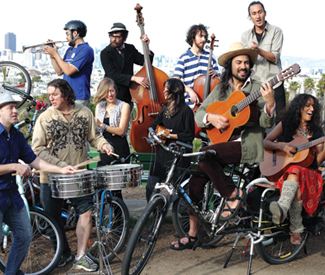
MUSIC While Rupa Marya of Rupa & the April Fishes and Gabe Dominguez of Shake Your Peace are crossing their fingers for cloudless, sunny days ahead during their joint week-long bicycle trek around the Bay Area, in some ways, they were brought together by a storm.

It was a storm both physical and figurative: the scattered downpours during their first encounter at the now-dispersed Occupy SF campsite at Justin Herman Plaza last November (11.11.11) during the Occupy Music Festival — where both bands played — and, the subsequent storm of ideas that lead to the bike tour agreement.

“So it was kind of like the perfect storm,” says Dominguez, sitting next to Marya in the Nervous Dog Coffee cafe on Mission Street in early April. “It was an auspicious day,” Marya later adds. “Oh my god, what a day.”

The fruit of that brainstorm, the Bay Rising Tour, will kick off tomorrow at Stanford University, with the ragtag bicycle caravan of around 15 core riders heading counterclockwise around the Bay, stopping in nine cities over 10 days, playing both conventional music venues and guerillas art spaces. The musicians on bikes piled high with gear will turn their final corner on to Divisadero to play the Independent April 28.

Marya and Dominguez had walked into the Nervous Dog that afternoon smiling, bubbling with expectations of the impending tour. The two are clearly platonically smitten with another other’s passion for social justice, global music, and good old-fashioned bike fun.

As Marya nibbles an empanada from the cafe, Dominguez continues their story. “We made the connection that both of our bands make multicultural dance rebel music, rock music for the ecotopian revolution. Bicycles, bioregionalism, now being the time — it all just coalesced.”

One key difference that’s soon to evaporate: Shake Your Peace has done many bike tours, but this will be Rupa & the April Fishes’ first (though they’ve done some trial runs in preparation).

Along with leading Shake Your Peace, and playing in Tiny Home with his girlfriend, Sonya Cotton, Dominguez is a co-founder of the yearly Bicycle Music Festival (since 2007) with Paul Freedman, who too plays a role in the Bay Rising Tour.

Freedman’s company is Rock the Bike, which built the pedal-powered audio system the groups will use in the open space and outdoor venues — San Jose Bike Party, Fremont Earth Day Grounds, Keller Beach Park.

Along with those mentioned, the tour will roll to A Place for Sustainable Living in Oakland for an Earth Day party (with food cooked by Marya’s urban farmer brother), a Beaver Liberation show in Martinez, and a Glen Cove ceremony by Ohlone Leaders in Vallejo.

Out on the road between venues, the caravan has three transportation strategies: people carrying their own instruments on bicycles, those packing larger instruments like guitars on Xtracycles — an Oakland company that sells an extension for the back of the bike — and lastly, a few riders on electric-hybrid bikes carrying six-to-eight foot trailers.

They also are encouraging other cyclists and Bay Area residents to come along for the day rides between shows — to help map out the flattest routes. There’s a real community effort feel to the plan.

“In the wake of where we find ourselves right now, economically, sociopolitically, we can’t wait for someone to hand us the reality we want. We have to build it, we have to create it. And that’s what’s so exciting about this way of touring,” Marya says.

She adds, “it’s not asking for permission, it’s just doing what you do as a musician, which is to mobilize yourselves…bring people on your journey, have a chance to interact with them in another way, which is so different than get on the tour bus, be isolated, be backstage. We’re going to create the stage, we’re going to create the experience.”

Both bands make the kind of music that invites interaction and discussion, so an interactive tour, flipping the tradition of a clear separation between artist and audience, seems the right direction.

Rupa & the April Fishes — now wrapping up their third studio album, Build — have long been fixtures on the global music scene, a Bossa nova bumping mix of Brazilian, Indian, Latin, and French influences, sung in three languages. While based out of San Francisco, they’re often out exploring the world, most recently Chiapas, Mexico; Amsterdam; and Athens, Greece.

Shake Your Peace started out in New York as folk trio, but now “Shake Your Peace 2.0” makes a style of music that Dominguez has dubbed “whup” — a melding of Afro-Latin beats with bluegrass instruments such as fiddle, and gospel harmonies.

“W-H-U-P, it’s a celebratory spirit with a philosophy, a political approach,” Dominguez explains excitedly. “We’re not just fighting for better wages, we’re fighting for life. It’s the spirit of your heart kicking. The scream when you come out of the womb. Life, yaow!”

He appears equally amped on the Bay Rising tour itself, adding again that others should join the rides with the bands — “they’re welcome to experience this rolling summer camp with us.” And they’ll both be Tweeting their locations along the way for the day rides.

As the effusive conversation in Nervous Dog comes to a close, Dominguez and Marya are still talking about the logistics of the trip, including where they’ll crash at night, and the importance of gathering tarps to cover all their gear, just in case of bad weather. 

BAY RISING TOUR

With Rupa & the April Fishes, Shake Your Peace

Thu/19-Sat/28

Various venues, Bay Area

www.theaprilfishes.com


Truth or consequences

0

arts@sfbg.com

SFIFF It’s possible to have an almost perfect Sundance Film Festival viewing experience if you hew to one simple rule: only go to the documentaries. Sure, see some of the dramatic entries too, after the 40th person has told you such-and-such title is great. But you can rarely go far wrong with the documentaries. Sundance has its pick of the annual crème de la crème in that genre (among U.S. if not necessarily international films).

As pretty much a “best of other festivals” festival taking place in late spring — thus perfectly situated to grab the best docs not just from Sundance, but also Berlin, Rotterdam, South by Southwest and elsewhere — the San Francisco International Film Festival can potentially offer the crème de la crème de la crème. Thank god documentaries, unlike that imaginary dairy substance, are not high in saturated fat or cholesterol. You can consume them for SFIFF’s entire span and remain your slim, lovely self, mentally refreshed by enormous quantities of new information ingested the fun and easy way.

Actually, a portrait of conspicuous consumption in its most corpulent form was among Sundance’s opening night films this January, and will duly boggle your mind at SFIFF. Lauren Greenfield’s obscenely entertaining The Queen of Versailles takes a long, turbulent look at the lifestyles lived by David and Jackie Siegel. He is the 70-something undisputed king of timeshares; she is his 40-something (third) wife, a former beauty queen with the requisite blonde locks and major rack, both probably not entirely Mother Nature-made. He’s so compulsive that he’s never saved, instead plowing every buck back into the business.

When the recession hits, that means this billionaire is — in ready-cash as opposed to paper terms — suddenly sorta kinda broke, just as an enormous Las Vegas project is opening and the family’s stupefyingly large new “home” (yep, modeled after Versailles) is mid-construction. Plugs must be pulled, corners cut. Never having had to, the Siegels discover (once most of the servants have been let go) they have no idea how to run a household. Worse, they discover that in adversity they have a very hard time pulling together — in particular, David is revealed as a remote, cold, obsessively all-business person who has no use for getting or giving “emotional support;” not even for being a husband or father, much.

http://www.youtube.com/watch?v=DM43Wyulc7w

What ultimately makes Queen poignantly more than a reality-TV style peek at the garishly wealthy is that Jackie, despite her incredibly vulgar veneer (she’s like a Jennifer Coolidge character, forever squeezed into loud animal prints), is at heart just a nice girl from hicksville who really, really wants to make this family work.

Other docs pipelined from Sundance to SF include acclaimed ones about dissident Chinese artist Ai Weiwei (Ai Weiwei: Never Sorry), Ethel (as in Kennedy), pervasive rape in the U.S. military (The Invisible War), and the Israeli military legal system that governs civilian Palestinians under occupation (The Law in These Parts). Of particular local interest is David France’s excellent How to Survive a Plague, about how ACT UP virtually forced the medical and pharmacological establishments into speeded-up drug trials and development that drastically reduced the AIDS epidemic’s U.S. fatalities within a decade. Don’t expect much about SF activism, though — like so many gay docs on national issues, this one barely sets foot outside Manhattan.

Of actual local origin are several SFIFF nonfiction highlights, not least festival closing nighter Don’t Stop Believin’: Everyman’s Journey, Ramona Diaz’s film about the incredible journey of Filipino superfan Arnel Pineda, from fronting a Journey cover band to fronting the actual Bay Area outfit itself as its latest lead vocalist. There’s also Micha X. Peled’s last globalization trilogy entry Bitter Seeds, focusing on hitherto self-sufficient farmers in India increasingly driven toward bankrupting debt (and widespread suicides) by costly biotech “advances;” Peter Nicks’ The Waiting Room, which sits us right there at Highland Hospital in Oakland, illustrating the heroically coping status quo and desperate need for improvement in a microcosm of U.S. healthcare; and Jamie Meltzer’s world premiere Informant. The latter’s subject is activist-turned-FBI snitch Brandon Darby, whose testimony got two anarchists imprisoned — and who fully participated in this portrait, even its re-enactments of his protest-group infiltration. Darby is expected to attend the festival; given this town’s political leanings, he might want to wear a raincoat.

Speaking of audiences hurling things — abuse, at the least — Caveh Zahedi (plus his lawyer) was evidently met with a shitstorm after the SXSW premiere of The Sheik and I. You, too, may feel the spasmodic urge to throttle him during this latest naughty-boy’s own adventure, in which he accepts a commission to make work for a biennial perversely themed around “art as subversive act” in the far-from-liberal United Arab Emirates. Professed fans, the curators had duly seen his prior work; surely they knew they were inviting trouble in these circumstances?

Nonetheless, they play perfectly into his hands, expressing dismay and barely masked fear as Zahedi faux-naively proceeds to do everything he shouldn’t. That includes ridiculing Islam and the host sheik, stereotyping Arabs in general, putting everyone (including himself and his two-year-old son) in potential danger, all the while claiming his aim is “a critique of imperialism.” Is he really the very model of the privileged Western artist, railing about artistic freedom while ignorant that sometimes, some places, some things (like blasphemy, and prison) must take precedent? Or is the whole act just a deliberate provocation (hardly his first), albeit one with disturbingly dire potential consequences? Alternately very funny and completely infuriating, The Sheik and I is one movie you might want to attend just for the Q&A afterward. Odds are, it’s gonna get ugly. 

www.sffs.org


A hundred visions and revisions

0

arts@sfbg.com

SFIFF R. Buckminster Fuller was born before the turn of the last century, and died before the start of this one. But place his philosophical and practical output next to any contemporary thinker, and something seems a bit off.

“He was totally out of sync with his time,” says SF-based documentarian Sam Green (2004’s The Weather Underground). “He was talking about green building in the 1930s or ’40s.”

You might know Fuller as the designer of the geodesic dome or the namesake of buckyball molecules, but Green, in conjunction with a new exhibit at the San Francisco Museum of Modern Art, is working to establish his reputation as a precursor to modern progressive-tech culture. On May 1, as part of the San Francisco International Film Festival, Green will regale audiences at the SFMOMA with a “live documentary” presentation, The Love Song of R. Buckminster Fuller, featuring a live score by Yo La Tengo.

The exhibit, “The Utopian Impulse: Buckminster Fuller and the Bay Area,” is already open, and features an installation called Buckminster Fuller and the Bay Area: A Relationship in 12 Fragments (inspired by the Dymaxion Chronofile), a collaboration between Green and SF projection-design firm Obscura Digital. The installation is a collage-like film projected on a sculpture inspired by Fuller’s “Dymaxion Map” of the world; the film is an exploration of Fuller’s maddeningly comprehensive personal archive, acquired by Stanford University in 1999.

“Fuller never built anything in the Bay Area, although he proposed a couple projects, and he never lived in the Bay Area, but his influence actually is pretty profound,” notes Green. “Especially on the counterculture, and specifically on the part of the counterculture that eventually morphed into early computer and Silicon Valley culture.” His drive to create efficient, waste-free systems through design and architecture inspired information technology as much as it foreshadowed the green movement.

So what makes Fuller anything more than just a fascinating mad scientist? “We’re not driving the [Dymaxion Car], and most of us are not living in domes or the Dymaxion House. So in some sense you could say he didn’t succeed,” admits Green. “But to me, what’s most relevant and most valuable about him really is that he was inspired to do everything he did by a belief that, through [better design], one could solve the problems of the world.”

“At the heart of all of his activities was a really simple idea, and he was saying this since the ’20s: there’s more than enough resources in the world so that everybody on the planet could have a very comfortable life,” Green muses. “And he really passionately believed that was possible. In some ways, to me, that’s the love song of R. Buckminster Fuller — love of humanity — which sounds a little corny but I really do feel like that was what drove him. He was a person of incredible energy and was on a mission for 50 years, and at the heart of it, I think, was that.”

This is Green’s second foray into the format he innovated with Utopia in Four Movements for SFIFF in 2010, which featured music by Brooklyn band the Quavers and is still touring around the world. “I’m charmed by the format and feel like there’s a lot of potential, a lot more I want to try with it,” Green says of this return to live documentary. “It also seems very appropriate for Fuller; he was somebody who was just a phenomenal speaker. So there seemed to be something about him that fit with this idea of a live documentary, the performative aspects of who he was.”

“It’s only through doing a live piece that you learn what works and what doesn’t. It’s almost like a comedy routine,” Green observes. “You do it and you feel that people respond to certain parts, they don’t respond to other parts, and you grow it and edit it and shape it based on that.”

As to whether or not he thinks there’s more to explore in the world of Bucky Fuller, he says, “With this I’m doing a live piece and an installation, and I may at some point do just a regular documentary about Fuller. I’m open. I’m certainly not done with him yet.”

www.sffs.org


Into new territory

2

arts@sfbg.com

SFIFF How to account for the desire for difficult terrain that runs through so much contemporary art cinema? Exploring the margins and crevices of what’s readily visible is just what good filmmakers do, but extremes have become commonplace. The irony that these far-flung films live on in the cosmopolitan vapors of the festival circuit cannot be lost on the filmmakers themselves. Remoteness may be a relative matter, with patience revealing islands everywhere, but inaccessible landscapes nonetheless guide a handful of interesting features showing at this year’s San Francisco International Film Festival.

>> Read our complete coverage of the San Francisco International Film Festival here.

The bourgeois couple stripped bare by vacation is a standby of modernist cinema, with Roberto Rossellini’s Viaggio in Italia (1954) still the gold standard and Maren Ade’s Everyone Else (2009) the best in recent memory. Julia Loktev’s The Loneliest Planet is an almost classical work in this mode. An engaged couple (Gael García Bernal and Hani Furstenberg) hire a local guide (Bidzina Gujabidze) to lead them through the magnificent Georgian steppe, and so the psychological roundelay begins. Fraught staging, language difficulties, Gerry-rigged tracking shots, and significant pocks in the Caucasus landscape are all worked out with great expertise but little verve.

Where The Loneliest Planet draws on landscape to reveal repressed instincts, Ulrich Köhler’s Sleeping Sickness drifts towards further occlusion. Joseph Conrad’s Heart of Darkness is the obvious reference point, though here it’s a black European who pursues a white man gone native. In the film’s first half we watch as rueful Dr. Ebbo Velten (Pierre Bokma) prepares to leave Cameroon’s lush danger with his wife and daughter. The imminent departure emboldens him to accuse the local authorities of bilking international aid donors for a nonexistent sleeping sickness crisis. Then Alex Nzila (Jean-Cristophe Folly) arrives in Cameroon to evaluate the medical program and finds Velten changed: he’s in a business partnership with a man he openly despised in the first half of the film, and we hardly hear any mention of his European family. Berlin School director Köhler works displacement as a figure of psychology, politics, and narrative and smartly uses the international aid question as a frame to plunge deeper mysteries of identity.

Conrad is a significant presence in The Rings of Saturn, the peripatetic novel by W.G Sebald that’s also the focus of Grant Gee’s suitably oblique documentary portrait. Patience (After Sebald) offers astute commentary on the moods of Sebald’s prose from thinkers like Adam Phillips, Robert Macfarlane, and Tacita Dean, though Gee succumbs to the spectacle of Google Earth mapping of the novel and some decidedly sub-Sebaldian spiritualism. Still, hearing the author speak his own mind on Virginia Woolf’s moth and the phenomenology of walking is worth the price of admission for fans.

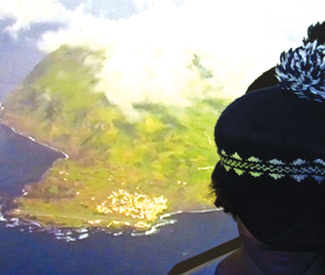
Gonçalo Tocha eschews the Google’s eye view in It’s the Earth Not the Moon, his resplendent study of Corvo (the tiny northernmost island of the Azores, close enough to being in the middle of the ocean and a far outlier of European Union). Tocha and his sound man Dídio Pestana dropped anchor there to capture every face, bird, and rock on the island — a self-consciously grandiose goal with something of the 19th century about it. The film first approaches Corvo with statistical lyricism: dimensions, number of residents, number of roads, and so on. The notion that you could hold the entire island in your head at once is an illusion, of course, but a sustaining one. Corvo is an island such as you might have imagined as a child, which is not to say that It’s the Earth is innocent of the world. As economic math and electoral politics sweep the second part of the film, Tocha proves himself an inheritor of the French essay-film tradition of Chris Marker and Agnès Varda. The film’s three hours pass easily in the intimacy of encounter, but one still admires the desire to give the film experience some qualitative measure of being marooned.

Corvo’s aging population might well feel at home in the timeless Brazilian village of Found Memories, the fable of a young woman born in the wrong time coming to a community of people who have forgotten to die. Along with It’s the Earth and other SFIFF selections Palaces of Pity and Neighboring Sounds, Júlia Murat’s first narrative feature seals a particularly strong year of Portuguese-language films. She delineates time and space through routine, patiently unfolding characterization in the adjoining repetitions. Lucio Bonelli’s cinematography is beautiful work in itself, fearlessly embracing darkness and shadow (the rural village must have seemed like easy street after lensing Lisandro Alonso’s formidable landscapes). Found Memories doesn’t break the mold of slow cinema — its melancholy mingling of photography and myth is especially reminiscent of Manoel de Oliveira’s The Strange Case of Angelica (2010) — but a late passage of clipped post-punk demonstrates that Murat can handle a sudden swerve.

That leaves little space for Davy Chou’s assured debut, Golden Slumbers, and it deserves an article of its own. The remoteness we experience here is that of phantoms: Chou’s film excavates the thriving Cambodian cinema that was rubbed out by the Khmer Rouge. All that remains are fugitive traces of printed ephemera and soundtracks of curling orchestral ballads and psychedelic nuggets — and the memories of those people who made or relished the films and survived Pol Pot. Most of the films discussed in this article use offscreen sound to develop a sense of place beyond the frame, but Golden Slumbers is a special case, with the poverty of archival materials turned to an advantage as elegy. Chou’s gliding Phnom Penh interludes and spaciously staged interviews reflect the influence of Jia Zhangke and Tsai Ming-liang’s Goodbye, Dragon Inn (2003), but these cinephilic touchstones never overwhelm the personal, defiant accounts of moviemaking at the heart of the film. Ever after is the tragic refrain of Chou’s film, but the once upon a time is as golden as he says. 


www.sffs.org

I get by with the help of my local DIY classes

0

What would the ultimate DIY day look like? There’s heaps of classes you can take in the Bay Area to make yourself more handy and sustainability-minded. Here’s a hypothetical 24 hours using the skills you can cull from those courses — scroll to the end of the article for details on where you can take each class concerned.

It’s Saturday! Wake up to the smell of coffee you roasted yourself (“Home Coffee Roasting”). Pour in your homemade almond milk for a nutty kick. (“Everyday Nut Milks and Cheeses”) For breakfast, you’re having toast with the jam you preserved (“Basics of Food Preservation and Jam-Making”) and fresh honey from your backyard beehive. (“Backyard Beekeeping”) Say hello to the chicken peeping outside, and thank your favorite hen as you enjoy that plate of scrambled eggs. (“Intro to Backyard Chickens”)

Mosey out to your freshly-landscaped garden, picking your way past the brand-new bank of sprightly succulents. (“Strategies in Urban Permaculture”) Admire your new water-saving irrigation system — she’s a real looker. (“Greywater, Rainwater Catchment, Earthworks”)

Time to primp for your day. Wash your body with the soap you made from scratch (“Cold Process Soap Making”) and afterwards, spritz yourself with handcrafted perfume. (“Making Natural Perfumes”) Head to your closet and pick out the fresh new frock you sewed (“Patternmaking and Design”), adorning yourself with those homemade earrings and pendant. (“Stitch DIY Class: Jewelry Making”)

After running a few errands around town, return to your garden to enjoy a cup of seasonal tea. It’s perfectly steeped — no need for artificial sweeteners. (“Tea and Food Pairing”) For lunch, you’re thinking crab ravioli with tomato cream sauce. (“Using Your Noodle”) Sprinkle fresh herbs gathered from your garden onto your plate for that extra kick. (“Starting an Herb Garden”)

Your out-of-town friends have been eating out every day of their trip, so you invite them over for a home-cooked meal. You remember hearing one of them saying that he craved sushi — sounds like the perfect night for nigiri and maki. (“We Be Sushi Workshop”) The handsome wooden table you built last weekend (“Wood and Metal”) makes the perfect centerpiece over which to catch up on each other’s lives.

The evening is going smoothly. Until, that is, one of your guests bumps into a burning candle on her way to the bathroom. The fire spreads quickly, but what do you know, those skills you copped from San Francisco’s firefighters save the day. (“Disaster Preparedness Training”)

Singe avoided, you and your friends get in the car to head to a mutual friend’s art show. Snap — the car sputters out! But you dodge an evening of tow trucks and mechanics’ waiting rooms. That auto repair class (“Essentials of Auto Maintenance”) taught you everything you need to save the day. Again.

You drift off to a deep sleep wrapped in a warm nest of your favorite knitted blankets. (“Knitting 101”) Sweet dreams, most capable person ever. 

“Home Coffee Roasting” May 3, 6pm-9pm, $30–$60. Modern Coffee, 411 13th St., Oakl. (510) 927-3252, www.iuhoakland.com

“Everyday Nut Milks and Cheeses” May 2, 6pm-8:30pm, $40-65. Instructor’s private home in Oakland, www.rawbayarea.com

“Basics of food preservation and jam-making” Fri/20, 6:30pm-8pm, $10. Pot and Pantry, 593 Guerrero, SF. (415) 206-1134, www.potandpantry.com

“Backyard beekeeping” Tue/24, 6pm-9pm, $35. Sticky Art Lab, 1682 University, Berk. (510) 655-5509, www.biofueloasis.com

“Intro to Backyard Chickens” Sun/15, 2pm, $35. Mill Valley Chickens, 106 Lomita, Mill Valley. (415) 389-8216, www.millvalleychickens.com

“Strategies in Urban Permaculture” Sun/15, noon-5pm, $25. Hayes Valley Farm, 450 Laguna, SF. (415) 753-7645, www.hayesvalleyfarm.com

“Greywater, Rainwater Catchment, Earthworks” basics of home irrigation Sun/29, 10am-1pm, $15. EcoHouse, 1305 Hopkins, Berk. (510) 548-2220, www.ecologycenter.org

“Cold Process Soap Making” Fri/20, 6pm-9pm, $65. Nova Studio, 24 West Richmond, Point Richmond. (510) 234-5700, www.thenovastudio.com

“Making Natural Perfumes” May 6, 10 am-5 p.m., $125. Nova Studio, 24 West Richmond, Point Richmond. (510) 234-5700, www.thenovastudio.com

“Patternmaking and Design” Four weekly classes, $175. Apparel Arts, 2325 Third St. Suite No. 406, SF. (415) 436-9738, www.apparel-arts.com

“Stitch DIY Class: Jewelry Making” Sat/14, 2:30pm-3:30pm, free. Indie Industries Castro Store, 2352 Market, SF. (415) 861-1150, 5titch.eventbrite.com

“Tea and Food Pairing” Tue/17, 7pm-8:30pm, $85. Tea Time Room, 542 Ramona, Palo Alto. (650) 328-2877, www.tea-time.com

“Using Your Noodle” 5/1, 6:30pm-9:30pm, $45-60. Marina Middle School,104A, 3500 Fillmore, SF. (415) 749-3495, www.ccsf.edu/continEd

“Starting an Herb Garden” May 5, 10:30am, $39. Common Ground Organic Garden Supply and Education Center, 559 College, Palo Alto. (650) 493-6072, www.commongroundinpaloalto.org

“We Be Sushi Workshop” Sat/14 and Sat/21, 10am-1pm, $65-80. We Be Sushi, 538 Valencia, SF. (415) 565-0749, www.ccsf.edu/continEd

“Wood and Metal” April 23 through July 2, Mon. 6pm-9pm, 10 sessions for $520. The Crucible, 1260 Seventh St., Oakl. (510) 444-0919, www.thecrucible.org

“Disaster preparedness training” Tues/17, 6:30pm-9:30pm, free. Valencia Gardens Community Room, 390 Valencia, SF. (415) 970-2024, www.sf-fire.org

“Essentials of Auto Maintenance” Sat/14, 11am, $60. Metric Motors, 1480 Howard, SF. (415) 295-4486, www.thedistilledman.com

“Knitting 101” Weekly instruction hours Mon. and Wed., 7 p.m.-9pm; Sat., 8:30am-10:30am, $66. Imagiknit, 3897 18th St., SF. (415) 621-6642, www.imagiknit.com


Mirkarimi claims Lee didn’t care what really happened

129

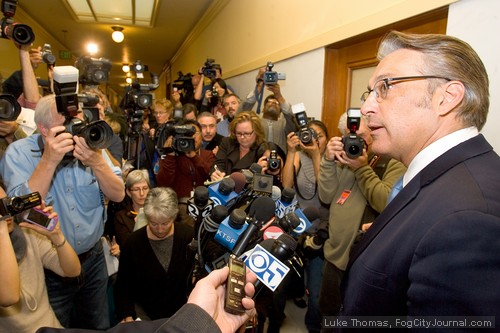
UPDATED BELOW Did Mayor Ed Lee ask Ross Mirkarimi what really happened in the conflict with his wife before removing him as sheriff? That question is not only important to understanding Lee and whether he was interested in the truth, but it could also be central to next week’s court hearing on whether Mirkarimi was denied due process before being suspended without pay.

In an interview published today in the New York Times, and in statements made today to the Guardian, Mirkarimi maintains that he sought to tell Lee the full story but that the mayor wasn’t interested. “He was clear that he was not interested in events or details, which were represented by me, even when I encouraged him,” Mirkarimi told The Bay Citizen, whose content the Times runs. “It was more than one occasion I offered to tell him my side of the story. If I had, it could have dramatically changed the mayor’s understanding of the situation.”

Yet the affidavit by Lee that was submitted to the court this week – which is written under penalty of perjury – paints a very different picture: one of the two men sitting in uncomfortable silence rather than Mirkarimi seizing the chance to shape Lee’s understanding of the situation.

“I asked Sheriff Mirkarimi to meet with me, because I felt that I needed to hear from him and consider what he had to say,” Lee wrote of the March 19 meeting where he gave Mirkarimi 24 hours to resign or be suspended, noting that he had reviewed the court records and “it appeared to me that he had engaged in official misconduct.”

“I explained to Sheriff Mirkarimi that I wanted to give him an opportunity to talk to me about this issue. It was a free flowing conversation with no time constraints. Sheriff Mirkarimi told me that he has not yet told his side of the story. I said, Okay, and waited for him to tell me his side of the story. He did not. Instead, after pausing, he asked me whether the suspension was based on his conduct as Sheriff. I responded that it was based on his conduct as a public official. I paused again and waited for Sheriff Mirkarimi to give me whatever information he thought important. He did not. Instead, Sheriff Mirkarimi asked me whether the suspension would be with or without pay. I told him it would be without pay. After giving him another chance to ask questions or give more information, I told Mr. Mirkarimi to consider my instruction to resign over the next 24 hours,” Lee wrote.

In an exchange of text messages with the Guardian, Mirkarimi maintains that Lee wasn’t interested in hearing from him or his wife, Eliana Lopez, what happened during the New Year’s Eve altercation or in its aftermath.

“On more than one occasion I offered details to Lee. He was either mute or changed the subject. Think about it – why else would they have DHR Miki Callahan [the city’s deputy human resources director] try to depose me after I was suspended without pay – they shoot first, then realize they better ask questions,” Mirkarimi wrote.

We asked why he didn’t use the opportunity of his meeting with Lee to tell his story.

“As I said, I did try. More than once. He wasn’t interested. In fact I told him how painful it’s been to not have contact [with Lopez, whom the court has barred him from contacting] since January 13, and encouraged him to get an independent account from my wife, Eliana; offered her phone number. Lee didn’t take it,” Mirkarimi said.

Paula Canny, Lopez’s attorney, has also said that Lee never tried to reach her and didn’t seem interested in what really happened. But the city’s official misconduct complaint makes a number of unsubstantiated allegations about that incident and what happened since that Mirkarimi and Lopez deny.

For example, the complaint claims that Mirkarimi “or his agents” asked Ivory Madison, the neighbor who helped Lopez make a videotape of her showing a bruise on her arm inflicted by Mirkarimi, to “destroy evidence,” a charge her husband, Abraham Mertens, made in a Chronicle op-ed. But in her own subsequent op-ed, Lopez says that wasn’t true and that Mirkarimi wasn’t even aware of the existence of the tape until after Madison had called the police and told them about it.

In the Times article, Mirkarimi also disputed another key allegation from the formal charges against him: “Sheriff Mirkarimi misused his office, and the status and authority it carries, for personal advantage when he stated to Ms. Lopez that he could win custody of their child because he was very powerful.”

That allegation also came from Madison, who hasn’t responded to calls from the Guardian, the Times, or other media outlets. But Mirkarimi told the Times that what he really told his wife was that California has “powerful” child custody laws that would make it difficult for her to take their son back to Venezuela if they divorced.

“I never said, ever, that I’m a powerful person,” he said. “It’s not even my style. I was quoting in the context of what had been a very familiar and painful reminder that, six months earlier, Eliana had been out of the country with Theo for two and a half months. I was referencing family law.”

Other news broken in the Times story was Mirkarimi disputing that he called the case a “private matter, a family matter,” saying that statement that so outraged domestic violence groups was “distorted by the press.” The article also quotes journalist Phil Bronstein minimizing the phone conversation he had with Madison before she decided to report the Mirkarimi-Lopez incident to the police, saying he only helped Madison contact “three people who Ross was close to” for reasons that weren’t clear. Bronstein, who hasn’t returned our calls on the issue [SEE UPDATE BELOW], was on the witness list for Mirkarimi’s domestic violence trial before Mirkarimi pled guilty to the lesser charge of false imprisonment.

The City Attorney’s Office isn’t commenting on the case, and when we asked the mayor’s Press Secretary Christine Falvey why Lee didn’t seek an account of what happened from Lopez or Mirkarimi, she told us simply, “The Mayor met with Ross Mirkarimi twice to discuss this.”

In the city’s response to Mirkarimi’s lawsuit seeking reinstatement of his pay and position until the official conduct hearings are resolved, which will be heard in Superior Court on April 20, they claim, “The Mayor met personally with Petitioner to discuss his intentions and has repeatedly invited Petitioner to tell his side of the story, an invitation Petitioner has repeatedly declined. But even more fundamentally, the due process claim fails as a matter of law. The constitutional right to due process is triggered only when the government works a deprivation of a legally recognized liberty or property interest.”

The city says caselaw is clear that elected officials can’t claim their office belongs to them. “A public office is always a public trust,” the city argues. But Mirkarimi’s attorneys say all employees have a clear property interest in their salaries, and they say it was illegal, coercive, and unfair to deprive Mirkarimi of his while he goes through the months-long official misconduct process. Police officers are almost always paid during their suspensions.

UPDATE 4/16: The message that I left for Bronstein seeking to speak with him about his conversation with Madison was nearly two weeks ago, and he called to take issue with my statement that he didn’t call back and with my characterization that he “minimized” his conversation with Madison in the New York Times article, although he did characterize their conversation as brief and fairly insignificant.

“Ivory Madison called me to say there were three people that Ross trusts and Eliana might want to get ahold of them, do you have their contact information, and I said I could probably get it,” Bronstein told us, noting that he never contacted any of them on her behalf. Sources tell us the three people were Aaron Peskin, Art Agnos, and Michael Hennessey. “No one was contacted, no information was passed, that was the extent of the conversation.”

Bronstein left those comments in a voicemail. I’m still waiting to talk to him about whether the conversation included talk of the incident and whether police should be involved, and I’ll update this post when I hear back.

Film Listings

0

Film listings are edited by Cheryl Eddy. Reviewers are Kimberly Chun, Max Goldberg, Dennis Harvey, Lynn Rapoport, and Matt Sussman. For rep house showtimes, see Rep Clock.

OPENING

*Applause See “Diva in the Headlights.” (1:27) Lumiere, Shattuck.

Bad Fever Dustin Guy Defa’s tiny, odd character study centers on one Eddie Cooperschmidt (Kentucker Audley, a director himself), who looks like Mr. February 1992 on a calendar of sensitive grunge band hunks, but acts more like Homer Simpson — the Nathanael West version, not Matt Groening’s. He still lives with mom (unsympathetically played by Annette Wright), doesn’t or can’t hold a job, has no friends, fumbles through an oddly formal vocabulary, and carries himself like a 13-year-old who’s just had all his growth spurts in one go. In other words, he’s the sort of character whose precise status — just socially inept, or developmentally disabled, or both? — is a mystery the film doesn’t bother clarifying. Nor do we find out what the story is behind Irene (Eleonore Hendricks), his hard-bitten antithesis, who seems to be staying in an empty school classroom as some sort of weird art experiment rather than because she’s “homeless,” and who manipulates the hapless Eddie into videotaped situations that are perverse but stop short of pornography. (Or rather he — almost certainly a virgin — stops short there.) As if more goofy pathos were needed here, Eddie’s dream is to be a stand-up comedian, a career he is about as well equipped for as brain surgeon. When Eddie plays his big first (and probably last) comedy gig, the onscreen audience appears to be wondering the same thing you might: is this just sad, or some kind of Andy Kaufman-type performance piece? Painstakingly low-key and realistic in execution, Bad Fever‘s success will depend on whether you can swallow it conceptually — these characters are surrounded by a real world, but they can seem unreal themselves. (1:24) Roxie. (Harvey)

Blue Like Jazz Tap or bottled water, rainy Portland, Ore. or dry Texas — how does a sincere, young Bible-thumping Baptist reconcile the two — a fish out of water nonetheless determined to swim upstream and make his way to adulthood. Based on the Donald Miller memoir-of-sorts, Blue Like Jazz may look like a Nicholas Sparks romantic opus from afar, but in the care of director-cowriter Steve Taylor, this tale of a young man coming to terms with the wider, wilder world apart from the strict confines of lock-in abstinence groups snatches a bit of the grace John Coltrane tapped in A Love Supreme. The earnest Donald (True Blood’s Marshall Allman) is all set to go to his nearby Bible Belt Christian university until his bohemian jazz-loving dad pulls favors and enrolls him at free-form Reed College. Donald will have to closet his holy-roller background if, as his new lesbian pal (Tania Raymonde) cautions, he “plans on ever making friends or sharing a bowl or seeing human vagina without a credit card.” Donald finds his way back to meaning and spirit — and the fun is getting there, as he joins a civil-disobedience-club-for-credit (Malaysian cocktail tennis was canceled) and falls for passionate activist Penny (Claire Holt). Allman, who also co-executive produced, emerges as a thoughtful actor who can carry a potentially maudlin and ultimately lovable collegiate coming-of-age story on his own. (1:47) (Chun)

*Bully Anyone who’s ever been a kid on the wrong side of a bully — or was sensitive and observant enough not to avert his or her eyes — will be puzzling over the MPAA’s R rating of this doc, for profanity. It’s absurd when the gory violence on network and basic cable TV stops just short of cutting characters’ faces off, as one blurred-out bus bully threatens to do to the sweet, hapless Alex, dubbed “Fish Face” by the kids who ostracize him and make his life hell on the bus. It’s a jungle out there, as we all know — but it’s that real, visceral footage of the verbal (and physical) abuse bullied children deal with daily that brings it all home. Filmmaker Lee Hirsch goes above and beyond in trying to capture all dimensions of his subject: the terrorized bullied, the ineffectual school administrators, the desperate parents. There’s Kelby, the gay girl who was forced off her beloved basketball team after she came out, and Ja’Maya, who took drastic measures to fend off her tormenters — as well as the specters of those who turned to suicide as a way out. Hirsch is clearly more of an activist than a fly on the wall: he steps in at one point to help and obviously makes an uplifting effort to focus on what we can do to battle bullying. Nevertheless, at the risk of coming off like the Iowa assistant principal who’s catching criticism for telling one victim that he was just as bad as the bully that he refused to shake hands with, one feels compelled to note one prominent component that’s missing here: the bullies themselves, their stories, and the reasons why they’re so cruel — admittedly a daunting, possibly libelous task. (1:35) Piedmont, Shattuck. (Chun)

*The Cabin in the Woods If the name “Joss Whedon” doesn’t provide all the reason you need to bum-rush The Cabin in the Woods (Whedon produced and co-wrote,  with director and frequent collaborator Drew Goddard), well, there’s not much more that can be revealed without ruining the entire movie. In a very, very small nutshell, it’s about a group of college kids (including Chris “Thor” Hemsworth) whose weekend jaunt to a rural cabin goes horribly awry, as such weekend jaunts tend to do in horror movies (the Texas Chainsaw and Evil Dead movies are heavily referenced). But this is no ordinary nightmare — its peculiarities are cleverly, carefully revealed, and the movie’s inside-out takedown of scary movies produces some very unexpected (and delightfully blood-gushing) twists and turns. Plus: the always-awesome Richard Jenkins, and in-jokes galore for genre fans. (1:35) California, Presidio. (Eddy)

*Damsels in Distress Whit Stillman lives! The eternally preppy writer-director (1990’s Metropolitan; 1994’s Barcelona; 1998’s The Last Days of Disco), whose dialogue-laden scripts have earned him the not-inaccurate descriptor of “the WASP Woody Allen,” emerges with this popped-collar take on girl-clique movies like Mean Girls (2004), Clueless (1995), and even Heathers (1988). At East Coast liberal-arts college Seven Oaks (“the last of the Select Seven to go co-ed”), frat guys are so dumb they don’t know the names of all the colors; the school newspaper is called the Daily Complainer; and a group of girls, lead by know-it-all Violet (Greta Gerwig), are determined to lift student morale using unconventional methods (tap dancing is one of them). After she’s scooped into this strange orbit, transfer student (Analeigh Tipton) can’t quite believe Violet and her friends are for real. They’re not, of course — they’re carefully crafted Stillman creations, which renders this very funny take on college life a completely unique experience. Did I mention the musical numbers? (1:38) (Eddy)

Detention The latest from A-list music video director turned B-movie helmer Joseph Kahn (2004’s Torque) realllllly wants to be a cult classic. Not sure that’s a certainty, but midnight would definitely be the appropriate hour to view this teen-slasher parody that also enfolds body-swapping, time travel, out-of-control parties, stuffed bears, accidental YouTube porn, unrequited love, the dreaded Dane Cook, and cinema’s most sledgehammer-heavy 1990s nostalgia to date — despite the fact that Detention‘s central homage is to The Breakfast Club, which came out in 1985. Nominally grounding the film’s garish look, broad humor, and breakneck pace are the charms of young leads Shanley Caswell (as klutzy tomboy Riley) and Hunger Games star Josh Hutcherson (as a Road House-worshiping skater), who displays questionable if admirable show biz aspirations by serving as one of Detention‘s executive producers. He was, after all, born in 1992, which in Detention‘s estimation was “like, the coolest year ever!” (1:30) (Eddy)

*The Lady Luc Besson directs Michelle Yeoh — but The Lady is about as far from flashy action heroics as humanly possible. Instead, it’s a reverent, emotion-packed biopic of Nobel Peace Prize winner Aung San Suu Kyi, a national hero in Burma (Myanmar) for her work against the country’s oppressive military regime. But don’t expect a year-by-year exploration of Suu’s every accomplishment; instead, the film focuses on the relationship between Suu and her British husband, Michael Aris (David Thewlis). When Michael discovers he’s dying of cancer, he’s repeatedly denied visas to visit his wife — a cruel knife-twist by a government that assures Suu that if she leaves Burma to visit him, they’ll never allow her to return. Heartbreaking stuff, elegantly channeled by Thewlis and especially Yeoh, who conveys Suu’s incredible strength despite her alarmingly frail appearance. The real Iron Lady, right here. (2:07) Bridge, Shattuck. (Eddy)

L!fe Happens Ah, another movie in the Juno-Knocked Up continuum of “Unplanned and totally ill-advised pregnancy? Welp, guess I’m having a baby!” We never know if a “shmishmortion” occurs to Kim (Krysten Ritter), because she has unprotected sex in the first scene and the next scene is “one year later,” with infant in tow. The wee babe’s dad, a surfer with neck tattoos, is out of the picture; Kim makes do with her job as a dog walker (Kristen Johnston plays her kid-hating, cheesy-diva boss) and the good graces of her roommates, sardonic budding self-help guru Deena (Kate Bosworth) and cheerful Laura (Rachel Bilson), whose only defining characteristic is that she’s a virgin (omg, the irony). As directed by Kat Coira (who co-wrote with Ritter), L!fe Happens lurches toward Hollywood conventionality by pairing Kim with a hunky guy (Geoff Stults) who doesn’t realize she’s a MILF. Fortunately, that storyline is frequently overshadowed — seriously, they might as well have named the baby “Plot Device” or “Conflict Generator” — by the remarkably realistic I-love-you-but-sometimes-I-want-to-kill-you relationship between BFFs Kim and Deena, which forms the film’s true emotional core. +100 for casting Weeds‘ Justin Kirk as an ascot-wearing weirdo who woos the icy Deena, with (not-so) surprising results. (1:40) (Eddy)

Lockout When the president’s daughter is trapped amid a prison uprising in outer space, the government has no choice but to call in Snake Plissken — er, Guy Pearce — to save the day. (1:35) Shattuck, Vogue.

*Monsieur Lazhar When their beloved but troubled teacher hangs herself in the classroom — not a thoughtful choice of location, but then we never really discover her motives — traumatized Montreal sixth-graders get Bachir Lazhar (Fellag), a middle-aged Algerian émigré whose contrastingly rather strict, old-fashioned methods prove surprisingly useful at helping them past their trauma. He quickly becomes the crush object of studious Alice (Sophie Nelisse), whose single mother is a pilot too often away, while troublemaker Simon (Emilien Neron) acts out his own domestic and other issues at school. Lazhar has his own secrets as well — for one thing, we see that he’s still petitioning for permanent asylum in Canada, contradicting what he told the principal upon being hired — and while his emotions are more tightly wrapped, circumstances will eventually force all truths out. This very likable drama about adults and children from Quebec writer-director Philippe Falardeau doesn’t quite have the heft and resonance to rate among the truly great narrative films about education (like Laurent Cantet’s recent French The Class). But it comes close enough, gracefully touching on numerous other issues while effectively keeping focus on how a good teacher can shape young lives in ways as incalculable as they are important. (1:34) Albany, Embarcadero, Smith Rafael. (Harvey)

People v. The State of Illusion Writer-producer-star Austin Vickers’ slice of self-help cinema is a motivational lecture illustrated by a lot of infomercial-type imagery, plus a narrative strand: when a stressed-out yuppie single dad’s carelessness results in a traffic death, he’s sent to prison. Naturally Aaron (played by J.B. Tuttle) hate, hate, hates it there, until the world’s most philosophically advanced janitor (Michael McCormick) gradually gets him to understand that the real “prison” is his mind — freedom requires only an “awareness shift.” The larger film, with Vickers addressing us directly and various experts chipping in, furthers that notion to suggest even cellular science supports the notion that reality is a matter of perception — and thus the roadblocks and limitations that gum us up on life’s paths (relationships, income, self-doubt, et al.) can be overcome if one believes so and acts accordingly. This elaborate pep talk isn’t really the sort of thing you can evaluate in art or entertainment terms, save to say it’s well-crafted for its type. As for value in other terms, well, odds are you’ve heard all this in one form or another before. But if you happen to be stuck in any kind of personal prison, who knows, People might be just the prod that gets you moving. (1:26) Opera Plaza. (Harvey)

A Simple Life When elderly Ah Tao (Deanie Ip), the housekeeper who’s served his family for decades, has a stroke, producer Roger (Andy Lau) pays for her to enter a nursing home. No longer tasked with caring for Roger, Ah Tao faces life in the cramped, often depressing facility with resigned calm, making friends with other residents (some of whom are played by nonprofessional actors) and enjoying Roger’s frequent visits. Based on Roger Lee’s story (inspired by his own life), Ann Hui’s film is well-served by its performances; Ip picked up multiple Best Actress awards for her role, Lau is reliably solid, and Anthony Wong pops up as the nursing home’s eye patch-wearing owner. Wong’s over-the-top cameo doesn’t quite fit in with the movie’s otherwise low-key vibe, but he’s a welcome distraction in a film that can be too quiet at times — a situation not helped by its washed-out palette of gray, beige, and more gray. (1:58) Metreon. (Eddy)

The Three Stooges: The Movie Why? (1:32) Presidio.

*The Turin Horse Hungarian auteur Béla Tarr’s final cinematic statement is extrapolated from a climactic episode in the life of Friedrich Nietzsche, wherein the philosopher tearfully intervened in the beating of a horse on the streets of Turin. Tarr, working with frequent collaborators Ágnes Hranitzky and László Krasznahorkai, conjures the lives of a horseman and his daughter as they barely subsist amid a windswept wasteland. This glacial Beckettian dirge of a film, shot in black and white and composed of Tarr’s trademark long takes, doesn’t so much develop these two characters as wear them down. Their stultifying daily routines — cleaning the stable, fetching water from the well, changing and cleaning their numerous layers of clothing — occupy much of the film, so it is all the more unsettling when this wretched lifestyle is torn asunder by the whims of nature. (2:26) SF Film Society Cinema. (Sam Stander)

We Have a Pope What if a new pope was chosen … but he didn’t want to serve? In this gentle comedy-drama from Italian writer-director Nanni Moretti (2001’s The Son’s Room), Cardinal Melville (veteran French actor Michel Piccoli) is tapped to be the next Holy Father — and promptly flips out. The Vatican goes into crisis mode, first calling in a shrink, Professor Brezzi (Moretti), to talk to the troubled man, then orchestrating a ruse that the Pope-elect is merely hiding out in his apartments as the crowds of faithful rumble impatiently outside. Meanwhile, Melville sneaks off on an unauthorized, anonymous field trip that turns into a soul-searching, existential journey; along the way he hooks up with a group of actors that remind him of his youthful dreams of the stage — and help him realize that being the next Pope will require a performance he’s not sure he can deliver. Back at the Vatican, all assembled are essentially trapped until the new Pope is publicly revealed; the bored Cardinals kill time by playing cards and, most amusingly, participating in a volleyball tournament organized by Brezzi. Irreverent enough, though I’m not sure what kind of audience this will draw. Papal humorists? (1:44) Embarcadero. (Eddy)

ONGOING

American Reunion Care for yet another helping of all-American horn dogs? The original American Pie (1999) was a sweet-tempered, albeit ante-upping tribute to ‘80s teen sex comedies, so the latest in the franchise, the older, somewhat wiser American Reunion, is obliged to squeeze a dab more of the ole life force outta the class of ‘99, in honor of their, em, 13th high school reunion. These days Jim (Jason Biggs) is attempting to fluff up a flagging postbaby sex life with wife Michelle (Alyson Hannigan). Kevin (Thomas Ian Nicholas) yearns to get in touch with his buried bad boy. Oz (Chris Klein) has become a sportscaster-reality competition star and is seemingly lost without old girlfriend Heather (Mena Suvari). Stifler (Seann William Scott) is as piggishly incorrigible as ever—even as a low-hanging investment flunky, while scarred, adventuring biker Finch (Eddie Kaye Thomas) seems to have become “the most interesting man in the world.” How much trouble can the gang get into? About as much of a mess as the Hangover guys, which one can’t stop thinking about when Jim wakes up on the kitchen floor with tile burns and zero pants. Half the cast—which includes Tara Reid, John “MILF!” Cho, Natasha Lyonne, and Shannon Elizabeth — seems to have stirred themselves from their own personal career hangovers, interludes of insanity, and plastic surgery disasters (with a few, like Cho and Thomas, firmly moving on), and others such as parental figures Eugene Levy and Jennifer Coolidge continuing to show the kids how it’s done. Still, the farcical American franchise’s essentially benign, healthy attitude toward good, dirty fun reads as slightly refreshing after chaste teen fare like the Twilight and High School Musical flicks. Even with the obligatory moment of full-frontal penis smooshing. (1:53) California, Four Star, Metreon, 1000 Van Ness, Presidio. (Chun)

*The Artist With the charisma-oozing agility of Douglas Fairbanks swashbuckling his way past opponents and the supreme confidence of Rudolph Valentino leaning, mid-swoon, into a maiden, French director-writer Michel Hazanavicius hits a sweet spot, or beauty mark of sorts, with his radiant new film The Artist. In a feat worthy of Fairbanks or Errol Flynn, Hazanavicius juggles a marvelously layered love story between a man and a woman, tensions between the silents and the talkies, and a movie buff’s appreciation of the power of film — embodied in particular by early Hollywood’s union of European artistry and American commerce. Dashing silent film star George Valentin (Jean Dujardin, who channels Fairbanks, Flynn, and William Powell — and won this year’s Cannes best actor prize) is at the height of his career, adorable Jack Russell by his side, until the talkies threaten to relegate him to yesterday’s news. The talent nurtured in the thick of the studio system yearns for real power, telling the newspapers, “I’m not a puppet anymore — I’m an artist,” and finances and directs his own melodrama, while his youthful protégé Peppy Miller (Bérénice Béjo) becomes a yakky flapper age’s new It Girl. Both a crowd-pleasing entertainment and a loving précis on early film history, The Artist never checks its brains at the door, remaining self-aware of its own conceit and its forebears, yet unashamed to touch the audience, without an ounce of cynicism. (1:40) 1000 Van Ness. (Chun)

*The Ballad of Genesis and Lady Jaye Once dubbed “the wickedest man in the world”, shock artist and cofounder of seminal industrial music pioneers Throbbing Gristle Genesis Breyer P-Orridge has softened somewhat with time. Her plunge into pandrogyny, an ongoing artistic and personal process embarked upon with the late Jacqueline “Lady Jaye” Breyer P-Orridge, is an attempt to create a perfectly balanced body, incorporating the characteristics of both. As artists, the two were committed to documenting their process, but as marriage partners, much of their footage is sweetly innocuous home video footage: Genesis cooking in the kitchen decked out in a little black dress, Lady Jaye setting out napkins at a backyard bar-b-que or helping to dig through Genesis’ archives of COUM Transmissions and Throbbing Gristle “ephemera,” the two wrapped in bandages after getting matching nose jobs. “I just want to be remembered as one of the great love affairs of all time,” Jaye tells Genesis. This whimsical documentary by Marie Losier will go a long way toward making that wish a reality. (1:12) Roxie. (Nicole Gluckstern)

*Casa de mi Padre Will Ferrell’s latest challenge in a long line of actorly exercises and comic gestures — from his long list of comedies probing the last gasps of American masculinity to serious forays like Stranger Than Fiction (2006) and Everything Must Go (2010) — is almost entirely Spanish-language telenovela-burrito Western spoof Casa de mi Padre. Here Ferrell tackles an almost entirely Spanish script (with only meager, long-ago high school and college language courses under his belt) alongside Mexican natives Gael García Bernal and Diego Luna and telenovela veteran Genesis Rodriguez. This clever, intriguing, occasionally very funny, yet not altogether successful endeavor, directed by Matt Piedmont and written by Andrew Steele, sprang from Ferrell’s noggin. Ferrell is nice guy Armando, content to stay at home at the ranch, hang with his buddies, and be dismissed by his father (Pedro Armendáriz Jr.) as a dolt. The arrival of his sleazy bro Raul (Luna) and Raul’s fiancée Sonia (Rodriguez) change everything, bringing killer narco Onza (Bernal) into the family’s life and sparking some hilariously klutzy entanglements between Armando and Sonia. All of this leads to almost zero improvisation on Ferrell’s part and plenty of meta, Machete-like spoofs on low-budget fare, from Sergio Leone to Alejandro Jodorowsky. Casa punctures padre-informed transmissions of Latin machismo, but it equally ridicules the idea of a gringo actor riding in and superimposing himself, badly or otherwise, over another country’s culture. (1:25) Four Star, Metreon, Shattuck. (Chun)

*The Deep Blue Sea Caught between the devil and the deep blue sea, filmmaker Terence Davies, much like his heroine, chooses a mutable, fluid sensuality, turning his source material, Terence Rattigan’s acclaimed mid-century play, into a melodrama that catches you in its tide and refuses to let go. At the opening of this sumptuous portrait of a privileged English woman who gives up everything for love, Hester (Rachel Weisz) goes through the methodical motions of ending it all: she writes a suicide note, carefully stuffs towels beneath the door, takes a dozen pills, turns on the gas, and lies down to wait for death to overtake her. Via memories drifting through her fading consciousness, Davies lets us in on scattered, salient details in her back story: her severely damped-down, staid marriage to a high court judge, Sir William (Simon Russel Beale), her attraction and erotic awakening in the hands of charming former RF pilot Freddie Page (Tom Hiddleston), her separation, and her ultimate discovery that her love can never be matched, as she hazards class inequities and ironclad gender roles. “This is a tragedy,” Sir William says, at one point. But, as Hester, a model of integrity, corrects him, “Tragedy is too big a word. Sad, perhaps.” Similarly, Sea is a beautiful downer, but Davies never loses sight of a larger post-war picture, even while he pauses for his archetypal interludes of song, near-still images, and luxuriously slow tracking shots. With cinematographer Florian Hoffmeister, he does a remarkable job of washing post-war London with spots of golden light and creating claustrophobic interiors — creating an emotionally resonant space reminiscent of the work of Wong Kar-wai and Christopher Doyle. At the center, providing the necessary gravitas (much like Julianne Moore in 2002’s Far From Heaven), is Weisz, giving the viewer a reason to believe in this small but reverberant story, and offering yet another reason for attention during the next awards season. (1:38) Embarcadero, Shattuck, Smith Rafael. (Chun)

Dr. Seuss’ The Lorax (1:26) Metreon, 1000 Van Ness.

Footnote (1:45) Albany, Clay.

*Friends With Kids Jennifer Westfeldt scans Hollywood’s romantic comedy landscape for signs of intelligent life and, finding it to be a barren place possibly recovering from a nuclear holocaust, writes, directs, and stars in this follow-up to 2001’s Kissing Jessica Stein, which she co-wrote and starred in. Julie (Westfeldt) and Jason (Adam Scott) are upper-thirtysomething New Yorkers with two decades of friendship behind them. He calls her “doll.” They have whispered phone conversations at four in the morning while their insignificant others lie slumbering beside them on the verge of getting dumped. And after a night spent witnessing the tragic toll that procreation has taken on the marriages of their four closest friends — Bridesmaids (2011) reunion party Leslie (Maya Rudolph), Alex (Chris O’Dowd), Missy (Kristen Wiig), and Ben (Jon Hamm), the latter two, surprisingly and less surprisingly, providing some of the film’s darkest moments — Jason proposes that they raise a child together platonically, thereby giving any external romantic relationships a fighting chance of survival. In no time, they’ve worked out the kinks to their satisfaction, insulted and horrified their friends, and awkwardly made a bouncing baby boy. The arrival of significant others (Edward Burns and Megan Fox) signals the second phase of the experiment. Some viewers will be invested in latent sparks of romance between the central pair, others in the success of an alternative family arrangement; one of these demographics is destined for disappointment. Until then, however, both groups and any viewers unwilling to submit to this reductive binary will be treated to a funny, witty, well crafted depiction of two people’s attempts to preserve life as they know it while redrawing the parameters of parenthood. (1:40) SF Center, Sundance Kabuki. (Rapoport)

*House of Pleasures Set in a fin de siècle French brothel, Bertrand Bonello’s lushly rendered drama is challenging and frequently unpleasant. Bonello sees the beauty and allure of his subjects, the many miserable women of this maison close, but rarely sinks to sympathy for their selfish and sometimes sadistic clients. Bound as they are by their debts to their Madame, the prostitutes are essentially slaves, held to strict and humiliating standards. All they have is each other, and the movie’s few emotional bright spots come from this connection. The filmmaking is wily and nouvelle vague-ish, featuring anachronistic music and inventive split-screen sequences. Additionally, there is a spidery complexity to the film’s chronology, wherein certain scenes repeat to reveal new contexts. This unstuck sense of newness is perhaps didactic — this could and does happen now as well as then — but it also serves to make an already compelling ensemble piece even richer and more engaging. (2:02) SF Film Society Cinema. (Sam Stander)

The Hunger Games Katniss Everdeen (Jennifer Lawrence) is a teenager living in a totalitarian state whose 12 impoverished districts, as retribution for an earlier uprising, must pay tribute to the so-called Capitol every year, sacrificing one boy and one girl each to the Hunger Games. A battle royal set in a perilous arena and broadcast live to the Capitol as gripping diversion and to the districts as sadistic propaganda, the Hunger Games are, depending on your viewpoint, a “pageant of honor, courage, and sacrifice” or a brutal, pointless bloodbath involving children as young as 12. When her little sister’s name comes up in the ann­ual lottery, Katniss volunteers to take her place and is joined by a boy named Peeta Mellark (Josh Hutcherson), with whom she shares an old, unspoken bond. Tasked with translating to the screen the first installment of Suzanne Collins’s rabidly admired trilogy, writer-director Gary Ross (2003’s Seabiscuit, 1998’s Pleasantville) telescopes the book’s drawn-out, dread-filled tale into a manageable two-plus-hour entertainment, making great (and horrifying) use of the original work’s action, but losing a good deal of the narrative detail and emotional force. Elizabeth Banks is comic and unrecognizable as Effie Trinket, the two tributes’ chaperone; Lenny Kravitz gives a blank, flattened reading as their stylist, Cinna; and Donald Sutherland is sufficiently creepy and bloodless as the country’s leader, President Snow. More exceptionally cast are Woody Harrelson as Katniss and Peeta’s surly, alcoholic mentor, Haymitch Abernathy, and Stanley Tucci as games emcee Caesar Flickerman, flashing a bank of gleaming teeth at each contestant as he probes their dire circumstances with the oily superficiality of a talk show host. (2:22) Marina, 1000 Van Ness, Presidio, SF Center, Sundance Kabuki. (Rapoport)

*The Hunter Shot and set during Iran’s contentious 2009 Presidential campaign, The Hunter starts as a Kafka-esque portrait of quiet desperation in a cold, empty Tehran, then turns into a sort of existential thriller. The precise message may be ambiguous, but it’s no surprise this two-year-old feature has so far played nearly everywhere but Iran itself. Ali (filmmaker Rafi Pitts) is released from prison after some years, his precise crime never revealed. Told that with his record he can’t expect to get a day shift on his job as security guard at an automotive plant, he keeps hours at odds with his working wife Sara (Mitra Haijar) and six-year-old daughter Saba (Saba Yaghoobi). Still, they try to spend as much time together as possible, until one day Ali returns to find them uncharacteristically gone all day. After getting the bureaucratic runaround he’s finally informed by police that something tragic has occurred; one loved one is dead, the other missing. When his thin remaining hope is dashed, with police notably useless in preventing that grim additional news, Ali snaps — think Peter Bogdanovich’s 1968 Targets. He’s soon in custody, albeit in that of two bickering officers who get them all lost in the countryside. Pitts, a long-ago child performer cast here only when the actor originally hired had to be replaced, makes Ali seem pinched from the inside out, as if in permanent recoil from past and anticipated abuse. This thin, hunched frame, vulnerable big ears, and hooded eyes — the goofily oversized cap he wears at work seems a deliberate affront — seems so fixed an expression of unhappiness that when he flashes a great smile, for a moment you might think it must be someone else. He’s an everyman who only grows more shrunken once the film physically opens up into a natural world no less hostile for being beautiful. (1:32) Roxie. (Harvey)

The Iron Lady Curiously like Clint Eastwood’s 2011 J. Edgar, this biopic from director Phyllida Lloyd and scenarist Abi Morgan takes on a political life of length, breadth and controversy — yet it mostly skims over the politics in favor of a generally admiring take on a famous narrow-minded megalomaniac’s “gumption” as an underdog who drove herself to the top. Looking back on her career from a senile old age spent in the illusory company of dead spouse Denis (Jim Broadbent), Meryl Streep’s ex-British Prime Minister Margaret Thatcher steamrolls past hurdles of class and gender while ironically re-enforcing the fustiest Tory values. She’s essentially a spluttering Lord in skirts, absolutist in her belief that money and power rule because they ought to, and any protesting rabble don’t represent the “real England.” That’s a mindset that might well have been explored more fruitfully via less flatly literal-minded portraiture, though Lloyd does make a few late, lame efforts at sub-Ken Russell hallucinatory style. Likely to satisfy no one — anywhere on the ideological scale — seriously interested in the motivations and consequences of a major political life, this skin-deep Lady will mostly appeal to those who just want to see another bravura impersonation added to La Streep’s gallery. Yes, it’s a technically impressive performance, but unlikely to be remembered as one of her more depthed ones, let alone among her better vehicles. (1:45) Opera Plaza. (Harvey)

*The Island President The titular figure is Mohamed Nasheed, recently ousted (by allies of the decades long dictator he’d replaced) chief executive of the Republic of Maldives — a nation of 26 small islands in the Indian Ocean. Jon Shenk’s engaging documentary chronicles his efforts up to and through the 2009 Copenhagen Climate Summit to gather greater international commitment to curbing greenhouse gas emissions. This is hardly do-gooderism, a bid for eco-tourism, or politics as usual: scarcely above sea level, with nary a hill, the Maldives will simply cease to exist soon if waters continue to rise at global warming’s current pace. (“It won’t be any good to have a democracy if we don’t have a country,” he half-jokes at one point.) Nasheed is tireless, unjaded, delightful, and willing to do anything, at one point hosting “the world’s first underwater cabinet meeting” (with oxygen tanks, natch) as a publicity stunt. A cash-strapped nation despite its surfeit of wealthy vacationers, it’s spending money that could go to education and health services on the pathetic stalling device of sandwalls instead. But do bigger powers — notably China, India and the U.S. — care enough about this bit-part player on the world stage to change their energy-use and economic habits accordingly? (A hint: If you’ve been mulling a Maldivian holiday, take it now.) Somewhat incongruous, but an additional sales point nonetheless: practically all the film’s incidental music consists of pre-existing tracks by Radiohead. (1:51) Lumiere, Shattuck, Smith Rafael. (Harvey)

*Jeff, Who Lives at Home The failure-to-launch concept will always thrive whenever and wherever economies flail, kids crumble beneath family trauma, and the seduction of moving back home to live for free with the parental units overcomes the draw of adulthood and individuation. Nevertheless brotherly writing and directing team Jay and Mark Duplass infuse a fresh, generous-minded sweetness in this familiar narrative arc, mainly by empathetically following those surrounding, and maybe enabling, the stay-at-home. Spurred by a deep appreciation of Signs (2002) and plentiful bong hits, Jeff (Jason Segel) decides to go with the signals that the universe throws at him: a mysterious phone call for a Kevin leads him to stalk a kid wearing a jersey with that name and jump a candy delivery truck. This despite the frantic urging of his mother (Susan Sarandon), who has set the bar low and simply wants Jeff to repair a shutter for her birthday, and the bad influence of brother Pat (Ed Helms), a striving jerk who compensates for his insecurities by buying a Porsche and taking business meetings at Hooters. We never quite find out what triggered Jeff’s dormancy and Pat’s prickishness — two opposing responses to some unspecified psychic wound — yet by Jeff, Who Lives at Home’s close, it doesn’t really matter. The Duplass brothers convince you to go along for the ride, much like Jeff’s blessed fool, and accept the ultimately feel-good, humanist message of this kind-hearted take on human failings. (1:22) SF Center, Sundance Kabuki. (Chun)

Jiro Dreams of Sushi Celebrity-chef culture has surely reached some kind of zeitgeist, what with the omnipresence of Top Chef and other cooking-themed shows, and the headlines-making power of people like Paula Deen (diabetes) and Mario Batali (sued for ripping off his wait staff). Unconcerned with the trappings of fame — you’ll never see him driving a Guy Fieri-style garish sports car — is Jiro Ono, 85-year-old proprietor of Sukiyabashi Jiro, a tiny, world-renowned sushi restaurant tucked into Tokyo’s Ginza station. Jiro, a highly-disciplined perfectionist who believes in simple, yet flavorful food, has devoted his entire life to the pursuit of “deliciousness” — to the point of sushi invading his dreams, as the title of David Gelb’s reverential documentary suggests. But Jiro Dreams of Sushi goes deeper than food-prep porn (though, indeed, there’s plenty of that); it also examines the existential conflicts faced by Jiro’s two middle-aged sons. Both were strongly encouraged to enter the family business — and in the intervening years, have had to accept the soul-crushing fact that no matter how good their sushi is, it’ll never be seen as exceeding the creations of their legendary father. (1:21) Embarcadero, Piedmont, Shattuck, Smith Rafael. (Eddy)

John Carter More or less an adaptation of Tarzan author Edgar Rice Burroughs’ 1917 sci-fi classic A Princess of Mars, John Carter is yet another film that lavishes special effects (festooned with CG and 3D) on a rote story filled with characters the viewer couldn’t give two craps about. Angry Civil War veteran John Carter (Taylor Kitsch, more muscleman than thespian) mysteriously zips to Mars, a planet not only populated by multiple members of the cast of HBO’s Rome (Ciarán Hinds, James Purefoy, and the voice of Polly Walker), but also quite a bit of Red Planet unrest. Against his better judgment, and with the encouragement of a comely princess (tragic spray-tan victim Lynn Collins), Carter joins the fight, as red people battle blue people, green four-armed creatures pitch in when needed, and sinister silver people (led by Mark Strong) use zap-tastic powers to manipulate the action for their amusement. If you’re expecting John Carter to be a step up from Conan the Barbarian (2011), Prince of Persia (2010), etc., because it’s directed by Andrew Stanton (the Pixar superstar who helmed 2008’s Finding Nemo and 2010’s WALL*E), eh, think again. There’s nothing memorable or fun about this would-be adventure; despite its extravagant 3D, it’s flatter than a pancake. (2:17) Metreon, 1000 Van Ness. (Eddy)

*The Kid with a Bike Slippery as an eel, Cyril (Thomas Doret) is the bane of authorities as he tries to run away at any opportunity from school and a youth home — being convinced that the whole adult world is conspiring to keep his father away from him. During one such chase he literally runs into hair-salon proprietor Samantha (Cécile De France), who proves willing to host him on weekends away from his public facility, and is a patient, steadying influence despite his still somewhat exasperating behavior. It’s she who orchestrates a meeting with his dad (Jerémié Renier, who played the child in the Dardennes’ 1996 breakthrough La Promesse), so Cyril can confront the hard fact that his pa not only can’t take care of him, he doesn’t much want to. Still looking for some kind of older male approval, Cyril falls too easily under the sway of Wes (Egon Di Mateo), a teenage thug whom everyone in Samantha’s neighborhood knows is bad news. This latest neorealist-style drama from Belgium’s Dardenne Brothers treads on very familiar ground for them, both in themes and terse execution. It’s well-acted, potent stuff, if less resonant in sum impact than their best work. (1:27) Embarcadero. (Harvey)

Mirror Mirror In this glittery, moderately girl-powery adaptation of the Snow White tale (a comic foil of sorts to this summer’s gloomier-looking Snow White and the Huntsman), Julia Roberts takes her turn as stepmom, to an earnest little ingenue (Lily Collins) whose kingly father (Sean Bean) is presumed dead and whose rather-teeny-looking kingdom is collapsing under the weight of fiscal ruin and a thick stratum of snow. Into this sorry realm rides a chiseled beefcake named Prince Alcott (Arnie Hammer), who hails from prosperous Valencia, falls for Snow White, and draws the attentions of the Queen (Roberts) from both a strategic and a libidinal standpoint. Soon enough, Snow White (Snow to her friends) is narrowly avoiding execution at the hands of the Queen’s sycophantic courtier-henchman (Nathan Lane), rustling up breakfast for a thieving band of stilt-walking dwarves, and engaging in sylvan hijinks preparatory to deposing her stepmother and bringing light and warmth and birdsong and perennials back into fashion. Director Tarsem Singh (2000’s The Cell, 2011’s Immortals) stages the film’s royal pageantry with a bright artistry, and Roberts holds court with vicious, amoral relish as she senses her powers of persuasion slipping relentlessly from her grasp. Carefully catering to tween-and-under tastes as well as those of their chaperones, the comedy comes in various breadths, and there’s meta-humor in the sight of Roberts passing the pretty woman torch, though Collins seems blandly unprepared to wield her power wisely or interestingly. Consider vacating your seats before the extraneous Bollywood-style song-and-dance number that accompanies the closing credits. (1:46) Metreon, 1000 Van Ness. (Rapoport)

*The Raid: Redemption As rip-roaring as they come, Indonesian import The Raid: Redemption (from, oddly, a Welsh writer-director, Gareth Huw Evans) arrives to reassure genre fans that action films are still being made without CG-embellished stunts, choppy editing, and gratuitous 3D. Fists, feet, and gnarly weapons do the heavy lifting in this otherwise simple tale of a taciturn special-forces cop (Iko Uwais) who’s part of a raid on a run-down, high-rise apartment building where all the tenants are crooks and the landlord is a penthouse-dwelling crime boss (Ray Sahetapy). Naturally, things go awry almost immediately, and floor-to-floor brawls (choreographed by Uwais and co-star Yayan Ruhian, whose character is aptly named “Mad Dog”) comprise nearly the entirety of the film; of particular interest is The Raid’s focus on pencak silat, an indigenous Indonesian fighting style — though there are also plenty of thrilling gun battles, machete-thwackings, and other dangerous delights. Even better: Redemption is the first in a planned trilogy of films starring Uwais’ badass (yet morally rock-solid) character. Bring it! (1:40) California, Metreon, Sundance Kabuki. (Eddy)

Safe House Frankly, Denzel Washington watchers are starved for another movie in which he’s playing the smartest guy in the room. Despite being hampered by a determinedly murky opening, Safe House should mostly satisfy. Washington’s Tobin Frost is well-used to dwelling into a grayed-out borderland of black ops and flipped alliances — a onetime CIA star, he now trades secrets while perpetually on the run. Fleeing from killers of indeterminate origin, Tobin collides headlong with eager young agent Matt (Ryan Reynolds), who’s stuck maintaining a safe house in Cape Town, South Africa. Tasked with holding onto Tobin’s high-level player by his boss (Brendan Gleeson) and his boss’s boss (Sam Shepard), Matt is determined to prove himself, retain and by extension protect Tobin (even when the ex-superspy is throttling him from behind amid a full-speed car chase), and resist the magnetic pull of those many hazardous gray zones. Surrounded by an array of actorly heavies, including Vera Farmiga, who collectively ratchet up and invest this possibly not-very-interesting narrative — ”Bourne” there; done that — with heart-pumping intensity, Washington is magnetic and utterly convincing as the jaded mouse-then-cat-then-mouse toying with and playing off Reynolds go-getter innocent. Safe House’s narrative doesn’t quite fill in the gaps in Tobin Frost’s whys and wherefores, and the occasional ludicrous breakthroughs aren’t always convincing, but the film’s overall, familiar effect should fly, even when it’s playing it safe (or overly upstanding, especially when it comes to one crucial, climactic scrap of dialogue from “bad guy” Washington, which rings extremely politically incorrect and tone-deaf). (2:00) SF Center. (Chun)

*Salmon Fishing in the Yemen In Lasse Hallström’s latest film, a sheikh named Muhammed (Amr Waked) with a large castle in Scotland, an ardent love of fly-fishing, and unlimited funds envisions turning a dry riverbed in the Yemeni desert into an aquifer-fed salmon-run site and the surrounding lands into an agricultural cornucopia. Tasked with realizing this dream are London marketing consultant Harriet Chetwode-Talbot (Emily Blunt) and government fisheries scientist Alfred Jones (Ewan McGregor), a reluctant participant who refers to the project as “doolally” and signs on under professional duress. Despite numerous feasibility issues (habitat discrepancies, the necessity for a mass exodus of British salmon, two million irate British anglers), Muhammed’s vision is borne forward on a rising swell of cynicism generated within the office of the British prime minister’s press secretary (Kristin Scott Thomas), whose lackeys have been scouring the wires for a shred of U.K.-related good news out of the Middle East. Ecology-minded killjoys may question whether this qualifies. But putting aside, if one can, the possible inadvisability of relocating 10,000 nonnative salmon to a wadi in Yemen — which is to say, putting aside the basic premise — it’s easy and pleasant enough to go with the flow of the film, infected by Jones’s growing enthusiasm for both the project and Ms. Chetwode-Talbot. Adapted from Paul Torday’s novel by Simon Beaufoy (2009’s Slumdog Millionaire), Salmon Fishing is a sweet and funny movie, and while it suffers from the familiar flurried third-act knotting together of loose ends, its storytelling stratagems are entertaining and its characters compellingly textured, and the cast makes the most of the well-polished material. (1:52) Four Star, Opera Plaza, Piedmont, Shattuck, Sundance Kabuki. (Rapoport)

*The Salt of Life Gianni Di Gregorio is both a triumph over and cautionary illustration of the aging uomo, racking up decades of experience yet still infantilized by that most binding tie. He’s a late bloomer who’s long worked in theater and film in various capacities, notably as a scenarist for 2008’s organized crime drama Gomorrah. That same year he wrote and directed a first feature basically shot in his own Rome apartment. Mid-August Lunch was a surprise global success casting the director himself as a putz, also named Gianni, very like himself (by his own admission), peevishly trying to have some independence while catering to the whims of the ancient but demanding mother (Valeria De Franciscis) he still lives with. Lunch was charming in a sly, self-deprecating way, and The Salt of Life is more of the same minus the usual diminishing returns: the creator’s barely-alter ego Gianni is still busy doing nothing much, dissatisfied not by his indolence but by its quality. But his pint-sized, wig-rocking, nearly century-old matriarch has now moved to a plush separate address with full-time care — and Salt’s main preoccupation is Gianni’s discovery that while he’s as available and interested in women as ever, at age 63 he is no longer visible to them. While Fellini confronted desirable, daunting womanhood with a permanent adolescent’s masturbatory fantasizing, Di Gregorio’s humbler self-knowledge finds comedy in the hangdog haplessness of an old dog who can’t learn new tricks and has forgotten the old ones. (1:30) Opera Plaza, Smith Rafael. (Harvey)

*A Separation Iran’s first movie to win Berlin’s Golden Bear (as well as all its acting awards), this domestic drama reflecting a larger socio-political backdrop is subtly well-crafted on all levels, but most of all demonstrates the unbeatable virtue of having an intricately balanced, reality-grounded screenplay — director Asghar Farhadi’s own — as bedrock. A sort of confrontational impartiality is introduced immediately, as our protagonists Nader (Peyman Moadi) and Simin (Leila Hatami) face the camera — or rather the court magistrate — to plead their separate cases in her filing for divorce, which he opposes. We gradually learn that their 14-year wedlock isn’t really irreparable, the feelings between them not entirely hostile. The roadblock is that Simin has finally gotten permission to move abroad, a chance she thinks she must seize for the sake of their daughter, Termeh (Sarina Farhadi). But Nader doesn’t want to leave the country, and is not about to let his only child go without him. Farhadi worked in theater before moving into films a decade ago. His close attention to character and performance (developed over several weeks’ pre-production rehearsal) has the acuity sported by contemporary playwrights like Kenneth Lonergan and Theresa Rebeck, fitted to a distinctly cinematic urgency of pace and image. There are moments that risk pushing plot mechanizations too far, by A Separation pulls off something very intricate with deceptive simplicity, offering a sort of integrated Rashomon (1950) in which every participant’s viewpoint as the wronged party is right — yet in conflict with every other. (2:03) Lumiere, Shattuck. (Harvey)

*They Call it Myanmar: Lifting the Curtain Recent elections signal that Myanmar’s status as “the second-most isolated country on the planet,” per Robert H. Lieberman’s doc, may soon be changing. With that hopeful context, this insightful study of Myanmar (or Burma, depending on who’s referring to it) is particularly well-timed. Shot using clandestine methods, and without identifying many of its fearful interviewees — with the exception of recently-released-from-house-arrest politician Aung San Suu Kyi, a Nobel Peace Prize winner — They Call it Myanmar offers a revealing look at a country largely untouched by corporate influences and pop culture. Myanmar’s military dictatorship is the opposite of a cult of personality; it’s scarier, one subject reflects, because “it’s a system, not an individual,” with faceless leaders who can be quietly be replaced. The country struggles with a huge disconnect between the very rich and the very poor; it has a dismal health care system overrun by “quacks,” and an equally dismal educational system that benefits very few children. Hunger, disease, child labor — all prevalent. Surprisingly, though the conditions that surround them are grim, Myanmar’s people are shown to be generally happy and deeply spiritual as they go about their daily lives. A highlight: Lieberman’s interactions with excited Buddhist pilgrims en route to Kyaiktiyo Pagoda, with an up-close look at the miraculously teetering “Golden Rock.” (1:23) Shattuck. (Eddy)

*This Is Not a Film Jafar Panahi is no longer allowed to make films in Iran. So, with the help of documentarian Mojtaba Mirtahmasb, he made This Is Not a Film. After arrests in 2009 and 2010, Panahi was sentenced to a 20-year ban from filmmaking and a six-year prison term for “assembly and colluding with the intention to commit crimes against the country’s national security and propaganda against the Islamic Republic,” as reported by the Green Voice of Freedom, a human rights website. He is also barred from leaving the country or giving interviews. This Is Not a Film, an “effort” credited to him and Mirtahmasb, seems simple at first: Panahi eats breakfast and gets dressed in long, self-shot takes. Then, after Mirtahmasb arrives to take over the camera, he talks to his lawyer, begins to narrate and reconstruct the last film he was working on, explores memories of filmmaking, and interacts with his neighbors. The editing becomes more complex, more cinematic, and more problematic as the day progresses.There’s a cliché in criticism that certain technically accomplished movies are “pure cinema,” and in a sense, if this is not a film, it’s pure filmmaking. It presents itself as a document, but its authenticity is questionable, and for a man who is banned from filmmaking, so is its legitimacy. But it is a process in action and in dialogue with itself. It is an act of defiance, and the product of an artist’s self-effacing need to express himself. Whether or not this is a film, it is a profound artistic howl. (1:15) SF Film Society Cinema. (Stander)

Titanic 3D (3:14) Metreon, 1000 Van Ness, Sundance Kabuki.

*21 Jump Street One of the more pleasant surprises on the mainstream comedy landscape has to be this, ugh, “reboot” of the late-‘80s TV franchise. I wasn’t a fan of the show — or its dark-eyed, bad-boy star, Johnny Depp — back in the day, but I am of this unexpectedly funny rework overseen by apparent enthusiast, star, co-writer, and co-executive producer Jonah Hill, with a screenplay by Scott Pilgrim vs. the World (2010) co-writer Michael Bacall. There’s more than a smidge of Bacall’s other high school fantasy, Project X, in the buddy comedy premise of nerd (Hill’s Schmidt) meets blowhard (Channing Tatum’s Jenko), but 21 Jump Street thankfully leapfrogs the former with its meta-savvy, irreverent script and har-dee-har cameo turns by actors like Ice Cube as Captain Dickson (as well as a few key uncredited players who shall remain under deep cover). High school continues to haunt former classmates Schmidt and Jenko, who have just graduated from the lowly police bike corps to a high school undercover operation — don’t get it twisted, though, Dickson hollers at them; they got this gig solely because they look young. Still, the whole drug-bust enchilada is put in jeopardy when the once-socially toxic Schmidt finds his brand of geekiness in favor with the cool kids and so-called dumb-jock Jenko discovers the pleasures of the mind with the chem lab set. Fortunately for everyone, this crew doesn’t take themselves, or the source material, too seriously. (1:49) Marina, Metreon, 1000 Van Ness, Shattuck, Sundance Kabuki. (Chun)

Wrath of the Titans Playing fast and loose with Greek myths but not agile enough to kick out a black metal jam during a flaming underworld power-grab, Wrath of Titans is, as expected, a bit of a CGI-crammed mess. Still, the sword-and-sandals franchise has attracted scads of international actorly talent — the cast is enriched this time by Édgar Ramírez (2010’s Carlos), Bill Nighy, and Rosamund Pike — and you do get at least one cool monster and paltry explication (Cerberus, which bolts from earth for no discernible reason except that maybe all hell is breaking loose). Just because action flicks like Cloverfield (2008) have long dispensed with narrative handlebars doesn’t mean that age-old stories like the Greek myths should get completely random with their titanic tale-spinning. Wrath opens on the twilight of the gods: Zeus (Liam Neeson) is practically groveling before Perseus (Sam Worthington) — now determined to go small, raise his son, and work on his fishing skills — and trying to persuade him to step up and help the Olympians hold onto power. Fellow Zeus spawn Ares (Ramírez) is along for the ride, so demigod up, Perseus. In some weird, last-ditch attempt to ream his bro Zeus, the oily, mulleted Hades (Ralph Fiennes) has struck a deal with their entrapped, chaotic, castrating fireball of a dad Cronus to let them keep their immortality, on the condition that Zeus is sapped of his power. Picking up Queen Andromeda (Pike) along the way, Perseus gets the scoop on how to get to Hell from Hephaestus (Nighy playing the demented Vulcan like a ‘60s acid casualty, given to chatting with mechanical owl Bubo, a wink to 1981 precursor Clash of the Titans, which set the bar low for the remake). Though there are some distracting action scenes (full of speedy, choppy edits that confuse disorientation for excitement) and a few intriguing monsters (just how did the Minotaur make it to this labyrinth?), there’s no money line like “Release the Kraken!” this time around, and there’s way too much nattering on about fatherly responsibility and forgiveness —making these feel-good divinities sound oddly, mawkishly Christian and softheaded rather than mythically pagan and brattily otherworldly. Wasn’t the appeal of the gods linked to the fact that they always acted more like outta-hand adolescents than holier-than-thou deities? I guess that’s why no one’s praying to them anymore. (1:39) Metreon, 1000 Van Ness. (Chun)


Dancing in the deep

0

DANCE Jodi Lomask has always been comfortable with both science and art. Perhaps that’s not surprising for someone who grew up with a physicist father and a visual artist mother — hanging around with his friends who would came to visit in Connecticut, and going with her to galleries and openings. Still, it’s not every child who, when trying to make sense of the world, was also “making dances” in her mind.

For the last 15 years, Lomask and her Capacitor collaborators (whose new work Okeanoswill be performed this weekend) have translated the dances in her head onto the stage. It’s a rather unusual way to establish an intimate human connection with the big world out there. Within Outer Spaces looked at our planet in context of the other heavenly bodies; Digging in the Dark examined Earth’s layers down to the molten core; futurespecies investigated reproduction in the past and the future.

For biome Lomask and her collaborators went to Costa Rica’s Monteverde Cloud Forest to study symbiotic relationships. For the upcoming premiere Okeanos, Lomask had herself certified as a diver and went to Bali to study marine protectorates and coral restoration projects.

Debunking the clichés of free-and-wild artists and right-brain-only scientists, she calls on the latter as essential collaborators and advisors.

“My personal theory is that art and science are at the bottom of a circle. As [their practitioners] get better, they separate for a while, but when they are very good they meet again,” she says. “The most successful scientists I know are also the most creative people I know. The most successful artists I know are the people who are very precise and rigorous in their craft; they have a lot of factual information that goes into their work.” It’s this kind of thinking that has made Lomask and Capacitor a regular participant at TED conferences.

In order to ground each work in “fact rather than fantasy,” in 2000 Lomask started a formal process consisting of six months of meetings between scientists and her creative team.

“A scientist makes a 20 minute presentation, then someone from our team — a designer, a musician — does the same,” she explains. “Then we have a show-and-tell about the specifics about what we are working on.” This way of working guides but also liberates the art-making because “we then can take off from factual information.”

At a late-stage rehearsal at Zaccho Dance Theatre’s whitewashed, concrete-walled studio, Okeanos‘ art and science elements were very much in evidence. Against the starkness of that environment, periodically punctuated by the rattling of a passing CalTrain, the stunning underwater videos by Australian cinematographer David Hannan suggested an unearthly yet innate beauty. Seahorses gave birth, an octopus explored its environment, schools of tiny fishes surrounded floating whales, and sharks shot by like torpedoes. Throughout, you got the sense that these creatures communicate with each other.

In addition to choreographing the movement vocabulary for the four dancers and five circus artists, Lomask also designed interactive physical structures that echo the natural world. One set calls up vortexes; another is an earth-like globe with many points of entry; yet another suggests a curtain of kelp. Lead science advisors Sylvia Earle and Tierney Thys provided taped narration. While helpful for its information, it’s most moving for the awe and love that is apparent in their voices.

As mentioned above, like many of Lomask’s works, Okeanos commingles circus artists and dancers. “It doesn’t make any difference to me whether a body is a trained dancer’s or a contortionist’s,” she says. “I am really interested in how the human body acts with the [sculptural] forms I have created. A contortionist can interact in a way a dancer cannot, but a dancer can embody an emotion or a concept that circus artists don’t have the training to do.”

Each Okeanos performance will be preceded by a different set of (separately ticketed) panel discussions surrounding issues of human interaction with the deep. The post-performance “Ocean Solutions Cafés” offer opportunities for continuing the conversation.

CAPACITOR: OKEANOS

Thu/12-Sun/15

Pre-show talks, 6:30pm, $20 (with show ticket); performances, 8pm, $25-$35

Herbst Pavilion

Fort Mason Center

Marina at Laguna, SF

www.capacitor.org


Heading East: Artists in flux

28

San Francisco isn’t an easy place to live for artists and others who choose to fill their souls at the expense of their bank accounts, particularly with the comparatively cheap and sunny East Bay so close. And with more of these creative types being lured eastward, Oakland and its surroundings are getting ever more hip and attractive — just as San Francisco is being gentrified by dot-com workaholics.

It’s a trend I’ve been noticing in recent years, one that I saw embodied during regular trips to make Burning Man art with the Flux Foundation (see “Burners in Flux,” 8/31/10) and hundreds of others who work out of the massive American Steel warehouse.

At least once a week, I would take BART to the West Oakland station and cycle up Mandela Parkway, a beautiful and inviting boulevard, riding in the wide bike lane past evocative public art projects in weather that was always warmer than my neighborhood in San Francisco.

Since then, I’ve watched waves of my Flux friends moving from San Francisco to the East Bay, pushed by the high cost of living and pulled by the allure of a better and more sustainable lifestyle, a migration of some of the most interesting and creative people I know, some of the very people that have made San Francisco so cool.

“I love San Francisco, but it’s just not an affordable place anymore,” said Jessica Hobbs, one of the Flux founders who last year moved with two other women from the crew into what they call the Flux Meow House in a neighborhood near the intersection of Oakland, Berkeley, and Emeryville.

Hobbs has long worked in the East Bay and “I’ve never been one of those who has that bridge-phobia” — that resistance to cross over into other cities for social gatherings — “but the most interesting culture of San Francisco is starting to move to the East Bay.”

In the last 10 years, workspaces for burners and other creative types have proliferated in the East Bay — including the Shipyard, the Crucible, NIMBY Warehouse, Xian, Warehouse 416, and American Steel — while the number in San Francisco has stayed static or even shrunk. That’s partly a result of SF’s dwindling number of light industrial spaces, but Hobbs said the influx of artists in the East Bay supported and populated these new workspaces and fed the trend.

“They were making space for that to happen, so we came over here,” Hobbs said. “There’s more willingness to experiment over here.”

There have been code-compliance conflicts between these boundary-pushing art spaces and civic officials, including Berkeley’s threats to shut down the Shipyard and Oakland’s issues with NIMBY, but Hobbs said both were resolved in ways that legitimized the spaces. And then events such as Art Murmur, a monthly art walk in downtown Oakland, put these artists and their creations on proud display.

“Oakland and the East Bay have been very welcoming,” Hobbs said. “They want us.”

As we all talked on April 5, Karen Cusolito was throwing a party celebrating the third anniversary of American Steel, a massive workspace she formed for hundreds of artists and a gathering space for her extended community. Cusolito had working in the East Bay since 2005, commuting from Hunters Point before finally moving to Oakland in 2010.

“I moved here with such great trepidation because I thought I’d be bored,” she said. “But I’ve found a more vibrant community than I could have imagined, along with an unexpected sense of calm.”

Reflecting on the third anniversary of American Steel, Cusolito said, “On one hand, I’m astonished that it’s been three years. On the other hand, I’m surprised that this hasn’t always existed,” she said. “I have an amazing community here. I’m very blessed.”

Hobbs’ roommate, Rebecca Frisch, lost her apartment in Hayes Valley last year and decided to seek some specific things that she felt her soul seeking. “I wanted more light and space and a garden. I had a long wish list and nearly all of it came true,” she said. “I cast my net as far north as Petaluma and even Sebastapol. It’s really about a home and setting that felt good and suited my wish list.”

The space they found was spacious and airy, almost suburban but in a neighborhood that is lively and being steadily populated with other groups of their friends who have also been moving from San Francisco, gathered into three nearby homes.

“It was a great space with this huge yard. It’s got sun all day long, fruit trees everywhere, and we now have an art fireplace. You don’t find that in San Francisco,” Hobbs said.

As much as Hobbs and Frisch have been pleased with East Bay living, they each felt finally pressured to leave San Francisco, which makes them wonder what the future holds for the city.

“It’s made me sad because it’s apparent there’s no room for quirky, creative individuals. It’s only for the super rich,” Frisch said. “I feel horrible for families and people with fewer options that I have. I wondered if I would mourn the city I loved, and it’s been just the opposite. I really love it here.”

There have been a few challenges and tradeoffs to living in the East Bay, Hobbs said, including a lack of late-night food offerings and after hours clubs. “With anything, there will be a balance between positives and convenience,” she said.

Not everyone from Flux is flowing east — that balance tips in different ways for different people at different times. Monica Barney recently moved to San Francisco from Oakland and she’s enjoying the more dense urban living.

“I got sick of living in the East Bay,” she said. “I didn’t like that you have to drive everywhere. It changes the tone of the neighborhood when you can get around without a car.”

Yet for most of the couple hundred artsy people in the Flux Foundation’s orbit, the East Bay is drawing more and more people. Jonny Poynton moved to West Oakland three years ago after living in San Francisco for nine. He appreciates the sense of community he’s found in Oakland, and he doesn’t feel like he’s given up much to attain it.

“One of the things I like about West Oakland is how close it is to the city,” he said.

Flux’s latest transplant is Jason DeCook, who works in the building trades and moved from San Francisco to just down the street from Poynton on April 7.

“I moved because of the usual reasons that most have, larger space for the same rent, but also the sunshine and proximity. I’ve been hella reluctant to do this for the past few years but thought about it a couple of times. Now the issue has been forced with all the art this year,” DeCook said.

In addition to working on art at American Steel, DeCook says he’s excited to have a yard and storage areas to work on his own projects.

“I’m a blue collar, hands-on kind of guy and it’s easy for me to feel connected to a lot of the people that live around me or are beginning to visit the area. It’s exciting to be in a place that has been ignored for so long by money, because a group of us can come up with a project or I can on my own and get to doing it with little red tape and it will be appreciated by the neighbors for making the place a little bit better,” DeCook said.

In many ways, he thinks that West Oakland and other East Bay pockets are on a similar trajectory as many of San Francisco’s coolest neighborhoods decades ago, many of which are now getting too expensive for the artists to live.

“Earlier today I was considering how, in the past, like the early ’60s when so many artists and musicians were drawn to the Haight and other places, they did so because it was cheap and close to opportunity,” he said. “I think West Oakland is seeing that happen to it. It is a furnace of creativity, and I am helping however I can to stoke that.

The Performant: It’s so magic

0

Terry Allen’s Ghost Ship Rodez and Christian Cagigal’s “The Collection” put a spell on it.

It sounds like a bit of a cliché, but there really is magic in a performance piece in which all of the disparate elements get pulled together just so, and suddenly the show becomes much greater than the mere sum of its parts. Crackling with an electric energy, a show infused with that elusive jolt provokes an integrated intellectual and emotional response that pervades the body entire, and lingers long after the lights come up. But it’s a fickle friend, this magic, and attempting to corral it too earnestly is the surest way to have it slip completely away, like sand pouring through determinedly clenched fingers.

Such a fate befell Terry and Jo Harvey Allen’s “Ghost Ship Rodez” at Z-Space over the weekend.

All of the elements for greatness were there: compelling subject matter (Antonin Artaud confined to the hold of a ship bound for France in a straitjacket and the throes of narcotics withdrawal and madness), Jo Harvey Allen as Artaud’s agitated inner monologue and outer demons, original music composed and performed live by Terry Allen, and a suspended sculpture of the titular ghost ship, whose fluttering sails served as a projection screen and whose hull was constructed from the forbidding body of an iron cot, evoking the one Artaud spent his voyage chained to. All of these aspects appeal greatly to my aesthetic, so why didn’t the performance move me as much as the press release did?

Part of the problem lay in the staging. Z Space lends itself well to dance performances with aerial components or energetic theatrical ensembles who hurl themselves into every available corner, but so much of “Ghost Ship” was static—the musicians trapped in one corner of the enormous stage, pinned practically against the wall, Jo Harvey Allen’s unadorned exposition, moving only occasionally from center stage to hover on and around the rectangular platform positioned below the exquisitely proportioned ghost ship sculpture floating forever above the fray.

The live music, instead of supporting the ebb and flow of the narrative, often overpowered it with a Texas twang and an electric keyboard that stuck out awkwardly among the accompanying strings. Neither Terry’s lyrics nor Jo’s monologues had much chance against its distracting wail, and would have been better served by tinkering with the levels. These drawbacks might have been overcome by a dose of that intangible stage mojo, but its lack resulted in a performance in which the raw power of Artaud’s truly visionary madness was distilled into a bloodless brew.

Perhaps not surprisingly, the show that best made a friend of that mysterious theatre magic for me this weekend was, in fact, a magician’s show. Local magic-maker and teller of tales, Christian Cagigal, parlayed his craft to a sold-out house at the EXIT Theatre Saturday night with his latest solo venture, “The Collection”. To call these forays “magic shows” doesn’t quite describe the charged blend of myth and mindfuck that Cagigal brings to his art.

Though surrounded onstage by a virtual cabinet of curiosities stuffed to the dusty brim with Fiji Mermaids, Ouija Boards, preserved remains of man and beast, battered toys, and intricately carved talismans and thingamajigs, Cagigal’s confidently understated, lo-fi performance nonetheless eschewed ornamentation, as with very few props he managed to open a gaping portal in the imaginations and willingly suspended disbelief of his oddience the unsettling effects of which lasted long beyond the night of the show. And if that’s not magic, I don’t know what it is.

Found in translation

4

Ludwig Wittgenstein once said “the limits of my language mean the limits of my world.” So for the sake of expanded horizons, let’s say thank you to professional translators, the diligent souls who dedicate their lives to the subtleties of language. When interpreters dissolve linguistic barriers, we are able to peer into the worlds articulated in literature of distant lands to understand them as our own.

But how do they do it? Surrealist Japanese author Haruki Murakami’s translators Jay Rubin and J. Philip Gabriel have taken apart prose, sentence by sentence. Without their efforts, Murakami’s mystic, cryptic worlds could not have become available to audiences in the United States and elsewhere. Rubin and Gabriel spoke with the Guardian in a phone interview preceding their Center for the Art of Translation presentation on the art of translation last week at 111 Minna.

San Francisco Bay Guardian: How were you introduced to Haruki Murakami?

Jay Rubin: By an American publisher in 1989. I was absolutely knocked out by him and stopped reading everyone else for a good 10 years after that. I was just so swept up in Murakami’s world.

J. Philip Gabriel: I was living in Japan and a friend recommended his work. I became interested in translating his short stories, and one of the translations was published in The New Yorker a few years later. I became a regular translator from then on.

SFBG: How do you align yourself with the author so that even the subtlest aspects of their work are communicated?

JR: Maybe I’m not doing that. You never know, do you? I’m always saying that people shouldn’t read translated literature, they should learn the language themselves. One way you can build up trust is by reading the translation and feeling to see if it moves you in the same recognizable ways as reading in your native language. There’s never a guarantee that you’re getting the unalloyed original. But if a piece of literature is able to make you afraid or delighted in some way, it’s fairly likely that there’s something in the original that does that too.

JPG: I work with writers who are fortunately still alive. I have the option of asking a question for clarification. Murakami’s English is really good, and he is a translator himself, so he understands the challenges at hand and is happy to give suggestions.

SFBG: Humor often becomes diluted between languages, especially since a lot of humor is word-based. How do you retain the original comic flow?

JR: When you have languages as different as Japanese and English, it’s virtually impossible to preserve a pun. You just simply have to make up wordplay that seems to work in a similar way. And since Murakami has obviously been influenced by Western literature, his humor is not too hard to convey.

JPG: Japanese culture has a huge appreciation for humor, but translated literature often ends up being serious or dark. You do the best you possibly can when translating humor, but it’s difficult. In Kafka on the Shore, there’s a set expression in Japanese, which means, “I’m so busy I would like a cat to lend a hand.” This is especially funny because the story is about a guy who has the ability to talk to cats. I came up with a pun by using the word “paws” instead of “pause,” and saying, “I would like you to take a paws in your busy schedule.”

SFBG: One challenge in translating East Asian languages to English is that there are certain expressions that could be said more concisely in the former than in the latter. How do you overcome linguistic differences without compromising style?

JR: Brevity is a problem because you’re so tempted to explain things the reader might miss. You always have to engage in a judgment to keep the verbiage as tight as it is in the original, and try not to overwhelm your reader with explanatory prose. After all, you’re not trying to explain the original, but recreate it so that it works in all the same gut levels.

JPG: I try to preserve the basic rhythm of the prose, alternating between long and short sentences. But the sentence structure itself is so different — verbs are at the end of a sentence in Japanese — and when you move the verb to the front, it’s like giving away the punch line.

SFBG: How was your experience translating 1Q84 together?

JR: 1Q84 was so damn long. Sheer stamina was what I needed, above all. I was so grateful when Phil decided to translate the last volume. The editor spent months going through in extreme detail to give it consistency, and there wasn’t a huge gap in style because we both kept close to the original.

JPG: Any two translators, like any two writers, are going to have a different style, and it’s hard to go beyond that. But the editor did a great job to have the final translation read smoothly.

SFBG: Did you face any challenges when conveying cultural differences in a text?

JR: Murakami actually references a lot of American and European culture, so he’s very approachable for someone with a fairly normal American background.

JPG: Stoicism in Japanese culture causes certain climaxes to be very low-key, and I had to underscore scenes for an American audience. We go through the trouble of translating works because we want to learn about the culture, but it turns out that culture is the hardest thing to translate.

Alerts

0

FRIDAY 13

Born N Raised in Frisco Eric Quesada Center for Culture and Politics, 518 Valencia, SF, 6:30pm, free www.tinyurl.com/poormagevent. A celebration of the end of the People Skool/Escuela de la Gente Winter 2012 session’s course, entitled Born N Raised in Frisco. This class concerned the “stories, poetry, music and media of people who have undergone the trauma of eviction, removal, gentriFUKation, displacement and/or forced migration out of San Francisco due to poverty, redlining, and/or re-devil-opment” and is part of the Uncle Al Robles Living Library project. People Skool, presented by POOR Magazine, lets the voices of San Francisco be heard, and this graduation party will continue the mission of POOR Magazine- to provide “poor people-led/indigenous people-led, grassroots, arts familia creating media, education and art on poverty, racism, disability, indigenous resistance and im/migraiton locally and globally.” 

SATURDAY 14

Just Cause Direct Action Training Lake Merritt United Methodist Church, 1330 Lakeshore, Oakland, 9am-6pm, free. Register at www.tinyurl.com/99springoakland. Around the country, a huge coalition of organizations moveon.org, Green For All, Code Pink, Jobs With Justice, UNITE HERE, and dozens of others have joined forces to present the 99% Spring action training. Their goal is true train 100,000 people in non-violent direct action and this is the week. In the Bay Area, a community-wide training will be led by Causa Justa / Just Cause, Mujeres Unidas y Activas (MUA), the School of Unity and Liberation (SOUL), and the Ruckus Society. The first part of the day will be a lesson on the current political economy, the second part a training in nonviolent direct action “open to people who are organizing with local organizations, Occupy groups, or who want to get involved in actions this Spring.” Smaller trainings in San Francisco will also take place at Million Fishes gallery and the UNITE HERE Local 2 headquarters.

Occupy Oakland Patriarchy BBQ and Speakout Rainbow Park, 5800 International Blvd, 1-5pm, free, www.tinyurl.com./OOpatriarchy. Occupy Oakland continues its weekly Saturday barbecues, meant to engage those who have been occupying with other Oakland residents, share free food, and build community. Last week, they commemorated the anniversary of the death of Black Panther Party icon Lil Bobby Hutton with a celebration of black power; this week, the theme is a speak-out on issues ranging from cuts to schools and services to low wages to racist policing. As organizers say, “the cycle of violence that currently exists attacks poor people, people of color, and women, and is specifically designed to keep us weak so we will passively accept our place in society.”

SUNDAY 15

Youth Theater Project Mission Cultural Center for Latino Arts, 2868 Mission, SF, 4/14 7pm and 4/15 2pm, free, www.tinyurl.com/youththeaterproject. The San Francisco Mime Troupe presents theater written by and about youth in San Francisco. The play comes after an eight-week workshop, and according to the Mime Troupe “The Project promotes artistic expression, discipline, and cross-cultural understanding as creative alternatives to drugs, gangs, prejudice, hostility and violence.” 

Rep Clock

0

Schedules are for Wed/11-Tue/17 except where noted. Director and year are given when available. Double and triple features are marked with a •. All times pm unless otherwise specified.

ARTISTS’ TELEVISION ACCESS 992 Valencia, SF; www.atasite.org. $6. "Other Cinema:" "Psychedelia:" analog-synthesizer subculture works by John Davis, Lori Varga, David Cox, Matthew Bate, and more, Sat, 8:30. "Brazilian Voices of Cinema:" O Dragão da Maldade contra o Santo Guerreiro (Rocha, 1969), Sun, 8.

BERKELEY FELLOWSHIP OF UNITARIAN UNIVERSALISTS 1606 Bonita, Berk; www.bfuu.org. $5-10. Queen of the Sun: What Are the Bees Telling Us? (Siegel, 2010), Thurs, 7.

CASTRO 429 Castro, SF; (415) 621-6120, www.castrotheatre.com. $7.50-10. •Young Adult (Reitman, 2011), Wed, 3:05, 7, and Juno (Reitman, 2007), Wed, 5, 8:55. "Midnites for Maniacs: Growing Up Too Fast Triple Bill:" •Lost in Translation (Coppola, 2003), Fri, 7:15; Battle Royale (Fukasaku, 2000), Fri, 9:30; and House (Ohbayashi, 1977), Fri, 11:45. Admission $13 for one or three films. •2046 (Wong, 2004), Sat, 2:30, 8:55; Days of Being Wild (Wong, 1991), Sat, 5; and In the Mood for Love (Wong, 2000), Sat, 7. •Sutro’s: The Palace at Lands End (Wyrsch, 2011), Sun, 1; Remembering Playland (Wyrsch, 2010), Sun, 3. •The Manchurian Candidate (Frankenheimer, 1962), Sun, 6:30, and The Parallax View (Pakula, 1974), Sun, 8:55.

CHRISTOPHER B. SMITH RAFAEL FILM CENTER 1118 Fourth St, San Rafael; (415) 454-1222, www.cafilm.org. $6.75-10.25. The Deep Blue Sea (Davies, 2011), call for dates and times. The Island President (Shenk, 2011), call for dates and times. Jiro Dreams of Sushi (Gelb, 2011), call for dates and times. The Salt of Life (de Gregorio, 2010), call for dates and times. Monsieur Lazhar (Falardeau, 2011), April 13-19, call for times. "World Ballet on the Big Screen:" Romeo and Juliet from the Royal Ballet, London, Sun, 10am; Tues, 6:30. Positive Negatives: The Photography of David Johnson (Steiner, 2011), Sun, 4:15.

ELMWOOD 10070 San Pablo, El Cerrito; www.rialtocinemas.com. Free. "Community Cinema:" Hell and Back Again (Dennis, 2011), Wed, 7.

KADIST ART FOUNDATION 3295 20th St, SF; (415) 738-8668. Free. Kippenberger: The Film (Kobel, 2005), Wed, 7.

PACIFIC FILM ARCHIVE 2575 Bancroft, Berk; (510) 642-5249, bampfa.berkeley.edu. $5.50-9.50. "Film 50: History of Cinema, Film and the Other Arts:" Playtime (Tati, 1967), Wed, 3:10. With a lecture by Marilyn Fabe. "Documentary Voices:" 24 City (Jia, 2008), Wed, 7. "Cine/Spin:" The Blood of a Poet (Cocteau, 1930), Thurs, 7:30. With accompaniment by UC Berkeley student DJs. "Dark Past: Film Noir by German Emigrés:" Caught (Ophuls, 1949), Fri, 7; Criss Cross (Siodmak, 1949), Fri, 8:50; Dark City (Dieterle, 1950), Sun, 6:15. "The Library Lover: The Films of Raúl Ruiz:" Tres Tristes Tigres (1968), Sat, 6; The Suspended Vocation (1977), Sun, 4. "Howard Hawks: The Measure of Man:" Rio Bravo (1959), Sat, 8; El Dorado (1967), Tues, 7.

ROXIE 3117 and 3125 16th St, SF; (415) 863-1087, www.roxie.com. $6.50-10. The Ballad of Genesis and Lady Jaye (Losier, 2011), Wed, 8:45. Better Than Something: Jay Reatard (Hammond and Markiewicz, 2011), Wed-Thurs, 7:30, 9:30. The Hunter (Pitts, 2010), Wed, 7. San Francisco International Women’s Film Festival, Fri-Sun. For more info, visit www.sfiwff.com. Bad Fever (Guy-Defa, 2011), April 13-19, 7.

SF FILM SOCIETY CINEMA 1746 Post, SF. $10-11. This Is Not a Film (Panahi, 2011), Wed-Thurs, 1, 3, 5, 7, 9. The Turin Horse (Tarr, 2011), April 13-19, 2, 5:30, 8:30.

SF PUBLIC LIBRARY Koret Auditorium, 100 Larkin, SF; www.sfpl.org. Free. "Bay Area Community Cinema Series:" Hell and Back Again (Dennis, 2011), Tues, 5:45.

"SONOMA INTERNATIONAL FILM FESTIVAL" Various North Bay locations; www.sonomafilmfest.org. More than 130 independent films from around the world, plus a tribute to legendary filmmaker John Waters, Wed-Sun.

VORTEX ROOM 1082 Howard, SF; www.myspace.com/thevortexroom. $7 donation. "Starship Vortex:" •Flash Gordon (Hodges, 1980), Thu, 9, and Barbarella (Vadim, 1968), Thu, 11.

YERBA BUENA CENTER FOR THE ARTS 701 Mission, SF; (415) 978-2787, www.ybca.org. $6-8. "Great Directors Speak:" •Robert Bresson: Without a Trace (Weyergans, 1965), and Chantal Akerman by Chantal Akerman (Akerman, 1996), Thu, 7:30.

Our Weekly Picks: April 11-17

0

WEDNESDAY 11

Sepultura

Playing a pummeling, hardcore-influenced mix of thrash and death metal, Sepultura put Brazil on the metal map with a run of vaunted albums that culminated in 1996’s sublime Roots. Since then, the band has been dogged by discord — only one original member, lead guitarist Andreas Kisser, will appear under the Sepultura banner this week in SF. Nevertheless, for fans looking to mosh with abandon to live renditions of classics like “Refuse/Resist,” the opportunity may be too good to pass up. They should be further enticed by a stellar opening line-up, which includes local heroes Death Angel and unrelenting Brazilian death metallers Krisiun. (Ben Richardson)

With Havok

7:30pm, $25

DNA Lounge

375 11th St., SF

(415) 626-2532

www.dnalounge.com


Mazzy Star

The rhythm of the current wave of 1990s band reunion tours suggests that the phenomena may be approaching its apogee. Best to gather ye alt-rock roses while ye may, and enjoy the expansive, fuzz drenched melodies of genre legends Mazzy Star. Hope Sandoval and co. will be appearing at this year’s ’90s-heavy Coachella — leading up to the big gig, however, the band will headline a series of more intimate shows, perfect for those who don’t feel like trekking all the way to Indio (to say nothing of Coachella ticket prices). (Tony Papanikolas)

With the Entrance Band, Alina Hardin

8pm, $37

Regency Ballroom

1300 Van Ness, SF

(415) 673-5716

www.theregencyballroom.com


THURSDAY 12

“Strange Concepts, Inc.”

Until HGTV has a show called Creepy Cribs, with experts on taxidermy, graveyard art, and vintage horror-movie posters advising homeowners on their Halloween-is-every-day decorating schemes, fans of unusual, unsettling décor will have to fend for themselves. (That’s how we like it, anyway!) Ghoul up your walls with a little help from San Franciscans Genevieve Coleman and Domonic Vescio, whose “Strange Concepts, Inc.” goes on display as part of the Divisadero Art Walk, and stays on the walls of Mini Bar through May. You’ll find paintings of colorful zombie pin-up girls, skulls, motorcycle-riding goats, and more — just the thing to hang above your mantle, next to the Fiji mermaid. (Cheryl Eddy)

Opening reception tonight, 7-10pm, free

Exhibit runs through May 31

Mini Bar

837 Divisadero, SF

(415) 525-3565


The Sandwitches

If you’re looking for an extremely talented local group to idolize and swoon over, try the Sandwitches. With guitars, muted drums, and haunting, high-pitched vocals, these three ladies create dark and whimsical folk and punk-influenced “sad pop.” Last year’s LP, Mrs. Jones’ Cookies, focuses on longing, desire, and the unattainable, with lush, moving tracks like “In the Garden” and “Joe Says.” Principle songwriters Heidi Alexander and Grace Cooper, who used to sing backup for the Fresh & Onlys, have the ability to lucidly illustrate emotions and insecurities most of us share but tend to conceal. (Mia Sullivan)

With Deep Time, Muscle Drum

9pm, $12

Brick and Mortar Music Hall

1710 Mission, SF

(415) 800-8782

www.brickandmortarmusic.com


Kevin Nealon

Springing from the stand-up comedy circuit to mainstream success as a cast member of Saturday Night Live from 1986-1995, Kevin Nealon has gone on to pop up in several familiar TV shows and films, such as Showtime’s Weeds and Happy Gilmore. He’s even written a book, Yes, You’re Pregnant, But What About Me? His live act is still sharp as ever, though, as evidenced by his 2009 DVD release Now Hear Me Out! He continues to exploit the hilarity of mundane occurrences in everyday life, making for side-splitting comedy that virtually anyone can relate to.(Sean McCourt)

Thu/12, 8pm; Fri/13, 8pm and 10:15pm; Sat/14, 7 and 9:30pm; Sun/15, 7pm; $25–$30

Cobb’s Comedy Club

915 Columbus, SF

(415) 928-4320

www.cobbscomedyclub.com


FRIDAY 13

Yonder Mountain String Band

“We don’t have a lot of nostalgia for the past,” banjoist Dave Johnston once said when asked why his often-pigeon-holed-as-bluegrass quartet decided to use a rock producer for its most recent release, The Show. While it’s cited influences ranging from Phish to the Talking Heads, John Hartford to the Grateful Dead, Yonder Mountain String Band’s bluegrass/folk/rock/jam sound is its very own. The Show further exemplifies YMSB’s refusal to fit neatly into a generic construct as the album features rambling bluegrass, alt-rock sounds, and funky country beats. Listening to its music at home will induce some swaying-by-yourself enjoyment, but the proper way to take these guys is live. (Sullivan)

With Brown Bird

Fri/13-Sat/14, 9pm, $35

Fillmore

1805 Geary, SF

(415) 346-6000

www.thefillmore.com


Modeselektor

Before bringing its live show to some unbearably hot desert next week, Berlin’s Modeselektor will be making a stop at 103 Harriet on the Monkeytown Tour. Possibly its best album to date, certainly the most accessible, Monkeytown continues to illustrate Gernot Bronsert and Sebastian Szary’s tendency to slyly disregard genres while crafting layered electronic grooves. With the forceful slam of “Pretentious Friends” featuring comically warped vocals by Busdriver, Thom Yorke chopping it up over a juggled FlyLo recalling uptempo beat on “Shipwreck,” or the ominous step of the snarling “Evil Twin” with Otto von Schirach, Modeselektor could fit in almost any scene from the UK to LA, if it ever wanted to settle for just ruling one. (Ryan Prendiville)

With Clicks & Whistles, Distal

10pm, $30

103 Harriet, SF

(415) 431-1200

www.1015.com


SATURDAY 14

“Down the Congo Line”

Inspired by a trip to the Republic of Congo, Dimensions Dance Theater’s “Down the Congo Line” promises us a look into the heart of Africa. Artistic director Deborah Vaughn invited two very different Diaspora perspectives. With The Last Dance and St. Ann and Rampart, LaTanya d.Tigner, a Dimensions alumna, is celebrating the African roots of New Orleans funeral processions. In Ndozi: Ancient Truth Revealed — both traditional and contemporary in its outlook — she is reprising her power collaboration with four Congolese drummers, led by Kiazi Malonga. The Salvador/Bahia-born Isaura Oliveira’s Congo in Brazil lets us see and hear African traditions through her country’s indigenous music and dance. (Rita Felciano)

8pm, $25

Malonga Casquelourde Center for the Arts

1428 Alice, Oakl.

(510) 465-3363

www.dimensionsdance.org


Acid Mothers Temple

A quick perusal through Acid Mothers Temple’s erotic, multi-colored, swirly cover art and excavation of its mantra (“Do Whatever You Want, Don’t Do Whatever You Don’t Want!!”) begs the question — how did this band not form in the 1960s? But, alas, this experimental psychedelic space-rock group hails from mid-’90s Japan. Its sound may metaphorically represent what would happen if our mothers decided to drop acid in a temple — a distorted, discordant, slightly frightening yet freeing and beautiful experience that feels nonsensical but fun. Caution: many of the people who attend this show may be on some type of illicit drug. Plan accordingly. (Sullivan)

With the Phantom Family Halo, High Horse

10pm, $12

Bottom of the Hill

1233 17th, SF

(415) 621-4455

www.bottomofthehill.com


Alcest

Though it began in Norway as misanthropic musical chaos, black metal has been reimagined and redefined after roughly two decades in existence. Swapping Scandinavian forests for the south of France, Alcest founder Neige (Stéphane Paut) added shoegaze and post-rock to a black metal substrate, creating music that is ethereal, other-worldly, and self-consciously beautiful. The meditative melodies and clean vocals have broadened the band’s audience, though Alcest retains the layered, overdriven guitars that recall black metal’s original palette. It may not please corpse-painted purists, but it’s haunting, unique, and well-worth bathing in in person. (Richardson)

With Giant Squid, Bryan Von Reuter

4pm, $12

Elbo Room

647 Valencia, SF

(415) 552-7788

www.elbo.com


SUNDAY 15

Pontiak

Don’t be fooled by the heavy shred that opens Pontiak’s latest LP. As much as the dense riffs and pounding drums from the heavy Appalachian blues rockers immediately lends Echo Ono to being cranked up ’till the neighbors move out of state, it also makes for a rewarding headphone experience. With a psychedelic edge that recalls contemporaries Tame Impala, and some harmonic depth harkening back to Pink Floyd (without the jazz influence), the album features some spacious production, from tom beats that rock back and forth from ear to ear and guitar parts that seem to gracefully step out of the way for one another. (Prendiville)

With Electric Shepherd & Outlaw, White Cloud

9pm, $10

Bottom of the Hill

1233 17th St., SF

(415) 621-4455

www.bottomofthehill.com


TUESDAY 17

Wanda Jackson

Throughout her more than 50 years in show business, she’s been called “The Queen of Rockabilly” and “The Sweet Lady With The Nasty Voice”—and now fans can rightly call Wanda Jackson a true musical icon, with her recent induction into the Rock and Roll Hall of Fame. Don’t let that enshrinement cheat you into thinking she’s retired though; the fiery chanteuse that released hits such as “Mean, Mean Man” and “Fujiyama Mama” can still belt out tunes like nobody’s business, and proved that yet again with the release of last year’s Jack White-produced The Party Ain’t Over. Retro rockers Sallie Ford and the Sound Outside open. (McCourt)

8pm, $27–$40

Regency Ballroom

1300 Van Ness, SF

(415) 673-5716

www.theregencyballroom.com

 The Guardian listings deadline is two weeks prior to our Wednesday publication date. To submit an item for consideration, please include the title of the event, a brief description of the event, date and time, venue name, street address (listing cross streets only isn’t sufficient), city, telephone number readers can call for more information, telephone number for media, and admission costs. Send information to Listings, the Guardian Building, 135 Mississippi St., SF, CA 94107; fax to (415) 487-2506; or e-mail (paste press release into e-mail body — no text attachments, please) to listings@sfbg.com. Digital photos may be submitted in jpeg format; the image must be at least 240 dpi and four inches by six inches in size. We regret we cannot accept listings over the phone.

Film Listings

0

Film listings are edited by Cheryl Eddy. Reviewers are Kimberly Chun, Max Goldberg, Dennis Harvey, Lynn Rapoport, and Matt Sussman. For rep house showtimes, see Rep Clock. Complete film listings, including ongoing films, at www.sfbg.com.

OPENING

*Applause See “Diva in the Headlights.” (1:27) Lumiere, Shattuck.

Bad Fever Dustin Guy Defa’s tiny, odd character study centers on one Eddie Cooperschmidt (Kentucker Audley, a director himself), who looks like Mr. February 1992 on a calendar of sensitive grunge band hunks, but acts more like Homer Simpson — the Nathanael West version, not Matt Groening’s. He still lives with mom (unsympathetically played by Annette Wright), doesn’t or can’t hold a job, has no friends, fumbles through an oddly formal vocabulary, and carries himself like a 13-year-old who’s just had all his growth spurts in one go. In other words, he’s the sort of character whose precise status — just socially inept, or developmentally disabled, or both? — is a mystery the film doesn’t bother clarifying. Nor do we find out what the story is behind Irene (Eleonore Hendricks), his hard-bitten antithesis, who seems to be staying in an empty school classroom as some sort of weird art experiment rather than because she’s “homeless,” and who manipulates the hapless Eddie into videotaped situations that are perverse but stop short of pornography. (Or rather he — almost certainly a virgin — stops short there.) As if more goofy pathos were needed here, Eddie’s dream is to be a stand-up comedian, a career he is about as well equipped for as brain surgeon. When Eddie plays his big first (and probably last) comedy gig, the onscreen audience appears to be wondering the same thing you might: is this just sad, or some kind of Andy Kaufman-type performance piece? Painstakingly low-key and realistic in execution, Bad Fever‘s success will depend on whether you can swallow it conceptually — these characters are surrounded by a real world, but they can seem unreal themselves. (1:24) Roxie. (Harvey)

Blue Like Jazz Tap or bottled water, rainy Portland, Ore. or dry Texas — how does a sincere, young Bible-thumping Baptist reconcile the two — a fish out of water nonetheless determined to swim upstream and make his way to adulthood. Based on the Donald Miller memoir-of-sorts, Blue Like Jazz may look like a Nicholas Sparks romantic opus from afar, but in the care of director-cowriter Steve Taylor, this tale of a young man coming to terms with the wider, wilder world apart from the strict confines of lock-in abstinence groups snatches a bit of the grace John Coltrane tapped in A Love Supreme. The earnest Donald (True Blood‘s Marshall Allman) is all set to go to his nearby Bible Belt Christian university until his bohemian jazz-loving dad pulls favors and enrolls him at free-form Reed College. Donald will have to closet his holy-roller background if, as his new lesbian pal (Tania Raymonde) cautions, he “plans on ever making friends or sharing a bowl or seeing human vagina without a credit card.” Donald finds his way back to meaning and spirit — and the fun is getting there, as he joins a civil-disobedience-club-for-credit (Malaysian cocktail tennis was canceled) and falls for passionate activist Penny (Claire Holt). Allman, who also co-executive produced, emerges as a thoughtful actor who can carry a potentially maudlin and ultimately lovable collegiate coming-of-age story on his own. (1:47) (Chun)

*Bully Anyone who’s ever been a kid on the wrong side of a bully — or was sensitive and observant enough not to avert his or her eyes — will be puzzling over the MPAA’s R rating of this doc, for profanity. It’s absurd when the gory violence on network and basic cable TV stops just short of cutting characters’ faces off, as one blurred-out bus bully threatens to do to the sweet, hapless Alex, dubbed “Fish Face” by the kids who ostracize him and make his life hell on the bus. It’s a jungle out there, as we all know — but it’s that real, visceral footage of the verbal (and physical) abuse bullied children deal with daily that brings it all home. Filmmaker Lee Hirsch goes above and beyond in trying to capture all dimensions of his subject: the terrorized bullied, the ineffectual school administrators, the desperate parents. There’s Kelby, the gay girl who was forced off her beloved basketball team after she came out, and Ja’Maya, who took drastic measures to fend off her tormenters — as well as the specters of those who turned to suicide as a way out. Hirsch is clearly more of an activist than a fly on the wall: he steps in at one point to help and obviously makes an uplifting effort to focus on what we can do to battle bullying. Nevertheless, at the risk of coming off like the Iowa assistant principal who’s catching criticism for telling one victim that he was just as bad as the bully that he refused to shake hands with, one feels compelled to note one prominent component that’s missing here: the bullies themselves, their stories, and the reasons why they’re so cruel — admittedly a daunting, possibly libelous task. (1:35) Piedmont, Shattuck. (Chun)

*The Cabin in the Woods If the name “Joss Whedon” doesn’t provide all the reason you need to bum-rush The Cabin in the Woods (Whedon produced and co-wrote, with director and frequent collaborator Drew Goddard), well, there’s not much more that can be revealed without ruining the entire movie. In a very, very small nutshell, it’s about a group of college kids (including Chris “Thor” Hemsworth) whose weekend jaunt to a rural cabin goes horribly awry, as such weekend jaunts tend to do in horror movies (the Texas Chainsaw and Evil Dead movies are heavily referenced). But this is no ordinary nightmare — its peculiarities are cleverly, carefully revealed, and the movie’s inside-out takedown of scary movies produces some very unexpected (and delightfully blood-gushing) twists and turns. Plus: the always-awesome Richard Jenkins, and in-jokes galore for genre fans. (1:35) California, Presidio. (Eddy)

*Damsels in Distress Whit Stillman lives! The eternally preppy writer-director (1990’s Metropolitan; 1994’s Barcelona; 1998’s The Last Days of Disco), whose dialogue-laden scripts have earned him the not-inaccurate descriptor of “the WASP Woody Allen,” emerges with this popped-collar take on girl-clique movies like Mean Girls (2004), Clueless (1995), and even Heathers (1988). At East Coast liberal-arts college Seven Oaks (“the last of the Select Seven to go co-ed”), frat guys are so dumb they don’t know the names of all the colors; the school newspaper is called the Daily Complainer; and a group of girls, lead by know-it-all Violet (Greta Gerwig), are determined to lift student morale using unconventional methods (tap dancing is one of them). After she’s scooped into this strange orbit, transfer student (Analeigh Tipton) can’t quite believe Violet and her friends are for real. They’re not, of course — they’re carefully crafted Stillman creations, which renders this very funny take on college life a completely unique experience. Did I mention the musical numbers? (1:38) (Eddy)

Detention The latest from A-list music video director turned B-movie helmer Joseph Kahn (2004’s Torque) realllllly wants to be a cult classic. Not sure that’s a certainty, but midnight would definitely be the appropriate hour to view this teen-slasher parody that also enfolds body-swapping, time travel, out-of-control parties, stuffed bears, accidental YouTube porn, unrequited love, the dreaded Dane Cook, and cinema’s most sledgehammer-heavy 1990s nostalgia to date — despite the fact that Detention‘s central homage is to The Breakfast Club, which came out in 1985. Nominally grounding the film’s garish look, broad humor, and breakneck pace are the charms of young leads Shanley Caswell (as klutzy tomboy Riley) and Hunger Games star Josh Hutcherson (as a Road House-worshiping skater), who displays questionable if admirable show biz aspirations by serving as one of Detention‘s executive producers. He was, after all, born in 1992, which in Detention‘s estimation was “like, the coolest year ever!” (1:30) (Eddy)

*The Lady Luc Besson directs Michelle Yeoh — but The Lady is about as far from flashy action heroics as humanly possible. Instead, it’s a reverent, emotion-packed biopic of Nobel Peace Prize winner Aung San Suu Kyi, a national hero in Burma (Myanmar) for her work against the country’s oppressive military regime. But don’t expect a year-by-year exploration of Suu’s every accomplishment; instead, the film focuses on the relationship between Suu and her British husband, Michael Aris (David Thewlis). When Michael discovers he’s dying of cancer, he’s repeatedly denied visas to visit his wife — a cruel knife-twist by a government that assures Suu that if she leaves Burma to visit him, they’ll never allow her to return. Heartbreaking stuff, elegantly channeled by Thewlis and especially Yeoh, who conveys Suu’s incredible strength despite her alarmingly frail appearance. The real Iron Lady, right here. (2:07) Bridge, Shattuck. (Eddy)

L!fe Happens Ah, another movie in the Juno-Knocked Up continuum of “Unplanned and totally ill-advised pregnancy? Welp, guess I’m having a baby!” We never know if a “shmishmortion” occurs to Kim (Krysten Ritter), because she has unprotected sex in the first scene and the next scene is “one year later,” with infant in tow. The wee babe’s dad, a surfer with neck tattoos, is out of the picture; Kim makes do with her job as a dog walker (Kristen Johnston plays her kid-hating, cheesy-diva boss) and the good graces of her roommates, sardonic budding self-help guru Deena (Kate Bosworth) and cheerful Laura (Rachel Bilson), whose only defining characteristic is that she’s a virgin (omg, the irony). As directed by Kat Coira (who co-wrote with Ritter), L!fe Happens lurches toward Hollywood conventionality by pairing Kim with a hunky guy (Geoff Stults) who doesn’t realize she’s a MILF. Fortunately, that storyline is frequently overshadowed — seriously, they might as well have named the baby “Plot Device” or “Conflict Generator” — by the remarkably realistic I-love-you-but-sometimes-I-want-to-kill-you relationship between BFFs Kim and Deena, which forms the film’s true emotional core. +100 for casting Weeds‘ Justin Kirk as an ascot-wearing weirdo who woos the icy Deena, with (not-so) surprising results. (1:40) (Eddy)

Lockout Just when you thought Luc Besson was turning over a new, serious-minded leaf with Aung San Suu Kyi biopic The Lady, Lockout arrives to remind you this is the dude whose earliest efforts (1990’s La Femme Nikita, 1997’s The Fifth Element) have since been subsumed beneath piles of dispose-o-flicks that resemble outtakes from the Transporter movies (which he produced, natch). That’s not to say there aren’t certain pleasures to be found in tossed-off action flicks; Lockout, which inexplicably required two directors (James Mather and Stephen St. Leger, who co-wrote with Besson), is enjoyable enough in the moment, in addition to being completely, consistently ludicrous throughout. Guy Pearce plays the wisecracking Snow, a wrongfully-convicted government agent who’s about to suffer the Punishment of the Future: being sedated and blasted to space prison to drool on himself for 30 years. That is, until the First Daughter (Maggie Grace) is trapped aboard the facility when a riot erupts. Naturally, reluctant rescuer Snow is chosen for prison-break-in-reverse duties. The rest goes like this: Boom! Quip! Boom! Quip! Lockout purports to be from an “original idea” by exec producer Besson, a bold claim considering the movie is more or less Con Air (1997) pasted over the Die Hard series and John Carpenter’s Escape movies. (1:35) Shattuck, Vogue. (Eddy)

*Monsieur Lazhar When their beloved but troubled teacher hangs herself in the classroom — not a thoughtful choice of location, but then we never really discover her motives — traumatized Montreal sixth-graders get Bachir Lazhar (Fellag), a middle-aged Algerian émigré whose contrastingly rather strict, old-fashioned methods prove surprisingly useful at helping them past their trauma. He quickly becomes the crush object of studious Alice (Sophie Nelisse), whose single mother is a pilot too often away, while troublemaker Simon (Emilien Neron) acts out his own domestic and other issues at school. Lazhar has his own secrets as well — for one thing, we see that he’s still petitioning for permanent asylum in Canada, contradicting what he told the principal upon being hired — and while his emotions are more tightly wrapped, circumstances will eventually force all truths out. This very likable drama about adults and children from Quebec writer-director Philippe Falardeau doesn’t quite have the heft and resonance to rate among the truly great narrative films about education (like Laurent Cantet’s recent French The Class). But it comes close enough, gracefully touching on numerous other issues while effectively keeping focus on how a good teacher can shape young lives in ways as incalculable as they are important. (1:34) Albany, Embarcadero, Smith Rafael. (Harvey)

People v. The State of Illusion Writer-producer-star Austin Vickers’ slice of self-help cinema is a motivational lecture illustrated by a lot of infomercial-type imagery, plus a narrative strand: when a stressed-out yuppie single dad’s carelessness results in a traffic death, he’s sent to prison. Naturally Aaron (played by J.B. Tuttle) hate, hate, hates it there, until the world’s most philosophically advanced janitor (Michael McCormick) gradually gets him to understand that the real “prison” is his mind — freedom requires only an “awareness shift.” The larger film, with Vickers addressing us directly and various experts chipping in, furthers that notion to suggest even cellular science supports the notion that reality is a matter of perception — and thus the roadblocks and limitations that gum us up on life’s paths (relationships, income, self-doubt, et al.) can be overcome if one believes so and acts accordingly. This elaborate pep talk isn’t really the sort of thing you can evaluate in art or entertainment terms, save to say it’s well-crafted for its type. As for value in other terms, well, odds are you’ve heard all this in one form or another before. But if you happen to be stuck in any kind of personal prison, who knows, People might be just the prod that gets you moving. (1:26) Opera Plaza. (Harvey)

A Simple Life When elderly Ah Tao (Deanie Ip), the housekeeper who’s served his family for decades, has a stroke, producer Roger (Andy Lau) pays for her to enter a nursing home. No longer tasked with caring for Roger, Ah Tao faces life in the cramped, often depressing facility with resigned calm, making friends with other residents (some of whom are played by nonprofessional actors) and enjoying Roger’s frequent visits. Based on Roger Lee’s story (inspired by his own life), Ann Hui’s film is well-served by its performances; Ip picked up multiple Best Actress awards for her role, Lau is reliably solid, and Anthony Wong pops up as the nursing home’s eye patch-wearing owner. Wong’s over-the-top cameo doesn’t quite fit in with the movie’s otherwise low-key vibe, but he’s a welcome distraction in a film that can be too quiet at times — a situation not helped by its washed-out palette of gray, beige, and more gray. (1:58) Metreon. (Eddy)

The Three Stooges: The Movie Why? (1:32) Presidio. *The Turin Horse Hungarian auteur Béla Tarr’s final cinematic statement is extrapolated from a climactic episode in the life of Friedrich Nietzsche, wherein the philosopher tearfully intervened in the beating of a horse on the streets of Turin. Tarr, working with frequent collaborators Ágnes Hranitzky and László Krasznahorkai, conjures the lives of a horseman and his daughter as they barely subsist amid a windswept wasteland. This glacial Beckettian dirge of a film, shot in black and white and composed of Tarr’s trademark long takes, doesn’t so much develop these two characters as wear them down. Their stultifying daily routines — cleaning the stable, fetching water from the well, changing and cleaning their numerous layers of clothing — occupy much of the film, so it is all the more unsettling when this wretched lifestyle is torn asunder by the whims of nature. (2:26) SF Film Society Cinema. (Sam Stander)

We Have a Pope What if a new pope was chosen … but he didn’t want to serve? In this gentle comedy-drama from Italian writer-director Nanni Moretti (2001’s The Son’s Room), Cardinal Melville (veteran French actor Michel Piccoli) is tapped to be the next Holy Father — and promptly flips out. The Vatican goes into crisis mode, first calling in a shrink, Professor Brezzi (Moretti), to talk to the troubled man, then orchestrating a ruse that the Pope-elect is merely hiding out in his apartments as the crowds of faithful rumble impatiently outside. Meanwhile, Melville sneaks off on an unauthorized, anonymous field trip that turns into a soul-searching, existential journey; along the way he hooks up with a group of actors that remind him of his youthful dreams of the stage — and help him realize that being the next Pope will require a performance he’s not sure he can deliver. Back at the Vatican, all assembled are essentially trapped until the new Pope is publicly revealed; the bored Cardinals kill time by playing cards and, most amusingly, participating in a volleyball tournament organized by Brezzi. Irreverent enough, though I’m not sure what kind of audience this will draw. Papal humorists? (1:44) Embarcadero. (Eddy)

On the Cheap Listings

0

On the Cheap listings are compiled by Soojin Chang. Submit items for the listings at listings@sfbg.com. For further information on how to submit items for the listings, see Picks.

WEDNESDAY 11

“The End of the Line” film screening and topical food conversation 18 Reasons, 593 Guerrero, SF. (415) 568-2710, www.18reasons.org. 7pm-9pm, $8 for students; $10 for members; $12 general admission. Have a “halibut” time getting a wake-up call on how our self-fish tastes impact marine life. The film follows Charles Clover to the Straits of Gibraltar through the Tokyo fish market and exposes over-fishing as a global issue that we shouldn’t simply skate around. Mullet over in a discussion with sustainable seafood experts after the film screening.

THURSDAY 12

Lee Ranaldo of Sonic Youth Amoeba, 1855 Haight, SF. (415) 831-1200, www.amoeba.com. 6pm, free. Ranaldo’s newly released album Between the Times and The Tides is a blissful synthesis of saturated melodies and superstar cameos. Produced by longtime Sonic Youth producer John Agnello, the record is interwoven with the guitar strums of Wilco’s Nels Cline as well as nostalgic collabs with a number of the Sonic Youth alumna.

FRIDAY 13

West Portal Avenue’s sidewalk arts and crafts show 236 West Portal, SF. (415) 566-3500, www.pacificfinearts.com. Through Sun/15. 10 am- 5pm, free. Take a stroll through West Portal’s vibrant neighborhood as it becomes colorfully adorned with photography, paintings, ceramics, and jewelry for its three-day artwalk.

“Zen Monster” poetry, art, and political journal launch event San Francisco Zen Center, 300 Page, SF. (415) 863-3136, www.sfzc.org. 7:30 p.m., $5–<\d>$10 donation suggested. Tri-coastal community of poets, writers, artists, and activists inaugurate their third magazine issue. Edited by Buddhists but aesthetically liberated from any particular artistic ideology, “Zen Monster” is intellectually, artistically, and politically-engineered by thinkers committed to the working middle class.

“Rusted Souls” 1AM Gallery, 1000 Howard, SF. (415) 861-5089, www.1amsf.com. 6:30pm-9:30pm, free. Machine versus Man takes a visceral turn in 1AM Gallery’s newest conceptual art exhibit. The future illustrated in this tragic yet eerily beautiful exposition revolves around the concept of a life in which technology eliminates rather than benefits mankind. The Rusted Souls are the seven gifted artists who use their extrasensory powers to lead humanity back from this hypothetical darkness.

“Five Creative Energies: a Tribute to the Muse” a.Muse Gallery, 614 Alabama, SF. (415) 279-6281, www.yourmusegallery.com. Opening reception 6pm-9pm, free. Roman lyrical poet Horace claimed that the muses gave the Greeks their genius. As part of the spring Open Studios day in the Mission, five artists of Art, Wine, and Dine celebrate the people and ideas that spark inspiration and creativity in our contemporary world through an abstract and surrealistic group show.

SATURDAY 14

45th Annual Cherry Blossom Festival Japantown, Post at Buchanan, SF. (415) 563-2313, www.nccbf.org. Through Sun/15. 11am-5pm, free. Cherry blossoms are flourishing just in time for the double weekend extravaganza celebrating the works of local Asian American artists. The Japan Center and its adjacent blocks will be embellished with costumed performers, kendo experts, massive taiko drums, and community-sponsored food bazaars. Classes and demonstrations on flower arranging, ink painting, bonsai, origami, and doll-making are offered throughout.

“Taste 2012: Cultivar” Root Division, 3175 17th St., SF. (415) 863-7668, www.rootdivision.org. Through Sat/28. Gallery hours Wed.-Sat., 2pm-6pm, free. Cultivar is a multi-disciplinary project that incorporates visual, performance, and interactive pieces that communicate the importance of environment sustainability and social practice. Artists blur distinctions between art and life, and strive to expand the urban agricultural evolution through their creative work.

SUNDAY 15

Sunday Streets 2012 spring edition Great Highway route through Golden Gate Park, SF. www.sundaystreetssf.com. 11am-4pm, free. Have you ever walked through Golden Gate Park, mesmerized by its beauty, only to have the rapturous moment destroyed by the sight and sound of passing cars? To celebrate spring in all its natural glory, an extensive route through the park and along the coast to the zoo will be vacated of all automobile traffic.

“World’s Longest chain of Skaters” world record challenge Skatin’ Place, Sixth Ave., SF. (415) 412-9234, www.cora.org. 10am-3pm, $15 includes skate rental. The California Outdoor Rollersports Association cordially invites you to assist in breaking the Guinness World Record for the longest chain of roller skaters and/or the longest skating serpentine. With miles opened up for non-motor vehicles, this Sunday marks an opportune moment for all competition-addicts.

Vegan cooking demonstration Whole Foods Market, 230 Bay Place, Oakl. (510) 834-9800, www.oaklandveg.com. 12:30pm-1:30pm, free. Life without dairy is definitely a daunting notion for first-timers to grasp. Join Allison Rivers Samson of Allison’s Gourmet as she reinvents omnivorous meals and learn how normally and appetizingly life can resume sans gouda.

MONDAY 16

“Aging Gracefully” member-led forum Commonwealth Club Office, 595 Market, SF. (415) 597-6700, www.commonwealthclub.org. 5:15pm, free for members; $20 general admission; $7 for students. Liz Lemon harshly describes the dilemma of aging as having two roads: the youth-clinging lane of Madonna, or the poised, dignified path of Meryl Streep. The folks at Commonwealth Club believe that aging gracefully doesn’t have to involve such diabolically opposed decisions, and that the key is lifestyle changes that can help personally prepare you to keep enjoying life to the fullest.

TUESDAY 17

“Sky Train: Tibetan Women on the Edge of History” City College of San Francisco, Ocean Campus, 50 Phelan, SF. (415) 239-3000, www.canyonsam.com. Noon-1pm, free. Writer and activist Canyon Sam explores the history of Tibet through the lens of its women. The memoir encompasses 20 years of personal interactions with Tibetan families, life stories of the people she met on the Beijing-to-Lhasa train, and profound conversations of Tibet’s courage and resilience.

“Can Sex Save the Planet?” Good Vibrations, 1620 Polk, SF. (415) 648-3392, www.savenature.org. 5:30pm-7:30pm, free. We have always thought so, but now it’s definite that sex can save the world. Good Vibrations is partnering up with SaveNature.Org to teach the public about the allure of safe sex while simultaneously raising funds to help global wildlife.

Heading East: The photographer

7

This week’s Guardian takes a look at San Francisco versus Oakland — and asks whether the big city may have lost its caché to the East Bay

caitlin@sfbg.com

Sasha Kelley grew up in the East Bay. The 22-year old photographer moved to San Francisco for the love of art — but she moved back East for the same reason.

“I was expecting [SF] to be this free-loving, accepting, encouraging place where anything can happen and everything would be welcomed.” Kelley told the Guardian through a series of phone and email interviews. “But it’s a place that is already established, the different art scenes have been formed and branded. Unless you are fortunate enough to have your own space, you are almost forced to fall into line with the given formula.”

That wasn’t the kind of artistic guidelines Kelley was looking for when she moved to the Tenderloin to study at the Academy of Art. While in San Francisco, she started C Proof (c-proof.org), a site she uses to explore African American life.

But she was having trouble finding the black arts community in the city. Besides MoAD, “the big exception,” as she put it, “the voice of the black artist just wasn’t there.”

And the call of home was a BART ride away. After three years in SF, Kelley decided to move away from the cramped studio she shared with two other people to Oakland in the summer of 2011.

“Right now in Oakland there is a little more wiggle room for experimentation,” she said. “There is still a lot of room to grow, to hold space, and establish new norms.”

One day, attending a general assembly meeting of Occupy Oakland, she met artist Githinji Mbire, who was opening up Omiiroo, a community gallery just one block from the 12th Street BART station (400 14th St., Oakl.) Kelley spent eight hours there the first time she visited.

“We just talked about art,” Kelley said. “A vision of a community space where people could just be and where it’s not about the formal aspects of it, it’s just really the work and reaching out to people.”

Now, Kelley hosts Sunday dinners at Omiiroo to bring together local artists. It’s become a drop-in creative space where Mbire crafts his multimedia maps of Africa. Local vegan food activist Bryant Terry stops by to sell his tea and talk to passers-by during the neighborhood’s thriving monthly Art Murmur. Kelley thinks such a space is possible in SF, but it would depend on finding an investor. “It’s a lot easier to sustain yourself in the East Bay,” she said.

San Francisco’s loss

116

news@sfbg.com

San Francisco is increasingly losing its working and creative classes to the East Bay and other jurisdictions — and with them, much of the city’s diversity — largely because of policy decisions that favor expensive, market-rate housing over the city’s own affordable housing goals.

“It’s definitely changing the character of the city,” said James Tracy, an activist with Community Housing Partnership. “It drains a big part of the creative energy of the city, which is why folks came here in the first place.”

>>Is Oakland cooler than San Francisco? Oaklanders respond.

Now, as San Francisco officials consider creating an affordable housing trust fund and other legislative changes, it’s fair to ask: Does City Hall have the political will to reverse the trend?

Census data tells a big part of the story. In 2000, the median owner-occupied home in San Francisco cost $369,400, and by 2010 it had more than doubled to $785,200. Census figures also show median rents have gone from $928 in 2000 up to $1,385 in 2010 — and even a cursory glance at apartment listings show that rents have been steadily rising since then.

Tracy and other affordable housing activists testified at an April 9 hearing before the Board of Supervisors Land Use and Economic Development Committee on a new study by the Budget and Legislative Analyst, commissioned last July by Sup. David Campos, entitled “Performance Audit of San Francisco’s Affordable Housing Policies and Programs.”

“There’s a hearing right now at City Hall about our housing stock and how it’s been skewing upward toward those with higher incomes,” Board President David Chiu told us, noting that it is sounding an alarm that, “Creative individuals that make this place so special are being driven out of the city.”

Oakland City Council member Rebecca Kaplan said that San Francisco’s loss has been a gain for Oakland and other East Bay cities, which are enjoying a new cultural vibrancy that has so far been largely free of the gentrifying impacts that can hurt a city’s diversity.

“You can add more people without getting rid of anybody if you do it right. Most of development is looking at places that are now completely empty like the Lake Merritt BART station parking lot, empty land around the Coliseum, and the West Oakland BART station,” Kaplan told us. “We have to commit to revitalization without displacement.”

Yet the fear among some San Franciscans is that we’ll have just the opposite: displacement that actually hinders the city’s attempts at economic revitalization. “What’s at stake is the economic recovery of the city,” Tracy said. “You can’t have such a large portion of the workforce commuting into the city.”

TOO MANY CONDOS

A big part of the problem is that San Francisco is building plenty of market-rate (read: really expensive) housing, but not nearly enough affordable housing. The report Campos commissioned looked at how well the city did at meeting various housing construction goals it set for itself from 1999 to 2006 in its state-mandated Housing Element, which requires cities to plan for the housing needs of its population and absorb a fair share of the state’s affordable housing needs.

The plan called for 7,363 market-rate units, or 36 percent of the total housing construction, with the balance being housing for those with moderate, low, or very low incomes. Developers built 11,293 market rate units during that time, 154 percent of what was needed and 65 percent of the total housing construction. There were only 725 units built for those with moderate incomes (just 13 percent the goal) and just over half the number of low-income units needed and 83 percent of the very low-income goal met.

“We have to do a better job of monitoring and evaluating each project,” Chiu said. “Every incremental decision we make determines whether this will be a city for just the wealthy.”

The situation for renters is even worse. From 2001-2011, the report showed there were only 1,351 rental units built for people in the low to moderate income range, people who make 50-120 percent of the area median income, which includes a sizable chunk of the working class living in a city where about two-thirds of residents rent.

“The Planning Commission does not receive a sufficiently comprehensive evaluation of the City’s achievement of its housing goals,” the report concluded, calling for the planners and policymakers to evaluate new housing proposals by the benchmark of what kind of housing the city actually needs. Likewise, it concluded that the Board of Supervisors isn’t being regularly given information it needs to correct the imbalance or meet affordable housing needs.

Policy changes made under former Mayor Gavin Newsom also made this bad situation even worse. Developers used to build affordable housing required by the city’s inclusionary housing law rather than pay in-lieu fees to the city by a 3-1 ratio, but since the formulas in that law changed in 2010, 55 percent of developers have opted to pay the fee rather than building housing.

Also in 2010, Newsom instituted a policy that allowed developers to defer payment of about 85 percent of their affordable housing fees, resulting in an additional year-long delay in building affordable housing, from 48 months after the market rate project got permitted to 60 months now.

Tracy and the affordable housing activists say the city needs to reverse these trends if it is to remain diverse. “It’s not even debatable that the majority housing built in the city needs to be affordable,” Tracy said.

Mayor Ed Lee has called for an affordable housing trust fund, the details of which are still being worked out as he prepares to submit it for the November ballot. Chiu said that would help: “I will require a lot of different public policies, but a lot of it will be an affordable housing trust fund.”

GROWTH AND DIVERSITY

San Francisco’s problems have been a boon for Oakland.

“With much love and affection to my dear SF friends, I must say that Oakland is more fun,” Kaplan told us. “Also I think a lot of people are choosing to live in Oakland now for a variety of reasons that aren’t just about price. We have a huge resurgent art scene, an interconnected food, restaurant, and club scene, a place where multicultural community of grassroots artists is thriving, best known from Art Murmur.”

There is fear that Oakland could devolve into the same situation plaguing San Francisco, with rising housing prices that displace its diverse current population, but so far that isn’t happening much. Oakland remains much more racially and economically diverse than San Francisco, particularly as it attracts San Francisco’s ethnically diverse residents.

“We’re not looking at a situation where the people moving into town are necessarily predominantly white,” Kaplan said. “We’re having large growth in quite a range of communities, including growing Ethiopian and Eritrean and Vietnamese populations…If you don’t want to live in a multicultural community, maybe Oakland’s not your cup of tea.”

According to the 2010 census, a language other than English is spoken at home in 40.2 percent of Oakland households, compared to 25.4 percent in San Francisco. “Almost every language in the world spoken in Oakland,” Kaplan said.

African Americans make up 28 percent of Oakland’s population, compared to only 6.1 percent in San Francisco, and 6.2 percent of the population of California. In San Francisco, the number of black-owned businesses is dismal at 2.7 percent, compared to 4 percent statewide and 13.7 percent in Oakland. The census also finds that 25.4 percent Oaklanders are people of Latino origin, compared to San Francisco at 15.1 percent and 37.6 percent statewide. San Francisco is 33.3 percent Asian, compared to Oakland at 16.8 percent and all of California at 13 percent.

Both cities are less white than California as a whole; the state’s white population is 57.6 percent, compared to 34 percent in Oakland and 48.5 percent in San Francisco.

Gentrification shows its face differently depending on the neighborhood. Some say Rockridge, a trendy Oakland neighborhood where prices have recently increased, has gone too far down the path.

“Rockridge has been ‘in’ for a long time, but the prices are staggering and it isn’t as interesting any more,” Barbara Hendrickson, an East Bay real estate agent, told us.

The nationwide foreclosure crisis didn’t spare Oakland and may have sped up its gentrification process. “The neighborhoods are being gentrified by people who buy foreclosures and turn them into sweet remolded homes,” observed Hendrickson.

Yet Kaplan said many of these houses simply remain vacant, driving down values for surrounding properties and destabilizing the community. “I think we need a policy where the county doesn’t process a foreclosure until the bank has proven that they own the note,” said Kaplan, who mentioned that the city has had some success using blight ordinances to hold banks accountable for the empty buildings.

And as if San Francisco didn’t have enough challenges, Kaplan also noted another undeniable advantage: the weather. “The weather is really quite something,” she said. “I have days with a meeting in San Francisco and I always have to remember to bring completely different clothing. Part of why I wanted to live in California was to be able to spend more time outdoors, be healthy, bicycle, things like that. So that’s pretty easy to do over here in Oakland.”

In their words: Oakland locals from this week’s Guardian cover

24

This week, the Guardian examines the issue of whether San Francisco is experiencing a cultural and economic exodus to the East Bay, especially Oakland. Our cover features creative folks from all over Oakland proper. They were asked the question “Is Oakland cooler than San Francisco?” and in return we got some pretty surprising answers (though, spoiler alert: the general consensus was “Hell Yes!”). Have a listen to their responses…

(Photos by Matthew Reamer)


Ali “Chief Saba” Ar Rasheed, Business Manager Easy Bay Dragons Motorcycle Club
“People often call Oakland ‘gritty’ compared to San Francisco… what I think they actually mean is more working-class.”


Adam Hatch, Owner Hatch Gallery/Co-founder Starline Project
“San Francisco is a visually appealing city but as far as where I’d want to live it’s Oakland.”


HOTTUB, Disco/Rap band (Clockwise from left: Jaysonik, Ambreezy, Lolipop, Funky Finger Mark, and CoCo Machete)
“Oakland in some ways is overshadowing San Francisco because artists can afford to live here,” Jaysonik.

Austin Barber, Guitarist and vocalist for Saviours
“I’ve always been more attracted to Oakland, mostly because of the music.”


Jessica Hobbs, Co-founder Flux Foundation
“I’ve found more openness to the art that I do… San Francisco is kind of a pain in the butt!”


Tanya Holland, Chef and Owner, Brown Sugar Kitchen/B-Side BBQ
“You actually know your neighbors which is a different experience than I had in San Francisco.”


Alfonso Dominguez, Architect/Owner Tamarindo Restaurant and Era Art Bar and Lounge
“It’s like comparing apples and pomegranates.”


Sam Strand, Artist/Co-founder Starline Project
“It’s a little rougher… but the fight is what makes it cooler. It’s like Detroit.”


Tyranny Allen, CEO of Marketing Kings
“We’ve got a lot more going on in Oakland. It’s the ultimate place to be in the Bay Area.”

Heads Up: 6 must-see concerts this week

0

In the days leading up to veritable sweaty behemoth Coachella, many national acts are cooling their jets, taking breathers, stretching their hamstrings before the big back-to-back weekend shows.

Those in the Bay Area smart enough to avoid that desert feather clusterfuck are to be rewarded this week with some mighty fine local and touring acts; musicians preferring to opt out of the chaos (or those that are simply stopping by on their way to the fest).

In that latter mix – bands dropping in before plopping down in the desert sun – a few ’90s big sellers and underground giants of the same era are indeed here this week, but their shows are, naturally, already long sold-out or too damn near it to call (Jeff Mangum, Mazzy Star, Radiohead, fIREHOSE). But if you already have tickets, mazel tov!

With that, I present your must-see (and might actually have the chance to catch) Bay Area concerts this week/end:

Emily Jane White

The gloomy finger-picking folk songstress just returned from a tour with fellow local Jolie Holland (the two kicked it off during Noise Pop with an enchanting night at the Swedish American); and she’ll likely play new tunes of her equally enchanting new release, Ode To Sentience, out June 12 on Antenna Farm.
With Foxtails Brigade, Paula Frazer
Wed/11, 9:30pm, $10
Cafe Du Nord
2170 Market, SF
(415) 861-5016
www.cafedunord.com
http://www.youtube.com/watch?v=G-fJcO52LFw

Sepultura
Playing a pummeling, hardcore-influenced mix of thrash and death metal, Sepultura put Brazil on the metal map with a run of vaunted albums that culminated in 1996’s sublime Roots. (Ben Richardson)
With Havok
Wed/11, 7:30 p.m., $25
DNA Lounge
375 11th St., SF
415-626-2532
www.dnalounge.com
http://www.youtube.com/watch?v=2oRsw1wuhaA

Trust, with Blood Orange
Buoyed by rolling dark wave synth, pulsating ’80s beats, and danceable rhythm, Trust’s debut full-length, TRST, is both beautiful and eerie – much like the music of Toronto contemporary Austra (which shares member Maya Postepski). The band opens for that soulful burst of flavor, Blood Orange (aka Lightspeed Champion, aka Dev Hynes).
Thu/12, 9:30pm, $12
Rickshaw Stop
155 Fell, SF
(415) 861-2011
www.rickshawstop.com
Trust
http://www.youtube.com/watch?v=8tc1xj7Nblc
Blood Orange
http://www.youtube.com/watch?v=18ew9nwn1HY

Festival of Resistance
Psychedelic farmageddon witchcraft act Future Twin (also a featured On the Rise band), Apogee Sound Club, Black Swans, and the Rabbles play this daytime benefit for the 99 Cent Print Committee – a group of writers, musicians, and artists who support activism through print. While a good cause, it’s also your last chance to see Future Twin for the next few months as it’s about to embark on a national tour.
Sat/14, 3-8pm, $5-$10
El Rio
3158 Mission, SF
(415) 282-3325
www.elriosf.com
http://www.youtube.com/watch?v=NFH4Ehi74d0

Art Beat Bazaar
Presented by the nonprofit Art Beat Foundation, it’s a pop-up indie craft mart set to the twist-worthy ’60s beat of Francophone Brooklyn-based pop act Les Sans Culottes (“Allo Allo”), and local all-girl garage rock band Female Trouble.
Sun/15, 3-7pm, free
Starry Plough
3101 Shattuck, Berk.
(510) 841-2082
www.starryploughpub.com
http://www.youtube.com/watch?v=4fb5uxIWPfg

Ximena Sariñana
Sariñana is a sweetly-piped, Mexican singer-songwriter who bounces between exuberant youthful pop and crisp jazz standards. She made a handful of those requisite SXSW who-to-know-now lists in various pop culture publications this year – and for good reason.
Sun/15, 8:30pm, $18
New Parish
579 18th St., Oakl.
(510) 444-7474
www.thenewparish.com