Video

Bike-borne tacos are coming! But not without your help

0

Now, Rose “Slam” Johnson’s Hot Bike would not be the first taco bike in the Bay Area. That honor, of course, is due to Alfonso Dominguez’s El Taco Bike. But Hot Bike does have something going for it, besides the adorableness of its creator (one of our Hot Pink List designees from last year’s Queer Issue). Where Dominguez’s ride was merely the storage receptacle for delicious steamed tacos de canasta, Johnson’s will serve as an actual portable kitchen on a Yuba Mundo utility bike. That’s right — vegan tacos made to order. 

She’s looking to raise $5,000 to make her dream a reality. Yes, that means a Kickstarter. But the video’s cute too! Look at it: 

Potential offerings for the Hot Bike include roasted veggies and sweet beans (!), each topped with Johnson’s signature beet coleslaw. The project is the culmination of many years of dreaming by the queer community activist, who has done work with the SF Bike Coalition’s Bike to School program, AIDS Life Cycle, the YMCA’s bike program, and the LGBT Center’s youth meal nights. She’s into the way that food has the power to bring people together. And she lives for biking — Johnson often spends the summer on the back of two wheels, having trekked up and down both coasts. 

Johnson plans to focus on catering events, or posting up alongside other food carts. I asked her during our recent interview on the bench outside of the 24th Street Philz Coffee why she wouldn’t be into doing the jingle-jangle ice cream truck thing (visions of door-to-door taco service pinging about my head) and she said it had to do with a concept she calls the “street food bubble.” See, people it seems are hesitant to buy tacos off the street from somebody whose kitchen hygiene skills are unproven. That’s why she likes to vend her wares in more established areas. 

“Once it’s popped, it’s popped,” Johnson continued. “But yeah, otherwise people are skeptical of selling food on the street.”

Overcome what skepticism remaining in your heart on Sun/26, when she takes her outfit (minus bike, that’s not built yet) over to Public Works for the club’s Stardust Sunday party featuring the First Church of the Sacred Silversexual, Mancub, and 8ball of the Space Cowboys. 

Stardust Sunday feat. tacos by Hot Bike

Sun/26 8 p.m.-12:30 a.m., $5 presale

Public Works

161 Erie, SF

www.publicsf.com

Unstuff that fluffy at the Great Valentine’s Day Pillow Fight 2012

0

SAY YES — among all the other heart-shaped madness taking place tonight, the annual feathers-flyin’ Valentine’s Day tradition at Justin Herman Plaza is back. Beat the stuffing out of each other lovingly, please.  Video h/t: kevinsyoza

West Oakland’s Bikes 4 Life re-opening with rides for all

0

“It keeps me occupied, not doing trouble in the summer, and after I’m gone it’s going to leave me with some experience,” says Lamar, a 16-year-old who works at Bikes 4 Life in the West Oakland community bike shop’s promotional video. After the completion of its remodels, the shop is re-opening tomorrow, Sat/11, and will be handing out free rides to the neighborhood kids.

The shop opened in 2009. It was a direct response to the spate of crime that was taking West Oakland’s youth away from creative, productive pursuits and into Juvenile Hall. Bikes 4 Life welcomes the neighborhood’s kids in for lessons in bike repair and maitenance — skills that have the added bonus of providing kids with the tools for gainful employment down the road. 

Making a difference, one spoke at a time. Tomorrow, Bikes 4 Life celebrates the changes to its workshop with an event during which it will give away 20 bikes to neighborhood kids, and get some of its program participants up on their soap box to talk about how the program has made a difference in their lives. 

Bikes 4 Life grand re-opening

Sat/11 noon, free

Bikes 4 Life

1600 Seventh St., Oakl.

(510) 452-2453

www.bikes4life.com

Right about now

0

THEATER It’s a rare thing, really too rare, to find an audience eagerly erupting into political discussions between acts of a play. But that’s what Little Brother inspires, and in an unaffected way, without pretension or unwelcome goading. It’s too cool, confident, and contemporary for that. After all, the night I saw the play — adapted by director Josh Costello from the 2008 teen novel by Canadian sci-fi author and activist (and co-editor of Boing Boing) Cory Doctorow — was just one night after Occupy Oakland tried to convert a vacant building into a much-needed community center for the needier of the 99 percent. That didn’t go too well. The street clashes with shock-trooping Oakland police forces led to something like 400 arrests before the night was over.

That latest incident, in an ongoing resistance to systemic and overweening injustice, resonated effortlessly with the proceedings onstage at Custom Made Theatre. There, on an intimate thrust stage, three sharp young actors (Daniel Petzold, Marissa Keltie, and Cory Censoprano) smoothly embodied a fleet series of characters in a story pitting a group of Mission District high school teens against the Department of Homeland Security. The battle takes place in the aftermath of a terrorist attack that levels the Bay Bridge and unleashes an all-out totalitarian crackdown by the federal government. It’s a dramatic, humorous, irreverent, and urgent story all at once. While far from a perfect play (dramatic consistency and verisimilitude are stretched a bit thin by the end), Little Brother is probably the most exciting thing on stage just now, alive like few other productions in its response to the present moment.

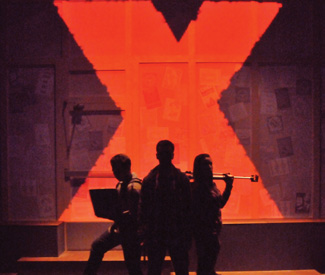
Behind the dynamic trio onstage stands a patchwork wall-projection screen (courtesy of set designer Sarah Phykitt, video designer Pauline Luppert, and video engineer Darl Andrew Packard) papered over with pages seemingly torn from radical histories and revolutionary tracts (it was easy enough to make out Emma Goldman’s visage among the repeated black-and-white pages), and periodically set aglow with live video feed, scene-setting photo montage, text messages, and hacker scrawl across computer and videogame screens.

While DHS is synonymous with Big Brother throughout, and for good reason — the agency is at the forefront of a total invasion of American private life and the Gitmo’ing of American teens — it can also be understood at times as a synonym for the state at large, from high school vice principals on up. As main character Marcus Yallow (a bright, engaging Petzold) explains in an early address to the audience, he’s a senior at a San Francisco public high school. Even before the Bay Bridge attack, “that makes me one of the most surveilled people in the world.”

Before being transformed into an all-out revolutionary by his violent, extra-constitutional encounter with DHS, Marcus and buddy Darryl (a sharp and versatile Censoprano) are fun-loving rebel hackers and gamers often on the receiving end of unwanted attention by the usual authorities. In an early scene, an inept school administrator interrogates Marcus, believing him, correctly, to be the hacker menace “w1n5t0n” (though, hilariously, pronouncing the handle literally instead of the intended “Winston”). Marcus outwits him, and the administrator loses his grip on the free-roaming online hooligan who, among other things, has handily derailed the “snitch tags” the school plants in library books to track the students.

At this point, Little Brother bears a striking similarity to The North Pool, Rajiv Joseph’s psychological two-hander set in a vice principal’s office after school, which had its premiere last year at Palo Alto’s TheatreWorks. But Joseph’s battle, while resonating with a larger political and historical context, ultimately remains more personal than political. Little Brother moves via the next terrorist attack into the realm of all-out political crisis, as short a distance from here as that may seem, and in this way resists reducing its themes to merely personal terms, highlights a tension with the personal throughout — even as it cleaves to a familiar coming-of-age narrative involving Marcus and girlfriend-coconspirator Ange (played compellingly by Keltie).

Costello shrewdly emphasizes this tension in his staging, which begins with the three principal characters recreating the story for a video cam so that it can be posted online. As Marcus begins a first-person account, his cohorts interrupt him almost immediately. “Dude, you can’t make it all about you,” says Darryl, with good-humored conviction. “It’s too big.”


LITTLE BROTHER

Through Feb. 25

Thurs.-Sat., 8 p.m.; Sun., 7 p.m., $25-$32

Gough Street Playhouse

1620 Gough, SF

www.custommade.org

Twisted misters

1

cheryl@sfbg.com

FILM This year’s San Francisco Independent Film Festival kicks off with a film that knows exactly what time it is: 4:44 Last Day on Earth.

Abel Ferrara’s latest imagines what the end of the world might be like for a volatile Lower East Side couple — he’s an ex-junkie (Ferrara favorite Willem Dafoe), she’s a young painter (Shanyn Leigh, Ferrara’s real-life companion). The film’s title refers to the predicted instant that an environmental catastrophe will completely dissolve the ozone layer, but 4:44 is mostly set indoors, specifically within the headspace of Dafoe’s character. It’s a gritty film that veers between self-indulgence and stuff that honestly seems pretty practical (sure, there’s a lot of Skyping, but if the world were ending, wouldn’t you?); as far as inward-looking disaster movies go, anyone planning an apocalypse film festival could double-bill 4:44 nicely with 2011’s Melancholia.

IndieFest is not an apocalypse film festival, per se. You could choose to have a jolly old time; there’s a power ballad sing-along, and even a flick called I Like You. But the selections for sick puppies are truly, truly outstanding this year. Personally, I recommend going as dark as you can possibly stand.

Start your journey with Michael R. Roskam’s Bullhead, a Belgian import that just scored a Best Foreign Language Film Oscar nomination. The five-second description of this film, which is about a cattle farmer who injects both his livestock and his own body with illegal hormones, doesn’t do it justice. Who knew there was such a thing, for instance, as a “hormone mafia underworld”? While some of Bullhead‘s nuances, which occasionally pivot on culture-clash moments specific to its Belgium setting, will inevitably be lost on American viewers, the most important parts of the movie come through loud and clear, and you won’t soon forget them.

http://www.youtube.com/watch?v=5fvLVNlMvus

Also memorable is Snowtown, another standout Australian crime film on the heels of Animal Kingdom (2010). While Snowtown — whose vérité shooting style recalls Andrea Arnold’s films about desperate living amid Britain’s council estates — isn’t quite as exportable as Animal Kingdom, it is just as uncomfortably tense, and features a teenage protagonist struggling to survive amid close-to-home evil. It’s based on the real-life case of Australia’s worst serial killer, and follows the gruesome facts quite closely. The film has a lot of characters that come and go without much explanation or introduction, which starts to seem deliberate after awhile. Fortunately, the core cast is magnetic. Remember 2005’s Wolf Creek? Snowtown is just as intense.

Still have a lust for blood? Of course you do. British director Ben Wheatley made a splash with 2009 gangster drama Down Terrace; he’s back with much buzz surrounding Kill List, with a review in the IndieFest catalog citing it as “the number one horror film of the year.” I’d hate to hand out that accolade so early in 2012, but this hired-killer-down-the-rabbit-hole tale is indeed worth considering.

Of course, there’s more to horror than guts and torture; if you need a reminder as to why, check out the festival’s pair of home-is-where-the-creepy-is films from Austria, Beside My Brother and Still Life. Beside My Brother‘s set-up — an emotionally disturbed father pretends his twin sons are the same person, and forces them to live as such, a practice they maintain into adulthood — is more promising than its payoff. Remember how in Dead Ringers (1988), the doppelganger bros were gynecologists? Here, they’re painters, and pretty bland ones at that. Far more harrowing is Still Life, about the irrevocable damage wrought by a father’s single, horrible revelation. First-time feature director Sebastian Meise manages to distill the complete crumbling of a seemingly normal-ish family into a slender, wrenching 77 minutes.

Speaking of harrowing, there’s nothing scarier in all of IndieFest than the early scenes of documentary Last Days Here, made by Don Argott and Demian Fenton (directors of 2009’s excellent The Art of the Steal). The film alights upon Bobby Liebling, dubbed the “godfather of doom” for his forty-plus year stint fronting legendary band Pentagram, as a fiftysomething crack addict living in his parents’ basement. Last Days Here is both heartfelt and gloves-off; it’s also blessed with having one of the most unbelievable comeback stories at its core (not a spoiler if you keep abreast of Bay Area concerts; Pentagram’s played here several times in recent years). It, like many of the films discussed here, has a distributor and will be coming around after IndieFest, but I implore you not to sleep on this one — even if you don’t love heavy metal, but especially if you do.

Less successful but no less intriguing is Atlanta oddity Snow On Tha Bluff, which is somewhere between an old-school ethnographic film — like, Robert Flaherty old — and self-aware product of the YouTube generation. The opening and closing scenes are obviously staged, as a drug dealer named Curtis Snow steals a video camera and decides he’ll make an autobiographical movie from the footage he collects. What’s between those bookends is what appears to be an authentic record of life in Snow’s crime-infested neighborhood, complete with drive-by shootings, home invasions, run-ins with the police, copious drug use, etc. Why any of the involved would allow their faces to be shown on camera while, say, firing a non-street legal weapon into a rival’s home is the film’s biggest mystery; its biggest accomplishment is obscuring the obvious lines of demarcation between what’s real and what’s not.

To end your IndieFest experience on a slightly uplifted note, you will have to die — or at least be cool with hanging out with the ghosts in Finisterrae, the first feature from Catalan artist Sergio Caballaro.

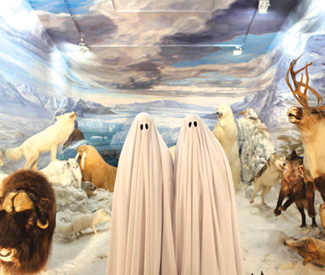
Expressing themselves via droll, post-production “dialogue” (in Russian, subtitled in English), the newly-deceased, sheet-wearing duo decides they would like to live again. A-journeying they go, following the wind and encountering an array of strange characters, including enough taxidermied animals to make Chuck Testa‘s head spin. Finisterrae starts slow but builds to glorious, gorgeously filmed and supremely weird heights. Hippies beware.

SAN FRANCISCO INDEPENDENT FILM FESTIVAL

Feb. 9-23, most films $11

Roxie Theater

3117 16th St., SF

www.sfindie.com


Rep Clock

0

Schedules are for Wed/8-Tues/14 except where noted. Director and year are given when available. Double and triple features are marked with a •. All times p.m. unless otherwise specified.

ARTISTS’ TELEVISION ACCESS 992 Valencia, SF; www.atasite.org. $6-10. Dirty Looks presents: City of Lost Souls, Fri, 8. “Mindscapes,” short films, Sat, 8.

CALIFORNIA COLLEGE OF THE ARTS 1118 Eighth St, SF; www.dirtylooksnyc.org. Free. Dirty Looks presents: “Queer Conversations on Culture in the Arts,” with selections from the “Female Trouble” experimental shorts program and a conversation with Margaret Tedesco, Thurs, 7.

CASTRO 429 Castro, SF; (415) 621-6120, www.castrotheatre.com. $7.50-10. •Pickpocket (Bresson, 1959), Wed, 3:30, 7:15, and American Gigolo (Schrader, 1979), Wed, 4:55, 8:45. •Beauty and the Beast (Cocteau, 1946), Thurs, 3:05, 7, and No Such Thing (Hartley, 2001), Thurs, 4:55, 8:50. “Midnites for Maniacs: I’m Black and I’m Proud:” •I’m Gonna Git You Sucka (Wayans, 1988), Fri, 7:30; Pootie Tang (Louis CK, 2001), Fri, 9:30; CB4 (Davis, 1993), Fri, 11:30. French American International School presents: “I-Speak: Celebrating 50 Years of International Education,” Sat, 6:30. This event, $5-10; tickets at www.internationalsf.org. •Do The Right Thing (Lee, 1989), Sun, 2, 8, and Malcolm X (Lee, 1992), Sun, 4:15. “Love: Ali MacGraw:” Love Story (Hiller, 1970), Tues, 8. With pre-show gala performance and MacGraw in person; for tickets ($25-45), visit www.ticketfly.com.

ELMWOOD 10070 San Pablo, El Cerrito; www.rialtocinemas.com. Free. “Community Cinema:” More Than a Month: One Man’s Journey to End Black History Month (Tilghman, 2012), Wed, 7.

CHRISTOPHER B. SMITH RAFAEL FILM CENTER 1118 Fourth St, San Rafael; (415) 454-1222, www.cafilm.org. $6.75-10.25. “Rafael Film Club:” “Jan Wahl,” Thurs, 1. Pina (Wenders, 2011), call for dates and times. “Mostly British Film Festival:” Route Irish (Loach, 2010), Wed, 7; Albatross (MacCormick, 2011), Thurs, 7. “2012 Oscar Nominated Short Films,” narrative and documentary (separate admission), Feb 3-9, call for times.

LAMORINDA THEATRES Four Orinda Theatre Square, Orinda; www.caiff.org. $12-15. “California Independent Film Festival,” 11 features, plus docs, shorts, and educational seminars, Feb 10-16.

MECHANICS’ INSTITUTE 57 Post, SF; (415) 393-0100, rsvp@milibrary.org. $10. “CinemaLit Film Series: Hollywood Dames: Beauty and Brains:” Intermezzo (Ratoff, 1939), Fri, 6.

PACIFIC FILM ARCHIVE 2575 Bancroft, Berk; (510) 642-5249, bampfa.berkeley.edu. $5.50-9.50. “Documentary Voices:” The Green Wave (Ahadi, 2010), Wed, 7. “Seconds of Eternity: The Films of Gregory J. Markopoulos:” “Markopoulos: The Early Films (1940-49)” Thurs, 7; “Eros and Myth (1950-63),” Sat, 6:30. “Austere Perfectionism: The Films of Robert Bresson:” The Trial of Joan of Arc (1962), Fri, 7; Les dames du Bois du Boulogne (1945), Fri, 8:25; Lancelot of the Lake (1974), Sat, 8:30. “Screenagers: 14th Annual Bay Area High School Film and Video Festival,” Sat, 3. “Howard Hawks: The Measure of Man:” The Criminal Code (1931), Sun, 4:30; Bringing Up Baby (1938), Tues, 7. “African Film Festival 2012:” Viva Riva! (Munga, 2010), Sun, 6:30.

ROXIE 3117 and 3125 16th St, SF; (415) 863-1087, www.roxie.com. $6.50-10. Come Back, Africa (Rogosin, 1959/2012), Wed-Thurs, 6:45, 8:30. Drive (Winding Refn, 2011), Wed, 8:45. Into the Abyss (Herzog, 2011), Wed, 6:45. SF IndieFest, Feb 9-23. Visit www.sfindie.com for complete schedule.

SFFS | NEW PEOPLE CINEMA 1746 Post, SF; www.sffs.org. $10-11. Domain (Chiha, 2010), Wed-Thurs, 2, 4:30, 7, 9:30. Once Upon a Time in Anatolia (Ceylan, 2011), Feb 10-16, 2, 5:30, 8:30.

TWINSPACE CONTINUUM 2111 Mission, Third Flr, Ste 3, SF; www.blockreportradio.com. $15. “Human Rights and Hip-Hop Film Festival,” documentaries and shorts, Fri, 5; Sat, 6:30.

VOGUE 3290 Sacramento, SF; www.mostlybritish.org. $12.50. “Mostly British Film Festival:” Black Butterflies (van der Oest, 2011), Wed, 5; London Boulevard (Monahan, 2010), Wed, 7:15; The Great White Silence (Ponting, 1924), Wed, 9:30; A Passionate Woman (2010), Thurs, 5; Route Irish (Loach, 2010), Thurs, 7:30.

VORTEX ROOM 1082 Howard, SF; www.myspace.com/thevortexroom. $7 donation. “The Second Coming of the Vortex Room:” The Second Coming of Suzanne (Barry, 1974), and Marjoe (Kernochan and Smith, 1972), Thurs, 8.

YERBA BUENA CENTER FOR THE ARTS 701 Mission, SF; (415) 978-2787, www.ybca.org. $6-8. “Bros Before Hos:” The Killing of a Chinese Bookie (Cassavetes, 1976), Thurs, 7:30; “Female Trouble,” experimental shorts program presented by Dirty Looks curator Bradford Nordeen, Sun, 2.

Film Listings

0

Film listings are edited by Cheryl Eddy. Reviewers are Kimberly Chun, Max Goldberg, Dennis Harvey, Lynn Rapoport, and Matt Sussman. For rep house showtimes, see Rep Clock. For complete listings, including more Ongoing films, see www.sfbg.com.

INDIEFEST

The 14th San Francisco Independent Film Festival runs Feb 9-23 at the Roxie Theater, 3117 16th St, SF. For tickets (most films $11) and schedule info, visit www.sfindie.com. For commentary, see “Twisted Misters.”

OPENING

*Elite Squad: The Enemy Within A huge hit in its native Brazil, this drama from director José Padilha (2002’s Bus 174) uses insane amounts of bullets to spin a twisted tale of police and government corruption. It’s a sequel of sorts to 2007’s The Elite Squad, though having missed that film isn’t a barrier to enjoying part two. Special ops cop Roberto Nascimento (Wagner Moura) returns; he’s higher up the bureaucratic food chain, but finds himself locked in a constant battle with bad guys both criminal and co-worker. (“I created the monster that would eat me up,” he realizes after an elaborate scheme to eliminate drug dealers and dirty cops goes horribly awry.) Meanwhile, his wife is now his ex-wife, and she’s remarried a lefty politician (Irandhir Santos) who’s particularly interested in exposing the same villains making Nascimento’s life hell, while also making Nascimento’s life hell himself. Fans of The Wire and particularly City of God — Enemy co-writer Bráulio Mantovani was an Oscar nominee for that 2002 film — will have particular interest in Enemy, though it never quite achieves those works’ memorable heights. One possible reason: too much Nascimento voice-over. How do you say “show me, don’t tell me” in Portuguese? (1:55) Four Star. (Eddy)

*I Am Bruce Lee Not to be confused with Bruce Lee: A Warrior’s Journey (2000), this Spike TV co-production is nonetheless a similarly praise-filled portrait of the groundbreaking, charismatic action star. Warrior’s Journey‘s main coup was revealing long-thought-lost footage from 1978’s The Game of Death, one of only five feature films starring Lee (two of which were posthumous, including 1973 smash Enter the Dragon). I Am Bruce Lee tilts more toward exploring Lee’s lasting legacy — an extended debate over whether or not he invented what we now call “mixed martial arts” definitely plays to the doc’s Spike TV interests — but also contains the expected biography, with an emphasis on Lee’s unique approaches to martial arts and philosophy, as well as input from suspects usual (Lee’s widow and daughter, top Lee student Dan Inosanto, etc.), understandable (boxer Manny Pacquiao, martial arts champ Cung Lee), and fanboy (Mickey Rourke, Ed O’Neill). Screening in a very limited run, I Am Bruce Lee is a flashy, entertaining primer for beginning students of Lee (lesson one: he was basically the coolest guy who ever lived); longtime fans may not learn anything new, but will no doubt find much to enjoy anyway. (1:34) Four Star, Metreon. (Eddy)

Journey 2: The Mysterious Island Dwayne Johnson and Vanessa Hudgens play a father-daughter team of explorers in this sequel to 2008’s Journey to the Center of the Earth. (1:34)

Once Upon a Time in Anatolia Turkish director Nuri Bilge Ceylan’s deconstructed Turkish police procedural offers little action but plenty of atmosphere. The search for a corpse by a group of men — a prosecutor, a commissar, a doctor, and their two main suspects— through the desolate, wind-scoured hills of rural Anatolia, is in fact something of a Hitchcockian MacGuffin. Ceylan’s real investigation is philosophical, zeroing in on the way in which each of these men constructs his own truth out of the re-telling and mis-telling of past events. And the drudgery of this protracted investigation, much of it depicted in real-time, provides plenty of opportunities for all of the players to tell their stories or to simply ruminate, often bitterly, about their own lives. There is palpable loneliness that courses through all the chatter, formally mirrored by Ceylan’s penchant long-takes of isolated figures swallowed by the countryside or the darkness of night. But despite the endless landscape that surrounds them, there is no exit for these small men. (2:37) SF Film Society Cinema. (Sussman)

Safe House Denzel Washington is a rogue CIA agent who goes on the run with a rookie (Ryan Reynolds) when mercenaries attack. (2:00) Presidio.

Star Wars: Episode 1: The Phantom Menace 3D Spoiler alert: no matter how rad the special effects look in 3D, this movie will still contain Jar Jar Binks. (2:16)

This Means War Another flick about battlin’ CIA agents — this time, though, it’s Chris Pine and Tom Hardy fighting over Reese Witherspoon. (2:00)

“2011 Oscar-Nominated Short Films, Live Action and Animated” See the shorts tipped to compete for Oscar gold in two separate programs, divided into live-action and animated films. Lumiere, Opera Plaza, Shattuck, Smith Rafael.

The Vow Sorry Rachel McAdams and Channing Tatum, but 1987’s Overboard is the best amnesia-themed romance of all time. (1:44) Marina.

W.E. Madonna’s having a big week, no? (1:59) Bridge.

ONGOING

Big Miracle Three gray whales trapped beneath the Beaufort Sea ice near the tiny town of Barrow, Alaska become an international cause célèbre through the uneasily combined efforts of an Anchorage reporter (John Krasinski), a Greenpeace activist (Drew Barrymore), a group of chainsaw-toting Inupiaq fishermen, a Greenpeace-hating oilman (Ted Danson), a Reagan-administration aide (Vinessa Shaw), a U.S. Army colonel (Dermot Mulroney), a pair of Minnesotan entrepreneurs (James LeGros and Rob Riggle) with a homemade deicing machine, and the crew of a Soviet icebreaking ship. The magical pixie dust of Hollywood has been sprinkled liberally over events that did indeed take place in 1988, but the media frenzy that blossoms out of one little local newscast is entirely believable. Everyone loves a good whale story, and this one is a tearjerker — though the kind that parents can bring their kids to without worrying overly much about subsequent weeks of deep-sea-set nightmares and having to explain terms like “critically endangered Western North Pacific gray whale” if they don’t want to. The film makes clear that the weak-on-the-environment Reagan administration and Danson’s oilman stand to gain some powerfully good PR from this feat, with potentially devastating ecological results down the line, and Barrymore’s character gets to recite a quick litany of impending oceanic catastrophes. But this kind of talk is characterized as less useful than a nice, quick, visceral pull on the heartstrings, and while offering us the pleasurable sight of whales breaching in open water, the film avoids panning out too much farther, which may be why the miracle looks so big. (2:03) 1000 Van Ness. (Rapoport)

*Chronicle A misfit (Dane DeHaan) with an abusive father and an ever-present video camera, his affable cousin (Matt Garretty), and a popular jock (Michael B. Jordan) discover a strange, glowing object in the woods; before long, the boys realize they are newly telekinetic. At first, it’s all a lark, pulling pranks and — in the movie’s most exhilarating scene — learning to fly, but the fun ends when the one with the anger problem (guess which) starts abusing the ol’ with-great-power-comes-great-responsibilities creed. Chronicle is a pleasant surprise in a time when it’s better not to expect much from films aimed at teens; it grounds the superhero story in a (mostly) believable high-school setting, gently intellectualizes the boys’ dilemma (“hubris” is discussed), and also understands how satisfying it is to see superpowers used in the service of pure silliness — like, say, pretending you just happen to be really, really, really, good at magic tricks. First-time feature director Josh Trank and screenwriter Max “son of John” Landis also find creative ways, some more successful than others, to work with the film’s “self-shot” structure. The technique (curse you, Blair Witch) is long past feeling innovative, but Chronicle amply justifies its use in telling its story. (1:23) 1000 Van Ness. (Eddy)

*Come Back, Africa Opposition to apartheid didn’t really pick up steam as a popular cause in the U.S. until the early 1980s. Which makes it all the more remarkable that New York City-based documentarian Lionel Rogosin made Come Back, Africa (1959) about a quarter-century earlier — though less surprisingly, the film itself was barely seen here at the time. Now finally playing American theaters outside his home town in a restored print, it’s a time capsule whose background is as intriguing as the history it captures onscreen. The horrors of World War II and some subsequent global travel had stirred a profound awareness of social injustices in Rogosin, who began planning a feature about South Africa while still working at his father’s textile business. He had very little filmmaking experience, however, so he took $30,000 of his earnings and as “practice” made On the Bowery (1956), a semi staged portrait of Manhattan’s skid row area that won considerable praise, if also some shocked and appalled responses from Eisenhower-era keepers of America’s wholesome, prosperous self-image. Armed with the confidence bestowed by that successful effort and several international awards, Bogosin traveled to South Africa — not for the first time, but now with the earnest intent of making his expose. In the mid- to late ’50s, however, that was hardly a simple task. The film, which mixes a loose, acted narrative with completely nonfiction elements, follows the luckless wanderings of an agreeable protagonist played by a first-time actor — Zacharia Mgabi, a 30-ish bearded worker “discovered” on a bus queue. His character, Zachariah, is caught in one catch-22 of apartheid life: he can’t get a job without the appropriate permits, and can’t get the permits without a job. And so on. All show and almost no “tell,” Come Back, Africa wasn’t shown in South Africa until the late 1980s; it nonetheless proved a great influence on development of the whole continent’s indigenous cinematic voices. (1:24) Roxie. (Harvey)

*Coriolanus For his film directing debut, Ralph Fiennes has chosen some pretty strong material: a military drama that is among Shakespeare’s least popular works, not that adapting the Bard to the screen has ever been easy. (Look how many times Kenneth Branagh, an even more fabled Shakespearean Brit on stage than Ralph, has managed to fumble that task.) The titular war hero, raised to glory in battle and little else, is undone by political backstabbers and his own contempt for the “common people” when appointed to a governmental role requiring some diplomatic finesse. This turn of events puts him right back in the role he was born for: that of ruthless, furious avenger, no matter that now he aims to conquer the Rome he’d hitherto pledged to defend. The setting of a modern city in crisis (threadbare protesting masses vs. oppressive police state) works just fine, Elizabethan language and all, as does Fiennes’ choice of a gritty contemporary action feel (using cinematographer Barry Ackroyd of 2006’s United 93 and 2008’s The Hurt Locker). He’s got a strong supporting cast — particularly Vanessa Redgrave as Coriolanus’ hawkish mother Volumnia — and an excellent lead in one Ralph Fiennes, who here becomes so warped by bloodthirst he seems to mutate into Lord Voldemort before our eyes, without need of any prosthetics. His crazy eyes under a razored bald pate are a special effect quite alarmingly inhuman enough. (2:03) Embarcadero. (Harvey)

*Haywire Female empowerment gets its kung-fu-grip thighs around the beet-red throat of all the old action-heroes. Despite a deflated second half — and director Steven Soderbergh’s determinedly cool-headed yet ultimately exciting-quelling approach to Bourne-free action scenes — Haywire is fully capable of seizing and demanding everyone’s attention, particularly that of the feminists in the darkened theater who have given up looking for an action star that might best Angelina Jolie’s Lara Croft. Former pro mixed martial arts fighter Gina Carano, who plays it as studiedly intense and charismatic as crossover grapplers Lee, Norris, and Seagal before her, is that woman, with convincingly formidable neck and shoulder muscles to distract from her curves. Her Mallory Kane is one of the few women in Haywire‘s pared-down, stylized mise-en-scene — the lone female in a world of men out to get her, starting with the opening diner scene of a watchful Mallory confronted by a man (Channing Tatum) playing at being her boyfriend, fed up with her shit, and preparing to pack her into the car — a scenario that doubtless many rebel girls can relate to until it explodes into an ultraviolent, floor-thrashing fight scene. Turns out Mallory is an ex-Marine and Blackwater-style mercenary, ready to get out of the firm and out of a relationship with her boss, Kenneth (Ewan McGregor), when she learns, the bruising way, that she’s been set up. The diner scene sets the tone for rest of Haywire, an otherwise straightforward (albeit flashback-loaded) feminist whodunit of sorts, limned with subtextual currents of sexualized violence and unfolding over a series of encounters with men who could be suitors — or killers. (1:45) California, 1000 Van Ness. (Chun)

*Pariah A teenage girl stands stock-still in a dark nightclub, gazing with desire and fear at the half-naked female dancers on the stage. Later, riding home on the bus, she slowly removes the layers of butch that held her together in the club, stripping down to some version of the person her parents need to see when she walks in the door. Nearly wordlessly, the opening scenes of Dee Rees’s Pariah poignantly depict the embattled internal life of Alike (Adepero Oduye), a 17-year-old African American girl living in Brooklyn with her family and struggling both to be seen as she is and to determine what that might look like. The battles are being waged externally, too, between Alike’s adoring father (Charles Parnell), living in willful ignorance, and angry, rigid mother (Kim Wayans), desperately enforcing a feminine dress code and steering Alike away from openly butch friend Laura (Pernell Walker). Rees’ script beautifully conveys a household of landmines and chasms, which widen as husband and wife and daughter struggle and fail to communicate, asking the wrong questions, fearfully skirting the truth about Alike’s sexuality and her parents’ crumbling marriage. And the world outside proves full of romantic pitfalls and the tensions of longtime friendship and peer pressure. The poems in which the talented Alike takes solace and makes her way toward a more truthful existence are beautiful, but at a certain point the lyricism overtakes the film, forcing an ending that is tidy but less than satisfying. (1:26) Lumiere, SF Center. (Rapoport)

The Woman in Black Daniel Radcliffe (a.k.a. Harry Potter) plays a grieving young widower in an old-fashioned ghost story, set in the era of spirit hands and other visitations from beyond the veil. But while Victorian séances were generally aimed at the dearly departed, the titular visitant (Liz White), who haunts the isolated estate of Eel Marsh House and its environs, is a vindictive, mean-spirited creature, avenging the long-ago loss of her child by wreaking havoc and heartbreak among the families of the nearby village, among them a local landowner (Ciarán Hinds) and his wife (Janet McTeer). Radcliffe’s character, a lawyer named Arthur Kipps, has been tasked with settling the affairs of the mansion’s recently deceased owner, an assignment that requires sifting through mounds of dusty, crumpled ephemera in one of the creakiest, squeakiest buildings ever constructed. Set at the end of a narrow spit of land that disappears into the surrounding wetlands when the tide is high, Eel Marsh House is a charming place to be marooned after dark. But no amount of horrified screams from the audience will keep Kipps from his duties, though it’s hard to make much headway amid the unrelenting creepiness. Nearly every moment brings a fresh inexplicable thumping noise from an upper floor; a new room full of dead-eyed dolls that Kipps has no business wandering into; another freakishly screaming face next to his as he gazes out the window. The house is a richly textured set piece; the horror is of the sort that makes you jump and then laugh, both at the filmmakers, for springing the same tricks on you over and over, and at yourself, for falling prey to them every time. (1:36) 1000 Van Ness, Shattuck. (Rapoport)

Making black herstory, every day

8

news@sfbg.com

Deconstructing the roots of

The black n gray suits

with hands in the Loot

That has buried the truth

About our black, brown and disabled youth

— excerpt from KKKourt by Tiny

OPINION On the first day of Black Herstory Minute (I mean, Month), I practiced black herstory, and walked through activism and breathed organizing and lived resistance by putting my body in the benches belonging to the criminal injustice system (a.k.a. the plantation) at 850 Bryant. I was there to support a struggle against injustice in the case of a young African warrior for truth, Fly Benzo, a.k.a. Debray Carpenter — student, son, media producer, organizer, and hip-hop artist who is facing a felony charge, jail sentence and $95,000 fine for nothing more than exercising his First Amendment right to free speech.

How many among you, overwhelmed with multiple Face-crack postings and a cacophony of tweets, might have missed the story of Fly, who spoke the truth about racism, police brutality and the unjust death of Kenneth Harding Jr. to a cop in a poor-people-of-color neighborhood, Bayview, which is under seize from the occupying army known as the police (or po’lice as we call them at POOR Magazine)?

As a woman criminalized and incarcerated for the sole act of being poor and houseless, the melanin-challenged daughter of a poor black single mother who spent all of her life in poverty and in struggle, I have witnessed first hand unequal justice against people of color and poor people. It’s a fact that remains, in 2012, still a very dire reality.

“They arrested me for exercising my Constitutional right to free speech,” said Benzo, 22.

Benzo’s revolution began when he was born to conscious African-descendant parents who, like many African descendant people in San Francisco, have been under the constant threat of removal, displacement, redlining, and ongoing police harassment for decades. He has been speaking out about injustices since he was a teen, starting with the fact that hardly any Bayview residents were hired to construct the multi-million-dollar T-Train that runs from downtown to Third Street — and the dramatic rise in the violent policing of the T-Train and the Muni bus lines that run through the poor communities of color in S.F.

But the beginning of Benzo’s current battle with the criminal injustice system began when he began to speak up about Harding, murdered by San Francisco police officers for not having a $2 dollar bus transfer. The judge might not admit the video that was taken at the scene of Benzo’s arrest, making his case all the more difficult to fight, and the truth all the more difficult to hear and see, which is where community support comes in.

A lot of people and organizers and politricksters talk about stopping the violence and how to “deal” with the inequities of racism and classism and violence on our youth of color. And yet when this brother spoke out, used his voice for nothing but truth and resistance about injustices he personally experiences everyday, who comes out to support him?

Practicing revolutionaries at POOR Magazine, the Idriss Stelly Foundation, The BayView Newspaper, Education not Incarceration, and United Playaz have been there, as well as his hard-working attorney, Severa Keith, and a few more. But we all need to be there, fighting for a very alive, very revolutionary, young truth-teller who is making black history, every day.

Tiny, a.k.a. Lisa Gray-Garcia, is an editor at POOR Magazine. Opening statements in the trial of Debray Carpenter are expected to begin Feb. 8 in Dept. 27.

Localized Appreesh: The Yellow Dress

0

Localized Appreesh is our weekly thank-you column to the musicians that make the Bay. To be considered, contact emilysavage@sfbg.com.

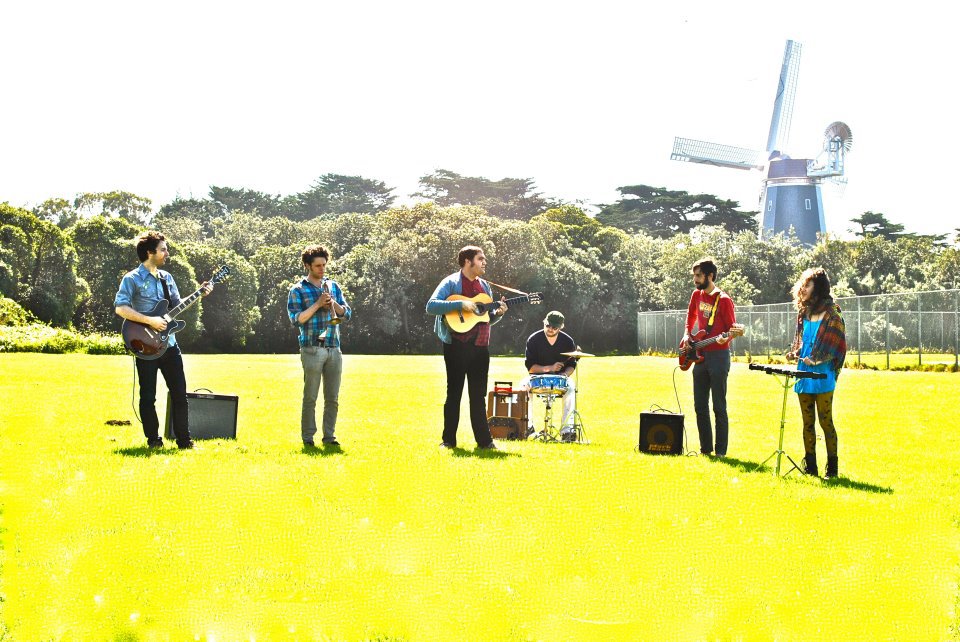
Dogs, ghosts, kids, hand-clapping, whistling on a sunny park day – it’s all in the video for the Yellow Dress’s “This Could Be Anything.” The song itself is already a treat, kicking off with the aforementioned clapping and whistling and a solitary guitar, in pipes mariachi trumpet and swallow-you-whole powerful vocal pipes à la orchestral pop master Beirut. (It also has garnered comparisons to Magnetic Fields and a drug-less Velvet Underground.)

The Yellow Dress closed out 2011 with a metaphoric group hug, thanks to the video and a well-received second album, Humblebees. This year, it’s already off to a run through the park, pull your dress up and get mud on your ankles, start. In the next seven days, the San Francisco band will play three local shows, all at interesting venues, perhaps a bit off the beaten path. Do it up big and catch a trio of Yellow Dress performances.

Year and location of origin: 2007, San Francisco (the corner of Haight and Fillmore to be exact)

Band name origin: We used to be called Mr Stopmotion and the Yellow Dress after a particularly dapper couple I saw walking through Golden Gate Park, back then we were just a two-piece, and the name was pretty unweildy. For about a day we were Mr Stopmotion, which sounds like a Devo/XTC cover band. We decided on The Yellow Dress, which immediately led to a dramatic (and affirming!) number of yellow dresses in both (me and original bandmember Jon) of our lives. For a not very interesting story that sure took a lot of time to write.

Band motto: I’m sorry.

Description of sound in 10 words or less: Earnest-indie-twee-folk-pop.

Instrumentation: Acoustic and electric guitar, bass, drums, glockenspiel, male/female vocals, trumpet, organs, whistles, hand claps, if anyone reading this plays the cello and love dinosaurs please call me.

Most recent release: Humblebees.

Best part about life as a Bay Area band: With so many artistic people around it’s easy to find like minded folks to play with, slowly envelop in your ever growing line-up.

Worst part about life as a Bay Area band: With so many artistic people around you are rarely the only game in town any given night.

First record/cassette tape/or CD ever purchased: The Top Gun soundtrack. It was great.

Most recent record/cassette tape/CD/or Mp3 purchased/borrowed from the Web: West Indies Funk Volume 3 (2012 is the year of the steel drum).

Favorite local eatery and dish: I miss Mission Burger so much, you have no idea. The Yellow Dress is however willing to give a full endorsement to the chicken millanesa torta at La Torta Gorda.

The Yellow Dress
With Adam Balbo, the Slaves
Thurs/9
Alley Cat Books
3036 24th St., SF


With Matt Dorrien, Fox and Woman
Fri/10, 8 p.m., $8
924 Gilman, Berk.
www.924gilman.com


Valentine’s Day Monthly Rumpus: Sugar’s Coming Out Party
With Pocket Full of Rye, Janine Brito
Feb. 14, 7 p.m., $10
Verdi Club
2424 Mariposa, SF
www.therumpus.net


The Performant: Strangers in a strange land

0

Dan Carbone and Kitka resculpt old terrain

From the dark corner of the stage throbs the low rhythm of a skin-clad, Celtic-style drum and the strum of acoustic guitar, while in the light a man clad in a white dress shirt sways in hypnotic time, eyes shut tight, arms flung wide. “Sleeping, sleeping,” he croons softly, “I’m only sleeping.” Still swaying, he begins to tell the tale from the beginning, about a little baby boy whose “brain is knitting itself in an unusual way.”

You’d be forgiven for thinking in this first moment that the man is speaking of his own infancy, after all, brains don’t come knit much more unusually than that of East Bay-based avant-gardian Dan Carbone. But the infant’s name is not Dan’s, and though his brief and tragic backstory reverberates through much of the rest of the play, the infant soon yields the spotlight to his younger brother, the creator of the piece, “Father Panic,” which made its stage debut at the Garage on Friday. 

Although “Father Panic,” is indubitably Carbone’s most autobiographical work, a fretful monologue about a precocious childhood both hideously warped yet strangely innocent, familiarly eccentric, flourishes abound throughout. Puppets, poltergeists, twisted songs that expose the tortured inner monologues of the characters to the surface, a live video installation curated by Philip Bonner (a.k.a. Bulk Foodveyor) of childhood detritus and memory bank fodder.

Catherine Debon takes a turn as television-land language teacher, who translates self-loathing lyrics such as “maybe we can hate ourselves together,” into mellifluous French. And instrumentation is handily provided by swampabilly guitarist Andrew Goldfarb, who comprises, with Carbone, the performative music duo The Wounded Stag. But the unacknowledged star of the show is probably Carbone’s mother, who gradually takes over the piece, a raw bundle of outré obsessions and an embattled nature, the very embodiment of a stranger in a strange land — like a Raëlian without a cause, or an aquatic African frog in a solitary tank.

***

The mountains of Serbia, and a vocal tradition almost unknown this side of the “pond,” lie thousands of miles away from the basements of Connecticut. But an intriguing collaboration between Kitka, Oakland’s premiere ensemble of acapella Eastern European music and Svetlana Spajic, a renowned Serbain folk singer, brought that faraway land to stirring life during a two-part concert staged over the weekend at CounterPULSE.

After a video of venerable vocalist Jandrija Baljak teaching his technique to Spajic’s homeland ensemble, the concert began in earnest when Spajic took the stage. Dressed in Sunday best attire suggesting a peasant en route to Ellis Island circa 1914, Spajic’s passionate ululations did little to dispel the sensation of being transported backwards through time and space. Joined in the second half by Kitka, the remaining songs were characterized by an almost medieval lack of vibrato and elongated interludes of dissonant voice-bending harmonies. Even when comprehension of the lyrics was impossible, the music tapped into a complexity of almost primal emotion—though some slyly inserted San Francisco-centric lines did bring us briefly back to home before we were whisked once more into the territory of the unfamiliar by our fearless musical guides.

Sundance Diary, volume four: more docs!

0

In a series of posts, Midnites for Maniacs curator-host and Academy of Art film-history teacher Jesse Hawthorne Ficks reports on the 2012 Sundance Film Festival. Check out his first, second, and third entries.

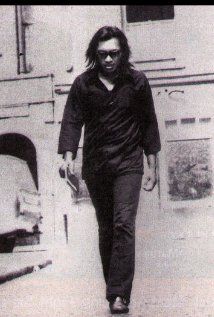
Winner of both the World Documentary Audience Award and the Special Jury Prize for its celebration of the artistic spirit is every musicologist’s dream film: Malik Bendjelloul’s Searching for Sugar Man. This larger-than-life tale is about obscure Detroit singer-songwriter Rodriguez, who created two brilliant albums, Cold Fact (1969) and Coming from Reality (1971), which some have compared to Bob Dylan’s greatest works. Yet virtually no one bought either of the records … except South Africans. The film reveals a fan base of millions, comprised of multiple generations who have viewed Rodriguez’s songs as political anthems for 40 years. And that’s just the first 15 minutes of the film!

Rodriguez’s lyrics and lifestyle celebrated a working-class hero mentality that seems to be as precious as the songs themselves, and Benjelloul’s film about his impact on a seemingly far-removed audience is a standout. But here’s a warning: be careful while reading any reviews of this film before you see it! Every single critic I’ve read has spoiled major dramatic points in the film, so try your best to catch it before you come into contact with any spoilers.

A few more for your doc queue:

The makers of 2006’s Jesus Camp, Heidi Ewing and Rachel Grady, picked up the U.S. Documentary Editing Award for their latest, Detropia. It poetically unearths a hopeless, dying city using beautifully dramatic storytelling, though the film itself feels a bit unfinished towards the final act. Kristi Jacobson and Lori Silverbush’s Finding North takes on hunger in America; many left the film wondering how they could take action to help ease the epidemic. David France’s superb How to Survive a Plague, about AIDS activists in the late 80s, left me and quite a few other critics totally devastated. France’s film is truly an emotional equivalent to last year’s U.S. Documentary Grand Jury Award winner about assisted suicide, How to Die in Oregon. This year’s World Cinema Documentary Editing Award went to Lisanne Pajot and James Swirsky’s Indie Game: The Movie, which follows a group of independent video game designers pouring a psychotic amount of hard work into their creation, Super Meat Boy.

But the most memorable among this year’s crop of socially-aware docs was Lauren Greenfield’s Queen of Versailles, which won the U.S. Directing Award for Best Documentary. The film follows an uber-rich U.S. family whose lavish lifestyle is slowly being toppled by the current recession. The inverted journey invites audiences to begin by scapegoating the couple (as it happens, the paterfamilias, David Siegel, is suing Sundance and the filmmakers for defamation). But as things onscreen turn sour, director Greenfield masterfully brings things back around, holding up a culture-of-entitlement mirror to the audience. This film stuck with me for days after the screening.  

Coming up next: Jesse Hawthorne Ficks on Sundance’s midnight movies (duh), and more!

Reggie Watts melts minds at SF Sketchfest’s Reggidency kickoff

3

“Welcome to [SF] Sketchfest,” Reggie Watts said, in what appeared to be his natural voice, “it’s going to be a big night for all of you guys.” The first night of his four-part “Reggidency” at the comedy festival was billed as being Just the Music but from before Watts took the stage at Yoshi’s SF – giving himself an introduction from behind the the curtain and then launching into a series of characters that wavered from pseudo-unintelligible to borderline familiar (Japanese? Jesse Jackson? Vallejo-ean?) – it was clear that label was Just a Guess.

To SF Sketchfest’s credit, it did mention that the series would be “unpredictable,” a label that gets applied to Watts’s work quite often. A week earlier at the same venue, I saw R&B singer Bilal perform with saxophonist Gary Bartz, and was struck by the vocalist’s ability to pull any sound out at any moment. You never quite knew what was going to come out of his mouth next, and when it came to comedy as well as music, the same seemed true with Watts. Whether beat boxing or mimicking Rihanna and Calvin Harris’s “We Found Love”, Watts did it with carefree, child-like playfulness, assuming that the kids were preternaturally versed in musical genres like house, soul, jazz scatting, grime, dub, and hip-hop.

The music came either with long, encyclopedic explanations of what the song was about – the sort you’d expect from an overzealous rock star – complete with huge contradictory elements, or ridiculous contextualization. One song was said to be appearing in the forthcoming video game Spore 3: Spored to Death, about “a microbe who lives in Williamsburg and really wants to be a detective,” while another was “originally for Tron: Legacy, but they ended up not using it because Daft Punk had it covered.”

As you might expect, the actual songs – consisting of keyboards and Watts’s mesmerizing vocally based looped beats – were their own punchline that had nothing to do with the set-up. One stand-out, a cautionary tale of sorts, about how “not every psychotropic substance is for everyone” was suitably trippy, with Watts creating layers of whiny back-up singers saying “oh yeah, I don’t feel so good” as he also dispensed common sense advice, such as “take a nap.” A soft love ballad pushed to the point of inaudibility warned of sentimental organ harvesting, while other tracks, almost entirely instrumental, showcased a technical skill that hid behind Watts’s bumbling physicality.

Most comedy can’t be condensed, and that’s extremely true of Watts’s output. Where other comedians struggle with transitions, he’s taken them out of the equation, as his characters – built as much upon vocabulary as tone and cadence – morph into one another with little more than a change in accent mid-sentence. (At one point Watts did an Oxfordshire boy doing a witch doing a bad “Kumar” – basically Indian Bill Cosby – and a little, probably unimportant piece of my mind broke.) During the space between songs – which was really the bulk of the show – he proved himself the king of the rambling narrative. If the show seemed short, it was only because of the near relentless pacing. No clear line between his music and comedy, the show was Just Reggie, which by itself is a lot to unpack.

The Reggidency continues
With Garfunkel & Oates
Feb/1, 8 p.m., $25
Mezzanine
444 Jessie, SF
www.mezzaninesf.com

After the tear gas clears

3

yael@sfbg.com

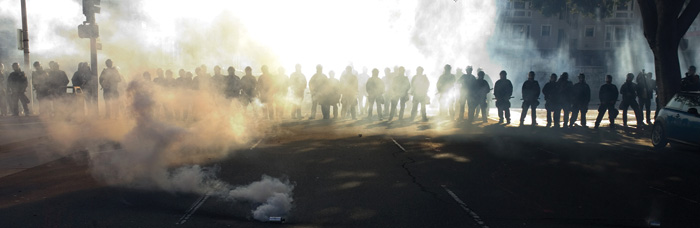
After a chaotic day of marches and confrontations between police and protesters Jan 28, I was arrested along with about 400 others who were trapped by police in front of the downtown Oakland YMCA. Seven of us were journalists.

The goal of the march was to take over an abandoned building — an the vacant Kaiser Convention Center, a city-owned building that’s been closed since 2005, was a prime target.

I have not yet been able to retrieve my property, including my recorder and notebook, which is being held by the Oakland Police Department. What follows is a pieced-together account and a perspective on what the events of Jan. 28.

I spend 20 hours behind bars, and missed the later parts of the action. But I was able to observe what happened in jail and make some sense of what happened.

Occupy people are constantly debating tactics and goals, and for many, the idea of occupying a vacant building made sense. When Occupy Oakland had a camp in Frank Ogawa Plaza, also known as Oscar Grant Plaza, and commonly shortened to OGP, it created a strong community. That community bridged divides between the homeless and the housed, between students and labor organizers, and between Oakland residents of different races, genders and levels of ability in an unprecedented fashion.

The camp had a kitchen that fed hundreds of people everyday and a network of shared tents and blankets which welcomed in hundreds who otherwise would have slept on the streets, often feeling isolated from other residents of their city and made to feel inferior.

The camp was repeatedly raided, Occupiers were tear gassed and shot with rubber bullets, and when OGP was cleared out, the community no longer had a home. And the police started that violence.

That was the practical reason for wanting to occupy a vacant building: to have a social center for Occupy Oakland.

Of course, there are other reasons. There’s the question that many squatters and homeless advocacy groups have been making for decades: why let buildings lie vacant while people freeze on the street?

Remember: The building that Occupy wanted to occupy is public property, and right now nobody is using if for anything.

In one exchange in jail, a guard asked a protester why the activists thought they had the right to take over a vacant building. “I mean, it’s not yours,” he insisted. The protester replied that many vacant buildings are government-owned and therefore public.

“So it’s the government’s,” the cop said.

“But I pay taxes,” the protester responded.

“Me too!” replied the cop. “It’s mine!”

“It’s both of ours,” smiled the protester. “It’s all of ours.”

That’s what made the convention center action such a clear and easy political decision.

A lot of people in Occupy would go further, saying that at a time of a severe housing crisis, it’s perfectly legitimate to take over privately owned buildings that are sitting there vacant. It’s part of the central argument of Occupy — that corporations and the rich unfairly own and continue to acquire much more wealth than the majority of people. For many people, owning a vacant building and doing nothing with it, while hundreds freeze on the streets, is a crime itself.


UP AGAINST THE COPS

Then there’s the question of the police — and violence.

The word “nonviolent” has a specific meaning in the history of political movements. Martin Luther King Jr. defined it in his essay “The Meaning of Non-Violence”: “If you are hit you must not hit back; you must rise to the heights of being able to accept blows without retaliating … But it also means that you are constantly moving to the point where you refuse to hate your enemy. You are constantly moving to the point where you love your enemy.”

It’s a philosophy but also, in political terms, a tactic.

Many of the people who make up Occupy Oakland get their start as activists organizing against police brutality in a city that has longstanding problems with violent and undisciplined officers.

Police Chief Howard Jordan said in a press release that “It became clear that the objective of this crowd was not to peacefully assemble and march, but to seek opportunity to further criminal acts, confront police, and repeatedly attempt to illegally occupy buildings.”

It was certainly clear that the intent of the crowd was to illegally occupy a building. And any honest assessment of Occupy Oakland would have to acknowledge that some members are not wedded to King-style nonviolent civil disobedience. (Neither, by the way, were a lot of the protest movements of the 1960s.) Many protesters wore masks and bandanas to disguise their identities and protect them from tear gas and pepper spray, and the march was led by protesters with makeshift shields, which suggests that they expected to be attacked. You could certainly argue that what those people were doing wasn’t confrontation; it was self-defense.

Frankly, it made sense to be prepared: In other Occupy Oakland actions, police have attacked with batons, tear gas, pepper spray, flash-bang grenades, and smoke bombs. And for quite a few Oakland residents, the police have always been seen as an outside force that can’t be trusted.

In fact, violence did break out. Many, including myself, have eyes still stinging from tear gas. I saw several wounds caused by rubber bullets shot at protesters. I spoke individually to at least a dozen people — one of them a pregnant woman — who were struck with police batons.

And protesters did not remain peaceful while this violence was being used against them.

Some picked up tear gas canisters and threw them back towards police; that much I saw. I also saw protesters throw empty plastic bottles at police.

According to the police, they also threw metal pipes, rocks and bricks. According to the protesters, they threw mainly empty plastic bottles and fruit at police. But as protesters often say of the police, “They’re the ones who showed up with the guns.” If the cops didn’t want violence, why unleash such an arsenal of weapons?

People got hurt, protesters and police alike. Several bystanders who had nothing to do with the situation were swept up in the mass arrest.

The city of Oakland, already in dire financial straits, likely spent hundreds of thousands of dollars reacting to the protests. Police claim that they were unable to sufficiently respond to violent crimes over the weekend, including five murders, because they were overwhelmed with Occupy troublemakers.

Of course, city officials were the ones who decided to arrest 400 people — with all the expense that involves.

There are, at this point, no reports of serious injuries to any police officers. However, at least a dozen protesters had welts on their faces or bodies from being beaten by clubs or shot with rubber bullets. One woman was shot in both arms with rubber bullet; one man was shot in the face with rubber bullets while holding a video camera to document the events. Several protesters were shoved to the ground and received wounds on their faces while being arrested. Police raised their rubber-bullet rifles to the faces of protesters throughout the day, threatening attacks. A rubber bullet to the face can cause brain damage and blindness.


DID IT HAVE TO HAPPEN?

How could this have been prevented?

Police say that “while peaceful forms of expression and free speech rights will be facilitated, acts of violence, trespassing, property destruction and overnight lodging will not be tolerated.” But 40 people were arrested during an ongoing Occupy Oakland vigil in the first weeks of January for having “illegal property” at OGP in what many saw as clearly a peaceful expression of First Amendment rights.

On KGO radio Jan. 29, Chief Jordan said that he has allowed Occupy Oakland to protest without a permit and would continue to do so, but those early January raids were ostensibly due to permit violations — violations of the terms of a permit that Occupy Oakland did in fact have.

There’s no question: The police response to Occupy Oakland over the past few months has caused some people in the movement to get more radical.

Many Occupy Oakland-affiliated medics condemned those who threw objects at police, saying that they provoked a backlash that caused more injuries. Many Oakland residents who might be in line with the socio-economic critique presented by the Occupy movement feel endangered and confused by marches that result in the massive use of police weapons in broad daylight. A lot of people would rather protest in a lot of ways that less resemble urban warfare.

On the other hand, there are also ways that Oakland officials could have prevented the consequences of weapons deployed and 400 arrested Jan. 28. They could, for example, have allowed protesters to occupy the vacant building.

When protesters seized a building Jan. 20 in San Francisco, police first attempted to prevent them. They lined up in front of the targeted building. They deployed pepper spray and struck several protesters with batons. When they were unsuccessful, and protesters entered the building from the back, they opted to block the surrounding streets and wait until the time seemed right to enter the situation and make arrests. Police spokesperson Carlos Manfredi told me that the cops were not going to rush into the situation and were trying to prevent injury and violence.

The Kaiser Convention Center has been vacant for years. The city of Oakland recently made plans to sell it to its Redevelopment Agency, but that plan fell into legal limbo when Gov. Jerry Brown signed AB26, a bill that dissolved all California redevelopment agencies.

At this point, nobody at Oakland City Hall has any plans whatsoever for the big, empty structure.

Why not allow Occupy to use the convention center? It’s not downtown, where Mayor Quan says businesses have been adversely affected by Occupy Oakland’s presence. It would give the movement a chance to stop focusing on trying to occupy spaces and start focusing on benefiting the community with food, shelter, and community programs that they provided when they had a camp. It would give the building tenants who could be held responsible for maintaining it. It might even help get Occupy Oakland and the Oakland Police Department out of the cycle of violence that they have been spiraling into for months.

Each time arrests occur, each time violence occurs, both sides blame the other. Both sides are correct that they were provoked. Both sides are correct that something that they think is worth defending was violated — for the cops, it’s the law. For the protesters, it’s the right of the people to assemble.

In fact, many Oakland residents have experienced violence at the hands of the Oakland Police Department for years before Occupy began. There was already a mass movement formed around the murder of Oscar Grant, and thousands of people fed up with police murders of unarmed, often black, suspects.

In recent decades, other radical groups, notably the Black Panthers, insisted that their community lacked basic needs because the city of Oakland refused to prioritize them. The Black Panther free breakfast program served food in a strikingly similar way to Occupy Oakland. Black Panthers were also notorious for carrying guns to defend themselves against police violence.

Occupy Oakland protesters (unlike Tea Party members) certainly don’t carry guns. But, more and more, they cry “fuck the pigs” as much as any Panther.

For much of the Occupy movement’s 99 percent, unjust actions by banks, corporations, and the government officials that they have often bought and paid for are the worst problems facing the United States today. For others, particularly the poor and people of color, these problems are magnified and exacerbated by the fact that they feel the threat of police harassment every day. For years, they’ve understood that police disproportionately do not investigate or solve crimes that happen to them and their families.


THE RADICALS AND THE BROADER MOVEMENT

The Oakland General Assembly Jan. 29 was the biggest it’s been in weeks. While there were still over 300 people in jail, 300 more came out to get involved with the meeting. That happened at the same time that many who felt that inexcusable violence and property destruction occurred Jan. 28 and concluded they could no longer have anything to do with Occupy Oakland.

It’s a challenge for the movement nationally, too: How do you accept and encourage the people whose legitimate anger at economic injustice and police abuse turns them toward more radical responses — and at the same time make room for a people who want nothing to do with the black bloc Fs, vandalism, and confrontation with the police?

There are tactical issues with the way the building occupation was planned. Many who were completely in line with the concept felt unsafe and uncomfortable with the secretive nature of the organizers who planned it. The location of the building targeted for occupation was kept secret for practical reasons; police could easily prevent a successful takeover. Supporters must often be led to the locations of planned takeovers without knowing where the action is and how they’ll get there. But how do you reconcile this with the transparency required when organizers are leading more than 1,000 people who want to use tactics they feel comfortable with and make their own choices?

Occupy Oakland is asking the people to imagine a world where property rights wouldn’t prevent them from doing all the good that they could do with a building like the Kaiser Convention Center. They must also ask themselves to imagine a world in which goals like a building occupation can be achieved in a way that everyone involved is able to consent to their involvement.

These debates continue to occur at Occupy Oakland. Some will leave the movement, some will join. Some will take the ideas and try to manifest them in new and different ways. Participants in Occupy Oakland desperately want basic needs of food and shelter met for their community members, and for the system that governs the city to do so in a way that allows people to thrive when it comes to health, education, and opportunities for creativity and growth. They think that they have the beginnings of a community and a process that can achieve those visions, better than the city government ever has, and they care more about achieving it than respecting the property rights of the owners of abandoned buildings.


Silver Swans

2

When is the cover better than the original? When the original is by newbie/vitriolic web backlash victim Lana Del Rey, and the cover is a sensual send-up by seasoned San Francisco duo Silver Swans (silverswans.bandcamp.com). The local act split open the pop song — “Video Games” — slowed it down, and filled it with chilly synth floating below breathy vocals.

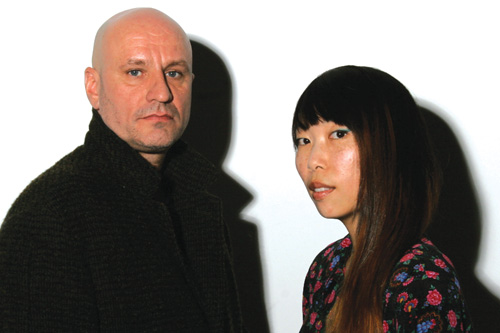
But we’re not here to debate Del Rey’s musical ability; we’re here to keep a glossy superhero eye on Silver Swans. Formed by Las Vegas-born vocalist Ann Yu and Jamaica-bred effects wizard-DJ Jon Waters in 2007, the band has delivered a lovely catalogue — most recently 2010’s Secrets EP and the upcoming LP Forever (Feb.7) — of heart-wrenching synth pop and shoulder-dancing, Manchester-evoking icy club rock. It’s high time they get their international due.

Description of sound: Someone else said it best: “tropical synths and stuttering 808s” wrapped in ambivalent romance and bittersweet longing.

Like most about the Bay Area music scene: The Bay Area music scene is both sophisticated yet charming. So many amazing bands come out of SF, yet you can still create your own place here and find people who appreciate what you do. In that sense, it’s still fresh here. The scene isn’t jaded and over-saturated, there’s charm and new inspiration everywhere.

What piece of music means the most to you and why: This is a hard one, so many songs have come into my life and forever changed me, the first mixtape I got had a song on it called “So Said Kay” by The Field Mice and I think I could have listened to that song on repeat for days reading into every lyric and just taking in the voice. It made me sad too, and just made me feel exactly what I wanted to feel at the time. It was one of the first songs to inspire me to write and also tap into that unknown territory where you don’t care about how unique or difficult a part is write, you just let yourself get carried away in the moment of the song itself and let it almost write itself.

Favorite local eatery and dish: El Metate Mexican Veggie burrito, the vegetables are roasted and always fresh. Everything there is delicious and on the cheap, right down to their alfajore cookies, I fully endorse the entire menu.

Who would you most like to tour with: Karin Dreijer Andersson — Jon and I are both admirers of everything she does. She is a true artist, and I get lost in her songs always.

Rep Clock

0

Schedules are for Wed/8-Tues/14 except where noted. Director and year are given when available. Double and triple features are marked with a •. All times p.m. unless otherwise specified.

ARTISTS’ TELEVISION ACCESS 992 Valencia, SF; www.atasite.org. $6-10. Dirty Looks presents: City of Lost Souls, Fri, 8. “Mindscapes,” short films, Sat, 8.

CALIFORNIA COLLEGE OF THE ARTS 1118 Eighth St, SF; www.dirtylooksnyc.org. Free. Dirty Looks presents: “Queer Conversations on Culture in the Arts,” with selections from the “Female Trouble” experimental shorts program and a conversation with Margaret Tedesco, Thurs, 7.

CASTRO 429 Castro, SF; (415) 621-6120, www.castrotheatre.com. $7.50-10. •Pickpocket (Bresson, 1959), Wed, 3:30, 7:15, and American Gigolo (Schrader, 1979), Wed, 4:55, 8:45. •Beauty and the Beast (Cocteau, 1946), Thurs, 3:05, 7, and No Such Thing (Hartley, 2001), Thurs, 4:55, 8:50. “Midnites for Maniacs: I’m Black and I’m Proud:” •I’m Gonna Git You Sucka (Wayans, 1988), Fri, 7:30; Pootie Tang (Louis CK, 2001), Fri, 9:30; CB4 (Davis, 1993), Fri, 11:30. French American International School presents: “I-Speak: Celebrating 50 Years of International Education,” Sat, 6:30. This event, $5-10; tickets at www.internationalsf.org. •Do The Right Thing (Lee, 1989), Sun, 2, 8, and Malcolm X (Lee, 1992), Sun, 4:15. “Love: Ali MacGraw:” Love Story (Hiller, 1970), Tues, 8. With pre-show gala performance and MacGraw in person; for tickets ($25-45), visit www.ticketfly.com.

ELMWOOD 10070 San Pablo, El Cerrito; www.rialtocinemas.com. Free. “Community Cinema:” More Than a Month: One Man’s Journey to End Black History Month (Tilghman, 2012), Wed, 7.

CHRISTOPHER B. SMITH RAFAEL FILM CENTER 1118 Fourth St, San Rafael; (415) 454-1222, www.cafilm.org. $6.75-10.25. “Rafael Film Club:” “Jan Wahl,” Thurs, 1. Pina (Wenders, 2011), call for dates and times. “Mostly British Film Festival:” Route Irish (Loach, 2010), Wed, 7; Albatross (MacCormick, 2011), Thurs, 7. “2012 Oscar Nominated Short Films,” narrative and documentary (separate admission), Feb 3-9, call for times.

LAMORINDA THEATRES Four Orinda Theatre Square, Orinda; www.caiff.org. $12-15. “California Independent Film Festival,” 11 features, plus docs, shorts, and educational seminars, Feb 10-16.

MECHANICS’ INSTITUTE 57 Post, SF; (415) 393-0100, rsvp@milibrary.org. $10. “CinemaLit Film Series: Hollywood Dames: Beauty and Brains:” Intermezzo (Ratoff, 1939), Fri, 6.

PACIFIC FILM ARCHIVE 2575 Bancroft, Berk; (510) 642-5249, bampfa.berkeley.edu. $5.50-9.50. “Documentary Voices:” The Green Wave (Ahadi, 2010), Wed, 7. “Seconds of Eternity: The Films of Gregory J. Markopoulos:” “Markopoulos: The Early Films (1940-49)” Thurs, 7; “Eros and Myth (1950-63),” Sat, 6:30. “Austere Perfectionism: The Films of Robert Bresson:” The Trial of Joan of Arc (1962), Fri, 7; Les dames du Bois du Boulogne (1945), Fri, 8:25; Lancelot of the Lake (1974), Sat, 8:30. “Screenagers: 14th Annual Bay Area High School Film and Video Festival,” Sat, 3. “Howard Hawks: The Measure of Man:” The Criminal Code (1931), Sun, 4:30; Bringing Up Baby (1938), Tues, 7. “African Film Festival 2012:” Viva Riva! (Munga, 2010), Sun, 6:30.

ROXIE 3117 and 3125 16th St, SF; (415) 863-1087, www.roxie.com. $6.50-10. Come Back, Africa (Rogosin, 1959/2012), Wed-Thurs, 6:45, 8:30. Drive (Winding Refn, 2011), Wed, 8:45. Into the Abyss (Herzog, 2011), Wed, 6:45. SF IndieFest, Feb 9-23. Visit www.sfindie.com for complete schedule.

SFFS | NEW PEOPLE CINEMA 1746 Post, SF; www.sffs.org. $10-11. Domain (Chiha, 2010), Wed-Thurs, 2, 4:30, 7, 9:30. Once Upon a Time in Anatolia (Ceylan, 2011), Feb 10-16, 2, 5:30, 8:30.

VOGUE 3290 Sacramento, SF; www.mostlybritish.org. $12.50. “Mostly British Film Festival:” Black Butterflies (van der Oest, 2011), Wed, 5; London Boulevard (Monahan, 2010), Wed, 7:15; The Great White Silence (Ponting, 1924), Wed, 9:30; A Passionate Woman (2010), Thurs, 5; Route Irish (Loach, 2010), Thurs, 7:30.

VORTEX ROOM 1082 Howard, SF; www.myspace.com/thevortexroom. $7 donation. “The Second Coming of the Vortex Room:” The Second Coming of Suzanne (Barry, 1974), and Marjoe (Kernochan and Smith, 1972), Thurs, 8.

YERBA BUENA CENTER FOR THE ARTS 701 Mission, SF; (415) 978-2787, www.ybca.org. $6-8. “Bros Before Hos:” The Killing of a Chinese Bookie (Cassavetes, 1976), Thurs, 7:30; “Female Trouble,” experimental shorts program presented by Dirty Looks curator Bradford Nordeen, Sun, 2.

Our Weekly Picks: February 1-7

0

WEDNESDAY 1

Kapowski

Oakland-based indie pop quartet Kapowski is celebrating the release of its debut album, Boy Detective, with a party at Rickshaw Stop. With influences including George Gershwin, the Velvet Underground, and David Bowie, it’s no wonder Kapowski’s sound seems very much its own unique creation — sort of a dreamy, eerie, dissonant electric piano-driven march. While Thursday marks the release of the band’s debut album, Kapowski’s vibe has been slow cooking since front man and group visionary Jesse Rimler began collaborating with bassist Jon Gondo during middle school. (Mia Sullivan)

With Mwahaha and Bells

8 p.m., $10

Rickshaw Stop

155 Fell, SF

(415) 861-2011

www.rickshawstop.com


THURSDAY 2

Mostly British Film Festival

February is traditionally an uber-boring month for cinemaniacs — but fret not, local film fans: you need not resort to queuing up at the megaplex to weep at Channing Tatum’s romantic troubles. Not only is IndieFest looming (opening night is Feb. 9), but the Mostly British Film Festival — co-presented by the San Francisco Neighborhood Theater Foundation and the California Film Institute — kicks off tonight, with 28 new and vintage films from the U.K. (duh), Ireland, Australia, and South Africa. Highlights include Ken Loach’s latest, political thriller Route Irish; a complete screening of Michael Apted’s “Up” documentary series; and swinging London time capsule Performance (1970). (Cheryl Eddy)

Through Feb. 9, $12.50

Vogue Theatre

3290 Sacramento, SF

Christopher B. Smith Rafael Film Center

1118 Fourth St., San Rafael

www.mostlybritish.org


moe.

There’s nothing quite like seeing a jam show. They tend to involve hours of emphatic lyric shouting, sensual hip swinging, and persistent head nodding. The air smells more like pot than oxygen, lulling you into a stupor that causes you to forget you’ve been expressively swaying to the same song for thirty minutes. While lesser known than Phish and its omnipotent predecessor, the Grateful Dead, moe. has developed a similarly fanatical fan base by producing fun, danceable jams, perfecting the art of improvisation, and consistently engaging audiences at live venues. moe.’s been at it since 1989 and shows no signs of subsiding into irrelevance. Not to be missed. (Sullivan)

Thurs/2-Fri/3, 9 p.m., $30

Independent

628 Divisadero, SF

(415) 771-1421

www.theindependentsf.com


“Elegy”

A beatific child, arms outstretched, rides a polar bear through a snowy landscape. A baby rhinoceros ascends through a pink cloudscape, glowing halo floating above its wrinkly gray ears. A brown-robed Saint Francis gazes upon a bleeding fawn — but, wait a second, what’s that falling space junk in the background? And how’d that toy robot get in there? Menlo Park native David Michael Smith’s drawings and paintings “hearken back in style to elegant Renaissance Madonnas and saints, while simultaneously borrowing images from contemporary pop culture,” according to Dana DeKalb’s essay in the catalogue for “Elegy,” his new solo exhibition. The drawings and paintings, many situated in elaborate frames constructed by the artist, have an effect that’s as calming as it is unsettling. (Eddy)

Through March 17

Reception tonight, 5:30 p.m.-7:30 p.m., free

Scott Richards Contemporary Art

251 Post, Ste. 425, SF

(415) 788-5588

www.srcart.com


Dengue Fever

During a trip to Cambodia in the 1990s, Zac Holtzman became enamored with ’60s Cambodian pop and set out to create a sound that integrated the genre’s powerful female vocals with the psychedelic surf sound of the American ’60s. Enter Dengue Fever — a six-piece rock band whose Cambodian female vocalist, Chhom Nimol, sings in Khmer and English (sometimes in the same song, often wearing something sparkly), while Holtzman puts down a dazed, surf riff reminiscent of “Wipe Out” with his double-necked guitar chapei. Dengue Fever is set to shake the Great American Music Hall on Thursday and Slim’s Friday, to the delight of Bay Area indie pop fusion enthusiasts. (Sullivan)

With Secret Chiefs 3

8:30 p.m., $20–<\d>$44.95

Great American Music Hall

859 O’Farrell, SF

(415) 885-0750

www.gamh.com


FRIDAY 3

“WTF with Marc Maron”

Part comedy discussion and part no holds barred interview program, Marc Maron’s WTF podcast has emerged as can’t miss listening for anyone curious about the thought processes of modern comedians and performers. The stripped-down feel and anything goes attitude of the show has led to some incredibly personal moments — Todd Glass coming out on a recent episode immediately comes to mind — that are respectfully ushered along by Maron’s neurotic but attentive and no bullshit personality. In a special live taping of the show, he’ll be chatting with a handful of eclectic guests that includes political satirist Will Durst, Arden Myrin (Chelsea Lately), and original Saturday Night Live cast member, Laraine Newman. (Landon Moblad)

10:30 p.m., $25

Cobb’s Comedy Club

915 Columbus, SF

(415) 928-4320

www.cobbscomedyclub.com


SATURDAY 4

“Between Me and the Other World”

Dissecting wounds in under-reported aspects of American history has allowed Joanna Haigood to create some of the Bay Area’s most remarkable dance theater works. So there is every reason to look forward to her newest endeavor, “Between Me and the Other World,” which examines W.E.B. Du Bois’ concept of “double-consciousness,” as analyzed in his The Souls of Black Folk. Using the “veil” as a metaphor, Du Bois eloquently explained the fractured state of being imposed on people who are not allowed to be themselves. Written in 1903, his observations have stood the test of time. For “Between” Haigood, in addition to her own dancers, has enlisted first-rate collaborators in Antony Brown for the music and David Slzasa for the design. This is a work in progress showing and includes a post-performance discussion. (Rita Felciano)

2 p.m., free

ODC Theater

3153 17th St., SF

(415) 822-6744

www.zaccho.org


Bob Odenkirk with The Birthday Boys in “Seven-Man Sweater”

Bob Odenkirk (Mr. Show) joins up-and-coming Upright Citizens Brigade troupe The Birthday Boys for two Saturday night performances of “Seven-Man Sweater.” Gaining steam over the past couple years with videos for Funny or Die and writing jobs for the MTV Movie Awards, The Birthday Boys create comedy that successfully blends smart satire and pop culture send-ups. The Los Angeles-based troupe’s style should mesh well with Odenkirk — a legend of the sketch form — in this sure to be hilarious mix of live performance and video shorts. (Moblad)

8 p.m. and 10:30 p.m., $20

Eureka Theatre

215 Jackson, SF

(415) 788-7469

www.sfsketchfest.com


Exodus

In the 1980s, thrash reaffirmed the faster-is-better trajectory of heavy metal that was already developing in the mechanistic speed and rhythm of acts like Judas Priest, replacing the big, rounded tones and psychedelic aftertaste of the ’70s with piston-like riffs and angular dual-guitar leads. Thrash, the supremely-aggro next step in this sequence, exists today as something of a brief and punctual link in the great, forbidding chain of heavy metal, but one whose dogged endurance (see: Slayer) guarantees it a permanent appeal. The show brings together fellow Bay Area thrash legends Possessed, Heathen and Forbidden in a memorial for Paul Baloff, the late vocalist of Exodus, who died 10 years ago. (Tony Papnikolas)

With Mad at Sam, Angerhead, Mudface, Hysteria, Hell Fire, and the Venting Machine

6 p.m., $30

Oakland Metro

630 Third St., Oakl.

(510) 763-1146

www.oaklandmetro.org


SUNDAY 5

Apocalypse Cakes Reading + Eating”

The world is ending soon. Why not eat as much dessert as possible before the inevitable? And why not get into the end-times spirit by whipping up one of Shannon O’Malley’s concoctions from Apocalypse Cakes: Recipes for the End? O’Malley’s book (an offshoot of her tasty and notorious blog) has all the recipes you’ll need to celebrate doomsday, as long as you have a sense of humor: Black Deforestation Cake, Impending Meteorite Rock Candy Cake, Whore of Babylon Fruit Tart, Shifting Poles Pineapple Upside-Down Cake, and, yes, 2012 Mayan Chocolate Cupcakes. Swing by Omnivore Books for a reading and tasting — the countdown is on, so calories totally don’t count. Right? (Eddy)

3 p.m., free

Omnivore Books

3885a Cesar Chavez, SF

www.apocalypsecakes.com


MONDAY 6

Thee Silver Mt Zion

You know how the creation of epic classical music appears to be on the edge of madness, at least, the way it’s depicted in Amadeus (1984)? All ferocious scribblings, and sore hands from tearing furiously into instruments with the passion of a particular set of notes pumping through the veins for hours, days, months. Bloody hands arise, ‘I’ve got it!’ This is how I picture Thee Silver Mt. Zion working. A modern, Canadian, post-punk version of that. Perhaps it’s because of the frequent title reworkings that suggests hyper attention to detail: A Silver Mt. Zion, The Silver Mt. Zion Memorial Orchestra & Tra-La-La Band, Thee Silver Mt. Zion Memorial Orchestra and Tra-La-La Band with Choir and Thee Silver Mountain Reveries. As part of the Godspeed You! Black Emperor collective, the Montreal-based band gained notoriety for its likewise stunning arrangements, droning movements, improvisational jazz style, and punk ethos. With name changes, lineup shifts, and sound tweaks over the past decade, it’s a wonder they’ve yet to collapse. (Emily Savage)

With Matina Roberts

Great American Music Hall

859 O’Farrell, SF

(415) 885-0750

www.gamh.com


TUESDAY 7

Leni Stern and the Masters of African Percussion

When German-born guitarist Leni Stern traveled to Mali in 2005, she met master musician Bassekou Kouyate, and became entranced with the local percussion instruments and style — later releasing albums such as 2007’s Africa and 2010’s Sa Belle Belle Ba, incorporating the West African sound. A lifelong musician (she won Gibson’s Female Jazz Guitarist of the Year award for five consecutive years) and traveler, she was inspired, to the say the least. At Yoshi’s, she’ll play guitar, n’goni ba, and jeli n’goni, alongside Kofo on talking drum, Alioune Faye on djembe, and Mamadou on bass and additional percussion. (Savage)

8pm, $16.

Yoshi’s

1330 Fillmore, SF

(415) 655-5600

www.yoshis.com


The Guardian listings deadline is two weeks prior to our Wednesday publication date. To submit an item for consideration, please include the title of the event, a brief description of the event, date and time, venue name, street address (listing cross streets only isn’t sufficient), city, telephone number readers can call for more information, telephone number for media, and admission costs. Send information to Listings, the Guardian Building, 135 Mississippi St., SF, CA 94107; fax to (415) 487-2506; or e-mail (paste press release into e-mail body — no text attachments, please) to listings@sfbg.com. Digital photos may be submitted in jpeg format; the image must be at least 240 dpi and four inches by six inches in size. We regret we cannot accept listings over the phone.

Seventeen Evergreen

0

Seventeen Evergreen (www.seventeenevergreen.com) occasionally sounds like evil video game music to me. The San Francisco band consists of Caleb Pate and Nephi Evans, both writers-producers who sing and play drums, synths, and Asiatic stringed instruments among other contraptions. Though it has roots in garage, the duo mostly sticks to experimental psych-pop, and sometimes incorporates aggressive dance beats that lend to gaming — you can almost picture shattered gold rings falling through the sky in a winning ding-ding-ding during moments in the forthcoming Steady On, Scientist! LP (March 27, Lucky Number). The next show is Feb. 25 with Atlas Sound at Bimbo’s as part of Noise Pop (8 p.m., $20. 1025 Columbus, SF. www.bimbos365club.com).

The album standout is “Polarity Song,” with its catchy, repetitive hook and provocative lyrics. The song also was featured on the Psyentist EP, released last December and subsequently, there was a music video. While the EP and video by Terri Timely, which played up a rainbow of yarn spun thrift store monsters, were released last year to local acclaim, the full-length will be out in 2012, making it the perfect year for the band to reach its deserved position beside fellow danceable indie giants. After watching Seventeen Evergreen live last year, the phrase “embrace the polarity of life” was bumping about my brain for weeks. Undoubtedly, this will happen to you too.

Description of sound: Somewhere between zenith snowflake pop and psychedelic cave techno.

What do you like most about the Bay Area music scene: The Asian influence on the avant garde, the room for innovation, and the many different scenes which may or may not always celebrate the out-and-out sonic weirdness that this city has produced over the years.

What piece of music means the most to you and why: No one piece could ever answer this one so far, but last year Cass McCombs’ “County Line” was a favorite. “Golden Lady” by Stevie Wonder and nearly anything by Moondog come to mind as perennials.

Favorite local eatery and dish: So many options here but let’s nominate the Chilaquiles at the farmer’s market in the Ferry Building or a number of places in the Mission for the same.

Who would you most like to tour with: ELO.

Main Attrakionz

0

Why is Oakland’s Main Attrakionz (www.mainattrakionz.com) on the rise? It’s because everybody’s talking about it, and with good reason. Last year’s massive 808s & Dark Grapes II mixtape wowed the underground hip-hop world, and with every passing month the act — rapper-producer Squadda B and rapper Mondre M.A.N. — catches the attention of yet another publication, and yet another rising producer — there have been collaborations with A$AP Rocky, Clams Casino, Kool A.D. of Das Racist and Danny Brown, among others.

The cloud-rap duo got a write-up on the Guardian’s Noise blog in December in which writer Frances Capell effused, “Main Attrakionz is carving out its own place in hip-hop by pioneering a new sub-genre” and later, “a refreshing realness runs throughout Main Attrakionz’s lyrics.” In 2012 there will be solo mixtapes from both rappers, along with the collaborative effort Bossalini’s & Fooliyones. With all this skill and regard it’s easy to forget how young the crew really is, it got its start in high school — way back in 2007.

Description of sound: Really can’t describe it. All of our music sounds different.

What do you like most about the Bay Area music scene: The fact that only we know what they talking about.

What piece of music means the most to you and why: The beat to “Da Art of Storytellin” by Outkast featuring Slick Rick, produced by Mr. DJ. It just reminds me of my childhood staying up to watch Rap City countdown and the song was usually number one. Whenever I hear the beat, I think of the puppets in the video.

Favorite local eatery and dish: Buffet Fortuna in Downtown Oakland; chow fun noodles

Who would you most like to tour with: Lil Wayne; as far as performances go, he’s gotta be the top rapper who been performing 10+ years. I wanna learn how he stays ready and energetic for all these years.

Metal Mother

0

Like some sort of neon, acid-drenched wood nymph, Metal Mother’s (metalmother.bandcamp.com) Tara Tati wanders through the leafy, NSFW video for the haunting art-pop “Shake” off last year’s Bonfire Diaries and into the mind’s eye. In 2012, there will be a first trip to SXSW, more videos (yay!), a few remixes, and, fingers crossed, another full length out toward the end of this year. And as the shimmering Tati says, she’ll “Continue dismantling the mundane and mediocre thought systems that are ruling the planet.”

Tati and her band, which came together shortly after the release of Bonfire proved most theatrical of the Guardian photoshoot, with glittering headpieces and flexible posing. In setting up the right headspace for a photo Tati at one point explained, “I imagine we’re on a wind-torn beach in Scotland.” Appropriate given the band’s atmospheric sound. Before embarking on tour, Metal Mother will play Disco Volante on March 3 (347 14 St., Oakl. www.discovolanteoakland.com)

Description of sound: Post-apocalyptic-art-wave.

What do you like most about the Bay Area music scene: Oakland (where I live) has the feeling of being a fairly insulated city, and I think because it feels like we’re off the mainstream radar a bit, in combination with the massive artist population, there’s more support here for being ‘experimental’ and trying new things, than there is for being traditional. There’s this intense camaraderie, like it’s all for one and one for all, yet at the same time, there’s a crazy bullshit filter that really keeps us all in our most authentically creative place.

What piece of music means the most to you and why: The piece that’s recently gotten the most consistent play on my iPod is Sufjan Stevens’ latest album, Age of Adz. I’ve realized that most music that has lasting power for me usually has some symphonic, classical element to it, and he really nailed it with this album. Its masterfully produced; the arrangements are shockingly complex yet have this unyielding elegance that still gets me all emotional. To me, it’s a perfect blend of sweetness, humility, passion, and absurdity; there’s never a dull moment!

Favorite local eatery and dish: Tacubaya in Berkeley, all the vegetarian dishes are amazing. My favorite is probably the ‘seasonal vegetable’ tamales.

Who would you most like to tour with: It’s a tie between Sufjan Stevens and Bjork.

Localized Appreesh: Ash Reiter

0

Localized Appreesh is our weekly thank-you column to the musicians that make the Bay. To be considered, contact emilysavage@sfbg.com.

Call it youthful summer abandon or fresh-baked pop, but there’s something about Ash Reiter’s song and Perez Bros-directed video “Heatwave” that melts the ice of a chilled and cubed SF day. Whether it’s the the lilting melody, surfy plucking, stoop sing-along, or the perfectly-cast ice cream man offering up too many dripping frozen treats, it’s hard to wipe that sticky grin off your face. That is, until you see the ice cream man’s crestfallen face, realizing it’s just too much sugar.

Fun fact: Ash Reiter is both the cheery lead singer/elementary school music teacher, and the eponymous band name. The indie pop five-piece has played with MGMT and been featured on Daytrotter, released the Heatwave EP late last year and followed that up with Christmas in California. About to embark on a Pacific Northwest tour, Ash Reiter will celebrate its return to SF with a Noise Pop show Feb. 21 at Bottom of the Hill. But before all of that, a stop at Amnesia this week.

http://www.youtube.com/watch?v=1l26Z6BLirU

Year and location of origin: 2008 in the East Bay.

Band name origin: My mom and pops gave it to me. In college my band was called Drunken Boat (like the Rimbaud poem) but another band by the same name started hassling me about so I decided to just go by my own name.

Band motto: What would Paul McCartney, Bryan Wilson, The Strokes, Feist, Grizzly Bear, The Talking Heads, or Jolie Holland do?

Description of sound in 10 words or less:
Sunny intelligent retro indie pop with a folk twist.

Instrumentation: Ash – guitar, vocals, Will – drums, vocals, Drew – guitar, Scott – bass, Anthony – keys, vocals

Most recent release: Six song EP – Heatwave. Plus we’re mixing a full-length called Hola right now.

Best part about life as a Bay Area band:
I’m from here but I’m always discovering new places and people. I like living close to my nana.

Worst part about life as a Bay Area band: Touring – you have to drive so far to get to the next big city- it’s not like East Coast where you can pop from city to city.

First record/cassette tape/or CD ever purchased
: Prince’s Batman Soundtrack.

Most recent record/cassette tape/CD/or Mp3 purchased/borrowed from the Web: St Vincent – Actor is my latest purchase and obsession.

Favorite local eatery and dish: House of Curries – chicken tikka masala with potato nan.

Ash Reiter
With Chrystian Rawk (record release), Anna Ash, and the Heather Band
2/4, 9 p.m., $7
Amnesia
853 Valencia, SF
(415) 970-0012
www.amnesiathebar.com

Occupy Oakland inmates at Santa Rita attacked- developing story

153

(THIS STORY HAS BEEN UPDATED)

In the aftermath of the mass arrests of Occupy Oakland protesters– and whoever else happend to be on the wrong street at the wrong time– on Jan. 28 in Oakland, there have been loads of reports and rumors about brutality inflicted on those arrested. Most of those arrested were held in Santa Rita jail.


My observations:

I spent 20 hours in jail, and I saw some cruel treatment. I saw people suffering after being denied medication. I saw people with allergies to the food that was provided refused any substitute and unable to eat, sometimes for more than 24 hours. I saw people crammed into holding cells meant for groups a third their size, so that some people had to remain standing, sometimes for more than 24 hours. As many arrestees were wearing clothing coated in tear gas and pepper spray, those chemicals continued to waft through cells and affect all present.

Reports:

I have reports directly from sources of arrested occupiers being beat up in jail with police batons. At least 20 people were ziptied, meaning their hands were cuffed behind their backs– and more often than not, if they happen to be cuffed too tightly and their hands go numb and even blue, police won’t loosen them– for more than eight hours. I know that some people who were denied access to a restroom ended up sitting in their own vomit and urine for at least four hours in some cases.

UPDATE Another report from Joshua Clover, a professor of English at UC Davis, who was released Monday night, :
“I was held for 53 hours for a misdemeanor charge which every single person here, and there, knows will never be brought, and indeed which will be met with a class action suit for wrongful arrest that the city of Oakland will be compelled to settle. I have a perforated peptic ulcer. Early on in the stay I requested non—prescription care — liquid antacid, which the jail keeps on hand — when I began to have an ulcer attack, which is to say, when I began to bleed internally. I was not given such care until an attorney was able to intervene by phone many hours later. I received one capful, which was mildly effective for about three hours. Further requests were ignored. As many will know, a bleeding ulcer attack is both painful and potentially fatal”

UPDATE When I questioned Alameda County Sheriff’s Department Public Information Officer Sergeant JD Nelson about this, he responded that “[Clover] was obviously seen by a medical person, and they said that was enough medicine.”

But accoridng to Clover, via an email, “The one time that I received medication, a deputy came to the cell door accompanied by someone who may have been a nurse, holding a capful of antacid. I asked for more but was not given it.” And was Clover seen by a medical professional to determine the correct amount of medication? He says, “Definitely not.”

Also according to Clover, “Food was often not provided for periods of up to 14 hours. For a long period I shared a cell with 27 other people; it was about ten by ten feet. For a period I was in a cell labeled ‘Maximum Occupancy: Two.’ There were ten of us, three very sick. We stood. One of the people slumped over on the toilet, that being the alternative to standing.”

UPDATE

“Three people I know were denied medication for HIV infections while being held for multiple days, which is a life-threatening choice made by the county”

“two women were denied anti-depressants that they had with them when they went to jail”

UPDATE According to an anonymous source, “My 12×12 cell had 28 people. There was a toilet, a concrete bench, and enough hard floor space for three or four of us to sleep at a time. A girl in the cell across from ours told the guards she needed Lexapro or she would go into withdrawl. They ignored the request. One of my cellmates was HIV-positive. When I last saw him at 2 a.m. on Monday morning he had not yet been given his medications. As I exited the jail I saw a woman who had just been released lying on the floor. She was having a seizure and being tended to by a couple of firemen.”

UPDATE From Alyssa Eisenberg, who has multiple sclerosis:
“I take my medication at least twice a day…without it, the pain is, everything kind of goes numb and tightens up. Somtimes I can’t even see without it. When  had to sign the booking form about noon i couldn’t even see it, my vision was so blurry…I was told they don’t give meds to people that are going to be cited and released, only to people that are going to stay and get charged.”

Unconfirmed reports:

Daily Kos quotes an anonymous source who reports that “prisoners from the Oakland Commune were being denied medications (some had seizures) while the guards said they didnt care if they died. Some people were brutally beaten. The put tear gas in the vents of my cell twice.”
According to Occupy Oakland media spokesperson Omar Yassin, a report that someone was tear gassed in the jail’s hallway is likely credible.

Then there’s the peolpe who were injured during the protests Jan. 28. Also according to Yassin:

At least a dozen people had welts on their faces or bodies from being beaten by clubs or shot with rubber bullets. One woman was shot in both arms with rubber bullet; one man was shot in the face with rubber bullets while holding a video camera to document the events. Several protesters were shoved to the ground and received wounds on their faces while being arrested. Police raised their rubber-bullet rifles to the faces of protesters throughout the day, threatening attacks– a rubber bullet to the face can cause brain damage and blindness.


A spokesperson for the Alameda County Sheriff’s Department refused to comment, although she did say that they’ve “been bombarded with calls about this all day.” Shocker.

UPDATE According to Alameda County Sheriff’s Department Public Information Officer Sergeant JD Nelson, no complaints of mistreatment at Santa Rita have been filed.

Nelson said that peanut butter was made avaliable to vegans those allergic to meat, in direct contrast to what I witnessed in jail.

In response to reports that some detainees were held on buses in the Santa Rita parking lot for up to eight hours, during which time they were refused bathroom access and in some cases made to sit in their own urine and vomit, Nelson said that “Generally when they come to the jail the buses are unloaded fairly quickly. Obviously some people are going to go first, some last.”

He told me that detainees were denied medication because “We do we allow them to take their medication in jail. People will try to smuggle stuff in.”

When asked about reported beating in jail, Nelson replied, “I haven’t gotten any reports of any skirmishes between officers and those arrested. We would report it if  there was any use of force,”

According to Nelson, the Alameda County Sheriff’s Office has video footage of all of the areas in the jail where arrestees were held, and, unless there was a lawsuit preventing its release, he would make the footage available to me soon. For now he said, “I don’t even know if they’ve been developed.” (Is this 1984? Not in the Orwellian sense. In the technology sense.)

More on this soon. Send me information that you have, yael@sfbg.com

Bangarang: DIY hip-hop collective Doomtree is back

0

There’s something undeniably envy-inducing about a music collective. Everyone lives their separate lives yet they have continuing influence on one another; they hover nearby for comfort and camaraderie, maintain a steadfast family, and encourage a breeding ground for creatives. The emcees, DJs, lyricists, and producers in the Twin Cities-based DIY hip-hop collective/label Doomtree seem to have that system down pat. Under their own monikers, they create praise-worthy individual records. Together, the group carves out quality time and records masterpieces.

“Every year we do an end of the year, label showcase at First Avenue which is kind of like our legacy club in Minneapolis” says sole female emcee Dessa (Maggie Wander) as the group van careens down the mountains in some “white, alien-looking terrain” a week into a tour that takes it to San Francisco this week. 

“We initially started doing that show as a test of our own draw. Over the years it’s morphed into this like, pagan celebration of the preceding year,” she adds. “It’s hours of music together, you can see how much time we’ve spent together as friends, and occasional roommates – living together in conversion vans and sharing hotel beds.”

Last November’s No Kings, the latest full-length from the seven-piece, is one of those rare accomplishments in the music world; it’s at once fun and earnest, boasts quality rhymes, good beats, and catchy hooks, and features a rotating Lazy Susan of frontpersons. No kings, no group leader. The record is obviously the work of a collective, a rather in tune one at that – most went to high school together, some have been friends since junior high.

Among the catchiest of the No Kings bunch is a little hip-hop track dubbed “Bangarang” – yes, also the name of a Skrillex song and EP but, no, it’s not remotely dubstep. Doomtree’s is tougher and amusing, with a hearty beat and quick-spitting flow. The lyrics mesh the funny with the thought-provoking – “all these rappers sounds the same/beats/sound the same/raps/sound the same.” and later, “I built more than a rap career/I’ve got my family here.” The band wisely chose to feature the song in a video based around a karaoke night, meaning the words scroll across the screen for the viewer as well. Oh, and that karaoke night is hosted by a sensually stripping Har Mar Superstar, the perfect star for such a video.

http://www.youtube.com/watch?v=E2dX_k6MvWM

“We thought it would be fun to showcase the personalities within Doomtree, and a goofier side to the performers,” says Dessa. “And we’ve been friends with that dude [Har Mar] for a really long time.” Har Mar is part of the sex-oozy Gayngs collective (also of Minneapolis), which runs in the same circles as Doomtree.

The idea for the video came about when producer-DJ Lazerbeak (Aaron Mader) was sitting at a bar with the producer who made the video and they agreed a karaoke video would be easy, and they could get Har Mar to run up on tables, singing and screaming. Then we get to the core of the reason for it: it’s cheap and looks great. “We’re an independent label, and we’re artists owned and operated, so keeping costs down is the name of the game!” Dessa says.

The obvious question, to me at least, was if the group itself enjoys the occasional karaoke night out. Does art imitate life? In this case, no. No, it doesn’t.  Dessa and Lazerbeak giggle when I pose the question. “We’ve never done it,” Dessa says. “A big no,” Lazerbeak laughs. Whatever guys.

Doomtree

With 2Mex
Tues/31, 9 p.m., $16
Slim’s
333 11th St., SF
www.slimspresents.com