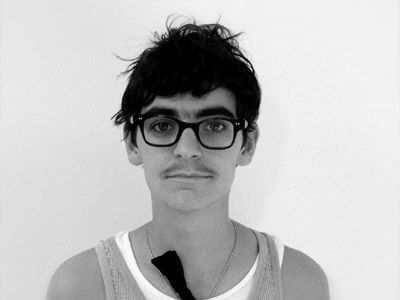
How adorable is JD Samson? As a member of the legendary electro-feminist band Le Tigre and currently the force behind MEN, her music skills alone bank winning points. When you add in that little mustache, messy hair, and big dorky glasses, Samson becomes a full-on queer sex symbol. And guess what ladies? She’s here and DJing SOM Bar‘s Saturday night Pride party.
The dancefloor is bound to be packed with gay-weekend celebrating hotties but if Samson is truly the apple of your eye, you might have to step up your game. Her last gf was Sia, the ridiculously cool Austrailian pop-singer who never fails to spew awkwardly entertaining stories, as seen by her interview with the Bay Guardian last year. The musical couple broke up this Spring and while it’s not confirmed that Samson is/is not carting a new beau, this party could very well be your chance to romance a queer celebrity with a ridiculous cool-factor.
;
Samson’s musical stylings are known to be eclectic but there’s no doubt her DJ choices for SOM’s “Lights Down Low” event will be electronic, hard, and very grind-able. Blur’s “Girls & Boys” will probably make a justified appearance on the playlist. Her cohorts for the evening will include Nomi Ruiz, a member of Hercules and Love Affair and Jessica 6, which plays the Pride Main Stage on Sunday.
If you’re somehow unfamiliar with Samson’s previous work or just haven’t completely been convinced of her charm, check out her It Gets Better video. Awwwww, JD!
LIGHTS DOWN LOW: ANNUAL PRIDE EDITION W/JD SAMSON AND NOMI RUIZ
Magical UK disco foursome Horse Meat Disco (the four horsemen of the discopocalypse?) are joining House of Stank at Juanita More’s super-kiki Pride party on Sunday — and hottie Jim Stanton from the quartet has gifted us with his Pride Top 5. Get ready to twirl, because there’s also a hot-hot Horsemeat minimix after the jump, celebrating the upcoming July 4 release of their third compilation disc, Horsemeat III (holy mirrorballs, Duck Man, just check out this track list). Get into it.
Macho, “I’m a Man” (Prelude), 1978 Macho is a proper disco song that reminds me of San Francisco because of the leather scene. It is sooo gay and hard! Perfect for that “dark room” action. Haha!
http://www.youtube.com/watch?v=-VbLB4UEFvw
Locussolus, “I Want It (Prins Tomas Remix)” (International Feel/UK), 2011 Prins Tomas turns DJ Harvey’s celebrated epic club track into a funky Dr Buzzard’s Original Savannah Band-style work out for our new disco generation. BIG!
http://www.youtube.com/watch?v=3EDtfBDSWug
Ava Cherry, “You Never Loved Me” (RSO), 1980 EVERYTHING you want from a disco track jam-packed into 8 minutes. Bitterness, heartache and regret? Check! Searing strings? Check! Brass section to die for? Check! And that trippy break HIT!!!
Run Baby Run, “Let No Man Put Asunder (Ron Hardy Edit)” (Salsoul), 1983 I love the original a lot, BUT I like Ron Hardy’s “raw” side! A proper Chicago legend. I edit this to another level. Soo ENERGETIC!!!Always in my set.
Paul Parker, Right On Target (Megatone), 1982 A muscular slab of energetic and frisky true San Francisco. Non-stop heavy action from Patrick Cowley the godfather of hi-NRG.
House of Stank is coming to town for Pride, playing Sunday at Juanita More!’s infamous pool party. We asked the NYC house and tech duo — W. Jeremy, who many will recognize from his years in SF, and Christy Love — for a top 5 list of their favorite Pride tracks, from booty-tech to old-school End Up classics.
5. “Big Freek (DJ Deeon Remix),” Freak Nik
— Christy Love first discovered Booty House while living in SF and this song is one of her all-time faves.
http://www.youtube.com/watch?v=a80csXQ3-kQ
4. “I Feel Good Things For You,” Daddy’s Favourite
— End-Up classic that samples Patrice Rushen.
3. “In and Out of My Life,” Adeva
— Jeremy is from New Jersey. Adeva is from New Jersey. ‘Nuff said.
2. “Do Ya Wanna Funk,” Patrick Cowley feat. Sylvester
— Two Bay Area Disco Legends on one track. Every time we hear this song it reminds us of SF Pride.
http://www.youtube.com/watch?v=w6yLwhKYVHY
1. “Day By Day (Green Velvet Mix)” – Dajae
— We are so excited to play alongside Dajae at Juanita MORE!’s Pride party!
W. Jeremy says: “2011 has been a busy year for us. The thing that we’re most excited about is our new record label, Get Up Recordings. We’re gearing up for our third release, a track called ‘Tonite’ by Honey Dijon and Sebastian Manuel, which is definitely going to be a future classic house track. We’re super excited about our upcoming roster, which will feature releases from Severino (Horse Meat Disco) and Nico Deceglia, also known as Hyena Stomp, the SF/Bay Area’s David Harness and another release from us. We just finished up a remix for The Two Bears for a track called “Bear Hug” on Southern Fried Records. We’re playing Cielo NYC for the first time in July with Tedd Patterson which is very exciting because of the club’s Funktion One sound system.”
The world of competitive air guitar in the United States has come a long way from it’s humble beginnings in 2003 when only two coasts were ripping faux chords. Nowadays, a nationwide shred-a-thon draws guitar mimes from around the country, and hosts competitions in 17 cities. Each regional winner competes in the Chicago nationals, vying for the chance to bring back the golden crown from the mother of all air guitar championship competitions in Oulou, Finland.
In fact, the Europeans have been serious about their air guitar for quite some time. The Fins have been holding the world air guitar competitions since 1996 to honor the practice as a true art form and a message of peace. (You can’t hold a rifle if you’re playing air guitar, right?)
In the U.S., however – the birthplace of both rock music and air guitar, mind you – it’s always been kind of a joke, something tighty-whitey-clad teenagers do in front of bedroom mirrors. Made legendary by Joe Cocker at his Woodstock performance in 1969, and then popularized by hair metal enthusiasts of the 1980s, the art of air guitar has yet to reach its cultural zenith here in the states – but we’re working on it.
http://www.youtube.com/watch?v=bpp-XLuS0Y4
Joe Cocker keeps busy in between vocals at his 1969 Woodstock performance. When asked what he was fingering, he replied: “I’ve always wanted to play guitar, but never learned.”
The San Francisco leg of the U.S. Air Guitar Championships will jump kick all over the Golden Gate this Fri/24 and Sat/25, and is open to all competitors.
Here’s how it works: Participants battle imaginary axes in two rounds: rockin’ air licks to a song of one’s own choosing, and then to a surprise song from the judges. They are scored on a scale from zero to six, just like in figure skating (would that ice skaters shared the air guitar competitors’ goofy self awareness.) The judges look for technical skill (the accuracy of the notes noodled), stage presence (rock god channeling), and something called “airiness,” that certain je ne sais quoi that transcends the act of air guitar into the upper echelons of high art. In the end, the two scores are totaled and the winner with the highest score from on both nights will represent San Francisco in the upcoming national throwdown.
Think you have what it takes to emerge victorious? Enter here. And be sure to check back for my play-by-play coverage of this weekend’s competition.
For the pastfewyears, as part of our annual Queer Issue, we’ve rounded up a few of the people who have inspired us with their unique approaches to queer life. Whether they’re activists, artists, performers, or just plain hot-to-trot rabble-rousers, they’ve made our queer hearts beat a little faster (and reminded us of the fantastic diversity and dedication of the community). This year, we’ve gathered together another Hot Pink bunch, and asked them. “What inspires you right now — and what could the queer community use more of?” This year’s Hot Pink List was photographed by Keeney + Law.
HONEY MAHOGANY
Singer, performer, social worker, photographer, glamour girl — Miss Honey Mahogany (www.itshoney.com) does it all and leaves you breathless. Catch up with her on the SFMOMA Pride Parade float (a drag salute to Paris, 1928) on Sunday, June 26, and look for her forthcoming EP this summer. “I feel really lucky to be coming of age as a performer at a time when there seem to be more and more queers out there in the public eye. Whether it be in popular media, politics, art, advocacy work, research … we are everywhere! One thing I would really like to see in the next few years is the rise of new, massively popular gay icons … and I mean ICONS, not celebrities. I think the world is ready for that. In fact, I think the world needs it.”
ROSE SLAM! JOHNSON
Have fun or make a difference? Bike-food-community activist Rose Slam! Johnson has found the two can make hot partners. She helped plan SF Bike Coalition’s Bike to School Day, and merrily oversees the Western Addition’s Urban Eating League, Apothocurious (a bike-powered organic food subscription service, www.apothocurious.com), and her own queer adult outdoors camp. This summer, she’s embarking on an multimonth bike ride and camping with Northwest queer youth. “Fear and defensiveness often distract us. By bringing people together around things we are passionate about — food, bikes, community, fun — we are able to move towards love, acceptance, and healing.”
KB BOYCE AND CELESTE CHAN
The masterminds behind Queer Rebels (www.queerrebels.com), an organization that showcases queer artists of color, KB and Celeste are involved in everything from Community United Against Violence (www.cuav.org) to “TuffNStuff: The Last Delta Drag King,” KB’s musical act. Upcoming “Queer Rebels of the Harlem Renaissance” (Friday, July 1 and Saturday, July 2), part of the national Queer Arts Festival (www.queerculturalcenter.org) is a stage extravaganza celebrating that great period. And TuffNStuff performs at the Trans March Rally (www.transmarch.org) Friday, June 24 from 3:30 p.m.-6:30 p.m. “We are inspired by new queer work that creates our own myths, reveals hidden histories, and is unapologetically, riotously gay!”
ALIX P. SHEDD
“It’s very rare to find an aesthetically dedicated queer space that isn’t centered around alcohol, includes queer youth, and is right for all different kinds of performers and performances. Somewhere you can scream, dance, and love everything that’s gay.” So Alix (with help from Lorin Murphy and a ton of volunteers) found a space, painted it pink, and launched the Big Gay Warehouse (www.biggaywarehouse.org). For the past year, the bGw has hosted many of the city’s most intriguing queercentric events, from punk concerts and video nights to sensory derangements and environmental makeovers. Alas, bGw’s days are numbered due to rising rents, but Alix — who’s also involved in trans-women-empowering nonprofit thrift store the Junque Shoppe and designs a clothing line called Apocalypse Vintage — already has the next move in mind.
MICAH TRON (WITH DJ JEANINE DA FEEN)
Super-sharp MC Micah Tron has been rising through the Bay’s hip-hop ranks with a deep electric sound and sexy come-ons. Check her out at www.soundcloud.com/Micahtron and peep her forthcoming EP “Jungle Music,” produced by the HOTTUB crew. She’ll be performing at the Crooked party at the Showdown on Friday, June 24 and on the Pride celebration main stage (www.sfpride.org) on Sunday, June 26 at 11:50 a.m. with her DJ Jeanine Da Feen. “Walking the streets of San Francisco inspire me, there’s nothing like being surrounded by people who aren’t afraid to be themselves. Our community could use more self-acceptance — we’re beautiful people!”
JOCQUESE “JOQ” WHITFIELD
Work! Voguer extraordinaire, Jocquese teaches the wonderful Tuesday night Vogue and Tone class — “a dance class with a party feel” — at Dance Mission Theatre (www.dancemission.com). He’s also part of the raucous Miss Honey nightlife crew and is a collaborator, with Shireen Rahimi, on the West Coast Dopest Outsiders youth life skills program, encouraging “movement through movement.” He’ll be performing at Crooked and Pride with Micah Tron. “I think we live in a society where we place sexuality on everything. I want to strip that away and tell people to just be themselves and dance.”
DIEGO GOMEZ/ TRANGELA LANSBURY
George Washington was due for a kick-ass sex change — so artist and illustrator Diego Gomez (designnurd.blogspot.com) started painting colorful characters like Storm from X-Men, She-Ra, and Jem on dollar bills, a.k.a. “Diego Dollars.” As the designer for Tweaker.org, he gets out valuable information from the San Francisco AIDS Foundation. He’s currently illustrating an “all-Latin porn-graphic novel” called Spicey and a comic book called “CuntBricks,” making clothes and accessories for Barney’s New York and local boutique Sui Generis, crafting with his “Needle X Change” knitting group, performing as his alter ego Trangela Landsbury, and a ton of other neon-bright activities. “I’d like to see more glitter and gold in the future and ‘happy’ surprises (not to mention endings).”
CHRISTOPHER REYNOLDS AND ALYSIA SEBASTIANI
Sustainability was all the queer conceptual rage this past year — but Christopher and Alysia, the powerhouses behind landscape design firm Reynolds-Sebastiani (www.reynolds-sebastiani.com) have been setting the principles in motion by designing and maintaining spaces throughout the city that morph norms to create alternative environments that adapt to change. Recent projects include a redesign of the Phoenix Hotel grounds, to be unveiled at Juanita More’s Pride Party on Sunday, June 26 and a show of amazing terrariums using vintage bottles they unearthed at St. Francis Fountain in the Mission’s new event space, Candy Kitchen, opening Thursday, June 23, 6 p.m.-10 p.m., and continuing for two weeks. “Like any cultural paradigm shift, sustainable practices must reach and change the popular vernacular in order to become truly sustainable — in this way they’re like queer culture,” says Christopher.
The giant commemorative AIDS ribbon that was up on Twin Peaks during the first half of June has been taken down, but the 30th anniversary of the epidemic, and how it changed San Francisco, is still reverberating throughout the city.
“It was like paradise,” Mark Ottman said as he guided me through the high-ceiling lobby, quiet as a library, of Union Bank on 400 California St. “For a few years. Then things got really scary.”
Ottman, the vice president of personal trust and estate services at the bank, recalled arriving in the city in 1981 as a 22-year-old Montana transplant. That year, the gay newspaper the Bay Area Reporter published the word AIDS for the very first time.
Although the paper has been at the forefront of reporting gay news for its 40 years — from White Night Riots of the 1970s through the Lavender Sweep of the 1990s, the Bowers vs. Hardwick decision through the “don’t ask, don’t tell” repeal — the way it straightforwardly handled the heartbreak of AIDS and the outrage that followed has become its lasting legacy.
“This was not stuff that was shown on the nightly news,” Ottman continued. “The B.A.R. was three or four months ahead in covering AIDS. In that sense, it was really the leader.”
This month, those with a thirst for history will need to look no further than newsprint. Union Bank’s LGBT Alliance has commissioned a retrospective exhibit highlighting the Bay Area Reporter’s coverage of the gay and lesbian community.
When the B.A.R. started in 1971, founders and friends Paul Bentley and Bob Ross had the intention of making it more than just a gossipy guide to bars and bathhouses. The newspaper focused on serious local news — even recruiting Harvey Milk as a political columnist.
“The founders weren’t journalists,” said Rick Gerharter, the longtime freelance photographer who curated the photo- and front page-filled exhibit at Union Bank. “But as the paper grew, it certainly became more professional.”
In 1981, when AIDS first appeared, the B.A.R. had no choice but to undergo a journalistic coming of age as it struggled to be first and be fair covering the mysterious disease that had begun to mow down gay men.
UNEASY EARLY AIDS COVERAGE
Yet the newspaper was not immune to the confusion and uneasiness that enveloped the community during the early days of the “gay cancer.”
“Me and my boyfriend both laughed — it must be another Anita Bryant plot against homosexuals,” said Robert Julian, recalling his first response to talk of the “gay-related immunodeficiency” or GRID.
“Gay people are united by sexual orientation, not genetics,” said Julian. Initially, the former B.A.R. entertainment editor and author of But the Show Went On: San Francisco 1987-1988 had his suspicions, thinking that a “physical ailment confined solely to gay people was a practical impossibility.”
It didn’t take long before the B.A.R. began reporting on the latest research, medical resources, and information about financial services available to the hundreds of gay men in San Francisco who had contracted the HIV virus.
Once researchers discovered that AIDS was being transmitted sexually, public opinion divided. Then-Mayor Diane Feinstein and Director of Public Health Mervyn Silverman wanted to close the bathhouses, but some members of the gay community considered this a violation of personal rights.
“There was this repression around gay people and sex, this hysteria around bathhouses,” said Gerharter. And the B.A.R. was hesitant to feed into that frenzy at first. “When it was clear what was really happening, how this thing was being spread around, then it clicked — and the paper really jumped to the forefront of covering what had tuned into an epidemic.”
STEAMY BATHHOUSE DEBATE
The paper not only began to cover the AIDS crisis extensively, but did it with an editorial slant that fostered debate in the community. Paul Lorch, then-managing editor, became a prominent voice arguing to keep the bathhouses open. Bathhouses don’t give you AIDS; unprotected sex gives you AIDS, Lorch expressed in strongly-penned editorials. Sometimes he even answered back to Letters to the Editor.
“Lorch and the publishers didn’t believe closing the bathhouses would solve it,” said Wayne Friday, who took over the paper’s political column after Harvey Milk was assassinated and continued it for 27 years. “But no one had an alternative. Diane [Feinstein] would call me at 5 a.m. asking me what we should do about this thing.”
The community was split. Some, including Friday, believed that the bathhouses were a public health hazard while others accused Feinstein of scapegoating. “Those people were being selfish and foolish,” Friday said. “Closing the bathhouses saved lives.”
In 1984 the San Francisco Health Department asked for a court order forbidding renting out private rooms in bathhouses. Without the luxury of privacy, most closed within months. “San Francisco became a blueprint of how to handle AIDS on the city level for the rest of the country,” Friday said.
OBITUARIES KEPT SAD TALLY
During this time, the B.A.R. was also keeping a more morbid type of tally: the obituaries. Each week the paper published two pages — 30 to 50 obituaries — until 1998.
“When you picked it up, it was the first thing you turned to,” Gerharter said. “It was just a name and a face. Maybe you recognized the person. Maybe someone you tricked with.”
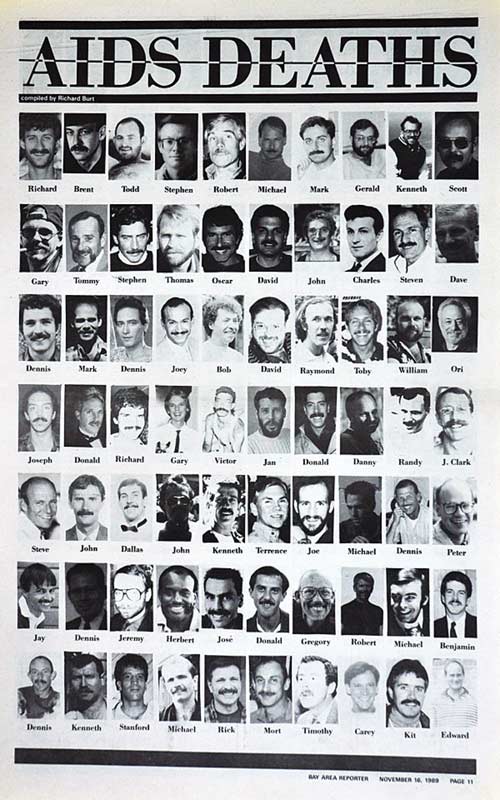
In 1989, art director Richard Burt became so overwhelmed by the number of obituaries that had been turned in to the B.A.R. within the first 10 months that he wanted to convey the sinking feeling in the pages of the paper. The Nov. 16 issue included a four-page collage of everyone who had passed away due to AIDS that year. Just a name and a face.
“It was heartbreaking,” Julian said, “to see my friends and lovers pictured there.”
Through the efforts of Tom Burtch and the San Francisco GLBT Historical Society, a massive searchable online database of B.A.R. obituaries since 1979 was launched in 2009 (www.leifkerdesigns.com/olo/index.jsp).
During his tenure at the paper, Julian chose not to cover AIDS, feeling that the point of entertainment news was to distract away “from the soul-crushing presence of the grim reaper stalking our neighborhoods.”
Though AIDS was a heavily political newsbeat, Friday removed himself from covering it for different reasons. “I knew every elected official. I sat in on all the City Hall meetings about the bathhouses,” Friday said. “But I just couldn’t do it every week. It was too damned personal.”
“Thinking about turning the page to those obituaries even now is making me shiver,” Ottman said. “It’s like a high school reunion, except you don’t know which half made it.”
COVERING THE RISE OF ACTIVISM
The B.A.R. was also instrumental in covering the various political and protest actions that accompanied the disease, including the bloody police sweep of ACT-UP protesters the Castro and the Stop AIDS Now or Else blockade of the Golden Gate Bridge, both in 1989.
Gerharter remembers the blockade. “They arranged it for the morning commute. And thank God it was foggy or else the surveillance cameras would have stopped us.”
Gerharter would often be trusted with information about an upcoming demonstration and be the only photographer allowed to tag along. “You can document history better when you become a part of it. You get closer to the people — they’re not posing,” he said. “It was our job to be advocates and watchdogs.”
After consistently seeing the tragedy of AIDS on the front page for almost a decade, the B.A.R. became more active itself, inciting its readers to action. “We’d read the B.A.R. to find out about the rallies were happening so we could skip work and take a road trip to Sacramento,” Ottman said. “The Chronicle would never cover that.”
When the fight against AIDS became a war, the B.A.R.’s writers often felt like they had become war correspondents, complete with all the outsize personality conflict and drama of the classic stereotype.
“[Bob] Ross was a nightmare boss, a pain in the ass, and complete rageaholic,” Julian said of B.A.R.’s often conservative cofounder, who died in 2003. “But he was committed to keeping the paper and us running.”
There has never been a better time to shake watcha momma gave ya— and if mother didn’t pack a heavy trunk, you’ll have to improvise with some extra nasty drops and shakes. No excuses—New Orleans’ bounce star Big Freedia is headlining the Pride edition of Hard French and cheeks across the peninsula will feel the aftershocks.
Unless you caught Freedia in Oakland last year or have witnessed another super booty-fied bounce musician live, you’re probably not ready for this jelly. Really. A quick Google search for Big Freedia and you’ll find yourself sufficiently slapped in the face by glorious asses, bouncing hard and fast to the vicious mash-up of heavy beats. Freedia says he was born with the moves.
“In New Orleans you grow up learning how to pop your ass. We teach ‘em from babies,” he says, taking a break in the studio where he’s putting the final touches on a debut full-length album. “For over two decades, it’s been in the culture here. You wake up with it and go to sleep with it. You breathe it in the air, each and every day.”
The Southern city by the sea is ass over heels for bounce and Freedia says he can catch apple bottoms gettin’ down to his genre ‘round the clock. “At a stop light, someone will jump out of their car and start shaking their ass. Happens all the time.”
Big Freedia’s love and pride for bounce is beyond evident when you see his nightly performance schedules and over the past year he’s introduced the rest of the country to not only the genre, but the presence of a gay hip-hop performer. His summer Go Homo Tour hopes to crush some stereotypes and fight homophobia. He’s also just released a five-song EP onScion A/V Presents and has his fingers crossed for a documentary and reality TV show. I suggested an aerobics video and he hinted that there may be some sort of yoga-bounce combo in the works.
And if that’s not enough– he still operates an interior decorating business; flowers, funerals, weddings. Hard to imagine his wild personality laying out table cloths and vases without a couple booty drops.
His stop at Hard French will be an epic end to Pride weekend, but that doesn’t mean dancers shouldn’t stretch before the game. The usual soul crowd has got some moves, of course, but Freedia is on a whole new hype. Still, there is no need to be intimidated, as he says, “honey, don’t you worry” and gladly offers three suggestions to loosen up loins in preparation for the dance floor.
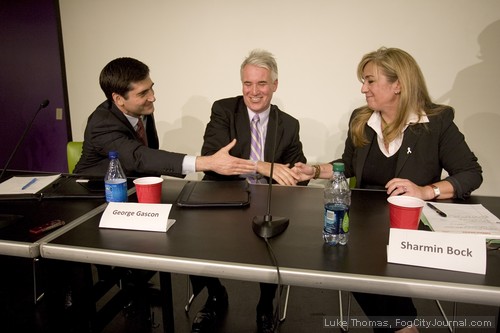
District Attorney and former SFPD Chief George Gascón, Alameda County Deputy District Attorney Sharmin Bock, and former San Francisco Police Commissioner David Onek all landed solid punches during a three-way District Attorney debate that was co-hosted by the San Francisco Young Democrats and the Alice B. Toklas LGBT Democratic Club, and moderated by Recorder editor Scott Graham. The primary sponsor of the debate was the City Democratic Club, according to CDC President Jim Reilly. So, thanks CDC for helping to pull off a great event.
The debate was framed as a choice between Bock, a veteran prosecutor with leadership experience, Gascón, a career cop with managerial experience, and Onek, a former San Francisco Police Commissioner and criminal justice reform expert. And above all it proved that if you lock three attorneys in the same room and pit them in a three-way fight, you’ll be rewarded with a blood sport spectacle.
Bock kicked off by noting that there are many similarities between the three candidates—except when it comes to independence and experience “Experience matters,” Bock said, throwing a one-two punch at Gascón and Onek. “The job of the District Attorney is not a management job, a police job or a job for someone with just a law degree. It needs a veteran prosecutor,” she said—remarks that resonated well with the crowd, judging from the applause.
But after a few niceties, Gascón shot right back at Bock and Onek. “I am the only one who has led large organizations and pushed public policy forward in an effective manner,” he said.
And Gascón struck a home run when he revealed that when he took the job of Chief of Police in Mesa, Arizona, he was “facing one of the most toxic environments” in terms of hatred towards people of color and the LGBT community–and that he did something about it, by standing up to anti-immigrant Sheriff Joe Arpaio of Maricopa County, and protecting the local LGBT community’s right to protest.
When it was his turn to speak, Onek fired off his own rounds at Bock and Gascón, noting that the state’s criminal justice system is broken—and claiming that it will take an outsider to fix it. “This is a once-in-a-lifetime opportunity to reform the criminal justice system,” Onek said, laying out his reform-minded track record.
And then he stuck it to both Bock and Gascón by stating that the death penalty does not work. “I will never seek it in San Francisco under any circumstances,” Onek said, earning excited applause, as he noted that he’ll look at all policy question through the prism of three questions: ‘Does it make us safer, is it cost effective and is it fair and equitable?”
Onek also noted that neither the Supreme Court’s ruling that California must reduce its prison population by 30,000, nor Gov. Jerry Brown’s call for prisoner realignment, come with any money. ‘That’s a disaster,” observed Onek, as he stressed the need to demand resources to help deal with the upcoming load of prisoners that about to return to San Francisco.
Gascón fielded questions about whether they are enough people of color and LGBT background in management in the D.A.’s Office. “Well, I think there’s definitely always room for improvement in any organization,” he said, noting that he has a history in the Los Angeles Police Department, the Mesa, Arizona Police Department and the SFPD, “of pushing very aggressively to have diversity within the office.” But he started a bit of a buzz when he said it was “really a surprise to me that I promoted the first male, black, police captain to the San Francisco Police Department.” “You would think that there have been, you know, male African-Americans in that department for many years. It was hard for me to believe that actually in 2009 we had not had one,” Gascón continued, a remark that got some debate observers asking afterwards, if this meant that Gascón really did not know that former SFPD Chief Earl Sanders was a black male.
Meanwhile, Bock was happily trampling all over the sit-lie legislation that then SFPD Chief Gascón and Mayor Newsom backed last fall, as she noted that more foot patrols and community policy are what’s actually needed. “Political hot-button measures don’t work,” Bock said. “Both sides agree it hasn’t worked. It’s the wrong response to the real problem.
Asked if he had a conflict of interest, when it comes to investigating allegations of police misconduct, Gascón claimed the problem is limited to a small number of officers, adding, “if the allegations are true.”
“In reality the majority of the SFPD are hard-working people doing the right thing,” he said. “And there has been only one challenge—and our office has prevailed,” Gascón said. “However, there have been a finite number of cases where I personally adjudicated the bad conduct—and those will be handled by the Attorney General’s office.”
Bock stressed that she was not in favor of sending drug offenders to prison and would focus on restorative justice, instead. Asked if she would have a panel on her staff review potential death penalty cases, Bock confirmed that she is committed to having a Special Circumstances Committee, as D.A. Kamala Harris did, to get input around the facts and from lawyers involved in such cases.“The ultimate decision is mine, and I oppose the death penalty,” Bock said, noting that she does not believe that 12 jurors will return a unanimous death penalty verdict. “But I do think as prosecutor you need to go case by case.”
Asked if he would have sought the death penalty in a case like the L.A. Night Stalker, who murdered 13 people, many of them elderly, Gascón said, “Probably not. All of us agree that the death penalty is not a good tool. But it is part of our system, and I continue to have the system Kamala Harris had in place. At the end of the day, it’s my decision, and I’m the only one in the room, who can say I’ve already turned down the death penalty.”
Agreeing with Bock that a jury is unlikely to go for the death penalty, Gascón maintained that the death penalty is “an illusory issue,” and that the real question is, “How do we rewrite the State Constitution [so the death penalty is not on the books]?”
Asked how he felt about marijuana, Gascón said he doesn’t believe folks should be incarcerated for use—and that folks are already being diverted to community courts in those instances.
But when Onek tried to wrap up by positioning himself as a the reformist-minded outsider, Gascón pounced, reminding folks that Onek was a Police Commissioner, when the Police Commission recommended Gascón to Mayor Newsom as the next SFPD Chief. “While David is someone I respect—and one of those who hired me, David has painted himself as an outsider, when the Police Commission is the policy-making body for the SFPD. There are no outsiders here. The question is, what have you done? There’s a difference between calling yourself a reformer and having other people call you a reformer.”
Bock for her part used her closing remarks to remind folks that there has been a crime lab scandal, alleged police misconduct, a DNA backlog, and about 100 cases dismissed as a result of these scandals, and a bunch of prisoners are about to be sent back to the community because of realignment. “We’re in challenging times, at a critical crossroads, with stormy weather ahead,” she said. “I’m not going to be trying things out at your expense. As a veteran progressive prosecutor, I’m fully prepared.”
An afternoon show under fruit trees and bright sunshine is always nice, but a line-up of super chill local music is extra conducive to ideal weekend mentality. As long as the weather keeps up its good behavior, Saturday’s Ears of the Beholder four-band showcase will be a total hit and a great introduction to some homegrown electro-pop.
Ears of the Beholder is a pretty rad indie-music blog, started by an San Francisco guy named Peter in 2008. The site promotes a lot of great shows around the city, handpicked with the best intentions. Start with beer, dab your beak with sunscreen and don’t forget the layers; the show may start early at the lovely El Rio, but it won’t wrap until after sunset. The ticket price also includes food, which means you won’t have to run-off mid-set for dinner and instead, you’re encouraged to plop down for a full evening. Take a listen to the line-up:
This SF band keeps things feather-light with pretty, super mellow guitars. They’re minimalist post-rock that’s super easy on the ears and their new synth addition is sure to add in a sweet surge of electro-pop.
The mystical chimes, mermaid voices, and super glassy synth melodies of San Francisoc’s Blackbird Blackbird wash over your senses in slow-motion. They’re a perfect soundtrack for underwater swimming.
These Santa Cruz guys keep things psychedelic, but add in a heavier, more danceable punch. Their random bag of tricks switches up quick and the super diverse samples insures things stay uber fresh from track to track.
The honest, fragile vocals from this Oakland native are compelling enough, but then he adds in pianos and totally weird racing beats. There’s something twisted about the combinations he throws and the unpredictability of it all keeps you along for the bright ride.
When the wind picks up in San Francisco, it’s easy to wish that your limbs could transform into glorious wings.You could float, soar, and glide over the city without worry and turn a pesky gust into an ariel springboard. Until the magic bird spell becomes available, us ground-bound humans are left to simulate the free-floating sensation. Dreamy pop seems to be the closest alternative and Saturday’s combination of Puro Instinct and John Maus are sure to sweep you right off those tired feet.
While the two acts offer different degrees of whimsical imagery, LA’s Puro Instinct and Minnesota-grown John Maus both incorporate fanatic amounts of melodic synth and levitation inspiration. The evening will feel like clouds, especially if your pre-show includes some mediation and a few medicinal puffs. You’ll dance a little and nod a lot, and even if you don’t quite make it to bird status, you’ll enjoy the limbo between.
Sisters Piper and Skylar used to be known as Pearl Harbor, but as of 2011, they’ve gone PC with the name Puro Instinct. The duo has since expanded into a six-piece, but their music remains ironically eerie–like antique baby dolls with scratched-up glass eyes. Distrust and hesitation lingers behind the layers of sweet lace and it’s just enough spunk to keep the melodies mysteriously minor. The addition of more ambient drums, surf-city guitars, and continued advice from their friend Ariel Pink, leaves their sound rounder and glossier than ever.
John Maus is working towards his PhD in political science and as boring as that sounds, his music-making hobby is full of curious fun. His deep voice burrows beneath layers of reverb, only just loud enough to break the surface of ’80s guitars and boisterous keyboard concoctions. His love for punk, appreciation of Baroque, and susceptibility to gush over movie soundtracks has somehow accumulated into one big, awesome mess. Tracks from his new album, We Must Become The Pitiless Censors Of Ourselves, (due June 28 onRibbon Music), are simultaneously tender and mean, feisty and introspective.
Puro Instinct is best for the sensitive seagulls. Adventurous hawks will be delighted by Maus. Pick your flight.
If last week’s E3 press conferences in Los Angeles are any indication, game consoles are no longer just about games. The Electronic Entertainment Expo, the year’s biggest video game industry event, lavishly presented gamers with a sneak peek at the most-anticipated titles and hardware goodies looking to lighten wallets later this year. But as more blockbuster game franchises are released simultaneously on the Wii, PlayStation, and Xbox, it’s become imperative for their parent companies to differentiate themselves — and traditional gaming has begun to take a back seat to this broad experimentation.
Along those lines, Microsoft attempted to guide itself out of the corner it had painted itself into following the huge sales of Kinect, the camera device that quickly became the fastest-selling consumer electronic of all time. Microsoft has been lacking significant game releases for Kinect owners, making this year’s release slate integral to satisfying the new and unexpectedly large consumer base. An upcoming Xbox interface allowing users to control other entertainment like Netflix and live TV by voice seemed to be a hit, as was the announcement of Kinect controls for traditional games like Mass Effect 3 and Ghost Recon: Future Soldier. Microsoft undoubtedly launched Kinect to compete with the draw of Nintendo’s family-friendly Wii, and the device’s appeal to the more serious gamer is a delicate maneuver that these franchises could help accomplish.
In the PlayStation camp, Sony made a speedy apology for the PlayStation Network outage that has battered its reputation for the past two months and piggybacked its return with announcements for bundles, deals, and partnerships offering consumers considerable content for their respective price points. Presenting these products as “gifts” to consumers was an interesting approach to mitigating ire over the network snafu. All business, Sony’s presentation was the least titillating but perhaps most solid of the conferences.
No more beating around the bush: the biggest question going into E3 2011 was “What is Nintendo’s new console?” Leaked information that pointed to a new, more powerful console was confirmed when Nintendo announced the Wii U, a console with a touchscreen controller capable of streaming games to your hands — with or without a television screen. Actual game announcements were left to the newly-launched 3DS and surprises were scarce: tried-and-true franchises MarioKart, Starfox, and The Legend of Zelda. While the possibilities for Wii U initially seem vast, the console’s true nature — and that of its “revolutionary” controller — remains nebulous. There’s the potential for an HD system to recapture Nintendo’s diminishing hardcore audience, but right now the Wii U looks like another stab at cornering families and casual players.
Third-party publishers care less about console revolutions and more about good ol’ fashioned video games. Electronic Arts stuck to its guns, offering concrete gameplay footage and loud (loud!) speakers that shook the Orpheum Theatre with Battlefield 3 explosions. The Battlefield franchise is looking to take Call of Duty head-on this year, and time will tell if players favor authenticity over that series’ scripted bombast. Either way, Battlefield 3 is one pretty game. EA also made a strong go at providing social networking experiences that augment traditional play, and offered them all for free — perhaps a dig at Activision’s recent announcement it will offer paid subscriptions to a similar Call of Duty social experience.
Inside the Los Angeles Convention Center, many newly-announced games were playable or shown in demo form. Highlights: Uncharted 3‘s two gameplay demos both boasted a top-tier knack for exciting set-pieces and storytelling, and it is the first game to truly suggest the power 3-D can add to the gameplay experience. BioShock Infinite was unmatched in attention to detail with its departure to a city-in-the-clouds backdrop. And Mass Effect 3 finally gave gamers a glimpse of Earth’s destruction in a short demo that demonstrated massive carnage and a surprisingly-affecting level finale. There were tears in a few eyes, folks.
E3 2011 was less about this or that game, and more about the process of evolving your traditional game console into an entertainment center where you surf the Web, watch movies, and even take the experience on the go. Nintendo was eager to suggest the new home applications its controller might afford, and Microsoft and Sony focused on expanding new possibilities for their current hardware through Kinect and Sony’s motion device, PlayStation Move. As more and more of the public identify as gamers, this is the playing field expanding to allow for different types of game experiences. Even so, games like Battlefield 3, Uncharted 3, and Mass Effect 3 suggest traditional gaming is more than up to the competition a broader user base might bring.
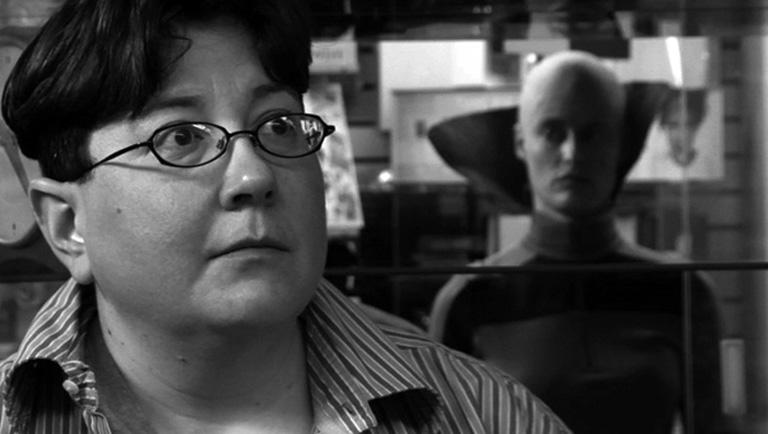
Codependent Lesbian Space Alien Seeks Same (Madeleine Olnek, U.S., 2011) Who can’t identify with that title? Metaphorically speaking, that is. Although Madeleine Olnek’s B&W feature insists on etaking it quite literally, to pretty hilarious results. Lonely stationery-store clerk Jane (Lisa Haas) tells her shrink she dreamed a close encounter in which a space ship dropped a note her way that read “What are you doing later?” Shortly thereafter, she finds herself the object of amorous pursuit by Zoinx (Susan Ziegler), one of several bald-pated, high Peter Pan-collared exiles from planet Zotz who’ve been dumped in Manhattan to seek “hot Earthling action” and get their hearts broken — because it is believed back home that “big feelings” of love are destroying the ozone. Ergo, guilty citizens must be rendered “numb and apathetic” by off-shore interspecies romance before safely returning. Meanwhile two badly mismatched government operatives (Dennis Davis, Alex Karpovsky) are spying upon the intergalactic love intrigue. Go Fish (1994) meets Plan 9 From Outer Space (1959), at last! June 25, 3:30 p.m., Castro. (Dennis Harvey)
The Evening Dress (Myriam Aziza, France, 2009) Everybody’s crushed on a teacher at some point, and indeed everybody in Helene Solenska’s (Lio) sixth grade French grammar class seems to have a crush on her. Why not: she’s attractive, wears sexy clothing (by classroom standards at least), and addresses the occasional sass with challenging provocation rather than simple discipline. But shy, studious Juliette (Alba Gaia Bellugi) has a crush bordering on obsession, particularly once she misinterprets teach’s attentions toward outgoing male student Antoine (Léo Legrand). You’re never too young to have a nervous breakdown, and our heroine’s increasingly reckless actions threaten to make her a pariah. Myriam Aziza’s feature is in that My Life as a Dog (1985) realm of movies about unpleasant childhoods that aren’t exploitative but at times grow truly discomfiting — it’s a worst case-scenario of pubescent imagination run amuck amid the usual teasing and bullying of peers. It’s a very good film if not an especially pleasant one. June 22, 4 p.m., Castro. (Harvey)
A Few Days of Respite (Amor Hakkar, Algeria and France, 2010) Quiet, bespectacled Moshen and his younger lover Hassan have fled Iran in the hopes of starting a new life together in Paris. They have only each other, and yet, because they lack visas, they must keep their distance while traveling to avoid arousing suspicion. While on a train in southern France, Moshen befriends Yolande, an older widow hungry for companionship who offers him a quick job painting her flat in a nearby small town. He agrees, forcing Hassan to continue hiding out, first in plain sight, and later, unknown to Yolande, in her attic, until tragedy drags everything out into the open. Algerian writer-director Amor Hakkar, who also plays Moshen, has crafted a sparse, intimate drama — emotionally enriched by its muted performances and minimal dialogue — about the lengths we are willing to go for love and the price we must pay in the process. Mon/20, 9:30 p.m., Elmwood; June 22, 9:30 p.m., Castro. (Matt Sussman)
How Are You? (Jannik Splidboel, Denmark, 2011) In the past few years Michael Elmgreen and Ingar Dragset, a Berlin-based artistic duo and romantic couple, have become international art world darlings known for their ambitious, playful, and critical large-scale installations, such as turning an exhibition space into a life-size replica of a New York City subway station or building a Prada pop-up shop in the Southwestern art mecca Marfa, Texas. At only 70 minutes, How Are You? can’t help but be a whirlwind tour, air kissing the bigger issues (commodity fetishism, identity politics, commercialism, and the vexed relationship the art world has to all three) Elmgreen and Dragset’s projects touch on while tracing the duo’s career trajectory all the way to their victory lap at the 2009 Venice Biennale. Brief but solid. Sun/19, 6:30 p.m., Roxie. (Sussman)
L.A. Zombie (Bruce LaBruce, Germany/U.S./France, 2010) If you’re going to see one Bruce LaBruce gay zombie erotic film, don’t make it L.A. Zombie. Alas, the latest from the queer Canadian auteur doesn’t hold up alongside its thematic predecessor, 2008’s Otto; or Up With Dead People. Lacking any of Otto‘s subtlety, L.A. Zombie is all sex, no substance. Sometimes that works: LaBruce’s The Raspberry Reich (2004) doesn’t go light on the porn, and that’s surely one of his best. But L.A. Zombie is lacking on all fronts. It stars noted gay porn actor Francois Sagat as a possible zombie (as in Otto, this is never made clear) who makes it his mission to fuck dead men back to life. Insert endless scenes of the zombie sticking his weird alien cock into gaping wounds and ejaculating blood onto corpses. If you can stomach that sentence, you can handle the film, but what’s the point? LaBruce’s past efforts have all the full-frontal male nudity without sacrificing the humor or cultural commentary. June 23, 9:30 p.m., Victoria. (Louis Peitzman)
Miwa: A Japanese Icon (Pascal-Alex Vincent, France, 2011) Chanteuse, star of stage and screen, outspoken champion of gay rights, drag queen: Akihiro Miwa has worn these many titles on her taxi-yellow, hair-like tiaras since she first rose to prominence as an androgynous torch singer at Tokyo jazz clubs in the 1950s. But it wasn’t until her dazzling star turn as the titular jewel thief in the camp classic Black Lizard (1968) that Miwa became a household name throughout Japan. Despite its clear admiration of its subject, Pascal Alex-Vincent’s documentary gives Miwa the Wikipedia treatment, resulting in a film that shares the unfortunate distinction of being both heartfelt and dull. Even his interviews with the lady herself come off as lusterless. Do yourself a favor, and track down a copy of Black Lizard instead. Mon/20, 1:30 p.m., Castro. (Sussman)
The Mouth of the Wolf (Pietro Marcello, Italy, 2009) This experimental narrative is a mix of archival footage and dramatic vignettes depicting the great love between two unlikely entwined souls who met in prison: ex-hood/longtime jailbird Enzo, a.k.a. Vincenzo Motta), and sometimes drug-addicted transsexual Mary Monaco (who died last year after filming). It’s also a lyrical appreciation of Genoa, the fabled northern Italian seaport that’s experienced tumultuous changes for over two millennia. Pietro Marcello’s unpinnable “docu-fiction” — Motta and Monaco apparently play themselves, a highlight being a 12-minute, nearly unbroken-shot dual interview — is frequently gorgeous cinematic poetry. If you seek the more conventional rewards of prose, you’ll probably be bored. However: anybody looking for Daddy should be informed that Enzo is pretty much the last word in unreconstructed macho-manliness. June 22, 9:30 p.m., Elmwood; June 24, 11 a.m., Castro. (Harvey)
Smut Capital of America (Michael Stabile, U.S., 2010) San Francisco. It’s smutty! You already know that, but do you know how deep-down and dirty it really is, in a historical sense? Basically we invented hardcore pornography in the 1960s (OMG, pubic hair!) and this lively local short, soon to expand to full-length, tells that story through fascinating archival footage, no-punch-pulled interviews with folks like John Waters and pornologist John Karr, and titillating naughty bits. Throughout there’s a feeling that a vital part of the story of sexual liberation, gay and straight, is being unearthed. And the raunchy tales of Polk Street hustlers, sticky-floored cinemas, and buck-wild hippie girls throwing open their golden gates will flood you with San Francisco pride. The short plays as part of the “Only in San Francisco” program with Running in Heels: The Glendon ‘Anna Conda’ Hyde Story and Making Christmas: The View From the Tom and Jerry Christmas Tree. Sun/19, 11 a.m., Victoria. (Marke B.)
Weekend (Andrew Haigh, U.K., 2011) The mumblecore-y movie many of us who lived through the 1990s wish was made back then: all that’s missing is the purposefully retro Cure soundtrack. Two scruffy, hipsterish, actually attractive Brit boys enjoy an ideal weekend fling. There is a fixie involved. Commitment-phobes each — one because he isn’t quite into the gay scene, one because he’s too full-on liberated for relationship gibberish — they gradually and adorably deal with their emotional attraction. By no means is this My Beautiful Launderette, and the melancholy self-regard might come a bit thick (Weekend was a big hit at the SXSW film fest, so … ), but it’s a well-acted, lovely film that examines the state of cute white skinny young bearded gay blokes today. Fri/17, 4:15, Castro. (Marke B.)
Without(Mark Jackson, U.S., 2011) This first feature by Seattle’s Mark Jackson (not to be confused with the Bay Area theater talent) is a stark reading of the psyche of 19-year-old Joslyn (Joslyn Jensen), newly arrived as temporarily caretaker to nearly-vegetative, wheelchair-bound Frank (Ron Carrier) while his kids and grandkids are on vacation. Left with this almost completely helpless charge — requiring butt-wiping, wheelchair-to-bed lifting, and regular transfusions of the Fishing Channel as stimulant — Joslyn seems to wallow in rather than escape her problems. Which appear to consist largely of a lesbian relationship whose gasping breaths we witness in occasional flashback. Isolated by no Internet or cellphone reception, not to mention her own powers of repression, Joslyn gradually looses grip as Jackson’s narrative grows more disturbing and ambiguous. Sat/18, 6:30 p.m., Victoria. (Harvey)
Frameline 35: San Francisco International LGBT Film Festival
Join the SF Bike Coalition to celebrate and congratulate the movers and shakers who realize the potential for connectedness and comfortable biking in San Francisco. Award recipients include the SFMTA for the safer green bike lanes installed along Market Street, which have attracted new commuter cyclists to the Financial District. Also hear from Leah Shahum about the Bike Coalition’s bold vision of cross-town bikeways.
Attend this panel discussion called “No Equality Without Economic Equality: The Struggle Against Gentrification and Displacement in the Castro in the Late 1990s” and learn about the tumultuous period of dot-com boom and doom in San Francisco’s Castro District — a time when rents soared, long-term tenants were displaced (many living with HIV and AIDS), and queer youth ended up on the street. But there was a silver lining. Out of the gentrification grew a strong community of activists and much- needed social services, as well as historical milestones like the Tom Ammiano write-in mayoral campaign of 1999 and the progressive takeover of the Board of Supervisors the following year. Speakers include Tommi Avicolli Mecca, Jim Mitulski and Gabriel Haaland, and Paola Bacchetta.
Guardian forum: Budget, Healthcare, and Social Services
This is the second forum in a five-part series that examine local issues that are expected to have a major impact in the upcoming mayoral race. Representatives from labor groups and local nonprofits will be on hand, as will budget experts, to discuss the city budget, access to healthcare for San Franciscans, and other useful and threatened social services. This is sure to be a lively discussion and a unique opportunity to get involved in local politics. Be there.
Weigh in on the issue of media access in San Francisco and the controversy around the accessibility of media passes for journalists while out on assignment. Panelists at this conversation with the Society of Professional Journalists will include SFPD’s Lt. Troy Dangerfield, attorney David Greene with the First Amendment Project, interim City Administrator Amy Brown, and a local journalist who has experience going through the process of trying to obtain a press pass.
Mail items for Alerts to the Guardian Building, 135 Mississippi St., SF, CA 94107; fax to (415) 437-3658; or e-mail alert@sfbg.com. Please include a contact telephone number. Items must be received at least one week prior to the publication date.
Editor’s note: School Board member Kim-Shree Maufas submitted this opinion piece on the upcoming Police Commission appointment.
On Friday, October 11, 2002, what began as an early morning school fight turned into a uniformed police officer-driven melee against students and teachers at Thurgoom Marshall High School. A total of 126 cops (some in SWAT/Riot gear) and sheriff’s deputites (tactical training was nearby) with firefighter and helicopter air support occupied the campus into the late afternoon.
That was so awful — but the real crime and shame for San Francisco was the subsequent behavior of the then Police Commission, which ignored hundreds of requests (delivered in writing and in person at commission meetings) for accountability, transparency, and reform to address ongoing police misconduct and bad practices so that San Francisco and its youth could actually feel safe and secure – not just from the criminals but from the city’s police force.
I recall that one woman, who lived in Pacific Heights, asking the commission to “deal with what happened at that high school across town because we all want to know what happened.”
After attending Police Commission meeting after Police Commission meeting with staff from the Ella Baker Center, Coleman Advocates for Youth and their Families and the ACLU of Northern California, the only response that I ever heard from that commission about the incident was: “We handle things in our own time.”
These painful memories had me in tears as I walked home after attending the recent Board of Supervisor’s Rules Committee meeting on June 2, 2011, where I watched the recommendation for the board’s appointment to the commission go forward.
Back in October 2002, I was the Parent Teacher Student Association president at Marshall, my daughter was a student, and I suddenly thrust forward to a public podium over and over again to demand justice for our families … goodbye fundraising and bake sales.
My social justice journey to the Board of Education is closely tied to the 2003 Proposition H, the police reform measure that gave people a voice for reform and accountability by expanding the Police Commission from five to seven, three to be selected by the Board of Supervisors and four by the mayor. San Franciscans slapped the old Police Commission squarely in the face, screaming that the people MUST have a VOICE.
Because of what my family and countless others have been through and died for, I will forever consider the seats appoinnted by the board as “the People’s Seats for the People’s Voice,” meaning that those seats are for people who openly fight on behalf of disenfranchised community members, for people who stand as unashamed/outspoken advocates for common sense police policies and practices — and as seats for those who don’t get mayoral appointments because they’re a part of the in crowd.
On June 14, 2011, the entire Board of Supervisors will vote for the Police Commission appointment — and it doesn’t have to be the recommendation from the Rules Committee. The supervisors can take a different position – they can stand with the people on this one.
With all due serious respect to the other applicants, this opening on the Police Commission belongs to David Waggoner, who represents that “People’s Voice for the People’s Seat” — and I believe all those voters who reformed the commission in 2003 would say so too.
We got an interesting call June 5 from a polling company. These folks typically ask if any member of the household works for the news media, and we have to figure out whether to lie and hear the questions or tell the truth and save 20 minutes. This time, the caller didn’t bother. So we agreed to answer “a few questions about the upcoming mayor’s race.”
Except the questions weren’t about the mayor’s race at all. They were about the proposal to mandate competitive bidding in the city’s garbage contract. And the poll, which was clearly testing different pro and con arguments, gave a good sense of how Recology, which holds the current monopoly, will try to frame the issues.
For starters, the pollster kept saying — without any evidence — that the proposal was the work of Waste Management Inc., a giant national garbage company. Among the arguments he presented: “This initiative is pushed by WMI, which puts profits ahead of customer service.” The pollster also charged that WMI had broken environmental laws and had a bad labor record.
Among the other arguments: “San Francisco should stick with a home-grown company that has done a good job.”
“The recycling system works.”
“A multinational Houston-based conglomerate wants to take over San Francisco’s recycling program.”
“Workers would lose their jobs.”
“Garbage rates would go up, and recycling would go down.”
“Politicians would have control over your garbage rates.”
That’s a nice snapshot of the campaign we’re going to see in the fall — and it’s utter bullshit.
The initiative is the work of retired Judge Quentin Kopp, Potrero Hill activist Tony Kelly and a few others. And it’s all about bringing competitive bidding to the city’s garbage contract. Waste Management Inc. has zero involvement.
“They haven’t give us a dime,” Kelly told me. “Nobody from Waste Management was involved in any way in our meetings or discussions. This isn’t about Waste Management Inc.; this has to do with the city and competitive bidding.”
David Tucker, Waste Management’s community and public relations director, was happy to go on the record and “let the world know that WM has not contributed any funding to this effort.”
“While it would be nice to be able to compete in San Francisco, the truth is that our focus is on the city’s landfill disposal and facilitation agreements,” Tucker said, referring to the battle that WM has been waging for several years now to have a fair chance at being selected as the company that disposes San Francisco’s trash in a landfill outside city limits. (Right now, WM disposes the city’s trash at its Altamont Landfill near Livermore, and Recology hauls the city’s trash across the Bay Bridge to Livermore. But the city’s Department of Environment has tentatively awarded the landfill disposal AND the facilitation (which refers to transporting the trash) to Recology, essentially giving them a monopoly over the city’s entire waste stream, starting in 2016.)
Kelly told us he has nothing against Recology: “If Recology wins the competitive bid for the next century, it’s fine with me.”
Fine with us, too — and the odds are that’s exactly what will happen. The initiative states clearly that the bids have to include zero waste goals and worker protections — and the city already gives preference to locally owned companies. (You can read the text here (pdf)).
But in the process, Recology will have to accept better controls on rates — and will no doubt have to pay a franchise fee. So the city will get a better deal.
Recology knows that if the question on the ballot is framed as whether the garbage contract should be up for competitive bidding, about 90 percent of the voters will say yes. So the only way to block this initiative is to muddy the waters and make it about another company that has no role in the campaign.
Recology’s got a sweet deal, a no-bid $220 million deal that dates back to the 1930s. The company wants to protect it — and apparently is prepared to use whatever misinformation is necessary to do that.
Photographer/filmmaker Brian Cross charts a musical map of the African diaspora in the Americas — and opens new Summit Peek Gallery show tonight (6/2), “If It Fits in the Backpack: 10 Years on the Road with Mochilla”
Last year, Los Angeles-based production group Mochilla released Timeless,a trilogy film series documenting three concerts performed in L.A., early 2009. For these concerts, the photographer/filmmaker/DJ duo behind Mochilla, Brian Cross and Eric Coleman, shined light on three composers who have helped influence and shape hip-hop in different ways: the originator of Ethio-jazz, Mulatu Astatke; leftfield Brazilian arranger, Arthur Verocai; and a gutsy rendition of J Dilla’s beats crafted by Miguel Atwood-Ferguson with 60-piece orchestra. The films paint intimate portraits of musical exchange and live performance while paying tribute to some of the overlooked giants of the sprawling African musical diaspora.
In many ways Timeless is a culmination of themes explored in Mochilla’s films from the past decade. Their first project, Keepintime: Talking Drums and Whispering Vinyl (2001), and the follow-up live recording and DVD release in 2004, captured improvisational collaboration between L.A. hiphop producers and DJs, such as Madlib and J.Rocc, among others, with some of the powerhouse session drummers who inspired their sample-based work. Brasilintime: Batucada Com Discos(2007) also navigated the dynamic tension between an older generation of drummers, this time including legendary Brazilian percussionists, and the new school of analog producer/turntablists.
But not only did Mochilla depict creative partnership between these two forms of percussionists, they also translated the cut-up aesthetic of the DJ and rhythmic momentum of the drummer to the inner workings of the films themselves. A pastiche of words, music, and imagery composed of still shots and footage drive forward the fragmented stories, and striking moments of reconciliation, which unfold on screen.
More recently, Cross (known more familiarly as B+) set off to Columbia to document the Petronio Alvarez music festival as well as collaborative work between Will Holland (a.k.a. Quantic) and Ernesto “Fruko” Estrada, who could be credited with forging the rootsy, Afro-Columbian take on salsa. Mochilla also shot a good deal of the footage for Banksy’s street art disaster film from last year, Exit Through the Gift Shop, caught wayward rapper Jay Electronica at the Pyramids in Egypt and recording in South Africa, and documented Nas and Damian Marley on tour. To put it short, the dudes put in work.
“I look more for the off-handed moments that can be sustained as photos in themselves,” Cross tells me over the phone, while working in the dark room basement of his home in Los Angeles. He says that he’s excited to see how the large hand-printed photos will look in the upcoming Mochilla showcase at the new Peek Gallery in the Mission, this Thursday. “I’m trying to be iconic, but at the same time I don’t want to make publicity photos for record companies,” Cross says. “The videos, in a way, can be much more interesting because the fluidity allows for a certain kind of candidness.”
Cross, 44, has quite a history with such candidness in his work. Born in Limerick, Ireland, Cross moved to San Francisco’s Mission district in 1990 before attending CalArts in Southern California to study photography. While still completing his degree, Cross started writing what would become a landmark book on the emergence and socio-political implications of hiphop in L.A., It’s Not About a Salary: Rap, Race, and Resistance in Los Angeles(Verso Books, 1993). He is responsible for a number of iconic album covers of underground hiphop acts, from Freestyle Fellowship to Ras Kass and Mos Def. And Cross also made headway with more than a few magazine photo spreads and music videos throughout the past couple decades, notably including an arresting multi-textured piece for DJ Shadow’s “Midnight in a Perfect World” off Entroducing….. (Mo’ Wax Records, 1996).
Looking over Cross’ ever-growing body of work, some primary themes consistently arise: Through the lens of hiphop, Cross orients a number of conversations, multi-generational interchanges, rhythmic confluences, and resistant divergences that weave through the diaspora of African musical traditions in the Americas. “There’s an anthropological side as well as an ethnomusicologist side to it—an attempt to make a map of the diaspora in terms of the music set by the present,” Cross explains. “The goal is ultimately to document in a way that is not strictly historical, but to let the past speak to now rather than the other way round.”
SFBGI find an interesting dynamic in your film work and the documented live performances. On the one hand, you’ll take hiphop producers and DJs and pair them with percussionists, so as to put the contemporary in tension with the recent past that informed those contemporaries. On the other hand, there’s another element of featuring the music of those composers themselves. In what way do you think the past speaks to the present, as you put it, in both those approaches?
Brian Cross The idea is that somehow you don’t want to frame it off. In other words, for Keepintime, we didn’t want to get Paul Humphrey or Earl Palmer involved in something and frame off the dialogue in terms of, ‘Ok Paul, we want you to play the classic break on “One Man Band (Plays all Alone),” and now we’re going to layer something on top of it and develop a routine.’ But that’s not what’s interesting about Paul Humphrey. Yeah, it’s amazing he did that, and that’s why we’re choosing to work with him. But Paul Humphrey is somebody living and breathing; he’s our past, but he’s also our present. We want to open up a space of dialogue that is open to this series of works but isn’t limited to it.
For the Brasilintime project, we could have gone to Brazil and found obscure musicians who made amazing recordings and complete the narrative in the way that normal Eurocentric or Western versions of the story go: We bring them to Carnegie Hall, we do a concert, venerate them, and show them that Carnegie Hall is in fact the best venue in the world and is the most important place to see music. Whoa whoa whoa, back it up, we’re not going to do that. We’re going to go to there and engage, and try to actually build a bridge to the music. Let’s not have this as a one-sided sentence that leads in a single direction. Generally, what we try to do is to de-center, to find ways in which we can open up, because, invariably, when you do these things, that’s when you make discoveries. Oh, Mamao and Wilson das Neves played on the Jose Mauro record, he died before the record came out, and then Dilla sampled it … that’s when you make these discoveries.
You know I don’t mind the Buena Vista Social Club [1997] record. Ry Cooder is a great producer and a great musician, but the film is fucking awful. It’s so fucking wrongheaded. And that director, Wim Wenders, is smarter than that, man. We’re people of the left, he knows better than that. Of course, everybody got involved and was super happy that these guys were finally discovered, and we can fully appreciate how beautiful their music is and the contributions they’ve made. But then Carnegie Hall is put into the equation; we don’t need to reaffirm the same set of cultural values. We don’t need that. Maybe that’s kind of a trite example, but I’m interested in trying to forge ways to talk about music, or to explore possibilities of music, that don’t fall into the same set of traps that most writing and television and documentaries about music fall into.
SFBGYeah, there are standard methods for placing outsider music, or the marginal narratives of musical traditions and musicianship, into the mainstream narrative, one of validation internal to our own frameworks of understanding. As a photography and filmmaker, how do you approach a sense of the outsider, or the musician who is resistant, or peripheral to the grand narratives? What techniques do you take up in order to engage these musicians and traditions and make them visible for a broader audience?
BC Well, when it comes to Brazilian music, I’m pretty serious about my shit. I do my research thoroughly. I try to put my best foot into it. But other than that, it’s pure human relationships, man. For me, here’s my pet peeve: Too much of the stuff happening right now is done without real social engagement. It’s through the Internet, whether it’s digital digging, or people paying 800 dollars for an obscure record from Ethiopia or Angola, when you could buy a ticket to go there for the same amount. You should be going. That’s the responsibility. The responsibility is to go there, actually experience it, and see what works on the ground.
To go back to Ry Cooder, when he went to Cuba to make Buena Vista, that wasn’t the music people were listening to in Cuba. People were listening to Timba, and Timba is a completely different thing. I just think there’s a lot more to be gained from actually going to say, Baranquilla, and spending time there in the town—meeting people, buying records, meeting musicians—than there is from surfing the Internet and finding the latest hot cumbia re-groove from Argentina or whatever. If you’re serious about your shit you have to go there, engage on the ground, and see what makes sense. You like Wu-Tang? Go to Staten Island. Go for a walk around the projects. Go visit P.L.O. Liquors where all those songs came from. That’s the kind of compliment you need to be paying people. And there’s ways to do this that aren’t touristic. You can go and feel the vibe there. It might seem obvious, but it gets lost in these discussions.
SFBGDo you see that as your primary motivational force? That your projects are prefaced on this desire to travel, meet these musicians that inspire you where they live and make music; find out what they’re doing, why they’re doing it, and be a part of it?
BC Well, the two things are kind of contingent. It’s cyclical somehow. I’m there, experiencing, helping to build bridges as best as I can, and I’m also thinking about photographs because that’s what I do.
SFBG How do you think this approach fits back into your earlier photo work in Los Angeles and your book, ‘It’s Not about a Salary?’
BC It’s an extension of it, really. You know the book is a very primitive thing, if you actually sit there and read it from cover to cover, which I did for a project a couple years ago, and I was highly embarrassed (laughs). But there was no model. It’s not like Can’t Stop Won’t Stop [Picador, 2005] existed, and someone had put that work down. I was 26, I had been into hiphop since I was 17, and I gave it a stab. And, of course, I put myself into a cultural debate that I didn’t know much about, for my own peril.
Ostensibly, the work isn’t much different. In that book, yeah, it’s about hiphop in Los Angeles, but I also managed to talk to Roy Porter, The Watts Prophets, Kamau Daaoood, Horace Tapscott, and a whole slew of other people who didn’t straightforwardly have anything to do with hiphop in Los Angeles. But in another way, they had everything to do with it. What has always been interesting for me with hiphop is that it has this historical reach. That’s what I tried to bring into the book. There’s definitely things which I don’t agree with now, and suppositions that I made or thought what would happen which didn’t. But it was a critical moment, right before TheChronic [Death Row, 1992], which I think was really a world changer.
The amazing thing about the golden era of hiphop, as they call it now, that era up to ‘95 or ’96, is that it was incredibly inclusive music. There was Japanese Koto, all sorts of rhythms from the Caribbean, rock, jazz, funk, you name it. That sourced people into record stores in different ways. The categories didn’t make sense as they did previously. That’s the magnetic lure of it. Somehow, hiphop allowed this extraordinary ability to look at previously recorded things and make them work in the present. For me, that was a critical modernist moment, or as the prevailing discourse has it a post-modernist moment—the collage and montage.
SFBG That brings up another interesting point in your work in the idea that when listening to hiphop not only is the origin of the break or the sample concealed, but also the artist’s background is concealed. The identity of the artist is mystified. Would you say that your projects aim towards making visible the musician as a person rooted in an environment or social setting?
BC The two-sided sword of the invention of youth culture is that it posits a kind of energy and dynamism to what we call youth. The problem is that the way it’s commodified is made contingent on the exclusion of anything outside youthful values or youthful thinking. I don’t agree with that. And if you look at the music of the diaspora, it’s not there. These kind of generational fishers don’t exist in other traditions of music: not in Latin, not in African-oriented music, and in my understanding of European folk traditions, they’re not there either.
While I find aspects of youth admirable, it shouldn’t ever be considered an exclusive category. For instance, David Axelrod is in his late 70s, and he has as much to contribute, and as many interesting things to say now as he did when he was 30. The thing is we’ve consigned him off to a category as if he doesn’t exist. And that seems ridiculous to me. I mean James Gadson still has fire now as a drummer just as he did when he played with Bill Withers. Why would we decide that he no longer has importance? It’s not like people have stopped listening to Bill Withers. But that’s how our music culture works. We fetishize the appearance of youth, but we’re not entirely clear on the implications of that. So, I like the idea of putting the person in the room if I can. For inclusivity, it has to be that.
And we have to get past the old ways of thinking, too. When I was first doing this, it was all super secretive. No one was supposed to know what your samples were or where your drums came from, because that was your tool kit, and if everyone had the same tool kit, it wouldn’t be interesting anymore. But I don’t buy that. In the end, there’s a deluge of information out there, it’s what you do with it that’s important. Your understanding and ability to manipulate the history is what’s important.
SFBGEven when you put out ‘Keepintime,’ I imagine that people worried that you would unveil the alchemic creative process, otherwise covered up, behind a hiphop record.
BC It goes back even before that. Take the video I did for DJ Shadow’s “Midnight In A Perfect World.” It plots out a series of concerns that I’m still interested in. You know, Earl Palmer is in there, and the sample is from a David Axelrod record. And they didn’t clear the sample. Shadow was terrified that Earl was going to recognize the song. But Earl didn’t even remember David Axelrod the person, let alone the record (laughs). They weren’t hits! Earl wasn’t sitting around listening to Axelrod records. But if you’re going to be too scared to talk to him, we’ll never learn anything from the guy. And then he shows up, and we’re transported to a whole different world: New Orleans before World War II.
You could say rock n’ roll came from the soles of Earl Palmer’s shoes. He was a child vaudeville performer, a tap dancer, and he battled against Sammy Davis Junior, and a lot of cats from that era. But he was never the best dude, and he was always interested in drums, so he taught himself how to play drums. So, that shuffle beat, that swamp beat as they call it, which became the foundation of rock n’ roll drumming, came from a guy who’s a tap dancer in black vaudeville as a child, who figured out a way to transform his tap dancing onto a drum kit. Think of the multi-billion dollar industry that rock n’ roll has become, and we still don’t know these things. We have to sit down and talk to these guys to find out these stories.
If It Fits in the Backpack: 10 Years on the Road with Mochilla Opening photo exhibition w/ film screenings and Q&A With Brian Cross and Eric Coleman Thurs./02, 7p.m.-11p.m., free (thru 06/30) Peek Gallery (Summit SF) 780 Valencia Ave. @19th St., SF (415) 861-5330 www.thesummit-sf.com/peekgallery.html
The federal Drug Enforcement Administration is conducting a multistate criminal investigation into the actions that prison systems have taken to obtain a death drug no longer produced in the United States, documents obtained by the Guardian indicate.
The documents don’t reveal the specific targets of the investigation, but federal agents have seized drug shipments in Alabama, Georgia, Kentucky, South Carolina, and Tennessee and are apparently also looking into drug procurement policies in California, Arkansas, Alaska, and Arizona.
The states have been scrambling to obtain sodium thiopental, a drug used in executions, after the lone American manufacturer, Hospira Corp., stopped producing it last year.
Georgia and Arizona both received shipments of the drug from Dream Pharma, a British wholesaler that, according to the Associated Press, “shares a building with a driving school in a gritty London neighborhood.”
In October 2010, the California Department of Corrections and Rehabilitation sent agents on a secret mission to get some of Arizona’s supply. The agents drove under cover of night to the Arizona state prison in Florence, where at midnight the warden handed them 12 grams of thiopental, enough for an execution.
The state later ordered 521 grams — far more than the state could possibly use in the next few years — from Archimedes Pharma, also a British supplier.
Several other states, including Georgia, obtained the drugs from a different British supplier, Link Pharmaceuticals. According to the Associated Press, Nebraska’s supply was imported from India.
Most of the states imported the drugs without the proper DEA paperwork, a federal crime, the documents show.
Sodium thiopental is part of the three-drug mix used for lethal injections in most states that allow capital punishment. It renders the subject unconscious before the other drugs stop the heart and lungs from operating.
If the drug isn’t effective — that is, if it’s an improper formulation or an off-market product that doesn’t meet U.S. standards — the condemned inmate could suffer horrible pain, something the U.S. Supreme Court has made clear is not legally tolerable.
The drug isn’t often used in hospitals; it has been replaced by other drugs. And California had to put all of its executions on hold last fall when the state’s last batch expired.
The documents are the latest released as the result of a federal lawsuit filed by the ACLU of Northern California and the Guardian seeking access to all records related to the import of the death drug. Last week the DEA released 71 pages of documents, but withheld 160 pages, justifying the withholding by saying that some of the records are part of an ongoing criminal investigation.
A May 16 letter from Katherine Myrick, the DEA’s chief Freedom of Information Officer, states that there are “two active investigations” and that release of the records could “reasonably be expected to interfere with enforcement proceedings.” The documents reveal how desperately state prison authorities were trying to find a way to procure the drug — and how concerned the DEA was about importing a controlled substance by agencies that had no medical or research functions.
Among other things, they show that the Obama administration was taking an active role in the process: “The White House is involved and is trying to sort things out,” a Nov. 11, 2010 memo from the Office of Diversion Control states.
Another Nov. 11 memo notes that “states have been importing the lethal drug regimen from England … the U.K. has written the State Department (and the FDA?) asking the U.S. to end the importation of the drug, which is being used in lethal injections.”
A Nov. 9 memo notes that “FDA is concerned about importation of non-FDA approved sodium thiopental used for executions … Safety, efficacy and indication are FDA issues. So is the matter of off-label use (which was also brought up).”
The memo from the Liaison and Policy Office explains that the “DEA requires a valid DEA registration as an importer and a properly executed declaration in order to import controlled substances.”
A Nov. 12 memo confirms that “only two import declarations have been filed for sodium pentothal” — meaning that all the other states obtained their supplies illegally. The identity of the two states is blacked out.
Arizona has an execution date set for May 25, and Nebraska has an execution scheduled for June 14. But the documents are so heavily redacted, and so many pages are missing, that it’s impossible to tell exactly which states are doing what — and whether any of the upcoming executions would be using illegally obtained drugs.
“The DEA is making it impossible to know whether the states are complying with the law and whether DEA is fulfilling its obligation to enforce our nation’s drug laws,” said Natasha Minsker, death penalty policy director for the ACLU of California. “Importing sodium thiopental without informing the DEA is a crime. We now know the DEA was poised to go into the Arizona Department of Corrections and seize their drugs, as they did in Georgia, but for some unknown reason they did not. Why did the DEA seize drugs in some states but not others?”
Calls and e-mails to the California Department of Corrections seeking information on whether the department is the target of a federal investigation were not returned.
The federal Drug Enforcement Administration is conducting a multistate criminal investigation into the actions that prison systems have taken to obtain a death drug no longer produced in the United States, documents obtained by the Bay Guardian indicate.
The documents don’t reveal the specific targets of the investigation, but federal agents have siezed drug shipments in Alabama, Georgia, Kentucky, South Carolina and Tennessee and are apparently also looking into drug procurement policies in California, Arkansas, Alaska and Arizona.
The states have been scrambling to obtain sodium thiopental, a drug used in executions, after the lone American manufacturer, Hospira Corp., stopped producing it last year.
Georgia and Arizona both received shipments of the drug from Dream Pharma, a British wholesaler that, according to the Associated Press, “shares a building with a driving school in a gritty London neighborhood.” And California sent agents on a secret mission to get some of Arizona’s supply.
Several other states, including Georgia, obtained the drugs from a different British supplier, Link Pharmaceuticals. According to the Associated Press, Nebraska’s supply was imported from India.
Most of the states imported the drugs without the proper DEA paperwork, a federal crime, the documents show.
The documents are the latest released as the result of a federal lawsuit filed by the ACLU of Northern California and the Bay Guardian seeking access to all records related to the import of the death drug. The DEA this week released 71 pages of documents, but withheld 160 pages, justifying the withholding by saying that some of the records are part of an ongoing criminal investigation.
A May 16 letter from Katherine Myrick, the DEA’s chief Freedom of Information Officer, states that there are “two active investigations” and that release of the records could “reasonably be expected to interfere with enforcement procedings.” The documents reveal how desperately state prison authorities were trying to find a way to procure the drug — and how concerned the DEA was about the import of a controlled substance by agencies that had no medical or research functions.
Among other things, they show that the Obama administration was taking an active role in the process: “The White House is involved and is trying to sort things out,” a Nov. 11, 2010 memo from the Office of Diversion Control states.
Another Nov. 11 memo notes that “states have been importing the lethal drug regimen from England … the UK has written the State Department (and the FDA?) asking the U.S. to end the importation of the drug, which is being used in lethal injections.”
A Nov. 9 memo notes that “FDA [the Food and Drug Administration] is concerned about importation of non-FDA approved sodium thiopental used for executions …. Safety, efficacy and indication are FDA issues. So is the matter of off-label use (which was also brought up.”
The memo from the Liason and Policy Office explains that “DEA requires a valid DEA registration as an importer and a properly executed declaration in order to import controlled substances.”
A Nov. 12 memo confirms that “only two import declarations have been filed for sodium pentothal” — meaning that all the other states obtained their supplies illegally. The identity of the two states is blacked out.
Sodium thiopental is part of the three-drug mix used for lethal injections in most states that allow capital punishment. It renders the subject unconscious before the other drugs stop the heart and lungs from operating.
If the drug isn’t effective — that is, if it’s an improper formulation or an off-market product that doesn’t meet U.S. standards — the condemned inmate could suffer horrible pain, something the U.S. Supreme Court has made clear is not legally tolerable.
The drug isn’t used very often in hospitals; it’s been replaced by other drugs. And California had to put all of its executions on hold last fall when the state’s last batch expired.
Arizona has an execution date set for May 25 and Nebraska has an execution scheduled for June 14. But the documents are so heavily redacted, and so many pages are missing, that it’s impossible to tell exactly which states are doing what — and whether any of the upcoming executions would be using illegally obtained drugs.
“The DEA is making it impossible to know whether the states are complying with the law and whether DEA is fulfilling its obligation to enforce our nation’s drug laws,” said Natasha Minsker, Death Penalty Policy Director for the ACLU of California. “Importing sodium thiopental without informing the DEA is a crime. We now know the DEA was poised to go into the Arizona Department of Corrections and seize their drugs, as they did in Georgia, but for some unknown reason they did not. Why did the DEA seize drugs in some states but not others?”
Calls and emails to the California Department of Corrections seeking information on whether the department is the target of a federal investigation were not returned.
Inspired 40 years later by the same neighborhood, the current sit-lie law is a legislative throwback. Back then, Haight Street was a center of controversy as hippies began to arrive in droves – hanging out, singing, dancing and generally occupying the sidewalks. Some business and property owners were apprehensive over the rapid changes to the neighborhood.
The Board of Supervisor enacted the ordinance, which made it a crime to “willfully sit, lie or sleep in or upon any street, sidewalk or other public place,” with a unanimous vote in 1968. Violation carried a fine of up to $500 and a maximum jail sentence of six months.
Then-Mayor Joseph L. Alioto, who signed the ban into law, told the San Francisco Chronicle the ordinance “will not be used to discriminate against any group or person.” His promise echoes the claims of contemporary proponents of sit-lie.
But police used the law to target not only hippies but also gay men in the Castro. The predictable reality of selective enforcement galvanized popular resistance.
Over the next decade, the ACLU sued and managed to overturn parts of the law. “[The original laws] were being used unjustly by the police against people who were considered undesirable,” said Alan Schlosser, legal director of the ACLU, who has been working for the organization since 1976. They were used against Hippies in the Haight, they were used in the Castro and the Tenderloin against the prostitutes.”
Political pressure from a wide coalition, which included Harvey Milk, convinced the board to rescind the ordinance in 1979. In fact, one of Milk’s signature campaign issues was stopping police harassment of gay people.
The current law does avoid some of the pitfalls of the old one. The ban only applies to sitting and lying down; the sixties-era law referred to the obstruction of public space. Police are now required to issue a warning, and the punishment for violation is significantly lower. Neither distinction, however, alters the fundamental problem of sit-lie.
The ordinance criminalizes an extremely common behavior, which is in itself harmless. The most vulnerable members of our society depend on public space and are inevitably the most susceptible to getting in trouble into the crosshairs sit-lie enforcement.
Queer activists are once again leading the effort against unfair and unwise regulation of public space. We reported April 11th that self-proclaimed “angry queers” installed handmade benches on city streets as a form of protest art. Likewise, this upcoming May 22nd, which is Milk’s birthday, Queers for Economic Equality Now (QUEEN) will be coordinating sidewalk events against sit-lie in San Francisco and Berkeley.
Tommi Avicolli Mecca who organizes with QUEEN, said “for me it is so thrilling to see two cities doing something against sit-lie and invoking Harvey’s name.”
It’s a privilege to be part of a food and drink judging panel. One witnesses wild creativity from up-and-coming stars as well as established greats in the field. Competitions are where food geniuses take risks, and step out further than the bounds of set menus sometimes allow.
Here are two upcoming contests I’ll be judging: one for cocktails up in Napa (wine country bartenders, please apply!) and one in SF showcasing five local chefs creating gourmet sausage recipes.
2nd Annual Wine Country Cocktail Competition
Head to Calistoga’s Solage Resort on a Monday night to support your favorite wine country bartender. The mixologists will compete for best cocktail using two winning products: Charbay’s exceptional spirits and Perfect Purée of Napa Valley’s purees and concentrates. Top three winners get cash prizes, while first place gets to participate in a drink photo shoot at Perfect Purée’s headquarters. Bartenders work with ingredients like Perfect Purée’s yuzu luxe sour and carmelized pineapple concentrate, and are allowed to use any base spirit from Charbay’s portfolio, from vodkas to rum (with the exception of its Whiskey Release II, Nostalgie, and brandy).
The last Charbay-Perfect Purée contest I judged at Rye delivered many memorable beauties. Wine country in the spring is already worth an excursion north, and if you attend the contest you can experience a growing cocktail scene in a region traditionally dominated by wine – not to mention a showcase of two of the area’s best local products.
Mark your calendars for what will be one of the most fun competitions of the summer. Tres Restaurant is the setting, and $10 is an oh-so-right price to sample five unique recipes featuring Saag’s Sausage. Here’s the meat of the competition: five popular Bay Area chefs will vie for best tailgating sausage recipe. You’ll get to sample each entry, along with classic game day sides like potato salad and coleslaw, then vote on who you think is top dog of the night. You’ll take home a swag bag stuffed with sausage samples, recipes, and more — the winning chef gets $250. Best of all, all ticket proceeds benefit Food Runners of San Francisco.
Like most Americans, I’ve been fascinated by the news of Osama bin Laden’s death, although my reaction has been a strange mix of relief (at the fact that this monster is gone) and revulsion (that murdering our enemies has become so widely accepted). And after processing it for a couple days, I think that we as a country need to go back to the point where things went so horribly wrong and to try to figure out whether there’s a better path that we might take.
I realize that President Obama has demonstrated no appetite for such an undertaking, which could be done through a Truth and Reconciliation Commission like the ones used so effectively in South Africa, Chile, Argentina, Columbia, Peru, East Timor, and other countries looking to heal themselves after deep political strife that led to gross human rights abuses, and to engage with the world about the best way forward.
Particularly now that he’s riding so high as a decisive commander-in-chief, Obama isn’t likely to don Jimmy Carter’s old peacemaker garb. But he should, because we all know where this perilous path we’re on ends, right? With more terrorist attacks to avenge bin Laden’s death, followed by more U.S. commando and Predator drone strikes, while Afghanistan, Pakistan, Iraq, Libya, and Iran just get worse, and then pretty soon we get drawn into Yemen, Somalia, Syria, or some of other countries filled with Muslims who are filled with righteous hatred of the Great Satan. And on and on it goes, never stopping, as the Israel-Palestinian conflict demonstrates.
Meanwhile, domestically, the hawks and the doves get ever more divided and resentful of each other, and the tough-talking, corporate-sponsored politicians play them off against each other, with their angry clips endlessly churned by the media maw until the most sensitive souls each go postal or just tune out. “Victory,” whatever that means anymore, just isn’t possible in this context.
The Bay Area chapter of the anti-war group World Can’t Wait is sponsoring two upcoming protests against Bush Administration war criminals: outside a Condoleezza Rice speech in Room 290 of Stanford University Law School on May 6 at 3 pm and against John Yoo at the UC Berkley School of Law graduation ceremony at Boalt Hall on May 13 at 9 am.
As the protesters have said, the decisions by these two individuals and other top Bush Administration officials have caused more death and human rights violations than Al Qaeda, but I can no longer work up any more anger at these two than I could against bin Laden. They just seem like two sides of the same cruel coin, the twin jets that have propelled this country down a disastrous path.
And at this point, I’d sacrifice my sense of vengeance to change course as a country. As much as I’d like to see Rice, Yoo, Bush, Cheney, and Rumsfield hauled into the Haig and tried for what they’ve done – which would perhaps give me the same sense of satisfaction that many feel now over the death of bin Laden – I would rather give them all complete immunity from prosecution to let them testify truthfully about what’s happened in these last 10 years so that we can begin to atone for it and move on.
If Obama could bring that about, he’d go down in history as a truly great man. Instead, he’ll probably just choose to ride this current wave into a safe reelection campaign, nothing will change, and hope will die.
Mayor Ed Lee appointed a deeply emotional Captain Greg Suhr as Chief of the San Francisco Police Department during a swearing-in ceremony where the majority of folks were either elected officials, running for election, running each other’s electoral campaigns—or wearing SFPD uniforms.
And in the end it seemed that the choice may have been influenced by pressure from the powerful San Francisco Police Officers Association, judging from the comment Lee jokingly directed at SFPOA leader Gary Delagnes, saying, “Gary, it’s time to get quiet and go to work.”
Lee told a standing-room only crowd that when he returned from Hong Kong to San Francisco four months ago finding a new police chief was his top priority. And that initially it was suggested (Lee did not say by whom) that he leave the SFPD situation alone and allow an elected mayor to appoint the next Chief.
‘While I am an interim mayor, this is not an interim decision,” Lee told the crowd, signaling that while he may be out of office in January, Suhr may be here to stay as the city’s top cop.
“Today, I’ve chosen the best candidate,” Lee continued, thanking Acting Chief Jeff Godown for his work leading the SFPD since former Mayor Gavin Newsom made the shocking decision to appoint former Chief George Gascón as District Attorney.
But while Newsom’s move may have upset the apple cart in the D.A.’s race, it sure seems to be working out well for Suhr.
Describing Suhr as “a police and people’s Chief: and “a reformer from the inside out,” Lee ran through a long list of the new Chief’s contributions to the SFPD. These included Suhr’s 30 years of service, his climb through the ranks to become Captain of the Mission station, his gig as Captain of the San Francisco Public Utilities Commission in a Homeland Security capacity, and, since 2009, as Captain of the Bayview station.
Suhr began by saying he was “speechless.” Donning glasses to read a speech that he had prepared the night before, Suhr choked up when he talked of being “fourth-generation, born and raised in San Francisco.” Recovering his composure, Suhr smoothly changed gears, as he joked how his appointment therefore makes him “a local hire,”—an insider reference to Sup. John Avalos’ recently approved local hire legislation that Mayor Lee is helping enact citywide.
Suhr recalled how he started out as a rookie on the midnight shift in the Tenderloin in 1981. He thanked his family, his friends and his girlfriend Wendy. And then he asked for a moment of silence “ to honor the memory of all the brave officers who have given their lives in the line of duty.”
Lee reclaimed the podium long enough to jokingly ask Suhr “to investigate the whereabouts of my birth certificate” as his first assignment as the new chief.
Then it was Board President David Chiu’s turn. Chiu described Suhr as someone, ”who knows our streets, walked the walk, and knows the beats, someone who we all feel confident will be able to bring the SFPD the reform that former Chief Godown, Chief Gascón and Chief Heather Fong initiated. “
San Francisco Superior Court Judge Katherine Feinstein, who is the daughter of Sen. Dianne Feinstein and the presiding judge of the Superior Court, recalled how she has known Suhr since the mid 1980s. “I have watched him as each of our careers have moved forward,” Feinstein said, noting how there were some “steps forward and some steps backward” and how, “there were those who thought this day would never come.” (Feinstein’s words were the only reference to some of the less sunny moments in Suhr’s long and distinguished career. These included his 2003 indictment as part of Fajitagate, an incident that involved off-duty officers, a bag of take-out food, a beer bottle and injuries sustained by two local residents. Suhr was cleared of wrongdoing the next year, but was reassigned by then Chief Heather Fong to the PUC position after an incident in 2005, in which a police officer was seriously injured at an anarchist protest, and videographer Josh Wolf was held in federal prison for 226 days after he refused to release unedited footage of the protest.)
Next up was D.A Gascón and his rooster-like shock of silver hair. Gascón noted that when he first came to San Francisco, in the summer of 2009, he had no allegiances to, and no prior knowledge of, people inside the SFPD.
“I looked at Greg Suhr and one of the things that impressed me is how he worked with and related to people,” Gascón said, explaining why he appointed Suhr as Bayview Captain “Not only has he exceeded all expectations he did an incredible job,” he said.
Police Commission President Thomas Mazzucco said that in the 100 days since the Commission announced it was looking for a new chief, it became clear that Suhr has the support of SFPD’s rank-and-file.
Mazzuco noted that he met Suhr in high school. “I knew he could hold a ball,” Mazzuco added, noting that he subsequently became Suhr’s football coach, even though he is younger than Suhr. “What the Police Commission has brought to us is not only a native son but also a cop’s cop. It’s an honor to have him as his chief.”
And after the swearing-in, the sentiment among officers in blue appeared to be strongly in Suhr’s favor. Lt. Ken Lee of Central Station recalled how he and Suhr went through the police academy together about 30 years ago.
“We went to different assignments but we’ve maintained a friendship,” Lee said. “The moment I met him I liked him. He was a very stand-up person, and as a native San Franciscan like myself, you could tell he had strong ties to the city. He’s a hard worker, he’s very dedicated to what he does.”
Lt. Mario Delgadillo, also of Central Station, said Suhr hasn’t lost his connection to the street. “That also means a lot, when you have a boss who’s walking with you,” Delgadillo said.
Suhr takes over the SFPD as it’s grappling with the fallout from a recent spate of scandals, including videos that Public Defender Jeff Adachi released that appear to show police misconduct at residential hotels and that forced DA Gascón to hand over his investigation of this alleged police misconduct to the FBI. Asked during a media roundtable what his appointment means for Acting Chief Godown, Suhr said Godown has returned to being Assistant Chief of Operations, which was the post he held before Gascón, who recruited Godown from LAPD, was appointed DA.
In response to a question about his top priorities as police chief, Suhr noted, “When I sit down with the mayor this afternoon, the mayor’s going to tell me what his priorities are. My first priority will be blocking the door open on the 5th floor so that if you wanna come see me you can, like it used to be. Then I have to meet with the command staff and captains and get their take on where they think we are, where they think we’re moving forward best, and match that up against how I’ve seen from a position of Bayview, how that matches up. And then see if I can’t meet with different community groups, the different police employee groups and the command staff.”
He didn’t mince words when it came to indicating that SFPD officers are going to be asked to give back during upcoming budget negotiations “I’m sure that there’s going to have to be adjustments and I look forward to working with a collaborative effort with the mayor and the board and the unions and the rank and file,” Suhr said. “When the economy’s been good we’ve benefited by it, and now that the economy has … gone the other way, to some extent I think that the officers are willing to give back to do whatever needs to be done to keep the city safe.”
So, how does Suhr think he differs from former Chief Gascón?
”He has a gorgeous head of hair,” Suhr joked. “To put it in a sports analogy, he’s a quarterback shortstop guy, and I’m more of a catcher, lineman, linebacker kind of guy. But I admire him, I think he moved a lot of issues forward for the police department, and I look forward to continuing those initiatives and giving a few of them a shot in the arm that I think were beginning to wane a bit.”
Suhr also talked about how he has always wanted to become a police officer (a comment that suggests he’s not planning to use the Chief’s post as a stepping stone to the District Attorney’s Office).
”When I went into the police department. on Silver Avenue which is now Willie Brown Academy — that was the police academy back in 1991 when I came in — man, we looked at just the regular uniformed police officers with just stars in our eyes, because they were just the sharpest, classiest folks that we were aspiring to be,” Suhr said.
And he indicated that as Chief, he won’t tolerate dishonesty in the face of ongoing investigations into alleged police misconduct. ”The character of a police officer must be above reproach,” Suhr said. “And I think that the investigation will show what it ends up showing, but I don’t think that there’s a police officer in San Francisco that would want to have a dishonest cop and I’d be at the top of that list. So I want all my officers to be of character that is above reproach.
Asked if he welcome clarification around the duties of SFPD officers assigned to the FBI’s Joint Terrorism Taskforce, Suhr said he believed an examination of the wording of the FBI’s most recent memorandum of understanding (MOU) with the department was already under way.
“I believe that the MOU is being revisited,” Suhr said. “I have not been a part of that, but again I think we have a real good policy with regard to our intelligence gathering and that does supercede any ask of any other agency. The officers are bound by policies and procedures. And that policy was well thought out with tremendous community and group input years and years ago, from situations that have not since repeated themselves. I think a lot of people back then couldn’t believe they happened in the first place, but I think measures were well thought out and put in place to make sure we don’t have a problem again.”
And at the end of the day, Suhr expressed the hope that his tenure as Chief would endure long after the interim mayor is replaced by an elected mayor.
”I’m a native San Franciscan, and this is a dream come true,” he said. “It’s my first day. However this story ends, with a little bit of luck (raps on the wood tabletop) it’s not going to end today.”
You know you want to fight zombies. But how? Perhaps answers are still alive in the reissued book, The Right to Be Lazy, by Paul LaFargue, the Cuban-born son-in-law of Karl Marx. Featuring its editor, Bernard Marszalek, and others, this Shaping San Francisco panel will discuss this book that, according to Marszalek, has been reproduced and distributed more widely than any other Marxist text save LaFargue’s papa-in-law’s commie manifesto. The author is sarcastic, sardonic, and satirical, a necessary combo when considering post-capitalistic visions of abundance and cooperation trumping standard issue toil and sacrifice. Because as anyone who’s walked through the Financial District will tell you, zombies are freakin’ hard to kill. (Kat Renz)
“Steve Ignorant presents CRASS songs 1977-82, Last Supper”
Is this really Crass? Well, Penny Rimbaud isn’t involved, and originally opposed cofounder Steve Ignorant performing the band’s music. But when you’re talking about anarcho-punks, everyone is their own leader and does what they want. So this is the final Crass run for Ignorant, backed by Gizz Butt, Bob Butler, Spike T. Smith, and reportedly a female vocalist (to handle feminist material from classic album Penis Envy.) Despite being influential, politically-minded figures in 1970s English punk rock, Crass never really toured in the U.S., which means this may be the best opportunity that fans have had to hear the material live, as well as the last. (Ryan Prendiville) With Goldblade
For those of us who learned to throw horns in the early 1990s with the help of Headbangers Ball, we got a healthy dose of contemporary clips along with the classics of the metal genre. This was how I first came across Accept’s “Fast As A Shark” and “Balls To The Wall,” two awesomely shredding tunes — indeed, “Balls” was the German band’s signature song, and its accompanying video was also a favorite on Beavis and Butthead. Get ready for some serious head-banging and sing-along anthems tonight as the band returns to the states supporting its new release, Blood Of The Nations. (Sean McCourt)
Would you bet more people can name the fab four members of the Beatles — or four kinds of beetles, those six-legged insects making up a quarter of the earth’s animal species? But really, why the burden of mutual exclusivity when both are celebrated at this week’s NightLife at California Academy of Sciences? It’s a fortunate homonymity, pairing the museum’s beetle expert David Kavanaugh with live music from Beatles experts in the form of tribute band the Sun Kings. Plus, it’s the U.S. debut of “The Beatles Hidden Gallery,” photos documenting the boys mere months before Beatlemania invaded the land like a blight of beetles. (Renz)
Since 2005, virtuoso Sean Smith has recorded numerous albums of solo guitar and collaborations. Taking after the iconic John Fahey, the finger-style guitarist wows audiences with immense technical skill and songwriting — crafting a new American Primitive. Having toured the U.S. extensively, Smith has shared the bill with Will Oldham (Bonnie “Prince” Billy), Six Organs of Admittance, and Bob Lind, among others. In March 2008, he joined the ranks of Citay as one of the two lead guitarists. Smith leads his electric power trio featuring Spencer Owen and Marc Dantona in selections from his upcoming full length, Huge Fluid Freedom. (Jen Verzosa)
Although it never quite attained the levels of fame and fortune of some of their hometown contemporaries, Mudhoney was one of the first (and best) bands to come out of Seattle during the late 1980s and early 1990s alternative rock explosion. With fuzzed-out guitars, heavy riffs, and songs like “Touch Me I’m Sick,” “Sweet Young Thing Ain’t Sweet No More,” and “Suck You Dry,” the band was the embodiment of what became the “grunge” movement — and it’s one of the only original groups around today, still kicking out the jams to loyal fans on new album The Lucky Ones. (Sean McCourt)
Sean Dorsey Dance has been working on The Secret History of Love (Part 1) for the last two years, and the project itself looks back much further, exploring the ways in which transgender and queer people have forged bonds through the decades. Drawing from extensive research at the GLBT Historical Society and interviews with community members, Dorsey continues to place direct elements of storytelling at the forefront of modern dance. With this show, he focuses on courageous acts of love and protest dating back to Stonewall. (Johnny Ray Huston)
Ukuleles, banjos, and fiddles, oh my. Performed to live, onstage music by bluegrass band the Crooked Jades, the Kate Weare Company’s Bright Land addresses American ideals, weaving threads of music, stories, and history represented by transatlantic folk music. With the Crooked Jades’ musical arrangements of traditional Celtic, English, and American songs, Weare’s ferocious artists and passionate choreography reinvent old-world music for the modern age in a layered collaborative form. Performer and composer Jeff Kazor blurs genres with haunting ballads and upbeat dance tunes and Weare’s dancers reveal powerful relationships enacting capsules of history and narrative. The Bay Area is a second home for the dance company — catch them while they visit this coast. (Julie Potter)
Art program counselor, member of the San Francisco indie-rock outfit Phantom Kicks, singer-songwriter, and pianist: Debbie Neigher can do it all. While she was DIY-ing her upcoming self-titled full length album, pop-folk icon and owner of Tiny Telephone recording studio John Vanderslice came out of retirement from producing records “in the luckiest freak accident” to work with her. In Neigher’s upcoming album, her silky soprano showcases her versatility in the effervescent “Frames” and the painfully courageous “Pink Chalk.” Neigher was the winner of West Coast Songwriters Best Song competition for the track “What Say You Now”; she was also nominated for SF Deli Magazine’s Emerging Artist Award of 2010. (Verzosa)
When I was a little kid, just thinking of the two-note intro to John Williams’ theme from Jaws was enough to make me want to jump out of the bathtub, let alone the murky waves of the Pacific I frolicked in down at the beach in Santa Cruz. Modern teenage movie-goers may flock to the latest Saw rip-off in search of some cinematic terror, but as the rest of us know, it’s what you don’t see that really scares the shit out of you — and Steven Spielberg made the most of that with his 1975 masterpiece. Just in time for when you would wish all those damn spring breakers would be eaten alive, tonight’s screening (presented as a double-feature with Spielberg’s 1977 Close Encounters of the Third Kind) will undoubtedly make someone new afraid to go into the water. (McCourt)
Listen up, San Francisco, cause this shit’s serious. The rep house movie theater is on the verge of extinction, and perhaps none are as precariously situated as the Red Vic (also the only collectively-owned movie theater in California). We owe it to our artistic sprits to not let these beloved institutions die out, but that takes more than just a fond thought. It takes patronage. Lucky for us, the Red Vic is making it easy to go and spend a whole day and drop a reasonable wad on “donations” — from a movie poster auction from 1-6 p.m., followed by a triple-header curated by Mr. “Midnites for Maniacs” Jesse Hawthorne Ficks from 7 p.m. on, and concluding with a midnight screening of San Francisco’s favorite cult film The Room (2003), all for way less than you’d spend on some crap IMAX travesty at the Metreon. (Nicole Gluckstern)
One video has Blondes playing in a laser-filled garage that could be anywhere. Another account has it DJing at the top of the Standard in New York. One listener describes the music as ecstatic, but it’s also been branded “snoozetronica.” Blondes is not another emerging duo in full electro-attack mode. Not “the next” Daft Punk or even the Twelves. It’s two Oberlin-educated guys who see themselves entering a musical landscape where everything may have been done. If the beats they build piece-by-piece seem inclusive — heavy but melodic, driving but not to the point of driving your body down — it’s because they’re looking for leftover limits. (Prendiville)
The Bay Area celebrates National Dance Week (through Sunday, May 1) in myriad ways, but few are as inviting and comprehensive as the Mark Foehringer Dance Project/SF’s “Dancing in the Park.” The extravaganza takes over the venerable Bandshell in Golden Gate Park for the fifth year in a row. The fun starts with a one-hour young choreographers’ showcase. Sample classes in modern, salsa, improv, and hip-hop will then share the space with more than two dozen professional (including Axis Dance Company, Robert Moses’ Kin, and Amy Seiwert/im’i-jre) and community groups (like Zoha, Sambamora, and SoulForce). At 2:30 p.m., Foehringer’s own dancers offer excerpts from their repertoire celebrating having survived and thrived for 15 years. (Rita Felciano)
The Guardian listings deadline is two weeks prior to our Wednesday publication date. To submit an item for consideration, please include the title of the event, a brief description of the event, date and time, venue name, street address (listing cross streets only isn’t sufficient), city, telephone number readers can call for more information, telephone number for media, and admission costs. Send information to Listings, the Guardian Building, 135 Mississippi St., SF, CA 94107; fax to (415) 487-2506; or e-mail (paste press release into e-mail body — no text attachments, please) to listings@sfbg.com. Digital photos may be submitted in jpeg format; the image must be at least 240 dpi and four inches by six inches in size. We regret we cannot accept listings over the phone.
Electric Party Songs and The Darker Side of Broadway
However you feel (or don’t) about the Beat Generation, you have to give Allen Ginsberg credit for his ability to transcend the limitations of that motley crew, always pushing forward and outward in his beatific search for the sublime. Perhaps no other modern poet has better exemplified the endless fluctuations of the underground, and how to eternally roll along with them. Our own Holy Fool: queer Buddhist Jew, vagabond truth-seeker, and the King of May. In all the ways that count, Allen Ginsberg was, and will always be, America.
And America, like it or not, will always have an influence on the global arts arena, so it is perhaps not surprising that the small band of multinational artists who comprise the “open program” of the Italy-based Workcenter of Jerzy Growtowski and Thomas Richards have embraced America, and Ginsberg in particular, in their touring productions I am America and Electric Party Songs.
Using Ginsberg’s poetry as a catalyst, Electric Party Songs was developed with social gatherings in mind, mashed ecstatic texts with Southern spirituals, “Capitol Air” with call-and-response.
Displaying a chummy familiarity despite the less-than-intimate setting of the SFMOMA lobby, the performers began by praising the creative energy of excess, first as a duet between Alejandro Rodriguez from Argentina, and Lloyd Bricken from Alabama, then quickly incorporating the eleven-person cast. Bursting with exuberance like Kerouac’s “fabulous yellow Roman candles,” they may have been dressed liked a runaway chorus line from a revival of Hair, but their intuitive chemistry was pure Digger.
Eventually, in a manner that Ginsberg would undoubtedly have approved of, the gleeful club abandoned word-for-word renditions of his poetry, and moved into a set of African-American spirituals, a focal point of much of Workcenter’s current research. A moving rendition of “Adam in the Garden” found several performers mixed into the oddience, keeping time and murmuring response, while in the center of the polite circle, the song leader Alejandro romped and wriggled with Davide Curzio (Italy), giggling, entangled, pulsing outwards, pushing forward: all innocence. By the end of the set it was impossible to believe they haven’t been here with us all along, hovering genially at the edges of our consciousness, just like the spirituals and the venerable poet that gave their electric party its juice.
Belters, babes, and consummate showmen – and that’s just the production crew! If Boxcar Theatre’s tongue-in-cheek tour of The Darker Side of Broadway, a dizzying slew of doomed ditties sung by most of the cast and crew, was an indicator, their upcoming production of Little Shop of Horrors(which opens May 20) should be a rip-snorter.
Highlights included a heartfelt West Side Story duet between ensemble member Amy Lizardo and “Ronnette” Nikki Arias (“A Boy Like That”), a tense, downtempo “Pimp’s Tango” from Threepenny Opera, between John Lewis (who will play Seymour) and Bryn Laux (who will play Audrey), and a hilariously bawdy “Glitter and Gay” from Candide performed by assistant director Lauren Doucette. After a terrifically evil rendition of a Shockheaded Peter song from artistic director Nick Olivero, a smashing performance of “The Cell Block Tango” from Chicago brought down the house, leaving us with appetites whetted like Audrey II’s for fresh blood, with a side of campy cheese.