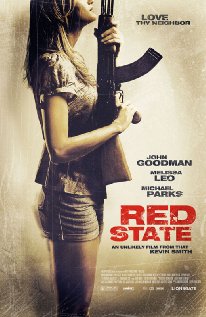
At the 2011 Sundance Film Festival, Kevin Smith created one of festival’s biggest sensations for audiences and film buyers alike by announcing he was going to auction off his film Red State after its world premiere screening.
Added to that, the hate-spreading publicity junkies known as the Westboro Baptist Church announced they would be staging a protest in front of the event with their usual “GOD HATES FAGS” signs, which in turn inspired Smith to stage his own protest of the Kansas-based church as a self-proclaimed “FAG ENABLER,” which in turn inspired hundreds of people from Park City to make their own signs. Tickets to the movie were rumored to have been scalped for close to a thousand dollars, and the buzz surrounding the situation was truly something I have rarely felt at Sundance.
But Smith had yet another trick up his sleeve: after the film completed, instead of auctioning off his film, he sold the film to himself for $20 and went on an inspired and jaw-dropping rant about how “this world of independent cinema had lost its way” (as Sundance director John Cooper stood awkwardly behind him), and that not only would he be self-distributing Red State, but that he was retiring from his 20-year career of filmmaking. Again, all of this had happened within a few hours and we all left the theater not really knowing what the hell had happened.
But all the hype seems even more relevant now that Red State has finished its world tour, recouping his $5 million production budget. On the eve of the world premiere for his latest stand-up movie (Kevin Smith: Burn In Hell, available on ePiX starting February 11), echoes of the naysaying critics bounce around in my brain especially in light of Louis CK’s similarly successful independent release Live at the Beacon Theater.
Smith gave both Hollywood and the indie scene the middle finger and managed to follow through on his goal without both of them. Red State, a surprisingly violent and complex political manifesto confronting gay rights, wasn’t just an immense departure from his usual clunky comedies, it is the stuff film history is built on. If a filmmaker can make millions of dollars with no studio backing, the entire industry (studios, filmmakers, critics, and audiences) best take note. This is how Hollywood was born back in the early 1910s, when a group of filmmakers rebelled against the vertically integrated monopolization of the Motion Picture Patents Company created by Thomas Edison (and friends). This East Coast gang led by Carl Laemmle and William Fox moved out West to create their own studios, which later became Universal Studios and 20th Century Fox, respectively.
Now let’s cut back to the critics of Red State. They were furious with Smith. Not only did they rarely even talk about the actual film in their reviews, they felt they needed to put Smith “in his place,” for he had somehow made a mockery of their profession. Not only had he not needed the studios to release his film, he hadn’t needed reviewers either. He has close to two million Twitter followers, after all! Critics busted out every kind of mocking comment imaginable; some were even quoted as proclaiming that they were the reasons Kevin Smith was famous in the first place. (Do some Googling, the reviews are priceless!) These critics weren’t just baffled or angry, they were scared.
Which brings us up to the present. If you prefer Smith’s earlier, funnier films like Clerks (1994) and Mallrats (1995), or you only like 1997’s Chasing Amy (Criterion released it!), or you even found something to enjoy in his underrated 2010 studio pic Cop Out, the man has made himself into a contemporary icon and has positioned himself as the voice of a whole new era. The uncensored, unrelenting, and utterly sincere Burn in Hell helps answer every single question you may have about love, life, being overweight, questioning God, being gay, the state of cinema, and ultimately following your dream before you drop dead tomorrow.
PORN AWARDS In a conference room at the Hard Rock Hotel in Las Vegas, diminutive porno starlets with improbable racks highlighted by latex or spandex-heavy outfits shifted, stilletto-to-stilletto, as lines of eager fans filed past to express their admiration for favorite scenes — and possibly cop a feel for their buddy’s camera. Flatscreen TVs showed avatars having at each other in various positions, advertisements for recently-released X-rated roleplay video games. One booth advertised both granny and midget couplings, another adult parodies of True Grit, Training Day, and Mallrats.
This was the weekend of the AVN Awards, the Oscars of the porn industry that take over Vegas once a year to honor the most compelling orgasms, wittiest titles, and best double penetration scene of the last 12 months.
In the midst of the melee, queer porn star Sophia St. James from Portland, Ore. waited in line to meet one of her idols. “I’m so excited!,” St. James told me when I chance across her on my AVN fan expo wanderings.
Most of the adult film aficionados present that Saturday afternoon in January had probably heard of the object of St. James’ affections, Belladonna, well-known in the industry for her gonzo-style sex and smoldering-pixie looks. Perhaps fewer of them would have been familiar with St. James, though the Amazon-esque beauty has an eponymous strap-on model and has done scenes for one of the nominees for the Best Alternative Website award, to be presented that night at the awards ceremony.
Later that day, we sit outside a Hard Rock coffeeshop with a handful of St. James’ co-stars from the AVN-nominated, San Francisco-produced QueerPorn.TV. I ask her how her fangirl experience went.
“I couldn’t believe it!” St. James exclaimed. “I got to the front of the line and was bending over to put down my bags when I hear this voice go ‘Sophia St. James.’ And I look around and Belladonna is saying my name!” The two exchanged gropes, business cards, and the promise to keep in touch. St. James was beaming.
This is why queer porn went to the AVN Awards. Sure, QueerPorn.TV was nominated for an award, and it was a good excuse for its actors to have a ball and a biscuit in Vegas. But also, queer porn wanted its props. And it turns out, it might be having a bigger impact on the industry than you’d expect for a bunch of Bay Area alterna-kids.
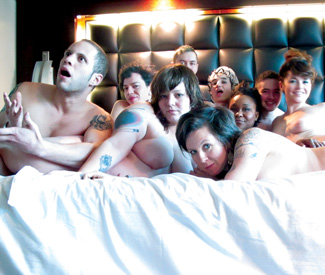
“QueerPorn.TV got nominated for Best Alternative Website. Regardless of whether we won or not, we needed to celebrate,” Courtney Trouble said. She was explaining why she booked a luxury Vegas suite for the weekend of the AVNs where 12 queer porn stars definitely slept, and possibly had an orgy. (“I’ve heard some rumors of that,” she wrote me in an email that confirmed the hot tub was flop distance from a king-sized bed with a view of the Strip.)
Trouble is responsible for more than her fair share of the queer porn that is available today. Her San Francisco production company Trouble Films includes QueerPorn.TV and NoFauxx.com (which she started decades ago in Olympia, Washington). In addition, she and co-director Tina Horn make DVDs — most recently, Fuckstyles, a compilation of vignettes featuring trans men, lesbian sex, and pegging scenes that will be released this year on Valentine’s Day.
Bereft of even the ever-diminishing profit margins of mainstream DVD porn (which are difficult to quantify — for a bare-all industry, the porn biz is remarkably adamant about hiding its sales figures) queer porn is largely a labor of love for its creators. During the weekend of the AVNs, its stars tell me the genre serves two purposes.
For one, it fills a masturbatory niche for those non-plussed by the heteronormative and Barbie-on-Barbie couplings of mainstream adult entertainment. But no less sexily, queer porn is an activism unto itself. “There are people out there that don’t see representation for themselves in porn,” St. James said. “Queer porn offers representation for everyone in the community.” By having sex on camera, queer adult film stars are taking their brand of sexuality from out of the shadows.
“Politically, trans visibility, queer femme visibility, and feminism are all very important things to me,” says Trouble, for whom 2012 marked her fourth year in Vegas for the AVNs. “If I didn’t do this every year and try to get as many folks as I could out there on the floor, a lot of us would just dissolve into the background of the industry. Every year I’m like, I’m going to rip this year a new one.”
So despite being there to party and bang each other, the queer porn stars were out to make a point. Sometimes explicitly. On Friday night, I sat on the floor of a mid-range hotel suite for an expert panel on the queer porn biz that featured Trouble, St. James, Horn, actors Tobi Hill-Meyer, Dylan Ryan, and to the glee of all involved, the legendary Nina Hartley, a bisexual feminist porn star who rose to fame in the 1980s. An intimate crowd wearing equal parts street and fetish wear listened to frank, cerebral discussions of what it’s like to be in the queer porn biz, about the disappointments and the rapturous moments when a particularly good physical or mental climax is reached. I left feeling uplifted, like I’d witnessed something important.
THE LESBIAN HUGH HEFNER
Chris Thorne is the founding editor of Xcritic.com, an adult DVD review site. He’s a member of the AVN Awards academy, and I called him pre-AVNs to get the inside scoop on the arduous process of voting in the 41 porn categories — but we would up talking about the rise of non-traditional porn titles.
“The biggest growth category for adult film right now is lesbian sex on film,” he said. “Hands down. Girl-girl porn has three dimensions right now. On one side, it’s a male fantasy, on one side you have girl-girl porn that appeals to females and straight males, then you have queer porn that is lesbian porn. The lines on all three of those are not clear. That middle part is where there’s a huge growth.”
The queer porn crew isn’t the only one that considers its offerings an alternative to mainstream skin flicks. All too early the next morning, I was at the fan expo interviewing Jincey Lumpkin, director of the Juicy Pink Box films, distributed through Girlfriends Films. The media is fond of calling Lumpkin “the lesbian Hugh Hefner.”
Lumpkin falls into that middle part Thorne was talking about. Queer she is not — she shies from the term and is also uncomfortable with “dyke,” attributing her preference to her religious upbringing in Carrollton, Georgia (she says her move to New York five years ago the first time she was exposed to any kind of queer community.) Lumpkin used to be an attorney who specialized in banking litigation, working 80 hours a week. Her coworkers — mostly straight, mostly male — were intrigued by her love life, and to satisfy their curiosity she started a confessional blog called Single White Femme.
Through means that are not quite explained during my interviews with Lumpkin and Girlfriend Films’ founder Dan O’Connell, the blog led to O’Connell granting Lumpkin directorial control over a subdivision of his company [CORRECTION: O’CONNELL AGREED TO DISTRIBUTE JUICY PINK BOX THROUGH GIRLFRIENDS]. “I like that she’s a lesbian,” O’Connol told me. “You can’t say it’s not lesbian porn.” Still, he says straight men like himself account for 40 percent of the films’ audience. He guesstimates single women make up 30 percent, and couples the remainder.
Is Lumpkin’s porn alternative? It’s up for debate. She tries to “break away from the traditional script” of girl-on-girl porn, a style that has long been a part of the traditional porn canon. Lumpkin dismisses this kind of “fake” lesbian scene as “let’s flutter our tongues together”-style porn.
She says her vignettes exclusively feature actual lesbian or bisexual women. Lumpkin won’t work with women with obvious plastic surgery or fake nails. But when I asked her to compare her work to that of the queer genre associated with San Francisco companies like QueerPorn.TV and Crash Pad Series she says “my work has more of an emphasis on aesthetics. I’m sure they hate it when I say that.”
Her scenes’ artful lighting might only account for part of this statement. “I would imagine if you asked someone in the Valley what San Francisco makes they’d say they make really nasty queer shit and really nasty kinky shit,” comments Horn on the perception of the Bay Area in other realms of the porn world. Still, the boundaries between the Valley and the Bay aren’t so defined — many actors like Arabelle Raphael and Ryan work in both places.
Everyone, it would appear, has a different notion of what makes queer and lesbian porn authentic. The Juicy Pink Box series, for example, does feature scenes with women scissoring. Lily Cade, a butch actor who is called “Porn Valley’s gold star lesbian porn star” because she’s never shot a scene with a man, eschews scissoring scenes on her own label Filly Films. “That’s stupid,” she told me at the AVN expo, clad in a suit (“I’m a professional, so I’m going to dress like one,” she said of her outfit choice). “I’m not aroused by that, so I’m not going to ask my actresses to do it.”
You’d be hard pressed, by way of another example, to find fisting scenes in a Filly or Girlfriends movie [UPDATE: Lumpkin writes to say that she is in full support of, and has shot fisting scenes, but that Girlfriends Films will not accept them on their label due to obscenity laws. More on that distinction here]. But Trouble’s scenes have them — in fact, on October 21 the SF auteur inaugurated an international day of celebration for that particular rough sex act. Filly and Girlfriends stick to cis-gendered actors [ANOTHER UPDATE: That should read “tend to stick to cis-gendered actors.” Drew Deveaux was the first transgendered actor for Girlfriends Films, in the Juicy Pink Box feature Boutique], and rarely use body types besides the taut standard of the porn industry. Trouble, a woman of size herself, is committed to portraying sexy fat people.
Perhaps another difference lies in the intended audience of each scene. Cade allowed that much of porn’s audience — even the “lesbian” films of Filly and Girlfriends — is men. “Wet dreams!” wishes a note inside Girlfriends Films’ Poor Little Shyla, whose plot line centers around Catholic school girls given hands-on lessons in lesbian sex by their wiser, big-boobed mothers. Though the blessing could hypothetically be geared towards women watching the flick, one suspects it’s not.
But all these types of porn share things in common. “I think we are all outcasts,” Trouble told me when I ask if there’s a big difference between queer and mainstream actors. “You have to be pretty courageous and strong to be in the porn industry. I think even Jenna Jameson would admit to being a total weirdo.”
“I’D LIKE TO THANK MY ASSHOLE”
The weekend’s climax for queer porn did not take place at a podium. Best Alternative Website didn’t win its category, which turns out is among the B-list honors that are announced in a quick scrolling of names on a Jumbotron at the AVN ceremony’s terminus anyways.
The high point instead, was the red carpet. “That’s where I shine the most,” Trouble told me. Arms draped around each other’s tuxes and sequined mini-dresses, queer porn stalked the lane in front of the flashbulbs and broadcast press with aplomb. It looked like they’d been doing it for years, which speaks to their professional talent — actors James Darling and Charlie Spats were walking as the second and third trans men ever on the AVNs’ carpet (Buck Angel, winner of 2007’s AVN for Best Transsexual Performer, was the first).
Queer dominatrix Princess Donna of San Francisco’s Kink.com walked the gauntlet arm-in-arm with Bobbi Starr, who would later accept the AVN for Best Female Performer. Hartley was there with her husband, and chatted with me about her role in queer porn education. “It helps that I can pass for a normie,” she laughed. “The presence of my physical self allows the message to sink in. I believe in this [queer porn] to my core.”
In the moment, it seemed that queer porn was truly a force in the industry. The week after the awards, I forwarded Trouble a photo of herself with an arm around a beaming Ron Jeremy on the red carpet. She cropped and lightened it before reposting on her Facebook page with the note “Ron Jeremy, you have made some seriously hot porn. I am a fan!”
But when it came time to watch the awards themselves — a drawn-out, logistically disastrous affair whose 2012 highlight was Best Anal Scene champ (and winner of seven awards in total) Asa Akira’s acceptance speech: “I’d like to thank my asshole for putting up with all my shenanigans!” — the core queer porn team was nowhere to be found. Beat from hours on their high heels in front of the cameras, Horn, Trouble, and co-stars went out for a “steak and a Manhattan,” rather than settling in with overpriced drinks to watch teleprompter flubs and malfunctioning clip reels.
Once again, the queer porn stars were taking what they wanted from the adult industry and leaving the rest. Explains Horn: “everyone was on their magic phones and on Twitter people were saying how terrible everything was. I was putting marrow on toast and I was like, eh, I don’t think I’m going to make it.”
But they met up with those who did attend the awards for the after-party. And yes, there was a hot tub involved.
Special thanks to Broke Ass Stuart for supplying the headline of this article. Porn + words = Stuart.
Jhameel (www.jhameel.com) once said to me, “I only have one life to do this.” As cliché as it might seem, it feels like the Oakland-based classical pop virtuoso is living his dream. Near the end of last year he began releasing a new song a week on his site in a series dubbed Waves (available now on Spotify). In the next couple of months, he’ll release another wave, this time of collaborations, and there is a super-secret major release coming in the spring.
He’s creating his own innovative world of modern, synthy R&B pop, often with the assist of the Web. The multi-instrumentalist routinely turns to his Twitter and Facebook fans to crowdsource ideas (like his Halloween costume last year — they suggested “Rufio” from Hook) and gives back to all those who “like” as well. Whenever he reaches a new high goal of followers, he records a drunken video for fans — taking shots on camera then attempting to play. It’s frankly adorable and just another way to connect. Another reason 2012 is the year for Jhameel? His Waves song “Collision” was just featured in a Droid Razr commercial. His next local show is Feb. 20 at Bottom of the Hill (9 p.m., $10. 1233 17th St., SF. www.bottomofthehill.com).
Description of sound: A minimalist combination of Prince, Michael Jackson, and whatever I feel on that day.
What do you like most about the Bay Area music scene: Bottom of the Hill.
What piece of music means the most to you and why: The piece of music that means the most to me changes almost on a daily basis, it depends on what is meaningful to me at that point in time. “Over My Dead Body” by Drake emanates an emotion that’s really hitting home for me right now.
Favorite local eatery and dish: Cheeseboard Pizza in Berkeley. Perfect vegetarian pizzas.
Who would you most like tour with: Janelle Monae. I have a crush on her.
It’s described as Hollywood v. Silicon Valley, a battle of powerful giants, the entertainment world against the tech world, and at first, the entertainment world won out — the Stop Online Piracy Act soared through its first Senate hearing and won unanimous committee approval. It sounded so simple — who’s in favor of piracy?
But the tech titans quickly realized what the bill really said and how dangerous it could be; DailyKos said that SOPA and the companion Protect IP Act (PIP) could “end the Internet as we know it” and dubbed The Great Firewall. So today a lot of major sites are going dark (or launching other protests) to fight the bills — and it’s making an impact.
More than 200 people gathered at a tech-community rally and press conference in opposition in San Francisco January 18. Framed by protesters holding signs with messages like “Innovate, not legislate” and “SOPA kills jobs,” a long list of tech industry giants testified against the bills, from Craig Newmark of Craigslist to Harvey Anderson of Mozilla to tech industry investor MC Hammer. Many mentioned that the tech industry is the only growing industry in the United States right now, and has created 50% of new jobs in the past three years, and claimed that SOPA and PIPA would halt that “engine of growth” in it’s tracks.
Hammer said that SOPA and PIPA would repress artists’ creativity. Said the former rapper, “When they say that it is to protect rights and content, that may be the surface, but underneath, as you drill down, you see all these other clauses that will put a tremendous burden upon service providers and a whole lot of other people and give the government the ability shut down sites without due process. This is just barbaric in it’s very nature.”
While to a certain extent this is a grassroots rebellion, it’s also part of a concerted campaign funded and run by some of the biggest corporations in the world (Google, Facebook, etc.)
The thing is, there are two groups of big evil corporations fighting over this — but one of them is wrong and one is right. The two Internet bills are terrible — they’ll damage free speech, and they aren’t going to stop piracy.
I called my friend Victor Krummenacher to ask him his thoughts, because Victor — a rock star, bass player for Camper Van Beethoven and someone who has made his living as a musician — is actually impacted by piracy. But he’s not in favor of SOPA:
A lot of music I’ve made has actually been pirated. When we’ve been able to successfully track down the source of the piracy, it’s been from China.
But the truth of the matter, especially in relation to music, is that the Internet has successfully deposed/destroyed scalable economies of manufactured goods (i.e. CDs/LPs etc) and exchanged that for a distribution system that allows for reduced royalty for internet sale and internet radio play (i.e. Pandora) and hard to monitor electronic files that are easy to share. And it’s hard to evaluate peer to peer sharing as piracy, from my point of view.
As an independent artist with hard left leanings, I view this as a way to censor alternative points of view, using failed/outmoded business models as an excuse. Media business has a LOT to contend with in as far as business models. I don’t know the solution to monetization, nor do you, or we would be rich men. But this bill, as it’s written, and as I understand it, only serves to allow the government another route to censor voices at a time when I feel they’re most needed, using corporate income streams as the excuse.
The Internet in spirit, as conceived of (by a bunch of hippies in California, essentially) cannot espouse censorship as a means of financial control. Jaron Lanier in “You Are Not A Gadget” hits on a lot of the morality ideas and questions I have about the “Internets.” But I think innovation in regards to our concepts of commerce, if not in fact about money itself, are where actual solutions lie. The Internet Piracy act has very severe authoritarian undertones that I find disturbing. I think you can coherently argue that something like the Arab Spring could be dissuaded using the Internet Piracy act because uprising is, by nature, bad for business.
Which is an excellent reason to oppose these bills.
I also asked Johnny Calcagno, a musician and tech head and old friend of mine who at one time worked for one of these giant corporations, to weigh in:
I have mixed feelings about the piracy/creativity duality. Ultimately it comes down to common sense. I believe most of what is pirated is from highly successful artists and companies in the entertainment and software industries. I just don’t feel too sorry for them, although maybe the 2% of Bruce Springsteen’s bottom line that is pirated away might have gone to support progressive causes.
Mostly though, I think we have to figure out a way for creative types to make a living, to have health care, and housing that works. For artists, I don’t think piracy is nearly as big a problem as the cost of health care, insurance, housing, and student loans.
It’s also worth pointing out that one would think that between piracy and the information-wants-to-be-free mentality we would be nearing the end times for commercially-oriented creativity, but if anything, there has been of late an explosion in output from musicians, writers, and filmmakers. Some of the same technology that is “ripping off” artists allows (sometimes the same) artists to cheaply and easily get their work before the public.
But still, making a living is a tough row to hoe for even the most talented of artists, and having money sucked out of the creative system and redistributed to Russian mobsters doesn’t exactly seem like it is helping.
Alec Baldwin tweeted today “I support strong anti-piracy laws, but the SOPA bill is typical, latter day US Congress overkill.” That’s farther in the anti-pirate direction than I would go, but I understand the sentiment. And plus, I don’t want him to get mad at me!
Jeez. I’m not following Alec Baldwin on Twitter. But I think you get the point: This isn’t about stopping piracy as much as it is protecting profits. And I suspect most musicians and artists (those who are in the artistic 99 percent) are going to oppose these bills. Because the big Hollywood players don’t really care about the rights of artists — and they never have.
In my Herbwise marijuana column in this week’s Guardian, I wrote about my epic meeting with a one Coral Reefer, 23-year old Twitter queen and self-styled cannabis activist (whose infamous shots of herself smoking a bejeweled bong in the nude may or may not have contributed to her popularity). When the deadline smoke had cleared, however, much remained to be said about this living, thriving Reefer. Below, some dense nuggets of well-crystalled wisdom about the smoking savant.
1. She was born in the Virgin Islands, but her parents fled when Hurricane Hugo hit. She has never owned a passport.
2. She decided to create her own website when she realized TwitPic technically owned all the photos she was posting on Twitter.
3. She was on “Weed Wars”episode No. 2 (briefly — she’s the bleached blonde in the denim shorts with her back to the camera @42:00. Watch the show all the way through though, mainstream media portrayal of Oakland’s Harborside Health Center, really interesting stuff)
4. She embellished her Hello Kitty bong herself, but now think it is evil: “I loved that bong, but it was just so fickle.”
5. Her grandmother, Mrs. China, was well known for her weed brownies, and raised cannabis herself: “I have a picture of her with the leaf of the plant that she grew. Finding out about my family history just made this seem right.”
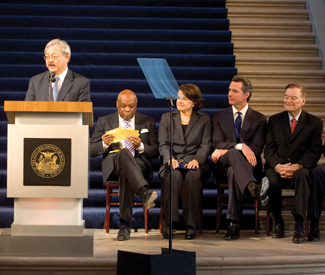
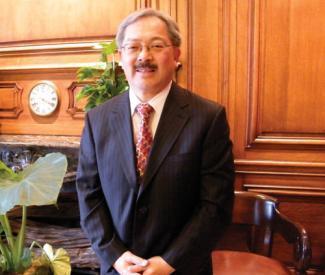
In his inaugural address on Jan. 8, and then again the next day as he appointed progressive Christina Olague to the District 5 seat on the Board of Supervisors, Mayor Ed Lee signaled an intention to bring all sides together to solve vexing city problems, from job creation to the need for more affordable housing.
“At its best, San Francisco is a city for everyone,” Lee said at his inauguration. “We are a city for the 100 percent.”
But that analysis, with his clever riff off of the Occupy movement’s 99 percent paradigm, masks deep political divisions and challenges that will likely play out repeatedly this year, particularly as he partners with a handful of wealthy individuals and corporations — members of the 1 percent, on which he lavished praise during his speech, such as venture capitalist Ron Conway — to craft his economic agenda.
Lee stressed his focus on creating private-sector jobs and his acceptance that “local government will have to do more with less,” while arguing that he can create broad prosperity by embracing high-tech innovations. “We’re poised to invent the future, right here and right now,” he said, shortly before interrupting his speech to post an employment infographic on Twitter.
The next day, after she was sworn in as supervisor representing one of the city’s most progressive districts (replacing Sheriff Ross Mirkarimi), Olague echoed Lee’s focus on job creation and the belief that “it’s time to roll up our sleeves to get things done” in a fashion that transcends ideology.
“I think this is an incredible time for our city and a time when we are coming together and moving past old political pigeonholes,” Olague said, while Lee said, “This is not about counting votes, it’s about what’s best for San Francisco and her district.”
Yet that optimistic spirit alone won’t provide for the renters and low-income homeowners being squeezed out of this gentrifying city, battles that both fought as activists — Olague with the Mission Anti-Displacement Coalition, Lee with the Asian Law Caucus — before joining city government. “We both came from backgrounds fighting for the rights of tenants and immigrants,” Lee said.
At his inauguration, he said he would take on that challenge directly.
“We need to create a permanent stream of revenue to fund housing in San Francisco,” Lee said, announcing the formation of a working group to craft a measure for the November ballot that would create a “permanent housing trust fund” to help finance low- to middle-income homes. “San Francisco must remain a place every one of us can call home.”
Olague listed her top priorities as job creation, affordable housing, helping shepherd redevelopment projects after the state abolished redevelopment agencies, and public safety. And she pledged to be an independent vote: “Every decision will be based on what’s best for my constituents and the people of San Francisco.”
Progressive political leaders were nonetheless thrilled with the choice. While Olague was an early supporter of Lee’s mayoral bid, she has deep roots in the progressive community and was a consistently good vote during her eight years on the Planning Commission.
“I am surprised by the choice, but I think it’s a good one,” Matt Gonzalez, the former D5 supervisor who appointed Olague to the commission, told us. “It’s an appointment that recognizes that D5 is the most progressive district in the city.”
Activist and building inspection commissioner Debra Walker agreed: “It’s an acknowledgment that District 5 is progressive.”
Green Party activist Susan King noted that Olague used to be a Green, as was new Sheriff Ross Mirkarimi and Sup. Jane Kim, before all switched to the Democratic Party in recent years. “It’s the second former Green sworn in over the last 24 hours,” King said. “It’s very exciting.”
“I’m elated. This is the best political news I’ve heard this year. I’ve known Christina for 15 years and I think she’ll be a fantastic supervisor,” Tom Radulovich, director of Livable City, told us. He also praised Lee for the gesture, saying, “He said he wants to work with everyone and this is a signal that he really means it.”
Sup. David Campos said Olague has good values and a wealth of experience in land use issue. “She brings a lot to the table and I can see why he chose her,” he told us.
Even Sup. Scott Wiener, a moderate, praised the Lee’s pick. “I think it’s an excellent choice. She’s thoughtful and independent,” he said. “I don’t always agree with her, but I respect her and I’ve always enjoyed working with her.”
Gonzalez told us he wonders whether the appointment would clear the field of progressive candidates, a long list of whom have expressed interest in running this year. The answer: probably not. Community College Board member John Rizzo contacted the Guardian shortly after the appointment to say, “I’m still in the race and planning to mount a vigorous campaign.”
SUPER EGO The slightly “meh” body of 2011 isn’t even cold and already we have two completely ridiculous yet ridiculously adorable, new deliberately manufactured subcultures to pretend argue on blogs about, because who blogs anymore? Seapunks and bronies, yep. I hope they fight, too, because it’d be the 2012 apocalypse in one cute, handy metaphor. Sparkly rainbow annihilation now!
Luckily, both also provide some cotton candy for thought. Bronies (and Pegasisters) are adult fans of “My Little Pony,” spanning the glittery spectrum from dedicated furries to wayward anime admirers. And yes, they dress up, and yes, there was a packed Bronycon in NYC last week. The Brony dance music of choice is variously called rainbowstep, ponystep, or dubtrot, and consists mostly of “My Little Pony”-based samples (“Fluttershy will snuggle you in your sleep!”) laid over basic dubstep tracks.
http://www.youtube.com/watch?v=2F7-Bz1lvBU
Many will find this to be divine justice for the much-maligned dubstep genre; I’m fascinated by both the ever-evolving cuddlecore-kawaii movement — humanity is so awesome — and the strange amalgamation of retro commercialism and celebratory fetishism, dancing together to something someone whipped up on a laptop for the occasion.
Seapunk is a bit more complex, a wonderful bit of subcultural engineering masterminded by elfin LA producer Fire for Effect, of underground pop group Ssion, who wanted more environmental consciousness in the club scene. (The original concept came from a “GIF dream” designed by Twitter personality Lil Internet, according to the legend.) Seapunk’s aqueous adherents, mostly in the Midwest but spreading fast — SF just got its first octopussy Seapunk mural at Market and 12th Street — have been characterized as goth mermaids, which certainly captures the look and feel: think turquoise-dyed hair and an embrace of all things oceanic, yay for steampunk jellyfish outfits.
But the whole idea is perhaps appropriately diffuse, nay watered-down: it’s more an “immersive Internet concept” than a pre-packaged lifestyle. And the music isn’t punk at all.
Besides an odd bubbly noise or two, it would be hard to identify any seapunk tracks (by Zombelle, Teams, Slava, Unknown, mostly on the Coral Records label) as anything but deep, dreamy tech house and bass music, a bit drowned-sounding, with those chipmunked rap samples now back in vogue. The lighter side of witch house, maybe.
It’s in the DJ sets, though, that seapunk catches my ear, especially those by Ultrademon. They’re perfectly party-ready, smart but completely nonthreatening, slightly melancholic fun runs you can imagine someone raving out to in a giant polyurethane bubble. But the intermittent, seemingly random fast-slow timeshifts are something more. What if mix tempos could shift suddenly, freely, and often at the clubs — like the currents of our rapidly rising, steadily depleting oceans?
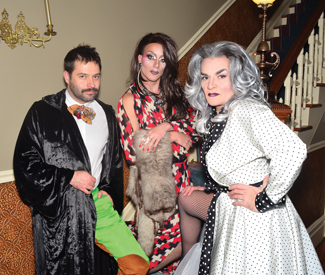
Some Thing turns two: I want to give a special birthday shoutout to one of my favorite weekly clubs, Some Thing (Fridays, 9 p.m.-4 a.m., $7. The Stud, 399 Ninth St., SF. www.studsf.com), which brings a fantastically twisted and hot, hot, hot community of queers and (other) together every Friday for shoestring razzle-dazzle drag shenanigans and afterhours dancing. Helmed by the glorious Glamamore, who celebrates 30 years of drag this year; VivvyAnne ForeverMore, fresh back from dance performances in NYC; and DJ down-E, our king of deadpan cataclysmic retro (why not just throw on some Carpenters occasionally?), this is really one of the hardest working parties in town — no sweat ever shows, though, those seams are seamless. There, you’ll see 10-plus performance numbers covering everything from nonironic Broadway showtune adoration to scandalous punk rock conflagration. Meet me there for a shot or four this Friday — and hit up the Noise blog for my juicy interview.
NGUZUNGUZU
In a stunning show of actual musical taste, Gawker named the rad, boppy LA global-bass duo’s “Perfect Lullaby” DJ mix one of 2011’s best. Catch them live at the new Future Perfect weekly.
Look, if you’re in the mood to just rave the fuck out to some good ol’ hardcore electro and minimal techno, you could do far worse than these two French dudes who are not douches, really!
Fri/13, 10 p.m., $20 advance. Mezzanine, 444 Jessie, SF. www.mezzaninesf.com
LEGOWELT
Fab Dutch hybridist performs live, bringing his unerring ear for totally jackable tech tracks and brain-tickling deep Chicago house vibes to the lovely No Way Back party.
Sat/14, 10 p.m.-4 a.m., $10–$15. Public Works, 161 Erie, SF. www.publicsf.com
DJ SPEN
One of the Baltimore’s famed Basement Boys, the energetic house legend welcomes in MLK Day at the soulful Harlum Muziq label monthly, with David Harness and Chris Lum.
HERBWISE I’d been waiting for an excuse to interview Coral Reefer. We have made a habit at my house of following the Oakland waitress religiously on the social Interwebs. What will she be smoking out of today? (Oh please, please let it be the Hello Kitty bong.)
Reefer, in all her penciled-eyebrows, bleached blond, 23-year old glory, represents that new kind of celebrity: the self-made Twittergasm. A casual observer of her Stoney Sundays weekly YouTube updates might question her 8,700-plus Twitter followers. At over one million views deep, these are now hosted by a woman named Rosepants so Reefer can focus on other projects. She also specializes in naked bong shots, and endless shout-outs to her cannabis community (I am checking her feed as I write this: her most recent post is “Attention: @heister07 is looking for fabric with cannabis prints or pot leaves on it. Anyone know where to look?”)
But say what you will about her methods, Reefer’s finding ways to educate the masses on all things cannabis. Come for the side boob, stay for the updates on the government’s double standard dealings with marijuana. A blog post on News Nug, her recently-created current events site, announced the dangers of Spice. “While patients and partygoers are seeking the soothing beneficial results of cannabis, they are greeted with a surprise blend of chemicals in each distribution,” she writes of the synthesized “cannabis” that recently stirred up a to-do in mainstream media.
Raising the hue-and-cry over Spice was excuse enough, I reasoned, for a Coral Reefer edition of Herbwise. So finally, it is happy hour on Friday, and I have locked down Reefer’s first in-person interview, to be conducted in the little-known smoking lounge above the SoMa dispensary Green Door. I am late, but she has been a productive stoner and offers me a pre-packed bong when I sit down. I immediately become too high to formulate insightful questions.
This turns out not to be a problem, because despite her babely exterior, Reefer knows what she has to say and says it well. And she says it slowly, which is important for me in this particular moment because I’m being overwhelmed by the hum of the prodigious ventilation system and the intermittent interruptions by well-meaning grey-ponytailed men unused to seeing two young women unattended in the cannabis lounge.
“Spice should be the realization that cannabis cannot be synthesized,” Reefer says. Often when cannabis-like substances are produced by artificial means, only one endocannabinoid is mimicked, which Reefer suspects is the reason behind some of the adverse side effects of Spice. These have been reported as heart attacks and psychotic episodes.
It’s a lot to take in when you’re stoned, but even (especially) through the fog it’s clear that Reefer has a knack for explaining cannabis facts to potheads.
Talk turns to politics, as talk with cannabis folk tends to do in this era of federal government crackdowns, and Reefer surprises me by saying that she doesn’t consider herself an activist, and does not plan on aligning herself more closely with formal patient advocacy organizations during the upcoming presidential election season.
She thinks that her message is better off the way it is, independent, controlled only by herself, and capable of appealing to broad swath of cannabis users. Her Internet fans include many smokers who don’t identify with the patient’s right movement that has presented itself as the most visible face of marijuana advocacy.
Says Reefer: “I don’t want to be preaching to the choir. My followers don’t consider themselves patients or recreational users. I feel like I’m reaching my own audience these days.”
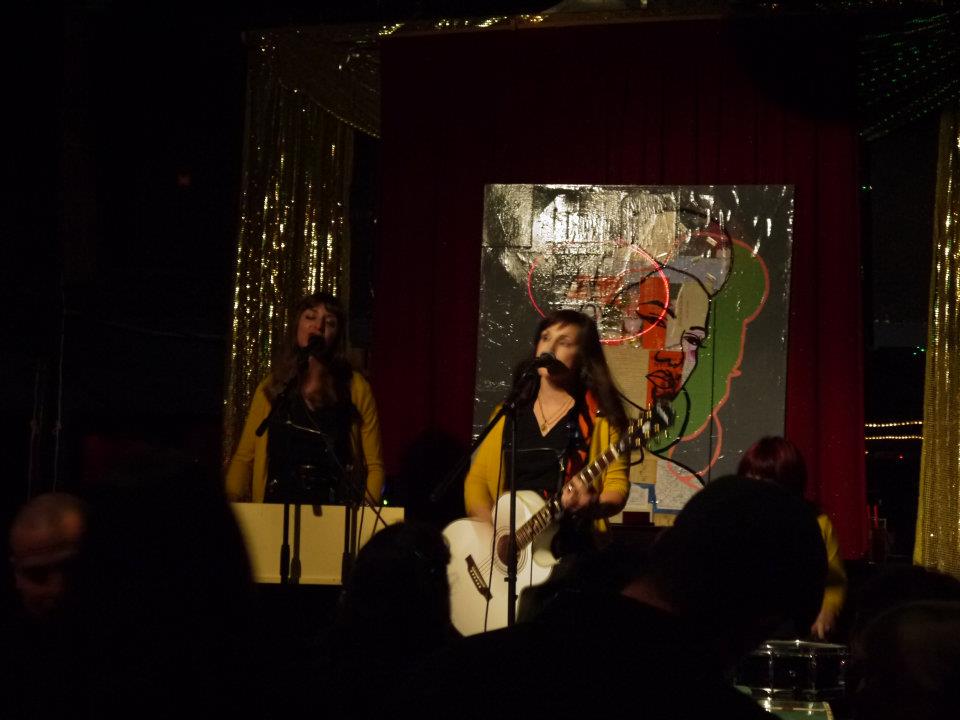
It starts off in your basic living room, two girls laughing then launching into a sweet, stripped down lo-fi version of Cock Sparrer’s oi classic “Take ‘Em All.” The musicians, Jennie Cotterill and Sara Lyons, play acoustic guitar and organ respectively, and harmonize “Take ’em all, take ’em all/Put ’em up against a wall and shoot ’em.” The disparity between the lyrics, origins, and this whole set-up encapsulates the appeal of Long Beach’s Cunt Sparrer, a trio that also includes Jen Kirk-Carlson and sometimes Myra Gallarza of Cotterill and Kirk-Carlson’s other band Bad Cop/Bad Cop on drums. More than a tribute act, Cunt Sparrer has been rearranging and rejuvenating Cock Sparrer tunes and other traditional punk hits for the past few years and through those efforts gained some deserved social media recognition — its Youtube clips routinely garner upwards of a thousand views, and on Twitter there was the biggest compliment of all: a tweet of approval from Cock Sparrer itself. I got the chance to chat with Cotterill and Lyons before their New Year’s Eve Eve San Francisco show this Friday at Thee Parkside — here are the juicy bits:
San Francisco Bay Guardian:How did the idea for Cunt Sparrer form? Sara Lyons: We’ve been big Cock Sparrer fans for a really long time and I always thought “Cunt Sparrer” was a funny name for an all-girl tribute band. Originally we had thought about doing it as a straightforward Cock Sparrer tribute, but then Jennie came across our first electric chord organ at a flea market and we just sort of started playing around with it and liked what we came up with.
SFBG: Have you met resistance from Cock Sparrer fans or in general from those offended by the term “cunt”? Ever have to deal with asshole punks? Jennie Cotterill: Some people seem to think that the word “cunt” means it’s going to be a strip show or something, but I think we’ve gotten pretty good at shutting that down. There are a lot of assholes on the internet, but in person for the most part everyone is pretty nice. SL: When we first started out I was nervous about resistance from Sparrer fans, but it turns out that a lot of our biggest fans are old-school Cock Sparrer fans who can appreciate hearing their favorite songs interpreted in a different way.
The Cock Sparrer-approved version of “Because You’re Young”: http://www.youtube.com/watch?v=eIWBwEqBPZQ
SFBG: What was Cock Sparrer’s response to your band? You’ve opened for them, correct? SL: We haven’t actually opened for Cock Sparrer. We did get to play at Punk Rock Bowling in Las Vegas this year, which they also played, but our shows weren’t connected. From everything we hear from people who have met or are close to the band, they’re really friendly guys who are super appreciative of their fans. They do know about us and have tweeted our Youtube video of “Because You’re Young,” so we think they are aware that Cunt Sparrer is coming from a place of major love and respect. JC: We really hope we get to meet them someday.
SFBG: What’s the been the best part about this band so far? Any particular moments that have stood out from live shows? JC: Getting to go on vacations with your best friends! SL: Yeah, just having the opportunity to spend a lot of time around my favorite people, playing some of my favorite songs. JC Our show at the Yucca Tap Room in Tempe, AZ back in November was our best experience ever. We were playing with Kevin Seconds and we had a local oi band called the All City Boot Boys opening up for us. SL: They were your classic big, burly traditional skinhead dudes and at first I was like, ‘I’m not sure how they’re going to respond to us.’ But when we started our set, there was this crowd of thirty plus huge dudes singing along to every word, chanting “oi”… JC: ….and inviting us back to their place for home-brewed beer.
SFBG: If you were to start another tribute band, which band would it cover? SL: We like Descendents songs. And we do cover Billy Bragg and the Misfits in our set. JC: And we’ve covered Angelic Upstarts and 7 Seconds before. SL: Yeah…badly. JC: I don’t know, though, I don’t think I’d really be interested in being in any other cover band. I know it’s kind of a novelty right now or whatever, to have a tribute band, but that’s not why I’m doing this. I’m in Cunt Sparrer so I can play music with my friends and because these are fun, good songs that I can play when I’m drunk. And they appeal to people. SL: We’re really lucky in that Cock Sparrer has such a unique and loyal fan base and that the majority of them are open to our interpretation of the music, because it plays such a vital role in a lot of people’s lives. We kind of stumbled onto a niche thing with Cunt Sparrer that I don’t think would work in any other capacity, and I think that’s why we’ve managed to do the things we’ve gotten to do so far with our little band.
Cunt Sparrer With Bro-Mags, Girl-illa Biscuits Fri/30, 9 p.m., $6 Thee Parkside 1600 17th St., SF (415) 252-1300 www.theeparkside.com
The year 2011, marked by mass uprisings in the Arab world followed by the wildfire-like Occupy Wall Street movement, also brought a handful of incidents that inspired mobile application developers to invent new tools for protesters taking to the streets.
There was the time Sam Zimmerman, a media producer in New York City, received a series of frantic texts from his girlfriend, who was getting arrested and wrapped up in orange mesh by New York Police Department officers along with a crowd of demonstrators at an Occupy Wall Street protest.
Then there were the protesters targeting Bay Area Rapid Transit (BART) stations to denounce the fatal police shooting of a homeless man who learned BART had cut off passenger cell phone service to thwart their efforts.
Activists criticized the BART cell-phone service shutdown as “pulling a Mubarak,” because it seemed to echo an earlier incident that year, when Egyptian dictator Hosni Mubarak cut off cell phone and Internet service to quell pro-democracy protests in Tahrir Square.
In all, 2011 was a banner year for free speech crackdowns — and finding innovative ways around them.
Shortly after Mubarak tried unsuccessfully to stem the tide of texts and Tweets unleashed early in the Arab Spring uprising, New Orleans attorney Kevin Vogeltanz learned what had happened while listening to a broadcast on NPR. It planted the kernel of an idea for a smartphone app that would allow people in crowds to communicate with one another through anonymous messaging, regardless of whether their phones were getting a signal.
“What they really needed,” Vogeltanz told us, “was a way to communicate through their cell phones peer-to-peer.” The project may have seemed an unlikely fit for a lawyer whose day job is working in maritime, oilfield, and insurance law, with some experience in white collar criminal defense. But he said he was stirred to action.
In the fall, Vogeltanz caught wind of BART’s unprecedented cell service disruption. “What I was incredulous about was, this is America,” he said. He was infuriated, but that served as motivation to hammer out the app. He convened a team of collaborators with knowledge in computer science to help tackle the challenge.
The app has been dubbed Dovetail. While still a work in progress, the plan is to use wifi transmitters built into smartphones to send short-range message bursts to other smartphones in the vicinity. People who install it will be able to send or receive messages, anonymously, to people around them — regardless of whether cell phone service is functional.
In New York, meanwhile, the plight of Zimmerman’s girlfriend inspired app developer Jason Van Anden to create the I’m Getting Arrested app. This tool for Android phones, which has been downloaded roughly 17,000 times so far, allows protesters who anticipate that they’ll soon be wearing handcuffs to instantly send emergency notifications to lawyers or loved ones.
“I researched it very quickly, and put it together,” explained Van Anden, who has a background in fine art and software engineering and develops mobile apps through his company, Quadrant2. “It was a way I could contribute to what was happening with the demonstrations.”
The I’m Getting Arrested app is free to download. To use it, arrestees hold their finger down on a bullseye on the phone screen before their wrists are constrained with zip-ties. The phone vibrates to let them know the message has been sent, and the pre-written distress signal goes out to previously selected contacts.
Since Van Anden released it this fall, just as the Occupy Wall Street protests were beginning to heat up and make international headlines, I’m Getting Arrested has been translated into more than a dozen foreign languages, with more — including Turkish and Azerbaijani — in the works.
“In the last two weeks, we’ve had about 1,000 new downloads from people in Russia,” Van Anden noted. In early December, Russian riot police arrested hundreds in Moscow protests led by citizens angered over election fraud, and voicing opposition to Prime Minister Vladimir Putin’s ruling party.
The year’s protests have sparked ideas for other apps, too. Mobizi’s Rich-O-Meter, for Android, features a circular gauge with a needle that points to your standing on the spectrum from 99-percent-to-1-percent, based on personal income.
Although learning how one stacks up against billionaires may have limited appeal, the app’s usefulness is revealed by pressing the red “Occupy Wall Street” button. That brings up a comprehensive “Actions and Directory” listing of Occupy websites and Twitter feeds from around the globe — from Fresno to Istanbul, with hundreds in between.
Then there’s the Shouty app — which still might not be as effective as the Occupy-inspired People’s Mic, an echo delivered with old-fashioned vocal chords. Shouty helps amplify sound in large crowds or spaces where sound systems have been banned by authorities. Developed by coder Nathan Hamblen and others at the “social coding” site Github, Shouty is a live-streaming tool that broadcasts sound as an MP3 stream so others in the crowd can pick up what is being said, even if they’re out of earshot.
Other sound apps may still catch on, like the just-released Occupy Drum Circle, which allows one to “start your own drum circle protest anywhere,” according to an description posted by developer Michael Desmond. For newshounds, there’s Occupy Wall Street News, an iPhone app, plus about a dozen others that aggregate information and news updates relating to Occupy and display it in a common feed.
I’m Getting Arrested, Shouty, Occupy Drum Circle, and Occupy Wall Street News all require cell service or an Internet signal to function, but Dovetail will be unique in that it’s designed to operate even if cellular towers have come down or a repressive government has sought to block the free flow of information by silencing networks. It could also be used in a natural disaster scenario.
Vogeltanz and his team have tested out Dovetail using Bluetooth transmitters, which send information over a shorter range than wifi, but project team member Robert Meredith, an IT director, says he thinks they’ll be able to harness wifi transmitters to improve the distance messages can travel. They plan to make it available for a free download, and it would be free to send and receive messages.
In a protest situation, there would be nothing barring law enforcement agencies from outfitting their own devices with the app to see what people in a crowd were saying to one another via Dovetail — but theoretically, they wouldn’t be able to pinpoint the senders.
To help their project along, the Dovetail developers have started a Kickstarter page where they hope to raise $30,000 by Jan. 23. Much of the funding will go toward purchasing phones for testing.
“We’re cutting the cell companies out of the equation,” Vogeltanz explained. “You’re using the built-in equipment on your cell phone to send a short-range radio burst.” Messages sent via Dovetail would be more resilient in a denser and larger group, he added. “There will be no viable way to shut down that communication,” he said, “unless you disperse the real-life group.”
I mean, the poor company was facing the prospect of paying as much as $300,000 a year in city taxes. And was threatening to move out of town over that money.
I was always dubious — the payroll tax is a tiny part of the cost of hiring an employee in San Francisco. But just in case you were worried about the future of this struggling little outfit that can’t afford to pay the local business tax, relax: A member of the Saudi royal family just gave Twitter a $300 million cash infusion. That’s like, 1,000 times the amount of money that Twitter might have had to pay the city if it didn’t get a special tax break.
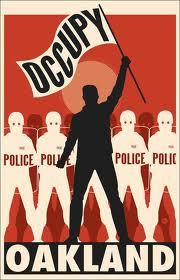
I couldn’t help but notice that the front page of the San Francisco Chronicle today juxtaposed this lead news photo and article about yesterday’s Port of Oakland shutdown with the following headline: “Blacks don’t feel drawn to white-led movement.”
San Francisco’s paper of record was referring to Occupy Oakland, which led several marches to shut down operations at the port Dec. 12 and claimed victory after accomplishing just what protest organizers had set out to do.
The article’s premise — that Occupy is a white-led movement — does not appear to ring true in the case of Occupy Oakland. I’m basing this statement on my 24-hour stay at the encampment that once stood at Frank Ogawa / Oscar Grant Plaza. After interviewing people living in tents there — who represented a wide variety of racial and economic backgrounds and voiced concerns about Oakland Public Schools, gang injunctions, Native American struggles, and police brutality, among other issues — I left with the impression that racial diversity was part of what made this particular movement unique and perhaps more politically potent than past coalitions driven by the left.
The Chronicle interviewed several African American individuals for the article who expressed that they felt a disconnect with the Occupy movement. Between in-depth interviews with Oakland residents who said they disagreed with Occupy’s tactics or thought occupiers should instead be protesting violence in African American neighborhoods, the article did mention one individual who doesn’t fit their narrative.
“Boots Riley, one of the more prominent Occupy Oakland organizers, is African American,” reporter Joe Garofoli informs us. Someone’s been paying attention.
So … did the reporter contact Riley to ask what he thought about the idea that blacks aren’t feeling drawn to Occupy?
Um, no. The Chronicle did not bother calling him, Riley informed us via text.
Riley, the organizer and hip hop artist whose voice could be heard on the megaphone at the port protest yesterday and when music by The Coup was blasting out of mobile sound systems, does have an opinion about the Chronicle’s coverage.
“Joe Garofoli’s article is hack journalism,” he proclaimed on Twitter. He followed it up by pointing out that Garofoli failed to interview Occupy-affiliated black Oakland residents who helped move Oakland resident Gayla Newsome back into her foreclosed home. Nor did the Chronicle talk to African American protesters who opposed school closures on Nov. 19. Black youth also took over an abandoned property to create a community center in a West Oakland neighborhood, Riley pointed out, but their perspective wasn’t reflected in the article, either.
It’s true that some black people may be critical of Occupy. No one’s perfect, and it’s good for any movement to engage in self-reflection, examine whether or not certain groups are feeling alienated, and consider what can be done to be more inclusive. But with coverage like that, I wouldn’t be suprised if readers felt a disconnect with the Chronicle’s portrayal of Occupy.
Occupy San Francisco protesters are calling for emergency rallies at noon outside 101 Market Street and 6 p.m. at Justin Herman Plaza in response to an early morning police raid carried out today, Dec. 7, which cleared the entire encampment.
Police made 70 arrests at Justin Herman Plaza while dismantling the Bay Area’s last major Occupy encampment. According to a post on the Occupy SF website, “Bicycles, books from the library, tents, and people’s belongings were thrown directly into trash crusher trucks. Many occupiers were trying to leave the area and were arrested anyway. Many more elected to get arrested as a form of peaceful protest.”
Mayor Ed Lee issued a statement about the raid, prefacing it by saying he supports the spirit of the movement. “From the beginning of the current Occupy SF encampment, I have made it clear to protesters that overnight camping at Justin Herman Plaza and on Market Street is not a sustainable or safe environment for protesters, the general public or City staff,” Lee wrote. “In San Francisco, we took a measured and balanced approach and negotiated with Occupy leadership in good faith to disassemble the camp at Justin Herman Plaza. The City made a site available to the group, but unfortunately, communication with the liaison team designated by Occupy SF deteriorated to a point where it was clear that no progress could be made.”
Lee added, “City agencies peacefully and orderly ended the encampment at Justin Herman Plaza.”
Live Twitter updates told a different story. “SFPD threw away entire backpacks filled w/ computers, homeless peoples life savings.. very sadistic..behavior by SFPD tonite…” a Tweet issued by Davey D noted.
“Police raid and destroy OccupySF. OccupySF’s kitchen served 1,700 needy people everyday at no charge to the city…. ” reads another update by DefaultMovie.
Two hours ago, Occupy SF posted this update on Twitter: “Early morning raids can destroy property but not the movement. Reassemble today!”
**UPDATE** Most of the 70 people taken into custody this morning have been released from jail by now, according to a small group of Occupy SF protesters who’ve set up an info table and chairs outside the Montgomery BART station. However, several remain in custody on felony charges of assault on a police officer, after allegedly throwing a chair at an officer who was clad in riot gear. About 30 arrests were made at the camp, and another 40 were arrested on Market Street after protesters spilled into the street in response to the raid.
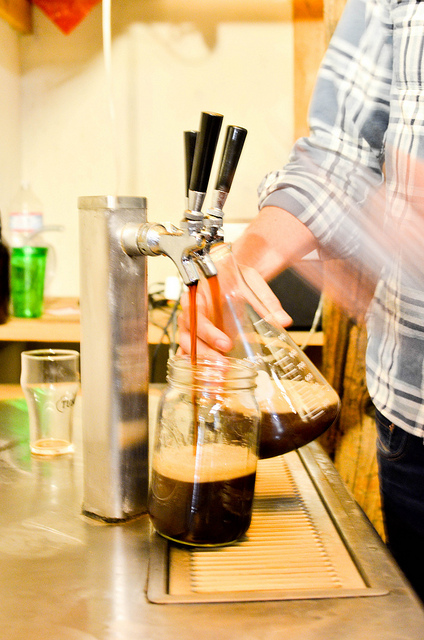
The owners of Pacific Brewery Laboratories are taking the first step from nanobrewery to brewpub by moving beyond their underground SoMa garage brewpub and its free tasting parties to the release of their first (soon to be) commercially available beer: the Squid Ink Black IPA. And they’re inviting you to celebrate! A three-destination pub crawl is planned, and here’s the itinerary: City Beer Store tonight, Tue/6, Le Trappe on Wed/7, and Shotwell’s on Thu/8.
It all started in 2010, when the owners Patrick Horn and Bryan Hermannsson made their transition into the keg crowd, making 10-gallon batches of tasty beer (check out our feature on the nanobrewery phenomenon from last year, and Pac Brew’s food-beer pairings in this year’s Beer Issue). Through word-of-mouth, news of their strikingly unusual choice in flavors — like Hibiscus Saison and Lemongrass IPA — got out. Their garage parties, which were consistently attended by some of the city’s best food trucks, revealed that their wide variety of beer flavors were even more pleasant when paired with chocolate, deli pastrami, or Chinese food.
And now, a month after the brewery’s bi-weekly brew night finale, a pub crawl to celebrate their new beer is the duo’s next order of business.
On a cold, chilly night, what will warm you up faster than a weekday evening pub crawl? That’s right, nothing.
You can thank them later for the juncture. Celebrating the first public tasting of their Squid Ink Black IPA, the owners will be hosting a three-night beer and snack-filled extravaganza. Each night a different location, each night the same deliciousness.
If you have been following the brewery on Twitter, you’ve probably noticed their “Where’s the squid?” tweets, giving hints to where the parties will be. Did you see Mr. Squid on the cash register of that Mission bar? Or chillin’ on the curb of Mason and Greenwich?
Nosh This and The Butcher’s Daughter will be providing munchies tonight and Thursday. Squid Ink popcorn will be supplied by Ryan Wilson and Because It’s Delicious, the perfect appetizer to compliment the citrus, hoppy flavor and dark malted barley of the black IPA.
I’m not a big fan of any tax breaks — mostly because I don’t think they work. The typical payroll tax break saves a company a few hundred dollars a year — nowhere near enough to make an actual difference in a hiring decision.
The Mirkarimi tax break for hiring ex-offenders is much richer — up to $10,000 per hire. That’s real money for some companies — although, again, I don’t know how many actual ex-offenders will get jobs because of it.
Still: The city’s facing a serious problem. More than 65 percent of the people now in county jail will eventually be arrested again. The recidivism number goes as high as 75 percent for state prison inmates. And under the governor’s realignment plan, San Francisco will be getting around 650 new state prison shifted into our local jail and probation system every year.
And I don’t hear many people at City Hall talking about it.
Lee told the Examiner that the Mirkarimi tax break is “not comprehensive enough.” Huh? The Twitter tax break was broad, in some cases arbitrary. Now a plan that is aimed not at a high-tech company but at people who have been released from jail and will have serious problems finding employment is “not comprehensive enough.”
Look: San Francisco has an interest — a direct public-safety and economic interest — in finding work for ex-offenders: If they don’t get employed, they’re almost certain to go back to crime. Employment is no guarantee that a former inmate will break out of the criminal cycle — but unemployment is a pretty good guarantee that he or she won’t.
So let’s be consistent here. If tax breaks work to create or preserve employment, it’s cheaper to follow the Mirkarimi plan and give incentives to employers for hiring ex-offenders than it is to re-arrest, re-try and re-incarcerate them. If the Twitter deal made sense, then this one clearly does, too.
Again: I’m not pushing this or any tax break for employers. But what’s Lee’s alternative? I asked his press spokesperson, Christine Falvey, to share with me the mayor’s plan for handing the influx of new inmates (all of whom will be released within a year or two of arrival in the SF county jail), but she hasn’t gotten back to me.
We all know what’s really going on here — nobody wants to do anything that looks like it’s aimed at helping criminals. I get it. But it’s just stupid, since criminals without jobs tend to stay criminals — and that’s not good for anyone in San Francisco.
UPDATE: Falvey emailed me back. She didn’t lay out any plan, but did say this:
“The mayor has not stated the he opposes the legislation but in its current form, it seems too narrow. He would like to see some of the categories broadened to include other populations that need support in job placement and retention. The legislation has not been voted on yet and he looks forward to reviewing the final version.”
On the Cheap listings are compiled by Lucy Schiller. Submit items for the listings at listings@sfbg.com. For further information on how to submit items for the listings, see Picks.
THURSDAY 1
Wildlife Works launch party Hangr 16, 3128 Valencia, SF. www.hangr16.com. 7 p.m., free with RSVP to rsvp@wildlifeworks.com. Wildlife Works, an ecologically-oriented clothing company with an 80,000-acre wildlife sanctuary in Kenya, is all about responsible consumption and for one night — a night that includes pizza and wine — will celebrate its new clothing collection available at Hangr 16, a Mission boutique.
Working Solutions holiday gift fair 101 Second St., SF. www.tmcworkingsolutions.org. 5-8 p.m., free. Reap the bounty of the micro-loaned harvest that Working Solutions has built throughout San Francisco, from Bernal Heights-wrought knife makers to hand-crafting chocolatiers.
Doubt, Atheism, and the 19th Century Russian Intelligentsia discussion University Press Books, 2430 Bancroft, Berk. www.universitypressbooks.com. 5:30-7 p.m., free. Victoria Frede, an associate professor of history at Cal, discusses how freethinking Russian intellectuals stuck it to the biggest guns around — the tsar and God.
Writ Writer screening and discussion Ellen Driscoll Playhouse, 325 Highland, Piedmont. www.diversityfilmseries.org. 6:30-9 p.m., free. Fred Cruz, a pioneer of the prisoners’ rights movement, taught himself the law while in prison and become a tirelessly outspoken advocate for inmates’ rights. Writ Writer pieces the story together from Cruz’s journals, letters, and filed documents.
FRIDAY 2
True Stories Lounge Makeout Room, 3225 22nd St., SF. www.makeoutroom.com. 7 p.m., $10. The lineup for the second True Stories Lounge — kind of a juicier, in-depth, and often locally-slanted version of The Moth — is unbeatable. Alan Kaufman (author of Jew Boy), David Talbot (founder of Salon.com), Marilyn Pittman (local comedian), Steve Fainaru (editor-in-chief of the Bay Citizen), and Peter Manso (controversial biographer) will read.
SATURDAY 3
Silencing the Witnesses forum Humanist Hall, 290 27th St., Oakl. www.berkeleycopwatch.org. 2 p.m., $5 donation. Berkeley Copwatch hosts a crucially-needed forum, considering recent police responses to Occupy. Up for discussion: the rights of civilian journalists to watch and record police activities at protests, the suppression of police brutality, and, of course, the first amendment.
Katie Finn jewelry showcase Love and Luxe, 1169 Valencia, SF. www.loveandluxesf.com. 5-9 p.m., free. Jeweler Katie Finn finds her glassy, imperfect stones in India and then encases them in thin settings of burnished gold. The result: dazzling rings that look a world and an era away.
In the Red: Flaming Lotus Girls Photography auction and party SOMArts Cultural Center, 934 Brannan, SF. www.somarts.org. 6 p.m.-2 a.m., free. So maybe you can’t house one of the Flaming Lotus Girls’ massive towers of flame in your living room, but you can probably hang up a photo of it. Perhaps the burniest of Burners, these Black Rock City mainstays host a dance-y evening based around archival prints of their fire-based work.
Criminal Class Press reading Edinburgh Castle Pub, 950 Geary, SF. www.castlenews.com. 7:30 p.m., free. Characterized as “literature’s underbelly,” the stuff to come out of Criminal Class Press tends to be hairy, hungover, and obscene in theme. The writers, a self-defined “scumbag elite,” team up with Chicago’s Windy City Story Slam for an evening of crime and grime.
SUNDAY 4
Gourmet Ghetto Snow Day Andronico’s, 1550 Shattuck, Berk. www.gourmetghetto.org. 10 a.m.-3 p.m., free. Possibly the classiest and warmest snow day in the United States, Berkeley’s version holds cider, cookies, crafting, and, of course, snow.
Palestinian Bazaar Live Oak Park, 1301 Shattuck, Berk. www.mecaforpeace.org. 10 a.m.-4 p.m., free. Wander through rows of olive oil-based products and woven gifts handcrafted by Palestinian artists.
Winter Pottery and Craft Sale Sharon Art Studio, Golden Gate Park, SF. www.sharonartstudio.org. 11 a.m.-5 p.m., free. It’s trivet time: stock up on dinnerware for all those imminent winter gorgefests. Proceeds from the massive, all-handmade sale directly benefit Sharon Art Center’s community-oriented art programs.
Chamber Orchestra and Circus Bella family concert Bayview Opera House, 4705 Third St., SF. www.bayviewoperahouse.org. 3-4 p.m., free. Throwing off the weighty yoke that is the term “elevator music,” the SF Chamber Orchestra joins with Circus Bella to present a highly interactive introduction to the genre for kids and families.
Make Drag, Not War! Dance Mission Theatre, 3316 24th St., SF. www.dancemission.com. 8 p.m., $5-$20 sliding scale. Veterans of the drag scene and of the Iraq, Afghanistan, and Vietnam wars team up for an activist theatre performance benefiting Veteran Artists. Ex-soldiers voice their stories to drag realizations for the third year.
MONDAY 5
21st Amendment march and celebration 21st Amendment Brewery, 563 2nd St., SF. www.21st-amendment.com. 4 p.m., free. Celebrate the 1933 repealing of Prohibition with period-appropriate prices: given that you know the password (hinted at on the brewery’s Twitter feed), your nickel is worth a beer. The raucous 4 p.m. march demanding an end to prohibition results in the inevitable: a boozy costume party complete with poker game.
“A lot of people are unaware that there are huge sections of Twitter that are all about Def Jam being the root of all evil.” Last month, I got to Skype with Nelson George about his new book The Plot Against Hip-Hop (Akashic Books, 176pp, $15.95), a noir mystery that explores the commercialization of the music through the fictional death of a renowned hip-hop historian named Dwanye Robinson. You can catch George at City Lights Bookstore (Thu/1) and Marcus Books’ Oakland location (Fri/2) this week.
Robinson bears more than a passing resemblance to George, who has written decades worth of academic looks at hip-hop and R&B. So naturally, our conversation turned to to the more sinister workings of the world (to be clear, he’s not committed to the Russel Simmons-as-devil version of things). Turns out George is more than a little frustrated with the state of the music today — and he thinks the Occupy movement might be the answer to hip-hop’s woes.
“This stuff they’re making,” he says, speaking of todays’ radio stars in his characteristically familiar tone (he is, after years of writing about them and producing VH1’s Hip Hop Honors awards show, on a first name basis with many of the big hip-hop guns). “They’re not even hoping for art. They’re just hoping to sell sugar water, T-shirts — whatever Jay(-Z)’s selling this week. I don’t think people were feeling that way about L.L., Eazy E.”
The Plot does illustrate a phenomenon that he says can affect the way social movements like hip-hop progress. In it, a security guard named D. Hunter takes on a massive cover-up that has gone back decades and might just hold the key to why hip-hop sucks these days. Throughout the storyline he runs into gangsters, CEOs, and all kinds of mixtures of the two — eventually stumbling upon certain individuals who have taken it upon themselves to subvert the true meaning of the music.
“That seems more compelling to me than the all-encompassing whoever-the-fuck-they-are,” George says earnestly, his face filling up the bottom half of my computer screen. He’s not into Illuminati-Def Jam theories, but he does talk about NWA’s first tour as an example in which history has been messed with. During that run, an official faxed letters all around the country that identified the cop-hating rap group as a security threat to small towns. “One guy was able to make a lot of fuss because he had the FBI seal behind him,” George tells me.
But, at least a month ago when Zuccoti Park was in its prime, George thinks that the Occupy movement is a decisive step against the tides of mind-numbing commercialization that has brought us emcees who will hawk whatever to whomever, as long as their singles are racking in the big bucks. He calls this music cum commerical process “the chilling effect,” whereby brands dictate what artists are able to put forward.
“I think that the Occupy movement will goose a lot of people to deal with a lot of things that are going on these days,” he concluded, telling me about how many of the hip-hop heads he knows have dropped by to check out the movement in the past months. “I think that it will help hip-hop.”
If you live in the Bay (or own a computer), you’ve probably heard of Oakland “cloud rap” duo Main Attrakionz via its breakthrough summer mixtape 808’s & Dark Grapes II. You may, however, be less familiar with the visionary producers behind two of the mixtape’s most spaced-out, hypnotically chill tracks, “Perfect Skies” and “Chuch.” Allow me to introduce you to the East Bay’s James Laurence and Dylan Reznick, a.k.a. Friendzone.
Laurence and Reznick began making music together in Destroy Tokyo, an early incarnation of experimental synth-poppers Religious Girls. After parting ways with the band, the pair started collaborating on electronic endeavors. “The first songs we wrote together were really emotional, uptempo electronic pop songs,” says Reznick. “Our sound never stays the same for very long.”
“We’re influenced by all types of music; early ‘90s rave, hip-hop, foreign pop music, shoegaze,” says Laurence. “Our sound is a mash-up of everything we listen to.” Indeed, listening to Friendzone is like popping a handful of codeine, sinking into a beanbag chair, and setting a satellite radio to worldwide scan. The pair lists footwork music masterminds DJ Nate and DJ Elmoe, Japanese producer Uyama Hiroto, and Xiu Xiu’s Jamie Stewart as a few of its influences.
Friendzone has released a host of mixtapes on its Tumblr, all of which meander on a thugged-out, ambient journey through the cosmos and back in about half an hour. “Our earliest mixtapes were just collections of songs we liked, but chopped [and] washed out,” says Laurence. “Kuchibiru Network was the first mixtape filled with tracks by our friends and collaborators along with genres we enjoy like J-pop, footwork, and ambient music.” Kuchibiru Network 2, a mix exclusively featuring artists connected with the band, drops this week.
Though Friendzone’s mixtapes, instrumentals, and remixes stand on their own, the band’s collaborations with rappers from Oakland to Japan have further piqued the curiosity of hip-hop heads. “We were just really inspired by a lot of the new music coming out of the rap scene, and sort of naturally started making 70 bpm compositions and working with rappers,” says Reznick.
Laurence was a fan of Main Attrakionz so he reached out to Sqaudda B (one half of the duo) on Twitter. “Once he found out we were local, he was more than happy to come over and work on some tracks with us,” says Laurence. “Whenever we have a session with them it’s sort of magical,” says Reznick. “They just show up, roll some blunts, quietly listen to whatever beats we have ready, [and] have a full song written within 15 to 20 minutes. [They] record all of their verses in one take, every time. It’s awe-inspiring.”
Friendzone is currently releasing a new song every week on Tumblr, and will put out an LP of collaborations with Main Attrakionz and Shady Blaze in early 2012. “[Working with rappers is] just what we’re into right now,” says Reznick. “We’ll continue to release non-collaborative music, as well as collaborations with artists from any style that inspire us.”
MUSIC The contrast was almost too much to bear. There she stood atop a pile of glittering, emoticoned video shares: Kreayshawn, repping for white girls in Oakland ’til the cows come home. Her N-word spouting sidekick and dookie gold everything, the perfectly-packaged “Gucci Gucci” video and swag-pumping ovaries. Everywhere, just everywhere.
You’d think she was the only one doing the hip-hop thing in the East Bay, or maybe you’d think that’s just how East Bay honky female emcees get down — but only if you didn’t know about k.flay (which can totally be remedied, by the way. She’s playing Wed/23 at the Independent).
You probably wouldn’t dress up like Kristine “k.flay” Flaherty for Halloween. She doesn’t wear curlers out or mess with bifurcated hair coloring, but she has been diligently laying down soul-baring flows on catchy beats in the Bay Area for years. It was k.flay’s voice you heard drifting through the hook of Zion I’s “Coastin.'” She spits verses about Diet Coke addiction, waking up in your ex-boyfriend’s bed when you didn’t mean to. You want to be her — and she’s not going to make you regret saying that.
Because not to belabor the Kreayshawn comparison, but k.flay will never inspire blog posts about racial appropriation. A Stanford grad (but still funky) she stepped into the hip-hop scene like she didn’t even need a costume to kick it — almost like she was of a generation that grew up with the music. One need only check the video for “Party,” a song off her 2011 mixtape I Stopped Caring in ’96 for an example of k.flay’s style. Witty, driving, contagious, her flows employ the use of newborns, hot guys, and the “old school cast of Felicity” to evoke house party-good times. Throughout, k.flay is flinging her arms around, the girl too cool to care that she looks like a goober.
Still, in a phone interview with the Guardian on a recent trip back to San Francisco (she was crashing in New York to record the album, “like one of those extended stay hotels,” she says) k.flay copped to the fact that she’s still considered a novelty in the industry — and that there’s a good reason for that.
“There’s never been someone who has had a long career and been really prolific and successful for a long time who was a white female rapper. There’s been a lot of blips here and there of people who have popped up and made some noise and doing some cool stuff, but I think no one’s really had a ton of staying power yet.”
She’d like to change that. Though the emcee has been known to roll around between genres (her new five-song album Eyes Shut features the co-producing chops of the Prodigy’s Liam Howlett and embraces electronic music), she’s got too much going on in her head to leave hip-hop.
“Maybe it’s a bad tendency, but I have this tendency to fill space with a lot of crap. It’s kind of good for me,” she laughs.
The question begged to be asked — how did the Summer of Kreayshawn strike k.flay? Turns out, k.flay’s “Gucci Gucci” remix wasn’t the two women’s first run-in. They had hooked up in 2010 to talk about Kreayshawn directing a k.flay video. ” I remember her saying to me ‘yeah my sister raps and it’s fucking horrible,'” k.flay says, adopting a slightly more nasal tone. “And showed me a video of it. I didn’t know she was doing anything at the time. And then one day I got a million emails about it and I was like, what is this and I realized it was her. Yeah, it was pretty random.”
What came after — Kreayshawn’s 500,000 Twitter followers, that weird beef with Rick Ross, life wrought large on a ghettoblaster-Sanrio-glitter tip — k.flay’s too cool to find fault with.
“To be honest I think in a way it was a bad situation for her. Anybody who has that big of a blow up, there’s so much pressure implicit in that. I would be freaked out if that had happened to me early on. I’m happy for anybody who is going to be successful as long as they’re obviously not like supporting genocide or doing something terrible.”
This is not k.flay’s first rodeo. Her debut album, Suburban Rap Queen, came out in 2004. And the new album? She feels great about where she was at creatively when she made it. And so maybe now she’s ready for viral. Asked about projects for the future, besides the frenetic touring that will mark her 2012, her answer implies a readiness for the next step in what’ll hopefully be a long career.
APPETITE San Francisco has long been a brunch town, and brunching is a weekend sport. But we also excel at that mysterious (for many of us) weekday meal called breakfast. Recent rising, shining, and exploring has yielded three newer breakfast options (which also serve on weekends), and one Sunday-only brunch so good I just had to include it.
SUNDAY BRUNCH DECADENCE
Husband/wife duo, Lori Baker and Jeff Banker, interact with diners during Sunday brunch at their restaurant Baker and Banker. Jeff delivers dishes to tables, chatting with patrons, while Lori spends her time between the restaurant and next-door bakery.
In keeping with the delights available for dinner, the fairly recent addition of Sunday brunch offers joys beyond mere scrambles and pancakes. While it’s still fall, do yourself a favor and order the cinnamon and spice-dusted donuts ($9), filled with a blessedly less-than-sweet pumpkin pie cream. Five to a basket, these warm rounds of autumn goodness disappeared quickly. One hopes they will stay on the menu, their filling changing seasonally.
On the savory side, there’s house-smoked trout on latkes, roasted squash salad, brisket hash, and Cajun eggs benedict. I’d like to single out mascarpone brown butter polenta as the decadent base for the eggs in purgatory ($14). Two semi-runny eggs over polenta are peppered with house sausage, swimming in a spicy-sweet tomato sauce adding a Southern Italian dimension. It’s an utterly satisfying breakfast dish seemingly half the restaurant ordered.
One of the best things to come along on a particular stretch of Market Street in awhile is Little Griddle, a few months old corner breakfast spot and burger joint. Blue collar workers and Civic Center government employees line up for bagels and Zoka coffee in the morning, while a large selection of around 15 burgers is the crowd favorite throughout the day.
Little Griddle was serving the sadly now defunct Spot Bagels. It currently offers New York Bagels (from Richmond, CA), delivered fresh daily. Breakfast platters of omelets or scrambles are massive, enough for two at roughly $8–$11, with crispy hash browns or salad. I like the Sandbox ($10.75): Black Forest ham, apple-smoked bacon, avocado, crimini mushrooms, yellow onions.
Griddle cakes ($5–$8) are likewise massive and come double- or triple-stacked, topped with strawberries and bananas, or dotted with pecans or chocolate chips.
Little Griddle’s space is humble. I relish orange floor tiles and the 1970s spirit of the tiny, triangular space. It keeps the gourmet, local approach from feeling hipster or put-on. In fact, it’s a neighborhood joint equipped for commuters, offering quality sans pretension.
Near the busy Van Ness Muni/BART stop, The Pastry Cupboard is a couple-months-old bakery from Chona Piumarta who was executive pastry chef at Slanted Door.
Pastry Cupboard leans towards American baked goods with cakes, pies, cookies, and Piumarta’s signature coconut almond macaroons (puffy and cake-like with a caramelized exterior). Scones and danishes cater to a morning appetite, but my poison is a cherry chocolate strudel. With a sugar icing and almonds on top, tart cherries and dark chocolate are layered inside a pastry shell with sweet cream cheese. Like a Bavarian version of a danish, it happily pairs with a robust espresso.
Beachside Coffee Bar and Kitchen (from the owners of neighboring Java Beach) is a roughly three months old cafe at the edge of the city, merely a block from the ocean. Coffee is a highlight here, made with care, cup by cup, sourcing beans from varying parts of the world.
In a cozy, simple space, friendly staff serve vegetarian or vegan bahn mi, fried egg and bacon or sausage sandwiches on brioche, and all things waffles: bacon waffles, Belgian waffles, chicken and waffles.
On a recent rainy morn, I was sold on the Irish breakfast sandwich ($6.95 regular, $9.95 large). Transported back to rainier days this summer traveling Ireland, I was delighted to eat Irish bacon and sausage, white and black pudding, and grilled tomatoes all packed into one sandwich with an egg. Though not quite the supreme blood sausages I’ve had in Ireland or Scotland, they are well-made and the real deal. With an accompanying chutney to dip the sandwich in, I was transported straight back to Ireland’s windswept shores… not unlike our own on a day of massive waves and fog.
What does Hearst Corporation own at the corner of Fifth and Mission that’s actually worth a lot of money?
No, it’s not the San Francisco Chronicle. The New York-based media congomerate bought the Chron in 1999, at the top of the newspaper market, for something in the neighborhood of a billion dollars, but it’s not even worth a small fraction of that today. Mid-sized dailies like the Chron have lost so much value over the past 12 years that Hearst would have trouble getting ten cents on the dollar if it put the paper on the market.
So here’s this unperforming asset on the Hearst balance sheet that can’t be unloaded without a huge write-down. What’s a corporate bean-counter to do?
Well, in this case (as in the case with urban dailies around the country) it turns out that the most valuable thing Hearst got when it bought the ol’ Chron was the real estate that came in the package. The Chronicle Building is worth a fortune as a development site, but it’s an historic structure that can’t be torn down. On the other hand, the old Examiner building, and the parking lots and the various odd lots on the edges, make up a nice site for high-end condos and office space — and now that the market is picking up, Hearst and its development partner, Forest City, are looking to make some cash off the Fifth and Mission dirt.
We’re talking two highrises, one residential and one commercial, and six smaller buildings. It will change the face of an area that’s outside the downtown core and that abuts a more low-rent district. Hearst and Forest City are talking about people working in the “creative economy” — particularly young tech firms. Between Twitter on one end and the Chron’s new project on the other, the Sixth Street corridor might start to get pinched.
I wonder what the supporters of the Twitter tax break are going to think about this. And I wonder whether the “young tech companies” that the city wants to attract to the area are going to be demanding tax breaks, too.
And I wonder what the Chron will have to say about all of that.
As cities across America evict encampments of the Occupy Wall Street movement, similarities of timing, talking points and tactics among major metropolitan mayors and police chiefs have led critics to wonder: Is some sort of national coordination going on?
The White House says there’s no federal oversight. Speaking November 15 aboard Air Force One, White House Press Secretary Jay Carney said “The president’s position is that obviously every municipality has to make its own decisions about how to handle these issues.”
But a little-known but influential private membership based organization has placed itself at the center of advising and coordinating the crackdown on the encampments. The Police Executive Research Forum, an international non-governmental organization with ties to law enforcement and the U.S. Department of Homeland Security, has been coordinating conference calls with major metropolitan mayors and police chiefs to advise them on policing matters and discuss response to the Occupy movement. The group has distributed a recently published guide on policing political events.
Speaking to Democracy Now! On November 17, PERF Executive Director Chuck Wexler acknowledged PERF’s coordination of a series of conference-call strategy sessions with big-city police chiefs. These calls were distinct from the widely reported national conference calls of major metropolitan mayors.
The coordination of political crackdowns on the Occupy movement has been conducted behind closed doors, with city officials and PERF refusing to say how many cities participated in the conference calls and the exact nature of the discussions. Reports of at least a dozen cities and some indication of as many as 40 accepting PERF advice and/or strategic documents include San Francisco, Seattle, New York, Portland, Oakland, Atlanta, and Washington DC.
The San Francisco Police Department and Mayor Ed Lee’s office did not returned the Guardian’s request for comment about the PERF calls by press time. However, Oakland interim Police Chief Howard Jordan was quoted by the Associated Press confirming Oakland and San Francisco police involvement in the strategy sessions.
PERF coordinated a November 10 conference call with city police chiefs across the country – and many of these cities undertook crackdowns shortly afterward.
“We know that there were influential conference calls of private groups that include police chiefs who played key roles in repressing the anti-globalization movement, in order to stage rolling attacks on occupations across the country,” said Baruca Peller, an organizer for Occupy Oakland. “In less than a week an unprecedented number of protesters have been brutalized and arrested, and in many cities such as Oakland these evictions were pushed for by the local one-percent.”
“Occupy Oakland is calling for a national day of re-occupation on Saturday, to let them know that if they can take a national offensive against us, we can take a national offensive in response and we will re-take these public spaces and what is already ours.”
According to PERF’s website, general membership in the group is exclusive to “the executive head of a municipal, county or state-funded agency that provides general police services. The agency must have at least 100 full-time employees, or serve a population of 50,000 or more people.”
PERF’s current and former directors read as a who’s who of police chiefs involved in crackdowns on anti-globalization and political convention protesters resulting in thousands of arrests, hundreds of injuries, and millions of dollars paid out in police brutality and wrongful arrest lawsuits.
These current and former U.S. police chiefs — along with top ranking police union officials and representatives from Canadian and British police — have been marketing to municipal police forces and politicians their joint experiences as specialists on policing mass demonstrations.
Chairing PERF’s board of directors is Philadelphia Police Commissioner and former Washington D.C. Metro Police Chief Charles Ramsey, who was responsible for coordinating the police response to protests against international banking institutions including the World Bank and International Monetary Fund. Those protests, and Ramsey’s response to massive anti-war demonstrations in Washington DC in the lead up the the Iraq War, often resulted in preemptive mass arrest of participants that were later deemed to be unconstitutional.
Ramsey’s predecessor as organization chair is former Philadelphia Police Commissioner and former Miami Police Chief John Timoney, who is responsible for the so called “Miami Model,” coined after the police crackdown on the 2003 Free Trade Agreement of the Americas protest. The police response to protesters in Miami lead to hundreds of injuries to protesters. The ACLU won multiple suits against the Miami P.D. over abuse to protesters and free speech concerns.
Prior to the 2003 protest, Timoney was quoted as saying that the FTAA was “the first big event for homeland security … the first real realistic run-through to see how it would work.”
Timoney arrived in Miami with plenty of baggage. At the 2000 Republican National Convention, Timoney coordinated a crackdown that resulted in more than 420 arrests with only 13 convictions, none of which resulted in jail time. As in Miami, there was well documented abuse of some of the people arrested.
Also among PERF’s directors is Minneapolis police chief Tim Dolan, who was responsible for the crackdown on protesters at the 2008 Republican National Convention. That event also resulted in lawsuits, protester injuries and an outcry from the national press about police brutality and the preemptive nature of the police action.
PERF is more than a mere policy group. Wexler has personally represented PERF at major political events, in face-to-face dialog with police tactical commanders and leadership. That was the case at the 2008 Republican National Convention, where Wexler and Minneapolis Police Chief Dolan coordinated what is widely regarded as one of the most aggressive political crackdowns in recent American history.
Wexler spent the afternoon of October 14 observing Occupy Philadelphia with Philadelphia police commissioner Ramsey. Speaking to the Philadelphia Tribune, Ramsey said: “They wanted to see what the Occupy protesters were doing here in Philadelphia. As we walked through their encampment, almost immediately they were texting other groups around the country – it was happening while we were there and that was very, very interesting. It’s instant communication, and it’s worldwide. We have to become more adept at using the technology. Our police department has its own active Facebook page as a way of reaching out to the community.”
“Had a great one-day conference in Philly about social media – very pertinent these days with the occupy protests …” Wexler stated from his twitter account.
As the occupation movement grew, PERF began circulating a publication titled Managing Major Events: Best Practices from the Field. The manual – a copy of which we downloaded — amounts to a how-to guide for policing political events, and gives special attention to policing “Anarchists” and “Eco Terrrorists” at political events.
The guide encourages the use of undercover officers and snatch squads to “grab the bad guys and remove them from the crowd.” It urges local law enforcement to use social media to map the Occupy movement.
An earlier PERF guide Police Management of Mass Demonstrations advocates the use of embedded media to control police messages, the use of undercover cops to infiltrate protest groups, the use and pitfalls of preemptive mass arrest, an examination of the use of less-than-lethal crowd control weapons, and general discussion weighing the use of force in crowd control.
Tuesday and Wednesday, Nov. 15 and 16, marked galvanizing student-led protests that shut down a Bank of America branch at Davis and California streets in San Francisco, prompted walk-outs and marches through the streets of Berkeley, and fed the momentum initiated by the Occupy Oakland and Occupy San Francisco encampments.
In San Francisco on Nov. 16, protesters from OccupySF joined with students from US campuses, city colleges, and California State University schools to launch a peaceful day of action that included a march from the OccupySF encampment to the California State building, with sit-in stops at downtown offices of corporations associated with several wealthy UC Regents.
The days’ actions were the result of a last-minute change of plans. Students had been organizing for months for a day centered on the scheduled UC Regents meeting at the UCSF Mission Bay campus. The meeting was cancelled on November 14, citing potential violent disruptions. Organizers from the group Occupy Education decided instead to march, rally, and occupy in San Francisco’s financial district.
“The 1% on the Board of Regents cancelled their meeting because we demanded they do the people’s business. So now we’re going to where they do Wall Street’s business,” an official statement from Occupy Education noted.
The march left from the encampment site, renamed Bradley Manning Plaza by some occupiers, around 1 p.m. About 500 students, OccupySF participants and supporters marched along the Embarcadero, chanting “Whose university? Our university!” and “No cuts, no fees, education must be free.”
Around 2:20, the march stopped at the Bank of America branch at California and Davis. There, about 200 entered the building. Protesters held doors open as employees pushed back. One woman speaking into a cell phone yelled “This is private property! Get away!”
The bank’s main room soon filled with protesters who stood on chairs, desks and other furniture, chanted slogans, and pounded on drums. Several gave speeches decrying UC Regents with large salaries and their involvement in fee hikes. Said organizer David Solnit, “If they occupy our education, we occupy their banks!”
The final arrests were made shortly before 7 p.m. Video by Rebecca Bowe
Organizers singled out Monica Lozano, UC Regent and member of the Bank of America board of directors, as one of the reasons for targeting the Bank of America. Fliers explaining the reason to target Lozano said, “We hear it every day. There’s no more money. No money to keep college affordable…make Wall Street corporations and the super-rich pay, including those who sit on our schools’ and universities’ boards.”
The protesters remained peaceful while inside the building. Some scrawled messages on file cabinets in white chalk.
Around 2:40, at the Davis Street bank entrance, protesters formed a circle in front of the door, in front of police who were guarding the door. OccupySF participant Amy O told the Guardian, “My arms were in peace signs and I had inserted myself in between a yelling police officer and an overly aggressive protester. Then more police came up from behind me. They pulled my hoodie and I was thrown to the ground…there was no warning and I fell hard on my elbow. My hands were up in the air.”
Craig Rouskey was involved in the same incident. He says he was shocked when, without warning, police “jumped into the crowd and started beating people over the head with batons.” Rouskey named “Officer Turvis” as the specific police officer involved in beating protesters with batons.
After this incident, which to stem from police efforts to clear the space in front of the door, about 100 protesters moved into the space and staged a sit-in outside the bank, while several hundred more looked on, blocking the street.
All other police-protester interaction was calm. Those inside the bank sat in, spoke out and played music for about an hour until police began to arrest. Then, as officers processed each arrestee individually, the process of removing them from the bank took over four hours. A total of 95 arrests were made.
The last relic of the sit-in to go was a tent protesters had pitched inside the bank. The tent is now being auctioned on Ebay, and the current bid is at $255.
Around 3 p.m., the march continued on Market to its final destination — the State Building on Golden Gate and Larkin streets – while several dozen remained at the Bank of America branch to support those sitting in. The march ended with a speak-out in front of the building, where students and other supporters talked about how University budget cuts have affected them and their families. Several students said they would not be able to afford continued schooling if proposed UC budget cuts, which include an 89 percent increase over the next four years, move forward.
Destiny Iwuoma, a first-year student at UC Berkeley with a double major in Legal Studies and African American Studies and a minor in Education who has also participated in Occupy Cal, was proud of the day’s participants. “I think the people inside the Bank of American are pretty brave,” he said.
Occupy protests around the Bay Area are working in tandem and relying on each other, Iwuoma said. “Buses from Occupy Cal left to support OccupySF. Occupy Oakland and SF came to support Occupy Cal. We’re supporting each other.”
A day earlier, the East Bay city of Berkeley was besieged with student protests. A day packed with rallies, marches, speakers, and a general assembly that drew thousands at the end of the day to UC Berkeley marked the Nov. 15 student strike and Day of Action called in response to a police crackdown less than a week earlier. Hundreds filled Sproul Plaza for a 2 p.m. rally. Honest Cheung, one of the 39 Berkeley students to be arrested after the first attempt to set up tents, condemned the campus police’s excessive use of force against student protesters. ”When they increase our debt, they increase their profit! And that is why they use violence,” Cheung said. “What kind of democracy do we live in when peaceful protestors are met with violence?”
Students moved to an intersection off campus to hear Robert Slaughter, a black student from St Mary’s College, describe how he beaten by police and arrested with 38 others, but was the only one charged with a felony and held on $15,000 bail.
A mass of students then marched down Bancroft Street, stopping traffic on Shattuck Avenue. They circled the streets around Berkeley High and made stops in front of Berkeley High and the Berkeley Civic Center, chanting, “Who’s university? Our university!” “Tell me what democracy looks like! This is what democracy looks like!” “Banks got bailed out, we got sold out.” At the high school, they chanted, “UC Berkeley, Berkeley High, hella hella Occupy,” and “Education is a right, Berkeley High is hella tight.”
By 4:30, the crowd had returned as a huge mass to Sproul Plaza. Protesters from Occupy Oakland arrived soon after, en masse, waving around a tent on a stick to announce their presence. After that, they had people sit down to form the General Assembly. After many mic checks and early announcements, they handed out agendas and announced the details of an afternoon shooting that occurred at Haas School of Business.
Someone stood and announced that a lawsuit would be filed against campus police for targeting protesters with excessive force Nov. 9. Occupy Cal plans to hold general assemblies at Sproul Plaza each night at 6 p.m. (Their Twitter feed is here)
The crowd continued to swell, and perhaps ten thousand people crammed into the plaza for the general assembly. They voted to re-establish the occupation of the plaza, and to demand an end to the wave of tuition hikes and funding cuts that have put higher education beyond the reach of many Californians.
“I believe words have the power to create change,” Said Jeanie Shoumacer, 47, an undergrad student who’d brought her 5-year-old son along for the civics lesson. “We must not let this end,” she urged the crowd, speaking from the steps of Sproul Hall. “We cannot give up.”
Berkeley’s Free Speech Movement began at Sproul Plaza. Signs of free speech activist Mario Savio had been set up with a sign reading, “This is Our History.” Speakers were flanked by banners that read, “Free education for all,” and “Defend public education.”
Morgan Crawford, a Berkeley student, had participated in the protests a week prior. “I was beaten last week,” he said. “I could hardly walk. I’m back here to speak in favor of re-establishing the encampment. Our voices will be heard, and when the police return to beat us into submission, stand strong, and stand together.”
Senior Andrea Barrera was one of the meeting facilitators. “We stand in solidarity with all the people in the world who are struggling with the system that we are working so hard to defeat,” she said.
The general assembly was run on a model of participatory democracy. Issues were presented, debated in small groups, and then voted on by everyone present. Friendly amendments were recorded, votes tallied, and proposals passed under a system that required an 80 percent super-majority to go forward. Though chaotic at times, Occupy activists were able to address and pass several resolutions in just over an hour – a display of efficiency.
“We don’t just organize,” Barrera said. “We communize. We work together.”
Traffic was stopped in downtown Berkeley today, Nov. 15, as a mass of university students took to the streets as part of the day of action organized by Occupy Cal. Hundreds gathered at Sproul Plaza at the University of California at Berkeley for a rally before embarking on a march down Bancroft that stopped in front of Berkeley High School and was progressing toward Berkeley Community College. Students decided to hold the day of action in the wake of a police crackdown last Wednesday that occurred when students tried setting up an Occupy encampment on campus.
As the 2 p.m. rally was underway, an officer-involved shooting occurred at the Haas School of Business, roughly a five minute walk north of Sproul Plaza. Wendi Jonassen, a student at UC Berkeley’s Graduate School of Journalism, told the Guardian she had spoken with eyewitnesses Juan Sanchez, a student at the Haas School of Business, and Josh Ahn, a student worker at the business school.
The eyewitnesses gave similar accounts, saying an individual entered a third-floor computer lab where about 20 students were working when a staff member noticed that he had what looked like a gun. He entered a side room apart from the main computer lab, where four students were present. Four officers entered that room, and students in the computer lab heard one of the officers say, “Put the gun down!” About ten seconds later, four shots were fired, the students said, and the man with the weapon was hit. He was transported to the hospital and was alive when he was taken out of the building, students said, but it was unclear how many gunshot wounds he had or what his condition was.
Also unclear was whether he was a student or why he’d entered the computer lab. Based on the information available, there was nothing to suggest the incident was connected with the student protests. There were no other injuries, and the entire building was declared a crime scene and closed to students.
As this was occurring, students who converged at Sproul Plaza for a 2 p.m. rally were making their way toward Bancroft Way and Telegraph Avenue to hear Robert Slaughter, an African American student at St. Mary’s who was arrested during the Nov. 9 Occupy Cal protest, describe his experience of being treated roughly by police and held in jail on $15,000 bail following the protest. Slaughter was banned from campus by the university administration.
During the student rally at 2 p.m., Honest Cheung, a sophomore who was one of the 39 arrested Nov. 9, spoke about what was prompting the student occupation. “We were getting beat for what those tents symbolized,” he said. “When they increase our debt, they increase their profits. And that is why they use violence.” Cheung said national student debt totals more than $1 trillion. “The first step to creating real change,” Cheung said, “is the courage to say no to authorities.”
Follow Nena Farrell’s live updates on Twitter here.