TV

Music Listings

0

Music listings are compiled by Guardian staff. Since club life is unpredictable, it’s a good idea to call ahead or check the venue’s website to confirm bookings and hours. Prices are listed when provided to us. Submit items for the listings at listings@sfbg.com. For further information on how to submit items for the listings, see Picks.

WEDNESDAY 27

ROCK/BLUES/HIP-HOP

Audacity, Pterodacdudes, Hysterians Knockout. 9pm, $5. Part of Total Trash Fest 3.

Bear Hands, Birdhand, Thelittlestillnotbigenough Hotel Utah. 8pm, $8.

Buttercream Gang, Horde and the Harem, Brownshoe Café Du Nord. 8pm, $10.

Guy Davis Biscuits and Blues. 8 and 10pm, $20.

Definite Articles, Dirty Mittens, Il Gato Rickshaw Stop. 8pm, $10.

Grass Widow, Cold Showers, Dunes, Petals Thee Parkside. 8pm, $8.

Memorials, Rough Waters, Straight Ups Bottom of the Hill. 9pm, $8.

My Parade, Get Dead, Axewound Red Devil Lounge. 9pm, $6.

Sabertooth Zombie, Humilitate, Street Justice Hemlock Tavern. 9pm, $7.

Yuck Independent. 8pm, $15.

JAZZ/NEW MUSIC

Cat’s Corner with Nathan Dias Savanna Jazz. 9pm, $10.

Cosmo Alleycats Le Colonial, 20 Cosmo, SF; www.lecolonialsf.com. 7pm.

Dink Dink Dink, Gaucho, Michael Abraham Amnesia. 7pm, free.

Jazz organ party with Graham Connah Royal Cuckoo, 3202 Mission, SF; www.royalcuckoo.com. 7:30pm, free.

Ben Marcato and the Mondo Combo Top of the Mark. 7:30pm, $10.

Realistic Orchestra Yoshi’s San Francisco.8pm, $15.

Rob Figliuzzi Trio 50 Mason Social House, 50 Mason, SF; www.50masonsocialhouse.com. 9pm, free.

DANCE CLUBS

Club Shutter Elbo Room. 10pm, $5. Goth with DJs Nako, Omar, and Justin.

Booty Call Q-Bar, 456 Castro, SF; www.bootycallwednesdays.com. 9pm. Juanita Moore hosts this dance party, featuring DJ Robot Hustle.

Buena Onda Little Baobab, 3388 19th St, SF; (415) 643-3558. 10pm, free. Funk, swing, rare grooves, and more with Dr. Musco and guests.

Full-Step! Tunnel Top. 10pm, free. Hip-hop, reggae, soul, and funk with DJs Kung Fu Chris and Bizzi Wonda.

Mary Go Round, the New Generation Lookout, 3600 16th St, SF; www.lookoutsf.com. 10pm, $5. Drag with Suppositori Spelling, Mercedez Munro, and Ginger Snap.

No Room For Squares Som., 2925 16th St, SF; (415) 558-8521. 6-10pm, free. DJ Afrodite Shake spins jazz for happy hour.

THURSDAY 28

ROCK/BLUES/HIP-HOP

Billy and Dolly, Karina Denike, Carletta Sue Kay Bottom of the Hill. 9pm, $10.

Guy Davis Biscuits and Blues. 8 and 10pm, $20.

Eat Skull, Unnatural Helpers, Uzi Rash, Street Eaters Hemlock Tavern. 9pm, $7.

Flakes, Swiss Family Skiers, Poontang Wranglers Knockout. 9:30pm, $5. Part of Total Trash Fest 3.

Frail, Survival Guide, Tigercat Thee Parkside. 9pm, $8.

Skylar Grey Rickshaw Stop. 9pm, $12. With Popscene DJs.

Zach Rogue: Release the Sunbird Café Du Nord. 8pm, $14.

JAZZ/NEW MUSIC

Gerald Albright Yoshi’s San Francisco. 8pm, $28.

Cosmo Alleycats Blondie’s, 540 Valencia, SF; (415) 864-2419. 9pm, free.

Dave Parker Quartet Purple Onion, 140 Columbus, SF; (415) 956-1653. 7:30-10:30pm, free.

Josh Smith Trio Rose Pistola, 532 Columbus, SF; www.rosepistola.com. 8pm, free.

Tom Lander and friends Medjool, 2522 Mission, SF; www.medjoolsf.com. 6-9pm, free.

Tom Lattanand, Jon Raskin Quartet El Valenciano, 1153 Valencia, SF; (415) 826-9561. 9pm, $5.

Organsm featuring Jim Gunderson and “Tender” Tim Shea Bollyhood Café. 6:30-9pm, free.

Paul Press Band featuring Kai Eckardt and Peter Horvath Savanna Jazz. 7pm, $10.

Soul jazz party with Chris Siebert Royal Cuckoo, 3202 Mission, SF; www.royalcuckoo.com. 7:30pm, free.

Stompy Jones Top of the Mark. 7:30pm, $10.

Swing with Stan Rite Spot, 2099 Folsom, SF; www.ritespotcafe.net. 9pm.

FOLK/WORLD/COUNTRY

Greensky Bluegrass Slim’s. 9pm, $16.

J.L. Stiles Café Royale, 800 Post, SF; (415) 641-6033. 8pm, free.

YeYe Suarez Red Poppy Art House. 8pm, $12-20.

DANCE CLUBS

Afrolicious Elbo Room. 9:30pm, $5. Afrobeat, Tropicália, electro, samba, and funk with DJs Pleasuremaker and Señor Oz, plus guest Vibrometers.

Culture Corner Koko Cocktails, 1060 Geary, SF; www.kokococktails.com. 10pm, free. Roots reggae, dub, rocksteady, and classic dancehall with DJ Tomas, Yusuke, Vinnie Esparza, and Basshaka and ILWF.

Guilty Pleasures Gestalt, 3159 16th St, SF; (415) 560-0137. 9:30pm, free. DJ TophZilla, Rob Metal, DJ Stef, and Disco-D spin punk, metal, electro-funk, and 80s.

1984 Mighty. 9pm, $2. The long-running New Wave and 80s party features video DJs Mark Andrus, Don Lynch, and celebrity guests.

Supersonic Bollyhood Café. 10pm, $5. Fly the friendly skies with SF’s Tasty Crew, spinning wold beats from the Balkans, Brazil, Colombia, and more.

Thursday Special Tralala Revolution Café, 3248 22nd St, SF; (415) 642-0474. 5pm, free. Downtempo, hip-hop, and freestyle beats by Dr. Musco and Unbroken Circle MCs.

Thursdays at the Cat Club Cat Club. 9pm, $6 (free before 9:30pm). Two dance floors bumpin’ with the best of 80s mainstream and underground with Dangerous Dan, Skip, Low Life, and guests. This week, Romeo Void’s Debora Iyall spins a special DJ set.

Tropicana Madrone Art Bar. 9pm, free. Salsa, cumbia, reggaeton, and more with DJs Don Bustamante, Apocolypto, Sr. Saen, Santero, and Mr. E.

FRIDAY 29

ROCK/BLUES/HIP-HOP

American Steel, Angry Amputees, Shotdown Bottom of the Hill. 10pm, $12.

Bells, Steve Taylor, Alameda, We are the Willows Amnesia. 9pm, $7.

Black Dahlia Murder, Whitechapel, Darkest Hour, Six Feet Under, Dying Fetus, Powerglove, As Blood Runs Black, Oceano, Hourcast, Fleshgod Apocalypse Fillmore. 3:30pm, $27.

Lance Canales and the Flood Union Room at Biscuits and Blues. 8:30pm, $10.

Das Racist, Black Mahal, Ren the Vinyl Archaeologist Mezzanine. 9pm, $18.

Thomas Dybdahl Brick and Mortar Music Hall. 9pm, $13.

“A Good Idea Fundraiser” Rickshaw Stop. 8pm, $30. With California Honeydrops, Con Brio, Neurovoltaic Orchestra, and more.

Heather Combs Band, Ponies, Alden Café Du Nord. 9pm, $12.

John Lee Hooker Jr. Biscuits and Blues. 8 and 10pm, $22.

David J, Emily Jane White, Chelsea Set Red Devil Lounge. 9pm, $12.

Chick Jagger and the Sticky Fingers, Liquid Sky, Jean Genies Rockit Room. 8pm, $5.

Katdelic with Brian Jordan Boom Boom Room. 9:30pm, $12.

Maps and Atlases, Princeton, Sister Crayon Slim’s. 9pm, $15.

Mazer Laser Lightshow 50 Mason Social House, 50 Mason, SF; www.50masonsocialhouse.com. 9pm, free.

Mean Jeans, Black Jaspers, Guantanamo Baywatch, Teutonics Thee Parkside. 9pm, $10-30. Part of Total Trash Fest 3.

Prizehog, Nero Order, Ghetto Blaster Hemlock Tavern. 9:30pm, $7.

Ben Sollee, Thousands Swedish American Hall (upstairs from Café Du Nord). 8pm, $15.

Woods, Fresh and Onlys, Mantles, DJ Britt Govea Independent. 9pm, $15.

JAZZ/NEW MUSIC

Gerald Albright Yoshi’s San Francisco. 8 and 10pm, $35.

Black Market Jazz Orchestra Top of the Mark. 9pm, $10.

Jazz Organ Party with Graham Connah Royal Cuckoo, 3202 Mission, SF; www.royalcuckoo.com. 7:30pm, free.

Linda Kosut Savanna Jazz. 7pm, $10.

North Beach All Stars Rose Pistola, 532 Columbus, SF; www.rosepistola.com. 8pm, free.

“Playback > Audiobus: The Genie” Million Fishes, 2501 Bryant, SF; www.me-di-ate.net. 8 and 9pm, $20-200. Live concert on a double-decker bus.

Vaughan Johnson Jazz Combo Jack’s Club, 2545 24th St., SF; (415) 641-1880. 7pm, free.

FOLK/WORLD/COUNTRY

Family Vibes featuring Sila and Nonstop Bhangra Elbo Room. 10pm, $10.

Tango No. 9 Red Poppy Art House. 8pm, $12-20.

DANCE CLUBS

Afro Bao Little Baobab, 3388 19th St, SF; (415) 643-3558. 10pm, $5. Afro and world music with rotating DJs including Stepwise, Steve, Claude, Santero, and Elembe.

Blow Up DNA Lounge. 10pm-2am, $20. Electro with Jeffrey Paradise and guests.

DJ Dirty Dreams Medjool, 2522 Mission, SF; www.medjoolsf.com. 10:30pm, $10.

Mission United Public Works. 9pm. Celebrate the Mission with Afrolicious, Hard French Crew, a fashion show, and more.

Sweater Funk’s Three Year Anniversary with Steve Arrington Som. 9pm, $15. Funk.

Teenage Dance Craze: The Number One Twisting Party in the Universe Knockout. 10pm, $4. With DJs Russell Quan, dX the Funky Granpaw, and Okieoran Scott.

Vintage Orson, 508 Fourth St, SF; (415) 777-1508. 5:30-11pm, free. DJ TophOne and guest spin jazzy beats for cocktalians.

SATURDAY 30

ROCK/BLUES/HIP-HOP

Bam Bam, Silent Pictures, Schande Hemlock Tavern. 9:30pm, $7.

Cornmeal, TV Mike and the Scarecrows Café Du Nord. 9:30pm, $15.

Delta Bombers Knockout. 9pm, $7. With DJs Badass Daniel Bermudez and dX the Funky Granpaw.

Fab Four Yoshi’s San Francisco. 8pm, $35.

Fiver Brown and the Good Sinners 50 Mason Social House, 50 Mason, SF; www.50masonsocialhouse.com. 9pm, free.

Julia Fordham and Paul Reiser Bimbo’s 365 Club. 9pm, $28.

Hank IV, John Wesley Coleman, Rayon Beach El Rio. 9pm, $7.

South Bay Surfers, Okmoniks, Shruggs, Night Howls, S’Lobsters Thee Parkside. 2pm, $8. Part of Total Trash Fest 3.

Spits, Black Jaspers, Personal and the Pizzas, Therapists, Apache Thee Parkside. 9pm, $15. Part of Total Trash Fest 3.

Earl Thomas and the Blues Ambassadors Biscuits and Blues. 8 and 10pm, $22.

Those Darlins, White Arrows, Motopony Bottom of the Hill. 10pm, $12.

JAZZ/NEW MUSIC

Daniel Casares Trio Rose Pistola, 532 Columbus, SF; www.rosepistola.com. 8pm, free.

Erik Deutsch, Scott Amendola, John Schifflett Red Poppy Art House. 9pm, $12-20.

Jazz Organ Party with Graham Connah Royal Cuckoo, 3202 Mission, SF; www.royalcuckoo.com. 7:30pm, free.

“Playback > Audiobus: Christopher Willits” Everybody Bikes, 1288 15th Ave, SF; www.me-di-ate.net. 8 and 9pm, $20-200. Live concert on a double-decker bus.

Savanna Jazz Trio Savanna Jazz. 7pm, $5.

Lavay Smith and Her Red Hot Skillet Lickers Club Deluxe, 1511 Haight, SF; www.sfclubdeluxe.com. 10pm, $10.

FOLK/WORLD/COUNTRY

Toshio Hirano Rite Spot, 2099 Folsom, SF; www.ritespotcafe.net. 9pm.

Tango No. 9 St. Cyprian’s Church, 2097 Turk, SF; www.noevalleymusicseries.com. 8pm, $15.

DANCE CLUBS

Afro Bao Little Baobab, 3388 19th St, SF; (415) 643-3558. 10pm, $5. Afro and world music with rotating DJs including Stepwise, Steve, Claude, Santero, and Elembe.

Blowoff Slim’s. 10pm, $15. With DJs Bob Moul and Rich Morel.

Bootie’s Best Dance Crew Mezzanine. 9pm, $8-15. Dance crews perform live, plus DJ sets by Adrian and Mysterious D.

DeeCee’s Soulshakedown Eighth Anniversary Bash Club Six. 9pm, $10-15. Reggae, dancehall, and hip-hop with Jan Warrior Shelter Hi-Fi, SAKE 1, ACTIV808, and more.

DJ Johnny 5 Medjool, 2522 Mission, SF; www.medjoolsf.com. 10:30pm, $10.

Icee Hot with MK, Scottie Deep, and Todd Edwards Public Works. 10pm, $10. House-garage.

Jock Jams Elbo Room. 10pm, $5. Hip-hop with the Arabian Prince and DJ Thrifty Lips, plus residents Nu-Jack and X2SIH.

Kafana Balkan Rickshaw Stop. 9pm, $10. With Brass Menazeri and DJ Zeljko.

New Wave City: 19th Anniversary DNA Lounge. 9pm, $7-12. Eighties dance party with DJs Skip and Shindog, Lowlife, and guests.

Roots and Rhythm Amoeba, 1855 Haight, SF; (415) 831-1200. 2pm, free. With DJ Harry Duncan.

SUNDAY 31

ROCK/BLUES/HIP-HOP

Matt Adams, Ayla Nereo, Trails, Katie Clover Hemlock Tavern. 9pm, $5.

Bone Cootes and friends Rite Spot, 2099 Folsom, SF; www.ritespotcafe.net. 9pm.

Fab Four Yoshi’s San Francisco. 7pm, $35.

Debora Iyall, True Margrit, Kate Kilbane and the Cellar Doors Bottom of the Hill. 6pm, $8.

Olin and the Moon Café Du Nord. 8pm, $10.

Rasputina, Smoke Fairies Great American Music Hall. 8pm, $16.

Zoé Regency Ballroom. 8pm, $38.

JAZZ/NEW MUSIC

Jennifer Bryce, Josh Workman Bliss Bar, 4026 24th St, SF; www.blissbarsf.com. 4:30pm, $10.

Jazz organ party with Lavay Smith and Chris Siebert Royal Cuckoo, 3202 Mission, SF; www.royalcuckoo.com. 7:30pm, free.

Tom Lander and friends Medjool, 2522 Mission, SF; www.medjoolsf.com. 6-9pm, free.

Savanna Jazz Jam Savanna Jazz. 7pm, $5.

Sunday jazz jam 50 Mason Social House, 50 Mason, SF; www.50masonsocialhouse.com. 9pm, free.

FOLK/WORLD/COUNTRY

Mandatory Merle Thee Parkside. 4pm, free.

DANCE CLUBS

Batcave Cat Club. 10pm, $5. Death rock, goth, and post-punk with Steeplerot Necromos and c_death.

Dub Mission Elbo Room. 9pm, $6. Dub, roots, and classic dancehall with DJ Sep, Ludichris, and guest Roommate.

45 Club Knockout. 10pm, free. Funky soul with DJs Dirty Dishes, English Steve, and dX the Funky Granpaw.

Jock Lookout, 3600 16th St, SF; www.lookoutsf.com. 3pm, $2. Raise money for LGBT sports teams while enjoying DJs and drink specials.

La Pachanga Blue Macaw, 2565 Mission, SF; www.thebluemacawsf.com. 6pm, $10. Salsa dance party with live Afro-Cuban salsa bands.

MONDAY 1

ROCK/BLUES/HIP-HOP

Blues Traveler Yoshi’s San Francisco. 8pm, $45.

Buffalo Killers, Greg Ashley Band, Strangers Family Band Hemlock Tavern. 6pm, $6.

Screamin’ Cyn Cyn and the Pons, Hepa/Titus, Deep Teens, WWE, Shane Shane, Shlitz Claiborne Stud. 9pm, $5.

Tally Hall, Speak, Casey Shea Bottom of the Hill. 9pm, $12.

Yemen Blues Independent. 8pm, $20.

DANCE CLUBS

Death Guild DNA Lounge. 9:30pm, $3-5. Gothic, industrial, and synthpop with Joe Radio, Decay, and Melting Girl.

M.O.M. Madrone Art Bar. 6pm, free. DJs Timoteo Gigante, Gordo Cabeza, and Chris Phlek playing all Motown every Monday.

Sausage Party Rosamunde Sausage Grill, 2832 Mission, SF; (415) 970-9015. 6:30-9:30pm, free. DJ Dandy Dixon spins vintage rock, R&B, global beats, funk, and disco at this happy hour sausage-shack gig.

TUESDAY 2

ROCK/BLUES/HIP-HOP

Audacity, Fuzz Hemlock Tavern. 9pm, $7.

Blues Traveler Yoshi’s San Francisco. 8pm, $45.

Dismantled, Everyting Goes Cold, Limnus DNA Lounge. 8pm, $13.

Matisyahu, Trevor Hall, John West Regency Ballroom. 8pm, $32.

Nerv, Lean, Radio Revolt, DJ Taypoleon Knockout. 9:30pm, $5.

One A-Chord, Bobby Tenna Elbo Room. 9pm, $8.

Real Estate, Dominant Legs, Melted Toys Independent. 8pm, $15.

Scattered Treets, Alternative Routes, Halsted Rickshaw Stop. 8pm, $10.

Film Listings

0

Film listings are edited by Cheryl Eddy. Reviewers are Kimberly Chun, Michelle Devereaux, Peter Galvin, Max Goldberg, Dennis Harvey, Johnny Ray Huston, Louis Peitzman, Lynn Rapoport, Ben Richardson, and Matt Sussman. For rep house showtimes, see Rep Clock. Due to early Best of the Bay issue deadlines, theater information was incomplete at presstime.

SAN FRANCISCO JEWISH FILM FESTIVAL

The 31st San Francisco Jewish Film Festival runs through August 8 at the Castro, 429 Castro, SF; Christopher B. Smith Rafael Film Center, 1119 Fourth St., San Rafael; Jewish Community Center of San Francisco, 3200 California, SF; Oshman Jewish Community Center, 3921 Fabian Way, Palo Alto; and Roda Theatre at Berkeley Rep, 2025 Addison, Berk. For tickets (most shows $12) and a full schedule, visit www.sfjff.org.

OPENING

Another Earth After serving a prison sentence for a youthful drunk-driving incident that killed two passengers in another car, Rhoda (Brit Marling) emerges no longer a blithe party girl but a haunted loner who prefers working as a high school janitor. Obsessed by her crime, she starts spying on the man it had left widowed and childless, a onetime composer (William Mapother) who like her has retreated into a solitary shell of depression. She finds a way to integrate herself (without revealing her identity) into his threadbare current existence, the two of them bonding over fascination with a newly discovered planet that appears the exact duplicate of Earth — complete with the possibility of our doubles living a parallel existence there. You can take Mike Cahill’s modestly scaled U.S. indie feature (cowritten with actor Marling) as a familiar drama about grief and repentance with a novel gloss of sci-fi, or as a sci-fi story with unusual attention to character emotions and almost no need of fantasy FX. Either way, it’s earnest, well-acted and interesting if not quite memorable; as has been noted elsewhere, the material could have fit just as effectively into a half-hour Twilight Zone episode. (1:32) (Harvey)

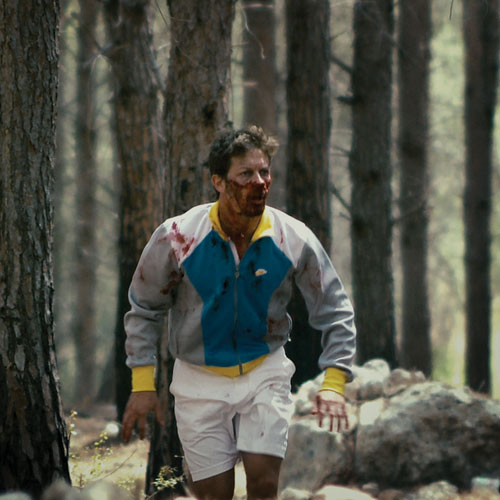
*Attack the Block The Goonies go to a South London projects, with more gore, guts, and gumption? With good reason, writer, director, and Edgar Wright/Simon Pegg cohort Joe Cornish’s own project, Attack the Block, has been getting raves at fests for its effortless, energetic originality, discernible through its thick, glottal stop-chomping, Jafaican-draped local brogue. The question posed, ever so entertainingly: what happens when you pit the toughest kids on the block against a ferocious pack of outer-space critters — not quite out to serve man but rather sever him limb from limb? We start out seeing this gang of at-risk, risk-taking youth through the peepers of a vulnerable female mugging victim and neighbor, Sam (Jodie Whittaker)—they seem as scary as any alien invader and she wants to bring down the full force of the law on them. But the pack, led by Moses (John Boyega, who charismatically scowls like a young 50 Cent), has more pressing matters at hand: a mysterious creature has come crashing down from out of the sky, and naturally, being nasty terrors, they kill it, bringing down a intergalactic shit storm of trouble. Their favorite refuge: the top-floor weed room overseen by Ron (Pegg sidekick Nick Frost), where they attempt to suss out why they’ve become the prime prey for wolfish aliens out for blood. Throw in chills, bike chases, a resourceful use of elevators and dumpsters, and an epic, eerie dubstep theme by Basement Jaxx, and you have a very fun horror-thriller that declines to preach but manages to bring home a message reminiscent of Night of the Living Dead (1968). Consider this a whole-hearted, double-fisted antidote to the fearful vigilantism of films like 2009’s Harry Brown. (1:28) (Chun)

Cameraman: The Life and Work of Jack Cardiff See review at www.sfbg.com. (1:30) Balboa.

Cowboys and Aliens Daniel Craig and Harrison Ford star in Jon Favreau’s sci-fi Western. (runtime not available)

Crazy, Stupid, Love Keep the poster’s allusion to 1967’s The Graduate to one side: there aren’t many revelations about midlife crises in this cleverly penned yet strangely flat ensemble rom-com, awkwardly pitched at almost every demographic at the cineplex. There’s the middle-aged romance that’s withered at the vine: nice but boring family man Cal (Steve Carell) finds himself at a hopeless loss when wife and onetime teenage sweetheart Emily (Julianne Moore) tells him she wants a divorce and she’s slept with a coworker (Kevin Bacon). He ends up waxing pathetic at a slick nightclub where he catches the eye of the well-dressed, spray-tanned smoothie Jacob (Ryan Gosling), who appears to have taken his ladies man stance from the Clooney playbook. It’s manly makeover time: GQ meets Pretty Woman (1990)! Cut to Cal and Emily’s babysitter Jessica (Analeigh Tipton), who is crushing out on Cal, while the separated couple’s tween Robbie (Jonah Bobo) hankers for Jessica. Somehow Josh Groban worms his way into the mix as the dullard suitor of Hannah (Emma Stone) in a hanging chad of a storyline that must somehow be resolved in this mad, mad, mad, mad — actually, the problem with Crazy Stupid Love is that it isn’t really that mad or crazy. It tries far too hard to please everybody in the theater to its detriment, reminding the viewer of a tidy, episodic TV series (albeit a quality effort) like Modern Family more than an actual film. Likewise I yearned for a way to fast-forward through the too-cute Jessica-Robbie scenes in order to get back to the sleazy-smart, punchy complexity of Gosling, playing adeptly off both Carrell and Stone. (1:58) (Chun)

Gunless Action comedy about an American cowboy flummoxed by the ways of the Canadian frontier. (1:29)

A Little Help Jenna Fischer stars as a frazzled single mom in this indie comedy. (1:48)

*The Names of Love Arthur (Jacques Gamblin) is a 40-ish scientist being interviewed about the threat of a bird flu epidemic when his radio broadcast is interrupted by 20-something Baya (Sara Forestier), who denounces him on-air as a “fascist” for frightening the public. But then, Baya tends to use that label rather indiscriminately, applying it to anyone who might conceivably have views to the right of the dial — and Arthur is in fact a solid liberal, which means she can bed him for love. As opposed to the many, many other men she beds as a self-described “political whore,” seeking out conservative types in order to seduce them and hopefully induce an idealogical shift by whispering sweet nothings (“Not all Arabs are thieves,” etc.) as they orgasm. Raised by parents whose emotions are so tightly wound his mother won’t acknowledge her parents were Jews killed at Auschwitz, Arthur has a hard time adjusting to a relationship with a lover who is faithful emotionally but sees promiscuity as her propagandic gift to the world. Meanwhile Baya’s largely Algerian family treats garrulous political argument as the very air they breathe. This odd-couple story written by Baya Kasmi and director Michel Leclerc deals with serious issues in both humorous and respectful fashion, making for one of the more novel, delightful and depthed French romantic comedies in a long time. Added plus: lots of antic gratuitous nudity. (1:42) Smith Rafael. (Harvey)

*NEDs There is bleak, and there is Scottish bleak. Weighed down by class and roundly ignored by apathetic institutions, the non-educated delinquent is the star of writer-director Peter Mullan’s wrenching but delightful NEDS (2010), a dark and curiously fanciful tale of youth in the housing estates of 1970s Glasgow. John McGill (Conor McCarron) is a bright and talented student with high hopes for a future at university until abuse by peers and teachers alike leads him down the well worn path of drinking, fighting, and gang life with the Young Car-Ds, his older brother Benny’s (Joe Szula) crew. The quiet John can’t escape the tide of history that society has set him upon and soon he’s joined the fray, abandoning his academic promise for a life of Doc Martens and concealed blades. As J. McGill so eloquently explains: “Youse want a NED? I’ll gie youse a fucking NED!” (2:03) Balboa. (Cooper Berkmoyer)

The Smurfs in 3D You’re welcome, world! Love, America. (1:43)

The Tree A dead man talks to his bereaved family through a fig tree in French director Julie Bertuccelli’s The Tree. In spite of this heavy-handed premise, the film never does what you expect it to. Amid the stark, savage countryside of Australia, Dawn (Charlotte Gainsbourg) and her four kids try to live life without their husband and father. But this proves an especially thorny endeavor since the tree in question seems to be a stubborn, invasive version of him. As in Lars von Trier’s Antichrist (2009), Gainsbourg embodies the role of grieving woman in another overflowingly open performance. Thankfully for us, this time she stays away from the scissors. The sweeping cinematography by Nigel Bluck is lovely to look at, and the young Morgana Davies is inspiring as Dawn’s 8-year-old daughter, Simone. Unlike that other magical realist Tree movie this summer, Bertuccelli’s film can at least be credited for being entirely unpretentious and kind of sweet. (1:40) (Ryan Lattanzio)

*World on a Wire The words “Rainer Werner Fasbinder” and “science fiction film” are enough to get certain film buffs salivating, but the Euro-trashy interior décor is almost reason enough to see this restored print of the New German Cinema master’s cyber thriller. Originally a two-part TV miniseries, World on a Wire is set in an alternate present (then 1973) in which everything seems to be made of concrete, mirror, Lucite, or orange plastic. When the inventor of a supercomputer responsible for generating an artificial world mysteriously disappears, his handsome predecessor must fight against his corporate bosses to find out what really happened, and in the process, stumbles upon a far more shattering secret about the nature of reality itself. Riffing off the understated cool of Godard’s Alphaville (1965) while beating 1999’s The Matrix to the punch by some 25 years, World on a Wire is a stylistically singular entry in Fassbinder’s prolific filmography. (3:32) Roxie. (Sussman)

ONGOING

Bad Teacher Jake Kasdan, the once-talented director of a few Freaks and Geeks episodes and 2002’s underrated Orange County, seems hell-bent on humiliating everyone in the cast of Bad Teacher. Cameron Diaz is Elizabeth, the title’s criminally bad pedagogue who prefers the Jack Daniels method to the Socratic. Her impetus for pounding Harper Lee into her middle school students’ bug-eyed little heads is to cash in on a bonus check to fund her breast-y ambitions and woo Justin Timberlake and his baby voice. The only likable onscreen presence is Jason Segal as a sad sack gym teacher in love with Elizabeth. But he could do so much better. There’s no shortage of racist jokes and potty humor in this R-rated comedy pandering to those 17 and below. When asked if she wants to go out with her coworkers, Elizabeth ripostes, “I’d rather get shot in the face!” That scenario is likely a better alternative than suffering this steaming pile of cash cow carcass. (1:29) (Lattanzio)

Beats, Rhymes & Life Actor Michael Rapaport probably didn’t set out to make a hip-hop Metallica: Some Kind of Monster (2004), but that’s pretty much where his portrait of A Tribe Called Quest ends up. The first half of Beats, Rhymes & Life: The Travels of A Tribe Called Quest is predictably worshipful, slathering on low angles and slow motion to cover mediocre live shows. More effectively, Rapaport traces the Queens group’s brief incubation period and subsequent breakthroughs in what would later be called alternative or, more obnoxiously, conscious hip-hop. A slew of notable followers and contemporaries toast Tribe’s first three albums, but by the time Rapaport catches up to the group’s 2008 reunion even their longtime friends De La Soul are wishing they’d call the whole thing off. The documentary slides into the Monster zone of hurt feelings and passive aggressive behavior in accounting for the group’s split after their inappropriately named 1998 album, The Love Movement. Phife Dawg and Q-Tip are the warring egos, though perennially slighted Phife is really no match for the imperially cool Tip. DJ Ali Shaheed Muhammad is the Kirk Hammett of the outfit, looking on helplessly as the two bigger personalities make a mess of things. There’s still novelty in a story about aging in hip-hop, but Rapaport’s portrait is utterly conventional. He also doesn’t pursue more interesting questions of race and politics that naturally follow the band’s crossover appeal. (1:38) (Goldberg)

*Beginners There is nothing conventional about Beginners, a film that starts off with the funeral arrangements for one of its central characters. That man is Hal (Christopher Plummer), who came out to his son Oliver (Ewan McGregor) at the ripe age of 75. Through flashbacks, we see the relationship play out — Oliver’s inability to commit tempered by his father’s tremendous late-stage passion for life. Hal himself is a rare character: an elderly gay man, secure in his sexuality and, by his own admission, horny. He even has a much younger boyfriend, played by the handsome Goran Visnjic. While the father-son bond is the heart of Beginners, we also see the charming development of a relationship between Oliver and French actor Anna (Mélanie Laurent). It all comes together beautifully in a film that is bittersweet but ultimately satisfying. Beginners deserves praise not only for telling a story too often left untold, but for doing so with grace and a refreshing sense of whimsy. (1:44) (Peitzman)

A Better Life (1:38)

*Bill Cunningham New York To say that Bill Cunningham, the 82-year old New York Times photographer, has made documenting how New Yorkers dress his life’s work would be an understatement. To be sure, Cunningham’s two decades-old Sunday Times columns — “On the Street,” which tracks street-fashion, and “Evening Hours,” which covers the charity gala circuit — are about the clothes. And, my, what clothes they are. But Cunningham is a sartorial anthropologist, and his pictures always tell the bigger story behind the changing hemlines, which socialite wore what designer, or the latest trend in footwear. Whether tracking the near-infinite variations of a particular hue, a sudden bumper-crop of cropped blazers, or the fanciful leaps of well-heeled pedestrians dodging February slush puddles, Cunningham’s talent lies in his ability to recognize fleeting moments of beauty, creativity, humor, and joy. That last quality courses through Bill Cunningham New York, Richard Press’ captivating and moving portrait of a man whose reticence and personal asceticism are proportional to his total devotion to documenting what Harold Koda, chief curator at the Costume Institute at the Metropolitan Museum of Art, describes in the film as “ordinary people going about their lives, dressed in fascinating ways.” (1:24) (Sussman)

Bride Flight Who doesn’t love a sweeping Dutch period piece? Ben Sombogaart’s Bride Flight is pure melodrama soup, enough to give even the most devout arthouse-goer the bloats. Emigrating from post-World War II Holland to New Zealand with two gal pals, the sweetly staid Ada (Karina Smulders) falls for smarm-ball Frank (Waldemar Torenstra, the Dutchman’s James Franco) and kind of joins the mile high club to the behest of her conscience. The women arrive with emotional baggage and carry-ons of the uterine kind. As the harem adjusts to the country mores of the Highlands, Frank tries a poke at all of them in a series of sex scenes more moldy than smoldery. This Flight, set to a plodding score and stuffy mise-en-scene, never quite leaves the runway. Not to mention the whole picture, pale as a corpse, resembles one of those old-timey photographs of your great grandma’s wedding. These kinds of pastoral romances ought to be put out to, well, pasture. (2:10) (Lattanzio)

*Bridesmaids For anyone burned out on bad romantic comedies, Bridesmaids can teach you how to love again. This film is an answer to those who have lamented the lack of strong female roles in comedy, of good vehicles for Saturday Night Live cast members, of an appropriate showcase for Melissa McCarthy. The hilarious but grounded Kristen Wiig stars as Annie, whose best friend Lillian (Maya Rudolph) is getting hitched. Financially and romantically unstable, Annie tries to throw herself into her maid of honor duties — all while competing with the far more refined Helen (Rose Byrne). Bridesmaids is one of the best comedies in recent memory, treating its relatable female characters with sympathy. It’s also damn funny from start to finish, which is more than can be said for most of the comedies Hollywood continues to churn out. Here’s your choice: let Bridesmaids work its charm on you, or never allow yourself to complain about an Adam Sandler flick again. (2:04) (Peitzman)

Buck This documentary paints a portrait of horse trainer Buck Brannaman as a sort of modern-day sage, a sentimental cowboy who helps “horses with people problems.” Brannaman has transcended a background of hardship and abuse to become a happy family man who makes a difference for horses and their owners all over the country with his unconventional, humane colt-starting clinics. Though he doesn’t actually whisper to horses, he served as an advisor and inspiration for Robert Redford’s The Horse Whisperer (1998). Director Cindy Meehl focuses generously on her saintly subject’s bits of wisdom in and out of a horse-training setting — e.g. “Everything you do with a horse is a dance” — as well as heartfelt commentary from friends and colleagues. In the harrowing final act of the film, Brannaman deals with a particularly unruly horse and his troubled owner, highlighting the dire and disturbing consequences of improper horse rearing. (1:28) Smith Rafael. (Sam Stander)

Captain America: The First Avenger OK, Marvel. I could get behind 2008’s Iron Man (last year’s Iron Man 2, not so much), but after Thor and now Captain America, I’m starting to get cynical about this multi-year build-up to the full-on Avengers movie, due in May 2012. Can even a superhero-stuffed movie directed by Joss Whedon live up to all this hype? There’s plenty of time to ponder, and maybe worry a little, with Captain America’s backstory-explaining picture now in theaters. Chris Evans stars as the 90-pound weakling who morphs into a supersoldier, thanks to the World War II-era tinkerings of a scientist (Stanley Tucci) and an inventor (Dominic Cooper as Howard Stark, a.k.a. Iron Man’s dad). The original plan for the musclebound shield-bearer (fighting Nazis, natch) gets waylaid a bit when the newly famous Captain America becomes a PR prop for the U.S. government; it’s abandoned entirely when a worse-than-Hitler foe, in the guise of power-obsessed Red Skull (Hugo Weaving), threatens the world. Directed by Spielberg cohort Joe Johnston, Captain America is gee-whiz enjoyable enough, but it’s very nearly the same movie as Thor, which no amount of Tommy Lee Jones (as a sarcastic army colonel) wisecracks can conceal. And here’s an anti-spoiler: there’s no post-credits surprise in this one, so you can bolt as soon as they start to roll. (2:09) (Eddy)

Cars 2 You pretty much can’t say a bad thing about a Pixar film. Cars 2 is by no means Ratatouille (2007) or Wall-E (2008), but the sequel to the 2006 hit Cars offers plenty of sleek visuals and one-note gags under its hollow hood. If nothing else, Pixar seems to have overcome the dingy, dark glaze that plagues 3-D films. Directors John Lasseter and Joe Ranft return to beloved autos Lightning McQueen (Owen Wilson) and the “extremely American” Mater (Larry the Cable Guy). This time around, secret agents Finn McMissile (Michael Caine) and Holley Shiftwell (Emily Mortimer) come along for the ride while working to expose sabotage in the alternative fuel industry. Compelling chase sequences, explosions and more than a few jabs at cultural stereotypes follow suit. This is the lightest, silliest Pixar film to date, but you probably don’t have any business seeing it unless you’ve got a kid in tow. (1:52) (Lattanzio)

*Cave of Forgotten Dreams The latest documentary from Werner Herzog once again goes where no filmmaker — or many human beings, for that matter — has gone before: the Chauvet-Pont-d’Arc Cave, a heavily-guarded cavern in Southern France containing the oldest prehistoric artwork on record. Access is highly restricted, but Herzog’s 3D study is surely the next best thing to an in-person visit. The eerie beauty of the works leads to a typically Herzog-ian quest to learn more about the primitive culture that produced the paintings; as usual, Herzog’s experts have their own quirks (like a circus performer-turned-scientist), and the director’s own wry narration is peppered with random pop culture references and existential ponderings. It’s all interwoven with footage of crude yet beautiful renderings of horses and rhinos, calcified cave-bear skulls, and other time-capsule peeks at life tens of thousands of years ago. The end result is awe-inspiring. (1:35) (Eddy)

Empire of Silver Love, not money, is at the core of Empire of Silver — that’s the M.O. of a Shanxi banking family’s libertine third son, or “Third Master” (Aaron Kwok) in this epic tug-of-war between Confucian duty and free will. The Third Master pines for his true love, his stepmother (Hao Lei), yet change is going off all around the star-crossed couple in China at the end of the 19th century and the start of the 20th, and the youthful scion ends up pouring his passion into the family business, attempting to tread his own path, apart from his Machiavellian father (Tielin Zhang). Much like her protagonist, however, director (and Stanford alum) Christina Yao seems more besotted with romance than finance, bathing those scenes with the love light and sensual hues reminiscent of Zhang Yimou’s early movies. Though Yao handles the widescreen crowd scenes with aplomb, her chosen focus on money, rather than honey, leaches the action of its emotional charge. It doesn’t help that, on the heels of the Great Recession, it’s unlikely that anyone buys the idea of a financial industry with ironclad integrity — or gives a flying yuan about the lives of bankers. (1:52) (Chun)

*Friends With Benefits If you see only one romantic comedy this summer about a sex-sans-pair-bonding pact between a girl and a guy saddled with intimacy issues — well, chances are, if you tend to see movies with premises like this, you probably already saw No Strings Attached. In which case, poor unlucky Friends with Benefits may be filed away in your brain as that other movie about fuckbuddies, the one in which Ashton Kutcher is played by Justin Timberlake and Natalie Portman (in a slightly eerie cosmic echo of last year’s Black Swan) is played by Mila Kunis. But if you see two such movies this summer, and admit it, you probably might, you’ll likely agree that FWB kicks NSA‘s booty call, particularly in the areas of scriptwriting ingenuity, pacing, and the casting subcategory of basic chemistry between romantic leads, with points possibly taken off for shark-jumping use of flash mobs and the fact that the maddeningly sticky song “Closing Time” will now be with you from closing credits ’til doomsday. This is not a searing, psychologically nuanced portrayal of two young people’s struggles to grapple with modern-day sexual mores and their own crippling pathologies — rather, the pair’s emotional baggage mostly seems to be stuffed with packing peanuts, and scenes in which they catalog their sexual proclivities in a humorously businesslike, gently raunchy fashion reveal them to be hearteningly adept at the art of communication. But such moments keep us entertained as the film, salted with light jabs at the genre’s worn-down touchstones yet utterly complicit, depicts the inevitable stages of a non-relationship relationship. (1:44) (Rapoport)

The Hangover Part II What do you do with a problematic mess like Hangover Part II? I was a fan of The Hangover (2009), as well as director-cowriter Todd Phillips’ 1994 GG Allin doc, Hated, so I was rooting for II, this time set in the East’s Sin City of Bangkok, while simultaneously dreading the inevitable Asian/”ching-chang-chong” jokes. Would this would-be hit sequel be funnier if they packed in more of those? Doubtful. The problem is that most of II‘s so-called humor, Asian or no, falls completely flat — and any gross-out yuks regarding wicked, wicked Bangkok are fairly old hat at this point, long after Shocking Asia (1976) and innumerable episodes of No Reservations and other extreme travel offerings. This Hangover around, mild-ish dentist Stu (Ed Helms) is heading to the altar with Lauren (The Real World: San Diego‘s Jamie Chung), with buds Phil (Bradley Cooper) and Doug (Justin Bartha) in tow. Alan (Zach Galifianakis) has completely broken with reality — he’s the pity invite who somehow ropes in the gangster wild-card Mr. Chow (Ken Jeong). Blackouts, natch, and not-very-funny high jinks ensue, with Jeong, surprisingly, pulling small sections of II out of the crapper. Phillips obviously specializes in men-behaving-badly, but II‘s most recent character tweaks, turning Phil into an arrogant, delusional creep and Alan into an arrogant, delusional kook, seem beside the point. Because almost none of the jokes work, and that includes the tired jabs at tranny strippers because we all know how supposedly straight white guys get hella grossed out by brown chicks with dicks. Lame. (1:42) (Chun)

*Harry Potter and the Deathly Hallows Part 2 Chances are you aren’t going to jump into the Harry Potter series with Harry Potter and the Deathly Hallows Part 2. So while the movie is probably the best Harry Potter film yet, it’s more a fitting conclusion than a standalone film. For fans of the books, there are no real surprises — this is a close adaptation. And for those Harry Potter movie fans who haven’t read the books, shame on you, and kudos if you managed to not get spoiled. It’s hard for me to offer a serious critical analysis of Part 2, because it represents the end of a long and very emotional journey. (Everyone in that audience was crying. Everyone.) I will say that, as was the case in the book, there are a few overdone, schmaltzy moments that aren’t really necessary. But in the context of the series, they’re forgivable — this may not be the great cinematic event of our generation, but Harry Potter as a whole is sure to be one of our most enduring cultural icons. (2:10) (Peitzman)

Horrible Bosses Lead by a clearly talented ensemble of comic actors, Horrible Bosses is yet another example of a big-budget summer comedy with a promising conceit (see Bad Teacher) that fails to deliver anything but crude alms to the lowest common denominator. Seth Gordon directs Jason Bateman, Jason Sudeikis, and Charlie Day as three pals fed up with their evil employers (Kevin Spacey, Colin Farrell and Jennifer Aniston, respectively) so they hatch a plan to have them killed. Because the answer to their problem obviously lies in a dive bar in the “bad part of town,” Jamie Foxx plays Motherfucker Jones, their murder consultant and the film’s most likable character-stereotype. In the tradition of The Hangover (2009) and its ilk of beer-guzzling, frat-boy cousins, Horrible Bosses is a disastrous pile-up of idiocy that’s more vapid than vulgar despite a few amusing performances. See it for no other reason than Michael Bluth and Charlie Kelly on coke. (1:33) (Lattanzio)

Larry Crowne While Transformers: Dark of the Moon may be getting all the attention for being the most terrible summer movie, I’d like to propose Larry Crowne as the bigger offender. No, it doesn’t have the abrasive effects of a Michael Bay blockbuster, but it’s surely just as incompetent. And coming from an actor as talented as Tom Hanks — who co-wrote, directed, produced, and stars in the film —Larry Crowne is insulting. The plot, insofar as there is one, centers around the titular Larry (Hanks), a man who goes to community college, joins a scooter gang led by Wilmer Valderrama, and ends up falling for his cranky, alcoholic teacher Mercedes (Julia Roberts). The scenes are thrown together hapharzadly, with no real sense of character development or continuity. Larry Crowne doesn’t even feel like a romantic comedy until a drunk Mercedes begins kissing and dry humping her student. But hey, who can resist a shot of Larry’s middle-aged bottom as he tries to wriggle into jeans that are just too small? (1:39) (Peitzman)

Life, Above All It’s tough enough to simply grow up, let alone care for a parent with AIDS and deal with the suspicions and fears of the no-nothing adults all around you. Rising above easy preaching and hand-wringing didacticism, Life, Above All takes as its blueprint the 2004 best-seller by Allan Stratton, Chandra’s Secrets, and makes compelling work of the story of 12-year-old Chandra (Khomotso Manyaka) and her unfortunate family, unable to get effective help amid the thicket of ignorance regarding AIDS in Africa. After her newborn sister dies, Chandra finds her loyalty torn between her bright-eyed best friend Esther (Keaobaka Makanyane), who’s rumored to hooking among the truck drivers in their dusty, sun-scorched rural South African hometown, and her mother (Lerato Mvelase), who listens far too closely to her bourgie friend Mrs. Tafa (an OTT Harriet Manamela), for her own good. Cape Town native director Oliver Schmitz sticks close to the action playing across his actors’ faces, and he’s rewarded, particularly by the graceful Manyaka, in this life-affirmer about little girls forced to shoulder heart-breaking responsibility far too soon. (1:46) (Chun)

Midnight in Paris Owen Wilson plays Gil, a self-confessed “Hollywood hack” visiting the City of Light with his conservative future in-laws and crassly materialistic fiancée Inez (Rachel McAdams). A romantic obviously at odds with their selfish pragmatism (somehow he hasn’t realized that yet), he’s in love with Paris and particularly its fabled artistic past. Walking back to his hotel alone one night, he’s beckoned into an antique vehicle and finds himself transported to the 1920s, at every turn meeting the Fitzgeralds, Gertrude Stein (Kathy Bates), Dali (Adrien Brody), etc. He also meets Adriana (Marion Cotillard), a woman alluring enough to be fought over by Hemingway (Corey Stoll) and Picasso (Marcial di Fonzo Bo) — though she fancies aspiring literary novelist Gil. Woody Allen’s latest is a pleasant trifle, no more, no less. Its toying with a form of magical escapism from the dreary present recalls The Purple Rose of Cairo (1985), albeit without that film’s greater structural ingeniousness and considerable heart. None of the actors are at their best, though Cotillard is indeed beguiling and Wilson dithers charmingly as usual. Still — it’s pleasant. (1:34) (Harvey)

*Page One: Inside the New York Times When Andrew Rossi’s documentary premiered at Sundance this January, word of mouth on it was respectable but qualified, with nearly everyone opining that it was good … just not what they’d been led to expect. What they expected was (in line with the original subtitle A Year Inside the New York Times) a top-to-bottom overview of how the nation’s most respected — and in some circles resented — arbiter of news, “style,” and culture is created on a day-to-day as well as longer term basis. That’s something that would doubtless fascinate anyone still interested in print media, or even that realm of web media not catering to the ADD nation. But that big picture and the wealth of minute cogs within isn’t Page One‘s subject. Instead, Rossi focuses on the Gray Lady’s wrestling with admittedly fast-changing times in which newspapers and any other information source on paper seem to constitute an endangered species. This particular Times, however, is such a special case that that crisis might better have been explored by training a camera on a less fabled publication, perhaps one of the many that have succumbed to a once unthinkable, market-shrunk mortality in recent years. The film finds its colorful protagonist in David Carr, an ex-crack addict turned media columnist who retains his cranky, nonconformist edge even as he defends the Times itself from the same out-with-the-old cheerleaders who 15 years ago were inflating the dot-com boom till it burst. Facing one particularly smug champion of the blogosphere at a forum, Carr notes that without a few remaining outlets — like the Times — doing the hard work of serious research and reportage, the web would have nothing to purloin or offer but its own unending trivia and gossip. Page One does what it does entertainingly well, but if you’re looking for insight toward this not-dead-yet U.S. institution as a whole, you’d be better off simply picking up this week’s Sunday edition and reading every last word. (1:28) Smith Rafael. (Harvey)

Pirates of the Caribbean: On Stranger Tides The last time we saw rascally Captain Jack Sparrow (Johnny Depp), he was fighting his most formidable enemy yet: the potentially franchise-ending Pirates of the Caribbean: At World’s End (2007). The first Pirates movie (2003) was a surprise critical success, earning Depp his first-ever Oscar nomination; subsequent entries, though no less moneymaking, suffered from a detectable case of sequel-itis. Overseeing this reboot of sorts is director Rob Marshall (2002’s Chicago), who keeps the World’s End notion of sending Jack to find the Fountain of Youth, but adds in a raft of new faces, including Deadwood‘s Ian McShane (as Blackbeard) and lady pirate Penélope Cruz. The story is predictably over-the-top, with the expected supernatural elements mingling with sparring both sword-driven and verbal — as well as an underlying theme about faith that’s nowhere near as fun as the film’s lesser motifs (revenge, for one). It’s basically a big swirl of silly swashbuckling, nothing more or less. And speaking of Depp, the fact that the oft-ridiculous Sparrow is still an amusing character can only be chalked up to the actor’s own brand of untouchable cool. If it was anyone else, Sparrow’d be in Austin Powers territory by now. (2:05) (Eddy)

*Project Nim This is the story of an individual plucked from their native culture even before birth, separated from parents shortly after, handed over to a chaotic if loving urban foster family, yanked from them to a lavish, isolated country estate, then shipped off to a medical experimentation lab, “rescued” only to be placed in prison like solitary confinement, and … well, things finally get a little better, but isn’t this enough abuse for several lifetimes? Before you call Child Services or the ACLU, be informed that this is not the saga of a human being, but one Nim Chimpsky, a chimpanzee born in U.S. captivity, then set on a highly unusual life course as the subject of a study in animal language acquisition by Columbia University linguist Herbert S. Terrace. Nim did indeed prove remarkably adept at learning sign language to communicate with his teachers/minders — even if Terrace finally belittled that as no more than imitation performed to beg food and other favor. Nim was a prodigy, and for a while a media sensation. He was also a temperamental, physically powerful wild beast who could (and sometimes did) cause considerable harm to those around him. Regardless, both his adaptation to human habitats and animal instincts should have been deal with a great deal more care and consistency — there was no overall plan for his well-being beyond serving (or being abandoned by) whoever his keepers were at any given moment. This latest documentary by James Marsh (2008’s Man on Wire, 1999’s Wisconsin Death Trip) is an involving story whose latter-day interviewees — tumbling rather easily into hero and villain categories, with Prof. Terrance not in the first camp — annotate an enormous amount of archival footage shot throughout Nim’s life. (1:33) (Harvey)

*Rapt Colder than cool — and pokerfaced in its perusal of all the angles — this hostage thriller takes as its starting point the real-life 1978 kidnapping of Belgian aristo Baron Edouard-Jean Empain. Slick industrialist Stanislas Graff (Yvan Attal) is smoothly going through the motions of life — preparing for a sojourn to China alongside heads of state, swinging through his gambling den, indulging in an afternoon tryst with a mistress, then heading home to make fatherly noises for the family. Graff’s seamless, impressively precise kidnapping effectively cock-blocks the routine. Fifty million euros is the ransom, and the kidnappers quickly, brutally demonstrate that they mean bidness. Filmmaker Lucas Belvaux tests the tension at home, in the boardroom, among law enforcement, while the ugly details of Graff’s day-to-day life are laid bare by the French tabloids, much like dismembered body parts — and giving off a whiff of the hypocrisies surrounding ex-IMF chief Dominique Strauss-Kahn. More often behind the camera than before it, Attal offers what might be his best performance as the entitled scion reduced to a cowering bag of bones and scar tissue. He’s well-matched by Anne Consigny as his shell-shocked spouse and Alex Descas as his lawyer, as Belvaux efficiently delivers his core query with almost zero melodrama: who’s the more brutal player in this high-stakes game — the so-called terrorists or the cutthroat captains of industry? (2:05) (Chun)

*Road to Nowhere “Legendary” is a term often applied to artists distinguished by either ubiquity or scarcity. Monte Hellman (1971’s Two-Lane Blacktop) definitely falls in the second camp — nearly 80, he’s just made his first feature in 22 years, causing a flurry of interest in the sparse 10 he made during the prior three decades he was, relatively speaking, active — movies hardly anyone saw when they came out since none were more than a blip on the commercial radar. Hellman’s career has largely been off the map — as a director and editor for hire, often fixing problems (like directors who die mid-production) without screen credit. Whether Road to Nowhere qualifies as summary statement or aberration has already divided viewers since its Venice premiere last fall. It’s a hall of mirrors in which a hotshot filmmaker (Tygh Runyan) making a movie about a woman’s apparent real-life murder casts an alluring non-actress (Shannyn Sossamon) whom an insurance investigator (Waylon Payne) and reporter (Dominique Swain) come to suspect might be playing herself — having faked her own death and adopted a new identity. The mix of noir, reality-illusion puzzle, industry in-jokes, film history name-dropping (as well as archival clips), uneven performances, sometimes stilted dialogue, brief startling violence, and handsome compositions (shot without permits on a hand-held digital camera) can be taken as two hours of delicious gamesmanship or exasperating self-indulgence. But no one can argue that by now Hellman hasn’t earned his right to be difficult. (2:02) Roxie, Smith Rafael. (Harvey)

*Snow Flower and the Secret Fan Working with Lisa See’s novel, director Wayne Wang returns to the crowd-pleasing territory of his wildly popular Joy Luck Club (1993) — fortunately it’s also material that feels intensely personal, even transposed in 21st century China (one of those modern Chinese women, Rupert Murdoch’s wife Wendi bought the rights to the book and provides a financial boost here). Modern-day Nina (Bingbing Li) is about to leave her native Shanghai for NYC and certain success in the banking world when she learns that her best friend, her laotong or sworn sister, Sophia (Gianna Jun), is in a coma. She must piece together the mystery of her friend’s life since they last parted, studying the book written about her 19th century forbearer Snow Flower (also Jun) and her own laotong Lily (Li). An uncredited turn by Hugh Jackman as a caddish boyfriend is beside the point here; Wang’s take on the bond of friendship that ties two women together, beyond the pain of foot-binding, marriage, class, and adversity is tremulously sentimental, in way that will have many would-be Joy Luck Club-ers happily identifying with these sisters from other mothers — and leave everyone else sobbing in the darkness. (1:40) (Chun)

*Super 8 The latest from J.J. Abrams is very conspicuously produced by Steven Spielberg; it evokes 1982’s E.T.: The Extra-Terrestrial as well as 1985’s The Goonies and 1982’s Poltergeist (so Spielbergian in nature you’d be forgiven for assuming he directed, rather than simply produced, the pair). But having Grandpa Stevie blessing your flick is surely a good thing, especially when you’re already as capable as Abrams. Super 8 is set in 1979, high time for its titular medium, used by a group of horror movie-loving kids to film their backyard zombie epic; later in the film, old-school celluloid reveals the mystery behind exactly what escaped following a spectacular train wreck on the edge of their small Ohio town. The PG-13 Super 8 aims to frighten, albeit gently; there’s a lot of nostalgia afoot, and things do veer into sappiness at the end (that, plus the band of kids at its center, evoke the trademarks of another Grandpa Stevie: Stephen King). But the kid actors (especially the much-vaunted Elle Fanning) are great, and there’s palpable imagination and atmosphere afoot, rare qualities in blockbusters today. Super 8 tries, and mostly succeeds, in progressing the fears and themes addressed by E.T. (divorce, loneliness, growing up) into century 21, making the unknowns darker and the consequences more dire. (1:52) (Eddy)

*Tabloid Taking a break from loftier subjects, Errol Morris’ latest documentary simply finds a whopper of a story and lets the principal participant tell her side of it — one we gradually realize may be very far from the real truth. In 1978 former Miss Wyoming Joyce McKinney flew to England, where the Mormon boy she’d grown infatuated with had been posted for missionary work by his church. What ensued became a U.K. tabloid sensation, as the glamorous, not at all publicity-shy Yankee attracted accusations of kidnapping, imprisonment, attempted rape and more. Her victim of love, one Kirk Anderson, is not heard from here — presumably he’s been trying to live down an embarrassing life chapter ever since. But we do hear from others who shed considerable light on the now middle-aged McKinney’s continued protestations that it was all just one big misunderstanding. Most importantly, we hear from the lady herself — and she is colorful, unflappable, unapologetic, and quite possibly stone-cold nuts. (1:28) (Harvey)

*Terri What happens when the camera stops on the quiet, shy and heavy 15-year-old in the corner of the classroom? Terri might be his story — if he cut class regularly to avoid being teased about his man-breasts, wore PJs to school, and befriended an affable, straight-talking Shrek of a teacher. Painfully awkward Terri (Jacob Wysocki) is ignored or mocked by most, left to feed the mice he catches in traps to passing raptors, care for his ailing uncle, and avoid the school bullies as best he can. But assistant principal Mr. Fitzgerald (John C. Reilly), who has a habit of nurturing the school’s misfits, recognizes Terri’s tender heart and takes him under his wing. It’s catching, apparently, as Terri first befriends the hair-pulling Chad (Bridger Zadina) and then Heather, the girl who allows herself be fingered in home ec (Olivia Crocicchia). What transpires among these school outcasts, shaped by director-writer Azazel Jacobs, subtly subverts your conventional teen identity story arc —Terri isn’t the only one here that’s good-hearted. (1:45) (Chun)

*13 Assassins 13 Assassins is clearly destined to be prolific director Takashi Miike’s greatest success outside Japan yet. It’s another departure for the multi-genre-conquering Miike, doubtless one of the most conventional movies he’s made in theme and execution. That’s key to its appeal — rigorously traditional, taking its sweet time getting to samurai action that is pointedly not heightened by wire work or CGI, it arrives at the kind of slam-dunk prolonged battle climax that only a measured buildup can let you properly appreciate. In the 1840s, samurai are in decline but feudalism is still hale. It’s a time of peace, though not for the unfortunates who live under regional tyrant Lord Naritsugu (Goro Inagaki), a li’l Nippon Caligula who taxes and oppresses his people to the point of starvation. Alas, the current Shogun is his sibling, and plans to make little bro his chief adviser — so a concerned Shogun official secretly hires veteran samurai Shinzaemon (Koji Yakusho) to assassinate the Lord. Fully an hour is spent on our hero doing “assembling the team” stuff, recruiting other unemployed, retired, or wannabe samurai. When the protagonists finally commence their mission, their target is already aware he’s being pursued, and he’s surrounded by some 200 soldiers by the time Miike arrives at the film’s sustained, spectacular climax: a small village which Shinzaemon and co. have turned into a giant boobytrap so that 13 men can divide and destroy an ogre-guarding army. A major reason why mainstream Hollywood fantasy and straight action movies have gotten so depressingly interchangeable is that digital FX and stunt work can (and does) visualize any stupid idea — heroes who get thrown 200 feet into walls by monsters then getting up to fight some more, etc. 13 Assassins is thrilling because its action, while sporting against-the-odds ingeniousness and sheer luck by our heroes as in any trad genre film, is still vividly, bloodily, credibly physical. (2:06) (Harvey)

Transformers: Dark of the Moon I’ll never understand the wisdom behind epic-length children’s movies. What child — or adult, for that matter — wants to sit through 154 minutes of assaultive popcorn entertainment? It’s an especially confounding decision for this third installment in the Transformers franchise because there’s a fantastic 90-minute movie in there, undone at every turn by some of the worst jokes, most pointless characters, and most hateful cultural politics you’re likely to see this summer. But when I say a fantastic movie, I mean a fantastic movie. It took two very expensive earlier attempts before director Michael Bay figured out that big things require a big canvas. Every shot of Dark of the Moon‘s predecessors seemed designed to hide their effects by crowding the screen. Finally we get the full view — the scale is now rightly calibrated to operatic and ridiculous. The marquee set pieces are inspired and terrifying, eliciting a sense of vertigo that’s earned for once, not imposed by the editing. The human hijinks are less consistent but ingratiatingly batshit, and without resorting to preening self-awareness and elaborately contrived mea culpas. But unfortunately Bay is too unapologetic even to walk back the ethnic buffoonery that not only upsets hippies like me but also seems defiantly disharmonious with the movie he’s trying to make. Bay is like that guy at the party who thinks amping up the racism will prove he’s not a racist. It’s that kind of garbage (plus, I guess, some universal primal hatred of Shia LaBeouf that I don’t really get) that makes people dismiss these movies wholesale. This time it’s just not deserved. I wouldn’t want to meet the asshole who made this thing, but credit where credit is due. It’s a visual marvel with perfectly integrated, utterly tactile, brilliantly choreographed CG robotics — a point that’ll no doubt be conceded in passing as if it’s not the very reason the movie exists. As if it’s not a feat of mastery to make a megaton changeling truck look graceful. (2:34) (Jason Shamai)

The Tree of Life Mainstream American films are so rarely adventuresome that overreactive gratitude frequently greets those rare, self-conscious, usually Oscar-baiting stabs at profundity. Terrence Malick has made those gestures so sparingly over four decades that his scarcity is widely taken for genius. Now there’s The Tree of Life, at once astonishingly ambitious — insofar as general addressing the origin/meaning of life goes — and a small domestic narrative artificially inflated to a maximally pretentious pressure-point. The thesis here is a conflict between “nature” (the way of striving, dissatisfied, angry humanity) and “grace” (the way of love, femininity, and God). After a while Tree settles into a fairly conventional narrative groove, dissecting — albeit in meandering fashion — the travails of a middle-class Texas household whose patriarch (a solid Brad Pitt) is sternly demanding of his three young sons. As a modern-day survivor of that household, Malick’s career-reviving ally Sean Penn has little to do but look angst-ridden while wandering about various alien landscapes. Set in Waco but also shot in Rome, at Versailles, and in Saturn’s orbit (trust me), The Tree of Life is so astonishingly self-important while so undernourished on some basic levels that it would be easy to dismiss as lofty bullshit. Its Cannes premiere audience booed and cheered — both factions right, to an extent. (2:18) Smith Rafael (Harvey)

*The Trip Eclectic British director Michael Winterbottom rebounds from sexually humiliating Jessica Alba in last year’s flop The Killer Inside Me to humiliating Steve Coogan in all number of ways (this time to positive effect) in this largely improvised comic romp through England’s Lake District. Well, romp might be the wrong descriptive — dubbed a “foodie Sideways” but more plaintive and less formulaic than that sun-dappled California affair, this TV-to-film adaptation displays a characteristic English glumness to surprisingly keen emotional effect. Playing himself, Coogan displays all the carefree joie de vivre of a colonoscopy patient with hemorrhoids as he sloshes through the gray northern landscape trying to get cell reception when not dining on haute cuisine or being wracked with self-doubt over his stalled movie career and love life. Throw in a happily married, happy-go-lucky frenemy (comic actor Rob Brydon) and Coogan (TV’s I’m Alan Partridge), can’t help but seem like a pathetic middle-aged prick in a puffy coat. Somehow, though, his confused narcissism is a perverse panacea. Come for the dueling Michael Caine impressions and snot martinis, stay for the scallops and Brydon’s “small man in a box” routine. (1:52) Smith Rafael. (Devereaux)

Winnie the Pooh (1:09)<\!s>2


Best of the Bay 2011 Readers Poll: City Living

1

BEST OF THE BAY 2011: READERS POLL

CITY LIVING


BEST STREET FAIR

Folsom Street Fair

www.folsomstreetfair.com


BEST HOTEL

The Fairmont Hotel

950 Mason, SF. (415) 772-5000, www.fairmont.com


BEST TOURIST ATTRACTION

Golden Gate Bridge


BEST TOUR

Local Tastes of the City

2179 12th Ave., SF. (415) 665-0480 and 588 Sutter, SF. (415) 665-0480 www.localtastesofthecitytours.com


BEST OVERALL LOCAL BLOG

SFist

www.sfist.com


BEST OVERALL LOCAL WEBSITE

Funcheap SF

www.sf.funcheap.com


BEST STARTUP COMPANY

Square

www.squareup.com


BEST NEWS BLOG OR SITE

Bay Citizen

www.baycitizen.org


BEST STYLE BLOG OR SITE

No Pants 2011

www.nopants2011.com


BEST SEX BLOG OR SITE

Tiny Nibbles

www.tinynibbles.com


BEST POLITICIAN, BEST POLITICIAN YOU LOVE TO HATE

Gavin Newsom


BEST NONPROFIT ORGANIZATION

Rocket Dog Rescue

www.rocketdogrescue.org


BEST ADULT EDUCATION

The Writing Salon

Various locations, www.writingsalons.com


BEST TV NEWSCASTER

Dana King of CBS


BEST LOCALLY PRODUCED TV SHOW

Check Please Bay Area

blogs.kqed.org/checkplease


BEST RADIO STATION

97.3 Alice

radioalice.radio.com


BEST RADIO DJ

Sarah and Vinnie of 97.3 Alice


BEST RADIO SHOW

Fernando and Greg of Movin 99.7


BEST PLACE TO GET A TATTOO

Black and Blue Tattoo

381 Guerrero, SF. (415) 626-0770, www.blackandbluetattoo.com


BEST TATTOO ARTIST

Karen Roze of Sacred Rose


BEST LOCAL ANIMAL RESCUE

SF SPCA

www.sfspca.org


BEST DOG-WALKING SERVICE

Oakland Dog Walker

(510) 863-0691,www.oakland-dog.com


BEST PET GROOMER

VIP Grooming

4299 24th St., SF. (415) 282-1393


BEST VETERINARIAN

Mission Pet Hospital

720 Valencia, SF. (415) 552-1969, www.missionpet.com


BEST DENTIST

Blair A. Keck, DDS

4128 18th St., SF. (415) 863-9255


BEST DOCTOR

Erika Horowitz, ND

(415) 643-6600, www.sfnatmed.com


BEST PLUMBER

Thomas Friel Plumbing

245 Connecticut, SF. (415) 626-1662


BEST ELECTRICIAN

Pauric Electric

541 Scott, SF. (415) 234-0839, www.thesfelectrician.com


BEST MOVING SERVICE

Delancey Street Moving and Trucking

600 Embarcadero, SF. (415) 512-5110, www.delanceystreetfoundation.org


BEST ALTERNATIVE HEALING

Double Happiness Health

1501 Mariposa, Suite 318, SF. (415) 255-2252, www.doublehappinesshealth.com


BEST THERAPIST

Kendra Rae of Linea Body

www.lineabody.com


BEST CAR MECHANICS

Pat’s Garage

1090 26th St., SF. (415) 647-4500, www.patsgarage.com


BEST MOTORCYCLE REPAIR

Charlie’s Place

3084 17th St., SF. (415) 255-0316, www.charlies-place.com


BEST BICYCLE REPAIR

Valencia Cyclery

1065 and 1077 Valencia, SF. (415) 550-6601, www.valenciacyclery.com


BEST SHOE REPAIR

Haight Street Shoe Repair

1614 Haight, SF. (415) 565-6710


BEST TAILOR

Al’s Attire

1314 Grant, SF. (415) 693-9900, www.alsattire.com


BEST LAUNDROMAT

Brain Wash

1122 Folsom, SF. (415) 431-9274, www.brainwash.com


BEST SALON

Carmichael Salon

619 Post, SF. (415) 409-2353, www.carmichaelsalon.com


BEST HAIRSTYLIST

Greg Griffin of the Barber Lounge

854 Folsom, SF. (415) 934-0411, www.barberlounge.com


BEST MASSAGE

The Mindful Body

2876 California, SF. (415) 931-2639, www.themindfulbody.com


BEST DAY SPA

Blue Turtle

57 West Portal, SF and 170 Columbus, SF. (415) 699-8494, www.blueturtlespa.com


BEST GYM

World Gym

290 De Haro, SF. (415) 703-9650, www.worldgym.com


BEST PERSONAL TRAINER

Jennifer Pattee, Basic Training

3301 Lyon, SF. (415) 519-6483, www.basictrainingsf.com


BEST YOGA STUDIO

Monkey Yoga Shala

3215 Lakeshore, Oakl. (510) 595-1330, www.monkeyyoga.com


BEST YOGA INSTRUCTOR

Deborah Burkman of Burkman Yoga

2876 California, SF. (415) 931-4367, www.burkmanyoga.com


BEST AMATEUR SPORTS TEAM

Fog Rugby

www.sffog.org


BEST PUBLIC SPORTS FACILITY

Kezar Stadium

755 Stanyan, SF


BEST BEACH

Baker Beach


BEST NATURE SPOT FOR PEOPLE WITH DISABILITIES

Muir Woods

(415) 388-2596, www.nps.gov/muwo


BEST CAMPGROUND

Samuel P. Taylor State Park

Sir Francis Drake, Lagunitas. (415) 488-9897


BEST CAMP FOR KIDS

Silver Tree Day Camp

www.sfrecpark.org


BEST PARK FOR DOGS

Fort Funston


BEST SKATE SPOT

Potrero Del Sol


BEST SURF SPOT

Linda Mar


BEST PLACE TO WATCH THE SUNSET

Land’s End

Dick Meister: Workers gaining in fight for union rights

0

This year marks the 76th anniversary of the National Labor Relations Act, the Depression-era law that was essential in building an American middle class – and which remains essential to the well-being of all working Americans. 

But you know what? Powerful corporate interests and their Republican buddies in Congress are nevertheless trying mightily to cripple what has so long been one of the most important U.S. laws of any kind.

Their main target currently is the National Labor Relations Board – the NLRB –which administers the National Labor Relations Act and takes seriously the act’s stated purpose of encouraging collective bargaining between workers and their employers.

The five-member labor board did very little to carry out its task of encouraging unionization during the notoriously anti-union Bush administration. But under President Obama, the NLRB has been doing its job – or has been trying to do its job — in the face of stiff Republican opposition.

The Republican opponents claim – what else? – that under Obama, the NLRB has become a tool of organized labor, Big Labor, as they like to call it.

It’s impossible to take those charges seriously. The labor board obviously has not been acting as an agent of unions, big or small. It’s merely been enforcing the law. But that, of course, means anti-labor forces no longer have the firm cooperation of the NLRB in their attempts to weaken unions as much as possible. They no longer have an ally in the White House. Bush is gone.

Imagine that. The National Labor Relations Board is actually doing what the law says it should do. And unions are actually getting a more or less even break vis-à-vis the corporate interests with whom they collectively bargain – or with whom they try to bargain.

What’s really got the anti-labor crowd sputtering lately is a ruling by the NLRB’s acting general counsel, Lafe Solomon,  against the Boeing Aircraft Company. Boeing was charged with breaking the labor law by moving a major assembly line from a unionized plant in Washington State to South Carolina, a notably anti-union state, in response to a machinist strike at the Washington plant. 

Moving the assembly line was done in violation of a provision in the National Labor Relations Act that bans companies from punishing striking unions by withholding or transferring jobs. Thus, said the NLRB’s Solomon, the assembly line should be moved back to Washington State.

Oh, boy, those union-hating Republicans in Congress didn’t like that at all. They threatened to defund the NLRB if it doesn’t withdraw its order to Boeing, trotting out their usual tired response to just about anything done in favor of unions these days. You’ve undoubtedly heard it – thousands of  times, maybe. Yes, that’s right. A ruling in favor of labor and labor law would be . . . Ah, yes, a job killer. Sure.

GOP House members have actually introduced something called – really – “The Protecting Jobs From Government Interference  Act.” that would void the NLRB order against Boeing  and prohibit future such orders. The proposed law undoubtedly has the approval of the union-hating U.S. Chamber of Commerce, which has led the right-wing charge against the NLRB. It complains that the labor board is “out of control.”

Actually, the NLRB is out of control  – out of control of the right-wingers who had  their way throughout Bush’s two terms and are miffed that, unlike Bush, Obama doesn’t think their way is the only way to handle labor-management relations.

Much to the chagrin of the right-wingers, the labor board has come back strong under Obama. One of the board’s most important steps has been to develop rules to streamline the workplace elections that are held to determine if workers want to unionize. 

The board has cut short the pre-election periods that employers have used to harass workers into voting against unionization, approaching them individually and in mass meetings, frequently threatening to fire or otherwise penalize workers who vote for union representation. Obama’s NLRB also has cut back the time for management to appeal the outcome of a vote for unionization.

The changes, as one union attorney noted, are “common sense changes that drag labor law into the 21st century.” 

Common sense often doesn’t mean much to anti-labor Republicans. Sensible or not, they plunge onward on the anti-labor path that’s always been theirs. According to a count by Politico.com’s Joseph Williams, House Republicans have convened oversight hearings on the NLRB or summoned board members to Capitol Hill 14 times since the midterm elections to answer harassing questions and have threatened to severely cut the NLRB’s budget to “bring the board to heel.”

So, it’s still not easy for unions and workers who want to join unions, despite the progressive change in the NLRB’s attitude and operations. 

But the situation is looking much better since the change has come, since the law that promises American workers the right of unionization – and the important benefits that come from it – -is now being enforced by people who believe that their mission is not to hamper unions, but to encourage their growth for the benefit of all Americans.


Dick Meister, former labor editor of the SF Chronicle and KQED-TV Newsroom, has covered labor and politics for more than a half-century. Contact him through his website, dickmeister.com, which includes more than 350 of his columns.


Dick Meister: New hope for domestic workers

0


With a lot of luck, we may finally take decisive action to guarantee decent treatment for the world’s highly exploited housekeepers, maids, nannies and other domestic workers. There are an estimated 100 million of them, working in more than 180 countries.

Their pay is generally at the poverty level, and very few have fringe benefits such as pensions and employer-paid health care. Few have the protection of unions or labor laws, and they’re often at the mercy of unscrupulous labor contractors.  Almost half of them are not entitled to even one day off per week. About a third of the female workers are denied maternity leave.

The hope for improving the domestics’ slavery-like conditions has arisen from action taken in Geneva this month at the annual meeting of the United Nation’s International Labor Organization – the ILO.

Delegates representing unions, employers and governments voted 396 to 16  for what’s called a “Convention on Domestic Workers.” The non-binding convention spells out how domestics should be treated in UN member countries – most importantly in the pace-setting United States.

In the U.S., as in most other countries, an estimated 80 percent of the domestics are women of color, subject to racial discrimination and physical and sexual abuse.  In the United States, most of them are immigrants as well . They’re easy targets for exploitation, especially since, as elsewhere, domestics mainly work in private unregulated households, usually alone.

What’s more, U.S. domestics lack most of the protections of state and federal labor laws that are granted most U.S. workers outside of agriculture . Most other non-agricultural workers at least have the right to unionize. But domestics don’t even have that basic right.

The National Labor Relations Act specifically denies union rights to anyone “in the domestic service of any family or person.” That’s right. The Depression-era law that was designed to pull poverty-stricken workers out of poverty and build a middle class does indeed prohibit an entire group of exceptionally needy workers  from taking a major step to improve their extremely poor working conditions. The word for that is “un-American.” 

That outrageous legal prohibition has its roots in racism. Pressures from southern states, which objected to granting union rights to the mainly black domestics, was the main reason domestics were excluded from the National Labor Relations Act.

 Some domestics have nevertheless formed union-like organizations to seek better treatment. But they need the force of law behind them.

The ILO convention calls for guaranteeing domestic workers in the United States and everywhere else some of the key rights that unionized workers invariably have, among them, regular working hours, vacations, maternity leaves and Social Security benefits.

Domestics would be promised what amount to contracts with employers that would make clear just what they would be expected to do, for how long, and for how much pay.  Their working conditions would have to include time off of at least 24 hours a week.

Migrant workers would have to be provided with a written job offer of employment or a contract before crossing  the border into another country to work.

It took several years for ILO representatives to adopt the domestic workers convention. It was finally adopted as a direct result of campaigning here and aboard by groups of activists from unions and other organizations. They will  be working for the next few years to get as many nations as possible to implement the ILO convention with their help.

The effort in this country is being led by the National Domestic Workers Alliance, with major support from the AFL-CIO, which has arranged to have some domestic workers represent themselves in ILO meetings and voting.

Among other things, proponents hope to make it clear that “domestic workers are real workers, NOT powerless individuals who are expected to remain in quiet servitude and endure long hours without overtime pay, along with hazardous working conditions without access to health and safety protections.”

Proponents also hope to end the “cultural relativity excuse that sleeping on a mattress in an unheated garage is better than he or she would get in their home country, or that the poor treatment of domestics is a tradition.”  The ILO convention says otherwise and workers in the United States and other countries where it is adopted  “will be armed with the knowledge that there is an international standard that protects them.”

Domestics already are granted labor rights in New York State, and California legislators are considering a proposal to bring them under that state’s labor laws. But winning basic rights for the badly exploited domestic workers elsewhere will be very difficult. But so was convincing ILO representatives to take on the task, the long needed task of granting domestic workers union rights and, with them, the decent wages, hours and working conditions that come with unionization.

Yes, winning the union rights for domestics worldwide will be very difficult. But we know it can be done.  And certainly we know that it should be done. 


Dick Meister, former labor editor of the SF Chronicle and KQED-TV Newsroom, has covered labor and politics for more than a half-century.  He can be reached through his website, dickmeister.com, which includes more than 300 of his columns.


Mayor Lee meets with Bayview community leaders about officer-involved shooting

Mayor Ed Lee and officials from the San Francisco Police Department met with Bayview community leaders in City Hall July 19 to discuss the police investigation surrounding a July 16 officer-involved shooting that has prompted intense community anger and protests. While city officials indicated that the meeting was called to provide information and updates for the community, frustrated community members emerging from the City Hall conference room dismissed it as “more of a lecture,” saying city officials weren’t open to hearing broader community concerns that have intensified in the wake of this tragic event.

Reporters were not allowed in the room while the meeting was held because “it’s more of a community meeting,” according to mayoral communications staff member Francis Tsang. Attendees included Bayview community leaders Chris Jackson, Geoffrea Morris, Mike Brown, Charlie Walker, Ed Donaldson, and the Rev. Amos Brown. District 10 Sup. Malia Cohen also issued invitations to the meeting, which was scheduled at the same time as the full Board of Supervisors meeting, and sent a representative.


The shooting victim was Kenneth Harding Jr., 19, from Washington. Police say he fired one round at officers before police fired nine rounds, killing him. However, some witnesses initially reported that they did not see Harding fire a gun, and a firearm wasn’t immediately recovered from the scene. Police initially tried to detain Harding on the station platform of the Oakdale / Palou stop on the T-Third line on suspected fare evasion. After Harding was killed, it came to light that he had a criminal history and had been named as a person of interest in the fatal shooting of a 19-year-old pregnant woman from Washington. The incident, which occurred in broad daylight and was captured on film and witnessed by people who were out on the street, proved to be a traumatizing event for a low-income, predominantly African American community where tensions already run high between police and residents.

Lee indicated to the Guardian that the July 19 meeting had been called primarily to clear up misinformation. “There have been a lot of stories spreading about what did and didn’t occur, and we felt it was necessary to get the community updated as quickly as possible,” Lee said. “Any time there is a death in any community we’re very concerned … this one in particular has been represented in many different ways, and a lot of it has been very inflammatory in terms of what people have said occurred. We’ve heard points like there was no gun, when in fact now we’ve found a gun through police investigation. That there was no shot made at officers when … the officers have at least some evidence through the ShotSpotter program that there was an initial shot made by the suspect.”

Lee added that MUNI staff had reported people relaying “all kinds of stories” while riding the buses. “These are very hard, hard feelings,” he said. “So I felt it necessary that we confront this head on with community leaders. We met with some yesterday, we’re meeting with some today, [Police Chief Greg Suhr] is hosting a town-hall meeting in the Bayview tomorrow to yet again find every opportunity to fully explain what they have uncovered as the evidence, and to make sure people base their views on the facts.” A larger community meeting is scheduled for July 20 at 6 p.m. at the Bayview Opera House.

Meanwhile, Bayview community leaders Chris Jackson and Geoffrea Morris were not pleased when they emerged from the conference room. “The mayor left without hearing one public comment,” Morris said. “It was just a lecture. It wasn’t addressing the police, and how they deal with fare evasion, and harass people along the T train. It was not that. It was just, the mayor said his little thing, did not say goodbye, and ran out.”

Morris went on, “We don’t have grief counselors out there. We don’t have the police saying that they’ll stay off the T-Train platform until the investigation is done. We thought this meeting was going to be for them to go, ‘where do we go from here?’ And the thing that people are missing … whatever demon that boy had, that was a human life.” Concerns are still swirling about how long it took for an ambulance to arrive after the shooting, Morris said, and about how police arrived at the scene with high-powered weapons which they kept drawn even as Harding writhed in a pool of blood on the sidewalk.

Morris and Jackson said that during the meeting, officials showed a Channel 7 TV news broadcast clip and played an audio of gunshots being fired to demonstrate that the suspect had fired an initial shot before police opened fire. “We all have Internet, smart phones, and all the footage as well,” Morris said. “I was there on the site.”

Shortly after the meeting, the San Francisco Police Department issued a statement to announce that gunshot residue had been detected on Harding’s right hand during an investigation. “The presence of gunshot residue on Harding’s right hand supports statements from witnesses that Harding held the gun in his right hand as he fired at the police officers,” the press release stated. It went on to note that the presence of gunshot residue on an individual’s hand could indicate that the individual fired a gun, or was in close proximity to a gun when it was fired, or touched something that was coated with gunshot residue.

Morris and Jackson also voiced concerns that went beyond the details of this particular case. “The response really needs to be a policy shift,” Jackson said. “We need a better approach in terms of violence prevention. We cannot address this with more cops on the T line.”

Jackson, who ran for District 10 supervisor in 2010, also questioned why police officers had been tasked with fare evasion enforcement on the T-Third line in the first place. MUNI also employs fare inspectors, he pointed out, and the city has a specialized program, called the ambassadors program, which was created last year in the wake of violence along the T-Third line directed at members of the Asian community. “Where was the public conversation about putting cops on MUNI trains?” Jackson wanted to know. “Who came up with that idea?”

Asked about this, Lee told the Guardian that he had specifically requested a higher police presence in areas where higher levels of crime were anticipated – and the July 16 shooting occurred in just such an area.

“I actually asked the chief to pay more attention to areas that had a history of gun violence and shootings and other kinds of violence … and it just so happens that this particular area, Third and Palou, is a place where there’s a lot of violence,” Lee said. “So we had more uniformed officers on that specifically at not only my request, but with the understanding of the police chief, too. He’s trying to do his best to keep everybody safe. And that in the summer, with all of the evidence that we have about where the shootings are and where they’re occurring, we naturally focus on areas where we think there’s going to be more violence to have more presence. So circumstances occurred where an individual was stopped because of a fare evasion, and I believe police were there to begin to detain him, and ask him to provide some evidence of who he is and why he did what he did, and that turned out to be a chase. A chase is one thing, but a chase with an opening of a firearm is a completely different thing.”

Meanwhile, Bayview community residents who ride the T-Third line experienced delays in recent days because MUNI operations staff decided to stop running light rail trains into the Bayview, instead dropping people off partway through the route and then directing them to wait for shuttle buses.

On July 18, a little before dark, a T-Third driver stopped at the Marin Street stop and announced that all passengers would have to wait for a shuttle bus. When passengers demanded to know why, she responded, “They’re acting up on Third Street, and our bosses don’t want us in the middle of it.”

According to SFMTA spokesperson Kristen Holland, operations staff began receiving reports around 6:30 or 7 p.m. July 18 that “there were upwards of 50 people walking on the right-of-way for the trains. As a safety precaution, our operations folks deployed buses for that portion of the line. We were told that they started at the southern terminus, and were walking north.”

This Guardian reporter hopped onto a shuttle bus with a notebook in hand after hearing that people were “acting up,” but by the time the bus made its way into the heart of the Bayview, the streets were calm. A MUNI employee who asked not to be named said he’d heard that someone had kicked in a window on one of the T-Third cars, and that was why the trains weren’t going through.

Meanwhile, the unexpected transfer left passengers weary, since for many waiting for the shuttle marked a second or third transfer on public transportation to get home. “People’s kind of frustrated. You go a few blocks, and they say it’s the end of the line. You go a couple blocks and they tell you the same thing,” said Darwin Green.

Another passenger, a youth who was with a friend and seemed concerned about the unfamiliar route the shuttle bus was taking, said, “I think it’s bullshit that they’re issuing citations. And there’s no need to shoot somebody because they didn’t have change for the bus fare.”
 
Another passenger was also disgruntled about the delays. Asked what he thought about everything that had been going on in recent days, he said, “It seems like they spend an awful lot of money in wages chasing down $2 fares.”

As the world turns

0

arts@sfbg.com

THEATER The title of Matt Smith’s solo show recalls a certain long-running television soap, but the tale it flags is nutty even by the guiding light of that genre. The Seattle-based writer-performer’s All My Children, now running at the Berkeley Marsh, is the wry, offbeat first-person account of one solitary middle-aged man’s shameless construction of a family by unconventional means — namely, stalking the children of his exes.

Max Poth (an affable, dryly amusing Smith) explains he’s had six serious romantic relationships in his life. But owing to a certain reticence or immaturity on his part, none of them lasted or led to marriage, let alone children. Max has recently learned, however — after a little nostalgic trawling of the Internet — that the women he once loved all managed to marry some other dude within months of breaking up with him. More than that, they each had a child — their one and only child — within a year of leaving him.

Max is the kind of guy who takes that kind of thing personally. Intrigued, stirred, and more than likely gripped by a midlife crisis, the wiry, weathered, graying perennial bachelor seeks out these grown children one by one, and tells them he is their real father. To hear Max confess it, this pronouncement comes out the first time as the pure inspiration of the moment, an irresistible impulse. But what begins willy-nilly soon continues with premeditation, a half-examined earnestness, and an almost scientific detachment. We, his audience, listen with increasingly rapt attention, a combination of fascination, mounting horror, and nervous laughter as Max — alone on a small stage with no mise-en-scène to speak of beyond a deliberately hokey light shift or two — waxes on about his cuckoo-like experiment in brood parasitism, or fatherhood.

The beauty of the show and its sly, unadorned storytelling (handily managed by director Bret Fetzer) lies in its ability to expand beyond a one-liner premise. Max soon introduces us to six younger characters as intriguing as his own suspect self. That this droll, unpredictable yarn ends up not just a midlife ode to parenting but one with something that smacks of real truth in it can be chalked up to the delicate (im)balance in Max between seemingly psychotic tendencies, morbid humor, and a genuine urge to devote himself, at last, to others. If love is the ultimate high he seeks, for Max — and all his voluntary children — a willing weirdness is the gateway drug.


SUBURBAN MAUL

Dysfunctional parents and dysfunctional children ultimately harmonize and heal amid the silent stalking of an escaped tiger in Tigers Be Still, a sweet and competent if TV-mannered 2010 comedy from young New York City playwright Kim Rosenstock, now making a sure West Coast debut at SF Playhouse under director Amy Glazer.

After her advanced degree in art therapy leads to exactly no job offers, Sherry (Melissa Quine) moves back into her mother’s house. It’s a house that admittedly could use some therapy. Mom is a recluse who communicates by an internal phone line from upstairs (and offstage), where she battles the shame of weight gain from an unknown ailment. Sister Grace (Rebecca Schweitzer) meanwhile occupies the couch, besotted, recovering not too well from a breakup with her fiancé with the aid of a large bottle of Jack Daniels, a well-worn DVD of Top Gun, and a reckless flirtation with the geriatric postman.

But Sherry’s ostensible charge, and first client, is in fact Zack (Jeremy Kahn), the morose son of her mother’s old flame and Sherry’s new boss (Remi Sandri). Zack, it turns out, is burdened by guilt over the car accident that took his own mother’s life, and his relationship with his loving but perplexed father has accordingly attenuated. In other words, that escaped tiger outside ends up standing for a lot of people’s trauma and fear — unless of course it’s just as lost and bored and depressed as everybody else in this gentle, mildly funny, and well-acted production. Although sentimental and not quite as outrageous or acute as it would like to pretend, Tigers Be Still has some decent laughs and can charm, especially with so likeable a cast, even if it doesn’t bite.

ALL MY CHILDREN

Fri/22, 8 p.m.; Sat/23, 8:30 p.m., $20–$50

Cabaret at Marsh Berkeley

2120 Allston, Berk.

www.themarsh.org

TIGERS BE STILL

Extended through Sept. 10

Tues.–Wed., 7 p.m.; Thurs.–Sat., 8 p.m. (also Sat., 3 p.m.), $30–$50

SF Playhouse

533 Sutter, SF

www.sfplayhouse.org

Film Listings

0

SAN FRANCISCO JEWISH FILM FESTIVAL

The 31st San Francisco Jewish Film Festival runs July 21-Aug 8 at the Castro, 429 Castro, SF; Christopher B. Smith Rafael Film Center, 1119 Fourth St., San Rafael; Jewish Community Center of San Francisco, 3200 California, SF; Oshman Jewish Community Center, 3921 Fabian Way, Palo Alto; and Roda Theatre at Berkeley Rep, 2025 Addison, Berk. For tickets (most shows $12) and a full schedule, visit www.sfjff.org.

OPENING

Captain America: The First Avenger Chris Evans trades in his Human Torch togs to play the patriotic Marvel superhero. (2:09) Marina, Shattuck.

*Enforcing the Silence With a taut running time of 59 minutes, Tony Nguyen’s debut doc delves into the mysterious 1981 murder of Lam Duong, a Vietnamese journalist and social activist who lived and worked in the Tenderloin. He’d come to Oberlin, Ohio in the early 1970s as part of a high school exchange program, and ended up staying for college and beyond as war raged in his homeland. Though the program Duong founded after moving to San Francisco, the Vietnamese Youth Development Center, was an asset to the community (providing a place for kids to hang out after school, assisting non-English speakers with complicated social-services forms, etc.), his political views made him a polarizing figure, and may have cost him his life. Was being seen as pro-communist (and speaking out about it, per his first amendment rights) the motive for Duong’s murder? What about the other Vietnamese American journalists also killed in the early 80s? The crimes remain unsolved, but as Nguyen’s film finds through interviews with investigators and people who knew Duong during his short life, the controversy lingers. Enforcing the Silence has its local debut Thurs/21 at 7 p.m., the 30th anniversary of Duong’s murder; half of the proceeds (tickets $5-25) will go to the VYDC. (:59) Roxie. (Eddy)

Friends With Benefits Mila Kunis and Justin Timberlake star in an apparent remake of the Natalie Portman-Ashton Kutcher rom-com No Strings Attached. (1:44) Four Star, Presidio.

Life, Above All It’s tough enough to simply grow up, let alone care for a parent with AIDS and deal with the suspicions and fears of the no-nothing adults all around you. Rising above easy preaching and hand-wringing didacticism, Life, Above All takes as its blueprint the 2004 best-seller by Allan Stratton, Chandra’s Secrets, and makes compelling work of the story of 12-year-old Chandra (Khomotso Manyaka) and her unfortunate family, unable to get effective help amid the thicket of ignorance regarding AIDS in Africa. After her newborn sister dies, Chandra finds her loyalty torn between her bright-eyed best friend Esther (Keaobaka Makanyane), who’s rumored to hooking among the truck drivers in their dusty, sun-scorched rural South African hometown, and her mother (Lerato Mvelase), who listens far too closely to her bourgie friend Mrs. Tafa (an OTT Harriet Manamela), for her own good. Cape Town native director Oliver Schmitz sticks close to the action playing across his actors’ faces, and he’s rewarded, particularly by the graceful Manyaka, in this life-affirmer about little girls forced to shoulder heart-breaking responsibility far too soon. (1:46) Embarcadero. (Chun)

*Rapt Colder than cool — and pokerfaced in its perusal of all the angles — this hostage thriller takes as its starting point the real-life 1978 kidnapping of Belgian aristo Baron Edouard-Jean Empain. Slick industrialist Stanislas Graff (Yvan Attal) is smoothly going through the motions of life — preparing for a sojourn to China alongside heads of state, swinging through his gambling den, indulging in an afternoon tryst with a mistress, then heading home to make fatherly noises for the family. Graff’s seamless, impressively precise kidnapping effectively cock-blocks the routine. Fifty million euros is the ransom, and the kidnappers quickly, brutally demonstrate that they mean bidness. Filmmaker Lucas Belvaux tests the tension at home, in the boardroom, among law enforcement, while the ugly details of Graff’s day-to-day life are laid bare by the French tabloids, much like dismembered body parts — and giving off a whiff of the hypocrisies surrounding ex-IMF chief Dominique Strauss-Kahn. More often behind the camera than before it, Attal offers what might be his best performance as the entitled scion reduced to a cowering bag of bones and scar tissue. He’s well-matched by Anne Consigny as his shell-shocked spouse and Alex Descas as his lawyer, as Belvaux efficiently delivers his core query with almost zero melodrama: who’s the more brutal player in this high-stakes game — the so-called terrorists or the cutthroat captains of industry? (2:05) Lumiere, Shattuck. (Chun)

*Road to Nowhere See “To Hellman and Back.” (2:02) Roxie, Smith Rafael.

ONGOING

Bad Teacher Jake Kasdan, the once-talented director of a few Freaks and Geeks episodes and 2002’s underrated Orange County, seems hell-bent on humiliating everyone in the cast of Bad Teacher. Cameron Diaz is Elizabeth, the title’s criminally bad pedagogue who prefers the Jack Daniels method to the Socratic. Her impetus for pounding Harper Lee into her middle school students’ bug-eyed little heads is to cash in on a bonus check to fund her breast-y ambitions and woo Justin Timberlake and his baby voice. The only likable onscreen presence is Jason Segal as a sad sack gym teacher in love with Elizabeth. But he could do so much better. There’s no shortage of racist jokes and potty humor in this R-rated comedy pandering to those 17 and below. When asked if she wants to go out with her coworkers, Elizabeth ripostes, “I’d rather get shot in the face!” That scenario is likely a better alternative than suffering this steaming pile of cash cow carcass. (1:29) SF Center, Shattuck. (Lattanzio)

Beats, Rhymes & Life Actor Michael Rapaport probably didn’t set out to make a hip-hop Metallica: Some Kind of Monster (2004), but that’s pretty much where his portrait of A Tribe Called Quest ends up. The first half of Beats, Rhymes & Life: The Travels of A Tribe Called Quest is predictably worshipful, slathering on low angles and slow motion to cover mediocre live shows. More effectively, Rapaport traces the Queens group’s brief incubation period and subsequent breakthroughs in what would later be called alternative or, more obnoxiously, conscious hip-hop. A slew of notable followers and contemporaries toast Tribe’s first three albums, but by the time Rapaport catches up to the group’s 2008 reunion even their longtime friends De La Soul are wishing they’d call the whole thing off. The documentary slides into the Monster zone of hurt feelings and passive aggressive behavior in accounting for the group’s split after their inappropriately named 1998 album, The Love Movement. Phife Dawg and Q-Tip are the warring egos, though perennially slighted Phife is really no match for the imperially cool Tip. DJ Ali Shaheed Muhammad is the Kirk Hammett of the outfit, looking on helplessly as the two bigger personalities make a mess of things. There’s still novelty in a story about aging in hip-hop, but Rapaport’s portrait is utterly conventional. He also doesn’t pursue more interesting questions of race and politics that naturally follow the band’s crossover appeal. (1:38) Shattuck, Sundance Kabuki. (Goldberg)

*Beginners There is nothing conventional about Beginners, a film that starts off with the funeral arrangements for one of its central characters. That man is Hal (Christopher Plummer), who came out to his son Oliver (Ewan McGregor) at the ripe age of 75. Through flashbacks, we see the relationship play out — Oliver’s inability to commit tempered by his father’s tremendous late-stage passion for life. Hal himself is a rare character: an elderly gay man, secure in his sexuality and, by his own admission, horny. He even has a much younger boyfriend, played by the handsome Goran Visnjic. While the father-son bond is the heart of Beginners, we also see the charming development of a relationship between Oliver and French actor Anna (Mélanie Laurent). It all comes together beautifully in a film that is bittersweet but ultimately satisfying. Beginners deserves praise not only for telling a story too often left untold, but for doing so with grace and a refreshing sense of whimsy. (1:44) Embarcadero, Piedmont. (Peitzman)

A Better Life (1:38) Opera Plaza, Shattuck.

*Bill Cunningham New York To say that Bill Cunningham, the 82-year old New York Times photographer, has made documenting how New Yorkers dress his life’s work would be an understatement. To be sure, Cunningham’s two decades-old Sunday Times columns — “On the Street,” which tracks street-fashion, and “Evening Hours,” which covers the charity gala circuit — are about the clothes. And, my, what clothes they are. But Cunningham is a sartorial anthropologist, and his pictures always tell the bigger story behind the changing hemlines, which socialite wore what designer, or the latest trend in footwear. Whether tracking the near-infinite variations of a particular hue, a sudden bumper-crop of cropped blazers, or the fanciful leaps of well-heeled pedestrians dodging February slush puddles, Cunningham’s talent lies in his ability to recognize fleeting moments of beauty, creativity, humor, and joy. That last quality courses through Bill Cunningham New York, Richard Press’ captivating and moving portrait of a man whose reticence and personal asceticism are proportional to his total devotion to documenting what Harold Koda, chief curator at the Costume Institute at the Metropolitan Museum of Art, describes in the film as “ordinary people going about their lives, dressed in fascinating ways.” (1:24) Opera Plaza. (Sussman)

Bride Flight Who doesn’t love a sweeping Dutch period piece? Ben Sombogaart’s Bride Flight is pure melodrama soup, enough to give even the most devout arthouse-goer the bloats. Emigrating from post-World War II Holland to New Zealand with two gal pals, the sweetly staid Ada (Karina Smulders) falls for smarm-ball Frank (Waldemar Torenstra, the Dutchman’s James Franco) and kind of joins the mile high club to the behest of her conscience. The women arrive with emotional baggage and carry-ons of the uterine kind. As the harem adjusts to the country mores of the Highlands, Frank tries a poke at all of them in a series of sex scenes more moldy than smoldery. This Flight, set to a plodding score and stuffy mise-en-scene, never quite leaves the runway. Not to mention the whole picture, pale as a corpse, resembles one of those old-timey photographs of your great grandma’s wedding. These kinds of pastoral romances ought to be put out to, well, pasture. (2:10) Opera Plaza. (Lattanzio)

*Bridesmaids For anyone burned out on bad romantic comedies, Bridesmaids can teach you how to love again. This film is an answer to those who have lamented the lack of strong female roles in comedy, of good vehicles for Saturday Night Live cast members, of an appropriate showcase for Melissa McCarthy. The hilarious but grounded Kristen Wiig stars as Annie, whose best friend Lillian (Maya Rudolph) is getting hitched. Financially and romantically unstable, Annie tries to throw herself into her maid of honor duties — all while competing with the far more refined Helen (Rose Byrne). Bridesmaids is one of the best comedies in recent memory, treating its relatable female characters with sympathy. It’s also damn funny from start to finish, which is more than can be said for most of the comedies Hollywood continues to churn out. Here’s your choice: let Bridesmaids work its charm on you, or never allow yourself to complain about an Adam Sandler flick again. (2:04) 1000 Van Ness, Presidio, Shattuck, Sundance Kabuki. (Peitzman)

Buck This documentary paints a portrait of horse trainer Buck Brannaman as a sort of modern-day sage, a sentimental cowboy who helps “horses with people problems.” Brannaman has transcended a background of hardship and abuse to become a happy family man who makes a difference for horses and their owners all over the country with his unconventional, humane colt-starting clinics. Though he doesn’t actually whisper to horses, he served as an advisor and inspiration for Robert Redford’s The Horse Whisperer (1998). Director Cindy Meehl focuses generously on her saintly subject’s bits of wisdom in and out of a horse-training setting — e.g. “Everything you do with a horse is a dance” — as well as heartfelt commentary from friends and colleagues. In the harrowing final act of the film, Brannaman deals with a particularly unruly horse and his troubled owner, highlighting the dire and disturbing consequences of improper horse rearing. (1:28) Lumiere, Shattuck, Smith Rafael. (Sam Stander)

Cars 2 You pretty much can’t say a bad thing about a Pixar film. Cars 2 is by no means Ratatouille (2007) or Wall-E (2008), but the sequel to the 2006 hit Cars offers plenty of sleek visuals and one-note gags under its hollow hood. If nothing else, Pixar seems to have overcome the dingy, dark glaze that plagues 3-D films. Directors John Lasseter and Joe Ranft return to beloved autos Lightning McQueen (Owen Wilson) and the “extremely American” Mater (Larry the Cable Guy). This time around, secret agents Finn McMissile (Michael Caine) and Holley Shiftwell (Emily Mortimer) come along for the ride while working to expose sabotage in the alternative fuel industry. Compelling chase sequences, explosions and more than a few jabs at cultural stereotypes follow suit. This is the lightest, silliest Pixar film to date, but you probably don’t have any business seeing it unless you’ve got a kid in tow. (1:52) 1000 Van Ness, SF Center, Shattuck. (Lattanzio)

*Cave of Forgotten Dreams The latest documentary from Werner Herzog once again goes where no filmmaker — or many human beings, for that matter — has gone before: the Chauvet-Pont-d’Arc Cave, a heavily-guarded cavern in Southern France containing the oldest prehistoric artwork on record. Access is highly restricted, but Herzog’s 3D study is surely the next best thing to an in-person visit. The eerie beauty of the works leads to a typically Herzog-ian quest to learn more about the primitive culture that produced the paintings; as usual, Herzog’s experts have their own quirks (like a circus performer-turned-scientist), and the director’s own wry narration is peppered with random pop culture references and existential ponderings. It’s all interwoven with footage of crude yet beautiful renderings of horses and rhinos, calcified cave-bear skulls, and other time-capsule peeks at life tens of thousands of years ago. The end result is awe-inspiring. (1:35) SF Center, Shattuck. (Eddy)

Empire of Silver Love, not money, is at the core of Empire of Silver — that’s the M.O. of a Shanxi banking family’s libertine third son, or “Third Master” (Aaron Kwok) in this epic tug-of-war between Confucian duty and free will. The Third Master pines for his true love, his stepmother (Hao Lei), yet change is going off all around the star-crossed couple in China at the end of the 19th century and the start of the 20th, and the youthful scion ends up pouring his passion into the family business, attempting to tread his own path, apart from his Machiavellian father (Tielin Zhang). Much like her protagonist, however, director (and Stanford alum) Christina Yao seems more besotted with romance than finance, bathing those scenes with the love light and sensual hues reminiscent of Zhang Yimou’s early movies. Though Yao handles the widescreen crowd scenes with aplomb, her chosen focus on money, rather than honey, leaches the action of its emotional charge. It doesn’t help that, on the heels of the Great Recession, it’s unlikely that anyone buys the idea of a financial industry with ironclad integrity — or gives a flying yuan about the lives of bankers. (1:52) Four Star. (Chun)

The Hangover Part II What do you do with a problematic mess like Hangover Part II? I was a fan of The Hangover (2009), as well as director-cowriter Todd Phillips’ 1994 GG Allin doc, Hated, so I was rooting for II, this time set in the East’s Sin City of Bangkok, while simultaneously dreading the inevitable Asian/”ching-chang-chong” jokes. Would this would-be hit sequel be funnier if they packed in more of those? Doubtful. The problem is that most of II‘s so-called humor, Asian or no, falls completely flat — and any gross-out yuks regarding wicked, wicked Bangkok are fairly old hat at this point, long after Shocking Asia (1976) and innumerable episodes of No Reservations and other extreme travel offerings. This Hangover around, mild-ish dentist Stu (Ed Helms) is heading to the altar with Lauren (The Real World: San Diego‘s Jamie Chung), with buds Phil (Bradley Cooper) and Doug (Justin Bartha) in tow. Alan (Zach Galifianakis) has completely broken with reality — he’s the pity invite who somehow ropes in the gangster wild-card Mr. Chow (Ken Jeong). Blackouts, natch, and not-very-funny high jinks ensue, with Jeong, surprisingly, pulling small sections of II out of the crapper. Phillips obviously specializes in men-behaving-badly, but II‘s most recent character tweaks, turning Phil into an arrogant, delusional creep and Alan into an arrogant, delusional kook, seem beside the point. Because almost none of the jokes work, and that includes the tired jabs at tranny strippers because we all know how supposedly straight white guys get hella grossed out by brown chicks with dicks. Lame. (1:42) SF Center. (Chun)

*Harry Potter and the Deathly Hallows Part 2 Chances are you aren’t going to jump into the Harry Potter series with Harry Potter and the Deathly Hallows Part 2. So while the movie is probably the best Harry Potter film yet, it’s more a fitting conclusion than a standalone film. For fans of the books, there are no real surprises — this is a close adaptation. And for those Harry Potter movie fans who haven’t read the books, shame on you, and kudos if you managed to not get spoiled. It’s hard for me to offer a serious critical analysis of Part 2, because it represents the end of a long and very emotional journey. (Everyone in that audience was crying. Everyone.) I will say that, as was the case in the book, there are a few overdone, schmaltzy moments that aren’t really necessary. But in the context of the series, they’re forgivable — this may not be the great cinematic event of our generation, but Harry Potter as a whole is sure to be one of our most enduring cultural icons. (2:10) Empire, 1000 Van Ness, Presidio, Sundance Kabuki. (Peitzman)

Horrible Bosses Lead by a clearly talented ensemble of comic actors, Horrible Bosses is yet another example of a big-budget summer comedy with a promising conceit (see Bad Teacher) that fails to deliver anything but crude alms to the lowest common denominator. Seth Gordon directs Jason Bateman, Jason Sudeikis, and Charlie Day as three pals fed up with their evil employers (Kevin Spacey, Colin Farrell and Jennifer Aniston, respectively) so they hatch a plan to have them killed. Because the answer to their problem obviously lies in a dive bar in the “bad part of town,” Jamie Foxx plays Motherfucker Jones, their murder consultant and the film’s most likable character-stereotype. In the tradition of The Hangover (2009) and its ilk of beer-guzzling, frat-boy cousins, Horrible Bosses is a disastrous pile-up of idiocy that’s more vapid than vulgar despite a few amusing performances. See it for no other reason than Michael Bluth and Charlie Kelly on coke. (1:33) Four Star, Marina, 1000 Van Ness, Sundance Kabuki. (Lattanzio)

Larry Crowne While Transformers: Dark of the Moon may be getting all the attention for being the most terrible summer movie, I’d like to propose Larry Crowne as the bigger offender. No, it doesn’t have the abrasive effects of a Michael Bay blockbuster, but it’s surely just as incompetent. And coming from an actor as talented as Tom Hanks — who co-wrote, directed, produced, and stars in the film —Larry Crowne is insulting. The plot, insofar as there is one, centers around the titular Larry (Hanks), a man who goes to community college, joins a scooter gang led by Wilmer Valderrama, and ends up falling for his cranky, alcoholic teacher Mercedes (Julia Roberts). The scenes are thrown together hapharzadly, with no real sense of character development or continuity. Larry Crowne doesn’t even feel like a romantic comedy until a drunk Mercedes begins kissing and dry humping her student. But hey, who can resist a shot of Larry’s middle-aged bottom as he tries to wriggle into jeans that are just too small? (1:39) Presidio, SF Center. (Peitzman)

Midnight in Paris Owen Wilson plays Gil, a self-confessed “Hollywood hack” visiting the City of Light with his conservative future in-laws and crassly materialistic fiancée Inez (Rachel McAdams). A romantic obviously at odds with their selfish pragmatism (somehow he hasn’t realized that yet), he’s in love with Paris and particularly its fabled artistic past. Walking back to his hotel alone one night, he’s beckoned into an antique vehicle and finds himself transported to the 1920s, at every turn meeting the Fitzgeralds, Gertrude Stein (Kathy Bates), Dali (Adrien Brody), etc. He also meets Adriana (Marion Cotillard), a woman alluring enough to be fought over by Hemingway (Corey Stoll) and Picasso (Marcial di Fonzo Bo) — though she fancies aspiring literary novelist Gil. Woody Allen’s latest is a pleasant trifle, no more, no less. Its toying with a form of magical escapism from the dreary present recalls The Purple Rose of Cairo (1985), albeit without that film’s greater structural ingeniousness and considerable heart. None of the actors are at their best, though Cotillard is indeed beguiling and Wilson dithers charmingly as usual. Still — it’s pleasant. (1:34) Albany, Embarcadero, 1000 Van Ness, Piedmont, Sundance Kabuki. (Harvey)

*Page One: Inside the New York Times When Andrew Rossi’s documentary premiered at Sundance this January, word of mouth on it was respectable but qualified, with nearly everyone opining that it was good … just not what they’d been led to expect. What they expected was (in line with the original subtitle A Year Inside the New York Times) a top-to-bottom overview of how the nation’s most respected — and in some circles resented — arbiter of news, “style,” and culture is created on a day-to-day as well as longer term basis. That’s something that would doubtless fascinate anyone still interested in print media, or even that realm of web media not catering to the ADD nation. But that big picture and the wealth of minute cogs within isn’t Page One‘s subject. Instead, Rossi focuses on the Gray Lady’s wrestling with admittedly fast-changing times in which newspapers and any other information source on paper seem to constitute an endangered species. This particular Times, however, is such a special case that that crisis might better have been explored by training a camera on a less fabled publication, perhaps one of the many that have succumbed to a once unthinkable, market-shrunk mortality in recent years. The film finds its colorful protagonist in David Carr, an ex-crack addict turned media columnist who retains his cranky, nonconformist edge even as he defends the Times itself from the same out-with-the-old cheerleaders who 15 years ago were inflating the dot-com boom till it burst. Facing one particularly smug champion of the blogosphere at a forum, Carr notes that without a few remaining outlets — like the Times — doing the hard work of serious research and reportage, the web would have nothing to purloin or offer but its own unending trivia and gossip. Page One does what it does entertainingly well, but if you’re looking for insight toward this not-dead-yet U.S. institution as a whole, you’d be better off simply picking up this week’s Sunday edition and reading every last word. (1:28) Lumiere, Smith Rafael. (Harvey)

Pirates of the Caribbean: On Stranger Tides The last time we saw rascally Captain Jack Sparrow (Johnny Depp), he was fighting his most formidable enemy yet: the potentially franchise-ending Pirates of the Caribbean: At World’s End (2007). The first Pirates movie (2003) was a surprise critical success, earning Depp his first-ever Oscar nomination; subsequent entries, though no less moneymaking, suffered from a detectable case of sequel-itis. Overseeing this reboot of sorts is director Rob Marshall (2002’s Chicago), who keeps the World’s End notion of sending Jack to find the Fountain of Youth, but adds in a raft of new faces, including Deadwood‘s Ian McShane (as Blackbeard) and lady pirate Penélope Cruz. The story is predictably over-the-top, with the expected supernatural elements mingling with sparring both sword-driven and verbal — as well as an underlying theme about faith that’s nowhere near as fun as the film’s lesser motifs (revenge, for one). It’s basically a big swirl of silly swashbuckling, nothing more or less. And speaking of Depp, the fact that the oft-ridiculous Sparrow is still an amusing character can only be chalked up to the actor’s own brand of untouchable cool. If it was anyone else, Sparrow’d be in Austin Powers territory by now. (2:05) SF Center. (Eddy)

*Project Nim This is the story of an individual plucked from their native culture even before birth, separated from parents shortly after, handed over to a chaotic if loving urban foster family, yanked from them to a lavish, isolated country estate, then shipped off to a medical experimentation lab, “rescued” only to be placed in prison like solitary confinement, and … well, things finally get a little better, but isn’t this enough abuse for several lifetimes? Before you call Child Services or the ACLU, be informed that this is not the saga of a human being, but one Nim Chimpsky, a chimpanzee born in U.S. captivity, then set on a highly unusual life course as the subject of a study in animal language acquisition by Columbia University linguist Herbert S. Terrace. Nim did indeed prove remarkably adept at learning sign language to communicate with his teachers/minders — even if Terrace finally belittled that as no more than imitation performed to beg food and other favor. Nim was a prodigy, and for a while a media sensation. He was also a temperamental, physically powerful wild beast who could (and sometimes did) cause considerable harm to those around him. Regardless, both his adaptation to human habitats and animal instincts should have been deal with a great deal more care and consistency — there was no overall plan for his well-being beyond serving (or being abandoned by) whoever his keepers were at any given moment. This latest documentary by James Marsh (2008’s Man on Wire, 1999’s Wisconsin Death Trip) is an involving story whose latter-day interviewees — tumbling rather easily into hero and villain categories, with Prof. Terrance not in the first camp — annotate an enormous amount of archival footage shot throughout Nim’s life. (1:33) SF Center. (Harvey)

*Snow Flower and the Secret Fan Working with Lisa See’s novel, director Wayne Wang returns to the crowd-pleasing territory of his wildly popular Joy Luck Club (1993) — fortunately it’s also material that feels intensely personal, even transposed in 21st century China (one of those modern Chinese women, Rupert Murdoch’s wife Wendi bought the rights to the book and provides a financial boost here). Modern-day Nina (Bingbing Li) is about to leave her native Shanghai for NYC and certain success in the banking world when she learns that her best friend, her laotong or sworn sister, Sophia (Gianna Jun), is in a coma. She must piece together the mystery of her friend’s life since they last parted, studying the book written about her 19th century forbearer Snow Flower (also Jun) and her own laotong Lily (Li). An uncredited turn by Hugh Jackman as a caddish boyfriend is beside the point here; Wang’s take on the bond of friendship that ties two women together, beyond the pain of foot-binding, marriage, class, and adversity is tremulously sentimental, in way that will have many would-be Joy Luck Club-ers happily identifying with these sisters from other mothers — and leave everyone else sobbing in the darkness. (1:40) Albany, Piedmont, SF Center, Sundance Kabuki. (Chun)

*Super 8 The latest from J.J. Abrams is very conspicuously produced by Steven Spielberg; it evokes 1982’s E.T.: The Extra-Terrestrial as well as 1985’s The Goonies and 1982’s Poltergeist (so Spielbergian in nature you’d be forgiven for assuming he directed, rather than simply produced, the pair). But having Grandpa Stevie blessing your flick is surely a good thing, especially when you’re already as capable as Abrams. Super 8 is set in 1979, high time for its titular medium, used by a group of horror movie-loving kids to film their backyard zombie epic; later in the film, old-school celluloid reveals the mystery behind exactly what escaped following a spectacular train wreck on the edge of their small Ohio town. The PG-13 Super 8 aims to frighten, albeit gently; there’s a lot of nostalgia afoot, and things do veer into sappiness at the end (that, plus the band of kids at its center, evoke the trademarks of another Grandpa Stevie: Stephen King). But the kid actors (especially the much-vaunted Elle Fanning) are great, and there’s palpable imagination and atmosphere afoot, rare qualities in blockbusters today. Super 8 tries, and mostly succeeds, in progressing the fears and themes addressed by E.T. (divorce, loneliness, growing up) into century 21, making the unknowns darker and the consequences more dire. (1:52) Empire, 1000 Van Ness, Shattuck. (Eddy)

*Tabloid Taking a break from loftier subjects, Errol Morris’ latest documentary simply finds a whopper of a story and lets the principal participant tell her side of it — one we gradually realize may be very far from the real truth. In 1978 former Miss Wyoming Joyce McKinney flew to England, where the Mormon boy she’d grown infatuated with had been posted for missionary work by his church. What ensued became a U.K. tabloid sensation, as the glamorous, not at all publicity-shy Yankee attracted accusations of kidnapping, imprisonment, attempted rape and more. Her victim of love, one Kirk Anderson, is not heard from here — presumably he’s been trying to live down an embarrassing life chapter ever since. But we do hear from others who shed considerable light on the now middle-aged McKinney’s continued protestations that it was all just one big misunderstanding. Most importantly, we hear from the lady herself — and she is colorful, unflappable, unapologetic, and quite possibly stone-cold nuts. (1:28) California, Embarcadero. (Harvey)

*Terri What happens when the camera stops on the quiet, shy and heavy 15-year-old in the corner of the classroom? Terri might be his story — if he cut class regularly to avoid being teased about his man-breasts, wore PJs to school, and befriended an affable, straight-talking Shrek of a teacher. Painfully awkward Terri (Jacob Wysocki) is ignored or mocked by most, left to feed the mice he catches in traps to passing raptors, care for his ailing uncle, and avoid the school bullies as best he can. But assistant principal Mr. Fitzgerald (John C. Reilly), who has a habit of nurturing the school’s misfits, recognizes Terri’s tender heart and takes him under his wing. It’s catching, apparently, as Terri first befriends the hair-pulling Chad (Bridger Zadina) and then Heather, the girl who allows herself be fingered in home ec (Olivia Crocicchia). What transpires among these school outcasts, shaped by director-writer Azazel Jacobs, subtly subverts your conventional teen identity story arc —Terri isn’t the only one here that’s good-hearted. (1:45) Bridge, California. (Chun)

*13 Assassins 13 Assassins is clearly destined to be prolific director Takashi Miike’s greatest success outside Japan yet. It’s another departure for the multi-genre-conquering Miike, doubtless one of the most conventional movies he’s made in theme and execution. That’s key to its appeal — rigorously traditional, taking its sweet time getting to samurai action that is pointedly not heightened by wire work or CGI, it arrives at the kind of slam-dunk prolonged battle climax that only a measured buildup can let you properly appreciate. In the 1840s, samurai are in decline but feudalism is still hale. It’s a time of peace, though not for the unfortunates who live under regional tyrant Lord Naritsugu (Goro Inagaki), a li’l Nippon Caligula who taxes and oppresses his people to the point of starvation. Alas, the current Shogun is his sibling, and plans to make little bro his chief adviser — so a concerned Shogun official secretly hires veteran samurai Shinzaemon (Koji Yakusho) to assassinate the Lord. Fully an hour is spent on our hero doing “assembling the team” stuff, recruiting other unemployed, retired, or wannabe samurai. When the protagonists finally commence their mission, their target is already aware he’s being pursued, and he’s surrounded by some 200 soldiers by the time Miike arrives at the film’s sustained, spectacular climax: a small village which Shinzaemon and co. have turned into a giant boobytrap so that 13 men can divide and destroy an ogre-guarding army. A major reason why mainstream Hollywood fantasy and straight action movies have gotten so depressingly interchangeable is that digital FX and stunt work can (and does) visualize any stupid idea — heroes who get thrown 200 feet into walls by monsters then getting up to fight some more, etc. 13 Assassins is thrilling because its action, while sporting against-the-odds ingeniousness and sheer luck by our heroes as in any trad genre film, is still vividly, bloodily, credibly physical. (2:06) Four Star, Opera Plaza. (Harvey)

Transformers: Dark of the Moon I’ll never understand the wisdom behind epic-length children’s movies. What child — or adult, for that matter — wants to sit through 154 minutes of assaultive popcorn entertainment? It’s an especially confounding decision for this third installment in the Transformers franchise because there’s a fantastic 90-minute movie in there, undone at every turn by some of the worst jokes, most pointless characters, and most hateful cultural politics you’re likely to see this summer. But when I say a fantastic movie, I mean a fantastic movie. It took two very expensive earlier attempts before director Michael Bay figured out that big things require a big canvas. Every shot of Dark of the Moon‘s predecessors seemed designed to hide their effects by crowding the screen. Finally we get the full view — the scale is now rightly calibrated to operatic and ridiculous. The marquee set pieces are inspired and terrifying, eliciting a sense of vertigo that’s earned for once, not imposed by the editing. The human hijinks are less consistent but ingratiatingly batshit, and without resorting to preening self-awareness and elaborately contrived mea culpas. But unfortunately Bay is too unapologetic even to walk back the ethnic buffoonery that not only upsets hippies like me but also seems defiantly disharmonious with the movie he’s trying to make. Bay is like that guy at the party who thinks amping up the racism will prove he’s not a racist. It’s that kind of garbage (plus, I guess, some universal primal hatred of Shia LaBeouf that I don’t really get) that makes people dismiss these movies wholesale. This time it’s just not deserved. I wouldn’t want to meet the asshole who made this thing, but credit where credit is due. It’s a visual marvel with perfectly integrated, utterly tactile, brilliantly choreographed CG robotics — a point that’ll no doubt be conceded in passing as if it’s not the very reason the movie exists. As if it’s not a feat of mastery to make a megaton changeling truck look graceful. (2:34) 1000 Van Ness, Sundance Kabuki. (Jason Shamai)

The Tree of Life Mainstream American films are so rarely adventuresome that overreactive gratitude frequently greets those rare, self-conscious, usually Oscar-baiting stabs at profundity. Terrence Malick has made those gestures so sparingly over four decades that his scarcity is widely taken for genius. Now there’s The Tree of Life, at once astonishingly ambitious — insofar as general addressing the origin/meaning of life goes — and a small domestic narrative artificially inflated to a maximally pretentious pressure-point. The thesis here is a conflict between “nature” (the way of striving, dissatisfied, angry humanity) and “grace” (the way of love, femininity, and God). After a while Tree settles into a fairly conventional narrative groove, dissecting — albeit in meandering fashion — the travails of a middle-class Texas household whose patriarch (a solid Brad Pitt) is sternly demanding of his three young sons. As a modern-day survivor of that household, Malick’s career-reviving ally Sean Penn has little to do but look angst-ridden while wandering about various alien landscapes. Set in Waco but also shot in Rome, at Versailles, and in Saturn’s orbit (trust me), The Tree of Life is so astonishingly self-important while so undernourished on some basic levels that it would be easy to dismiss as lofty bullshit. Its Cannes premiere audience booed and cheered — both factions right, to an extent. (2:18) California, Embarcadero, Empire, Smith Rafael, Sundance Kabuki. (Harvey)

*The Trip Eclectic British director Michael Winterbottom rebounds from sexually humiliating Jessica Alba in last year’s flop The Killer Inside Me to humiliating Steve Coogan in all number of ways (this time to positive effect) in this largely improvised comic romp through England’s Lake District. Well, romp might be the wrong descriptive — dubbed a “foodie Sideways” but more plaintive and less formulaic than that sun-dappled California affair, this TV-to-film adaptation displays a characteristic English glumness to surprisingly keen emotional effect. Playing himself, Coogan displays all the carefree joie de vivre of a colonoscopy patient with hemorrhoids as he sloshes through the gray northern landscape trying to get cell reception when not dining on haute cuisine or being wracked with self-doubt over his stalled movie career and love life. Throw in a happily married, happy-go-lucky frenemy (comic actor Rob Brydon) and Coogan (TV’s I’m Alan Partridge), can’t help but seem like a pathetic middle-aged prick in a puffy coat. Somehow, though, his confused narcissism is a perverse panacea. Come for the dueling Michael Caine impressions and snot martinis, stay for the scallops and Brydon’s “small man in a box” routine. (1:52) Clay, Shattuck, Smith Rafael. (Devereaux)

Winnie the Pooh (1:09) 1000 Van Ness, Presidio.

Zookeeper (1:42) 1000 Van Ness.


Film listings are edited by Cheryl Eddy. Reviewers are Kimberly Chun, Michelle Devereaux, Peter Galvin, Max Goldberg, Dennis Harvey, Johnny Ray Huston, Louis Peitzman, Lynn Rapoport, Ben Richardson, and Matt Sussman. For rep house showtimes, see Rep Clock.

Nude Beaches Guide 2011

18

garhan@aol.com

A few snippets from the year in nude beaches: TV installer Paul Jung enjoyed playing nude volleyball on the north end of Baker Beach. Stinson Beach local and attorney-teacher Fred Jaggi preferred to be naked while tossing a Frisbee on Red Rock Beach in the North Bay. And when he wasn’t busy representing an area that stretches from Tomales south to Muir Beach and as far east as Novato, Marin County Supervisor Steve Kinsey could sometimes be found without a stitch of clothing at a beach in Point Reyes National Seashore.

They’ll be able to continue enjoying their favorite clothing-optional spots. Unfortunately, that’s not the case for all Californians.


BUDGET CUTS TO NAKED SPACE

As you may have heard, our state government plans to close 70 state parks and beaches, including at least three places in Northern California that have traditionally attracted naturists: Montara’s Gray Whale Cove State Beach in San Mateo County, Garrapata State Park near Carmel, and Zmudowski State Beach in northern Monterey County. All three sites have seen declines in nude use recently.

But there’s good news too: After a July 8 meeting of the California State Park & Recreation Commission, Allen Baylis, a board member of the Naturist Action Committee, was hopeful that the state will soon officially designate some beaches as clothing-optional — and said that progress is being made behind the scenes. “We’re going to get there sooner or later,” he predicted. Plus, we’ve learned that none of the spots slated for closure will be fully shuttered before July 2012.

Roy Stearns, deputy director of communications of the California State Parks, says that until then “there may be service reductions and closures on non-peak days, such as Monday through Thursday,” but nothing firm has been decided yet.

“And how do you really close a beach?” asks a state official who wants to remain anonymous. “It’s never been done before in California, so it’s new territory to us. Sure, we can close the bathrooms and the doors, turn off the electricity, and stop the garbage pickup, but you probably can’t keep people out.”

To prevent them from being broken or vandalized, authorities may even decide to keep some gates open at closed beaches.


MARIN TIDINGS

Thankfully, Kinsey won’t have to worry about those concerns in Marin County, although he has had his hands full trying to broker an agreement between homeowners and nudists at Muir Beach in 2009 and 2010. In the end, county officials ordered a sign to be erected on the sand, warning visitors not to engage in lewd behavior and encouraging them to report violations to law enforcers.

“My favorite ongoing spot for going au natural is Limantour Beach, in the dunes heading toward Drakes Estero,” Kinsey says. In fact, while others were mowing their lawns or having barbecues with their families, Kinsey spent part of his Fourth of July weekend sunbathing in the nude area of Limantour.

Limantour isn’t the only clothing-optional place in Marin where Kinsey likes to relax. He was at Bass Lake, also in the Point Reyes National Seashore last year. “And I make it a point to check Red Rock once a year to make sure things are steady and stable,” Kinsey says.


THE NEW BEACH ON THE BLOCK

Even while some nude beaches face closure, we’re proud to add North Garberville Nude Beach in Humboldt County to our online guide this year.

Its discovery comes as a surprise to us, even though it has been known to locals for years. If there’s one thing we’ve learned about covering — and uncovering — nude beaches over the years, it’s to expect the unexpected.

For instance, at North Garberville some visitors even camp naked. “I’ve done it, but so have others,” says reader Dave.


NAKED ON THE MOUNTAINTOP

In January, the leader of the Tahoe Area Naturists, North Swanson, used snowshoes to walk down a flurry-covered hill and go nude with some friends at Secret Harbor Creek Beach, just south of Incline Village, in North Lake Tahoe. “If it’s above 40 degrees and there’s no wind, it’s okay,” says Swanson, who went back several more times that month.

A few times, bears have wandered onto nude beaches at Tahoe during broad daylight, though nobody’s been injured, and the bears have left quickly every time. Once, a federal park ranger on a trail near Marin County’s Bass Lake let a group of nudists pass without incident while he was busy writing a citation to a man (clothed) for not having his dog on a leash.

About the ratings: We give an A to spots that are large or well-established and where the crowd is mostly nude, B to places where fewer than half the visitors are nude, C to small or emerging nude areas, and D to areas we suggest you avoid.

Please send brainstorms, your new beach finds, trip reports, and improved directions (especially road milepost numbers), along with your phone number to garhan@aol.com or Gary Hanauer, c/o San Francisco Bay Guardian, 135 Mississippi St., San Francisco CA 94107


SAN FRANCISCO

NORTH BAKER BEACH

RATING: A

From the first day of summer, when several hundred people appeared — by the estimate of regular visitor Paul Jung — to the warm spells that followed, visitors have been swarming onto San Francisco’s North Baker Beach this year. And when it’s been hot, 60 percent to 80 percent of those people showing up on the shoreline have been nude. The only bummer: a mini-war has erupted between beach regulars and a few gawkers with cameras or binoculars who occasionally hang out in the rocks above the site. “Most of the regulars carry small mirrors to shine at them,” explains Jung, who keeps one in his beach bag. “Some people are even starting to shine laser pointers at them, with great success. Sometimes, five of us will aim up at one guy. So far, it’s been pretty effective in getting them to back off.”

Directions: Take the 29 Sunset or go north on 25th Avenue to Lincoln Boulevard. Turn right and take the second left onto Bowley Street. Follow Bowley to Gibson Road, turn right, and follow Gibson to the east parking lot. At the beach, head right to the nude area, which starts at the brown and yellow “Hazardous surf, undertow, swim at your own risk” sign. Some motorcycles in the lot have been vandalized, possibly by car owners angered by bikers parking in car spaces; to avoid trouble, motorcyclists should park in the motorcycle area near the cyclone fence.


LAND’S END BEACH

RATING: A

What ends at Land’s End? Quite possibly your tan lines. Shorts, bikini tops, and even a few work clothes seem to disappear during weekday lunch breaks on warm summer days at this fun cove, which attracts a few skinny-dippers among a mostly swimsuit-wearing crowd. The site features a mix of sand and rocks, plus some of the Bay Area’s best views. The beach is a quarter-mile long, with some nice sunbathing nooks. Bring a windbreaker in case the weather changes or check out the mini-windbreaks that visitors there have made with rocks and put together one of your own.

Directions: Follow Geary Boulevard to the end, then park in the dirt lot up the road from the Cliff House. Take the trail at the far end of the lot. About 100 yards (past a bench and some trash cans) the path narrows and bends, then rises and falls, eventually becoming the width of a road. Don’t take the road to the right, which leads to a golf course. Just past another bench, as the trail turns right, go left toward a group of dead trees where you will see a stairway and a “Dogs must be leashed” sign. Descend and head left to another stairway, which leads to a 100-foot walk to the cove. Or instead, take the service road below the El Camino del Mar parking lot for a quarter-mile until you reach a bench, then follow the trail there. It’s eroded in a few places. At the end, you’ll have to scramble over some rocks. Turn left (west) and walk until you find a good place to put down your towel.


GOLDEN GATE BRIDGE BEACH

RATING: A

Golden Gate Bridge Beach’s rocky shoreline features incredible views of the world-famous bridge, along with water that can be great for wading. “In low tide,” one woman says, “you can sometimes go 150 feet.” But if you want to be alone, don’t even think about visiting this site, where hundreds of gay men — along with some women and straight visitors — pack three side-by-side coves on the hottest days. No wonder it’s also known as Nasty Boy Beach!

Directions: From the toll booth area of Highway 101/1, take Lincoln Boulevard west about a half mile to Langdon Court. Turn right (west) on Langdon and look for space in the parking lots, across Lincoln from Fort Winfield Scott. Park and then take the beach trail, starting just west of the end of Langdon, down its more than 200 steps to Golden Gate Bridge Beach, also known as Marshall’s Beach. Despite recent improvements, the trail to the beach can still be slippery, especially in the winter and spring.


FORT FUNSTON BEACH

RATING: C

Even though Fort Funston has gone to the dogs — who appear here with their human entourages by the hundreds — a few naturists sneak in from time to time. But don’t even think about going naked here on weekends. Even on weekdays, be sure to use discretion before disrobing. Suit up quickly if you see rangers or families in the area. Authorities usually only issue several citations a year at Fort Funston, south of Ocean Beach, so if you don’t make a fuss and remain in the dunes, you may not be busted. If anyone complains, put on your beach gear right away. Two more fun activities at Fort Fun: watching the passing parade of people and their dogs, and watching the hanggliders that take off from the cliffs.

Directions: From San Francisco, go west to Ocean Beach, then south on the Great Highway. After Sloat Boulevard, the road heads uphill. From there, curve right onto Skyline Boulevard, go past one stoplight, and look for signs for Funston on the right. Turn into the public lot and find a space near the west side. At the southwest end, take the sandy steps to the beach, turn right, and walk to the dunes. Find a spot as far as possible from the parking lot. Don’t go nude here on the weekends. And if you dislike dogs, try another beach.


CONTRA COSTA COUNTY

LAS TRAMPAS REGIONAL WILDERNESS

RATING: C

Are you ready to moon the moon? Imagine walking nude on parkland in the East Bay Hills, with the trail silhouetted by a full moon and small herds of horses coming up to greet you: it’s a scene that makes you feel like you’re on Avatar‘s fictional planet Pandora, mingling with another species.

“It’s absolutely surreal,” says Jurek Zarzycki of Fremont. “The horses come within inches of you, so close you can feel their breath. It’s like being on a moonscape with aliens. You may be a little afraid at first, but the horses are very friendly.”

As part of a partnership between the Sequoians nudist park and the San Jose-based Bay Area Naturists, Hikers leave the Sequoians’ property fully clothed at dusk and walk through meadows and up hills until the moon rises, before heading back down the slopes completely nude, with their clothes folded neatly into their backpacks. Some people walk partially nude, especially near the top of the main ridge used by the hikers where, says Zarzycki, “there can be very cold winds.” San Leandro resident Dave Smith, who leads the naked treks, adds that “the coastal air just starts pouring over the hilltop. And the wind begins howling.” Once on the peak, almost everyone dons a windbreaker.

Zarzycki suggests hikers bring good hiking shoes, a flashlight — though most of the time, the moon provides plenty of light — and bug spray. And don’t forget baby carrots to give to the horses. “It’s truly wonderful,” says Smith. “We’re usually the only ones on the path.”

Zarzycki agrees. “It’s one of the best experiences I’ve ever had. I pitched my tent right there at the Sequoians and then slept under the sky.”

After the walk, most hikers shower at the Sequoians, then take a dip in the pool or hot tub.

Directions: Contact the Sequoians (www.sequoians.com) or the Bay Area Naturists (www.bayareanaturists.org) for details on how to join a walk. Meet at the Sequoians park. To get there, take Highway 580 east to the Crow Canyon Road exit. Or follow 580 west to the first Castro Valley off-ramp. Take Crow Canyon Road toward San Ramon three-quarters of a mile to Cull Canyon Road. Then follow Cull Canyon about 6.5 miles to the end of the paved road. Take the dirt road on the right until the Y in the road and keep left. Shortly after, you’ll see the Sequoians sign. Proceed for another three-quarters mile to the Sequoians front gate.


SAN MATEO COUNTY

DEVIL’S SLIDE, MONTARA

RATING: A

Though it’s one of 70 beaches and parks being closed by the state to save money, Gray Whale Cove is set to remain available for use through at least July 2012. (But days and hours may be reduced according to Roy Stearns, deputy director of communications of the California State Parks.) Today only a few visitors go nude: naturist numbers are down sharply form the several hundred that came during Devil Slide’s heyday as a privately operated nude beach. The nudists that do come tend to hang out on the pretty northern end of the shoreline. “It’s a good place to recharge from work,” says Ron, a regular visitor who enjoys swimming there, even though signs warn of dangerous surf. Dogs are prohibited.

Directions: Driving from San Francisco, take Highway 1 south through Pacifica. Three miles south of the Denny’s restaurant in Linda Mar, turn left (inland or east) on an unmarked road, which takes you to the beach’s parking lot and to a 146-step staircase that leads to the sand. Coming from the south on Highway 1, look for a road on the right (east), 1.2 miles north of the Chart House restaurant in Montara.


SAN GREGORIO NUDE BEACH, SAN GREGORIO

RATING: A

Now in its 45th year of operation, San Gregorio continues its reign as the USA’s longest continually used nude beach. The beach, adjacent to the no-nudity-allowed San Gregorio State Beach, usually attracts a large gay crowd, along with some nude and suited straight couples, singles, and families. First-timers should be wary of the driftwood structures on the sandy slope leading down to the beach, which are used by some visitors as “sex condos.” (If you see one with a t-shirt on a pole, it means it’s occupied.) However, fans of the beach savor San Gregorio’s stunning scenery. It has “awesome natural beauty,” says regular visitor Bob Wood. Attractions at this 120-acre site include two miles of great sand and intriguing tide pools to explore, as well as a lagoon and lava tube.

Directions: From San Francisco, drive south on Highway 1 past Half Moon Bay. Between mileposts 18 and 19, look on the right side of the road for telephone call box number SM 001 0195 at the Stage Road intersection. From there, continue 1.1 miles to the entrance, ABOUT 0.1 MILES from Junction 84. Turn into a gravel driveway, passing through an iron gate with 19429 on the gatepost. Drive past a grassy field to the parking lot, where you’ll be asked to pay an entrance fee. Take the long path from the lot to the sand; everything north of the trail’s end is clothing-optional (families and swimsuit-using visitors tend to stay on the south end of the beach). The beach is also accessible from the San Gregorio State Beach parking area to the south; from there, hike about a half mile north. Take the dirt road past the big white gate with the toll road sign to the parking lot.


SANTA CRUZ COUNTY

BONNY DOON NUDE BEACH, BONNY DOON

RATING: A

At Bonny Doon, “free bathers” head for the northernmost of two coves, where Santa Cruz County’s best-looking nude beach usually has a friendly, social crowd. In recent years, its delightful scenery and peaceful vibes have attracted more women and couples than most clothing-optional sites. However, the Doon’s reputation has been tarnished recently by reports of increased visits by law enforcers and comments left on message boards by men and women alike about some men on the sand making unwanted advances. Jill from Santa Cruz visited the beach in March and wrote that, even after she and her boyfriend left, “one of the men actually got up and followed us.” But after a June visit, Elizabeth from San Jose said, “I gave them the get-away-from-me look and things were cool after that.”

Directions: Go south on Highway 1 to the Bonny Doon parking lot at milepost 27.6 on the west side of the road, about 11 miles north of Santa Cruz. From Santa Cruz, head north on Highway 1 until you see Bonny Doon Road, which veers sharply to the right just south of Davenport. The beach is right off the intersection. Park in the paved lot to the west of Highway 1; don’t park on Bonny Doon Road or the shoulder of Highway 1. If the lot is full, drive north on Highway 1, park at the next beach lot and walk back to the first lot. To get to the beach, climb the berm next to the railroad tracks adjacent to the Bonny Doon lot, cross the tracks, descend, and take the trail to the sand. Walk north past most of the beach to the cove on the north end.


2222, SANTA CRUZ

RATING: A

Named for the house number across the street, America’s smallest nude beach could probably fit in your yard. And that’s what makes it a magical place. You won’t find crowds at this pocket size cove, which takes scrambling to reach and isn’t recommended for children or anyone who isn’t a good hiker. However, those who are agile enough to make it down a steep cliff and over some concrete blocks on the way down will probably be rewarded with an oasis of calm and a good spot to catch some sunrays. Even though there’s a walking path just above it, the beach can’t be seen from above. College students like to hang out here and, if they’re lucky, get a glimpse of a local juggler who can sometimes be seen practicing his routines on the sand.

Directions: The beach is a few blocks west of Natural Bridges State Beach and about 2.5 miles north of the Santa Cruz Boardwalk. From either north or south of Santa Cruz, take Highway 1 to Swift Street. Drive for 0.8 miles to the ocean, then turn right on West Cliff Drive. The beach is five blocks away. Past Auburn Avenue, look for 2222 West Cliff on the inland side of the street. Park in the nine-car lot next to the cliff. If it’s full, continue straight and park along Chico Avenue. Use care in following the path on the side of the beach closest to downtown Santa Cruz and the municipal wharf.


PRIVATES BEACH, SANTA CRUZ

RATING: A

Surf and turf conditions at Privates are excellent once again. The beach — 4524 Opal Cliff Drive, north of the Capitola Pier — is nearly always pristine. “Privates is one of my favorite beaches,” says Brittney Barrios, manager of the nearby Freeline Design Surfboards shop. “It’s always very peaceful.” Nudists, surfers, and families all mingle on the sand. “Everyone gets along,” adds Barrios. “And it’s never crowded.” Barrios, who likes to lay out in the sun at Privates, says many of the local naturists share a favorite pastime: “They like to play paddle ball.”

Directions: Some visitors walk north from Capitola Pier in low tide (not a good idea since at least four people have needed to be rescued). Others reach it in low tide via the stairs at the end of 41st Avenue, which lead to a surf spot called the Hook at the south end of a rocky shore known as Pleasure Point. Surfers can paddle on their boards for the short stretch between Privates and Capitola or the Hook. But most visitors buy a key to the beach gate for $100 a year at Freeline (821 41st Ave., Santa Cruz (831) 476-2950), 1.5 blocks west of the beach. Others go with someone with a key or wait outside the gate until a person with a key goes in, provided a security guard is not present (they often are). “Most people will gladly hold the gate open for someone behind them whose hands are full,” says Bay Area Naturists leader Rich Pasco. The nude area starts to the left of the bottom of the stairs.


MARIN COUNTY

MUIR NUDE BEACH

RATING: A

Happier times have returned to the clothing-optional portion of Muir Beach, long cherished by nudists and known to locals as Little Beach. “Dogs without leashes have replaced people without swimsuits as the top beach concern of the season,” says Steve Kinsey, the member of the Marin County Board of Supervisors who found himself smack dab in the middle of the brouhaha between some homeowners and nudists over use of the sand in the last few years. After several community meetings, it was decided that, while naked use of the incredibly beautiful cove would not be ended, a warning sign stressing “respect” for everyone and listing a phone number for complaints would be installed by the county. Unlike many other nude beaches, Muir doesn’t have a challenging beach path, with eroded steps or poison oak — and the swimming here can be good. To reach it, walk along the water to the north end of the public beach and follow the others you will see crossing over a line of rocks there.

Directions: From San Francisco, take Highway 1 north to Muir Beach to milepost 5.7. Turn left on Pacific Way and park in the Muir lot (to avoid tickets, don’t park on Pacific). Or, park on the long street off Highway 1 across from Pacific and about 100 yards north. From the Muir lot, follow a path and boardwalk to the sand. Then walk north to a pile of rocks between the cliffs and the sea. You’ll need good hiking or walking shoes to cross. In very low tide, try to cross closer to the water. The nude area starts north of it.


RED ROCK BEACH, STINSON BEACH

RATING: A

With what’s thought to be the friendliest Bay Area nude beach crowd, Marin’s Red Rock Beach plays host to Ultimate Frisbee games that last up to three hours. Nudists are also trying their luck at double disc court, for which players toss two Frisbees at once (“We throw them really hard and fast,” says Fred Jaggi, the attorney-teacher from Stinson Beach), and Befuddle, which, Jaggi explains, means that “you throw the first one soft and the second disc hard.” Naked Scrabble has replaced nude hearts as the most popular game played by sunbathers. Tips: the lower part of the trail sometimes is slippery, so wear good shoes on the path instead of flip-flops. For more sitting space, visit when the tide is low (check tide tables before visiting) and bring a folding beach chair. If possible, arrive early in the day, before crowds, or come on a Monday.

Directions: Go north on Highway 1 from Mill Valley, following the signs to Stinson Beach. At the long line of mailboxes next to the Muir Beach cutoff point, start checking your odometer. Look for a dirt lot full of cars to the left (west) of the highway 5.6 miles north of Muir and a smaller one on east side of the road. The lots are at milepost 11.3, one mile south of Stinson Beach. Limited parking is also available 150 yards to the south on the west side of Highway 1. Or from Mill Valley, take the West Marin/Bolinas Stage toward Stinson Beach and Bolinas. Get off at the intersection of Panoramic Highway and Highway 1. Then walk south 0.6 mile to the Red Rock lots. Follow the long, steep path to the beach that starts near the Dumpster next to the main parking lot.


BASS LAKE, BOLINAS

RATING: A

“It really was nice in May,” says Dave Smith of San Leandro regarding his visit to beautiful Bass Lake, deep in the Point Reyes National Seashore. The lake lies off a path that, if you continue past the lake turnoff, will eventually take you to a waterfall. “The trail was a little overgrown — but I had fun swimming nude in the lake.” Bass, though, doesn’t attract as many nudists as it did 10 years ago. “When I first went, everybody was nude,” says Smith, who usually leads a group of Bay Area Naturists once a year for picnicking and swimming outings at Bass — which, by the way, doesn’t have any bass fish. Pat, a recent visitor, says, “Most people are cool if you take off your clothes, but some are kind of freaked out.” Suggestions: bring an air mattress, water shoes, and a thick towel or tarp for sitting on the matted, sometimes prickly meadow near the water. For even more fun, try the lake’s rope swing.

Directions: From Stinson Beach, go north on Highway 1. Just north of Bolinas Lagoon, turn left on the often-unmarked exit to Bolinas. Follow the road as it curves along the lagoon and eventually ends at Olema-Bolinas Road. Continue along Olema-Bolinas Road to the stop sign at Mesa Road. Turn right on Mesa and drive four miles until it becomes a dirt road and ends at a parking lot. On hot days the lot fills quickly. A sign at the trailhead next to the lot will guide you down scenic Palomarin Trail to the lake. For directions to Alamere Falls, 1.5 miles past Bass Lake, please see “Elsewhere In Marin” in our online listings.


RCA BEACH, BOLINAS

RATING: A

Inspiring. Romantic. Isolated. Rugged. However you describe RCA Beach, a Point Reyes National Seashore property near Bolinas, you’ll probably say you like it. “It hasn’t changed much in 20 years,” says regular visitor Michael Velkoff. But it can be a bit breezy at the cove, which requires a moderately long walk to reach. The good news is that there are lots of nooks that are sheltered from the wind. And there’s so much driftwood on the sand that many people build windbreaks or even whole forts. Though seldom deserted, RCA is never crowded and averages five to 20 people per day. “It’s a quiet place,” says Velkoff. “Whenever I’ve been there, everyone’s been nude.”

Directions: From Stinson Beach, take Highway 1 (Shoreline Highway) north toward Calle Del Mar for4.5 miles. Turn left onto Olema Bolinas Road and follow it 1.8 miles to Mesa Road in Bolinas. Turn right and stay on Mesa until you see cars parked past some old transmission towers. Park and walk a quarter mile to the end of the pavement. Go left through the gap in the fence. The trail leads to a gravel road. Follow it until you see a path on your right, leading through a gate. Take it along the cliff top until it veers down to the beach. Or continue along Mesa until you come to a grove of eucalyptus trees. Enter through the gate here, then hike a half mile through a cow pasture on a path that will also bring you through thick brush. The second route is slippery and eroding, but less steep. “It’s shorter, but toward the end there’s a rope for you to hold onto going down the cliff,” says Velkoff.


LIMANTOUR BEACH, OLEMA

RATING: B

On warm days in the summer, arrive by 10:30 a.m. or the parking lot of this Olema-area clothing-optional beach may be full. More parking is located a half mile away. Even with several hundred visitors on a hot weekend day, Limantour is so large that it usually looks deserted. Recently named one of the USA’s top 10 national park beaches in the west by Sunset Magazine, you may just want to wear one thing: a pair of binoculars for watching birds, whales, and seals. Leashed dogs are okay, but only on the south half of the beach. Nudity is allowed away from main public areas like the parking lot or a picnic area, as long as nobody complains. A regular visitor says he walks several minutes from the lot before going nude. “The closest person is usually 100 to 150 yards away,” he says. Also popular for disrobing are the sand dunes on the north end.

Directions: Follow Highway 101 north to the Sir Francis Drake Boulevard exit, then follow Sir Francis through San Anselmo and Lagunitas to Olema. At the intersection with Highway 1, turn right onto 1. Just north of Olema, go left on Bear Valley Road. A mile after the turnoff for the Bear Valley Visitor Center, turn left (at the Limantour Beach sign) on Limantour Road and follow it 11 miles to the parking lot at the end. Walk north a half mile until you see some dunes about 50 yards east of the shore. Nudists usually prefer the valleys between the dunes for sunbathing, which may be nearly devoid of, or dotted with, users depending on the day.


GET NAKED: UPCOMING NUDIST EVENTS

BODYFEST

A five day long, clothing-optional summer camp at a retreat in the Santa Cruz Hills

July 20–26, www.photonaturals.com


SEQUOIANS NUDIST PARK

The family friendly Castro Valley park is holding a naked luau on July 30, an outdoor movie on the lawn Aug. 6, and a day of Jamaican food and reggae music Aug. 20.

www.sequoians.com


FULL MOON HIKE

For fun that’s not in the sun, join this group nude hike in the East Bay Hills.

Next hike Sept. 9. Leaves from the Sequoians, Castro Valley. www.sequoians.com


BONNY DOON BEACH CLEANUP

Want to help the environment and work on your tan at the same time? Drop by this nude beach to give back to nature, in your natural state.

Sept. 17. Bonny Doon Beach, Santa Cruz. www.bayareanaturists.org


NUDE BEACH PARTY DAY

Clothes-free races, nude fashion show, track and field events, naked sand sculpting, and body painting — and prizes up to $500 for winners.

Oct. 8, 11 a.m.–4 p.m., free. North Baker Beach, SF. www.photonaturals.com 


Over the edge

0

cheryl@sfbg.com

SAN FRANCISCO JEWISH FILM FESTIVAL The 2011 San Francisco Jewish Film Festival program touts Rabies as Israel’s first horror movie. I suppose I agree that the gloriously trashy filmography of producers Menahem Golan and Yoran Globus doesn’t technically count, though the cousins were Israeli and can be thanked/blamed for flicks like 1985’s Lifeforce and 1980’s New Year’s Evil. Anyway, Rabies is the first shot-in-Israel horror movie, made by Israeli directors Aharon Keshales and Naot Papushado, with a cast of comely Israeli stars Americans probably won’t recognize. Not knowing anything about the actors is actually an advantage — Rabies is the kind of movie that builds its tension around absolutely anything happening at any given moment, viewer expectations be damned.

See, there’s this fox preserve. It’s supposed to be deserted, but is actually overrun with humans whose nightmarish plights keep intersecting. Just when you think you have things figured out — ah, yes, it’s another movie about a coveralls-wearing psychopath who builds traps to ensnare lost girls who happen to stumble near his rural lair — yeah, you don’t. Not even the presence of a dog (see: title) is a reliable indicator of what’s to come. Here’s a hint without giving anything away: Rabies redefines “mean-spirited;” it’s also squirm-inducing on many, many levels.

Writer-directors Keshales and Papushado are lifelong horror fans, and their influences (early Wes Craven, Tobe Hooper, Eli Roth) are obvious. But there’s something different afoot, which is explained in the directors’ statement and is worth keeping in mind while watching: “Rabies is a satirical horror film about the intense and harsh difficulties of living in Israel.” The (satirical) end result turns out to be total madness. If Rabies finds an audience, expect more genre movies (there’s at least one Israeli-made zombie flick underway) from a region uniquely suited to exploit horror’s way of commenting on social unease.

Another kind of insanity takes hold in Bobby Fischer Against the World, the new documentary by Liz Garbus (1998’s The Farm: Angola U.S.A.) This is, of course, the story of the Brooklyn chess champion’s sad spiral from prodigy to famous eccentric to tin-foil crazy; at the end of his life, his controversial post-9/11 rants and raging anti-Semitism (despite coming from a Jewish family) saw him exiled to the only country that would have him: Iceland, where he’d won the 1972 World Chess Championship.

Bobby Fischer Against the World will no doubt stand as the definitive Fischer bio-doc; Garbus compiles vintage footage, photographs, and letters, plus a huge array of interviews — people who knew Fischer intimately, chess experts, sportscasters, Henry Kissinger. That last one’s not so surprising once you realize the Cold War-era significance of Fischer’s high-profile 1972 battle with Soviet opponent Boris Spassky. Think quick — when’s the last time a chess match enthralled the world? Maybe we cared for half a minute about Garry Kasparov versus that computer? In the Fischer era, the stakes were so high that matches were shown on live TV, results were broadcast in Times Square, and, according to one interviewee here, “there were chess groupies” (cut to the unlikely sight of the Charlie’s Angels cast posing seductively behind a game board).

The sport’s golden boy, already kind of an odd duck to begin with, dealt with his newfound superstardom by engaging in ever-stranger behavior. Garbus leaves it open to interpretation whether Fischer’s diva tactics (delaying matches, refusing to play in front of a camera) were the result of his flaring neuroses, or an elaborate plan to psych Spassky out. After the match that riveted the world (game six was “a symphony of placid beauty,” a chess colleague remembers dreamily), Fischer’s inability to function within the world of chess — the only world he’d known since he was six years old — led to him being unable to function at all. Bobby Fischer Against the World‘s ultimate question is a thorny one: was being so good at chess (and only chess) the thing that drove Bobby Fischer crazy — or was his mental illness the only reason he was so good at chess in the first place? 

SFJFF

July 21–Aug. 8, most shows $12

www.sfjff.org


Short takes on the 2011 San Francisco Jewish Film Festival

0

Eichmann’s End: Love, Betrayal, Death (Raymond Lay, Germany/Israel, 2010) Many documentaries rely heavily on historical reenactments to flesh out real-life events not caught on camera. Sometimes this effect can be corny, but in Eichmann’s End, the powerful reenactments make the film. Interviews with actual eyewitnesses guide the acted-out tale of Nazi Adolph Eichmann’s post-World War II life; despite his grim contributions to the Holocaust, he managed to escape to Buenos Aires, eventually settling down to a normal-seeming life with his wife and sons. Though he lived under an assumed name, his true identity was known by many, including a Dutch journalist who conducted a series of interviews with Eichmann in the late 1950s.

Transcripts from these chats are performed nearly verbatim, tellingly revealing Eichmann’s lack of guilt, remorse, or any feelings whatsoever (except regret that he wasn’t able to exterminate all the Jews before the war ended). When by chance his teenage son became smitten with the pretty daughter of a Jewish Nazi hunter who’d survived a concentration camp in the 1930s, events were set in motion that lead to his dramatic capture and highly public trial in Israel. (For what happened next, see The Hangman, below). Eichmann’s End occasionally betrays its made-for-TV roots (as with its intrusive, unnecessarily “tense” score), but it’s chilling nonetheless. Mon/25, 5 p.m., Castro; Mon/1, 4:25 p.m., Roda; Aug. 7, 2:10 p.m., Oshman. (Cheryl Eddy)

The Hangman (Netalie Braun, Israel, 2010) Sephardic Jew Shalom Nagar would already be a pretty compelling subject for a short documentary — for starters, he’s a ritual butcher by trade — but the film’s title reveals his most prominent contribution to history: he was the jailer turned executioner of Adolph Eichmann. Though he calls the man evil (and, chuckling, recalls that the captured Nazi literally thought his shit didn’t stink) he admits he “grew attached” after six months of close contact; his task was not so much preventing Eichmann’s escape, but preventing his death before his trial, to the point of taste-testing all his food to make sure it wasn’t poisoned. When lots were drawn and a hesitant Nagar was selected to “press the button,” the experience affected him so deeply that he became devoutly religious. The rest of his life story, including a stint working at a jail in Hebron after the Six-Day War (where he advocated for prisoners’ rights), is no less remarkable, and reveals a remarkable man who views his fellow humans without any shred of prejudice. July 31, 4:45 p.m., JCCSF; Aug. 2, 4:40 p.m., Roda; Aug. 6, 4:30 p.m., Oshman. (Eddy)

In Heaven Underground: The Weissensee Jewish Cemetery (Britta Wauer, Germany, 2011) In Heaven Underground charts the history of the Weissensee Jewish Cemetery in Berlin, the second-largest Jewish cemetery in Europe, and an important piece of Jewish-German culture that somehow managed to escape desecration at the hands of the Nazis. Surprisingly perhaps, In Heaven Underground is a joyous film, showcasing Weissensee not as a place of death, but as a site for the enduring vibrancy of life. From the Pobbig-Shulz family who live on its premises to the goshawk enthusiasts who conduct research in its lush deciduous environs, Jews and gentiles alike reveal Weissensee cemetery’s resilient personality and its contributions to the people of Berlin both in the past and present. As Harry Kindermann, who worked there as a teenager, notes: “Jewish children could laugh in 1942. But only in the cemetery, because nobody there forbade it.” Sun/24, Castro, 11 a.m.; Aug. 6, 4:40 p.m., Roda. (Cooper Berkmoyer)

Polish Bar (Ben Berkowitz, U.S., 2010) The “good Jewish boy:” does he really exist? In Polish Bar, director-writer Ben Berkowitz tells the story of Rueben (Vincent Piazza) as he grapples with his roots and does whatever it takes to realize his dream of DJ stardom. Although employed by his uncle Sol (Judd Hirsch), Reuben moonlights at a strip club, honing his turntable skills and scoring cash on the side with more illicit trade. Along with stripper Ebony (Golden Brooks) and bouncer Tommy (James Badge Dale), he walks a razor’s edge between his aspirations and utter obliteration. Piazza does a great job of toeing the line; Reuben never comes off as malicious, just lost and caught in a vicious game. As Reuben sinks ever deeper into a sordid world of drugs and sex (and a weird plot tangent or two) he is forced to confront his tenuous relationship with his Jewish upbringing and face the repercussions of his actions. Sat/23, 9:15 p.m., Castro; July 30, 9:30 p.m., Roda; Aug. 2, 8:45 p.m., Oshman; Aug. 6, 8:55 p.m., Rafael. (Berkmoyer)

Skate of Mind (Karin Kainer, Israel, 2010) Ostensibly a documentary about skateboarding in Tel Aviv, Skate of Mind is more poignantly a story of youth in Israel. Mohammed Kahil (a.k.a. Juice) is an Arab-Israeli teenager with an unquenchable thirst for skating, dashing his father’s hopes that Mohammed help out with the family grocery store. Ever the rebellious son, he leaves home to move in with his Jewish girlfriend, Alina Fine. Although there are plenty of opportunities for Mohammed to showcase his considerable talent and talk endlessly about skateboarding, his relationship with Alina is the most intriguing part of Skate of Mind. Both their fathers disapprove, and having to get by on their own wears on their youthful, bordering-on-naïve love. In the end, despair and hope meet side by side as two young Israelis are forced to confront reality and look to the future. July 31, 8:50 p.m., JCCSF; Aug. 4, 2:30 p.m., Roda. (Berkmoyer)

San Francisco Jewish Film Festival
July 21-Aug 8, most shows $12
Castro Theater
429 Castro, SF
Christopher B. Smith Rafael Film Center
1119 Fourth St., San Rafael
Jewish Community Center of San Francisco
3200 California, SF
Oshman Jewish Community Center
3921 Fabian Way, Palo Alto
Roda Theatre at Berkeley Rep
2025 Addison, Berk.
(415) 621-0523
www.sfjff.org

Repulsed by Recology’s tactics, Kopp strikes name from Adachi initiative

36

Who knew that a bunch of garbage could get a taxpayer watchdog like former supe/state senator/judge Quentin Kopp threatening not to endorse Public Defender Jeff Adachi’s pension reform initiative? But that’s what happened according to Kopp, who adds that he was “personally insulted’ by a signature gatherer outside the West Portal post office last week, after he struck his name from a petition he had signed in support of Public Defender Jeff Adachi’s pension reform measure.

Adachi, who has reportedly been paying up to $5 per signature, also came under fire this week from opponents of his measure, who are threatening legal action after an undercover video showed four signature gatherers for Adachi’s measure soliciting signatures while making misleading statements about the proposal.

But this misbehavior had not been made public when Kopp encountered a signature gatherer last Friday, who asked if he would sign the Adachi petition. “I wrote my name and has just started to print it, when he said, how do you feel about Recology?” recalled Kopp, who is backing a ballot initiative that would require competitive bidding and hundreds of millions of dollars in franchise fees from firms who seek to win San Francisco’s garbage collection and recycling contract.

As such, Kopp’s initiative threatens to up-end the terms of an 80-year old charter amendment that resulted in Recology (formerly Norcal Waste Systems) gaining a contractless monopoly on San Francisco’s $226 million-a-year garbage and recycling stream. 

When Kopp asked the signature gatherer, who identified himself as Tim McArdle, why he was asking about Recology, McArdle said he had another petition on hand, which referred to the allegedly satisfactory service that Recology is providing.

At which point, Kopp began to strike his name from Adachi’s $5-a pop petition. McArdle allegedly interrupted, saying, “No, that’s not the same petition as Recology’s.” And when Kopp kept scratching out his name, McArdle allegedly began swearing at him, even allegedly employing the time-honored F-word. “A woman walked by and was shocked,” Kopp said.(So far the Guardian has been unable to locate McArdle, but when we do, we’ll be sure to update this post.)


When McArdle grabbed back his clipboard, Kopp said he was able to see that on its backside was what Kopp describes as ‘Recology’s phony petition.”

So, why is Kopp so repulsed by Recology? According to Kopp. Recology recently signed up the city’s top signature-gathering firms to work on their petition thereby preventing Kopp and his associates from hiring these firms to collect signatures for his competitive bidding initiative. “And they are doing so from our rates, the money we pay, its legalized misappropriation of our money,” Kopp claimed

So far, it seems as if Recology’s strategy is paying off, at least in the short term. This week, sponsors of the competitive bidding initiative announced that they will turn in their signatures by December 11 to qualify their measure for the June 2012 ballot—and not their original target of November 2011.

Their decision followed less than three weeks of signature-gathering, a tight squeeze that occured, in part, because the City Attorney’s Office  took the full 15 days allowed by law to review the language of the Kopp initiative, which was first submitted June 3.

Even so, and despite an extensive Recology-financed media campaign that included push polls and network and cable TV ads against competitive bidding,  proponents and volunteers with Kopp’s campaign managed to gather the 7,168 signatures they needed to qualify his initiative by the city’s July 11 deadline for submitting petitions for the November election. But some signatures could prove invalid, hence the decision to delay the competitive bidding initiative until June.

And the Guardian learned today that the Board’s Budget and Finance Committee has scheduled a July 20 hearing on whether to award Recology the city’s $11 million-a-year landfill disposal contract, with the full Board set to vote on the issue on July 26 and August 2. In other words, the Board is rushing to make a decision on the landfill, which would further consolidate Recology’s monopoly on the city’s waste stream, before the Board’s summer recess.

The Guardian has also learned that the Budget and Finance Committee will hear a resolution July 20 concerning Recology’s existing agreement with the city over garbage. Rumors are swirling that this hearing will allow Sup. Ross Mirkarimi, who sits on the committee, is running for sheriff and has allegedly been meeting with Mayor Ed Lee and Recology president and CEO Mike Sangiacomo behind closed doors, to insert a clause to allow for the payment of a $4 million franchise fee. But insiders assure the Guardian that Mirkarimi has no such plans, although Mirkarimi himself could not be reached.


Either way, as Kopp points out, the alleged proposed $4 million fee would only amount to 2 percent of Recology’s annual revenue from San Francisco ratepayers. ‘That’s almost an insult,” Kopp said, noting that Oakland, whose population is 340,000, (42 percent of San Francisco’s daytime population) gets a franchise fee of $30 million.

Now, in a recent report to the Board’s LAFCO committee, Recology claimed it provides $18 million annually in “free services” to the city. But the report did not include an independent analysis of Recology’s estimates, and therefore these claims raised the hackles of Kopp, Kelly and other competitive bidding proponents.

Kopp predicts a $4 million franchise fee would allow city leaders who oppose his measure to claim that one of the two objectives of his proposed initiative have been addressed.

In an interview with the Guardian earlier this year, Mayor Ed Lee said he felt that Recology “has justified its privilege to be the permit holder in San Francisco because of the things that it has been willing to do with us.”

Kopp said Lee repeated this position in June, and that Board President David Chiu recently said that he is opposed to monopolies in concept, but felt that any effort to allow competitive bidding on garbage services would tear the city apart.

“Chiu spoke in such draconian terms I thought I was in Iraq or Afghanistan,” Kopp said.

But these latest developments have strengthened Kopp and Kelly’s resolve to push ahead with their effort to give local residents a chance to decide whether competitive bidding would be better for San Francisco rate payers. As they point out, such a vote doesn’t mean Recology would be ousted from the city because they stand an excellent chance of winning any competitive bid. But it could mean that Recology is ousted from its current cost-plus arrangement with the city that allows them to make an estimated 10-20 percent profit.

And whatever happens, the upcoming battle threatens to shed light on Recology’s business model, which is based on vertical expansion into other counties and states, and the knowledge that, unlike the competitive bids it submits everywhere else in California, it has a guaranteed annual revenue of $225 million in San Francisco. In its 1996 filings with the Securities Exchange Commission, NorCal Waste and its 45 subsidiaries (now known as Recology) reported that San Francisco accounts for 50 percent of its annual revenue. And while those public filings are 15 years old, it’s clear Recology continues to rely on San Francisco for a large and guaranteed chunk of its income.

Or as one insider put it, “When you have a cost-plus contract, you can start buying things—like the Pier 96 development, and the recycling facility. And you can move profits to a different part of the company. You’re not competitively bidding the composting. And you can shift your profits out of San Francisco. And with a cost-plus contract, you put everything in the rates. For instance, the city says it wants composting. Ok, here’s the cost, here’s the bill. But you take the profit from the composting and invest it in San Jose, or San Bernardino, and use it to advance your other objectives, like buying two large landfills in Nevada and financing political campaigns.”

Meanwhile, Kopp says he plans to take Adachi to task for hiring the same signature gathering firm that is trying to undermine his petition.


“And I’m not planning to sign his petition now, and I might not endorse it,” Kopp said.


Film Listings

0

Film listings are edited by Cheryl Eddy. Reviewers are Kimberly Chun, Michelle Devereaux, Peter Galvin, Max Goldberg, Dennis Harvey, Johnny Ray Huston, Louis Peitzman, Lynn Rapoport, Ben Richardson, and Matt Sussman. For rep house showtimes, see Rep Clock.

OPENING

Beats, Rhymes & Life See “Buggin’ Out.” (1:38) Shattuck.

*”An Evening With Andy and Jonathan” Before the 80s standup craze dredged up so much bottom-feeding crap, the comedy world had room for a few chameleonic improv innovators like the subjects of this Roxie program hosted by Johnny Legend. Making its theatrical debut is his recent DVD assembly Jonathan Winters: Birth of a Comedy Genius, a compilation bringing together clips from various long-forgotten shows like The NBC Comedy Hour and The Steve Allen Plymouth Show. A man of a thousand voices, Winters (who’s still occasionally active — he voices Papa Smurf in the imminent Smurfs feature) anticipated the manic improvisational glee of Jim Carrey and others as he sped through myriad instantly-created characters, often leaving any fellow players silenced and agog. If these segments predating his peak fame in the late 60s aren’t necessarily stellar in terms of material — it was an era when TV allowed very little that was “edgy” — the performer himself is always a marvel to watch. The co-feature is cult fave My Breakfast with Blassie, the 55-minute semi-staged, all-improv vehicle for the late Andy Kaufman — very much “playing” himself — and his older pro wrestler friend Fred Blassie. Legend co-directed that 1983 oddity, made just a year before the “dadaist” comedian’s untimely death; also on the bill is a one-hour program of ultra-rarities featuring Kaufman, Blassie, Legend and more. Roxie. (Harvey)

Harry Potter and the Deathly Hallows Part 2 Game over. (2:10)

If A Tree Falls: A Story of the Earth Liberation Front If A Tree Falls: A Story of the Earth Liberation Front traces the roots and development of the controversial environmental activist organization through one of its members, Daniel McGowan, as he faces trial for the newly imagined charge of eco-terrorism. McGowan is thoughtful and open about his participation in numerous actions against perceived enemies of Earth, allowing director Marshall Curry to craft an intelligent documentary as much about McGowan and the E.L.F. as the almost insurmountable ethical murkiness of activism in America. Frustrated by the apparent ineffectuality of peaceful protest and faced with the continued despoiling of our planet, McGowan and his peers pose a difficult question: how far is too far? Or, what price do we pay by failing to go far enough? Curry is careful to allow both sides of the debate ample time on screen in a timely consideration of the viability of direct action and the human face behind a media frenzy. (1:30) Shattuck. (Cooper Berkmoyer)

*Project Nim This is the story of an individual plucked from their native culture even before birth, separated from parents shortly after, handed over to a chaotic if loving urban foster family, yanked from them to a lavish, isolated country estate, then shipped off to a medical experimentation lab, “rescued” only to be placed in prison like solitary confinement, and … well, things finally get a little better, but isn’t this enough abuse for several lifetimes? Before you call Child Services or the ACLU, be informed that this is not the saga of a human being, but one Nim Chimpsky, a chimpanzee born in U.S. captivity, then set on a highly unusual life course as the subject of a study in animal language acquisition by Columbia University linguist Herbert S. Terrace. Nim did indeed prove remarkably adept at learning sign language to communicate with his teachers/minders — even if Terrace finally belittled that as no more than imitation performed to beg food and other favor. Nim was a prodigy, and for a while a media sensation. He was also a temperamental, physically powerful wild beast who could (and sometimes did) cause considerable harm to those around him. Regardless, both his adaptation to human habitats and animal instincts should have been deal with a great deal more care and consistency — there was no overall plan for his well-being beyond serving (or being abandoned by) whoever his keepers were at any given moment. This latest documentary by James Marsh (2008’s Man on Wire, 1999’s Wisconsin Death Trip) is an involving story whose latter-day interviewees — tumbling rather easily into hero and villain categories, with Prof. Terrance not in the first camp — annotate an enormous amount of archival footage shot throughout Nim’s life. (1:33) (Harvey)

*Snow Flower and the Secret Fan Working with Lisa See’s novel, director Wayne Wang returns to the crowd-pleasing territory of his wildly popular Joy Luck Club (1993) — fortunately it’s also material that feels intensely personal, even transposed in 21st century China (one of those modern Chinese women, Rupert Murdoch’s wife Wendi bought the rights to the book and provides a financial boost here). Modern-day Nina (Bingbing Li) is about to leave her native Shanghai for NYC and certain success in the banking world when she learns that her best friend, her laotong or sworn sister, Sophia (Gianna Jun), is in a coma. She must piece together the mystery of her friend’s life since they last parted, studying the book written about her 19th century forbearer Snow Flower (also Jun) and her own laotong Lily (Li). An uncredited turn by Hugh Jackman as a caddish boyfriend is beside the point here; Wang’s take on the bond of friendship that ties two women together, beyond the pain of foot-binding, marriage, class, and adversity is tremulously sentimental, in way that will have many would-be Joy Luck Club-ers happily identifying with these sisters from other mothers — and leave everyone else sobbing in the darkness. (1:40) Albany. (Chun)

*Tabloid Taking a break from loftier subjects, Errol Morris’ latest documentary simply finds a whopper of a story and lets the principal participant tell her side of it — one we gradually realize may be very far from the real truth. In 1978 former Miss Wyoming Joyce McKinney flew to England, where the Mormon boy she’d grown infatuated with had been posted for missionary work by his church. What ensued became a U.K. tabloid sensation, as the glamorous, not at all publicity-shy Yankee attracted accusations of kidnapping, imprisonment, attempted rape and more. Her victim of love, one Kirk Anderson, is not heard from here — presumably he’s been trying to live down an embarrassing life chapter ever since. But we do hear from others who shed considerable light on the now middle-aged McKinney’s continued protestations that it was all just one big misunderstanding. Most importantly, we hear from the lady herself — and she is colorful, unflappable, unapologetic, and quite possibly stone-cold nuts. (1:28) California. (Harvey)

*Terri What happens when the camera stops on the quiet, shy and heavy 15-year-old in the corner of the classroom? Terri might be his story — if he cut class regularly to avoid being teased about his man-breasts, wore PJs to school, and befriended an affable, straight-talking Shrek of a teacher. Painfully awkward Terri (Jacob Wysocki) is ignored or mocked by most, left to feed the mice he catches in traps to passing raptors, care for his ailing uncle, and avoid the school bullies as best he can. But assistant principal Mr. Fitzgerald (John C. Reilly), who has a habit of nurturing the school’s misfits, recognizes Terri’s tender heart and takes him under his wing. It’s catching, apparently, as Terri first befriends the hair-pulling Chad (Bridger Zadina) and then Heather, the girl who allows herself be fingered in home ec (Olivia Crocicchia). What transpires among these school outcasts, shaped by director-writer Azazel Jacobs, subtly subverts your conventional teen identity story arc —Terri isn’t the only one here that’s good-hearted. (1:45) California. (Chun)

Trigun: Badlands Rumble Set in a futuristic western border town with as much variety in firepower as in its inhabitants (think Mos Eisley with way more guns), anime import Trigun: Badlands Rumble follows Vash the Stampede, an apparently bungling but actually expert gunslinger, as he attempts to both woo the beautiful and dangerous Amelia and prevent the infamous robber Gasback from pulling off the most daring heist in history. The orgy of destruction that results wears thin, as does the philosophical side to a movie that employs “rolling the dice” as a metaphor at least seven times. Vash’s staunch thou-shalt-not-kill posturing is somewhat intriguing if not wildly incongruous with the level of chaos celebrated by Badlands Rumble; there’s simply no way that everyone lives with the sheer tonnage of lead in the air. I’m guessing this could be a blast for those more familiar with the manga and animated series it’s based upon, but as for the casual viewer, it may leave you somewhat confused. (1:30) Viz Cinema. (Berkmoyer)

*”TV Noir” This-three night retrospective of broadcast episodes from the boob tube’s formative decade — in which it went from being the luxury of a few to the nation’s primary entertainment — spotlights moody crime, procedural, and morality dramas that fit into the medium’s early fast-cheap requirements. Network TV in the 1950s wasn’t yet mostly L.A.-based, and as a result providing a starting point for a lot of actors, writers and directors who’d soon make a splash on Broadway or in Hollywood, as well as established stars willing to slum a bit. Among those whose work you’ll catch in the series’ six separate programs are Leslie Nielsen, Sidney Lumet, Joanne Woodward, Boris Karloff, James Coburn, Robert Aldrich, Blake Edwards, Angie Dickinson, Lee Marvin, and even Harpo Marx. Highlights include Charles Bronson, atypically manic as an ex-con released to terrorize his wife (“Don’t you understand I love you, I’d never hurt you…” [Five seconds later] “You let a cop in here, Laura, and I’ll blow off his head, then yours!”) in an episode from forgotten 1955 series Treasury Men in Action. Jack Palance is swell as usual in “The Kiss Off,” a 1953 segment from long-running omnibus Suspense. And Brian Keith, a long way from the treacle train of Family Affair a decade later, plays Mike Hammer in a failed pilot of that name, the first attempted TV version of Mickey Spillane’s take-no-prisoners private eye. It was excellent but evidently too hardboiled for the tube at the time, although subsequent attempts both big- and small-screen would be more successful. While not all the largely very rare, commercially unavailable materials here qualify as “noir” by even a generous stretch of the imagination, they’re all testaments to the TV’s industry and invention back when many programs were broadcast “live.” Collector-curator Johnny Legend will be on hand to introduce all shows. Roxie. (Harvey)

Winnie the Pooh John Cleese narrates this new animated film about the honey-loving bear and his pals in the Hundred Acre Wood. (1:09)

ONGOING

Bad Teacher Jake Kasdan, the once-talented director of a few Freaks and Geeks episodes and 2002’s underrated Orange County, seems hell-bent on humiliating everyone in the cast of Bad Teacher. Cameron Diaz is Elizabeth, the title’s criminally bad pedagogue who prefers the Jack Daniels method to the Socratic. Her impetus for pounding Harper Lee into her middle school students’ bug-eyed little heads is to cash in on a bonus check to fund her breast-y ambitions and woo Justin Timberlake and his baby voice. The only likable onscreen presence is Jason Segal as a sad sack gym teacher in love with Elizabeth. But he could do so much better. There’s no shortage of racist jokes and potty humor in this R-rated comedy pandering to those 17 and below. When asked if she wants to go out with her coworkers, Elizabeth ripostes, “I’d rather get shot in the face!” That scenario is likely a better alternative than suffering this steaming pile of cash cow carcass. (1:29) 1000 Van Ness, SF Center, Shattuck. (Lattanzio)

*Beginners There is nothing conventional about Beginners, a film that starts off with the funeral arrangements for one of its central characters. That man is Hal (Christopher Plummer), who came out to his son Oliver (Ewan McGregor) at the ripe age of 75. Through flashbacks, we see the relationship play out — Oliver’s inability to commit tempered by his father’s tremendous late-stage passion for life. Hal himself is a rare character: an elderly gay man, secure in his sexuality and, by his own admission, horny. He even has a much younger boyfriend, played by the handsome Goran Visnjic. While the father-son bond is the heart of Beginners, we also see the charming development of a relationship between Oliver and French actor Anna (Mélanie Laurent). It all comes together beautifully in a film that is bittersweet but ultimately satisfying. Beginners deserves praise not only for telling a story too often left untold, but for doing so with grace and a refreshing sense of whimsy. (1:44) Balboa, Piedmont, Sundance Kabuki. (Peitzman)

A Better Life (1:38) Shattuck, Sundance Kabuki.

*Bill Cunningham New York To say that Bill Cunningham, the 82-year old New York Times photographer, has made documenting how New Yorkers dress his life’s work would be an understatement. To be sure, Cunningham’s two decades-old Sunday Times columns — “On the Street,” which tracks street-fashion, and “Evening Hours,” which covers the charity gala circuit — are about the clothes. And, my, what clothes they are. But Cunningham is a sartorial anthropologist, and his pictures always tell the bigger story behind the changing hemlines, which socialite wore what designer, or the latest trend in footwear. Whether tracking the near-infinite variations of a particular hue, a sudden bumper-crop of cropped blazers, or the fanciful leaps of well-heeled pedestrians dodging February slush puddles, Cunningham’s talent lies in his ability to recognize fleeting moments of beauty, creativity, humor, and joy. That last quality courses through Bill Cunningham New York, Richard Press’ captivating and moving portrait of a man whose reticence and personal asceticism are proportional to his total devotion to documenting what Harold Koda, chief curator at the Costume Institute at the Metropolitan Museum of Art, describes in the film as “ordinary people going about their lives, dressed in fascinating ways.” (1:24) Castro. (Sussman)

*Bridesmaids For anyone burned out on bad romantic comedies, Bridesmaids can teach you how to love again. This film is an answer to those who have lamented the lack of strong female roles in comedy, of good vehicles for Saturday Night Live cast members, of an appropriate showcase for Melissa McCarthy. The hilarious but grounded Kristen Wiig stars as Annie, whose best friend Lillian (Maya Rudolph) is getting hitched. Financially and romantically unstable, Annie tries to throw herself into her maid of honor duties — all while competing with the far more refined Helen (Rose Byrne). Bridesmaids is one of the best comedies in recent memory, treating its relatable female characters with sympathy. It’s also damn funny from start to finish, which is more than can be said for most of the comedies Hollywood continues to churn out. Here’s your choice: let Bridesmaids work its charm on you, or never allow yourself to complain about an Adam Sandler flick again. (2:04) 1000 Van Ness, Shattuck, Sundance Kabuki. (Peitzman)

Buck This documentary paints a portrait of horse trainer Buck Brannaman as a sort of modern-day sage, a sentimental cowboy who helps “horses with people problems.” Brannaman has transcended a background of hardship and abuse to become a happy family man who makes a difference for horses and their owners all over the country with his unconventional, humane colt-starting clinics. Though he doesn’t actually whisper to horses, he served as an advisor and inspiration for Robert Redford’s The Horse Whisperer (1998). Director Cindy Meehl focuses generously on her saintly subject’s bits of wisdom in and out of a horse-training setting — e.g. “Everything you do with a horse is a dance” — as well as heartfelt commentary from friends and colleagues. In the harrowing final act of the film, Brannaman deals with a particularly unruly horse and his troubled owner, highlighting the dire and disturbing consequences of improper horse rearing. (1:28) Shattuck, Smith Rafael, Sundance Kabuki. (Sam Stander)

Cars 2 You pretty much can’t say a bad thing about a Pixar film. Cars 2 is by no means Ratatouille (2007) or Wall-E (2008), but the sequel to the 2006 hit Cars offers plenty of sleek visuals and one-note gags under its hollow hood. If nothing else, Pixar seems to have overcome the dingy, dark glaze that plagues 3-D films. Directors John Lasseter and Joe Ranft return to beloved autos Lightning McQueen (Owen Wilson) and the “extremely American” Mater (Larry the Cable Guy). This time around, secret agents Finn McMissile (Michael Caine) and Holley Shiftwell (Emily Mortimer) come along for the ride while working to expose sabotage in the alternative fuel industry. Compelling chase sequences, explosions and more than a few jabs at cultural stereotypes follow suit. This is the lightest, silliest Pixar film to date, but you probably don’t have any business seeing it unless you’ve got a kid in tow. (1:52) 1000 Van Ness, SF Center, Shattuck. (Lattanzio)

*Cave of Forgotten Dreams The latest documentary from Werner Herzog once again goes where no filmmaker — or many human beings, for that matter — has gone before: the Chauvet-Pont-d’Arc Cave, a heavily-guarded cavern in Southern France containing the oldest prehistoric artwork on record. Access is highly restricted, but Herzog’s 3D study is surely the next best thing to an in-person visit. The eerie beauty of the works leads to a typically Herzog-ian quest to learn more about the primitive culture that produced the paintings; as usual, Herzog’s experts have their own quirks (like a circus performer-turned-scientist), and the director’s own wry narration is peppered with random pop culture references and existential ponderings. It’s all interwoven with footage of crude yet beautiful renderings of horses and rhinos, calcified cave-bear skulls, and other time-capsule peeks at life tens of thousands of years ago. The end result is awe-inspiring. (1:35) SF Center, Shattuck. (Eddy)

Green Lantern This latest DC Comics-to-film adaptation fails to recognize the line between awesome fantasy-action and cheeseball absurdity, often resembling the worst excesses of the Christopher Reeve Superman movies. A surprisingly palatable Ryan Reynolds stars as Hal Jordan, the cocky test pilot who is chosen to wield a power ring as a member of an intergalactic police force called the Green Lantern Corps. He must face down Parallax, an alien embodiment of fear, who appears here as a chuckle-inducing floating head surrounded by tentacles. Peter Sarsgaard is effectively nauseating as Hector Hammond, who becomes Parallax’s crony after he is transformed by a transfusion of fear energy. The acting is all over the map, with Blake Lively’s blank-faced love interest caricature as the weakest link, and the effects are hit-or-miss, but scenes featuring alien Green Lanterns should please fans, and you could probably do worse if you’re looking for an entertaining popcorn flick. (1:45) 1000 Van Ness. (Stander)

The Hangover Part II What do you do with a problematic mess like Hangover Part II? I was a fan of The Hangover (2009), as well as director-cowriter Todd Phillips’ 1994 GG Allin doc, Hated, so I was rooting for II, this time set in the East’s Sin City of Bangkok, while simultaneously dreading the inevitable Asian/”ching-chang-chong” jokes. Would this would-be hit sequel be funnier if they packed in more of those? Doubtful. The problem is that most of II‘s so-called humor, Asian or no, falls completely flat — and any gross-out yuks regarding wicked, wicked Bangkok are fairly old hat at this point, long after Shocking Asia (1976) and innumerable episodes of No Reservations and other extreme travel offerings. This Hangover around, mild-ish dentist Stu (Ed Helms) is heading to the altar with Lauren (The Real World: San Diego‘s Jamie Chung), with buds Phil (Bradley Cooper) and Doug (Justin Bartha) in tow. Alan (Zach Galifianakis) has completely broken with reality — he’s the pity invite who somehow ropes in the gangster wild-card Mr. Chow (Ken Jeong). Blackouts, natch, and not-very-funny high jinks ensue, with Jeong, surprisingly, pulling small sections of II out of the crapper. Phillips obviously specializes in men-behaving-badly, but II‘s most recent character tweaks, turning Phil into an arrogant, delusional creep and Alan into an arrogant, delusional kook, seem beside the point. Because almost none of the jokes work, and that includes the tired jabs at tranny strippers because we all know how supposedly straight white guys get hella grossed out by brown chicks with dicks. Lame. (1:42) SF Center. (Chun)

Happy Happy, a documentary by Roko Belic (1999’s Genghis Blues), traces the contented lifestyles of men and women around the globe. Manoj Singh is a Kolkata rickshaw driver sustained by his son’s smile. Anne Bechsgaard’s life is enriched by her co-housing community in Denmark. These soothingly sentimental profiles are intercut with commentary from leading neuroscientists and psychologists. They provide a cursory guide to the rare balancing act that is happiness in the 21st century. A brisk 75 minutes, the film is saturated with thought-provoking tidbits (the Bhutan government aims for gross national happiness instead of GDP) and an ambient backing track that’s heavy on the chimes. However, sometimes there’s the sense that these mechanics of happiness aren’t cinematically compelling enough, and that rifling through a couple Wikipedia pages might offer just as much insight. At its best, Happy sparks a reflection on how many of the unofficial criteria for joy one has fulfilled, and suggests ideas for simple happiness boosters. (1:15) Roxie. (Getman)

Horrible Bosses Lead by a clearly talented ensemble of comic actors, Horrible Bosses is yet another example of a big-budget summer comedy with a promising conceit (see Bad Teacher) that fails to deliver anything but crude alms to the lowest common denominator. Seth Gordon directs Jason Bateman, Jason Sudeikis, and Charlie Day as three pals fed up with their evil employers (Kevin Spacey, Colin Farrell and Jennifer Aniston, respectively) so they hatch a plan to have them killed. Because the answer to their problem obviously lies in a dive bar in the “bad part of town,” Jamie Foxx plays Motherfucker Jones, their murder consultant and the film’s most likable character-stereotype. In the tradition of The Hangover (2009) and its ilk of beer-guzzling, frat-boy cousins, Horrible Bosses is a disastrous pile-up of idiocy that’s more vapid than vulgar despite a few amusing performances. See it for no other reason than Michael Bluth and Charlie Kelly on coke. (1:33) 1000 Van Ness, Sundance Kabuki. (Lattanzio)

Larry Crowne While Transformers: Dark of the Moon may be getting all the attention for being the most terrible summer movie, I’d like to propose Larry Crowne as the bigger offender. No, it doesn’t have the abrasive effects of a Michael Bay blockbuster, but it’s surely just as incompetent. And coming from an actor as talented as Tom Hanks — who co-wrote, directed, produced, and stars in the film —Larry Crowne is insulting. The plot, insofar as there is one, centers around the titular Larry (Hanks), a man who goes to community college, joins a scooter gang led by Wilmer Valderrama, and ends up falling for his cranky, alcoholic teacher Mercedes (Julia Roberts). The scenes are thrown together hapharzadly, with no real sense of character development or continuity. Larry Crowne doesn’t even feel like a romantic comedy until a drunk Mercedes begins kissing and dry humping her student. But hey, who can resist a shot of Larry’s middle-aged bottom as he tries to wriggle into jeans that are just too small? (1:39) 1000 Van Ness, Piedmont, SF Center. (Peitzman)

Midnight in Paris Owen Wilson plays Gil, a self-confessed “Hollywood hack” visiting the City of Light with his conservative future in-laws and crassly materialistic fiancée Inez (Rachel McAdams). A romantic obviously at odds with their selfish pragmatism (somehow he hasn’t realized that yet), he’s in love with Paris and particularly its fabled artistic past. Walking back to his hotel alone one night, he’s beckoned into an antique vehicle and finds himself transported to the 1920s, at every turn meeting the Fitzgeralds, Gertrude Stein (Kathy Bates), Dali (Adrien Brody), etc. He also meets Adriana (Marion Cotillard), a woman alluring enough to be fought over by Hemingway (Corey Stoll) and Picasso (Marcial di Fonzo Bo) — though she fancies aspiring literary novelist Gil. Woody Allen’s latest is a pleasant trifle, no more, no less. Its toying with a form of magical escapism from the dreary present recalls The Purple Rose of Cairo (1985), albeit without that film’s greater structural ingeniousness and considerable heart. None of the actors are at their best, though Cotillard is indeed beguiling and Wilson dithers charmingly as usual. Still — it’s pleasant. (1:34) Albany, Balboa, 1000 Van Ness, Piedmont, Sundance Kabuki. (Harvey)

Monte Carlo (1:48) 1000 Van Ness.

Mr. Popper’s Penguins (1:35) SF Center.

*My Perestroika Robin Hessman’s very engaging documentary takes one very relatable look at how changes since glasnost have affected some average Russians. The subjects here are five thirtysomethings who, growing up in Moscow in the 70s and 80s, were the last generation to experience full-on Communist Party indoctrination. But just as they reached adulthood, the whole system dissolved, confusing long-held beliefs and variably impacting their futures. Andrei has ridden the capitalist choo-choo to considerable enrichment as the proprietor of luxury Western menswear shops. But single mother Olga, unlucky in love, just scrapes by, while married schoolteachers Lyuba and Boris are lucky to have inherited an apartment (cramped as it is) they could otherwise ill afford. Meanwhile Ruslan, once member of a famous punk band (which he abandoned on principal because it was getting “too commercial”), both disdains and resents the new order just as he did the old one. Home movies and old footage of pageantry celebrating Soviet socialist glory make a whole ‘nother era come to life in this intimate, unexpectedly charming portrait of its long-term aftermath. (1:27) Balboa. (Harvey)

*Page One: Inside the New York Times When Andrew Rossi’s documentary premiered at Sundance this January, word of mouth on it was respectable but qualified, with nearly everyone opining that it was good … just not what they’d been led to expect. What they expected was (in line with the original subtitle A Year Inside the New York Times) a top-to-bottom overview of how the nation’s most respected — and in some circles resented — arbiter of news, “style,” and culture is created on a day-to-day as well as longer term basis. That’s something that would doubtless fascinate anyone still interested in print media, or even that realm of web media not catering to the ADD nation. But that big picture and the wealth of minute cogs within isn’t Page One‘s subject. Instead, Rossi focuses on the Gray Lady’s wrestling with admittedly fast-changing times in which newspapers and any other information source on paper seem to constitute an endangered species. This particular Times, however, is such a special case that that crisis might better have been explored by training a camera on a less fabled publication, perhaps one of the many that have succumbed to a once unthinkable, market-shrunk mortality in recent years. The film finds its colorful protagonist in David Carr, an ex-crack addict turned media columnist who retains his cranky, nonconformist edge even as he defends the Times itself from the same out-with-the-old cheerleaders who 15 years ago were inflating the dot-com boom till it burst. Facing one particularly smug champion of the blogosphere at a forum, Carr notes that without a few remaining outlets — like the Times — doing the hard work of serious research and reportage, the web would have nothing to purloin or offer but its own unending trivia and gossip. Page One does what it does entertainingly well, but if you’re looking for insight toward this not-dead-yet U.S. institution as a whole, you’d be better off simply picking up this week’s Sunday edition and reading every last word. (1:28) Smith Rafael. (Harvey)

Pirates of the Caribbean: On Stranger Tides The last time we saw rascally Captain Jack Sparrow (Johnny Depp), he was fighting his most formidable enemy yet: the potentially franchise-ending Pirates of the Caribbean: At World’s End (2007). The first Pirates movie (2003) was a surprise critical success, earning Depp his first-ever Oscar nomination; subsequent entries, though no less moneymaking, suffered from a detectable case of sequel-itis. Overseeing this reboot of sorts is director Rob Marshall (2002’s Chicago), who keeps the World’s End notion of sending Jack to find the Fountain of Youth, but adds in a raft of new faces, including Deadwood‘s Ian McShane (as Blackbeard) and lady pirate Penélope Cruz. The story is predictably over-the-top, with the expected supernatural elements mingling with sparring both sword-driven and verbal — as well as an underlying theme about faith that’s nowhere near as fun as the film’s lesser motifs (revenge, for one). It’s basically a big swirl of silly swashbuckling, nothing more or less. And speaking of Depp, the fact that the oft-ridiculous Sparrow is still an amusing character can only be chalked up to the actor’s own brand of untouchable cool. If it was anyone else, Sparrow’d be in Austin Powers territory by now. (2:05) SF Center. (Eddy)

*Super 8 The latest from J.J. Abrams is very conspicuously produced by Steven Spielberg; it evokes 1982’s E.T.: The Extra-Terrestrial as well as 1985’s The Goonies and 1982’s Poltergeist (so Spielbergian in nature you’d be forgiven for assuming he directed, rather than simply produced, the pair). But having Grandpa Stevie blessing your flick is surely a good thing, especially when you’re already as capable as Abrams. Super 8 is set in 1979, high time for its titular medium, used by a group of horror movie-loving kids to film their backyard zombie epic; later in the film, old-school celluloid reveals the mystery behind exactly what escaped following a spectacular train wreck on the edge of their small Ohio town. The PG-13 Super 8 aims to frighten, albeit gently; there’s a lot of nostalgia afoot, and things do veer into sappiness at the end (that, plus the band of kids at its center, evoke the trademarks of another Grandpa Stevie: Stephen King). But the kid actors (especially the much-vaunted Elle Fanning) are great, and there’s palpable imagination and atmosphere afoot, rare qualities in blockbusters today. Super 8 tries, and mostly succeeds, in progressing the fears and themes addressed by E.T. (divorce, loneliness, growing up) into century 21, making the unknowns darker and the consequences more dire. (1:52) Empire, 1000 Van Ness, Shattuck. (Eddy)

Transformers: Dark of the Moon I’ll never understand the wisdom behind epic-length children’s movies. What child — or adult, for that matter — wants to sit through 154 minutes of assaultive popcorn entertainment? It’s an especially confounding decision for this third installment in the Transformers franchise because there’s a fantastic 90-minute movie in there, undone at every turn by some of the worst jokes, most pointless characters, and most hateful cultural politics you’re likely to see this summer. But when I say a fantastic movie, I mean a fantastic movie. It took two very expensive earlier attempts before director Michael Bay figured out that big things require a big canvas. Every shot of Dark of the Moon‘s predecessors seemed designed to hide their effects by crowding the screen. Finally we get the full view — the scale is now rightly calibrated to operatic and ridiculous. The marquee set pieces are inspired and terrifying, eliciting a sense of vertigo that’s earned for once, not imposed by the editing. The human hijinks are less consistent but ingratiatingly batshit, and without resorting to preening self-awareness and elaborately contrived mea culpas. But unfortunately Bay is too unapologetic even to walk back the ethnic buffoonery that not only upsets hippies like me but also seems defiantly disharmonious with the movie he’s trying to make. Bay is like that guy at the party who thinks amping up the racism will prove he’s not a racist. It’s that kind of garbage (plus, I guess, some universal primal hatred of Shia LaBeouf that I don’t really get) that makes people dismiss these movies wholesale. This time it’s just not deserved. I wouldn’t want to meet the asshole who made this thing, but credit where credit is due. It’s a visual marvel with perfectly integrated, utterly tactile, brilliantly choreographed CG robotics — a point that’ll no doubt be conceded in passing as if it’s not the very reason the movie exists. As if it’s not a feat of mastery to make a megaton changeling truck look graceful. (2:34) Empire, 1000 Van Ness, Sundance Kabuki. (Jason Shamai)

The Tree of Life Mainstream American films are so rarely adventuresome that overreactive gratitude frequently greets those rare, self-conscious, usually Oscar-baiting stabs at profundity. Terrence Malick has made those gestures so sparingly over four decades that his scarcity is widely taken for genius. Now there’s The Tree of Life, at once astonishingly ambitious — insofar as general addressing the origin/meaning of life goes — and a small domestic narrative artificially inflated to a maximally pretentious pressure-point. The thesis here is a conflict between “nature” (the way of striving, dissatisfied, angry humanity) and “grace” (the way of love, femininity, and God). After a while Tree settles into a fairly conventional narrative groove, dissecting — albeit in meandering fashion — the travails of a middle-class Texas household whose patriarch (a solid Brad Pitt) is sternly demanding of his three young sons. As a modern-day survivor of that household, Malick’s career-reviving ally Sean Penn has little to do but look angst-ridden while wandering about various alien landscapes. Set in Waco but also shot in Rome, at Versailles, and in Saturn’s orbit (trust me), The Tree of Life is so astonishingly self-important while so undernourished on some basic levels that it would be easy to dismiss as lofty bullshit. Its Cannes premiere audience booed and cheered — both factions right, to an extent. (2:18) California, Empire, Smith Rafael, Sundance Kabuki. (Harvey)

*The Trip Eclectic British director Michael Winterbottom rebounds from sexually humiliating Jessica Alba in last year’s flop The Killer Inside Me to humiliating Steve Coogan in all number of ways (this time to positive effect) in this largely improvised comic romp through England’s Lake District. Well, romp might be the wrong descriptive — dubbed a “foodie Sideways” but more plaintive and less formulaic than that sun-dappled California affair, this TV-to-film adaptation displays a characteristic English glumness to surprisingly keen emotional effect. Playing himself, Coogan displays all the carefree joie de vivre of a colonoscopy patient with hemorrhoids as he sloshes through the gray northern landscape trying to get cell reception when not dining on haute cuisine or being wracked with self-doubt over his stalled movie career and love life. Throw in a happily married, happy-go-lucky frenemy (comic actor Rob Brydon) and Coogan (TV’s I’m Alan Partridge), can’t help but seem like a pathetic middle-aged prick in a puffy coat. Somehow, though, his confused narcissism is a perverse panacea. Come for the dueling Michael Caine impressions and snot martinis, stay for the scallops and Brydon’s “small man in a box” routine. (1:52) Shattuck, Smith Rafael. (Devereaux)

Zookeeper (1:42) 1000 Van Ness, Shattuck.

TV party

2

TRASH These days we’re used to TV series regularly offering better, more serious, and more relevant drama than mainstream movies, a notion unthinkable not long ago. But even at the height of boob tube silliness, when zero cable alternatives and FCC strictures resulted in mostly bland programming, there was some room for deviation from formula. That room was primarily occupied by TV movies, which began being produced in 1964. By decade’s end they were a broadcast staple, earning strong ratings and lessening the need for networks to purchase old theatrical-release films for broadcast.

In the 1970s TV movies would increasingly take on social issues. That kind of activist edge was still pretty rare, however, when two little-remembered telepics the Vortex Room is showing on Thursday, July 14 first aired. Both are dated relics stylistically but surprisingly prescient politically.

The Man (1972), which was given a brief theatrical release after being made for ABC, was adapted from Irving Wallace’s trashy bestseller by The Twilight Zone‘s Rod Serling — fair enough, since its conceit must have seemed science fiction at the time. James Earl Jones plays a fusty academic Senate president pro tempore suddenly swept into the Oval Office after circumstances wipe out the succession line before him.

Having a “black,” “Negro,” or “jigaboo” (depending on who’s talking and how publicly) commander-in-chief naturally brings out the not-so-latent racism in the various old white male power-mongers used to minority colleagues being powerless token figures. Polite and awed by his position to a fault — he’s no 2008 Barack Obama — our protag nonetheless learns to stand up for himself and his office, even if that means making some decisions unpopular with black voters.

Four years earlier, another trashy novelist (Sidney Sheldon of The Other Side of Midnight) had the pretty good idea of updating (without crediting) Sinclair Lewis’ 1935 cautionary novel It Can’t Happen Here — about a “patriotic” political party pushing the country toward a fascist dictatorship — as a modern action-suspense series. What with Vietnam protests, campus unrest, civil rights struggles, and so forth, the concept of our nation undergoing civil war was evidently too hot for the networks. They passed even after the original script had been shorn of nearly all direct political commentary.

Nonetheless, feature-length pilot Shadow on the Land is fairly strong (and violent) meat for the era. Its hectic portrait of a nation oppressed by governmental “security” brutality, air travel restrictions, etc. on one side, destabilized by a “Society of Man” underground resistance on the other is a metaphor applicable to the Nazi threat of Lewis’ day, Nixon vs. the Left, or post-Patriot Act America. It’s by turns wooden, heavy-handed, shrill, and sophisticated — not exactly good, but still a credible picture of something that could well happen here, perhaps more easily now than in 1968.  

THE UNITED STATES OF VORTEX

The Man, Thurs/14, 9 p.m.;

Shadow on the Land, Thurs/14, 11 p.m., $5

Vortex Room

1082 Howard, SF

www.myspace.com/thevortexroom


Film Listings

0

Film listings are edited by Cheryl Eddy. Reviewers are Kimberly Chun, Michelle Devereaux, Peter Galvin, Max Goldberg, Dennis Harvey, Johnny Ray Huston, Louis Peitzman, Lynn Rapoport, Ben Richardson, and Matt Sussman. For rep house showtimes, see Rep Clock.

OPENING

Beats, Rhymes & Life See “Buggin’ Out.” (1:38) Shattuck.

*”An Evening With Andy and Jonathan” Before the 80s standup craze dredged up so much bottom-feeding crap, the comedy world had room for a few chameleonic improv innovators like the subjects of this Roxie program hosted by Johnny Legend. Making its theatrical debut is his recent DVD assembly Jonathan Winters: Birth of a Comedy Genius, a compilation bringing together clips from various long-forgotten shows like The NBC Comedy Hour and The Steve Allen Plymouth Show. A man of a thousand voices, Winters (who’s still occasionally active — he voices Papa Smurf in the imminent Smurfs feature) anticipated the manic improvisational glee of Jim Carrey and others as he sped through myriad instantly-created characters, often leaving any fellow players silenced and agog. If these segments predating his peak fame in the late 60s aren’t necessarily stellar in terms of material — it was an era when TV allowed very little that was “edgy” — the performer himself is always a marvel to watch. The co-feature is cult fave My Breakfast with Blassie, the 55-minute semi-staged, all-improv vehicle for the late Andy Kaufman — very much “playing” himself — and his older pro wrestler friend Fred Blassie. Legend co-directed that 1983 oddity, made just a year before the “dadaist” comedian’s untimely death; also on the bill is a one-hour program of ultra-rarities featuring Kaufman, Blassie, Legend and more. Roxie. (Harvey)

Harry Potter and the Deathly Hallows Part 2 Game over. (2:10)

If A Tree Falls: A Story of the Earth Liberation Front If A Tree Falls: A Story of the Earth Liberation Front traces the roots and development of the controversial environmental activist organization through one of its members, Daniel McGowan, as he faces trial for the newly imagined charge of eco-terrorism. McGowan is thoughtful and open about his participation in numerous actions against perceived enemies of Earth, allowing director Marshall Curry to craft an intelligent documentary as much about McGowan and the E.L.F. as the almost insurmountable ethical murkiness of activism in America. Frustrated by the apparent ineffectuality of peaceful protest and faced with the continued despoiling of our planet, McGowan and his peers pose a difficult question: how far is too far? Or, what price do we pay by failing to go far enough? Curry is careful to allow both sides of the debate ample time on screen in a timely consideration of the viability of direct action and the human face behind a media frenzy. (1:30) Shattuck. (Cooper Berkmoyer)

*Project Nim This is the story of an individual plucked from their native culture even before birth, separated from parents shortly after, handed over to a chaotic if loving urban foster family, yanked from them to a lavish, isolated country estate, then shipped off to a medical experimentation lab, “rescued” only to be placed in prison like solitary confinement, and … well, things finally get a little better, but isn’t this enough abuse for several lifetimes? Before you call Child Services or the ACLU, be informed that this is not the saga of a human being, but one Nim Chimpsky, a chimpanzee born in U.S. captivity, then set on a highly unusual life course as the subject of a study in animal language acquisition by Columbia University linguist Herbert S. Terrace. Nim did indeed prove remarkably adept at learning sign language to communicate with his teachers/minders — even if Terrace finally belittled that as no more than imitation performed to beg food and other favor. Nim was a prodigy, and for a while a media sensation. He was also a temperamental, physically powerful wild beast who could (and sometimes did) cause considerable harm to those around him. Regardless, both his adaptation to human habitats and animal instincts should have been deal with a great deal more care and consistency — there was no overall plan for his well-being beyond serving (or being abandoned by) whoever his keepers were at any given moment. This latest documentary by James Marsh (2008’s Man on Wire, 1999’s Wisconsin Death Trip) is an involving story whose latter-day interviewees — tumbling rather easily into hero and villain categories, with Prof. Terrance not in the first camp — annotate an enormous amount of archival footage shot throughout Nim’s life. (1:33) (Harvey)

*Snow Flower and the Secret Fan Working with Lisa See’s novel, director Wayne Wang returns to the crowd-pleasing territory of his wildly popular Joy Luck Club (1993) — fortunately it’s also material that feels intensely personal, even transposed in 21st century China (one of those modern Chinese women, Rupert Murdoch’s wife Wendi bought the rights to the book and provides a financial boost here). Modern-day Nina (Bingbing Li) is about to leave her native Shanghai for NYC and certain success in the banking world when she learns that her best friend, her laotong or sworn sister, Sophia (Gianna Jun), is in a coma. She must piece together the mystery of her friend’s life since they last parted, studying the book written about her 19th century forbearer Snow Flower (also Jun) and her own laotong Lily (Li). An uncredited turn by Hugh Jackman as a caddish boyfriend is beside the point here; Wang’s take on the bond of friendship that ties two women together, beyond the pain of foot-binding, marriage, class, and adversity is tremulously sentimental, in way that will have many would-be Joy Luck Club-ers happily identifying with these sisters from other mothers — and leave everyone else sobbing in the darkness. (1:40) Albany. (Chun)

*Tabloid Taking a break from loftier subjects, Errol Morris’ latest documentary simply finds a whopper of a story and lets the principal participant tell her side of it — one we gradually realize may be very far from the real truth. In 1978 former Miss Wyoming Joyce McKinney flew to England, where the Mormon boy she’d grown infatuated with had been posted for missionary work by his church. What ensued became a U.K. tabloid sensation, as the glamorous, not at all publicity-shy Yankee attracted accusations of kidnapping, imprisonment, attempted rape and more. Her victim of love, one Kirk Anderson, is not heard from here — presumably he’s been trying to live down an embarrassing life chapter ever since. But we do hear from others who shed considerable light on the now middle-aged McKinney’s continued protestations that it was all just one big misunderstanding. Most importantly, we hear from the lady herself — and she is colorful, unflappable, unapologetic, and quite possibly stone-cold nuts. (1:28) California. (Harvey)

*Terri What happens when the camera stops on the quiet, shy and heavy 15-year-old in the corner of the classroom? Terri might be his story — if he cut class regularly to avoid being teased about his man-breasts, wore PJs to school, and befriended an affable, straight-talking Shrek of a teacher. Painfully awkward Terri (Jacob Wysocki) is ignored or mocked by most, left to feed the mice he catches in traps to passing raptors, care for his ailing uncle, and avoid the school bullies as best he can. But assistant principal Mr. Fitzgerald (John C. Reilly), who has a habit of nurturing the school’s misfits, recognizes Terri’s tender heart and takes him under his wing. It’s catching, apparently, as Terri first befriends the hair-pulling Chad (Bridger Zadina) and then Heather, the girl who allows herself be fingered in home ec (Olivia Crocicchia). What transpires among these school outcasts, shaped by director-writer Azazel Jacobs, subtly subverts your conventional teen identity story arc —Terri isn’t the only one here that’s good-hearted. (1:45) California. (Chun)

Trigun: Badlands Rumble Set in a futuristic western border town with as much variety in firepower as in its inhabitants (think Mos Eisley with way more guns), anime import Trigun: Badlands Rumble follows Vash the Stampede, an apparently bungling but actually expert gunslinger, as he attempts to both woo the beautiful and dangerous Amelia and prevent the infamous robber Gasback from pulling off the most daring heist in history. The orgy of destruction that results wears thin, as does the philosophical side to a movie that employs “rolling the dice” as a metaphor at least seven times. Vash’s staunch thou-shalt-not-kill posturing is somewhat intriguing if not wildly incongruous with the level of chaos celebrated by Badlands Rumble; there’s simply no way that everyone lives with the sheer tonnage of lead in the air. I’m guessing this could be a blast for those more familiar with the manga and animated series it’s based upon, but as for the casual viewer, it may leave you somewhat confused. (1:30) Viz Cinema. (Berkmoyer)

*”TV Noir” This-three night retrospective of broadcast episodes from the boob tube’s formative decade — in which it went from being the luxury of a few to the nation’s primary entertainment — spotlights moody crime, procedural, and morality dramas that fit into the medium’s early fast-cheap requirements. Network TV in the 1950s wasn’t yet mostly L.A.-based, and as a result providing a starting point for a lot of actors, writers and directors who’d soon make a splash on Broadway or in Hollywood, as well as established stars willing to slum a bit. Among those whose work you’ll catch in the series’ six separate programs are Leslie Nielsen, Sidney Lumet, Joanne Woodward, Boris Karloff, James Coburn, Robert Aldrich, Blake Edwards, Angie Dickinson, Lee Marvin, and even Harpo Marx. Highlights include Charles Bronson, atypically manic as an ex-con released to terrorize his wife (“Don’t you understand I love you, I’d never hurt you…” [Five seconds later] “You let a cop in here, Laura, and I’ll blow off his head, then yours!”) in an episode from forgotten 1955 series Treasury Men in Action. Jack Palance is swell as usual in “The Kiss Off,” a 1953 segment from long-running omnibus Suspense. And Brian Keith, a long way from the treacle train of Family Affair a decade later, plays Mike Hammer in a failed pilot of that name, the first attempted TV version of Mickey Spillane’s take-no-prisoners private eye. It was excellent but evidently too hardboiled for the tube at the time, although subsequent attempts both big- and small-screen would be more successful. While not all the largely very rare, commercially unavailable materials here qualify as “noir” by even a generous stretch of the imagination, they’re all testaments to the TV’s industry and invention back when many programs were broadcast “live.” Collector-curator Johnny Legend will be on hand to introduce all shows. Roxie. (Harvey)

Winnie the Pooh John Cleese narrates this new animated film about the honey-loving bear and his pals in the Hundred Acre Wood. (1:09)

ONGOING

Bad Teacher Jake Kasdan, the once-talented director of a few Freaks and Geeks episodes and 2002’s underrated Orange County, seems hell-bent on humiliating everyone in the cast of Bad Teacher. Cameron Diaz is Elizabeth, the title’s criminally bad pedagogue who prefers the Jack Daniels method to the Socratic. Her impetus for pounding Harper Lee into her middle school students’ bug-eyed little heads is to cash in on a bonus check to fund her breast-y ambitions and woo Justin Timberlake and his baby voice. The only likable onscreen presence is Jason Segal as a sad sack gym teacher in love with Elizabeth. But he could do so much better. There’s no shortage of racist jokes and potty humor in this R-rated comedy pandering to those 17 and below. When asked if she wants to go out with her coworkers, Elizabeth ripostes, “I’d rather get shot in the face!” That scenario is likely a better alternative than suffering this steaming pile of cash cow carcass. (1:29) 1000 Van Ness, SF Center, Shattuck. (Lattanzio)

*Beginners There is nothing conventional about Beginners, a film that starts off with the funeral arrangements for one of its central characters. That man is Hal (Christopher Plummer), who came out to his son Oliver (Ewan McGregor) at the ripe age of 75. Through flashbacks, we see the relationship play out — Oliver’s inability to commit tempered by his father’s tremendous late-stage passion for life. Hal himself is a rare character: an elderly gay man, secure in his sexuality and, by his own admission, horny. He even has a much younger boyfriend, played by the handsome Goran Visnjic. While the father-son bond is the heart of Beginners, we also see the charming development of a relationship between Oliver and French actor Anna (Mélanie Laurent). It all comes together beautifully in a film that is bittersweet but ultimately satisfying. Beginners deserves praise not only for telling a story too often left untold, but for doing so with grace and a refreshing sense of whimsy. (1:44) Balboa, Piedmont, Sundance Kabuki. (Peitzman)

A Better Life (1:38) Shattuck, Sundance Kabuki.

*Bill Cunningham New York To say that Bill Cunningham, the 82-year old New York Times photographer, has made documenting how New Yorkers dress his life’s work would be an understatement. To be sure, Cunningham’s two decades-old Sunday Times columns — “On the Street,” which tracks street-fashion, and “Evening Hours,” which covers the charity gala circuit — are about the clothes. And, my, what clothes they are. But Cunningham is a sartorial anthropologist, and his pictures always tell the bigger story behind the changing hemlines, which socialite wore what designer, or the latest trend in footwear. Whether tracking the near-infinite variations of a particular hue, a sudden bumper-crop of cropped blazers, or the fanciful leaps of well-heeled pedestrians dodging February slush puddles, Cunningham’s talent lies in his ability to recognize fleeting moments of beauty, creativity, humor, and joy. That last quality courses through Bill Cunningham New York, Richard Press’ captivating and moving portrait of a man whose reticence and personal asceticism are proportional to his total devotion to documenting what Harold Koda, chief curator at the Costume Institute at the Metropolitan Museum of Art, describes in the film as “ordinary people going about their lives, dressed in fascinating ways.” (1:24) Castro. (Sussman)

*Bridesmaids For anyone burned out on bad romantic comedies, Bridesmaids can teach you how to love again. This film is an answer to those who have lamented the lack of strong female roles in comedy, of good vehicles for Saturday Night Live cast members, of an appropriate showcase for Melissa McCarthy. The hilarious but grounded Kristen Wiig stars as Annie, whose best friend Lillian (Maya Rudolph) is getting hitched. Financially and romantically unstable, Annie tries to throw herself into her maid of honor duties — all while competing with the far more refined Helen (Rose Byrne). Bridesmaids is one of the best comedies in recent memory, treating its relatable female characters with sympathy. It’s also damn funny from start to finish, which is more than can be said for most of the comedies Hollywood continues to churn out. Here’s your choice: let Bridesmaids work its charm on you, or never allow yourself to complain about an Adam Sandler flick again. (2:04) 1000 Van Ness, Shattuck, Sundance Kabuki. (Peitzman)

Buck This documentary paints a portrait of horse trainer Buck Brannaman as a sort of modern-day sage, a sentimental cowboy who helps “horses with people problems.” Brannaman has transcended a background of hardship and abuse to become a happy family man who makes a difference for horses and their owners all over the country with his unconventional, humane colt-starting clinics. Though he doesn’t actually whisper to horses, he served as an advisor and inspiration for Robert Redford’s The Horse Whisperer (1998). Director Cindy Meehl focuses generously on her saintly subject’s bits of wisdom in and out of a horse-training setting — e.g. “Everything you do with a horse is a dance” — as well as heartfelt commentary from friends and colleagues. In the harrowing final act of the film, Brannaman deals with a particularly unruly horse and his troubled owner, highlighting the dire and disturbing consequences of improper horse rearing. (1:28) Shattuck, Smith Rafael, Sundance Kabuki. (Sam Stander)

Cars 2 You pretty much can’t say a bad thing about a Pixar film. Cars 2 is by no means Ratatouille (2007) or Wall-E (2008), but the sequel to the 2006 hit Cars offers plenty of sleek visuals and one-note gags under its hollow hood. If nothing else, Pixar seems to have overcome the dingy, dark glaze that plagues 3-D films. Directors John Lasseter and Joe Ranft return to beloved autos Lightning McQueen (Owen Wilson) and the “extremely American” Mater (Larry the Cable Guy). This time around, secret agents Finn McMissile (Michael Caine) and Holley Shiftwell (Emily Mortimer) come along for the ride while working to expose sabotage in the alternative fuel industry. Compelling chase sequences, explosions and more than a few jabs at cultural stereotypes follow suit. This is the lightest, silliest Pixar film to date, but you probably don’t have any business seeing it unless you’ve got a kid in tow. (1:52) 1000 Van Ness, SF Center, Shattuck. (Lattanzio)

*Cave of Forgotten Dreams The latest documentary from Werner Herzog once again goes where no filmmaker — or many human beings, for that matter — has gone before: the Chauvet-Pont-d’Arc Cave, a heavily-guarded cavern in Southern France containing the oldest prehistoric artwork on record. Access is highly restricted, but Herzog’s 3D study is surely the next best thing to an in-person visit. The eerie beauty of the works leads to a typically Herzog-ian quest to learn more about the primitive culture that produced the paintings; as usual, Herzog’s experts have their own quirks (like a circus performer-turned-scientist), and the director’s own wry narration is peppered with random pop culture references and existential ponderings. It’s all interwoven with footage of crude yet beautiful renderings of horses and rhinos, calcified cave-bear skulls, and other time-capsule peeks at life tens of thousands of years ago. The end result is awe-inspiring. (1:35) SF Center, Shattuck. (Eddy)

Green Lantern This latest DC Comics-to-film adaptation fails to recognize the line between awesome fantasy-action and cheeseball absurdity, often resembling the worst excesses of the Christopher Reeve Superman movies. A surprisingly palatable Ryan Reynolds stars as Hal Jordan, the cocky test pilot who is chosen to wield a power ring as a member of an intergalactic police force called the Green Lantern Corps. He must face down Parallax, an alien embodiment of fear, who appears here as a chuckle-inducing floating head surrounded by tentacles. Peter Sarsgaard is effectively nauseating as Hector Hammond, who becomes Parallax’s crony after he is transformed by a transfusion of fear energy. The acting is all over the map, with Blake Lively’s blank-faced love interest caricature as the weakest link, and the effects are hit-or-miss, but scenes featuring alien Green Lanterns should please fans, and you could probably do worse if you’re looking for an entertaining popcorn flick. (1:45) 1000 Van Ness. (Stander)

The Hangover Part II What do you do with a problematic mess like Hangover Part II? I was a fan of The Hangover (2009), as well as director-cowriter Todd Phillips’ 1994 GG Allin doc, Hated, so I was rooting for II, this time set in the East’s Sin City of Bangkok, while simultaneously dreading the inevitable Asian/”ching-chang-chong” jokes. Would this would-be hit sequel be funnier if they packed in more of those? Doubtful. The problem is that most of II‘s so-called humor, Asian or no, falls completely flat — and any gross-out yuks regarding wicked, wicked Bangkok are fairly old hat at this point, long after Shocking Asia (1976) and innumerable episodes of No Reservations and other extreme travel offerings. This Hangover around, mild-ish dentist Stu (Ed Helms) is heading to the altar with Lauren (The Real World: San Diego‘s Jamie Chung), with buds Phil (Bradley Cooper) and Doug (Justin Bartha) in tow. Alan (Zach Galifianakis) has completely broken with reality — he’s the pity invite who somehow ropes in the gangster wild-card Mr. Chow (Ken Jeong). Blackouts, natch, and not-very-funny high jinks ensue, with Jeong, surprisingly, pulling small sections of II out of the crapper. Phillips obviously specializes in men-behaving-badly, but II‘s most recent character tweaks, turning Phil into an arrogant, delusional creep and Alan into an arrogant, delusional kook, seem beside the point. Because almost none of the jokes work, and that includes the tired jabs at tranny strippers because we all know how supposedly straight white guys get hella grossed out by brown chicks with dicks. Lame. (1:42) SF Center. (Chun)

Happy Happy, a documentary by Roko Belic (1999’s Genghis Blues), traces the contented lifestyles of men and women around the globe. Manoj Singh is a Kolkata rickshaw driver sustained by his son’s smile. Anne Bechsgaard’s life is enriched by her co-housing community in Denmark. These soothingly sentimental profiles are intercut with commentary from leading neuroscientists and psychologists. They provide a cursory guide to the rare balancing act that is happiness in the 21st century. A brisk 75 minutes, the film is saturated with thought-provoking tidbits (the Bhutan government aims for gross national happiness instead of GDP) and an ambient backing track that’s heavy on the chimes. However, sometimes there’s the sense that these mechanics of happiness aren’t cinematically compelling enough, and that rifling through a couple Wikipedia pages might offer just as much insight. At its best, Happy sparks a reflection on how many of the unofficial criteria for joy one has fulfilled, and suggests ideas for simple happiness boosters. (1:15) Roxie. (Getman)

Horrible Bosses Lead by a clearly talented ensemble of comic actors, Horrible Bosses is yet another example of a big-budget summer comedy with a promising conceit (see Bad Teacher) that fails to deliver anything but crude alms to the lowest common denominator. Seth Gordon directs Jason Bateman, Jason Sudeikis, and Charlie Day as three pals fed up with their evil employers (Kevin Spacey, Colin Farrell and Jennifer Aniston, respectively) so they hatch a plan to have them killed. Because the answer to their problem obviously lies in a dive bar in the “bad part of town,” Jamie Foxx plays Motherfucker Jones, their murder consultant and the film’s most likable character-stereotype. In the tradition of The Hangover (2009) and its ilk of beer-guzzling, frat-boy cousins, Horrible Bosses is a disastrous pile-up of idiocy that’s more vapid than vulgar despite a few amusing performances. See it for no other reason than Michael Bluth and Charlie Kelly on coke. (1:33) 1000 Van Ness, Sundance Kabuki. (Lattanzio)

Larry Crowne While Transformers: Dark of the Moon may be getting all the attention for being the most terrible summer movie, I’d like to propose Larry Crowne as the bigger offender. No, it doesn’t have the abrasive effects of a Michael Bay blockbuster, but it’s surely just as incompetent. And coming from an actor as talented as Tom Hanks — who co-wrote, directed, produced, and stars in the film —Larry Crowne is insulting. The plot, insofar as there is one, centers around the titular Larry (Hanks), a man who goes to community college, joins a scooter gang led by Wilmer Valderrama, and ends up falling for his cranky, alcoholic teacher Mercedes (Julia Roberts). The scenes are thrown together hapharzadly, with no real sense of character development or continuity. Larry Crowne doesn’t even feel like a romantic comedy until a drunk Mercedes begins kissing and dry humping her student. But hey, who can resist a shot of Larry’s middle-aged bottom as he tries to wriggle into jeans that are just too small? (1:39) 1000 Van Ness, Piedmont, SF Center. (Peitzman)

Midnight in Paris Owen Wilson plays Gil, a self-confessed “Hollywood hack” visiting the City of Light with his conservative future in-laws and crassly materialistic fiancée Inez (Rachel McAdams). A romantic obviously at odds with their selfish pragmatism (somehow he hasn’t realized that yet), he’s in love with Paris and particularly its fabled artistic past. Walking back to his hotel alone one night, he’s beckoned into an antique vehicle and finds himself transported to the 1920s, at every turn meeting the Fitzgeralds, Gertrude Stein (Kathy Bates), Dali (Adrien Brody), etc. He also meets Adriana (Marion Cotillard), a woman alluring enough to be fought over by Hemingway (Corey Stoll) and Picasso (Marcial di Fonzo Bo) — though she fancies aspiring literary novelist Gil. Woody Allen’s latest is a pleasant trifle, no more, no less. Its toying with a form of magical escapism from the dreary present recalls The Purple Rose of Cairo (1985), albeit without that film’s greater structural ingeniousness and considerable heart. None of the actors are at their best, though Cotillard is indeed beguiling and Wilson dithers charmingly as usual. Still — it’s pleasant. (1:34) Albany, Balboa, 1000 Van Ness, Piedmont, Sundance Kabuki. (Harvey)

Monte Carlo (1:48) 1000 Van Ness.

Mr. Popper’s Penguins (1:35) SF Center.

*My Perestroika Robin Hessman’s very engaging documentary takes one very relatable look at how changes since glasnost have affected some average Russians. The subjects here are five thirtysomethings who, growing up in Moscow in the 70s and 80s, were the last generation to experience full-on Communist Party indoctrination. But just as they reached adulthood, the whole system dissolved, confusing long-held beliefs and variably impacting their futures. Andrei has ridden the capitalist choo-choo to considerable enrichment as the proprietor of luxury Western menswear shops. But single mother Olga, unlucky in love, just scrapes by, while married schoolteachers Lyuba and Boris are lucky to have inherited an apartment (cramped as it is) they could otherwise ill afford. Meanwhile Ruslan, once member of a famous punk band (which he abandoned on principal because it was getting “too commercial”), both disdains and resents the new order just as he did the old one. Home movies and old footage of pageantry celebrating Soviet socialist glory make a whole ‘nother era come to life in this intimate, unexpectedly charming portrait of its long-term aftermath. (1:27) Balboa. (Harvey)

*Page One: Inside the New York Times When Andrew Rossi’s documentary premiered at Sundance this January, word of mouth on it was respectable but qualified, with nearly everyone opining that it was good … just not what they’d been led to expect. What they expected was (in line with the original subtitle A Year Inside the New York Times) a top-to-bottom overview of how the nation’s most respected — and in some circles resented — arbiter of news, “style,” and culture is created on a day-to-day as well as longer term basis. That’s something that would doubtless fascinate anyone still interested in print media, or even that realm of web media not catering to the ADD nation. But that big picture and the wealth of minute cogs within isn’t Page One‘s subject. Instead, Rossi focuses on the Gray Lady’s wrestling with admittedly fast-changing times in which newspapers and any other information source on paper seem to constitute an endangered species. This particular Times, however, is such a special case that that crisis might better have been explored by training a camera on a less fabled publication, perhaps one of the many that have succumbed to a once unthinkable, market-shrunk mortality in recent years. The film finds its colorful protagonist in David Carr, an ex-crack addict turned media columnist who retains his cranky, nonconformist edge even as he defends the Times itself from the same out-with-the-old cheerleaders who 15 years ago were inflating the dot-com boom till it burst. Facing one particularly smug champion of the blogosphere at a forum, Carr notes that without a few remaining outlets — like the Times — doing the hard work of serious research and reportage, the web would have nothing to purloin or offer but its own unending trivia and gossip. Page One does what it does entertainingly well, but if you’re looking for insight toward this not-dead-yet U.S. institution as a whole, you’d be better off simply picking up this week’s Sunday edition and reading every last word. (1:28) Smith Rafael. (Harvey)

Pirates of the Caribbean: On Stranger Tides The last time we saw rascally Captain Jack Sparrow (Johnny Depp), he was fighting his most formidable enemy yet: the potentially franchise-ending Pirates of the Caribbean: At World’s End (2007). The first Pirates movie (2003) was a surprise critical success, earning Depp his first-ever Oscar nomination; subsequent entries, though no less moneymaking, suffered from a detectable case of sequel-itis. Overseeing this reboot of sorts is director Rob Marshall (2002’s Chicago), who keeps the World’s End notion of sending Jack to find the Fountain of Youth, but adds in a raft of new faces, including Deadwood‘s Ian McShane (as Blackbeard) and lady pirate Penélope Cruz. The story is predictably over-the-top, with the expected supernatural elements mingling with sparring both sword-driven and verbal — as well as an underlying theme about faith that’s nowhere near as fun as the film’s lesser motifs (revenge, for one). It’s basically a big swirl of silly swashbuckling, nothing more or less. And speaking of Depp, the fact that the oft-ridiculous Sparrow is still an amusing character can only be chalked up to the actor’s own brand of untouchable cool. If it was anyone else, Sparrow’d be in Austin Powers territory by now. (2:05) SF Center. (Eddy)

*Super 8 The latest from J.J. Abrams is very conspicuously produced by Steven Spielberg; it evokes 1982’s E.T.: The Extra-Terrestrial as well as 1985’s The Goonies and 1982’s Poltergeist (so Spielbergian in nature you’d be forgiven for assuming he directed, rather than simply produced, the pair). But having Grandpa Stevie blessing your flick is surely a good thing, especially when you’re already as capable as Abrams. Super 8 is set in 1979, high time for its titular medium, used by a group of horror movie-loving kids to film their backyard zombie epic; later in the film, old-school celluloid reveals the mystery behind exactly what escaped following a spectacular train wreck on the edge of their small Ohio town. The PG-13 Super 8 aims to frighten, albeit gently; there’s a lot of nostalgia afoot, and things do veer into sappiness at the end (that, plus the band of kids at its center, evoke the trademarks of another Grandpa Stevie: Stephen King). But the kid actors (especially the much-vaunted Elle Fanning) are great, and there’s palpable imagination and atmosphere afoot, rare qualities in blockbusters today. Super 8 tries, and mostly succeeds, in progressing the fears and themes addressed by E.T. (divorce, loneliness, growing up) into century 21, making the unknowns darker and the consequences more dire. (1:52) Empire, 1000 Van Ness, Shattuck. (Eddy)

Transformers: Dark of the Moon I’ll never understand the wisdom behind epic-length children’s movies. What child — or adult, for that matter — wants to sit through 154 minutes of assaultive popcorn entertainment? It’s an especially confounding decision for this third installment in the Transformers franchise because there’s a fantastic 90-minute movie in there, undone at every turn by some of the worst jokes, most pointless characters, and most hateful cultural politics you’re likely to see this summer. But when I say a fantastic movie, I mean a fantastic movie. It took two very expensive earlier attempts before director Michael Bay figured out that big things require a big canvas. Every shot of Dark of the Moon‘s predecessors seemed designed to hide their effects by crowding the screen. Finally we get the full view — the scale is now rightly calibrated to operatic and ridiculous. The marquee set pieces are inspired and terrifying, eliciting a sense of vertigo that’s earned for once, not imposed by the editing. The human hijinks are less consistent but ingratiatingly batshit, and without resorting to preening self-awareness and elaborately contrived mea culpas. But unfortunately Bay is too unapologetic even to walk back the ethnic buffoonery that not only upsets hippies like me but also seems defiantly disharmonious with the movie he’s trying to make. Bay is like that guy at the party who thinks amping up the racism will prove he’s not a racist. It’s that kind of garbage (plus, I guess, some universal primal hatred of Shia LaBeouf that I don’t really get) that makes people dismiss these movies wholesale. This time it’s just not deserved. I wouldn’t want to meet the asshole who made this thing, but credit where credit is due. It’s a visual marvel with perfectly integrated, utterly tactile, brilliantly choreographed CG robotics — a point that’ll no doubt be conceded in passing as if it’s not the very reason the movie exists. As if it’s not a feat of mastery to make a megaton changeling truck look graceful. (2:34) Empire, 1000 Van Ness, Sundance Kabuki. (Jason Shamai)

The Tree of Life Mainstream American films are so rarely adventuresome that overreactive gratitude frequently greets those rare, self-conscious, usually Oscar-baiting stabs at profundity. Terrence Malick has made those gestures so sparingly over four decades that his scarcity is widely taken for genius. Now there’s The Tree of Life, at once astonishingly ambitious — insofar as general addressing the origin/meaning of life goes — and a small domestic narrative artificially inflated to a maximally pretentious pressure-point. The thesis here is a conflict between “nature” (the way of striving, dissatisfied, angry humanity) and “grace” (the way of love, femininity, and God). After a while Tree settles into a fairly conventional narrative groove, dissecting — albeit in meandering fashion — the travails of a middle-class Texas household whose patriarch (a solid Brad Pitt) is sternly demanding of his three young sons. As a modern-day survivor of that household, Malick’s career-reviving ally Sean Penn has little to do but look angst-ridden while wandering about various alien landscapes. Set in Waco but also shot in Rome, at Versailles, and in Saturn’s orbit (trust me), The Tree of Life is so astonishingly self-important while so undernourished on some basic levels that it would be easy to dismiss as lofty bullshit. Its Cannes premiere audience booed and cheered — both factions right, to an extent. (2:18) California, Empire, Smith Rafael, Sundance Kabuki. (Harvey)

*The Trip Eclectic British director Michael Winterbottom rebounds from sexually humiliating Jessica Alba in last year’s flop The Killer Inside Me to humiliating Steve Coogan in all number of ways (this time to positive effect) in this largely improvised comic romp through England’s Lake District. Well, romp might be the wrong descriptive — dubbed a “foodie Sideways” but more plaintive and less formulaic than that sun-dappled California affair, this TV-to-film adaptation displays a characteristic English glumness to surprisingly keen emotional effect. Playing himself, Coogan displays all the carefree joie de vivre of a colonoscopy patient with hemorrhoids as he sloshes through the gray northern landscape trying to get cell reception when not dining on haute cuisine or being wracked with self-doubt over his stalled movie career and love life. Throw in a happily married, happy-go-lucky frenemy (comic actor Rob Brydon) and Coogan (TV’s I’m Alan Partridge), can’t help but seem like a pathetic middle-aged prick in a puffy coat. Somehow, though, his confused narcissism is a perverse panacea. Come for the dueling Michael Caine impressions and snot martinis, stay for the scallops and Brydon’s “small man in a box” routine. (1:52) Shattuck, Smith Rafael. (Devereaux)

Zookeeper (1:42) 1000 Van Ness, Shattuck.


Na Nach-ing on (rave) heaven’s door

0

In this week’s Super Ego nightlife column, I get all excited about the Na Nach subsect of Hasidic Jewish followers of the Rebbe Nachman of Breslov. The Na Nach embrace an endearing philosophy of ecstatic dancing in the streets (via their brightly colored vans) as a form of worship, equal parts Sufi whirling dervish and 1990s trance party. They also have a very active Web presence.

In the past couple of months, everyone from the Jewish Daily Forward to Vice Magazine has taken notice. Since dancing around crazily as a form of spiritual practice is basically my life, I’m less interested in the not-so-unexpected intersection of Jewish mysticism and raving in the streets. Over-the-top Orthodox Jewish men’s wedding dancing is, after all, one of those wonderfully bizarre and irresistible human cultural treasures, no matter what you may think of conservative religious practices. (Needless to say, there are no female Na Nach dancers in evidence.)

No, what mostly interests me is the charming — and sometimes really well-produced — homemade trance and electro music that accompanies the Na Nach dancers. And of course the inevitable gay parody. 

Below are some videos featuring Na Nach that give you some flavor of the dancing and the music. At the end, there’s a special treat from the great Tel Aviv gay club Arisa, whose slickly produced, hilariously parodic video flyers have been causing a sensation on the homo Web. Enjoy, and let these remind you to get outside and dance around a bit in this beautiful weather!

Na Nach renegades

http://www.youtube.com/watch?v=jL17-69b5yA&NR=1

Cosmic Na Nach groove

Dubbed out Na Nach psy-trance

http://www.youtube.com/watch?v=6ZX_yiy1ycQ

Funky Na Nach

The comedy TV parody

http://www.youtube.com/watch?v=DC_Jrw2X9Tw

The gay party parody from Arisa


Film Listings

0

Film listings are edited by Cheryl Eddy. Reviewers are Kimberly Chun, Michelle Devereaux, Peter Galvin, Max Goldberg, Dennis Harvey, Johnny Ray Huston, Louis Peitzman, Lynn Rapoport, Ben Richardson, and Matt Sussman. For rep house showtimes, see Rep Clock. For first-run showtimes, see Movie Guide. Due to the Fourth of July holiday, theater information was incomplete at presstime.

OPENING

A Better Life Demian Bichir (Weeds) stars in this drama about an immigrant family struggling to realize the American dream. (1:38)

Horrible Bosses Jason Bateman and Jennifer Aniston star in this workplace comedy. (1:33)

How to Live Forever After his mother died, documentarian Mark S. Wexler began to seriously contemplate aging and, inevitably, his own death. A certain amount of baby boomer naval-gazing is the inevitable result, but Wexler is curious enough to expand his quest into realms beyond his own graying hair and expanding midsection. The film’s (mostly) tongue-in-cheek title comes into play as he visits scientists, inventors, new age types, cryonics-facility workers, and doctors with various anti-aging philosophies and agendas. But probably the most compelling long-life widsom comes from the elderly folks he visits for practical advice. While the Guinness record-holding 114-year-olds aren’t much for coherent communication, quite a few of the 80-, 90- and 100-somethings Wexler talks to suggest that simply being a spitfire is a key to longevity. Highlights include the late fitness guru Jack LaLanne, enviably energetic in his mid-90s; a 104-year-old Brit who’s a smoker, drinker, and aspiring marathoner; and an 80-year-old tap dancer who decides to compete in a beauty pageant for senior citizens. “I’m older than he is,” she giggles of her boyfriend. “But he can drive at night!” (1:34) (Eddy)

Vincent Wants to Sea An anorexic, an obsessive-compulsive, and someone with Tourette syndrome go on a roadtrip: it’s not the setup to a bad joke, it’s the gist of Vincent Wants to Sea, a mostly fun, sometimes touching, but often improbable film. When Vincent’s mother dies, his father (Heino Ferch) decides it’s time for Vincent (Florian David Fitz — who also wrote the screenplay) to once and for all eradicate his tics and spasms and sequesters him at a summer camp-esque institution in the German countryside. The subsequent escape and journey to the Italian coast (where Vincent hopes to scatter his mother’s ashes) with two fellow patients, the anorexic Marie (Karoline Herfuth) and the Bach-loving compulsive Alex (Johannes Allmayer), is rife with self-discovery and uplifting music, so much so that it sometimes resembles a Levi’s ad more than a feature film. There’s real heart and humor beneath the cheese, but there’s a lot of cheese. (1:36) (Cooper Berkmoyer)

Zookeeper Kevin James graduates from policing mall rats to hanging with talking zoo animals. (1:42)

ONGOING

The Art of Getting By The Art of Getting By is all about those confusing, mixed-up and apparently sexually frustrating months before high school graduation. George (Freddie Highmore) is a trench coat-wearing misanthrope — an old soul, as they say — whose parents and teachers are always trying to put him inside a box and tell him how to think. He finds a kindred sprit in Sally (Emma Roberts) who smokes and watches Louis Malle films. Hot. Heavily scored by the now-ancient songs of early ’00s blog bands, it may all sound like indie bullshit but this one has charm and wit despite its post-trend package. Like a sad little crayon, Highmore is a competent Michael Cera surrogate du jour. Writer-director Gavin Wiesen embraces hell of clichés, but he suitably sums up a generational angst along the way. The film may not always feel real, but it does have real feeling. Look out for great performances from Blair Underwood and Alicia Silverstone. (1:24) (Ryan Lattanzio)

Bad Teacher Jake Kasdan, the once-talented director of a few Freaks and Geeks episodes and 2002’s underrated Orange County, seems hell-bent on humiliating everyone in the cast of Bad Teacher. Cameron Diaz is Elizabeth, the title’s criminally bad pedagogue who prefers the Jack Daniels method to the Socratic. Her impetus for pounding Harper Lee into her middle school students’ bug-eyed little heads is to cash in on a bonus check to fund her breast-y ambitions and woo Justin Timberlake and his baby voice. The only likable onscreen presence is Jason Segal as a sad sack gym teacher in love with Elizabeth. But he could do so much better. There’s no shortage of racist jokes and potty humor in this R-rated comedy pandering to those 17 and below. When asked if she wants to go out with her coworkers, Elizabeth ripostes, “I’d rather get shot in the face!” That scenario is likely a better alternative than suffering this steaming pile of cash cow carcass. (1:29) (Lattanzio)

*Beginners There is nothing conventional about Beginners, a film that starts off with the funeral arrangements for one of its central characters. That man is Hal (Christopher Plummer), who came out to his son Oliver (Ewan McGregor) at the ripe age of 75. Through flashbacks, we see the relationship play out — Oliver’s inability to commit tempered by his father’s tremendous late-stage passion for life. Hal himself is a rare character: an elderly gay man, secure in his sexuality and, by his own admission, horny. He even has a much younger boyfriend, played by the handsome Goran Visnjic. While the father-son bond is the heart of Beginners, we also see the charming development of a relationship between Oliver and French actor Anna (Mélanie Laurent). It all comes together beautifully in a film that is bittersweet but ultimately satisfying. Beginners deserves praise not only for telling a story too often left untold, but for doing so with grace and a refreshing sense of whimsy. (1:44) (Peitzman)

*Bill Cunningham New York To say that Bill Cunningham, the 82-year old New York Times photographer, has made documenting how New Yorkers dress his life’s work would be an understatement. To be sure, Cunningham’s two decades-old Sunday Times columns — “On the Street,” which tracks street-fashion, and “Evening Hours,” which covers the charity gala circuit — are about the clothes. And, my, what clothes they are. But Cunningham is a sartorial anthropologist, and his pictures always tell the bigger story behind the changing hemlines, which socialite wore what designer, or the latest trend in footwear. Whether tracking the near-infinite variations of a particular hue, a sudden bumper-crop of cropped blazers, or the fanciful leaps of well-heeled pedestrians dodging February slush puddles, Cunningham’s talent lies in his ability to recognize fleeting moments of beauty, creativity, humor, and joy. That last quality courses through Bill Cunningham New York, Richard Press’ captivating and moving portrait of a man whose reticence and personal asceticism are proportional to his total devotion to documenting what Harold Koda, chief curator at the Costume Institute at the Metropolitan Museum of Art, describes in the film as “ordinary people going about their lives, dressed in fascinating ways.” (1:24) (Sussman)

Bride Flight Who doesn’t love a sweeping Dutch period piece? Ben Sombogaart’s Bride Flight is pure melodrama soup, enough to give even the most devout arthouse-goer the bloats. Emigrating from post-World War II Holland to New Zealand with two gal pals, the sweetly staid Ada (Karina Smulders) falls for smarm-ball Frank (Waldemar Torenstra, the Dutchman’s James Franco) and kind of joins the mile high club to the behest of her conscience. The women arrive with emotional baggage and carry-ons of the uterine kind. As the harem adjusts to the country mores of the Highlands, Frank tries a poke at all of them in a series of sex scenes more moldy than smoldery. This Flight, set to a plodding score and stuffy mise-en-scene, never quite leaves the runway. Not to mention the whole picture, pale as a corpse, resembles one of those old-timey photographs of your great grandma’s wedding. These kinds of pastoral romances ought to be put out to, well, pasture. (2:10) (Lattanzio)

*Bridesmaids For anyone burned out on bad romantic comedies, Bridesmaids can teach you how to love again. This film is an answer to those who have lamented the lack of strong female roles in comedy, of good vehicles for Saturday Night Live cast members, of an appropriate showcase for Melissa McCarthy. The hilarious but grounded Kristen Wiig stars as Annie, whose best friend Lillian (Maya Rudolph) is getting hitched. Financially and romantically unstable, Annie tries to throw herself into her maid of honor duties — all while competing with the far more refined Helen (Rose Byrne). Bridesmaids is one of the best comedies in recent memory, treating its relatable female characters with sympathy. It’s also damn funny from start to finish, which is more than can be said for most of the comedies Hollywood continues to churn out. Here’s your choice: let Bridesmaids work its charm on you, or never allow yourself to complain about an Adam Sandler flick again. (2:04) (Peitzman)

Buck This documentary paints a portrait of horse trainer Buck Brannaman as a sort of modern-day sage, a sentimental cowboy who helps “horses with people problems.” Brannaman has transcended a background of hardship and abuse to become a happy family man who makes a difference for horses and their owners all over the country with his unconventional, humane colt-starting clinics. Though he doesn’t actually whisper to horses, he served as an advisor and inspiration for Robert Redford’s The Horse Whisperer (1998). Director Cindy Meehl focuses generously on her saintly subject’s bits of wisdom in and out of a horse-training setting — e.g. “Everything you do with a horse is a dance” — as well as heartfelt commentary from friends and colleagues. In the harrowing final act of the film, Brannaman deals with a particularly unruly horse and his troubled owner, highlighting the dire and disturbing consequences of improper horse rearing. (1:28) Smith Rafael. (Sam Stander)

Cars 2 You pretty much can’t say a bad thing about a Pixar film. Cars 2 is by no means Ratatouille (2007) or Wall-E (2008), but the sequel to the 2006 hit Cars offers plenty of sleek visuals and one-note gags under its hollow hood. If nothing else, Pixar seems to have overcome the dingy, dark glaze that plagues 3-D films. Directors John Lasseter and Joe Ranft return to beloved autos Lightning McQueen (Owen Wilson) and the “extremely American” Mater (Larry the Cable Guy). This time around, secret agents Finn McMissile (Michael Caine) and Holley Shiftwell (Emily Mortimer) come along for the ride while working to expose sabotage in the alternative fuel industry. Compelling chase sequences, explosions and more than a few jabs at cultural stereotypes follow suit. This is the lightest, silliest Pixar film to date, but you probably don’t have any business seeing it unless you’ve got a kid in tow. (1:52) Balboa. (Lattanzio)

*Cave of Forgotten Dreams The latest documentary from Werner Herzog once again goes where no filmmaker — or many human beings, for that matter — has gone before: the Chauvet-Pont-d’Arc Cave, a heavily-guarded cavern in Southern France containing the oldest prehistoric artwork on record. Access is highly restricted, but Herzog’s 3D study is surely the next best thing to an in-person visit. The eerie beauty of the works leads to a typically Herzog-ian quest to learn more about the primitive culture that produced the paintings; as usual, Herzog’s experts have their own quirks (like a circus performer-turned-scientist), and the director’s own wry narration is peppered with random pop culture references and existential ponderings. It’s all interwoven with footage of crude yet beautiful renderings of horses and rhinos, calcified cave-bear skulls, and other time-capsule peeks at life tens of thousands of years ago. The end result is awe-inspiring. (1:35) (Eddy)

Conan O’Brien Can’t Stop Conan O’Brien Can’t Stop seems less of a movie title and more like a hushed comment shared between one of the many hangers-on during the filming of the “Legally Prohibited From Being Funny On Television Tour.” Throughout 23 cities’ worth of footage, O’Brien seethes, paces, sweats, yells and beats dead jokes so hard that they spring back to life, as he is wont to do. At this point, the Leno/Coco drama is a bit stale — at least in internet time — but the documentary is a fascinating comedian character study nonetheless. It may be hard to sympathize with a man nursing a bruised ego as he cashes a $45 million dollar check, but it’s easy to see that he’s one of the best late night hosts (temporarily off) the air. Split primarily between clips of O’Brien performing songs on stage with a myriad of celebrity guests and bemoaning how exhausted and frustrated he is, Can’t Stop derives most of its hilarity from the off-the-cuff comments that pepper Conan’s everyday conversations. (1:29) (David Getman)

*The Double Hour Slovenian hotel maid Sonia (Ksenia Rappoport) and security guard Guido (Filippo Timi) are two lonely people in the Italian city of Turin. They find one another (via a speed-dating service) and things are seriously looking up for the fledgling couple when calamity strikes. This first feature by music video director Giuseppe Capotondi takes a spare, somber approach to a screenplay (by Alessandro Fabbri, Ludovica Rampoldi, and Stefano Sardo) that strikingly keeps raising, then resisting genre categorization. Suffice it to say their story goes from lonely-hearts romance to violent thriller, ghost story, criminal intrigue, and yet more. It doesn’t all work seamlessly, but such narrative unpredictability is so rare at the movies these days that The Double Hour is worth seeing simply for the satisfying feeling of never being sure where it’s headed. (1:35) (Harvey)

Empire of Silver Love, not money, is at the core of Empire of Silver — that’s the M.O. of a Shanxi banking family’s libertine third son, or “Third Master” (Aaron Kwok) in this epic tug-of-war between Confucian duty and free will. The Third Master pines for his true love, his stepmother (Hao Lei), yet change is going off all around the star-crossed couple in China at the end of the 19th century and the start of the 20th, and the youthful scion ends up pouring his passion into the family business, attempting to tread his own path, apart from his Machiavellian father (Tielin Zhang). Much like her protagonist, however, director (and Stanford alum) Christina Yao seems more besotted with romance than finance, bathing those scenes with the love light and sensual hues reminiscent of Zhang Yimou’s early movies. Though Yao handles the widescreen crowd scenes with aplomb, her chosen focus on money, rather than honey, leaches the action of its emotional charge. It doesn’t help that, on the heels of the Great Recession, it’s unlikely that anyone buys the idea of a financial industry with ironclad integrity — or gives a flying yuan about the lives of bankers. (1:52) (Chun)

Green Lantern This latest DC Comics-to-film adaptation fails to recognize the line between awesome fantasy-action and cheeseball absurdity, often resembling the worst excesses of the Christopher Reeve Superman movies. A surprisingly palatable Ryan Reynolds stars as Hal Jordan, the cocky test pilot who is chosen to wield a power ring as a member of an intergalactic police force called the Green Lantern Corps. He must face down Parallax, an alien embodiment of fear, who appears here as a chuckle-inducing floating head surrounded by tentacles. Peter Sarsgaard is effectively nauseating as Hector Hammond, who becomes Parallax’s crony after he is transformed by a transfusion of fear energy. The acting is all over the map, with Blake Lively’s blank-faced love interest caricature as the weakest link, and the effects are hit-or-miss, but scenes featuring alien Green Lanterns should please fans, and you could probably do worse if you’re looking for an entertaining popcorn flick. (1:45) (Stander)

The Hangover Part II What do you do with a problematic mess like Hangover Part II? I was a fan of The Hangover (2009), as well as director-cowriter Todd Phillips’ 1994 GG Allin doc, Hated, so I was rooting for II, this time set in the East’s Sin City of Bangkok, while simultaneously dreading the inevitable Asian/”ching-chang-chong” jokes. Would this would-be hit sequel be funnier if they packed in more of those? Doubtful. The problem is that most of II‘s so-called humor, Asian or no, falls completely flat — and any gross-out yuks regarding wicked, wicked Bangkok are fairly old hat at this point, long after Shocking Asia (1976) and innumerable episodes of No Reservations and other extreme travel offerings. This Hangover around, mild-ish dentist Stu (Ed Helms) is heading to the altar with Lauren (The Real World: San Diego‘s Jamie Chung), with buds Phil (Bradley Cooper) and Doug (Justin Bartha) in tow. Alan (Zach Galifianakis) has completely broken with reality — he’s the pity invite who somehow ropes in the gangster wild-card Mr. Chow (Ken Jeong). Blackouts, natch, and not-very-funny high jinks ensue, with Jeong, surprisingly, pulling small sections of II out of the crapper. Phillips obviously specializes in men-behaving-badly, but II‘s most recent character tweaks, turning Phil into an arrogant, delusional creep and Alan into an arrogant, delusional kook, seem beside the point. Because almost none of the jokes work, and that includes the tired jabs at tranny strippers because we all know how supposedly straight white guys get hella grossed out by brown chicks with dicks. Lame. (1:42) (Chun)

Happy Happy, a documentary by Roko Belic (1999’s Genghis Blues), traces the contented lifestyles of men and women around the globe. Manoj Singh is a Kolkata rickshaw driver sustained by his son’s smile. Anne Bechsgaard’s life is enriched by her co-housing community in Denmark. These soothingly sentimental profiles are intercut with commentary from leading neuroscientists and psychologists. They provide a cursory guide to the rare balancing act that is happiness in the 21st century. A brisk 75 minutes, the film is saturated with thought-provoking tidbits (the Bhutan government aims for gross national happiness instead of GDP) and an ambient backing track that’s heavy on the chimes. However, sometimes there’s the sense that these mechanics of happiness aren’t cinematically compelling enough, and that rifling through a couple Wikipedia pages might offer just as much insight. At its best, Happy sparks a reflection on how many of the unofficial criteria for joy one has fulfilled, and suggests ideas for simple happiness boosters. (1:15) Roxie. (Getman)

Kung Fu Panda 2 The affable affirmations of 2008’s Kung Fu Panda take a back seat to relentlessly elaborate, gag-filled action sequences in this DreamWorks Animation sequel, which ought to satisfy kids but not entertain their parents as much as its predecessor. Po (voiced by Jack Black), the overeating panda and ordained Dragon Warrior of the title, joins forces with a cavalcade of other sparring wildlife to battle Lord Shen (Gary Oldman), a petulant peacock whose arsenal of cannons threatens to overwhelm kung fu. But Shen is also part of Po’s hazy past, so the panda’s quest to save China is also a quest for self-fulfillment and “inner peace.” There’s less character development in this installment, though the growing friendship between Po and the “hardcore” Tigress (Angelina Jolie) is occasionally touching. The 3-D visuals are rarely more than a gimmick, save for a series of eye-catching flashbacks in the style of cel-shaded animation. (1:30) (Stander)

Larry Crowne While Transformers: Dark of the Moon may be getting all the attention for being the most terrible summer movie, I’d like to propose Larry Crowne as the bigger offender. No, it doesn’t have the abrasive effects of a Michael Bay blockbuster, but it’s surely just as incompetent. And coming from an actor as talented as Tom Hanks — who co-wrote, directed, produced, and stars in the film —Larry Crowne is insulting. The plot, insofar as there is one, centers around the titular Larry (Hanks), a man who goes to community college, joins a scooter gang led by Wilmer Valderrama, and ends up falling for his cranky, alcoholic teacher Mercedes (Julia Roberts). The scenes are thrown together hapharzadly, with no real sense of character development or continuity. Larry Crowne doesn’t even feel like a romantic comedy until a drunk Mercedes begins kissing and dry humping her student. But hey, who can resist a shot of Larry’s middle-aged bottom as he tries to wriggle into jeans that are just too small? (1:39) (Peitzman)

Midnight in Paris Owen Wilson plays Gil, a self-confessed “Hollywood hack” visiting the City of Light with his conservative future in-laws and crassly materialistic fiancée Inez (Rachel McAdams). A romantic obviously at odds with their selfish pragmatism (somehow he hasn’t realized that yet), he’s in love with Paris and particularly its fabled artistic past. Walking back to his hotel alone one night, he’s beckoned into an antique vehicle and finds himself transported to the 1920s, at every turn meeting the Fitzgeralds, Gertrude Stein (Kathy Bates), Dali (Adrien Brody), etc. He also meets Adriana (Marion Cotillard), a woman alluring enough to be fought over by Hemingway (Corey Stoll) and Picasso (Marcial di Fonzo Bo) — though she fancies aspiring literary novelist Gil. Woody Allen’s latest is a pleasant trifle, no more, no less. Its toying with a form of magical escapism from the dreary present recalls The Purple Rose of Cairo (1985), albeit without that film’s greater structural ingeniousness and considerable heart. None of the actors are at their best, though Cotillard is indeed beguiling and Wilson dithers charmingly as usual. Still — it’s pleasant. (1:34) Balboa. (Harvey)

Monte Carlo (1:48)

Mr. Nice By the second hour of Mr. Nice, star Rhys Ifans and company have exhausted every possible pot smoking flourish. There’s the seductive French inhale by the pool, the suggestive mouth to mouth, the euphoric dragon release in the deserts of Pakistan: all rendered in extreme close-up with improbably thick plumes of white smoke. Mr. Nice is mostly sexy drug use tutorial, though it’s also part biography of real-life drug smuggler Howard Marks. His claim to fame — at least according to the movie’s tagline — is the sheer number of aliases, phone lines, and children he had (43, 89, and 4, respectively). Unexpectedly, it’s the period costuming, cinematography, and the enchanting listlessness of Chloe Sevigny that redeem the film. Mr. Nice is captivatingly interlaced with vintage news and scenery clips from the period and it’s shot in a way that is both hyper-stylized and erratic. Those twists and turns of Marks’s life turn out to be not nearly as suspenseful onscreen as they should be, making the movie less of a traditional drug thriller and more of a mildly interesting reflection on the culture of the period. (2:01) (Getman)

Mr. Popper’s Penguins (1:35)

*My Perestroika Robin Hessman’s very engaging documentary takes one very relatable look at how changes since glasnost have affected some average Russians. The subjects here are five thirtysomethings who, growing up in Moscow in the 70s and 80s, were the last generation to experience full-on Communist Party indoctrination. But just as they reached adulthood, the whole system dissolved, confusing long-held beliefs and variably impacting their futures. Andrei has ridden the capitalist choo-choo to considerable enrichment as the proprietor of luxury Western menswear shops. But single mother Olga, unlucky in love, just scrapes by, while married schoolteachers Lyuba and Boris are lucky to have inherited an apartment (cramped as it is) they could otherwise ill afford. Meanwhile Ruslan, once member of a famous punk band (which he abandoned on principal because it was getting “too commercial”), both disdains and resents the new order just as he did the old one. Home movies and old footage of pageantry celebrating Soviet socialist glory make a whole ‘nother era come to life in this intimate, unexpectedly charming portrait of its long-term aftermath. (1:27) Balboa. (Harvey)

*Page One: Inside the New York Times When Andrew Rossi’s documentary premiered at Sundance this January, word of mouth on it was respectable but qualified, with nearly everyone opining that it was good … just not what they’d been led to expect. What they expected was (in line with the original subtitle A Year Inside the New York Times) a top-to-bottom overview of how the nation’s most respected — and in some circles resented — arbiter of news, “style,” and culture is created on a day-to-day as well as longer term basis. That’s something that would doubtless fascinate anyone still interested in print media, or even that realm of web media not catering to the ADD nation. But that big picture and the wealth of minute cogs within isn’t Page One‘s subject. Instead, Rossi focuses on the Gray Lady’s wrestling with admittedly fast-changing times in which newspapers and any other information source on paper seem to constitute an endangered species. This particular Times, however, is such a special case that that crisis might better have been explored by training a camera on a less fabled publication, perhaps one of the many that have succumbed to a once unthinkable, market-shrunk mortality in recent years. The film finds its colorful protagonist in David Carr, an ex-crack addict turned media columnist who retains his cranky, nonconformist edge even as he defends the Times itself from the same out-with-the-old cheerleaders who 15 years ago were inflating the dot-com boom till it burst. Facing one particularly smug champion of the blogosphere at a forum, Carr notes that without a few remaining outlets — like the Times — doing the hard work of serious research and reportage, the web would have nothing to purloin or offer but its own unending trivia and gossip. Page One does what it does entertainingly well, but if you’re looking for insight toward this not-dead-yet U.S. institution as a whole, you’d be better off simply picking up this week’s Sunday edition and reading every last word. (1:28) Smith Rafael. (Harvey)

*Super 8 The latest from J.J. Abrams is very conspicuously produced by Steven Spielberg; it evokes 1982’s E.T.: The Extra-Terrestrial as well as 1985’s The Goonies and 1982’s Poltergeist (so Spielbergian in nature you’d be forgiven for assuming he directed, rather than simply produced, the pair). But having Grandpa Stevie blessing your flick is surely a good thing, especially when you’re already as capable as Abrams. Super 8 is set in 1979, high time for its titular medium, used by a group of horror movie-loving kids to film their backyard zombie epic; later in the film, old-school celluloid reveals the mystery behind exactly what escaped following a spectacular train wreck on the edge of their small Ohio town. The PG-13 Super 8 aims to frighten, albeit gently; there’s a lot of nostalgia afoot, and things do veer into sappiness at the end (that, plus the band of kids at its center, evoke the trademarks of another Grandpa Stevie: Stephen King). But the kid actors (especially the much-vaunted Elle Fanning) are great, and there’s palpable imagination and atmosphere afoot, rare qualities in blockbusters today. Super 8 tries, and mostly succeeds, in progressing the fears and themes addressed by E.T. (divorce, loneliness, growing up) into century 21, making the unknowns darker and the consequences more dire. (1:52) (Eddy)

*13 Assassins 13 Assassins is clearly destined to be prolific director Takashi Miike’s greatest success outside Japan yet. It’s another departure for the multi-genre-conquering Miike, doubtless one of the most conventional movies he’s made in theme and execution. That’s key to its appeal — rigorously traditional, taking its sweet time getting to samurai action that is pointedly not heightened by wire work or CGI, it arrives at the kind of slam-dunk prolonged battle climax that only a measured buildup can let you properly appreciate. In the 1840s, samurai are in decline but feudalism is still hale. It’s a time of peace, though not for the unfortunates who live under regional tyrant Lord Naritsugu (Goro Inagaki), a li’l Nippon Caligula who taxes and oppresses his people to the point of starvation. Alas, the current Shogun is his sibling, and plans to make little bro his chief adviser — so a concerned Shogun official secretly hires veteran samurai Shinzaemon (Koji Yakusho) to assassinate the Lord. Fully an hour is spent on our hero doing “assembling the team” stuff, recruiting other unemployed, retired, or wannabe samurai. When the protagonists finally commence their mission, their target is already aware he’s being pursued, and he’s surrounded by some 200 soldiers by the time Miike arrives at the film’s sustained, spectacular climax: a small village which Shinzaemon and co. have turned into a giant boobytrap so that 13 men can divide and destroy an ogre-guarding army. A major reason why mainstream Hollywood fantasy and straight action movies have gotten so depressingly interchangeable is that digital FX and stunt work can (and does) visualize any stupid idea — heroes who get thrown 200 feet into walls by monsters then getting up to fight some more, etc. 13 Assassins is thrilling because its action, while sporting against-the-odds ingeniousness and sheer luck by our heroes as in any trad genre film, is still vividly, bloodily, credibly physical. (2:06) (Harvey)

Transformers: Dark of the Moon I’ll never understand the wisdom behind epic-length children’s movies. What child — or adult, for that matter — wants to sit through 154 minutes of assaultive popcorn entertainment? It’s an especially confounding decision for this third installment in the Transformers franchise because there’s a fantastic 90-minute movie in there, undone at every turn by some of the worst jokes, most pointless characters, and most hateful cultural politics you’re likely to see this summer. But when I say a fantastic movie, I mean a fantastic movie. It took two very expensive earlier attempts before director Michael Bay figured out that big things require a big canvas. Every shot of Dark of the Moon‘s predecessors seemed designed to hide their effects by crowding the screen. Finally we get the full view — the scale is now rightly calibrated to operatic and ridiculous. The marquee set pieces are inspired and terrifying, eliciting a sense of vertigo that’s earned for once, not imposed by the editing. The human hijinks are less consistent but ingratiatingly batshit, and without resorting to preening self-awareness and elaborately contrived mea culpas. But unfortunately Bay is too unapologetic even to walk back the ethnic buffoonery that not only upsets hippies like me but also seems defiantly disharmonious with the movie he’s trying to make. Bay is like that guy at the party who thinks amping up the racism will prove he’s not a racist. It’s that kind of garbage (plus, I guess, some universal primal hatred of Shia LaBeouf that I don’t really get) that makes people dismiss these movies wholesale. This time it’s just not deserved. I wouldn’t want to meet the asshole who made this thing, but credit where credit is due. It’s a visual marvel with perfectly integrated, utterly tactile, brilliantly choreographed CG robotics — a point that’ll no doubt be conceded in passing as if it’s not the very reason the movie exists. As if it’s not a feat of mastery to make a megaton changeling truck look graceful. (2:34) (Jason Shamai)

The Tree of Life Mainstream American films are so rarely adventuresome that overreactive gratitude frequently greets those rare, self-conscious, usually Oscar-baiting stabs at profundity. Terrence Malick has made those gestures so sparingly over four decades that his scarcity is widely taken for genius. Now there’s The Tree of Life, at once astonishingly ambitious — insofar as general addressing the origin/meaning of life goes — and a small domestic narrative artificially inflated to a maximally pretentious pressure-point. The thesis here is a conflict between “nature” (the way of striving, dissatisfied, angry humanity) and “grace” (the way of love, femininity, and God). After a while Tree settles into a fairly conventional narrative groove, dissecting — albeit in meandering fashion — the travails of a middle-class Texas household whose patriarch (a solid Brad Pitt) is sternly demanding of his three young sons. As a modern-day survivor of that household, Malick’s career-reviving ally Sean Penn has little to do but look angst-ridden while wandering about various alien landscapes. Set in Waco but also shot in Rome, at Versailles, and in Saturn’s orbit (trust me), The Tree of Life is so astonishingly self-important while so undernourished on some basic levels that it would be easy to dismiss as lofty bullshit. Its Cannes premiere audience booed and cheered — both factions right, to an extent. (2:18) (Harvey)

*The Trip Eclectic British director Michael Winterbottom rebounds from sexually humiliating Jessica Alba in last year’s flop The Killer Inside Me to humiliating Steve Coogan in all number of ways (this time to positive effect) in this largely improvised comic romp through England’s Lake District. Well, romp might be the wrong descriptive — dubbed a “foodie Sideways” but more plaintive and less formulaic than that sun-dappled California affair, this TV-to-film adaptation displays a characteristic English glumness to surprisingly keen emotional effect. Playing himself, Coogan displays all the carefree joie de vivre of a colonoscopy patient with hemorrhoids as he sloshes through the gray northern landscape trying to get cell reception when not dining on haute cuisine or being wracked with self-doubt over his stalled movie career and love life. Throw in a happily married, happy-go-lucky frenemy (comic actor Rob Brydon) and Coogan (TV’s I’m Alan Partridge), can’t help but seem like a pathetic middle-aged prick in a puffy coat. Somehow, though, his confused narcissism is a perverse panacea. Come for the dueling Michael Caine impressions and snot martinis, stay for the scallops and Brydon’s “small man in a box” routine. (1:52) Smith Rafael. (Devereaux)

*Trollhunter Yes, The Troll Hunter riffs off The Blair Witch Project (1999) with both whimsy and, um, rabidity. Yes, you may gawk at its humongoid, anatomically correct, three-headed trolls, never to be mistaken for grotesquely cute rubber dolls, Orcs, or garden gnomes again. Yes, you may not believe, but you will find this lampoon of reality TV-style journalism, and an affectionate jab at Norway’s favorite mythical creature, very entertaining. Told that a series of strange attacks could be chalked up to marauding bears, three college students (Glenn Erland Tosterud, Tomas Alf Larsen, and Johanna Morck) strap on their gumshoes and choose instead to pursue a mysterious poacher Hans (Otto Jespersen) who repeatedly rebuffs their interview attempts. Little did the young folk realize that their late-night excursions following the hunter into the woods would lead at least one of them to rue his or her christening day. Ornamenting his yarn with beauty shots of majestic mountains, fjords, and waterfalls, Norwegian director-writer André Ovredal takes the viewer beyond horror-fantasy — handheld camera at the ready — and into a semi-goofy wilderness of dark comedy, populated by rock-eating, fart-blowing trolls and overshadowed by a Scandinavian government cover-up sorta-worthy of The Girl with the Dragon Tattoo (2009). (1:30) (Chun)

*X-Men: First Class Cynics might see this prequel as pandering to a more tweeny demographic, and certainly there are so many ways it could have gone terribly wrong, in an infantile, way-too-cute X-Babies kinda way. But despite some overly choppy edits that shortchange brief moments of narrative clarity, X-Men: First Class gets high marks for its fairly first-class, compelling acting — specifically from Michael Fassbender as the enraged, angst-ridden Magneto and James McAvoy as the idealistic, humanist Charles Xavier. Of course, the celebrated X-Men tale itself plays a major part: the origin story of Magneto, a.k.a. Erik Lehnsherr, a Holocaust survivor, is given added heft with a few tweaks: here, in an echo of Fassbender’s turn in Inglourious Basterds (2009), his master of metal draws on his bottomless rage to ruthlessly destroy the Nazis who used him as a lab rat in experiments to build a master race. The last on his list is the energy-wrangling Sebastian Shaw (Kevin Bacon), who’s set up a sweet Bond-like scenario, protected by super-serious bikini-vixen Emma Frost (January Jones). The complications are that Erik doesn’t ultimately differ from his Frankensteins — he pushes mutant power to the detriment of those puny, bigoted humans — and his unexpected collaborator and friend is Xavier, the privileged, highly psychic scion who hopes to broker an understanding between mutants and human and use mutant talent to peaceful ends. Together, they can move mountains—or at least satellite dishes and submarines. Jennifer Lawrence as Raven/Mystique and Nicholas Hoult as Hank McCoy/Beast fill out the cast, voicing those eternal X-Men dualities — preserving difference vs. conformity, intoxicating power vs. reasoned discipline. All core superhero concerns, as well as teen identity issues — given a fresh charge. (2:20) (Chun)

(Summer!) Trash Lit: The Profession

0

By Steven Pressfield. Crown, 320 pages, $25


Wow, they still drink Rolling Rock in 2032. And they still use military laptops and handhelds and complain about bad TV reception. The web doesn’t seem to have advanced much, and people still rely on the Al Jazeera video feed to see what’s going on in the Middle East.


There’s a lot that’s jarring in The Profession, a military thriller set in the Middle East 20 years in the future. For one thing, the future looks a lot like today, except that there’s been a dirty bomb attack on Long Beach and the Chinese are starting to cash in their U.S. debt, putting the world economy into turmoil. (It takes China 20 years to figure that out? Damn.)
So it’s pretty bad sci-fi. But it’s not a bad adaptation of the Heart of Darkness/Apaocalypse Now myth of the powerful general who goes rogue with his loyal troops and tries to take over part of the world.


In this case, it’s the Middle East, where (again, bad sci-fi) they’ve just found some more really rich oil fields. And much of the military work of the major nations is done by mercenaries.


One of them is General James Salter, who got cashiered out of the Marine Corps for defying the president’s orders, but who has a MacArthur-like following in both the military and the civilian worlds. He’s a private soldier now, and he’s got this plan to take control of much of the world’s oil, and then return in triumph to Washington, where he can become president (oh, and marry the widow of the prez who cashiered him, who is also involved in this plot.


Our hero, Gilbert Gentilhomme (and what kind of name is that for an action hero?) is one of Salter’s best friends and loyalists, one of the few who can get close to the great man. And he knows he can’t let the general get away with his plan.


Lots of desert battles. Random brutality. International intrigue, of sorts. A bleak and dusty vision of the future — but one where there’s no climate change or peak oil. No sex (and how come none of this summer’s thrillers have any sex?). But not bad for a quick beach read.
 

Dearly beloved

0

Pop historians have praised Prince’s 1984 Purple Rain as the greatest soundtrack of all time, the greatest album of the 1980s, and even the greatest album (full stop) of all time. Fans agree — the Oscar-winning platter has sold more than 13 million copies.

Purple Rain, the movie, occupies another space entirely — it’s a time capsule of the big-hair, tight-pants era. Far from a forgotten footnote to the Purple Rain album, however, the movie has emerged as a full-fledged cult classic. Naturally, this means it’s a favorite of Peaches Christ, who’ll be feting the movie in royal style this weekend. The film’s leading lady, actor-musician Apollonia, who still performs and also runs her own production company, will appear in person. I spoke with her from the shores of Lake Minnetonka — er, Los Angeles — ahead of her San Francisco visit.

SFBG One of the highlights at the Castro event is sure to be the costume contest. Do you have any ’80s fashion regrets?

Apollonia I think my fashion regret was wearing, like, lace leggings. I wore those with undies underneath for a TV show in Mexico. They looked great in person. You know, sometimes you wear things and you look in the mirror and you go, “Oh man, this is kickin’.” Then I saw it on TV and I was like, “Oh shit, what the hell did I just do?” It was baaad. [Laughs.]

SFBG I’m sure Purple Rain fans always ask about your relationship with Prince.

A The funniest thing — a bit annoying, too — is that a lot of people will ask, “I want to buy tickets for the Prince concert, can you get me better seats?” [Laughs.] And these are just innocent fans who don’t know better. [I also get] “Did you guys date? Were you married?” No, we never dated. We were not married. I’m not the drummer, I’m not the ex-wife. I’m the actor that was in the movie!

SFBG How was Prince to work with? Do you keep in touch?

A He’s funny, great personality. Musical genius. We don’t see each other every month, but we [performed together] at the Roosevelt Hotel in Hollywood maybe two years ago. I always tell friends, you know, forever it’s Ike and Tina, Sonny and Cher, and Prince and Apollonia. I could see people’s faces, they were freaked out watching us!

SFBG Do you have a favorite memory of working on Purple Rain?

A It was all hard work, but I enjoyed it from day one — and going to the Oscars, which was wild! Just being part of music folklore — it’s an iconic movie and I’m honored to have been part of it. 

PURPLE RAIN

Fri/1, 8 p.m., $25–$43

Castro Theatre

429 Castro, SF

www.peacheschrist.com


Wanna see something really silly? “Twilight Zone Live: Season 8”

1

The Dark Room’s suckling at the boob tube is a mass cultural sub-phenomenon of questionable taste and, yes, abnormal staying power. Remember 2005’s Batman the TV Show: The Play? I still wake up screaming from that one. But the persistence of this peculiar fetish is perhaps best measured by the yardstick of one series in particular, to wit, Dark Room’s annual live staging of Twilight Zone episodes.

It continues this weekend, and every subsequent weekend in July, in the eighth installment of Twilight Zone Live, actual episodes from the hoary small screen perennial recreated with wry comic aplomb and mainlined nostalgia by a variety of guest directors and comedy-ready cast members. Better than TV in that it is slightly bigger. Need more enticement? Check out Sam Shaw and Dan Foley in this spiffy pitch-perfect video teaser from Crisis Hopkins, an (almost) faithful recreation of the 1983 teaser for The Twilight Zone: The Movie

http://www.youtube.com/watch?v=ycArOJZ9eDE

Twilight Zone Live: Season 8

Through July 30

Fri-Sat, 8 p.m., $20

Dark Room

2263 Mission, SF

(415) 401-7987

http://darkroomsf.com (tickets here)


Dick Meister: Paid sick leave is good for us all

5

The latest figures show that some 44 million workers in private employment  – more than 40 percent of the private sector workforce – do not have paid sick days that they could use to recover from illnesses, including contagious illnesses such as the flu, or worse.

It should be of particular concern that those occupations which are currently least likely to provide paid sick days include occupations most likely to have regular contact with the public – most importantly and most disturbingly, food service and food preparation.

That raises serious health problems – especially in these tight economic times, when workers need to stay on the job as much as they can, no matter how ill they are, to earn as much money as they can. Which, of course, endangers the health of those who come in contact with them, as well as delaying their recovery from their illness.

Public health experts note that the fewer the number of workers who are able to stay at home when sick, the more likely it is that diseases will spread. In addition to the increased suffering of the public and other workers which that causes, it also causes significant economic losses.

Laws have been proposed in several states and in Congress that would require employers to grant paid sick leaves to their employees, but it seems unlikely that the measures, however much they are needed, will pass any time soon – if at all.

But there has at least been a start, however slight, toward what’s broadly needed. That’s a paid sick leave law that was adopted by the city of San Francisco five years ago – the first citywide such law in the country. If nothing else, the San Francisco ordinance proves that such laws are quite feasible, and not the “job killers” that anti-labor forces contend they would be.

San Francisco business groups fought fiercely against adoption of the ordinance and thankfully lost big time. The ordinance was approved by 61 percent of the voters in a citywide election in 2006.

Under the ordinance, workers in businesses with fewer than 10 workers can earn up to five paid sick days a year, while workers in larger businesses can earn up to nine paid sick days.  Workers accrue one hour of paid sick leave for every 30 hours they work. They may use the sick time to recover from their own illnesses, care for a sick family member, or seek routine medical care.

A recent independent survey of nearly 1,200 San Francisco workers and nearly 700 employers by the Institute for Women’s Policy Research came up with findings that the city ordinance was, in the words of the California AFL-CIO, “overwhelmingly positive for workers, businesses and the public.”

The labor federation called the study “further evidence policies that help working families meet their responsibilities at work and at home are good for everyone.”

The study shows, in short, that the San Francisco ordinance has had a great impact on workers’ lives but little or no impact on the city’s businesses.  They overwhelmingly report that the law has not cut into their profits. Two-thirds of them reported no problems implementing the law.

It seems likely that the reason for the slight impact on businesses business can be attributed to the fact that most workers take sick leave days only when they need them.  Even though the law allows workers five to nine sick days a year, San Francisco workers used a median of just three days a year. And one-quarter of the workers didn’t take a single sick day.

Even the major opponent of the law prior to its passage, the local, politically powerful restaurant association that led the political fight against the city ordinance, now concedes it hasn’t led to employee abuses or hurt restaurants or other business.

Most important, as the state AFL-CIO noted, the survey proved that having paid sick days makes a substantial difference for working families.  More than half the workers surveyed said they’ve benefitted from the law. Among other important things, the law has given workers who need paid sick days the most, including parent and workers with chronic health conditions, the time they need to care for their health and that of their children.

The labor federation reports that it hears regularly “the stories of parents who are forced to choose between their children’s health and the financial well-being of their family . . . who have put off visits to the doctor and sacrifice their health to avoid losing their jobs.

Washington, D.C. and Milwaukee have followed San Francisco’s lead and adopted ordinances providing paid sick leave for workers.  And some states, California, New Jersey and Connecticut among them, have adopted similar though less extensive laws.

But what’s most needed is a federal law – a law that, if properly enforced, would grant sick leave pay to all workers, helping them, their families and anyone else who might be exposed to their illness.

It’s obviously the sensible thing to do.


Dick Meister, former labor editor of the SF Chronicle and KQED-TV Newsroom, has covered labor and politics for more than a half-century as a reporter, editor, author and commentator. Contact him through his website, www.dickmeister.com, which includes more than 300 of his columns.


Fake-out

0

arts@sfbg.com

HAIRY EYEBALL It’s not just the title of Stephanie Syjuco’s solo show “RAIDERS” — her first at Catharine Clark Gallery — that brings to mind Indiana Jones. Something of the latter-day swashbuckler comes across in Syjuco’s art, which, like Indy, initially seems to be playing to all sides for the sake of plunder — when in fact this cleverness is the outward expression of a deeper skepticism toward the very institutions it’s engaged with.

But Indiana Jones is also a pop cultural commodity and a franchise that has netted millions for creators George Lucas and Steven Spielberg. This too, I imagine, is not lost on Syjuco, whose work frequently strips Pop Art bare of its smart, slick exterior (as well as Conceptual Art of its pretensions) to access the larger and far less glamorous network of market forces, production processes, and questions of ownership that shape it as a commodity.

Whereas Takashi Murakami installed an actual Louis Vuitton boutique inside Los Angeles’ Museum of Contemporary Art, Syjuco’s project “Counterfeit Crochet” called on hobbyists the world over to knit fake designer bags, complete with logos, and even provided the patterns and instructions. She has also, on more than one occasion, set up detourned versions of shops and marketplaces inside museum walls.

“RAIDERS” opens with an installation of what at first glance appears to be a collection of handsome Asian antiquities — mainly vases and small, decorative vessels — arranged on the very shipping crates they were transported in. It quickly becomes obvious that what we’re looking at is truly a set-piece, and that the “priceless” cache before us is actually an arrangement of life-size photographic reproductions adhered to laser-cut wooden backings.

Raiders: International Booty, Bountiful Harvest (Selections from the A____ A__ M______) — to give the installation its full title — becomes more interesting when you consider that Syjuco used images downloaded from the Asian Art Museum’s online database of its holdings as her source material. Love and theft (if I may poach the title of Eric Lott’s remarkable study of American minstrelsy) are certainly forces that have shaped many a museum’s prized holdings, and it is this history — one so often bound to colonialism and its aftermath — that is also embedded in Syjuco’s fakes.

And Syjuco decidedly, politically, traffics in fakes, not forgeries. Practically every piece in “RAIDERS” has rematerialized online, open source materials — be they digital images or readily accessible canonical texts — into art objects that are themselves parodies of object-ness. Conceptually whip-smart and materially banal (wood, tape, paper, and glue are common ingredients), Syjuco’s pieces continually taunt us with the question, “Why buy the cow when you can get the milk for free?”

In the gallery’s back room, jewel-case-size blocks of wood covered in pixilated digital prints of CD cover art representing Syjuco’s entire collection of “music illegally downloaded or pirated from others” are, as the bright orange stickers adhered to their shrink-wrapped exteriors proclaim, really available for the “blowout price” of $9.99 a piece.” Across from this pile that looks as if it had been airlifted straight from a Tijuana bootlegger, is Phantoms (h__rt _f d__kn_ss) an installation organized around Joseph Conrad’s Heart of Darkness, replete with a table, sawhorses, houseplants, TV monitors, and 10 bound copies of different online, public domain versions of Conrad’s text that are strictly “price upon request.”

Syjuco is certainly not the first artist to take on the art world’s biggest white elephant: value. But she wields her scalpel with a thoughtful precision and economy of gesture that will forever be beyond the abilities of a gaseous giant such as Damien Hirst. And that, to borrow another clichéd bit of market-speak, is truly priceless.


INKSTAINS

If you missed the San Francisco Museum of Modern Art’s excellent Eadweard Muybridge retrospective that closed earlier this month, Matt Bryans has created something of an homage to the early master’s photographic panoramas and doctored views of a not-quite-virginal Yosemite at SF Camerawork.

“Untitled” unfurls along one of the gallery’s walls for nearly 30 feet, a fantastical expanse of ever-shifting landscape seemingly captured from a middle distance. Glaciers give way to snow-capped peaks, which then dip into valleys that ease into rolling plains and finally abut more misty crags. In the piece’s upper half, clouds swirl and dissolve across the arc of the sky as in a Chinese ink painting.

Although the piece has the weathered patina of an old daguerreotype and recalls Muybridge in its staged epicness, Bryans is a collage artist who works solely with a medium whose livelihood has been called into question about as often as film photography’s: newsprint. “Untitled” — which like the other large collage commissioned by SF Camerawork is all explosions and stars wrapped around a support column — was created using only India erasers and inky photographs clipped from newspapers.

Scanning the sky of Bryans’ panorama, you can make out the smudged traces of what was once type. And the closer you look, you start seeing the fissures between the thousands of carefully glued pieces that Bryans has transformed into a seemingly organic whole, which nonetheless appears on the point of disintegration.

The panorama piece is large enough that it sags a little and billows whenever a current of air hits it. It seems to hang heavy with the losses it embodies — photography’s ghosts, newspapers as a disappearing medium, the unknowable contexts of the images themselves — a load that’s almost too much to bear. 

STEPHANIE SYJUCO: RAIDERS

Through July 16

Catharine Clark Gallery

150 Minna, SF

(415) 399-1439

www.cclarkgallery.com

MATT BRYANS: BREAKING THE LAND

Through Aug. 20

SF Camerawork

657 Mission, SF

(415) 512-2020

www.sfcamerawork.org