Travel

Editorial: Taxes — without the GOP

0

Gov. Jerry Brown did everything he promised to do. He negotiated in good faith with the Republicans. He listened to their ideas. He made it clear he was willing to accept concepts (pension reform, for example) that his biggest campaign supporters wouldn’t like. And he got absolutely nowhere.

The Republicans in Sacramento have demonstrated over the past two months that they have no interest in solving the state’s budget crisis and that they’re nothing more than obstructionists. It’s time for the Democratic Party leadership to give up on all this talk of bipartisanship and craft a budget solution that works — without the GOP.

There are several possible alternatives, but they all require Brown and the Democratic leadership in the Legislature to acknowledge that there’s no way to keep the state solvent and functional without at least extending existing taxes — and no way to get two-thirds support in the Assembly or Senate for any tax measure.

There’s some talk among progressives in Sacramento of using a creative legal strategy to put the extension of temporary sales and car taxes on the ballot with a simple majority vote. In essence, the Legislature can amend any existing law with a simple majority vote — and amending the current tax code to extend the temporary taxes for a year might work. Republicans will howl and sue, and it’s possible that the courts will side with them — but it’s worth a try. At the very least, the Democrats will be highlighting the difference between the two parties, giving the public a clear choice — and putting the GOP legislators on notice that if they won’t help find a solution, they’re going to be irrelevant.

The other option is to start gathering signatures immediately for a ballot initiative, or series of initiatives, that not only extends the temporary taxes but increases taxes on big corporations and the very rich. It’s too bad Brown didn’t start that process months ago; it would have given him immense bargaining clout with the Republicans. As it is, any initiative would have to wait until November; there’s nowhere near enough time to qualify a measure for a special June election.

Still, a lot of the projected state cuts could be delayed until after the voters have a chance to weigh in — and the politics are clearly on the side of progressive taxes. In fact, a poll commissioned by the California Federation of Teachers shows that 78 percent of Californians support a 1 percent increase in income taxes for Californians earning more than $500,000 a year. Even Republicans back the notion by a 60 percent majority.

With Brown leading the charge, raising the money for a signature-gathering effort and a strong campaign shouldn’t be a problem. And if California can start clearing up its red ink with taxes on the very wealthy, it will send a profound message nationwide.

Brown, to his credit, is finally starting to travel around the state and preach his message. He’s hitting Republican districts and trying to get voters to pressure their representatives to work with him. It’s a nice idea, two months too late — and it’s unlikely to turn any legislators around at this point.

On the other hand, the governor, whose popularity is high, would do wonders for the politics of the state and the nation by resuming the old populist stance he took in the early 1990s when he campaigned for president as a foe of corporate power and concentrated wealth. The folks at Calbuzz, the Santa Barbara political blog, put it nicely, suggesting that Brown start channeling the legendary former Wisconsin governor, Bob La Follette.

“As a political matter, it’s time for Jerry Brown to reach for his inner La Follette and start sounding some good, old-fashioned, Wisconsin-style populism. Instead of going after the railroads, as La Follette did, however, Brown should aim at the ultrawealthy, the oil companies, and other greedy corporate interests that have a) allowed the California Republican Party to gridlock the budget process and b) fought to keep special corporate loopholes, including outrageously low property tax rates from Prop. 13.”

That’s how you turn California around.


Understanding radiation

41

The Bradbury Science Museum in Los Alamos, New Mexico contains a bunch of exhibits about the history of Los Alamos National Laboratory and its science and research work. And with alarm bells continuing to sound around the world in light of Japan’s troubled efforts to contain a nuclear contamination crisis at its Fukushima Daiichi plant, (and folks on the West Coast and beyond stockpiling potassium iodide for fear of exposure to drift) I found myself drawn to the “Understanding Radiation” display during a recent visit to the museum, which includes a chart to help folks calculate their annual radiation dose (scroll down to the end of this post to figure out your own personal annual dose.)

The display notes that the three main sources of radiation for folks in the United States are from outer space, fallout from past nuclear testing and nuclear power plants.

“Exposure doesn’t make you radioactive but can cause biological harm measured in units called rems,” the display stated, noting that our exposure to ionizing radiation is measured by a unit called a rem.
“On average, each of us receives a total dose of about one-third of a rem (362 millirem) per year, from all sources,” the display notes.

The average American receives about 360 millirems in one year, according to the Bradbury Science Museum, and the display includes a pie chart that shows that the biggest slice of our annual dose comes from natural sources, starting with radon gas, which is present in most rocks and soil and building materials, is produced in small amounts in buildings, and can build up indoors, especially in basements and tightly sealed buildings.

The second highest source is a combination of natural cosmic radiation (the dose you receive from the sun and outer space) and terrestrial radiation (the dose you receive from the ground).

The third largest dose comes from medical and dental procedures, including X-rays.

That’s followed by internal radiation (what comes from our bodies), consumer products, other sources, and lastly, an average annual but very small dose from Los Alamos National laboratory activities.

UPDATE: A spokesperson for the Los Alamos National Laboratory clarified that the small dose from the lab’s activities opnly applies to folks living in the immediate area. “Our exhibit notes that Laboratory activities contribute about 1/10 millirem to the public – to a person who lives in Los Alamos year-round,” they clarified. “ It doesn’t apply to someone living in say, the Bay Area, let alone a person who lives in the Bay Area and doesn’t visit Los Alamos (or the nearby Lawrence Livermore National Laboratory for that matter).” [So, my apologies for my misinterpretation, and thanks for the clarification!]

Now, maybe, like me, you did not pay attention/or did not retain the information from your chemistry classes on nuclear fission, fusion and fallout. If so, what follows could be of interest to you.

And if you did pay attention, rest assured that I’m trying to figure out if folks will need to start factoring in a new annual dose level related to leaks from the Fukushima Daiichi plant. (Today’s news is all about how marine life faces a threat from the runoff: high levels of radioactive cesium have been detected in seawater near the damaged nuclear reactors, and this is raising the disturbing prospect that radiation could enter the food chain. Cesium 137 levels have been detected at 20 times the normal level at 1,000 ft from the effluent at the plant. These levels are far less than the iodine 131, which has been found spilling from the plant at concentrations of more than 1,150 times the maximum allowable levels. But the problem is that unlike iodine 131 which degrades relatively quickly, (it becomes half as potent every 8 days), cesium 137 has a half life of 30 years and is absorbed by marine plants, which are eaten by fish, and tends to bioaccumulate (become more concentrated) as it moves up the food chain (as big fish eat smaller fish).

Anyways, I’ll update this post, when we get more information about the size and nature of the leaks, which are thought to have occurred when seawater was dumped on the overheating reactors. (The idea is that the seawater picked up the radiation before it washed back out to sea, but other sources are also thought to be possible).

In the meantime, read on if you want to brush up your understanding of radiation/or better understand the sources of your annual personal radiation dose:

“Radiation is energy in the form of waves or particles,” the BSM display observes. “Radiation is energy traveling at the speed of light. It makes up familiar parts of our world, such as visible light, ultraviolet light and infrared light, radio and television waves, X-rays and microwaves.”

That said, the display goes on to explain that the problem is with ionizing radiation.

“Is radiation harmful?” the display asks. “Most radiation is not, but some radiation carries enough energy to separate molecules or remove electrons from atoms and this can damage living tissue. This type of radiation is called ionizing radiation. It includes particles and energy emitted from radioactive elements and the X-rays used in medicine or at airports. A less energetic form of radiation, ultraviolet rays from the sun, can burn our skin.”

So, how can we protect ourselves from ionizing radiation?
“We can protect ourselves from the effect of ionizing radiation by applying three principles: time, distance and shielding,” the display states.

“We use time to allow a radioactive material to decay and thus decrease its radioactivity. Or we limit the amount of time we are exposed to the source of radiation.”

“We use distance between us and the source to decrease the likelihood it will reach us.”

“We use shielding between us and the source of radiation to absorb or stop radiation before it reaches us.”

“We can protect ourselves from the effects of ionizing radiation from internal hazards (inhaling or ingesting radioactive material) through the use of engineered controls (like containment and ventilation) and personal protective equipment (like anti-contamination clothing and respirators).

Ionizing radiation comes in two forms: a) Waves or rays and b) particles.

One type is similar to visible light and occurs as waves or rays, e.g. gamma rays, X-rays. And, as the museum explains, gamma radiation and X-rays can easily penetrate our bodies and so are external hazards. They can be stopped by dense material such as lead, concrete and steel. Examples of gamma-emitting radionuclides are cesium-137 and cobalt-60, uranium-235 and plutonium-239, in addition to being alpha-emitters, also emit gamma radiation.

The other type of ionizing radiation is known as alpha, beta and neutron radiation and is produced by energetically charged particles.

Alpha radiation
Alpha particles (two protons and two neutrons) can be stopped by a single sheet of paper and cannot penetrate clothing or the outer layer of skin. So externally, alpha radiation is not a hazard. But if alpha particles enter your body by breathing and eating, then they can be an internal hazard. [Examples of alpha-emitting radionuclides are Uranium-235 and plutonium-239. And as recent reports from Japan have explained, plutonium has been found at the Fukushima Daiichi plant. While the source is currently not clear, the reactors could be a source, as could tests of tests of nuclear weapons in the atmosphere, because even though these ended in 1980, they left trace amounts of plutonium around the world. This is worrying because Plutonium-239 has a half-life of 24,000 years and can cause healthy tissue to turn cancerous if it gets deep inside the body.)

Beta radiation:
Most beta particles are negatively charged and have a short range in air and cannot penetrate other substances very deeply. But if beta radiation has enough energy, it can penetrate your skin, so it’s considered an external hazard. It can be stopped by plastic, aluminum, wood, and clothing. Examples are phosphorous-32 and hydrogen-3 (tritium) which is deemed to be a very low hazard.

Neutron radiation
Neutrons are neutrally charged, subatomic particles emitted during a nuclear reaction in radiation-generating devices like accelerators and nuclear power plants.
They are also emitted by special radionuclides like californium-252 or by ionization of materials like plutonium plus berrylium. Highly penetrating, water, concrete and hydrogen-rich materials make effective shields.”

How to measure your exposure
Our exposure to ionizing radiation is measured by a unit called a rem.
“On average, each of us receives a total dose of about one-third of a rem (362 millirem) per year, from all sources,” the museum display notes.

How to calculate your personal annual radiation dose.

1.    Calculate your Cosmic radiation level
The level of cosmic radiation depends on your altitude:
If you live at sea level, you receive 26 millirem, a year.
If you live at 0-1,000 ft above sea level, it’s 28 millirem.
If you live at 1,001-2,000 ft, it’s 31 millirem.
If you live at 2,001-3000 ft,  it’s 35 millirem.
If you live at 3,001-4,000 ft, it’s 41 millirem.
If you live at 4,001-5,000 ft, it’s 47 millirem.
If you live at 5,001-6,000 ft, it’s 52 millirem.
If you live at 6,001-7,000 ft, it’s 66 millirem.
If you live at 7,001-8.000 ft, it’s 79 millirem.
If you live at 8,001 ft and plus, it’s 96 millirem.

2.    Now add the terrestrial radiation, the dose you receive from the ground:
If you live closest to the Atlantic Coast, add 23 mrem.
If you live closest to the Gulf of Mexico, add 23 mrem.
If you live closest to Colorado Plateau (AZ, Utah, Colorado, New Mexico) add 90 mrem.
If you live closest to the MidWest, add 46 mrem.
If you live closest to the Pacific Coast, add 46 mrem.
If you live closest to Alaska, add 46 mrem.
If you live closest to Hawaii, add 46 mrem.

3.    Add your radon gas dose
Add 200 mrem (the U.S. Average) for radon gas we breathe.

4.    Add natural radiation dose for food and water
Add 40 mrem for average natural radiation from food we eat and water we drink.

5.    Fallout from past atmospheric testing of nuclear devices
Add 0.5 mrem for fallout from past atmospheric testing of nuclear devices.

6.    Occupational exposure
Add 44 mrem if you work at the Los Alamos National Laboratory as a radiation worker, or your occupational dose from your job.

7.    Radiation from different medical treatments
If you have X-rays of the arm, hand, foot, or leg, add 1 mrem.
If you have Xrays of the chest, add 6 mrem.
If you have X-rays of the pelvis/hip, add 65 mrem.
If you have X-rays of the skull/neck, add 20 mrem.
If you have barium enemas, add 405 mrem.
If you have upper gastrointestinal tract radiography,    add 245 mrem.
If you have dental X-rays, add 2 mrem.
If you have CT (computed tomography) scans, add 110 mrem.
If you have a plutonium-powered pacemaker, add 100 mrem.
If you have a thyroid scan, add 14 mrem.
If you have porcelain crowns or false teeth, add 0.07 mrem.

8.    Depending on your lifestyle, place of residence, here are more factors to add:

If you travel by air plane, add 0.5 mrem per hour in air.
If your luggage is inspected, add 0.002 mrem.
If you live within 50 miles of a coal-fired electric utility plant, add 0.03 mrem.
If you live within 50 miles of a nuclear reactor, add 0.01 mrem (not counting Japan).
If you smoke 1/2 pack of cigarettes per day, add 500 mrem.
If you smoke 1 pack of cigarettes per day, add 1,000 mrem.
If you smoke 11/2 packs per day, add 1,500 mrem.
If you smoke 2 packs per day, add 2,000 mrem.
If you have a smoke detector, add 0.008 mrem.
If you live in a stone, adobe, brick, or concrete building, add 7 mrem.
If you wear a luminous wristwatch, add 0.06 mrem.
If you use a gas compression lantern, add 6.2 mrem.

9.    Average annual dose from the Los Alamos National Laboratory, add O.1 mrem.
 
The museum notes that this dose is, “a small fraction of the amount the public receives from some consumer products and our natural environment.” And it clarifies that a mrem, or millirem, is one thousandth of a rem.

So, you’ve added up your annual dose, but what does this mean in terms of health?

“Radioactive materials give off ionizing radiation that can alter the chemical makeup of human tissue,” the museum display notes. ‘The amount of damage depends  on the amount of radioactivity.” (And the time, distance and shielding involved, see above).

‘It’s clear that very high exposures such as those experienced at Chernobyl can be fatal,” the display continues, noting that 31 people died within the first few weeks at Chernobyl after receiving radiation doses in excess of 1,000 rems, and that many others, who were exposed to doses of 100 rems, have a 1 in 100 chance of developing cancer.

“It’s very difficult to determine at exactly what level exposure to radioactivity becomes dangerous,” the display states, noting that worldwide the number of fatalities over the next 50 years were estimated to be as high as 17,000. (Again, this was before the March 2011 triple disaster in Japan.)

The display observes that a 1991 study by the International Atomic Energy Agency measured no increase in any radiation-related illnesses in villages near the site.
“But the study did not look at the highest-risk populations closest to the site,” the display added, noting that there were no fatalities in 1979 at Three Mile Island, when reactor failure allowed “small amounts of radioactive water and steam to be released from the containment structure.”

“Exposure levels to folks nearby were less than 100 millirem per year, which is about one third of the normal background yearly dose,” the display observed.

It also noted that strontium and radium are biologically active, which means they can migrate to bone tissue and stay there a long time. And that radioactive iodine can replace the stable iodine which is very important to human health. “Radioactive iodine is taken up by the thyroid and can pose a significant health risk.” (Hence the rush on potassium iodine, even though radioactive iodine degrades fairly fast, and the radioactive risk can be combated by banning fishing and the consumption of seafood for a period of time as Japan is already doing.)

The display clarifies that exposure doesn’t make you radioactive, but it can cause biological harm, and that medical X-rays are by far the largest artificial source of radiation for the average American.

For more information, you can also check this chart from the Public Domain here

Dinner with the Clams

1

arts@sfbg.com

MUSIC “This is where the heartbeat is. Does that sound cocky?” Shannon Shaw, bold-voiced singer and bassist from Oakland’s Shannon and the Clams, is cautious how she answers my question. She’s in a booth, finishing up her fries at Grubstake, just off of Polk Street. The eatery is my suggestion for a pre-performance chat about the band’s new album, Sleep Talk (1-2-3-4 Go! Records), slated for release April 5.

Amid the bustling dinner-time sounds of the restaurant, Cody Blanchard, the guitarist, eats something vegetarian, while Ian Amberson, the group’s drummer, opts for the more traditional caldo verde soup. In a few hours Shannon and the Clams is playing a show at the nearby Hemlock Tavern, along with openers Guantanamo Baywatch — a Portland, Ore., band they admire — and Uzi Rash.

The heartbeat Shaw refers to is the Bay Area and its seemingly tight-knit music scene. I’d asked if the group’s members if they thought their success could have been achieved anywhere, or if it’s something particular to their Oakland stomping grounds.

“The Bay Area is defined by its history of fun punk — stuff like the Mummies, the Trashwomen, and the Bobbyteens,” Cody says, in acknowledgment of our locale’s rich garage rock history. But as much as they’re influenced by the “weird and wild people” they consider like-minded allies, and the strange beauty of Oakland’s abandoned neighborhoods, Shannon and the Clams’ inspiration also comes from a place in the past, no less strange, sort of dark, yet innocent. Their music is the sound of teenage despair.


NOT QUITE QUEERCORE

I first encountered Shannon and the Clams live at Oakland’s Stork Club in early 2009. I’d seen their ridiculous name around before, but didn’t know what to expect. They’d been categorized as everything from queercore to surf punk to the downright nauseating term retro-billy. “I think the people feel a kinship with us,” Cody says, discussing the group’s fan base. “People become really comfortable letting their freak flag fly.”

Still, Cody doesn’t think some of the labels assigned to the band were the best fit. “I’d rather musical genres have more to do with sounds instead of politics, gender, and sexuality,” he explains, while acknowledging that it isn’t how things often work.

On that night two years ago, Shannon and the Clams turned out a solid performance that incorporated oldies elements such as late-1950s, early-1960s vocal styles and instrumental sounds. The group even covered Del Shannon’s “Runaway,” which was the moment of confirmation for me. I knew I was hooked and wanted more.

The group’s version of “Runaway” is a keeper, but Shannon and the Clams isn’t just recycling rock ‘n’ roll hits from a repressive American era when feelings were bottled up, not talked about. The group’s songs and sound possess an individual spirit and personality that ranges from playful to feral, calm (a clam anagram) to cuckoo. Both shine through on Sleep Talk, the follow-up to 2009’s I Wanna Go Home, also on 1-2-3-4 Go! Records. The new collection of songs was written and recorded in three weeks.

The Bay Area’s most recent wave of psych and garage bands draws from the acid-soaked late-1960s, with results that often come out drone-y, druggy, and dreamlike. But the Clams obviously take note of the less-altered dawn of that same decade, before psilocybin and its closely associated synthetic cousin became the remedy reaction of youth and counterculture. Melodramatic songs of angst and lost love were common.

Shannon, a self-described square-but-morbid kid, admits to loving Roy Orbison’s “Crying.” “Any teenager death ballad, I was all over,” she says. A tragic mood is conjured on Sleep Talk‘s “Half Rat,” where the incessantly repetitive lyric longs for a soul mate’s return. It’s almost like when a loved one dies and you dream about them being alive, only to be disappointed when you wake up to the heartbreaking reality that nothing will ever bring them back. It’s no wonder that without a release other than singing, so many of the voices from the past were compelled to do some amazing things.


THAT VOICE

Raspy and powerful, Shannon’s voice has become a signature trademark. She shreds words, wails, and lets loose with an extended growl on “Done With You.” Her vocal delivery is raw, real, and out of control — one of a kind. Her vocals are one reason that it’s misleading to tag Shannon and the Clams as simply retro — it’s hard to imagine a June Cleaver-type belting out songs in this fashion, though maybe someone like Wanda Jackson would be up for the task.

“I think it’s out-of-body,” Shannon, says when asked about singing. “I just sometimes feel kind of possessed on stage, or like I’m excreting odd toxins or something.” She notes that other dynamic vocalists like Tina Turner, James Brown, and Irma Thomas bring a similarly unique intensity to live performance.

Wanda Jackson is a queen of rock ‘n’ roll, but it was another Jackson who inspired Shannon to get up on stage sing in public for the first time, at a karaoke bar during her “lowest of lows.” She performed a ballad famously delivered by a little boy who, sadly, was adult ahead of his time. “I didn’t sing publicly at all till I started playing [music] around three years ago, and I just knew I really needed to sing “Ben” [by Michael Jackson], and I needed to sing it right away,” she explains. “I didn’t care about being self-conscious.” After being accepted by her “grizzled karaoke comrades,” she found the strength and confidence to perform her own songs.

Cody, the Clams’ co-songwriter, is also no slouch behind the mic. On Sleep Talk‘s “Old Man Winter,” he sounds brilliant doing his rockabilly best, exaggerating the whooping, keening sounds Buddy Holly could make with his voice. He’s pretty keen on the originality of vocalists Hasil Adkins, Joey Ramone, and Marc Bolan, preferring sound over lyrical content.

“Amazing singing is something that feels to the singer like a compulsion or a nervous tick, as if that singer can’t do anything to keep themselves from crying out,” he says. “They must do it or they’ll go nuts, and they just invent these bizarre sounds.”


WE JUST WANNA BE WEIRD

On the subject of songwriting, Cody uses vivid imagery to describe a T-Rex- that “kidnaps” him and takes him away to a “glittery, horny, spaced-out fantasy world.” I guess Clam nation can’t all be doom and gloom. Indeed, a typical Shannon and the Clams show finds the band in colorful costume, making inventive use of capes, fast-food outfits, and other assorted disguises. This past Halloween they even dressed as Devo for a night of cover songs.

Shannon and the Clams’ affinity for cartoons, jingles, and campy commercialism is apparent. On Sleep Talk‘s cover art, photographed by Keith Aguiar, Shannon and Cody are buried in what looks like a landfill of stuffed animal nostalgia and familiar characters. The imagery is indicative of their bubblegum side and love of Jim Henson’s Muppets. Cody points out that the people behind those Muppet tunes were pretty solid songwriters. On “The Cult Song,” listeners might even detect a vocal tribute to the Cookie Monster, if not Keith Moon circa “Boris the Spider.”

The name Joe Meek pops up more than once in conversation. “I love how Meek’s records sound, so inventive and strange,” Cody says, regarding the innovative Space Race-era producer behind “Telstar,” an instrumental No. 1 hit by the Tornados. “And he seemed totally nuts.”

Shannon and the Clams haven’t yet rocketed to the moon, but a trip to South by Southwest and a tour with Hunx and His Punx are part of their immediate travel plans. I ask what comes after that. “I feel like something [currently] brewing in Oakland is much weirder caveman-type music,” Shannon says, in anticipation of the scene’s next wave of creativity. “Can we just be weirdo, other rock ‘n’ roll?”

Cody is convinced that the dedication of the Bay Area music scene is unique and undying. “I can’t think of any other cities that are so enthusiastic about [music],” he says. “It just keeps coming. Waves of all kinds come and go.” If you think Shannon and the Clams are riding the wave for teenage kicks and landing in tragic territory, you’re partly right — and it’s working. Right now, with Sleep Talk, you’ve got a second dose.

Synapse lapse

0

le.chicken.farmer@gmail.com

CHEAP EATS Dear Earl Butter,

That’s great about the synapse package. Synapse packages are very important, as the Pod surely knows. I can only imagine what having had yours brought “to the fore” has done for your creative output and pulled pork with barbecue slaw. Because in terms of thinking and cooking and playing Scrabble and guitar, I mean, it all boils down to synapse packages. Wait. What’s a synapse package?

What I know is — and this is a beautiful thing about reality and air travel — your most recent pulled pork and barbecue slaw samwich kept me up until 2 a.m. in the morning. In a good way! I got a lot of important work done, like studying the 1985 Chicago Bears defense and inventing an eight-woman version of their famous 46.

Did you know that when the Attack was telling you about having “the most fun she ever had” playing football she was talking about playing with me and my friends? And this is saying something, since we are a respectable 0-1, and her old team is something like 58-3 in league history. We play against them Sunday and it is my goal, as defensive coordinator, to not lose by more than 80.

So the next day I tried feverishly to explain my late-night 46-inspired 242 defense to Coach, but unfortunately a human being had pooped in her garage, and she was despondent. Not even taking her out to Chilli Cha Cha 2 and sitting under the mural with boobs on it could revive her zest for life and interest in defensive schemes in general.

Will try again tonight.

Meanwhile, I just wanted to thank you for keeping Cheap Eats unreal while I was away, and for accidentally even throwing in a little sports talk. In light of recent developments, and speaking of keeping it unreal, I see us becoming this fine, radical, and all-around conscientious alternative weekly’s sports section.

Sssh. I’m trying to sleep.

Your Dani

Dear Mrs. Downstairs Neighbor,

That all sounds great and, of course, welcome back, but the point is that Kris and I went to the Great American BBQ in Alameda. I got the brisket with beans and greens ($12.75) and she got the St. Louis style pork ribs, coleslaw, and beans ($10). I’m in the middle of this cleanse and am not supposed to be eating stuff like this, but I thought you would be proud of me if I could say that I cleansed with beef.

We liked it there. It had a good, classic BBQ place feel. We talked about Matt Stahl, whom we have in common, and how Matt and I teach similar things but he probably teaches them better. He is like my hero in all sorts of ways, but mostly in the guitar and singing and being-Matt way. I think we probably talked about music. We also have that in common. Remember? She used to play in Fibulator, back in the day.

We evaluated the place like good critics. We thought the meats were very well done. We decided that the heat of the sauces could be upped a notch so order your hotness one past what you would. If you like medium, get hot.

Anyway, a little bit of the table hot sauce fixed it up for us. At first we were like, maybe this is not the best BBQ we’ve ever had. But then we both agreed, that, wait a minute, if we lived a little closer, we’d be eating here all the time.

The owner came out and gave us a nice chat and some peach cobbler, which we thought was very good. Then our time together was over. I was supposed to watch either the space station or an iridium flare on my roof with my across-the-hall neighbor, Hazel, and had to get home. I would eat here again. I enjoy BBQ. You taught me how.

Yers,

Earl

GREAT AMERICAN BBQ

Tues.–Thurs. 11:30 a.m.– 8 p.m.; Fri. 11:30 a.m.–-9 p.m.;

Sat. noon–8 p.m.; Sun. noon–8 p.m.

2009 High, Alameda

(510) 865-3133

MC/V

Beer and wine

Film Listings

0

Film listings are edited by Cheryl Eddy. Reviewers are Kimberly Chun, Michelle Devereaux, Peter Galvin, Max Goldberg, Dennis Harvey, Johnny Ray Huston, Louis Peitzman, Lynn Rapoport, Ben Richardson, and Matt Sussman. For rep house showtimes, see Rep Clock. For first-run showtimes, see Movie Guide.


OPENING

The Beaver Jodie Foster directs and co-stars in this film about a man (Mel Gibson) who communicates using a hand puppet. No word if said hand puppet calls anyone “sugar tits.” (1:30)

*Carancho What Psycho (1960) did for showers this equally masterful, if far more bloody, neo-noir is bound to do for crossing the street at night. Argentine director Pablo Trapero has spun his country’s grim traffic statistics (the film’s opening text informs us that more than 8,000 people die every year in road accidents at a daily average of 22) into a Jim Thompson-worthy drama of human ugliness and squandered chances. Sosa (Ricardo Darín of 2009’s The Secret in Their Eyes) is the titular “carancho,” or buzzard, a disbarred lawyer-turned-ambulance chaser who swoops down on those injured in road accidents on behalf of a shady foundation that fixes personal injury lawsuits. It’s only a matter of time before he crosses paths with and falls for Lujan (a wonderful Martina Gusman, also of Trapero’s 2008 Lion’s Den), a young ambulance medic battling her own demons and a grueling work schedule. A May-December affair begins to percolate until Sosa botches a job and incurs the wrath of the foundation, kicking off a chain reaction that only leads to further tragedy for him and his newfound love. Trapero keeps a steady hand at the wheel throughout, deftly guiding his film through intimate scenes that lay bare Lujan’s quiet desperation and Sosa’s moral ambivalence as well as genuinely shocking moments of violence. The Academy passed over Carancho as one of this year’s nominees for Best Foreign Language Film, but Hollywood would do well to learn from talent like Trapero’s. (1:47) Lumiere, Shattuck. (Sussman)

Desert Flower Based on the best-selling “model memoir,” Desert Flower spins the remarkable tale of Waris Dirie, who fled across the Somalian desert as a young teen to escape an arranged marriage. The marriage was not the most cruel tradition to be imposed on the girl, however — as a toddler, she’d been circumcised, and the crude operation (designed to keep her “pure” until marriage) caused her pain for years after. Waris (played as an adult by Ethiopian supermodel Liya Kebede) eventually makes her way to London, where she’s discovered by a top photographer (Timothy Spall) while mopping floors at a fast-food restaurant. Part culture-clash drama, part girl-power success story (Waris befriends a spunky Topshop clerk, played by Sally Hawkins), Desert Flower is directed (by Sherry Hormann) with the heavy-handedness of a TV movie. But the film does a powerful job drawing attention to a subject not often discussed — despite the efforts of activists like the real-life Dirie, female circumcision still affects some 6,000 girls a day — and for that it cannot be faulted. (2:00) (Eddy)

Diary of a Wimpy Kid: Rodrick Rules Sequel to last year’s hit comedy based on the best-selling YA books by Jeff Kinney. (1:36)

Kill the Irishman If you enjoy 1970s-set Mafia movies featuring characters with luxurious facial hair zooming around in Cadillacs, flossing leather blazers, and outwitting cops and each other — you could do a lot worse than Kill the Irishman, which busts no genre boundaries but delivers enjoyable retro-gangsta cool nonetheless. Adapted from the acclaimed true crime book by a former Cleveland police lieutenant, the film details the rise and fall of Danny Greene, a colorful and notorious Irish-American mobster who both served and ran afoul of the big bosses in his Ohio hometown. During one particularly conflict-ridden period, the city weathered nearly 40 bombings — buildings, mailboxes, and mostly cars, to the point where the number of automobiles going sky-high is almost comical (you’d think these guys would’ve considered taking the bus). The director of the 2004 Punisher, Jonathan Hensleigh, teams up with the star of 2008’s Punisher: War Zone, Ray Stevenson, who turns in a magnetic performance as Greene; it’s easy to see how his combination of book- and street smarts (with a healthy dash of ruthlessness) buoyed him nearly to the top of the underworld. The rest of the cast is equally impressive, with Vincent D’Onofrio, Val Kilmer, Christopher Walken, and Linda Cardellini turning in supporting roles, plus a host of dudes who look freshly defrosted from post-Sopranos storage. (1:46) (Eddy)

*Queen of the Sun: What Are the Bees Telling Us? There are plenty of docs out there detailing the slow decline of the human race — self-inflicted decline, that is, thanks to our disregard for long-term environmental damage caused by our greedy, polluting ways. But unlike the recent Carbon Nation (2010), for example, which took a broad look at renewable energy, Queen of the Sun studies a far more specific issue. A tiny one, in fact: the size of a honeybee. Of course, as the movie points out, this honeybee-sized disaster is actually a global disaster in the making. The latest from Taggart Siegel, director of 2005’s The Real Dirt on Farmer John, investigates the global bee crisis, talking to numerous beekeepers and scientists to discover why bees are disappearing, how their mass-vanishing act affects the food chain, and what (if anything) can be done before it’s too late. Creative animation and quite a few characters (including a shirtless French guy who tickles his hive with his graying mustache) keep Queen of the Bees from feeling too much like a lecture; in fact, it’s quite an eye-opener. You’ll think twice before ever swatting another bee. (1:23) Roxie. (Eddy)

Sucker Punch From what I can tell, Sucker Punch is Zach Snyder’s remake of his 300 (2006), except with jailbait instead of Spartans. (2:00) Presidio.

*Win Win See “#Winning.” (1:46) Bridge.

Winter in Wartime A 13-year-old boy joins the resistance movement in 1945 Nazi-occupied Holland. (1:43) Embarcadero, Shattuck, Smith Rafael.

ONGOING

The Adjustment Bureau As far as sci-fi romantic thrillers go, The Adjustment Bureau is pretty standard. But since that’s not an altogether common genre mash-up, I guess the film deserves some points for creativity. Based on a short story by Philip K. Dick, The Adjustment Bureau takes place in a world where all of our fates are predetermined. Political hotshot David Norris (Matt Damon) is destined for greatness — but not if he lets a romantic dalliance with dancer Elise (Emily Blunt) take precedence. And in order to make sure he stays on track, the titular Adjustment Bureau (including Anthony Mackie and Mad Men‘s John Slattery) are there to push him in the right direction. While the film’s concept is intriguing, the execution is sloppy. The Adjustment Bureau suffers from flaws in internal logic, allowing the story to skip over crucial plot points with heavy exposition and a deus ex machina you’ve got to see to believe. Couldn’t the screenwriter have planned ahead? (1:39) Marina, 1000 Van Ness, Piedmont, SF Center, Shattuck, Sundance Kabuki. (Peitzman)

*Battle: Los Angeles Michael Bay is likely writhing with envy over Battle: Los Angeles; his Transformers flicks take a more, erm, nuanced view of alien-on-human violence. But they’re not all such bad guys after all; these days, as District 9 (2009) demonstrated, alien invasions are more hazardous to the brothers and sisters from another planet than those trigger-happy humanoids ready to defend terra firma. So Battle arrives like an anomaly — a war-is-good action movie aimed at faceless space invaders who resemble the Alien (1979) mother more than the wide-eyed lost souls of District 9. Still reeling from his last tour of duty, Staff Sergeant Nantz (Aaron Eckhart) is ready to retire, until he’s pulled back in by a world invasion, staged by thirsty aliens. In approximating D-Day off the beach of Santa Monica, director Jonathan Liebesman manages to combine the visceral force of Saving Private Ryan (1998) with the what-the-fuck hand-held verite rush of Cloverfield (2008) while crafting tiny portraits of all his Marines, including Michelle Rodriguez, Ne-Yo, and True Blood‘s Jim Parrack. A few moments of requisite flag-waving are your only distractions from the almost nonstop white-knuckle tension fueling Battle: Los Angeles. (1:57) California. (Chun)

Biutiful Uxbal (Javier Bardem) has problems. To name but a few: he is raising two young children alone in a poor, crime-beset Barcelona hood. He is making occasional attempts to rope back in their bipolar, substance-abusive mother (Maricel Álvarez), a mission without much hope. He is trying to stay afloat by various not-quite legal means while hopefully doing the right thing by the illegals — African street drug dealers and Chinese sweatshop workers — he acts as middleman to, standing between them and much less sympathetically-inclined bossmen. He’s got a ne’er-do-well brother (Eduard Fernandez) to cope with. Needless to say, with all this going on (and more), he isn’t getting much rest. But when he wearily checks in with a doc, the proverbial last straw is stacked on his camelback: surprise, you have terminal cancer. With umpteen odds already stacked against him in everyday life, Uxbal must now put all affairs in order before he is no longer part of the equation. This is Alejandro González Iñárritu’s first feature since an acrimonious creative split with scenarist Guillermo Arriaga. Their films together (2006’s Babel, 2003’s 21 Grams, 2000’s Amores Perros) have been criticized for arbitrarily slamming together separate baleful storylines in an attempt at universal profundity. But they worked better than Biutiful, which takes the opposite tact of trying to fit several stand-alone stories’ worth of hardship into one continuous narrative — worse, onto the bowed shoulders of one character. Bardem is excellent as usual, but for all their assured craftsmanship and intense moments, these two and a half hours collapse from the weight of so much contrived suffering. Rather than making a universal statement about humanity in crisis, Iñárritu has made a high-end soap opera teetering on the verge of empathy porn. (2:18) Shattuck. (Harvey)

*Black Swan “Lose yourself,” ballet company head Thomas (Vincent Cassel) whispers to his leading lady, Nina (Natalie Portman), moments before she takes the stage. But Nina is already consumed with trying to find herself, and rarely has a journey of self-discovery been so unsettling. Set in New York City’s catty, competitive ballet world, Black Swan samples from earlier dance films (notably 1948’s The Red Shoes, but also 1977’s Suspiria, with a smidgen of 1995’s Showgirls), though director Darren Aronofsky is nothing if not his own visionary. Black Swan resembles his 2008 The Wrestler somewhat thematically, with its focus on the anguish of an athlete under ten tons of pressure, but it’s a stylistic 180. Gone is the gritty, stripped-down aesthetic used to depict a sad-sack strongman. Like Dario Argento’s 1977 horror fantasy, the gory, elegantly choreographed Black Swan is set in a hyper-constructed world, with stabbingly obvious color palettes (literally, white = good; black = evil) and dozens of mirrors emphasizing (over and over again) the film’s doppelgänger obsession. As Nina, Portman gives her most dynamic performance to date. In addition to the thespian fireworks required while playing a goin’-batshit character, she also nails the role’s considerable athletic demands. (1:50) Shattuck. (Eddy)

*Cedar Rapids What if The 40 Year Old Virgin (2005) got so Parks and Rec‘d at The Office party that he ended up with a killer Hangover (2009)? Just maybe the morning-after baby would be Cedar Rapids. Director Miguel Arteta (2009’s Youth in Revolt) wrings sweet-natured chuckles from his banal, intensely beige wall-to-wall convention center biosphere, spurring such ponderings as, should John C. Reilly snatch comedy’s real-guy MVP tiara away from Seth Rogen? Consider Tim Lippe (Ed Helms of The Hangover), the polar opposite of George Clooney’s ultracompetent, complacent ax-wielder in Up in the Air (2009). He’s the naive manchild-cum-corporate wannabe who never quite graduated from Timmyville into adulthood. But it’s up to Lippe to hold onto his firm’s coveted two-star rating at an annual convention in Cedar Rapids. Life conspires against him, however, and despite his heartfelt belief in insurance as a heroic profession, Lippe immediately gets sucked into the oh-so-distracting drama, stirred up by the dangerously subversive “Deanzie” Ziegler (John C. Reilly), whom our naif is warned against as a no-good poacher. Temptations lie around every PowerPoint and potato skin; as Deanzie warns Lippe’s Candide, “I’ve got tiger scratches all over my back. If you want to survive in this business, you gotta daaance with the tiger.” How do you do that? Cue lewd, boozy undulations — a potbelly lightly bouncing in the air-conditioned breeze. “You’ve got to show him a little teat.” Fortunately Arteta shows us plenty of that, equipped with a script by Wisconsin native Phil Johnston, written for Helms — and the latter does not disappoint. (1:26) California, Empire, Sundance Kabuki. (Chun)

Certified Copy Abbas Kiarostami’s beguiling new feature signals “relationship movie” with every cobblestone step, but it’s manifestly a film of ideas — one in which disillusionment is as much a formal concern as a dramatic one. Typical of Kiarostami’s dialogic narratives, Certified Copy is both the name of the film and an entity within the film: a book written against the ideal of originality in art by James Miller (William Shimell), an English pedant fond of dissembling. After a lecture in Tuscany, he meets an apparent admirer (Juliette Binoche) in her antique shop. We watch them talk for several minutes in an unbroken two-shot. They gauge each other’s values using her sister as a test case — a woman who, according to the Binoche character, is the living embodiment of James’ book. Do their relative opinions of this off-screen cipher constitute characterization? Or are they themselves ciphers of the film’s recursive structure? Kiarostami makes us wonder. They begin to act as if they were married midway through the film, though the switch is not so out of the blue: Kiarostami’s narrative has already turned a few figure-eights. Several critics have already deemed Certified Copy derivative of many other elliptical romances; the strongest case for an “original” comes of Roberto Rossellini’s Voyage to Italy (1954). The real difference is that while Rossellini’s masterpiece realizes first-person feelings in a third-person approach, Kiarostami stays in the shadow of doubt to the end. (1:46) Clay, Shattuck, Smith Rafael. (Goldberg)

Even the Rain It feels wrong to criticize an “issues movie” — particularly when the issues addressed are long overdue for discussion. Even the Rain takes on the privatization of water in Bolivia, but it does so in such an obvious, artless way that the ultimate message is muddled. The film follows a crew shooting an on-location movie about Christopher Columbus. The film-within-a-film is a less-than-flattering portrait of the explorer: if you’ve guessed that the exploitation of the native people will play a role in both narratives, you’d be right. The problem here is that Even the Rain rests on our collective outrage, doing little to explain the situation or even develop the characters. Case in point: Sebastian (Gael García Bernal), who shifts allegiances at will throughout the film. There’s an interesting link to be made between the time of Columbus and current injustice, but it’s not properly drawn here, and in the end, the few poignant moments get lost in the shuffle. (1:44) Opera Plaza, Shattuck. (Peitzman)

*Heartbeats Twenty-one-year-old French Canadian Xavier Dolan — who wrote, directed, and starred in 2009’s I Killed My Mother — returns with the romantic farce Heartbeats, a film peppered with homages to the films, art, and literature that inspired it. While the story is simple — friends Francis (Dolan) and Marie (Monia Chokri) both fall for stunning stranger Nicolas (Niels Schneider) — Dolan’s visual references give his film weight. As with his first movie, he draws from his own life, though Heartbeats is more an amalgamation of stories than Dolan’s singular experience. (1:35) Lumiere. (Peitzman)

*The Human Resources Manager What happens when a nameless, faceless “human resource” begin to resolve into a palpably real being with hopes, fears, loved ones, a hometown, a past? The harried Human Resources Manager of a big Jerusalem bakery finds out when one of his employer’s foreign workers is killed in a suicide bombing. After her body remains unclaimed in a city morgue, his employer is tagged with callous indifference, and it’s up to the beleaguered HR Manager (Mark Ivanir) — already suffering from something of an existential crisis — to undertake damage control. That task turns out to be absurdly above and beyond the ordinary when he retraces his late charge’s footsteps and tracks down her family in Romania, dogged by a meddling reporter (Guri Alfi). Back in the bleak old country, “neither east nor west,” as he’s constantly reminded, the HR Manager encounters a suitably salty, strange array of characters — the earthy Consul (Rozina Cambos) and the deceased’s divorced husband (Reymond Amsalem) and her feral son (Noah Silver) — though who can actually claim the lady’s remains? The troublesome chore turns into a journey about reconnecting with the people the HR Manager stopped seeing as full-fledged, complicated beings. Working from A.B. Yehoshua’s 2006 novel, A Woman in Jerusalem, director Eran Riklis deigns to give his characters names, apart from the dead, and instead focuses on crafting a carefully balanced, altogether enjoyable and accessible black comedy, rendering it all with a delicate touch that Anton Chekhov might have approved of. (1:43) Opera Plaza. (Chun)

I Am File in the dusty back drawer of An Inconvenient Truth (2006) wannabes. The cringe-inducing, pretentious title is a giveaway — though the good intentions are in full effect — in this documentary by and about director Tom Shadyac’s search for answers to life’s big questions. After a catastrophic bike accident, the filmmaker finds his lavish lifestyle as a successful Hollywood director of such opuses as Bruce Almighty (2003) somewhat wanting. Thinkers and spiritual leaders such as Desmond Tutu, Howard Zinn, UC Berkeley psychology professor Dacher Keltner, and scientist David Suzuki provide some thought-provoking answers, although Shadyac’s thinking behind seeking out this specific collection of academics, writers, and activists remains somewhat unclear. I Am‘s shambling structure and perpetual return to its true subject — Shadyac, who resembles a wide-eyed Weird Al Yankovic — doesn’t help matters, leaving a viewer with mixed feelings, less about whether one man can work out his quest for meaning on film, than whether Shadyac complements his subjects and their ideas by framing them in such a random, if well-meaning, manner. And sorry, this film doesn’t make up for Ace Ventura: Pet Detective (1994). (1:16) Shattuck. (Chun)

*The Illusionist Now you see Jacques Tati and now you don’t. With The Illusionist, aficionados yearning for another gem from Tati will get a sweet, satisfying taste of the maestro’s sensibility, inextricably blended with the distinctively hand-drawn animation of Sylvain Chomet (2004’s The Triplets of Belleville). Tati wrote the script between 1956 and 1959 — a loving sendoff from a father to a daughter heading toward selfhood — and after reading it in 2003 Chomet decided to adapt it, bringing the essentially silent film to life with 2D animation that’s as old school as Tati’s ambivalent longing for bygone days. The title character should be familiar to fans of Monsieur Hulot: the illusionist is a bemused artifact of another age, soon to be phased out with the rise of rock ‘n’ rollers. He drags his ornery rabbit and worn bag of tricks from one ragged hall to another, each more far-flung than the last, until he meets a little cleaning girl on a remote Scottish island. Enthralled by his tricks and grateful for his kindness, she follows him to Edinburgh and keeps house while the magician works the local theater and takes on odd jobs in an attempt to keep her in pretty clothes, until she discovers life beyond their small circle of fading vaudevillians. Chomet hews closely to bittersweet tone of Tati’s films — and though some controversy has dogged the production (Tati’s illegitimate, estranged daughter Helga Marie-Jeanne Schiel claimed to be the true inspiration for The Illusionist, rather than daughter and cinematic collaborator Sophie Tatischeff) and Chomet neglects to fully detail a few plot turns, the dialogue-free script does add an intriguing ambiguity to the illusionist and his charge’s relationship — are they playing at being father and daughter or husband and wife? — and an otherwise straightforward, albeit poignant tale. (1:20) Opera Plaza. (Chun)

Inside Job Inside Job is director Charles Ferguson’s second investigative documentary after his 2007 analysis of the Iraq War, No End in Sight, but it feels more like the follow-up to Alex Gibney’s Enron: The Smartest Guys in the Room (2005). Keeping with the law of sequels, more shit blows up the second time around. As with No End in Sight, Ferguson adeptly packages a broad overview of complex events in two hours, respecting the audience’s intelligence while making sure to explain securities exchanges, derivatives, and leveraging laws in clear English (doubly important when so many Wall Street executives hide behind the intricacy of markets). The revolving door between banks, government, and academia is the key to Inside Job‘s account of financial deregulation. At times borrowing heist-film conventions (it is called Inside Job, after all), Ferguson keeps the primary players in view throughout his history so that the eventual meltdown seems anything but an accident. The filmmaker’s relentless focus on the insiders isn’t foolproof; tarring Ben Bernanke, Henry Paulson, and Timothy Geithner as “made” guys, for example, isn’t a substitute for evaluating their varied performances over the last two years. Inside Job makes it seem that the entire crisis was caused by the financial sector’s bad behavior, and this too is reductive. Furthermore, Ferguson does not come to terms with the politicized nature of the economic fallout. In Inside Job, there are only two kinds of people: those who get it and those who refuse to. The political reality is considerably more contentious. (2:00) Lumiere. (Goldberg)

*Jane Eyre Do we really need another adaptation of Jane Eyre? As long as they’re all as good as Cary Fukunaga’s stirring take on the gothic romance, keep ’em coming. Mia Wasikowska stars in the titular role, with the dreamy Michael Fassbender stepping into the high pants of Edward Rochester. The cast is rounded out by familiar faces like Judi Dench, Jamie Bell, and Sally Hawkins — all of whom breathe new life into the material. It helps that Fukunaga’s sensibilities are perfectly suited to the story: he stays true to the novel while maintaining an aesthetic certain to appeal to a modern audience. Even if you know Jane Eyre’s story — Mr. Rochester’s dark secret, the fate of their romance, etc. — there are still surprises to be had. Everyone tells the classics differently, and this adaptation is a thoroughly unique experience. And here’s hoping it pushes the engaging Wasikowska further in her ascent to stardom. (2:00) Albany, Embarcadero, Piedmont, Sundance Kabuki. (Peitzman)

The King’s Speech Films like The King’s Speech have filled a certain notion of “prestige” cinema since the 1910s: historical themes, fully-clothed romance, high dramatics, star turns, a little political intrigue, sumptuous dress, and a vicarious taste of how the fabulously rich, famous, and powerful once lived. At its best, this so-called Masterpiece Theatre moviemaking can transcend formula — at its less-than-best, however, these movies sell complacency, in both style and content. In The King’s Speech, Colin Firth plays King George VI, forced onto the throne his favored older brother Edward abandoned. This was especially traumatic because George’s severe stammer made public address tortuous. Enter matey Australian émigré Lionel Logue (Geoffrey Rush, mercifully controlled), a speech therapist whose unconventional methods include insisting his royal client treat him as an equal. This ultimately frees not only the king’s tongue, but his heart — you see, he’s never had anyone before to confide in that daddy (Michael Gambon as George V) didn’t love him enough. Aww. David Seidler’s conventionally inspirational script and BBC miniseries veteran Tom Hooper’s direction deliver the expected goods — dignity on wry, wee orgasms of aesthetic tastefulness, much stiff-upper-lippage — at a stately promenade pace. Firth, so good in the uneven A Single Man last year, is perfect in this rock-steadier vehicle. Yet he never surprises us; role, actor, and movie are on a leash tight enough to limit airflow. (1:58) Embarcadero, Empire, 1000 Van Ness, Piedmont, Shattuck, Sundance Kabuki. (Harvey)

*Last Lions It’s hard being a single mom. Particularly when you are a lioness in the Botswana wetlands, your territory invaded and mate killed by an invading pride forced out of their own by encroaching humanity. Add buffalo herds (tasty yes, but with sharp horns they’re not afraid to use) and crocodiles (no upside there), and our heroine is hard-pressed to keep herself alive, let alone her three small cubs. Derek Joubert’s spectacular nature documentary, narrated by Jeremy Irons (in plummiest Lion King vocal form) manages a mind-boggling intimacy observing all these predators. Shot over several years, while seeming to depict just a few weeks or months’ events, it no doubt fudges facts a bit to achieve a stronger narrative, but you’ll be too gripped to care. Warning: those kitties sure are cute, but this sometimes harsh depiction of life (and death) in the wild is not suitable for younger children. (1:28) Opera Plaza, Shattuck. (Harvey)

*Limitless An open letter to the makers of Limitless: please fire your marketing team because they are making your movie look terrible. The story of a deadbeat writer (Bradley Cooper) who acquires an unregulated drug that allows him to take advantage of 100 percent of his previously under-utilized brain, Limitless is silly, improbable and features a number of distracting comic-book-esque stylistic tics. But consumed with the comic book in mind, Limitless is also unpredictable, thrilling, and darkly funny. The aforementioned style, which includes many instances of the infinite regression effect that you get when you point two mirrors at each other, and a heavy blur to distort depth-of-field, only solidifies the film’s cartoonish intentions. Cooper learns foreign languages in hours, impresses women with his keen attention to detail, and sets his sights on Wall Street, a move that gets him noticed by businessman Carl Van Loon (Robert DeNiro in a glorified cameo) as well as some rather nasty drug dealers and hired guns looking to cash in on the drug. Limitless is regrettably titled and masquerades in TV spots as a Wall Street series spin-off, but in truth it sports the speedy pacing and tongue-in-cheek humor required of a good popcorn flick. (1:37) 1000 Van Ness, Presidio, SF Center. (Galvin)

*The Lincoln Lawyer Outfitted with gym’d-tanned-and-laundered manly blonde bombshells like Matthew McConaughey, Josh Lucas, and Ryan Phillippe, this adaptation of Michael Connelly’s LA crime novel almost cries out for an appearance by the Limitless Bradley Cooper — only then will our cabal of flaxen-haired bros-from-other-‘hos be complete. That said, Lincoln Lawyer‘s blast of morally challenged golden boys nearly detracts from the pleasingly gritty mise-en-scène and the snappy, almost-screwball dialogue that makes this movie a genre pleasure akin to a solid Elmore Leonard read. McConaughey’s criminal defense attorney Mickey Haller is accustomed to working all the angles — hence the title, a reference to a client who’s working off his debt by chauffeuring Haller around in his de-facto office: a Lincoln Town Car. Haller’s playa gets truly played when he becomes entangled with Louis Roulet (Phillippe), a pretty-boy old-money realtor accused of brutally attacking a call girl. Loved ones such as Haller’s ex Maggie (Marisa Tomei) and his investigator Frank (William H. Macy) are in jeopardy — and in danger of turning in some delightfully textured cameos — in this enjoyable walk on the sleazy side of the law, the contemporary courtroom counterpart to quick-witted potboilers like Sweet Smell of Success (1957). (1:59) Marina, 1000 Van Ness, SF Center, Sundance Kabuki. (Chun)

Mars Needs Moms (1:28) 1000 Van Ness, SF Center.

The Music Never Stopped Based on a Dr. Oliver Sacks case history, this neurological wild-ride focuses on the generation gap in extremis: after a ’60s teenage son rebels against his parents, staying incommunicado in the interim, he resurfaces over two decades later as a disoriented, possibly homeless patient they’re called to identify at a hospital. He’s had a benign brain tumor removed — yet it had grown so large before surgery that it damaged gray-matter areas including those handling recent memory. As a result, Gabriel (Lou Taylor Pucci) relates to Mr. (J.K. Simmons) and Mrs. Sawyer (a terrific but underutilized Cara Seymour) as if they were still his upstate NY domestic keepers. A radiant Julia Ormond plays the music therapist who convinces them Gabe might respond to music, which had helped serially glue and sever the father-son bond decades earlier. This is an inherently fascinating psychological study. But director Jim Kohlberg and his scenarists render it placidly inspirational, with too little character nuance, scant period atmosphere (somewhat due to budgetary limitations), and weak homage to the Grateful Dead (ditto) rendering an unusual narrative oddly formulaic. (1:45) Shattuck, Sundance Kabuki. (Harvey)

*Of Gods and Men It’s the mid-1990s, and we’re in Tibhirine, a small Algerian village based around a Trappist monastery. There, eight French-born monks pray and work alongside their Muslim neighbors, tending to the sick and tilling the land. An emboldened Islamist rebel movement threatens this delicate peace, and the monks must decide whether to risk the danger of becoming pawns in the Algerian Civil War. On paper, Of Gods and Men sounds like the sort of high-minded exploitation picture the Academy swoons over: based on a true story, with high marks for timeliness and authenticity. What a pleasant surprise then that Xavier Beauvois’s Cannes Grand Prix winner turns out to be such a tightly focused moral drama. Significantly, the film is more concerned with the power vacuum left by colonialism than a “clash of civilizations.” When Brother Christian (Lambert Wilson) turns away an Islamist commander by appealing to their overlapping scriptures, it’s at the cost of the Algerian army’s suspicion. Etienne Comar’s perceptive script does not rush to assign meaning to the monks’ decision to stay in Tibhirine, but rather works to imagine the foundation and struggle for their eventual consensus. Beauvois occasionally lapses into telegraphing the monks’ grave dilemma — there are far too many shots of Christian looking up to the heavens — but at other points he’s brilliant in staging the living complexity of Tibrihine’s collective structure of responsibility. The actors do a fine job too: it’s primarily thanks to them that by the end of the film each of the monks seems a sharply defined conscience. (2:00) Albany, Embarcadero. (Goldberg)

Paul Across the aisle from the alien-shoot-em-up Battle: Los Angeles is its amiable, nerdy opposite: Paul, with its sweet geeks Graeme (Simon Pegg) and Clive (Nick Frost), off on a post-Comic-Con pilgrimage to all the US sites of alien visitation. Naturally the buddies get a close encounter of their very own, with a very down-to-earth every-dude of a schwa named Paul (voiced by Seth Rogen), given to scratching his balls, spreading galactic wisdom, utilizing Christ-like healing powers, and cracking wise when the situation calls for it (as when fear of anal probes escalates). Despite a Pegg-and-Frost-penned script riddled with allusions to Hollywood’s biggest extraterrestrial flicks and much 12-year-old-level humor concerning testicles and farts, the humor onslaught usually attached to the two lead actors — considered Lewis and Martin for pop-smart Anglophiles — seems to have lost some of its steam, and teeth, with the absence of former director and co-writer Edgar Wright (who took last year’s Scott Pilgrim vs. the World to the next level instead). Call it a “soft R” for language and an alien sans pants. (1:44) California, Four Star, 1000 Van Ness, Presidio. (Chun)

*Phil Ochs: There But For Fortune When Phil Ochs was at his peak, he was one of the finest polemical folksingers to come out of the ’60s, and when he tumbled from those heights, the fall was terrible: he lost more than friends and fame — he appeared to completely lose himself, to substance abuse and mental illness. Director Kenneth Bowser does the singer-songwriter justice with this documentary, threading to-the-ramparts tunes like “Hazard, Kentucky,” questioning numbers a la “Love Me, I’m a Liberal,” and achingly beautiful songs such as “Jim Dean of Indiana” throughout political events of the day, scenes from a protest movement that were inextricably entangled with Ochs’ oeuvre. Along with the many clips of Ochs in performance are interviews with the artist’s many friends, cohorts, and fans including Van Dyke Parks (who is becoming a Thurston Moore-like go-to for a generation’s damaged voices), brother (and music archivist) Michael Ochs, Joan Baez, Tom Hayden, Peter Yarrow, Billy Bragg, daughter Meegan Ochs, and Ed Sanders. Expect an education in Ochs’ art, but also, perhaps more importantly (to the singer-songwriter), a glimpse into a time and place that both fed, fueled and bestowed meaning on his songs. Bowser succeeds in paints the portrait of a performer that was both idealistic and careerist, driven to fight injustice yet also propelled to explore new creative avenues (like recording with local musicians in Africa). Did Ochs fall — by way of drink, drugs, and mental illness — or was he pushed, as the artist claimed when he accused CIA thugs of destroying his vocal chords? The filmmaker steps back respectfully, allowing us to draw our own conclusion about this life lived fully. (1:38) Smith Rafael. (Chun)

Rango (1:47) Empire, Presidio, 1000 Van Ness, Sundance Kabuki.

Red Riding Hood In order to appreciate a movie like Red Riding Hood, you have to be familiar with the teen supernatural romance genre. Catherine Hardwicke’s sexy reinterpretation of the fairy tale is not high art: the script is often laughable, the acting flat, and the werewolf CGI embarrassing. But there’s something undeniably enjoyable about Red Riding Hood, especially in the wake of the duller, more sexually repressed Twilight series. Amanda Seyfried stars as Valerie, a young woman living in a village of werewolf cannon fodder. She’s torn between love and duty — or, more accurately, Peter (Shiloh Fernandez) and Henry (Max Irons). Meanwhile, a vicious werewolf hunter (Gary Oldman) has arrived to overact his way into killing the beast. It’s a silly story with plenty of hamfisted references to the original fairy tale, but if you can embrace the camp factor and the striking visuals, Red Riding Hood is actually quite fun. Though, to be fair, it might help if you suffer through Beastly first. (1:38) 1000 Van Ness, Shattuck, SF Center. (Peitzman)

*True Grit Jeff Bridges fans, resist the urge to see your Dude in computer-trippy 3D and make True Grit your holiday movie of choice. Directors Ethan and Joel Coen revisit (with characteristic oddball touches) the 1968 Charles Portis novel that already spawned a now-classic 1969 film, which earned John Wayne an Oscar for his turn as gruff U.S. Marshall Rooster Cogburn. (The all-star cast also included Dennis Hopper, Glen Campbell, Robert Duvall, and Strother Martin.) Into Wayne’s ten-gallon shoes steps an exceptionally crusty Bridges, whose banter with rival bounty hunter La Boeuf (a spot-on Matt Damon) and relationship with young Mattie Ross (poised newcomer Hailee Steinfeld) — who hires him to find the man who killed her father — likely won’t win the recently Oscar’d actor another statuette, but that doesn’t mean True Grit isn’t thoroughly entertaining. Josh Brolin and a barely-recognizable Barry Pepper round out a cast that’s fully committed to honoring two timeless American genres: Western and Coen. (1:50) Shattuck. (Eddy)

Unknown Everything is blue skies as Dr. Martin Harris (Liam Neeson) flies to Germany for a biotech conference, accompanied by lovely wife Elizabeth (January Jones in full Betty Draper mode). Landing in Berlin things quickly become grey, as he’s separated from his wife and ends up in a coma. Waking in a hospital room, Harris experiences memory loss, but like Harrison Ford he’s getting frantic with an urgent need to find his wife. Luckily she’s at the hotel. Unluckily, so is another man, who she and everyone else claims is the real Dr. Harris. What follows is a by-the-numbers thriller, with car chases and fist fights, that manages to entertain as long as the existential question is unanswered. Once it’s revealed to be a knock-off of a successful franchise, the details of Unknown‘s dated Cold War plot don’t quite make sense. On the heels of 2008’s Taken, Neeson again proves capable in action-star mode. Bruno Ganz amuses briefly as an ex-Stasi detective, but the vacant parsing by bad actress Jones, appropriate for her role on Mad Men, only frustrates here. (1:49) 1000 Van Ness, SF Center. (Ryan Prendiville)

You Won’t Miss Me Look at this fucking hipster: dour, aimless Shelly (Stella Schnabel, daughter of Julian) has her own New York City apartment (plus access to a country home, the ability to travel to Atlantic City on a whim, etc.) despite having no apparent source of income. Shelly drifts, going on auditions to further her as-yet unsuccessful acting career; leaving monotone voice mails for her mother; visiting her therapist; hooking up with assorted unwashed dudes; and hanging out with her insipid friends, one of whom helps our hapless 21st century protagonist set up her very first email account. That Shelly is depressed is a given; why anyone would choose to watch this drag of a film is a mystery. Director Ry Russo-Young aims to break up the angst by deploying an array of formats — from Super 8 to Flip — but no amount of artsy quirks (or cameos recognizable only to mumblecore enthusiasts) can make up for You Won’t Miss Me‘s uninvolving plot and unsympathetic characters. For a less painful (though by no means pain-free) experience, seek out last year’s similar Tiny Furniture instead. (1:21) Roxie. (Eddy)

REP PICKS

Dimension 5 and ESPY The Vortex Room March series of vintage espionage obscurities continues with this double bill of two particularly off-radar relics. First up is a 1966 U.S. B-flick that was one of a gazillion cheap James Bond imitations flooding the market at the time. It stars Jeffrey Hunter — a fading late 50s movie star who this same year made the mistake of surrendering Star Trek‘s Kirk role to William Shatner. He’s Justin Power, a big swingin’ dick type who works for “Espionage, Inc.,” surrounded by a bevy of pantingly available female assistants. He discovers a “fantastic Red plot” to “destroy Los Angeles unless all Allied forces are withdrawn from Southeast Asia” being executed by Bond villain Harold “Oddjob” Sakata, who shows off his wrestling physique in a wheelchair and barks things (obviously dubbed by another actor) like “You?! Attack me?! Your superior?!?!” Our hero is thrown a “horizontal curve” by the “curious cat” Kitty (France Nguyen of 1958’s South Pacific and 1993’s Joy Luck Club), an ally with her own hidden agenda. The cheesy big gimmick is Power’s use of a “time travel belt,” but the main attraction today is the film’s occasionally jaw-dropping sexist and racist condescensions. More overtly fantasy-oriented is 1974’s Japanese ESPY from director Jun Fukuda, a veteran of Toho Godzilla epics. Gifted with telekinetic powers, racecar driver Miki (handsome ex-model Masao Kusakari, still active in movies and TV) is drafted into a organization of similar extra-normal abilities to avert international crisis — unknown forces are assassinating world leaders attempting to negotiate peace in various trouble spots. Turns out “superhumans” living among us want to winnow the “weak” human race. It’s good mutants vs. these bad mutants in a globe-trotting adventure that anticipates elements of X-Men (2000), The Fury (1978), Scanners (1981), and even Team America: World Police (2004) while hovering on the borders of spy, kung fu, disaster flick, and (briefly but memorably) sexploitation … with a very groovy 70s soundtrack to boot. Vortex Room. (Harvey)<\!s>2


Fantastic fantasy

0

GAMER When they first announced a new game called Dragon Age: Origins, the prizewinning developers at BioWare were enjoying the success of Mass Effect, their wildly popular space opera, which had just introduced the public to the intergalactic potential of the studio’s imagination by creating an entire sci-fi universe from scratch. If Mass Effect was all about the future of role-playing games, Origins was all about their past. Almost defiantly traditional, even down to its title, the game embraced shopworn role-playing game tropes like dwarfs, elves, rogues, and locked chests with the tender respect of a closet-cleaning teenager encountering a childhood toy.

Set in a world of high fantasy that simultaneously revered and reinvented the genre’s many archetypes, the series also resurrected the company’s most popular play style: players control one hero and three companions, switching between them at will. The fighting can be paused at any time to better coordinate your party’s actions.

Despite having many virtues, Origins was marred by its imperfections. Its art directors woefully misinterpreted their retro mandate (the loading screen featured what was effectively a giant, rotating tribal tattoo). The scope of the game world, along with the geographic and interspecies conflicts that underpinned it, was unevenly developed. An overabundance of meaningless dialogue meant that the urgency of the plot was often lost amid the ramblings of boring NPCs. Most damningly, the combat felt strangely weightless — allies and adversaries seemed to stand there swinging mightily at each other until someone fell down.

Dragon Age II is as elaborately polished and stage-managed as its predecessor was rough-hewn and idiosyncratic. The game’s opening sequence drops you right onto the battlefield, showing off a redesigned game engine that makes combat at once visceral, gory, and kinetic. Even while playing as a mage, zapping enemies at range with your staff, you feel as if your avatar is breaking a sweat. The characters’ special abilities look legitimately powerful, sending foes flying or julienning them into a shower of immaculately rendered giblets.

The story follows a family of refugees called the Hawkes, whose flight from their homeland of Ferelden parallels the events of the first game. Arriving in the city of Kirkwall, they are quickly confronted with the game’s major theme: dystopia. Founded centuries ago by an unpleasant-sounding empire of slave-owning magicians, Kirkwall is marked by strife, xenophobia, and violence.

Much of the conflict centers around BioWare’s carefully crafted axes of enmity. The city’s human residents resent the influx of Fereldean refugees. The local elves are considered second-class citizens, and summarily abused. The series’ treatment of magic is particularly fascinating, pitting a self-righteous order of Templars (who think that the magic-adept are dangerous and should be controlled by force) against the mages themselves (who bridle at the Templar’s pious enthrallment).

Players will experience Kirkwall’s vicissitudes both through their own story and through their relationships with a fascinating cast of characters. Rich or poor, straight or gay, insouciant she-pirate or revenge-hungry ex-slave, the city’s inhabitants spring to vibrant life from the pen of BioWare’s inimitable writing team. The entire narrative is even structured around an ingenious frame story.

Try too hard to scratch beneath the game’s admittedly pretty surface, however, and you’ll be dealt a stinging rebuke. Though its appearance is universally stunning, Dragon Age II compensates for Origins’ excessive ambition by limiting itself to a narrow range of environments, enemy types, and mission structures. In 12 hours with the game, a player will clear out the same identical cave five or six times. Though the cut scene and conversation dialogue is excellent, game play is too often comprised of “travel here, travel there,” with the occasional ambush thrown in just to whet your appetite, your sword, and, thanks to the series’ distinctive blood-spatter graphical effect, pretty much everything else you have on.

If you can ignore some repetition (you want me to save another wayward, magic-addled youth?) and concentrate on the game’s positive qualities (there are many), Dragon Age II will provide some 40 hours of enjoyment. BioWare has taken an old role-playing dog and taught it a number of impressive number of new tricks. Unfortunately, “roll over” and “shake” are often overshadowed by “fetch,” and sometimes, “play dead.”

Dragon Age II

Bioware/Electronic Arts

(PC, Xbox 360, Playstation 3)

Our Weekly Picks: March 16-22

0

WEDNESDAY 16

EVENT

“Nerd Nite SF No. 10: Visualization of Science, Undersea Internet, and the Art of Videogames”

Get your geek on! Nerd Nite, a relaxed celebration of the cerebral, features science-centric presentations that will increase your already genius-level IQ, you MENSA member, you. Take your first sip of alcohol and listen to lectures like The Coolest A/V Club in the Universe: Science Visualization at the California Academy of Sciences” by Jon Britton, senior systems engineer and production engineering manager of electronics engineering and science visualization (that’s a mouthful) at the academy; “20,000 Leagues Under the TCP: The Undersea Internet” by Chris Woodfield, senior network engineer for Yahoo!; and “Sorry, but Videogames Are Art” by acclaimed technology journalist Alex Handy. (Jen Verzosa)

8 p.m., $8

Rickshaw Stop

155 Fell, SF

(415) 861-2011

www.sf.nerdnite.com


MUSIC

“(Pre) St. Paddy’s Day Punk Bash XI”

Tradition dictates that the St. Paddy’s Day Punk Bash is held on, well, March 17. But this year, there was a Steve Ignorant-playing-Crass-songs show (don’t call it a reunion!) scheduled for March 17, so veteran local promoter Scott Alcoholocaust — noting the potential conflict of mohawked interests — scooted his Paddy party to the day prior. Alas, Crass ran into visa troubles and had to reschedule its gig for later this spring. So get your punk fix tonight; tomorrow, you can stay home and recover (suggested activity: watching all the Leprechaun movies) while the amateurs crowd the pubs. The bill includes SF’s own tongue-in-cheek rockers Crosstops and “all-zombie” Dead Boys tribute act UNdead Boys. Magically delicious! (Cheryl Eddy)

With Ruleta Rusa, Face the Rail, and Street Justice

8 p.m., $8

Elbo Room

647 Valencia, SF

(415) 552-7788

www.elbo.com


THURSDAY 17

EVENT

“How Wine Became Modern Featuring Pop-Up Magazine”

If you prefer wine to green beer on St. Patrick’s Day, head to SFMOMA for a wine-infused installment of their Now Playing series, featuring Pop-Up Magazine in a new, between-issues format, “Sidebar.” Unlike normal magazines with a shelf life, each issue of Pop-Up takes the form of a live performance presented to an audience in real time. This issue discusses wine culture, science, history, politics, and humor in conjunction with the museum’s current exhibition, “How Wine Became Modern.” The evening includes a screening of Brian De Palma’s Dionysus in 69 (1970) and a rooftop bacchanal-themed event by Meatpaper magazine. Bonus: admission is half-price after 6 p.m. Thursday nights. (Julie Potter)

6 p.m., $9

San Francisco Museum of Modern Art

151 Third St., SF

(415) 357-4000

www.sfmoma.org


FRIDAY 18

DANCE

Dance Anywhere

A few years ago dancer-choreographer Beth Fein asked herself: “What if the world paused to dance?” It certainly couldn’t hurt. In the Bronx, hip-hop helped reduce violence. More recently, all of Cairo danced on Tahrir Square. Fein elicited enough of a response that people around the globe will gather for one big communal dance. You can “dance anywhere” on your own or join kindred spirits. In San Francisco, find Alyce Finwall (Geary and Grant streets), the Foundry (Civic Center BART), Kara Davis and Agora Project (Lincoln Park), or Project Trust (Togonon Gallery). In Oakland see Carolyn Lei-Lanilau (Bosko Picture and Framing store), Destiny Arts Center (at home), and Eric Kupers’ Dandelion Dance Theater (Frank Ogawa Plaza). For additional Bay Area participants consult the website. (Rita Felciano)

Noon, free

Various Bay Area locations

(415) 706-7644

www.danceanywhere.org


DANCE

Nederlands Dans Theater

The elite dance creatures of Nederlands Dans Theater visit Berkeley to perform Whereabouts Unknown, the work of former artistic director Jiri Kylián, and Silent Screen, a collaboration by resident choreographers Paul Lightfoot and Sol León set to the music of Philip Glass. Known for its gorgeously trained artists, the company pairs the work of NDT’s longtime leader alongside choreography by the company’s next generation of dance makers, giving audiences an idea of this fine group’s trajectory. In addition, artistic director Jim Vincent (previously stateside directing Hubbard Street Dance Chicago) offers a free public lobby talk with Cal Performances’ Kathryn Roszak Sat/19 at 5 p.m. (Potter)

Fri/18–Sat/19, 8 p.m., $34–$72

Zellerbach Hall

Bancroft at Telegraph, Berk.

(510) 642-9988

www.calperfs.berkeley.edu


MUSIC

Devo

With nearly 15 years between releases leading up to 2010’s Something for Everybody, it’s probably an understatement to say that Devo has slowed down considerably since its heyday throughout the 1970s and ’00s. Regardless, the band is still synonymous with the idiosyncratic new wave and synth-punk it helped create those many years ago. Ringleader Mark Mothersbaugh has rekindled the group’s flare for sci-fi kitsch, surreal humor, and of course, the costumes, in recent appearances and the group seems rejuvenated with touring drummer Josh Freese (Vandals, A Perfect Circle) on board. With talks of a possible Devo Broadway musical in the works, it seems the group possibly has a few more tricks up its oddball sleeve. (Landon Moblad)

With the Octopus Project

9 p.m., $37.50–$99.50

Warfield

982 Market, SF

(415) 345-0900

www.thewarfieldtheatre.com


DANCE

RAWdance

RAWdance, also known as Ryan T. Smith and Wendy Rein, may be best known for their Concept Series, in which popcorn and new dance packs them in. (It is also a place where a local critic was once hit by a flying ice cream bar.) The work shown is usually “in progress.” An ODC Theater Residency has now enabled the two artists to finish one of their tentative excursions. The full-evening Hiding in the Space Between — live dance and LED projections — takes on the complications, discoveries, and shifting priorities that an exploding range of technology imposes on us. Human beings have always been social creatures, but what kind of animals are we turning into? (Felciano)

Fri/18–Sun/20, 8 p.m., $15–$18

ODC Theater

3153 17th St., SF

(415) 863-9834

www.odctheater.org


SATURDAY 19

MUSIC

Greg Ginn and the Royal We

Full disclosure: I have only the vaguest impression of what the erstwhile Black Flag guitarist’s latest project actually sounds like (short answer: weird and stony), and my preliminary Internet sleuthing suggests that nobody else seems to know too much, either. What’s certain, however, is that any band with Greg Ginn at the helm will make for an interesting experience — consider the countless stories in circulation about people who walked into a Taylor Texas Corrugators show hoping to hear “Police Story,” only to be held hostage by a nightmarish jam band for over an hour. Here’s hoping Ginn’s latest project lives up to the jarring strangeness of its immediate predecessors. (Tony Papanikolas)

With Big Scenic Nowhere and Glitter Wizard

9 p.m., $8

Thee Parkside

1600 17th St., SF

(415) 252-1330

www.theeparkside.com


PERFORMANCE

“Jay and Silent Bob Get Old”

Since their first appearance in Kevin Smith’s 1994 film Clerks, the characters of Jay and Silent Bob have gone on to achieve cult status — ever though Smith’s alter ego doesn’t speak much and his overly-verbose partner, portrayed by Jason Mewes, is a foul-mouthed, obnoxious punk. Smith and Mewes have revived the hilarious duo once again; brandishing the tagline “Every saga has a middle age,” they’ve started taping a live podcast, “Jay and Silent Bob Get Old,” riffing on just about everything funny thing you could imagine. When the show comes to the city tonight, just imagine you’re standing in front of that old Quick Stop in Jersey and let the raunchy tirades roll. (Sean McCourt)

9 p.m., $59.50

Warfield

982 Market, SF

(415) 345-0900

www.thewarfieldtheatre.com


SUNDAY 20

MUSIC

Carlton Melton

Welcome to Spaceship Earth. Please enjoy its dynamic equilibrium, finite resources, and infallible interdependency. Heavy shit? Maybe. But engineer and visionary Buckminster Fuller had reality dialed, helping popularize these concepts and designing the eco-before-“eco” geodesic dome. Time travel 40 years to today, where the five members of Carlton Melton have pioneered “dome rock” from the acoustic womb of their spherical abode on the Mendocino coast. No rehearsals, studios, or second takes; all dome-inspired improvisation, experimentation, and Floydian trippiness. Bucky would be proud. And beyond reverberations from dome sweet dome, how could you flake on a stony Sunday afternoon BBQ with Acid King? (Kat Renz)

With Acid King and Qumram Orphics

2 p.m., $8

Bottom of the Hill

1233 17th St., SF

(415) 621-4455

www.bottomofthehill.com


MONDAY 21

MUSIC

Destroyer

Dan Bejar is never quite what he seems. He’s a pivotal member of indie talent union the New Pornographers, but the nine albums he’s released as Destroyer stands to eclipse that collective effort. The name may invoke metal, but that’s the one popular genre that Bejar seems to borrow from the least. Kaputt in particular, the latest and best Destroyer album since 2001’s Streethawk: A Seduction, finds Bejar in territory that’s undeniably smooth. Smooth jazz smooth, but adding musical nuance and lyrical mystery in a way that hasn’t been so successful since the ’80s (or arguably, ever). If the eight-piece orchestra on this tour aims to destroy anything, it’s expectations. (Prendiville)

With the War on Drugs, Devon Williams, and DJ Britt Govea

8 p.m., $16

Great American Music Hall

859 O’Farrell, SF

(415) 885-0750

www.gamh.com

The Guardian listings deadline is two weeks prior to our Wednesday publication date. To submit an item for consideration, please include the title of the event, a brief description of the event, date and time, venue name, street address (listing cross streets only isn’t sufficient), city, telephone number readers can call for more information, telephone number for media, and admission costs. Send information to Listings, the Guardian Building, 135 Mississippi St., SF, CA 94107; fax to (415) 487-2506; or e-mail (paste press release into e-mail body — no text attachments, please) to listings@sfbg.com. Digital photos may be submitted in jpeg format; the image must be at least 240 dpi and four inches by six inches in size. We regret we cannot accept listings over the phone.

Film Listings

0

SAN FRANCISCO INTERNATIONAL ASIAN AMERICAN FILM FESTIVAL

The 29th SFIAAFF runs through Sun/20 at the Camera 12, 201 S. Second St., San Jose; Pacific Film Archive, 2776 Bancroft, Berk.; Sundance Kabuki, 1881 Post; and Viz Cinema, New People, 1746 Post, SF. For tickets (most shows $12) and additional program information, visit www.caamedia.org. All times pm.

WED/16

Kabuki “Futurestates” (shorts program) 4. One Voice 4:45. Made in India 6:45. Anna May Wong: In Her Own Words with “Slaying the Dragon Reloaded” 7:15. Dance Town 9:15. Affliction 9:30.

PFA M/F Remix 7. Sampaguita, National Flower 9.

Viz “Living Life Large” (shorts program) 4. Dog Sweat 6:45. Peace 9:15.

THURS/17

Kabuki Living in Seduced Circumstances 4:20. “Tainted Love” (shorts program) 5:15. “Silent Rituals and Hovering Proxies” (shorts program) 6:45. Surrogate Valentine 7. Bi, Don’t Be Afraid! 7:30.

PFA Dance Town 7. Nang Nak 9:20.

Viz “Life Interrupted” (shorts program) 5. “Futurestates” (shorts program) 7:30.

FRI/18

PFA Passion 7. The Taqwacores 8:45.

SAT/19

Camera Amin 12:15. Piano in a Factory 1. Saigon Electric 3:15. “Life, Interrupted” (shorts program) 3:30. Almost Perfect 6. Made in India 6. Emir 8:30. When Love Comes 9.

PFA Bend It Like Beckham 4. The Imperialists Are Still Alive! 6:10. Histeria 8.

SUN/20

Camera “3rd I South Asian International Shorts” noon. The Fourth Portrait 1. One Voice 2:15. Surrogate Valentine 3:30. Abraxas 4:45. Bi, Don’t Be Afraid! 6. It’s a Wonderful Afterlife 7:30. Break Up Club 8.


OPENING

Certified Copy See “Looking Glass Love.” (1:46) Clay, Shattuck, Smith Rafael.

*Heartbeats See “Xavier University.” (1:35) Lumiere.

*The Human Resources Manager What happens when a nameless, faceless “human resource” begin to resolve into a palpably real being with hopes, fears, loved ones, a hometown, a past? The harried Human Resources Manager of a big Jerusalem bakery finds out when one of his employer’s foreign workers is killed in a suicide bombing. After her body remains unclaimed in a city morgue, his employer is tagged with callous indifference, and it’s up to the beleaguered HR Manager (Mark Ivanir) — already suffering from something of an existential crisis — to undertake damage control. That task turns out to be absurdly above and beyond the ordinary when he retraces his late charge’s footsteps and tracks down her family in Romania, dogged by a meddling reporter (Guri Alfi). Back in the bleak old country, “neither east nor west,” as he’s constantly reminded, the HR Manager encounters a suitably salty, strange array of characters — the earthy Consul (Rozina Cambos) and the deceased’s divorced husband (Reymond Amsalem) and her feral son (Noah Silver) — though who can actually claim the lady’s remains? The troublesome chore turns into a journey about reconnecting with the people the HR Manager stopped seeing as full-fledged, complicated beings. Working from A.B. Yehoshua’s 2006 novel, A Woman in Jerusalem, director Eran Riklis deigns to give his characters names, apart from the dead, and instead focuses on crafting a carefully balanced, altogether enjoyable and accessible black comedy, rendering it all with a delicate touch that Anton Chekhov might have approved of. (1:43) Opera Plaza, Shattuck. (Chun)

*Jane Eyre Do we really need another adaptation of Jane Eyre? As long as they’re all as good as Cary Fukunaga’s stirring take on the gothic romance, keep ’em coming. Mia Wasikowska stars in the titular role, with the dreamy Michael Fassbender stepping into the high pants of Edward Rochester. The cast is rounded out by familiar faces like Judi Dench, Jamie Bell, and Sally Hawkins — all of whom breathe new life into the material. It helps that Fukunaga’s sensibilities are perfectly suited to the story: he stays true to the novel while maintaining an aesthetic certain to appeal to a modern audience. Even if you know Jane Eyre’s story — Mr. Rochester’s dark secret, the fate of their romance, etc. — there are still surprises to be had. Everyone tells the classics differently, and this adaptation is a thoroughly unique experience. And here’s hoping it pushes the engaging Wasikowska further in her ascent to stardom. (2:00) Embarcadero. (Peitzman)

*Limitless An open letter to the makers of Limitless: please fire your marketing team because they are making your movie look terrible. The story of a deadbeat writer (Bradley Cooper) who acquires an unregulated drug that allows him to take advantage of 100 percent of his previously under-utilized brain, Limitless is silly, improbable and features a number of distracting comic-book-esque stylistic tics. But consumed with the comic book in mind, Limitless is also unpredictable, thrilling, and darkly funny. The aforementioned style, which includes many instances of the infinite regression effect that you get when you point two mirrors at each other, and a heavy blur to distort depth-of-field, only solidifies the film’s cartoonish intentions. Cooper learns foreign languages in hours, impresses women with his keen attention to detail, and sets his sights on Wall Street, a move that gets him noticed by businessman Carl Van Loon (Robert DeNiro in a glorified cameo) as well as some rather nasty drug dealers and hired guns looking to cash in on the drug. Limitless is regrettably titled and masquerades in TV spots as a Wall Street series spin-off, but in truth it sports the speedy pacing and tongue-in-cheek humor required of a good popcorn flick. (1:37) (Galvin)

The Lincoln Lawyer Matthew McConaughey stars as an unconventional lawyer who takes on a controversial client (Ryan Phillippe). (1:59)

The Music Never Stopped Based on a Dr. Oliver Sacks case history, this neurological wild-ride focuses on the generation gap in extremis: after a ’60s teenage son rebels against his parents, staying incommunicado in the interim, he resurfaces over two decades later as a disoriented, possibly homeless patient they’re called to identify at a hospital. He’s had a benign brain tumor removed — yet it had grown so large before surgery that it damaged gray-matter areas including those handling recent memory. As a result, Gabriel (Lou Taylor Pucci) relates to Mr. (J.K. Simmons) and Mrs. Sawyer (a terrific but underutilized Cara Seymour) as if they were still his upstate NY domestic keepers. A radiant Julia Ormond plays the music therapist who convinces them Gabe might respond to music, which had helped serially glue and sever the father-son bond decades earlier. This is an inherently fascinating psychological study. But director Jim Kohlberg and his scenarists render it placidly inspirational, with too little character nuance, scant period atmosphere (somewhat due to budgetary limitations), and weak homage to the Grateful Dead (ditto) rendering an unusual narrative oddly formulaic. (1:45) Shattuck. (Harvey)

Paul Across the aisle from the alien-shoot-em-up Battle: Los Angeles is its amiable, nerdy opposite: Paul, with its sweet geeks Graeme (Simon Pegg) and Clive (Nick Frost), off on a post-Comic-Con pilgrimage to all the US sites of alien visitation. Naturally the buddies get a close encounter of their very own, with a very down-to-earth every-dude of a schwa named Paul (voiced by Seth Rogen), given to scratching his balls, spreading galactic wisdom, utilizing Christ-like healing powers, and cracking wise when the situation calls for it (as when fear of anal probes escalates). Despite a Pegg-and-Frost-penned script riddled with allusions to Hollywood’s biggest extraterrestrial flicks and much 12-year-old-level humor concerning testicles and farts, the humor onslaught usually attached to the two lead actors — considered Lewis and Martin for pop-smart Anglophiles — seems to have lost some of its steam, and teeth, with the absence of former director and co-writer Edgar Wright (who took last year’s Scott Pilgrim vs. the World to the next level instead). Call it a “soft R” for language and an alien sans pants. (1:44) California. (Chun)

*Phil Ochs: There But For Fortune When Phil Ochs was at his peak, he was one of the finest polemical folksingers to come out of the ’60s, and when he tumbled from those heights, the fall was terrible: he lost more than friends and fame — he appeared to completely lose himself, to substance abuse and mental illness. Director Kenneth Bowser does the singer-songwriter justice with this documentary, threading to-the-ramparts tunes like “Hazard, Kentucky,” questioning numbers a la “Love Me, I’m a Liberal,” and achingly beautiful songs such as “Jim Dean of Indiana” throughout political events of the day, scenes from a protest movement that were inextricably entangled with Ochs’ oeuvre. Along with the many clips of Ochs in performance are interviews with the artist’s many friends, cohorts, and fans including Van Dyke Parks (who is becoming a Thurston Moore-like go-to for a generation’s damaged voices), brother (and music archivist) Michael Ochs, Joan Baez, Tom Hayden, Peter Yarrow, Billy Bragg, daughter Meegan Ochs, and Ed Sanders. Expect an education in Ochs’ art, but also, perhaps more importantly (to the singer-songwriter), a glimpse into a time and place that both fed, fueled and bestowed meaning on his songs. Bowser succeeds in paints the portrait of a performer that was both idealistic and careerist, driven to fight injustice yet also propelled to explore new creative avenues (like recording with local musicians in Africa). Did Ochs fall — by way of drink, drugs, and mental illness — or was he pushed, as the artist claimed when he accused CIA thugs of destroying his vocal chords? The filmmaker steps back respectfully, allowing us to draw our own conclusion about this life lived fully. (1:38) Smith Rafael. (Chun)

You Won’t Miss Me Look at this fucking hipster: dour, aimless Shelly (Stella Schnabel, daughter of Julian) has her own New York City apartment (plus access to a country home, the ability to travel to Atlantic City on a whim, etc.) despite having no apparent source of income. Shelly drifts, going on auditions to further her as-yet unsuccessful acting career; leaving monotone voice mails for her mother; visiting her therapist; hooking up with assorted unwashed dudes; and hanging out with her insipid friends, one of whom helps our hapless 21st century protagonist set up her very first email account. That Shelly is depressed is a given; why anyone would choose to watch this drag of a film is a mystery. Director Ry Russo-Young aims to break up the angst by deploying an array of formats — from Super 8 to Flip — but no amount of artsy quirks (or cameos recognizable only to mumblecore enthusiasts) can make up for You Won’t Miss Me‘s uninvolving plot and unsympathetic characters. For a less painful (though by no means pain-free) experience, seek out last year’s similar Tiny Furniture instead. (1:21) Roxie. (Eddy)

ONGOING

The Adjustment Bureau As far as sci-fi romantic thrillers go, The Adjustment Bureau is pretty standard. But since that’s not an altogether common genre mash-up, I guess the film deserves some points for creativity. Based on a short story by Philip K. Dick, The Adjustment Bureau takes place in a world where all of our fates are predetermined. Political hotshot David Norris (Matt Damon) is destined for greatness — but not if he lets a romantic dalliance with dancer Elise (Emily Blunt) take precedence. And in order to make sure he stays on track, the titular Adjustment Bureau (including Anthony Mackie and Mad Men‘s John Slattery) are there to push him in the right direction. While the film’s concept is intriguing, the execution is sloppy. The Adjustment Bureau suffers from flaws in internal logic, allowing the story to skip over crucial plot points with heavy exposition and a deus ex machina you’ve got to see to believe. Couldn’t the screenwriter have planned ahead? (1:39) 1000 Van Ness, Piedmont, SF Center, Shattuck, Sundance Kabuki. (Peitzman)

*Battle: Los Angeles Michael Bay is likely writhing with envy over Battle: Los Angeles; his Transformers flicks take a more, erm, nuanced view of alien-on-human violence. But they’re not all such bad guys after all; these days, as District 9 (2009) demonstrated, alien invasions are more hazardous to the brothers and sisters from another planet than those trigger-happy humanoids ready to defend terra firma. So Battle arrives like an anomaly — a war-is-good action movie aimed at faceless space invaders who resemble the Alien (1979) mother more than the wide-eyed lost souls of District 9. Still reeling from his last tour of duty, Staff Sergeant Nantz (Aaron Eckhart) is ready to retire, until he’s pulled back in by a world invasion, staged by thirsty aliens. In approximating D-Day off the beach of Santa Monica, director Jonathan Liebesman manages to combine the visceral force of Saving Private Ryan (1998) with the what-the-fuck hand-held verite rush of Cloverfield (2008) while crafting tiny portraits of all his Marines, including Michelle Rodriguez, Ne-Yo, and True Blood‘s Jim Parrack. A few moments of requisite flag-waving are your only distractions from the almost nonstop white-knuckle tension fueling Battle: Los Angeles. (1:57) California, 1000 Van Ness. (Chun)

Beastly The problem with a title like Beastly is that it’s difficult to avoid the obvious line: the movie lives up to its name. But indeed, this modernized take on the Beauty and the Beast tale is wretched on all fronts — a laughable script, endless plot holes, and the kind of wooden acting that makes you long for the glory days of Twilight (2008). New “It Boy” Alex Pettyfer stars as Kyle, a vapid popular kid who is cursed to look like a slightly less attractive version of himself by a vengeful witch (Mary-Kate Olsen). Only the love of kind-hearted Lindy (Vanessa Hudgens) can cure him of his fate. There is so much wrong with Beastly, it’s hard to zone in on its individual faults: this is a film in which the opening scene has Kyle telling his ugly classmates to “embrace the suck”—and then getting elected to student government anyway. Embrace Beastly‘s suck if you can’t live without Pettyfer’s washboard abs, but you’re far better off rewatching the Disney or Cocteau versions. (1:35) 1000 Van Ness. (Peitzman)

Biutiful Uxbal (Javier Bardem) has problems. To name but a few: he is raising two young children alone in a poor, crime-beset Barcelona hood. He is making occasional attempts to rope back in their bipolar, substance-abusive mother (Maricel Álvarez), a mission without much hope. He is trying to stay afloat by various not-quite legal means while hopefully doing the right thing by the illegals — African street drug dealers and Chinese sweatshop workers — he acts as middleman to, standing between them and much less sympathetically-inclined bossmen. He’s got a ne’er-do-well brother (Eduard Fernandez) to cope with. Needless to say, with all this going on (and more), he isn’t getting much rest. But when he wearily checks in with a doc, the proverbial last straw is stacked on his camelback: surprise, you have terminal cancer. With umpteen odds already stacked against him in everyday life, Uxbal must now put all affairs in order before he is no longer part of the equation. This is Alejandro González Iñárritu’s first feature since an acrimonious creative split with scenarist Guillermo Arriaga. Their films together (2006’s Babel, 2003’s 21 Grams, 2000’s Amores Perros) have been criticized for arbitrarily slamming together separate baleful storylines in an attempt at universal profundity. But they worked better than Biutiful, which takes the opposite tact of trying to fit several stand-alone stories’ worth of hardship into one continuous narrative — worse, onto the bowed shoulders of one character. Bardem is excellent as usual, but for all their assured craftsmanship and intense moments, these two and a half hours collapse from the weight of so much contrived suffering. Rather than making a universal statement about humanity in crisis, Iñárritu has made a high-end soap opera teetering on the verge of empathy porn. (2:18) Shattuck. (Harvey)

*Black Swan “Lose yourself,” ballet company head Thomas (Vincent Cassel) whispers to his leading lady, Nina (Natalie Portman), moments before she takes the stage. But Nina is already consumed with trying to find herself, and rarely has a journey of self-discovery been so unsettling. Set in New York City’s catty, competitive ballet world, Black Swan samples from earlier dance films (notably 1948’s The Red Shoes, but also 1977’s Suspiria, with a smidgen of 1995’s Showgirls), though director Darren Aronofsky is nothing if not his own visionary. Black Swan resembles his 2008 The Wrestler somewhat thematically, with its focus on the anguish of an athlete under ten tons of pressure, but it’s a stylistic 180. Gone is the gritty, stripped-down aesthetic used to depict a sad-sack strongman. Like Dario Argento’s 1977 horror fantasy, the gory, elegantly choreographed Black Swan is set in a hyper-constructed world, with stabbingly obvious color palettes (literally, white = good; black = evil) and dozens of mirrors emphasizing (over and over again) the film’s doppelgänger obsession. As Nina, Portman gives her most dynamic performance to date. In addition to the thespian fireworks required while playing a goin’-batshit character, she also nails the role’s considerable athletic demands. (1:50) Shattuck, Sundance Kabuki. (Eddy)

*Cedar Rapids What if The 40 Year Old Virgin (2005) got so Parks and Rec‘d at The Office party that he ended up with a killer Hangover (2009)? Just maybe the morning-after baby would be Cedar Rapids. Director Miguel Arteta (2009’s Youth in Revolt) wrings sweet-natured chuckles from his banal, intensely beige wall-to-wall convention center biosphere, spurring such ponderings as, should John C. Reilly snatch comedy’s real-guy MVP tiara away from Seth Rogen? Consider Tim Lippe (Ed Helms of The Hangover), the polar opposite of George Clooney’s ultracompetent, complacent ax-wielder in Up in the Air (2009). He’s the naive manchild-cum-corporate wannabe who never quite graduated from Timmyville into adulthood. But it’s up to Lippe to hold onto his firm’s coveted two-star rating at an annual convention in Cedar Rapids. Life conspires against him, however, and despite his heartfelt belief in insurance as a heroic profession, Lippe immediately gets sucked into the oh-so-distracting drama, stirred up by the dangerously subversive “Deanzie” Ziegler (John C. Reilly), whom our naif is warned against as a no-good poacher. Temptations lie around every PowerPoint and potato skin; as Deanzie warns Lippe’s Candide, “I’ve got tiger scratches all over my back. If you want to survive in this business, you gotta daaance with the tiger.” How do you do that? Cue lewd, boozy undulations — a potbelly lightly bouncing in the air-conditioned breeze. “You’ve got to show him a little teat.” Fortunately Arteta shows us plenty of that, equipped with a script by Wisconsin native Phil Johnston, written for Helms — and the latter does not disappoint. (1:26) California, Empire, Piedmont, Sundance Kabuki. (Chun)

Even the Rain It feels wrong to criticize an “issues movie” — particularly when the issues addressed are long overdue for discussion. Even the Rain takes on the privatization of water in Bolivia, but it does so in such an obvious, artless way that the ultimate message is muddled. The film follows a crew shooting an on-location movie about Christopher Columbus. The film-within-a-film is a less-than-flattering portrait of the explorer: if you’ve guessed that the exploitation of the native people will play a role in both narratives, you’d be right. The problem here is that Even the Rain rests on our collective outrage, doing little to explain the situation or even develop the characters. Case in point: Sebastian (Gael García Bernal), who shifts allegiances at will throughout the film. There’s an interesting link to be made between the time of Columbus and current injustice, but it’s not properly drawn here, and in the end, the few poignant moments get lost in the shuffle. (1:44) Lumiere, Shattuck. (Peitzman)

The Fighter Once enough of a contenda to have fought Sugar Ray Leonard — and won, though there are lingering questions about that verdict’s justice — Dicky (Christian Bale) is now a washed-up, crack-addicted mess whose hopes for a comeback seem just another expression of empty braggadocio. Ergo it has fallen to the younger brother he’s supposedly “training,” Micky (Mark Wahlberg), to endure the “managerial” expertise of their smothering-bullying ma (Melissa Leo) and float their large girl gang family of trigger-tempered sisters. That’s made even worse by the fact that they’ve gotten him nothing but chump fights in which he’s matched someone above his weight and skill class in order to boost the other boxer’s ranking. When Micky meets Charlene (Amy Adams), an ambitious type despite her current job as a bartender, this hardboiled new girlfriend insists the only way he can really get ahead is by ditching bad influences — meaning mom and Dicky, who take this shutout as a declaration of war. The fact-based script and David O. Russell’s direction do a good job lending grit and humor to what’s essentially a 1930s Warner Brothers melodrama — the kind that might have had Pat O’Brien as the “good” brother and James Cagney as the ne’er-do-well one who redeems himself by fadeout. Even if things do get increasingly formulaic (less 1980’s Raging Bull and more 1976’s Rocky), the memorable performances by Bale (going skeletal once again), Wahlberg (a limited actor ideally cast) and Leo (excellent as usual in an atypically brassy role) make this more than worthwhile. As for Adams, she’s just fine — but by now it’s hard to forget the too many cutesy parts she’s been typecast in since 2005’s Junebug. (1:54) 1000 Van Ness, SF Center. (Harvey)

Gnomeo and Juliet If you willingly see a movie titled Gnomeo and Juliet, you probably have a keen sense of what you’re in for. And as long as that’s the case, it’s hard not to get sucked into the film’s 3D gnome-infested world. Believe it or not, this is actually a serviceable adaptation of Shakespeare’s classic — minus the whole double-suicide downer ending. But at least the movie is conscious of its source material, throwing in several references to other Shakespeare plays and even having the Bard himself (or, OK, a bronze statue) comment on the proceedings. It helps that the cast is populated by actors who could hold their own in a more traditional Shakespearean context: James McAvoy, Emily Blunt, Maggie Smith, and Michael Caine. But Gnomeo and Juliet isn’t perfect — not because of its outlandish concept, but due to a serious overabundance of Elton John. The film’s songwriter and producer couldn’t resist inserting himself into every other scene. Aside from the final “Crocodile Rock” dance number, it’s actually pretty distracting. (1:24) 1000 Van Ness. (Peitzman)

Hall Pass There are some constants when it comes to a Farrelly Brothers movie: lewd humor, full-frontal male nudity, and at least one shot of explosive diarrhea. Hall Pass does not disappoint on the gross-out front, but it’s a letdown in almost every other way. Rick (Owen Wilson) and Fred (Jason Sudeikis) are married men obsessed with the idea of reliving their glory days. Lucky for them, wives Maggie (Jenna Fischer) and Grace (Christina Applegate) decide to give them a week-long “hall pass” from marriage. Of course, once Rick and Fred are able to go out and snag any women they want, they realize most women aren’t interested in being snagged by dopey fortysomethings. On paper, Hall Pass has the potential to be a sharp, anti-bro comedy. Instead, it wallows in recycled toilet humor that’s no longer edgy enough to make us squirm. At least there are still moments of misogyny to provide that familiar feeling of discomfort. (1:38) 1000 Van Ness. (Peitzman)

Happythankyoumoreplease Director, writer, and star Josh Radnor gets the prize for most unwieldy, hard-to-remember title in a while — and a tiny gold star for revealing the most heart within one so-called hipster. In this indie feel-gooder, writer Sam (Radnor) is lost at sea, completely adrift at the close of his twenties and unable to sell his novel. The aimlessness is beginning to seem less than cute to the random ladies that pass in the night and chums like Annie (Malin Akerman), who happens to have Alopecia and whose merry outlook is battling with her lack of self-confidence, and Mary Catherine (Zoe Kazan), who is puzzling whether to follow her boyfriend Charlie (Pablo Schreiber) to LA or to retain her life as a an artist in NYC. It takes a lost little boy, Rasheen (Michael Algieri), to bring out the selfless nurturer in Sam’s self-conscious man-child, giving him the courage to approach the local hottie-slash-waitress-slash-cabaret-singer Mississippi (Kate Mara). Radnor — who resembles a likable, every-guy Ben Affleck, though he’s hindered with an expressiveness that ranges from bemused to bemused — himself points to the similarities between Woody Allen’s hymns to Manhattan intelligentsia-bohemia and his own aria to NYC singles on the brink of hooking up with adulthood. Waxing cute rather than critical, Happythankyoumoreplease lacks Allen’s early bite, but its guileless sweetness just might do the trick and satisfy some. (1:40) Lumiere. (Chun)

I Am File in the dusty back drawer of An Inconvenient Truth (2006) wannabes. The cringe-inducing, pretentious title is a giveaway — though the good intentions are in full effect — in this documentary by and about director Tom Shadyac’s search for answers to life’s big questions. After a catastrophic bike accident, the filmmaker finds his lavish lifestyle as a successful Hollywood director of such opuses as Bruce Almighty (2003) somewhat wanting. Thinkers and spiritual leaders such as Desmond Tutu, Howard Zinn, UC Berkeley psychology professor Dacher Keltner, and scientist David Suzuki provide some thought-provoking answers, although Shadyac’s thinking behind seeking out this specific collection of academics, writers, and activists remains somewhat unclear. I Am‘s shambling structure and perpetual return to its true subject — Shadyac, who resembles a wide-eyed Weird Al Yankovic — doesn’t help matters, leaving a viewer with mixed feelings, less about whether one man can work out his quest for meaning on film, than whether Shadyac complements his subjects and their ideas by framing them in such a random, if well-meaning, manner. And sorry, this film doesn’t make up for Ace Ventura: Pet Detective (1994). (1:16) Opera Plaza, Shattuck. (Chun)

I Am Number Four Do you like Twilight? Do you think aliens are just as sexy — if not sexier! — than vampires? I Am Number Four isn’t a rip-off of Stephenie Meyer’s supernatural saga, but the YA novel turned film is similar enough to draw in that coveted tween audience. John (Alex Pettyfer) is a teenage alien with extraordinary powers who falls in love with a human girl Sarah (Dianna Agron). But they’re from two different worlds! To be fair, star-crossed romance isn’t the issue here: the real problem is I Am Number Four‘s “first in a series” status. Rather than working to establish itself as a film in its own right, the movie sets the stage for what’s to come next, a bold presumption for something this mediocre. It lazily drops some exposition, then launches into big, loud battles without pausing to catch its breath. I Am Number Four only really works if it gets a sequel, and we all know how well that turned out for The Golden Compass (2007). (1:44) 1000 Van Ness. (Peitzman)

I Saw the Devil This latest by South Korean wunderkind Kim Ji-woon (2008’s The Good, The Bad, The Weird; 2003’s A Tale of Two Sisters) aims to push serial-killer thriller conventions to new extremes in intensity, violent set-piece bravado, and sheer length. Intelligence agent Joo-yeong (Lee Byung-hun) is inconsolably horrified when his fiancée — a police chief’s daughter — is abducted, tortured and murdered by giddily remorseless Kyung-chul (Choi Min-sik). The latter is a rural schoolbus driver who stalks his prey on and off the job, hauling them to a rigged-up shack where he enjoys their protracted final writhings. Once our hero tracks down this grotesque villain, he demonstrates a perverse, obsessive side by letting the “devil” loose again — each time after serious physical punishment — so that he can live in terror of his avenger. The trouble with that concept is that our upright, fanatical hero thus allows remorseless Kyung-chul to abuse new victims every time he’s let loose, which simply doesn’t make psychological sense. I Saw the Devil has some dazzling action set-pieces and outre content. But the dependency on slasher genre-style harm toward pretty young women sounds a sour, conventional note. And while it reserves a delicious irony or two for the end, this glorified horror flick simply goes on way too long. (2:21) Opera Plaza. (Harvey)

*The Illusionist Now you see Jacques Tati and now you don’t. With The Illusionist, aficionados yearning for another gem from Tati will get a sweet, satisfying taste of the maestro’s sensibility, inextricably blended with the distinctively hand-drawn animation of Sylvain Chomet (2004’s The Triplets of Belleville). Tati wrote the script between 1956 and 1959 — a loving sendoff from a father to a daughter heading toward selfhood — and after reading it in 2003 Chomet decided to adapt it, bringing the essentially silent film to life with 2D animation that’s as old school as Tati’s ambivalent longing for bygone days. The title character should be familiar to fans of Monsieur Hulot: the illusionist is a bemused artifact of another age, soon to be phased out with the rise of rock ‘n’ rollers. He drags his ornery rabbit and worn bag of tricks from one ragged hall to another, each more far-flung than the last, until he meets a little cleaning girl on a remote Scottish island. Enthralled by his tricks and grateful for his kindness, she follows him to Edinburgh and keeps house while the magician works the local theater and takes on odd jobs in an attempt to keep her in pretty clothes, until she discovers life beyond their small circle of fading vaudevillians. Chomet hews closely to bittersweet tone of Tati’s films — and though some controversy has dogged the production (Tati’s illegitimate, estranged daughter Helga Marie-Jeanne Schiel claimed to be the true inspiration for The Illusionist, rather than daughter and cinematic collaborator Sophie Tatischeff) and Chomet neglects to fully detail a few plot turns, the dialogue-free script does add an intriguing ambiguity to the illusionist and his charge’s relationship — are they playing at being father and daughter or husband and wife? — and an otherwise straightforward, albeit poignant tale. (1:20) Opera Plaza, Smith Rafael. (Chun)

Inside Job Inside Job is director Charles Ferguson’s second investigative documentary after his 2007 analysis of the Iraq War, No End in Sight, but it feels more like the follow-up to Alex Gibney’s Enron: The Smartest Guys in the Room (2005). Keeping with the law of sequels, more shit blows up the second time around. As with No End in Sight, Ferguson adeptly packages a broad overview of complex events in two hours, respecting the audience’s intelligence while making sure to explain securities exchanges, derivatives, and leveraging laws in clear English (doubly important when so many Wall Street executives hide behind the intricacy of markets). The revolving door between banks, government, and academia is the key to Inside Job‘s account of financial deregulation. At times borrowing heist-film conventions (it is called Inside Job, after all), Ferguson keeps the primary players in view throughout his history so that the eventual meltdown seems anything but an accident. The filmmaker’s relentless focus on the insiders isn’t foolproof; tarring Ben Bernanke, Henry Paulson, and Timothy Geithner as “made” guys, for example, isn’t a substitute for evaluating their varied performances over the last two years. Inside Job makes it seem that the entire crisis was caused by the financial sector’s bad behavior, and this too is reductive. Furthermore, Ferguson does not come to terms with the politicized nature of the economic fallout. In Inside Job, there are only two kinds of people: those who get it and those who refuse to. The political reality is considerably more contentious. (2:00) Bridge. (Goldberg)

The King’s Speech Films like The King’s Speech have filled a certain notion of “prestige” cinema since the 1910s: historical themes, fully-clothed romance, high dramatics, star turns, a little political intrigue, sumptuous dress, and a vicarious taste of how the fabulously rich, famous, and powerful once lived. At its best, this so-called Masterpiece Theatre moviemaking can transcend formula — at its less-than-best, however, these movies sell complacency, in both style and content. In The King’s Speech, Colin Firth plays King George VI, forced onto the throne his favored older brother Edward abandoned. This was especially traumatic because George’s severe stammer made public address tortuous. Enter matey Australian émigré Lionel Logue (Geoffrey Rush, mercifully controlled), a speech therapist whose unconventional methods include insisting his royal client treat him as an equal. This ultimately frees not only the king’s tongue, but his heart — you see, he’s never had anyone before to confide in that daddy (Michael Gambon as George V) didn’t love him enough. Aww. David Seidler’s conventionally inspirational script and BBC miniseries veteran Tom Hooper’s direction deliver the expected goods — dignity on wry, wee orgasms of aesthetic tastefulness, much stiff-upper-lippage — at a stately promenade pace. Firth, so good in the uneven A Single Man last year, is perfect in this rock-steadier vehicle. Yet he never surprises us; role, actor, and movie are on a leash tight enough to limit airflow. (1:58) Albany, Embarcadero, Empire, 1000 Van Ness, Piedmont, Sundance Kabuki. (Harvey)

*Last Lions It’s hard being a single mom. Particularly when you are a lioness in the Botswana wetlands, your territory invaded and mate killed by an invading pride forced out of their own by encroaching humanity. Add buffalo herds (tasty yes, but with sharp horns they’re not afraid to use) and crocodiles (no upside there), and our heroine is hard-pressed to keep herself alive, let alone her three small cubs. Derek Joubert’s spectacular nature documentary, narrated by Jeremy Irons (in plummiest Lion King vocal form) manages a mind-boggling intimacy observing all these predators. Shot over several years, while seeming to depict just a few weeks or months’ events, it no doubt fudges facts a bit to achieve a stronger narrative, but you’ll be too gripped to care. Warning: those kitties sure are cute, but this sometimes harsh depiction of life (and death) in the wild is not suitable for younger children. (1:28) Embarcadero, Shattuck. (Harvey)

Mars Needs Moms (1:28) 1000 Van Ness, SF Center.

Nora’s Will There’s certainly something to be said for the uniqueness of Nora’s Will: I can’t think of any other Mexican-Jewish movies that cover suicide, Passover, and cooking with equal attention. But while it sounds like the film is overloaded, Nora’s Will is actually too subtle for its own good. It meanders along, telling the story of the depressed Nora, her conflicted ex-husband, and the family she left behind. When the movie focuses on the clash between Judaism and Mexican culture, the results are dynamic, but more often that not, it simply crawls along. It’s not that Nora’s Will is boring: it’s just easily forgettable, which is surprising given its subject matter. Meanwhile, it walks that fine line between comedy and drama, never bringing the laughs or the emotional catharsis it wants to offer. The only real reaction it inspires is hunger, particularly if the idea of a Mexican-Jewish feast sounds appealing. Turns out “gefilte fish” is the same in every language. (1:32) Opera Plaza, Shattuck. (Peitzman)

*Of Gods and Men It’s the mid-1990s, and we’re in Tibhirine, a small Algerian village based around a Trappist monastery. There, eight French-born monks pray and work alongside their Muslim neighbors, tending to the sick and tilling the land. An emboldened Islamist rebel movement threatens this delicate peace, and the monks must decide whether to risk the danger of becoming pawns in the Algerian Civil War. On paper, Of Gods and Men sounds like the sort of high-minded exploitation picture the Academy swoons over: based on a true story, with high marks for timeliness and authenticity. What a pleasant surprise then that Xavier Beauvois’s Cannes Grand Prix winner turns out to be such a tightly focused moral drama. Significantly, the film is more concerned with the power vacuum left by colonialism than a “clash of civilizations.” When Brother Christian (Lambert Wilson) turns away an Islamist commander by appealing to their overlapping scriptures, it’s at the cost of the Algerian army’s suspicion. Etienne Comar’s perceptive script does not rush to assign meaning to the monks’ decision to stay in Tibhirine, but rather works to imagine the foundation and struggle for their eventual consensus. Beauvois occasionally lapses into telegraphing the monks’ grave dilemma — there are far too many shots of Christian looking up to the heavens — but at other points he’s brilliant in staging the living complexity of Tibrihine’s collective structure of responsibility. The actors do a fine job too: it’s primarily thanks to them that by the end of the film each of the monks seems a sharply defined conscience. (2:00) Albany, Embarcadero. (Goldberg)

Rango (1:47) Empire, 1000 Van Ness, Sundance Kabuki.

Red Riding Hood In order to appreciate a movie like Red Riding Hood, you have to be familiar with the teen supernatural romance genre. Catherine Hardwicke’s sexy reinterpretation of the fairy tale is not high art: the script is often laughable, the acting flat, and the werewolf CGI embarrassing. But there’s something undeniably enjoyable about Red Riding Hood, especially in the wake of the duller, more sexually repressed Twilight series. Amanda Seyfried stars as Valerie, a young woman living in a village of werewolf cannon fodder. She’s torn between love and duty — or, more accurately, Peter (Shiloh Fernandez) and Henry (Max Irons). Meanwhile, a vicious werewolf hunter (Gary Oldman) has arrived to overact his way into killing the beast. It’s a silly story with plenty of hamfisted references to the original fairy tale, but if you can embrace the camp factor and the striking visuals, Red Riding Hood is actually quite fun. Though, to be fair, it might help if you suffer through Beastly first. (1:38) 1000 Van Ness, Shattuck, SF Center. (Peitzman)

Take Me Home Tonight Just because lame teen comedies existed in the ’80s doesn’t mean that they need to be updated for the ’10s. Nary an Eddie Money song disgraces the soundtrack of this unselfconscious puerile, pining sex farce — the type one assumes moviemakers have grown out of with the advent of smarty-pants a la Apatow and Farrell. Take Me Home Tonight would rather find its feeble kicks in major hair, big bags of coke, polo shirts with upturned collars, and “greed is good” affluenza. Matt (Topher Grace) is an MIT grad who’s refused to embrace the engineer within and is instead biding his time as a clerk at the local Suncoast video store when he stumbles on his old high school crush Tori (Teresa Palmer), a budding banker. In an effort to impress, he tells her he works for Goldman Sachs and trails after her to the rip-roaring last-hooray-before adulthood bash. Pal Barry (Dan Fogler) gets to play the Belushi-like buffoon when he swipes a Mercedes from the dealership he just got fired from, and ends up with a face full of powder in the arms of a kinky ex-supermodel (Angie Everhart). Despite cameos by comedians like Demetri Martin and a trailer and poster that make it all seem a bit cooler than it really is, Take Me Home Tonight doesn’t really touch the coattails of Jonathan Demme or even Cameron Crowe — in the hands of director Michael Dowse, it feels nowhere near as heartfelt, rock ‘n’ roll, or at the very least, cinematically competent. (1:37) 1000 Van Ness. (Chun)

*True Grit Jeff Bridges fans, resist the urge to see your Dude in computer-trippy 3D and make True Grit your holiday movie of choice. Directors Ethan and Joel Coen revisit (with characteristic oddball touches) the 1968 Charles Portis novel that already spawned a now-classic 1969 film, which earned John Wayne an Oscar for his turn as gruff U.S. Marshall Rooster Cogburn. (The all-star cast also included Dennis Hopper, Glen Campbell, Robert Duvall, and Strother Martin.) Into Wayne’s ten-gallon shoes steps an exceptionally crusty Bridges, whose banter with rival bounty hunter La Boeuf (a spot-on Matt Damon) and relationship with young Mattie Ross (poised newcomer Hailee Steinfeld) — who hires him to find the man who killed her father — likely won’t win the recently Oscar’d actor another statuette, but that doesn’t mean True Grit isn’t thoroughly entertaining. Josh Brolin and a barely-recognizable Barry Pepper round out a cast that’s fully committed to honoring two timeless American genres: Western and Coen. (1:50) SF Center. (Eddy)

“2011 Academy Award-Nominated Short Films, Live-Action and Animated” (Live-action, 1:50; animated, 1:25) Red Vic.

Unknown Everything is blue skies as Dr. Martin Harris (Liam Neeson) flies to Germany for a biotech conference, accompanied by lovely wife Elizabeth (January Jones in full Betty Draper mode). Landing in Berlin things quickly become grey, as he’s separated from his wife and ends up in a coma. Waking in a hospital room, Harris experiences memory loss, but like Harrison Ford he’s getting frantic with an urgent need to find his wife. Luckily she’s at the hotel. Unluckily, so is another man, who she and everyone else claims is the real Dr. Harris. What follows is a by-the-numbers thriller, with car chases and fist fights, that manages to entertain as long as the existential question is unanswered. Once it’s revealed to be a knock-off of a successful franchise, the details of Unknown‘s dated Cold War plot don’t quite make sense. On the heels of 2008’s Taken, Neeson again proves capable in action-star mode. Bruno Ganz amuses briefly as an ex-Stasi detective, but the vacant parsing by bad actress Jones, appropriate for her role on Mad Men, only frustrates here. (1:49) 1000 Van Ness, SF Center. (Ryan Prendiville)

*William S. Burroughs: A Man Within William S. Burroughs, as director John Waters puts it in this long-overdue documentary, became famous before any of his peers, “for all the things you were supposed to hide: he was gay; he was a junkie; he shot his wife.” Of course, that isn’t the entire story. Examining the cultural forces and tragic biographical events that shaped The Naked Lunch author, director Yony Lesler attempts with varying degrees of success to separate the intensely private man from the countercultural raconteur in the gray flannel suit Burroughs would become later in his life. Combining interviews with a who’s who of famous associates, friends, and admirers, rare and never-before seen archival footage, and clips from Burroughs’ own experimental films and later home movies, Lesler makes a convincing case for Burroughs as a perennial outsider, even to himself. His Harvard education and wealthy pedigree set him apart from his crunchier Beat compatriots and he openly disdained the label of “gay revolutionary” even as his writing boldly envisioned same-sex desire as something truly queer. And although his dour mien and conservative dress would later become personal trademarks, he in fact privately mourned the death of his wife, Joan Vollmer, who he shot in Mexico playing a drunken round of William Tell (he was never tried), and his estranged son, Bill Burroughs Jr., who died attempting to approximate his father’s former junkie lifestyle. The film’s talking heads variously credit Burroughs with everything from punk rock to performance art, but the sad, all-too-human story behind the hagiography is what’s most compelling here. (1:38) Roxie. (Sussman)

REP PICK

*In the Dust of the Stars This goofy 1976 science-fiction opus would certainly have some cult cache in the West if it hadn’t been an East Germany-Romania coproduction whose exposure was pretty well limited to nations behind the Iron Curtain. A spaceship from planet Cynro captained by Akala (Jana Brejchova) arrives on Tem 4, having answered a call asking for help. It is disconcerting when the Temians try to make them crash during landing, then incongruously welcome them with open arms and cocktails — well, actually, flavored inhalers — while claiming no distress signal was sent. When our protagonists remain skeptical, they are further plied with a lavish party involving much interpretive dancing, snakes slithering among the smorgasbord (which no one seems to mind, or notice), screaming women bouncing on circus nets, and a game in which men and women alike catch little balls with their cleavage. The guests are brainwashed by these vaguely orgiastic goings-on, but one who’d stayed behind on the ship suspects something amiss, soon discovering Tem 4’s big secret: its ruling class are invaders who have enslaved the actual natives, who toil in the mines or serve as frequently slapped waiters. Its supreme leader, apparently named “Boss,” likes to get his hair painted different colors and wear a bathrobe at all times. Things bog down at times as we wait for the proletariat to achieve nonviolent revolutionary overthrow of their capitalist oppressors, but how can you dislike any movie in which people wear futuristic pastel disco track suits and red leather jumpsuits? Let alone one that alternately recalls everything from 1930s Flash Gordon and 1950s mega-kitsch like Queen of Outer Space (1958) to Barbarella (1968) and Space: 1999. This is part of Goethe Institut’s “From the Wild West to Outer Space: East German Genre Films” series, which concludes March 31 with the 1968 youth pop musical Hot Summer. (1:35) Thurs/17, 7 p.m., $7, Goethe-Institut, 530 Bush, SF; www.goethe.de. (Harvey)


Film listings are edited by Cheryl Eddy. Reviewers are Kimberly Chun, Michelle Devereaux, Peter Galvin, Max Goldberg, Dennis Harvey, Johnny Ray Huston, Louis Peitzman, Lynn Rapoport, Ben Richardson, and Matt Sussman. For rep house showtimes, see Rep Clock. For first-run showtimes, see Movie Guide.
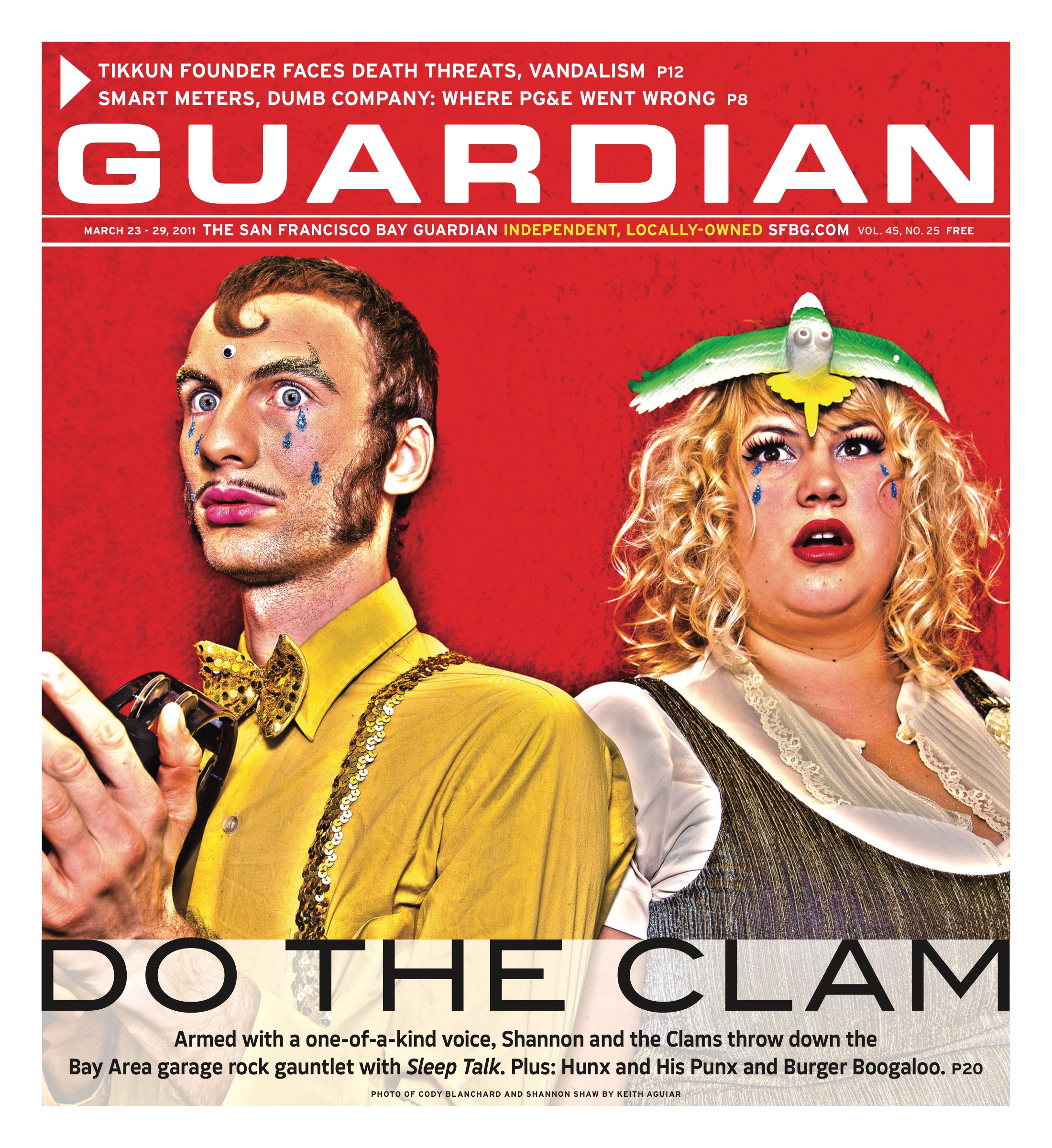
Don’t miss the free MUNI youth bus pass!

4

If you do down to the BART station at 16th and Mission today (Thursday) from 3-5 p.m., you’ll see banners that read ‘Get Your Free Fast Pass.” The PR blitz is the work of the MORE Public Transit Coalition, which is conducting a series of community bus pass clinics in the Mission, the Bayview and Chinatown in the coming weeks to help low-income families apply for free MUNI youth passes. 

Last week, at the urging of the MORE Public Transit Now Coalition and Sup. David Campos, the MTA Board approved the Youth Lifeline Program, which will provide 12,000 low-income youth with free MUNI bus passes in April, May and June.

But to access the free bus pass program, low-income families need to fill out an application and return it to the MTA Office. As a result, community organizers are setting up the bus pass clinics to inform low-income parents and students about the program and to help them to apply.

“We fought hard to get these free bus passes,” Gloria Esteva of POWER (People Organized to Win Employment Rights) said in a press release. “Now we want to make sure that children get these passes in their hands and don’t have to worry having bus fare in order to make it school each day.”

More than 20,000 transit dependant students in San Francisco rely on public transit to travel to and from school daily. But last year, the price of the Youth Fast Pass doubled from $10 to $20.

“We take the bus everywhere we go,” Un Un Che from the Chinese Progressive Association. Said. “My family depends on MUNI to get to school, to work, to the doctor.  Buses are not a luxury; they are a necessity.”

A similar clinic will be held in the Bayview on Monday March 14 at the Mandela Plaza at the corner of 3rd Street and Palou. A second clinic will be held in the Mission on Thursday March 17 and a second in the Bayview on Monday March 21. Future clinics are planned for Chinatown, though dates are not yet available. But applications will be available at all locations in English, Spanish, and Chinese, and assistance will be provided in all three languages.
 Organizers note that while the program is a positive step, the 12,000 passes still fall short of meeting the need for affordable public transportation in San Francisco.
 
“We know that next year the city plans to continue to cut yellow school buses,” POWER organizer Beatriz Herrera said.  “We need a permanent program that will ensure that our children can travel safely around the city, get to school each day, and meet their basic transit needs.”

Newsom’s fancy gift, trip to China

The Chronicle’s got a story today about how Lt. Gov. Gavin Newsom’s personal investments and earnings, documented in an economic disclosure form released by the Fair Political Practices Commission (FPPC), make him a lot richer than his boss, Gov. Jerry Brown.

The form also discloses travel payments and gifts Newsom received in 2010, which makes for some interesting reading. For one, San Francisco’s former mayor evidently received a very expensive pen (made by Louis Vuitton and valued at $398) last year from this guy.

The most significant item in the travel and gifts category, of course, was Newsom’s trip to Shanghai last June, valued at $9,082 and paid for by the San Francisco-Shanghai Sister City Committee. He traveled there with former Mayor Willie Brown and some others for San Francisco week at Expo 2010 Shanghai China.

Evidently, it was a week filled with dancing, singing, and celebration. (And dressing to impress. Check out the creamy, eco-friendly suit Brown wore at this “dazzling” event.)

http://www.youtube.com/watch?v=NZ8rKho15dw

Since becoming lieutenant governor of California, Newsom has continued his efforts to improve business relations between China and San Francisco. Just have a look at his recent article in China Brief, a magazine published by the American Chamber of Commerce in the People’s Republic of China (AmCham-China).

In the article, penned in late January of 2011, Newsom wrote:

“China’s central government stresses the importance of developing their innovation industry sectors–including clean-tech, biotech and information technology (IT)—and is projected to commit over $600 million of government funds to support this development. This overlaps with San Francisco’s core industry sectors. With over 500 tech and new media companies (including leaders such as Salesforce.com, Zynga and Twitter), more than 225 clean-tech companies and a worldclass biotech hub (anchored by the University of California San Francisco), San Francisco brings together internationally-recognized leadership in each of these sectors.”

Meanwhile, a few items on that economic disclosure form suggest that what’s good for business in China is also good for Newsom. His wife’s investment portfolio, the Jennifer Siebel Newsom Trust, includes stocks ranging from $10,001 to $100,000 each in China Valves Technology, a for-profit, “e-learning services provider” called  Chinacast, and a Chinese motor manufacturer called Harbin Electric.

Hasan Elahi’s surveillance protest art

0

Hasan Elahi seems awfully jocular for a guy who is under constant surveillance. We’re standing in a room lined with 64 monitors, on which flash photos of his personal life from over the past seven years. “There’s gas stations, all the beds I’ve slept in,” the artist narrates as the slideshows progress. Rutgers, Brooklyn, Santa Fe, Philly, an unidentified toilet. “All the toilets I’ve ever done anything in,” he grins, checking to see if we get the joke.

Nowadays, Elahi is the one instigating his own surveillance. But the Bangladeshi American, an associate professor at the University of Maryland, was once detained at the Detroit airport by INS, who then turned him over to the FBI for six months of “interviews” regarding his international travel habits. His project of comprehensive self-documentation, now on display for an exhibition at the Intersection of the Arts (and opens today, Weds/2), grew out of this “terrifying” experience.

But the terror of the interrogation room seems far away at the moment as Elahi and I sit amidst gallery staff sawing wood and arranging wiring in preparation for the opening of “Hiding in Plain Sight.”

“After it was all over,” Elahi remembers of his detainment and subsequent investigation, as he lounges in a dark windbreaker, broken-in black pants, and neon green flip-flops “I asked the agents, can I get a memo saying I’m okay? But not ever having been formally charged, it’s a little bit of a problem to get formally exonerated. See, it’s all extra-judicial, there’s no law. But they did give me some numbers to call for when I was going to leave the country, and I called them! And pretty soon the phone calls got longer, you know, ‘there’s a really nice beach where I am right now, you should check it out.’ And then they turned into emails. I’m a very sharing guy.”

He smiles widely at his subversion of the process, shrugging his shoulders and raising his hands up like an overgrown Dennis the Menace. It’s hard to imagine anyone suspecting the man of terrorist activity.

“But it was such an unbalanced relationship! All I ever got back from the agent was ‘thank you, be safe.’ And I thought, why is he the only one who gets to know all this?”

So it started as a prank. Elahi wrote some “really clunky code” for his phone that tracked his geographical whereabouts, and started taking endless photos of the meals he ate, the view out of his condo window, the police van in his brother’s backyard, and posted them all to an “intentionally user-unfriendly” website – simultaneously pinging the FBI agent all the while. His website, Tracking Transience, now houses over 40,000 images, give or take.

Which seems like it helped him heal — he’s certainly stoked to talk about it now. In fact, so stoked I can barely get a word in edgewise over Professor Elahi’s lectures on the notion of camoflauge (“do you know why soldiers these days wear that pixelated camo? We don’t fight in nature anymore, it’s so that they appear to blend in with the machinery through night vision goggles!”) and externalized memory. 

So he’s gotta be doing something right.

Finally I interrupt. “But wasn’t it, you know, scary to be getting interrogated by the FBI? Does all this–” I swung my arm around at an image of a dinner from Elahi’s past at an East Bay hot plate restaurant. “Help to deal with that violation?”

Elahi pauses, but for just a moment. “It was truly terrifying. I knew who had the upper hand, the power – you know right away. You go into survival mode. In my case, that meant cooperate. Tell them every detail of everything.” He says he felt the proximity of incarceration, the planned ambivalence of interrogation questions intended to trip up incautious suspects. “The last thing on my mind was an art project.”

But being an artist, he eventually concocted a creative work to better understand what he went through. He says the deluge of information (you can’t, for example, use Elahi’s website to see where he was yesterday or right now, you have to sift through thousands of randomly-generated images at once) creates a role reversal, throwing the viewer into the role of intelligence officers grasping for clues of wrongdoing from a lifetime worth of information.

The irony is that in the endless self-documentation that qualified as bizarre in 2004 is now a part of everyday second life. That “clunky code,” Elahi tried to sell it to cell phone companies, but they laughed at him and asked who on earth would ever want to track their own every movement. But nowadays, I have a dozen friends who track themselves far more comprehensively for the world’s enjoyment than Elahi ever did. Not to mention New York artist Wafaa Bilal, who took surveillance protest art to a new level when he had a camera surgically implanted in his head last month. 

“Yeah, the project’s obsolete,” Elahi chuckles, back to the easy assurance of a man far removed from the dangers of the Patriot Act. He reminds me that the information share goes beyond, even, what we put in our status updates and foursquare check-ins. “Even times when you think you’re not being monitored — PG&E knows when you’re home when your utilities usage goes up.”

Which throws “Hiding in Plain Sight” into a different sort of light: from the prank on the FBI that it seems at first blush to that of a man accepting that he’s — that we’re all — being watched, and attempting to control what of the information is seen. After all, Elahi’s photos are taken from his perspective – his face and those of his companions never appear.

“The information that the FBI has on me has no value because you already have it,” he says. “I actually live a very anonymous life.”


Hasan Elahi: “Hiding in Plain Sight”

Through April 23

Opening reception: Weds/2 7-9 p.m., free

Intersection for the Arts

925 Mission, SF

(415) 626-2787

www.theintersection.org


Comedian Amy Dresner talks sober comedy

3

Twelve-steppers say in order for an addict to get on the road to recovery, it’s essential that they accept their addiction. But for comics Amy Dresner, Ian Harvie, and Felon O’Reilly, successful recovery is not just about acceptance: it’s about turning addiction into one big, serious joke. It might sound like funny business, but standing onstage with the mic and some yuks has been the only way all three have been able to maintain their sobriety. Now, they’re bringing the laughs throughout the country on their “Laughs Without Liquor” comedy tour, donating proceeds to local “sober living” causes along the way. Lucky for us, March 5th brings the tour to SF.

The three comics kicked off their tour in January, performing at the New York Gay and Lesbian Center in a benefit for a drug and alcohol program. But although the comics now travel and tour together, they didn’t always have a lot in common. Ian Harvie is a trans guy who has toured with Margaret Cho, while Felon O’Reilly has been to rehab 17 times and to jail 50 times more than that.

The two met eight years ago while performing stand-up and working out their respective sobrieties in Maine. O’Reilly proposed the “Laughs without Liquor” concept to Harvie, and soon the two were doing sober stand-up together.  Last year the two found comedian Amy Dresner at the Downtown Comedy Club in Los Angeles. 

“I was onstage ranting about rehab and my drug-induced epilepsy or whatever,” says Dresner. She was quickly added to the tour roster. 

Dresner, originally from LA, grew up in a showbiz environment. Her father was a television comedy writer, with friends and connections to household name comics who Dresner met and knew as a child. But comedy was something she left unexplored until her addiction was kicked. “It’s always been my secret dream to be a comic but I didn’t have the balls to do it until a few years ago. It takes real commitment and prior to that, my commitment was to getting high and being depressed.”

Now that Dresner is both sober and leading the life of a full-time comedian, she is able to reflect on how her career and her sobriety inform each other. “I’ve found that for a lot of people struggling with addiction, there is a lot of shame involved. That is another big trigger for self-destructive behavior. So if I can make people laugh at things they feel ashamed of – well, it can be very healing.”

She can also attest to the ways in which sobriety has improved her stage presence. “When you’re a sober comic you are really present and connected to the audience.  You can see what jokes are working and which ones aren’t. There’s no deluding yourself that you killed when you really bombed.”

Dresner appreciates the positive reactions, understanding and support that she has received from her sober audience members. But she wants to be clear that she doesn’t condemn alcohol or the people that drink it. “I think there’s a big misconception that if you are making jokes about sobriety, you are somehow undermining it. Being sober is not the same as being Mormon. We aren’t trying to bring back Prohibition. I loved getting drunk and if I could do it and not crash my car, ruin all my relationships, lose my job and carry my liver around on a dolly, I would.”

But it’s probably best to leave your booze at home if you want to see Dresner in this tour specifically. While you don’t need to take a breathalyzer test to attend, all of the shows on the tour will take place at churches, sober clubhouses, amphitheaters, and other places that are not bars. Instead of spending too much on drinks, your entrance fee will go to support a local sober living facility or treatment center.

The Laughs Without Liquor SF show will take place at a local church with poet and author Bucky Sinister hosting. All proceeds will go to the Castro Club, a sober gathering place and home for queer folks in recovery. 

For Dresner, the upcoming show in SF will hold a particularly special meaning. “I got strung out on speed for the first time in SF, so it will be very ironic to come back and do a sober gig here.”


Laughs Without Liquor

Sat/5, 8 p.m., $20

Most Holy Redeemer Church

100 Diamond, SF

(818) 588-7390

www.laughswithoutliquor.com


The dance of motherhood as … a dance

1

From Amy Chua’s “Tiger Mother” rules to Ayelet Waldman’s “Bad Mother” guilt, the stories about motherhood are not only filling bookshelves and mommy blogs, they’re being danced on stage.

Sat/26, Ellis Wood, choreographer and mother of three, performs the world premiere of Mom, an evening-length solo, at Fort Mason’s Southside Theater. Speaking about the angle of the work, Wood said, “Motherhood is not the prettiest thing in the world. There are so many sides to it and so many things you didn’t know you were getting into, and so many leaps you have to take, and so many crashes you have to deal with, and the piece addresses that. It’s not a stereotypically pretty picture of mom. Hopefully it’s a more thought-provoking look into a layered experience.”

At 46 with children ages 7, 5, and 2, Wood never really stopped dancing. “There were times when I performed when I was eight months pregnant and that was a lot of fun. If I just had the baby that was harder … but usually I performed.” said Wood. Ideas for Mom emerged when Wood was dancing in Japan just weeks before giving birth to her youngest. She considers the intimate nature of the Southside Theater well-matched for this raw and personal solo, a mix of dance and video.

Wood comes from a dance family. Her parents, Marni and David Wood, performed with the Martha Graham Dance Company when she was growing up. “We used to take classes from them when we were kids, little Graham classes here and there. We used to travel with the Graham company when we were really little, when they would go on tour, and there were always people like Merce Cunningham and John Cage and Carolyn Brown, and it was just normal to have all those people around. I didn’t know then but I think of it now as a special thing … being around people like Martha and [Isamu] Noguchi … I got a lot of info pretty young about the dance world and that did affect my whole path.” said Wood.

Visiting the Bay Area holds special significance for Wood. She has returned every year for about a decade, performing in the city and usually teaching at UC Berkeley, where her parents started the dance program. “My parents built the studio. There was no dance department and they helped sand the floors,” she said. “They literally built the studio, so it has so much nostalgia for me. My dad picked the building on campus that he wanted to be the dance studio. They had a different building chosen for him and he saw this church on the corner of Bancroft and Dana with these beautiful stained glass windows and he said ‘I’ll take this, I want the space.’ He and my mom built the whole dance department there.”

With Mom, Wood refocuses herself, returning to solo work, which is how she started 15 years ago with her solo Canary. Through the years her work has always addressed women either politically or energetically, and at the upcoming performance, audience members will have the opportunity to say a few words about motherhood, which will be filmed and shared at the end of the performance. 

“I had just finished [Ayelet Waldman’s] book Bad Mother,” said Wood. “It’s very provoking and maybe even controversial, but it is interesting and brings up a lot of issues that are taboo and I like that.  So whether I agree or not, it brings up things that a lot of people don’t want to talk about, and hopefully, not in a way that pushes people away, but in a way that draws people.  My goal is to do that too.”

Mom

Sat/26, 8 p.m., $20

Southside Theater           

Fort Mason Center

Marina at Laguna, SF

(415) 345-7575

www.fortmason.org

Back to the streets

2

Coronel knew an old man in Granada who said

(who often said):

“I wish I were a foreigner, so that I

Could go home

— Zero Hour, Ernesto Cardenal

I first came into contact with the work of poet Roberto Vargas a couple of years ago, when I saw his face, projected several stories tall, on a wall just off Valencia Street.

I was riding my bike to the Day of the Dead procession when I came across filmmaker Veronica Majano screening historical footage of the old Mission District on the wall of Dog Eared Books. The footage of Vargas was from a movie called Back to the Streets, and it showed a Latino hippie fest in Precita Park circa-1970. Long-haired Chicanos smoked weed and danced and played bongos on the grass while Vargas read from a stage. On today’s Valencia Street, Vargas was a ghost returned from a long-lost Mission, now standing twenty feet tall on the bookstore’s wall, reading a powerful poem that angrily denounced the SFPD for the mysterious death of a Mission Latino youth in police custody.

The film of Vargas was a beautiful snapshot of Latino youth culture in the neighborhood before gang violence and gentrification, like a Mission High School yearbook scene from an exhilarating era of Latino self-determination. In 1970, the Free Los Siete movement was feeding the community at a free breakfast program out of St. Peter’s Church on Alabama Street and had started free clinics and legal aid programs in the Mission. In the years to follow, the neighborhood would see the founding of the Mission Cultural Center and Galeria de la Raza and the inception of many of the neighborhood’s now world-famous mural projects.

Looking at the groovy scene in the park, it was hard to imagine that just a few short years later, Vargas and other kids from the Mission would be fighting alongside the Sandinistas in the jungles and mountains of Nicaragua. Yet the utopian promise of the era’s poetry, art, and youth culture in many ways culminated in the guerrilla war in which Vargas and other poets from San Francisco would fight and ultimately — in 1979 — help defeat the forces of Nicaraguan dictator Anastasio Somoza.

On Feb. 24, the day of his 70th birthday, Roberto Vargas makes a rare return to San Francisco to perform in a poetry event at the Mission Cultural Center in honor of that Nicaraguan solidarity movement of the 1970s. A video will be shown of footage from that struggle — classic scenes of Vargas and others taking over the Nicaraguan consulate in San Francisco; of the famed nightly candlelight vigils at 24th and Mission BART Plaza in support of the Sandinistas — and Vargas will be reunited on stage to read with old poet friends like Lawrence Ferlinghetti, Diane di Prima, Alejandro Murguía, and Vargas’ old compañero from San Francisco State University’s Third World Liberation Front, actor Danny Glover. The event is not open to the public. Invitations have been given out and the small MCC theater’s 150 seats have already been filled. Yet the event provides an opportunity to publicly honor Roberto Vargas’ contributions to the Mission, and to reflect on the hopes and dreams of Mission past.


POETRY AND REVOLUTIONARY VISION

Poetry was a part of Vargas’ world from the beginning. Vargas was born in Nicaragua, but came to the United States when he was a small child. In his 1980 collection of poems Nicaragua Te Canto Besos, Balas, y Sueños, he writes of “living in an offbeat alley called Natoma Street (where I always imagined a lost Mayan city existed beneath the factories).” By the late 1950s, Vargas may have been the first Mission District Latino Beat poet. “I graduated from Mission High School in 1958 and used to hang out in North Beach, going around to see all the poets,” he says. “I met Allen Ginsberg when I was just a 19-year-old kid running around in North Beach. Diane di Prima, Bob Kaufman, Ted Berrigan — all the major poets knew me when I was in my teens.”

After a stint in the U.S. Marine Corps and an attempt at a boxing career that ended with a detached retina (an injury that also helped him avoid the Vietnam-era draft), Vargas went to SF State, where he was heavily active in the student strike of 1968-69. Students walked out of campus and battled riot police while standing on picket lines for five months to demand an ethnic studies program at the university.

In the spirit of the times, Vargas and other poets — including a young Mission Chicano named Alejandro Murguía — joined the Pocho-Che Collective to publish poetry by local Latino poets. The poets went to cut sugar cane in the Venceremos Brigade in Cuba. They put out small poetry chapbooks in the Mission, full of poems that linked Che Guevara’s call for Third World revolution with the experience of the Chicano barrios of the United States in a new vision tropical. In the era after the SF State strike, the city started funding community arts projects in the ghettos. Like all classic zines, the first copies of Pocho-Che were scammed, in this case late at night at Vargas’ new job in the Mission’s Neighborhood Arts Program. In the years to come, the group would eventually publish hardbound books by Vargas, Nina Serrano, and others.

Today, Murguía is a professor in the ethnic studies program at SF State that the strikers fought to originate. He is the author of the American Book Award-winning short story collection This War Called Love (2002) and the memoir The Medicine of Memory (2002). He remembers, “The poetry scene was incipient, very young, and the readings weren’t always very formal. Sometimes they were at community events or protest rallies. But we had contact with Latin America. We knew people who had been in Chile, like Dr. Fernando Alegría.”

Alegría was a poet who had been the cultural attaché to the U.S. under Allende in Washington. Vargas recalls, “Alegría had myself and some other young poets come to Chile and spend a month or two studying with [Pablo] Neruda. But, of course, our plans were canceled by the coup in Chile.”

Murguia remembers the September 1973 coup in Chile that overthrew the popularly elected Socialist democracy of Salvador Allende caused the young poets to organize rare formal readings at Glide Memorial Church in protest. “We had several big ones there,” he says. “There was a broad range of poets — Michael McClure, Fernando Alegría, Jack Hirschman, Bob Kaufman, Janice Mirikitami all read. There was a line going down the block to get in.”

In addition to their mentor, Alegría, Vargas, and Murguía also knew one of their heroes, the Nicaraguan Marxist poet and priest, Ernesto Cardenal. Cardenal lived under the Somoza dictatorship in a sort-of internal exile in a religious artist commune called Solentiname. Vargas wanted to bring Cardenal to read in the United States, but Somoza would not allow the poet, who was critical of the Nicaraguan dictator, to travel outside the country. Vargas went to his old pal Ginsberg for help.

“Because Allen knew me when I was a kid, he helped me with my organizing for Nicaragua,” says Vargas. “Allen was part of PEN, and in 1973 or ’74 he went to the State Department with other writers to put pressure on [Anastasio] Somoza. Eventually Somoza relented and we brought Cardenal to New York for a reading.”

The poetry of Cardenal was a north star to the young Mission poets. Cardenal’s epic 1957-60 masterwork Zero Hour is perhaps the literary foundation of revolution in Nicaragua. Influenced formally by Ezra Pound, Zero Hour weaves a sprawling history of Somozan oppression and U.S. intervention in Nicaragua together with lyrical imagery of Nicaragua’s natural beauty and wildlife. The poem creates a poignant sense that Nicaraguans, unable to enjoy and own these natural riches, had under Somoza become exiles within their own country.

Of particular interest to the young Mission poets, though, was Cardenal’s Homage to the American Indians (1969), a book-length meditation on the glory of Mayan and North American native civilizations. “For us, the work of Cardenal was very important,” says Murguía. “Homage to the American Indians is a continental vision of Native Americans — everything from the San Blas Indians of Panama to the Indians of Omaha to the Indians of Mexico City and Peru.”

In Homage, Cardenal evokes a lost Indian Utopia “so democratic that archaeologists know nothing about their rulers,” where “their pyramids were built with no forced labor, the peak of their civilization did not lead to an empire, and the word wall does not exist in their language.” He writes:

But how to write anew the hieroglyph,

How to paint the jaguar anew,

How to overthrow the tyrants?

How to build our tropical acropolis anew

Cardenal’s poems of this lost glorious past were to Vargas more pointedly a vision of a Latin American utopia that can also be regained in the future. In Cardenal’s work, says Vargas, “There is a longing for the simplicity of that civilization — the creativity, the innocence, the tribalism. Can we get it back after all the dictatorships, after all that capitalism has done? Cardenal showed us what we were, what we had, what we lost.”

Under Cardenal’s influence, the Mission poets turned seeing lost Mayan cities beneath the city’s factories into a literary movement. By 1975, members of Pocho-Che had started a magazine called El Tin Tan with Murguia as editor and Vargas as contributor. El Tin Tan presented a sweeping utopian vision of a borderless invisible Latino republic united culturally and politically under the sign of the palm tree. The poets situated the capital of this world right here in the Mission District.

“To tropicalize the Mission — to see it as a tropical pueblo — was a political act of defiance and self-determination,” says Murguía. “We were saying that we put this particular neighborhood — our pueblo, in a way — not in a context of North American history but in the context of Latin American history. The history of the eastern U.S. doesn’t affect California until 1848 when the first illegal immigrants came to California — not from the South, but from the East.

El Tin Tan,” Murguía continues, “was probably the first magazine that was intercontinental in scope, a combination of politics and literature and art and different trends from the Mission to Mexico City to Argentina and everywhere in between.” He proudly recalls that it ran the first North American essays on Salvadoran poetry, and translated and printed a short story by Nelson Marra, a writer imprisoned by the Uruguayan dictatorship.

Yet for all its international perspective, El Tin Tan remained firmly rooted in the Mission. Columns by Nuyorican poet Victor Hernández Cruz and news of the assassination of Salvadoran guerrilla poet Roque Dalton ran side by side with the first comics by future Galeria de la Raza founder Rene Yáñez, all folded between wildly colorful cover art by neighborhood favorites like the famed Chicano artist Rupert Garcia and the muralist Mike Rios.

“The magazines were colorful — tropical — on the outside, but very political on the inside,” says Murguía. “That was a metaphor for our own work.”

By this time, Vargas had become an Associate Director at the SF Arts Commission. From within City Hall, he started to pump city arts money into the Mission, helping to fund projects like Mike Rios’ mural of the people holding BART on their backs at 24th and Mission BART Plaza and the Balmy Alley Mural Project — art that can still be seen in public today.

Once, Vargas commissioned a Chuy Campesano mural for the Bank of America building at 22nd and Mission. “I read a poem called “Boa” and had the crowd dancing and chanting, Es la Boa, Es la Boa,” says Vargas. “We were trying to say, ‘You made your millions off our farmers, but now you are on our turf in the Mission here in occupied Mexico. So we’ll put hieroglyphics on the walls of your bank like we used to do!’ Someone from the bank tried to take the mic from me and cops came and escorted us out.”

Vargas’s story of the mural’s dedication ceremony captures the bravado of the era. “It was a beautiful time, all of us young and thinking we were going to change the world. We wanted to change the world through culture.”

The poets organized the community to demand a neighborhood’s arts center, too. In 1977, the dream was realized when the City, with pressure from Vargas from within City Hall in the Arts Commission, purchased an old, five-floor furniture store at 24th and Mission to be made into the Mission Cultural Center. Murguia became the center’s first director.

The Mission utopia was becoming a reality for Vargas. In Nicaragua Te Canto, he wrote:

We used to drive

Our lowered down Plymouths and Chevys

On top of the breast of a mountain to

Make love and drink wine… Never

Knowing what was going to happen after

Mission High School

The Mission is now an expression of real culture, a many-faceted being … both plus and minus with the soul of a human rainbow…My people watching slides of Sandino and Nica history … White children wearing guarachas and afros trippin’ down the streets to party. Young Salvadoran poets discussing the assassination of Roque Dalton … The Mission is now an implosion/explosion of human color, of walls being painted by muralistas. There is a collective feeling of compassion for each other Nicas Blacks Chicanos Chilenos Oppressed Indios. The sense of collective survival, histories full of Somozas, Wounded Knees written on the walls.

In Zero Hour, Cardenal wrote of Nicaragua’s trees and birds and lakes, and their call to revolution, as seen from its mountains:

What’s that light way off there? Is it a star?

Its Sandino’s light shining in the black mountain


Vargas, the excited Mission kid, echoed in his work:


Tonight I am sitting on a mountain called Bernal Hill

Tonight I see the flames of America Latina spreading from here …


STRUGGLE AND VICTORY — AND STRUGGLE

Perhaps inevitably, the Latin American Utopia Vargas and company created in poetry would seem so tantalizingly close to actualization that they would be forced to pick up the gun and fight for its existence.

When the enormous earthquake of 1972 left Nicaragua’s capital, Managua, in ruins, Nicaraguan refugees flocked to SF’s Mission District. Soon, San Francisco was home to more Nicaraguans than any place on Earth outside of Nicaragua. The family of Anastasio Somoza had controlled Nicaragua with brutal repression for generations. Somoza’s embezzling of relief funds for earthquake victims led to increased revolutionary activity against his rule. Taking their name from Augusto Sandino, a Nicaraguan revolutionary who led resistance against U.S. occupation of Nicaragua in the 1930s, La Frente Sandinista de Liberacion Nacional (FSLN) — or the Sandinistas, as they were popularly known — began guerrilla activities in late 1974 by taking government officials and Somoza relatives hostage in a raid on the house of the minister of agriculture. They received a $2 million ransom and had their communiqué printed in the national newspaper. Thus was born the Sandinista revolution.

In the Mission, Vargas, Murguía, and others were in touch with La Frente, and began organizing Sandinista solidarity rallies to coordinate with La Frente’s actions in Nicaragua. Out of offices in the Mission Cultural Center, along with El Tin Tan, the poets published a newspaper called La Gaceta about the situation in Nicaragua. The paper had a circulation of 5000 copies and was available for free all over the district. The sight of pro-Sandinista rallies at 24th and BART Plaza became so common that the plaza was popularly nicknamed Plaza Sandino.

Vargas organized takeovers of the Nicaraguan consulate in San Francisco and traveled the US, speaking about Nicaragua. Yet, soon, this kind of support didn’t seem like enough. In Cardenal’s poetry, victory was inevitable. Cardenal had written that Indian time was circular, that “history became prophecy,” and that therefore the “empire will always fall.” He had also written, “The hero is reborn when he dies. And the green grass is reborn from the ashes.” In poetry, Vargas and Murguia found inspiration to go to war.

In 1976 and 1977, Mission District residents, in solidarity with the FSLN, began quietly leaving San Francisco to join up with La Frente and pick up the gun in the Sandinista Revolution. Among them were Roberto Vargas and Alejandro Murguía.

“It was very romantic,” says Murguía. “If you grew up in the time after Che’s death, when you had Che’s figure calling for “1,2,3, many Vietnams” and a lot of different armed struggles going on all over Latin America, then it would seem logical, I think, if you were kind of young and crazy, that you would want to participate in some of these situations besides just doing solidarity work or organizing rallies. Also, the coup in Chile crushed our generation’s hope for electoral change in Latin America.”

Today, Murguía tries to situate the poets’ embrace of armed struggle within the spirit of those long ago times, but one senses that Vargas would not hesitate to join a guerrilla war tomorrow morning. When I ask him how the young poets made the leap from verse to bullets, he is incredulous at the question.

“We had to fight! There was no other way!” Vargas says. “We had the historical perspective and as a people we were worthless if we let that situation stand. We had our own books out. But are we really revolutionary poets if we just sit back and collect our laurels?”

Murguía compares the Sandinista war with the Spanish Civil War, when there were many international brigades in which writers had been involved. He suggests the poets went to war because they were poets. “If you knew the situation intimately in Nicaragua and you were reading Cardenal’s poems,” he says, “it was easy to see the connection between poets and political necessity.”

Vargas began organizing small, tight-knit cadres for battle in Nicaragua, recruiting his Sandinista guerrillas right off of the streets of the Mission. “I was secretive and I found them one by one,” he explains. “We were very clandestine and very compartmentalized. We never had more than a dozen people in our committee at once.”

Men who were menial laborers in San Francisco would one day be among the most respected heroes of the Nicaraguan Revolution. “When I recruited Chombo [Walter Ferretti], he was a cook at the Hyatt Regency,” says Vargas. “Later, Chombo would become a head of national security in Nicaragua. Another recruit was a former pilot, so I went to talk to him where he pumped gas at 21st and South Van Ness. That was Commandante Raúl Venerio. After the triumph of 1979, he would become the Chief of the Nicaraguan Air Force.”

When in San Francisco, Venerio later served as the editor of La Gaceta. In Nicaragua, the former gas station attendant became a real hero. “They got an airplane and attacked the National Palace,” says Vargas, laughing. “They hit it and split, and got away — real Mission boys!”

Before heading off to join La Frente, Vargas’ recruits would undergo a regimen of training and political education, an informal boot camp largely hidden in plain sight in the Bay Area.

“It was primitive,” remembers Murguía. “We didn’t really have someone with a military background to train us. We got just guns at pawn shops on Mission Street and practiced shooting at the firing range in Sharp Park down in Pacifica. We worked out with a friend who was a black belt in karate.”

Murguía says the most difficult part of training was the daily pre-dawn run of five laps around Bernal Hill. “We would run up the hill counter-clockwise — because that way is more difficult,” he says, “and we would wear these combat boots we bought at Leed’s Shoes on Mission.”

Besides being a part of physical conditioning, the run was a litmus test of the recruits’ commitment. “Doing activity like that is almost impossible if you’re not really psychologically into it,” says Murguía. “Try running five times around Bernal Hill! You start wondering after your third lap, ‘Goddamn! Why am I doing this?‘ Especially when no one is forcing you to do it!”

When I ask if the daily jog of 10 or 12 Latino men in combat boots on the hill at sunrise did not attract any, uh, attention, Murguía shrugs. “There were less people on the hill in those days,” he says. He recalls that the Mission cadres trained in complete anonymity: “We got money to rent planes and we took turns learning to fly the planes around the Bay Area. Nobody suspected anything because nobody knew anything about Nicaragua then.”

When I try to imagine a phalanx of Sandinistas at dawn on today’s Bernal Hill, surrounded by a crowd of early morning dog walkers, I can’t help but laugh. But the cadre’s training was deadly serious, and Murguía says its value was far more than psychological. “What I discovered when I went to the Southern Front was that our San Francisco cadres were some of the most advanced in the war,” he explains. “We understood the political situation and the tactic of insurrection and we had a minimum of physical conditioning. But some of these other cats, man! They literally just walked in off the street!”

For a time, Murguía remained the director of the Mission Cultural Center, while making regular trips to fight in Nicaragua. In 1977, Vargas resigned from the Arts Commission and went to battle for six or seven months. He and Murguía would spend the next couple of years rotating back and forth from the war front in Nicaragua to their solidarity work in the Mission. Murguía describes his entry into Nicaragua, his stay in various guerrilla safe houses in Costa Rica, and his experiences in the war in his 1991 American Book Award-winning fictionalized memoir, Southern Front.

Though Murguía says the actual military war on the ground was largely a stalemate between the Sandinistas and the Somozas’ National Guard, the Sandinistas were at last able to triumph through international pressure, strategic military victories, and a general strike. Somoza fled in July of 1979, and the Sandinistas entered Managua victorious on July 19 of the same year. Cardenal’s poem “Lights” describes the city as seen from a plane that brought the elder poet into a Managua free from the Somoza family’s rule for the first time in 43 years. In Managua, street graffiti declared, El triunfo de la revolución el triunfo de la poesía.

Vargas and Murguía, however, did not enter Managua with the victorious army. The Southern Front did not go to Managua, and Vargas had recently been sent back to the U.S., to coordinate a simultaneous take over of the Nicaraguan consulates in major U.S. cities from coast to coast to coincide with the victory in Managua.

Vargas’ work for Nicaragua did not end with victory. The Mission High kid now found himself serving in the new revolutionary government as cultural attaché to the United States. “I was jailed in the takeover of the DC consulate,” Vargas says, laughing, “but then I came back several months later to serve there!”

The voluble poet grows uncharacteristically silent when I ask him what it felt like to actually win the war.

“To win?,” he asks, pronouncing the word as if he was hearing it for the very first time. “Well … it’s like taking off a huge load, man. Like taking mountains off your back.” He is silent for a bit and then adds, “But what do you win? You win the right to continue the struggle.”

“To win was to reach the objective of getting rid of the Somoza family once and for all,” Vargas says. “But it was not really a win/lose situation.” Indeed, the Sandinistas inherited a country in ruins and in debt, with an estimated 50,000 war dead, and 600,000 homeless. Nicaragua’s left-wing powers would become an obsession for the Reagan Administration, who for the next ten years offered heavy financial assistance and training to the Contras, a coalition of pro-Somoza and anti-Sandinista guerrillas who fought to overthrow the revolutionary government. The U.S. strangled Nicaragua’s economy with a trade embargo like it employed against Cuba. In reality, for the Sandinistas, the war literally never ended.

“Somoza bombed everything in Nicaragua before he left the country. Reagan was spending — what? — $100 million a year annually against us at that time?” says Vargas. “They spent so much for a decade to destroy our little country.”

Nonetheless, poetry remained in the forefront of the Nicaraguan revolution. Cardenal was named Ministry of Culture, and he instituted poetry workshops across Nicaragua as part of a highly successful literacy campaign that raised literacy from just 12 percent to over 50 percent in the first 6 months of the revolutionary government. Soon, poetry was being written and taught in the tiniest villages and in the fields.

“We tried,” Vargas says bluntly. “We were doing very important land reform, incredible stuff for the economy. But it was dangerous to be a good example. We had the potential, but we had to hold off this enormous power [of the U.S.] for decades. Ultimately, we had to step back so they would not destroy Nicaragua.”

In 1990, Nicaraguan voters, weary of war and economic misery, chose to elect FSLN President Daniel Ortega’s U.S.-backed opponent, Violetta Chamorro, in the presidential election. “We lost the elections,” says Vargas. “But we had to allow them to demonstrate that we were not like Cuba or other revolutions. We lost beautiful young men and women to get that liberty.”

I ask Vargas to consider the successes and failures of the Nicaraguan revolution. He pauses and then seemingly changes the subject, excitedly telling me of the time he brought Ginsberg to meet the Sandinista soldiers. “Ginsberg was fascinated by the Sandinistas,” says Vargas. “And he wanted to see what he had been supporting on my behalf all these years. So I took him to the fighting along the Honduras border in 1984, during the Contra war.”

When Ginsberg went to the war zone, he brought not a rifle but a concertina. “I took him to meet these young soldiers in a trench. They see Allen with the concertina and they were like, ‘Who the hell is this guy?’ I told them he was a very famous poet. At once, they all started taking bits of paper out of their pockets that they had written poems on and started reading them to Allen. So there we are, with these soldiers in the trench with their rifles reading poetry, and Allen just wailing away on this concertina!”

I think of the strange road from Cardenal’s vision of lost Mayan cities to Vargas’ dreams of a Bernal Hill utopia to Ginsberg listening to soldiers’ poetry in a Nicaraguan trench, and I see that Vargas has answered my question with his own, the question asked by revolutionary poetry.


LOST CITIES, AND NEW ONES

The lost moment with Ginsberg in the trenches is like a missing chapter out of Roberto Bolaño’s Savage Detectives. Indeed Vargas’ story in many ways embodies that of Bolaño’s exile poet generation, of which he wrote, “They dreamed of a Latin American paradise and died in a Latin American hell.” Except for one crucial difference: Vargas is very much alive and still fighting.

Today, Vargas still puts in a tireless 50-hour work week as a labor organizer for the American Federation of Teachers in San Antonio, TX. During our conversation, he excitedly tells me of an action he is organizing for next month, a march of teachers on the Texas capital to protest budget cuts to education. “I camp out in the teacher’s lounge and talk to them when they are on break,” he says. “I signed up 50 new members last week!”

As he nears 70, the poet shows no signs of slowing down. “I can’t afford to!” he says. “My youngest son is only 17. When I get finished putting him through college, then maybe I can take a break.”

But work seems like more than necessity to Vargas; political struggle is the central theme of his life’s work. “Work, work, work, Erick,” he tells me. “That is what we have to do. I could go back and forth about what went wrong in Nicaragua, but there is more work to do and I have to stay positive. It is all part of the process.”

When Vargas comes back to the Mission Cultural Center this week, he will literally return, full circle, to a building he helped build. “We had no money to hire laborers, so we’d be there with our kids every weekend, building the place,” he remembers.

One of those kids was Vargas’ son, Mission poet Ariel Vargas, who will read in public with his father for the first time this week. “Cardenal baptized him when Ernesto came to bless the new Mission Cultural Center in 1977,” Vargas says. “He had offered to baptize any children who also might be there. In the end, there was a line of families around the block on 24th Street who had brought their children for Ernesto Cardenal to baptize. Ariel had already been there every weekend on his hands and knees sanding those huge gymnasium-like floors with us. The Mission Cultural Center is still there and that is our monument.” As he discusses the Mission, Vargas forgets the problems of the Nicaraguan revolution and begins talking nonstop again at last. He comes back to the stories that started our conversation. “You know, I lived at 110 Mullen on Bernal Hill,” he says, his excitement gathering. “Mike Rios was my neighbor. Rene Yáñez lived on the block. So it was all happening right there! Carlos Santana lived down the block at around 180 Mullen or something. We used to hear him and his band jamming all the time. The Arts Commission had a stage truck and I’d take it out to Precita Park and put the stage down for Carlos to play on.” I think of Cardenal’s vision of the repeating cycle of time, the promise that the empire will always fall and the hero will always be reborn. Much in the Mission has changed. But Vargas, the old poet, still looks out from Bernal Hill today and sees lost cities beneath the surface.


Grub

4

paulr@sfbg.com

DINE When cultural historians of the future gather to argue the question of when and where Valencia Street finally jumped the shark, they might find themselves concentrating on the changes that came to a single block, between 18th and 19th streets, early in the presidency of Barack Obama. They might, in particular, find themselves considering a place called Grub, which sounds like a greasy joint of some kind where people eat with their fingers but is in reality a gorgeously designed restaurant that flows from a plate-glass façade through a nouveau-mod dining room to a glowing blue bar that looks like something from Star Wars, or Las Vegas.

It’s the sort of place you wouldn’t have found on Valencia as recently as five years ago, and it suggests, to me — along with the nearby The Summit, with its matching plate-glass façade — that a basic shift in sensibility is occurring. Like the Ferry Plaza farmers market, Valencia Street and its establishments now get mentioned in the travel section of The New York Times, and this kind of publicity means tourists, coming as if to some exotic game preserve. Tourists fundamentally change the nature of whatever it is they’re coming to experience, almost as in a chemical reaction.

None of this is to imply that Grub itself is an unworthy restaurant. It is highly worthy, with a value-intensive menu that includes authentic grub like burgers and mac ‘n’cheese, as well as such highfalutin treats like osso buco. (Is it just me, or has osso buco suddenly become trendy?)

Both the burgers and mac ‘n’ cheese are offered in “bar” (ie, design your own) mode. Your burger choices include beef, buffalo, vegetarian, ahi tuna, and portobello mushroom. The ahi burger ($12) consists of five ounces of seared filet. You can add cheeses and condiments to your heart’s content, but given the priciness and quasi-delicacy status of ahi, we thought it decadent to slather it with pickled red onions and bacon. Our suave server (a godlet who might have just stepped from the set of one of those Twilight movies) recommended the wasabi aioli, which did indeed bring a moistening intensity, though the sandwich remained a little frail, pale, and delicate, like a child who needs to get outside more.

Plunging into the mac ‘n’ cheese bar, by contrast, is like going to a gym where everyone is insanely worked out. All the variations (base price $9) include white and sharp cheddar cheeses and a gratin of grana padano breadcrumbs — more than enough flavor thrust to reach escape velocity. But you can tart up your crock with everything from truffle oil to grilled steak ($1 per extra ingredient) and some savories in between. Truffle oil is, for me, one of the world’s most overrated (and overpriced) food items — with lobster (a favorite of the godlet) not far behind — and I thought it more or less got lost amid the meatiness of the mushrooms and bite of the cheese. The steak stood up better, adding a hint of smokiness and enough weight to make the dish a meal unto itself.

But the menu offers other meals unto themselves, too, with a bit more polish. Grilled tiger prawns ($15) were arranged atop a butternut squash risotto heavily leavened with Parmesan cheese, whose tang balanced what otherwise might have become a cloying sweetness. A filet of Pacific snapper ($16) was “crusted” — “smeared” would have been more accurate — with what seemed like crab-cake batter and seated on a pad of celery-root puree with a pool of carrot-butter-white wine sauce and watercress salad. And the osso buco ($17) arrived in autumnal, rather grave guise atop mashed potatoes with a burgundy-charged sauce and fried shoestring carrots. The meat was fork-tender, and as someone who’s been making osso buco for years (from the same Patty Wells recipe), I can tell you this isn’t a given, even with long simmering. As for mashed potatoes instead of the more traditional risotto: eh. The potatoes did have a dense, mousseline-like velvetiness, which led me to suspect the involvement of tons of butter. But then, at higher-end sort of greasy spoon, you would expect a higher grade of grease, and butter is the grease of the gods, or at least godlets.

GRUB

Dinner: nightly, 6 p.m.–12:30 a.m.

Brunch: Sat.–Sun., 10 a.m.–2:30 p.m.

758 Valencia, SF

(415) 431-GRUB (4782)

www.grubsf.com

Beer and wine

AE/MC/V

Noisy

Wheelchair accessible


Stage Listings

0

THEATER

ONGOING

Clue Boxcar Playhouse, 505 Natoma; 776-1747, www.boxcartheatre.org. $15-35. Wed-Fri, 8pm; Sat, 7 and 10pm. Through Sat/19. A play based on a film based on a board game is just the kind of tangled genealogy much goodtime theater is made of these days. So there’s nothing too new about Boxcar’s stage adaptation of the manic 1985 comedy derived from a once popular Parker Bros. diversion. In fact, it’s at least the second stage adaptation of same to be offered in San Francisco. (Impossible Productions remounted its version at the Dark Room just last year.) Nevertheless, led by adapter-director Nick A. Olivero, Boxcar’s production pursues its vision like a mad yen, with a loving fidelity and self-referential glee that are not so much inspired as just plain zealous (although Olivero’s scenic design does reach new heights: a TV-toned board-game set that the audience peers down on from six-feet-high balconies ringing the stage). Performances are dutiful and solid for the most part, with especially nice work from Brian Martin (as the butler) and J. Conrad Frank (as Mrs. Peacock). Although there’s something vaguely and not unpleasantly hypnotic about it all, groups of cult-film line-gleaners may be the best audience for this one. (Avila)

*Farragut North NOHSpace, 2840 Mariposa. www.opentabproductions.com. $25. Thurs-Sat, 8pm. Through March 5. Former Howard Dean speechwriter Beau Willimon’s formulaic but solidly crafted 2008 play about backroom politics and the seamy side of what’s euphemistically called the American democratic process seems like it’d make a good George Clooney movie. George Clooney thought so too. He’s making it now under the title The Ides of March. You can see it sooner and without all those goddamn movie stars in this low-budget, high-octane staging by OpenTab Productions (Fishing). Stephen (Ben Euphrat) is a 25-year-old wiz of a press secretary for a “maverick” governor heading into a major primary battle on the road to the White House. But an unexpected phone call leads “idealistic” power-lover Stephen into temptation, even as it reveals the real dynamics of the electoral system he thought he’d mastered. A battle for career survival ensues with his former boss (Alex Plant), in which loyalty is a password and decency the first sandbag to drop. Opening night had one or two timing issues and some actors lost in shadow, but director Dave Sikula builds the action well and gets strong performances from an uneven but generally winning cast. Particularly nice work comes from a convincingly unraveling Euphant, a coolly compassionate Carla Pauli (as precocious intern–turned–unwitting pawn), and the formidable Nathan Tucker as Stephen’s slickly conniving counterpart and Mephistopheles of the moment.

Next to Normal Curran Theatre, 445 Geary; (888) SHN-1799, www.shnsf.com. $30-99. Call for dates and times. Through Sun/20. Diana Goodman (Alice Ripley) is a woman too restlessly witty and big-souled to sit easy in the suburban home she shares with her husband (Asa Somers), 16-year-old daughter (Emma Hunton), and 18-year-old son (Curt Hansen). What’s worse, the 18-year-old died as a baby about 17 years ago, and has not been taking the news lying down. A mother’s grief winds through this sometimes clever, mostly sappy, and ultimately tedious Broadway rock musical about a bipolar woman and the impact of her illness on her family. Director Michael Greif’s (Rent) kinetic staging takes place across a three-level industrial-box set that houses musicians in its outer corners as well as the stereotypical family dwelling in its center. The set’s outer façade (moving panels featuring giant eyes and mouth) meanwhile suggests the whole thing as a model of the mind we’re witnessing come apart. The 2008 musical by Brian Yorkey (book and lyrics) and Tom Kitt (music) won a Pulitzer for its supposedly bold depiction of mental illness. But despite reasonable scoffing at the paternalistic, pharmacologically fueled regime of mainstream treatment (embodied by Jeremy Kushnier’s various doctors), neither Tony-winner Ripley’s jagged performance nor Yorkey’s book transcends a stultifying and finally grating set of narrative clichés, which the driving, mostly generic-sounding score only makes more obvious. A Woman Under the Influence this isn’t. (Avila)

Party of 2 – The New Mating Musical Shelton Theater, 533 Sutter; (800) 838-3006, www.partyof2themusical.com. $27-29. Sun, 3pm. Open-ended. A musical about relationships by Shopping! The Musical author Morris Bobrow.

*Pearls Over Shanghai Thrillpeddlers’ Hypnodrome, 575 Tenth St; 1-800-838-3006, www.brownpapertickets.com. $30-69. Sat, 8pm. Through April 9. Thrillpeddlers’ acclaimed production of the Cockettes musical continues its successful run.

Spalding Gray: Stories Left to Tell Gough Street Playhouse, 1620 Gough; (510) 207-5774, www.custommade.org. $10-25. Thurs-Sat, 8pm. Through Sat/19. Originally conceived as a one-off benefit show by Gray’s widow, Kathleen Russo and director Lucy Sexton, Spalding Gray: Stories Left to Tell intersperses segments of some of Gray’s most famous works—Swimming to Cambodia, Gray’s Anatomy, Monster in a Box—with excerpts from his journals, the stories left to tell. The original concept to have five actors representing five aspects of Gray’s words—adventure, career, family, journals, and love—seems to have been crafted with the specific purpose of allowing several people the opportunity to “speak for” Spalding, without actually performing “as” Spalding, appropriate enough for a celebratory memorial, but hard to accept as a capital-P play. It’s a conundrum that Custom Made Theatre cannot solve. Half the cast convey by their tone and manner the casual ease of campfire story-tellers, while the other half take a more performative approach to their recitations, particularly a smooth Patrick Barresi as “Career” and the likable Richard Wenzel as “Love.” The stories themselves are often hilarious, including Gray’s turns as a “Bowery Bum,” a jailbird in Nevada, and a sweat lodge initiate, while the stories that are not side-splittingly funny are poignant, painful, and even unflinchingly sentimental, especially in regards to his young sons. But as a work of theatre, they underwhelmed. (Gluckstern)

Treefall New Conservatory Theatre Center, 25 Van Ness; 861-8972, www.nctsf.org. $24-40. Call for dates and times. Through Feb 27. New Conservatory Theatre Center presents a tale of erotic attraction by Henry Murray.

What We’re Up Against Magic Theatre, Fort Mason Center, bldg D; 441-8822, www.magictheatre.org. Wed-Fri, 8pm; Sat, 2:30 and 8pm; Sun, 2:30pm; Tues, 7pm. Through March 6. Following the popularity of Theresa Rebeck’s Mauritius in 2009, Magic Theatre brings the New York playwright back for the world premiere of a decidedly flimsy comedy about sexual discrimination at a busy architecture firm. Eliza (Sarah Nealis) is the bright and brash new employee who finds herself shut out by an old boys network. Sodden boss Stu (Warren David Keith) resents her heartily for her competence and ambition, while ass-kissing power-jockey Weber (James Wagner) uses the leverage for all its worth. Gender solidarity with sole (but soulless) sister Janice (Pamela Gaye Walker) doesn’t get Eliza very far either. One guy at the firm, Ben (Rod Gnapp), alone knows better (among what amounts to an unbelievably inept staff). Eliza, meanwhile, crafts a form of revenge from her well-guarded solution to the otherwise stymieing “duct problem” in the plans for a new mall, a major account hitting the skids. Ben’s obsession with ducts is something of a key joke here, which ends up being characteristic of a play that stretches its not-very-new conceits thinly over two acts. The glass ceiling, ducts and all, is a bit too transparent in this bloodless production (helmed by artistic director Loretta Greco), leaving precious little to wonder or worry about. (Avila)


BAY AREA

The Agony and the Ecstasy of Steve Jobs Berkeley Rep, Thrust Stage, 2025 Addison, Berk; (510) 647-2949, www.berkeleyrep.org. $14.50-73. Call for dates and times. Through Feb 27. In his latest monologue (playing in repertory with another, The Last Cargo Cult), Mike Daisey explores the deeper implications of his own, and our, obsession with technology through a parallel look at the career of Apple’s megalomaniacal founder, and Daisey’s own reconnaissance trip to Apple’s manufacturing center in southern China. The story is well-crafted, Daisey’s delivery dependably expert—even if his humor occasionally strays into the more obvious, belabored humor of the office water-cooler wag—and the real-world vision of hell he paints in a behemoth suicide-ridden factory called Foxconn (apt if understated name there) all too salient. But the story gives us back as revelation what we already know, surely, about the horrifying labor system behind our various electronic gizmos and much else besides. It’s a kind of liberal conceit to play along with the indignation and head back out into the world fully willing to do battle against corporate capital, or at least sign an online petition. As a performer, meanwhile, Daisey has not budged from the formula he originally borrowed from Spalding Gray but made it even more his own. Indeed, to call his approach “indebted” to Gray is like saying the black market iPhone knock-offs he describes are merely an homage to Apple’s product. Beside his professed love for the latest high tech wizardry comes this uncanny attachment to the utterly low-tech, analog-monologue style of the late master.

Collapse Aurora Theatre, 2081 Addison, Berk; (510) 843-4822, www.auroratheatre.org. $34-55. Wed-Sat, 8pm; Sun, 2 and 7pm; Tues, 7pm (also Feb 19, 2pm). Through March 6. Aurora Theatre presents a comedy by Allison Moore.

Grapes of Wrath Marion E. Green Black Box Theater, 531 19th, Oakl; www.theatrefirst.com. $10-30. Thurs-Sat, 8pm; Sun, 2pm. Through Sun/20. TheatreFIRST presents Frank Galati’s stage adaptation of the John Steinbeck novel.

Heartbreak House Live Oak Theatre, 1301 Shattuck, Berk; (510) 649-0999, www.berkeleyrep.org. $12-15. Fri-Sat, 8pm (also Thurs/17, 8pm). Through Sat/19. Actors Ensemble of Berkeley presents the George Bernard Shaw comedy set just before World War I.

The Last Cargo Cult Berkeley Repertory Theatre, Thrust Stage, 2025 Addison, Berk; (510) 647-2949, www.berkeleyrep.org. $14.50-73. Call for dates and times. Through Sun/20. As fans of J. Maarten Troost have learned, life on an island “paradise” is far less idyllic than the imagination yearns to believe. So it’s hardly surprising that Mike Daisey’s monologue The Last Cargo Cult begins with a white-knuckle ride in a prop plane piloted by a man with a milky eye. Daisey’s destination, the Pacific island of Tanna, is the location of one of the world’s last so-called “cargo cults”, and their big celebration “John Frum Day” is approaching. Daisey’s intention to hang out at the festivities smacks a little of entitled voyeurism, but the parallel he manages to draw between the complexities of a religion dedicated to a mythical cargo of “awesome shit”, and our own dedication to the acquisition of same, is a striking one. From our almost blind faith in the value of basically valueless currency, to our even blinder faith that indenturing ourselves by debt will enrich us, the foundations of our own “cargo cult” are revealed smartly by Daisey to be just as precarious as if built at the base of a volcano as in Tanna. Still, I found the most revealing thing about the evening to be the moment when the couple next to me took off with a $100 bill they’d acquired free-of-charge at the door, to which I can’t help but ask them: “Did you get your money’s worth?” (Gluckstern)

Not a Genuine Black Man The Marsh Berkeley, TheaterStage, 2120 Allston, Berk; 826-5750, www.themarsh.org. $20-50. Fri, 8pm. Through Fri/18. Brian Copeland brings back his long-running solo show.

Seagull Wed, 7:30pm, Thurs-Sat, 8pm; Sun, 7pm; Tues, 8pm. Through Feb 27. Marin Theatre Company presents a new translation of Chekhov’s great play from former Oregon Shakespeare Festival artistic director Libby Appel. The translation feels crisp and lucid, but artistic director Jasson Minadakis’s production remains fairly unmoving despite some effective moments among a skilled cast, including the dependably charismatic Howard Swain (as the doctor). The surprising lack of connection or spark between the principal characters—especially the jaded writer (Craig Marker) and the infatuated, soon-to-be-ruined Masha (an otherwise vivacious Liz Sklar)—results in a dutiful production without that pent-up Chekhovian atmosphere that should envelop and follow you for hours if not days to come. (Avila)

Strange Travel Suggestions The Marsh Berkeley, Cabaret, 2120 Allston Way, Berk; (800) 838-3006, www.themarsh.org. $15-35. Thurs-Fri, 8pm; Sat, 5pm. Through Sat/19. Jeff Greenwald stars in a one-man show about the vagaries of wanderlust.

World’s Funniest Bubble Show The Marsh Berkeley, 2120 Allston Way, Berk; (800) 838-3006, www.themarsh.org. $8-11. Sun, 11am. Through April 3. The Amazing Bubble Man extends the bubble-making celebration.

PERFORMANCE/DANCE

BAY AREA

Marga’s Funny Mondays The Cabaret at The Marsh Berkeley, 2120 Allston; (800) 838-3006, www.themarsh.org. Mon/14, 8pm. $10. Marga Gomez hosts a Monday night comedy series.


Stage listings are compiled by Guardian staff. Performance times may change; call venues to confirm. Reviewers are Robert Avila, Rita Felciano, and Nicole Gluckstern. Submit items for the listings at listings@sfbg.com. For further information on how to submit items for the listings, see Picks. For complete listings, see www.sfbg.com.


Stage Listings

0

ONGOING

Audition – A Play Exit Theater, 156 Eddy; (800) 838-3006, www.brownpapertickets.com. Call for price. Thurs and Sat, 8pm; Sun, 3pm. Through Sun/13. GenerationTheatre presents a comedy of the absurd by Roland David Valayre.

Bone to Pick and Diadem Exit on Taylor, 277 Taylor; (800) 838-3006, www.cuttingball.com. $15-50. Thurs-Sat, 8pm; Sun, 5pm. Through Sun/13. Cutting Ball Theatre presents a pair of plays by Eugenie Chan.

Clue Boxcar Playhouse, 505 Natoma; 776-1747, www.boxcartheatre.org. $15-35. Wed-Fri, 8pm; Sat, 7 and 10pm. Through Feb 19. A play based on a film based on a board game is just the kind of tangled genealogy much goodtime theater is made of these days. So there’s nothing too new about Boxcar’s stage adaptation of the manic 1985 comedy derived from a once popular Parker Bros. diversion. In fact, it’s at least the second stage adaptation of same to be offered in San Francisco. (Impossible Productions remounted its version at the Dark Room just last year.) Nevertheless, led by adapter-director Nick A. Olivero, Boxcar’s production pursues its vision like a mad yen, with a loving fidelity and self-referential glee that are not so much inspired as just plain zealous (although Olivero’s scenic design does reach new heights: a TV-toned board-game set that the audience peers down on from six-feet-high balconies ringing the stage). Performances are dutiful and solid for the most part, with especially nice work from Brian Martin (as the butler) and J. Conrad Frank (as Mrs. Peacock). Although there’s something vaguely and not unpleasantly hypnotic about it all, groups of cult-film line-gleaners may be the best audience for this one. (Avila)

*The Companion Piece Z Space at Theatre Artaud, 450 Florida; (800) 838-3006, www.zspace.org. $20-$40. Thurs 7pm; Fri-Sat, 8pm; Sun, 5pm. Through Sun/13. Z Space presents the world premiere of a new play by Mark Jackson, with Beth Wilmurt and Christopher Kuckenbaker.

Next to Normal Curran Theatre, 445 Geary; (888) SHN-1799, www.shnsf.com. $30-99. Call for dates and times. Through Feb 20. Diana Goodman (Alice Ripley) is a woman too restlessly witty and big-souled to sit easy in the suburban home she shares with her husband (Asa Somers), 16-year-old daughter (Emma Hunton), and 18-year-old son (Curt Hansen). What’s worse, the 18-year-old died as a baby about 17 years ago, and has not been taking the news lying down. A mother’s grief winds through this sometimes clever, mostly sappy, and ultimately tedious Broadway rock musical about a bipolar woman and the impact of her illness on her family. Director Michael Greif’s (Rent) kinetic staging takes place across a three-level industrial-box set that houses musicians in its outer corners as well as the stereotypical family dwelling in its center. The set’s outer façade (moving panels featuring giant eyes and mouth) meanwhile suggests the whole thing as a model of the mind we’re witnessing come apart. The 2008 musical by Brian Yorkey (book and lyrics) and Tom Kitt (music) won a Pulitzer for its supposedly bold depiction of mental illness. But despite reasonable scoffing at the paternalistic, pharmacologically fueled regime of mainstream treatment (embodied by Jeremy Kushnier’s various doctors), neither Tony-winner Ripley’s jagged performance nor Yorkey’s book transcends a stultifying and finally grating set of narrative clichés, which the driving, mostly generic-sounding score only makes more obvious. A Woman Under the Influence this isn’t. (Avila)

Out of Sight The Marsh, 1062 Valencia; (800) 838-3006, www.themarsh.org. $15-35. Thurs and Sat, 8pm; Sun, 3pm. Through Sun/13. Sara Felder’s solo show combines juggling and shadow puppetry to tell the coming-of-age story of a devoted Jewish daughter who, after an eye-opening trip to Israel as a teen in the 1980s, reaches a crisis of understanding with her legally blind opera-loving mother, an ardent Zionist. The first juggling act belongs to her mother (as portrayed by Felder), who amusingly balances several sets of eyeglasses and other magnifying devices to capture a sense of the action at the Met. From there, Felder weaves increasingly adept and riskier feats of juggling into her narrative, as if sharpening her own set of 20/20s (as an out lesbian and a questioning Jew vis-à-vis Israel) from within the penumbra of motherly influence and affection. It’s also, at times, a striking illustration of both the unease and grace she manifests in broaching the subject of Israel’s glaring contradictions. Significantly, Felder’s seminal romance with a woman pays no part in the tension with her mother—or with her best male friend, who turns Orthodox after touching down in the Holy Land. Rather, it’s the gentle Felder’s encounter with the reality of the Jewish state for Palestinians and her willingness to see it for what it is. Still, given the chasm between mother and daughter on so big and basic an issue, their reconciliation comes a bit fast and neat. (Avila)

Party of 2 – The New Mating Musical Shelton Theater, 533 Sutter; (800) 838-3006, www.partyof2themusical.com. $27-29. Sun, 3pm. Open-ended. A musical about relationships by Shopping! The Musical author Morris Bobrow.

*Pearls Over Shanghai Thrillpeddlers’ Hypnodrome, 575 Tenth St; 1-800-838-3006, www.brownpapertickets.com. $30-69. Sat, 8pm. Through April 9. Thrillpeddlers’ acclaimed production of the Cockettes musical continues its successful run.

Spalding Gray: Stories Left to Tell Gough Street Playhouse, 1620 Gough; (510) 207-5774, www.custommade.org. $10-25. Thurs-Sat, 8pm. Through Feb 19. Originally conceived as a one-off benefit show by Gray’s widow, Kathleen Russo and director Lucy Sexton, Spalding Gray: Stories Left to Tell intersperses segments of some of Gray’s most famous works—Swimming to Cambodia, Gray’s Anatomy, Monster in a Box—with excerpts from his journals, the stories left to tell. The original concept to have five actors representing five aspects of Gray’s words—adventure, career, family, journals, and love—seems to have been crafted with the specific purpose of allowing several people the opportunity to “speak for” Spalding, without actually performing “as” Spalding, appropriate enough for a celebratory memorial, but hard to accept as a capital-P play. It’s a conundrum that Custom Made Theatre cannot solve. Half the cast convey by their tone and manner the casual ease of campfire story-tellers, while the other half take a more performative approach to their recitations, particularly a smooth Patrick Barresi as “Career” and the likable Richard Wenzel as “Love.” The stories themselves are often hilarious, including Gray’s turns as a “Bowery Bum,” a jailbird in Nevada, and a sweat lodge initiate, while the stories that are not side-splittingly funny are poignant, painful, and even unflinchingly sentimental, especially in regards to his young sons. But as a work of theatre, they underwhelmed. (Gluckstern)

Treefall New Conservatory Theatre Center, 25 Van Ness; 861-8972, www.nctsf.org. $24-40. Call for dates and times. Through Feb 27. New Conservatory Theatre Center presents a tale of erotic attraction by Henry Murray.

BAY AREA

The Agony and the Ecstasy of Steve Jobs Berkeley Rep, Thrust Stage, 2025 Addison, Berk; (510) 647-2949, www.berkeleyrep.org. $14.50-73. Call for dates and times. Through Feb 27. Storyteller Mike Daisey spins a yarn about the Apple head.

Collapse Aurora Theatre, 2081 Addison, Berk; (510) 843-4822, www.auroratheatre.org. $34-55. Wed-Sat, 8pm; Sun, 2 and 7pm; Tues, 7pm (also Feb 19, 2pm). Through March 6. Aurora Theatre presents a comedy by Allison Moore.

East 14th – True Tales of a Reluctant Player The Marsh Berkeley, 2120 Allston Way, Berk; (800) 838-3006, www.themarsh.org. $20-50. Call for times. Through Sun/13. Don Reed’s one-man show continues its extended run.

Grapes of Wrath Marion E. Green Black Box Theater, 531 19th, Oakl; www.theatrefirst.com. $10-30. Thurs-Sat, 8pm; Sun, 2pm. Through Feb 20. TheatreFIRST presents Frank Galati’s stage adaptation of the John Steinbeck novel.

Heartbreak House Live Oak Theatre, 1301 Shattuck, Berk; (510) 649-0999, www.berkeleyrep.org. $12-15. Fri-Sat, 8pm (also Sun/13, 2pm; Feb, 17, 8pm). Through Feb 19. Actors Ensemble of Berkeley presents the George Bernard Shaw comedy set just before World War I.

The Last Cargo Cult Berkeley Repertory Theatre, Thrust Stage, 2025 Addison, Berk; (510) 647-2949, www.berkeleyrep.org. $14.50-73. Call for dates and times. Through Feb 20. As fans of J. Maarten Troost have learned, life on an island “paradise” is far less idyllic than the imagination yearns to believe. So it’s hardly surprising that Mike Daisey’s monologue The Last Cargo Cult begins with a white-knuckle ride in a prop plane piloted by a man with a milky eye. Daisey’s destination, the Pacific island of Tanna, is the location of one of the world’s last so-called “cargo cults”, and their big celebration “John Frum Day” is approaching. Daisey’s intention to hang out at the festivities smacks a little of entitled voyeurism, but the parallel he manages to draw between the complexities of a religion dedicated to a mythical cargo of “awesome shit”, and our own dedication to the acquisition of same, is a striking one. From our almost blind faith in the value of basically valueless currency, to our even blinder faith that indenturing ourselves by debt will enrich us, the foundations of our own “cargo cult” are revealed smartly by Daisey to be just as precarious as if built at the base of a volcano as in Tanna. Still, I found the most revealing thing about the evening to be the moment when the couple next to me took off with a $100 bill they’d acquired free-of-charge at the door, to which I can’t help but ask them: “Did you get your money’s worth?” (Gluckstern)

Not a Genuine Black Man The Marsh Berkeley, TheaterStage, 2120 Allston, Berk; 826-5750, www.themarsh.org. $20-50. Fri, 8pm. Through Feb 18. Brian Copeland brings back his long-running solo show.

Strange Travel Suggestions The Marsh Berkeley, Cabaret, 2120 Allston Way, Berk; (800) 838-3006, www.themarsh.org. $15-35. Thurs-Fri, 8pm; Sat, 5pm. Through Feb 19. Jeff Greenwald stars in a one-man show about the vagaries of wanderlust.

The 39 Steps TheatreWorks at the Mountain View Center for the Performing Arts, 500 Castro, Mtn View; (650) 463-1960, www.theatreworks.org. $24-79. Tues-Wed, 7:30pm; Thurs-Fri, 8pm; Sat, 2 and 8pm; Sun, 2 and 7pm. Through Sun/13. TheatreWorks presents Patrick Barlow’s comic adaptation of the book and movie of the same name.

World’s Funniest Bubble Show The Marsh Berkeley, 2120 Allston Way, Berk; (800) 838-3006, www.themarsh.org. $8-11. Sun, 11am. Through April 3. The Amazing Bubble Man extends the bubble-making celebration.

PERFORMANCE/DANCE

BAY AREA

Marga’s Funny Mondays The Cabaret at The Marsh Berkeley, 2120 Allston; (800) 838-3006, www.themarsh.org. Mon/7, 8pm. $10. Marga Gomez hosts a Monday night comedy series.


Stage listings are compiled by Guardian staff. Performance times may change; call venues to confirm. Reviewers are Robert Avila, Rita Felciano, and Nicole Gluckstern. Submit items for the listings at listings@sfbg.com. For further information on how to submit items for the listings, see Picks. For complete listings, see www.sfbg.com.

Dick Meister: Black Porters Led the Way

0

Dick Meister, formerly labor editor of the SF Chronicle and KQED-TV Newsroom, has covered labor, politics and other matters for a half-century.


February is Black History Month, a good time to honor the Brotherhood of Sleeping Car Porters, one of the most important yet too often overlooked leaders in the long struggle for racial equality.

The union, the first to be founded by African Americans, was involved deeply in political as well as economic activity. It joined with the NAACP to serve as the major political vehicle of African Americans from the late 1930s through the 1950s.

Together, the two organizations led the drives in those years against racial discrimination in employment, housing, education and other areas, and in doing so, laid the groundwork for the civil rights movement of the 1960s.

The need for a porters’ union was painfully obvious. Porters commonly worked 12 or more hours a day on the Pullman Company’s sleeping car coaches for less than $100 a month. And out of that, they had to pay for their meals, uniforms, even the polish they used to shine passengers’ shoes. They got no fringe benefits, although they could ride the trains for half-fare on their days off – providing they were among the very few with the time and money to do so. And providing they didn’t ride a Pullman coach.

In order to meet their basic living expenses, porters had to draw on the equally meager earnings of their wives, who were almost invariably employed as domestics.
 
It was a marginal and humiliating experience for porters. They were rightly proud of their work, a pride that showed in their smiling, dignified bearing. But porters knew that no matter how well they performed, they would never be promoted to higher-paying conductors’ jobs. Those jobs were reserved for white men.

Porters knew most of all that their white passengers and white employers controlled everything. It was they alone who decided what the porters must do and what they’d get for doing it.

When a passenger pulled the bell cord, porters were to answer swiftly and cheerfully. Just do what the passengers asked – or demanded. Shine their shoes, fetch them drinks, make their beds, empty their cuspidors. And more. No questions, no complaints, no protests. No rights. Nothing better epitomized the vast distance between black and white in American society.

Hundreds of porters who challenged the status quo by daring to engage in union activity or other concerted action were fired. But finally, the administration of President Franklin D. Roosevelt granted workers, black and white, the legal right to unionize. And finally, in 1937, the Brotherhood of Sleeping Car Porters won a union contract from Pullman.

The contract was signed exactly 12 years after union president and founder A. Philip Randolph had called the union’s first organizing meeting in New York City. It was a long arduous struggle, but it brought the porters out of poverty. It won them pay at least equal to that of unionized workers in many other fields , a standard workweek, and full range of fringe benefits. Most important, porters won the right to continue to bargain collectively with Pullman on those and other vital matters.

Union President Randolph and Vice President C.L. Dellums, who succeeded Randolph in 1968, led the drive that pressured President Roosevelt into several important actions against discrimination, including the creation of a Fair Employment Practices Commission in housing as well as employment. FDR agreed to set up the commission – a model for several state commissions – and take other anti-discrimination steps only after Randolph and Dellums threatened to lead a march on Washington by more than 100,000 black workers  and others who were demanding federal action against discrimination.

Dellums and Randolph struggled as hard against discrimination inside the labor movement, particularly against the practice of unions setting up segregated locals, one for white members, one for black members.

Randolph, elected in 1957 as the AFL-CIO’s first African-American vice president, long was known as the civil rights conscience of the labor movement, often prodding federation President George Meany and other conservative AFL-CIO leaders to take stands against racial discrimination.

The sleeping car coaches that once were the height of travel luxury have long since disappeared, and there are very few sleeping car porters in this era of less-than-luxurious train travel. The Brotherhood of Sleeping Car Porters is gone, too. But before the union disappeared, it had reached goals as important as any ever sought by an American union – or by any other organization anywhere.

Dick Meister, former labor editor of the SF Chronicle and KQED-TV Newsroom, has covered labor and politics for a half-century. Contact him through his website, www.dickmeister.com, which includes more than 250 of his columns.

Sound and environment: Moving beyond tropical bass with Chief Boima

0

A couple weeks ago I shot a long-winded email to former Bay Area DJ and producer Chief Boima. I had just finished speaking to Dun Dun of the Los Rakas crew for what eventually became this article, and he mentioned an upcoming EP with former Bay Area DJ and producer Boima. Now, if you don’t know about Boima, you need to get acquainted with the Banana Clipz digital funk on Ghetto Bassquake (for free download, too). It’s a joint instrumental album between Boima and Oro 11 of Bersa Discos that merges electronic architectonics with rhythms, melodies, and sound bits from the African diaspora.
Enough of that, though — Boima withstood my long-windedness, and after a couple exchanges, he did all the explaining.

SFBG Dun said that you do with instrumentals what Los Rakas does with lyrics. Do you see similarities in your respective styles? Your backgrounds and influences?
Chief Boima Well, when I first came across Los Rakas I had just come back from Panama, and I was on this high from hearing all the big carnaval tunes and the mix of sounds that reflected my musical and cultural background, but in a Spanish-speaking world. I grew up on the stuff that a lot of Panamanians grew up on, zouk, dancehall, soca, etc. So I was at the SF Carnaval and I heard Panamanian reggae but with this Bay Area flavor to it. (Check my initial reaction here, and I had been posting stuff like this.) I identified with what they were doing immediately.
Also, my father is from Sierra Leone, and I grew up with West African cultural influences, so I try to incorporate that musically into my electronic and hip-hop beats. I feel like Los Rakas do the same thing with Panama, and what Dun said is a great compliment.

SFBG Dun also mentioned a future EP coming up. What’s your process working with Los Rakas? What are some of your thoughts on this upcoming EP?
CB Well I linked up with Rico and Dun after not seeing them for maybe a year. I had given Rico some instrumentals and I never had gotten the chance to record on them. At that point I had a little studio set up in my spot in Oakland, so I invited them down to work on stuff. I think it was a real natural collaboration because we knocked out a lot of different stuff in like 6 months. They would come over and just freestyle or write. A lot of songs came out through different processes. Like one song they gave me an acapella and I constructed a beat around it. Other songs, I played them the beat and they’d just start writing to it, and we’d record. This would all happen after work and on weekends, so it was cool because the sessions were real compact but productive. I’m real excited about the EP. I think the material is strong and unique, so I can’t wait to see the reception.

SFBG “Tropical” or “tropical bass” seems to be the new term which has emerged to cover the range of new electronic music informed by both American and Afro-Latin styles of music, and their many convergences and hybrids. Do you see yourself as part of this tropical movement? Would you trace its form or define it differently?
CB I get the name tropical bass, but I see it akin to a label like world music that’s just kind of vague. I think the styles that are included under the genre are diverse musically, but they share similarities in the production process that is informed by increased access to technology and information across the world. It’s also really related to urban environments, like hip-hop and house were in their beginning stages. So I see all this music as a kind of continuum of hip-hop and electronic music from Detroit and Chicago. I see myself as part of that production process, more than a musical genre.
The genres I enjoy and work with are informed by their local environments and have names like hip-hop, dancehall, coupe decale, house, soca, and kuduro. They come out of specific regions, and their environments inform the music. A lot of the most popular rhythms are related to Africa and its diaspora, people who are generally scattered around the tropics. So that’s why people use tropical, but I wouldn’t necessarily describe myself or anyone else that way. It doesn’t really work anymore when you get [sounds like] Balani in Mali, or UK Funky, which are not tropical [in setting], but are still informed by the same aesthetics and production processes.

SFBG Do you try to digitize or transfer Afro-Latin/Caribbean folk sounds, genres, or ideas into electronic form?
CB Yes, but I don’t explicitly set that as a goal. I add in all my influences, which are informed by growing up in the Midwest and spending time on the West Coast as much as “folk” music. I was into hip-hop and electronic music growing up, and my older relatives would get down to music that was recorded by live instruments. I love those older tunes, they make me nostalgic, and make me feel connected to my culture, so I wanted to bring the feelings that I have when I hear them to a contemporary club space.

SFBG Our sense of place is now more amorphous than it was maybe thirty years ago. The Internet has in many ways uprooted us, and with regards to music, given us access to all sorts of folk genres, sonic forms of indigenous culture, traditional sounds and instruments, beforehand only accessible perhaps by being there or coming into contact with someone who was indeed there. To what extent do you think the open source availability of the Internet influences the way you channel folk forms of music and older sonic traditions in your production? In what way does place or region (whether the Bay, Cuba, NY, or online places, even the temperate range of tropical) inform your music?
CB I think the Internet has facilitated interactions and dialogue, but you can’t overlook things like increased immigration and traveling. A New York Times article recently said that New York is as diverse as it’s ever been. It claims that NY has more people born in other countries living there than ever before. The whole United States is changing. Europe is changing. The feedback loop to global centers of production in the “South” is super influential. International travel is becoming cheaper, so it’s easier to see the whole world. I think we’re going to reach an energy crisis in the near future where all that will be curbed a little, and the Internet will keep those interactions going, but we’re really living at the apex of an empire, just like the Romans, and the Ottomans, and the Greeks were super diverse civilizations informed by cultures from all over the world. So the Internet is just our current means of achieving those interactions. It takes the place of the role that sailors and desert caravans and conquerors had before. It’s just faster, and totalizing across the globe.
I travel a lot, and I have a diverse cultural background with multiple influences. That puts me in a certain position of influence because of my experience, but someone who has never traveled can have the same influences because I post about it on the Internet. But that doesn’t mean that it’s a new thing. Cotton and sugar comes from India. Potatoes come from Peru. Coffee comes from Ethiopia. These are things that are fundamental to our cultural identity today, but we don’t necessarily think about them as coming from other places. I feel like these things seep into everyday life, and they become a part of wherever they end up whether NY, London, Rio, Kampala, etc. But when they get to those places I think they change. In other words, environment’s influence is fundamental and if you listen hard you can tell the difference.

Short takes on Indiefest ’11

1

So much to see, independently! Below are some quick reviews of flicks that caught our attention …

SAN FRANCISCO INDEPENDENT FILM FESTIVAL Feb 3–17, most shows $11. Roxie Theater, 3117 16th St., SF. 1-800-838-3006, www.sfindie.com

Bloodied but Unbowed (Susanne Tabata, Canada, 2010) “Nobody tells you that by the time you’re 25 half your friends will be gone” is just one of the memorable lines in Bloodied but Unbowed, director-writer Susanne Tabata’s affectionate and probing doc on the Vancouver punk-hardcore scene. It could have been any scene from around the U.S. in the early 1980s — except most weren’t as politicized and didn’t birth bands like the perpetually touring D.O.A., with speed-demon-in-the-pocket drummer Chuck Biscuits, who the Clash called the best, and the Subhumans, who made an impact with such songs as “Slave to My Dick” and whose vocalist Gerry “Useless” Hannah ended up serving five years in the pen for his involvement in the anarchist group Direct Action. Culling telling quotes from the musicians, managers, and knowledgeable onlookers like Jello Biafra, Henry Rollins, and Duff McKagen, Tabata contextualizes the scene up north, while also capturing the moment with the still-vital music, genuine-article photos and footage from Dennis Hopper’s Out of the Blue (1980), and those ironclad anecdotes, ending with the images of a road-worn D.O.A. and an encounter with the vanquished hope of the punk scene, Art Bergmann. What came after hardcore? Heroin is the bittersweet, inevitable punch line. But as narrator Billy Hopeless of the Black Halos offers at Bloodied but Unbowed‘s close, the memories and the music survive — and continue to inspire others to write their own chapters. Feb. 11 and 14, 7 p.m. (Kimberly Chun)

We Are What We Are (Jorge Michel Grau, Mexico, 2010) Hewn from the same downbeat, horror-in-the-cruddy-apartment-next-door fabric as 2008’s Let the Right One In, Mexican import We Are What We Are is a disturbing, well-crafted peek into the grubby goings-on of a family of urban cannibals. In the opening minutes, the patriarch collapses and dies in a shopping center; the rest of writer-director Jorge Michel Grau’s film follows the frantic actions of his widow and three kids, notably oldest son and apparent heir-to-the-hunt Alfredo (Francisco Barreiro), who seems way to timid to become the resident Leatherface. With Lady MacBeth-ish sis Sabina (Paulina Gaitán) urging him on — and volatile younger brother Julián (Alan Chávez) doing his best to blow the family’s tenuously-held cover — Alfredo grapples with the gory task at hand. (And I do mean gory.) If you miss this must-see at IndieFest (it’s sure to be a hot ticket), stay tuned for a theatrical release later in 2011. Fri/4, 7 p.m. (Eddy)

The Drummond Will (Alan Butterworth, U.K., 2010) For a quirky, fast-paced comedy, The Drummond Will has a high body count. It’s a mystery in the vein of Edgar Wright’s Hot Fuzz (2007), but it’s a much more subtle enterprise overall. Straight-laced Marcus (Mark Oosterveen) and charming Danny (Phillip James) travel from the city to the country for their father’s funeral. They soon learn that they stand to inherit his house, which — as it turns out — comes with a set of bizarre complications. Shot in black-and-white, The Drummond Will transitions seamlessly from fish-out-of-water comedy to bloody whodunit. As the deaths escalate, so do the laughs. Because, yes, sometimes it’s funny when people keep dying. I don’t know why the English seem to have a particular talent for gallows humor — the aforementioned Hot Fuzz, 2008’s In Bruges, the original Death at a Funeral (2007) — but let’s be glad they do. And here’s hoping first-time director Alan Butterworth (who co-wrote the film with Sam Forster) has more farce up his sleeve. Fri/4, 7 p.m.; Sun/6, 2:30 p.m. (Louis Peitzman)

Food Stamped (Shira Potash and Yoav Potash, U.S., 2010) Indeed, this is a doc by and about a Berkeley couple who temporarily set aside their Whole Foods-y ways and take the “food stamp challenge,” spending no more than $50 on a week’s worth of groceries (roughly $1 per meal, they figure). And they’re gonna eat only healthy meals, dammit, if they have to dumpster-dive to do it. But Food Stamped is, thankfully, not a self-righteous yuppie safari into po’ town — the Potashs’ experiment provides the framework for an investigation into ways diets could be improved among lower-income families, including visits to farmers’ markets and a farm in Maryland where food is grown for an entire school system. At a slim 60 minutes, Food Stamped is the ideal length to make its point succinctly, without getting preachy — though (and the filmmakers acknowledge this) their food-stamp project is merely a temporary stunt designed to open the eyes of those who’ve never actually needed food stamps to survive. These IndieFest screenings are copresented by the San Francisco Food Bank, which will be accepting donations on-site. Feb. 13, 4:45 p.m.; Feb. 15, 7 p.m. (Cheryl Eddy)

Free Radicals (Pip Chodorov, France, 2010) There’s a paradox at the core of Pip Chodorov’s feature, in that it employs perhaps the most commonplace and programmatic form of contemporary commercial moviemaking — documentary — to explore perhaps the most unique and expressive manifestation of film: experimental cinema. Free Radicals takes its title from a film by Len Lye, and one of the best aspects of Chodorov’s approach is that it doesn’t mercilessly chop up avant-garde works in the service of generic contemporary montage. He’s willing to show a work such as Lye’s film in its entirety, without intrusive voice-over. Chodorov is the son of filmmaker Stephan Chodorov, and his familiar and familial “home movie” approach to presentation is both an asset and a liability. It’s helpful in terms of firsthand and sometimes casual access to his subjects — he largely draws from and focuses on a formidable, if orthodox male, canon: Stan Brakhage, Robert Breer, Peter Kubelka. But it also opens the door for a folksy first-person approach to narration that can err on the side of too-cute. It’s subtitle — A History of Experimental Cinema — to the contrary, Free Radicals functions best as a celebration or appreciation of some notable and vanguard filmmakers and their efforts, rather than as an overview of experimental film. Feb. 13, 8:30 p.m.; Feb. 17, 7 p.m. (Johnny Ray Huston)

Kaboom (Gregg Araki, U.S.-France, 2010) Gregg Araki’s crackerjack teen sex romp is pure verve — a return to devil-may-care form for fans of The Doom Generation (1995) and Nowhere (1997). Kaboom is right: besides sneaking under the blue velvet rope for a classical mindfuck death trip (there’s even a good part for Jennifer Lynch), Araki and his winning cast let loose a fusillade of dorm-room chatter that runs metaphorical language to its limits. The cult-bidden mystery is too squarely accounted for, but then Kaboom is really as much The Palm Beach Story (1942) as Twin Peaks. Our coed heroes are Stella (Haley Bennett) and Smith (Thomas Dekker), and they’re the only platonic thing in the movie. Taken with Araki’s lasting affection for 1990s culture jamming, this rock-solid friendship is actually quite touching, but Kaboom works best when sliding up and down the Kinsey scale, huffing comic book paranoia for the fun of it. Thurs/3, 7 p.m. (Max Goldberg)

Mars (Geoff Marslett, U.S., 2010) Thanks to Mars, the question “Can mumblecore survive in outer space?” has been answered. (And it’s actually less annoying out there than it is on Earth!) Austin, Texas, writer-director Geoff Marslett’s rotoscope-animated tale follows three astronauts (including m-core heavy Mark Duplass) on a Mars mission, two of whom(Duplass and Zoe Simpson) spark romantically en route. Meanwhile, a solo robot delegation lands ahead of them, discovering new life forms and new emotions, as it sparks romantically, á la Wall-E (2008), with a Mars explorer thought lost a decade before. All the squee gets a little dippy toward the end, but the contrast between slacker and sci-fi genres mostly works. Added points for casting Texas hero Kinky Friedman as the POTUS; Giant Sand’s Howe Gelb did the film’s music and plays the sarcastic head of mission control. Fri/4, 9:15 p.m.; Mon/7, 7 p.m. (Eddy)

Special Treatment (Jeanne Labrune, France, 2010) Let’s get this out of the way first: Isabelle Huppert can do no wrong. That’s not to say she doesn’t occasionally pick terrible projects — she’s just never the thing that’s wrong with them. Special Treatment isn’t so much terrible as it is terribly misguided, contrasting the worlds of psychiatry and prostitution with broad, cartoonish strokes. Huppert plays Alice, a lady of the night who’s thinking about giving up the trade. I don’t blame her; the clients Special Treatment presents her with are the dullest of perverts. One wants her to dress up like a Japanese schoolgirl with a teddy bear and a giant lolly. Another goes the collar and dog bowl route. It’s 2011 — can’t we be a bit more creative with our fetishes? On the opposite end, there’s disenchanted therapist Xavier (Bouli Lanners). And wouldn’t you know it? His patients are photocopies from psychiatry textbooks. There’s a point to be made about the link between paying for sex and paying for someone to listen, but Special Treatment lacks the depth to drive it home. Sat/5 and Feb. 9, 7 p.m. (Peitzman)

Superstonic Sound: The Rebel Dread (Raphael Erichsen, U.K., 2010) “Everything I am came out of music,” says Don Letts — the second-generation Jamaican British DJ, director, and entrepreneur credited with turning punks on to reggae in the late 1970s — in this documentary about his life and work. Much like his contemporary, the late Malcolm McLaren, Letts was a cultural cross-pollinator, working in different mediums while encouraging subcultures to feedback into and off of each other to create something explosive and new. While this serviceable doc lets Letts himself retrace ground that’s been extensively covered elsewhere (it’s worth noting, though, that nearly all the archival footage used was shot by Letts himself), the scenes with his formerly estranged son, who’s also a DJ, are tender and unexpected. Feb. 12, 7 p.m.; Feb. 16, 9:15 p.m. (Matt Sussman)

Transformation: The Life and Legacy of Werner Erhard (Robyn Symon, U.S., 2010) The last thank you in the end credits of this documentary, in bold, is for Werner Erhard. The exiled former est leader and “personal growth” preacher or pioneer should thank director Robyn Symon — I think? – for Transformation, since it’s a 77-minute advertisement for him. Certainly, Erhard is a potentially rich choice in terms of subject matter, but very early on, it’s clear that Symon is out to paint a romantic, positive portrait: testimonials on his behalf are coupled with a low-volume acoustic guitar musical backdrop, and Erhard is even interviewed on the beach. Every once in a while an offhand moment — such as a brief mention of Scientology figurehead L. Ron Hubbard’s predatory view of Erhard — disrupts the soothing flow and opens the possibility of a broader, critical look at the “personal growth” phenomenon. (For the most part, it’s only been dramatized, usually through parody, in films such as 1999’s Magnolia and 1995’s Safe.) As a cultural and even historical figure, Erhard is worthy of an appraisal that’s neither enraptured nor utterly damning. This isn’t it. Thurs/3, 9:15 p.m.; Sat/5, 7 p.m.; Tues/8, 9:15 p.m. (Huston)

Worst in Show (Don Lewis, U.S., 2010) All films about animals in the competitive arena must acknowledge the fundamental truth that the animals themselves are nowhere near as entertaining as their owners. A dog just wants to play, eat, crap, sleep, and maybe have its belly rubbed. The dog’s owner, on the other hand, wants other things — titles, media attention, perhaps an endorsement deal — because they have convinced themselves (as they must convince the judges, and to some degree, the public) that their dog does not just want to play, eat, crap, sleep, and maybe have its belly rubbed. No! Their dog is special. Doc Worst in Show understands this basic drama and finds plenty of eager players in the canine and bipedal contenders, both new and returning, at Petaluma’s annual Ugliest Dog in the World Competition. Amid all the patchy fur, bad eyes, underbites, and malformed legs, it’s the big hearts and outsized egos that truly stand out in this portrait of pageant motherhood at its most extreme. Feb. 9, 9:15 p.m.; Feb. 13, 2:30 p.m. (Sussman)

Je T’aime, I Love You Terminal (Dani Mankin, Israel, 2010) It’s unfair to judge a film by its title, but Je t’aime, I Love You Terminal lets you know exactly what you’re in for. This twee indie romance is Before Sunrise (1995) meets Once (2006) meets every other twee indie romance you’ve ever seen. The film is more mediocre than it is bad, exploring the single-day love affair between two strangers stranded in Prague. Ben is moving from Israel to New York to marry the one that got away. Naturally, he also sings and plays guitar. Emily, an impulsive free spirit, teaches Ben a valuable lesson about living in the moment. Saying this story has been done before is an understatement: Je t’aime packs on indie cliché after indie cliché, without really bothering to develop Ben or Emily into interesting characters on their own. This is a retread without anything to distinguish it from the rest, dragging it down from shrug-worthy to eye-rolling. Feb. 12, 4:45 p.m.; Feb. 14, 9:15 p.m. (Louis Peitzman)

Dreadfully fun

0

Dead Space 2

(Visceral Games/Electronic Arts), Xbox 360, PS3, PC

GAMER Survival horror might be the game genre most affected by the environment it’s played in. You’ll see the best results when a player agrees to meet the title halfway: turning out the lights and turning up the volume. Then it’s up to the developers to deliver on their half of the equation. Though generally lauded when it released in 2008, the original Dead Space launched with promise but ultimately was content to repeat itself for the majority of its playtime.

Dead Space 2 delivers. An homage to movies like 1979’s Alien and 1997’s Event Horizon (which it most closely resembles), the Dead Space series is set in a future where space travel allows humans to embark on “planet cracking” missions, wherein all celestial bodies of the galaxy are prime meat for resource-exhausting expeditions. On one such expedition the shuttle finds an alien artifact, contagion, blah blah blah … zombies. A pretty first-rate “previously on” feature in the main menu will catch anyone up to speed.

As engineer Isaac Clarke, it’s up to you to survive this “necromorph” outbreak, this time aboard a space station named the Sprawl. Armed with a ton of weaponry and a little kinetic energy module, you’ll have to escape another apocalypse of the undead, as always by dismembering their arms and legs (and tentacles).

Perhaps taking a cue from last year’s Mass Effect 2‘s streamlining successes, Dead Space 2 is far more linear and cinematic than its predecessor. But unlike that other similarly space-themed sequel, the divide between what is lost and what is gained in the transition is far less apparent. In embracing the hallmarks of any good survival horror series — jump scares, the feeling of dread around each corner, and limited supplies — this sequel is less about innovation than it is about refinement.

Contrary to the drab shuttle hallways of the first game, the Sprawl was once a bustling metropolis and the environments you encounter are much more varied. From a church to a mall to zero-gravity space walks, the freshness in each area keeps it exciting. While the scares range from terrifyingly atmospheric (a bloodstained and deserted daycare center is especially eerie) to inelegant “monster closets” where enemies pop out of vents as you walk past, the game is never boring.

After a promising debut and a bit of a misstep with the God of War-aping Dante’s Inferno (2010), with Dead Space 2 developer Visceral Games has crafted an adventure that begs to be played more than once. Aspects remain overly familiar but, like the best franchises, the Sprawl provides players with a compelling setting and sense of dread that they’ll happily return to.

Stage Listings

0

THEATER

ONGOING

Audition – A Play Exit Theater, 156 Eddy; (800) 838-3006, www.brownpapertickets.com. Call for price. Thurs and Sat, 8pm; Sun, 3pm. Through Feb 13. GenerationTheatre presents a comedy of the absurd by Roland David Valayre.

Bone to Pick and Diadem Exit on Taylor, 277 Taylor; (800) 838-3006, www.cuttingball.com. $15-50. Thurs-Sat, 8pm; Sun, 5pm. Through Feb 13. Cutting Ball Theatre presents a pair of plays by Eugenie Chan.

Clue Boxcar Playhouse, 505 Natoma; 776-1747, www.boxcartheatre.org. $15-35. Wed-Fri, 8pm; Sat, 7 and 10pm. Through Feb 19. A play based on a film based on a board game is just the kind of tangled genealogy much goodtime theater is made of these days. So there’s nothing too new about Boxcar’s stage adaptation of the manic 1985 comedy derived from a once popular Parker Bros. diversion. In fact, it’s at least the second stage adaptation of same to be offered in San Francisco. (Impossible Productions remounted its version at the Dark Room just last year.) Nevertheless, led by adapter-director Nick A. Olivero, Boxcar’s production pursues its vision like a mad yen, with a loving fidelity and self-referential glee that are not so much inspired as just plain zealous (although Olivero’s scenic design does reach new heights: a TV-toned board-game set that the audience peers down on from six-feet-high balconies ringing the stage). Performances are dutiful and solid for the most part, with especially nice work from Brian Martin (as the butler) and J. Conrad Frank (as Mrs. Peacock). Although there’s something vaguely and not unpleasantly hypnotic about it all, groups of cult-film line-gleaners may be the best audience for this one. (Avila)

*The Companion Piece Z Space at Theatre Artaud, 450 Florida; (800) 838-3006, www.zspace.org. $20-$40. Thurs 7pm; Fri-Sat, 8pm; Sun, 5pm. Through Feb 13. Z Space presents the world premiere of a new play by Mark Jackson, with Beth Wilmurt and Christopher Kuckenbaker.

Next to Normal Curran Theatre, 445 Geary; (888) SHN-1799, www.shnsf.com. $30-99. Call for dates and times. Through Feb 20. Diana Goodman (Alice Ripley) is a woman too restlessly witty and big-souled to sit easy in the suburban home she shares with her husband (Asa Somers), 16-year-old daughter (Emma Hunton), and 18-year-old son (Curt Hansen). What’s worse, the 18-year-old died as a baby about 17 years ago, and has not been taking the news lying down. A mother’s grief winds through this sometimes clever, mostly sappy, and ultimately tedious Broadway rock musical about a bipolar woman and the impact of her illness on her family. Director Michael Greif’s (Rent) kinetic staging takes place across a three-level industrial-box set that houses musicians in its outer corners as well as the stereotypical family dwelling in its center. The set’s outer façade (moving panels featuring giant eyes and mouth) meanwhile suggests the whole thing as a model of the mind we’re witnessing come apart. The 2008 musical by Brian Yorkey (book and lyrics) and Tom Kitt (music) won a Pulitzer for its supposedly bold depiction of mental illness. But despite reasonable scoffing at the paternalistic, pharmacologically fueled regime of mainstream treatment (embodied by Jeremy Kushnier’s various doctors), neither Tony-winner Ripley’s jagged performance nor Yorkey’s book transcends a stultifying and finally grating set of narrative clichés, which the driving, mostly generic-sounding score only makes more obvious. A Woman Under the Influence this isn’t. (Avila)

Out of Sight The Marsh, 1062 Valencia; (800) 838-3006, www.themarsh.org. $15-35. Thurs and Sat, 8pm; Sun, 3pm. Through Feb 13. The Marsh presents a new solo show by Sara Felder.

Party of 2 – The New Mating Musical Shelton Theater, 533 Sutter; (800) 838-3006, www.partyof2themusical.com. $27-29. Sun, 3pm. Open-ended. A musical about relationships by Shopping! The Musical author Morris Bobrow.

*Pearls Over Shanghai Thrillpeddlers’ Hypnodrome, 575 Tenth St; 1-800-838-3006, www.brownpapertickets.com. $30-69. Sat, 8pm. Through April 9. Thrillpeddlers’ acclaimed production of the Cockettes musical continues its successful run.

Spalding Gray: Stories Left to Tell Gough Street Playhouse, 1620 Gough; (510) 207-5774, www.custommade.org. $10-25. Thurs-Sat, 8pm. Through Feb 19. Custom Made Theatre presents stories by the late writer and performer.

Treefall New Conservatory Theatre Center, 25 Van Ness; 861-8972, www.nctsf.org. $24-40. Call for dates and times. Through Feb 27. New Conservatory Theatre Center presents a tale of erotic attraction by Henry Murray.

BAY AREA

The Agony and the Ecstasy of Steve Jobs Berkeley Rep, Thrust Stage, 2025 Addison, Berk; (510) 647-2949, www.berkeleyrep.org. $14.50-73. Call for dates and times. Through Feb 27. Storyteller Mike Daisey spins a yarn about the Apple head.

Collapse Aurora Theatre, 2081 Addison, Berk; (510) 843-4822, www.auroratheatre.org. $34-55. Wed-Sat, 8pm; Sun, 2 and 7pm; Tues, 7pm (also Feb 19, 2pm). Through March 6. Aurora Theatre presents a comedy by Allison Moore.

East 14th – True Tales of a Reluctant Player The Marsh Berkeley, 2120 Allston Way, Berk; (800) 838-3006, www.themarsh.org. $20-50. Call for times. Through Feb 13. Don Reed’s one-man show continues its extended run.

Grapes of Wrath Marion E. Green Black Box Theater, 531 19th, Oakl; www.theatrefirst.com. $10-30. Thurs-Sat, 8pm; Sun, 2pm. TheatreFIRST presents Frank Galati’s stage adaptation of the John Steinbeck novel.

Heartbreak House Live Oak Theatre, 1301 Shattuck, Berk; (510) 649-0999, www.berkeleyrep.org. $12-15. Fri-Sat, 8pm (also Feb 13, 2pm; Feb, 17, 8pm). Through Feb 19. Actors Ensemble of Berkeley presents the George Bernard Shaw comedy set just before World War I.

The Last Cargo Cult Berkeley Repertory Theatre, Thrust Stage, 2025 Addison, Berk; (510) 647-2949, www.berkeleyrep.org. $14.50-73. Call for dates and times. Through Feb 20. As fans of J. Maarten Troost have learned, life on an island “paradise” is far less idyllic than the imagination yearns to believe. So it’s hardly surprising that Mike Daisey’s monologue The Last Cargo Cult begins with a white-knuckle ride in a prop plane piloted by a man with a milky eye. Daisey’s destination, the Pacific island of Tanna, is the location of one of the world’s last so-called “cargo cults”, and their big celebration “John Frum Day” is approaching. Daisey’s intention to hang out at the festivities smacks a little of entitled voyeurism, but the parallel he manages to draw between the complexities of a religion dedicated to a mythical cargo of “awesome shit”, and our own dedication to the acquisition of same, is a striking one. From our almost blind faith in the value of basically valueless currency, to our even blinder faith that indenturing ourselves by debt will enrich us, the foundations of our own “cargo cult” are revealed smartly by Daisey to be just as precarious as if built at the base of a volcano as in Tanna. Still, I found the most revealing thing about the evening to be the moment when the couple next to me took off with a $100 bill they’d acquired free-of-charge at the door, to which I can’t help but ask them: “Did you get your money’s worth?” (Gluckstern)

Not a Genuine Black Man The Marsh Berkeley, TheaterStage, 2120 Allston, Berk; 826-5750, www.themarsh.org. $20-50. Fri, 8pm. Through Feb 18. Brian Copeland brings back his long-running solo show.

Strange Travel Suggestions The Marsh Berkeley, Cabaret, 2120 Allston Way, Berk; (800) 838-3006, www.themarsh.org. $15-35. Thurs-Fri, 8pm; Sat, 5pm. Through Feb 19. Jeff Greenwald stars in a one-man show about the vagaries of wanderlust.

The 39 Steps TheatreWorks at the Mountain View Center for the Performing Arts, 500 Castro, Mtn View; (650) 463-1960, www.theatreworks.org. $24-79. Tues-Wed, 7:30pm; Thurs-Fri, 8pm; Sat, 2 and 8pm; Sun, 2 and 7pm. Through Feb 13. TheatreWorks presents Patrick Barlow’s comic adaptation of the book and movie of the same name.

World’s Funniest Bubble Show The Marsh Berkeley, 2120 Allston Way, Berk; (800) 838-3006, www.themarsh.org. $8-11. Sun, 11am. Through April 3. The Amazing Bubble Man extends the bubble-making celebration.

PERFORMANCE/DANCE

BAY AREA

Marga’s Funny Mondays The Cabaret at The Marsh Berkeley, 2120 Allston; (800) 838-3006, www.themarsh.org. Mon/7, 8pm. $10. Marga Gomez hosts a Monday night comedy series.


Stage listings are compiled by Guardian staff. Performance times may change; call venues to confirm. Reviewers are Robert Avila, Rita Felciano, and Nicole Gluckstern. Submit items for the listings at listings@sfbg.com. For further information on how to submit items for the listings, see Picks. For complete listings, see www.sfbg.com.

Getting free

3

rebeccab@sfbg.com

Shane Bauer and Josh Fattal have been held captive in Evin Prison in Tehran for more than 540 days, and their friends and supporters in the Bay Area have been mounting an extraordinary campaign pushing for their release.

On July 31, 2009, Bauer and Fattal were hiking with Sarah Shourd, who is Bauer’s fiancée, through green mountains in Iraqi Kurdistan. The three UC Berkeley graduates had traveled from Damascus for a recreational visit. They were wandering nearby Ahmed Awa, a popular tourist destination where hundreds of people had flocked to camp, to visit a waterfall and enjoy the peace and quiet of the mountains.

They say they didn’t realize how close they were to Iran, which has no diplomatic ties to the United States.

Shourd told the Guardian she’s not sure whether they accidentally traversed the Iranian border, because it was unmarked. “We had no intention of being anywhere near Iran,” she said. “And if we were, we’re very sorry.”

Iranian officials surrounded them, speaking in Farsi, which they couldn’t understand. They were arrested on suspicion of spying and taken into custody. Before being taken to prison, one phoned a friend, Shon MeckFessel — who had been traveling with them but opted not to go on the hike because he wasn’t feeling well — to alert him that something had gone wrong. That would be the last communication any of them would have with close friends or family members for months.

Shourd was finally released on bail Sept. 14, 2010 on humanitarian grounds after spending 410 days in solitary confinement. She was reunited with family and friends — but Bauer and Fattal have remained in detainment ever since.

Since returning to the United States, Shourd has thrown her energy into advocating for their release — and she’s not alone. “Everyone in the family has been working tirelessly for all 18 months,” she said, “which is far, far longer than we ever imagined in our worst nightmares.”


FIGHTING FOR FREEDOM

While Shourd was still in prison, her mother, Nora, gave up her home and job to move in with Bauer’s mother, Cindy Hickey, and work for their release full-time. Fattal’s older brother, Alex, suspended his graduate studies at Harvard to dedicate himself to the campaign. His mother, Laura Fattal, stopped working to devote herself to the campaign.

“That’s just family alone,” Shourd noted. “If you start to look to how many people have contributed to our campaign and how many ways, it just blows your mind.” Soon after her release, Shourd put out a call for people to hang banners proclaiming the innocence of Bauer and Fattal and calling for their release. In response, nearly 60 banners were unfurled in 25 different countries.

Shourd has made countless media appearances since her release, and even put out an MP3 of a song she composed while in solitary confinement, which can be downloaded as a way to support the Free the Hikers campaign. Their story has drawn the interest of prominent figures. On Jan. 19, Noam Chomsky released a video offering to testify on their behalf if a trial is held, saying Bauer and Fattal “have dedicated themselves to advocating for social and environmental justice in Africa and elsewhere, and they truly embody the spirit of humanitarianism.”

Others who have publicly defended the trio include President Barack Obama, who issued a statement in July saying none of the hikers ever worked for the U.S. government, addressing Iranian accusations that they were there to commit espionage. United Nations Secretary General Ban Ki-Moon and the Archbishop Desmond Tutu have called for their release. A documentary has been produced about their plight, and a second one is in the works.

In San Francisco, artists and musicians have responded in droves to a call for support. An art auction that will benefit the campaign is planned for Jan. 29, featuring the work of more than 80 artists, plus live musical performances. As a nod toward Bauer’s work in photojournalism, the event will emphasize photography, and notables such as Mimi Chakrova, Taj Forer, Roberto Bear Guerra, Ken Light, the LUCEO Photo Collective, Susan Meiselas, Lianne Milton, Mark Murrmann, Alec Soth, and others have donated work. Among the artists who donated pieces are Marianne Bland, Mark Brecke, Teresa Camozzi, Andreina Davila, Eric Drooker, and former Board of Supervisors President Matt Gonzalez.

In early February, a music benefit will be held at the Bottom of the Hill to benefit the campaign. Titled “They Sing These Songs In Prison,” the event will feature performances of The Nightwatchman — that’s Tom Morello of Rage Against the Machine — plus Jolie Holland, accordionist Jason Webley, and Ryan Harvey & Lia Rose.

“The funding is to support the campaign to free Shane and Josh, and it goes to a wide array of needs that we have, like translation into Farsi, travel for media, and meeting with some various embassies and governments that are involved in advocating for Shane and Josh’s release,” Shourd explained. “Also, some of the money will probably go toward legal fees, and website fees, and materials for the campaign from flyers to business cards to t-shirts.”


WHO ARE THE HIKERS?

The campaign to advocate for their release has been tagged Free the Hikers, but the identities of the three young people (Bauer and Fattal are both 28, Shourd is 32) go much deeper than that. They’re social-justice advocates, antiwar activists, writers, environmentalists, travelers, and creative thinkers with deep ties to the Bay Area.

Shourd, who lives in Oakland, was teaching English to Iraqi refugees when she was in Syria, as well as practicing some journalism. Fattal, who taught at Aprovecho — an education center in Oregon focused on sustainability and permaculture — had been traveling to India, South Africa, and other places through the International Honors Program to lead workshops on health and sustainable technology before visiting his friends in Syria.

“Josh is an environmentalist, he’s a teacher, he’s an incredible, incredible, generous and selfless man,” Shourd said. “As soon as you meet him, you feel what an extraordinary and unique human being he is. I was friends with him for years before he came to visit us in Damascus, and he decided to travel with us to Northern Iraq to Iraqi Kurdistan to learn about Kurdish culture, to see another diverse aspect of the Middle East.”

Bauer wrote for publications such as The Nation, Mother Jones, and the Christian Science Monitor. A photojournalist who has won multiple awards and had his work published internationally, Bauer has documented everything from tenant conditions in San Francisco SROs to conflict-ridden regions in Africa and the Middle East. Bauer also wrote an article for the Guardian about an Oakland residence that is famous among East Bay anarchists (See “Hellarity burns,” May 27, 2008).

“Shane has an incredible passion for pursuing truth and complicating our ideas about other parts of the world, about conflicts around the world and at home,” Shourd noted. She added that many of his stories serve to highlight “some of the very specific ways that the U.S. presence in Iraq has taken a toll on innocent people.”

Before their ill-fated excursion, Shourd said she’d heard from multiple westerners and her Arabic tutor that Iraqi Kurdistan was a safe and enjoyable place to visit. “It’s often referred to as ‘the other Iraq’ because it’s a semiautonomous region designated as a no-fly zone by the U.S. government,” she explained. “It’s actually a part of the Middle East that has a very positive fingerprint from the U.S. government because they helped protect the Kurdish people from Saddam Hussein. So Northern Iraq is not a dangerous place for Americans or westerners to go, and no American has ever been killed in Northern Iraq, which is just phenomenal after a decade of war and occupation.”

She said Bauer, Fattal, and MeckFessel were all enthusiastic about the trip, and after researching it online, the four felt they had enough information to travel there. “We ordered a special Lonely Planet guide of Northern Iraq, and a friend of ours who went a month before we did borrowed it and lost it, so we didn’t have the Lonely Planet guide,” she noted. “But we still felt we had enough information about it to travel there and really believed we had nothing to fear.”


SOLITARY

Shourd credits her fiancé and her friend with helping her through “every minute of prison,” even though she was alone in her cell for 23 hours a day. At first she wasn’t allowed to see them at all, but after some time had passed, guards allowed her to visit with them in an outdoor courtyard for 30 minutes a day. Later, that brief time together was increased to an hour.

“There’s no way I could have maintained hope and maintained my own sanity and the strength that it took to get through every day of isolation and depravity and uncertainty and fear,” she said. “The emotional strength that that took, and the discipline that it took, really Shane and Josh and I all created together in the little time that we had, through the unconditional support and love we had for each other.”

Since they didn’t speak Farsi and the guards spoke very little English, it was difficult to communicate basic needs, and Shourd described the experience as being surrounded by hostility.

“Whenever I just started to slip away mentally, Shane and Josh would bring me back, and the knowledge that they were going to be there for me was the only thing that got me through 410 days of solitary confinement,” she said. The three thought up activities to give themselves something to look forward to, like marking time with small courtyard celebrations and special food they saved to share together or discussing topics in an organized format. “We had almost like a curriculum that we followed of study, and sort of intellectual exploration,” she explained.

They were only allowed to have pens for one month — that was the easiest month, Shourd said. But the rest of the time, even though they weren’t permitted to write things down, they were allowed to read. “Books were our lifeline. We read the same books in concert, we took turns reading books and passed them back and forth when we saw each other in the courtyard. And we would memorize dates and memorize poetry and recite poetry to each other and test each other on dates,” Shourd said.

“Josh would give me math problems to do in my head because he knew I was trying to get better with algebra. We had a dictionary that we passed back and forth, and we would make stories from words in the dictionary and tell each other these really intricate fantastical stories that we came up with. Anything to keep your mind busy.”

Beginning in her second month in prison, Shourd also passed the time by composing songs. A month went by before she was able to share the first one with Bauer and Fattal, but when she did finally sing it for them, they learned the words and sang it with her. “When we were together in the outdoor courtyard, they would just tell me to sing louder,” Shourd said. “I know they’re singing those songs now.”

The intellectual drills, storytelling, math problems, and singing weren’t merely a remedy for boredom. “You have to really keep your mind strong and busy so that you don’t get sort of swallowed up by the abyss of fear and loneliness that encroaches on you day by day in that kind of situation,” she said.


LOOKING AHEAD

Despite the time, energy, and effort spent on the campaign to free all three, no one can say for sure just when Bauer and Fattal will finally be reunited with family and friends. In November, Iranian authorities said that a trial previously scheduled for that month had been postponed, but the Free the Hikers campaign is calling for them to be released without a trial.

“They don’t deserve to be there one minute longer than I was, and they never deserved to be there in the first place,” Shourd said. “They should be shown the same kind of humanitarianism that they have put into action in their lives, through their work.”

Amnesty International is among many of the groups that have called for the Iranian government to release the two young men. “One year after their arrest, the Iranian authorities’ failure to charge them with illegal entry into Iran or more serious charges, such as espionage, has fueled speculation that the Iranian authorities are holding them as a bargaining chip,” notes a statement released July 2010 by Amnesty International, an international human rights organization.

Meanwhile, Shourd has been contemplating what her experience would have been like if the U.S. and Iran actually maintained diplomatic ties, and she published an opinion piece on CNN International calling for greater communication between the governments.

“I think it’s their responsibility to their people to do that, and I think it’s a tragedy that there’s been 30 years of practically no relationship between Iran and the U.S.,” Shourd said. “It’s a tragedy for countless Iranian Americans in this country who have a hard time visiting their relatives in Iran, sending them money, even just getting information about them or visiting their homeland.”

She began her opinion piece by recounting the time that a prison guard brought her freshly picked roses, an uncommon gesture of kindness during her incarceration. “In the worst of circumstances, the most extraordinary acts of human kindness emerge,” she told the Guardian. “They were rare. The vast majority of my experience was empty and desolate. But the times that the guards were kind to me … will stay with me for the rest of my life.” *

ART AUCTION TO FREE ALL THREE

Saturday, Jan. 29, 7 p.m.

SomArts Cultural Center

934 Brannan, SF

Musical performances by The Ferocious Few, Devon McClive and Sons, Grant Hazard and Lorin Station

www.artforssj.tumblr.com/#about

THEY SING THESE SONGS IN PRISON

Featuring The Nighwatchman, Jolie Holland, Jason Webley, Ryan Harvey & Lia Rose

Thursday, Feb. 10, 8:30 p.m., $12–$18

Bottom of the Hill

1233 17 St., SF

www.bottomofthehill.com

To learn more, visit www.freethehikers.org, www.freeourfriends.eu