Travel

On Guard!

1

news@sfbg.com

ORACLE’S DIRTY SECRET

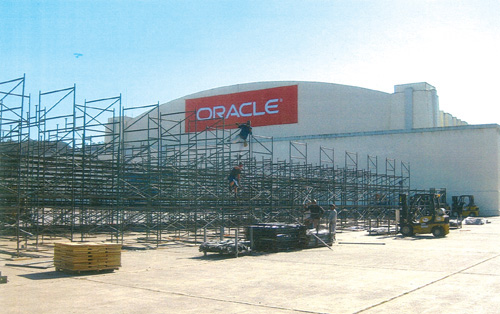
If wealth trickled down from Oracle’s OpenWorld conference in San Francisco last week, very little of it reached a small group of low-wage laborers hired from out of state to set up for a concert hosted as an event highlight on Treasure Island.

Oracle is a prominent Bay Area tech company helmed by Larry Ellison, the billionaire CEO who worked closely with top city officials to bring the America’s Cup sailing regatta to San Francisco.

The Oct. 5 Oracle OpenWorld concert on Treasure Island featured Sting and Tom Petty as headliners. Registration packages for the weeklong tech conference, which drew some 45,000 attendees to San Francisco, ranged from $1,395 to $2,595.

A member of the carpenters union contacted the San Francisco Office of Labor Standards & Enforcement (OLSE) Sept. 16 to formally complain that a construction crew assembling a large seating structure for the event was being paid less than the city-mandated minimum wage of $9.92 per hour, city documents show.

Josh Pastreich, an OLSE official, went to the worksite to interview crew members. Their names were redacted from public records, but Pastreich described them as monolingual Spanish speakers who travel from city to city building seating arrangements for major events.

“Everyone is being paid $8 an hour (except for the supervisors),” he reported in a city document. “Workers generally started at 6:30 am but there was a little confusion about quitting times.” At least one work day lasted 11 and a half hours, according to a timesheet. The workers were hired by subcontractors brought in by Hartmann Studios, an events management outfit working directly for Oracle.

“We made a phone call, and sent them some emails,” OLSE director Donna Levitt explained. “Nobody said, ‘we intended to pay them the [legal] rate,'” but the subcontractors increased workers’ hourly wages to comply with San Francisco minimum wage ordinance requirements, Levitt said. Since the company adjusted the rate immediately, no fines were issued. There were fewer than 20 workers on the project.

OLSE did not correspond with Oracle directly, but spoke to the subcontractors. One was T & B Equipment, a Virginia-based company. “We were not aware of the minimum wage there, but we fixed it before the payroll was done,” a T & B representative identified only as Mr. Waller told the Guardian. Lewmar, a Florida-based subcontractor, assisted with staffing for the job. Oracle, Hartmann Studios, and Lewmar did not respond to Guardian requests for comment.

Since the enforcement agency intervened, the laborers earned $9.92 per hour instead of $8 — still well below the average Bay Area payscale for similar work. Building bleachers is comparable to raising scaffolding for major construction projects, and the prevailing wage for unionized scaffolding erectors in California is $37.65 per hour, or $62.63 when benefits are factored in.

None of the workers were from San Francisco, which likely spurred the carpenters union complaint — Carpenters Local 22 has faced significant losses in membership since the economic downturn due to high levels of unemployment disproportionately impacting the construction sector. Represenatives from Local 22 did not return calls seeking comment.

Boosters of the America’s Cup have hailed the upcoming sailing event as an engine for local job creation, but Oracle’s use of low-wage, out-of-state laborers at its pricey, high-profile OpenWorld event raises questions. While the tech company is a separate outfit from the America’s Cup organizing team, Ellison holds leadership positions at both.

Ellison was named the world’s sixth wealthiest individual in a Forbes profile in 2010, with a net worth of $28 billion. His total compensation last year was listed as $70,143,075. That’s 3,399 times the amount a person earning $9.92 an hour would make in a year working 40 hours every week — before taxes, of course. (Rebecca Bowe)


LEE’S TELLING VETO

The Board of Supervisors approved legislation to close a gaping loophole in the city’s landmark Health Security Ordinance on Oct. 4, in the process forcing Mayor Ed Lee to promise his first veto and reveal his allegiance to business interests over labor and consumer groups.

Sup. David Campos sponsored legislation that would prevent SF businesses from pocketing money they are required to set aside for employee health care, seizures that totaled about $50 million last year. These health savings accounts are often used by restaurants who charge their customers a 3-5 percent surcharge, ostensibly for employee health care, instead simply keeping most of the money.

Despite aggressive lobbying against the measure by the San Francisco Chamber of Commerce — which went so far as to threaten to withdraw support for Prop. C, the pension reform measure it helped craft with Lee and labor unions — the Board of Supervisors approved the measure on a 6-5 vote on first reading (final approval was expected Oct. 11 after press time).

But then Lee announced that he would veto the measure, claiming it was about “protecting jobs,” a stand that was criticized in an Oct. 5 rally on the steps of City Hall featuring labor unions, consumer advocates, and mayoral candidates John Avalos, Leland Yee, Dennis Herrera, and Phil Ting.

Lee and Board President David Chiu — who voted against the Campos legislation, along with Sups. Sean Elsbernd, Mark Farrell, Carmen Chu, and Scott Wiener — have each offered alternative legislation that lets businesses keep the money but make some minor reforms, such as requiring businesses to notify employees that these funds exist.

Both Lee and Chiu talk about seeking “compromise” and “consensus” on the issue, but Campos and his allies say it’s simply wrong for businesses to take money that belongs to the employees, to gain a competitive advantage over rivals who actually offer health insurance or pay into the city’s Healthy San Francisco program, and to essentially commit fraud against restaurant customers.

“This money belongs to the workers and it’s something that consumers are paying for,” Campos said. “We have a fundamental disagreement.” (Steven T. Jones)


ET TU, DAVID CHIU?

In a press release on Oct. 6, mayoral candidate David Chiu stated his concerns over Mayor Ed Lee’s potentially illegal campaign contributions from employees of the GO Lorrie airport shuttle service. That company benefited from a decision by airport officials in September and then offered to reimburse employees for making $500 contributions to Lee, according to a Bay Citizen report.

“These revelations raise deeply troubling questions that merit a full investigation by state authorities. City Hall cannot be for sale. Pay-to-play politics has no place in San Francisco, and will have no place in a Chiu administration — you can count on that,” he said in the release.

But has Chiu — one of the top fundraisers in the mayoral field — been engaging in a little pay-to-play of his own? That was the question we had after we saw that he had received lots of donations from restaurant owners, whose side he took last week in opposing Sup. David Campos’ legislation to keep them from raiding their employee health care funds.

The Golden Gate Restaurant Association (GGRA) waged unsuccessful legal battles against the Health Care Security Ordinance and lobbied against Campos’ recent reforms of its loophole. And in the latest donation cycle, the GGRA donated the maximum $500 to the Chiu campaign. Other Bay Area food services contributed up to $5,950.

So the question remains, despite Chiu’s posturing against “pay-to play politics”— are these food service companies contributing to Chiu’s campaign because he’s doing their bidding in opposing the Campos measure and sponsoring an alternative that lets them keep most of the money?

When Liane Quan, co-owner of SF’s Lee’s Deli, was asked if the health care legislation was a reason she donated, she said, “Yes, that’s one reason.” She then hesitated to elaborate why. Members of the Quan family associated with Lee’s Deli contributed a total of $1,000 to the campaign.

Maurizio Florese, an Italian-speaking co-owner of Mona Lisa’s Restaurant who contributed $100, didn’t want to talk about his contribution or employee health care. Neither did his wife and co-owner, Filomena Florese, who is also President of Mona Lisa Inc., which manufactures chocolate and pastry products.

In fact, despite leaving messages at seven local restaurants who donated to Chiu, none wanted to talk. But we did finally get ahold of Chiu campaign manager Nicole Derse, who said Chiu has a broad array of supporters and his donations from restaurants had nothing to do with his stance on the Campos legislation.

“There definitely is no correlation at all,” she told us. “Any suggestion to the contrary is ludicrous.” (Christine Deakers)

City Lights celebrates a vital, veteran publisher

1

The avant-garde publisher New Directions was founded in 1936, but the idea was borne two years earlier when Ezra Pound gave some fairly harsh advice to James Laughlin, a 22-year-old aspiring poet and Harvard undergrad. In 1934, Laughlin was ambitious enough to travel to Rapallo, Italy, to meet and study under Pound, who was by that time a fascist and outspoken anti-Semite, but still respected by young writers as the force behind Eliot, Joyce, and Hemingway, as well as Imagism, the movement he helped shape. After two months, though, Pound didn’t think Laughlin possessed enough talent, and told him to return to the states and “do something useful.”
 
Three quarters of a century later, “useful” hardly describes New Directions (which will be celebrated Tues/11 at City Lights Books) and its dedication to publishing eccentric and groundbreaking work, beginning with the likes of Dylan Thomas, Denise Levertov, Tennessee Williams, and Marianne Moore, and continuing today with contemporaries like László Krasznahorkai and Javier Marías.

Birds, Beasts, and Seas: Nature Poems from New Directions (New Directions Publishing, 191 pages, $14.95) testifies to that dedication. Published to commemorate its 75th anniversary this year, and edited by the poetry editor, Jeffrey Yang, the anthology draws from the New Directions’ exhaustive archive, piling together over 140 poets of every nationality, period, and style into a handsome little book. Arranged chronologically by date of birth, and spanning from antiquity to the present, the anthology explores the vastly different ways poets have responded to nature: worshipping it, vilifying it, and bemoaning its loss. As luck would have it, four contributors to the anthology will read at City Lights to commemorate New Directions’ anniversary: Michael Palmer, Michael McClure, Lawrence Ferlinghetti, and Nathaniel Tarn.
 
As conventional or even dry as an anthology of nature poems may sound, Birds, Beasts, and Seas is impressive simply because New Directions’ specialty has always been renegades, rejects, and intransigents. It’s an anthology of nature poems, of course, but the poems are by no means characteristic of the genre. They are, however, characteristic of New Directions. Several of the poets here are rarely anthologized at all, and stumbling onto them is like bumping into old friends suddenly back from oblivion. William Bronk, for instance, whose poem “Aspects of the World Like Coral Reefs” dismantles science and asserts “It is absurd to describe the world in sensible terms;” or French poet Saint John Perse, Chilean poet Vincente Huidobro, and some of the very poets reading at City Lights on Tuesday, like Nathaniel Tarn whose brooding poem from “The Fire Season” wouldn’t appear in your typical nature anthology:
 
Our pines continue to die and continue to die—
funeral carpets of needles around their base.
You could sleep there, you could suffocate
soundly and be in harmony with all of nature.
 
Editor Yang writes in the preface that nature poems could change our way of thinking about the environment, and while Yang’s faith in the poem is admirable (however naive), the most anyone can really expect from Birds, Beasts, and Seas is an anthology that, at its finest moments, is new and invigorating.

New Directions Publishing 75th Anniversary
Tues/11, 7 p.m., free
City Lights
261 Columbus, SF
www.citylights.com

Uncorking Jameson

0

virginia@sfbg.com

APPETITE Ireland is a green land of rolling hills, sheep, and craggy coastline, to be sure. The people enchanted even more: a generous, welcoming, hilarious lot. One of my favorite people in recent Ireland travels was Liam O’Leary, distillery operations manager at New Midleton Distillery in County Cork, near the southern coast of Ireland.

The name New Midleton may not mean a lot to some, but if you follow Irish whiskey, you know there are merely three distilleries producing publicly sold spirits in all of Ireland and this one’s the mother. Most famously, it’s the home to Jameson (founded in 1780 by John Jameson and originally produced in Dublin at the Old Jameson Distillery, which I also visited). New Midleton also produces numerous Irish whiskies including Midleton, Powers Gold Label, Tullamore Dew, Paddy, and smaller pot still brands like my longtime favorite Irish whiskey, Redbreast, and new love Green Spot. (Oh, that it would become available in the States).

Liam hosted the Renaissance Man and I on a private tour of the grounds. Spending pleasurable hours talking of whiskey and his 40-year history at Jameson (long before it was the huge company it is now), we soon delved into a subject dear to my heart, and, it seems, to every local I spoke to: music. We watched mass distilling in action, and finished with a hearty Irish lunch in the distillery restaurant.

The New Midleton facility is to date the most colossal, high production I’ve yet seen: towering stills, control panels, endless storage buildings stacked with barrels, and the world’s largest pot still (able to hold up to 125,000 liters, or roughly 33,000 gallons), which is no longer in use but is viewable in the Old Midleton museum. Numerous copper pot stills operate simultaneously, holding a massive 75,000 liters each. The facility whirs and buzzes continuously, recalling Ireland’s past, creating its future.

Exploring New Midleton, it was only fitting we talk Jameson. Possibly the highlight of my trip to Ireland — and there were many — was tasting Jameson 20-year whiskey straight from bourbon barrels (of which the majority of Jameson is aged in), and alongside it, 10-year whiskey in sherry barrels, both of which are blended into higher-end final product.

Both were superb, the purest forms of Irish whiskey I’ve tasted, particularly the golden, 20-year in bourbon barrels. Its layers kept unfolding: warm, honeyed and bright, spicy, fresh with grain and fruit. Already perfection, this stuff should be bottled at cask strength on its own. The sherry cask whiskey adds round, dark notes, giving it fullness and sensual depth.

As I taste through the Jameson line here at home, notes from those unforgettable barrels come back to me. I pick up various strains from the bourbon and sherry oak, all with that ever-present smoothness Irish whiskey is known for as it is generally triple-distilled. As the biggest selling Irish whiskey in the world, Jameson has done much to advance the category. Here are my tasting notes:

Jameson Rarest Reserve, $279: Rarest Reserve is the granddaddy of the line. Winning numerous awards (including this year’s Double Gold at the SF World Spirits Competition), it’s an expensive but truly special imbibement. After one explores the full-bodied aromas of ripe plum and spice, the taste impresses with toasted wood, dusty peach, dark chocolate, a hint of slate, leather, and earth. Here I find encompassed the approachable yet elevated possibilities inherent in Irish whiskey.

Jameson 18-year Limited Reserve, $86.99: The 18-year is another big award-winner, hitting my taste buds with an intense amount of peach. For me it evokes a golden summer freshness. Though I prefer it neat, it’s also lovely on the rocks. A couple drops of water allow other tastes to unfold, including orange marmalade, gentle spice, nuttiness, and biscuit. It’s soft yet bright, and could convert the non-whiskey drinker.

Jameson Gold Reserve, $60.99: Gold Reserve is a richer whiskey than the 12-year or Jameson Irish Whiskey. I get creamy apple on the nose, a gentle honey texture, and a peppery finish.

Jameson 12-year Special Reserve, $39.99: The 12-year won Gold this year at the SF World Spirits Competition. It’s sweet and spicy with sherry, wood notes. Oddly enough, I find its astringency is softened and rounded out with food.

Jameson Irish Whiskey, $24.99: The original Jameson has never been my Irish whiskey go-to. I find it a bit hot and thin, despite sweet fruit, vanilla and nuts. But this is the great global seller in Irish whiskey, often the first introduction many have to the category.

Subscribe to Virgina’s twice monthly newsletter, The Perfect Spot, www.theperfectspotsf.com


On the Cheap Listings

0

THURSDAY 29

Lesbian werewolf party El Rio, 3158 Mission, SF. (415) 282-3325, www.elriosf.com. 9 p.m.-close, free. Allison Moon didn’t sit around waiting for a big publishing house to bring her tale of werewolf hunter-werewolf love to the masses. She up and published it herself, which explains why Moon has been showing up in the most unexpected spots to promote her supernatural story. Not that El Rio should be considered unexpected. Where else would this party happen but at that Outer Mission be-patioed dive?

Litquake Epicenter California Institute of Integral Studies, 1453 Mission, SF. www.litquake.org. 7 p.m., free. An expert panel – including a freelance artists, poets, editors, and curators – examines the trends in inter-disciplinary arts. Talk will travel from social media to technology and cross-media storytelling. Get your teeth sharpened for Litquake’s onslaught of bookish happenings with this appetizer course.

FRIDAY 30

“Lessons from the Battle of Benton Harbor: Confronting Police Brutality, Courtroom Abuse, and Corporate Dictatorship” ArtInternationale, 963 Pacific, SF. 7 p.m., free. Listen to tales from Reverend Edward Pinkney and Dorothy Pinkney, who’ve been crusading against the corporate-government takeover of Benton Harbor, Mich. Their stories will blend with those of ex-San Francisco poet laureate devorah major and community activist and ex-president of the Board of Supervisors Matt Gonzalez, who will also bring their stories of police violence and racist government policies.

SATURDAY 1

Open Studios: Mission, Bernal Heights, Castro, Eureka Valley, Excelsior See map of participating SF galleries. www.artspan.org. Also Sun/2. 11 a.m.-6 p.m., free. If you start drinking coffee really early and wear really comfortable shoes and your art enthusiast’s hat… well you still probably won’t see all the galleries whose doors are being thrown open today. But you can try. Featured artists include All Over Coffee’s Paul Madonna, installation artist Cynthia Toms, the Metal Arts Guild, and queer creative activist Doyle Johnson.

Arab Cultural Festival Union Square, SF. www.arabculturalcenter.org. Noon-6 p.m., $6. In typical festival fashion, this event bills itself as the largest – in this case, the largest fete of Arab art and culture in Northern Cali. Regardless of its ranking, the program will bring a Palestinian folkloric dance company, an NY-based band inspired by the Sudanese pentatonic scale, a Jordanian-American virtuoso, and Syrian-American hip-hop. Did we mention that traditional food will be served?

Filipino International Book Festival San Francisco Main Library, 100 Larkin, SF. www.sfpl.org. 11 a.m.-5 p.m., free. Also Sun/2, noon-5 p.m. Wander amidst the stacks – today and tomorrow this literary event will focus on the works of Filipino and Filipino-American artists. Food will be on offer, come celebrate a culture with great significance in the Bay Area.

SUNDAY 2

Oakland Centennial Suffrage Parade Starts at Edoff Memorial Bandstand, 666 Bellevue, Oakl. www.waterfrontaction.org/parade. 11:30 a.m., free. In 1908, 300 Oakland women marched these selfsame city streets to the Republican Convention to ask the party to prioritize their right to vote in their country’s elections. It wasn’t until three years later that their civil rights were made law, but let’s continue to honor their legacy. This parade – with speeches by Oakland mayor Jean Quan and others, is a great way to give thanks to our ancestors.

Modern Times 40th anniversary party Modern Times Bookstore, 2919 24th St., SF. (415) 282-9246, www.moderntimesbookstore.com. 1 p.m., free. This recent move to 24th isn’t the first time that the Mission’s iconic bookstore has had to pack up its volumes – it’s actually the third, which might explain the uninterrupted focusing on bringing literature to the people. Today, the shop is hosting the 90th birthday of Jean Pauline, who has been working at the store’s shifting locations since 1971. It coincides with Modern Times’ 40 year marker, a fact which its new neighbor La Victoria Bakery and Kitchen will be commemorating with a custom-made cake.

MONDAY 3

First Monday Movies: High Sierra Excelsior Branch Library, 4400 Mission, SF. www.sfpl.org. 6:30-8:30 p.m., free. Settle into the Excelsior’s book palace for a screening of this 1941 Humphrey Bogart movie. Bogey plays Roy “Mad Dog” Earle, an ex-con who is compelled by a mobster to rob a resort for lots of loot. Sadly, Earle loses his stomach for the heist when his sweetie dumps him after fixing her deformed foot. The ensuing chase with the police takes him all the way up to the peak of Mt. Whitney.

“Don’t Shoot: One Man, a Street Fellowship, and the End of Violence in Inner-City America” First Unitarian Church of Oakland, 685 14th St., Oakl. www.brownpapertickets.com. 7 p.m., free. How’s this for a solution the drug wars on American inner-city streets? Huge interventions with drug offenders, in which they sit with their families and policies to hear about how their actions affect their community. If it sounds Pollyanna-esque, you should attend this lecture. David Kennedy has helped to coordinate these happenings in over 50 cities, and has seen decent results throughout.


Submit items for the listings at listings@sfbg.com. For further information on how to submit items for the listings, see Picks.

Moving the planet: San Francisco speaks

2

As far as the planet is concerned, it’s probably a good thing that Morgan Fitzgibbons is adept at guilt trips. Consider the Huffington Post editorial the SF neighborhood activist and founder of Western Addition’s Wigg Party wrote earlier this year. You know our descendents? “They will either remember you as someone who fought for life against the greatest odds, or someone who simply neglected your most fundamental responsibility — to pass the world on to the next generation,” wrote Fitzgibbons. 

In the same editorial he promised to “see you in the streets.” Well ready your street-walking shoes, because that day has come: Sat/24 is Moving Planet Day, which will see 2,000 events in more than 168 countries, promises to be one of the largest global manifestations for the environment to date. People across the Earth will be speaking out, massing up, and getting loud about the need to stop our fossil-fueled ways before it’s too late.

Morgan Fitzgibbons walks the walk at a tree planting in July. Photo via St. Cyprian’s Episcopal Church

And you should hear the voicemail we got from Fitzgibbons yesterday. Jesus, blistering. Invoking our duty as agents of change in the Bay Area, for chrissakes. So we decided to swing into action: today, tomorrow, and next week we’ll be profiling Moving Planet Day events across the planet. We’ll begin close to home with Fitzgibbons explaining what will be happening in our very own city. Tomorrow: an organizer from Buenos Aires tells us what’s in store down south. 

San Francisco Bay Guardian: What is your role in your city’s Moving Planet Day events?

Morgan Fitzgibbons: As a leader of a neighborhood based resilient community organization, I am of course a long time fan of 350.org and know from previous experience that their annual days of action are the biggest events in the whole world of climate change, sustainability, etc. So I’ve been doing general volunteering since May to help produce the event – anything from finding a scissor lift to media outreach to hopefully being able to say a few words on stage on Saturday.

SFBG: What inspired you to get involved?

MF: I’ve known and worked with the 350.org folks for a number of years now, and so I know there is no bigger event on the scene. They have done an excellent job of galvanizing the whole world to stand together, and that’s really key – this is a global problem that requires a global solution. 


SFBG: What does your city have planned for Saturday?

MF: Our event is going to bring together people from all over the Bay Area. People will meet in their regional cities and towns and then travel to San Francisco at 12 p.m. to march from Justin Herman Plaza down Market Street to Civic Center for a big rally featuring 350.org founder Bill McKibben and the Sierra Club’s executive director Mike Brune as well as a bunch of great music, including Ashel Seasunz!


SFBG: How many people are expected to attend?

MF: We won’t really know until Saturday, but we are anticipating somewhere in the 2,000-4,000 range.


SFBG: Why is this such a big deal?

MF: It’s a huge deal because climate change and the related planetary crises threaten the very foundations of our society. The world’s governments have obviously demonstrated that they are going to put short-term profits ahead of any long-term security and are effectively ignoring these issues. Saturday is the rare time when we can push the clueless governments out of the way and stand together as a concerned global population. Millions of people around the world are going to devote their day to standing up for this cause, because they know that the maintenance of a healthy planet is more important than anything else in the world. 


SFBG: What do you hope that this day achieves?

MF: You know rallies are notoriously tricky because everyone shows up, everyone’s excited, and then at the end of the day you’re not always sure what came out of it. I think obviously a big takeaway is going to be knowing that millions of people around the world feel the same urgency that you do, which is extremely empowering. But what I personally hope people take away from the day is that this isn’t a problem that’s solved with a rally or voting for or against some bill at the  ballot box. It’s something that is going to require us to get out in our neighborhoods every day to organize and build more resilient communities. That’s what I’ll be preaching if they hand me the mic.


SFBG: How will you transport yourself to the festivities?

MF: I’m going to be riding from Tour de Fat in the morning, so I’ll be taking my bicycle through the Wiggle. I wouldn’t have it any other way.


SFBG: Complete this sentence: We can reverse the causes of man-made climate change if we…

MF: …get out in our neighborhoods and organize. This must happen in every community big and small. There is no movement without this. We need no less than a cultural revolution. But as soon as people take this aspect of the work seriously… look out.


Moving Planet Day

Sat/24 10 a.m.-6 p.m., free

March starts at Justin Herman Plaza, SF

Afternoon activities at Civic Center, SF

www.moving-planet.org


Maximum Consumption: Rhubarb Whiskey pairings

0

Booze-soaked bluegrass, could there be anything more befitting for this time of year, on this plot of land? San Francisco is finally warm, if only for the week, so enjoy it while it lasts. Sit on your front porch (read: stairwell or fire escape), whip up a naturally-infused whiskey cocktail, then listen to the rough and tough Americana songs of Oakland’s own, Rhubarb Whiskey. Or you can check out the band live this Friday, Sept. 23 at the Plough and the Stars.

With harder-edged takes on folk, it’s got the auditory sensation of dragged chains through fiddle, railroad spike on accordion, ominous train horns a-coming through the fog, perked up with plucked mandolin. A jug in hand seems almost mandatory at this point. For Maximum Consumption, I asked Rhubarb Whiskey – which includes Boylamayka Sazerac, Emchy, and Sizzle La Fey – to pair their songs (all of which you can hear on their Bandcamp page) with the appropriate whiskey. They did me one better and gave helpful explanations, and a recipe for their specially concocted namesake recipe at the end.

Track: “We All Come to the Same Place” paired with  Stranahan’s Colorado Whiskey
Stranahan’s Colorado Whiskey – sweet smooth with some hints of caramel and smoke on the finish – it sounds like roughing it, but really it’s all about the most sweet and comfortable moments.

Track: “Whiskey Neat” paired with Jim Beam Rye
While this song about trying to get with a girl at a show but getting into a fight instead even mentions 18-year-old scotch, it’s really more of a rough and tumble Jim Beam Rye sort of feel. Spicy, pissed off, and feeling like you’re gonna have a good time raising hell with your broke-ass friends.

Track: “Bears in the Lot” paired with Wild Turkey
This song also name checks a booze but this time it hits the nail on the head – if you’re stranded and heartbroken in an Alaskan bar with rogue bears, it has to be a Wild Turkey night.

Track: “Night Jasmine” paired with Sazerac Rye with Fee Brother’s Rhubarb Bitters
This murder ballad set in a Louisiana swamp has to have the dark liquid vice of Sazerac Rye Whiskey with the sour seedy and slightly sweet undertones from Rhubarb Bitters. While the whiskey is upfront, smooth, and mysteriously seductive, the rhubarb undertones will pull you into the bitey lusty flavor – and you know that while the drink is tasty it’s going to be a dangerous night.

Track: “Whiskey in the Afternoon” paired with Bulleit Rye
This song is all about what happens when the drinking gets away from you. When the heart of the song is about having your whiskey all day long, we have to speak from the experience of the recording itself and go with Bulleit Rye.

Track: “Go Away” paired with Jameson
A sweet and true love song about drinking on the beach, hopping trains, and stowing away on ships. It’s gotta be Jameson for this one. The booze had to travel to get to the wayfaring lovers but it keeps ’em warm and cozy while they’re barreling forward on those windy boxcars.

Track: “Sorrows Drowned” paired with Maker’s Mark
This was the first song the band ever wrote. Dark, drunken and pissed off it’s the song you stomp and slur along to at last call while you’re finishing that last Maker’s of the night and still just wanting one more.

Final note from the band:
“Lastly of course we have to get to the name Rhubarb Whiskey itself. We love to play music, make food together, and we hella love our rye whiskey, so as soon as the band was formed we knew that we needed to channel our inner boozahol super powers and come up with somethin’ special.”

Adding, “Since Emchy is a big fan of cooking rhubarb pie she went ahead and tried making some rhubarb simple syrup. Add that to some rye whiskey with an ice cube or three and you’ve got yourself a Rhubarb Whiskey.”

Official Recipe
Rhubarb Simple Syrup
1 cup sugar
1 cup water
1 cup peeled and chopped rhubarb
Boil 1 cup of water, add 1 cup sugar, stir until sugar is completely dissolved, add 1 cup coarsely chopped and peeled rhubarb, lower water to a simmer, let simmer covered for one hour. Put into glass mason jar to cool and then refrigerate. Let sit at least one hour (a full day is better for flavor).

Once your rhubarb simple syrup is cool, add one part syrup to two parts rye whiskey (brand of your choice but don’t go too high end, that insults the whiskey and brings bad luck — we suggest Beam Rye or Makers if you need to get a little fancy). 1-3 ice cubes recommended. Now put on your favorite murder ballads album, drink up, and be careful — it goes down a little too easy.

Record Release Party
With Rhubarb Whiskey, 5 Cent Coffee, and Plasterkatz
Fri/23, 8 p.m., $10
The Plough and the Stars
116 Clement, SF
www.theploughandthestars.com


Localized Appreesh: The 21st Century

0

Localized Appreesh is our weekly thank-you column to the musicians that make the Bay. Each week a band/music-maker with a show, album release, or general good news during those seven days is highlighted and spotlit. To be considered, contact emilysavage@sfbg.com.

Last fall, eclectic new folk act the 21st Century was given the opportunity of a lifetime: a chance to record with legendary producer Stephen Short  (the former owner of Trident Studios who has worked with David Bowie, the Clash, Paul McCartney, Queen, Echo and the Bunnymen et. al.). The Bay Area eight-to-nine piece was thrilled but too broke to cover all the costs of making the album, plus, there were travel commitments (Short is based in Texas).

The forward-thinking futurists harnessed modern technology: they set up a Kickstarter page. With the $10,000+ funding in place (thanks to 187 backers), the band recorded late last  year, and the album will be released in November. Before that release, however, the 21st Century will play a show as part of the ongoing Mission Creek Music and Art Festival.

Year and location of origin: 2010, SAN FRANCISCO/OAKLAND/BERKELEY
Band name origin: The name originates from a few different places. One is ambition. We’re an eight (and occasionally a nine) piece with orchestrated horns and four part harmonies and a couple of kitchen sinks so we wanted to name ourselves in a way that reflected that bold and without limits musical attitude. We also felt that we’d spent much of our lives hearing our times and our generation defined for us in ways that we didn’t relate to so we thought why don’t we take a stab at it and have a say in the matter. Hence THE 21ST CENTURY. Oh and I also remember hearing Elvis Costello saying that he named himself after the two largest acts he could think of — a pretty gutsy move. I thought — now that’s a good idea, but let’s raise him one.
Band motto: Unofficially, it’s probably ‘What would Bruce Springsteen Do?”
Description of sound in 10 words or less: Intricate arrangements, colorful harmonies, brass, lyrical surrealism and off-beat pop sensibility.
Instrumentation: Electric, Acoustic and bass guitars, drums, keys, horns, lots of percussion and lots of singing.
Most recent release: THE CITY, Coming Soon…November 2011.
Best part about life as a Bay Area band: People want to be friends.
Worst part about life as a Bay Area band: The bars and clubs close too early. 2 a.m.? Come on.
First record/cassette tape/or CD ever purchased: The single of “Under Pressure” by David Bowie and Freddy Mercury. I thought I was getting Vanilla Ice.
Most recent record/cassette tape/CD/or Mp3 purchased/borrowed from the Web: Wilco’s The Whole Love & Girls Father, Son, Holy Ghost.
Favorite local eatery and dish: Al Pastor at El Metate–dynamite.And the Cold House Noodles at Yamo.

Mission Creek Music and Art Festival
Ongoing through Sept. 30
Multiple venues through San Francisco and Oakland
www.mcmf.org

The 21st Century
Sept. 28, 9 p.m. $8
The New Parish
579 18th St., Oakl.
Event info

Live at the Starry Plough:

The America’s cup confusion

19

If the sponsors (and city officials) are right, the America’s Cup is going to be a huge event, attracting hundreds of thousands of spectators, many of whom will want to be on the San Francisco waterfront to watch. But it’s never been clear to me exactly how that’s going to work — how are all those (rich) people who are used to getting around in limos going to travel from their downtown hotels to the viewing areas? If the city wanted to do this right, we should close down the Embarcadero and some of the feeder streets to all vehicles (except ambulances — always needed when rich old people get excited) and force everyone to travel by pedicab. Buy up a fleet of several hundred of the human-powered vehicles and let all the unemployed teenagers get a shot at driving them. Job creation for youth; environmentally sound transportation; potentially fun bumper-car action with well-heeled patrons screaming in fear.


Remember: The f-line, even with improvements, can’t possibly handle the necessary traffic. And the AC types aren’t going to ride the train anyway. No way private cars can all fit without massive gridlock.


So: Pedicabs. My suggestion.


In the meantime, there’s this little problem of 8 Washington.


See, the developer of what would be the city’s most expensive condos ever is planning on excavating 110,000 cubic yards of soil for a massive underground parking garage — right along the Embarcadero, and right during the America’s Cup events. The Draft Environmental Impact Report for 8 Washington indicates that the dump trucks (about 20 big trucks per day, and possibly a lot more) would be using that roadway to get to 101 or 280.


Actually, if activist Brad Paul is correct, there’s no way the developer can excavate that much dirt in the time frame that it’s supposed to happen unless the number of trucks is closer to 300 a day. Imagine all of that happening while 100,000 people are trying to get to the waterfront to watch the show. Oh, and according to the DEIR for the America’s Cup, the Embarcadero will be CLOSED during that period.


The fact is, the 8 Washington project is not only a terrible idea (just what the city needs — more condos for mega-millionaires) but would directly screw up the whole America’s Cup effort. And the amazing thing is that the AC people and the Mayor’s Office don’t seem to be paying attention.


Paul has put together a lengthy critique of the whole mess that makes great reading if you’re into this sort of thing. So I thought I’d just post it all here. Warning: It’s long. Enjoy.


August 15, 2011                                                                                                         


Bill Wycko
Environmental Review Officer
San Francisco Planning Department
1650 Mission Street, Suite 400
San Francisco, CA  94103


Re: COMMENTS ON DRAFT EIR FOR 8 WASHINGTON STREET/
SEAWALL LOT 351 PROJECT    
Case No. 2007.0030E


Dear Mr. Wycko:


I am writing to my provide my comments on the Draft Environmental Impact Report (“DEIR”) for this project, a document that is incomplete, inadequate and in places quite misleading. I’ve organized my comments in sections beginning with a detailed discussion of how the project’s construction schedule has been greatly underestimated. This is followed by discussions of the DEIR’s failure to address key Housing and Population issues, misstatements regarding historic obligations related to Golden Gateway, comments on recreation issues, and more.  In general, I believe the DEIR fails to present objective information and analysis, it omits a number of relevant issues that are critical to the ability of public officials to make objective and informed decisions about the project and it is filled with judgments and assertions that are not supported by facts.


The DEIR is incomplete and inadequate in the following areas:


I. THE DEIR CONSTRUCTION SCHEDULE FOR 8 WASHINGTON IS BOTH INACCURATE AND MISLEADING.


The DEIR construction schedule is based on overly optimistic assumptions that are totally unrealistic; the ramifications of these erroneous assumptions need to be carefully considered as they will cascade throughout the project requiring major revisions to the DEIR before it can be considered accurate and complete.


At the bottom of page II.19 it states:
 
      Project construction, including demolitions, site and foundation work,
      construction of the parking garage, and construction of the buildings,
      would take 27-29 months. Assuming that construction would begin in 2012,   
      the buildings would be ready for occupancy in 2014. The first phase of the
      construction would take about 16 months and would include demolition       
     (2 months), excavation and shoring (7 months), and foundation and below
      grade construction work (7 months).


While the DEIR unequivocally states the project will take 27-29 months to construct, from 2012 to 2014, facts provided elsewhere in the DEIR together with current city policies,  the City’s America’s Cup Host and Venue Agreement and basic math indicate that this schedule is not tenable. The remainder of this section provides the data and analysis that lead to the conclusion that construction of 8 Washington will take much longer than 27-29 months, almost TWICE AS LONG, with excavation taking 2.5 to 3 TIMES longer.  


Table 1: Requested Changes to the overall DEIR construction schedule


          ACTIVITY             MINIMUM           MAXIMUM


    DEIR’s construction schedule: 27 months    to    29 months  


    Actual excavation schedule:  18 months           22 months
    — DEIR estimate for excavation – 7 months            – 7 months
    + Increased excavation time  11 months      to       15 months 
    + Archeology delays                .5 months      to         2 months
    +  America’s Cup delays                  2.5 months       to         5 months
    +  Weather delays                        .25 months      to         1 months


   ACTUAL CONSTRUCTION TIME 41 months       to      52 months


To refute the numbers in Table 1, project sponsors must present additional, verifiable data supporting their unrealistic assumptions, beginning with the claim that the first phase of construction takes 16 months with a mere seven months allocated for excavation/shoring.


A. The DEIR fails to accurately ascertain and analyze the excavation/shoring schedule.


The DEIR states on page II.20 that “approximately 110,000 cubic yards of soil” will be excavated from the site for an underground garage (approximately 90,000 cubic yards) and other foundation work during the seven (7) month “excavation” portion of the projected timeline. It later states excavation will take place 6.5 hours per day with an average of 20 truck trips per day (pg.IV.D.31). Assuming the average dump truck holds 12 cubic yards of dirt (typical payload for a dump truck), that would mean:


      · 110,000 cu. yards/12 cubic yards per truck = 9,166 truck trips


      · 20 trucks/day X 12 cubic yards/trip = an average of 240 cu. yards/day


      · 110,000 cu. yards/240 cu. yards per day = 458 working days for this task


Could this task be completed in seven (7) months as claimed in the DEIR?  NO.


     ·5 working days per week X 52 weeks = 260 working days per year
             – 11 holidays per year
                   249  total working days/year


     ·458 days to finish task/249 working days per year = 22 months  (not 7)
     
For this to take 7 months as the DEIR asserts, the following would have to be true:


   · 20 trucks/day X 7 months (145 working days ) = 2,900 total truck trips


   · 110,000 cu. yards/2,900 trucks = each truck must average 38 cubic yards/trip
Empirical evidence exists, however, proving the DEIR’s claim that the excavation portion of the schedule will take seven months is inaccurate and misleading:


        CASE STUDY #1: San Francisco General Hospital Rebuild Project


A recent SF General Hospital (SFGH) Newsletter reports the hospital’s contractor just finished hauling 120,000 cu. yards of dirt from the 45’ deep hole that was dug to build two basement levels and the foundation for a new hospital building. This is as close as anyone is likely to get to replicating what 8 Washington proposes, a three level 40’ deep underground garage accounting for most of the 110,000 cubic yards of dirt that must be removed from the site. 


A call to the SFGH Rebuild office revealed their excavation process took seven (7) months with an average truck load of 13 cu. yards per trip. How was that possible?


“The average truck load was 13 cubic yards. Some days we had
over 300 truck loads hauled in one day. This volume was possible
through use of a paved drive that allowed trucks to enter the side, be
loaded up then tires washed to prevent dirt on road causing storm-            
water pollution and dust.”


The SF General site is just a few blocks from U.S. 101 with direct access via Potrero Ave., thus minimizing potential traffic conflicts. The 8 Washington site will require driving long distances on city streets including “The Embarcadero, Harrison Street, and King Street… likely the primary haul and access routes to and from I-80, U.S. 101, and I-280 (pg. IV.D.31).” Imagine 300 trips a day on one of these streets.


               CASE STUDY #2: SF PUC’s New Hetch Hetchy Reservoir Tunnel


A recent Oakland Tribune story (4/8/11) describes construction of a new 3.5-mile tunnel designed to protect the water supply from SF’s Hetch Hetchy reservoir from major earthquakes by boring a 2nd, state-of-the-art tunnel from Sunol to Fremont alongside the existing 81-year-old Irvington Tunnel. The article states:


      “By the time the New Irvington Tunnel is completed in 2014, crews will have
        excavated about 734,000 cubic yards of material—the equivalent of 61,000
        dump-truck trips, said officials with the SF Public Utilities Commission.”


Dividing 734,000 cubic yards of soil by the 61,000 dump truck trips that the PUC says are necessary equals 12 cubic yards per truck trip. Given this job’s overall size and $227 million budget, it would seem to confirm the fact that the most efficient excavation equipment for the 8 Washington site will be 12 cubic yard dump trucks.


In light of these facts and the analysis provided above, the only way 8 Washington could meet its proposed seven (7) month excavation schedule would be to:


a) schedule up to 300 TRUCK TRIPS A DAY, over 10 TIMES the average number of trips per day (20) stated in the DEIR and 3 TIMES the absolute maximum of 100 truck trips per day (pg. IV.D.31)  along the Northeast Embarcadero during a period of time that directly overlaps with the major America’s Cup events and activities, something specifically prohibited by the City’s America’s Cup Host and Venue Agreement ,        


         OR


b) average 38 cubic yards of dirt per truck trip, 3 TIMES the average truck payload of both the PUC’s Irvington Tunnel project and SF General Hospital’s 120,000 cubic yard excavation project—assuming that 38 cubic yard trucks:  a) exist in sufficient quantity in   the Bay Area, b) would be available during that period of time described and c) would be allowed on The Embarcadero, Harrison St., King St., Washington St. and Drumm St. by     the City. [see photo comparison of 12 cubic yard vs. 30 cubic yard trucks below]


Unless the project sponsor can demonstrate that one of these two highly unlikely scenarios is possible, then the EIR must reanalyze a number of impacts (e.g. Land Use, Air Quality, Greenhouse Gases) based on a revised excavation schedule, one that takes 2.5 to 3 TIMES as long as the one described in DEIR to complete excavation work, and this 22 month timeline assumes NO archeological remains are found on site and the City imposes NO stop work orders related to America’s Cup (see below).


This 15-month difference between the excavation period analyzed in the DEIR and the ACTUAL time it will take to complete the excavation (22 months vs. 7 months) is a major deficiency in the DEIR with profound impacts.  For instance, some of the most significant unavoidable negative impacts described in the DEIR involve degraded air quality both during and after construction. Adjusting the environmental analysis to reflect how long excavation will actually take means significant air quality impacts related to excavation (with the greatest detrimental effect on seniors, children and people exercising) will persist for 2.5 to 3 TIMES LONGER than described in the DEIR.  This flaw also requires significant revisions to other sections of the DEIR.


In light of this new information, the next draft of the EIR must contain an analysis of    this longer overall construction period—two months for demolition; a range of 18 to 22 months for excavation (not seven months); a built-in range of time for the shutting down of the site when archeological artifacts are uncovered, documented and extracted (something the DEIR’s archeology consultant states is “likely” ); and the building construction period. Finally, given these overly aggressive excavation schedule estimates, all other estimates for later construction phases must now to be cross checked for accuracy by independent contractors (e.g. not working for 8 Washington developer    or the source of the prior DEIR excavation estimate).


B. The actual construction timeline for 8 Washington will be 41-52 MONTHS. 
If the project sponsors disagree with this assessment, they must provide the Planning Department with much more detailed information on how they expect to achieve a shorter construction period given the restrictions described in the DEIR itself as well as mathematical analysis described above. For instance,


– Did the developers err when they reported that the average number of truck
   trips per day would be 20 as analyzed in the DEIR?  If so, what number do they 
   choose to use now and how does that impact various aspects of the DEIR analysis
   such as air quality, conflicts with pedestrians, MUNI and America’s Cup, etc.. 


– Does the developer plan to raise the limit of truck trips per day from 100 (as
   per the DEIR) to 300 truck trips per day? If so, how often will this happen and 
   how will these changes impact various aspects of the previous EIR analysis (e.g. air
   quality, traffic/transit/pedestrian conflicts, America’s Cup)?


– Does the developer plan to lengthen the average workday or work six days a
   week? If so, how often and how would this impact the previous DEIR analysis?
   NOTE: The DEIR construction schedule (27-29 months) was not predicated on the
   trucks operating 6 days a week EVERY WEEK. But even if the developer ran dump  
   trucks 6 days a week for the ENTIRE excavation period it would still take TWICE AS
   LONG as the DEIR states to remove 110,000 cubic yards of dirt .


– Where is the project sponsor planning to route 100 to 300 trucks a day as they
   leave the site, particularly during the various America’s Cup trials (2012) and
   finals (2013) when vehicular traffic will be severely limited or prohibited?
   Washington Street? The Embarcadero? Drumm Street? Clay Street?, where exactly?


– Have the developers located a source of 30+ cubic yard trucks and secured
   city permission to use them on the specific streets described in the DEIR?
   It seems fair to assume the SF General Hospital’s excavation contractor would have
   done this if it were possible (and the SF PUC’s Irvington Tunnel contractor). See the  
   three photos below to get a sense of the size difference between a typical 12 cubic yard
   dump truck and the type of tractor-trailer rig required to carry 30 cubic yards or more.


As the questions and examples (SF General Hospital) above demonstrate, the DEIR’s claim that 110,000 cubic yards can be excavated in seven months defies the laws of physics and math, not to mention the America’s Cup Host & Venue Agreement between the City and Larry Ellison’s Oracle BMW Racing Team 


 A thorough reading of the DEIR’s Archeology section and the America’s Cup Host and Venue Agreement indicate that additional time must be built into the construction schedule for predictable work stoppages related to both issues.


KNOWN ARCHEOLOGICAL RESOURCES IDENTIFIED ON THIS SITE IN THE DEIR


On page IV.C.12, the DEIR’s archeology consultant, Archeo-Tec, identifies the Gold Rush ship Bethel as located under a portion of the site and states that “If discovered, the Bethel would be the oldest known (and perhaps most intact) archeological example of an early Canadian built ship (Pg. IV.C.3)”. On page IV.C.11, the archeology consultant states “Significant archeological resources are likely to exist at this site”.  The DEIR, goes on to state the proposed project will destroy a portion of city’s original Seawall causing “the largest disturbance of the Old Seawall to date”.


As a result of these DEIR findings, the archeology consultant should now be asked for an estimate of the time required to mitigate the discovery of the Bethel and other likely finds (e.g. original Seawall, other Gold Rush ships, original Chinatown). This “likely” work delay should be built into the construction schedule and stated as a range. For purposes of the matrix below (Table 1) we chose a time of two weeks to two months based on anecdotal information from other similar sites. Archeo-Tec, the archeology consultant, should be able to come up with a more precise estimate.


KNOWN AMERICA’S CUP SCHEDULING CONFLICTS


Based on recent MTA staff presentations on protocols for the America’s Cup, it seems clear that traffic, particularly construction dump trucks, will be banned from Washington Street, Drumm Street and The Embarcadero during major America’s Cup events that include, at a minimum, the America’s Cup World Series warm-up races (July/Sept. 2012), the penultimate Louis Vuitton Cup Series (July/August 2013) and the America’s Cup finals (Sept. 2013).  


This represents a minimum of 2.5 months that must be added to the construction schedule, something the DEIR authors should have included if they had read the America’s Cup DEIR which states there are 9+ weeks of races associated with this event in 2012/2013. The extra few weeks added to the low end range in Table 1 (below) are there to accommodate last minute weather delays and various large non-racing events held along the waterfront that will require closure of The Embarcadero, Washington Street, Drumm Street, etc.


Table 1 below lays out a more credible and realistic construction schedule based on the factors described at length above, taken directly from the DEIR or readily available from the city (e.g. America’s Cup DEIR) and the America’s Cup Host and Venue Agreement.


Table 1: Requested Changes to the overall DEIR construction schedule


          ACTIVITY             MINIMUM           MAXIMUM 


    DEIR’s construction schedule: 27 months    to    29 months  


    Actual excavation schedule:  18 months           22 months
    — DEIR estimate for excavation – 7 months            – 7 months
    + Increased excavation time  11 months      to       15 months 
    + Archeology delays                .5 months      to         2 months
    + America’s Cup delays                   2.5 months        to         5 months
    + Weather delays                        .25 months      to         1 months


   ACTUAL CONSTRUCTION TIME 41 months       to      52 months


To refute these numbers, the project sponsors must not only present a verifiable and detailed plan to remove 110,000 cubic yards (9,167 truck trips) in seven months that the City has signed off on but also produce a letter from the City and Oracle BMW Racing granting a waiver from Section 10.4 of the America’s Cup Host and Venue Agreement that would allow 20 to 300 trucks a day to drive along The Embarcadero, Washington Street   or Drumm Street during major America’s Cup events in 2012 and 2013.


D. Significant Transportation and Energy issues that were not addressed in DEIR.


More specific information related to the construction process needs to be provided and analyzed in the EIR, particularly regarding the far reaching impacts of those 9,166 dump truck trips, impacts that go beyond the immediate Northeast Waterfront.


The DEIR states “While the exact routes that construction trucks would use would depend on the location of the available disposal sites, The Embarcadero, Harrison Street, and King Street would likely be the primary haul and access routes to and from I-80, U.S. 101, and I-280”. At a minimum, The EIR needs to include information on where the two or three most likely disposal sites are located, based on recent experience (SF General Hospital excavation) so that one can analyze the extent of potential conflicts on the Bay Bridge or 101 South where other trucks will be transporting dirt to and/or from the Transbay Terminal project, Hunters Point Shipyard, Mission Bay, Treasure Island, etc. Without this information, the City could find itself creating significant traffic conflicts on the Bay Bridge or highway 101 that greatly increase air quality, traffic and transit problems without having analyzed these potential impacts in a flawed EIR.


Simply saying “While the exact routes that construction trucks would use would depend on the location of the available disposal sites” isn’t adequate or acceptable. Assumptions must be made regarding most likely disposal sites and routes to those sites and what additional cumulative impacts these routes (and 9,166 trucks) will create. The EIR must provide a MAP of the route to be used for hauling soil, all the way from the departure point at 8 Washington to the final destination(s) with an explanation of where trucks will drive and what restrictions there are on hours, size of payload, safety, etc. for the various streets, highways and bridges they will travel on. If the options include trucking the soil to San Francisco’s southern waterfront to transfer it to barges, then this needs to be disclosed and analyzed, including the potential routes and destinations of those barges.
In addition, to accurately compare the environmental impacts of the project sponsor’s ‘Preferred Project’ to the “No Project” alternative (energy consumption, traffic impacts, air quality degradation, etc.), one needs to know not only the destination of the approximately 9,166 dump truck trips but also the average miles per gallon of a typical dump truck. For instance, if the final destination for the soil was 100 miles away and a typical dump truck averages 8 miles per gallon of diesel fuel, then:


      9,166 truck trips X 200 miles per round trip = 1,833,200 miles for all dump trucks;


      1,833,200 gallons/8 MPG = 229,150 gallons of diesel fuel that would be burned. 


In other words, the city’s choices would be:


     229,150 gallons of diesel fuel used to transfer 110,000 cubic yards 1,833,200 miles


VS.


    ZERO (O) gallons of diesel fuel used if the NO PROJECT alternative were approved.


E. Importance of accurate, detailed information re: the construction process.


Given the above discussion, it is clear that the construction schedule set forth in the DEIR is inaccurate at best and has led, in many cases, to the significant understating of major negative impacts associated with this project. The lack of a detailed discussion of some of the key aspects of the construction process, e.g. the route and destination of 9,166 dump trucks, is also highly problematic.


Without a complete and thorough analysis of the impacts of a of an overall construction schedule that is TWICE AS LONG as the one analyzed in this DEIR, city officials will be missing much of the critical information they need to determine whether or not the developer’s ‘Preferred Project’ is necessary, desirable or feasible. A complete and factual analysis of this issue must be included in the next draft of the EIR which, given this and  other major inaccuracies and omissions (see below), should be recirculated in draft form.


II. THE DEIR FAILS TO DISCUSS OR ANALYZE ANY CRITICAL HOUSING ISSUES RELEVANT TO 8 WASHINGTON OR UNIQUE ENVIRONMENTAL AND ENERGY IMPACTS THOSE HOUSING ISSUES CREATE. 


A. Impacts of the project on the City’s Housing Needs were Not Analyzed in DEIR.  The DEIR states that potentially significant impacts to Population and Housing will not be discussed because the 2007 NOP/Initial Study found that the proposed project would not adversely affect them. Unfortunately the DEIR lacks the basic information needed to reach such a conclusion and, as we will demonstrate, an objective review of relevant 2008-2011 housing data contradicts this conclusion.


The world, particularly regarding housing, has changed radically since 2007. Relying   on housing and population information from 2007 ignores the financial and housing meltdown of 2008 and is simply indefensible. In addition, back in 2007, the EIR consultants were relying on stale, seven-year-old census data while today they have access to a multitude of fresh 2010 census data. No one can dispute that the housing environment today could not be more unlike the housing environment in 2007.
By relying solely on pre-2008 housing data from the 2007 NOP/Initial Study, this DEIR    lacks any of the basic information needed to conclude that this project would not have adverse effects on Population and Housing and must now revisit and thoroughly analyze these issues.


B. The DEIR fails to analyze how the type and price of housing proposed for
8 Washington determines whether or not it meets the city’s housing needs.


One of the project objectives (Pg II.14) is to “help meet projected City housing
needs.” How is that possible, given the fact that the developer has publicly stated
that these will be “the most expensive condominiums in the history of SF” ? With a
$345,000,000 project cost , 8 Washington’s 165 units will cost $2.0 million a unit
just to build . To secure financing and a ‘reasonable’ profit, each unit will have to
sell for $2.5-$5 million with penthouses selling for $8-$10 million.


Nowhere in the DEIR is ANY of this discussed. There is no analysis of how these
very high sales prices will determine who lives at 8 Washington (e.g. how many San
Francisco families could afford these prices?) and how the incomes of these new
residents ($250,000 to over $1 million/year) will dramatically change a number of
the environmental impacts of the project, with major implications for sustainability
and energy use, among other things.


The final EIR must state the average cost to build each unit and the range of
sales prices expected so that public officials can assess for themselves whether
the proposed condos will or will not  “help meet projected City housing needs.” 


The 2009 Housing Element, signed into law by Mayor Ed Lee on June 29, 2011, states that 61% of the housing need in San Francisco is for below-market-rate housing—serving families making 30-120% of Area Median Income (AMI), and only 39% of the city’s housing need is for market rate housing (120% to 500+% AMI).


As Planning staff and Commissioners know from their Housing Element discussions, the luxury condos proposed for this project are so expensive they will not help the city meet its current unmet housing needs. If this project objective (Pg II.14) is left in the final EIR, it should include a note explaining that the project, as proposed, is unlikely to meet this objective for the following reasons:


Condominiums selling for $2.5 million and more fall into the one segment of the city’s housing market that is currently overbuilt and has historically been over represented in relation to the state’s Regional Housing Needs Allocation (RHNA) goals that underpin the updated 2009 Housing Element of the city’s General Plan. An ABAG report on housing needs vs. housing production in SF (1999-2006) that came out in 2007—a report that should have informed the 2007 NOP/Initial Study for 8 Washington—states RHNA Allocations (Goal), Permits Issued (Permitted) and % of Allocation Permitted (% of RHNA Goal) by income category as follows:


Table 2: SF Housing Production (1999-2006)*


Housing Type  Very Low    Low              Moderate       Market Rate 
by Income    Income Income  Income           Housing
____________________________________________________________________________________________________________
  % of AMI:    21-50%  51-80%  81-120%         120-500+%
  Annual income: [21-50K] [57-81K] [85-123K]   [123K-$1million+]
———————————————————————————————————-
·RHNA Goal (units)   5,244       2,126   5,639                7,363


·Permitted    4,203       1,101      661                        11,474


·% of RHNA Goal     80%      52%       12%             156%


        * from a 2007 ABAG report entitled: A Place to Call Home


A chart like this, showing housing goals by income group (based on RHNA numbers from the State Office of Housing and Community Development), must be included in the DEIR so public officials can analyze what portion of the city’s unmet affordable and middle income housing needs, if any, the proposed project would meet. It illustrates something local housing experts have long known, that the city consistently comes in well above its RHNA goals for market rate condos, and has historically fallen short of its goals in all other categories for affordable housing, the housing that serves the 61% of San Franciscans that cannot afford ‘market rate’ housing.
C. Dramatic changes to the San Francisco housing market since the 2007 NOP/ Initial Study were not acknowledged and analyzed in the DEIR. All the traditional (pre-2007) sources of funding for the city’s affordable housing programs have dried up since the 2008 housing crash. Redevelopment tax increment funds will either be significantly reduced to pay the state to avoid closure of the SF Redevelopment Agency, or they will be eliminated altogether. Proceeds from the state’s $2.8 billion Affordable Housing Bond (Prop. 1C) are all spent. The federal Low Income Housing Tax Credit, a major source of funding for affordable housing, is under attack by House and Senate Republicans and may not survive.


This indicates that San Francisco won’t come close to meeting its pre-2007 affordable housing production levels  until we find a new permanent local source of funding for affordable housing. How long will that take? The DEIR must address this issue.


Another chart that must be included in the DEIR shows the city’s RHNA goals by income category combined with a summary of a recent SF Business Times (6/24/2011) chart showing all San Francisco residential projects under construction, permitted or  in the planning pipeline . Such a chart would look something like Table 3 below:


Table 3: Where does the city need help in meeting its RHNA goals?


          Extremely Low       Very Low            Low             Moderate          Market Rate   
                 Income          Income           Income            Income               Housing
         Below 30% AMI          31-50%            51-80%           81-120%              120-500+% 
      [21K-30K]         [35K-50]        [57K-81K]      [85K-120K]        [120K-$1M+]
____________________________________________________________________________________________________________


RHNA      439/yr.                   439/yr.           738/yr.            901/yr.                    1,632/yr.
Goals:      10.5%        +          10.5%      +      18%        +     22%  =  61%           39%
# of units                    of total        of total
% of goal
                             All Affordable Categories Combined            Market Rate_


Underway:          470 units                 1,557 units


Approved:                  8,751 units             30,878 units


In Pipeline:                   780 units                     4,184 units 
________________________________________________________________________
                          10,000 units             36,619 units 
            or                     or
          21.5% of all units                 78.5% of all units


                        56% of RHNA goals                                300% of RHNA goal
                in all affordable categories                        in market rate category
Some version of Table 3 must be included in the revised DEIR to help public officials determine whether the significant negative environmental impacts this project creates are outweighed by the ‘need’ for the type of housing that 8 Washington provides given the priorities set forth in the Housing Element of the General Plan and what the above-mentioned SF Business Times chart tells us about likely housing production for each segment of the city’s housing needs (from 2011-2014). 


Table 3 demonstrates that in a few years, if nothing changes, the city will have approved and built out 300% of its RHNA goal for Market Rate projects (such as 8 Washington) but only 56% of its RHNA goals for all other housing that serves San Franciscans making 30% AMI to 120% AMI. But given what we now know about the current lack of funding for affordable housing, the exact opposite of what was true in 2007 (when the city had significant amounts of Redevelopment tax increment and other affordable housing funds), many of the affordable housing projects listed by the Business Times are now on hold and unlikely to come on line by 2014. This means the mismatch between market rate (39% of need but 300% of production) and all categories of affordable will be even greater than Table 3 indicates.


To be fair, one could argue that some of the market rate housing on the Business Times chart may not be built soon either given that banks have been reluctant to lend money lately. However, a recent article in the SF Chronicle (8/11/11) entitled “Rents Go Through Roof” indicates that the city’s housing market is roaring back; Dennis Robal, property manager with Chandler Properties, reports “Noe Valley apartments that were $2,000 a month a year ago are now going for $2,400”. These kinds of increases, driven by new renters from the tech sector, are prompting major increases in investments by financial institutions in new rental housing.


Regarding the condo market, the one group of potential condominium buyers that
have not suffered financially from the economic meltdown are the very people who
caused it, the Wall Street investors, derivatives specialists, hedge fund managers,
etc. who are now making record salaries and bonuses. These are some of the people
8 Washington will be marketing to because they have the cash to spend $2.5-$10
million on a second, third or fourth home in San Francisco.


NONE of this housing analysis appears in the DEIR yet including it in the DEIR is
critical to the ability of public officials to make informed, rational decisions on this
project, particularly claims by the developer that this project will “help meet
projected City housing needs”. The information and analysis described above is
necessary to allow city officials and all readers to determine accurately and
objectively what portion of San Francisco’s unmet affordable and middle income
housing needs, if any, 8 Washington would meet.


Each year, as the City assesses how well it is meeting its RHNA (state) housing goals, the one area that has consistently over produced is high-end market rate housing affordable to people making $250,000 to $1 million+ a year.
How does building second, third and fourth homes for this demographic “help the city meet its housing needs?”


The unmet housing needs in San Francisco are for people making from 30%-50% of median income all the way up to 100-120%, not people making $250,000 to $1,000,000+ a year (200-500% or more of area median income). The DEIR needs to discuss the following questions to be considered complete, adequate and accurate, questions such as:


How does this project relate to the objectives, policies and goals of San Francisco’s recently enacted 2009 Housing Element of the General Plan?


What portion of San Francisco’s affordable and middle-income housing needs will this proposed project actually meet?


How many other projects under construction, approved or in the pipeline (see June 24,
2011 SF Business Times chart) will meet the needs of San Franciscans who can afford market rate housing vs. those that meet the needs of  the 61% of SF residents needing below market housing?


What percentage of “residents” of these condos will be using this housing as their primary residence vs. as second, third and fourth vacation homes?


Given that numerous studies show transit use goes down as income goes up,
how likely is it that these new owners will use public transit?


Again, the answer to each of these questions provides critical information that public
officials need to assess for themselves whether the proposed condos will or will
not “help meet the projected City housing needs.” 


Everything that’s happened since the 2008 economic/housing meltdown has made our housing problems worse, something the DEIR doesn’t attempt to analyze, arguing instead that a 2007 NOP/Initial Study—competed a year before the housing bubble burst—absolves it of all such responsibility, an argument that is factually absurd.


D. The DEIR fails to acknowledge, measure or analyze the unique environmental impacts generated by owners who can pay $2.5 to $10 million for luxury condos.


Building housing for this demographic has measurable impacts on transit and energy use that were not included in the DEIR. We know from national studies that low-and middle- income residents are far greater consumers of public transit than people with higher incomes. Imagine how much different public transit use will be when this inverse relationship includes people who can afford $2.5-10 million condos that come with             1-for-1 parking (costing almost $100,000 a space to build).


But a far greater environmental impact than driving private cars was not addressed in this DEIR, an impact resulting from lifestyle differences one can anticipate with some members of this highest of high-end demographics: owning and/or using private jets.


It’s reasonable to assume that five of the 165 condo buyers at 8 Washington (just 3% of   all buyers) are Wall Street hedge fund managers, derivatives traders or venture capitalists using these condos as second, third or fourth homes. It’s also reasonable to assume that these five buyers will use their condos 1.5 times a month on average and commute to and from SF aboard private business jets, a perfectly rational assumption for Wall Street executives making tens of millions in salary and bonuses each year. Why would they fly private jets rather than take Southwest…because they can. The fact that a handful of  people that are this wealthy will buy units at 8 Washington must be factored into any environmental analysis of a project that will explicitly market to this high-end demographic. That analysis must include, among others, the following:


                           Table 4: The Jet Fuel Burn Rate for Luxury Condominiums
___________________________________________________________________________
Mid to large size business jets used to fly cross country (e.g. Hawker 800XP, Gulfstream G2/G3, Bombardier Global Express) average 400 gallons of jet fuel per hour and take six hours to fly New York to SF and five hours to fly back for an 11 hour round trip  :


     · 11 hours X 400 gallons per hour = 4,400 gallons of jet fuel per trip
          a typical family car burns 1,200 gallons of gas per year so one flight from
          NYC to SF equals almost four years of driving a typical family car.
               ————————————————————————————————————————————————————————————————————-
       
        ·  1.5 trips/mo. = 6,600 gallons/mo. X 12 mo. = 79,200 gallons of jet fuel/year


        ————————————————————————————————————————————————————————————————————-
Using our example of 5 residents, the numbers over one year and 20 years are:


        ·  5 X 79,200 gallons/per year = 396,000 GALLONS OF JET FUEL A YEAR or
         equivalent to driving a family car 330 years, A THIRD OF A MILENNIUM, per year.


        ·  396,000 gallons/year X 20 years = 7,920,000 GALLONS of jet fuel in 20 years
         equivalent to driving family car 6,600 years, OVER 6 MILLENIUM, in 20 years.


Given these condos cost $2+ million to build and will sell for $2.5 to $8 million or more,    it seems quite reasonable to assume a mere 3% of these buyers—just five (5) buyers out of 165 —will be part-time residents wealthy enough to commute to San Francisco by business jet. If this is a reasonable assumption , then the DEIR must include the mathematical calculations above to show the true energy costs of this project. In fact, it would also be reasonable to assume a few other buyers will use private business jets to commute from LA, San Diego, Denver, etc. The only way to prevent this, forbidding buyers to own or use corporate jets, is of course impossible.
This is just one example of how housing prices—and who lives in that housing—greatly changes environmental impacts and why this analysis must be included in the DEIR for    8 Washington. As condo prices reach $2.5-10 million, it’s reasonable to assume a number of buyers will use them as a second, third or fourth homes and that some of those buyers will travel here by jet, not car or public transit. On the other hand, if units at 8 Washington were affordable or market rate rental or affordable-by-design condos (80%-150% AMI), it’s very unlikely any of its residents would own or use business jets. Price does matter with regard to energy consumption and transit use.


Given these facts, the 8 Washington DEIR must analyze such questions as:


How many solar panels do you need to make up for 396,000 gallons of jet fuel per year?


How many low flow toilets make up for 396,000 gallons of jet fuel per year?


How many double pane windows make up for 396,000 gallons of jet fuel per year?


How many on-demand hot water heaters make up for 396,000 gallons of jet fuel per year?


Looking at the longer term impacts of this excessive consumption of energy resources:


How many solar panels compensate for 7,920,000  gallons of jet fuel over 20 years?


How many low flow toilets make up for 7,920,000 gallons of jet fuel over 20 years?


How many double pane windows make up for 7,920,000 gallons of jet fuel over 20 years?


How many on demand water heaters make up for 7,920,000 gallons of jet fuel over 20 years?


Having this information in the DEIR is necessary for the Planning Commissioners or Board of Supervisors to make informed decisions about 8 Washington, especially when the project sponsor keeps touting it as state-of-the-art, sustainable, LEED certified (at Gold or Platinum level), etc. When added to the project sponsor’s insistence on building a 420-car underground (below sea level) garage, one has to question how one can call this a model of sustainable development or let the DEIR include sustainability as a project objective.


Unless the DEIR seriously and objectively addresses questions of how the price of housing and who lives in that housing impacts environmental sustainability, we risk creating a backlash against things like LEED certification and terms like “sustainability”. They could easily become just another example of slick marketing and “greenwashing”. Everyone agrees that building 10,000 s.f. McMansions in the Sierra Foothills on 2-acre lots—even if they’re LEED certified at the highest level—is NOT sustainable development. Why is it any less absurd to use “green” and “sustainable” to describe $2.5-$10 million condos built as second and third homes for extremely wealthy part-time residents, some of whom commute from their primary residence by private jet?


The DEIR must provide public officials with the data and information they need to analyze all the significant impacts that units this expensive have on the environment. With this information, decision makers might choose to require a much smaller garage or no garage at all (insisting on more efficient use of nearby existing garages). They might also choose to support a much smaller project or no project at all, based on the lack of demonstrable need for this housing type and all the other negative impacts described above. But they cannot make any of these decisions in a rational and objective manner without all the facts, many of which are missing from this DEIR.


E. The DEIR confuses project “objectives” with city mandated requirements with regard to Inclusionary Housing, then fails to discuss any of the relevant issues around this city policy.


The project objective (Pg II.14) that talks about the project’s ability “to help meet
projected City housing needs” reads in full:


 “To develop a high-quality, sustainable and economically feasible
   high-density, primarily residential, project within the existing
   density designation for the site, in order to help meet projected
   City housing needs and satisfy the City’s inclusionary affordable
         housing requirement;” 


Satisfying the city’s inclusionary affordable housing requirement, for this or any market  rate housing development, IS NOT an Objective, and stating it as such is misleading. It is,  in fact, legally mandated by city ordinance. The developer doesn’t have a choice in the matter and it should be stricken from this Objective. However, this reference to inclusionary housing leads one to ask several questions that are never addressed in the DEIR but should be. An Inclusionary Housing section must be added that answers questions such as:


What are the specific requirements for including permanent below market rate (BMR) units in all market rate projects and how many would be required on-site for this one?


Did the developer ever consider building on-site BMR units and if not, why not?


If the developer did consider and reject on-site BMR units, why?


If the developer has decided to pay the in-lieu affordable housing fee, what would it be and how and where (e.g. within a 1-mile radius of the project) would it be spent?


Given that the in-lieu fee charged developers to buy out of providing BMR units on-site is based on construction costs and sales prices for “average” condos, how will the extraordinarily high construction costs and sales prices for these condos impact the in-lieu fee? If it doesn’t impact the fee, would an appropriate mitigation measure be amending the Inclusionary Housing policy so that it does?


Mentioning the inclusionary requirement as part of an objective stating that the project seeks to “help meet projected City housing needs” is misleading and inaccurate. It tries to infer that the funding for 30 affordable units provided by the developer’s inclusionary requirement is helping to meet this objective when, in fact, relying on inclusionary payments to advance the city’s affordable housing goals will only drive the city further   out of compliance with its state mandated RHNA goals. The following example clearly demonstrates the validity of this claim:


TNDC’s proposed affordable family apartment project at Eddy and Taylor Streets is typical of the projects now stalled in the city’s affordable housing pipeline due to the lack of affordable housing funding from traditional sources. But the Eddy and Taylor project is a 150 unit development, not 30 units. For it to go forward, you would need the inclusionary housing funds from FIVE market rate projects like 8 Washington. What would that do to San Francisco’s RHNA goals:


         If:  165 market rate units are needed to fund 30 affordable units,
  Then:   825 market units (5X) are needed to fund 150 affordable units (975 total units).
      
         If:  out of a every 975 new housing units, 825 are market rate & 150 are affordable,
   Then:  for each new 975 units built in SF: 85% are market rate, 15% affordable.


But the 2009 Housing Element of San Francisco’s General Plan (based on the state RHNA goals) calls for 39% OF NEW HOUSING TO BE MARKET RATE (NOT 85%). Relying on Inclusionary Housing off-site payments to fund affordable housing clearly runs counter to the housing production goals set forth in the 2009 Housing Element in the General Plan as well as the RHNA goals for San Francisco established by the state of California. Furthermore, as SB375 Sustainable Development funding criteria begins influencing state funding decisions, by driving our RHNA numbers toward 85% market rate, projects like 8 Washington could jeopardize San Francisco’s ability to apply for and receive state and federal infrastructure and transit funding.


The only way to bring San Francisco’s housing production numbers back into line with the goals in the Housing Element (and RHNA numbers) is to create a new local permanent and dedicated source of funding for affordable housing. These relevant facts regarding the impacts of inclusionary housing must be included in the DEIR.


III. THE DEIR IGNORES THE GENTRIFICATION/DISPLACEMENT IMPACTS OF THIS PROJECT THAT WILL RESULT IN THE LOSS OF HUNDREDS OF RENT CONTROLLED UNITS IN THE GOLDEN GATEWAY BY ENCOURAGING THE FURTHER HOTELIZATION OF ITS 1,200 RENTAL APARTMENTS


The other ‘partner’ in this project is Timothy Foo, who bought Golden Gateway from Perini Corp. about 20 years ago. Only 20% of the 8 Washington site is on Port land, while 80% of the site is on land owned by Mr. Foo and currently occupied by Golden Gateway’s community recreation center. However, Mr. Foo’s only mention in the DEIR is in a footnote to the first sentence of the Introduction which states: “On January 3, 2007, an environmental evaluation application (EE application) was filed by San Francisco Waterfront Partners II (the “project sponsor”) on behalf of the Golden Gateway Center*”. That footnote says “*Golden Gateway Center, Authorization Letter from Timothy Foo, December 27, 2006”).


In addition to violating the original Golden Gateway development agreement that required Perini (and future owners) to preserve the recreation center in exchange for deep discounts in land prices charged by Redevelopment, for some time now Mr. Foo has also been converting rent controlled apartments in the Golden Gateway to short term rental use (e.g. on one floor of a high-rise tower, a third of the units are rented this way). These conversions have been documented by the Golden Gateway Tenants Association, the Affordable Housing Alliance and the San Francisco Tenants Union. While such conversions are not unique to the Golden Gateway Center (see attached Bay Citizen article), they are illegal and violate city zoning, rent control and apartment conversion ordinances.


The DEIR must address this issue by posing the following questions to Mr. Foo and incorporating his answers into the DEIR. He must provide this information because as the owner of 80% of the underlying land that comprises the 8 Washington site, he has had and continues to have a direct financial stake in this project. He must be asked the following questions:


How many of Golden Gateway’s 1,200 rental apartments are currently being used as hotel rooms and/or short-term rentals and/or rented to persons other than those using them as primary residences or directly related to the person residing there (e.g. corporations, business organizations, apartment brokers).


Has Mr. Foo consulted with either the Rent Board or the Planning Department as to the legality of his use of apartments in Golden Gateway as hotel rooms or short-term rentals under applicable city zoning codes, the San Francisco Rent Control ordinance or the city’s Apartment Conversion Ordinance?


Upon receiving and analyzing this information from Mr. Foo, the DEIR must then answer the following questions:


Is the ‘hotelization’ of Golden Gateway and other large apartment complexes likely to increase with the approval of 8 Washington, a development that:


a) builds 165 high-end luxury condos ($2.5 – $10 million each)
 on Mr. Foo’s property—creating a much more upscale
environment adjacent to his Golden Gateway apartments;


b) provides Mr. Foo with $10-15 million (what he’s likely to
be paid for his 80% of the site) that can be used to upgrade
his rent controlled apartments at Golden Gateway in order                             to attract even more higher paying hotel users; and


c) if no mention of these conversions is made in the DEIR, after                     these written comments have been submitted, will send a clear
message to Mr. Foo and others that the City has no intention of
enforcing its own zoning, rent control and apartment conversion
ordinances, thereby encouraging even more conversions.


If conversions like those at Golden Gateway are not stopped soon, the city is at risk of losing thousands of residential apartments in its downtown neighborhoods.


What kind of mitigations would prevent the further hotelization of the Golden Gateway’s 1,200 rent controlled apartments?


With larger apartment complexes such as Golden Gateway, Parkmerced and Fox Plaza, owners get around the current prohibition on renting residential apartments for less than 30 days as hotel rooms (an action that is legally prohibited by the San Francisco Apartment Conversion Ordinance) by leasing them for more than 30 days to third parties (e.g. corporations, apartment brokers). These intermediaries then rent the apartments for anywhere from a day or two to a few weeks to a month or two.


A simple amendment to the Apartment Conversion Ordinance that changes “you cannot rent an apartment for less than 30 days” to “you cannot rent or occupy an apartment for less than 30 days” would prevent Golden Gateway and others from renting apartments for anywhere from a few days to up to four weeks. Preventing 30-60 day rentals would be a more complicated matter.


The DEIR must address how constructing 8 Washington could encourage, help fund and accelerate Mr. Foo’s conversion of the 1,200 units at Golden Gateway from rent controlled apartments to hotel use as well as the impacts this would have on the city’s housing goals as set forth in the San Francisco’s 2009 Housing Element and its RHNA goals. For instance, if we’re converting housing to non-housing (hotel) uses as fast or faster than we are creating new housing units, we will never dig ourselves out of our current housing crisis and that outcome would have catastrophic impacts on the environmental and economic sustainability of San Francisco as a city.


The DEIR must also describe, in detail, the kind of mitigations (see above) that, if enacted, could mitigate the potential impact of losing more that 165 rent controlled apartments at the Golden Gateway, erasing the gain, on paper, of 165 luxury condos.


IV. FREQUENT USE OF THE WORD “PRIVATE” AS A MODIFIER OF THE GOLDEN GATEWAY RECREATION FACILITIES THROUGHOUT THE DEIR  IS BOTH MISLEADING AND INNACCURATE IN LIGHT OF THE RECENT PRIVITIZATION AND FEE STRUCTURES IMPOSED ON THE CITY’S “PUBLIC’ RECREATION FACILITIES AND SWIMMING POOLS.


The current fee structure for public recreation facilities in San Francisco results in situations where the cost of attending ‘public’ pools can often exceed fees charged by    the “private” Golden Gate Tennis & Swim Center (GGTSC).


The use of the term “private” in this context throughout the DEIR appears to be an attempt to justify the loss of GGTSC facilities for the 3-4 years that it would be shut down if the “preferred project” were approved (see section I.A for actual construction schedule) as well as the permanent loss of five of nine tennis courts, the basketball court and the current, family-friendly ground level swimming pools, Jacuzzi and open space.


In the past, the city’s public recreation facilities, including its swimming pools, were  “public” in every sense of the word—open long-hours, open 6-7 days a week and “free” to residents. In recent years, however, the San Francisco Recreation & Parks Department has increased resident user fees, reduced hours and increased the privatization of its facilities in response to ongoing budget deficits. Today, both the ‘private’ Golden Gateway facility and ‘public’ pools are open to anyone, anyone who is willing to pay   the fees that they charge. Neither is free.


A. The DEIR fails to discuss the privatization of the City’s  recreation centers: According to a 7/9/11 SF Chronicle article, the city is now leasing 23 of its 47 recreation centers to outside interests (e.g. nursery schools, private classes) with the city staffing only a dozen (12) of the 47 former “public” recreation centers. Seven (7) of the remaining recreation centers are under renovation and five (5) are vacant, unavailable for any kind of use “because no one has leased them and there is no money for city workers to run them”. Out of a total of 47 city recreation centers, only 12 are staffed by city workers who run programs for residents, many of them for a fee, during reduced days and hours.


The City also runs nine “public” swimming pools in neighborhoods such as North Beach, the Mission, Bayview, Visitacion Valley, etc. These pools used to be open five or six days a week and were free for residents. Today, residents pay $5 for each swim and $7 for adult swim lessons/water exercise. Children under 17 pay $1 per swim and $2 for swim lessons/water exercise ($3 for a swim & a class together).


Active Recreation Facilities: Public vs. Private… is there a difference anymore?


Each time a family of two adults goes to a city pool it costs $10 per visit to swim and up to $14 per visit if they participate in swim lessons or water exercise. If that family went three times a week, it would cost them $120-$168 per month depending upon how many times they took a swim vs. participated in swim lessons/water exercise. That comes to at least $1,440 dollars per year. Additional swim lessons/water exercise classes drive costs of using a “public” pool even higher.


Now imagine a family of two adults living at the Golden Gateway who currently       swim every day at the Golden Gate Tennis and Swim Center. At the city’s North Beach (public) pool, it would cost them $200 a month ($10/swim X 20 days) to swim Tuesday through Saturday (the pool is closed Sunday/Monday) and their schedules would have to match specific windows each day when the pool is available for adult lap swimming. Compare that to the two pools at the Golden Gateway Tennis and Swim Center—one just for swimming laps; one for kids, families and seniors that are open seven days a week for longer hours.


B. Comparative Costs. Because our hypothetical couple live at the Golden Gateway Apartments they automatically receive a discounted membership of about $170  per month ($85 each) to use the two pools, full gym across the street and have the ability to reserve tennis courts at $20 per use. Since the Golden Gateway was built (1960’s), residents have always received discounted membership at this facility, one of two community benefits Redevelopment required, along with Sidney Walton Square, in exchange for entitlements to build both the Golden Gateway (1,150 rental units) and the adjacent Gateway Commons (condominiums). Redevelopment felt both amenities were needed to meet the open space and active recreation needs of what was to become one of the densest residential communities in San Francisco and discounted the land for the GGTSC and Gateway Commons in exchange for the owner maintaining an active recreation facility at the GGTSC in perpetuity.


Even for those who don’t get the Golden Gateway resident discount, memberships to the Tennis and Swim Center that don’t include automatic access to the tennis courts cost about $220 a month to swim 30 days a month, the same price two adults would pay to swim only 20 days a month at the North Beach pool, a facility with no gym and only   one pool and therefore greater restrictions on when they could swim laps. It should also be noted that over 300 “guests” are admitted free to the Golden Gateway recreation facility each month, a total of 3,000 to 4,000 guests each year. We are not familiar with   a similar policy for free guests at the North Beach pool (or any other city pools).


Clearly, the recent privatization and escalating fee structures at the city’s “public” recreation centers/swimming pools have erased any real distinctions between public facilities and private facilities as viewed by local families and residents. But one of          8 Washington’s main justifications for closing the Golden Gateway Tennis and Swim Center for 3-4 years during construction—and downsizing the replacement facility—
is that it is a “private” club maintained for the selfish interests of the few.


Putting aside the fact that 8 Washington’s condos will cost $2 million each to build  and will sell for $2.5 to $5 million each and up (for upper floors), making them unaffordable to 97% of all San Franciscans (talk about catering to “the few”), the issue of who uses the current recreation facilities on this site is an important one that the DEIR must address. The similarities outlined above between today’s Golden Gateway recreation facilities and the City’s current “public” recreation centers/swimming pools contradicts the impression created by the DEIR in its current form with so many derogatory references to GGTSC as a ‘private’ club.


It is imperative that public officials have the information outlined above regarding the current costs of “public” recreation in front of them so they can decide for themselves what distinctions, if any, exist in today’s world between this ‘private’ club and so called “public” alternatives. This information is precisely what an EIR is suppose to provide to officials charged with making these kinds of decisions.


For these reasons, we must insist that you provide—in the Comments and Responses document—a clear, complete explanation of this issue, with a chart (see attached for potential template) that compares the facilities, hours, programs and costs to San Francisco residents of the city’s nine (9) “public” swimming pools with the current Golden Gateway recreation facility fee structure. Without such an analysis critical information will be lacking, information that Planning Commissioners, Park and Recreation Commissioners, Port Commissioners and the Board of Supervisors will clearly need as they assess the validity of the developer’s claims about who is served by the current facilities (and what environmental impacts they have) versus those who’ll be served by the proposed project (and its environmental impacts).


Without this information, it will be difficult for these public bodies to make informed decisions as to whether to grant or not grant the conditional use authorizations, upzonings and dozens of separate approvals and permits needed for this complicated and controversial project to proceed.


V. THE DEIR FAILS TO ADDRESS OR ANALYZE ANY OF THE MAJOR ECONOMIC ISSUES RELATED TO THIS PROJECT, ISSUES THAT HAVE SIGNIFICANT ENVIRONMENTAL AND FINANCIAL IMPACTS ON THE NEIGHBORHOOD AND THE CITY.


Several of the project sponsor’s and the Port’s objectives for this project speak to the “economic” benefits of the project for the developers, the Port and the City. The DEIR and other Port documents talk about the need to develop SWL 351 in order to generate revenue for badly needed Port infrastructure work. But the Port’s financial term sheet for this project is unrealistic, misleading and relies on depriving the city of $32 million in general fund dollars as part of a proposed Infrastructure Financing District.


This section addresses the DEIR’s lack of analysis or scrutiny regarding the ‘alleged’ financial benefits of the project as described in the Port’s Term Sheet for Seawall Lot 351 with San Francisco Waterfront Partners (“Term Sheet”) and how that Term Sheet, if executed, would have very real environmental impacts with regard to transit, open space, recreation, housing and population.  An examination of the Term Sheet demonstrates that the stream of income on which the term sheet’s finances rely cannot be achieved.  An objective analysis of “payments” described in this Term Sheet leads one to a much more pessimistic set of income projections than those presented in the September 23, 2010 Director’s Recommendation to the Port Commission. That report describes three payment sources as follows:


(1)  a land lease with annual payments of $120,000 per year;
(2)  future payments triggered by resale of condos created by the Project;
(3)  a to-be-established Infrastructure Financing District (IFD) that allows
              a portion of growth in property taxes to be reinvested in public facilities;  
 
That third source of funding is particularly troubling since it requires a sizeable appropriation of City General Fund revenues ($32 million) by the Port for its own purposes. We will now examine each of these proposed “payment” schemes to determine how realistic they are as well as the potential environmental and economic consequences they create for San Francisco’s residents and taxpayers:
1.  Lease Payments. It is easy to refute the likelihood of the $120,000/year lease payment for parcels to be used as open space with related facilities.  The second paragraph of Director’s Recommendation (page 5) states: “If engineering and cost analyses deem additional funding is needed to finance agreed upon public improve- ments, the Port agrees to designate some or all of the $120,000 per year park rent to augment financing of these public improvements.”  If the developer produces “engineering and cost analyses” showing “additional funding is needed to finance agreed upon public improvements,” the Port will “designate some or all of the $120,000/year in park rent to finance public improvements,” improvements that the developer is responsible for.  Suddenly this $120,000 of alleged “rent” could become no rent. Is that likely to happen? You be the judge:


A Little Recent History


The developer of 8 Washington is San Francisco Waterfront Partners, a partnership between Pacific Waterfront Partners and CALSTRS, the same partnership that  developed Piers 1½, 3 and 5 across the street. According to the Port’s rent rolls, San Francisco Waterfront Partners makes rent payments for Piers 1½, 3  and 5 of  $41,666.67 per month or $500,000 annually. But 90% of this is wiped out by a rent credit of a $450,000 annual rent credit ($37,500.00 per month). This means that the actual rent for Piers 1½, 3 and 5 paid by San Francisco Waterfront Partners isn’t $500,000/year, but $50,000/year or 1/10 of the original rent. Knowing this, it seems highly likely that the Port will grant a similar rent credit to 8 Washington, a credit that it has already offered in the Term Sheet approved last year.


The DEIR needs to discuss this and ask the following questions to help establish for public officials whether or not 8 Washington has the possibility of generating resources to fix up the Port’s historic infrastructure.


Was the $450,000 rent rebate given Piers 1½, 3 and 5 given for “public improvements” in the same way the 8 Washington Term Sheet proposes to give      8 Washington an up-to-$120,000/year (100%) rebate for “public improvements?


How much of this $120,000/year lease payment to the Port is guaranteed?


Based on recent history with this developer (see above box), it would appear that claiming a $120,000 per year lease payment is, at best, a gross overestimate.


2.  Future payments triggered by resale of condos (aka increased transfer tax). The second source of payments (around $25 MILLION over life of the lease) involves the developer recording covenants “committing all owners to transfer payments to the Port of ½ percent of sale value for all sales of the residential condominiums and all re-sales of commercial condominiums” (from Director’s Report, Page 4), in other words, a ‘voluntary’ increase in the transfer tax.  


This idea of obligating future owners to a special transfer “fee” was already tried, unsuccessfully, several years ago by then Mayor Gavin Newsom’s office as a way to provide ‘stimulus’ for large condo developers with approved projects who were trying to get financing. In exchange for agreeing to binding future condo owners to ‘voluntarily’ pay a 1% increase in the real estate transfer tax (but not calling it a “tax”), the Mayor’s Office proposed relieving the developers of 1/3 of their affordable housing requirement. That idea failed to get off the ground for both legal and political reasons. Regarding this proposal:


How does the Port plan to argue this increase in the real estate transfer TAX is not really a tax and do so in a way that convinces the Pacific Legal Foundation, Howard Jarvis Taxpayers Association and SF Board of Realtors not to sue?
Mayor Newsom’s failed proposal did trigger an multi-stakeholder discussion of a broader, legally defensible strategy, going to the voters for a permanent, across the board increase in the transfer tax on ALL real estate transactions (above the median home price) generating tens of millions of dollars a year for affordable housing. A portion of this new money would fund traditional affordable housing built by non- profit housing development corporations, but a portion would also be available to for-profit housing developers to buy down their affordable housing obligations. All sides agreed to this compromise and to place it on the November 2010 ballot, because it HAD to go to the voters, just as the ½% transfer tax increase proposed     in this Term Sheet would need voter approval.


NOTE: The reason that this proposal was not on the ballot that November, as reported in the New York Times, was because Mayor Newsom refused to support it or ANY tax increase, no matter how much support it had, for fear of giving his Republican opponent in the Lt. Governor’s race an issue to use against him in the 2010 election.


If the best legal and political minds in the city couldn’t figure out a way to “voluntarily” increase the real estate transfer tax without going to the voters then, how does the Port propose to do the same thing for 8 Washington now?


3.  New IFD Funding Mechanism. The third weak link in this financing plan is the as yet “to-be-established Infrastructure Financing District (IFD) that will allow a portion of growth in property taxes to be reinvested in public facilities.”  Port Director’s Recommendation, page 2.   While the concept is an interesting one, it is in its infancy in San Francisco. The Board of Supervisors is in the process of setting up a pilot IFD with seven or eight property owners on Rincon Hill to test this model.


To date, citywide discussions about the use of tax increment financing tools, such as the IFD, have linked their use to funding a larger set of neighborhood infrastructure needs and public benefits previously identified through adopted Area Plans such as Eastern Neighborhoods, Market Octavia and Rincon Hill and not for the specific needs of individual projects or developers (e.g. 8 Washington).


Looking ahead, it isn’t hard to imagine the kind of criteria the Board of Supervisors might adopt to determine what developments could avail themselves of IFDs. Those with significant legal, political and financial challenges, such as 8 Washington, would not score well.  Nor would projects that dramatically reduce and eliminate active recreation facilities serving middle-income families and seniors for over 45 years.  Finally, projects that undo decades old community benefits agreements, provided as part of a Redevelopment plan (e.g. Golden Gateway’s permanent active recreation center), probably wouldn’t pass muster .


Assuming the city eventually creates IFDs in certain circumstances, how does the Port make the case for THIS project, given the growing political and legal opposition to it, the long standing community resource that it destroys and the fact that the Board of Supervisors won’t give up $32 million for it (see below).


 4. Diversion of property taxes from the General Fund to the Port. The majority of the 8 Washington/SWL 351 site is NOT Port property, but under the jurisdiction of the City and County of San Francisco. Exhibit A of the Term Sheet shows the boundary of the 0.64 acre under Port control (SWL 351) and the 2.51 acres portion currently privately owned by Golden Gateway on AB168, 171, 291 (80% of the site). SWL 351 (the Port land) is only 20% of the total development site.


While these blocks were under the jurisdiction of the Redevelopment Agency, the property tax increment was diverted from the City’s General Fund to that Agency.  Following termination of the Redevelopment project area several years ago, however, ALL property tax revenue from this land flows to the General Fund.  The Port now proposes to divert the property tax increment from the portion of this site NOT UNDER PORT JURISDICTION away from the General Fund and to the Port.


The Port Director’s Term Sheet Recommendation on page 6 proposes “a new Port IFD” covering both SWL 351 and the Golden Gate Tennis and Swim Club (WHICH IS NOW ENTIRELY UNDER THE CITY’S JURISDICTION AND TAXING AUTHORITY).  Under the “new Port IFD” all the property tax increment from development on non-Port property would be diverted FROM the General Fund TO the Port.  Toward the end of the Term Sheet recommendation the Port Director does state that the Board of Supervisors would have to agree to this arrangement, which prompts several questions that should have been asked and answered in the DEIR:


Who from the city, not the Port, agreed to including these IFD financial terms in the Term Sheet?


Which members of the Board of Supervisors were consulted regarding this planned appropriation of property tax revenue from the city’s general fund?


What would lead the Port to think ANY current or future Board of Supervisors would  ‘voluntarily’ turn over $32 million in General Fund dollars to the Port, providing a $32 MILLION CITY SUBSIDY FOR LUXURY CONDOS when the Board is struggling with massive budget deficits, layoffs and cuts to vital city programs?


The DEIR must address whether or not this project is financially viable because if it is not, then the public facilities and infrastructure the project has promised to provide cannot be built. The DEIR must also assess the likelihood of the Board of Supervisors turning over $32 million in General Fund monies as a subsidy to the Port for this and other Port projects and analyze what environmental impacts this loss of $32 million to the city would create over time: what parks wouldn’t be maintained, which parks and recreation centers closed, what transit lines discontinued or run less frequently, etc.; actions that would not have been necessary had the city kept that $32 million. Specifically, the DEIR must answer the following questions:


Can 8 Washington’s public facilities (e. g. Jackson Commons, other open space) ever  be built with IFD funding, given that:


a) the IFD is predicated on the Port capturing 100% of the tax increment generated by 8 Washington even though the Port only owns 20% of the site, and


b) according to recent testimony before the Planning Commission by Michael Yarne (OEWD), under state law IFD’s are prohibited on land that “is currently,  or was previously part of a redevelopment area”?
 
Under what circumstances does the Port anticipate that the current (or a future) 
Board of Supervisors would voluntarily give up its 80% of this tax increment
($32 million out of $40 projected by the Port) to fund public improvements for   
LUXURY CONDOS at 8 Washington or other Port projects?


Has the Port had any discussions with the Board of Supervisors regarding this?


If so, what was the Board’s reaction?
    
Has the Port or project sponsor had state legislation passed (or introduced) that
provides the necessary waivers from the current state prohibition against
setting up IFD’s in former redevelopment areas?


Again, this is information that public officials must have to make informed, objective
decisions about the impacts of this project.


VI. THE DEIR FAILS TO DISCLOSE THAT 8 WASHINGTON IS THE FOURTH ATTEMPT TO CONVERT THE GOLDEN GATEWAY TENNIS & SWIM CLUB FROM CITY MANDATED ACTIVE RECREATION USE TO CONDOMINIUMS. IT PRESENTS VERY BRIEF AND MISLEADING INFORMATION REGARDING THE HISTORIC RECORD SUPPORTING THE REQUIREMENT TO PRESERVE THE CURRENT ACTIVE RECREATION FACILITIES ON SITE IN PERPETUITY.


The DEIR addresses this issue very briefly in a footnote on page II.3 that states:


2 The original development agreement governing the Golden Gateway Center Lots required the developer to provide non-profit community facilities as part of the overall development with the Golden Gateway Center. In Section 4 (a) of the Agreement for Disposition of Land for Private Development (“Agreement”) between Perini-San Francisco Associates (the “Developer’) and the Redevelopment Agency, dated August 27, 1962, the Developer agreed to maintain “community facilities of  a permanent nature… designed primarily for use on a nonprofit basis” (page 25 of the Agreement). Subsequent to the Agreement, the Agency and Golden Gateway Center (the successor to the Developer) entered into a Second Supplement and Amendment to the Agreement (“Second Supplement”) on March 14, 1976. Section 1(d) of the Second Supplement deleted Section 4(a) of the agreement (page 12 of Second Supplement) and thereby removed the requirement to maintain community facilities on the property in exchange for the dedication of Sydney Walton Park for perpetual use as a public park.


This interpretation of those documents contradicts evidence previously by individuals with intimate, first hand knowledge of those Golden Gateway redevelopment agreements. Those comments are attached as:


Exhibit A: A May 9, 1984 letter from then Mayor Dianne Feinstein that begins:“As a supervisor and as mayor, I have a long history with the redevelopment plan and agree with those who maintain that this site has always been considered set aside for recreation and open space.”


Exhibit B: An August 8, 1990 letter from Robert Rumsey to then redevelopment director Ed Helfeld that states:


  “I happened to be Deputy Director of Redevelopment in the late 1950’s and early  
    1960’s when the Golden Gateway redevelopment plan was adopted by the city and
    when Perini Corp. was subsequently selected as the developer of the Golden Gateway
    over eight other competitors… I feel it is important to place on the record the view of  
    the staff and commissioners of the agency at the time of selection: The provision of that
    open space and recreational space was a significant factor in the selection of the
    Perini proposal. And clearly, the space was presumed to be kept that way in
    perpetuity” (underlining Mr. Rumsey’s).


Exhibit C: A January 24, 2003 letter from Senator Dianne Feinstein reiterating that: 
  
   “I have a long history with the redevelopment area at Washington and Drumm Streets     
    and concur with those who believe this space was intended for recreation and open
    space. Please oppose further development of the Golden Gateway Tennis & Swim Club.”


These letters came in reaction to THREE previous unsuccessful attempts to develop the Golden Gateway Recreation Center as condominiums. Those attempts included:


1. Perini Corp. (early 80’s). The original developer of the Golden Gateway project proposed replacing the Golden Gate Tennis & Swim Club (GGT&SC) with a 9-story condominium project, in violation of its original approvals for the larger project that called for the GGTSC to serve as one of two major community benefits (along with Sidney Walton Sq.) in perpetuity. NOTE: This took place after the Second Supplement and Amendment to the Agreement referenced in Footnote 2 (above) was executed. Clearly, then Mayor Feinstein, had a very different interpretation of the Second Supplement than that of the author of Footnote 2 when she says in her letter that  “I agree with those who maintain that this site has always been considered set aside for recreation and open space.”


2. Perini Corp. (early 90’s). Again the owners of the Golden Gateway proposed replacing the project’s active recreation center with a condo project. This time, a letter from former Redevelopment Director Robert Rumsey date 8/8/90 provides extensive evidence that the interpretation of events contained in Footnote 2 is neither complete nor accurate. His detailed first hand description of that transaction which took place in the 1970’s is quite instructive. In addition to his comment that:


     “I feel it is important to place on the record the view of the staff and commissioners  
      of the agency at the time of selection: The provision of that open space and
      recreational space was a significant factor in the selection of the Perini proposal.
      And clearly, the space was presumed to be kept that way in perpetuity”


his letter states that “if it is now proposed that there is a loophole permitting that space to be invaded by condominiums, I would consider that to be most unfortunate for the city” and describes the land use negotiations that allowed Perini to substitute 155 low-rise condos for the four remaining high-rise rental towers that were suppose to be built as Phase III of the redevelopment plan. According to Rumsey, the agency finally, “albeit reluctantly” agreed to let Perini make this change “because some seven years had elapsed since completion of Phase II and there was otherwise no prospect for building on those long-barren blocks”.


Rumsey then states that the Agency’s October 28, 1975 minutes show the debate over what the Agency should charge Perini for the land that made up Phase III (now Gateway Commons condominiums) focused on “whether it should be $8.45 a square foot, the price established 15 years earlier, or a more realistic 1975 price of $15-$20 a square foot”. He then states:


      “My new successor, Arthur F. Evans, said he might agree with the higher number if
      the land was offered without restrictions, such as requirements of open space. And
      he added: Amenities such as Sidney Walton Square and the Golden Gateway tennis
      courts were on land that was not income producing, and since no one could build
      highrise buildings on this area, its value could be considered zero.”


As a result of this discussion, according to Rumsey, “Evans and the commission agreed to hold the land sales price to the original $8.45 a square foot, as the agency continued to view the open and recreation space to be in perpetuity.”


Based on Rumsey’s letter and substantial community opposition, this second attempt to replace the GGT&SC was defeated.


3. John Hamilton, developer (2003-04). In the mid-90’s Perini sold Golden Gateway to Timothy Foo and a group of investors. In 2003, developer John Hamilton proposed another condo tower on the site. Senator Feinstein’s January 24, 2003 letter was responding to that proposal. After reiterating her conclusion that “this space was intended for recreation and open space”,  she goes on to say, “increasing the height of the Club would drastically change the picturesque panorama of the Bay and would create shadow effects on the newly constructed Embarcadero. Further, development of more residential units would increase traffic noise and pollution, and disregard the original understanding between City officials and area residents that open space and recreational amenities should be preserved.”


4. Current 8 Washington Street/SWL 351 proposal is the 4th Attempt (2006-present) to develop condos on this site and demolish the Golden Gateway’s active recreation center, a facility that’s successfully fulfilled its intended purpose for almost 50 years.


In his written comments on 8 Washington’s DEIR dated August 11, 2010, Mr. Edward Helfeld, Director of the Redevelopment during the second attempt to demolish the Golden Gateway Tennis and Swim Club speaks to the original purpose of the facility, how it has successfully served San Francisco’s recreation needs for over four decades and how relatively inexpensive it is compared to other tennis facilities in the city. He also writes that “As Executive Director (1987-1994) I was in total support of retaining Golden Gateway Tennis and Swim Club”.


Any public official or member of the general public reading the current DEIR would have no knowledge of these three previous attempts to build on this site, their outcome and the role former city officials have played in confirming that the Golden Gateway active recreation center was meant to be preserved as an active recreation center in perpetuity. The Comments and Responses to the 8 Washington Street/SWL 351 DEIR must include this historic information in order to be considered accurate, complete and objective.


VII. ADDITIONAL COMMENTS ON THE 8 WASHINGTON DEIR


A.  The DEIR’s Introduction presents confusing and conflicting information regarding how, when and by whom environmental review for this project was initiated. The first two paragraphs of the DEIR’s Introduction (pg. Intro.1) raise some troubling questions about how environmental review for 8 Washington was carried out that need to be addressed more completely and forthrightly. The timeline for environmental review is described as follows (quoting from the DEIR):


1. “On January 3, 2007, an environmental evaluation application (EE application) was filed by San Francisco Waterfront Partners II (the “project sponsor”) on behalf of the Golden Gateway Center for a project at 8 Washington Street and the adjacent Seawall Lot 351, which is owned by the Port….(the Port is not a co-sponsor of the proposed project, but has authorized San Francisco Waterfront Partners II to submit an EE application that includes Seawall Lot 351).”


2. “On August 15, 2008, the Port issued a Request for Proposals (RFP) for the development of Seawall Lot 351. Two parties submitted timely proposals: SF Waterfront Partners II and a development group led by Dhaval Panchal (which later withdrew its proposal).”


3. “On November 10, 2008, the Port reissued the RFP for this project.”


4. “On February 24, 2009, the Port Commission authorized Port staff to enter into an exclusive negotiating agreement with SF Waterfront Partners II, finding that the proposal submitted by SF Waterfront Partners II meets the requirements of the RFP and meets the Port’s objectives for Seawall Lot 351.”


It appears from this timeline that the ‘project sponsor’, SF Waterfront Partners, was selected to carry out the 8 Washington project on January 3, 2007 when they were “authorized” (by the Port) to submit an Environmental Evaluation (EE) application officially beginning environmental review. However, there’s no explanation in the DEIR as to why, 18 months later (August 2008), the Port decided to issue an official RFP to select a developer for Seawall Lot 351.


This makes no sense given that Seawall Lot 351 was included in the January 3rd EE application submitted by SF Waterfront Partners (if not as designated developer, then in what capacity?). Then three months later (November 2008), we’re told the Port reissued the RFP with no explanation as to why. Finally, on Feb. 24, 2009, twenty five months after SF Waterfront Partners filed the EE application and began the environmental review process, the Port Commission authorizes staff to enter into an exclusive negotiating agreement with SF Waterfront Partners (SFWP) to develop  SWL 351. This raises troubling questions that need to be addressed in the DEIR to give public officials (and the general public) a clearer sense of the appropriateness, completeness and legality of the current environmental review process.


The DEIR must explain:


1. Is this how environmental review is normally sequenced? Is it routine for a developer that has not yet been selected by the Port to undertake a specific project, let alone negotiated an Exclusive Negotiating Agreement (ENA) with the Port for said project, to submit an EE application to Planning for this project that they haven’t yet been selected to develop and then for the Port, eighteen months later, to issue the first RFP to select a developer for the project and have a developer other than the one who submitted the EE respond to the RFP—then drop out (with     no explanation why in the DEIR), then have the RFP reissued six months later and then finally,
25 months after the current developer of 8 Washington submitted the EE, the Port finally selects said developer (SFWP) as the official developer of 8 Washington and begins negotiating an ENA? Is this NORMAL procedure?


2. How could the Port authorize SFWP’s EE application without a written agreement designating SFWP as the approved developer of SWL351? Is this standard procedure in these matters?


3. If this EE process was, in fact, legal prior to August 2008, why did the Port reverse course on August 15, 2008 and issue an RFP for SWL 351 (a site already included in the EE application filed 18 months earlier)? Doesn’t the initial applicant in the EE process have to be either the property owner or his designated developer and be able to demonstrate site control? How would that have been possible back in January 3, 2007 for SWL 351?


4. What role did SFWP play in drafting the RFP (and Port’s objectives for SWL351)?


5. What reasons did the second respondent to RFP give for “withdrawing his proposal?”


6. Why was the RFP reissued on November 10, 2008?


7. When on January 3, 2007, the Planning Department accepted an environmental evaluation application (EE) “filed by San Francisco Waterfront Partners II (the “project sponsor”) on behalf of Golden Gateway Center for a project at 8 Washington Street and the adjacent Seawall Lot 351”, was Planning aware that San Francisco Waterfront Partners had not been and could not be legally designated as “project sponsor” for SWL 351 at that time?


8. Why didn’t the fact that SFWP had no legal basis to claim that it was the “project sponsor” for SWL 351 invalidate the EE application? The DEIR states that the Port “authorized San Francisco Waterfront Partners II to submit an EE application that includes Seawall Lot 351” but wouldn’t that imply SFWP would eventually be selected as the developer and discourage other developers from submitting responses to the Port’s August 15, 2008 RFP given that SFWP had been working with Planning staff on the environmental evaluation for 18 months already?


9. Is what happened in January 2007 legal? If not, when did the Planning Department become aware of this problem and what did it do about it?


10. Having now publicly described this chronology in the DEIR, what legal impact does this have today on the environmental and project review process?


11. Would any other developer be allowed to begin the environmental review process on a project for which they had neither been designated developer nor had site control?


These questions MUST be answered in the DEIR given the bizarre and confusing chronology that now appears in it regarding how environmental review was initiated for this project.


B. In other Port documents related to 8 Washington, San Francisco Waterfront Partners II is described as a partnership between Pacific Waterfront Partners (PWP) and California State Teachers Retirement System (CalSTRS). However, the involvement of CalSTRS in this project appears nowhere in the DEIR. Given that CalSTRS has already spent over $23 million dollars in predevelopment funds for 8 Washington, the DEIR must contain some mention of CalSTRS as a member of this partnership and the fact that the same partnership (PWP and CalSTRS) developed Piers 1½, 3 and 5 across The Embarcadero from this site.


Finally, the first sentence of the Introduction to the DEIR refers to the fact that “on January 3, 2007 an environmental evaluation application (EE) was filed by SF Waterfront Partners on behalf of the Golden Gateway Center   for a project at 8 Washington”. That footnote references “Golden Gateway Center, Authorization Letter from Timothy Foo dated Dec. 27, 2006.”


For this DEIR to be complete and accurate it must address several key questions including:


1. Who is developing this project? Pacific Waterfront Partners?  CalSTRS? Golden Gateway Center (Timothy Foo)? What are their relationships to each other and the proposed project?


2. What precisely is the relationship between these three entities and the Port?


3. What was the understanding between SFWP, Timothy Foo and the Port when SFWP submitted its EE application on behalf of Golden Gateway Center? All three are mentioned in the relevant discussion in the DEIR.


C. The DEIR is inadequate and incomplete due to its failure to include A Community Vision for San Francisco’s Northeast Waterfront. The DEIR is inadequate and biased in discussing the Planning Department’s Northeast Embarcadero Study (NES), while failing to include an equally detailed discussion of the background and recommendations of the study prepared by Asian Neighborhood Design entitled A Community Vision for San Francisco’s Northeast Waterfront, dated February 2011, which was presented to the Planning Commission on July 7, 2011. 


The second sentence in the third paragraph of the Introduction states that the purpose of the Northeast Embarcadero Study (NES) was “to foster consensus on the future of Seawall Lot 351 and at other seawall lot properties on the northern waterfront” and leaves the reader with the impression that it succeeded in this goal by stating how many public workshops were held (five) and “on July 8, 2010, the San Francisco Planning Commission adopted a resolution that it ‘recognizes the design principles and recommendations of the Study’ and urges the Port of San Francisco to consider the recommendations of the NES when considering proposals for new development in this area”.


To be accurate and truthful, the DEIR should mention the level of anger and frustration expressed by the majority of the public that attended these five workshops who felt the Port, who was paying for the NES, was dictating its conclusions in order to facilitate the approval of the
8 Washington. For example, when 30-40 people at a workshop opposed the notion advanced by Planning staff that The Embarcadero needed a “hard edge” and that “higher heights” were appropriate for the 8 Washington site and only 6-8 people expressed support for these ideas, the notes from that meeting would later say that opinion was divided on these matters. To its credit, the Planning Department states clearly in the final draft of the NES that they failed in their goal   of achieving consensus on the future of SWL 351.


The DEIR needs to include this information to provide a more accurate representation of the outcome of the NES process.


People were so upset by what they perceived as a transparent attempt to ‘justify’ 8 Washington, that they began their own community-based planning process to address the larger issues of reconnecting Chinatown, North Beach, Russian Hill and Telegraph Hill to the Waterfront; healing the wounds left by the ramps to the Embarcadero Freeway by making Broadway, Washington and Clay Streets more pedestrian, bicycle and transit friendly; and fostering consensus on the future of Seawall Lot 351 and at other seawall lot properties on the northern waterfront.


Four major community organizations representing thousands of local residents, small businesses        and property owners became the primary sponsors/organizers of this “Community Vision for the Northeast Waterfront” and hired Asian Neighborhood Design to assist them in developing it.    These organizations included: Friends of Golden Gateway; Golden Gateway Tenants Association; Telegraph Hill Dwellers and Barbary Coast Neighborhood Association. Stakeholders from Chinatown, Russian Hill, Nob Hill, Fisherman’s Wharf and other neighborhoods also participated.


On July 7, 2010, when the Planning Department staff presented the NES to the Planning Commission, AND and the four sponsors of the “Community Vision for the Northeast Waterfront” were invited to present a summary of their planning work to date.


The DEIR fails to make any mention of the alternative plan created by these four community groups with AND’s help. It needs to describe this study, how it differs from Planning’s NES and include it in the final EIR so public officials can evaluate the merits of both studies for themselves.
 
The DEIR must describe the reasons why this alternative community planning process was undertaken and include a detailed discussion how the proposed project would or would not conform to each of the recommendations contained in A Community Vision for San Francisco’s Northeast Waterfront?


I am attaching a copy of the AND Study: A Community Vision for San Francisco’s Northeast Waterfront to these comments and ask that it be included in the EIR so that readers and public officials can gauge for themselves if it was more successful in “fostering consensus on the future of Seawall Lot 351 and at other seawall lot properties on the northern waterfront” than the Planning Department’s Northeast Embarcadero Study (NES).


D. The DEIR tries, unsuccessfully, to minimize the loss of iconic views of Coit Tower and Telegraph Hill from in front of the Ferry Building with its argument about ‘episodic’ views and a new claim that “trees” already obscure the views of Coit Tower from in front of the Ferry Building, views enjoyed by millions of tourists, residents and office workers each year.  As demonstrated in Figure IV.B-3: View B (page IV.B.7), the height and mass of the proposed project would completely obstruct views of Coit Tower and Telegraph Hill currently seen from the Embarcadero Promenade at the northern end of the Ferry Building. This significant adverse effect on the visual quality and scenic vistas enjoyed by the public puts the project in direct conflict with a number of city and Port planning policies. The DEIR’s conclusion that this would not create a substantial adverse effect on a scenic vista because “Coit Tower and Telegraph Hill would continue to be visible from numerous vantage pointes in the vicinity of the Project site and the City” is a biased and subjective judgment that is not based on fact. This ‘episodic’ argument could be used to claim that NO building ever blocks an important view because if you walk far enough past the offending structure, you might get the view back.
The comment about trees blocking the view of Coit Tower from in front of the Ferry Building must be stricken from the document. I just came from standing at the main entrance of the Ferry Building and I could clearly see Coit Tower and most of Telegraph Hill. While several trees in front of the F-line stop across the street did impede the view around the edges, these trees could easily be pruned to eliminate the problem.


E. The DEIR’s Traffic and Transit Data is Seriously Out of Date.


The traffic data relied upon by the DEIR in reaching its conclusions is incredibly stale, having been based on surveys done in 2006-2007 and with 2000 census data (page IV.D.5 of the DEIR).  These studies must be updated.  For example, the assumptions made in the DEIR that the existing conditions at the Embarcadero/Broadway and Embarcadero/Washington intersections are “satisfactory” (at LOS D) defy logic.  Anyone familiar with the real time conditions at these intersections knows that this assessment could not be based on a factual analysis of current conditions at peak periods which, by the way, often occur on weekends (not studied in DEIR).


Also out of date is the transit information relied upon by the DEIR in reaching its conclusion that the project would not result in significant transportation impacts to transit systems (Impact TR-2), having been based upon data on capacity and utilization of individual MUNI lines from 2007 (page IV.D.9 of the DEIR).  This data should also be updated. For example, whoever was responsible for the assumption in the DEIR that the F-Line is not at capacity during peak periods has never ridden the F-line at peak periods. The America’s Cup will only make this worse.


F. The DIER belittles Pedestrian Safety Issues. The DEIR states that: “Conflicts between pedestrians and vehicles could occur at the project garage driveway, which could cause the potential inbound vehicles to queue onto Washington Street. Outbound vehicles would queue inside the garage and would not affect street traffic. Conflicts between outbound vehicles and pedestrians could still occur, but their effect on pedestrians would be reduced because pedestrians on the sidewalk have the right-of-way.” (page IV.D.25). I’m sure the fact that pedestrians have the right-of-way is of great comfort to families of children and seniors who’ve been struck and killed by cars. This statement is insulting and MUST be stricken from the DEIR. It’s also not true.


In the very next paragraph the DEIR makes the following statement about these potential vehicular and pedestrian conflicts at the garage driveway:


“The number of vehicles and pedestrians per minute are relatively small (about one vehicle and three pedestrians every 30 seconds on average) and it is therefore not anticipated that the proposed project would cause any major conflict or interfere with pedestrian movements in the area.” (page IV.D.25)


These numbers translate to 2 cars and 6 pedestrians every minute or 120 cars and 360 pedestrians an hour (or approximately 1,440 cars and 4,320 pedestrians coming into potential conflict in any given 7 am to 7 pm period).  The DEIR’s conclusion that such conflict between vehicles and pedestrian movement would be “less than significant” makes no logical sense and is simply not supported by the facts presented in the DEIR. 


G. The DEIR must include a new fence around the Golden Gateway Tennis and Swim Club in its NO PROJECT Alternative. Finally, the comments often heard about the “ugly green fence” around the GGTSC reminds us that the DEIR must let the reader know that it is the owner of the property, Mr. Timothy Foo, who is responsible for the ugly “green fence”. First, he has put the GGTSC operator on a month-to-month lease making it difficult for them to make a substantial investment in a nicer fence. Second, Mr. Foo himself stands to gain financially if 8 Washington is approved, so he has no incentive to fix the fence since its unsightliness is being used as an argument for demolishing the current facility. This simplest way to correct this bias would be to:


Include a rendering of the site with a new, attractive fence in the NO PROJECT alternative .


For the reasons stated in this letter, I believe this DEIR is seriously incomplete and inadequate to address the potentially significant impacts of this project.  I urge you to revise the document and re-circulate it in draft form.


Sincerely,


Brad Paul



Bravo, il gato

2

FALL ARTS The clouds hang over San Francisco like a brumous, early evening warning sign. It’s late summer on the back patio of popular Mission street bar El Rio. Small pockets of people huddle near outdoor heaters, and vintage pop songs come pumping through the speakers. Three men dressed neatly in sweaters and hoodies sit at a long picnic table clutching cheap beers.

This is the story of il gato, a San Francisco band that describes itself as indie-baroque-folk. Its music is baroque in the sense that it’s melancholic yet upbeat, lyric-heavy yet leans towards the classical, and highly decorated with a wide array of instrumentation. The band’s 2010 long-player, All These Slippery Things (self-released), and similarly-named followup EP All Those Slippery Things (released last month) feature banjo, mandolin, piano, a string quartet, and trumpets, along with aggressive acoustic folk guitar, looping pedal, upright and electric bass, and complex drumming.

After years of dutiful practice in tiny apartment kitchens, labored songwriting, and intimate live shows, the group finally recorded (thanks to a grant from the Bay Bridged blog) in 2009 at legendary studio Tiny Telephone, owned by revered local musician John Vanderslice. “I…remember how eclectic and fresh their instrumentation and arrangements were,” says Vanderslice. “They were a blast to have in the studio.” But this all came a decade after the first seedling of the il gato concept. Fittingly, the band’s journey — a mildly operatic one, given the twists and bumps along the way — began in Italy.

THE PROLOGUE: Daimian Holiday Scott is studying architecture abroad in Vicenza, Italy. The year is 1999; he hasn’t picked up an instrument since middle school. All of those niggling emotions involved with overseas travel had led to an outburst of emotions, which, naturally, led to buying a guitar. The initial concept was performance art: he’d speak with a fake Italian accent but sing cover songs in English. That never actually happened. “It’s the story before the story,” says il gato drummer, Johnny Major, “the prelude.”

THE FIRST ACT: fast forward five years. Scott shuts the door to the bedroom and asks his girlfriend to listen to the songs he’s been working on from a safe distance in the living room. “It took a long time for me to break free of being super shy and inhibited,” Scott says.

Scott was in his native Gainsville, Fla. writing songs on acoustic guitar and harmonica, learning that to be a songwriter, one must evolve out of the bedroom. He moved to the Bay Area in 2001, first to Berkeley and later, the Mission District of San Francisco, playing as il gato with a rotating cast of talented musicians friends. Years later, when he longed for consistency, he put up an ad on Craigslist seeking musicians.

Major, a San Francisco native who had recently returned from a two-year stay in Chile, answered it. “I liked the name,” says Major, “And of course, I really liked the music. I thought he sounded like a combination of Isaac Brock from Modest Mouse and Doug Martsch from Built to Spill, two of my favorite bands.”

Major — who has played in a variety of other bands including Sang Matiz and his new solo project, Adios Amigo — listened to Scott’s first album Conversation Music, which didn’t have drums, and heard some interesting potential for percussion. During this time, in 2008, Scott, Major and multi-instrumentalist Matthew Souther (who left the band a few months ago) would play in Major’s street-level Lower Haight apartment. The band next gained bassist Andrew Thomas, a Dallas, Tex.-born musician who had recently moved to SF with his girlfriend after a stint in college and other touring bands in Los Angeles. Scott and Thomas had been introduced by their girlfriends one night at the Latin American Club. “He came over the next week to my apartment in North Beach, we just played guitar and upright bass in my kitchen,” says Thomas of Scott.

ACT TWO: the end of an era. Scott’s aria, his solo work in effect, officially comes to an end. He’s part of a band now, all equal parts. “It was no longer just my project,” he says, taking a sip of Pabst Blue Ribbon. Over the course of four short days in February of 2010, the band essentially recorded two albums (the full-length and E.P.), 17 songs in total. The guitar, bass, vocals, and drums were all recorded live at Tiny Telephone. The overdubs of horns and string sections were recorded in Thomas’ home, to save time and money. “I can’t believe it turned out as well as it did,” Major says.

And it did turn out well. The songs are striking and wholly unique. That said, there are hints at the groups’ influences like Neutral Milk Hotel, Beirut, Modest Mouse, even Violent Femmes. But there are other elements, even hip-hop tucked in some parts as Major points out, especially in the mouthful of talk-sung lyrics in brassy folk single, “On Feathers and Arrows.” Major and Scott then discuss Scott’s predilection toward reggae beats, a holdover from his childhood with hippie parents. “That’s the nature of trying to describe your music to someone, it’s always difficult,” Scott says.

He adds that he is also influenced by the non-musical: acerbic, witty writers such as Kurt Vonnegut, along with films like Paul Thomas Anderson’s Magnolia. The band was recently featured on the soundtrack for the documentary Crime After Crime, something Scott is hoping to do more in the future.

ACT THREE: that future. The band has a handful of shows lined up this fall, including Cafe du Nord this week and Andrew Bird’s “Rock for Kids” fundraiser Sept. 19 at the Make-Out Room, along with some brief tours planned. Then, in January 2012, il gato wants to go back to Tiny Telephone to record a followup. Sitting in the back patio, chatting about the projects to come, the group’s goals are clear. Right now, all three are primarily focused on the band itself. In 2009, Scott was laid off from his job as an architect and Major was laid off six months ago. “I’m hopefully looking to break in to something else,” Major says. “Ideally, I’ll have a career as a performing musician, it’s difficult but that’s the dream for all of us. That’s why we’re here right now.”

CURTAIN CALL: take a bow. Crush the cans. 

Check out il gato’s favorite local eats here. They’ve got some good ones!

IL GATO

With Sallie Ford & The Sound Outside

Thurs/25, 9 p.m., $12

Cafe du Nord

2170 Market, SF

www.cafedunord.com

Central Subway gravy train shows how City Hall works

69

Despite its skyrocketing cost, inefficient design, and a growing chorus of criticism – ranging from a Wall Street Journal editorial today to an op-ed in the SF Chronicle last week – the Central Subway project continues to move forward for one simple reason: rich and powerful people want it to happen, whether it makes sense or not, because it benefits them directly.

“The subway is a case study in government incompetence and wasted taxpayer money,” the Wall Street Journal wrote in a “Review & Outlook” piece today (full text below), but it was only partially correct. The Central Subway is actually a case study in how things get done at City Hall, and how connected contractors and their political patrons make off with that taxpayer money.

“San Francisco is embarking on a Big Dig of the West, and unless our local leadership applies the brakes soon, the damage to our transit systems will be all but guaranteed. I urge local and national leaders to recognize what is obvious and stop this train to nowhere,” former San Francisco Transportation Agency Chair Jake McGoldrick wrote in his Aug. 18 op-ed.

But that isn’t likely to happen, given the political dynamics that have taken root at City Hall this year. Remember, this project was the result of a mutually beneficial deal that then-Mayor Willie Brown cut with Chinatown power broker Rose Pak back in 2003 (when the project was estimated at $648 million, before it ballooned to its current price tag of $1.6 billion).

This was the same duo that engineered the appointment of Ed Lee as interim mayor earlier this year and then pushed him to break his word and run to retain control of Room 200, as well as pressuring David Chiu into being the swing vote to give Lee that job and secretly backing Jane Kim’s run for the Board of Supervisors. All are big supporters of the Central Subway project, despite all the experts calling it an wasteful boondoggle that will be the most expensive 1.7-mile piece of track ever built in this country.

But the opinion of fiscal and transportation policy experts matters little in a town that is once again being governed by shameless power brokers. Hell, Brown even uses his weekly column in the Chronicle to confirm his weekly breakfast date (every Monday at the St. Regis Hotel) with his “friend” and client Jack Baylis, a top executive at AECOM, the main contractor for the Central Subway, as well as the America’s Cup, Transbay Terminal, the rebuild of the city’s sewer system, and all the other most lucrative city contracts.

In turn, AECOM kicks down contracts and payouts to a network of political supporters that will ensure that the project gets built, such as Chinatown Community Development Center, which signed an $810,000 contract in December to support the Central Subway in unspecified ways right before CCDC and its director Gordon Chin provided crucial support for getting Lee into the Mayor’s Office, where he can ensure the Central Subway project remains on track.

Yes, it’s just that crass and obvious. And it isn’t even about politics. Hell, Baylis is a Republican from Los Angeles, despite his meddling in San Francisco’s political affairs by sponsoring the Alliance for Jobs and Sustainable Growth and other groups that will be doing independent expenditures on behalf of Lee this fall, trying to tell us that “it’s all about civility.”

No, it’s about money and it’s about power, straight up. The Central Subway is really more of a gravy train than a sensible transit project, but that’s just how business is being done at City Hall these days.

One of the people who has long criticized the project – noting how Chinatown would be served far better with surface transit options, at a fraction of the cost – is Tom Radulovich, executive director of Livable City and an elected BART board member. He was heartened to see so many more voices – from the editorials to a recent Civil Grand Jury report to internal audits in the San Francisco Municipal Transportation Agency, which will lose money operating the new system – echoing his concerns.

“There are more people who seem to be sharing my thoughts,” Radulovich said. “It would be good to have a civic debate on this.”

But he’s not confident that will happen, despite the fresh wave of concerns. “There’s a lot of stuff that looks like planning that has gone into justifying this,” he said. “When the political culture of City Hall and the planning culture come together, this is what you get.”


Full text of WSJ article:

Off the San Francisco Rails

Tony Bennett may have left his heart in San Francisco, but the politicians who contrived the city’s Chinatown subway project must have left their brains somewhere else. The subway is a case study in government incompetence and wasted taxpayer money.

P.S. The Obama Administration is all for it.

Former Mayor Willie Brown sold a half-cent sales tax hike to voters in 2003 to pay for the 1.7-mile line on the pretext that the subway would ease congestion on Chinatown’s crowded buses, but he was more interested in obtaining the political support of Chinatown’s power brokers. In 2003, the city estimated the line would cost $647 million, but the latest prediction is $1.6 billion, or nearly $100 million for each tenth of a mile.

Transportation experts say the subway’s design is seriously flawed and that improving the existing bus and light-rail service would make more sense. The subway misses connections with 25 of the 30 light-rail and bus lines that it crosses, and there’s no direct connection to the 104-mile Bay Area Rapid Transit line or to the ferry.

Commuters will have to travel eight stories underground to catch the train and walk nearly a quarter of a mile to connect to the Market Street light-rail lines—after riding the subway for only a half mile. Tom Rubin, the former treasurer-controller of Southern California Rapid Transit District, calculates that taking the bus would be five to 10 minutes faster along every segment.

The city’s metro system, which is already running $150 million operating deficits, isn’t likely to have the money to keep the subway running in any case. Last month the San Francisco Civil Grand Jury, a watchdog group, warned that the subway’s costs “could stretch the existing maintenance environment [of the metro system] to the breaking point” and will defer the purchase of a new communications system.

Alas, San Francisco will likely drag national taxpayer money into the bay too. The city has applied for a multiyear $942 million “full funding grant agreement” from the Federal Transit Administration (FTA) to cover 60% of its capital costs. In 1964 Congress created a back-door earmark program called “New Starts” to subsidize local transportation projects. The FTA rates and recommends projects for grants, and Congress usually rubber-stamps its recommendations.

In January 2010, Transportation Secretary Ray LaHood modified the grant criteria by adding environmental and communal benefits and minimizing cost-effectiveness. The change effectively means that any project can get federal funding as long as its sponsors claim they’re moving cars off the road.

“Measuring only cost and how fast a project can move the most people the greatest distance simply misses the boat,” Mr. LaHood wrote in January 2010 on his Fast Lane blog. “Look, everywhere I go, people tell me they want better transportation in their communities. They want the opportunity to leave their cars behind . . . And to enjoy clean, green neighborhoods. The old way of doing things just doesn’t value what people want.” We’re told Mr. LaHood is smarter than he sounds.

The FTA has given the Chinatown subway one of its highest project ratings, which virtually assures a full funding grant agreement. Once the city receives such an agreement, the feds are obligated to provide whatever funds they promise. The FTA won’t approve the agreements until the fall, so there’s still hope that someone wises up and nixes the project. Oh, and if Congress is looking for discretionary programs to cut, New Starts would be a good start.

Stage Listings

0

THEATER

OPENING

Geezer Marsh, 1062 Valencia, SF; (415) 282-3055. $25-100. Opens Thurs/25, 8pm. Runs Thurs, 8pm; Sat-Sun, 5pm. Through Sept 18. Geoff Hoyle returns to the Marsh with his acclaimed solo show.

BAY AREA

The Merry Wives of Windsor Old Mill Park, 375 Throckmorton, Mill Valley; www.curtaintheatre.org. Free. Opens Sat/27, 2pm. Runs Sat-Sun and Sept 5, 2pm. Through Sept 18. Curtain Theatre performs Shakespeare’s Falstaff-centric comedy.

Of Dice and Men La Val’s Subterranean, 1834 Euclid, Berk; www.impacttheatre.com. $10-20. Previews Thurs/25-Fri/26, 8pm. Opens Sat/27, 8pm. Runs Thurs-Sat, 8pm. Through Oct 1. Impact Theatre performs Cameron McNary’s comedy about a group of adult Dungeons and Dragons players.

Sense and Sensibility Mountain View Center for the Performing Arts, 500 Castro, Mtn View; (650) 463-1960, www.theatreworks.org. $19-69. Previews Wed/24-Fri/26, 8pm. Opens Sat/27, 8pm. Runs Tues-Wed, 7:30pm; Thurs-Sat, 8pm (also Sat, 2pm); Sun, 2 and 7pm. Through Sept 18. TheatreWorks performs Roger Parsley and Andy Graham’s adaptation of the Jane Austen novel.

The Tempest Dominican University of California, Forest Meadows Amphitheater, 1475 Grand, San Rafael; (415) 499-4488, www.marinshakespeare.org. $20-35. Performance times vary; check website for schedule. Through Sept. 25. Marin Shakespeare Company presents Shakespeare’s romance with a steampunk twist.

ONGOING

“AfroSolo Arts Festival” Various venues, SF; www.afrosolo.org. Free-$100. Through Oct 20. The AfroSolo Theatre Company presents its 18th annual festival celebrating African American artists, musicians, and performers.

American Buffalo Actors Theatre of San Francisco, 855 Bush, SF; (415) 345-1287, www.actorstheatresf.org. $26-38. Wed-Sat, 8pm. Extended through Sept 17. Actors Theatre of San Francisco performs the David Mamet crime classic.

The Book of Liz Custom Made Theatre, 1620 Gough, SF; www.custommade.org. $25-32. Thurs/25-Sat/27, 8pm; Sun/28, 7pm. Custom Made Theatre performs David and Amy Sedaris’ comedy about an unconventional nun.

Exit, Pursued By a Bear Boxcar Playhouse, 505 Natoma, SF; www.crowdedfire.org. $10-35. Wed-Sat (Wed/24-Sat/27 and Sept 7-17), 8pm. Through Sept 17. Crowded Fire performs Lauren Gunderson’s new play, a feminist revenge comedy.

Gilligan’s Island: Live On Stage! 2011 Garage, 975 Howard, SF; www.brownpapertickets.com. $10-20. Sat/27-Sun/28, 8pm. Moore Theatre and SAFEhouse for the Performing Arts presents this updated, ribald take on TV’s classic castaways.

A Midsummer’s Night Dream This week: Dolores Park, 19th St at Dolores, SF; www.womanswill.org. Free (donations requested). Sat/27-Sun/28, 2pm. Woman’s Will performs the Shakespeare favorite.

The Nature Line Phoenix Theater, 414 Mason, SF; www.sleepwalkerstheatre.com. $17-20. Thurs/25-Sat/27, 8pm. With The Nature Line, Sleepwalkers Theatre concludes playwright J.C. Lee’s ambitious apocalypse trilogy, “This World and After.” Now well into the post-apocalyptic age, Aya (Charisse Loriaux) buries her miscarriages in the hardscrabble earth, tended by a blind one-breasted s/he named T (Amy Prosser) who plants a would-be garden and collects tattered love letters from a past when people could still physically — and emotionally — touch one another. All that’s been banished now, Aya’s friend Arty (Ariane Owens) tells us, along with the onetime plague of “sadness.” The few humans remaining huddle in the antiseptic arms of a corporate entity represented by a bossy nurse (Janna Kefalas) and her spacey assistant (Lissa Keigwin), who manage an artificial insemination clinic fueled by a stable of four comic-book–reared studs, or “dudes” in the argot of the future (a sensitive crooner smitten with Aya, played by Joshua Schell, and a boisterously adolescent fantastic three played by the roundly hilarious Roy Landaverde, Jeff Moran, and Jomar Tagatac). If Lee’s title suggests “line” as both lineage and division, the play recovers a timeless order by challenging the artificial lines between persons; people and “nature”; past, present, and future; or dream and reality. Director Mina Morita’s staging is fleet and at times poetic, while she gets generally solid performances from her cast (the more comical parts working best). Imaginative, just a little risqué, and reminiscent in its heightened vernacular, low humor, and romantic optimism of word-struck apocalypto-dramas like Liz Duffy Adams’ Dog Act, Nature is a well-constructed narrative with a theme and dialogue that can feel alternately eloquent and heavy-handed. (Avila)

Peaches en Regalia Stage Werx, 533 Sutter, SF; www.wilywestproductions.com. $12-24. Thurs/25-Sat/27, 8pm. The new comedy by Bay Area playwright Steve Lyons borrows its title from a Frank Zappa instrumental and stamps it on the menu of a local diner (tangibly evoked in Wes Cayabyab and Quinn J. Whitaker’s spiffy set design), where new employee and recent college graduate Peaches (an endearingly offbeat Sarah Moser) revels in her impulse decision to leave a job at an investment bank to work at a place with such an auspicious side dish. We meet Peaches, as well as best friend Joanne (Nicole Hammersla), nebbish customer Norman (Philip Goleman), and confident guy’s guy Syd (Cooper Carlson), through a set of discrete monologues, each illustrated with mute help from the other characters. Philosophies of life and hidden desires are all on display but the plot is a prix fixe menu of romance, marriage, and parenthood as deliberate encounters lead to unexpected matches. Sharp performances crisply directed by Sara Staley add zest to otherwise average comic fare, but the writing has several inspired flights of zaniness too. Questionable whether the second act’s course is warranted, however, since it’s plot to pull into parenthood a reluctant Norman — for whom the pace of events collapses nine months and more into a dizzying time warp — is a bit too I Love Lucy to concentrate on without itching to change the channel. (Avila)

Tigers Be Still SF Playhouse, 522 Sutter, SF; www.sfplayhouse.org. $30-50. Tues-Wed, 7pm; Thurs-Sat, 8pm (also Sat, 3pm). Through Sept 10. SF Playhouse performs Kim Rosenstock’s quirky comedy.

True West NOHspace, 2840 Mariposa, SF; 1-800-838-3006, www.truewestsf.com. $10-28. Wed-Sat, 8pm. Through Sept 17. Expression Productions presents Sam Shepard’s tale of two brothers.

Waiting for Giovanni Decker Theater, New Conservatory Theatre Center, 25 Van Ness, SF; www.nctcsf.org. $25-36. Previews Wed/24-Fri/26, 8pm. Opens Sat/27, 8pm. Runs Wed-Sat, 8pm; Sun, 2pm. Through Sept 18. This world-premiere play by Jewelle Gomez in collaboration with Harry Waters Jr. imagines a split-second of indecision in the mind of author James Baldwin.

BAY AREA

Candida Bruns Memorial Amphitheater, 100 California Shakespeare Theatre Way, Orinda; www.calshakes.org. $35-66. Tues-Thurs, 7:30pm; Fri-Sat, 8pm (also Sept 3, 2pm); Sun, 4pm. Through Sept 4. Cal Shakes artistic director helms this taken on George Bernard Shaw’s classic about a housewife torn between her husband and a new suitor.

The Complete History of America (abridged) Dominican University of California, Forest Meadows Amphitheater, 1475 Grand, San Rafael; (415) 499-4488, www.marinshakespeare.org. $20-35. Performance times vary; check website for schedule. Through Sept. 25. Marin Shakespeare Company performs Adam Lon, Reed Martin, and Austin Tichenor’s three-person romp through American history.

Madhouse Rhythm Cabaret at Marsh Berkeley, 2120 Allston, Berk; (415) 282-3055, www.themarsh.org. $15-35. Thurs/25, 7:30pm. Joshua Walters performs his hip-hop-infused autobiographical show about his experiences with bipolar disorder.

Not a Genuine Black Man Marsh Berkeley, TheaterStage, 2120 Allston, Berk; 1-800-838-3006, www.themarsh.org. $20-50. Sat, 5pm (also Sept 8 and 22, 7:30pm). Through Sept 24. This is it: the final extension of Brian Copeland’s solo show about growing up in (nearly) all-white San Leandro.

Reduction in Force Berkeley City Club, 2315 Durant, Berk; (510) 558-1381, www.centralworks.org. $14-25. Thurs/25-Sat/27, 8pm (also Sat/27, 5pm); Sun/28, 5pm. Central Works performs “an economic comedy about back-stabbing, ass-kissing, and survival of the sneakiest.”

The Road to Hades John Hinkel Park, Southampton Ave, Berk; (510) 841-6500, www.shotgunplayers.org. $10 (suggested donation; no one turned away for lack of funds). Sat-Sun, 3pm. Through Sept 11. Shotgun Players presents a new comedy written by and starring veteran comedian and clown Jeff Raz.

Seven Guitars Marin Theatre Company, 397 Miller, Mill Valley; (415) 388-5208, www.marintheatre.org. $34-55. Tues and Thurs-Sat, 8pm (also Thurs/25, 1pm; Sept 3, 2pm); Wed, 7:30pm; Sun, 2 and 7pm. Through Sept 4. Marin Theatre Company performs August Wilson’s 1940s-set entry into his series of plays about the African-American experience.

Strange Travel Suggestions Cabaret at Marsh Berkeley, 2120 Allston, Berk; (415) 282-3055, www.themarsh.org. $20-50. Fri/26, 8pm; Sat/27, 5pm. Jeff Greenwald returns with a new version of his hit show of improvised monologues about travel.

Toke Ashby Stage, 1901 Ashby, Berk; www.brownpapertickets.com. $25. Thurs-Sat, 8pm; Sun, 5pm. Through Sept 11. Swirl Media presents Deedee Kirkwood’s pot-fueled comedy.

2012: The Musical! This week: Veterans’ Memorial Park, Main at Third St, Napa; www.sfmt.org. Free. Wed/24, 7pm. Also Thurs/25, 7pm, Montclair Ball Field, 6300 Moraga, Montclair; Sat/27-Sun/28, 3pm, San Lorenzo Park, Dakota at Ocean, Santa Cruz. Continues through Sept 25 at various Bay Area venues. San Francisco Mime Troupe mounts their annual summer musical; this year’s show is about a political theater company torn between selling out and staying true to its anti-corporate roots.

PERFORMANCE/DANCE

“Crazy Ain’t Nothing But Love Misspelled” Stage Werx Theatre, 533 Sutter, SF; www.brownpapertickets.com. Sun, 7pm. $12. Presented by Solo Sundays, this evening includes performances by Maria Affinito, David Caggiano, and Vanessa Alabarces.

Gray Garage, 975 Howard, SF; www.brownpapertickets.com. Thurs, 8pm. $10. The Oakland-based solo performer presents excerpts from Burst and the work-in-progress Self-ish.

“Hubba Hubba Revue Summer Camp” DNA Lounge, 375 11th St, SF; www.hubbahubbarevue.com. Fri, 10:15pm. $15. The burlesque and variety revue returns with a summer camp there.

“Rustling Silk” CounterPULSE, 1310 Mission, SF; www.brownpapertickets.com. Fri-Sat, 8pm. $15-20. This Avy K Productions project is inspired by the world of ancient nomadic horsemen, with music, dance, video, and live painting. 


Stage listings are compiled by Guardian staff. Performance times may change; call venues to confirm. Reviewers are Robert Avila, Rita Felciano, and Nicole Gluckstern. Submit items for the listings at listings@sfbg.com. For further information on how to submit items for the listings, see Picks. For complete listings, see www.sfbg.com.

Project Dog brings out the purebred in rescue dogs

0

“I once split my pants photographing a Finnish spitz on the cliffs above Sutro Baths,” the lovely, energetic Kira Stackhouse laughed over drinks at Blackbird Bar in the Castro last week. She was recounting some very interesting stories about her ambitious Project Dog — an attempt to meticulously photograph woofy representatives of all 170 official American Kennel Club registered breeds next to purebred counterparts from dog rescue agencies.

“A big part of my mission is to photograph as many of these dogs as I can in iconic San Francisco and Bay Area settings, sometimes I’m trying to shoot five or six dogs a day. It’s not like I travel around with a change of clothes –but apparently there’s no lengths I won’t go to! So I just tried to hold my legs together until I got the shot.”

Stackhouse, who left a high profile job in marketing to expand her Nuena Pets photography business, launched a Kickstarter campaign earlier this month to help fund a full-color coffeetable book that will come out of Project Dog. (The campaign wraps up in three more days.) I asked her to explain the motivations behind the project — which has become a viral hit in the Bay Area and beyond, and has garnered several local accolades —  and what she hoped to accomplish. 

“It was weird how the idea came about. I love pets, but I always thought of myself as more into cats — until I got a dog of my own a couple years ago and fell completely in love. The dog was a purebred from a breeder, a Boston terrier. And when I would take him out, people would give me such shit about not going to an animal rescue place.

“So I thought, ‘You know, most people don’t know that rescued animals can be purebred — or that almost all official breed groups contain rescue organizations.’ It dawned on me that one way to get this message out would be to start a project that gets these dogs side by side in a format that would be instantly recognizable and appealing to people.

A sample layout from the forthcoming Project Dog book, featuring Basenjis — one from a breeder and one from an animal rescue organization.

“On top of that, I wanted this to be a community effort — so I asked people to submit their purebreds for picture consideration and tell stories about them on the Project Dog site. People really got into that — some of the stories are so funny, and we attracted entries from people like the mayor of Carmel! Then I could see what was out there and choose which dogs to photograph.

“But another community function I wanted to fulfill was building a platform to host the debate about purebred rescue dogs. People feel passionately — some owners are afraid rescue purebreds will diminish the ‘brand’ of the dogs, and some rescue dog fans are really vocal about their opposition to breed fetishization. This is somewhere they can all go at it.

And of course, I get to photograph some really beautiful dogs — and get really creative in a way I feel can benefit the community.”

It’s true, she does — some of the photos and test layouts for the book are stunning. But Project Dog, which is partnered with the SPCA, is also helping to enlarge perceptions of rescue dogs, usually knee-jerked as mangy mutts (not that those aren’t cute!), when in fact any kind of dog can find itself in need of a loving home. The Project Dog motto is, “Every dog is a work of art,” and Stackhouse’s dedication is proving that true. 

Preorder the Project Dog book for three more days on the Project Dog Kickstarter.

Imprisoned hikers’ families react to sentencing

12

The families of Shane Bauer and Josh Fattal issued a statement yesterday (Sun/21) after receiving confirmation that the two men, both 29, had been sentenced to eight years in prison after an Iranian court found them guilty of illegal entry into Iran and espionage on behalf of the United States.

“Of the 751 days of Shane and Josh’s imprisonment, yesterday and today have been the most difficult for our families,” the statement notes. “Shane and Josh are innocent and have never posed any threat to the Islamic Republic of Iran, its government or its people.

“We are encouraged that the Iranian Foreign Minister, Ali Akbar Salehi, has said he hopes the case will proceed in a manner that will result in Shane and Josh’s freedom. We appeal to the authorities in Iran to show compassion and allow them to return home to our families without delay.

“We also ask everyone around the world who trusts in the benevolence of the Iranian people and their leaders to join us in praying that Shane and Josh will now be released.”

Bauer and Fattal were arrested with Bauer’s fiancée, Sarah Shourd, on July 31, 2009 on the unmarked border between Iran and Iraqi Kurdistan where the three had been hiking during a vacation. Shourd, 32, was released on humanitarian grounds last September after spending 410 days in solitary confinement. Bauer and Fattal were sentenced after more than two years of detainment awaiting trial.

“We have repeatedly called for the release of Shane Bauer and Joshua Fattal,” U.S. State Department Spokesperson Victoria Nuland told the Guardian. “Shane and Josh have been imprisoned too long, and it is time to reunite them with their families.”

The United States maintains the two men have no connection to the United States government. Speaking earlier on the issue, President Barack Obama said, “I want to be perfectly clear: Sarah, Shane and Josh have never worked for the United States government. They are simply open-minded and adventurous young people who represent the best of America, and of the human spirit.”

Iraqi Kurdistan, the region where the three had been hiking, is a semi-autonomous region of northern Iraq that has been notably more stable then other areas of Iraq since the 2003 U.S. lead invasion. The U.S. State department had affirmed the relative safety of travel in the Kurdistan region of Iraq just weeks before their ill-fated trip.

Bauer, a freelance writer and photojournalist who has written for the Guardian and other Bay Area news outlets, and Fattal, an environmental advocate, are both graduates of UC Berkeley had both traveled extensively abroad pursuing their vocations and interests.

Shourd has indicated that she does not plan to return to Iran to stand trial, but has been a constant advocate for the release of her traveling companions. Supporters have organized several events in the Bay Area, including an art auction and film screening, to assist in the efforts calling for the hikers’ release from Iran.

Bauer and Fattal appeared in court only once on February 6 this year when they testified to their innocence verbally and in writing. Their Iranian lawyer, Masoud Shafiee, has said he will appeal the verdict. It remains unclear if the time they have served thus far will apply to the court sentence.

Speaking about the case, Secretary Of State Hillary Clinton said, “We continue to express our hope that the Iranian authorities will exercise the humanitarian option of releasing these two young men.”

The Iranian Ambassador to the United Nations has not yet returned the Guardian’s request for comment.

Rebecca Bowe contributed to this report.

UPDATED: Is time travel possible? A Potrero Hill sign warns of the possibility.

10

Something strange popped up on an unassuming tree near the Guardian offices in Poterero Hill earlier this week. Walk up Mississippi Street, in between Mariposa and 18th Streets, and you will find a white sheet of paper taped to a trunk with neon green electrical tape. The sign warns bystanders of an attempt at time travel.

The picture is pasted here. I’ve also taken the liberty of typing it out for you.

“NOTICE

I’m currently testing my time machine and if all goes according to plan expect to materialize
here at 1:30pm on Friday the 19th of August 2011.

This is just a courtesy note to make sure you’re not standing in this spot at that time. Things might get messy if you are.

I won’t be arrive in a Delorean, or be naked or be half man and half fly. This isn’t the fucking movies.

TJFB”

So what does this all mean? Is there a nut planning to do something freaky near us? It is an actual scientific endeavor? It is a marketing ploy (I’m usually quick to assume such things)? We’ll find out at 1:30 p.m. today and update this post. A crack team of Guardian editors will be on hand to find out the truth. It’s out there.

Update 1: Something does indeed look fishy, as suspected. Check out this conversation on Reddit. However, as dedicated time travel enthusiasts, we still plan to stake it out.

Update 2: HOLY CRAP, IT WAS AMAZING! There was a huge puff of smoke, and lasers, and unicorns, and roller skates, and books containing sports scores from the year 2012 … just kidding. What do you think happened? Until the next alien landing or chupacabra sighting ’round these parts, the Guardian’s X-files division will be returning to our regularly scheduled duties.

Swear ta god, there was like 12 witnesses assembled for the event.

Update 3: See you next week! Looks like our time traveler had some family law issues to tend to. 

Vigilante Vigilante: The anti-anti-tagging movie

5

Fred Radke buffs Banksy and can’t stand public mural walls, even when they’re meant to inspire  hope in his post-Katrina NoLa. 

Joe Connolly deals with the death of his 11-year old son by zealously trucking around cans of paint and paint-removing chemicals, occasionally throwing up his own tag as a caution sign to the other, bad, graffiti artists.

Jim “Silver Buff” Sharp will even take down signs for lost dogs in his mission to purge Berkeley’s streets of DIY expression.

Meet your anti-graffiti activists, courtesy of a new film by Berkeley producers, Vigilante Vigilante.

The movie, shot over the course of 500-some days by Max Good and Nathan Wollman, gives a breathless history of people writing on walls (including a dubious reference to graff buffers back in the Paleolithic days), right up to modern day Bay Area strife – anybody remember the Warm Water Cove “clean-up”? The timeline focuses on the conflict between taggers and law-and-order types. If, in this age of JR and other highly-publicized and lauded street art, you don’t think is for real anymore, watch this video

Good capturing Sharp’s technique

The movie then moves onto Good and Wollman’s mission to expose the unaffiliated lone wolfs who spend their days erasing other people’s works of self-expression. They travel across the country, gaining surprising amounts of access to the three men’s routines.

But as it turns out, Vigilante isn’t down to use the middle-aged to elderly white guys they profile (add to this list a one “Silver Circle” from Portland, who is now retired) as the faces of evil. Instead, the movie couches its critique in the wack broken windows sociological theory – itself a tool used by elite populations to justify wiping clean the visible signs of any disenfranchised citizens. 

By the end of the movie, Good and Wollman are arranging meet-ups between the anti-taggers so that they can swap paint-matching and poster removal techniques. The scene is almost heartwarming: the anti-graffiti vigilantes, with their relentless schedules and dedication to their craft almost win the audience over. Even if we’re a little creeped out by them.

Coca Cola vs. Twist’s tag wall: Which is the visual pollution?

So who is the villan in all this? Vigilante Vigilante finds a plausible symbol of nefariousness: James Q. Wilson, the sociologist behind the broken window theory (the inspiration, by the way, for Rudy Giuliani’s 1990s purging of downtown Manhattan).

The producers were right to do so. For the community member upset that their neighborhood is poor, that their area’s youth are unemployed, that circumstances seem beyond their control, Wilson’s theory successfully obfuscates cause and effect, a standard conservative trick of defeating class consciousness. Graffiti doesn’t cause race riots, poorly-dealt-with natural disasters, or high unemployment rates. Writing on a wall is often the response to a society that belittles minority youth, the middle class and poorer, and anyone who is having trouble with the capitalistic treadmill. Jeff Chang‘s Can’t Stop Won’t Stop is a great place to start if you’re interested in this anti-colonialist view of street art.

The obsessive cover-ups of the vigilantes (that in more than one case have morphed into tags themselves, a fact the filmmakers highlight when they begin covering up Sharp’s silver buffs with neon pink and gold buffs, to his dismay), are ultimately their attempt at regaining control in a world that can seem really mean at times. Which doesn’t change the fact that what they’re doing is lame — can hardly blame this guy… 

Vigilante Vigilante is at the Roxie through Sat/20


Stage Listings

0

OPENING

Exit, Pursued By a Bear Boxcar Playhouse, 505 Natoma, SF; www.crowdedfire.org. $10-35. Previews Thurs/18-Fri/19, 8pm. Opens Sat/20, 8pm. Runs Wed-Sat (Aug 24-27 and Sept 7-17), 8pm. Through Sept 17. Crowded Fire performs Lauren Gunderson’s new play, a feminist revenge comedy.

Waiting for Giovanni Decker Theater, New Conservatory Theatre Center, 25 Van Ness, SF; www.nctcsf.org. $25-36. Previews Fri/19-Sat/20 and Aug 24-26, 8pm; Sun/21, 2pm. Opens Aug 27, 8pm. Runs Wed-Sat, 8pm; Sun, 2pm. Through Sept 18. This world-premiere play by Jewelle Gomez in collaboration with Harry Waters Jr. imagines a split-second of indecision in the mind of author James Baldwin.

BAY AREA

Toke Ashby Stage, 1901 Ashby, Berk; www.brownpapertickets.com. $25. Opens Thurs/18, 8pm. Runs Thurs-Sat, 8pm; Sun, 5pm. Through Sept 11. Swirl Media presents Deedee Kirkwood’s pot-fueled comedy.

ONGOING

Act One, Scene Two SF Playhouse, Stage Two, 533 Sutter, SF; (415) 869-5384, www.un-scripted.com. $10-20. Thurs/18-Sat/20, 8pm. Un-Scripted Theater Company hosts a different playwright each night, performing the first scene of an unfinished play and then improvising its finish.

“AfroSolo Arts Festival” Various venues, SF; www.afrosolo.org. Free-$100. Through Oct 20. The AfroSolo Theatre Company presents its 18th annual festival celebrating African American artists, musicians, and performers.

American Buffalo Actors Theatre of San Francisco, 855 Bush, SF; (415) 345-1287, www.actorstheatresf.org. $26-38. Wed-Sat, 8pm. Through Sept 3. Actors Theatre of San Francisco performs the David Mamet crime classic.

Bedtime in Detroit Boxcar Theatre Studios, 125A Hyde, SF; www.boxcartheatre.org. $15. Thurs/18-Sat/20, 8pm; Sun/21, 4pm. Boxcar Theatre’s first-ever Directing Lab Performance is of Ellen K. Anderson’s drama, set in Detroit on Devil’s Night.

Billy Elliot Orpheum Theater, 1192 Market, SF; www.shnsf.com/shows/billyelliot. $35-200. Wed/17-Sat/20, 8pm (also Sat/20, 2pm); Sun/21, 2 and 7:30pm. As a Broadway musical, Billy Elliot proves more enjoyable than the film. The movie’s T. Rex score may have been a major selling point, but it was a bit maudlin for a story that needed no help in that department. The musical naturally has a sentimental moment or three, but it’s much more often funny, muscular in its staging (with repeatedly inspired choreography from Peter Darling), and expansive in its eclectic score (Elton John) and well-wrought book and lyrics (Lee Hall). Moreover, Stephen Daldry (who also directed the 2000 film) plays up bracingly the too-timely class politics of the modest 1980s English mining town besieged by Margaret Thatcher’s neoliberal regime in the latter’s ultimately successful bid to crush the once-powerful miners union. The cast is likewise very strong. The second act is not as strong as the first, but as crowd-pleasing entertainment the musical burrows deep and more often than not comes up with gold. (Avila)

The Book of Liz Custom Made Theatre, 1620 Gough, SF; www.custommade.org. $25-32. Thurs-Sat, 8pm; Sun, 7pm. Extended through Aug 28. Custom Made Theatre performs David and Amy Sedaris’ comedy about an unconventional nun.

Gilligan’s Island: Live On Stage! 2011 Garage, 975 Howard, SF; www.brownpapertickets.com. $10-20. Sat-Sun, 8pm. Through Aug 28. Moore Theatre and SAFEhouse for the Performing Arts presents this updated, ribald take on TV’s classic castaways.

A Midsummer Night’s Dream Steve Silver Theater, 1101 Eucalyptus (on the Lowell High School campus), SF; www.bathwater.org. $20. Thurs/18-Sat/20, 7:30pm. Bathwater Productions performs an acrobatic version of the Shakespeare classic.

A Midsummer’s Night Dream This week: McLaren Park, Mansell St, SF; www.womanswill.org. Free (donations requested). Sat/20-Sun/21, 2pm. Performances continue at Bay Area parks through Aug 28. Woman’s Will performs the Shakespeare favorite.

The Nature Line Phoenix Theater, 414 Mason, SF; www.sleepwalkerstheatre.com. $17-20. Thurs-Sat, 8pm. Through Aug 27. With The Nature Line, Sleepwalkers Theatre concludes playwright J.C. Lee’s ambitious apocalypse trilogy, “This World and After.” Now well into the post-apocalyptic age, Aya (Charisse Loriaux) buries her miscarriages in the hardscrabble earth, tended by a blind one-breasted s/he named T (Amy Prosser) who plants a would-be garden and collects tattered love letters from a past when people could still physically — and emotionally — touch one another. All that’s been banished now, Aya’s friend Arty (Ariane Owens) tells us, along with the onetime plague of “sadness.” The few humans remaining huddle in the antiseptic arms of a corporate entity represented by a bossy nurse (Janna Kefalas) and her spacey assistant (Lissa Keigwin), who manage an artificial insemination clinic fueled by a stable of four comic-book–reared studs, or “dudes” in the argot of the future (a sensitive crooner smitten with Aya, played by Joshua Schell, and a boisterously adolescent fantastic three played by the roundly hilarious Roy Landaverde, Jeff Moran, and Jomar Tagatac). This all takes place at the edge of a vast, reportedly menacing frontier. Lured by an enchanting dream, and urged by T, Aya crosses over into this forbidding land, followed willy-nilly by everyone else, only to find another Eden of sorts, inhabited by the, at first, unrecognized figures of Aya’s lost and future familia (Soraya Gillis and Carla Pantoja) — a poignant moment comes in a bilingual reunion that magically erases barriers of language and time. Indeed, if Lee’s title suggests “line” as both lineage and division, the play recovers a timeless order by challenging the artificial lines between persons; people and “nature”; past, present, and future; or dream and reality. Director Mina Morita’s staging is fleet and at times poetic, while she gets generally solid performances from her cast (the more comical parts working best). Imaginative, just a little risqué, and reminiscent in its heightened vernacular, low humor, and romantic optimism of word-struck apocalypto-dramas like Liz Duffy Adams’ Dog Act, Nature is a well-constructed narrative with a theme and dialogue that can feel alternately eloquent and heavy-handed. That said, its final image remains an apt conclusion for the trilogy as a whole, amid another Eden where the first kiss, and first heartbreak, starts the beating all over again. (Avila)

Peaches en Regalia Stage Werx, 533 Sutter, SF; www.wilywestproductions.com. $12-24. Thurs-Sat, 8pm. Through Aug 27. The new comedy by Bay Area playwright Steve Lyons borrows its title from a Frank Zappa instrumental and stamps it on the menu of a local diner (tangibly evoked in Wes Cayabyab and Quinn J. Whitaker’s spiffy set design), where new employee and recent college graduate Peaches (an endearingly offbeat Sarah Moser) revels in her impulse decision to leave a job at an investment bank to work at a place with such an auspicious side dish. We meet Peaches, as well as best friend Joanne (Nicole Hammersla), nebbish customer Norman (Philip Goleman), and confident guy’s guy Syd (Cooper Carlson), through a set of discrete monologues, each illustrated with mute help from the other characters. Philosophies of life and hidden desires are all on display but the plot is a prix fixe menu of romance, marriage, and parenthood as deliberate encounters lead to unexpected matches. Sharp performances crisply directed by Sara Staley add zest to otherwise average comic fare, but the writing has several inspired flights of zaniness too. Questionable whether the second act’s course is warranted, however, since it’s plot to pull into parenthood a reluctant Norman — for whom the pace of events collapses nine months and more into a dizzying time warp — is a bit too I Love Lucy to concentrate on without itching to change the channel. (Avila)

Tigers Be Still SF Playhouse, 522 Sutter, SF; www.sfplayhouse.org. $30-50. Tues-Wed, 7pm; Thurs-Sat, 8pm (also Sat, 3pm). Through Sept 10. SF Playhouse performs Kim Rosenstock’s quirky comedy.

True West NOHspace, 2840 Mariposa, SF; 1-800-838-3006, www.truewestsf.com. $10-28. Wed-Sat, 8pm. Through Sept 17. Expression Productions presents Sam Shepard’s tale of two brothers.

2012: The Musical! This week: Washington Square Park, Columbus at Union, SF; www.sfmt.org. Free. Sat/20, 2pm. Also Sun/21, 2pm, Yerba Buena Gardens, Mission at Third St, SF. Continues through Sept 25 at various Bay Area venues. San Francisco Mime Troupe mounts their annual summer musical; this year’s show is about a political theater company torn between selling out and staying true to its anti-corporate roots.

What Mamma Said About Down There SF Downtown Comedy Theater, 287 Ellis, SF; www.sfdowntowncomedytheater.com. $15. Thurs/18-Sat/20, 8pm. Sia Amma returns with her solo comedy.

BAY AREA

Candida Bruns Memorial Amphitheater, 100 California Shakespeare Theatre Way, Orinda; www.calshakes.org. $35-66. Tues-Thurs, 7:30pm; Fri-Sat, 8pm (also Sept 3, 2pm); Sun, 4pm. Through Sept 4. Cal Shakes artistic director helms this taken on George Bernard Shaw’s classic about a housewife torn between her husband and a new suitor.

Communicating Doors Live Oak Theatre, 1301 Shattuck, Berk; www.aeofberkeley.org. $12-15. Fri/19-Sat/20, 8pm. Actors Ensemble of Berkeley performs Alan Ayckbourn’s “time-travel-battle-of-the-sexes comedy.”

The Complete History of America (abridged) Dominican University of California, Forest Meadows Amphitheater, 1475 Grand, San Rafael; (415) 499-4488, www.marinshakespeare.org. $20-35. Performance times vary; check website for schedule. Through Sept. 25. Marin Shakespeare Company performs Adam Lon, Reed Martin, and Austin Tichenor’s three-person romp through American history.

Madhouse Rhythm Cabaret at Marsh Berkeley, 2120 Allston, Berk; (415) 282-3055, www.themarsh.org. $15-35. Thurs, 7:30pm. Through Aug 25. Joshua Walters performs his hip-hop-infused autobiographical show about his experiences with bipolar disorder.

Not a Genuine Black Man Marsh Berkeley, TheaterStage, 2120 Allston, Berk; 1-800-838-3006, www.themarsh.org. $20-50. Sat, 5pm (also Sept 8 and 22, 7:30pm). Through Sept 24. This is it: the final extension of Brian Copeland’s solo show about growing up in (nearly) all-white San Leandro.

Reduction in Force Berkeley City Club, 2315 Durant, Berk; (510) 558-1381, www.centralworks.org. $14-25. Thurs-Sat, 8pm (also Sat/20 and Aug 27, 5pm); Sun, 5pm. Through Aug 28. Central Works performs “an economic comedy about back-stabbing, ass-kissing, and survival of the sneakiest.”

The Road to Hades John Hinkel Park, Southampton Ave, Berk; (510) 841-6500, www.shotgunplayers.org. $10 (suggested donation; no one turned away for lack of funds). Sat-Sun, 3pm. Through Sept 11. Shotgun Players presents a new comedy written by and starring veteran comedian and clown Jeff Raz.

Seven Guitars Marin Theatre Company, 397 Miller, Mill Valley; (415) 388-5208, www.marintheatre.org. $34-55. Tues and Thurs-Sat, 8pm (also Aug 25, 1pm; Sat/20 and Sept 3, 2pm); Wed, 7:30pm; Sun, 2 and 7pm. Through Sept 4. Marin Theatre Company performs August Wilson’s 1940s-set entry into his series of plays about the African-American experience.

Strange Travel Suggestions Cabaret at Marsh Berkeley, 2120 Allston, Berk; (415) 282-3055, www.themarsh.org. $20-50. Fri, 8pm; Sat, 5pm. Through Aug 27. Jeff Greenwald returns with a new version of his hit show of improvised monologues about travel.

“2011 New Works Festival” TheatreWorks at Lucie Stern Theatre, 1355 Middlefield, Palo Alto; (650) 463-1960, www.theatreworks.org. $19-29. Schedule varies. Through Sun/21. TheatreWorks presents its annual festival of new musicals and plays, performed in workshop or staged-reading form, plus a panel discussion.

PERFORMANCE/DANCE

“Four Saints in Three Acts: An Opera Installation” Novellus Theater, 700 Howard, SF; (415) 978-2787, www.ybca.org. Previews Thurs, 7:30pm. Runs Fri-Sat, 8pm; Sun, 2pm. $10-85. SFMOMA and YBCA present this new production of Virgil Thomson and Gertrude Stein’s opera.

“Free Preview of SF Fringe Festival” Exit Theatre, 156 Eddy, SF; RSVP to carrpool@pacbell.net. Sat, 8pm. Free. Check out excerpts from Fringe-bound works by local companies.

“Help is on the Way XVII: Gotta Sing! Gotta Dance!” Herbst Theatre, 401 Van Ness, SF; www.helpisontheway.org. Sun, 7:30pm. $50-125. Performers including Lea Salonga, Shirley Jones, Kim Nalley, Paula West, and more join forces to raise money for local AIDS service organizations, presented by the Richmond/Ermet AIDS Foundation.

“House Special” ODC Theater, 3153 17th St, SF; (415) 863-9834, www.odctheater.org. Sat, 8pm. $15-18. Julie Caffey, Christine Bonasea, and Raisa Punkii present works-in-progress as part of ODC’s summer shared-residency program.

“A Mix Tape for Ophelia” CounterPULSE, 1310 Mission, SF; www.counterpulse.org. Fri-Sat, 8pm. $20. CounterPULSE and Collage Theater present this multimedia exploration of adolescence through a Shakespearian, queer lens.

“SF Live!” 50 Mason Social House, 50 Mason, SF; www.50masonsocialhouse.com. Mon, 9:30pm. Free. Ongoing. Comedy and music showcase.

“2011 Bay Area Rhythm Exchange” Herbst Theatre, 401 Van Ness, SF; (415) 392-4400, www.cityboxoffice.com. Fri-Sat, 8pm. $17-25. Stepology presents this tap dance festival, featuring Melinda Sullivan, Channing Cook Holmes, the Barbary Coast Cloggers, and more.

“The Wounded Stag” Marsh, 1062 Valencia, SF; www.themarsh.org. Tues, 7:30pm, $10. Musical performance and monologues with multi-instrumentalist Andrew Goldfarb (a.k.a. the Slow Poisoner) and absurdist performance artist Dan Carbone.


Performance times may change; call venues to confirm. Reviewers are Robert Avila, Rita Felciano, and Nicole Gluckstern. Submit items for the listings at listings@sfbg.com. For further information on how to submit items for the listings, see Picks. For complete listings, see www.sfbg.com.

The post-labor world

8

The engineers at Intel are thinking about the future, and they’ve hired sci-fi writers to help them imagine what the next few generations of chips will need to do. We’re talking about cars that drive themselves and space stations with AI — and, of course, about a future where robots do most of the work:


In one of the stories in “The Tomorrow Project,” a couple dash from Paris to the south coast of France to provide an injured relative with a blood transfusion. They travel in a car that navigates and drives itself. Medical information is wirelessly beamed to the vehicle’s dashboard and into mobile-phone-like ear studs. In another story, robotic automation has rendered jobs a thing of the past, and one human ponders what to do with his free time.


What to do with your free time. Imagine that.


Got me thinking about Player Piano, the first Vonnegut novel (and the first one I read, back in high school). In Vonnegut’s world, there are rich, educated people who control the machines — and then there’s everyone else, poor and frustrated and marginalized because there’s no meaningful work to do.


Seem familiar? Sound a little tiny bit like our jobless recovery?


Let me suggest something radical, something that a few futuristic writers have discussed but that’s no longer part of our national political consciousness. We may soon be heading for an economic system that involves massive structural unemployment. There may not be a need for as many human beings to do as much labor, particularly manual labor, as there has been in all of the history of civilization. That’s not necessarily a bad thing — but it will require us as a society to be willing, at a certain level, to divorce labor from income.


In other words, we’ll have to accept that the productive wealth of society will have to be distributed in part on the basis of need, not just on work. I know that sounds awful Marxist, but it’s also the only way a post-labor world can actually work. It’s that or massive starvation and global warfare.


This stuff wasn’t all that crazy a generation ago. In 1973, with Nixon in the White House, Daniel Patrick Moynihan wrote “The Politics of a Guaranteed National Income,” and he wasn’t remotely a commie. But with the “end of welfare as we know it” and the Reagan-Bush II tax cuts and the worship of wealth that passes for civil discourse in the United States today, it seems hard to imagine how anyone can talk seriously about giving people money — for the long term, for life — even if they aren’t employed in compensated labor as we know it today.


The dystopian novels like “Player Piano” assume that there’s some inherent value in labor — that people who can’t find meaningful work that requires skill and pride and offers the rewards of craftsmanship — will become morose and depressed. That’s only true if you assume that work and pay are connected in a 2011-style model. There’s plenty of good work to do in the world; shit, I could put 200 people to work today, researching and writing articles and reports that would add to the base of civic knowledge and do at least some good for the world. I just can’t afford to pay them. There’s so much else that the world needs — work that can only be done by humans and that will enrich us all, but that has no “value” in the modern economic paradigm. That is, it’s good work — and nobody will pay anyone to do it.


I’ll give you a good example: San Francisco alone could probably use 500 full-time people to take care of seniors. I don’t mean people with medical training; I mean people who can cook and clean — and, more important, sit around and talk to lonely single seniors, give them company, make their lives more full. There’s absolutely no economic model for that work right now — the seniors who need it can’t afford to pay for it, there’s nowhere near enough government money (thank you, tax cuts) and no conceivable private-sector role. Good, meaningful work that needs to be done. Lots of qualified people around with no jobs. No functional way to pair them.


Now, you ask me, we raise taxes profoundly on the wealthy and big business and create government jobs to do all the work that needs to be done. Redistribute enough wealth and create enough public-sector employment and we’ll be able to keep modern capitalism going for a while longer.


But we also need to start thinking about the post-labor world, about whether we want people to “ponder what to do with their free time” (which isn’t such an awful thing) and then think about good uses for that free time (acknowleging that there will always be some freeloaders who get money and don’t do jack shit for anyone) — or whether we want large number of people to starve in the streets because there’s no paying work.


When robots do the labor, who gets the paycheck? If it’s the small class of people who own all the robots, we’re looking at a pretty damn ugly future.

Environmentalists: America’s Cup not green enough

A preliminary planning document for the America’s Cup doesn’t go far enough to protect San Francisco’s natural environment, a coalition of environmental organizations has said.

The Environmental Council — made up of a group of nonprofits including the Sierra Club, San Francisco Baykeeper, Turtle Island Restoration Network, the Dolphin Swimming and Boating Club, and others closely tracking planning for the America’s Cup — were gearing up to offer feedback to the San Francisco Planning Commission Aug. 11 on a hefty draft environmental impact review (DEIR) of the prestigious yachting event’s impacts on marine life, air quality, and parklands.

The draft EIR “does not go far enough to protect San Francisco’s air, water, and marine life,” said Teri Shore of the Turtle Island Restoration Network. She advocated for requiring vessels to use the cleanest possible fuels and to travel at slow speeds so as not to collide with dolphins, porpoises, seals, sea lions, or whales once outside the Golden Gate.

Ken Coren, Vice President of the Dolphin and Swimming Club, voiced concerns about the effects the race would have on swimming and recreational boating. “The bay would be sealed off — it would only be spectator viewing,” he said. Activities like swimming around Aquatic Park or entering the bay on rowboats “would be prevented if you were going to take the EIR as it stands today at its word.”

Jon Golinger, president of the Telegraph Hill Dwellers, said the report “dramatically underestimates the impact” to individual San Francisco neighborhoods.

http://www.youtube.com/watch?v=BngNbTCUcM8
Jon Golinger speaks at a press conference on the steps of City Hall. Video by Rebecca Bowe

Jennifer Clary, of San Francisco Tomorrow, said the groups’ concerns centered on three key areas: Impacts to the water, such as the potential for oil spills or degraded water quality; impacts that huge crowds would have on surrounding lands, especially in protected areas such as the Presidio; and neighborhood impacts. “You have already busy locations, and they’re going to packing more people in,” she said.

While they raised concerns, the nonprofit representatives also made it clear that they were not opposed to the America’s Cup, and only wanted to see the city strengthen environmental protections during the event. David Anderson, Conservation Committee Chair with the Golden Gate Audubon Society, noted that the world-famous regatta would result in a major economic boon. “Certainly the city can afford some mitigation to make it right,” he said.

Return of the rock

0

emilysavage@sfbg.com

MUSIC Outside Lands has stepped up its game in its fourth year. The mix of bands this time around is truly inspired — if a bit pilfered from old lineups at other fests like Treasure Island. No matter, it’s riding high in 2011.

This was not always the case. Last year, the Golden Gate Park festival seemed lackluster in the music department; the lineup wasn’t as solid as it had been previously, and it lacked that one giant-but-dependably-awesome act like Radiohead (or this year’s Arcade Fire). In the process, it may have lost a festival-goer or two.

It also went down to just two days in 2010 (it was three in 2008 and 2009), which Another Planet Entertainment vice president Allen Scott says was originally the plan. He later added, “[Last] year there weren’t a lot of touring headliners because of the recession. A lot of bands and artists decided to take last year off.”

This year, however, it’s back to long-weekend status. Saturday is already sold out, unless you want to do it up big and invest in a three-day pass or VIP tickets. That leaves, as of press time, the option of going either Friday or Sunday.

The highlights below are meant to help you more easily maneuver your way through the thick bustle of crowds and trees when you get out to those green fields. For the most part, I steered clear of headliners, since those are the artists who likely inspired your decision to attend in the first place. Here’s how to get the most (audio) bang for your buck.


FRIDAY

Do not miss:

Big Boi: Despite Big Boi’s arrest for drug possession last weekend, Scott says, “We are expecting Big Boi to be performing at Outside Lands this Friday.” Chances are, you were not one of the lucky few who jumped on tickets to see Big Boi at the Independent earlier this year — a venue far smaller than his usual digs. Needless to say, that show was way, way sold out. While the Outside Lands stage is far larger, his presence with silky-smooth vocals and casual flowing skills are big enough to dominate.

Joy Formidable: The acclaimed Welsh trio has been lauded for ushering a return to ’90s-era pop and shoegaze. With driving guitar riffs and strong female vocals, there’s a definite glint of Breeders in there. Dave Grohl, a man well familiar with the grunge decade, chose the band to open for Foo Fighters later this year.

Toro Y Moi: South Carolina native Chaz Bundick, known as Toro Y Moi on stage, is one of those talented genre smashers. His sophomore album Underneath the Pine, which came out earlier this year, has elements of dance, funk, and dream pop; Bundick is said to be influenced by French house, ’80s R&B, and Stones Throw hip-hop. And you can throw a little Off the Wall-era Michael Jackson in there as well.

Worth checking out:

Kelley Stoltz: He’s got connections with Sonny Smith (of Sonny and the Sunsets) — he appeared on the Sunsets’ album Tomorrow is Alright — but Kelley Stoltz is a talented musician to watch in his own right. The singer-songwriter-guitarist is at the heart of San Francisco’s garage scene, has been compared to Brian Wilson (Beach Boy, not Giant), and will likely perform tracks off his excellent 2010 Sub Pop release To Dreamers.


SATURDAY

Do not miss:

Black Keys: With just two members, the Black Keys has a notoriously big sound. This will travel well, even if you’re stuck towards the back of the crowd, and that deep soul will likely cause some uncontrollable shoulder shaking.

Old 97s: One of the early pioneers of alt-country, Old 97s was at the forefront of a new classification of music in the early ’90s. Since then, singer Rhett Miller has struck out on his own with well-received solo albums, but catching his sound where it all started is a rarer treat.

Worth checking out:

STRFKR: Portland, Ore.-based dance pop quartet STRFKR (pronounced “Starfucker”) injects emotion into live electronic dance music. Call it that now-retro genre electro pop, call it the LCD Soundsystem effect, call it whatever you wish: just dance.


SUNDAY

Do not miss:

Beirut: Beirut doesn’t play very often — the last time it stopped in San Francisco was at the Treasure Island Festival in 2008 — but when it does, it’s imperative that you watch. The result is an inspired jumble of brass horns and ukulele, Balkan folk, and Eastern European-influenced torch songs. Band leader Zachary Condon’s vocals soar live and he emotes convincingly at each stop.

Deadmau5: The tripped-out lights, lasers, and holograms of the show are worth sticking around for regardless of sound. But Deadmau5, nestled in a lit-up diamond cube and wearing an oversize foam mouse head, does bring music as well; it’s haunting yet danceable electronica with moving beats and breakdowns.

tUne-YarDs: Colorful, paint-streaked Merrill Garbus (a.k.a. tUne-YarDs) could likely be dubbed acid queen of 2011 — minus any actual drugs. Her looping drums, ukulele, and bass compositions are a dizzying work of art. And if you’ve seen her weirdo video for “Bizness,” you know she’s got a few unique ideas floating around. All that brain power manifests itself into a superior live show. Plus, she brought “two free-jazzing saxophonists” to the Pitchfork Music Festival, so here’s hoping she’ll do the same in her adopted Bay Area home.

Worth checking out:

Fresh & Onlys: The band may on the verge of outgrowing this place, but for now, Fresh & Onlys can be described as very San Francisco. As in, its music is one of a few local favorites to be included in the Hemlock Tavern’s meticulously selective jukebox. The garage rockers play moody, ’80s-tinged rock ‘n’ roll — soundtrack music for backseat teenage make-out sessions.

Major Lazer: You know Diplo, that guy who made M.I.A. good? He is also a member of Major Lazer, along with another producer you may know through M.I.A., Switch. Diplo has described Major Lazer’s sound as “digital reggae and dancehall from Mars in the future,” which: yeah. The show includes eye-popping costumes, hype men, and a refreshing bent towards live audio.


OUTSIDE LANDS MUSIC AND ARTS FESTIVAL Fri/12-Sun/14, noon, $85 Golden Gate Park, SF www.sfoutsidelands.com

Stage Listings

0

THEATER

OPENING

Bedtime in Detroit Boxcar Theatre Studios, 125A Hyde, SF; www.boxcartheatre.org. $15. Opens Thurs/11, 8pm. Runs Thurs-Sat, 8pm; Sun, 4pm. Through Aug 21. Boxcar Theatre’s first-ever Directing Lab Performance is of Ellen K. Anderson’s drama, set in Detroit on Devil’s Night.

True West NOHspace, 2840 Mariposa, SF; 1-800-838-3006, www.truewestsf.com. $10-28. Previews Fri/12, 8pm. Opens Sat/13, 8pm. Runs Wed-Sat, 8pm. Through Sept 17. Expression Productions presents Sam Shepard’s tale of two brothers.

BAY AREA

Candida Bruns Memorial Amphitheater, 100 California Shakespeare Theatre Way, Orinda; www.calshakes.org. $35-66. Previews Wed/10-Fri/12, 8pm. Opens Sat/13, 8pm. Runs Tues-Thurs, 7:30pm; Fri-Sat, 8pm (also Sept 3, 2pm); Sun, 4pm. Through Sept 4. Cal Shakes artistic director helms this taken on George Bernard Shaw’s classic about a housewife torn between her husband and a new suitor.

Seven Guitars Marin Theatre Company, 397 Miller, Mill Valley; (415) 388-5208, www.marintheatre.org. $34-55. Previews Thurs/11-Sat/13, 8pm; Sun/14, 7pm. Opens Tues/16, 8pm. Runs Tues and Thurs-Sat, 8pm (also Aug 25, 1pm; Aug 20 and Sept 3, 2pm); Wed, 7:30pm; Sun, 2 and 7pm. Through Sept 4. Marin Theatre Company performs August Wilson’s 1940s-set entry into his series of plays about the African-American experience.

ONGOING

Act One, Scene Two SF Playhouse, Stage Two, 533 Sutter, SF; (415) 869-5384, www.un-scripted.com. $10-20. Thurs-Sat, 8pm. Through Aug 20. Un-Scripted Theater Company hosts a different playwright each night, performing the first scene of an unfinished play and then improvising its finish.

“AfroSolo Arts Festival” Various venues, SF; www.afrosolo.org. Free-$100. Through Oct 20. The AfroSolo Theatre Company presents its 18th annual festival celebrating African American artists, musicians, and performers.

American Buffalo Actors Theatre of San Francisco, 855 Bush, SF; (415) 345-1287, www.actorstheatresf.org. $26-38. Wed-Sat, 8pm. Through Sept 3. Actors Theatre of San Francisco performs the David Mamet crime classic.

Billy Elliot Orpheum Theater, 1192 Market, SF; www.shnsf.com/shows/billyelliot. $35-200. Tues-Sat, 8pm (also Wed, 2pm); Sun, 2pm. Through Aug 21. As a Broadway musical, Billy Elliot proves more enjoyable than the film. The movie’s T. Rex score may have been a major selling point, but it was a bit maudlin for a story that needed no help in that department. The musical naturally has a sentimental moment or three, but it’s much more often funny, muscular in its staging (with repeatedly inspired choreography from Peter Darling), and expansive in its eclectic score (Elton John) and well-wrought book and lyrics (Lee Hall). Moreover, Stephen Daldry (who also directed the 2000 film) plays up bracingly the too-timely class politics of the modest 1980s English mining town besieged by Margaret Thatcher’s neoliberal regime in the latter’s ultimately successful bid to crush the once-powerful miners union. The cast is likewise very strong. The second act is not as strong as the first, but as crowd-pleasing entertainment the musical burrows deep and more often than not comes up with gold. (Avila)

The Book of Liz Custom Made Theatre, 1620 Gough, SF; www.custommade.org. $25-32. Thurs-Sat, 8pm; Sun, 7pm. Extended through Aug 28. Custom Made Theatre performs David and Amy Sedaris’ comedy about an unconventional nun.

Country Club Catastrophe Exit Theatre, 156 Eddy, SF; www.brownpapertickets.com. $20. Thurs/11-Sat/13, 8pm. Back Alley Theater Company performs its first original production, a farcical comedy set at a country club.

Gilligan’s Island: Live On Stage! 2011 Garage, 975 Howard, SF; www.brownpapertickets.com. $10-20. Sat-Sun, 8pm. Through Aug 28. Moore Theatre and SAFEhouse for the Performing Arts presents this updated, ribald take on TV’s classic castaways.

Left-Handed Darling Exit Theatre, 156 Eddy, SF; www.brownpapertickets.com. $15-30. Fri/12-Sat/13, 8pm. This American gothic from Foul Play productions and playwright Nikita Schoen, directed by Michelle Talgarow, moves too listlessly and could use some trimming besides — besides the trimming invoked in the story, that is. Still, it offers spirited moments and morbid chuckles in its macabre tale about a little girl named Calliope (a nicely remote if somewhat wooden Amanda Ortmayer) who runs off to join the circus sideshow. Her shut-in parents once comprised a magic act there, but a gruesome tragedy inadvertently provoked by the infant Calliope has her father (Don Wood) pretending to be a lone convalescent to a charitable neighboring farmer (Sean Owens), as her mother (Kimberly Maclean) tries to keep hidden directly behind him (for reasons stemming from the aforementioned tragedy). In the face of parental opposition to her sideshow fever, Calliope’s willfulness gets the better of her — all the worse for mom and dad, and a girls’ academy recruiter (Mikka Bonel). Embraced by a set of sideshow freaks as one of their own, Calliope discovers stardom and “belonging” not what they were cracked up to be. Don Seaver’s moody sound design and a large freaky caricature-puppet (crafted by Peter Q. Parish) lend atmosphere, while solid turns from Owens (including as the sideshow’s half-man half-woman) and the bright, agile Bonel (including as an armless sideshow Venus) bring needed punch. Less consistent but fiery Mikl-Em has good moments too as sideshow barker Sugarchurch. But the production’s shuffling gait and slightly muddled storyline make small beer of its embroidered dialogue and wistful denouement. (Avila)

A Midsummer Night’s Dream Steve Silver Theater, 1101 Eucalyptus (on the Lowell High School campus), SF; www.bathwater.org. $20. Thurs-Sat, 7:30pm. Through Aug 20. Bathwater Productions performs an acrobatic version of the Shakespeare classic.

The Nature Line Phoenix Theater, 414 Mason, SF; www.sleepwalkerstheatre.com. $17-20. Thurs-Sat, 8pm. Through Aug 27. With The Nature Line, Sleepwalkers Theatre concludes playwright J.C. Lee’s ambitious apocalypse trilogy, “This World and After.” Now well into the post-apocalyptic age, Aya (Charisse Loriaux) buries her miscarriages in the hardscrabble earth, tended by a blind one-breasted s/he named T (Amy Prosser) who plants a would-be garden and collects tattered love letters from a past when people could still physically — and emotionally — touch one another. All that’s been banished now, Aya’s friend Arty (Ariane Owens) tells us, along with the onetime plague of “sadness.” The few humans remaining huddle in the antiseptic arms of a corporate entity represented by a bossy nurse (Janna Kefalas) and her spacey assistant (Lissa Keigwin), who manage an artificial insemination clinic fueled by a stable of four comic-book–reared studs, or “dudes” in the argot of the future (a sensitive crooner smitten with Aya, played by Joshua Schell, and a boisterously adolescent fantastic three played by the roundly hilarious Roy Landaverde, Jeff Moran, and Jomar Tagatac). This all takes place at the edge of a vast, reportedly menacing frontier. Lured by an enchanting dream, and urged by T, Aya crosses over into this forbidding land, followed willy-nilly by everyone else, only to find another Eden of sorts, inhabited by the, at first, unrecognized figures of Aya’s lost and future familia (Soraya Gillis and Carla Pantoja) — a poignant moment comes in a bilingual reunion that magically erases barriers of language and time. Indeed, if Lee’s title suggests “line” as both lineage and division, the play recovers a timeless order by challenging the artificial lines between persons; people and “nature”; past, present, and future; or dream and reality. Director Mina Morita’s staging is fleet and at times poetic, while she gets generally solid performances from her cast (the more comical parts working best). Imaginative, just a little risqué, and reminiscent in its heightened vernacular, low humor, and romantic optimism of word-struck apocalypto-dramas like Liz Duffy Adams’ Dog Act, Nature is a well-constructed narrative with a theme and dialogue that can feel alternately eloquent and heavy-handed. That said, its final image remains an apt conclusion for the trilogy as a whole, amid another Eden where the first kiss, and first heartbreak, starts the beating all over again. (Avila)

Peaches en Regalia Stage Werx, 533 Sutter, SF; www.wilywestproductions.com. $12-24. Thurs-Sat, 8pm. Through Aug 27. The new comedy by Bay Area playwright Steve Lyons borrows its title from a Frank Zappa instrumental and stamps it on the menu of a local diner (tangibly evoked in Wes Cayabyab and Quinn J. Whitaker’s spiffy set design), where new employee and recent college graduate Peaches (an endearingly offbeat Sarah Moser) revels in her impulse decision to leave a job at an investment bank to work at a place with such an auspicious side dish. We meet Peaches, as well as best friend Joanne (Nicole Hammersla), nebbish customer Norman (Philip Goleman), and confident guy’s guy Syd (Cooper Carlson), through a set of discrete monologues, each illustrated with mute help from the other characters. Philosophies of life and hidden desires are all on display but the plot is a prix fixe menu of romance, marriage, and parenthood as deliberate encounters lead to unexpected matches. Sharp performances crisply directed by Sara Staley add zest to otherwise average comic fare, but the writing has several inspired flights of zaniness too. Questionable whether the second act’s course is warranted, however, since it’s plot to pull into parenthood a reluctant Norman — for whom the pace of events collapses nine months and more into a dizzying time warp — is a bit too I Love Lucy to concentrate on without itching to change the channel. (Avila)

Tigers Be Still SF Playhouse, 522 Sutter, SF; www.sfplayhouse.org. $30-50. Tues-Wed, 7pm; Thurs-Sat, 8pm (also Sat, 3pm). Through Sept 10. SF Playhouse performs Kim Rosenstock’s quirky comedy.

What Mamma Said About Down There SF Downtown Comedy Theater, 287 Ellis, SF; www.sfdowntowncomedytheater.com. $15. Thurs-Sat, 8pm. Through Aug 20. Sia Amma returns with her solo comedy.

BAY AREA

Communicating Doors Live Oak Theatre, 1301 Shattuck, Berk; www.aeofberkeley.org. $12-15. Fri-Sat, 8pm; Sun/14, 2pm. Through Aug 20. Actors Ensemble of Berkeley performs Alan Ayckbourn’s “time-travel-battle-of-the-sexes comedy.”

The Complete History of America (abridged) Dominican University of California, Forest Meadows Amphitheater, 1475 Grand, San Rafael; (415) 499-4488, www.marinshakespeare.org. $20-35. Performance times vary; check website for schedule. Through Sept. 25. Marin Shakespeare Company performs Adam Lon, Reed Martin, and Austin Tichenor’s three-person romp through American history.

Fly By Night Lucie Stern Theatre, 1305 Middlefield, Palo Alto; (650) 463-1960, www.theatreworks.org. $19-69. Wed/10, 7:30pm; Thurs/11-Sat/13, 8pm (also Sat/13, 2pm). TheatreWorks performs the world premiere of Kim Rosentock, Michael Mitnick, and Will Connolly’s musical, set in 1965 New York.

Macbeth Dominican University of California, Forest Meadows Amphitheater, 1475 Grand, San Rafael; (415) 499-4488, www.marinshakespeare.org. $20-35. Performance times vary; check website for schedule. Through Sun/14. Marin Shakespeare Company takes on the Scottish play.

Madhouse Rhythm Cabaret at Marsh Berkeley, 2120 Allston, Berk; (415) 282-3055, www.themarsh.org. $15-35. Thurs, 7:30pm. Through Aug 25. Joshua Walters performs his hip-hop-infused autobiographical show about his experiences with bipolar disorder.

A Midsummer’s Night Dream This week: Downtown Library, 400 Front, Danville; www.womanswill.org. Free (donations requested). Sat/13, 2pm. Amador Valley Community Park, 4455 Black, Pleasanton. Sun/14, 4:30pm. Performances continue at Bay Area parks through Aug 21. Woman’s Will performs the Shakespeare favorite.

Not a Genuine Black Man Marsh Berkeley, TheaterStage, 2120 Allston, Berk; 1-800-838-3006, www.themarsh.org. $20-50. Sat, 5pm (also Sept 8 and 22, 7:30pm). Through Sept 24. This is it: the final extension of Brian Copeland’s solo show about growing up in (nearly) all-white San Leandro.

Reduction in Force Berkeley City Club, 2315 Durant, Berk; (510) 558-1381, www.centralworks.org. $14-25. Thurs-Sat, 8pm (also Aug 20 and 27, 5pm); Sun, 5pm. Through Aug 28. Central Works performs “an economic comedy about back-stabbing, ass-kissing, and survival of the sneakiest.”

The Road to Hades John Hinkel Park, Southampton Ave, Berk; (510) 841-6500, www.shotgunplayers.org. $10 (suggested donation; no one turned away for lack of funds). Sat-Sun, 3pm. Through Sept 11. Shotgun Players presents a new comedy written by and starring veteran comedian and clown Jeff Raz.

Strange Travel Suggestions Cabaret at Marsh Berkeley, 2120 Allston, Berk; (415) 282-3055, www.themarsh.org. $20-50. Fri, 8pm; Sat, 5pm. Through Aug 27. Jeff Greenwald returns with a new version of his hit show of improvised monologues about travel.

“2011 New Works Festival” TheatreWorks at Lucie Stern Theatre, 1355 Middlefield, Palo Alto; (650) 463-1960, www.theatreworks.org. $19-29. Schedule varies. Through Aug 21. TheatreWorks presents its annual festival of new musicals and plays, performed in workshop or staged-reading form, plus a panel discussion.

2012: The Musical! This week: Live Oak Park, Shattuck and Berryman, Berk; www.sfmt.org. Free. Sat/13-Sun/14, 2pm. Continues through Sept 25 at various Bay Area venues. San Francisco Mime Troupe mounts their annual summer musical; this year’s show is about a political theater company torn between selling out and staying true to its anti-corporate roots.

PERFORMANCE/DANCE

Lily Cai Dance Company Novellus Theater, Yerba Buena Center for the Arts, 700 Howard, SF; (415) 978-ARTS, www.ybca.org. Sat, 8pm. $25-40. The company’s 2011 Home Season Concert includes the world premieres Shifting and What Is Missing, plus Candelas.

“Mortified” DNA Lounge, 375 11th St, SF; www.getmortified.com. Fri, 8pm, $17. The popular storytelling series (famous for its embarassing tales) moves into its biggest venue yet, with way more room for sympathetic cringing.

“Permutae/Reception” CounterPULSE, 1310 Mission, SF; www.counterpulse.org. Fri-Sat, 8pm. $10-20. Mary Franck/Finley Coyl and Tessa Wills contribute to these evenings of shared performance.

BAY AREA

“Hella Gay Comedy Show” La Estrellita Café, 446 E. 12th St, Oakl; (510) 465-7188. 9pm, $10. Charlie Ballard hosts this showcase of LGBT comedians.

“My Fair Lady” Woodminster Amphitheater, Joaquin Miller Park, 3300 Joaquin Miller, Oakl; (510) 531-9597, www.woodminster.com. $26-42. Woodminster Summer Musicals presents the classic makeover tale, selected by Woodminster audiences as their choice for this season’s musical.


Performance times may change; call venues to confirm. Reviewers are Robert Avila, Rita Felciano, and Nicole Gluckstern. Submit items for the listings at listings@sfbg.com. For further information on how to submit items for the listings, see Picks. For complete listings, see www.sfbg.com.

Behind the yuba: A trip to Hodo Soy Beanery’s factory floor

0

When I was fourteen, Snorkel Mom and I went to Japan to visit my Japanese “grandma” Kiyo. She lived in Tokyo and I remember one morning walking with her to a tiny, closet-sized building that had housed the neighborhood tofu shop in the very same spot for several hundred years. We took home a block of the freshest, most exquisite tofu I had ever eaten — nothing like the hard blocks of flavorless tofu found at most stores here in the States. So when I heard that there was a small company making fresh, traditional tofu in Oakland, I knew it would be worth hopping over the Bay to see what they had to offer.

On the first Wednesday of every month, Hodo Soy Beanery offers a tour to the public, giving folks a chance to sample the wide variety of soy products it creates and see first hand how it gets made. Hodo’s long list of organic, GMO-free soy delights includes fresh, creamy soymilk (nothing like that crap you can get in a box!), super-flavorful tofu in a wide range of textures, and ready-to-eat yummies like tofu salads, curry nuggets, and bricks of braised tofu with dense, potent flavors, perfect for adding to a sandwich in place of meat.

But probably the most exciting item at the beanery is its yuba. Hodo is the only place in the country making fresh yuba, a paper-thin tofu skin that comes together on the surface of heated soymilk. It’s carefully lifted off, drip-dried, and tenderly folded into small delicate rectangles. The texture is incredible and I can see this super-high protein soy food becoming a staple in home cooking on account of its versatility and delicacy.

And apart from being tasty, a visit to Hodo is fun. The staff was working hard and there’s big machines (eyes forward, people!), but there was a very human pace about the place. I got to chat with a few of the workers and they seemed to be enjoying their day.

That’s a beautiful thing, when companies are able to create an environment where their employees are having a good time and simultaneously making a product that is pure, simple, and scrumptious. There’s no longer the need to travel back to Japan to find that perfect piece of tofu, made in a centuries-old shop. Hodo’s right here.

Kind of makes me want to sing… 

Stage Listings

0

Stage listings are compiled by Guardian staff. Performance times may change; call venues to confirm. Reviewers are Robert Avila, Rita Felciano, and Nicole Gluckstern. Submit items for the listings at listings@sfbg.com. For further information on how to submit items for the listings, see Picks. For complete listings, see www.sfbg.com.

THEATER

OPENING

Gilligan’s Island: Live On Stage! 2011 Garage, 975 Howard, SF; www.brownpapertickets.com. $10-20. Opens Sat/6, 8pm. Runs Sat-Sun, 8pm. Through Aug 28. Moore Theatre and SAFEhouse for the Performing Arts presents this updated, ribald take on TV’s classic castaways.

A Midsummer Night’s Dream Steve Silver Theater, 1101 Eucalyptus (on the Lowell High School campus), SF; www.bathwater.org. $20. Opens Thurs/4, 7:30pm. Runs Thurs-Sat, 7:30pm. Through Aug 20. Bathwater Productions performs an acrobatic version of the Shakespeare classic.

Peaches en Regalia Stage Werx, 533 Sutter, SF; www.wilywestproductions.com. $12-24. Opens Thurs/4, 8pm. Runs Thurs-Sat, 8pm. Through Aug *7. Wily West Productions performs company director Steve Lyons’ quirky comedy.

BAY AREA

“2011 New Works Festival” TheatreWorks at Lucie Stern Theatre, 1355 Middlefield, Palo Alto; (650) 463-1960, www.theatreworks.org. $19-29. Schedule varies; runs Aug 7-21. TheatreWorks presents its annual festival of new musicals and plays, performed in workshop or staged-reading form, plus a panel discussion.

ONGOING

Act One, Scene Two SF Playhouse, Stage Two, 533 Sutter, SF; (415) 869-5384, www.un-scripted.com. $10-20. Thurs-Sat, 8pm. Through Aug *0. Un-Scripted Theater Company hosts a different playwright each night, performing the first scene of an unfinished play and then improvising its finish.

“AfroSolo Arts Festival” Various venues, SF; www.afrosolo.org. Free-$100. Through Oct *0. The AfroSolo Theatre Company presents its 18th annual festival celebrating African American artists, musicians, and performers.

American Buffalo Actors Theatre of San Francisco, 855 Bush, SF; (415) 345-1*87, www.actorstheatresf.org. $26-38. Wed-Sat, 8pm. Through Sept 3. Actors Theatre of San Francisco performs the David Mamet crime classic.

Billy Elliot Orpheum Theater, 1192 Market, SF; www.shnsf.com/shows/billyelliot. $35-200. Tues-Sat, 8pm (also Wed, 2pm); Sun, 2pm. Through Aug 21. As a Broadway musical, Billy Elliot proves more enjoyable than the film. The movie’s T. Rex score may have been a major selling point, but it was a bit maudlin for a story that needed no help in that department. The musical naturally has a sentimental moment or three, but it’s much more often funny, muscular in its staging (with repeatedly inspired choreography from Peter Darling), and expansive in its eclectic score (Elton John) and well-wrought book and lyrics (Lee Hall). Moreover, Stephen Daldry (who also directed the *000 film) plays up bracingly the too-timely class politics of the modest 1980s English mining town besieged by Margaret Thatcher’s neoliberal regime in the latter’s ultimately successful bid to crush the once-powerful miners union. The cast is likewise very strong. The second act is not as strong as the first, but as crowd-pleasing entertainment the musical burrows deep and more often than not comes up with gold. (Avila)

Country Club Catastrophe Exit Theatre, 156 Eddy, SF; www.brownpapertickets.com. $20. Thurs-Sat, 8pm. Through Aug 13. Back Alley Theater Company performs its first original production, a farcical comedy set at a country club.

Left-Handed Darling Exit Theatre, 156 Eddy, SF; www.brownpapertickets.com. $15-30. Fri-Sat, 8pm. Through Aug 13. Foul Play Productions perfomrs the world premiere of Nikita Schoen’s Dust Bowl-era drama.

Tigers Be Still SF Playhouse, 522 Sutter, SF; www.sfplayhouse.org. $30-50. Tues-Wed, 7pm; Thurs-Sat, 8pm (also Sat, 3pm). Through Sept 10. SF Playhouse performs Kim Rosenstock’s quirky comedy.

What Mamma Said About Down There SF Downtown Comedy Theater, 287 Ellis, SF; www.sfdowntowncomedytheater.com. $15. Thurs-Sat, 8pm. Through Aug 20. Sia Amma returns with her solo comedy.

BAY AREA

Communicating Doors Live Oak Theatre, 1301 Shattuck, Berk; www.aeofberkeley.org. $12-15. Fri-Sat, 8pm; Aug 14, 2pm. Through Aug 20. Actors Ensemble of Berkeley performs Alan Ayckbourn’s “time-travel-battle-of-the-sexes comedy.”

The Complete History of America (abridged) Dominican University of California, Forest Meadows Amphitheater, 1475 Grand, San Rafael; (415) 499-4488, www.marinshakespeare.org. $20-35. Performance times vary; check website for schedule. Through Sept. 25. Marin Shakespeare Company performs Adam Lon, Reed Martin, and Austin Tichenor’s three-person romp through American history.

East 14th: True Tales of a Reluctant Player Marsh Berkeley, 2120 Allston, Berk; www.themarsh.org. $20-50. Sat/6, 8:30pm; Sun/7, 7pm. Don Reed’s hit solo comedy receives one last extension before Reed debuts his new show (a sequel to East 14th) in the fall.

Fly By Night Lucie Stern Theatre, 1305 Middlefield, Palo Alto; (650) 463-1960, www.theatreworks.org. $19-69. Tues-Wed, 7:30pm; Thurs-Sat, 8pm (also Sat, 2pm); Sun, 2 and 7pm. Through Aug 13. TheatreWorks performs the world premiere of Kim Rosentock, Michael Mitnick, and Will Connolly’s musical, set in 1965 New York.

Macbeth Dominican University of California, Forest Meadows Amphitheater, 1475 Grand, San Rafael; (415) 499-4488, www.marinshakespeare.org. $20-35. Performance times vary; check website for schedule. Through Aug 14. Marin Shakespeare Company takes on the Scottish play.

Madhouse Rhythm Cabaret at Marsh Berkeley, 2120 Allston, Berk; (415) 282-3055, www.themarsh.org. $15-35. Thurs, 7:30pm. Through Aug 25. Joshua Walters performs his hip-hop-infused autobiographical show about his experiences with bipolar disorder.

A Midsummer’s Night Dream This week: Rengstorff House, 3070 N. Shoreline, Mtn View; www.womanswill.org. Free (donations requested). Sun/7, 2pm. Performances continue at Bay Area parks through Aug 21. Woman’s Will performs the Shakespeare favorite.

Not a Genuine Black Man Marsh Berkeley, TheaterStage, 2120 Allston, Berk; 1-800-838-3006, www.themarsh.org. $20-50. Sat, 5pm (also Sept 8 and 22, 7:30pm). Through Sept 24. This is it: the final extension of Brian Copeland’s solo show about growing up in (nearly) all-white San Leandro.

Reduction in Force Berkeley City Club, 2315 Durant, Berk; (510) 558-1381, www.centralworks.org. $14-25. Thurs-Sat, 8pm (also Aug 20 and 27, 5pm); Sun, 5pm. Through Aug 28. Central Works performs “an economic comedy about back-stabbing, ass-kissing, and survival of the sneakiest.”

The Road to Hades John Hinkel Park, Southampton Ave, Berk; (510) 841-6500, www.shotgunplayers.org. $10 (suggested donation; no one turned away for lack of funds). Sat-Sun, 3pm. Through Sept 11. Shotgun Players presents a new comedy written by and starring veteran comedian and clown Jeff Raz.

Strange Travel Suggestions Cabaret at Marsh Berkeley, 2120 Allston, Berk; (415) 282-3055, www.themarsh.org. $20-50. Fri, 8pm; Sat, 5pm. Through Aug 27. Jeff Greenwald returns with a new version of his hit show of improvised monologues about travel.

2012: The Musical! This week: Lakeside Park, Bellevue and Perkins, Oakl; www.sfmt.org. Free. Wed/3-Thurs/4, 7pm. Peacock Meadow, Golden Gate Park, SF. Sat/6, 2pm. Glen Park, Bosworth and O’Shaughnessy, SF/ Sun/7, 2pm. Continues through Sept. 25 at various Bay Area venues. San Francisco Mime Troupe mounts their annual summer musical; this year’s show is about a political theater company torn between selling out and staying true to its anti-corporate roots.

PERFORMANCE/DANCE

DanceWright Project and Labayan Dance/SF Dance Mission Theater, 3316 24th St, SF; www.brownpapertickets.com. Fri-Sat, 8pm; Sun, 7pm, $18. The companies share the stage to present their joint 2011 summer/fall season.

“Fireside Storytelling: Spectacular Injuries” Jellyfish Gallery, 1286 Folsom, SF; www.jellyfishgallery.com. $10. Storytelling with Quintin Mecke, Chris Spurrell, Lori “Switch” Ayres, Damian Chacona, and more.

“Five Funny Females Festival” Purple Onion, 140 Columbus, SF; www.5funnyfemales.eventbrite.com. Fri-Sat, 8 and 10pm. $22. This fest’s format hightlights five different female comedians during each set, with host Susan Alexander.

Live stand-up comedy and belly dancing Four Star, 2200 Clement, SF; (415) 666-3488. Thurs, 8pm. $7. Variety show with Johnny Steele, Kurt Weitzmann, and other comedians, plus magician Charlie Martin, Rasa the belly dancer, and more.

“Previously Secret Information” Stage Werx Theatre, 533 Sutter, SF; www.previouslysecretinformation.com. Sun, 7 and 9:30pm. $25-35. This month’s edition of the storytelling series features Greg Proops, Joe Klocek, and Dhaya Lakshminarayanan.

“The Unbearable Lightness of Raya (The *011 Remix)”/”Halloween! The Ballad of Michele Myers” CounterPULSE, 1310 Mission, SF; 1-800-838-3006, www.counterpulse.org. Fri-Sun, 8pm. $15-20. Drag superstar Raya Light stars in her San Francisco Fringe Festival hit musical, with updates, in a performance paired with a drag (and musical) take on slasher films.