Television

Rep Clock

0

Schedules are for Wed/7-Tues/13 except where noted. Director and year are given when available. Double and triple features are marked with a •. All times p.m. unless otherwise specified.

ARTISTS’ TELEVISION ACCESS 992 Valencia, SF; www.atasite.org. $7. “Other Cinema:” Live A/V program with Michael Gendreau and Lisa Seitz and others, Sat, 8:30.

BALBOA 3630 Balboa, SF; www.brownpapertickets.com. $17.50-20. “Opera and Ballet at the Balboa Theatre:” Sleeping Beauty, performed by the Bolshoi Ballet, Wed, 7:30. Tosca, performed by the Royal Opera House, Sat-Sun, 10am.

CASTRO 429 Castro, SF; (415) 621-6120, www.castrotheatre.com. $7.50-10. The Wayshower (John-Roger and Garcia, 2012), Wed, 7:30. Free preview with director and cast in person; for entry, email thewayshowermovie@gmail.com with full name and number of tickets requested. “Long Now Foundation: Seminars About Long-Term Thinking: “Rick Prelinger presents Lost Landscapes of San Francisco 6,” Thurs, 7:30. This event, $10; advance tickets at lostlandscapes.eventbrite.com. “Midnites for Maniacs: Home for the Holidays:” •Home Alone (Columbus, 1990), Fri, 7:30; Weird Science (Hughes, 1985), Fri, 9:45; Career Opportunities (Gordon, 1991), Fri, 11:45. •Saturday Night Fever (Badham, 1977), Sat, 2:20, 7, and Logan’s Run (Anderson, 1976), Sat, 4:35, 9:15. •Throne of Blood (Kurosawa, 1957), Sun, 1:30, 6:15, and Macbeth (Polanski, 1971), Sun, 3:35, 8:20.

CHRISTOPHER B. SMITH RAFAEL FILM CENTER 1118 Fourth St, San Rafael; (415) 454-1222, www.cafilm.org. $6.75-10.25. Eames: The Architect and the Painter (Cohn and Jersey, 2011), call for dates and times. The Artist (Hazanavicius, 2011), Dec 9-15, call for times. Golf in the Kingdom (Streitfeld, 2010), Dec 9-15, call for times. Sutro’s: The Palace at Land’s End (Wyrsch, 2011), Sun, 4:15. Filmmaker Tom Wyrsch in person.

JEWISH COMMUNITY CENTER OF THE EAST BAY 1414 Walnut, Berk; (510) 848-0237, www.brownpapertickets.com. $6-8. San Francisco Jewish Film Festival presents: The Matchmaker (Nesher, 2010), Thurs, 7:30.

PACIFIC FILM ARCHIVE 2575 Bancroft, Berk; (510) 642-5249, bampfa.berkeley.edu. $5.50-9.50. “Jeanne Moreau: Enduring Allure:” The Trial (Welles, 1962), Wed, 7; The Fire Within (Malle, 1964), Thurs, 7; Mademoiselle (Richardson, 1966), Sat, 6:30; The Bride Wore Black (Truffaut, 1968), Sat, 8:35; Chimes at Midnight (Welles, 1966), Sun, 3. “Southern (Dis)comfort: The American South in Cinema:” God’s Little Acre (Mann, 1958), Fri, 7; The Intruder (Corman, 1962), Fri, 9:10; Wise Blood (Huston, 1979), Sun, 5:15. Theater closed Dec 12-Jan 11.

ROXIE 3117 and 3125 16th St, SF; (415) 863-1087, www.roxie.com. $6.50-10. House of Boys (Schlim, 2010), Wed-Thurs, 7, 9:15. “Holidays with the Human Centipede!”: The Human Centipede (First Sequence) (Six, 2009), Fri, 7:30; The Human Centipede 2 (Six, 2011), Fri, 9:20. “2 Drunk 2 Die Hard:” Die Hard (McTiernan, 1988), Thurs, 7:30. “Southern (Dis)Comfort: The American South in Cinema:” Reflections in a Golden Eye (Huston, 1967), Sat, 2:45, 7; The Strange One (Garfein, 1957), Sat, 5, 9:15; Two Thousand Maniacs! (Lewis, 1964), Sun, 5:15, 9:15; God’s Little Acre (Mann, 1958), Sun, 2:45, 7; Moonrise (Borzage, 1948), Mon, 6:45; Swamp Water (Renoir, 1941), Mon, 8:30; Poor White Trash (Daniels, 1957), Tues, 6:15; Hurry Sundown (Preminger, 1967), Tues, 8.

SFFS | NEW PEOPLE CINEMA 1746 Post, SF; www.sffs.org. $12-15. “An Evening with Don Hertzfeldt,” Thurs, 7, 9:15. “The Dardy Family Home Movies By Stephen Sondheim By Erin Markey,” Fri-Sat, 8; Sun, 6.

YERBA BUENA CENTER FOR THE ARTS 701 Mission, SF; (415) 978-2787, www.ybca.org. $6-10. Louder Than a Bomb (Jacobs and Siskel, 2010), Thurs and Sat, 7:30; Sun, 2. “From Muppets to Metal: Music Movies:” Saxon: Heavy Metal Thunder — The Movie (Coolhead Productions, 2010), Fri, 7, 9:30.

On the Cheap Listings

0

Submit items for the listings at listings@sfbg.com. For further information on how to submit items for the listings, see Picks.

THURSDAY 8

Drag Queens on Ice Union Square Ice Rink, 333 Post, SF. www.unionsquareicerink.com. 8-9:30 p.m., $10. Mutha Chucka, Anna Conda, Lil’ Hot Mess and other dazzlingly-named lovelies gleefully speed and twirl through the Union Square ice skater crowd.

Archie Green: the Making of a Working-Class Hero talk Green Arcade, 1680 Market, SF. 7 p.m., free. Historian Sean Burns captured foundational labor activist Archie Green’s story over years of interviews and conversations. Now he shares how Green became a tireless and radical advocate for the preservation of American folklore.


FRIDAY 9

Winter Wunderkammer holiday art sale The Lab, 2948 16th St., SF. www.thelab.org. 6-11 p.m. Also Sat/10, 11 a.m.-4 p.m., free. For the 15th year, the Lab hosts a jewel of a holiday sale where it’s possible to spend anything from one buckaroo to 50. Up for grabs: small-format work by local artists.

OCCUPY! screening Artists’ Television Access, 992 Valencia, SF. www.atasite.org. 6:30 p.m., donation requested. ATA hosts a multimedia collage of the Occupy movement. Poetry, videos, history, aerial maps, and performance art relating to the massive protest are on the docket; all donations directly benefit Occupy San Francisco.

Luke Warm Water and Jim Barnard poetry reading Nefeli Caffe, 1854 Euclid, Berk. (510) 841-6374. 7 p.m., free. Stirring poets Luke Warm Water (a virtuoso of spoken word hailing from Rapid City, South Dakota) and Jim Barnard (cofounder of Berkeley’s Poetry Express readings) join forces for a colorful finger-snapper.


SATURDAY 10

End of Semester show Mission Cultural Center for Latino Arts, 2868 Mission, SF. www.missionculturalcenter.org. 2-5 p.m., $5. Mission Cultural Center showcases the multitudinous and fine community talents it has worked to cultivate this semester, from Afro-Peruvian dancers to Samba Jam Brazilian percussion artists.

Writers with Drinks Make Out Room, 3225 22nd St., SF. www.makeoutroom.com. 7:30-9:30 p.m., $5-10 sliding scale. Gail Carriger, Sean Baby, Mike Jung, and Diana Salier have between them a prestigious prize for young adult lit, a balls-out comic strip, MTV appearances, and a new poetry chapbook on heartache and Wikipedia. The Center for Sex and Culture reaps the proceeds from this all-star reading.

Vagabond Indie Craft Fair Urban Bazaar, 1371 9th Ave., SF. www.vagabondsf.wordpress.com. 12:30-6 p.m., free. Independent artisans and the SF Etsy street team unite amongst Urban Bazaar’s backyard succulents for a small-scale, high-quality local craft fair.

1901 Maritime Christmas Hyde Street Pier, SF. www.nps.gov/safr. 6-9 p.m., free with reservation to (415) 447-5000. If the idea of riding the waves circa 1900 brings to mind scurvy and mishaps with icebergs, you’ve got it wrong. The National Park Service trots out costumed actors and historic ships for a warm, watery Christmas performance by lamplight.

East Bay Alternative Press Book Fair Berkeley City College, 2050 Center, Berk. www.berkeleycitycollege.edu. 10 a.m.-4 p.m., free. Local independent writers, publishers, zinesters and craftspeople flood downtown Berkeley to showcase boundlessly-inventive bookworks.


SUNDAY 11

Christine Schmidt book signing Museum Store, SFMOMA, 151 Third St., SF. www.sfmoma.org. 2 p.m., free. Christine Schmidt, the artist behind Yellow Owl Workshop and those ubiquitous, beautifully-printed California poppy postcard sets, demonstrates a project and signs her recent how-to printmaking book meant for, she says, those with “low budgets and high ambition.”


MONDAY 12

Occupy Phoenix Books readings Phoenix Books, 3957 24th St., SF. www.dogearedbooks.com. 6:30 p.m., free. Young ‘uns from 826 Valencia join Denise Sullivan, author of Keep on Pushing: Black Power Music from Blues to Hip Hop for a night of Occupy-oriented readings. Accompanying the shindig is local Americana act McCabe and Mrs. Miller.

Cass McCombs greets the Great American Music Hall crowd warmly

0

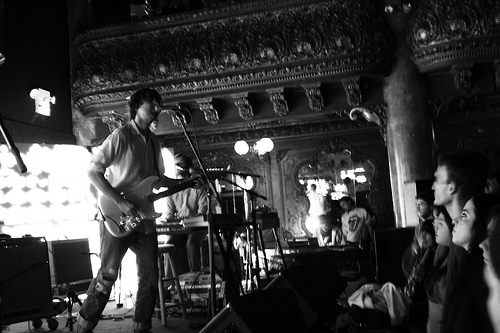
There’s been a lot of talk about how Cass McCombs is an impenetrable character, so much so that it’s become tiring. We’ve heard about his elusiveness and nomadic lifestyle; about his tendency to either act bitterly in interviews (i.e. Pitchfork interview) or shun them altogether. Oh, and that he’s never happy. Admittedly, McCombs has shaped this cryptic persona himself — he’s even made it difficult to know what he looks like (recent photographs have been vague, he’s always altering his “look”). It was an enormous pleasure then on Sunday night to be able to experience the songwriter first hand when he performed at the Great American Music Hall, where it was all about the music.

Before a dazzling wall of batting lights, McCombs stood with his band and seemed to take pleasure in every moment of the concert. The audience gave him a very warm reception and was perhaps appreciative for the same reasons I was — at long last we were having our own experience of McCombs.

The better part of the set was downtempo and tinged with melancholy. Wit’s End, the first of two albums that he released this year on Domino Records, is slow, ethereal, and rooted in what feels like the aftermath of tragedy. Listening to the band perform the single from that record, “County Line,” was grand. If one didn’t appreciate how lovely and original that song was before, one certainly did after last night. It has the mood of an R&B track, and the slow, hushed rhythm section seems to reflect the hopelessness of McCombs’ voice as he sings so simply “you never even tried to love me / what do I have to do / to make you want me?”

Humor Risk, McCombs’ second album of this year, is an effective supplement to Wit’s End in a live context. Compared to Wit’s End, it’s a more buoyant and melodic album. When the band performed songs like “The Same Thing” and “Robin Egg Blue,” it felt like McCombs was taking the audience up for a breath of air before plunging it back into the chilling gloom of Wit’s End.

Earlier in the set, the band performed “Bradley Manning,” a song that McCombs premiered a few days before on the television news show Democracy Now. The “protest” narrative tells the story of Bradley Manning — the 23-year-old intelligence analyst that was arrested for dispatching thousands of classified documents to Wikileaks. McCombs’ detailed story-telling recalls Bob Dylan’s “Hurricane,” and it was played to shouts and whistles of approval from the audience. “Bradley you know you have friends even though you’re locked in there,” McCombs says at the very end of the song. It was one of the highlights of the night. How many of us had forgotten about Bradley Manning, and how many are now discussing his arrest?

As the audience poured out of the venue then, the overwhelming thought on everyone’s mind was probably not “who is Cass McCombs?” but something like “wow — so that’s Cass McCombs.”

Live Shots: Iggy Pop at the Warfield

2

It had been a long wait to see Iggy Pop live (not like, Morrissey-long, but more like three months later than anticipated). When I spoke with Pop back in September, he was ecstatic to be out on the road again.

He was in France at the time, prepping in his hotel room before a big show – a concert he’d planned to follow up with an evening of wine and French television with his lady friend. We talked about cartoons, his image, the Rock and Roll Hall of Fame, and American Idol.

He told me that on this tour, he’d be playing, “All of Raw Power, some of Fun House, some songs from the eponymous debut The Stooges, and some stuff that was too hot to handle, too raw for the times — stuff that came out on bootlegs in the ’70s like ‘Cock in My Pocket,’ ‘Open Up and Bleed,’ ‘Head on the Curve.’” So I was, understandably, equally ecstatic to see him live. Shortly thereafter, he broke his foot (after seeing him last night at the Warfield, I now realize how easily that could happen) and the tour was cut short.

Finally in San Francisco, on a windy  December evening, Pop tore the paint off the walls with the sheer enormity of his stage presence, pumping with rock’n’roll energy and yes, raw power. These were my favorite moments from the night:

10 great bits about Iggy Pop’s show at the Warfield (hint: the band plays the venue again Tuesday night):
1. Pop and Co. running out on stage and immediately launching into a frenzied “Raw Power.” No opening chit-chat, no fuss.
2. The quick-fire follow-up to that first song was ultimate punk anthem, “Search and Destroy.” Fist pumps.
3. Seeing guitarist James Williamson and saxophonist Steve Mackay a.k.a “Mr. Fun House” (as Pop described him) in the flesh.
4. Mike Watt’s cherry red bass, forever-entertaining facial expressions, and jerky movements.
5. Speaking of movement, Pop’s taut, brown leathered skin, and the noodling snake contortions he does with it.
6. Pop writhing “like a cat!” (as the couple behind me kept shouting), on top of one of the speakers, posing.
7. The band inviting “99 percenters” – and every one else – from the crowd on stage for one song, and Pop instructing them to “shake a little,” adding, “I would!”
8. The threatening, heart-pumping, supersexy guitar riff in “I Wanna Be Your Dog.”
9. Pop stage-diving during “I Wanna Be Your Dog.”
10. Pop stage-diving during “I Wanna Be Your Dog” and not breaking his foot.

Rep Clock

0

Schedules are for Wed/30-Tues/6 except where noted. Director and year are given when available. Double and triple features are marked with a •. All times p.m. unless otherwise specified.

ARTISTS’ TELEVISION ACCESS 992 Valencia, SF; www.atasite.org. $6-10. “Frequency Structures: Works with Sound and Film,” featuring Paul Clipson and John Davis, Madison Brookshire and Tashi Wada, and John Davis and Ben Bracken, Fri, 8. “Other Cinema:” Films about Muzak by Dale Hoyt and others, Sat, 8:30.

BALBOA 3630 Balboa, SF; www.brownpapertickets.com. $17.50-20. “Opera and Ballet at the Balboa Theatre:” Sleeping Beauty, performed by the Bolshoi Ballet, Sat/3-Sun/4, 10am; Dec 7, 7:30.

CASTRO 429 Castro, SF; (415) 621-6120, www.castrotheatre.com. $7.50-10. The Sound of Music (Wise, 1965), Wed-Sun, 7 (also Sat-Sun, 1). Presented sing-along style; this event, $10-15.

CHRISTOPHER B. SMITH RAFAEL FILM CENTER 1118 Fourth St, San Rafael; (415) 454-1222, www.cafilm.org. $6.75-10.25. “The Films of John Korty:” Alex and the Gypsy (1976), Thurs, 7; Farewell to Manzanar (1976), Sun, 1; Twice Upon a Time (1983), Sun, 7. Seducing Charlie Barker (Glazer, 2010), Fri-Sat, call for times. Eames: The Architect and the Painter (Cohn and Jersey, 2011), Sun, 4:15.

DE ANZA COLLEGE 21250 Stevens Creek, Cupertino; (415) 810-2892. “De Anza Experimental Film Exhibition,” Fri, 7:30.

“OCEAN AVENUE FILM FESTIVAL” 1649 Ocean, SF; artsconn@comcast.net. $5-10. Short films in all genres. Sat, 6-9.

PACIFIC FILM ARCHIVE 2575 Bancroft, Berk; (510) 642-5249, bampfa.berkeley.edu. $5.50-9.50. “Alternative Visions:” “Flotsam and Jetsam: The Spray of History,” films by Lewis Klahr, Wed, 7:30. “Kino-Eye: The Revolutionary Cinema of Dziga Vertov:” The Fall of the Romanov Dynasty (Shub, 1927), Thurs, 7. “Afterimage: The Films of Nicolás Pereda:” Together (2009), Fri, 7; Perpetuum Mobile (2010), Fri, 8:45; Summer of Goliath (2010), Sat, 6:30; All Things Were Now Overtaken By Silence (2010), Sun, 3; Where Are Their Stories? (2007), Sun, 5. “Southern (Dis)comfort: The American South in Cinema:” Baby Doll (Kazan, 1956), Sat, 9.

ROXIE 3117 and 3125 16th St, SF; (415) 863-1087, www.roxie.com. $5-9.75. Sigur Rós: Inni (Morisset, 2011), Wed-Thurs, 7, 8:30. “World AIDS Day:” “Still Around,” short films, Thurs, 7; Sex in an Epidemic (Carlomusto, 2010), Thurs, 8:45. These screenings, $12; a portion of proceeds benefits the UCSF Health Project. House of Boys (Schlim, 2010), Dec 2-8, 7, 9:15 (also Sat/3-Sun/4, 2:30, 4:30). Star Udo Kier in person Fri/2. “Midnites for Maniacs: More Fun Than Games, A Tribute to Greydon Clark:” •Hi-Riders (1978), Fri, 7:30; Joysticks (1983), Fri, 9:20; Wacko (1981), Fri, 11:15. All three films, $12. “An Evening With Amy Sedaris,” Sun, 7:30. This event, a benefit for the Roxie, $100. “Christmas in Acidland! Presented by Johnny Legend:” “Christmas in Acidland (Part One),” Yuletide TV insanity, Mon, 6, 9:15; “Christmas Noir,” classic original TV episodes, Mon, 7:30; “Christmas in Acidland (Part Two),” more “in-Santa-ty” from TV, Tues, 6, 9:30; Christmas in Hell (Cardona, 1959), Tues, 7:15.

SFFS | NEW PEOPLE CINEMA 1746 Post, SF; www.sffs.org. $10-15. The Swell Season (August-Perna, Mirabella-Davis, and Dapkins, 2011), Wed-Thurs, 1, 5, 7, 9. “The Dardy Family Home Movies By Stephen Sondheim By Erin Markey,” Fri/2-Sat/3 and Dec 9-10, 8; Sun/4 and Dec 11, 6. The City Dark (Cheney, 2011), Tues, 3, 5, 7, 9.

YERBA BUENA CENTER FOR THE ARTS 701 Mission, SF; (415) 978-2787, www.ybca.org. $6-10. “From Muppets to Metal: Music Movies:” Chico and Rita (Trueba, Mariscal, and Errando, 2010), Thurs, 7:30; Coleman-Rollins-Kirk-Cage (Fontaine, 1966-68), Sun, 2. San Francisco Cinematheque presents: “Lewis Klahr’s Prolix Satori,” Fri 7:30.

The food divide

4

news@sfbg.com

Antonia Williams is part of a slow, quiet food revolution. After battling obesity for much of her adult life, the 26-year-old lifelong Bayview resident did some research. “I realized it had a lot to do with the food I consumed,” she told us. “As a result of growing up in the neighborhood, I suffer from obesity. I’m overweight because of the lack of options for good healthy food.”

“It’s what I grew up on, McDonald’s and a lot of fried food for dinner,” she recalls. “The grocery stores in the area were very limited in what they offered. I believe my parents weren’t as educated or aware” about health and nutrition.

Williams managed to escape this bad foods trap, change her personal diet, and now works as a “food guardian” for the nonprofit Southeast Food Access (SEFA), helping to bring more nutritious fare to the Bayview.

The complex of challenges Williams faced simply to eat well—the fast food all around her, the dearth of grocery stores, and lack of awareness—reflects the array of systemic barriers to good food that keep tens of thousands of San Franciscans in chronically poor health.

Under the weight of recession and double-digit unemployment, San Francisco’s chronic food divide has grown deeper and wider. From regions of the city like Bayview, Excelsior, and other Southeast neighborhoods, to seniors surviving on marginal fixed incomes, to the city’s swelling unemployed and underemployed who rely on food pantries, access to fresh food is a daily geographic and economic battle.

Roughly one in five San Franciscans each day has no reliable source of adequate sustenance and must scramble for food from soup kitchens, food pantries, or other “emergency” supplies that have become a structural part of the city’s food system, according to the San Francisco Food Bank.

Each month, more than 100,000 families rely on the Food Bank to help feed themselves — nearly double the amount from 2006. Economic recession has dramatically increased the number of city residents using food stamps (known as “CalFresh”) each month, rising from 29,008 in 2008 to 44,185 in 2010.

Yet even that rise belies a far deeper need: only 47 percent of those qualifying for CalFresh are actually accessing benefits, according to a data analysis by California Food Policy Advocates; at minimum, more than 40,000 additional city residents are entitled to get this help, and thus eat better.

Across the city, parallel economic and food divides compound one another, spelling serious trouble for people’s basic nutrition and health — in turn depleting their energy, cognition, and ability to do everything from succeeding in school to getting a job.


BEYOND GROCERY STORES

In Bayview, where poverty and unemployment run about double citywide averages, these geographic and economic food divides come to a head. District 10, encompassing Bayview/Hunters Point (BVHP), features some of the city’s most grocery-impoverished neighborhoods, and has the highest rates of CalFresh usage.

This confluence of lack and need—compounded by a prevalence of fast food and liquor stores over fresh food offerings—has inspired Antonia Williams and other residents to fight for better food in their neighborhoods.

As one of four paid Food Guardians for SEFA, Williams spends about 20 hours a week examining grocery store shelves in Bayview, talking with consumers and food retailers, and educating both about the need for more fresh non-processed foods.

One recent victory: armed with customer survey data, she convinced the Bayview Foods Co. to stock low-sodium tomato paste. Next on Williams’ food improvement list is getting more low-sodium products, less cholesterol, and more fiber on the shelves.

These may sound like small steps, but they’re part of a larger effort to get healthier food in Bayview, where chronic diseases such as obesity, diabetes and heart disease are rampant. “I think a lot of people just don’t know the link between the food we are eating and these chronic diseases,” says Williams.

The Bayview is among the city’s most food-deprived districts, with just 63 percent of residents living within a half-mile of a supermarket (in Excelsior, it’s 57 percent), compared with 84 percent citywide. That ratio improved somewhat with the arrival this August of Fresh & Easy supermarket on Third Street, but access to fresh produce remains limited — a situation that numerous studies show contributes greatly to chronic undernourishment and disease.

Indeed, statistics show Bayview area residents suffer by far the city’s “highest rates of everything negative,” as former district supervisor Sophie Maxwell puts it: obesity, diabetes, heart disease, and cancer.

Ironically, the Bayview’s Third Street is home to the city’s bustling produce warehouses, which rattle early every morning with trucks and crates full of fruits and vegetable, “but you have to go out of the district to get it,” says Maxwell, who helped spearhead a Food Security Task Force while in office. “I was very much aware of [the food access problem] because of what I had to do to get food myself.”

Much of Third Street remains a boulevard of liquor stores and fried and fast food. According to Tia Shimada of California Food Policy Advocates, “A lot of what we see instead of food deserts is food swamps, where the amount of healthy nutritious food available is overwhelmed by all the fast food and junk food.”

Despite a seemingly diverse landscape of food businesses, “There’s a saturation in neighborhoods with unhealthy choices,” SEFA’s Tracey Patterson argues. “When the cheapest choice in front of you is fatty comfort food and fast food, that’s what you get accustomed to eating. The easier options quickly become habit.”

Kenny Hill, a 23-year-old food guardian and Bayview resident, puts it like this: “What we have in our community, that’s what we eat.” But he says history and culture play a role, too. “We need to change the culture of what’s considered good…Growing up eating salad, people would say, ‘Why are you eating that? That’s white people’s food.'”

In other words, it takes more than getting a grocery store—which itself involved a nearly 20-year struggle for Bayview residents and leaders. “Food access is just one part of the issue. Even if you get a grocery store, that doesn’t solve the problem,” says Patterson, whose group, SEFA, espouses “three pillars” to fix the area’s food problems: more grocery stores; education and health literacy; and expanded urban agriculture. “None on their own is enough.”


HUNGER CROSSES LINES

Getting a job isn’t enough either, statistics show. A recent study by the USDA cited by the Food Security Task Force shows that 70 percent of families nationwide with “food insecure” children have at least one member working full-time. And in San Francisco, the task force found, “39 percent of the households that receive weekly groceries through the SF Food Bank include at least one working adult. Only 18 percent of clients are homeless.”

At least by federal definitions of poverty, food insecurity isn’t just for poor people anymore — particularly in San Francisco, where exorbitant housing and other costs compound people’s struggles to meet their food needs. “If you just look at the poverty level, you’re missing a lot of people who are struggling to make ends meet,” says Colleen Rivecca, advocacy coordinator with St. Anthony’s Foundation. “Hunger and health and housing are so interconnected.”

Indeed, while the Federal Poverty Level for a family of three is $18,310, cost-of-living research by the INSIGHT Center for Community Economic Development found that in San Francisco, this family would need almost $40,000 more than that to make ends meet.

Rivecca says the ongoing recession is simultaneously deepening the food divides and undermining efforts to address it. For instance, SSI recipients must make do with $77 a month less than they got in 2009, while California is the only state where SSI cannot be supplemented by food stamps.

According to the Food Security Task Force, San Francisco “has an inordinately high number of residents who are elderly, low-income and/or blind and disabled — over 47,000 residents receive SSI.” Many are homebound, socially isolated, and living in SRO units without kitchens, and no means of preparing their own food. So it’s no surprise that these same people, who need help the most, often get it the least.

Due to “misconceptions about what qualifies,” says CFPA’s Kerry Birnbach, only 5 percent of Californians eligible for Social Security participate in CalFresh. “Senior citizens are more isolated, and the more isolated you are, the less likely you are to know about it.” Birnbach says that leads to lower nutrition, less energy, and greater hospitalization rates. “It’s not having food on the table — choosing between food and medicine.”

A 2006 study by the San Francisco Department of Aging and Adult Services found that while the city’s elders “received approximately 12.2 million free meals through all of the programs in the City including food pantries, free dining rooms, and home delivered meals, the gap between the number of meals served and the number of meals needed was somewhere between 6 [million] and 9 million meals annually.”


BAND-AID FOOD SYSTEM

As television cameras made clear on Thanksgiving, there’s no shortage of food and meal giveaway programs, soup kitchens run by churches and nonprofits — a whole constellation of ad hoc benevolence spread across the city. But this kind of “emergency food assistance” has become a structural part of the city’s dietary landscape.

Another main ingredient in the city’s food infrastructure is seemingly cheap fast food, which for many poor people becomes the diet of first and last resort. Sup. Eric Mar recalls meeting with teenage mothers and hearing one parent speak about dumpster diving at McDonald’s for what she called “fancy dinner.”

“The cheapest possible food like McDonald’s is seen as a luxury,” says Mar, who last year passed legislation preventing fast food chains from selling kids meals with toys unless they improved their nutrition content. “Poor people rely on whatever’s out there, and when McDonald’s or Burger King sells cheap, it undercuts families’ efforts to get healthy.”

District 10 Sup. Malia Cohen sees the impacts of fast food and junk food every day in Bayview. “There is no infrastructure out there to de-program people” from long-standing fast food habits. “I don’t fault people for eating fast food, but I do want them to think twice and know they have a choice.”

So what is the choice, and how will the city address its deep food divides, which cut across geographic and demographic lines?

So far, it’s a patchwork project. As one step, the supervisors in April passed a new zoning ordinance designed to encourage more urban food production. In Bayview, Cohen says, “We’re looking at urban agriculture as something that’s viable” to feed low-income residents.

Despite the arrival of Fresh & Easy, BVHP remains a critical flashpoint for the food security fight. Markets for fresh produce are few and far between. In 2006 the Department of the Environment teamed with Girls 2000 and Literacy for Environmental Justice to create the Bayview Hunters’ Point Farmers Market, but for a variety of reasons, the customer base wasn’t sufficient for farmers to keep selling there, and the project stalled. Now there is talk of reviving a farmers market in the area.

But for larger, more structural change to take hold, Mar argues, the food gap “has to be a citywide goal and priority.” And, he notes, bigger forces — notably agribusiness lobbies and congressional agriculture committees — make local progress more difficult. “It’s hard because the Farm Bill allows these food companies and commodity groups to keep their prices lower, and small businesses and producers have a hard time keeping their prices low,” encouraging more fast food and obesity and other diet-related diseases.


GREEN GLIMMERS

On a chilly gray late afternoon the day before Thanksgiving, we met with Patterson, Williams, and two other food guardians at Bridgeview Community Garden on the corner of Newhall and Revere in Bayview. Perched on a small chunk of slope overlooking houses and freeway traffic, the plot offers a thriving little harvest of tomatoes, kale, leeks, basil, and other vegetables and herbs. It’s not a lot of food, but along with other nearby agriculture, such as Quesada Gardens and the larger Alemany Farm, it helps bolster residents’ weekly dose of fresh produce.

Equally important, it gives budding food activists like Antonia Williams and Kenny Hill reason to believe things can change. After yanking a healthy crop of leeks from the soil, fellow food guardian Jazz Vassar, 25, notes, “There are a lot of community organizations doing good work here. We have high hopes to change things.”

Even as they work to nourish a different food future, the food guardians are acutely aware of the jagged rocks and stubborn old roots that need to be cleared. Asked what the city should do about Bayview’s many-layered food struggles, Hill responds: “Realize there is a problem in Bayview, and allocate resources here. There are statistics that this is a food desert, there are high rates of crime—people have to wake up and see that people here have been disenfranchised.”

It’s not about having the city do it for them, says Hill. “Give us something to latch on to so we can help ourselves.”

Former Bay Guardian city editor Christopher D. Cook is the author of Diet for a Dead Planet: Big Business and the Coming Food Crisis.

Rep Clock

0

Schedules are for Wed/23-Tues/29 except where noted. Director and year are given when available. Double and triple features are marked with a •. All times p.m. unless otherwise specified.

ARTISTS’ TELEVISION ACCESS 992 Valencia, SF; www.atasite.org. $6. “Other Cinema:” The Price of Sex (Chakarova, 2011), Sat, 8:30.

CASTRO 429 Castro, SF; (415) 621-6120, www.castrotheatre.com. $7.50-10. “Woody Wednesdays:” •Stardust Memories (Allen, 1980), Wed, 3:15, 7, and Vicky Christina Barcelona (Allen, 2008), Wed, 5, 8:45. The Sound of Music (Wise, 1965), Nov 25-Dec 4, 7 (also Fri/25 and Sat-Sun, 1). Presented sing-along style; this event, $10-15.

CHRISTOPHER B. SMITH RAFAEL FILM CENTER 1118 Fourth St, San Rafael; (415) 454-1222, www.cafilm.org. $6.75-10.25. Melancholia (von Trier, 2011), Wed-Thurs, call for times. “The Films of John Korty:” The Autobiography of Miss Jane Pittman (1974), Sun, 1 (free admission); “A Variety of Shorts,” Sun, 7.

PACIFIC FILM ARCHIVE 2575 Bancroft, Berk; (510) 642-5249, bampfa.berkeley.edu. $5.50-9.50. “Southern (Dis)Comfort: The American South in Film:” The Beguiled (Siegel, 1971), Sat, 6; Hurry Sundown (Preminger, 1967), Sun, 3. “Jeanne Moreau: Enduring Allure:” La notte (Antonioni, 1961), Sat, 8:10; Diary of a Chambermaid (Buñuel, 1964), Sun, 6. “Kino-Eye: The Revolutionary Cinema of Dziga Vertov:” Three Heroines (1938), Tues, 7.

ROXIE 3117 and 3125 16th St, SF; (415) 863-1087, www.roxie.com. $5-9.75. Dragonslayer (Patterson, 2011), Wed-Thurs, 8:15, 9:40. Public Speaking (Scorsese, 2010), Wed-Thurs, 6:30. The Woodmans (Willis, 2010), Wed-Thurs, 7, 9. “Loads of Curt McDowell,” Sat-Mon, call for times. “It’s the Paul Meinberg Show!”, Tues, 7. Sigur Rós: Inni (Morisset, 2011), Nov 25-Dec 1, 7, 8:30 (also Sat-Sun, 3, 5).

Film Listings

0

Film listings are edited by Cheryl Eddy. Reviewers are Kimberly Chun, Max Goldberg, Dennis Harvey, Lynn Rapoport, and Matt Sussman. For rep house showtimes, see Rep Clock.

OPENING

Arthur Christmas Santa’s son (voiced by James McAvoy, who heads up an all-star, mostly-British cast) steps up to solve a North Pole crisis in this 3D animated tale. (1:37) Presidio, Shattuck.

Hugo Martin Scorsese directs this fanciful 3D tale of an orphan secretly living in a train station. (2:07) Shattuck, Sundance Kabuki.

The Muppets Of course The Muppets is a movie appropriate for small fry, with a furry cast (supplemented by human co-stars Jason Segel and Amy Adams) cracking wise and conveying broad themes about the importance of friendship, self-confidence, and keeping dreams alive despite sabotage attempts by sleazy oil tycoons (Chris Cooper, comically evil in the grand Muppet-villain tradition). But the true target seems to be adults who grew up watching The Muppet Show and the earliest Muppet movies (1999’s Muppets from Space doesn’t count); the “getting the gang back together” sequence takes up much of the film’s first half, followed by a familiar rendition of “let’s put on a show” in the second. Interwoven are constant reminders of how the Muppets’ brand of humor — including Fozzie Bear’s corny stand-up bits — is a comforting throwback to simpler times, even with a barrage of celeb cameos and contemporary gags (chickens clucking a Cee-Lo Green tune — I think you can guess which one). Co-writer Segal pays appropriate homage to the late Jim Henson’s merry creations, but it remains to be seen if The Muppets will usher in a new generation of fans, or simply serve as nostalgia fodder for grown-ups like, uh, me, who may or may not totally still own a copy of Miss Piggy’s Guide to Life. (1:38) Presidio. (Eddy)

My Week With Marilyn See “No Bombshell.” (1:36) Albany, Clay, Piedmont.

*Sigur Rós: Inni This ain’t your mom’s 3D IMAX arena-rocker exercise. The follow-up to 2007’s Heima, which set out to contextualize Sigur Rós in its native Iceland, Inni opens with a torrent of light and shadow that resolves into the image of frontperson Jónsi Birgisson on bowed guitar, a bright splinter on a stage otherwise drenched in black. The screen explodes with bleached-out light as Birgisson hits the high note, drummer Orri Pall Dyrason bashes his cymbal, and the combo picks up a symphonic head of noise. The still somewhat-mysterious ensemble that burst fully formed onto the international music scene along with the new millennium is seen here through the prism of live performance, worth catching on a big screen (Inní was also released this month on DVD along with a live double-CD). Director Vincent Morisset infuses the often-not-so-interesting genre of concert film with all the drama and unique strategies appropriate to a group that has charted its own indelible path from the start. Sigur Rós’ music may connect to that of Mogwai and other post-rock outfits, but those groups can only hope to score the moving-image counterpart that the Icelandic band finds here, its own variant of Inní‘s smoky, reflective black and white imagery, flickering in time to the beat, fading in and out of focus, and favoring off-center compositions. Undercutting the serious beauty onstage are clips of Sigur Rós’s slightly surreal reality of life on tour and snippets of archival footage from its first decade of life. (1:14) Roxie. (Chun)

*The Swell Season In 2008, musicians Glen Hansard (1991’s The Commitments, Irish band the Frames) and Markéta Irglová won an Oscar for the original song “Falling Slowly” from the folk rock musical Once, in which they star as a Dublin street busker and a young Czech immigrant who spend a week writing and recording songs that document their falling in love. The film boosted them into the public eye at hyperspeed, and they began to tour extensively, performing under the name the Swell Season. For three years following Once‘s debut, filmmakers Nick August-Perna, Chris Dapkins, and Carlo Mirabella-Davis followed the pair, who had become romantically involved, as they struggled to negotiate sudden fame, life on the road, and the stresses of time and change on their relationship. The beautifully filmed black-and-white documentary that resulted is a quiet affair whose visual intimacies and personal revelations are balanced by soft, muted monochromes that preserve some necessary degree of distance for Hansard and Irglová. Troubling issues are engaged in conversational tones, and the rest of the tale is told onstage amid Hansard’s gorgeous emotional storms and Irglová’s more spare but equally lovely compositions. The honesty is sometimes uncomfortable to witness, as two people accustomed to baring their souls in their songs agree to face the camera for a little while longer. (1:31) SFFS New People Cinema. (Rapoport)

*Tomboy In her second feature, French filmmaker Céline Sciamma (2007’s Water Lilies) depicts the brave and possibly perilous gender experimentations of a 10-year-old girl. Laure (Zoé Héran) moves with her family to a new town, falls in with the neighborhood gang during the summer vacation, and takes the stranger-comes-to-town opportunity to adopt a new, male persona, Mikael, a leap of faith we see her consider for a moment before jumping, eyes open. Watching Mikael quietly observe and then pick up the rough mannerisms and posturing of his new peers, while negotiating a shy romance with Lisa (Jeanne Disson), the sole female member of the gang, is to shift from amazement to amusement to anxiety and back again. As the children play games in the woods and roughhouse on a raft in the water and use a round of Truth or Dare to inspect their relationships to one another, all far from the eyes of the adults on the film’s periphery, Mikael takes greater and greater risks to inhabit an identity that he is constructing as he goes, and that is doomed to be demolished sooner, via accidental discovery, or later, when fall comes and the children march off to school together. All of this is superbly handled by Sciamma, who gently guides her largely nonprofessional young cast through the material without forcing them into a single precocious situation or speech. The result is a sweet, delicate story with a steady undercurrent of dread, as we wait for summer’s end and hope for the best and imagine the worst. (1:22) Embarcadero. (Rapoport)

ONGOING

*El Bulli: Cooking in Progress Oh to be a fly on the wall of El Bulli — back in 2008 and 2009, when director Gereon Wetzel turned his lens on the Spanish landmark, it was considered the best restaurant in the world. This elegantly wrought documentary, covering a year at the culinary destination (now closed), allows you to do just that. Wetzel opens on chef-owner Ferran Adrià shutting down his remarkable eatery for the winter and then drifting in and out of his staff’s Barcelona lab as they develop dishes for the forthcoming season. Head chef Oriol Castro and other trusted staffers treat ingredients with the detached methodicalness of scientists — a champignon mushroom, say, might be liquefied from its fried, raw, sous-vide-cooked states — and the mindful intuition of artists, taking notes on both MacBooks and paper, accompanied by drawings and much photo-snapping. Fortunately the respectful Wetzel doesn’t shy away from depicting the humdrum mechanics of running a restaurant, as Adrià is perpetually interrupted by his phone, must wrangle with fishmongers reluctant to disclose “secret” seasonal schedules, and slowly goes through the process of creating an oil cocktail and conceptualizing a ravioli whose pasta disappears when it hits the tongue, tasting everything as he goes. Energized by an alternately snappy and meditative percussive score, this look into the most influential avant-garde restaurant in the world is a lot like the concluding photographs of the many menu items we glimpse at their inception — a memorable, sublimely rendered document that leaves you hungry for more. (1:48) Opera Plaza. (Chun)

*The Descendants Like all of Alexander Payne’s films save 1996 debut Citizen Ruth, The Descendants is an adaptation, this time from Kaui Hart Hemmings’ excellent 2007 novel. Matt King (George Clooney) is a Honolulu lawyer burdened by various things, mostly a) being a haole (i.e. white) person nonetheless descended from Hawaiian royalty, rich in real estate most natives figure his kind stole from them; and b) being father to two children by a wife who’s been in a coma since a boating accident three weeks ago. Already having a hard time transitioning from workaholic to hands-on dad, Matt soon finds out this new role is permanent, like it or not — spouse Elizabeth (Patricia Hastie, just briefly seen animate) will not wake up. The Descendants covers the few days in which Matt has to share this news with Elizabeth’s loved ones, mostly notably Shailene Woodley and Amara Miller as disparately rebellious teen and 10-year-old daughters. Plus there’s the unpleasant discovery that the glam, sporty, demanding wife he’d increasingly seemed “not enough” for had indeed been looking elsewhere. When has George Clooney suggested insecurity enough to play a man afraid he’s too small in character for a larger-than-life spouse? But dressed here in oversized shorts and Hawaiian shirts, the usually suave performer looks shrunken and paunchy; his hooded eyes convey the stung joke’s-on-me viewpoint of someone who figures acknowledging depression would be an undeserved indulgence. Payne’s film can’t translate all the book’s rueful hilarity, fit in much marital backstory, or quite get across the evolving weirdness of Miller’s Scottie — though the young actors are all fine — but the film’s reined-in observations of odd yet relatable adult and family lives are all the more satisfying for lack of grandiose ambition. (1:55) California, Piedmont, SF Center, Sundance Kabuki. (Harvey)

Dragonslayer Dragonslayer tags along with Josh “Skreech” Sandoval, a Fullerton, Calif. skater celebrated for shredding pools and living a vagabond’s life. First-time director Tristan Patterson fronts with the kind of side-winding portraiture that prizes sensory impressions instead of back-story, but whittle away Dragonslayer‘s loose ends and you end up with an unremarkable lost generation romance, a Bonnie and Clyde with lower stakes. The film meets Skreech at 23: he’s turned his back on sponsorship gigs and a romance that produced a son (no trace of the mother here). In an arbitrarily defined chapter structure, Skreech investigates freshly abandoned pools, squats in a friend’s backyard, shows off his medical marijuana license, and cracks tallboys in Southern California’s magic light. He’s stunned by a pretty girl’s red lipstick and fades into a relationship with her (it takes a while before the movie treats her as anything more than scenery). He takes a few earnest stabs at fatherhood and rehearses his principles of no principles to the soundtrack’s well-stocked bangs. There are a few genuinely poignant moments — Skreech’s taking a call from his estranged mother in a bus full of punks — but in general Dragonslayer is too caught up in its own glossy reverie to register emergent emotions. Patterson’s tendency to use editing as dramatic shorthand is evident in an early sequence of Skreech muffing a skate contest abroad: repeated shots of Skreech wiping out are cut with the eventual winner’s triumphs and then back to our hero’s defeated expression. Arranged in the foregone style of reality television, the actual event is given no room to breathe. (1:14) Roxie. (Goldberg)

*Drive Such a lovely way to Drive, drunk on the sensual depths of a lush, saturated jewel tone palette and a dreamlike, almost luxurious pacing that gives off the steamy hothouse pop romanticism of ’80s-era Michael Mann and David Lynch — with the bracing, impactful flecks of threat and ultraviolence that might accompany a car chase, a moody noir, or both, as filtered through a first-wave music video. Drive comes dressed in the klassic komforts — from the Steve McQueen-esque stances and perfectly cut jackets of Ryan Gosling as the Driver Who Shall Remain Nameless to the foreboding lingering in the shadows and the wittily static, statuesque strippers that decorate the background. Gosling’s Driver is in line with Mann’s other upstanding working men who hew to an old-school moral code and are excellent at what they do, regardless of what side of the law they’re working: he likes to keep it clear and simple — his services as a wheelman boil down to five minutes, in and out — but matters get messy when he falls for sweet-faced neighbor Irene (Carey Mulligan), who lives down the hall with her small son, and her ex-con husband (Oscar Isaac) is dragged back into the game. Populated by pungent side players like Albert Brooks, Bryan Cranston, Ron Perlman, and Christina Hendricks, and scattered with readily embeddable moments like a life-changing elevator kiss that goes bloodily wrong-right, Drive turns into a real coming-out affair for both Danish director Nicolas Winding Refn (2008’s Bronson), who rises above any crisis of influence or confluence of genre to pick up the po-mo baton that Lynch left behind, and 2011’s MVP Ryan Gosling, who gets to flex his leading-man muscles in a truly cinematic role, an anti-hero and under-the-hood psychopath looking for the real hero within. (1:40) Lumiere. (Chun)

Happy Feet Two (1:40) Four Star, 1000 Van Ness, Presidio.

Le Havre Aki Kaurismäki’s second French-language film (following 1992’s La Vie de Boheme) offers commentary on modern immigration issues wrapped in the gauze of a feel good fairy tale and cozy French provincialism a la Marcel Pagnol. Worried about the health of his hospitalized wife (Kaurismäki regular Kati Outinen), veteran layabout and sometime shoe shiner Marcel (Andre Wilms) gets some welcome distraction in coming to the aid of Idrissa (Blondin Miguel), a young African illegally trying to make way to his mother in London while eluding the gendarmes. Marcel’s whole neighborhood of port-town busybodies and industrious émigrés eventually join in the cause, turning Le Havre into a sort of old-folks caper comedy with an incongruously sunny take on a rising European multiculturalism in which there are no real racist xenophobes, just grumps deserving comeuppance. Incongruous because Kaurismäki is, of course, the king of sardonically funny Finnish miserabilism — and while it’s charmed many on the festival circuit, this combination of his usual poker-faced style and feel-good storytelling formula may strike others as an oil-and-water mismatch. (1:43) Bridge. (Harvey)

Immortals Arrow time (comin’ at ya, in 3D), blood lust, fascinating fascinators, and endless seemingly-CGI-chiseled chests mark this rework of the Theseus myth. Tarsem Singh flattens out the original tale of crazy-busy hero who founded Athens yet seems determined to outdo the Lord of the Rings series with his striking art direction (so chic that at times you feel like you’re in a perfume ad rather than King Hyperion’s torture chamber). As you might expect from the man who made the dreamy, horse-slicing Cell (2000), Immortals is all sensation rather than sense. The proto-superhero here is a peasant (Henry Cavill), trained in secret by Zeus (John Hurt and Luke Evans) and toting a titanic chip on his shoulder when he runs into the power-mad Cretan King Hyperion (Mickey Rourke, struggling to gnash the sleek scenery beneath fleshy bulk and Red Lobster headgear). Hyperion aims to obtain the Epirus Bow — a bit like a magical, preindustrial rocket launcher — to free the Titans, set off a war between the gods, and destroy humanity (contrary to mythology, Hyperion is not a Titan — just another heavyweight grudge holder). To capture the bow, he must find the virgin oracle Phaedra (Freida Pinto), massacring his way through Theseus’ village and setting his worst weapon, the Beast, a.k.a. the Minotaur, on the hero. Saving graces amid the gory bluster, which still pays clear tribute to 1963’s Jason and the Argonauts, is the vein-bulging passion that Singh invests in the ordinarily perfunctory kill scenes, the avant-garde headdresses and costumes by Eiko Ishioka, and the occasional edits that turn on visual rhymes, such as the moment when the intricate mask of a felled minion melts into a seagoing vessel, which are liable to make the audience gasp, or laugh, out loud. (1:50) 1000 Van Ness. (Chun)

In Time Justin Timberlake moves from romantic comedy to social commentary to play Will Salas, a young man from the ghetto living one day at a time. Many 12-steppers may make this claim, but Salas literally is, because in his world, time actually is money and people pay, say, four minutes for a cup of coffee, a couple hours for a bus ride home from work, and years to travel into a time zone where people don’t run from place to place to stay ahead of death. In writer-director Andrew Niccol’s latest piece of speculative cinema, humans are born with a digitized timepiece installed in their forearm and a default sell-by date of 25 years, with one to grow on — though most end up selling theirs off fairly quickly while struggling to pay rent and put food on the table. Time zones have replaced area codes in defining social stature and signaling material wealth, alongside those pesky devices that give the phrase “internal clock” an ominous literality. Niccol also wrote and directed Gattaca (1997) and wrote The Truman Show (1998), two other films in which technological advances have facilitated a merciless, menacing brand of social engineering. In all three, what is most alarming is the through line between a dystopian society and our own, and what is most hopeful is the embattled protagonist’s promises that we don’t have to go down that road. Amanda Seyfried proves convincible as a bored heiress to eons, her father (Vincent Kartheiser) less amenable to Robin Hood-style time banditry. (1:55) 1000 Van Ness, Shattuck. (Rapoport)

*Into the Abyss: A Tale of Death, a Tale of Life How remarkable is it that, some 50-plus features along, filmmaker Werner Herzog would become the closest thing to a cinema’s conscience? This time the abyss is much closer to home than the Amazon rainforest or the Kuwaiti oil fields — it lies in the heart of Rick Perry country. What begins as an examination of capital punishment, introduced with an interview with Reverend Richard Lopez, who has accompanied Texas death row inmates to their end, becomes a seeming labyrinth of human tragedy. Coming into focus is the execution of Michael Perry, convicted as a teenager of the murder of a Conroe, Tex., woman, her son, and his friend — all for sake of a red Camaro. Herzog obtains an insightful interview with the inmate, just days before his execution, as well as his cohort Jason Burkett, police, an executioner, and the victims’ family members, in this haunting examination of crime, punishment, and a small town in Texas where so many appear to have gone wrong. So wrong that one might see Into the Abyss as more related to 1977’s Stroszek and its critical albeit compassionate take on American life, than Herzog’s last tone poem about the mysterious artists of 2010’s Cave of Forgotten Dreams (and it’s also obviously directly connected to next year’s TV documentary, Death Row). The layered tragedies and the strata of destroyed lives stays with you, as do the documentary’s difficult questions, Herzog’s gentle humanity as an interviewer, and the fascinating characters that don’t quite fit into a more traditional narrative — the Conroe bystander once stabbed with a screwdriver who learned to read in prison, and the dreamy woman impregnated by a killer whose entire doomed family appears to be incarcerated. (1:46) Embarcadero, Shattuck. (Chun)

J. Edgar The usual polished, sober understatement of Clint Eastwood’s directing style and the highlights-compiling CliffsNotes nature of Dustin Lance Black’s screenplay turn out to be interestingly wrong choices for this biopic about one of the last American century’s most divisive figures. Interesting in that they’re perhaps among the very few who would now dare viewing the late, longtime FBI chief with so much admiration tempered by awareness of his faults — rather than the other way around. After all, Hoover (played by Leonardo DiCaprio) strengthened his bureau in ways that, yes, often protected citizens and state, but at what cost? The D.C. native eventually took to frequently “bending” the law, witch-hunting dubious national enemies (he thought the Civil Rights movement our worst threat since the bomb-planting Bolshevik anarchists of half a century earlier), blackmailing personal ones, weakening individual rights against surveillance, hoarding power (he resented the White House’s superior authority), lying publicly, and doing just about anything to heighten his own fame. A movie that internalized and communicated his rising paranoid megalomania (ironically Hoover died during the presidency of Nixon, his equal in that regard) might have stood some chance of making us understand this contradiction-riddled cipher. But J. Edgar is doggedly neutral, almost colorless (literally so, in near-monochrome visual presentation), its weird appreciation of the subject’s perfectionism and stick-to-it-iveness shutting out almost any penetrating insight. (Plus there’s Eastwood’s own by-now-de rigueur soundtrack of quasi-jazz noodling to make what is vivid here seem more dull and polite.) The love that dare not speak its name — or, evidently, risk more than a rare peck on the cheek — between Hoover and right-hand-man/life companion Clyde Tolson (Armie Hammer, very good if poorly served by his old-age makeup) becomes both the most compelling and borderline-silly thing here, fueled by a nervous discretion that seems equal parts Black’s interest and Eastwood’s discomfort. While you might think the directors polar opposites in many ways, the movie J. Edgar ultimately recalls most is Oliver Stone’s 1995 Nixon: both ambitiously, rather sympathetically grapple with still-warm dead gorgons and lose, filmmaker and lead performance alike laboring admirably to intelligent yet curiously stilted effect. (2:17) Four Star, Marina, 1000 Van Ness, SF Center, Shattuck, Sundance Kabuki. (Harvey)

Jack and Jill (1:39) 1000 Van Ness, Shattuck.

*Like Crazy Jacob (Anton Yelchin) and Anna (Felicity Jones) meet near the end of college; after a magical date, they’re ferociously hooked on each other. Trouble is, she’s in Los Angeles on a soon-to-expire student visa — and when she impulsively overstays, then jets home to London for a visit months later, her re-entry to America is stopped cold at LAX. (True love’s no match for homeland security.) An on-and-off long-distance romance ensues, and becomes increasingly strained, even as their respective careers (he makes furniture, she’s a magazine staffer) flourish. Director and co-writer Drake Doremus (2010’s Douchebag) achieves a rare midpoint between gritty mumblecore and shiny Hollywood romance; the characters feel very real and the script ably captures the frustration that settles in when idealized fantasies give way to the messy workings of everyday life. There are some contrivances here — Anna’s love-token gift from Jacob, a bracelet engraved “Patience,” breaks when she’s with another guy — but for the most part, Like Crazy offers an honest portrait of heartbreak. (1:29) California, Piedmont, SF Center, Sundance Kabuki. (Eddy)

*Love Crime Early this year came the announcement that Brian De Palma was hot to do an English remake of Alain Corneau’s Love Crime. The results, should they come to fruition, may well prove a landmark in the annals of lurid guilty-pleasure trash. But with the original Love Crime finally making it to local theaters, it’s an opportune moment to be appalled in advance about what sleazy things could potentially be done to this neat, dry, fully clothed model of a modern Hitchcockian thriller. No doubt in France Love Crime looks pretty mainstream. But here its soon-to be-despoiled virtues of narrative intricacy and restraint are upscale pleasures. Ludivine Sagnier plays assistant to high-powered corporate executive Christine (Kristin Scott Thomas). The boss enjoys molding protégée Isabelle to her own image, making them a double team of carefully planned guile unafraid to use sex appeal as a business strategy. But Isabelle is expected to know her place — even when that place robs her of credit for her own ideas — and when she stages a small rebellion, Christine’s revenge is cruelly out of scale, a high-heeled boot brought down to squash an ant. Halfway through an act of vengeance occurs that is shocking and satisfying, even if it leaves the remainder of Corneau and Nathalie Carter’s clever screenplay deprived of the very thing that had made it such a sardonic delight so far. Though it’s no masterpiece, Love Crime closes the book on his Corneau’s career Corneau (he died at age 67 last August) not with a bang but with a crisp, satisfying snap. (1:46) Lumiere. (Harvey)

*Margin Call Think of Margin Call as a Mamet-like, fictitious insider jab at the financial crisis, a novelistic rejoinder to Oscar-winning doc Inside Job (2010). First-time feature director and writer J.C. Chandor shows a deft hand with complex, writerly material, creating a darting dance of smart dialogue and well-etched characters as he sidesteps the hazards of overtheatricality, a.k.a. the crushing, overbearing proscenium. The film opens on a familiar Great Recession scene: lay-off day at an investment bank, marked by HR functionaries calling workers one by one into fishbowl conference rooms. The first victim is the most critical — Eric Dale (Stanley Tucci), a risk-management staffer who has stumbled on an investment miscalculation that could potentially trigger a Wall Street collapse. On his way out, he passes a drive with his findings to one of his young protégés, Peter (Zachary Quinto), setting off a flash storm over the next 24 hours that will entangle his boss Sam (Kevin Spacey), who’s agonizing over his dying dog while putting up a go-big-or-go-home front; cynical trading manager Will (Paul Bettany); and the firm’s intimidating head (Jeremy Irons), who gets to utter the lines, “Explain to me as you would to a child. Or a Golden Retriever.” Such top-notch players get to really flex their skills here, equipped with Chandor’s spot-on script, which manages to convey the big issues, infuse the numbers with drama and the money managers with humanity, and never talk down to the audience. (1:45) Presidio, Sundance Kabuki. (Chun)

*Martha Marcy May Marlene If Winter’s Bone star Jennifer Lawrence was the breakout ingénue of 2010, look for Martha Marcy May Marlene‘s Elizabeth Olsen to take the 2011 title. Both films are backwoodsy and harrowing and offer juicy roles for their leading starlets — not to mention a pair of sinister supporting roles for the great John Harkes. Here, he’s a Manson-y figure who retains disturbing control over Olsen’s character even after the multi-monikered girl flees his back-to-the-land cult. Writer-director Sean Durkin goes for unflashy realism and mounds on the dread as the hollow-eyed Martha attempts to resume normal life, to the initial delight of her estranged, guilt-ridden older sister (Sarah Paulson). Soon, however, it becomes clear that Things Are Not Ok. You’d be forgiven for pooh-poohing Olsen from the get-go; lavish Sundance buzz and the fact that she’s Mary-Kate and Ashley’s sis have already landed her mountains of pre-release publicity. But her performance is unforgettable, and absolutely fearless. (1:41) Lumiere. (Eddy)

*Melancholia Lars von Trier is a filmmaker so fond of courting controversy it’s like he does it in spite of himself — his rambling comments about Hitler (“I’m a Nazi”) were enough to get him banned from the Cannes Film Festival earlier this year, where Melancholia had its debut (and star Kirsten Dunst won Best Actress). Oops. Maybe after the (here’s that word again) controversy that accompanied 2009’s Antichrist, von Trier felt like he needed a shocking context for his more mellow latest. Pity that, for Melancholia is one of his strongest, most thoughtful works to date. Split into two parts, the film follows first the opulent, disastrous, never-ending wedding reception of Justine (Dunst) and Michael (Alexander Skarsgard), held at a lavish estate owned by John (Kiefer Sutherland), the tweedy husband of Justine’s sister, Claire (Charlotte Gainsbourg). Amid the turmoil of arguments (John Hurt and Charlotte Rampling as Justine and Claire’s divorced parents), pushy guests (Stellan Skarsgard as Justine’s boss), livid wedding planner (Udo Kier, amazing), and hurt feelings (Michael is the least-wanted groom since Kris Humphries), it’s clear that something is wrong with Justine beyond just marital jitters. The film’s second half begins an unspecified amount of time later, as Claire talks her severely depressed, near-catatonic sister into moving into John’s mansion. As Justine mopes, it’s revealed that a small planet, Melancholia — glimpsed in Melancholia‘s Wagner-scored opening overture — is set to pass perilously close to Earth. John, an amateur astronomer, is thrilled; Claire, fearful for her young son’s future and goaded into high anxiety by internet doomsayers, is convinced the planets will collide, no matter what John says. Since Justine (apparently von Trier’s stand-in for himself) is convinced that the world’s an irredeemably evil place, she takes the news with a shrug. Von Trier’s vision of the apocalypse is somber and surprisingly poetic; Dunst and Gainsbourg do outstanding work as polar-opposite sisters whose very different reactions to impending disaster are equally extreme. (2:15) Albany, Embarcadero, Smith Rafael. (Eddy)

Midnight in Paris Owen Wilson plays Gil, a self-confessed “Hollywood hack” visiting the City of Light with his conservative future in-laws and crassly materialistic fiancée Inez (Rachel McAdams). A romantic obviously at odds with their selfish pragmatism (somehow he hasn’t realized that yet), he’s in love with Paris and particularly its fabled artistic past. Walking back to his hotel alone one night, he’s beckoned into an antique vehicle and finds himself transported to the 1920s, at every turn meeting the Fitzgeralds, Gertrude Stein (Kathy Bates), Dali (Adrien Brody), etc. He also meets Adriana (Marion Cotillard), a woman alluring enough to be fought over by Hemingway (Corey Stoll) and Picasso (Marcial di Fonzo Bo) — though she fancies aspiring literary novelist Gil. Woody Allen’s latest is a pleasant trifle, no more, no less. Its toying with a form of magical escapism from the dreary present recalls The Purple Rose of Cairo (1985), albeit without that film’s greater structural ingeniousness and considerable heart. None of the actors are at their best, though Cotillard is indeed beguiling and Wilson dithers charmingly as usual. Still — it’s pleasant. (1:34) Opera Plaza, Shattuck. (Harvey)

The Other F Word The 1980s U.S. hardcore punk scene was one refreshing bastion of opposition in the Reagan era of militaristic, monetary, and quasi-“family values” conformism. It was a fairly harmless outlet (if also a factory) for all that excess testosterone. Boys will be boys, etc. Sooner or later they’d have to grow the fuck up. Right? Well, punk became punk-pop, embraced by the musical product divisions of multinational corporations everywhere, and while the chords didn’t change much, the lyrics stopped being angry about political-economic injustice — now they were about dubious injustices like girl problems. How (let alone why) do you grow up when label execs and fans want you to stay the guy who causes shoulder dislocations worldwide? Illustrating one gun-to-head route toward responsible adulthood is Andrea Nevins’ The Other F Word, a fun if superficial new documentary in which the missing unmentionable is (gasp) fatherhood. Punks become dads! Like whoa! Break out the swear jar! Much of this is cute. But the notion that getting older and more sedate is any more revelatory in a 45-year-old man from a 20-year-old band than it is for the rest of us seems questionable. Our principal guide is very likeable Pennywise leader Jim Lindberg, seen getting less and less happy with his road-to-family-time ratio. Some other interviewees here look like parental recipes for future therapy; a deeper documentary might have probed that. But F Word seldom gets past the surface “shock” appeal of heavily tattooed, aging bad boys changing nappies and joining the PTA. It’s still stuck in a testosterone zone most of its subjects have at least learned to compartmentalize. (1:38) Lumiere, Shattuck. (Harvey)

Puss in Boots (1:45) 1000 Van Ness.

The Skin I Live In I’d like to think that Pedro Almodóvar is too far along in his frequently-celebrated career to be having a midlife crisis, but all the classic signs are on display in his flashy, disjointed new thriller. Still mourning the death of his burn victim wife and removed from his psychologically disturbed daughter, brilliant-but-ethically compromised plastic surgeon Robert (played with smoldering creepiness by former Almodóvar heartthrob Antonio Banderas) throws himself into developing a new injury-resistant form of prosthetic skin, testing it on his mysterious live-in guinea pig, Vera (the gorgeous Elena Anaya, whose every curve is on view thanks to an après-ski-ready body suit). Eventually, all hell breaks loose, as does Vera, whose back story, as we find out, owes equally to 1960’s Eyes Without a Face and perhaps one of the Saw films. And that’s not even the half of it — to fully recount every sharp turn, digression and MacGuffin thrown at us would take the entirety of this review. That’s not news for Almodóvar, though. Much like Rainer Werner Fassbinder before him, Almodóvar’s métier is melodrama, as refracted through a gay cinephile’s recuperative affections. His strength as a filmmaker is to keep us emotionally tethered to the story he’s telling, amidst all the allusions, sex changes and plot twists torn straight from a telenovela. The real shame of The Skin I Live In is that so much happens that you don’t actually have time to care much about any of it. Although its many surfaces are beautiful to behold (thanks largely to cinematographer José Luis Alcaine), The Skin I Live In ultimately lacks a key muscle: a heart. (1:57) Embarcadero, Shattuck. (Sussman)

Steve Jobs: The Lost Interview Is this a quickie cash-in following the tidal wave of appreciation following the death of Steve Jobs? Interviewer Robert Cringely made Triumph of the Nerds, a PBS miniseries about the birth of the personal computer industry, in 1995, and much of this lengthy talk with Jobs (his former employer) didn’t ultimately make the cut, although the Apple co-founder’s critique of Microsoft as lacking taste went down in history. The master tapes of this discussion were thought to be lost until the series editor unearthed an unedited copy of the entire interview in his London garage. This rush production isn’t quite unedited (at points Cringely steps in to contextualize) — and it was done more than 15 years ago, before Jobs sold NeXT to Apple and returned to the firm to shake the firmament with the iPod, iPhone, and iPad — but the interview and the answers Cringely fields are nevertheless fascinating, from the potentially silly question “are you a hippie or a nerd?” (“If I had to pick one of those two, I’m clearly a hippie,” Jobs responds with a sly look in his eye, “and all the people I worked with were clearly in that category, too”) to Jobs’ prophesies about the impact of the Web to musings like “I think everybody in this country should learn to program a computer, learn a computer language, because it teaches you how to think.” (1:00) Opera Plaza. (Chun)

Tower Heist The mildest of mysteries drift around the edges of Tower Heist — like, how plausible is Ben Stiller as the blue-collar manager of a tony uptown NYC residence? How is that Eddie Murphy’s face has grown smoother and more seamless with age? And how much heavy lifting goes into an audience member’s suspension of disbelief concerning a certain key theft, dangling umpteen floors above Thanksgiving parade, in the finale? Yet those questions might not to deter those eager to escape into this determinedly undemanding, faintly entertaining Robin Hood-style comedy-thriller. Josh Kovacs (Stiller) is the wildly competent manager of an upscale residence — toadying smoothly and making life run perfectly for his entitled employers — till Bernie Madoff-like penthouse dweller Arthur Shaw (Alan Alda) is arrested for big-time financial fraud, catching the pension fund of Josh’s staffers in his vortex. After a showy standoff gets the upstanding Josh fired, he assembles a crew of ex-employees Enrique (Michael Peña) and Charlie (Casey Affleck), maid Odessa (Gabourey Sidibe), and foreclosed former resident Mr. Fitzhugh (Matthew Broderick), as well as childhood friend, neighbor, and thief Slide (Murphy). Murphy gets to slink effortlessly through supposed comeback role — is he vital here? Not really. Nevertheless, a few twists and a good-hearted feel for the working-class 99 percent who got screwed by the financial sector make this likely the most likable movie Brett Ratner has made since 2006’s X-Men: The Last Stand — provided you can get over those dangles over the yawning gaps in logic. (1:45) 1000 Van Ness, Shattuck. (Chun)

Twilight Saga: Breaking Dawn — Part One Some may have found Robert Pattinson’s stalker-suitor Edward Cullen sufficiently creepy (fits of overprotective rage, flirtatious comments about his new girlfriend’s lip-smackingly narcotic blood) in 2008’s first installment of the Twilight franchise. And nothing much in 2009’s New Moon (suicide attempt) or 2010’s Eclipse (jealous fits, poor communication) strongly suggested he was LTR material, to say nothing of marriage for all eternity. But Twilight 3.5 is where things in the land of near-constant cloud cover and perpetually shirtless adolescent werewolves go seriously off the rails — starting with the post-graduation teen nuptials of bloodsucker Edward and his tasty-smelling human bride, Bella Swan (Kristen Stewart), and ramping up considerably when it turns out that Edward’s undead sperm are, inexplicably, still viable for baby-making. One of the film’s only sensible lines is uttered at the wedding by high school frenemy Jessica (Anna Kendrick), who snidely wonders whether Bella is starting to show. Of course not, in this Mormon-made tale, directed by Bill Condon (1998’s Gods and Monsters, 2004’s Kinsey). And while Bella’s dad, Charlie (Billy Burke), seems slightly more disgruntled than usual, no one other than lovesick werewolf Jacob Black (Taylor Lautner) seems to question the wisdom of this shotgun-free leap from high school to honeymoon. The latter, however, after a few awkward allusions to rough sex, is soon over, and Bella does indeed start showing. Suffice it to say, it’s not one of those pregnancies that make your skin glow and your hair more lustrous. What follows is like a PSA warning against vampire-bleeder cohabitation, and one wonders if even the staunchest members of Team Edward will flinch, or adjust their stance of dewy-eyed appreciation. (1:57) Marina, 1000 Van Ness, SF Center, Sundance Kabuki. (Rapoport)

A Very Harold and Kumar 3D Christmas Delivery of a mystery package to the crash pad Kumar (Kal Penn) no longer shares with now-married, successfully yuppiefied Harold (John Cho) forces the former to visit the latter in suburbia after a couple years’ bromantic lapse. Unfortunately Kumar’s unreconstructed stonerdom once again wreaks havoc with Harold’s well-laid plans, necessitating another serpentine quest, this time aimed toward an all-important replacement Xmas tree but continually waylaid by random stuff. Which this time includes pot (of course), an unidentified hallucinogen, ecstasy, a baby accidentally dosed on all the aforementioned, claymation, Ukrainian mobsters, several penises in peril, a “Wafflebot,” and a Radio City Music Hall-type stage holiday musical extravaganza starring who else but Neil Patrick Harris. Only in it for ten minutes or so, NPH manages to make his iffy material seem golden. But despite all CGI wrapping and self-aware 3D gratuitousness, this third Harold and Kumar adventure is by far the weakest. While the prior installments were hit/miss but anarchic, occasionally subversive, and always good-natured, Christmas substitutes actual race jokes for jokes about racism, amongst numerous errors on the side of simple crassness. There are some laughs, but you know creators Jon Hurwitz and Hayden Schlossberg are losing interest when the majority of their gags would work as well for Adam Sandler. Cho and Penn remain very likeable; this time, however, their movie isn’t. (1:30) 1000 Van Ness. (Harvey)

The Woman on the Sixth Floor There is a particular strain of populist European comedy in which stuffy northerners are loosened up by liberating exposure to those sensual, passionate, loud, all-embracing simple folk from the sunny south. The line between multicultural inclusion and condescension is a thin one these movies not infrequently cross. Set in 1960, Philippe Le Guay’s film has a bourgeoisie Paris couple hiring a new maid in the person of attractive young Maria (Natalia Verbeke). She joins a large group of Spanish women toiling for snobbish French gentry in the same building. Her presence has a leavening effect on investment counselor employer Jean-Louis (Fabrice Luchini), to the point where he actually troubles to improve the poorly housed maids’ lot. (Hitherto no one has cared that their shared toilet is broken.) But he also takes an inappropriate and (initially) unwanted romantic interest in this woman, lending a creepy edge to what’s intended as a feel-good romp. (For the record, Verbeke is about a quarter-century younger than Luchini — a difference one can’t imagine the film would ignore so completely if the genders were reversed.) Le Guay’s screenplay trades in easy stereotypes — the Spanish “help” are all big-hearted lovers of life, the Gallic upper-crusters (including Sandrine Kiberlain as J-L’s shallow, insecure wife) emotionally constipated, xenophobic boors — predictable conflicts and pat resolutions. As formulaic crowd-pleasers go, it could be worse. But don’t be fooled — if this were in English, there’d be no fawning mainstream reviews. In fact, it has been in English, more or less. And that ugly moment in cinematic history was called Spanglish (2004). (1:44) Opera Plaza, Shattuck. (Harvey)

*The Woodmans Francesca Woodman jumped off a building in 1981 when she was 22, despondent over the fact that her photographs hadn’t found a niche in New York’s competitive art world. She was no stranger to competition — she’d grown up with a parents who placed art-making above all other obligations. Fast-forward to the 21st century, and Francesca remains the most-acclaimed Woodman; her haunting black-and-white photos, often featuring the artist’s nude figure, have proven hugely influential in the realms of both fine art and fashion. She was, as the San Francisco Museum of Modern Art website says (an exhibit of her work opens Nov. 5), “ahead of her time.” Scott Willis’ documentary features extensive interviews with her parents, George and Betty, and to a lesser extent Francesca’s brother, Charles (also an artist); the film is both Woodman bio and incisive exploration of the family’s complex dynamics. Most fascinating is Charles, who remarks of his daughter’s posthumous success, “It’s frustrating when tragedy overshadows work.” But after her death, he took up photography, making images that resemble those Francesca left behind. (1:22) Roxie. (Eddy)

Young Goethe in Love You might be suspect North Face (2008) director Philipp Stölzl’s take on Germany’s most renowned writer is biting off of 1998’s Shakespeare in Love, but the filmmaker manages to rise above facile comparisons to deliver his own unique stab at re-creating the life and love of the 23-year-old polymath, long before he became an influential poet and cultural force. Stölzl and co-writers Christoph Müller and Alexander Dydyna spin off the autobiographical nature of what some consider the world’s first best-seller, 1774’s The Sorrows of Young Werther, though there were few sorrows at first for the young Johann Wolfgang von Goethe (Alexander Fehling) — a perpetually raging, playful party animal rather than the brooding forerunner of romanticism. Unable to move forward in his law studies and believed a wretched failure by his father (Henry Hübchen), Goethe is exiled to a job in a small-town court, beneath the thumb of the fiercely bourgeois court councilor Kestner (Moritz Bleibtreu). Embodying the charms of provincial life: Lotte Buff (Miriam Stein), the bright-eyed, artistic eldest daughter of a struggling widower. Naturally Goethe and Lotte end up caught in each other’s orbits, although rivals for affection and attention lie around each corner, as does a certain inevitable sense of despair. Charismatic lead actors and attention to period details — as well as an infectious joie de vivre — are certain to animate fans of historical romance. (1:42) Embarcadero, Shattuck. (Chun) 


J’Accuse: An open letter from a UC-Davis professor

17

I

Madeline Perez, our correspondent on the scene at the University of California-Davis, reports that Nathan Brown, an untenured  assistant professor in the Department of English, has written an eloquent  open letter to Chancellor Linda P.B. Katehi  demanding her  immediate resignation. She emailed his letter to the Guardian. Perez  says it has  further electrified the campus and given an emotional rationale to the Occupy Davis movement and unified the students in calling for Katehi’s resignation. As a result of his letter, Brown has become an instant campus hero and given his department new distinction. He was interviewed Monday morning  on Amy Goodman’s “Democracy Now” show on KPFA Pacifica radio  and then on Monday night  MSNBC cable television shows. 

Brown in his interviews emphasized the point in his letter that “the fact is, the administration of UC campuses systematically uses police brutality to terrorize students and faculty, to crush political dissent on our campuses and to suppress free speech and peaceful assembly. Many people know this.  Many more people are learning it very quickly.”

Brown opens his letter by saying that he is a junior faculty member “who has taken an active role in supporting the student movement to defend public education on our campus and throughout the UC system. In a word, I am the sort of young faculty member, like many of my colleagues, this campus needs. I am an asset to the University of California at Davis. You are not.”

He concludes: “I call  for your resignation because you are unfit to do your job. You are unfit to ensure the safety of students at UC Davis. In fact: you are the primary threat to the safety of students at UC Davis. As such, I call upon you to resign immediately.”

Open Letter to Chancellor Linda P.B. Katehi
Linda P.B. Katehi,

I am a junior faculty member at UC Davis. I am an Assistant Professor in the Department of English, and I teach in the Program in Critical Theory and in Science & Technology Studies. I have a strong record of research, teaching, and service. I am currently a Board Member of the Davis Faculty Association. I have also taken an active role in supporting the student movement to defend public education on our campus and throughout the UC system. In a word: I am the sort of young faculty member, like many of my colleagues, this campus needs. I am an asset to the University of California at Davis.

You are not.

I write to you and to my colleagues for three reasons:

1) to express my outrage at the police brutality which occurred against students engaged in peaceful protest on the UC Davis campus today

2) to hold you accountable for this police brutality

3) to demand your immediate resignation

Today you ordered police onto our campus to clear student protesters from the quad. These were protesters who participated in a rally speaking out against tuition increases and police brutality on UC campuses on Tuesday—a rally that I organized, and which was endorsed by the Davis Faculty Association. These students attended that rally in response to a call for solidarity from students and faculty who were bludgeoned with batons, hospitalized, and arrested at UC Berkeley last week. In the highest tradition of non-violent civil disobedience, those protesters had linked arms and held their ground in defense of tents they set up beside Sproul Hall. In a gesture of solidarity with those students and faculty, and in solidarity with the national Occupy movement, students at UC Davis set up tents on the main quad. When you ordered police outfitted with riot helmets, brandishing batons and teargas guns to remove their tents today, those students sat down on the ground in a circle and linked arms to protect them.

What happened next?

Without any provocation whatsoever, other than the bodies of these students sitting where they were on the ground, with their arms linked, police pepper-sprayed students. Students remained on the ground, now writhing in pain, with their arms linked.

What happened next?

Police used batons to try to push the students apart. Those they could separate, they arrested, kneeling on their bodies and pushing their heads into the ground. Those they could not separate, they pepper-sprayed directly in the face, holding these students as they did so. When students covered their eyes with their clothing, police forced open their mouths and pepper-sprayed down their throats. Several of these students were hospitalized. Others are seriously injured. One of them, forty-five minutes after being pepper-sprayed down his throat, was still coughing up blood.

This is what happened. You are responsible for it.

You are responsible for it because this is what happens when UC Chancellors order police onto our campuses to disperse peaceful protesters through the use of force: students get hurt. Faculty get hurt. One of the most inspiring things (inspiring for those of us who care about students who assert their rights to free speech and peaceful assembly) about the demonstration in Berkeley on November 9 is that UC Berkeley faculty stood together with students, their arms linked together. Associate Professor of English Celeste Langan was grabbed by her hair, thrown on the ground, and arrested. Associate Professor Geoffrey O’Brien was injured by baton blows. Professor Robert Hass, former Poet Laureate of the United States, National Book Award and Pulitzer Prize winner, was also struck with a baton. These faculty stood together with students in solidarity, and they too were beaten and arrested by the police. In writing this letter, I stand together with those faculty and with the students they supported.

One week after this happened at UC Berkeley, you ordered police to clear tents from the quad at UC Davis. When students responded in the same way—linking arms and holding their ground—police also responded in the same way: with violent force. The fact is: the administration of UC campuses systematically uses police brutality to terrorize students and faculty, to crush political dissent on our campuses, and to suppress free speech and peaceful assembly. Many people know this. Many more people are learning it very quickly.

You are responsible for the police violence directed against students on the UC Davis quad on November 18, 2011. As I said, I am writing to hold you responsible and to demand your immediate resignation on these grounds.

On Wednesday November 16, you issued a letter by email to the campus community. In this letter, you discussed a hate crime which occurred at UC Davis on Sunday November 13. In this letter, you express concern about the safety of our students. You write, “it is particularly disturbing that such an act of intolerance should occur at a time when the campus community is working to create a safe and inviting space for all our students.” You write, “while these are turbulent economic times, as a campus community, we must all be committed to a safe, welcoming environment that advances our efforts to diversity and excellence at UC Davis.”

I will leave it to my colleagues and every reader of this letter to decide what poses a greater threat to “a safe and inviting space for all our students” or “a safe, welcoming environment” at UC Davis: 1) Setting up tents on the quad in solidarity with faculty and students brutalized by police at UC Berkeley? or 2) Sending in riot police to disperse students with batons, pepper-spray, and tear-gas guns, while those students sit peacefully on the ground with their arms linked? Is this what you have in mind when you refer to creating “a safe and inviting space?” Is this what you have in mind when you express commitment to “a safe, welcoming environment?”

I am writing to tell you in no uncertain terms that there must be space for protest on our campus. There must be space for political dissent on our campus. There must be space for civil disobedience on our campus. There must be space for students to assert their right to decide on the form of their protest, their dissent, and their civil disobedience—including the simple act of setting up tents in solidarity with other students who have done so. There must be space for protest and dissent, especially, when the object of protest and dissent is police brutality itself. You may not order police to forcefully disperse student protesters peacefully protesting police brutality. You may not do so. It is not an option available to you as the Chancellor of a UC campus. That is why I am calling for your immediate resignation.

Your words express concern for the safety of our students. Your actions express no concern whatsoever for the safety of our students. I deduce from this discrepancy that you are not, in fact, concerned about the safety of our students. Your actions directly threaten the safety of our students. And I want you to know that this is clear. It is clear to anyone who reads your campus emails concerning our “Principles of Community” and who also takes the time to inform themselves about your actions. You should bear in mind that when you send emails to the UC Davis community, you address a body of faculty and students who are well trained to see through rhetoric that evinces care for students while implicitly threatening them. I see through your rhetoric very clearly. You also write to a campus community that knows how to speak truth to power. That is what I am doing.

I call for your resignation because you are unfit to do your job. You are unfit to ensure the safety of students at UC Davis. In fact: you are the primary threat to the safety of students at UC Davis. As such, I call upon you to resign immediately.

Sincerely,

Nathan Brown
Assistant Professor
Department of English
Program in Critical Theory
University of California at Davis

Rep Clock

0

Schedules are for Wed/16-Tues/22 except where noted. Director and year are given when available. Double and triple features are marked with a •. All times p.m. unless otherwise specified.

ARTISTS’ TELEVISION ACCESS 992 Valencia, SF; www.atasite.org. $5-10. “Periwinkle Queer Cinema: Food!,” adults-only shorts program, Wed, 8. “Beautiful Moving Images,” shorts program, Thurs, 8. SF Cinematheque presents: “Once It Started It Could Not End: Cut-Ups and Collage by Sears, Cox, Kennedy, and Rosentrater,” Fri, 7:30. “Other Cinema:” works about place and the sensibility it informs by Angela Reginato, Greg Berger, and others, Sat, 8:30.

BALBOA 3630 Balboa, SF; www.brownpapertickets.com. $17.50-20. “Opera and Ballet at the Balboa Theatre:” Adriana Lecouvreur, performed by the Royal Opera House, London, Wed, 7:30; Esmeralda, performed by the Bolshoi Ballet, Sat-Sun, 10am; Tues, 7:30.

CALIFORNIA COLLEGE OF THE ARTS Timken Lecture Hall, 1111 Eighth St, SF; www.cca.edu. Free. “Cinema Visionaries: An Evening with Barry Jenkins,” short film screening and discussion, Tues, 7.

CASTRO 429 Castro, SF; (415) 621-6120, www.castrotheatre.com. $7.50-10. “Woody Wednesdays:” •Crimes and Misdemeanors (Allen, 1989), Wed, 3, 7, and Deconstructing Harry (Allen, 1997), Wed, 5, 9. “Greta Garbo Double Feature:” •Ninotchka (Lubitsch, 1939), Thurs, 2:45, 7, and Grand Hotel (Goulding, 1932), Thurs, 4:45, 9:05. Dark Country in 3D (Jane, 2009), Fri, 7:30. With director-star Thomas Jane in person. “Harry Potter Marathon:” Harry Potter and the Sorcerer’s Stone (Columbus, 2001), Sat, noon; Harry Potter and the Chamber of Secrets (Columbus, 2002), Sat, 2:50; Harry Potter and the Prisoner of Azkaban (Cuarón, 2004), Sat, 6; Harry Potter and the Goblet of Fire (Newell, 2005), Sat, 8:35; Harry Potter and the Order of the Phoenix (Yates, 2007), Sun, noon; Harry Potter and the Half-Blood Prince (Yates, 2009), Sun, 2:30; Harry Potter and the Deathly Hallows — Part 1 (Yates, 2010), Sun, 5:30; Part 2 (2011), Sun, 8:10. Thirty-minute break between Secrets and Prisoner on Sat and Prince and Hallows — Part 1 on Sun; $12 each day for all four films.

CHRISTOPHER B. SMITH RAFAEL FILM CENTER 1118 Fourth St, San Rafael; (415) 454-1222, www.cafilm.org. $6.75-10.25. Le Havre (Kaurismäki, 2011), Wed-Thurs, call for times. The Help (Taylor, 2011), Thurs, 6:30. With filmmakers and stars Viola Davis and Octavia Spencer in person; tickets, $20. Melancholia (von Trier, 2011), Nov 18-24, call for times. M*A*S*H* (Altman, 1970), Sun, 2. With Elliot Gould in conversation with Norman Solomon. “The Films of John Korty:” Funnyman (Korty, 1967), Sun, 7. “A Century Ago: The Films of 1911,” hosted by Randy Haberkamp with piano accompaniment by Michael Mortilla, Mon, 7.

EMBARCADERO CENTER CINEMA One Embarcadero Center, SF; www.sffs.org. $12-20. “New Italian Cinema:” The Jewel (Molaioli, 2011), Wed, 6:30 and Fri, 1; This World Is for You (Falaschi, 2011), Wed, 9:15 and Sun, 3:30; The Father and the Foreigner (Tognazzi, 2010), Thurs, 6:30 and Sun, 12:30; Some Say No (Avellino, 2011), Thurs, 9:15 and Sat, 9:30; A Quiet Life (Cupellini, 2010), Fri, 6:30; 20 Cigarettes (Amadei, 2010), Fri, 9:30; One Life, Maybe Two (Aronadio, 2010), Sat, 4; The First Assignment (Cecere, 2010), Sat, 6:30; Habemus Papam (Moretti, 2011), Sun, 6:30, 9:15.

FOUR STAR 2200 Clement, SF; lntsf.com/chinese_american_film_festival_2011. $5. “Chinese American Film Festival,” new films from China and Hong Kong, Nov 16-22.

PACIFIC FILM ARCHIVE 2575 Bancroft, Berk; (510) 642-5249, bampfa.berkeley.edu. $5.50-9.50. “Alternative Visions:” “Space is the Place: Recent Avant-Garde Shorts,” Wed, 7:30. “Behind the Scenes: The Art and Craft of Cinema: Phil Tippett, Special Effects Master:” Starship Troopers (Verhoeven, 1997), Thurs, 7; The Seventh Voyage of Sinbad (Jurad, 1958), Fri, 7. With Tippett in person. “Southern (Dis)Comfort: The American South in Film:” The Story of Temple Drake (Roberts, 1933), Fri, 9:10; Suddenly, Last Summer (Mankiewicz, 1960), Sat, 8:15. “Abbas Kiarostami: The Fragility of Life:” Through the Olive Trees (1994), Sat, 6; A Taste of Cherry (1997), Sun, 4:30. “Kino-Eye: The Revolutionary Cinema of Dziga Vertov:” Three Songs of Lenin (1935/38), Sun, 2.

ROXIE 3117 and 3125 16th St, SF; (415) 863-1087, www.roxie.com. $5-9.75. N.A.S.A.: The Spirit of Apollo (Garon and Spiegel, 2011), Wed, 7:30, 9:30. X: The Unheard Music (Morgan, 1986), Thurs, 7, 9:30. Gainsbourg: A Heroic Life (Star, 2010), Wed-Thurs, 6:45. Gainsbourg: The Man Who Loved Women (Forneri, 2011), Wed-Thurs, 9:15. Dragonslayer (Patterson, 2011), Nov 18-24, call for times. The Woodmans (Willis, 2010), Nov 18-24, 7, 9 (also Sat-Sun, 3, 5).

SFFS | NEW PEOPLE CINEMA 1746 Post, SF. Pipe Dreams (Iwerks, 2011), Wed, 7. Benefit for the San Francisco Green Film Festival. Contact info for this event www.sfgreenfilmfest.org; tickets $15-25. California State of Mind: The Legacy of Pat Brown (Rice and Armstrong, 2011), Thurs, 2, 4:30, 7, 9:30. Contact info for this event www.sffs.org; tickets $10-11.

VICTORIA 2961 16th St, SF. Yogawoman (Clere, 2011), Thurs, 7. Contact info for this event yogawoman.eventbrite.com; tickets $15. “Fall 2011 San Francisco Underground Short Film Festival:” “Act One,” Sat, 7:30; “Act Two: After Dark,” Sat, 10:30. Contact info for this event www.peacheschrist.com; tickets $15-20.

YERBA BUENA CENTER FOR THE ARTS 701 Mission, SF; (415) 978-2787, www.ybca.org. $6-8. Love Streams (Cassavetes, 1984), Thurs, 7:30; Sun, 2.

Visual wizard

0

arts@sfbg.com

FILM Having brought life to a host of magical creatures and creations in movies including the original Star Wars trilogy, Jurassic Park (1993), RoboCop (1987), Starship Troopers (1997), and more, special effects legend Phil Tippett’s film credits span more than three decades and counting.

Fans of his work and films are in for a special treat Thursday and Friday, when Tippett will be appearing at the Pacific Film Archive in Berkeley as part of its “Behind the Scenes: The Art and Craft of Cinema” series. Tippett, who was born and raised in Berkeley, will give an illustrated talk, screening film clips from a variety of films that influenced him, then move on to cover his career, showing more clips and behind-the-scenes photos, and sharing personal anecdotes about working on different projects.

King Kong came on television in 1955, when I was 4 years old, and my brain just couldn’t even comprehend what I was seeing. I guess parents didn’t care if kids watched stuff that freaked them out back then,” Tippett laughs.

“Then when I was seven, in ’58, I saw The 7th Voyage of Sinbad — it just totally knocked my socks off. I was never the same after that. It was like a lightning bolt had hit me, and over the years I just tried to figure out what that was that I was looking at, because it was just mesmerizing,” he remembers. “There weren’t really the trade periodicals and journals that they have today. The only thing we had was Forry Ackerman’s Famous Monsters of Filmland.”

Tippett religiously read the magazine, and eventually befriended Ackerman, who in turn introduced the budding filmmaker to Ray Harryhausen, the legendary stop motion animation pioneer who had worked on The 7th Voyage of Sinbad. Tippett went on to hone his stop-motion skills without the benefit of a formal education, gleaning what he could while offering to help out others already in the industry.

“I never took any film or animation classes or anything like that, but found the people that did, and availed myself to them — you know, throw some hay down in the back room somewhere and I’ll sleep there and help you out,” recalls Tippett. “I was just lucky, being in the right place at the right time.”

Although he remains humble, Tippett has created some of the most iconic images and scenes in modern movie history. Some of his most recognizable work includes the Imperial AT-AT Walkers and Tauntauns from 1980’s The Empire Strikes Back, the design of Jabba the Hutt in 1983’s Return of the Jedi, the ED-209 from Robocop, and several dinosaurs from Jurassic Park. Tippett has run his own studio based in Berkeley for the last 25 years, and is still very active in the movie business, with his company being involved with the production of current films such as Immortals, which came out last week.

Although the industry has largely shifted from stop motion animation to computer animation, and Tippett Studios is at the top of the game in that realm, Tippett himself still prefers the classic, old-school method to movie magic making.

“It’s the whole craft — it’s some kind of weird alchemy,” says Tippett. “You are just looking for this thing that’s always elusive and you always surprise yourself in what you find.”

“BEHIND THE SCENES: THE ART AND CRAFT OF CINEMA: PHIL TIPPETT, SPECIAL EFFECTS MASTER”

Thurs/17-Fri/18, 7 p.m., $5.50–<\d>$9.50

Pacific Film Archive

2757 Bancroft, Berk.

(510) 642-5249 bampfa.berkeley.edu

Let’s get lost

0

FILM Dragonslayer tags along with Josh “Skreech” Sandoval, a Fullerton, Calif. skater celebrated for shredding pools and living a vagabond’s life. First-time director Tristan Patterson fronts with the kind of side-winding portraiture that prizes sensory impressions instead of back-story, but whittle away Dragonslayer‘s loose ends and you end up with an unremarkable lost generation romance, a Bonnie and Clyde with lower stakes. If Dragonslayer‘s Sundance awards and Christine Vachon executive producer credit are any indication, Patterson’s combination of familiar character packaging and cool reality effects has already been a lucrative one.

The film meets Skreech at 23: he’s turned his back on sponsorship gigs and a romance that produced a son (no trace of the mother here). In an arbitrarily defined chapter structure, Skreech investigates freshly abandoned pools, squats in a friend’s backyard, shows off his medical marijuana license, and cracks tallboys in Southern California’s magic light. He’s stunned by a pretty girl’s red lipstick and fades into a relationship with her (it takes a while before the movie treats her as anything more than scenery). He takes a few earnest stabs at fatherhood and rehearses his principles of no principles to the soundtrack’s well-stocked bangs.

There are a few genuinely poignant moments — Skreech’s taking a call from his estranged mother in a bus full of punks — but in general Dragonslayer is too caught up in its own glossy reverie to register emergent emotions. Patterson’s tendency to use editing as dramatic shorthand is evident in an early sequence of Skreech muffing a skate contest abroad: repeated shots of Skreech wiping out are cut with the eventual winner’s triumphs and then back to our hero’s defeated expression. Arranged in the foregone style of reality television, the actual event is given no room to breathe. This kind of telescoping becomes even more calculating when Patterson treads into Skreech and Leslie’s garbled romance. Patterson seems eager to place the movie in the tradition arty wasted youth pics (take your pick), but Dragonslayer‘s riskless form makes like Real Skaters of Orange County.

Skreech’s interesting face is the only thing that counts. Like a punk Giacometti, he appears very differently from one angle to the next. His rotating hairstyles and t-shirts provide visual fizz, and he’s also good for sweetly stoned bits of dropout philosophy. With all that said, it’s difficult to imagine Patterson pulling off the same frictionless portraiture with one of the punks squatting in Oscar Grant Plaza — someone, that is, who would necessitate difficult editorial decisions. I didn’t love Matthew Porterfield’s 2010 Putty Hill — another portrait of lost youth with plenty of other elements in common — but its canny diffusion of grief and formally inscribed layers of knowledge make for an instructive comparison with Dragonslayer‘s shallow depths. The filmmaker’s hand is both invisible and inescapable in Dragonslayer, its main purpose to score the artistic equivalent of a contact high.

After inking Skreech with a tribute to his son, a tattooist speaks wistfully about how the young man’s wild style hearkens back to the days before skateboarding was another ESPN sport. For his own part, Skreech listens to the Germs when he’s cruising Fullerton with his infant son. There’s an interesting question of punk nostalgia lurking here, but Dragonslayer is too caught up banking a pretty picture to address it.

DRAGONSLAYER opens Fri/18 at the Roxie.

Ross Mirkarimi is (cautiously) optimistic (VIDEO)

Spirits were high at Sup. Ross Mirkarimi’s election night party at Carnelian by the Bay Nov. 8, as polling numbers seemed to be trending in his favor in the race for San Francisco sheriff. Around 10:30 p.m., supporters were flooding into the main lounge, a spacious venue with low lighting and huge windows overlooking the Bay Bridge. Plastic deputy sheriff stars were being passed around as party favors.

“We’re winning,” Mirkarimi said as he greeted a supporter who had just walked through the door.

Cheers arose when a television news broadcast projected onto a big screen displayed Mirkarimi’s 10-point lead, and the candidate decided it was time to make an announcement. He thanked the people who worked on his campaign, but stressed that it wasn’t over yet. We captured the moment on film:

http://www.youtube.com/watch?v=OZP1MAjRRpA
Video by Rebecca Bowe

Rep Clock

0

Schedules are for Wed/9-Tues/15 except where noted. Director and year are given when available. Double and triple features are marked with a •. All times p.m. unless otherwise specified.

ARTISTS’ TELEVISION ACCESS 992 Valencia, SF; www.atasite.org. $6-10. “Brazil on Screen:” Bandido de Luz Vermelha (Sganzerla, 1968), with “O Vermelha Luz do Bandido” (Jorge, 2009), Fri, 8. “Other Cinema:” works by archival compilation master Bill Morrison, Sat, 8:30.

CASTRO 429 Castro, SF; (415) 621-6120, www.castrotheatre.com. $7.50-10. “Woody Wednesdays:” •Annie Hall (Allen, 1977), Wed, 3, 7, and Hannah and Her Sisters (Allen, 1986), Wed, 4:50, 8:50. The Man Who Fell to Earth (Roeg, 1976), Thurs, 2:30, 5:15, 8. “Midnites for Maniacs: Lost in No Man’s Land:” •FernGully: The Last Rainforest (Kroyer, 1991), Fri, 7:30; Romancing the Stone (Zemeckis, 1984), Fri, 9:30, and Ishtar (May, 1987), Fri, 11:45. $12 for all three films. “3rd I International South Asian Film Festival:” Gamperaliya (Peries, 1964), Sat, noon; I Am Sindhutai Sapkal (Mahadevan, 2010), Sat, 2:30; A Letter of Fire (Handagama, 2005), Sat, 5:10; Delhi Belly (Deo, 2011), Sat, 9:15. More info at thirdi.org/festival. •Flash Gordon (Hodges, 1980), Sun, 2, 4, and Dune (Lynch, 1984), Sun, 4:10, 9:15.

CHRISTOPHER B. SMITH RAFAEL FILM CENTER 1118 Fourth St, San Rafael; (415) 454-1222, www.cafilm.org. $6.75-10.25. Le Havre (Kaurismäki, 2011), Nov 11-17, call for times. Crimebuster: A Son’s Search for His Father (Dematteis, 2011), Sun, 2. Between Two Worlds (Kaufman and Snitow, 2011), Mon, 7.

EMBARCADERP CENTER CINEMA One Embarcadero Center, SF; www.sffs.org. $12-20. “New Italian Cinema:” A Quiet Life (Cupellini, 2010), Sun, 1; The First Assignment (Cecere, 2010), Sun, 3:45; Our Life (Luchetti, 2010), Sun, 6:30, 9:30; It’s Happening Tomorrow (Luchetti, 1988), Mon, 6:30; Ginger and Cinnamon (Luchetti, 2003), Mon, 9; 20 Cigarettes (Amadei, 2010), Tues, 6:30; One Life, Maybe Two (Aronadio, 2010), Tues, 9:15.

EXPLORATORIUM McBean Theater, 3601 Lyon, SF; www.exploratorium.edu. $5. “The Last Kodachrome Movie: Recent Works in Obsolete Color,” Wed, 7:30.

NINTH STREET INDEPENDENT FILM CENTER 145 Ninth St, SF; www.artwithimpact.org. Free. Slingshot Hip-Hop (Salloum, 2008), Thurs, 6.

PACIFIC FILM ARCHIVE 2575 Bancroft, Berk; (510) 642-5249, bampfa.berkeley.edu. $5.50-9.50. “Alternative Visions:” El Valley Centro (Benning, 1999), Wed, 7:30. “Romani Culture:” The Shutka Book of Records (Manic, 2005), Thurs, 7:30. “Southern (Dis)Comfort: The American South in Film:” House by the River (Lang, 1950), Fri, 7; The Fugutive Kind (Lumet, 1960), Fri, 8:50. “Abbas Kiarostami: The Fragility of Life:” And Life Goes On… (1992), Sat, 6 and Sun, 3. “Jeanne Moreau: Enduring Allure:” Jules and Jim (Truffaut, 1961), Sat, 8; Touchez pas au grisbi (Becker, 1953), Sun, 4:50. “Kino-Eye: The Revolutionary Cinema of Dziga Vertov:” Stride, Soviet! (The Moscow Soviet in the Present, Past, and Future) (1926), Tues, 7.

PALACE OF FINE ARTS 3301 Lyon, SF; (415) 554-0525, www.americanindianfilminstitute.com. Free-$20. “36th Annual American Indian Film Festival,” Thurs-Sat.

ROXIE 3117 and 3125 16th St, SF; (415) 863-1087, www.roxie.com. $5-9.75. “3rd I International South Asian Film Festival:” Big in Bollywood (Bowles and Meehan, 2011), Wed, 7:20; “The Family Circus: Local Short Films,” Thurs, 7:20; Ashes (Naidu, 2010), Thurs, 9:30; Patang (Bhargava, 2010), Fri, 7:20; Semshook (Kumar, 2010), Fri, 9:45; Flying Fish (Pushpakumara, 2011), Sun, noon; Way of Life (Driver, 2011), Sun, 12:20; The Boxing Ladies (Nandakumar, 2011), plus shorts, Sun, 2:30; The Image Threads (Vijay, 2010), Sun, 2:40; Play Like a Lion: The Legacy of Maestro Ali Akbar Khan (Mellars, 2011), Sun, 4:30; What Is Time? (Pasha, 2009), Sun, 6; Pudhupettai (Selvaraghavan, 2006), Sun, 7:20. More info at thirdi.org/festival. Gainsbourg: The Man Who Loved Women (Forneri, 2011), Wed-Thurs, 7, 9. “International BowWow Doggy Film Festival,” Sat, 12:30. This event, $10-90. Public Speaking (Scorsese, 2010), Mon-Tues, 7, 8:45.

SAN FRANCISCO PUBLIC LIBRARY Koret Auditorium, 100 Larkin, SF; www.sfpl.org. Free. “Bay Area Community Cinema Series:” We Still Live Here (Makepeace, 2011), Tues, 5:45.

VORTEX ROOM 1082 Howard, SF; www.myspace.com/thevortexroom. $5 donation. “The Vortex Incarnate:” •Bedazzled (Donen, 1967), Thurs, 9, and The Car (Silverstein, 1977), Thurs, 11.

WALT DISNEY FAMILY MUSEUM 104 Montgomery, the Presidio, SF; www.waltdisney.org. $12-20. “The 11th Hour: A Sampling of Shorts from World War II,” Fri, repeats throughout the day starting at 11am.

YERBA BUENA CENTER FOR THE ARTS 701 Mission, SF; (415) 978-2787, www.ybca.org. $6-8. Urbanized (Hustwit, 2011), Wed-Thurs, 4, 6, 8. “Manila! Manila!”, reading and screening with author R. Zamora Linmark, Fri, 7 (free event). The Dream of Eleuteria (Zuasola, 2010), Sat, 7:30; Sun, 2.

New ‘Romance’: Wild Flag stole our hearts at Great American Music Hall

0

Despite the awesome spectacle (high kicks, guitar humping) and the resumes (Sleater-Kinney, Helium, the Minders) Wild Flag’s music stands on its own. The indie rock foursome (don’t call it a supergroup) from Portland, Oreg. and Washington D.C. ripped the Great American Music Hall to shreds on Saturday night, likely Friday night too, but I wasn’t there.

Jumping on stage without a word and whipping through the first three songs of the set (all off the self-titled debut), the band set the bar high early; the energy between vocalist-guitarist Mary Timony and vocalist-guitarist Carrie Brownstein was instantly electric. The two snaked around one another, in classic sex-soaked rock god movements. Janet Weiss’ complex drumming remained a blissful flurry of pummeling hits. Organist Rebecca Cole added cool retro garage charm. This is a pack of insanely talented musicians, and the crowd fed off their every lick. It was a packed, attentive, ecstatic house.

Ever the dry wit, Brownstein occasionally piped up with observations — “last night they said we brought the weather from Portland” and “I watched two depressing movies before the show — Girl, Interrupted and How To Die In Oregon.” A pre-game decision that she identified as a bad idea. Playing nearly every track off the album, including standout “Racehorse” and singles “Future Crimes” and “Romance” –  plus two promising new songs – the band retreated off stage after a tight hour.

When they returned for the first and only encore, Brownstein said she’d read a story online about Danzig being too cold at Fun Fun Fun Fest, which delayed his stage time, then she remarked about his need for shawl, buttering us up for a Misfits cover. “I don’t need a fucking shawl to sing a Misfits song,” she explained. Brownstein tricked us by asking if we liked the Misfits song “’Bullet” – cheers – “Yeah, I’m not going to play that, it’s fucking offensive.” Wild Flag launched into a garage version of “She.” Someone threw a shawl on stage. This was followed by a Television cover. The band closed out the impeccable set with a tingling cover of Patti Smith’s “Ask the Angels.”

While Wild Flag is essentially brand new (late 2010), the show felt nostalgic. It was the night of my 10-year high school reunion (which I chose not to attend for obvious reasons), and there were wistful pangs of youthful abandon. Having been just a tiny bit too young for the heart of riot grrrl, on the very teetering tip of the movement, I always felt like I was on the outside wishing to break in. But when the merch woman for Wild Flag at Great American Music Hall complimented my Bikini Kill tattoo, I was filled with pride. Listening to bands like Bikini Kill, Bratmobile, and Sleater-Kinney changed my young life for the better; no matter my non-traditional place in its legacy, riot grrrl brought me to feminism, to music as art, to journalism.

Yes, Wild Flag is a new –  and might I add, yet again, brilliant – project and should be judged as such, that demands a clean slate, but the members have been a part of the cultural female underground, the ongoing, endless discussion of riot grrrl, post-riot-grrrl, women in rock, and genderless musicianship for decades. It’s unavoidable and I think, a disservice to simply ignore. When do we stop talking about musicians based on sex? It’s a question I alone cannot answer but I think it starts with bands like these. I wasn’t  the only one claiming it album of the year/best show of the year –  female or not – I’ve heard that high praise elsewhere, everywhere.

Frame missing

0

arts@sfbg.com

FILM Of all Elliot Lavine’s noir programs for the Roxie, “Not Necessarily Noir” is both the toughest sell and the most creative from a curatorial perspective. There are two programs in this abbreviated “Not Necessarily Noir” run that should have built-in audiences — a slam dunk Joan Crawford double bill of Johnny Guitar (1954) and Female on the Beach (1955), and a full course of Ed Wood — but the terrifically nervous movies at the start of the series do the most to stake out its intuitive terrain.

As a thorough revision of Robert Siodmak’s classic adaptation of the Hemingway story, Don Siegel’s The Killers (1964) is a fine place to begin. Siegel’s remake was initially contracted for television, but that fell through when the director littered the film with mean specks of violence; a sniper sequence seemed in especially poor taste after the Kennedy assassination. If they only knew: in the movie version it’s Ronald Reagan pulling the trigger.

The wild casting combinations are dynamite in Siegel’s hands: the future president and John Cassavetes brawl and killer pair Lee Marvin and Clu Gulager pursue the story of a big heist. Marvin’s hired gun wants to know what made former racecar driver Johnny North (Cassavetes) die without a fight. Gulager’s goofy psychopath needs the suggestion of a million bucks to get interested. Ducking Siodmak’s smooth noir style, Siegel gives us hard daylight, cheap motels, and actors sweating through their makeup. The director approaches fatalism matter-of-factly, leaving the expressionistic language of seduction and madness without much purchase. With characteristic perversity, Siegel has Johnny accuse femme fatale Sheila Farr (Angie Dickinson, a Kennedy friend) of betrayal when his head is wrapped up following an auto accident. It should be an emotional peak and we can’t even see his eyes.

Against the odds of its title, the unjustly obscure Brainstorm (1965) charts a well-plotted crackup. With its glinting surfaces, jazz score, and debauched party scenes, the William Conrad film can evoke a pulp La Dolce Vita (1960) or La Notte (1961). Jim (Jeffrey Hunter) is a chiseled intellectual manning room-sized computers. In a dreamlike prologue, he discovers a beautiful woman (Anne Francis) wrapped in mink in the backseat of her car. She’s unconscious, and her car is parked in the path of a train. After the rescue, Jim finds out she belongs to Jim’s boss Cort Benson (Dana Andrews in a fine menacing turn). A little later Cort finds out the two youngsters have been playing around and uses his power to cast Jim as a lunatic. Jim begins to play along when he realizes it could make for a persuasive alibi for murder.

Brainstorm never ventures into the underworld, but Conrad’s squeezed widescreen framing gives the sense of being underwater. Along with the hard horizontals of modernist offices and passing references to the Nuremberg Trials, the film’s self-conscious tripling of female threat (the traditional femme fatale, a woman psychologist, a hired hand who accuses Jim of lewd phone calls) insinuates deep pathological reserves of noir anxiety. Brainstorm‘s disintegration isn’t quite up to Shock Corridor (1963) and The Manchurian Candidate (1962), but they’re all stirring the same pot.

If Clint Eastwood’s avenging cop in Siegel’s Dirty Harry (1971) was a neo-noir lodestar, his directorial debut of that same year pushed in a different direction. In Play Misty for Me, an extreme amplification of the femme fatale into a castrating bitch (many fatal attractions followed) obscures his character’s masculine code. As Dave, Eastwood appears every bit the New Hollywood playboy driving along the Pacific Coast Highway to his nighttime disc jockey gig. After the show he has a drink with his barkeep friend (Siegel, naturally) and soon looks to pick up a swell-looking babe down the bar (Jessica Walter). Back at her place Evelyn admits she’s the one always calling in with a request for “Misty,” and things only get stickier from there.

Dave grasps at Evelyn’s movie-romance psychosis with the same hard stare reserved for bad dudes in the spaghetti westerns and crime movies, but here this front signals disbelief, frustration, and ineffectuality. Instead of trapping his onscreen persona in the frame, as in the classical noir, Eastwood pictures himself enjoying a false mastery of space. Dave strolls with a good girl in sylvan nature (shades of 1947’s Out of the Past), but the unnervingly distant framings anticipate the knockout moment when Evelyn’s hand strikes menacingly into the foreground of one of these shots. Play Misty for Me isn’t necessarily noir, but Eastwood’s cunning extension of the “deadly is the female” trope doesn’t play nice with the audience’s identification — and that’s maybe the coolest killer of all.

“NOT NECESSARILY NOIR II”

Nov. 4-8, $5–$9.75

Roxie Theater

3117 16th St., SF

(415) 863-1087

www.roxie.com


Rep Clock

0

Schedules are for Wed/2-Tues/8 except where noted. Director and year are given when available. Double and triple features are marked with a •. All times p.m. unless otherwise specified.

ARTISTS’ TELEVISION ACCESS 992 Valencia, SF; www.atasite.org. $6. Yanqui Walker and the Optical Revolution (Ramey, 2010), plus works by Jesse Lerner and others, Sat, 8.

BALBOA 3630 Balboa, SF; www.brownpapertickets.com. $10-20. Super Natural (2011), Thurs, 7:15. Big-wave surfing doc. The Bolshoi Re-Opening Gala, Moscow (2011), Sat-Sun, 10am.

CALIFORNIA HISTORICAL SOCIETY MUSEUM 678 Mission, SF; (415) 357-1848, www.californiahistoricalsociety.org. Free. “Manzanar Fishing Club: A New Film Documenting the Untold Story of the Largest Mass Detention in U.S. history,” select clips and discussion with filmmakers, Thurs, 5:30.

CASTRO 429 Castro, SF; (415) 621-6120, www.castrotheatre.com. $7.50-15. •Rebel Without a Cause (Ray, 1955), Wed, 3, 7, and Bigger Than Life (Ray, 1956), Wed, 5, 9:05. •In a Lonely Place (Ray, 1950), Thurs, 3:10, 7, and Party Girl (Ray, 1958), Thurs, 4:55, 8:55. Warren Miller’s Like There’s No Tomorrow (2011), Fri, 8. This screening, $20; more info at www.warrenmiller.com.

CHRISTOPHER B. SMITH RAFAEL FILM CENTER 1118 Fourth St, San Rafael; (415) 454-1222, www.cafilm.org. $6.75-10.25. Gainsbourg: A Heroic Life (Star, 2010), Wed-Thurs, call for times. The Bolshoi Re-Opening Gala, Moscow (2011), Sun, 1:30 and Tues, 7.

COUNTERPULSE CounterPulse, 1310 Mission, SF; www.sftff.org. $12-15. “10th Annual San Francisco Transgender Film Festival,” Thurs, 8 (performances); Fri-Sat, 8 (films).

EMBARCADERO One Embarcadero Center, Promenade Level, SF; (415) 554-0525, www.americanindianfilminstitute.com. Free-$20. “36th Annual American Indian Film Festival,” Nov 4-9. Festival continues Nov 10-12 at the Palace of Fine Arts, 3301 Lyon, SF.

PACIFIC FILM ARCHIVE 2575 Bancroft, Berk; (510) 642-5249, bampfa.berkeley.edu. $5.50-9.50. “Alternative Visions:” The Unstable Object (Eisenberg, 2011), Wed, 7:30. “Jeanne Moreau: Enduring Allure:” Bay of Angels (Demy, 1962), Thurs, 7; Elevator to the Gallows (Malle, 1958), Fri, 7; The Lovers (Malle, 1958), Fri, 8:50. “Abbas Kiarostami: The Fragility of Life:” Where Is the Friend’s Home? (1987), Sat, 6 and Sun, 5. “Special Screening:” Red Desert (Antonioni, 1964), Sat, 8. “Kino-Eye: The Revolutionary Cinema of Dziga Vertov:” Kino-Eye (1924), Sun, 2; The Man with a Movie Camera (1929), Tues, 7.

ROXIE 3117 and 3125 16th St, SF; (415) 863-1087, www.roxie.com. $5-9.75. Mindglow (Wohl and Svedas, 2011), Wed, 7:30. With live performances by Bronze and Limosine. Gainsbourg: The Man Who Loved Women (Forneri, 2011), Wed-Thurs, 7, 9. A Hard Day’s Nightmare, Thurs, 7, 9:30. “Not Necessarily Noir:” The Killers (Siegel, 1964), Fri, 6:15, 9:50; Play Misty For Me (Eastwood, 1971), Fri, 8; Brainstorm (Conrad, 1965), Sat, 3:15, 7:45; Blow Out (De Palma, 1981), Sat, 1, 5:40, 9:55; Johnny Guitar (Ray, 1954), Sun, 3:30, 7:30; Female on the Beach (Pevney, 1955), Sun, 1:45, 5:40, 9:40; Teenage Gang Debs (Johnson, 1966), Mon, 8; Girl Gang (Dertano, 1954), Mon, 6:40, 9:40; Jail Bait (Wood, 1954), Tues, 6; Glen or Glenda? (Wood, 1953), Tues, 7:30; Plan 9 From Outer Space (Wood, 1959), Tues, 8:45. Ed Wood screenings hosted by Johnny Legend.

SAN FRANCISCO STATE UNIVERSITY McKenna Theater, 1600 Holloway, SF. “Contact: The Reel and the Real: Humanity’s Search for Extra-Terrestrial Intelligence:” Contact (Zemeckis, 1997), Wed, 6. With astronomer Jill Tarter, inspiration for Jodie Foster’s Contact character, in person; this event, free and more info at www.bayareascience.org. Knuth Hall, 1600 Holloway, SF. In the Wrong Body (Solaya, 2010), Thurs, 7. This event, $10 and more info at www.freethefive.org.

SFFS | NEW PEOPLE CINEMA 1746 Post, SF; www.sffs.org. $12-20. “French Cinema Now:” The Screen Illusion (Amalric, 2011), Wed, 5; Le Havre (Kaurismäki, 2011), Wed, 7; Angèle and Tony (Delaporte, 2010), Wed, 9. “Cinema By The Bay:” I Think It’s Raining (Moore, 2011), Thurs, 9:30; “Baywatch!,” shorts program, Fri, 7; The Bat (West, 1926), with a live performance of a new score by Ava Mendoza, Fri, 9:30; “WeOwnTV: Freetown in the Bay,” shorts program, Sat. 2; “Essential SF: Canyon Cinema,” shorts program, Sat, 4:30; The Price of Sex (Chakarova, 2011), Sat, 6:45; Where’s My Stuff? (Burbank, 2011), Sat, 9 and Sun, 4:15; “Reel SF,” shorts program, Sun, 2; “SF360.org Presents: Essential SF,” shorts program, Sun, 7. VORTEX ROOM 1082 Howard, SF; www.myspace.com/thevortexroom. $5 donation. “The Vortex Incarnate:” •Asylum of Satan (Girdler, 1975), Thurs, 9, and The Devil and Max Devlin (Stern, 1981), Thurs, 11. YERBA BUENA CENTER FOR THE ARTS 701 Mission, SF; (415) 978-2787, www.ybca.org. $6-8. Urbanized (Hustwit, 2011), Nov 4-10, 4, 6, 8 (also Sat/5-Sun/6, 2).

Film Listings

0

Film listings are edited by Cheryl Eddy. Reviewers are Kimberly Chun, Max Goldberg, Dennis Harvey, Lynn Rapoport, and Matt Sussman. For rep house showtimes, see Rep Clock.

OPENING

Asylum of Satan and The Devil and Max Devlin The Vortex Room’s penultimate program of Satanic cinema weighs deeper into approximating the torments of hell, starting with the 1972 Asylum. The inevitable young lovely (Carla Borelli) is committed to a mental institution against her will. The other patients dress in white robes with heavy hoods like Klan members — in wheelchairs, yet — and the few other “normal” inmates tend to die horrible deaths under “treatment.” Reaching Andy Milligan-level amateurity of performance and filmmaking (complete with a library-music score), this patience-testing horror was the first feature from William Girdler, who stuck with exploitation genres but managed a steep learning curve. During the next few years he ascended to guilty-pleasure blaxploitation Exorcist rip-off Abby (1974) to competent hairy Jaws (1975) rip-off Grizzly (1976) to a true original, 1978’s berserk all-star The Manitou, in which a 400-year-old evil Native American spirit grows as a tumor from Susan Strasberg’s neck. Sadly, we’ll never know where Girdler could have gone from that zenith — he died in a helicopter crash at age 30 the same year. For maximum incongruity, Asylum‘s co-feature is 1981’s The Devil and Max Devlin, in which Elliott Gould plays a mean L.A. slumlord who’s run over by a bus full of Hare Krishnas. Waking up in Hades, Satan (Bill Cosby — what about that casting seems disturbingly just-right?), offers Max a deal: he can get outta jail free if he delivers three souls by making some innocent kids into selfish brats. One of them is a teen singer who, in a strange in-joke, sounds exactly and looks quite a bit like Barbra Streisand (the former Mrs. Gould). With its non-cute representations of Hell and deliberately humorless Cosby, this ersatz comedy made at the height of Disney’s post-Walt wilderness wandering won the Mouse House one of its first PG (as opposed to G) ratings. Mercifully Beelzebub’s further influence was curtailed before the studio reached the logical end point of this path, producing porn. Vortex Room. (Harvey)

I Think It’s Raining In local film curator Joshua Moore’s first feature, screening on opening night at Cinema by the Bay, a young woman named Renata (Alexandra Clayton) returns to her hometown of San Francisco after unspecified wanderings, replants herself loosely (in a motel), and proceeds to drift across the city, connecting with old friends and with strangers and disconnecting in response to internal impulses like panic attacks and drunken vitriol. The film is filled with evocative moments, like a scene in a nightclub where Renata’s musician friends call her up to perform a song (written and sung by Clayton) that seems to sketch out all the charms and failings and pitfalls and misadventures that make up her mysterious biography — Super 8 images flickering across her face, her own image set off in the darkness and isolated from the life and warmth around her. Renata is clearly moving in an atmosphere of emotional disturbances, and her discomfort and unsteadiness transmit powerfully, leaving the viewer equally uneasy and afraid. The mood temporarily lightens during a random, rainy-day encounter with a young man, Val (Andrew Dulman), who seems tuned in to Renata’s frequency without emitting the same anxious bursts of static — or perhaps simply inspires her to try to tune in to his. But it’s painfully unclear how sustaining such a mode can be for a protagonist who admits to lacking the primary skills for holding on to happiness. (1:32) SFFS New People Cinema. (Rapoport)

*Like Crazy Jacob (Anton Yelchin) and Anna (Felicity Jones) meet near the end of college; after a magical date, they’re ferociously hooked on each other. Trouble is, she’s in Los Angeles on a soon-to-expire student visa — and when she impulsively overstays, then jets home to London for a visit months later, her re-entry to America is stopped cold at LAX. (True love’s no match for homeland security.) An on-and-off long-distance romance ensues, and becomes increasingly strained, even as their respective careers (he makes furniture, she’s a magazine staffer) flourish. Director and co-writer Drake Doremus (2010’s Douchebag) achieves a rare midpoint between gritty mumblecore and shiny Hollywood romance; the characters feel very real and the script ably captures the frustration that settles in when idealized fantasies give way to the messy workings of everyday life. There are some contrivances here — Anna’s love-token gift from Jacob, a bracelet engraved “Patience,” breaks when she’s with another guy — but for the most part, Like Crazy offers an honest portrait of heartbreak. (1:29) (Eddy)

Revenge of the Electric Car The timing is right for Chris Paine to make a follow-up to his 2006 Who Killed the Electric Car?, a celebrity-studded doc examining the much-mourned downfall of GM’s EV1 — with gas prices so high and oil politics so distressing, even drivers who don’t consider themselves radical environmentalists are interested in going electric, as choices aplenty flood the marketplace. The aptly-titled Revenge of the Electric Car makes nice with GM’s Bob Lutz as he readies the release of the Chevy Volt. It also profiles Silicon Valley’s own electric car startup, Tesla; tracks Nissan’s top gun Carlos Ghosn as he pushes the Nissan Leaf into production; and even digs up an off-the-grid mechanical wizard known as “Gadget,” who makes his living converting regular autos (if a Porsche is “regular”) into vehicles with plug-in power. The film makes it clear that for most of these folks, business comes first — sure, it’s great to be green, but you have to make green, too — and there’s some tension when the crash of 2008 threatens the auto industry’s enthusiasm for planet-friendly innovations. But there’s far more optimism here than Paine’s first Electric Car film, not to mention a refreshing lack of Mel Gibson. (1:30) Embarcadero, Shattuck. (Eddy)

*Sutro’s: The Palace at Land’s End Filmmaker Tom Wyrsch (2008’s Watch Horror Films, Keep America Strong and 2009’s Remembering Playland) explores the unique and fascinating history behind San Francisco’s Sutro Baths in his latest project, an enjoyable documentary that covers the stories behind Adolph Sutro, the construction of his swimming pools, and the amazingly diverse, and somewhat strange collection of other attractions that entertained generations of locals that came to Land’s End for amusement. Told through interviews with local historians and residents, the narrative is illustrated with a host of rarely-seen historic photographs, archival film footage, contemporary video, and images of old documents, advertisements and newspapers. The film should appeal not only to older viewers who fondly remember going to Sutro’s as children, and sadly recall it burning down in 1966, but also younger audiences who have wandered through the ruins below the Cliff House and wondered what once stood there. (1:24) Balboa. (Sean McCourt)

Tower Heist Members of the 99% (real-life zillionaires Ben Stiller and Eddie Murphy) team up to get revenge on a sleazy Wall Street 1%-er (Alan Alda). Brett Ratner (also a real-life zillionaire) directs, so don’t actually expect much timely social commentary. (1:45) Balboa, Presidio, Shattuck.

A Very Harold and Kumar 3D Christmas The bros are back in this year’s first, and no doubt stoniest, holiday-themed release. (1:30)

ONGOING

Anonymous Hark, what bosom through yonder bodice heaves? If you like your Shakespearean capers OTT and chock-full of fleshy drama, political intrigue, and groundling sensation, then Anonymous will enthrall (and if the lurid storyline doesn’t hold, the acting should). Writer John Orloff spins his story off one popular theory of Shakespeare authorship — that Edward de Vere, the 17th Earl of Oxford, was the true pen behind the works attributed to William Shakespeare of Stratford-upon-Avon. Our modern-day narrator (Derek Jacobi) foregrounds the fictitious nature of the proceedings, pulling back the curtain on Ben Jonson (Sebastian Armesto) staging his unruly comedies for the mob, much to the amusement of a mysterious aging dandy of a visitor: the Earl of Oxford (Rhys Ifans). Hungry for the glory that has always slipped through his pretty fingers, the Earl yearns to have his works staged for audiences beyond those in court, where Queen Elizabeth I (Vanessa Redgrave as the elder regent, daughter Joely Richardson as the lusty young royal) dotes on them, and out of the reach of his puritan father-in-law Robert Cecil (David Thewlis), Elizabeth’s close advisor, and he devises a plan for Jonson to stage them under his own name. But much more is triggered by the productions, uncovering secret trysts, hunchback stratagems, and more royal bastards than you can shake a scepter at. Director Roland Emmerich invests the production with the requisite high drama — and camp — to match the material, as well as pleasing layers of grime and toxic-looking Elizabethan makeup for both the ladies and the dudes who look like ladies (the crowd-surfing, however, strikes the off-key grunge-era note). And if the inherent elitism of the tale — could only a nobleman have written those remarkable plays and sonnets? — offends, fortunately the cast members are more than mere players. Ifans invests his decadent Earl with the jaded gaze and smudgy guyliner of a fading rock star, and Redgrave plays her Elizabeth like a deranged, gulled grotesque. (2:10) 1000 Van Ness, SF Center, Sundance Kabuki. (Chun)

*The Black Power Mixtape 1967-1975 Cinematic crate-diggers have plenty to celebrate, checking the results of The Black Power Mixtape 1967-1975. Swedish documentarian Göran Hugo Olsson had heard whispers for years that Swedish television archives possessed more archival footage of the Black Panthers than anyone in the states — while poring through film for a doc on Philly soul, he discovered the rumors were dead-on. With this lyrical film, coproduced by the Bay Area’s Danny Glover, Olsson has assembled an elegant snapshot of black activists and urban life in America, relying on the vivid, startlingly crisp images of figures such as Stokely Carmichael and Huey P. Newton at their peak, while staying true to the wide-open, refreshingly nonjudgmental lens of the Swedish camera crews. Questlove of the Roots and Om’Mas Keith provide the haunting score for the film, beautifully historicized with shots of Oakland in the 1960s and Harlem in the ’70s. It’s made indelible thanks to footage of proto-Panther school kids singing songs about grabbing their guns, and an unforgettable interview with a fiery Angela Davis talking about the uses of violence, from behind bars and from the place of personally knowing the girls who died in the infamous Birmingham, Ala., church bombing of 1963. (1:36) Shattuck. (Chun)

*Contagion Tasked with such panic-inducing material, one has to appreciate director Steven Soderbergh’s cool head and hand with Contagion. Some might even dub this epic thriller (of sorts) cold, clinical, and completely lacking in bedside manner. Still, for those who’d rather be in the hands of a doctor who refuses to talk down to the patient, Contagion comes on like a refreshingly smart, somewhat melodrama-free clean room, a clear-eyed response to a messy, terrifying subject. A deadly virus is spreading swiftly — sans cure, vaccine, or sense — starting with a few unlikely suspects: globe-trotting corporate exec Beth (Gwyneth Paltrow), a waiter, a European tourist, and a Japanese businessman. The chase is on to track the disease’s genesis and find a way to combat it, from the halls of the San Francisco Chronicle and blog posts of citizen activist-journalist Alan (Jude Law), to the emergency hospital in the Midwest set up by intrepid Dr. Mears (Kate Winslet), to a tiny village in China with a World Health investigator (Marion Cotillard). Soderbergh’s brisk, businesslike storytelling approach nicely counterpoints the hysteria going off on the ground, as looting and anarchy breaks out around Beth’s immune widower Mitch (Matt Damon), and draws you in — though the tact of making this disease’s Typhoid Mary a sexually profligate woman is unsettling and borderline offensive, as is the predictable blame-it-on-the-Chinese origin coda. (1:42) Shattuck. (Chun)

*Drive Such a lovely way to Drive, drunk on the sensual depths of a lush, saturated jewel tone palette and a dreamlike, almost luxurious pacing that gives off the steamy hothouse pop romanticism of ’80s-era Michael Mann and David Lynch — with the bracing, impactful flecks of threat and ultraviolence that might accompany a car chase, a moody noir, or both, as filtered through a first-wave music video. Drive comes dressed in the klassic komforts — from the Steve McQueen-esque stances and perfectly cut jackets of Ryan Gosling as the Driver Who Shall Remain Nameless to the foreboding lingering in the shadows and the wittily static, statuesque strippers that decorate the background. Gosling’s Driver is in line with Mann’s other upstanding working men who hew to an old-school moral code and are excellent at what they do, regardless of what side of the law they’re working: he likes to keep it clear and simple — his services as a wheelman boil down to five minutes, in and out — but matters get messy when he falls for sweet-faced neighbor Irene (Carey Mulligan), who lives down the hall with her small son, and her ex-con husband (Oscar Isaac) is dragged back into the game. Populated by pungent side players like Albert Brooks, Bryan Cranston, Ron Perlman, and Christina Hendricks, and scattered with readily embeddable moments like a life-changing elevator kiss that goes bloodily wrong-right, Drive turns into a real coming-out affair for both Danish director Nicolas Winding Refn (2008’s Bronson), who rises above any crisis of influence or confluence of genre to pick up the po-mo baton that Lynch left behind, and 2011’s MVP Ryan Gosling, who gets to flex his leading-man muscles in a truly cinematic role, an anti-hero and under-the-hood psychopath looking for the real hero within. (1:40) Bridge, SF Center. (Chun)

50/50 This is nothing but a mainstream rom-com-dramedy wrapped in indie sheep’s clothes. When Adam (Joseph Gordon-Levitt) learns he has cancer, he undergoes the requisite denial, anger, bargaining, depression, and acceptance like a formality. Aided by his bird-brained but lovable best friend Kyle (Seth Rogan), lovable klutz of a counselor Katherine (Anna Kendrick), and panicky mother (Anjelica Huston), Adam gets a new lease on life. This comes in the form of one-night-stands, furious revelations in parked cars, and a prescribed dose of wacky tobaccy. If 50/50 all sounds like the setup for a pseudo-insightful, kooky feel-goodery, it is. The film doesn’t have the brains or spleen to get down to the bone of cancer. Instead, director Jonathan Levine (2008’s The Wackness) and screenwriter Will Reiser favor highfalutin’ monologues, wooden characters, and a Hollywood ending (with just the right amount of ambiguity). Still, Gordon-Levitt is the most gorgeous cancer patient you will ever see, bald head and all. (1:40) Four Star, 1000 Van Ness, SF Center, Sundance Kabuki. (Ryan Lattanzio)

Footloose Another unnecessary remake joins the queue at the box office, aiming for the pockets of ’80s-era nostalgics and fans of dance movies and naked opportunism. A recap for those (if there are those) who never saw the 1984 original: city boy Ren McCormack moves to a Middle American speck-on-the-map called Bomont and riles the town’s inhabitants with his rock ‘n’ roll ways — rock ‘n’ roll, and the lewd acts of physicality it inspires, i.e., dancing, having been criminalized by the town council to preserve the souls and bodies of Bomont’s young people. Ren falls for wayward preacher’s daughter Ariel Moore — whose father has sponsored this oversolicitous piece of legislation — and vows to fight city hall on the civil rights issue of a senior prom. Ren McCormack 2.0 is one Kenny Wormald (prepped for the gig by his tenure in the straight-to-cable dance-movie sequel Center Stage: Turn It Up), who forgoes the ass-grabbing blue jeans that Kevin Bacon once angry-danced through a flour mill in. Otherwise, the 2011 version, directed and cowritten by Craig Brewer (2005’s Hustle & Flow), regurgitates much of the original, hoping to leverage classic lines, familiar scenes, and that Dance Your Ass Off T-shirt of Ariel’s. It doesn’t work. Ren and Ariel (Dancing with the Stars‘ Julianne Hough) are blandly unsympathetic and have the chemistry of two wet paper towels, the adult supporting cast should have known better, and the entire film comes off as a tired, tuneless echo. (1:53) 1000 Van Ness, Presidio. (Rapoport)

Gainsbourg: A Heroic Life Far from perfect, yet imbued with all the playful, artful qualities of the maestro himself, writer-director Joann Sfar goes out of his way to tell singer-songwriter Serge Gainsbourg’s tale the way that he sees it, as that of an artist, and in the process creates a wonderland of cartoonish perversity from the cradle to the grave. The remainder of A Heroic Life is almost eclipsed by the film’s earliest interludes, which trail the already too-clever-for-his-own-good young musician and painter, born Lucien Ginsburg, as he proudly claims his gold star from the Nazis. With echoes of 400 Blows (1959) resounding with every wayward step, the brash young Lucien lives by his active imagination, dreaming up a fat, spiderlike plaything from the monstrous Jew depicted in Nazi propaganda and conjuring an imaginary alter-ego he dubs his ugly Mug. Though Heroic Life‘s adult Serge is seamlessly embodied by Eric Elmosnino, few of the moments from the grown lothario’s life rival those initial scenes, with the exception of his exuberant love affair with Brigitte Bardot (Laetitia Casta) and the fantastic music that came out of it. Still, it’s a joy to hear his music, even in short snatches, with subtitles that clearly spell out Gainsbourg’s talents as a stunning, uniquely talented lyricist. (2:02) Lumiere, Smith Rafael. (Chun)

*Gainsbourg: The Man Who Loved Women Those hungry for more of the real Serge Gainsbourg — after being tantalized and teased by Joann Sfar’s whimsical comic book-inspired feature — will want to catch this documentary by Pascal Forneri for many of the details that didn’t fit or were skimmed over, here, in the very words and image of the songwriter and the many iconic women in his life. Much of the chanson master’s photographic or video history seems to be here — from his blunt-force on-camera proposition of Whitney Houston to multiple, insightful interviews with the love of his life, Jane Birkin, as well as the many women who won his heart for just a little while, such as Brigitte Bardot, Juliette Gréco, Françoise Hardy, and Vanessa Paradis. Gainsbourg may be marred by its somewhat choppy, mystifying structure, at times chronological, at times organized according to creative periods, but overriding all are the actual footage and photographs loosely, louchely assembled and collaged by Forneri; delightful pre-music-videos Scopitones of everyone from France Gall to Anna Karina; and the gemlike, oh-so-quotable interviews with the mercurial, admirably honest musical genius and eternally subversive provocateur. Quibble as you might with the short shrift given his later career—in addition to major ’70s LPs like Histoire de Melody Nelson and L’Homme à tête de chou (Cabbage-Head Man) — this is a must-see for fans both casual and seriously seduced. (1:45) Roxie. (Chun)

The Help It’s tough to stitch ‘n’ bitch ‘n’ moan in the face of such heart-felt female bonding, even after you brush away the tears away and wonder why the so-called help’s stories needed to be cobbled with those of the creamy-skinned daughters of privilege that employed them. The Help purports to be the tale of the 1960s African American maids hired by a bourgie segment of Southern womanhood — resourceful hard-workers like Aibileen (Viola Davis) and Minny (Octavia Spencer) raise their employers’ daughters, filling them with pride and strength if they do their job well, while missing out on their own kids’ childhood. Then those daughters turn around and hurt their caretakers, often treating them little better than the slaves their families once owned. Hinging on a self-hatred that devalues the nurturing, housekeeping skills that were considered women’s birthright, this unending ugly, heartbreaking story of the everyday injustices spells separate-and-unequal bathrooms for the family and their help when it comes to certain sniping queen bees like Hilly (Bryce Dallas Howard). But the times they are a-changing, and the help get an assist from ugly duckling of a writer Skeeter (Emma Stone, playing against type, sort of, with fizzy hair), who risks social ostracism to get the housekeepers’ experiences down on paper, amid the Junior League gossip girls and the seismic shifts coming in the civil rights-era South. Based on the best-seller by Kathryn Stockett, The Help hitches the fortunes of two forces together — the African American women who are trying to survive and find respect, and the white women who have to define themselves as more than dependent breeders — under the banner of a feel-good weepie, though not without its guilty shadings, from the way the pale-faced ladies already have a jump, in so many ways, on their African American sisters to the Keane-eyed meekness of Davis’ Aibileen to The Help‘s most memorable performances, which are also tellingly throwback (Howard’s stinging hornet of a Southern belle and Jessica Chastain’s white-trash bimbo-with-a-heart-of-gold). (2:17) Shattuck. (Chun)

The Ides of March Battling it out in the Ohio primaries are two leading Democratic presidential candidates. Filling the role of idealistic upstart new to the national stage — even his poster looks like you-know-who’s Hope one — is Governor Mike Morris (George Clooney), who’s running neck-and-neck in the polls with his rival thanks to veteran campaign manager (Philip Seymour Hoffman) and ambitious young press secretary Steven (Ryan Gosling). The latter is so tipped for success that he’s wooed to switch teams by a rival politico’s campaign chief (Paul Giamatti). While he declines, even meeting with a representative from the opposing camp is a dangerous move for Steven, who’s already juggling complex loyalties to various folk including New York Times reporter Ida (Marisa Tomei) and campaign intern Molly (Evan Rachel Wood), who happens to be the daughter of the Democratic National Party chairman. Adapted from Beau Willimon’s acclaimed play Farragut North, Clooney’s fourth directorial feature is assured, expertly played, and full of sharp insider dialogue. (Willimon worked on Howard Dean’s 2004 run for the White House.) It’s all thoroughly engaging — yet what evolves into a thriller of sorts involving blackmail and revenge ultimately seems rather beside the point, as it turns upon an old-school personal morals quandary rather than diving seriously into the corporate, religious, and other special interests that really determine (or at least spin) the issues in today’s political landscape. Though stuffed with up-to-the-moment references, Ides already feels curiously dated. (1:51) California, Marina, 1000 Van Ness, Piedmont, Sundance Kabuki. (Harvey)

In Time Justin Timberlake moves from romantic comedy to social commentary to play Will Salas, a young man from the ghetto living one day at a time. Many 12-steppers may make this claim, but Salas literally is, because in his world, time actually is money and people pay, say, four minutes for a cup of coffee, a couple hours for a bus ride home from work, and years to travel into a time zone where people don’t run from place to place to stay ahead of death. In writer-director Andrew Niccol’s latest piece of speculative cinema, humans are born with a digitized timepiece installed in their forearm and a default sell-by date of 25 years, with one to grow on — though most end up selling theirs off fairly quickly while struggling to pay rent and put food on the table. Time zones have replaced area codes in defining social stature and signaling material wealth, alongside those pesky devices that give the phrase “internal clock” an ominous literality. Niccol also wrote and directed Gattaca (1997) and wrote The Truman Show (1998), two other films in which technological advances have facilitated a merciless, menacing brand of social engineering. In all three, what is most alarming is the through line between a dystopian society and our own, and what is most hopeful is the embattled protagonist’s promises that we don’t have to go down that road. Amanda Seyfried proves convincible as a bored heiress to eons, her father (Vincent Kartheiser) less amenable to Robin Hood-style time banditry. (1:55) 1000 Van Ness, SF Center. (Rapoport)

Johnny English Reborn (1:41) 1000 Van Ness, SF Center.

The Legend is Born: Ip Man If you prefer your martial arts movies Zhang Yimou-lush, Jackie Chan-hilarious, or Tsui Hark-insane, you’ll want to skip The Legend is Born: Ip Man, an earnest, unfussy semi-biopic about the early years of Wing Chun grandmaster Yip Man (he taught Bruce Lee … respect). Here, he’s called Ip Man and is played by the bland Dennis To, who might be carved from wood if not for his many nimble fight scenes — playful dispute-settling, grueling training sequences, to-the-death clashes, etc. The Ip Man story has been popular Hong Kong movie fodder in recent years, with the far more charistmatic Donnie Yen playing the lead in a pair of 2008 and 2010 flicks. This apparently unrelated production is less flashier than those films, but purists will appreciate appearances by fightin’ screen legends Sammo Hung and Yuen Bao, plus a cameo by Yip Man’s real-life son. Side note: director Herman Yau co-directed absolutely bonkers crime drama The Untold Story (1993), starring Anthony Wong as a Sweeney Todd type who runs a restaurant famed for its “pork” buns. Worth a look, fiends. (1:40) Four Star. (Eddy)

The Lion King 3D (1:29) SF Center.

*Love Crime Early this year came the announcement that Brian De Palma was hot to do an English remake of Alain Corneau’s Love Crime. The results, should they come to fruition, may well prove a landmark in the annals of lurid guilty-pleasure trash. But with the original Love Crime finally making it to local theaters, it’s an opportune moment to be appalled in advance about what sleazy things could potentially be done to this neat, dry, fully clothed model of a modern Hitchcockian thriller. No doubt in France Love Crime looks pretty mainstream. But here its soon-to be-despoiled virtues of narrative intricacy and restraint are upscale pleasures. Ludivine Sagnier plays assistant to high-powered corporate executive Christine (Kristin Scott Thomas). The boss enjoys molding protégée Isabelle to her own image, making them a double team of carefully planned guile unafraid to use sex appeal as a business strategy. But Isabelle is expected to know her place — even when that place robs her of credit for her own ideas — and when she stages a small rebellion, Christine’s revenge is cruelly out of scale, a high-heeled boot brought down to squash an ant. Halfway through an act of vengeance occurs that is shocking and satisfying, even if it leaves the remainder of Corneau and Nathalie Carter’s clever screenplay deprived of the very thing that had made it such a sardonic delight so far. Though it’s no masterpiece, Love Crime closes the book on his Corneau’s career Corneau (he died at age 67 last August) not with a bang but with a crisp, satisfying snap. (1:46) Lumiere. (Harvey)

*Margin Call Think of Margin Call as a Mamet-like, fictitious insider jab at the financial crisis, a novelistic rejoinder to Oscar-winning doc Inside Job (2010). First-time feature director and writer J.C. Chandor shows a deft hand with complex, writerly material, creating a darting dance of smart dialogue and well-etched characters as he sidesteps the hazards of overtheatricality, a.k.a. the crushing, overbearing proscenium. The film opens on a familiar Great Recession scene: lay-off day at an investment bank, marked by HR functionaries calling workers one by one into fishbowl conference rooms. The first victim is the most critical — Eric Dale (Stanley Tucci), a risk-management staffer who has stumbled on an investment miscalculation that could potentially trigger a Wall Street collapse. On his way out, he passes a drive with his findings to one of his young protégés, Peter (Zachary Quinto), setting off a flash storm over the next 24 hours that will entangle his boss Sam (Kevin Spacey), who’s agonizing over his dying dog while putting up a go-big-or-go-home front; cynical trading manager Will (Paul Bettany); and the firm’s intimidating head (Jeremy Irons), who gets to utter the lines, “Explain to me as you would to a child. Or a Golden Retriever.” Such top-notch players get to really flex their skills here, equipped with Chandor’s spot-on script, which manages to convey the big issues, infuse the numbers with drama and the money managers with humanity, and never talk down to the audience. (1:45) Shattuck, Sundance Kabuki. (Chun)

*Martha Marcy May Marlene If Winter’s Bone star Jennifer Lawrence was the breakout ingénue of 2010, look for Martha Marcy May Marlene‘s Elizabeth Olsen to take the 2011 title. Both films are backwoodsy and harrowing and offer juicy roles for their leading starlets — not to mention a pair of sinister supporting roles for the great John Harkes. Here, he’s a Manson-y figure who retains disturbing control over Olsen’s character even after the multi-monikered girl flees his back-to-the-land cult. Writer-director Sean Durkin goes for unflashy realism and mounds on the dread as the hollow-eyed Martha attempts to resume normal life, to the initial delight of her estranged, guilt-ridden older sister (Sarah Paulson). Soon, however, it becomes clear that Things Are Not Ok. You’d be forgiven for pooh-poohing Olsen from the get-go; lavish Sundance buzz and the fact that she’s Mary-Kate and Ashley’s sis have already landed her mountains of pre-release publicity. But her performance is unforgettable, and absolutely fearless. (1:41) Sundance Kabuki. (Eddy)

Midnight in Paris Owen Wilson plays Gil, a self-confessed “Hollywood hack” visiting the City of Light with his conservative future in-laws and crassly materialistic fiancée Inez (Rachel McAdams). A romantic obviously at odds with their selfish pragmatism (somehow he hasn’t realized that yet), he’s in love with Paris and particularly its fabled artistic past. Walking back to his hotel alone one night, he’s beckoned into an antique vehicle and finds himself transported to the 1920s, at every turn meeting the Fitzgeralds, Gertrude Stein (Kathy Bates), Dali (Adrien Brody), etc. He also meets Adriana (Marion Cotillard), a woman alluring enough to be fought over by Hemingway (Corey Stoll) and Picasso (Marcial di Fonzo Bo) — though she fancies aspiring literary novelist Gil. Woody Allen’s latest is a pleasant trifle, no more, no less. Its toying with a form of magical escapism from the dreary present recalls The Purple Rose of Cairo (1985), albeit without that film’s greater structural ingeniousness and considerable heart. None of the actors are at their best, though Cotillard is indeed beguiling and Wilson dithers charmingly as usual. Still — it’s pleasant. (1:34) Opera Plaza, Shattuck. (Harvey)

Moneyball As fun as it is to watch Brad Pitt listen to the radio, work out, hang out with his cute kid, and drive down I-80 over and over again, it doesn’t quite translate into compelling cinema for the casual baseball fan. A wholesale buy-in to the cult of personality — be it A’s manager Billy Beane or the actor who plays him — is at the center of Moneyball‘s issues. Beane (Pitt) is facing the sad, inevitable fate of having to replace his star players, Jason Giambi and Johnny Damon, once they command the cash from the more-moneyed teams. He’s gotta think outside of the corporate box, and he finds a few key answers in Peter Brand (a.k.a. Paul DePodesta, played by Jonah Hill), who’s working with the sabermetric ideas of Bill James: scout the undervalued players that get on base to work against better-funded big-hitters. Similarly, against popular thought, Moneyball works best when director Bennett Miller (2005’s Capote) strays from the slightly flattening sunniness of its lead actor and plunges into the number crunching — attempting to visualize the abstract and tapping into the David Fincher network, as it were (in a related note, Aaron Sorkin co-wrote Moneyball‘s screenplay) — though the funny anti-chemistry between Pitt and Hill is at times capable of pulling Moneyball out of its slump. (2:13) Four Star, 1000 Van Ness, Presidio, Sundance Kabuki. (Chun)

*My Afternoons with Margueritte There’s just one moment in this tender French dramedy that touches on star Gerard Depardieu’s real life: his quasi-literate salt-of-the-earth character, Germain, rushes to save his depressed friend from possible suicide only to have his pretentious pal pee on the ground in front of him. Perhaps Depardieu’s recent urinary run-in, on the floor of an airline cabin, was an inspired reference to this moment. In any case, My Afternoons With Margueritte offers a hope of the most humanist sort, for all those bumblers and sad cases that are usually shuttled to the side in the desperate ’00s, as Depardieu demonstrates that he’s fully capable of carrying a film with sheer life force, rotund gut and straw-mop ‘do and all. In fact he’s almost daring you to hate on his aging, bumptious current incarnation: Germain is the 50-something who never quite grew up or left home. The vegetable farmer is treated poorly by his doddering tramp of a mother and is widely considered the village idiot, the butt of all the jokes down at the cafe, though contrary to most assumptions, he manages to score a beautiful, bus-driving girlfriend (Sophie Guillemin). However the true love of his life might be the empathetic, intelligent older woman, Margueritte (Gisele Casadesus), that he meets in the park while counting pigeons. There’s a wee bit of Maude to Germain’s Harold, though Jean Becker’s chaste love story is content to remain within the wholesome confines of small-town life — not a bad thing when it comes to looking for grace in a rough world. (1:22) Opera Plaza. (Chun)

Oranges and Sunshine At the center of this saga of lives ripped apart by church and state is Margaret Humphreys, the Englishwoman who uncovered the scandalous mass deportation of children from England to Australia. In one of her most rewarding roles since The Proposition (2005), her last foray to Oz, Watson portrays the English social worker who in the ’80s learns of multiple cases of now-adult orphans in Australia who don’t know their real name or even age but remember that they once lived in the UK. She starts to explore the past of victims such as Jack (Hugo Weaving) and Len (David Wenham) and tries to reunite them with their families, including mothers who were told their youngsters were adopted into real families. In the course of her work, and at the expense of her own family life, Humphreys discovers the horrors that befell many young deportees — as child slave-laborers — and the corruption that extends its fingers into government and the Catholic church. In his first feature film, director Jim Loach, son of crusading cinematic force Ken Loach, turns over each stone with care and compassion, finding the perfect filter through which to tell this well-modulated story in Watson, whose Humphreys faces harassment and post-traumatic stress disorder in her quest to heal the children who were lured overseas in the hope that they would ride horses to school and pick oranges off a tree for breakfast. (1:45) Albany, Embarcadero. (Chun)

*Paranormal Activity 3 A prequel to a prequel, this third installment in the faux-home-movie horror series is as good as one could reasonably hope for: considerably better than 2010’s part two, even if inevitably it can’t replicate the relatively fresh impact of the 2007 original. After a brief introductory sequence we’re in 1988, with the grown-up sisters of the first two films now children (Chloe Csengery, Jessica Tyler Brown) living with a recently separated mom (Lauren Bitter) and her nice new boyfriend (Christopher Smith). His wedding-video business provides the excuse for many a surveillance cam to be set up in their home once things start going bump in the night (and sometimes day). Which indeed they do, pretty quickly. Brown’s little Kristi has an invisible friend called Toby she says is “real,” though of course everyone else trusts he’s a normal, harmless imaginary pal. Needless to say, they are wrong. Written by Christopher Landon (Paranormal Activity 2, 2007’s Disturbia) and directed by the guys (Henry Joost, Ariel Schulman) who made interesting nonfiction feature Catfish (2010), this quickly made follow-up does a good job piling on more scares without getting shameless or ludicrous about it, extends the series’ mythology in ways that easily pave way toward future chapters, and maintains the found-footage illusion well enough. (Excellent child performances and creepy camcorder “pans” atop an oscillating fan motor prove a great help; try to forget that video quality just wasn’t this good in ’88.) Not great, but thoroughly decent, and worth seeing in a theater — this remains one chiller concept whose effectiveness can only be diminished to the point of near-uselessness on the small screen. (1:24) California, 1000 Van Ness. (Harvey)

*Point Blank Not for nothing did Hollywood remake French filmmaker Fred Cavaye’s last film, Anything for Her (2008) as The Next Three Days (2010) — Cavaye’s latest, tauter-than-taut thriller almost screams out for a similar rework, with its Bourne-like handheld camera work, high-impact immediacy, and noirish narrative economy. Point Blank — not to be confused with the 1967 Lee Marvin vehicle —kicks off with a literal slam: a mystery man (Roschdy Zem) crashing into a metal barrier, on the run from two menacing figures until he is cornered and then taken out of the action by fate. His mind mainly on the welfare of his very pregnant wife Nadia (Elena Anaya), nursing assistant Samuel (Gilles Lellouche) has the bad luck to stumble on a faux doctor attempting to make sure that the injured man never rises from his hospital bed. As police wrangle over whose case this exactly is — the murder of an industrialist seems to have expanded the powers of the stony-faced, monolithic Commandant Werner (Gerard Lanvin) — Samuel gets sucked into the mystery man’s lot, a conspiracy that allows them to trust no one, and seemingly impossibly odds against getting out of the mess alive. Cavaye never quite stops applying the pressure in this clever, unrelenting cat-and-mouse and mouse-and-his-spouse game, topping it with a nerve-jangling search through a messily chaotic police station. (1:24) Opera Plaza. (Chun)

Puss in Boots (1:45) 1000 Van Ness, Presidio.

Real Steel Everybody knows what this movie about rocking, socking robots should have been called. Had the producers secured the rights to the name, we’d all be sitting down to Over The Top II: Child Endangerment. Absentee father Charlie Kenton (Hugh Jackman) and his much-too-young son Max (Dakota Goyo) haul their remote-controlled pugilists in a big old truck from one underground competition to the next. Along the way Charlie learns what it means to be a loving father while still routinely managing to leave cherubic Max alone in scenarios of astonishing peril. Seriously, there are displays of parental neglect in this movie that strain credulity well beyond any of its Rock ‘Em Sock ‘Em elements. Fortunately the filmmakers had the good sense to make those elements awesome. The robots look great and the ring action can be surprisingly stirring in spite of the paper-thin human story it depends on. And as adept as the script proves to be at skirting the question of robot sentience, we’re no less compelled to root for our scrappy contender. Recommended if you love finely wrought spectacle but hate strong characterization and children. (2:07) 1000 Van Ness, Shattuck. (Jason Shamai)

The Rum Diary Hunter S. Thompson’s writing has been adapted twice before into feature form. Truly execrable Where the Buffalo Roam (1980) suggested his style was unfilmable, but Terry Gilliam’s Fear and Loathing in Las Vegas (1998) duly captured a “gonzo” mindset filtered through quantities of drugs and alcohol that might kill the ordinary mortal — a hallucinatory excess whose unpleasant effectiveness was underlined by the loathing Fear won in most quarters. Now between those two extremes there’s the curiously mild third point of this Johnny Depp pet project, translating an early, autobiographical novel unpublished until late in the author’s life. Failed fiction writer Paul Kemp (Johnny Depp) thinks things are looking up when he’s hired to an English-language San Juan newspaper circa 1960 — though it turns out he was the only applicant. A gruff editor (Richard Jenkins), genially reckless photographer flatmate (Michael Rispoli) and trainwreck vision of his future self (Giovanni Ribisi) introduce him to the thanklessness of writing puff pieces for the gringo community of tourists and robber barons. One of the latter (Aaron Eckhart as Sanderson) introduces him to the spoils to be had exploiting this tax-shelter island “paradise” without sharing one cent with its angrily cast-aside, impoverished natives. Sanderson also introduces Kemp to blonde wild child Chenault (Amber Heard), who’s just the stock Girl here. Presumably hired for his Withnail & I (1987) cred, Bruce Robinson brings little of that 1987’s cult classic’s subversive cheek to his first writing-directing assignment in two decades. Handsomely illustrating without inhabiting its era, toying with matters of narrative and thematic import (American colonialism, Kemp-slash-Thompson finding his writing “voice,” etc.) that never develop, this slack quasi-caper comedy ambles nowhere in particular pleasantly enough. But the point, let alone the rage and outrageousness one expects from Thompson, is missing. On the plus side, there’s some succulent dialogue, as when Ribisi asks Depp for an amateur STD evaluation: “Is it clap?” “A standing ovation.” (2:00) California, Marina, 1000 Van Ness, Piedmont, Sundance Kabuki. (Harvey)

Sarah’s Key (1:42) Opera Plaza, Shattuck.

The Skin I Live In I’d like to think that Pedro Almodóvar is too far along in his frequently-celebrated career to be having a midlife crisis, but all the classic signs are on display in his flashy, disjointed new thriller. Still mourning the death of his burn victim wife and removed from his psychologically disturbed daughter, brilliant-but-ethically compromised plastic surgeon Robert (played with smoldering creepiness by former Almodóvar heartthrob Antonio Banderas) throws himself into developing a new injury-resistant form of prosthetic skin, testing it on his mysterious live-in guinea pig, Vera (the gorgeous Elena Anaya, whose every curve is on view thanks to an après-ski-ready body suit). Eventually, all hell breaks loose, as does Vera, whose back story, as we find out, owes equally to 1960’s Eyes Without a Face and perhaps one of the Saw films. And that’s not even the half of it — to fully recount every sharp turn, digression and MacGuffin thrown at us would take the entirety of this review. That’s not news for Almodóvar, though. Much like Rainer Werner Fassbinder before him, Almodóvar’s métier is melodrama, as refracted through a gay cinephile’s recuperative affections. His strength as a filmmaker is to keep us emotionally tethered to the story he’s telling, amidst all the allusions, sex changes and plot twists torn straight from a telenovela. The real shame of The Skin I Live In is that so much happens that you don’t actually have time to care much about any of it. Although its many surfaces are beautiful to behold (thanks largely to cinematographer José Luis Alcaine), The Skin I Live In ultimately lacks a key muscle: a heart. (1:57) Embarcadero, Shattuck, Sundance Kabuki. (Sussman)

*Take Shelter Jeff Nichols directed Michael Shannon in 2007’s Shotgun Stories, released right around the time the actor’s decade-plus prior career broke huge with an Oscar nom for 2008’s Revolutionary Road. Their second collaboration, Take Shelter, is a subtle drama that succeeds mostly because of Shannon’s strong star turn, with an assist from Jessica Chastain (suddenly ubiquitous after The Help, The Debt, and Tree of Life). Curtis (Shannon) and Samantha (Chastain) live paycheck to paycheck in a small Midwestern town; the health insurance associated with his construction job is the only reason they’ll be able to afford a cochlear implant for their deaf daughter. When Curtis starts having horrible nightmares, he can’t shake the feeling that his dreams prophesize an actual disaster to come — or are an indicator that Curtis, like his mother before him, is slowly losing touch with reality. Curtis does seek professional help, but he also starts ripping up his backyard, making expensive improvements to the family’s tornado shelter. You know, just in case. Domestic turmoil, troubles at work, and social ostracization inevitably follow. Where will it all lead? Won’t spoil it for you, but Take Shelter‘s conclusion isn’t nearly as gripping as Shannon’s performance, an skillfully balanced mix of confusion, anger, regret, and white-hot terror. (2:00) Lumiere, Shattuck. (Eddy)

The Thing John Carpenter’s 1982 The Thing is my go-to favorite film (that and 1988’s They Live — I’m a little bit Carpenter-obsessed). So this prequel-which-is-actually-more-like-a-remake is already treading on holy cinematic ground with me. My expectations were low. Pleasantly, first-time director Matthijs van Heijningen Jr. doesn’t deliver a total suckfest (as most remakes of sacred movies do, like the abominable 2003 Texas Chainsaw Massacre); his Thing is rated R, is not in 3D, casts a few actual Norwegians to play the inhabitants of Norway’s Antarctic research lab, etc. It also tries to create continuity with Carpenter’s film by ending exactly where the 1982 film begins. However, all that comes before is basically a weak imitation of Carpenter, whose own film was heavily inspired by 1951 sci-fi classic The Thing from Another World (all three versions list John W. Campbell Jr.’s story “Who Goes There?” as source material). Van Heihningen Jr. offers nothing new except for CG (the 1982 organic FX were creepier, though). Oh, there’s also a “we need a final girl” plot device that shoehorns Mary Elizabeth Winstead into the mix. Both this version and Carpenter’s film build up dread with paranoia. But Carpenter’s was also heavy with the Antarctic-long-haul side effects of cabin fever and extreme isolation. Not really a factor when your main character has just jetted in from New York. (1:43) 1000 Van Ness. (Eddy)

The Three Musketeers 3D (1:50) 1000 Van Ness.

The Way (1:55) 1000 Van Ness.

*Weekend In post-World War II Britain, the “Angry Young Man” school excited international interest even as it triggered alarm and disdain from various native bastions of cultural conservatism. Alan Sillitoe’s Saturday Night and Sunday Morning (1958) discomfited many by depicting a young factory grunt who frequently wakes in a married woman’s bed, chases other available tail, lies as naturally as he breathes, and calls neighborhood busybodies “bitches and whores.” Today British movies (at least the ones that get exported) are still more or less divided by a sort of class system. There’s the Masterpiece Theatre school of costumed romance and intrigue on one hand, the pint-mouthed rebel yellers practicing gritty realism on another. Except contemporary examples of the latter now allow that Angry Young Men might be something else beyond the radar once tuned to cocky, white male antiheroes. The “something else” is gay in Weekend, which was shot in some of the same Nottingham locations where Albert Finney kicked against the pricks in the 1960 film version of Saturday Night. The landscape has changed, but is still nondescript; the boozy clubs still loud but with different bad music. It’s at one such that bearded, late-20s Russell (Tom Cullen) wakes up next morning with a hangover next to no married lady but rather Glen (Chris New). It would be unfair to reveal more of Weekend‘s plot, what little there is. Suffice it to say these two lads get to know each other over less than 48 hours, during which it emerges that Russell isn’t really “out,” while Glen is with a vengeance — though the matter of who is more emotionally mature or well adjusted isn’t so simple. Writer-director Andrew Haigh made one prior feature, a semi-interesting, perhaps semi-staged portrait of a male hustler called Greek Pete (2009). It didn’t really prepare one for Weekend, which is the kind of yakkety, bumps and-all romantic brief encounter movies (or any other media) so rarely render this fresh, natural, and un-stagy. (1:36) Embarcadero. (Harvey)

The Woman on the Sixth Floor There is a particular strain of populist European comedy in which stuffy northerners are loosened up by liberating exposure to those sensual, passionate, loud, all-embracing simple folk from the sunny south. The line between multicultural inclusion and condescension is a thin one these movies not infrequently cross. Set in 1960, Philippe Le Guay’s film has a bourgeoisie Paris couple hiring a new maid in the person of attractive young Maria (Natalia Verbeke). She joins a large group of Spanish women toiling for snobbish French gentry in the same building. Her presence has a leavening effect on investment counselor employer Jean-Louis (Fabrice Luchini), to the point where he actually troubles to improve the poorly housed maids’ lot. (Hitherto no one has cared that their shared toilet is broken.) But he also takes an inappropriate and (initially) unwanted romantic interest in this woman, lending a creepy edge to what’s intended as a feel-good romp. (For the record, Verbeke is about a quarter-century younger than Luchini — a difference one can’t imagine the film would ignore so completely if the genders were reversed.) Le Guay’s screenplay trades in easy stereotypes — the Spanish “help” are all big-hearted lovers of life, the Gallic upper-crusters (including Sandrine Kiberlain as J-L’s shallow, insecure wife) emotionally constipated, xenophobic boors — predictable conflicts and pat resolutions. As formulaic crowd-pleasers go, it could be worse. But don’t be fooled — if this were in English, there’d be no fawning mainstream reviews. In fact, it has been in English, more or less. And that ugly moment in cinematic history was called Spanglish (2004). (1:44) Albany, Clay. (Harvey)

Boo ya!

0

culture@sfbg.com

Hell’s bells, our very own high unholy day approaches — and the fact that Halloween’s on a Monday this year means an entire weekend of insane. Oh, why not just make it a whole week. Surely you have a week’s worth of slutty Rick Perry toupee costumes in your closet? Tape ’em on crooked and check out some of the eee-vil events below, from fiendishly family friendly to naughtily “adult.”

WEDNESDAY 26

“Death in Parallel” fundraiser and preview Mission Cultural Center, 2868 Mission, SF. (415)821-1155, www.missionculturalcenter.org. 6:30 p.m.–9:30 p.m., $50. Get your dead on a little early at this sneak preview of the epicenter of SF’s Dia de los Muertos celebration.

Dream Queens Revue: Halloween Spooktacular Show Aunt Charlie’s Lounge, 133 Turk, SF. www.dreamqueensrevue.com. 9:45 p.m., free. The dreamy weekly drag show goes ghoulish with SF’s sole goth queen, Sophilya Leggz.

THURSDAY 27

“Ann Magnuson plays David Bowie and Jobriath, or, the Rock Star as Witch Doctor, Myth Maker, and Ritual Sacrifice San Francisco Museum of Modern Art, 151 Third St., SF. (415) 357-4000, www.sfmoma.org. 6 p.m.-9:45 p.m., free with museum admission. Fierce hero of the 1980s New York performance underground (and familiar face as sitcom television sidekick-boss-neighbor), Magnuson returns to her fabulous roots in this piece that include incorporate “dreams, Jung, human sacrifice, Aztec shamanism, and all things dark, bloody, and beautiful.” And it’s a costume party! In the SF MoMA! Creativity abounds.

“Halloween! The Ballad of Michele Myers” CounterPULSE, 1310 Mission, SF. www.counterpulse.org. 8 p.m., also Fri/28-Sun/30, $20. Gear up for a drag-studded slasher musical taking cues from “Heathers” and “The Facts of Life,” starring the perfectly horrific Raya Light. She’s a-scary!

Naked Girls Reading: Neil Gaiman Center for Sex and Culture, 1349 Mission, SF. www.sexandculture.org. 8 p.m., $15. Costumes and masks are encouraged at this semi-participatory, all-but-traditional reading of Sandman creator Gaiman’s darker work.

TheaterPop SF: SuperNatural, Red Poppy Arthouse, 2698 Folsom, SF. www.redpoppyarthouse.org. 7 p.m., $10. Local performers skip the tacky underchin flashlights and dry ice for carefully composed, intricate explorations of the macabre.

“Unmasked! The 2011 GLBT Historical Society Gala” Green Room, San Francisco War Memorial, 401 Van Ness, SF. www.unmaskedgala.org. 6 p.m.-9 p..m., $60/$100. A star-studded affair featuring fabulous (of course) entertainment, yummy food, and some of the most revered names in the queer community, including Phyllis Lyon, Jose Sarria, and Armistead Maupin.

Zombie Nightlife with Peaches Christ California Academy of Sciences, 55 Music Concourse Dr., Golden Gate Park, SF. www.calacademy.org. 6 p.m.-10 p.m., $12. The undead are by no means unfashionable — get a zombie makeover, dance with similarly festering folks, sample the latest zombie video games, and listen to a presentation by the Zombie Research Society at the ever-popular, always good-looking weekly Nightlife event at the Cal Academy of Sciences. With Peaches Christ as hostess, it’s a zombie no-brainer.

FRIDAY 28

The Big Nasty: 10th Anniversary Party with Too $hort Mezzanine, 444 Jesse, SF. www.mezzaninesf.com. 8 p.m., $30. A $1000 best costume prize is sure to put the kibosh on those perennially popular nurse get-ups. As if legendary Bay legend Boo $hort, er, Too $hort weren’t enough of an incentive to ditch tired costumes and go as your favorite classic rapper.

Haunted Hoedown, Bottom of the Hill, 1233 17th St., SF. www.bottomofthehill.com, 9 p.m., $10. Rin Tin Tiger and Please Do Not Fight headline the second annual hoedown at this live rock showcase; expect a barn-burner.

Jason Webley’s Halloween Spectacular Slim’s, 333 11th St., SF. www.slims-sf.com. 9 p.m., $14. After once faking his own death at a Halloween show and then disappearing for six months, accordionist Webley’s full-band show this year promises excitement, to say the least.

Night of the Living Shred Club Six, 66 Sixth St., SF. www.clubsix1.com. 9 p.m.-4a.m., $10. This hip-hop and electro throwdown is one where we’ll let the WTF press release speak for itself: “four rooms, five bands, five of the Bay’s best DJs including The Whooligan and Richie Panic, a Paradise Wheels half-pipe and best skate trick contest” — all catered by Mission Chinese Food and Bar Crudo and hosted by two of our favorite people ever, Kelly Kate Warren and Parker Day.

“Rhythm of the 90s” Ultimate Halloween Party Café Cocomo, 650 Indiana, SF. www.fivestarunited.com. 9 p.m.-2 a.m., $45. Break out the Clueless costume and the ketchup bottle; Café Cocomo’s massive dance floor has plenty of room to turn back the clock. Macarena, anyone?

Salem 103 Harriet, SF. www.1015.com, 10 p.m., free. The biggest and scariest name in the witch house dance music movement swoops in from Michigan for a free show, with Tearist, Pfang, Gummybear, Dials and Whitch providing gallows support.

Scaregrove, Stern Grove, 2750 19th Ave., SF. www.sfrecpark.org. 4 p.m.-9 p.m., $8. ‘Tis the season for bouncy castles — bring the kids out for hayrides, carnival activities, a haunted house, and (fingers crossed) funnel cake at the park.

Speakeasy’s Monsters of Rock Halloween Festival Speakeasy Ales and Lagers, 1195 Evans, SF. www.goodbeer.com. 4 p.m.-9 p.m., free. Parties centered upon the theme of good beer never really get old — especially when there are food trucks, live music, and heady costumes.

Sugar Skull Decorating Workshop Autumn Express, 2071 Mission, SF. www.autumnexpress.com. 5 p.m.–6 p.m., $20. Sugar skulls are provided (so you can keep licking away at last year’s) at artist Michele Simon’s decorative exploration of the Dia de los Muertos tradition.

Third Annual Zombie Prom Verdi Club, 2424 Mariposa, SF. www.zombiepromsf.com. 9 p.m., $20. Costume contest, coffin photo booth, live music, and a scary thought: the dancers on the floor tonight may have been doing that move for hundreds of years. Hey, our prom was kind of like night of the living dead, too.

SATURDAY 29

BiBi SF: Queer Middle East Masquerade 4 Shine, 1337 Mission, SF. www.bibisf.org, 9 p.m., $10. The charitable and extremely sultry BiBi SF throws a great party that combines Arabic, Persian, Pan-African, and Latin sounds with hip-shaking belly dancers, lovely drag performances, and an unbelievably hot crowd. All are welcome to this fourth installment of marvelous masquerading.

Club 1994 Halloween Special Vessel, 85 Campton Pl., SF. www.vesselsf.com. 9 p.m.-3 a.m., $18.50 advance.  Sexy electro glamour throwdown for Halloween, anyone? The gorgeous crew behind Blow Up is resurrecting its super-popular, Nintendo-rrific tribute to the pop sounds of the early ’90s (oh yes boy bands and TERL classics!) for a Halloween dress ’em up. With Stretch Armstrong, Jeffrey Paradise, and Vin Sol. The awesome Ava Berlin hosts.  

Circus Center’s Haunted House Circus Center, 755 Frederick, SF. www.circuscenter.org. Tours from 6-7 p.m., show at 7:30. Putting your body in the hands of a practicing student is sometimes not the best idea (see: haircuts, dental exams), but the Circus Center’s students have thrown together an extensive haunted house sure to turn your stomach in only the best way.

Dark Room does Halloween Hot Spot, 1414 Market, SF. 10 p.m., $5. “It’s like Debbie Does Dallas for freaks!” Quoth the undead hosts of this cute monthly queer goth and industrial party at a the little-known but awesome Hot Spot club on Market. Throw on your sheet and twirl. 

Ghost Ship IV: The Afterlife Treasure Island. www.spacecowboys.org. 9 p.m.-4 a.m., $50 tickets (extremely limited) on site. A massive, Halloween-themed arm of Burning Man, Ghost Ship mashes together DJs, art cars, food trucks, a stroboscopic zoetrope, and thousands of people.

GO BOO! Deco Lounge, 510 Larkin, SF. www.decosf.com, 9 p.m.-late, $5. If you want to experience some really sexy underground disco energy with a fantastically diverse crowd, the monthly Go Bang! Party is one of your best bets — this Halloween edition brings in DJ Glenn Rivera and Mattski to join residents Sergio and Steve Fabus of the storied Trocadero Disco. Pop on a costume and hustle on down.

Halloween Freakout with Planet Booty Café du Nord, 2170 Market, SF. www.planetbooty.org. 9 p.m., $12. It’s hard to imagine a more extreme Planet Booty, but this would be the night for it: swap your standard neon unitard for a black velvet version.

Halloween Masquerade with Zach Deputy The Independent, 628 Divisidero, SF. www.theindependentsf.com. 8:30 p.m., $20. Deputy’s “gospel-ninja-soul” provides the soundtrack to an unorthodox masquerade, followed by a free (with ticketstub) Boom Boom Room afterparty.

Halloween 2011: A Red Carpet Runway Massacre Jones, 620 Jones, SF., www.juanitamore.com. 9 p.m., $35. “I prefer the glamour to the gore on Halloween,” quoth ever-poised (even while double-fisting shots) drag ruler Juanita More. Join her at recently opened rooftop bar Jones for dancing and fashionable fun with Djs Delachaux and Sparber, club Some Things hilarious Project Runtover amateur design contest, treats from farm:table and Gimme Shoes, and More, More, More.

“Hallowscreen” cartoon screening Walt Disney Family Museum, 104 Montgomery, Presidio, SF. www.waltdisney.org 11 a.m., 1 p.m., 3 p.m., 4 p.m., 5 p.m. Also Sun/30, Mon/31. $7 adults, $5 children. Catch “Hell’s Bells” and other early, strange Disney shorts that show Walt’s more uncanny side. If you haven’t been to the excellent museum yet, here’s a great occasion.

Horror Costume Party, SUB-Mission, 2183 Mission, SF. www.sf-submission.com. 9 p.m., $4 in costume. Get your gore on with Meat Hook and the Vital Organs; after an earsplitting set, zombiewalk down the street for a taco at Cancun.

Foreverland Halloween Ball Bimbos 365 Club, 1025 Columbus, SF. www.bimbos365club.com. 9 p.m., $22. The Thriller dance is only the beginning at this costume-intensive, 14-piece tribute to M.J. himself.

Jack O’Lantern Jamboree Children’s Fairyland, Oakl. www.fairyland.org. 10 a.m. — 5 p.m., also Sun/30. $10. From juggling and puppets to rides and parades, Oakland’s Fairyland puts on a gentle All Hallow’s weekend.

Lights Down Low Halloween SOM Bar, 2925 16th St., SF. www.som-bar.com. 9:30 p.m., $10 advance. One of the city’s finest, wildest parties brings in bass music star Pearson Sound a.k.a. Ramadanman with DJ Christian Martin, Manaré, Sleazemore, and Eli Glad.

Mansion Madness: Official Playboy Halloween 2011 Mist Ultra Club, 316 11th St., SF. 9 p.m., $40-$80 Find your haunted honey bunny among the bodacious playmate hostesses at this hoppin’ Slayboy event.

Monster Bash on the U.S.S. Hornet 707 W. Hornet, Pier 3, Alameda. www.uss-hornet.org. 7:30 p.m., $25. What better place to celebrate spooks than among the 300 ghosts haunting the crannies of Alameda’s ancient aircraft carrier?

Spooktacular Japantown Halloween Party and Trick-or-Treat Japantown Peace Plaza, Post at Buchanan, SF. www.sfjapantown.org. 12 p.m.–4 p.m., free. Uni-nigiri and candy corn: the perfect combination. Trick-or-treat in the light of day through the Japan Center Malls.

32nd Annual Spiral Dance, Kezar Pavilion, 755 Stanyan, SF. www.reclaimingspiraldance.org. 7:30 p.m., $10–$20 (sliding scale). The witches of San Francisco gather for a huge participatory dance honoring those who have passed.’

Trannyshack Presents: Halloween: A Party DNA Lounge, 375 11th, SF. www.dnalounge.com. 11 p.m., $25. Anything but the traditional drag, the 5th incarnation of Peaches Christ and Heklina’s annual costumed throwdown features a fantastically horrific secret (and “big!”) guest judge. Oh, and the usual genius-creative bevy of outré drag performers, including Fauxnique, Becky Motorlodge, Toxic Waist, and Exhibit Q.

Wild Side West Costume Contest and Party Wild Side West, 424 Cortland, SF. 8 p.m., free. Try not to get your t.p. body cast caught on a shrub in the Bernal hotspot’s beer garden.

Wicked Gay! Halloween Bash Lexington Club, 3464 19th St., SF. www.lexingtonclub.com. 9 p.m., free. The happily hectic Mission dyke bar holds a costume party and contest with live beats.

SUNDAY 30

All Hallow’s Eve DNA Lounge, 375 11th St., SF. www.dnalounge.com. 9 p.m.-afterhours, $13, 18+. Great goth and industrial music parties Meat and Death Guild form an unholy alliance with the gorily titillating Hubba Hubba revue burlesque dancers for what’s sure to be a night to dismember. DJs Decay, devon, Joe Radio, Netik, and more tear you apart on the dance floor

Ceremony Halloween Tea, City Nights, 715 Harrison, SF. www.industrysf.com. 5 p.m.-midnight, $40. The name sounds genteel; the shirtless gay dancing to Freemasons and others will likely be raucous.

Fruitvale Dia de los Muertos Festival Fruitvale Village, Oakl. www.unitycouncil.org. 10 a.m.-5 p.m., free. Oakland’s Day of the Dead festival, falling a bit before SF’s, features dancers, gloriously fragrant food, huge crowds, and, of course, compelling tributes to loved ones who have passed.

Halloween Family Dance Class, ODC Dance Commons, 351 Shotwell, SF. www.odcdance.org. 1 p.m-2 p.m., $5/person, $20/family. Britt Van Hees allows kids and folks who’ve already mastered the Sprinkler to add the Thriller dance to their repertoire.

The Holy Crow Holy Cow, 1535 Folsom, SF., www.honeysoundsystem.com. 8 p.m.-2 a.m., $5. Quaffingly queer electronic music collective Honey Soundsystem throw one of the best weekly parties in the city — the Halloween edition of Honey Sunday should be a total scream, queen. 

Midnight Monster Mayhem, Rockit Room, 406 Clement, SF. www.rock-it-room.com. 9 p.m., $10 before 11 p.m. The live hip-hop dance party (costumed, of course) may well be the perfect nightcap to pumpkin pork stew at nearby Burma Superstar.

PETNATION 5 Public Works, 161 Erie, SF. www.publicsf.com. 9 p.m., $5 before 10 p.m., $10 after. Dance to Fido’s memory — Public Works honors deceased pets with soul-shaking beats, a DDLM art exhibit and a commemorative altar (plus, proceeds go to OccupySF).

MONDAY 31

Classical at the Freight Freight and Salvage Coffeehouse, 2020 Addison, Berk. www.freightandsalvage.org. 6:30 p.m., $10.50 for adults, under 12 free. The Bellavente Wind Quintet breathes chilling strains to a kid’s costume parade and candy-filled celebration.

Halloween at El Rio El Rio, 3158 Mission, SF. www.elriosf.com. 8 p.m., $7. Two Ohioans under the stage name “Mr. Gnome” take over the inclusive, ever-popular dive for Halloween.

Teatro ZinZombie, Teatro ZinZanni, Pier 29, SF. www.love.zinzanni.org. 6 p.m.-11 p.m., tickets start at $117. Tonight might be the one to finally catch SF’s cabaret mainstay, which for a few precious hours transforms into a zombie-laden spectacle.

Viennetta Discotheque: Halloween! UndergroundSF, 424 Haight, SF. 10 p.m., free. One of SF’s cutest underground queer Monday weekly parties will claws you to reel in horror at the frightful fantasticity of its drag denizens. Your body hits the floor with DJ Stanley Frank, Alexis Blair Penny, and Jason Kendig on the decks.


24 hours of occupation

1

rebeccab@sfbg.com

No sooner had I arrived at downtown Oakland’s Frank H. Ogawa Plaza — christened Oscar Grant Plaza by the activists who have established the Occupy Oakland encampment there –than the police showed up.

It was Oct. 18, and the ever-evolving occupation had been going strong for eight days. Oakland City Hall served as a backdrop for the bustling tent village, and the plaza steps were adorned with banners. “Welcome to Oscar Grant Plaza,” one proclaimed. “This is an occupation. We have not asked for permission. We do not allow the police. You are entering a LIBERATED SPACE.”

By press time, a standoff between Oakland police and the 300 to 400 occupiers hadn’t yet occurred, though a clash seemed imminent. City government had declared the autonomous village illegal and issued several eviction notices, citing health and safety concerns, while occupiers had made clear their intentions to stay put.

Around 5 p.m. on Oct. 18, two cops appeared at the camp. They weren’t in uniform, but black polo shirts emblazoned with the words “Tactical Negotiator.” Protesters immediately surrounded them, a customary response to police presence since the encampment was raised. The police said they’d come to “facilitate” a march scheduled to depart from the camp — but the protesters demurred. Occupy Oakland’s General Assembly had not consented to this, they replied.

The impasse didn’t last long, because a group of about 50 tore into the intersection and headed up Broadway. The radical queer march had commenced. “We’re here! We’re queer!” They chanted. “Tax the banks and eat the rich!” Many donned fabulous costumes, and one skinny person clad in form-fitting leopard print carried a sign showing a unicorn bursting from a cage, with the words, “It’s time to break free.”

As the march passed Wells Fargo and Chase, a dozen police vehicles trailed slowly behind, occasionally sounding sirens. Apparently, this was what they’d meant by “facilitating.”

Despite the cat-and-mouse with the cops, the nonviolent demonstration concluded without incident. Protesters returned, flushed and energized, to home base — Occupy Oakland, a vortex of radical defiance against the ills of capitalism that had materialized Oct. 10 and showed no signs of fading. Intrigued, I decided to spend 24 hours there documenting it.


ORGANIZED OPPOSITION

The camp encompassed a lively blend of projects that seemed to have materialized organically. There was a kitchen serving free food, a first aid tent, a media tent where one could power a laptop by bicycle, a free school named for police shooting victim Raheim Brown, an informational booth with stacks of radical literature, a container garden, portable toilets, an arts and crafts space, and a kids’ area. Committees had been set up to tackle safety, sanitation, finances, events, and other duties, replete with color-coded armbands. Regular workshops, political discussions, teach-ins, lectures from notable speakers, and live music performances had all been arranged. Taking it all in, a woman with long gray hair exclaimed, “The ’60s were never this organized!”

Occupy Oakland’s experimental community mushroomed up as part of the wave of encampments established in solidarity with Occupy Wall Street, part of a nationwide movement that has captured the public’s imagination and reinvigorated the left.

“We are reclaiming public space to use as a forum for the people to come together, meet one another, listen to each other, and build power for ourselves,” read a statement on the Occupy Oakland website. “[It] is more than just a speak-out or a camp out. The purpose of our gathering here is to plan actions, to mobilize real resistance, to defend ourselves from the economic and physical war that is being waged against our communities.”

The camp supported a wild and unlikely mix of people united in their disenchantment with the status quo — young and old, black and white, housed and homeless, queer and straight, credentialed and uneducated, vegan and omnivorous — and within this developing space, societal barriers seemed to be falling away.

“It’s an occupation that transcends what it was initially about,” reflected a protester named Miguel. “It’s feeding homeless people, and it’s giving people a place to sleep.”

Protesters didn’t rally around demands. “From my understanding, this is a movement of autonomy, and liberation from … the politics of representation, and the economics of capitalism,” said Bryan R., an organizer who helped plan the occupation. “To engage in dialogue with the power by means of demand is to acknowledge their power over us.”

All decisions were made by consensus in a General Assembly. The occupation had passed resolutions stating that it didn’t back any political parties, supported the Pelican Bay prisoners’ hunger strike, and was in solidarity with striking students and workers.

Rodrick Long, a 21-year-old Oakland native who’d been camped at the occupation for two days when I met him, said he felt he was participating in a piece of Oakland’s history.

“As far as Oakland goes, I just think we need more unity,” he said. “There’s a lot of gang violence, and a lot of poverty. A lot of people don’t show enough that they care about Oakland. But it’s a lot of people here. I didn’t expect this many people to come.”


MANAGING CONFLICT

Occupy Oakland seemed both serious and playful as it journeyed each day toward fomenting the revolution, or maybe just keeping the camp together, depending on who you asked. A tense General Assembly meeting was reportedly held after the city issued the first eviction notice on Oct. 20, and occupiers vowed to hold their ground. But the somber moment broke up when someone kept randomly shouting “Michael Jackson!” — prompting someone to blast the song “Smooth Criminal” over a loudspeaker, sparking an impromptu dance party before everyone got down to business again.

The occupiers were sculpting a self-governed, non-hierarchical mini society in the heart of Oakland as an affront to Wall Street bankers and capitalism itself — a complicated endeavor, to be sure. This was, after all, a mix of perfect strangers, some with mental-health issues (who’d been failed by the very system the occupation was opposing, several people pointed out to me), striving to coexist in a densely populated public park. Illegally.

There were ups and downs. Mainstream newspapers were running headlines about the occupation’s rat problems, television reporters had gotten into tiffs with protesters, and in the hours before I arrived, a man who went by Kali was forced out for starting arguments that eventually came to blows.

The outside world seemed separate from the occupation, though its presence was acutely felt. News vans were parked along the perimeter at all hours of the day, and a live stream sent raw footage directly to the Internet, making the surreal scene feel a bit like a fishbowl.

As night fell, around 150 people congregated in the plaza’s amphitheater for the evening’s General Assembly, which opened with general announcements. Ellen spoke about organizing actions against foreclosures. Jonathan urged a transition from mega-banks to credit unions. Someone proposed expanding the first aid tent into a free clinic that would operate out of an onsite RV. But just as a woman began describing the struggle of revolutionary youth in Uganda, shouts rang out from somewhere in the thicket of tents. Kali was back. Members of the “safer spaces” committee made a beeline toward him to try and deescalate the conflict, while others milled about in alarm and confusion.

Despite mediators’ efforts, Kali went on a rampage, triggering an emergency meeting to determine how best to handle this kind of aggression. Once he departed, however, the encampment’s emotional rollercoaster seemed to wind down.

“It’s up to us to figure out creatively how to maintain the health of this camp,” organizer Louise Michel told me later. “It’s really important for people here to figure out how to problem solve … Everyone has the commitment.”


LOOKING FOR REASONS

Dialogues had been started to address safety issues — but the city of Oakland was highlighting reports of assaults and sexual harassment as reasons the encampment would not be allowed to stay.

Security volunteers were regularly stationed around the plaza perimeter. Tim Simons began his shift around midnight, pacing the sidewalk and gazing out at the deserted downtown Oakland street while maintaining constant communication with his security crew via walkie-talkie.

“It’s been the most intense mixture of people coming together that I’ve ever seen,” reflected Simons, who’d watched the occupation grow since the beginning. “They’re camping here because they want this to become a revolutionary political force. The significant question is: How do we project outward from here? Is this going to become more than just a camp?”

He stressed its significance as a takeover of public space, saying it integrated all manner of people whose lives had been impacted by failed economic policies. Simons also acknowledged the anti-police attitude shared by many occupiers. “In Oakland, it’s really hard to play this game that the police are on our side,” he said. “There’s no real illusion here about what role the cops play.”

That sentiment wasn’t shared by everyone, though. “We’re trying to practice a nonviolent response toward police,” Mindy Stone, who was staying in a tent at the Occupy Oakland overflow camp at Snow Park, told me. “We want to try to make them feel like they are the 99 percent.”

It had been an eventful night. I drifted off to sleep in a borrowed tent, as the banter of people sitting and smoking on park benches floated in.

The next morning was sunny and warm, and the mood of the camp was buoyant. Kitchen volunteers busily prepared food, joking together as they listened to music. Donations flowed in daily from Arizmendi bakery, farmers’ markets, and other generous supporters.

In the arts and crafts area, people were painting a banner to urge people to withdraw their money from major banks by Nov. 5, Guy Fawkes Day. A redhead in a flowing silken outfit wound his way through camp with a garbage bag, asking people if they had pocket trash. A self-defense workshop was in swing, its participants partnered up, giggling, as they practiced holds and blocks.


INCUBATING IDEAS

Dallas Holland was tending wheatgrass, bok choy, herbs, and other edibles in a container garden. “I’ve been overwhelmed with the way the community has come together … It’s amazing to watch this transform into a Mecca of ideas,” she said. “People are having meetings and thinking of ways to perpetuate the movement.” An Alabama native, Holland graduated from college in 2006 and had been unemployed for a year.

Allen Adams, a 37-year-old Oakland native, told me he’d been sleeping outside regularly since before the occupation. “I quadruple up on the shirts. It gets to you,” he said.

He’d had little luck finding work, though he was constantly searching online. With him was Brandy, his well-loved, four-month old pit bull.

“I’ve been struggling all my life,” Adams said. “My dad did, my mom did, my grandmother did. And for what? To have no money.” But he said he was amazed and inspired by the occupation. “I like the fact that people can get together and discuss issues. How can we implement programs to do what California has failed to do? It’s a big task. We’re just working toward betterment. Lasting changes, not just temporary shit.”

Michel echoed these goals. “It’s really bold, and it’s really complex, but no one’s ever lived what we’re trying to do,” she said. “People feel a lot of ownership over what we have here. There’s a sense here of people having each other’s back. Politically, it’s huge.”

During my last hour at Occupy Oakland, David Hilliard, a founding member of the Black Panthers, delivered a speech, driving home the point that the occupation should be organized and focused.

“You’re here, which is a wonderful thing,” Hilliard told the occupiers. “Now we need to have some very basic programs dealing with desires and needs here in Oakland. It can’t be abstract. I can assure you, in a very short time, they’re going to run you out of here. Put something on paper that can help you address the basic desires — otherwise, you’re not going to last long. Get some concrete demands.” *