Television

The story of hip-hop

0

By Courtney Garcia

MUSIC From the start, Ice-T was a versatile chameleon, the product of an integrated culture, and a student of the marginalized.

Born in New Jersey, raised in the Crenshaw District of LA, he joined the Crips then pursued the army to pay his bills. His career was blazed in rap, though he once flipped the game to heavy metal. Multifaceted talent that he is, Ice would later grow even more famous on television.

It’s no surprise, then, that he now adds the title of director to his resume, with the debut of his first documentary, Something From Nothing: The Art of Rap, at this year’s Sundance Film Festival. The feature length endeavor is the pioneering artist’s tribute to the culture that bred him, beat him, and made him who he is; it’s a culture he feels is slowly slipping from his grasp. It’s a story as much about the traditions of hip-hop as it is a fervent call to action, told through the eyes of its maker and his impressive posse of friends.

The premise, nevertheless, is simple: this is the story of hip-hop. “It’s a lot of life lessons because you’re not only hearing about rap, but experiences and struggles,” explained Ice during a one-on-one breakfast interview at The Lift in Park City, Utah. He was present for the screenings, along with Grandmaster Caz and Chuck D, both of whom appear in the film.

Other notable feature players include Eminem, Dr. Dre, Kool Moe Dee, Kanye West, Royce da 5’9,” Common, Rakim, KRS-One, Bun B, and Snoop Dogg. “You’re hearing people who you thought woke up successful talk about how they thought about quitting, how they had to find their voice,” Ice said. “I wanted to catch these guys when they were vulnerable, to show they’re real people, and that success doesn’t come without some blows.”

Ice got into rap initially to avoid falling back into gang life, first experimenting with turntables while enlisted in the military. Musically, he made his name as an underground artist before signing with Warner Music/Sire Records, and eventually winning a Grammy for his song, “Back On the Block.” He would follow such success with a branch into acting, currently starring in the primetime series, Law & Order: Special Victims Unit. And while his schedule is more than demanding, he found time between shoots to direct this documentary, a film he believes had to be made to challenge the fallacious imagery of hip-hop in American culture.

“This movie is not about the money or the cars, it’s about the craft,” he says. “The only questions we get asked by the press were, you know, ‘Who are you having sex with?’ ‘How high do you get?’ ‘Who don’t you like?’ They don’t care about your work…I wanted people to see the hip-hop I know, not the hip-hop that’s been given out until now. You’re getting this image that’s not real.”

Something From Nothing begins on the streets of New York, and follows the beat to the sunny coast of Los Angeles. Interviewing the gamut of rap’s finest, Ice catches his friends at the record store, in the studio, on their patio and at the diner. They eat; they smoke; they talk hip-hop. Some, like Kanye, freestyle for the camera; others spit the rhymes they can’t get out of their heads.

In one of the more poignant scenes, Ice speaks with Eminem about his toil to commit to the trade amidst extreme discouragement, and the moment he realized it was his raison d’etre. Equally surreal, the filmmaker travels to Dr. Dre’s lavish estate in the Hollywood Hills, where the two converse about the late, Tupac Shakur.

Because the name ‘Ice-T’ signifies authority, the strength of this film is his access to the inside, exposing tales most people would never have a chance to hear. He hits on every shade of the genre, from gangster rap to native tongue, the poetics of Q-Tip to the in-your-face anarchy of Immortal Technique.

Introducing the film at Sundance, he described his impetus as a dissatisfaction with the current state of hip-hop, and an earnest aim to improve the situation.

Later, he elaborated. “To me, the most pinnacle moment in the movie was when Mos Def quoted Q-Tip saying ‘rap is not pop; rap never had pop ambitions.’ It’s a counterculture. Now it’s become pop, and how you gonna get mad at the kids? They want to eat; they want to make money; they want to live. If you ask me what my dream is, I would love to see a 19 year-old Public Enemy come out of nowhere; I would love to see the new 18 year-old Ice Cube just come kick in the door, and start telling motherfuckers, ‘Fuck the bling, this is what’s good. Let’s talk about Obama, let’s talk about Occupy Wall Street. Let’s go in.'”

He added, “It will never get radio play, but I believe if a young group of kids really nailed it, they could get a movement going. And it’s needed. I took Rage Against the Machine out as my opening act, so of course I want to see that. The terrain is wide open.”

It’s rare to catch Ice-T without his signature shades, and somehow it’s obvious he truly is the OG he claims. Yet his inner sincerity and passion show through in this project, an ode to the first platform to ever give him a voice. He sold the rights to film after the Sundance showings to The Indomina Group for worldwide distribution; a theatrical release is planned for summer.

“Music has that power to give people emotion, and that’s what’s lacking right now,” he reiterated. “They’re not using art form at full power. They’re just rubbing the surface of it.”

On the township

0

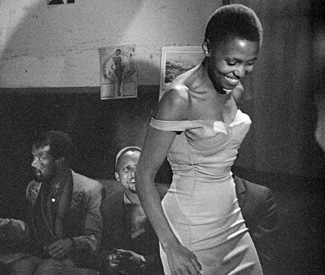
FILM Opposition to apartheid didn’t really pick up steam as a popular cause in the U.S. until the early 1980s. Which makes it all the more remarkable that New York City-based documentarian Lionel Rogosin made Come Back, Africa about a quarter-century earlier — though less surprisingly, the film itself was barely seen here at the time. Now finally playing American theaters outside his home town in a restored print, it’s a time capsule whose background is as intriguing as the history it captures onscreen.

The horrors of World War II and some subsequent global travel had stirred a profound awareness of social injustices in Rogosin, who began planning a feature about South Africa while still working at his father’s textile business. He had very little filmmaking experience, however, so he took $30,000 of his earnings and as “practice” made On the Bowery (1956), a semi staged portrait of Manhattan’s skid row area that won considerable praise, if also some shocked and appalled responses from Eisenhower-era keepers of America’s wholesome, prosperous self-image. (It was, as 1959’s Come Back, Africa would also be, much more widely appreciated in Europe.)

Armed with the confidence bestowed by that successful effort and several international awards, Bogosin traveled to South Africa — not for the first time, but now with the earnest intent of making his expose. In the mid- to late ’50s, however, that was hardly a simple task. He and wife Elinor Hart had to do everything clandestinely, from making contacts in the activist underground to recruiting actors and crew. (The latter eventually had to be brought in mostly from Europe and Israel.) To get permits he fed the government authorities a series of lines: first he pretended to be making an airline travelogue to encourage tourism; then a music documentary to show local blacks “were basically a happy people;” then another doc, about the Boer War. Amazingly, despite the myriad likelihoods of being informed on, he shot the entire film without being shut down or deported. It remained, however, a stressful and dangerous endeavor for all concerned.

Like On the Bowery, Come Back, Africa qualified as a documentary by the looser standards of the time (Rogosin preferred the term “poetic realism”), but mixed a loose, acted narrative with completely nonfiction elements. Like the prior film, it also followed the luckless wanderings of an agreeable protagonist played by a first-time actor actually found on the street — here Zacharia Mgabi, a 30-ish bearded worker “discovered” on a bus queue.

His character, Zachariah, is caught in one catch-22 of apartheid life: he can’t get a job without the appropriate permits, and can’t get the permits without a job. First he tries finding employment in the misery of a mining encampment, then travels to Johannesburg — where it’s illegal for him to be without further permits — where he’s bounced from one position to another. Working as “house boy” to a middle-class white couple, he’s fired when the racist, shrewish wife (a memorable performance by Myrtle Berman) catches him sneaking a drink from her own secret booze stash. An auto-shop stint is lost due to a friend’s incessant goofing off, while service as porter in a hotel is terminated when a hysterical white lady guest cries “Rape!” simply because he surprises her in a hallway.

Meanwhile Zachariah’s wife arrives from their native KwaZulu, and they tentatively set up house in a Sophiatown shack. (Come Back, Africa is of particular interest for its scenes there — within a few years the government had forcibly emptied this poor black township, having made its population mix of races illegal, and the area was razed to become an unrecognizable whites only suburb.) But even this small foothold on stability is doomed. Just as alcoholism dragged On the Bowery‘s hero back into a downward spiral at the end (both on- and offscreen), so Zachariah and his family are helpless to save themselves from the violence, police harassment, and self-destruction apartheid breeds and maintains itself with.

All show and almost no “tell,” Come Back, Africa pauses around the two-thirds point to let several men pass around a bottle, discussing the nature of and solutions to their oppression. They’re happily interrupted by the incongruity of a young woman in an elegant cocktail dress — no less than a then-unknown Miriam Makeba, who sings a couple of songs in her inimitable voice. When the film was finished, Rogosin bribed officials to get her out of the country, bankrolling his contracted “discovery’s” launch at the Venice Festival, and in the U.S. and England. But to his great disappointment, she was quickly taken under Harry Belafonte’s wing, dismissing her first benefactor as “not very nice” and “an amateur.” Thus a legend was born, with Rogosin pretty much cut out of the resume.

Come Back, Africa, too, would disappoint its maker in some respects. With a furious South African government swiftly condemning this portrait as “distorted,” his original plans for a trilogy became impossible. The film won a number of prizes — although unlike On the Bowery, it was pointedly not nominated for a Best Documentary Oscar — and would eventually be widely seen on European television. But it has still never been broadcast in the U.S., and despite Rogosin’s efforts — he went so far as to open NYC’s still-extant Bleeker Street Cinemas in 1960 to show it and other important new works — it collided with a thud against the overwhelming indifference of middle-class white audiences. They were barely starting to confront such thorny racial issues in their own backyard, much less in far-flung nations. Not shown in South Africa until the late 1980s, Come Back nonetheless proved a great influence on development of the whole continent’s indigenous cinematic voices.

A liberal shit-kicker to the end, Rogosin made other documentaries, was integral to the New American Cinema movement (alongside Jonas Mekas, Robert Downey Sr., Shirley Clark, and other experimental luminaries), founded distribution company Impact Films, and moved to England for a spell before dying in Los Angeles at the century’s turn. It’s a pity he didn’t live to see his two first features restored and rediscovered — though interviews late in life suggest he never let limited exposure dampen his activist zeal one whit.

COME BACK, AFRICA opens Fri/3 at the Roxie.

The Performant: Strangers in a strange land

0

Dan Carbone and Kitka resculpt old terrain

From the dark corner of the stage throbs the low rhythm of a skin-clad, Celtic-style drum and the strum of acoustic guitar, while in the light a man clad in a white dress shirt sways in hypnotic time, eyes shut tight, arms flung wide. “Sleeping, sleeping,” he croons softly, “I’m only sleeping.” Still swaying, he begins to tell the tale from the beginning, about a little baby boy whose “brain is knitting itself in an unusual way.”

You’d be forgiven for thinking in this first moment that the man is speaking of his own infancy, after all, brains don’t come knit much more unusually than that of East Bay-based avant-gardian Dan Carbone. But the infant’s name is not Dan’s, and though his brief and tragic backstory reverberates through much of the rest of the play, the infant soon yields the spotlight to his younger brother, the creator of the piece, “Father Panic,” which made its stage debut at the Garage on Friday. 

Although “Father Panic,” is indubitably Carbone’s most autobiographical work, a fretful monologue about a precocious childhood both hideously warped yet strangely innocent, familiarly eccentric, flourishes abound throughout. Puppets, poltergeists, twisted songs that expose the tortured inner monologues of the characters to the surface, a live video installation curated by Philip Bonner (a.k.a. Bulk Foodveyor) of childhood detritus and memory bank fodder.

Catherine Debon takes a turn as television-land language teacher, who translates self-loathing lyrics such as “maybe we can hate ourselves together,” into mellifluous French. And instrumentation is handily provided by swampabilly guitarist Andrew Goldfarb, who comprises, with Carbone, the performative music duo The Wounded Stag. But the unacknowledged star of the show is probably Carbone’s mother, who gradually takes over the piece, a raw bundle of outré obsessions and an embattled nature, the very embodiment of a stranger in a strange land — like a Raëlian without a cause, or an aquatic African frog in a solitary tank.

***

The mountains of Serbia, and a vocal tradition almost unknown this side of the “pond,” lie thousands of miles away from the basements of Connecticut. But an intriguing collaboration between Kitka, Oakland’s premiere ensemble of acapella Eastern European music and Svetlana Spajic, a renowned Serbain folk singer, brought that faraway land to stirring life during a two-part concert staged over the weekend at CounterPULSE.

After a video of venerable vocalist Jandrija Baljak teaching his technique to Spajic’s homeland ensemble, the concert began in earnest when Spajic took the stage. Dressed in Sunday best attire suggesting a peasant en route to Ellis Island circa 1914, Spajic’s passionate ululations did little to dispel the sensation of being transported backwards through time and space. Joined in the second half by Kitka, the remaining songs were characterized by an almost medieval lack of vibrato and elongated interludes of dissonant voice-bending harmonies. Even when comprehension of the lyrics was impossible, the music tapped into a complexity of almost primal emotion—though some slyly inserted San Francisco-centric lines did bring us briefly back to home before we were whisked once more into the territory of the unfamiliar by our fearless musical guides.

Cheers, puppeteers!

1

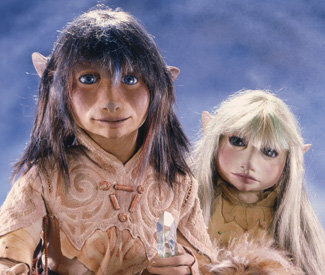
Showcasing the boldly imaginative and innovative talents of the artisans at the Jim Henson Company, the 1982 fantasy film The Dark Crystal broke new ground when it came to visual special effects and believable creature creations.

The movie’s tale — evil Skeksis versus good Gelflings and Mystics, just tryin’ to restore balance and freedom to their world — captivated viewers’ imaginations upon its release, and has gone on to become a beloved part of many people’s childhood memories. And it’s still earning new fans: in honor of the film’s 30th anniversary, SF Sketchfest presents a special Crystal screening with guest Dave Goelz, who performed the puppetry for fan favorite Fizzgig, as well as the Skeksi Garthim Master SkekUng.

Goelz, who’ll introduce the film and share some rare, behind-the-scenes footage, is looking forward to marking the movie’s milestone with fans. “What I love about doing these events is that it reminds me of the quality of the things we were doing, and that they are enduring, and how much we enjoyed making them,” he says.

Having worked with Henson since 1973, Goelz was no stranger to busting through creative and logistical boundaries on film and television projects, but even he was uncertain for a time about Crystal‘s chances of success. “We all knew Jim as an incredible, indefatigable optimist. He was just so positive about everything, and he just believed that we could do anything — and he usually figured out a way to do it,” Goelz remembers.

“On the first day of shooting, though, we had to have the Skeksis file by the bedside of their dying emperor, and that was the very first shot that I was in. We were up on a two-foot riser, walking, and each Skeksis has two people inside, and then about four people down below, sort of duck walking on the floor, with each one holding a cable control.

Partway through the first shot I fell off the riser — it was dark, I couldn’t see where I was going. I remember thinking at that moment, ‘Jim’s optimism has really caught up with him this time. We’ll never get this thing shot!’ But of course, within two weeks we were ad-libbing in the characters.”

Goelz attributes the film’s success to the hard work of everyone involved, but points especially to Henson’s emotional and financial commitment to the quality of their projects.

“These things were developed and rehearsed for months, only Jim Henson would make that kind of investment,” Goelz says. “He was always like that. People who worked in the shop all those years tell me that he never came in and said, ‘You can’t buy that fabric for Miss Piggy. It’s $200 a yard!’ — he never held back on anything for the shop and the characters.”

In addition to the time, money, and effort spent on bringing the world of Crystal to life through advances in special effects technology, the crew also found simple ways to add depth to the film’s characters, as was the case with the lovable Fizzgig.

“The reason he’s convincing is because he’s used sparingly,” Goelz notes. “He’s a character who can’t really do much; he can move his paws and blink and open his mouth, so if you overexpose him you will realize that he’s limited. But the way he was conceived was to be used sparingly and that was useful.

Secondly, the way he traveled was by rolling [himself into a ball], which made it very easy for us to shoot him. We just rolled him across the shot, so that was extremely simple. One of the simplest things in the movie!”

Having worked with the Muppets for nearly 40 years (bringing life to much-loved characters like Gonzo and Bunsen Honeydew) and lending his talents to affiliated projects such as Labyrinth (1986), Fraggle Rock, and a host of other films and television shows, Goelz says he loves to see the impact of his efforts on fans.

“A lot of people who originally saw these projects [as children] are in their 30s now and have little kids, and they want to pass this along to their kids,” he reflects. “It’s very heartwarming to see there is a legacy.”

THE DARK CRYSTAL 30TH ANNIVERSARY CELEBRATION

Sat/4, 11 a.m., $10

Castro Theatre

429 Castro, SF

www.sfsketchfest.com

Rep Clock

0

Schedules are for Wed/8-Tues/14 except where noted. Director and year are given when available. Double and triple features are marked with a •. All times p.m. unless otherwise specified.

ARTISTS’ TELEVISION ACCESS 992 Valencia, SF; www.atasite.org. $6-10. Dirty Looks presents: City of Lost Souls, Fri, 8. “Mindscapes,” short films, Sat, 8.

CALIFORNIA COLLEGE OF THE ARTS 1118 Eighth St, SF; www.dirtylooksnyc.org. Free. Dirty Looks presents: “Queer Conversations on Culture in the Arts,” with selections from the “Female Trouble” experimental shorts program and a conversation with Margaret Tedesco, Thurs, 7.

CASTRO 429 Castro, SF; (415) 621-6120, www.castrotheatre.com. $7.50-10. •Pickpocket (Bresson, 1959), Wed, 3:30, 7:15, and American Gigolo (Schrader, 1979), Wed, 4:55, 8:45. •Beauty and the Beast (Cocteau, 1946), Thurs, 3:05, 7, and No Such Thing (Hartley, 2001), Thurs, 4:55, 8:50. “Midnites for Maniacs: I’m Black and I’m Proud:” •I’m Gonna Git You Sucka (Wayans, 1988), Fri, 7:30; Pootie Tang (Louis CK, 2001), Fri, 9:30; CB4 (Davis, 1993), Fri, 11:30. French American International School presents: “I-Speak: Celebrating 50 Years of International Education,” Sat, 6:30. This event, $5-10; tickets at www.internationalsf.org. •Do The Right Thing (Lee, 1989), Sun, 2, 8, and Malcolm X (Lee, 1992), Sun, 4:15. “Love: Ali MacGraw:” Love Story (Hiller, 1970), Tues, 8. With pre-show gala performance and MacGraw in person; for tickets ($25-45), visit www.ticketfly.com.

ELMWOOD 10070 San Pablo, El Cerrito; www.rialtocinemas.com. Free. “Community Cinema:” More Than a Month: One Man’s Journey to End Black History Month (Tilghman, 2012), Wed, 7.

CHRISTOPHER B. SMITH RAFAEL FILM CENTER 1118 Fourth St, San Rafael; (415) 454-1222, www.cafilm.org. $6.75-10.25. “Rafael Film Club:” “Jan Wahl,” Thurs, 1. Pina (Wenders, 2011), call for dates and times. “Mostly British Film Festival:” Route Irish (Loach, 2010), Wed, 7; Albatross (MacCormick, 2011), Thurs, 7. “2012 Oscar Nominated Short Films,” narrative and documentary (separate admission), Feb 3-9, call for times.

LAMORINDA THEATRES Four Orinda Theatre Square, Orinda; www.caiff.org. $12-15. “California Independent Film Festival,” 11 features, plus docs, shorts, and educational seminars, Feb 10-16.

MECHANICS’ INSTITUTE 57 Post, SF; (415) 393-0100, rsvp@milibrary.org. $10. “CinemaLit Film Series: Hollywood Dames: Beauty and Brains:” Intermezzo (Ratoff, 1939), Fri, 6.

PACIFIC FILM ARCHIVE 2575 Bancroft, Berk; (510) 642-5249, bampfa.berkeley.edu. $5.50-9.50. “Documentary Voices:” The Green Wave (Ahadi, 2010), Wed, 7. “Seconds of Eternity: The Films of Gregory J. Markopoulos:” “Markopoulos: The Early Films (1940-49)” Thurs, 7; “Eros and Myth (1950-63),” Sat, 6:30. “Austere Perfectionism: The Films of Robert Bresson:” The Trial of Joan of Arc (1962), Fri, 7; Les dames du Bois du Boulogne (1945), Fri, 8:25; Lancelot of the Lake (1974), Sat, 8:30. “Screenagers: 14th Annual Bay Area High School Film and Video Festival,” Sat, 3. “Howard Hawks: The Measure of Man:” The Criminal Code (1931), Sun, 4:30; Bringing Up Baby (1938), Tues, 7. “African Film Festival 2012:” Viva Riva! (Munga, 2010), Sun, 6:30.

ROXIE 3117 and 3125 16th St, SF; (415) 863-1087, www.roxie.com. $6.50-10. Come Back, Africa (Rogosin, 1959/2012), Wed-Thurs, 6:45, 8:30. Drive (Winding Refn, 2011), Wed, 8:45. Into the Abyss (Herzog, 2011), Wed, 6:45. SF IndieFest, Feb 9-23. Visit www.sfindie.com for complete schedule.

SFFS | NEW PEOPLE CINEMA 1746 Post, SF; www.sffs.org. $10-11. Domain (Chiha, 2010), Wed-Thurs, 2, 4:30, 7, 9:30. Once Upon a Time in Anatolia (Ceylan, 2011), Feb 10-16, 2, 5:30, 8:30.

VOGUE 3290 Sacramento, SF; www.mostlybritish.org. $12.50. “Mostly British Film Festival:” Black Butterflies (van der Oest, 2011), Wed, 5; London Boulevard (Monahan, 2010), Wed, 7:15; The Great White Silence (Ponting, 1924), Wed, 9:30; A Passionate Woman (2010), Thurs, 5; Route Irish (Loach, 2010), Thurs, 7:30.

VORTEX ROOM 1082 Howard, SF; www.myspace.com/thevortexroom. $7 donation. “The Second Coming of the Vortex Room:” The Second Coming of Suzanne (Barry, 1974), and Marjoe (Kernochan and Smith, 1972), Thurs, 8.

YERBA BUENA CENTER FOR THE ARTS 701 Mission, SF; (415) 978-2787, www.ybca.org. $6-8. “Bros Before Hos:” The Killing of a Chinese Bookie (Cassavetes, 1976), Thurs, 7:30; “Female Trouble,” experimental shorts program presented by Dirty Looks curator Bradford Nordeen, Sun, 2.

Rep Clock

0

Schedules are for Wed/25-Tues/31 except where noted. Director and year are given when available. Double and triple features are marked with a •. All times p.m. unless otherwise specified.

ART DECO MOVIE THEATER 2700 Saratoga, Alameda; www.baicff.com. $10-20. "Bay Area International Children’s Film Festival," family films from around the world, Sat-Sun, 10am-5:30pm.

BALBOA 3630 Balboa, SF; www.brownpapertickets.com. $15-20. "Opera and Ballet at the Balboa Theatre:" Caligula, from the Paris Opera Ballet, Wed, 7:30; Cendrillon, from the Royal Opera House, Sat-Sun, 10am. "Jazz and Film:" A Great Day in Harlem (Bach, 1994), with live performance by Jimmy Ryan’s Balboa Be Bop Band, Sun, 5:30.

BERKELEY FELLOWSHIP OF UNITARIAN UNIVERSALISTS 1924 Cedar, Berk; www.bfuu.org. Hypothesis (Smith), followed by a discussion about 9/11 truth, Thurs, 7.

CASTRO 429 Castro, SF; (415) 621-6120, www.castrotheatre.com. $7.50-10. "Noir City X:" •House of Bamboo (Fuller, 1955), Wed, 7:30, and Underworld USA (Fuller, 1961), Wed, 9:20; •Naked Alibi (Hopper, 1954), Thurs, 7:30, and Pickup (Haas, 1951), Thurs, 9:20; •Thieves’ Highway (Dassin, 1949), Fri, 7:30, and The Breaking Point (Curtiz, 1950), Fri, 9:30; •Three Strangers (Negulesco, 1946), Sat, 1, 5, 9, and The Great Gatsby (Nugent, 1949), Sat, 3, 7; Roadhouse Nights (Henley, 1930), Sun, noon; The Maltese Falcon (Del Ruth, 1931), Sun, 1:20; City Streets (Mamoulian, 1932), Sun, 3; Mr. Dynamite (Crosland, 1935), Sun, 4:45; The Glass Key (Heisler, 1942), Sun, 7; The Maltese Falcon (Huston, 1941), Sun, 9. Advance tickets (double features, $10-15) and more info at www.noircity.com.

CHRISTOPHER B. SMITH RAFAEL FILM CENTER 1118 Fourth St, San Rafael; (415) 454-1222, www.cafilm.org. $6.75-10.25. "Rafael Film Club:" Complicated Women (Munro Neely, 2003), Thurs, 1. With author and film critic Mick LaSalle. Pina (Wenders, 2011), Jan 27-Feb 2, call for times. Joffrey: Mavericks of Dance (Hercules, 2011), Sat, 10:30am.

JEWISH COMMUNITY CENTER OF THE EAST BAY 1414 Walnut, Berk; (510) 848-0237, www.brownpapertickets.com. $6-8. "San Francisco Jewish Film Festival Presents:" 77 Steps (Mara’ana, 2010), Thurs, 7:30.

PACIFIC FILM ARCHIVE 2575 Bancroft, Berk; (510) 642-5249, bampfa.berkeley.edu. $5.50-9.50. "Film 50: History of Film, Cinema, and the Other Arts:" "Back to the Beginning: From the Cinema of Attractions to Narrative Illusionism," with lecture by Marilyn Fabe, Wed, 3:10. This event, $5.50-11.50. "Documentary Voices:" David Holzman’s Diary (McBride, 1968), Wed, 7. "African Film Festival 2012:" Medicine for Melancholy (Jenkins, 2007), with director Barry Jenkins in person, Thurs, 7; A Screaming Man (Haroun, 2010), Sun, 4:30. "Howard Hawks: The Measure of Man:" Paid to Love (1927), Fri, 7; Scarface (1932), Tues, 7. "Henri-Georges Clouzot: The Cinema of Disenchantment:" Diabolique (1955), Fri, 8:40; The Spies (1958), Sun, 6:30. "Austere Perfectionism: The Films of Robert Bresson:" Pickpocket (1959), Sat, 6:30; Diary of a Country Priest (1950), Sat, 8:10.

ROXIE 3117 and 3125 16th St, SF; (415) 863-1087, www.roxie.com. $6.50-10. Warren Ellis: Captured Ghosts (Meaney, 2011), Wed, 7:15, 9. The Upsetter: The Life and Music of Lee "Scratch" Perry (Higbee and Bhala Lough, 2011), Thurs, 7:30, 9:30. Sing Your Song (Rostock, 2011), Jan 27-Feb 2, 6:45, 8:45 (also Sat-Sun, 2:45, 4:45).

SFFS | NEW PEOPLE CINEMA 1746 Post, SF; www.sffs.org. $10-11. Fullmetal Alchemist: The Sacred Star of Milos (Murata, 2011), Wed-Thurs, 2, 4:30, 7, 9:15. Sleeping Beauty (Leigh, 2011), Jan 27-Feb 2, 2, 4:30, 7, 9:15 (no 7pm show Mon/30).

YERBA BUENA CENTER FOR THE ARTS 701 Mission, SF; (415) 978-2787, www.ybca.org. $6-8. "British Arrow Awards: Best British Television Commercials of 2011," Thurs-Sun, 2, 4, 6, 8. The House by the Cemetery (Fulci, 1981), Fri-Sat, 10.

ZINC DETAILS 1905 Fillmore, SF; rsvp@zincdetails.com. Free. Eames: The Architect and the Painter (Cohn and Jersey, 2011), Wed, 6. With a discussion about the Eames with former Dwell editor Sam Grawe.

Too much in the son

1

arts@sfbg.com

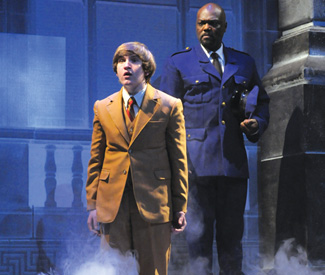
THEATER The Berkeley Rep’s thrust stage sinks to floor-level down front where a simply furnished living room freely communicates with the audience seated nearby, while to the back rises the imposing façade of San Francisco City Hall. The impressive jumble of a set (by Todd Rosenthal) ensures the jarring conflation of private and public life strikes us palpably before a single line is uttered in Ghost Light. As it happens, the first words are those famous ones spoken by Dianne Feinstein from City Hall on November 27, 1978, announcing the assassination of Mayor George Moscone and Supervisor Harvey Milk by former supervisor Dan White. They come over the television to a 14-year-old boy (Tyler James Myers) home sick from school the day his father died.

The dream play that follows is not realistic, but it is also more than fiction. A unique collaboration between Bay Area–based director and California Shakespeare Theater artistic director Jon Moscone (real-life youngest son of the slain mayor) and Berkeley Rep’s Tony Taccone, Ghost Light is an at times promising but otherwise laden attempt to explore the stifled grief of a man haunted by the death of a murdered father — a father who was also a public figure, a political leader whose legacy is in some sense embattled (or at least seriously overshadowed by the subsequent apotheosis of Harvey Milk).

The complex feelings this entails for the son of such a man — whose career in the state senate and as mayor was arguably more important than Milk’s to the legal and social battle for gay rights — are only heightened by the fact that the son is also gay, with a public profile of his own and the mixed blessing of a prominent family name.

If the son in this situation-turned-scenario sounds a little like Hamlet, the comparison was not lost on Taccone either, who penned the script while drawing on hours of freewheeling conversations with Jon Moscone, initiator of the project and the play’s director. (Ghost Light had its world premiere last year in Ashland at the Oregon Shakespeare Festival, where it was commissioned as part of its “American Revolutions: The United States History Cycle.”) Director-turned-playwright Taccone has the character “Jon” (played with manic energy and sudden introspection by a sympathetic Christopher Liam Moore) stuck midway through the preparations for a production of Hamlet, unable to decide what to do with the Ghost — indeed, haunted by the whole idea. This unusual block has his best friend and collaborator Louise (a lively if slightly affected Robynn Rodriguez) frustrated and worried.

Jon’s block also feeds a dream life populated by several characters — a Loverboy (Danforth Comins) spun from an online flirtation; his perennially 14-year-old self (Myers) locked in a battle of wills with some cosmic undertaker cum grief councilor named Mister (a sure, larger-than-life Peter Macon); the silent image of his black-veiled widow mother (Sarita Ocón); and a menacing prison guard in a soiled shirt (a sharp Bill Geisslinger), who turns out to be the grandfather he never knew.

It’s suggested more than once in the dialogue that all of these characters stalking his sleep (and often arriving onstage through the portal of Jon’s bed, pitch atop the shiny black granite steps of City Hall) are merely the dreamer himself in various disguises and aspects. This much, of course, we are already primed to assume. In fact, the fundamental problem facing the main character — namely, his inability to properly let go of his own grief and suffering around the death of his father, which appears here as an inability to let his own father’s “perturbed spirit” rest at last — is equally a condition readily recognizable to a modern audience in a therapeutic age. It may be grounds to build on in terms of character development, but the lack of mystery here also undercuts any suspense in the plot, as the increasingly blurred line between Jon’s dreaming and waking lives points toward nervous collapse and the threat of some self-inflicted disaster (personified by the foul-mouthed, homophobic, and gun-toting prison guard stalking his unconscious).

Taccone makes a valiant attempt to draw together a complicated and wrenchingly personal yet all-too-public story with a set of interrelated subplots and quick-moving dialogue (filled with as much quippy humor and menace as pathos). But the results are uneven. Although Geisslinger makes a serviceable villain, the danger he represents never feels palpable. Likewise, the underworld subplot involving boyhood Jon (played a little too typically “boyishly” by Myers to be readily believed) comes across as vague and treacly.

Perhaps unsurprisingly, it is the more realistic, down-to-earth scenes that play best and are most evocative. The intricacy of a life divided painfully between public and private personas, public and private pain and loyalties too, comes across best when the character of Jon is operating in the “real” world. To this end, Moscone the director shrewdly brings the audience in at key points as well, raising the houselights for an acting master class led by his onstage character. Meta-theater, town hall meeting, group therapy — the lines begin to blur here in a lively, resonant discussion of “acting” as social action.

Another interesting scene takes place in a bar, where Jon finally meets Basil (Ted Deasy), the man with whom he’s been having an online fling for weeks (and the inspiration for the Loverboy of his increasingly intrusive dream world). The awkwardness, defensiveness, and barely contained rage revealed here — as Jon discovers that Basil’s own fantasy projection incorporates his public familial tragedy — speak more eloquently to the messy particulars of the main character’s dilemma then perhaps any other scene in the play.

In the end, the thematic aptness of the mise-en-scène — which forces Jon, for instance, to open the front doors of City Hall just to retrieve a beer from the fridge — speaks also to the monumental task this play has set itself. If the results prove very mixed, they are all the more discomfiting because the root story is so fascinating, the dramatic project itself audacious and strange, and the insight to be potentially gleaned so tantalizing — speaking to our collective intersections with history in the deepest recesses of the psyche.


GHOST LIGHT

Through Feb. 19

Tues., Thurs.-Sat., 8 p.m. (also Sat. and Feb. 16, 2 p.m.); Wed. and Sun., 7 p.m. (also Sun., 2 p.m.), $14.50-$73

Berkeley Repertory Theatre, Thrust Stage, 2025 Addison, Berk.

(510) 647-2949

www.berkeleyrep.org

Public TV, for sale

2

OPINION The San Mateo Community College District Board of Trustees has announced the upcoming sale of its independent public television station, KCSM-TV. Some potential new owners are cause for alarm.

A January 10th walk-though for potential bidders was attended by the Christian broadcasting giant Daystar Television. The fastest-growing faith-based network in the country, Daystar’s mission is to reach souls with the good news of Jesus Christ as one of a “new breed of televangelists.”

While the prospect of San Mateo Community College bringing Daystar to the Peninsula is the most dramatic possible outcome of the district’s decision to sell, some of the other bidders present challenges as well.

Public Media Company, controlled by radio brokers Public Radio Capital and much in the news for its role in the still-contested sale of KUSF’s radio license to the formerly commercial station KDFC, also toured the station on Jan. 10.

Public Media Company/Public Radio Capital is based in Boulder, Colorado. The intertwined family of limited liability companies has been buying up college radio stations at fire-sale prices all over the country and folding them into tight National Public Radio classical or jazz-only formats. Independent musicians have expressed alarm at the loss of accessible college radio outlets, and the San Francisco Board of Supervisors denounced the loss of KUSF to San Francisco’s cultural fabric in a 2011 resolution.

Other possible bidders included the mysterious Locust Point Networks, a website without a definition beyond “an early stage telecommunications company,” and Cheifet Productions, which produced programming on Silicon Valley for the PBS Nightly Business Report. Also in the potential market are Independent Public Media, a satellite TV service created by one of the founders of Free Speech TV, and KAXT, a South-Bay based family of foreign-language stations founded by a former KGO reporter.

In the Bay Area, public broadcasting is dominated by the vast KQED, which owns television and radio stations from Sacramento to Salinas to San Jose. KQED has long been criticized for a paucity of local programming and news, and a fondness for cooking shows.

The absorption of independent outlets into the KQED structure promises more standardization and less variety for peninsula residents.

The district claims the sale of the educational, noncommercial TV license is a necessity because operating an independent public television station is not compatible with the core mission of educating students. But the district will continue to operate the radio station Jazz 91 radio station.

District officials also said that the TV station was losing money. But a financial statement posted with bid materials seemed to include many shared radio/TV expenses.

The district trustees meet Jan. 25 at 6:00 p.m. at the College of San Mateo, 3401 College of San Mateo Drive. They should be told in no uncertain terms that a sale to a Christian broadcaster is unacceptable — and that that any sale must protect the public interest in localism, independence, and a diversity of points of view. 

Tracy Rosenberg is the executive director of Media Alliance, a Bay Area nonprofit that advocates for democratic communications. www.media-alliance.org


Legal, not legal

4

caitlin@sfbg.com

HERBWISE It’s been a weird year to start a marijuana column. Shortly after we started Herbwise, which was intended to be our weekly look at marijuana culture and events, politics reared its ugly head, rendering it necessary to go to hearings at the State Building, call up California Assembly members, and occasionally wade through seas of legalese. Such is the state of cannabis under ongoing federal prohibition, but it’s been a particularly dramatic year.

And in some moments, news and culture reporting melded together in the marijuana world. Take, for example, the case of Oakland’s Harborside Health Center, which is often called the largest dispensary in the world (it is certainly the largest in California). After years of painstakingly crafting a working relationship with city government, the business was heavily audited by the IRS. The federal agency decided Harborside — and 40 other California dispensaries — fell under the jurisdiction of Section 280E of the Internal Revenue Code, which denies the right for businesses involved in illegal drug trafficking to claim standard business expenditures. The collective now owes $2.4 million in back taxes, an amount that founder Steve DeAngelo asserts will bankrupt it if his business is forced to pay up.

Despite the ever-growing acceptance of the plant in the United States — a Gallup poll put the number at 50 percent in the fall of 2011 — medical marijuana is under attack by the federal government. Last fall, US Attorney for Northern California Melinda Haag sent out letters to the landlords of roughly a dozen Bay Area dispensaries threatening them with civil forfeiture, or possibly four decades in prison, if they failed to move this “trafficking” off their property within 45 days. The letters targeted dispensaries considered to be in a school zone.

Most left without a fight. In San Francisco, the Tenderloin’s Divinity Tree Patients Wellness Cooperative, the Market Street Collective on Upper Market, and the Mission District’s Medithrive and Mr. Nice Guy were among the businesses that shut their doors, some completely and some to transition into delivery-only services. [UPDATE: Attorney Matt Kumin tells the Guardian that Divinity Tree and Medithrive have filed a “coordinated federal lawsuit” through his office in protestation of the closures]

Fairfax’s sole dispensary, Marin Alliance for Medical Marijuana, was forced to close after 15 years of legal operation overseen by long-time cannabis activist Lynette Shaw. The 7,500-person Marin County berg’s town council passed a resolution supporting the Alliance, which served as a symbol of popular support for legal cannabis in a county beset with some of the highest breast cancer rates in the country.

Assemblymember Tom Ammiano and Sen. Mark Leno have been the most outspoken California politicians in coming out against the federal government’s meddling with the state’s cannabis. At a press conference at San Francisco’s State Building in October 2011, Ammiano announced his frustration that the feds would “upset the will of the people” by curtailing safe patient access. Proud to be an elected gay official, he promised to continue to crusade for an issue that he says disproportionately affects the LGBTQ community.

One of the steps Ammiano took was to meet with Haag to discuss what could be done to assuage her concerns with the industry. “That was very, very disappointing,” Ammiano commented on this initial talk. In a recent phone interview with the Guardian, he remembered that Haag implied that the order was coming from above, from high up in the Obama Administration.

Ammiano doubts her assertion that she had little discretion in the matter. “She said she was only doing what the boss was telling her to do. We had a hard time with that.”

He does think that the Obama Administration is sending its attorneys mixed messages — case in point, US Attorney General Eric Holder’s repeated comments that federal interference in state-legal marijuana operations would be “a low priority.” Ammiano also makes the connection between the attacks on cannabis and the self-sustaining industries behind the War on Drugs. “The DEA, some of the diehards, this is like a jobs program for them,” he said.

His meeting with California Attorney General Kamala Harris went more smoothly. Ammiano says Harris, who voiced cautious support for the industry last fall, was eager for a more comprehensive regulatory system to be put into place, but she supported Proposition 215 — the 1996 measure that legalized medical marijuana in California — on principle.

Faced with an ambiguous future, medical cannabis’ proponents — politicians, activists, entrepreneurs, and patients — are putting forth plans for just such a system. This year will be the playing field for a passel of campaigns to take medical marijuana out of the under-supervised arena in which it’s found itself.

Three ballot initiative campaigns seek to address the issue. Two — Regulate Marijuana Like Wine and Repeal Prohibition — would legalize cannabis use for adults across the board. Another, which has perhaps the most likely chance to succeed in the $2 million process of getting onto the ballot, is being put forth by patient advocacy group Americans for Safe Access, the United Food and Commercial Workers (the union that represents many cannabis workers in California), and marijuana collectives. It’s called the Medical Marijuana Regulation, Control, and Taxation Act.

“We decided to focus on medical because we figured that taking that further step at this point is unwise given the federal government’s actions over the last months,” said attorney George Mull, who is part of the team that proposed the measure. If passed, the initiative would establish a 21-member state regulatory board comprised of doctors, industry folk, patients, activists, government officials, and others. A state supplemental tax on cannabis would be levied and local governments would be required to allow one dispensary per 50,000 residents. Ammiano said that he and Leno were also working on proposing legislation that would provide regulations.

But the future of medical marijuana in California remains somewhat cloudy. “I’m worried that even if we come up with the regulations, the feds will find something else,” said Ammiano. Complicating the matter, the California Supreme Court moved unanimously on Jan. 18 to review the power that cities and counties have to make their own laws concerning cannabis accessibility — plus, it plans to look at the old disconnect between state and federal law on the matter..

So much for the politics of marijuana in 2012. Away from the headlines, it’s plain to see that the plant is increasingly accepted in popular culture. On a local level, East Bay YouTube stoner Coral Reefer continues to tweet to thousands of followers every time she sparks a bowl, and on the national stage, Miley Cyrus admits to smoking “way too much fucking weed,” after seeing the birthday cake friends had gotten her. (It had Bob Marley’s face on it.)

On television, the United States is learning about Harborside’s travails — but not just from the news shows. Discovery Channel shot a season of reality TV following DeAngelo and his staff, telling the stories of patients and about the reality of running a dispensary for a show they entitled Weed Wars even before the final $20 million IRS ruling. As the collective is being persecuted by the feds, its fan base across the country grows.

Will Discovery Channel renew Weed Wars for a second season? Regardless of the network’s views on the protagonists’ profession, if the cameras are kept rolling they’re sure to capture another year of interesting times for California cannabis.


A Bay Area kind of stand-up: Frankie Quinones of For the People Comedy

2

Common knowledge states that if you’re serious about becoming a stand-up comedian on the West Coast, you move to Los Angeles. But Frankie Quinones created the diversity of For the People Comedy here in San Francisco and despite his rising star on the stand-up scene, he’s sticking around for the moment.

Maybe that’s because Carmelita lives here. “She’s taken on a whole thing of her own, her own career,” says the Ventura County native of his sassed-up, club-going Latina sexpot. “Carmelita’s got her own list of things to do in 2012.” You can check out Quinones — and possibly Carmelita or his popular “Cholo Whisperer” skit — at the next For the People event at Cobb’s on Thu/19. 

Carmelita was created back in 1996 in Quinones’ high school improv class. She hails from Quinones’ stable of characters inspired by – well, what else – the people he sees on an everyday basis. In Carmelita’s case that’s his female family members, mixed with Quinones’ own mannerisms. “She’s really confident, but not really conceited,” he says. 

Her star vehicle was “Eh-So Eh-Spicy,” in which she half-dishes, half-raps about men looking at her tits in line at the store and courts suitors in a San Francisco bar. You’re definitely laughing at her, but somehow, Quinones escapes reducing the brash Carmelita into a stereotype like so many other male comedian’s female alter egos. Carmelita shares set time with a host of Quinones’ other personas, including a hippie character named Sun Diamond whose mannerisms are culled from the patchouli-scented denizens of our fair city.

Quinones is proud of being a Latino comic, part of a tradition that also includes his personal role models Gabriel “Fluffy” Iglesias and Paul Rodriguez, who his parents used to watch on TV when he was young. He often performs at Latino comedy nights in Los Angeles, but in San Francisco — where successful Latino comics are well-known for relocating quickly down south when fame beckons — he’s used to being the only Hispanic name on otherwise all-black and all-white bills.

His comedy often dances along the edge of racial tensions, ultimately resolving them in a feel-good way. In “Cholo Whisperer,” a upper-middle class suburban couple hires an expert to deal with the shanking, 40-drinking gangster (played by Quinones) they’ve adopted after being charmed by their neighbor’s cholo. The cholo whisperer, who walks with a mystic’s bauble-topped scepter but dresses in everyday street wear and a blue bandana, teaches the white husband how to be “the jefe,” a role that mainly involves puffing out his chest and barking short orders. 

“Some people think I’m stupid for not moving to LA already,” says Quinones, drinking a Negra Modelo in front of his combination plate on a sidewalk tables at the Valencia Street Puerto Alegre. “But I feel like I’m doing something for the San Francisco comedy scene.” You can check out For the People’s new monthly gig every last Wednesday at SoMa’s Sofa nightclub on Eighth Street and Minna. Quinones crafts the program for these nights with the newbie comedy fan in mind — usually they’ll feature stand-ups from all kinds of backgrounds, even a live DJ for musical interludes. 

“I’ve always been that fool in my family, like ah, fucking Frankie,” Quinones laughs. “People in my life are not surprised that I’m a stand-up comedian.”

Maybe that’s why they’ve been so supportive. “I have a good team of homies that believe in this as much as I do,” says Quinones, who says the word of mouth hype his group of friends give him is invaluable in promoting his shows – indeed, a word from a mutual friend was how I heard about his work. “Our brand of comedy is like, this is all of us, together. It’s like, I’m no better than you because I’m on stage. I try to create a family vibe so that when people come in they feel a part of it.”

Just don’t heckle him – that positivity has its limits. “If somebody heckles me that’s the green light,” he laughs forbodingly, for a moment seeming like the snarky comedians we’re used to from network television and BET. That impression doesn’t last long before we’re back to the group experience: “But my goal is to make it funny for everyone.”


For the People Comedy

Thu/19 8 p.m., $15

Cobb’s Comedy Club

915 Columbus, SF

(415) 928-4320

www.cobbscomedyclub.com

Residents slam proposal for more parking meters

65

Nothing makes people more angry than when the city tries to take away their free street parking. The San Francisco Municipal Transportation Agency was reminded of that fact at a City Hall hearing this morning when residents and business owners unleashed a storm of angry criticism over a proposal to install new parking meters in Potrero Hill, Dogpatch, Mission Bay, and parts of the Mission District.

The plans for this pilot program, which were released on Dec. 20, are intended to address the increased demand for parking in the “Mission Bay Parkshed” from development now underway in the area, as well as concerns about increased demand for street spaces once the parking lot at Folsom and 17th Street is converted into a park.

As with previous SFMTA proposals for extended parking meter hours – which were also met with angry criticism – the idea is to encourage increased use of transit and to free up more street parking space for business customers by discouraging local residents from taking up street parking spots for extended periods of time.

But even people who support that idea in concept say that the SFMTA plans are badly designed and don’t take into account the conditions on the ground, largely because they say planners did an abysmal job of outreach and gathering community input before creating the plans.

“I’m urging a cooling off period,” said Tony Kelly, president of the Potrero Boosters Neighborhood Association. He wants to see more active parking management of that neighborhood, but said planners need to better consult local residents. “We’ve earned that right in our neighborhood and you have not earned our trust.”

And that was among the more mild criticisms at this sometimes raucous hearing, where there were standing room only crowds in the main hearing room and an overflow room showing the hearing on television. Officials were accused of hostility to working families, incompetence, arrogance, and with trying to drive businesses out of town.

“Are you insane?” asked one commenter, while another asked, “How do you look at yourself in the mirror?” Several business owners said they would leave the city in the plans were implemented, and one said half of his employees were driven to tears over the proposals. “I don’t hear anyone asking for meters,” said one commenter. “I don’t hear anyone saying this is good.”

But there are those who say the city shouldn’t be expected to supply free parking to residents who choose to own cars, particularly given the SFMTA’s tight budget situation and the role that drivers searching for limited street parking spaces play in increasing traffic congestion in the city, thus slowing down Muni.

“On behalf of Livable City (and as a Mission District resident), I want to express our support for the expansion of SFpark meters into the Mission Bay, 12th and Folsom, and 17th and Folsom neighborhoods,” Livable City Executive Director Tom Radulovich wrote in a recent letter to the SFMTA. “Each of these areas is seeing intensified activity – new residents, new businesses, and new restaurants, bars, and entertainment venues – and each is badly in need of intelligent parking management. The expansion of metered spaces will provide the parking turnover that neighborhood-serving businesses need. SFpark metering and pricing will also reduce cruising for parking in these neighborhoods.”

But the opinions expressed at the hearing were almost uniformly critical, saying the plans actually call for meters on streets that are mostly residential and that they need more work. We’ll have more detailed analysis of the proposals and related issues in upcoming issues of the Guardian.

Capitalizing on the Auld Mug

0

news@sfbg.com

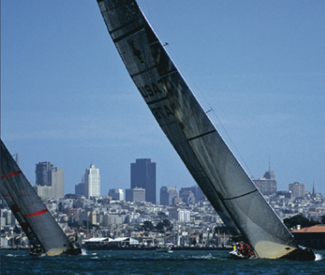
The latest America’s Cup controversy arose with a complaint filed in state court in New York City on Dec. 12, alleging that the Golden Gate Yacht Club (GGYC), defender of the coveted sailing trophy and orchestrator of the prestigious international regatta in San Francisco, unfairly rejected an African American sailing team’s bid to compete as a defender candidate.

In a move that piqued the interest of close observers in the sailing world, the suit also takes things a step farther by challenging the legitimacy of including lucrative waterfront development deals into GGYC’s December 2010 agreement to host the 34th America’s Cup in San Francisco.

The suit invokes a 159-year-old document, the America’s Cup Deed of Gift, drafted after the schooner America won the treasured Cup — affectionately known as the Auld Mug — in a match off the coast of England in 1851. Executed under the laws of New York since the schooner sailed under the New York Yacht Club, the deed establishes the America’s Cup trust, and sets out guidelines that every recipient of the cup must abide by. The suit holds that accepting the cup made GGYC a trustee under the deed, and “each club holds the Cup as ‘trustee for the benefit of all potential challengers.'”

Because GGYC set up its own America’s Cup Event Authority, which stands to profit from San Francisco real-estate development deals without sharing surplus revenue among competitors, the lawsuit charges that the yacht club violated its fiduciary duties as trustee.

“It is clear that GGYC is strictly forbidden from using its possession of the Cup and its attendant duties as trustee … in a manner that directly benefits itself, any of its members, or any third party,” asserts the complaint, filed by Madison Avenue law firm McDermott Will & Emery LLP. “The law strictly prohibits self-dealing by a trustee.”


BLACK SAILING CREW

The lawsuit was filed on behalf of African Dispora Maritime (ADM), a North Carolina nonprofit organization founded by sea captain Charles Kithcart, who developed his skills as a mariner under former America’s Cup sailors and continues to pursue an ambitious dream.

Kithcart says he’s convened a sailing team to compete in the America’s Cup that includes African American Olympian sailors, and held discussions with a prominent Rhode Island yacht designer, David Pedrick, about constructing a qualifying vessel for his team. Pedrick, who’s designed America’s Cup racing yachts before, confirmed to the Guardian that he was willing to work with ADM.

GGYC accepted and later refunded ADM’s $25,000 application fee, but rejected the nonprofit’s proposal to enter the race, saying it wasn’t satisfied Kithcart’s team would have the necessary resources to compete. Kithcart claims to have a fundraising strategy for his America’s Cup bid ready to go, but his anticipated support appears to hinge upon being accepted as an America’s Cup competitor.

“You create a groundswell with the public,” he said. “This is the essence of our organization: It’s going to excite people’s imagination. Money can be generated, and there are people who will fund things.”

Kithcart’s vision extends beyond just racing in the elitist tournament, since that alone “doesn’t fulfill any of the social needs that are not only apparent, but glaring.”

ADM’s mission, he explained, is to train African American youth as competitive sailors, cultivate youth interest in math and science as it applies to nautical skills, and make a splash on the world stage by breaking into a predominantly white sport with a black-led team, á la the Jamaican bobsledders from the film Cool Runnings.

“We can really create inspired minds,” Kithcart said, enthusiastically describing field trips through church youth groups or Boys & Girls Clubs that would educate kids about the history of black mariners and offer the empowering experience of learning to helm a ship. “Our future is the youth.” Moreover, a yacht-building team would be a job-creation engine in tough economic times, he asserted.

The once-debt-plagued GGYC — which rocketed to sailing stardom after billionaire Oracle CEO Larry Ellison joined up, installed his crew members on the board, and clinched the 33rd America’s Cup with his Team Oracle Racing off the coast of Valencia, Spain in 2010 — has approved competitors from France, Spain, Italy, New Zealand, Sweden, China, and Korea for the 34th America’s Cup. The main event, a one-on-one match following all preliminary rounds, is to be held in San Francisco in the summer of 2013.

The foreign teams are known as challengers, but ADM applied to sail as a defender candidate — a U.S. team that would race against Team Oracle in a Defender Series in a bid to represent the U.S. in the 34th America’s Cup.

Under the race protocol drafted by the winners of the 33rd America’s Cup and an Italian team that has since withdrawn as the challenger of record, GGYC stated that it would consider applications from defender candidates. However, it would only accept “those it is satisfied have the necessary resources … and experience to have a reasonable chance of winning the America’s Cup Defender Series.”

Had GGYC accepted ADM’s application to compete, Kithcart’s African American led team would have sailed against Ellison’s Team Oracle crew — a spectacle Kithcart imagines would make fine fodder for national television broadcasts. He remains optimistic that it can happen. “We’re definitely going to get into the America’s Cup,” he told the Guardian in a recent telephone conversation.

That same confidence is conveyed in ADM’s lawsuit. “Indeed, ADM’s application showed that its proposed team quite obviously could beat Team Oracle Racing,” the complaint claims, “and certainly stood a ‘reasonable chance’ of doing so.”

The lawsuit alleges that GGYC ignored Kithcart’s repeated requests to be considered for entry into the competition almost until the deadline last spring, then rejected ADM on an arbitrary and unequal basis compared with its treatment of other competitors.

Three other teams that were accepted as competitors — including Club Nautico di Roma, the challenger of record — have since withdrawn, citing financial problems. The suit suggests these economically troubled teams were accepted as competitors without question even while ADM was rejected, and charges that GGYC made no attempt to determine the status of ADM’s team or fundraising plan.

What it all adds up to, according to ADM’s claim, is breach of contract and a failure to deal in good faith as a trustee. Nor is ADM shy about making demands. The lawsuit asks the court to compel GGYC to accept ADM’s application, reschedule all the planned races in order to hold a Defender Series, cancel the development rights afforded to the Event Authority, and pay ADM in excess of $1 million to compensate for the delay in building its yacht.


SO MUCH MONEY

John Rousmaniere, an America’s Cup historian who has authored several books about the sailing competition, regarded ADM’s case with skepticism. He seemed doubtful that GGYC could be forced to accept an application from a U.S. team.

“Golden Gate could invite other U.S. yacht clubs to compete for the right to defend, but it has chosen not to do that. Instead, it’s developing its own boat and crew. This is their right under the Deed of Gift,” he said. “The Deed of Gift is very clear — there is no obligation for another American boat to sail.”

He’s also dubious of the charge that GGYC breached its fiduciary duties as trustee by engaging in self-dealing, an argument that could have far greater consequences for Ellison in the long run. A similar dispute arose when the sailing tournament was held in New Zealand about a decade ago, he said, and the exact meaning of “trust” in the Deed of Gift has been debated before in similar arguments. “I don’t think it’s ever been resolved,” he added.

The lawsuit argues that the cup is held in trust for the benefit of all competitors, and that GGYC violated its duties as a trustee when it set up a real-estate deal benefiting its own interests without sharing the wealth. Under the terms of the Host City Agreement, the America’s Cup Event Authority (ACEA) has the potential to lock in leases and long-term development rights for up to nine piers along the city’s waterfront for 66 years, with properties ranging from as far south as Pier 80 at Islais Creek to as far north as Pier 29, home of the popular dinner theater Teatro ZinZanni.

The Event Authority is a California LLC, whose agent for service of process is listed as ACEA board chairman Richard Worth of Lawrence Investments LLC — a technology and biotechnology private equity investment firm controlled by Ellison.

Under the protocol and in keeping with America’s Cup tradition, competitors will share in any “net surplus revenue” earned by the America’s Cup trust. However, this excludes the commercial and real estate rights granted to ACEA, the private entity controlled by Ellison, which is separate from the America’s Cup trust.

“For the first time in America’s Cup history, it appears that valuable rights generated by a trustee as a result of holding the America’s Cup are being explicitly excluded from the Cup’s net surplus revenue and … being held elsewhere, to the detriment of the competitors,” ADM’s suit alleges.

Rousmaniere says this isn’t the first time a legal argument invoking the Deed of Gift has found its way into court amid an America’s Cup power struggle, and that the issue remains a point of debate. Part from the problem, he believes, stems from the fact that a 21st Century event is governed by a rather vague 18th century document.

“The defender really runs the thing,” he said, referring to GGYC and by extension, the powerful Ellison. The question is, “How much authority is he going to give the challengers?”

“These people have a lot of lawyers working for them,” Rousmaniere observed, referring to GGYC and Ellison’s Team Oracle Racing, which are closely related. “People are taking a big risk here, and they want to be protected. The stakes are so high because there’s so much money involved.”

America’s Cup spokesperson Stephanie Martin referred Guardian inquiries to Tom Ehman, Vice Commodore of GGYC, who communicated with Kithcart about ADM’s application to compete. Ehman, who was taking a holiday in Spain, did not return an email request for comment and could not be reached by phone. However, a statement attributed to GGYC appeared on the blog Sailing Anarchy, which published a report about ADM’s suit.

“GGYC was served today with a complaint filed in the Supreme Court, County of New York, alleging breach of fiduciary duty, among other baseless claims,” the statement noted. “We believe the lawsuit is utterly without merit and that GGYC will prevail.”

Kithcart, meanwhile, is keeping his eye on the prize. “We need to excite our youth and then stand back and get out of the way and see what they create,” he said. “I’m betting they’ll make a movie about this. I’m betting there’ll be books about this. I’m betting this is history. We’re going to be a story.”

Meister: Student athletes deserve pay for their play

0

By Dick Meister

Dick Meister, former labor editor of the SF Chronicle and KQED-TV Newsroom, has covered labor for more than a half-century. Contact him through his website, www.dickmeister.com, which includes more than 300 of his columns.

Few groups of workers are more highly exploited than so-called student athletes, as they’re called euphemistically by the colleges and universities that employ them.

That’s right, employ them – employ them to play games that bring in billions of dollars in television money and other revenue to their schools and their highly-paid coaches.

The schools really make out at this time of the year, playing in football bowl games that bring schools millions of dollars from radio and television networks that use the games to peddle beer and other merchandise at great profit.

The athletic factories, aka schools, are like any other factories. They pay lots to those who manage their enterprises  – coaches, in their case – and as little as possible to those who do the work – the student athletes, of course.

Major schools pay their coaches in the high five or six figures, and allow them to collect thousands more from manufacturers for outfitting their teams of supposed amateurs in particular brands of clearly labeled footgear and uniforms bearing brand names and symbols, such as the Nike swoosh.

And what do the student athletes get in return for their efforts in behalf of the coaches and shoe salesmen of America? Most don’t even get college degree  – don’t even graduate. And only a relative few go on to the professional teams that pay big bucks to former college stars.

Football and basketball players, whose play brings in revenue of more than $6 billion a year, are the most exploited. They typically spend more time practicing and playing than studying and attending classes. They get room, board, tuition, a few thousand dollars under the table or some expensive goods and services in some cases. But that’s about it. And they have no job security. They can be fired – stripped of their athletic scholarships – if they don’t play as well as their coaches demand.

“You’re not a student athlete, but an athlete-student,” noted Basketball Hall of Famer Isiah Thomas, who left the University of Indiana before graduation to play professionally for the Detroit Pistons of the National Basketball association.

Thomas said the student athlete’s “main purpose is to be a ballplayer, to generate some money, put people in the stands. Eight or ten hours of your day are filled with basketball, football.”

The money the players generate is badly needed, say the schools that employ them. Badly needed, that is, to help finance the schools’ athletic programs. The schools could scale down the programs, of course, maybe even redesign them for the use of genuine students. But the schools engaged in big-time athletics are so heavily committed to staging lucrative public spectacles they wouldn’t even consider such a revolutionary move.

So, as long as schools continue chasing after money generated by their athletes, how about sharing some of what they get with the athletes whose play makes their money-making possible? How about treating them as employees elsewhere are treated?

Drop the fiction that student athletes are amateurs and openly pay them for their play, and provide them fringe benefits, job security and a voice in determining their wages, hours and working conditions.

That’s not as far-fetched an idea as you might think. The board of directors of the National Collegiate Athletic Association actually agreed in November to allow major colleges and universities to pay $2,000 stipends to athletes who sign up to play for them.

As the New York Times’ Joe Nocera reported, more than 125 college athletic directors and conference commissioners have protested even that modest proposal, which has kept it, at least temporarily, from going into effect.

It’s not much, but it would be a start toward giving athletes a fair share of the billions they earn for their schools. The next step should be up to the student athletes themselves. They should  – what else? – organize a union.

Dick Meister, former labor editor of the SF Chronicle and KQED-TV Newsroom, has covered labor for more than a half-century. Contact him through his website, www.dickmeister.com, which includes more than 300 of his columns.


Keith Olberman to NY Mayor Bloomberg: Resign!

0


With a link to the video of Keith Olberaman’s scathing commentary on Current TV on  Bloomberg’s  raid on Occupy New York

I have been watching Keith Olberman for years, as a tv sports reporter,  the MSNBC star who opened up broadcast journalism to a bit of liberal advocacy,  and now to his excellent television show at Current TV (channel 107 in San Francisco) carrying on the Olberman tradition.   On Tuesday night (12/27/11), he rousted New York Mayor Michael  Bloomberg from his office with a scathing indictment of his use of pepper-spraying, truncheon-swinging  police against unarmed Occupy protesters in a cowardly early morning raid  in lower Manhattan.

It was one of his best commentaries, the sort of thing Edward R. Murrow would have enjoyed.   Since the media either dismissed or misreported  this important raid and the important next day legal jockeying between the mayor and the  protesters/ National Lawyers Guild  over a temporary restraining order, Olberman’s commentary was all the  more valuable.

Listen to  Olberman’s  complete commentary with this link. And tune in Olberman regularly to get the best continuing Occupy coverage and some of the best invective on television.

http://current.com/shows/countdown/videos/keiths-special-comment-why-occupy-wall-street-needs-michael-bloomberg

Our Weekly Picks: December 25-31

0

WEDNESDAY 28

Doe Eye

When Maryam Qudus — sole member of local indie-pop project, Doe Eye — sings “I Hate You,” it’s hard to believe her. It’s cute as hell. But the point of the song is indeed that. She doesn’t hate the faceless “you,” but is tortured by the affection. It’s that kind of thoughtfulness with an added ear for pop charm that makes Doe Eye a project you can espouse. Doe Eye released the EP, Run, Run, Run, in August, and sure, it’s about as radio-friendly as you can get. But the instrumentation, with its orchestral and wavy synth touches, is undoubtedly inspired by indie-rock acts around today, be it Beach House or St. Vincent. (James H. Miller)

With The Trims, Pounders, and Miles the DJ

9 p.m., $8

Bottom of the Hill

1233 17th St., SF

(415) 621-4455

www.bottomofthehill.com


Mara Hruby

Michael Jackson doing “Ain’t No Sunshine.” Al Green doing “Light My Fire.” Nina Simone doing “Rich Girl.” (Yeah, Hall and Oates, look it up.) While a cover rarely make the original irrelevant, a good one should make it the artist’s own. On From Her Eyes, a free EP she reportedly sang, arranged, recorded, and engineered, Oakland’s Mara Hruby lent her sweet, soulfully agile voice to tracks by Mos Def, Andre 3000, Bob Marley, Jamiroquai, and others, rendering each different and new. Since then Hruby has been at work on her debut album, teasing songs “Lucky (I Love You)” and “The Love Below” online, and will be including new material at this show. (Ryan Prendiville)

With Chris Turner

8 p.m., $15

Yoshi’s Oakland

510 Embarcadero West, Oakl.

(510) 238-9200

www.yoshis.com


THURSDAY 29

The Umbrellas of Cherbourg and A Woman is a Woman

A double bill of The Umbrellas of Cherbourg (1964) and A Woman is a Woman (1961) at the Castro is the stuff cinephilia is made of. Those sweet on The Artist should be sure to check in with these earlier Gallic interpretations of Hollywood razzle dazzle. The first, Jacques Demy’s Umbrellas is the purer confection in many ways, but the film’s tender sentimentalism and radiant color design flow towards a soulful poetry of the everyday. The second, by Jean-Luc Godard, is an early distillation of his complex movie love and a poignant offering to actress Anna Karina. Both films feature scores by Michel Legrand, so they carry their complex register of emotions with a lightness that escapes words. (Max Goldberg)

3:25 and 7 p.m., $10

Castro Theatre

429 Market, SF

(415) 621-6120

www.castrotheatre.com


Pictureplane

What do you get when you cross a gutter punk b-boy with a space goth? Sprinkle him with a little MDMA and you’ve got Travis Egedy, a.k.a. Pictureplane. Egedy works clubby ’90s vocal samples and celestial beats into infectious pop songs, which he sings over in a breathy, lusty moan. With effervescent dance anthems like “Black Nails” and “Trancegender,” Egedy gives goths something to freak to. And you’re just as likely to shake it as you are to wind up in the center of a mosh pit. We should all thank our lucky stars for the weird amalgam of personas that is Pictureplane. Speaking of stars, did I mention he’s really, really into space? (Frances Capell)

With Popscene DJs

10 p.m., $12

Rickshaw Stop

155 Fell, SF

(415) 861-2011

www.rickshawstop.com


Asher Roth

Let’s face it. A lot of us love rap, but many of us can’t relate to carrying guns or moving kilos of cocaine. Luckily there’s Asher Roth, a gifted 26-year-old MC who raps about things the everyman can identify with — like partying with friends and soaking up sunshine. Roth may be a college bro, but he’s legit enough to have earned props from the likes of Ludacris and Slick Rick. Roth prides himself on his live performances and makes them unforgettable by bringing along a full band. If that’s not incentive enough, Thursday is the release show for Roth’s fresh new Pabst & Jazz Sessions mixtape produced by Blended Babies. (Capell)

10 p.m., $25

330 Ritch, SF

(415) 542-9574

www.330ritch.com


FRIDAY 30

Wizard Of Oz

For more than 70 years and counting, The Wizard of Oz has entertained and fascinated viewers; at the time of its original release, the film’s breathtaking color sequences enthralled audiences still stuck on black and white, and the soundtrack’s beloved songs introduced the world to the talents of Judy Garland. For the majority of us who have grown up watching the movie on television, we are in for a special treat tonight when the grand old Paramount hosts a screening, a rare chance to see such a classic piece of cinema on the big screen, the way it was meant to be viewed. Just watch out for flying monkeys! (Sean McCourt)

8 p.m., $5

Paramount Theatre

2025 Broadway, Oakl.

(510) 465-6400

www.paramounttheatre.com


X

Taking the same searing energy that propelled its contemporary punk counterparts then add the rock solid drumming of DJ Bonebrake, the guitar virtuosity of Billy Zoom, and the poetic lyrics and intimate vocal interplay of John Doe and Exene Cervenka. Legendary Los Angeles punk rockers X have always distinguished themselves from the other bands of the genre. This holiday season finds the band celebrating with “The Xmas Traveling Rock & Roll Revival,” where fans are sure to hear all of their favorite iconic tunes, and probably a couple of revved-up holiday favorites as well. (McCourt)

With Sean Wheeler & Zander Schloss, and the Black Tibetans.

8 p.m. Fri.; 9 p.m. Sat/31, $33–$50

Slim’s, 333 11th St., SF

(415) 255-0333

www.slimspresents.com


Agent Orange

In the mid through late 1970s, Southern California was one of the hubs of hardcore punk, with bands like Black Flag, Circle Jerks, and Wasted Youth all forming in the region. It was also a center of skateboarding, thanks to — among other things — a newly developed polyurethane wheel and a drought that left scores of pools empty. The band Agent Orange was a by-product of both of these phenomenons. Formed in Orange County in 1979 by lead singer and guitar player Mike Palm, bassist James Levesque, and drummer Scott Miller, the band took a Dick Dale spin on hardcore and became synonymous with early incarnations of “skate punk.” Skateboarders needed an identity of their own, and Agent Orange helped with that task. Now, 30 years later, you don’t need to know how to do a kick flip to understand why they were so essential. (Miller)

With Inferno of Joy, Tokyo Raid, The Nerv, Suggies

8:30 p.m., $15

330 Ritch, SF

(925) 541-9574

www.330ritch.com


Gavin Russom

“I hear you’re buying a synthesizer and an arpeggiator.” James Murphy tipped his hand when he wrote that a decade ago, but while would-be musicians could have gone straight past the irony to eBay, one thing they wouldn’t have was Gavin Russom. The ace up the sleeve, Russom is the tech wizard, creating analog synths for LCD Soundsystem and others. But more guru than a Radio Shack hobbyist, Russon has performed, DJ’ed, and created music on his own and under the aliases of the Crystal Ark and Meteoric Black Star. His latest “Night Sky,” is an epic, speedily slow building, sexually suggestive track that proves, as usual, he knows what you really want. (Prendiville)

With LA Vampires, Bobby Browser, Magic Touch, and Pickpocket

9:30 p.m., $10

Public Works

161 Erie, SF

(415) 932-0955

www.publicsf.com


SATURDAY 31

Primus

Is one of your New Years’ resolutions to go Sailing The Seas Of Cheese? Do you plan on serving up some Frizzle Fry? Imbibing in some Pork Soda? Well, any way you look at it, the two club shows this week by musical boundary-busting Bay Area rock favorites Primus are a rare treat for local fans to see the band up close and personal. You can choose to ring in the New Year with Les Claypool and company on Saturday, or if you prefer, you can work off your holiday hangover on Sunday with the band, which will be performing two sets each night at its Hawaiian Hukilau-themed parties. (McCourt)

9 p.m.; 8 p.m. Sun/1, $50–$65

Great American Music Hall

859 O’Farrell St., SF

(415) 885-0750

www.slimspresents.com


Thee Oh Sees

There’s no shortage of New Year’s Eve events taking place in the city, but you’re hard-pressed to find a more definitively San Francisco way to spend the evening than with local psych-pop darlings Thee Oh Sees. Though many a band has hopped on the fuzzy garage train in recent years, these guys have been blazing the trail for well over a decade (under various monikers). Each new release, including the spanking new Carrion Crawler/The Dream (In The Red) finds Thee Oh Sees shredding harder and better, but its live shows will melt your face clean off. Enjoy some gnarly guitar riffage, kiss a stranger, and partake in the vices you’ve resolved to quit come sunrise. (Capell)

With The Fresh & Onlys and White Fence

9 p.m., $15–$20

Brick & Mortar Music Hall

1710 Mission, SF

(415) 371-1631

www.brickandmortarmusic.com


“Sea of Dreams NYE 2012”

Part carnivale, part circus, part burn, part Halloween, part massive: the annual Sea of Dreams event takes the promise of a wild New Year’s Eve and adds more. In part it has to do with the crowd, drawing some serious do-it-themself-ers with fantastically creative outfits. But whatever distractions are off stage, there will be hard competition from a triple bill of headliners including local favorites Beats Antique, infectious dance MC Santigold (who has new material to debut live), and the return of Amon Tobin’s deafening, eyeball melting ISAM set. (Prendiville)

With Claude VanStroke, MarchFourth Marching Band, An-ten-nae, Diego’s Umbrella, and more

8 p.m., $75–$145

SF Concourse Exhibition Center

635 8th St., SF

www.seaofdreamsnye.com


SUNDAY 1

Eliza Rickman

With her little toy piano Eliza Rickman makes bewitching alternative folk rock. Listening to her EP, Gild the Lily, is like walking through a life size dollhouse and feeling not sure whether to be frightened or enchanted. There’s something about the nature of the toy piano — its sparkling sound can be at once blood curdling and tender (like John Cages’ Suites for Toy Piano, which popularized the instrument). Similarly, Rickman’s voice has a plucked from the garden pleasantness, but her words tend toward the tragic. This balance between adorable and dreary can even be seen in the titles of her songs, like “Black Rose” and “Cinnamon Bone.” In any event, whether she’s cinnamon, bone, or both, the toy piano under her hands is more than a novelty. (Miller)

7 p.m., free

Amnesia

853 Valencia, SF

(415) 970-0012

www.amnesiathebar.com


The Guardian listings deadline is two weeks prior to our Wednesday publication date. To submit an item for consideration, please include the title of the event, a brief description of the event, date and time, venue name, street address (listing cross streets only isn’t sufficient), city, telephone number readers can call for more information, telephone number for media, and admission costs. Send information to Listings, the Guardian Building, 135 Mississippi St., SF, CA 94107; fax to (415) 487-2506; or e-mail (paste press release into e-mail body — no text attachments, please) to listings@sfbg.com. Digital photos may be submitted in jpeg format; the image must be at least 240 dpi and four inches by six inches in size. We regret we cannot accept listings over the phone. *

Reel, reel good

0

DENNIS HARVEY’S FAVORITE DOCUMENTARIES OF 2011:

American Teacher (Vanessa Roth and Brian McGinn, U.S.)

The Arbor (Clio Barnard, U.K.)

Buck (Cindy Meehl, U.S.)

The Last Lions (Dereck Joubert, U.S./Botswana)

My Perestroika (Robin Hessman, U.S./U.K./Russia)

Nostalgia for the Light (Patricio Guzmán, France/Germany/Chile)

Pianomania (Robert Cibis and Lilian Franck, Austria/Germany)

Pina (Wim Wenders, Germany/France/U.K.)

Shut Up Little Man! An Audio Misadventure (Matthew Bate, Australia)

Vigilante Vigilante: The Battle for Expression (Max Good, U.S.)

We Were Here (David Weissman and Bill Weber, U.S.)


DENNIS HARVEY’S FAVORITE NARRATIVE FEATURES OF 2011:

The Artist (Michel Hazanavicius, France/Belgium)

Ceremony (Max Winkler, U.S.)

Certified Copy (Abbas Kiarostami, France/Italy/Belgium)

The Descendants (Alexander Payne, U.S.)

Drive (Nicolas Winding Refn, U.S.)

Happy, Happy (Anne Sewitsky, Norway)

Hugo (Martin Scorsese, U.S.)

I’m Glad My Mother Is Alive (Claude Miller and Nathan Miller, France)

Incendies (Denis Villeneuve, Canada/France)

Machotaildrop (Corey Adams and Alex Craig, U.S./Canada)

The Mill and the Cross (Lech Majewski, Sweden/Poland)

The Names of Love (Michel Leclerc, France)

Oka! (Lavinia Currier, U.S.)

Rango (Gore Verbinski, U.S.)

A Separation (Asghar Farhadi, Iran)

The Strange Case of Angelica (Manoel de Oliveira, Portugal/Spain/France/Brazil)

Tucker and Dale vs. Evil (Eli Craig, U.S./Canada)

Uncle Boonmee Who Can Recall His Past Lives (Apichatpong Weerasethakul, Thailand/U.K./France/Germany/Spain/Netherlands)

Weekend (Andrew Haigh, U.K.)

Young Adult (Jason Reitman, U.S.)


CHERYL EDDY’S TOP 11 OF 2011

1. The Artist (Michel Hazanavicius, France/Belgium)

2. Young Adult (Jason Reitman, U.S.)

3. Tinker Tailor Soldier Spy (Tomas Alfredson, France/U.K./Germany)

4. Drive (Nicolas Winding Refn, U.S.)

5. Melancholia (Lars von Trier, Denmark/Sweden/France/Germany)

6. The Descendants (Alexander Payne, U.S.)

7. Shame (Steve McQueen, U.K.)

8. The Trip (Michael Winterbottom, U.K.)

9. Cave of Forgotten Dreams (Werner Herzog, Canada/U.S./France/Germany/U.K.)

10. TrollHunter (André Øvredal, Norway)

11. The Tree of Life (Terrence Malick, U.S.)


KIMBERLY CHUN’S TOP 10 FILM “LIKES” OF 2011

(ALPHABETICAL)

Please don’t speak: The Artist (Michel Hazanavicius, France/Belgium)

Scrappy apocalypse: Attack the Block (Joe Cornish, U.K./France)

Scraps of footage refashioned: The Black Power Mixtape 1967-1975 (Goran Olsson, Sweden)

Best long-form music video: Drive (Nicolas Winding Refn, U.S.)

Personal apocalypse: The Future (Miranda July, Germany/U.S.)

The lives of others: Margin Call (J.C. Chandor, U.S.)

Feel-good apocalypse: Melancholia (Lars von Trier,

Denmark/Sweden/France/Germany)

Body Con: Shame (Steve McQueen, U.K.)

Body Con 2: The Skin I Live In (Pedro Almodóvar, Spain)

Two-state evolution: The Time That Remains (Elia Suleiman, U.K./Italy/Belgium/France)


RYAN LATTANZIO’S TOP 11 OF 2011

1. Melancholia (Lars von Trier, Denmark/Sweden/France/Germany)

2. Uncle Boonmee Who Can Recall His Past Lives (Apichatpong Weerasethakul, Thailand/U.K./France/Germany/Spain/Netherlands)

3. We Need to Talk About Kevin (Lynne Ramsay, U.K./U.S.)

4. Drive (Nicolas Winding Refn, U.S.)

5. Certified Copy (Abbas Kiarostami, France/Italy/Belgium)

6. A Separation (Asghar Farhadi, Iran)

7. Into the Abyss: A Tale of Death, a Tale of Life (Werner Herzog, Germany/Canada)

8. Weekend (Andrew Haigh, U.K.)

9. Shame (Steve McQueen, U.K.)

10. Meek’s Cutoff (Kelly Reichardt, U.S.)

11. The Future (Miranda July, Germany/U.S.)


JESSE HAWTHORNE FICKS’ PICKS FOR 2011

(FOLLOWED BY THE AMOUNT OF TIMES HE’S SEEN EACH FILM, IF MORE THAN ONCE)

(Updated from the print version)

1. (tie) Meek’s Cutoff (Kelly Reichardt, U.S.)

Even though this was on my list last year, it was released officially this year. Minimalist, transcendental, and more dramatic than any other action film this year. (4)

1. (tie) Attack the Block (Joe Cornish, U.K./France)

Subversive, prophetic, and totally addictive! This is one best films of the decade! Believe, bruv! (6)

2. Midnight in Paris (Woody Allen, Spain/U.S.)

Just because this is a crowd pleaser should not detract from Allen’s complicated script, shining as bright as ever. Re-watch and be stunned that the ending is much more profound than you may have first noticed. (7)

3. Season two of Louie (FX Network)

Louis C.K. transcended his own brilliant comedy and created 13 genuine existential classics.

4. The Trip (Michael Winterbottom, U.K.)

Steve Coogan finally achieved his art house goal with this pitch-perfect exploration of a man and his own worst enemy. Winterbottom’s six-part mini-series for British television was great, but the edited-down feature film is downright life affirming. (5)

5. We Need to Talk About Kevin (Lynne Ramsay, U.K./U.S.)

Director Ramsay (our modern-day Orson Welles, anyone?) and editor Joe Bini have created an hypnotic ride of poetic cinema. Do we really have to wait 10 more years before her Ramsay’s next show stopper, like we did after 2002’s Morvern Callar?

6. (tie) Hanna (Joe Wright, U.S./U.K./Germany)

A flawless reworking of La Femme Nikita (1991) with crisp dialogue that was light years ahead of anything else this year.

6. (tie) The Woman (Lucky McKee, U.S.)

Audiences were running for the doors at Sundance. This high-concept allegory is one of the most disturbing explorations of misogyny ever put on film. (3)

6. (tie) Sucker Punch (Zack Snyder, U.S./Canada)

This fast and furious pseudo-“feminist” flick seemed to be unfairly treated and totally misunderstood by audiences and critics alike. Get the 127-minute director’s cut on Blu-ray, stop letting fanboy nonsense bully you, and revel in Emily Browning’s tour de force performance. (2)

7. Young Adult (Jason Reitman, U.S.)

Diablo Cody’s script is near-perfect in this look at a 37-year-old who has to reassess where her “determination” has led her. (2)

8. Beginners (Mike Mills, U.S.)

Who wants their heart broken? A man confronts the death of his father and realizes his romantic choices might be leading him to no man’s land. Gulp. (3)

9. Heartbeats (Xavier Dolan, Canada)

This 22-year-old writer-director-star’s mash-up of My Own Private Idaho (1991) and In the Mood for Love (1999) captures our era’s hipster insecurities so flawlessly that it’ll take a decade for people to recognize how important this film actually is. (3)

10. The Artist (Michel Hazanavicius, France/Belgium)
This accessible masterpiece proves silent movies are futuristic! Perfect for the whole family and part of the second Golden Age for cinema from the 1920s.

11. The Beaver (Jodie Foster, U.S./United Arab Emirates)
I don’t care what he does offscreen, Mel Gibson is a damn fine actor! And Jodie Foster’s dark and deeply personal directing deserves the mensch of the year award!

12. (tie) Take Shelter (Jeff Nichols, U.S.)

Michael Shannon’s performance (as a father who will stop at nothing to “protect” his family) is creepy. Nichols’ ending is even creepier.

12. (tie) Melancholia (Lars von Trier, Denmark/Sweden/France/Germany)

Von Trier’s “nicest” film is genuine therapy for a neurotic soul.

13. One Day (Lone Scherfig, U.S./U.K.)

Stop telling me the book was so much better! With a Same Time, Next Year (1978) structure, this film’s deep emotions (courtesy of Anne Hathaway) shook me to the core.

14. Certified Copy (Abbas Kiarostami, France/Italy/Belgium)

This unofficial remake of Roberto Rossellini’s Journey to Italy (1954) still kept me guessing; it also features another jaw-dropping performance by Juliette Binoche.

15. The Tree of Life (Terrence Malick, U.S.)

This audacious exploration of a 1950s family is absolutely universal and profound. (2)

16. Tyrannosaur (Paddy Considine, U.K.)

Who wants their stomach punched, ripped open, torn out, and then presented to you? Then check out this love story.

17. (tie) Hugo (Martin Scorsese, U.S.)

Who says 3D isn’t art? Did studios really allow Scorsese to show multiple Georges Méliès’ films in 3D? Plus, Sacha Baron Cohen gives a truly Oscar-worthy supporting performance.

17. (tie) Drive Angry (Patrick Lussier, U.S.)

Lussier, director of 2009’s absolutely brilliant My Bloody Valentine remake, facilitated a priceless Nicolas Cage performance — he drinks from a freakin’ human skull, in 3D — but keeps things so frenetic, I had to sit in the theater for a second viewing as soon as it was over! (2)

17. (tie) Final Destination 5 (Steven Quale, U.S.)

In which the entire franchise of entitled 20-somethings dying gruesome deaths comes full circle by concluding with every single grisly death from all five films in glorious 3D.

18. The Mill and the Cross (Lech Majewski, Sweden/Poland)

Rutger Hauer + 143 Digital layers = monumental experimental art for the ages!

19. Rakhta Charitra and Rakhta Charitra 2 (Ram Gopal Varma, India)

Ram Gopal Varma’s films should compete at Cannes. (2)

20. Bill Cunningham New York (Richard Press, U.S./France)

This doc’s inspiring message: do what you love every day of your life, and don’t ever slow down.


Actor of the Year: Andy Serkis (Rise of the Planet of the Apes, The Adventures of Tintin)

Actress of the Year: Melissa McCarthy (Bridesmaids)

Best Future Midnite Movie: The Catechism Cataclysm (Todd Rohal, U.S.)

Shot in less than a week, this abstract, train of thought buddy road trip has the immediacy of sheer brilliance!

Jesse Hawthorne Ficks teaches film history at the Academy of Art University and curates and hosts Midnites for Maniacs, a film series emphasizing dismissed, underrated, and overlooked films.


LYNN RAPOPORT’S TOP 8 FILMS OF 2011

1. The Artist (Michel Hazanavicius, France/Belgium)

2. Beginners (Mike Mills, U.S.)

3. Tomboy (Céline Sciamma, France)

4. Dirty Girl (Abe Sylvia, U.S.)

5. Bridesmaids (Paul Feig, U.S.)

6. Pariah (Dee Rees, U.S.)

7. Young Adult (Jason Reitman, U.S.)

8. Crazy, Stupid, Love. (Glenn Ficarra and John Requa, U.S.)


SAM STANDER’S TOP 10 FILMS OF 2011

1. Uncle Boonmee Who Can Recall His Past Lives (Apichatpong Weerasethakul, Thailand/U.K./France/Germany/Spain/Netherlands)

2. Meek’s Cutoff (Kelly Reichardt, U.S.)

3. Drive (Nicolas Winding Refn, U.S.)

4. Midnight in Paris (Woody Allen, Spain/U.S.)

5. Certified Copy (Abbas Kiarostami, France/Italy/Belgium)

6. The Tree of Life (Terrence Malick, U.S.)

7. Essential Killing (Jerzy Skolimowski, Poland/Norway/Iceland/Hungary)

8. The Future (Miranda July, U.S.)

9. Bridesmaids (Paul Feig, U.S.)

10. Captain America: The First Avenger (Joe Johnston, U.S.)


MAX GOLDBERG’S TOP 10 FILMS OF 2011 (SAN FRANCISCO OPENINGS)

The Arbor (Clio Barnard, U.K.)

Attenberg (Athina Rachel Tsangari, Greece)

Get Out of the Car (Thom Andersen, U.S.)

The Kid with a Bike (Jean-Pierre Dardenne and Luc Dardenne, Belgium/France/Italy)

Mysteries of Lisbon (Raúl Ruiz, Portugal)

Of Gods and Men (Xavier Beauvois, France)

Oki’s Movie (Hong Sang-soo, South Korea)

Road to Nowhere (Monte Hellman, U.S.)

Terri (Azazel Jacobs, U.S.)

Señora con Flores/ Woman with Flowers (Chick Strand, U.S./Mexico)


The Performant: Tradition! Tradition!

0

Golden Girls, Kung Pao Kosher, Merry Forking Christmas … the holidays are coming whether you like it or not.

Love ‘em or hate ‘em, the holidays just keep on coming around. And unless you plan on hibernating the entire month of December away, sooner or later someone is going to force you into an ugly sweater and drag you to some seasonal entertainment designed to fill you with goodwill towards all humankind — or some such optimistic twaddle. Even so, there’s certainly no reason you have to subject yourself to endless renditions of Tchaikovsky’s famous suite or stale Bing Crosby carols in order to fulfill your holiday spirit quota. Alternatives abound here in Babylon-by-the-Bay, and you’re sure to stumble across a few that speak to your own imitable tastes.


Call it nostalgia, or call it an abiding love for the dubious fashions of the late 80’s, but whatever the attraction, this year’s edition of Trannyshack’s “The Golden Girls Christmas Episodes,” (through Dec. 23) has been packing the house at the Victoria Theatre with its irreverent rendition of the iconic television show. The four Tranny Grannies — Heklina, Cookie Dough, Pollo del Mar, and Matthew Martin — embody their characters with real affection, as their enthusiastic audiences sing along to the retro jingles of old Dr. Pepper commercials while cat-calling each spectacular costume change.

Another tradition-in-the-making, Pianofight’s third annual production of “A Merry Forking Christmas,” (through Dec. 30) is also packing the house with a good mix of PianoFight first-timers and old “Forking” initiates who are easily identified by their crumpled brown paper BYOB bags. The concept of “Forking” is both deceptively simple and yet infinitely clever — a choose-your-own-adventure story which “forks” off in several, audience-mandated directions, mostly determined by chaotic bursts of applause. Set in that oppressive microcosm otherwise known as “The Mall,” the play follows a handful of characters battling the stress and hopelessness of Christmas Eve either engaged in last minute selling, buying, security guarding, or Santa Claus-ing as the “true meaning” of the holiday in question eludes each.

Since nothing can make one feel more self-consciously Jewish than a month full of Christmas cheer, it’s good to know that Lisa Geduldig’s Kung Pao Kosher Comedy event (Dec. 23-25) has been stuffing holiday orphans of all faiths full of potstickers and potshots for nineteen years. This year’s headliner is Elayne Boosler, and if you go for the dinner show your ticket includes a seven-course feast, which sounds like my kind of Christmas. Or it would if it didn’t compete with the First Satanic Church’s annual Black X Mass (Sun/25) at the Elbo Room. Basically an excuse to throw a high-voltage rock show on the quietest night of the year, Black X Mass consistently boasts some of the most eclectic line-ups imaginable, combining costumed concept bands with “abstract metal” ensembles, mean-tempered go-go devils, various permutations of Mongoloid and Graves Bros. Deluxe, and a black-clad specialist in a rarified musical field — “Theremin Wizard Barney.” It’s a season’s greeting more reminiscent of “The Shining” than “It’s a Wonderful Life” but let’s face it, sometimes that’s exactly the kind of tradition we like best.

The Bonds trial: What a phenomenal waste

6

What a phenomenal waste of everyone’s time and money.

After eight years, millions of dollars in taxpayer money, and endless trees killed for newspaper stories, Barry Bonds was just sentenced to spend a month on his Beverly Hills estate.

If I take steroids and lie about it, can I spend a month there, too?

Seriously — other than the publicity the U.S. Attorney’s Office got for prosecuting the Home Run King, what has all of this accomplished? Are any of us safer now that Bonds has been forced to live under house arrest for 30 days and do 250 hours of community service (that he was going to do anyway)?

I’ve always agreed with Dave Zirin on this one:

After all the public money, drama, and hysterics, this is what we’re left with. He was “evasive.” Keep in mind that we live in a country where the US Department of Justice has not pursued one person for the investment banking fraud that cratered the US economy in 2008. Not one indictment has been issued to a single Bush official on charges of ordering torture or lying to provoke an invasion of Iraq. Instead, we get farcical reality television like the US vs. Barry Bonds.

Did Bonds take a “performance enhancing drug?” Again, Zirin:

The cortisone shot into Curt Schilling ankle in the 2005 playoffs was a performance enhancer. The Viagra coursing through Bob Dole’s veins is a performance enhancer. Whatever keeps that smile glued to Laura Bush’s face is a performance enhancer.

Please: There are real crimes happening all the time, from war crimes to political corruption and fraud, things that actually change the lives of human beings for the worse. And the U.S. Department of Justice has proudly used our taxpayer money to send Barry Bonds home for a month.

I’m so proud of our justice system.

Rep Clock

0

Schedules are for Wed/14-Tues/20 except where noted. Director and year are given when available. Double and triple features are marked with a •. All times p.m. unless otherwise specified.

ARTISTS’ TELEVISION ACCESS 992 Valencia, SF; www.atasite.org. $6. “Other Cinema:” “New Experimental Works,” Sat, 8:30.

BALBOA 3630 Balboa, SF; www.brownpapertickets.com. $17.50-20. “Opera and Ballet at the Balboa Theatre:” Tosca, performed by the Royal Opera House, Wed, 7:30; The Nutcracker, performed by the Royal Ballet and the orchestra of the Royal Opera House, Sat-Sun, 10am.

CASTRO 429 Castro, SF; (415) 621-6120, www.castrotheatre.com. $7.50-10. “Noir City Xmas:” Lady on a Train (David, 1945), Wed, 7:30; Christmas Holiday (Siodmak, 1944), Wed, 9:20. •The Soft Skin (Truffaut, 1964), Thurs, 2, 7, and Shoot the Piano Player (Truffaut, 1960), Thurs, 5:15, 9:15. The Birds (Hitchcock, 1963), Fri, 2, 4:30, 7, 9:30. “Heeeere’s Christmas!”: The Shining (Kubrick, 1980), presented as part of “The Torrance Family Christmas Revue,” hosted by Peaches Christ, Sat, 8. This event, $25-45; more info at www.peacheschrist.com. “Santa’s Cool Holiday Film Festival:” Santa Claus Conquers the Martians (Webster, 1964), plus vintage Christmas cartoons, and more, Sun, 1:30.

CHRISTOPHER B. SMITH RAFAEL FILM CENTER 1118 Fourth St, San Rafael; (415) 454-1222, www.cafilm.org. $6.75-10.25. The Artist (Hazanavicius, 2011), Wed-Thurs, call for times. Golf in the Kingdom (Streitfeld, 2010), Wed-Thurs, call for times. The Nutcracker, performed by the Royal Ballet and the orchestra of the Royal Opera House, Sun, 1:30; Tues, 7.

ELECTRIC WORKS 230 Eighth St, SF; www.sfelectricoworks.com. “Imagine That,” animation screening curated by Sarah Klein for kids and adults, Sat, 6.

EXPLORATORIUM McBean Theater, 3601 Lyon, SF; www.exploratorium.edu. Free with admission ($10-15). A Child’s Christmas in Wales (Lightner, 1963), Sat, 2.

HOUSE OF AIR 926 Mason, SF; www.houseofair.com. $8. One for the Road, Fri, 8.

PACIFIC FILM ARCHIVE 2575 Bancroft, Berk; (510) 642-5249, bampfa.berkeley.edu. $5.50-9.50. Theater closed through Jan 11.

ROXIE 3117 and 3125 16th St, SF; (415) 863-1087, www.roxie.com. $6.50-10. “Southern (Dis)Comfort: The American South in Cinema:” Wild River (Kazan, 1960), Wed, 6:15; Spring Night, Summer Night (Anderson, 1968), Wed, 8:30; The Beguiled (Siegel, 1971), Fri, 7; Shy People (Konchalovsky, 1987), Fri, 9:15. Golf in the Kingdom (Streitfeld, 2011), Wed-Thurs, call for times. Footprints (Peros, 2011), Dec 16-22, 7, 8:45 (also Sat/17-Sun/18, 3, 4:45). Paul McCartney: The Love We Make (Maysles and Kaplan, 2011), Dec 16-22, 7, 9 (also Sat/17-Sun/18, 3:15, 5).

SAN FRANCISCO PUBLIC LIBRARY Koret Auditorium, 100 Larkin, SF; www.sfpl.org. Free. “Bay Area Community Cinema Series:” Taking Root: The Vision of Wangari Maathai (Merton and Dater), Wed, 5:45.

SFFS | NEW PEOPLE CINEMA 1746 Post, SF; www.sffs.org. $10-11. The Bride Wore Black (Truffaut, 1968), Fri and Dec 18-22, 2, 4:30, 7, 9:30.

VORTEX ROOM 1082 Howard, SF; www.myspace.com/thevortexroom. “Left Out of Radical Light: (A So-Called/Supposed Survey of) Alternative Film and Video in the San Francisco Bay Area, 1945-2000,” Fri, 8.

YERBA BUENA CENTER FOR THE ARTS 701 Mission, SF; (415) 978-2787, www.ybca.org. $6-10. “From Muppets to Metal: Music Movies:” Emmet Otter’s Jug-Band Christmas (Henson, 1977), Thurs, 7:30; Sun, 2; John Zorn: A Film in 15 Scenes (Klahr, Gobolux, Hills, and Izzo, 2011), Sat, 7:30.

Dick Meister: The artistry of silence in film

0

Dick Meister is a long-time San Francisco writer. Contact him through his website, www.dickmeister.com.

I didn’t get much sleep last night. I was kept awake thinking of a film – “The Artist” – I had just seen. It stands out, even in the harsh light of day, as one of the very best of the many movies, silent and sound movies alike, that I’ve watched over the past 60 years. (Read the Guardian’s take on the film here.)

Although the widely-acclaimed movie was made this year, “The Artist” is a silent film, except for an excellent music soundtrack that sounds like the live orchestral music that accompanied major silent films. That practice ended, of course, with the coming of talkies.

That’s the movie’s major theme, the end of the silents – a theme it handles even better than other excellent films covering the topic, such as “Singin’ in the Rain.” I won’t go beyond noting the theme, for fear of disclosing the plot, but, believe me, it’s a very well-plotted and well-acted theme.

It was filmed in the United States, and two of its co-stars, Penelope Ann Miller and John Goodman, are American, but it’s really a French film. The director, Michael Hazanavicius, is French, as are the two lead characters, Jean Dujardin and Berenice Bejo. They play it straight with none of the mugging and exaggerated gestures that were common in the silents of yesterday.

But, boy, do Dujardin and Bejo look like the silent stars of yesterday, he classically handsome with pencil-thin mustache playing a silent film idol in the late 1920s, she with the pert, almost always-smiling look of a twenties flapper seeking film stardom. Their acting is indeed special, as is that of an incredibly talented fox terrier named Uggie, Dujardin’s romping, steadfastly loyal canine sidekick.

All that, and dancing, too – especially the stars’ dynamic hoofing to jazz melodies that could have come straight out of the twenties. They will surely turn you to toe-tapping and maybe the urge to leap up and do a little body swaying yourself.

The San Francisco Chronicle’s exceptional film critic, Mick LaSalle, describes Dujardin’s performance as “extraordinary and lovely, the first truly great silent film performance in about 80 years.” Amen to that, and to LaSalle’s assessment of “The Artist” as “a profound achievement . . . a product of serious study, honest appreciation and love” of silents.

Maybe it could even lead to a resurgence of the silent film, a medium that has not been of much interest to contemporary audiences. For the average person’s exposure to silents – if any – has been primarily through the speeded-up, bleached-out, “sound-enhanced” silents shown occasionally on television, that greatest of all the enemies of thoughtful, imaginative silence.

Watching silents presented as intended is an experience unlike any other, one that brings the actors and their audiences particularly close, far closer than most sound films. It requires special skills of actors, film directors and editors, who cannot rely on the crutch of words and sounds to reach the audience.

It requires great involvement and concentration by the audience as well. Silent film viewers are free to exercise their right to interpret cinematic actions as they wish, to imagine for themselves the retort of the gun, the scream of the heroine, the lonesome whistle of the train.

They are free to imagine all that’s being said, be it in French, or any other language. Silent films are truly universal and truly a distinctive art form apart from sound films.

Relatively few people have been privileged to see silents as they were meant to be seen. “The Artist” gives them that rare opportunity.

Dick Meister is a long-time San Francisco writer. Contact him through his website, www.dickmeister.com.