taxes

An absolute must-read on taxes (by Stephen King)

10

A lot of things drive me crazy (people making a left turn on 16th and Bryant at 5 p.m., backing up traffic for an entire block; people who get to park in the midde of the street on Sunday because the cops don’t ticket churchgoers; politicians who say “I’ll take a look at that” as a way to duck a question, dog owners who leave piles of shit in the middle of the sidewalk… don’t get me started). But one of the worst, on top of my list, is the claim that wealthy people who think the rich don’t pay enough taxes should just write the government a check.

George W. Bush loved that one. Every time taxes on the rich came up, he’d say: “If you think your taxes are too low, the IRS takes checks and money orders.” You can pay online, too.

So what’s wrong with that argument? Why doesn’t Warren Buffett just pay the taxes he thinks he ought to, and stop complaining? Because taxes don’t work that way, that’s why. And one of the best essays on this critical point just appeared on the Daily Beast. The author of this gem, called “tax me, for F@%&’s sake” is an author, Steven King, who is also part of the 1 percent, a man whose knack for telling horror stories has made him very wealthy. And he has harsh words for just about everyone who tries to get away with suggesting that high taxes ought to be voluntary:

I’ve known rich people, and why not, since I’m one of them? The majority would rather douse their dicks with lighter fluid, strike a match, and dance around singing “Disco Inferno” than pay one more cent in taxes to Uncle Sugar. It’s true that some rich folks put at least some of their tax savings into charitable contributions. My wife and I give away roughly $4 million a year to libraries, local fire departments that need updated lifesaving equipment (Jaws of Life tools are always a popular request), schools, and a scattering of organizations that underwrite the arts. Warren Buffett does the same; so does Bill Gates; so does Steven Spielberg; so do the Koch brothers; so did the late Steve Jobs. All fine as far as it goes, but it doesn’t go far enough.

What charitable 1 percenters can’t do is assume responsibility—America’s national responsibilities: the care of its sick and its poor, the education of its young, the repair of its failing infrastructure, the repayment of its staggering war debts. Charity from the rich can’t fix global warming or lower the price of gasoline by one single red penny. That kind of salvation does not come from Mark Zuckerberg or Steve Ballmer saying, “OK, I’ll write a $2 million bonus check to the IRS.” That annoying responsibility stuff comes from three words that are anathema to the Tea Partiers: United American citizenry.

More:

Most rich folks paying 28 percent taxes do not give out another 28 percent of their income to charity. Most rich folks like to keep their dough. They don’t strip their bank accounts and investment portfolios. They keep them and then pass them on to their children, their children’s children. And what they do give away is—like the monies my wife and I donate—totally at their own discretion. That’s the rich-guy philosophy in a nutshell: don’t tell us how to use our money; we’ll tell you. The Koch brothers are right-wing creepazoids, but they’re giving right-wing creepazoids. Here’s an example: 68 million fine American dollars to Deerfield Academy. Which is great for Deerfield Academy. But it won’t do squat for cleaning up the oil spill in the Gulf of Mexico, where food fish are now showing up with black lesions. It won’t pay for stronger regulations to keep BP (or some other bunch of dipshit oil drillers) from doing it again. It won’t repair the levees surrounding New Orleans. It won’t improve education in Mississippi or Alabama. But what the hell—them li’l crackers ain’t never going to go to Deerfield Academy anyway. Fuck ’em if they can’t take a joke.

He skewers the idea that giving the rich more money creates jobs (“At the risk of repeating myself, here’s what rich folks do when they get richer: they invest. A lot of those investments are overseas, thanks to the anti-American business policies of the last four administrations.”) He explains why the GOP tries so hard to defend tax cuts (“They simply idolize the rich. Don’t ask me why; I don’t get it either, since most rich people are as boring as old, dead dog shit. The Mitch McConnells and John Boehners and Eric Cantors just can’t seem to help themselves. These guys and their right-wing supporters regard deep pockets like Christy Walton and Sheldon Adelson the way little girls regard Justin Bieber … which is to say, with wide eyes, slack jaws, and the drool of adoration dripping from their chins.”) And he warns that life might not be so pretty for the uber-rich if this trend continues:

Last year during the Occupy movement, the conservatives who oppose tax equality saw the first real ripples of discontent. Their response was either Marie Antoinette (“Let them eat cake”) or Ebenezer Scrooge (“Are there no prisons? Are there no workhouses?”). Short-sighted, gentlemen. Very short-sighted. If this situation isn’t fairly addressed, last year’s protests will just be the beginning. Scrooge changed his tune after the ghosts visited him. Marie Antoinette, on the other hand, lost her head.

Think about it.

Yes, think about it: A society that gets more and more economically unequal is a society that won’t be stable for long.


Poll shows tax-the-rich measure hurt by Brown’s merger

9

A new poll confirms a fear we’ve raised before – Gov. Jerry Brown’s insistence on coupling the popular tax on millionaires with an unpopular increase in the sales tax could doom the revenue package this November – putting pressure on the governor and his allies to step up their political games and save the schools from disastrous cuts.

The SF Chronicle’s story on the Public Policy Institute of California poll focused on the disconnect voters have between government services they support and their willingness to pay for them, which isn’t exactly news to anyone. A big reason for this state’s dire fiscal situation is that people want something for nothing.

Last year, thanks to the Occupy Wall Street movement highlighting how the richest 1 percent have amassed ever-greater wealth at the expense of the rest of us, that dynamic began to change. People started to openly and consistently advocate for increasing taxes on the wealthy, no longer cowed by accusations of “class warfare.”

The PPIC poll found that 65 percent of respondents like the idea of taxing millionaires and putting that money toward education, while 80 percent oppose the $5 billion in trigger cuts to schools that will occur if voters reject the tax measure. But only a slim majority of 54 percent favor the measure that Brown is pushing, mostly because 52 percent say they don’t like the sales tax increase, a regressive tax that will likely be highlighted repeatedly by opponents of the measure.

That’s a big challenge for the broad coalition that supports the measure, but it’s an especially big deal for Brown. He was the one who created this bad combination in the first place, and convinced the California Federation of Teachers to drop its Millionaires Tax – the clean measure that would have 65 percent support right now – in favor of a merged measure that’s a bit more progressive than Brown’s original idea.

Assembly member Tom Ammiano and other progressives we respect have said they like the compromise and worried that competing tax measures could sink them all in this make-or-break election (that’s because under state law, tax measures need a simple majority only during presidential elections, meaning it will be four more years until we have this opportunity again).

Maybe, but the sales tax increase was never a good idea, and these poll numbers show they’ve got a difficult challenge on their hands. In particular, Brown will need to finally prove his repeated campaign statements that he’s the one with the knowledge, skills, and experience to get things done in the dysfunctional, gridlocked state. It’s time to make good on those words, governor.

Pissed off shareholders, homeowners, and taxpayers converge on Wells Fargo meeting

12

Wells Fargo managed to hold its shareholder meeting April 24, but not without difficulty. A protest against the bank’s ongoing part in the foreclosure crisis, investments in the private prison industry, and record of tax dodging brought some 2,000 people to the West Coast Wells Fargo headquarters at 465 California St. for the meeting.

A broad coalition, including more than 180 Wells Fargo shareholders, as well as organized labor, students, immigrant rights advocates, and Occupy protesters, swarmed the building. Many entered the building, and others blocked its entrances and set up a stage on California, turning the block between Montgomery and Sansome into a combination alternative “stakeholders meeting” and block party.

Streets surrounding the headquarters were closed for more than four hours, as both protesters and some 200 police in riot gear stood their ground; there were 24 arrests, mostly for trespassing.

Participants hailed from across the country, from students from the University of Minnesota to steel workers from Redding, Penn. Demonstrators were explicitly and enthusiastically “non-violent.” One local organizer from the Alliance of Californians for Community Empowerment (ACCE) announced, “This is a non-violent direct action,” to an eruption of cheers from the crowd, at a rally preceding the march.

Police say organizers stuck to their tactical intentions. “I think it was a successful event,” said Sgt. Michael Andraychak, a spokesperson for the SFPD. “They have followed through with their stated objective: to have a peaceful protest.”

The organizers were somewhat less successful in a stated objective to get a large number of discontent Wells Fargo shareholders into the meeting to ask tough questions. More than 180 attended a training to prepare for the meeting on the night of April 23, but less than 30 made it inside.

However, the meeting was cut short, and organizers claim that in barring a number of shareholders, Wells Fargo acted illegally and the result of votes from meeting may be invalid.

Many shareholders were particularly incensed about public subsidies that the company took advantage of in 2008. In an amendment to the tax code that lasted only three months before Congress revoked it, the IRS gave tax breaks to healthy banks that acquired banks that were faring more poorly; Wells Fargo acquired Wachovia during the three month window. As a result, the company received $17.96 billion in tax breaks between 2008 and 2012, significantly more than the cost of the Wachovia deal.

Protesters hoped to disrupt the meeting to demand that the bank pay more taxes. Wells Fargo announced record profits this year, as well as a $19.8 million pay package for CEO John Stumpf. Stumpf has earned $60 million in the past three years.

“If they were paying their taxes, we wouldn’t have to do this” said Al Haggett, a retired San 911 worker who trained dispatchers and police.

Ron Colbert, another shareholder and a worker for Sacramento’s school district, also attempted to enter the meeting. “My sisters and brothers are suffering from foreclosure and they are pocketing our money instead of paying their taxes,” said Colbert.

“Tuition keeps going up every year. I have loans like you wouldn’t believe: $15,000, and it’s just my first year. But I pay my taxes, so why can’t they?” said Andrew Contstas, a psychology major at the University of Minnesota who traveled to San Francisco for the protest.

Determined to shut down the meeting, many groups of protesters entered the building at different times.

Around 10:30 am, about 75 were able to get in and sit down in the lobby, refusing to leave. “They said if we dispersed, they would let the shareholders in,” said SEIU Local 1021 organizer Gabriel Haaland, referring to the shareholders who came to protest and air their grievances. “They still didn’t. But they let shareholders in from either side.”

Many non-protester shareholders were able to enter through back entrances, escorted by police.

Workers from several unions who are currently locked in labor disputes, including janitors with SEIU Local 87 and AT&T technicians with local Communication Workers of America chapters, were also present at the protest. A stage set up in front of Wells Fargo turned California into an arena in which worker, student, homeowners, and immigrants told their stories.

Chris Drioane of CWA Local 9410 said that he is fed up after he worked 80-90 hours per week with no days off though the 2011 holiday season. “I worked from Thanksgiving to Valentine’s Day with no days off,” said Drioane.

The SFPD made 20 arrests, six for “chaining themselves to an object” and 14 for “some form of trespassing” after Wells Fargo asked them to make the arrests. Four were arrested by the Sheriff’s Department for interfering with an officer.

Ruth Schultz, a shareholder who was arrested inside the meeting, said that those who entered were able to speak. Several stood up and spoke individually before they were escorted out; afterward, the remaining protester-shareholders mic-checked the meeting and expressed their desire that Wells Fargo cease investment in private prisons, give principal reduction to all underwater homeowners, and pay “their fair share” of taxes. Police handcuffed them, and they were cited and released after spending 30 minutes in a room inside the Wells Fargo headquarters.

Schultz says the meeting lasted only 15 minutes after the group was detained, and was “ceremonial at best…They went on about their profits this year, how they’re sitting on the most capital they’ve ever had before.”

She says she was particularly frustrated from one statement made by CEO John Stumpf. “He said, ‘we’re proud of our mortgage business. In fact, I love our mortgage business.’”

A press releases from organizers explained that the protest was part of “99% Power, a national effort to mobilize well over 10,000 people, from all walks of life and representing the diversity of the 99%, to engage in nonviolent direct action at more than three dozen corporate shareholder meetings across the country.”

The national group plans to create similar chaos at a Bank of America shareholder meeting in Charlotte, NC May 6.

Guardian endorsements for June 5 election

34

>>OUR ONE-PAGE “CLEAN SLATE” PRINTOUT GUIDE IS HERE. 

As usual, California is irrelevant to the presidential primaries, except as a cash machine. The Republican Party has long since chosen its nominee; the Democratic outcome was never in doubt. So the state holds a June 5 primary that, on a national level, matters to nobody.

It’s no surprise that pundits expect turnout will be abysmally low. Except in the few Congressional districts where a high-profile primary is underway, there’s almost no news media coverage of the election.

But that doesn’t mean there aren’t some important races and issues (including the future of San Francisco’s Democratic Party) — and the lower the turnout, the more likely the outcome will lean conservative. The ballot isn’t long; it only takes a few minutes to vote. Don’t stay home June 5.

Our recommendations follow.

PRESIDENT

BARACK OBAMA

Sigh. Remember the hope? Remember the joy? Remember the dancing in the streets of the Mission as a happy city realized that the era of George Bush and The Gang was over? Remember the end of the war, and health-care reform, and fair economic policies?

Yeah, we remember, too. And we remember coming back to our senses when we realized that the first people at the table for the health-policy talks were the insurance industry lobbyists. And when more and more drones killed more and more civilian in Afghanistan, and the wars didn’t end and the country got deeper and deeper into debt.

Oh, and when Obama bailed out Wall Street — and refused to spend enough money to help the rest of us. And when his U.S. attorney decided to crack down on medical marijuana.

We could go on.

There’s no question: The first term of President Barack Obama has been a deep disappointment. And while we wish that his new pledge to tax the millionaires represented a change in outlook, the reality is that it’s most likely an election-year response to the popularity of the Occupy movement.

Last fall, when a few of the most progressive Democrats began talking about the need to challenge Obama in a primary, we had the same quick emotional reaction as many San Franciscans: Time to hold the guy accountable. Some prominent left types have vowed not to give money to the Obama campaign.

But let’s get back to reality. The last time a liberal group challenged an incumbent in a Democratic presidential primary, Senator Ted Kennedy wounded President Jimmy Carter enough to ensure the election of Ronald Reagan — and the begin of the horrible decline in the economy of the United States. We’re mad at Obama, too — but we’re realists enough to know that there is a difference between moderate and terrible, and that’s the choice we’re facing today.

The Republican Party is now entirely the party of the far right, so out of touch with reality that even Reagan would be shunned as too liberal. Mitt Romney, once the relatively centrist governor of Massachusetts, has been driven by Newt Gingrich and Rick Santorum so deeply into crazyland that he’s never coming back. We appreciate Ron Paul’s attacks on military spending and the war on drugs, but he also opposes Medicare and Social Security and says that people who don’t have private health insurance should be allowed to die for lack of medical care.

No, this one’s easy. Obama has no opposition in the Democratic Primary, but for all our concerns about his policies, we have to start supporting his re-election now.

U.S. SENATE

DIANNE FEINSTEIN

The Republicans in Washington didn’t even bother to field a serious candidate against the immensely well-funded Feinstein, who is seeking a fourth term. She’s a moderate Democrat, at best, was weak-to-terrible on the war, is hawkish on Pentagon spending (particularly Star Wars and the B-1 bomber), has supported more North Coast logging, and attempts to meddle in local politics with ridiculous ideas like promoting unknown Michael Breyer for District Five supervisor. She supported the Obama health-care bill but isn’t a fan of single-payer, referring to supporters of Medicare for all as “the far left.”

But she’s strong on choice and is embarrassing the GOP with her push for reauthorization of an expanded Violence Against Women Act. She’ll win handily against two token Republicans.

U.S. CONGRESS, DISTRICT 2

NORMAN SOLOMON

The Second District is a sprawling region stretching from the Oregon border to the Golden Gate Bridge, from the coast in as far as Trinity County. It’s home to the Marin suburbs, Sonoma and Mendocino wine country, the rough and rural Del Norte and the emerald triangle. There’s little doubt that a Democrat will represent the overwhelmingly liberal area that was for almost three decades the province of Lynn Woolsey, one of the most progressive members in Congress. The top two contenders are Norman Solomon, an author, columnist and media advocate, and Jared Huffman, a moderate member of the state Assembly from Marin.

Solomon’s not just a decent candidate — he represents a new approach to politics. He’s an antiwar crusader, journalist, and outsider who has never held elective office — but knows more about the (often corrupt) workings of Washington and the policy issues facing the nation than many Beltway experts. He’s talking about taxing Wall Street to create jobs on Main Street, about downsizing the Pentagon and promoting universal health care. He’s a worthy successor to Woolsey, and he deserves the support of every independent and progressive voter in the district.

U.S. CONGRESS, DISTRICT 12

NANCY PELOSI

Nancy Pelosi long ago stopped representing San Francisco (see: same-sex marriage) and began representing the national Democratic party and her colleagues in the House. She will never live down the privatization of the Presidio or her early support for the Iraq war, but she’s become a decent ally for Obama and if the Democrats retake the House, she’ll be setting the agenda for his second term. If the GOP stays in control, this may well be her last term.

Green Party member Barry Hermanson is challenging her, and in the old system, he’d be on the November ballot as the Green candidate. With open primaries (which are a bad idea for a lot of reasons) Hermanson needs support to finish second and keep Pelosi on her toes as we head into the fall.

U.S. CONGRESS, DISTRICT 12

BARBARA LEE

This Berkeley and Oakland district is among the most left-leaning in the country, and its representative, Barbara Lee, is well suited to the job. Unlike Pelosi, Lee speaks for the voters of her district; she was the lone voice against the Middle East wars in the early days, and remains a staunch critic of these costly, bloody, open-ended foreign military entanglements. We’re happy to endorse her for another term.

U.S. CONGRESS, DISTRICT 13

JACKIE SPEIER

Speier’s more of a Peninsula moderate than a San Francisco progressive, but she’s been strong on consumer privacy and veterans issues and has taken the lead on tightening federal rules on gas pipelines after Pacific Gas and Electric Company killed eight of her constituents. She has no credible opposition.

STATE SENATE, DISTRICT 11

MARK LENO

Mark Leno started his political career as a moderate member of the Board of Supervisors from 1998 to 2002. His high-profile legislative races — against Harry Britt for the Assembly in 2002 and against Carole Migden for the Senate in 2008 — were some of the most bitterly contested in recent history. And we often disagree with his election time endorsements, which tend toward more downtown-friendly candidates.

But Leno has won us over, time and again, with his bold progressive leadership in Sacramento and with his trailblazing approach to public policy. He is an inspiring leader who has consistently made us proud during his time in the Legislature. Leno was an early leader on the same-sex marriage issue, twice getting the Legislature to legalize same-sex unions (vetoed both times by former Gov. Arnold Schwarzenegger). He has consistently supported a single-payer health care system and laid important groundwork that could eventually break the grip that insurance companies have on our health care system. And he has been a staunch defender of the medical marijuana patients and has repeatedly pushed to overturn the ban on industrial hemp production, work that could lead to an important new industry and further relaxation of this country wasteful war on drugs. We’re happy to endorse him for another term.

STATE ASSEMBLY, DISTRICT 17

TOM AMMIANO

Ammiano is a legendary San Francisco politician with solid progressive values, unmatched courage and integrity, and a history of diligently and diplomatically working through tough issues to create ground-breaking legislation. We not only offer him our most enthusiastic endorsement — we wish that we could clone him and run him for a variety of public offices. Since his early days as an ally of Harvey Milk on gay rights issues to his creation of San Francisco’s universal health care system as a supervisor to his latest efforts to defend the rights of medical marijuana users, prison inmates, and undocumented immigrants, Ammiano has been a tireless advocate for those who lack political and economic power. As chair of Assembly Public Safety Committee, Ammiano has blocked many of the most reactionary tough-on-crime measures that have pushed our prison system to the breaking point, creating a more enlightened approach to criminal justice issues. We’re happy to have Ammiano expressing San Francisco’s values in the Capitol.

STATE ASSEMBLY, DISTRICT 19

PHIL TING

Once it became abundantly clear that Assessor-Recorder Phil Ting wasn’t going to get elected mayor, he started to set his eyes on the state Assembly. It’s an unusual choice in some ways — Ting makes a nice salary in a job that he’s doing well and that’s essentially his for life. Why would he want to make half as much money up in Sacramento in a job that he’ll be forced by term limits to leave after six years?

Ting’s answer: he’s ready for something new. We fear that a vacancy in his office would allow Mayor Ed Lee to appoint someone with less interest in tax equity (prior to Ting, the city suffered mightily under a string of political appointees in the Assessor’s Office), but we’re pleased to endorse him for the District 19 slot.

Ting has gone beyond the traditional bureaucratic, make-no-waves approach of some of his predecessors. He’s aggressively sought to collect property taxes from big institutions that are trying to escape paying (the Catholic Church, for example) and has taken a lead role in fighting foreclosures. He commissioned, on his own initiative, a report showing that a large percentage of the foreclosures in San Francisco involved some degree of fraud or improper paperwork, and while the district attorney is so far sitting on his hands, other city officials are moving to address the issue.

His big issue is tax reform, and he’s been one the very few assessors in the state to talk openly about the need to replace Prop. 13 with a split-role system that prevents the owners of commercial property from paying an ever-declining share of the tax burden. He wants to change the way the Legislature interprets Prop. 13 to close some of the egregious loopholes. It’s one of the most important issues facing the state, and Ting will arrive in Sacramento already an expert.

Ting’s only (mildly) serious opponent is Michael Breyer, son of Supreme Court Justice Breyer and a newcomer to local politics. Breyer’s only visible support is from the Building Owners and Managers Association, which dislikes Ting’s position on Prop. 13. Vote for Ting.

DEMOCRATIC COUNTY CENTRAL COMMITTEE

You can say a lot of things about Aaron Peskin, the former supervisor and retiring chair of the city’s Democratic Party, but the guy was an organizer. Four years ago, he put together a slate of candidates that wrenched control of the local party from the folks who call themselves “moderates” but who, on critical economic issues, are really better defined as conservative. Since then, the County Central Committee, which sets policy for the local party, has given its powerful endorsement mostly to progressive candidates and has taken progressive stands on almost all the ballot issues.

But the conservatives are fighting back — and with Peskin not seeking another term and a strong slate put together by the mayor’s allies seeking revenge, it’s entirely possible that the left will lose the party this year.

But there’s hope — in part because, as his parting gift, Peskin helped change state law to make the committee better reflect the Democratic voting population of the city. This year, 14 candidates will be elected from the East side of town, and 10 from the West.

We’ve chosen to endorse a full slate in each Assembly district. Although there are some candidates on the slate who aren’t as reliable as we might like, 24 will be elected, and we’re picking the 24 best.

DISTRICT 17 (EAST SIDE)

John Avalos

David Campos

David Chiu

Petra DeJesus

Matt Dorsey

Chris Gembinsky

Gabriel Robert Haaland

Leslie Katz

Rafael Mandelman

Carole Migden

Justin Morgan

Leah Pimentel

Alix Rosenthal

Jamie Rafaela Wolfe


DISTRICT 19 (WEST SIDE)

Mike Alonso

Wendy Aragon

Kevin Bard

Chuck Chan

Kelly Dwyer

Peter Lauterborn

Hene Kelly

Eric Mar

Trevor McNeil

Arlo Hale Smith

State ballot measures

PROPOSITION 28

YES

LEGISLATIVE TERM LIMITS

Let us begin with a stipulation: We have always opposed legislative term limits, at every level of government. Term limits shift power to the executive branch, and, more insidiously, the lobbyists, who know the issues and the processes better than inexperienced legislators. The current system of term limits is a joke — a member of the state Assembly can serve only six years, which is barely enough time to learn the job, much less to handle the immense complexity of the state budget. Short-termers are more likely to seek quick fixes than structural reform. It’s one reason the state Legislatures is such a mess.

Prop. 28 won’t solve the problem entirely, but it’s a reasonable step. The measure would allow a legislator to serve a total of 12 years in office — in either the Assembly, the Senate, or a combination. So an Assembly member could serve six terms, a state Senator three terms. No more serving a stint in one house and then jumping to the other, since the term limits are cumulative, which is imperfect: A lot of members of the Assembly have gone on to notable Senate careers, and that shouldn’t be cut off.

Still, 12 years in the Assembly is enough time to become a professional at the job — and that’s a good thing. We don’t seek part-time brain surgeons and inexperienced airline pilots. Running California is complicated, and there’s nothing wrong with having people around who aren’t constantly learning on the job. Besides, these legislators still have to face elections; the voters can impose their own term limits, at any time.

Most of the good-government groups are supporting Prop. 28. Vote yes.

PROPOSITION 29

YES

CIGARETTE TAX FOR CANCER RESEARCH

Seriously: Can you walk into the ballot box and oppose higher taxes on cigarettes to fund cancer research? Of course not. All of the leading medical groups, cancer-research groups, cancer-treatment groups and smoking-cessation groups in the state support Prop. 29, which was written by the American Cancer Society and the American Heart Association.

We support it, too.

Yes, it’s a regressive tax — most smokers are in the lower-income brackets. Yes, it’s going to create a huge state fund making grants for research, and it will be hard to administer without some issues. But the barrage of ads opposing this are entirely funded by tobacco companies, which are worried about losing customers, particularly kids. A buck a pack may not dissuade adults who really want to smoke, but it’s enough to price a few more teens out of the market — and that’s only good news.

Don’t believe the big-tobacco hype. Vote yes on 29.

San Francisco ballot measures

PROPOSITION A

YES

GARBAGE CONTRACT

A tough one: Recology’s monopoly control over all aspects of San Francisco’s waste disposal system should have been put out to competitive bid a long time ago. That’s the only way for the city to ensure customers are getting the best possible rates and that the company is paying a fair franchise fee to the city. But the solution before us, Proposition A, is badly flawed public policy.

The measure would amend the 1932 ordinance that gave Recology’s predecessor companies — which were bought up and consolidated into a single behemoth corporation — indefinite control over the city’s $220 million waste stream. Residential rates are set by a Rate Board controlled mostly by the mayor, commercial rates are unregulated, and the company doesn’t even have a contract with the city.

Last year, when Recology won the city’s landfill contract — which was put out to bid as the current contract with Waste Management Inc. and its Altamont landfill was expiring — Recology completed its local monopoly. At the time, Budget Analyst Harvey Rose, Sup. David Campos, and other officials and activists called for updating the ordinance and putting the various contracts out to competitive bid.

That effort was stalled and nearly scuttled, at least in part because of the teams of lobbyists Recology hired to put pressure on City Hall, leading activists Tony Kelley and retired Judge Quentin Kopp to write this measure. They deserve credit for taking on the issue when nobody else would and for forcing everyone in the city to wake up and take notice of a scandalous 70-year-old deal.

We freely admit that the measure has some significant flaws that could hurt the city’s trash collection and recycling efforts. It would split waste collection up into five contracts, an inefficient approach that could put more garbage trucks on the roads. No single company could control all five contracts. Each of those contracts would be for just five years, which makes the complicated bidding process far too frequent, costing city resources and hindering the companies’ ability to make long-term infrastructure investments.

It would require Recology to sell its transfer station, potentially moving the waste-sorting facility to Port property along the Bay. Putting the transfer station in public hands makes sense; moving it to the waterfront might not.

On the scale of corrupt monopolies, Recology isn’t Pacific Gas and Electric Co. It’s a worker-owned company and has been willing to work in partnership with the city to create one of the best recycling and waste diversion programs in the country. For better or worse, Recology controls a well-developed waste management infrastructure that this city relies on, functioning almost like a city department.

Still, it’s unacceptable to have a single outfit, however laudatory, control such a massive part of the city’s infrastructure without a competitive bid, a franchise fee, or so much as a contract. In theory, the company could simply stop collecting trash in some parts of the city, and San Francisco could do nothing about it.

As a matter of public policy, Prop. A could have been better written and certainly could, and should, have been discussed with a much-wider group, including labor. As a matter of real politics, it’s a messy proposal that at least raises the critical question: Should Recology have a no-bid, no contract monopoly? The answer to that is no.

Prop. A will almost certainly go down to defeat; Kopp and Kelly are all alone, have no real campaign or committee and just about everyone else in town opposes it. Our endorsement is a matter of principle, a signal that this longtime garbage deal has to end. If Recology will work with the city to come up with a contract and a bid process, then Prop. A will have done its job. If not, something better will be on the ballot in the future.

For now, vote yes on A.

PROPOSITION B

YES

COIT TOWER POLICY

In theory, city department heads ought to be given fair leeway to allocate resources and run their operations. In practice, San Francisco’s Department of Recreation and Parks has been on a privatization spree, looking for ways to sell or rent public open space and facilities as a way to balance an admittedly tight budget. Prop. B seeks to slow that down a bit, by establishing as city policy the premise that Coit Tower shouldn’t be used as a cash cow to host private parties.

The tower is one of the city’s most important landmarks and a link to its radical history — murals painted during the Depression, under the Works Progress Administration, depict local labor struggles. They’re in a bit of disrepair –but that hasn’t stopped Rec-Park from trying to bring in money by renting out the place for high-end events. In fact, the tower has been closed down to the public in the past year to allow wealthy patrons to host private parties. And the city has more of that in mind.

If the mayor and his department heads were acting in good faith to preserve the city’s public spaces — by raising taxes on big business and wealthy individuals to pay for the commons, instead of raising fees on the rest of us to use what our tax dollars have already paid for — this sort of ballot measure wouldn’t be necessary.

As it is, Prop. B is a policy statement, not an ordinance or Charter amendment. It’s written fairly broadly and won’t prevent the occasional private party at Coit Tower or prevent Rec-Park from managing its budget. Vote yes.


Dufty fights Mayor Lee’s dehumanization of homeless people

65

I’ve had some pretty sharp disagreements with Bevan Dufty, but in this case, he’s on the right track: Mayor Lee’s idea of launching an ad campaign to discourage contributions to panhandlanders is ugly, dehumanizing, and a civic disgrace.

Homeless people are people. They’re not animals at Yosemite (“please don’t feed the bears.”) They’re not some sort of public-relations problem for downtown hotels. They’re San Franciscans who for one reason or another have lost the ability to pay rent. That’s not a crime and it shouldn’t be the end of their humanity.

You want to stop agressive panhandling? It’s relatively easy. Increase general assistance grants and make sure that everyone in the city has enough money to eat and get a place to sleep. Oh, but that involves raising taxes — and it also requires a dramatic change in attitude at City Hall. A guaranteed minimum income wasn’t always considered a crazy radical idea; 40 years ago, it was part of the mainstream of American political thought. Now, anybody who isn’t working — for whatever reason — is considered drunk, lazy, a freeloader, a drag on all of the rest of us. Except that a lot of the rest of us are one paycheck away from the same fate.

I always give to panhandlers. I know some of them take the money and buy booze or drugs; I spend part of my money on such things, too, and I don’t even live on the street. If I did, I suspect the beer-and-bourbon portion of my net spending would increase significantly. I know some have substance-abuse problems; I suspect that the buck or two I hand over isn’t going to make that any better or worse, but it might very well keep someone in need of a drink or a fix decide it’s not necessary to rob a passer-by or break a car window to get the money.

Even the “agressive” panhandlers I encounter tend to calm down if you treat them politely. If I have no cash, I look them in the eye, say I’m sorry and would love to help but I can’t do it right now. In more than 30 years walking the streets of San Francisco, treating panhandlers like the human beings they are, I’ve never once had a problem. And I don’t expect to.

Let’s do an ad campaign to discouarge residents and tourists from continuing to allow their tax money to go for loopholes and benefits for large corporations. Don’t feed the rich; they’re already too fat. How about it, Ed?


Happy Tax Day, suckers

18

It’s Tax Day, the deadline for filing income tax returns, which seems like an appropriate time for Senate Republicans to kill President Barack Obama’s proposed Buffett Rule, which would have required the richest Americans to pay at least a 30 percent tax rate rather than using various tax dodges to pay a lower tax rate than most of us.

Honestly, it’s hard to even summon the outrage or indignation anymore over the latest example of life under plutocracy. Most Americans seem resigned to accept being ruled by the rich in crass, obvious, and incredibly short-sighted ways – even on Tax Day, when our class resentments should be finely tuned.

Sure, California voters will probably get a chance to increase taxes on millionaires this November – a proposal that consistently polls well – but even that has now been tied to a sales tax increase. Whatever happened to good ole economic populism? Why has the Occupy Wall Street movement’s brilliant “We are the 99 percent” paradigm faded so quickly from the national stage?

Despite mountains of evidence that the richest individuals and corporations have written tax codes to their benefit, and that the tax code is fundamentally unfair to most Americans and damaging to this country’s long-term economic prospects, Americans seem to accept their lowly fate and role serving the greedy rich.

The latest examples of solid reporting on our corrupt and inequitable tax system come from the New York Times’ David Kocieniewski, whose year-long series “But Nobody Pays That” just won the Pulitzer Prize for explanatory reporting, with the committee calling it a “lucid series that penetrated a legal thicket to explain how the nation’s wealthiest citizens and corporations often exploited loopholes and avoided taxes.”

And yet today, Tax Day, the greedy rich still paid lower tax rates than most of us, and then used their Republican Party enablers to prevent that situation from changing anytime soon. But rather than heeding that simple fact or clicking on my links that explain the problem in more detail, the blog commenters will probably say I’m just jealous. Ugh, I think it’s my nap time.

Social liberalism beats economic populism?

13

Eric Alterman, who writes on media for The Nation, has a book out on the history of liberalism in America and a fascinating essay in The New York Times on how progessives lost the economic war. It’s hard to make a case this complicated in a few hundred words, so he sounds as if he’s somewhat downplaying the importance of civil rights. And American history is, of course, complicated and the post-War era one of the most confusing times to understand and analyze. But Alterman seems to come down on the side of those who argue that the fight for what he calls the “rights agenda” undermined the battle for economic equality:

In other words, economic liberalism is on life-support, while cultural liberalism thrives. The obvious question is why. The simple answer is that cultural liberalism comes cheap. Supporting same-sex marriage or a woman’s right to choose does not cost the wealthy anything or restrict their ability to become wealthier.

He also disses incompetence, always an easy target, since the economic crises that post-War liberals addressed — from inner-city and rural poverty to energy prices and inflation — defied easy solutions and there were bound to be mistakes. But here’s his basic hit:

“The great liberal failing of this time,” Daniel Patrick Moynihan observed as early as 1968, was “constantly to over-promise and to overstate, and thereby constantly to appear to under-perform.” This not only alienated key constituencies, but it also diminished the trust between the governing and the governed that previous generations of liberals had worked so hard to earn.

Caught in the crosswinds of so many simultaneous crises — I have not even mentioned Vietnam — many liberals chose to focus, rather perversely, on a “rights” agenda and the internecine fights it engendered within their increasingly fractured coalition. They lost sight of the essential element that had made the coalition possible in the first place: the sense that liberalism stood with the common man and woman in their struggle against economic forces too large and powerful to be faced by individuals on their own.

In other words, if we’d just been willing to throw the gays and the women under the bus (or do what so many “liberals” so often suggested, and move more slowly on things like abortion rights, comparable worth and same-sex marriage, which are so easy for the Right to use as wedge issues) we might have held on to the coalition that was able to wage the War on Povery under LBJ.

Okay, that’s not fair — Alterman is a lot more nuanced than that. And I agree with him entirely that it’s easy (particularly in a place like San Francisco) to support same-sex marriage, and that cultural issues can give fiscal conservatives cover with a left-leaning electorate. It drives me nuts. And I completely agree that Obama needs to return liberalism to an economic populist agenda.

And a lot of this discussion has been done before, starting with Thomas Frank and What’s the Matter with Kansas?

But would we really be better off in the long run if we’d abandoned the “rights” agenda in favor of economic equality? Or is it possible that the Right is losing steam on the Culture War and in the process discrediting its economic ideas? Do women who heard Rush Limbaugh call a law student a “slut” start questioning what he says about taxes?

I dunno. Interesting questions.

Why Wall Street loves the War on Drugs

46

The raid on Oaksterdam has just about everyone in local politics engaging in a little head-scratching: What possible reason would the Obama administration have to crack down on medical marijuana in an election year? How does it help the president, who will be facing an unsettled and angry electorate in a still-tough economy, to alienate the pot smoking liberals of the world, who were at one point among his most loyal constituents?

What a fucking idiot.

Here’s what make it worse: I don’t think anyone at Goldman Sachs talked to the White House about this, but the 1 percent clearly have a lot to gain from the drug war.

And it has nothing to do with drugs.

Let’s be logical here. There’s only one possible way to increase economic equality in this country, and it involves government intervention. With union membership at a fraction of what it once was, government is the only institution with the power these days to enforce income redistribution. The wealthy have to be forced to pay higher taxes, and that money has to be spent on public education, affordable housing, economic development, public-sector-driven job creation and other programs that are proven to narrow the wealth gap.

But that’s tricky, since the Right has done such an effective job (with the help of corrupt politicians of every stripe, including liberals) of making Americans mistrust government. How do you get people to vote for higher taxes when they think the money’s going to be wasted on pointless wars and crony contracts — and on sending federal agents to roust pot clubs?

The two factors that most accounted for the fall of economic liberalism in the 1960s were Vietnam and pot. My parents generation saw the government as the nation’s leaders who got us out of the Great Depression and won World War II. My generation saw government as the assholes who were sending us to die in Southeast Asia and putting us in jail for smoking weed. That’s why when Ronald Reagan announced that “government is not the solution, it’s the problem,” so many of my peers nodded (through the haze) and said: Right on.

There are more progressives in the Bay Area today who distrust and dislike the federal government than there were before the raids began. We’re going back to the days when “the feds” became a dirty word. And it’s undermining everything that Obama is tyring to do with the economy.

Yeah, Wall Street, which is trying to get rid of pesky regulations, loves this — if you hate the feds in Oaksterdam, it’s hard to love them at the IRS and Securities and Exchange Commission. That’s what the 1 percent relies on. And it’s working.


The slate controversy at the DCCC

30

There’s nothing like a combination of insider politics, a struggle for control of the local Democratic Party and the ongoing discussion about the need for progressives and moderates to get along better to make for a complicated political story.

Which is exactly what’s going on with Alix Rosenthal’s effort to put together a Women’s Slate for the Democratic County Central Committee.

I’ve spend way too much time trying to figure it all out, but it raises enough interesting issues to make it worth discussion in the progressive community.

The background: For four years, the progressives have controlled the DCCC – and thus the powerful local endorsements for the local Democratic Party. That’s taken considerable organizing – and it’s worked to a great extent because of a remarkable degree of unity among a famously fractious bunch.
In the past two elections, every progressive group, the Harvey Milk Club, the Tenants Union, the teacher’s union, the nurses, the Sierra Club — and the Bay Guardian – has endorsed essentially the slate of candidates. There are problems with that approach – it’s easy for some people or some groups to get excluded, and you get complaints of machine politics – but in reality, there weren’t a lot of people who identified as progressive getting left out. Quite the opposite – the slate organizers were working hard to recruit people to run. Serving on the DCCC isn’t glamorous and it’s a lot of work. (It’s also at times unpleasant — the arguments are harsh, sometimes more so than necessary.)

In 2012, we have a different problem: The people who are called moderates have convinced a lot of high-profile canidates (former Sup. Bevan Dufty, Sup. Malia Cohen, School Board member Hydra Mendoza) – people who will win on name-recognition alone – to run. Combined with the retirement of Aaron Peskin, and the all-but certain re-election of incumbents like Scott Wiener and Leslie Katz (who remains to this day the only member of the DCCC who refuses ever to take my phone calls) and you have the makings of a conservative victory.

Let me take a second on this “moderate” tag. Moderates in San Francisco are people who are liberal on social issues – like, frankly, 80 or 90 percent of the city – but conservative on economic issues. Conservative is the right word here: The moderates don’t typically support higher taxes on the rich and big business, don’t support development controls, are weak on tenant issues, don’t think that housing should be a right of all people and pretty much buy into what in the Clinton era we called neo-liberalism.

The progressives (who have economic policies more like the Democratic Party of FDR and Lyndon Johnson) and the moderates (who have economic policies more like the Democratic Party of  Walter Shorenstein, Dianne Feinstein and Bill Clinton) have been fighting for decades over the future of a city where there aren’t a whole lot of Republicans.

So when I say conservative I’m not talking about Reagan or Santorum — but I’m talking about a very different economic vision than mine.

And while I’m all in favor of being civil and polite to everyone and respecting friends and colleagues who disagree with you, I guess I’m enough of an old commie (with a lower case “c”) to believe deeply in class struggle and the idea that the rich and powerful don’t give up without a fight.

And having a good working relationship with the conservative Democrats (hey, I’m on great terms with Scott Wiener – we talk all the time and I respect him and like him personally) doesn’t mean I’m ready to give up the notion that in the United States and California and San Francisco, 2012, there’s a class war going on. We didn’t start the war, but we have to fight it to survive — and to keep the city from becoming an ossified playground of the very wealthy.

Okay, enough background and rhetoric. On March 29, Rosenthal – who is also my friend and I respect and often support – sent out an email that announced that all of the women running for DCCC were going to work together on a slate:

“The female candidates for the San Francisco Democratic County Central Committee (DCCC) have banded together to form a slate of our own. It’s called Elect Women 2012, and it includes all women running this June in both Assembly districts in San Francisco, moderates and progressives alike. The slate is intended to provide a support network for both new and seasoned candidates, to develop an amicable working relationship between moderate and progressive candidates, and above all to get more women elected to public office.”

 
That’s all good. More women in politics is good. Supporting new candidates is good. A working relationship between progressives and moderates is good.
But here’s the question, and it’s not a new one in San Francisco: Is it a good idea, both politically and as a matter of strategy, to promote the interests of people who largely disagree with you on issues? If a slate of women helps knock off a progressive man in favor of a conservative woman, is that a positive change?

Rosenthal doesn’t think that’s going to happen. We’ve had a couple of long discussions about this, and she’s looked at the math and the current list of candidates, and she thinks her slate is more likely to help a couple of progressive women (Petra DeJesus, for example) who might not otherwise win.
“You need to touch the voters three or four times before they know who you are,” she told me. “The winners will be people who are on several slates, and the progressives have more slates than the moderates.”

The guys who she agrees should really be on the DCCC and might have a close call (Matt Dorsey, for example, a gay man, or Dr. Justin Morgan, an African American man) won’t win or lose on the basis of a competing women’s slate.

Rosenthal ran for office on a pledge to bring more women into the DCCC and into public office, and that’s an important goal – right now, there’s not a single woman among the citywide elected officials in San Francisco. (That hasn’t always been the case — the mayor for 10 (awful) years was Dianne Feinstein, and in the past decade or so we’ve had a female treasurer, assessor, district attorney, city attorney and public defender. But right now: All guys.

The Board of Supes is a bit lopsided, too – seven men, four women.

And for the same reason that putting people of color into office almost by definition changes the perspective of politics, electing women is a progressive value. No matter how sympathetic the straight white men are, there are things we never had to experience and will never really understand.

That said, I would much rather have (mostly progressive) white guy Aaron Peskin run the Democratic Party than (mostly conservative) Asian woman Mary Jung – and so would Rosenthal. “No question, no doubt about it,” she told me.

Now that Jung has all but announced that she wants to be the next party chair, and since a number of the women on the slate will support her over a progressive (and would support her over Rosenthal) – is this doing the movement any good?

Gabriel Haaland, a transgender man and former president of the Harvey Milk Club, points out that “the Milk Club could simply endorse all LGBT candidates for our slate, and there are some who have argued for that over the years. But we don’t — because we work in coalitions, and that kind of slate undermines the whole concept of coalition politics.”

Hene Kelly, who is on the women’s slate but has insisted that the mailings make it clear she isn’t supporting some of the other candidates who will be connected with her, thinks the Rosenthal plan is a bad idea.

“There are people on this slate I could not and would not support because they don’t share my beliefs,” Kelly told me. “These are nice people, but they don’t see San Francisco the way that I do. Mary Jung and I don’t believe in the same things.”

Rosenthal says that the very fact that so many people who disagree on issues can work together on a slate shows that women can get along and end some of the divisiveness on the DCCC. Kelly – who is a passionate and often fierce fighter – disagrees: “I’m not that easy to get along with.”

Kelly is part of what will be a progressive coalition slate – including women and yes, men – and Latinos, African Americans, LGBT people, young people, older people … a mix. An imperfect but generally San Francisco mix. And all of them share the same political values.

Some of the people who don’t like the women’s slate are, indeed, men – and Rosenthal is at least a little proud of that. In another email talking about a Chronicle story, she notes:

“I have already received panicked calls from some male candidates and leaders, it seems there is quite a buzz about us and about Heather’s article. Which is great.  I hear that Malia said some good things, as did Supervisor Wiener.”

Wait — Scott Wiener and Malia Cohen are happy about the slate? This is supposed to be good news? I like Scott and we’ve worked together on issues we agree on, but I didn’t endorse him for office; on the most critical things, we don’t agree at all. And interestingly, there is not one progressive woman quoted as opposing the idea in the Heather Knight piece in the Chron.

I think the panic is not, alas, about men fearing the power of women. There isn’t a progressive man I know who would be unhappy with Hene Kelly running the party.

The question is about whether this effort might help shift the balance of  power away from the progressives – and, frankly, whether all this talk about getting along together is an excuse for watering down what we want to do and what we believe in.

Maybe Alix Rosenthal is right, and her slate — which will spend about $25,000 in what amounts to co-op advertising — will help bump a couple of progressive women to the top and help the left hold on (narrowly, because it will be close) to the DCCC. Maybe the moderate/conservative crew will win a majority, and some of the moderate women will be impressed by the help Rosenthal gave them and elect her chair (which would be a lot better than some of the alternatives).

Maybe politics should be less rancorous and we should all get along better – except that, in my 30 years of experience, getting along with the moderates has always, always, always, led to a watering down of the progressive program and agenda. 

Maybe I’m just a straight white guy who doesn’t get it – and I’m happy to cop to that possibility.

I agree that there aren’t enough women in local political office, that we need to encourage and promote progressive women candidates, that much of the leadership (such as it is) on the left is male — and that needs to change.

But I’m not sure that working to help elect people who disagree with you on the key economic and political issues is good for the values that I think Alix Rosenthal and I share.

It’s tricky, but at least we should be thinking and talking about it. Nicely. I promise.

Breaking: hundreds with OccupySF ‘occupying’ building

40

UPDATE: Representatives of the Archdiocese have made clear that they will not make a decision regarding the building occupation until the morning 

OccupySF, along with at least 400 supporters and homeless advocacy groups, have entered a vacant ’building and plan to turn it into a community center. Participants served a free dinner, unrolled sleeping bags and tacked up posters in rooms marked “sleeping quarters” by organizers, and are currently meeting to decide next steps.

“Occupy San Francisco and Occupy Oakland originally were providing food and shelter to those who didn’t have it previously. That’s the plan I think, to provide food, shelter and a space for political organizing,” said protester Samantha Levens, 33, a deckhand on the Alameda-Oakland Ferry. 

The building, 888 Turk, is the former site of Westside Mental Health Center and has been vacant since the closure of that mental health clinic about five years ago. It is owned by the Archdiocese of San Francisco.

It is available for lease through HC&M Commercial Properties.

About 400 marched to the building at 4:30pm, trailed by an former AC Transit decorated and converted to a protest-party vehicle by Occupy Oakland. The march had the air of an April Fools Day Carnival, complete with clowns, jugglers, and a man dressed as Captain America alongside people with bandanas and Guy Fawkes masks. Protesters marched from Union Square on Geary, chanting “homes not jails” and ”housekeys not handcuffs.”

The march followed a rally in Union Square, in which homeless advocates from Berkeley, Oakland and Sacramento spoke to the crowd, and performers including the Mixcoatl Anahuac dance group and the Brass Liberation Orchestra kept the mood festive.

The protest was part of a national day to defend the rights of the homeless with protests in 17 cities. Paul Boden of the Western Regional Advocacy Project, which planned the Union Square protest, spoke speficically about Business Improvement Districts in San Francisco, which he claimed funell property taxes to businesses at the expense of the homeless.

When the march arrived at Turk and Gough, the site of the building, it had already been unlocked from the inside, and protesters on the roof held a sign reading “organize or starve.”

About 40 police officers provided an on-foot escort for the march. Officers as well as several police vehicles are currently standing by the “occupied” site, and declined to provide comment at this time. 

An OccupySF-associated building takeover occurred Jan. 20 just a few blocks away at the former Cathedral Hill Hotel. At the request of the building’s owners, police entered the building, and no occupiers remained the following morning.

“Occupy SF through the OccupySF commune has inhabited a vacant building for the purpose of creating a community center in the spirit of the buildings original intention, to create a center for health and healing,” according to a press release issued by the group.


Lee and the foreclosure crisis

1

EDITORIAL More than 1000 homes in San Francisco are either in foreclosure or at the start of the process. Some 16,000 homeowners are underwater, and as many as 12,000 may face foreclosure in the next 12 months. A report by the Alliance of Californians for Community Empowerment shows that the city could lose $115 million from the reduced property taxes and the costs of carrying out evictions.

That’s a crisis — and while the mayor has no direct control over home foreclosures, he ought to be speaking out and joining the protesters who are fighting this cascade of often-fraudulent bank actions.

The problems are legion: An audit released in February by Assessor Phil Ting shows that more than 80 percent of the foreclosure notices filed in San Francisco contain at least one legal irregularity, and many contain multiple. Banks back-date documents, use faulty information, and in some cases clearly and directly break the law when they move to seize property — often because of bad-faith loans that were more the fault of the banks than the homeowners.

A group from Occupy Bernal, the well-organized, sophisticated operation that’s been intervening in foreclosures and evictions in the Southeast neighborhoods, visited us recently, and the stories we heard were alarming. Some told of bankers who promised to make loan modifications — then went ahead with foreclosure anyway. Some people spend weeks just trying to figure out who actually owns the mortgage — and while the financial institutions are ducking calls and hiding from responsibility, they’re moving forward to toss people out of their homes.

ACCE and Occupy Bernal have had some successes — they slowed down foreclosure actions, forced banks to come to the table and in some cases saved homes. But the activists are up against big corporations and big numbers — too many homes on the block, too many financial institutions, and not enough people and money.

The Ting report showed enough violations of law that we’ve already urged the city attorney and the district attorney to start taking action.

But we’ve heard little beyond silence from the office of Mayor Ed Lee.

Lee’s the city’s chief executive, the person who has to handle the financial fallout of the foreclosure crisis as well as the human impacts — families evicted from their homes have a high chance of winding up on the streets, putting additional pressure on already-stressed social services.

Besides, this is a tragedy — and a lot of the problem is simply unaccountable, unreachable financial institutions. If Occupy Bernal and ACCE, through volunteer organizing and community pressure, can prevent a fair number of evictions, thing what the mayor of San Francisco could do — just by speaking out.

Lee ought to show up at some of the Occupy Bernal actions, but that may be too much to ask. But it’s not too much to suggest that he publicly support the foreclosure fighters and call on the banks to work with local homeowners.

The city keeps its multibillion-dollar short-term cash accounts in institutions like Bank of America, which is responsible for more than 10 percent of all foreclosures in the city. Wells Fargo, with its headquarters right here in town, is responsible for 22 percent of the local foreclosures. Lee ought to let the banks know the city won’t keep doing business with bad actors.

With a little visibility, the mayor could help save hundreds, maybe thousands of families from facing homelessness. This crisis calls for leadership; where’s the mayor?

Editorial: Mayor Lee: Ease off Mirkarimi and help stop the foreclosure crisis

16

And so the downtown gang (Willie Brown/Rose Pak, PG&E, the Chamber, the big developers et al) used Ed Lee to outmaneuver the progressives and roll Lee into the job of “interim mayor” on condition Lee not run for mayor.  Then Lee kept lying for months about his intentions and saying over and over that he would not run for mayor–until the downtown gang convinced him to run as a way to further damage the progressives. And now, according to news reports, Mayor Lee is poised to file misconduct charges against Mirkarimi for his gulty plea of false imprisonment in the Mirkarimi domestic violence case.

This could lead to an explosive and polarizing scenario where the Board of Supervvisors, in an election year, would be asked to remove Mirkarimi, a former fellow supervisor and political ally, as sheriff or side with him on what has turned out to become a toxic political issue. This would affect at minimum Mar, Avalos, Campos, and Olague in the supervisors’ races and Mar, Avalos, and Campos in the upcoming Democratic County Central Committee race. It would also affect any candidate in any race that said a nice word about Mirkarimi.  If anybody thinks the mayor and the downtown gang would be unhappy with this prospect, think again. I recommend that Lee hold off on Mirkarimi, and work to uphold his position as a “unifier,” and not become a polarizer and promoter of media and City Hall circuses. Instead of taking on Mirkarimi and the progressives, he should concentrate on such important and timely issues as helping stop the foreclosure process on the thousands of homes facing foreclosure in San Francisco. More: he should go after the big foreclosure banks, starting with the Bank of America and its multi-million dollar short term cash account with the city, and  Wells Fargo, with its national headquarters here in town.b3

More than 1,000 homes in San Francisco are either in foreclosure or at the start of the process. Some 16,000 homeowners are underwater, and as many as 12,000 may face foreclosure in the next 12 months. A report by the Alliance of Californians for Community Empowerment shows that the city could lose $115 million from the reduced property taxes and the costs of carrying out evictions.

That’s a crisis — and while the mayor has no direct control over home foreclosures, he ought to be speaking out and joining the protesters who are fighting this cascade of often-fraudulent bank actions.

The problems are legion: An audit released in February by Assessor Phil Ting shows that more than 80 percent of the foreclosure notices filed in San Francisco contain at least one legal irregularity, and many contain multiple. Banks back-date documents, use faulty information, and in some cases clearly and directly break the law when they move to seize property — often because of bad-faith loans that were more the fault of the banks than the homeowners.

A group from Occupy Bernal, the well-organized, sophisticated operation that’s been intervening in foreclosures and evictions in the Southeast neighborhoods, visited us recently, and the stories we heard were alarming. Some told of bankers who promised to make loan modifications — then went ahead with foreclosure anyway. Some people spend weeks just trying to figure out who actually owns the mortgage — and while the financial institutions are ducking calls and hiding from responsibility, they’re moving forward to toss people out of their homes.

ACCE and Occupy Bernal have had some successes — they slowed down foreclosure actions, forced banks to come to the table and in some cases saved homes. But the activists are up against big corporations and big numbers — too many homes on the block, too many financial institutions, and not enough people and money.

The Ting report showed enough violations of law that we’ve already urged the city attorney and the district attorney to start taking action.

But we’ve heard little beyond silence from the office of Mayor Ed Lee.

Lee’s the city’s chief executive, the person who has to handle the financial fallout of the foreclosure crisis as well as the human impacts — families evicted from their homes have a high chance of winding up on the streets, putting additional pressure on already-stressed social services.

Besides, this is a tragedy — and a lot of the problem is simply unaccountable, unreachable financial institutions. If Occupy Bernal and ACCE, through volunteer organizing and community pressure, can prevent a fair number of evictions, think of what the mayor of San Francisco could do — just by speaking out.

Lee ought to show up at some of the Occupy Bernal actions, but that may be too much to ask. But it’s not too much to suggest that he publicly support the foreclosure fighters and call on the banks to work with local homeowners.

The city keeps its multibillion-dollar short-term cash accounts in institutions like Bank of America, which is responsible for more than 10 percent of all foreclosures in the city. Wells Fargo, with its headquarters right here in town, is responsible for 22 percent of the local foreclosures. Lee ought to let the banks know the city won’t keep doing business with bad actors.

With a little visibility, the mayor could help save hundreds, maybe thousands of families from facing homelessness. This crisis calls for leadership; where’s the mayor?

Millionaires Tax merger is a risk and opportunity

40

My first reaction to today’s news that the popular Millionaires Tax measure was merging with Gov. Jerry Brown’s broad-based tax measure was “What the fuck!?!?” Taxing millionaires had over two-thirds support in recent polls and seemed to clearly tap the tax-the-rich zeitgeist that animated and was amplified by the Occupy movement.

Now, it’s being married to a measure that increases the regressive sales tax and brings the income taxes increases down to those making $250,000 per year, possibly turning more self-interested voters against it. This just seemed to blow a golden opportunity to do the one simple thing that most Californians agree we need to do to address the state’s perpetual and deepening fiscal crisis: tax the rich.

But then I talked to Assembly member Tom Ammiano, someone with longstanding and unwavering progressive values, and he said, “It’s the art of the deal. It’s acceptable to me, not because it’s perfect.” While he’s not a fan of sales tax increases, he explained how it improves upon the Millionaires Tax in a couple key ways, and that is finally represents some new political cooperation after years of frustrating dysfunction in Sacramento.

“This is something we can build on,” Ammiano told me. “It’s a pretty good coming together.”

Clearly, there is value in creating a functional center-left coalition to counteract the inflexible conservatism that a shrinking minority of Republicans has used to mindlessly block all revenue measures, defund education, and plunge the state into a serious fiscal crisis. And it is good strategy  to reduce the number of competing tax measures on the ballot, and to broaden the coalition of supporters.  

But beyond those tactical benefits, the new measure is worth supporting on its merits. Ammiano notes that it actually raises more money than the Millionaires Tax (about $2 billion per year more) and frees up how that money can be spent (rather than limiting it solely to education).

“We raise more money over more years and we cut back his sales tax increase,” said Steve Hopcraft, a spokesperson for the campaign, noting that Brown’s proposed half-cent sales tax increase is now a quarter-cent increase and the measure now raises $3.3 billion per year from the top 2 percent of wage earners. “It’s a progressive measure that has almost a consensus now…It’s basically what we were proposing but with a quarter percent increase in the sales tax.”

And a expiration date that the Millionaires Tax didn’t have. But while the sales tax increase sunsets in four years, the income tax increases — which range from a 1 percent bump for $250,000 earners to 3 percent for those making more than $1 million — last for seven years.

So Brown’s measure, which had broad institutional support, gets better. And the Millionaires Tax — developed by the California Federation of Teachers and others and receiving strong popular support — gets watered down just a bit. I suppose that alright, if they can still make the ballot and win over voters in November.

That’s a big “if,” perhaps bigger today than it was yesterday. And if supporters of this measure blow this important opportunity — after all, the threshold for approving tax increases drops to a simple majority only during presidential elections, so the stakes now are high — then we’ll all pay a heavy price for this decision. 

Brown compromise may water down Millionaires Tax

4

The Restore California campaign and Governor Jerry Brown’s—the authors of two competing ballot initiatives that would both raise taxes to fund education—are in talks today. The two groups hope to strike a deal and agree on one measure.

“I think we’ll have a compromise measure that will be more progressive than governor’s current one,” said Fred Glass, communications director for the California Federation of Teachers (CFT).

The CFT, along with the measure’s co-sponsor Restore California, have seen widespread support for their proposed Millionaires Tax. In its current form, the measure would raise taxes on the state’s highest income earners. California residents earning $1 million per year would pay an additional three percent in income taxes; those making $2 million or make per year would add five percent. 60 percent of funds raised would go towards education.

The proposed initiative would not raise taxes on anyone earning less than $1 million per year, and tax increases would be permanent.

Brown’s plan included a half-cent sales tax increase and would expire after five years.

But Brown has expressed concern that competing measures would mean defeat for any plan to fund education, and now a deal may be reached between the two parties.

The Sacramento Bee reports that the compromise measure may lower Brown’s proposed sales tax increase to a quarter-cent and extend the tax increase to seven years.

But the deal could pose an organizing challenge. Polls have consistently shown majority support for the Millionaires Tax, and signature gathering is already well underway; if a new deal is reached, proponents would need to start fresh and may face only four to five weeks to gather more than one million signatures.

According to Glass, many lawmakers might have supported the Millionaires Tax in its original version if it hadn’t been for Brown’s competing version.

“Everybody wanted to support the governor. There was enormous pressure on the legislature, even those who were sympathetic [to the Millionaires Tax],” said Glass.

Details of a finalized compromise measure could be announced as soon as this afternoon.

The case for a study of the economic impact of market rate housing

88

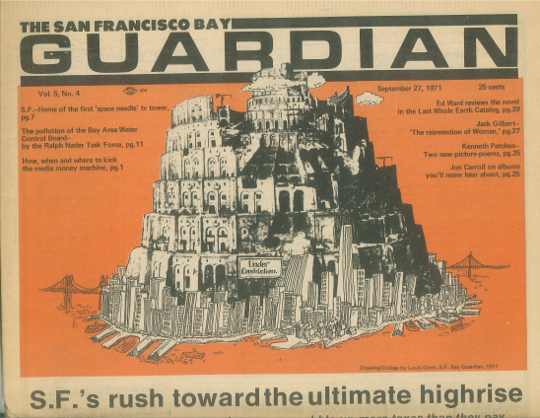
“SF’s rush toward the ultimate highrise” read the headline on the Guardian front page of Sept. 27, 1971. The headline and the graphics by Art Director Louis Dunn illustrated the central point of our bombshell study: that despite the rhapsodies of  the Chamber of Commerce and the big developers, highrise commercial buildings don’t produce gushing revenues and they don’t pay for themselves.In fact, our exclusive study of the downtown highrise district  found that “for every $10 the district yields to the city treasury, the city has to provide $11 in services.

“Put another way: the highrise district contributes $62.9 million, or 25.2% of all locally generated municipal revenue.  But it costs $67.7 million, or 25.2% of all locally financed expenditures (figures from fiscal 1970.

“This means taxpayers subsidize–35 cents or so on the tax rate in fiscal 1970–the construction and maintenance of our civic monuments–the Bank of America building, the Transamerica building, the Hilton Hotel–and soon, another 23 skyscrapers that will be taller and bulkier and more  expensive than ever for residents and taxpayers.”

Project Director Tom Lehner, a San Francisco resident and expert on urban policy from UC-Berkeley’s School of Public Policy, made the crucial point: :”This report overturns once and ffor  all, emphatically and conclusively, the conventional wisdom that downtown skyscrapers somehow provide the municipal treasury with its lifeblood.

“Anyone who thinks for a moment about what’s happening in New York,” Lehner added, “will come to the same conclusion as our study did.  But the air’s been so full of propaganda from the Chamber of Commerce and other downtown interests like the Examiner and Chronicle that it’s difficult to have a clear thought about the subject.”  The economic  fact that taxpayers subsidize highrise development has become gospel and helped provide the ammunition for the slow growth movement on commercial highrises that ultimately won on the Proposition M  initiative in 1986.

Below is the  PDF that shows our study with the Louis Dunn drawings: scroll  through.

http://test.sfbg.com/PDFs/highrise.pdf

Today, the burning issue is the luxury building at 8 Washington and the host of market rate developments already built or in the works and their impact on neighborhoods. And today the city needs a study that can provide the facts on the economic impact of market rate development and how neighborhoods can cope with the impacts in an era of “now new taxes.”

Tony Kelly is the president of the Potrero Hill Boosters and one of the most knowledgeable neighborhood activists on the market rate housing front.  He and the Boosters are dealing with the Mission Bay Landrush and the city’s plan to flood the Eastern Neighborhoods with market rate housing. His take is most instructive on why a study is needed:

‘”During the Eastern Neighborhoods re-zoning in 2008, I saw neighbors who supported development turn into NIMBYs overnight as soon as they realized that building market-rate housing in San Francisco doesn’tpay for itself, or much of anything else.  On Potrero Hill, we spent an entire decade working on neighborhood planning that was supposed to  
give us new parks, new transit lines, and better schools in a part of town that desperately needs all of that.  And then, when the new zoning was finally approved … … we found out that none of those improvements made it over the finish line. 


“The impact fees for the new development won’t even come close to providing the transit, parks, schools or infrastructure that the new residents need, let alone those of us who are already here in a very underserved part of town.  I shouldn’t really have to remind you that the new housing isn’t affordable for City residents.  And the Planning  
Department’s own study from 2008 confirms that when you build market-rate housing, you create a bigger need for affordable housing – more than you are getting in affordable housing fees or inclusionary units.

” So, with every new market rate housing unit, we are falling further behind on everything the City needs to do to support neighborhoods.  And the increased property taxes are all going to the General Fund, to support services elsewhere in the City.  Who in their right minds, in any neighborhood, would sign up for such a deal?

“Now, on this side of town, we are stuck with development plans that are designed to double the populations of district 10 and district 6 in the next 20 years.  In my neighborhood, Potrero Hill, the population will triple. And now we have to figure out how to support this booming population without much help from City Hall.

“The new condominium projects that the Potrero Boosters Neighborhood Association has already seen in the past few months reveal the consequences of the Eastern Neighborhoods rezoning—thousands of condos and apartments (and thousands more residents) coming to the neighborhood, with very few opportunities for children or families, and not much planning from the City for alternatives to automobiles.  

“We cannot have urban density in our part of this City with suburban ways of living and getting around, and yet, that is what we have, now and in the future.  So in the neighborhoods, we have to plan (and takeaction) to create our own infrastructure, and not simply rely on what the City manages to give us.”

Kelly’s arguments against pellmell market rate housing is particularly strong for the city’s new frontier of Mission Bay and the Eastern Neighborhoods, but it applies to every neighborhood and the entire city.  This is why for starters the supervisors need to direct the budget analyst or the city’s economist to do a detailed study to help Tony Kelly and the rest of the neighborhoods deal properly with the onslaught of market rate housing.  b3

Editorial on the case against 8 Washington:
>
http://www.sfbg.com/bruce/2012/03/06/editorial-case-ag

Occupying the Capitol

5

It’s an unseasonably hot day at UC Davis, and student activists are milling around a tent city, set up especially for 100 people arriving from a four-day March on Education. The school, one of the hubs of the Occupy movement, gained notoriety when public safety Officer John Pike casually pepper sprayed a line students during a sit-in back in November. Now, officers bike through the idyllic scene, smiling and chatting up occupiers.

Everyone is preparing for the next day, March 5, the statewide day to defend education that will bring thousands of students and teachers to Sacramento to demand an end to budget cuts and fee hikes at California’s schools, community colleges, and universities.

Those on the march hope to highlight the importance of this issue, marching 79 miles from the Bay Area. The first night, the march stayed in Richmond, and the next day Richmond’s Mayor Gayle McLaughlin came out to welcome them.

Students march annually on Sacramento, and say they won’t stop until education is affordable (or, as some would demand, free). A climate of worldwide protest over disparities in wealth and opportunity, including Occupy protests in the United States, helped fuel a larger than usual turnout this year.

More than 5,000 people converged in Sacramento March 5 and marched to the Capitol building, occupying the Rotunda all day. Many chanted “no cuts, no fees, education must be free.”

Community college student throughout the state are reeling from the cuts, and resulting fee hikes—course units, once free, were raised from $26 to $36 per unit last year, and will be increased another $10 this summer. These costs go towards closing the state budget deficit, and not toward a bigger course catalogue; classes continue to be slashed.

Frances Gotoh of San Bernardino Valley College is back at school after being laid off from her longtime job at Bank of America. She said she desperately needs the retraining; without it her job prospects look dim. She needs to support her family—her 20-year-old son is also a college student—but says she can’t afford the increasing fees. “Why is education being taken away?” asked Gotoh. “It belongs to the people.”

Josselyn Torres, a psychology major at Sonoma State University, felt similarly. “Every year, the fees are getting higher but the class size is getting bigger,” said Torres, who noted that many of her friends won’t be graduating with her because so many of the classes they needed were cut. “The politicians have all gone to college. If they keep cutting our education, how can we make it as far as them?”

When the march reached the Capitol, student and state government leaders spoke on the importance of education. Students demanded an end to fee hikes and budget cuts. Assembly Speaker John Perez (D-Los Angeles) and Senate President Pro Tem Darrell Steinberg (D-Sacramento) praised student activists and expounded on the necessity of accessibility to education. Almost all speakers decried the two-thirds majority needed to raise taxes, allowing just a few Republicans to block them.

Lt. Gov. Gavin Newsom also spoke, describing the need to support education in staunchly free-market terms: “You can’t have an economic development strategy without a workforce development strategy.”

Periodically, the crowd interrupted Newsom and other politicians in the midst of making promises with chants of “show us.” They also chanted this election year threat: “You’ll hear us out or we’ll vote you out!”

Around 12:30 p.m., the permitted rally ended and thousands dispersed. About 400 stayed to “Occupy the Capitol.” The group streamed into the building and into the rotunda. California Highway Patrol officers, responsible for policing the Capitol, blocked more than 150 from entering the central area. So, communicating via the Peoples Mic with several rounds of crowd repetition for every sentence spoken, the group participated in a statewide general assembly.

Some building employees showed support, but the only politician to sit down with the protesters was Newsom, who sits on the UC Board of Regents and CSU Board of Trustees. He chatted with students, some of whom requested that he ask police to stop blocking students from meeting in the same area; he didn’t do so, but was able to convince them to give protesters in the rotunda access to bathrooms.

The group managed to collectively decide on demands of the state: support the Millionaire’s Tax ballot initiative, repeal Prop. 13, cancel all student debt, fund all education through college, and democratize the Board of Regents. When building closed at 6 p.m., officers declared the assembly unlawful and arrested 70 who refused to disperse.

Meanwhile, another 400 or so attended a permitted rally on the Capitol lawn called by several Sacramento labor unions to support Occupy the Capitol.

Over the past five years, education funding in California has been cut drastically. Spending per K-12 student per year has gone down by almost $2,000 and higher education has seen program cuts and tuition hikes. Gov. Jerry Brown’s latest budget proposal includes still more cuts to California colleges and universities.

Several proposed ballot initiatives are designed to address this. An initiative sponsored by Brown would bring spending per student per year up by $1,000, stabilizing at $7,658 (it was $7,096 in 2011-12) and reversing a five-year slide. But it would still be less than 2007-08, according to a report from the California Budget Project (CBP).

That report shows K-12 education spending is the biggest piece of the state budget, although California ranks dismally low compared to other states for spending on K-12 education: 47th in the country.

The governor’s proposal would raise funds with a combination of a tax increase for those earning $250,000 and over per year and a sales tax increase. But critics say the increase in the sales tax, which is notoriously regressive, would hurt lower and middle income families.

The measure is up against other potential ballot initiatives that would raise revenue strictly from the wealthiest Californians. The so-called Millionaire’s Tax, for example, would raise funds for education by increasing taxes on those making $1 million or more per year. The Millionaire’s Tax also has the advantage of resulting in a permanent change in the law, while Brown’s measure would apply only for the next five years.

“California’s problems have also been exacerbated by tax cuts, one-time ‘solutions,’ overly optimistic assumptions, and the fact that the two-thirds vote requirement for the legislature to approve any tax measure has blocked adoption of a balanced approach towards bridging the budget gap,” according to the CBP report.

Teachers’ unions are divided over the best ballot measure. The California Teachers’ Association has endorsed Brown’s measure, emphasizing that it includes a plan to close the budget deficit.

“The governor’s initiative is the only initiative that provides additional revenues for our classrooms and closes the state budget deficit, and guarantees local communities will receive funds to pay for the realignment of local health and public safety services that the Legislature approved last year,” said Dean Vogel, CTA president, in a press release.

But the Millionaire’s Tax was sponsored by the California Federation of Teachers, and it has now been endorsed by this student general assembly. John Rizzo, president of the City College of San Francisco Board of Trustees, also endorsed the measure.

“We’ve got to tell the state of California that we cannot continue this. We cannot continue the cuts to our community colleges, to UCs, to the California State Universities,” said Rizzo, speaking at a March 1 rally in San Francisco.

According to a recent report, of five polls conducted throughout California, each initiative has majority support, but voter prefer the Millionaire’s Tax, with a recent Field Poll showing 63 percent support.

Legislators are also at work trying to increase education funding. Assembly Speaker Perez has introduced a bill that would slash tuition fees by two-thirds at CSU and UC schools for students of families making less than $150,000 per year. The bill would also allocate funding to city colleges throughout the state, for them to determine how to best use the money.

The cost of the plan, about $1 billion, would be paid by eliminating a corporate tax loophole that the Legislature approved in 2009, which would allow companies to choose the cheaper of two formulas for calculating their taxes. Critics have called the legislation bad for business, saying that removing tax incentives would hurt California companies.

“The California Middle Class Scholarship Act is very simple,” Perez told students at UC Davis when he unveiled the bill on Feb. 3. “Too many families are getting squeezed out of higher education. For students whose families make $150,000 a year or less, too much to qualify for our current financial aid system, but not enough to be able to write a check for the cost of education, without feeling that pinch, the Middle Class Scholarship Act reduces fees at the UC system and at the CSU system by two-thirds, giving tremendous assistance to those families to make college affordable again.”

Education advocates say California needs to do something to reverse the spiraling cost of higher education in California, which could do long-term damage to the state, affecting young people and businesses that need skilled workers and spiraling out from there. And these advocates say this short-sighted strategy is easily preventable if there is the political will to address it.

“There are a lot of sources of revenue that are not being taken advantage of,” Lisa Schiff, a member of Parents for Public Schools of San Francisco, told us.

Even if tuitions were lowered or—as the most ambitious of protesters demand—higher education was made free, most former students would still be saddled with massive debt. As costs have risen, debts of hundreds of thousands of dollars are commonplace. With the job market recovery slow and painful, graduates often feel helpless to pay back their debt.

Robert Meister, a professor of Political and Social Thought at UC Santa Cruz and president of the Council of UC Faculty Associations, has long argued that the state’s higher education systems ought to focus on keeping tuitions low and student debt in check (see “In the red,” 1/11/11).

Yet he told us that growing income inequality makes people even more desperate for a college education and willing to accept levels of student debt that limit their ability to become anything more than corporate cogs after graduation. “Their ability to raise tuition is a function of the growth of income inequality,” he told us.

In his speech at UC Davis, Perez cast the issue as one of a disinvestment in the state’s future: “California’s public colleges and universities has been one of our most prestigious institutions, and, unfortunately, because of the collapse of the economy, we’ve moved away from fully investing in those universities and colleges.”

A month later, the school again served as a backdrop for illustrating the problem and calling for reform. Dani Galietti, a MFA student at UC Davis who was setting up a performance art piece when I arrived, greets everyone cheerfully and is thrilled about the Occupy movement.

“I wanted to share myself and my work with the movement,” Galietti tells me while taping a “paper trail” to the sidewalk; she plans to walk on it with home-made stamps attached to the bottoms of her shoes.

But her mood darkens when I ask about her student debt. “I came out of five years of education $100,000 in debt,” says Galietti, “and I’m not the only one.”

She is a first generation college student, she explains, who helped pay for school with McNair scholarships.

“I grew up one of five, with a single mother,” Galietti explains. “We struggled my whole life, as a lot of people have, financially.”

“So many people are graduating with so much debt. There’s this looming fear, fear and hopelessness. The economy’s bad, the job market sucks. I’m so thankful that they’re out here. People are active, they’re making a difference.”

“We need education,” Galietti says. “I mean, knowledge is power.”


The case against 8 Washington

35

tredmond@sfbg.com

In city planning terms, it’s a fairly modest project: 134 condos, no buildings more than 12 stories tall, on a 27,000-square-foot site. It’s projected to meet the highest environmental building standards and offers new open space and pedestrian walkways. It’s near Muni, BART, and ferry lines. And the city will collect millions of dollars in new taxes from it.

But the 8 Washington project, which will come before the Planning Commission March 8, has become a flashpoint in city politics, one of the defining battles of Mayor Ed Lee’s administration — and a symbol of how the city’s housing policy has failed to keep pace with the needs of the local workforce.

Put simply, it will create the most expensive condos in city history, housing for the richest of the 1 percent on the edge of the waterfront — and will further push San Francisco toward becoming a city that caters almost entirely to the very wealthy.

So in a city where the growing divide between the 1 percent and the rest of us has become a central issue and where the lack of affordable housing is one of the top civic concerns, 8 Washington is an important test. By any rational standard, this sort of development is the last thing San Francisco needs.

But some of the best-connected lobbyists in the city are pushing it. One of the mayor’s closest allies, Chinatown powerbroker Rose Pak, is a leading advocate — and the final outcome will say a lot about city politics in the Lee administration.

There are all sorts of half-truths and misleading statements by supporters of 8 Washington. Here are the five main reasons the project shouldn’t be approved.

1. It fills no housing need. San Francisco has no shortage of housing for the very rich; the dramatic need, outlined in both regional planning documents and the city’s own General Plan, is for low- and moderate-income housing for the people who actually work in this city (see “Dollars or sense?” 9/28/10). While San Francisco is getting richer by the day, the core workforce — public employees, workers in the hotel and restaurant industry, service workers, construction and trade workers, and a majority of the people in the lower levels of the finance and tech sector — are being priced out of the city. That means more people working here and living far out of town, often commuting by car, in what everyone agrees is an unsustainable situation. Meanwhile, more and more high-paid workers from Silicon Valley are living in San Francisco — again, commuting to distant jobs, either by car or by corporate bus.

The city’s General Plan states that some 60 percent of all new housing built in the city should be below market rate. San Francisco desperately needs housing for its workforce. This type of project simply puts the city deeper in the hole and further from its housing goals.

2. It’s a reward for bad actors. The main developer of this project is Simon Snellgrove, but one of his partners is, by necessity, Golden Gateway, which owns a significant part of the land — and which has been flouting at least the spirit if not the letter of city and state law and costing San Francisco tens of millions of dollars.

As project opponent Brad Paul has noted in written testimony, when Timothy Foo, the current owner, bought the complex from Perini Corp. about 20 years ago, he used a loophole in state law that allowed him to avoid a formal transfer of ownership. That means the property wasn’t re-assessed, costing the city about $1.5 million a year. According to the Assessor’s Office, the deal wasn’t illegal (and these tricks to avoid reassessment are relatively common) but still: He’s costing the city millions by using a loophole not available to most people.

Golden Gateway, which was built in a redevelopment area as middle-class housing, is now renting out apartments as short-term tourist or corporate rentals. There are dozens of examples right now on Craigslist. City law bars the owners of rental housing from converting it to hotel rooms, but a loophole in that law makes what Foo’s outfit is doing technically legal. But he’s clearly violating the spirit of the city ordinance that seeks to protect rental housing from hotel conversions.

One of the main aesthetic complaints about the area — something Snellgrove’s lobbyists have tried to use to support the project — is the ugly fence that now surrounds the Golden Gateway Tennis and Swim Club. But who do you suppose put that fence there?

Do we as a city want to be giving special zoning benefits to companies that try to circumvent tax and housing laws?

3. It’s an environmental disaster. Snellgrove and his architects, Skidmore Owning and Merrill, are seeking LEED platinum certification for the project, saying that its energy-efficiency, water use, and green building materials will make it one of the most sustainable structures in San Francisco. It is, the project website notes, close to all types of public transit.

But LEED doesn’t take into account what the building is used for (see “Is LEED really green,” 7/5/11) — and in this case, the use makes a huge amount of difference.

People who buy multi-million-dollar condos don’t tend to take Muni or BART when they go places. That’s not conjecture, it’s a proven fact. A 2008 study by the American Public Transportation Association notes, bluntly, that wealthier people are more likely to drive cars. When you move into the stratospheric regions of the ultra-rich, that’s even more true. A 2011 report on the Charting Transport website notes: “The very rich tend to shun public transport.”

The current zoning in the area allows for one parking space for every four residential units. Snellgrove is asking for one space per unit — in other words, he figures every single buyer will have a car.

Many of the people who buy these condos won’t be working or even living most of the time in San Francisco. These are condos for world travelers, second and third homes for people who want to spend a few weeks a year in San Francisco. “They aren’t going to be living here all year,” Christina Olague, a former Planning Commission member who is now the District 5 supervisor, told us last July.

If five of the 165 residents of 8 Washington fly in a private or corporate jet from, say, New York to their SF pad once a month, the project will cause the use of jet fuel equivalent to what a normal family would use driving a car for 330 years, Paul noted.

“How many solar panels are needed compensate for burning 396,000 gallons of jet fuel a year?” he asked.

Then there’s the construction issue. If the developer’s projections are correct, as many as 20,000 dump truck runs will be trundling along the Embarcadero for several months, one every two minutes — and it could be happening right as the traffic nightmare called the America’s Cup is hitting the waterfront.

It also goes against some 40 years of waterfront planning policy, all of which as focused on downzoning and creating open space. This would be the first upzoning of San Francisco waterfront property in decades.

4. It will wipe out what is mostly a middle-class recreation facility. The Golden Gateway Tennis and Swim Club will be closed for three years, then (possibly) reopened later as a smaller facility. The club — with two outdoor pools and six tennis courts — sounds like something for the elite, and it’s managed by the upscale Bay Club, but a lot of the users are longtime Golden Gateway residents and seniors. “I would say 30 or 35 percent of the users are seniors,” Lee Radner, chair of Friends of Golden Gateway, told me. Most, he said, are middle-class people, and the expense isn’t that high. “My wife and I pay $3 a day to use the pool,” he said. “I swim every day, and it would cost more than that to use the public pools in the city.” He added: “There are some wealthier people, of course, but many of us are retired and on fixed incomes.”

We’re talking about 90,000 total square feet of outdoor recreation space — which dwarfs the 20,000 square feet of open space the developer promised to provide.

5. The city doesn’t get much out of the deal. In exchange for upzoning the waterfront, creating a big all of buildings and screwing up the city’s housing balance, what does the San Francisco general fund get? Not a lot. The estimates for new tax revenue run about $1.5 million a year of the next 60 years — and when you translate that to what economist call “net present value,” the cash equivalent today of that revenue stream, it’s about $30 million. The Port of San Francisco is talking about creating a special infrastructure financing district — sort of the equivalent of a redevelopment area — to pull that money out in advance, which may not even be legal (since part of the land is a former redevelopment area, the state law that allows these special finance districts may not apply). But even so, a Jan. 14 Port memo suggests that the agency has plans to spend all that money on its own infrastructure — setting up a potential battle between the supervisors and the Port Commission over where the money, if it actually can be collected up front, will go.

Like any developer, Snellgrove will pay into the city’s affordable housing fund — in this case, about $9 million to pay for the equivalent of 27 units. No affordable units will be on site, of course; that would detract from the uber-wealthy ambience of the place. And it’s not clear when those units would be built. “Nobody builds 27-unit buildings any more,” Paul, a former deputy mayor for housing, said. “We’ll have to wait until there’s enough money for a bigger project, somewhere, sometime down the road. That’s what we’re getting here.”

Either way, it’s not a huge benefit for allowing this disaster of a project — and it’s a terrible statement for San Francisco to make. At a time when the mayor has cleared the Occupy protesters — who are talking about how little the rich pay in taxes — off the waterfront, the city is preparing to move in the exceptionally rich, who aren’t paying anywhere near their fair share in tax revenue to local government.

(Nobody knows for sure whether the costs of servicing high-end residential exceed the revenue the city gets from property taxes. In 1971, the Guardian put together the first-ever cost-benefit study for highrise office development, which showed that commercial buildings cost the city more than they paid; that’s been confirmed and demonstrated over the years to the point where it’s hardly even an argument any more. The supervisors ought to ask the city economist or the budget analyst to do the same sort of analysis for luxury condos.)

There’s another element here: Mayor Lee made a point during his campaign to say over and over again that he was an independent thinker, that powerful and influential allies like Rose Pak would not be calling the shots at City Hall. This will be his first major test: Pak and lobbyist Marcia Smolens are working hard to promote 8 Washington. And we’re already getting some disturbing signals out of the mayor’s office.

Lee told us that he has “no thoughts” about the project and hasn’t been paying any attention to it. That’s an odd stance, considering that his own Port Commission is pushing it and staffers in his office are working with the developer. This is a big priority for Pak, and the notion that she has never mentioned it to the mayor defies reason. Board President David Chiu, who talks to the mayor regularly, opposes the project, which is in Chiu’s district.

It’s hard to imagine that anyone who pays attention to local politics could be missing what will be one of the landmark votes this spring on the Planning Commission — which will take up the project March 8 — and the Board of Supervisors.

The mayor, may, indeed, be ignoring everything that supporters and opponents of 8 Washington have said and may be waiting until the Planning Commission vote to take a position. But if he’s just ducking questions because he’s planning to support it, he’s making a big mistake.

This is a chance for San Francisco to go beyond the platitudes about building housing, go beyond the hype about “green” buildings, see through the fraud about community benefits and consider what this really is: A special favor for a developer who wants to cater to the top 1 percent of the 1 percent and move San Francisco even closer to being a city of, by, and for the elite. The only reasonable vote on 8 Washington is No.

Editorial: The case against the 8 Washington tower

27

Editorial note: In 1971, at the height of the Alvin Duskin anti-highrise battle, the Guardian did a special first ever cost benefit study for high rise office development.

We found that highrises cost the city  more in services than they produce in revenue.  This meant that the commercial high rise boom could be fought on economic grounds, not just aesthietic and environmental grrounds, and the Chamber of Commerce/Big development gang could never adequately refute our findings.  In fact, they are now taken for  granted. So, as the 8 Washington battle is poised to open the floodgates even further for a forest of market rate residential  buildings, it’s time for the city to do its own study to determine the economics of high end  residential buildings.  Does the cost of servicing luxury residential buildings exceed the taxes they pay? We and many others in the neighborhoods are certain that market rate housing doesn’t pay for itself. But the facts are needed and so we urge the supervisors to direct the budget analyst or the city economist to do a similar analysis  for luxury condos.  Below is Executive Editor Tim Redmond’s powerful argument against 8 Washington.

By Tim Redmond

tredmond@sfbg.com

In city planning terms, it’s a fairly modest project: 134 condos, no buildings more than 12 stories tall, on a 27,000-square-foot site. It’s projected to meet the highest environmental building standards and offers new open space and pedestrian walkways. It’s near Muni, BART, and ferry lines. And the city will collect millions of dollars in new taxes from it.

But the 8 Washington project, which will come before the Planning Commission March 8, has become a flashpoint in city politics, one of the defining battles of Mayor Ed Lee’s administration — and a symbol of how the city’s housing policy has failed to keep pace with the needs of the local workforce.

Put simply, it will create the most expensive condos in city history, housing for the richest of the 1 percent on the edge of the waterfront — and will further push San Francisco toward becoming a city that caters almost entirely to the very wealthy.

So in a city where the growing divide between the 1 percent and the rest of us has become a central issue and where the lack of affordable housing is one of the top civic concerns, 8 Washington is an important test. By any rational standard, this sort of development is the last thing San Francisco needs.

But some of the best-connected lobbyists in the city are pushing it. One of the mayor’s closest allies, Chinatown powerbroker Rose Pak, is a leading advocate — and the final outcome will say a lot about city politics in the Lee administration.

There are all sorts of half-truths and misleading statements by supporters of 8 Washington. Here are the five main reasons the project shouldn’t be approved.

1. It fills no housing need. San Francisco has no shortage of housing for the very rich; the dramatic need, outlined in both regional planning documents and the city’s own General Plan, is for low- and moderate-income housing for the people who actually work in this city (see “Dollars or sense?” 9/28/10). While San Francisco is getting richer by the day, the core workforce — public employees, workers in the hotel and restaurant industry, service workers, construction and trade workers, and a majority of the people in the lower levels of the finance and tech sector — are being priced out of the city. That means more people working here and living far out of town, often commuting by car, in what everyone agrees is an unsustainable situation. Meanwhile, more and more high-paid workers from Silicon Valley are living in San Francisco — again, commuting to distant jobs, either by car or by corporate bus.

The city’s General Plan states that some 60 percent of all new housing built in the city should be below market rate. San Francisco desperately needs housing for its workforce. This type of project simply puts the city deeper in the hole and further from its housing goals.

2. It’s a reward for bad actors. The main developer of this project is Simon Snellgrove, but one of his partners is, by necessity, Golden Gateway, which owns a significant part of the land — and which has been flouting at least the spirit if not the letter of city and state law and costing San Francisco tens of millions of dollars.

As project opponent Brad Paul has noted in written testimony, when Timothy Foo, the current owner, bought the complex from Perini Corp. about 20 years ago, he used a loophole in state law that allowed him to avoid a formal transfer of ownership. That means the property wasn’t re-assessed, costing the city about $1.5 million a year. According to the Assessor’s Office, the deal wasn’t illegal (and these tricks to avoid reassessment are relatively common) but still: He’s costing the city millions by using a loophole not available to most people.

Golden Gateway, which was built in a redevelopment area as middle-class housing, is now renting out apartments as short-term tourist or corporate rentals. There are dozens of examples right now on Craigslist. City law bars the owners of rental housing from converting it to hotel rooms, but a loophole in that law makes what Foo’s outfit is doing technically legal. But he’s clearly violating the spirit of the city ordinance that seeks to protect rental housing from hotel conversions.

One of the main aesthetic complaints about the area — something Snellgrove’s lobbyists have tried to use to support the project — is the ugly fence that now surrounds the Golden Gateway Tennis and Swim Club. But who do you suppose put that fence there?

Do we as a city want to be giving special zoning benefits to companies that try to circumvent tax and housing laws?

3. It’s an environmental disaster. Snellgrove and his architects, Skidmore Owning and Merrill, are seeking LEED platinum certification for the project, saying that its energy-efficiency, water use, and green building materials will make it one of the most sustainable structures in San Francisco. It is, the project website notes, close to all types of public transit.

But LEED doesn’t take into account what the building is used for (see “Is LEED really green,” 7/5/11) — and in this case, the use makes a huge amount of difference.

People who buy multi-million-dollar condos don’t tend to take Muni or BART when they go places. That’s not conjecture, it’s a proven fact. A 2008 study by the American Public Transportation Association notes, bluntly, that wealthier people are more likely to drive cars. When you move into the stratospheric regions of the ultra-rich, that’s even more true. A 2011 report on the Charting Transport website notes: “The very rich tend to shun public transport.”

The current zoning in the area allows for one parking space for every four residential units. Snellgrove is asking for one space per unit — in other words, he figures every single buyer will have a car.

Many of the people who buy these condos won’t be working or even living most of the time in San Francisco. These are condos for world travelers, second and third homes for people who want to spend a few weeks a year in San Francisco. “They aren’t going to be living here all year,” Christina Olague, a former Planning Commission member who is now the District 5 supervisor, told us last July.

If five of the 165 residents of 8 Washington fly in a private or corporate jet from, say, New York to their SF pad once a month, the project will cause the use of jet fuel equivalent to what a normal family would use driving a car for 330 years, Paul noted.

“How many solar panels are needed compensate for burning 396,000 gallons of jet fuel a year?” he asked.

Then there’s the construction issue. If the developer’s projections are correct, as many as 20,000 dump truck runs will be trundling along the Embarcadero for several months, one every two minutes — and it could be happening right as the traffic nightmare called the America’s Cup is hitting the waterfront.

It also goes against some 40 years of waterfront planning policy, all of which as focused on downzoning and creating open space. This would be the first upzoning of San Francisco waterfront property in decades.

4. It will wipe out what is mostly a middle-class recreation facility. The Golden Gateway Tennis and Swim Club will be closed for three years, then (possibly) reopened later as a smaller facility. The club — with two outdoor pools and six tennis courts — sounds like something for the elite, and it’s managed by the upscale Bay Club, but a lot of the users are longtime Golden Gateway residents and seniors. “I would say 30 or 35 percent of the users are seniors,” Lee Radner, chair of Friends of Golden Gateway, told me. Most, he said, are middle-class people, and the expense isn’t that high. “My wife and I pay $3 a day to use the pool,” he said. “I swim every day, and it would cost more than that to use the public pools in the city.” He added: “There are some wealthier people, of course, but many of us are retired and on fixed incomes.”

We’re talking about 90,000 total square feet of outdoor recreation space — which dwarfs the 20,000 square feet of open space the developer promised to provide.

5. The city doesn’t get much out of the deal. In exchange for upzoning the waterfront, creating a big all of buildings and screwing up the city’s housing balance, what does the San Francisco general fund get? Not a lot. The estimates for new tax revenue run about $1.5 million a year of the next 60 years — and when you translate that to what economist call “net present value,” the cash equivalent today of that revenue stream, it’s about $30 million. The Port of San Francisco is talking about creating a special infrastructure financing district — sort of the equivalent of a redevelopment area — to pull that money out in advance, which may not even be legal (since part of the land is a former redevelopment area, the state law that allows these special finance districts may not apply). But even so, a Jan. 14 Port memo suggests that the agency has plans to spend all that money on its own infrastructure — setting up a potential battle between the supervisors and the Port Commission over where the money, if it actually can be collected up front, will go.

Like any developer, Snellgrove will pay into the city’s affordable housing fund — in this case, about $9 million to pay for the equivalent of 27 units. No affordable units will be on site, of course; that would detract from the uber-wealthy ambience of the place. And it’s not clear when those units would be built. “Nobody builds 27-unit buildings any more,” Paul, a former deputy mayor for housing, said. “We’ll have to wait until there’s enough money for a bigger project, somewhere, sometime down the road. That’s what we’re getting here.”

Either way, it’s not a huge benefit for allowing this disaster of a project — and it’s a terrible statement for San Francisco to make. At a time when the mayor has cleared the Occupy protesters — who are talking about how little the rich pay in taxes — off the waterfront, the city is preparing to move in the exceptionally rich, who aren’t paying anywhere near their fair share in tax revenue to local government.

(Nobody knows for sure whether the costs of servicing high-end residential exceed the revenue the city gets from property taxes. In 1971, the Guardian put together the first-ever cost-benefit study for highrise office development, which showed that commercial buildings cost the city more than they paid; that’s been confirmed and demonstrated over the years to the point where it’s hardly even an argument any more. The supervisors ought to ask the city economist or the budget analyst to do the same sort of analysis for luxury condos.)

There’s another element here: Mayor Lee made a point during his campaign to say over and over again that he was an independent thinker, that powerful and influential allies like Rose Pak would not be calling the shots at City Hall. This will be his first major test: Pak and lobbyist Marcia Smolens are working hard to promote 8 Washington. And we’re already getting some disturbing signals out of the mayor’s office.

Lee told us that he has “no thoughts” about the project and hasn’t been paying any attention to it. That’s an odd stance, considering that his own Port Commission is pushing it and staffers in his office are working with the developer. This is a big priority for Pak, and the notion that she has never mentioned it to the mayor defies reason. Board President David Chiu, who talks to the mayor regularly, opposes the project, which is in Chiu’s district.

It’s hard to imagine that anyone who pays attention to local politics could be missing what will be one of the landmark votes this spring on the Planning Commission — which will take up the project March 8 — and the Board of Supervisors.

The mayor, may, indeed, be ignoring everything that supporters and opponents of 8 Washington have said and may be waiting until the Planning Commission vote to take a position. But if he’s just ducking questions because he’s planning to support it, he’s making a big mistake.

This is a chance for San Francisco to go beyond the platitudes about building housing, go beyond the hype about “green” buildings, see through the fraud about community benefits and consider what this really is: A special favor for a developer who wants to cater to the top 1 percent of the 1 percent and move San Francisco even closer to being a city of, by, and for the elite. The only reasonable vote on 8 Washington is No.