SF

On the Cheap Listings

0

Submit items for the listings at listings@sfbg.com. For further information on how to submit items for the listings, see Picks.

THURSDAY 8

Drag Queens on Ice Union Square Ice Rink, 333 Post, SF. www.unionsquareicerink.com. 8-9:30 p.m., $10. Mutha Chucka, Anna Conda, Lil’ Hot Mess and other dazzlingly-named lovelies gleefully speed and twirl through the Union Square ice skater crowd.

Archie Green: the Making of a Working-Class Hero talk Green Arcade, 1680 Market, SF. 7 p.m., free. Historian Sean Burns captured foundational labor activist Archie Green’s story over years of interviews and conversations. Now he shares how Green became a tireless and radical advocate for the preservation of American folklore.


FRIDAY 9

Winter Wunderkammer holiday art sale The Lab, 2948 16th St., SF. www.thelab.org. 6-11 p.m. Also Sat/10, 11 a.m.-4 p.m., free. For the 15th year, the Lab hosts a jewel of a holiday sale where it’s possible to spend anything from one buckaroo to 50. Up for grabs: small-format work by local artists.

OCCUPY! screening Artists’ Television Access, 992 Valencia, SF. www.atasite.org. 6:30 p.m., donation requested. ATA hosts a multimedia collage of the Occupy movement. Poetry, videos, history, aerial maps, and performance art relating to the massive protest are on the docket; all donations directly benefit Occupy San Francisco.

Luke Warm Water and Jim Barnard poetry reading Nefeli Caffe, 1854 Euclid, Berk. (510) 841-6374. 7 p.m., free. Stirring poets Luke Warm Water (a virtuoso of spoken word hailing from Rapid City, South Dakota) and Jim Barnard (cofounder of Berkeley’s Poetry Express readings) join forces for a colorful finger-snapper.


SATURDAY 10

End of Semester show Mission Cultural Center for Latino Arts, 2868 Mission, SF. www.missionculturalcenter.org. 2-5 p.m., $5. Mission Cultural Center showcases the multitudinous and fine community talents it has worked to cultivate this semester, from Afro-Peruvian dancers to Samba Jam Brazilian percussion artists.

Writers with Drinks Make Out Room, 3225 22nd St., SF. www.makeoutroom.com. 7:30-9:30 p.m., $5-10 sliding scale. Gail Carriger, Sean Baby, Mike Jung, and Diana Salier have between them a prestigious prize for young adult lit, a balls-out comic strip, MTV appearances, and a new poetry chapbook on heartache and Wikipedia. The Center for Sex and Culture reaps the proceeds from this all-star reading.

Vagabond Indie Craft Fair Urban Bazaar, 1371 9th Ave., SF. www.vagabondsf.wordpress.com. 12:30-6 p.m., free. Independent artisans and the SF Etsy street team unite amongst Urban Bazaar’s backyard succulents for a small-scale, high-quality local craft fair.

1901 Maritime Christmas Hyde Street Pier, SF. www.nps.gov/safr. 6-9 p.m., free with reservation to (415) 447-5000. If the idea of riding the waves circa 1900 brings to mind scurvy and mishaps with icebergs, you’ve got it wrong. The National Park Service trots out costumed actors and historic ships for a warm, watery Christmas performance by lamplight.

East Bay Alternative Press Book Fair Berkeley City College, 2050 Center, Berk. www.berkeleycitycollege.edu. 10 a.m.-4 p.m., free. Local independent writers, publishers, zinesters and craftspeople flood downtown Berkeley to showcase boundlessly-inventive bookworks.


SUNDAY 11

Christine Schmidt book signing Museum Store, SFMOMA, 151 Third St., SF. www.sfmoma.org. 2 p.m., free. Christine Schmidt, the artist behind Yellow Owl Workshop and those ubiquitous, beautifully-printed California poppy postcard sets, demonstrates a project and signs her recent how-to printmaking book meant for, she says, those with “low budgets and high ambition.”


MONDAY 12

Occupy Phoenix Books readings Phoenix Books, 3957 24th St., SF. www.dogearedbooks.com. 6:30 p.m., free. Young ‘uns from 826 Valencia join Denise Sullivan, author of Keep on Pushing: Black Power Music from Blues to Hip Hop for a night of Occupy-oriented readings. Accompanying the shindig is local Americana act McCabe and Mrs. Miller.

Alerts

0

alert@sfbg.com

THURSDAY 8

Feminist Occupiers

Eyewitness accounts from women in the Bay Area and London have attested to sexual harassment in Occupy camps and struggles to be heard at Occupy General Assembly meetings. Join in a vibrant discussion about women’s issues within the Occupy and other protest movements.

Light supper served at 6:15 p.m. for a suggested $7.50 donation

747 Polk, SF

Contact: Norma Gallegos

415-864-1278

baradicalwomen@earthlink.net

www.radicalwomen.org


SATURDAY 10

Occupy Education organizing

Help plan the next steps in the campaign to get funding for the public university system at this organizing meeting for Occupy Education NorCal. The discussion will include the demands in an open letter to state officials approved Nov. 15 by Occupy Cal General Assembly and plans for a direct action campaign in the spring.

Noon, free

UAW Local 2865

2070 Allston #205, Berk

caloccupation@gmail.com


International Human Rights March

Participate in International Human Rights Day by marching from the OccupySF encampment to United Nations Plaza, where a series of speakers will address the need to strengthen efforts to protect and expand basic human rights at home and abroad.

3-5 p.m., free

Justin Herman/Bradley Manning Plaza

Market and Steuart, SF

www.occupysf.org


MONDAY 12

West Coast Port Shutdown

To hit business where it hurts and swat away union busting, OccupyOakland and OccupyLA are working hand-in-hand to protest EGT (an international grain exporter whose practices have detrimental effects on the working class) and Goldman Sachs (the investment banking giant that supports EGT and has fired port truckers) through a port blockade along the West Coast. Come help demonstrate the power of people to cut into the profits of entities hostile to the 99 percent.

5:30 am, West Oakland BART station, march to Port of Oakland

3 p.m., Rally at 14th and Broadway, Oakl, then march to Port

5 p.m., West Oakland BART station, march to Port

www.westcoastportshutdown.org

wcportshutdownmedia@gmail.com


TUESDAY 13

Steve Williams Roast

After 15 years of helping lead People Organized to Win Employment Rights (POWER), Steve Williams is moving on. But before he goes, he’ll be subjecting himself to the Steve Williams Roast & Toast, with the goal of raising more than $5,000 for POWER. To help meet that goal, the Unitarian Universalist Veatch Program has agreed to match every donated dollar up to that amount.

7-10 p.m., $25-$40

SEIU Local 1021 HQ

350 Rhode Island, SF

peopleorganized.givezooks.com/events/steve-williams-toast-roast


Mail items for Alerts to the Guardian Building, 135 Mississippi St., SF, CA 94107; fax to (415) 437-3658; or e-mail alert@sfbg.com. Please include a contact telephone number. Items must be received at least one week prior to the publication date.

Telegenic Band Check: Corpus Callosum

2

SFBG videographer Ariel Soto-Suver met local SF band and performance troupe, Corpus Callosum, in their studio to record a live set and learned all about their love of video game music.

Appetite: Winter delights

0

Our favorite holiday Scotches

In this week’s paper I shared a few dynamic new spirits releases across categories, from creme de menthe to Scottish gin. This round, it’s Scotch sips for a winter’s night. While I continue to sip Mortlach 16 and one-of-a-kind bottles from the Scotch Malt Whisky Society I recently brought home from Scotland, wishing they were available in the States, here are four producers that are available and would be gladly received as holiday gifts by Scotch whisky lovers in your life.

For something unusual:

BOWMORE – Smoky Sophistication

Smoky, like a fine cigar, with muted, sophisticated tones… that’s Bowmore’s 15-year “Darkest” Scotch.

For Islay Scotch-fanatics (Islay: the island on which generally peaty/smoky Scotches thrive), this one is an understated beauty. Where Laphroaig‘s standard 10-year Scotch hits hard and heavy on the smoke (Ardbeg’s Supernova and Alligator take it even further – like sucking on an ashtray… in a good way), Bowmore 15 takes a more seductive route. Tantalizing on the nose with chocolate, pepper and wood, the taste is rich in cedar wood, sea brine, sherry, toffee, and, yes, peat. This gorgeous Islay Scotch is aged in American bourbon and Oloroso sherry casks, without being overwhelmed by either sherry sweetness or peaty smoke.

It’s among my top peat-driven Scotches of all time, a lesson in balance, offering all the smoke one could desire, but not merely that. Bowmore is the oldest distillery in Islay, around since 1779. In keeping with its rich history, it’s one of Islay’s gems – at a reasonable price. $69.99

BALBLAIR 2000 – Young and Bright

Young and bright aren’t words one thinks of in relation to Scotch. Way up north in the Highlands, Balblair crafts stand-up Scotches with just such a profile.

Though I like the green apple, woody spice of their 1989 single malt, I’m more taken with the younger 2000. Golden, and balanced, it unfolds with pear and green apple notes, making way for honey, coconut, and a spice zing that lingers warm and soft on the palate. It tastes young, yes, but this makes it no less complex than an older, mustier Scotch. In fact, in my latest travels through Scotland, Balblair 2000 stood out not just because of it’s modern packaging, but because it is fresh, different than many of the other whiskies I was sipping (and well-priced for a single malt). Though not easy to find in the States, SF’s own Whisky Shop has it at $62.50 a bottle. $62.50

Elegantly approachable:

THE MACALLAN – Romance & Range

Returning last month from Speyside up in Northern Scotland, I stayed on the enchanting Macallan estate. I’ll never forget the austere peace of the 370-acre land: the river Spey, lush green hillsides contrasting with vivid colors of fall, moody storms passing swiftly through.

The Macallan whiskies are a lesson in elegance, even if the popularity (and thus scarcity) of higher-aged product drives up prices. Harmony of spice and brightness is obtained by maturing their Scotches in both sherry and bourbon casks.

Besides their bracing 10 year cask strength Scotch, which is sadly not available in the States, my favorites are on the pricier end: 21 year Fine Oak ($180-250) is heady with jasmine and tropical fruits, while nutty, orange blossom notes of the 3o year Sherry ($900-$1000) compliment its earthiness. Both are gorgeous. On the affordable end, the 15 year ($80) is honey-rich, with cinnamon and floral notes melding into orange and chocolate. The classic Sherry Oak 12 year ($49.99) is a great value, evoking orange marmalade, vanilla and toffee. $49.99-$1000

THE GLENROTHES – Smooth Balance

If you can find Glenrothes Vintage 1994 ($79), snatch it up, for it is the last of the vintage. Making way for Vintage 1995 ($82) just released this month, the Speyside whisky producer makes some of the more elegant Scotches from the region.

Like The Macallan, they mature their whiskies in both sherry and bourbon casks. 1995 evokes pepper, cedar, creamy butterscotch, and when a couple drops of water are added, a surprising whisper of chocolate. 1994 gives off a nose of apple and even pencil shavings, while tasting of woody vanilla. On the cheaper end ($45), you won’t go wrong with Glenrothes classic Select Reserve ($45), bright with orange zest, malt, salt, and coconut. If you want to go all out, hunt for the rare (only 120 bottles in US, $375) 1996 Single Cask Editor’s Edition. The nose evokes an earthy, aged rum and demerara sugar, while the taste is crisp spice, maple syrup richness, and Oaxacan chocolate. A truly unique Scotch.

I recently spent time with Glenrothes director Ronnie Cox, his sense of humor and good taste evident. Glenrothes is one of the great blended whiskys, and as he quipped: “Single malts for thinkers, blended whisky for drinkers.” I’d say Glenrothes is for both. $45-$375

Subscribe to Virgina’s twice monthly newsletter, The Perfect Spot, www.theperfectspotsf.com

Dick Meister: Six ways to heal the economy

8


By Dick Meister

 Dick Meister, former labor editor of the SF Chronicle and KQED-TV Newsroom, has covered labor and politics for more than a half-century. Contact him through his website, www.dickmeister.com, which includes more than 350 of his columns.

The AFL-CIO has come up with an ambitious six-point plan for healing our very sick economy – one of the best plans that have yet been suggested by anyone.

Point one calls for rebuilding the school, transportation and energy systems by spending at least $2.2 trillion to restore crumbling 20th century infrastructure. As the AFL-CIO says, it would be an investment that would put millions of people to work while laying the foundation for the nation’s long-term growth and competitiveness with other nations.

Point two is as direct: “Revive U.S. manufacturing and stop exporting good jobs overseas.”  That would involve, among many other steps, reforming and enforcing tax policies that are currently encouraging U.S. companies to have manufacturing done in other countries. And enhance Buy America standards, increase investment in job training and oppose free trade deals.

Point three: Provide federal help for hiring people to do at least part of the work that needs to be done nationwide. That could create millions of jobs in distressed communities, especially communities of color, where much of the work is badly needed. In doing so, pay competitive wages and do not replace existing jobs.

Point four: Help federal, state and local governments avoid more of the layoffs and cutbacks of public services that have been a major drag on the economy. Congress should make a commitment to not lay off any more federal employees. It should prevent more state and local layoffs by providing increased federal funding of Medicaid when unemployment is high and providing additional federal funds directly to communities “to save and create jobs and protect and restore public services.”

Point five: Extend unemployment benefits for at least a year to those whose benefit payout time has expired. “Our economy continues to suffer from a massive shortfall of consumer demand . . . the primary reason why businesses are not hiring.”

The AFL-CIO calls for combining the extension of benefits with providing relief to homeowners facing foreclosure. If banks lowered the principal balance on mortgages to current market value, the AFL-CIO calculates that “over $70 billion a year would be pumped back into the economy, millions of families would be able to stay in their homes and over one million jobs would be created.”

Point six: “Reform Wall Street so that it helps Main Street create jobs.” That would mean channeling capital into productive sectors of the economy – more lending to small businesses, for instance – and enacting a federal financial speculation tax to discourage harmful speculation and “make Wall Street pay to rebuild the economy it helped destroy.” The government should “enforce tough safeguards to stop the kind of cheating and massive fraud on Wall Street that precipitated the crisis of 2008.”

Many of those who did indeed cause the crisis are still in control, many still doing just what brought on the economic ailments that so deeply affect the country. It will take a lot to loosen their tight grip on the economy. But it can be done if we are wise enough to adopt reforms such as the AFL-CIO advocates.

Dick Meister, former labor editor of the SF Chronicle and KQED-TV Newsroom, has covered labor and politics for more than a half-century. Contact him through his website, www.dickmeister.com, which includes more than 350 of his columns.

Art Basel frontlines: SCOPEing out Friday

1

Guardian photos by Paula Connelly

Art Basel is not the only show in Miami’s town this weekend. In addition to every gallery, boutique, and busy streetcorner hosting its own opening of varying degrees of importance, there are approximately 2,100 smaller art fairs going on (give or take). One of these is SCOPE, which I heard about first because urban art trendsetter SF gallery White Walls was trucking some canvases of ABOVE’s stenciled hip-hop dancers– and street artist ROA’s drawings of animals in capitivity, etched on wooden crates — down to show. (CORRECTION: ROA’s publicist has informed us that his installation is not wood etchings. His mediums are enamel, charcoal, China ink, aerosol and acrylic on found wood….no crates.) 

But to get into SCOPE, I first had to make it past the Alpine climber.

And I’m not talking Avery Lawrence’s “Moving a Tree,” though his real-life treadmilling amongst the artourists was a refreshing welcome to SCOPE’s cool white-tent embrace.

“Hi! I’m hear for press reg — ” I began, but didn’t take into account there was an older, wealthier European man with three likewise situated adults with him, behind me. 

“WELL WHAT IS THIS?” he bellowed, and the young woman at the front desk switched her attention like some money-seeking automaton. “Hello! This is SCOPE Festival!” 

“Is it mainly… emerging artists?” ventured the woman in tow with the man, who was now at my elbow at the front desk and had briefly given me a look of consolation when he realized he had asserted his importance over mine. Whatever, they paid first and then the other guy at the counter took pity on me and let me in. 

Everyone clucks when I tell them this story later in the wind of a South Beach hotel terrace. Were you trying to buy art? Well then. SCOPE, on its own, is responsible for $100 million in art sales each year. It concentrates on more edgy art — statement pieces, if you will. And there was some fantastically beautiful things on sales.

Here is the art fair to attend if you are interested in purchasing a life-size replica of a taco shack (Kenton Parker), multi-level traditional Iranian drawings wherein size-appropriate photographs of modern Iranians seamlessly collaged in (Soody Sharifi), Isabel Samaras‘ “Nuthatches With Attitude” (they’re wearing NWA hats and dookie gold and they’re adorable). But also, a rhinestone hamburger. 

This was the most serious buyer-seller discussion I heard, and yes I took photos of it with my Droid (above!) The couple were deciding between the basketball-sized hamburger, opened Lifesavers pack, or Chanel perfume bottle, all shiny and glorious. The Chanel bottle was beginning to rise above the hamburger, and the salewoman smoothly informed them “this one is $26,000. You see, the artist applies each stone individually. It really is amazing.” Reflecting on how little I wanted to see that puppy installed in someone’s home (or dressing room, e-blargh!) I moved on to eavesdrop on other, less trainwrecky people.

Later on the same day, a few blocks from SCOPE, we wandered into the Rubell Family Collection, currently hosting an exhibit featuring a room wallpapered in full Budweiser sixpacks (old label design) and sculptures of gravestones with putt-putt holes on the grass before them, human hands protruding from their flanks holding paper cups where their gravestone ears would be. It is called “American Exuberance,” but judging from my experience at SCOPE you could most likely have the same experience at any of the art fairs in Miami this weekend. Duh.  

Students forage in SF park for weekend Fungus Fair

0

Late fall is the time for the fleshy bodies of fungi to find their way to the moist, earthy surface.

This time of year, mushroom specialist and biology teacher JR Blair can be found at McClaren Park with students from San Francisco State University collecting hundreds of species of mushrooms for the much-anticipated Fungus Fair (check Caitlin Donohue’s piece on last year’s fair here). 

“All of the mushrooms are collected the Friday before the fair,” Blair said. ”Between 100 and 200 species of mushrooms are sorted and brought to (the exhibit) by Friday night.”

Blair was featured on KQED’s video series Science on the Spot, foraging around McClaren Park sniffing, tasting, and delicately handling the mushrooms to identify the species.

“It’s like an Easter egg hunt,” said Blair in the Quest video. “You hear squeals of delight off in the woods.”

The collected mushrooms are spread over several tables and meticulously labeled, providing an elaborate mushroom gallery of all shapes, sizes, colors and smells.

The Fungus Fair has been an annual event for 41 years with exhibits that show mushroom hunters how to identify edible species and workshops that demonstrate how to grow your own on pieces of wet newspaper.

Around 200 volunteers, comprised of UC Berkeley and SF State students, help to gather mushrooms and run the different exhibit stations. The fair includes live cooking demonstrations, informational exhibits on poisonous, hallucinogenic, medicinal, and microscopic mushrooms and family-friendly workshops on how to make spore prints.

“I think everyone should go to the fungus fair,” said volunteer coordinator Stephanie Wright. “But I’m biased.”

This is Wright’s fourth year helping out with the Fungus Fair and her job wrangling college students is not one she takes lightly. An incredible amount of planning goes into the fair each year, but the rewards of the fair are worth it to those dedicated to spreading the mushroom love.

“Foraging for mushrooms puts me in touch with nature, slows me down,” said mushroom enthusiast and Fungus Fair coordinator Lisa Gorman. “I’m stopping, breathing more deeply and observing. The process compels me to attend to a world and kingdom other than my own.”

The fair takes place Dec. 3 and 4 at the Lawrence Hall of Science in the Oakland Hills from 10 a.m. to 5 p.m. and costs $15 at the door. For more information you can visit the Mycological Society of San Francisco website or the museum event site.


Occupy the Mission?

Photo taken by Geoff King outside 1950 Mission Street on May 1, 2010.

As the Guardian reported yesterday, protesters camped out at Occupy SF rejected the city’s offer to grant use of 1950 Mission Street, the fenced-in site of a shuttered school near 16th and Mission streets, in exchange for clearing out of Justin Herman Plaza.

Occupiers ultimately opted not to sign a facility license agreement prepared by the city that would have granted them use of the empty lot and some structures — with about 17 strings attached, including rules banning minors or pets from the site. However, some occupiers noted at a meeting yesterday that they saw potential in the space and liked the idea of relocating to the Mission.

It’s worth noting that this offer isn’t the first time the site, which formerly housed the Phoenix Continuation School, has been linked with economic justice activism. On the evening of May 1, 2010, around 100 activists — many of them clad in black with bandanas covering their faces — participated in a May Day march that culminated with a takeover of this very same abandoned lot.

While it was more common to hear rallying cries of “reclaim” than “occupy” at that point in time, the action was meant to draw attention to the fact that the abandoned school could be put to better use. After people broke into the property and mingled around within the fenced-in area, announcing they wished to hold the space and ultimately turn it into a free school, police wound up cutting off access to the street and making arrests.

UPDATE: Meanwhile, a raid at Occupy SF seems imminent. According to a text update from the Guardian’s Yael Chanoff, who has been closely following Occupy SF since its inception, about 80 officers were on the scene as of 6 p.m. Dec. 1, and police barricades were already beginning to surround the camp.


The She’s on Girls, Women’s Audio Mission, and soccer practice

0

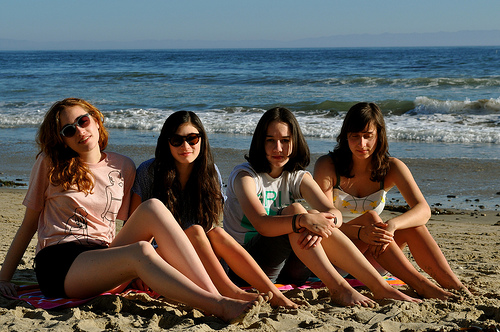
The She’s have opened for Girls, played with Thao with the Get Down Stay Down, and this month, released an infectious, surfy garage-pop debut album, Then It Starts To Feel Like Summer (the record release show is this Saturday at Bottom of the Hill).

Oh, and the band members – bassist Samantha Perez, vocalist Hannah Valente, guitarist Eva Treadway, and drummer Sinclair Riley – are all juniors in high school. But don’t diminish their talent by seeing She’s as a novelty, “young, all-girl band.” They’ve got the chops. I got the lowdown from the Bay Area quartet after school this week, discussing playing against stereotypes, life with punk parents, dream shows (hint: they’ve already played theirs), and kindergarten enemies.

San Francisco Bay Guardian: What were the first concerts you attended?
Hannah Valente: One of the first concerts we attended as a group was Blondie at the Fillmore. It was really inspiring to see a woman with such a powerful voice.
Samantha Perez: For me, I went to a lot of punk shows with my parents growing up because they were in the punk scene. It inspired me to begin playing music because I love the atmosphere and energy at shows.
SFBG: When did you start playing music and what influenced that?
Eva Treadway: We all grew up with music around us, both from our parents and also from growing up in SF. I was raised on a mix of old country blues records from my dad and Grateful Dead jams from my mom, which, come to think of it, is an interesting mix. As a kid I was crazy about the Beatles, and that was what really sparked my interest in picking up a guitar. I asked my parents for lessons and I had my first few lessons when I was about 10. When I started songwriting with the other members of the band, making music got really exciting for me again. Because we all come from different musical backgrounds – there was by no means Grateful Dead in Sami’s household growing up – but we also share really similar ideas and tastes in music.
Sinclair Riley: I started playing piano when I was about seven, then a few other classical instruments, but I didn’t start playing drums until the beginning of The She’s. My dad had a Beach Boys CD that he would always play in the car when he was driving, and I always liked driving with him so that I could listen to it because it was so much more interesting to me, I loved it so much more than anything I was playing on piano.
SP: I started playing guitar when I was seven years old. I was really resistant to play guitar, but my dad bought me a pink daisy-shaped one, so I got into it. As the years went on, I liked it more and more and then I started to sing in the San Francisco Girls Chorus, but I really wanted to start writing songs and start preforming.
HV: I was really influenced by my dad. He always seemed to be playing guitar around the house, so I just started singing with him. When I was like, three, I would sing with him while I took baths. I always liked music because it helped me connect to people. I’m shy, so it’s nice to have another way to communicate.
SFBG: How did you meet?
SP: We all met in kindergarten, and we were really close friends except me and Eva. We were enemies. In fifth grade we started playing music together and through that we became closer friends. It all started one day after soccer practice when Hannah said she had learned to play the Aly & AJ version of “Walking on Sunshine.” Eventually, the whole soccer team was in the band, but in the end it came down to just us four.
SFBG: Can you tell me a little about the process of making Then it Starts to Feel Like Summer?
SR: It was a pretty long yet satisfying process. About half the songs we already had written, and the others we wrote during the process of recording. It was so wonderful to get the opportunity to record at Women’s Audio Mission. It was really fun being in the studio and getting to take our time on this one. On this album we tried to capture the sound of what we play live. The ladies there are so nice and also taught us a bout the engineering aspect as well.
SFBG: What influences your sound? Who influences you personally?
HV: We are said to be a cross between the Ramones and the Ronettes, we really like the Beach Boys and other ’60s garage music. We’re always listening to new types of music, like ’60s country, local bands, and of course, pop.
ET: We’re influenced by going places and walking around San Francisco.
From listening to great songs, Lennon/McCartney of course, Brian Wilson, George Harrison, Phil Spector, even Britney Spears. Pretty much everything Christopher Owens from Girls writes I find inspiring.
SFBG: Where do you write music? Is it a group effort?
SR: Normally what happens is someone will bring in a guitar part or a melody or some part of a song, and we’ll all work together in our practice area (Hannah’s basement) to finalize the song – add lyrics, harmonies.
SFBG:  What’s been the most surreal experience thus far in the band? The weirdest?
HV: Hand’s down the most surreal show was playing with Girls at the Fillmore. Not only did we get to play with one of our favorite bands to listen to, but we also got to play on a stage where so many inspirational artists have performed.
SP: Playing at such a historic venue was unbelievable. The audience was great, the sound was great, the food backstage was great…it just really couldn’t have turned out any better. On the other hand, the weirdest experience we’ve had was probably when we were asked to play on TV on an early news broadcasting at like, 5 a.m.. We stayed the night in San Jose on a school night so that we could get to the studio at 3 a.m. and still be on time for school. However, we just happened to be there the same day that the San Bruno pipelines exploded, which meant our segment was canceled. It was a long, sleepy ride to school that morning, but at least we looked TV ready for all our peers!
SFBG. Who would play your dream show?
HV: Our first dream show would be to play with Girls, but then that actually happened. Then I would say to play with Magic Kids, but that also happened. After that, it would be the Morning Benders, but yes, that happened, too.
SP: Perhaps now our dream show would be with the early Beach Boys, once we build a time traveling machine, maybe that will be possible.
SFBG: Is it difficult working as an underage band in the San Francisco music scene?
EV: I think the most difficult part about being an underage musician (apart from sometimes not being allowed into to our own shows) is being treated as some sort of novelty act. It seems like a lot of times people feel that it is enough to describe our band as a “young all-girl band”, which really says nothing about our music. When people write reviews I wish they would remember that our age and gender are facts, and it doesn’t really go much deeper than that. It is true that being teenagers in the SF music scene is exciting for us. We’ve gotten to meet and even perform with some of our idols, and I know that that is something most teenagers don’t have the opportunity to do. I am proud of what we’ve done at this point in our lives, both as a band and as individuals and I feel fortunate to know what I am passionate about early on. The way I see it, it only leaves us time to grow.
SFBG: Is the She’s an intentionally all-female band?
SR: Not really, it just happened. We formed the band at that age when boys have cooties, and it’s been no boys ever since. We get treated differently since we’re a young all-girl teenage band though, and it’s made us stronger. We can go against the stereotype that girls and teenagers aren’t as capable as others.
SFBG: Do you consider yourselves feminists?
HV: We want women to be taken more seriously in the whole music industry. Every step of the way, our album was made by women. We hope to inspire other girls to get involved in this industry because women are way underrepresented.

The She’s
With Tijuana Panthers, Melted Toys
Sat/3, 10 p.m., $10
Bottom of the Hill
1233 17th St., SF
(415) 621-4455
www.bottomofthehill.com

New Wave City tributes Depeche Mode

0

At any New Wave City event, you can expect a cool crowd of knowledgeable New Wave music fans from various ages and walks of life, who come together to dance, socialize and celebrate the music of their lives. Each event features a tribute to one of the seminal acts of the period, such as Depeche Mode, The Smiths, The Cure, New Order, Siouxsie and the Banshees, etc. You’ll hear songs from the featured artist throughout the evening as well as the rest of the best of New Wave. Visuals from Altered Images (AKA Skip) include vintage video, ’80s movies and TV, slide shows with images of ’80s icons, street posters and club flyers from 1979-1984, and original concert photos to round out the experience.

For this installment of New Wave City, enjoy a music and video history of Depeche Mode in two rooms:

THE MUSIC FOR THE MASSES ROOM features the best of 80’s Depeche Mode in music & videos plus dancing to the rest of the best of New Wave with your hosts & DJ’s Skip, Shindog, & Low-Life. THE VIOLATOR ROOM features 90’s and beyond Depeche Mode plus New Wave B-sides & rarities with special guest DJ’s: Melting Girl (Death Guild) & Tomas Diablo (Strangelove).

Saturday, December 3 from 9pm-3am @ SPACE 550, 550 Barneveld, SF

Win FREE TICKETS to the Great Dickens Christmas Fair

0

While supplies last, visit the quaint streets of Victorian London right here is San Francisco for FREE. Drop of any non-perishable food item – canned haggis perhaps? – for donation to the Guardian building @ 135 Mississippi and receive two (2) tickets!

The original Great Dickens Christmas Fair is the only event of its kind anywhere and is celebrating its 33rd year. The winding lanes of Victorian London come to life in over three indoor acres magically transformed into music halls, pubs, dance parties and charming shops overflowing with hand-made holiday treasures. Enticing aromas of roasted chestnuts and hearty foods fill the air.  It’s a lamp-lit city brimming with lively and colorful characters from the pages of history and the imaginations of Charles Dickens, Jules Verne & Lewis Carroll.

Friday, November 25 and every Saturday-Sunday until December 18 from 11am-1pm @ The Cow Palace, 2600 Geneva, SF | free-$25 | Free Bart Shuttle from Glen Park station

Rep Clock

0

Schedules are for Wed/30-Tues/6 except where noted. Director and year are given when available. Double and triple features are marked with a •. All times p.m. unless otherwise specified.

ARTISTS’ TELEVISION ACCESS 992 Valencia, SF; www.atasite.org. $6-10. “Frequency Structures: Works with Sound and Film,” featuring Paul Clipson and John Davis, Madison Brookshire and Tashi Wada, and John Davis and Ben Bracken, Fri, 8. “Other Cinema:” Films about Muzak by Dale Hoyt and others, Sat, 8:30.

BALBOA 3630 Balboa, SF; www.brownpapertickets.com. $17.50-20. “Opera and Ballet at the Balboa Theatre:” Sleeping Beauty, performed by the Bolshoi Ballet, Sat/3-Sun/4, 10am; Dec 7, 7:30.

CASTRO 429 Castro, SF; (415) 621-6120, www.castrotheatre.com. $7.50-10. The Sound of Music (Wise, 1965), Wed-Sun, 7 (also Sat-Sun, 1). Presented sing-along style; this event, $10-15.

CHRISTOPHER B. SMITH RAFAEL FILM CENTER 1118 Fourth St, San Rafael; (415) 454-1222, www.cafilm.org. $6.75-10.25. “The Films of John Korty:” Alex and the Gypsy (1976), Thurs, 7; Farewell to Manzanar (1976), Sun, 1; Twice Upon a Time (1983), Sun, 7. Seducing Charlie Barker (Glazer, 2010), Fri-Sat, call for times. Eames: The Architect and the Painter (Cohn and Jersey, 2011), Sun, 4:15.

DE ANZA COLLEGE 21250 Stevens Creek, Cupertino; (415) 810-2892. “De Anza Experimental Film Exhibition,” Fri, 7:30.

“OCEAN AVENUE FILM FESTIVAL” 1649 Ocean, SF; artsconn@comcast.net. $5-10. Short films in all genres. Sat, 6-9.

PACIFIC FILM ARCHIVE 2575 Bancroft, Berk; (510) 642-5249, bampfa.berkeley.edu. $5.50-9.50. “Alternative Visions:” “Flotsam and Jetsam: The Spray of History,” films by Lewis Klahr, Wed, 7:30. “Kino-Eye: The Revolutionary Cinema of Dziga Vertov:” The Fall of the Romanov Dynasty (Shub, 1927), Thurs, 7. “Afterimage: The Films of Nicolás Pereda:” Together (2009), Fri, 7; Perpetuum Mobile (2010), Fri, 8:45; Summer of Goliath (2010), Sat, 6:30; All Things Were Now Overtaken By Silence (2010), Sun, 3; Where Are Their Stories? (2007), Sun, 5. “Southern (Dis)comfort: The American South in Cinema:” Baby Doll (Kazan, 1956), Sat, 9.

ROXIE 3117 and 3125 16th St, SF; (415) 863-1087, www.roxie.com. $5-9.75. Sigur Rós: Inni (Morisset, 2011), Wed-Thurs, 7, 8:30. “World AIDS Day:” “Still Around,” short films, Thurs, 7; Sex in an Epidemic (Carlomusto, 2010), Thurs, 8:45. These screenings, $12; a portion of proceeds benefits the UCSF Health Project. House of Boys (Schlim, 2010), Dec 2-8, 7, 9:15 (also Sat/3-Sun/4, 2:30, 4:30). Star Udo Kier in person Fri/2. “Midnites for Maniacs: More Fun Than Games, A Tribute to Greydon Clark:” •Hi-Riders (1978), Fri, 7:30; Joysticks (1983), Fri, 9:20; Wacko (1981), Fri, 11:15. All three films, $12. “An Evening With Amy Sedaris,” Sun, 7:30. This event, a benefit for the Roxie, $100. “Christmas in Acidland! Presented by Johnny Legend:” “Christmas in Acidland (Part One),” Yuletide TV insanity, Mon, 6, 9:15; “Christmas Noir,” classic original TV episodes, Mon, 7:30; “Christmas in Acidland (Part Two),” more “in-Santa-ty” from TV, Tues, 6, 9:30; Christmas in Hell (Cardona, 1959), Tues, 7:15.

SFFS | NEW PEOPLE CINEMA 1746 Post, SF; www.sffs.org. $10-15. The Swell Season (August-Perna, Mirabella-Davis, and Dapkins, 2011), Wed-Thurs, 1, 5, 7, 9. “The Dardy Family Home Movies By Stephen Sondheim By Erin Markey,” Fri/2-Sat/3 and Dec 9-10, 8; Sun/4 and Dec 11, 6. The City Dark (Cheney, 2011), Tues, 3, 5, 7, 9.

YERBA BUENA CENTER FOR THE ARTS 701 Mission, SF; (415) 978-2787, www.ybca.org. $6-10. “From Muppets to Metal: Music Movies:” Chico and Rita (Trueba, Mariscal, and Errando, 2010), Thurs, 7:30; Coleman-Rollins-Kirk-Cage (Fontaine, 1966-68), Sun, 2. San Francisco Cinematheque presents: “Lewis Klahr’s Prolix Satori,” Fri 7:30.

Clark shadows

0

TRASH If you were around in the waning days of drive-ins and urban grindhouses, the heydays of video stores and 1980s late-night cable, or were a Mystery Science Theatre 3000 fan, the name Greydon Clark might ring a faint bell — maybe even a warning bell.

For 25 years Clark was a prolific independent director, writer, producer, and even bit-part actor in the realm of low-budget exploitation movies designed for quick playoff in second-run theaters, graveyard-shift broadcast slots, and on rental shelves. Most were retreads of well-worn genre trends, a couple outright imitations of recent hits; they rarely hit the radar of mainstream critics, let alone awards-giving bodies — not even the Golden Raspberries. Though his last two features were futuristic adventures, Clark himself was relegated to cinema’s past by the turn of the millennium, having “aged out” in a business where an obsession with youth trickles down even to the least prestigious off-camera creative roles.

Now just short of 70, Clark is still around, selling memorabilia on his website, appearing at fan conventions, and the like. This Friday he’ll be at the Roxie for a Midnites for Maniacs tribute triple-bill featuring rare 35mm screenings of features long out of circulation.

First up is 1978’s Hi-Riders, a hybridization of then-current Smokey and the Bandit (1977) knockoffs and the earlier biker-flick vogue that’s one of his most enjoyable films. Frequent Clark collaborator Darby Hinton and busy stunt performer (through 1997’s Titanic) Diane Peterson are the nominal stars of a raucous action cheapie that pits muscle-car aficionados against each other, then against trigger-happy yokels ordered to kill by a vengeful fat cat who proclaims “Animals like that should be exterminated!” Acting pitched at a 10 on the hysteria scale, skinny dipping, and good crashes involving an actual bitchin’ Camaro ensue.

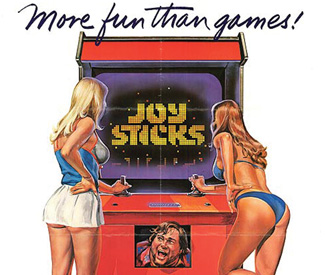
This is followed by Joysticks (1983), a prior Midnites for Maniacs midnight selection that remains a giddy high-lowlight in the short-lived 80s subgenre of movies about videogaming. How can it miss, with Porky’s-style gags, a hero named McDorfus, secondary “punk” villain King Vidiot (played by Napoleon Dynamite’s future Uncle Rico), and a theme song Tipper Gore might have taken exception to (“Jerk it left, jerk it right, shoot it hard, shoot it straight, video to the maaaaaax!!!”)?

Last and quite possibly least is 1982’s Wacko, one of several Airplane!-like slasher spoofs at the time. Its genial flailing about in search of laughs ropes in several of Clark’s favorite falling stars (Joe Don Baker, Stella Stevens, George Kennedy) and one future celebrity (pre-“Dice Man” Andrew Clay, as Fonz-y high school stud Tony Schlongini). If you were 10 years old (or 15 and stoned) in 1982, this was probably the funniest thing ever. So regress already.

But this selection offers just the tip of the native Michigander’s celluloid iceberg. Driving west on a whim in the 1960s, Clark managed to score work as both an actor and scenarist with Z-budget multihyphenate role model Al Adamson, including the incredible Satan’s Sadists (1969) and incredibler Dracula vs. Frankenstein (1971).

Those experiences empowered him to direct, co-write, and act in 1973’s The Bad Bunch (Kiss The Establishment Goodbye was one of several alternative titles), a drama of Vietnam War-era racial tensions that was shot in Watts for less than $15,000. It was clumsily crafted and crudely melodramatic, but serious-minded enough — despite gratuitous boobs and opening song “Honky Mutha Nigga Lover” — to set him on a more determinedly commercial, costs recouping path from then on.

Thus 1976’s Black Shampoo, an outrageous blaxploitation cash-in on Warren Beatty’s heterosexual hairdresser lothario hit, followed quickly by the unforgettably named (if otherwise forgettable) Satan’s Cheerleaders (1977), tentacled-alien-Frisbee-creature horror Without Warning (1980, with a very young David Caruso as one victim), and so forth. They inevitably featured once-hot, now economically-priced Hollywood names of a certain age (Clu Gulager, Jack Palance, Yvonne De Carlo etc.), attractive youngers mostly never to be heard from again, and Clark regulars like actress spouse Jacqueline Cole. (The fact that so many of his actors and crew came back for more suggests that he’s a pleasant guy to work for.)

Some of these movies actually require the MST3K treatment they got (i.e. 1985 Joe Don vs. Mafia shoot ’em up Final Justice) to be watchable. Some, like 1990 psychological thriller Out of Sight, Out of Her Mind or 1980 sci-fi fantasy The Return (a rare upgrade to then-current B-level stars in Cybill Shepard and Jan-Michael Vincent), didn’t get it and aren’t.

But others are inspirationally silly, with enough hints to make it clear that their creator was in on the joke. Probably the most widely seen of his films is acknowledged camp classic The Forbidden Dance, one of two lambada movies released on the same day in 1990. It stars former Miss USA and future Mulholland Drive (2001) enigma Laura Harring as an Amazonian tribal princess who comes to Beverly Hills (accompanied by “witch doctor” Sid Haig) to attract attention to rainforest destruction via the healing power of public ass-grinding. All this and an ozone depletion message make it Clark’s Inconvenient Truth, just as The Bad Bunch was his Crash.

Less socially conscious but equally nuts are Uninvited (1988), in which a yacht full of the expected veteran actors and hot young ‘uns are terrorized by a mutant lab-experiment cat puppet; and Russian Holiday (1992), a daft espionage thriller with Susan Blakely as a tourist haplessly playing Nancy Drew amidst Moscow neck-snappings.

Then there’s 1989’s Skinheads: The Second Coming of Hate. Its hilarious racist, sexist, swastika-emblazoned goon squad makes the mistake of pursuing clean-cut “good” kids into the wilderness lair of survivalist Chuck Connors, who fought in World War II and knows just what to do with a buncha neo-Nazi scum. It’s pretty much the Reefer Madness of Reagan-era fascist punk gang movies (1982’s Class of 1984, 1984’s Savage Streets, etc.) — a category that surely calls for its own Midnites for Maniacs tribute.


“MORE FUN THAN GAMES! A TRIBUTE TO GREYDON CLARK”

Fri/2, triple-feature starts at 7 p.m., $12

Roxie Theater

3117 16th St., SF

(415) 863-1087 www.midnitesformaniacs.com

Our Weekly Picks: November 30-December 6

0

WEDNESDAY 30

“Flotsam and Jetsam: The Spray of History”

The ceaselessly inventive Los Angeles filmmaker Lewis Klahr comes to town for two shows this week. Joseph Cornell’s boxes are perhaps the most convenient reference point for Klahr’s richly emotional collage animation, though his handmade films’ range of tones and complex interlacing of pop culture and personal sentiment really merits stand-alone consideration. This PFA program samples Klahr’s recent short films, while the SF Cinematheque show at Yerba Buena Center for the Arts on Friday focuses on Klahr’s ongoing series of sublime musical memory pieces, Prolix Satori. The two shows have no overlapping films, which among other things means you get to appreciate Klahr’s Brill Building ear for titles (A Thousand Julys, False Aging, Wednesday Morning Two A.M., Daylight Moon, Well Then There Now). (Max Goldberg)

7:30 p.m., $9.50

Pacific Film Archive Theater

2575 Bancroft, Berk.

(510) 642-1412

www.bampfa.berkeley.edu

www.sfcinematheque.org


Lemuria

You would think that a band called Lemuria — a hypothetical continent said to have submerged into the depths of the Indian Ocean — would sound along the lines of Vangelis or Tangerine Dream. But the trio from Buffalo, NY, takes after alternative pop-punk predecessors like Superchunk and the Breeders. Sheena Ozella and Alex Kerns started Lemuria in 2004, taking on bass player Jason Draper a year later. Since then, Lemuria has matured into a band that’s at once frisky and endearing, dynamic and biting. On Lemuria’s newest album, Pebble (Bridge 9), Ozella and Kerns alternate on vocals in such a way that inspires deep sighs, like you’ve just spotted an adorable little dog. But when Ozella’s tough and vivacious guitar playing takes a front-seat, you realize that dog can bite. (James H. Miller)

With the Pillowfights!, Matsuri

9 p.m., $10

Bottom of the Hill

1233 17th St., SF

(415) 621-4455

www.bottomofthehill.com


FRIDAY 2

“Danzón”

It’s hard to imagine contemporary dance and performance without the seminal influence of German choreographer-performer Pina Bausch, whose work was so different when it started in the 1970s that it spawned its own genre: dance theater. Bausch’s gorgeous visual aesthetic, wildly eclectic movement, incorporation of speech and unbridled emotion, and her collaborative, searching process all contributed to a remaking of the landscape. The subject of a recent 3D documentary tribute by Wim Wenders, Bausch (who died in 2009) left behind a supreme body of work that her company continues to perform around the world. This weekend, Tanztheater Wuppertal Pina Bausch offers Danzón, Bausch’s poignant, humor-filled celebration of life’s journey in the teeth of death. No 3D specs required. (Robert Avila)

Through Dec. 3, 8 p.m., $30

Zellerbach Hall, Berk.

(510) 642-9988

www.calperformances.org


“True Stories Lounge”

As the cliché goes, truth is stranger than fiction — and knowing that a story is true (or at least somewhat “based on a true story,” Texas Chainsaw Massacre-style) makes it all the more fascinating. The ongoing series “True Stories Lounge” brings together a varied slate of word-wranglers to spin compelling non-fiction tales. This edition’s storytellers include spoken word artist Alan Kaufman, who’ll read from his new memoir, Drunken Angel; comedian Marilyn Pittman, talking through a family tragedy; Salon.com founder David Talbot, reading from his soon-to-be-released book of San Francisco history; Bay Citizen editor Steve Fainaru, a 2008 Pulitzer winner, discussing Iraq; and Brando biographer Peter Manso, reading from his latest Cape Cod-set true crime book. (Cheryl Eddy)

7:30 p.m., $10

Make-Out Room

3225 22nd St., SF

www.makeoutroom.com


Benoit & Sergio

“Sergio used to be my English teacher,” reads a YouTube comment for “Walk and Talk.” How hard it would be to explain a lyric like “My baby does K all day” at a parent-teacher conference? In 2009 Sergio quit the D.C. prep school racket to make music full-time with French expatriate Benoit. The electronic duo has quickly built a reputation on less than a dozen tracks released across Ghostly International, Visionquest, and DFA. With an original sound that mixes ecstatic techno house, melancholic late-night soul, and playfully barbed vocals, this will be the SF debut of the pair’s live show. (Ryan Prendiville)

With No Regular Play and DJ sets by Pillowtalk, Thee Mike B, Rich Korach, and more

9 p.m., $15-20

Public Works

161 Erie, SF

(415) 932-0955

www.publicsf.com


SATURDAY 3

Papercuts

Founder and lead songwriter of Papercuts, Jason Robert Quever, has a knack for softly wooing listeners into his songs. Part of the seductiveness is Quever’s voice. You tend to follow its breathiness until you’re deep in his weightless and roomy dream pop. On Papercuts’ Fading Parade, the band’s debut album on Subpop, which came out earlier this year, Quever can sound like a love sick ghost, padding around and whispering pleas in your ear. His vocals hover over a lulling swathe of reverb, but drums and guitars retain enough crispness so as not to become a colorless drone. It’s a carefully weighted balance, and one that’s well worth witnessing live. (Miller)

With Dominant Legs, Tim Cohen’s Magic Trick

9 p.m., $12

Rickshaw Stop

155 Fell, SF

(415) 861-2011

www.rickshawstop.com


“In the Red — Flaming Lotus Girls Gallery Show”

The Flaming Lotus Girls always go big, pushing the envelope on fire arts innovation every year at Burning Man and other festivals. That’s a big reason why I profiled them in my book, The Tribes of Burning Man: How an Experimental City in the Desert is Shaping the New American Counterculture. And it’s also why they’re in debt, now more than most years. So come mingle, marvel at their fiery artworks, dance to DJs from Space Cowboys and the Ambient Mafia, buy some art (including photo prints of FLG projects) or shwag (from the FLG’s autographed and lipstick-kissed calendar to copies of my book that I’ll be selling and signing there), and help the Flaming Lotus Girls get out of the red and into active preparations for its next big project. (Steven T. Jones)

With Deckward, 8Ball, Olde Nasty, and more

6 p.m.-2a.m., free but donations accepted

SomArts

934 Brannan, SF

(415) 552-1770

www.flaminglotus.com


“The Bay Brewed: A Rock and Roll Beer Festival”

Live music and drinking clearly go well with together. Unfortunately, beer festivals too often conjure up images of boring C list jam bands or old-timers working their way through a bunch of Creedence covers. Not the case with The Bay Brewed, a beer festival and music showcase mash-up put on by the folks over at The Bay Bridged blog. Along with unlimited tastings from 21st Amendment, Anchor Steam, Lagunitas, and Magnolia, among others, admission includes performances by some great local bands. Pick up a complimentary mug and catch the shoegaze-y post-punk of Weekend, the psychedelic rock of Sleepy Sun, the dub-tinged Extra Classic, and the punky power pop of Terry Malts. (Landon Moblad)

2-7 p.m., $55

Verdi Club

2424 Mariposa, SF

(415) 861-9199

www.thebaybridged.com/the-bay-brewed


SUNDAY 4

Cass McCombs

Similar to the nomadic lifestyle he’s maintained over the years, Cass McCombs creates music that can be tough to pin down. Though he was born in Concord and has considered the Bay Area home at various points in his career, the indie singer-songwriter has bounced all over the country, eschewing traditional genre expectations in the process. Wit’s End and Humor Risk, McCombs’ two 2011 albums, fully demonstrate his maturing take on sparse folk, dreamy pop, and melancholic rock spiked with just the right amount of humor.(Moblad)

With White Magic, Liza Thorn

8 p.m., $16

Great American Music Hall

859 O’Farrell, SF

(415) 885-0750

www.slimspresents.com


MONDAY 5

The Sea and Cake

Merely listening to indie veteran the Sea and Cake’s extensive catalog of material is an exhausting feat. With jazz, Brazilian, and African influences, this band has been generating a unique sound for more than 20 years. Characterized by Sam Prekop’s breathy vocals and delicate guitar work, the Sea and Cake has long provided the perfect soundtrack for mellowing out with your friends. The group embraced a more experimental sound for this year’s The Moonlight Butterfly (Thrill Jockey), its first release since 2008. Timelessly hip, yet approachable, start your week off right with the effervescent jams of the Sea and Cake. (Frances Capell)

With Lia Ices

8 p.m., $21

Great American Music Hall

859 O’Farrell, SF

(415) 885-0750

www.slimspresents.com


TUESDAY 6

Jeffrey Lewis & the Junkyard

Jeffrey Lewis is a jack of all trades. His style encompasses both cerebral folk and grungy, distorted garage rock. Though his lyrics may come across as stream-of-conscience tangents, Lewis’ witty songs are brimming with clever and heartbreaking observations. The musician is also an accomplished comic book artist, and his illustrations often accompany his live performances. Topics of discussion include LSD, farm animals, and the history of Communism. Is there anything Lewis can’t do? (Capell)

With the Yellow Dress, Tortured Genies

8 p.m., $10

Rickshaw Stop

155 Fell, SF

(415) 861-2011

www.rickshawstop.com


Other Lives

Other Lives is building a lot of momentum in the wake of Tamer Animals (TBD Records), the band’s latest album. The five-piece from Stillwater, Okla., supported Bon Iver on tour, and afterward, played headline shows across Europe. Eclipsing its recent successes, though, was the announcement that it will support Radiohead on its U.S. Tour, beginning in February. The momentum is certainly deserved. Tamer Animals is dim folk-rock that builds on robust orchestration — violins, cellos, clarinets, and horns all have a grand presence on the record. Once an instrumental collaboration called Kunek, Other Lives still has an appreciation for the slightest sonic details, so that nearly every moment has something to call surprising, if not riveting. (Miller)

With JBM

9 p.m., $12

Cafe Du Nord

2170 Market, SF

(415) 861-5016

www.cafedunord.com


Anna Calvi

Praised by Brian Eno as “the best thing since Patti Smith,” dark songstress Anna Calvi also exudes the fierce swagger and edgy sex appeal of predecessors PJ Harvey and Pat Benatar. Calvi’s flamenco and blues-tinged debut earned her critical acclaim and a Mercury Prize nomination for best album of 2011. A backing band consisting of Mally Harpaz on harmonium and percussion and Daniel Maiden-Wood on drums heightens the drama of Calvi’s cinematic anthems. Armed with a guitar and a voice that’s both sultry and operatic, the fiery Calvi seduces everything in her path. (Capell)

8 p.m., $17 Great American Music Hall 859 O’Farrell, SF (415) 885-0750 www.slimspresents.com 

The Guardian listings deadline is two weeks prior to our Wednesday publication date. To submit an item for consideration, please include the title of the event, a brief description of the event, date and time, venue name, street address (listing cross streets only isn’t sufficient), city, telephone number readers can call for more information, telephone number for media, and admission costs. Send information to Listings, the Guardian Building, 135 Mississippi St., SF, CA 94107; fax to (415) 487-2506; or e-mail (paste press release into e-mail body — no text attachments, please) to listings@sfbg.com. Digital photos may be submitted in jpeg format; the image must be at least 240 dpi and four inches by six inches in size. We regret we cannot accept listings over the phone.

Astral projections

0

arts@sfbg.com

THEATER A savage and seductive performer with a potent skill set, Erin Markey has been busy these last several years conquering New York’s downtown performance scene. But she’s no stranger to San Francisco. The rising 30-year-old performance artist, actor, and playwright credits visits to the Bay Area with some formative experiences, including her introduction to pole dancing — subject of her acclaimed one-woman play, Puppy Love: A Stripper’s Tail — and the invention of her drag persona, Hardy Dardy, the Michigan patriarch of her new multimedia, multi-character musical solo show, The Dardy Family Home Movies by Stephen Sondheim by Erin Markey. So it’s fitting as well as plain badass that the new piece receives its world premiere here, this week, under the auspices of the San Francisco Film Society’s KinoTek program.

Why SFFS? Markey was last out in San Francisco in 2009, on a bill with Beth Lisick and Tara Jepsen, when Film Society programmer Sean Uyehara saw her and was floored. “I thought, ‘This woman is going to be famous,'” remembers Uyehara, who describes Markey’s ferocious ability to woo and alarm and audience at almost the same moment. He stayed in touch. Later, Markey’s proposed Dardy Family piece, which avails itself of several screens for live camera feeds and pre-recorded video projections, made it a candidate for KinoTek, Uyehara’s bailiwick — though he admits it’s the most theater-like piece SFFS has taken onboard since initiating the cross-platform programming stream in the mid-aughts.

“We’re presenting a play, essentially,” says Uyehara, adding, “It’s based around this idea of home movies and how these home movies interact with a ‘normal’ Midwestern family. So I could see the potential for a hybrid program developed out of that.”

Markey, reared in the South and Midwest, studied theater and gender studies at the University of Michigan, where renowned NEA Four performance artist and faculty member Holly Hughes became a critical influence. Today she enjoys a growing reputation as an intensely charismatic shape-shifter in the queer performance and cabaret scenes, and a sharp and daring actor at large (her turn in an intimate, site-specific production of Green Eyes, a violent and erotic Tennessee Williams one-act, won her raves at last January’s Under the Radar Festival, in a production now headed to Boston.) I spoke with Markey by phone from New York about the background to The Dardy Family Home Movies.

San Francisco Bay Guardian You’ve said you became a stripper to save money to move to New York, but were inspired by the pole dancers you’d first seen in SF. It almost sounds like a post-graduate program for you in performance. Was it a big adjustment?  

Erin Markey It was a big adjustment. The dynamics between the girls that work there are really complicated. I knew I was leaving, so I had a different relationship to it than most. But it was hugely influential. It’s such an isolated, specific, weird context, with arbitrary sets of rules that you can only figure out by doing it wrong. It was almost the perfect thing to do for somebody who was studying queer studies and theater practice as well. It was constantly surprising me, and defying everything that I was reading about, in terms of feminism. Because there are camps — people being pro-porn or anti-porn, for example.

But it’s just so complicated. There’s almost nothing else to do but make creative work around it, just to reflect and acknowledge how complicated it is. I think it does that work much more service than being just “for” or “against.” The experience really changed my relationship to storytelling. Performing there feels really similar to performing for any crowd. But in that context you never know what exploitation means, if you’re being exploited or if you’re exploiting them because you’re affecting this interest. It feels similar to acting and doing cabaret and stuff like that. So I tried to tease out what felt the most sincere, even if it was really absurdist and ridiculous — that feels most sincere sometimes. Those just go in and out: being really absurd and being hard and real.

SFBG Can you explain who the Dardys are?

EM Actually, maybe 10 years ago, I don’t remember when, but in San Francisco I went to a drag king competition. There was a workshop, and I took it. We were all making drag king characters. I used to sing a little song in my head all the time, like a gibberish song: “hardee, dardee, hardee, har …” So I just decided to name my guy Hardy Dardy. He ended up being my go-to drag persona. He’s actually been in almost every show I’ve ever made on some level, even if he wasn’t named as Hardy Dardy. He was in Puppy Love, and he was in a show that I made about being my sister’s maid of honor.

He had his own show called The Curse, which was talk-show style. During that show, I ended up having to flesh out more of his life. His wife was first introduced in Puppy Love, actually. He mentions briefly that he went to the strip club when he got upset one day. So Molly became his wife, and I became very interested in her. She’s definitely not my mom, but she could be very good friends with her. I started making the Dardy Family Home Movies based on Molly’s experience mostly — her dealing with her kids leaving home, and having to re-understand her entire identity. I watched my mom go through that. All she wanted to do was be a good stay-at-home mom. It’s not like other professions where the older you get supposedly the higher up you get in the ranks, and the more you become what you wanted to be in the first place. You prepare these children to leave and be good people, and then they leave.

SFBG It’s sort of built-in obsolescence.

EM I thought about that a lot when I thought about the women at the strip club — how they depreciate in value over time, because youth is a really important part of making money in that context. It seems like this dark cloud hanging over these women’s heads. As an actor, I know what the value of being young is in this industry. It hangs over our heads as well. This show [includes] the conversation between Molly and her daughter, Kelly — who’s “a lot like me,” heh, heh — and who’s ultimately talking about being a performer. These things I’m talking about aren’t crazy explicit [in the show] necessarily. It’s a family of characters that I’ve been developing over years. But in the subtext of everything, this stuff is definitely there. 

THE DARDY FAMILY HOME MOVIES BY STEPHEN SONDHEIM BY ERIN MARKEY

Through Dec. 11

Fri.-Sat., 8 p.m.; Sun., 6 p.m., $15

SFFS New People Cinema

1746 Post, SF

www.sffs.org

Stage Listings

0

Stage listings are compiled by Guardian staff. Performance times may change; call venues to confirm. Reviewers are Robert Avila, Rita Felciano, and Nicole Gluckstern. Submit items for the listings at listings@sfbg.com. For further information on how to submit items for the listings, see Picks.

THEATER

OPENING

Cinderella Buriel Clay Theater, African American Art and Culture Complex, 762 Fulton, SF; 1-800-838-3006, www.african-americanshakes.org. $10-35. Opens Fri/2, 8pm. Runs Fri-Sat, 8pm (also Sat/3 and Dec 10, 3pm); Sun, 3pm. Through Dec 18. African-American Shakespeare Company opens its season with a re-telling of the fairy tale set in the bayous of Louisiana.

The Golden Girls: The Christmas Episodes Victoria Theatre 2961 16th St, SF; www.trannyshack.com. $30. Opens Thurs/1, 8pm. Runs Thurs-Sat, 8pm. Through Dec 23. Heklina, Cookie Dough, Matthew Martin, and Pollo Del Mar star in this drag-tastic holiday tribute to the classic sitcom.

Dr. Strangelove: LIVE Dark Room, 2263 Mission, SF; www.darkroomsf.com. $20. Opens Thurs/1, 8pm. Runs Thurs-Sat, 8pm. Through Dec 17. Stage adaptation of Stanley Kubrick’s classic cold war comedy.

Ladies in Waiting Exit Stage Left, 156 Eddy, SF; www.horrorunspeakable.com. $20. Opens Thurs/1, 8pm. Runs Thurs-Sat, 8pm. Through Dec 17. No Nude Men Productions presents three one-acts by Alison Luterman, Claire Rice, and Hilde Susan Jaegtnes.

The Last Five Years Boxcar Playhouse, 505 Natoma, SF; www.brownpapertickets.com. $20-35. Previews Fri/2, 8pm. Opens Sat/3, 8pm. Runs Thurs-Sat, 8pm; Sun, 2pm. Through Dec 18. Poor Man’s Players performs Jason Robert Brown’s relationship drama as its inaugural production.

Mommy Queerest Bindlestiff Studio, 185 Sixth St, SF; www.brownpapertickets.com. $15-25. Opens Thurs/1, 8pm. Runs Thurs-Sat, 8pm. Through Dec 17. Kat Evasco performs her autobiographical show about being the lesbian daughter of a lesbian mother.

Three Sisters Eureka Theatre, 215 Jackson, SF; (415) 255-8207, www.42ndstmoon.org. $20-50. Previews Wed/30, 7pm; Thurs/1-Fri/2, 8pm. Opens Sat/3, 6pm. Runs Wed, 7pm; Thurs-Fri, 8pm; Sat, 6pm (also Dec 10, 1pm); Sun, 3pm. Through Dec 18. 42nd Street Moon performs Jerome Kern and Oscar Hammerstein II’s World War I-set musical.

The Treasure of the Himawari Shrine: Another Mr. YooWho Adventure NOHspace, 2840 Mariposa, SF; 1-800-838-3006, www.brownpapertickets.com. $5-18. Previews Thurs/1, 7pm. Opens Fri/2, 7pm. Runs Fri-Sat, 7pm; Sun, 3pm. Through Dec 18. Master clown Moshe Cohen’s creation Mr. YooWho returns with a Japan-set adventure.

Xanadu New Conservatory Theatre Center, 25 Van Ness, SF; (415) 861-8972, www.nctcsf.org. $25-45. Previews Fri/2-Sat/3 and Dec 7-9, 8pm; Sun/4, 2pm. Opens Dec 10, 8pm. Through Jan 15. New Conservatory Theatre Center performs the retro roller-skating musical.

BAY AREA

God’s Plot Ashby Stage, 1901 Ashby, Berk; (510) 841-6500, www.shotgunplayers.org. $18-27. Previews Thurs/1, 7pm; Fri/2, 8pm. Opens Sat/3, 8pm. Runs Thurs, 7pm; Fri-Sat, 8pm; Sun, 5pm (starting Dec 15, also runs Wed, 7pm). Through Jan 15. Writer-director Mark Jackson’s historical drama, set in 1665 Virginia, closes out Shotgun Players’ 20th anniversary season.

The Secret Garden TheatreWorks at Lucie Stern Theatre, 1305 Middlefield, Palo Alto; (650) 463-1960, www.theatreworks.org. $19-72. Previews Wed/30, 7:30pm; Thurs/1-Fri/2, 8pm. Opens Sat/3, 2 and 8pm. Runs Tues-Wed, 7:30pm; Thurs-Sat, 8pm (also Sat, 2pm; Dec 24, shows at 1 and 6pm); Sun, 2 and 7pm. Through Dec 31. TheatreWorks performs the Tony Award-winning musical adaptaion of Frances Hodgson Burnett’s novel.

The Wild Bride Berkeley Repertory Theatre, Roda Theatre, 2015 Addison, Berk; (510) 647-2949, www.berkeleyrep.org. $14.50-73. Previews Fri/2-Sat/3 and Tues/6, 8pm; Sun/5, 7pm. Opens Wed/7, 8pm. Runs Tues, Thurs-Sat, 8pm (also Thurs and Sat, 2pm; no matinees Dec 8 or 15); Wed and Sun, 7pm (also Sun, 2pm; no matinee Jan 1). Through Jan 1. Britain’s Kneehigh Theatre Company returns to Berkeley Rep with the American premiere of Emma Rice’s grown-up fairy tale.

ONGOING

Absolutely San Francisco Alcove Theater, 414 Mason, Ste 502, SF; (415) 992-8168, www.thealcovetheater.com. $32-50. Schedule varies, through Dec 29. Not Quite Opera Productions presents Anne Nygren Doherty’s musical about San Francisco, with five characters all portrayed by Mary Gibboney.

Annapurna Magic Theatre, Bldg D, Fort Mason Center, Marina at Laguna, SF; (415) 441-8822, www.magictheatre.org. $20-60. Wed/30-Sat/3, 8pm (also Sat/3, 2:30pm); Sun/4, 2:30pm. Magic Theatre artistic director Loretta Greco helms this new two-hander by playwright Sharr White about a dying man named Ulysses (Rod Gnapp) who gets an unexpected visit by his ex-wife, Emma (Denise Cormier), who took their young son and left him some 20 years earlier when he was still an alcoholic. Ulysses, a once respected poet living a reclusive life in his trailer home (a cluttered stick-figure set by Andrew Boyce) in a tiny Colorado town, is now dry of drink and published verse — and normally naked too (at the moment Emma shows up he happens to be frying some sausages, so he’s got a little apron on as well as an oxygen tube for his dire emphysema). But he has continued to write unanswered letters to his son and composed over years an epic work comparing love to the alluring but deadly mountaintop that gives the play its title. For her part, Emma has left her second husband in another middle-of-the-night flight, but her reasons are a little different this time. We sense she never got over Ulysses either, but there’s a nagging urgency to her arrival too related to their now grown-up son, which is gradually revealed in the course of their sometimes too glib or forced interactions. There’s more than a whiff of Sam Shepard about this lonely cowboy poet and his estrangement, but the story is not nearly as compelling or suspenseful as a Shepard play, in part because characters and plot are not very believable and the story is bluntly sentimental to boot. (Avila)

*Fela! Curran Theatre, 445 Geary, SF; www.shnsf.com. $31-200. Wed-Sat, 8pm (also Wed and Sat, 2pm); Sun, 2pm. Through Dec 11. Director-choreographer Bill T. Jones’s highly successful Off-Broadway to Broadway musical (with book by Jones and Jim Lewis; additional lyrics by Lewis; and additional music by Aaron Johnson and Jordan McLean) proves worth the hype. With a prodigious performance at the center of it all by Sahr Ngaujah (rotating in the title role with Adesola Osakalumi), this is less a biography than euphoric and vehement musical party, sermon, and political rally at once. At the same time, enough of the career and times of Fela Anikulapo-Kuti (1938–1997) come through — amid a gorgeous video-enhanced street-art design scheme, and ecstatic live music and choreography deployed with contagious bravado — that there is no missing the contemporary relevance in the Nigerian Afrobeat legend and popular activist-outlaw who stood up for a devastated population against the Western imperialism and international corporate tyranny fronted by Nigeria’s oil-trading military regime. The only thing that would make this show better would be seeing it down at an Occupy encampment. (Avila)

*The Kipling Hotel: True Misadventures of the Electric Pink ’80s Marsh San Francisco, 1062 Valencia, SF; (415) 282-3055, www.themarsh.org. $15-50. Sat, 8:30pm; Sun, 7pm. Extended through Dec 18. This new autobiographical solo show by Don Reed, writer-performer of the fine and long-running East 14th, is another slice of the artist’s journey from 1970s Oakland ghetto to comedy-circuit respectability — here via a partial debate-scholarship to UCLA. The titular Los Angeles residency hotel was where Reed lived and worked for a time in the 1980s while attending university. It’s also a rich mine of memory and material for this physically protean and charismatic comic actor, who sails through two acts of often hilarious, sometimes touching vignettes loosely structured around his time on the hotel’s young wait staff, which catered to the needs of elderly patrons who might need conversation as much as breakfast. On opening night, the episodic narrative seemed to pass through several endings before settling on one whose tidy moral was delivered with too heavy a hand, but if the piece runs a little long, it’s only the last 20 minutes that noticeably meanders. And even with some awkward bumps along the way, it’s never a dull thing watching Reed work. (Avila)

Language Rooms Thick House, 1695 18th St, SF; www.brownpapertickets.com. $20-28. Thurs-Sat, 8pm; Sun, 7pm. Extended through Dec 11. The immigrant experience has some familiar familial dynamics across the board. Parents, for instance, can easily discover their Americanized children becoming embarrassed by the older generation’s “foreign” ways. Allegiances potentially strain much further, however, when the immigrant story gets entwined with a little narrative called the “war on terror.” That’s the volatile mixture at the center of Yussef El Guindi’s Language Rooms, a somewhat uneven but ultimately worthwhile new play that leverages absurdist comedy to interrogate the perversion of basic human sympathies post-9/11. Seattle-based playwright El Guindi (whose other Bay Area productions include Back of the Throat and the hilarious Jihad Jones and the Kalashnikov Babes) well knows that the transformation of nightmare into bureaucratic routine is a reality sometimes best broached in a comic vein. (Avila)

Not Getting Any Younger Marsh San Francisco, Studio Theater, 1062 Valencia, SF; (415) 826-5750, www.themarsh.org. $15-50. Thurs-Fri, 8pm; Sat, 8:30pm; Sun, 3pm. Extended through Dec 17. Marga Gomez is back at the Marsh, a couple of too-brief decades after inaugurating the theater’s new stage with her first solo show — an apt setting, in other words, for the writer-performer’s latest monologue, a reflection on the inevitable process of aging for a Latina lesbian comedian and artist who still hangs at Starbucks and can’t be trusted with the details of her own Wikipedia entry. If the thought of someone as perennially irreverent, insouciant, and appealingly immature as Gomez makes you depressed, the show is, strangely enough, the best antidote. (Avila)

*On the Air Pier 29 on the Embarcadero (at Battery), SF; (415) 438-2668, love.zinzanni.org. $117 and up (includes dinner). Showtimes vary, through Dec 31. Teatro ZinZanni’s final production at its longtime nest on Pier 29 is a nostalgia-infused banquet of bits structured around an old-time radio variety show, featuring headliners Geoff Hoyle (Geezer) and blues singer Duffy Bishop. If you haven’t seen juggling on the radio, for instance, it’s pretty awesome, especially with a performer like Bernard Hazens, whose footing atop a precarious tower of tubes and cubes is already cringingly extraordinary. But all the performers are dependably first-rate, including Andrea Conway’s comic chandelier lunacy, aerialist and enchanting space alien Elena Gatilova’s gorgeous “circeaux” act, graceful hand-balancer Christopher Phi, class-act tapper Wayne Doba, and radio MC Mat Plendl’s raucously tweeny hula-hooping. Add some sultry blues numbers by raunchy belter Bishop, Hoyle’s masterful characterizations (including some wonderful shtick-within-a-shtick as one-liner maestro “Red Bottoms”), a few classic commercials, and a healthy dose of audience participation and you start to feel nicely satiated and ready for a good cigar. Smoothly helmed by ZinZanni creative director Norm Langill, On the Air signals off-the-air for the popular dinner circus — until it can secure a new patch of local real estate for its antique spiegeltent — so tune in while you may. (Avila)

*Period of Adjustment SF Playhouse, 533 Sutter, SF; (415) 677-9596, www.sfplayhouse.org. $20-50. Tues-Thurs, 7pm (also Dec 21-22, 2pm); Fri-Sat, 9pm (also Sat, 3pm; no show Dec 24). Through Jan 14. A nervous young man with an unaccountable tremor, George Haverstick (a compellingly manic Patrick Alparone) has waited until his honeymoon to finally call on his old Korean War buddy, Ralph (a stout but tender Johnny Moreno) — only to drop his new bride, Isabel (the terrifically quick and sympathetic MacKenzie Meehan), at the doorstep and hurry away. As it happens, Ralph’s wife of five years, Dorothea (an appealing Maggie Mason), has just quit him and taken their young son with her, turning the family Christmas tree and its uncollected gifts into a forlorn monument to a broken home — which, incidentally, has a tremor of its own, having been built atop a vast cavern. Tennessee Williams calls his 1960 play “a serious comedy,” which is about right, since although things end on a warm and cozy note, the painful crises of two couples and the lost natures of two veterans — buried alive in two suburbs each called “High Point” — are the stuff of real distress. SF Playhouse artistic director Bill English gets moving but clear-eyed, unsentimental performances from his strong cast — bolstered by Jean Forsman and Joe Madero as Dorothea’s parents—whose principals do measured justice to the complex sexual and psychological tensions woven throughout. If not one of Williams’s great plays, this is an engaging and surprisingly memorable one just the same, with the playwright’s distinctive blend of the metaphorical and concrete. As a rare snowfall blankets this Memphis Christmas Eve, 1958, something dark and brooding lingers in the storybook cheer. (Avila)

Savage in Limbo Actors Theatre of San Francisco, 855 Bush, SF; (415) 345-1287, www.actorstheatresf.org. $26-38. Wed/30-Sat/3, 8pm. Actors Theatre of San Francisco performs John Patrick Shanley’s edgy comedy.

SexRev: The José Sarria Experience CounterPULSE, 1310 Mission, SF; (415) 552-4100, www.therhino.org. $10-25. Fri/2-Sat/3, 8pm (also Sat/3, 10:30pm); Sun/4, 3pm. Theatre Rhinoceros performs John Fisher’s musical celebration of America’s first queer activist — a hit for the company in 2010.

A Tale of Two Genres SF Playhouse, 533 Sutter, SF; (415) 869-5384, www.un-scripted.com. $10-20. Thurs-Sat and Dec 20-21, 8pm (also Sat, 3pm). Through Dec 21. Un-Scripted Theater Company presents an improvised musical inspired by Charles Dickens.

The Temperamentals New Conservatory Theatre Center, 25 Van Ness, SF; (415) 861-8972, www.nctcsf.org. $25-45. Wed-Sat, 8pm; Sun, 2pm. Through Dec 18. New Conservatory Theatre Center performs Jon Marans’ drama about gay rights during the McCarthy era.

Totem Grand Chapiteau, AT&T Park, Parking Lot A, 74 Mission Rock, SF; cirquedusoleil.com/totem. $58-248.50. Tues-Sun, schedule varies. Extended through Dec 18. Cirque Du Soleil returns with its latest big-top production.

*Working for the Mouse Exit Theatre, 156 Eddy, SF; www.brownpapertickets.com. $22. Thurs-Sat, 8pm. Through Dec 17. It might not come as a surprise to hear that even “the happiest place on earth” has a dark side, but hearing Trevor Allen describe it during this reprise of 2002’s Working for the Mouse will put a smile on your face as big as Mickey’s. With a burst of youthful energy, Allen bounds onto the tiny stage of Impact Theatre to confess his one-time aspiration to never grow up — a desire which made auditioning for the role of Peter Pan at Disneyland a sensible career move. But in order to break into the big time of “charactering,” one must pay some heavy, plush-covered dues. As Allen creeps up the costumed hierarchy one iconic cartoon figure at a time, he finds himself unwittingly enmeshed in a world full of backroom politics, union-busting, drug addled surfer dudes with peaches-and-cream complexions, sexual tension, showboating, job suspension, Make-A-Wish Foundation heartbreak, hash brownies, rabbit vomit, and accidental decapitation. Smoothly paced and astutely crafted, Mouse will either shatter your blissful ignorance or confirm your worst suspicions about the corporate Disney machine, but either way, it will probably make you treat any “Casual Seasonal Pageant Helpers” you see running around in their sweaty character suits with a whole lot more empathy. (Note: review from the show’s recent run at La Val’s Subterranean in Berkeley.) (Gluckstern)

BAY AREA

Annie Berkeley Playhouse, Julia Morgan Center for the Arts, 2640 College, Berk; (510) 845-8542, www.berkeleyplayhouse.org. $17-35. Thurs/1-Sat/3, 7pm; Sun/4, noon and 5pm. Berkeley Playhouse performs the classic musical.

Rambo: The Missing Years Cabaret at Marsh Berkeley, 2120 Allston, Berk; (415) 282-3055, www.themarsh.org. $15-50. Thurs-Fri, 7pm; Sat, 8:30pm. Through Dec 10. Howard “Hanoi Howie” Petrick presents his solo show about being an anti-war demonstrator — while also serving in the Army.

The Soldier’s Tale Aurora Theatre, 2081 Addison, Berk; (510) 843-4822, www.auroratheatre.org. $10-55. Tues, 7pm; Wed-Sat, 8pm; Sun, 2 and 7pm. Through Dec 18. Aurora Theatre presents a re-imagined version of Igor Stravinsky’s 1918 musical by Tom Ross and Muriel Maffre.

The World’s Funniest Bubble Show Marsh Berkeley, TheaterStage, 2120 Allston, Berk; (415) 826-5750, www.themarsh.org. $8-50. Sun and Dec 26-30, 11am (no show Dec 25). Through Dec 31. Louis “The Amazing Bubble Man” Pearl returns with this kid-friendly, bubble-tastic comedy.

PERFORMANCE/DANCE

“Camino Real” Exit on Taylor, 277 Taylor, SF; (415) 419-3584, www.cuttingball.com. Sun, 1pm. Free. Cutting Ball Theater’s “Hidden Classics Reading Series” takes on Tennessee Williams.

“Cut the Crap! With Semi-Motivational Guru, Clam Lynch” Dark Room, 2263 Mission, SF; www.darkroomsf.com. Fri/2, Dec 16, Jan 6, Jan 13, 10:30pm. $15. Get motivated with self-help-guru-satirizing comedian Clam Lynch.

“An Evening With Amy Sedaris” Roxie, 3117 16th St, SF; (415) 431-3611. Sun, 7:30. $100. One more reason to love Amy Sedaris: she’s performing to benefit the Roxie Theater.

“Help Is On the Way for the Holidays X” Marines Memorial Theatre, 600 Sutter, SF; (415) 273-1620, www.helpisontheway.org. Mon, 7:30pm. $40-100. AIDS benefit concert and gala with Mary Wilson, Sheryl Lee Ralph, Sally Struthers, and other stars.

Kunst-Stoff Kunst-Stoff Arts, One Grove, SF; www.kunst-stoff.org. Thurs-Sat, 8:30pm. Through Dec 10. $15. The contemporary dance company performs its home season, divided into three programs featuring guests and multiple premieres.

“Left Coast Leaning” Yerba Buena Center for the Arts, 701 Mission, SF; (415) 978-2787, www.ybca.org. Thurs-Sat, 8pm. $15. YBCA and Youth Speaks’ Living Word Project present this performance festival, featuring slam poet Rafael Casal, tap dancer Jason Samuels Smith, and others.

“Make Drag Not War 3” Dance Mission Theater, 3316 24th St, SF; www.veteranartists.org. Sun, 8pm. $5-20. Veteran Artists and Iraq Veterans Against the War present this benefit pairing drag queens with recent military veterans to tell their stories through drag performances.

Mark Foehringer Dance Project | SF Children’s Creativity Museum, 221 Fourth St, SF; www.brownpapertickets.com. Sat-Sun, 11am, 2pm, 4pm; Dec 20-23, 11am and 2pm. Through Dec 23. $20-35. The contemporary ballet company performs Mark Foehringer’s Nutcracker Sweets.

ODC/Dance Novellus Theater, Yerba Buena Center for the Arts, 700 Howard, SF; (415) 978-2787, www.odcdance.org. Thurs/1-Fri/2 and Dec 8-9, 11am; Sat/3 and Dec 10, 1 and 4pm; Sun/4 and Dec 11, 2pm. $15-45. The company presents the 25th anniversary of KT Nelson’s The Velveteen Rabbit.

“Picklewater Clown Cabaret Adult Xmas Pageant” Stage Werx, 446 Valencia, SF; www.picklewater.com. Mon, 7 and 9pm. $15. A variety show that celebrates all the winter holidays in one.

Printz Dance Project Z Space, Theater Artaud, 450 Florida, SF; www.brownpapertickets.com. Wed-Sat, 8pm. $22-25. The company performs its evening-length dance performance Hover Space. 2


Film Listings

0

Film listings are edited by Cheryl Eddy. Reviewers are Kimberly Chun, Max Goldberg, Dennis Harvey, Lynn Rapoport, and Matt Sussman. For rep house showtimes, see Rep Clock.

OPENING

Answers to Nothing The first scene is of Dane Cook getting a blow job. If you don’t run screaming from the room after that, you’ll be mildly rewarded by this ensemble drama tracing the lives of several Los Angeles residents trapped in various states of quiet desperation. At least director and co-writer Matthew Leutwyler (2010’s The River Why) has the sense to cast Cook (2007’s Good Luck Chuck) as a character you’re supposed to hate; he’s a therapist who’s cheating on his trying-to-get-pregnant wife (Elizabeth Mitchell) with a hipster singer (Aja Volkman) inexplicably hung up on a married dude who treats her like an afterthought. Barbara Hershey has a few understated scenes as Cook’s lonely mother; Julie Benz plays his sister-in-law, a no-nonsense detective investigating the disappearance of a young girl. Probably the most unexpected plot thread — in a film that remains more or less identical to all others cast in the Crash (2004) mode — follows a guilt-ridden woman (Miranda Bailey) determined to help her paralyzed brother complete a marathon. These characters could’ve been the whole movie, no blow job required. (2:03) (Eddy)

*The Artist See “Silence Is Golden.” (1:40) Embarcadero.

*”Christmas in Acidland” Psychedelic it may not be, but the Roxie’s two days of Yuletide weirdness curated by Johnny Legend offers plenty of seasonal nostalgia heavily seasoned by kitsch. The two titular programs compile Xmas-themed errata including animation shorts, musical interludes (Liberace, Ricky Nelson, a tranquilized-looking Rosemary Clooney, a bizarrely maudlin song from none other than Joan Rivers, a “Little Drummer Boy” duet from the mutually nonplussed Bing Crosby and David Bowie), Bob Hope cracking wise on Elvis and gay cowboys, Howdy Doody visiting Santa’s workshop, and greetings from the Reagans — Ron, Nancy, and future turncoat Patty. A “Christmas Noir” program features dramatic miniatures including Dragnet forced at gunpoint to be heartwarming, and Harpo Marx’s only dramatic role as a deaf-mute mime who witnesses a mob hit while performing in a department store window display. Last but far from least there’s the 1959 Mexican family spectacular Santa Claus, which in its English-language version played for years at U.S. kiddie matinees and on TV. One could make the case for a certain lysergic tenor to this wacko color fantasy that starts with a ballet for leaping devils in hell and seldom reduces the insanity level thereafter. Old St. Nick here has competition from one of Satan’s horned, red-jumpsuited minions in determining the naughtiness or niceness of several Mexico City children. (Though there are also “It’s a Small World”-style production numbers representing Xmas spirit in other cultures, including “the Orient” and “even Russia.”) The film’s equal-opportunity jumble of mythologies also has room for Vulcan, Merlin, and a “magic parasol.” A fairly elaborate production for Mexican exploitation king René Cardona (1969’s Night of the Bloody Apes), it’s warped the holiday realities of many a child over the last 50-plus years, and remains an uncontrolled substance of dubiously wholesome oddity still. Roxie. (Harvey) 2Eames: The Architect and the Painter Mad Men would boast considerably fewer sublime lines without the design impact of postwar masters Charles and Ray Eames. Touching on only the edges of the wide net cast by the couple and the talented designers at their Venice, Calif., studio, Eames attempts to sum up the genius behind the mid-century modern objets that brought a sophisticated new breed of beauty and glamour to an American middle class. Narrated by James Franco and chock-full of interviews with everyone from grandson Eames Demetrios to director Paul Schrader, this debut feature documentary by Jason Cohn opens on the then-married would-be architect Charles and sidetracked painter Ray meeting and swooning at the Cranbook Academy of Art in Michigan, all while working with Eero Saarinen on a prize-winning molded-wood chair for a MOMA competition. Their personal and design lives would remain intertwined forever more — through their landmark furniture designs (who doesn’t drool for that iconic Eames lounge and ottoman, one of many pieces still in production today); their whimsical, curious, and at-times-brilliant films; their exuberant propaganda for the US government and assorted corporations; and even those Mad Men-like indiscretions by the handsome Charles (Cohn drops one bombshell of an interview with a girlfriend). Throughout, in a way that faintly reflects the industrial design work at Apple today, the Eameses made selling out look good — even fun. One only wishes Cohn, who seems to get lost in the output, delved further into the specific furniture designs and films themselves (only 1968’s Powers of Ten is given adequate play), but perhaps that’s all fated to be sketched out for a sequel on the powers of two. (1:24) Balboa, Smith Rafael. (Chun)

House of Boys Amsterdam, 1984: a hot young thing named Frank (Layke Anderson) stumbles out of a rainstorm and into the House of Boys, an only-in-the-movies establishment with a cabaret stage downstairs and a boarding house of sorts for taut-torso’d dancers upstairs. At its helm are Cher … er, Madame (Udo Kier, dazzling in drag), who tut-tuts and dispenses world-weary advice, and earthy mother figure Emma (Eleanor David). As Frank finds himself onstage and off — he’s run away from a middle-class home with a father who insists he remove the “I Heart Boys” bumper sticker from his car — he falls in love with go-go star Jake (Benn Northover). But by the film’s third act, House of Boys’ dance-club melodrama has given way to a far less glitter-infused look at the frightening early days of the AIDS epidemic, with Stephen Fry playing a kindly doctor who snarls when he sees Ronald Reagan on TV. Director and co-writer Jean-Claude Schlim’s film shifts wildly in tone, dips its toes in narrative cheese, and contains lines like “You didn’t have sex — you made love” and “Don’t dream your life, live your dreams!”, but it’s vividly atmospheric throughout, and unexpectedly heartfelt at the finish. Star Udo Kier appears in person at Fri/2 screenings. (1:53) Roxie. (Eddy)

*The Man Nobody Knew: In Search of My Father, CIA Spymaster William Colby A man who dove straight from college into intelligence work — joining the CIA after World War II, and working against communism in Italy (successfully) and Vietnam (not so much) — William Colby became head of the CIA amid the organization’s most tumultuous years; he was called before an angry Congress multiple times in the mid-1970s to answer questions about the agency’s top-secret “Family Jewels” documents, among other cover-ups. This documentary, made by his son, Carl, combines archival footage with contemporary insights from politicians (Donald Rumsfeld, James Schlesinger) and journalists (Bob Woodward, Seymour Hersh), as well as Colby’s first wife (and Carl’s mother) Barbara Heinzen. The Man Nobody Knew is an apt title; in the beginning, at least, William Colby was perfectly suited for covert work — able to square his Roman Catholic beliefs with the shifty moral ground that comes with, say, allegedly ordering assassinations. But he was so closed-off in other aspects that his own son remembers him as a total enigma. Colby’s mysterious death, officially due to a boating accident, adds one more unknowable layer to the film, which intriguingly frames a controversial segment of American history through a very personal lens. (1:44) Lumiere, Shattuck. (Eddy)

*Seducing Charlie Barker Veteran local theater director Amy Glazer’s second feature is, like her first, adapted from a play she’d already done on stage — this one by Theresa Rebeck, retitled from its less descriptive original The Scene. Charlie (Stephen Turner Barker) is an actor whose career might have already peaked; tired of his sloth while she slaves in a TV casting gig she hates, wife of 14 years Stella (Daphne Zuniga) insists he hit up a long-ago pal turned sleazy but successful producer for a job. At the party he’s forced to attend for that purpose, however, Charlie gets sidelined — from his task, his art, his marriage — by Clea (Heather Gordon), a new arrival in Manhattan who has a hard body, bottomless ambition, no inhibitions, and no scruples. She’s a monster who might leave him picked clean as carrion in a vulture cage by the time they’re done. The narrative is a little over-crammed and a little underballasted to be fully credible. But Rebeck writes knockout dialogue for the numerous scorched earth confrontations here, and Glazer’s actors do a terrific job fleshing out characters that might read a bit schematic on the page. The results are imperfect but pack considerable juicy dramatic punch. (1:29) Opera Plaza, Smith Rafael. (Harvey)

*Shame It’s been a big 2011 for Michael Fassbender, with Jane Eyre, X-Men: First Class, Shame, and the upcoming A Dangerous Method raising his profile from art-house standout to legit movie star (of the “movie stars who can also act” variety). Shame may only reach one-zillionth of X-Men‘s audience due to its NC-17 rating, but this re-teaming with Hunger (2008) director Steve McQueen is Fassbender’s highest achievement to date. He plays Brandon, a New Yorker whose life is tightly calibrated to enable a raging sex addiction within an otherwise sterile existence, including an undefined corporate job and a spartan (yet expensive-looking) apartment. When brash, needy, messy younger sister Cissy (Carey Mulligan, speaking of actors having banner years) shows up, yakking her life all over his, chaos results. Shame is a movie that unfolds in subtle details and oversized actions, with artful direction despite its oft-salacious content. If scattered moments seem forced (loopy Cissy’s sudden transformation, for one scene, into a classy jazz singer), the emotions — particularly the titular one — never feel less than real and raw. (1:39) Embarcadero. (Eddy)

ONGOING

Anonymous Hark, what bosom through yonder bodice heaves? If you like your Shakespearean capers OTT and chock-full of fleshy drama, political intrigue, and groundling sensation, then Anonymous will enthrall (and if the lurid storyline doesn’t hold, the acting should). Writer John Orloff spins his story off one popular theory of Shakespeare authorship — that Edward de Vere, the 17th Earl of Oxford, was the true pen behind the works attributed to William Shakespeare of Stratford-upon-Avon. Our modern-day narrator (Derek Jacobi) foregrounds the fictitious nature of the proceedings, pulling back the curtain on Ben Jonson (Sebastian Armesto) staging his unruly comedies for the mob, much to the amusement of a mysterious aging dandy of a visitor: the Earl of Oxford (Rhys Ifans). Hungry for the glory that has always slipped through his pretty fingers, the Earl yearns to have his works staged for audiences beyond those in court, where Queen Elizabeth I (Vanessa Redgrave as the elder regent, daughter Joely Richardson as the lusty young royal) dotes on them, and out of the reach of his puritan father-in-law Robert Cecil (David Thewlis), Elizabeth’s close advisor, and he devises a plan for Jonson to stage them under his own name. But much more is triggered by the productions, uncovering secret trysts, hunchback stratagems, and more royal bastards than you can shake a scepter at. Director Roland Emmerich invests the production with the requisite high drama — and camp — to match the material, as well as pleasing layers of grime and toxic-looking Elizabethan makeup for both the ladies and the dudes who look like ladies (the crowd-surfing, however, strikes the off-key grunge-era note). And if the inherent elitism of the tale — could only a nobleman have written those remarkable plays and sonnets? — offends, fortunately the cast members are more than mere players. Ifans invests his decadent Earl with the jaded gaze and smudgy guyliner of a fading rock star, and Redgrave plays her Elizabeth like a deranged, gulled grotesque. (2:10) Four Star. (Chun)

Arthur Christmas (1:37) 1000 Van Ness, Presidio, Shattuck.

*The Descendants Like all of Alexander Payne’s films save 1996 debut Citizen Ruth, The Descendants is an adaptation, this time from Kaui Hart Hemmings’ excellent 2007 novel. Matt King (George Clooney) is a Honolulu lawyer burdened by various things, mostly a) being a haole (i.e. white) person nonetheless descended from Hawaiian royalty, rich in real estate most natives figure his kind stole from them; and b) being father to two children by a wife who’s been in a coma since a boating accident three weeks ago. Already having a hard time transitioning from workaholic to hands-on dad, Matt soon finds out this new role is permanent, like it or not — spouse Elizabeth (Patricia Hastie, just briefly seen animate) will not wake up. The Descendants covers the few days in which Matt has to share this news with Elizabeth’s loved ones, mostly notably Shailene Woodley and Amara Miller as disparately rebellious teen and 10-year-old daughters. Plus there’s the unpleasant discovery that the glam, sporty, demanding wife he’d increasingly seemed “not enough” for had indeed been looking elsewhere. When has George Clooney suggested insecurity enough to play a man afraid he’s too small in character for a larger-than-life spouse? But dressed here in oversized shorts and Hawaiian shirts, the usually suave performer looks shrunken and paunchy; his hooded eyes convey the stung joke’s-on-me viewpoint of someone who figures acknowledging depression would be an undeserved indulgence. Payne’s film can’t translate all the book’s rueful hilarity, fit in much marital backstory, or quite get across the evolving weirdness of Miller’s Scottie — though the young actors are all fine — but the film’s reined-in observations of odd yet relatable adult and family lives are all the more satisfying for lack of grandiose ambition. (1:55) California, 1000 Van Ness, Piedmont, SF Center, Sundance Kabuki. (Harvey)

*Drive Such a lovely way to Drive, drunk on the sensual depths of a lush, saturated jewel tone palette and a dreamlike, almost luxurious pacing that gives off the steamy hothouse pop romanticism of ’80s-era Michael Mann and David Lynch — with the bracing, impactful flecks of threat and ultraviolence that might accompany a car chase, a moody noir, or both, as filtered through a first-wave music video. Drive comes dressed in the klassic komforts — from the Steve McQueen-esque stances and perfectly cut jackets of Ryan Gosling as the Driver Who Shall Remain Nameless to the foreboding lingering in the shadows and the wittily static, statuesque strippers that decorate the background. Gosling’s Driver is in line with Mann’s other upstanding working men who hew to an old-school moral code and are excellent at what they do, regardless of what side of the law they’re working: he likes to keep it clear and simple — his services as a wheelman boil down to five minutes, in and out — but matters get messy when he falls for sweet-faced neighbor Irene (Carey Mulligan), who lives down the hall with her small son, and her ex-con husband (Oscar Isaac) is dragged back into the game. Populated by pungent side players like Albert Brooks, Bryan Cranston, Ron Perlman, and Christina Hendricks, and scattered with readily embeddable moments like a life-changing elevator kiss that goes bloodily wrong-right, Drive turns into a real coming-out affair for both Danish director Nicolas Winding Refn (2008’s Bronson), who rises above any crisis of influence or confluence of genre to pick up the po-mo baton that Lynch left behind, and 2011’s MVP Ryan Gosling, who gets to flex his leading-man muscles in a truly cinematic role, an anti-hero and under-the-hood psychopath looking for the real hero within. (1:40) Lumiere. (Chun)

Happy Feet Two (1:40) 1000 Van Ness.

Le Havre Aki Kaurismäki’s second French-language film (following 1992’s La Vie de Boheme) offers commentary on modern immigration issues wrapped in the gauze of a feel good fairy tale and cozy French provincialism a la Marcel Pagnol. Worried about the health of his hospitalized wife (Kaurismäki regular Kati Outinen), veteran layabout and sometime shoe shiner Marcel (Andre Wilms) gets some welcome distraction in coming to the aid of Idrissa (Blondin Miguel), a young African illegally trying to make way to his mother in London while eluding the gendarmes. Marcel’s whole neighborhood of port-town busybodies and industrious émigrés eventually join in the cause, turning Le Havre into a sort of old-folks caper comedy with an incongruously sunny take on a rising European multiculturalism in which there are no real racist xenophobes, just grumps deserving comeuppance. Incongruous because Kaurismäki is, of course, the king of sardonically funny Finnish miserabilism — and while it’s charmed many on the festival circuit, this combination of his usual poker-faced style and feel-good storytelling formula may strike others as an oil-and-water mismatch. (1:43) Opera Plaza. (Harvey)

Hugo Hugo turns on an obviously genius conceit: Martin Scorsese, working with 3D, CGI, and a host of other gimmicky effects, creates a children’s fable that ultimately concerns one of early film’s pioneering special-effects fantasists. That enthusiasm for moviemaking magic, transferred across more than a century of film history, was catching, judging from Scorsese’s fizzy, exhilarating, almost-nauseating vault through an oh-so-faux Parisian train station and his carefully layered vortex of picture planes as Hugo Cabret (Asa Butterfield), an intrepid engineering genius of an urchin, scrambles across catwalk above a buzzing station and a hotheaded station inspector (Sacha Baron Cohen). Despite the special effects fireworks going off all around him, Hugo has it rough: after the passing of his beloved father (Jude Law), he has been stuck with an nasty drunk of a caretaker uncle (Ray Winstone), who leaves his duties of clock upkeep at a Paris train station to his charge. Hugo must steal croissants to survive and mechanical toy parts to work on the elaborate, enigmatic automaton he was repairing with his father, until he’s caught by the fierce toy seller (Ben Kingsley) with a mysterious lousy mood and a cute, bright ward, Isabelle (Chloe Grace Moretz). Although the surprisingly dark-ish Hugo gives Scorsese a chance to dabble a new technological toolbox — and the chance to wax pedantically, if passionately, about the importance of film archival studies — the effort never quite despite transcends its self-conscious dazzle, lagging pacing, diffuse narrative, and simplistic screenplay by John Logan, based on Brian Selznick’s book. Even the actorly heavy lifting provided by assets like Kingsley and Moretz and the backloaded love for the fantastic proponents at the dawn of filmmaking fail to help matters. Scorsese attempts to steal a little of the latters’ zeal, but one can only imagine what those wizards would do with motion-capture animation or a blockbuster-sized server farm. (2:07) 1000 Van Ness, Shattuck, Sundance Kabuki. (Chun)

Immortals Arrow time (comin’ at ya, in 3D), blood lust, fascinating fascinators, and endless seemingly-CGI-chiseled chests mark this rework of the Theseus myth. Tarsem Singh flattens out the original tale of crazy-busy hero who founded Athens yet seems determined to outdo the Lord of the Rings series with his striking art direction (so chic that at times you feel like you’re in a perfume ad rather than King Hyperion’s torture chamber). As you might expect from the man who made the dreamy, horse-slicing Cell (2000), Immortals is all sensation rather than sense. The proto-superhero here is a peasant (Henry Cavill), trained in secret by Zeus (John Hurt and Luke Evans) and toting a titanic chip on his shoulder when he runs into the power-mad Cretan King Hyperion (Mickey Rourke, struggling to gnash the sleek scenery beneath fleshy bulk and Red Lobster headgear). Hyperion aims to obtain the Epirus Bow — a bit like a magical, preindustrial rocket launcher — to free the Titans, set off a war between the gods, and destroy humanity (contrary to mythology, Hyperion is not a Titan — just another heavyweight grudge holder). To capture the bow, he must find the virgin oracle Phaedra (Freida Pinto), massacring his way through Theseus’ village and setting his worst weapon, the Beast, a.k.a. the Minotaur, on the hero. Saving graces amid the gory bluster, which still pays clear tribute to 1963’s Jason and the Argonauts, is the vein-bulging passion that Singh invests in the ordinarily perfunctory kill scenes, the avant-garde headdresses and costumes by Eiko Ishioka, and the occasional edits that turn on visual rhymes, such as the moment when the intricate mask of a felled minion melts into a seagoing vessel, which are liable to make the audience gasp, or laugh, out loud. (1:50) 1000 Van Ness. (Chun)

In Time Justin Timberlake moves from romantic comedy to social commentary to play Will Salas, a young man from the ghetto living one day at a time. Many 12-steppers may make this claim, but Salas literally is, because in his world, time actually is money and people pay, say, four minutes for a cup of coffee, a couple hours for a bus ride home from work, and years to travel into a time zone where people don’t run from place to place to stay ahead of death. In writer-director Andrew Niccol’s latest piece of speculative cinema, humans are born with a digitized timepiece installed in their forearm and a default sell-by date of 25 years, with one to grow on — though most end up selling theirs off fairly quickly while struggling to pay rent and put food on the table. Time zones have replaced area codes in defining social stature and signaling material wealth, alongside those pesky devices that give the phrase “internal clock” an ominous literality. Niccol also wrote and directed Gattaca (1997) and wrote The Truman Show (1998), two other films in which technological advances have facilitated a merciless, menacing brand of social engineering. In all three, what is most alarming is the through line between a dystopian society and our own, and what is most hopeful is the embattled protagonist’s promises that we don’t have to go down that road. Amanda Seyfried proves convincible as a bored heiress to eons, her father (Vincent Kartheiser) less amenable to Robin Hood-style time banditry. (1:55) Four Star, Shattuck. (Rapoport)

*Into the Abyss: A Tale of Death, a Tale of Life How remarkable is it that, some 50-plus features along, filmmaker Werner Herzog would become the closest thing to a cinema’s conscience? This time the abyss is much closer to home than the Amazon rainforest or the Kuwaiti oil fields — it lies in the heart of Rick Perry country. What begins as an examination of capital punishment, introduced with an interview with Reverend Richard Lopez, who has accompanied Texas death row inmates to their end, becomes a seeming labyrinth of human tragedy. Coming into focus is the execution of Michael Perry, convicted as a teenager of the murder of a Conroe, Tex., woman, her son, and his friend — all for sake of a red Camaro. Herzog obtains an insightful interview with the inmate, just days before his execution, as well as his cohort Jason Burkett, police, an executioner, and the victims’ family members, in this haunting examination of crime, punishment, and a small town in Texas where so many appear to have gone wrong. So wrong that one might see Into the Abyss as more related to 1977’s Stroszek and its critical albeit compassionate take on American life, than Herzog’s last tone poem about the mysterious artists of 2010’s Cave of Forgotten Dreams (and it’s also obviously directly connected to next year’s TV documentary, Death Row). The layered tragedies and the strata of destroyed lives stays with you, as do the documentary’s difficult questions, Herzog’s gentle humanity as an interviewer, and the fascinating characters that don’t quite fit into a more traditional narrative — the Conroe bystander once stabbed with a screwdriver who learned to read in prison, and the dreamy woman impregnated by a killer whose entire doomed family appears to be incarcerated. (1:46) Opera Plaza, Shattuck. (Chun)

J. Edgar The usual polished, sober understatement of Clint Eastwood’s directing style and the highlights-compiling CliffsNotes nature of Dustin Lance Black’s screenplay turn out to be interestingly wrong choices for this biopic about one of the last American century’s most divisive figures. Interesting in that they’re perhaps among the very few who would now dare viewing the late, longtime FBI chief with so much admiration tempered by awareness of his faults — rather than the other way around. After all, Hoover (played by Leonardo DiCaprio) strengthened his bureau in ways that, yes, often protected citizens and state, but at what cost? The D.C. native eventually took to frequently “bending” the law, witch-hunting dubious national enemies (he thought the Civil Rights movement our worst threat since the bomb-planting Bolshevik anarchists of half a century earlier), blackmailing personal ones, weakening individual rights against surveillance, hoarding power (he resented the White House’s superior authority), lying publicly, and doing just about anything to heighten his own fame. A movie that internalized and communicated his rising paranoid megalomania (ironically Hoover died during the presidency of Nixon, his equal in that regard) might have stood some chance of making us understand this contradiction-riddled cipher. But J. Edgar is doggedly neutral, almost colorless (literally so, in near-monochrome visual presentation), its weird appreciation of the subject’s perfectionism and stick-to-it-iveness shutting out almost any penetrating insight. (Plus there’s Eastwood’s own by-now-de rigueur soundtrack of quasi-jazz noodling to make what is vivid here seem more dull and polite.) The love that dare not speak its name — or, evidently, risk more than a rare peck on the cheek — between Hoover and right-hand-man/life companion Clyde Tolson (Armie Hammer, very good if poorly served by his old-age makeup) becomes both the most compelling and borderline-silly thing here, fueled by a nervous discretion that seems equal parts Black’s interest and Eastwood’s discomfort. While you might think the directors polar opposites in many ways, the movie J. Edgar ultimately recalls most is Oliver Stone’s 1995 Nixon: both ambitiously, rather sympathetically grapple with still-warm dead gorgons and lose, filmmaker and lead performance alike laboring admirably to intelligent yet curiously stilted effect. (2:17) Marina, 1000 Van Ness, SF Center, Shattuck, Sundance Kabuki. (Harvey)

*Like Crazy Jacob (Anton Yelchin) and Anna (Felicity Jones) meet near the end of college; after a magical date, they’re ferociously hooked on each other. Trouble is, she’s in Los Angeles on a soon-to-expire student visa — and when she impulsively overstays, then jets home to London for a visit months later, her re-entry to America is stopped cold at LAX. (True love’s no match for homeland security.) An on-and-off long-distance romance ensues, and becomes increasingly strained, even as their respective careers (he makes furniture, she’s a magazine staffer) flourish. Director and co-writer Drake Doremus (2010’s Douchebag) achieves a rare midpoint between gritty mumblecore and shiny Hollywood romance; the characters feel very real and the script ably captures the frustration that settles in when idealized fantasies give way to the messy workings of everyday life. There are some contrivances here — Anna’s love-token gift from Jacob, a bracelet engraved “Patience,” breaks when she’s with another guy — but for the most part, Like Crazy offers an honest portrait of heartbreak. (1:29) California, Piedmont, SF Center, Sundance Kabuki. (Eddy)

*Margin Call Think of Margin Call as a Mamet-like, fictitious insider jab at the financial crisis, a novelistic rejoinder to Oscar-winning doc Inside Job (2010). First-time feature director and writer J.C. Chandor shows a deft hand with complex, writerly material, creating a darting dance of smart dialogue and well-etched characters as he sidesteps the hazards of overtheatricality, a.k.a. the crushing, overbearing proscenium. The film opens on a familiar Great Recession scene: lay-off day at an investment bank, marked by HR functionaries calling workers one by one into fishbowl conference rooms. The first victim is the most critical — Eric Dale (Stanley Tucci), a risk-management staffer who has stumbled on an investment miscalculation that could potentially trigger a Wall Street collapse. On his way out, he passes a drive with his findings to one of his young protégés, Peter (Zachary Quinto), setting off a flash storm over the next 24 hours that will entangle his boss Sam (Kevin Spacey), who’s agonizing over his dying dog while putting up a go-big-or-go-home front; cynical trading manager Will (Paul Bettany); and the firm’s intimidating head (Jeremy Irons), who gets to utter the lines, “Explain to me as you would to a child. Or a Golden Retriever.” Such top-notch players get to really flex their skills here, equipped with Chandor’s spot-on script, which manages to convey the big issues, infuse the numbers with drama and the money managers with humanity, and never talk down to the audience. (1:45) Presidio, Sundance Kabuki. (Chun)

*Melancholia Lars von Trier is a filmmaker so fond of courting controversy it’s like he does it in spite of himself — his rambling comments about Hitler (“I’m a Nazi”) were enough to get him banned from the Cannes Film Festival earlier this year, where Melancholia had its debut (and star Kirsten Dunst won Best Actress). Oops. Maybe after the (here’s that word again) controversy that accompanied 2009’s Antichrist, von Trier felt like he needed a shocking context for his more mellow latest. Pity that, for Melancholia is one of his strongest, most thoughtful works to date. Split into two parts, the film follows first the opulent, disastrous, never-ending wedding reception of Justine (Dunst) and Michael (Alexander Skarsgard), held at a lavish estate owned by John (Kiefer Sutherland), the tweedy husband of Justine’s sister, Claire (Charlotte Gainsbourg). Amid the turmoil of arguments (John Hurt and Charlotte Rampling as Justine and Claire’s divorced parents), pushy guests (Stellan Skarsgard as Justine’s boss), livid wedding planner (Udo Kier, amazing), and hurt feelings (Michael is the least-wanted groom since Kris Humphries), it’s clear that something is wrong with Justine beyond just marital jitters. The film’s second half begins an unspecified amount of time later, as Claire talks her severely depressed, near-catatonic sister into moving into John’s mansion. As Justine mopes, it’s revealed that a small planet, Melancholia — glimpsed in Melancholia‘s Wagner-scored opening overture — is set to pass perilously close to Earth. John, an amateur astronomer, is thrilled; Claire, fearful for her young son’s future and goaded into high anxiety by internet doomsayers, is convinced the planets will collide, no matter what John says. Since Justine (apparently von Trier’s stand-in for himself) is convinced that the world’s an irredeemably evil place, she takes the news with a shrug. Von Trier’s vision of the apocalypse is somber and surprisingly poetic; Dunst and Gainsbourg do outstanding work as polar-opposite sisters whose very different reactions to impending disaster are equally extreme. (2:15) Albany, Bridge. (Eddy)

Midnight in Paris Owen Wilson plays Gil, a self-confessed “Hollywood hack” visiting the City of Light with his conservative future in-laws and crassly materialistic fiancée Inez (Rachel McAdams). A romantic obviously at odds with their selfish pragmatism (somehow he hasn’t realized that yet), he’s in love with Paris and particularly its fabled artistic past. Walking back to his hotel alone one night, he’s beckoned into an antique vehicle and finds himself transported to the 1920s, at every turn meeting the Fitzgeralds, Gertrude Stein (Kathy Bates), Dali (Adrien Brody), etc. He also meets Adriana (Marion Cotillard), a woman alluring enough to be fought over by Hemingway (Corey Stoll) and Picasso (Marcial di Fonzo Bo) — though she fancies aspiring literary novelist Gil. Woody Allen’s latest is a pleasant trifle, no more, no less. Its toying with a form of magical escapism from the dreary present recalls The Purple Rose of Cairo (1985), albeit without that film’s greater structural ingeniousness and considerable heart. None of the actors are at their best, though Cotillard is indeed beguiling and Wilson dithers charmingly as usual. Still — it’s pleasant. (1:34) Opera Plaza, Shattuck. (Harvey)

The Muppets Of course The Muppets is a movie appropriate for small fry, with a furry cast (supplemented by human co-stars Jason Segel and Amy Adams) cracking wise and conveying broad themes about the importance of friendship, self-confidence, and keeping dreams alive despite sabotage attempts by sleazy oil tycoons (Chris Cooper, comically evil in the grand Muppet-villain tradition). But the true target seems to be adults who grew up watching The Muppet Show and the earliest Muppet movies (1999’s Muppets from Space doesn’t count); the “getting the gang back together” sequence takes up much of the film’s first half, followed by a familiar rendition of “let’s put on a show” in the second. Interwoven are constant reminders of how the Muppets’ brand of humor — including Fozzie Bear’s corny stand-up bits — is a comforting throwback to simpler times, even with a barrage of celeb cameos and contemporary gags (chickens clucking a Cee-Lo Green tune — I think you can guess which one). Co-writer Segal pays appropriate homage to the late Jim Henson’s merry creations, but it remains to be seen if The Muppets will usher in a new generation of fans, or simply serve as nostalgia fodder for grown-ups like, uh, me, who may or may not totally still own a copy of Miss Piggy’s Guide to Life. (1:38) Balboa, 1000 Van Ness, Presidio. (Eddy)

My Week With Marilyn Statuette-clutching odds are high for Michelle Williams, as her impersonation of a famous dead celebrity is “well-rounded” in the sense that we get to see her drunk, disorderly, depressed, and so forth. Her Marilyn Monroe is a conscientious performance. But when the movie isn’t rolling in the expected pathos, it’s having other characters point out how instinctive and “magical” Monroe is onscreen — and Williams doesn’t have that in her. Who could? Williams is remarkable playing figures so ordinary you might look right through them on the street, in Wendy and Lucy (2008), Blue Valentine (2010), etc. But as Monroe, all she can do is play the little-lost girl behind the sizzle. Without the sizzle. Which is, admittedly, exactly what My Week — based on a dubious true story — asks of her. It is true that in 1956 the Hollywood icon traveled to England to co-star with director Sir Laurence Olivier (Kenneth Branagh) in a fluff romance, The Prince and the Showgirl; and that she drove him crazy with her tardiness, mood swings, and crises. It’s debatable whether she really got so chummy with young production gofer Colin Clark, our wistful guide down memory lane. He’s played with simpering wide-eyed adoration by Eddie Redmayne, and his suitably same-aged secondary romantic interest (Emma Watson) is even duller. This conceit could have made for a sly semi-factual comedy of egos, neurosis, and miscommunication. But in a rare big-screen foray, U.K. TV staples director Simon Curtis and scenarist Adrian Hodges play it all with formulaic earnestness — Marilyn is the wounded angel who turns a starstruck boy into a brokenhearted but wiser man as the inevitable atrocious score orders our eyes to mist over. (1:36) Albany, Clay, 1000 Van Ness, Piedmont. (Harvey)

Puss in Boots (1:45) 1000 Van Ness, Presidio.

*Sigur Rós: Inni This ain’t your mom’s 3D IMAX arena-rocker exercise. The follow-up to 2007’s Heima, which set out to contextualize Sigur Rós in its native Iceland, Inni opens with a torrent of light and shadow that resolves into the image of frontperson Jónsi Birgisson on bowed guitar, a bright splinter on a stage otherwise drenched in black. The screen explodes with bleached-out light as Birgisson hits the high note, drummer Orri Pall Dyrason bashes his cymbal, and the combo picks up a symphonic head of noise. The still somewhat-mysterious ensemble that burst fully formed onto the international music scene along with the new millennium is seen here through the prism of live performance, worth catching on a big screen (Inní was also released this month on DVD along with a live double-CD). Director Vincent Morisset infuses the often-not-so-interesting genre of concert film with all the drama and unique strategies appropriate to a group that has charted its own indelible path from the start. Sigur Rós’ music may connect to that of Mogwai and other post-rock outfits, but those groups can only hope to score the moving-image counterpart that the Icelandic band finds here, its own variant of Inní‘s smoky, reflective black and white imagery, flickering in time to the beat, fading in and out of focus, and favoring off-center compositions. Undercutting the serious beauty onstage are clips of Sigur Rós’s slightly surreal reality of life on tour and snippets of archival footage from its first decade of life. (1:14) Roxie. (Chun)

The Skin I Live In I’d like to think that Pedro Almodóvar is too far along in his frequently-celebrated career to be having a midlife crisis, but all the classic signs are on display in his flashy, disjointed new thriller. Still mourning the death of his burn victim wife and removed from his psychologically disturbed daughter, brilliant-but-ethically compromised plastic surgeon Robert (played with smoldering creepiness by former Almodóvar heartthrob Antonio Banderas) throws himself into developing a new injury-resistant form of prosthetic skin, testing it on his mysterious live-in guinea pig, Vera (the gorgeous Elena Anaya, whose every curve is on view thanks to an après-ski-ready body suit). Eventually, all hell breaks loose, as does Vera, whose back story, as we find out, owes equally to 1960’s Eyes Without a Face and perhaps one of the Saw films. And that’s not even the half of it — to fully recount every sharp turn, digression and MacGuffin thrown at us would take the entirety of this review. That’s not news for Almodóvar, though. Much like Rainer Werner Fassbinder before him, Almodóvar’s métier is melodrama, as refracted through a gay cinephile’s recuperative affections. His strength as a filmmaker is to keep us emotionally tethered to the story he’s telling, amidst all the allusions, sex changes and plot twists torn straight from a telenovela. The real shame of The Skin I Live In is that so much happens that you don’t actually have time to care much about any of it. Although its many surfaces are beautiful to behold (thanks largely to cinematographer José Luis Alcaine), The Skin I Live In ultimately lacks a key muscle: a heart. (1:57) Lumiere, Shattuck. (Sussman)

*Sutro’s: The Palace at Land’s End Filmmaker Tom Wyrsch (2008’s Watch Horror Films, Keep America Strong and 2009’s Remembering Playland) explores the unique and fascinating history behind San Francisco’s Sutro Baths in his latest project, an enjoyable documentary that covers the stories behind Adolph Sutro, the construction of his swimming pools, and the amazingly diverse, and somewhat strange collection of other attractions that entertained generations of locals that came to Land’s End for amusement. Told through interviews with local historians and residents, the narrative is illustrated with a host of rarely-seen historic photographs, archival film footage, contemporary video, and images of old documents, advertisements and newspapers. The film should appeal not only to older viewers who fondly remember going to Sutro’s as children, and sadly recall it burning down in 1966, but also younger audiences who have wandered through the ruins below the Cliff House and wondered what once stood there. (1:24) Balboa. (Sean McCourt)

*The Swell Season In 2008, musicians Glen Hansard (1991’s The Commitments, Irish band the Frames) and Markéta Irglová won an Oscar for the original song “Falling Slowly” from the folk rock musical Once, in which they star as a Dublin street busker and a young Czech immigrant who spend a week writing and recording songs that document their falling in love. The film boosted them into the public eye at hyperspeed, and they began to tour extensively, performing under the name the Swell Season. For three years following Once‘s debut, filmmakers Nick August-Perna, Chris Dapkins, and Carlo Mirabella-Davis followed the pair, who had become romantically involved, as they struggled to negotiate sudden fame, life on the road, and the stresses of time and change on their relationship. The beautifully filmed black-and-white documentary that resulted is a quiet affair whose visual intimacies and personal revelations are balanced by soft, muted monochromes that preserve some necessary degree of distance for Hansard and Irglová. Troubling issues are engaged in conversational tones, and the rest of the tale is told onstage amid Hansard’s gorgeous emotional storms and Irglová’s more spare but equally lovely compositions. The honesty is sometimes uncomfortable to witness, as two people accustomed to baring their souls in their songs agree to face the camera for a little while longer. (1:31) SFFS New People Cinema. (Rapoport)

*Tomboy In her second feature, French filmmaker Céline Sciamma (2007’s Water Lilies) depicts the brave and possibly perilous gender experimentations of a 10-year-old girl. Laure (Zoé Héran) moves with her family to a new town, falls in with the neighborhood gang during the summer vacation, and takes the stranger-comes-to-town opportunity to adopt a new, male persona, Mikael, a leap of faith we see her consider for a moment before jumping, eyes open. Watching Mikael quietly observe and then pick up the rough mannerisms and posturing of his new peers, while negotiating a shy romance with Lisa (Jeanne Disson), the sole female member of the gang, is to shift from amazement to amusement to anxiety and back again. As the children play games in the woods and roughhouse on a raft in the water and use a round of Truth or Dare to inspect their relationships to one another, all far from the eyes of the adults on the film’s periphery, Mikael takes greater and greater risks to inhabit an identity that he is constructing as he goes, and that is doomed to be demolished sooner, via accidental discovery, or later, when fall comes and the children march off to school together. All of this is superbly handled by Sciamma, who gently guides her largely nonprofessional young cast through the material without forcing them into a single precocious situation or speech. The result is a sweet, delicate story with a steady undercurrent of dread, as we wait for summer’s end and hope for the best and imagine the worst. (1:22) Opera Plaza, Shattuck. (Rapoport)

Tower Heist The mildest of mysteries drift around the edges of Tower Heist — like, how plausible is Ben Stiller as the blue-collar manager of a tony uptown NYC residence? How is that Eddie Murphy’s face has grown smoother and more seamless with age? And how much heavy lifting goes into an audience member’s suspension of disbelief concerning a certain key theft, dangling umpteen floors above Thanksgiving parade, in the finale? Yet those questions might not to deter those eager to escape into this determinedly undemanding, faintly entertaining Robin Hood-style comedy-thriller. Josh Kovacs (Stiller) is the wildly competent manager of an upscale residence — toadying smoothly and making life run perfectly for his entitled employers — till Bernie Madoff-like penthouse dweller Arthur Shaw (Alan Alda) is arrested for big-time financial fraud, catching the pension fund of Josh’s staffers in his vortex. After a showy standoff gets the upstanding Josh fired, he assembles a crew of ex-employees Enrique (Michael Peña) and Charlie (Casey Affleck), maid Odessa (Gabourey Sidibe), and foreclosed former resident Mr. Fitzhugh (Matthew Broderick), as well as childhood friend, neighbor, and thief Slide (Murphy). Murphy gets to slink effortlessly through supposed comeback role — is he vital here? Not really. Nevertheless, a few twists and a good-hearted feel for the working-class 99 percent who got screwed by the financial sector make this likely the most likable movie Brett Ratner has made since 2006’s X-Men: The Last Stand — provided you can get over those dangles over the yawning gaps in logic. (1:45) 1000 Van Ness, Shattuck. (Chun)

Twilight Saga: Breaking Dawn — Part One Some may have found Robert Pattinson’s stalker-suitor Edward Cullen sufficiently creepy (fits of overprotective rage, flirtatious comments about his new girlfriend’s lip-smackingly narcotic blood) in 2008’s first installment of the Twilight franchise. And nothing much in 2009’s New Moon (suicide attempt) or 2010’s Eclipse (jealous fits, poor communication) strongly suggested he was LTR material, to say nothing of marriage for all eternity. But Twilight 3.5 is where things in the land of near-constant cloud cover and perpetually shirtless adolescent werewolves go seriously off the rails — starting with the post-graduation teen nuptials of bloodsucker Edward and his tasty-smelling human bride, Bella Swan (Kristen Stewart), and ramping up considerably when it turns out that Edward’s undead sperm are, inexplicably, still viable for baby-making. One of the film’s only sensible lines is uttered at the wedding by high school frenemy Jessica (Anna Kendrick), who snidely wonders whether Bella is starting to show. Of course not, in this Mormon-made tale, directed by Bill Condon (1998’s Gods and Monsters, 2004’s Kinsey). And while Bella’s dad, Charlie (Billy Burke), seems slightly more disgruntled than usual, no one other than lovesick werewolf Jacob Black (Taylor Lautner) seems to question the wisdom of this shotgun-free leap from high school to honeymoon. The latter, however, after a few awkward allusions to rough sex, is soon over, and Bella does indeed start showing. Suffice it to say, it’s not one of those pregnancies that make your skin glow and your hair more lustrous. What follows is like a PSA warning against vampire-bleeder cohabitation, and one wonders if even the staunchest members of Team Edward will flinch, or adjust their stance of dewy-eyed appreciation. (1:57) Marina, 1000 Van Ness, SF Center, Sundance Kabuki. (Rapoport)

Young Goethe in Love You might be suspect North Face (2008) director Philipp Stölzl’s take on Germany’s most renowned writer is biting off of 1998’s Shakespeare in Love, but the filmmaker manages to rise above facile comparisons to deliver his own unique stab at re-creating the life and love of the 23-year-old polymath, long before he became an influential poet and cultural force. Stölzl and co-writers Christoph Müller and Alexander Dydyna spin off the autobiographical nature of what some consider the world’s first best-seller, 1774’s The Sorrows of Young Werther, though there were few sorrows at first for the young Johann Wolfgang von Goethe (Alexander Fehling) — a perpetually raging, playful party animal rather than the brooding forerunner of romanticism. Unable to move forward in his law studies and believed a wretched failure by his father (Henry Hübchen), Goethe is exiled to a job in a small-town court, beneath the thumb of the fiercely bourgeois court councilor Kestner (Moritz Bleibtreu). Embodying the charms of provincial life: Lotte Buff (Miriam Stein), the bright-eyed, artistic eldest daughter of a struggling widower. Naturally Goethe and Lotte end up caught in each other’s orbits, although rivals for affection and attention lie around each corner, as does a certain inevitable sense of despair. Charismatic lead actors and attention to period details — as well as an infectious joie de vivre — are certain to animate fans of historical romance. (1:42) Opera Plaza, Shattuck. (Chun)


How does it make you feel?

0

arts@sfbg.com

MUSIC Africa Hitech makes intoxicating music. Programmed polyrhythms snake over punchy bass lines. Synthetic chord progressions crescendo and fall, disrupted by surges of 808 kicks, constellations of snares, outbursts of electric energy.

All the while, an offbeat rhythm assaults the interweaving drum patterns, unsettling any steady flow that might have taken shape. This tension pulls the music forward, destining outwards, while the bass anchors the body, whether on the dance floor or just mesmerized inwardly, a head in the groove.

The sound builds in momentum, in suspense, but with subtle patience, producing a great gathering of intensity — which if you happen to hear on the right sound system — exceeds its limit, and disorients, overwhelms, destructs, rejuvenates. It’s the Dionysian rave rewired for our times.

“We grew up in that whole bass line culture in the UK with dub, reggae, soul, and everything that’s come about after it and around it,” says Steve Spacek, who together with Mark Pritchard makes the duo Africa Hitech. “We try to tap into that amazing feeling of the frequency in the club when everyone’s getting down together on one vibe, one of the best feelings imaginable.”

Seasoned producers-vocalists Spacek and Pritchard have pursued this utopian vision of sound in their latest project. In the past couple years, Africa Hitech has released three EPs, including this month’s Do U Really Wanna Fight on Warp, and dropped a brilliant record earlier this spring, 93 Million Miles. The songs navigate two topological poles: the cosmic and the streets. While “The Sound of Tomorrow” and “Light the Way” evoke otherworldliness, the ecstatic openness of galactic space channeled by the likes of George Clinton’s Mothership and Sun Ra’s Arkestra, “Blen” and “Gangslap” gurgle in the enclosed terrain of frenetic polypercussion and dread inducing low end. Their vocals wreak both havoc and bliss on language: soulful croons give away to disembodied vocoder chants; or, Spacek unleashes a growling patois, and sample cuts dissipate in mutilated mantras, reconfigured on a stuttering trigger pad: “Out/ Out/ Out/ Out in the streets/ Out in the streets/ They call it murrderrrrr.”

“We’re trying to preserve the Jamaican sound system in the music we make,” says Spacek. “There’s all these so-called different genres, but we just see them as all just one family. In the end they’re just different tempos and sensibilities of the same rhythm.”

That rhythm, the swing, carries traces of its past. Its body has been dispersed across the Atlantic: marked by violence, labor, hybridization, creative upheavals and reversals, restless paths of migration and commerce, moments of resistance and dreams of redemption. In these diasporic unfoldings, the swing has evolved, adapted, mutated. Those struck by the rhythm have both reinvented its prosthetic origins and conjured alternative prophecies, sometimes in folkloric traditions, sometimes in the margins, on the limits of popular music or in the neglected underbellies of familiar acoustic space. Recall the recent ancestry. Mystic purveyors of dub armed the bass line in a highly weaponized electronic form; techno rebels programmed the soul of the machine with analog drum machines, keyboards, and sequencers; hip-hop and jungle collagists digitized the beat through cut and paste sample techniques, effect, and manipulation. Today, footwork, dubstep, funky, and all their kin tap into the same alchemy, spread spontaneously through the planetary dissolution wrought by cyberspace. Africa Hitech picks up here.

For Spacek and Pritchard, sonic oscillations between the cosmic and street, inner and outer, traces of the past and hyper-tech future, collapse in the simple and pure feeling of the intoxicating bass line. “We’re not trying to make music that’s deep and meaningful. We’re trying to make music that feels good … the kind of feeling that you can’t escape, and you don’t want to, you get lost in it,” says Spacek, the words now rushing out. “The bass becomes so immense that it’s literally rattling your ribcage. Some call it spiritual. It resonates. It makes sense, intuitively. But there’s some kind of emotion in there that we don’t quite understand. To some degree, we don’t want to understand it, maybe we can’t. We just want to feel it.”

AFRICA HITECH

With Jonwayne, Kush Arora, DJ Dials

Thurs/1, 10 p.m.

Public Works

161 Erie, SF (415) 932-0955

www.publicsf.com

Dead horses and fool’s gold

1

arts@sfbg.com

HAIRY EYEBALL What more can art tell us about our culture’s conflicted relationship to celebrity, let alone its own conflicted relationship with celebrity? Not much, I suspect.

Kim Kardashian needs Barbara Kruger, who collaborated with the self-branding phenom on a now infamous cover portrait for W magazine’s 2010 art issue, like a fish needs a bicycle. And Warhol’s silk-screened Marilyns, or even Jeff Koons’ ceramic tribute to the King of Pop and his pet primate, seem positively quaint next to the hollow extravagance of Siren (2008), Marc Quinn’s life size statue of a yoga-posing Kate Moss cast in solid gold. I’m sure, though, that Kruger and Quinn appreciated the press their pieces netted them.

So, kudos to Bay Area artist Ray Beldner for attempting to scout some new routes through well-trod terrain. His two series of portraits at Catharine Clark Gallery are as much about the processes used to create them as they are the famous (and sometimes infamous) faces they depict. The results are decidedly mixed.

For the ghostly digital portraits in the first series, “101 Portraits,” Beldner overlaid the first 101 results that came up in a Google image search for a given subject, resulting in a hazy composite of that person’s publicly circulated image at a particular moment in time that reveals little of their actual likeness.

Some subjects are recognizable by a certain feature (Sarah Palin’s trademark up-do, Barack Obama’s prominent ears), whereas others (Michael Jackson, Britney Spears) are nearly unidentifiable, eraser-marks of their former selves.

The portraits invite allegorical speculation. Is the recognizability of Palin and Obama’s outlines a testament to the consistency of image in politics? Does the illegible smudginess of Jackson and Spears offer a formal comment on their respective falls from grace? But why over think things? Beldner’s composites are at their most intriguing when viewed as useless data sets; palimpsestic reminders that for all of the algorithms Google has churning out its top results, the internet is still something of an impenetrable jungle.

Gimmickry gets the better of Beldner’s other series, “Drawn by the hand of…,” hung in the gallery’s rear space. Wearing silicone gloves made from casts of other people’s hands, Beldner applied colored ink directly to paper. The resulting ventriloquized finger-paintings — whose sparse, monochromatic figurations recall Raymond Pettibon — are too stylistically uniform to say much about the potential affective affinities between the hand used and the person depicted.

Rather, the paintings come off as obvious and sometimes ghoulish sight gags: Jackson (again) was drawn using the hand of a young boy; for Jaycee Lee Dugard’s kidnapper Phillip Garrido, Beldner used the hand of a young girl. If the gesture seems familiar, it’s because it’s old news: another Young British Artist alum of Quinn’s, Marcus Harvey, caused much pearl-clutching with his 1995 portrait of British child murderer Myra Hindley, created by applying gray and black acrylic paint using a plaster cast of a child’s open palm.


ROCK TUMBLER


Leslie Shows’ large-scale mixed media portraits of the many faces of two pyrite chunks are the formidable and beguiling standouts of “Split Array,” her first solo exhibit at Haines Gallery. Despite Shows’ subject matter — fool’s gold — there is no joking around here. The pyrite portraits are the 2006 SECA Award recipient’s most technically finessed exploration of the parallels between geologic formation and the material process of painting to date.

Shows has worked layers of Plexiglas, colored ink, Mylar, crushed glass, metal dust, and mirrored shards onto thin, reflective aluminum panels (which she also engraves) to create trompe l’oeil effects that give her compositions dimensional heft despite their bas relief-like surfaces. When viewed head-on, a silvery pyramid-shaped outcrop seems to emerge from the upper left section of Face K (2011), pulling away from its striated Plexiglas backing. Similarly, Face P (2011) seems to extend infinitely back into the upper right hand corner of its aluminum “canvas” even as bloodied streaks (ink stains, perhaps?) in the lower half foreground the entire composition’s flatness.

However dazzling, the pyrite portraits are not merely the sum of such special effects. A deeper kind of alchemy is going on here beyond Shows’ transformation of industrial materials into representations of a mineral which is, by and large, useless to industry. I’m still trying to put my finger on it. Robert Smithson’s dictum “Nature is never finished” comes to mind as a signpost, although I’m guessing he would’ve had beef with the Faces series.

In Smithson’s gallery installations, the mirrors placed to infinitely reflect piles of shells or dirt were reminders of these natural components’ infinite variety and unknowable totality. Nature could be brought into the white cube but the white cube would never fully exhaust it. Show’s pyrite faces — with their man-made materials and Cubist collapsing of multiple perspectives — arrive at a similar conclusion, but through overt representation rather than presentation. To attempt the latter would risk evoking a naive transcendentalism which in this day and age could amount to a fool’s errand.

RAY BELDNER: PORTRAITS

Through Dec. 23

Catharine Clark Gallery

150 Minna, SF

(415) 399-1439

www.cclarkgallery.com

LESLIE SHOWS: SPLIT ARRAY

Through Dec. 24

Haines Gallery

49 Geary, Fifth Flr., SF

(415) 397-8114

www.hainesgallery.com