Scene

The art of play

0

arts@sfbg.com

FILM Through the rear window of a nondescript vehicle, three lines of dotted lights stream by in the darkness. The perspective shifts, and you realize you are at the seat of a car, driving through a tortuous tunnel, about to emerge into a skylit, open highway. You’re unsure of your location, or even your destination, but slowly, like a detective story, clues help you piece together some semblance of meaning and purpose. You peer into the rear-view mirror, dive into the road flickering behind you, and let your mind wander beyond that concrete past.

From there, animated filmmaker and multimedia artist Al Jarnow guides you on a hypnotic trip through the interconnected pathways of nature, art, and machinery in Autosong (1976). The dark tunnel returns anew, and the car disappears, unhinging your viewpoint in a disembodied drift. Oceanic tides wash away the whirling road and grids of cubes emerge, twisting in harmony as Jarnow deconstructs the geometrical notions that give form to subjectivity, motion, and space. “In my experimental films I leaned more toward music than a traditional narrative structure,” Jarnow says, calling from his home and studio in Long Island. “Themes build up and then repeat, come back slightly changed and repeat again… like a jazz variation on a theme.”

Brooklyn-born Jarnow found a supportive and inspired community for animated films in New York during the 1970s and ’80s. Trained originally as a painter, he fell into the medium by chance, coaxed by a friend into animating humorist Edward Lear’s offshoot love story The Owl and the Pussycat (1968) with his wife Jill Jarnow’s vibrant paintings. “As we were in the process of making that film, I started doing experiments. And the thrill of seeing something move, and come alive, just woke up a whole new world for me,” Jarnow says. Fascinated with “sculpting in time” more than conventional cartoon plots, Jarnow populated his mesmerizing worlds with an atypical cast of characters and ideas.

Jarnow’s experimental shorts — handcrafted from cell-animation, stop-motion, painting, drawing, and photography — revel in the unending process of exploration and discovery. In left field films like Cubits (1978), Jarnow wields an unlikely power, bringing abstract concepts and formal procedures to life. Ink-drawn geometric shapes dance in rhythm on flashcards like robotic pop-lockers, revealing both operations of motion and a methodical creative process. Yet the logical rigor underpinning Jarnow’s stories feels human and impassioned, saturated with a visceral aura of wonder that is far removed from a scientist’s sterile research lab. Call Jarnow the Carl Sagan of animators (well, a bit more fun than that). “I think art is a form of play,” he says. “It’s a tactile experience of experimenting with the world around you, pushing it this way or that way, and seeing what happens. It’s as much for children as grownups.”

So it’s fitting that Jarnow also brought that playful spirit to bear on educational shorts for PBS’s Sesame Street and 3-2-1 Contact. In his first commercial piece, Yak (1970), the talking beast drops knowledge about the letter y, before running headfirst into the screen and terrifying many an imaginative youngin’ under the sheets (just check the YouTube comments). In Facial Recognition (1978), humans reproduce the computational functions of a dot-matrix printer, thanks to stop-motion magic. And billions of years are reduced to two minutes in the time-lapse of Cosmic Clock (1979), where the lifetime of a boy, a city, and nature all pass through their respective cycles (the last civilization even blasts off into space in a moment’s flash).

Even though Jarnow’s multilayered vision made a lasting impression on a whole generation in heyday of the Children’s Television Workshop, no one knew the author behind the box — and very few had the opportunity to penetrate NYC’s avant-garde animators scene. But earlier this year Jarnow finally got his due. Chicago’s archival imprint Numero Group digitally transferred 45 of Jarnow’s 16mm shorts and compiled them in a handsomely packaged DVD. Celestial Navigations: The Short Films of Al Jarnow includes a 30-minute documentary and 60 pages of liner notes. The title piece, Jarnow’s most explicit scientific voyage, traces the window-light defining his studio walls from equinox to equinox, montaged with heliocentric frames of Stonehenge. It’s stunning — and difficult — but with some patience, you can travel the cosmos with the druids and back again.

The retrospective is hardly exhaustive. “Making art is a way of learning about the world,” Jarnow says. “It’s a way of processing the information coming in through you.” Jarnow hasn’t stopped experimenting with new artistic forays, ceaselessly searching for engaging mediums to provoke and compel. From installing exhibits at San Francisco’s Exploratorium (which set the framework for cofounding the Long Island Children’s Museum) and developing interactive computer software to making ephemeral sculpture on the beach, Jarnow continues to make a playful game, and invoke an animated wonder, of the world.

AL JARNOW: CELESTIAL NAVIGATIONS

Screening and Q&A with Al Jarnow

April 22, 7:15 and 9:30 p.m., $6–$9

Red Vic Movie House

1727 Haight, SF

(415) 668-3994

www.redvicmoviehouse.com

www.protozone.net/AJ/Jarnow 


Force is the weapon of the weak: decrying the right’s violent rhetoric

16

American political discourse is being poisoned by some truly scary rhetoric from the right-wing, which is increasingly resorting to threats and condoning of violence, a trend that has played out in recent weeks right here on the Guardian’s Politics blog. Now is the time to recognize and stop it, just as a new coalition is calling for

San Francisco resident Greg Lee Giusti was arraigned in federal court this morning for making threatening phone calls to House Speaker Nancy Pelosi, one day after the arrest of Charles Alan Wilson for threatening to kill Sen. Patty Murray (D-Wash.). In both cases, the subject was the recent health care reform bill, the anger of the suspects stoked by misinformation and inflammatory rhetoric from top conservative politicians and media figures, as well as the Tea Party movement.

But these cases – along with the recent domestic terrorism plot by Christian fundamentalists and other incidents of overt and implied threats of violence – aren’t isolated examples; they are closer to the norm of rhetoric emanating from the right-wing these days, a trend not seen in this country since the months that led up to the bombing of the Oklahoma City federal building by right-wing radical Timothy McVeigh, the biggest act of domestic terrorism before 9/11.

Consider Giusti, who also wrote a scary letter to me and the Guardian in the midst of his threats against Pelosi, taking issue with our recent cover story that was critical of police crackdowns on SF nightlife. In additional to praising police violence and encouraging cops to “crack a few skulls open,” just like his NYPD cop uncle, who “knows how to inflect [sic] excruciating Paine [sic] on someone without leaving any signs of what happened.”

But Giusti was far from alone in promoting violence over the issues we’ve raised. SFPD Southern Station Capt. Daniel McDonough praised the sometimes-violent tactics of the two undercover cops who bust parties and nightclubs, strongly implying those tactics were justified to counter the unspecified threats of violence that nightclubs represent. “Because of their diligence and professionalism the amount of violence and disorder has been reduced,” McDonough wrote, echoing a troubling strain of right-wing political thought that condones violence to prevent even speculative threats of violence, a perspective that led us to invade Iraq.

And when I wrote about McDonough’s response yesterday, a commenter wrote that aggressive police tactics are justified because, “The unprecedented ascendancy of nightclubs and violation of the Constitutional rights of residents to peaceful use of their property calls for drastic measures.”

In a similar vein, our blog post this week on a newly released video of American soldiers in a helicopter opening fire on a crowd in Baghdad that included journalists and children while making disturbing comments that seemed to relish the opportunity to kill people also provoked some equally disturbing comments.

“So a couple of journalists embedded with terrorists killing Americans got wiped out…congrats to the shooters! A couple of terrorists in training got shot up in a terrorist rescue attempt…congrats to the shooters! Everyone on scene who died got what was coming to them,” one wrote, while another warned, “Raise a weapon against America or Americans and prepare to experience the worst day in the rest of your life. Hoowa!”

Even though the helicopter was miles away and the video showed no credible threats toward it or anyone else, supporters of the war seemed to think that quickly resorting to violence is acceptable. “This is the price we pay for are [sic] freedom. put yourself in that chopper and then put yourself on the ground they all no [sic] what can and will happen. It will happen at home again 911 just give it time. We will do are [sic] best to defend are [sic] country. GOD BLESS USA.”

And I will do my best to defend this country from right-wing extremists. That effort starts with challenging Sarah Palin’s winking exhortation for her followers to “lock and load,” and with letting commentators like Glenn Beck and Bill O’Reilly, on a nightly basis, cast liberals as enemies of the state to their well-armed listeners.

This is simply not OK, a point that’s being made by the prosecutors of Giusti and Wilson, as well as the new Stop Domestic Terrorism campaign by a coalition of organization concerns about the increasing violent rhetoric of the rights. 

“Law abiding Americans do not advocate violence against fellow Americans,” campaign spokesperson Brad Friedman said in a public statement. “As Americans, we all need to engage in a vigorous debate of the issues based on facts and reason rather than fear and prejudice.”

But even in San Francisco, it’s common for conservatives and so-called “moderates” to condone violence against the homeless, drug users, petty criminals, ravers, Critical Mass bicyclists, “illegal immigrants,” or others that they dismiss as “getting what’s coming to them” for daring to violate laws or social mores. I’ve personally had violence wished on me more times than I can count, in letters, phone messages, and to my face. 

As a full-time newspaper journalist for almost 20 years, I’ve dealt with right-wing crazies for a long time, but there are times when you can sense their indignation getting ratcheted up to dangerous levels. In 1994, I wrote stories for the Auburn Journal and Sacramento News & Review about right-wing “patriots” and “constitutionalists” that were part of the militia movement in Placer County.

They warned me that then-President Bill Clinton was an agent of the “New World Order” who was plotting a socialist takeover of the “real Americans,” and that violent resistance was necessary. They spun elaborate fantasies about the impending civil war, which they said the federal government had already started with their raids in Ruby Ridge and Waco. 

“You won’t be able to write an article like this anymore because the government will come and kick in your door and murder you and your children,” one militia member told me after my first article came out.

On April 19 of the next year, while I was working for the Santa Maria Times, I remember vividly when the federal building in Oklahoma City was bombed, killing 168 people. For the first 24 hours, most media outlets speculated that it was an attack by terrorists from the Middle East, but as soon as I heard it was the anniversary of the Waco incident, I knew exactly who was really responsible: the dangerous right wing extremism that pushed militia member Timothy McVeigh to attack his own country.

And now, it’s happening again. Overheated rhetoric on the right is casting Pelosi and fellow Democrats not just as political opponents, but as dangerous enemies of the “real Americans” that Palin claims to champion. They have, like Wilson said of Murray, “ a target on her back.”

When Sen. Leland Yee tried to find out how much Palin was being paid to speak at California State University-Stanislaus, he was aggressively attacked by her acolytes for trying to “take away her constitutional right to free speech,” according to an anonymous message left on his answering message yesterday, which his office shared with the Guardian. “Maybe we ought to have a homosexual with a long enough dick so he can stick it up his ass and fuck himself while he’s on stage giving a speech.”

Such crass, semi-literate, weirdly homophobic comments might be funny if they weren’t part of a larger, more dangerous trend in this country. Once again, a Democratic president is being actively accused of treasonous hostility to “real Americans” by major conservative figures with huge audiences, and once again, the lunatic fringe is being worked up into a frenzy.

The recently uncovered plot by Michigan militia members to murder police officers in the hopes of starting a holy war with the enemies of Christianity is just one indication for what this kind of rhetoric is leading to in isolated pockets around the country. Now is the time to put a stop to condoning violence in any of its forms, whether it’s cops cracking the skulls of clubbers or street denizens, soldiers firing on crowds of people, or citizens threatening our elected representatives.

“Force is the weapon of the weak,” said the radical pacifist-anarchist Ammon Hennacy, a quote that was often repeated by folk singer and progressive writer Utah Phillips, who I had the honor of covering at the same time I was covering the militia movement. It’s true, and at this difficult moment in our country’s history, let’s all try to stay strong.  

Uproot: Notes from the underground food scene

0

Recently Kitchen Table Talks, a monthly series of discussions on the US food system, invited a panel of SF entrepreneurs from the emerging underground food scene for a QA, hoping to answer big questions like what’s driving the trend and whether or not it has a future. As Iso Rabins from forageSF, Leif Hedendal, a veteran chef of secret suppers, Lucera Muñoz Arrellano, the owner of a bacon-wrapped hot dog cart in the Mission, shared their stories, I got a sense that no one had an overarching theory about the recent surge of popular interest. But it’s clear a lot of passionate people are firmly committed to redefining our food culture whether the man likes it or not.

Rabins originally began forageSF as a way to educate people about wild food with guided foraging tours that served to recontextualize nature as not an abstraction but an integrated environment to which we are inherently bound; it can even feed us. As he saw more and more people’s interest in preparing food grow and their resources dwindle, forageSF evolve to include the Underground Market, a venue for foragers and other uncertified producers to sell their goods. He’s had a few run-ins with the health department, but since he’s now operating under the quasi-legal status of a club he said he pretty much plans on running the market till forced to shut down.

In the long term, though, Rabins doesn’t have much interest in “legitimizing” the market considering enough certified farmers markets already exist, and to him, adjusting to the regulations would circumscribe the innovative spirit of the project. But he does see it developing into more of a launching pad for those wanting to make the switch over to the mainstream.

Hedendal, after working in brick-and-mortar food establishments, became disillusioned with what he described as kitchen culture — the demanding schedule and strict hierarchy that disconnected workers from the community, and thus, one of the main pleasures of cooking. He’s also critical of the “cheating” that many restaurants resort to in order to still be considered sustainable and not go broke. After getting out of the professional world almost a decade ago, he’s been involved with various food projects and secret dinners that sought to uphold the values of community, affordability, and creativity — it’s a pretty long and impressive resume. As of right now, he’s cooking for Dinner Discussions, which brings together food and socially-engaged artists. But for all his negative experiences working in restaurants, Hedendal’s ultimate goal is to open one that satisfies his values of true sustainability and community—maybe impossible now but who knows what will be eventually possible with the changing tides in our food and economic culture.

Lucero Muñoz Arrellano, though, kept the conversation grounded in the practical reality for a lot of those who informally vend on the streets. When asked why she began selling the popular Mexican hot dogs, she answered, assisted by a translator, that her biggest reason was to find a way to support her children, bringing it home that for many in this recession, underground food is a means to surviving in a shrinking job market that’s squeezing out the marginalized—especially those who might lack formal education or English language skills.

I don’t want to sell her short, though; her experiences and trials as an informal street vendor have given her a goal other than just subsisting. With her recent acceptance into the incubator program at La Cocina, a nonprofit geared towards nurturing low-income food entrepreneurs, Arrellano has been inspired to convince others to legalize their businesses. She’s intimately familiar with the hurdles that are almost impossible to navigate—like the bureaucratese of the necessary documentation that frustrates many non-English speakers or those who have limited education. And she also knows the risks that informal vendors suffer. At a minimum, the $250 citation fee can wipe out more than a day’s worth of work, not to mention the threat of having the cart confiscated and losing what may be their only livelihood. Some work in fear of arrest and deportation. A very big risk indeed.

In some ways the talk was illuminating and in other ways it confirmed ideas I deeply support. I suspect, given the wide-arching participation in decentralizing the mainstream food industry, the underground scene is not solely about hipster novelty-seeking. (Though, let’s not lie, that does play a significant part.) It also reflects the growing public re-evaluation of dysfunctional socioeconomic systems and support for those who are redefining how and what we eat.

Avoiding sharks and difficult questions with Toro y Moi

0

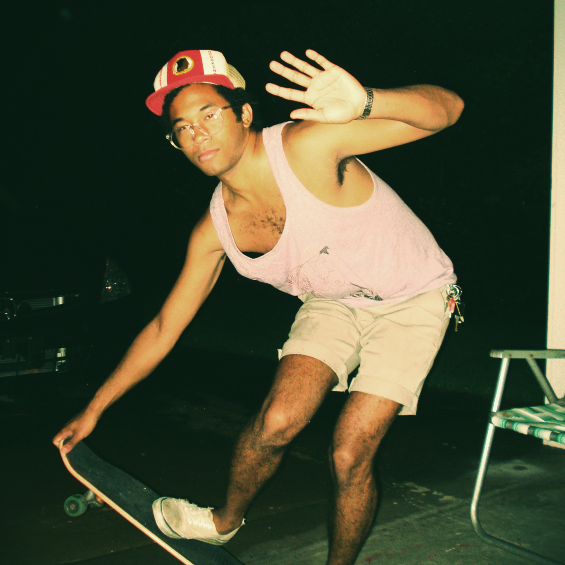
When you come out of the womb and your mama names you Chaz, life is going to be pretty cool. Mr. Chazwick Bundick is a child of the south, who from the sound of his uber laid-back synth melodies, must have grown up poolside, full pitcher of sweet tea attached at the hip.  The electro-musician goes by the moniker Toro y Moi— playing Mon/12 at Bottom of the Hill– and fully embodies the chillwave scene at its core, with layer upon layer of ambient wonder. And of course, Chaz is way chill.

Growing up in Columbia, South Carolina, Bundick layed low and created music in his bedroom as a young guy, taking inspiration from his parent’s luscious vinyl collection. Electronic and experimental elements of late ’70s new wave combined with his favorite artists, Animal Collective, Sonic Youth, J Dilla, Flying Lotus, and Daft Punk, for an antiqued space sound.He likes to think of himself as a composer, as opposed to a songwriter, producing complex layers of buried bass, fairytale melodies, surf guitars, and bewitching vocals.

His latest LP, Causers of This [Carpark, 2010] was released in February and is a total treasure box; a more electronic take on the usual beach soundtrack. Toro y Moi’s whimsical songs sound like they’re floating 10,000 leagues under the sea; cool, calm, and unaffected by gravity. Funny, because I soon find out that the guy doesn’t like water. 

Talking to Bundick over the phone was interesting– his mellow, musical stylings are a definite reflection of the 23-year-old’s unhurried, aloof temperament. Setting up the stage for a Philadelphia performance that evening, Bundick causally answered a few questions about life as a Southern Chaz and avoiding the sharks that loom.

SFBG: I read in a previous interview that if you could be any animal, it would be a dog or a shark. So, what kind of canine? 

Bundick: I like French Bulldogs, black Pugs, mutts, Jack Russell Terriers and wieners. 

SFBG: And what about sharks– I hear they freak you out.

Bundick: Well, I’m not a fan of jumping in the ocean. The water has to be clear, with light sand. I grew up going to a beach that had unclear water and I didn’t like going in– I like to see what’s in the water. I’m also afraid of sting rays. My friend stepped on one. And jellyfish. 

SFBG: Funny, because your sound is so easily compared to ocean-characteristcs. Yet you’re not an ocean fan.

Bundick: If I had to choose between living in the mountains or the beach, I’d definitely choose the mountains. 

SFBG: So what’s your music-writing process like? Do you dream of wooded slopes, crystal-clear streams and mountain lions?

Bundick: When I write songs I literally lock myself in my room. I won’t go out or talk to anyone. I go into songwriting mode. 

SFBG: For how long? Like a day? A week?

Bundick: Weeks or months. I think the longest was two months of not talking to anyone– OK, well, not in a crazy person way. That would make for a cool story, but basically, people ask me to hang out and I say, no sorry. I mean, I see my parents and stuff.

SFBG: So what have you been listening to while on tour?

Bundick: Let me grab my iPod and see…lots of soul and funk. Some weird house music. Riz Ortolani, an Italian composer from the ’70s who wrote the music to the movie Cannibal Holocaust. They show animals being killed– it’s bad. It was banned in a lot of places. Oh, and no, I didn’t watch it. My friend did. He told me. I wouldn’t watch it. 

SFBG: What have you been doing in between shows?

Bundick: Working on interviews. Drawing in my sketchbook.

SFBG: What do you like to draw?

Bundick: Numbers. 

SFBG: Uh, what? That sounds boring. Explain. 

Bundick: I like to draw numbers. Particularly the number two and the number five. Sometimes the number three. I’m not obsessed…I went to school for design, so I like the work with the shape and counter space, their arms and feet and different fonts.

SFBG: Wow, that actually makes sense. So what now? 

Bundick: I feel kinda weird. I feel like I might be kinda sick. And so I drank a bunch of orange juice and now I’ve got that gross, too much orange juice feeling.


I didn’t have any orange juice today, but I think I understand the feeling. Maybe he should’ve added a little vodka?


Toro y Moi w/The Ruby Suns and dreamdate

Mon/12, 8:30pm, $10

Bottom of the Hill

1233 17th Street, SF

www.bottomofthehill.com


SFPD’s Capt. McDonough defends rogue cops

15

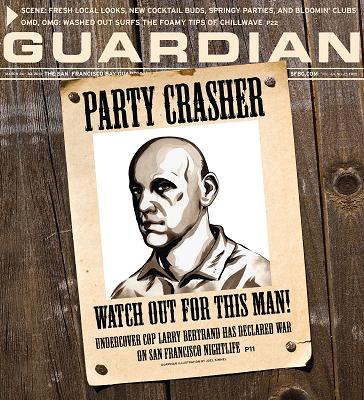
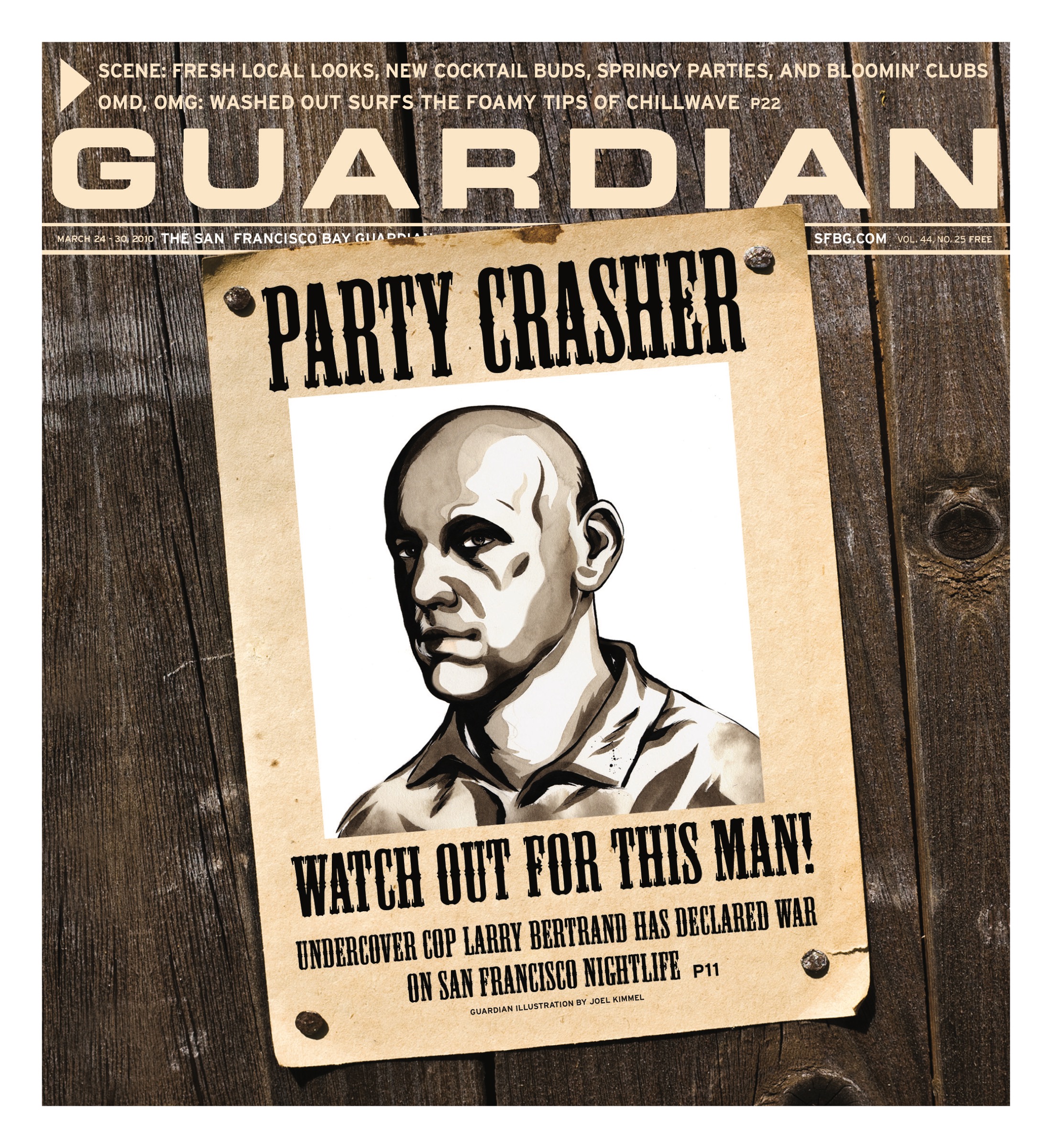
The San Francisco Police Department has steadfastly tried to ignore back-to-back cover stories in the Bay Guardian and SF Weekly that detailed the campaign of harassment and brutality against nightclubs and parties in SoMa by a pair of undercover cops.

The fact that those two cops – SFPC Officer Larry Bertrand and state agent Michelle Ott – have reportedly been absent from the scene in recent weeks might indicate that the department has heeded the outcry and put a leash on them. But now, in the “Captain’s Comments” in today’s Southern Station Newsletter, Capt. Daniel McDonough – who, along with Commander James Dudley, is believed by nightlife advocates to be behind the crackdown – has issued a full-throated defense of the pair’s actions.

Despite the fact that those actions (including repeated and selective harassment of certain clubs, illegal property seizures, threats and retaliation against complainants, and unnecessary force) have resulted in multiple legal actions against the city, McDonough claims they have somehow prevented unspecified “problems” and “violence and disorder.”

That negative claim is impossible to prove or disprove, but it’s certainly true that it was the arrival of aggressive cops at a January party that we wrote about that precipitated the “violence and disorder” that night.

McDonough writes, in full: 

There has been a recent deluge of articles about Nightlife in the Southern District.  The articles particularly focused on two fine individuals, Officer Bertrand of Southern Station and Agent Ott of the Alcoholic Beverage Commission. (ABC) 

One thing the articles didn’t have to focus on was the amount of violence occurring in the District at the late night venues.  This I believe has been directly related to the good work of these dedicated Officers.  In conjunction with the members of Southern Station, Officer Bertrand and Agent Ott would regularly inspect nightclubs and bars to ensure compliance with laws and codes that have been enacted to have an orderly establishment and to also stop the rampant amount of unpermitted parties that would arguably cause problems.  Because of their diligence and professionalism the amount of violence and disorder has been reduced.  Establishments that routinely would have numerous calls for services started to take responsibility to handle the influx of people and establish security procedures.  The benefits reaped by the citizens of San Francisco by the actions of Officer Bertrand and Agent Ott are measured in the lack of homicides shootings and knifings that haven’t occurred because of their good work.  They are to be commended.  I would also like to thank all of those establishment owners who communicate to me their positive relationships with those two officers.

Community Meeting 

Wednesday April 21 2010 6pm

Community Room

South Beach Harbor Pier 40

Original synth

33

marke@sfbg.com

MUSIC “In a time when people are becoming more and more isolated every day by the Internet, alone at their computers and staring at the tiny, sad glowing screens in their cellular hands, it only makes sense to me that we are all feeling a slight sense of loneliness and (hopefully) the desire for connection with others … Whereas 1980s groups responded to implicit cold, colorless alienation of the repressive regimes of Reagan-Thatcher-era politics and culture, today’s groups I think express a similar frustration responding to what I call ‘the culture of isolation.'”

That’s Pieter Schoolwerth, founder of Wierd Records, a New York City label dedicated to releasing records by contemporary acts that eerily mimic the sounds of obscure electronic new wave, in a recent interview with Austrian music journal Skug. Oddly in the context of connection, he’s talking about some of the most deliberately cold, enigmatic, bleak yet beguiling music ever produced — “lost” underground European and American music that came out roughly between 1979 and 1986 (if it came out at all), was inspired by goth, industrial, and synthpop giants like Throbbing Gristle, Joy Division, Bauhaus, the Cure, and Depeche Mode, and is only being rediscovered now.

It’s igniting fierce interest, with musicological fanatics digging up spooky swaths of unknown angular gems and a slew of current bands channeling the sound. Originally made in decaying urban centers with then-newly-affordable analog synthesizers and drum machines by dozens of often untraceable musical mavericks — Ausgang Verboten, Esplendor Geometrico, Das Kabinette, Eleven Pond, Nine Circles, Zwischenfall, Gerry and the Holograms — these unearthed and unearthly tunes from decades ago are beginning to seep into the Bay Area scene via a handful of excellent compilations, club nights, and musical visionaries. Can something be retro if hardly anyone heard it the first time? That’s just one of the intriguing questions that springs to mind. Meanwhile, humans are dancing. Here’s a mix of some of the originals:

ANGULAR COLDWAVE LAUNCH MIX by Angular Recording Co

COLD CONNECTION, CHAIN REACTION

This bracingly unfamiliar music (or rather, slightly familiar — you think you’re hearing some bizarre 1981 B-side by Soft Cell or Visage but it turns out to be a crazy one-off from Columbus, Ohio from that same year) was usually grouped at the time into three fuzzy genres that overlapped at many points, sharing among them a DIY spirit, a dystopian view of the future, an urge to map the melodramatic onto the automatic, erotic astringency, and pretension without pretentiousness. Yes, much of it veers into “Sprockets” territory, but that’s actually part of the appeal.

Dark wave was an umbrella term for goth rock, early industrial, and darker synthpop. It grafted lamentation and cavernous basslines over post-punk’s angular angst and icebox oddity, and was popularized by groups like Fad Gadget, Front 242, and Chris and Cosey and at clubs like London’s seminal Batcave. Cold wave was the French version of dark wave that skewed toward more Pong-like synth figures, fizzling chords, studied malaise, and gnomic haiku. (“Business man/Yet you kill the boss/Computer programs/Shadows in the night,” Lyonnaise duo Deux disaffectedly intone on 1983’s unshakeable “Game and Performance.”) Synth wave, or minimal synth, was a kind of prickly disco: chromatic, sparsely produced, brooding and moody, yet often quite catchy and dance floor-oriented.

All three genres are now generally lumped together as “wave” (or sometimes “retrograde”), which can include a vast array of other period sounds, from John Zorn-like no-wave jazz explosions to Dead Can Dance spooky-tribal incantations. Basically, if it feels like you’re listening to a late-night college radio program somewhere in the Midwest in 1984, one possibly called “Flash Frequencies” or “Shadow Talk,” you’ve caught the uncanny wave gist. If you imagine yourself a fishnet-gloved extra in the movie Liquid Sky who pronounces “paradise” as “pah-rahd-eyes,” then you definitely have.

Dark wavers Brynna and Domini at Club Shutter. Photo by Sadie Mellerio

But just because the sound aimed for frigidity doesn’t mean it didn’t build community. Wave acts may have been what some would call “unbranded,” but they operated within close-knit networks: cassettes were passed hand-to-hand, recording studios were shared in warehouse-based artists’ communes, fans around the world braved dangerous parts of town to attend wave-centric club nights. The music itself attempted to humanize the arctic pitch of analog synths by infusing it with longing, restlessness, ennui, and gloom.

Vice Angular “This is Cold Wave” Mix

Today, that naive sincerity, refreshing lack of self-conscious irony, and marketplace virginity translate into authenticity, appealing to retro aficionados who vomit a tad at goth’s Hot Topicality, the macho posturing that torpedoed industrial, or the Polly Estherization of new wave. (Like techno, soul, and disco before it, new wave retro is finally purging itself of excess baggage and mainstream complications by going minimal and original.) Dusted-off waveforms and hyperactive web forums attract a network of virtual seekers and posters who salivate at each discovery. Schoolwerth may be right about wave’s cry against a culture of Internet isolation — and the turn toward analog is a specific rejection of the digital — but like an anxious clan gathered around a silicon-chip fire, its current fans watch anxiously online for freshly exhumed and re-chilled visions to appear. Then they go play them at clubs. Here is something old that seems truly new.

FOREVER EXHUMED, FOREVER ORANGE EYES

Wierd Records’ contemporary roster of disquieted simulators, including the almost paranormally attuned Xeno and Oaklander and Led er Est, has been gaining global club-play traction — something many of the original artists, who drifted off into other, often fascinatingly mundane lives, could only have hoped for. (One example: Lidia the Rose, one half of Dutch act Nine Circles, abandoned musicmaking in the early ’80s to raise “a half dozen” children in a commune-like setting. It was only after one of her sons Googled her name that she realized there were fans of her extremely limited, cassette-only output. She has since started making music again.) And wave affectations have garnered larger attention from the breakthrough of experimental synthpop band Cold Cave, which draws on the sound’s pallid idiosyncrasies. “Hear sounds about yesterday’s pain today,” the band’s MySpace deadpans.

Notable contemporary Bay Area wave acts include the excellently jerky Muscle Drum, founded by long-term wave-proponent Rob Spector of the group Bronze, fog-shrouded darkwave duo Sleeping Desiress, cinematic dirgers After Dark, and exquisitely anguished quintet Veil Veil Vanish. The East Bay’s Katabatik Sound System has been producing lurching experimental-industrial music and events for a while, and V. Vale’s Re/Search crew has been exhuming rare tunes forever. A particular favorite around the Bay Guardian office lately is the Soft Moon, a melancholic, pitch-perfectly crepuscular project of punk veteran and graphic designer Luis Vasquez.

The Soft Moon

“Honestly, being associated with the wave phenomenon was a little surprising to me at first,” Vasquez told me, balking, like many retro-contemporizers I talked to, at being associated with any kind of scene. “But I think I understand why. My instrumental formula is similar because of the use of drum machines, synthesizers, rhythmic bass lines, and somber melodies. It could also just be the overall feeling my music has. I’m still not quite sure.”

http://www.youtube.com/watch?v=Ufcfo9K1yfI

On the classic side of things, two just-released, high profile compilations — The Minimal Wave Tapes (Minimal Wave/Stones Throw) and Wierd-curated Cold Waves and Minimal Electronics Volume 1 (Angular) — along with recent German comp Genotypes (Genetic Records) have made underground synth rarities more accessible to potential wavers.

“I was exposed to new wave at a young age via my older brother’s small collection of cassettes,” NYC’s Veronica Vasicka of the Minimal Wave label wrote in an e-mail. “Later I’d sneak out of my parents’ apartment at night to go dancing in the East Village. I really associate those teenage days of first discovering record shops and old VHS tapes of bands like Throbbing Gristle with the inspiration that led me to launch the Minimal Wave label.”

Vasicka coined the term minimal wave to encompass her fascination with both cold wave and minimal synth sounds. Her long-running Sunday night East Village Radio show has served as a beacon for American synth fans, and the incredible response to her extensive Web site (www.minimal-wave.org) has established her as the point-person for the movement. She has her own theory about why the sound seems right:

“On one hand, I am surprised that minimal wave has been so easily welcomed in this day and age. But on the other, and when looking at things from an economic standpoint, there’s a distinct parallel between what was happening during the late 1970s and early ’80s and now. The weak economy that led to the recession peak in 1983 is similar to what has been happening during the past several years. And it seems that cultural and artistic output tend to be affected by economic and social struggle. So perhaps this context has provided the openness necessary to embrace minimal, DIY synthesizer music.”

PASSING FIRES, STRANGE DESIRES

I’ve just entered Sub Mission Gallery for underground queer punk party Sissy Fit. The energy is edgy. Clouds of smoke drift in from outside. Patrons in black sway on the dance floor and eye each other from the benches lining the bare walls. DJ Pickle Surprise, whose style ranges from hardcore blasts to camp classics, puts on a throbbing track by early ’80s Marseille synthers Martin Dupont and I’m instantly transported back to my shadowy youth, spent skulking around the checkerboard dance floors of downtown Detroit clubs Bookie’s, Todd’s, and Liedernacht. I whip an imaginary cigarette holder to my pursed lips, checking to make sure my phantom pillbox hat is properly tilted. He follows that up with a selection of wave tracks old and new, including Storüng, Oppenheimer Analysis, and 2VM, that transforms the joint into an electro-sepulchral time portal. The added twist to this nostalgia trip is mystery — the music ventures beyond the “‘remember the 80s party” canon and into some uncanny partial-recall state.

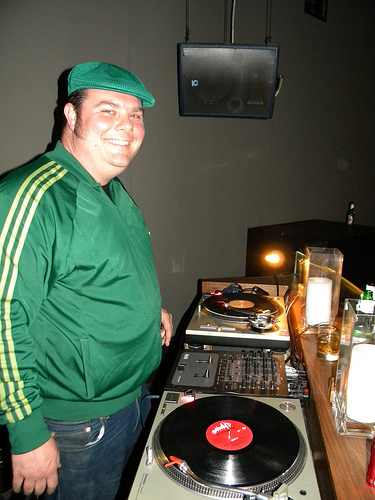
DJ Pickle Surprise

“I find I’m playing this sound more and more,” Pickle Surprise, a.k.a. Joe Krebs, told me. He got into wave after attending one of the parties Wierd has been throwing in Brooklyn since 2003. “It can call up visions of lasers and line-dancing robots, but after getting to know it more, there’s something less cold or android about it, more of a human touch. It’s analog. There’s something supernatural as well. Like Videodrome, where you’re up in the middle of the night and get pulled into something on television. Something haunting that recalibrates you.”

“Did the passions of the artists shape the way the technology was used, or did the technology shape the people using it? NERD!” DJ Nary Guman, a.k.a. Joe Polastri, teased over e-mail. Along with DJ Inquilab, a.k.a. Nihar Bhatt, he puts on the monthly wave-friendly Warm Leatherette. They started their own party early last year because they found their tastes didn’t quite fit in anywhere. “Once I started digging I found out just how vast the field was,” Bhatt added. “It’s exciting to have something that can be danceable, experimental, popular, and punk at the same time.”

Other San Francisco parties that have embraced the sound include the monthly Shutter (www.myspace.com/clubshutter) at Elbo Room, which packs in the kohled and the beautiful with hits from Sisters of Mercy and Fields of the Nephilim among rarer tracks. Local band Jonas Reinhardt’s Synth City, every last Thursday of the month at the Attic (www.jonasreinhardt.com) mixes a wave feel into atmospheric krautrock and new age rambles. And the Radioactivity happy hour at 222 Hyde (www.222hyde.com) celebrates “low-budget synths and Cold War dance parties.”

LE DECADENCE ELECTRONIQUE

The party most faithful to the retrograde spirit, however, is the energetically opaque Nachtmusik, put on by DJs Josh Cheon, Justin, and Omar. Chilly green lasers strobe live performers, wave-o-philes gather in corners to trade track knowledge, and open-minded dancers try out new-old moves to alien beats. (Surprisingly, this insular music sounds really good loud in a crowd.)

Josh Cheon of Dark Entries Records. Photo by Jon Rivera

If anyone’s the heart of the Bay wave scene, it’s Cheon. One of our most important amateur musicologists, he was integral to the disco revival of the ’00s, tracking down and conducting in-depth interviews with gay bathhouse-era survivors and then moving on to international wave. For him, the music summons youthful memories of dancing at NYC’s the Bank to Clan of Xymox, Q Lazzarus, Cetu Javu, Wolfshiem, Beborn Beton, and VNV Nation. “From the first notes of Ministry’s With Sympathy and Depeche Mode’s Speak and Spell, I’ve been a sucker for synths,” he told me, laughing.


Death Domain by darkentriesrecords

In 2009, Cheon started Dark Entries Records (www.darkentriesrecords.com) to release some of his finds, including Second Decay, Zwischenfall, Those Attractive Magnets, and upstate New York’s Eleven Pond, whose “Watching Trees” has become a wave anthem of sorts. (He found Eleven Pond through a comment one of the members posted on SF synth collector Goutroy’s A Viable Commercial blog, goutroy.blogspot.com.)

Staying true to the “DIY vinyl retrograde” spirit, Dark Entries releases come in hand-numbered batches of 500, and for the most part the digital rights are kept by the artists themselves. There are no CDs.

He shrugs off the possibility that there’s little left to discover. “It’s like gold mine after gold mine,” Cheon told me. “There’s just so much out there — even the artists themselves are surprised to be reminded of this time in their lives that they’d mostly forgotten. It’s actually really touching when they find out there’s an intense interest in what they did in their youth. They’re just amazed.”

Later this year he’ll be releasing a Bay Area Retrograde (BART) compilation, highlighting our own historical wave purveyors. “What many people forget is San Francisco’s rich synthpop and new wave history, with bands like Voice Farm, Tuxedomoon, the Units, and the Club Foot scene for starters. [Factrix, Minimal Man, and Los Microwaves are some others.] But that’s just scratching the surface. I mean, who knows what great tracks are waiting to be heard? And what amazing stories behind them.”

NACHTMUSIK

Wed/14 and second Wednesdays, 10 p.m., $3

The Knockout

3223 Mission, SF

www.theknockoutsf.com

WARM LEATHERETTE

Fri/16 and third Fridays, 9 p.m., free

Space Gallery

1141 Polk, SF

www.myspace.com/warmleatherettesf

THE SOFT MOON

Tue/20, 8 p.m., pay what you can

21 Grand

416 25th St., Oakl.

www.myspace.com/thesoftmoon


RJD2’s music is a trip– even for him

0

Skip the Blockbuster run of predictable action flicks and let an RJD2 album call the shots. The record may spin, but your mind will cartwheel with scenes of drama, horror and thrill of your choosing. Allow the blaring horns to signal a wild chase, the sampled soul to spur images of a powerful protagonist and the hip-hop bass to conjure up a dreary, urban setting: the music of RJD2 –playing Wed/7 at The Independent–  is a mind-driven movie reel.

Ramble John “RJ” Krohn has been making music as RJD2 since 1993, switching up his perfectionist tainted DJ process by not only sampling everything from ’70s disco and movie themes, but by also using his own vocals and live instrumentation. Last year RJ took on the boss role and started his own label, RJ’s Electrical Connections, putting out his fourth and latest record The Colossus in January. 

Colossus begins with “Let There Be Horns“, its hot Latin drum beat, humming strings, tiptoeing chimes and heavy synths immediately filling my mind’s projector with images from an underground business deal. I imagined film flickering with shots of Miami mobsters, blaring brass begetting cash exchanges and the electric guitar solo warming of police presence. I heard the medley of Russian-style strings as an audible indication of a fight between the pastel suited-men and the story’s dirty antagonists. The synth seemed to indicate when life was good in palm-laden city and the sampled clapping at the song’s end wrapped up my vision with high hopes. 

Each song on Colossus has a similar, industrial, urban story for me; I see factory workers, trains, smog filled cities and lover’s quarrels each time RJD2’s beats play. Is this weird? Maybe my over-active imagination should get back in the closet? I was hoping that RJ himself would understand.

Talking over the phone from his Ohio home, RJ was enjoying a small window of free time by repairing a broken synth, which he admitted was “pretty nerdy.” Not as nerdy as my “visions”, I thought. I asked him questions about owning the label and other slightly boring items, flirting around what I really wanted to ask. I felt like a kindergarten student with my hand-up, squirming with a question. And then, I just blurted it out. 

SFBG: So…do you ever think of your music as a story? I tend to think of the sounds, instruments and samples as characters– interacting, meeting, fighting, making love? Antagonists and Protagonists in a movie scene. Do you think of it like that? 

RJ: (Giggle). I think of things in a similar manner, yes. 

SFBG: (Sigh of relief).

RJ: The fun of instrumental music for me is the intention of release. The arrangement of the song is the most important thing– how it progresses. The tension and the release. Building drama. The medium I work in is drama. Two things might be working with each other, or against each other, and thinking of them as characters or playing roles makes sense to me. There’s a relationship between the two parts: between the drums and the groove, the intro and the base of the song. The bridge, the breakdowns, each section– where they fall next to each other and the transitions between them. 

SFBG: So if not in story-writting mode, where does your head go when you put together your songs?

RJ: I like to let things unfold on its own accord. I don’t like to force it. I find it fun and interesting and rewarding to let it take me along for the ride. I’m not the kind of guy who starts with a blueprint, or gets lyrics, chords and melodies in their sleep– I’m in total awe of that. Almost all of the time I’m recording, it’s an exploratory project– I don’t know what I’m looking for, shooting for as I go. I like to get the sensation that the experience is like going along for a ride in someone else’s movie, trip or story. 

No need for a pill, puff or embarrassment– looks like everybody gets a free trip from RJD2’s music.


RJD2

Wed/7, 8pm, $20

The Independent

628 Divisadero, SF

www.the independentsf.com


Game Theory: San Francisco ShEvil Dead vs. Oakland Outlaws, 4/3/10

6

Caitlin Donohue isn’t a sports writer. But she sure likes to win. Check out the last installment of “Game Theory” here. Oh, and give us a shout if you’ve got a big game coming up in the Bay.


I expected a lot from my first roller derby. Clotheslining, fishnets, snarling. Beer. I had high hopes. And I found all that — and believe me, I found it good, you don’t get $3 Pyramid Ales at just any sporting event. But I also stumbled unwittingly into a world of highly unorthodox female empowerment, a world where ladies have serious thigh muscles and sweat blithely through their heavy makeup. It’s a place that reclaims sports for the XX chromosones of today. And I liked it.


Clearly, the closer a sporting arena’s vibe is to that of the Thunderdome, the better your spectator experience. At Fort Mason Center’s Herbst Pavilion, where the ShEvil Dead was set to take on the Oakland Outlaws (both teams in the Bay Area Derby Girls’ League), there was little room for the genteel derby onlooker — if such a thing does indeed exist. 


The chaos and din of the standing room only bleachers and the rows upon rows of fans sitting on the concrete floor went far to blur the lines between the audience and the women tearing circles around the pink tape demarcated oval track in the middle of the Pavilion. The energy was super hyped, channeled completely towards the female gladiators on the floor. Handmade signs were held up lauding individual players, and cheap tamales and booze vendors (Maker’s Mark is a sponsor) confirmed that derby lacks much of the pretense, and ego that mar other sporting events. The arena had completely sold out and the crowd of 1,600 set a new record for league attendance.


A ShEvil Dead skater beats the drum for the derby bout against the Oakland Outlaws to start


The bout began with some enthusiastic theatrics from both sides– glory laps taken by each ShEvil Dead team member as her name was announced by a commentator that was barely audible over the reverberating boos and cheers from the crowd. Derby games only come every once in awhile — the next match for the Outlaws isn’t until May — so every one counts. Particularly this one. 


“Last year, we lost a coach and a lot of players,” says Dead captain/coach Windigo Jones, whose online player bio explains she grew up in Northern Ontario, “chasing ever larger prey through the northern boreal forests.” This bout was an opportunity for the squad (which had been down to “eight or nine players, when a normal team has something like 22,” according to Jones) to show the world how far they’d come. 


It’s all a touching story for Jane Hammer, captain/coach of the Outlaws — but not touching enough that she wanted the other team to win. “We were a little nervous for this one,” Hammer tells me.


The ShEvil Dead do indeed make the game interesting. Watching the game from the safety of the sidelines, I didn’t see as much, oh I don’t know, animosity as I had expected in the player-on-player collisions, but there’s no doubt that these women are playing to win. Each play, or “jam” is a long, grinding affair where the elected “jammer” must slip through the pack of players from both teams, lapping everyone to get points before she is inevitably shoved careening from the marked track.


Oh yeah, we’re jammin’. I wanna jam it with you


There’s a lot of hip throwing, and grunting — sights and sounds that fit into what I expected of a derby bout. But there was also an unexpected element. These ladies were elite athletes. Skating quick circles around a track barely larger than a basketball court is no joke — and they were doing it while being buffeted and beaten by a bevy of butch beauties (sorry, I got catch up). They had the healthy stink of women un self consciously immersed in sport, despite their boy shorts and red lipstick.


The climax comes in a pivotal play towards the end of the second period. Hammer, jamming for the Outlaws, goes to the penalty box, and the Dead’s jammer, Knock Knock, gets knock-knocked off her feet, hard. So hard, in fact, that the starred spandex helmet panty that marks her as the jammer flies off her head. 


The jammer hat is what officially defines the jammer in the derby rule book. Whoever has that stretchy diaper on their head is the motor behind their team’s game. And without a designated jammer, your team is totally ass backwards . But just a week ago the Dead had practiced plays involving passing that jammer panty, and veteran Mexican Jumping Mean recalled the lesson instantly during the bout. She  swooped in for the star, replacing it on her own helmet, and racked up some vital points for the Dead before the Outlaws had time to react.


 “Only a real veteran would have thought to do that,” says her captain/coach Windigo Jones. “I was so proud of her.” The Outlaws ended up winning the bout, but only barely. “It came down to the last jam,” says Hammer.


Later on, I chatted with both coach/captains about the match, and what derby has meant to them. “This is a kind of empowerment you just can’t find anywhere else,” says three year veteran Hammer. She started skating while growing up in Las Vegas, where “you hung out at the rink, because that was the thing to do.” She quickly got into the scene upon her arrival in the Bay Area. 


Nowadays, she’s a legend. “Oh, everyone knows who Miss Jane is!” says aspiring roller derb-ette exclaims as she guides me to the locker rooms at half time. 


Half time in a close game brings a chance for the Outlaws to rehydrate, refocus, and reamp for battle


The league’s set up seems to encourage a culture of respect and camaraderie between players of all levels. It takes a shape similar to that of Manchester United; teams like the Outlaws and ShEvil Dead compete against each other in the regular season, but often have league wide practices together and combine their best players to represent them on the Bay Area Derby All Stars. That’s the travel team which rolls hard for the Bay against Women’s Flat Track Derby Association squads from all over the nation. The All Stars, of which Jones and Hammer are both members, are currently ranked 20th in the country, down from a standing in the top ten not too long ago. “We have a lot of work to do,” admits Hammer.


“The crowd we had Saturday was totally unexpected for me. It’s amazing how much this league has grown over the past few years,” says Jones, who entered the league around the same time as Hammer. It was a time when, Jones says “the league would take on pretty much anyone who was willing to learn the skills — they were pretty desperate for players.” 


That’s not the case anymore. Hammer hesitantly attributes the soaring popularity of derby in part to movies like last year’s Whip It, whose sexy depiction of the sport might have contributed to the sell out crowd at Saturday’s bout (the attendance of 1,600 was a league record). Still, the movie seemed to “Hollywood” the derby scene a little. “Underage skaters? That’s not really what we’re about,” Hammer tells me. This fledgling sport has a lot to deal with when it comes to how it will be represented in mainstream consciousness.


But there’s no doubt that more and more ladies will be getting their kicks in heavy eyeliner and elbow pads. BAD has announced that it’s putting its new West Oakland practice space to use this summer with a rec league, designed not only for retired league veterans but also “girls who might not have the most advanced skate skills. We’re going to have an introductory course to teach people the basic rules,” says Hammer. 


Like all the derby stars I talked to, the coach of the Outlaws was invested in the contributions that rookies make to her league’s future. The rec league seems like a great opportunity to evangelicize the uplift (and rock hard leg muscles) that come from a life in the derby. Just get your game face on, ladies. Hammer’s insistent that the rec league be no “walk in yoga class.” “We’re going to evaluate people’s skills like the system we use for who makes the [competitive] league. We have to add everybody onto our [practice space’s] insurance, so we’ve got to have some discretion when it comes to who plays. It’s a safety thing.”


Bay Area Derby Girls’ next league game:


Oakland Outlaws vs. TBA


May 1 doors @ 6:30 p.m., game @ 8:30 p.m., $10-12


Herbst Pavilion


Fort Mason Center, SF


www.bayareaderbygirls.com


Getting into the Afro-psych groove: Witch

1

The juicy goodness of excellent psych is worth revisiting no matter how far back it was released — hence this darting glance at Witch, the Zambian ‘70s rock fivesome, and its 1975 full-length, Lazy Bones!!,  released a few months back by QDK Media. Licensed from vocalist Emanyeo Jagari Chanda (the last surviving member of the group is now a foreman at a uranium mining operation in a remote Zambian village) , this gem from the so-called Zam Rock scene rumbles as fiercely as any combo off an early Nuggets comps (see badass rump-shaker “Off Ma Boots”). There are  plenty of wah-wah-wonderful super-fuzz guitar rave-ups (“Tooth Factory”) here, mixed in a blood-pumping dose of James Brown-style funk (“Little Clown”) and some Mahavishnu-touched jams (the levitating “October Night”). Worth comparing to the recently reissued work by Death, the lost black rockers of Detroit? Perhaps, though Witch turns out to be in a fabulous league of its own — spurring me to search out other ‘70s African rock obscuros like Blo and Ofege.

Start your “Vinyl Addiction”

1

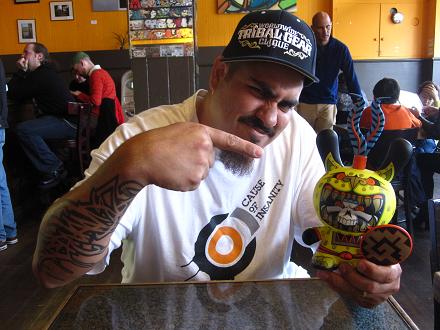
“Here’s my Jaguar Warrior.” Jesse Hernandez pulls out his toy, and sets it on our café table with a broad smile. Two women at the next table over are immediately intrigued. “Oh, that’s beautiful! What is that?” they coo. Hernandez seems flattered by the compliments, and patiently explains that it’s a vinyl toy and that he designed the elaborate yellow cat figurine with the sweeping blue plumes and fierce, fanged skull peering out of its face. And yes, it’s pretty cool.

One gets the impression that, as host of MYX TV’s new show “Vinyl Addiction,” (who celebrates its launch party and the release of an exclusive Hernandez toy Sat/3 at New People) Hernandez is used to explaining to people just what these cute/creepy little dolls are. He certainly got me to understand their appeal.

“There’s a multi-faceted quality to [vinyl toys],” Hernandez explains. The toys, which are often designed by well known artists, are manufactured in runs ranging from the mass release to the limited edition, to the one-off “custom,” hand painted by the artist themselves. Springing initially from the heavy character culture in Japan and Hong Kong in the late nineties, their designs can range from precious to unsettling, from manga to menacing. “They’re usually both,” says Hernandez “they’re cute, but really messed up. Or it’s dangerous and cute.” 

It’s easy to see why the seniors at the next table were intrigued by Hernandez’s design. The “jaguar” design is painted onto a bunny doll, the cat ears superimposed on the floppy rabbit ones. Though simplified from many of his custom runs, the artwork on the doll is at once, fierce, tribal and modern. It’s only slightly adorable when taken in with its globular cartoon rabbit form.

Hernandez has dubbed his style “urban Aztec,” and he deploys it in a dizzying array of mediums. He creates beautiful drawings (“everything I do is based on drawing,” he says) and fine art paintings of Aztec warriors and mythological figures, reflecting his Yaqui/Chicano heritage. “You have to push the limits,” he says. “I wanna make something timeless.”

He shows a slightly more city-oriented side in his animated sequences, painting a picture of life in the Bay Area, where he grew up, with “The Nutshack,” his original MYX series that he art directs and co-created. Hernandez says many artists come to vinyl toys as an offshoot of their production of other kinds of art. “Vinyl toys can be a stepping stone, a rite of passage for an artist to have something [mass produced].”

With all these projects, it baffles the mind that Hernandez could take on another job. But it’s clear that “Vinyl Addiction” sprang from his respect for the vinyl toy movement- and a desire that an artist be the one to tell their story. 

Most episode shoots, it’s just him and the cameraman. Though he now holds the titles of the show’s host/producer/creater/director/editor/animator, Hernandez was loathe, at first, to become the oncamera host of “Vinyl Addiction.” But now that two years after shooting the pilot with co-field producer Roland Posadas, he sees his involvement as key to part of the show’s effectiveness. “I think it brings out that level of authenticity,” he says. “This is my culture. Everyone knows I’m a part of it, and I want everyone to be shown in the best light possible.” 

His expertise of the topic is evident in the preview reels of the program, which will air nationwide through On Demand and in MYX’s three urban markets of the Bay, Orange County and Northern Virginia. Hernandez goes to his colleagues’ gallery and custom shows, profiling artists and companies involved in making the toys. 

“The hardest challenge,” he says, was to figure out a way to cover the topic in a way that made sense to people who didn’t know much about vinyl toys, to educate them on the art form. He resoved the issue with “Vinyl Vocab” segments, which take a moment to teach viewers the definition of one of the scene’s specialty terms. Hernandez’s voiceovers during the lessons are done in a faux British accent, which seems to poke fun at the concept of codifying a scene that, up to now, has been pretty esoteric.

But Hernandez is sure that the popularity of vinyl toy art is on the rise in America. He says mainstream companies are picking up on the toys’ aesthetic to appeal to consumers. “So many people are into the look [of vinyl toys], even if they don’t understand it. It’s an unknown art form.” Two years ago, he told MYX that they had to produce “Vinyl Addiction” to be in on the first wave of the toys’ growing US popularity.

I’m going to have to agree with him that it’s hard not to love the vinyl doll. Even I, with whom the verb “collect” and the concept of the “collectible” sit poorly due to my inveterate nomadism, couldn’t help but paw at some of the more striking pieces. Hernandez met me at Kidrobot, a store on Haight street that’s been selling it’s own line of vinyl toy figurines and T-shirts since 2002. He tells me he always used to love coming here to see the new releases. 

Inside, the stark white walls are lined with glass cases full of nicely displayed vinyl friends. Here, a couple of blasé kids sumple, only their shaggy heads and limbs protruding from cans labeled “Boring Juice,” there, an adorable rhino brandishing a revolver. Not to mention all the spikey, snarling things that are just… so cute. 

Suddenly, I can understand the motivation of all the friends I have with vast toy collections. They’re witty. They’re creative. They’re art. I like them. And, judging from the drive of Hernandez and “Vinyl Addiction,” I don’t think I’ll be the only one.


“Vinyl Addiction” launch party

Sat/3 7-10 p.m., free

New People

1740 Post, SF

www.vinyladdiction.tv


City limits

0

arts@sfbg.com

FILM Looking at a map of Paris, the city’s rings resemble those of the giant Sequoia cross-section in Vertigo (1958), the one Kim Novak points to saying, “Somewhere in here I was born … and here I died.” It’s a touchstone scene for Chris Marker, one he recasts in both La Jetée (1962) and Sans Soleil (1983), though the Paris metaphor is prompted by his lesser known essay film, Le joli mai (“May the beautiful,” filmed with the venerable cinematographer Pierre Lhomme). The usual critical operations fail a filmmaker so fruitfully difficult to pin down, so:

C is for cat, Marker’s spirit animal from the beginning. Grinning or otherwise, “a cat is never on the side of power.” The feline kind presents respite and provocation in his films, and solidarity only glimpsed. To quote Montaigne, Marker’s ancestor in essay, “When I play with my cat, how do I know that she is not passing time with me rather than I with her?”

H is for happiness, the pop-survey platter on which Le joli mai turns. “Are you happy?” “Will you go on being happy?” The questions are pointedly pat, but Marker’s sync sound inquests press into speculative existentialism.

R is for Rouch, Jean, whose Chronicle of a Summer (1961, codirected with Edgar Morin) is Le joli mai‘s most obvious predecessor. In this film, ethnographer-poet Rouch turns the lightweight 16mm camera (a then-new invention) back on his own means of gathering information about “this strange tribe living in Paris.”

I is for interview: insistence and incredulity.

S is for statistics and the survey, the source of Le joli mai’s troubled lyricism. A concluding litany of figures (4,000 kilograms of butter, 600 tons of falling dust, 14 suicides) holds a strange mirror up to the urban organism. S is also for the spider crawling us across a dully pontificating Parisian’s shoulder—breaking decorum, the camera zooms in on the arthropod, delightfully bored. And also: Simone Signoret’s voice; scavenging the street’s interruptions and silences; the situationists, especially Guy Debord’s psychogeographic maps of Paris; and the speed of thought.

M is for May, the month of Le joli mai‘s game of hopscotch. It seems an auspicious choice given the famous Paris May still to come, but then again, as Marker argues in A Grin without a Cat (1977), 1968 came late. M is also for Michel Legrand’s drizzly score and Masculin féminin (1966) — Godard’s film owes a clear debt to Le joli mai‘s upended reportage.

A is for Algeria, Le joli mai‘s structuring absence. Filmed as military operations drew to a close, the shadow of occupation hangs over the stock market trading floor, a young couple’s difficulty talking about themselves, and, finally, the devastating testimony of a young Algerian man living in France. As for contemporary parallels of a civilian population’s repressing atrocities carried out in its name, let us simply say the complacency documented in Le joli mai still needs toppling.

R is for revolution, an endeavor in form and content. We love Marker for being the rare eyewitness not to reduce the 1960s to disavowal or twinkling hagiography, and for his willingness to draw different lines in the sand.

K is for Krasna, Sandor, one of Maker’s most reliable aliases, a migrant intellectual. Lately he has taking to posting elegant black-and-white stills of Paris street protestors, circa 2003, on his Flickr account. Five decades on, Marker still dissects the crowd, searching the “sum of solitudes” described in Le joli mai.

E is for essay, the quicksilver genre straddling verb and noun. The fact that La Jetée is still Marker’s best known film means he’s not well known (in the States, anyway), but how many consciousnesses has he burned?

R is for revision since “You never know what you may be filming.”

POETRY MEETS POLITICS: THE ESSAY — CHRIS MARKER’S LE JOLI MAI

Thurs/1, 7 p.m., $5

Phyllis Wattis Theater

San Francisco Museum of Modern Art

151 Third St., SF

www.sfmoma.org

All in the family

0

arts@sfbg.com

FILM The Rizzo family of City Island, N.Y. — a tiny atoll associated historically with fishing and jurisdictionally with the Bronx — have reached a state where their primary interactions consist of sniping, yelling, and storming out of rooms. These storm clouds operate as cover for the secrets they’re all busy keeping from one another.

Correctional officer Vince (Andy Garcia) pretends he’s got frequent poker nights so he can skulk off to his true shameful indulgence: a Manhattan acting class. Naturally, perpetually fuming spouse Joyce (Julianna Margulies) assumes he’s having an affair. Daughter Vivian (Dominik García-Lorido) is back home from “school” on “spring break,” quote marks required because in fact she’s dropped out to work at a strip joint nearby, an endeavor hinted at by her newly extra-perky breasts. The world class-sarcasms of teenager Vinnie (Ezra Miller) deflect attention from his own hidden life as an aspiring chubby chaser crushing on a plus-sized schoolmate and transfixed by the huge neighbor (Carrie Baker Reynolds) who’s a live webcam star among fanciers of BBW (Big Beautiful Women).

All this (plus everyone’s sneaky cigarette habit) is nothing, however, compared to Vince’s really big secret: he conceived and abandoned a “love child” before marrying, and said guilty issue has just turned up as a 24-year-old car thief on his cell block. Tony (Steven Strait) is eligible for provisional parole, but since his mother (fondly recalled as “a drunk and a whore”) is deceased, he has no family to take him in.

Ergo, Vince brings him home, explaining to no one (Tony included) their wee biological link. But as dad spends increasing time “playing poker” — i.e. hanging out with fellow would-be thespian Molly (Emily Mortimer) and even scoring a Scorcese audition — vengefully-minded mom has time to notice that frequently shirtless new handyman Tony has a Body of Death. Their flirtation includes her sympathetic comment, “Being in prison and not being able to smoke? That’s like being in jail!”

City Island advance-screened last week a couple nights after Hot Tub Time Machine. While it will be lucky to make a small fraction of Hot Tub‘s multiplex dough, it offers cheering, contrasting evidence that not all American live-action movie comedy outside the Judd Apatow realm is by and for imbeciles. Writer-director Raymond De Felitta made a couple other features in the last 15 years, none widely seen; if this latest is typical, we need more of him, more often.

Perfectly cast (who knew Andy Garcia could be funny?), City Island is farcical without being cartoonish, howl-inducing without lowering your brain-cell count. It’s arguably a better, less self-conscious slice of dysfunctional family absurdism than Little Miss Sunshine (2006) — complete with an Alan Arkin more inspired in his one big scene here than in all of that film’s Oscar-winning performance.

CITY ISLAND opens Fri/2 in San Francisco.


A 40-year Last Gasp that’s getting stronger

0

By Cécile Lepage

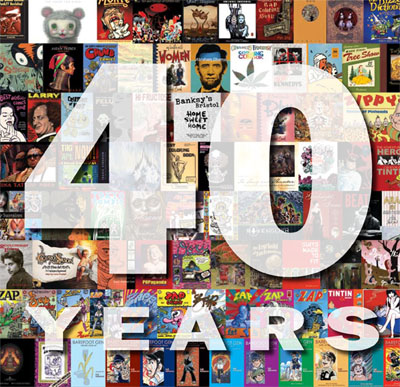
Last Gasp, San Francisco’s landmark independent and underground publisher, is turning 40. To celebrate this feat – in four decades, Last Gasp has spawned more than 300 comics and 250 books – it is throwing a party and an art show Thurs/April 1 at 111 Minna Gallery.

Who dared wager, in the mid-1970s, that Last Gasp would survive the withering of the underground comix scene? Head shops, the main outlet for unedited explicit sex-, drug-, and violence-ridden content (the “x” in comix stands for X-rated), were being prosecuted and forced to shut down due to anti-drug paraphernalia laws. Comics stores favored the more mainstream adventures of masked men in tights. Finally,“there wasn’t the same appetite for comics anymore,” according to Colin Turner, associate publisher to his dad Ron, who founded Last Gasp. No matter: the small venture outlived its peers by continually adapting, tuning to consumer demand and catering to bookstores’ standards and their stapled-leaflet scorn. Over the years, Last Gasp branched out into artist monographs, coloring pads, music-related books and graphic novels.

Yet, browsing its odds-and-ends catalogue, one gets the sense that Last Gasp hasn’t compromised its bizarre and satirical bent. Sure, it might carry such mundane items as coloring books, but beware of the twist! Gangsta Rap Coloring Book flaunts 48-pages of line drawn gangsta rappers. As for Tee Corinne’s Cunt Coloring Book, well, the title says it all. Last Gasp may have diversified, but it never reneged on complete artistic license, the hallmark of underground comix.

Today, Last Gasp thrives in the areas of lowbrow art and pop surrealism. Lowbrow is an umbrella label for “art forms that are popular and wonderful, that people love, but that aren’t respected in the fine art world”, according to Colin. It ranges from tattoos and Kustom Kulture to street art and graffiti – artistic expressions rooted in pop culture that take place on canvases ranging from car exteriors to skin..

As for pop surrealism, the genre emerged from cartoon-y visuals only to reclaim traditional old master painting craftsmanship. Artists such as Scott Musgrove, Camille Rose Garcia and Mark Ryden colonize canvasses with impeccably-rendered phantasmagorical creatures and weird visions. Neglected for years by art institutions, the loose-knit community of lowbrow artists is gradually being endorsed by upscale galleries and museums, a shift that once again attests to Ron Turner’s prescient flair. Back in the day, he promptly discerned underground comix’ wide appeal and cultural relevance, supporting the work of then-young and aspiring artists such as R. Crumb, Bill Griffith, and Spain Rodriguez, all of whom matured into cult or mainstream icons.

It could be said that Ron Turner got sidetracked into publishing. In the late 1960s, the Fresno native enrolled in the SF State psychology department. The Peace Corps volunteer, freshly returned from a stint in Sri Lanka, was thrust into the Bay Area countercultural upheaval and its myriad of grassroots movements. As a Berkeley Ecology Center activist, he figured that he could raise funds by releasing an environmentally-oriented comic book.

“I thought the graphic approach would engage teenagers, help them thwart authority figures, and provide answers to ecological concerns”, Ron recalls. With the mentorship of Gary Arlington, the San Francisco Comic Book Company owner who was selling Zap Comix under the counter, he compiled and printed 20,000 copies of Slow Death Funnies 1. By that time, his Ecology Center accomplices had dispersed, and their successors only agreed to redeem 10 copies of the title. “My garage was filled with 19,990 Slow Death Funnies 1 and I had to find a way to get rid of them”, he laughs.

This task proved easier than one might initially presume: with his good-humored nature, Turner unloaded his goods at 200 locations, not just head shops but also universities, hairdressers and even a leather jacket store. Eventually,Last Gasp reprinted the comic and sold around 45,000 copies. After this initiation, the socially-aware Turner satyed in the business because “it was a kooky way to shed some light on issues that needed attention.”

Last Gasp’s second publication was the all-woman feminist first It Ain’t Me Babe. “At the time, I was living alone with my newly-born daughter and I was drawing comics,” says Trina Robbins, who put together the title. “But you wouldn’t know it, because the 98% male underground comix industry had shut me out. I heard that Ron was looking for material for a women’s liberation comic book. I phoned him. The next day he visited me, wrote me a check for $1,000 — which in those days was quite an amount of money — and voilà!”

The 1975 book Amputee Love probed another rarely addressed topic, the sexual life of a crippled couple. “UC medical centers purchased some copies to sensitize nurses to the fact that amputation does not mean death of sexuality,” says Ron Turner. Other notable contributions to unconventional subject matters include Anarchy (1978) and Cocaine Comix (1976).

According to Ron Turner, cartoonists hold the highest rank in creativity because they can communicate their vision the most clearly: “Most art is some form of propaganda. The artist wants to sell you on his vision and what it leads to.” Turner’s fascination with human behavior conditioning stems from his psychology studies.

At 70, Ron Turner still sports a hippie hairstyle: a white hair ponytail and an eccentric plaited beard running down to the navel of his buddha-like belly. Comix aficionados regard him not only as a pillar but also as a guardian angel. “Last Gasp is unique in that it’s a publishing house and also a distributor. It has kept many smaller and larger presses afloat,” explains Cartoon Art Museum curator Andrew Farago.

Niched in a corner room of Last Gasp’s Florida Street offices, Turner’s personal collection of popular art is an eclectic mix of original drawings and paintings, side show banners, circus items and vinyl sculptures. “Are these for real?”, hollers a guy named Charlie, who is lending a hand in preparing the anniversary art show. He has uncovered a pile of four framed paintings that serial killer John Wayne Gacy made while on death row. Lowbrow art is definitely not for the fainthearted.

Bay Area Sistah Sound celebrate two years of femme beats

0

The ladies of Bay Area Sistah Sound know their place — and it’s in the beat kitchen. The all female DJ crew (which includes DJ Zita, the legendary Pam the Funkstress and newest addition to the cast, DJ Similak Chyld) is celebrating its second anniversary at 111 Minna on Fri/2. It seemed like a good time to reflect with the women on their past two years.

A lot has changed around these parts since DJ Zita moved back to the Bay area after living for a spell in Hawaii. Upon her return to San Francisco, she found the famously inclusive city lacking on the female pride front. “I noticed the fact that the [hip hop DJ] scene was male dominated. There were a lot of women, but they were all doing their own thing. There was no solidarity.” Zita, a founding member of Sisters in Sound, the first all woman group of DJs on the islands, decided to change all that.

It’s still true that when you go into a lot of the larger hip hop/R & B clubs in town these days, you’ll still encounter a dude heavy clientele. But the number of women-run groups and women-featured nights — and no, we’re not talking about the Lusty Lady — is on the rise. You’ve got Coo-yah Wednesdays at Paradise Lounge, with resident reggae spinners Daneekah and Green B, RRS Feed, Peaches at Skylark on Thursday nights, a funky — a funky, souly, hip hop affair orchestrated by promoter Masaye Waugh, who formerly slung drinks at Everlasting B.A.S.S. when the party was at club 330 Ritch.

“I really love the B.A.S.S. party,” says Waugh. “That was right around when I was learning about what it means to be a female DJ in the business.” Later, Masaye texts me “I was so excited and inspired by [Everlasting B.A.S.S.] and it made me understand/appreciate more what I had gotten into. Have you seen Pam scratch with her boob? That’s a party!”

Waugh understands why more and more women are choosing to work together, B.A.S.S. style. “It’s that communal feeling of working with other women,” she says. That sentiment of solidarity was what led DJ Zita to round up Pam the Funkstress and DJ Neta, who has since left to pursue family life and a PhD, to form a mainland female DJ crew. “Pam [of activist hip hop duo The Coup] and Neta were veterans,” Zita tells me. “They’d been holding down for a minute.”

Zita started inviting female singers and B-girls to perform with them each month, and found they were able to spin their own kind of nightlife. “There’s more of a vibe of respect for women at our parties,” says Zita, whose B.A.S.S. crowds tend to be majority female.

The DJ is excited to see B.A.S.S.’s contribution to women run nightlife in the city. “We’re inspiring other female DJs to come out,” says Zita, who had to upgrade from last year’s anniversary space to two room 111 Minna in order to accommodate B.A.S.S.’s growing fan base and lineup (eighteen woman DJs will be featured on Friday).

So what does year three hold for the ladies of B.A.S.S.? The addition of DJ Similak Chyld, for one. Similak, whose also scratched with Future Primitive Sound, had never been in an all female project before, and initially had some hesitations. But after having done some shows with the crew, she’s noticed some upsides to a gender specific crowd. “There’s no dudes that are there just to gawk,” the diminutive DJ says. “If there’s so many women, they tend to just shut the fuck up.” Plus, it’s a chance to spin with some women she’s looked up to for awhile. “Zita called me [to ask me to be a part of B.A.S.S.]- who calls people anymore? I remember being humbled and blown away. I mean, I saw Pam’s shows over ten years ago!”

Zita says future plans include the continued expansion of B.A.S.S.’s lineup, as well as global takeover. “We’d like to start touring beyond the Bay- down to Southern California, across the country, or… world tour! It’s going to be exciting to see what 2010 brings.”

Everlasting B.A.S.S. Two Year Anniversary

Fri/2 9 p.m., $5-20

111 Minna

111 Minna, SF

www.bassladydjs.com

SPRING SCENE 2010 ISSUE RELEASE – GOTTA BE FRESH

0

Yo, Yo Yo…listen up on March 23rd, the Guardian honored the Best Bartenders in the Bay with banging beats from old school super phat DJ Chub E. Freez and slammin’ fresh eats from Bar Bambino. A big shout out goes to Jacobo and the super fly staff of SOM!


Sit, lie, stand and fight

14

A version of the following op-ed by Ben Rosenfeld ran in this week’s Guardian, edited for space reasons, and it’s generating quite a lively discussion here. He has asked us to post this extended dance mix of his piece, which offers more political context and gets into some of the issues raised in this weeks’ cover story, which is also generating heated debate. So here it is:

            This is a call out to creative, fun-loving San Franciscans: The mayor, the police chief, and their downtown cronies have declared war on our grassroots arts culture, and they are coming for your actual and conceptual space next. All that stands between the town you love and their vision of San Francisco as one big mercantile zone is a single vote progressive majority on the Board of Supervisors. But come November, they see the chance to take that away. The future they promise is already manifest in their many recent attacks on public and private gatherings, and their efforts to wrest the commons from the commoners.

            On Halloween 2009, the San Francisco Police, under their new chief, Los Angeles transplant George Gascón, shut down the Take Back Halloween Flashdance in front of the Ferry Building before DJ Amandeep “Deep” Jawa even arrived. Then they shut down several smaller street parties. (SFBG, 11/2/09) Their official reason—that organizers lacked permits—is what Bill Clinton famously termed an explanation, but not an excuse. The SFPD has a long history not only of tolerating unpermitted gatherings, but of re-routing traffic around and even escorting them. They are fully empowered to grant the equivalent of on-the-fly permits, a concept recognized in federal parks regulations. Applying for an actual permit is cumbersome, costly, anti-spontaneous, and reinforces the government’s view of itself as censor.

            Since Halloween, Chief Gascón’s force has been striking a mighty blow against crime by writing scores of open container citations to revelers in Dolores Park; fining or forcing the closure of SOMA clubs and bars for failing to conform to every fickle letter of the law; and sending undercover officers into warehouse and studio parties to bust them from within, sometimes violently, and without warrants. Their alpha party-crasher is a twitchy undercover cop named Larry Bertrand. He reportedly makes a habit of gratuitously attacking partygoers and vandalizing property, especially DJ equipment. One DJ wrote on a confidential email list: “I have been telling every DJ I know to run with their gear when your party gets busted [by Bertrand].” Not only has the chief failed to rein in Bertrand, but he wants to put a Taser in his hand, and in the hands of a rotten core of approximately 100 other officers whom the Chron found in 2006 are responsible for most citizen complaints, but whom the Department and this chief have systematically failed to discipline.

            Perhaps the most un-San Franciscan of all of Gascón’s initiatives is his demand for an anti-sit/lie ordinance, which would literally criminalize the very act of sitting or lying on certain public sidewalks at certain times. Never mind the fact that most violent crime is committed by people standing up and in striking range. Gascón appears to share the mayor’s philosophy that homelessness is just an aesthetic problem the rest of us should hose off our sidewalks. Not only is the idea just plain mean, it is anathema to San Francisco’s culture of compassion and broadmindedness, and its affirmative celebration of vibrant street culture. The danger is not that the police will arrest everyone who dares to take a load off or sit and sip a Snapple against the side of a building, but that they will enforce the law selectively according to their own purity tests, while robbing the rest of us of a diverse street scene that makes us all richer.

            To be sure, essential San Francisco has reasserted itself in the teeth of earlier culture wars, if in ever wealthier iterations. When Willie Brown stood in front of Critical Mass in 1997 and declared it illegal, riders blew by him like he was a grand prix flagman, and ridership surged from one or two thousand to five to seven thousand. What’s different this time are the demographics. San Francisco is richer than ever before, even at the height of the dot.com boom. Rents are through the roof. Everywhere, industrial warehouses and studios are drying up and concept industrial restaurants and bars are sprouting up. A new wave of young, hip residents has arrived seeking Dionysus, but they want no part of the political machinations under his robe. They are liberal, but they are not active. At least not yet. The mayor, the chief, and the norm core they serve are counting on our collective non-engagement. If we don’t band together—hipsters, activists, artists, and fun-loving folk all—we will watch the San Francisco we cherish slip away.

            On March 27, reclaim public space. Sit and lie on the public sidewalk. March and sing in the public street. Picnic on the pavement. Pop open a beer in Dolores Park. Do it without a permit. The Constitution is your permit. San Francisco’s heritage of artistic experimentation is your permit. Hell, the people telling you to get a permit flocked here because people like you marched around them in the first place and made this City a model of art and innovation for the world. Do it for them too. This is a defining moment. They are playing for keeps and so must we. Let’s bask in San Francisco’s ongoing heyday, not in quaint stories of the good times that used to be.

Hammers of fortune!

0

Big news on the local metal scene: San Francisco prog-shredders Hammers of Misfortune have just signed to Metal Blade Records. Hot off the Metal Blade press-release telegraph:

“Metal Blade Records is pleased to announce the signing of San Francisco’s progressive metal outfit HAMMERS OF MISFORTUNE. Metal Blade Records will release four of the band’s previous releases in late summer 2010 with a new studio album expected in 2011.”

According to the release, the band (conceived as “break-up proof” by band founder John Cobbett) will continue to produce their own albums. Along with Cobbett (who’s also in Ludicra) on guitar, Hammers’ regular members include Chewy Marzolo on drums (also a member of swingin’ side project King City), multi-instrumentalist (keyboards, flute, and haunting vocals) Sigrid Sheie, and bassist Max Barnett (of Old Grandad fame). News to me, thanks to Metal Blade’s PR, is that guitarist-vocalist Leila Abdul-Rauf (whose previous band, solid black-metal outfit Saros, is on “indefinite hiatus,” according to their Myspace page) has joined the Hammers line-up.

http://www.youtube.com/watch?v=DwPZ3lqg19g

Frankly, I’m stoked — in a world where far too many shitty, quasi-metal bands get record contracts, this is great news for one of San Francisco’s most innovative, talented, hardworking, and (lest we forget) awesomely furious bands. Horns up, Hammers!

Read Josh Wilson’s 2007 profile of the band in the Guardian here; check out the full press release on Metal Blade’s site here.

Appetite: Dreaming of the islands …

1

This weekend affords the last of a series of Hawaiian escapes here in San Francisco, especially Aloha Fridays at Gordon Biersch, which would be especially idyllic in the Spring gorgeousness we’ve been experiencing. 


But it’s also a time to dream of stealing away to the islands not just for drinks but for food. A recent event at Burlingame’s striking Sub-Zero & Wolf Showroom highlighted the locavore, farm-fresh movements infusing Hawaii’s culinary scene with new life.


It was a February night of island breezes and mai tais with three of Hawaii’s biggest chefs, Roy Yamaguchi (yes, that Roy of Roy’s restaurants), Alan Wong and D.K. Kodama, plus a mixologist, winemaker, Hawaiian products (like sweet and spicy Kilauea hot sauce), transforming Sub Zero’s kitchens into a Hawaiian luau.


Roy Yamaguchi serves us his latest


Fresh-flower leis were draped over our necks as we were handed shiso, ginger, and elderflower soju-based cocktails, then escorted to a three-course tasting in a back room before other guests joined us in the main areas. The table was laden with flowers and artistic fish dishes from all three chefs. I was pleasantly surprised at the range and quality of tastes. Proud of Hawaii’s recent resurgence in locally grown produce and sustainable, local seafood and animals (they’re even raising Maine lobsters on the islands), everyone from chefs to farm owners (brought together by Hawaii’s Visitors Bureau) talked of Hawaiian grass-fed cows and a new iPhone app, What Chefs Eat, which gives Hawaiian chefs’ recommends for the best in non-touristy food joints. Keep up with Hawaiian food news at Share Your Table, and head to Gordon Biersch this Saturday, transported to Hawaii via the Bay. 


SCENE: NonStop Bhangra brings the dance

0

From Scene: The Guardian Guide to Bay Area Nightlife and Glamour — on stands now in the Guardian

You’ve always been the, shall we say, expressive one in your group. Eye-fluttering comes naturally to you. Your hands have been known to fly to your face at the slightest appearance of everyday anguish. You enjoy flouncing. So go east, young thang — straight to dramatic Bollywood.

Can’t quite swing the flight to Mumbai? You’re in luck, because since 2004, Vicki Virk and Suman Raj of the dholrhythms dance troupe, along with DJ Jimmy Love and others, have been holding monthly NonStop Bhangra club nights (www.nonstopbhangra.com) that turn the Rickshaw Stop into handclapping, bangle-clanging, whirling celebrations of bhangra, the dance music that drives Indian cinema. They spend the night’s first hour schooling audiences to bhangra basics, leaving each diva free to bob and spin for the rest of the night to the tunes of an ever more impressive lineup of dub, hip-hop, and electronica DJs and musicians. We caught up with Virk to chat about how she’s made this unconventional club night a multicultural institution in the Bay for the past six years.

SFBG How did you first come into contact with bhangra music?

VICKI VIRK I grew up in Punjab, India, and moved to the United States when I was around 12. My family’s culture has always involved bhangra music. Suman learned about Punjabi culture when she married my cousin and we became close soon after. We talked a bunch about doing something that was community-oriented, would bring a lot of people together, and was positive.

NonStop Bhangra all started accidentally — I never thought this is what I’d be doing! We started off by hosting a free dance class. I started dating DJ Jimmy Love, and when we wanted to celebrate our class anniversary, he suggested we host a party where all our students could practice their dance. We invited our family and friends and people really loved it, so we did another show a couple of months later. Then we approached the Rickshaw Stop, and it just turned into what it is now. It’s grown so much. We’re hosting our 65th party this month.

SFBG Has the night’s experience evolved since those beginnings as a bhangra showcase?

VV It has changed a lot, but the base of it has stayed the same. We now have a live element: hip hop and electronica DJs and drummers, and we’ve added lights. It’s a ritual now. We open the doors at nine, start the lesson, and the whole audience does it together. It’s better than a regular club night because participants get to learn it, watch it, and then do it. Bhangra’s easier to learn and has a happier vibe than other types of dancing. All kinds of people can dance to it regardless of ethnicity. Most of our crew is not Indian — we have white people, Koreans, Filipinos. The audience sees an eclectic group onstage and it reminds them that music is universal and full of passion.

SFBG How do the other genres mix with the bhangra sound?

VV Bhangra has a heavy bass, a four-four drum beat. It’s a really down-to-earth kind of music, and if you have good DJs, it goes really well with hip-hop and reggae. I explain it to people as the hip-hop of India. It’s what plays in all the clubs there regardless of the region.

SFBG Are people from India surprised to see bhangra performed in this all-inclusive way?

VV We did a show in front of the Contemporary Jewish Museum when one of our MC’s cousins was visiting from India — and the cousin was shocked at the diverse crowd. He was taking pictures, calling his friends back home. Bhangra is such a cultural dance. It hasn’t been taught that often outside the Punjabi community. And sometimes that community is concerned about the shows, they think maybe bhangra will be taken advantage of. But then they learn about what we are doing, and they love it. Now people bring their parents. We’ll have an older woman dancing next to a hipster kid! *

NON STOP BHANGRA

Third Saturdays, 9 p.m., $15–$20

Rickshaw Stop

155 Fell, SF

www.nonstopbhangra.com

SCENE: Jazz Mafia Keeps it in the family

1

Written by Lilan Kane. From Scene: The Guardian Guide to Bay Area Nightlife and Glamour — on stands now in the Guardian

Jazz in its most fashionable and handsome form found itself around a table at Coda recently. I had the pleasure of meeting with dapper Jazz Mafia members Adam Theis, Joe Bagale, and Dublin to gain some insight into their music and experiences as members of one of the Bay’s most youthful jazz ensembles.

The Mafia (www.jazzmafia.com), as one might expect, is a collective that incorporates several smaller groups containing dozens of members into a large and tuneful family. The first of these groups, Realistic Orchestra, was established about 10 years ago when various jazz forces of the Bay Area started to intertwine and jam together. (Other branches of the family include Brass Mafia, Spaceheater, and the Shotgun Wedding Quintet.)

Main Mafia figures Theis (trombonist, arranger, and bandleader) and Dublin (emcee, vocalist, rapper) are still at the forefront of Realistic Orchestra. They’ve held a Tuesday night residency at Coda for several years, rotating various Jazz Mafia acts. The night I interviewed them, singer and multi-instrumentalist Joe Bagale was taking the stage, with Theis manning the bass.

Before moving to the elegantly appointed Coda, the Mafia had a raucous six-year run at Bruno’s, racking up several awards and introducing jazz to a new generation of night-lifers. The sharpshooters have played with Lyrics Born, Santana, Bobby McFerrin, Sly and the Family Stone drummer Gregg Errico, and many more. A highlight: recently Joe was closing a Saturday night show with Donny Hathaway’s version of John Lennon’s song “Jealous Guy.” He was lost in the moment of it with his eyes closed and his heart pouring out into the microphone. He opened his eyes to find Stevie Wonder in front of him. Wonder got onstage and the band prompted him to revisit an old B-side cut, “All Day Sucker.” Suffice to say, the house was rocked and shocked.

But Mafia members’ interests aren’t limited to revamping standards with star power. In 2008, Theis won the prestigious Gerbode-Hewlett Foundation’s Emerging Composers Grant, which he used to fund his latest project, “Brass Bows and Beats,” a 50-minute innovative suite with strings, vocals, horns, a DJ, and even a didgeridoo. When Theis took the group to the Playboy Jazz Festival last year, host Bill Cosby called Bagale to the stage, facetiously suggested that the variety of genres in the piece would sound like skimming through all the channels of satellite radio really fast. Admittedly, this concept — infusing hip-hop, jazz, classical, soul, electronic, and more — is ambitious. But Brass Bows and Beats debuted with a sold-out performance at the Palace of Fine Arts in San Francisco last April and was deemed an artistic success. (Theis will also be jazzing up the San Francisco Symphony’s performance of Shostakovich’s Symphony 8 in April.)

Dublin, the MC of the group, adds a hip-hop element to the mix — and a connection to younger fans. He recently paired with producer Elon to release a solo record, Ease The Pain (Jazz Mafia Recordings), featuring singers Emily Schmidt and Forrest Day. And Bagale, although able to call up the deepest soul and sharpest wit in his vocal stylings, enjoys taking a background role as head vocal arranger. “One of the coolest experiences for me is to be able to write and arrange for other singers and not be the focal point,” he said.

About those arrangements — it’s in its orchestral distribution of sounds that the Mafia really shines. Its talented members have the capacity hear and highlight a dazzling array of instrumental lines, often numbering up to 45. Then the group’s arrangers write them out instrument by instrument, voice by voice, line by line. “To do one three-minute or so tune, I usually put in 50 to 100 hours,” Theis said.

In an attempt to reach more young jazz enthusiasts, the Mafia is planning a summer tour across Canada, New York, and New England, the first major tour it has undertaken. These young men and women are trying to expand the palette of the live scene, one arrangement at a time.

JAZZ MAFIA TUESDAYS

Tuesdays, 9 p.m., $7

Coda Lounge

1710 Mission, SF

www.codalive.com

ADAM THEIS AND ALL-STAR JAZZ MAFIA ENSEMBLE WITH SF SYMPHONY

April 2, 8 p.m., $15–$130

Davies Symphony Hall

201 Van Ness, SF

www.sfsymphony.org

JAZZ MAFIA TOUR FUNDRAISER FEATURING BRASS, BOWS, AND BEATS

April 25, 3 p.m. and 7 p.m., $25–$75

Yoshi’s SF 1330 Fillmore, SF

www.yoshis.com

See you at the bar

0

By Allan McNaughton

This week, San Francisco and the world said goodbye to a good friend, a true gentleman, and a diehard rock and roll fan. Bruce Roehrs, columnist and reviewer for Maximumrocknroll magazine and a staple on the local punk rock scene, passed away peacefully at his home. The exact time and circumstances of his death have yet to be determined.

Roehrs was born in Philadelphia and spent his childhood in Fort Myers, Fla. His mother, Elizabeth, raised him and his younger brother, Ted, in a single-parent household. He was proud to cite her as the main influence on his life, and the many strengths of Roehrs’ character (his manners, work ethic, optimism, and loyalty) are a testament to her parenting. In the mid-1960s, he attended the University of Miami, where his interest in basic three-chord rock progressed into a passion for all forms of jazz, blues, and rock ‘n’ roll. After college, he spent time in Gainesville, Fla., and then Tucson, where he drove a Yellow Cab. Wherever he lived, he had to be close to a major city, where he could be sure to catch live music.

Roehrs moved to San Francisco in the early 1980s and soon became a fixture on the punk rock scene. His obvious passion for rock ‘n’ roll led to him being drafted by Maximumrocknroll founder Tim Yohannan to write for the magazine. His enthusiasm for the music he championed jumped off the page from his first reviews until the day he died.

In Roehrs’ most recent column for the magazine, the April issue, he froths at the mouth over the recent reunion of New York hardcore pioneers Agnostic Front while still devoting dozens of column inches to obscure punk, skinhead, and hardcore bands from Australia, Germany, and Boise, Idaho. His columns earned him thousands of fans all over the world. The massive outpouring of tributes that have appeared online since his passing give some idea of this love and respect. The stories his friends are sharing continue to give more insight on his unique personality, from the time Grand Funk Railroad gave him a bunch of acid to sell and he came back with $8 (he’d been giving it away to pretty girls), to his weekly grocery deliveries to a 90-year-old woman in his union. He always had a firm handshake for the fellas and a charming word for the ladies.

Roehrs’ many friends in San Francisco knew him as a fixture right in front of the stage whenever a great band was playing. He was a true music fan, from the latest just-out-of-the-garage projects of his drinking buddies to international stars like Motorhead, Cock Sparrer, and the U.K. Subs. He traveled extensively to pursue his passion, from flying to Texas or London to see his favorite bands, to driving through the South following his beloved AntiSeen.

While most of us find that our music tastes get mellower with age, Bruce joked that his tastes got harder, faster, and louder as he got older. He had less time for “wimpy shit” like the Undertones, although I know he always retained a soft spot for the Fall. He grabbed life by the neck the same way he would get you in an affectionate headlock if he saw you in the pit. He was also a longtime member of the Rumblers Car Club, was known to enjoy surfing and skiing, and could hold a reasoned conversation on pretty much any topic connected to history or current events. Still, nothing could top listening to loud, fast music over a couple of beers.

Roehrs will be sadly missed by his brothers Ted, Christopher, and Robert, his union brothers from San Francisco Carpenters Union Local 42, his brothers from the Rumblers CC, the staff and shitworkers of Maximumrocknroll, and his massive family of friends and fans on the international music scene. I’ll end this the way he would end his column: See you at the bar, you fucks!

For updates and memorial information, see www.maximumrocknroll.com