Scene

Inspirationstitute

0

I don’t do regrets, but I do wish that I’d arrived in San Francisco early enough to catch more than the hot tail end of the Popstitute years. (A show of Popstitute-related archival objets d’art is on display at Goteblud starting Sat27.) In another way, though, the Popstitute era continues, perhaps more forcefully, now. Whether or not the participants have ever encountered or read about Popstitute, the spirit of the postmodern — savor the late ’80s-early ’90s-ness of that term — music-art-and-protest group is reborn in various forms within the most fab current Bay Area happenings, from the Thrillpeddlers to Hunx and His Punx to High Fantasy.

The past year or so has seen Marc Huestis’ 1982 new wave movie Whatever Happened to Susan Jane get a digital facelift, and Patrick Cowley’s 1976-79 recording project Catholic introduced to different generations thanks to Honey Soundsystem. For the thirstiest seekers left in SF and its stronger wings, the time is right for a fresh taste of Popstitute, and “Boredom=Death: The Popstitutes 86-95” is set to deliver the DayGlo dyed-hair mania to old friends and lovers and new eyes. On display at the zine treasure trove Goteblüd, it promises a barrage of ready-to-rule-today paper mementos, as well as banners, photographs, and Mylar photo ornaments. Opening night deserves to be a scene. A happening. An event that inspires wild ideas that bloom into wilder actions.

It’s overly simple to call Popstitute a punk and new wave next-generation answer to the Cockettes, even if there are corollaries between Hibiscus’ role as the Cockettes’ chief fount of inspiration and the late Diet Popstitute’s (a.k.a. Michael Collins) galvanizing role in Popstitute the band, club(stitute), and overall entity. The Goteblüd show is accompanied by a terrific fluorescent zine that gathers flyers (featuring Alvin Popstitute, now a writer), newspaper articles (by Don Baird and others), and zine excerpts, which all hint at Popstitute’s untamed variety.

The “Boredom=Death” zine includes some fantastic pages from Tantrum, a zine put together by Tyler (a.k.a. Tyler-Bob, or Tylenol) Popstitute. Behold Tyler’s drawing of Truthstar the Unicorn — Tyler was way ahead of the unicorn trend curve — bungee-jumping with Yoda and current 73-year-old-of-the -moment Yoko Ono. Clip out his mortifying Madame mask and wear it to a party. A few years back Butt magazine included a photo of one of my favorite art acts ever in SF, Tyler’s amazing H.R. Giger-like gay male circuit queen gym body, which was plaster cast and made from a latex-like material. I remember running into Tyler one night at a SoMa club when he was wearing it. It was pure Popstitute art: irreverent, brilliant, pop-influenced in a completely inventive and unpredictable way, both fun and scathing at the same time. Like Popstitute, it wasn’t sterile art for art’s sake. It was art brought to life.


BOREDOM=DEATH

Sat/27, 6-8pm (continuesw through May 29)

Goteblud

766 Valencia, SF.

www.goteblud.com

Our Weekly Picks

0

>>WEDNESDAY 24

MUSIC

Mi Ami

I’m thankful for Mi Ami. Without the SF band that is two thirds ex-Black Eyes members, I’d be more wistful about that band’s untimely collapse. Listening to Mi Ami is like visiting an old friend; it’s even the next logical step in the evolution of that unmistakable Black Eyes sound. Sure, there are lots of drums and rhythmic bass, and the squealing vocals of Daniel Martin-McCormick are one-of-a-kind, but Mi Ami’s songs are longer, more about repetition and atmosphere. With a sophomore LP due this spring, Mi Ami’s abrasive sound isn’t ever going to snag an MTV spot — but they’ll always have a reliably loyal following of listeners to show for it. (Peter Galvin)

With High Places and Protect Me

8:00 p.m., $10

Rickshaw Stop

155 Fell, SF

(415) 861 2011

www.rickshawstop.com


EVENT

“Luna Negra: A Night of Performance for and by Women”

It’s only right that during Women’s History Month, we sit down and listen to writers like Roxanne Dunbar-Ortiz. Born to a landless father/farmer and Native American mother in Oklahoma, Dunbar-Ortiz built a life around supporting the struggle of the disenfranchised. She protested the Vietnam War and played major roles in the Native American civil rights movement and publicizing U.S. treachery against the Sandinistas during the contra war. She’ll be joined onstage by other spoken word voices, Afro-Caribbean music, dancers, an Ecuadorian curandera, and not one Y chromosome. (Caitlin Donohue)

7 p.m. , $5–$7

Mission Cultural Center for Latino Arts

2868 Mission, SF

(415) 643-5001

www.missionculturalcenter.org


>>THURSDAY 25

EVENT/MUSIC

Healing Haiti: An Evening of Arts and Culture

The Haiti benefits of recent weeks often bring together more talented artists than you’d normally find on a single bill. This one is no exception. The Berkeley label Wide Hive (celebrating its 10th anniversary) and the music workshop Own the Mic are uniting with the Element Lounge to put on a show that includes everything from belly dancing to new Bay Area R&B, with gift baskets and raffles thrown in. Tribal Mystics will bring the belly dance, while the music lineup includes DJing by Matt Cali and vocal turns by new voices Alexis Rose, Charito Soriano, Yvette Plant, and Guardian writer Lilan Kane. Radio mainstay Jamillions is one headliner — all proceeds go to Yele Haiti. (Johnny Ray Huston)

9 p.m., $5–$7

Element Lounge

1028 Geary, SF

(415) 440-1125

www.ownthemic.org/healing-haiti


DINE/EVENT

Querido Viejo Tequila Tasting Event

At some point, everyone has a bad run-in with tequila. It could be downing too many margaritas at your coworkers’ wedding or putting back shots because your friends thought you “weren’t quite drunk enough.” We all know this stuff is strong and not to be messed with. Fortunately, Querido Viejo Tequila is offering a tasting where you can actually enjoy the flavors and aromas and not feel pressured to pound one right after the other. This local distiller has been fermenting pure agave for years and is sharing its new line of hooch. The Terrace Room’s 180-degree view overlooks Lake Merritt, so be sure to bring a camera and enjoy the sunset. But remember: pace yourself. (Elise-Marie Brown)

6 p.m.; $2 tequila, $5 appetizer

Terrace Room

1800 Madison, Oakl.

(510) 903-3771

www.theterraceroom.com


MUSIC

Ana Tijoux

As one of Chile’s most respected lady MCs, Ana Tijoux is different from the summery South American songstresses who often breeze through town. Born into exile, Tijoux began life in France, where her Chilean father and French mother fled during Pinochet’s cruel regime. As a teenager, she returned to her father’s homeland and quickly found a home in Santiago’s burgeoning hip-hop scene. It was there that she earned her cred as a conscious “rapera.” Her upcoming solo release 1977 (Nacional Records) drops lyrics that reflect on the year of her birth, and that unique moment in Chile’s turbulent history that heavily influenced her own. (Mirissa Neff)

With Funky C and Joya; DJ set by Juan Data

8 p.m., $12–$15

La Peña Cultural Center

3105 Shattuck, Berk.

(510) 849-2568

www.lapena.org


>>FRIDAY 26

MUSIC

Nite Jewel

She pops in a blank 8-track cassette and takes a deep breath before pressing the ‘Record’ button. Romona Gonzalez, the L.A. lady behind Nite Jewel, insists on making and mixing her sound with old gadgets. She hits play on another deck, letting the beats of early ’90s hip-hop and R&B reverberate on the speakers, while her fingers plunk out lace-lined synth-sounds. Nite Jewel is absolutely ideal for a hazy discotheque or any smoky bedroom with glowing stars on the ceiling. Gonzalez sings and the ghostly melodies bounce and swirl, pulling listeners into a desirable, hypnotic state. She is Debbie Deb, Bronx pop, and alternative disco all at once, layering sounds and personalities that pulse and push, yet still manage to relax and soar. (Amber Schadewald)

With Neon Indian, DJ set by Jonas Reinhart

9 p.m., $15

Mezzanine

444 Jessie, SF

(415) 625-8880

www.mezzaninesf.com


DANCE

Ballet Folclorico de Mexico de Amalia Hernandez

Ballet Folclorico de Mexico de Amalia Hernandez is one of the best in the grand tradition of researching indigenous dances and adapting them to the proscenium theater. It’s also a legendary family-run institution led by the daughter of anthropologist/dancer Amalia Hernandez, who founded the company in 1951. The dances still encompass a wide spectrum of the Mexican experience: an initial quasi-mystical encounter between Aztec gods and humans, the struggle for independence; and the carnivals associated with religious festivals. But they also include choreographies inspired by such mundane activities as games, hunting and wedding rituals. (Rita Felciano)

8 p.m., $25–$65

Marin Veterans Memorial Auditorium

10 Avenue of the Flags, San Rafael

(415) 499-6800

www.marincenter.org


FILM/SEX

Too Much Pussy! Feminist Sluts in The Queer X Show

What do you get when you put seven ladies — musicians, artists, activists, sex workers, and porn stars — in a van and send them around Europe with the duty to discover the line between art and pornography? You get Too Much Pussy, a sex-positive road movie by Emilie Jouvet. The camera follows the group of radical women in and out of nightclubs in Paris, Berlin and Stockholm during the summer of 2009. They span sexual (dis)orientations and gender expressions and the experiences they gather are just as diverse: political, inspiring, sexy and frustrating. Chat up two of the stars, Madison Young and Sadie Lune, after the film for even more dirty secrets. (Schadewald)

8 p.m., $10–$15

Femina Potens

2199 Market, SF

(415) 864-1558

www.feminapotens.org


>>SATURDAY 27

MUSIC

Audio Alchemy: Kid Koala

Who doesn’t love Dan the Automator? From Dr. Octagon to Handsome Boy Modeling School, Loveage, and Deltron 3030, this guy is one of our favorite DJs. Fess up. He is. And here’s another reason to love: he’s presenting Kid Koala in Audio Alchemy, a bimonthly mixing of live music with top DJs at Yoshi’s. Yoshi’s has been been on some other for a minute now. Last year’s sessions with 9th Wonder, Black Quarterback and Manicato in the front room; Alan Marshall, De La Soul, Gil Scot Heron, and Amiri Baraka in the auditorium; swank mixers thrown by the dandies at Brooklyn Circus — they’ve got a tight off-hours scene. One that seems to be fusing together some tastier elements of our desolate culture. (D. Scot Miller)

With DJ Shortkut and the Jazz Mafia All-Stars

10:30 p.m., $20

Yoshi’s SF

1330 Fillmore, SF

(415) 655-5600

www.yoshis.com


DANCE

ODC Pilot 56: “My Young Nostalgic Life”

ODC’s Pilot program showcases are a deal for audiences who like the thrill of discovery. They’re also a break for young choreographers, who get 11 weeks in a supportive environment to create work even as they learn ancillary skills such as marketing, program design, and production and box office management. Since the first Pilot in 1990, close to 300 choreographers have gone through this gentle boot camp. Pilot 56 features six women who collectively decided that “My Young Nostalgic Life” best describes ideas they want to explore through dance. (Felciano)

8 p.m. (also Sun/28, 5 and 8 p.m.), $12

ODC Commons

351 Shotwell, SF

(415) 863-9834

www.brownpapertickets.com


MUSIC

Soweto Gospel Choir

Times are tough in Soweto. Fault me for stating the obvious to provide context for the Soweto Gospel Choir. Are they joyful? Yes. Are they melodious? Uh-huh. Do their voices meld from ululatory to raspy to soaring to proud to a blend of gospel noise and traditional African rhythm? Do audiences come away clapping and laughing and smiling fit to beat the band? Sing it! Part of the group’s elation may have to do with the runaway success of their mission — providing shelter and hope to AIDS orphans in their home communities. So far they’ve toured the world performing for some pretty receptive big dogs — Nelson Mandela, Oprah and Archbishop Desmond Tutu, to name a few. (Donohue)

8 p.m., $25–$65

Paramount Theatre

2025 Broadway, Oakl.

(415) 575-6100

www.ciis.edu


EVENT

Pearls Over Shanghai Kabuki Makeup Class

If the only knowledge you have of Kabuki makeup comes from Memoirs of a Geisha, don’t droop your head in embarrassment — instead, take a class on the traditional Japanese art form. RetroFit Vintage is offering a chance to educated the misinformed or the curious on what it takes to create the perfect Noh heroine. Kegel Kater will apply the makeup for her role as a whore, angel, and lotus dancer in Thrillpeddlers’ Pearls Over Shanghai. (Brown)

3–5 p.m., free

RetroFit Vintage

910 Valencia, SF

(415) 550-1530

www.retrofityourworld.com


EVENT

Muchas Voces Una Vision/Many Voices One Vision”

What is the function of a poet laureate, exactly? I’m fairly certain I’ve never seen one designing fanciful special boards for the neighborhood diner, or doing anyone’s English homework. How can we put these decorated people of the pen to work? Happily, the dilemma is being resolved in fine fashion this weekend, when SF’s official bards past and present join forces and rattle off original lines to benefit the people of Haiti. Catch readings by poet laureate Diane di Prima and her predecessors Devorah Major and Jack Hirschman. They’ll be joined by more than 30 other artists. (Donohue)

7 p.m. , $10 (suggested donation)

La Peña Cultural Center

3105 Shattuck, Berk.

(415) 849-2568

www.lapena.org


>>MONDAY 29

MUSIC

Nellie McKay

You probably didn’t see it coming, but now that Nellie McKay’s As Normal as Blueberry Pie: A Tribute to Doris Day (Verve) is out, it’d be tough to come up with a more suitable pairing. Musician, comedienne, actress — if there’s one thing McKay isn’t, it’s predictable. But who knew she’d pay genuine homage to one of the swinginest singers of the 1950s? Setting aside her often self-depreciating wit, McKay reintroduces Day to a new generation of fans with irresistible exuberance and charm. To make it a truly classy affair, the Great American is going for the sit-down experience. (Galvin)

With Howard Fishman

8:00 p.m., $21

Great American Music Hall

859 O’Farrell, SF

(415) 885-0750

www.gamh.com


MUSIC

Taylor Texas Corrugators

As founder and leader of legendary Southern California punk rockers Black Flag — he started the band and its record label, SST — Greg Ginn has earned his place in the DIY underground pantheon. The famously hard-working artist has never been complacent, and he comes to the city tonight with his new project, the Taylor Texas Corrugators. The Corrugators finds the guitarist leaning in a more Western swing direction, but, as always, with a host of other musical influences thrown in to keep things evolving. (Sean McCourt)

With Guella and Barney Caldron

8 p.m., $10

Red Devil Lounge

1695 Polk, SF

(415) 447-4730 www.reddevillounge.com


* The Guardian listings deadline is two weeks prior to our Wednesday publication date. To submit an item for consideration, please include the title of the event, a brief description of the event, date and time, venue name, street address (listing cross streets only isn’t sufficient), city, telephone number readers can call for more information, telephone number for media, and admission costs. Send information to Listings, the Guardian Building, 135 Mississippi St., SF, CA 94107; fax to (415) 487-2506; or e-mail (paste press release into e-mail body — no text attachments, please) to listings@sfbg.com. We cannot guarantee the return of photos, but enclosing an SASE helps. Digital photos may be submitted in jpeg format; the image must be at least 240 dpi and four inches by six inches in size. We regret we cannot accept listings over the phone.

Endless hookup

0

arts@sfbg.com

MUSIC Where are the turntablist masters of yore? They’ve gone missing, replaced by the likes of the Hood Internet.

It’s true. The art of the hip-hop mix, once protected by the Skratch Piklz and the X-Men (a.k.a. X-ecutioners) and the Beat Junkies and Triple Threat, has returned to the province of the sound editors, just like in the early 1980s. The problem was the turntable itself. A painful lesson of the ugly aughts was to never trust technology. Hardware emerges, changes, and is destroyed according to consumerist tastes. The alchemical idea may be subject to manipulation by the likes of Steve Jobs, Rupert Murdoch, and Eric Schmidt, but it is eternal in its adaptability to any mechanical form.

So while scratch DJs take to message boards and cry over Panasonic allegedly discontinuing its Technics 1200 line (which turned out be a false rumor), rockists and electronic heads open their laptops, launch Serato and Reason software, and get to mixing. It’s not like those turntable masters aren’t missed, though. While they spun and cut soul, funk, and hip-hop with finely nuanced techniques, like 16th century woodblock cutters, the new editors and mashup artists skip stones across genres, leaving small ripples of pop delight that quickly dissipate.

It’s a different aesthetic, that’s for sure. The Hood Internet consists of Chicago-based musicians Aaron Brink and Steve Reidell. Both moved there after finishing college — Brink at the University of Michigan and Reidell at University of Wisconsin, Madison. Initially they formed May or May Not, a “noisy pop band,” as Reidell called it, and made beats on the side for rappers “you would have never have heard of” until producers like Girl Talk and Them Jeans inspired them to create the Hood Internet Web site in 2007. Using Acid Pro and Ableton Live, they flooded the Web with smart, imaginative mashups of the Shins vs. Crime Mob, and Jim Jones vs. Daft Punk. It was a hobby: Reidell was an art director for Smart Bar, and the site’s array of cheeky collages is testament to his superior design skills. Brink is a clinical psychologist. They’ve performed around town and occasionally landed spot gigs on the weekend, but this spring marks their first extended national tour.

“I left my job earlier this year to be able to focus on the Hood Internet,” Reidell says. He’s calling from a video set in Chicago, and the resulting clip will be for “Chicago 3016,” a new single the Hood Internet produced with local MC Kid Static. It’s a reference to Chicago’s failed bid for the 2016 Summer Olympics. “There’s a great hip-hop scene here right now, from Kid Static to the Cool Kids and Kidz in the Hall. Freddie Gibbs, he’s from Gary, Indiana, but he’s basically Chicago since we’re such close neighbors.”

Unless they’re showing some hometown love — they recently mashed together buzzing Chi-town newcomers Bin Laden Blowin’ Up’s “Chi Don’t Dance” with Broken Bells’ “Citizen” — the Hood Internet tends to use radio hits, flipping recognizable raps over rock and dance tracks. Hence, The Hood Internet Mixtape Vol. 4 includes “Bring the Tabloid Sores,” where Chuck D.’s stentorian boom from “Bring the Noise” rides over Nosaj Thing’s eerie electronic remix of Health’s “Tabloid Sores.” Less brilliantly, it also includes “Swaggin’ Out,” which pairs Soulja Boy’s muttering boast from “Turn My Swag On” with Joe Jackson’s smooth jazz-pop “Steppin’ Out.” “There’s a handful of irony in what we do. The mashup itself is an ironic form of music,” Reidell says. “We live in an age where anyone can do it if you’ve got Garageband and download some a cappellas.”

The Hood Internet operates in a pop context. It isn’t simply plundering black music for source material and reshaping it for white hipsters. Collected into the ongoing Hood Internet Mixtape series, these sounds represent how much of the audience, black and white, consumes music today. To the duo’s credit, their approach is more innovative than the hordes of mixtape DJs that artlessly smack Lil Wayne “exclusives” together with little care for flow or context, or even the old-school jocks who scratch and blend like it was still the ’90s. But these tracks also demonstrate how hip-hop has been reduced by much of its audience into a series of sugary sensations — again, the skipping stones analogy. It’s music for partying, getting laid, and working out at the gym, not for intellectual exploration. You can’t blame the Hood Internet’s clever and innovative response for the current pop miasma, though.

“In recent months I’ve digested the new Freeway & Jake One album, Pill’s 4180 mixtape and Freddie Gibbs’ mixtapes as intensely as the CFCF and Caribou album,” Reidell answers when asked if he takes hip-hop seriously. “That said, a lot of pop music — and a lot of hip-hop falls into that being that it’s popular — is disposable. It’s not because it’s hip-hop, it’s because a lot of pop music is disposable. The Hood Internet mixes a lot of that stuff. But while we might mix Gucci Mane one day, we’ll mix a really thoughtful Anti-Pop Consortium track the next day.

“I think there’s some value to it because it’s introducing people to things they might not otherwise have heard,” he continues. “It’s time-stamped to a certain degree, and it’s for partying. But there’s value to that, too. People like to have a good time.”

THE HOOD INTERNET

With Tobacco (of Black Moth Super Rainbow) and the New Slave

Sat/27, 10 p.m., $12

Bottom of the Hill

1233 17th St., SF

(415) 621-4455

www.bottomofthehill.com

A lost San Francisco saga

0

arts@sfbg.com

Part one of “A lost San Francisco saga” ran in the March 17, 2010 issue of the Guardian. It can be found at www.sfbg.com/2010/03/16/lost-san-francisco-saga.

MUSIC In 1971, Herman Eberitzsch Jr. III decided it was time to record and somehow save his organic experiences of playing at clubs and avant-garde cafes in the city. He assembled a quartet from his “grapevine of connections” — including good friend Joe West, a Rasputin-looking guitarist, whom Eberitzsch originally met at the Post Office — and booked sessions at Roy Chen’s recording studio in Chinatown. With no previous studio background, Eberitzsch rehearsed the musicians, taught them the arrangements, and guided their inspiration in a quest for abysmal funk and thunderous jazz. These sessions produced an enchanting trip into “Rapture of the Deep,” a left-field meditation on rebellious passion, “Funk Punk,” and the ethereal moral fable “Dark Angels.” The unrestrained songs pull you head over heels into their internal worlds; their oceanic tides carry you great distances. Still, Atlantic Records saw no commercial success in the tapes, finding them much too experimental, and shelved the project.

Undaunted, Eberitzsch invested in a new quintet, Motion, “to bring some bread to the table.” He met Coke Escovedo along the way and joined his frenetic Latin outfit Azteca in 1973. During the first rehearsal, Eberitzsch called out “I got a tune!” as soon as a silence held the conversation. He taught them heavy joints that “came from outer space” — including “Life is a Tortured Love Affair,” “Make It Sweet,” and “Rebirth.” These songs would help land the contract for Coke’s seminal solo debut. They demonstrated Eberitzsch’s gift for concise, soulful lyricism, a quality he would cultivate over the course of his songwriting ventures.

Feeling reassured of his own talents and industry potential after such a success, Eberitzsch moved on to spearhead a new project with his close friend and lead singer, Johnny Lovett. He herded the grapevine once again, including songstress Linda Tillery, and brought Motion to Wally Heider studios in 1974. Always one to incorporate past experiences, Eberitzsch fused the propulsive pathos of Latin funk into his broad-flowing musical direction. The verdant, multilayered arrangements and groove-laden percussion were augmented by surging horn riffs and a lush string section.

These songs by Motion were tighter in form, shaped in part by Eberitizsch’s focus on concise lyrical narratives: testaments of joy and calls for solidarity in the face of injustice. It was the wake of the civil rights era, although America’s failed political experiment of dreaming national unity did not so much destroy idealism as redirect its boundless strength to a more grassroots level. “Our music was simply a product of people coming together in a community and expressing ourselves,” says Eberitzsch. “It was a groundswell of inspiration.” But Columbia also “didn’t hear it at the time,” and another set of tapes found their way to Eberitzsch’s basement.

These setbacks still didn’t disillusion Eberitzsch. He recorded at Different Fur Studios in 1976 and established the loose framework for an adventurous modern soul sound he would continue to develop and transform for the next five years. He worked extensively on Lee Oskar’s solo effort and collaborated once again with Greg Errico. He would record more challenging work in the late 1970s and early ’80s, fragmenting and experimenting with untapped techniques of musicality. (In 1984, he made “Morons,” a confessional tale about rude, party-crashers who eat all the furniture — something of a coarse minimal-wave racket destined to go viral on tomorrow’s blogosphere.)


A WISE INNOCENCE

“The music was very innocent,” Eberitzsch says. “We worked from a standpoint not so much of knowledge but of an ignorance of where we were going. We really were crawling to stand, to walk, to run. It was pure.” But by forsaking formula and conventional pop structures, Eberitzsch was able to craft a unique outsider sound hinged on his restless yet determinate spirit to create new dimensions of possibility in his music.

Eberitzsch brought that explorer’s ethos to the studio, where he played around with recording techniques. With a child’s amusement, he used an old- fashioned Fender Echoplex in “Rapture,” and applied a screwdriver to his Hammond keyboard to create wobbling noises. He then manipulated the tape loop, searching loosely for “weird sounds” that would produce warped textures. Those strange, idiosyncratic effects helped to shape the psychedelic, expanding quality of the music without smothering it in abstraction.

“It’s still earthy because it was manipulated not by machines, but by the hands of the monkey man,” Eberitzsch says with a laugh when discussing such techniques. He claims inspiration for his hands-on approach to technical play came in part from the infamous introductory scene of 2001: A Space Odyssey, where the protohuman chimpanzee throws a bone into the air and it turns, in a twist of editing magic, into a spaceship.

Eberitzsch’s creative hunger also guided his poignant lyrical ability. He wrote ebullient songs that rejoice in the sweeter tastes of life, with invigorating messages about overcoming life’s struggles. In “Life is a Tortured Love Affair,” singer Johnny Lovett laces his words with an incisive despair, yet still gathers the vigor to belt out, “You’ve got to keep improving.” The mood is matched in “Dark Angels,” where fluttering keys charge an uplifting groove contrasted by a mournful guitar riff.

Soulful compositions such as “Life is a Tortured Love Affair” and “Dark Angels” possess different shades of tension, suspending aggressive and nurturing forces in a dynamic balance of sound and energy. While reaching to empower and gathering the courage to hope, the songs returned to sober realizations about “the nonresolvable conflicts of civilization.” Yet even today, Eberitzsch exudes a wise innocence, remaining simply and impossibly idealistic. “I wrote songs that have great messages about how it could be better,” he says.

Ecstatic that the world finally wants to hear his earthy psychedelia, Eberitzsch searches for some reason behind the new twist in his fate. “There’s a need for music that was from an era with a lot of vibrancy, wonderful messages, incredible originality, and spiritual feeling,” he says. Eberitzsch is right. His music not only embodies that iconic era of the Bay Area, but also, like a prism, distorts and enriches it from a new angle. It reminds us that much of this particular history has yet to be heard — let alone written. “That’s why the tapes ended up in the garage,” he reflects. “I thought somebody, some day, is going to end up in the garage and blow the sand off this cryptic message.”

Part one of “A lost San Francisco saga” ran in the March 17, 2010 issue of the Guardian. It can be found online at www.sfbg.com/2010/03/16/lost-san-francisco-saga.

Family Groove Records is releasing the HE3 Project: Chapter One on March 30. For more information, go to www.familygrooverecords.com.


Viva, chicas

0

SUPER EGO Your kiki, cross-eyed club correspondent just returned, ass-tanned and full of mescal, from Mexico D.F. You’d think with all the lithe, young emo Altinos running around the bright and trash-strewn apocalyptic neighborhoods, their anime hair-spikes poking through the eye-level smog, there’d be a hopping alternaqueer club scene. But no — although Marrakech mixed in some thrashy Mexi-core with retro-electro hits and Tom’s Leather Bar (no leather, but lots of opera and a surprise Dutch blowjob — don’t ask) served up bored go-gos so over it they surely must have been parodying the concept of bored go-gos. Tal vez no pensaron en esto. And El Viena brought some boot-kicking banda, bringing to mind our own outstanding La Bota Loca party, Saturdays at Oakland’s Club 21 (www.club21oakland.com).

Otherwise, it was wall-to-wall Gaga. I blame NAFTA. Still, the drag saved it. The regal, bodystockinged reinas of Butterflies had me choking on my free peanuts, singing along to Celia Cruz, and the heartfelt, ramshackle performances at Oasis floated on a sea of waved white hankies and tossed carnations. But the most magical moment happened at Club 33. Mexico City nightlife is in turmoil at the moment — a recent spate of violence has forced bars to close earlier than usual. So, at precisely 2 a.m., to avoid police attention, we were locked inside the tiny, dark, hipster-strewn 33, speakeasy-like, while a dead-on drag impersonation of ranchera legend Paquita La Del Barrio (who recently said she’d rather see a child die than be adopted by a gay couple, que?) crooned us into ethereal swoons beneath a dinky mirrorball. D.F. I love you.


SWEDISH INVASION

OK, I’m officially weirded out that Swedes are everywhere again. But hey, if they can Nordic-track the hip and the hop like rhymesters Looptroop, Adam Tensta, and Timbuktu and Chords then I’m all blue-eyed with it. They’ll be showing off the multicultural side of state socialism, with hyper-eclectic styles and jokester flair.

Thu/25, 9 p.m., $10. Club Six, 66 Sixth St., SF. www.clubsix1.com


THE NEW 7TH HEAVEN ROLLER DISCO

Rollerskating parties — CELLSpace’s Black Rock Roller Disco and Mighty’s Roller Disco have tackled them, nightlife-wise, to insanely popular and hilariously hip-bruising effect. Now Mezzanine tosses its sequined fedora in the rink, with glittering DJs Conor, Chris Orr, BT Magnum, and Jordan. Crack that whip.

Thu/25, 9 p.m., $5 entry/$5 skate rental. Mezzanine, 444 Jessie, SF. www.mezzaninesf.com


MOSSMOSS

Local quality techno whiz Alland Byallo’s Nightlight Music label (www.nightlight-music.com) has been hosting a primo monthly throwdown every fourth Friday at 222 Hyde, and the goodies keep coming — this month features a two-hour set by local blorpy stabber Mossmoss, whose playful glitches always pep my roll.

Fri/26, 10 p.m., $5. 222 Hyde, SF. www.222hyde.com


PRINCE LANGUAGE

If you missed DJ Greg Wilson at Triple Crown last week, I weep for you. The tasty, spooky rare funk, disco, global, soul, and New Wave re-edit wave keeps rolling over us, however. New York hottie Prince Language keeps it tight, chopped, and almost familiar — from Sharon Redd to the Rapture, Ahmed Fakroun to the Droyds.

Fri/26, 10 p.m., $8. SOM, 2925 16th St., SF. www.som-bar.com


TRANNYSHACK DAVID BOWIE TRIBUTE

Yes, we may have seen it all from the Trannyshackers — but trash drag can never really jump the Trannyshark. It’s foolproof! One of the club’s bloody jewels in its crown of regular tribute nights is this stardust fete, featuring, like, 40 queens and DJ Omar. (Watch for my favorite thin white drag, Kiddie.)

Fri/26, 10 p.m., $12. DNA Lounge, 375 11th St., SF. www.dnalounge.com


OTTER POPS

Gays: they are animals. Yet they’re so full of benefits. Combine your love of skinny, hairy queers with your yearning for philanthropy at this fuzzy shindig. Lightly furred cuties take the stage for a “Hot Otter Contest” (hopefully manscape-free), while $10 beer bust proceeds go to benefit the Marine Mammal Center. DJ Bus Station John helps you lick down to the stick. Purposes for porpoises? Positively.

March 27, 9 p.m., free. Lone Star Saloon, 1354 Harrison, SF. www.lonestarsaloon.com


STARGATE

If you haven’t checked out Temple’s sci-fi warper “Stargate-Portal Room” designed by artist Xavi, then this hyperdimensional celebration is calling out to you across the galaxy. Get alien with tech-breaks, acid crunk psych-heroes an-ten-nae, Deru, Lotus Drops, Phalanx, Drag’nfly, and dozens others.

March 28, 10 p.m., $5. Temple, 540 Howard, SF. www.templesf.com

The new War on Fun

46

news@sfbg.com

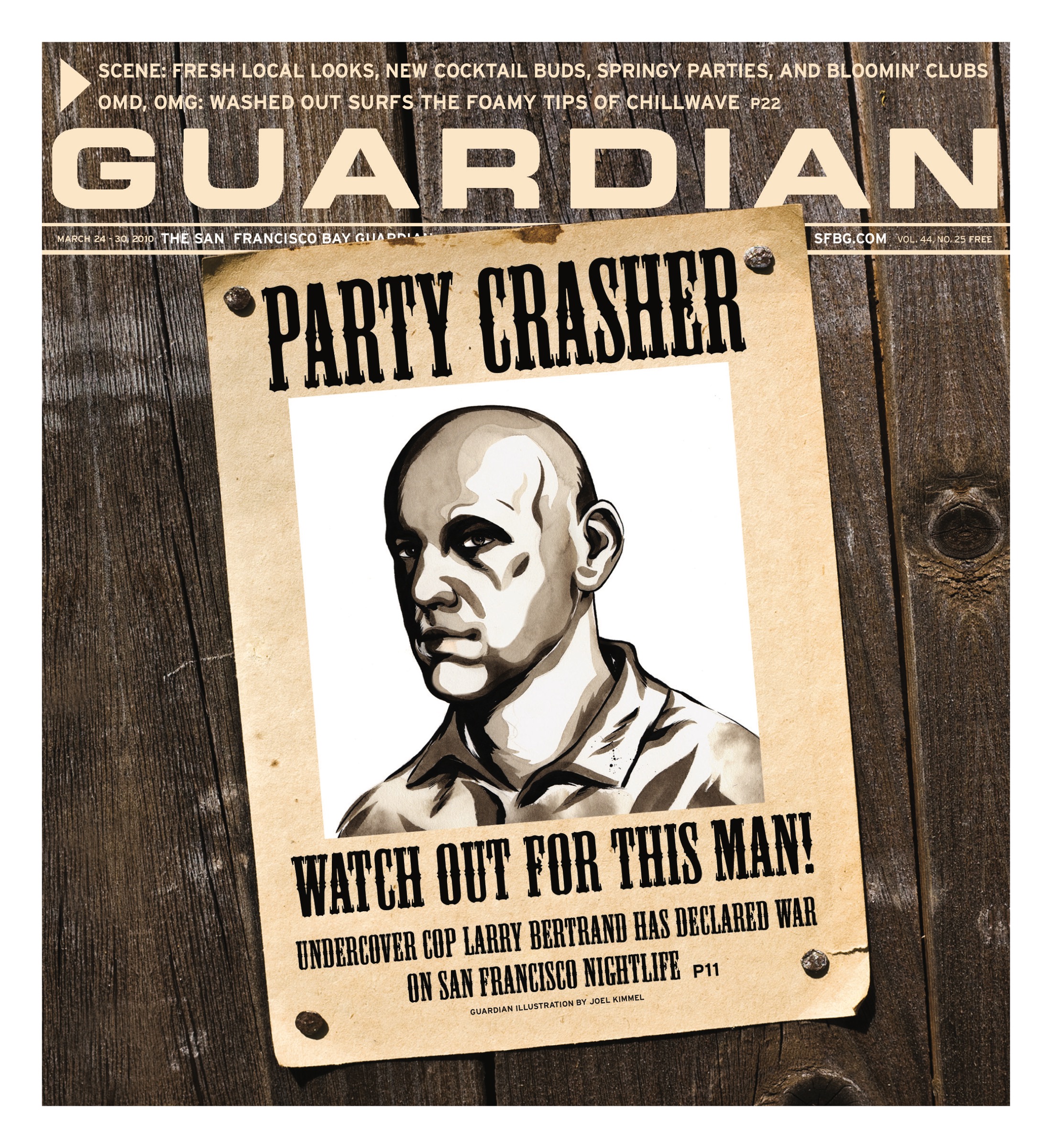
For several years, the Guardian has been running regular stories chronicling what we’ve dubbed the Death of Fun, a trend of official crackdowns and shakedowns on people who throw parties and festivals in San Francisco. In the last year, that trend has started to morph into an often brutal War on Fun, with a growing list of atrocities and casualties associated with this overzealous new approach to killing the city’s entertainment industry.

Why this is happening is baffling to those most affected: nightclub owners and workers, party promoters, DJs and VJs, fundraising activists, and people just out to have a good time without being harassed by a cop. But in recent months, we’ve learned much more about what’s happening and who the main perpetrators are.

Two undercover enforcers have been at the center of just about every recent case of nightclubs or private parties being raided without warrants and aggressively shut down, their patrons roughed up (see “Fun under siege,” 4/21/09) and their money, booze, and equipment punitively seized “as evidence” (see “Police seize DJs laptops,” 11/24/09) even though few of these raids result in charges being filed in court.

Officer Larry Bertrand of the San Francisco Police Department’s Southern Station and Michelle Ott, an agent with the California Department of Alcoholic Beverage Control, are plainclothes partners who spend their weekends undercover, crashing parties, harassing disfavored nightclubs, brutalizing party-goers, and trying to send the unmistakable message that they’re in charge of San Francisco nightlife. Neither responded to our interview requests.

Isolated incidents of intolerant cops and NIMBY citizens who repeatedly complain about certain clubs or festivals has been a problem for years (see “Death of fun,” 5/24/06 and “Death of fun, the sequel,” 4/24/07). Top city officials have opted to cancel events such as Halloween in the Castro District rather than try to manage them better, and the nightlife community has tried to organize in defense of its interests (see “Fighting for the right to party,” 7/1/08) with mixed results.

But the personal War of Fun by Bertrand and Ott seems to have galvanized and united the nightlife and festival community like never before, leading to the creation of a new California Music and Culture Association and prompting threats of a federal lawsuit alleging the ABC-SFPD collaboration is a racketeering scheme designed to harass, disrupt, and extort people engaged in otherwise lawful activity.

The myriad horror stories associated with Bertrand and Ott have also finally begun to draw attention from the Mayor’s Office, which has quietly pushed the SFPD to rein in Bertrand and change its policies on raiding parties and seizing property. State Sen. Mark Leno also has gotten involved, brokering a March 12 meeting between club owners and Steve Hardy, director of ABC (which, in addition to cracking down on nightclubs — see “Busting bars,” 6/23/09 — has recently announced a campaign against fruit-infused liquor).

“They were going to see how they could unwind this a bit,” Leno told us, adding that he was “infuriated” by stories of abusive treatment of the public. “The fear that it spreads through the community is unacceptable.”

The question now is what Hardy, Mayor Gavin Newsom, and Police Chief George Gascón — who has ordered some crackdowns and wants greater authority to discipline problem officers — is going to do about it.


CHAOS AT A STUDENT PARTY

It was after midnight on Jan. 31 when Krystal Peak, a journalist with San Francisco State University’s Golden Gate Xpress, received a call from her managing editor. There was a commotion and a swarm of police cars outside a student party at Seventh and Minna streets near her home, and she was asked to investigate.

She came upon the aftermath of a melee between police and partygoers that had taken place after a fundraising event at a SoMa warehouse art space was upended. The benefit was organized to raise legal funds for students who staged a building occupation at the University of California at Berkeley, in defiance of budget cuts.

The event was clearly chaotic, and it’s hard to sort out exactly what happened and when. City officials say the partiers were throwing bottles and firecrackers at the police; people at the event say the cops started it all.

But the tales partygoers tell about the behavior of Bertrand and Ott, the undercover enforcers, are similar to a series of other stories involving the pair, stories published in the Guardian and elsewhere.

There had been multiple arrests by the time Peak arrived on the scene. Numerous witnesses asserted that things were going along without incident until a fire marshal arrived in response to a complaint, and in short order, two officers who’d been there in plainclothes for hours — Bertrand and Ott — began shouting, tackling people, and kicking in doors.

Police Chief George Gascón acknowledged that the department has been targeting underground parties. “We get a lot of resident complaints about it,” he said in a recent Guardian interview. “We’re talking about a lot of the underground parties, or the parties where the promoters are exceeding their authorities to a number of people.”

Several hundred attended this particular party. Of the 11 people arrested, eight were either detained or cited and released. None faced underage drinking or drug charges. At least five were charged with resisting arrest. One individual was charged with vandalism, two were charged with battery on an officer, and two detained for being drunk in public.

Peak began photographing the scene: busted-up chairs, uniformed officers guarding the entrance, police cars everywhere. She zoomed her lens to capture the wreckage inside. None of the uniformed officers seemed to have a problem with her — but when she spotted the undercover officers with exposed badges, that changed.

The cops broke through the door, yelling. “They said, ‘This is an investigation, you’re not allowed to be here.'<0x2009> she said. “We told them we were with the press.” They threatened to arrest her.

Shortly after, the plainclothes officers crossed in front of her to an unmarked car. She took another picture. Bertrand, a tall guy with a shaved head, allegedly turned and grabbed her arm, and both officers shouted at her. “[Ott] said to me, ‘Your flash has impeded my investigation,'” Peak recounted. She was cuffed and arrested on the spot, and her camera was confiscated.

She was cited for obstruction of justice, but the charges were dropped. And she got her camera back — but says the SD memory card, where all the photos were stored — was missing.

“I flipped [the camera] open … and found the SD card was missing,” she said. She asked Bertrand where it was. “He said, ‘I don’t know what you’re talking about,'” Peak recalled. Bertrand, she recalled, then looked around at a group of officers watching the exchange, and announced, “This woman is refusing to leave. I’m going to have to re-arrest her.” Ott appeared, according to Peak, and insisted that there was no evidence the memory card had been in the camera in the first place.

“My camera will not ignite a flash unless there’s a memory card in there,” Peak explained. In the end, she left empty-handed — without photos of the undercover officers.


BUSTING DOORS

Earlier, when the party was in full swing, a 24-year-old California State University, Fullerton student visiting from Los Angeles says when the fire marshal entered, Bertrand flashed his badge, yelling at everybody to get out. “It was really aggressive from the get-go,” said the Fullerton student, who spoke on condition of anonymity because he had a pending legal case. “It’s very hard for me to describe the intensity to which this guy was busting down doors.”

Later, the young man from L.A. said, he was following people who left in a rush, and ran to catch up. “Shortly after, I felt a blow to the back right of my head,” he said. “My glasses flew off, and I was tackled to the ground. My forehead was being pushed straight into the ground and they were holding my hair. I kept repeating … please, I can’t see — I’m legally blind. I thought three or four officers were on top of me, and they were saying, ‘Fuck you, you little anarchist punk.'<0x2009>”

That’s when he said he felt a sensation like “a bunch of really intense bee stings on my left side, just above my hipbone.” He thought he was Tasered — and photos he showed us depict a skin burn. SFPD officers are not authorized to carry Tasers.

“It sounds like a stun gun, not a Taser gun,” Ken Cooper, a firearms and Taser instructor based in New York, noted when the incident was described to him.

When we shared the photos with SFPD’s media relations department, Lt. Lyn Tomioka noted, “I can tell you that we do not have any tool that would produce the type of wounds shown in the picture that you attached, or produce a stinging sensation.”

The L.A. visitor said he was delivered this explanation from an officer while in the holding cell: “One of your anarchist buddies must’ve had a Taser, ran over to you trying to get one of our officers, got you instead, and ran away.”

Cooper Brislain, a Web developer from Santa Cruz, told us his iMac was destroyed that night. A friend of the owners of the art space, he was there doing video mixing for the party, he explained. After the trouble started, he began carrying his computer and mixing equipment toward the door. “The uniformed officers were going to let me go. I told them, ‘I just came here to perform.’ They seemed OK,” he said. Then he encountered Bertrand.

He … grabbed me by the collar, led me over toward the wall, and sat me down,” Brislain told us. He says Bertrand and Ott seized his computer. Brislain says no charges were filed against him.

The morning after, he found that his computer had been smashed up. His friends found it in pieces at the bottom of the stairs. To this day, he says he has not been able to retrieve his ID, which was seized that night. “I tried calling [Bertrand] on his extension to leave a message and never heard back,” he says. “They told me he probably wouldn’t return voicemails.” The District Attorney’s Office has a different perspective. D.A. spokesperson Brian Buckelew said the partygoers were drunk and “going nuts on police.” People were throwing firecrackers, he said. “It obviously got out of hand, and people were throwing bottles at police,” he said.

The student from L.A. allegedly shoved a female officer, Buckelew said. According to the report, he said, police officers were taking someone into custody, and he tried to pull them free.

Nevertheless, even Chief Gascón agrees that it’s not okay to destroy someone’s personal property. “If in fact the allegations were proven to be the case that an officer took somebody’s laptop and threw it down the stairs,” Gascón told us, “that would be inappropriate, and that officer would be sanctioned accordingly.” He noted that he met with an attorney from the Electronic Frontier Foundation about a recurring trend of officers — Bertrand in particular — seizing DJ laptops at underground parties. “We’ve met with them and we’ve agreed to actually tighten up the protocols in how this would be handled,” Gascón noted.


A RICO SUIT

The list of local nightclub clubs that have been recently targeted by Bertrand and Ott or subjected to ABC sanctions is long. It includes Great American Music Hall, Slim’s, DNA Lounge, Mist, Whisper, the Room, Vessel, Azul, Butter, and Club Caliente (which closed down after its mostly Latino customers were scared away by repeated raids).

“Using the now familiar pattern and ruse of ABC authority, these raids have been without warrant and without probable cause, under the pretext of finding liquor violations,” attorney Mark Webb wrote in a claim against the city, describing the harassment of Caliente owner Maurice Salinas and later adding, “Despite numerous raids, the invading officers [Bertrand and Ott] managed to ‘uncover’ a single infraction: one customer used his brother’s ID card, claiming he was over 21 to gain entry. For this reason, Mr. Salinas was cited and fined, bullied, intimidated, and yelled at on the spot.”

Webb said such behavior isn’t legitimate police work, but unlawful harassment. In fact, this experienced litigator said it’s far closer to the shakedowns and extortion rackets familiar to him from the start of his legal career in the late 1970s prosecuting organized crime cases in New York City.

That’s why he’s threatening to bring a novel lawsuit against the city and ABC under federal Racketeer Influenced and Corrupt Organization (RICO) Act, a law designed go after the mob, but which has since been adapted to target entities ranging from the tobacco industry to the Los Angeles Police Department.

Webb told us that interference with legitimate business operations, such as running a nightclub, is the essence of RICO suits. As part of the case, Webb plans to submit a surveillance video that shows Bertrand kneeling on the neck of bartender Javier Magallon from The Room and twisting his arm. Webb gave us a copy of the video.

Another element of making a RICO case is the use of intimidation and retaliation against those who complain — which was central to a March 17 SF Weekly story about promoter Arash Ghanadan being inappropriately singled out for arrest by Bertrand as retaliation for filing a complaint against the officer with the Office of Citizen Complaints.

Webb says he has a strong case that he intends to file soon, but that most of his clients just want the SFPD to rein in Bertrand and stop facilitating ABC actions. “I want to have a sit-down with Gavin Newsom,” Webb said. “I am calling on Mayor Newsom to come in and mediate what would be an expensive, divisive fight that will generate national interest … I think this thing can go way quickly without litigation.”

Newsom press secretary Tony Winnicker, who said Newsom has brought concerns about Bertrand to the chief’s attention, didn’t immediately embrace Webb’s offer. “The mayor would rather leave it to the chief,” Winnicker said.

So the question for Gascón is whether he’s willing to take on the cowboy cops within the SFPD’s ranks. After all, Bertrand is also on the San Francisco Police Officers Association Board of Directors.

The nightlife community is organized like never before and plotting its next move in fighting a war it didn’t initiate and barely understands. Whether that war continues now seems to be a question for the party crashers and their supervisors.

Film listings

0

Film listings are edited by Cheryl Eddy. Reviewers are Kimberly Chun, Michelle Devereaux, Max Goldberg, Dennis Harvey, Johnny Ray Huston, Erik Morse, Louis Peitzman, Lynn Rapoport, Ben Richardson, and Matt Sussman. The film intern is Peter Galvin. For rep house showtimes, see Rep Clock. For first-run showtimes, see Movie Guide.

OPENING

Chloe See "Moore and Less." (1:36) Elmwood, SF Center, Sundance Kabuki.

Greenberg Roger Greenberg (Ben Stiller) is 40, and you might think he’s going through a midlife crisis — if he hadn’t been in pretty much this same crisis for 15 years or more. Still very edgy and fragile after a nervous breakdown-sparked institutional stay, he’s holing up at the comfortable Hollywood home of a big-deal brother while the latter and family are on vacation in Vietnam. (The implication being that Roger is most welcome here when no one else actually has to endure his prickly, high maintenance company.) While in residence he reconnects with old friends including the ex-girlfriend (Jennifer Jason Leigh) he dumped yet never quite got over — though clearly she did — and the ex-bandmate (Rhys Ifans) he burned by wrecking their one shot at a major-label deal. He also gets involved, kinda-sorta, with big bro’s personal assistant Florence (mumblecore regular Greta Gerwig), whose passivity and low self-esteem make her the rare person who might consider a relationship with someone this impossible. Like all Noah Baumbach films, especially the slightly overrated Squid and the Whale (2005) and vastly underrated Margot at the Wedding (2007), his latest pivots around a pathologically self-absorbed and insensitive protagonist who exasperates anyone unlucky or blind enough to fall into his or her orbit. Working from a story co-conceived by spouse Leigh, Baumbach’s script sports his usual sharp dialogue, penetrating individual scenes, and narrative surprises. But it also gets stuck in dislikable Roger’s rut, finding conflict easily but stubbornly resisting even the smallest useful change. For all its amusing and uncomfortable moments, Greenberg emerges a dual character slice with no real point. Neither Roger or Beth reward long scrutiny (least of all as a hapless potential couple), while the few screen minutes Ifans and Leigh get make you wish their roles had hijacked the focus instead. (1:40) Piedmont, Shattuck. (Harvey)

Hot Tub Time Machine At last, Crispin Glover returns to his time-travel movie roots! (1:55) California.

How to Train Your Dragon Yet another 3D cartoon for the kiddies. At least this one is about Vikings. (1:38)

*The Sun It may have taken five years for Alexander Sokurov’s The Sun (2005) to reach local theaters, but then the Russian master’s contemplation of Emperor Hirohito’s last days as Godhead is decidedly out of time. Painterly and slow like all Sokurov’s work, the film specifically follows his estranged reconstructions of Hitler’s retreat with Eva Braun (1999’s Moloch) and Lenin’s demise (2000’s Taurus). In August 1945, Hirohito broke with tradition by making a direct appeal to the Japanese people to end military operations; soon thereafter he renounced his divine rights. The Sun‘s elliptical narration intuits the emperor’s paled existence, and Issey Ogata’s lead performance, centering on a fish-out-of-water puckering of the lips, amply conveys the shuttered hours of a man who, in experience if not in fact, is not quite human. The muted use of available light and a disquieting sound design (faraway air-raid sirens yield to the barest brush of a finger) eschew historiography’s harsh glare, instead returning primal scenes of power to a dreamlike state of unknowing. Sokurov’s most hallucinatory effects are reserved for ashen views of firebombed Tokyo which float free from perspective or clear boundary; a brief fantasy in which fish-like warplanes spew apocalyptic destruction suggests the emperor’s childlike imagination and set the stage for his historical date with General MacArthur, realized by Sokurov less as a diplomatic breakthrough than a leaden twilight. (1:50) Shattuck. (Goldberg)

Waking Sleeping Beauty Hollywood history is full of epic rivalries, juicy scandals, multi-million-dollar mistakes, and triumphant comebacks. Sometimes, all of the above and more can be contained within a single studio, or even a single studio division, or even a single studio division during a finite number of years, as illustrated by this insidery peek at Disney’s animation division. The doc gives a bit of background, but focuses its attentions on 1984-1994, a ten-year span that saw the floundering department struggle through post-Walt, identity-crisis blues before blossoming into a rejuvenated powerhouse. Waking Sleeping Beauty director Don Hahn was a producer on the Oscar-nominated Beauty and the Beast (1991), so he’s uniquely positioned to tell the story as it unfolded, using home movies and countless interviews. High points include a glimpse of late composer Howard Ashman introducing his demo for the iconic Little Mermaid (1989) tune "Under the Sea" (it was Ashman’s idea to give the crab character a Jamaican accent), and plenty of dish on the legendary Jeffrey Katzenberg-Michael Eisner feud. (1:26) Embarcadero. (Eddy)

ONGOING

Ajami You may recognize the title of Yaron Shoni and Scandar Copti’s debut collaboration as one of five films nominated for a 2010 Academy Award in the Foreign Category. Though it didn’t bring home the grand prize, Ajami remains a complex and affecting story about desperation and its consequences in a religiously-mixed town in Israel. As we follow the lives of four of Ajami’s residents the narrative shifts perspective almost maddeningly, switching characters seemingly at the height of each story’s action. But once all of the stories fully intersect, the final product has the distinction of feeling both meticulously calculated and completely natural. I was most impressed to learn that Shani and Copti prepared their actors with improvised role-playing rather than scripts. By withholding what was going to happen in a scene before shooting, we are treated to looks of surprise and emotion on actor’s faces that never feel unnatural. Attaining such a level of realism may be Ajami‘s crowning achievement; it can’t have been easy to make a foreign world feel so familiar. (2:00) Shattuck. (Galvin)

Alice in Wonderland Tim Burton’s take on the classic children’s tale met my mediocre expectations exactly, given its months of pre-release hype (in the film world, fashion magazines, and even Sephora, for the love of brightly-colored eyeshadows). Most folks over a certain age will already know the story, and much of the dialogue, before the lights go down and the 3-D glasses go on; it’s up to Burton and his all-star cast (including numerous big-name actors providing voices for animated characters) to make the tale seem newly enthralling. The visuals are nearly as striking as the CG, with Helena Bonham Carter’s big-headed Red Queen a particularly marvelous human-computer creation. But Wonderland suffers from the style-over-substance dilemma that’s plagued Burton before; all that spooky-pretty whimsy can’t disguise the film’s fairly tepid script. Teenage Alice (Mia Wasikowska) displaying girl-power tendencies is a nice, if not surprising, touch, but Johnny Depp’s grating take on the Mad Hatter will please only those who were able to stomach his interpretation of Willy Wonka. (1:48) Castro, Empire, 1000 Van Ness, SF Center, Sundance Kabuki. (Eddy)

*The Art of the Steal How do you put a price on something that’s literally priceless? The Art of the Steal takes an absorbing look at the Barnes Collection, a privately-amassed array of Post-Impressionist paintings (including 181 Renoirs) worth billions — and the many people and corporate interests who schemed to control it. Founder Albert C. Barnes was an singular character who took pride in his outsider status; he housed his art in a specially-constructed gallery far from downtown Philadelphia’s museum scene, and he emphasized education and art appreciation first and foremost. But he had no heirs, and after his death in 1951, opportunists began circling his massive collection; the slippery political and legal dealings that have unfolded since then are nearly as jaw-dropping as Barnes’ prize paintings. Philly documentarian Don Argott has a doozy of a subject here, and his skillful, even suspenseful film does it justice. (1:41) Smith Rafael. (Eddy)

The Blind Side When the New York Times Magazine published Michael Lewis’ article "The Ballad of Big Mike" — which he expanded into the 2006 book The Blind Side: Evolution of a Game — nobody could have predicated the cultural windfall it would spawn. Lewis told the incredible story of Michael Oher — a 6’4, 350-pound 16-year-old, who grew up functionally parentless, splitting time between friends’ couches and the streets of one of Memphis’ poorest neighborhoods. As a sophomore with a 0.4 GPA, Oher serendipitously hitched a ride with a friend’s father to a ritzy private school across town and embarked on an unbelievable journey that led him into a upper-class, white family; the Dean’s List at Ole Miss; and, finally, the NFL. The film itself effectively focuses on Oher’s indomitable spirit and big heart, and the fearless devotion of Leigh Anne Tuohy, the matriarch of the family who adopted him (masterfully played by Sandra Bullock). While the movie will delight and touch moviegoers, its greatest success is that it will likely spur its viewers on to read Lewis’ brilliant book. (2:06) Oaks. (Daniel Alvarez)

Brooklyn’s Finest "Really? I mean, really?" asked the moviegoer beside me as the final freeze-frame of Brooklyn’s Finest slapped our eyeballs. Yes, that’s the sound of letdown, despite the fact that Brooklyn’s Finest initially resembled a promisingly gritty juggling act in the mode of The Wire and Cop Land (1997), Taxi Driver (1976) and Training Day (2001). Bitter irony flows from the title — and from the lives, loves, bad habits, pressure-cooker stress, and unavoidable moral dilemmas of three would-be everyday cops, all occupying several different rungs on a food chain where right and wrong have an unpleasant way of switching sides. Eddie (Richard Gere) is the veteran officer just biding his time till he gets his pension, all while comforting himself with the meager sensuous attentions of hooker Chantel (Shannon Kane). Sal (Ethan Hawke) is the bad detective, stealing from the dealers to fund a dream home for his growing family with Angela (Lili Taylor). Tango (Don Cheadle) is the undercover detective who has cultivated friendships with dealers like Caz (Wesley Snipes) and sacrificed his marriage for a long-promised promotion from his lieutenant (Will Patton) and his superior (Ellen Barkin, in likely the most misogynist portrayal of a lady with a badge to date). You spend most of Brooklyn’s Finest waiting for these cops to collide in the most unfortunate, messiest way possible, but instead the denouement leaves will leave one wondering about unresolved threads and feeling vaguely unsatisfied. In any case, director Antoine Fuqua and company seem to pride themselves on their tough-minded if at times cartoonish take on law enforcement, with Hawke in particular turning in a memorably OTT and anguished performance. (2:13) 1000 Van Ness. (Chun)

The Bounty Hunter There’s a real feeling of impotence in reviewing a movie whose ad was pasted on the side of the bus you took to the screening. This thing is determined to be seen, and that’s a true shame. Those who heed the call of the ubiquitous marketing campaign will have to sit through a dull parade of contrivances concerning a bounty hunter (Gerard Butler) whose latest catch is his court-skipping ex-wife (Jennifer Aniston). She’s a hotshot city journalist who’s forced to continue her investigation of a police cover-up while handcuffed to a car door and bickering with her old flame. The trajectory of the plot is obvious enough, but there’s so little chemistry between the two actors that the inevitable reconciliation practically constitutes a twist ending. Aniston saw fit not to whine her way through this role, which is something, but nothing nearly as complimentary can be said about Butler. He emotes in lurches, with the presence of a guy who’s not sure acting is the right direction for his life but still really wants to give it a go. If "This. Is. Sparta!" weren’t burned into my brain I would swear the man had never been in front of a camera before. (1:50) 1000 Van Ness, SF Center, Sundance Kabuki. (Jason Shamai)

The Crazies Disease and anti-government paranoia dovetail in this competent yet overwhelmingly non-essential remake of one of George A. Romero’s second-tier spook shows. In a small Iowa hamlet overseen by a benevolent sheriff (Timothy Olyphant) and his pregnant wife (Radha Mitchell), who’s also the town doctor, a few odd incidents snowball into all-out chaos when a mysterious, unmarked plane crashes into the local water supply. Before long, the few residents who aren’t acting like homicidal maniacs are rounded up by an uber-aggressive military invasion. Though our heroes convey frantic panic as they try to figure out what the hell is going on, The Crazies never achieves full terror mode. It’s certainly watchable, and even enjoyable at times. But memorable? Not in the slightest. (1:41) 1000 Van Ness. (Eddy)

Crazy Heart "Oh, I love Jeff Bridges!" is the usual response when his name comes up every few years for Best Actor consideration, usually via some underdog movie no one saw, and the realization occurs that he’s never won an Oscar. The oversight is painful because it could be argued that no leading American actor has been more versatile, consistently good, and true to that elusive concept "artistic integrity" than Bridges over the last 40 years. It’s rumored Crazy Heart was slotted for cable or DVD premiere, then thrust into late-year theater release in hopes of attracting Best Actor momentum within a crowded field. Lucky for us, this performance shouldn’t be overlooked. Bridges plays "Bad" Blake, a veteran country star reduced to playing bars with local pickup bands. His slide from grace hasn’t been helped by lingering tastes for smoke and drink, let alone five defunct marriages. He meets Jean (Maggie Gyllenhaal), freelance journalist, fan, and single mother. They spark; though burnt by prior relationships, she’s reluctant to take seriously a famous drunk twice her age. Can Bad handle even this much responsibility? Meanwhile, he gets his "comeback" break in the semi-humiliating form of opening for Tommy Sweet (Colin Farrell) — a contemporary country superstar who was once Bad’s backup boy. Tommy offers a belated shot at commercial redemption; Jean offers redemption of the strictly personal kind. There’s nothing too surprising about the ways in which Crazy Heart both follows and finesses formula. You’ve seen this preordained road from wreckage to redemption before. But actor turned first-time director Scott Cooper’s screenplay honors the flies in the windshield inherited from Thomas Cobb’s novel — as does Bridges, needless to say. (1:51) Piedmont, 1000 Van Ness, Shattuck, Sundance Kabuki. (Harvey)

Diary of a Wimpy Kid Spoiler alert: nothing happens in Diary of a Wimpy Kid. That was OK when it was just a book—author Jeff Kinney’s illustrated novel works due in large part to his whimsical drawings and tongue-in-cheek humor. It’s a kids’ book, but it’s fun for adults, too. The same can’t be said for the film adaptation: Diary of a Wimpy Kid sticks close to its source material without the creativity necessary to make it work on the big screen. As in the book, Greg Heffley (Zachary Gordon) navigates the treacherous terrain of middle school, struggling to cope with an awkward best friend, a brutal older brother, and parents who just don’t understand. All the actors turn in solid performances — Gordon is a particularly good find. But there’s so little here to work with. The best that can be said about Diary of a Wimpy Kid is that it’s cute and mostly harmless: a pleasant diversion for young’uns, and a tolerable bore for the parents they drag along. (2:00) 1000 Van Ness. (Peitzman)

*An Education The pursuit of knowledge — both carnal and cultural — are at the tender core of this end-of-innocence valentine by Danish filmmaker Lone Scherfig (who first made her well-tempered voice heard with her 2000 Dogme entry, Italian for Beginners), based on journalist Lynn Barber’s memoir. Screenwriter Nick Hornby breaks further with his Peter Pan protagonists with this adaptation: no man-boy mopers or misfits here. Rather, 16-year-old schoolgirl Jenny (Carey Mulligan) is a good girl and ace student. It’s 1961, and England is only starting to stir from its somber, all-too-sober post-war slumber. The carefully cloistered Jenny is on track for Oxford, though swinging London and its high-style freedoms beckon just around the corner. Ushering in those freedoms — a new, more class-free world disorder — is the charming David (Peter Sarsgaard), stopping to give Jenny and her cello a ride in the rain and soon proffering concerts and late-night suppers in the city. He’s a sweet-faced, feline outsider: cultured, Jewish, and given to playing fast and loose in the margins of society. David can see Jenny for the gem she is and appreciate her innocence with the knowing pleasure of a decadent playing all the angles. The stakes are believably high, thanks to An Education‘s careful attention to time and place and its gently glamored performances. Scherfig revels in the smart, easy-on-eye curb appeal of David and his friends while giving a nod to the college-educated empowerment Jenny risks by skipping class to jet to Paris. And Mulligan lends it all credence by letting all those seduced, abandoned, conflicted, rebellious feelings flicker unbridled across her face. (1:35) Oaks, Smith Rafael. (Chun)

*The Ghost Writer Roman Polanski’s never-ending legal woes have inspired endless debates on the interwebs and elsewhere; they also can’t help but add subtext to the 76-year-old’s new film, which is chock full o’ anti-American vibes anyway. It’s also a pretty nifty political thriller about a disgraced former British Prime Minister (Pierce Brosnan) who’s hanging out in his Martha’s Vineyard mansion with his whip-smart, bitter wife (Olivia Williams) and Joan Holloway-as-ice-queen assistant (Kim Cattrall), plus an eager young biographer (Ewan McGregor) recently hired to ghost-write his memoirs. But as the writer quickly discovers, the politician’s past contains the kinds of secrets that cause strange cars with tinted windows to appear in one’s rearview mirror when driving along deserted country roads. Polanski’s long been an expert when it comes to escalating tension onscreen; he’s also so good at adding offbeat moments that only seem tossed-off (as when the PM’s groundskeeper attempts to rake leaves amid relentless sea breezes) and making the utmost of his top-notch actors (Tom Wilkinson and Eli Wallach have small, memorable roles). Though I found The Ghost Writer‘s ZOMG! third-act revelation to be a bit corny, I still didn’t think it detracted from the finely crafted film that led up to it. (1:49) California, Piedmont, Sundance Kabuki. (Eddy)

*The Girl With the Dragon Tattoo By the time the first of Stieg Larsson’s so-called "Millennium" books had been published anywhere, the series already had an unhappy ending: he died (in 2004). The following year, The Girl With the Dragon Tattoo became a Swedish, then eventually international sensation, its sequels following suit. The books are addicting, to say the least; despite their essential crime-mystery-thriller nature, they don’t require putting your ear for writing of some literary value on sleep mode. Now the first of three adaptive features shot back-to-back has reached U.S. screens. (Sorry to say, yes, a Hollywood remake is already in the works — but let’s hope that’s years away.) Even at two-and-a-half hours, this Girl With the Dragon Tattoo by necessity must do some major truncating to pack in the essentials of a very long, very plotty novel. Still, all but the nitpickingest fans will be fairly satisfied, while virgins will have the benefit of not knowing what’s going to happen and getting scared accordingly. Soon facing jail after losing a libel suit brought against him by a shady corporate tycoon, leftie journalist Mikael Blomkvist (Michael Nyqvist) gets a curious private offer to probe the disappearance 40 years earlier of a teenage girl. This entangles him with an eccentric wealthy family and their many closet skeletons (including Nazi sympathies) — as well as dragon-tattooed Lisbeth Salander (Noomi Rapace), androgynous loner, 24-year-old court ward, investigative researcher, and skillful hacker. Director Niels Arden Oplev and his scenarists do a workmanlike job — one more organizational than interpretive, a faithful transcription without much style or personality all its own. Nonetheless, Larsson’s narrative engine kicks in early and hauls you right along to the depot. (2:32) Albany. (Harvey)

Green Zone Titled for the heavily-guarded headquarters of international occupation in Baghdad, Green Zone reunites director Paul "Shaky-Cam" Greengrass with star Matt Damon, the two having previously collaborated on the last two Bourne films. Instead of a super-soldier, this time around Damon just plays a supremely insubordinate one as he attempts to uncover the reason why his military unit can’t find any of Saddam’s WMDs. With the aid of the CIA, a Wall Street Journal reporter and a friendly Iraqi, Damon goes rogue in order to suss out the source of the misinformation. The Iraq War action is decent if scarce, but an overindulgence in (you guessed it) shaky-cam and political jargon cannot hide the fact that Green Zone‘s plot is simplistic and probably light on actual facts. Damon makes a fine cowboy-cum-hero, but the effectiveness of the mix of patriotism and Pentagon paranoia will vary based on your penchant for such things. Still, Green Zone moves fast enough that it remains worth a matinee for conspiracy thriller aficionados. (1:55) Empire, 1000 Van Ness, Sundance Kabuki. (Galvin)

The Hurt Locker When the leader of a close-knit U.S. Army Explosive Ordnance Disposal squad is killed in action, his subordinates have barely recovered from the shock when they’re introduced to his replacement. In contrast to his predecessor, Sgt. James (Jeremy Renner) is no standard-procedure-following team player, but a cocky adrenaline junkie who puts himself and others at risk making gonzo gut-instinct decisions in the face of live bombs and insurgent gunfire. This is particularly galling to next-in-command Sanborn (Anthony Mackie). An apolitical war-in-Iraq movie that’s won considerable praise for accuracy so far from vets (scenarist Mark Boal was "embedded" with an EOD unit there for several 2004 weeks), Kathryn Bigelow’s film is arguably you-are-there purist to a fault. While we eventually get to know in the principals, The Hurt Locker is so dominated by its seven lengthy squad-mission setpieces that there’s almost no time or attention left for building character development or a narrative arc. The result is often viscerally intense, yet less impactful than it would have been if we were more emotionally invested. Assured as her technique remains, don’t expect familiar stylistic dazzle from action cult figure Bigelow (1987’s Near Dark, 1989’s Blue Steel, 1991’s Point Break) — this vidcam-era war movie very much hews to the favored current genre approach of pseudo-documentary grainy handheld shaky-cam imagery. (2:11) Shattuck. (Harvey)

*The Last Station Most of the buzz around The Last Station has focused on Helen Mirren, who takes the lead as the Countess Sofya, wife of Leo Tolstoy (Christopher Plummer). Mirren is indeed impressive — when is she not? — but there’s more to the film than Sofya’s Oscar-worthy outbursts. The Last Station follows Valentin Bulgakov (James McAvoy), hired as Tolstoy’s personal secretary at the end of the writer’s life. Valentin struggles to reconcile his faith in the anarchist Christian Tolstoyan movement with his sympathy for Sofya and his budding feelings for fellow Tolstoyan Masha (Kerry Condon). For the first hour, The Last Station is charming and very funny. Once Tolstoy and Sofya’s relationship reaches its most volatile, however, the tone shifts toward the serious — a trend that continues as Tolstoy falls ill. After all the lighthearted levity, it’s a bit jarring, but the solid script and accomplished cast pull The Last Station together. Paul Giamatti is especially good as Vladimir Chertkov, who battles against Sofya for control of Tolstoy’s will. You’ll never feel guiltier for putting off War and Peace. (1:52) Albany. (Peitzman)

*The Most Dangerous Man in America: Daniel Ellsberg and the Pentagon Papers For many, Daniel Ellsberg is a hero — a savior of American First Amendment rights and one of the most outspoken opponents of the Vietnam war. But as this documentary (recently nominated for an Academy Award) shows, it’s never an an easy decision to take on the U.S. government. Ellsberg himself narrates the film and details his sleepless nights leading up to the leak of the Pentagon Papers — the top secret government study on the Vietnam war — to the public. Though there are few new developments in understanding the particulars of the war or the impact the release of the Papers had on ending the conflict, the film allows audiences to experience the famous case from Ellsberg’s point of view, adding a fresh and poignantly human element to the events; it’s a political documentary that plays more like a character drama. Whether you were there when it happened or new to the story, there is something to be appreciated from this tale of a man who fell out of love with his country and decided to do something about it. (1:34) Shattuck, Smith Rafael. (Galvin)

*Mother You can guarantee that a movie titled Mother is not gonna be a love fest, ever. And through the lens of The Host (2006) director-writer Bong Joon-ho, motherly love becomes downright monstrous — though altogether human. Much credit goes to the wonderful lead actress Kim Hye-ja as the titular materfamilias, who’s frantically self-sacrificing, insanely tenacious, quaintly charming, wolfishly fearsome, and wildly guilt-ridden, by turns. On the surface, she’s a sweetly innocuous herbalist and closet acupuncturist — happily, and a wee bit too tightly, tethered to her beloved son Yoon Do-joon (Won Bin). He’s a slow-witted, forgetful, and easily confused mop-top who flies into deadly rages when taunted or called a "’tard." When Do-joon is quickly arrested and charged with the murder of schoolgirl Moon Ah-jung (Mun-hee Na), Mom snaps into action with a panic-stricken, primal ferocity and goes in search of the killer to free her boy. But there’s more to Do-joon, his studly pal Jin-tae (Ku Jin), and Moon Ah-jung than meets the eye, and Mother discovers just how much she’s defined, and twisted, herself in relation to her son. Bong gives this potentially flat and cliched noirish material genuine lyricism, embedding his anti-heroine in a rural South Korean landscape like a penitent wandering in an existential desert, gently echoing filmmakers such as Ingmar Bergman and Abbas Kiarostami and beautifully transcending genre. (2:09) Shattuck. (Chun)

Our Family Wedding America Ferrera and Lance Gross play a couple of lovebirds who must jump through some serious family hoops before they get married in the mostly serviceable Our Family Wedding. What begins as a dual Guess Who’s Coming to Dinner, with the differences in each family’s traditions forcing complications and compromises, soon loses sight of its matrimonial plot as the focus steers towards a childish rivalry between the fathers. While it’s being marketed as a goofy comedy, the final product seeks a relatively sentimental tone, which makes the few slapstick moments — like a goat trying to rape Academy Award-winning actor Forest Whitaker — seem pretty inappropriate. Still, for some audiences the well-tread plot will act as comfort food: they fight, they make up, and it all ends in a big wedding where we watch the characters dance for damn near ten minutes. (1:41) 1000 Van Ness. (Galvin)

*A Prophet Filmmaker Jacques Audiard has described his new film, A Prophet, as "the anti-Scarface." Yet much like Scarface (1983), A Prophet bottles the heady euphoria that chases the empowerment of the powerless and the rise of the long-shot loner on the margins. In its almost-Dickensian attention to detail, devotion to its own narrative complexity, and passion for cinematic poetry, A Prophet rises above the ordinary and, through the prism of genre, finds its own power. The supremely opportunistic, pragmatically Machiavellian intellectual and spiritual education of a felon is the chief concern of here. Played by Tahar Rahim with guileless, open-faced charisma, Malik is half-Arab and half-Corsican — and distrusted or despised by both camps in the pen. When he lands in jail for his six-year sentence, he’s 19, illiterate, friendless, and vulnerable. His deal with the devil — and means of survival — arrives with Reyeb (Hichem Yacoubi), temporarily locked up before his testifies against the mob. Corsican boss Cesar Luciani (Niels Arestrup) wants him dead, and Malik is tagged to penetrate Reyeb’s cell with a blade hidden in mouth. After Malik’s gory rebirth, it turns out that the teenager’s a seer in more ways than one. From his low-dog position, he can eyeball the connections linking the drugs entering the prison to those circulating outside, as well as the machinations intertwining the Arab and Corsican syndicates. It’s no shock that when Cesar finds his power eroding and arranges prison leaves for his multilingual crossover star that Malik serves not only his Corsican master, but also his own interests, and begins to build a drug empire rivaling his teacher’s. Throughout his pupil’s progress, Audiard demonstrates a way with Henri Cartier-Bresson’s decisive moment, and when Malik finally breaks with his Falstaffian patriarch, it makes your heart skip a beat in a move akin to the title of the director’s last film. This Eurozone/Obama-age prophet is all about the profit — but he’s imbued with grace, even while gaming for ill-gotten gain. (2:29) Shattuck, Smith Rafael. (Chun)

Remember Me Ominously set in New York City during the summer of 2001, Remember Me, starring Robert Pattinson (of the Twilight series) and Emilie de Ravin (of TV’s Lost), pretty much answers the question of whether it’s still too soon to make the events of September 11 the subject of a date movie. Or rather, not the subject so much as the specter waiting just off-camera for its walk-on while brooding 21-year-old Tyler Hawkins (Pattinson) quotes Gandhi, gets into brawls, gets drunk, writes letters to his dead brother, and otherwise channels despondency and rage into various salubrious outlets. One of these is romancing (under circumstances severely testing the viewer’s credulity) de Ravin’s Ally Craig, grappling somewhat more constructively with her own familial tragedy. Ally is the sort of self-possessed, strong-willed young woman whose instincts, shortly after she’s been backhanded by her drunk father (Chris Cooper), tell her to placate and have sex with her drunk boyfriend when he comes home enraged after battling his own father (Pierce Brosnan). She is there to teach Tyler, through quirky habits like eating dessert first, what director Allen Coulter (2006’s Hollywoodland) wishes to teach us: that time is short and one must fill one’s life with meaningful actions — like throwing a fire extinguisher through a window to convince a classroom of tweens to stop bullying one’s little sister. The film is seeded with allusions to an impending catastrophe that feels less integrated than exploited. And it’s uncomfortable seeing the fall of the towers used to make the ground shake under a sweet, fairly depthless depiction of love and grief. (2:08) Empire, 1000 Van Ness, Sundance Kabuki. (Rapoport)

Repo Men If you are considering going to see Repo Men you’ll need to go ahead and turn off your brain first — the guy who wrote it sure did. The script is jam-packed with contrivances and tonal inconsistencies, which is a shame because the plot had potential. In a near future when mechanical replacement organs are a reality, Jude Law plays Remy, an ex-soldier hired by the Union to find recipients that cannot afford their bills and repossess their artificial organs to return to the manufacturer. After a freak accident, Remy needs a replacement organ himself and when he can’t pay, the Union sends his childhood friend and ex-partner Jake (Forest Whitaker) to retrieve it. Repo Men is at its best when it embraces its cartoonishness, when the film is so stupid that it transcends the hodge-podge story and glows with goofy grotesque action. If you can, stick around ’til the climax that includes an Old Boy (2003) homage (rip-off) and one of the more laugh-out-loud ridiculous endings I’ve seen in a long time. But high-art, this ain’t. (1:53) 1000 Van Ness, Shattuck, Sundance Kabuki. (Galvin)

The Runaways In Floria Sigismondi’s tale of the rise and fall of a 1970s all-girl band, LA producer Kim Fowley (Michael Shannon) proclaims that the Runaways are going to save rock and roll. It’s hard to gauge the sincerity of this pronouncement, but you can certainly hear, in songs like "Cherry Bomb" and "Queens of Noise," how the band must have brightened a landscape overrun by kings of prog rock. Unfortunately, a handful of teenagers micromanaged by a sleazy, abusive nutcase proved not quite up to the task, though the band did launch the careers of metal guitarist Lita Ford (Scout Taylor-Compton) and, more famously, Joan Jett (Kristen Stewart). Sigismondi’s film entertainingly sketches the Runaways’ beginnings in glam rock fandom and gradual attainment of their own rabid fan base. We get Currie lip-synching Bowie to catcalls at the high school assembly, Jett composing "Cherry Bomb" with Fowley, glamtastic hair-and-wardrobe eye candy, pills-and-Stooges-fueled intra-band fooling around, and five teenage girls sent off sans chaperone on an international tour with substantial quantities of hard drugs in their carry-on luggage. What follows is less pretty: a capsule version of the band’s disintegration after the departure of bottoming-out 16-year-old lead singer Cherie Currie (Dakota Fanning). In a film darkened by Currie’s trajectory, Jett’s subsequent success is a feel-good coda, but it’s awkwardly attached and emblematizes one of The Runaways‘ main problems. When the band begins to fall apart, the film doesn’t know which way to turn and ends up telling no one’s story well. (1:42) 1000 Van Ness, SF Center. (Rapoport)

She’s Out of My League From the co-writers of the abysmal Sex Drive (2008), She’s Out of My League could be another 90-minute assemblage of gross-out humor, dick jokes, and unabashed homophobia. As it turns out, the latest offering from Sean Anders and John Morris is legitimately funny — far better than the trailer (and that half-assed title) would have you believe. The adorkable Jay Baruchel stars as Kirk, a hapless loser who finds himself dating bonafide hottie Molly (Alice Eve). Once you get past the film’s silly conceit — Kirk’s only "movie ugly," and personality goes a long way — you’re left with a surprisingly charming comedy. The characters are amusing and the wit is sharp. Not to mention the fact that She’s Out of My League offers a downright heartfelt message. There’s a sincerity here that feels genuine instead of just tacked-on: yeah, yeah, it’s about what’s inside that counts, but there’s more to it than that. Ignore the dreadful "jizz in my pants" scene, and the movie’s almost an old-fashioned romcom. (1:44) 1000 Van Ness, SF Center. (Peitzman)

Shutter Island Director Martin Scorsese and muse du jour Leonardo DiCaprio draw from oft-filmed novelist Dennis Lehane (2003’s Mystic River, 2007’s Gone Baby Gone) for this B-movie thriller that, sadly, offers few thrills. DiCaprio’s a 1950s U.S. marshal summoned to a misty island that houses a hospital for the criminally insane, overseen by a doctor (Ben Kingsley) who believes in humane, if experimental, therapy techniques. From the get-go we suspect something’s not right with the G-man’s own mind; as he investigates the case of a missing patient, he experiences frequent flashbacks to his World War II service (during which he helped liberate a concentration camp), and has recurring visions of his spooky dead wife (Michelle Williams). Whether or not you fall for Shutter Island‘s twisty game depends on the gullibility of your own mind. Despite high-quality performances and an effective, if overwrought, tone of certain doom, Shutter Island stumbles into a third act that exposes its inherently flawed and frustrating storytelling structure. If only David Lynch had directed Shutter Island — it could’ve been a classic of mindfuckery run amok. Instead, Scorsese’s psychological drama is sapped of any mystery whatsoever by its stubbornly literal conclusion. (2:18) California, 1000 Van Ness, Sundance Kabuki. (Eddy)

Mutaytor records album in iconic SF house

2

Recently in San Francisco, a unique and iconic band recorded an album in a unique and iconic house, and the two entities seemed to resonate beautifully.

Mutaytor might be the ultimate Burning Man tribe, an eclectic group of Los Angeles-based performers who came together in the event’s Black Rock City more than a decade ago, forming into a band that’s like a traveling circus that evangelizes the burner ethos and culture everywhere they go, just by being who they are: sexy, scruffy, wild, warm, colorful denizens of the counterculture. 

Mutaytor is perhaps the most popular and emblematic musical act to emerge from Burning Man, a group whose spirited performances on and off the playa reflected and helped to shape and define the culture that birthed them. And if that’s not enough cultural cred, many of the two dozen members work for Burning Man in various capacities, from building Black Rock City with the Department of Public Works to forming the backbone of event’s regional network in Los Angeles. 

My path has crossed Mutaytor’s many times, from watching them play at my first Burning Man in 2001 to joining them on the burner-dominated Xingolati cruise ship in 2005 to being invited on the weekend of March 13, 2010 to watch them record their fourth album, “Unconditional Love” in the sprawling Westerfeld House, a Victorian mansion on San Francisco’s Alamo Square that is the legendary former home to such countercultural figures as Satanist Anton LaVey and members of the Manson family to noted ‘60s promoter Chet Helms’ Family Dog Productions and the band Big Brother and the Holding Company.

Today, the house is owned by Jim Siegel, a longtime Haight Street head shop owner and housing preservationist who did a masterful job at restoring this place, showing a striking attention to detail. Siegel owns the Distractions store on Haight Street, one of the few walk-in outlets for buying Burning Man tickets, and became a friend of the Mutaytor family in 2004.

“It all started with a guy crush that I had on someone in the band,” Siegel said, noting how that evolved into a real friendship with the whole band, which he’s hosted many times in his sprawling, 28-room house with the colorful history. Although the dancers and other women who perform with Mutaytor weren’t at this recording – Siegel said they usually prance around the house topless and lend a debaucherous energy to Siegel’s house – he still loves the energy that the band brings when they invade his house: “It reminds me of my hippie days living in communes.”Jim Siegel (left), Buck Down (center), and bassist John Avila (right) take a break.

Jim Siegel (from left), Buck Down, and bassist John Avila (formerly of Oingo Boingo) take a break.

Buck A.E. Down – a key band member, singing and playing guitar, as well as producing and arranging their songs – said the album and accompanying documentary film is Mutaytor trying to build on a career that began as basically a pickup group of musicians and performers on the playa.

“We’re a total product of that environment,” Buck said of Mutaytor’s musicians, dancers, acrobats, fire spinners, aerialists, hoopers, thespians, producers, culture mavens, and facilitators of the arts. While there were nine musicians that played on the latest album they recorded in San Francisco, their full crew is more than triple that number.

“We’ve been underground for 10 years and have a voluminous body of work,” Buck said, talking about the decision to take their three albums worth of songs and other material they’ve developed in live shows and put it all into a new album before adding wryly, “You can’t really call it a greatest hits if you’ve never really had a hit, can you?”

But the band itself has been a huge hit everywhere it’s gone, particularly cities where Burning Man is popular. Buck said that around 2002, rock bands were starting to die out in the Los Angeles area, but the rave scene was still going strong, with DJs packing people into big venues, both underground and clubs. So the members of Mutaytor started to plug into that scene, which was already drawing energy from Burning Man, the event they know so well.

“We knew that the first band that could penetrate the rave scene was going to make it,” Buck said, noting that the tactic worked, with the ravers drawn to their mix of electronica-infused music and performance art. “So, between that and Burning Man, we developed just a ravenous following.”

With this built-in fan base of burners and ravers, Mutaytors was able to start getting gigs in the clubs of Hollywood, San Francisco, and other cities that had significant numbers of people who attended Burning Man.

“We became a very recognizable and tangible part of that culture,” Buck said, noting that burners sought out Mutaytor to plug into the vibe of Black Rock City, if only for a night in their cities. “What we were able to do is provide that vibe.”

Christine “Crunchy” Nash, Mutaytor’s tour manager and self-described “den mother,” said that Burning Man founder Larry Harvey has been very encouraging and supportive of Mutaytor, urging them to essentially be musical ambassadors of the event and its culture. “That’s one thing Larry said to us is I want to do this year round and that’s what we’re doing in LA,” Crunchy said. “Most of the people in the band have been going to Burning Man for more than 10 years.”

Buck added, “We’re like the Jews, the wandering Jews,” which totally cracked up the group, but I understood what he meant, particularly as he went on to explain how the burner tribes are scattered through the world, but they retain that essential cultural connection.

Particularly down in Los Angeles, where the Mutaytor crew regularly works and plays with other Burning Man camps, from the Cirque Berserk performers and carnies to longtime members of my own camp, Garage Mahal, Crunchy said their extended tribe really is a year-round, active community of burners.

“It really is like we are there in LA and we just pick up and move to the playa,” she said.

Crunchy said they have family-like connections in San Francisco – to such businessman-burners as Jim Siegel and JD Petras, who both have sprawling homes where the band can stay – and in cities around the country that have big, established Burning Man tribes, from New York City to Portland, Oregon.

“It’s the movers and shakers of the San Francisco community and others that have allowed us to survive as we’ve tried to make it,” Crunchy said. “It’s made traveling so much easier because we have places to stay at many places we play.”

Buck said that was essential to their survival: “You take that kind of culture away from Burning Man and we would have broke up a long time ago, or we wouldn’t have even formed.” Just as Mutaytor is rooted on the playa, its members also wanted to root this album in a special place and immediately thought of the Westerfeld House.

“There are just places where stuff happens, just certain environments that are special places,” Buck said, citing of the house’s notable past residents, from rock stars to Satanists. “What’s interesting here is the particular blend of eclectic thinking.”

Buck said Mutaytor is made up of musical professionals – from session players to sound guys at venues like the Roxie and for concert tours — and they have three recording studios at their disposal among them, but they chose to do the recording here because it felt magical and personal to them.

“We had an epiphany on the road and decided we just had to record it here,” Buck said, adding how well the decision has worked out acoustically. “Rather than just recording the band, we want to record the house. That’s how we’ve been miking it up.”

Each room on the group floor was filled with musical instruments and recording equipment, and Buck said excitedly that they have been resonating with this 120-year-old building: “We’re getting some of the best tones.”

Mutaytor is trying to carry over into a new era just as Siegel is closing a chapter on an old one. He was one of the original head shop owners on Haight Street, but he says that he’s unhappy with the combination of commercialism and NIMBYism that have overtaken his neighborhood so much so that he’s choosing to close up shop.

“The Haight is dead now, it’s over,” said Siegel, who plans to close Distractions at the end of August, right before Burning Man, and reopen a new business in the thriving, culturally rich Mission District. “I’ve run that store since 1976, so it’ll be a big change in my life.”

Bless up, Sebastopol!

0

The Hopmonk Tavern’s dance floor is packed in front of the DJ tables onstage. Reggae beats, dub tracks — the guy scratching gleefully up there even throws in a funk/soul number for good measure. Irie people groove, and couples grind to the sounds, which mingle with the smoke in the air. At the other end of the venue, the Hopmonk’s home brewed ales are poured and there’s an entrance to an expansive patio, where greenery of all stripes sets the scene. This is Monday Night Edutainment with DJ Jacques and DJ Guacamole. And this is Sebastopol?

Maybe I’m the only to be surprised by this- that a town with a population just under eight thousand that’s better known for its apple orchards and vineyards, has been having its Monday nights taken over by a reggae party for nine years straight. But Jacques and Guac’s brainchild, Monday Night Edutainment, is not just a small town scene. The party pulls in its share of guest stars like Sister Carol, Norris Man, Mega Banton- even Pam the Funkstress has been known to pass through the joint on occasion. Jacques and Guac recently threw a get-down for International Women’s Day featuring an all female lineup, and have an upcoming 4/20 eve blowout featuring British artists Mad Professor, Chukki Starr and Gappy Ranks (April 19).

But when the two DJs, who operate as the WBLK Dancehall Massive, first started scratching on Mondays, the music’s ascendency in town wasn’t quite as evident. “Reggae shows would sometimes come through the Mystic Theatre in Petaluma, or the Last Day Saloon in Santa Rosa, but there was never really a reggae presence in Sebastopol,” says DJ Jacques, whose gigs have taken him as far as High Times’ Cannabis Cup in Amsterdam.

That began to change when the duo met each other, initially as jam band percussionists, at local drum circles and shows. Jacques was a transplant from Boston, Guacamole a native Californian- but their musical tastes were complimentary enough that the two started looking into collaborative efforts. “We have different lists of favorites. There’s definitely crossover between us- but that makes it more fun,” explains Jacques.

Eventually, they started a weekly reggae/dancehall night, originally at Irish pub Jasper O’Farrell’s, that would feature a type of performance they dubbed a ‘DJ set,’ where guest artists would sing over the ‘version,’ beats selected by the DJ. When unaccompanied by a vocalist, Guac and Jacques would play sets, occasionally trying to one-up each other to see who could throw down the nicest flow. “That makes for a dope session where we’re constantly trying new things,” says Jacques.

The sets garnered a reputation that started attracting heads from beyond Sebastopol’s farm fields and sleepily upscale boho downtown. “We have folks that come through every week from all over the Bay area,” says Jacques. “Many of our crowd are musicians or people who work in the service industry that have Monday nights off. The night of the party often attracts artists in the area for big name weekend shows. They drop into the Hopmonk, Jacques says, “to hang out and enjoy the vibes” as well as perform. Nowadays, Sebastopol reggae parties are increasing in popularity, perhaps an inevitable progression for an area heavy in ganja culture.

Even as they helped to expand the area’s musical horizons, for the WBLK Dancehall Massive duo the mission continues- not only to play reggae’s best new jams, but to bring freshness to the Sebastopol music scene. “As the person who introduces music to the masses, we have a responsibility to seek new songs, artist and styles,” philosophizes Jacques. “In the immortal words of George Clinton, ‘free your mind and your ass will follow.’” All the way up to Sonoma County? As the prime minister of funk commands, so shall it be.


Monday Night Edutainment w/ Jacques & Guac

9 p.m. every Monday, $5

Hopmonk Tavern

230 Petaluma, Sebastopol

(707) 829-7300

www.hopmonk.com

Closer edits: An interview with classic DJ dynamo Greg Wilson

0

In this week’s issue of the Guardian, I finally got the total fanboy pleasure of writing about, and talking to, one of my true DJ inspirations, electro-funk originator and dance edit king Greg Wilson. (He’ll be performing at Triple Crown on Fri/19). Kicking his career off in 1975, the man has the kind of stamina and skills most spinners can only dream about. (And I didn’t even get into the fact that he was the first professional DJ hired for a regular gig at the hugely influential Hacienda club in Manchester.) In the late ’70s and early ’80s, Wilson provided a crucial link between the often segregated black soul and white dance scenes — he was known as a “black music specialist,” eek — and his panoramic edits were the fruitful results of his colorblind cross-pollination. Here’s our email chat in full, his replies coming after a “brilliant night in Melbourne,” Australia.

http://www.youtube.com/watch?v=zY-EgzcN6_k

SFBG: It’s such perfect timing to have you come to SF for the tour. We’re finally getting an edit fan scene going here, as well as our usual host of groove revivalists and analogue equipment fetishists. As to the US edit scene in general, I’m wondering if you’ve heard and what you think of some of the newer acts and labels like Wolf + Lamb, Soul Clap, Tensnake, and SF’s own King & Hound. I’m also curious as to your thoughts on more established soul re-editors like Moodymann. Are there any other Americans you particularly admire? I’d like to try to tease out some of the influence you’ve had here in the past 20 years.
Greg Wilson: I suppose it’s been more the other way around, with me editing or mixing tracks by US artists. On [recently released compilation] Credit To The Edit Vol 2, a third of the album is made up of US tracks — “Don’t Turn it Off” by 40 Thieves, “Starlight” By Escort, “Oh Snap!” by Nick Chacona & Anthony Mansfield and ‘One Life Time To Live’ by Gary Davis. I’ve obviously picked up on some of the US edits, via Prince Language, Rong, Rvng Of The Nrds etc, but there’s probably loads of good stuff I’m missing out on.

http://www.youtube.com/watch?v=AWiKEBuFiNY

SFBG: Can you tell me the story of your relationship with [musician, DJ, and Green Gorilla crewmember] Anthony Mansfield? You talk about it a bit in the liner notes for Credit to the Edit Vol 2. I’m hoping you can expand upon that a bit, since he’s such an integral part of the scene here.
GW: Anthony introduced me to a lot of the people on the San Francisco scene when I was last over. The remix I did of ‘Oh Snap!’ was a big tune for me, and we’ve become friends as a result. When I came over in 2008 he took me to Haight-Ashbury, which, being a ’60s obsessive, was the first place on my to go to list. He also took me across the Golden Gate bridge and right up to where you look out over the Pacific. The fog was rolling in and it felt like we were at the edge of the world, which I suppose we were in a sense. It really was one of the most incredible sights I’ve ever seen.

Greg in one of his 1984 electro promos

SFBG: Obviously and strangely for the US, it was the excellent BBC Essential Mix that reintroduced you to many of the heads here, even though you’d been active again for years before that. Of course, the only way we heard that mix was over the Internet, which brings me to my question. One of the differences from when you were DJing before your retirement period has got to be the ways in which DJs and  music-makers distribute music and promote themselves. I know you’re open to using the latest technology to make tracks. How do you feel about the current digital distribution era, and can you talk a bit about what it was like in the past? It seems a far cry from the record pool and radio days.
GW: Yes, two very different times — back in the 70s and early 80s, I received promo copies from all the UK companies, and bought US imports from a shop called Spin Inn in Manchester, which was the only place in the North to shop if you wanted to be taken seriously as a black music specialist. It was these two sources that kept me ahead of the game back then. During the Electro era I also began receiving promos from a few New York labels, which gave me exclusives on a few tracks like ‘E.T Boogie’ by the Extra T’s and Indeep’s ‘Last Night A DJ Saved My Life’.

Nowadays most of the stuff I pick up on is sent directly to me online. I still buy stuff from places like Juno and Piccadilly, and have records and CDs posted to me, but the majority of newer tracks I play come to me via online contacts. The Internet is key to everything I do, without it I could never have returned to deejaying in the way I have, and certainly not toured around the world.

I think it’s an exciting time. Some people pine for the old days, but, as great as they were, I don’t like to dwell on the past too much in a nostalgic way, but use it to inform the future. I like the way younger people, who didn’t have direct experience of the original disco era are drawing influence from it and re-shaping from their own perspective here and now. For me, music, not matter how old it might be, is always alive and evolving, so I’m all for bringing it into a new context.

My Essential Mix illustrated this, balancing the past with the present. This is what I always strive for — connecting back, but moving on. I was shocked at the overwhelming positivity response to the Essential Mix. I’d expected it to appeal to some, but not to others, but it was almost totally positive. I also hadn’t taken into account that within days of it being broadcast in England, it would be uploaded onto blogs worldwide. I had no idea that it would have global impact.

Greg in 1976

SFBG: One of the reasons I think the edit scene is so hot in the US right now is not just because editing technology is so readily available, but because edits are a slight technological tweak to classics that serve to introduce these songs to a new generation in a relatable way. They’re not the exhaustive distortions of techno dance remixes, but neither are they the technophobic “rare grooves” Holy Grails of the purists. The sound seems to be a perfect balance of creative manipulation and relaxed classicism, which seems right for the times. Am I just pissing on myself theoretically?     
GW: For me, it’s as simple as putting together a version of a track to play out yourself. This may be a straightforward edit, or a little bit more involved, bringing in outside elements. It might be a simple extension, or it could be a track you love everything about, but for one part, which you can now cut out. It gives older music a contemporary twist, which I’m all for if it’s done with love and respect for the original.

http://www.youtube.com/watch?v=PMhnX0En9eQ

SFBG: About that wonderful Revox B77 of yours. Can you get a bit wonky  about it — what’s the model, how do you store it and transport it, and how do you keep it up? Fanboys are dying to know!
GW: I have my own B77s (flight-cased) for UK gigs and we hire them in when I play overseas (Revox R99’s also work for me). I used to take my own on the flights around Europe, but it could be steep on the XS. It can give the promoters a bit of a headache tracking them down, but everyone has managed to find a unit somewhere. People would be disappointed if I turned up without one, as it’s an essential part of what I do – spinning sounds, samples, and textures over the tracks I play, and creating dub fx. It’s become my trademark and on the rare occasions when I do DJ without it I feel really weird. I don’t know where to put my hands!

Fo sho

0

THEATER Leave it to a small and scrappy low-to-no-budget theater company to revive, at just the right time, Dario Fo’s We Won’t Pay! We Won’t Pay! Fo, Italy’s esteemed latter-day commedia dell’arte rabble-rouser — the first clown (who really is a clown) to win a Nobel Prize — crafted this gem in inspired response to another period of social-economic bullshit, the tumultuous mid-1970s, when Italy was suffering the brunt of the “stagflation” resulting from an oil-triggered worldwide downturn. Fo’s 1974 farce draws on the real-life price rebellions and grocery-store riots carried out by Italy’s (financially) desperate housewives for a very funny and pointed tale of revolutionary high jinx in the domestic sphere. And Eastenders’ production, confidently helmed by artistic director Susan E. Evans, does it full justice. But the company doesn’t stop there: the second half of the evening is devoted to one of two series of new shorts plays (running in repertory) that take the Fo piece and run with it, in varying contemporary directions.

We Won’t Pay! takes up the bulk of the evening and remains the highlight, however, especially in Ron Jenkins’ lively translation, delivered shrewdly by a strong cast with palpable personality and fine comic instincts. Its homey scenario connects the personal and political effortlessly, as a bright working-class housewife named Antonia (a deft and utterly charming Beatrice Basso) tries to hide from her morally upstanding husband, Giovanni (a drolly pompous yet amiable Craig Dickerson), the groceries stolen in an exhilarating impromptu rebellion at the local market. Upright citizens and the coercive unjust hierarchies they protect are, of course, turned right on their head in the process. Even the policeman who shows up at the door (one of several supporting roles essayed with skill and aplomb by Matt Weimer) has had about enough of the whole system. By the end, an agitprop spirit takes over as Giovanni spouts what by now seems the most commonsensical thing — rebellion — as curtain and forth wall come down.

Often cleaving a little too closely to the original material, the playlets that follow in the second act can have the feel of an exercise rather than a fully wrought play of whatever length. But there are some small surprises to be found along the way. Actor Jeff Thompson strikes just the right pitch of whimsy and incipient political consciousness as he digests what has just gone before from the perspective of an incidental stage property, namely A Frozen Rabbit Head, in Gene Mocsy’s playful monologue of the same name. And playwright Isaiah Dufort’s A Statement shifts the opening scene between Antonia (Tristan Cunningham) and neighbor Margherita (Katarina Fabic) just enough to give it a distinctly Bay Area edge, nicely realized by the actors under Amy K. Kilgard’s direction. Less satisfying are the next two in the series, Jeff Thompson’s The Report, which strains after meaning and humor in a beat cop’s political awakening, and Scott Munson’s Safeway Encounter, which begins promisingly but soon gets off-kilter, charging headlong down broadly absurd aisles of no return. In the end, it’s a mixed bag, rabbit heads and all, but nourishing just the same.

FO/FAUX!

Wed/17-Sat/20, 8 p.m.; Sun/21, 2 p.m., $20

Eureka Theatre

215 Jackson, SF

(510) 568-4118

www.eastenders.org


Pool loops

0

superego@sfbg.com

SUPER EGO “Don’t you think that scratching records might annoy the people who spent a long time in the studio making them?”

I’m snickering at a jaw-droppingly antiquated — yet actually quite relevant — video from 1983 titled “1st UK DJ to Mix Live on TV.” It features famous, fresh-faced turntablist Greg Wilson, gracefully fending off tin-eared questions from Tube program host Jools Holland while demonstrating to an antsy, angular-haired audience what this whole “mixing records” thing is about.

The scratching bit’s a hoot because Wilson — who recently emerged from an 18-year retirement and will be performing at Triple Crown on Friday — isn’t scratching at all. He’s merely cueing up the record, a simple act that draws gasps. “Well, that’s it, that’s the danger,” Wilson replies to Holland, poker-faced, his soft brown Afro unshaken. “But when a record’s been played in the club for a long time, people get a bit fed up hearing it, and it’s nice to hear it in a different way. And that’s why I kind of … play about with them a bit.”

Wilson goes on to blow post-punk minds by phasing on two — two — tables at once. Then he takes it to a whole other level by revving up his trademark, Steampunk-prophesying Revox B77 reel-to-reel effects machine, real-time sampling David Joseph’s Jheri curl-slick classic “You Can’t Hide (Your Love From Me),” filling out the back-end with sly loops and layering on psychedelic dub echoes. It’s a wondrous bit of analog theater that I imagine, in this “digital age” I keep hearing about, would cause the same kind of pop-culture rupture if played out on American Idol today.

Or maybe not so much. Two of the big nightlife media hooks of the past few years have been the disco revival and the vinyl resurgence — twinned digital-reactionary movements that recall the late-1990s hip-hop and soul crate-digging of hometown heroes like DJ Shadow and Ren the Vinyl Archeologist, a fruitful response to the CD reissue mania of that time. Every technology carves out an implicit niche for its own backlashes. Now, it swallows them too. Despite all the retro nostalgia, DJs need the Internet to get their mixes out and research rare tunes. Plastic and silicon moving in tandem — it’s a real mishmash.

Wilson, who spent his decks hiatus pursuing his production career, may still keep one hand on the vintage — that Revox B77 still travels with him — but he’s made no secret of his enthusiasm for new fad gadgets, and felt that with the simultaneous rise of disco re-fever and software hijinks, a comeback was due.

“I think it’s an exciting time,” he e-mailed me from Australia, in the midst of a bonkers world tour to support his latest compilation of rejiggers, Credit to the Edit, Vol. 2 (Tirk). “Some people pine for the old days. But great as they were, I don’t like to dwell on the past too much in a nostalgic way, but use it to inform the future. I like the way younger people, who didn’t directly experience the original disco era, are drawing influence from it, reshaping it from their own perspective here and now. For me, music — no matter how old it might be — is always alive and evolving, so I’m all for bringing it into a new context.”

Wilson made his name in the ’70s and ’80s by birthing the electro-funk movement in the U.K. (www.electrofunkroots.co.uk), which pipelined many hard-to-find American dance releases to British crowds, and he came of age in a world of DJ record pools — strategic vinyl-sharing cabals that hooked cash-strapped DJs up with record companies eager to get their releases heard. Record pool culture opened the doors for innumerable disco and funk edits: DJs wanted to sound unique, so they mixed (or had someone else mix) their own versions of hits, stamping them with an individual sonic imprint. Thus the hugely influential edit scene was born, paving the way for a spectrum of club remixes from genius and egregious.

No one handled edits quite like Wilson, whose pitch-perfect additions, stretches, and overlaps and live technique proved to be a bulletproof blueprint. The disco edit scene, a subsection of disco revivalism that also digs up more contemporary “lost” tracks, keeps looping back into view, the most recent fanatic attack including acts like Wolf + Lamb, Soul Clap, Les Edits Du Golem, and Tensnake, and labels like Rong, Wurst, and Ugly.

Our very own rulers of the local edit scene are King & Hound (www.myspace.com/garthgrayhound), a collaborative effort between two SF DJ legends, Garth and James Glass, on the Golden Goose label. The two met in the early ’90s at the notorious Record Rack music store and have lately released tasty versions of David Ian Xtravaganza’s kiki 1989 “Elements of Vogue” and Can’s space-groovy “A Spectacle.”

“I have quite a few of Greg’s records,” Garth told me over e-mail. “I recently rediscovered one of his early hip-hop records called ‘We Don’t Care’ by Ruthless Rap Assassins, which I bought in 1987!” Glass joined in, “I grew up in London listening to Greg’s mixes and I’d hear him out and about.” Both of them shake off suggestions of Wilsonian influence, however. “But we’re all doing the same thing — taking out the cheese and respecting the quality,” Glass said.

Wilson’s brilliant 2009 Essential Mix mix for the U.K.’s BBC1 radio found Massive Attack and Talking Heads sharing space with Geraldine Hunt and Chic, and reintroduced him to American ears (“I think that mix illustrates what I always strive for: connecting back but moving on,” he told me. “I was shocked at the overwhelmingly positive response.”) But to Bay players he was always in the loop, working with the invaluable Anthony Mansfield of the Green Gorilla crew and Qzen and even visiting Haight Street a few years back to feed his ’60s obsession.

I recently had the opportunity to explore a bit of the Bay Area’s record pool and disco edit past with DJ Jim Hopkins of the ubiquitous Twitch Recordings, and who currently spins eclectic sets at venues like 440 Castro and Trax. He’s no stranger to the edit scene, becoming one of the youngest edit contributors in the early ’80s to San Francisco disco and Hi-NRG record pool Hot Tracks and later, after Hot Tracks owner Steve Algozino passed away from AIDS, Rhythm Stick, helmed by Algozino’s protégée Jenny Spiers. (He also namechecks the Bay’s Disconet and New Wave-friendly Razor Maid.) Hopkins got his edit start as a teen in the ’70s, using the pause button on his dad’s tape deck to make his own edits, and soon grabbed professional attention. “Record companies wanted several versions of their records available for DJs, and record pools wanted to put out compilation issues for subscribers that featured unique takes on tracks, so I happily provided,” he told me. “It’s funny that those things are worth a fortune today.”

Hopkins just started an online organization called the San Francisco Disco Preservation Society (find it at www.twitchrecordings.com) to collect and celebrate Bay-centric edits and reel-to-reel mixes. “As for the edit scene now, there seem to be two kinds being produced. There are easy-sounding ones that just extend the good parts. Then there are more serious ones that take the original and make it into something new and more moody. I think that’s good for the future — because sometimes I have to laugh. Disco kids these days are pulling anything out of vinyl resale bins from 20 years ago and calling it ‘classic’ when most of it is crap. It was crap back then, too. Making it into anything different is doing it a favor, really.”

Read Marke B.’s full interview with Greg Wilson here.

GREG WILSON: CREDIT TO THE EDIT TOUR

Fri/19, 10 p.m.–4 a.m., $15/$20

Triple Crown

1772 Market, SF

www.triplecrownsf.com

HONEY SUNDAYS PRESENTS JIM HOPKINS

Sun/21, 10 p.m., $3

Paradise Lounge

1501 Folsom, SF

www.paradisesf.com


Film listings

0

Film listings are edited by Cheryl Eddy. Reviewers are Kimberly Chun, Michelle Devereaux, Max Goldberg, Dennis Harvey, Johnny Ray Huston, Erik Morse, Louis Peitzman, Lynn Rapoport, Ben Richardson, and Matt Sussman. The film intern is Peter Galvin. For rep house showtimes, see Rep Clock. For first-run showtimes, see Movie Guide.

SF INTERNATIONAL ASIAN AMERICAN FILM FESTIVAL

The 28th San Francisco International Asian American Film Festival runs through Sun/21 at the Sundance Kabuki, 1881 Post, SF; Viz Cinema, 1746 Post, SF; Clay, 2261 Fillmore, SF; Pacific Film Archive, 2575 Bancroft, Berk; and Camera 12 Cinemas, 201 South Second St, San Jose. Tickets (most shows $12) available at www.asianamericanmedia.org. All times pm.

WED/17

PFA Agrarian Utopia 7. Mundane History 9:20.

Sundance Kabuki "Classic Filipino American Shorts" (shorts program) 4:15. God is D_ad 4:30. "FutureStates" (shorts program) 6:45. Wo Ai Ni Mommy 7. You Have Been Weighed and Found Wanting 9:15. Aoki 9:30.

Viz "Memory Vessels and Phantom Traces" (shorts program) 4:45. Ninoy Aquin and the Rise of People Power 7. Dear Doctor 9:15.

THURS/18

PFA Hana, Dul, Sed… 7. Bayan Ko: My Own Country 9.

Sundance Kabuki Mundane History 5. "Wandering, Wondering" (shorts program) 5. "Blueprints for a Generation" (shorts program) 5. Au Revoir Taipei 7. "FutureStates" (shorts program) 7:15.

Viz "Sweet Dreams and Beautiful Nightmare" (shorts program) 5. Tehran Without Borders 7:30.

FRI/19

Camera Au Revoir Taipei 7.

PFA What We Talk About When We… 7. The Forbidden Door 9:10.

SAT/20

Camera Dear Doctor noon. "3rd I South Asian International Shorts" (shorts program) 2:45. Aoki 3. The People I’ve Slept With 4:45. A Village Called Versailles 5:30. Make Yourself at Home 7:15. Like You Know it All 7:45. Prince of Tears 9:15.

PFA Manila in the Claws of Neon 6. About Elly 8:30.

SUN/21

Camera "Wandering, Wondering" (shorts program) noon. Talentime 2. State of Aloha 2:15. Cooking With Stella 4:30. Fog 4:45. In the Matter of Cha Jung Hee 6:45. The Forbidden Door 7. The Message 9.

OPENING

The Bounty Hunter Gerard Butler and Jennifer Aniston play a formerly married couple who … zzzzz. Huh? Oh, whatever. (1:50)

Diary of a Wimpy Kid The agonies of middle school come to life in this kid-friendly comedy. (2:00)

The Girl on the Train André Téchiné’s beautifully photographed, ripped-from-the-headlines film explores the events that led a young Parisian girl to lie about being the victim of an anti-semitic attack. Téchiné’s dramatization fails as an account of the incident, but the film manages to evoke a powerfully mysterious tone due largely to two stellar performances, by Émilie Dequenne as the 20-something Jeanne and Catherine Deneuve as her persistent mother. Much of the running time follows Jeanne’s experiences before the fabrication, as she falls for (and moves in with) a young wrestler named Franck, before a tragic event causes Jeanne to invent the famous lie. An arty exploration into the psychology of victimization that happens to be anchored by a real-life event, The Girl on the Train may disappoint those looking for easy answers but is undeniable as a showcase for some outstanding acting. (1:42) Embarcadero, Shattuck. (Galvin)

*The Girl With the Dragon Tattoo See "Life After Death." (2:32) Albany, Embarcadero.

Mother Bong Joon-ho’s latest is a crime drama about a mentally challenged murder suspect and his formidable mother. See review at www.sfbg.com. (2:09) Clay, Shattuck.

*Neil Young Trunk Show As loose as Jonathan Demme’s prior Neil doc Heart of Gold (2006) was tidy, with a taste for rave-ups where that film emphasized the mellower country-rock side, this neck-deep wade into Young’s four-decade-plus songbook is pretty dang nirvanic. Shot at the Tower Theater in Upper Darby, PA —exactly the kind of funky old midsized venue you’d want to see him at — it’s assembled via camera and editorial choices as seemingly random yet astute as Young’s grab bag of tunes. The latter range from historic hits ("Cinnamon Girl," "Harvest," "Cowgirl in the Sand") to more recent compositions ("The Believer," "No Hidden Path") and some real obscurities from the bottom of that trunk, including a few acoustic heartbreakers. Even shown out of concert order — there’s never any sense just where we are in the audience’s evening — they meld seamlessly, the epic half-hour oceanics of "Path" just as well as something small and plaintive like "Sad Movies." Never in better voice (qualify that as you will) at age 65, surrounded by an assured band of five plus scattered oddball props and one live canvas painter, Young is the eye of this particular hurricane — even if "Like a Hurricane" is the one performance that feels a tad uninspired. If you’re a fan, this will be pretty close to sheer ecstasy. If not … well, frankly, I have absolutely no idea whether
you’ll be converted, mildly entertained, or bored to death. (1:22) Lumiere, Shattuck. (Harvey)

Repo Men Nope, not a sequel to the 1984 cult classic. Jude Law and Forest Whitaker will, however, relieve you of your futuristic mechanical organs if you can’t pay for them post-transplant. (1:53) Shattuck.

The Runaways In Floria Sigismondi’s tale of the rise and fall of a 1970s all-girl band, LA producer Kim Fowley (Michael Shannon) proclaims that the Runaways are going to save rock and roll. It’s hard to gauge the sincerity of this pronouncement, but you can certainly hear, in songs like "Cherry Bomb" and "Queens of Noise," how the band must have brightened a landscape overrun by kings of prog rock. Unfortunately, a handful of teenagers micromanaged by a sleazy, abusive nutcase proved not quite up to the task, though the band did launch the careers of metal guitarist Lita Ford (Scout Taylor-Compton) and, more famously, Joan Jett (Kristen Stewart). Sigismondi’s film entertainingly sketches the Runaways’ beginnings in glam rock fandom and gradual attainment of their own rabid fan base. We get Currie lip-synching Bowie to catcalls at the high school assembly, Jett composing "Cherry Bomb" with Fowley, glamtastic hair-and-wardrobe eye candy, pills-and-Stooges-fueled intra-band fooling around, and five teenage girls sent off sans chaperone on an international tour with substantial quantities of hard drugs in their carry-on luggage. What follows is less pretty: a capsule version of the band’s disintegration after the departure of bottoming-out 16-year-old lead singer Cherie Currie (Dakota Fanning). In a film darkened by Currie’s trajectory, Jett’s subsequent success is a feel-good coda, but it’s awkwardly attached and emblematizes one of The Runaways‘ main problems. When the band begins to fall apart, the film doesn’t know which way to turn and ends up telling no one’s story well. (1:42) Bridge. (Rapoport)

ONGOING

Ajami You may recognize the title of Yaron Shoni and Scandar Copti’s debut collaboration as one of five films nominated for a 2010 Academy Award in the Foreign Category. Though it didn’t bring home the grand prize, Ajami remains a complex and affecting story about desperation and its consequences in a religiously-mixed town in Israel. As we follow the lives of four of Ajami’s residents the narrative shifts perspective almost maddeningly, switching characters seemingly at the height of each story’s action. But once all of the stories fully intersect, the final product has the distinction of feeling both meticulously calculated and completely natural. I was most impressed to learn that Shani and Copti prepared their actors with improvised role-playing rather than scripts. By withholding what was going to happen in a scene before shooting, we are treated to looks of surprise and emotion on actor’s faces that never feel unnatural. Attaining such a level of realism may be Ajami‘s crowning achievement; it can’t have been easy to make a foreign world feel so familiar. (2:00) Embarcadero, Shattuck. (Galvin)

Alice in Wonderland Tim Burton’s take on the classic children’s tale met my mediocre expectations exactly, given its months of pre-release hype (in the film world, fashion magazines, and even Sephora, for the love of brightly-colored eyeshadows). Most folks over a certain age will already know the story, and much of the dialogue, before the lights go down and the 3-D glasses go on; it’s up to Burton and his all-star cast (including numerous big-name actors providing voices for animated characters) to make the tale seem newly enthralling. The visuals are nearly as striking as the CG, with Helena Bonham Carter’s big-headed Red Queen a particularly marvelous human-computer creation. But Wonderland suffers from the style-over-substance dilemma that’s plagued Burton before; all that spooky-pretty whimsy can’t disguise the film’s fairly tepid script. Teenage Alice (Mia Wasikowska) displaying girl-power tendencies is a nice, if not surprising, touch, but Johnny Depp’s grating take on the Mad Hatter will please only those who were able to stomach his interpretation of Willy Wonka. (1:48) Castro, Cerrito, Empire, 1000 Van Ness, SF Center, Sundance Kabuki. (Eddy)

*The Art of the Steal How do you put a price on something that’s literally priceless? The Art of the Steal takes an absorbing look at the Barnes Collection, a privately-amassed array of Post-Impressionist paintings (including 181 Renoirs) worth billions — and the many people and corporate interests who schemed to control it. Founder Albert C. Barnes was an singular character who took pride in his outsider status; he housed his art in a specially-constructed gallery far from downtown Philadelphia’s museum scene, and he emphasized education and art appreciation first and foremost. But he had no heirs, and after his death in 1951, opportunists began circling his massive collection; the slippery political and legal dealings that have unfolded since then are nearly as jaw-dropping as Barnes’ prize paintings. Philly documentarian Don Argott has a doozy of a subject here, and his skillful, even suspenseful film does it justice. (1:41) Elmwood, Opera Plaza, Smith Rafael. (Eddy)

Avatar James Cameron’s Avatar takes place on planet Pandora, where human capitalists are prospecting for precious unobtainium, hampered only by the toxic atmosphere and a profusion of unfriendly wildlife, including the Na’vi, a nine-foot tall race of poorly disguised cliches. When Jake Sully (Sam Worthington), a paraplegic ex-marine, arrives on the planet, he is recruited into the "Avatar" program, which enables him to cybernetically link with a part-human, part-Na’vi body and go traipsing through Pandora’s psychedelic underbrush. Initially designed for botanical research, these avatars become the only means of diplomatic contact with the bright-blue natives, who live smack on top of all the bling. The special effects are revolutionary, but the story that ensues blends hollow "noble savage" dreck with events borrowed from Dances With Wolves (1990) and FernGully: The Last Rainforest (1992). When Sully falls in love with a Na’vi princess and undergoes a spirit journey so he can be inducted into the tribe and fight the evil miners, all I could think of was Kevin Bacon getting his belly sliced in The Air Up There (1994). (2:42) 1000 Van Ness. (Richardson)

The Blind Side When the New York Times Magazine published Michael Lewis’ article "The Ballad of Big Mike" — which he expanded into the 2006 book The Blind Side: Evolution of a Game — nobody could have predicated the cultural windfall it would spawn. Lewis told the incredible story of Michael Oher — a 6’4, 350-pound 16-year-old, who grew up functionally parentless, splitting time between friends’ couches and the streets of one of Memphis’ poorest neighborhoods. As a sophomore with a 0.4 GPA, Oher serendipitously hitched a ride with a friend’s father to a ritzy private school across town and embarked on an unbelievable journey that led him into a upper-class, white family; the Dean’s List at Ole Miss; and, finally, the NFL. The film itself effectively focuses on Oher’s indomitable spirit and big heart, and the fearless devotion of Leigh Anne Tuohy, the matriarch of the family who adopted him (masterfully played by Sandra Bullock). While the movie will delight and touch moviegoers, its greatest success is that it will likely spur its viewers on to read Lewis’ brilliant book. (2:06) Elmwood, Oaks. (Daniel Alvarez)

Brooklyn’s Finest "Really? I mean, really?" asked the moviegoer beside me as the final freeze-frame of Brooklyn’s Finest slapped our eyeballs. Yes, that’s the sound of letdown, despite the fact that Brooklyn’s Finest initially resembled a promisingly gritty juggling act in the mode of The Wire and Cop Land (1997), Taxi Driver (1976) and Training Day (2001). Bitter irony flows from the title — and from the lives, loves, bad habits, pressure-cooker stress, and unavoidable moral dilemmas of three would-be everyday cops, all occupying several different rungs on a food chain where right and wrong have an unpleasant way of switching sides. Eddie (Richard Gere) is the veteran officer just biding his time till he gets his pension, all while comforting himself with the meager sensuous attentions of hooker Chantel (Shannon Kane). Sal (Ethan Hawke) is the bad detective, stealing from the dealers to fund a dream home for his growing family with Angela (Lili Taylor). Tango (Don Cheadle) is the undercover detective who has cultivated friendships with dealers like Caz (Wesley Snipes) and sacrificed his marriage for a long-promised promotion from his lieutenant (Will Patton) and his superior (Ellen Barkin, in likely the most misogynist portrayal of a lady with a badge to date). You spend most of Brooklyn’s Finest waiting for these cops to collide in the most unfortunate, messiest way possible, but instead the denouement leaves will leave one wondering about unresolved threads and feeling vaguely unsatisfied. In any case, director Antoine Fuqua and company seem to pride themselves on their tough-minded if at times cartoonish take on law enforcement, with Hawke in particular turning in a memorably OTT and anguished performance. (2:13) 1000 Van Ness, Shattuck. (Chun)

The Crazies Disease and anti-government paranoia dovetail in this competent yet overwhelmingly non-essential remake of one of George A. Romero’s second-tier spook shows. In a small Iowa hamlet overseen by a benevolent sheriff (Timothy Olyphant) and his pregnant wife (Radha Mitchell), who’s also the town doctor, a few odd incidents snowball into all-out chaos when a mysterious, unmarked plane crashes into the local water supply. Before long, the few residents who aren’t acting like homicidal maniacs are rounded up by an uber-aggressive military invasion. Though our heroes convey frantic panic as they try to figure out what the hell is going on, The Crazies never achieves full terror mode. It’s certainly watchable, and even enjoyable at times. But memorable? Not in the slightest. (1:41) 1000 Van Ness. (Eddy)

Crazy Heart "Oh, I love Jeff Bridges!" is the usual response when his name comes up every few years for Best Actor consideration, usually via some underdog movie no one saw, and the realization occurs that he’s never won an Oscar. The oversight is painful because it could be argued that no leading American actor has been more versatile, consistently good, and true to that elusive concept "artistic integrity" than Bridges over the last 40 years. It’s rumored Crazy Heart was slotted for cable or DVD premiere, then thrust into late-year theater release in hopes of attracting Best Actor momentum within a crowded field. Lucky for us, this performance shouldn’t be overlooked. Bridges plays "Bad" Blake, a veteran country star reduced to playing bars with local pickup bands. His slide from grace hasn’t been helped by lingering tastes for smoke and drink, let alone five defunct marriages. He meets Jean (Maggie Gyllenhaal), freelance journalist, fan, and single mother. They spark; though burnt by prior relationships, she’s reluctant to take seriously a famous drunk twice her age. Can Bad handle even this much responsibility? Meanwhile, he gets his "comeback" break in the semi-humiliating form of opening for Tommy Sweet (Colin Farrell) — a contemporary country superstar who was once Bad’s backup boy. Tommy offers a belated shot at commercial redemption; Jean offers redemption of the strictly personal kind. There’s nothing too surprising about the ways in which Crazy Heart both follows and finesses formula. You’ve seen this preordained road from wreckage to redemption before. But actor turned first-time director Scott Cooper’s screenplay honors the flies in the windshield inherited from Thomas Cobb’s novel — as does Bridges, needless to say. (1:51) Lumiere, Piedmont, 1000 Van Ness, Shattuck, Sundance Kabuki. (Harvey)

*An Education The pursuit of knowledge — both carnal and cultural — are at the tender core of this end-of-innocence valentine by Danish filmmaker Lone Scherfig (who first made her well-tempered voice heard with her 2000 Dogme entry, Italian for Beginners), based on journalist Lynn Barber’s memoir. Screenwriter Nick Hornby breaks further with his Peter Pan protagonists with this adaptation: no man-boy mopers or misfits here. Rather, 16-year-old schoolgirl Jenny (Carey Mulligan) is a good girl and ace student. It’s 1961, and England is only starting to stir from its somber, all-too-sober post-war slumber. The carefully cloistered Jenny is on track for Oxford, though swinging London and its high-style freedoms beckon just around the corner. Ushering in those freedoms — a new, more class-free world disorder — is the charming David (Peter Sarsgaard), stopping to give Jenny and her cello a ride in the rain and soon proffering concerts and late-night suppers in the city. He’s a sweet-faced, feline outsider: cultured, Jewish, and given to playing fast and loose in the margins of society. David can see Jenny for the gem she is and appreciate her innocence with the knowing pleasure of a decadent playing all the angles. The stakes are believably high, thanks to An Education‘s careful attention to time and place and its gently glamored performances. Scherfig revels in the smart, easy-on-eye curb appeal of David and his friends while giving a nod to the college-educated empowerment Jenny risks by skipping class to jet to Paris. And Mulligan lends it all credence by letting all those seduced, abandoned, conflicted, rebellious feelings flicker unbridled across her face. (1:35) Oaks, Smith Rafael. (Chun)

*The Ghost Writer Roman Polanski’s never-ending legal woes have inspired endless debates on the interwebs and elsewhere; they also can’t help but add subtext to the 76-year-old’s new film, which is chock full o’ anti-American vibes anyway. It’s also a pretty nifty political thriller about a disgraced former British Prime Minister (Pierce Brosnan) who’s hanging out in his Martha’s Vineyard mansion with his whip-smart, bitter wife (Olivia Williams) and Joan Holloway-as-ice-queen assistant (Kim Cattrall), plus an eager young biographer (Ewan McGregor) recently hired to ghost-write his memoirs. But as the writer quickly discovers, the politician’s past contains the kinds of secrets that cause strange cars with tinted windows to appear in one’s rearview mirror when driving along deserted country roads. Polanski’s long been an expert when it comes to escalating tension onscreen; he’s also so good at adding offbeat moments that only seem tossed-off (as when the PM’s groundskeeper attempts to rake leaves amid relentless sea breezes) and making the utmost of his top-notch actors (Tom Wilkinson and Eli Wallach have small, memorable roles). Though I found The Ghost Writer‘s ZOMG! third-act revelation to be a bit corny, I still didn’t think it detracted from the finely crafted film that led up to it. (1:49) California, Embarcadero, Piedmont, Sundance Kabuki. (Eddy)

Green Zone Titled for the heavily-guarded headquarters of international occupation in Baghdad, Green Zone reunites director Paul "Shaky-Cam" Greengrass with star Matt Damon, the two having previously collaborated on the last two Bourne films. Instead of a super-soldier, this time around Damon just plays a supremely insubordinate one as he attempts to uncover the reason why his military unit can’t find any of Saddam’s WMDs. With the aid of the CIA, a Wall Street Journal reporter and a friendly Iraqi, Damon goes rogue in order to suss out the source of the misinformation. The Iraq War action is decent if scarce, but an overindulgence in (you guessed it) shaky-cam and political jargon cannot hide the fact that Green Zone‘s plot is simplistic and probably light on actual facts. Damon makes a fine cowboy-cum-hero, but the effectiveness of the mix of patriotism and Pentagon paranoia will vary based on your penchant for such things. Still, Green Zone moves fast enough that it remains worth a matinee for conspiracy thriller aficionados. (1:55) California, Empire, 1000 Van Ness, Piedmont, Sundance Kabuki. (Galvin)

The Hurt Locker When the leader of a close-knit U.S. Army Explosive Ordnance Disposal squad is killed in action, his subordinates have barely recovered from the shock when they’re introduced to his replacement. In contrast to his predecessor, Sgt. James (Jeremy Renner) is no standard-procedure-following team player, but a cocky adrenaline junkie who puts himself and others at risk making gonzo gut-instinct decisions in the face of live bombs and insurgent gunfire. This is particularly galling to next-in-command Sanborn (Anthony Mackie). An apolitical war-in-Iraq movie that’s won considerable praise for accuracy so far from vets (scenarist Mark Boal was "embedded" with an EOD unit there for several 2004 weeks), Kathryn Bigelow’s film is arguably you-are-there purist to a fault. While we eventually get to know in the principals, The Hurt Locker is so dominated by its seven lengthy squad-mission setpieces that there’s almost no time or attention left for building character development or a narrative arc. The result is often viscerally intense, yet less impactful than it would have been if we were more emotionally invested. Assured as her technique remains, don’t expect familiar stylistic dazzle from action cult figure Bigelow (1987’s Near Dark, 1989’s Blue Steel, 1991’s Point Break) — this vidcam-era war movie very much hews to the favored current genre approach of pseudo-documentary grainy handheld shaky-cam imagery. (2:11) Cerrito, Opera Plaza, Shattuck. (Harvey)

*The Last Station Most of the buzz around The Last Station has focused on Helen Mirren, who takes the lead as the Countess Sofya, wife of Leo Tolstoy (Christopher Plummer). Mirren is indeed impressive — when is she not? — but there’s more to the film than Sofya’s Oscar-worthy outbursts. The Last Station follows Valentin Bulgakov (James McAvoy), hired as Tolstoy’s personal secretary at the end of the writer’s life. Valentin struggles to reconcile his faith in the anarchist Christian Tolstoyan movement with his sympathy for Sofya and his budding feelings for fellow Tolstoyan Masha (Kerry Condon). For the first hour, The Last Station is charming and very funny. Once Tolstoy and Sofya’s relationship reaches its most volatile, however, the tone shifts toward the serious — a trend that continues as Tolstoy falls ill. After all the lighthearted levity, it’s a bit jarring, but the solid script and accomplished cast pull The Last Station together. Paul Giamatti is especially good as Vladimir Chertkov, who battles against Sofya for control of Tolstoy’s will. You’ll never feel guiltier for putting off War and Peace. (1:52) Albany, Opera Plaza. (Peitzman)

*The Most Dangerous Man in America: Daniel Ellsberg and the Pentagon Papers For many, Daniel Ellsberg is a hero — a savior of American First Amendment rights and one of the most outspoken opponents of the Vietnam war. But as this documentary (recently nominated for an Academy Award) shows, it’s never an an easy decision to take on the U.S. government. Ellsberg himself narrates the film and details his sleepless nights leading up to the leak of the Pentagon Papers — the top secret government study on the Vietnam war — to the public. Though there are few new developments in understanding the particulars of the war or the impact the release of the Papers had on ending the conflict, the film allows audiences to experience the famous case from Ellsberg’s point of view, adding a fresh and poignantly human element to the events; it’s a political documentary that plays more like a character drama. Whether you were there when it happened or new to the story, there is something to be appreciated from this tale of a man who fell out of love with his country and decided to do something about it. (1:34) Shattuck, Smith Rafael. (Galvin)

*North Face You’ll never think of outerwear the same way again — and in fact you might be reaching for your fleece and shivering through the more harrowing climbing scenes of this riveting historical adventure based on a true tale. Even those who consider themselves less than avid fans of outdoor survival drama will find their eyes frozen, if you will, on the screen when it comes to this retelling/re-envisioning of this story, legendary among mountaineers, of climbers, urged on by Nazi propaganda, to tackle the last "Alpine problem." At issue: the unclimbed north face of Switzerland’s Eiger, a highly dangerous and unpredictable zone aptly nicknamed "Murder Wall." Two working-class friends, Toni Kurz (Benno Fürmann of 2008’s Jerichow) and Andi Hinterstoisser (Florian Lukas) — here portrayed as climbing fiends driven to reach summits rather than fight for the Nazis — take the challenge. There to document their achievement, or certain death, is childhood friend and Kurz’s onetime sweetheart Luise (Johanna Wokalek, memorable in 2008’s The Baader Meinhof Complex), eager to make her name as a photojournalist while fending off the advances of an editor (Ulrich Tukur) seeking to craft a narrative that positions the contestants as model Aryans. But the climb — and the Eiger, looming like a mythical ogre — is the main attraction here. Filmmaker Philipp Stölzl brings home the sheer heart-pumping exhilaration and terror associated with the sport — and this specific, legendarily tragic climb — by shooting in the mountains with his actors and crew, and the result goes a way in redeeming an adventure long-tainted by its fascist associations. (2:01) Smith Rafael. (Chun)

Our Family Wedding America Ferrera and Lance Gross play a couple of lovebirds who must jump through some serious family hoops before they get married in the mostly serviceable Our Family Wedding. What begins as a dual Guess Who’s Coming to Dinner, with the differences in each family’s traditions forcing complications and compromises, soon loses sight of its matrimonial plot as the focus steers towards a childish rivalry between the fathers. While it’s being marketed as a goofy comedy, the final product seeks a relatively sentimental tone, which makes the few slapstick moments — like a goat trying to rape Academy Award-winning actor Forest Whitaker — seem pretty inappropriate. Still, for some audiences the well-tread plot will act as comfort food: they fight, they make up, and it all ends in a big wedding where we watch the characters dance for damn near ten minutes. (1:41) 1000 Van Ness. (Galvin)

*Percy Jackson and the Olympians: The Lightning Thief It would be easy to dismiss Percy Jackson and the Olympians: The Lightning Thief as an unabashed Harry Potter knock-off. Trio of kids with magic powers goes on a quest to save the world in a Chris Columbus adaptation of a popular young adult series — sound familiar? But The Lightning Thief is sharp, witty, and a far cry from Columbus’ joyless adaptation of Harry Potter and the Sorcerer’s Stone (2001). Logan Lerman stars as Percy Jackson, the illegitimate son of Poseidon and Catherine Keener. Once he learns his true identity at Camp Half-Blood, he sets off on a quest with his protector, a satyr named Grover, and potential love interest Annabeth, daughter of Athena. Along the way, they bump into gods and monsters from Greek mythology — with a twist. Think Percy using his iPhone to fight Medusa (Uma Thurman), or a land of the Lotus-Eaters disguised as a Lady Gaga-blasting casino. A worthy successor to Harry Potter? Too soon to say, but The Lightning Thief is at least a well-made diversion. (1:59) 1000 Van Ness. (Peitzman)

*A Prophet Filmmaker Jacques Audiard has described his new film, A Prophet, as "the anti-Scarface." Yet much like Scarface (1983), A Prophet bottles the heady euphoria that chases the empowerment of the powerless and the rise of the long-shot loner on the margins. In its almost-Dickensian attention to detail, devotion to its own narrative complexity, and passion for cinematic poetry, A Prophet rises above the ordinary and, through the prism of genre, finds its own power. The supremely opportunistic, pragmatically Machiavellian intellectual and spiritual education of a felon is the chief concern of here. Played by Tahar Rahim with guileless, open-faced charisma, Malik is half-Arab and half-Corsican — and distrusted or despised by both camps in the pen. When he lands in jail for his six-year sentence, he’s 19, illiterate, friendless, and vulnerable. His deal with the devil — and means of survival — arrives with Reyeb (Hichem Yacoubi), temporarily locked up before his testifies against the mob. Corsican boss Cesar Luciani (Niels Arestrup) wants him dead, and Malik is tagged to penetrate Reyeb’s cell with a blade hidden in mouth. After Malik’s gory rebirth, it turns out that the teenager’s a seer in more ways than one. From his low-dog position, he can eyeball the connections linking the drugs entering the prison to those circulating outside, as well as the machinations intertwining the Arab and Corsican syndicates. It’s no shock that when Cesar finds his power eroding and arranges prison leaves for his multilingual crossover star that Malik serves not only his Corsican master, but also his own interests, and begins to build a drug empire rivaling his teacher’s. Throughout his pupil’s progress, Audiard demonstrates a way with Henri Cartier-Bresson’s decisive moment, and when Malik finally breaks with his Falstaffian patriarch, it makes your heart skip a beat in a move akin to the title of the director’s last film. This Eurozone/Obama-age prophet is all about the profit — but he’s imbued with grace, even while gaming for ill-gotten gain. (2:29) Embarcadero, Shattuck, Smith Rafael. (Chun)

Remember Me Ominously set in New York City during the summer of 2001, Remember Me, starring Robert Pattinson (of the Twilight series) and Emilie de Ravin (of TV’s Lost), pretty much answers the question of whether it’s still too soon to make the events of September 11 the subject of a date movie. Or rather, not the subject so much as the specter waiting just off-camera for its walk-on while brooding 21-year-old Tyler Hawkins (Pattinson) quotes Gandhi, gets into brawls, gets drunk, writes letters to his dead brother, and otherwise channels despondency and rage into various salubrious outlets. One of these is romancing (under circumstances severely testing the viewer’s credulity) de Ravin’s Ally Craig, grappling somewhat more constructively with her own familial tragedy. Ally is the sort of self-possessed, strong-willed young woman whose instincts, shortly after she’s been backhanded by her drunk father (Chris Cooper), tell her to placate and have sex with her drunk boyfriend when he comes home enraged after battling his own father (Pierce Brosnan). She is there to teach Tyler, through quirky habits like eating dessert first, what director Allen Coulter (2006’s Hollywoodland) wishes to teach us: that time is short and one must fill one’s life with meaningful actions — like throwing a fire extinguisher through a window to convince a classroom of tweens to stop bullying one’s little sister. The film is seeded with allusions to an impending catastrophe that feels less integrated than exploited. And it’s uncomfortable seeing the fall of the towers used to make the ground shake under a sweet, fairly depthless depiction of love and grief. (2:08) Empire, 1000 Van Ness, Sundance Kabuki. (Rapoport)

She’s Out of My League From the co-writers of the abysmal Sex Drive (2008), She’s Out of My League could be another 90-minute assemblage of gross-out humor, dick jokes, and unabashed homophobia. As it turns out, the latest offering from Sean Anders and John Morris is legitimately funny — far better than the trailer (and that half-assed title) would have you believe. The adorkable Jay Baruchel stars as Kirk, a hapless loser who finds himself dating bonafide hottie Molly (Alice Eve). Once you get past the film’s silly conceit — Kirk’s only "movie ugly," and personality goes a long way — you’re left with a surprisingly charming comedy. The characters are amusing and the wit is sharp. Not to mention the fact that She’s Out of My League offers a downright heartfelt message. There’s a sincerity here that feels genuine instead of just tacked-on: yeah, yeah, it’s about what’s inside that counts, but there’s more to it than that. Ignore the dreadful "jizz in my pants" scene, and the movie’s almost an old-fashioned romcom. (1:44) Elmwood, Oaks, 1000 Van Ness, SF Center. (Peitzman)

Shutter Island Director Martin Scorsese and muse du jour Leonardo DiCaprio draw from oft-filmed novelist Dennis Lehane (2003’s Mystic River, 2007’s Gone Baby Gone) for this B-movie thriller that, sadly, offers few thrills. DiCaprio’s a 1950s U.S. marshal summoned to a misty island that houses a hospital for the criminally insane, overseen by a doctor (Ben Kingsley) who believes in humane, if experimental, therapy techniques. From the get-go we suspect something’s not right with the G-man’s own mind; as he investigates the case of a missing patient, he experiences frequent flashbacks to his World War II service (during which he helped liberate a concentration camp), and has recurring visions of his spooky dead wife (Michelle Williams). Whether or not you fall for Shutter Island‘s twisty game depends on the gullibility of your own mind. Despite high-quality performances and an effective, if overwrought, tone of certain doom, Shutter Island stumbles into a third act that exposes its inherently flawed and frustrating storytelling structure. If only David Lynch had directed Shutter Island — it could’ve been a classic of mindfuckery run amok. Instead, Scorsese’s psychological drama is sapped of any mystery whatsoever by its stubbornly literal conclusion. (2:18) California, 1000 Van Ness, Sundance Kabuki. (Eddy)

A Single Man In this adaptation of Christopher Isherwood’s 1964 novel, Colin Firth plays George, a middle-aged gay expat Brit and college professor in 1962 Los Angeles. Months after the accidental death of Jim (Matthew Goode), his lover for 16 years, George still feels worse than bereft; simply waking each morning is agony. So on this particular day he has decided to end it all, first going through a series of meticulous preparations and discreet leave-takings that include teaching one last class and having supper with the onetime paramour (Julianne Moore) turned best friend who’s still stuck on him. The main problem with fashion designer turned film director Tom Ford’s first feature is that he directs it like a fashion designer, fussing over surface style and irrelevant detail in a story whose tight focus on one hard, real-world thing — grief — cries for simplicity. Not pretentious overpackaging, which encompasses the way his camera slavers over the excessively pretty likes of Nicholas Hoult as a student and Jon Kortajarena as a hustler, as if they were models selling product rather than characters, or even actors. (In fact Kortajarena is a male supermodel; the shocker is that Hoult is not, though Hugh Grant’s erstwhile About a Boy co-star is so preening here you’d never guess.) Eventually Ford stops showing off so much, and A Single Man is effective to the precise degree it lets good work by Goode, Moore and especially the reliably excellent Firth unfold without too much of his terribly artistic interference. (1:39) 1000 Van Ness, Opera Plaza. (Harvey)

*Sweetgrass Recorded between 2001-03 by Lucien Castaing-Taylor and Ilisa Barbash, Sweetgrass immerses us in sheep farming before taking off after a pair of latter-day cowboys on a 150-mile drive through Montana’s Absaroka-Beartooth range — a journey with deep historical roots and no practical future. As its rugged scenery beggars (but ultimately unseats) projections of the pastoral, so too do its mild sheep trigger myriad symbolic associations. Sweetgrass is finally about the relationship between farmhands and their flocks, and in this, it is notably unsentimental. During long takes of shearing and birthing, the correspondent displays of violence and tenderness, much of it erotic and seemingly reflexive, speaks to the human-animal encounter Berger eulogized in 1977. The lonesome cowboys whisper sweet nothings to the dogs and hurl fantastically mismatched streams of curses at the sheep (the absence of women being the common link). Through it all, Castaing-Taylor’s camera is an embodied presence, and hard work at that. Compared with Planet Earth‘s impossible views and spectacular displacements, Sweetgrass has its feet planted on the ground. (1:41) Lumiere, Shattuck. (Goldberg)

REP PICKS

The Female Bunch Al Adamson was the Ed Wood Jr. of the late 60s and 1970s, albeit a version without any delusions of grandeur — in it for the money, he knew his ultra-cheap films were crap. This one, titled to cash in on The Wild Bunch and made the same year (though there were no distribution takers until 1971, two years later), is closer to an unacknowledged, soporific remake of Herschell Gordon Lewis’ great ’68 She-Devils on Wheels, with the deadly dames on horseback rather than motorcycles. When Sandy (Nesa Renet) is dumped by her faithless Vegas lounge singer boyfriend — and no wonder, since she behaves like a Velcro doormat — her showgirl friend Libby (peroxide-blonde perennial Adamson star and subsequent spouse Regina Carroll) recommends she join a "club" of women on a secret ranch. They smuggle drugs, have soft-core orgies (with Mexican men and each other), abuse the local "wetbacks," and enforce a strict "no men" rule on ranch property whose violation can lead to the poor sod getting branded, dragged to death, or worse. One such unfortunate is Russ Tamblyn, who sure fell hard and fast from being third-billed in Best Picture winner West Side Story just eight years prior; another is pathetic ranch hand Lon Chaney, Jr. in one of his last roles, seeming even more pathetic than called for because he was undergoing debilitating cancer treatments at the time. The "she-devil" here is serious man-hater Grace, whose thespian Jennifer Bishop also appeared in such greats as 1970’s Bigfoot (as one of the pretty girls it keeps chained in its cave), 1974’s Impulse (imperiled by William Shatner), 1969’s The Maltese Bippy, and two Hee Haw episodes. The Female Bunch was advertised with slogans including "Hot Pants — and a Fast Draw! They Treat Their Horses Better Than Their Men!" It was partially shot at the Spahn Ranch, also home at the time to Charlie Manson and company. This grade-Z opus is preceded at the Vortex Room by the very big-budget Candy (1968), an abysmal stab at Terry Southern’s porn satire whose all-star cast included everyone from Brando and Burton to Ringo Starr, Sugar Ray Robinson, John Huston, and Anita Pallenberg. Thurs/18, 9 p.m., $5, Vortex Room, 1082 Howard, SF; www.myspace.com/thevortexroom. (Harvey)

Rapera rules everything around her: Ana Tijoux rising

8

As ever and ever the divide grows between what we hear on the radio versus what’s truly fly in hip hop these days, Ana Tijoux plots her coming to America. Born to Chilean parents who fled from the brutal reign of Augusto Pinochet, the MC’s life reads as the manifesto for the counterculture universality of hip hop. How to express the feelings stirred up by moving across the world at 14? How about coming to a country whose democratically elected president was slaughtered, replaced by a dissident-torturing dictator, that happens to be where your parents grew up? Tijoux found her anger reflected in the rhymes of the American rappers of the early ’90s- and shortly after, used their “force” to raise her own voice. She’s been a player on the South American hip hop scene ever since, and is releasing her second solo album, 1977, which may be her most personal project yet, looping scenes from a remarkable life story with her direct, staccato flows. Here in the Bay, we’re getting a chance to catch her beats live (Thurs/25, La Peña Cultural Center), not too long after her debut among the gringos at South by Southwest. She wanted me to tell you that if you were born in 1977, you get into the Berkeley show for free. Read on to our telephone chat with Tijoux, an awesome conversation tweaked but a little by the intricacies of chatting with a translator and my own gradually stiffening Spanish.

San Francisco Bay Guardian: Your family fled Chile to escape Pinochet’s dictatorship. How old were you when your family moved back to? What led them to move back at that time?

Ana Tijoux: I was born in Peru, but after the coup my parents moved to France. I was 14, and it was 1990 when we moved back to Chile. It was always our plan that when we could come back to Chile, we would come back as a family. My childhood was fantastic, but all I knew of Chile were the stories my parents had told me. I had an image of the country, but when I got back, it was very different. There was another way for everything, another way to go to school. Now that I’m older, though, I can see that [adjusting to my new life] was one the things that made me strong.

SFBG: Tell me about how you got involved in hip hop.

AT: I began to rhyme in Chile, but when we lived in France my mother used to work with [homeless teenagers], who loved to listen to hip hop. I used to go with mother to her work and listen to NWA and other hip hop groups from France. I began to listen to hip hop thanks to my mother! In Chile I found the way to say everything that I was feeling through rhyming. I began to rhyme when I was 18 or 19.


Dig Tijoux’s life, animated- and the sexiest Public Enemy tee ever- on the video from 1977’s title track


SFBG: What was the hip hop scene like in Chile back in those days?

AT: What happened with Chile in hip hop, the scene is very strong in relation to the rest of Latin America. It was very strong then, but it’s even bigger now.


SFBG: What, if any, challenges did being a rapera in a budding hip hop scene bring?

AT: There were none. I always felt the support of my friends. I never felt different because I was a female. Maybe there was more respect, they wouldn’t say bad words in front of me. My colleagues were proud there was a woman on stage.


SFBG: Your upcoming tour will be the first time you’ve performed in the United States. What are your feelings on bringing your music up here?

AT: I’m happy and more anxious than nervous, because whenever I travel to another country there’s a new energy. I’ve toured in France, Spain, Switzerland, Argentina, Venezuela, Cuba, Mexico- all over.


SFBG: Is hip hop culture different here in the States?

AT: Of course it will be different- different and similar. But it will be the same music and the same energy.


SFBG: You mentioned in one article I read that you wanted to bring back the hip hop of ’92-’95- what is it about that era that you like?

AT: I feel that hip hop was more simple then, more to the point. It was more personal, the golden age of hip hop. For me, all the albums from that time are classic. I like the force and anger. I’m sure it’s nostalgic too- those were the years I learned I could make something, say what I was thinking. One of my favorite albums is Enter the Wu Tang (36 Chambers), but there are so many good ones.


SFBG: What shows will you be checking out when you’re not performing at South by Southwest?

AT: Flying Lotus.


SFBG: Why’d you name your album 1977— I know that’s the year of your birth, what were you trying to say by invoking that time?

AT: That’s also the name of a song on the album. I wanted to make a number in the album.


ANA TIJOUX

Thur/25 8 p.m., $12-15

La Peña Cultural Center

3105 Shattuck, Berkeley

(510) 849-2568

www.lapena.org

Supes pass resolution protecting SF Patrol Special Police Officers

Jane Warner, or “Officer Jane” as she’s known throughout the Castro, had a rough Christmas Eve. It started when Warner, a San Francisco Patrol Special Police officer who was out walking the foot beat, was alerted that a fight had broken out at Trigger, a bar on Market Street. When she arrived, she says she encountered a drunk and belligerent man. “He got more excited and charged the doormen, he pushed me, I pushed him back, and I said, ‘You’re under arrest,’” Warner told the Guardian shortly after the incident occurred. “He started to walk away from me, I drew my baton, I hit him twice, and he turned around and he hit me and I went to block his punch and he broke my arm,” at which point she fell to the ground in pain. “It cracked the bone right between the elbow and the shoulder,” she said.

According to a police report, several San Francisco police officers arrived on the scene shortly after and arrested the man, James Crayton McCullough. But when they arrived at the police station and tried to get him out of the police car, according to the report, he wedged his body onto the floor of the vehicle and allegedly shouted at one of them, “I’m going to shoot you in the fucking head!” Later, he was transported to San Francisco General Hospital because he had a laceration on his head, where he allegedly threatened a nurse.

Before he was through that night, he’d amassed six felony charges and three misdemeanor charges, District Attorney spokesperson Brian Buckelew told us shortly after the incident. He somehow managed to make $250,000 bail. But he was issued orders to stay 150 yards away from Warner, as well as Castro bars Trigger and Badlands. McCullough also received an order to stay out of the entire Castro neighborhood — a move Buckelew says is highly unusual.

The incident prompted Sup. Bevan Dufty to introduce a resolution to encourage San Francisco Police Chief George Gascon to consider imposing an increase in penalties for an assault on a Patrol Special Police Officer. This past Tuesday, at the Board of Supervisors meeting, that resolution was approved.

Since Warner was assaulted, other incidents have occurred in which Patrol Special Officers were placed in harm’s way, according to a press release sent out yesterday by the organization.

San Francisco’s Patrol Special Police, roughly 40 strong, is a private force dating back to the days of the Gold Rush. In a rare arrangement, they’re authorized under the City Charter to patrol different neighborhoods, hired by private clients such as merchant associations, and they adhere to regulations set by the Police Commission. While they aren’t sworn officers, they undergo a training process similar to that of SFPD officers and they make arrests. Warner describes the patrol specials’ model as a form of “community policing” which she says emphasizes crime prevention.

When asked about Dufty’s resolution in an interview with the Guardian last week, Gascon was somewhat resistant to the idea. He said he had a problem with private policing in general. “This is more of a private police model,” he said. “Their uniforms are very similar to the San Francisco Police Department. So, quite frankly to the majority of the public, it is very hard to distinguish between one and the other.”

“I understand where Supervisor Dufty’s coming from,” Gascon added. “These are people that are certainly out there providing public safety services and they sometimes become the target of people that, for whatever reason or another, they don’t want to be subject to their authority. The problem that I have again is that it continues to blur the line of a very unusual process. … There’s no question that in some places there are people who certainly are in favor of having patrol specials. This is not to take away from the quality of service that patrol special officers provide because I think some of them are very professional and they are very courteous and very effective in what they do. ”

While it’s a felony to assault a San Francisco Police Officer, there are no special charges in the penal code for an individual who commits an assault on a patrol special officer. Dufty’s resolution asks the Police Commission and Gascon to provide Patrol Specials with “the same protections that San Francisco Police Department officers and a number of others who are protected under state code from being assaulted in the line of duty.”

Informing the public

1

news@sfbg.com

Information is power. But too often, those with political power guard public documents and information from the journalists, activists, lawyers, and others who seek it on the people’s behalf. So every year, we at the Guardian honor those who fight for a freer and more open society by highlighting the annual winners of the James Madison Freedom of Information Awards, which are given by the Northern California chapter of the Society of Professional Journalists.

This year’s winners are:

Beverly Kees Educator Award

Rachele Kanigel

Rachele Kanigel, an associate professor of journalism and advisor to Golden Gate Xpress publications at San Francisco State University, has been highly involved in student press rights work on a national level. She wrote The Student Newspaper Survival Guide (Blackwell Publishing, 2006), a book designed to empower budding campus reporters. A champion of the free speech rights of her students, Kanigel has gone to bat on several occasions on behalf of student journalists whose work was challenged by interests that didn’t believe students should be afforded the same protections as professional reporters. Kanigel sees part of her job as educating the world about the importance of student journalists and standing up for their rights. “A lot of people won’t talk to student journalists, but they’re doing some really important work,” she said. “A lot of what we have to do is to assure the student journalists and tell the world outside that these are journalists.” The educator award is named in honor of Beverly Kees, who was the SPJ NorCal chapter president at the time of her death in 2004.

Norwin S. Yoffie Career Achievement Award

Mark Fricker

Mary Fricker is the kind of investigative reporter many of us would like to be.

She started out in the 1980s investigating complaints of irregularities at her local savings and loan when she was reporting for the old Russian River News community paper. Her dogged research and hard-hitting stories produced the first major investigation into the toxic problems of financial deregulation in S&Ls. Her work won numerous awards, including the Gerald Loeb Award given out by UCLA and the prestigious George Polk Award, and ultimately led to the book, Inside Job: The Looting of America’s Savings and Loan. The book won Best Book of the Year award from the Investigative Reporters and Editors association.

Fricker did business reporting and major investigative work for 20 years with the Santa Rosa Press Democrat. She retired and joined the Chauncey Bailey Project as a volunteer investigative reporter, researcher, Web site maestro, and general good spirit. Her work included several key investigations that determined that the Oakland Police Department was virtually alone in not taping interviews with suspects in investigations. Her stories changed that practice. She is a most worthy recipient of the Norwin S.<0x2009>Yoffie award, which honors the memory of the former publisher of the Marin Independent Journal, a founder of the SPJ/FOI committee, and a splendid warrior in the cause of Freedom of Information.

Professional Journalist

G.W. Schulz

G.W. Schulz was busy when we got him on the phone. “I’m sending out about eight or nine new freedom of information requests a day,” he said. “I fired off a few to the governor of Texas this morning.”

The relentless reporter is working on the Center for Investigative Reporting’s program exposing homeland security spending. It hasn’t been easy. Since the federal government began making big grants to local agencies for supposed antiterrorism and civil emergency equipment and programs, following the money has required unusual persistence. Homeland Security officials don’t even know where their grants are going, so Schulz has been forced to dig deeper.

“I think this is the biggest open government campaign I’ll ever do in my career,” he said. “We’re juggling dozens of requests, state by state. And it’s breathtaking what some people will ignore in their own public records laws.”

He’s found widespread abuse. “These agencies are getting all this expensive equipment and they don’t even maintain it or train their staff how to use it,” he said. CIR is not only doing its own stories, it’s working with local papers that don’t have the resources to do this kind of work. “Lots of great stories in the pipeline,” he said before signing off to get back to the battle. “I’m really excited.”

Legal Counsel

Ann Brick/ACLU

On the heels of a now-infamous Supreme Court ruling on so-called First Amendment rights for corporate political speech, SPJ is honoring an individual who has made a career devoted to protecting real, individual free speech rights for almost 20 years. Ann Brick, staff attorney for the Northern California chapter of the American Civil Liberties Union, has litigated in defense of privacy rights, free speech, government accountability, and student rights in cases ranging from book burning to Internet speech to illegal government wiretapping. “I can’t tell you how much of an honor it is to have worked with the ACLU,” she says, adding, “I can’t think of another award I’d rather get than this one — an award from journalists.” But the public’s gratitude goes to Brick, whose years of service are a shining example of speaking truth to power.

Computer Assisted Reporting

Phillip Reese

Phillip Reese of The Sacramento Bee is being honored for his unrelenting pursuit of public records and for producing interactive databases. Reese was the architect of the Bee‘s data center, providing readers readily accessible information about legislative voting records, neighborhood election results, state employee salaries, and other important information. At one point, the city of Sacramento demanded several thousand dollars in exchange for employee salary data. Reese gathered the city’s IT workers and a city attorney for a meeting, where he argued that organizing records in an analyzable format would insure the system wasn’t being abused, so they chose to provide the records for free. The online databases provide public access to records that are often disorganized and cryptic. “Sometimes these databases go well with a story, and sometimes they can stand on the Internet alone. People can view them in a way that is important to themselves,” Reese said.

Public Official

Leland Yee

State Sen. Leland Yee (D-San Francisco) has been an open government advocate since his days on the San Francisco Board of Supervisors, and one of his favorite targets is the administration of the University of California. He has fought to protect UC students from administrators who want to curtail their free-speech right and to get documents from university officials.

In 2008, he authored and passed SB 1696, which blocked the university from hiding audit information behind a private contractor. UCSF was refusing to release the information in an audit the school paid a private contractor to conduct. “I read about this in the newspaper and I was just scratching my head. How can public officials do this stuff?” Yee said. He had to overcome resistance from university officials and public agencies arguing that the state shouldn’t be sticking its nose into their business. “But it’s public money, and they’re public entities, and the people have a right to know where that money is going.”

Computer Assisted Reporting

Thomas Peele and Daniel Willis

This duo with the Bay Area News Group, which includes 15 daily and 14 community newspapers around the Bay Area, performed monumental multitasking when they decided to crunch the salaries of more than 194,000 public employees from 97 government agencies into a database. Honored with the Computer Assisted Reporting Award, the duo provided the public with a database that translated a gargantuan amount of records into understandable information. They had to submit dozens of California Public Records Act requests to access the records of salaries that account for more than $1.8 billion in taxpayer money. “It is important that the public know how its money is spent. This data base, built rather painstakingly one public records act request at a time by Danny Willis and myself as a public service, goes a long way in helping people follow the money,” Peele said.

Nonprofit

Californians Aware: The Center for Public Forum Rights

California’s sunshine laws, including the Brown Act open meeting law and California Public Records Act, aren’t bad. Unfortunately, they are routinely flouted by public officials, often making it necessary to go to court to enforce them. That’s why we need groups like CalAware, and individuals like its president, Rick McKee, and its counsel, longtime media attorney Terry Francke. Last year, while defending an Orange County school board member’s free speech rights and trying to restore a censored public meeting transcript, CalAware not only found itself losing the case on an anti-SLAPP (strategic lawsuit against public participation) motion, but being ordered to pay more than $80,000 in school district legal fees. “It’s never been easy, but that was going to be the end of private enforcement of the Brown Act,” Francke said. Luckily, Sen. Leland Yee intervened with legislation that prevents awarding attorney fees in such sunshine cases, leaving CalAware bruised but unbowed. “We’ve become active in court like never before.”

News Media

SF Public Press/McSweeney’s

Last year, when author Dave Eggers and his McSweeney’s magazine staff decided to put out a single newspaper issue (because “it’s a form we love,” Eggers told us), they filled San Francisco Panorama with the unusual mix of writers, topics, and graphics one might expect from a literary enterprise. But they wanted a hard-hitting investigation on the cover, so they turned to the nonprofit SF Public Press and reporters Robert Porterfield and Patricia Decker. Together, they worked full-time for four months to gather information on cost overruns on the Bay Bridge rebuild, fighting for public records and information from obscure agencies and an intransigent CalTrans. “We’re still dealing with this. I’ve been trying to secure documents for a follow-up and I keep getting the runaround,” said Decker, a new journalist with a master’s degree in engineering, a nice complement to Porterfield, an award-winning old pro. “He’s a great mentor, just such a fount of knowledge.”

Professional Journalist

Sean Webby

San Jose Mercury News reporter Sean Webby won for a series spotlighting the San Jose Police Department’s use of force and how difficult it is for the public or the press to track.

The department and the San Jose City Council refused to release use-of-force reports, so Webby obtained them through public court files. He zeroed in on incidents that involved “resisting arrest” charges, and even uncovered a cell phone video in which officers Tasered and battered suspects who did not appear to be resisting.

Webby has won numerous awards in the past, but says he is particularly proud of this one. “Freedom of information is basically our mission statement, our bible, our motto,” he said. “We feel like the less resistance the average person has to getting information, the better the system works.”

Webby said that despite causing some tension between his paper and the San Jose Police Department, the project was well worth it. “We are never going to back off the hard questions. It’s our job as a watchdog organization.”

Public Service

Rita Williams

KTVU’s Rita Williams is being honored for her tireless efforts to establish a media room in the San Francisco Federal Building that provides broadcasters the same access to interviews as print reporters.

Television and radio equipment was banned from the federal pressroom following 9/11, but Williams solicited support from television stations, security agencies, the courts, and the National Bar Association. After a six-year push, they were able to restore access.

Williams and her supporters converted a storage unit in the federal building into a full-blown media center, which was well-used during the Proposition 8 trial. “I only did two days of the trials, but every time I walked into the room, I would just be swarmed with camera folks saying thank you, thank you, thank you,” she said. “I’m getting close to retirement and I was in the first wave of women in broadcasting, and I’m proud that almost 40 years later, I can leave this legacy.”

Citizen

Melissa Nix

With her Betty Page looks, dogged sense of justice, and journalistic training, Melissa Nix became a charismatic and relentless force in the quest to find out how her ex-boyfriend Hugues de la Plaza really died in 2007. Nix began her efforts after the San Francisco medical examiner declared it was unable to determine how de la Plaza died and the San Francisco Police Department seemed to be leaning toward categorizing the case as a suicide. Using personal knowledge of de la Plaza and experience as a reporter with The Sacramento Bee, Nix got the French police involved, who ruled the death a homicide, and unearthed the existence of an independent medical examiner report that concluded that de la Plaza was murdered.

Editorial/Commentary

Daniel Borenstein

Contra Costa Times reporter Daniel Borenstein wasn’t out to deprive public worker retirees of yachting, country club golf, and rum-y cocktails at tropical resorts. The columnist was only trying to figure out how, for example, the chief of the Moraga-Orinda Fire District turned a $185,000 salary into a $241,000 annual pension. Borenstein’s effort to unearth and make public, in easily readable spreadsheets, the records of all Contra Costa County public employee pensioners led the Contra Costa Times to a court victory stipulating just that: all records would be released promptly on request without allowing retirees time to go to court to block access. The effects have been noticeable: “I get scores of e-mails most weeks in reaction to the columns I’m writing on pensions, [and] public officials are much more sensitive to the issue,” Borenstein says. It is a precedent that has carried into the Modesto Bee‘s similar pension-disclosure efforts in Stanislaus County.

Student Name Withheld After a photojournalism student at San Francisco State University snapped photographs at the scene of a fatal shooting in Bayview-Hunters Point, police skipped the usual process of using a subpoena to seek evidence, and went straight into his home with a search warrant to seize this student’s work. But with the help of his attorney, the student quashed the warrant, arguing California’s shield law prevents law enforcement from compelling journalists to disclose unpublished information. He won, and the case served to demonstrate that the shield law should apply to nontraditional journalists.

The student is being recognized because he resisted the warrant rather than caving into the demands of law enforcement. Invoking the shield law in such cases prevents reporters from being perceived as extensions of law enforcement by the communities they report on, enabling a free exchange of information. The student remained anonymous in the aftermath of the shooting because he feared for his life. Based on his ongoing concerns, NorCal SPJ and the Guardian have agreed to honor his wish to have his name withheld.

Our weekly picks

0

WEDNESDAY 10th

DANCE

Alvin Ailey American Dance Theater


Today, Alvin Ailey American Dance Theater is as much Judith Jamison’s company as it was Ailey’s. Having reluctantly taken on the company’s artistic directorship after Ailey’s death, Jamison has led the troupe for the last 20 years with remarkable perspicacity and skill. Jamison may not be a great choreographer, but she is a great company director and dance visionary. This anniversary season sports three Bay Area premieres. Borrowing the title from Jamison’s autobiography, Ronald K. Brown, something of a visionary himself, set his new Dancing Spirit in her honor. Company dancer-choreographer Matthew Rushing’s Uptown looks to the Harlem Renaissance for inspiration. Finally, Jamison contributes Among Us (Private Spaces: Public Places), a series of vignettes set to a jazz score by Eric Lewis. (Rita Felciano)

8 p.m. (through Sat/13), $36–$62

Zellerbach Hall

UC Berkeley campus, Berk.

(510) 642-9988

www.calperformances.org

THURSDAY 11th

VISUAL ART

Pepe Moreno


Exploring the life of one of the most iconic characters in the history of comic books, the new "Batman: Yesterday and Tomorrow" exhibit at the Cartoon Art Museum spotlights Bruce Wayne and his crime-fighting alter-ego, starting from his creation by artist Bob Kane and running through his many transformations over the years. Groundbreaking artist Pepe Moreno will be on hand tonight to discuss his revolutionary 1990 graphic novel Batman: Digital Justice, which was written and illustrated using computer hardware and software — one of the first such endeavors undertaken in the comics world. (Sean McCourt)

7 p.m., $5 donation requested

Cartoon Art Museum

655 Mission, SF

(415) 227-8666

www.cartoonart.org

EVENT

Thirsty Bear Beer Tasting


I’m hardly the first person to hop on the eat-everything-organic bandwagon. But when you live in San Francisco, it’s only a matter of time before you start shopping at farmers markets in hopes of finding the perfect toxin-free mango or avocado. Now you can add "organic beer connoisseur" to your list of titles by attending Thirsty Bear’s free organic beer tasting and workshop. You’ll learn all there is to know about sustainable brewing techniques, and get to sample some of the tastiest beers immediate area has to offer. (Elise-Marie Brown)

12-1:30 p.m., free

Green Zebra Environmental Action Center

50 Post, SF

(415) 346.2361

www.thegreenzebra.org

MUSIC

A Sunny Day in Glasgow


A Sunny Day in Glasgow wants you to rethink shoegaze. The Philadelphia trio layers their instruments in a manner that resembles a 21st-century Cocteau Twins, but their wall of sound is never as heavy, aiming instead for a sunny pop atmosphere you wouldn’t expect from the genre. Sometimes the accompanying vocals by Annie Fredrickson and Josh Meakim are maddeningly hard to make out beneath the waves of sound, but then they emerge clearly at just the right moment, like a breath of fresh air. Last year’s sophomore album Ashes Grammar (Mis Ojos Discos) was a sprawling mega-mix of moods, with songs bleeding into songs willy-nilly, and it’s safe to figure that their live show would reflect such a singular aural experience. If the critical reactions to Ashes Grammar are any indication, chances are good A Sunny Day in Glasgow won’t be performing in spaces as tiny as the Hemlock for long. (Peter Galvin)

With the Gold Medalists and Apopka Darkroom

9 p.m., $8

Hemlock Tavern

1131 Polk, SF

(415) 923-0923

www.hemlocktavern.com

EVENT/MUSIC

Free Party for Experience Hendrix Tour


Inspired by Jimi Hendrix’s significant contributions to the music world, his father formed Experience Hendrix, a series of tribute concerts. Debuting in 1995 at Seattle’s Bumbershoot Arts and Music Festival, the show has been on the road ever since. The tour comes to the Warfield tonight with a lineup that includes Band of Gypsys’ original bassist Billy Cox, along with Joe Satriani, Kenny Wayne Shephard, Eric Johnson, Susan Tedeschi, and Jonny Lang. Before the show, Hard Rock Café hosts a party with a raffle for tickets and transportation to the show. (Lilan Kane)

4 p.m., free

Hard Rock Café

Pier 39, SF

(415) 956-2013

www.hardrock.com/sanfrancisco

FRIDAY 12th

MUSIC

The Temper Trap


Although these guys were featured in (500) Days of Summer, don’t let that fool you into thinking they’re strictly light and whimsical. Just reminiscing on the first time I saw them gets me giddy inside. Drumsticks flew everywhere, and Dougy Madagi whaled uncontrollably in the mic as the crowd absorbed every drop of their soaring energy. Let’s just say these guys know how to put on a serious show. Now the Melbourne, Australia rockers are making their second trip here as headliners. (Brown)

9 p.m., $22.50

The Fillmore

1805 Geary, SF

(415) 346-6000

wwwvenation.com

COMEDY

Dave Attell


You wanna know why you’ve never seen television commercials for Jägermeister? Dave Attell knows a few good reasons. Attell is perhaps best known to mainstream audiences for his stint hosting Comedy Central’s Insomniac, a hilarious late-night, booze-fueled TV program where he explored what to do in various cities while on tour. This weekend the sometimes abrasive but always gut-bustingly funny comedian brings his high-proof standup to the city for the weekend, covering a variety of topics, including the aforementioned elixir and its propensity for instigating debauchery. (McCourt)

8 p.m. and 10:15 p.m. (also Sat/13) , $35.50

Cobb’s Comedy Club

915 Columbus, SF

(415) 928-4320

www.cobbscomedyclub.com

DANCE

ODC/Dance


How many modern dance companies do you know with two in-house choreographers? These ensembles usually swim an eclectic rep or feature the work of a single artist. ODC/Dance is very much the exception because of KT Nelson and Brenda Way, two dance-makers who couldn’t be more different in terms of style, artistic temperament, musicality, and sources of inspiration. Every season offers at least one new piece from each. This year, Way is working with composer/performer Pamela Z on Waving Not Drowning (A Guide to Elegance), a response to a 1963 manual on etiquette. Nelson turns to Mozart’s glorious Piano Concerto No. 20 in D minor for Labor of Love, in which she explores what she calls "committed adult love" — the stresses and joys experienced by couples in relationships. (Felciano)

March 12/ 7 p.m. (through March 28), $15–$45

Novellus Theater

Yerba Buena Center for the Arts

701 Mission, SF

(415) 978-ARTS

www.odcdance.org

SATURDAY 13th

COMEDY

Martin Lawrence


Damn, Gina! Even if he’s fallen off your radar after donning the "Eddie Murphy fat suit" in Big Momma’s House (2000), you have fond memories of Martin Lawrence from such early comedic ventures as the TV series Martin, the host of HBO’s Def Comedy Jam or the tabloid field-day "Running Down Ventura Boulevard Yelling at Cars." In 2010, Lawrence is taking a break from film and returning to his roots with a stand-up tour, where his manic delivery really has room to breathe. Though he often finds himself an easy target, there is no doubt Lawrence is a huge star and these tickets are going to sell out — so get to steppin’! (Galvin)

8 p.m. (also Sun/14), $42.75–$77.50

Paramount Theatre

2025 Broadway, Oakl.

(510) 465-6400

www.paramounttheatre.com

MUSIC

E.C. Scott


E.C. Scott works a crowd, inciting laughter and tears. Atlantic Records’ cofounder Jerry Wexler praised her as "one honest-to-God soul singer." She’s become a major staple in the blues circuit in the Bay Area and beyond. Scott grew up singing in St. John’s Missionary Baptist Church in Oakland and cites gospel as a major influence. She’s shared the stage with Lou Rawls, Ray Charles, Patti Labelle, and John Lee Hooker, and in 1994, signed a multirecord deal with Blind Pig Records that resulted in a Downbeat award and W.C. Handy nomination for Soul/Blues Female Artist of the Year. (Lilan Kane)

8 p.m., $20

401 Mason, SF.

(415) 292-2583

www.biscuitsandblues.com

MUSIC

Youth Brigade


Formed by brothers Adam, Mark, and Shawn Stern in 1980, Youth Brigade made its mark on the early California punk scene with empowering anthems like "Fight to Unite" and DIY action. The trio started the Better Youth Organization to promote shows and put out records for themselves and their friends’ bands. Thirty years later, the group still plays with raw, rebellious energy and spirit. The sprawling new box set Let Them Know: The Story of Youth Brigade and BYO Records chronicles their efforts. (McCourt)

9 p.m., $18

Slim’s

333 11th St., SF

(415) 255-0333

www.slims-sf.com

SUNDAY 14th

MUSIC

Scarlett Fever


Local fans of punk, rockabilly, hot rods, burlesque, and more join together today for a very special cause — the annual "Scarlett Fever" show, an all-day benefit for Scarlett James, teenage daughter of Rosa and Bob James, who suffers from Rett syndrome, a childhood neurodevelopmental disorder that leads to the loss of many motor skills. The annual event helps pay for her care and raises money for research into the disorder. Her father is a veteran musician (playing in Del Bombers) and each year has enlisted the help of some stellar talent. Today’s event includes Big Sandy and the Fly Rite Boys, Three Bad Jacks, Stigma 13, Ghost Town Hangmen, plus live burlesque — courtesy of Hubba Hubba Revue — and raffles, including one for a new custom motorcycle. (McCourt)

1 p.m., $15

DNA Lounge

375 11th St., SF

(415) 626-1409

www.dnalounge.com

TUESDAY 16th

FILM

Remembering Playland at the Beach


If you haven’t yet met Laffing Sal, it’s time for you to take a trip to (dreaded) Fisherman’s Wharf and the (free) Musée Mécanique. As every self-respecting San Franciscan knows, Sal once presided over the Funhouse at Playland at the Beach, an amusement park along Ocean Beach that had its heyday in the 1910s and ’20s (but didn’t close until 1972). The most famous film to feature Sal’s terrifying cackle is 1948’s The Lady From Shanghai — but no doubt you’ll get an earful in Tom Wyrsch’s brand-new doc, Remembering Playland at the Beach, which is stuffed with archival footage, photographs, and interviews. Appropriately, the film debuts at the Balboa, just blocks from the former site of Playland’s famous midway. (Cheryl Eddy)

7 and 9:15 p.m., $6.50–$9

Balboa Theatre

3630 Balboa, SF

(415) 221-3117

www.balboamovies.com

FILM

Palestine Cinema: A Shorts Program


The Red Vic has partnered with the Arab Film Festival for a tempting "second look" at a series of short works by a new and international generation of Palestinian filmmakers, originally screened as part of AFF 2009. Topping the lineup is Riyad Deis’ Swesh Swesh, set during the Arab Revolt in Palestine in 1936–39, as a farming family reluctantly harbors a revolutionary fugitive and finds its traditional beliefs challenged in the resulting exchange. The one-night-only program also includes Lesh Sabreen by Bay Area–trained Muayad Alayan (and shot by SF filmmaker Christian Bruno). It focuses on a young couple trapped, literally, between the wall of Israeli occupation and their families’ own conservative mores. (Robert Avila)

7:15 and 9:15 p.m., $6-9

Red Vic Movie House

1727 Haight, SF

(415) 668-3994

www.redvicmoviehouse.com

The Guardian listings deadline is two weeks prior to our Wednesday publication date. To submit an item for consideration, please include the title of the event, a brief description of the event, date and time, venue name, street address (listing cross streets only isn’t sufficient), city, telephone number readers can call for more information, telephone number for media, and admission costs. Send information to Listings, the Guardian Building, 135 Mississippi St., SF, CA 94107; fax to (415) 487-2506; or e-mail (paste press release into e-mail body — no text attachments, please) to listings@sfbg.com. We cannot guarantee the return of photos, but enclosing an SASE helps. Digital photos may be submitted in jpeg format; the image must be at least 240 dpi and four inches by six inches in size. We regret we cannot accept listings over the phone.

Film listings

0

Film listings are edited by Cheryl Eddy. Reviewers are Kimberly Chun, Michelle Devereaux, Max Goldberg, Dennis Harvey, Johnny Ray Huston, Erik Morse, Louis Peitzman, Lynn Rapoport, Ben Richardson, and Matt Sussman. The film intern is Peter Galvin. For rep house showtimes, see Rep Clock. For first-run showtimes, see Movie Guide.

SF INTERNATIONAL ASIAN AMERICAN FILM FESTIVAL

The 28th San Francisco International Asian American Film Festival runs March 11-21 at the Castro, 429 Castro, SF; Sundance Kabuki, 1881 Post, SF; Viz Cinema, 1746 Post, SF; Clay, 2261 Fillmore, SF; Pacific Film Archive, 2575 Bancroft, Berk; and Camera 12 Cinemas, 201 South Second St, San Jose. Tickets (most shows $12) available at www.asianamericanmedia.org. All times pm.

THURS/11

Castro Today’s Special 7.

FRI/12

Clay In the Manner of Cha Jung Hee 6:45. Raspberry Magic 9. The Forbidden Door 11:59.

Pacific Film Archive Independencia 7. The Message 8:40.

Sundance Kabuki Agrarian Utopia 3:45. Talentime 4:30. City of Life and Death 6:30. Fog 7. "Scene/Unseen" (shorts program) 9:15. "Sweet Dreams and Beautiful Nightmares" (shorts program) 9:30.

SAT/13

Clay China Sings! 1:30. "An Afternoon with Aasif Madvi" (on-stage interview) 4. Dear Lemon Lima 6:15. Prince of Tears 8:45.

Pacific Film Archive In the Matter of Cha Jung Hee 3:30. Like You Know it All 5:30. City of Life and Death 8.

Sundance Kabuki "3rd I South Asian International Shorts" (shorts program) noon. State of Aloha 1. A Village Called Versailles 2:15. Insiang 3:15. Ninoy Aquino and the Rise of People Power 4:30. God is D-ad 6. A Moment in Time 7. Agrarian Utopia 8:30. "Wandering, Wondering" (shorts program) 9:15.

Viz "Up Close and Personal with the Asian American Film Industry" (workshop) 1. Aoki 3:30. "Classic Filipino American Shorts" (shorts program) 6. Make Yourself at Home 8:30.

SUN/14

Castro The Housemaid noon. The Message 2:45. The People I’ve Slept With 6. Love Aaj Kal 9.

Clay What We Talk About When We… 1. Lt. Watanda and conversation with director Freida Lee Mock 3:15. Cooking with Stella 6. Like You Know It All 8:45.

Pacific Film Archive Lessons of the Blood 3. Dear Doctor 5:30. Prince of Darkness 8.

Sundance Kabuki "Blueprints for a Generation" (shorts program) 1. Manilatown is in the Heart 2. Wo Ai Ni Mommy 3:30. Independencia 4:30. Take Me Anywhere 6. Tehran Without Permission 6:30. Mundane History 8:15. Talentime 8:30.

Viz Hold the Sun 1:15. The Mountain Thief 6. Seven Intellectuals in a Bamboo Forest: Part 4 8:15.

MON/15

Sundance Kabuki Take Me Anywhere 4. Raspberry Magic 4:30. "Memory Vessels and Phantom Traces" (shorts program) 6:45. Manilatown is in the Heart 7. About Elly 9. Dear Lemon Lima 9:15.

Viz Fog 4:30. Hold the Sun 6:45. Seven Intellectuals in a Bamboo Forest: Part 5 9.

TUES/16

Pacific Film Archive Tehran Without Permission 7. The People I’ve Slept With 8:45.

Sundance Kabuki "Scene/Unseen" (shorts program) 4:15. A Moment in Time 5. State of Aloha 6:45. Lessons of the Blood 7. The Mountain Theif 9. Hana, Dul, Sed… 9:30.

Viz Make Yourself at Home 4:15. The Bonesetter’s Daughter (work-in-progress) 6:40. A Village Called Versailles 9.

OPENING

Ajami You may recognize the title of Yaron Shoni and Scandar Copti’s debut collaboration as one of five films nominated for a 2010 Academy Award in the Foreign Category. Though it didn’t bring home the grand prize, Ajami remains a complex and affecting story about desperation and its consequences in a religiously-mixed town in Israel. As we follow the lives of four of Ajami’s residents the narrative shifts perspective almost maddeningly, switching characters seemingly at the height of each story’s action. But once all of the stories fully intersect, the final product has the distinction of feeling both meticulously calculated and completely natural. I was most impressed to learn that Shani and Copti prepared their actors with improvised role-playing rather than scripts. By withholding what was going to happen in a scene before shooting, we are treated to looks of surprise and emotion on actor’s faces that never feel unnatural. Attaining such a level of realism may be Ajami‘s crowning achievement; it can’t have been easy to make a foreign world feel so familiar. (2:00) Embarcadero. (Galvin)

*The Art of the Steal How do you put a price on something that’s literally priceless? The Art of the Steal takes an absorbing look at the Barnes Collection, a privately-amassed array of Post-Impressionist paintings (including 181 Renoirs) worth billions — and the many people and corporate interests who schemed to control it. Founder Albert C. Barnes was an singular character who took pride in his outsider status; he housed his art in a specially-constructed gallery far from downtown Philadelphia’s museum scene, and he emphasized education and art appreciation first and foremost. But he had no heirs, and after his death in 1951, opportunists began circling his massive collection; the slippery political and legal dealings that have unfolded since then are nearly as jaw-dropping as Barnes’ prize paintings. Philly documentarian Don Argott has a doozy of a subject here, and his skillful, even suspenseful film does it justice. (1:41) Embarcadero, Shattuck, Smith Rafael. (Eddy)

*The Good Guy Romantic comedies often have very simple premises predicated on familiarity — you know why you go to see them, and they make sure to deliver. Much of the early goings of The Good Guy feel clichéd, but as it turns out, that’s kind of the point. Tommy (Scott Porter), a charming Wall Street investment banker, has been dating Beth (Alexis Bledel), and they’re taking things slow and sweet. When he loses one of his top sellers to another firm, Tommy decides to be a nice guy and give bumbling temp Daniel (Bryan Greenberg) a chance to shine; he also takes the time to teach him how to dress and pick up girls. But when Daniel decides to use his newfound skills on Beth &ldots; well, you see the triangle coming a mile away. How it all unfolds, however, proves far less obvious. In his writing-directing debut, Julio Depietro delivers what is very much a writer’s film, an experiment in form and expectation. Attempts to capture the culture of a Wall Street investment firm fare less well, but as a skewing of movie archetypes and presumptions, The Good Guy is surprisingly satisfying. It won’t change the rom-com game, but it’s something a little different in a genre that could use a kick in the pants. (1:31) Opera Plaza. (Galvin)

Green Zone Nope, it’s not a new Jason Bourne movie, but it is an action thriller directed by Paul Greengrass and starring Matt Damon. (1:55) California, Piedmont.

Our Family Wedding This multi-culti comedy boasts an all-star cast, including Forest Whitaker, America Ferrara, Regina King, Taye Diggs, and Carlos Mencia. (1:41) tk.

Remember Me Robert Pattinson attempts to prove his range beyond suckin’ blood. (2:08) tk.

She’s Out of My League Tale as old as time: beauty and the geek. (1:44) Oaks.

*Sweetgrass See "Wild Yonder." (1:41) Lumiere, Shattuck.

ONGOING

*"Academy Award-Nominated Short Films: Animated" Just because it’s animation doesn’t mean it’s just for kids. Like the live-action Oscar-nominated shorts, this year’s animated selections have got range, from the traditionally child-friendly to downright vulgar. Skewing heavily towards CG fare, the shorts vary from a Looney Tunes-style chase for an elderly woman’s soul (The Lady and the Reaper) to the Wallace and Gromit BBC special, A Matter of Loaf and Death. Most entertaining by far is Logorama, an action-packed tale set in a world populated by familiar trademarked logos. Any film that casts the Michelin man as a garbage-mouthed cop on the case of a renegade Ronald McDonald deserves to win all the awards in the universe. (1:35) Shattuck. (Galvin)

*"Academy Award-Nominated Short Films: Live Action" Aren’t you tired of wondering what all the fuss is about when the Academy awards their Oscar for Best Short? In an effort to give audiences a chance to play along, Shorts International is screening these less-seen works together. Though one or two of the five nominated films threaten to adhere to the Academy’s penchant for either heartbreaking or heartwarming, the majority are surprisingly oddball picks. Perhaps most odd of all is Denmark/U.S. submission The New Tenants. Feeling a tad forced but no less funny for it, Tenants draws on celebrities like Vincent D’Onofrio and comedian Kevin Corrigan to bring life to this surreal adaptation by Anders Thomas Jensen (2006’s After the Wedding). My pick would be Sweden’s gloriously goofy Instead of Abracadabra, which stars a stay-at-home slacker as he puts on a magic show for his father’s birthday. Obviously, some selections are going to be better than others, but hey, they’re shorts. If you don’t like one, just wait 10 minutes and you’ll find yourself somewhere completely different. (1:35) Shattuck. (Galvin)

Alice in Wonderland Tim Burton’s take on the classic children’s tale met my mediocre expectations exactly, given its months of pre-release hype (in the film world, fashion magazines, and even Sephora, for the love of brightly-colored eyeshadows). Most folks over a certain age will already know the story, and much of the dialogue, before the lights go down and the 3-D glasses go on; it’s up to Burton and his all-star cast (including numerous big-name actors providing voices for animated characters) to make the tale seem newly enthralling. The visuals are nearly as striking as the CG, with Helena Bonham Carter’s big-headed Red Queen a particularly marvelous human-computer creation. But Wonderland suffers from the style-over-substance dilemma that’s plagued Burton before; all that spooky-pretty whimsy can’t disguise the film’s fairly tepid script. Teenage Alice (Mia Wasikowska) displaying girl-power tendencies is a nice, if not surprising, touch, but Johnny Depp’s grating take on the Mad Hatter will please only those who were able to stomach his interpretation of Willy Wonka. (1:48) Castro, Empire, 1000 Van Ness, SF Center, Sundance Kabuki. (Eddy)

Avatar James Cameron’s Avatar takes place on planet Pandora, where human capitalists are prospecting for precious unobtainium, hampered only by the toxic atmosphere and a profusion of unfriendly wildlife, including the Na’vi, a nine-foot tall race of poorly disguised cliches. When Jake Sully (Sam Worthington), a paraplegic ex-marine, arrives on the planet, he is recruited into the "Avatar" program, which enables him to cybernetically link with a part-human, part-Na’vi body and go traipsing through Pandora’s psychedelic underbrush. Initially designed for botanical research, these avatars become the only means of diplomatic contact with the bright-blue natives, who live smack on top of all the bling. The special effects are revolutionary, but the story that ensues blends hollow "noble savage" dreck with events borrowed from Dances With Wolves (1990) and FernGully: The Last Rainforest (1992). When Sully falls in love with a Na’vi princess and undergoes a spirit journey so he can be inducted into the tribe and fight the evil miners, all I could think of was Kevin Bacon getting his belly sliced in The Air Up There (1994). (2:42) 1000 Van Ness, Sundance Kabuki. (Richardson)

The Blind Side When the New York Times Magazine published Michael Lewis’ article "The Ballad of Big Mike" — which he expanded into the 2006 book The Blind Side: Evolution of a Game — nobody could have predicated the cultural windfall it would spawn. Lewis told the incredible story of Michael Oher — a 6’4, 350-pound 16-year-old, who grew up functionally parentless, splitting time between friends’ couches and the streets of one of Memphis’ poorest neighborhoods. As a sophomore with a 0.4 GPA, Oher serendipitously hitched a ride with a friend’s father to a ritzy private school across town and embarked on an unbelievable journey that led him into a upper-class, white family; the Dean’s List at Ole Miss; and, finally, the NFL. The film itself effectively focuses on Oher’s indomitable spirit and big heart, and the fearless devotion of Leigh Anne Tuohy, the matriarch of the family who adopted him (masterfully played by Sandra Bullock). While the movie will delight and touch moviegoers, its greatest success is that it will likely spur its viewers on to read Lewis’ brilliant book. (2:06) Oaks. (Daniel Alvarez)

Brooklyn’s Finest "Really? I mean, really?" asked the moviegoer beside me as the final freeze-frame of Brooklyn’s Finest slapped our eyeballs. Yes, that’s the sound of letdown, despite the fact that Brooklyn’s Finest initially resembled a promisingly gritty juggling act in the mode of The Wire and Cop Land (1997), Taxi Driver (1976) and Training Day (2001). Bitter irony flows from the title — and from the lives, loves, bad habits, pressure-cooker stress, and unavoidable moral dilemmas of three would-be everyday cops, all occupying several different rungs on a food chain where right and wrong have an unpleasant way of switching sides. Eddie (Richard Gere) is the veteran officer just biding his time till he gets his pension, all while comforting himself with the meager sensuous attentions of hooker Chantel (Shannon Kane). Sal (Ethan Hawke) is the bad detective, stealing from the dealers to fund a dream home for his growing family with Angela (Lili Taylor). Tango (Don Cheadle) is the undercover detective who has cultivated friendships with dealers like Caz (Wesley Snipes) and sacrificed his marriage for a long-promised promotion from his lieutenant (Will Patton) and his superior (Ellen Barkin, in likely the most misogynist portrayal of a lady with a badge to date). You spend most of Brooklyn’s Finest waiting for these cops to collide in the most unfortunate, messiest way possible, but instead the denouement leaves will leave one wondering about unresolved threads and feeling vaguely unsatisfied. In any case, director Antoine Fuqua and company seem to pride themselves on their tough-minded if at times cartoonish take on law enforcement, with Hawke in particular turning in a memorably OTT and anguished performance. (2:13) 1000 Van Ness, Shattuck. (Chun)

Cop Out I think there was a plot to Cop Out — something involving a stolen baseball card and a drug ring and Jimmy (Bruce Willis) trying to pay for his daughter’s wedding. Frankly, it’s irrelevant. Kevin Smith’s take on the buddy cop genre, which partners Willis with Tracy Morgan, is more a string of dick jokes and toilet humor than anything else. Not that there’s anything wrong with that. Sometimes it’s nice to sit back and turn off your brain, as Morgan’s Paul describes his bowel movements or when hapless thief Dave (Seann William Scott) begins imitating everything our heroes say. At the same time, Cop Out is easily forgettable: Smith directed the film, but writing duties went to the Cullen Brothers of TV’s Las Vegas. All judgments about that series aside, the script lacks Smith’s trademark blend of heart and vulgarity. Even Mallrats (1995) had a beginning, a middle, and a satisfying end. Without Smith as auteur, Cop Out is worth a few laughs but destined for the bargain bin. (1:50) 1000 Van Ness. (Peitzman)

The Crazies Disease and anti-government paranoia dovetail in this competent yet overwhelmingly non-essential remake of one of George A. Romero’s second-tier spook shows. In a small Iowa hamlet overseen by a benevolent sheriff (Timothy Olyphant) and his pregnant wife (Radha Mitchell), who’s also the town doctor, a few odd incidents snowball into all-out chaos when a mysterious, unmarked plane crashes into the local water supply. Before long, the few residents who aren’t acting like homicidal maniacs are rounded up by an uber-aggressive military invasion. Though our heroes convey frantic panic as they try to figure out what the hell is going on, The Crazies never achieves full terror mode. It’s certainly watchable, and even enjoyable at times. But memorable? Not in the slightest. (1:41) 1000 Van Ness. (Eddy)

Crazy Heart "Oh, I love Jeff Bridges!" is the usual response when his name comes up every few years for Best Actor consideration, usually via some underdog movie no one saw, and the realization occurs that he’s never won an Oscar. The oversight is painful because it could be argued that no leading American actor has been more versatile, consistently good, and true to that elusive concept "artistic integrity" than Bridges over the last 40 years. It’s rumored Crazy Heart was slotted for cable or DVD premiere, then thrust into late-year theater release in hopes of attracting Best Actor momentum within a crowded field. Lucky for us, this performance shouldn’t be overlooked. Bridges plays "Bad" Blake, a veteran country star reduced to playing bars with local pickup bands. His slide from grace hasn’t been helped by lingering tastes for smoke and drink, let alone five defunct marriages. He meets Jean (Maggie Gyllenhaal), freelance journalist, fan, and single mother. They spark; though burnt by prior relationships, she’s reluctant to take seriously a famous drunk twice her age. Can Bad handle even this much responsibility? Meanwhile, he gets his "comeback" break in the semi-humiliating form of opening for Tommy Sweet (Colin Farrell) — a contemporary country superstar who was once Bad’s backup boy. Tommy offers a belated shot at commercial redemption; Jean offers redemption of the strictly personal kind. There’s nothing too surprising about the ways in which Crazy Heart both follows and finesses formula. You’ve seen this preordained road from wreckage to redemption before. But actor turned first-time director Scott Cooper’s screenplay honors the flies in the windshield inherited from Thomas Cobb’s novel — as does Bridges, needless to say. (1:51) Embarcadero, Empire, Piedmont, 1000 Van Ness, Shattuck, Sundance Kabuki. (Harvey)

*An Education The pursuit of knowledge — both carnal and cultural — are at the tender core of this end-of-innocence valentine by Danish filmmaker Lone Scherfig (who first made her well-tempered voice heard with her 2000 Dogme entry, Italian for Beginners), based on journalist Lynn Barber’s memoir. Screenwriter Nick Hornby breaks further with his Peter Pan protagonists with this adaptation: no man-boy mopers or misfits here. Rather, 16-year-old schoolgirl Jenny (Carey Mulligan) is a good girl and ace student. It’s 1961, and England is only starting to stir from its somber, all-too-sober post-war slumber. The carefully cloistered Jenny is on track for Oxford, though swinging London and its high-style freedoms beckon just around the corner. Ushering in those freedoms — a new, more class-free world disorder — is the charming David (Peter Sarsgaard), stopping to give Jenny and her cello a ride in the rain and soon proffering concerts and late-night suppers in the city. He’s a sweet-faced, feline outsider: cultured, Jewish, and given to playing fast and loose in the margins of society. David can see Jenny for the gem she is and appreciate her innocence with the knowing pleasure of a decadent playing all the angles. The stakes are believably high, thanks to An Education‘s careful attention to time and place and its gently glamored performances. Scherfig revels in the smart, easy-on-eye curb appeal of David and his friends while giving a nod to the college-educated empowerment Jenny risks by skipping class to jet to Paris. And Mulligan lends it all credence by letting all those seduced, abandoned, conflicted, rebellious feelings flicker unbridled across her face. (1:35) SF Center, Shattuck, Smith Rafael. (Chun)

Formosa Betrayed The turbulent modern history of Taiwan is certainly deserving of increased international attention, but writer-producer Will Tao’s strategy of structuring Formosa Betrayed as a political thriller is too often at odds with imparting facts and information. Set in the early 80s, the film thrusts viewers into an unraveling government conspiracy that has FBI agent Jake Kelly (James Van Der Beek) trailing the suspected murderers of a Chicago professor to Taipei. Initially, selling Dawson’s Creek alum Van Der Beek as an FBI agent seems a strange choice, but undoubtedly his name will fill seats, and Formosa Betrayed is shooting for maximum awareness. There are some scenes of real tension, but just when you are beginning to get wrapped up in the inherent drama of conspiracy and murder, the suspense is interrupted by a long-winded bout of soapboxing. Formosa Betrayed might enlighten some audiences about Taiwan’s controversial history, but it too often does so at the expense of its own watchability. You start to wonder why Tao didn’t just make a documentary. (1:43) SF Center. (Galvin)

*The Ghost Writer Roman Polanski’s never-ending legal woes have inspired endless debates on the interwebs and elsewhere; they also can’t help but add subtext to the 76-year-old’s new film, which is chock full o’ anti-American vibes anyway. It’s also a pretty nifty political thriller about a disgraced former British Prime Minister (Pierce Brosnan) who’s hanging out in his Martha’s Vineyard mansion with his whip-smart, bitter wife (Olivia Williams) and Joan Holloway-as-ice-queen assistant (Kim Cattrall), plus an eager young biographer (Ewan McGregor) recently hired to ghost-write his memoirs. But as the writer quickly discovers, the politician’s past contains the kinds of secrets that cause strange cars with tinted windows to appear in one’s rearview mirror when driving along deserted country roads. Polanski’s long been an expert when it comes to escalating tension onscreen; he’s also so good at adding offbeat moments that only seem tossed-off (as when the PM’s groundskeeper attempts to rake leaves amid relentless sea breezes) and making the utmost of his top-notch actors (Tom Wilkinson and Eli Wallach have small, memorable roles). Though I found The Ghost Writer‘s ZOMG! third-act revelation to be a bit corny, I still didn’t think it detracted from the finely crafted film that led up to it. (1:49) California, Embarcadero, Piedmont, Sundance Kabuki. (Eddy)

The Hurt Locker When the leader of a close-knit U.S. Army Explosive Ordnance Disposal squad is killed in action, his subordinates have barely recovered from the shock when they’re introduced to his replacement. In contrast to his predecessor, Sgt. James (Jeremy Renner) is no standard-procedure-following team player, but a cocky adrenaline junkie who puts himself and others at risk making gonzo gut-instinct decisions in the face of live bombs and insurgent gunfire. This is particularly galling to next-in-command Sanborn (Anthony Mackie). An apolitical war-in-Iraq movie that’s won considerable praise for accuracy so far from vets (scenarist Mark Boal was "embedded" with an EOD unit there for several 2004 weeks), Kathryn Bigelow’s film is arguably you-are-there purist to a fault. While we eventually get to know in the principals, The Hurt Locker is so dominated by its seven lengthy squad-mission setpieces that there’s almost no time or attention left for building character development or a narrative arc. The result is often viscerally intense, yet less impactful than it would have been if we were more emotionally invested. Assured as her technique remains, don’t expect familiar stylistic dazzle from action cult figure Bigelow (1987’s Near Dark, 1989’s Blue Steel, 1991’s Point Break) — this vidcam-era war movie very much hews to the favored current genre approach of pseudo-documentary grainy handheld shaky-cam imagery. (2:11) Opera Plaza, Shattuck. (Harvey)

*The Last Station Most of the buzz around The Last Station has focused on Helen Mirren, who takes the lead as the Countess Sofya, wife of Leo Tolstoy (Christopher Plummer). Mirren is indeed impressive — when is she not? — but there’s more to the film than Sofya’s Oscar-worthy outbursts. The Last Station follows Valentin Bulgakov (James McAvoy), hired as Tolstoy’s personal secretary at the end of the writer’s life. Valentin struggles to reconcile his faith in the anarchist Christian Tolstoyan movement with his sympathy for Sofya and his budding feelings for fellow Tolstoyan Masha (Kerry Condon). For the first hour, The Last Station is charming and very funny. Once Tolstoy and Sofya’s relationship reaches its most volatile, however, the tone shifts toward the serious — a trend that continues as Tolstoy falls ill. After all the lighthearted levity, it’s a bit jarring, but the solid script and accomplished cast pull The Last Station together. Paul Giamatti is especially good as Vladimir Chertkov, who battles against Sofya for control of Tolstoy’s will. You’ll never feel guiltier for putting off War and Peace. (1:52) Albany, Empire, Sundance Kabuki. (Peitzman)

*Leonard Cohen: Live at the Isle of Wight 1970 The dawn of the Me Decade saw the largest-ever music festival to that date —albeit one that was such a logistical, fiscal and hygenic disaster that it basically killed the development of similar events for years. This was the height of "music should be free" sentiments in the counterculture, with the result that many among the estimated six to eight hundred thousand attendees who overwhelmed this small U.K. island showed up without tickets, refused to pay, and protested in ways that included tearing down barrier walls and setting fires. It was a bummer, man. But after five days of starry acts often jeered by an antsy crowd — including everyone from Joni, Hendrix, Dylan, Sly Stone, the Who and the Doors to such odd bedfellows as Miles Davis, Tiny Tim, Voices of East Harlem, Supertramp, and Gilberto Gil — Canadian troubador Cohen appeared at 4 a.m. on a Monday to offer balm. Like director Murray Lerner’s 1995 Message to Love, about the festival as a whole, this footage has been shelved for decades, but it bounces right back from the dead — albeit soothingly. Cohen seems blissed out, pupils like black marbles, his between-song musings are as poetical as those fascinating lyrics, and his voice is suppler than the rasp it would soon become. Kris Kristofferson, Judy Collins, Joan Baez, and bandmate Bob Johnson offer reflections 40 years later. But the main attraction is obviously Cohen, who is magnetic even if an hour of (almost) nothing but ballads reveals how stylistically monotone his songwriting could be. (1:04) Roxie. (Harvey)

*The Most Dangerous Man in America: Daniel Ellsberg and the Pentagon Papers For many, Daniel Ellsberg is a hero — a savior of American First Amendment rights and one of the most outspoken opponents of the Vietnam war. But as this documentary (recently nominated for an Academy Award) shows, it’s never an an easy decision to take on the U.S. government. Ellsberg himself narrates the film and details his sleepless nights leading up to the leak of the Pentagon Papers — the top secret government study on the Vietnam war — to the public. Though there are few new developments in understanding the particulars of the war or the impact the release of the Papers had on ending the conflict, the film allows audiences to experience the famous case from Ellsberg’s point of view, adding a fresh and poignantly human element to the events; it’s a political documentary that plays more like a character drama. Whether you were there when it happened or new to the story, there is something to be appreciated from this tale of a man who fell out of love with his country and decided to do something about it. (1:34) Lumiere, Shattuck, Smith Rafael. (Galvin)

*North Face You’ll never think of outerwear the same way again — and in fact you might be reaching for your fleece and shivering through the more harrowing climbing scenes of this riveting historical adventure based on a true tale. Even those who consider themselves less than avid fans of outdoor survival drama will find their eyes frozen, if you will, on the screen when it comes to this retelling/re-envisioning of this story, legendary among mountaineers, of climbers, urged on by Nazi propaganda, to tackle the last "Alpine problem." At issue: the unclimbed north face of Switzerland’s Eiger, a highly dangerous and unpredictable zone aptly nicknamed "Murder Wall." Two working-class friends, Toni Kurz (Benno Fürmann of 2008’s Jerichow) and Andi Hinterstoisser (Florian Lukas) — here portrayed as climbing fiends driven to reach summits rather than fight for the Nazis — take the challenge. There to document their achievement, or certain death, is childhood friend and Kurz’s onetime sweetheart Luise (Johanna Wokalek, memorable in 2008’s The Baader Meinhof Complex), eager to make her name as a photojournalist while fending off the advances of an editor (Ulrich Tukur) seeking to craft a narrative that positions the contestants as model Aryans. But the climb — and the Eiger, looming like a mythical ogre — is the main attraction here. Filmmaker Philipp Stölzl brings home the sheer heart-pumping exhilaration and terror associated with the sport — and this specific, legendarily tragic climb — by shooting in the mountains with his actors and crew, and the result goes a way in redeeming an adventure long-tainted by its fascist associations. (2:01) Smith Rafael. (Chun)

*Percy Jackson and the Olympians: The Lightning Thief It would be easy to dismiss Percy Jackson and the Olympians: The Lightning Thief as an unabashed Harry Potter knock-off. Trio of kids with magic powers goes on a quest to save the world in a Chris Columbus adaptation of a popular young adult series — sound familiar? But The Lightning Thief is sharp, witty, and a far cry from Columbus’ joyless adaptation of Harry Potter and the Sorcerer’s Stone (2001). Logan Lerman stars as Percy Jackson, the illegitimate son of Poseidon and Catherine Keener. Once he learns his true identity at Camp Half-Blood, he sets off on a quest with his protector, a satyr named Grover, and potential love interest Annabeth, daughter of Athena. Along the way, they bump into gods and monsters from Greek mythology — with a twist. Think Percy using his iPhone to fight Medusa (Uma Thurman), or a land of the Lotus-Eaters disguised as a Lady Gaga-blasting casino. A worthy successor to Harry Potter? Too soon to say, but The Lightning Thief is at least a well-made diversion. (1:59) 1000 Van Ness. (Peitzman)

*Precious: Based on the Novel Push By Sapphire This gut-wrenching, little-engine-that-could of a film shows the struggles of Precious, an overweight, illiterate 16-year-old girl from Harlem. Newcomer Gabourey Sidibe is so believably vigilant that her performance alone could bring together the art-house viewers as well as take the Oscars by storm. But people need to actually go and experience this film. While Precious did win Sundance’s Grand Jury and Audience Award awards this year, there is a sad possibility that filmgoers will follow the current trend of "discussing" films that they’ve actually never seen. The daring casting choices of comedian Mo’Nique (as Precious’ all-too-realistically abusive mother) and Mariah Carey (brilliantly understated as an undaunted and dedicated social counselor) are attempts to attract a wider audience, but cynics can hurdle just about anything these days. What’s most significant about this Dancer in the Dark-esque chronicle is how Damien Paul’s screenplay and director Lee Daniels have taken their time to confront the most difficult moments in Precious’ story –- and if that sounds heavy-handed, so be it. Stop blahging for a moment and let this movie move you. (1:49) Roxie, Shattuck. (Jesse Hawthorne Ficks)

*Prodigal Sons Some of the best documentaries in recent years have been hijacked by their subject — or even by another subject the filmmaker wasn’t planning on. Prodigal Sons was supposed to be Kimberly Reed’s story about a high-school quarterback, basketball captain, class president, and valedictorian born to a family of Montana farmers, returning for a reunion 20 years later — albeit as a fully transitioned male-to-female transgender person attending with her female lover. That would have made for an interesting movie. What makes Sons a fascinating one is that Reed finds the camera focus stolen almost right away by a crisis in progress. Its name is Marc, adopted "problem child" of the McKerrow family (Kimberly changed her surname post-op). It’s not so much that Marc grabs the spotlight out of a jealous need for attention, though that may be a factor. It’s that he’s still trapped in a sibling relationship that for her ceased to exist — at least in its original form — decades ago. Running a gamut from harrowing to miraculous, the remarkable Prodigal Sons grows stranger than fiction when abandoned-at-birth Marc discovers something jaw-dropping about his ancestry. Suffice it to say, this results in a trip to Croatia and biological link to some of Hollywood’s starriest legends. If Kimberly’s story is about repression forcing a mentally healthy transformation, Marc wrests us away from that inspirational self-portrait. He renders Sons a challenging, head-on glimpse of mental illness with no easy answers in sight. (1:26) Lumiere, Shattuck. (Harvey)

*A Prophet Filmmaker Jacques Audiard has described his new film, A Prophet, as "the anti-Scarface." Yet much like Scarface (1983), A Prophet bottles the heady euphoria that chases the empowerment of the powerless and the rise of the long-shot loner on the margins. In its almost-Dickensian attention to detail, devotion to its own narrative complexity, and passion for cinematic poetry, A Prophet rises above the ordinary and, through the prism of genre, finds its own power. The supremely opportunistic, pragmatically Machiavellian intellectual and spiritual education of a felon is the chief concern of here. Played by Tahar Rahim with guileless, open-faced charisma, Malik is half-Arab and half-Corsican — and distrusted or despised by both camps in the pen. When he lands in jail for his six-year sentence, he’s 19, illiterate, friendless, and vulnerable. His deal with the devil — and means of survival — arrives with Reyeb (Hichem Yacoubi), temporarily locked up before his testifies against the mob. Corsican boss Cesar Luciani (Niels Arestrup) wants him dead, and Malik is tagged to penetrate Reyeb’s cell with a blade hidden in mouth. After Malik’s gory rebirth, it turns out that the teenager’s a seer in more ways than one. From his low-dog position, he can eyeball the connections linking the drugs entering the prison to those circulating outside, as well as the machinations intertwining the Arab and Corsican syndicates. It’s no shock that when Cesar finds his power eroding and arranges prison leaves for his multilingual crossover star that Malik serves not only his Corsican master, but also his own interests, and begins to build a drug empire rivaling his teacher’s. Throughout his pupil’s progress, Audiard demonstrates a way with Henri Cartier-Bresson’s decisive moment, and when Malik finally breaks with his Falstaffian patriarch, it makes your heart skip a beat in a move akin to the title of the director’s last film. This Eurozone/Obama-age prophet is all about the profit — but he’s imbued with grace, even while gaming for ill-gotten gain. (2:29) Embarcadero, Shattuck, Smith Rafael. (Chun)

Shutter Island Director Martin Scorsese and muse du jour Leonardo DiCaprio draw from oft-filmed novelist Dennis Lehane (2003’s Mystic River, 2007’s Gone Baby Gone) for this B-movie thriller that, sadly, offers few thrills. DiCaprio’s a 1950s U.S. marshal summoned to a misty island that houses a hospital for the criminally insane, overseen by a doctor (Ben Kingsley) who believes in humane, if experimental, therapy techniques. From the get-go we suspect something’s not right with the G-man’s own mind; as he investigates the case of a missing patient, he experiences frequent flashbacks to his World War II service (during which he helped liberate a concentration camp), and has recurring visions of his spooky dead wife (Michelle Williams). Whether or not you fall for Shutter Island‘s twisty game depends on the gullibility of your own mind. Despite high-quality performances and an effective, if overwrought, tone of certain doom, Shutter Island stumbles into a third act that exposes its inherently flawed and frustrating storytelling structure. If only David Lynch had directed Shutter Island — it could’ve been a classic of mindfuckery run amok. Instead, Scorsese’s psychological drama is sapped of any mystery whatsoever by its stubbornly literal conclusion. (2:18) California, 1000 Van Ness, Sundance Kabuki. (Eddy)

A Single Man In this adaptation of Christopher Isherwood’s 1964 novel, Colin Firth plays George, a middle-aged gay expat Brit and college professor in 1962 Los Angeles. Months after the accidental death of Jim (Matthew Goode), his lover for 16 years, George still feels worse than bereft; simply waking each morning is agony. So on this particular day he has decided to end it all, first going through a series of meticulous preparations and discreet leave-takings that include teaching one last class and having supper with the onetime paramour (Julianne Moore) turned best friend who’s still stuck on him. The main problem with fashion designer turned film director Tom Ford’s first feature is that he directs it like a fashion designer, fussing over surface style and irrelevant detail in a story whose tight focus on one hard, real-world thing — grief — cries for simplicity. Not pretentious overpackaging, which encompasses the way his camera slavers over the excessively pretty likes of Nicholas Hoult as a student and Jon Kortajarena as a hustler, as if they were models selling product rather than characters, or even actors. (In fact Kortajarena is a male supermodel; the shocker is that Hoult is not, though Hugh Grant’s erstwhile About a Boy co-star is so preening here you’d never guess.) Eventually Ford stops showing off so much, and A Single Man is effective to the precise degree it lets good work by Goode, Moore and especially the reliably excellent Firth unfold without too much of his terribly artistic interference. (1:39) Bridge, 1000 Van Ness, Shattuck. (Harvey)

Up in the Air After all the soldiers’ stories and the cannibalism canards of late, Up in the Air‘s focus on a corporate ax-man — an everyday everyman sniper in full-throttle downsizing mode — is more than timely; it’s downright eerie. But George Clooney does his best to inject likeable, if not quite soulful, humanity into Ryan Bingham, an all-pro mileage collector who prides himself in laying off employees en masse with as few tears, tantrums, and murder-suicide rages as possible. This terminator’s smooth ride from airport terminal to terminal is interrupted not only by a possible soul mate, fellow smoothie and corporate traveler Alex (Vera Farmiga), but a young tech-savvy upstart, Natalie (Anna Kendrick), who threatens to take the process to new reductionist lows (layoff via Web cam) and downsize Ryan along the way. With Up in the Air, director Jason Reitman, who oversaw Thank You for Smoking (2005) as well as Juno (2007), is threatening to become the bard of office parks, Casual Fridays, khaki-clad happy hours, and fly-over zones. But Up in the Air is no Death of a Salesman, and despite some memorable moments that capture the pain of downsizing and the flatness of real life, instances of snappily screwball dialogue, and some more than solid performances by all (and in particular, Kendrick), he never manages to quite sell us on the existence of Ryan’s soul. (1:49) Oaks, 1000 Van Ness, SF Center, Sundance Kabuki. (Chun)

Valentine’s Day Genre moviemaking loves it a gimmick — and nothing gets more greeting-card gimmicky or sell-by-date corny than the technique of linking holidays and those mandatory date nights out. You’re shocked that nobody thought of this chick flick notion sooner. Valentine’s Day is no My Bloody Valentine (1981, 2009) — it aspires to an older, more yupscale lady’s choice-crowd than the screaming teens that are ordinarily sought out by horror flicks. And its A-list-studded cast — including Oscar winners Julia Roberts, Jamie Foxx, and Kathy Bates as well as seemingly half of That ’70s Show‘s players — is a cut above TV tween starlets’ coming-out slasher slumber parties. It partly succeeds: bringing Valentine’s haters into the game as well as lovers is a smart ploy (although who believes that the chic-cheekbones-and-fulsome-lips crew of Jessica Biel and Jennifer Garner would be dateless on V-Day?), and the first half is obviously structured around the punchlines that punctuate each scene — a winning if contrived device. Juggling multiple storylines with such a whopping cast lends an It’s a Mad Mad Mad Mad World (1963) quality to the Jessica- and Taylor-heavy shenanigans. And some tales get a wee bit more weight than others (the charisma-laden scenes with Bradley Cooper and Roberts cry out for added screentime), creating a strangely lopsided effect that adds unwanted tedium to an affair that should be as here-today-gone-tomorrow as a Whitman’s Sampler. (1:57) 1000 Van Ness, Sundance Kabuki. (Chun)

*The White Ribbon In Michael Haneke’s The White Ribbon, his first German-language film in ten years, violence descends on a small northern German village mired in an atmosphere of feudalism and protestant repression. When, over the course of a year, a spate of unaccountable tragedies strikes almost every prominent figure as well as a powerless family of tenant farmers, the village becomes a crucible for aspersion and unease. Meanwhile, a gang of preternaturally calm village children, led by the eerily intense daughter of the authoritarian pastor, keep appearing coincidentally near the sites of the mysterious crimes, lending this Teutonic morality play an unsettling Children of the Corn undertone. Only the schoolteacher, perhaps by virtue of his outsider status, seems capable of discerning the truth, but his low rank on the social pecking order prevent his suspicions from being made public. A protracted examination on the nature of evil — and the troubling moral absolutism from which it stems. (2:24) Opera Plaza. (Nicole Gluckstern)

The Wolfman Remember 2000’s Hollow Man, an update of 1933’s The Invisible Man so over-the-top that it could only have been brought to you by a post-Starship Troopers (1997) Paul Verhoeven? Fear not, Lon Chaney, Jr. fanclub members — The Wolfman sticks fairly true to its 1941 predecessor, setting its tale of a reluctant lycanthrope in Victorian England, where there are plenty of gypsies, foggy moors, silver bullets, angry villagers, and the like. Benicia Del Toro plays Lawrence Talbot, who’s given an American childhood backstory to explain his out-of-place stateside accent (and a Mediterranean-looking mother to make up for the fact that he’s supposed to be the son of Anthony Hopkins). Soon after returning to his estranged father’s crumbling manor, Lawrence is chomped by a you-know-what. Next full moon, Lawrence realizes what he’s become; murderous rampages and much angst ensue. (He’s kind of like the Incredible Hulk, except much hairier). Director Joe Johnston (a tech whiz who worked on the original Star Wars movies, and helmed 2001’s Jurassic Park III), doesn’t offer much innovation on the werewolf legend (or any scares, for that matter). But the effects, including transformation scenes and claw-tastic gore, are predictably top-notch. (2:05) 1000 Van Ness, SF Center. (Eddy)

The Yellow Handkerchief The Yellow Handkerchief is one of those quiet, character-driven dramas that get mistaken for subtle classics. It’s not bad, just bland. In fact, there’s something pleasant about the way the film’s three unlikely friends forge a lasting bond, but the movie as a whole is never quite that cohesive. William Hurt stars as Brett Hanson, an ex-con with a dark past. (The Yellow Handkerchief tries to make this mysterious by way of vague flashbacks, but the audience gets there faster than the film does.) His inadvertent sidekicks are the troubled Martine (Kristen Stewart) and the awkward Gordy (Eddie Redmayne). The talented cast, rounded out by Maria Bello as the wife Brett left behind, does solid work with the material, but no one really stands out enough to elevate The Yellow Handkerchief to greatness. Redmayne is perhaps the most impressive, ditching his British accent to play a character so quirky, he’s almost Rain Man. But after taking a step back, the big picture is muddled. People are fascinating, but what does it all mean? (1:36) Shattuck, Sundance Kabuki. (Peitzman)

REP PICKS

*"Ben Russell: Let Each One Go Where He May" See "Wild Yonder." San Francisco Cinematheque.<\!s>

Young people protest school cuts

0

By Brady Welch

The scene was relatively quiet around 1:45 p.m. on March 4—just another sunny afternoon in the Mission District. Fifteen minutes later, things got much louder. Hundreds of Mission High students, accompanied by faculty and staff, poured out upon Dolores Street near the intersection of 18th, banging drums, blowing whistles, chanting, and holding handmade signs reading “Stop Crippling Public Education,” and “DREAM: Act Now.” Cars halted at the intersection honked in support, and the marching students, invariably stoked to have left school almost an hour early, grew louder in response.

It was one of the first actions in the Mission in conjunction with dozens of others across the state in protest against massive budget cuts in public education. The Mission High marchers continued their march south along Valencia Street, eventually converging with numerous other school and civic groups at the 24th and Mission BART station. In preview of the boisterousness that was to follow, a group of students from Cupertino was chanting, “You say cut backs, we say fuck that!”

One of them, Lucas Ho, told me that with the massive budget cuts, “The chances for student success are being limited,” citing rollbacks in honor programs and not hiring tutors. Another student who only gave her name as Stacey, came with about 30 other students from Balboa High School. “Our education is important,” she said emphatically, before our conversation was cut short by more chanting and drumming.

Particularly heartening were the large number of enthusiastic elementary school students, who at many points during the day’s rallies, seemed to be leading the charge. The San Francisco Community School, in particular, seemed to come armed with a number of assertive youngsters, one of whom on the verge of yelling themselves hoarse with crowd-hyping chants over a megaphone.

Fifth-grader Deontay Harper stood by holding a large banner. “We’re protesting for justice and to save our teachers,” he told me with surprising erudition. Without proper funding, “it’s gonna be harder for us to learn.” SF Community School 4th and 5th grade teacher Robin Yorkey concurred. The budget cuts “are going to ruin us,” she told me over the din. “They’re going to make class size huge, and we’re incredibly concerned.” In the background, the aforementioned pint-sized Eugene Debs on the megaphone engaged in the classic call-and-response, “What do we want? Justice! When do we want it? Now!”

Across the street, 11th grader Moneace Smith came with fellow students and teachers from June Jordan School for Equity. “It is our future money—we need that,” she told me, showing a level of recognition of the cuts’ long-term impact. “We want our education. We want to go to college.”

Tying one on with Dave Attell

0

Dave Attell had my dream job. In the Comedy Central series, Insomniac, from 2001-2004, Attell took the typical travel show concept and gave it a degenerate edge, showcasing the people and places that come alive in towns across the country after midnight. The show was a smash hit in its own right… but I think he’s tired of talking about it now. So more importantly, he’s a super sharp stand up comedian with a rather dead pan manner and a knack for making hecklers feel like fools. He rocks the USO circuit on the regular, but he’s doing a civilian show on a stage near you shortly (Fri/12 & Sat/13, Cobb’s Comedy Club). He asked me to let y’all know that he’ll be performing new materials- so all the real comedy fans, come out and play.

San Francisco Bay Guardian: So we’re all really stoked you’re coming to San Francisco…

Dave Attell: I love SF. That’s where I started headlining. That’s probably where I’m going to end headlining, too. I have nothing but good thoughts about SF- even though now that it’s all fancy and PC it’s not as fun anymore, everyone knows that.

SFBG: How long have you been doing standup?

DA: Twenty years.

SFBG: Oh yeah, some change has gone down then. The thing I keep reading about you is that you’re a comedian’s comedian. What does that even mean?

DA: It means you can’t act. I can’t. I’m a horrible actor. I like jokes, I like writing jokes. But yeah, I don’t really know what that means. It’s a compliment, I hope.

SFBG: Has your comedy matured/grown over time? New themes?

DA: That’s a great question and the answer is no. Being in your mid forties and still talking about drinking and porn, I’d say the answer is no. I’m a good comic, not a great comic.

SFBG: Who, in your eyes, are?

DA: There are so many great comics. Everyone says Richard Pryor, George Carlin, which is true. The longer I do comedy, I realize it’s hard to always come to the table enthused. Bill Hicks, who was an amazing, important part of SF comedy. He was another guy who was ahead of the curve. But I’m nothing like those guys, I go for dirty humor. I can spread the word about them, though! There’s so many new guys- and I know people don’t like dragging their ass out to a new club, but that’s how it’s supposed to be done, club experiences. Cobb’s is a club where you do that, where you can bring out the new material, it’s great. Every year or so I check in at Cobb’s. 

SFBG: I have to tell you, I have a not so secret dream to be a travel show host. I loved Insomniac, was that a fun project to work on?

DA: Yes. But I’m too old to be a travel show host, I’m a has been. I encourage you to go out and do it, though. We need to see a woman’s perspective. I would go to the Middle East. It’s rough out there, but there’s a few places where you can party. Abu Dhabi and Dubai. It’d be a lot of money, but…

SFBG: Dubai! All I always hear about are those apartment islands they’ve built in the shape of the continents.

DA: Well their economy is in the shitter too, so they’re not building land masses anymore. It’s weird for people who fear God to act like God. Building the earth, isn’t that his job?


“I realize it’s hard to always come to the table enthused.” 

SFBG: Were the cities featured ones you were familiar with before the show? How’d you scout the locations and people you talked to?

DA: I mean, it wasn’t magic. It was hit a bar, talk to folks, get a couple shots, roll out. The part no one talks about is the late night jobs. There’s a lot of shows that focus on different jobs now, but I think we were unique on that.

SFBG: Were there any jobs you featured that you could see yourself doing?

DA: Not the coal mine. I hate being trapped. The coal miners have these sleds that go into the mountain, and then after twelve hours they pull them out. I have serious claustrophobia, couldn’t do that. I’m not a big fan of the water either, so not the ocean jobs. Of course, [we did the show] back when there still were jobs.

SFBG: I hear you are a fixture on the USO circuit. What’s that like?

DA: Ah good, a new topic. I’ve done four shows in Iraq, five in Afghanistan. I don’t know if they’re going to want me back, I’m kind of dirty. But really, it’s hard for the troops because it’s really boring, but really, really dangerous. You get a perspective on what these people do and how cool they are. Everybody talks about how “amazing” they are, but they keep it low key, do their jobs, and then come back for more- some of these guys are doing second, third tours of duty. The Olympics, they fill you with pride, but the army… it does, more.

SFBG: Lots of different acts do the USO tour, right? Were you traveling with, like, a bunch of cheerleaders as well?

DA: Being in the USO, you get to see a lot of other acts. The last one I did was with Billy Ray Cyrus. We never would have met otherwise. The thing is there’s USO stuff going on all over the world and the people that do it are really, really cool. The USO has a small budget, its not a government thing, it’s privately funded. I mean, I’m really a nobody in that scene. Robin Williams, Dane Cook, they do it. That’s amazing. The troops, they’re in the dirt, the mud- and all of sudden they look up, and there’s a star.

SFBG: Do you have family that were in the military?

DA: My dad was in the Navy, he told me some great stories. He wasn’t a career man though. Retail was his real calling, him being a Jew.

SFBG: How’d you get into the USO gig?

DA: Why wouldn’t I? I’m too old to fight. I’m lucky to have the opportunity to go over there and do it. These are the times we live in. This is what we do during a war on terror, whether it’s wrong or right. It comes down to; either we have to end the war or I need to get more material.

SFBG: Or we need to get the draft going, new audiences, right?

DA: Right. What we should do, all the people that lose on the Biggest Loser, we should send out there. We should say ‘you can go on this show, but if you lose you have to go to war.’

SFBG: Or how about all the reality shows! There’s your draft.

DA: Right.


And so! Dave Attell and I = Problem. Solved.


Fri/12 & Sat/13, 8 p.m. & 10:30 p.m., $35.50

Cobb’s Comedy Club

915 Columbus, SF

(415) 928-4320

www.cobbscomedyclub.com

8th Annual Best Bartender in the Bay

0

Calling all Barflies, beer drinkers, highballers, and aficionados of the fine drink!!
It’s time to shine the spotlight on those who keeps us hydrated.  Vote for your favorite bartenders (and their venues) in the categories listed below.
1.    Craziest Bartender
2.    Bartender with the Best Cocktail – Include name of cocktail
3.    Sexiest Male Bartender
4.    Sexiest Female Bartender
5.    Best Shrink Behind the Bar
6.    Funniest Bartender (AKA The Godfrey*)
7.    Crankiest Bartender
The Bay Area’s favorites will be featured in Scene: The Guardian Guide to Nightlife and Glamour, coming March 24th!
*Named after our 1st bartender hall of fame inductee, three-time winner Meredith Godrey of the Horseshoe Tavern.

To vote email your favorite bartenders to promos@sfbg.com by 6pm on March 16th, subject “Best Bartender”.

Trash Lit: Grafton’s craft in ‘U is for Undertow’

0

U is for Undertow
Sue Grafton
Putnam. 403 pages, $27.95

I love the Sue Grafton books. I bought A is for Alibi in 1983, when it came out, and I’ve read every one of them since. Unlike, say, Patricia Cornwell, whose characters age (and get crabbier) as time passes, Kinsey Milhone is eternal, always young, always living in a town called Santa Teresa that’s a lot like Santa Barbara, always living with her old (but never dying) landlord, Henry, always eating at the foul Hungarian restaurant down the street. Milhone is a comfortable protagonist, never deeply tortured, but never exactly adjusted either, and even her OCD habits (locking her car – and telling us she locked her car – about 50 times a book) are endearing.

This one’s set in 1988, where Milhone is quite at home, and in 1963-1967, where Sue Grafton is less so. Grafton’s got a problem with hippie chicks – one of the central villains in U is for Undertow is a girl named Shelly who later changes her name to Destiny. She’s an almost embarrassing parody of how middle America saw flower children in the late 1960s – except that she appears in 1963, before there were a lot of real hippies about in the land. To make matters worse, she brags that she was part of the beat scene in San Francisco and slept with both Ferlinghetti and Ginsberg – which is fairly unlikely, even in fiction; I don’t know who Allen Ginsberg, a proudly gay poet, was fucking in 1963, but I don’t think there were many hippie chicks on the list.

The horror of the dirty girl is almost too much to believe! Destiny is living in a bus with the son of a respectable family who dropped out of college to join her – and she has a child by another man who’s left the picture! And she’s raising her child (gasp) a vegan! And he runs around naked! And she’s preggers again, this time with his kid, and she insists on natural childbirth! She is, of course, also a total beyotch, who doesn’t respect the mother of the once-nice-young-boy loser who is under her hippie-chick spell.

There’s other stuff I didn’t love in here – one young character, who hates his stepmom, gets in trouble at his fancy private school and is forced to transfer to the horrors of a public school, where he of course meets awful bad kids who corrupt him entirely and turn him into a druggie.

In and around all this, though, is a fascinating mystery. It involves two kidnappings from the ’60s, a guy who might or might not have fabricated repressed memories, a dead dog in a dead girls’ grave, and a tangled tale across three decades that weaves the lives of the good and the bad (and it’s deliciously hard to tell which is which) into a first-rate detective story.

We also along the way learn some new clues about Milhone’s past (great trivia about Aunt Gin for serious fans of the series) and get a couple of excellent Grafton comments about the important things in life:

“At the time, I’d introduced [cancer patient] Stacey to junk food, which he’d never eaten in his life. Thereafter, I tagged along with him as he went from McDonald’s to Wendy’s to Arby’s to Jack in the Box. My crowning achievement was introducing him to the In-N-Out Burger. His appetite increased, he regained some of the weight he’d lost during the cancer treatments, and his enthusiasm for life returned. Doctors were still scratching their heads.”

Hippie-chick sex. Hippie chick seduction of a high school kid. Sweet Kinsey-shoots-murderer scene. (“It’s only in the movies the bad guys keep firing. In real life, they sit down and behave.”) I almost gagged on the ’60s stuff, but I stayed up way past my bedtime to get to the end.

Hot sex events this week: March 3-9

1

This week, whore it up, burlesque it down, see some art, and tie…no, strap…one on.

————-

Red Hots Burlesque

Celebrate Dottie Lux’s birthday and the release of Tim Burton’s new Disney vehicle with a Wonderland-themed night of burlesque, comedy, and music.

Fri/5, 7:30pm

$5-$10

El Rio

3158 Mission, SF

www.redhotsburlesque.com

————-

Buckle-Up Beavers! Strap-Ons for Women workshop

Once considered taboo in the queer scene, strap-on play is now de rigeur for many. But not all of us know the ropes, whether pitching or catching. Join sapphic savant and veteran pegster Allie Moon for this fun, informative, sexy introduction to the world of harnesses, dildos, lubes, and moves. Proceeds benefit Camp Beaverton for Wayward Girls.


Sat/6, 7-9pm
$10
Fruitopia Event Space
1080 23rd Ave, Ste 100, Oakl

————-

How to Whore

Marcus Markus talks about escorting, covering issues such as health, the law, screening clients, specific arts, handling clients, having a hot session, profitability, and money management. Good for men and women thinking of getting into the business, those already in it, people who hire escorts, and anyone just intrigued with the profession, this course will be a setting to converse freely and exchange ideas.

Sat/6, 3-5pm

$10-$25

Culture for Sex and Culture

1519 Mission, SF

sexandculture.org


————-

Jessica Whiteside: Innocence Perceived
Gallery Three presents new works by artist and burlesque performer Jessica “Tink” Whiteside, featuring mixed media paintings, sculptures, and a video installation piece investigating the culture clash surrounding American sexual identity.

Sat/6, 7pm

Gallery Three

(415) 931-1500

www.jessicawhiteside.com

————-

Hubba Hubba @ Uptown

Kingfish and Eddie welcome Isabella Minx, Bitter Waitress, Lady X, Dixie DeLish, Siren Sapphire, Mother Joseph, Gibson Pearl, Princess Cream Pie, Chi Chis del Fuego, Victoria Victrola, Cupcake, and Zip the What-Is-It? in this installment of the weekly burlesque review.

Mon/8, 9pm

$5

Uptown Club

1928 Telegraph, Oakl

www.hubbahubbarevue.com