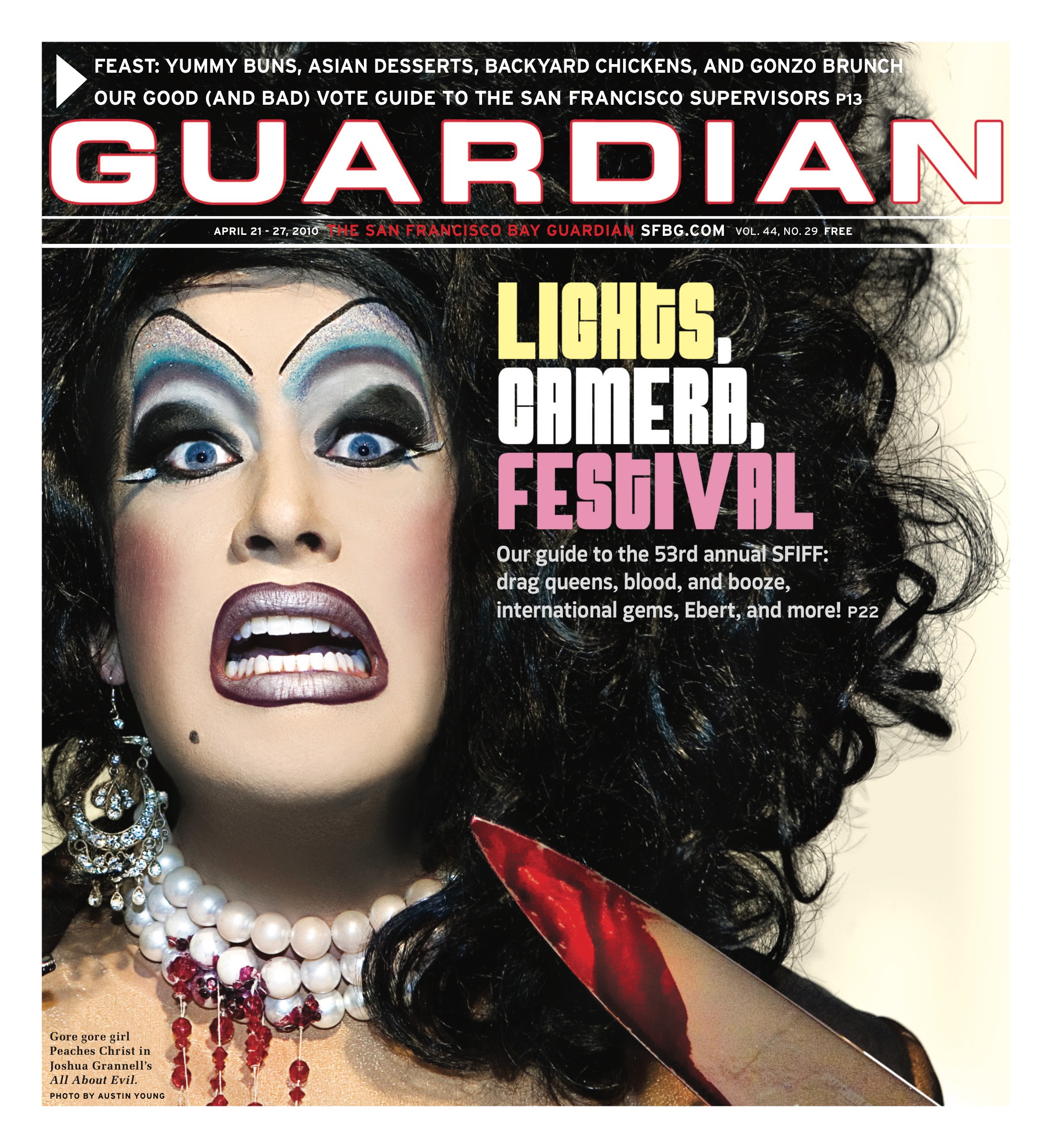
Scene

North Beach and Chinatown lift forks for Noodlefest 2010

1

I do love me some noodles. As do we all — just ask the cooks carving them from a solid, gyro like block of pasta at the Seattle Chinese restaurant I once blissfully attended, or the happy fettuccine eaters at the sidewalk cafes on Columbus Avenue. The world would be a better place if we could all put down our weapons and pick up our forks and spoons.

Which is roughly what is happening at this weekend’s Noodlefest 2010 (Sun/2). Sure, the days of armed warfare between North Beach and Chinatown may be safely behind us (were they ever in existence), but the two adjacent neighborhoods rarely come together to plan community happenings. Harken to the candlelit dinner scene in The Lady and the Tramp — it takes a pasta strand to break the ice, and bring you snout to snout.

But why eat a strand when you can sample six different pasta meals? Entry to Noodlefest gets you a taste of three steaming mountains of Chinatown noodles, and three from North Beach, in addition to live noodle making demonstrations and entertainment of all stripes.

So grab a fork. And to reinforce what this peaceful coexistence of culinary traditions signifies in the history of our city, two long time residents of the neighborhoods, Reverend Norman Fong of the Chinatown Community Development Center, and Dan Macchiarini of the North Beach Merchants’ Association, sent us their memoirs of growing up in the city’s historically Chinese and Italian ‘hoods. If the following tales of downtown SF life in the ‘50s and ‘60s don’t make you feel all noodley inside, then I don’t know what will.


Noodlefest 2010
Sun/2 3-7pm, $15
Grant, between Pacific & Vallejo, SF

www.chinatowncdc.org
———————-

The yin and yang of Chinese-Italian relationships
By Reverend Norman Fong, Chinatown Community Development Center


During the 1950s and 1960s,  it wasn’t all fine and dandy growing up in Chinatown and North Beach, although I wouldn’t trade my life experience for anything. In my younger elementary school years, I was a Chinatown kid; all my classmates were Chinese-Americans.

Then I had to cross Washington Square to head to Francisco Jr. High, where I learned about other races.  I remember having a crush on one very cute girl who lived in North Beach but I was too shy to ever ask her out and there weren’t too many cross-cultural relations back then. I also remember some very negative moments when groups of Italian boys would harass me.

One time I was chased by these boys who screamed “let’s get the Chinaman” and they tied me to the fence near St. Peter & Paul and they threw water balloons at me. I went home and I told my mom “I hate italians” and explained what happened.

My mom said life was about balance. “Did you know our landlord is Italian? He only charges us $90 rent and never raised the rent?” I didn’t fully understand at the time just how much that meant, but I do now. Years later, when I was about 18 years old, we were evicted from our home — by a Chinese landlord who bought the building.

Life is about balance, the Yin and Yang of life. Dan Macchiarini and Kathleen Dooley of the North Beach Merchants Association are friends because we shared the same block at the Chinatown Community Development Center office at 1525 Grant. I bought my Valentine’s Day flowers from Kathleen for my wife a number of years.

This Noodlefest is not just about noodles, spaghetti versus chow mein… It’s about relationships… and building cultural bridges… and “balance.”

Fireworks and noodles
By Dan Macchiarini, North Beach Merchants’ Association


Back in the day of the day, back when I was around 9 years old in the early 1960’s, I was among a bunch of kids my age from North Beach and Chinatown who would regularly play pick up games of football in Washington Square. Park Saturdays, Sundays, and whenever we could during the summer. We would have played baseball but the adults using the park wouldn’t let us and we could only play softball down at the Joe DiMaggio playground.

This was also a time when there were no real playgrounds at all in Chinatown, so a lot of the Chinese kids would come across Broadway to play in North Beach at Washington Square Park with us Italian kids. Some kids from Chinese ancestry lived in North Beach already. We got along fairly well too, considering the nonsensical historic animosity between a lot of our parents from our two distantly different racial and ethnic backgrounds.

We also hung out and played tennis dodge ball in the alley streets in both communities. These alleys during the day were very safe and were the kind of the place where car drivers looked out for and expected us kids to be.   Chinatown and North Beach both share a network of smallish streets and alleys. We made these “kids turf” when we weren’t in the park.

However, the most fun time for us was around mid February every year. It was always rainy and cold but this is the time of Chinese New Year. None of us Italian kids, even on the fourth of July, had access to fire works like the Chinese kids did. This made for a great trading relationship between us, everything from baseball cards to candy and sometimes even money changed hands for us to get the fireworks and use them. We had great contests blowing up tin cans, setting off stings of fire crackers to see how much noise and smoke we could make, until we got nailed by our parents who would attempt to restrict our alley pyrotechnics antics, commerce and careers on both sides of the ethnic divide.

The Chinese kids seemed to be at greater liberty to get and use these fireworks than we Italian kids were. It didn’t seem fair to me. I asked my father why this was. He said it was part of their culture and explained the “lunar new year.” He and my mother regularly took us to the Chinese New Year parade during the late 1950s and early 1960s. There were massive fireworks and firecrackers there, mostly still in the rain but spectacular at night during the parade of dragons and lions.

Before the parade, my parents would take my sister and I to dinner in their favorite Chinese restaurant and they would order all kinds of exotic dishes.  The restaurant, still there, was up Washington Street just off Grant Ave., three block off of Broadway and, literally, under the building. You walk down concrete steps to the doorway. Very “old school” Chinatown. My father knew all the waiters and the owner would greet us with broad smile.  Somehow, they knew each other back in their day, the 1930s, when everyone was struggling just to survive. So we got the VIP treatment there.

The food was incredibly good, although as a nine year old, I was somewhat picky — which my father had a VERY low tolerance for. I loved the Chinese noodles, all the chow mien dishes, and was okay with the rice dishes, but I had a lot of trouble with egg fu yung types; they tasted runny and raw to me. My mother insisted that my sister and I “try everything” they ordered, and my father would cuff me in the head to get my attention and tell me to “eat all your food.” I evolved a plan through; it involved a conspiracy with my sister because she loved egg fu yung. When my parents were distracted and not looking, we would change plates under the table. This all worked out fairly well until one time when we dropped one of the plates we were exchanging under the table. The food hit the floor and my father hit the ceiling. I was good at ducking, though. Luckily, the waiters and the owner were in fits laughter over this so my father’s temper cooled off fast but my mother made us kids sit through the rest of the meal without ANY more food as well as having to help the waiters picked up the mess.

I complained to my father, asking him why I couldn’t just eat the chow mien, like the pasta we made and ate at home. He told me that he brought me out to a Chinese restaurant so “you can learn” the taste of the way other people make food — and beside, the Chinese invented pasta too.

He said it was part of history, that about 800 years ago Marco Polo, an Italian merchant, went to China from Europe to Asia along the silk road to trade — and brought the idea of pasta to Italy and Europe (along with gunpowder).

He went on about this history, lecturing about how food was part of culture and we, as kids, should experience all kinds of food to learn about all kinds of cultures.  This lasted about ten minutes, but it still didn’t get me to like egg fu yung — although a thought pushed itself into my nine year old mind that those Chinese kids I played and “traded” with in the alleys of North Beach and Chinatown for fireworks were my “Silk Road,” and going between North Beach and Chinatown was truly great adventure.
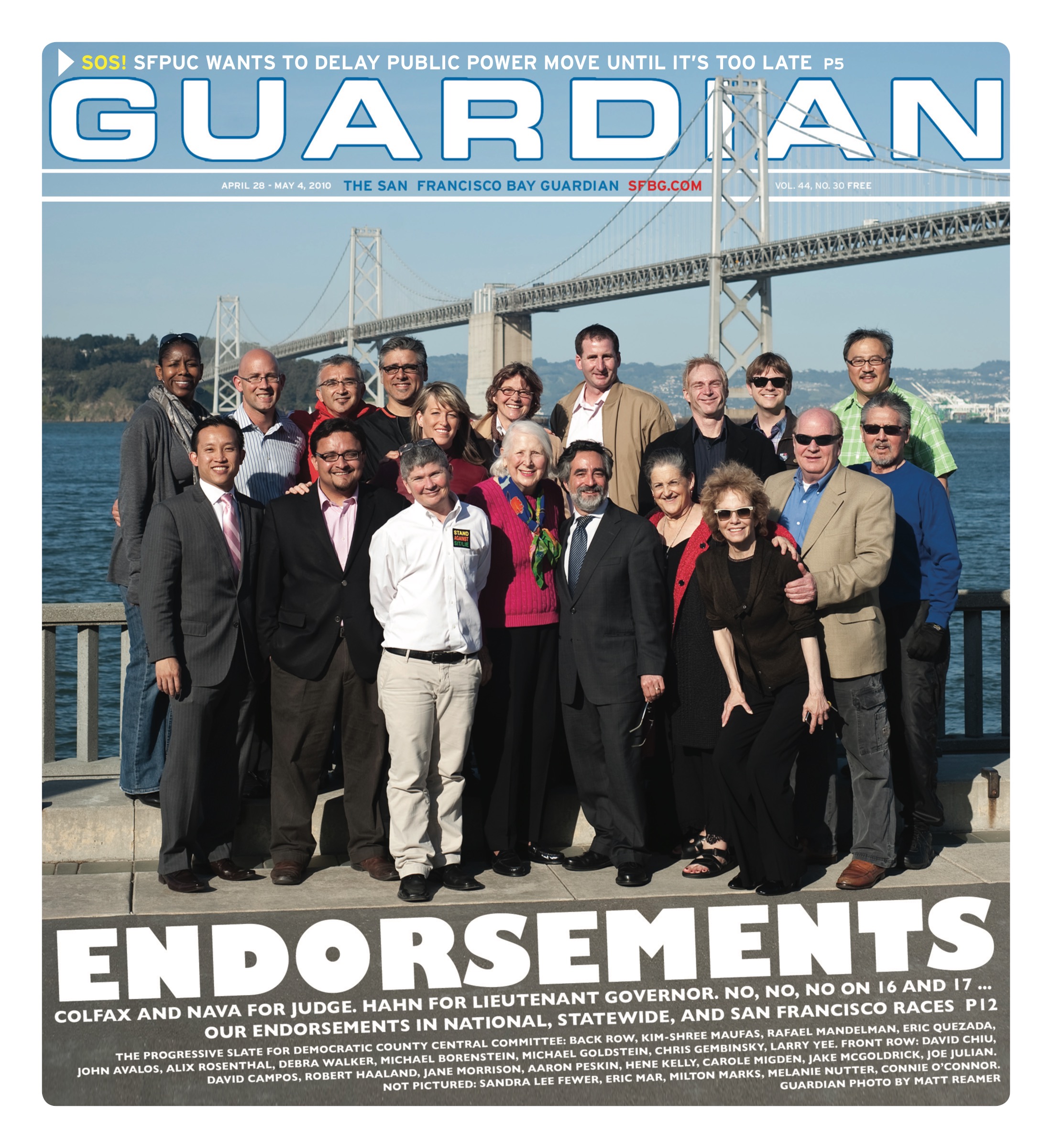
ENDORSEMENTS: State ballot measures

8

PROPOSITION 13

LIMITS ON PROPERTY TAX ASSESSMENT FOR SEISMIC RETROFITS

YES

The primary sponsor of Prop. 13 is Republican Sen. Roy Ashburn, who dominated the news for several days after he was arrested for drunk driving on his way home from a Sacramento gay bar. Needless to say, Ashburn’s dramatic coming out has whipped up far more attention than his noncontroversial ballot initiative.

We’re generally opposed to anything that gives tax cuts or tax deferrals to property owners; thanks to a 1978 measure also called Prop. 13, much of the commercial and residential property in California is badly under assessed. And Prop. 13, 2010 style, is indeed a tax break. But it’s probably justified.

Buildings in this state are typically reassessed for property taxes after they’ve been modified with new construction, except in cases where the modifications are made to comply with earthquake-safety standards. While most buildings that undergo seismic retrofitting are exempt from reassessment until the property is transferred to a new owner, the exemption for unreinforced masonry buildings is limited to 15 years. Prop 13 would remove that 15-year cap.

The fiscal impact on cities is likely to be pretty minor, and the measure might encourage both commercial and residential landlords to bring their buildings up to standard. Vote yes.


PROPOSITION 14

OPEN PRIMARIES

NO

At the height of a royal mess last year when the state budget was long overdue and the two-thirds majority needed to pass it was still out of reach by one vote, Republican Sen. Abel Maldonado struck a deal with Democrats. He said he’d support the budget — if the majority party would meet a few of his demands. One thing he insisted on was Prop. 14 — a ballot measure that would effectively remove political parties from the primary elections process, allowing all voters to cast ballots for any candidate regardless of party affiliation.

Under Maldonado’s plan, all candidates would run on a single primary ballot, and the top two vote-getters would face off in the general election. Heavily funded by the California Chamber of Commerce and marketed by the same spin doctors and corporate lawyers who are rolling in Yes on 16 campaign money, Prop. 14’s backers say it will result in more centrist elected officials.

There are plenty of pitfalls here, the most worrisome being that it would drive up the cost of elections and give more moneyed (and corporate-allied) candidates a sharper competitive edge while elbowing out progressives. It would allow Republicans to play a role in what would normally be Democratic primaries (and vice versa.) The measure would also make it nearly impossible for smaller parties — the Green Party, for example — to offer candidates in the November elections.

Bad idea, bad process, Vote no.


PROPOSITION 15

FAIR ELECTIONS ACT

YES

California desperately needs electoral reform. Corporate campaign spending and lobbyists have poisoned the decision-making process and muzzled the voice of the people. Something radical needs to be done — and while this measure is only a small, measured step in the right direction, it’s an important and promising experiment.

Prop. 15 would create a pilot public financing program for the 2014 and 2018 races for California Secretary of State — and the program would be funded by a tax on lobbyists. Right now lobbyists pay only $12.50 per year to register with the state. This measure would increase that fee to $350 annually and use the money to create a fund of about $6 million that candidates for the crucial office overseeing elections in the state could tap after demonstrating their popular support by gathering a number of small contributions. All candidates who qualify would be given the same amount of money and left to compete on the issues. Ideally this public financing program would prove successful and eventually be expanded to other offices. Public financing of election campaigns, which is currently working well in Arizona and Maine, is certainly worth a try in California. Vote yes.


PROPOSITION 16

MONOPOLY PROTECTION FOR PG&E

NO! NO! NO!

The deceptively titled “Taxpayer’s Right to Vote Act” was dreamed up and funded entirely by Pacific Gas and Electric Co., the monopolistic utility that is worried it could face actual competition here in San Francisco (and elsewhere) from municipal electricity programs that would offer customers a greener energy mix and more accountability than PG&E executives will ever demonstrate.

Rather than accept some healthy competition, this sleazy corporation has opted to spend some $35 million to exterminate all possibilities of municipal electricity programs cropping up anywhere in the state in a bid to preserve its octopus-like grip on the energy market in Northern California. Prop. 16 would require a two-thirds majority vote at the ballot before any community choice aggregation (CCA) program — or any attempt at creating or expanding a public-power system — could move forward. That’s an extreme hurdle — -and PG&E knows it.

In effect, PG&E is trying to buy public policy here, trying to pass a law that will protect its own monopoly interests.

In San Francisco, the CCA being proposed would offer customers 51 percent renewable power by 2017, which means it would blow PG&E out of the water in the green arena and mark S.F. as taking greater strides toward combating climate change than any other major U.S. city. This example could set a precedent for others, which, in turn, could create favorable market conditions for green energy startups that want to harness wind, solar, biomass, geothermal, tidal, and energy efficiency alternatives.

The very existence of Prop. 16 is already threatening the San Francisco CCA; the city’s Public Utilities Commission is trying to delay a final contract until after the June 8 vote on the measure (see editorial, page 5)

Vote no on Prop 16. Not just because it’s an example of a big business single-handedly trying to alter the state constitution for its own economic benefit by pouring millions of dollars into a deceptive advertising campaign. Not just because a two-thirds majority vote requirement is anti-democratic. Not just because there were reports that the signature gatherers who got people to sign on in support of placing Prop. 16 on the ballot were telling people that its purpose was to limit PG&E expansion or encourage solar power. Not just because Senate Pro Tem Darrell Steinberg and a half dozen members of the Legislature sent a letter rebuking PG&E CEO Peter Darbee for disrespecting the democratic process by going straight to the ballot to undermine legislation it initially supported that enabled the creation of CCA programs. Not just because PG&E is using $35 million of ratepayer dollars (that’s the check you wrote them for your electricity bill!) to put out slick TV ads for this campaign when it should have been repairing the pipelines under those manholes that keep exploding and messing up your morning commute. Not even just because with CCA, you already have the right to vote whether or not you want to be part of it, a choice PG&E will never give you. And not just because PG&E keeps trying to raise rates, which is much more difficult for municipal energy agencies to do.

If for no other reason, vote no because Prop. 16 flies in the face of everything environmentalists stand for. It’s a measure that will thwart progress on fighting climate change, brought to you by the company that practically invented green-washing. PG&E is a huge nuclear power player; it purchases coal from mountaintop-removal coal mines in West Virginia that are completely devastating biodiverse landscapes in Southern Appalachia and screwing over poor people by tainting their drinking water; and it’s in the process of building fossil fuel-fired power plants in poor communities of color in California. The CCA programs at least represent a glimmer of hope for an alternative model; Prop. 16 kills off that possibility with one fell swoop motivated by pure greed. For the love of justice, democracy, and the planet, vote no on Prop 16.


PROPOSITION 17

CAR INSURANCE SCHEME

NO, NO, NO!

Mercury Insurance sponsored this measure and is campaigning for it with tens of millions of dollars, betting it can fool voters and make hundreds of millions of dollars in profits by doing so. And if the company is right, insurance rates will skyrocket for new drivers and those who haven’t had continuous insurance coverage, which experts say will increase the number of uninsured drivers on the roadways and end up increasing insurance rates for everyone.

Mercury and its founder George Joseph have been truly malevolent players in California, exploiting their customers to make billions of dollars in profits, attacking California’s landmark insurance reform measure Prop. 103 with lawsuits and corrupting campaign contributions over more than 20 years, and flouting insurance regulators in such brazen fashion that even Insurance Commissioner Steve Poizner, a conservative Republican, recently chastised the company for its “lengthy history of serious misconduct” (see “Buying power,” March 17).

Now, however, the company is hoping its promise to cut the insurance premiums of drivers who have maintained continuous coverage by “as much as $250 per year” will buy their votes and that they’ll overlook the myriad negative impacts of increasing everyone else’s premiums by $1,000 per year or more, based on Mercury’s own estimates.

Think about that. If you’re a driver who missed an insurance payment by even one day, or a soldier returning from boot camp, or someone with a low-income getting insurance for the first time or after ditching your car for a while, what are you going to do when you discover already-expensive car insurance comes with a $1,000 annual surcharge?

Many Californians, those who share our roads, will choose to drive without insurance. Then they’ll be more likely to leave the scene of accidents or declare bankruptcy rather than paying out-of-pocket for their accidents, both of which increase the cost of insurance for everyone else.

That’s how insurance works. If someone pays less, someone else pays more; and the only entity guaranteed to really make money over the long term is the insurance company. Don’t fall for this scam. Vote no on 17.

Murder, he filmed

0

arts@sfbg.com

Get your shit peeled/ Check the murder rate, the shit’s real. —Eddi Projex, "Straight from Oakland"

MUSIC/FILM I first met Pretty Black, a member of Yukmouth’s Regime crew, in 2005 at the Mekanix’ studio in Oakland. He arrived with Husalah of the Mob Figaz to record. Goofing off, Hus urged me to get on the song, so I recorded an intro in mangled French, dubbing the pair "les hommes mobs." Black loved the pronunciation (moeb) and thus began one of my least likely rap-world friendships.

For even by rap standards, Black was a live wire. The 25-year-old always had a pistol on him, was always ready to fight, and, with his Range Rover and Lamborghini, clearly made his money off the street, though I didn’t inquire how. He was an angry young man, not someone to piss off. Yet according to Husalah, he had another side.

"Outside the circle, he seemed like the coldest dude on earth," Hus says. "But inside, you knew he was real compassionate. He provided for his niggas. And if you needed something, he was very resourceful."

"Plus," he adds, "if someone tried to fuck with you, he already knocked ’em out before you could even react."

Born in Chicago, Black was christened Ayoola Matthew Odumuyiwa by his Nigerian immigrant parents. When he first came to the Bay, he was known as Verstyle, but soon adopted the more in your face Pretty Black, a pun on the pimp sense of "pretty" (a "gorgeous" man) and his very dark skin. Like albino Jamaican rapper Yellowman, Black transformed a perceived negative — his color placing him on the lowest rung of our country’s caste system — into a defiant positive.

In 2008, on my birthday, May 25 (not, as sometimes reported, on May 30), Black was shot to death at an apartment complex where his relatives lived, a planned assassination. In other words, not random violence or robbery. Except for the killers, no one knows why. I was shocked because, while I could imagine someone wanting to kill him, I’d never known a murder victim. It’s like a candle flame being blown out: one second, fully here; the next, gone. I recalled, too, the last time I’d seen him, at a show featuring the Jacka. As we were catching up, he said, apropos of nothing, "Remember when we met and recorded that song? That was cool. Le moeb!" While ordinary at the time, this circling back to the night we met took on a retrospective uncanniness, as did one of his last songs, also recorded with the Mekanix, on which Black, playing both parts of a phone call, tells himself, "Don’t go outside, nigga. They’re trying to kill you."

BACK TO BLACK


I’ve been thinking about Black lately, in large part due to Land of the Homicide: The Murders in Oakland, CA (HookerBoyFilmz/HBO), a documentary DVD by Oakland filmmaker Dame Hooker. Brought into the game by veteran director Kevin Epps and multimedia journalist JR, Hooker has manned the cameras since 2001, releasing his first DVD, an overview of the local rap scene called The Bay Got Game (HookerBoy), in 2006. He’s also notched artist-oriented flicks like Mistah FAB’s Prince of the Bay (HookerBoy/InYoFace, 2007), among numerous other projects. Camera on shoulder, he’s a ubiquitous presence at any significant function, constantly accumulating footage of anything from a performance to a sideshow to an ass-whupping in high definition.

"I had a camera, but I was just shooting around the hood," Hooker recalls. "I didn’t know how to edit or anything. But FAB, Stalin, Shady Nate — I watched those dudes grow up. I started going to all their shows and they wanted the footage, so I learned how to edit just by watching TV or watching somebody else. Current TV on HBO showed me a lot about how to put it in a format."

Indeed, he nailed the format so well that Current TV licensed some of his footage and hired him and Epps to make content for the program’s Web site, which proved to be the genesis of the Land of the Homicide project.

"We did a pod, a little five-minute segment for Current TV," Hooker says. "It was called Popped in Oakland. I went around to my friends and was like, tell me how you got shot, and they was showing their wounds. HBO wanted me to extend it, and I was doing that already."

Some of the wounds are pretty grisly. One man pulls up a sleeve to display an arm that got sprayed with an AK. The arm is functional but it looks like a tree root, all twisted and gnarled, a permanent symbol of the gun problem in Oakland — which frequently leads the nation in homicides — not to say the entire country. Hooker himself hasn’t been immune to the violence. He shows me some of his own wounds.

"You got to know how to maneuver around here," he says grimly. "You can get shot just by looking at someone wrong. I got shot five times. Somebody thought I looked at them funny. I didn’t have no money on me or nothing."

RANDOM TARGETS


As Hooker’s own story suggests, Oakland’s gun violence often has a random quality to it. People get shot, sometimes killed, by mistake, in addition to intended victims like Pretty Black. One of the more notorious accidental murders was Jesse "Plan Bee" Hall, founder of the classic 1990s crew Hobo Junction, who was shot in 1992 while sitting next to the intended target. Among the interviewees are Plan Bee’s parents, his sister, and his younger brother, Bobby "Blu-Nose" Hall, as Hooker provides an unflinching look at the family’s devastation and grief. Before the end of the film, however, he winds up returning to the Hall residence as Blu-Nose himself is murdered, seemingly, like his brother, a random target.

"I got a large family. None of my family members have passed away like that," Hooker says. "Except my first cousin — we was real close — and my uncle, [and] two uncles, on my mother’s side. All the rest have been friends, but my friends be like my family."

Ordinarily, Blu-Nose’s death would raise a question like what are the odds of someone speaking on camera about gun violence being killed by gun violence shortly afterward? But this being Oakland, the question is: what are the odds of this occurring three times in quick succession? Because this is exactly what happens with Land of the Homicide, separating it from similarly-themed hood documentaries. Another of the main interviewees, a rapper from the East Oakland’s 70s named Hennessey who had many previous wounds to display, is also murdered. Though I hadn’t heard his music, I’d already begun to hear Hennessey’s name here and there; he’d just signed to Thizz for his first major project shortly before his death, and the contrast between his on-camera gregariousness and the extremely dapper corpse we see at his funeral makes a more emphatic argument against the legality of guns than any commentary could.

Pretty Black is the third victim. Although he didn’t have prior wounds himself, Black bumped into Hooker during the filming and agreed to lend his perspective as someone who knew the street life all too well.

"I was going around getting their opinion about the stuff," Hooker recalls. "Most of them was trying to help people, trying to get their hood right. I don’t know if it was a curse doing the DVD or what, but they all died back to back. It was supposed to be about the lives taken in Oakland, but it turned out to be the people that was interviewed."

I don’t think there’s a word for Hooker’s experience here. Obviously the tragic series of murders gives his DVD an authority and authenticity most documentaries couldn’t buy. But the price is not something he would have willingly paid.

"Land of the Homicide, that’s based on really good friends," he said. "DVDs, those don’t matter when it’s someone you know."

From Cleveland with love

2

johnny@sfbg.com

MUSIC Baby Dee is not your generic person in a band, with dull quotes about the process of recording an album. Baby Dee has something to say, and she says it with light power, ever so occasionally punctuating a comment with a machine-gun laugh that’s love-at-first-hearing. Some would say Baby Dee’s music is more of an acquired taste, but the new A Book of Songs for Anne Marie (Drag City) strips her musicality down to its essence, and the result, while owing a generative debt to German Lieder, is crystalline in a manner that trumps more affectation-laden contemporaries like Joanna Newsom and the musician most often compared to Dee, her friend Antony Hegarty of Antony and the Johnsons. Mabel Mercer comes to mind. On the eve of Dee’s SF visit, I got her on the horn, and the result was good enough that I didn’t want to write or talk around it. So here it is — 100-proof Baby Dee.

On the use of the Baby Dee song “Cavalry” in Joao Pedro Rodrigues’ movie To Die Like A Man: “He told me [it was the heart of the film] when I met him and I thought he was just blowing smoke up my ass. But so many reviews have said that he lavished all his gifts on that one scene.

How truly wonderful. Most people get a song in a movie and just an inconsequential fragment is playing in the background, but here the whole movie stops and everyone listens to the song — you can’t ask for more than that.

On her hometown: “I love Cleveland. It took me a long time to love Cleveland. I hated it all the time growing up. I left when I was 18 years old like a bullet out of a gun and never went back for more than a day at a time for almost 30 years.

The house I actually live in now, my recurring nightmare was to walk into the front door of that house. That was my end-of-the-world dream, instead of a holocaust or a great tsunami.

About ten years ago I went back there and ended up staying because my parents were in such bad shape. I was just experimenting with good behavior. [Laughs]

When they died I was stuck there, I’d lost my apartment in New York. I quit music and had a tree business. Then I woke up one morning and realized that I liked Cleveland. But it took me a lifetime. I’ve loved it ever since.

I never really toured the states, I’d toured Europe, and seeing what the rest of America is like made me love Cleveland. In Cleveland there is zero attitude at all. Nobody is cool in Cleveland, and if they are, it sure as hell isn’t because they live in Cleveland. The cool cities in America are New York, New Orleans — or what’s left of it — and San Francisco. In it’s own crazy way Vegas is cool. And maybe Niagara Falls.

New York is the city that never sleeps. I used to call Cleveland the city that shits the bed.”

On Marc Almond: “I adore, I worship Marc Almond. He’s one of the greatest people in the world in addition to being a great singer. People tend to think he’s a sweetheart, but in his case it’s absolutely true — he’s as good as gold. And we’ve got history — I gave him reasons to not be as good as gold to me. [Laughs] He’s just a prince.”

On German Lieder and classical music: “It had its influence on me, but in strange ways. When I grew up, I would leave the room when people would play Schubert. I couldn’t take it. It was an irrational hatred, and I haven’t had many musical ones. But there was history there — we took piano lessons, and my father had sort of been cast [by life] in the role of the Erl King with the dying child. Ooo, oogedy-boogedy, don’t go there! That kind of thing. We had to play some simple child’s version of Schubert’s Der Erlkönig, and my father was really into it without even having self-awareness why. He’d say “Play that one again” over and over, not even realizing it was about the death of his own soul. Hideous.

I was more at home with really, really old music. As a matter of fact I avoided the entire 19th century. It isn’t that there wasn’t beautiful music — Chopin, Beethoven — but I avoided the whole thing. I discovered Bach and went backwards from there. I was fascinated by Gregorian music and I finally got as a far as the Renaissance and became obsessed with [Giovanni Pieruigi da Palestrina] and the Spanish composer [Juan Evo] Morales [Ayma] and [Tomas Luis de] Victoria.”

On Joey Arias: “It’s not like Joey Arias is underrated. He might be the most beloved living drag singer. But he’s sort of ghettoized, very unfairly. I think he’s one of the greatest vocalists alive. If you’ve ever heard Joey get serious, there’s no greater heartbreaker.”

On her relation to the New York club scene: “The whole time cool things were happening in New York, I was in some dusty old piano loft in the South Bronx playing Palestrina on an organ.”

On her drink of choice: “It depends on when and where. If it’s before dinner, J&B Scotch on the rocks. If it’s after, it would definitely be Armagnac.”

BABY DEE

With Karl Blau, Jeffery Manson

Fri/30, 9 p.m., $12

Amnesia

853 Valencia, SF

(415) 970-0012

www.amnesiathebar.com

Music listings

0

Music listings are compiled by Paula Connelly and Cheryl Eddy. Since club life is unpredictable, it’s a good idea to call ahead to confirm bookings and hours. Prices are listed when provided to us. Submit items at listings@sfbg.com.

WEDNESDAY 28

ROCK/BLUES/HIP-HOP

*Aesop, Venture Capitalists, New Humans Bottom of the Hill. 9pm, $10.

Fix My Head, This Runs on Blood, Useless Children, Gain to Lose Sub-Mission, 2183 Mission, SF; www.sf-submission.com. 9pm, $6.

*"Full Pink Moon Party" Rickshaw Stop. 8pm, $10. With Sonya Cotton, Honeycomb, Jascha vs. Jascha, and Kris Gruen.

Japanther, Reaction, Dirty Marquee, Street Eaters Hemlock Tavern. 9pm, $8.

Pomegranate, Fall Risk, Control-R Hotel Utah. 8:30pm, $6.

Chad Price, Michael Dean Damron, Micah Schabnel, Piss Pissdofferson Thee Parkside. 8:30pm, $5.

Stymie and the Pimp Jones Luv Orchestra, Funk Revival Orchestra Café du Nord. 9pm, $10.

Volker Strifler Band Biscuits and Blues. 8pm, $15.

FOLK/WORLD/COUNTRY

Anoushka Shankar Palace of Fine Arts Theater, 3301 Lyon, SF; (415) 563-6504. 8pm, $25-$65.

DANCE CLUBS

Booty Call Q-Bar, 456 Castro, SF; www.bootycallwednesdays.com. 9pm. Juanita Moore hosts this dance party, featuring DJ Robot Hustle.

Club Shutter Elbo Room. 10pm, $5. Goth with DJs Omar, Nako, and Justin.

Hands Down! Bar on Church. 9pm, free. With DJs Claksaarb, Mykill, and guests spinning indie, electro, house, and bangers.

Machine Sloane, 1525 Mission, SF; (415) 621-7007. 10pm, free. Warm beats for happy feet with DJs Sergio, Conor, and André Lucero.

Mary-Go-Round Lookout, 3600 16th St, SF; (415) 431-0306. 10pm, $5. A weekly drag show with hosts Cookie Dough, Pollo Del Mar, and Suppositori Spelling.

RedWine Social Dalva. 9pm-2am, free. DJ TophOne and guests spin outernational funk and get drunk.

Respect Wednesdays End Up. 10pm, $5. Rotating DJs Daddy Rolo, Young Fyah, Irie Dole, I-Vier, Sake One, Serg, and more spinning reggae, dancehall, roots, lovers rock, and mash ups.

Synchronize Il Pirata, 2007 16th St, SF; (415) 626-2626. 10pm, free. Psychedelic dance music with DJs Helios, Gatto Matto, Psy Lotus, Intergalactoid, and guests.

Telephoned Harlot, 46 Minna, SF; www.harlotsf.com. 7pm. Mash-ups with DJ Sammy Bananas and singer Maggie Horn.

Yoruba Dance Sessions Bacano! Som., 2925 16th St, SF; (415) 558-8521. 9pm, free. With resident DJ Carlos Mena and guests spinning afro-deep-global-soulful-broken-techhouse.

THURSDAY 29

ROCK/BLUES/HIP-HOP

Aquaserge, Casper and the Cookies, Grand Lake Rickshaw Stop. 8pm, $10.

Arcadio, Guns for San Sebastian, Charles Gonzalez Café du Nord. 9pm, $10.

C-Mon and Kypski, Frequency, Sweet Snacks, DJ Mancub Independent. 9pm, $12.

A Day to Remember, August Burns Red, Silverstein, Enter Shikari, Go Radio Regency Ballroom. 6:45pm, $23.

Dunes El Rio. 8pm, $5.

Shane Dwight Biscuits and Blues. 8pm, $20.

Flood, Hashishian, Days of High Adventure Knockout. 10pm, $6.

49 Special, Big Nasty, TV Mike and the Scarecrowes Hotel Utah. 9pm, $7.

Emily McLean, Quinn DeVeaux, Street Sirens Red Devil Lounge. 8pm, $8.

Murs, Sick Jacken Fillmore. 8pm, $20.

Photo Atlas, Moog, Smile Radio Thee Parkside. 9pm, $8.

Spill Canvas, Tyler Hilton, AM Taxi, New Politics Slim’s. 7:30pm, $16.

Sugar and Gold, Nite Jewel, Baron Von Luxxury, DJ Loose Shus Bottom of the Hill. 9pm, $10.

Sugar Butt Tiger, Bare Wires, Girl Band, MC Meathook and the Vital Organs, SF Rockstar Paradise Lounge. 9pm, $7. Proceeds benefit the Haight-Ashbury Street Fair.

Emily Jane White, Helene Renault, Chloe Makes Music Hemlock Tavern. 9pm, $7.

FOLK/WORLD/COUNTRY

Bluegrass and old-time jam Atlas Café. 8pm, free.

Jordan Carp Bollyhood Café. 8pm, free.

Jon Rubin with Cal Keaoola Bliss Bar, 4026 24th St., SF; (415) 826-6200. 8pm, free.

DANCE CLUBS

Afrolicious Elbo Room. 9:30pm, $8-10. DJs Pleasuremaker and Señor Oz mark their night’s third anniversary with a live performance by Aphrodesia.

Caribbean Connection Little Baobab, 3388 19th St, SF; (415) 643-3558. 10pm, $3. DJ Stevie B and guests spin reggae, soca, zouk, reggaetón, and more.

Drop the Pressure Underground SF. 6-10pm, free. Electro, house, and datafunk highlight this weekly happy hour.

Good Foot Yoruba Dance Sessions Bacano! Som., 2925 16th St, SF; (415) 558-8521. 9pm, free. A James Brown tribute with resident DJs Haylow, A-Ron, and Prince Aries spinning R&B, Hip hop, funk, and soul.

Koko Puffs Koko Cocktails, 1060 Geary, SF; (415) 885-4788. 10pm, free. Dubby roots reggae and Jamaican funk from rotating DJs.

Mestiza Bollywood Café, 3376 19th St, SF; (415) 970-0362. 10pm, free. Showcasing progressive Latin and global beats with DJ Juan Data.

Peaches Skylark, 10pm, free. With an all female DJ line up featuring Deeandroid, Lady Fingaz, That Girl, and Umami spinning hip hop.

Popscene 330 Rich. 10pm, $10. Rotating DJs spinning indie, Britpop, electro, new wave, and post-punk.

FRIDAY 30

ROCK/BLUES/HIP-HOP

Aunt Kizzy’z Boyz Biscuits and Blues. 8 and 10pm, $20.

David Baron, Dan Vickrey, Blackstone Heist, American Studies Hotel Utah. 9pm, $10.

Clipd Beaks, Sightings, Bill Orcutt Hemlock Tavern. 9pm, $7.

Flexx Bronco, My Revolver, Bourbon Saints, Electric Sister Thee Parkside. 9pm, $6.

JFP, Cnote, Mack Misstress El Rio. 10pm, $5.

Kapakahi, Dogman Joe, Stranger Café du Nord. 9:30pm, $12.

Lemonade, Solid Gold, Active Child, DJ Aaron Axelsen Rickshaw Stop. 9pm, $10.

Lord T. and Eloise, Tenderloins, Hottub DJ Set Independent. 9pm, $14.

Ponys, Disappears, Spencey Dude and the Doodles Bottom of the Hill. 10pm, $12.

Rogue Wave, Man/Miracle Fillmore. 9pm, $19.50.

Joe Rut Great American Music Hall. 9pm, $14. With comedian Will Franken.

Shpongle, ADHK, Hallucinogen LIVE Regency Ballroom. 9pm, $30.

Shayna Steele Coda. 10pm, $10.

JAZZ/NEW MUSIC

Audium 9 1616 Bush, SF; (415) 771-1616. 8:30pm, $15.

Black Market Jazz Orchestra Top of the Mark. 9pm, $10.

Chano Dominguez Flamenco Jazz Quartet featuring Tomasito Palace of Fine Arts Theare, 3301 Lyon, SF; www.sfjazz.org. 8pm, $25-60.

Dan Zemelmen Quartet with Kenny Washington Red Poppy Art House. 8pm, $12-15.

Eric Kurtzrock Trio Ana Mandara, Ghirardelli Square, 891 Beach, SF; (415) 771-6800. 8pm, free.

Fred Frith and Theresa Wong Meridian Gallery, 535 Powell, SF; www.meridiangallery.org. 8pm, $10.

Kenny Lattimore Yoshi’s San Francisco. 8 and 10pm, $38.

"A Night at Birdland" Deco Lounge, 510 Larkin, SF; (415) 346-2025. 9pm. With the MegaFlame Blue Band.

FOLK/WORLD/COUNTRY

Eek-a-mouse Rock-it Room. 10pm, $22. With the Holdup and DJ Mr. E.

Lava, Mestizo, Carmen Milagro Slim’s. 8pm, $16.

Melees Socha Café, 3235 Mission, SF; (415) 643-6848. 8:30pm, free.

Stairwell Sisters Revolution Café, 3248 22nd St, SF; (415) 642-0474. 8:45pm, free.

DANCE CLUBS

Activate! Lookout, 3600 16th St, SF; (415) 431-0306. 9pm, $3. Face your demigods and demons at this Red Bull-fueled party.

Afrolicious Elbo Room. 9:30pm, $8-10. DJs Pleasuremaker and Señor Oz mark their night’s third anniversary with Chico Mann and guest DJ Similak Chyld.

Area Codes Element Lounge. 10pm, $10. With DJs Platurn, Doc Fu, and White Mike spinning Bay Area hip hop.

Blow Up Rickshaw Stop. 10pm, $10. With rotating DJs.

Exhale, Fridays Project One Gallery, 251 Rhode Island, SF; (415) 465-2129. 5pm, $5. Happy hour with art, fine food, and music with Vin Sol, King Most, DJ Centipede, and Shane King.

Fat Stack Fridays Koko Cocktails, 1060 Geary, SF; (415) 885-4788. 10pm, free. With rotating DJs Romanowski, B-Love, Tomas, Toph One, and Vinnie Esparza.

Gay Asian Paradise Club Eight, 1151 Folsom, SF; www.eightsf.com. 9pm, $8. Featuring two dance floors playing dance and hip hop, smoking patio, and 2 for 1 drinks before 10pm.

Good Life Fridays Apartment 24, 440 Broadway, SF; (415) 989-3434. 10pm, $10. With DJ Brian spinning hip hop, mashups, and top 40.

Hot Chocolate Milk. 9pm, $5. With DJs Big Fat Frog, Chardmo, DuseRock, and more spinning old and new school funk.

Look Out Weekend Bambuddha Lounge. 4pm, free. Drink specials, food menu and resident DJs White Girl Lust, Swayzee, Philie Ocean, and more.

M4M Fridays Underground SF. 10pm-2am. Joshua J and Frankie Sharp host this man-tastic party.

Meat Vs. Death Guild DNA Lounge. 8:30pm, $4-8. Industrial, gothic, EBM, and more with Decay, BaconMonkey, Joe Radio, and Melting Girl.

Quantic Mighty. 10pm, $12. With Disco Shawn and DJ Sake 1.

Rockabilly Fridays Jay N Bee Club, 2736 20th St, SF; (415) 824-4190. 9pm, free. With DJs Rockin’ Raul, Oakie Oran, Sergio Iglesias, and Tanoa "Samoa Boy" spinning 50s and 60s Doo Wop, Rockabilly, Bop, Jive, and more.

Suite Jesus 111 Minna. 9pm, $20. Beats, dancehall, reggae and local art.

Teenage Dance Craze Party Knockout. 10pm, $3. With DJ Sergio Iglesias, Russell Quann, and dX the Funky Gran Paw.

SATURDAY 1

ROCK/BLUES/HIP-HOP

*AC/Dshe, Total B.S., Honeydust Slim’s. 9pm, $14.

Antlers, Phantogram Independent. 9pm, $14.

Mike Beck and the Bohemian Saints Riptide. 9pm, free.

Broken Social Scene Fillmore. 9pm, $25.

Grand National, Bonafide, General Jones Hotel Utah. 9pm, $8.

JC Smith Band Biscuits and Blues. 8 and 10pm, $16.

*Laudanum, Worm Ouroboros, Dispirit Hemlock Tavern. 9:30pm, $7.

Maus Haus, Rafter, White Cloud Bottom of the Hill. 10pm, $10.

Outernational Thee Parkside. 9pm, $10.

Plushgun, Music for Animals, Fake Your Own Death, Marissa Guzman Rickshaw Stop. 8pm, $15.

Warren Teagarden, Collisionville, Charmless Kimo’s. 9pm, $7.

JAZZ/NEW MUSIC

Audium 9 1616 Bush, SF; (415) 771-1616. 8:30pm, $15.

Eric Kurtzrock Trio Ana Mandara, Ghirardelli Square, 891 Beach, SF; (415) 771-6800. 8pm, free.

Hypnotic Brass Ensemble Palace of Fine Arts Theatre, 3301 Lyon, SF; www.sfjazz.org. 3 and 8pm, $5-25.

Kenny Lattimore Yoshi’s San Francisco. 8 and 10pm, $38.

Marlena Teich Quintet Savanna Jazz. 8pm.

Sanctuary Trio featuring Peter Apfelbaum and guests Coda. 10pm, $10.

Ricardo Scales Top of the Mark. 9pm, $15.

FOLK/WORLD/COUNTRY

Boyd and Wain Socha Café, 3235 Mission, SF; (415) 643-6848. 8:30pm, free.

Evangenitals El Rio. 11:30pm, $7.

Gold Live Rockit Room. 9pm, $15. With Ce’Cile, Daddy Rolo, Empress I-Lexis, Danneekah.

Sour Mash Hug Band, Four Inch Pony, Janay Rose Mercury Café, 201 Octavia, SF; (415) 252-7855. 7pm, $5.

Red Hot Chachkas Red Poppy Art House. 8pm, $15.

Brazil Vox Revolution Café, 3248 22nd St, SF; (415) 642-0474. 8:45pm, free.

DANCE CLUBS

Bar on Church 9pm. Rotating DJs Foxxee, Joseph Lee, Zhaldee, Mark Andrus, and Niuxx.

Dead After Dark Knockout. 6-9pm, free. With DJ Touchy Feely.

Debaser Knockout. 9pm, $5. Alt-rock hits from the 90s with DJ Jamie Jams and Emdee of Club Neon.

Everlasting Bass 330 Ritch. 10pm, $5-10. Bay Area Sistah Sound presents this party, with DJs Zita and Pam the Funkstress spinning hip-hop, soul, funk, reggae, dancehall, and club classics.

Fire Corner Koko Cocktails, 1060 Geary, SF; (415) 885-4788. 9:30pm, free. Rare and outrageous ska, rocksteady, and reggae vinyl with Revival Sound System and guests.

Foundation Som., 2925 16th St., SF; (415) 558-8521. 10pm.

Gemini Disco Underground SF. 10pm, $5. Disco with DJ Derrick Love and Nicky B. spinning deep disco.

HYP Club Eight, 1151 Folsom, SF; www.eightsf.com. 10pm, free. Gay and lesbian hip hop party, featuring DJs spinning the newest in the top 40s hip hop and hyphy.

Kontrol Endup. 10pm, $20. With resident DJs Alland Byallo, Craig Kuna, Sammy D, and Nikola Baytala spinning minimal techno and avant house.

Leisure Paradise Lounge. 10pm, $7. DJs Omar, Aaron, and Jet Set James spinning classic britpop, mod, 60s soul, and 90s indie.

New Wave City DNA Lounge. 9pm, $7-12. Erasure tribute with Skip and Shindog and Andy T.

Rebel Girl Rickshaw Stop. 10pm, $5. "Electroindierockhiphop" and 80s dance party for dykes, bois, femmes, and queers with DJ China G and guests.

Saturday Night Soul Party Elbo Room. 10pm, $10. Sixties soul with DJs Lucky, Phengren Oswald, and Paul Paul.

So Special Club Six. 9pm, $5. DJ Dans One and guests spinning dancehall, reggae, classics, and remixes.

Social Club Lookout, 3600 16th St, SF; (415) 431-0306. 9pm. Shake your money maker with DJs Lee Decker and Luke Fry.

Soundscape Vortex Room, 1082 Howard, SF; www.myspace.com/thevortexroom. With DJs C3PLOS, Brighton Russ, and Nick Waterhouse spinning Soul jazz, boogaloo, hammond grooves, and more.

Spirit Fingers Sessions 330 Ritch. 9pm, free. With DJ Morse Code and live guest performances.

SUNDAY 2

ROCK/BLUES/HIP-HOP

Eluvium, Benoit Pioulard Café du Nord. 8pm, $12.

Nymph, Three Leafs, Woom Hemlock Tavern. 9pm, $6.

Shootin’ Lucy, Neutralboy, Steel Tigers of Death, Gunner Kimo’s. 5:30pm, $6.

JAZZ/NEW MUSIC

Kenny Lattimore Yoshi’s San Francisco. 5pm, $5-38.

Raul Midon Palace of Fine Arts Theatre, 3301 Lyon, SF; www.sfjazz.org. 7pm, $25-55.

Ray Obiedo and the Urban Latin Jazz Project Coda. 8pm, $10.

*Kronos Quartet Herbst Theatre, 401 Van Ness, SF; www.performances.org. 11am, $8-15.

Rent Romus and the Emergency String Ensemble, Noertker’s Moxie Chamber Ensemble Musicians Union Hall, 116 Ninth, SF; www.noertker.com. 7:30pm, $10.

FOLK/WORLD/COUNTRY

Damon and the Heathens, Graves Brothers Deluxe, Doc Holler Amnesia. 8:30pm, $7.

"Wanderlust at the Fillmore" Fillmore. 8pm, $25. With Rupa and the April Fishes, MC Yogi, and DJ Dragonfly.

DANCE CLUBS

Afterglow Nickies, 466 Haight, SF; (415) 255-0300. An evening of mellow electronics with resident DJs Matt Wilder, Mike Perry, Greg Bird, and guests.

Call In Sick Skylark. 9pm, free. DJs Animal and I Will spin danceable hip-hop.

DiscoFunk Mashups Cat Club. 10pm, free. House and 70’s music.

Dub Mission Elbo Room. 9pm, $6. Dub, roots, and classic dancehall with Vinnie Esparza and guest Spliff Skankin’.

FlashDance SF Glas Kat, 520 4th St., SF; www.flashdancesf.com. 6pm, $25.

Gloss Sundays Trigger, 2344 Market, SF; (415) 551-CLUB. 7pm. With DJ Hawthorne spinning house, funk, soul, retro, and disco.

Honey Soundsystem Paradise Lounge. 8pm-2am. "Dance floor for dancers – sound system for lovers." Got that?

Jock! Lookout, 3600 16th St, SF; (415) 431-0306. 3pm, $2. This high-energy party raises money for LGBT sports teams.

Kick It Bar on Church. 9pm. Hip-hop with DJ Zax.

Lowbrow Sunday Delirium. 1pm, free. DJ Roost Uno and guests spinning club hip hop, indie, and top 40s.

Religion Bar on Church. 3pm. With DJ Nikita.

Stag AsiaSF. 6pm, $5. Gay bachelor parties are the target demo of this weekly erotic tea dance.

MONDAY 3

ROCK/BLUES/HIP-HOP

"Felonious Presents Live City Revue" Coda. 9pm, $7.

Futurecop, Keith Masters Elbo Room. 9pm, $7.

Green River Ordinance, Matt Hires, Angel Taylor Café du Nord. 8pm, $12.

Garrison Starr, Joey Ryan, Cate Le Bon Bottom of the Hill. 9pm, $10.

FOLK/WORLD/COUNTRY

AaronandJane Rockit Room. 8pm, free.

DANCE CLUBS

Bacano! Som., 2925 16th St, SF; (415) 558-8521. 9pm, free. With resident DJs El Kool Kyle and Santero spinning Latin music.

Black Gold Koko Cocktails, 1060 Geary, SF; (415) 885-4788. 10pm-2am, free. Senator Soul spins Detroit soul, Motown, New Orleans R&B, and more — all on 45!

Death Guild DNA Lounge. 9:30pm, $3-5. Gothic, industrial, and synthpop with Decay, Joe Radio, and Melting Girl.

M.O.M. Madrone Art Bar. 6pm, free. With DJ Gordo Cabeza and guests playing all Motown every Monday.

Manic Mondays Bar on Church. 9pm. Drink 80-cent cosmos with Djs Mark Andrus and Dangerous Dan.

Monster Show Underground SF. 10pm, $5. Cookie Dough and DJ MC2 make Mondays worth dancing about, with a killer drag show at 11pm.

Network Mondays Azul Lounge, One Tillman Pl, SF; www.inhousetalent.com. 9pm, $5. Hip-hop, R&B, and spoken word open mic, plus featured performers.

Skylarking Skylark. 10pm, free. With resident DJs I & I Vibration, Beatnok, and Mr. Lucky and weekly guest Djs.

TUESDAY 4

ROCK/BLUES/HIP-HOP

Heartless Bastards, Hacienda, Amy Cook Independent. 8pm, $18.

*Lupe Fiasco, B.o.B. Warfield. 8pm, $40.

MC Frontalot, Brandon Patton, Edible Norris Café du Nord. 8pm, $12.

Mantles, Dimmer, Weekend Rickshaw Stop. 8pm, $10.

Mudface, Great American Beast, Motogruv Elbo Room. 9pm, $6.

Needtobreathe, Stephen Kellogg and the Sixers, Seabird Great American Music Hall. 8pm, $19.
Rangers, Jon Porras, Radiant Husk, Centipede Eest Hemlock Tavern. 9pm, $6.
Title Tracks, New Trust, Bye Bye Blackbirds Bottom of the Hill. 9pm, $10.
Zweng, Frisky Disco, Parachute Musical, Winter Sounds Thee Parkside. 8pm, $6.
DANCE CLUBS
Alcoholocaust Presents Argus Lounge. 9pm, free. With DJs What’s His Fuck, Taypoleon, and Mackiveli.
Eclectic Company Skylark, 9pm, free. DJs Tones and Jaybee spin old school hip hop, bass, dub, glitch, and electro.
La Escuelita Pisco Lounge, 1817 Market, SF; (415) 874-9951. 7pm, free. DJ Juan Data spinning gay-friendly, Latino sing-alongs but no salsa or reggaeton.
Mixology Aunt Charlie’s Lounge, 133 Turk, SF; (415) 441-2922. 10pm, $2. DJ Frantik mixes with the science and art of music all night.
Rock Out Karaoke! Amnesia. 7:30pm. With Glenny Kravitz.
Share the Love Trigger, 2344 Market, SF; (415) 551-CLUB. 5pm, free. With DJ Pam Hubbuck spinning house.
Womanizer Bar on Church. 9pm. With DJ Nuxx.

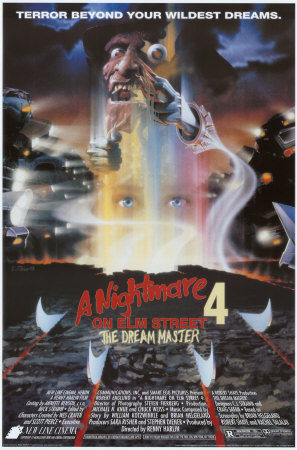
Welcome to Elm Street: Part Four

0

In honor(?) of the new A Nightmare on Elm Street, we’re recapping all of the Elms so far. Find more on the Pixel Vision blog.

In the immortal words of the Fat Boys: are you ready for Freddy?

Well, duh. By 1988’s A Nightmare on Elm Street 4: The Dream Master, everyone and their (human-faced) dog was ready for Freddy, whose status as a grinning, quotable pop culture icon would only be enhanced by his latest film. The Dream Master is the first of the Nightmare movies to basically do away with any semblance of a plot; instead, the film exists to provide variously surreal, outlandish, and repulsive nightmare sequences that inevitably end in the death of whatever character is chiefly involved.
And that ain’t such a bad thing. Though the behind the scenes credits are sorta impressive, actually — Renny Harlin, who’d go on to make Die Hard 2 (1990), Cliffhanger (1993), and Deep Blue Sea (1999), directed; Brian Helgeland, who shared a screenwriting Oscar with Curtis Hanson for 1997’s L.A. Confidential, and was later nominated for adapting 2003’s Mystic River, is among its co-writers — this movie is utterly ridiculous anytime Freddy’s not the center of attention.

Thankfully, that’s not often. As Louis described in his post on Nightmare 3, the remaining Elm Street kids/Dream Warriors — now more or less integrated into Springwood’s normal high school population —  are the first to go, and they go fast. But wait, you say! Didn’t Freddy get buried in consecrated ground, etc. etc., at the end of Dream Warriors? Yeah, but no matter: before Kincaid (Ken Sagoes) dies, he dreams his dog, Jason (zing!), turns demonic and pees a fiery stream into Freddy’s junkyard grave. Naturally, Freddy comes back to “life,” except he was already dead, or undead, or something, to begin with, wasn’t he? “You shouldn’t have buried me. I’m not dead!” Whatever, he’s back.

Before you can sing a slo-mo jump rope rhyme, Kincaid gets gloved, and ever-horny Joey (Rodney Eastman) drowns in his waterbed. Kristen (now played by Tuesday Knight, who’s no Patricia Arquette) meets a fiery end, but not before courteously extending Freddy’s nightmare-entering capabilities beyond the Elm Street circle: she pulls innocent, mousy Alice (Lisa Wilcox) into her fatal dream. (Freddy’s response: “How sweet! Fresh meat!”) Logically, of course, this means Freddy can now terrorize Alice and all of her friends, including her kung fu-fighting brother, Rick (Andras Jones); asthmatic nerd Sheila (Toy Newkirk); bug-phobic workout-aholic Debbie (Brooke Theiss); and letter-jacketed love interest Dan (Danny Hassel).

The death scenes benefit from what appears to be a bigger special-effects budget than previous films, with Debbie’s transformation into a giant cockroach remaining my personal favorite. There’s also a nice bit where Alice gets pulled into a movie screen, and an attempt at near-artsyness when a scene repeats multiple times to slow Alice and Dan from saving one of their imperiled, snoozing friends. I’m also a huge fan of the scene where Freddy visits Alice’s workplace, the Crave Inn (zing!) diner. Seems Freddy, in a particularly sassy mood, has ordered himself a pizza. A pizza covered in heads! Screaming heads! Freddy spears a head-meatball with one of his claws and excitedly smacks his lips: “My faaaaavorite!” The chewing sounds are amazing.

Later, Alice turns Perseus and “kills” Freddy by showing him his reflection in a piece of stained glass (but not before Freddy reminds us that “I. Am. Eternal!”) And since Freddy has now become not just a slaughterer-of-the-sleeping, but a taker-of-souls (when and how did that happen, exactly?), his captives sail to freedom past Alice in a wash of white light, as if Zelda Rubenstein was showing them the way. Yeah, that’s the end of him, for sure! Er … one more thing about Dream Master is its determined-to-be “hip” soundtrack, with Sinead O’ Conner, Dramarama, Blondie, and other artists contributing tunes. But you can’t go wrong with the Fat Boys.

Welcome to Elm Street: Part Three

0

In honor(?) of the new A Nightmare on Elm Street, we’re recapping all of the Elms so far. Find more on the Pixel Vision blog.

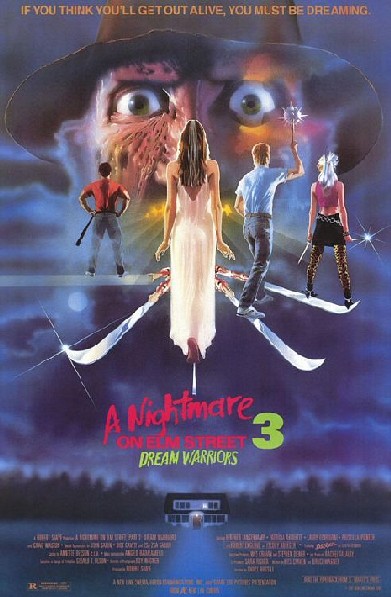
“Live together, die alone.” I stole that line from Lost, but it sums up A Nightmare on Elm Street 3: Dream Warriors (1987) all too well. The remaining Elm Street kids — you know, the ones whose parents enacted mob justice on Fred Krueger — find themselves locked in a psych ward. They’re not really crazy: they’re just having bad dreams. But these teens are (mostly) smarter than their predecessors, and they refuse to go down without a fight. The “dream warriors” pick up on two important facts: there’s safety in numbers, and you can do awesome shit when you’re dreaming. I believe The Simpsons’ Ralph Wiggum said it best: “Sleep! That’s where I’m a Viking.”
No Vikings in this bunch, sadly, but these kids do have pretty nifty powers and thus a fighting chance against Freddy. In case you’re planning on assembling your own team of dream warriors — and honestly, it’s not a bad idea — I thought I’d break down the pros and cons of part three’s heroes. Yes, most of them end up dead and those that don’t (spoiler alert) are offed in part four. But hey, it’s good to know what skills to look for and what faults to avoid when you’re trying to save your ass.

Presenting the dream warriors, in the order in which they bite it.

Phillip (Bradley Gregg)
Pros: Bitchin’ ‘80s hair.
Cons: Sleepwalker. First to die, with the most disturbing death scene by far. He really doesn’t have a lot going for him.

Jennifer (Penelope Sudrow)
Pros: Has a (somewhat painful) system for staying awake. Burning oneself with cigarettes shows serious motivation.
Cons: Smoker. Thinks she’s going to be an actress — yeah, she’s one of those. And, of course, the second to die. “Welcome to prime time, bitch.”

Taryn (Jennifer Rubin)
Pros: Stands her ground. That means not putting out for skeezy orderlies. Gets the best line of the movie: “In my dreams, I’m beautiful. And bad.” Switchblades.
Cons: Attitude. Really needs to comb that hair. Pesky heroin addiction, which Freddy exploits with terrifying fingerneedles.

Will (Ira Heiden)
Pros: Nerdy charm. In his dreams, he can walk — not to mention be the Wizard Master. That’s right, he can blow up evil wheelchairs with green lightning (in the name of Lowrek, Prince of Elves).
Cons: Even as a wizard master, he’s still just a dweeb. And eventually, a dead one.

Nancy Thompson (Heather Langenkamp)
Pros: She’s been here before. Check out that grey streak: it screams “survivor.” Prescription for Hypnocil. Won’t take getting killed lying down.
Cons: Lots of baggage. Dead friends, dead boyfriend, dead mom — rewatch the first Nightmare on Elm Street if you need a refresher. Kind of naïve, inevitably. You really thought ghost dad was legit?

Kristen (Patricia Arquette)
Pros: Good at art. Marvel at her popsicle stick recreation of Nancy’s house! Does flips. Can bring people into her dreams.
Cons: Can bring people into her dreams. Hey, that’s a bad thing when you’re trying to avoid getting murdered. Poor common sense. All the Freddy fan-art is asking for it, don’t you think?

Kincaid (Ken Sagoes)
Pros: Tells it like it is, which means more great lines: “Let’s go kick the motherfucker’s ass all over dream land!” “Yo, Freddy! Where you hidin’ at, you burnt-face pussy?” Also, dreams give him super strength!
Cons: Gets thrown in the quiet room a lot, so you know he’s bad news. Nasty habit of antagonizing Freddy Krueger.

Joey (Rodney Eastman)
Pros: Knows to wake up his friends when necessary. Dream scream can break mirrors and banish the boogeyman.
Cons: But mostly quiet. Too quiet. Ball of teenage hormones, which inspires him to follow the hot nurse from hell and get himself comatose.

Dr. Neil Gordon (Craig Wasson)
Pros: The only doctor who actually believes that his patients are being killed by Freddy Krueger. Master hypnotist. Sees dead people — or dead nuns, at least.
Cons: Not a teenager. Might we say he’s getting too old for this shit? Can’t even fight a skeleton.

So there you have it. Now you can — I’m so sorry for this — pick your own dream team. And if you’d like to recruit me as a dream warrior, you should know that I’ve seen countless horror movies and know how to survive relatively unscathed. On the other hand, I’m pee-my-pants frightened of Freddy, so let’s call it a draw.

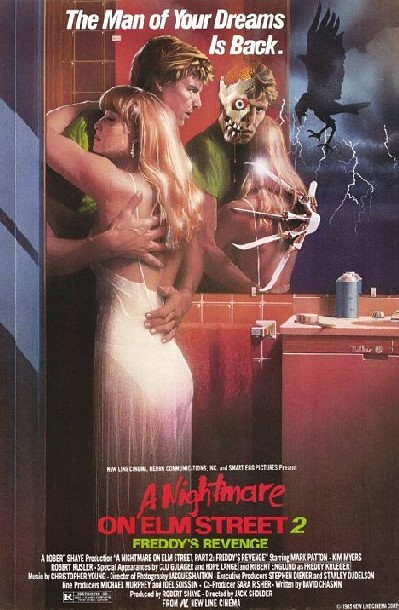
Welcome to Elm Street: Part Two

2

In honor(?) of the new A Nightmare on Elm Street, we’re recapping all of the Elms so far. Find more on the Pixel Vision blog.

A Nightmare on Elm Street, Part 2: Freddy’s Revenge (1985) is probably the most reviled of all the Nightmare movies. Which is silly, because it’s awesome. OK, there are serious continuity problems and an utter lack of interior logic. You could skip right to part three without missing a beat — in fact, maybe you should. Freddy’s Revenge works better outside the context of the series. You have to appreciate this movie for what it is: a campy, homoerotic comedy. Dark comedy, but still.

Nancy (Heather Langenkamp) has been replaced by adorkable dweeb Jesse (Mark Patton). Freddy (Robert Englund) doesn’t want to kill Jesse; he wants to—wait for it — get inside him. And if you’re wondering how this Freddy relates to the original, don’t bother. Part 2’s Freddy seems to be able to torment people who are awake. He doesn’t murder teens on his own: he has to work through Jesse’s body. Or something. Screw the plot — the fun of Freddy’s Revenge is noting all the queer subtext.

Here’s my list of the 14 gayest things in this movie.

1.    Jesse’s uber-femme scream is way more piercing than Nancy’s. Now, I don’t want to make assumptions. I’m sure lots of straight boys scream like that. But in context, it’s suspect.

2.    Jesse is terrible at sports. Again, not trying to play into stereotypes. Well, no more than the movie is.

3.    Grady (Robert Rusler) queers things further when he pulls down Jesse’s pants. Then the boys start wrestling. Coach Schneider (Marshall Bell) offers the only appropriate response: “Assume the position.”

4.    To borrow a line from Buffy, “the subtext is rapidly becoming text.” “Guy gets his rocks off like this,” Grady says. “Hangs out at queer S&M joints downtown. He likes pretty boys like you.” Smile, Jesse. Grady thinks you’re pretty.

5.    Diagram of an ass on the chalkboard. Giant snake rubbing against Jesse’s face. Paging Dr. Freud!

6.    Jesse’s dance routine evokes painful memories for gay men everywhere who recall similar embarrassments. Relatedly, I love his Lady Gaga glasses.

7.    “Schneider’s always got a stick up his ass.” Cough.

8.    Look, I’m not saying sleepwalking isn’t real. I’m just saying sleepwalking into the aforementioned gay S&M club is a little hard to swallow. No pun intended.

9.    Coach Schneider’s death scene is where things get really interesting: he’s tied up, stripped, and ravaged in the shower. Need I mention the towel repeatedly slapping his ass? Or the fact that the showerheads are obviously penises?

10.    Jesse’s beard/love interest Lisa (Kim Myers) insists that she wants to help him. I think she means “cure” him, but we all know that never works.

11.    Once Jesse does try to hetero it up by making out with Lisa, he finds himself rudely interrupted. See, Freddy’s tongue is in his mouth.

12.    Where does he run? To (shirtless) Grady’s room, of course. This leads to the film’s most surreal exchange yet: “Something is trying to get inside my body.” “Yeah, and she’s female and she’s waiting for you in the cabana. And you want to sleep with me.”

13.    It doesn’t stop there. “He’s inside me,” Jesse whines. “I’m scared.” Just relax. “He’s inside me and he wants to take me again!” That Freddy — he’s insatiable!

14.    Fast-forward to Lisa’s intervention. “I love you, Jesse,” she says. Then she has the audacity to kiss Freddy, and you better believe he freaks. (Ew, girls.)

So in the end, Lisa’s love destroys the evil (read: queer) Freddy. A sadly homophobic twist to this otherwise gay romp. How would I have ended Freddy’s Revenge? Krueger realizes he’s just a metaphor for repressed sexuality and scampers off to part three, where he can be legitimately scary again. Meanwhile, Jesse and Grady ride off into the sunset, and any further bodily penetration is completely consensual.

FEAST: 10 kick-ass brunches

2

We here at the Guardian don’t survive on green buds and printer ink alone. We eat real food. Sometimes! But we do get up late and hungover. While we often forgo fancy brunch — unless we save our pennies for the amazing eggs-meet-legs “Sunday’s a Drag” buffet at Harry Denton’s (www.harrydenton.com) or dim sum nirvana at Yank Sing (www.yanksing.com) or Ton Kiang (www.tonkiang.net) — we’ll sure as shootin’ shell out for thrifty chilaquiles and bloody marys, especially the way the Bay makes ’em. Here are some of our dearest bleary-eyed, late-morning tummy fillers. (Marke B.)


BASHFUL BULL TOO

There are days when you wake up with a bladder full of Jameson’s and a fervent wish to sink into a salty, unglamorous world of egg and cheese. These are the mornings when bottomless mimosas and goat cheese frittatas sound like fightin’ words. Easy tiger, I got you — just slump into a booth at Bashful Bull Too, the most standard of Outer Sunset diners. There’s no live jazz band, no “scene” at all — just you and your greasy calories. Get down on their cheap plates of hash browns and bacon, or better yet, a burger. Slabs of ground beef are acceptable fare when, after all, you’re having breakfast at 2 p.m. (Caitlin Donohue)

3600 Taraval, SF. (415) 759-8112


BEAN BAG CAFÉ

In you’re from the Midwest, good brunch spots are distinguished by waitresses who call you “hon” and have your coffee waiting for you before you sit down. Become a regular at Bean Bag Café in the Western Addition, and they’ll do all that and more. Bean Bag’s extensive breakfast and lunch menu and progressive cooking staff means never having to decide if it’s too late for Goldilocks oatmeal (yep, it’s just right) or too early for pancakes and beer. Speaking of pancakes, the Bean Bag buttermilk, customized with bananas and caramelized walnuts on top, is a must-have. Pair it with scrambled eggs drenched in Tabasco, and you’re set until 3 p.m., when Bean Bag kicks off its happy hour with beer for $1.75. Other highlights: sunshine and a petting zoo of scruffy but wuvable dogs outside. (Diane Sussman)

601 Divisadero, SF. (415)-563-3634


CAFE DU SOLEIL

Lower Haight — known for its nicoise? C’est vrai! The salad nicoise at Cafe Du Soleil is a stunner, bursting with tender tuna, piquant greens, and enough fresh fixings to ensure some inner sunshine. But don’t stop there — or at the pastry case in front, with delectable goodies like croques madames and hazelnut chocolate croissants. Soleil’s salmon tortilla, a sort of deconstructed-quiche pyramid topped with lovely lox and drizzled with smoky romesco, is this laidback Parisian hang’s brunchtime piece de resistance. Bonus: hunky scruffsters and tattooed ladies. (Marke B.)

200 Fillmore, SF. (415) 934-8637. www.soleilsf.com


CHLOE’S

Let’s face it, one aspect of brunch — at least on a Sunday — is the wait. Chloe’s is no exception. The restaurant’s rep and tiny size mean that while weekdays are fine, on the weekend you will be waiting in a (loose) line. The upside is that Chloe’s is on a quiet corner of Church Street, so on a sunlit day, you’ll get fresh air and nothing noisier or more imposing than the people-watching pleasure of the J-Church sliding by. Once inside, indulge your sweet tooth: two highlights of the low-key menu are french toast made with croissants (served with strawberries and powdered sugar) and banana walnut pancakes, a Chloe’s specialty. Chloe’s offers some pleasant, simple variations on scrambled eggs, and the fresh fruit and white rosemary toast to compliment them. This may be Noe Valley, but the coffee is Twin Peaks good. (Johnny Ray Huston)

1399 Church, SF. (415) 648-4116


CHOW

The agony of brunch, since it allows for judgment-free consumption of lunch dishes or breakfast dishes, means having to choose between savory or sweet, sandwich or omelet, salad or hash browns. Ten minutes alone can be devoted to the age-old question of pancake or eggs benedict? Coffee or cocktail? Pancake or … This is where Chow ends the cycle of neurosis. At Chow, you can order one egg benedict and one pancake, accompanied by one cup of coffee and one wine mojito. Plus, Chow has two pancakes without peer: the blueberry with warm blueberry sauce and mascarpone cheese, and Marion’s ricotta pancake with lemon. Get one of each! Of course, if you want the chilaquiles or a cheesy scramble, Chow will happily oblige. Watch them start to emit a soft, warm glow when paired with a blushing bellini. (Diane Sussman)

212 Church and 1245 Ninth Ave. 415-552-2469; 415-665-9912, www.chowfoodbar.com


HOMEMADE CAFÉ

It’s Saturday morning-slipping-toward-noon, and there are few reasons to expend the effort to pick your fuzzball head up off the pillow it dropped onto in the after-party wee hours. Curled in your cocoon, there is but one comforting thought: breakfast! Few places can revive the soul and satisfy the belly as proficiently as Homemade Café. You’d be wise to choose the spinach, mushroom, and feta omelet. Sweet or spicy is a tough choice, though, since there are spectacularly fluffy blueberry pancakes to be had as well. It’s crucial that you remember this magical phrase: “Upgrade to Home-Fry Heaven.” They’ll arrive smothered in cheese, salsa, sour cream, and a choice of guacamole or pesto. You will feel alive again — at least until naptime. (Rebecca Bowe)

2454 Sacramento, Berk. (510) 845-1940


LIME

I love Lime. Not just because it offers a pretty good assortment of belly-filling foodstuffs on Sunday mornings or the hip and lively atmosphere — but because of the bottomless mimosas and bloody marys. Now, I could try to compare Lime’s eggs benedict to others I’ve eaten, but why bother? There are bottomless fucking mimosas and bloody marys, people! Who cares about the food when I can get stupid drunk with my friends at 11 a.m.? In fact, I can’t recall a time when we weren’t asked to leave, albeit very nicely by the wait staff. Just be careful, those drinks will knock you on your ass and give you a hangover by 4 p.m. Guaranteed. (Ben Hopfer)

2247 Market St., SF. 415.621.5256, www.lime-sf.com


LYNN & LU’S ESCAPADE CAFE

Lynn and Lu, I heart you. Snag a quaint table under an umbrella on Grand Avenue or find a spot on the back patio for a beautiful sunny brunch. The morning portions are fat, happy, and classic. Three-egg omelets come bursting with your filler of choice and arrive sitting next to a pile of yummy roasted potatoes. Those with stomachs bigger than their eyes will be relieved to see that the Escapade frittatas look more like a crowd-pleasing tower of peppers, veggies, and eggs than a paltry single serving — everyone will waddle away with a smile. The service is fabulous, the price is just right, and the food comes quick enough to whisk away any dream-soaked cobwebs. (Amber Schadewald)

3353 Grand Ave, Oakland, 510-835-5705


MAMA’S ROYAL CAFÉ

Imagine a John Waters time warp with rickety counter chairs, a napkin art gallery, and a suggestive painting of female softball players with a giant bat, and you’ve just about captured the quirkiness of Mama’s Royal Café. The home fries, hollandaise dishes, and rib-sticking omelets are consistently satisfying, but weekly specials also offer seasonal and delicious treats like lemon-ricotta pancakes with blood orange curd. The wait staff often serves on hipster time, which, quite frankly, works out perfectly since Mama’s is best enjoyed with friends on a lazy Sunday as you discuss, or help each other remember, last night’s misadventures. (Robyn Johnson)

4012 Broadway, Oakland. (510) 547-7600. www.mamasroyalcafeoakland.com


STACKS

After a recent multihour hike around the Presidio, I found myself ravenous. You know the feeling — fully prepared to combine breakfast, lunch, dinner, a multitude of snacks, and dessert into a single meal. Where better to do that than at Stacks, the San Francisco location of a mini-chain (others are in Menlo Park and Burlingame) that looks like a Denny’s that got an upscale makeover, with some of the biggest floral arrangements you’ll ever see. Speaking of gigantic, Stacks’ portions are robust, and their menu is a monster: over a dozen omelet choices; copious varieties of pancakes, crepes, and waffles; sandwiches and burgers; daily specials; and at least seven different smoothies. (Cheryl Eddy)

501 Hayes, SF. (415) 241-9011. www.stacksrestaurant.com


TAQUERIA LOS COYOTES

Being on a tight budget has forced me to get creative, and this underdog taqueria located on a block full of distracting alternatives has become my favorite spot for a weekend breakfast burrito. There are never any lines, the food is as cheap as it comes, and the egg and chorizo burrito with beans, cheese, and rice is guaranteed to soak up a whole weekend of leftover mischief hanging. It’s even big enough to share with any co-conspirators still hanging out as well. (Paula Connelly)

3036 16th St., SF. (415) 861-3708. www.taquerialoscoyotes.com


ZAZIE

Yes, there’ll be a wait — but it’s more than worth it at Zazie, a French bistro that is San Francisco’s best patio brunch spot. The heart of the menu resides in the poached egg dishes (my favorite is La Mer, with real Dungeness crab, avocado, and green onion), seven to choose from, each with a choice of one, two, or three perfectly poached eggs, wonderfully tangy hollandaise sauce, and a side of potatoes fried up with, get this, roasted garlic cloves. Yum! Everything on the brunch menu is awesome, from challah french toast to scrambled eggs Fontainebleau to the full-on trout du sud. C’est magnifique! (Steven T. Jones)

941 Cole Street, SF. (415) 564-5332, www.zaziesf.com

FEAST: Free crystal glass!

0

culture@sfbg.com

Should ceaseless hangovers and clumsy, inebriated behavior ever sour you on the drinking scene, you could do worse than while away an evening in one of SF’s many pan-Asian dessert cafes. Cheap prices, pleasant late-night crowds, cultural cachet … the sole caveat being that, for the neophyte dabbler in casual Asian cuisine, menus can approach this side of incomprehensible. This thought came to me midway through ordering at Tapioca Express (1522 Fillmore, (415) 346-6600. www.tapiocaexpress.com). A whim had struck me for bubble tea, but in my naiveté, I had come unprepared for what lay ahead. A universe of flavors, forms, and toppings were at my fingertips — it’s not unusual for a café to feature more than 80 bubble tea options; variations on form, flavoring, and toppings (“free crystal glass,” which to me sounds like a great deal on street drugs). Even ignoring the savories, I was at a loss. But I squashed the disorientation and walked away with an avocado snow, a tapioca-beaded milkshake whose creamy taste will dispel any hesitation you have toward desserts made from nacho ingredients. Sitting with my prize and savoring the peaceful, nonalcoholic hum around me, I knew: I was hooked. I needed more dessert cafe. And thus it began, the adventures of a white girl in the land of taro, grass jelly, and tadpoles.

As if the culinary adventures at Creations Dessert House (5217 Geary, (415) 668-8812, www.creationsdessert.com) weren’t enough food for thought, the ambience, as in other specimens of its genre, strikes an odd balance between coffeehouse and sit-down restaurant. Rather than highlighting its bubble teas, the ginormous menu focuses on hearty snacks, from fast food-like “value boxes” to potato polenta-esque radish cakes topped with fish sauce, and elaborately plated desserts (bowls of cubed fruits and ice cream nestled neatly alongside each other, rather than the helter-skelter mix-up found on most Western plates). The waitress will bring you complimentary hot tea while you ponder your options.

An after-school crowd and a more fast food vibe prevails at Quickly (2116 Irving and various SF locations, (415) 665-3090, www.quicklyusa.com), a global megachain that provides a gateway to bubble tea from New Zealand to Singapore. I learned about Quickly’s ubiquity from the café’s helpfully excessive signage, which also alerted me to its “new healthy fashion food” with “fiber green milk tea, black rice, and colis milk.” Eschewing the fried mini octopi and hot grass jelly, a plant-based pudding treat, I opted for a saccharine sweet rose bubble tea. And, in a bit of providence, I tried the Hong Kong egg puff, which turned out to be a crispy, waffle-bubble wrap marriage. It’s folded into a paper envelope, which fit nicely into my heart. New favorite thing!

Imagine, then, my elation at discovering that this mysterious egg puff was not a solely corporate creation — that, in fact, a sojourn into the Outer Sunset (SF’s epicenter of Asian dessert pleasures) will reveal Eggettes (3136 Noriega, (415) 681-8818, www.eggettessf.com), whose specialty is the puff. Eggettes has the distinction of three flavors; original, chocolate, and honeydew, whose golden-brown crust cedes to a chewy green dough within. Eggettes features the usual phalanx of bubble teas, and for the packs of adolescents usually present, not just free wireless but free computers! Imagine! Should you go, try the rice rolls, flat noodles rolled into delicious chewy nuggets, accompanied by peanut and hoisin sauce.

The challenge of dessert cafes may be what relentlessly pulls us to them — the variety of their wares. After all, the menu at 37 Degrees Dessert Café (1155 Taraval, (415) 566-3887) is a solid 10 pages long, filled with evocative photos to guide your deliberations. Dare you try the Deep Sea, whose striated layers of sweet liquid and “coral jellies” resemble nothing more than the dentist office’s saltwater aquarium tank poured into a tall ice cream sundae glass? Will you opt for the crystal rolls at 100% Sweet Café (2512 Clement, (415) 221-1628), small rice paper sachets of sugary goo, fresh strawberries, and mangos that constitute the most difficult and slippery food item to eat ever?

All told, the dessert cafes made a distinct impression on me. Situated at a small table, plied with free hot tea, megalith menu in hand detailing lobster balls, black pearl barley, and cold tofu flakes curdled in a wooden bucket — it’s easy to lose a few hours contemplating the fact that one will never, ever know all there is to be eaten under the sun.

But a girl can try. Osmanthus jelly with a side of explosive eggs, please?

Reggie Watts is awesome, and I totally don’t get him

0

I’ve been a Reggie Watts aficionado for some time now — maybe since January. His video for “Fuck Shit Stack” was the most hilarious send up of hip hop culture I’ve seen in awhile, and one of the more visually creative videos. And I heard he was Seattle based, which got me very excited to see Pacific Northwest steez represented at his upcoming appearance at Conan O’Brien’s “The Legally Prohibited from Being on Television” tour stop, Thur/22 at the Nob Hill Masonic Center.

So I was stoked to get the chance to talk to the singer/beat boxer/comedian. Especially on 4/20. Interview dates don’t get much cooler. We’d straight kick it on the phone, giggle, talk about life, man. He says he’s in Seattle as we speak. What’s good in Northwest hip hop, Reggie?

“I haven’t lived in Seattle for over six years, and I’m not really a big hip hop guy,” says Watts. There is a medium sized pause as I mentally recalibrate, and feel out my new role as “reporter who doesn‘t get it.” Damn.

You’ll excuse me for being confused. Watts considers himself more of a comedic performer, but the majority of his work available online revolves around his prodigious musical talents that can be most readily understood in the language of hip hop. He’s been using a Line 6 DL4 delay box since the late nineties to concoct audio lasagnas of sound. And though the beats and bleats that come out of these largely improvised, layer cakes can borrow from retro commercial jingles and R&B hooks, the overwhelming impression they lay down is that of a super dope, low tech hip hop production.

I really like it. But, clearly, I don’t understand. So. Crap. But these things happen. What else can we talk about. Williamsburg? Blue Bottle coffee?

San Francisco Bay Guardian:
How’s Brooklyn, Reggie?
Reggie Watts: Brooklyn’s cool. Really cool parties, great comedy scene. I live in Williamsburg, and there’s lots of photographers, visual artists, everything’s there.

SFBG: And really, you’re not into hip hop?
RW: I like the beats, but I don’t really follow it. It’s kind of like sports. Well no, because I don’t really like sports at all. I have friends that will play me stuff, but I don’t know a lot about it.

SFBG: (grasping, trying to salvage predetermined flow of interview) But… “Fuck Shit Stack”! Such incisive social commentary — you have such smart things to say about hip hop culture!
RW: I like real hip hop, that song to me is about that kind of stuff. There’s plenty of hip hop that’s more in the tradition of bohemian hip hop, poetic spoken style. I have a problem with the too cool, money money lifestyle. It’s been around for a long time.

SFBG: Can’t you say the same thing about all forms of music?
RW: I think more so now than any other time period. Communication and product placement, trying to sell things. The concept of money being given to people to perpetuate certain kinds of lifestyles. We see the direct effect in our hearts. When Nas came out with “Made you Look,” I was like oh shit, something’s going to happen, but it was kind of a one hit thing. I don’t mind materialism, as long as you use it creatively.

SFBG:
Allright. So what will you listen to, left to your own devices?
RW: Techno, glitch, dub step. But I’m also really into… I don’t know, I enjoy the Carpenters, Seegar, Marvin Gaye — I pretty much really like everything. StereoLab I could listen to 24/7, Phoenix, I really like electronic music, ambient music.

SFBG: What are we going to see onstage at the show this week?
RW: 95% of what I do on stage is improvise, it’s up to the night and what’s going on. It’s usually me doing some really stupid shit for awhile, then I’ll do a song with the looping machine using really stupid lyrics. I’ll do a keyboard song, some more stupid bullshit.

SFBG: Are you excited to come to SF?
RW: Oh yeah, always a good time, I’ve got a lot of friends. And I’m excited for Blue Bottle coffee. We just got one in Brooklyn, I’m excited to see what it’s like out in SF.

SFBG: Oh yeah, we’ve got that Blue Bottle. It’s everywhere.
RW: It’ll fuck you up, in a good way.

Conan O’Brien’s “Legally Prohibited From Being Funny on Television” Tour feat. Reggie Watts

Thurs/22 8 p.m., $39.50-79.50

Nob Hill Masonic Center

1111 California, SF

(415) 776-4702

www.masonicauditorium.com

www.teamcoco.com

Top pic picks

0

The White Meadows (Mohammad Rasoulof, Iran, 2009) This latest by the recently jailed Iranian director of Iron Island (2005) is a stark, visually striking allegory whose natural settings (the salt formations of Lake Urmia) could hardly be more surreal. Aging Rahmat (Hasan Pourshirazi) rows his little boat from one tiny island community to another, collecting tears from variably aggrieved locals so they can be absolved of their sins — just how, neither they or we know. During his latest travels he gains a teenaged stowaway, then a blind-struck painter as passengers; witnesses a couple of village rituals that prove fatal for their main participants; and experiences other curious events that scarcely prompt a raised eyebrow from him. As with so much modern Iranian cinema, Mohammad Rasoulof’s film carefully renders its political symbolism so abstract you can dig endlessly for hidden meanings, or simply lose yourself in the hypnotic black-and-white-in-color imagery of black-clad people on bleached landscapes. Fri/23, 6:30 p.m., Kabuki; Sat/24, 9:30 p.m., Kabuki; Sun/25, 8 p.m., PFA. (Dennis Harvey)

Nymph (Pen-ek Ratanaruang, Thailand, 2009) Boy meets girl. Boy and girl fall in love. Girl cheats on boy with boss. Boy falls in love with tree. So are the broad strokes of Thai director Pen-ek Ratanaruang’s jungle-horror, Nymph, a city-to-country romance that deftly weaves strands of urban anomie, sexual dysfunction, and rural mythos into a dreamy, arboreal fantasia. One might be tempted to reference Lars von Trier’s Antichrist (2009) and fellow Thai helmer Apichatpong Weerasethakul’s 2004 breakout, Tropical Malady, as obvious points of reference, but that would derogate the potency and intensity of Ratanaruang’s singular, artistic design. The director of Last Life in the Universe (2003) and Ploy (2007) creates a tropical mise-en-scène that is less cinematic than immersive, developed largely by his use of tight, suspenseful close-ups, fluid camera work (including a 10-minute opening sequence that is practically gymnastic), and a transfixing ambient score. But unlike Tropical Malady, which leveraged much of its second-half’s novelty from overwrought, homoerotic tropes and a condescending nativism, Nymph‘s descent into the jungle is only the beginning of this powerful love story. Fri/23, 9 p.m., Kabuki; Sat/24, 4:30 p.m., Kabuki; April 28, 4:45 p.m., Kabuki. (Erik Morse)

Around a Small Mountain (Jacques Rivette, France/Italy, 2009) Around a Small Mountain (or 36 vues du Pic Saint Loup) is New Wave doyen Jacques Rivette’s return to the whimsy of 1984’s Love on the Ground, another exploration of theater staring eternal demoiselle Jane Birkin. In Mountain, Birkin plays Kate, a prodigal daughter who has returned to her deceased father’s circus after an unspecified trauma forced her into a 15 year absence. En route she encounters Vittorio (Sergio Castellitto), a peripatetic who instantly discovers in Kate a fellow improviser for his acrobatic feats of conversation. In hopes of learning her secret past, Vittorio follows Kate and her shabby troupe from performance to performance through the tiny towns of the Cevennes. Along the way, Rivette treats his audience to a mish-mash of sideshow sketches, enchanting dialogues and haunting soliloquies, all beneath the magical totem of the big top. The film is spellbinding ode to the theatre of everyday life and the actors who prance in and out of its cirque. Fri/23, 9:30 p.m., Kabuki; Sat/24, 4:15 p.m., Kabuki; April 28, 6:30 p.m., PFA. (Morse)

Way of Nature (Nina Hedenius, Sweden, 2008) Save for when Werner Herzog is doing the talking, documentaries about the natural world often benefit from a lack of voiceover narration. Nature’s seasons, cycles, and rhythms provide their own narrative structure, and simply, silently observing what happens can make for fascinating viewing. Nina Hedenius understands this. Her engrossing year-in-the-life portrait of Lisselbäcka Farm in northern Sweden is cut around creatures great and small — horses, cows, goats, chickens, dogs — and their routines. Although humans are part of the bucolic scene Hedenius so meticulously orchestrates (the sound editing is such that the film would be no less immersive if you watched it blindfolded), they are merely supporting actors. After watching, for the fourth time, another gangly offspring leap to its feet, minutes after being born, you start to realize the ways in which our species is quite helpless. If their keepers suddenly passed away, the animals of Lisselbäcka — domesticated though they may be — would probably manage to carry on. The way of nature is instinct, not mastery. Sat/24, 2 p.m., PFA; Sun/25, 3:45 p.m., Kabuki; Mon/26, 1 p.m., Kabuki; April 28, 6:30 p.m., Kabuki. (Matt Sussman)

Between Two Worlds (Vimukthi Jayasundara, Sri Lanka, 2009) Part vision quest, part historical allegory, Vimukthi Jayasundara’s lush and beguiling head-scratcher unfolds like the mutable folktale told between two fishermen in one of the film’s asides. A synopsis would go something like this: an unnamed South Asian man falls from the sky into an unspecified South Asian country (although the Sinhala the actors speak places us in Sri Lanka) under siege by revolutionaries intent on destroying all means of communication and killing any remaining young men. Fleeing a riot-ravaged city he winds up in the countryside where he reconnects with his sister-in-law, and undergoes several mysterious and mystical experiences at a nearby lake. “It’s possible that one can see today what has happened in the past,” cautions an old man to our protagonist, and Jayasundara — with an eye for arresting mise-en-scene, gorgeously photographed by Channa Deshapriya — attempts to offer a way to re-see the traumas of the civil war that ravaged Sri Lanka for over three decades. Like a freshly remembered dream, Between Two Worlds is as stubbornly oblique as it is hard to shake. Sat/24, 6:15 p.m., Kabuki; Sun/25, 9 p.m., Kabuki; Mon/26, 9:15, Kabuki. (Sussman)

Transcending Lynch (Marcos Andrade, Brazil, 2010) Picture it: everyone’s favorite psycho-thriller filmmaker and coffee retailer waxing beatific about peace, love, and “infinite bliss,” his American Spirit–stained teeth frozen in a perma-grin as he extols the virtues of the “unified field” of consciousness. At certain moments in Transcending Lynch, an exploration of infamous auteur David Lynch and his 35-year devotion to transcendental meditation, the director comes across as flakier than the celebrated piecrust at Twin Peaks‘ Double R diner. (At one point he even utters the phrase “Holy jumping George!”) For the irony-soaked, all the TM talk may be a little TMI, but for Lynch the practice is nothing short of the very source of his creative wellspring. Marcos Andrade’s documentary, which follows Lynch on a 2008 Brazilian book tour, won’t offer the mad-genius Eagle Scout’s more rabid followers much new insight. While the movie strives to be meditative, it’s more of an amalgam of trippy travelogue and pitch meeting. Even more frustrating, we get only teasing glimpses of how TM has directly informed and impacted the artist’s work. Lynch may be on the path to universal enlightenment, but when it comes to the man himself, the rest of us ignoramuses are still mostly in the dark. Sat/24, 6:30pm, Kabuki; Mon/26, 9pm, Kabuki; Tues/27, 12:30pm, Kabuki. (Michelle Devereaux)

14-18: The Noise and the Fury (Jean-Françoise Delassus, France/Belgium, 2009) Made for French TV, Jean-Françoise Delassus’ unclassifiable film would be arresting simply for cobbling together seldom-seen archival footage reflecting all aspects of the First World War, from its leaders to its trenches. But he and co-scenarist Isabelle Rabineau have shaped that footage into a narrative driven by the writings of a (fictional) French everyman soldier who somehow manages to survive and serve in most of its major conflicts. The result melds exquisite color tinting, first-person narration, clips from commercial films about the war (by D.W. Griffith and Chaplin as well as European directors), and ambient sound to create a brilliant kind of living history lesson that makes the events of nearly a century ago seem as immediate as yesterday’s. Mon/26, 4:30 p.m., Kabuki; May 1, 2 p.m., Kabuki; May 3, 9 p.m., Kabuki. (Harvey)

The Peddler (Eduardo de la Serna, Lucas Marcheggiano, and Adriana Yurkovich, Argentina, 2009) Daniel Burmeister is a traveling filmmaker. He drives his infirm jalopy from one small Argentine town to the next, hoping to set up camp for a month and make a movie with the locals. He’ll need food, a place to stay, and a camera. Whatever camera they can find. Usually the mayors are easy to convince, because Burmeister is essentially a regional attraction, a one-man circus they know about from the neighboring towns. It’s this strange repurposing of the filmmaking experience that makes the documentary so distinctive and special. And just watching the old man hustle from shot to shot with his bashful actors, working efficiently from one of the handful of scripts he’s been cycling through for years, is an absolute pleasure. Directors Eduardo de la Serna, Lucas Marcheggiano, and Adriana Yurcovich capture the jury-rigged process with unobtrusive admiration and an absence of condescension. As I watched it I kept thinking it was like the soul that was missing from Michel Gondry’s 2008 warmed-over DIY manifesto Be Kind Rewind. Mon/26, 6:30 p.m., PFA; May 1, 12:30 p.m., Kabuki; May 4, 6:30 p.m., Kabuki. (Jason Shamai)

Russian Lessons (Olga Konskaya and Andrei Nekrasov, Russia/Norway/Georgia, 2010) I remember watching the news two summers ago and feeling confused by the details of the Russia-Georgia War, the culmination of a dispute over the territory of South Ossetia. There seemed to be a haziness about who started what. Russian Lessons offers Olga Konskaya and Andrei Nekrasov’s version of what happened that summer and indicts Russian and mainstream international news organizations for exactly that failure to present a satisfactory chronology. Konskaya, a theater director and documentary producer, filmed events as they unfolded on the Northern end of the conflict while Nekrasov, a veteran documentarian, filmed in the South. The result is a collection of interviews with residents of recently bombed Georgian towns, confrontations with Russian soldiers, and investigations of still-smoldering battle sites. The filmmakers spend an equal amount of time scrutinizing source footage from the war and its antecedents, exposing how it was used to mislead the international community. It’s a disturbing and persuasive rebuttal to the Putin administration’s official side of the story. April 28, 3:15 p.m., Kabuki; April 29, 12:30 p.m., Kabuki; May 1, 6:15 p.m., Kabuki. (Shamai)

Restrepo (Tim Hetherington and Sabastian Junger, USA, 2010) Starting mid-’07, journalists-filmmakers Tim Hetherington and Sebastian Junger spent some 15 months off and on embedded with a U.S. Army platoon in Afghanistan’s Korengal Valley, a Taliban stronghold with steep, mountainous terrain that could hardly be more advantageous for snipers. Particularly once a second, even more isolated outpost is built, the soldiers’ days are fraught with tension, whether they’re ordered out into the open on a mission or staying put under frequent fire. Strictly vérité, with no political commentary overt or otherwise, the documentary could be (and has been) faulted for not having enough of a “narrative arc” — as if life often does, particularly under such extreme circumstances. But it’s harrowingly immediate (the filmmakers themselves often have to dive for cover) and revelatory as a glimpse not just of active warfare, but of the near-impossible challenges particular to foreign armed forces trying to make any kind of “progress” in Afghanistan. April 30, 3:45 p.m., Kabuki; May 2, 4:15 p.m., PFA; May 4, 9:30 p.m., Kabuki. (Harvey)

Animal Heart (Séverine Cornamusaz, France/Switzerland, 2009) This first feature by Séverine Cornamusaz has a story that would have fit just as well into the cinema of 1920 — or the literature of Thomas Hardy or George Eliot 50 years earlier. Paul (Olivier Rabourdin) is the gruff owner of family lands in the Swiss Alps, raising livestock whom he treats better than wife Rosine (Camille Japy). When he’s forced to hire a seasonal hired hand in the form of Eusebio (Antonio Bull), the easygoing Spaniard’s concern for ailing Rosine incites not Paul’s compassion but his brute jealousy. This elemental triangle set amid the severe elements of its spectacularly shot setting has a suitably blunt (but not crude) power; it leads not where you might expect but to a hard-won fadeout of audacious intimacy. April 30, 4 p.m., Clay; May 2, 9:15 p.m., Clay; May 3, 6 p.m., Kabuki. (Harvey)

Henri-Georges Clouzot’s Inferno (Serge Bromberg and Ruxandra Medrea, France, 2009) A painstaking craftsman who left nothing to chance, French suspense master Clouzot (1955’s Diabolique, 1953’s The Wages of Fear) decided to push his own envelope a little in 1964. He cast Serge Reggiani as a resort innkeeper who becomes pathologically, paranoically possessive of his gorgeous wife (Romy Schneider). Convincing himself she’s having an affair, he gradually snaps tether — and the film itself would reflect that downward spiral by increasingly illustrating his mental stage in distortive image and sound. Unfortunately, the project also drove Clouzot mad in a way, as his grapplings at a new filmic language ran counter to the kind of creative discipline that normally storyboarded everything within an inch of its life. Shooting endless footage, spending endless money, he finally admitted defeat and abandoned ship. Never completed, the film’s surviving pieces were restored for this absorbing unmaking-of documentary — even if the original clips, daring then but now looking like psychedelic kitsch, suggest Inferno would likely have been no masterpiece but a fascinating, instantly-dated failure. May 2, 1:45 p.m., Kabuki; May 5, 6:15 p.m., Kabuki. (Harvey)

Presumed Guilty (Roberto Hernández and Geoffrey Smith, Mexico, 2009) A fan of true crime TV programming, I all but take for granted that little coda at the end of each episode reminding viewers that the suspects shown are innocent until proven guilty. I sometimes forget that such rights are not the case in all countries, such as in Mexico where the criminal justice system employs a reverse practice requiring the accused to prove themselves innocent. In Presumed Guilty, filmmakers, lawyers, and UC Berkeley students Roberto Hernández and Layda Negrete use rarely-seen, up-close footage of the Mexican trial process in their effort to exonerate a young Mexico City street vendor who is falsely accused of murder in 2005. The proceedings, which require the defendant to stand for hours on end and are performed sans jury, is riveting stuff for fans of those A&E true crime shows and is sure to ruffle the feathers of a few sympathetic humanitarians. May 2, 3:30 p.m., Kabuki; May 3, 6:30 p.m., PFA; May 6, 3:15 p.m., Kabuki. (Peter Galvin)

Lebanon (Samuel Maoz, Israel, 2009) “Das Boot in a tank” has been the thumbnail summary of writer-director Samuel Maoz’s film in its festival travels to date, during which it’s picked up various prizes including a Venice Golden Lion. On the first day of Israel’s 1982 invasion (which Maoz fought in), an Israeli army tank with a crew of three fairly green 20-somethings — soon joined by a fourth with even less battle experience — crosses the border, enters a city already halfway reduced to rubble, and promptly gets its inhabitants in the worst possible fix, stranded without backup. Highly visceral and, needless to say, claustrophobic (there are almost no exterior shots), Lebanon may for some echo The Hurt Locker (2009) in its intense focus on physical peril. It also echoes that film’s lack of equally gripping character development. But taken on its own willfully narrow terms, this is a potent exercise in squirmy combat you-are-thereness. May 2, 9 p.m., Kabuki; May 5, 9:30 p.m., Kabuki. (Harvey)

The Day God Walked Away (Philippe van Leeuw, France/Belgium, 2009) Director Philippe Van Leeuw states in the press materials that he made The Day God Walked Away in an attempt to understand how the assassins of the 1994 Rwandan genocide could do what they did and how others could stand by and watch. I walked away from Day with a better understanding of what might draw a person to choose defeatism over an unlikely survival. The film opens as a Tutsi housekeeper (Ruth Nirere) finds herself trapped in her Belgian employers’ house, fearing for her children and surrounded by gun-toting murderers. Light on scripted dialogue and featuring local actors, van Leeuw’s nonintrusive filming lends the film an authentic atmosphere that can be slow but is never boring. In lensing the film’s horrific scenes in a simple and matter-of-fact fashion, he eerily replicates the emotional separation that survivors of the massacre were forced to adopt in order to live. May 3, 6:45 p.m., Clay; May 4, 4 p.m., Kabuki; May 5, 4:15 p.m., Kabuki. (Galvin)

The Practice of the Wild (John J. Healey, USA, 2009) “The way I want to use ‘nature’ is to refer to the whole of the physical universe,” explains the poet Gary Snyder in John J. Healy’s succinct but penetrating documentary on the octogenarian poet, essayist, and environmental activist. Snyder’s expansive definition conjoins the two areas to which he has devoted his life and creative practice to better being at peace with: the terrestrial and the existential. Healey provides the back story — covering Snyder’s farmstead childhood, his discovery of his love for the outdoors, his association with the Beats and later immersion in Zen Buddhism, and his two marriages — told in part through the obligatory scan-and-pan photography and contextual talking heads. The film’s highpoints, however, are the many lively conversations Snyder engages in with his friend and fellow writer Jim Harrison, whose grizzled countenance and chirpy demeanor make him a character in his own right. May 3, 6:45 p.m., Kabuki; May 5, 1:30 p.m., Kabuki. (Sussman)

Joan Rivers: A Piece of Work (Ricki Stern and Annie Sundberg, USA, 2010) Whether you’re a fan of its subject or not, Ricki Stern and Annie Sundberg’s documentary is an absorbing look at the business of entertainment, a demanding treadmill that fame doesn’t really make any easier. At 75, comedian Rivers has four decades in the spotlight behind her. Yet despite a high Q rating she finds it difficult to get the top-ranked gigs, no matter that as a workaholic who’ll take anything she could scarcely be more available. Funny onstage (and a lot ruder than on TV), she’s very, very focused off-, dismissive of being called a “trailblazer” when she’s still actively competing with those whose women comics trail she blazed for today’s hot TV guest spot or whatever. Anyone seeking a thorough career overview will have to look elsewhere; this vérité year-in-the-life portrait is, like the lady herself, entertainingly and quite fiercely focused on the here-and-now. May 6, 7 p.m., Castro. (Harvey)

THE 53RD SAN FRANCISCO INTERNATIONAL FILM FESTIVAL runs April 22–May 6 at Sundance Kabuki Cinemas, 1881 Post, SF; Clay Theatre, 2261 Fillmore, SF; Castro Theatre, 429 Castro, SF; and the Pacific Film Archive, 2575 Bancroft, SF. Tickets (most shows $12.50) are available by calling (925) 866-9559 or by visiting www.sffs.org>.


Bring it back?

0

UPDATE: Oh dear, the Talvin Singh show’s been cancelled. More Volcano fallout? Hopefully he’ll be back soon, tablas in hand.

superego@sfbg.com

SUPER EGO One thing I’ve noticed recently, with equal parts pleasure and mind-warping “oh jeez”-ness, has been the unashamed use of the terms electronica and trip-hop in party promotions. I know we’re in a moment of total 1990s nostalgia — and, yikes, rap-rock was the byword at Coachella, according to the New York Times — but can we finally chuff off the wallpaper blahs of these musty genres and renew them? This week sees a plethora of well-known older acts like Talvin Singh, Bonobo, Signal Path, and Bluetech coming to town — all with live instrumentation. Maybe the moment to reshine has arrived, live? Ping me when DJ Shadow steps up with the Dap-Kings or Boards of Canada melts into Mastodon. Or Owl City grows some Orbs.


TALVIN SINGH

It’ll be tablatastic when the British legend, who laced drum and bass with acoustic Asian-flavored classical effects (and took Indian dance music out of the bhangra and into the digital) with seminal album OK in 1998, brings his live act to town. Yes, he’s calling his sound tablatronica, and, yes, he has invented an electronic instrument called the Tablatronic. The future is here again. Tabla!

Wed/21, 8 p.m., $25. Bimbo’s 365 Club, 1025 Columbus, SF. www.bimbos365club.com


SIGNAL PATH

Montana — known for its live electronic musicians? For the past decade and change, Missoula duo Signal Path have been representing with a bop-worthy blend of live instrumentation and “computer-generated production.” (Think all kinds of wired hijinks plus live drums and guitar.) The effect is surprisingly free of pretension, almost jam-bandish, but without all that twirling patchouli. They’ll be joined by energetic SF groovers MO2 — no relation to Montana.

Thu/22, 9 p.m., $10. Boom Boom Room, 1601 Fillmore, SF. www.boomboomblues.com


BLOODY BEETROOTS

One thing about the last decade’s electro-filter explosion — the music may not survive, but future anthropologists will forever be puzzled by the profusion of masked DJs. Italian duo Bloody Beetroots are among the few big names standing in terms of ear-splitting squelch and spangle (and their original Bizarro Spider Man masks are still de rigueur), perhaps by expanding their onslaught to include quiet moments of finely sculpted beauty — and a live drummer. Plus, they quote Baudelaire on the MySpace.

Thu/22, 9 p.m., $20. The Independent, 628 Divisadero, SF. www.theindependentsf.com


BONOBO

I’ve seen trip-hopper Bonobo several times in his DJ guise, and while he pushes all the right sonic buttons for a toke-tastic night of bass-heavy sway, it always seemed his mind was more on mental trips than dance-floor hips. On new album Black Sands, he’s added live horns, strings, vocals, and percussion that allow his more cerebral compositions to take on fuller force and rumble. He’ll hit Mezzanine with the whole works.

Fri/23, 9 p.m., $25. Mezzanine, 444 Jessie, SF. www.blasthaus.com


SATORI SOCIAL

Set on expanding his musical palette beyond mere laptopping, Hawaii’s ambient wizard Bluetech has gone live with his new band Satori Social, adding a vocals, flute, horns, and percussion to his mellow glitching. Can a Burner-heavy crowd vibe on a little jazzy soul and reggae-ish sunshine? Whatever the answer, the question-wrestling should be a joy to watch and hear. Contempo Brit dubber Ott and hometown acid-crunky an-ten-nae open up.

Fri/23, 10 p.m.- 4 a.m., $15. 103 Harriet, SF. www.1015.com


A+D

Oh dear and good goddess, they’re back. DJs Adrian and the Mysterious D are two of our finest exports, delivering genre-defying bootlegs and monster mashups to needy hordes from Budapest to Hong Kong. They’re back from roving the world on a giant tour to helm once again their little famous party, Bootie, here at home. Will they be bringing back any Finnish death rock to pervert?

Sat/24, 9 p.m., $12. DNA Lounge, 375 11th St., SF. www.bootiesf.com


PRINCE KLASSEN

More striking disco re-edits on the scene, this time coming from Austin, Texas — and, oddly, from a member of the Fully Fitted crew that includes ho-hum hipster-electroids Amanda Blank and Pase Rock. Don’t let that scare you away. If you’re into warm, red classics made warmer and redder and no neon posing, Prince Klassen (not to be confused with Prince Language, the NYC re-edit master) can provide. Disco love is a drug.

Sat/24, 9 p.m.- 3 a.m., $5. Deco Lounge, 510 Larkin, SF. www.decosf.com *

Our Weekly Picks

0

WEDNESDAY 21

EVENT/LIT

Yann Martel: Beatrice and Virgil

Yann Martel brought us The Life of Pi, an award-winning story about an Indian boy trapped on a life raft with a Bengal tiger in the middle of the Pacific Ocean. At www.whatisstephenharperreading.ca, Martel chronicles his vow to send a book every two weeks to Canadian Prime Minister Stephen Harper to promote government arts funding. And now, Martel is back with Beatrice and Virgil, another folkloric tale. It’s about a writer working on a novel about the Holocaust, and it’s also the story of a donkey named Beatrice and a howler monkey named Virgil whose epic journey begins only after fate places them in a taxidermy shop run by an intriguing man. (Paula Connelly)

In conversation with Laura Fraser

7:30 p.m., $15 (21 and over)

Sundance Kabuki Theater

1181 Post, SF

www.booksmith.com

THURSDAY 22

MUSIC

Blank Dogs

It’s impossible to keep up with what Blank Dogs frontman Mike Sniper is up to at any given moment. In addition to being a tad shy — as evidenced by his wearing a mask or blanket to performances and publicity photo shoots — the Brooklyn native is also so prolific that he probably has another limited distribution EP or 7-inch scheduled for release by the end of this sentence. His brand of lo-fi new-wave is noisy and discordant, but ever familiar, like New Order or OMD heard through a tunnel with a blender running in the background. Sniper is emerging from his East Coast bedroom for a show at Eagle Tavern, and though his persona might not be the mystery it once was, his unique perversion of post-punk is always promisingly puzzling. (Peter Galvin)

With Bare Wires, Fresh and Onlys, Cosmetics

9 p.m., call for price

Eagle Tavern

398 12th St. , SF

(415) 626-0880

www.sfeagle.com

DINE

Wine Enthusiast’s Talk of the Town 2010

More than 500 varieties of wine and spirits — along with food from 30 great Bay Area restaurants — are on the menu for sampling at Wine Enthusiast’s Toast of the Town 2010, a classy affair taking place in the historic environs of the beautiful War Memorial Opera House. Live jazz provides the soundtrack for the evening’s indulgences, which benefit the San Francisco Food Bank, the venerable organization that needs a little help of its own right now to help people in our community. Raise a glass (or several) and know that this night of fun will also help to make someone’s day tomorrow when they sit down for a much-needed meal. (Sean McCourt)

7 p.m., $89 ($169 for 5 p.m. VIP tasting)

War Memorial Opera House

301 Van Ness, SF.

www.wineenthusiast.com

1-800-847-5949

MUSIC

Jrod Indigo

Jrod Indigo inspires comparisons to Michael Jackson, Robin Thicke, and Prince. Born in Chicago, raised in Atlanta, having spent some time in Seattle and now in the Bay Area, Jrod possesses musical versatility. He’s a polished songwriter who prefers to play with a live band. Layered harmonies, vintage synths, funky guitar riffs, and deeply-rooted soul incorporate different elements from the music of the cities where he has lived. He’s performed with Amel Larrieux, Martin Luther, Crown City Rockers, and others. Tonight he’s the headliner. (Lilan Kane)

With the Whooligan, Femi

9:30pm, $7

Coda Lounge

1710 Mission, SF

(415) 551-2632

www.codalive.com

MUSIC

Chicha Libre

Drink enough mugs of chicha, and you’ll get lifted like the ancients. The fermented corn drink has been imbibed since before the conquistadors launched their grand tour of bummer, and still plays a central role in the lives of indigenous Peruvians. Gets you all drunk and stuff. This age-old psychedelia inspires the chaps of Chicha Libre, a South American surf band that adds classic pop sounds from 1970s AM radio, sun-drenched Beach Boys guitar melodies, and a little cumbia shake to the Amazonian rhythms of their ancestors. Raise a glass. (Caitlin Donohue)

With the Cuban Cowboys, DJ Juan Data

8 p.m., $9.99

Rickshaw Stop

155 Fell, SF

(425) 861-2011

www.rickshawstop.com

FRIDAY 23

SPORTS

Harlem Globetrotters

They’re the only professional basketball team to play an entire game on ice skates (and ice, in Central Park) or go for an 8,000-game win streak: If you haven’t seen the Harlem Globetrotters do their thing, you’re missing out on the greatest American sports kitsch. From the get they’ve been showboaters — they actually got their start as a traveling team in Chicago, but dubbed themselves Harlem because it sounded more exotic. We forgive them because they can make half-court shots, have the most kick ass of theme songs, dribble like the devil, and clown on David Duchovny when he sits courtside. (Donohue)

7 p.m., $21–$109

Cow Palace

2600 Geneva, Daly City

(415) 404-4111

www.harlemglobetrotters.com

MUSIC

Around Amoeba in 180 Minutes with DJ Bearzbub

Amoeba is a colossal beast of a record store. With rows upon rows of vinyl, CDs, posters, and listening stations, it’s hard not to look for a specific record and leave with 10 other things. The infinite sound in the place can suck you in for hours. Today, however, DJ Bearzbub is your guide. He’ll show you what the store has to offer within a three-hour timespan. (Elise-Marie Brown)

6 p.m., free

Amoeba Music

1855 Haight, SF

(415) 831-1200

www.amoeba.com

DANCE

National Dance Week

National Dance Week is a kind of spring madness of lessons, mini-performances, workshop showings and rehearsal watching in SF, the North, South and East Bay. All of it is free. You won’t be able to take in all of the four hundred-plus offerings, but you can enjoy it today. Noon is kick-off time at Union Square with over a dozen showcases and — new this year — the first annual “One Dance” flash-mob event. Look out for solo dancer Fawole and musicians popping up throughout the city, and mini shows from a new generation of dancers at the Richmond District YMCA in the late afternoon. You can see Robert Moses at work. Or, in the evening, you can take a class in Afro-Cuban, Hula Hoop, Tango, Go Go Style, World Fusion or West Coast Swing. For details, go online or pick up a brochure at dance studios and selected coffee shops. (Felciano)


Noon (through May 2), free

Union Square, SF

(415)920-9181

www.bayareandw.org

MUSIC

J Rocc

In 1992, Stones Throw mainstay DH J Rocc founded the World Famous Beat Junkies with Melo-D and Rhettmatic. Since then, he’s been a dominating force in turntablism, releasing several mixtapes and producing different Stones Throw releases. He’s been a reliable force within Madlib’s live shows, and worked with Madlib again on Beat Konducta Vol. 5-6: A Tribute to J Dilla. He’s currently putting together a solo album, and this show should offer a taste. (Kane)

With DJ Apollo

10 p.m., $8–$10

Mighty

119 Utah

(415) 626-7001

www.mighty119.com

MUSIC

Bonobo

Since the success of his third album, 2006’s Days to Come, Bonoboa.k.a. Simon Green — has refined his impressive sound. The evidence is on his latest effort, Black Sands. The combination of live instrumental arrangements and complex digital sounds in his work can be extraordinary. (A tip: if you want a taste of Bonobo’s live set but don’t have the $22 to get into Mezzanine, trek to the Haight and catch an earful at Amoeba Music at 5 p.m.) (Brown)

With Yppah and Mofnono

Mezzanine

444 Jessie, SF

(415) 625-8880

www.mezzaninesf.com

SATURDAY 24

THEATER

Tartuffe

Seems like lately, everything old is new again on the Bay Area theater scene. Current or recent local productions have updated The Diary of Anne Frank, Lysistrata, and The Seagull. San Francisco’s up-and-coming Generation Theatre isn’t aiming to alter to content of Molière’s classic comedy Tartuffe, as other productions have before (there’ve been versions that cast the main character as a televangelist, reset the action in India or during the Harlem Renaissance, and paid homage to the TV show Dallas.) Instead, Generation’s new translation by director Roland David Valayre arranges the play’s lines in alexandrine verse — which is to say, the 12-syllable format in which it was originally written. “Twelve-foot long laughter” is promised. (Cheryl Eddy)

8 p.m. (through May 16), $20–$25

Studio 205 at Off-Market Theater

965 Mission, SF

(415) 377-5882

www.generationtheatre.com

SUNDAY 25

COMEDY

Aqua Teen Hunger Force Live

Two of the more bizarrely brilliant and hilarious shows that appear on Cartoon Network’s Adult Swim, Aqua Teen Hunger Force and Squidbillies, come to life tonight. As part of a national tour, ATHF cocreator Dave Willis (voice actor for characters including Meatwad and Carl) is joined by Dana Snyder, who voices Master Shake and Granny Cuyler. Expect zany script readings, screenings of clips, music, and more at an event that should be more exciting than drinking pine cone liquor and selling a house that oozes blood to Glenn Danzig. (McCourt)

8 p.m., $25

Regency Ballroom

1290 Sutter, SF

(800) 745-3000

www.theregencyballroom.com

www.aquateenlive.com

MONDAY 26

MUSIC

Audra MacDonald with the SF Symphony

After you win four Tony awards, you can pretty much do what you want when it comes to musical theater. Audra McDonald neatly illustrates the point. One of only three actresses to accomplish the triple Tony feat, the soprano has graduated from roles in Broadway productions like A Raisin in the Sun, Carousel, and Ragtime to solo performances backed by some of the greatest musical ensembles in the country. In this SF Symphony performance, McDonald takes on her favorite show tunes, as well as a few ditties written especially for her. When you’re this good — did we mention she has two Grammies stashed away? — people will compose music in the hopes you’ll sing it. (Donohue)

8 p.m., $15–$105

Davies Symphony Hall

201 Van Ness, SF

(415) 864-6000

www.sfsymphony.org

TUESDAY 27

EVENT

A Fresh Look: Observations on Artistic and Social Practices in Urban Farming

Mmmmm. If there’s any benefit of living in San Francisco, it’s the array of delicious food sold at the multiple farmers’markets throughout the city. But selling pesticide-free produce isn’t the only way to encourage sustainable farming. The San Francisco Art Institute is working to address the proper social practices of urban farming by launching a new underground market. Along with live music and a panel discussion, delicious treats will be sold: think homemade cookies, raw chocolate, quiche, marmalades and kombucha. (Brown)

4 p.m., free

San Francisco Art Institute

800 Chestnut, SF

(415) 771-7020

www.sfai.com

MUSIC

Liars

Liars has spent the better part of a decade refining a terrifyingly bestial art-metal, and its fifth album Sisterworld is the culmination of years spent concocting an unusual formula of chant-like vocals, ambient noise and sudden outbursts of sound. Whether anyone’s listening or not, the group is immensely proud of its weirdness — they reinforce high-concept songs about murder and witchcraft with just the right amount of traditional songwriting to draw in the unsuspecting. After all, if there wasn’t a good deal of brilliance behind that eerie atmosphere and brutal bluster, it’d just be another Tuesday night goth show. (Galvin)

With Fol Chen

8:30 p.m., $15

Slim’s

333 11th St., SF

(415) 255 0333

www.slims-sf.com


The Guardian listings deadline is two weeks prior to our Wednesday publication date. To submit an item for consideration, please include the title of the event, a brief description of the event, date and time, venue name, street address (listing cross streets only isn’t sufficient), city, telephone number readers can call for more information, telephone number for media, and admission costs. Send information to Listings, the Guardian Building, 135 Mississippi St., SF, CA 94107; fax to (415) 487-2506; or e-mail (paste press release into e-mail body — no text attachments, please) to listings@sfbg.com. We cannot guarantee the return of photos, but enclosing an SASE helps. Digital photos may be submitted in jpeg format; the image must be at least 240 dpi and four inches by six inches in size. We regret we cannot accept listings over the phone.

Crime Bomb

1

Editors note: This story was originally published May 31,  2001.


They found Virginia Lowery lying in the garage of her Excelsior home, an electrical cord around her throat, an ice pick jammed through her skull — in one ear and out the other. For the next 11 years San Francisco homicide detectives made no progress on the case. Promising leads turned into dead ends. Theories collapsed. The cops assigned to the case retired. It looked like Lowery’s 1987 slaying would never be solved.


Then in April 1998, by pure chance, police found Robert C. Nawi. Or rather, they found his fingertips.


When Nawi, a 57-year-old carpenter, got in a shouting match in a North Beach watering hole, he was picked up by the cops on misdemeanor charges and shuttled to county jail, where he was fingerprinted and booked. The computer spat out some interesting news: Nawi’s digits, according to the database, resembled a fingerprint found at the scene of Lowery’s slaying.


Soon thereafter, police evidence analyst Wendy Chong made a positive print match, and the new suspect found himself facing murder charges and life in a cage.


Nawi’s fate, to be decided at trial next year, rests largely on police readings of his fingerprints, as well as some DNA gathered by the coroner. Which raises some questions: How, exactly, did the cops and their computers analyze the evidence? Did they get it right? Is anybody checking their work?


Making a match between the distinguishing ridges and whorls, often microscopic, of two fresh fingerprints is a relatively simple task for a print expert. However, cases like Nawi’s aren’t so clear-cut: the print collected in Lowery’s garage is faint, smudged, and missing in patches.


Michael Burt, the resident forensicscience guru at the San Francisco Public Defender’s Office, shows me an 8-by-10-inch enlargement of the print discovered at the murder scene; it’s blurry, grainy, and only about 60 percent complete. To my layperson’s eye, it bears little resemblance to the clear, fresh mark left by Nawi at his booking. “The one print is so washed out you can’t see anything,” says Burt, who is representing Nawi. “This is not science at all; it’s subjective and shouldn’t be allowed.”


Burt, a 22-year veteran defense lawyer known around the Hall of Justice for his trademark cart full of documents, has plenty of cause to doubt the cops’ evidence. Despite what you may have seen on Law and Order, fingerprint examiners can — and often do — get it wrong. Last year 141 of America’s top forensic labs were tested to see if they could accurately match two fingerprints: 39 percent failed; 11 labs made false IDs. San Francisco analysts are rarely, if ever, graded for accuracy.


Jim Norris, head of the San Francisco Police Department’s forensics division, argues that new computer imaging tools are making it possible to match even sketchy, partial prints. “When somebody shows a print that was originally collected at the crime scene, and it looks very difficult to deal with, what they’re not looking at is the image that has been [digitally] enhanced,” Norris explains. “It’s a lot easier to deal with.” Norris admits that the department has seldom tested its print examiners for accuracy, but he says their work is constantly checked by superiors.


According to Burt, in this particular instance analysts didn’t turn to computers but simply enlarged the prints before making the call. The district attorney’s DNA evidence against Nawi is equally flawed, he says. When coroner Boyd Stephens autopsied the corpse, he — per routine — snipped the woman’s fingernails with a household nail clipper and stuck them in an envelope. Unrefrigerated, the clippings slowly rotted for more than a decade, until, in the wake of Nawi’s arrest, prosecutor John Farrell had them tested for DNA.


When the crime lab got the evidence, in 1998, DNA analyst Alan Keel scraped all 10 nails with a single cotton swab, combined the scrapings into one tiny pile, and dropped them into a genetic-typing device. According to standard forensic procedure, each nail should’ve been swabbed and tested separately.


Now, Burt contends, the sample has deteriorated because of a lack of refrigeration and has been contaminated with the DNA of more than one person. “[Keel] says there are three, possibly four different individuals underneath her fingernails,” the lawyer says. “He’s trying to grab my client out of that mixture. There’s no scientific way to do that.”


Norris disagrees: “There are ways to deal with [DNA] mixtures; it’s not a common problem luckily, but it’s something that comes up — for example, in rape cases where there are multiple assailants. There are ways to deal with it.”


I run down the scenario for Dr. Simon Ford, a Ph.D. biochemist and DNA expert who heads up San Francisco–based Lexigen Science and Law Consultants. “That’s not good,” Ford tells me. “You should deal with each hand separately, at least, and probably each nail separately. I don’t think combining all the nails together is a good idea.”


The dispassionate examination of crime scene evidence — narcotics, fingerprints, hair and fibers, genetic material, firearms, and everything else — is a cornerstone of the American justice system. The work, which can mean the difference between life and death for a suspect, is carried out by more than 500 labs nationwide, most of them run by law enforcement agencies.


In the public imagination — as shaped by endless cops-and-lawyers TV shows — forensic science is a perfectly impartial arbiter of justice. Eyewitnesses get confused. Police may be corrupt. Lawyers can corkscrew facts. Juries, not always composed of the brightest lights, can be swayed by mob dynamics. But science doesn’t lie. If the analyst says the bullet came from the suspect’s gun, then it must have.


It’s a comforting thought.


There’s just one problem: All forensic science is performed by humans, and all people make blunders. They mislabel samples. They use malfunctioning equipment. They inadvertently drop a flake of skin in a vial of blood, thus adding their own DNA to the sample.


Subjectivity, too, plays a starring role in forensic science, much of which depends on human-made comparisons. In one case heard last year by San Francisco Superior Court Judge Robert Dondero, two DNA experts couldn’t agree on the meaning of a genetic sample.


In addition to honest mistakes born of incompetence and overwork, there are continuously uncovered examples of fraud: the lab analyst, believing that the verdict justifies the means, willing to lie on the stand or fake test results. While the scientific question of DNA accuracy has been hashed out extensively in court rooms and the media, the issue of police crime lab accuracy has gone ignored, both by press and government regulators.


Each year California cops make 1.5 million arrests. Each of the state’s 19 local crime labs — run by sheriffs, prosecutors, and cops — performs thousands of analyses annually. Each of those tests, if faulty, could put an innocent person behind bars, or set a guilty soul free.


And in the wild world of forensics there are precious few safeguards against human bias and error: Crime labs are almost entirely unregulated. There are virtually no federal laws governing their operation; no law that says, “Bullet comparisons must be done using the best, most accurate techniques”; no law that says, “DNA examiners must meet these basic educational criteria”; no requirement that crime labs be audited and inspected. In California only DUI-<\h>testing procedures are regulated by state law.


“There’s more regulation in whether some clinical lab can give a test for strep throat than there is on whether you can use a test to put somebody in the gas chamber,” public defender Burt says. “That to me seems backwards. The stakes are the highest in the criminal justice system. These people are deciding who lives or dies.”


The ramifications spread beyond individual cases. While billions of dollars have been poured into police departments and prisons over the past two decades, pols and badge wearers have shown little interest in adequately funding or regulating crime labs. California’s facilities need hundreds of millions of dollars in repairs and equipment upgrades. The idea of public oversight is off the radar entirely.


The nonprofit American Society of Crime Laboratory Directors (ASCLD) is the closest thing forensics has to a regulatory agency. Created in the early 1970s to “improve the quality of laboratory services provided to the criminal justice system,” the group runs a voluntary accreditation program for forensic facilities. To get the society’s stamp of approval, a facility must pass a 149-point inspection. (Sample question: “Are the procedures used generally accepted in the field or supported by data gathered in a scientific manner?”) To maintain the certification, a lab must be tested annually and be reinspected every five years.


Of the approximately 500 labs in the United States, a mere 187 are accredited by the ASCLD. Only 11 of California’s 19 local crime labs have the group’s seal of approval. The San Francisco police facility isn’t one of them. Neither is the Contra Costa sheriff’s lab. Nor the San Mateo sheriff’s forensic unit.


“Got dope?” asks the white-coated woman who opens the locked door to the SFPD crime lab. She’s expecting cops bearing drug-filled baggies, to be weighed and tested and filed away until the courtroom beckons. Crime lab chief Martha “Marty” Blake steps out of her windowless office to greet me.


A few months back, Blake and her 18-person team traded overstuffed quarters in the city’s central cop shop at Eighth Street and Bryant for expansive new $1.5 million digs out in the asphalt wastes of the Hunters Point shipyard. “I’m getting ready to apply for accreditation, hopefully by next spring,” she says, pointing to a file cabinet emblazoned with the ASCLD seal. “We couldn’t get accredited in that facility when we were downtown at the Hall of Justice. It was too cramped. There was no way we could guarantee there would never be any chance for any contamination of the evidence when we had four people crammed into a little room trying to look at clothing, for example.”


Blake’s operation has taken its lumps over the years. In 1994 analyst Allison Lancaster was canned after she was videotaped faking drug tests. Last year Superior Court Judge Dondero slammed the lab’s lead DNA expert for “engaging in shortcuts,” “performing missteps,” and harboring a questionable “degree of bias” against defendants. Defense lawyers like Burt continue to hammer the lab for its lack of credentials.


With her eyeglasses and graying hair Blake looks more like a schoolteacher than a cop. She pulls a xeroxed sheet of paper out of a drawer and eagerly places it in front of me. “We just switched to a new case review process. This is the sort of thing we have to implement for accreditation. Every case we produce has to go through a review by a supervisor,” she explains. “This wasn’t happening before; a review happened before, but you’d just glance over [the work] and say, ‘Hmm, looks good to me,’ and initial it. It was sort of lightweight.” Bolstered by an increased budget and a growing staff, the lab’s procedures are improving across the board, according to Blake.


Why should forensic labs, which can land someone on death row, go without government oversight? “I’d like to think we can do this ourselves,” Blake replies, noting that the state’s management of the DUI testing program has been less than stellar. “I’m a little nervous about other agencies getting involved in regulation,” she says, because they don’t “really know the science.”


Nationally, the accountability vacuum is producing a steady stream of scandals, raising unsettling questions about the way we administer justice in this locked-down nation. A small sampling:
• Let’s start with the trial of the century, wherein O.J.’s defense team put the forensic bunglings of the Los Angeles Police Department on display for “unacceptable sloppiness,” pointing out a dozen major instances of possible evidence contamination. After losing the Simpson trial, the lab promptly began a thorough overhaul.
• In 1993 the West Virginia Supreme Court found a police blood expert guilty of fabricating or misrepresenting evidence in a staggering 134 cases. The man, one Fred Zain — employed by the state cops during the 1980s — was put on trial for perjury, while the state freed several unjustly imprisoned death row inmates and paid out millions to people who had been wrongfully convicted. Bexar County, Texas, where Zain worked in the early ’90s, also prosecuted him for perjury.
• A few years later, in 1997, the reputation of the Federal Bureau of Investigation crime lab — at the time widely regarded as the pinnacle of forensic science — was shredded by the allegations of a whistle-blowing scientist. The bureau’s lab practiced shoddy science and regularly presented inaccurate, pro-prosecution testimony, charged Dr. Frederic Whitehurst, one of the agency’s top explosives experts. The FBI denied the allegations and tried to discredit Whitehurst, but a scathing 517-page report by the Justice Department’s inspector general corroborated many of the scientist’s major claims and recommended disciplinary action against five agents.


• An April 1997 front-page story in the Wall Street Journal brought more unflattering publicity to the FBI lab, scrutinizing the track record of agent Michael Malone, a hair and fiber analyst. The paper quoted three well-known forensic scientists who challenged Malone’s analyses (one labeled him a “fraud”), illustrated numerous cases where the agent seemed to be fudging the evidence — and noted that courts were busy overturning convictions obtained with his testimony. “The guy’s a total liar,” one defense lawyer told the Wall Street Journal.
• In 1998 San Diego jurors convicted a top county police DNA expert of embezzling $8,100 in cash seized as evidence in murder cases. That same year the San Diego Police Department embarked on a 10-month internal investigation into charges of sloppy work and missing evidence at its crime lab, and it admitted that it had lost crucial evidence in an unsolved homicide case.
• Last year a crime lab chemist in Prince George’s County, Md., claimed that the police department was using improperly calibrated drug analysis equipment. Defense lawyers promptly challenged some 100 pending drug cases.


California is one of the few states that has actually scoped the inner workings of its local crime labs. The results of that onetime review, performed in 1998 by the state auditor’s office, are disturbing. Quality control was lacking at most of the facilities. Many of the labs were using “outdated and improperly working equipment.” As in San Francisco, many didn’t make their scientists undergo regular proficiency testing.


Without quality assurance measures — minimal at 13 of the 19 labs — the potential for error shoots through the roof. California auditor Elaine Howel says the study raised serious questions. “There are several issues,” she says. “Is the evidence being handled appropriately so there’s no potential for contamination?” Labs, according to Howel, should “make sure they are consistently applying the methodology so one forensic examiner isn’t using one technique and someone is using a different technique to conduct the same type of testing. That ties back to the credibility of the results.”


Ten of the outfits were relying on “outmoded” technology that needed replacement. At the Huntington Beach Police Department lab, staffers worked up a Rube Goldberg–<\d>esque scheme to revive a broken arson analysis gadget. Sort of. “Because the laboratory does not have the funds to replace this equipment, staff found a creative way to cool the [machine] using hoses rigged to a faucet,” auditors found. But, they noted, “this method could negatively affect the analysis of the evidence processed by this instrument.”


Then there was the question of whether the analysts themselves were up to par. “We think forensic examiners need to be tested every year to make sure they’re maintaining competence in their ability to perform the forensic examinations they’re doing,” Howel tells me. Eight of the labs had no proficiency testing for their staffers.


“It helped us put our operation in perspective to the rest of the state,” says S.F. lab chief Blake, who thinks the audit was fair. “We did look like we were swamped. It helped us get our additional staff.”


Whitehurst, the former top explosives expert at the FBI, doesn’t like the term ‘whistle-blower.’ “We’re simply scientists, and we disagree with the type of science that’s being practiced — because it’s not science,” he told me. “Our forensic labs are dictating truth; they’re not discovering it.” Whitehurst says he constantly hears from irate crime lab scientists claiming their operations are riddled with improprieties.


The Ph.D. chemist spent eight years at the bureau combing the rubble of bomb blasts for clues. And complaining. During his tenure with the bureau, he made 237 written complaints concerning what he saw as a pattern of bunk science and bogus testimony on the part of his colleagues. The charges spurred an 18-month probe by the Justice Department, the phone-book-size results of which were made public in 1997, undoubtedly marking one of the FBI’s worst public embarrassments.


The special-inspection team, an international panel of renowned forensic scientists, had few kind words for the lab, finding “significant instances of testimonial errors, substandard analytical work, and deficient practices” in numerous investigations, including the Unabomber, Oklahoma City, and World Trade Center bombings. Among the skeletons in the bureau’s closet: “scientifically flawed reports”; examiners devoid of the “requisite scientific qualifications”; and five agents who couldn’t be trusted.


Whitehurst’s experiences have led him to believe that crime labs should be overseen by federal or state authorities, rather than by ASCLD and its voluntary certification program. “It’s a foregone conclusion; there’s no question in my mind in five years forensic labs will be regulated, and they will be audited,” said Whitehurst, who now lives in Bethel, N.C., and acts as an expert witness in criminal trials. “There’s too much discovery happening.”


Lab directors argue that their work is constantly reviewed by the courts — juries don’t have to believe a forensic expert; judges can overturn verdicts based on forensic evidence — making their profession among the most scrutinized.
Whitehurst disagrees, saying juries, defense lawyers, and judges are often baffled by the science presented to them. “Listen to this phrase: pyrolisis-gas chromatography/mass spectrometry,” he says. “Do you know what that is? Let’s try this one: fourier transform infrared spectrometry. I’ve got a doctorate in chemistry and a jurisdoctorate also. What I’m saying to you are completely foreign concepts. When I try to explain how a ultraviolet spectraphatometer works, or how a micro spectraphatometer works, just saying the words begins the glass-over of the eyes.”


The Alameda County Sheriff’s crime lab is housed in a two-story building in the foothills just off 150th Avenue in San Leandro. On the second floor, in a series of linoleum-tiled rooms connected by a cluttered hallway, the lab’s technicians scope the physical remnants of crime, putting bullets beneath microscopes, lifting latent fingerprints from knife handles, culling DNA strands from splattered blood.


Each year the operation, which analyzes evidence for most of the county’s police forces, handles some 200 “major” investigations, most of them murders and rapes. But drug cases (1,800 to 2,000) and DUIs (more than 4,700) make up the bulk of the work. There are only eight lab technicians to handle the massive load.


“Every analytical report has to be right on the mark,” said lab director Tony Sprague, who has worked at the facility for 30 years. “We have a huge responsibility to make sure all the results are accurate.”


Sprague guides me through the building, showing me a single lead particle, as magnified 10,000 times by a monstrous, $270,000 scanning electron microscope. Next door a white-<\h>coated technician sits glued to a conventional microscope, studying a handgun cartridge. Across the hall are the analysts’ personal workstations: on one of the wide-topped tables sit the innards of an auto; on another lie sheets of paper covered with boot prints.


Sprague is an amiable gearhead and explains in detail how each of the machines works. The gas chromatograph/mass spectrometer, an ovenlike slab of a machine, can detect the presence of gasoline or kerosene in air samples collected at the scene of a suspected arson fire. Another device uses infrared light to determine the chemical composition of a given substance — a bag of white powder for instance.


The lab’s ASCLD accreditation in June 1999 was a huge undertaking, according to Sprague. “It took us about two years [to get certified],” he says. “It was costly from the standpoint that you have to take dedicated staff time away from analytical work to get the paperwork done for the accreditation process. In our case we really didn’t change our ways of doing forensic science to meet accreditation standards. There was really no issue about doing things differently — the thing we had to do, we had to document all the policies, the procedures, all of our quality assurance records had to be brought up to a little bit higher level.”


Voluntary reviews by the nonprofit ASCLD are enough regulation for Sprague, who views government oversight as a losing proposition. “Some mandated federal program? I don’t know that that’s really the answer,” he says. “That would involve a huge bureaucracy. It would be a very difficult situation.”


Ralph Keaton, executive director of ASCLD’s accrediting board, agrees. “I think crime laboratories should have some kind of program to review the quality of the work being produced by the laboratory — and that’s the reason we came into existence,” he tells me via telephone from the organization’s headquarters in Garner, N.C. “It’s my opinion that no one can evaluate the type of work being done better than the actual practitioners of that discipline. Just like the oversight of the medical profession is best done by the doctors themselves.”


Speaking to me in his office library, Sprague tells me he is proud of the work his team does, proud to be acknowledged by his peers. But he admits to a certain frustration, saying that his lab is seriously short-staffed: “We’re about one-third the strength we should be at for what we’re doing.”

Crime Bomb

0

Editors note: This story was originally published in 2001.


They found Virginia Lowery lying in the garage of her Excelsior home, an electrical cord around her throat, an ice pick jammed through her skull — in one ear and out the other. For the next 11 years San Francisco homicide detectives made no progress on the case. Promising leads turned into dead ends. Theories collapsed. The cops assigned to the case retired. It looked like Lowery’s 1987 slaying would never be solved.
Then in April 1998, by pure chance, police found Robert C. Nawi. Or rather, they found his fingertips.
When Nawi, a 57-year-old carpenter, got in a shouting match in a North Beach watering hole, he was picked up by the cops on misdemeanor charges and shuttled to county jail, where he was fingerprinted and booked. The computer spat out some interesting news: Nawi’s digits, according to the database, resembled a fingerprint found at the scene of Lowery’s slaying.
Soon thereafter, police evidence analyst Wendy Chong made a positive print match, and the new suspect found himself facing murder charges and life in a cage.
Nawi’s fate, to be decided at trial next year, rests largely on police readings of his fingerprints, as well as some DNA gathered by the coroner. Which raises some questions: How, exactly, did the cops and their computers analyze the evidence? Did they get it right? Is anybody checking their work?


Making a match between the distinguishing ridges and whorls, often microscopic, of two fresh fingerprints is a relatively simple task for a print expert. However, cases like Nawi’s aren’t so clear-cut: the print collected in Lowery’s garage is faint, smudged, and missing in patches.
Michael Burt, the resident forensic-<\h>science guru at the San Francisco Public Defender’s Office, shows me an 8-by-10-inch enlargement of the print discovered at the murder scene; it’s blurry, grainy, and only about 60 percent complete. To my layperson’s eye, it bears little resemblance to the clear, fresh mark left by Nawi at his booking. “The one print is so washed out you can’t see anything,” says Burt, who is representing Nawi. “This is not science at all; it’s subjective and shouldn’t be allowed.”
Burt, a 22-year veteran defense lawyer known around the Hall of Justice for his trademark cart full of documents, has plenty of cause to doubt the cops’ evidence. Despite what you may have seen on Law and Order, fingerprint examiners can — and often do — get it wrong. Last year 141 of America’s top forensic labs were tested to see if they could accurately match two fingerprints: 39 percent failed; 11 labs made false IDs. San Francisco analysts are rarely, if ever, graded for accuracy.
Jim Norris, head of the San Francisco Police Department’s forensics division, argues that new computer imaging tools are making it possible to match even sketchy, partial prints. “When somebody shows a print that was originally collected at the crime scene, and it looks very difficult to deal with, what they’re not looking at is the image that has been [digitally] enhanced,” Norris explains. “It’s a lot easier to deal with.” Norris admits that the department has seldom tested its print examiners for accuracy, but he says their work is constantly checked by superiors.
According to Burt, in this particular instance analysts didn’t turn to computers but simply enlarged the prints before making the call. The district attorney’s DNA evidence against Nawi is equally flawed, he says. When coroner Boyd Stephens autopsied the corpse, he — per routine — snipped the woman’s fingernails with a household nail clipper and stuck them in an envelope. Unrefrigerated, the clippings slowly rotted for more than a decade, until, in the wake of Nawi’s arrest, prosecutor John Farrell had them tested for DNA.
When the crime lab got the evidence, in 1998, DNA analyst Alan Keel scraped all 10 nails with a single cotton swab, combined the scrapings into one tiny pile, and dropped them into a genetic-<\h>typing device. According to standard forensic procedure, each nail should’ve been swabbed and tested separately.
Now, Burt contends, the sample has deteriorated because of a lack of refrigeration and has been contaminated with the DNA of more than one person. “[Keel] says there are three, possibly four different individuals underneath her fingernails,” the lawyer says. “He’s trying to grab my client out of that mixture. There’s no scientific way to do that.”
Norris disagrees: “There are ways to deal with [DNA] mixtures; it’s not a common problem luckily, but it’s something that comes up — for example, in rape cases where there are multiple assailants. There are ways to deal with it.”
I run down the scenario for Dr. Simon Ford, a Ph.D. biochemist and DNA expert who heads up San Francisco–<\d>based Lexigen Science and Law Consultants. “That’s not good,” Ford tells me. “You should deal with each hand separately, at least, and probably each nail separately. I don’t think combining all the nails together is a good idea.”
Blinding them with science
The dispassionate examination of crime scene evidence — narcotics, fingerprints, hair and fibers, genetic material, firearms, and everything else — is a cornerstone of the American justice system. The work, which can mean the difference between life and death for a suspect, is carried out by more than 500 labs nationwide, most of them run by law enforcement agencies.
In the public imagination — as shaped by endless cops-and-<\h>lawyers TV shows — forensic science is a perfectly impartial arbiter of justice. Eyewitnesses get confused. Police may be corrupt. Lawyers can corkscrew facts. Juries, not always composed of the brightest lights, can be swayed by mob dynamics. But science doesn’t lie. If the analyst says the bullet came from the suspect’s gun, then it must have.
It’s a comforting thought.
There’s just one problem: All forensic science is performed by humans, and all people make blunders. They mislabel samples. They use malfunctioning equipment. They inadvertently drop a flake of skin in a vial of blood, thus adding their own DNA to the sample.
Subjectivity, too, plays a starring role in forensic science, much of which depends on human-<\h>made comparisons. In one case heard last year by San Francisco Superior Court Judge Robert Dondero, two DNA experts couldn’t agree on the meaning of a genetic sample.
In addition to honest mistakes born of incompetence and overwork, there are continuously uncovered examples of fraud: the lab analyst, believing that the verdict justifies the means, willing to lie on the stand or fake test results.
While the scientific question of DNA accuracy has been hashed out extensively in court rooms and the media, the issue of police crime lab accuracy has gone ignored, both by press and government regulators.
Each year California cops make 1.5 million arrests. Each of the state’s 19 local crime labs — run by sheriffs, prosecutors, and cops — performs thousands of analyses annually. Each of those tests, if faulty, could put an innocent person behind bars, or set a guilty soul free.
And in the wild world of forensics there are precious few safeguards against human bias and error: Crime labs are almost entirely unregulated. There are virtually no federal laws governing their operation; no law that says, “Bullet comparisons must be done using the best, most accurate techniques”; no law that says, “DNA examiners must meet these basic educational criteria”; no requirement that crime labs be audited and inspected. In California only DUI-<\h>testing procedures are regulated by state law.
“There’s more regulation in whether some clinical lab can give a test for strep throat than there is on whether you can use a test to put somebody in the gas chamber,” public defender Burt says. “That to me seems backwards. The stakes are the highest in the criminal justice system. These people are deciding who lives or dies.”
The ramifications spread beyond individual cases. While billions of dollars have been poured into police departments and prisons over the past two decades, pols and badge wearers have shown little interest in adequately funding or regulating crime labs. California’s facilities need hundreds of millions of dollars in repairs and equipment upgrades. The idea of public oversight is off the radar entirely.
The nonprofit American Society of Crime Laboratory Directors (ASCLD) is the closest thing forensics has to a regulatory agency. Created in the early 1970s to “improve the quality of laboratory services provided to the criminal justice system,” the group runs a voluntary accreditation program for forensic facilities. To get the society’s stamp of approval, a facility must pass a 149-point inspection. (Sample question: “Are the procedures used generally accepted in the field or supported by data gathered in a scientific manner?”) To maintain the certification, a lab must be tested annually and be reinspected every five years.
Of the approximately 500 labs in the United States, a mere 187 are accredited by the ASCLD. Only 11 of California’s 19 local crime labs have the group’s seal of approval. The San Francisco police facility isn’t one of them. Neither is the Contra Costa sheriff’s lab. Nor the San Mateo sheriff’s forensic unit.
Renewing the review process
“Got dope?” asks the white-<\h>coated woman who opens the locked door to the SFPD crime lab. She’s expecting cops bearing drug-filled baggies, to be weighed and tested and filed away until the courtroom beckons. Crime lab chief Martha “Marty” Blake steps out of her windowless office to greet me.
A few months back, Blake and her 18-person team traded overstuffed quarters in the city’s central cop shop at Eighth Street and Bryant for expansive new $1.5 million digs out in the asphalt wastes of the Hunters Point shipyard. “I’m getting ready to apply for accreditation, hopefully by next spring,” she says, pointing to a file cabinet emblazoned with the ASCLD seal. “We couldn’t get accredited in that facility when we were downtown at the Hall of Justice. It was too cramped. There was no way we could guarantee there would never be any chance for any contamination of the evidence when we had four people crammed into a little room trying to look at clothing, for example.”
Blake’s operation has taken its lumps over the years. In 1994 analyst Allison Lancaster was canned after she was videotaped faking drug tests. Last year Superior Court Judge Dondero slammed the lab’s lead DNA expert for “engaging in shortcuts,” “performing missteps,” and harboring a questionable “degree of bias” against defendants. Defense lawyers like Burt continue to hammer the lab for its lack of credentials.
With her eyeglasses and graying hair Blake looks more like a schoolteacher than a cop. She pulls a xeroxed sheet of paper out of a drawer and eagerly places it in front of me. “We just switched to a new case review process. This is the sort of thing we have to implement for accreditation. Every case we produce has to go through a review by a supervisor,” she explains. “This wasn’t happening before; a review happened before, but you’d just glance over [the work] and say, ‘Hmm, looks good to me,’ and initial it. It was sort of lightweight.” Bolstered by an increased budget and a growing staff, the lab’s procedures are improving across the board, according to Blake.
Why should forensic labs, which can land someone on death row, go without government oversight? “I’d like to think we can do this ourselves,” Blake replies, noting that the state’s management of the DUI testing program has been less than stellar. “I’m a little nervous about other agencies getting involved in regulation,” she says, because they don’t “really know the science.”
Beyond O.J.
Nationally, the accountability vacuum is producing a steady stream of scandals, raising unsettling questions about the way we administer justice in this locked-down nation. A small sampling:
• Let’s start with the trial of the century, wherein O.J.’s defense team put the forensic bunglings of the Los Angeles Police Department on display for “unacceptable sloppiness,” pointing out a dozen major instances of possible evidence contamination. After losing the Simpson trial, the lab promptly began a thorough overhaul.
• In 1993 the West Virginia Supreme Court found a police blood expert guilty of fabricating or misrepresenting evidence in a staggering 134 cases. The man, one Fred Zain — employed by the state cops during the 1980s — was put on trial for perjury, while the state freed several unjustly imprisoned death row inmates and paid out millions to people who had been wrongfully convicted. Bexar County, Texas, where Zain worked in the early ’90s, also prosecuted him for perjury.
• A few years later, in 1997, the reputation of the Federal Bureau of Investigation crime lab — at the time widely regarded as the pinnacle of forensic science — was shredded by the allegations of a whistle-<\h>blowing scientist. The bureau’s lab practiced shoddy science and regularly presented inaccurate, pro-<\h>prosecution testimony, charged Dr. Frederic Whitehurst, one of the agency’s top explosives experts. The FBI denied the allegations and tried to discredit Whitehurst, but a scathing 517-page report by the Justice Department’s inspector general corroborated many of the scientist’s major claims and recommended disciplinary action against five agents.
• An April 1997 front-page story in the Wall Street Journal brought more unflattering publicity to the FBI lab, scrutinizing the track record of agent Michael Malone, a hair and fiber analyst. The paper quoted three well-known forensic scientists who challenged Malone’s analyses (one labeled him a “fraud”), illustrated numerous cases where the agent seemed to be fudging the evidence — and noted that courts were busy overturning convictions obtained with his testimony. “The guy’s a total liar,” one defense lawyer told the Wall Street Journal.
• In 1998 San Diego jurors convicted a top county police DNA expert of embezzling $8,100 in cash seized as evidence in murder cases. That same year the San Diego Police Department embarked on a 10-month internal investigation into charges of sloppy work and missing evidence at its crime lab, and it admitted that it had lost crucial evidence in an unsolved homicide case.
• Last year a crime lab chemist in Prince George’s County, Md., claimed that the police department was using improperly calibrated drug analysis equipment. Defense lawyers promptly challenged some 100 pending drug cases.
Under the microscope
California is one of the few states that has actually scoped the inner workings of its local crime labs. The results of that onetime review, performed in 1998 by the state auditor’s office, are disturbing. Quality control was lacking at most of the facilities. Many of the labs were using “outdated and improperly working equipment.” As in San Francisco, many didn’t make their scientists undergo regular proficiency testing.
Without quality assurance measures — minimal at 13 of the 19 labs — the potential for error shoots through the roof. California auditor Elaine Howel says the study raised serious questions. “There are several issues,” she says. “Is the evidence being handled appropriately so there’s no potential for contamination?” Labs, according to Howel, should “make sure they are consistently applying the methodology so one forensic examiner isn’t using one technique and someone is using a different technique to conduct the same type of testing. That ties back to the credibility of the results.”
Ten of the outfits were relying on “outmoded” technology that needed replacement. At the Huntington Beach Police Department lab, staffers worked up a Rube Goldberg–<\d>esque scheme to revive a broken arson analysis gadget. Sort of. “Because the laboratory does not have the funds to replace this equipment, staff found a creative way to cool the [machine] using hoses rigged to a faucet,” auditors found. But, they noted, “this method could negatively affect the analysis of the evidence processed by this instrument.”
Then there was the question of whether the analysts themselves were up to par. “We think forensic examiners need to be tested every year to make sure they’re maintaining competence in their ability to perform the forensic examinations they’re doing,” Howel tells me. Eight of the labs had no proficiency testing for their staffers.
“It helped us put our operation in perspective to the rest of the state,” says S.F. lab chief Blake, who thinks the audit was fair. “We did look like we were swamped. It helped us get our additional staff.”
Busting the FBI
Whitehurst, the former top explosives expert at the FBI, doesn’t like the term ‘whistle-blower.’ “We’re simply scientists, and we disagree with the type of science that’s being practiced — because it’s not science,” he told me. “Our forensic labs are dictating truth; they’re not discovering it.” Whitehurst says he constantly hears from irate crime lab scientists claiming their operations are riddled with improprieties.
The Ph.D. chemist spent eight years at the bureau combing the rubble of bomb blasts for clues. And complaining. During his tenure with the bureau, he made 237 written complaints concerning what he saw as a pattern of bunk science and bogus testimony on the part of his colleagues. The charges spurred an 18-month probe by the Justice Department, the phone-book-<\h>size results of which were made public in 1997, undoubtedly marking one of the FBI’s worst public embarrassments.
The special-inspection team, an international panel of renowned forensic scientists, had few kind words for the lab, finding “significant instances of testimonial errors, substandard analytical work, and deficient practices” in numerous investigations, including the Unabomber, Oklahoma City, and World Trade Center bombings. Among the skeletons in the bureau’s closet: “scientifically flawed reports”; examiners devoid of the “requisite scientific qualifications”; and five agents who couldn’t be trusted.
Whitehurst’s experiences have led him to believe that crime labs should be overseen by federal or state authorities, rather than by ASCLD and its voluntary certification program. “It’s a foregone conclusion; there’s no question in my mind in five years forensic labs will be regulated, and they will be audited,” said Whitehurst, who now lives in Bethel, N.C., and acts as an expert witness in criminal trials. “There’s too much discovery happening.”
Lab directors argue that their work is constantly reviewed by the courts — juries don’t have to believe a forensic expert; judges can overturn verdicts based on forensic evidence — making their profession among the most scrutinized.
Whitehurst disagrees, saying juries, defense lawyers, and judges are often baffled by the science presented to them. “Listen to this phrase: pyrolisis-gas chromatography/mass spectrometry,” he says. “Do you know what that is? Let’s try this one: fourier transform infrared spectrometry. I’ve got a doctorate in chemistry and a jurisdoctorate also. What I’m saying to you are completely foreign concepts. When I try to explain how a ultraviolet spectraphatometer works, or how a micro spectraphatometer works, just saying the words begins the glass-over of the eyes.”
Understaffed in Alameda
The Alameda County Sheriff’s crime lab is housed in a two-<\h>story building in the foothills just off 150th Avenue in San Leandro. On the second floor, in a series of linoleum-<\h>tiled rooms connected by a cluttered hallway, the lab’s technicians scope the physical remnants of crime, putting bullets beneath microscopes, lifting latent fingerprints from knife handles, culling DNA strands from splattered blood.
Each year the operation, which analyzes evidence for most of the county’s police forces, handles some 200 “major” investigations, most of them murders and rapes. But drug cases (1,800 to 2,000) and DUIs (more than 4,700) make up the bulk of the work. There are only eight lab technicians to handle the massive load.
“Every analytical report has to be right on the mark,” said lab director Tony Sprague, who has worked at the facility for 30 years. “We have a huge responsibility to make sure all the results are accurate.”
Sprague guides me through the building, showing me a single lead particle, as magnified 10,000 times by a monstrous, $270,000 scanning electron microscope. Next door a white-<\h>coated technician sits glued to a conventional microscope, studying a handgun cartridge. Across the hall are the analysts’ personal workstations: on one of the wide-<\h>topped tables sit the innards of an auto; on another lie sheets of paper covered with boot prints.
Sprague is an amiable gearhead and explains in detail how each of the machines works. The gas chromatograph/mass spectrometer, an ovenlike slab of a machine, can detect the presence of gasoline or kerosene in air samples collected at the scene of a suspected arson fire. Another device uses infrared light to determine the chemical composition of a given substance — a bag of white powder for instance.
The lab’s ASCLD accreditation in June 1999 was a huge undertaking, according to Sprague. “It took us about two years [to get certified],” he says. “It was costly from the standpoint that you have to take dedicated staff time away from analytical work to get the paperwork done for the accreditation process. In our case we really didn’t change our ways of doing forensic science to meet accreditation standards. There was really no issue about doing things differently — the thing we had to do, we had to document all the policies, the procedures, all of our quality assurance records had to be brought up to a little bit higher level.”
Voluntary reviews by the nonprofit ASCLD are enough regulation for Sprague, who views government oversight as a losing proposition. “Some mandated federal program? I don’t know that that’s really the answer,” he says. “That would involve a huge bureaucracy. It would be a very difficult situation.”
Ralph Keaton, executive director of ASCLD’s accrediting board, agrees. “I think crime laboratories should have some kind of program to review the quality of the work being produced by the laboratory — and that’s the reason we came into existence,” he tells me via telephone from the organization’s headquarters in Garner, N.C. “It’s my opinion that no one can evaluate the type of work being done better than the actual practitioners of that discipline. Just like the oversight of the medical profession is best done by the doctors themselves.”
Speaking to me in his office library, Sprague tells me he is proud of the work his team does, proud to be acknowledged by his peers. But he admits to a certain frustration, saying that his lab is seriously short-staffed: “We’re about one-third the strength we should be at for what we’re doing.”<\!s>v

Stage listings

0

Stage listings are compiled by Guardian staff. Performance times may change; call venues to confirm. Reviewers are Robert Avila, Rita Felciano, and Nicole Gluckstern. Submit items for the listings at listings@sfbg.com.

THEATER

OPENING

Peter Pan Threesixty Theater, Ferry Park (on Embarcadero across from the Ferry Bldg); www.peterpantheshow.com. $30-125. Previews Tues/27 and April 29, 7pm; April 30-May 1, 7:30pm (also May 1, 2pm); April 28 and May 5, 2pm; May 2, 1 and 5pm. Opens May 8, 7:30pm. Runs Tues and Thurs, 7pm; Fri-Sat, 7:30pm (also Sat, 2pm); Wed, 2pm; Sun, 1 and 5pm. Through August 29. JM Barrie’s tale is performed in a specially-built 360-degree CGI theater.

Tartuffe Studio 205 at Off-Market Theater, 965 Mission; 377-5882, http://generationtheatre.com. $20-25. Opens Fri/23, 8pm. Runs Fri-Sat, 8pm; Sun, 3pm. Through May 16. Generation Theatre performs a new English translation of Molière’s classic, in Alexandrine verse.

BAY AREA

Oliver! Julia Morgan Center for the Arts, 2640 College, Berk; www.berkeleyplayhouse.org. $24-33. Opens Sat/24, 7pm. Runs Fri, 7:30pm; Sat, 2 and 7pm; Sun, 1 and 6pm. Through May 16. Berkeley Playhouse performs the Dickens-based musical.

ONGOING

An Accident Magic Theatre, Bldg D, Fort Mason Center, Marina at Laguna; 441-8822, www.magictheatre.org. $25-55. Opens Wed/21, 8pm. Runs Wed-Sat, 8pm (also Sat, 2:30pm); Sun, 2:30pm; Tues, 7pm. Through May 9. Magic Theatre closes their season with Lydia Stryk’s world premiere drama.

*…And Jesus Moonwalks the Mississippi Cutting Ball Theater, 277 Taylor; 1-800-838-3006, www.cuttingball.com. $15-30. Thurs/22-Sat/24, 8pm; Sun/25, 5pm. In this inspired poetical-historical counter-narrative from Bay Area playwright Marcus Gardley, Greek mythology, African American folklore, personal family history, and Christian theology are all drawn irresistibly along in a great sweep of wild and incisive humor, passion, pathos and rousing gospel music as buoyant and wide as the Mississippi — or rather Miss Sippi (the impressive Nicole C. Julien), personification of the mighty and flighty river. The Cutting Ball-Playwrights Foundation coproduction, lovingly directed by Amy Mueller, sports exquisite design touches from Cutting Ball regulars like Michael Locher, whose gorgeous plank-wood set serves as the ideal platform for a work both magnificently simple and eloquently evocative. (Avila)

Andy Warhol: Good For the Jews? Jewish Theatre, 470 Florida; 292-1233, www.tjt-sf.org. $15-45. Thurs-Sat, 8pm; Sun, 2 and 7pm. Through May 16. Renowned monologist Josh Kornbluth is ready to admit his niche is a narrow one: he talks about himself, and more than that, he talks about his relationship to his beloved late father, the larger-than-life old-guard communist of Kornbluth’s breakthrough Red Diaper Baby. So it will not be surprising that in his current (and still evolving) work, created with director David Dower, the performer-playwright’s attempt to "enter" Warhol’s controversial ten portraits of famous 20th-century Jews (neatly illuminated at the back of the stage) stirs up memories of his father, along with a close family friend — an erudite bachelor and closeted homosexual who impressed the boyhood Josh with bedtime stories culled from his dissertation. The scenes in which Kornbluth recreates these childhood memories are among the show’s most effective, although throughout the narrative Kornbluth, never more confident in his capacities, remains a knowing charmer. But the story’s central conceit, concerning his ambivalence over presenting a showing of "Warhol’s Jews" at San Francisco’s Contemporary Jewish Museum, feels somehow artificial. It’s almost a stylized rendition of the secular-Jewish moral quandary and neurotic obsession driving Kornbluth works of the past — or in other words, all surface, not unlike the work of another shock-haired artist, but less meaningfully so. (Avila)

The Diary of Anne Frank Next Stage, 1620 Gough; 1-800-838-3006, www.custommade.org. $10-28. Thurs-Sat, 8pm; Sun, 7pm. Through May 1. Custom Made performs Wendy Kesselman’s modern take on the classic.

"DIVAfest" Exit Theatre, 156 Eddy; 673-3847, www.theexit.org. Check website for dates and times. Through May 1. The ninth annual festival features plays and performances by women artists.

Eat, Pray, Laugh! Off-Market Theaters, 965 Mission; www.brownpapertickets.com. $20. Wed, 8pm. Through April 28. Off-Market Theaters presents stand up comic and solo artist Alicia Dattner in her award-winning solo show.

Frau Bachfeifengesicht’s Spectacle of Perfection Stage Werx Theatre, 533 Sutter; 1-800-838-3006, www.circusfinelli.com. $15-20. Fri/23-Sun/25, 8pm. San Francisco’s all-women clown troupe, Circus Finelli, performs their comedy show inspired by European circus acts and American vaudeville.

*Loveland The Marsh, 1074 Valencia; 826-5750, www.themarsh.org. $15-50. Sat/24, 8:30pm; Sun/25, 7pm. Starting May 8, runs Sat, 5pm and Sun, 2pm at the Marsh Berkeley, 2120 Allston, Berk. Through June 13. Los Angeles–based writer-performer Ann Randolph returns to the Marsh with a new solo play partly developed during last year’s Marsh run of her memorable Squeeze Box. Randolph plays loner Frannie Potts, a rambunctious, cranky, and libidinous individual of decidedly odd mien, who is flying back home to Ohio after the death of her beloved mother. The flight is occasion for Frannie’s own flights of memory, exotic behavior in the aisle, and unabashed advances toward the flight deck brought on by the seductively confident strains of the captain’s commentary. The singular personality and mother-daughter relationship that unfurls along the way is riotously demented and brilliantly humane. (Avila)

Macho Bravado Thick House, 1695 18th St; http://machobravado.eventbee.com. $15-25. Thurs/22-Sat/24, 8pm. Asian American Theater Company performs Alex Park’s drama about a Korean-American soldier dealing with life on the home front after fighting in the Middle East.

*Master Class New Conservatory Theatre Center, 25 Van Ness; 861-8972, www.nctcsf.org. $22-40. Wed-Sat, 8pm; Sun, 2pm. Through May 2. Terrence McNally’s lovingly clever and thoroughly engaging portrait-play about opera icon Maria Callas takes the inspired notion of post-career Callas (Michaela Greeley) teaching a Julliard master class of eager young singers, while naturally finding herself unable to resist dominating the stage once more. Through a set of arias performed to piano accompaniment (by Kenneth Helman) by a cast of actor-singers (Alyssa Stone, Holly Nugent, Gustavo Hernández), Callas’s unselfconsciously curt and even brutal interactions with the students finally evoke for this deeply proud yet insecure woman both past theatrical glories and backstage heartaches. The play receives an impressive, all-around satisfying production at New Conservatory Theatre under Arturo Catricala’s astute direction. Of course, even with decent to excellent work on and off stage by the entire production team — including a stately mood-setting scenic design by Kuo-Hao Lo — it would no doubt amount to little without a formidable lead actor to fill Callas’s elegant but slightly over-the-top shoes. Here a marvelously imposing yet charming Greeley delivers the part as if she were born to play it, and all goes swimmingly as a result. (Avila)

Pearls Over Shanghai Hypnodrome, 575 Tenth St.; 1-800-838-3006, www.thrillpeddlers.com. $30-69. Fri-Sat, 8pm; starting July 10, runs Sat, 8pm and Sun, 7pm. Extended through August 1. Thrillpeddlers presents this revival of the legendary Cockettes’ 1970 musical extravaganza.

The Real Americans The Marsh, 1062 Valencia; 826-5750, www.themarsh.org. $18-50. Wed-Thurs and May 28, 8pm; Sat, 5pm; Sun, 3pm. Through May 30. The Marsh presents the world premiere of Dan Hoyle’s new solo show.

SexRev: The José Sarria Experience Mama Calizo’s Voice Factory, 1519 Mission; 1-800-838-3006, www.therhino.org. $10-25. Previews Wed/21-Fri/23, 8pm. Opens Sat/24, 8pm. Runs Wed-Sat, 8pm; Sun, 2pm. Through May 2. Theatre Rhinoceros presents John Fisher’s musical celebration of America’s first queer activist.

Shopping! The Musical Shelton Theater, 533 Sutter; 1-800-838-3006, www.brownpapertickets.com. $27-29. Fri-Sat, 8pm. Ongoing. The musical is now in its fifth year at Shelton Theater.

Tell It Slant Southside Theater, Fort Mason Center, Bldg D, Marina at Laguna; www.tixbayarea.com. $20-40. Fri-Sun, 8pm (also Sun, 2pm; no 8pm show May 16). Through May 16. BootStrap Foundation presents Sharmon J. Hilfinger and Joan McMillen’s musical about Emily Dickinson.

"Wanton Darkness: Two Plays By Harold Pinter and Conor McPherson" Phoenix Theatre, 414 Mason; 335-6087. $24-28. Thurs-Sat, 8pm; Sun, 2pm. Through May 8. 2nd Wind Productions performs Ashes to Ashes and St. Nicholas in repertory.

What Mama Said About Down There Our Little Theater, 287 Ellis; 820-3250, www.theatrebayarea.org. $15-25. Thurs-Sun, 8pm. Through July 30. Writer-performer-activist Sia Amma presents this largely political, a bit clinical, inherently sexual, and utterly unforgettable performance piece.

BAY AREA

*East 14th: True Tales of a Reluctant Player Marsh Berkeley, 2120 Allston, Berk; www.themarsh.org. $20-35. Sun/25, 2pm; April 30 and May 7, 9pm; May 1 and 8, 8pm. Through May 8. Don Reed’s solo play, making its Oakland debut after an acclaimed New York run, is truly a welcome homecoming twice over. (Avila)

Equivocation Marin Theatre Company, 397 Miller, Mill Valley; (415) 388-5208, www.marintheatre.org. $34-54. Tues and Thurs-Sat, 8pm (also Sat/24 and May 1, 2pm; no show April 30); Wed, 7:30pm; Sun, 2 and 7pm. Through May 2. Marin Theatre Company presents playwright Bill Cain’s award-winning hit, a sparksy drama that steeps itself in the history of Shakespeare’s life, labors and times to, among other things, draw pointed references to a barbaric period of fear, witch-hunting and state-sponsored torture ("Politics is religion for people who think they’re god," as one character has it). As staged by artistic director Jasson Minadakis, the play is nervously kinetic and pitched rather high by a cast of first-rate actors delivering surprisingly lackluster performances. The fact is Cain also bites off quite a bit in Equivocation, including "Shagspeare"’s (Charles Shaw Robinson) fraught relationship with his morosely clever daughter (Anna Bullard), neglected twin of the beloved son he lost — which is perhaps why some of it seems only half chewed by the end. The play — set in designer J.B. Wilson’s metallic two-tiered semi-circle representing the storied Globe Theatre, where the Bard wrote and occasionally acted alongside his fellow King’s Men as co-proprietor — has also a wearying tendency to spell its morals in block letters. Some genuine insight into the plays and their meaning then and now lifts interest in the fictionalized action, which otherwise skirts by on mild amusement, somewhat strained dialogue and familiar post-9/11 indignation. (Avila)

Girlfriend Berkeley Repertory Theatre, Thrust Stage, 2025 Addison, Berk; (510) 647-2949, www.berkeleyrep.org. $27-71. Wed, 7pm; Thurs-Sat and Tues, 2pm (also Sat, 2pm); Sun, 2 and 7pm. Through May 9. If you like Matthew Sweet’s songs you’ll probably like the spirited renditions in this new boy-meets-boy musical, which borrows its title from Sweet’s famous 1991 album. The songs, backed by a solid band in a recessed fake-wood-paneled den at the back of the stage, underscore the fraught but exhilarating emotional bond between two Nebraska teens at the end of their high school careers and the cusp of an anxious, ambiguous independence. The performances and chemistry generated by actors Ryder Bach and Jason Hite under Les Waters’ sharp direction are marvelous, delivering perfectly the inherent honesty and feeling in Todd Almond’s book, while Joe Goode’s beautifully understated choreography adds a fresh, youthful insouciance to the staging. But the story is a small one, not just a small town story, and its short, predictable arc makes for a slackness not altogether compensated for by the evocative tension between the lovers. (Avila)

A History of Human Stupidity LaVal’s Subterranean Theatre, 1834 Euclid, Berk; (510) 499-0356, www.randt.org. $16-20. Thurs/22-Sat/24, 8pm; Sun/25, 7pm. Rough and Tumble presents a new play about an old subject, human folly. Actually, Andy Bayiates’ play — which under Cliff Mayotte’s direction takes the form of an out-to-the-audience physicalized history lesson before a blackboard wall — is less than comprehensive, leaping from a Dawn-of-Man slugfest to a familiar recounting of Western imperial history under an evolving definition of stupidity — initially, "a good idea gone bad." Performed unevenly by a five-member female cast, the wordier humor leans toward the quirky or goofy, while the slapstick lacks much of a punch, despite a fair amount of punching. In the end, the insights and irreverence are too pedestrian to sustain even those theoretically receptive to a wacky lecture on familiar themes. (Avila)

John Gabriel Borkman Aurora Theatre, 2081 Addison, Berk; (510) 843-4822, www.auroratheatre.org. $34-55. Tues and Sun, 7pm (also Sun, 2pm); Wed-Sat, 8pm. Through May 9. A former bank manager (James Carpenter) who did time for illegally speculating with customer accounts to the ruin of all now paces like a lone wolf (in the operative metaphor) in his upstairs study, planning a return to respectability, as his estranged wife (Karen Grassle) occupies the rooms below along with a testy housekeeper (Lizzie Calogero), where her sister (Karen Lewis) competes for the love and loyalty of the patriarch’s grown son (Aaron Wilton), who contrary to the designs of all his elders is determined to marry a charming widow (Pamela Gaye Walker) and "live," as he is compelled to reiterate. Ibsen’s play has an enduring topicality that is hard to miss of course, but Aurora’s production, directed by veteran hand Barbara Oliver, also inadvertently suggests why this leaden, slightly ridiculous work is so rarely produced, despite some solid acting, especially from an imposing yet slyly comical Carpenter in the title role. (Avila)

The Lysistrata Project Regent House, 2836 Regent, Berk; www.crowdedfire.org. $10-15. Thurs/22-Fri/23, 8pm. Crowded Fire presents Elana McKernan’s Aristophanes-inspired tale as part of its Matchbox Production development program for new works.

*A Seagull in the Hamptons Ashby Stage, 1901 Ashby, Berk; www.shotgunplayers.org. $15-30. Wed/21, 7pm; Thurs/22-Sat/24, 8pm; Sun/25, 5pm. Emily Mann’s free adaptation of Chekhov’s Seagull captures the essence of his early "comedy" — very much a human comedy, brimming with pain, turmoil and tragedy in equal measure with laughter, love and folly — and yet manages to be completely of its own (our own) time and place, so effortlessly as to seem a little miraculous. It helps, naturally, that director Reid Davis has assembled a very solid and enjoyable ensemble cast for this wonderfully tailored Shotgun Players production. (Avila)

To Kill a Mockingbird Mountain View Center for the Performing Arts, 500 Castro, Mtn View; (650) 463-1960, www.theatreworks.org. $27-62. Tues-Wed, 7:30pm; Thurs-Sat, 8pm (also Sat, 2pm); Sun, 2 and 7pm. Through May 9. TheatreWorks performs Christopher Sergel’s adaptation of Harper Lee’s literary masterpiece.

PERFORMANCE/DANCE

Alonzo King LINES Ballet Novellus Theater, Yerba Buena Center for the Arts, 700 Howard; 978-2787, www.linesballet.org. Wed-Thurs, 7pm; Fri-Sat, 8pm; Sun, 5pm. The company performs its 2010 spring season.

"Bay Area National Dance Week" Various locations; www.bayareadw.org. April 23-May 2. Over 400 free events, including performances and classes, hightlight this 12th annual celebration of dance.

"The Cat’s Pajamas" Make-Out Room, 2335 22nd St; www.makeoutroom.com. Mon, 8pm, $5. Cabaret show featuring a variety of acts under the theme "ModMambo."

"CubaCaribe Festival of Dance and Music" Dance Mission Theater, 3316 24th St; www.cubacaribe.org. Fri-Sat, 8pm; Sun, 7pm; Sun/25, 3pm. Through May 2. $12-22. The sixth annual fest showcases Cuban and Caribbean performers from the U.S. and abroad.

"Diaspora Tales #2: 1969" CounterPULSE, 1310 Mission; www.brownpapertickets.com. Fri-Sat, 8pm. $15. Asian Improv Arts, Asian Pacific Islander Cultural Center, and Oakland Asian Cultural Center collaborate on this interdisciplinary work.

"Evolution of a Kiss" Shotwell Studios, 3252-A 19th St; www.brownpapertickets.com. Fri-Sat, 8pm. Through May 1. $10-15. Cynthia Brinkman performs her solo show based on real-life accounts of first kisses.

"Kindergarde: Avant-Garde Poems, Plays, Stories, and Songs for Children" California College of Arts, 1111 Eighth St; www.sptraffic.org. Sun, 5:30pm, $5. Small Press Traffic presents this eclectic performance.

"Performance Art in Front of an Audience Ought to Be Entertaining" Marsh Studio Theater, 1062 Valencia; www.themarsh.org. Wed, 7:30pm. $10-20. Phillipe Coquet and Carla Pauli perform Sean Fletcher and Isabel Reichert’s drama set amid the 1980s avant garde art scene.

"La Semilla Caminante/The Traveling Seed" Intersection for the Arts, 446 Valencia; 626-2787. Fri-Sun, 8pm. $5-15. Intersection and Campo Santo present a new multimedia performance work by Celia Herrera Rodriguez, Cherrie Moraga, and Alleluia Panis.

"Springboard V" Meridian Gallery, 535 Powell; www.brownpapertickets.com. Fri-Sat, 8pm; Sun, 7pm. $10-25. Jump! Theater presents this staged reading of excerpts from plays by local writers.

Sabar dances for Bay Area art form

0

When Delina Patrice Brooks got the call to audition for the new movie about the Bay area African dance community, she didn’t have to think twice. “Anything that helps to promote, preserve and expose the beauty of African dance gets an easy “yes” from me,” says the local dancer and artist. She wound up in a supporting role in Sabar, a film which screens at the Museum of the African Diaspora Fri/23, and which highlights an important cultural movement in the Bay. “The film was very reflective of our community,” says Brooks, whose been an advocate of, and participant in, the traditional artistic form for over a decade.
Sabar’s creator and director, Nigerian filmmaker Chike Nwoffiah, initially set out to make a documentary on the local dance scene that captivated him with it’s vibrant sights and sounds. Flush with dance classes and performances, the Bay’s African dance — a form which has a subgenre known as “sabar” — culture is unprecedented in the US.

“African dance is huge in the Bay area,” says Eboni Hawkins, director of see.think.dance, which promotes connections between urban communities, artists and dance productions. “Out of all dance communities in the US, we [in the Bay] are really known for traditional dance.”

After hearing of the social connotations and intense spiritual communion that many African dancers take from their art, Nwoffiah, who at one point commented “my heart was bleeding sabar,” decided that his story could be best told in a dramatic arc.

Check out Sabar‘s trailer

The film he brought forth follows Aisha (played by the talented Bunmi DeRosario, a real life regular in the Bay’s traditional dance scene), a hip hop dancer who comes to sabar, a dance that originally comes from Senegal, more or less by accident. She’s surprised to find that the rhythms of the drums awaken within her some kind of rememberance — or is it destiny? — or excitement lacking in her modern world. She’s swept into the orbit of the dance, and the pattern of her daily life is forever changed.

For advocates of African dance, its not an unbelievable awakening. “There are people that come to dancing late in life, and they find that they become a part of something larger than themselves,” says Hawkins. “This is a really tight community, and it can be very welcoming.”

Watching Sabar, which has been screening across the world since its premiere at the 2009 Pan-African Film & Television Festival in Burkina Faso, you begin to understand the draw of traditional African dance; the bright fabrics, the clacking of cowries mixing with the bottomless reverberations of the djembe drums, the communal nature of multi dancer performances. The movie Sabar was honored with the best feature film and audience choice awards at the Urban Mediamakers Film Festival in Atlanta.

Hawkins calls Sabar a great “introductory point” for those unacquainted with the dance — and Brooks is quick to make the connection for those that like what they see. When asked what she would share with people about the making of the movie, she had an invitation to extend. “For anyone who enjoys moving their body, come dance with us! It’s intimidating at first — absolutely — but it’s invigorating.” She cited the workout potential of the art form, and finished up with an affirmation. “Just like in the film, the drums are captivating and the moves just — they just feel good.”

Fri/23 5 & 7:30 p.m., free with $10 museum admission
Museum of the African Diaspora
685 Mission, SF
(415) 358-7200
www.moadsf.org

SCENE: San Francisco

0


SanFolk Disco’s blazing neo-folk collision

1

JL Stiles would like it if we all just appreciated what we’ve got a little more. 

“If you look at the new artists that have come out of San Francisco recently, we’re got some really innovative people. But in the belly of the beast, traction is not easy to come by. The great artists, someone discovers them and cashes out on their genius, and then they’re touring all over and just come back every once in awhile,” says the mathematician/musician/creator of the new neo folk concert series San Folk Disco, which kicks off Thur/15 at Café Du Nord.

The series will showcase three Bay area artists each month, with the intent to gather together three different kinds of folk sound, what the event’s website calls “three blazing comets of musical ice and fire.”  

Stiles, himself an accomplished guitarist who attributes his musical acumen to a penchant for advanced mathematical theorems, has aspirations of becoming “a personal music scene.” Though he has taken pleasure in the aspects of SanFolk Disco he’s orchestrated, when it comes to event planning in general “I prefer that everybody else do it, and me be the source of it. I’m about what music is fundamentally; inspiration, profundity, a serious, magical thing. If it’s only about JL Stiles, it’s really small. If it’s about what music encompasses for humankind, it’s something to live your life for.”

Here’s the profundity going down at tomorrow night’s SanFolk Disco; Stiles opens (as he will each month), and from there the boundaries of folk, rock, and bluesy jam music will be explored. Sweet, jazzy Kasey Johansing’s ephemeral purrs are set to lay a nice, velvety groundwork for a more jingle-jangle, feel good sesh by Bart Davenport. “Bart’s the kind of guy that always leaves you with a smile on your face. He gets crowds dancing,” says Stiles.

Sounds like a fun night; support your local music scene while it still is local, hear a bunch of different artists’ interpretation of what folk music is today… strike a blow for personal connections in a rapidly digitizing social sphere? “It’s a civic duty to go out and take charge and participate in some way in peoples’ lives,” exhorts Stiles. “Do your civic duty, come out and party!”

SanFolk Disco feat. Bart Davenport, Kacey Johansing & JL Stiles

Thur/15 8 p.m., $10-12

Café Du Nord

2170 Market, SF

www.sanfolkdisco.blogspot.com


An MPC fiend at work

0

arts@sfbg.com

MUSIC Few producers have pushed forward the aesthetic of West Coast underground hip-hop like Exile. His dynamic production style navigates a certain uneasiness at the heart of Californian reveries: warm pulses of boom-bap ride over blown-out bass lines and dirtied, jazz-strut melodies. Yet among the towering forces of Dr. Dre gangster pulp and Madlib beat tapes ad infinitum, Exile has been something of a submerged anonymity.

Exile (born Aleksander Manfredi) broke out into the Los Angeles scene at the brink of the millennium as part of the duo Emanon, formed in half by dexterous lyricist and singer Aloe Blacc. In reality, they had already been hustling an arsenal of cassettes since the mid-1990s, championing sun-bleached soundscapes and whimsical verses on the grind. It set the framework for Exile’s prodigious output during the last few years (holds breath): another decisive Emanon full-length, 2004’s The Waiting Room on Shaman Work; full production in the vein of Marley Marl for two freshmen rap debuts, Blu’s impassioned 2007 Below the Heavens on Sound in Color, and Fashawn’s solid 2009 Boy Meets World on One Records; a versatile 2006 beat conductor showcase, Dirty Science (also on Sound and Color); and the 2009 concept album Radio on Plug Research, which reworked a pastiche of sound bytes, vocals, and loops culled from Los Angeles’ AM/FM frequencies.

In any free time scrapped among those projects, Exile also helped spearhead a new form of live performance with the Akai MPC, a powerful drum machine and sampler tool henceforth used only for production. “The MPC is able to do almost anything any instrument can do if it’s programmed right,” Exile tells me over the phone. “Buttons allow you to trigger and manipulate sounds — and that’s exactly what music is.” No longer limited to mixing, scratching, and juggling prerecorded sounds on the turntables, the producer can build, layer, and freak music from its most basic building blocks. “The idea is to have your own instrument, made up of other instruments: a chopped up guitar, horn, bass line, and drums; then add some synth keys,” Exile says. “You have all these instruments at your fingertips and you can rework them.” Simply put, Exile brings a hip-hop producer’s analog studio to the stage.

Whether flipping robotic percussive breaks and lurching sub-bass that reach into your gut and pile-drive your sternum or reimagining Afrika Bambaataa with kindred spirit DJ Day, Exile continually impresses and body rocks the crowd in his live show. Sure, some talented laptop performers have incorporated similar techniques into their sets from behind glowing Apple computer screens, but it’s thrilling to see Exile openly at work in front of the audience. The visual aspect is key as he demonstrates unparalleled skills on the machine, tapping buttons in rapid-fire wizardry like a future-funked Thelonious Monk.

Exile invokes a natural musicality when playing the equipment. This makes his claims that the MPC is a real and serious instrument all the more convincing. “The first instrument I learned was an accordion, which has a lot of buttons,” he says, amused by the thought. “Then I picked up the keyboard and some drums. But I really learned to play the drums with the MPC.”

Exile was that kid in junior high finger-drumming syncopated rhythms on classroom desks and beat boxing in the hallways. Hooked on hip-hop and electronic jams, he was inspired to make programmed music with whatever tools he could find. “The first song I ever recreated was Tom Tom Club’s “Genius of Love” with a turntable and two-tape decks,” Exile recalls. “I recorded a two-bar section of a song, rewound so there were two bars of empty space, recorded two bars again, and then empty space again. Do that for three minutes, then go back and fill in the empty space, and add another tape onto that.” Repeat that DIY method until the sounds of a loving genius knock out of the speakers in full android glory.

This restless impulse to create took Exile down a long road experimenting with four-track recorders, Roland samplers, and even helium balloons before he laid his hands on the MPC. Now, he’s a certified fiend, transforming the way we see hip-hop as much as we hear it. And there’s much more to come. 

EXILE

Fri/16, 9 p.m., $5–$10

Som SF

2925 16th St., SF

(415) 558-8521

www.som-bar.com