Scene

Obstructions of justice

4

The uneasy relationship between OccupyOakland and the Oakland Police Department has resulted in a troubling spate of controversial arrests recently.

At a press conference last month, Police Chief Howard Jordan stated, “The plaza area outside of City Hall is a public area. We do not have any legal right to remove you if you’re standing there, at any time during the day, if you’re exercising you’re First Amendment rights. If you’re not breaking the laws, we’re not concerned about your presence.”

But now, Oakland police have arrested dozens of people who were doing little more than “standing there, exercising their First Amendment rights” — and one man even faces life in prison for it.

There have been 40 arrests in the last couple weeks, including two incidents at Frank Ogawa/Oscar Grant Plaza. In each episode, police say they were just doing their job, enforcing laws surrounding permit violations. But many supporters and lawyers associated with OccupyOakland say that police have created a targeted and discriminatory campaign to wipe out the movement.


VIGIL TURNS VIOLENT

About 100 protesters were present at a permitted vigil on Dec. 30. An OccupyOakland participant had been issued a permit for a teepee and one table, but police showed up at noon to explain that they were in violation of that permit, claiming people were sleeping, eating, bringing in trash cans, and storing belongings in the teepee

Protesters say they were cleaning up the plaza when police started making arrests; police say they refused to comply. But both parties say that the scene turned violent.

“Who instigates the violence? I don’t know,” Matt Perry, a movement supporter, told us. “A cop tells you to back up and you don’t back up, he’s gonna use his baton on you.”

But many of the arrests and citations had nothing to do with assault. Carly says she was arrested for “having a yoga mat under her arm.” She was later charged with obstruction of justice. In an even more puzzling case, 23-year-old Tiffany Tran was arrested and charged with “lynching.”

“The taking by means of a riot of any person from the lawful custody of any peace officer is a lynching,” reads California Penal Code 405a, a felony charge punishable by two to four years in prison.

The law attempts to prevent white mobs from forcibly taking African Americans from police custody to kill them, but police have a history of using it against protesters, stating that anyone trying to stop an arrest is guilty of lynching.

Tran says she was held in a pitch-dark police van for seven hours before she was booked at Santa Rita Jail, where she was held in 22-hour daily lockdown due to overcrowding. She was held for four days without being told why.

On the fourth day, she was finally arraigned, but prosecutors opted not to file charges and she was released. But Tran said the tactic left her uneasy because prosecutors said charges could still be filed until the statute of limitations expires in a year. As she told us, “Now I feel I can’t go out and express myself as I should be able to.”


ON THE GROUND

When I arrived at 10pm on Jan. 4 to investigate the situation at the vigil, the scene was calm. About 40 people sat and talked, a few worked on computers.

“Some of the people here were arrested mainly for contempt of cop, or being against the government. And then charges of lynching or obstruction of justice were brought after the fact to substantiate an unlawful arrest, to allow the wheels of so-called justice to turn a few more times,” Svend La Rose, an ordained minister and member of OccupyOakland’s tactical action committee, said of the Dec. 30 arrests.

Suddenly, the cry of “riot police!” rang out.

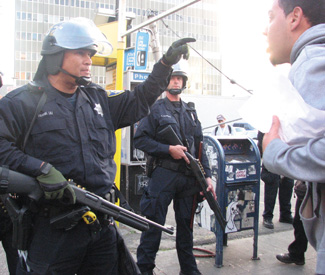
Police cars had pulled up on 14th street, and a line of police exited. In unison, they started advancing, brandishing batons. Many who were at the scene grabbed their possessions and fled. Most just backed away as the cops advanced. A handful stood in front of the teepee, and were arrested on the spot.

Twelve were arrested, including La Rose. Also arrested was Adam Katz, a photographer from the media committee who was documenting events. Katz said that police told him to back up, and when he complied and backed up “probably 50-60 feet,” he was still arrested.

“I took one picture and I was told to back up,” he said. “I repeatedly asked ‘Back up to where?’ as an army of police pushed me out of the plaza. They said, ‘Back up behind the line.’ I kept saying, ‘What line? I don’t see a line.'”

Then there’s Chris, another occupier arrested Jan. 4. According to Katz and other witnesses, Chris had already left the plaza and gone across the street when he was arrested for somehow delaying the police who were trying to clear the plaza.


DISCRETION

On Jan. 7, OccupyOakland held an “anti-repression march,” claiming that recent arrests are an overt attempt to repress the movement. The National Lawyers Guild issued a statement demanding an end to the “ongoing violence, harassment, and unconstitutional arrests of Occupy Oakland protesters.”

“There is evidence that would go to show that they were targeting people based on First Amendment activity, and not for illegal activity,” said attorney Mike Flynn, president of the NLG-SF. “Police charged into the plaza and grabbed whoever they could, and also targeted selective people who withdrew and didn’t even linger there.”

But OPD spokesperson Johnna Watson told us these arrests were perfectly legal. “The law allows us to use our discretion,” she said.

A person’s history with the movement is factored into this discretion. Many of those Perry deems “regulars” are, according to the police, “repeat offenders.” As Watson said, “There may be knowledge of a past history, like a repeat offender. If an officer has knowledge that a crime is occurring, has occurred, or is about to occur, we have the right to issue a citation or arrest. If we have someone constantly continuing to break the law, we may not issue a citation.”

In other words, involvement with this political movement can get people arrested who might otherwise not be.

“That police have escalated their attacks on people is pretty disturbing. It looks like they really think they can drive this movement out of Oakland with violence and repression,” said Dan Siegel, a former legal advisor to Mayor Jean Quan who resigned over her handling of OccupyOakland.

Siegel is now representing Marcel Johnson, aka Khali, one of the several protesters arrested Dec. 30, who faces life in prison. A homeless man who became an OccupyOakland regular, Khali was arrested when he tried to hold on to his blanket, which police wanted to throw away, saying that it was unpermitted property.

While in jail, he was charged with felony assault on a police officer, his third strike. A protester called Black Angel who knows Khali said he was transformed by the movement. “He came here and found a family,” he said. “He was like, I’m going to protect this. It gave me some sense of myself.”

But now, Siegel said, “He faces life in prison because of his status of being poor, homeless, and with mental health issues.”

Juries may decide whether OccupyOakland defendants are guilty, but Siegel said the arrests aren’t just: “You still have to ask yourself, why are the police doing this when we have 100 unsolved murders in Oakland?”

Appetite: Cocktailing the East Bay

0

In this week’s paper we poured out our thoughts on two delicious new additions to the East Bay bar scene, Honor Bar and the New Easy. Below, we glass up some other exciting East Bay drink destinations we think are worth your swizzle:

Oakland boasts the biggest concentration and range for East Bay cocktails, some of its consistent best at Adesso, casual drinks with bocce ball at Make Westing, elegant classic-style at Flora, pizza with cocktails at Marzano and Boot & Shoe ServiceMiel for tequila/mezcal drinks, Conga Lounge and divey Kona Club for tiki kitsch. Berkeley keeps it real with organic drinks at Gather, and artisanal cocktails at Revival Bar & Kitchen. The little island of Alameda hosts the beloved tiki gem, Forbidden Island, launched in part by tiki/rum expert Martin Cate who went on to open SF’s Smuggler’s Cove. Here, cheesy B-movie tribute nights and stmulating live music flow along with Banana Mamacows. As mentioned above, Emeryville now has two destination-worthy bars for cocktail lovers: Prizefighter and Honor Bar.


Albany is blessed with three old school classics merely blocks from each other along San Pablo Ave.: the musty, tiki vibe of Club Mallard, the mid-century, retro swank of Kingman’s Ivy Room, and the edgy comfortability of Hotsy Totsy Club. Though none of these three are exactly craft cocktail bars, Hotsy Totsy comes closest, with house cocktail sodas, gracious bar manager Jessica Maria, and stellar guest bartenders like Scott Baird of The Bon Vivants, who bartends here weekly. They’ve kept on longtime bartender Chet, in his 70’s, who has been tending there the better part of a couple decades. Their gorgeous, restored Wurlitzer jukebox is a treasure of rare and popular 45s, which you can play for free to your hearts content. Hotsy Totsy encourages lingering with friends under pressed tin ceilings, rocking out to excellent tunes hand-selected by staff. Funky ’70’s garage sale paintings line the walls and hilariously creepy movies (like For Your Height Only starring Weng Weng) play silently on the flat screen, add to the edgy, blissfully divey, convivial spirit.

Easy honors

0

virginia@sfbg.com

APPETITE It’s true: the East Bay cocktail scene is growing by leaps and bounds lately, with a slew of new bars (many opened by San Francisco bar stars) popping up from Albany to Alameda. Two comfortable new hangouts just debuted Jan. 3, serving cocktails for the geek and casual imbiber alike. Both claim noteworthy bartenders covering various shifts. I spent an evening tasting through their menus. Here’s an early peek at cocktail stand-outs at these two. For more exciting drink destinations in the East Bay, click here


HONOR BAR

Situated in its own building — with parking lot — not far from Emeryville’s shopping center madness (and E-ville’s other shining bar beacon, Prizefighter, www.prizefighterbar.com, which opened at the end of 2011), Honor Bar serves gourmet pub food in a room glowing with vintage signs, a Creature from the Black Lagoon pinball machine, and granite red bar at the center of it all. After passing through an entrance lined with cigar signs, records, even a stuffed owl, grab a beer from a tub of ice. It’s all on the honor system, so ask a bartender to add it to your tab. (No surprise: this is already garnering early buzz).

Cocktail menu quality was pretty much guaranteed under bar manager Alex Smith who came from SF’s Gitane. I’ve written about his exquisite drinks at Gitane few times, and was unsurprised to find his offerings at Honor Bar more casual but nonetheless sophisticated, easily exhibiting promise at this early date to be among the best cocktails in the East Bay.

While slurping oysters with St. Germain herb mignonette or dipping Kennebec fries ($3.50) in salt and vinegar aioli or Serrano ham jelly, select from cocktails (all $10) grouped under “stirred” (spirituous) or “shaken” (mixed with other ingredients). I was immediately won over by gently smoky, spicy, bright layers of the Porfiriato. Tequila, guajillo pepper-infused mezcal, Cocchi di Torino, Licor 43, and cinnamon bitters meld in a complex yet drinkable whole.

The spirit of tiki hovers over but does not overwhelm the bourbon-based Bleeding Monarch. Passion fruit lends a tropical air, orgeat adds texture, balsamico amaro and Campari finish with deliciously bitter undertones. Black Sabbath is as badass as it sounds: Laphroiag Scotch dominates with a rough and tumble, smoky presence, given nuance by Averna, absinthe, and orange bitters.

Smith’s established skill with sherry shows in Jenkins’ Ear, highlighting oloroso sherry with aged rum, Angostura bitters and cardamom-spice properties of Hum liqueur — no element out of balance. Dessert with a savory essence can be had in a Winter Flip. Whole egg softens brandy and tawny port, while Smith’s housemade Indian pudding is a cream base (rather than a thick pudding) for layers of spice.

1411 Powell, Emeryville, (510) 653-8667, www.honorbar.com


THE NEW EASY

In Oakland’s Grand Lake district, Easy Lounge closed, transforming into the New Easy. Big Easy inspiration is evident in upcoming Nola Sundays with BBQ, punch bowls (proceeds go to charities), and New Orleans tunes. The space is funky, eclectic, charming, with boozy quotes etched into one wall, stars painted on another, white lights draped over individual picnic tables. The small back patio is warmed by heat lamps and a skeleton gazing over cactus plants.

The welcoming neighborhood joint focuses on farmers market ingredients. Each Saturday a new menu of cocktails is created using ingredients from the big Grand Lake Farmers Market a block away.

Summer-Jane Bell not only created the menu but was hands-on with space design elements, painting stars as she crafted the menu. Her winning bartender team includes Yael Amyra (Circolo, Burritt Room), Ian Adams (15 Romolo, Orson), David Ruiz (Mr. Smith), and Morgan Schick (Nopa, Michael Mina).

Bell’s menu is decidedly playful, reminiscent of American childhood… but with booze. The festive theme starts as you receive Chinese take-out boxes of fresh-popped popcorn, while bites of mini sliders and grilled cheese sandwiches are passed around. I had the most fun with Mad Hatter ($10). Sailor Jerry rum and a spicy ginger soda are obvious mates, but the bright orange, creamy drink surprises with golden raisin puree and carrot juice. Bright and healthy, spice and sweetness (but not too much) make it a delightful alternative to an orange creamsicle.

Gift Horse ($9) was probably the most balanced, making fine use of Hayman’s Old Tom gin, which I haven’t seen much on cocktail menus in awhile. Dolin Blanc vermouth and Bell’s winter bitters made with a tequila base, unfold in floral, dry layers with notes of cranberry and fennel from the bitters.

Winter Sideshow ($11) offers the most spectacle, even if I prefer the former two drinks. The drink will change with the seasons, a base of Beefeater gin and Pür Spiced Blood Orange liqueur the backdrop for Angostura-flambeed kumquats, lit before you.

3255 Lakeshore Ave., Oakl., 510-338-4911, www.easy510.com 

Subscribe to Virgina’s twice-monthly newsletter, The Perfect Spot, www.theperfectspotsf.com


Our Weekly Picks: January 11-17

0

WEDNESDAY 11

The Finches

The Finches are keen on the sounds of the 1960s and ’70s. While checking the band’s website recently, I found a couple of mixes that founding members Carolyn Pennypacker Riggs and Aaron Olson put together, comprised of songs by Harry Nilsson, Donovan, the Byrds, Joni Mitchell, and others. You might have been able to guess that they listened to some of those when writing their own songs. On the Finches’ most recent album, 2011’s On Golden Hill (their first in four years), there are smidgens of proto-punk, psychedelic rock, and singer-songwriter folk soaked in ’60s sheen. But while the band may quote from the past, the music is for now, distinctly their own. (James H. Miller)

With Brainstorm, and the Key Losers

9 p.m., $7

Hemlock Tavern

1131 Polk, SF

(415) 596-7777

www.hemlocktavern.com


Victims Family

With wailing guitar, gruff vocals, and jazzy bass lines, Victims Family has long crouched above the standard crusted punk pack, creating an aggressive punk-jazz-metal hybrid assault with political-circus style lyrics that satisfy the thinking-man’s pit. The long-standing hardcore act — born of Santa Rosa circa 1984 — is on Jello Biafra’s Alternative Tentacles label; AT describes Victims Family’s music in a fittingly verbose fashion: “groove/thrash/bad-acid/punk/noise/metal/samba.” All of the above. The band’s Elbo Room show this week is its first of the year, and the lineup is an Alternative Tentacles Showcase, fleshed out by the excellent Fleshies and Pins Of Light. Here’s to a pit-filled 2012. (Emily Savage)

With Fleshies, and Pins of Light

9 p.m., $10

Elbo Room

647 Valencia, SF

(415) 552-7788

www.elbo.com


THURSDAY 12

Burnt Ones

Though I’m not sure what it is about San Francisco that sparks the formation of retro garage-pop bands, I’m positive that Burnt Ones are doing it better than most. This trio laces sweet pop melodies with heavy reverb for some sweaty, good old fashioned fun. It’s been a while since Burnt Ones released its catchy debut LP Black Teeth & Golden Tongues (Roaring Colonel), yet it remains a staple in my rotation. Check out the addictive single, “Gonna Listen To T.Rex (All Night Long).” If this heavy hitter doesn’t get stuck in your head for the rest of the week, you might wanna get yourself checked out. (Frances Capell)

With the Mallard, and Koko and the Sweetmeats

9 p.m., $6

Hemlock Tavern

1131 Polk, SF

(415) 923-0925

www.hemlocktavern.com


French Cassettes

While there may not be anything explicitly French about this quartet of garage rockers from the Bay, the Baroque pop ménage they embrace along with their refined musical sensibilities suggests the French Cassettes are more quintessentially so than one might imagine. It’s a preference towards subtlety over excess, and an emphasis on the minutiae. A touch of strings here, a tinge of electric energy there, and a deep reserve of catchy hooks borrowed and reinvented from some of their forerunners in pop art. Think Kinks and Beatles, but more demure; The Shins but less morose. Their first EP Summer Darling came out last year and now the band starts the year off rocking ever-so-effortlessly at a divey venue in the Mission. (Courtney Garcia)

9 p.m., $8

Brick and Mortar Music Hall

1710 Mission, SF

(415) 800-8782

www.brickandmortarmusic.com


“Le Martyre de Saint Sébastien”

Here’s the stereotypical scandal in a nutshell: According to Roman Catholic legend, Saint Sébastien was martyred in the third century BCE during Emperor Diocletian’s persecution of Christians. First he was shot through with arrows (the homoerotic possibilities of a half-naked youth being pierced many times while in religious ecstasy has not escaped centuries of artists), then he was clubbed to death. In 1911, French composer Claude Debussy, with Italian poet Gabriele d’Annunzio, wrote a five act mystery about the saint’s life, incorporating narrative and musical accompaniment. But the star ballerina, Ida Rubinstein, was a Jewish woman, so Pope Pius X (himself later canonized) instructed Catholics to shun the performances, martyring the work. Le sigh. Now here’s the music: grounded yet unearthly, full of Debussy’s restless, swirling chords augmented with sacred-sounding chants and hypnotic figures. This multimedia interpretation by the SF Symphony, featuring narrator Frederica von Stade, should shoot to the stars.

Through Sat/14

8 p.m., $35–$140

Davies Symphony Hall

201 Van Ness, SF

(415) 864-6400

www.sfsymphony.org


FRIDAY 13

“For Your Consideration”

Unless you have the time, coin, and stamina to globe-trot around to every festival, you’re likely missing out on quite a bit of tasty international cinema. Sure, the latest Pedro Almodóvar will always hit the local art-house joint, but more obscure (and no less worthy) films that lack big-money distribution probably will not. Fortunately, San Rafael is a lot closer than Berlin or Cannes, where “For Your Consideration: A Selection of Oscar Submissions from Around the World” unspools starting today, with Sweden’s Beyond (starring Noomi “I Had the Dragon Tattoo First” Rapace); Hungarian standout Béla Tarr’s latest, The Turin Horse; Bulgarian youth-gone-wild treatise Tilt; and several others, including a movie from the Philippines (The Woman in the Septic Tank) that spoofs awards-grubbing “message” films. (Cheryl Eddy)

Through Jan. 19, $6.35–$10.25

Christopher B. Smith Rafael Film Center

1118 Fourth St., San Rafael

(415) 454-1222

www.cafilm.org


Ellis Avery

“La Belle Rafaela” (1927) is a decadent, highly erotic painting by the Polish Art Deco painter Tamara de Lempicka. The model de Lempicka used for the piece was Rafaela Fano — a woman she hired off the streets of Paris, painted several times, and with whom she became romantically involved. “La Belle” depicts Rafaela as a curvaceous nude, bathed in shadows, and flinching with euphoria. It conveys such feverish sensuality that probably would have been unachievable had the artist’s desires not been utterly real. The painting inspired author Ellis Avery to write The Last Nude, a historical novel that re-imagines the love affair from the perspective of Fano. At Books Inc., Avery reads from this story that plunges into the depths of a forbidden romance set in glamorous 1920s Paris. (Miller)

7:30 p.m., Free

Books Inc.

2275 Market, SF

(415) 864-6777

www.booksinc.net


“Midnites for Maniacs: The Mind is a Terrible Thing to Taste”

Oh, you didn’t think Midnites for Maniacs programmer Jesse Hawthorne Ficks would program a Friday the 13th flick to coincide with today’s sinister day-and-date combo? (Well, he might, but he’d pick one of the more ridiculous entries, like the one where Jason takes outer space.) Nay, fiends, tonight’s triple-feature is face-warping enough to be themed “The Mind is a Terrible Thing to Taste.” It kicks off with Sam Raimi’s 1992 Army of Darkness (Bruce. Fucking. Campbell.); followed by American Psycho, which came out in 2000 but remains eerily current in all ways (fashions excepted); and Alice Cooper’s Welcome to My Nightmare, a 1975 concert film capturing the shock rocker in his prime. All this for $12! Hockey mask optional. (Eddy)

7:30 p.m., $12

Castro Theatre

429 Castro, SF

(415) 621-6120

www.castrotheatre.com


Devo

If there is any band that is a testament to the variance in public recognition, it’s Devo. To many, it is simply the band with the flowerpot hats that sang “Whip It.” Another group, however, will assert that Devo is the greatest musical act to ever come out of the Akron, Ohio area (Ha! Take that the Black Keys!) and that those “hats” are in fact Energy Domes. But while its 2010 album Something For Everybody — the first in 20 years since 1990’s Smooth Noodle Maps — was ostensibly market tested to please all camps, it largely represents a return to the formula of cynical yet mind-numbingly catchy pop that made it a quintessential cult band in the first place. (Ryan Prendiville)

Through Sat/14, 9 p.m., $50

Fillmore

1850 Geary, SF

(415) 346-6000

www.thefillmore.com


SATURDAY 14

Coast Jumper

I recently put together a list of my top 10 self-released albums of 2011, and I’m now kicking myself for not listening to Coast Jumper’s ambitious Grand Opening before I did. As far as debuts go, this Bandcamp gem is surprisingly lush and cohesive. There are a few glimpses of Vampire Weekend and Grizzly Bear, but above all Grand Opening presents a young indie rock five-piece making an exciting contribution to our local music scene. So, I’m making a late New Year’s resolution to pay close attention to Coast Jumper in 2012. (Capell)

With Dogcatcher, Briertone, and Colin Carthen

9 p.m., $10

Hotel Utah

500 Fourth St, SF

(415) 546-6300

www.hotelutah.com


SUNDAY 15

Max Cooper

With a PhD in computational biology and a tendency to name, if not organize, tracks after abstract scientific concepts (see the Serie trilogy of Harmonisch, Stochastisch, and Chaotisch) the UK’s Max Cooper could come across as a purely heady figure — a brain floating in a jar in some IDM lab. But Cooper has made a name for himself — appearing on Resident Advisor’s Top 100 DJs of 2011 — with ambient techno that manages to be moving. A delicate, light touch at work, whether a twinkle of keys or burst of static, Cooper’s evocative effects create familiar cinematic imagery: a walk in the rain, a passing car, a gasp emitted from bright red lips. (Prendiville)

With William Wardlaw, Max Jack vs. Pedro Arbulu, Max Gardner vs. Brian Knarfield

9 p.m., $15–$20

Monarch

101 Sixth St., SF

(415) 284-9774

www.monarchsf.com


Vetiver

Vetiver’s lead singer Andy Cabic proved the value of wandering when his strolls through the Richmond District led to another critically-acclaimed album for one of San Francisco’s most compelling folk bands. The band gained serious traction last spring with the release of The Errant Charm, a title hinting there may be inherent misdeed in such vagrancy; though the music, channeling ’60s-style acoustics and California daze, is meant for musing. Through the close of last year the disheveled crooners were playing what seemed like every city in the country, promoting their newest record, and spreading the love. Now they return to their roots. The oracle predicts a jam session on a sparkly night in the Bay. (Garcia)

With Magic Trick, Prairiedog, DJ Britt Govea

8 p.m., $20

Independent

628 Divisadero, SF

(415) 771-1421

www.theindependentsf.com


MONDAY 16

“Martin Luther King Jr. Day Double Feature”

“All of us have something to say, but some are never heard” — Richard Pryor, Wattstax (1973). MLK Jr. Day calls into question how we remember the past. The Wattstax concert is sometimes recalled derivatively as “the black Woodstock.” But while soul music may have been the response, the event was put on by Stax Records to commemorate and come to terms with the seventh anniversary of the Watts Riots in LA, which challenged the limits of MLK Jr.’s nonviolent philosophy. As a double feature the Wattstax documentary will be shown with The Black Power Mixtape 1967-1975 (2011), a revelatory look at a movement’s era that sadly took the distance of continent and a few decades to make. (Prendiville)

Wattstax 3, 7p.m.; The Black Power Mixtape 4:55, 8:55 p.m., $7.50–$10

Castro Theatre

429 Castro, SF

(415) 621-6120

www.castrotheatre.com


The Guardian listings deadline is two weeks prior to our Wednesday publication date. To submit an item for consideration, please include the title of the event, a brief description of the event, date and time, venue name, street address (listing cross streets only isn’t sufficient), city, telephone number readers can call for more information, telephone number for media, and admission costs. Send information to Listings, the Guardian Building, 135 Mississippi St., SF, CA 94107; fax to (415) 487-2506; or e-mail (paste press release into e-mail body — no text attachments, please) to listings@sfbg.com. Digital photos may be submitted in jpeg format; the image must be at least 240 dpi and four inches by six inches in size. We regret we cannot accept listings over the phone.

Film Listings

0

Film listings are edited by Cheryl Eddy. Reviewers are Kimberly Chun, Max Goldberg, Dennis Harvey, Lynn Rapoport, and Matt Sussman. For rep house showtimes, see Rep Clock.

OPENING

*Battle for Brooklyn Posed as neither a left nor a right issue (though George Will does drift into view at one improbable moment), Michael Galinsky’s powerful documentary does the exhaustive, long-haul work of charting the fight between residents and business owners in Brooklyn’s Prospect Heights as they oppose the condemnation of their property — oh-so-inconveniently in the way of the proposed Atlantic Yards, a mammoth Frank Gehry-designed development involving a basketball arena for the New Jersey Nets and more than a dozen skyscrapers. The scrappy residents and activists, led in part by graphic designer Daniel Goldstein, face seemingly unbeatable forces: developer Forest City Ratner, which looks to Eminent Domain to seize a community’s land, whether it likes it or not; a complicit and corrupt state and city government; and other members of a diverse, divided community who are clamoring for the jobs that Ratner’s PR machine promises. Galinsky imparts the impact of the project — and its devastating effects on the neighborhood, despite alternate proposals and the recent real estate bust — over the course of eight years, with hundreds of hours of footage, time-lapse images, and a fortunate focus on one every-guy hero: Goldstein, who loses a fiancé and finds love at the ramparts, while his home is shorn away, all around him. Along the way, the viewer gets an education on the infuriating ways that these sorts of boondoggles get pushed through all opposition — the corollaries between this struggle and, say, the building of the 49ers stadium in Santa Clara are there for the viewer to draw. (1:33) Roxie. (Chun)

Beauty and the Beast 3D Disney’s “tale as old as time” returns in spiffy 3D form. Dancing candelabra in yo’ face! (1:24)

Carnage Nancy (Kate Winslet) and Alan (Christoph Waltz) have arrived in the apartment of Penelope (Jodie Foster) and Michael (John C. Reilly) to discuss proper follow-up to a playground incident in which one of their children went ballistic on another. But this grownup discussion about conduct between children quickly degenerates into a four-way living room sandbox melee, as the couples reveal snobbish disdain toward one another’s presumed values and the cracks in each marriage are duly bared. Roman Polanski’s unnecessary screen translation of Yasmina Reza’s play remains awkwardly rooted to the stage, where its contrivances would have seemed less obvious, or at least apt for the medium. There’s some fun to be had watching these actors play variously self-involved, accusatory Manhattanites who enact a very lite Who’s Afraid of Virginia Woolf? amid way too much single-malt Scotch ingestion. But the text gets crudely farcical after a while, and its critiques of the characters’ shallow materialism, bad parenting, knee-jerk liberal empathy, privileged class indifference, etc. would resonate more if those faults weren’t so cartoonishly drawn. In the end, Carnage‘s high-profile talent obliterates rather than illuminates the material — it’s like aiming a bazooka at a napkin. (1:20) Balboa, Embarcadero, Shattuck. (Harvey)

Cleanflix See Trash. (1:32) Roxie.

Contraband A former smuggler (Mark Wahlberg) comes out of retirement to chase one last score. Don’t they always? (1:49)

*Hipsters Though it might misleadingly draw a horde of Hipster Bingo look-alikes, the title of this goofy, passionate, generous-hearted Russian musical is fully earned. Director Valery Todorovsky’s let’s-put-on-a-show gumption, twinkly earnestness, and clownish costumes are likely drive today’s too-cool-for-schoolies out the theater, but if they stick around, the razzle-dazzle charm and cinematic flair that the filmmaker applies to this adaptation of Yuri Korotkov’s book, Boogie Bones, should win them over. The dateline is Moscow, 1955, and the scene is a West Side Story-style showdown between the hard-partying, rebellious boogie-woogie stilyagi, or hipsters, in love with American jazz and culture, and the terribly serious, grayed-out Communist hardliners who equate flashy fashion with individualistic decadence. Yet one comrade, Mels (Anton Shagin), finds himself crossing party lines after an encounter with fetching “Good Time” Polly (Oksana Akinshina of 2002’s Lilya 4-Ever) and slowly begins to assemble the look, the moves, the music, and the bad reputation that come with life as a hipster. A few of the film’s plot turns may be a bit tough to swallow, and some details, such as the music, don’t adhere strictly to era, but the affection Todorovsky feels for his characters, their plight, and musicals (particularly Baz Luhrmann’s) gleams through, especially when the director tracks alongside his freedom-loving protagonists as they occupy the streets with their subcultural kin of yesterday and today. (2:05) Lumiere, Shattuck, Smith Rafael. (Chun)

The Iron Lady Curiously like Clint Eastwood’s 2011 J. Edgar, this biopic from director Phyllida Lloyd and scenarist Abi Morgan takes on a political life of length, breadth and controversy — yet it mostly skims over the politics in favor of a generally admiring take on a famous narrow-minded megalomaniac’s “gumption” as an underdog who drove herself to the top. Looking back on her career from a senile old age spent in the illusory company of dead spouse Denis (Jim Broadbent), Meryl Streep’s ex-British Prime Minister Margaret Thatcher steamrolls past hurdles of class and gender while ironically re-enforcing the fustiest Tory values. She’s essentially a spluttering Lord in skirts, absolutist in her belief that money and power rule because they ought to, and any protesting rabble don’t represent the “real England.” That’s a mindset that might well have been explored more fruitfully via less flatly literal-minded portraiture, though Lloyd does make a few late, lame efforts at sub-Ken Russell hallucinatory style. Likely to satisfy no one — anywhere on the ideological scale — seriously interested in the motivations and consequences of a major political life, this skin-deep Lady will mostly appeal to those who just want to see another bravura impersonation added to La Streep’s gallery. Yes, it’s a technically impressive performance, but unlikely to be remembered as one of her more depthed ones, let alone among her better vehicles. (1:45) Albany. (Harvey)

Joyful Noise As heartfelt and anodyne as the singing underdogs at its center, Joyful Noise offers a spirited if ultimately hamstrung spin on a familiar set-up (anyone seen 1993’s Sister Act 2?). Queen Latifah and Dolly Parton (returning to the screen after a two decade hiatus) do most of the heavy lifting as working-class single mother Vi Rose Hill and flashy widow G.G. Sparrow, respectively, who find themselves locking horns as they strategize how to take the small-town Georgia church choir they both sing in to the big-time Gospel competition that gives the film its title. There’s also the matter of G.G.’s city-slicked grandson’s aggressive courting of Vi Rose’s precocious teenage daughter, who, it turns out, like many of the supporting players here, can out-belt most American Idol finalists. Writer-director Todd Graff’s script works in some genial digs at Parton’s fabulous artifice (“Who cares if I’ve had a few little nips and tucks? God didn’t make plastic surgeons so they could starve!” she proudly declares), but Parton’s singing often provides the emotional expressiveness that her face now has trouble conveying. Latifah’s performance is the biggest surprise in a movie that seems all but hatched from a Disney channel writers meeting: Vi Rose radiates both light and heat, tempering Joyful Noise‘s steady stream of homespun treacle with some much-needed righteousness and fury. (1:58) (Sussman)

*Kill All Redneck Pricks: A Documentary About the Band Called KARP An isolated instance of gonzo male adolescent noise in the forest of Beat Happening-type indie twee and riot grrliness that dominated Olympia, Wash.’s fertile early 1990s music scene, KARP (originally known by this documentary’s moniker) was composed of three nerdy middle-school friends from bleak neighboring Tumwater. Granted purpose by the majestic sludge of the Melvins, they dropped out of high school to become primitive sound-alikes, then gradually found their own voice in heavy, aggressive music with some pop chops and silly attitude. (At one point they adopted wrestling superhero personae, including a drag one.) “So dark and so clowny at the same time,” this “really earnest-ridiculous teenage explosion” made a name for itself touring tirelessly and recording occasionally over the decade’s course. In classic rock-doc bio fashion, however, nothing ended happily ever after: Alcoholism, drug addiction, a suicide attempt, and yea greater tragedy in time befell these kids who were pretty much born to play with each other. Even if you’ve never heard (or heard of) KARP before, William Badley’s excellent feature — packed with performance footage and scenester recollections — will make you wistful for the band’s loss. (1:25) Roxie. (Harvey)

ONGOING

*The Adventures of Tintin Producer Peter Jackson and director Steven Spielberg join forces to adapt the work of Belgian comic creator Hergé, using performance-capture 3D animation (and featuring that new technology’s most prominent performer, Andy Serkis, in a key role). Hergé wrote over 20 volumes following the globe-trotting exploits of intrepid young reporter Tintin (Jamie Bell) and his canine companion, Snowy; The Adventures of Tintin draws from a trio of books dating from the early 1940s, tweaking the tales a bit but retaining the series’ ebullient energy and sharp humor. After he impulsively buys a model ship, Tintin is sucked into a mystery involving a long-lost pirate treasure sought by the sinister Sakharine (Daniel Craig) and, eventually, newfound Tintin ally Captain Haddock (Serkis). Fan favorites Thompson and Thomson (Simon Pegg and Nick Frost — frequent compadre Edgar Wright co-wrote the script) and a certain “Milanese Nightingale” make appearances in a story that careens between exotic locales and high-seas battles, and is packed with epic chase scenes that would leave Indiana Jones breathless. And in case you were worried, Tintin boasts the least creepy, least “uncanny valley” performance-capture animation I’ve seen to date. (1:47) 1000 Van Ness, Presidio. (Eddy)

Alvin and the Chipmunks: Chip-wrecked (1:27) 1000 Van Ness.

*The Artist With the charisma-oozing agility of Douglas Fairbanks swashbuckling his way past opponents and the supreme confidence of Rudolph Valentino leaning, mid-swoon, into a maiden, French director-writer Michel Hazanavicius hits a sweet spot, or beauty mark of sorts, with his radiant new film The Artist. In a feat worthy of Fairbanks or Errol Flynn, Hazanavicius juggles a marvelously layered love story between a man and a woman, tensions between the silents and the talkies, and a movie buff’s appreciation of the power of film — embodied in particular by early Hollywood’s union of European artistry and American commerce. Dashing silent film star George Valentin (Jean Dujardin, who channels Fairbanks, Flynn, and William Powell — and won this year’s Cannes best actor prize) is at the height of his career, adorable Jack Russell by his side, until the talkies threaten to relegate him to yesterday’s news. The talent nurtured in the thick of the studio system yearns for real power, telling the newspapers, “I’m not a puppet anymore — I’m an artist,” and finances and directs his own melodrama, while his youthful protégé Peppy Miller (Bérénice Béjo) becomes a yakky flapper age’s new It Girl. Both a crowd-pleasing entertainment and a loving précis on early film history, The Artist never checks its brains at the door, remaining self-aware of its own conceit and its forebears, yet unashamed to touch the audience, without an ounce of cynicism. (1:40) California, Embarcadero, 1000 Van Ness, Piedmont, Sundance Kabuki. (Chun)

The Conquest Yet another entry in the relatively new, burgeoning genre of mostly comic biopics portraying political figures still or at least recently in office, Xavier Durringer’s film chronicles conservative Nicolas Sarkozy’s rise to the French presidency. As cannily impersonated by Denis Podalydès, Sarkozy (a.k.a. the Midget, to his detractors) is a Napoleon complex-afflicted shark whose need for perpetual careerist motion cancels out enjoyment even for his triumphs — save, perhaps, a momentary gloat over enemies left trampled. At the start he’s already neared the top of the government ladder, albeit not nearly near enough. Several years’ further upward scrambling are framed by flash-forwards to 2007, when he’s on the verge of finally becoming president, albeit at the cost of “top advisor” and long-suffering first wife Cécilia (Florence Pernel) jumping ship. Her earlier lament “Our life has become a TV show” has been ignored by a spouse quite happy living an almost entirely public, media-hounded life. (Although as his popularity continues to sink, Sarkozy almost certainly doesn’t feel that way now.) Without depiction of or insight into the main figure’s background, The Conquest becomes an entertaining but superficial, near-farcical enterprise providing little insight into what makes him tick. But then, that’s the problem with instant biographies — it’s a lot easier to grasp a significant figure’s complexities when enough time has passed for hindsight to clear the immediate fog of scandal, spectacle, and grotesquerie. (1:45) Smith Rafael. (Harvey)

A Dangerous Method Cool and chatty (unsurprisingly, given its subject matter and the fact that it’s based on a play and a novel), David Cronenberg’s latest begins in 1904 Zurich as a shrieking patient (Keira Knightley) is escorted into the care of psychiatrist Carl Jung (Michael Fassbender). Dr. Jung, an admirer of Sigmund Freud, tests the “talking cure” on the woman, who turns out to be the fiercely intelligent and conveniently beautiful Sabina Spielrein. An attraction, both intellectual and sexual, soon develops, no matter that Jung is Sabina’s doctor, or that he happens to be married to a prim wife whose family wealth keeps him in boats and lake houses. Meanwhile, Jung and Freud (an excellent Viggo Mortensen) begin corresponding, eventually meeting and forming a friendship that’s tested first when Sabina comes between them, and later when Jung expresses a growing interest in fringe pursuits like parapsychology. The scenes between Freud and Jung are A Dangerous Method‘s most intriguing — save those brief few involving Vincent Cassel as a doctor-turned-patient who advises Jung to “never repress anything” — but the film is mostly concerned with Jung’s various Sabina-related dramas. Pity that this is a tightly-wound Fassbender’s least dynamic performance of the year, and that Knightley, way over the top in Sabina’s hysterical scenes, telegraphs “casting mistake” from the get-go. (1:39) Albany, Embarcadero, Sundance Kabuki. (Eddy)

The Darkest Hour (1:29) 1000 Van Ness.

*The Descendants Like all of Alexander Payne’s films save 1996 debut Citizen Ruth, The Descendants is an adaptation, this time from Kaui Hart Hemmings’ excellent 2007 novel. Matt King (George Clooney) is a Honolulu lawyer burdened by various things, mostly a) being a haole (i.e. white) person nonetheless descended from Hawaiian royalty, rich in real estate most natives figure his kind stole from them; and b) being father to two children by a wife who’s been in a coma since a boating accident three weeks ago. Already having a hard time transitioning from workaholic to hands-on dad, Matt soon finds out this new role is permanent, like it or not — spouse Elizabeth (Patricia Hastie, just briefly seen animate) will not wake up. The Descendants covers the few days in which Matt has to share this news with Elizabeth’s loved ones, mostly notably Shailene Woodley and Amara Miller as disparately rebellious teen and 10-year-old daughters. Plus there’s the unpleasant discovery that the glam, sporty, demanding wife he’d increasingly seemed “not enough” for had indeed been looking elsewhere. When has George Clooney suggested insecurity enough to play a man afraid he’s too small in character for a larger-than-life spouse? But dressed here in oversized shorts and Hawaiian shirts, the usually suave performer looks shrunken and paunchy; his hooded eyes convey the stung joke’s-on-me viewpoint of someone who figures acknowledging depression would be an undeserved indulgence. Payne’s film can’t translate all the book’s rueful hilarity, fit in much marital backstory, or quite get across the evolving weirdness of Miller’s Scottie — though the young actors are all fine — but the film’s reined-in observations of odd yet relatable adult and family lives are all the more satisfying for lack of grandiose ambition. (1:55) California, Piedmont, Presidio, SF Center, Sundance Kabuki. (Harvey)

The Devil Inside (1:27) 1000 Van Ness.

*Drive Such a lovely way to Drive, drunk on the sensual depths of a lush, saturated jewel tone palette and a dreamlike, almost luxurious pacing that gives off the steamy hothouse pop romanticism of ’80s-era Michael Mann and David Lynch — with the bracing, impactful flecks of threat and ultraviolence that might accompany a car chase, a moody noir, or both, as filtered through a first-wave music video. Drive comes dressed in the klassic komforts — from the Steve McQueen-esque stances and perfectly cut jackets of Ryan Gosling as the Driver Who Shall Remain Nameless to the foreboding lingering in the shadows and the wittily static, statuesque strippers that decorate the background. Gosling’s Driver is in line with Mann’s other upstanding working men who hew to an old-school moral code and are excellent at what they do, regardless of what side of the law they’re working: he likes to keep it clear and simple — his services as a wheelman boil down to five minutes, in and out — but matters get messy when he falls for sweet-faced neighbor Irene (Carey Mulligan), who lives down the hall with her small son, and her ex-con husband (Oscar Isaac) is dragged back into the game. Populated by pungent side players like Albert Brooks, Bryan Cranston, Ron Perlman, and Christina Hendricks, and scattered with readily embeddable moments like a life-changing elevator kiss that goes bloodily wrong-right, Drive turns into a real coming-out affair for both Danish director Nicolas Winding Refn (2008’s Bronson), who rises above any crisis of influence or confluence of genre to pick up the po-mo baton that Lynch left behind, and 2011’s MVP Ryan Gosling, who gets to flex his leading-man muscles in a truly cinematic role, an anti-hero and under-the-hood psychopath looking for the real hero within. (1:40) Lumiere. (Chun)

*Everyday Sunshine: The Story of Fishbone This doc offers a lively, revealing look at SoCal ska-punk rockers Fishbone, a band that formed circa 1979 in a San Fernando Valley junior high newly filled with bussed-in South Central kids. In its heyday, Fishbone enjoyed cult success with hits like “Party at Ground Zero” and the tune that gives the film its title; Everyday Sunshine speaks to Fishbone’s broad appeal, as famous faces chime in to reminisce (and longtime fan Laurence Fishburne narrates), but it also illuminates some of the reasons its members never became megastars. Codirectors Chris Metzler (a San Francisco resident best-known for 2004’s Plagues and Pleasures on the Salton Sea) and Lev Anderson spent months on the road with the band, capturing the infectious energy of its live shows in addition to behind-the-scenes tension. Past members add their voices, but the main protagonists are bassist-vocalist Norwood Fisher and lead vocalist-saxophone player Angelo Moore. Their intertwining stories offer a poignant portrait of creative soulmates who’ve weathered many storms (personality conflicts, legal and money troubles, an industry that didn’t know how to categorize them) without once giving up on their music. In addition to its compelling story, the film’s quirkier stylistic choices, including animation, lift Everyday Sunshine above the crowded field of traditional music docs. (1:47) Roxie. (Eddy)

*The Girl With the Dragon Tattoo The meeting of Stieg Larsson’s first “Millennium” book and David Fincher promised fireworks, as he’s a director who can be equally vivid and exacting with just the elements key to the series: procedural detail, obsession, violence, tweaked genre conventions, mind games, haunted protagonists, and expansive story arcs. But perhaps because this possible franchise launch had to be rushed into production to ride the Larsson wave, what should have been a terrific matchup turns out to be just a good one — superior in some stylistic departments (notably Trent Reznor and Atticus Ross’ pulsing score), but overall neither an improvement nor a disappointment in comparison to the uninspired but effective 2009 Swedish film version. Daniel Craig plays Mikael Blomkvist, the muckraking Stockholm journalist whose public disgrace after a failed expose of a suspect corporate tycoon makes him the perfect candidate for an unexpected assignment: staying sequestered in the wealthy, warring Vanger clan’s island home to secretly investigate a teenage girl’s disappearance and presumed murder 40 years ago. His testy helpmate is the singular Lisbeth Salander (Rooney Mara), antisocial hacker, researcher, and ex-mental patient par excellence. Nearly three hours long, the compressed, slightly altered (get over it) storyline nonetheless feels rushed at times; Fincher manages the rare feat of making mostly internet research exciting in filmic terms, yet oddly the book’s more shocking episodes of sex and/or mayhem don’t have the memorable impact one might expect from him. The leads are fine, as is the big support cast of recognizable faces (Christopher Plummer, Stellan Skarsgård, Robin Wright, etc.) But the knockout suspense, atmosphere, and urgency one hoped for isn’t present in this intelligent, not entirely satisfying treatment. On the other hand, maybe those who’ve already read the books and seen the prior films have already had so much exposure to this material that a revelatory experience is no longer possible. (2:38) Four Star, Marina, 1000 Van Ness, Sundance Kabuki, SF Center. (Harvey)

Le Havre Aki Kaurismäki’s second French-language film (following 1992’s La Vie de Boheme) offers commentary on modern immigration issues wrapped in the gauze of a feel good fairy tale and cozy French provincialism a la Marcel Pagnol. Worried about the health of his hospitalized wife (Kaurismäki regular Kati Outinen), veteran layabout and sometime shoe shiner Marcel (Andre Wilms) gets some welcome distraction in coming to the aid of Idrissa (Blondin Miguel), a young African illegally trying to make way to his mother in London while eluding the gendarmes. Marcel’s whole neighborhood of port-town busybodies and industrious émigrés eventually join in the cause, turning Le Havre into a sort of old-folks caper comedy with an incongruously sunny take on a rising European multiculturalism in which there are no real racist xenophobes, just grumps deserving comeuppance. Incongruous because Kaurismäki is, of course, the king of sardonically funny Finnish miserabilism — and while it’s charmed many on the festival circuit, this combination of his usual poker-faced style and feel-good storytelling formula may strike others as an oil-and-water mismatch. (1:43) Opera Plaza. (Harvey)

Hugo Hugo turns on an obviously genius conceit: Martin Scorsese, working with 3D, CGI, and a host of other gimmicky effects, creates a children’s fable that ultimately concerns one of early film’s pioneering special-effects fantasists. That enthusiasm for moviemaking magic, transferred across more than a century of film history, was catching, judging from Scorsese’s fizzy, exhilarating, almost-nauseating vault through an oh-so-faux Parisian train station and his carefully layered vortex of picture planes as Hugo Cabret (Asa Butterfield), an intrepid engineering genius of an urchin, scrambles across catwalk above a buzzing station and a hotheaded station inspector (Sacha Baron Cohen). Despite the special effects fireworks going off all around him, Hugo has it rough: after the passing of his beloved father (Jude Law), he has been stuck with an nasty drunk of a caretaker uncle (Ray Winstone), who leaves his duties of clock upkeep at a Paris train station to his charge. Hugo must steal croissants to survive and mechanical toy parts to work on the elaborate, enigmatic automaton he was repairing with his father, until he’s caught by the fierce toy seller (Ben Kingsley) with a mysterious lousy mood and a cute, bright ward, Isabelle (Chloe Grace Moretz). Although the surprisingly dark-ish Hugo gives Scorsese a chance to dabble a new technological toolbox — and the chance to wax pedantically, if passionately, about the importance of film archival studies — the effort never quite despite transcends its self-conscious dazzle, lagging pacing, diffuse narrative, and simplistic screenplay by John Logan, based on Brian Selznick’s book. Even the actorly heavy lifting provided by assets like Kingsley and Moretz and the backloaded love for the fantastic proponents at the dawn of filmmaking fail to help matters. Scorsese attempts to steal a little of the latters’ zeal, but one can only imagine what those wizards would do with motion-capture animation or a blockbuster-sized server farm. (2:07) 1000 Van Ness, Shattuck, Sundance Kabuki. (Chun)

In the Land of Blood and Honey The grudging, occasionally outright hostile tone some critics, culture vultures, and fan types have taken toward In the Land of Blood and Honey points toward a fundamental problem most of them have, though few admit it: the belief that Angelina Jolie is just too damn famous, too much a figure of public speculation and private fantasy, to be taken seriously — let alone to make a movie about rape and genocide during the Balkans Wars. But the fact is, her narrative debut as writer and director would probably be getting reviews in the respectable-to-rave range if created by anyone else. It’s certainly gotten some of those, but you’d be hard-pressed not to glimpse a certain “Who does she think she is?” resentment behind others who see the film as heavy-handed do-gooderism from a chick who should leave cinematic commentary about profoundly tragic historical events to people who are less … er, sexy. Not that Blood and Honey doesn’t have its genuine faults. There’s contrivance in the way that young Muslim painter Ajla (Zana Marjanovic) and Serb cop Danijel (Goran Kostic) have a first date just as the war reaches 1992 Sarajevo, then intersect again when she’s a POW and he’s an officer in the Serbian Army. This allows him to save her from the regular rapes other women prisoners suffer at the hands of guards, and eventually to set her up as his protected mistress, a breach of code that is unwelcome news to the ears of his powerful father General Nobosjsa (Rade Serbedzija), a fanatical “ethnic cleanser.” This premise is typical movie exceptionalism, even if it’s still a good step above the usual device of casting a Western character-star as our guide in unpleasant foreign affairs. While not a great movie, Blood and Honey is a very good one; an honorable achievement, not just a vehicle for honorable intentions. Of course the point is nothing more complicated than “War is hell,” but how often do movies actually punch that across, as opposed to pouting a bit while making war look exciting? (2:07) Opera Plaza, SF Center. (Harvey)

J. Edgar The usual polished, sober understatement of Clint Eastwood’s directing style and the highlights-compiling CliffsNotes nature of Dustin Lance Black’s screenplay turn out to be interestingly wrong choices for this biopic about one of the last American century’s most divisive figures. Interesting in that they’re perhaps among the very few who would now dare viewing the late, longtime FBI chief with so much admiration tempered by awareness of his faults — rather than the other way around. After all, Hoover (played by Leonardo DiCaprio) strengthened his bureau in ways that, yes, often protected citizens and state, but at what cost? The D.C. native eventually took to frequently “bending” the law, witch-hunting dubious national enemies (he thought the Civil Rights movement our worst threat since the bomb-planting Bolshevik anarchists of half a century earlier), blackmailing personal ones, weakening individual rights against surveillance, hoarding power (he resented the White House’s superior authority), lying publicly, and doing just about anything to heighten his own fame. A movie that internalized and communicated his rising paranoid megalomania (ironically Hoover died during the presidency of Nixon, his equal in that regard) might have stood some chance of making us understand this contradiction-riddled cipher. But J. Edgar is doggedly neutral, almost colorless (literally so, in near-monochrome visual presentation), its weird appreciation of the subject’s perfectionism and stick-to-it-iveness shutting out almost any penetrating insight. (Plus there’s Eastwood’s own by-now-de rigueur soundtrack of quasi-jazz noodling to make what is vivid here seem more dull and polite.) The love that dare not speak its name — or, evidently, risk more than a rare peck on the cheek — between Hoover and right-hand-man/life companion Clyde Tolson (Armie Hammer, very good if poorly served by his old-age makeup) becomes both the most compelling and borderline-silly thing here, fueled by a nervous discretion that seems equal parts Black’s interest and Eastwood’s discomfort. While you might think the directors polar opposites in many ways, the movie J. Edgar ultimately recalls most is Oliver Stone’s 1995 Nixon: both ambitiously, rather sympathetically grapple with still-warm dead gorgons and lose, filmmaker and lead performance alike laboring admirably to intelligent yet curiously stilted effect. (2:17) Opera Plaza, Shattuck. (Harvey)

King of Devil’s Island When teenaged Erling (Benjamin Helstad) arrives at Bastøy Prison — more labor camp than reform school — he’s more worldly than many of the other boys there, especially Olav (Trond Nilssen), though the newcomer and long-time inmate bond over a shared fascination with seafaring life. That’s about the only happy thing that happens in Bastøy; set in 1915, King of Devil’s Island is based on the Norwegian island prison’s troubled past, and a rebellion that erupts when the boys reach the breaking point. Surprisingly, it’s not the exhausting work (hauling rocks and trees as rain and snow whip across gloomy fjords) that leads to unrest — it’s the failure of the camp’s strict-but-not-sadistic overseer (go-to stern Scandinavian Stellan Skarsgård) to remove a “housefather” with rapey tendencies. An overlong running time enables a few too many climaxes (though the big uprising is well-earned, and cathartic), but director Marius Holst avoids melodrama, and powerful performances, particularly by the glowering Helstad, elevate the grim King above typical hell-is-for-children fare. (1:54) SFFS New People Cinema. (Eddy)

*Melancholia Lars von Trier is a filmmaker so fond of courting controversy it’s like he does it in spite of himself — his rambling comments about Hitler (“I’m a Nazi”) were enough to get him banned from the Cannes Film Festival earlier this year, where Melancholia had its debut (and star Kirsten Dunst won Best Actress). Oops. Maybe after the (here’s that word again) controversy that accompanied 2009’s Antichrist, von Trier felt like he needed a shocking context for his more mellow latest. Pity that, for Melancholia is one of his strongest, most thoughtful works to date. Split into two parts, the film follows first the opulent, disastrous, never-ending wedding reception of Justine (Dunst) and Michael (Alexander Skarsgard), held at a lavish estate owned by John (Kiefer Sutherland), the tweedy husband of Justine’s sister, Claire (Charlotte Gainsbourg). Amid the turmoil of arguments (John Hurt and Charlotte Rampling as Justine and Claire’s divorced parents), pushy guests (Stellan Skarsgard as Justine’s boss), livid wedding planner (Udo Kier, amazing), and hurt feelings (Michael is the least-wanted groom since Kris Humphries), it’s clear that something is wrong with Justine beyond just marital jitters. The film’s second half begins an unspecified amount of time later, as Claire talks her severely depressed, near-catatonic sister into moving into John’s mansion. As Justine mopes, it’s revealed that a small planet, Melancholia — glimpsed in Melancholia‘s Wagner-scored opening overture — is set to pass perilously close to Earth. John, an amateur astronomer, is thrilled; Claire, fearful for her young son’s future and goaded into high anxiety by internet doomsayers, is convinced the planets will collide, no matter what John says. Since Justine (apparently von Trier’s stand-in for himself) is convinced that the world’s an irredeemably evil place, she takes the news with a shrug. Von Trier’s vision of the apocalypse is somber and surprisingly poetic; Dunst and Gainsbourg do outstanding work as polar-opposite sisters whose very different reactions to impending disaster are equally extreme. (2:15) Lumiere, Shattuck. (Eddy)

Midnight in Paris Owen Wilson plays Gil, a self-confessed “Hollywood hack” visiting the City of Light with his conservative future in-laws and crassly materialistic fiancée Inez (Rachel McAdams). A romantic obviously at odds with their selfish pragmatism (somehow he hasn’t realized that yet), he’s in love with Paris and particularly its fabled artistic past. Walking back to his hotel alone one night, he’s beckoned into an antique vehicle and finds himself transported to the 1920s, at every turn meeting the Fitzgeralds, Gertrude Stein (Kathy Bates), Dali (Adrien Brody), etc. He also meets Adriana (Marion Cotillard), a woman alluring enough to be fought over by Hemingway (Corey Stoll) and Picasso (Marcial di Fonzo Bo) — though she fancies aspiring literary novelist Gil. Woody Allen’s latest is a pleasant trifle, no more, no less. Its toying with a form of magical escapism from the dreary present recalls The Purple Rose of Cairo (1985), albeit without that film’s greater structural ingeniousness and considerable heart. None of the actors are at their best, though Cotillard is indeed beguiling and Wilson dithers charmingly as usual. Still — it’s pleasant. (1:34) Shattuck. (Harvey)

Mission Impossible: Ghost Protocol No world landmark (the Kremlin, the Burj Khalifia) is too iconic and/or freaking tall for uber-adrenalized Impossible Missions Force agent Ethan Hunt (Tom Cruise) and his team (Jeremy Renner, Paula Patton, Simon “Comic Relief” Pegg) to infiltrate, climb, assume false identities in, use as a home base for unleashing futuristic spy technology that seems almost plausible (with the help of lots of iPads), race a BMW through, etc. One kind of gets the sense that Cruise and company sat down with a piece of paper and were like, “What stunts haven’t we done before, and how many of them can I do with my shirt off?” Celebrated animation director Brad Bird (2004’s The Incredibles) is right at home with Ghost Protocol as his first live-action effort — the film’s plot (set in the present day, it involves a positively vintage blend of Russians and nukes) and even its unmemorable villain take a back seat to Cruise’s secret-agent shenanigans, most of which take the form of a crazy plan that must be altered at the last minute, resulting in an even crazier plan, which must be implemented despite the sudden appearance of yet another ludicrously daunting obstacle, like, say, a howling sandstorm. For maximum big dumb fun, make sure you catch the IMAX version. A warning, though: any time the movie screeches to a halt to explore emotions or attempt characterization … zzz. (2:13) 1000 Van Ness, Presidio. (Eddy)

My Week With Marilyn Statuette-clutching odds are high for Michelle Williams, as her impersonation of a famous dead celebrity is “well-rounded” in the sense that we get to see her drunk, disorderly, depressed, and so forth. Her Marilyn Monroe is a conscientious performance. But when the movie isn’t rolling in the expected pathos, it’s having other characters point out how instinctive and “magical” Monroe is onscreen — and Williams doesn’t have that in her. Who could? Williams is remarkable playing figures so ordinary you might look right through them on the street, in Wendy and Lucy (2008), Blue Valentine (2010), etc. But as Monroe, all she can do is play the little-lost girl behind the sizzle. Without the sizzle. Which is, admittedly, exactly what My Week — based on a dubious true story — asks of her. It is true that in 1956 the Hollywood icon traveled to England to co-star with director Sir Laurence Olivier (Kenneth Branagh) in a fluff romance, The Prince and the Showgirl; and that she drove him crazy with her tardiness, mood swings, and crises. It’s debatable whether she really got so chummy with young production gofer Colin Clark, our wistful guide down memory lane. He’s played with simpering wide-eyed adoration by Eddie Redmayne, and his suitably same-aged secondary romantic interest (Emma Watson) is even duller. This conceit could have made for a sly semi-factual comedy of egos, neurosis, and miscommunication. But in a rare big-screen foray, U.K. TV staples director Simon Curtis and scenarist Adrian Hodges play it all with formulaic earnestness — Marilyn is the wounded angel who turns a starstruck boy into a brokenhearted but wiser man as the inevitable atrocious score orders our eyes to mist over. (1:36) Balboa, Clay, Marina, Shattuck. (Harvey)

*Pariah A teenage girl stands stock-still in a dark nightclub, gazing with desire and fear at the half-naked female dancers on the stage. Later, riding home on the bus, she slowly removes the layers of butch that held her together in the club, stripping down to some version of the person her parents need to see when she walks in the door. Nearly wordlessly, the opening scenes of Dee Rees’s Pariah poignantly depict the embattled internal life of Alike (Adepero Oduye), a 17-year-old African American girl living in Brooklyn with her family and struggling both to be seen as she is and to determine what that might look like. The battles are being waged externally, too, between Alike’s adoring father (Charles Parnell), living in willful ignorance, and angry, rigid mother (Kim Wayans), desperately enforcing a feminine dress code and steering Alike away from openly butch friend Laura (Pernell Walker). Rees’ script beautifully conveys a household of landmines and chasms, which widen as husband and wife and daughter struggle and fail to communicate, asking the wrong questions, fearfully skirting the truth about Alike’s sexuality and her parents’ crumbling marriage. And the world outside proves full of romantic pitfalls and the tensions of longtime friendship and peer pressure. The poems in which the talented Alike takes solace and makes her way toward a more truthful existence are beautiful, but at a certain point the lyricism overtakes the film, forcing an ending that is tidy but less than satisfying. (1:26) Embarcadero. (Rapoport)

*Shame It’s been a big 2011 for Michael Fassbender, with Jane Eyre, X-Men: First Class, Shame, and A Dangerous Method raising his profile from art-house standout to legit movie star (of the “movie stars who can also act” variety). Shame may only reach one-zillionth of X-Men‘s audience due to its NC-17 rating, but this re-teaming with Hunger (2008) director Steve McQueen is Fassbender’s highest achievement to date. He plays Brandon, a New Yorker whose life is tightly calibrated to enable a raging sex addiction within an otherwise sterile existence, including an undefined corporate job and a spartan (yet expensive-looking) apartment. When brash, needy, messy younger sister Cissy (Carey Mulligan, speaking of actors having banner years) shows up, yakking her life all over his, chaos results. Shame is a movie that unfolds in subtle details and oversized actions, with artful direction despite its oft-salacious content. If scattered moments seem forced (loopy Cissy’s sudden transformation, for one scene, into a classy jazz singer), the emotions — particularly the titular one — never feel less than real and raw. (1:39) Bridge, Embarcadero, Shattuck. (Eddy)

Sherlock Holmes: A Game of Shadows Maybe Guy Ritchie should’ve quit while he was ahead. Thanks to strong performances from Robert Downey Jr. and Jude Law, the British director’s first Holmes flick proved surprisingly fun. Two years later, it’s clear that Ritchie’s well of creatitivity has run dry. Sherlock Holmes: A Game of Shadows is cliched and overlong, burying a few good ideas under an avalanche of tired action movie stalwarts gone steampunk. To be fair, the set design and art direction are still sumptuous, creating a hyperbolic, detailed vision of Victorian Europe. New cast additions Jared Harris (as Moriarty, maliciously polite) and Stephen Fry (as Mycroft, eccentric and nude) do well with limited material. Noomi Rapace, playing a helpful gypsy, is superfluous. Downey Jr. and Law are still game for some amusing PG-13 homoeroticism, but it’s the former’s disinterested performance that ensures the movie’s downfall. Forced to make do without witty quips or interesting deductions, the Holmes of A Game of Shadows is part bruiser, part buffoon. The game’s a flop, Watson. (2:09) 1000 Van Ness, SF Center, Sundance Kabuki. (Ben Richardson)

The Skin I Live In I’d like to think that Pedro Almodóvar is too far along in his frequently-celebrated career to be having a midlife crisis, but all the classic signs are on display in his flashy, disjointed new thriller. Still mourning the death of his burn victim wife and removed from his psychologically disturbed daughter, brilliant-but-ethically compromised plastic surgeon Robert (played with smoldering creepiness by former Almodóvar heartthrob Antonio Banderas) throws himself into developing a new injury-resistant form of prosthetic skin, testing it on his mysterious live-in guinea pig, Vera (the gorgeous Elena Anaya, whose every curve is on view thanks to an après-ski-ready body suit). Eventually, all hell breaks loose, as does Vera, whose back story, as we find out, owes equally to 1960’s Eyes Without a Face and perhaps one of the Saw films. And that’s not even the half of it — to fully recount every sharp turn, digression and MacGuffin thrown at us would take the entirety of this review. That’s not news for Almodóvar, though. Much like Rainer Werner Fassbinder before him, Almodóvar’s métier is melodrama, as refracted through a gay cinephile’s recuperative affections. His strength as a filmmaker is to keep us emotionally tethered to the story he’s telling, amidst all the allusions, sex changes and plot twists torn straight from a telenovela. The real shame of The Skin I Live In is that so much happens that you don’t actually have time to care much about any of it. Although its many surfaces are beautiful to behold (thanks largely to cinematographer José Luis Alcaine), The Skin I Live In ultimately lacks a key muscle: a heart. (1:57) Opera Plaza. (Sussman)

*Sutro’s: The Palace at Land’s End Filmmaker Tom Wyrsch (2008’s Watch Horror Films, Keep America Strong and 2009’s Remembering Playland) explores the unique and fascinating history behind San Francisco’s Sutro Baths in his latest project, an enjoyable documentary that covers the stories behind Adolph Sutro, the construction of his swimming pools, and the amazingly diverse, and somewhat strange collection of other attractions that entertained generations of locals that came to Land’s End for amusement. Told through interviews with local historians and residents, the narrative is illustrated with a host of rarely-seen historic photographs, archival film footage, contemporary video, and images of old documents, advertisements and newspapers. The film should appeal not only to older viewers who fondly remember going to Sutro’s as children, and sadly recall it burning down in 1966, but also younger audiences who have wandered through the ruins below the Cliff House and wondered what once stood there. (1:24) Balboa. (Sean McCourt)

*Tinker Tailor Soldier Spy Tomas Alfredson (2008’s Let the Right One In) directs from Bridget O’Connor and Peter Straughan’s sterling adaptation of John le Carré’s classic spy vs. spy tale, with Gary Oldman making the role of George Smiley (famously embodied by Alec Guinness in the 1979 miniseries) completely his own. Your complete attention is demanded, and deserved, by this tale of a Cold War-era, recently retired MI6 agent (Oldman) pressed back into service at “the Circus” to ferret out a Soviet mole. Building off Oldman’s masterful, understated performance, Alfredson layers intrigue and an attention to weird details (a fly buzzing around a car, the sound of toast being scraped with butter) that heighten the film’s deceptively beige 1970s palette. With espionage-movie trappings galore (safe houses, code machines), a returned-to flashback to a surreal office Christmas party, and bang-on supporting performances by John Hurt, Mark Strong, Colin Firth, Toby Jones, and the suddenly ubiquitous Benedict Cumberbatch, Tinker Tailor epitomizes rule one of filmmaking: show me, don’t tell me. A movie that assumes its audience isn’t completely brain-dead is cause for celebration and multiple viewings — not to mention a place among the year’s best. (2:07) 1000 Van Ness, Piedmont, SF Center, Shattuck, Sundance Kabuki. (Eddy)

*War Horse If the idea of watching heroic horses getting slaughtered amid the brutal trench warfare of World War I fills your heart with disgust, then you might want to applaud Steven Spielberg and his relatively sensitive touch with that material in the heartrending War Horse. The PG-13 rating also gives you some idea that the director will be hewing to the movie’s origins as a children’s book. Spielberg paints this tale about loss of innocence, be it in the fields of the farm or the battle, in broad strokes, but here, you might feel a bit less manipulated by his prowess as a crowd-pleasing storyteller, less conscious about the legacy he draws on, and more immersed in a story that stays as close as it can to its animal protagonist’s point of view, short of pulling a Mr. Ed. War Horse opens with Joey’s birth and follows him as he’s sold to a struggling English farm run by traumatized war veteran Ted (Peter Mullan), his spunky wife Rose (Emily Watson), and his animal-loving son Albert (Jeremy Irvine). Circumstance — and an unyielding landlord (David Thewlis) — sends Joey off to the so-called Great War, first into the care of an honorable captain (Tom Hiddleston), later a French girl (Celine Buckens), and worst, into the arms of the German enemy, where he toils as a disposable beast of burden charged with hauling the literal machines of war uphill. Spielberg shields viewers both young and old from the more explicit horrors, though gracefully imparts war’s terrors, sending fresh chills through a viewer when, for instance, a child riding a horse disappears over a ridge and fails to return. No one’s immune from tears, and you have to wonder how much healing is actually possible at War Horse‘s conclusion, despite its stylized, symbolism-laden beauty. Nonetheless cinephiles will glean a certain pleasure from images that clearly nod to the blood-red skies of Gone With the Wind (1939), the ominous deep focus of Orson Wells, and the too-bright Technicolor clarity-slash-artifice of National Velvet (1944). (2:26) 1000 Van Ness, SF Center, Shattuck, Sundance Kabuki. (Chun)

We Bought A Zoo “If you could choose between animals or humans or animals, which would you choose?” is a standard question among passionate critter lovers, and Cameron Crowe and company go out of their way to outline which side of the divide they stand on. The result won’t please animal-centric fans of, say, Rise of the Planet of the Apes. Reporter Benjamin Mee (Matt Damon) has just lost his beloved wife and is so overwhelmed by all the solo dad time he’s had with his two cute kids, Dylan (Colin Ford) and Rosie (Maggie Elizabeth Jones), that he’s ready to do something rash. Despite the advice of his brother (Thomas Haden Church), he quits his newspaper job and throws his lot in with the ultimate child’s amusement: he buys a ramshackle zoo in the boonies and tries his darnedest to fix it. Coming with the property is the fetching if brusque zookeeper Kelly (Scarlett Johansson, slightly bushier of eyebrow — read: homelier — than usual) and a mixed bag of kooky workers (including Elle Fanning and Crowe fave Patrick Fugit). The challenge for Ben is to get the zoo up to speed, with zero previous experience and limited lucre. Unfortunately Crowe takes the human vs. animal choice to heart and errs on the side of the humanoids: there’s way too few animals here and far too little about the zoo itself. Much like an overbearing zookeeper, the filmmaker protects us from this semi-tame kingdom, when really a viewer wants to know is, when are we going to get more stories about the animals? Can we have a real tour of the grounds? Even the comic efforts of Haden Church and J.B. Smoove as Ben’s realtor aren’t enough to whisk away one’s impatience (or the unsettling feeling that Ben’s affinity for a elderly ailing tiger will end with an SF Zoo-style arm removal) with all these damn people standing between us and the creatures, like a crowd of gawkers hogging the view of the lions. (2:03) 1000 Van Ness. (Chun)

*Young Adult We first meet Mavis Gary (Charlize Theron) passed out next to last night’s bar pickup, whose name she won’t remember upon waking. You get the feeling this scenario happens a lot to Mavis — she’s the aging Manhattan model who seems like a trophy until the guy realizes she’s an even bigger asshole than he is. Plus, she’s in Minneapolis, on a house-grade scotch budget, where the denizens of the Midwestern home town she’s long abandoned assume she’s living a relatively glittering existence as swinging single and published author (albeit ghost author, of a petering-out tween fiction franchise). But no, her life is empty. Save your sympathy, however — Mavis might feel she’s missing something, but her consumerist values and incredible selfishness aren’t going to be sacrificed in finding it. After getting a courtesy baby announcement from old boyfriend Buddy (Patrick Wilson), she makes a determination as arbitrary as it is adamant: they were always meant to be together, and she needs to reclaim him so they can re-live their glory as King Jock and Queen Bitch of high school. Never mind that Buddy is quite happy where he is — let alone that new baby, and a wife (Elizabeth Reaser) less glam but cooler than Mavis will ever be. Acting as her confidant on this kamikaze mission is ex-classmate Matt (Patton Oswalt), who wants to reverse time about two decades for very different reasons. This reunion for the Juno (2007) duo of director Jason Reitman and writer Diablo Cody puts the latter’s facile wit to more complex, mature, organic use — though this ruthless yet quiet black character comedy is no uptempo crowd-pleaser. Rather, it’s an insidious, incisive commentary on such entertainments, as well as on juvie fiction like Sweet Valley High, whose adaptation is what Cody was developing before this tangent trumped it. It’s a surprisingly nervy movie, more like a 20-years-later sequel to Heathers (1988) than to Juno. (1:34) California, Four Star, 1000 Van Ness, Presidio, Vogue. (Harvey) *


 

Saying goodbye to the Nuns singer Jennifer “Miro” Anderson

1

Jennifer “Miro” Anderson, former co-lead singer and keyboardist of one of SF’s first punk bands the Nuns, died in New York, December 16th, of complications from breast and liver cancer. She was 54.

A striking, statuesque blonde beauty, Ms. Miro began her interest in music as a devoted member of the David Bowie fan club. She joined the Nuns in the mid ’70s and co-authored some of their better known songs, including the punk classic “Suicide Child.” One of the city’s first punk bands, the Nuns became popular rapidly that they were selling out the Mabuhay Gardens on consecutive weekends and subsequently earned the opening slot on the Sex Pistols infamous “farewell” at Winterland.

The Nuns continued into the ’80s and Jennifer pursued a solo career as well. I met Jennifer in 1990 in LA, where she was giving acting a go and found her to be one of the funniest and wittiest people in the scene, endlessly bemused by all of the madness swirling around her. We continued to to see each other when she returned to Marin in the mid ’90s and one of my favorite memories of my own time in the Bay Area was spending the day with her at her place in Belvedere.

Later, she moved to New York and became a dominatrix and would occasionally do Nuns projects – oddly enough, her presence on the Net was somewhat below the radar and so I never did get a chance to say goodbye to her.

So, I do now. To one of the most uproarious companions I ever had, wherever you are now, keep them baffled, my love – you were a gifted, wonderful friend on those rare occasions when I could see you. And no – I don’t have those shiny leather trousers you loved so much; maybe when we see each other again, okay?

J Angel.

Review: Keep it couch-side for Courtney Trouble’s latest Live Sex Show

3

The phrase “live sex show” invokes a history of glitzy spectacle designed for the viewer eager to escape the intimate, nuanced relationships of home. But a recently released film from director Courtney Trouble turns that idea on its head. Filmed at the Center for Sex and Culture’s annual Masturbate-A-Thon, every scene from Trouble’s Live Sex Show (Trouble Films) takes places on and around a grand green couch – and the live sex that takes place is as intimate and nuanced as it gets.

The sex in the film range from peeks that make the viewer feel voyeristic,  to fourth-wall breaking performative coupling, and actors seem to be having tons of fun playing with these varying approaches. 

Jolene Parton and Peter Devries fuck in a way that feels unaltered from if they had been on a couch in their living room. They switch between positions naturally, and do not strain to “open up” for the camera as mainstream porn actors are taught to do. Nonetheless, the scene delivers super-sexy shots of tits, ass, genitals, and sweaty orgasms – not to mention hot cuddling action after climax. 

Tina Horn and Roger Wood power-play their way through a spanking and strap-on scene, screaming and grunting with a gusto that straddles the line between “real sex” and “performance.”  In one nice moment, their movements end naturally and morph into a bow that is greeted with cheers from the audience. When the two realize they’re not being yanked with a cane, however, they shrug and keep fucking. 

This show’s indisputable main attraction is a scene with legendary porn star and sex positive crusader Nina Hartley and the young, wildly popular Jiz Lee. These two play to the audience, delivering a wonderful comedy routine-anatomy lesson-crash course in how tell your partner what you want during sex. 

Their scene does with joy and ease what the sex workers’ rights movement has been working on for years; it makes it clear that porn actors are workers who spend time having sex on camera, but who are also complete human beings with real lives and real desires. It’s sexy and exciting when, faced with Lee’s dripping pussy and smiling face Hartley exclaims, “I love my job!”

It’s also unashamedly political. Ditto Hartley’s expert dirty talk—“you’re so tight, so slick, so strong,” she moans to Lee during the fisting. Commenting on the strength of vaginal muscles is almost as unexpected as the scene’s end, with Hartley asking Lee about college majors. 

One of the ideas of queer porn is that it is made by and for people who have been oppressed and not considered part of the sexual “norm”—those with nonwhite, trans, queer, hairy, natural bodies, among others. 

People like this are often in mainstream porn, but framed as fetishes. Watching lesbians, strap-on, trans people, interracial sex is considered kinky. 

Like all good queer porn, Live Sex Show shows that when not “normal” people have sex, it’s about their own enjoyment; not who’s watching.  Wood fucks Horn with a strap on, and both parties are clearly having a blast. Lee can’t get enough of the fact that great sexcapade with icon Hartley, and brags about it to the audience. When the audience whoops and cheers, you can tell it’s because they’re just that pleased to see hot performers having such a great time.

In the immortal words of the Lady Gaga parody that went viral on YouTube, “Queer Porn this Way”: “Porn that humanizes is so hot, you’ll want that shit on DVD.” 

Yeah, you probably will.

Pick up your copy of Live Sex Show at www.courtneytrouble.com/films

The Bay Guardian respects all gender identities and preferred pronouns. This post was updated per Jiz Lee’s request to be referred to as ‘they.’

8 Mile blues

0

There have been a number of documentaries lately reflecting a fascination with Detroit as a ruined giant, our very own (barely) living Pompeii. Local residents have made films lamenting the extreme poverty and the bungled public-corporate policies that largely created it. Non-locals, particularly those state-funded Europeans, have made others whimsically extolling the environ’s pockets of reversion to agrarian culture — seeing utopian futurism there rather than a grimly comic last resort. Or they’ve exploited its accidental status as the world’s largest open-air gallery for the aesthetics of extreme urban decay.

James R. Petix’s It Came From Detroit is like none of the above. In fact the movie it most resembles in some ways is Doug Pray’s 1996 Hype!, which documented the still-fresh boom and bust of grunge — a phenom you may have thought about recently given the, er, hype attendant around Nevermind‘s 20th anniversary. About a decade after Seattle flew the flannel flag high, Detroit too had a musical moment that conquered the nation … or at least was supposed to.

Motor City’s answer to grunge — as framed by a media finally certain it had found the ever-elusive "next Seattle" — was garage, a term that had already gained some new traction from the 1980s Paisley Underground and related ’60s revivalist movements. Sporting chops barely above the Shaggs level when they started out, turbulent trio the Gories’ willfully primitive abandon triggered something, igniting a DIY scene that would eventually encompass such stellar acts as the Wildbunch, the Hentchmen, the Go, Detroit Cobras, the Dirtbombs, Electric Six, and more.

The scene was primed to explode, and when the White Stripes became Cover Boy and Girl on music mags ’round the world, their improbable success seemed sure to spread. A publicity frenzy peaked in 2003, when the Stripes vs. Von Bondies "feud" reached maximum impact via Jack White’s fist on Jason Stollsteimer’s face. But the rough-edged, rootsy focus of Detroit’s disparate new music stalled short of making further commercial inroads; while their sounds ranged from punk blues to goth bluegrass and beyond, nearly all the bands had the kind of live dynamic that can only be muted in the recording studio.

The label-signing frenzy fast over, for most it was back to the drag queen bars, bowling alleys, and coffee shops that had served as Gories venues early on, back to the lowly dayjobs (when found) and sleeping in cars when even rock bottom rent is too much. But the myriad interviewees in It Came don’t seem particularly disillusioned. As more than one points out, when you’re from Detroit you keep your expectations low and make music for love, because nobody’s gonna become a star. Almost nobody, that is.

IT CAME FROM DETROIT

Thurs/5, 7:30 and 9:30 p.m., $6.50-$10

Roxie Theater

3117 16th St., SF

www.roxie.com

Film Listings

0

Film listings are edited by Cheryl Eddy. Reviewers are Kimberly Chun, Max Goldberg, Dennis Harvey, Lynn Rapoport, and Matt Sussman. For rep house showtimes, see Rep Clock. Due to the New Year holiday, theater information was incomplete at presstime.

OPENING

The Conquest Yet another entry in the relatively new, burgeoning genre of mostly comic biopics portraying political figures still or at least recently in office, Xavier Durringer’s film chronicles conservative Nicolas Sarkozy’s rise to the French presidency. As cannily impersonated by Denis Podalydès, Sarkozy (a.k.a. the Midget, to his detractors) is a Napoleon complex-afflicted shark whose need for perpetual careerist motion cancels out enjoyment even for his triumphs — save, perhaps, a momentary gloat over enemies left trampled. At the start he’s already neared the top of the government ladder, albeit not nearly near enough. Several years’ further upward scrambling are framed by flash-forwards to 2007, when he’s on the verge of finally becoming president, albeit at the cost of “top advisor” and long-suffering first wife Cécilia (Florence Pernel) jumping ship. Her earlier lament “Our life has become a TV show” has been ignored by a spouse quite happy living an almost entirely public, media-hounded life. (Although as his popularity continues to sink, Sarkozy almost certainly doesn’t feel that way now.) Without depiction of or insight into the main figure’s background, The Conquest becomes an entertaining but superficial, near-farcical enterprise providing little insight into what makes him tick. But then, that’s the problem with instant biographies — it’s a lot easier to grasp a significant figure’s complexities when enough time has passed for hindsight to clear the immediate fog of scandal, spectacle, and grotesquerie. (1:45) (Harvey) The Devil Inside Another year, another CG-heavy exorcism movie. (1:27)

*Everyday Sunshine: The Story of Fishbone This doc offers a lively, revealing look at SoCal ska-punk rockers Fishbone, a band that formed circa 1979 in a San Fernando Valley junior high newly filled with bussed-in South Central kids. In its heyday, Fishbone enjoyed cult success with hits like “Party at Ground Zero” and the tune that gives the film its title; Everyday Sunshine speaks to Fishbone’s broad appeal, as famous faces chime in to reminisce (and longtime fan Laurence Fishburne narrates), but it also illuminates some of the reasons its members never became megastars. Codirectors Chris Metzler (a San Francisco resident best-known for 2004’s Plagues and Pleasures on the Salton Sea) and Lev Anderson spent months on the road with the band, capturing the infectious energy of its live shows in addition to behind-the-scenes tension. Past members add their voices, but the main protagonists are bassist-vocalist Norwood Fisher and lead vocalist-saxophone player Angelo Moore. Their intertwining stories offer a poignant portrait of creative soulmates who’ve weathered many storms (personality conflicts, legal and money troubles, an industry that didn’t know how to categorize them) without once giving up on their music. In addition to its compelling story, the film’s quirkier stylistic choices, including animation, lift Everyday Sunshine above the crowded field of traditional music docs. The filmmakers will be on hand for Q&As on opening weekend, with the band in person (and performing short sets) at Fri/6 shows. (1:47) Roxie. (Eddy)

In the Land of Blood and Honey See “Lights, Jolie, Action.” (2:07)

It Came from Detroit See Trash. (1:27) Roxie.

King of Devil’s Island When teenaged Erling (Benjamin Helstad) arrives at Bastøy Prison — more labor camp than reform school — he’s more worldly than many of the other boys there, especially Olav (Trond Nilssen), though the newcomer and long-time inmate bond over a shared fascination with seafaring life. That’s about the only happy thing that happens in Bastøy; set in 1915, King of Devil’s Island is based on the Norwegian island prison’s troubled past, and a rebellion that erupts when the boys reach the breaking point. Surprisingly, it’s not the exhausting work (hauling rocks and trees as rain and snow whip across gloomy fjords) that leads to unrest — it’s the failure of the camp’s strict-but-not-sadistic overseer (go-to stern Scandinavian Stellan Skarsgård) to remove a “housefather” with rapey tendencies. An overlong running time enables a few too many climaxes (though the big uprising is well-earned, and cathartic), but director Marius Holst avoids melodrama, and powerful performances, particularly by the glowering Helstad, elevate the grim King above typical hell-is-for-children fare. (1:54) SFFS New People Cinema. (Eddy)

ONGOING

*The Adventures of Tintin Producer Peter Jackson and director Steven Spielberg join forces to adapt the work of Belgian comic creator Hergé, using performance-capture 3D animation (and featuring that new technology’s most prominent performer, Andy Serkis, in a key role). Hergé wrote over 20 volumes following the globe-trotting exploits of intrepid young reporter Tintin (Jamie Bell) and his canine companion, Snowy; The Adventures of Tintin draws from a trio of books dating from the early 1940s, tweaking the tales a bit but retaining the series’ ebullient energy and sharp humor. After he impulsively buys a model ship, Tintin is sucked into a mystery involving a long-lost pirate treasure sought by the sinister Sakharine (Daniel Craig) and, eventually, newfound Tintin ally Captain Haddock (Serkis). Fan favorites Thompson and Thomson (Simon Pegg and Nick Frost — frequent compadre Edgar Wright co-wrote the script) and a certain “Milanese Nightingale” make appearances in a story that careens between exotic locales and high-seas battles, and is packed with epic chase scenes that would leave Indiana Jones breathless. And in case you were worried, Tintin boasts the least creepy, least “uncanny valley” performance-capture animation I’ve seen to date. (1:47) (Eddy)

Alvin and the Chipmunks: Chip-wrecked (1:27)

*The Artist With the charisma-oozing agility of Douglas Fairbanks swashbuckling his way past opponents and the supreme confidence of Rudolph Valentino leaning, mid-swoon, into a maiden, French director-writer Michel Hazanavicius hits a sweet spot, or beauty mark of sorts, with his radiant new film The Artist. In a feat worthy of Fairbanks or Errol Flynn, Hazanavicius juggles a marvelously layered love story between a man and a woman, tensions between the silents and the talkies, and a movie buff’s appreciation of the power of film — embodied in particular by early Hollywood’s union of European artistry and American commerce. Dashing silent film star George Valentin (Jean Dujardin, who channels Fairbanks, Flynn, and William Powell — and won this year’s Cannes best actor prize) is at the height of his career, adorable Jack Russell by his side, until the talkies threaten to relegate him to yesterday’s news. The talent nurtured in the thick of the studio system yearns for real power, telling the newspapers, “I’m not a puppet anymore — I’m an artist,” and finances and directs his own melodrama, while his youthful protégé Peppy Miller (Bérénice Béjo) becomes a yakky flapper age’s new It Girl. Both a crowd-pleasing entertainment and a loving précis on early film history, The Artist never checks its brains at the door, remaining self-aware of its own conceit and its forebears, yet unashamed to touch the audience, without an ounce of cynicism. (1:40) (Chun)

Being Elmo: A Puppeteer’s Journey (1:25)

A Dangerous Method Cool and chatty (unsurprisingly, given its subject matter and the fact that it’s based on a play and a novel), David Cronenberg’s latest begins in 1904 Zurich as a shrieking patient (Keira Knightley) is escorted into the care of psychiatrist Carl Jung (Michael Fassbender). Dr. Jung, an admirer of Sigmund Freud, tests the “talking cure” on the woman, who turns out to be the fiercely intelligent and conveniently beautiful Sabina Spielrein. An attraction, both intellectual and sexual, soon develops, no matter that Jung is Sabina’s doctor, or that he happens to be married to a prim wife whose family wealth keeps him in boats and lake houses. Meanwhile, Jung and Freud (an excellent Viggo Mortensen) begin corresponding, eventually meeting and forming a friendship that’s tested first when Sabina comes between them, and later when Jung expresses a growing interest in fringe pursuits like parapsychology. The scenes between Freud and Jung are A Dangerous Method‘s most intriguing — save those brief few involving Vincent Cassel as a doctor-turned-patient who advises Jung to “never repress anything” — but the film is mostly concerned with Jung’s various Sabina-related dramas. Pity that this is a tightly-wound Fassbender’s least dynamic performance of the year, and that Knightley, way over the top in Sabina’s hysterical scenes, telegraphs “casting mistake” from the get-go. (1:39) (Eddy)

The Darkest Hour (1:29)

*The Descendants Like all of Alexander Payne’s films save 1996 debut Citizen Ruth, The Descendants is an adaptation, this time from Kaui Hart Hemmings’ excellent 2007 novel. Matt King (George Clooney) is a Honolulu lawyer burdened by various things, mostly a) being a haole (i.e. white) person nonetheless descended from Hawaiian royalty, rich in real estate most natives figure his kind stole from them; and b) being father to two children by a wife who’s been in a coma since a boating accident three weeks ago. Already having a hard time transitioning from workaholic to hands-on dad, Matt soon finds out this new role is permanent, like it or not — spouse Elizabeth (Patricia Hastie, just briefly seen animate) will not wake up. The Descendants covers the few days in which Matt has to share this news with Elizabeth’s loved ones, mostly notably Shailene Woodley and Amara Miller as disparately rebellious teen and 10-year-old daughters. Plus there’s the unpleasant discovery that the glam, sporty, demanding wife he’d increasingly seemed “not enough” for had indeed been looking elsewhere. When has George Clooney suggested insecurity enough to play a man afraid he’s too small in character for a larger-than-life spouse? But dressed here in oversized shorts and Hawaiian shirts, the usually suave performer looks shrunken and paunchy; his hooded eyes convey the stung joke’s-on-me viewpoint of someone who figures acknowledging depression would be an undeserved indulgence. Payne’s film can’t translate all the book’s rueful hilarity, fit in much marital backstory, or quite get across the evolving weirdness of Miller’s Scottie — though the young actors are all fine — but the film’s reined-in observations of odd yet relatable adult and family lives are all the more satisfying for lack of grandiose ambition. (1:55) (Harvey)

*Drive Such a lovely way to Drive, drunk on the sensual depths of a lush, saturated jewel tone palette and a dreamlike, almost luxurious pacing that gives off the steamy hothouse pop romanticism of ’80s-era Michael Mann and David Lynch — with the bracing, impactful flecks of threat and ultraviolence that might accompany a car chase, a moody noir, or both, as filtered through a first-wave music video. Drive comes dressed in the klassic komforts — from the Steve McQueen-esque stances and perfectly cut jackets of Ryan Gosling as the Driver Who Shall Remain Nameless to the foreboding lingering in the shadows and the wittily static, statuesque strippers that decorate the background. Gosling’s Driver is in line with Mann’s other upstanding working men who hew to an old-school moral code and are excellent at what they do, regardless of what side of the law they’re working: he likes to keep it clear and simple — his services as a wheelman boil down to five minutes, in and out — but matters get messy when he falls for sweet-faced neighbor Irene (Carey Mulligan), who lives down the hall with her small son, and her ex-con husband (Oscar Isaac) is dragged back into the game. Populated by pungent side players like Albert Brooks, Bryan Cranston, Ron Perlman, and Christina Hendricks, and scattered with readily embeddable moments like a life-changing elevator kiss that goes bloodily wrong-right, Drive turns into a real coming-out affair for both Danish director Nicolas Winding Refn (2008’s Bronson), who rises above any crisis of influence or confluence of genre to pick up the po-mo baton that Lynch left behind, and 2011’s MVP Ryan Gosling, who gets to flex his leading-man muscles in a truly cinematic role, an anti-hero and under-the-hood psychopath looking for the real hero within. (1:40) (Chun)

The Flowers of War (2:21)

*The Girl With the Dragon Tattoo The meeting of Stieg Larsson’s first “Millennium” book and David Fincher promised fireworks, as he’s a director who can be equally vivid and exacting with just the elements key to the series: procedural detail, obsession, violence, tweaked genre conventions, mind games, haunted protagonists, and expansive story arcs. But perhaps because this possible franchise launch had to be rushed into production to ride the Larsson wave, what should have been a terrific matchup turns out to be just a good one — superior in some stylistic departments (notably Trent Reznor and Atticus Ross’ pulsing score), but overall neither an improvement nor a disappointment in comparison to the uninspired but effective 2009 Swedish film version. Daniel Craig plays Mikael Blomkvist, the muckraking Stockholm journalist whose public disgrace after a failed expose of a suspect corporate tycoon makes him the perfect candidate for an unexpected assignment: staying sequestered in the wealthy, warring Vanger clan’s island home to secretly investigate a teenage girl’s disappearance and presumed murder 40 years ago. His testy helpmate is the singular Lisbeth Salander (Rooney Mara), antisocial hacker, researcher, and ex-mental patient par excellence. Nearly three hours long, the compressed, slightly altered (get over it) storyline nonetheless feels rushed at times; Fincher manages the rare feat of making mostly internet research exciting in filmic terms, yet oddly the book’s more shocking episodes of sex and/or mayhem don’t have the memorable impact one might expect from him. The leads are fine, as is the big support cast of recognizable faces (Christopher Plummer, Stellan Skarsgård, Robin Wright, etc.) But the knockout suspense, atmosphere, and urgency one hoped for isn’t present in this intelligent, not entirely satisfying treatment. On the other hand, maybe those who’ve already read the books and seen the prior films have already had so much exposure to this material that a revelatory experience is no longer possible. (2:38) (Harvey)

Le Havre Aki Kaurismäki’s second French-language film (following 1992’s La Vie de Boheme) offers commentary on modern immigration issues wrapped in the gauze of a feel good fairy tale and cozy French provincialism a la Marcel Pagnol. Worried about the health of his hospitalized wife (Kaurismäki regular Kati Outinen), veteran layabout and sometime shoe shiner Marcel (Andre Wilms) gets some welcome distraction in coming to the aid of Idrissa (Blondin Miguel), a young African illegally trying to make way to his mother in London while eluding the gendarmes. Marcel’s whole neighborhood of port-town busybodies and industrious émigrés eventually join in the cause, turning Le Havre into a sort of old-folks caper comedy with an incongruously sunny take on a rising European multiculturalism in which there are no real racist xenophobes, just grumps deserving comeuppance. Incongruous because Kaurismäki is, of course, the king of sardonically funny Finnish miserabilism — and while it’s charmed many on the festival circuit, this combination of his usual poker-faced style and feel-good storytelling formula may strike others as an oil-and-water mismatch. (1:43) (Harvey)

Hugo Hugo turns on an obviously genius conceit: Martin Scorsese, working with 3D, CGI, and a host of other gimmicky effects, creates a children’s fable that ultimately concerns one of early film’s pioneering special-effects fantasists. That enthusiasm for moviemaking magic, transferred across more than a century of film history, was catching, judging from Scorsese’s fizzy, exhilarating, almost-nauseating vault through an oh-so-faux Parisian train station and his carefully layered vortex of picture planes as Hugo Cabret (Asa Butterfield), an intrepid engineering genius of an urchin, scrambles across catwalk above a buzzing station and a hotheaded station inspector (Sacha Baron Cohen). Despite the special effects fireworks going off all around him, Hugo has it rough: after the passing of his beloved father (Jude Law), he has been stuck with an nasty drunk of a caretaker uncle (Ray Winstone), who leaves his duties of clock upkeep at a Paris train station to his charge. Hugo must steal croissants to survive and mechanical toy parts to work on the elaborate, enigmatic automaton he was repairing with his father, until he’s caught by the fierce toy seller (Ben Kingsley) with a mysterious lousy mood and a cute, bright ward, Isabelle (Chloe Grace Moretz). Although the surprisingly dark-ish Hugo gives Scorsese a chance to dabble a new technological toolbox — and the chance to wax pedantically, if passionately, about the importance of film archival studies — the effort never quite despite transcends its self-conscious dazzle, lagging pacing, diffuse narrative, and simplistic screenplay by John Logan, based on Brian Selznick’s book. Even the actorly heavy lifting provided by assets like Kingsley and Moretz and the backloaded love for the fantastic proponents at the dawn of filmmaking fail to help matters. Scorsese attempts to steal a little of the latters’ zeal, but one can only imagine what those wizards would do with motion-capture animation or a blockbuster-sized server farm. (2:07) (Chun)

I Melt With You A lamentation frequently heard is that men don’t know how to express their feelings. At least not the theoretically less “manly” ones of vulnerability, self-doubt, weepiness, affection, “do these board shorts make me look fat?,” etc. Every once in a while, however, there comes an entertainment that makes you think: better to keep those feelings unexpressed, bud. “Entertainment” is a term pretty loosely applied to I Melt With You, which careens drunkenly between the obnoxious, embarrassing, and unintentionally hilarious before really jumping off a cliff of unearned, fatal self importance. Richard (Thomas Jane) is a once-promising novelist whose printed output stalled short of the sophomore slump, and who’s now reduced to teaching actual sophomores. Jonathan (Rob Lowe) has blown his marriage, child custody, and Hippocratic Oath playing Dr. Feelgood to prescription-addicted socialites. Ron (Jeremy Piven) is a symptom of high-flying Wall Street corruption whose lush life is about to collapse under a hailstorm of federal fraud investigation. Tim (Christian McKay) is depressed — hey, somebody has to be fourth-billed and most expendable plot-wise. They’re gathering at shared age 44 — the horror — for their annual week long bacchanal at an impressive cliffside Monterey manse. Faced with the unbearable triteness of their being, these quixotically arrogant self-loathers implode in terms just as meaningful as you’d expect from four reasonably privileged grown white men whose primary source of angst is the fact that life didn’t turn out to be as easy or fun as imagined in their freshman dorm. Credit is due to director Mark Pellington (1999’s Arlington Road) and first-time (possibly last-time) scenarist Glenn Porter for their resolute belief that such crybaby bathos merits tragic grandeur. They take the term “epic fail” seriously, making I Melt the Götterdämmerung of male menopause movies. (1:47) (Harvey)

J. Edgar The usual polished, sober understatement of Clint Eastwood’s directing style and the highlights-compiling CliffsNotes nature of Dustin Lance Black’s screenplay turn out to be interestingly wrong choices for this biopic about one of the last American century’s most divisive figures. Interesting in that they’re perhaps among the very few who would now dare viewing the late, longtime FBI chief with so much admiration tempered by awareness of his faults — rather than the other way around. After all, Hoover (played by Leonardo DiCaprio) strengthened his bureau in ways that, yes, often protected citizens and state, but at what cost? The D.C. native eventually took to frequently “bending” the law, witch-hunting dubious national enemies (he thought the Civil Rights movement our worst threat since the bomb-planting Bolshevik anarchists of half a century earlier), blackmailing personal ones, weakening individual rights against surveillance, hoarding power (he resented the White House’s superior authority), lying publicly, and doing just about anything to heighten his own fame. A movie that internalized and communicated his rising paranoid megalomania (ironically Hoover died during the presidency of Nixon, his equal in that regard) might have stood some chance of making us understand this contradiction-riddled cipher. But J. Edgar is doggedly neutral, almost colorless (literally so, in near-monochrome visual presentation), its weird appreciation of the subject’s perfectionism and stick-to-it-iveness shutting out almost any penetrating insight. (Plus there’s Eastwood’s own by-now-de rigueur soundtrack of quasi-jazz noodling to make what is vivid here seem more dull and polite.) The love that dare not speak its name — or, evidently, risk more than a rare peck on the cheek — between Hoover and right-hand-man/life companion Clyde Tolson (Armie Hammer, very good if poorly served by his old-age makeup) becomes both the most compelling and borderline-silly thing here, fueled by a nervous discretion that seems equal parts Black’s interest and Eastwood’s discomfort. While you might think the directors polar opposites in many ways, the movie J. Edgar ultimately recalls most is Oliver Stone’s 1995 Nixon: both ambitiously, rather sympathetically grapple with still-warm dead gorgons and lose, filmmaker and lead performance alike laboring admirably to intelligent yet curiously stilted effect. (2:17) (Harvey)

*Melancholia Lars von Trier is a filmmaker so fond of courting controversy it’s like he does it in spite of himself — his rambling comments about Hitler (“I’m a Nazi”) were enough to get him banned from the Cannes Film Festival earlier this year, where Melancholia had its debut (and star Kirsten Dunst won Best Actress). Oops. Maybe after the (here’s that word again) controversy that accompanied 2009’s Antichrist, von Trier felt like he needed a shocking context for his more mellow latest. Pity that, for Melancholia is one of his strongest, most thoughtful works to date. Split into two parts, the film follows first the opulent, disastrous, never-ending wedding reception of Justine (Dunst) and Michael (Alexander Skarsgard), held at a lavish estate owned by John (Kiefer Sutherland), the tweedy husband of Justine’s sister, Claire (Charlotte Gainsbourg). Amid the turmoil of arguments (John Hurt and Charlotte Rampling as Justine and Claire’s divorced parents), pushy guests (Stellan Skarsgard as Justine’s boss), livid wedding planner (Udo Kier, amazing), and hurt feelings (Michael is the least-wanted groom since Kris Humphries), it’s clear that something is wrong with Justine beyond just marital jitters. The film’s second half begins an unspecified amount of time later, as Claire talks her severely depressed, near-catatonic sister into moving into John’s mansion. As Justine mopes, it’s revealed that a small planet, Melancholia — glimpsed in Melancholia‘s Wagner-scored opening overture — is set to pass perilously close to Earth. John, an amateur astronomer, is thrilled; Claire, fearful for her young son’s future and goaded into high anxiety by internet doomsayers, is convinced the planets will collide, no matter what John says. Since Justine (apparently von Trier’s stand-in for himself) is convinced that the world’s an irredeemably evil place, she takes the news with a shrug. Von Trier’s vision of the apocalypse is somber and surprisingly poetic; Dunst and Gainsbourg do outstanding work as polar-opposite sisters whose very different reactions to impending disaster are equally extreme. (2:15) (Eddy)

Midnight in Paris Owen Wilson plays Gil, a self-confessed “Hollywood hack” visiting the City of Light with his conservative future in-laws and crassly materialistic fiancée Inez (Rachel McAdams). A romantic obviously at odds with their selfish pragmatism (somehow he hasn’t realized that yet), he’s in love with Paris and particularly its fabled artistic past. Walking back to his hotel alone one night, he’s beckoned into an antique vehicle and finds himself transported to the 1920s, at every turn meeting the Fitzgeralds, Gertrude Stein (Kathy Bates), Dali (Adrien Brody), etc. He also meets Adriana (Marion Cotillard), a woman alluring enough to be fought over by Hemingway (Corey Stoll) and Picasso (Marcial di Fonzo Bo) — though she fancies aspiring literary novelist Gil. Woody Allen’s latest is a pleasant trifle, no more, no less. Its toying with a form of magical escapism from the dreary present recalls The Purple Rose of Cairo (1985), albeit without that film’s greater structural ingeniousness and considerable heart. None of the actors are at their best, though Cotillard is indeed beguiling and Wilson dithers charmingly as usual. Still — it’s pleasant. (1:34) (Harvey)

Mission Impossible: Ghost Protocol No world landmark (the Kremlin, the Burj Khalifia) is too iconic and/or freaking tall for uber-adrenalized Impossible Missions Force agent Ethan Hunt (Tom Cruise) and his team (Jeremy Renner, Paula Patton, Simon “Comic Relief” Pegg) to infiltrate, climb, assume false identities in, use as a home base for unleashing futuristic spy technology that seems almost plausible (with the help of lots of iPads), race a BMW through, etc. One kind of gets the sense that Cruise and company sat down with a piece of paper and were like, “What stunts haven’t we done before, and how many of them can I do with my shirt off?” Celebrated animation director Brad Bird (2004’s The Incredibles) is right at home with Ghost Protocol as his first live-action effort — the film’s plot (set in the present day, it involves a positively vintage blend of Russians and nukes) and even its unmemorable villain take a back seat to Cruise’s secret-agent shenanigans, most of which take the form of a crazy plan that must be altered at the last minute, resulting in an even crazier plan, which must be implemented despite the sudden appearance of yet another ludicrously daunting obstacle, like, say, a howling sandstorm. For maximum big dumb fun, make sure you catch the IMAX version. A warning, though: any time the movie screeches to a halt to explore emotions or attempt characterization … zzz. (2:13) (Eddy)

The Muppets Of course The Muppets is a movie appropriate for small fry, with a furry cast (supplemented by human co-stars Jason Segel and Amy Adams) cracking wise and conveying broad themes about the importance of friendship, self-confidence, and keeping dreams alive despite sabotage attempts by sleazy oil tycoons (Chris Cooper, comically evil in the grand Muppet-villain tradition). But the true target seems to be adults who grew up watching The Muppet Show and the earliest Muppet movies (1999’s Muppets from Space doesn’t count); the “getting the gang back together” sequence takes up much of the film’s first half, followed by a familiar rendition of “let’s put on a show” in the second. Interwoven are constant reminders of how the Muppets’ brand of humor — including Fozzie Bear’s corny stand-up bits — is a comforting throwback to simpler times, even with a barrage of celeb cameos and contemporary gags (chickens clucking a Cee-Lo Green tune — I think you can guess which one). Co-writer Segal pays appropriate homage to the late Jim Henson’s merry creations, but it remains to be seen if The Muppets will usher in a new generation of fans, or simply serve as nostalgia fodder for grown-ups like, uh, me, who may or may not totally still own a copy of Miss Piggy’s Guide to Life. (1:38) (Eddy)

My Week With Marilyn Statuette-clutching odds are high for Michelle Williams, as her impersonation of a famous dead celebrity is “well-rounded” in the sense that we get to see her drunk, disorderly, depressed, and so forth. Her Marilyn Monroe is a conscientious performance. But when the movie isn’t rolling in the expected pathos, it’s having other characters point out how instinctive and “magical” Monroe is onscreen — and Williams doesn’t have that in her. Who could? Williams is remarkable playing figures so ordinary you might look right through them on the street, in Wendy and Lucy (2008), Blue Valentine (2010), etc. But as Monroe, all she can do is play the little-lost girl behind the sizzle. Without the sizzle. Which is, admittedly, exactly what My Week — based on a dubious true story — asks of her. It is true that in 1956 the Hollywood icon traveled to England to co-star with director Sir Laurence Olivier (Kenneth Branagh) in a fluff romance, The Prince and the Showgirl; and that she drove him crazy with her tardiness, mood swings, and crises. It’s debatable whether she really got so chummy with young production gofer Colin Clark, our wistful guide down memory lane. He’s played with simpering wide-eyed adoration by Eddie Redmayne, and his suitably same-aged secondary romantic interest (Emma Watson) is even duller. This conceit could have made for a sly semi-factual comedy of egos, neurosis, and miscommunication. But in a rare big-screen foray, U.K. TV staples director Simon Curtis and scenarist Adrian Hodges play it all with formulaic earnestness — Marilyn is the wounded angel who turns a starstruck boy into a brokenhearted but wiser man as the inevitable atrocious score orders our eyes to mist over. (1:36) (Harvey)

New Year’s Eve (1:58)

*Pariah A teenage girl stands stock-still in a dark nightclub, gazing with desire and fear at the half-naked female dancers on the stage. Later, riding home on the bus, she slowly removes the layers of butch that held her together in the club, stripping down to some version of the person her parents need to see when she walks in the door. Nearly wordlessly, the opening scenes of Dee Rees’s Pariah poignantly depict the embattled internal life of Alike (Adepero Oduye), a 17-year-old African American girl living in Brooklyn with her family and struggling both to be seen as she is and to determine what that might look like. The battles are being waged externally, too, between Alike’s adoring father (Charles Parnell), living in willful ignorance, and angry, rigid mother (Kim Wayans), desperately enforcing a feminine dress code and steering Alike away from openly butch friend Laura (Pernell Walker). Rees’ script beautifully conveys a household of landmines and chasms, which widen as husband and wife and daughter struggle and fail to communicate, asking the wrong questions, fearfully skirting the truth about Alike’s sexuality and her parents’ crumbling marriage. And the world outside proves full of romantic pitfalls and the tensions of longtime friendship and peer pressure. The poems in which the talented Alike takes solace and makes her way toward a more truthful existence are beautiful, but at a certain point the lyricism overtakes the film, forcing an ending that is tidy but less than satisfying. (1:26) (Rapoport)

*Shame It’s been a big 2011 for Michael Fassbender, with Jane Eyre, X-Men: First Class, Shame, and A Dangerous Method raising his profile from art-house standout to legit movie star (of the “movie stars who can also act” variety). Shame may only reach one-zillionth of X-Men‘s audience due to its NC-17 rating, but this re-teaming with Hunger (2008) director Steve McQueen is Fassbender’s highest achievement to date. He plays Brandon, a New Yorker whose life is tightly calibrated to enable a raging sex addiction within an otherwise sterile existence, including an undefined corporate job and a spartan (yet expensive-looking) apartment. When brash, needy, messy younger sister Cissy (Carey Mulligan, speaking of actors having banner years) shows up, yakking her life all over his, chaos results. Shame is a movie that unfolds in subtle details and oversized actions, with artful direction despite its oft-salacious content. If scattered moments seem forced (loopy Cissy’s sudden transformation, for one scene, into a classy jazz singer), the emotions — particularly the titular one — never feel less than real and raw. (1:39) (Eddy)

Sherlock Holmes: A Game of Shadows Maybe Guy Ritchie should’ve quit while he was ahead. Thanks to strong performances from Robert Downey Jr. and Jude Law, the British director’s first Holmes flick proved surprisingly fun. Two years later, it’s clear that Ritchie’s well of creatitivity has run dry. Sherlock Holmes: A Game of Shadows is cliched and overlong, burying a few good ideas under an avalanche of tired action movie stalwarts gone steampunk. To be fair, the set design and art direction are still sumptuous, creating a hyperbolic, detailed vision of Victorian Europe. New cast additions Jared Harris (as Moriarty, maliciously polite) and Stephen Fry (as Mycroft, eccentric and nude) do well with limited material. Noomi Rapace, playing a helpful gypsy, is superfluous. Downey Jr. and Law are still game for some amusing PG-13 homoeroticism, but it’s the former’s disinterested performance that ensures the movie’s downfall. Forced to make do without witty quips or interesting deductions, the Holmes of A Game of Shadows is part bruiser, part buffoon. The game’s a flop, Watson. (2:09) (Ben Richardson)

The Sitter Which lovable schlub do you identify with more — Zach Galifianakis or Jonah Hill? Galiafiankias was already a full-blown standup-of-sorts talent before he broke into the cineplexes, but Hill — son of Richard Feldstein, account to rockers such as Metallica — seems like a natural talent of the kind that wasn’t buffed and bruised onstage, but embodies a kind of Apatow-like organic funniness untied to one-liners and conventional shtick. In a way that musicians like his father’s clients might appreciate, he riffs well, and that talent serves him pretty well in The Sitter, which the actor has described as a mash-up of Adventures in Babysitting (1987) and After Hours (1985), only more punk rock. It’s actually more hip-hop pop, as filtered through a hapless but smartypants college drop-out and pitched to his 20-something peer group rather than the rug rats, but who’s sweatin’? As our tale opens, Noah (Hill) is not-so-busy failing to launch, living with his lovelorn mom, when he gets roped into sitting her pal’s kids as a good deed. The little monsters (Max Records, Landry Bender, and Kevin Hernandez) need a dose of harsh reality, and surprise, Noah is prepared to give it to them, when he goes on a drug run for his bad girlfriend (Ari Graynor). Hill does well with what he’s got to work with, as do such sketched-out figures like Sam Rockwell’s oddball gay dealer, who seems clearly derived from Alfred Molina’s character in Boogie Nights (1997), and though this effort never quite transcends its obvious sound-bite inspirations (and makes sure everyone feels far too good at the end), it delivers some cute-crass pleasure for just a brief sitting. (1:21) (Chun)

The Skin I Live In I’d like to think that Pedro Almodóvar is too far along in his frequently-celebrated career to be having a midlife crisis, but all the classic signs are on display in his flashy, disjointed new thriller. Still mourning the death of his burn victim wife and removed from his psychologically disturbed daughter, brilliant-but-ethically compromised plastic surgeon Robert (played with smoldering creepiness by former Almodóvar heartthrob Antonio Banderas) throws himself into developing a new injury-resistant form of prosthetic skin, testing it on his mysterious live-in guinea pig, Vera (the gorgeous Elena Anaya, whose every curve is on view thanks to an après-ski-ready body suit). Eventually, all hell breaks loose, as does Vera, whose back story, as we find out, owes equally to 1960’s Eyes Without a Face and perhaps one of the Saw films. And that’s not even the half of it — to fully recount every sharp turn, digression and MacGuffin thrown at us would take the entirety of this review. That’s not news for Almodóvar, though. Much like Rainer Werner Fassbinder before him, Almodóvar’s métier is melodrama, as refracted through a gay cinephile’s recuperative affections. His strength as a filmmaker is to keep us emotionally tethered to the story he’s telling, amidst all the allusions, sex changes and plot twists torn straight from a telenovela. The real shame of The Skin I Live In is that so much happens that you don’t actually have time to care much about any of it. Although its many surfaces are beautiful to behold (thanks largely to cinematographer José Luis Alcaine), The Skin I Live In ultimately lacks a key muscle: a heart. (1:57) (Sussman)

*Tinker Tailor Soldier Spy Tomas Alfredson (2008’s Let the Right One In) directs from Bridget O’Connor and Peter Straughan’s sterling adaptation of John le Carré’s classic spy vs. spy tale, with Gary Oldman making the role of George Smiley (famously embodied by Alec Guinness in the 1979 miniseries) completely his own. Your complete attention is demanded, and deserved, by this tale of a Cold War-era, recently retired MI6 agent (Oldman) pressed back into service at “the Circus” to ferret out a Soviet mole. Building off Oldman’s masterful, understated performance, Alfredson layers intrigue and an attention to weird details (a fly buzzing around a car, the sound of toast being scraped with butter) that heighten the film’s deceptively beige 1970s palette. With espionage-movie trappings galore (safe houses, code machines), a returned-to flashback to a surreal office Christmas party, and bang-on supporting performances by John Hurt, Mark Strong, Colin Firth, Toby Jones, and the suddenly ubiquitous Benedict Cumberbatch, Tinker Tailor epitomizes rule one of filmmaking: show me, don’t tell me. A movie that assumes its audience isn’t completely brain-dead is cause for celebration and multiple viewings — not to mention a place among the year’s best. (2:07) (Eddy)

*Tomboy In her second feature, French filmmaker Céline Sciamma (2007’s Water Lilies) depicts the brave and possibly perilous gender experimentations of a 10-year-old girl. Laure (Zoé Héran) moves with her family to a new town, falls in with the neighborhood gang during the summer vacation, and takes the stranger-comes-to-town opportunity to adopt a new, male persona, Mikael, a leap of faith we see her consider for a moment before jumping, eyes open. Watching Mikael quietly observe and then pick up the rough mannerisms and posturing of his new peers, while negotiating a shy romance with Lisa (Jeanne Disson), the sole female member of the gang, is to shift from amazement to amusement to anxiety and back again. As the children play games in the woods and roughhouse on a raft in the water and use a round of Truth or Dare to inspect their relationships to one another, all far from the eyes of the adults on the film’s periphery, Mikael takes greater and greater risks to inhabit an identity that he is constructing as he goes, and that is doomed to be demolished sooner, via accidental discovery, or later, when fall comes and the children march off to school together. All of this is superbly handled by Sciamma, who gently guides her largely nonprofessional young cast through the material without forcing them into a single precocious situation or speech. The result is a sweet, delicate story with a steady undercurrent of dread, as we wait for summer’s end and hope for the best and imagine the worst. (1:22) (Rapoport)

Twilight Saga: Breaking Dawn — Part One Some may have found Robert Pattinson’s stalker-suitor Edward Cullen sufficiently creepy (fits of overprotective rage, flirtatious comments about his new girlfriend’s lip-smackingly narcotic blood) in 2008’s first installment of the Twilight franchise. And nothing much in 2009’s New Moon (suicide attempt) or 2010’s Eclipse (jealous fits, poor communication) strongly suggested he was LTR material, to say nothing of marriage for all eternity. But Twilight 3.5 is where things in the land of near-constant cloud cover and perpetually shirtless adolescent werewolves go seriously off the rails — starting with the post-graduation teen nuptials of bloodsucker Edward and his tasty-smelling human bride, Bella Swan (Kristen Stewart), and ramping up considerably when it turns out that Edward’s undead sperm are, inexplicably, still viable for baby-making. One of the film’s only sensible lines is uttered at the wedding by high school frenemy Jessica (Anna Kendrick), who snidely wonders whether Bella is starting to show. Of course not, in this Mormon-made tale, directed by Bill Condon (1998’s Gods and Monsters, 2004’s Kinsey). And while Bella’s dad, Charlie (Billy Burke), seems slightly more disgruntled than usual, no one other than lovesick werewolf Jacob Black (Taylor Lautner) seems to question the wisdom of this shotgun-free leap from high school to honeymoon. The latter, however, after a few awkward allusions to rough sex, is soon over, and Bella does indeed start showing. Suffice it to say, it’s not one of those pregnancies that make your skin glow and your hair more lustrous. What follows is like a PSA warning against vampire-bleeder cohabitation, and one wonders if even the staunchest members of Team Edward will flinch, or adjust their stance of dewy-eyed appreciation. (1:57) (Rapoport)

*War Horse If the idea of watching heroic horses getting slaughtered amid the brutal trench warfare of World War I fills your heart with disgust, then you might want to applaud Steven Spielberg and his relatively sensitive touch with that material in the heartrending War Horse. The PG-13 rating also gives you some idea that the director will be hewing to the movie’s origins as a children’s book. Spielberg paints this tale about loss of innocence, be it in the fields of the farm or the battle, in broad strokes, but here, you might feel a bit less manipulated by his prowess as a crowd-pleasing storyteller, less conscious about the legacy he draws on, and more immersed in a story that stays as close as it can to its animal protagonist’s point of view, short of pulling a Mr. Ed. War Horse opens with Joey’s birth and follows him as he’s sold to a struggling English farm run by traumatized war veteran Ted (Peter Mullan), his spunky wife Rose (Emily Watson), and his animal-loving son Albert (Jeremy Irvine). Circumstance — and an unyielding landlord (David Thewlis) — sends Joey off to the so-called Great War, first into the care of an honorable captain (Tom Hiddleston), later a French girl (Celine Buckens), and worst, into the arms of the German enemy, where he toils as a disposable beast of burden charged with hauling the literal machines of war uphill. Spielberg shields viewers both young and old from the more explicit horrors, though gracefully imparts war’s terrors, sending fresh chills through a viewer when, for instance, a child riding a horse disappears over a ridge and fails to return. No one’s immune from tears, and you have to wonder how much healing is actually possible at War Horse‘s conclusion, despite its stylized, symbolism-laden beauty. Nonetheless cinephiles will glean a certain pleasure from images that clearly nod to the blood-red skies of Gone With the Wind (1939), the ominous deep focus of Orson Wells, and the too-bright Technicolor clarity-slash-artifice of National Velvet (1944). (2:26) (Chun)

We Bought A Zoo “If you could choose between animals or humans or animals, which would you choose?” is a standard question among passionate critter lovers, and Cameron Crowe and company go out of their way to outline which side of the divide they stand on. The result won’t please animal-centric fans of, say, Rise of the Planet of the Apes. Reporter Benjamin Mee (Matt Damon) has just lost his beloved wife and is so overwhelmed by all the solo dad time he’s had with his two cute kids, Dylan (Colin Ford) and Rosie (Maggie Elizabeth Jones), that he’s ready to do something rash. Despite the advice of his brother (Thomas Haden Church), he quits his newspaper job and throws his lot in with the ultimate child’s amusement: he buys a ramshackle zoo in the boonies and tries his darnedest to fix it. Coming with the property is the fetching if brusque zookeeper Kelly (Scarlett Johansson, slightly bushier of eyebrow — read: homelier — than usual) and a mixed bag of kooky workers (including Elle Fanning and Crowe fave Patrick Fugit). The challenge for Ben is to get the zoo up to speed, with zero previous experience and limited lucre. Unfortunately Crowe takes the human vs. animal choice to heart and errs on the side of the humanoids: there’s way too few animals here and far too little about the zoo itself. Much like an overbearing zookeeper, the filmmaker protects us from this semi-tame kingdom, when really a viewer wants to know is, when are we going to get more stories about the animals? Can we have a real tour of the grounds? Even the comic efforts of Haden Church and J.B. Smoove as Ben’s realtor aren’t enough to whisk away one’s impatience (or the unsettling feeling that Ben’s affinity for a elderly ailing tiger will end with an SF Zoo-style arm removal) with all these damn people standing between us and the creatures, like a crowd of gawkers hogging the view of the lions. (2:03) (Chun)

*Young Adult We first meet Mavis Gary (Charlize Theron) passed out next to last night’s bar pickup, whose name she won’t remember upon waking. You get the feeling this scenario happens a lot to Mavis — she’s the aging Manhattan model who seems like a trophy until the guy realizes she’s an even bigger asshole than he is. Plus, she’s in Minneapolis, on a house-grade scotch budget, where the denizens of the Midwestern home town she’s long abandoned assume she’s living a relatively glittering existence as swinging single and published author (albeit ghost author, of a petering-out tween fiction franchise). But no, her life is empty. Save your sympathy, however — Mavis might feel she’s missing something, but her consumerist values and incredible selfishness aren’t going to be sacrificed in finding it. After getting a courtesy baby announcement from old boyfriend Buddy (Patrick Wilson), she makes a determination as arbitrary as it is adamant: they were always meant to be together, and she needs to reclaim him so they can re-live their glory as King Jock and Queen Bitch of high school. Never mind that Buddy is quite happy where he is — let alone that new baby, and a wife (Elizabeth Reaser) less glam but cooler than Mavis will ever be. Acting as her confidant on this kamikaze mission is ex-classmate Matt (Patton Oswalt), who wants to reverse time about two decades for very different reasons. This reunion for the Juno (2007) duo of director Jason Reitman and writer Diablo Cody puts the latter’s facile wit to more complex, mature, organic use — though this ruthless yet quiet black character comedy is no uptempo crowd-pleaser. Rather, it’s an insidious, incisive commentary on such entertainments, as well as on juvie fiction like Sweet Valley High, whose adaptation is what Cody was developing before this tangent trumped it. It’s a surprisingly nervy movie, more like a 20-years-later sequel to Heathers (1988) than to Juno. (1:34) (Harvey)

The Performant: Tripp hop nation

1

Going balls out for Berlin-style ping-pong with American Tripps

The only thing lacking is a haze of cigarette smoke curling over the lone ping-pong table bogarting the cosy dance floor of Project One. A polite jostle of players, perhaps 25 strong, rings the table, shoulder to shoulder. Each one clutches a paddle in one hand, and, more than a few, a drink in the other. The game is “Berlin-style” ping-pong (also known as rundlauf)—a participatory style of play in which every participant gets a turn serving or receiving as the circle shuffles one spot at a time, counter-clockwise around the crowded table.

And despite the resolutely smoke-free Californian air and the proliferance of decidedly un-Germanic striped sweatbands worn by the regulars, it’s easy to imagine the scene in general transplanted to a basement in Prenzlauer Berg, right down to The Fine Young Cannibals on the sound-system. Welcome to American Tripps.
 
Trust the Germans to come up with a group variation on an ostensibly individualistic pastime. And trust a San Franciscan enamored of the practice (Allan Hough) to be the one to transport it overseas and invite the neighbors, in this case the faithful readers of his Mission Mission blog, to play a few rounds. And then a few more. Now nearing its six-month anniversary, American Tripps has attracted a core group of loyal followers and a slew of curious first-timers to each of its nomadic ping-pong parties, held in a variety of bars and art spaces in and around the Southerly neighborhoods.

Although the general demographic is skewed heavily (about 3-to-1) towards “dude-ness,” the testosterone in the room is far from frothing over. Clearly at the end of each round there will be a winner, and a table’s worth of losers, but this statistic seems of little concern to the people patiently standing in line, waiting to be eventually eliminated. At American Tripps it’s very much about playing the game, not so much about whether or not you make it to the final round. At least that’s what I tell myself each time I miss the ball (almost every time), or volley it into the DJ booth at the back of the room (once). Achtung, baby!

Thankfully there are better players, and at each tournament a half-dozen or so wind up dominating most of the final rounds, which are played at frenetic top speeds in contrast to the leisurely strolling that defines the first part of the game. For instance, at Lower Haight’s D-Structure store the week before, the unassuming-looking Tim Walsh (the drummer for neo-psychedelic ensemble the Stepkids) rose to the top more than a few times, while the genial Peter Allen (whom I secretly dubbed “The Mayor of the Lower Haight”) maintained a decent game through almost every round while greeting close to every single person who entered the room, dancing ecstatically to Jimmy Cliff, and coordinating his sweatbands to his Wing Wings t-shirt.

Of course being a good player doesn’t guarantee you’ll get far in any given game—pitting oneself against an entire room full of strangers is a great leveler. And so leveled, you might discover the best parts of the evening don’t even involve the game at all, except as an excellent ice-breaker, or as Allan Hough puts it, “the grand prize is that everybody had an epic time all night.”

I’m sold. Now where do I find a set of sweatbands?

Nite Trax: DJ Pickpocket’s top 11 parties of 2011

6

Wily DJ Pickpocket of the invaluable roving Donuts parties — which combine forward-thinking, often experimental live acts with crazy-fun dancing and DJs, plus donuts! — offers some of her best party experiences from a busy year spent on the local scene. She’s got a wild night planned for us tomorrow, Fri/30, at SF’s Public Works for the Donuts anniversary-birthday party with Gavin Russom, LA Vampires, and Magic Touch. Here are her Pickpocket ’11 party picks:

1) Icee Hot with Anthony Shakir at Public Works
“Detroit legend Anthony “Shake” Shakir has been making techno music for more than 20 years, and I think this was his first time in SF. He played an epic set and Brooklyn’s Creep opened up.”

http://www.youtube.com/watch?v=6fxtNfszImI

2) Sunset Campout with Larry Heard, Steve Summers live,  Miracles Club live in Belden, CA

“Imagine an entire town on a river turned into a house music party zone for an entire weekend. Cabins, tents, a crazy soundsystem, floaties, live acts, and the legendary Larry Heard, a.k.a. Mr. Fingers. It was unreal!”

3) No Way Back & Honey Soundsystem with Virgo Four (live!) at Public Works
“Merwyn Sanders and Eric Lewis (a.k.a.Virgo Four) put out a seminal house album in 1989 straight out of Chicago. in 2011, they put out Resurrection, a massive batch of previously unheard and unreleased material from 1984 to 1990. This legendary duo played a memorable live set in the intimate Oddjob Loft at Public Works.”

4) Omar Souleyman at Mezzanine
“Coming all the way from Syria, Omar Souleyman played a sweaty party with his funky folk and boogie pop sounds of Syria. The whole crowd was bobbing up and down in a sweaty craze.”

5) Sweaterfunk with Dam Funk at Li Po Lounge
“Dam Funk got really intimate with old friends and fans to a free party in the basement of Lipo Lounge on a Sunday night. Playing obscure boogie tracks and MCing on the mic, he won everyone’s hearts and got the whole crowd dancing til they turned the lights on at 1:30am.”

6) Donuts and No Way Back with Optimo and Mi Ami at Public Works
“JD Twitch and Jonnie WIlkes of Glasgow are better known as Optimo, the duo not only are amazing DJs but are known for throwing their crazy Optimo Espacio parties in Glasgow with live acts. Mi Ami (who have actually been a guest at Optimo Espacio in Scotland) opened up for them, playing a dancey live set to a sweaty crowd in the Oddjob Loft at Public Works.”

7) As You Like It, Donuts, and No Way Back with Mike Huckaby, Steffi, and Beautiful Swimmers at Public Works
“All-star lineup, two floors, about 900 people dancing until almost 4am. Need I say more? Beautiful Swimmers killed it in the Oddjob Loft with their mix of everything from disco to italian house, Mike Huckaby opened up for Steffi in the main room–and the crowd wouldn’t stop dancing even when the lights came on.”

http://www.youtube.com/watch?v=bNzzkL_0Psk

8) Sunset Boat Party with Magic Touch live at Sunset Boat Party
“Sunset has been throwing amazing parties in the woods, on boats and in underground spacessince the 90’s.  If you’ve never experienced one of the boat parties it’s something you have to experience at least once. Imagine dancing to live or DJed dance music on the upper deck while floating underneath a full moon or swaying on the main dancefloor with views of the city and the Golden Gate Bridge through the windows.”

9) Icee Hot with Omar S and Jackmaster at Public Works
“Detroit legend Omar S played an amazing set of classic house and Detroit techno in the sweaty upstairs Oddjob Loft Halloween weekend.”

10) Donuts with Legowelt, Miracles Club, Xosar, Tres Lingerie at Public Works
“Donuts presented a night with numerous live electronic acts. Tres Lingerie opened up with their boogie disco songs fronted with vocals by the charismatic James Anthony, Miracles Club delivered a 90’s era house performance complete with stage dancer Ryan Boyle, and to top it off the dark synth debut live set by Xosar, as Clone describes as “occult-tinged public access house music”. Dutch electronic genius Danny Wolfers, aka Legowelt joined her and ventured off into his solo live set which closed the night.”

11) L.A. Vampires at High Fantasy, Aunt Charlie’s Lounge
“High Fantasy is one of the most fun and unique weekly parties in San Francisco. Hosted by the infamous Alexis Blair Penney and Myles Cooper, this night brings together drag queens, gay boys, straight music lovers, and hot girls to the dance floor for some of the most underground dance music. LA Vampires is the solo venture of Amanda Brown. Amanda is also the founder of 2011′s most talked-about labels 100% Silk. The impact and influence of 100% Silk, was huge this year. 100% Silk harked back to a time in club music when energy and attitude were more important than polished production.”

***BONUS! The Beat Electric Dance Show 2 at Mezzanine
“What is actually 2011 footage of San Francisco’s club night “The Beat Electric Dance Show 2″ looks like found footage from golden disco’s past, not just thanks to the added VHS grain, but because of what appears to be totally unbridled nightlife bliss at Mezzanine. The Beat Electric dance show had live VHS video taping of dancers on the stage, on the dancefloor to Beat Electric DJs and an epic live set by Magic Touch with a crazy guitar solo by Josh Anzano. Tres Lingerie and Corinne also played, and HOTTUB and Jihaari T were MC’s for the night.”

Pop your cork

0

Below are our picks to ring in the new. Events are listed alphabetically. Parties end at 2 a..m. except where noted. For more New Year’s parties, see This Week’s Picks. For New Year’s Day parties, click here. Lampshade hats not included.


1984

Light on the Orwellian totalitarianism and heavy on ceaselessly pumping ’80s music, longtime favorite retro night 1984 takes you back to the future once again. And it is free!

9 p.m.-2 a.m., free. Mighty, 119 Utah, SF. www.mighty119.com


ALL DAY PUNK ROCK NEW YEAR’S

Considering we’re about to embark upon another year full of economic gloom and doom, the band names from Eli’s lineup — World of Shit, Short Changed, Society Dog — aren’t too uplifting. But at least they’ll help you rage through.

2 p.m.–12:30 a.m., $10. Eli’s Mile High Club, 3629 Martin Luther King Jr. Blvd., Oakl. www.elismilehigh.com


BEARRACUDA

What could possibly say New Year more than a hunky mass of sweaty, hairy gay bears getting down until the wee hours? You in the middle! DJs Craig Gaibler and Brian Maier keep it steamy.

8 p.m.-3a.m., $25. Club 8, 1151 Folsom, SF. www.bearracuda.com


BOBB SAGGETH

Elbo Room’s NYE spectacular includes the West Coast’s greatest Black Sabbath cover band* Bobb Saggeth, featuring members of Saviours, Citay, 3 Leafs, Sean Smith. Plus, it’s dark metal lords Black Cobra’s homecoming show. *Note: the “greatest Black Sabbath cover band” descriptor is self-inflicted though accurate. With Black Cobra.

9 p.m., $20. Elbo Room, 647 Valencia, SF. www.elbo.com


BOOTIE

Mashup mayhem galore at the original bastard pop party, whose special NYE installment includes mashup band Smash-Up Derby performing live and DJs Adrian and Mysterious D., Mykill, and Dada. Plus: ballon drop!

9 p.m.-3 a.m., $25–$50. Mezzanine, 444 Jessie, SF. www.mezzaninesf.com


CALIFORNIA HONEYDROPS

With raucous group efforts towards blues, gospel, New Orleans jazz, and R&B, California Honeydrops tend bring the sonic party wherever they play — why should NYE be any different? Admission price gets you live Americana music and a drink of your choosing.

11 p.m., $40. Pizzaiolo, 5008 Telegraph, Oakl. (510) 652-4888, www.pizzaiolooakland.com


ECLECTIC FEVER

A glowing, global party to dive into, with the effervescent Zap Mama, plus Sila, Non Stop Bhangra, Sambaxe Dance, and DJs J-Boogie, Jimmy Love, DJ Jeremiah, and Matt Haze. A real ear-opener for 2012.

8:30-4 a.m., $65. 1290 Fillmore, SF. zapmama.eventbrite.com


EL SUPERRITMO!

We have a soft spot for this weekly throwdown of tuneful styles from Latin America — cumbia, baile funk, reggaeton, and more. This promises be a wild installment with residents El Kool Kyle and DJ Roger Más joined by Ricky Garay, aka Señor Mucho Musica.

9 p.m., $20. Makeout Room, 3225 22nd St., SF. www.makeoutroom.com


FOREVERLAND

The show stars 14-piece Michael Jackson tribute band Foreverland, but there also will be the frisky Kitty Kitty Bang Bang Burlesque, an appearance by “the girl in the fishbowl” (a vintage Bimbo’s tradition), complimentary bubbly, party favors, and a traditional balloon drop at countdown. With Slim Jenkins, the Cottontails.

8 p.m., $65. Bimbo’s, 1025 Columbus, SF. www.bimbos365club.com


GO BANG!

This awesome, mixed-crowd monthly disco party has zero attitude but all the glamour. It’s like a Studio 54 you can actually get into. Atlanta’s DJ Osmose will bring his scratching turntable technique to bear on some rare disco tracks this NYE, along with Doc Sleep, Eddie House, and hosts Sergio and Steve Fabus. Good times!

9 p.m.-late, $10. Deco Lounge, 510 Larkin, SF. wwwdecosf.com


KINK

The colorful boys behind two of the Bay’s most vital party machines — Honey Soundsystem and Pacific Sound (Sunset) — join forces to bring in hot and heavy Bulgarian techno hero KiNK. He’ll be playing live, with a few melted minds sure to follow. Eight other DJs on two floors will help it all out.

9 p.m.-5 a.m., $15-$30. Public Works, 161 Erie, SF. www.publicsf.com


KREAYSHAWN

Yep. The controversial, anti-Gucci mini-rapper in thick black frames is back, playing her biggest SF venue to date. The show is all ages and the event is titled “Never Coming Down.” With Wallpaper, Roach Gigz, Starting Six, DJ Amen.

9pm, $38. , Regency Ballroom, 1300 Van Ness, SF. www.theregencyballroom.com


LEA DELARIA

The much-lauded Broadway star, swingin’ jazz musician, and fabulously blue comedian is back in the town to ring in the new year with peals of laughter. Latest show “Last Butch Standing” promises to be a full-on entertaining eve, topped with some outrageous New Year’s surprises, of course.

7 p.m. and 9 p.m., $30–$35, Victoria Theatre, 2961 16th St., SF. www.therhino.org


LEXINGTON NYE BLACKOUT

If you can’t remember who you kissed at midnight, does it really count? Find out at SF’s favorite lesbian bar, when rockin’ DJs Andre and Jenna Riot and host Sara Goodman turn out your lights — and turn on the craziness. Oblivion awaits!

9 p.m., free. Lexington Club, 3464 19th St., SF. www.lexingtonclub.com


MAGIC LEAVES

Presented by Seaweed Sway, Loving Cup Presents, and Song Bird, the show boasts a glut of crunchy local freak-folk and a singular midnight champagne toast. Should be a delightfully analog evening. With Little Wings, Range of Light Wilderness, Au Dunes.

9 p.m., $15–$20. Amnesia, 853 Valencia, SF. www.amnesiathebar.com


MIDNIGHT NYE 2012

Get ready for a blast of warm tropicalia and clouds of fun, as Club Six rocks steady to reggae, dancehall, and global bass sounds, courtesy of the Daddy Rolo, Spicey, Dee Cee Shakedown crews. With DJs Shawn Reynaldo, Jah Warrior Shelter Hi-Fi, Pam the Funkstress, and many more on two floors.

8 p.m.-4 a.m., $20–$30. Club Six, 66 Sixth St., SF. www.clubsix1.com


“NEW YEAR’S EVE SHAKE”

This party is all about the shimmy-n-shake, soul, surf, and all other 1960s rock’n’roll sounds. There’ll be live music courtesy of the Barbary Coasters, the Ogres, and the TomorrowMen, along with go-go dancing by the Mini Skirt Mob (which features members of the Devile-Ettes. And of course, the requisite champagne and balloons.

9:30 p.m., $10–$15. Starry Plough, 3101 Shattuck, Berk. www.starryploughpub.com.


NEW YEAR’S FIREWORKS SHOW

The damp, strength-sapping chill of midnight on the Embarcadero is still worth the 15 minutes of promised pyrotechnic glory. Thousands of San Franciscans huddled together under the sky = magic.

12 a.m., free. Pier 14, Embarcadero, SF.


NYE CONFIDENCE STARTER 2012

A nice little bash on the edge of the Tenderloin with some quality local peeps. DJ Ed Dee Pee will play “down tempo, New neo-soultronica imports, and broken beat-ish styles.”

9 p.m.-3 a.m., $10. Siete Potencias Africanas Gallery, 777 O’Farrell, SF.


OLDIES NIGHT’S NASTY ASS LATE NEW YEAR’S EVE PARTY

The title is a mouthful, but it should be a good one. There’ll be a live performance by the Cuts along with Oldies Night regulars DJ Primo and Daniel spinning that twist-worthy doo-wop, one hit wonders, soul, and scratchy seven-inch rock ‘n roll.

9 p.m.-4 a.m., $10. Knockout, 3223 Mission, SF. www.theknockoutsf.com


OPEL NYE

The spiritually minded, breaks-oriented underground collective rises to the 2012 occasion with and a mad, possibly fire-twirling free-for-all with the UK’s Lee Coombs, plus members of the Strategik and Ambient Mafia crews.

9 p.m.-4 a.m., $25–$40. Mission Rock, 817 Terry Francois, SF. opelnye.eventbrite.com


SWEATERFUNK

Fuzzy local weekly party Sweaterfunk has kept the lights on for soulful boogie — and its more contemporary twists and turns — in this city for a wonderful while. For NYE, special Swedish future-funker guests Opolopo and Amalia should really turn you inside out.

9 p.m.-3 a.m., $20–$30. SOM, 2925 16th St., SF. www.som-bar.com


THE ITALIAN JOB

Get a little swanky at North Beach’s lovely Monroe club, with some pumpin’ house from Italy’s Rufus plus a “family” of DJs, including Stef “The Baron,” Francesco Signorile, and Carol.

10 p.m., $20–$25. Monroe, 473 Broadway, SF. www.monroesf.com


THIS MUST BE THE PLACE

This festive affair gives you a number of reasons to welcome 2012 into Oakland, among them a bang-up lineup of techno and house DJs from the Space Cowboys crew and an awesome onslaught of funk and hip-hop from the likes of Sake One, Platurn, and Joe Quixx. What up, East Bay!

9 p.m., $25–$85. Oakland Metro, 630 Third St., SF. stayeastbay.eventbrite.com


TRANNYSHACK NYE

Queens, queens, and more queens — they’ll be gushing out like a waterfall at this annual drag hoo-haw, with performances by Heklina, Suppositori Spelling, Holy McGrail, Honey Mahogany, Matthew Martin and a million more.

9:30 p.m.-3 a.m., $25–$39. DNA Lounge, 375 11th St., SF. www.trannyshack.com


VELVET TEEN

This is your twee, feel-good option, the soaring-sweet vocals and sharp riffs of perennial Bay Area indie rock favorites Velvet Teen will assure a night of arms slung around waists and peachy full body sways. With Happy Body Slow Brain, Fake Your Own Death.

10 p.m., $17. Bottom of the Hill, 1233 17th St., SF. www.bottomofthehill.com


WAX IDOLS AND TERRY MALTS

And then there are the new local favorites, Wax Idols and Terry Malts — both bands are part of an exciting, classic garage punk rock surge in the Bay Area music scene. And if punks indeed have no future, celebrate the end of times at the Hemlock. The show also includes champagne toast at midnight.

9 p.m., $10. Hemlock Tavern, 1131 Polk, SF. www.hemlocktavern.com

Occupy Berkeley’s overnight clashes with police

In an afternoon raid, the Berkeley Police Department cleared what was left of the Occupy Berkeley protest encampment. Here’s our account of protesters’ attempts to defend the camp last night and early this morning.

After being served an eviction notice the morning of December 21, protesters gathered at the Occupy Berkely camp, established several blocks away from the downtown Berkley BART station. About 100 protesters remained on site throughout the night, clashing a few times with police. But when the park officially opened at 6 a.m., an encampment of about 20 tents remained in Martin Luther King Junior Civic Center Park.

The Occupy Berkeley camp had been in place since October 10. In early December, it boasted more than 60 tents and several hundred protesters, but many packed up and left when the eviction notice was served. The notice stated, “this park is closed at 10:00 p.m. Starting December 21, 2011, this law will be enforced.”

It also noted that protesters were in violation of California Penal Code section 647 (e), which prohibits “public lodging.”

After the Occupy SF State camp was cleared December 20, Occupy Berkeley became the Bay Area Occupy movement’s last remaining tent city.

Around 11 p.m. Thursday, dozens of protesters milled around the camp. About 40 joined hands in a Winter Solstice ritual beside a large Christmas tree in the plaza, decorated by occupiers earlier that evening. Others had moved their tents and belongings to a nearby plaza outside of a Bank of America on Shattuck Avenue.

Two arrests were made around midnight. Some occupiers state that one of those arrested had been causing tension and fights in the camp, which has become notorious after several reports of crime. Yet when the arrests were made around midnight, thirty people followed and stood outside the police station, which is directly across the street from the camp.

Here’s a video from the scene posted by YouTube user akenower:
http://www.youtube.com/watch?v=Cg-maHNl6gs&feature=youtu.be

“I can’t say I like the guy, but I’m in solidarity with my fellow occupiers,” said one longtime OccupySF camper who has been spending time at Occupy Berkeley since the OccupySF eviction December 7.

Said the young man, who preferred to remain anonymous, “I’d rather continue the process of working this out within the camp than see him go to the police.”

At 12:30 a.m., a Berkeley Public Works truck pulled up to the park’s southeast corner, and workers loaded one or two tents and other possessions into the truck bed. About 70 protesters ran over to respond, led by a dozen “citizen journalists” wielding cameras. When one man using a computer to film the police approached a police car, an officer abruptly opened his door and struck the computer, and the man fell to the ground.

The officer then exited the vehicle and brandished his baton. Protesters responded by chanting “go home!” and advancing towards the officer; he retreated several feet into the street before returning to his car and driving away.

About 30 minutes later, protesters began to gather outside the police station on Martin Luther King Junior Way. The BPW truck, packed with their confiscated tents and other items, had pulled up in front of the station.

The truck’s driver initially surged forward. But as more protesters massed, and someone called out “you’re part of the 99 percent too,” the driver slowed to a stop and parked. Protesters, who cried out, “come get your stuff back!” climbed on to the truck and began redistributing items.
Soon, a dozen officers exited the police station with batons and lined up, surrounding the truck. Protesters refused to leave the intersection, chanting “Whose streets? Our streets!”

Holding their batons with both hands, several officers struck protesters, ordering them to get back. About ten “street medics” — protesters tasked with tending to injured occupiers — responded with assistance.

After police left the scene, the mood turned calm. Protesters exchanged stories and ideas for tactics, and donated coffee and food from supporters who stopped by trickled in.

The temperature was in the low 30s as the longest night of the year inched by. Unsure whether police would return, dozens of protesters stayed awake through the night.

Nite Trax: Nebakaneza’s top 10 dubstep tracks of 2011

14

DJ Nebakaneza of the always raging Ritual Dubstep weekly (every Thursday, 9pm-3am at Temple) has one of the finest ears on the dubstep scene and a generous taste when it comes to the often narrowly defined genre. The Anonymous-like masked mixer has definitely turned us on to some great tunes this year. Here’s his tops in the wobble department for 2011:

10. Natty Freq, “Luna Obscura,” Wizard Piss EP

Natty Freq – Luna Oscura (SB004 Clip) by Natural Frequency

9. Gomes, “Lower State,” Lower State EP

GOMES LOWER STATE EP MINI MIX by Gomes aka G-Man

8. Bratkilla, “Underworld,” Deathstep

7. TKR, “Cluster Bomb,” Divergent Paths Vol. 2

[PL017] _ TKR – Cluster Bomb – Out now on Divergent Paths Vol2! by ParadiseLostRecordings

6. Silkie featuring Truth, “Feel,” City Limits Vol. 2 

http://www.youtube.com/watch?v=TF3G8GkYcyI

5. Genetix, “Stealth,” Beast Mode EP

Genetix – Stealth by Genetix Dubstep

4. Vinja, “Bombassador,” Bombassador/Flute Loop EP

Vinja – Bombassador by Vinja

3. Disonata, “Evoke,” Form Your Path/Evoke EP

Evoke / Form Your Path OUT NOW on DiaMind Records on 12″ and WEB by Disonata

2. 501, “White Lies,” Dubstep Dubplates Volume 1

http://www.youtube.com/watch?v=-rVODO7sUFs

1. Aya, “In Too Deep,” Not Here To Mingle EP

http://www.youtube.com/watch?v=x9UcX9Ct0q8

BONUS! Check out Nebakaneza mixing blindfolded:

Policing the police

2

Bay Area cities have been at the forefront of local challenges to the police state, making stands on issues including racial profiling, deportations of undocumented immigrants, the use of force against peaceful protests, and police intelligence-gathering and surveillance of law-abiding citizens. But the city of Berkeley is creating comprehensive policies to address all of these issues in a proposed Peace and Justice Ordinance that is now being developed.

The effort comes against the backdrop of clashes between police and Occupy movement protesters, including the violent Oct. 25 police raid on OccupyOakland, with Berkeley Police and other jurisdictions on the scene.

Among other things, Berkeley is redefining when it will join other communities in what’s called “mutual aid” agreements — deals that require nearby agencies to help each other out when one public-safety department is overwhelmed.

It’s not terribly controversial when it applies to firefighting — but some people in San Francisco and Berkeley weren’t happy to see their officers joining the Oakland cops in the crackdown in peaceful protesters.

Berkeley officials also want to limit the ability of local cops to work with the FBI and federal immigration agents.

The effort began quietly last summer with behind-the-scene organizing spearheaded by the Washington D.C.-based Bill of Rights Defense Committee, which reached out to a wide variety of groups, include the NAACP, the ACLU, Asian Law Caucus, National Lawyers Guild, the Coalition for a Safe Berkeley, and the city’s Peace and Justice Commission.

“It was a series of one-on-one conversations with the leaders of these groups and then getting them into a room together,” said Bill of Rights Defense Committee Executive Director Shahid Buttar.

That effort got a major push forward last month when Councilmembers Jesse Arreguin and Kriss Worthington led an effort to suspend mutual aid agreements the Berkeley Police Department has with the University of California police and two other police agencies — as well as two city policy documents — over concerns about the use of force against peaceful protesters and domestic surveillance activities.

The council approved the proposal unanimously. Ironically, on the day after the vote, the university launched a violent and controversial crackdown on the OccupyCal encampment — without the help of Berkeley Police.

“It sends the message that we’re not going to try to suppress people’s rights to demonstrate and express themselves,” Arreguin told the Guardian.

The timing of the violent police raid on OccupyOakland — which made international headlines — helped elevate the issue. “What happened in Oakland made people very concerned,” Arreguin said.

Peace and Justice Commission member George Lippman agreed: “People were so shocked by what happened in Oakland that they didn’t resist. …To me, it comes down to what are our values.”

Arreguin used public records laws to obtain the mutual aid agreements between the various cities and then, with help from activists, identified provisions that conflict with Berkeley laws and values. Worthington said that work was crucial to winning over other members of the council: “If it was a generic objection to the whole thing, we would not have won the vote.”

The agreements that the council suspended were with the UC police, the Northern California Regional Intelligence Center (an arm of the Joint Terrorism Task Force, a domestic surveillance pact that has ramped up activities since 9/11), the Urban Area Security Initiative (a creation of the Department of Homeland Security), the city’s Criminal Intelligence Policy, and its Jail Policy (which directs local officers to honor federal immigration holds).

“There is a real potential for problems when we give police the blank check to respond to mutual aid agreements,” he said. “We’re trying to ensure they respect this community’s values.”


“WE DON’T DO ICE’S JOB.”

Arreguin and other members of his coalition have been working on modifying provisions of these documents, and they are expected to return to the council for a vote next month. But that’s just the first step in Berkeley’s efforts to create comprehensive peace and justice policies, covering civil liberties, crowd control policies, use of force, and cooperation with other policing agencies.

“The ordinance we’re discussing would cover a lot of these areas,” Arreguin said. “What we’re trying to achieve here is more accountability.”

For example, the police are the ones who decide what is an “emergency situation” that would trigger a mutual aid response. But should a peaceful protest that blocks traffic or goes on an unpermitted march be considered an emergency? “It may not be appropriate for us to respond to every request, particularly when it comes to political activities,” Arreguin said. “Just because people are breaking laws, that shouldn’t be a pretext to respond to mutual aid.”

In a similar vein, the coalition is developing policies to support Berkeley’s status as a sanctuary city for immigrants of all kinds and looking for ways to resist the federal Secure Communities program, a national database of fingerprints and arrest information that allows Immigration and Customs Enforcement agents to place detention holds on those suspected of being undocumented immigrants.

The boards of supervisors in San Francisco, Santa Clara, and other jurisdictions have tried unsuccessfully to opt out of the program, something that requires state approval. But the activists say Santa Clara has become a model by following up with an ordinance that says the county won’t honor the federal requests until they have a signed written agreement to cover all the county’s costs associated with honoring the holds.

“We don’t do ICE’s job,” Sup. George Shirakawa told supporters after the Oct. 17 vote, according to published reports. Arreguin called the effort “a smart approach and we want to see if we can do it in Berkeley.”

Other Bay Area cities have also begun to examine issues related to a police state that has expanded since the 9/11 attacks, including Richmond and Piedmont. In San Francisco, the latest process of challenging the role of local police officers in domestic surveillance — issues the city has periodically wrestled with for decades — began earlier this year (“Spies in blue,” April 26). It led to an ordinance that would limit that activity, which activists say Sup. Jane Kim will introduce next month.

“If our local police are going to work with the FBI at all, they have to observe our local laws,” says John Crew, the police practices expert with the ACLU-Northern California who has been helping develop San Francisco’s ordinance. “Far to often, the FBI has shown interest in protest activities that have nothing to do with illegal activities.”

For example, documents unearthed by a lawsuit filed by the ACLU and the Bay Guardian and through other avenues show FBI coordination with local police agencies related to the Occupy protests, those aimed at BART, and in the aftermath of the trail of Johannes Merserle, the former BART officer who shot Oscar Grant. The UC Board of Regents also canceled a meeting last month where a large protest was organized, citing unspecified intelligence about threats to public safety.

Crew noted that a right to privacy is written into California’s constitution, yet San Francisco has two experienced police inspectors assigned full-time to work with FBI and its Joint Terrorism Task Force. “They aren’t focused on laws being broken, but on collecting massive amounts of information,” Crew said.


SURVEILLANCE IN THE SPOTLIGHT

Veena Dubal of the Asian Law Caucus, which has also been involved with Berkeley coalition, is happy to finally be connecting various issues related to an overreaching police state. “What’s really exciting about the ordinance is it’s pushing back on all these very problematic federal polices that have really gone after communities of color,” she said. “The people being spied on in Berkeley are not the people who live in the hills, it’s the students and people of color.”

She said the Occupy movement, its broad appeal to the 99 percent, and police overreaction to peaceful protests have helped to highlight some of these longstanding policing issues and caused more people to feel affected by this struggle.

“The Occupy movement certainly brings these issues to an audience that wasn’t concerned about it before. Surveillance and police brutality, all the sudden that’s in the spotlight.” she said, noting that people have begun to question their willingness to give police more power after 9/11. “More and more people are understanding that the powers the government took aren’t just being directed at terrorists, but members of their families.”

Willie Phillips of Berkeley’s NAACP chapter, a lifelong Berkeley resident who has experienced discrimination and racial profiling by police his whole life, said it’s good to finally build a coalition that broadens support for addressing policing issues.

“It gets people discussing issues that overlap and creating that kind of dialogue is important,” he told us. “Separation only creates a division in addressing the issue that we’re facing…..We have to start looking at our commonalities and our hopes, instead of fear, because fear is what divides us.”

Phillips said the Occupy movement, with its engaged young people who have stood strong against aggressive police tactics, has helped place the spotlight back on policing issues after progress on combating racial profiling in the ’90s was derailed by 9/11.

“It’s shows that everyone can be marginalized,” Phillips said of the Occupy movement. “Ninety-nine percent of people have been marginalized and that context helps us understand each other.”

Arreguin hopes that Berkeley’s work in this realm sparks discussions with other Bay Area jurisdictions. “We want to work on a regional level to deal with these issues,” he said, later adding, “I’ve been alarmed as the police state has developed over the years.”

Asked whether he’s gotten any pushback from police to his efforts, Arreguin said Police Chief Michael Meehan and his department have been very cooperative and that “our police are just waiting for a dialogue about what kind of changes we want to see.”

A Berkeley Police spokesperson says the department won’t comment on political matters. Berkeley Police Association President Tim Kaplan said mutual aid agreements are important to public safety, but that “we do feel like we’re part of the Berkeley community and we want to work with the city and its citizens….We’re going to do what the law says.”

And the coalition is intent on writing some of the country’s most progressive laws for policing the police.

“The victory we had on mutual aid agreements is very exciting and we have an opportunity to make some real changes,” Arreguin said.

Buttar said his organization has helped to facilitate similar coalitions in about 30 cities, from Los Angeles to Hartford, Conn. But he said Berkeley’s is the biggest and has the most ambitious agenda. “I tend to think that just getting the coalition together is a win,” Buttar said. “So, to that extent, Berkeley is already a model.”

Plugging the flow

0

rebeccab@sfbg.com

When significant events related to the Occupy movement occur in the pre-dawn hours, it usually means a protest encampment has been raided. But on Dec. 12, Occupy protesters were the ones carrying out a strategic plan before sun up.

Activists organized by OccupyOakland effectively blocked cargo shipments from moving through several Port of Oakland terminals that day, as part of a coordinated West Coast Port Blockade that featured similar actions in other cities including San Diego, Portland, Seattle, and Longview, Washington.

About 150 longshore workers were sent home from their morning shifts at Oakland shipping terminals because protesters were marching in circular picket lines outside the gates.

The day began when more than 1,000 protesters met up at the West Oakland BART station at 5:30 a.m., sleepily raising signs and banners in the chilly morning air as they proceeded down 7th Street toward the port. Once they reached the sprawling shipping hub, they formed picket lines outside terminal entrances. Police were on the scene and clad in riot gear, but no clashes with protesters occurred early in the day.

Around 7 a.m., when the morning shift would have typically started, two International Longshore & Warehouse Union (ILWU) dockworkers — who declined to give their names — stood near the Hanjin Shipping gate at berths 55 and 56. Past the gate, a cargo vessel which had likely come from Japan was berthed and waiting to unload.

The men calmly surveyed the roughly 200 chanting Occupy activists as they marched around and around in a circular picket. “Ain’t nobody going to cross it,” one offered. The other gestured toward the protesters. “These are Americans wanting American jobs,” he said.

Around 10 a.m. outside the same terminal, protest organizer and Oakland hip-hop artist Boots Riley declared the first part of the port shutdown to be a victory. “Longshoremen are going home now,” he said. “Effectively, the Port of Oakland is shut down.” Later in the afternoon, protesters returned to prevent the start of an evening shift.

Until recently, the nationwide Occupy movement manifested as tent cities springing up everywhere in rebellion against the lopsided economic conditions. After a series of police raids cleared the tents away, however, organizers in the Bay Area and beyond took a different tack with the port blockade.

Working in tandem with allies from labor, occupiers from San Diego all the way up to Anchorage directed their gaze at international shipping hubs, critical infrastructure for multinational businesses importing and exporting goods between Asia and North America.

Cargo terminals make for heavyweight targets, as five of the nation’s 10 largest ports are located along the West Coast. The value of annually traded goods flowing in and out of Oakland alone is $34 billion, and authorities there estimate some $8 million could be lost if business were to be halted for a full day.


MAKING HISTORY

OccupyOakland unanimously approved the call for a coordinated West Coast port blockade at a Nov. 18 General Assembly.

“The ports play a pivotal role in the flow and growth of capital for the 1 percent in this country and internationally,” occupiers explained on a website announcing the port shutdown. “For that reason alone it is the ideal place to disrupt their profit machine.”

The ports weren’t selected as a target for that reason alone, but rather as an affront to specific corporations whose labor practices have sparked the ire of port workers. Export Grain Terminal (EGT) and its parent company, Bunge, Ltd., came into Occupy’s crosshairs because of their ongoing dispute with ILWU Local 21 in Longview, Wash., stemming from what longshoremen characterize as union-busting practices.

Port terminal operator Stevedoring Services of America (SSA Marine) and its parent company’s primary shareholder, Goldman Sachs, were also singled out in support of low-wage port truckers whose employment classification as independent contractors bars them from unionizing.

The third objective of the blockade, according to organizers, was to strike back against a series of police raids that dismantled Occupy encampments nationwide.

It wasn’t the first time cargo ships traversing the Pacific would be stalled by a politically motivated coast-wide port blockade. In 2008, ILWU members coordinated a West Coast port shutdown in dissent of the Iraq War.

In 1984, longshoremen and anti-apartheid activists blocked South African cargo to boycott the apartheid regime, noted ILWU member Stan Woods. Similar shutdowns, carried out in response to politically explosive issues going back to 1934, have been led by community activists forming picket lines at port entrances to prevent dockworkers from beginning their shifts.

Occupy’s call for a coordinated blockade brought an unprecedented twist to this historic trend, representing the first time a group unaffiliated with dockworkers had called for a shutdown spanning the entire West Coast. It left some seasoned organizers wondering anxiously how things would unfold, while others saw it as a gust of wind in the sails of the labor movement.

“One of the good things about the Occupy movement is that it’s challenging leaders of progressive institutions,” Woods said. “The old way … isn’t working. There’s been a one-sided class war, and there has to be a two-sided class war.”

Organizer Barucha Peller noted that the Occupy movement could be galvanizing for non-unionized workers, too. “Our movement is giving a framework for the 89 percent of workers who are not in unions,” she said.

For occupiers up and down the West Coast, the port shutdown also seemed to present a kind of test as to whether their young movement could successfully “exert its collective muscle,” as an OccupyOakland press statement put it, and effectuate a mass mobilization even after police raids flattened their encampments.


A ROUGH VOYAGE

In the weeks leading up to Dec. 12, even as Bay Area Occupy organizers plastered fliers about the blockade everywhere, met with union members, and organized outreach events to garner community support, they stumbled into challenges. Robert McEllrath, the president of the ILWU, publicly criticized the blockade plan, saying organizers had failed to reach out to union officials before unanimously approving the call to action.

“Any decisions made by groups outside of the union’s democratic process do not hold water, regardless of the intent,” McEllrath wrote. He seemed troubled that Occupy had attached itself to a union struggle without adequate communication, but an official endorsement of a third-party blockade by the ILWU would have landed the union in legal trouble.

“Whenever a group of people decide to march into a workplace in an effort to shut it without respecting the democratic decision-making process, it’s not an ideal situation,” ILWU spokesperson Craig Merrilees told the Guardian.

Some rank-and-file ILWU members saw things differently. “The rank and file do support the principles of the community, and Occupy,” said Anthony Lavierge, an ILWU steward. “Longshoremen had a good response to [the Nov. 2 port blockade]. It was empowering to a lot of people that so many came out.”

Another rank-and-file union member said, “the majority of ILWU workers are supportive of what’s going on, definitely.”

One rank-and-file ILWU member and self-described anarchist published a critique online raising concerns that OccupyOakland had failed to bring local union officials on board before approving the call to action.

In response, OccupyOakland organizer Mike King said, “We never brought it to them, because it’s not something they could endorse.” Yet he added that they had sought to include the rank-and-file from the start.

“We have done far more outreach for Dec. 12,” than in the days prior to the Nov. 2 port shutdown, which brought tens of thousands of activists to the street, King said. “Leading up to Nov. 2, we never expected half that many people would show up.”

Occupiers in San Diego, Los Angeles, Portland, Vancouver, Anchorage, and other cities all signed up to participate, and the idea drew support from activist groups as far away as Japan who vowed to perform solidarity actions in their own communities.

Nevertheless, the international union president’s statement prompted a flurry of mainstream news articles — along with some downright derisive columns — casting occupiers as out of sync with the very workers they claimed to stand with.

In Oakland, authorities of the targeted facility posed another obstacle. The Port of Oakland took out full-page ads in local daily newspapers and the New York Times urging the community to “Keep the Port Open.” The ads borrowed the language of the movement by proclaiming that the port “employs the 99 percent.” Port spokesperson Robert Bernardo emphasized this message in an interview with the Guardian. “When you shut down a port, you lose jobs,” he said. “Local jobs.”

Sue Piper, special assistant to Oakland Mayor Jean Quan, noted prior to Dec. 12 that the mayor was working with police and port officials to ensure that the port remained open for business. On the morning of the port blockade, however, police stood down and did not prevent protesters from circling up in front of terminal entrances.


BIG FISH TO FRY

Lost in much of the mainstream coverage of the port blockade were Occupy Oakland’s three main objectives. The protesters aimed to demonstrate solidarity with low-income port truckers laboring in service of the powerful SSA Marine; stand with ILWU Local 21 members in their face-off against EGT; and deliver a show of resistance against coordinated police raids of Occupy encampments nationwide.

In October, 26 Los Angeles truckers working for a port company called Toll Group were fired after wearing Teamsters truckers’ union jerseys to their shifts to demonstrate their wish to unionize. Because they’re classified as independent contractors instead of employees, it’s illegal for the truckers to join unions. They’re paid per shipment rather than per hour, which translates to hours of unpaid labor spent in the queue, and must cover their own job-related costs.

Occupy Los Angeles caught wind of the incident and began to talk about doing an action in solidarity with the truckers.

“The date of Dec. 12 was originally suggested by people in Los Angeles,” explained Dave Welsh, a delegate of the San Francisco Labor Council and secretary of the Committee to Defend the ILWU. “It’s also Our Lady of Guadalupe feast day, a Mexican holiday. Since many truckers of the Port of LA are Mexican, they picked that date. One focus [of the blockade] is support for truckers and their demand for better wages, working conditions, etc.”

On the day of the blockade, an open letter from port truckers was published on the website of the Coalition for Clean and Safe Ports, an advocacy group. “We are inspired that a non-violent democratic movement that insists on basic economic fairness is capturing the hearts and minds of so many working people,” the message read. “Thank you ’99 Percenters’ for hearing our call for justice. We are humbled and overwhelmed by recent attention. Normally we are invisible.”

The second major target of the blockade was EGT, which constructed a new grain terminal on Port of Longview property at the edge of the Columbia River in southern Washington, about an hour’s drive from Portland, Ore.

EGT’s parent company is Bunge, Ltd., a major agribusiness firm that has come under fire for everything from tax evasion, to rampant clearing of Amazon rainforest lands for soybean cultivation, to the use of slave labor in Brazil.

Although the terminal construction first brought hope to a small community inflicted with 15 percent unemployment , ILWU Local 21 President Dan Coffman says things soured when EGT brought in out-of-state laborers to build the facility, then refused to hire members of his union.

Coffman contends that EGT’s lease with the port means the company is required to hire Local 21 workers, but EGT disputes this, and has been locked in a federal court battle with the port. The dispute has prompted union members to stage port blockades of their own, resulting in some arrests.

Peller, the Occupy Oakland organizer, announced on a megaphone Dec. 12 that occupiers in southern Washington had shut down the Port of Longview, according to a text message from ILWU Local 21. Union members wanted to thank the movement for the show of support, she added.

“They thought they could just run over a small local,” Coffman told the Guardian, referencing EGT. “Well, David met Goliath. We’re going to fight them till the bitter end.”

George Chen’s list of things that didn’t suck in 2011

0

For so many more year-end music lists, click here and pick up this week’s paper.

Musician and writer George Chen says, “2011: man, most of it was shitty, but here were the good things:”

1. Helm. Luke Younger from Birds of Delay, Halloween weekend in London. Best noise set I’ve seen in a while, it helped that there was a fan blowing his bangs out of his hoodie. He has an album called Cryptography out on Kye.

2. White Lung. Youngins from Vancouver B.C. playing sick, straight forward punk. Saw them in a bowling alley.

3. Village of Spaces’ Alchemy and Trust album. It took a village to put this out, or at least four labels working in conjunction. Dan Beckman’s (Uke of Spaces Corners) quiet folk masterpiece.

4. Divorce. A band from Glasgow that exists in kind of a cultural vacuum there, a bit like the early ’00s trapped in amber, but then cracked open and given adrenal supplements. They are coming to America in July 2012.

5. Trash Kit put out an album in 2010, but I only got to see them once in 2011. Sadly, they have broken up. Finger-picky jaunty punk with weird rhythms.

6. Andrew W.K. This was not particularly “good”, but distinct encapsulation of the zeitgeist. My band played a show with him at Dem Passwords. He didn’t actually watch us or anything, he showed up right before going on with an entourage. Fans started force-feeding him bananas, Redbull, and whiskey and it turned into a freakish spectacle. I took a nap during his set, came back in, and he was still going for like two and a half hours, driving his fans away. Respect, the modern Andy Kaufman.

7. This Invitation. Chen Santa Maria went on a California tour with Warren in April and it was sparsely attended, but perhaps we’re to blame for that. It’s nice to see one of your oldest friends get some recognition for their work, which Aquarius did by giving their stamp of approval to his three (!) double CDs.

8. Cacaw from Chicago, a few ex-Coughs peeps project. They are now broken up, but this summer they came through and it was a monstrous sludge engine. Dark and fierce.

9. Anika. Technically a 2010 release, but she played at the Independent in October. The lady herself has a passive stage presence, but the music of the whole group (members of Portishead and Beak>) is best described as “Nico fronting PiL” (someone at the LA Times can claim that one).

10. SF Comedy. I still feel like an outsider at all this, but holy shit, there’s good stuff going on right now. Perhaps it is a national, even international renaissance in comedy, but the energy and talent going on here feels as exciting to me as the music scene used to feel. I actually don’t want to name names although the free show at the Rite Spot is a good place to start. I also noticed that none of the music I put on this list has anything to do with the Bay Area. Sorry, music. I just listen to podcasts now.

Young Canadian punk band White Lung:

Our Weekly Picks: December 14-20

0

WEDNESDAY 14

The Christmas Ballet

Not everyone is nutty enough to celebrate the nuclear family during the holidays. But that’s no reason not to go out and party. Smuin Ballet is a good place to start. The core of the late Michael Smuin’s The Christmas Ballet stays pretty much the same — classical music and (more or less) classical dancing in the first half, and a marvelous-fun, stylistically allover the place second half. Some ingredients have become classics: Santa Baby, Surfer, and Drummer Boy, among others. Every year, however, there are premieres. This December they are by Amy Seiwert and Robert Sund. (Rita Felciano)

Through Dec. 23, times vary

8 p.m., $25–$62

Yerba Buena Center for the Arts

701 Mission St. SF

415-556-5000

www.smuinballet.org


THURSDAY 15

Baths

Baths is 22-year-old electronic musician Will Wiesenfeld. Like many lumped into the chillwave category, Wiesenfeld recorded his debut album Cerulean (Anticon) in his bedroom. Cerulean is a soft and fuzzy collection of melodic, piano-driven love songs endowed with the contemporary flair of inventive rhythms and eclectic samples. The album features lots of strange, distant vocals and some unlikely cameos by clicking pens and rustling blankets. Weisenfeld’s music feels lukewarm, relaxing, laid-back. It’s like, well, warm baths. (Frances Capell)

With Dntel and Raliegh Moncrief

8 p.m., $18

Slim’s

333 11th St., SF

(415) 255-0333

www.slimspresents.com


Emmett Otter’s Jugband Christmas

With the Muppets currently making their highly anticipated comeback in movie theaters, Bay Area fans are in for a special treat, a trip down memory lane to Frogtown Hollow with screenings of 1977’s Emmet Otter’s Jug-Band Christmas. Featuring a cast of beloved furry and felt-covered magical creations of the Jim Henson Company, the film tells the tale of the adorable Ma Otter and her son, who both secretly enter a musical talent contest to win money to buy each other presents for Christmas. Hosted by Kermit the Frog, the talent show is propelled by a variety of foot-stomping musical numbers, and punctuated by the young otter’s heartwarming realization that family is the greatest gift of all. (Sean McCourt)

7:30 p.m.; Dec. 18, 2 p.m., $8

Yerba Buena Center for the Arts

701 Mission, SF

(415) 978-2787

www.ybca.org


Yip Deceiver

Think of Yip Deceiver as Of Montreal’s wicked cousin. Of Montreal multi-instrumentalist Davey Pierce has borrowed the band’s poppiest elements and let them run wild on his electronic side project. Lots of synthesizers and infectious hooks inform the retro dance blow-out that is Yip Deceiver. It’s like an Of Montreal that’s been fed party drugs and handed a glowstick. A naughtier, sweatier Of Montreal. “Dance like you’ve got no soul,” Pierce commands on Yip Deceiver’s “Sadie Hawkins Day.” (Capell)

With Shock, Loose Shus, and Tres Lingerie

8 p.m., $6

Milk Bar

1840 Haight, SF

(415) 387-6455

www.milksf.com


Loco Dice

Dusseldorfer techno DJ Loco Dice is kind of the alpha male of the underground dance scene. Not just because of his sculpted physique, impeccable five o’clock shadow, forceful opinions, and tendency to fill parties up with expensive sunglasses and hot chicks. No, it’s his refreshingly muscular style that elicits awe — he can make anybody’s record sound like his body-pumping own during a set, and his residencies on Ibiza helped add some speaker-engulfing German power to the island’s signature Spanish-samba techno sound. (The party line on this talent is that his years spent playing hip-hop cultivated a certain transformative energy.) Don’t write him off as some Jersey Shore Ibizan, though. Loco Dice also brings a roving ear and polished intelligence to the decks, as well as the kind of improvisatory magic only a live setting, and pulsing psychic conversation with the dancers, can provide. (Marke B.)

10 p.m., $15–$25

Vessel

85 Campton, SF

www.vesselsf.com


Dinosaur Jr.

Of all the pioneering alternative rock groups dragging out their old albums in their entirety, Dinosaur Jr. could easily have kept the past quarantined away. In the seven-odd years since J. Mascis and Lou Barlow put aside a long standing grudge, the band has been operating at peak form, releasing acclaimed albums including 2007’s Beyond and 2009’s Farm. The current tour, however, finds Dino looking back and performing 1988’s Bug, an album remembered for shredded guitars (“Freak Scene”) and destroyed vocal cords (“Don’t”) as much as a tour that resulted in the band’s unceremonious break-up. Former SST labelmate, Henry Rollins, will be on hand for a Q&A looking back on the era, and perhaps lay some issues to rest (Ryan Prendiville)

With Pierced Arrows

8 p.m., $32.50

Fillmore

1850 Geary, SF

(415) 346-6000

www.thefillmore.com


FRIDAY 16

Slow Hands

Slow food, slow cooking, slow money, slow living … why not a slow house movement? Well, at least “slow” in the non-metaphoric sense: NYC DJ Slow Hands was at the vanguard of a dance music moment that a couple of years ago began to slow house music tempos down to a sultry 100 beats per minute from the standard 120bpm. Sometimes he’d play slower tunes from outside the usual dance realm, sometimes he’d actually just slow down the records themselves. (The Moombahton genre followed the second method soon afterwards, slowing Dutch Euro-techno down to reggaeton speed.) But Slow Hands slow never equals boring. His mixes move with the hypnotic complexity of a dream machine, full of dubby effects, chugging momentum, and entrancing riffs. He may not even play slow at all, blasting off into wondrously ecstatic underground pop if the room feels it. Read my interview with him at www.sfbg.com/slowhands (Marke B.)

9 p.m., $15 before midnight, $20 after

Beat Box

314 11th St., SF.

www.ayli-sf.com


SATURDAY 17

A Child’s Christmas in Wales

Dylan Thomas’s prose poem A Child’s Christmas in Wales should stand alongside Dickens’ A Christmas Carol as one of the seasonal classics. It tells the story of a Welsh boy’s Christmas with witty anecdotes and rich language, reviving an earlier time “before the motor car” when everything — even the snow which “came shawling out of the ground and swam and drifted out of the arms and hands and bodies of the trees” — was unspoiled and dreamlike. Originally written for a BBC radio broadcast, the poem became a children’s book after Thomas’s death in 1953. This short film adaptation from 1963 was produced by Marvin Lightner and uses the bold and theatrical original recording by Thomas. (James H. Miller)

2 p.m., $15

Exploratorium

3601 Lyon, SF

(415) 561-0360

www.exploratorium.edu


“One-Minute Play Festival”

One of the shortest plays on record is Samuel Beckett’s Breath — it runs somewhere between 20 and 30 seconds and, from beginning to end, consists purely of sounds of a child crying, followed by heavy breathing, light changes, and a stage cluttered with trash. Not even Beckett attempted to put actors in the terse script. But at the One-Minute Play Festival, they do use actors. With more than 80 one-minute plays written specifically for the occasion, over 30 actors and five directors, the two-day festival provides quite the jarring experience. In 60 seconds, you can probably do little more than read this short article and blow your nose. But by that time at the festival, you would have already seen a contemporary drama. (Miller)

8 p.m.; Dec. 18, 2 and 7 p.m., $20

Thick House

1695 18th St., SF

(415) 626-2176

www.playwrightsfoundation.org


Lagwagon

Growing up, skate-punk trailblazer Lagwagon was a pretty big deal for me. In the band’s heyday, Lagwagon’s frontman Joey Cape was the poster boy for teenage fuck-ups everywhere. The band may have been made up of a bunch of slackers, but its music became the definitive sound of Fat Wreck Chords and inspired countless skate-punk bands to follow in its footsteps. I’d kind of forgotten about Lagwagon until I found out it was re-releasing five of its albums from the ’90s this year. For those of us who downloaded all its music on Napster and spent our allowance money on 40s, it’s payback time. (Frances Capell)

With Druglords of the Avenues and Heartsounds

9 p.m., $22

Slim’s

333 11th St., SF

(415) 255-0333

www.slimspresents.com


Pinback

Pinback tends not to burst into moments of wild intensity, but it doesn’t dwell on the lower end of things either. It finds, rather, a comfortable space between the two, much like the Sea and Cake, with whom it shares a similar texture and mood. Formed in the late 1990s as a side project by Zach Smith and Rob Crow after Smith’s band Three Mile Pilot went on hiatus, the San Diego band released its self-titled debut in 1999. In 2007, the band released Autumn of the Seraphs — an instant classic Pinback album that’s spearheaded by Smith and Crow’s complementary vocals and rhythmic guitar work. Since then, the band has been relatively quiet on the recording end, but it hasn’t yet renounced the tour bus. (Miller)

With Ghetto Blaster

10 p.m., $20

Bottom of the Hill

1233 17th St., SF

(415) 621-4455

www.bottomofthehill.com


SUNDAY 18

“Santa’s Cool Holiday Film Festival”

Something is happening to the children of Mars. Hooked on TV programs beamed from nearby Earth, they can’t eat or sleep — they’ve become fixated on foreign concepts like “playing with toys” and “Christmas.” After consulting with the planet’s resident 800-year-old wise man, Martian leaders come up with a solution: “We need a Santa Claus on Mars.” Interstellar kidnapping ahoy! Forget A Christmas Story (1983) — it’s all about 1965’s Santa Claus Conquers the Martians, an outrageously low-budget fruitcake of spunky kids, robot henchmen, bloop-bloop “space age” sound effects, zapping rays, a German-accented rocket expert, a villain with a mustache, and (naturally) a heartwarming final message about the true spirit of Christmas. This screening also features retro holiday cartoons and trailers, plus a toy drive hosted by the San Francisco Firefighter’s Toy Program. Hooray for Santy Claus! (Cheryl Eddy)

1:30 p.m., $7.50–$10 ($5 admission for children who contribute a new, unwrapped toy)

Castro Theatre

429 Castro, SF

(415) 621-6120

www.castrotheatre.com


TUESDAY 20

Zach Rogue

As an atheist gentile, I don’t know much about Judaism. But I do know that by the midpoint of December the bombardment of everything X-mas has me eyeing all the non-Christian events possible. Luckily, the Idelsohn Society has set up the Tikva Records pop-up shop, a non-red and white, non-ringing of the bells oasis. For the beginning of “the Festival of Lights” (Thanks Wikipedia!), local singing songwriter Zach Rogue, of indie-rock outfit Rogue Wave and recent project Release the Sunbird, will inaugurate the festivities with a performance and candle lighting. Candle lighting? I’ve got to see this. (Prendiville)

7 p.m., donation suggested (RSVP online)

Tikva Records

3191 Mission, SF

(415) 713-0649

www.tikvarecords.eventbrite.com  


The Guardian listings deadline is two weeks prior to our Wednesday publication date. To submit an item for consideration, please include the title of the event, a brief description of the event, date and time, venue name, street address (listing cross streets only isn’t sufficient), city, telephone number readers can call for more information, telephone number for media, and admission costs. Send information to Listings, the Guardian Building, 135 Mississippi St., SF, CA 94107; fax to (415) 487-2506; or e-mail (paste press release into e-mail body — no text attachments, please) to listings@sfbg.com. Digital photos may be submitted in jpeg format; the image must be at least 240 dpi and four inches by six inches in size. We regret we cannot accept listings over the phone.