San Francisco

Who cares about SF’s (black and brown) prisoners? Part 2

2

Eileen Hirst of the San Francisco County Sheriff’s Office just sent me statistics that prove that the majority of folks sitting in our county jails are black men awaiting trial — statistics that underscore the extent to which the “let’s not rebuild the prison” debate really is racially tinged:

“On any given day, we have about 2000 to 2100 people in custody,” Hirst said, noting that the two jails at the center of the debate only house male prisoners.

The biggest group in custody, Hirst said, are African American (58 percent). Next come Caucasians (18 percent), Latinos/Hispanics (15 percent), Asians (4 percent) and others (4 percent).

The overwhelming majority are male (87 percent).

And the vast majority (80 percent) are simply awaiting trial.
”Only 20 percent of the jail population is sentenced,” Hirst said.

So, does this mean that the nine supervisors who voted this week for a $412 million seismic safety bond that won’t upgrade these jails are racist?

No, but it does suggest that they believe that voters won’t support a bond that uses money to help build safe facilities to house black men in custody. Instead, the $412 million bond they voted to place on the June ballot will be used to build a new police command center, and retrofit firehouses and secure their water supply.

“No one is saying that we’re not going to rebuild the jails, but they are going to do the project in phases, and this bond represents the first phase,” Hirst said.

She noted that two previous attempts to pass bonds to rebuild prisons failed to get the required two-thirds of voter approval.

(In 1992, 57 percent of voters approved a $158  million general obligation bond, ten percent short of the needed 67 percent. Two years later, in 1994, only 54 percent of voters approved a similar bond, only know the same project’s costs had expanded to $195 million.)

‘And at that point we were under a federal court order to rebuild the jails,” Hirst said. She recalled how hot water had to be pumped in from a flatbed truck parked on the front lawn in front of those facilities that lay just two football fields away from the San Andreas fault, and that they have since been rebuilt.

Hirst said community groups went out with huge photos of those poor conditions, but the public still didn’t vote to support the bond, and the jails eventually got  rebuilt through a “certificate of participation” financing mechanism that Monique Moyer (who was then mayor Willie Brown’s director of public finance) came up with.

“So. I don’t think we are not going to rebuild,” Hirst said. “But we do operate in a landscape of competing priorities.”

Lucky 7: Listening in on the Strange Boys

0

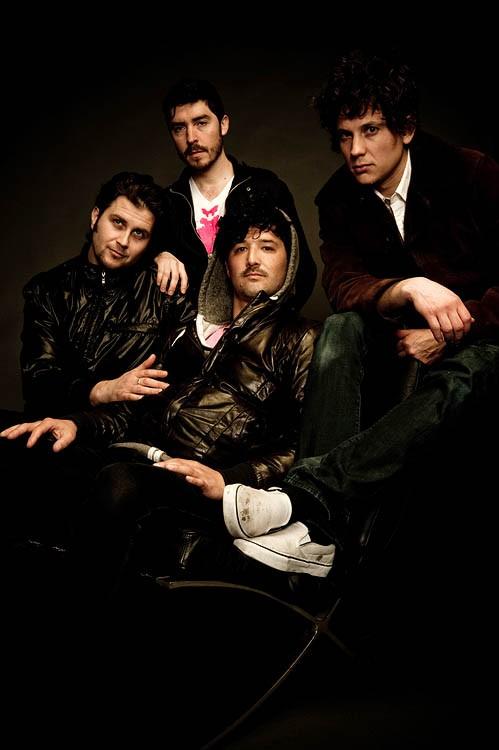
The Strange Boys (playing at the Elbo Room on Sat/27) are as brave and cocky as their music would suggest, an obvious product of the southern state they call home. Hailing from Austin, Texas, their “don’t mess” attitude harmonizes perfectly with wailing garage rock and humid twang. Ryan Sambol’s nasally vocals remind me of a young Bob Dylan and complement the band’s ’60s sound. 

The four Texans started making music together in high school and have since developed a sound easily categorized alongside The Monks, The Seeds, The Black Lips, and San Francisco’s Girls. The tracks off their debut full length, The Strange Boys and Girls Club (In the Red), were recorded at their friend Orville’s house in Denton. They scratch and squeak, transmitted through an AM radio style filter, instructing listeners to throw back a few brews on the porch and let cigarettes burn down to their lips.

The Strange Boys don’t want to be the next hipster trend. They strive to be an outlet for escaping all the horrible shit that surrounds our daily lives: war, a rotting economy, and a twisted government. Standing atop their rusty soap box, the boys demand you stop your bitching and moaning long enough to hear what their guitars have to say.

I was curious about their sources of inspiration. Bassist Philip Sambol was kind enough to scribble down some items from of the member’s current playlists:

1. Abner Jay, various songs on some tapes

2. A mix tape a fan gave Ryan

3. Townes Van Zandt, Live at the Old Quarter, Houston, Texas (Tomato, 1977/ Fat Possum, 2009)

4. John ‘Bloodcut’ Joseph, The Evolution of a Cro Magnon (PUNKHOuse) audiobook

5. It’s Always Sunny in Philadelphia, season four

6. The Savage Love podcast

7. CCR
http://www.youtube.com/watch?v=4R6nmKjcSeU

The Strange Boys
Sat/27, 9 p.m., $10
Elbo Room
647 Valencia, SF.
www.elbo.com

Let’s all read Sand Paper

0

Charmingly disheveled Adobe Books, strung as it is on the alcoholic’s crucifix known as the cross-section of 16th and Valencia, has become a beloved sanctuary for readers, drunkards, and occasionally homeless individuals alike. I always look forward to Adobe Books’ events because you can never predict who among the circus just outside will enter and join the fun. Not many bookstores on this dry earth permit customers to imbibe openly from brown bags of Colt 45 during poetry readings. Adobe Books’ Dickensian squalor places it fondly in my heart even as its floorboards sink beneath the weight of dusty overladen bookshelves — and when the smell of stale beer and, somehow, cats, forces me to breathe through my mouth while I peruse.

On Monday, March 1, Adobe Books will host the San Francisco launch party of three new books from Sand Paper Press. It’ll be worth holding my nose to dive in.

Known for featuring and promoting the works of writers associated with Key West Florida, Sand Paper is not as provincial as it may seem. Key West is like Iowa City in that both localities are marked by a disproportionately high writers-to-population ratio. Elizabeth Bishop, Wallace Stevens, Tennessee Williams, and Earnest Hemingway have all served as pro tem Floridians. This upcoming Monday, books by Stuart Krimko, Shawn Vendor, and Arlo Haskell will be presented and read at Adobe.

Stuart Krimko, currently based in Los Angeles, is the author of The Sweetness of Herbert, a collection of poems loosely inspired by the works of Welsh poet George Herbert (1593-1633). Herbert was remembered for his fancifully monastic poems about the existence of God, and his influence is most evident in lines by Krimko like “(As God in the form of a nauseous wave cast Jonah out.)/ That’s what aggressive living is about.” Readers should note that the collection’s title is intentionally misleading; Herbert’s allusion is tangentially related to a work that is richly imbued with Krimko’s own personality.

Key West poet Arlo Haskell’s collection Joker is lovely. John Ashbery once commented that Haskell’s poems “conjure an ambiance as temperate and welcoming as ocean air.” Ashbery was correct in the sense that Haskell’s poems have a flowing and pellucid quality to them, best seen in phrases like “Imagination is our hard respite/ and the birds in the trees are one of a kind: loneliness./ Our law, like love and lust, is liquid”. However, Haskell’s work is not always temperate nor welcoming; they are frequently political and incisive. Despite Haskell’s aptitude for a pretty turn of phrase, he is not afraid to stir the water. Nor is he apprehensive in revealing what lies beneath.

Along with Haskell and Krimko, young writer Shawn Vandor will also be at Adobe, reading from his collection of stories Fire at the End of the Rainbow.

Sand Paper Press launch party
Mon/1, 7pm, free
Adobe Books
3166 16th Street, SF.
www.myspace.com/adobebooks

Transit activists swarm City Hall

0

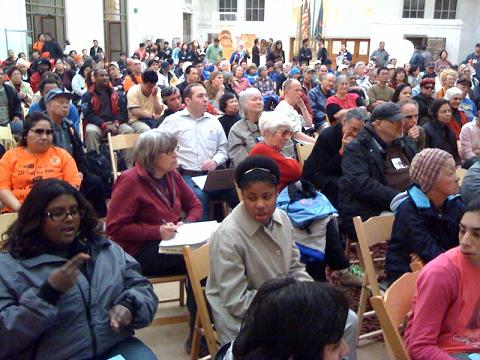
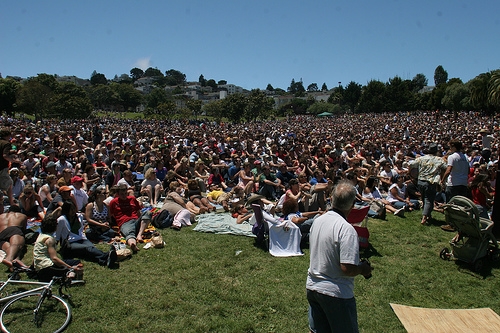
Hundreds of transit supporters, angrily opposed to the package of Muni fare hikes and service cuts proposed to close a $16.9 million mid-year budget deficit, are now packed into City Hall demanding equity and justice.

“I’ve never seen anything like this,” Judson True, spokesperson for the SF Municipal Transportation Agency, told me as he surveyed the huge overflow crowd packed into South Light Court, watching the upstairs budget meeting on closed circuit television. “We should all get on buses and go to Sacramento. It’s clear that grassroots organizing is alive and well in San Francisco.”

It may be true that budget cuts and lack of political will to raise taxes in Sacramento helped cause this problem, but this crowd was angry and they directed most of that ire at the MTA board and the man who appointed them, Mayor Gavin Newsom.

Even True wasn’t spared, as college student Glo Pereira laid into him as we spoke: “I’m a person who doesn’t appreciate this,” she glowered.
That was the dominant mood among the wide coalition of groups represented here today, including a strong presence by communities of color, those with disabilities, and social justice groups.

MTA spokesperson Judson True is confronted by activist Glo Pereira

“You folks should resign! You aren’t doing your job and you haven’t done your job,” activist Bob Planthold told the board. “This is an agency run by one man, Gavin Newsom, in the interests of one man, Gavin Newsom.”

That’s a common theme, one of complete exasperperation, with regular calls to tax the rich and lay off the poor, and for more engaged leadership from the Mayor’s Office.

As I write, there’s still lots of public testimony to go before the board deliberates and votes, so check back to this blog post, which I’ll update periodically.

Update: The MTA board seems to have heeded much the public input, voting 6-1 (with Trustee Cameron Beach in dissent) to remove the increases in Fast Pass fares for youth, senior, and the disabled and to approve the rest of the fare increases, which will increase prices for express buses and cable cars. That package was then approved on a 4-3 (with McCray, Lee, and Beach in dissent, although they didn’t make clear the reason for their votes).

Similarly, another 4-3 vote by the same trustees approved a package of service reductions that total about a 10 percent overall cut, although there was a consensus direction for the board to try to spare cuts on the busiest lines, including 14, 49, 30, 38, M, and the Owl, as well as ensuring nightime cuts are minimized. Overall, the results of the vote weren’t entirely clear and the meeting wasn’t formally adjourned, but instead will be recessed until Tuesday when the board will discuss the larger budget picture going into the next fiscal year.

At that time, the board will consider placing a parcel tax or other new revenues measures on the November ballot, something that seemed to have the support of most board members. In addition, Director Malcom Heinicke today outlined his support for a extended parking meter hours, which he would like to see done as a pilot program along five or six selected commercial corridors on Sundays and on a single commercial corridor on weeknights until 10 p.m. Several board members voiced support for the idea.

While today’s vote didn’t close the $16.9 million deficit that was the purpose of this meeting and the public testimony that went for nearly five hours, MTA executive director Nat Ford noted that “there is some softness” in the revenue picture, including the possibility of getting a $7 million from the Board of Supervisors and using a greater portion of the $17 million windfall that the MTA received after the feds decided to discontinue the Oakland airport connector service on operations rather than maintenance, as staff had proposed. In addition, the MTA board is currently discussing a privatization plan for taxi medallions, which could affect the revenue picture.

I’ll try to help sort this out with another post before day’s end, including more testimony from the occassionally raucous meeting, but it appears that this meeting essentially ended with a “To Be Continued,” and the board will pick up where it left off on Tuesday, when the big new revenue proposals (which Mayor Gavin Newsom has resisted supporting) could be at the very center of the debate.


So long, Bryant Park: SF students show at Fashion Week’s last season in the tents

0

As the New York fashion world flicked a sassy over-the-shoulder wave and bid its Bryant Park home goodbye — Fashion Week will move to Lincoln Center starting next season — six students from San Francisco’s Academy of Art University fretted and beamed as their projects took the stage before the eyes of famed industry professionals.

For the past five years, AAU has been showing select student’s work during New York Fashion week, to give promising graduates exposure and to lure new students out to the Bay Area. Bethany Meuleners’ story is a case in point: three and a half years ago, she secured a seat as a prospective featured student, sat in the audience, and dreamed of seeing her own designs on the runway. Serendipitously, she graduated just in time to have her goal realized. “I can’t believe I’m here! In Bryant Park!” Meuleners told me before the show. “It’s such an iconic thing.”

It’s difficult to piece together a coherent narrative from the collections of six individual designers, but this season seemed to play a gothic darkness (three of the students’ offerings were almost entirely black) off a theme best summed up as “monochrome time traveler.”


The most captivating and curious of the black camp was the work of Sabah Husain, which seamlessly distilled the glitz and glitter of India into wearable yet sophisticate outerwear. Husain brought the cut glass of a chandelier that had dazzled her back to her native India to be replicated into gemstones that she sewed into her designs — long felted jackets dripping with jewels, coats fit for a king. “This was my journey of moving from one aesthetic to another,” explained Husain. “In India, garments are largely draped, while in Western culture, they are all constructed.” Hopefully her cultural fusion will continue on in future garment construction.

Meuleners’ designs went for disassembled gothic, characterized by dark metallic bodysuits, lace dresses, and worn combat boots. Haphazard additions in flowing black silk chiffon created a perfect wardrobe for a sparkly vampire. It is a strange reality from a vision of an innocent child’s game. “I like having a story in mind when I design,” she said. “This was about a little girl playing dress up in her mom’s closet, throwing on clothes.” Meuleners mentioned that she used to shop her own mother’s closet for formals… the mother of this collections’ closet may need to have her fangs filed.

A departure from the shimmer and shine were the sculpted knits of Steven Oo. Creaturesque sweaters gave girls stegosaurus spines, and coned details on shoulders scratched towards wearer’s necks. Oo’s commanding demeanor (crucial for survival in the fashion world) may serve him better than his diligence or technical experimentation. Calm and collected backstage, he stood with a tie purposefully undone over a printed t-shirt, waving a lint roller over garments as he talked. “I was most worried about fitting with the new models,” Oo admitted. “But the knits treated me well.” Each piece took 40 to 60 hours of hand- and machine-knitting to create.

The work of the other students was a spray of light colors — whites, grays, and tans — on a trip: up to space, out on safari, and into the past.

The standout collection among the students consited of the six sculptural, cosmically conceptual looks that sweet and quiet Hyo Sun An sent out. Ornately fringed jumpsuits constructed from one continuous piece of fabric brilliantly transposed form over figure. An was searching through a science magazine for inspiration. Intrigued by the concepts of the Mobius strip and Klein bottle, An chose wool and jersey in gorgeous and complex gray tones to explore fluidity in fashion.

Lady Grace met desert expedition with Marina Solomatnikova’s sand suede suits. “I wanted to play between masculine and feminine,” she said after the show, still shaking with exhilaration. Masculine elements were present in heavy tailoring and femininity shown through in organza ruffles and deeply cut backs, resulting in six outfits that would be perfect for a duchess on an African safari.

Naomi Sutton, with an easy laugh that kept her blond hair shifting over her delicate shoulders, recounted her numerous trips to Bay Area vintage stores and fabric remnant warehouses to find the white and cream velvets and laces she printed with delightful images of chubby children playing, based on of her childhood memories. Traipsing down the runway, models became enchanted sleepwalkers dressed in ghosty gauzes. Aprons and silky ribbons gave a sense of nostalgia. Stepping into Sutton’s dresses is stepping into a whimsical past.

The six students are all back in San Francisco, frequenting their favorite inspiration spots — city beaches, Union Square — while the current class has its eyes locked on Lincoln Center and next season.

How the UC regents avoided a PR mess with Bill Clinton

0

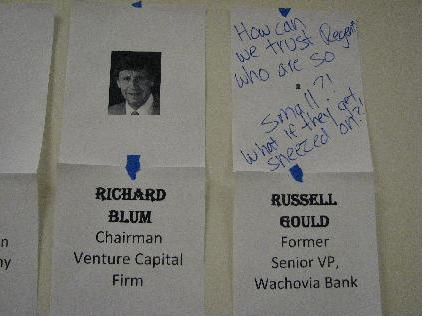
Things were calm and peaceful outside San Francisco’s Fairmont Hotel, perched high atop a windy hill on Mason Street, as dark shiny vehicles rolled up to the stately entrance and well-dressed patrons filed in on the evening of Feb. 24. They were there to hear former President Bill Clinton deliver a speech titled “Don’t Stop Thinking About Tomorrow: Building a Better World,” as a benefit for the American Himalayan Foundation. The AHF is chaired by Richard Blum, a member of the University of California Board of Regents who is married to Sen. Diane Feinstein.

As guests arrived, a small group of workers tried to thrust neon green fliers into their hands. The fliers were headlined, “Tell Richard Blum to Stop Poverty at UC!” and charged that the UC Regents had approved a package of raises for UC executives on Jan. 21 even as front-line UC workers faced layoffs and cuts. The stack of Xeroxed fliers was a mere blip compared with what AFSCME Local 3299, the union that represents workers throughout the University of California system, had originally planned.

The union had organized a picket against Blum’s AHF event, which would have forced Clinton to cross a picket line in order to go in. Not only would this have created an unwanted spectacle, it could have marred the entire event. As AFSCME Local 3299 member Tim Thrush put it, “Bill Clinton is a friend of labor. AFSCME has worked with him a lot in the past … And Clinton will not cross the picket line.”

UC workers have been reeling in the face of massive layoffs and budget cuts. While the university administration contends that there is little it can do in the face of a decimated state budget, union workers point to examples of privatization on the UC campus as an alarming trend that is supplanting public-sector jobs and eroding California’s renowned public-education system.

AFSCME Local 3299 laid out three demands, according to organizer Danielle DiSilverio. While two — involving benefits for custodians at the Irvine campus and concerns about “reductions in time” at the Santa Cruz and San Diego campuses — have not been met, they did secure an agreement to abandon a plan to contract out jobs for shuttle drivers at UC Berkeley. Since the UC Berkeley shuttle drivers would be able to keep their jobs, Local 3299 called off the picket.

“We would prefer to not have to do this kind of stuff,” Thrush told the Guardian. “But unfortunately, in the world that Dick Blum operates in, we can’t get his attention unless we do stuff like this. As he works hard on poverty issues and gives money and time to poverty issues, he also makes decisions at UC that further the poverty problem of our lowest-paid workers. We want to keep reminding him that it’s not OK to do that.”

Who cares about San Francisco’s (black and brown) prisoners?

0

I knew Sup. Chris Daly was going to get slammed for his Feb. 23 vote against placing a $412 million earthquake-safety bond measure on the June ballot. I knew it when I heard him say the following: ”I care more about the people at the jail, the people who are there involuntarily, if we have a seismic incident, then I do about the rest of the people at 850 Bryant.”

Daly noted that he would have supported the bond package if it included money for new lockups, as was originally proposed.

‘What about the people in the jails?” Daly asked. “These are San Franciscans, my constituents, folks who are disproportionately people of color, folks who are disproportionately low-income and have been caught up in the criminal justice system.”

What I later discovered  was that several key figures in the local prison reform movement, including Dorsey Nunn of Legal Services for Prisoners with Children and Rhodessa Jones of the Medea Project, a visionary theater model for incarcerated women, were sitting in the Chambers, awaiting commendations as part of the city’s ongoing Black History Month celebrations.

Later that same afternoon, Sup Ross Mirkarimi honored Jones (left) and Idris Ackamoor (right) for their work with Cultural Oddysey. And afterwards, I caught up with Jones by phone to see what she thought of the plan not to rebuild the jails on Bryant Street , a decision apparently made to reduce the price of the city’s proposed seismic safety charter amendment by $250 million.

Jones, who conducted a residency at San Francisco county jail that resulted in the Medea Project, told me that these kind of inequitable decisions illustrate why she got motivated to do work inside jail, in the first place.

“When we walk into the jail, we try to educated the prisoners that they have no rights and no safety,” Jones said. “We are trying to find ways to infuse their lives with the political reality and end recidivism.”

She also noted that she has not been able to take the Medea Project inside the local jail because it’s gotten so crowded.

But last time she was there, the women were primarily black and brown and, according to Jones, “they are the fastest growing number inside.”

Jones, who is currently working on the issue of reparations and “how the prison-industrial complex looks so much like slavery,”  told me that in the 20 years since she began the Medea project, she’s learned that figuring out the questions around any issue is central to understanding it.

“So, are these folks not human beings as well? How do we transform the humanity? And what would Christ do? A lot of people don’t have any connection with an issue until it’s sitting at their dinner table,” Jones said.

Meanwhile, the Board also honored a dozen other local African American leaders,

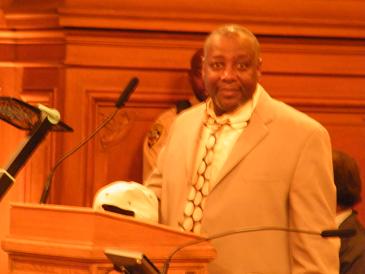
These honorees included Brian Gadsden (at the podium) and Herve Ernes

Sup. Carmen Chu recognized Kenyatta Scott of Abraham Lincoln High School (in red at the podium.


Sup. Ross Mirkarimi recognized Don Lacey (KPOO FM) and Marcus Books.

Sup. Daly recognized Bobby Bogan (at the podium below) of Seniors Organizing Seniors.

Sup. Sean Elsbernd recognized Courtney Johnson Clenendin, and Sup. Bevan Dufty recognized John Weber (see below); emperor of the Imperial Court

Sup. David Campos recognized Karen Huggins (at the podium) for her work with residents of San Francisco Housing Authority properties, describing her as a “force of nature.”

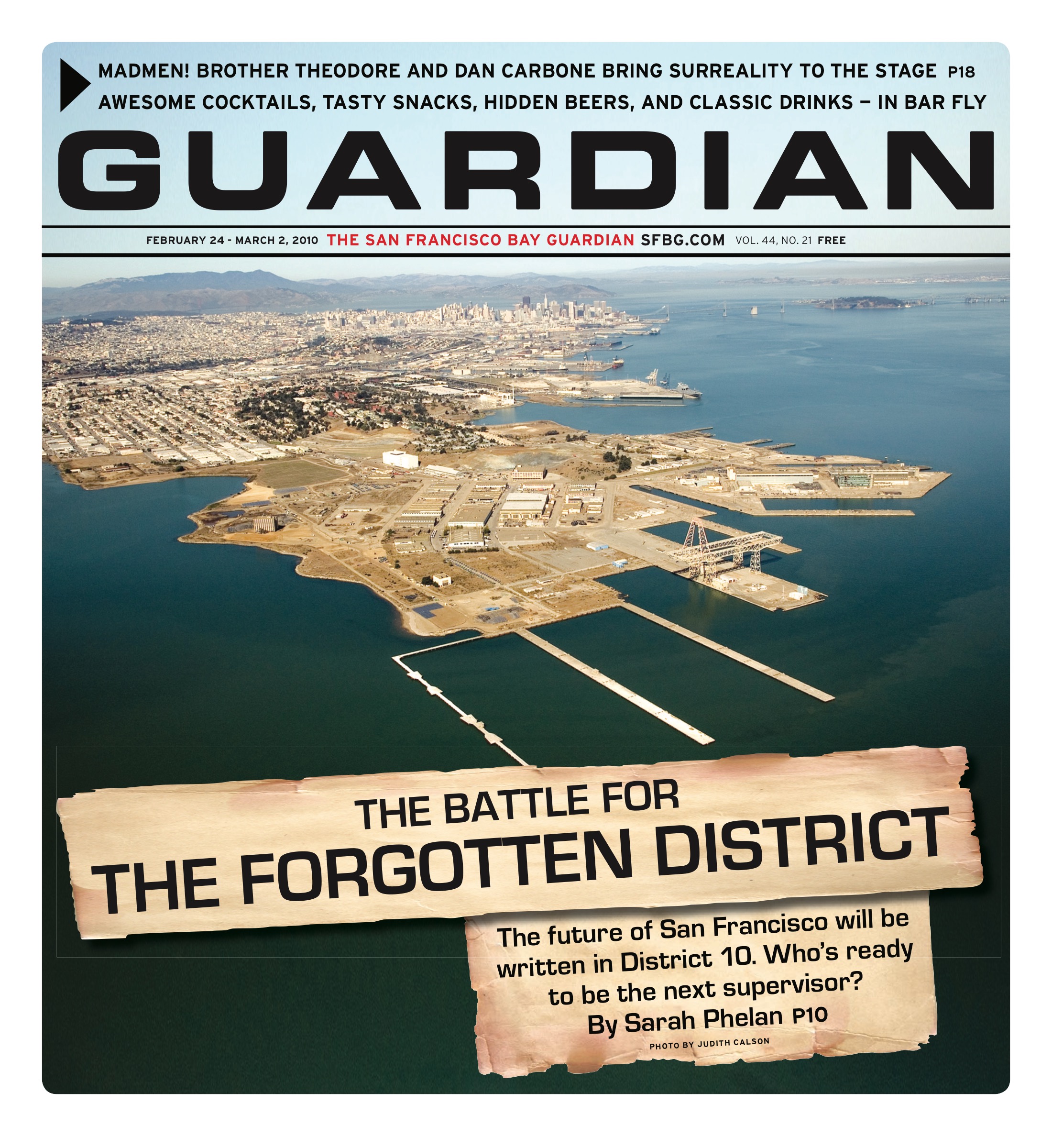
Sup. Sophie Maxwell, whose district is the subject of our cover story recognized Emily Wade-Thompson (at podium below), George Wahington Elementary School principal.

Supervisor Avalos recognized Joseph Lambert and Elba Clemente-Lambert, (both at podium below) who run the Creative Music Emporium.

“We are the last remaining African American owned store in San Francisco, and the only independent music store south of Cesar Chavez,” the Lamberts said.

On the way out of the press box, I couldn’t help photographing  this cutting in a file compiled by local African American videographer and blogger Ace Washington, who is passionately concerned about the ongoing exodus of San Francisco’s already dwindling black population. 

Anyone want to hazard a guess what the 2010 census is going to reveal? (Here’s a clue: it’s doubtless less than it was ten years ago).

Meanwhile, I’ll leave you with this video clip of Bobby Bogan talking about how he used to be in a gang and recruit for the gang, but is now working for and with seniors, one of other most vulnerable populations in town besides blacks, children, folks with disabilities and, you guessed it, prisoners of color. 


Underground and proud

0

THEATER It’s difficult enough to want to perform in San Francisco without the added hardship of not quite fitting into someone else’s concept of “performance.” And the unclassifiable Dan Carbone must surely be one of the hardest acts to shoehorn into a hapless festival curator’s vision. As a performer who regularly skirts the way-out edge between the surreal and the downright schizophrenic, he’s had the dubious honor of being shut out of the comedy club circuit, kicked off the stage at San Francisco’s now-defunct Dadafest, and not selling out the house of numerous local and national “standard” venues.

But Carbone’s ability to evoke the most unconventional of worlds — beginning with his classic one-act Up From the Ground, involving a mysterious giant flower in a Southern cornfield, and most recently with his “one man space opera” Kingdom of Not — has been discomfiting and astonishing audiences and critics on for more than 10 years, and he has the accolades, if not the ticket sales to prove it.

“The SF theater world has no idea what I’m about,” Carbone confesses via e-mail. “They don’t know what to do with me.” Originally an experimental filmmaker, Carbone’s off-kilter performance aesthetic and penchant for dream logic meshes more readily with his silver screen collaborators (including the inimitable Kuchar brothers) than with his more traditionally linear solo show peers. So what’s a decidedly noncommercial, genre-shredding, avant-gardian to do to widen the scope of his influence? Start his own damn performance series, of course.

To kick start this series with a serious bang, Carbone is hosting professional provocateur-comedian Rick Shapiro in his second San Francisco appearance. A former drug addict and homeless rent boy, Shapiro’s own slow rise (literally, up from the ground) serves as ample fodder for his mercurial rants against the status quo, and his unstructured, stream-of-consciousness performance style once earned him the moniker “the James Joyce of comedy.” Or as Carbone puts it, “He’s the only guy on the circuit who not only tells dick jokes but also riffs on Sartre and Kierkegaard — and does so simultaneously.” Their shared inability to write for the mainstream, which has precipitated this joining of forces, will test the theory that art is at its best when designed to suit its creators — not its curators.

March 6, Carbone performs his two most celebrated solo shows, Up from the Ground and Here be Monsters, and premiere a show of works April 3 (both at the Dark Room Theater; check Web site for details). But his ultimate goal is collaboration. “The lesson,” he concludes, “is I need to start my own scene.” Dan Carbone and Rick Shapiro Sat/27, 10 p.m., $8 Dark Room Theater 2263 Mission, SF (415) 401-7987

www.darkroomsf.com

“Gonna Find Boyfriends Today” — Myles Cooper USA

0

What’s as inspiring as Myles Cooper‘s 2010 anthem “Gonna Find Boyfriends Today”? The video for “Gonna Find Boyfriends Today,” directed by another San Francisco talent, Skye Thorstenson. It’s true. SF is home to singing strawberries, dancing cupcakes, Mr. Peanuts, cherubic choirs, floating hearts and flaming hearts. Find yourself a cutie and watch it.

Ethics for political consultants?

1

I got an email from Garry South today. He’s the guy who used to run Gavin Newsom’s campaign for governor. Now he’s turned on his previous client. And he’s sent out a message to political reporters explaining why Newsom — the guy he was pushing for governor of California — is actually a worthless hack.


Here’s the mail:


STATEMENT BY GARRY SOUTH


CHIEF STRATEGIST, JANICE HAHN FOR LT. GOVERNOR


FORMER SENIOR ADVISOR, GAVIN NEWSOM FOR GOVERNOR


I am surprised and perplexed that my friend and former client Mayor Gavin Newsom apparently has decided to jump into the lieutenant governor’s race at the last minute – especially against an already-announced candidate who would be the first woman lieutenant governor in California history.


In every one of several conversations we had about the job while he was running for governor, the Mayor expressed nothing but disinterest in and disdain for the office of lieutenant governor. In fact, he was derisively dismissive of Gray Davis’s decision to run for and serve as lieutenant governor prior to running for governor (“I’m not a Gray Davis,” he said). On a couple of occasions, he directed me to repudiate publicly in the strongest terms that he had any interest in ever running for lieutenant governor.


The Mayor himself told the Chronicle in October that rumors he may run for lieutenant governor were “absurd” and “a complete lie,” and angrily accused Jerry Brown of personally spreading false information to that effect. As recently as December, he himself said flatly “no” when asked directly on a San Francisco radio show whether he intended to run for lieutenant governor.


In addition, when he precipitously pulled out of the governor’s race in late October – against my advice – he said he couldn’t continue as a statewide candidate because he was a husband, a new father and the mayor of San Francisco. So far as I know, he’s still a husband, a new father and the mayor of San Francisco. So it’s pretty hard to see what’s changed over the last four months that would now allow him to run for another statewide office.


If the Mayor does run, it is his responsibility to explain why he now claims to want an elected office he summarily dismissed publicly numerous times over the last several months, and which just earlier this year he called “a largely ceremonial post” … “with no real authority and no real portfolio.”


Now, if Garry South were an attorney, I think he could be disbarred for that statement. Lawyers can’t discuss anything that transpired between them and their ckients.And it sounds to me like he’s taking confidential conversations between himself and his client — talks that occured during campaign strategy sessions — and passing them along to the world.


But since political consultants have no regulations, nothing will happen to him.


Now, there is a code of ethics of the American Association of Political Consultants, which you can read here. It says, in part:


  • I will treat my colleagues and clients with respect and never intentionally injure their professional or personal reputations.

  • I will respect the confidence of my clients and not reveal confidential or privileged information obtained during our professional relationship.

  • Of course, the AAPC is just a trade group, with no enforcement. (Just as journalism codes of ethics are not enforceable by anyone.) But if you ask me, it’s a little slimy.


    Muni cuts spark popular backlash

    2

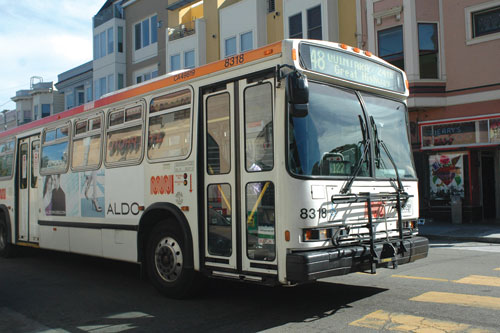
    Tomorrow’s big showdown over the latest round of Muni service cuts and fare hikes seems to be galvanizing transit supporters and giving birth to a rejuvenated progressive advocacy effort, including a new transit riders union led by noted alternative transportation advocate Dave Snyder. And that hearing is just a prelude to a taxi medallion privatization plan that will be heard in the afternoon and another big Muni budget blowout on Tuesday.

    “We are asking everyone to show up and complain about the mayor and the MTA board’s failure to prepare for this and find alternatives to the drastic cuts they’re proposing,” Snyder told us, referring to the San Francisco Municipal Transportation Agency’s plans to close a $16.9 million mid-year budget deficit (which is what’s left after the $11 million from the taxi permit selloff, which the MTA has already figured into the budget) almost entirely on the backs of Muni riders, who have already seen their fares double since Gavin Newsom became mayor in 2004.

    The hearing is Friday at 9 a.m. in City Hall Room 400. That afternoon, Snyder will meet with a broad-based advisory board that he’s assembled to lead (and to name) the new transit riders union that he’s been working on for months, and his tentative plan is to formally launch it on Monday.

    For now, those interested in being part of this fledgling organization can sign up here. The new organization is being launched as the MTA board moves from tomorrow’s controversial meeting into another one on Tuesday, that one to start grappling with the huge budget deficit the agency will still face in the next fiscal year that begins in June, even if it’s successful in closing this year’s.  

    Snyder is probably just the right person to lead this effort, having directed the San Francisco Bicycle Coalition in its formative years before founding Transportation for a Livable City (now known as Livable City) and then becoming the transportation policy director for the San Francisco Planning and Urban Research Association (SPUR), a post he left last year during a controversy surrounding Snyder’s appointment to the Golden Gate Bridge, Highway, and Transportation District Board of Directors. 

    Snyder said Newsom and the MTA board have failed to plan for this foreseeable funding shortfall, saying they should have accelerated plans for extended parking meter hours (particularly ending the free parking on Sundays), a congestion pricing program, a local vehicle license fee, or measures like a gas tax, transit assessment fee, or a parcel tax – all of which the MTA board and mayor could have placed on the ballot for voter approval. Instead, they did nothing and are now pursuing a 10 percent reduction in Muni service, which could start a disastrous downward spiral.

    “They need a stable, long-term funding source,” Snyder told us. “The charter actually says they’re supposed to aggressively seek new sources of funding.”

    MTA spokesperson Judson True said that neither tax increases nor extended parking meter hours among the proposed solutions for Friday’s discussion, but they’re likely to be raised as part of a longer term strategy during the meeting on Tuesday: “It’s likely that the various tax measures will be part of that discussion.”

    That could include reviving the extended parking meter hours proposal, which the MTA board heard last year during a rancorous public meeting, directing staff to do more community outreach on it. As True said, “We did a fair amount of outreach on it so we’ll see where the discussion goes on the two-year budget.”

    Snyder is hardly alone in his local advocacy for budget solutions that spare Muni from deep cuts. In fact, the Transit Not Traffic coalition that successfully pushed the 2007 MTA reform measure Prop. A – which includes the Bike Coalition, Livable City, Walk SF, and other progressive groups – has revived itself in advance of tomorrow’s meeting and will be flying outside City Hall starting at 8:30 a.m.

    There is broad support on the left for seeking more funding from drivers and the general public, but it’s not unanimous. The anti-war ANSWER Coalition frustrated many of its usual progressive allies last year by organizing against extended meter hours, claiming it was a hidden tax of low-income motorists. And Newsom has stubbornly resisted supporting new revenue measures, even in the face of unprecedented budget shortfalls, which makes the quest to win the support of two-thirds of voters difficult.

    But the popular outrage that’s been expressed in recent weeks about how much Muni has been cut, year after year since Newsom became mayor, will likely put pressure on him and the MTA board (all of whom Newsom appointed) to pursue new revenue options.

    True sounded weary as we spoke, noting how much anger has been expressed at the recent series of town hall meetings. “We know where people stand on these proposals,” True said. “The board is going to have some tough decisions to make, clearly.”

    SF officials tap corporate cash

    2

    San Francisco’s $500 campaign contribution limit makes it tough for rich individuals and corporations to curry favor with local politicians, right? Well, not really. Actually, politicians can still tap wealthy interests for tens of thousands of dollars for their special events and pet projects, as long as they fill out a form called “Payments Made at the Behest of an Elected Officer” within 30 days.

    Traditionally, those forms have been buried in the files of the Ethics Commission, but the agency recently put them online, a rare bit of user-friendly sunshine from this often-toothless watchdog body. A Guardian review of the forms shows it is almost exclusively the city’s most fiscally conservative elected officials who use this tactic, tapping a relatively small pool of downtown power brokers.

    When Sup. Michela Alioto-Pier wanted to support a Bizworld Foundation event in December, she had Pacific Gas & Electric donate $5,000 on her behalf. Sup. Sean Elsbernd throws a big annual crab-feed fundraiser in February, with proceeds going to the Laguna Honda Foundation. The form for this year’s event isn’t in yet, but last year he got $5,000 each from all the top anti-progressive funders: Don Fisher, Dede Wilsey, Charles Schwab, Warren Hellman, Platinum Advisors, and the San Francisco Association of Realtors.

    But far and away the biggest beneficiary of these kinds of corporate donations is Mayor Gavin Newsom, who submitted more than half the forms on file. For last year’s Sunday Streets events, he tapped the Hellman family for $30,000, Blue Shield for $10,000, his favorite developer Lennar for $10,000, and Lennar subcontractor CH2M Hill for $5,000. The year before, the top Sunday Streets donors (at $20,000 each) were California Pacific Medical Center (which is seeking city approval to build two new hospitals) and Catholic Healthcare West.

    For his swearing-in events in 2008, Newsom tapped old family friends Gordon and Ann Getty for $30,000, the Fisher family for $20,000, and Charles Schwab, Dede Wilsey, and Marc Benioff for $15,000 each. And, of course, PG&E gave him $10,000.

    When Treasurer Jose Cisneros was starting his Bank on San Francisco program in 2008, he had Wells Fargo donate $20,000. When Sup. Bevan Dufty wanted to create Mission High School scholarships in his name, he called his friends Denise and John York, owners of the 49ers, to cut a check for $19,000.

    Only one official from the progressive side of the local political spectrum turned to these big donations for help, and that was then-Sup. Aaron Peskin in 2007, when he wanted to raise $84,000 to buy a Telegraph Hill property to turn into open space. His top donors were the Gerson Bakar Foundation for $34,000 and 1301 Sansome LLC for $15,000.

    So if you want to find out how downtown corporations are supporting the politicians they favor, keep your eye on this valuable new online resource.

    The clue master takes it down to Chinatown

    2

    It was a casual question to end a brief interview with SF Treasure Hunts clue master Jayson Wechter. “What’s something about San Francisco’s history that most people who live in the city don’t know about?” “Hmm, let’s see,” Wechter begins, whose Chinese New Year hunt this weekend (Sat/27) is his mostly highly attended event of the year. Before I can apologize for putting him on the spot, he starts reeling off the following:

    1. The CIA used a house on Telegraph Hill in the 1950s to perform unauthorized LSD trials on men they hired prostitutes to bring home from bars.

    2. The bay used to come all the way up to Montgomery Street on the east side of the city before it was filled in. Land being in such short supply back then, dud ships were converted to hotels, saloons and warehouse space.

    3. William Tecumseh Sherman was a banker in SF before the Civil War.

    4. In 1845, newspaper man and devote Mormon, Sam Brannan chartered a boat to take him and his Latter Day Saint brethren from the east coast to San Francisco (still part of Mexico when their journey began). They eventually migrated away from the city, but not before good old Sam had a street downtown named after him. “Had they stayed,” concluded Wechter solemnly “the SF sound would not have been Jefferson Airplane or the Grateful Dead but the Mormon Tabernacle Choir.”

    Clearly, this man trivias.

    Gleening post-collegiate inspiration from Keroauc’s On the Road, Wechter moved to San Francisco to work as a freelance journalist, taxi driver and eventually, private investigator. But a quick mind and a knack for knowing “a little bit about everything” had led Wechter to creating treasure hunts for his friends from the time he was 11 years old. He began in earnest with the SF hunts 20 years ago, to the delight of history/culture knick-knackery aficionados. Nowadays, the games attract clue hunters from all over the country, none more so than for the annual Chinese New Year hunt.

    “There’s a great sense of joy in discovering something new… It’s a team activity for people that don’t have any athletic prowess,” he says of the events’ popularity today. Just make sure you’re ready to take the ‘me’ out of ‘team.’ Many of the groups at the fast paced, high pressure event are made of friends and couples- at least, before the competition starts. “Let’s just say the treasure hunts accentuate the ‘dynamics’ of a relationship,” chuckles Wechter.

    Saturday’s Chinese New Year hunt will involve participants in a sort of noir mystery of their own making, racing in and out of parade routes, answering questions on the city’s landmarks, cultural history and general knowledge to win the competition’s big pay-off. “People have the ability to see things they normally wouldn’t [during Chinese New Year celebrations], says Wechter. “It’s a pedestrian focused event and has a festival, carnival like atmosphere- like Mardi Gras without the alcohol!”

    The competition is broken into four levels of play; beginner, regular, master’s and “thinks faster than runs” for the competition’s less mobile participants. Already, 1,500 players are signed up for this weekend’s event.

    So pop quiz: do you have what it takes to match wits with Jayson Wechter?

    Sat/27 4:30 p.m., $35 pre order, $40 at event

    Justin Herman Plaza

    1 Market, SF

    (925) 866-9599

    www.sftreasurehunts.com

    “The State of Black SF”

    2

    By Adrian Castañeda

    To support those living in public housing, the Osiris Coalition is hosting an event called The State of Black SF this Sunday (Feb. 28) at the Main Library’s Koret Auditorium from 2-4:30 pm. It will feature a short film and a panel discussion on the plight of the city’s African American population, a topic discussed in this week’s Guardian cover story.

    One of the items the panel is sure to discuss is the mayor’s Hope SF initiative to renovate eight public housing projects around the city. City officials, residents, and developers agree that housing projects like Hunter’s View and Alice Griffith are dilapidated. But while plans have been made for revitalization and rebuilding, some community groups are worried that current residents, an already marginalized population, will be overlooked.

    With this in mind, the Housing Rights Committee of San Francisco is drafting The Right to Remain Act that aims to assign accountability and protect current tenants during the construction process.

    If passed by the Board of Supervisors, the ordinance would provide for the establishment of a monitoring committee comprised of residents and community leaders to approve plans and keep the public informed.  The aim, says Julian Davis of the San Francisco Housing Development Corporation, is to guarantee that current residents benefit from revitalization and will be allowed to remain in their neighborhoods. “They’re all just stated policy goals at this point,” he said of the effort to provide stronger guarantees.

    Under the ordinance, existing provisions in the Hope SF plan would be enforced by limiting city funding for future projects until appropriate conditions for relocation and construction are met. The current Hope SF plan includes specific one-to-one placement and phased development provisions, where residents will be moved to on-site housing if possible.

    However, there is no guarantee the developers will abide by these plans, so the Right to Remain Act will fill in gaps in federal and state housing laws and hold the Hope SF plan to its goals by ensuring every resident will receive a contract for their home and can sue if their rights are not upheld. Sara Shortt of the HRCSF told us, “No matter what kind of rhetoric is thrown around by officials during all of this, there’s something real on paper that can be enforced.” Shortt, who served on the mayor’s Hope SF task force, says there is a long history of broken promises in communities like Hunter’s View and tenant’s fear being pushed out of their homes.

    Many city officials, including District 10 supervisor Sophie Maxwell and those in the Mayor’s Office of Housing, are receptive to the general idea behind the act but few have assured their support. “I don’t think the mayor’s office is particularly keen on it,” Davis said of the proposed residential committee. Shortt said, “It’s not just about logistical issues. We believe you can’t guarantee that without having accountability and oversight.” She adds that the act should be “in the spotlight,” for the November District 10 elections, “so all the candidates are aware this is something that they’re going to have to take a position on.”

    The act is still being drafted, but the relocation of residents at the Hunter’s View projects has already begun. The pre-existing surplus of hundreds of empty units has made the on-site relocation simple, and Jack Gardner of the John Stewart Company says demolition will begin in March. While the Right to Remain Act would not retroactively cover current projects, it will protect residents in future redevelopment plans.

    “Wouldn’t it be great to have it happen like Hunter’s View at the other sites?” says Davis.

    Local CEO arrested in bribery sting

    0

    By Nima Maghame

    San Francisco-based High Com Security owner Yochanan Cohen was one of 22 CEOs and presidents of security companies that make everything from bullets to bullet-proof vests who were arrested by the Federal Bureau of Investigation under the Foreign Corrupt Practices Act for illegally bribing foreign officials to win weapon defense contracts.

    “This ongoing investigation is the first large-scale use of undercover law enforcement techniques to uncover FCPA violations and the largest action ever undertaken by the Justice Department against individuals for FCPA violations,” said Assistant Attorney General Lanny A. Breuer. All except one of the 22 heads of companies from across the country were arrested together on Jan. 19 when they met in Las Vegas for the 2010 Shooting, Outdoors Trade Show convention. The remaining CEO was apprehended the same day in Miami.

    The undercover operation was designed by the FBI, which set up a sales agent representing the defense ministry of an undisclosed African nation. The agent was set up to inquire about purchasing arms for the presidential guard with the intention of being bribed. Once both sides met, the agent invited the CEOs and presidents to the country’s capital city.

    Reportedly, the agreement was that the companies would pay a 20 percent commission for a slice of a  $15 million dollar venture that the African nation would use to outfit the presidential guard. Then, 10 percent of the commission was to go to sales agent with the other 10 percent going to the African nation’s defense ministry. The sales agent wined and dined the private business owners who then emailed the agent overpriced quotes for M4 carbines, body armor, and illegal purchasing agreements according to the indictment, and wired the bribe money to his overseas bank account. Dealings went so far that crates of weapons and armor were showing up in the African country.

    In a FBI press release that came out shortly after the arrest, the bureau reported they had set up the operation after several undercover agents in the field had made allegations that foreign ministries were being bribed by the law enforcement products industry. 

    “Corrupt payments to foreign officials to obtain or retain business erode public confidence in our free market system and threaten to undermine foreign governments,” said U.S. Attorney Channing Phillips. “These indictments set forth serious allegations and reflect the Department’s commitment to aggressively investigate and prosecute those who try to advance their businesses through foreign bribery.”

    So far none of the indicted have any set trial date but the dependents will be heard by the federal court in Washington D.C.


    Gascon’s remarks at press conference are stunning

    4

    By Brady Welch

    Police Chief George Gascon held a press conference Feb 25th to discuss his desire to arm his officers with Conducted Energy Devices (known to you and me as Tasers or stun guns) — and his comments demonstrated that the chief still doesn’t get it.

    Gascon is arguing that Tasers could prevent some deadly police shootings. But there’s a much larger issue that he seems to be ignoring.

    On December 28, 2009, the federal Ninth Circuit Court of Appeals right here in San Francisco affirmed the decision of a lower court that an unarmed man shot with a Taser can sue the city of Coronado, just outside San Diego. The zapping caused Carl Bryan to fall face first into the pavement, thus knocking out his four front teeth. To add insult to injury, one of the Taser probes lodged in the man’s flesh, requiring a doctor’s scalpel to remove it.
    And what was this citizen’s crime? Getting upset with himself for being pulled over twice in the same day for routine traffic infractions. According to court records, the 21-year-old Bryan was driving home on a Sunday morning after a long night with friends and got pulled over for speeding. Later that same morning, he got stopped again, this time for not wearing a seat belt (which he forgot to put back on after initially getting stopped).

    Bryan pulled to the curb and started punching the steering wheel, shouting expletives at himself for being so careless. He then got out of the car “yelling gibberish and hitting his thighs,” the court decision reports. The officer yelled at Bryan to get back in the car, but Bryan apparently didn’t hear him. Then the cop, without warning, shot the kid with his Taser gun.
    Bryan didn’t die. He also wasn’t on drugs (Tasers are particularly dangerous to people under the influence of stimulants). But he was hurt — and at least according to the court files, there’s good grounds to argue that he should never have been zapped in the first place.

    Gascon acknowledged that Tasers can be dangerous, although he offered a somewhat morbid justification of taser-implicated deaths—loosely paraphrased, he suggested that if you ask a crackhead to run around the block, that person would probably suffer cardiac arrest anyway. And he talked about special training to avoid police Tasing of drug-addled and mentally ill people.

    But what he’s missing — and what has a lot of community activists concerned — is the situation in Coronado: The Taser shooting of someone who should never have been shot with anything. Two police commissioners, Petra DeJesus and Vincent Pan, have expressed concerns over whether people can trust a San Francisco police department armed with semi-lethal weapons that officers might feel inclined to used in decidedly less than semi-lethal situations. The Ninth Circuit’s opinion is only the most recent and ballyhooed case.

    What was particularly galling during the chief’s press conference was when Taser-supporting commissioners Tom Mazzucco and Jim Hammer came forward to plead the case for using Tasers on the mentally ill — as opposed to real bullets — almost as if to say, Certainly, we can all agree on this.

    Well, maybe not. Here’s what the Ninth Circuit had to say:

    A mentally ill individual is in need of a doctor, not a jail cell, and in the usual case—where such an individual is neither a threat to himself nor to anyone else—the government’s interests in deploying force to detain him is not as substantial as its interest in deploying that force to apprehend a dangerous criminal. Moreover, the purpose of detaining a mentally ill individual is not to punish him, but to help him. The government has an important interest in providing assistance to a person in need of psychiatric care; thus, the use of force that may be justified by that interest necessarily differs both in degree and in kind from the use of force that would be justified against a person who has committed a crime or who poses a threat to the community.

    In other words: Cops shouldn’t be shooting mentally ill people anyway, with Tasers or with pistols.

    And if you give the cops Tasers, it’s almost certain that they’ll zap a whole lot of people who were, as one critic put it, “guilty of nothing more than mouthing off to a cop on the bus.”

    BTW, there’s an interesting Amnesty International report on Tasers here


    (Lack of) grace at EpiscoDisco

    0

    It was bound to happen. Some girl in a white coat tagged Grace Cathedral.

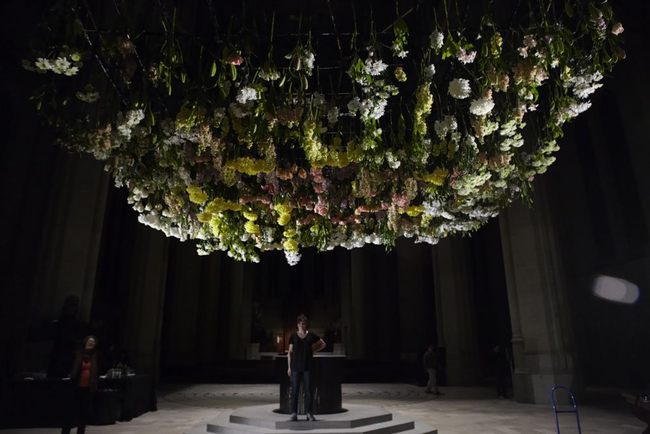
    One thousand flowers were suspended from above as an art installation while I watched Nodzzz run through a collection of songs. The band described the outing as the first time they had ever held a microphone in church. I took that as confirmation they weren’t pastors or priests in their previous line of work. As soon as their set was done someone, maybe the event’s organizer, got on the microphone and had a startling announcement to make. He informed us that this may have been the final installment of EpiscoDisco because the woman in white, who he accused of “probably tripping on acid,” had vandalized the church. The man on the mic rhetorically told us that in the event’s one-year history, no such disrespect had ever occurred up until now, and that the future of the monthly get-together was now in doubt, as the church’s leadership would likely frown upon that night’s incident. He described what she had done and what she was wearing. To be honest, I sort of feared for the girl, because it sounded as if this guy was hoping for a lynch mob or at least some sort of immediate repercussions for her actions. He seemed pretty pissed, and if he was to be held responsible, I’d say rightfully so.

    The church is one of those buildings a San Francisco resident is likely to take for granted. Grace’s occupation would normally be limited to parishioners or tourists, but its gothic majesty opens engraved chamber-like doors once a month on Saturday evenings, allowing a curious bunch of unlikely visitors to roam freely, seemingly unsupervised. Maybe it’s my Catholic upbringing, but something about the whole thing just seems so backwards. Disco scenesters mix it up with the garage rock crowd with drinks in their hands and stained glass windows in the background? Same-sex couples sharing intimate secrets littered among long rows of pews? Hipsters dressed (in their Sunday best?) ogling a giant crimson version of the holy bible all within the Episcopalian version of the house of the lord? It was madness. It seemed so wrong. Really, what would Jesus do?

    Who could blame the girl? Before the culprit’s act was publicly announced, I myself was tempted to do something drastic in iconoclastic fashion. In fact, I did voice my fantasy out loud to my friend, saying I wanted to tag or at least tip something over. I’m sure some of those feelings were just residual teenage angst from the aforementioned upbringing of religion’s expectations of conformity and control. However, whereas I was a talker, the woman in white was a walker. Without inhibition she let loose in the form of either spray paint or maybe one of those Magnum markers. One friend thought she smelled something funny, but figured someone had light up a cig indoors. I never saw (nor smelled) her work of attempted ecclesiastical immortalization, but her sacrilegious act made her instantly notorious and got her bounced. We could only wonder what compelled her to do it. What did she have to say? My guess was “666,” even if it is a bit cliché, while another friend suggested she graffiti-ed “This church rulz.” In any event and quite unceremoniously, she attempted to re-enter the place of worship, but to no avail.

    People filtered out of the cathedral slowly, just as they had been asked, while flamboyantl men with interesting haircuts decked out in leopard-print ensembles continued to berate the alleged vandal on their way out. As far as they were concerned, their EpiscoDisco was to suffer an uncertain future. So much for the church’s youth outreach program, but it was nice while it lasted. I guess we’ll just have to stay tuned.

    On Feb. 26, the cab industry changes, radically

    16

    The San Francisco taxi industry will undergo a major change starting Feb. 26, when the Municipal Transportation Agency is expected to adopt a complete transformation of how cab medallions — the permits needed to operate a taxi in the city — are allocated. You can read the proposal here. In essence, it would allow cab medallions — which are now allocated to individual drivers on the basis of seniority on a waiting list — to be sold on the open market.

    It’s a tricky proposition. But the mayor appoints the MTA board, and the mayor wants this — both to help with the city’s budget problems and because, well, he’s always supported privatization of some public assets, and that’s what this proposal amounts to.

    And here’s a little stinker that’s part of the deal: The MTA currently has 30 of the valuable medallions just sitting around in a desk. Those are permits that could be issued to the top 30 drivers on the waiting list — many of whom have been driving for 15 years or so while they slowly rose to the top of the list.

    Instead, if the proposal passes, those medallions — or at least some of them — will be sold off, over the counter, at prices that could reach $400,000.

    Judson True, the MTA’s spokesperson, confirmed that there were 30 unallocated permits on hand right now and that at least half would likely be sold at market rate. The MTA is budgeting $15 million for direct permit sales.

    So if you’re, say, number 16 on the waiting list, and 15 people ahead of you get permits that are currently available — and the next 15 are sold, and you can’t afford it — you’re SOL. Until someone else dies and another permit comes up — unless that permit is sold, too.


    A look back at the 2010 Sundance Film Festival (part three: docs!)

    2

    Check out Jesse’s two-part take on Sundance’s narrative side here and here.

    Sporting the revamped tagline “This is the renewed rebellion. This Sundance, reminded,” the festival’s always-stellar documentary selections most often live up to their astonishing subject matter. This year was no different. First up for me was the controversial 8: The Mormon Proposition by Reed Cowan and Steven Greenstreet. The film explores the Mormon Church’s involvement (and sneaky double-dealings) in the pro-Prop 8 campaign in California, as well as exploring how many Mormon leaders use God’s will as a manipulation tatic towards preventing (or in this case, taking away) civil rights. The film’s most jaw-dropping revelation, which draws a connection between the persecution of a follower of Mormon Church founder Joseph Smith and today’s struggle for same-sex marriage, will chill your bones with irony.

    But while the audience at 8‘s world premiere gave the film a five-minute standing ovation (the crowd included everyone from Dustin Lance Black, Oscar-winning screenwriter of 2008’s Milk, to San Francisco mayor Gavin Newsom), the filmmakers make a major misstep by undercutting an otherwise powerful and damning interview from a Mormon leader with gurgling, demon-like sounds and a backdrop cartoon of the man as the devil. This Michael Moore-esque technique of falling prey to “emotional ranting” not only contradicts Sundance director John Cooper’s catalog description of the film, but helps shuts down the “conversation” (which both filmmakers stressed numerous times during the Q&A) with people who voted for Prop 8. Unfortunately, this cheap shot lowers the film’s credibility and when questioned by an audience member (who had voted for Prop 8) why they had used such tactics as “altering the [Morman man’s] voice,” the filmmakers quickly became defensive, shouting, “We didn’t alter anything!” and “Listen to the words!” When re-questioned, they stated, without a doubt, that they “stood by” how they had presented the information. Where was that conversation again?

    Expanding on a six-minute short co-directed by Alfonso Cuaron (2008’s Children of Men), The Shock Doctrine (an adaptation of Naomi Klein’s book about economist Milton Friedman’s “Free Market” idea), is a 79-minute whirlwind of film. Directors Michael Winterbottom and Matt Whitecross disturbingly deconstruct this “marginalized backwater economic theory” and expose it as the main philosophy applied towards many of the U.S. and U.K’s current international (mis)handlings. While it may be a simplification in many areas (and filled with George W. Bush and conservative bashing), this doc sheds light on deregulated trading between countries, and how it has had devastating aftereffects on the rest of the world.

    Also expanding on a previous short film (2006’s A Conversation with Basquiat), Tamra Davis’ Jean-Michel Basquiat: The Radiant Child is a tightly woven overview of his life combined with poignant interviews with friends and ex-lovers, topped off with very personal footage that Davis herself conducted in the early 1980s. With an outstanding soundtrack of early 80s no-wave tracks as well as classic hip-hop tunes, this tribute is a genuine crowdpleaser for fans and the uninitiated alike.

    Leon Gast’s Smash His Camera uncovers villified 1970s paparazzo Ron Galella in a deliciously contradictory manner. Exploring the constant battles revolving around privacy rights (claimed by both Galella and his subjects), freedom of the press, and obsession with fame, the film asks viewers to question our own fascination with stars. It raises the revolutionary, contemporary question as to how legit Galella actually might be as an artist. With priceless moments signed and delivered by Galella himself, you may find yourself walking out of the film wanting to scapegoat and demonize an individual for showing us exactly what we are captivated by and are constantly seeking out.

    The latest doc from Stanley Nelson’ (2006’s Jonestown: The Life and Death of the Peoples Temple), Freedom Riders, delivers the type of archival footage that we’ve forgotten history is made of. Beginning in 1961, if follows a few groups of devoted individuals who were brave enough to take buses into the deepest of the segregated South, with hopes of ending racial discrimination. Nelson’s film is a genuine tribute to the audacious and non-violent struggle by protestors who even Martin Luther King Jr, John F. Kennedy, and Robert Kennedy didn’t know how to support. With the current civil rights struggles in the United States, Freedom Riders strikes more than a few heartbreaking chords, making it a must-see.

    Yael Hersonski’s A Film Unfinished deconstructs an infamous Nazi-produced documentary about the Warsaw ghetto, incorporating a newly-discovered reel of outtakes and contradictory footage. What was meant to be a document of how happy the Jewish people supposedly were in the ghetto is overwhelmingly exposed as nothing but reenactments and revisionism. The importance of A Film Unfinished goes beyond the subject matter, for it not only examines the misrepresentation of certain historical documents and the long-standing destructive side effects of doing so, but also directly correlates to so many dilemmas we currently have with the delivery of information through cinema, TV, and online media. The film picked up Sundance’s World Cinema Documentary Editing Award.

    Tim Hetherington and Sebastian Junger’s Restrepo, which won the festival’s Documentary Grand Jury Prize, chronicles the deployment of a platoon of U.S. soldiers in Afghanistan’s Korengal Valley. The visceral footage is quiet, haunting, and surprisingly non-judgemental. Interspersed with interviews with the soldiers after they’ve returned home from their 15-month outing, the audience gets to experience not just individual journeys, but also the contrasting after effects on the group, post-tour of duty. As Hetherington and Junger spoke after the screening, the revelation of how close they become with the battalion (during the ten trips they made with the soldiers) brought up a valid question about the filmmaker’s impartiality. These soldiers saw and did things in Afghanistan they don’t seem to understand and I left the theater with the same confusion. Since seeing Restrepo, I haven’t been able to stop thinking it.

    Christian Frei’s Space Tourists follows the spectacular quest of 40-year-old Anousheh Ansari, an Iranian-American millionaire whose dreams of becoming a space traveler came true. The film does not use narration, allowing its images to connect with the audience as opposed to telling them what and how to feel. This filmmaking choice (reminiscent of documentarian Frederick Wiseman) is risky business nowadays (more than two thirds of the audience filed out of the theater mid-film), but has the possibilty of achieving a transcendental feeling if you stick with it. Watching Ansari live out her fantasies (at a cost of $20 million) in real life, in slow motion on board the space shuttle is truly mesmerizing. But makes Frei’s film so profound is his attention to the world below, focusing on people like a gang of junk collectors who survive by scavenging the hills, retrieving the shuttle’s segmented remains. How rare that a film can provide so much insight to the world’s dichotomies while at the same time exploring (wo)man’s final frontier.

    Heidi Ewing and Rachel Grady’s follow-up to their Oscar-nominated Jesus Camp (2006), finds them on a corner in Florida: 12th & Delaware. This intersection has a pro-choice abortion clinic on one side of the street — and on the other, a pro-life pregnancy care center. Using the same techniques as their previous documentary (no narration, very few statistics, and no talking head interviews), Ewing and Grady get astoundingly up close and personal with both centers’ employees and clients. Unbiased, respectful, and remarkably candid, 12th & Delaware offers insight and clarity into both sides’ passion. While most will leave the theater with the same belief system as they had before going in (though I have to say that I sure believe the other side’s dedication a whole lot better now), there’s no doubting that this is genuine journalistic cinema at its best.

    And finally: Waiting For Superman, Davis Guggenheim’s follow-up to his Oscar-winning An Inconvenient Truth (2006), deftly explores the American education system in grueling detail, from the horrifying statistics of “academic sinkholes” and “drop-out factories” that plague our nation to the specific children, parents, and teachers that are caught in the middle. The incredible amount of research, follow-through, and devastating footage that Guggenheim has skillfully combined  is enough to open anyone’s eyes. The film suggests that while we all are waiting for a Superman figure to come and magically fix it all, every one of us is somehow involved with and affected by this nightmare. Along the way, this apolitical film becomes inspired, accountable, and motivational cinema. Rightfully, it won Sundance’s Audience Award for Best Documentary Feature.

    Noise Pop: A last-minute slacker’s guide

    0

    An exhausting week of show after show has arrived, and it’s hard to say no to such a thick lineup of interesting indie. That is, if you had a choice. If you’ve already got your tickets, my mother would be proud. If you are among the league of last-minute fools, be forewarned — you are officially SOL (insert Debbie Downer “whaw whaw” here). Lots of shows are sold out, including almost everything I had my eye on: Edward Sharpe and the Magnetic Zones, Loquat, Best Coast, Zee Avi, Atlas Sound, Four Tet, Mirah… So, if you’re like me and staggering to find your place in Noise Pop, here’s a guide to what’s best of what’s left.

    WED/24

    The Ghost of a Saber Toothed Tiger (Sean Lennon, Charlotte Kemp Muhl w/Cornelus)

    Sean Lennon has always put me to sleep — not because he’s boring, but because his voice is pure lullaby. When he’s not helping out his mom, Yoko Ono, or playing sweet songs on his own, Lennon has put his heart into singing with his sweetie, hottie model Charlotte Kemp Muhl. The members of Cornelius will join the lovebirds on stage for pure ambient, twinkling folk everyone should eat with a spoon. 7pm, $20, The Independent

    Foreign Born

    Four guys and lots of galloping, hustling, clanking percussion, all kept up with audible aptitude. Foreign Born is low key, lyrical indie that knows when to tap into its intimate side and explore the more subtle jems. Think Vampire Weekend with a dash of folk rock. With The Fresh and Onlys. 8pm, $14, all ages, Rickshaw Stop
     
    Film: P-Star Rising

    Priscilla is nine years old, totally adorable, and totally badass. The tiny MC grabs the mic with no fear, rapping about her single dad, dead-beat mom and the joys of being a rap star before puberty. From kid to underage celeb status, the family struggles to keep it real while chasin’ the dream. 9:15pm, $10, all ages, Roxie Theater


    THU/25

    Film: The Heart is a Drum Machine

    Nearly everyone is at least semi-obsessed with music and this feature documentary attempts to discover what it is about notes and tones that feel so good. The film has quite an impressive stack of celebrities and scientists, all offering their opinions and personal love affairs with the art form, including Elijah Wood, Jason Schwartzman, and crazy woman Juliette Lewis. 9:30pm, $10, all ages, Viz Cinema


    FRI/26

    Nurses

    A Portland trio of whistles and wonderful sounds, Nurses craft songs with the leaves and sticks and stones they find in every corner. Looping and sampling these oddities, they make beautiful and inquisitive melodies that remind one of owls and environmentally friendly attitudes. With John Vanderslice, Honeycomb, Conspiracy of Venus. 7pm, $15, Swedish American Hall
     
    The Art of Noise, Soiree featuring Shlomo

    Heavy bass means weighty pours, right? The Art of Noise will surely light up your Friday night, with deep dance sounds and nods of hip hop. Shlomo is California based and full of genre bending material, poorly categorized as experimental, with full on low tones, synth kicks and lazer bites. 5pm, free, Project One


    SAT/27

    Pop ‘n’ Shop

    Gotta look hot for the rest of Noise Pop weekend! More than 40 local designers, snacks and booze for all your perusing. 12pm-5pm, free, all ages, The Verdi Club

    Music For Animals

    They’re local and totally weird in a good way. Music for Animals is slightly funny and yet remains to be musically sound with sparky guitars and pop-friendly choruses. The quartet loves keeping it cool with their SF musical comrades and love to please their Bay fans. With Nico Vega, The Soundtrack of Our Lives, and Imaad Wasif. 7pm, $16, The Independent
     
    !!! and My First Earthquake

    It doesn’t matter if you’re not sure how to pronounce the band’s punctuation happy name (chk-chk-chk), they’re damn good and full of electronic, relentless energy. Bring a bandana for that embarrassing sweat dripping down your nose and you’ll be a happy dancer. San Francisco band My First Earthquake is equally stellar synth-pop, sewn with catchy lyrics and a perfectly feisty front-woman. With Maus Haus and Sugar and Gold. 7pm, $20, Mezzanine

    Our weekly picks

    0

    WEDNESDAY (24th)

    MUSIC

    Noise Pop: The Ghost of a Saber Toothed Tiger

    Noise Pop is in full effect, and Sean Lennon manages to pull double duty with the most important ladies in his life, performing with Plastic Ono Band as well as a group that includes his girlfriend Charlotte Kemp Muhr. The latter project, dubbed Ghost of a Saber Toothed Tiger, presents lavish folk songs not too far-flung from Lennon’s solo output, including a few spaced-out covers of that material. But Muhl’s harmonies lend a new depth and tone to the sublime psych gems. Performing under the pseudonyms Amatla and Zargifon, the duo is joined at this performance by members of Cornelius’s band (Keigo Oyamada, Shimmy Hirotaka Shimizu, Yuko Araki), adding to the full sound. (Peter Galvin)

    With If By Yes (Petra Hayden and Yuka Honda)

    8 p.m., $20

    The Independent

    628 Divisadero, SF

    (415) 771-1421

    www.theindependentsf.com

    MUSIC

    Noise Pop: Harlem, Young Prisms

    Best party of Noise Pop probably has to be the Harlem show. The Bay Area isn’t trifling when it comes to garage rock, but the Texan trio can hang with the best of them (and in fact, they have some ties to them). They’ve got the best rock ‘n’ roll invocation of Caspar the Friendly Ghost since fellow Austin boy Daniel Johnston, and a handsome guitar sound. And yeah, they have a song called “Psychedelic Tits” that Jayne Mansfield would be proud to dance to regardless of whether Frank Tashlin was watching. They can write about unhappily blasting ABBA in the rain in the South of France and make it sound like the best time. Opening for them are Mexican Summer signees Young Prisms, one of the best new bands in San Francisco. (Johnny Ray Huston)

    With Best Coast, the Sandwitches

    8 p.m., $12

    Cafe Du Nord

    2170 Market, SF

    (415) 861-5016

    www.cafedunord.com

    MUSIC

    Jimmy Scott and the Jazz Expressions

    There is nothing quite like Jimmy Scott singing “Sometimes I Feel Like a Motherless Child.” I’ve seen Scott testify when singing this song — even at 85 years old, he grabs hold of it with ferocity. That’s how it is when a song tells the story of your life, and Scott, well he’s the kind of singer who turns a song into a story. Back in the ’60s, Scott brought fearless singing on songs such as “Day By Day.” In recent years, his takes on standards like “All of Me” have had an increased sense of mischievous humor. If you haven’t seen Jimmy Scott live, you should, because there is no one quite like him, and no document of a concert in Tokyo, no matter how enjoyable, can match the experience. (Huston)

    8 p.m., $18

    Yoshi’s San Francisco

    1330 Fillmore, SF

    (415) 655-5600

    www.yoshis.com

    THURSDAY (25th)

    FOOD/SPOKEN WORD

    “In the Defense of Food”

    Food. It’s one thing that can bring people together, create tears of joy, make mouths water, and conjure dreams. Although many of us try to fight the temptation to indulge in delectable bites, we are, in fact a society obsessed with savory morsels that bring us to our knees, and keep us begging for more. So let’s talk about it. Poetri, the star of the original Def Poetry Jam on Broadway, will unleash his inner love for food, and top spoken word artists from the Bay Area will also spend the evening praising unforgettable treats. And yes, food sampling and wine tasting are on the menu. (Elise-Marie Brown)

    6 p.m., $20 (RSVP required)

    Museum of the African Diaspora

    685 Mission, SF

    (415) 358-7200

    www.moadsf.org

    DANCE

    Robert Moses’ Kin: The Cinderella Principle

    When Robert Moses formed his dance company 15 years ago, he called it Robert Moses’ Kin. Moses knows that families today no longer just run along bloodlines. Nontraditional, blended, interracial, same-sex, single parent, no-kids families have become common. Hence The Cinderella Principle: Try These On to See If They Fit, an hour-long, full company work for which he collaborated with playwright Anne Galfour. The choreographic impetus came from interviews with people who are engaged in redefining kinship. Since dance companies often refer to themselves as family, Cinderella seems a particularly appropriate subject for a choreographer to undertake. The live music by Todd Reynolds includes beat boxer Kid Beyond. Cinderella will be joined by two works from 2008, Toward September and Hush. (Rita Felciano)

    8 p.m (also Fri/26-Sat/27), $20-35.

    Yerba. Buena Center for the Arts

    701 Mission, SF

    (415) 978-2787

    www.ybca.org

    VISUAL ART

    Jill Storthz: Woodcuts

    San Francisco has a lot of artists, but how many artists have San Francisco in heart and mind? Jill Storthz does — she’s written about the city’s influence on her work’s “splintered ramshackle quality entwined with colored light, earth, and space. Points for use of the word ramshackle, no doubt, but Storthz’s woodcuts have a lightness and grace to them, and the piece on the postcard for her latest show is rich with color in a manner that doesn’t listlessly parrot Mission School motifs. Storthz doesn’t draw within the lines of color theory — in other words, her art is distinct, not derivative. (Huston)

    5:30–7 p.m. (through March), free

    The Grotto

    490 2nd St, SF

    www.jillstorthz.com

    www.sfgrotto.org

    FRIDAY (26th)

    ART/PHOTOGRAPHY

    Third Annual International Juried Plastic Camera Show

    What happened to the days when a basic point-and-shoot camera with film could make life exciting? We didn’t have the option of viewing photos instantly — instead, we had to march over to the one-hour photo and wait as our roll of film was developed. Whether the pictures came out in focus or not, the whole point was to document a moment in time when something worthy of a photo took place. At the Juried Plastic Camera Show, renowned photographers will showcase their work with the use of low-grade cameras — sans all the fancy equipment — and unveil beautiful pieces at that. (Brown)

    6 p.m., free

    RayKo Photo Center

    428 Third St., SF

    (415) 495-3773

    www.raykophoto.com

    MUSIC

    Noise Pop: Atlas Sound

    Buffalo Springfield died so that we might have Neil Young, and Peter Gabriel gave up the ghost with Genesis so his angelic 1980s pipes could blast from the boombox of an adolescent John Cusack. Sometimes branching off is a good idea. So it is with the music of Atlas Sound, the more-than-side project of Deerhunter’s Bradford Cox. The group’s recent album Logos (Kranky/4AD, 2009) is a hodgepodge of druggy, reverbed, and blissed-out beauty recorded whenever, wherever, and with whatever from 2007 to 2009. (Brady Welch)

    With Geographer, Magic Wands, Nice Nice

    8 p.m., $16-18

    Great American Music Hall

    859 O’Farrell, SF

    (415) 885-0750

    www.noisepop.com

    FILM

    Downstream

    As recent entries The Book of Eli, The Road (2009), and I Am Legend (2007) have demonstrated, it’s easy to nuke a fascinating sci-fi genre into ponderous, sentimental meh-ness. (Not every postapocalyptic film can be as cool as 1979’s Mad Max.) Self-distributed Downstream avoids the heart-tugging route, for the most part: after his scientist father is killed, a boy grows up to be a straggly-haired drifter in a ravaged world where there’s no gas and very few women (thanks to cancers caused by genetically altered food). His one hope is of finding a rumored city kept civilized by clean energy. Its over-reliance on split-screen can be distracting, but Downstream deserves props for approaching dystopia from an intriguingly green perspective. (Cheryl Eddy)

    Fri/26-Sat/27, 8 p.m.; Sun/28, 7 p.m.; $12

    Victoria Theatre

    2961 16th St., SF

    (415) 863-7576

    www.downstreamthemovie.com

    MUSIC

    Brian McKnight, Lalah Hathaway

    Tonight, two respected R&B singers come together in one of the most soulful towns. Brian McKnight has made an imprint with his singing and songwriting on such hits as “Back at One” and “Anytime.” He also plays nine instruments. His timeless voice is an inspiration to several of today’s R&B singers. Opening for McKnight is Lalah Hathaway, daughter of the legendary Donny Hathaway. Her buttery alto tone is reminiscent of her father’s voice, but she injects her own timbre and control into every note. (Lilan Kane)

    8pm, $50–$75

    Fox Theater

    1807 Telegraph, Oakl.

    (510) 302-2277

    www.thefoxoakland.com

    SATURDAY (27th)

    EVENT

    Monster Jam

    A stampede of horsepower comes thundering into the Bay Area today as the Monster Jam series of monster truck races and events hits Oakland, featuring ground-shaking custom creations such as “Iron Man,” “Donkey Kong,” “Maximum Destruction,” and the long-running fan favorite “Grave Digger.” Spectators will be treated to both races and full-on “freestyle” events — where the 10,000 pound muscle machines fly through the air at distances up to 130 feet and reach heights up to 35 feet in the air — not to mention crushing cars aplenty. Get in touch with your inner gear-head and speed on over to the Coliseum early, where a pit party precedes the night’s main events, allowing fans to get up close and personal with the burly beasts. (Sean McCourt)

    3 p.m. pit party, 7 p.m. main event; $7.50–$30 ($125 for an all access pass)

    Oakland Coliseum

    7000 Coliseum Way, Oakl.

    (800) 745-3000

    www.monsterjam.com

    MUSIC

    California Honeydrops

    It’s cold season, so if you are experiencing a sore throat, grab some California Honeydrops. Their music makes you feel good. Originating in the Oakland subway stations in 2007, California Honeydrops has played worldwide. Led by vocalist and trumpeter Lech Wierzynski, the band embraces roots, blues, and New Orleans-style horn lines to create a modern sound with a traditional influences. The playful rhythm section includes Chris Burns on the keys, drummer Ben Malament, and bassist Seth Ford-Young, with spicy shouts from saxophonist Johnny Bones. Bring your dancing shoes. (Kane)

    $10–$15, 7:30 and 9 p.m.

    Red Poppy Art House

    2698 Folsom, SF

    (415) 826-2402

    www.redpoppyarthouse.org

    ART/FILM

    Cartune Xprez: 2010 Future Television

    Combine images of old Sunday morning cartoons, live video theater, and psychedelic colors and shapes into a cosmic video and you’ve got Cartune Xprez: an out-of-body dream sequence come to life. Many of the directors will be on hand to explain the concepts for their work, so don’t be scared if you misinterpret their tour de force. Artists who have presented at Cartune Xprez in the past include Shana Moulton, Day-Glo maniacs Paper Rad, and collage visionary Martha Colburn. (Brown)

    8 p.m., $5

    LoBot Gallery

    1800 Campbell, Oakl.

    www.lobotgallery.com

    SUNDAY (28th)

    EVENT/LIT

    “Meet Ann Bannon: Queen of Lesbian Pulp Fiction”

    Pulp fiction isn’t just Tarantino kitsch. For pre-Stonewall gay and lesbian writers, the creation of pulp titles with something more — a way to forge community, share desires, and spark imagination. For some, if not all, this meant pulp was a political act. It would be difficult to find a better representative of lesbian pulp fiction than Ann Bannon, whose five-volume Beebo Brinker Chronicles has seen numerous reprints and recently inspired a stage play. In conjunction with the West Coast premiere of the stage version of Beebo Brinker, Bannon is coming to town for a tea party. Heat it up and add honey. (Huston)

    1 p.m., $20–$40

    Brava Theater Center

    2789 24th St., SF

    (415) 641-7657

    www.brava.org The Guardian listings deadline is two weeks prior to our Wednesday publication date. To submit an item for consideration, please include the title of the event, a brief description of the event, date and time, venue name, street address (listing cross streets only isn’t sufficient), city, telephone number readers can call for more information, telephone number for media, and admission costs. Send information to Listings, the Guardian Building, 135 Mississippi St., SF, CA 94107; fax to (415) 487-2506; or e-mail (paste press release into e-mail body — no text attachments, please) to listings@sfbg.com. We cannot guarantee the return of photos, but enclosing an SASE helps. Digital photos may be submitted in jpeg format; the image must be at least 240 dpi and four inches by six inches in size. We regret we cannot accept listings over the phone.


    Connecting flights

    0

    arts@sfbg.com

    DANCE The buzz surrounding the Akram Khan Company’s second Bay Area visit — they first appeared in 2003 as part of the San Francisco International Arts Festival — proved that sometimes pre-performance excitement is not the result of marketing hype. A copresentation by San Francisco Performances and Yerba Buena Center for the Arts, Khan’s bahok (2008), a 75-minute evocation of displacement in a world constantly on the move, proved witty, humane, and haunting, despite its sentimental ending.

    Though bahok (“carrier” in Bengali) is set for an international cast of eight, this was of less interest than the way Khan peeled away each dancer’s anonymity. The piece showed individuals who tease, love, fight, and ultimately find commonality despite linguistic and cultural differences. Each, some more clearly than others, was a “carrier” of the cultural forces that shaped them. But that’s not all they were.

    Tall Taiwanese ballerina Cheng-Fang Wu’s character was an image-obsessed show-off. Her duet with the much shorter Indian Saju was pure Marx Brothers. Seoul-born Young-Jin Kim appears hopelessly lost in an interview with an immigration official but becames a determined peacemaker when breaking up a fistfight. And what about the neurotically self-possessed Spaniard Eulalia Ayguade Farro? She’s the one who breaks the ice by picking up a bag dropped by the catatonically staring Sung-Hoon Kim.

    bahok is set in a place of transit, an airport, a bus station — but also, perhaps, a center for processing migrants. In Fabiana Piccioli’s somber lighting, the sense of nowhere numbs spirits as well as limbs, as those assembled wait for their numbers to come up. From anonymity and suffocating stasis, Khan built bahok into something like a community of hope — still waiting, but bathed in what looked suspiciously like a sunrise.

    With an immaculate sense of timing, Khan layers individual dramatic episodes with fiercely physical dancing that rebounds from the floor even as it gives into it. The work started slowly with tiny movements from the seated dancers. A leg opens; an arm drops; papers are rustled. The immobile Sung-Hoon Kim seemed planted in front of a babbling electronic message-board, yet he had the first big solo, in which he sliced space with fractured fury only to melt into the ground. Then, one by one, the dancers opened themselves.

    Among the most complex characters was a gymnastically flipping Farro, who raced around like an errant firecracker and turned into an attack dog when somebody dared to touch her precious papers. She just about ate the glued-to-his cell phone Saju when he didn’t seem to know all that much about Indian mythology. The dynamic Saju, who has a flair for the deadpan, later defended himself in a hilarious, but matter-of-factly delivered, pan-Asian solo.

    Khan doesn’t shy away from metaphors; he slips them unobtrusively into his physical language. South African dancer Shanell Winlock, who tried to facilitate the interview with the non-English-speaking Young-Jin Kim, tells the invisible interrogator that she carries her father’s shoes in her bag. Later, having donned a man’s jacket, she stepped into them and haltingly performed a half-remembered version of an over-boot dance invented by South African miners.

    One of bahok‘s wonderfully humorous duets showed Slovak Andrej Petrovic trying to wake up his floppy-doll Korean girlfriend, Set-Byeol Kim. Her resistance drives him to distraction, but they make a go of it, her still-sleeping form sitting on top of him as they try to find a common rhythm for their competing arms. Their bumbling was touching, funny, and all too believable.

    I just wish Khan’s ending had not literally spelled out bahok‘s meaning on that otherwise well-used message-board. There was no need for that. We got it just fine.