San Francisco

Editor’s Notes

0

Tredmond@sfbg.com

Hundreds of parents packed the Marina Middle School auditorium last week to talk about cuts to public education — and Assembly Member Tom Ammiano, who spoke about reforming Proposition 13, said he thought the response to his suggestions was overwhelmingly positive. That’s not surprising — public school parents in San Francisco are not really the demographic you worry about when you talk about raising taxes to pay for education.

And until fairly recently, I thought it was impossible to do anything worthwhile about tax policy on a statewide level. I figured the state Legislature, with its obstinate Republicans, could never launch a tax reform movement, and that passing a ballot measure to alter Prop. 13 was a long shot at the very best. I was the one telling local officials that we had to look to our own resources, right here in San Francisco.

But when I see hundreds of parents organizing around school cuts, and hundreds of Muni riders organizing around transit cuts, and tens of thousands of students organizing around cuts to higher education, I start to think: maybe there’s hope.

Maybe the state has gotten so bad, the red ink so awful, that Californians will finally realize that they can’t have good public services for free. And maybe they’ll realize that Prop. 13 does a lot more for big commercial property owners than for homeowners, and that a split-roll measure like the one Ammiano is proposing could raise the kind of money we need for decent schools and public services.

I have to hope so.

A progressive primary for District 6

8

By Supervisor Chris Daly

OPINION Ten years ago, the newly drawn District 6 (which includes the Tenderloin, South of Market, and North Mission) was thought to be politically up for grabs. With an aggressive grassroots campaign and a progressive sweep across the city, we won the seat. Despite small demographic shifts to the right over the years, we’ve built a clear progressive identity for our district. Community stakeholders and all of progressive San Francisco should be proud of this accomplishment.

In 2006, despite downtown’s major effort to unseat me, I held on with a nine point, or 1,600-vote, margin. I would guess that this is generally reflective of the current political dynamics in the district. In other words, District 6 is roughly a progressive +10 district.

But heading into the first open-seat race in the district in 10 years, we have to take care to not become victims of our own success. Already, four serious progressive candidates have declared for the seat and are now raising money, seeking endorsements, formulating campaign strategy, and assembling their teams.

Our system for electing supervisors allows voters to rank their top three choices. In other words, even if all progressive voters ranked three progressive candidates on every ballot, a certain number of those votes would not transfer to the strongest progressive candidate. In District 6, where the political contests have been pretty black and white for a decade, it’s a safe bet we’ll have more than our share of voters who only vote for one candidate. (In 2006, a number of voters even marked me as their first, second, and third choice.)Sensing an unexpected political opportunity, downtown is working to coalesce around a single candidate to steal away the seat and the progressive majority on the Board of Supervisors. We can’t afford to let that happen. Our 10-point margin of error is too small to risk moving forward on our current path.

That’s why I have asked all the major progressive candidates in the race to participate in a progressive primary early this summer. A central polling place will be open to all District 6 voters. We will have a ranked-choice ballot that will include the progressive candidates who have qualified for public financing (raised more than $5,000 in qualifying contributions.) Permanent absentee voters will be able to mail in their ballots. In most respects, the progressive primary will look like an officially sanctioned election.

The primary will give district voters an opportunity to signal their early preference in candidates and will give the progressive campaigns much-needed experience identifying and turning out their supporters. More important, it will give the rest of us a window into what otherwise could become a very confusing progressive cluster.

The winner of the primary will become the beneficiary of my endorsement and campaign support. It also will be a momentum-builder for the campaign that is already strongest within the district and will signal to all progressive voters that, even if they’ve committed to another candidate, they need to make sure they rank the progressive primary winner on their ballot.

As progressives continue to build our politics, we need to keep creating democratic forums and structures. I hope the Progressive Primary becomes a useful component of our political movement.

Supervisor Chris Daly represents District 6.

Alerts

0

alerts@sfbg.com

THURSDAY, MARCH 4


Day of Action

Join thousands of teachers, parents, students, public sector workers, union members, and social justice activists to protest two years of devastating budget cuts to California’s public education system and other vital public services and to demand the creation of revenue measures to help solve the budget crisis.

Main rally

5 p.m., free

San Francisco Civic Center

Polk at Larkin


CCSF Rally

10 a.m. Rally featuring speak outs, teach-ins, and direct action. Corner of Ocean and Phelan, SF

Rally attendees will later join the 5 p.m. rally at Civic Center.

SFSU

12:15 p.m. Picket line march to Malcolm X Plaza, SFSU campus

12:30 p.m. Theater, spoken word, stenciling, and teach-In at Malcolm X Plaza, SFSU campus

3:30 p.m. Board Muni or shuttle to BART. Those at 19th St. Muni with a march T-shirt get a free pass

4:00 p.m. Gather at the steps of the Asian Art Museum, 200 Larkin, SF

5 p.m. Join the San Francisco Civic Center rally


Save Our Schools

March with parents, educators, and students from southeast area San Francisco public K-12 schools.

3 p.m. meet at 24th St. and Mission, SF

3:15 p.m. March to 16th St. and Mission to State Building at Van Ness and McAllister 4:30 p.m. Rally with United Educators of San Francisco (UESF) at the State Building, 455 Golden Gate 5 p.m. March to San Francisco Civic Center


Defend Public Services

Public transit supporters join educators to protest service cuts, with open mike and street theater.

1:30 p.m. Civic Center Plaza


March to Oakland

Join the picket lines with participants from UC Berkeley, Oakland Tech, Skyline High, Oakland Education Association, University Professional and Technical Employees, Coalition of University Employees, and the American Federation of Teachers and march to Oakland’s Frank Ogawa Plaza. Attendees join the 5 p.m. rally at Civic Center.

Frank Ogawa Plaza

Broadway at 14th St., Oakl.

Berkeley Public K-12 Schools

4 p.m. Join the community to line Martin Luther King Way from University to Dwight, Berk.


CSU East Bay Walkout

Noon Campus walkout and open mic speak out to defend public funding for public education featuring a delivery of demands to California State University East Bay President Mohammad H. Qayoumi. California State University East Bay, Agora Stage, Off Harder Road, Hayward

Chabot College

Noon Walkout and rally, 25555 Hesperian, Hayward

3:30 p.m. Leave for Civic Center rally


Laney College

11 a.m. walkout and rally

1 p.m.– 4 p.m. march to Frank Ogawa Plaza

Fruitvale BART

Meet at 11 a.m.

11:30 a.m.– 4 p.m. march to Frank Ogawa Plaza Oakland Public Schools

9:15 a.m. district wide “California’s Budget is a Disaster!” drill

11:30 a.m.–4 p.m. march to Frank Ogawa Plaza

UC Berkeley

7 a.m. Campus picketing

Noon Rally and action at entrance to Sproul Plaza, Telegraph at Bancroft

1 p.m. March to Oakland’s Frank Ogawa Plaza

Mail items for Alerts to the Guardian Building, 135 Mississippi St., SF, CA 94107; fax to (415) 255-8762; or e-mail alert@sfbg.com. Please include a contact telephone number. Items must be received at least one week prior to the publication date.


MTA board ponders bad options

2

By Adam Lesser

If Friday’s San Francisco Municipal Transportation Agency decision to cut Muni service by 10 percent was met with a backlash, it didn’t get much better this afternoon as MTA Chief Financial Officer Sonali Bose laid out further options for closing next fiscal year’s $56.4 million projected budget deficit.

One option that was very unpopular but potentially lucrative is the possibility of eliminating transfers. That’s right. Going from the Sunset to North Beach, and need to transfer from the N to the 8X? You’ll be paying twice if the MTA Board of directors goes with this option. It would generate $20.4 million to help close the budget gap.

Other proposed changes included a consolidation of transit stops in the system, charging for metered street parking on Sundays, extending meter hours into the evenings, a reduction in work orders requiring payments to other city departments, window wrapping advertising on MTA buses, and dedicated tax measures that would raise additional funding for Muni.

A further 5 percent service reduction was also not ruled out, though CEO Nathaniel Ford suggested that Bose remove it as part of the list of solutions to the budget crunch. For every 5 percent reduction in service, the MTA saves $7.2 million.

Ford tried to strike a conciliatory tone. “Last Friday was a very difficult day. People were understandably upset,” he said. “We must recognize we can only deliver the services we can afford. Going forward our choices are going to get that much more difficult.”

The criticism of the MTA Board was diverse. Tom Radulovich, Executive Director of Livable City, questioned the future of the board. “I think there’s a very good chance the MTA in it current form won’t see its 11th anniversary because it isn’t doing what voters want it to do.” Radulovich said the MTA had failed to live up to its charter mandate by not seeking new funding for the agency.

Many pro-transit groups argued that the Board should extend meter hours and eliminate free parking on Sunday. They felt the best way to promote public transportation and deal with the budget is to increase costs on drivers in San Francisco.

“There is some easily implementable low hanging fruit,” said Marc Caswell, program manager for the San Francisco Bicycle Coalition. “By increasing parking meters, you will help make transit affordable. You must extend meter hours.” Caswell suggested the board was receiving “political pressure” from the mayor’s office not to extend meter hours or eliminate free Sunday parking.

Two issues from Friday’s meeting were continued this afternoon. One was the proposal to exclude the 8X bus lines from the premium pass. Eric Williams from Transport Workers Union Local 250-A was vocal. “You’re putting these raises on the less fortunate. The 8X are coming from the Sunnydale neighborhood. They’re going to get on the local 9 and pack buses. These people are coming off housing projects to get to work.”

The second continued item surrounded the proposed elimination of free parking for employees who work at city garages, effectively charging them to park in the garage where they work. The irony of the proposal was not lost on Mission and Fifth Garage Supervisor Jorge Carrillo who showed up at the hearing to explain to the MTA board that one of his security guards will have to work 30 hours just to pay the monthly 300 dollar parking fee. “It’s outrageous. I live 50 miles away from the garage. That’s two to three hours to get home on public transportation.”

In line with projected budge deficits was a request to extend the current state of fiscal emergency through 2012. Declaring a fiscal emergency allows the MTA to avoid the California Environment Quality Act (CEQA) requirements should it decide to cut service or increase fares over the next two years.

Bose concluded her presentation with a reminder that there will be a town hall meeting on the proposals next Wednesday, March 10th at 6:00pm at 1 South Van Ness on the second floor. The SFMTA Board meets again March 30th.

Family’s deportation illustrates why Campos’ amendment is needed

7

The case of MUNI bus driver Charles Washington, whose wife Tracey and her 13-year old son face deportation on Friday after the boy tried to take 46 cents from another kid, helps illustrate why Sup. David Campos spent over a year working with local immigration experts to figure out a way to amend the city’s sanctuary policy. Under the Campos amendment, which Mayor Gavin Newsom has refused to implement, kids like Charles Washington’s 13-year-old stepson would only be referred to US immigration and Customs Enforcement after a juvenile justice determined that they were actually guilty of a felony.

Unfortunately, the city’s juvenile probation department, under Mayor Gavin Newsom’s orders, and running scared of rightwing nuts who have unsuccesfully tried to sue the city, has refused to implement Campos amendment. Campos, who spent over a year working with immigration experts to develop a measured and legally defensible amendment, has called a hearing to determine why juvenile probation is refusing to implement his amendment, which a super majority of the Board supported last year,thereby overriding Newsom’s mayoral veto.

And now, with the face of the Washingtons all over the local media, city officials are either rushing to clarify their positions, or avoiding reporters altogether, as the Washingtons fight to keep their family intact–and in San Francisco.

Sgt Tomioka of the San Francisco police Department left me a message this morning to clarify that the SFPD doesn’t refer immigrant youth to US Immigration and Customs Enforcement (ICE).

“That is not a function of the SFPD,” Tomioka said in a voice message.
And she’s right. That job is left to the city’s probation officers. But the city’s probation officers are required, under Newsom’s policy, to refer kids to ICE if the arresting SFPD officer charges them with a felony. So, in that sense the SFPD is involved in the ICE referral process, albeit indirectly.

As the SFPD’s Sgt. Wilfred Williams explained, SFPD officers make the arrests, write up the charges and transport suspected juvenile felons to the Juvenile Justice Center.

And it’s at the Juvenile Justice Center that members of the city’s Juvenile Probation Department are required, under Newsom’s orders, to pick up the phone and refer kids to US Immigration and Customs Enforcement (ICE) when kids they suspect of being undocumented are booked with felony charges.

In the case of Charles Washington’s skinny 13-year-old stepson, the kid was arrested by the SFPD on Jan. 25 and charged with felony assault, extortion and robbery. I haven’t seen a police report of the incident, yet. But Washington said it was based on what the other kid’s family told the police, and that there were no witnesses to the incident. And felony charges are all that’s needed, under Newsom’s current policy to require a probation officer to refer a kid to ICE.

And once juveniles are in the hands of ICE, a nightmarish Catch 22 kicks in, in which local protections no longer apply, and ICE’s deportation orders can trump any legal immigration application, including green card applications.

In the case of the Washingtons, the family was applying for green cards–applications that cost thousands of dollars. And US Citizenship and Immigration Services had agreed to review their case. But then came their son’s arrest by the SFPD who charged him with three felonies and transported him to Juvenile Probation, whose officers were required to refer him to ICE. And ICE, according to Washington, then used his son “as bait” to get his wife to show up at their office, where they slapped an electronic monitoring device on her ankle and gave her and her son their deportation marching orders.

Angela Chan, staff attorney at the Asian Law Caucus, and the lawyer helping the Washingtons’ negogiate their way through this immigration nightmare, clarified that USCIS isn’t refusing to consider their case, because of the stepson’s referral.
Instead, the problem is that USCIS  won’t be able to finish that process before Friday, when the Washingtons are due to be deported.

“Unfortunately, the mother and her child will be deported by ICE well before their greencard application can be processed by USCIS, which can take months,” Chan said.

Further compounding the Washingtons’ legal problems is the fact that their 13-year-old is supposed to appear before a juvenile justice on Monday (March 8) to review the charges against him.Chan said it’s likely that a juvenile justice would review the boy’s case and reduce the charges, probably requiring him to do six months informal probation. In other words, the felony charges that led to his referral to ICE likely wouldn’t be upheld in court.

Now, under the amendment that Sup. Campos authored and the Board approved last fall, but Newsom is refusing to implement, the boy’s probation oficer would not be required to refer him to ICE if the felony charges aren’t upheld. In which case, the boy would go free, his parents could continue applying for green cards, and the family could remain intact

But since ICE want to deport Washington’s stepson before his March 8 hearing, the boy won’t have his day in court. Even worse, he will likely be slapped with a bench warrant by the juvenile justice department–the kind of Catch 22 detail that will play havoc with future attempts to apply for green cards from outside the US.

I asked Lori Haley of US ICE what’s the big hurry to deport the Washingtons by Friday.
“They overstayed their visas,” was all Haley would say, along with the comment that “We don’t confirm when someone is going to be deported.”

Asked who was responsible for telling the Washingtons that they needn’t rush to apply for green cards, which is what Charles Washington said happened, Haley referred me to UC CIS, whose spokesperson Sharon Rummery said it was impossible to ascertain if a contractor with the US government misinformed the family.

‘I can’t say that it’s true or not, because it was a private conversation between one of the operators who works on our customer service line,” Rummery said. “Our operators are highly trained and are backed up by our trained officers,” Rummery continued, confirming that the operators are contractors, not US CIS staff.

Rummery offered that folks who are deported to their native country can file for a waiver of deportation and also a waiver of a ban on reentering the country.

“They have to demonstrate that an immediate relative, who has legal status, in this case the husband, will suffer severe hardship,” Rummery said. “When they are sent away, then they can apply for a waiver and return with a green card.”

But Rummery said she could not provide a reliable time estimate as to how long all this would take, nor did she know how the stepson’s felony charges and possible bench warrant would impact the family’s chances of getting a green card through this process.

So, I called Sens. Barbara Boxer, Dianne Feinstein, Speaker of the House Nancy Pelosi, and President Barack Obama’s press office to see if any of them are aware of this case and whether they would consider a private bill. As the Asian Law Caucus’ Chan explained to me, earlier today, “A private bill is when a bill is passed to grant immigration relief for an individual.  It doesn’t change SF’s policy or the way the feds are bullying us, but it may help this family.
  
No one in Boxer, Feinstein, Pelosi or Obama’s press offices was aware of this case when I called, but they all said they’d look into it,and the folks in Feinstein’s office sounded horrified that a kid could be deported thanks to a schoolyard fight over 46 cents. So, maybe there is hope after all.

To date, Mayor Gavin Newsom’s new media spokesperson Tony Winnicker hasn’t returned my calls.

But I did read that Winnicker had told the Chronicle that it was “‘an unfortunate situation for the family, and we’re sympathetic to it.”

“But [Winnicker] said the mayor is actually protecting ‘hard-working, law-abiding residents of this city, including undocumented residents’ by reporting youths after felony arrests,” the Chronicle continued.

Somehow, I don’t think that Charles Washington, a hard-working law-abiding resident of San Francisco, would agree that anybody is protecting him by deporting his wife and her two kids. Especially since the 13-year old hasn’t even had his day in court to determine if he is even guilty as charged.

And while the Chron wrote that Washington “hopes to visit them in Australia,” the Chron’s reporter must have left the press conference by the time Washington explained  how often he is likely to get to visit Australia. As Washington noted,  if you are deported, you typically have to wait 3-10 years to visit the US again.
“So, if it’s a 10-year ban, I’ll get to visit them 3 times, and if it’s a 3-year ban, I’ll get to visit them once,” Washington, who drives a MUNI bus, said.

“I refer to them as my sons, because I’m still going to be their dad,” continued Washington, who is praying for a miracle.

In the meantime, Sup. David Campos is holding a March 4 hearing before the Board’s rules committee to explore why the City’s Juvenile Probation Department has refused to implement Campos’ amendment to Newsom’s sanctuary policy. Up unitl now, Newsom’s office has claimed that taking this extra precaution would violate the US Constitution. I wonder how many families like the Washingtons are going to have to be destroyed before someone in the Mayor’s Office decides that it’s time to revaluate their position and prevent local families from get ripped apart, simply because their kids, green cards or not, insist on acting like kids.


SF leaders condemn SEIU tactics

104

San Franciscans seem to be turning against Service Employee International Union and its national President Andy Stern this week, first with the vote by SEIU Local 1021 members to oust Stern’s leadership team, and now with a letter signed by a broad array of top political officials condemning SEIU tactics against the National Union of Healthcare Workers.

As the Guardian reported last year, NUHW President Sal Rosselli and his management team broke away from SEIU’s United Healthcare Workers after a protracted conflict that culminated in a hostile SEIU takeover of the local, placing it under a Stern-controlled trusteeship. NUHW had criticized Stern’s autocratic leadership style and undemocratic methods while SEIU accused Rosselli of using union funds to undermine Stern’s decisions.

Since then, a majority of SEIU-UHW workers statewide has filed petitions asking to decertify with SEIU-UHW and affiliate with NUHW, which has won seven of the nine elections that have been held so far. So SEIU filed various complaints with the National Labor Relations Board to try to block those elections, while NUHW has complained of worker harassment and ballot meddling by SEIU.

Earlier today, SEIU-UHW sent out a press release touting an NLRB ruling that clears the way for elections at 51 facilities around the state covering 6,845 voters, blaming NUHW for “violating members’ democratic rights” in opposing those elections.

But NUHW leaders say SEIU-UHW has been “cherry-picking” selected sites where they think their chances of winning are good and keeping their NLRB complaints in place to block other sites, often dividing up bargaining units in the process to raise fears in workers that they might lose bargaining clout if they switch unions. NUHW is a relatively small organization compared to the massive SEIU.

NUHW leaders say they want a fair, up-or-down vote among all of the SEIU-UHW members statewide who have asked for elections, and they’ve asked SEIU to sign a Fair Election Agreement to prevent harassment and intimidation, something that SEIU often asks employers to sign.

Supporting that request is an open letter signed by 116 San Francisco political leaders from across the spectrum, including every member of the Board of Supervisors except Sup. Carmen Chu, Assembly members Tom Ammiano and Fiona Ma, Sen. Mark Leno, Democrat Party chair Aaron Peskin and nine other members of the DCCC, all four major candidates for the Dist. 8 Board of Supervisors seat, United Educators of San Francisco President Dennis Kelly, and representatives from a board array of unions and grassroots organizations, including UNITE-HERE, POWER, Young Workers United, Chinese Progressive Association, Coleman Advocates, and many others.

Interestingly, in addition to his critics on the left within the labor movement, Stern is also being criticized by conservatives right now after President Barack Obama appointed him to his National Commission on Fiscal Responsibility and Reform.

The Guardian has forwarded the letter and allegations to SEIU-UHW officials and is awaiting a response, which I’ll post in the comments section when I hear back.


The letter reads:

WE, THE UNDERSIGNED community leaders of San Francisco, are deeply troubled by allegations that the Service Employees International Union (SEIU) committed multiple, serious violations of state labor law during the union representation election between SEIU United Healthcare Workers – West (SEIU-UHW) and the National Union of Healthcare Workers (NUHW) for 10,000 Fresno County homecare workers this June.

These allegations, made in sworn testimony before the California Public Employment Relations Board, include that SEIU officials directed staff to open, mark, and alter workers’ ballots; threaten the deportation of immigrants; and tell workers they would suffer the loss of wages, benefits and hours to scare them into voting for SEIU. The complaint alleges further that SEIU organizers physically removed ballots from workers’ mailboxes and homes.

Caregivers in San Francisco have complained of similar intimidation and harassment at the hands of SEIU officials trying to block union representation elections requested by them and tens of thousands of other California healthcare workers who have petitioned to join NUHW.

Over the next year, as thousands of San Francisco homecare workers, private sector nursing home workers, and private sector hospital workers make their choice for union representation between SEIUUHW and NUHW, we are committed to see that these workers can make their decision democratically, without intimidation, harassment, threats or coercion of any kind, from any party.

NUHW officials have communicated to us their willingness to enter into Fair Election Agreements, which are common in California’s healthcare industry, and which SEIU officials have long championed throughout the nation, to govern their campaign conduct and protect caregivers’ freedom of choice in their upcoming union representation elections.

Therefore, we are asking that you and San Francisco’s healthcare employers join NUHW in negotiating Fair Election Agreements to establish ground rules for these elections and guarantee that workers can choose their representatives for themselves. Please know that regardless of your decision, we will stand united to ensure that San Francisco’s healthcare workers have the fair elections they deserve.

No regular play

2

superego@sfbg.com

SUPER EGO One of the best things about the San Francisco scene is we don’t have “hits.” You can always escape that tired Kid Cudi dirge or hypothetical Ke$ha-Cannibal Corpse mashup (not a bad idea, as long as it involves rusty chainsaws) by jetting to another spot. Below is a brief survey of four of the city’s most intriguing regular parties, and the music they’ll most likely ravish you with.

YORUBA DANCE SESSIONS

I’ve got to admit I kind of lost it in a good way on the Som floor at this new weekly the last time I attended. (If I huffed down the back of your neck, I apologize.) It’s one of the most diverse-crowded joints in the city, flipping to deep global soul rhythms, and yes there was a dance circle. “There is a negative stigma attached to house music,” DJ and founder Carlos Mena told me. “It is not the stereotype-laden skits that appear on Saturday Night Live. It is soul-filled music, which encompasses rhythms from Africa and beyond. I want to provide a space for dancers to express themselves.” Upcoming guests include Greece’s Osunlade and Ezel from the Dominican Republic.

Sounds like:

DJ Spinna featuring Erro, “Butterfly Girl (Casamena Remix)” Babatunde Olatunji, “Saré Tete Wa” Ezel featuring Tamara Wellons, “”In My Lifetime (Deetron Remix)” Fela Kuti, “Ako” Afefe Iku, “Baiao”

Wednesdays, 10 p.m., $5. Som, 2925 16th St., SF. www.som-bar.com

LIFE/STYLE

You’ll want to don a fly fedora or pop a fresh gardenia in your hair for this youthful and stylish — but actually not pretentious — free weekly at the revamped Beauty Bar, which just celebrated its first anniversary. Decades of familiar retro (is that redundant?) are definitely on the carefully curated playlist, but mixed into some newer party jams by DJs Roll and Ts with the help of some stellar backup from the likes of the excellent Sweaterfunk crew. Indie, Northern Soul, boogie, glam, Brit, Mod … the night can go in any direction. “It’s always a headful of rad times!” says Roll.

Sounds like:

The Juan Maclean, “Happy House” New Order, “Blue Monday” The Ronnettes, “By My Baby” Holy Ghost!, “Hold On” David Bowie, “Queen Bitch” Wham!, “Club Tropicana”

Thursdays, 10 p.m., free. Beauty Bar, 2299 Mission, SF. www.beautybar.com/sf

LOOSE JOINTS

Tom Thump, Centipede, and Damon Bell — the “highly unlikely yet perfectly unusual” DJ trio behind this two-year-old weekly throwdown at the Make-Out Room are pure quality, mainstays on the SF scene who each light up in individual ways. Loose Joints is a gonzo sonic outlet for their funkier sides, incorporating Italo, Latin, space disco, globaltronics, and even future bass beats into a cutting-edge stew. Says Thump, “We’re like an all-vinyl house party (as in your home) where everyone is so trashed they’re tearing their clothes off. We’re boundary pushing and blurry — but never cheesy.”

Sounds like: The Bamboos featuring Lyrics Born, “Turn It Up!”

Tropical Discoteque 2, “La Rosa (Simbad and F. Francis Edit)”

Stevie Wonder, “Superstition (Todd Terje Edit)” Situation, “Goblin in the Bikini Shack” Gonja Sufi, “Holidays/Candylane”

Fridays, 10 p.m., $5. Make-Out Room, 3225 22nd St., SF. www.makeoutroom.com

OLDIES NIGHT

“We’ve had people that dress really nice, like from a certain era — and we’ve had people in their underwear, ha ha,” says one of my favorite club people, Primo Pitino, of the attendees at the fantastic, eight-year-old, twice-monthly, doo-woppy Oldies Night, which he puts on with DJs Ivar and Daniel. “But our party isn’t a throwback party for turning back the clock, it’s for playing music we used to dance around the house naked to, like ‘Please Mr. Postman.’ And our cute crowd has a fairly low asshole ratio.” It’s all true, and not a hard sell by half.

Sounds like:

Little Eva, “The Loco-Motion” Gino Washington, “Out Of This World” The Montereys, “Without A Girl” Bo Diddley, “Bo Diddley” The Metros, “Since I Found My Baby”

First and third Fridays, 10 p.m., $3. The Knockout, 3223 Mission, SF. www.theknockoutsf.com

Specchio

0

paulr@sfbg.com

Success brings penalties as well as rewards, and if you are a successful cuisine in America, one of the penalties involves banality. Banality is the essence of mass culture. You are Italian food and everybody loves you, but Chef Boyardee puts you in a can and sells you from Wal-Mart shelves, and (just a bit higher up the shame scale) you can find yourself being dished out in hackneyed versions in hackneyed settings, squishy cannelloni in bland Bolognese sauce at quaint spots with tabletop candles set in empty bottles of cheap Chianti.

Yet there’s much to be said for the tried-and-true. Europe might be the Old World, but it also has its ultramodern dimensions. In my observations, the resolution of old and new has generally meant that the latter is fitted gracefully into the former, another piece of a puzzle being forever assembled. The American way is to raze whole blockfuls of hideous, shoddy buildings so a new generation of hideous, shoddy buildings can replace them. The past in America is as disposable as everything else, from razor blades to auto workers.

Specchio is a newish Italian restaurant in America (in our very own San Francisco, in fact), but it has the Euro-modern feel of a glam place in Milan or Barcelona. The embrace of the new is fervent and obvious; the name means “mirror,” with an implication of a dusty article you might find atop Granny’s chest of drawers, but Specchio’s interior design doesn’t emphasize mirrors and certainly not dust. There are, instead, textured concrete walls, concrete floors, a gleaming stainless-steel exhibition kitchen at the rear of the soaring main dining area, and spare furniture of a post-Bauhaus flavor. It is the sort of setting you would expect to be deafening even without people in it, but the noise, while not inconsiderable, is surprisingly well-managed. In this respect Specchio resembles Delfina.

The au courant setting does not quite prepare one for chef Gino Assaf’s poised, traditional menu. (Assaf grew up in Venice and was the chef at Gondola in North Beach for several years.) It’s the photographic-negative, or mirror, effect: a reversal, with the old as an inlay on the new. It has been many years, for instance, since I last tasted vitello al tonno — veal topped with tuna sauce, as classic an Italian dish in its way as spaghetti with meat balls — and that version had been made (with scaloppini-style cutlets) by a home-schooled Italian friend. Specchio’s version (part of a $48 prix-fixe) featured slow-roasted veal in thin slices, almost like carpaccio or bresaolo; these were laid like mats on a wide plate and topped with the creamy, caper-sharpened tuna sauce, pipings of crème fraiche, plenty of lemon, and a small garden of arugula leaves.

More thin-sliced flesh: salmon carpaccio (also a prix-fixe item), scattered with shreds of fennel root and green peppercorns and dressed with a lemon vinaigrette. This version was visually more arresting than the traditional beef interpretation — translucent orange salmon flesh trumping opaque red meat — but the overall flavor effect was less rich and tangy.

Lobster is overrated and problematic, and (for me) the less that’s done to and with it, the better. The flesh is best when plucked right from the shell, swabbed with a bit of butter, and eaten. So lobster ravioli in a lobster bisque sauce (again, prix-fixe) sounded as if it might be overwrought. It wasn’t. The meat inside the pasta pockets remained sweet and firm, with its distinctive tactility, while the creamy sauce was intense with crustacean essence. For a bit of color, the kitchen added asparagus coins.

Swordfish, as the meatiest of fish, needs no introduction and very little help — just some tabs of braised leek and grapefruit sections, say, atop a grilled steak (prix-fixe), itself seated atop a bed of roasted potato, zucchini, and red bell pepper. The leek and grapefruit made an unexpected and appealing combination: a fruity sharpness with an undertone of earth.

Complaining about tiramisù is almost as cliché as tiramisù itself, so I am pleased to report that Specchio’s tiramisù was as good as could be: moist but not soggy, with a nice balance between the competing charges of espresso and liquor. (The great weakness of tiramisù is too much booze, which leads to sogginess and drunk-breath.) Equally impressive, in the Italian tradition of classic simplicity, was a pat of lightly sweetened ricotta cheese topped with a syrupy strawberry reduction that was more fruit than sweet. It was like a small piece of cheesecake, with no crust. Is there a Chef Boyardee take on this? I hope not.

SPECCHIO

Dinner: Tues.–Thurs., Sun., 5:30–10:30 p.m.;

Fri.–Sat., 5:30–11 p.m.

2331 Mission, SF

(415) 958-5528

www.ristorantespecchio.com

Wine and beer,

AE/DS/MC/V

Well-managed noise

Wheelchair accessible


Jerry Brown and the Rose Bird factor

16

Jerry Brown hadn’t even formally announced that he was running for governor when the San Francisco Chronicle brought up the name of Rose Bird.


It’s fine to talk about where Brown is vulnerable, and there’s no shortage of material. The guy has a long public record; anyone who served two terms as governor in the 1970s and early 1980s, and two terms as mayor of Oakland, and one term as chair of the state Democratic Party, and did a couple of years as a KPFA talk show host, is going to have baggage. He’s also got a wealth of experience.


But the Rose Bird stuff is a cheap shot.


Here’s how the Chron describes it:


Rose Bird: As governor, Brown appointed Bird to be chief justice of the state Supreme Court. After she invalidated the death sentence of every case she reviewed, voters in 1986 made her and two others the first judges unseated from the court. To voters older than 45, Bird’s name is shorthand for “liberal judges.”


Actually, voters ousted her after a savage campaign funded by big business interests who were mad at her pro-labor and pro-free speech rulings. The death penalty was their weapon, and even then it was pretty bogus: The Bird Court consistently upheld the constitutionality of the death penalty.


But in the early 1980s, death-penalty law was unsettled in the United States; the U.S. Supreme Court had in 1977 ruled that executions were legal in America, but set strict standards for states to follow. Most states were struggling to sort out what the ruling meant and to figure out how to comply. By 1986, when Bird was under assault, 38 states had adopted death-penalty laws, but only 13 had actually executed anyone. In conservative states like Arkansas, Kentucky, Mississippi and Tennessee, judges were trying to determine if the laws fit the Supreme Court’s standards — essentially what the Bird Court was doing in California.


And in California, the death-penalty statute had been written by John Briggs, the guy who wanted to keep gay people from teaching in the schools. The Briggs law was, by all accounts, poorly drafted, unclear and convoluted, and applying it under the federal standard was a challenge.


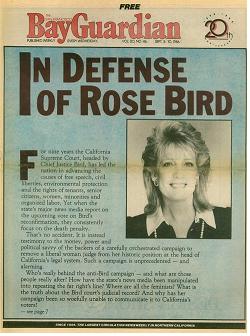
In other words, as we wrote at the time (In Defense of Rose Bird, Sept. 3, 1986):


The charge that the Bird court has refused to enforce the death penalty is simply inaccurate … the California Supreme Court has simply been doing what most state and federal courts have done over the past ten years: carefully scrutinizing death sentences to ensure that they are valid under the federal and state constitutions and complex and ever-changing standards of the U.S. Supreme Court.


The real issue didn’t make the press. Again, from our cover story at the time:


For nine years, the California Supreme Court, headed by Chief Justice Bird, has led the nation in advancing the causes of free speech, civil liberties, environmental protection and the rights of tenants, senior citizens, women, minorities and organized labor.


 Big-business interests organized and funded a massive campaign to get rid of Bird — not because of the death penalty but for purely economic reasons.


The Chronicle got it wrong back then, and is getting it wrong again today.

Marshall amps

1

johnny@sfbg.com

VISUAL ART/MUSIC I’m walking with Jim Marshall from his apartment in the Castro to his favorite restaurant just around the corner. The T-shirt he’s wearing showcases one of his more famous photos, of Johnny Cash flipping the bird. Marshall tells me and his friend and assistant of 13 years, Amelia Davis, about another time he was wearing the shirt. When the person he was with said he wanted one, he promptly took it off and gave it to him. We sit down at a table, I turn on my old tape recorder, and Marshall asks me for my first question. I say, “Well, it’s not a question, but I guess the first thing I could observe about you is that you’ll give someone the shirt off your back.” He laughs.

This story, itself born from a story from Marshall, suits an article about him, because as the title of his one of his new books makes clear, a major foundation of his photography is trust. Almost every page of Trust: Photographs of Jim Marshall (Vision On, 165 pages, $34.95) illustrates the deep implicit bond between photographer and subject in Marshall’s work, an element largely lacking from the prefab realm of music photography today. At times, this trust makes for startling juxtapositions: more than once Marshall’s camera catches a singer — Mahalia Jackson at Carnegie Hall; BB King at the Fillmore West; Janis Joplin at an outdoor concert in San Jose; Big Mama Thornton in a San Francisco recording studio; Nina Simone at New York Town Hall; Big Joe Turner at Berkeley Folk Festival — wholly unguarded, with arms open wide. The gesture reflects Marshall’s wholehearted embrace of music, an approach that makes his best images sing.

Marshall is a San Francisco photographer. “I was just starting out during the Beat era, in 1959, hanging out in North Beach,” he says. “They called me Jaguar Jim because I had a Jag 120. I photographed at the Hungry Eye. Lenny Bruce was the first roll of color I ever shot — 10 frames. Fantasy Records called me up about 10 years ago and said, ‘Jim, we’ve got some of your shots here.’ I figured there was some Creedence [Clearwater Revival] stuff, or Otis Redding. But there were 10 slides [of Bruce] that had been stuck under a cabinet for 35 years.” One of those 10 frames can be found in Match Prints (HarperCollins, 208 pages, $40), a just-published collaborative monograph that juxtaposes photos by Timothy White with photos by Marshall. In the shot, Bruce is standing before a brick wall, and he has his arms outstretched — almost like he’s expecting to be arrested. He’s on stage.

The back and forth between White’s photos and Marshall’s in Match Print — also on display at New York’s Staley-Wise Gallery later this month — is partly a conversation between on-the-scene verité images and the carefully set designed studio shots that tend to dominate magazine profiles. But it’s also about iconography and a memorable pose: Jim Morrison taking a drag from a cigarette for Marshall, Robert Mitchum inhaling (unlike Bill Clinton) for White. Match Prints has a casual sense of humor, evident in the pairing of Cash giving the finger with a White shot of Elizabeth Taylor flipping two birds after stepping out of a limo. (It’s also made clear by Alice Cooper’s playfully catty comments about his sister-in-leopard-skin-boots Lil’ Kim.) But the lingering moments of the book, and ironically, the most contemporary visions, come from older black and white Marshall photos, such as one of a zaftig Mama Cass in the back of a car, or bouffant-and-eyeliner beauty Little Richard lost in thought. Cass’s style and Richard’s drag are very Bay Area rock n’ roll 2010.

Marshall’s photography is 2010 enough to be lodged in the White House at the moment. President Obama has a Marshall shot of John Coltrane (also within Trust) on the wall. “He [Obama] had a White House photographer take a picture of him reflected in the [frame’s] glass,” Marshall explains with pride. “He signed it, ‘To Jim — I’m a big fan of your work … and Coltrane!” A little later, back at Marshall’s apartment, I look at this photo, and think of Obama’s image and trust. In deed, is the President doing right by the artists?

At lunch, Marshall zooms in on a telling moment from Obama’s recent State of the Union address. “He said, ‘This administration this year will end discrimination against gays in the military.’ The camera was on four generals and admirals in front of Obama. The whole place stood up and applauded. Those motherfuckers didn’t blink, didn’t move — nothing. They just sat there stone-faced. That’s the last thing they wanted to hear.”

The trust recorded in Trust is a different kind of commitment than one offered by a political figure. The photo of Coltrane — itself reflective, a bit melancholy, even haunted — that Obama sees himself within is a chief example. “Miles [Davis] saw my pictures of Coltrane and saw that John trusted me, and that was good enough for Miles,” Marshall explains, after I tell him about a great Davis interview in which he proclaimed that his favorite thing to do was watch white people act stupid on TV. “Miles, he didn’t like white people a whole lot. But for some reason he liked me. He said, ‘You’re as crazy as me.'” The truth is, in America, then and now, that’s as good a reason as any to like someone.

Truth is another strong element of Trust. Marshall’s investment in emotional truth means that his opinions aren’t always orthodox. Trust contains some photos of the infamous 1972 Rolling Stones American tour — “I must have done two pounds of blow on that tour,” Marshall crows — also documented by Robert Frank in the movie Cocksucker Blues. “I was never a big Robert Frank fan, and I’ll tell you why,” Marshall says, with trademark intimate candor. “As good as [Frank’s classic 1958 monograph] The Americans is — and it’s one of the all-time great photo books, damn near as great as [1955’s] Family of Man — what Frank failed to do is this: he didn’t show in one picture, as far as I can remember, the joy of being an American. It’s cynical. That bothers the shit out of me.”

As much as Frank, Marshall is a primary documentarian of 20th century America, well aware of a time when great filmmakers and photographers had enough faith in the government to work for it. “I had a Baby Brownie [camera] when I was a kid,” he says, when asked how he found his calling. “Everything was blurry — you had to take the picture when the sun was at your back. But I won a track meet, the 50 yard dash, and a guy was taking pictures for the school. He had an early Leica. When we go back to my apartment I’ll show you my scrapbook — it has pictures of cameras cut out of magazines and pasted on the paper, with their prices written in pencil. He took a picture of me that was razor sharp, and I thought, ‘This guy has a magic box.'”

Marshall’s Leica images have their own magic, evident in monographs such as Tomorrow Never Knows — The Beatles’ Last Concert (1987), Monterey Pop (1992), Not Fade Away (1997), Proof (2004), and Jazz (2005). Trust distinguishes itself by the dominance of color images — Marshall laughs heartily when I tell him that the blue sky found in a pair of outdoor concert photos of Joplin is a California blue. The color in Marshall’s photos is super-real, to re-deploy a word Anthony DeCurtis applies to White in the introduction to Match Prints. It isn’t the cliché hallucinogenic vision found in so many recreations of drug trips or the ’60s, but instead an extra intensity, utterly pure.

“The single greatest performance I ever saw in my life was Otis Redding in Monterey [at Monterey Pop in 1967],” Marshall says, as we page through Trust. “Brian Jones was there as a guest, and he said, ‘I think Mick [Jagger] is one of the greatest singers, and our band is one of the best, but personally, you couldn’t give me a million pounds to follow Otis Redding on stage.’ It was that shattering of a performance.” The photo we’re looking at as he says this is deep black and rich blue, with fists to the fore. It’s a cry — a shout — into the night.

A pair of photos in Trust capture confidences exchanged between Johnny Cash and a top-of-the-world Bob Dylan — a country-folk echo of the gestures of confidence between Marshall, Coltrane, and Davis. Marshall laughs when I tell him of an anecdote about the great folk artist-archivist and magician Harry Smith slamming the door of his Chelsea Hotel room in the young Dylan’s face with a loud “Fuck off!” When Marshall first began to photograph Cash and Dylan, the upstart musician was uncooperative, until his idol set him straight about the man behind the lens. “Bob Dylan respected without equivocation two people,” says Marshall. “Johnny Cash and Pete Seeger.” Indeed, Trust’s American history isn’t just a rock star history, it’s a secret history, a braided folk tale that extends from Elizabeth Cotten to the unlikely yet perfectly logical friendship between Sly Stone and Doris Day. Its stunning photos of the Carter Family can inspire a conversation about Redding’s and Anita Carter’s individually magnificent versions of “I’ve Been Loving You Too Long.”

Back at Marshall’s apartment, a photo of his late friend Tim Hardin at Woodstock broods as quietly as one of Hardin’s ballads, near the fireplace. “A million people around him, and he’s totally alone,” Marshall says, as if he took the shot yesterday. The hallway is lined with photos, not just by Marshall, but more often by famous acuaintances, many of them layered gestures of friendship that need no inscription. Marshall takes out his teenage scrapbook and sets it down on a table by his autographed images of Obama and Joe DiMaggio. “This was from the late 1940s!” he says, his voice rising in amazement. “Isn’t that a mindfuck?” It sure is. Another mindfuck would be for the best musicians and biggest personalities of the Bay Area to step in front of Marshall’s Leica today.


A NEW LOOK: JIM MARSHALL AND FRIENDS PUT THE FOCUS ON MS

VISUAL ART/EVENT This month, from March 5–19, one of Jim Marshall’s iconic images of Janis Joplin will be showcased in Union Square. The shot, of Joplin at the Palace of Fine Arts with arms outstretched as she sits atop a colorful Volkswagen Beetle, is just one of a number of prints being auctioned up for sale by photographers such as Baron Wolman, Michael Zagaris, Herb Greene, Robert Altman, Bobby Klein, and Marshall.

The cause is treatment of — and public awareness and conversation about — multiple sclerosis. All of the proceeds from sales of the photography goes to MSFriends, a grass-roots nonprofit begun by Marshall’s longtime friend Amelia Davis. Marshall hired Davis as an assistant knowing she had MS, and one encounter with Davis makes it easy to see why: she’s committed and dedicated. In the case of MSFriends, this dedication involves providing 24/7 telephone peer support, running an organization staffed by people who have MS, in an effort to help people with MS and others understand and respond to a misdiagnosed and misunderstood disease. 

For more information about MSFriends Rock for MS and MSFriends, go to www.msfriends.org  


Taxi turbulence

13

By Skyler Swezy

news@sfbg.com

It’s 10:20 p.m. on a recent Saturday night. Cab driver Dorian Lavender picks up a middle-aged couple outside the Gold Club, a strip joint in SoMa.

The couple is sharply dressed for a night out. After requesting the Mitchell Brothers’ O’Farrell Theatre as their destination, the man brags to Lavender about having had sex with a stripper in one of the club’s private rooms. His female companion smiles and says nothing.

“This is before I met her,” the man explains. “We’re swingers.”

Minutes later, beneath the theater’s flashing marquee, the man hands the driver a $20 bill for the $10 fare. “Keep the change,” he says.

A few blocks away, a young couple flags the cab from the corner of Bush and Polk streets. They are talkative and entertained as Lavender tells them about the swingers. Ten minutes later, the meter reads $9.86. Apologizing, the young man hands him $11.

Lavender folds the bills into the cash-wad kept in his pocket.

“That’s how it goes with cab driving,” he says. “The nice couple tips 10 percent, the weird swingers tip 100 percent — and they were more interesting to talk to.”

At 25, Lavender considers cab driving a great gig and survives working only three shifts a week. He enjoys the cash, freedom, and unpredictable encounters. He’s even landed a few dates. A lot of career cabbies start driving for the same reasons. But after the excitement wears off, it turns out to be a tough job.

A typical cab driver in San Francisco makes less than $30,000 a year. Before drivers even start a shift, gate fees (covering the rental on the cab and the use of its permit, known here as a medallion), gas, and graft have already set them back close to $100. Bribes are commonplace in the industry, used to ensure weekend shifts, airport fares, and newer cars.

The industry offers no retirement plan or health coverage. In fact, the primary reason some people stay behind the wheel long after the thrill is gone is the promise that at some point, after maybe 15 years, an active driver becomes eligible for his or her own medallion. It costs almost nothing, and offers a tremendous benefit: drivers with medallions no longer pay high gate fees, get better shifts — and can lease out the permit when they’re not working. The lease revenue alone can nearly double a driver’s income.

Since 1978, medallions have been issued only to working drivers, and entirely on the basis of a waiting list that now numbers 3,200 names. New medallions become available when permit-holders retire, die, or are forced by disability to stop driving.

That system — and the entire cab industry — is about to change, profoundly. On Feb. 26, the San Francisco Municipal Transportation Agency agreed to allow some permits to be sold on the open market to help close its huge budget deficit. When the dust settles and the implications of that decision become clear, life for cab drivers and passengers will be very different.

Some say the industry will be better; some say it will be much worse — but the truth is, nobody really knows.


PRIVATIZING PERMITS

Mayor Gavin Newsom’s adminstration has talked about allowing the sale of permits for several years, but only in the past few months has Christine Hayashi, SFMTA’s deputy director of taxi services, come up with a detailed plan.

It’s aimed at addressing what some drivers call an unfair and flawed system. Permit-holders by law must drive a minimum number of shifts, and it they get hurt or just get too old to drive, they have to surrender their medallions, leaving them with no source of income.

It will also help SFMTA’s budget — the city could sell unclaimed permits for big money and would get a cut of every other sale.

But critics, including Judge Quentin Kopp, the former San Francisco supervisor who wrote the 1978 law that created the old system, say the medallion holders just want to cash in on something that has always been city property.

The pilot project approved by the SFMTA board allows the city to sell up to 60 medallions directly to drivers and allow about 300 drivers over the age of 70 to sell their medallions to any qualified driver who can come up with the cash. The program aims to set a fixed selling price, but has yet to do so, instead setting a $400,000 limit. It is estimated that medallions will sell for no less than $200,000.

That, of course, will be a huge windfall to the sellers, who paid nothing for their permits.

The pilot program was essentially a done deal even before the Feb. 26 vote. In an e-mail to the Guardian, agency spokesperson Judson True confirmed that $11 million in taxi revenue had been added into the MTA budget before the vote took place.


THE GREED FACTOR

Kopp sat behind the desk in his West Portal neighborhood office a week before the MTA vote, bitterly condemning the medallion sales program. “It’s based on greed. It’s based on City Hall greed,” he said. The stentorian 82-year-old occasionally thumped the desk with his fist for emphasis as he launched into the history of Proposition K. Then-Sup. Kopp authored that landmark legislation prohibiting private companies from owning driving permits, instead granting control to drivers.

“This will reverse a system that gave a genuine cab driver the opportunity to obtain a permit and replace it with a system that restores the ability of people with lots of money to buy a permit,” he said.

But Kopp’s bill had some unforeseen consequences. The list has become so long that medallions are being issued to people in their 60s and 70s — and some of those people are driving passengers around town despite failing reflexes, eyesight, and motor skills.

Carl Macmurdo, president of the Medallion Holders Association (MHA), believes that selling medallions will provide an exit plan for geriatric drivers while giving younger cabbies an entry opportunity. At 59, Macmurdo is still a full-time driver and has been in the industry 27 years.

It makes sense that MHA members are generally in favor of the pilot program — they could potentially make a mountain of money. Although only those over the age of 70 are now eligible to sell them, the age limit could be lowered in the future.


INDENTURED SERVANTS

The United Taxi Workers (UTW) headquarters consists of a few cramped offices on the fourth floor of an old office building in the Mission District. All the interior trim is painted taxi-yellow. In late January, UTW spokespersons Mark Gruberg and Rua Graffis sat at a large table, fearing the worst.

They predict the sale of medallions will provide large cab companies with the equivalent of indentured servants. They say drivers will need upwards of a $200,000 loan to purchase a medallion, requiring a hefty downpayment.

Few drivers will be able to pay for a permit with savings, so the system will only work if someone is willing to finance those purchases. And drivers who are recent immigrants or have bad credit may not be able to get traditional loans. So they could wind up borrowing from their employers, the cab companies, UTW activists say — and by owning the debt the companies will essentially own the medallion.

“Supposedly there’s going to be a provision that says a cab company can’t lend money to a driver toward purchasing a medallion. But it would be so easy to get around that by hooking up with an outside lender,” Gruberg said.

Another fear is that the pilot program will favor young drivers and punish veterans. “Suppose a 27 year-old is on the list and I’m 63. Which one of us is the bank more likely to lend money to?” Graffis asked.

Under the pilot program, drivers will have the option to purchase according to seniority on the list. But without a lender, that’s little help.


WHO’S GETTING SCREWED

At 1 p.m. the day of the SFMTA vote, Bill Mounsey and David Barlow were sitting on a bench outside the hearing room. Both are members of UTW and planned to speak in protest of the pilot program.

Mounsey is 63. He’s been on the list for 13 years and is No. 200. He is part of the group most vulnerable in the medallion reform process — drivers who have already waited more than a decade but still have years to go.

If at any point the board decides to eradicate the list before he receives a medallion, Mounsey’s years of waiting will be wasted. “I would never buy one. I’m 63 years-old, no one would ever give me a loan,” he said.

For now, the wait list survives. Under the pilot program, one medallion will be given away for every one sold until the list is exhausted. However, with only half as many medallions being given out, Mounsey fears the list will move half as fast.

Around 50 people attended the meeting, a small fraction of the city’s cab drivers. At 3:56 p.m. the board passed the pilot program and Prop. K moved a little closer toward death.

Hayashi spent more than 175 hours trying to create a pilot program that provides the city with revenue and benefits the taxi drivers. She has made an effort to engage the taxi community and worked with a group of drivers to draft the proposal. She even plans on getting a taxi license.

After the City Hall meeting, Hayashi explained the challenges facing the pilot program over coffee in a downtown cafe. Before March 30, when the proposal is set for a final SFMTA vote, Hayashi must lock down lenders, create lending programs feasible for drivers, and set a fixed selling price for the medallions.

The blaring problem with the pilot program is a lack of committed lenders ready to finance cab drivers’ loans. Bank of the West has expressed interest, as well as two New York credit unions experienced in medallion loans and two San Francisco credit unions.

But how will those loans be structured? Who will qualify? How much of a downpayment will drivers need? And how, in the end, will this change the experience and qualifications of the drivers — and the quality of cab service in the city?

Hayashi sounds confident. “Good service depends on happy drivers. Our goal is to restore professional pride for the drivers, allow them to feel that taxi driving is a career and a respected profession,” she said.

But a lot — a whole lot — can go wrong with this major change in a complex industry that provides essential service to residents and tourists alike. And once the city moves down the path to private medallions, it’s going to be hard to go back.

Expanding movement

1

rebeccab@sfbg.com

When University of California Berkeley students staged building occupations last fall, their furious, brazen response to startling tuition hikes and staff cutbacks captured the attention of the world, recalling the radical actions of earlier generations.

Yet the thrust behind the March 4 Strike and Day of Action, a mass mobilization for public education and services that is reaching into all corners of the state and spreading nationwide, appears to stem from widespread agitation that extends well beyond the flare-ups on college campuses.

"What’s historic about this is that pre-K through PhD has never walked together," said Lillian Taiz, president of the California Faculty Association, which represents faculty in the California State University system. "We have often been pitted against one another, and I think everyone feels finally, in the end, there is no difference in importance between pre-K and PhD. We need it all."

The historic new alliance faces an uphill climb in an environment characterized by a devastating budget crisis at the state level. California — the world’s eighth-largest economy — hovers around 47th in the nation in terms of per-pupil spending, and the most recent wave of budget rollbacks has cut to the bone.

Students and teachers across the Bay Area argue that with dramatic slashes in funding, the educational system is failing youth. Class sizes are ballooning to claustrophobic levels, students are unable to take their desired courses, fees are going up, bathrooms are getting cleaned less frequently, and staffers are getting stressed by overwhelming workloads. "Classes are jam-packed," Taiz says. "You have kids sitting on the floor. You have students just begging to be allowed in a class."

As University of California students decry a 32 percent hike in fees, the California State University system is suffering from damage inflicted by 2,000 faculty layoffs over the past year. The San Francisco Unified School District, meanwhile, is staring down an estimated $113 million budget deficit over the next two years, and 900 layoff notices recently were issued to teachers, librarians, secretaries, and other school employees to warn them that their jobs could be slashed by the end of the school year.

When San Francisco’s school district faced a gaping budget shortfall during the last budget cycle, it was propped up by a combination of Rainy Day Fund reserve dollars and stimulus funding from the American Recovery and Reinvestment Act. With no such safety nets in place this time around, anxiety levels are higher and the outlook is uncertain.

March 4 is shaping up to be more than an opportunity to vent frustrations to elected leaders. Instead, organizers describe it as a rallying point for a movement to defend public education that has caught on like wildfire, uniting people from different worlds. Pickets and rallies will be staged throughout the region. Thousands are expected to swarm Civic Center Plaza in San Francisco. Students from a handful of East Bay campuses are organizing marches to Frank Ogawa Plaza in downtown Oakland. Students and faculty from Berkeley will be boarding buses to take the message to Sacramento. The Oakland Unified School district will host a districtwide mock "disaster drill" to call attention to the disastrous budget. Even public transit activists opposed to the latest round of Muni service cuts and fare hikes are joining the protests, hoping to expand the discussion to support vital public services (for details on these and other events, see "Alerts" opposite this page).

"We’ve never gotten this level of activism over anything in SF since I’ve been here," says Matthew Hardy, communications director for United Educators of San Francisco. "There’s a growing movement for progressive taxation and budget reform instead of draconian cuts."

Taiz, who teaches history at Cal State Los Angeles, described March 4 as an opportunity to fill a void in leadership. "Historically, in these moments where ordinary people step up to the plate, you end up leading the leaders," she said. "We are kind of shocked, but in truth, we do know what has to be done." Quality education isn’t just important for young people, but for society as a whole, she argued. "I am a baby boomer, and if the folks coming up behind me don’t have really, really good jobs, I’m going to be eating dog food. Because those are the people who pay Social Security and pay the taxes."

In the week preceding March 4, teachers and students throughout the Bay Area were in a frenzy of preparation.

Carlos Baron, a theater professor at SF State, was wondering whether the grand procession of papier-mâché puppets his theater students will unveil on the March 4 Day of Action should take a V-shape or some other form. "The main puppet is the Draculator," explained Baron, a Chilean who directed plays in the Salvador Allende era before he began teaching at SF State in 1978. "It’s a cross between the Terminator-Governor and Dracula. But also it doubles as a banker and a general."

When asked how funding cutbacks affect students, Baron didn’t hesitate. "It impedes the creation of a positive vision for themselves and this society," he said. It stunts "the development of the imagination," he added. "We are trained as individuals to accept our failure and our smallness because we’re familiar with it. They don’t want an educated population, a sensitive population, a dreaming population. Would we select Schwarzenegger?"

Nicole Abreu Shepard, a first-grade teacher at Buena Vista Elementary in San Francisco’s Mission District, was collecting permission slips from parents to take her students to a rally and march down 24th Street. "The entire school is walking out," Abreu Shepherd said. Buena Vista’s art program exists solely because parents volunteer their time, she explained. More than half the students qualify for free or reduced lunch, and many incoming kindergarteners or preschoolers are new to the English language. Now there are proposals on the table to increase kindergarten class sizes to 25 or possibly even 30 students. "It’s sort of tying their hands behind their back and asking them to teach on one foot," she noted, and worried about the eventual result. "It’s going to be harder and harder to keep parents who could afford private school in a public school system."

Meanwhile, at the UC Berkeley campus, Krystof Cantor was sitting behind a table heaped with piles of radical literature bearing titles such as "After the Fall: Communiques from an Occupied California." Cantor, who earned his PhD in vision science in 2005, was joining student organizers in making one last push to drum up student interest in March 4 events at a multi-faceted event called "Rolling University." Late on the evening of Feb. 26, a dance party on the Berkeley campus morphed into a street riot — replete with ignited Dumpsters — in downtown Berkeley. The incident attracted media attention and drew public criticism from administrative officials.

The radicalized student movement that has erupted on the UC Berkeley campus is "very much about seizing power," Cantor told the Guardian several days before. "It’s been disruptive, it’s been militant, and it’s been creative. That’s very scary," to the administrators the movement is targeting, he added.

That focused pressure on UC administrators sets these students apart from the coalition of UC Berkeley faculty members and student government members and allies who are coordinating bus trips to protest in Sacramento March 4, he explained. "Sacramento’s not innocent, but it’s not like the administrators are just doing what they have to do," he charged, pointing to new construction projects on campus even as workers are hit with layoffs and furloughs, plus an increasing trend of privatizing on-campus jobs and services. "You can save the public sector by pouring money into it. But it won’t work if the people in charge … want to privatize everything."

Jasper Bernes, a graduate student in English who was seated next to Cantor, noted that the occupation tactic is catching on at other campuses. "I have no doubt that March 4 will greet us with news of many occupations," he said.

Baron, the Chilean theater professor, noted that some SF State students had occupied a business school building in protest of budget cuts. "They were pissed," he said. "They wanted to do something radical. They really inconvenienced a lot of people — but they took chances nonetheless. I went there, and I locked arms with them for awhile." At the same time, he wondered about how effective it was, he said.

And for all the months of preparation and visioning, Baron said he also wonders what will ultimately be borne out of the marches, rallies, pickets, and procession of lovingly crafted street puppets he helped breathe life into. For all the hard work and planning, he says, "My problem is not so much March 4. It’s March 5."

Questioning Prop. 16

4

rebeccab@sfbg.com

GREEN CITY In Sacramento, at a Feb. 26 joint legislative committee hearing about Proposition 16, a ballot initiative that Pacific Gas & Electric Corp. plans to sink $35 million into, PG&E executive Ed Bedwell found himself in the hot seat. Sen. Mark Leno and Assembly Member Tom Ammiano, who both represent San Francisco, joined Assembly Member Jared Huffman (D-San Rafael) in grilling Bedwell about an initiative that seems to be aimed directly at the efforts of San Francisco and Marin counties to establish alternative power providers to PG&E.

"What this measure is really about is limiting competition," Leno charged as the hearing got underway. "It’s not about anything else, right? In effect, this will do nothing but limit competition."

San Francisco and Marin are both in the process of creating community choice aggregation (CCA) programs, public entities that would offer electricity from clean, renewable technologies. Prop. 16, on the June ballot, would require two-thirds of voters to approve CCAs.

None of the state’s other investor-owned utilities have supported into the initiative, but representatives from the California Chamber of Commerce and the California Taxpayer’s Association joined Bedwell in testifying in favor of Prop 16.

Bedwell said he didn’t believe there is any motive behind it, a statement that prompted laughter from the audience. He argued that Prop. 16 would "give Californians the right to choose who would serve them." He quoted a professor at UC Berkeley’s Haas School of Business who said CCA is "fraught with danger" and added, "We couldn’t agree more."

But if Prop 16 passes, the likelihood that San Franciscans will be able to choose between PG&E or a power provider that offers 51 percent green electricity will be significantly decreased. And if PG&E rates continue to climb, customers will have no choice but to go along for the ride with this energy monopoly.

Mark Toney, executive director of the Utility Reform Network who testified against Prop. 16, said PG&E has requested rate increases amounting to 30 percent by 2013. In rural communities where unemployment is high and farmers rely on energy-intensive water pumping for irrigation, these ballooning energy costs would hurt the economy.

Michael Boccadoro of the Agricultural Energy Consumers Association, an organization representing 40,000 growers that usually partners with PG&E, testified against Prop. 16. "This will have a chilling effect, not just on CCA, but on the irrigation districts as well," he said. In the midst of a recession, "we’re in a very significant water crisis," he said. "Rate increases have a chilling effect on the farming community because we’re paying for higher-priced power from PG&E and we have to pump groundwater."

Paul Hauser, representing municipally-owned Redding Electric Utility, testified that if customers in his economically depressed territory were paying PG&E prices instead of the municipal rates, they would pay an extra $440 per year.

"Never … have I seen political activity by a regulated utility so far outside the bounds of acceptable conduct as PG&E’s sole sponsorship of the Constitutional Amendment politely referred to as Proposition 16," said John Geesman, former executive director of the California Energy Commission. Geesman noted that PG&E Corp. derives all its funding from PG&E Co., which is regulated by the California Public Utilities Commission, meaning ratepayer dollars are being siphoned into the $35 million devoted to the Prop 16 campaign.

"It ought to be illegal to take ratepayer dollars and use it against ratepayer interests," Geesman said.

San Francisco Sup. Ross Mirkarimi testified that the opposition could never amass as much funding for a fight against Prop. 16 as PG&E will spend to promote it. "It should be laughed out of the political arena anywhere near Sacramento," Mirkarimi said.

Yet it’s moving forward. Despite stern warnings from Leno that PG&E is flouting a state law saying utility companies must cooperate fully with CCA programs, Bedwell was free to leave after the tough questioning session from elected officials. Clustered in the hallway just after their pro-Prop. 16 testimony, the men in expensive suits were the ones laughing.

Still defying gravity

0


By Brady Welch

news@sfbg.com

For more than a decade, a curious scene has greeted viewers looking upon the old Hugo Hotel at Sixth and Howard streets. A bright green couch lurches precipitously from the building’s corner window. Packs of reading lamps are scaling the building’s outer walls. A floor or two up, another couch, some coffee tables, and one of those old and impossibly heavy television cabinets appear to contemplate jumping from the fourth-story rooftop. No prank of the homeless, this precarious assemblage — wow, that’s a dangling claw-foot bathtub three stories up — is the Defenestration Project, the work of Bay-Area artist Brian Goggin.

“I never thought it would last,” Goggin recently admitted to us. In fact, the project wasn’t supposed to last for more than six months. “The clock and armoire were built for the project. But the bathtub is an original from the Hugo, and all the others were salvaged from the street or found in thrift stores.” It is a testament to the project’s sheer fortitude against the elements — and its quirky appeal — that Defenestration will celebrate its 13th anniversary March 5 at 1:AM Gallery, located directly across the street from the installation.

The event will be a retrospective-cum-fundraiser for a proposed $75,000 restoration Goggin has titled “Project Restore Defenestration” that includes illuminating the lamps and installing an LED strobe in the hulking television set. “We’re making sure that all the pieces are looking good and in some cases even better than they originally looked,” he said.

A few pieces of furniture already have been removed, many needing to be entirely rebuilt. Others will be restored while remaining affixed to the building, requiring boom lifts and scaffolding. Overall, these will require resealing, repainting, fiberglassing in some instances, and in the case of the couch, getting covered in a new gloss of latex (as a preservative). Goggin estimates the restoration will take from one to three months, and he may even add some entirely new pieces to the installation.

“We want to see it vibrant again,” he said. For the gallery show, he plans to have individual pieces of furniture on view with the intent that patrons will sponsor them. “We’re hoping to get the funding and support, so by the time the rain stops, we’re funded and ready to go. If we don’t, maybe it’s time for it to come down.”

And come down it eventually will, though not for lack of funding and support. In October 2009, a court ruled that the San Francisco Redevelopment Agency could condemn and acquire the building under eminent domain for $4.6 million. Though the agency’s plan is to build much-needed affordable housing in the area, the sale represented the retreat of any protective cover the building’s original owners, the I.M. and S.I. Patel Living Trust, inadvertently provided for the artwork.

The Guardian spoke to Jeremy Sugerman, Goggin’s legal adviser, who was able to confirm that the artist always had a loose agreement with the Patels whereby they reserved the right to notify the artist to take down the work for any reason or lose title to it. So when the Redevelopment Agency purchased the building, the notice from the Patels came due.

Sugerman and Goggin then went directly to the Redevelopment Agency and pleaded with them to let the building and art stay until a new development was solidly in the works. A raggedy Hugo Hotel with couches and reading lamps welded to its side, they argued, is easier on the eye than an empty hole in the ground. Sugerman told us that the agency was immediately receptive. A month after the purchase, SFRA commissioners approved a permit stipulating that the work could stay hanging for a minimum of 18 months.

Then again, any demolition of the building will require a litany of proposal reviews, permits, and budgeting that could take longer than the 18-month lifeline. In other words, Defenestration will continue to occupy the same conspicuously abandoned and, depending on whom you ask, dilapidated building at the corner of Sixth and Howard.

Originally funded by a combination of maxed-out credit cards, a $3,500 grant from the National Endowment for the Arts, “sweat equity” from more than 100 volunteers, and a staggering $14,000 raised on the project’s opening night, Goggin — understandably — doesn’t envision the same type of institutional support existing in today’s economy for his present renovation. Still, he’s positive. “I feel like this can be done,” he said, adding that $75,000 “is not an outrageous amount to be raised. It’s much less than Burning Man projects that only stay up for a few days.”

Which got us to wondering how in the heck Goggin came up with the idea of Defenestration — a word that means throwing someone or something out a window — in the first place. “I was an apprentice to a sculptor in Europe for a number of years, helping him set up shows, and he invited me to go create an installation in Paris,” Goggin told us. “There was this one area where they were demolishing 18th-century buildings, and I could see remnants of the walls and portions of the staircases and tiled elements of the bathrooms and old shelving. Through the course of imagining what could fill that vacant space that so many had lived in, life and form created a drama.”

For years, it was a drama that played out solely within the artist’s head. But Goggin eventually received the NEA grant, and like a kid who just received his allowance, went shopping around. “I just started knocking on doors, asking people who had buildings if they’d be interested as a base for this installation,” he told us. “Most owners were interested in the idea but then, when they found out what would be involved in installing the piece, became less interested. After I was told off a 16th time, I was riding my bicycle by the Hugo Hotel and I noted the sign.” The sign Goggin is referring to is still there. Posted for potential buyers of the building, it reads: “LOT & BUILDING for SALE. Limit ‘130’ ZONED: RC. 3 HEIGHT,” and lists a fax number.

“It looked vacant, so it seemed like a good option,” he said. “I sent them a proposal.”

Sumati Patel, the daughter of the buildings owner, loved the idea, and over the course of a few weeks, convinced her father that having Goggin work on the building would ultimately be advantageous to the real estate. Squatters had become a problem since renovations on the building had stalled in the 1990s. “Lots of squatters,” Patel told us. “Tons. They’re pooping and peeing. They would have rallies. It gets tiring. It gets expensive.” Under the artist’s agreement with the owners, Goggin sort of took responsibility for the building. “If a squatter got it in, Brian would go over there and take care of it,” Patel said. And how does she feel the project turned out? “I remember once picking up my AAA magazine and seeing an article about Defenestration and showing my dad, like, ‘See?'”

The agreement between Goggin and SFRA to keep the work hanging certainly testifies to the success of the project. It has become part of the neighborhood, and although its days are numbered, perhaps they will be brighter than ever before.

Bill Bennett, Public-Interest Fighter, dies at 92

0

On the front page of the Oct. 19, l988 issue of the Guardian, we ran a big picture of Bill Bennett with a caption that read: “Bill Bennett, the only public official in California to take on PG&E.” The California Public Utilities Commission was poised to make yet another multibillion giveaway to the Pacific Gas and Electric Co. — and not one public official in San Francisco was on hand to monitor the CPUC hearings and testify about the horrible impacts the rate hike to pay for the Diablo Canyon nuclear power plant would have on the public. Our editorial noted, “The only public official in California who has taken on the case is Bill Bennett, a member of the State Board of Equalization and a former member of the CPUC, a determined old warrior who fought Diablo from the start and continues to do so, on his own, against the odds and at considerable personal cost.” William Morgan Bennett, the public official who for more than five decades fought the corporate goliaths, died Feb. 9 at his home in Kentfield after a short illness. He was 92. Today, there are other public officials out there fighting PG&E, but there is nobody who could take on PG&E and its private utility allies as effectively as Bennett.

For the full obituary, see the Bruce Blog at sfbg.com


Newsom’s sanctuary policy destroys MUNI worker’s family

12

“They used our son as bait, just to get the mother to come in,” Washington said.

When San Francisco native and MUNI bus driver Charles Washington married Tracey, his Australian girlfriend in Reno last April, he never imagined that she and her sons would be deported after her 13-year-old bullied another kid at school for 46 cents.

But that’s what will happen Friday, March 5, almost a year after their wedding, unless a miracle happens. And this travesty is happening thanks to Mayor Gavin Newsom’s overreaching juvenile sanctuary policy, a broken federal immigration system, and a couple who tried to do the right thing, but were told they didn’t need to apply for a green card in a hurry, when they called an immigration number for information last year.

‘What more could we have done other than call the number?” Washington asked, noting that once they were told it wasn’t urgent, they began saving up, so they could afford the several thousand dollars a green card for his wife and two kids was going to cost.


But now, thanks to a bullying incident at school, and the city’s overly draconian policy towards immigrant youth, Washington’s wife and her 13-year-old son will be deported to Australia on Friday, and her 5-year-old boy will accompany them, while Washington  stays in San Francisco to look after his 12-year old daughter (pictured in a photograph taken at the March 1 press conference at Asian Law Caucus).

“There are no laws that prevent me from going to Australia, but I have joint custody of my daughter from a previous marriage and her mother is not going to authorize the child to move, so I’m hoping for a miracle,” Washington explained.

His wife Tracey, who has been forced to wear a federal electronic monitoring bracelet since February, looked on in silence, flanked by her sons and step-daughter.

Washington, who grew up on Mt. Davidson Terrace, and was formerly in the military, had been driving a MUNI bus for a year and a half, when he woke one morning after he got home from his late-night MUNI shift, to hear the phone ringing with a call from his stepson’s school to say there where problems between him and a sixth grader.

“The school told me it was their policy to call the parents any time the police are going to talk to a child,” Washington said. Twenty minutes later, he and his wife were at the school, talking to an SFPD officer, who said a report had been filed by another parent about the incident and the police now wanted to talk to their kid.

After the interview with the police, Washington thought the worst thing that could happen was that the officer would write a citation to say his son needed to appear at juvenile court. Instead, the police arrested his stepson, putting him in handcuffs and saying that they were going to take him to the Juvenile Justice center.

“I think my son was in shock, as I was, “ Washington said. “What he actually did, and what the actual charges are, they are universes apart. Back when I was in school, at worst, a bully was sent home for the day, creating problems for them at home, when they explain to their parents why they’ve been sent home.”

Instead, Washington’s stepson was charged with felony robbery, extortion and assault after the parents of a sixth-grader at his school called the police, but his case has yet to be adjudicated by a juvenile justice, –and a bench warrant will be issued if he fails to attend a March 8 hearing in San Francisco—3 days after he and his mother are deported.

According to Washington, (pictured here (left) with Angela Chan, (right) staff attorney for the Asian Law Caucus) no weapons, no injuries and no witnesses were involved in his stepson’s incident. “And it was strictly one kids’ words against the other,” Washington said.

So, why did the police decide to refer his stepson to the federal immigration authorities?

“I think the officer picked up on the fact that he had an accent,” Washington said. “And when asked where he was born, my stepson said, ‘Australia.’ He is 13 years old. He doesn’t know if he is undocumented or not. As far as he is concerned, he was born in Australia, moved to San Francisco, and this is his family, his new family.”

Washington said his stepson was held for a week at Juvenile Hall for a week, during which the atmosphere at home became tense and stressful.

“We did not understand why this was happening,” Washington said. “Kids on my bus get on and do way worse things than he actually did, and the police usually make their presence known, but there is no worry about going to Juvenile Hall.”

But the worst was yet to come.
After his stepson had been at Juvenile Hall for about a week, Washington got a call from his stepson’s probation officer, saying that he was going to have to contact federal Immigration and Customs Enforcement (ICE).

“He said he had to contact ICE, that he was just doing his job, that it’s what’s required under his job title,” Washington said.

Under a new policy that Mayor Gavin Newsom ordered in the summer of 2008, the city’s juvenile probation officers are required to contact the feds when a juvenile is booked on suspected felony charges. This means, the probation officers are required to contact ICE before immigrant kids have even had a hearing before a juvenile judge to determine if they are in fact, guilty, as charged.

‘They didn’t say, ‘he might be deported,’” Washington said.” I was just told that there might be a ‘ICE hold put on him,’ but at this point I was still not understanding the importance of ICE.”

Once ICE picked up his stepson and transferred him to ICE’s facility on Sansome Street, Washington got a call from his stepson, who said he was OK.

“At this point, we were aware of the immigration issue, so I told my wife to stay at home and I went down there with a lawyer, and I was able to meet with my son,” Washington recalled.

But when he got back home, he received a call from his lawyer who notified him that if his wife was willing to go in and put on an electronic monitoring ankle bracelet, the feds would release their son.

“So, I drove my wife to Sansome Street, and that’s when we were informed that she was being handed her deportation orders, along with our 13-year-old son,” he said

His wife has been wearing the electronic monitoring ankle bracelet ever since.

“She wore pants today because it makes her feel ashamed, and she cries nightly over the fact that she feels like she’s being treated like an animal,” Washington said. “She says, ‘I feel like they think I’m a murderer, but I’m not, I haven’t done anything wrong.’”

According to Washington, his wife arrived in the country along with her kids on a 90-day visa-waiver, and the couple got married about 45 days into that visa.

“We had known each other for seven years, and we looked into getting a green card, two days after we were married, and we were told, not once, but twice, that if you enter on a visa-waiver, there is no deadline to apply for your green card. We were misinformed.”

But while Washington notes that the office that he spoke to was a contractor for the federal government and had its information wrong, he still can’t get over the fact that the federal government would treat him and his wife this way, using their son as bait.

‘This is all shocking to me,” Washington said. “I never dreamed America would treat not only someone from America, but someone not from America, this way. All we want is for our application to be reviewed based upon the facts. We are being told it’s too late.”

Equally upsetting for Washington was the experience of seeing his stepson used as bait.

‘They used our son as bait, just to get the mother to come in,” he said. “ Our son wasn’t there for more than 4 or 5 hours ,and we had no clue that the deportation papers would be served until we walked in. They hadn’t even put the monitoring bracelet on her. She could easily have run, but we still don’t want to break the law, regardless of the outcome. Even though we did something wrong according to ICE, it wasn’t intentionally. If we had been given the correct information, we wouldn’t be here. Yes, we couldn’t afford the money at that time, but we’d have made sacrifices.”

Washington said he is reaching out to the media in a last ditch effort to save his family.

“I don’t know any other way but to network, maybe someone might know someone else who can save my family,” he said. ‘My stepson, he’s just a nerd, he’s not a violent person, he’s not aggressive at all, he’s just being a boy, and he really hasn’t had a father figure in his life, until he moved here.”

Angela Chan, staff attorney for the Asian Law Caucus, which has been helping the Washington family try to get their green cards, said that if the son had never been reported to ICE, then the family likely would have received green cards.

“But now they are refusing to consider it, because of the ICE referral,” Chan said.

Chan also explained that if the boy was able to appear before a juvenile justice, he’d likely get informal probation for a first-time minor offense.

“He only had a hearing, but the juvenile proceedings were halted, when he got handed off to ICE,” Chan said. “The District Attorney had filed charges, but they had not yet been adjudicated, and a judge had not yet reduced the charges.”

Jane Kim, President of the San Francisco United School District said the School Board unanimously supported the amendment to Newsom’s policy that Sup. David Campos introduced last year and which a supermajority of the Board of Supervisors supports.

“We have seen how changes in the Juvenile Probation Department as of August 2008 have been used as a blunt tool to separate family members, regardless of whether the juvenile is convicted of the charges, and regardless of the family’s circumstances. And we don’t believe that the Campos amendment violates the US Constitution.”

“Newsom’s policy has put a lot of burden on our staff,’ Kim said, explaining how schools are now worried about calling the police, lest students end up being deported because the police referred them to ICE, based merely on accusations, 

“For those worried about public safety, I think this type of situation encourages under reporting,” Kim said.

Washington for his worries that his wife and her kids will be homeless in Australia.

‘My wife sold her furniture and gave up her apartment in Melbourne to come here, and her mother and father have a one-bedroom apartment, so there is no space for her and two kids,” he said

He also worries that if they ever manage to come back, his stepson will have a warrant out for his arrests:
 ‘Today we were notified that if my stepson doesn’t show up for his March 8 pre-hearing (in the juvenile justice system where the DA’s office is pressing charges), we’ll have to worry about a warrant for his arrest, which will make it even more difficult for him to move back” Washington said.

If a person is deported, they are barred from reentering the country for 3-10 years.

The Washingtons’ federal deportation will occur the day after the Board of Supervisors holds a hearing into why the city’s Juvenile Probation Department has failed to implement the city’s new policy towards immigrant youth: under the new policy, which the Board passed in 2009, a teenager like Tracey Washington’s son would get his day in court before being referred to federal immigration.

Since July 2008, when Newsom first began requiring probation officers to report all suspected undocumented youth for deportation right after arrest – before the youth  receives an attorney or a hearing on the alleged charges, over 160 children have been reported to ICE without regard to their innocence or how minor the offense.

In November 2009, a community-based based campaign resulted in the passage of a new policy that restores due process to immigrant youth. The new policy gives youth an opportunity to have a hearing and requires a finding that the youth committed a felony before any referral to ICE. If implemented, the new policy would boost public safety for all residents because it would put an end to the Mayor’s policy, which has caused immigrant residents to be afraid to have contact with city employees.

 “Until Mayor Newsom restores due process to all youth in San Francisco, many more hard-working families like the Washingtons will be torn apart,” said Chan.
On Thursday, March 4, the Board’s’ Rules Committee will hold a 10.30 am hearing at City Hall regarding Juvenile Probation Department’s refusal to implement the Campos amendment which would restore due process to youth.


Pressure builds to save Muni

5

Widespread frustration with Muni service cuts and fare hikes – passionately expressed by the public on Friday at a San Francisco Municipal Transportation Agency meeting that continues tomorrow (Tuesday, March 2, starting at noon in City Hall Room 400) – has prompted a surprisingly diverse backlash.

From angry, street-level progressive activists to the downtown-friendly San Francisco Planning and Urban Research Association (SPUR), San Franciscans are criticizing the SFMTA’s budget plan (including the 10 percent service cuts approved on Friday, which could be revisited tomorrow) as short-sighted and unnecessarily divisive, prompting the biggest and most diffuse progressive organizing effort in years.

“I’ve never seen anything like this,” SFMTA spokesperson Judson True told me as he surveyed the huge, passionate crowd assembled for Friday’s meeting, adding, “It’s clear grassroots organizing is alive and well in San Francisco.”

It’s true that grassroots organizing helped with Friday’s massive turnout, with hundreds of people lined up to give almost five hours worth of public testimony, much of it expressing frustration with poor city leadership (particularly by Mayor Gavin Newsom and his appointed SFMTA board and director) and declining public services.

But these weren’t the talking points of a centrally organized effort, which is what’s so remarkable about this movement. While many progressive groups joined forces under the Transit Not Traffic banner (coordinated by MTA Citizens Advisory Board member Sue Vaughn and others), and there’s a new San Francisco transit riders union (coordinated by transportation activist Dave Synder), the huge turnout on Friday came also from disability rights groups, ethnically identified groups from the Mission and Chinatown, the Senior Action Network, San Francisco Tomorrow, the social justice group POWER, the antiwar ANSWER Coalition, and several other groups, with very little coordination among them.

“We are really seeing a diverse group of people arguing for transit justice,” said Marc Caswell of the San Francisco Bicycle Coalition, which was part of the Transit Not Traffic coalition.

In fact, with Muni fares increasing and services declining since Newsom became mayor, a wide variety of groups seems to have figured out independently that there’s something seriously wrong with Newsom’s no-new-taxes approach to running the city, particularly given declining transit funding from the state and feds.

“These aren’t solutions. They’re just pitting one group against another,” said Frank Lara of the ANSWER Coalition, which opposes a proposal for extended parking meter hours, much to the chagrin of progressive groups who want motorists to help close the budget gap by giving up their free parking on Sundays.

One SPUR proposal also seeks to eliminate this pitting of groups against each other, listing as its biggest dollar proposal the elimination of work orders from the San Francisco Police Department, which would save $12.2 million per year, which the SFPD charges SFMTA for unspecified services that it has yet to document, despite agreeing to as part of last year’s budget deal.

When asked about the work order proposal, Newsom press secretary Tony Winnicker said doing so would make Muni less safe by discouraging officers from riding buses, saying such work orders were a “good accounting practice” rather than the budgetary shell game that progressive supervisors and SPUR director Gabriel Metcalf have called it.

“The gamesmanship with work orders has got to stop,” Metcalf told the Guardian, criticizing the SFMTA for cutting service across the board and raising fares for express bus service and cable cars. “They don’t have to do that and they shouldn’t do that. They just need some political courage right now.”

The next largest SPUR proposals are to charge $300 per year for disabled placards that allow drivers to park for free (which would raise $10 million per year) and to enforce existing city codes that require garages to charge by the hour rather than all day (which would raise $6.85 million), followed by Muni work rule changes that would need union approval.

Winnicker said Newsom was aware of the big turnout on Friday and the anger voiced by the crowd, telling us, “He understands people are concerned and he shares those concerns.” But rather than accepting that many people blame Newsom, Winnicker blamed Muni’s Transportation Workers Union for voting down about $5 million worth of wage concessions and work rule changes. Yet many speakers criticized Newsom’s finger-pointing on Friday, saying he and the SFMTA were too focused on targeting workers rather than the downtown corporations that Newsom has refused to adequately tax.

“There was already a fare increase last year, so for the low-income popular, this is major,” Wing Hoo Leung, vice president of the Community Tenants Association, told me in Mandarin, translated by Tan Chow, an organizer with Chinatown Community Development Center. “In a bad economy, the low-income people can’t get hit again and again. We need to cut from the top.”

Tax measures will be a big part of tomorrow’s SFMTA discussion of the $100 million budget deficit looming for the next two years – such as a parcel tax, downtown transit assessment district, parking tax increase, or local vehicle license fee — and several SFMTA board members agreed with the statement made Friday by Trustee Malcolm Heinicke that, “We need to look for other sources of revenue.”

Even Winnicker said Newsom acknowledges the need to discuss tax measures, even though he philosophically opposes them: “He understands that many things have to be on the table to close next year’s budget gap.”

But he’s far from advocating for any revenue-side solutions.

“The mayor doesn’t think the tax measures will have much public support,” Winnicker said. Yet progressive groups say that’s because Newsom has undermined people’s faith in local government and actively opposed tax increases rather than trying to make the case to the public that they’re needed to present public transit and other vital services.

“Newsom has to be out there fighting, one at the state level, and he needs to show some leadership here,” said Bob Allen of the group Urban Habitat. “I don’t want to hear Gavin Newsom say again that this is a transit-first city if he’s not going to do anything to support it.”

But Allen said that if Newsom and other city leaders made the case for new taxes to support transit and ran a strong campaign, “This city will support a ballot measure to protect Muni and expand it.”

Yet right now, he said one of the things frustrating low-income San Franciscans is there is a basic inequity between motorists and Muni riders: “If parking is going to be free on Sunday, transit should be free on Sunday. If parking is going to be free in the evenings, transit should be free in the evenings.”  

Newsom has long voiced opposition to extended meter hours, only recently softening that position slightly to possibly allow for a small pilot program for Sundays. But his appointed trustees might be willing to go even further, with Bruce Oka saying on Friday, “I know the mayor doesn’t like it, but it has to be tried.”

Bill Bennett, the only public official in California to take on PG&E

0

William Morgan Bennett, 1918-2010

On the front page of the Guardian of Oct. 19, 1988, we ran a big picture of Bill Bennett with a caption that read: “Bill Bennett, the only public official in California to take on PG&E.”

The reason we featured Bennett was because the California Public Utilities Commission was poised to make yet another multi-billion giveaway to the Pacific Gas & Electric Company.

This time the CPUC would force the public to pay $3.4 billion worth of PG&E’s mistakes  at its Diable Canyon nuclear power plant and not one public official in San Francisco, home of the PG&E/Raker Act scandal, and not one from any other public agency or public institution was on hand to monitor the CPUC hearings and testify about the horrible impacts the Diablo rate hike will have on the public.

The lone, honorable exception was Bill Bennett. Our editorial noted, “The only public official in California who has taken on the case is Bill Bennett, a member of the State Board of Equalization and a former member of the CPUC, a determined old warrior who fought Diablo from the start and continues to do so today, on his own, against the odds and at considerable personal cost.”

To drive the point home about Bennett’s couirageous stand, we continued, “Those who ignored the case–for example, the supervisors, mayor and city attorney of San Francisco, the board of directors of BART, the regents of the University of California and their counterparts in every other public agency and institution that pays or represents people who pay PG&E bills–ought to be ashamed. The citizens of every city, county and district ought to look at their representatives and ask: Where were you when PG&E walked away with all the marbles.”

 The press in Northern California was ignoring the story, despite the colorful,  forceful and newsworthy campaign that Bennett was waging. He said he had called the  Chronicle and Examiner reporters to try to interest them in the story, but “it was useless so I gave up.”  Guardian Reporter Jim Balderston did the story and quoted Bennett  as saying, among other things, “This commission (the CPUC) must think long and hard of the welfare of the ratepayers and the shareholders of PG&E.” With no Bill Bennett on the CPUC, PG&E once again quietly walked away with billions in ratepayer money.

William Morgan Bennett, the public attorney  who for more than five decades fought the corporate goliaths from taking all the marbles, died Feb.9th at his home in Kentfield after a short illness. He was 91. An overflow crowd paid tribute  to his extraordinary life and career at services held on Feb. 12th at St. Patrick’s Church in Larkspur

When his daughter Joan phoned me about Bennett’s death, I realized once again how much the Guardian and the consumer and the rate-payer would miss Bennett. We are in the middle of PG&E’s biggest monopoly scam ever –Prop l6 and PG&E’s initiative to kill public power and community choice aggregation (CCA)– and Bennett is alas missing in action, for one of the first times in his life. Today, there are other public officials out there fighting PG&E, but there is nobody who can  take on PG&E and its allies as effectively as Bennett.

Our 1988 story had a sidebar with the head, “Bennett vs. PG&E: The 30 years war.” The sidebar recounted an incident characteristic of Bennett and the way he gave new meaning to the term public service.  In 1959 the El Paso/Pacific Northwest natural gas pipeline merger was all but approved by the CPUC, except for an appeal from Bennett as CPUC general counsel.  Before Bennett could file the appeal, he got a phone call from Gregory Harrison, a partner in the politically powerful law firm of Brobeck, Phleger and Harrison. Harrison asked Bennett if he was going to file. Bennett said yes and Harrison responded, “I told them you would say that.”

Harrison told Bennett he would be removed from the case if he filed the appeal. Bennett told Harrison he was going to call a press conference. Harrison responded. “I told them you would say that,” and hung up. Shortly thereafter, Bennett got a call from Gov. Brown, who asked him if he was going to file the appeal. Bennett said yes and Brown refused to discuss the matter further.

Twenty minutes later, Bennett got a telegram from Brown that stated, “You no longer represent me or the State of California in USA v El Paso.” This infuriated Bennett and fueled his relentless 14-year crusade to compel El Paso to divest itself of Pacific Northwest. because of its price-fixing and monopolistic implications for California. In 1969, appearing as a private citizen, he successfully argued the final U.S. Supreme Court appeal in the case, the last oral argument heard by the Earl Warren court.

The Washington Monthly caught the drama and precedent of Bennett’s appearance in its November 1971 issue. “His last appearance before the court in 1969
needs to have been witnessed. Standing alone against an array of the best legal talent that could be provided by El Paso, the states of California and Utah, lawyers for other gas companies and the U.S. government, represented personally by Solicitor General Erwin Griswold, Bennett attacked as the lone surviving avenging angel of the original antitrust action. Finger in the air, voice crying out in toners of retribution, he spoke brilliantly and forcefully without notes for an hour…In the process, Bennett impressed at least one justice privately, and many more observers, as one of the most brilliant and effective lawyers to have gotten to his feet to present oral arguments to the court during the last 14 years.”

 As the final footnote in this legal saga, Bennett  stopped El Paso’s efforts in Congress to pass legislation to void the breakup of El Paso. The result: the largest refund for California ratepayers in the history of regulation to date.  The decision set a  national precedent in antitrust law.

Bennett was born Feb. 20, 1918 in San Francisco to Lt. William M. Bennett of the San Francisco Police Department and Eva Curran of Amador. He attended Most Holy Redeemer Elementary School, St. Ignatius High School, the University of San Francisco and the Hastings College of Law. At the outbreak of World War II, he suspended his law studies and joined the U.S. Army Air Corps.

He was a B-17 pilot in the North African, Mediterranean and European theater of operations, l5th Air Force, 483rd Bombardment Group, 815th Squadron, stationed in North Africa and then in Foggia, Italy. The 483rd flew a total of 215 combat missions during 14 months of combat duty and Bennett was in the middle of it all. “Wherever there were major oil refineries, aircraft and parts factories, tank works, railroad terminals and marshaling yards, supply dumps, bridges and communication networks, he saw action,” Jane Bennett said.  He flew 35 missions and encountered severe flak and fighter attacks at some of the most heavily defended targets in Europe:  Linz’ Herman Goering Tank Works; Berlin’s Daimler-Benz Tank Works; Innsbruck; Vienna; Regensburg; Blechhhammer; Schweinfurt; Salzburg; Landshut; Moosbierbaum, and Ruhland where ME 262 German jets attacked his squadron.

The Tuskegee Airmen, the famous black squadron, escorted Bennett’s missions. “Their base was right next to my father’s,” Joan Bennett said. “They were separated on the ground but equal in the air. That is, they were  equal targets for the Germans.” Bennett often visited some of the fighters across the runway that segregated the blacks.   George McGovern,  the bomber pilot who later became a presidential candidate in l972, was stationed at a nearby base.  He flew B-24s.

Bennett flew some of the first shuttle missions into Russia.  As the bomber squadrons flew deeper into Germany, the planes did not have fuel or were too shot up  to return to their base in Italy. So the squadrons continued on to Poltova,  Russia, to get refueled  and repaired, and  then either flew back  immediately back to their base or stayed over night and flew back the next day.  The missions were kept secret during the war  but later became known as the “Poltova missions.”

 Of the original 646 crew members sent to Italy in March 1944, 38 per cent were killed or missing in action. His bomb group received numerous battle awards, including two outstanding unit presidential citations. Bennett was highly decorated and won three Oak Leaf Clusters, four Bronze Stars and the Distinguished Flying Cross. He was awarded the DFC  for his courage and skill in miraculously bringing his plane back from a mission over Worgi, Austria, in February, 1945.  Bennett’s plane was hit by heavy enemy fire and the two right engines were shot out. He told his crew to bail out but they refused because they counted on Bennett to pull  them through.  Bennett did, safely piloting his crippled plane over the Alps. When the plane limped back to its base in Italy, there was nothing left inside, because the crew had ditched everything to lighten the load.


Col. Paul L. Barton, Bennett’s commanding officer, pins the Distinguished Flying Cross on Bennett in a ceremony on May 12, l945, at the air base on the Sterparone farm in Foggia, Italy.  Gen. Twining, head of the l5th Air Force who ended up as Chief of Staff of the USAF after the war,  attended the ceremony.  “There was no Tom Hanks, Brad Pitt, Tom Cruise WWII move glamor,”  Bennett’s daughter Jane told me.  “The base itself was primitive: steel mats for runways.  Ankle deep mud in the winter along with snow, ice and rain. Open latrines, no toilet paper, tent-living with one crew per tent. No mess halls. One canteen of water per day, etc.”  She said the Bennetts visited the farm in l982.  “The runways were vineyards,” she recalled. “The briefing hall for the men still stands. The interior of white plaster is still lined with drawings of pinup girls. The young girl who lived on the farm during the war is now the owner of the family land. She was very gracious.  She invited us in for coffee.”

 After the war, Bennett finished  law school at the University of San Francisco and then embarked upon a remarkable career of public service. Until I started working on his obituary,  I knew nothing about Bennett’s distinguished war record as a bomber pilot.   But it is clear to me that, having followed Bennett through the years, that  his combat experience under artillery fire and with flak coming at him from all directions served him well in public life.  He spent most of his public career  as a tough, smart and  aggressive attorney who relished  taking on the big cases and the big corporate behemoths who were screwing the public on illegal mergers or monopoly rate increases. To him, this was just combat in a different theater of operations. Sometimes as a public attorney, sometimes acting as an individual citizen, he handled precedent-setting cases  in antitrust, regulatory and criminal law and argued six times before the U.S. Supreme Court. He earned the nickname “the legal Houdini” but I always thought of him as “Fighting Bill” Bennett.

 As a deputy attorney general, he successfully prosecuted public corruption trials in 1954-55 against the State Board of Equalization in San Diego and put l3 public officials in jail. From 1957-59, he handled the celebrated case of Caryl Chessman, known as “the redlight bandit.” After his argument before the U.S. Supreme Court, the court clerk quietly handed him a note from Associate Justice Felix Frankfurter. He wrote, “There is no reason why I should not tell you how admirably you represented the state in this important case.” The clerk told Bennett he should save the note because it was only the second such note that Frankfurter had ever written.

From 1957-58, Bennett represented the state before the CPUC and won many cases against utilities that resulted in hundreds of millions of dollars in ratepayer rebates. Gov. Brown appointed him chief counsel of the PUC in 1958.

In 1960 Bennett was invited to join Sen. John F. Kennedy’s campaign as an advance man canvassing a territory from Chicago to New York.  He became friends with JFK and was considered part of Kennedy’s “Irish mafia.” Kennedy asked him to head the Federal Power Commission but he rejected it to remain with his family.

Bill Bennett and then presidential candidate John F. Kennedy  are pictured in 1960 as they got off the campaign plane at O’Hare field in Chicago.  Bennett was an advance man for JFK and helped stage several rallies in Chicago. Then JFK and Bennett headed east to Hamtramck, Michigan, and finished up at the garment center in New York.  JFK asked Bennett to be head of the Federal Power Commission but Bennett turned the appointment down to remain in California with his family.

In 1962, after Brown appointed Bennett to the CPUC, he promptly took on PG&E with gusto.  With the support of the Sierra Club, Bennett filed the lone dissenting opinion against the CPUC’s approval of a nuclear power plant upwind of San Francisco at Bodega Bay. The  Bodega fight was started in the living room of Prof. Joe Neilands, a UC-Berkeley biochemistry professor and stoked along by the Neilands/CharlieSmith/David Pesonen gang, with help from the Chronicle and its executive editor Scott Newhall and environmental writer Harold Gilliam.  The battle caught on and became a national story and focal point for the emerging anti-nuclear movement. PG&E was forced by public opinion to withdrew its application and skedall down  to Diablo Canyon. And so did Bennett.
Bennett was later visited by the chairman of PG&E, Robert Gerdes. told Bennett, “We don’t mind you dissenting, but do you realize the Russians are trying to stop us from building atomic plants.”

During his CPUC tenure, Bennett led the commission to regularly reduce electricity and gas rates in response to rate cases before the commission. In 1968, then Gov. Ronald Reagan refused to reappoint Bennett to the commission and sent Bennett a letter apologizing for not being able to reappoint him. Reagan did not explain the reason. Before Reagan could kick him off the CPUC,  Bennett  had saved the consumers hundreds of millions of dollars. Ever after Bennett, the CPUC has operated on a supine  basis with PG&E and other utilities and has handed down rate increases and goodies to them on a virtual assembly line basis.  

I first met Bennett in 1967 in his CPUC office overlooking the Civic Center  in the  state building. Lee Fremstad, then the San Francisco correndent for the Sacramento Bee, took me in and introduced me. I had rarely seen a public official like Bennett. He knew about the Guardian and me, had some juicy story ideas for me, and a batch more for Fremstad. Fremstad bantered back and forth with Bennett, noting a couple of ideas but rejecting others as too much even for the Bee and its longtime public power posture.  Bennett was open, expansive,  full of Irish humor,  a populist Democrat full of opinions I liked, jutting the Bennett jaw to make a point, and the kind of guy  who might be good for a lively  three martini lunch.

I thought he would have made a wonderful newspaper columnist or editorial writer, if he could find a newspaper that would publish his  tough consumer-oriented opinions that so  agitated the PG&Es and Hearsts  of the region.  We always enjoyed  Bennett at the Guardian, endorsed and supported him and used him as a friendly source and inspiration.all through the years. 

When Bennett left the CPUC, Neilands and Smith held an appeciation dinner for him in Berkeley that brought together the Bodega Bay/public power warriors of the era.   This was a watershed moment for the Guardian and me.  My wife Jean and I went, met Bennett and Neilands et al and got initiated. We also met Peter Petrakis, a fan of Bennett’s, and a graduate student of Neilands. Neilands did our pioneering expose of the PG&E/Raker Act  scandal in l969.   Petrakis joined the Guardian and  followed up Neilands’ work with a series of investigative storiies that revived the scandal and  the public power movement in San Francisco.  Bennett, as I realized, was a catalyst.  

Bennett’s next move to stay in public service was to run for the State Board of Equalization and Franchise Tax Board. He won his first campaign in l970 even though his opponent outspent him $450,000 to $4,000, all his own money. He was relected to five more terms, despite refusing to accept campaign contributions, and continued to fight the good fight against the special interests in Sacramento and beyond. He was also a professor of law at Hastings while on the board.

Bill Bennett with his wife Jane in 1943 at the primary cadet school in King City, Calif. They were married 67 years.

Bennett is survived by his wife of 67 years, Jane, and sons William (wife Gwendolyn) of Lafayette, James (Paula) of Kentfield, Michael (Roxanne) of Manhattan, Kansas, and daughter Joan of Kentfield and grandsons Jimmy, Will, Jack, and Brendan of Kentfield.

The Bennett family obituary  sums up their patriarch: “Despite his friendships with president and esteemed jurists, his out-going nature was such that he was a friend to all. He was a populist democrat, consumer rights advocate, and a veritable David against the corporate world’s Goliaths, in the vein of his mentor and ultimately friend, Earl Warren. Even with such achievements, his most important and cherished career was as a father and family man. Upon retirement, he embarked upon his most rewarding and enjoyable career: a devoted, loving, entertaining husband, father, and grandfather. For them and through them, he will live forever ‘in his way.'” 

For me, I will stick with our cutline under Bennett’s picture on our l988 front page: “Bill Bennett, the only public official in California to take on PG&E.”


The Bennett family photo was taken in May,  2009, at the Napa airport. A B-l7 was touring the country and Bennett wanted to see it. Jane Bennett said he actually went through the plane. “It was not easy. The access was a skinny, steep, metal ladder to the cockpit. I don’t know how he got up it. He refused a ride in the plane. As he said, ‘If I cannot fly it, what’s the point.'”

Chatting with “The Yellow Handkerchief” star Eddie Redmayne

0

English actor and model Eddie Redmayne isn’t yet a household name, but he’s achieved rising star status with a string of much lauded roles in indie and mainstream films. After playing Edward Wilson, Jr. in The Good Shepherd (2006) and murderous son Tony in Savage Grace (2007), he returns to American film as colorful outcast Gordy in The Yellow Handkerchief. I spoke to Redmayne about getting a handle on his strange character, which meant doing road trip research and adopting a Southern drawl.

San Francisco Bay Guardian: The character of Gordy is a rather unusual one. How would you describe him to someone who hadn’t seen The Yellow Handkerchief?

Eddie Redmayne: Good question. I would say he is an open-hearted eccentric. He has spent his entire life as an outcast. He’s trying to find his own way, so he’s never fit in really. But he has an open heart, which is often misunderstood.

SFBG: So what drew you to the character?

ER: What drew me to the character was how utterly ridiculous it was that they would consider the idea of an English actor to play the part. When I read it, I thought that’s the most absurd thing in the world, I will never get it. So I went into the audition without a sort of care in the world, assuming that it was madness that they would consider me. I suppose what drew me to the part was how far from me he was.

SFBG: Is that a challenge for you, playing American parts? You’ve kind of shifted back and forth — do you see yourself doing more of that in the future?

ER: For me, what I love about my job is, I love storytelling. And if the story’s a good one to tell, then I’m incredibly proud to be a part of it, whether it’s English, American. It’s neither here nor there, really. I found this one a specific challenge and working on the accent was challenging. I had a great dialect coach. And also you feel a responsibility when it’s someone so far from where you are. But you have to actually go under the skin of it. So I did go down to Louisiana and do a road trip from Oklahoma through the Osage nation reservation and then down into New Orleans, so at least I could get a sense of the geography and the kind of places this guy was growing up in.

SFBG: How much of that were you able to use in creating Gordy’s backstory?

ER: Well, I don’t know if you remember the [sketchbook]. That was something that, when I did my road trip, I collected myself. I went and used all these disposable cameras and took photos and did drawings and messed around. Which was a lot of fun, and a way of building up a backstory for who he was and who his dad was and what his life story had been. For the audience, it’s kind of extraneous, I suppose, but for me it’s important that I knew where he was from.

SFBG: I wanted to commend you for your performance in The Yellow Handkerchief, but I also thought you were great in Savage Grace. You seem to play these characters who aren’t always relatable or even very likable to an audience. They’re interesting, but they’re not necessarily people you’d want to spend a lot of time with. So how do you find that balance in making them sympathetic but also difficult?

ER: [laughs] I know what you mean, and certainly with Tony in Savage Grace, that film wasn’t written as a psychological discussion as to how this person had ended up there. It was a cold detachment on what this life was, and what happens when relatively talented people have so much money that it catalyzes inertia almost. There’s nothing to do with your life because you don’t have to do anything. I suppose what I try to do is not to judge the characters that I play, and just present them honestly and hope that, certainly more so in Yellow Handkerchief, that the audience does eventually, despite feeling alienated and isolated from this guy to begin with because of his quirks and his eccentricities, that eventually they do see that there is an openness they can relate to.

SFBG: Going back to The Yellow Handkerchief, I wanted to ask for your opinion on why this unlikely trio forms. Obviously there’s some attraction on Gordy’s part when it comes to [Kristen Stewart’s character] Martine, but what else is there that links them together?

ER: For me, the film is about chance, really. It’s about chance and circumstance. And what I love is, it hopefully feels like this is a story going on in the world that the camera stumbles across, travels with, and then lets go. It’s really about the truth of those moments in life that it is through moments of luck or passing or who you bump into on the street or whether, specifically in Yellow Handkerchief, a rain storm causes these people to end up in a car together for three days. It’s as simple a conceit as that. But I think it plays truthfully in its idiosyncrasies almost.

SFBG: Can you talk about developing chemistry with your co-stars, William Hurt and Kristen Stewart? How did you form that bond, both on-screen and off?

ER: Well, what was wonderful is, Kristen is magnetic and an incredibly wonderful person, very open and lovely, and we got on very well form the outset. William is someone I’ve admired for a long time and have worked with on The Good Shepherd, although I’d never acted with him. What was great is, firstly, we had two weeks rehearsal, which is rare on film and something that William insists on. So we got to know each other. But also, three of us sat in a car in the incredible heat in Louisiana, passing through these extraordinary landscapes. It’s a way to bond quite promptly, and so the chemistry built really through spending an intense, really quite intimate time together.

SFBG: I wanted to close by asking what’s next for you. You’ve done your fair share of theater, so I was wondering if you might be returning to the stage anytime soon?

ER: Actually, I open a play on Broadway [on March 11] with Alfred Molina. It’s a new play about Mark Rothko, which we just finished a run of at the Donmar Warehouse Theatre in London. It’s called Red, and it’s about Rothko and his assistant. So I’m lucky enough to act on Broadway in two weeks time.

The Yellow Handkerchief opens Fri/5 in Bay Area theaters.

SEIU members oust the old guard

0

In a stunning repudiation of the union leadership installed by Service Employees International Union President Andy Stern – whose autocratic style, aggressive expansion, and friendly relationships with big employers has caused a rift in the national labor movement – members of SEIU Local 1021 have voted overwhelmingly for a reform slate of new leaders.

As we wrote recently, the stakes were high here in San Francisco, where the old guard leaders threatened to undermine the union’s progressive tendencies just as Mayor Gavin Newsom is threatening mass layoffs and pay cuts for city employees, and the San Francisco Labor Council’s ideological balance was being tipped by the pro-development push of the building trades.

But the results couldn’t have been more clear in the first local election since Stern installed the Local 1021 after merging 10 union locals together, including the former Local 790, which represents most city employees. Stern’s whole slate was voted out by a substantial margin, including current President Damita Davis-Howard, who had 1445 votes to the 2141 votes garnered by Sin Yee Poon, who now takes over the top spot after having led SF Human Services Agency workers.

Also pushed out was James Bryant, a political ally of Newsom and enabler of Pacific Gas & Electric and other downtown power brokers, who was defeated in his run for Political Action Committee Chair. Alysabeth Alexander, who is in her 20s, beat him by a vote of 2552-1506.

The vote will certainly strengthen the hand of progressives in San Francisco going into what’s expected to be a tough budget fight with Newsom, as well as helping progressive supervisorial candidates in the November election against what is expected to be a strong push by downtown to break the progressive majority on the Board of Supervisors.

In addition, it could roil SEIU’s internal politics after a turbulent year, in which Stern created divisive clashes with his own local health care workers (causing Sal Rosselli to create the rival National Union of Healthcare Workers), UNITE-HERE, and the California Nurses Association.


The press release from the winning reform slate follows: 

Reformers Sweep in SEIU 1021 Election; Members Vote for Transparency and Democracy for Northern California’s Largest Public Sector Union 

On Friday, thousands of public sector votes were counted to determine the future leadership of one of the largest unions in Northern California.  This is the first election for SEIU 1021, formed only three years ago after the merging of 10 locals.

The reform slate, Change 1021, swept the elections taking a clear majority of the executive leadership seats. This all-member slate easily defeated the former administration-appointees by the International SEIU.  Some candidates won by a 3 to 1 margin while others enjoyed a comfortable 2 to 1 lead on their opponents. See attached list of election results.

“We are excited about the opportunity to give the leadership of this Union back to the membership,” stated Karen Bishop, the San Francisco County Area Representative Elect.  Former San Francisco Board of Supervisors President and current Chair of the San Francisco Democratic Party  Aaron Peskin agreed, affirming, “It is very heartening to see that real democracy has prevailed.”

Change 1021 campaigned on a platform for reform, seeking a stronger union that would prioritize member representation at work sites; fiscal transparency; and an internal democratic structure. “Members spoke with their votes, sending a clear message about priorities,” said Roxanne Sanchez, President Elect.

The challenges for the new board are daunting-they must reunite and reinvigorate a membership hit hard by the economic downturn, with thousands to receive lay-off notices this week.  The Board Elect is ready to make the budget fight a priority to fight layoffs and preserve important public and non-profit services for our communities.

 “Our members have spoken, loudly and clearly, that business as usual is absolutely no longer tolerable and that a fundamental change in the focus of our union towards the needs and priorities of our members are in prompt order,” says Sin Yee Poon, Chief Elected Officer Elect. For now, there is cause for celebration as the congratulatory calls have been flooding across California from members, elected officials, labor leaders, and community partners.

Newly  elected members will assume office at the next Executive Board meeting, March 9th.   International Union leaders are expected to be in attendance.           

Change 1021 Candidates who were elected are: Chief Elected Officer, Sin Yee Poon; President, Roxanne Sanchez; First Vice President, Gary Jimenez; Second Vice President, Crawford Johnson; Third Vice President, Larry Bradshaw; Secretary, Pamela Morton; Treasurer, Kathy O’Neil; Political Action Comm. Chair, Alysabeth Alexander; Social & Economic Justice Comm. Chair, Gladys Gray; Capital Stewardship Comm. Chair, Harry Baker; Cities Industry Chair, Renita Terry; Counties Industry Chair, Ken Tam; Special Districts Industry Chair, Saul Almanza; Schools Industry Chair, Mynette Theard; Sacramento County Rep, Ken Bloomberg; Registered Nurses Industry Chair, David Fleming; City & County of SF Industry Chair, Kathy Basconcillo; San Francisco Area Reps- Karen Bishop, David Turner, Jacqueline Sowers; Alameda County Area Reps,- Amy Dooha, Eric Stern, Gregory Correa; Sonoma County Area Rep, Nancy Atwell; Budget & Finance Comm Region 3, Michael Tong; and Budget & Finance Comm. Region 4, Mary Jane Logan.

Bombers kick off derby days with home opener

6

Perhaps the snarling theatrics of Whip It have rubbed off on yours truly, but I think it’s no stretch to say that the upcoming bout between the Bay Bombers and the Brooklyn Red Devils (Sat/6, Kezar Stadium) will not only be a showdown between east and west, but also a fight between good and evil. This is co-ed roller derby at its most epic. Why? Your ignorance is regrettable, but forgiven. Let me brief you on the history that has lead up to this momentous event.

Jim Fitzpatrick, an ex firefighter, current general manager of our American Roller Skating Derby home team and a Bomber himself from 1977 to 1987, was injured on his day job years ago. After a long struggle with physical therapy and attempts to regain his athleticism, he was offered his old team’s GM position in 2007. He’s never looked back, winning the league championship and GM of the year award every season since. “Roller derby might seem like a strange outlet,” Fitzpatrick humbly says, “but if I can inspire someone go forward and not give up- no matter how difficult life can be at times- then I’ll feel I’ve accomplished something special.” Fitzpatrick’s daughter’s Alta Loma middle school band will be playing the national anthem before the Bombers’ bout on Saturday. Let’s say it all together; awwwwww.


Bay Bombers bust out their league champion blocking skills

And who is his team defending these hard-won accolades against? In the other corner! The Red Devils are managed by the “Demonic Dame of Derby,” Georgia Hase, who started skating professionally in 1964 but rose to fame as a supervillan on the ‘90s TV show Rollergames, where she screamed at her own players when they fell, broke up sister-sister teams and made families everywhere screw up their faces at the boob tube and say “I don’t like her at all!” And she’s started taunting our Bombers already, people! The Red Devils’ website says “our skaters are taught to skate hard and dirty the way we want them to- not the way the pansy San Francisco Bay Bombers or those San Diego Firebirds are taught to skate.” Oooooo! Talk bad about California, will you?! It’s on!

This year marks the return of Bombers stars Roman Lacson and Brian Perry, plus the newly signed speed skating champ/derby legend Patsy Delgado. The SF team, who have been in the bay since 1954,  longer even than the Giants, will also feature seven rookies who made it on the team fresh off of this winter’s banked track boot camp. The team is offering wannabe bruisers like yourself the chance to skate their track before this weekend’s game- the perfect chance to see for yourself what it feels like to bomb. 


San Francisco Bay Bombers vs. Brooklyn Red Devils

Sat/6 8 p.m., $10-20

Kezar Stadium

755 Stanyan, SF

www.arsdbombers.com


The Chronicle’s dishonest hit on district elections

8

The move to get rid of district elections – which is based entirely on the fact that big business and more conservative voices (including the Chron) don’t like the progressive policy positions of the current board – is now well under way. The Chron devoted its Insight section to the issue Feb. 28, leading with a long editorial that wandered back and forth between points and never really made the case.


An example of the Chron’s logic:


But sitting atop the decision-making tree [in San Francisco] are small-time politicos, some elected with fewer than 10,000 votes in a city with a population of 808,976.


Horrifying! It’s as if the United States Congress – which has to decide issues like war and peace — was made up of local politicos who were elected with as few as 100,000 votes in a nation of 350 million.


Or as if the California Assembly – which has to deal with a $28 billion budget deficit – was made up of local politicos who were elected with as few as 50,000 votes in a state of more than 35 million.


A district supes votes could represent about 1.2 percent of the entire city. A state Assembly member could represent only 0.1 percent of the population of the state. And yet, I don’t hear the Chron calling for the state Assembly to be replaced with an at-large body.


More:


A town with sweeping plans to develop two empty Navy bases at Hunters Point and Treasure Island, fill vacant offices with new jobs, and cut its budget by more than a half billion dollars isn’t getting the thought, expertise – and citywide vision – it needs for these challenges.
This lack of broad leadership obstructs the city’s future. A major cause is the district election system that magnifies neighborhood and tight-knit interest groups to produce officeholders with little stake in citywide questions. If all politics is local, as former House Speaker Tip O’Neill famously declared, then San Francisco has pushed this dictum to the max. It’s all about me and my neighborhood.


That’s absolutely, factually untrue – the district elected board has done more to advance citywide issues – from minimum wage to health care to the rainy day fund to infrastructure planning – than any at-large board in the previous 20 years.


And the Chron’s own editorial contradicts that argument:


Supervisor David Campos (a winner with 9,440 votes) led a move to keep illegal immigrants who are juveniles accused of felonies from being turned over to federal authorities, despite a city legal opinion that the idea wouldn’t fly. Supervisor John Avalos (6,918 votes) dreamed up the “must spend” order directing the mayor to maintain expenditures in a record deficit year. Thankfully, he dropped the idea at the 11th hour


Okay, I get that the Chronicle editorial board doesn’t like the Campos sanctuary bill or the Avalos must-spend legislation – but that are both citywide issues. They have nothing to do with “me and my neighborhood.”


Which is really the entire point here. The Chron doesn’t like the outcome of district elections – because over the past ten years, the progressives have shown they can win district races. There’s a good reason for that; in district races, you don’t need to raise huge amounts of money.


As Assemblymember Tom Ammiano and Supervisor David Chiu point out in an opposing editorial:


Part of that increased accessibility to government is the result of the decrease in the cost of running a district versus a citywide election. In the 1994 citywide elections, the average winning candidate spent $456,000 in today’s dollars. That’s 225 percent greater than the amount spent today: In 2008, the winning candidates spent an average of $204,000. Candidates needing to raise money for a citywide race will inevitably turn to special interests for contributions. If you believe elected representatives should speak up for people, not just the special interests that donated to their campaigns, today’s district system serves you better.


They also note:


Before district elections were passed, under a citywide election system, many neighborhoods – the Excelsior, the Sunset, the Mission and Bayview-Hunters Point – had no supervisor of their own. Today, all residents can pick up the phone and reach an office responsible for their neighborhood and responsive to their concerns – a broken streetlight, a dangerous pothole or a consistently tardy Muni line.


A lot of people don’t like Chris Daly’s personality, and some don’t like his politics, but if you’re a person living on SSI in a grubby little hotel room in the Tenderloin and you need help, you can walk into his office and get a welcome reception and assistance with your needs. You won’t get that from the mayor.


On the other hand, do you think, Don Fisher ever needed to stand in line and try to make a 15-minute appointment to talk to Gavin Newsom? Seriously?


And while we’re on the personality stuff: Yeah, some of Daly’s antics have been over the top. But he’s no worse than some of the others who have served on citywide boards. Former Sup. Bill Maher once accused one of his opponents of having a small penis, and waved around two fingers spread about an inch apart to the press and public.


More important, we had supervisors who did nothing. We had supervisors who did exactly what the mayor said without any question. We had supervisors who were wholly-owned subsidiaries of major local corporations. I’ll take Chris Daly over those folks any day.


By any rational standard, the district board over the past ten years has been more productive, more accountable, more representative and more accessible than any at-large board I’ve seen in my almost 30 years of covering this city.


So the Chron needs to shut up about “citywide perspective”’ and personalities. If the paper wants to oppose district elections, it needs to drop the poll-tested downtown talking points and tell the truth:


The current board is too liberal for the Chron. The moderate candidates the paper prefers can’t win in districts. So they want to change the rules.


That’s the story, beginning, middle and end.


PG&E’s laughable Prop 16: Who needs friends when you’ve got $35 million?

Last month, when the Guardian sent an intern to cover a debate between Pacific Gas & Electric Co. spokesperson David Townsend and California Sen. Mark Leno, the reporter was ejected from the event at Townsend’s request.

I figured I’d be immune from such nonsense when I ventured to the state capitol yesterday for a joint informational hearing about Proposition 16, the ballot initiative that PG&E has bankrolled for the June ballot for the purpose of extinguishing competition in its service territory. The initiative would establish a two-thirds majority vote before any municipal electricity program could get up and running, and its sole sponsor is PG&E.

But just after I snapped a photo of Sen. Mark Leno and Assemblyman Tom Ammiano chuckling sardonically at a PG&E executive who had mistakenly referred to the ballot initiative as “Prop 13,” a guard swooped in and ordered me to stop photographing and turn off my voice recorder.

I shot him a dirty look at first, but then realized that I could wind up meeting the same fate as our unfortunate intern if I didn’t cooperate. He informed me that it’s protocol to provide advance notification before photographing or recording a public meeting at the capitol (despite the fact that the hearing is televised and open to the public). Then he asked for my name and affiliation, and said he would have to ask committee members for permission before he could allow me to do any more recording or photographing. Presumably, the decision would be based on who was asking. He vanished and, a few minutes later, returned to say that the answer was “no.”

Thus, I was reduced to frantically scribbling down notes, which means the exchanges transcribed below aren’t as complete as they could be. (Anyone know of an acupuncturist who can soothe muscle stiffness in the forearm?)

Yesterday’s hearing made it clear that PG&E has little support for the ballot initiative other than its own war chest of funding, and it’s royally pissed off the Legislature besides. PG&E Senior Director Ed Bedwell blushed a bright red hue more than once when he was assailed with statements such as, “Alienating those who are usually in your camp is not a good sign,” an admonishment delivered by Assembly Member Tom Ammiano when pointing out that not even California’s other investor-owned utilities are behind the initiative.

Apparently, not even the Republican members of the Senate Energy, Utilities and Communications Committee and the Assembly Utilities and Commerce Committee could stand the smell of the PG&E’s bullshit, as every one of them had walked out of the room by the end. Not a single member of either legislative committee had a positive word for the proposition, but Assembly Member Jared Huffman plainly stated his opinion: “I think this is a terrible initiative.”

Nor was there any evidence of the “coalition” supporting Prop 16 that the PG&E-funded public relations firm that orchestrated this campaign claims exists. Every single member of the public who commented voiced strong opposition, and most had traveled there on their own dime.

Even the conservative-leaning Agricultural Energy Consumers Association, which represents 40,000 growers, is against it. “It would have a chilling effect on the farming community,” Michael Boccadoro of the Agricultural Energy Consumers testified. A representative from the California Chamber of Commerce spoke in favor, but local Chambers of Commerce are not unified in their support.

Paul Hauser, of Redding Electric Utility, testified that if customers in his territory —  which has been slammed with high unemployment — were paying PG&E prices instead of the municipal electricity rates, every single man, woman, and child would have to fork over an extra $440 per year.

The Pacific Gas & Electric Corporation, which is the parent company of the regulated Pacific Gas & Electric Company, has vowed to spend $35 million on Prop 16. Since the corporation derives all of its funding from the company, which is regulated by the California Public Utilities Commission and earns its money through customer billing, this means that every PG&E ratepayer is pitching in. Speaking of bills, PG&E rates will increase 30 percent by 2013 if PG&E is granted its requested hikes, according to The Utility Reform Network.

“Maybe it’s time the Legislature took a very hard look at whether that parent corporation needs to exist,” Boccadoro, of the agricultural group, commented. “Maybe it’s time for a vote on rate increases as well.”

One point that came up over and over again during questioning was the fact that instead of proposing changes to legislation, PG&E sought to use the initiative process to get its way, a move that Leno argues is flouting the democratic process. A second point was that its move is inconsistent with a statute that requires utilities to “cooperate fully” with community-choice aggregation programs. Below are some exchanges between members of the Legislature and Bedwell, the PG&E executive.

Leno: Can you describe to us how Prop 16 exemplifies your abiding by the statute of AB 117 in “cooperating fully?”
Bedwell: Can you repeat that?
Leno: (repeats language of statute)
Bedwell: … “I don’t see how that’s necessarily inconsistent. The cooperation aspect is in the implementation…”
(Leno takes issue with this, saying that they could have proposed that such language be included in the bill at the time it was being drafted. He points out that Prop 16 would present a “hurdle” to municipal power programs, and asks Bedwell if he agrees.)
Bedwell: Says he thinks it would create “a high bar.”
Leno: “A high bar. How is a high bar in any way consistent with ‘cooperate fully?’”
Bedwell: … “I don’t see it’s a matter of cooperation or lack of cooperation. …”

Bedwell: “We value our customers. I think you know through the last six or seven years in San Francisco, you know that we’re very committed to retaining our customers.”
Leno: (Explains that he is a PG&E customer in San Francisco, and a Sacramento Municipal Utility District [SMUD] customer in Sacramento.) “I pay PG&E 25 percent more, and I get more green power here in Sacramento. [In PG&E’s San Francisco territory] my business suffers regularly from blackouts. I’ve never had a blackout here in Sacramento.”

Concerns raised about City College-Foundation pact

0

By Jobert Poblete

At its meeting yesterday, the City College of San Francisco Board of Trustees discussed a new draft agreement with its fundraising arm, the Foundation of City College of San Francisco. As reported in this week’s Guardian, the foundation is seeking greater autonomy from the college. The CCSF trustees limited their discussion to proposed changes to the draft agreement, but a final decision may be reached as early as next month in advance of the foundation board’s March 16 meeting.

City College trustee John Rizzo, who was part of the task force that drafted the agreement, explained that the new deal would give the foundation control of all funds except for $3 million raised by CCSF departments and faculty. Rizzo also said that the CCSF task force pushed the foundation to shift its focus from scholarships to saving classes and to operate with a level of transparency beyond the minimum required from nonprofit organizations.

Budget deficits have led to the cancellation or elimination of 1500 sections, including all 2010 summer classes, at CCSF. The draft agreement would require the foundation to consider sources and new fundraising that could be used to fund classes and programs, but trustee Steve Ngo called for a stronger commitment from the foundation to tap existing resources, including investment gains and restricted funds.

Hal Huntsman, president of the CCSF Academic Senate, presented the trustees with a resolution from the Senate’s executive council recommending that the new agreement not be approved without shared governance review and approval. Huntsman also raised concerns about changes to the foundation’s bylaws that would give representatives from CCSF’s academic and classified senates seats on the foundation board, but with one-year terms instead of the customary three years.

Trustee Lawrence Wong raised the possibility of asking the foundation for more time to discuss the issues raised at the meeting and to allow the shared governance bodies to weigh in. Chancellor Don Griffin reiterated the need to solicit buy-in from the college’s constituent bodies but called on the board to stay on schedule. “The board has spent a lot of time on these negotiations,” Griffin said. “And I think we’re 99 percent of the way there.”

A committee made up of representatives from the college and the foundation will meet again this month or early March. The CCSF board may then call a special meeting to vote on the agreement in advance of the foundation board’s quarterly meeting on March 16.