San Francisco

Ed Lee does some ‘splainin

Ed Lee, appointed San Francisco’s interim mayor early this year after giving the San Francisco Board of Supervisors his word that he would not seek a full term, filed papers to enter the race as a mayoral candidate on Aug. 8.

“I haven’t changed at all,” Lee said when reporters questioned his 180-degree turnaround. “I’ve just made a change of mind in terms of running for this office.”

Standing beside his wife, Anita, the mayor delivered a five-minute speech about what has transpired in his seven months as interim mayor, saying he was motivated to run by his accomplishments in office so far.

http://www.youtube.com/watch?v=7u4DudZPY80

Lee said he had met with members of the Board of Supervisors and understood that some would be looking for an explanation on his change of heart.

Former District 6 Sup. Chris Daly has said he believes Lee’s run for mayor was scripted from the start. Whatever the case, an outburst that occurred as Lee was filling out paperwork certainly was not part of any script. Surrounded by news cameras, Charles Khalish heckled Lee, asking, “Sir, are you going to step down? You’re in the office under false pretenses, Mr. Lee.” When security surrounded him, he loudly protested, and a group of sheriff deputies and mayoral security officers with the San Francisco Police Department closed in and grabbed him.

http://www.youtube.com/watch?v=Gs0tFvWCNzo

While it was impossible for this reporter to see exactly what took place seconds before Khalish was forcibly removed, Tony Winnicker, a former press secretary to Mayor Gavin Newsom who is now issuing media advisories for Lee’s mayoral campaign, later claimed he wouldn’t have been removed if he hadn’t gotten pushy. The officers hauled Khalish down the corridor as he shrieked, “Heeeeeeelp!!” They restrained his arms behind his back and placed his head in a lock while they told him to stop resisting.

“He was cited for obstructing public business,” sheriff spokesperson Eileen Hirst later told the Guardian. “It is likely that he will be released as soon as the paperwork is finished.” She added that she had not yet seen an incident report.

The interim mayor said he made the decision to run over the weekend with the help of his family members. Chinatown power broker Rose Pak is not part of his family, but Lee’s daughter Brianna wrote in a January editorial called “Fear the ‘ Stache” that she had always known Pak as “Auntie Rose.”

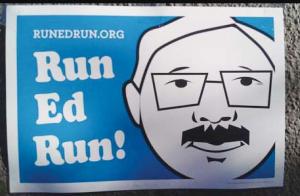
Pak was a key driver behind “Run, Ed, Run,” the campaign backed by Progress for All that plastered cartoon drawings of Lee all over San Francisco. Progress for All will be the subject of discussion at the Aug. 8 Ethics Commission meeting, since Ethics director John St. Croix has stated he believes the political organization filed improperly as a general purpose committee. In late July, five mayoral candidates — including Board President David Chiu — joined Democratic County Central Committee chair Aaron Peskin in asking for an investigation into whether Progress for All had violated local campaign laws. Campaign finance reports, meanwhile, show that the effort was backed by a small group of inflential business insiders. Asked about the role of “Run, Ed, Run,” on his campaign for mayor, here’s how Lee responded:

http://www.youtube.com/watch?v=CBI5SSmVr4E

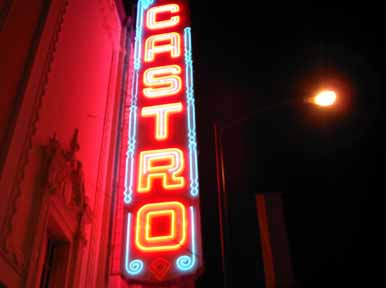
This evening, Lee the will participate in a mayoral candidate forum hosted by the Duboce Triangle/Castro/Eureka Valley Neighborhood Association at the Castro Theater at 7 p.m.

A new kind of biker bar

0

Rapha Cycle Club is altering my mental image of what a biker bar is. For one thing, the walls are all really white. For others, I can shop, I can order a cup of Four Barrel and a Telltale Preserve croissant, I can watch the Tour de France – but I can’t have a beer. 

That’s because it’s a clothing shop, mainly. But as manager Emily Haddad (who Rapha imported to SF from her gig at an Austin bike shop specifically to work at the new space) tells me, it’s so much more. 

“It’s a bar, but one where everyone’s drinking coffee.”

It’s also a bar where everyone’s drinking coffee that opens at six a.m. on some days – those being when the Tour de France is on TV, or Italy’s equivalent the Giro D’Italia. On those days Haddad says there can be twenty bikers in the sleek Marina storefront, sitting and standing around the long, low table in the middle of the room that’s speckled with vintage biking photos and ephemera, watching the race and chatting amongst themselves. 

Rapha is a British cycling clothes brand that debuted in 2004 with a multimedia exhibition called “Kings of Pain.” It now has an office in Portland, Ore., has opened a similar “social shop” in Tokyo, and a mobile club — a van with similar intent that is cruising Europe this summer, stopping in places like Alpe D’Huez, France. The dominant colors of the line are grey and, complexly, pink – a homage to the Maglia Rosa, the pink jersey that is wore by the standings leader in the Giro D’Italia. 

Here is a Graeme Fife – the playwright and cycling journalist – quote the company feels illustrates its ethos. It is, in fact, written on the shop’s wall:

The greatest battle is not physical but psychological. The demons telling us to give up when we push ourselves to the limit can never be silenced for good. They must always be answered by the quiet the steady dignity that simply refuses to give in. Courage. We all suffer. Keep going.

Rapha Cycle Club San Francisco is the first yearround cafe the label has opened – a four seasons timetable that was decided, one assumes, when Haddad and Rapha brass realized that SF’s “summer” is not really the height of cycling season. 

Tucked into my favorite Marina intersection (its neighbors are John Campbell’s Irish Bakery and Real Food Co. grocery store), the shop-cafe is mere blocks from the hill that separates the neighborhood from the rest of San Francisco to the south. 

One end of the long table meant for coffee-drinking and the cheering-on of jerseys holds a glass curio case dedicated to Eddy Merckx, the dashing Belgian who many consider the most accomplished cyclist of all time (five Tour de France victories, three world championships, breaker of the world hour record). The case houses two commemorative plates, and amazing retro keychains that proclaim Merckx a world record holder. There is also a small photo gallery in a loft space upstairs, with rotating exhibitions that currently feature black and white images of men grimacing in pain.

One imagines road bike ironpeople inspired by Merckx or the steady dignity on the shop’s flatscreens purchasing a pink jersey and turning bike wheels resolutely to the mountain rising up from Rapha’s front door. Even if this is not quite the case, the shop is the ideal jump-off for friends meeting up to bike to the Marin Headlands, joining the phalanxes of sharply-Lycra’d bicyclists on those hills. 

With its sleek, get-er-done ethos Rapha Cycle Club would be a really good stop for all those businesspeoples that complain about not being able to ride their workclothes on their bikes. The shop sells a very expensive (but maybe worth it? I find men’s dress clothes hard to judge) blazer made by British bespoke tailor Timothy Everest that buttons up, and together, has a sharp little pocket on its back, and is made of fabric that gives enough to encourage light physical exertion.

It also sells similarly functional gingham dress shirts. One guy was trying on a pink, short-sleeved number when I was in the shop, wondering out loud if he could pull it off. Everyone in the store encouraged him to try. Or rather: Keep going. 


Rapha Cycle Club 

Mon.-Fri., 7 a.m.-7 p.m.; Sat.-Sun. 7 a.m.-6 p.m.

2198 Filbert, SF

(415) 896-4671

www.rapha.cc/san-francisco

Just say no

0

arts@sfbg.com

HAIRY EYEBALL Summertime is supposed to be about taking it easy and soaking up good vibes. This is decidedly not the case with “Negative Space,” Steven Wolf Fine Arts’ current group show that, like an old punk rock mix-tape, delivers one lean, catchy declaration of refusal after another.

This is not to say that “Negative Space” sounds only one note. Each of the 10 featured artists offers a different enough riff on the exhibit’s title (one shared by Matt Borruso’s slim, collage-filled hardcover volume, on display here; itself a nod to the late critic Manny Farber’s classic 1971 collection of film criticism) to avoid turning an organizing principal into too much of a gimmick. There’s also enough well-delivered black humor to prevent this modest collection of deliberately difficult, critically-minded and middle-finger-waving art from becoming either overly self-serious or gratingly puerile.

Nicholas Knight, for one, is more prankster than killjoy. His Permission Slip (2010) is a pad of those very paper indulgences — free for the taking — printed with the artist’s signature (as “witness”), along with a place for the holder to sign into effect the statement, “I have permission.” “Permission to do what, exactly?” is the natural follow-up question, and one which Knight’s ludicrous contract leaves unanswered with a pithy shrug of non-commitment.

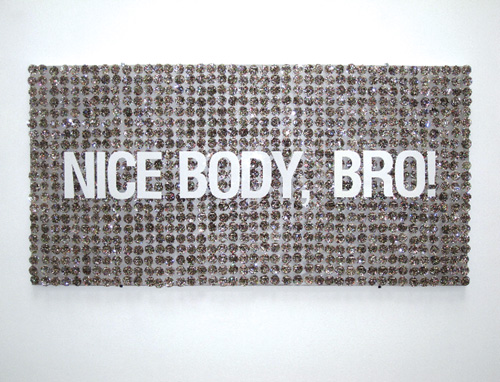
Jeffrey Augustan Songco’s Nice Body, Bro! (2011), which features the titular phrase spelled out in white three-dimensional lettering over a background of what look like rainbow-colored paillettes, becomes a sight gag about transubstantiation once one knows, courtesy of the wall card, that the large sequins are, in fact, glitter-covered communion wafers.

More clever is David Robbins’ Fuck Buttons, 1985-87, a tic-tac-toe grid of purple-and-orange hued photographs of 1″ buttons, each adorned with a different usage of the word “fuck.” The piece’s initial giddy rush of profanity gradually runs out of steam as various self-canceling dialogues emerge out of the buttons’ placements next to each other. The resulting imaginary arguments read like obscene variations on the old “who’s on first?” routine (for example, the piece’s middle row, left to right, reads: “Fuck you,” “Don’t fuck with me,” “Fuck me”).

The real stand-outs of the gallery’s front room, however, eschew the Pop-isms of Songco and Robbins. Whitney Lynn’s sculpture Animal Trap (2011), a black plexiglass cube with an open bottom propped up at an angle by a sawed-off tree branch, sits in the middle of the floor, as if lying in wait. The piece takes Minimalist sculpture’s classic forms (the cube) and materials (transparent plastic, wood) and, with its suggestive title and familiar arrangement, freights them with unexpected emotion and an implied narrative that has a decidedly unhappy ending.

Animal Trap faces down James Hayward’s Automatic Black Painting #9 (1975), perhaps the purest, if also the most traditional, interpretation of the exhibit’s title. Unlike Ad Reinhardt’s black paintings from the previous decade, which reveal embedded grids and distinct shades upon prolonged viewing, Hayward’s darkness harbors no hidden designs. In fact, the point of his early monochromatic canvases, such as this one, was to erase his hand entirely by laboriously building up thin layers of pigment to avoid any traces of brushstroke. The resulting 36 x 36 inch oil slick is all that remains of Hayward’s slow, cumulative self-exorcism.

In the gallery’s rear “lounge” area hang Christine Wong Yap’s meticulous, cartoon-like ink drawings on gridded vellum, illustrating various quotes from positive psychological studies on topics such as learned optimism and creativity as applied to the lives of artists. Despite the occasional glint of a glitter pen or iridescent foil rainbow, these selections from the series Positive Signs (2011) come off as more humorously pessimistic when presented together than they did when they originally appeared on the San Francisco Museum of Modern Art’s Open Space blog earlier this year as weekly posts.

Wong Yap’s charts and diagrams, to some degree, metabolize the very clinical discourses about happiness and creativity that they also satirize, making for a strange cocktail of uppers and downers when viewed alongside the lithographs of posters and texts by Guy Debord and the Situationist International — earlier and more pointedly political examples of what would later be called culture jamming — that hang opposite.

It is easy to imagine, say, Wong Yap depicting “live without dead time,” an old Situationist slogan that was scrawled by May ’68 protestors on the same Paris streets that Debord had previously cut apart and re-mapped for dreamers and drifters in his famous chart Guide Psychogeographique de Paris (1957, also hanging), as another nugget of motivational wisdom. The Spectacle for the win, folks?

Then again, maybe I’m just being pessimistic, an attitude which “Negative Space” doesn’t so much as inundate you with, like the noxious signature scent that wafts out of Abercrombie and Fitch stores, but rather involuntarily triggers, as when a stranger begins to violently cough on a crowded bus. You find yourself shrinking away, but the impulse to cough, too, is irrepressible.

“NEGATIVE SPACE”

Through Aug. 27

Steven Wolf Fine Arts

2747 19th Street, Ste. A, SF

(415) 293-3677

www.stevenwolffinearts.com

Hail to the kings

0

It’s that time of year, y’all: the 16th annual San Francisco Drag King Contest is here to shake up midsummer with its proud “cavalcade of sex, drag, and rock n’ roll,” per its saucy press release. Drag kings are less frequently in the spotlight than their queenly counterparts, but the two groups coexist harmoniously — former Miss Trannyshack and San Francisco Supervisor candidate Anna Conda is among the 2011 event’s judges.

Since raising one’s glamour quotient to Anna Conda levels likely ain’t easy, it seems certain that winning the coveted prize of top Drag King would also require more than throwing on a suit and drawing on a moustache. I went to the source, event producer and co-emcee Fudgie Frottage (also known as Lu Read), to find out more.

SFBG San Francisco has a long history of drag kings — can you talk a little about that and also about how you got your start performing?

Fudgie Frottage The term “drag king” didn’t really pop up here until the ’90s, when Leigh Crow was doing her Elvis Herselvis character. But prior to that, there were definitely women who were doing drag king performances. Moby Dick, who had been out here, went back to New York and started Club Casanova, and that brought a lot of publicity to the whole drag king phenomenon. I’ve been performing since I was in kindergarten — for show and tell, the teacher made me sing. When I first moved to San Francisco in the ’70s, I was in a few different bands. When Trannyshack was in its heyday, I came up with a “faux-queen” character, and Fudgie came after that. But I was doing my club DragStrip back in ’95, before TrannyShack started. I was mostly just producing at first, and then I kind of jumped back on the stage.

SFBG What are the important qualities a drag king must have?

FF Sense of humor. Stage presence!

SFBG How do performers come up with their stage names and personas?

FF I’m not really sure! Sometimes they’re suggested by other people. Other times it’s just a brainstorm. For me, the name comes first, before the actuality of getting up there and doing something. It’s just part of the creative process. It’s an art form, just like you just can’t ask a painter why they did this particular painting. It’s just what’s inside of each person.

SFBG Do many performers sing live?  

FF Everything happens! There’s been live singers, and bands, and lip-sync, of course. Sometimes there’s dancing. There was a juggler a few years back. That was pretty entertaining.

SFBG Looking at the list of special guests for 2011, including bands like Black Flag cover band Black Fag, it’s clear the contest is full-on extravaganza. What can audiences expect?

FF [In addition to Black Fag], we’ve got some performers [like D.R.E.D.] from New York and some locals — this is the first year [rapper] JenRO will perform with us. But we have burlesque chanteuse the Indra, we’ve got Leigh Crow coming back. It’s a huge show, and it’s really, really fun. There’s definitely a little bit of everything involved in it. In the press release, I say it’s a mash-up of a monster truck show, the Miss America pageant, American Idol, and the Westminster Dog Show, since our theme is “Doggone Sweet 16.” I think sometimes people might be put off by something called a drag king contest, because they’re like, “What is that?” Some people don’t even realize that there are drag kings. But we’re just a big, huge variety show, where everybody’s out to have a really good time. And there is amazing talent.

16TH ANNUAL SAN FRANCISCO DRAG KING CONTEST Fri/5, 8 p.m., $10–$35 (benefits Pets Are Wonderful Support) DNA Lounge 375 11th St., SF. www.sfdragkingcontest.com

Shady financial dealings mar the “Run, Ed, Run” campaign

68

Not only do the groups behind the campaign urging Mayor Ed Lee to run for mayor get lucrative city contracts, sometimes with Lee’s help, but at least one of the companies has also made direct payouts to Chinatown power broker Rose Pak, who arranged to place Lee in the Mayor’s Office and has been coordinating the campaign to keep him there.

This latest revelation, from documents uncovered by the Guardian, comes as other local media outlets have been exposing the financial self-interest that Pak, former Mayor Willie Brown, and their allies have in urging Lee to break his word and run for a full mayoral term, including a devastating front page article in today’s Chronicle.

Reporter John Cote writes that Progress for All, the group behind the “Run, Ed, Run” campaign, “has been bankrolled almost entirely by a small group of politically connected individuals, some of whom have received millions of dollars in city contracts in recent years.” Among them is Robert Chiang, owner of Chiang CM Construction, which has received millions of dollars in city contracts despite lawsuits and rulings by regulators alleging that the company violated a variety of wage laws.

Chiang CM has also paid Pak personally at least $10,000, according to her tax return form that she filed with the city back in 2002 when she bought a Rincon Hill condominium for half-price through a city affordable housing program. The tax form listed that payment under “miscellaneous income,” along with $12,000 from Emerald Fund, the politically connected developer of the project, “an apparent violation of regulations governing the distribution of the discount housing,” according to an Examiner article at the time (“Affordable-housing flap,” 2/24/03). But the Brown Administration, which approved Pak’s purchase of the condo, refused to take any action against Pak, a close ally of both Brown and Lee.

We reached Pak on her cell phone to discuss her financial ties to Chiang CM and what they paid her for, and after we explained our findings three times, she said, “I don’t remember,” and hung up the phone. When we called the company for comment, we were told “nobody is available to speak on that right now.”

More recently, the Examiner has reported on the millions of dollars in city contracts that Lee has helped steer to other key Progress for All leaders, including the Chinatown Community Development Center, whose executive director, Gordon Chin, also leads Progress for All. In addition to its city contracts, documents obtained by the Guardian also show that on Dec. 10, 2010, CCDC entered into a contract with Central Subway Partners – which is building the Central Subway project long pushed by Pak and Lee, but criticized as an overly expensive boondoggle by many transit activists – to be paid up to $810,000 for unspecified services that “will be issued on an Annual Task Order basis.” Chin hasn’t yet returned a Guardian call for comment.

The Chronicle also broke the story about Pak urging Recology – which just last month was awarded a lucrative city contract (with Lee’s support) giving it a monopoly over all aspects of waste management in the city – to improperly have its employees work for the “Run, Ed, Run” campaign. And the Bay Citizen has also exposed the financial self-interest of Progress for All backers, which Judge Quentin Kopp and local Democratic Party chair Aaron Peskin have separately called for prosecutors and regulators to investigate.

“Unlike all other candidates who must abide by the strict $500 contribution limit and source restriction (no corporate, union or City contractor money), Progress for All has been able to raise unlimited amounts from any source, making it easy to amass large sums of money for its efforts,” Peskin wrote in a July 28 letter to Ethics Commission director John St. Croix, requesting an investigation. The Ethics Commission is scheduled to discuss Progress for All at its Aug. 8 meeting.

Despite her considerable power and influence – including arranging regular trips to China for public officials, including Lee and Board President David Chiu – Pak’s 1999 tax return indicated she had an adjusted gross income of just $31,084. On her application, Pak reported a $60,000 income in 2002 as a “self employed consultant,” yet a whopping $73,414 in her checking account.

Although Maggie LaRue, the inclusionary program manager, wrote Pak a letter on June 17, 2002 challenging the “inadequate documentation” of her income in the application, the Mayor’s Office ultimately approved her purchase of a swanky two-bedroom apartment at 400 Beale Street for just $300,000, although it was valued at $580,000.

Although Pak seems to have fairly steady income from the vague consulting work that she does, a request for information from the Office of the Treasurer and Tax Collector indicates that she doesn’t have a business license and hasn’t paid any local taxes, even though city laws require a license from any “entity engaging or about to engage in business for seven or more days a year in San Francisco.”

Lee’s office has consistently denied knowledge of or connections to the Progress for All campaign, although the Chronicle has reported that Lee does plan to get into the mayor’s race, probably next week. The deadline to file for a run is Aug. 12.

Fall ballot gets stripped of progressive measures

25

The San Francisco Tenants Union suffered a pair of disappointing setbacks in the last week – first when a referendum on the Parkmerced project narrowly failed to qualify for the fall ballot, then when progressive supervisors withdrew a proposed ballot measure to prevent demolition of existing rental housing – leaving the fall ballot without any progressive measures (unless one counts the sales tax measure that was unanimously approved this week by the Board of Supervisors).

Also dropped from the ballot this week was another progressive measure that would have prevented the Recreation and Park Department from entering into new commercial leases of parks and recreation centers, a measure written by the citizens group Take Back Our Parks to reverse RPD’s recent push to monetize more of its assets.

Yet unlike last week’s removal of a third measure placed on the ballot by at least four progressive supervisors – the Fair Shelter Initiative, written by the Coalition on Homelessness, which was unhappy that Sup. Jane Kim dropped her support under pressure from the Mayor’s Office – it was the sponsoring groups that asked the supervisors to remove the two measures this week.

Sponsors of the parks measure say it had some legal problems that would have complicated the campaign, particularly after an analysis by the City Attorney’s Office concluded that it could affect things like private party reservations and leases associated with the America’s Cup.

Ted Gullicksen of the San Francisco Tenants Union said his group concluded there were legal problems with the anti-demolition measure as well and that it wouldn’t affect the demolition of 1,500 housing units associated with the Board of Supervisors’ 6-5 vote to approve the massive Parkmerced project, which was the catalyst for the measure.

SFTU sponsored the signature-gathering campaign to do a referendum on that vote, but the Elections Department concluded on July 29 that of the 18,487 signatures that were turned in, just 12,917 were valid, falling short of the 14,336 they needed. Gullicksen said delays in qualifying the 56-page petition gave them just three weeks to gather signatures, and a freak mid-June rainstorm hurt that effort as well.

“We knew from the get-go that it was going to be a challenge,” he said. “It was very disappointing that we fell just short.”

But he said there was a silver lining: “It sent a message to the supervisors. David Chiu [the swing vote on the Parkmerced approval] called me the next day to say he’d make sure demolitions don’t become an epidemic.”

Sup. David Campos – who helped sponsor all three measures and even kept his name on the shelter measure after Sups. Eric Mar and Kim had removed theirs – told us, “I think it’s disappointing that there isn’t a measure on the ballot to excite the progressive base, but at the end of the day, we do have an exciting mayor’s race and races for sheriff and district attorney.”

Campos has endorsed John Avalos of mayor and Ross Mirkarimi for sheriff, but has not yet made an endorsement for DA.

Al Gore calls for an “American spring”

4


In an interview with Keith Olberman Tuesday night  on his Current TV show,   Al Gore called for “an American spring” to counter the assault of the teaparty Republicans

and to go on the offensive from the grassroots and on the internet.  Gore was eloquent in his Goreish way and made many of the right points.

Olberman asked him, quite diplomatically, if a Democrat ought to run against  Obama and if Gore would support a Democratic primary fight.

Gore said no, he supported Obama and would continue to support him, and that the history of primary fights meant that the President and his challenger would both

lose.  He said Obama needed lots of help and pressure from the grassroots. Here’s the interview:  The Keith Olberman show is at 8 p.m. weekdays at Channel 107 in San Francisco.

I think Olberman is even better in this  format than he was when he pioneered the progressive tv show on MSNBC.  B3

http://current.com/shows/countdown/videos/al-gore-on-why-america-needs-a-non-violent-tahrir-square-part-one


Happy birthday, Chet

0

Judy Davis, the longtime partner of the late Chet Helms, sent out her annual birthday card for Chet to his legion of friends and followers.

HIs birthday was Aug. 2 and he died in 2005 at the age of 69.   He was a legendary promoter of rock music, creator of Chet Helms and the Family Dog at the old Avalon Ballroom, icon of the Summr of Love,  loser to Bill Graham in the rock battles of the l960s, a great San Francisco spirit who spread good will and good vibes wherever he went.    I wrote his obituary for the Guardian and  ended  with the wonderful story of how Chet  died owing the city of San Francisco $30,000 for providing police protection for his 30th anniversary Summer of Love concert in Golden Gate Park.   In the famous Chet tradition, he had neglected to incorporate the Summer of Love concert group and so the city went after him personally as the promoter of record.

However, I noted that, given all that Chet had done for the city for so long  with concerts and good works,  it was more than a fair deal for the city. B3


SF Giants asked to take a stand against racism UPDATED

13

Updated with response from SF Giants at bottom of post

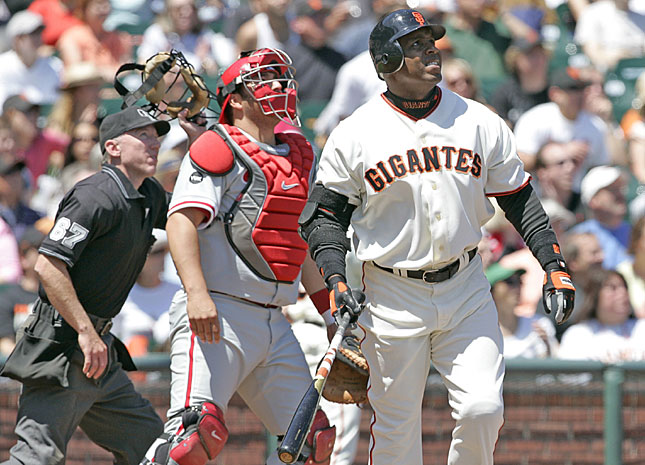
The San Francisco Giants will host the Arizona Diamondbacks tonight (July 31), beginning a three-game series that will determine the first place slot in the National League West. A lot of eyes will be on our 2010 league champions – all the more reason, says a classic Mission District arts and culture organization, for them to take a stand against racist anti-immigration laws.

In early June, community members who had been leaders of the 1960s to ’80s group Casa Hispana de Bellas Artes sent Giants CEO Bill Newcombe a letter with a simple request. They want the baseball team to wear its popular ‘Gigantes’ jerseys while playing the Arizona Diamondbacks and the Atlanta Braves, two squads that hail from states that have recently passed laws codifing racial profiling in the fight against illegal immigration. The letter tells the team “this kind of law has created a paralyzing climate of fear among Latino families, citizen and non-citizen alike.”

San Francisco, the Casa Hispana elders insist, does not swing at discriminatory government. Reminding the Giants organization of its long-standing support of the Latino community, they’re politely encouraging the team to represent its fans by speaking out against discrimination. We caught up with Casa Hispana elder Don Santina for an email interview to explain why his group asked its team for a wardrobe change. The Guardian was unable to reach the SF Giants for comment – but any organizational response we get will be added to this post.


San Francisco Bay Guardian: Tell us about the mission of Casa Hispana de Bellas Artes.

Don Santina: Casa Hispana de Bellas Artes was founded in 1966 in the Mission District by a group of artists and poets to promote cultural advocacy for Latino-Chicano-Raza culture. [Our] group produced and sponsored programs year-round but focused particularly on an annual two-month long Raza/Hispanidad Festival which opened on October 12, Dia de la Raza. Among the multitude of programs, exhibits, performances, and events produced included major undertakings like the Chichen Itza exhibit at SF State, the pre-Colombian artifacts at the De Young and 24th Street BART station opening, the Cisco Kid Festival with Duncan Renaldo, and the Latin American Theatre Festival with Enrique Buenaventura, and low rider car exhibit at the US Presidio. Casa faded into history in 1983 when its major funding sources withdrew. The National Endowment for the Arts was seized by Reaganites.

In 1975 Casa Hispana executive director Amilcar Lobos Yong read a bilingual version of “Casey at the Bat” at Candlestick Park as part of a program in honor of the Giant’s support of the Latino community. Photo by Joe Ramos

SFBG: Why did you send this letter to the Giants?

DS: The elders of Casa wrote to Bill Newcomb’s Giants organization because it had produced a pre-game program in Candlestick Park with Horace Stoneham’s Giants team in 1975 honoring the Giants for their “pioneer recognition of Latin players” in the racist world of major league baseball.  At the event, Casa Poets Theatre read “Casey at the Bat” in English and Spanish before the game and gave awards to the Giants, Juan Marichal, and Tito Fuentes for his works with youth in the Mission District (editor’s note: the awards were presented by long-time Bay Area Latino news legend Luis Echegoyen). Casa people felt that the Giants should continue that anti-racist policy by making a genuine statement against SB 1070 by at least wearing Gigantes uniforms when playing Arizona and Atlanta.


SFBG: What’s been the response from the team? Did they get back to you?

DS: The Giants received Casa’s letter on June 9, and the business has not responded. Casa is disappointed in this lack of response and respect from a San Francisco-based team which has many Latino players.


SFBG: What is a professional sports team role’s in their community? Should they be speaking out on political and social issues? 

DS: A professional sports team has the same responsibilities to the community as any other business; in a word: Spike Lee’s “do the right thing.” Unfortunately, these teams are all mega-corporate businesses with morality based on profit. Dave Zirin has covered this topic very thoroughly.


SFBG: How much of the artists and community members involved with Casa Hispana are baseball fans?

DS: Most of the Casa people love the Giants; however, they also love fútbol, a.k.a. the international game of soccer.   


SFBG: Do you think they’ll be wearing the Gigantes jerseys at AT&T Park tonight?  

DS: We don’t think they’ll wear the Gigantes uniforms without public pressure or embarrassment. [But] if they do, it will be beneficial as a public stand against racial profiling laws. 


UPDATED WEDNESDAY, AUGUST 3: The Guardian contacted Giants spokesperson Shana Daum, who said she couldn’t recall recieving Casa Hispana’s letter but that the Giants would not be wearing their Gigantes jerseys at all during this week’s Arizona series. “We try to support the community, but we don’t want to take a political stance,” she told us.

“There’s other ways for major league baseball to get involved.” Daum cited the team’s annual Fiesta Gigantes celebration during September’s Hispanic Heritage Month, HIV/AIDS awareness days, the team’s pioneering involvement in the It Gets Better campaign. She added “but we appreciate the spirit in which [Casa Hispana’s request to wear the Gigantes jersey] was asked.”

Complete interview: “Between Two Worlds” directors Deborah Kaufman and Alan Snitow

0

In 1981 Deborah Kaufman founded the nation’s first Jewish Film Festival in San Francisco. Thirteen years later, with similar festivals burgeoning in the wake of SFJFF‘s success — there are now over a hundred around the globe — she left the festival to make documentaries of her own with life partner and veteran local TV producer Alan Snitow.

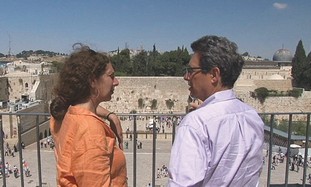
Their latest, Between Two Worlds, which opens at the Roxie Fri/5 while playing festival dates, could hardly be a more personal project for the duo. Both longtime activists in various Jewish, political, and media spheres, Snitow and Kaufman were struck — as were plenty of others — by the rancor that erupted over the SFJFF’s 2009 screening of Simone Bitton’s Rachel. That doc was about Rachel Corrie, a young American International Solidarity Movement member killed in 2003 by an Israeli Defense Forces bulldozer while standing between it and a Palestinian home on the Gaza Strip.

As different sides argued whether Corrie’s death was accidental or deliberate, she became a lightning rod for ever-escalating tensions between positions within and without the U.S. Jewish populace on Israeli policy, settlements, Palestinian rights, and more — with not a few commentators amplifying the conservative notion that any criticism of Israel is anti-Semitic, even (or especially) when it comes from Jews themselves.

People who hadn’t seen (and boasted they wouldn’t see) the strenuously even-handed Rachel called the documentary an “anti-Israeli hate fest” akin to “Holocaust denial,” its SFJFF inclusion “symptomatic of a demonic strategy” by “anti-Semites on the left.” KGO radio’s John Rothmann opined on air that the festival had “crossed the line” and “sympathized with those who participate in terror.”

Stunned SFJFF executive director Peter Stein (who’s leaving the festival after its current edition) decried Jewish community “thought police” who pressured the institution and those connected to it with defunding and boycotting threats. The festival attempted damage control by inviting a public foe of the screening (Dr. Michael Harris of StandWithUs/Voice for Israel) to speak before it, which only amplified the hostile rhetoric.

Seeing the festival being used by extremists on both sides became a natural starting point for Between Two Worlds, which takes a many-sided, questioning, sometimes humorous look at culture wars in today’s American Jewish population. It touches on everything from divestment debates at UC Berkeley to the disputed site of a Museum of Tolerance in Jerusalem (atop a 600-year-old Muslim cemetery), from the tradition of progressive liberalism
among U.S. Jews to rising ethnic-identity worries spawned by intermarriage and declining birth rates.

The fundamental question here, as Kaufman puts it, is “Who is entitled to speak for the tribe?” For the first time, the filmmakers have made themselves part of the subject matter, exploring their own very different personal and familial experiences to illustrate the diversity of the U.S. Jewish experience. Snitow’s mother had to hide her prior Communist Party membership to remain active in social-justice movements after the 1940s, while Kaufman’s father was a devoted Zionist from his Viennese childhood who had to adjust to offspring like “Tevye’s daughters gone wild,” including one who converted to Islam.

They’re clearly in sympathy with other documentary interviewees insisting that one core of Jewish identity has been, and should remain, a stance against absolutism and injustice towards any peoples. Between their SFJFF screenings the filmmakers chatted with the Guardian.

SFBG: Is the Bay Area still a bastion of Jewish liberalism, relatively speaking? Watching your movie I wondered how many other places there are where a Jewish film festival audience would boo and heckle a conservative pro-Israeli speaker like Dr. Michael Harris.

Deborah Kaufman: What we saw at the festival during the Rachel uproar was a collapse of the center. It was really a moment when the extremes were at battle and the center simply disappeared. That’s what was and is so disturbing. A kind of apathy where the moderates just throw up their hands and walk away from what’s become a very toxic debate.

Alan Snitow: It’s not that the Bay Area is unique to boo a so-called “pro-Israel” speaker. It’s that the Bay Area has maintained an open debate about Israeli policies when other Jewish communities never countenanced such debate from the get-go. Rachel was not shown in other Jewish film festivals around the country because they are already creatures of conservative donors. The aim in this power grab by the right in San Francisco was and is to silence people and institutions like the festival that oppose a McCarthyite crackdown in a remaining bastion of free speech. And this is being mirrored in Israel itself where the Knesset recently passed a law punishing anyone who publicly supports the idea of a boycott of the West Bank settlements.

I think we also have to question this claim of “pro-Israel.” All criticism of Israel’s occupation is now being branded as “anti-Israel.” Theodore Bikel — a lifelong Zionist activist who went to jail with my mother at the Soviet consulate in Washington DC — was recently called an “anti-Zionist” because he supported an actors’ boycott of performing in the settlements. J Street — an explicitly and consistently pro-Israel voice that is critical of Israeli policies — is regularly attacked as not really pro-Israel for that very reason. “Pro-Israel” has come to mean pro the policies of the current, most right-wing government in Israeli history — a government that is now advocating the truly Orwellian position that there is no occupation at all! That’s not what pro-Israel or Zionist ever meant except to some ideologues on the far right.

DK: The Bay Area has had a history of passionate political commitment — to both the Zionist and anti-Zionist causes. But today the right wing is certainly louder and aside from what we saw at the theater that day, there has been a significant silencing of voices critical of Israel’s occupation policies.

SFBG: Conversely, have you perceived the local Jewish community as growing more conservative in recent years? In particular, more inclined to treat criticism of Israeli government policies as inherently anti-Semitic, even when voiced by fellow Jews?

DK: We were interested in the notion of excommunication — going back to Spinoza — and to the accusation “self-hating Jew” that some people used to attack Hannah Arendt when she wrote Eichmann in Jerusalem. Today, right-wing Jews are leveling charges of treason against Jewish academics, rabbis, and community members whose positions on israel aren’t as rabidly right wing as theirs. We didn’t have to look very far to find dramatic stories for our film on these themes. Censorship and the stifling of dissent are happening right in our home town.

AS: There’s conservative and there’s conservative. The Jewish community hasn’t become more conservative in terms of voting patterns or support for civil rights or the welfare state, but the establishment has become more and more dependent on an ever smaller number of big conservative donors who have bought out these institutions and compromised their independence and legitimacy as representing the whole Jewish community. This is a major reason for the crisis. More and more young Jews are finding the community’s institutions do not reflect their liberal beliefs and upbringing, particularly when it comes to Israel. The result is that many young people are not identifying with Israel because its actions are not consistent with their ideals as American Jews.

SFBG: Had you already been thinking about somehow addressing political rifts in the Jewish community before the SFJFF fracas?

DK: We began the film over a year before the JFF fracas. We were focusing more on Jewish identity than politics — looking at intermarriage, hybrid identities, a new generation of American Jews — we wanted to re-tell the Biblical story of Ruth, and we were following a fantastic feminist-queer internet discussion called “Rabbis: Out Of My Uterus!” that we thought would be fun to film — but we kept getting swept into the Israel vortex and realized we had to address the question of dissent and who speaks for the Jewish community at this historical moment for the film to be relevant.

SFBG: The festival had shown other movies relating to different aspects of the Palestinian conflict before, and Rachel does make an effort to represent all the different sides of its story. What do you think particularly ticked people off about that film?

DK: Over the years the festival had shown many films that were more controversial than Rachel. In fact, that same summer the festival showed a film called Defamation that we felt was far more critical of the Jewish establishment, but it went right under everybody’s radar. It was the Tea Party summer — almost anything could have been the spark that ignited a controversy. But the tragic death of Rachel Corrie had already made her an internationally famous symbol of opposition to Israel’s occupation, so the anger was focused on the program with her name.

AS: Rachel was just a pretext. In the months before the film festival, think tanks in Israel had declared the Bay Area a node of “delegitimization” of Israel (along with Toronto and London). The right was looking for a test case to make an example of Jewish institutions that step out of line. The San Francisco Jewish Film Festival was founded as a transgression right from the start — a place where unpopular and counter-cultural and diverse views could engage. It was a perfect target to attack.

One other item: when the festival allowed [Harris] on the podium to attack one of its own films and filmmakers it was a bad precedent, and the right smelled blood in the water. The festival’s good faith effort was viewed as a sign of weakness and the attacks only intensified. The people who wrote the attacking emails are people who think that any criticism of Israel is tantamount to anti-Semitism. They are not to be appeased by any symbolic action. They want control and silence.

SFBG: Deborah, since you left the festival it’s seen several well-regarded executive and programming directors depart, seemingly burnt out. Do you think the effort it takes to represent and placate the festival audience has gotten harder?

DK: I’m not sure things have changed so much. There has always been pressure on festival directors to do what major donors demand. I got a lot of that during my tenure but resisted the pressure. The difference is the political atmosphere which is more polarized and shrill, especially since the new, ultra-right government in Israel has come to power. It’s hard to withstand the bullying and accusations of treason and self-hate.

AS: I think it’s also important to add that Deborah and Janis [Plotkin] — who was director for many years — also had a lot of fun with the festival. This is a very hard job, but it’s a creative and fascinating one, and these attacks may come with the territory, but they don’t dominate it.

DK: In terms of the audience it’s always been a diverse group. I have fond memories of the midnight screening of the silent version of The Golem (1920) we did at the Roxie in our second year — where people in the audience were literally screaming at each other and at the projectionist during the whole screening about whether we should turn the volume up or down on the rock music sound track we had commissioned.

SFBG: You’ve shown Between Two Worlds to a variety of Jewish audiences so far, in Toronto, New York, and Jerusalem as well as SF. What have been some of the responses?

DK: The response has been great and sometimes surprising — we’ve had people from the left and right of the political spectrum both say the film has made them reconsider their own stridency. Non-Jews have said it mirrors what they felt they could not say out loud. Young people have told us it’s affirming of their perceptions and reveals a history they didn’t know existed. In Jerusalem one person felt the film was overly optimistic because it didn’t examine the support of right-wing Christian fundamentalists for the settlements!

AS: I think the personal stories we tell of our own families ring true to many people. Most Jews know deep down that if you look at the family histories of American Jews, you will find intense long term debates between those people at the Passover seder table who were Communists, Socialists, and Zionists. Often, the only way to sit down together was to maintain silence, but we wanted to bring those utopian hopes and ideals back into focus, and people across the political spectrum seem to take that as an opportunity to think about and question their own families and their own positions.

SFBG: How did the decision come about to put yourselves in the film? As filmmakers, was it awkward to become subjects?

DK: We’ve never been in our own films so it was something of a challenge for us. We don’t feel relaxed in front of the camera, but early in the production we realized we had to be in the film so that people would know where we were coming from, and also because our family histories shed a lot of light on debates inside the Jewish community today. We watched a lot of work by other documentary filmmakers who put themselves in their films like Marlon Riggs, Alan Berliner, and Ross McElwee, and decided we’d give it a try. We also felt this film was really about the intersection of the personal and the political, so the structure that moves back and forth between the two made sense to us.

AS: My daughter, Tania, is an actor, and I kept thinking that we needed to consult with her about being on camera. It’s not just something that you do. You have to work at it and learn how to do it. After we did it a couple of times, we realized that we weren’t dressing right, that the hair was wrong, that I was scratching my head, that we should have shot ourselves from above and not below. Rather than being an on camera ego-trip, it was a humbling experience.

Between Two Worlds opens Fri/5 at the Roxie.

Scribe’s Guide to Playa Prep

32

steve@sfbg.com

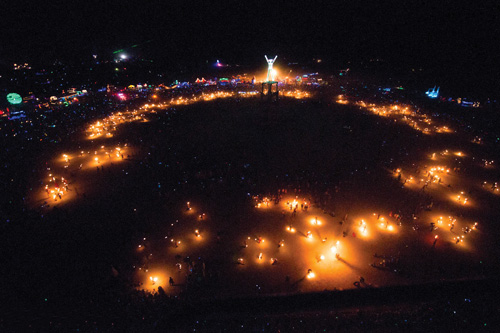
PLAYA PREP This is a crazy time of year for burners, when they begin to realize just how overly ambitious their art projects actually are, when the August calendar seems to shrink as to-do lists grow, and when procrastination morphs into panic — all of it laced with a giddy, distracting excitement about the dusty adventures to come.

Don’t worry, fellow burners, Scribe is here to help. I’m way too busy right now to actually come help weld your art car or hot glue your costume (unless you’ve got stuff or skills that I may need, in which case we can maybe work something out) but after years of deep immersion in this culture, I do have a few tips and resources for you.


ATTITUDE

The most important thing to bring to the playa with you is the right attitude. It’s right up there with your ticket at the very top of the list. As I worked on this guide, I posed the question “What’s the most important thing you bring to the playa?” to online burner hives, and most of the answers I got back had something to do with attitude.

Whether you’re a nervous newbie or salty veteran, it’s important to leave your expectations at home and just be open to whatever experiences await you. Intention is everything out there, and if you try to always maintain an open mind, a loving heart, and a sense of humor, everything you need will just flow your way.

It isn’t always easy. When your project breaks, or the dust won’t stop blowing, or your lover squashes your heart, or some yahoo behaves in a way that strikes you as somehow un-Burning Man, it’s natural to let your anxieties creep up. But you’ve got to let it go, because it’s all going to be OK, it really is. When all else fails, just breathe.

It is the breaking through those difficult moments and coming out the other side — enduring through things that feel like they may break you — that makes Burning Man feel so transformative. It is a cauldron, and you may not come out in the same form you went it, but that’s part of why you go.


GETTING AROUND

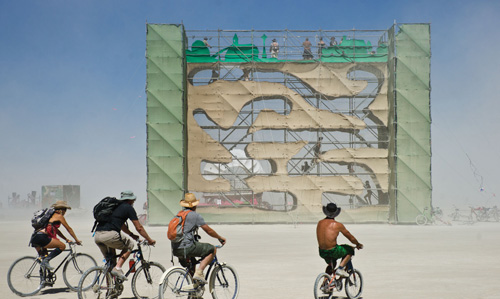
You’ll need a motorized vehicle to get to Burning Man — and art cars can be a fun way to get around when you’re there, a sort of surreal public transit system — but if you don’t have a good bicycle then you’re at a decided disadvantage in fully experiencing Black Rock City, the most bike-friendly city on the planet while it exists. And that’s never been more true than this year, when early reports indicate that the wet winter has left the playa packed solid and perfect for pedaling.

Form and function are equally important when it comes to your bike. It needs to be in good mechanical condition (and with enough tools and patch kits to keep it that way) and correctly sized to your body, ideally with a comfortable, upright position and basket for your stuff. And you also need to decorate it and make it unique, both because making art is the essence of Burning Man and so you can easily find it amid a sea of bikes. Form and function, they’re like two wheels rolling together.

Although the Borg, a.k.a. Black Rock City LLC, recommends that you bring a bike lock, I’ve personally never used one and never had a problem. Sure, bike thefts happen, but I believe they’re almost always crimes of opportunity or drunken mistakes involving nondescript bikes, not unique rides like mine that I could spot 100 yards away.

I’m convinced that half the people who think their bikes got stolen actually just lost them. The playa can be a very disorienting place, with art cars and other visible markers moving around — and even one’s own brain conspiring against locating one’s bike. So illuminate your bike well, ideally with something that sticks up high the air, and leave your lights on as you explore on foot.

Speaking of which: wear good, comfy shoes. Most costumes should stop at the ankle at Burning Man, particularly if you’re prowling the playa


SNEAKING IN

In honor of the mad scramble for tickets after Burning Man sold out more than a month before the event for the first time in its 25-year history, I’m offering some thoughts on sneaking into the event. Given how many people could find themselves stuck with counterfeit tickets or otherwise unable to get in this year, it seems like something that any thorough guide should cover.

Now, before everyone jumps all over me, telling me that I’m endangering lives and undermining the spirit and the stability of the event, let me make clear the spirit in which I’m offering this advice. Just think of it like a hacker publicizing the security vulnerabilities of a beloved institution — hopefully the Borg will read this too and do what it can to either plug the holes or somehow take pity on the desperate souls stuck outside the city’s gates.

First of all, you gotta know what you’re getting yourself into. Gate crew takes this shit very seriously, thoroughly searching every car and trailer, and looking into hiding spots that you probably haven’t even thought of. Many of them take real pride in this, some thoroughly stomping on rolls of carpet that might contain a stowaway, potentially adding injury to your insult.

Here’s the worst part: It is official Burning Man policy that when stowaways are found, everyone in that vehicle gets his or her tickets torn up. And burner brass says it will beef up security this year, including more people at the gate and more people scanning the open playa with night-vision goggles and fast interceptor cars.

Every year, they catch about 30 people trying to sneak it. “We’re very confident that we catch all the stowaways,” Borg member Marian Goodell tells us. But we all know that can’t possibly be true, right? There are playa legends of a contortionist who puts herself in a packing bin and gets in every year, and I’ve met people who claim to have snuck in both at the gate and over the open playa.

So, if you gotta do it, my best advice is to find a confederate on the inside, such as someone on Gate crew who owes you or will take pity on you or a bribe from you. That’s how many coyotes do it at the US-Mexico border, and it could work here too. There aren’t any wristbands at Burning Man, so once you can weasel your way in amid the confusion at the gate, you’re in.

Skydivers also have a pretty good shot at getting in, even though they’re likely to be greeted on the ground by someone asking for their tickets. But, it’s a big city, and if you’ve got some skydiving expertise and you’re able to rapidly change directions during the final phase of your descent, you might just make it.

There are also ways to take advantage of human oversights, particularly during the early arrival period before the event begins. There are often openings in the gate briefly left unguarded in the early days, as we discovered last year after a trip to the reservoir. Or sometimes, after thoroughly searching the car, the person at the gate will forget to tear your ticket. And believe it or not, sometimes people on the inside end up with spare tickets for friends who couldn’t make it. Any untorn tickets can be spirited out by people making runs into nearby Gerlach for supplies.

But in closing, let me just reiterate that buying a ticket is part of the “radical self-reliance” principle that is central to the burner ethos, so do yourself and your community a favor and find a ticket, or accept that you may just have to sit this year out. Don’t worry, we’ll make more.


FOOD AND SHELTER

In preparing for Burning Man, it’s always helpful to remember Maslow’s Hierarchy of Needs, which instructs us that we need to see to our basic needs at the bottom of the pyramid before we can even think about approaching the enlightenment at its pinnacle. And that begins with food and shelter.

Contrary to common misconceptions, you don’t need an RV or trailer on the playa — and it’s too late to get one at this point anyway. Frankly, you’ll be fine in a cheap pup tent as long as you place it under a sturdy shade structure, such as the 10-by-20-foot steel carports that are ubiquitous on the playa, or a cheaper shade structure with poles reinforced by PVC or something to help it from being flattened.

You may need to make adjustments during the course of the week, but jerry-rigging your shit is just part of the fun. Or if that’s not your cup of tea, more and more burners in recent years have been building their own yurts or turning to custom-made designs like the Playa Dome Shelters from Shelter Systems (www.shelter-systems.com/playadomes.html).

For food, just try to keep it simple, nutritious, and free of unnecessary waste. That means lots of simple snacks and easy meals, such as those you make ahead of time and reheat. There are also some good entrepreneurs out there that have perfected this approach, such as Gastronaut SF (www.gastronautsf.com/playa-provisions), which makes meals that you boil in the bag, which even allows you to reuse that water.

And don’t forget to take your vitamins because playa life can really take it out of you. Dr. Cory’s Playa Packs (www.drcory.com) are one of many good companies that understand what nutrients you’ll need and try to provide them.


SHOPPING

Let’s face it, for all the talk about decommodification and intentional communities and all that hippie crap, you’re going to need stuff at Burning Man. Lots and lots of stuff. Luckily, San Francisco is a great place to get it, and here are some of my personal favorite spots to shop for my playa gear.

Mendels This art supply store has everything you need for your costumes and other Burning Man projects, and many things you didn’t know you needed. For example, when I was looking for a cool covering for my bike years ago, I found tubes of thick acrylic paint that dries hard (now known as 3-D Paint), which has lasted for years and drawn compliments the whole time.

1556 Haight, SF. (415) 621-1287, www.mendels.com

Fabric Outlet Fake fun fur has become a staple item for Burning Man costumes and art projects, particularly as the styles and varieties of it have gotten better. And this place has the coolest fake furs in town, as well as a huge selection of other fabrics, patterns, and sewing kits.

2109 Mission, SF. (415) 552-4525, www.fabricoutletsf.com

Multikulti This is the best place in town to find a great selection of groovy sunglasses for just $6 each — and you’ll want a good selection of shades out there to go with your costumes — as well as a variety of other accessories and costumey geegaws to accent your Burning Man ensemble.

539 Valencia, SF. (415) 437-1718

Five and Diamond If there is a store that grew directly out of the feather-and-leather fashion aesthetic that has come to take center stage on the playa, this is it. From groovy utility belts (important when your costumes lack pockets) to elaborate leather outer wear to some of the coolest custom goggles that I’ve found (mine has a built-in light and both clear and shaded lenses), this place has great — if slightly pricey — stuff.

510 Valencia, SF. (415) 255-9747, www.fiveanddiamond.com

Held Over My favorite second-hand clothing store creates special racks of Burning Man clothes this time of year, but I always prefer to assemble my own outfits from their great selection of unique vintage and specialty clothes, including an entire room of tuxedos and other retro formal wear.

1543 Haight, SF. (415) 864-0818

Distractions The oldest walk-up Burning Man ticket outlet, Distractions knows just what burners need, offering a wide variety of playa-oriented clothing and accessories that you’ll need, from goggles to EL wire strips to pipes and other smoking paraphernalia.

1552 Haight, SF. (415) 252-8751

Cool Neon This Oakland-based company specializes in electro luminescent wire, the staple item for illumination on the playa (and whether you’re walking or on a bike, you will need to be lit-up out there). Cool Neon makes the rounds at many of the fairs and trunk shows, but you can also place orders for shipment or arrange pickups at its office at 1433 Mandela Parkway in Oakland.

www.coolneon.com

Discount Builders Supply Rather than spending your hard-earned money at Home Depot or some other chain store in the burbs, this locally owned business has everything you need to construct and decorate your project, or see to your sundry personal needs. They’re also used to burners with strange requests, so they give good advice.

1695 Mission, SF. (415) 621-8511, www.discoutbuilderssupplysf.com


WORKSPACES

The project. It is the essence of Burning Man, whether it’s the fun fur and EL wire you’re putting on your bike, the bar or showers your camp is building, or some ridiculously ambitious artwork that you’re creating with a crew of hundreds. Black Rock City is a series of thousands of these individual projects, all of which are coming together right now. And if you’re looking for some help finishing (or starting) yours, here are some resources you can tap.

The Crucible The Crucible is a venerable nonprofit institution that offers a wide variety of arts and crafts classes and resources in a state-of-the-art facility in West Oakland, with many burners among its staff and clients. As the longtime host of the Fire Arts Festival, this place knows its stuff.

1270 17th St., Oakl. www.thecrucible.org

CELLspace The Flaming Lotus Girls and many other key burner art collectives were born here, and his facility continues to provide the expertise and tools to bring Burning Man to life, year after year.

2050 Bryant, SF. www.cellspace.org

Techshop The new kid on the block, but one of the most technologically advanced, Techshop is a DIY workshop with amazing tools and experts on staff. Join its Aug. 15 EL wire workshop or other upcoming classes catering to burners.

926 Howard, SF. www.techshop.ws

American Steel Also known as Big Art Studios, this massive warehouse houses many of these biggest projects now bound for Burning Man. It may not have the structural support of places like the Crucible, but if you’re looking for knowledgeable burners to work through some problem, American Steel is brimming over with them.

1960 Mandela Parkway, Oakl. www.americansteelstudios.com

Burning Man costume creations If it’s sewing or other costuming help that you need, there are lots of local designers who might lend a hand (see “What not to M.O.O.P.” in this guide). Or you can stop by these Aug. 11 or Aug. 25 sewing circle meetups listed at www.meetup.com/Burning-Man-Costume-Creations


ART

Here are a few of the major installation artworks with Bay Area connections that I’m excited to see on the playa this year:

Charon by Peter Hudson Peter Hudson and his large volunteer crews have created some of the most dynamic art pieces in Burning Man history, zoetropes that use motion and strobe lights to animate the characters they create: the swimmers of Sisyphish, the divers of Deeper, the snake and monkeys of Homouroboros, and the man reaching for the golden apple of Tantalus. This year, Charon the boatman crosses the river Styx into Hades and, well, you just really gotta see what could be his best piece yet. As the artist says, “Charon asks them to reflect on their own mortality and ponder how to give and get the most from their brief time here on earth.”

Tympani Lambada by the Flaming Lotus Girls Combining fire, steel, light, and sound on the massive scale that we’ve come to expect from the Flaming Lotus Girls, Tympani Lambada simulates the structure of our inner ears, which control not just hearing but balance and perception. As always with this crew, this project promises to be space as occupy and interact with (usually with an unbelievable sense of awe) rather just a structure to see. And as they’ve been doing for many years (see “Angels of the Apocalypse,” 8/20/05), the dynamic crew built this creation right out at the Box Shop on Hunters Point (with an assist for American Steel, where some of its longest sections are being built).

Truth and Beauty by Marco Cochrane Following up last year’s amazing Blissdance, which is now on display on Treasure Island, this crew hoped to make an even larger female nude sculpture of the same model (55 feet this time), but their fundraising fell a little short so they couldn’t complete it. But even in the abbreviated form they’re bringing to the playa this year — just the torso from knee to shoulder, but well-anchored that it’s climbable — it should still be something to see.

Temple of Transition, by International Art Megacrew The Temple is always a special place at Burning Man (see “Burners in flux,” 8/31/10), and this year promises to be as spectacular as it is spiritual. The project is headed by a pair of builders known by their nationalities, Kiwi and Irish, and built mostly in Reno by a crew of committed volunteers from more than 20 countries. It’s centerpiece tower, Gratitude, is a towering 120-feet tall, surrounded by and connected to five smaller towers: Birth, Growth, Union, Death, and Decay.

Otic Oasis Lightning (Burning Man’s attorney) and friends (including named artists Gregg Fleishman and Melissa Barron) wanted the quietest spot on the playa for this 35-foot wooden pyramid of comfy lounging compartments, a remote spot where even the music from art cars couldn’t reach. Their answer: at the very back of the walk-in camping area, a spot only reachable on foot by people intending to go there. Finally, a quiet spot to chill out.


PLAYA EVENTS

OK, I know that many of these events are music-related, and there are an untold number of quirky, weird things to do on the playa besides just rocking out to a DJ. But exploring what the hundreds of theme camps offer each year is part of the fun, and it’s too Herculean a task to sort through the voluminous information and offer you sound predictions.

But every year the music lovers among us compile their recommendations of the stops to hit that will be going off and filled with dancing fools, so I know those lists are valuable. And mine does include some other stuff as well, so just deal with it.

The future of Burning Man The 17 board members of The Burning Man Project, the new nonprofit entity being created to take over operations of Burning Man in coming years (see “State of the burn” in this guide), will be available to discuss the future of this culture. This is your chance to weigh in on what’s important to you and how the event should be governed into the future.

Everyday, 1 p.m.-2:30 p.m. at Everywhere Lane (near Center Camp)

Lee Coombs This British-born DJ has long been a great supporter of Burning Man art projects — and he always plays fun sets — so come check him as the playa’s best daytime dance party camp starts to work it out.

Tuesday, 5 p.m.-6 p.m., Distrikt (9&F)

Unicorn Stampede

The perverts from Kinky Salon love getting horny on the playa, and this time they’re getting literal as they dress as unicorns and stampede across the playa, spreading their joy and juices onto unsuspecting burners and ending up at the Walkout Woods art piece. What does all that mean? Bring a horn, leave your inhibitions, and come find out.

Wednesday, 7-9:30 p.m., gather at The Man

Shpongle OT’s regular Wednesday night White Party — which has included many epic performances over the years, and this year include big draws EOTO, Infected Mushroom (both doing live sets on two stages OT is setting up for live music this year) and Christopher Lawrence, at midnight, 1:30 am and 3 am respectively — welcomes the dawn with pysbient music innovators Shpongle, which is already generating lots of excitement.

Thursday, 5:45 am (sunrise set), Opulent Temple (10&B)

Deep End reunion It’s like family day at Distrikt as the core San Francisco-based DJs that helped launch the original Deep End day parties play successive one-hour sets, with Syd Gris followed by Tamo, Kramer, and then Clarkie. Buckle up, everyone, because this could get ugly.

Thursday, 2-6 p.m., Distrikt (9&F)

Cuddle Ocean Upping the ante on the stereotype of ravers heaped into cuddle puddles at Burning Man, some instigators from last year’s Temple of Flux crew are seeking to create a Cuddle Ocean of thousands of burners heaped all over each other in the deep playa. Come feel the love.

Thursday, 6-8 p.m., between the Man and the Temple

Bootie BRC Adrian, Mysterious D, and the rest of the popular Bootie SF music mashup crew will be throwing a dance party specially mixed for your on-playa pleasure — with actual words!

Thusday, 8 pm-???, Fandango (Esplanade&4)

Circle of Regional Effigies burn Regional events have become an important part of the Burning Man culture, and this year 23 of them will build wooden effigies in circle around The Man. And then, as tends to happen to our effigies, they will all burn — simultaneously!

Thursday, 9 p.m., around The Man

Critical Tits This women-only topless bike ride has been a playa tradition for many years, so cruise by to cheer them on and offer your encouragement for what is a very freeing experience for many of the participants. Besides, who doesn’t like tits?

Friday, 4-5 p.m., The Man

Space Cowboys Hoedown Legendary SF-based sound collective the Space Cowboys has a tradition of driving its mobile music vehicle the Unimog out to the “biggest, baddest art piece” on the playa for a big dance party every year, which art cars with speakers and radio receivers can also relay, create a fun circle of sound. And this year, the winner is…The Flaming Lotus Girls’ Tympani Lambada.

Friday night at Tympani Lambada

Distrikt Come ride the daytime dance party train to the end of the line with DJ Kramer spinning until someone drags him off the stage to get ready for the burn.

Saturday, 4-??? at Distrikt Camp (9&F)

Scumfrog Dutch-born DJ Scumfrog has been rocking the playa every year since he first camped with us at Opulent Temple in 2004, and as readers of my book know, he’s a Burning Man true believer who just loves this culture, so he always brings his A-game. This is the place to be as the sun rises on final full day of Black Rock City.

Sunday, 4 am-sunrise, Disorient (2&Esplanade)

Tribes of Burning Man signing Yours truly, Scribe, will be on stage leading a discussion of issues raised in my book, The Tribes of Burning Man: How an Experimental City in the Desert is Shaping the New American Counterculture. Study up by ordering a signed copy now from www.steventjones.com and join in the debate, or just come heckle me for this shameless plug.

Sunday 4 p.m., Center Camp Stage

Steven T. Jones, a.k.a. Scribe, is the Guardian’s city editor and the author of The Tribes of Burning Man: How an Experimental City in the Desert is Shaping the New American Counterculture, which grew out of a series of stories in the Guardian that ran from 2004 through 2010.




Replacing the Concourse

4

news@sfbg.com

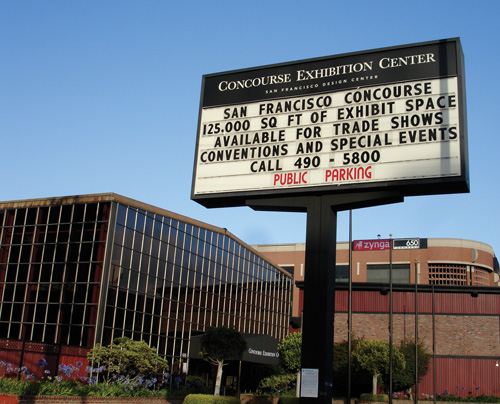
In one of the few remaining San Francisco neighborhoods untouched by gentrification, there is a proposal to demolish the Concourse Exhibition Center and replace the quintessential Showplace Square building with a market-rate residential project, which the developer says will be rental apartments.

This is the first major project in the new Eastern Neighborhoods Plan that will change the light industrial neighborhood where brick and mortar meet interior design, raising questions about whether the development would be sustainable, transit-oriented, and family-friendly.

Home to annual events like the Green Festival and the KPFA Craft Fair, the Concourse is where mom and pop vendors share their wares in an affordable venue — one of the few remaining in the city.

“Since ’96,” recounted Alan Van De Kamp, director of sales for the Green Festival, “they’ve been trying to sell it, to tear it down. You never know from year to year … You imagine at some point, somebody’s gonna say it’s time.”

Though nothing has been approved, the current proposal by developer and Concourse owner Bay West Development, first introduced in 2000, has come the farthest yet. The project will be considered for approval by the Planning Commission once the environmental review process is complete, which could take up to six months. Public comments on the project will be accepted until August 8.

The proposed project contains two sites, one at 801 Brannan Street and one at 1 Henry Adams Street, which would result in a total development of up to 674 residential units, 43,037 square feet of retail space, and 673 parking spaces. Under the city’s inclusionary housing laws, 221 of those units would be affordable (71 to be built on site and 150 dedicated to the city for development). Of the total parking spaces, 166 spaces would replace existing parking spots at the site.

Bay West, developer of the San Francisco Design Center, has owned the Concourse building for 30 years and wants to demolish and rebuild as part of the Eastern Neighborhoods Rezoning and Area Plans, the blueprint for development in a part of the city dominated by working class residents.

That controversial plan was in development for years, during which there was a moratorium on approval of large projects, and it was finally adopted in 2008. It was created to redevelop The Mission, Showplace Square/Potrero Hill, East SoMa, and the Central Waterfront — 7 percent of the city’s 47 square miles — over 20 years.

“It’s our feeling that the building itself is beyond its use as an exhibit hall and we’re replacing it with housing units,” said Sean Murphy, a partner at Bay West.

The Planning Commission heard the draft Environmental Impact Report for the proposal on July 28. At the hearing, the commissioners expressed interest in seeing the progression of the development, but not all were convinced.

“There is a certain amount of vagueness,” said Commissioner Kathrin Moore. “This EIR is ultimately tempered by the strong policy issues that underlie building in the Eastern Neighborhoods and at this moment I don’t quite see that.”

The proposal has left some questions unanswered, such as, where will the small vendors go to sell their wares? Bay West has suggested exhibition halls like the Cow Palace or Moscone Center, but Green Festival organizers say that isn’t realistic for everyone. “We would lose some of our vendors if we went to Moscone,” said Van De Kamp. “There’s some people that can’t come. A lot of the green economy is about mom and pops. They can’t afford it.”

Sue Hestor, a land-use attorney who opposes the development, asked vendors who use the Concourse how important leaving the center would be. “For a lot of people,” she said, “it meant the difference for them being viable or not.”

It would be a major challenge to move, said Robbie Kowal, the co-director of Sea of Dreams, a huge party and concert that will hold its seventh annual celebration this New Years Eve at the Concourse. “There’s the Cow Palace, and the Design Center, but it’s not that big, not a place where you can put a proper concert on one side and a multitude of different kinds of spaces [on the other]. The Sea of Dreams’ success is attributable to the proper use of the Concourse.”

With 125,000 square feet of space that can be split into its west and east halls and a mezzanine, the Concourse building has catered to annual festivals and events for more than 20 years, holding as many as 6,800 people at once.

“There’s room for so many different communities in there. We love our home,” said Kowal. “It’s a really unique and wonderful space.”

The redwood frame of the Concourse, accented by glass fronts that allow for natural lighting, used to be a furniture mart and then a fashion and jewelry mart before it was an event center. The project proposal’s architect, David Baker and Partners, has already designed many of the new buildings in Showplace Square.

Bay West isn’t worried about where the Concourse shows will go. “Most of our shows use less than 20,000 square feet,” said Murphy. “The larger shows would go to the 100,000 square foot San Mateo County Event Center.”

Tony Kelly of the Potrero Boosters Neighborhood Association says the intention of the plan is to reduce the light industrial area by zoning more of it for residential uses, protecting only about half of it and converting the remainder.

“This is an area where we don’t have enough parks, or transit. The project would double the population, and we don’t have enough new infrastructure to handle it,” he said. “It’s essentially a ticking time bomb that the city’s going to have to get a handle on at some point, or these residents are going to be miserable.”

Though the project would create at least an acre of publicly accessible open space, some residents wonder if it’s enough, and the concern about insufficient transit remains.

“It seems to me that once again there is too much parking near a freeway entrance, inadequate transit that is not likely to improve significantly once the Transit Effectiveness Project [a city plan for improving Muni service] is implemented,” said activist Sue Vaughan, who rides her bike at least part way during her commute from the Richmond District to REI at 840 Brannan Street for work.

“This is exactly the kind of place that attracts (commuters),” said Hestor. “There’s too much parking. There’s crappy transit. It totally undermines any idea of sustainable development.”

But at the commission hearing, Commissioner Hisashi Sugaya didn’t think Hestor’s argument had merit. “Parking is not an environmental impact as far as the city is concerned,” he said.

Vaughan says that Muni managers have been absent from several development meetings in the Eastern Neighborhoods area. “No one from Muni was represented on this panel discussion about the Sustainable Communities Strategy,” she said, referring to a July 6 meeting convened by the Planning Department to discuss the importance of building housing next to accessible transit.

The Concourse is scarcely accessible by bus lines 10 and 19, but with a growing population in Showplace Square, it wouldn’t be enough, says Vaughan. “We’re moving forward with all these projects with lots of parking near freeway entrances, which makes it seems like SF is becoming a bedroom community for Silicon Valley. You have an impact on Muni when that happens. With more cars, there’s more congestion for buses.”

Bay West argues that the apartments it plans to build at the Concourse site would be “workforce housing” with less than 1:1 parking (actual parking would work out to .79:1 at the 801 Brannan site and .64:1 at the One Henry Adams site). More than 40 percent of the units would be larger two-bedroom units intended for families.

Yet Kelly says that that by offering the apartments at market rates, none are appropriate for new families. “For all the talk about keeping families here, then how come we’re not building family housing?”

It’s a max-out project, says San Francisco architect Dick Millet, of the Potrero Boosters Neighborhood Association. “In the end, under their breath, they’re all going to say, I wouldn’t live there myself.”

Step up and save CCA

6

EDITORIAL Two things became abundantly clear at the San Francisco Public Utilities Commission meeting July 26th: The Community Choice Aggregation program is off track — and General Manager Ed Harrington has no interest in making it work. The supervisors need to move aggressively to save CCA.

Since 2007, when a draft implementation plan was released, the goals of the program — which is supposed to offer a cleaner alternative to Pacific Gas & Electric Co. — have shifted fairly dramatically. No longer does the plan seek to meet PG&E’s rates. It won’t be aimed at the entire city to start. And the PUC is putting most of its effort into a short-term contract to buy green power from Shell Energy North America — and all-but ignoring the more important moves to build a publicly owned energy-generation infrastructure.

CCA, which allows cities to buy power in bulk and resell it to customers, is a step in the right direction. The program now before the PUC would put San Francisco in the public power business — to a degree. But as the financial projections for the program demonstrate, the real savings and the real revenue won’t come until San Francisco replaces PG&E as the owner and operator of the local grid. A full-scale public power system would allow the city to both increase renewable power and cut rates — and would bring hundreds of millions into the treasury in the process (see “Mud Money,” 6/26/08).

Still, CCA offers many benefits — including the chance for the city to build local renewable energy facilities. And that’s where the PUC’s efforts ought to be focused.

During discussion of the proposed contract July 26th, Harrington was largely negative and talked repeatedly as if he didn’t think the original program could work. He kept saying that renewable power was more costly (true, today — but not after the city starts building its own facilities). He said that the goals the “advocates” (who include a majority of the Board of Supervisors) have demanded were unrealistic. And most of the commissioners seemed clueless.

That’s a terrible way to launch one of the most important environmental and financial initiatives in modern San Francisco history. Marin County is already well on the way to creating a working CCA system. Other counties are moving forward. And San Francisco, the only city in the nation with a federal mandate for public power, can’t get its civic act together.

The supervisors need to get involved, quickly. The Local Agency Formation Commission, which is overseeing this project, should haul Harrington in for a hearing as soon as possible. Among other things, the LAFCO members should ask why Harrington is so determined that the project won’t work; why his proposal is geared to a small number of residents and businesses who would face higher rates for power; and what his plans are to create a local energy generation infrastructure that over the long run would be dramatically cheaper and greener than anything PG&E (which has been in the background here trying to undermine CCA) will be able to offer.

The problems with CCA reflect the immense challenges of putting this program in the hands of a commission a majority of whose members were appointed by a mayor who opposed public power, managed by someone who has never supported municipalization efforts. Harrington and the SFPUC appear to be setting CCA up to fail. The supervisors need to step in before that happens — and every candidate for mayor needs to be pushed to publicly support CCA and make this an important campaign issue. And they need to promise that they’ll appoint people with real public power credentials who will replace Harrington and shake up the next PUC.

is Rec-Park really broke?

16

By David Looman

OPINION The senior staffers at the Recreation and Park Department routinely cry that the department is poor and going broke. Is it possible they are lying?

Conspicuously lacking in discussions of Rec-Park funding is any kind of hard data about how well or poorly San Francisco Rec-Park is really funded. Whether it’s the mainstream media, the alternative press, or our elected representatives on the Board of Supervisors, nobody seems to know how our park system compares with other park systems in California or the U.S.

And nobody seems to want to check up on Rec-Park’s sad-sweet story.

This lack of real information is particularly surprising, since the data is readily available. Every year, the Trust for Public Land, a well-respected, San Francisco-based park advocacy organization, conducts a meticulous and comprehensive survey of how well recreation and park systems across the country are being funded. The survey is always available on the Web, at www.tpl.org.

Surprise!

In the TPL’s 2000 book, Inside City Parks, by Peter Harnik, San Francisco was among the three best-funded systems, measured either per acre or per resident. In every annual survey after that, San Francisco continued to rank in the top three, until 2006. In 2006, the TPL found San Francisco to be the best-funded park system in America.

That’s right, the best-funded department in the entire U.S.!

This year’s survey, based on the 2008 figures, has changed its methodology a bit, and expenditures are no longer calculated per acre. With the new methodology, San Francisco has slipped a bit. The city is now only the fourth-best funded park system in the country for cities with populations larger than 500,000, and the sixth best for cities over 250,000.

For operating expenditures (total budget minus capital spending) San Francisco is the fourth best funded among all cities. We don’t have as many capital expenditures as, say, Seattle, whose newer park system is still growing.

The question of where that money goes is another matter. I think I can offer a few suggestions about what happens.

Problem number one is the long and glorious history of absolutely incompetent management, particularly in the last 15 years, under the administrations of mayors Willie Brown and Gavin Newsom. Second is that longstanding Rec-Park Department practice of ignoring and rejecting any public input, including factual input, from people who actually use and know the parks. This has led to a number of costly mistakes.

The department has more ethically dubious faults too—the wages spent organizing so-called “public support” for some of its unpopular projects; more wages spent having employees testify about what a great job the department is doing, etc.

The department presently is trying to privatize everything within reach. Its poor-mouth rational for doing so is false. It’s time we all faced the fact that Rec-Park isn’t giving us the whole truth.

David Looman is a longtime San Francisco political consultant and parks user.

The foodie crackdown

3

news@sfbg.com

Yet another blow was dealt to the San Francisco’s free-thinking food scene on June 11 when the final Underground Market was staged by ForageSF, at least for the time being. The market was shut down by the San Francisco Department of Public Health (SFDPH) in a clash between small-time food businesses and city officials over permitting and regulatory issues.

“I was ready for this for a while,” ForageSF founder Iso Rabins told us. “I thought someone would show up eventually to say something about this, and now they have.”

Rabins began the Underground Market in 2009 as a monthly venue for food entrepreneurs to share their goods without financial and bureaucratic red tape. It’s basically a farmers market without the permits, fees, and commercial kitchen requirements that add thousands of dollars to the cost of staging an event. Throw in live music, drinks, a little subversive thrill, and you’ve got a gathering that has proven enormously popular.

Until now, the market has operated as a private event. It is held in a private space and attendees are required to sign a membership form and pay a $5 entrance fee. It’s become a huge draw for foodies, with 1,500 to 3,200 patrons per event, according to Rabins, so the state government got wind of its largely unregulated operations.

Alicia Saam, the temporary events coordinator with SFDPH, says her department was asked by state officials to observe the market. It’s now too big to be considered private, she says, so it must adhere to health code and public safety regulations just like any other public event.

“One of the things that differentiate private versus public events is how much advertisement goes out there,” Saam said. “Something that is advertised and has grown big enough to have a following, that becomes a concern for us as a public event.”

Without official oversight, rules are bound to be broken. As with any novice venture, mistakes are made. When officials came to the Underground Market, they saw some vendors acting more like friends at a house party than professional food vendors, which is the complicated line that the market tries to toe.

“We observed operators and vendors eating and then handling the food, and that’s a huge contamination hazard for us,” Saam said. “They weren’t washing their hands before continuing food service, nor did they have a hand-washing set-up right there at their booth. There looked to be temperature issues as far as some of the food that was being stored, such as protein foods, sausages, and dairy. Some foods were not protected but were displayed on the table uncovered. People come up and they’re excited and curious, there’s a lot of creativity there, so they’re hovering over the food and possibly contaminating it with all sorts of things. The source of food, such as the kitchen where the food is coming from, needs to be an approved space where there are no animals, or cats like in some homes. It needs to be a commercial space that is properly cleaned and sanitized.”

According to the U.S. Center for Disease Control, one in six Americans get sick each year from eating contaminated food. Salmonella infection is of particular concern because food can be contaminated anywhere from the fields to kitchen surfaces.

The SFDPH has already allowed the Underground Market to operate unregulated for more than a year without any reported food illnesses, but Rabins is quick to agree that these health concerns are real.

“I do believe that these issues of health are important, and although I feel that all the vendors at the market are very careful about what they make, we do want to institute some Serve-Safe classes, basic food safety,” Rabins says.

He says that on the whole, people cooking small batches pay much more attention to their ingredients and processes than industrial food companies do. Rabin said that while the country’s food safety system works pretty well, it doesn’t allow for much locally based innovation in new models for making and sharing food.

“The Health Department’s position makes sense because this is the system that has existed, this is the system that they know and that their jobs support, and it’s a system that works in a lot of ways. But it’s also a system that was really created for industrial processes,” Rabins says. “Unfortunately the way regulations work, top-down is one-size-fits-all, but that’s just not the way it is.”

That gets to the meat of the issue: whether and how much the city should get involved in people’s food habits. Where is the line between public restaurants and private homes — and are there ways of creating hybrids of the two? It’s an ongoing battle in San Francisco between regulating restaurants (and netting taxes) while still promoting an innovative food industry that attracts locals and tourists alike.

In the past few years, the mobile food truck craze has hit San Francisco with little bits of foodie culture from all over the world. Entrepreneurs say it’s too difficult and expensive to start a successful restaurant in SF, so they’re trying small-time pop-ups instead.

At first they went unregulated, but now laws define what they can sell, the permits they need, and limit their mobility. Permits are expensive too, starting at $1660 for initial basic coverage, which is why Rabins says the Underground Market provides an additional support for motivated locals. As city officials have closed big budget deficits year after year without any substantial increases in general tax revenue, fees and permit costs have risen substantially in recent years.

According to Rabins, getting the Underground Market up to code means, “getting all the vendors commercial kitchen space, making them get catering licenses, which is around $600, making them pay for vendor event permits, which is $140 per event, and then I would have to buy a sponsor permit which is another $1200 per event plus event insurance plus, plus, plus all these things that would essentially destroy the spirit of the event. It would make the bar way too high.”

Tightening the membership rules is another option, such as making people sign up weeks in advance or requiring member cards. Richard Lee, the director of environmental health regulatory programs at SFPHD, says that regardless of the vendor’s complaints, the regulations must be met.

“We think that these are reasonable options,” Lee said. “Anyone who is going to sell to the public needs to meet certain requirements, and unfortunately some of those requirements are going to be costly. They have to pay for permits and whatever those permits cost they’re going to have to pay.”

Until some agreement can be reached, the Underground Market won’t be operating, and San Franciscans will have to find their fix at the numerous above ground markets and restaurants. Lee says that he hopes that the market meets city demands, and soon, as this kind of entrepreneurial innovation is essential to a thriving food economy.

“We do encourage the micro-enterprises, and there are possible ways to have that started in San Francisco,” Lee said. “It is possible that there may be legislation in the future that might be supported by the Board [of Supervisors] to make it easier for them to get permitted, so there are things that can be done. For us, though, it is food safety and public health that are the most important things.”

But Rabins is already looking far beyond just the small market model.

“They just want to make it another farmers market,” Rabins said. “I’m not interested in running another farmers market. There are plenty of farmers markets around and people who have been doing them for years and know how to do them.”

He also isn’t interested in conforming to the pre-set expectations and sees the motivation behind the market taking it to new heights. In addition to reopening, he says that ForageSF has secured a kitchen space for helping entrepreneurs launch their small businesses and host public classes.

“We are going to hopefully have a rooftop garden with a movie screen, a retail space in front that sells products being made in the kitchen by vendors, and possibly a small-scale brewery in back,” Rabins said.

He is also reaching out to other similar market organizers, such as some in Los Angeles, to brainstorm ways to make this business model more acceptable across the country. He says they are in the initial phases of creating a model that is reproducible for others who want to start their own markets.

Once again, in the place where the organic food movement first bloomed, people are coming together to create new interactions between producers, consumers, and their food.

Whose voice?

0

arts@sfbg.com

FILM In 1981 Deborah Kaufman founded the nation’s first Jewish Film Festival in San Francisco. Thirteen years later, with similar festivals burgeoning in the wake of SFJFF’s success — there are now over a hundred around the globe — she left the festival to make documentaries of her own with life partner and veteran local TV producer Alan Snitow.

Their latest, Between Two Worlds, which opens at the Roxie this Friday while playing festival dates, could hardly be a more personal project for the duo. Both longtime activists in various Jewish, political, and media spheres, Snitow and Kaufman were struck — as were plenty of others — by the rancor that erupted over the SFJFF’s 2009 screening of Simone Bitton’s Rachel. That doc was about Rachel Corrie, a young American International Solidarity Movement member killed in 2003 by an Israeli Defense Forces bulldozer while standing between it and a Palestinian home on the Gaza Strip.

As different sides argued whether Corrie’s death was accidental or deliberate, she became a lightning rod for ever-escalating tensions between positions within and without the U.S. Jewish populace on Israeli policy, settlements, Palestinian rights, and more — with not a few commentators amplifying the conservative notion that any criticism of Israel is anti-Semitic, even (or especially) when it comes from Jews themselves.

People who hadn’t seen (and boasted they wouldn’t see) the strenuously even-handed Rachel called the documentary an “anti-Israeli hate fest” akin to “Holocaust denial,” its SFJFF inclusion “symptomatic of a demonic strategy” by “anti-Semites on the left.”

Stunned SFJFF executive director Peter Stein (who’s leaving the festival after its current edition) decried Jewish community “thought police” who pressured the institution and those connected to it with defunding and boycotting threats. The festival attempted damage control by inviting a public foe of the screening (Dr. Michael Harris of StandWithUs/Voice for Israel) to speak before it, which only amplified the hostile rhetoric.

Seeing the festival being used by extremists on both sides became a natural starting point for Between Two Worlds, which takes a many-sided, questioning, sometimes humorous look at culture wars in today’s American Jewish population. It touches on everything from divestment debates at UC Berkeley to the disputed site of a Museum of Tolerance in Jerusalem (atop a 600-year-old Muslim cemetery), from the tradition of progressive liberalism among U.S. Jews to rising ethnic-identity worries spawned by intermarriage and declining birth rates.

The fundamental question here, as Kaufman puts it, is “Who is entitled to speak for the tribe?” For the first time, the filmmakers have made themselves part of the subject matter, exploring their own very different personal and familial experiences to illustrate the diversity of the U.S. Jewish experience. Snitow’s mother had to hide her prior Communist Party membership to remain active in social-justice movements after the 1940s, while Kaufman’s father was a devoted Zionist from his Viennese childhood who had to adjust to offspring like “Tevye’s daughters gone wild,” including one who converted to Islam.

They’re clearly in sympathy with other documentary interviewees insisting that one core of Jewish identity has been, and should remain, a stance against absolutism and injustice towards any peoples. Between their SFJFF screenings the filmmakers chatted with the Guardian.


SFBG Is the Bay Area still a bastion of Jewish liberalism, relatively speaking?

Deborah Kaufman What we saw at the festival during the Rachel uproar was a collapse of the center. It was really a moment when the extremes were at battle and the center simply disappeared. That’s what was and is so disturbing. A kind of apathy where the moderates just throw up their hands and walk away from what’s become a very toxic debate.

Alan Snitow It’s not that the Bay Area is unique to boo a so-called “pro-Israel” speaker [like Harris]. It’s that the Bay Area has maintained an open debate about Israeli policies when other Jewish communities never countenanced such debate from the get-go. Rachel was not shown in other Jewish film festivals around the country because they are already creatures of conservative donors. The aim in this power grab by the right in San Francisco was and is to silence people and institutions like the festival that oppose a McCarthyite crackdown in a remaining bastion of free speech. And this is being mirrored in Israel itself where the Knesset recently passed a law punishing anyone who publicly supports the idea of a boycott of the West Bank settlements.

I think we also have to question this claim of “pro-Israel.” All criticism of Israel’s occupation is now being branded as “anti-Israel.” “Pro-Israel” has come to mean pro the policies of the current, most right-wing government in Israeli history — a government that is now advocating the truly Orwellian position that there is no occupation at all! That’s not what pro-Israel or Zionist ever meant except to some ideologues on the far right.


SFBG Had you already been thinking about somehow addressing political rifts in the Jewish community before the SFJFF fracas?  

DK We began the film over a year before the SFJFF fracas. We were focusing more on Jewish identity than politics — looking at intermarriage, hybrid identities, a new generation of American Jews — we wanted to re-tell the Biblical story of Ruth, and we were following a fantastic feminist-queer internet discussion called “Rabbis: Out Of My Uterus!” that we thought would be fun to film. But we kept getting swept into the Israel vortex and realized we had to address the question of dissent and who speaks for the Jewish community at this historical moment for the film to be relevant.

Between Two Worlds opens Fri/5 at the Roxie.

Non-accidental tourist

0

le_chicken_farmer@yahoo.com

CHEAP EATS It’s an interesting experience to be a tourist in one’s own town. I recommend it. And I don’t mean showing your visitors to the Golden Gate Bridge and Alcatraz, a big, good dinner, and then going home; I mean sleeping at the hotel with them. Wandering around with a confused expression on your face, asking silly questions, and wearing funny clothes are optional, but encouraged.

Hedgehog is allergic to cats and Stoplight pretty much is one. For me, the decision was easy. As much as I enjoy sleeping with my cute little kitty all tangled in my hair and trying between four and five every morning to scratch out my eyeballs, I prefer the sensation of soft, warm, human skin, along with some other advantages such as sex, intelligent conversation, and sleep.

Hedgehog being for the most part a human being, I subletted my place and puss a little earlier than I had to, and went with her.

One night we stayed at the Edwardian on Market and Gough. This is not my new favorite hotel, but on the plus side it put me in a position to eat three things I might not have otherwise eaten, including a bowl of Italian wedding soup from Caffé Trieste across the street.

As far as I know, there are no other kinds of wedding soup beside the Italian kind. It has, traditionally, escarole in it, and tiny meatballs, in a chicken broth with celery and onions. Some wedding soups also contain pastine, which is both little tiny pasta similar to orzo, and one of my cousins in Ohio.

The Leone family recipe never had pasta in it. Nor did the Rubino family recipe. Maybe because both of my Grandmas came from the same li’l village in Italy. They made, instead, these dense cheesy eggy spongey croutons we called cheesies. And if you ever are lucky enough to have a holiday dinner with any one of my siblings, but especially Maria, there will be wedding soup with cheesies.

I have never had it at a wedding.

But then again, I have never had a wedding. If I do, there will be wedding soup like this, and that will be all I need to know. I personally can’t stop eating it once I start.

Except at a restaurant because then you’re at a restaurant. And if I don’t change the subject soon, this will be a restaurant review, which won’t exactly do. So let me tell you what we watched on television at the Edwardian Hotel that night.

The San Francisco Giants, and the San Jose Giants, who were playing two different teams on two different channels — and at my apartment there isn’t even a TV, so take that, Stoplight.

Tourism 1, Stoplight 0.

I’m just kidding. Before the game(s), we went to Sushi Zone for an early dinner. We got there at 5:30, before the masses, and sat right down at the counter. The place is, of course, miniscule. Two booths and maybe six or eight seats at the bar. By six there was a waiting list, and people were bringing their knitting and pitching tents on the sidewalk.

Can I tell you how smug we felt? Sitting and eating our early-bird dinner? So smug that I almost hated us . . . but loved the worms. Truly, this is top-shelf sushi.

Hedgehog had the baked mussel appetizer, which had mayonnaise in it, so I passed on that and ate a salad. Everything sushi-y that we had was fantastic, including regular old saba, but the show stopper was tuna with mango and something else.

It was the mango and wasabi combination that caught Hedgehog’s attention, and then mine when she showed it to me. I am always looking for new taste sensations and good, ripe mango with wasabi on it — not to mention the fish and ginger and everything — really floated my boat. This carried me over, happinesswise, until our late dinner, which occurred out of nowhere on our way back to the hotel, but we’ll all have to wait until next week, cause I’m out of inches.

For at least 20 minutes, my new favorite restaurant was:

SUSHI ZONE

Mon.-Sat. 5-10 p.m.

1815 Market, S.F.

(415) 621-1114

Beer and wine

Cash only

Music Listings

0

Music listings are compiled by Emily Savage. Since club life is unpredictable, it’s a good idea to call ahead or check the venue’s website to confirm bookings and hours. Prices are listed when provided to us. Submit items for the listings at listings@sfbg.com. For further information on how to submit items for the listings, see Picks.


WEDNESDAY 3

ROCK/BLUES/HIP-HOP

Carolyn Wonderland Cafe Du Nord. 9:30pm, $15.

DNTEL, One Am Radio, Geotic Rickshaw Stop. 8pm, $10-$12.

Early and Often, Goodriddler, Build Us Airplanes Bottom of the Hill. 9pm, $8.

Midnite Snaxx, Veronica Hemlock Tavern. 9pm, $5.

Proclamation, Sanguis Imperem, Pale Chalice Elbo Room. 9pm, $10-$12.

This is Hell, Decoder, Endwell, Until Your Heart Stops Thee Parkside 8pm, $10.

JAZZ/NEW MUSIC

Cat’s Corner with Nathan Dias Savanna Jazz. 9pm, $10.

Cosmo Alleycats Le Colonial, 20 Cosmo, SF; www.lecolonialsf.com. 7pm.

Dink Dink Dink, Gaucho, Michael Abraham Amnesia. 7pm, free.

Jazz organ party with Graham Connah Royal Cuckoo, 3202 Mission, SF; www.royalcuckoo.com. 7:30pm, free.

Ben Marcato and Mondo Combo Top of the Mark. 7:30pm, $10.

Curtis Salgado Biscuits and Blues. 8 and 10pm, $18.

DANCE CLUBS

Booty Call Q-Bar, 456 Castro, SF; www.bootycallwednesdays.com. 9pm. Juanita Moore hosts this dance party, featuring DJ Robot Hustle.

Buena Onda Little Baobab, 3388 19th St, SF; (415) 643-3558. 10pm, free. Funk, swing, rare grooves, and more with Dr. Musco and guests.

Mary Go Round Lookout, 3600 16th St, SF; www.lookoutsf.com. 10pm, $5. Drag with Suppositori Spelling, Mercedez Munro, and Ginger Snap

No Room For Squares Som., 2925 16th St, SF; (415) 558-8521. 6-10pm, free. DJ Afrodite Shake spins jazz for happy hour.


THURSDAY 4

ROCK/BLUES/HIP-HOP

AXXONN, En, Holly Herndon Hemlock Tavern. 9pm, $7.

A Decent Animal, Bitter Honeys Cafe Du Nord. 9pm, $10.

Exhumed, Macabre, Cephalic Carnage, Withered Slim’s. 8pm, $16.

Flexx Bronco 330 Ritch. 9pm, $8.

Halden Wofford and Hi Beams Amnesia. 9pm, $7.

Hydroponic, Agent Deadlies, Over the Falls Bottom of the Hill. 9pm, $8.

Texas Thieves, Unko Atama, Paper Bages Knockout. 10pm, $7.

Tornado Rider, Phenomenauts, Judgement Day Great American Music Hall. 8pm, $14.

Wailers, Revival Sound System Independent. 9pm, $25.

JAZZ/NEW MUSIC

Jazz organ party with Graham Connah Royal Cuckoo, 3202 Mission, SF; www.royalcuckoo.com. 7:30pm, free.

Tom Lattanand, Jon Raskin Quartet El Valenciano, 1153 Valencia, SF; (415) 826-9561. 9pm, $5.

DANCE CLUBS

Afrolicious Elbo Room. 9:30pm, $5. Afrobeat, Tropicália, electro, samba, and funk with DJs Pleasuremaker and Señor Oz.

Guilty Pleasures Gestalt, 3159 16th St, SF; (415) 560-0137. 9:30pm, free. DJ TophZilla, Rob Metal, DJ Stef, and Disco-D spin punk, metal, electro-funk, and 80s.

1984 Mighty. 9pm, $2. The long-running New Wave and 80s party features video DJs Mark Andrus, Don Lynch, and celebrity guests.

PAWAS, Clint Stewart, Atish and Mark Slee, Dheeraj Sareen, Jamaica Suk Public Works. 10pm, $5-$7. Electronic dance music.

Shit Robot DJ Set Rickshaw Stop. 10pm, $7.

Thursday Special Tralala Revolution Café, 3248 22nd St, SF; (415) 642-0474. 5pm, free. Downtempo, hip-hop, and freestyle beats by Dr. Musco and Unbroken Circle MCs.

Tropicana Madrone Art Bar. 9pm, free. Salsa, cumbia, reggaeton, and more with DJs Don Bustamante, Apocolypto, Sr. Saen, Santero, and Mr. E.


FRIDAY 5

ROCK/BLUES/HIP-HOP

Bastard Noise, Landmine Marathon, Voetsek, Hosebeast Sub/Mission, 2183 Mission;www.sf-submission.com. 8pm, $10.

Brass Tax Amnesia. 9pm, $5.

Rick Estrin and Nightcats Biscuits and Blues. 8 and 10pm, $20.

La Corde, Ggreen,Waldo Astoria Hemlock Tavern. 9:30pm, $7.

Mirah, Tara Jane O’Neil El Rio. 9pm, $5-$10.

Mr. Big Fillmore. 9pm, $35.

Mustache Harbor, Private Idaho Slim’s. 9pm, $15.

New Monsoon, Sean Leahy and Friends, Kiyoshi Foster with late night set by New Monsoonageddon Great American Music Hall. 9pm, $15.

Pollux, Cure for Gravity, Repeat After Me Bottom of the Hill. 10pm, $10.

True Mad North, Red Weather, City Tribe, MilesCountry Hotel Utah Saloon. 8:30pm, $8.

JAZZ/NEW MUSIC

Black Market Jazz Orchestra Top of the Mark. 9pm, $10.

Rick Estrin and Nightcats,Little Charlie Baty Biscuits and Blues. 8 and 10pm, $20.

Jazz organ party with Graham Connah Royal Cuckoo, 3202 Mission, SF; www.royalcuckoo.com. 7:30pm, free.

Vaughan Johnson Jazz Combo Jack’s Club, 2545 24th St., SF; (415) 641-1880. 7pm, free.

DANCE CLUBS

Afro Bao Little Baobab, 3388 19th St, SF; (415) 643-3558. 10pm, $5. Afro and world music with rotating DJs including Stepwise, Steve, Claude, Santero, and Elembe.

Duniya Dancehall Bollyhood Cafe, 3372 19th St., SF; www.duniyadance.com. 10pm, $5-$10. Bangra, Bollywood, and West African dance.

Oldies Night Knockout. 9pm, $2-$4. Doo-wap, one hit wonders, and soul with DJ Primo, Daniel and Lost Cat.

120 Minutes Elbo Room.10pm, $5-$10. With Resident Djs Whitch and Nako plus special guest Nike 7UP.

Steffi, Mike Huckaby, Beautiful Swimmers, Lovefingers Public Works. 9pm, $10-$15.

Vintage Orson, 508 Fourth St, SF; (415) 777-1508. 5:30-11pm, free. DJ TophOne and guest spin jazzy beats for cocktalians.


SATURDAY 6

ROCK/BLUES/HIP-HOP

Justin Ancheta Amnesia. 10pm, $30.

Annie Bacon and Her Oshen Riptide. 10 and 11:15pm, free.

Cast of Thousands featuring Brady Kids String Players, Kindness and Lies, Tremor Low Cafe Du Nord. 9:30pm, $10.

Dredg, Trophy Fire, Strange Vine Great American Music Hall. 8pm, $20.

Dub Fillmore Festival Gene Suttle Plaza and Fillmore Center, Fillmore and O’Farrell; www.dubfillmorefest.com. 10am, free.

Mickey Hart Band Independent. 9pm, $30.

Moenia Fillmore. 9pm, $35.

Oakhelm, Walken, Negative Queen El Rio. 10pm, $7.

San Francisco Rock Project Amoeba. 2pm, free.

San Frandelic Summer Fest Thee Parkside. 2pm, $12.

Sioux City Kid, Kill Moi, Tiny Television Bottom of the Hill. 10pm, $10.

Torche, Big Business, Thrones Slim’s. 9pm, $15.

Wet Illustrated, Angora Debs, Dimples Hemlock Tavern. 9pm, $5.

WomenROCK’s Fifth Anniversary Celebration Box Factory,865 Florida, SF; (415) 637-6870. 2pm, free.

JAZZ/NEW MUSIC

Bonjour, Tristesse St. Gregory of Nyssa Episcopal Chuch, 500 De Haro, SF; www.pacificcollegium.org. 8pm, $10-$30.

Jazz organ party with Graham Connah Royal Cuckoo, 3202 Mission, SF; www.royalcuckoo.com. 7:30pm, free.

John Weise, C. Spencer Yeh, Bill Orcutt, Pod Blotz Lab, 2948 16th St., SF; www.thelab.org. 9pm, $6-$15.

DANCE CLUBS

Afro Bao Little Baobab, 3388 19th St, SF; (415) 643-3558. 10pm, $5. Afro and world music with rotating DJs including Stepwise, Steve, Claude, Santero, and Elembe.

Bootie SF DNA Lounge. 9pm, $8-$10. Mashups with DJ Paul V, DJ Fox, and John!John!

Club 1994 Rickshaw Stop. 9pm, $10-$15. ’90s hip-hop and TRL classics

Debaser Knockout. 9pm, $5. ’90s alternative dance party with DJ Jamie Jams and Emdee.

ESL Music Showcase Public Works. 930pm, $10-$20. Featuring Nickodemus, Rob Garza, Afrolicious, DJ Sep.

Sanafrica Bollyhood Café. 9pm, $7-10. West African and Latin fusion party with Jose Luis, DJ Nado, and DJ Mignane.

Saturday Night Soul Party Elbo Room. 10pm, $10. Sixties soul 45s with DJs Lucky, Phengren Oswald, and Paul Paul.


SUNDAY 7

ROCK/BLUES/HIP-HOP

Bowling for Soup, Dollyrots, Sunderland Bottom of the Hill. 9pm, $15.

Gorilla Takeover DNA Lounge. 5:30pm, $10-$12.

Hipwaders at JAMband Family Festival Park Chalet, 100 Great Hwy., SF; www.parkchalet.com. 3pm, free.

Hurd Ensemble, Ellul Hemlock Tavern. 9pm, $6.

“Jerry Day” Jerry Garcia Amphitheater,40 John F. Shelley, SF; jerryday.org. Noon, free.

Aaron Neville and Quinn Deveaux, Blue Beat Review Stern Grove, 19th Ave. and Sloat, SF; www.sterngrove.org. 2pm, Free.

Kally Price Old Buster Blues and Jazz Band, Emperor Norton’s Jazz Band Amnesia. 9pm, $5.

Twang Sunday with Going Away Party, Creak Thee Parkside. 4pm, free.

YOB, Dark Castle, Hornss Elbo Room. 3pm, $10-$12.

JAZZ/NEW MUSIC

Bonjour, Tristesse St. Gregory of Nyssa Episcopal Chuch, 500 De Haro, SF; www.pacificcollegium.org. 8Pm, $10-$30. A cappella music from the 20th century on.

Jazz organ party with Graham Connah Royal Cuckoo, 3202 Mission, SF; www.royalcuckoo.com. 7:30pm, free.

Matt Schofield Biscuits and Blues. 8 and 10pm, $20.

DANCE CLUBS

Batcave Cat Club. 10pm, $5. Death rock, goth, and post-punk with Steeplerot Necromos and c_death.

Fresh Ruby Skye. 6pm. DJ Kevin Lee and Derek Monteiro. Benefiting Glide Memorial Church.

Dub Mission Elbo Room. 9pm, $6. Dub, roots, and classic dancehall with DJ Sep, Ludichris, and guest Matt Haze.

Jock Lookout, 3600 16th St, SF; www.lookoutsf.com. 3pm, $2. Raise money for LGBT sports teams while enjoying DJs and drink specials.

La Pachanga Blue Macaw, 2565 Mission, SF; www.thebluemacawsf.com. 6pm, $10. Salsa dance party with live Afro-Cuban salsa bands.

Tropical Hot Dog Night Knockout. 10pm, free. Mutant disco and post punk with DJ Placentina, Lady of the Night.


MONDAY 8

ROCK/BLUES/HIP-HOP

Adam Arcuragi and Lupine Choral Society, Fancy Dan Elbo Room. 9pm, $7.

Dominique Leone, Horns of Happiness, Aaron Novik/Thorny Brocky Knockout. 10pm, $7.

DANCE CLUBS

Death Guild DNA Lounge. 9:30pm, $3-5. Gothic, industrial, and synthpop with Joe Radio, Decay, and Melting Girl.

M.O.M. Madrone Art Bar. 6pm, free. DJs Timoteo Gigante, Gordo Cabeza, and Chris Phlek playing all Motown every Monday.

Sausage Party Rosamunde Sausage Grill, 2832 Mission, SF; (415) 970-9015. 6:30-9:30pm, free. DJ Dandy Dixon spins vintage rock, R&B, global beats, funk, and disco at this happy hour sausage-shack gig.


TUESDAY 9

ROCK/BLUES/HIP-HOP

Timothy Bloom Cafe Du Nord. 9:30pm, $12.

Bombshell Betty and Her Burlesqueteers, Fromagique Elbo Room. 9pm, $10.

Imelda May Independent. 8pm, $20.

Misner and Smith Dastardly Amnesia. 9:30pm, $5.

Tortured Genies,Roomate, Sunbeam Rd Hemlock Tavern. 9pm, $6.