San Francisco

Sundance Diary, volume two: ‘Beasts’ and ‘Daughters’

0

In a series of posts, Midnites for Maniacs curator-host and Academy of Art film-history teacher Jesse Hawthorne Ficks reports on the 2012 Sundance Film Festival. Check out his first entry here.

The surprise hit at this year’s Sundance Film Festival was Benh Zeitlin’s Beasts of the Southern Wild, which not only has the power to hypnotize but to also enlighten with its striking cinematography, fantastical special effects (wonderfully designed by San Francisco’s own Academy of Art University), and a truly guttural performance by newcomer Quvenzhané Wallis. She plays Hushpuppy, a precocious six-year-old searching to understand a world post-Katrina, post-race, and more importantly post-childhood.

Combining David Gordon Green’s George Washington (2001), Spike Jonze’s Where the Wild Things Are (2008), and most appropriately Julie Dash’s Daughters of the Dust (1991), Zeitlin has created a genuinely haunting enigma for modern audiences that deserves multiple viewings for maximum understanding. But even though it won both the U.S. Dramatic Grand Jury Prize and the U.S. Dramatic Excellence in Cinematography Award at this year’s festival, will Beasts ultimately be able to find an audience outside of the festival?

As it happens, Daughters of the Dust was restored for this year’s festival (and correctly color timed for the first time ever!) This visual poem exploring South Carolina’s coastal Gullah culture is as modern, historical, profound, and universal as Jane Campion’s The Piano (1993) and Terrence Malick’s Tree of Life. Yet for some reason, the film did not find a very large audience. With Sundance holding a 30-plus minute Q&A with Dash herself following the screening, many historical and symbolic details were explored — but more importantly, you were able to just sit with the film.

http://www.youtube.com/watch?v=c4PEcVK6gbM

When I was in college, Daughters was truly was one of the most difficult movies for me to keep up with (I fell asleep multiple times, couldn’t understand the character’s accents, etc.) Seeing it again for its 20th anniversary, the film feels more than ever like a revelatory example of visual narrative cinema: images and sounds sweep the viewer into a place where they can slow down and absorb the kind of filmmaking that can resonate in your soul.

Up next: Jesse Hawthorne Ficks goes doc-wild in his third Sundance Diary.

Bangarang: DIY hip-hop collective Doomtree is back

0

There’s something undeniably envy-inducing about a music collective. Everyone lives their separate lives yet they have continuing influence on one another; they hover nearby for comfort and camaraderie, maintain a steadfast family, and encourage a breeding ground for creatives. The emcees, DJs, lyricists, and producers in the Twin Cities-based DIY hip-hop collective/label Doomtree seem to have that system down pat. Under their own monikers, they create praise-worthy individual records. Together, the group carves out quality time and records masterpieces.

“Every year we do an end of the year, label showcase at First Avenue which is kind of like our legacy club in Minneapolis” says sole female emcee Dessa (Maggie Wander) as the group van careens down the mountains in some “white, alien-looking terrain” a week into a tour that takes it to San Francisco this week. 

“We initially started doing that show as a test of our own draw. Over the years it’s morphed into this like, pagan celebration of the preceding year,” she adds. “It’s hours of music together, you can see how much time we’ve spent together as friends, and occasional roommates – living together in conversion vans and sharing hotel beds.”

Last November’s No Kings, the latest full-length from the seven-piece, is one of those rare accomplishments in the music world; it’s at once fun and earnest, boasts quality rhymes, good beats, and catchy hooks, and features a rotating Lazy Susan of frontpersons. No kings, no group leader. The record is obviously the work of a collective, a rather in tune one at that – most went to high school together, some have been friends since junior high.

Among the catchiest of the No Kings bunch is a little hip-hop track dubbed “Bangarang” – yes, also the name of a Skrillex song and EP but, no, it’s not remotely dubstep. Doomtree’s is tougher and amusing, with a hearty beat and quick-spitting flow. The lyrics mesh the funny with the thought-provoking – “all these rappers sounds the same/beats/sound the same/raps/sound the same.” and later, “I built more than a rap career/I’ve got my family here.” The band wisely chose to feature the song in a video based around a karaoke night, meaning the words scroll across the screen for the viewer as well. Oh, and that karaoke night is hosted by a sensually stripping Har Mar Superstar, the perfect star for such a video.

http://www.youtube.com/watch?v=E2dX_k6MvWM

“We thought it would be fun to showcase the personalities within Doomtree, and a goofier side to the performers,” says Dessa. “And we’ve been friends with that dude [Har Mar] for a really long time.” Har Mar is part of the sex-oozy Gayngs collective (also of Minneapolis), which runs in the same circles as Doomtree.

The idea for the video came about when producer-DJ Lazerbeak (Aaron Mader) was sitting at a bar with the producer who made the video and they agreed a karaoke video would be easy, and they could get Har Mar to run up on tables, singing and screaming. Then we get to the core of the reason for it: it’s cheap and looks great. “We’re an independent label, and we’re artists owned and operated, so keeping costs down is the name of the game!” Dessa says.

The obvious question, to me at least, was if the group itself enjoys the occasional karaoke night out. Does art imitate life? In this case, no. No, it doesn’t.  Dessa and Lazerbeak giggle when I pose the question. “We’ve never done it,” Dessa says. “A big no,” Lazerbeak laughs. Whatever guys.

Doomtree

With 2Mex
Tues/31, 9 p.m., $16
Slim’s
333 11th St., SF
www.slimspresents.com

An expert’s pour: What and where to drink during SF Beer Week

0

Now that Drynuary has basically curled up into a ball and died (take that, seasonal sobriety!), it’s time to turn our gaze to SF Beer Week. 10 days of heavyweight gourmet beer drinking lie ahead of us, Bay Area. Even if your hankering for a beer paunch pales in comparison, say, to your desire to fit into your Valentine’s Day party dress, you have a responsibility to indulge.

For Beer Week is not just a gustatory pleasure — it supports what has burgeoned in SF into a thriving biz. Breweries sized from nano to Anchor are filling a six pack near you. Feb. 10-19 will conjure everything from urban beer hikes to beer-and-chocolate pairing events, beer-and-cheese couplings to the finest in bitter ales. Quite recently, we had the pleasure to one-on-one (via email) with David McLean, the mastermind behind all the brews at Magnolia Brewery. This isn’t his first time talking with the Guardian about the miracles of local boozing, but this time we’ve captured his can’t-miss picks for hobnobbing and hops that will take place Feb. 10-19 (and yes, they include an stout made with Hog Island oysters).

San Francisco Bay Guardian: In general, what are your top picks for Beer Week this year? 

David McLean: There are still so many incoming events in the queue to be posted to the schedule that I’m not sure we’ve even been exposed to half of what 2012’s SF Beer Week has to offer. But what I think we are starting to see is a more developed, organic process of brewers and other food-beverage professionals coming together in all kinds of great collaborations. This being the fourth year, my sense is that everyone’s creativity is much better developed following a few years of trying things out, seeing what works, seeing what other people are doing, and so forth. I’m not sure events like the SpeakeasySchmaltzNinkasiHomebrew Chef [tasting dinner with circus performers at the Elk Lodge] or the Trumer and Bols dinner at Comstock Saloon could have happened in year one, for example. And, the big opening celebration (Feb. 10) got a lot bigger this year, having moved to a new venue for us — the Concourse Exhibition Center. [Plus, we’ve] partnered with Noise Pop for the music and Off the Grid and other great vendors for the food. 

SFBG: Anyone new on the scene whose brews you’re excited to sample?

DM: After many delays (all par for the course) it is super-exciting to have Southern Pacific Brewing Company open just in time for SF Beer Week. As the first new brewery built in San Francisco in many years (close to 10), that one leads the pack in terms of excitement level. But the big story in craft beer this year is growth and newcomers to the industry — there are a number of other new beers and brewing companies in the Bay Area that are all worth trying. Another SF company just getting off the ground is Pacific Brewing Laboratories, which is starting to get its Squid Ink IPA and a couple of other beers into bars and restaurants. Almanac’s latest seasonal release, Winter Wit, should be hitting the streets just in time for Beer Week too, and it’s worth hunting down.

SFBG: A new release from a well-established local brewery you’re excited about?

DM: There are a handful of interesting collaborations among established breweries timed for Beer Week releases, but the one I am most excited about is the SF Strong Ale event that all members of the SF Brewers Guild collaborated on (and which was brewed at Speakeasy). It will debut at the opening celebration and then will be available in a very limited draft release around San Francisco (including at all Guild brewpubs).

SFBG: A food-beer pairing event you think is a can’t-miss?

DM: The creativity now happening in the world of beer dinners is something to behold. To me, the range of pairing dinners throughout Beer Week is one of its most impressive strengths. But some pairings are just so perfect as to be timeless — they’re less about being creative and more about flavors that need no help fitting together. A personal favorite is oysters and beer, particularly oysters and certain kinds of stout (especially dry stouts). We go a step further at Magnolia with an oyster stout we make using Hog Island Sweetwater oysters in the beer. The effect is subtle, and maybe it is gilding the lily, but a few freshly-shucked Sweetwaters and a glass of that beer (Oysterhead Stout) is about as good as it gets. We’ll be spending all day on Valentines Day shucking a variety of oysters and serving them with that stout and some other good oyster-pairing beers until the oysters run out. But, if I was free on February 13, you might find me at the Butcher and the Beer at the Beast and the Hare – it’s a dinner with Ryan Farr and Almanac Beer.

SFBG: Your tip for making it through Beer Week — how DO you do it?

DM: The well-timed vacation waiting on the other side of Beer Week helps maintain my sanity during Beer Week. I think many of us are already buried in Beer Week-related planning and work and the week hasn’t even started yet. With multiple events to work everyday, some near, some far, it’s a definitely a marathon and not a sprint. But it is also one of the premier celebrations of craft beer in the country and the sense of enthusiasm, camaraderie, and support from the beer community is more than enough to help us all get through the week. It’s energizing, actually. But don’t forget to hydrate.

SFBG: Has there been an increase in Bay Area craft breweries over the past year? What are the new ones?

DM: Here and everywhere. We started in 2011 with about 1,700 breweries in the country. We are creeping up on 2,000 a year later and there are something like 800 or so known to be in planning. It’s safe to say craft beer is exploding right now, and consumers have never had more quality choices for their beer drinking. In the Bay Area, some notable highlights are Southern Pacific, Elevation 66, Dying Vines, Pacific Brewing Laboratories, and Heretic Brewing. But, there are plenty more on the way in 2012.

For a full list of SF Beer Week events, head over to www.sfbeerweek.org


The Hangover: Jan. 25-29

1

Jounce with us, if you will, through the Guardian staff’s frenzied weekend. Here’s our live reviews, hot raging, random sightings.

***Classy is, somehow, the wrong word for a quality show at Yoshi’s – but elegant is an appropriate descriptor, especially considered the dapper ladies and gentlemen assembled on Wednesday night for Red Bull Music Academy’s presention of Gary Bartz, featuring young buck R&B devils Aloe Blacc and Bilal. It takes a certain level of grace for a venerable saxophonist like Bartz to give up the spotlight, but Bilal’s tear-jerkingly masterful roar-to-whisper rendition of “Body and Soul,” and Blacc’s swaggerful performance of his hit “I Need a Dollar” were well-choreographed breaks in the venerable saxophonist’s riff and trills. (Caitlin Donohue)

http://www.youtube.com/watch?v=IZFQphn_hu0

***On Friday night I experienced an Outerlands sit-down dinner for the first time, and it was nothing short of magical. You can always expect a bit of a wait at this earthy, intimate gathering place known for its Tartine-esque bread, savory soups, and mason-jarred drinks because of the place’s popularity-to-table ratio. But ordering an opening beer from a list that will impress even the haughtiest of San Francisco beer snobs stoked my epicurean anticipation and made the slight wait (dare I say?) enjoyable. I indulged in an Aventinus (or two), the warm manilla clam and fennel salad, and the fresh cavatelli with wild mushrooms, winter squash, rapini, and parmesan. (Mia Sullivan)

***The pure indie-pop bliss of Adios Amigo drew me in Friday night at the Hemlock. Led by Il Gato drummer/Adios Amigo guitarist-vocalist Johnny Major, the quartet played upbeat ’50-evoking pop for a packed house. Performing songs off its new five-song EP, Adios Amigo occasionally dipped towards mellow Belle & Sebastian sentimentality, at other points rocking more Shins-like. After the show, spit out into the Tenderloin, I made the short trip to the Edinburgh Castle for an excellent ska night, and ended up pushing through another crowd, stoked on the spinning sounds of two-tone. (Emily Savage)

***My Saturday night was enjoyed in a house in Alamo Square with a cluster of the friendliest jungle juice sippin’ folks. A friend of the host was leaving to Jerusalem, another was celebrating her birthday, and a roommate’s brother was anticipating his birthday a couple nights ahead. Space Ghost’s ethereal synthscape was spinning our boozy heads in to a luscious sub-bassed frenzy as friends reunited and babes made out in the corner. In many ways, it was a typical house party – enthusiastic dance moves by the most unexpected people, messy hugs, messier number exchanges, and tears over lost weed. What made this night really special though is that by sunrise there was a marriage proposal, homemade cake, and a dance-off to a remix of “This Is How We Do It.” (Soojin Chang)

***I was in the mood for some mind-bending psych-rock this weekend and found it in both Feral Ohms and Carlton Melton at El Rio. Unfortunately, I arrived just after stoner-metal openers Glitter Wizard finished, a cruel defeat as I’d been hoping to catch the whole lineup for this particularly epic evening. While I missed Glitter Wizard, nearly weeping into my Tecate, I did receive a surprise treat. The gods shined down on me when a friendly stranger offered up a vegan, cheeseless version (however did they know?) of the excellent frybread that pops up at El Rio nightly thanks to Rocky’s Frybread. (Emily Savage)

http://www.youtube.com/watch?v=drbGNEqZlbI

***Somehow I ended up Sunday night at the Stud listening to true-blue classic disco hits, with a barking dog in my lap and whiskey and Coke perspiring in hand. “Dance Doggy Dance A Fundraiser for Wonder Dog Rescue” was sadly, sparsely attended, there’s no question there, but the idea has potential. Wonder Dog volunteers brought the energy and disco digs, and a few attendees brought their small pups out to the SOMA bar. Maybe it will gain momentum, perhaps next time it’ll be a daytime event, or there will be more preview press. Hopefully, you’ll see this very blurb and start prepping your dog’s glittery bow tie in anticipation of the next doggy disco. (Emily Savage)

Inside the Occupy Oakland protest

57

UPDATE: We’ve corrected a few factual mistakes. We originally reported that protesters forced open the door of the YMCA; in fact, they asked to be let in and they were. We regret the error.

An Occupy Oakland march that turned violent Jan. 28 led to the arrest of 400 people, including me.

The march, which peaked at about 2,000 protesters, was organized with the intention of entering a vacant building — the Kaiser Convention Center — and turning it into a new “Social Center” that participants in Occupy Oakland hoped to use to gather, teach, and organize.

The move was more than symbolic. Occupy activists have engaged in constant debate about tactics and goals, particularly when it comes to violence and property destruction, and it’s hard to argue at this point that Occupy Oakland is a nonviolent movement.

But many thought that the goal of occupying a vacant building made sense. When Occupy Oakland had a camp in Frank Ogawa Plaza, also known as Oscar Grant Plaza, commonly described as OGP, it created a strong community. It’s a community that bridged divides between the homeless and the housed, between students and labor organizers, and between Oakland residents of different races, genders and levels of ability in an unprecedented fashion.

Besides that, the camp had a kitchen that fed hundreds of people everyday. The camp had a network of shared tents and blankets that welcomed in hundreds who would have slept freezing on the streets, often feeling isolated from other residents of their city and made to feel inferior. Now, they had a place to stay that was warmer, more safe and secure, and was embedded in a community bound together by ties of solidarity.

That community was able to thrive in it’s centralized camp location.

That was the practical reason for wanting to occupy a vacant building: to have a social center for Occupy Oakland.

Of course, there are other reasons. There’s the question that many squatters and homeless advocacy groups have been making for decades: why let buildings lie vacant while people freeze on the street?

The march set off from OGP at 1 p.m. Jan. 28. There was no ambiguity about group’s goal: Many pushed carts stacked with furniture, hoping to furnish the new center; others held a large banner reading “Vacant? Take it!” 

Many other Occupy groups around the world, including protesters in Washington DC, London, England, and Belfast, Ireland, have taken over vacant buildings in an attempt to create social centers, house homeless community members and protest injustice symbolized by buildings lying vacant while people live on the street.

In Oakland, the attempts were staved off when riot police lined up in front of the march and declared unlawful assemblies.

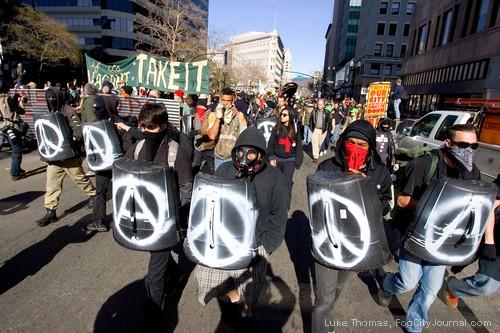
In front of the  Convention Center, police threw smoke bombs into the crowd and warned that those who refused to disperse would be arrested. The march continued around the corner to 12th St and Oak, where protesters and police were involved in another confrontation. Police shot smoke bombs and “pepper bombs,” canisters of pepper spray that explode on impact, into the crowd. Some in the march responded by throwing canisters, along with plastic bottles, back at police. Masked protesters in the front of the group brandished makeshift shields. Protesters say the shields were there to protect them from rubber bullets and bean bag rounds.

The cops had a different perspective. “It became clear that the objective of this crowd was not to peacefully assemble and march, but to seek opportunity to further criminal acts, confront police, and repeatedly attempt to illegally occupy buildings,” said Oakland Police Chief Howard Jordan in a press release.

In a tense moment, hundreds knelt to hide behind the frontline shields while police fired rubber bullets into the crowd.
When police began to advance at both the front and back end of the group, protesters retreated, marching on 12th St back to Ogawa/Grant Plaza.

As they marched on 12th street, Occupy Oakland-affiliated street medics treated injuries from tear gas, pepper spray, and rubber bullets. Police followed in the rear of the march, continuing to project exploding flash-bang grenades at the crowd.

At about 5:30, another march left from the plaza, again with the stated attention of occupying a building. Police marched behind protesters. When the march cut through Fox Square in Oakland’s Uptown neighborhood, police filled in all surrounding sides of the march. Protesters have used the term “kettling” to describe a situation in which police line up on all sides of a group, blocking anyone in the group from leaving.
After “kettling” hundreds of protesters at this location, police began to deploy tear gas. Some protesters with makeshift plastic and metal shields, many marked with the “circle-A” anarchy symbol, advanced towards police. Several police beat the shield back with batons and struck some protesters.

One 19-year-old woman who was struck with a baton to the kidneys was brought to the hospital and treated for internal bleeding.
At Fox Square, police announced that the gathering was an unlawful assembly. Minutes later, some protesters knocked over a line of chain-link fencing, allowing the march to exit the “kettle.” The march continued on Telegraph.

When the march arrived at Broadway between 22nd and 23rd streets, protesters asked to be let into the YMCA and someone who was in there opened the doors. Police later closed in on both sides until they had formed a line preventing the approximately 400 protesters from exiting.

On Broadway, there was no dispersal order issued. This is in violation of the Oakland Police Department’s crowd control policy, which states that “If after a crowd disperses pursuant to a declaration of unlawful assembly and subsequently participants assemble at a different geographic location where the participants are engaged in non-violent and lawful First Amendment activity, such an assembly cannot be dispersed unless it has been determined that it is an unlawful assembly and the required official declaration has been adequately given.”

About 6:30 p.m., police announced that all of the blocked-in group was under arrest.

It was more than six hours before the sidewalk was cleared of all detainees. Most are charged with failure to disperse. Some, such as those who entered the YMCA, have been charged with burglary.

Dozens of protesters who had avoided arrest marched back to City Hall. There, they illegally entered the building and committed several acts of vandalism. According to a press release, these included “breaking an interior window to a Hearing Room, tipping over and seriously damaging the historic model of City Hall, destroying a case containing a model of Frank Ogawa Plaza, and breaking into the fire sprinkler and elevator automation closet.” Protesters also report setting off fireworks in the counsel chambers.

Some protesters took an American flag from City Hall and burned it in front of the government building.

Oakland officials have complained about the cost of the protests. The city had reportedly spent $2.4 million policing Occupy Oakland protesters as of November 15, just weeks after announcing the decision to close down five elementary schools to save $2 million.
Occupy activists say the huge — expensive — police presence is an overreaction.

“The amount of property damage by protesters has been minimal next to Mayor Quan’s destruction of the humanitarian Occupy Oakland community and excessive force against peaceful people, said Wendy Kenin, an Occupy Oakland spokesperson. “The City of Oakland’s commitment to militarism far outweighs its investment in schools. 

Kenin said she was back at Occupy Oakland outside City Hall, with her four children, the day after the incidents.
There were no arrests made in the City Hall incident, partly because so many police resources were deployed at the YMCA.

Cities and counties that provided police reenforcements to handle the mass arrests include Alameda County, San Mateo County, Santa Clara County, San Francisco County and Marin County and the cities of Fremont, Hayward, Berkeley, Pleasanton, San Francisco and Union City/Newark; and the University of California-Berkeley, according to an Oakland Police Department press release. 

Dozens of those detained were brought to Glenn Dyer jail, which quickly filled up; the rest were brought to Santa Rita jail in Dublin.
Several members of the press, as well as passers-by who were on their way to work in the area, were swept up in the arrests.

In jail, those detained debated tactics involved in the day’s demonstrations and discussed the future of Occupy Oakland.

The number of injured protesters is unknown, but in the 19-person sampling of arrestees with whom I spent 20 hours, two had bruises from baton strikes, one suffered from an injured foot after a pepper-bomb exploded upon impact with her ankle, and most had irritation in their eyes, ears, and throat from exposure to tear gas and pepper spray.

Oakland police report that three officers were injured.

As of the morning of Jan. 30, about 100 remained in Santa Rita.

Headshots for the homeless? Photographer Joe Ramos connects art and social work

6

Images of homelessness are not hard to come by. These scenes are often pathetic, clichéd. In the worst cases, the homeless are portrayed as inhuman heaps of blanket and facial disfigurement, people reduced to their time spent sleeping on the streets or begging for money. But in “Acknowledged,” photographer Joe Ramos’ exhibit at the Main Library that opens Sat/28, unhoused subjects are shown in a way that’s truly radical: as people just like us.

The tradition of using poor peoples’ image as exploitative art can be traced back to Jacob Riis’s photos of New York City tenement housing in his 1890 photojournalism book How the Other Half Lives. The project launched a spate of tenement tourism among the upperclass in New York City — a phenomenon which finds its equivalent today in the slum tours conducted in Mumbai, Rio, Nairobi, and other developing cities.

The stated intention of these enterprises is admirable: to raise awareness of a societal problem that needs to be addressed. But their results can be a dehumanization and objectification of the “other half,” the poor becoming art and entertainment rather than harbingers of a culture gone awry and, most importantly, fellow human beings. 

But that is why Ramos’s photography project is so exceptional. Instead of randomly snapping pictures of the homeless on the street, the photographer works for Project Homeless Connect, a non-profit that provides medical and social services to the homeless in San Francisco. For the past six years, Ramos has been photographing program participants — he told the Guardian, at their own request.

The results are striking, studio-style portraits in both color and black-and-white. For “Acknowledged””s exhibition, many of the pictures are displayed alongside stories and interviews. Respect, empathy, and a strange glamor suffuse each portrait. 

Like John Steinbeck, Ramos was born and raised in Salinas, California. Mentored by Richard Conrat, the former assistant of the famed photographer of Dust Bowl families, Dorothea Lange, Ramos brings a neo-Depression era aesthetic to his work. As the child of farmhands, he understands poverty. Ramos’ subjects are not the other — they are unmistakably like any of us, after a bout of bad luck or a few missed paychecks.

In a recent phone interview with the Guardain, Ramos was emphatic about his project’s goals. “There are as many reasons for being homeless as there are homeless people,” he said. “Not all of them are out on the street. Many are in the shelter system. There are families with children in the school system who are technically homeless.” 

He said because of this invisible class of struggling, unhoused people, most of us don’t associate homelessness with anything other than the panhandler on the corner of Geary and Powell Streets. Through his work, Ramos wants to show the true face of homelessness — in all its complexity, dignity, and humanity.

“Acknowledged” features portraits of well-dressed, loving families. There is the man in a business suit with haunting eyes who lost his way after accidentally causing a fatal accident. There are transgender adults who faced harsh family rejection, discrimination, and unemployment as a result of their need to express what they felt inside.

Ramos says that after hearing his subjects’ stories, he finds himself befriending them, seeing them again and again. He has photographed some of them up to 10 times. After each photo is developed, he sends a copy to his subject, or their subject’s family upon request. Sometimes his portraits are used to show family back home that estranged members are doing all right. 

Ramos subjects pose on a completely voluntary basis. While his project is undoubtedly artistic, it’s hard not to see it through another lens: as a free studio portrait service for those who would never be able to record their lives in any other way. The surprising sense of ease visible in the photos’ faces makes sense. These people are clients, not art objects. They feel at ease because they feel acknowledged. 


“Acknowledged”: Joe Ramos photo exhibit

Through March 25

Opening program (including expert panel on SF homelessness): 

Sat/28 2 p.m., free

San Francisco Public Library

100 Larkin, SF

(415) 557-4000

www.sfpl.org


CORRECTION: An earlier version of this article mistakenly identified Joe Ramos’ mentor. He was actually taught by Richard Conrat. The Guardian apologizes for the error. 

Mayor Lee’s call for more hearings gets wary reception

41

Labor and the Left came out strongly against Mayor Ed Lee’s proposed charter amendment to require all city legislation be delayed and subjected to hearings by the Small Business Commission and other commissions if it might cost private sector jobs, putting its prospects of making the ballot in doubt.

 “This legislation is one, unnecessary; two, unbalanced; and three, divisive,” Mike Casey, president of the San Francisco Labor Council – whose executive committee voted unanimously to oppose the legislation – said during today’s Rules Committee hearing on the measure.

He and other labor leaders noted that members of the business community have plenty of opportunities to weigh in on legislation it opposes, but Lee’s proposal would elevate employers’ interests far above those concerning the environment, consumers, public health, or workers. “This legislation gives one stakeholder undue power in the democratic process, which is undemocratic,” said Kate Hegé of La Raza Centro Legal, which represents day laborers and other immigrants.

Teacher Ken Tray of United Educators of San Francisco said, “Often times ‘jobs’ is used as a red herring to divert the city from doing what it needs to do.” It was a common theme, as opponents of the proposal noted that paid sick leave, the local minimum wage, and requiring employee health benefits were all fiercely opposed by the business community. “Anything that raises workers up, we’re told it’s a job killer,” said Larry Bradshaw of SEIU Local 1021.

Small business representatives – a bit sheepishly, given the tenor of the hearing, and without support from their downtown brethren – said they were simply looking for the ability to express their concerns. “We’ve tried to let small business have a voice at the Board of Supervisors,” said longtime small business advocate Scott Hauge, a regular at City Hall.
Keith Goldstein of Potrero Dogpatch Merchants Association said, “We feel we don’t have a say in this process.”

Mayor’s Office board liaison Jason Elliott emphasized that Lee’s charter amendment would create a delay and an extra hearing or two, but that supervisors would still be free to approve the legislation anyway. “This is about public participation and feedback,” Elliott said.

But Sup. David Campos, who led the questioning of Elliott, wasn’t buying it. “What’s the reason behind this? Is there a specific reason the Mayor’s Office has decided to do this now and through a charter amendment?” Campos said, probing for instances in which the Mayor’s Office thought the business community hadn’t been heard.

Elliott continued to say it was about emphasizing jobs and taking more public input, but he couldn’t explain what’s lacking currently or what’s muting employers. Campos thanked the Mayor’s Office for being willing to work with supervisors and accept amendments – including many introduced today, which delayed the vote on the measure until next week.
But Campos questioned the need for the legislation, comparing it to the hollow jobs rhetoric from the current field of Republican presidential candidates. “It’s not just the number of jobs you have, it’s the quality of those jobs,” Campos said.

(Side note: the Mayor’s Office issued a press release today celebrating the first two businesses to take advantage of last year’s controversial mid-Market payroll tax exemption, Zendesk and Pearl’s Deluxe Burgers, which created 56 jobs between them. And to help create those great burger joint jobs, Pearl’s got Redevelopment Agency assistance, a low-interest city loan, and an exemption from the payroll tax. For hiring burger flippers that probably make minimum wage. But I digress…)

Campos said that everyone in City Hall wants to see more good jobs in the city, “but I don’t believe this is a constructive approach.” Sup. Jane Kim echoed the sentiment, saying private sector job creation isn’t the only imperative. “Lowering our minimum wage to $3 or $1 an hour would create plenty of jobs in San Francisco,” she said.

Even the more conservative third committee member, Sup. Mark Farrell, said he tends to agree with his committee colleagues and made the motion to continue the item until next week, when its prospects for passage look weak unless Lee can convince them that there’s more to this measure than just political grandstanding.

Can SF follow Berkeley in dumping the big banks?

15

The City of Berkeley is considering dropping its contract with Wells Fargo and moving the city’s money to a credit union or a smaller community bank. That makes perfect sense — the Move Your Money Project has been urging individuals to do that, and there’s no reason why cities (which are huge customers of banking services) can’t do the same.


In fact, San Francisco ought to be next on the list.


This city puts all of its short-term money in Bank of America. It’s a lot of cash — if the city spends more than $6 billion a year, much of that at some point goes into a city account and most of the checks the city issues are paid on that account. We’re talking a plum deal for a big bank — particularly since the city’s checks aren’t going to bounce and the money comes in steadily.


Why B of A? Because the contract is put out to bid, and B of A was able to offer the best deal. But the bidding process didn’t consider the issues that Occupy has brought up — nor did it consider the number of local jobs that could be generated if the city put its money in a local bank that actually makes local loans to small businesses and homeowners instead of foreclosing on people and shipping the profits back to North Carolina every night.


I don’t know if there’s a local credit union or community bank big enough to handle the business of a client the size of San Francisco — but there’s no reason the entire contract has to go to one bank.


Besides, we could always create our own.

America’s Cup moves forward, but economic concerns remain

5

In past weeks, several environmental and community organizations filed two appeals of the Environmental Impact Report (EIR) prepared for the America’s Cup yacht race in 2013.

Jan. 24, the Board of Supervisors rejected the appeal, allowing for construction on the several major projects contained in the America’s Cup proposal to move forward.

But some supervisors say that the many groups with environmental concerns about the America’s Cup brought up important issues, including economic issues that will still need to be addressed.

Organizations involved in the appeals include San Francisco Tomorrow, Telegraph Hill Dwellers, and the Golden Gate Audubon Society.

The biggest concession regards the jumbotron, a giant TV screen that was planned to project the race’s events. The America’s Cup event authority planned to float the jumbotron’s 44-foot wide screen on a 140-foot barge, and anchor it with large concrete blocks, dropped in Aquatic Park. Opponents said that the blocks would stir up potentially toxic sediments and that the whole plan put Aquatic Park, a preferred beach of bay swimmers, at risk of a diesel spill that would have long-term implications for the safety of its swimmers.

After a heated back-and-forth, attorney for the The America’s Cup event authority Mary G. Murphy stated that the Authority would ditch plans for the water-born jumbotron and look into landside options.

President of the Dolphin Club Reuben Hechanova said that the decision on the jumbotron was a clear victory. The club, whose members have been swimming in the cold waters of Aquatic Park since 1877, was vocal in its opposition for plans for the floating TV. Members of the Dolphin Club and their allies had been meeting with city officials for over a year, campaigning against the jumbotron.

Hechanova denied that Dolphin Club members had planned to disrupt the America’s Cup in a swim-in called “Occupy the Bay” if plans for the floating jumbotron proceeded.

“We were always going to continue to work with the governing agencies…we were not going to occupy the bay. The only official spokespersons of the club are the board members,” Hechanova told the Guardian.

Appellants were also concerned about effects on air quality from cruise ship emissions.

The EIR claimed that these air quality issues would be mitigated with a shore-side power source on Pier 70, but appellants questioned the feasibility of these mitigating measures. Michael Martin of the Mayor’s Office on Economic and Workforce Development commented on the issue, stating that since issuing the report the port, along with its shipyard partner, BAE San Francisco Ship Repair, had in fact secured the 5.7 million necessary for the shore-side power project.

Still, several supervisors remained skeptical about the feasibility of paying for all of the mitigating measures crucial to the adequacy and accuracy of the EIR. Supervisors will vote on these and other financial matters associated with the Cup at a Feb. 14 hearing.

“I have questions remaining about finances, about union jobs that will be created for San Franciscans in this project…as well as assuring that there would be no hit to the general fund,” said Supervisor John Avalos at the meeting’s end.

Other environmental concerns, such as impact on sea and shore birds and on neighborhoods adjacent the America’s Cup area, went largely unresolved.

However, in an amendment proposed by Supervisor David Chiu, the Board made clear that they would require additional environmental reviews, including, potentially, more EIRs, for subsequent projects.

Aaron Peskin, former President of the Board of Supervisors and longtime water rights advocate, has been a vocal opponent of many aspects of the America’s Cup. He said these agreements are a step in the right direction.

“I wouldn’t call it a victory, I’d call it a step. It’s a good step,” said Peskin.

After the appeals had been rejected, Campos thanks all parties involved, including the appellants.

“I do believe that the two appeals that have been filed have clearly made this project better, and not only on the environmental piece. I think the appeals have also raised some very important issues about financial terms of this deal,” said Campos.

The sex heard ‘round the world: [SSEX BBOX] documentary premieres

1

Scenes from [SSEX BBOX], the global sexuality documentary project whose long-awaited first episode will premiere at the Center of Sex and Culture on Mon/30:

One. A protest in Berlin, where a presentation is being made on the 16th century physical punishments that religious institutions imposed on sexually “immoral” people. 

Two. A conversation between two transgendered men living in Brazil.

Filmed in the form of interviews and group discussions, [SSEX BBOX] is a social justice film project that takes viewers on tour through the different understandings of gender and sexuality from around the globe. The documentary engages the ongoing conversation regarding the cultural, social, and even linguistic implications that are intertwined within sexuality. It will air 15 10-minute episodes bi-weekly from January to August 2012 — but the Mon/30 screening will offer the chance to talk face-to-face with the team behind the project. 

[SSEX BBOX] sexuality out of the box! from SSEX BBOX on Vimeo.

Priscilla Bertucci, the executive producer and director of [SSEX BBOX], holds that in an environment where something so primary as a noun is categorized as male or female, sexism and strict gendering become strongly embedded in cultural perceptions of sexuality. Looking back at the project, she commented to the Guardian in a recent phone interview:

SF and Berlin are pioneering cities in that there is a lot of sexual education and many years of work have been [put into those places towards] bringing about awareness. [Exploring sexuality] is definitely more difficult in Barcelona and Brazil where there are still a lot judgments.  People perceive gender as male or female, straight or gay, and don’t really think of what may be outside of this divided box. 

On location with [SSEX BBOX]. Photo by Danila Bustamante

When shooting in Sao Paulo, Bertucci encountered numerous individuals who had never been exposed to the idea of alternative sexual orientations. That lack of experience wasn’t a surprise to her — she was raised there:

I grew up in Brazil and I experienced a gap in information first hand. In places like Sao Paulo, there is a huge lack of sex education in schools and sex educators in general. When I was very young, I was aware of the gay and lesbian community. But at some point, I started not fitting in the box because I would sometimes be attracted to men and I didn’t really identity as bisexual. But later, I became aware that I could identify as queer or gender queer. But it took me a long time and I had to go out and learn a lot of things on my own. A project like [SSEX BBOX] helps people understand that they don’t have to choose [from] a binary.

Bertucci’s film features interviews with sex activists, educators, psychotherapists, and average citizens from all over the spectrum of sexuality. The documentary was mostly edited here in San Francisco, but its crew was comprised of a globetrotting crew of directors and cinematographers traveling through Sao Paulo, Berlin, and Barcelona. 

The international affair was made possible through efficient Skype meetings and Dropbox, and [SSEX BBOX] will continue to embrace the web as a way to distribute their films. The team also launched a pocket-size zine in fall of 2011 that included photography, personal narratives, cartoons, paintings, and writings on gender expression which you can order online in digital or paper form.


[SSEX BBOX] documentary premiere 

Mon/30 7:30-11 p.m., free. 

Center for Sex and Culture

1349 Mission, SF

(415) 902-2071

www.sexandculture.org

This is our country, too: Fred Korematsu’s daughter on her father’s civil rights legacy

1

“One never knows after someone dies what happens to their legacy. Sometimes it becomes a part of history and sometimes it grows,” Karen Korematsu -remarked in a phone interview with the Guardian this week. Her father, civil rights activist Fred Korematsu, will be honored statewide with his own official day on Mon/30. You can celebrate his legacy locally at the Oakland Museum of California’s Lunar New Year event on Sun/29, where Karen will be speaking about her dad’s contribution to our cultural heritage.

“In the case of my father, his legacy seems to be growing,” Karen continued. “His story resonates and remains important to people.” Last year was the first time California celebrated the Fred Korematsu Day of Civil Liberties and the Constitution. This year, events from a photo exhibition in the Smithsonian National Portrait Gallery, panel discussions, and teacher workshops in Humboldt, San Diego, Davis, San Francisco, and San Jose will commemorate his work.

The Oakland Museum of California’s celebration will be especially meaningful — Korematsu was born and raised in Oakland.  The event will include remarks from Oakland Mayor Jean Quan, a talk by Karen, performances by students from the Korematsu Discovery Academy in Oakland, vocalist Shirley Kazuyo Muramoto, and koto player Brian Mitsuhiro, and a screening of the Emmy Award-winning Of Civil Wrongs and Rights: the Fred Korematsu Story.

The elder Korematsu was a civil rights hero who refused to be incarcerated in the Japanese internment camps during World War II. When President Roosevelt signed Executive Order 9066 on February 19, 1942 requiring Japanese Americans to be placed in internment camps, the 23-year-old Korematsu refused to report. He attempted to continue his life as a normal American citizen, but was spotted and arrested in San Leandro three months later. Convicted for violating military orders, he lived for several months at the Tanforan assembly center in San Bruno and subsequently was transferred to Topaz, Utah — one of the 10 incarceration camps that were set up for Japanese Americans during WWII — where his family was also being held. 

Korematsu refused to let go of the belief that his civil liberties as guaranteed by the constitution were being directly violated. He appealed his case to the U.S. Supreme Court to no avail. 

That is, until 1983, when researcher Aiko Herzig-Yoshinaga and professor Peter Irons brought to light previously-suppressed documents detailing the FBI and military intelligence agencies’ conclusion that Japanese Americans were not threats to national security. 

Korematsu’s case was re-opened by a legal team of pro bono attorneys and at long last, his conviction was overturned in a federal court in San Francisco. In 2011, the U.S. Department of Justice released an admission of error in the case of the Japanese American internment camp. 

Karen is disappointed that her father didn’t live to see the apology. But she sees the confession as an important step towards bringing “accountability to people in government who need to take responsibility in making sure that decisions are always in the best interests of all Americans.”

She holds that actions like those of her father are especially relevant today, in these times of anti-immigrant sentiment. “He took a stance against racial profiling in issues such as national security and immigration,” she said. 

Following 9/11, Fred, along with the Japanese American Citizen League, spoke out against the national security measures the U.S. government was taking towards Muslim inmates being held at Guantanamo Bay. He became an active member of the National Coalition for Redress and Reparations. He assisted in the passage of a bill that prompted an official apology from the U.S. government, granting $20,000 for each surviving Japanese American who was incarcerated.

Today, Fred’s legacy lives on through the work of the Korematsu Institute. Founded in 2009 through the Asian Law Caucus, the institute’s mission is to advance pan-ethnic civil and human rights through education. 

Karen said that one of the many ventures of the institute is creating supplemental curriculum for K-12 schools to provide historical information that is missing in textbooks. She believes that her father’s story is an important lesson for children. “It tells the truth about American history, the Constitution, and their own backgrounds,” she said. 

Sensitive to the current financial troubles of California’s school system, the Korematsu Institute raises funds independently to create educational kits that it distributes to schools free-of-cost. 

Upon her father’s death, Karen believed that she had been passed on the torch in terms of challenging prejudice through education — so that nothing similar to the Japanese internment camps will ever happen again. “It’s heartwarming to tell my father’s story and see his legacy grow,” she concluded.


Lunar New Year celebration

Sun/29 noon-4:30 p.m., free with museum admission

Oakland Museum of California

1000 Oak, Oakl.

(510) 318-8400

www.museumca.org


Dome rock

2

MUSIC “I don’t know if you’ve ever been in a geodesic dome,” says drummer-guitarist Andy Duvall, formerly of Zen Guerilla, and currently one third of the improvisational space rock outfit Carlton Melton. “But if you stand right in the middle, there’s a sweet spot.”

Carlton Melton records all its stripped down, lo-fi material in a dome house located a few hours north of here, though the three mainstays — Duvall, Rich Millman, and Clint Golden — call Oakland and San Francisco home. As for their process: “We just go up, hang out, and record all weekend. It’s very sloppy in many ways but I’ve always been a fan of slop. I think perfection can be a little boring.”

During recording other musician pals drop in and out. Live, the trio switches up the instrumentation mid-set. Duvall, a gifted, frenetic drummer influenced by Colm Ó Cíosóig of My Bloody Valentine among others (“[He’s] completely overlooked when people talk of their brilliance”), added guitar to his repertoire for Carlton Melton. The band will again show its live prowess locally this Saturday at El Rio.

In the few years since the vocal-less act formed in 2008 — I use “formed” tentatively, as it was more of a natural progression than the word implies — it’s released a cluster of DIY material on indie labels and its own, Mid-To-Late Records. There was the initial, 2008 “Live in Point Arena” CD-R, an Empty Shapes split LP, another split with Qumran Orphics and a few seven-inches on SF’s Valley King Records and the Irish Trensmat Records (which specializes in “transmitting drone, noise, oscillations and grooves”), both in 2011. In 2012 they’ll put out yet another long-player (already recorded), likely in spring, and are currently hammering out the details for a European tour.

Last year also saw the release of the swirling, spacey Country Ways LP, a record that begins with the 20-minute titular track, a slow-building stunner of dangling drums and psychedelic guitar with the irregular cosmic zap. A track that seemingly has no beginning or end, with the foggy vortex of pleasing chords hanging on for eternity, it’s trance-like, sensory, afferent. And something clicks when you remember they made this sound while cracking beers amongst friends over a few days in a specially-shaped structure.

The band actually came to be because of the dome. After Zen Guerrilla — a band that, should be noted, amassed many local fans and was a 2001 GOLDIES winner — split up in 2003, Millman was busy raising his two kids. Duvall was happily spending time with his girlfriend and their two cats, Gerard and Cheval. In 2008, Millman called Duvall, and asked if he’d want to start playing again. He agreed but it was mostly to jam with an old friend, the opposite of a definition band. The two, now both 44, who first began creating music together in 1990 when they lived in Delaware, talked to the owner of the dome and said “hey, we’re going to come up and bring some amps and make a bunch of noise at your place, do you mind?”

Back to that sweet spot — it naturally enriches sound. “If you’re talking, your voice just instantly amplifies. Same thing happens with music, you’re playing guitar and it’s just swirling around in the dome. It’s sort of ideal for psychedelic music.” says Duvall in a phonecall from his home in Oakland.

That first night up north was magic. They realized they needed name. Duvall, with all his genial charm recalls the conversation then whispers “Carlton Melton.” Melton was a cool guy he knew from junior high in Delaware, a real bad-ass. Strangely, Millman, who went to another school, also knew Melton in Delaware — they’d played one another in football. Years later, Duvall and Melton happen to meet another dude named Carlton Melton, and that last bit of coincidence seems to have sealed the name’s fate. “It’s bizarre but it really fits the band. I just hope the guy from Delaware’s not offended, because we named the band after him for all the right reasons.”

CARLTON MELTON

With Feral Ohms, and Glitter Wizard

Sat/28, 9 p.m., $8

El Rio

3158 Mission, SF

www.elriosf.com

What are people?

4

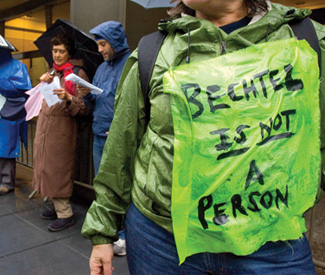
Protesters from the Occupy movement and beyond gathered in front of the Ninth Circuit Court of Appeals in San Francisco on Jan. 20, calling for the adoption of a 28th amendment to the U.S. Constitution aimed at refuting the idea that corporations should have the same rights as people, a legal doctrine know as corporate personhood.

The event was part of a day of action at courthouses around the country, seeking to raise public awareness about the unfettered influence of corporate money in U.S. elections and draw attention to the second anniversary of the landmark corporate personhood decision by U.S. Supreme Court, Citizens United vs the Federal Elections Commission.

“We are here not to protest, not to petition, and not to plead, but to proclaim a truth that should be self evident, even to the Supreme Court: Corporations are not people; money is not speech,” said Abraham Entin, of North Bay Move To Amend, addressing a crowd gathered at the courthouse. “Corporations work very hard to convince us that we cannot do without them and the products they produce. They tell us they are too big to fail, and that our survival is dependent on their survival … Occupy has changed all that.”

In a contentious 5-4 ruling handed down on Jan. 21, 2010, the Citizens United case solidified the legal framework that bequeaths corporations the same rights under the Constitution as real, living, breathing, U.S. citizens, and by merit of their First Amendment rights as citizens bars any restrictions placed on a corporation’s ability to spend money to influence elections.

When Republican presidential candidate Mitt Romney famously said on the campaign trail that “corporations are people, my friend, because corporations have people inside them,” he is reflecting the logic of the majority opinion in the Citizens United case. The court’s majority asserted that corporations are essentially an association of people and thus enjoy the same rights as individuals.

The court also claimed that it is impossible to distinguish between the corporate media outlets and other corporate speech, so all corporations should enjoy the free speech rights saved for the press. Furthermore, because journalists often have to spend money to achieve speech, money spent on messaging by all corporations represents protected speech.

Corporations, a relatively modern invention, aren’t actually discussed in the Constitution. But the notion of corporation personhood began around 1886 in the case of Santa Clara County v. Southern Pacific Railroad. What Citizens United did was equate corporate money spent to influence elections with protected political speech, upending attempts at election reforms and gutting the McCain-Feingold Act of 2002 that regulated federal election campaigns.

That corporations act to corrupt our democratic systems for their own profit is not conspiracy, it’s simply a byproduct of what they are. Corporations are legally obligated to act to maximize their profits for the benefit of their shareholders, otherwise their board and corporate officers are considered negligent of their obligations to their shareholders’ financial interests. Unlike journalists, whose professional credo calls for fairness and acting in the public interest, corporations are designed to act in their own interests.

As Justice John Paul Stevens wrote for the dissenting judges in Citizens United, “Corporations have no consciences, no beliefs, no feelings, no thoughts, no desires. Corporations help structure and facilitate the activities of human beings, to be sure, and their ‘personhood’ often serves as a useful legal fiction. But they are not themselves members of ‘We the People’ by whom and for whom our Constitution was established.”

The resulting flood of corporate money into election campaigns since the court’s ruling is delivered through an aqueduct known as the Super PAC (political action committee). In the wake of Citizens United, election spending by Super PACs in the 2010 midterm elections exceeded $300 million dollars, more spending than the overall spending in the previous five midterm elections combined.

Unlike donations to campaigns, which so far remain regulated, Super PAC money is spent directly by the Super PAC, and can be spent attacking as well as supporting candidates, leading to fears that corporations can exert influence on incumbents before a re-election campaigns by threatening to spend money attacking them in the upcoming election cycle.

“Corporations are human creations, state creations, legal entities … There is no reason we cannot limit their spending,” said Carlos Villarreal, executive director of the National Lawyers Guild’s Bay Area chapter. “Nonprofit organizations are limited in their political spending. Churches and charitable organizations are also limited in their spending. So why not for-profit corporations?”

Perhaps no group knows more about government limits to free speech than participants of the Occupy movement. Elastic restrictions on individual free speech and freedom of association rights spelled out in the First Amendment, resting on alleged risks to health and public safety, have led to Occupy encampments across the nation being restricted and evicted, at times enforced by brutal police crackdowns.

The right of the government to restrict individual and group speech that officials believe represents a clear and present danger was established by the Supreme Court in the 1919 Schenck v United States case — the famous “don’t yell fire in a crowded theater” case. What is not widely known is that this case was a re-examination of the famous 1917 Espionage Act. The “crowded theater” was our nation’s entry into World War I, and those being jailed for “yelling fire” were labor organizers and pacifists expressing their opposition to our entry into the war.

Relying on Schenck, courts have consistently defended restrictions on individual free speech when there is a compelling interest to public safety, the so-called “clear and present danger” standard. Villarreal and the crowd gathered before the Ninth Circuit asserted that corporate influence in our democratic processes represents a clear and present danger to society. “There is no more compelling interest than protecting democracy,” said Villarreal.

Despite the apparent double standard, legal experts say the courts action in the Citizens United case leaves a constitutional amendment as the only avenue left for regulating corporate money in elections and ending corporate personhood, but the movement to take on that Herculean task has already begun.

U.S. Sen. Bernie Sanders (I-VT) and Rep. Ted Deutch (D-FL) have introduced legislation proposing a 28th Amendment to the Constitution. While the language differs from another amendment presented by the group Move to Amend, it also takes aim at ending corporate personhood.

“Two years ago, the United States Supreme Court betrayed our Constitution and those who fought to ensure that its protections are enjoyed equally by all persons regardless of religion, race or gender, by engaging in an unabashed power-grab on behalf of corporate America,” Sanders wrote in a Jan. 20 Guardian(UK) column.

In Sanders’ home state of Vermont, the state Senate is also considering a resolution calling for a constitutional amendment against corporate personhood. A similar resolution, authored by Alix Rosenthal, was adopted by the San Francisco Democratic County Central Committee during a special meeting on Jan. 21. There was just one dissenting vote, and DCCC members say they plan to push for the state party organization to also adopt the stance.

The hurdles set forth to amend the U.S. Constitution, outlined in Article V, are substantial. In order for an amendment to even be considered, a super majority of both houses of Congress must initiate the process, or two-thirds of states must call for the amendment. Proposed amendments passing this threshold are then adopted only after three-quarters of state legislatures ratify the proposed amendment. But that difficult road is one the protesters said they are ready to travel. “We are here on a rainy day with warm hearts and wet feet. We are the 100 percent, the humans. No corporation has every experienced the thrill of wet feet,” said Gangs of America author Ted Nace. “We are the fools who go out on a wet day to fix a broken world. Eighty percent of the public want to fix this. That means we are halfway to our goal. What remains is organization, mobilization.”

How should San Franciscans vote?

36

The Board of Supervisors Rules Committee will consider competing proposals for changing how elections are conducted in San Francisco tomorrow (Thu/26) at 2 p.m., taking public testimony and voting on which ideas should go before voters in June.

Sups. Sean Elsbernd and Mark Farrell propose to end the ranked-choice voting (RCV) system and go back to runoff elections, while Sups. David Campos and John Avalos propose modifying RCV to allow more than three candidates to be ranked and changing the public campaign financing system to make qualifying more difficult and thus thin the electoral herd a bit. They would also consolidate odd-year elections for citywide offices into a single year, a proposal that Sup. Scott Wiener is also offering as a stand-alone measure.

“We believe our current election system fundamentally works. However, we heard concerns from voters during our last election that it was difficult to discern the different ideas and ideologies of the numerous candidates in the race. We are introducing an ordinance today that is designed to address this concern,” Avalos said in a public statement on Jan. 10 when their measure was introduced.

That package came in reaction to the proposal to repeal the RCV system that voters approved in 2002, a campaign that has been strongly promoted for years by political moderates, downtown groups such as the San Francisco Chamber of Commerce, and the San Francisco Chronicle and other mainstream media outlets.

During a forum at the San Francisco Planning and Urban Research Association last week, Elsbernd debated Steven Hill – the author and activist who created the city’s RCV system – on the issue. Much of it came down to differences over how to gauge the will of voters and allow them to make good decisions.

Hill’s argues that runoff elections – which have traditionally been held in December, although the current proposal could create either June/November or September/November elections – tend to have very low turnout of voters (who tend to be more white, rich, and conservative than in general elections). And they are usually dominated by nasty, corporate-funded independent expenditures campaigns designed to sully the more progressive candidate.

“Let’s face it, December was just a terrible time of year for an election,” Hill said, adding that September would be just as bad, June is too early, and both options would also likely have low turnouts.

Hill said that while RCV may have flaws, so does every electoral system, but that RCV is an accurate gauge of voter preference. He displayed charts and statistics showed that the winning candidate in every election since RCV started has won a majority of the continuing ballots, which are those that remain after a voter’s first three choices have been eliminated.

But Elsbernd seized on that idea to say, “Continuing ballots, that’s what this issue is all about.” He made the distinction between continuing ballots and total ballots cast, saying the latter is what’s important and that few winners under RCV receive a majority of total ballots cast.

“Our elected officials should be elected by a majority of the votes cast,” Elsbernd said.

He said that runoff elections offer voters a clear distinction between different candidates and their ideologies, and he even dangled a proposition that might have appealed to progressives in the last mayor’s race: “Wouldn’t we have loved our month of Ed Lee debating John Avalos about the future of San Francisco?”

Elsbernd cited crowded field free-for-all races like the District 10 race of 2010, in which Malia Cohen came from behind to win using RCV, saying they muddy up the contests. “The benefit of the runoff is you get that true one on one,” Elsbernd said, calling for “real discussion, real debates, about what San Franciscans want.”

Yet Hill said the crowded fields of candidates in some recent races wasn’t caused by RCV, a system that promotes real democracy by giving voters more than one choice of candidates rather than being stuck with the lesser of two evils. And rather than showing the problems with RCV, Hill said Cohen’s election (an African-American woman elected to serve a largely African-American district) and that of Mayor Jean Quan in Oakland (who came from behind to beat Don Perata, who many perceived as a corrupt party boss) show how RCV can help elevate minority and outsider candidates.

All those arguments – and many, many more – will likely be made during what’s expected to be a long afternoon of public testimony.

Hot sexy events: January 18-24

0

Thankful. I am thankful for San Francisco sex. Just got back from the AVN awards in Vegas this weekend and couldn’t get over the fake boobs (literally — mountainous cleavage), rubber ducky-esque lips, and rote couplings that took over the Hard Rock Hotel for the better part of the week. Don’t get me wrong, the weekend was all kinds of wonderful and there were buffets and penthouse hot tubs filled with Tina Horn, Princess Donna, and Akira Raine — salacious tweeting and rumors of Robin Leach and deep red carpet conversations about being forced to wear condoms. But for me, SF.

Also, the trailer for James Franco’s new movie based on the life of Kink.com actress-writer Lorelei is out: 

Why am I so stoked on this city? Read on about what San Francisco does best: weird, original, affirming sex events in the City By the Bay. Here’s four reasons that’ll make you glad you’re here (pervert).


Good Vibrations’ Lakeshore store opening

Once an employee-owned store in the Mission, Good Vibes has expanded into a nationwide business, powered by an Ohio sex toy corporation, and teaching everyone from Florida to Washington about the power of gadgets in the bedroom through an award-winning sales and education website. (Read our interview with the company’s C.O.O. and staff sexologist Carol Queen here.)The empire gets one bigger today, with the opening of Good Vibes’ first Oakland brick and mortar location. Kandi Burress of Real Housewives of Atlanta will be on hand to promote her superlative line of vibrators, Bedroom Kandi

Sat/28 6-9 p.m., free

Good Vibrations

3219 Lakeshore, Oakl.

(510) 788-2389

www.goodvibes.com


Perverts Put Out: Midwinter Edition

Accepting his honor at this year’s Guardian Goldies art awards, performance provacateur Philip Huang utilized a neti pot in ways surely frowned up by the Health Department. The man is inappropriateness, embodied — just ask those “God Hates Fags” people, he’s crashed their protests with a colander head, carrying a sign that says “No Fags on the Moon.” So what does a Huang do at a reading made for and by pervy weirdos? You’ll just have to attend the latest edition of Perverts Put Out, to find out. Tonight’s event also features sexy solliquies by horehound stillpoint, Sherilyn Connelly, and Jen Cross. 

Sat/28 7:30 p.m., $10-15

Center for Sex and Culture

1349 Mission, SF

www.sexandculture.org


John Leslie one-year memorial

Harken back to your best memories of golden age porn star John Leslie, who passed away in 2010. Center for Sex and Culture will be hosting this memory circle for friends of his work — which includes Talk Dirty To Me (1980), Nothing To Hide (1981), and Talk Dirty To Me, Part II (1982). One of the first actor-cum-director hyphenates in adult film, the man was big back in the days of well-budgeted productions. Perhaps this will also be a look back on the long, strange road the porn industry has traveled over the past few decades (after all, Leslie did finish out his career directing gonzo releases). 

Sun/29 5:30 p.m., free

Center for Sex and Culture

1349 Mission, SF

(415) 902-2071

www.sexandculture.org


[SSEX BBOX] premiere 

Name the sexiest cities in the world. Did Sao Paolo, Berlin, and San Francisco make it on there? They’re the obvious choices, of course — and fertile territory for this global documentary project. The team behind [SSEX BBOX] chased tail around the globe, chatting with all orientations and genders about what makes them tingle below (above) the equator.

Mon/30 8:30 p.m., free

Center for Sex and Culture

1349 Mission, SF

(415) 902-2071

www.ssexbbox.com


Frilly werewolf

1

LIT “When you’ve lived so far like I have,” Christine Beatty’s wry voice came crackling through the phone as she drove to Las Vegas to play the slots, “you sometimes just have to catch your eye in the rearview mirror and laugh. I’ve led such a charmed life, really.”

Some doe-eyed Wisconsinite may have snagged the Miss America crown last week, but in terms of representing this nation’s glorious variousness, that tiara should be tucked neatly into Beatty’s glovebox. A transsexual activist, author, and good-time girl, Beatty just published her memoir, Not Your Average American Girl on her newly christened Glamazon Press (available at Modern Times bookstore in the Mission, www.mtbs.com). In it, she tells her story of growing up and discovering her inner self during a very turbulent time in Northern California, through the stoner 1970s to the economically rocky ’80s to our own time, when trans people have gained an unprecedented visibility yet still find themselves the targets of discrimination from both conservative quarters and other LGBTs.

“I started Glamazon Press because I want transwomen to have another outlet for expression that I think is lacking, ” Beatty said. “I feel that the Internet has brought us more visibility, but we’re still tucked under the wing of the gay movement, and maybe it’s time to move out. I don’t want to divorce the ‘T’ from LGBT, it’s been very politically beneficial in many ways. But we need to develop our own voice. There are situations unique to us — the surgery costs money, and we’re completely vulnerable in the work place from a legal viewpoint, if people employ us at all.”

In her memoir, a significant amount of valuable San Francisco history is unearthed. Not Your Average American Girl’s juiciest bits, for me, recall her life as a trans newbie in the Tenderloin in the ’80s, hanging out at the Spirit Club and embracing sex worker life — a period vividly evoked, the city seething with a grimy energy and sense of family, a lost drama of payphones, sex ads, and backrooms. And then she’s a ’90s rocker with her band Glamazon, the book also nailing the electrifying live scene of the time.

The most resonant parts, all recounted with a kind of surprised honesty, deal with Beatty’s deathly drug habit and recovery, her HIV diagnosis 25 years ago, and her journey into transwomanhood, something she approached with such unrelenting drive that her ex-wife and her mother became two of her biggest supporters, despite initial upset.

http://www.youtube.com/watch?v=mWziz4N6RUY

Even considering Beatty’s storytelling talents, however, it’s a wonder that Not Your Average American Girl exists at all. It meticulously recreates scenes from Beatty’s experiences using entries from the journals that she’s kept all her life. And really, if your mortal coil encompassed typical suburban mama’s boy, stoner hippie, macho soldier, undercover married cross-dresser (or “frilly werewolf”), Tenderloin call girl, recovering heroin addict, pioneering rock musician, and author-publisher, how legible would your diary be?

“When I went to write the book, I looked at these old journals and I was filled with gratitude,” Beatty said. “I was so scared, hopeless, resentful in parts. But I see how far I’ve come and I’m still alive. And I must have known I was going to survive — otherwise why the hell would I write all this down?”

Pay to park

62

The San Francisco Municipal Transportation Agency has hailed the success of its SFpark program — which uses high-tech meters and demand-variable pricing to manage on-street parking — noting that expired meter citations are down and meter revenue is up. The resulting 11 percent net increase in revenue  is all going to improve Muni. So transit improves, drivers get more spots and fewer tickets — everybody wins.

[CLARIFICATION (2/1): The new meters had an 11 percent net revenue increase compared to the old meters, but overall net revenues from citations and meters was still down by 3 percent.]

But the SFMTA has run into a hornet’s nest of opposition with its latest proposal to expand SFpark into the Northeast Mission District, Potrero Hill, Dogpatch, and Mission Bay, largely because the plan involves placing meters on streets where parking is now free. And even those who don’t object to paying for parking say the SFMTA has bungled this process.

The problem isn’t just what critics say are arrogance and dubious outreach efforts by agency officials. It may be that the SFMTA pursued too many goals at once, mixing them in ways that muddled the message. Or it may just be that charging for parking will always anger drivers, no matter how it’s proposed.

The agency wants to discourage driving — particularly cruising for parking, hence SFpark’s “Circle Less, Live More” slogan — to speed up Muni and reduce traffic congestion. But that also means charging for street parking so cars won’t just sit in those spaces, and that involves a complicated balancing act in mixed use neighborhoods.

Residents, many employers, and commuters want all-day street parking, preferably free and easy. But most business owners want enough parking turnover so their customers can find a spot. City policies call for prioritizing residents’ needs, and the SFMTA needs money to fund and expand Muni service.

Meeting all of those needs isn’t easy. But over the last couple of months, the SFMTA’s effort to expand its successful and popular SFpark program have managed to turn thousands of residents angrily against that program, the agency, and the proposition that people shouldn’t expect free parking.


COMMUNITY OUTRAGE

Architect John Lum and artist-designer Miranda Caroligne didn’t know each other a couple months ago, but now they’re helping to lead a movement that is uniting neighborhood groups in the Mission, Dogpatch, and Potrero Hill against the parking meter proposals.

“You have an agency that is not listening at all to the community. That’s fascism!” declares Lum. He’s actually an amiable and soft-spoken young guy who employs 10 people at his architecture firm near 17th and Capp streets, but this issue really gets his blood boiling.

And Lum isn’t alone, as the Jan. 13 public meeting before an SFMTA hearing officer showed. Not only did everyone who streamed to the microphone voice opposition to the proposals, but they usually did so in angry and accusatory ways, saying it would destroy businesses, punish the poor, and result in conditions that are simply unworkable and intolerable. And they said the SFMTA simply doesn’t care.

“If you’re a PDR business,” Caroligne said, referring to the Production, Distribution, and Repair businesses whose last bastion is some of the targeted areas, “you’re never going to get people to work at a place that doesn’t have parking…This proposal will push them out.”

There are myriad ways that the plans are flawed, say their critics: Meters were proposed on some residential streets in initial plans, despite SFMTA policies to the contrary; traffic surveys had too small a sampling and weren’t realistic; residential permit districts would be replaced by meters, or meters would be placed where districts might work better; transit service on Potrero Hill is too bad to expect people to use it; live-work spaces were inappropriately treated like retail outlets; and meters near the 22nd Street Caltrain station could actually discourage the use of public transit.

“There’s not that much disagreement, but where there is, it’s really important,” said Tony Kelly, president of the Potrero Boosters Neighborhood Association. “I’m someone who supports parking management, and I’m frustrated that the MTA is so tone deaf with this. We’ve been through a lot of fake public outreach efforts and this is looking like one of those.”

Janet Carpinelli, president of the Dogpatch Neighborhood Association, said her members feel like the SFMTA is ramming this through without regard for the needs or input of that neighborhood.

“The real issue is it’s a very big inconvenience to the businesses and residents in this neighborhood and it’s not really helping anything. It’s just a revenue grab by the MTA,” she said.

Potrero Hill resident Jim Wilkins was so outraged by the proposal to install meters along Pennsylvania Street outside his home that he started an online petition against the proposals that has so far garnered about 1,300 signatures. “We’re forming an organization to resist these proposals,” he told us.

Lum was already a member of the 17th Street Coalition, which formed in 2010 to oppose the renewal of a liquor license at the local Gas’n’Shop, but more recently organized opposition to the meter proposal. It attracted Caroligne, and now they’ve formed a new group, Northeast Mission Neighbors, which held a joint organizing meeting with the Dogpatch and Potrero groups on Jan. 23. They’re all determined to delay and modify the SFMTA’s proposal, which had been scheduled for adoption by the SFMTA Board of Directors Feb. 7.

Lum said the proposed changes are tough to accept: “I don’t think this is about free parking, it’s about living and working in a community with certain things and now those things are changing.”


CHANGE IS HARD

The biggest target of critics’ ire is Jay Primus, who runs the SFpark program for the SFMTA. He maintains that he’s done extensive outreach and gathered community input that has shaped the plans. “These are still proposals and nothing has been approved yet,” he told us.

For example, Wilkins told us his campaign continued even after the meters in front of his house were eliminated from the proposal last month. Primus also noted the proposed meters allow for all-day parking at just 25 cents an hour in most places, so it isn’t really such an inconvenience or financial hardship. And Primus just announced that the Feb. 7 hearing is being pushed back by at least two weeks to heed more community input.

But most of the opposition to the proposals isn’t surprising, and Primus thinks it comes more from the idea of charging for street parking than with the specifics of the proposal.

“Parking is always an emotional and delicate issue in San Francisco, as it is in most cities,” Primus said, citing protests against charging for parking going back to when the first meters were installed in 1947. “This has happened at every block that has gotten meters.”

But now, there are even more benefits and ease of use with modern meters, which motorists can pay with a credit card or even remotely. Variable pricing is also used to ensure more parking based on demand, although it’s being kept at a very low rate in areas where businesses or residents still need all-day parking.

“If people are opposed to paying 25 cents per hour, the lowest rate in the city, then they are opposed to paying for parking,” Primus said. He said it’s a matter of equity among citizens: “There’s nothing equitable about providing parking for free and asking people to pay $4 for a round trip Muni ride.”

That’s a notion that is echoed by others who say it’s time for motorists to start paying their fair share.

“Everybody wants something for nothing. We all want that. Nobody wants to pay for parking, not even me,” Don Shoup, the UCLA professor who wrote the influential book The High Cost of Free Parking, told us. He later added, “That whining you hear is the sound of change.”

At a time when governments are hurting for revenue to provide basic services — among them, maintaining extensive roadway systems for motorists whose taxes don’t come anywhere near covering their societal impacts — he said it just doesn’t make sense to continue subsidizing the storage of automobiles.

“San Francisco has some of the most valuable land on earth. You have expensive housing for people and free parking for cars. It’s not surprising that San Francisco has homeless people and traffic congestion,” Shoup said. “There was never a city that is so liberal about other people’s affairs and so conservative about its own affairs.”

But Shoup did agree with critics that the real goal of managing parking isn’t to discourage driving, although he applauds the SFpark program for using its increased revenue on public transit, which he thinks makes sense from a social justice perspective.

Jason Henderson, a professor of geography at San Francisco State and author of an upcoming book on the politics of parking and mobility, goes even further than Shoup in saying that San Francisco should use its parking policies to discourage driving. But at the very least, Henderson said it is counterproductive to offer free parking.

“The city is giving away valuable real estate with all of this free and underpriced curbside parking at a time when the city’s transportation infrastructure is crumbling and essential city services for parks, after school programs, and libraries are constantly being cut. And here we have thousands of acres of real estate just being given away,” Henderson told us.

“If anything, it needs to be done citywide so that it’s judicious and level, so that merchants won’t say that people won’t come to their neighborhood because they can go to a different neighborhood where there’s free parking.”

Primus said there is a particularly strong need to manage parking around Mission Bay and the North Mission, where much of the city’s growth is occurring.

“In a way, the SFMTA is catching up with the growth of the city. These are some of the last remaining areas that are residential-commercial mixed use areas with no parking management,” Primus said.

Kelly agrees that time has come, but he doesn’t think the SFMTA has helped its case, particularly given the emotions surrounding the issue and the need to maintain public support for improved transit service.

“They’ve been spending all their waking hours in the last couple years pissing people off over parking meters, do you really think people will then support their revenue proposals?” Kelly questioned.

Lum and Caroligne both said the SFMTA should have been willing to make the fundamental argument to people that the days of free parking are coming to an end.

“That’s where a lot of the anger is coming from, you’re doing this for all these reasons that don’t make sense and treating us like children,” Caroligne said, although she also added, “I agree with you that there would still be some outrage, even if the outreach had been better.”

The Performant: Discord fever

0

San Francisco Tape Music Festival unwinds at ODC

The fact that it’s raining makes it an unexpectedly perfect night to attend the San Francisco Tape Music Festival. The water rushing through pipes and sweeping across the rooftop of the ODC Theatre adds an extra layer of ambience to the cacophonic tones emitting from a modest bank of speakers, squatting on the stage like forbidding monoliths. The here-and-now intrusion of the rainfall ties even the most outré compositions of the evening together in an entirely unanticipated manner, from the oldest (dated 1857) to those created this still-young year by members of the current incarnation of the San Francisco Tape Music Collective and sfSound.


Snugly protected from the bluster of the elements, we sit in patient anticipation as the lights dim to as near a full blackout as can be achieved with glowing EXIT signs and lighted soundboard. The darkness forces focus on the content of the composition, not the conduit, freeing the senses from the unconscious tyranny of vision. And a certain amount of focus does come in handy for an evening spent listening to the trajectories of polyphonic dissonance whizzing through the room at reckless speeds. Field recordings, samples of radio-age music scores, spoken murmurings of French, English, Greek, percussive clatterings, static-y white noise, and a host of sonic curiosities stack up on top of each other like the building blocks of childhood, leaning precariously, threatening to topple. “Purposeless play,” John Cage once described it, though of course such purposelessness contains a purpose all its own.

Maggi Payne, SF Tape Music Fest, SFBG.com

Composer Maggi Payne

A 16-minute Matthew Barnard composition entitled The Piano Makers sweeps the oddience into the Kemble piano factory, where Barnard made a series of field recordings of piano manufacturing: all clatter of machinery, zing of taut strings and tuning forks, and pounding of keys. John Cage’s Williams Mix kicks off a centennial celebration of Cage’s birth with a frenetic mélange of classic cartoon scores, old jazz standards, church hymns, radio announcements, and a lonesome foghorn. One of the evening’s most distinctive aural pleasures comes courtesy of noted theatrical sound-designer Cliff Caruthers, whose eerie, affecting Underneath would serve perfectly as the ambient score of some great, underwater epic — Gilgamesh perhaps — all creaking boards, and groaning depths, punctuated by the primal bellow of some unfathomable creature and a twinkle of silvery fish. Maggi Payne’s Glassy Metals rounds out the first half with a textural layering of metallic sounds manipulated to mimic the wet gurgle of a deep forest brook and rush of dry desert winds.

Ma++ Ingalls, SF Tape Music Fest, SFBG.com

Performer Ma++ Ingalls. Photo by Lenny Gonzalez

Two of the highlights of the second half include the second John Cage piece of the night, Imaginary Landscape No. 5. Composed on a block graph designating eight tracks and 42 separate sound clips, the realization of this version was created collaboratively by the Tape Music Collective, and performed by Ma++ Ingalls. Sterfos, by Orestis Karamanlis, also performed by Ingalls, transports the listener to a fishing village on the edge of the Aegean Sea. Bucolic village sounds such as the somber clang of church bells, footsteps crunching on gravel, the lapping of waves, dogs barking, children playing, and an elderly man with the oratory tone of a storyteller, all layered over with the urgent textural tones of aggressive modernity. More than any other piece of the evening, Sterfos embodies the cinematic quality of the music, a clearly defined story arc winding through the village entire. Only a minor technical glitch halfway through the piece mars the otherwise seamless meander along the shoreline of a strangely familiar sea.


Weed on wheels

9

steve@sfbg.com

CANNABIS CLUB GUIDE 2012 When we first created our detailed local Cannabis Club Guide two years ago — which you can find at www.sfbg.com/cannabisguide — it seemed as if the marijuana business had entered a golden age of openness and professionalism in San Francisco. But with a federal crackdown shuttering at least a half-dozen dispensaries in the Bay Area (Market Street Collective, Sanctuary, Mr. Nice Guy, Medithrive, Divinity Tree, Marin Alliance for Medical Marijuana) things have changed. Luckily for needy patients and stoners alike, San Francisco has always been a resourceful city, so those meddling feds have actually done very little to disrupt the free flow of the world’s best marijuana.

Even before the cannabis industry moved above ground and into brick-and-mortar storefronts, there were always pot delivery services here. Now they’re really proliferating, so we thought it was high time to add them to our guide. And once we delved into this realm, we found that it was every bit as civilized and professional as a visit to our friendly neighborhood dispensary — and perhaps even more convenient and cost-effective.

The process seems just as secure and legally compliant as it is at the clubs, with most reputable delivery services requiring that you become a member before accessing their products. That means sending them copies of your doctor’s recommendation and California ID, which can be even done from a photo on your smart phone. After the services verify you, you’re good to go.

We’re starting the guide with just a trio of the most high-profile delivery services, as well as a couple more dispensaries, but we’ll be adding to the online guide throughout the year, so check back frequently for more updates.


DELIVERIES


THE GREEN CROSS

This is one of San Francisco’s premier cannabis clubs, setting the standard for everyone else in terms of quality, professionalism, and advocacy for the industry. My sources had long been telling me that the Green Cross carries the best weed in the city — information validated by the long string of awards it accumulates at cannabis competitions. And founder Kevin Reed has been a passionate, high-profile leader in the community for years.

But I became even more impressed once I actually used the service. Its great website features the best descriptions of its nearly two dozen strains of lab-tested marijuana, including where and how it was grown, as well as products ranging from inexpensive pipes to eye drops. I settled on a $40 eighth of Blue Deliah, a sativa-dominant hybrid that looked both cheap and good.

Within about 30 minutes, the friendly delivery guy showed up at my apartment, handed me a white paper bag full of goodies, and charged me $35 with my new customer discount. Inside the bag, there was a grinder, a cool jar, rolling papers, a lighter and other Green Cross swag, a pot cookie, non-medicated munchies, an information packet, a receipt stuck to the inside of the bag — and a baggie of beautifully trimmed buds.

www.thegreencross.org

(415) 648-4420

Opened in 2004

Price: Low to average

Selection: Huge and high-quality

Delivery time: Super fast

Sketch factor: Very low

Access: Secure but easy to use


MEDITHRIVE

When Medithrive opened as a dispensary in my Mission District neighborhood, it became one of my favorite clubs, so I was disappointed to see it shut down by threats from the federal government late last year. But it immediately reinvented itself as a delivery-only club, and it still retains the friendly service and large selection that first endeared me to it.

“It’s definitely been a change for us, but if patients can handle the delivery thing, it ends up being better for everyone,” said the employee who took my order: the Apocalypse Medi-Mix, a mix of high-quality small buds (better for vaporizers) for $40 for four grams. And because I was a newbie to its delivery service, they threw in a free joint.

I called at 3 p.m. and was told to expect delivery between 4:15 p.m.-4:45 p.m. — and it actually showed up at 4 p.m. It wasn’t a problem because I was working at home all afternoon, but I can imagine such a long arrival window wouldn’t be ideal for some. And frankly, the buds were pretty dry, perhaps the result of not moving as much inventory as Medithrive is used to.

But on the whole, it’s still a solid dispensary and a very friendly staff that’s still worth using.

www.medithrive.com

(415) 562-MEDI

Opened in 2010

Price: Average with good deals

Selection: Large

Delivery time: Fast but uncertain

Sketch factor: Low

Access: Secure but easy to use


FOGGY DAZE DELIVERY

This place pops up prominently when people Google marijuana delivery services in San Francisco, but other parts of its operation don’t seem quite as tight as its search engine savvy. Even its readily available website, I learned while trying to order, has an outdated menu of available items. For what it actually offers, customers need to visit www.weedmaps.com, where the guy said the menu would quickly appear when I typed in “foggydaze,” but it didn’t.

Finally, I just asked him to recommend a good sativa strain, and he mentioned just two that they had in stock: Headband and Cheezle. Shooting in the dark, I went with an eighth of Cheezle for $45, and he offered me a new member gift of a joint or sample of equal or lesser priced weed. I opted for the joint because it just seemed easier at that point, particularly since my initial call went to voicemail and then I had to wait 45 minutes to get my information verified. An hour later (he said it would be 45 minutes), I had my weed.

Compared to the bad old days of ordering whatever my underground drug dealer had and jumping through whatever hoops he required, Foggy Daze is much better. But in the modern marijuana scene in this highly evolved city, Foggy Daze doesn’t quite measure up as is.

www.foggydazedelivery.com

(415) 200-7451

Price: Average

Selection: Small

Delivery time: OK, but slow on verification

Sketch factor: Medium

Access: Pretty good


DISPENSARIES


APOTHECARIUM

It was only a matter of time before someone had the idea to really emphasize excellent personal service with high-end products in an elegant environment — but the folks at Apothecarium have done it in a way that really sets them apart from the rest of the pack. This place is an experience more than just a place to score weed, much the same way adventurous bars like Alembic aren’t just about getting tipsy but appreciating just what a cocktail can become in the right hands.

Visitors to the Apothecarium are warmly greeted and seated in front of an extensive (and well-designed) menu, which an knowledgeable staffer patiently and enticingly walks you through, focusing exclusively on you and your needs. Once you finally find what you want, a large jar of your chosen buds emerge, and the employee uses long silver tweezers to place the prettiest ones on a display tray in front of you to inspect while he weighs out your choice of small or large buds with an air of showmanship.

2095 Market, SF.

(415) 500-2620

www.apothecariumsf.com

Buds weighed on purchase

Opened in 2011

Price: High to low (“compassionately priced” strains available)

Selection: Large, extremely informative menu available

Ambiance: Looks like a fancy hair salon, hardwood floors and patterned wallpaper

Smoke on site: No

Sketch factor: Low

Access/security: Secure but easy access


1944 OCEAN COLLECTIVE

Despite a somewhat forbidding waiting room, this neighborhood dispensary on a mellow stretch of Ingleside’s Ocean Avenue has a real family feel once you step onto the salesfloor.

I was in the market for edibles when I went to 1944, and chatted with the jocular sales staff about which available edible wouldn’t give me couch lock or paranoia — a fully-functioning treat, as it were. My budtender pointed me towards a sativa-based peanut butter cookie with high potency, and then made me feel OK about our difficulty making a decision. “We’re all stoners here,” he laughed.

Once you make your selection among the edibles, flowers, and tinctures on offer, head to the back of the low-glitz, comfortably appointed room to give your money at the cash register. Head back to the bud counter to pick up your selection — if you’re lucky you can grab a brownie bite, cup of tea, or apple from the buffet to assuage your munchies. There’s even a sign that announces the dispensary’s job counseling and resume writing classes. A somewhat cold exterior sure, but it belies a warm heart. (Reviewed by Caitlin Donohue)

1944 Ocean, SF.

(415) 239-4766

Buds weighed on purchase

Opened in 2004

Price: From cheap to high

Selection: Large

Ambiance: Comfortable seating, jovial staff, family feel

Smoke on site: No

Sketch factor: Forbidding waiting room, friendly inside

Access/security: Tight 

Find our full Cannabis Club Guide at www.sfbg.com/cannabisguide

Occupy is back — with horns and glitter

8

yael@sfbg.com

On Jan. 20, hundreds of activists converged on the Financial District in a day that showed a reinvigorated and energized Occupy movement.

The day of action was deemed “Occupy Wall Street West.” Despite pouring rain, the numbers swelled to 1,200 by early evening.

Critics have said that the Occupy movement is disorganized and lacks a clear message. Some have decried its supposed lack of unity. Others have even declared it dead.

But the broad coalition of community organizations that came together to send a message focused on the abuses of housing rights by corporations and the 1 percent sent a clear message:

The movement is very much alive.


A FULL SCHEDULE

Protesters packed the day with an impressive line-up of marches, pickets, flash mobs, blockades, and everything in between.

The action began at 6:30 a.m., when dozens chained and locked themselves together, blocking every entrance to Wells Fargo’s West Coast headquarters at 420 Montgomery Street. The bank didn’t open for business that morning.

Another group of protesters did the same thing at the Bank of America Building around the corner. A dozen blockaded one of the bank’s entrances from 8:30 a.m. to 6 p.m., preventing its opening. A group organized by Act Now to Stop War and End Racism (ANSWER) closed down the Bank of America branch at Powell and Market for several hours.

The Bank of America branch at Market and Main was also closed when activists turned it into “the Food Bank of America.” Several chained themselves for the door, while others set up a table serving donated food to hundreds of people.

Meanwhile, activists with the SF Housing Rights Coalition and Tenants Union occupied the offices of Fortress Investments, a hedge fund that has overseen the destruction of thousands of rent controlled apartments at Parkmerced. Direct actions also took place at the offices of Bechtel, Goldman Sachs, and Citicorp.

Hundreds picketed the Grand Hyatt at Union Square in solidarity with UNITE HERE Local 2 hotel workers.

A group of about 600 left from Justin Herman Plaza at noon and marched to offices of Fannie Mae, Wells Fargo, and the Immigration and Customs Enforcement Agency (ICE) in a protest meant to draw attention to housing and immigrant-rights issues.

“It’s not just a corporate problem. The government has been complicit in these abuses as well,” said Diana Masaca, one of the protest’s organizers.

More than 100 activists from People Organized to Win Employment Rights (POWER) and the Progressive Workers Alliance “occupied Muni,” riding Muni buses on Market Street with signs and chants demanding free transit for youth in San Francisco.

Another 200 participated in an “Occupy the Courts” action at the Ninth Circuit Court of Appeals, in protest of the Citizens United Supreme Court decision and corporate personhood.


GLITTER AND BRASS

Exhausted, soaked protesters managed to keep a festive spirit throughout the day, with colorful costumes, loud music, and glitter — lots of glitter.

The Horizontal Alliance of Very Organized Queers (HAVOQ) and Pride at Work brought the sparkly stuff, along with streamers and brightly colored umbrellas, to several different actions. Many painted protest slogans onto their umbrellas, proclaiming such sentiments as “I’ll show you trickle down” and “Not gay as in happy, queer as in fuck capitalism.”

According to protester Beja Alisheva, “HAVOQ is about bringing fabulosity to the movement with glitter, queerness, and pride. All day we’ve been showing solidarity between a lot of different types of oppression.”

There was also the Occupy Oakland party bus — a decked-out former AC transit bus — and carnival, a roving party that shut down intersections and bank entrances in its path while providing passengers a temporary respite from rain.

The Brass Liberation Orchestra, a radical marching band that has been energizing Bay Area protests for a decade, showed up in full force with trumpets, drums, trombones, and a weathered sousaphone.

The Interfaith Allies of Occupy also used horns to declare their message. About 30 participated in a mobile service, sounding traditional rams’ horns and declaring the need to “lift up human need and bring down corporate greed.”

Said Rabbi David J. Cooper of Kehela Community Synagogue in Oakland: “Leviticus 19 says, do not stand idly by in the face of your neighbor’s suffering. Well, we’re all neighbors here. Ninety-nine percent of us are suffering in some way, economically or spiritually. And maybe that number is 100 percent.”


FOCUS ON HOUSING

A coalition called Occupy SF Housing called for and organized the day of action, but the messages ranged from environmental to anti-war to immigrant rights.

Many groups did focus in on housing-related issues — and a takeover of a vacant hotel building stressed the urgency and need to house homeless San Francisco residents.

Housing protests included an anti wage-theft occupation led by the Filipino Community Center and the National Alliance for Filipino Concerns at the offices of CitiApartments, an action at the offices of Fortress Investments to demand a halt to predatory equity, and an “Occupy the Auction” demonstration in which protesters with Occupy Bernal stopped the day’s housing auction (at which foreclosed homes are sold) at City Hall.

“A lot of the displacement in this city is happening because of banks and because of things that are out of peoples’ control,” said Amitai Heller, a counselor with the San Francisco Tenants Union. “People will live in a rent controlled apartment for 20 years thinking that they have their retirement planned. A lot of the critiques of the movement are, if you couldn’t afford it you should move. But these people moved here knowing they could afford it because of our rent controls.”


LIBERATE THE COMMONS

Most of the early protests drew a few hundred people. But when the 5 p.m. convergence time rolled around, many people got off work and joined the march. A rally at Justin Herman Plaza brought about 600; by the time the march joined up with others at Bank of America on Montgomery and California, the numbers had doubled.

The evening’s demonstration, deemed “liberate the commons,” was also more radical than other tactics throughout the day; organizers hoped to break into and hold a vacant building, the 600-unit former Cathedral Hill Hotel at 1101 Van Ness.

When protesters arrived at the site, police were waiting for them. Wearing riot gear and reinforced by barricades, the cops successfully blocked the Geary entrance to the former hotel.

The darkness, rain, and uncertainty created a chaotic environment as protesters decided how to proceed. Some attempted to remove barricades; others chanted anti-police slogans.

Soon, cries of “Medic! We need a medic!” pierced the air. A dozen or so protesters had been pepper sprayed.

Police Information Officer Carlos Manfredi later claimed that the pepper spray was in response to “rocks, bottles and bricks” thrown by protesters. He also claimed that one officer was struck in the chest by a brick, and another “may have broken his hand.”

But I witnessed the entire incident, and I can say that no rocks, bottles or bricks were thrown at police.

When protesters opted to march down Van Ness, apparently towards City hall, several broke windows at a Bentley dealership at 999 Van Ness.

The march then turned around and headed back up Franklin, ending at the former hotel’s back entrance. There, it became clear that some protesters had successfully entered the building; they unfurled a banner from the roof reading “liberate the commons.”

Soon, many other protesters streamed into the building. They held it, with no police interference, for several hours.

Around 9:30, police entered the building and arrested three protesters for trespassing. About 15 others remained in the building, but left voluntarily by midnight.

This building has been a target of protest campaigns in San Francisco since it was purchased by California Pacific Medical Center, which closed the hotel in 2009. There are plans underway for a hospital to open at the site in 2015.

The project has been met with opposition from unions such as SEIU United Healthcare Workers West and UNITE HERE Local 2. The California Nurses Association (CNA) has also come out against the hospital proposal. In fact, it was the target of a CNA protest earlier in the day Jan. 20, when protesters created a “human billboard” reading “CPMC for the 1 percent.”

At a Jan.18 press conference, CNA member Pilar Schiavo said that at the former Cathedral Hill Hotel site, “A huge hospital is being planned with is being likened by Sutter to a five-star hotel. At the same time, Sutter is gutting St. Lukes Hospital, which is essential to providing healthcare for residents in the Mission, the Excelsior and Bayview- Hunter’s Point.”

Homes Not Jails, a group that finds housing for the homeless, often without regard to property rights, was crucial to planning the “Liberate the Commons’ protest. The group insists that the 30,000 vacant housing units in San Francisco should be used to shelter the city’s homeless, which they estimate at 10,000.


RAINY REBIRTH

Wet and cold conditions were not what Occupy SF Housing Coalition organizers had in mind they spent weeks planning Occupy Wall Street West, which was billed as the reemergence of the Occupy Movement in San Francisco for 2012.

Yet for many, the day was still a success.

“The rain’s a downer. But I think it speaks to the power of the movement, the fact that all these people are still out getting soaked,” said Heller on Jan. 20.

Perhaps hundreds of “fair-whether activists” did forgo the day’s events to stay out of the cold. If that’s the case, then occupy protesters with big plans for the spring should be pleased.

At this rate, it seems that Occupy will survive the winter- and emerge with renewed energy in 2012.


This article has been to corrected. We originally reported that a demonstration at the offices of Citi Apartments was led by the Chinese Progressive Association (CPA). In fact, it was led by the Filipino Community Center and the National Alliance for Filipino Concerns, and supported by a number of organizations including the Progressive Workers Alliance, of which CPA is a member organization. We regret the error.


A real SF tweet

0

le.chicken.farmer@gmail.com

CHEAP EATS I keep buying little plants and killing them. This makes me miss chickens, which are, in my experience, both easier to keep alive and more gratifying to kill. Now that they come from the grocery store, I cook more chickens than ever. Therefore, I would like to have fresh herbs in my kitchen. Therefore, I keep buying these little plants.

And killing them.

Luck would have it, I was in New Orleans when the 49ers beat the Saints. Did you see that? Both Coach and Wayway, with whom I was in constant textual contact that day, described hoots, honks, and general happiness in our neighborhood here. And that was before kick-off! I can imagine what it was like after.

Here there was dead-ass silence for a change. Except me and Hedgehog, who were writhing and screaming on our leather couch in front of our 50-inch flat screen plasmatic TV. Until we both wet our pants and had to jump in our Jacuzzi bathtub.

By our I mean someone else’s.

Except the pants.

Next day on KCBS John Madden called it the best game he ever saw — which is saying something, as he’s seen a lot of games. Me, I am not so prone to hyperbole. Either that or I am journalismically challenged by the old-fashionedest of lag times between my opinion of Things and publication. (Don’t worry; as we speak, Hedgehog is teaching me how to twit.)

Well, whatever happens(ed) with the rest of this football season, I want you to know where I’ll be watching the games next season, since in real life I don’t even own a TV, let alone a big flat plasmatic one .. .

At my new favorite restaurant: The Old Clam House!

Twenty-two years I’ve been living in and around this city, and for exactly that long have I been meaning to eat at The Old Clam House. It’s the oldest restaurant in San Francisco! In the same location! Since 1861!

To give you some idea of how long ago that is, think of it like this: 151 years.

Considering what all has gone down since then — the big earthquake, the other one, and Donte Whitner’s hit on Pierre Thomas — it’s amazing that even some of the Clam House is still standing. But the bar area is original, according to them. And from the photos you can tell that it is.

So that was where we sat. Checkerboard floor, wood trim, old-fangled ceiling tiles, and the Niners game on TV. Mind you, I had just played football, over at Crocker Amazon, so I probably didn’t smell very pretty. Or look nice.

In fact I was starving, cold, and frazzled. And my hamstring was gone, so I had to sit on ice. We ordered clams paella acini and Swiss chard with onions and bacon, and Hedgehog ordered something stiff to drink, because as hard as it is to play on my football team, I think it’s even harder to watch.

The paella was delicious, and in an unusual way: cioppino sauce, sausage, olives, cheddar cheese. And acini are little tiny pastas, between couscous and orzo. We’d have preferred rice, but it was good this way too. The clams were good, and plentiful, the sausage so-so, and the Swiss chard of course was great. (Bacon.)

As for the bread and butter, besides being pretty good breads and butters, I like it that they tell you on the menu not only where the bread comes from, but where the butter comes from: Acme and Strauss, respectively.

Butter does matter.

My favorite touch, however, was the little glass of warm clam broth with onions that they brought to our table first. That was a yummy, warming treat, and a very nice touch.

Plus I ordered a Coke and it came in a carafe.

But listen up, Mr. Madden: I totally agree. And for more up-to-date (and shorter) musings on sports, food, and Things, you can henceforth tweeter me at @lechickenfarmer. *

THE OLD CLAM HOUSE

Daily: 11 a.m.-10 p.m.

299 Bayshore Blvd., SF.

(415) 826-4880

AE/D/MC/V

Full bar

Guardian editorial: Plazas are public space

1

EDITORIAL The attack on public space has been underway for years now in San Francisco. Parks and recreation centers have been turned into pay-to-enter facilities rented out to private organizations. The sit-lie law restricts the use of public sidewalks. Occupy protesters have been evicted from a public plaza. And now, Supervisor Scott Wiener wants to put new restrictions on the mini-parks and plazas that have been a rare bright spot in the battle to reclaim the streets.

Wiener has introduced legislation that would ban camping, cooking, four-wheeled shopping carts, and the sale of merchandise in Harvey Milk Plaza and Jane Warner Plaza, near Market and Castro. He argues that the two parklets — one reclaimed from what had been roadway — are in legal limbo: They aren’t parks, so the city’s park codes don’t apply, and they aren’t sidewalks, so rules like the sit-lie law don’t apply, either.

But there are serious problems with the Wiener legislation. For one thing, it’s clearly directed at homeless people — the ban on shopping carts makes no sense at all except for the fact that a lot of homeless people carry their possessions in those carts. And the ban on camping (which isn’t a problem right now in the two plazas) could be used to prevent an Occupy-style action in the Castro.

The ACLU says there are serious constitutional issues with the bill. In a Jan. 21 letter, ACLU staff attorney Linda Lye notes that the ban on the sale of merchandise without a permit could “burden expressive activity.” And she explains that the shopping cart rules have exceptions for bicycles, strollers, and two-wheeled carts, but “it is wholly unclear why some but not other wheeled conveyances are singled out for prohibition, other than to restrict the activities of an unpopular group.”

A letter signed by 21 members of the Harvey Milk Club, including co-founders Harry Britt and Cleve Jones, Assemblymember Tom Ammiano, and eight past club presidents, points out that “the interests of the LGBT community have always been united with the interests of public space. As a community that is forced—far too often and for far too long—to spend much of our collective lives ‘in the closet,’ the ability to be free in public spaces has been tremendously liberating. Harvey Milk knew that liberation was only possible if we escaped the shadows of anonymity and invisibility. When we restrict these spaces—even when those restrictions are meant, initially, to be applied to another group of people—we damage ourselves.”

The issue goes far beyond the Castro. There are a growing number of small plazas in the city, part of the popular and successful Pavement to Parks Program — and the last thing the city should be doing is putting undue restrictions on their use.

Wiener, to his credit, has been in touch with the ACLU, and amended his original proposal to exempt the sale of newspapers and other printed material. But that doesn’t solve the First Amendment issues — for example, would the sale of T-Shirts with political slogans be banned? Could the city decide which political candidates or causes could get a permit and which couldn’t?

The whole thing seems like a solution in search of a problem. The plazas, like most of the city’s parklets, are for the most part clean and well-maintained community gathering spots that don’t need new rules or restrictions. The supervisors should reject the Wiener legislation.


Rep Clock

0

Schedules are for Wed/25-Tues/31 except where noted. Director and year are given when available. Double and triple features are marked with a •. All times p.m. unless otherwise specified.

ART DECO MOVIE THEATER 2700 Saratoga, Alameda; www.baicff.com. $10-20. "Bay Area International Children’s Film Festival," family films from around the world, Sat-Sun, 10am-5:30pm.

BALBOA 3630 Balboa, SF; www.brownpapertickets.com. $15-20. "Opera and Ballet at the Balboa Theatre:" Caligula, from the Paris Opera Ballet, Wed, 7:30; Cendrillon, from the Royal Opera House, Sat-Sun, 10am. "Jazz and Film:" A Great Day in Harlem (Bach, 1994), with live performance by Jimmy Ryan’s Balboa Be Bop Band, Sun, 5:30.

BERKELEY FELLOWSHIP OF UNITARIAN UNIVERSALISTS 1924 Cedar, Berk; www.bfuu.org. Hypothesis (Smith), followed by a discussion about 9/11 truth, Thurs, 7.

CASTRO 429 Castro, SF; (415) 621-6120, www.castrotheatre.com. $7.50-10. "Noir City X:" •House of Bamboo (Fuller, 1955), Wed, 7:30, and Underworld USA (Fuller, 1961), Wed, 9:20; •Naked Alibi (Hopper, 1954), Thurs, 7:30, and Pickup (Haas, 1951), Thurs, 9:20; •Thieves’ Highway (Dassin, 1949), Fri, 7:30, and The Breaking Point (Curtiz, 1950), Fri, 9:30; •Three Strangers (Negulesco, 1946), Sat, 1, 5, 9, and The Great Gatsby (Nugent, 1949), Sat, 3, 7; Roadhouse Nights (Henley, 1930), Sun, noon; The Maltese Falcon (Del Ruth, 1931), Sun, 1:20; City Streets (Mamoulian, 1932), Sun, 3; Mr. Dynamite (Crosland, 1935), Sun, 4:45; The Glass Key (Heisler, 1942), Sun, 7; The Maltese Falcon (Huston, 1941), Sun, 9. Advance tickets (double features, $10-15) and more info at www.noircity.com.

CHRISTOPHER B. SMITH RAFAEL FILM CENTER 1118 Fourth St, San Rafael; (415) 454-1222, www.cafilm.org. $6.75-10.25. "Rafael Film Club:" Complicated Women (Munro Neely, 2003), Thurs, 1. With author and film critic Mick LaSalle. Pina (Wenders, 2011), Jan 27-Feb 2, call for times. Joffrey: Mavericks of Dance (Hercules, 2011), Sat, 10:30am.

JEWISH COMMUNITY CENTER OF THE EAST BAY 1414 Walnut, Berk; (510) 848-0237, www.brownpapertickets.com. $6-8. "San Francisco Jewish Film Festival Presents:" 77 Steps (Mara’ana, 2010), Thurs, 7:30.

PACIFIC FILM ARCHIVE 2575 Bancroft, Berk; (510) 642-5249, bampfa.berkeley.edu. $5.50-9.50. "Film 50: History of Film, Cinema, and the Other Arts:" "Back to the Beginning: From the Cinema of Attractions to Narrative Illusionism," with lecture by Marilyn Fabe, Wed, 3:10. This event, $5.50-11.50. "Documentary Voices:" David Holzman’s Diary (McBride, 1968), Wed, 7. "African Film Festival 2012:" Medicine for Melancholy (Jenkins, 2007), with director Barry Jenkins in person, Thurs, 7; A Screaming Man (Haroun, 2010), Sun, 4:30. "Howard Hawks: The Measure of Man:" Paid to Love (1927), Fri, 7; Scarface (1932), Tues, 7. "Henri-Georges Clouzot: The Cinema of Disenchantment:" Diabolique (1955), Fri, 8:40; The Spies (1958), Sun, 6:30. "Austere Perfectionism: The Films of Robert Bresson:" Pickpocket (1959), Sat, 6:30; Diary of a Country Priest (1950), Sat, 8:10.

ROXIE 3117 and 3125 16th St, SF; (415) 863-1087, www.roxie.com. $6.50-10. Warren Ellis: Captured Ghosts (Meaney, 2011), Wed, 7:15, 9. The Upsetter: The Life and Music of Lee "Scratch" Perry (Higbee and Bhala Lough, 2011), Thurs, 7:30, 9:30. Sing Your Song (Rostock, 2011), Jan 27-Feb 2, 6:45, 8:45 (also Sat-Sun, 2:45, 4:45).

SFFS | NEW PEOPLE CINEMA 1746 Post, SF; www.sffs.org. $10-11. Fullmetal Alchemist: The Sacred Star of Milos (Murata, 2011), Wed-Thurs, 2, 4:30, 7, 9:15. Sleeping Beauty (Leigh, 2011), Jan 27-Feb 2, 2, 4:30, 7, 9:15 (no 7pm show Mon/30).

YERBA BUENA CENTER FOR THE ARTS 701 Mission, SF; (415) 978-2787, www.ybca.org. $6-8. "British Arrow Awards: Best British Television Commercials of 2011," Thurs-Sun, 2, 4, 6, 8. The House by the Cemetery (Fulci, 1981), Fri-Sat, 10.

ZINC DETAILS 1905 Fillmore, SF; rsvp@zincdetails.com. Free. Eames: The Architect and the Painter (Cohn and Jersey, 2011), Wed, 6. With a discussion about the Eames with former Dwell editor Sam Grawe.