San Francisco

The war on sunshine

0

EDITORIAL The Rules Committee of the San Francisco Board of Supervisors joined the war on sunshine May 17 when it rejected four qualified candidates from three organizations who are mandated by the ordinance to choose representatives for the task force because of the organizations’ special open government credentials.

The representatives served as experienced, knowledgeable members who were independent counters to the nominees of supervisors who were often promoting an anti-sunshine agenda. The committee asked the organizations to come up with more names.

That was a nasty slap at members and organizations that have served the task force well for years. And this arbitrary demand will make it virtually impossible for these organizations to come up with a “list of candidates” to run the supervisorial gauntlet. Who wants to go before the supervisors on a list for a bout of public character assassination?

Specifically, the committee:

• Unanimously moved to sack the two incumbents (Allyson Washburn from the League of Women Voters) and Suzanne Manneh (New California Media). The League was mandated to name a representative because of its tradition and experience with good government and public access issues. New California Media was mandated to name a member to insure there would always be a journalist of color on the task force.

• Unanimously refused to seat two representatives from the Northern California chapter of the Society of Professional Journalists, the sponsor of the ordinance with a long tradition in open government and First Amendment issues. One SPJ mandated representative was for a journalist (Doug Comstock, editor of the West of Twin Peaks Observer, one of the best neighborhood papers in town and a former chair of the task force.) The second mandated seat was for an attorney (Ben Rosenfeld).

• Tried to knock out incumbent Bruce Wolfe on motion of member Mark Farrell, but Wolfe survived on a 2-l vote.

• Voted unanimously for four new persons to the task force while sacking and refusing to appoint able members with experience and expertise without a word of thanks.

Committee Member David Campos later told me that he went along because he could see he didn’t have the votes. He said the organization’s candidates “were eminently qualified,” that they should have been appointed, and that he would fight for them. He said he would ask the office of Jane Kim, who chairs the committee, to set the issue for hearing at the next rules meeting or call for a special meeting.

We asked Campos what the organizations should do. “They should stand by their candidates,” he said. We concur.

The Society of Professional Journalists, the League of Women Voters, and California New Media and their open government allies should stand by their candidates, lobby for them with the rules committee and the full board, and get out the word about this attempted coup in the most important court of all, the court of public opinion.

The Sunshine Task Force has annoyed some elected officials with its dogged efforts to promote open government. City Hall is already trying to find ways to undermine it. That needs to end, now.

Sipping lattes with the transmale program specialist

1

“People at sex clubs are looking to hook up. It’s usually my safe sex practices that get me turned down more and not the fact that I’m transgender” 

I thought it would be cute to conduct today’s interview in a bathhouse sauna. Instead I found myself sipping a soy milk latte in one of the Mission’s many hip coffee shops — not as intimate of an option, but probably better for my note taking. For once, I was on time, and I patiently awaited San Francisco sex educator Niko Kowell.

I love Kowell’s official job title, transmale program specialist. It sounds so glamorous, and in truth, it is. Kowell is the creator of San Francisco’s Transmenformen night, held every second and fourth Thursday at Eros, one of San Francisco’s most innovative gay bathhouses. At TM4M, as the event is nicknamed, Kowell facilitates group dialogues for queer and transmen who want to have sex with other males. He teaches bathhouse cruising tactics (coy glances over one’s shoulder among them), screens transgender and queer-related films, and puts on an almost-naked yoga class. 

>>INNOVATIVE SEX ED MAKE YOU FEEL ALL WARM INSIDE? CHECK OUT LAST WEEK’S KELLY LOVEMONSTER INTERVIEW WITH CUDDLE THERAPY SPECIALIST TRAVIS SIGLEY

During our morning together, Kowell and I talked about bathhouse culture and fucking transmen. He also debunked the rumor that all transmen who sleep with men are bottoms. 

San Francisco Bay Guardian: Tell us about your experiences with gender and sexuality, particularly within gay male cruising and bathhouse culture.

Niko Kowell: It’s been interesting learning about gay male cruising. I come from a really communicative, consensual background when it comes to sex. And I have had to learn how to pick up men in a bathhouse in a completely different way. It’s a lot more to do with eye contact. Being too verbal can be seen as a turn off. I’ve also had to think of creative ways to disclose the fact that I’m transgendered. Recently I’ve taken to towel flashing hot guys I’m attracted to. 

I had a lot of assumptions of what male cruising spaces would be like. People at sex clubs are looking to hook up. It’s usually my safe sex practices that get me turned down more and not the fact that I’m transgender. It’s been good for me to learn that my trans-ness isn’t always the reason why people aren’t interested. There are are a number of reasons why someone wouldn’t be interested. I’ve also had to learn how to be my own best advocate. It’s important to know what your boundaries are and be willing to stand by them. 

SFBG: Take us through the series of events that led to your position as a transmale program specialist. 

NK: Five years ago when I was in college I came to San Francisco and did an internship at Eros. I was studying psychology, and I was working on a paper entitled the “First Timers’ Guide to Playing With a Transguy.” I went back to Ohio, graduated, and promptly returned to SF.

Upon my return, I was working part-time at Eros when Luke Woodward, the previous program supervisor at Transthrive, hired me as a private contractor to do Transthrive events. Last October our program got funding, and now I get to focus predominantly on transmale programing. TM4M is a collaboration between Eros, Trannywood Pictures, and Transthrive, a program at the Asian Pacific Islander Wellness Center

Showing them tats, flashing those biceps: Niko Kowell in the Transthrive offices.

SFBG: Eros is already known to be a queer masculine and transinclusive space. Why have a night specifically geared to transmen?

NK: It is important that TM4M happens at Eros because it gets transmen into a male space. It begins to build community between cismen and transmen, and it teaches everyone how to have casual sex with different types of bodies safely. TM4M is a space where transmen can talk about what it was like to transition and still be into the same gender. I want to reduce shame around the issue of transitioning and participating in one’s sexuality.

SFBG: What other events and projects are you currently working on?

NK: I’m working with Trannywood Pictures on a documentary project about transmen and their relationships to their penis, whether that be the cock they strap on or the cock they grew while on testosterone. The project was inspired by the 1999 documentary Private Dicks a special about cisguys and their relationships to their penis. 

SFBG: How do you identify with your gender today?

NK: I identify strongly as transgender. I use male pronouns, and I strongly feel genderqueer. I’m really proud of my female history. It’s important to me. I guess I identify as queer in general in regards to my sexuality and gender.

SFBG: Are you currently dating anyone?

NK: I’m in a nonmonogamous relationship with a ciswoman. I almost predominantly play with men, and she almost predominantly plays with woman. It works for us.

SFBG: Tell us something interesting and sexy.

NK: I’m versatile. It’s hard for me to find cismen who want me to top them. I just want to dispel the rumor that all transmen who sleep with men are bottoms. That’s why I wrote the top five reasons to fuck a transguy:

1. Transguys are hot

2. Trans cock is any shape or size you want, and it never goes soft

3. Three holes are better than two

4. Small hands make small fist(s)

5. Curiosity killed the cat, but satisfaction brought it back

I’m in part being cheeky with my list, and I acknowledge that every transguy is unique in the way they want to experience sex and their sexuality. I want people to keep in mind some transmen may not agree with these reasons. 

SFBG: What does creating a sex-positive space mean for you?

NK: A sex-positive space should be free of judgement. There is no certain way to be a man or be sexual. You should be sexual in a way that makes sense for you. When I’m facilitating dialogue about sex it’s important that everyone in the room remain open and supportive.

As a facilitator I’m open and honest about my experiences. I sleep with men and women. I’ve done porn. The people who keep coming back to my events are committed to cultivating a sex-positive space. It’s about diversity and really connecting with the diversity of queerness. People should have the space they need to share their personal experiences, and we need to really be in support of each other as a broader GLBTQI community as well. 

“Men on the Mat”: A queer guy yoga class

Thu/24, 7pm, $5-10 suggested donation

Eros

2051 Market, SF

www.erossf.com


Editorial: The war on sunshine

7

EDITORIAL The Rules Committee of the San Francisco Board of Supervisors joined the war on sunshine May 17 when it rejected four qualified candidates from three organizations who are mandated by the ordinance to choose representatives for the task force because of the organizations’ special open government credentials.

The representatives served as experienced, knowledgeable members who were independent counters to the nominees of supervisors who were often promoting an anti-sunshine agenda. The committee asked the organizations to come up with more names.

That was a nasty slap at members and organizations that have served the task force well for years. And this arbitrary demand will make it virtually impossible for these organizations to come up with a “list of candidates” to run the supervisorial gauntlet. Who wants to go before the supervisors on a list for a bout of public character assassination?

Specifically, the committee:

•Unanimously moved to sack the two incumbents (Allyson Washburn from the League of Women Voters) and Suzanne Manneh (New California Media now known as America New Media.)  The League was mandated to name a representative because of its tradition and experience with good government and public access issues. America New Media was mandated to name a member to insure there would always be a journalist of color on the task force.

•Unanimously refused to seat two representatives from the Northern
California chapter of the Society of Professional Journalists, the sponsor of the ordinance with a long tradition in open government and First Amendment issues. One SPJ mandated representative was for a journalist (Doug Comstock, editor of the West of Twin Peaks Observer, one of the best neighborhood papers in town and a former chair of the task force.) The second mandated seat was for an attorney (Ben Rosenfeld).

•Tried to knock out incumbent Bruce Wolfe, an excellent member,  on motion of member Mark Farrell, but Wolfe survived on a 2-l vote.

•Voted unanimously for four new persons to the task force while sacking and refusing to appoint able members with experience and expertise without a word of thanks, explanation, or apology.

Committee Member David Campos later told me that he went along because he could see he didn’t have the votes. He said the organizations’ candidates “were eminently qualified,” that they should have been appointed, and that he would fight for them. He said he would ask the office of Jane Kim, who chairs the committee, to set the issue for hearing at the next rules meeting or call for a special meeting.

We asked Campos what the organizations should do. “They should stand by their candidates,” he said. We concur.

The Society of Professional Journalists, the League of Women Voters, and America New Media and their open government allies should stand by their candidates, lobby for them with the rules committee and the full board, and get out the word about this attempted coup in the most important court of all, the court of public opinion.

The Sunshine Task Force has annoyed some elected officials with its dogged efforts to promote open government. City Hall is again  trying to find ways to undermine it. That needs to end, now.


Heads Up: 7 must-see concerts this week

0

Weirdo jazz, San Pedro punks, free daytime brewery parties, the highly desirable remains of the Misfits, and more, in this week’s Heads Up.

Just a lot of great shows you should be going to, alright? Apologies. Didn’t mean to snap at you. Sadly, that’s about all I can muster post-Bay to Breakers. The sun-baked, beer-soaked ragers and blistering top 40 pumping all morning and through the night rubbed my Divisadero-based brain the wrong way. Hope everyone’s houses are still standing, and may they be free of the retched urine stain.

Let the bloody chaos — err, week of mind-bending and enthusiastically nutty shows — begin yet again. Here are your must-see Bay Area concerts this week/end:

San Francisco Offside Festival
This fest is a brief but fascinating look into the current world of jazz, including an experimental night at El Valenciano with modern “garage jazz” quartet Bait & Switch, and brand new quintet These Are Our Hours, which features members of the Oakland Active Orchestra. The second night at 50 Mason Social House explores straight-forward contemporary jazz, focusing on three Bay Area composers (bassist Marcus Shelby, trumpeter Erik Jekabson, and guitarist Alex Pinto) and their respective trios. Night three’s location is under wraps for now, but the fest promises to deliver an evening of “genre-expanding music that intersects jazz in distinctive ways.”
Thu/24, 8pm, $10 per night or $25 for festival pass
El Valenciano
1135 Valencia, SF

Fri/25, 8pm, $10 per night or $25 for festival pass
50 Mason Social House, SF

Sat/26, check www.sfoffside.com

I Break Horses
“Listen to “Winter Beats” from 2011’s Hearts, and you’ll probably have Stockholm, Sweden’s I Break Horses figured as a purely dreamy, slightly cold shoegazing act. Just listen to those mesmerizing synth arpeggios and slow, distantly winsome vocals. But as soon as the snares start cracking on “Wired” and build into a beat that a person could actually bounce around a bit too, some of the ice starts melting away” — Ryan Prendiville
With Silver Swans, DJs Omar and Aaron
Thu/24, 9:30pm, $14 Advance
Rickshaw Stop
155 Fell, SF
(415) 861-2011
www.rickshawstop.com
http://www.youtube.com/watch?v=-Sg7YkPnEYw

Toys That Kill
Toys That Kill is back! That instantly likeable F.Y.P. offshoot –  with the same snot-nosed, sugared up forever young yelps of singer Todd and jubilant pop punk spirit – has finally released a new album Fambly 42, out this month on Todd’s iconic San Pedro label, Recess Records. The band tours to Oakland this weekend for night two of 1-2-3-4 Go! Records’ Go Go fest. 
With Avengers, the Bananas, Fleshies, Terry Malts
Fri/25, 9pm, $12
New Parish
579 18th Street  Oakl.
(510) 444-7474
www.thenewparish.com
http://www.youtube.com/watch?v=jzMLr-laYrs

Jaberi & Deutsch
Full disclosure: Deutsch is an old pal. But Jaberi is a brand new face, and he’s got the crackling R&B vocal pipes that round out this East Bay-based, lo-fi keyboard duo.
With Lake, Half-Handed Cloud
Sat/26, 9:30pm, $8
Hemlock
1131 Polk, SF
(415) 923-0923
www.hemlocktavern.com
http://www.youtube.com/watch?v=uaRk8SzZBFI

Terry Malts
Punk-minded chainsaw pop act Terry Malts (also On the Rise alums) play this free, all-ages show at a brewery this weekend. Beer, Malts, and – fingers crossed – sunshine. What possible reason could you have to not go?
With Uzi Rash, Synthetic I.D., Yi
Sat/26, 4-9pm, free
Speakeasy Ales & Lagers
1195 Evans, SF
Facebook: PosDes+Speakeasy Present
http://www.youtube.com/watch?v=h1K9O4FkzOs

Danzig with Doyle performing The Misfits
Dying to catch singer (Glenn) Danzig and guitarist Doyle (Wolfgang von Frankenstein), back to muscle-y back, singing something about skulls (“I want your skull”), death, ladies (“She was virgin vixen”), Halloween (“Hallo-weeeeen”), or other ghoulish, fist-pumping Misfits delights? This may be your last chance – last caress, if you will. Neither is a current member of the theatrical hardcore band, but they were the ones – along with Doyle’s brother Jerry – who essentially started it all.
With Kyng, Monstro
Sun/27, 8pm, $38
Warfield
982 Market, SF
www.thewarfieldtheatre.com
http://www.youtube.com/watch?v=ChjZqbwDVFg

Lazer Sword
The formerly SF-based electro duo returns this week for an album release party, celebrating their sophomore album, Memory (Monkeytown), a stripped down, “more emotional, [more] adult,” and “sleeker, sexier” affair from the previously ADD act. Stream here.
Icee Hot with DJ Stingray
Sun/27, 10pm, $5 before 11pm; $10 after
161 Erie, SF
(415) 932-0955
www.publicsf.com
http://www.youtube.com/watch?v=6Ula6lbWLG0

The return of Willie Brownism to the sunshine task force

35

As an advocate for the passage of the  San Francisco sunshine ordinance and task force in the early 1990s, I felt obligated to take my first and only City Hall position and serve as a founding member of the task force. I served for l0 years and helped with many other good members to build the task force into a strong and respected agency  for helping citizens get access to records and meetings and hold city officials accountable for suppressing access.

The task force is the only place where citizens can file an access complaint without an attorney or a fee and force a city official, including the mayor, to come before the task force for questioning and a ruling on whether they had violated  sunshine laws, The task force lacked enforcement power, but it still annoyed of city officials, including Mayor Willie Brown.

In fact, Willie spent a good deal of time trying to kick me off the task force. He used one jolly  maneuver after another, even getting an agent to make a phony complaint against me for violating the ordinance with an email. (The complaint went nowhere.) I refused to budge and decided to stay on the task force until Willie left office—on the principle that that neither the mayor nor anybody else from City Hall could arbitrarily kick members off the task force. When Willie left office after two terms, I resigned with the hope that the Willie principle had been established.

The principle held, until last Thursday (May 17) when the board’s rules committee (Sup. Mark Farrell, Chair Jane Kim, and Sup. David Campos) brought Willie Brownism back to the task force with a vengeance. The committee moved to sabotage the task force by sacking or refusing to appoint four qualified candidates from three organizations who are mandated by the ordinance to choose representatives for the task force because of the organizations’ special open government  credentials. Their representatives served as experienced, knowledgeable members who were independent counters to nominees of supervisors who were often  promoting an anti-sunshine agenda. The committee asked the organizations to come up with more names. There was no explanation nor apology to the candidates nor to their organizations. It was a nasty slap at members and organizations that have served the task force well for years. And this arbitrary demand  will make  it virtually impossible for these organizations to come up with a “list of candidates” to run the supervisorial gauntlet.  Who wants to go before the supervisors on a list for a bout of public character assassination?

 Specifically, the committee:

+unanimously moved to sack the two incumbents (Allyson Washburn from the League of Women Voters) and Suzanne Manneh (California New Media.)  The League was mandated to name a representative because of its tradition and experience with good government and public access issues.  California New Media was mandated to name a member to insure there would always be a journalist of color on the task force.

+unanimously refused to seat two representatives from the Northern
California chapter of the Society of Professional Journalists, the sponsor of the ordinance with a long tradition in open government and First Amendment issues.  One SPJ  mandated  representative was for a journalist (Doug Comstock, editor of the West of Twin Peaks Observer, one of the best neighborhood papers in town and a former chair of the task force.) The second mandated seat was for an attorney (Ben Rosenfeld.)

+tried to knock out incumbent Bruce Wolfe on motion of Farrell, but Wolfe survived on a 2-l vote.   

+voted unanimously to approve David Pilpel, a former task force member who is known by observers for delaying meetings with is  bursts of lengthy nitpicking on almost every item.   He then usually votes against citizen complaints and for protecting  city officials on the basis of spotting   “onerous” burdens caused by the complaint

+voted unanimously for four new persons to the task force while sacking  and refusing to appoint able members with experience and expertise without a word of thanks. The four new members are “a “a bunch of neophytes,” according Rick Knee, outgoing SPJ member for 10 years.

Knee, a former task force chair surveying the carnage,  said that the committee’s actions stemmed “partly from a desire  by some supervisors to sabotage the task force and the ordinance itself, and partly from a vendetta by certain supervisors after the task force found several months ago that the board violated local and state open meeting laws when it railroaded some last minute changes to a contract on the Park Merced development project without allowing sufficient time for public service review and comment.” He noted that the developer “had slipped in a 14-page package of amendments at the llth hour”  to get board approval.

Knee said  that the rules committee is recommending sacking two incumbents and apparently hopes to sack two more. Farrell wanted to push out a fifth but was outvoted by Kim and Campos.  All five candidates, he said,  “have done excellent work, each brought a unique perspective and, while we had our share of disagreements among ourselves, all shared a passion for open government and for making sure that everyone who came before us got a fair hearing.”

Hanley Chan, an outgoing task force member,  backed up Knee’s point in an email. He  wrote that “I spoke with Sup. David Chiu and he told me that the rest of the supervisors will not appoint any incumbent, because we defied the city attorney’s opinion (the Park Merced  case). “”You should have made a right decision. I was told by the city attorney that it was legal, my aides explained it to the task force and you should have made a better judgment.'”  Chan said that the rules committee ouster move  was “retribution on how we voted that day.”  Chan said that “Bruce Wolfe and all the task force members made a wonderful argument and stuck to their guns.” The task force vote was a  unanimous 8-0 vote.The point: defy the supervisors and city attorney and the boys and girls in the back room and  get blasted off   the task force, bang, bang, bang, bang. 

The committee choreographed the move smoothly.  Farrell as the heavy  would make the move. Kim would agree and facilitate as chair. Campos would go along reluctantly. The deputy city attorney would be supine through the process  even though the supervisors were breaking precedent and misinterpreting the ordinance.  Sunshine candidates and advocates in the audience were furious and emails have been crackling back and forth ever since.

Campos later told me that he went along because he could see he didn’t have the votes. He said the organization’s candidates “were eminently qualified,” that they should have been appointed, and that he would fight for them. He said he would ask Kim’s office to set the issue for hearing at the next rules meeting or call for a special meeting. Kim did not return calls for comment.

I asked Campos what the organizations should do. “They should stand by their candidates,” he said.

I concur. The Society of Professional Journalists,  the League of Women Voters, and California New Media and their open government allies should stand by their candidates, lobby for them with the rules committee and the full board, and get out the word about this attempted coup in the most important court of all, the court of public opinion. Make this an election issue with all incumbents and candidates.  Let public officials know there are serious consequences to supporting Willie Brownism on the sunshine task force, the first and best local task force of its kind in the country if not the world.

The good news is that the rules committee has demonstrated, with its sneak attack,  the value of the task force for citizens and open government and why it is a San Francisco institution that needs to be saved and strengthened.  All of this  illustrates once again my  favorite axiom of mine. In San Francisco, the public is generally safe, except when the mayor is in his office and the supervisors are in session. b3


Dum Dum Girls drummer Sandra Vu doubles as SISU’s lead singer

2

If you’ve ever caught Dum Dum Girls live, you’ve likely asked yourself, “who is that babe with the flying black hair who’s slaying on drums?” That’s Sandra “Sandy Beaches” Vu, the quartet’s drummer, who also fronts her own music project, SISU (pronounced “see-soo”). Her band mixes minimal electro beats and synth with guitar, bass, and flute, all surrounded by Vu’s ethereal voice, a far cry from Dum Dum Girls’ chainsaw surf guitar and singer Dee Dee’s vibrato.

This tour, SISU joins Dum Dum Girls as the traveling opener for most nights including Mon/21 in San Jose (though not in San Francisco, Tues/22 – but hey, Sandy will still be there, pounding away with DDG). SISU’s totally DIY (hence, highly limited) hand-numbered CD-Rs will be available on the West Coast tour.

I spoke with the tireless Vu during a quick van ride during their joint tour, in her Los Angeles hometown, discussing doing double duty in the lineup, feeling naked on stage, and beats that sound like a giant’s stride.

SFBG Can you tell me about SISU’s formation, when did it start, and how did the idea come together?

Sandra Vu  I was in a band called Midnight Movies, we were signed to a small label and we were on track to “go big” but it never happened. I had put everything into it at that point, and had structured my life, day job, and so on to make playing music my life.

So when we split, I was pretty confused about what to do next. I had always written songs and generally messed around with recording multiple tracks of myself since I learned how to use a tape deck.

So I just decided to write songs for myself, and learn how to use the computer as a home studio. This was before Garageband so it was a little more esoteric back then to record on a laptop. My goal was always just to keep it going and play music with my friends if they would join me.

SFBG Who else is in the band now?

SV Ryan Wood also played in Midnight Movies. We had that special rhythm section bond and had become really good friends. He’s a talented songwriter and guitar player in his own right. He’s pretty much the other half of the SISU brain. More than playing guitar and keyboard, he’s the band engineer.

We have done a lot of self-releases, so I’ve made him responsible for the sort of technical aspects of the band, which I think plays a big hand in the sound of the band. He is a synth nerd and fine tunes a lot of sounds that we end up using. Then there is Nathanael Keefer on drums, Rebecca Calinsky on keyboards, and Chris Stevens who joined us on this tour on bass guitar. They are the best!

SFBG When did you start drumming? And when did you pick up other instruments?

SV I started playing drums when I was 13. I taught myself guitar around the same time as well, if not before. My first instrument was the piano, I think around age 7. In second grade, I joined the school band and learned the flute.

I wanted to play drums for a long time, but picked up guitar and flute along the way because it’s a bit inaccessible to get a drumkit. You know, it’s expensive, takes up a lot of room, and super loud – basically, every parents’ nightmare. I realize it sickens people to hear how easily it came to me, but it really didn’t. I worked hard at it and spent many many hours playing and obsessing.

SFBG Has SISU opened for Dum Dum Girls before this tour? What’s it like doing double-duty at shows so far?

SV No, this is the first time. We had talked about it before, but it hasn’t happened until now! Now that I’m a few shows in, I can tell you that it’s pretty stressful. I thought we had no time to hang out playing in one band, we absolutely have zero time to grab dinner after soundcheck with friends now because I have another soundcheck right after. Overall, it’s more mentally tiring than physically. I don’t think I could drum in two bands in one night though, that would just be too intense.

SFBG Do you see any similarities between the two bands?
SV They are very much separate. Dee Dee and I have overlapping taste in music, but the outcome of our bands are very different. For one, there are no synths in Dum Dum Girls, whereas SISU songs are often centered around synth sounds. In SISU, I play the guitar very sparingly and hardly ever use complete chords.

SFBG Any other musicians, songs, or albums influence SISU?

SV  Some unexpected influences are Serge Gainsbourg, DJ Shadow, and Vashti Bunyan. There is one DJ Shadow song that I was sure inspired our bass sound, but I went back and listened to it, and it was much different than I remembered. It was strange that I was inspired by an inaccurate memory, and even stranger that what we came to could have been drawn from much more obvious band, like the Cure.

SFBG Anything non-music related influence SISU?

SV The song “Infinity Net” on our new EP was inspired by artist Yayoi Kusama and a conversation I had with a friend. Sometimes I will let a visual idea dictate sounds and rhythm in a song. It’s easier for me to describe sounds as visual than in words, for instance, I always describe to Nat, our drummer, that the beat is like a giant slowly stepping, which would give the song a weighty downbeat. So, in a nutshell, yes, things like dots and giants will influence SISU.

SFBG Is there a huge visceral change switching between drummer and frontperson?  

SV Completely. I often don’t see audience faces from the drums. And if I do, I have this cage of drums and hardware before me. In front, it’s just me, my guitar, and the feeling of utter nakedness. Singing is the most vulnerable thing I can think of doing in front of a bunch of strangers, apart from literally going naked.

SFBG Who writes SISU songs, lyrics?

SV I’ve written and arranged almost everything that we’ve put out. I like to collaborate on lyrics with friends occasionally. The invitation is always open to my bandmates since it is usually the last thing we add. “Light Eyes” lyrics were written by my friend Deborah Uytiepo. I had originally written the song not for SISU, but for an unnamed project. I like to experiment that way, involve my friends and open up my world to people who aren’t musicians. I create everything else alone and typically between the hours of 2-8am, so it’s nice to engage that way.

SFBG Is ‘Demon Tapes Vol. 2’ available only in CD-R format?

SV For now, yes. My friend just brought up the idea of putting the first and second Demon Tapes EPs together in an actual cassette tape, which will probably happen a bit later. I wanted Vol. 2 to be a cassette tape, but in the end, CD-R is more suited to our DIY production process. It’s faster to burn CDs and easier to customize packaging. I would have ruined cassettes if I tried to spray paint them.

SFBG Is it meant to be a follow-up to the ‘Demon Tapes’ EP?

SV I like the idea of seriality, but the thing they have in common is that they are demos. They are first-takes of ideas as they first happened. We left in a lot of technical mistakes and things I knew I could have performed better. Half the time in SISU, we are deciding whether or not to “fix” stuff, but we often don’t, even if it’s not a demo. The other common thing between the two is that we produced and did everything ourselves. Ryan knows how to mix and record and we are both graphic designers. I played nearly every instrument on both. It is half out of necessity and half that I actually enjoy every step of the way. My fingerprints are literally on each and every CD that goes out.

SFBG Any plans to record a full-length?
SV Yes, we have one “in the can” as they say. It should be in the cannon, but instead it’s waiting in some can somewhere. It was supposed to come out last year, but we had some difficulty planning a release date around my schedule with Dum Dum Girls. I’m already thinking about the next record, but we are still figuring out a way to release that one.

Dum Dum Girls
With SISU, Young Prisms
Mon/21, 8pm, $14
Blank Club
44 S. Almaden, San Jose
(408) 292-5265
www.theblankclub.com

Dum Dum Girls
With Tamaryn, Young Prisms
Tue/22, 8pm, $17
Slim’s
333 11th St., SF
(415) 255-0333

www.slimspresents.com


SF-born legend Terry Bozzio on UK’s reunion, his dad’s accordion, and the importance of drum lessons

1

Bay Area-born and raised drummer extraordinaire Terry Bozzio (who plays the Regency Ballroom Fri/18 with reunited band UK) has performed with Frank Zappa, Missing Persons, Jeff Beck, Fantomas, and a host of other musicians over the years. Recognized as one of the best modern drummers, he has recorded a variety of instructional videos, been honored by Guitar Center’s RockWalk in Hollywood, and has created some of the most insane custom drum sets ever seen on stage.

Bozzio’s amazing talents will be on display live tonight as he performs with the reunited prog rock super group UK — with whom he originally played from 1978 through 1980 — which also features John Wetton (King Crimson, Asia) and Eddie Jobson (Frank Zappa, Roxy Music).

Born in San Francisco, Bozzio’s family moved to Marin County when he was in third grade. His father had been a child musical prodigy, playing the accordion on stage in San Francisco when he was only four years old, and continued to occasionally play when he was older and had a family.

“People would come over for a Sunday dinner, and they’d beg him to play the accordion — he would begrudgingly pull it out, but within a few chords he would silence the room, he could just hold them in the palm of his hand,” says Bozzio over the phone during a recent tour stop in Portland. “To witness that power was something I was very jealous of at an early age, and now having experienced being able to do that — so I’m told — I credit him with having inspired it.”

When Bozzio started playing a musical instrument himself a few years later — the drums — his father would often give advice to him and his band mates when practicing in one of his first groups, Blue Glass Radio, a combo comprised of friends from middle school. “I was pretty much a rock’n’roll, play by ear kind of guy until I took six months of drum lessons which were very, very key and important for me, when I was 15 or so,” says Bozzio.

“My last year at Drake High School I started to study music seriously, and continued to study jazz and classical at College of Marin; I graduated from there with a commercial music degree — just an A.A. degree — but that was enough to prepare me for what was going to happen within a very short time.”

Bozzio soon began playing a wide variety of musicians, in many different styles, and after some time found himself with a reputation as being one of the best drummers in the Bay Area, which eventually led him to being asked to join Frank Zappa’s band. From there, Bozzio has gone on to perform with an incredible amount of world-class musicians over a nearly four decade long career.

With this UK reunion, Bozzio says he is having fun looking back and re-examining that particular portion of his musical legacy.
“I’ve always been proud of that music, and I think both John and Eddie are tremendous musicians with a great history in rock’n’ roll, making great contributions. When you listen back to some of this stuff, it impresses you because you kind of listen with fresh ears.”

Performing at the Regency Ballroom in San Francisco will have a special hometown meaning for Bozzio — he saw his first rock concert at the Avalon Ballroom, which was what the venue was called in its first incarnation back in the ’60s.

“My dad and my uncle took me down, I remember clearly, we saw It’s A Beautiful Day, Canned Heat, and Vanilla Fudge. I’ve never been back, so this will be the first the first time since 1965 that I’ll be there!”

With UK set to play in Europe and Japan after the U.S. leg of the tour is finished, Bozzio’s schedule shows no signs of slowing down, and the talented musician is grateful for the opportunities he’s been given.

“The power of music is a very spiritual and amazing thing—I’m 61, and for almost 40 years I’ve been making a living as a musician, without having to get a day job—I consider myself very lucky, the stars have been lined up for me.”

Terry Bozzio with UK
Fri/18, 8pm, $65-$99
Regency Ballroom
1290 Sutter, SF
www.theregencyballroom.com

Head of the (dance) class

0

DANCE Complaining about the quality of public schools is about as ubiquitous as whining about MUNI. Admittedly, the quality of the former has a bigger impact on our future than having to wait for the N another 10 minutes. The good news is that the San Francisco Unified School District is not nearly as bad as its reputation; talk to some parents who have kids in it. While its art components are woefully underfunded, at least they exist. The yearly “Young at Art” exhibit at the de Young Museum (through Sun/20) has a selection from this year’s crop.

Dance programs, however, would probably not exist without outside funding. Zaccho Dance Theatre, for instance, has had but the minutest support from SFUSD for a program it has run for elementary school children in the Bayview neighborhood since 1990. On May 9, 125 kids packed Z Space with a rockingly exuberant and intelligent program in front of cheering, shouting, and stomping parents and friends. It was quite a show.

However, San Francisco does have one first-rate arts education program that is the envy of school districts with much better reputations: the Ruth Asawa School of the Arts, which this year celebrates its 30th anniversary. Its dance department is so good that students from around the Bay Area request inter-city transfers to attend. “I have one student who comes all the way from Vacaville,” says its director, Elvia Marta.

These dancers — 40 of them — will show their moxie this week at the Palace of Fine Arts with a concert of student and faculty choreography. Also included is a piece from alumnus Zack Benitez, who worked in Hollywood with Paula Abdul and is now coaching a musical, Adam and Eve, in Paris. (In French, of course.) At a rehearsal at ODC Commons, the students looked young, raw, and fierce. You could see these were dancers on their way, knowing where they want to be in a few years and having an inkling of how to get there. They were disciplined, focused, and attentive to the suggestions that Marta and Brittany Ceres Brown, who teaches choreography, gave them. In that way they are already professionals.

Getting into this public-school dance program is not easy. The application process is rigorous — questionnaires, grades, recommendations, essays, statements of commitment, auditions with small pieces of solo choreography — and sounds suspiciously like a rehearsal for college. Plus, according to the department’s website, students need “a basic ballet foundation.”

“Ballet focuses on alignment,” Marta explains. “It gives you an understanding of how the body and its skeletal and anatomical systems function.” But she also says that over the years she has had “kids who come from modern dance with a really good understanding of the body.” One way or another, this is not a program for beginners.

It also means that in all probability, the students come from families who have been willing and able to pay for ballet lessons in private studios or ballet-company schools. Criticism about “elitism” has wafted around RASOTA almost since the beginning. Marta is not deterred: “I let people talk. I don’t think it’s elitist. I think kids need something to be passionate about. It keeps them focused and on the straight and narrow. These [students] work very hard, taking academics in the morning and dance in the afternoon.”

Marta, born in Panama, grew up doing salsa. “Everybody knew how to do it. We didn’t have any training,” she says. At Balboa High School, dance teacher Yvonne McClung, who later became the first head of the RASOTA’s Dance Department, suggested Marta and her twin sister should take dance classes. At first, she didn’t know what a dance class was. She has since learned.

This year, all ten graduating dancers are off to colleges — many of which have distinguished dance departments. One of them, Marta says, was accepted at Juilliard. “It’s the second year,” she says with almost motherly pride. Juilliard is the country’s toughest dance program to get into. 

“RUTH ASAWA SAN FRANCISCO SCHOOL OF THE ARTS 30TH YEAR ANNIVERSARY DANCE CONCERT”

Fri/18-Sat/19, 8pm, $18-$28

Palace of Fine Arts

3301 Lyon, SF

www.sfsota.org

Meister: Another presidential step against anti-gay bias

1

By Dick Meister

Dick Meister, former labor editor of the SF Chronicle and KQED-TV Newsroom, has covered labor and politics for more than a half-century. Contact him through his website, www.dickmeister.com, which includes more than 350 of his columns.

President Obama’s bold endorsement of same-sex marriage should be only the first of his key acts in behalf of gay Americans. It’s now past time for him to redeem a 2008 campaign promise to issue an executive order barring federal contractors from discriminating against gay workers.

Such discrimination is already banned in Washington, D.C., and 21 states, including California. A presidential order would cover the millions of federal contractor employees in the other states. Building roads, bridges and dams are among the many essential tasks they perform throughout the country.

Previous executive orders, first issued seven decades ago, have made it illegal for contractors to discriminate on the basis of race or religion. Recent investigations by the San Francisco Chronicle and the gay publication Metro Weekly noted that Obama made his promise to add a ban on anti-gay discrimination during a meeting with a gay rights group in Houston four years ago.

The Chronicle quoted Heather Cronk, director of the gay rights group Get Equal, as noting that a non-discrimination order “would give concrete, real-life workplace protections to people who work for federal contractors like ExxonMobil that refuse, year after year, to add those protections on their own.”

Cronk recalled that former Bay Area activist Cleve Jones recently presented Obama with a binder containing more than 40 accounts of workplace discrimination in hopes of making a decisive case for a presidential order. The president accepted the binder, Cronk said, without saying a word. But later, Obama adviser Valerie Jarrett said the president had no immediate plans to ban contractor discrimination on his own.

That was confirmed a day later by Jay Carney, Obama’s press secretary. Carney claimed the president nevertheless “is committed to securing equal rights” for lesbian, gay, bisexual and transgender Americans. He cited Obama’s long-time support for the proposed Employment Non-Discrimination Act that would give federal protection to LGBT workers in government as well as private employment.

Instead of issuing an executive order, Carney added, the president’s plans are to take “a comprehensive approach” by pushing for passage of the non-discrimination act.

But, as the Chronicle noted, “the legislation has no chance of passing in the current Congress,” whereas congressional approval is not needed for an executive order to go into effect. In any case, there seems to be only a slight chance that Obama would suffer serious political harm for issuing an order, since polls show strong public support for him doing so.

The president has in fact been losing support because of his refusal to act. The Chronicle, for instance, noted the anger of Log Cabin Republicans, the gay rights group that led the legal fight against the “don’t ask, don’t tell” policy that had excluded gays and lesbians from military service. The GOP group complained that Obama has “turned his back on 1.8 million LGBT workers” and failed to deliver on a policy that has broad, bipartisan support among the American peopl

Harsh criticism came, too, from a former congressional staffer, Tico Almeida, who helped draft the Employment Non-Discrimination Act and now heads a group called Freedom to Work. He called Obama’s refusal to act “a political calculation that cannot stand” as he announced that his organization was launching a campaign to increase pressure on Obama to issue an order.

One prominent – and wealthy – activist who’s pledged to contribute $100,000 to the drive to get Obama to change his mind called his refusal to sign an order “craven election-year politics.”

Pretty strong language, but Obama’s inaction on such a vital issue rightly opens him to such harsh judgment. His endorsement of same-sex marriage took genuine political courage. It proved he has the strength, the will and the ability to take the country another step closer to granting true equality to all Americans. Now the president needs to take that next essential step.

Dick Meister, former labor editor of the SF Chronicle and KQED-TV Newsroom, has covered labor and politics for more than a half-century. Contact him through his website, www.dickmeister.com, which includes more than 350 of his columns.

New JFK bike lanes are bad for everyone

154

Golden Gate Park visitors have had a couple months to get used to the confusing new lane configurations on JFK Drive – with bike lanes along the edges of the road and a row of parked cars in the middle – and I have yet to hear from anyone who likes this design. Nice try, San Francisco Municipal Transportation Agency, but this design isn’t working for any road users and should be scrapped.

The idea of using a row of parked cars to separate cyclists from motorists isn’t inherently bad, and it has worked well in some European cities. But the way this is designed, passengers exiting vehicles must cross the bike lane to get to the sidewalk, creating a conflict that isn’t good for either user. It was intended to create safer bikeways, but they actually feel more dangerous and uncertain now.

There are buffer zones where motorists aren’t supposed to park, but on busy days they do anyway, with little to fear from parking control officers who rarely venture into the park, often crowding into the bike lane. The design also accentuates the visual blight of automobiles in this beautiful park, with more lanes of cars dominating the viewscape in many spots.

And I’m not the only one who feels this way. After my cover story on urban cycling last week, I got a few notes critical of the new design, including an email from longtime local cyclist Thomas Kleinhenz, who wrote, “When the new Golden Gate Park bike lanes went in I scratched my head. Who dreamt this up. It helps no one. Cyclists now ride in a lane between the curb on the right and parked cars on the left. You have cyclists, roller-bladers, rental bikers, and children all stuck in the same lane with pedestrians trying to get to and from their cars.”

Kleinhenz cited state road design manuals discouraging this kind of design, claiming they may even be illegal. He continued, “When I’ve ridden it, I’ve had to dodge a child darting out from between the cars and a family of 5 who strolled across the bike lane confused about where to go. I’ve also been stuck behind Segways and rental bikers, forcing me and another rider to go out into the traffic lane just to top 5 mph. But of course the traffic lanes are now thinner to make room for the new bike lanes. So we’re left with one non-functional, unsafe lane and another mildly functional unsafe lane. Meanwhile cars have less room to maneuver, and people getting out of their parked cars are forced to try to avoid traffic on one side and cyclists on the other. While cyclists who don’t want to deal with the congestion in the bike lane now must be aware of having car doors opened into them in the now narrower traffic lane.”

His comments are typical of others that I’ve heard, including those from transportation engineers who are similarly baffled by the choices made here. The SFMTA deserves credit for trying something new, but I’ll give them even more credit if they just call this one a mistake and start over. And that is a possibility.

“We’re going to continue monitoring the JFK bikes lanes closely and we will consider potential adjustments to make them more intuitive and user-friendly,” SFMTA spokesperson Paul Rose told us, adding that the agency will analyze changes in traffic speed and volumes for both cyclists and motorists and parking volume, as well as surveying people’s perceptions of the project.

Hopefully some changes will be in the offing, but I think the project is an example of a bigger problem that I discussed in last week’s article, and that is political and civic leaders going with the easy bicycle infrastructure projects so they can claim lots of new mileage rather than the more politically difficult projects we actually need.

Last year on Bike to Work Day, newly minted Mayor Ed Lee announced two bike projects: the JFK lanes and new cycletracks on the dangerous few blocks on Fell and Oak streets to connect the Panhandle with the Wiggle, which has long been a high priority for cyclists as it completes a popular east-west bike corridor. Well, the former project got done and the latter got delayed when neighbors complained about the lost parking spots.

Now, because the SFMTA tried to accommodate motorists with too many new parking spots in Golden Gate Park – despite previous promises to decrease street parking in the park in exchange for building a massive underground parking lot – we’ve ended up with a messy design that only exacerbates conflicts between motorists, pedestrians, and cyclists. In their effort to please everyone, as is often the case, they have pleased nobody.

June 6 hearing may spell the end of HANC recycling center

12

It’s just a triangle of land on Frederick Street, right next to Kezar Stadium. But the Haight Ashbury Neighborhood Council (HANC) recycling center has been the subject of years of political battles- and depending on the results of a June 6 hearing, they may get shut down for good.

HANC got an eviction notice in December 2010. HANC’s lawyer, Robert DeVries, successfully challenged the eviction. The Recreation & Parks department sued for eviction again in in June 2011, and that matter may finally come to a close June 6. The Guardian is awaiting comment from Rec & Parks.

In December, the Planning Commission approved a plan to turn the site into a community garden. They meant a garden run by Rec & Parks, not HANC. But HANC got to work building one, and Executive Director Ed Dunn is proud to say that they did so “without a cent of taxpayer money.”

Dunn emphasizes that “over the course of the past year or so the operation has been completely transformed.” The new community garden has 50 beds, which resident gardener Greg Gaar says are divided into about 100 plots, are are planted with mostly native plants that are currently in full bloom.

“We could build one community garden like this per month at no cost to the city,” said Dunn, referencing a recent SPUR report that talked about the benefits and challenges of urban agriculture.

Said Dunn, “we can help fill in some of those challenges.”

The center has a history of working on the cutting edge of environmentally friendly trends. The site at 780 Frederick was established as a recycling center in 1974, a decade before San Francisco implemented curbside recycling. The curbside program became fully operational in the early ‘90s. But 18 recycling centers remain in the city- and state Bottle Bill laws require the existence of recycling centers in “convenience zones.” Dunn says the HANC recycling center fulfills the legal requirement to be nearby a recycling center for several supermarkets.

Now, many San Francisco residents rely on curbside recycling, rather than trucking their bottles, cans, and paper products to a recycling center. But a large population uses recycling centers- for excess amounts of recyclables that don’t fit in the bins, other material that doesn’t fit like large cardboard, or to generate income. Those who benefit from money traded for recyclables include housed people looking to supplement income, often immigrants and the elderly, and people living on the streets. But the center’s opponents have painted the population it serves as mostly or all homeless, and the city has argued for its eviction on the grounds that the recycling center attracts homeless people to the area.

“[Gavin Newsom] thought the eviction was one way they could ward off camping in Golden Gate Park,” said Dunn.

Some neighbors have raised concerns about the noisy garbage-picking in the nightime, and questioned the need for recycling centers with curbside in place. If the center is shut down, though, it won’t signal the end of recycling centers or those who benefit from them. It will likeley change where people go to cash in on recyclables; HANC’s recycling center is centrally located, while the majority of  San Francisco’s recycling centers are in neighborhoods on the city’s borders, including several in Bayview-Hunters Point.

Regardless of the centers effects on the community, HANC’s landlord, Rec & Parks, doesn’t legally need a reason to evict them- they just need to give notice. HANC has fought the eviction, but after almost two years of successful stalling, Rec & Parks may finally succeed.

Smalltown confidential

0

arts@sfbg.com

FILM When trial locations are moved, it is generally because the crime is so notorious, or the local populace so riled, that it is not expected the plaintiff can avoid a hostile jury. It is seldom, if ever, moved for the precise opposite reasons: say, because a defendant is wildly popular and the person he’s accused of murdering was considered “possibly the meanest woman in East Texas.”

Nonetheless, that scenario actually happened 15 years ago when wealthy Carthage, Tex. widow Marjorie Nugent, her absence finally a cause for concern rather than relief after several months, was discovered in her garage freezer under various frozen edibles. The immediately confessed culprit was none other than one Bernhardt Tiede II, the town’s beloved assistant funeral home director turned full-time companion to the elderly Mrs. Nugent. The mild-mannered, much-younger Tiede had simply snapped under the weight of her abuse one day, impulsively pumping four bullets into her backside. Trouble was, at least according to the ambitious local district attorney, that pretty much no one in Carthage blamed him, or felt the crime deserved much more than a slap on the wrist.

What might have appeared an obvious case of money-hungry predation to outsiders — after all, Tiede had become the sole beneficiary of Nugent’s will, in theory forever separating the family fortune from already-exasperated relatives she’d estranged herself from — didn’t look that way to townspeople. Bernie was generous to a fault with his own money; once he’d ingratiated himself to Marjorie, he accomplished the impossible and got her to use her money to help the local needy and contribute to charities. (Check forgery allowed this to continue after her death, until he was arrested.) He’d liberated her from a miserly, hermit-like old age, encouraging her to enjoy life on lavish vacations and cultural outings — which he also enjoyed, natch.

But then, Bernie was a tonic to everyone. At the funeral home he’d been a consummate consoler, corpse make-up artist, seller of upscale caskets, and had sung hymns with the theatrical fervor of a musical-theater queen. (He was also highly active in the local community theater.) He doted on all old ladies, while seemingly oblivious to the overtures of women nearer his age. Even if those gay rumors were true, well, conservative Carthage could turn a blind eye in his case.

Ergo the trial was, at D.A. request, moved to more neutral terrain. This bizarre love-story-gone-wrong of sorts is dramatized in Richard Linklater’s delicious new film, an ideal reunion with his School of Rock (2003) lead Jack Black. Bernie has Black as the pie-sweet titular figure, Shirley MacLaine — face like an old leather boot ready to kick a dog — as the formidable Marjorie, and Matthew McConaughey as Danny “Buck” Davidson, the vainglorious D.A. determined to make his name on this case. They’re all great, but in a way the film’s star is its Greek chorus: a colorful array of Carthage townsfolk (many played by actual residents) narrating and commenting on events that, naturally, they still gossip about today.

In town recently for Bernie‘s San Francisco International Film Festival screening, Linklater says the project had a hard time getting financed precisely because of that running pseudo-documentary commentary, nearly all of it lifted from quotes in co-scenarist Skip Hollandsworth’s original Texas Monthly reportage.

“There was so much of it — no one could make the leap with me,” the director explains. “[To funders] it just didn’t seem like a real movie. Yet now [the commentary] ends up a lot of people’s favorite element.” Once his lead actors signed on, things fell into place, although they still had to squeak by on a tight 22-day shooting schedule.

Linklater calls Bernie “my little ambiguous love letter” to East Texas, where he grew up. “It’s a place you get out of if you feel at all different, like I did in moving to Austin,” he says.

Returning homeward to shoot the film, he found locals “suspicious — they think they’re going to be portrayed as hicks — but still very friendly and open. They all had opinions.” He says the case illustrates “how arbitrary our justice system is,” and that once the trial was moved Tiede was prosecuted “for his otherness — [the D.A. describing] him flying first class on vacations to jurors who’ve never been on a plane.”

Wild rumors still swirl in Carthage, from alleged sex tapes (of Tiede and gentlemen friends) to Nugent family members’ belief that Bernie “still has [stolen] millions stashed in Swiss bank accounts.” Linklater scoffs at such unsubstantiated tales — after all, the truth on record is already quite satisfyingly strange enough. 2


BERNIE opens Fri/18 in Bay Area theaters.

Battles without honor and humanity: this week’s new movies

0

While all the cool kids are at Cannes, us losers are stuck stateside to contemplate the two big Hollywood movies opening this week: Battleship, which stars Liam Neeson, the guy still smarting from his titular role in the reigning biggest flop of all time, and aliens (and has no chance of being the best movie based on a board game); and The Dictator (review below). Your choice is clear.

You could also feed your Jack Black obsession (already running red-hot with the new Tenacious D album, natch) with Richard Linklater’s new comedy, Bernie (review here). You could expand your cinematic horizons at the San Francisco Cinematheque’s third annual “Crossroads” festival. Or, while weeping over blogs detailing Cannes flicks you won’t get to see until 2013, you could organize your summer movie plan of attack.

And, of course, feed your Sno-Cap habit with The Dictator and other top picks from the rest of this week’s opening slate:

The Dictator As expected, The Dictator is, yet again, Sacha Baron Cohen doing his bumbling-foreigner shtick. Said character (here, a ruthless, spoiled North African dictator) travels to America and learns a heaping teaspoon of valuable lessons, which are then flung upon the audience — an audience which, by film’s end, has spent 80 minutes squealing at a no-holds-barred mix of disgusting gags, tasteless jokes, and schadenfreude. If you can’t forgive Cohen for carbon-copying his Borat (2006) formula, at least you can muster admiration for his ability to be an equal-opportunity offender (dinged: Arabs, Jews, Asians, African Americans, white Americans, women of all ethnicities, and green activists) — and for that last-act zinger of a speech. If The Dictator doesn’t quite reach Borat‘s hilarious heights, it’s still proudly repulsive, smart in spite of itself, and guaranteed to get a rise out of anyone who watches it. (1:23) Balboa, Presidio. (Cheryl Eddy)

Indie Game: The Movie Much like the film business, the video-game biz is mostly controlled by a few huge companies with thousands of employees, hell-bent on ensnaring as many of the billions of dollars spent on games annually as possible. And then, as James Swirsky and Lisanne Pajot’s documentary explores, there are the little guys, who are “not trying to be professional” or produce glossy content for the masses. Instead, these individuals (or pairs) take advantage of the miracle of digital distribution to follow their own visions and create their own games. The best-case scenarios — illustrated by San Francisco indie developer Jonathan Blow and his hugely successful Braid — can reap enormous creative and financial rewards, but getting there — as the struggles facing the creators of Super Meat Boy and Fez plainly attest — can be a mentally and physically draining process, filled with frustration and self-doubt, exacerbated by the taunts of haters online. A thoughtful, artfully-shot peek at one tiny corner of a behemoth industry, Indie Game also offers a surprisingly tense, raw look at some very bright minds struggling to triumph on their own terms. (1:36) Roxie. (Eddy)

http://www.youtube.com/watch?v=eDDzjcAoiwo

Payback Jumping off Margaret Atwood’s Payback: Debt and the Shadow Side of Wealth, her 2008 meditation on borrowing and lending and the way those acts reverberate through culture, documentarian Jennifer Baichwal finds a thought-provoking, graceful, seemingly free-form way into the writer’s ideas. The film dips into the dynamics between a handful of unlikely debtors and creditors scattered around the globe: two families in Northern Albania tied by a blood feud over disputed land and dishonor; organizing migrant workers and their employers in Florida; and the BP oil spill and an unsuspecting environment. Baichwal, like Atwood, uncovers few easy answers — especially when it comes to handling disasters on the scale of the BP spill — all the while treating her material with elegantly considered imagery and handling her subjects with a cool intelligence. That approach might leave some yearning for an uptick in emotional connection, or simply some connect-the-dots storytelling and, dare we say, drama. Meanwhile fans of the director’s Manufactured Landscapes (2006) will see Payback as its writerly relation, a tone poem about the crimes we’ve manufactured and muddled. (1:26) Lumiere, Shattuck. (Kimberly Chun)

Where Do We Go Now? With very real, deadly sectarian conflict on their doorstep, a group of Lebanese village women are making it up as they go along in this absurdist, ultimately inspiring dramedy with a dash of musical. Once sheltered by its isolation and the cheek-to-jowl intimacy of its denizens, the uneasy peace between Muslims and Christians in this small town threatens to shatter when the outside world begins to filter in, first through town-square TV broadcasts then tit-for-tat jabs that appear ready to escalate into violence. So the village’s women conspire to preserve harmony any way they can, even if that means importing a motley cadre of Ukrainian “exotic” dancers. What results is a post debauchery climax that almost one-ups 2009’s The Hangover — and a film that injects ground-level merriment and humanity into the headlines, thanks to director, co-writer, and star Nadine Labaki (2007’s Caramel), who has a gimlet eye and a generous spirit. (1:40) Embarcadero. (Chun)

The Performant: Traveler’s tales

0

The WE Players’ courageous Odyssey on Angel Island

It’s an overcast morning, typical San Francisco springtime, but upon disembarking from the Angel Island ferry at Ayala Cove, we are transported imaginatively to the island kingdom of Ithaca, where a merry band of brash suitors vie for the attentions of the fair Penelope (Libby Kelly) outside her palace, which might have otherwise been mistaken for the Angel Island visitor’s center.

A bevy of serving girls approach each disoriented oddience member to offer sustenance and mysterious smiles, as the suitors challenge a stalwart few to join in the contests for Penelope’s hand — tug-of-war, footraces, pushing competitions. So begins the WE Players newest production “The Odyssey on Angel Island,” an all-day performance combining the elements of a hero’s quest with a day hike around Angel Island State Park — one of the Bay Area’s loveliest natural treasures.


It takes a while for the real action to begin, and the suitors’ rambunctious ardor begins to seem wearisome, but finally Telemachus (James Udom), Odysseus’ son makes the scene, the catalyst behind what will become our mutual quest. Although “The Odyssey” is best remembered as being the tale of the protracted homecoming of Odysseus, Telemachus’ own journey and coming-of-age story is an important piece of the epic tale, therefore it’s his footsteps that we wind up following in around the island, as he searches for news of his long-lost father, who hasn’t bee seen in Ithaca for nineteen long years.

Two distinguishing characteristics of the WE Players stand out in this ambitious performance project. One is their truly ingenious use of space, including both the natural and the man-made features of the island. A breeze-buffeted meadow outside the historic Camp Reynolds stands in for the land of Aeolus, “warden of wind” (Nathaniel Justiniano), a dramatic ridge along the perimeter road serves as Mount Olympus, and the dank and crumbling Batteries Wallace and Drew become the hypnotically creepy Land of the Lotos-Eaters and the cave of the Cyclops, respectively. The brooding ruined barracks of the East Garrison serve double duty as the palace of Circe (Julie Douglas) and the underworld home of the prophet Tiresias (Michael Moerman), while the soft, sugary sands of Quarry Beach beckon the weary traveler to bask in Calypso’s (Caroline Parsons) treacherous thrall.

The second distinctive WE Players characteristic on display is the intersection of slapstick physical comedy and elegant ritual. While humorously exaggerated characters such as Justiniano’s dim-witted, corporate executive Zeus and Ross Travis’ vain and petulant Hermes elicit more laughter than fealty from their mortal subjects, the beguiling dance of a drifting siren (Libby Kelly), the soporific sacrifice of the Lotos-Eaters, and a protection ceremony enacted by a cluster of nymphs on sacred ground (a former military chapel) create a meditative bond between performers and participants.

However, as the day progresses, it becomes apparent that the overall experience could use less ritualized downtime during each performed segment, and a more non-programmed downtime in between scenes for more self-direction (and, honestly, snack breaks). It would make the languid pace of the quieter scenes seem more deliberately introspective than as ways to fill time until the last ferry, and allow Telemachus’ “stalwart crew” more opportunities to connect independently to the themes of travel, duty, heroism, and homecoming presented by the players (along with bread and cheese) on a silver platter.

But you won’t see a play this summer with better views or loftier ambitions, guaranteed, and when the sky finally clears, and Helios shows his face at last, you do get the feeling that the gods are watching over the long journey home.

“The Odyssey on Angel Island,”
Through July 1
Angel Island State Park
$40-$75
(415) 547-0189
www.weplayers.org

What small business owners care about

14

Since the mayor’s office still insists that any business-tax reform ought to be revenue-neutral, and since he and other continue to talk about the myth that a payroll tax hurts job growth, I found the latest Bank of America survey of local small business owners fascinating.

Here’s what the survey found: Small business owners are concerned about (1) the cost of healthcare (2) access to credit and (3) finding qualified employees. Local taxes aren’t even on the list.

Now, if you ask almost any business operator whether he or she would like to pay lower taxes, most will probably say, sure. And I agree that a gross receipts tax is a better way of spreading the burden around. But the notion that slightly raising business taxes would hinder job growth in any significant way isn’t supported by reality.

In fact, if you used higher taxes to improve the schools (and thus the education of the future workforce) it would do more to keep employers from leaving San Francisco than cutting taxes. If the state of California went to a single-payer health-care system — dramatically reducing the cost to employers — it would do more to attract jobs to this state than all the tax cuts in a Republican’s wet dreams.

And if Bank of America and Wells Fargo would start loaning money to small businesess, you’d see almost immediate job growth.

How’s that for a Small Business Week agenda?

Live Shots: Livening up Mendell Plaza

7

Every Saturday, as part of a 12-week free concert series, the Bayview Opera House transforms Mendell Plaza into a music-filled oasis. (I visited on May 12 and fell in love with the sounds and sights of this Bayview spot.)


While listening to soulful live tunes, you can join in on a game of dominoes, stroll through the organic community garden to check out some vivacious kale fronds, or head over to the 100% College Prep Club  table.

The Club is an inspiring organization that offers youth in the Bayview-Hunters Point after-school tutoring, with the ultimate goal of getting them into college. The Club also takes its students on college tours to help motivate them and explore learning opportunities outside of San Francisco. These kids are an amazing and multi-talented bunch! All the musicians who performed were either former graduates of the program or soon off to college. Pretty impressive.

Thanks to the beautiful weather, there was a large turnout from the Bayview-Hunters Point community. Even the pup guarding the bbq stand gave a howl of appreciation for such a fun and vibrant event.

Recology’s slate cards

8

Wow. Every single slate card I’ve seen so far for this election has been paid for at least in part by Recology, which is fighting a measure that would require competitive bidding on its garbage contract.

The Richmond Democratic Club. The Teacher’s Union. The SF Women’s Political Committee. The SF Democratic Party. The Milk Club. The Alice B. Toklas Club. I’m sure there are a few more out there. And every one has a big “No on A” ad on the back.

The good news is that a lot of these mailers list good candidates for the County Central Commitee, and getting their message out to more people helps. And this is nothing new — everyone looks to the people with money to fund slate cards, and Recology’s spending a lot of money this spring. And I’m confident that every one of these groups took a No on A position before they asked for slate-card money.

Still: You look at the pile and it looks like Recology owns San Francisco politics.

Green presidential candidate seeks to energize the disenfranchised

6

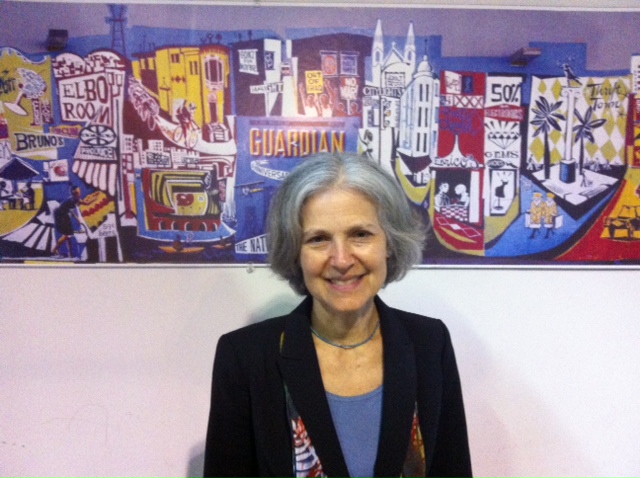
After participating in last weekend’s Green Party presidential debate against Roseanne Barr in San Francisco, which we cover in this week’s paper, frontrunner candidate Jill Stein stopped by the Bay Guardian office to chat about her hopes for progressive change in this tumultuous political year.

“The political-corporate establishment should not be given a pass in the voting booth,” the Massachusetts physician told us. “Four more years of Wall Street rule is what we get if you give them your vote.”

She ticked off a litany of bipartisan failures from the Democratic and Republican parties, from reforming Wall Street and narrowing the wealth gap to seriously addressing climate change and this country’s wasteful wars, and said people are fed up and want fundamental reforms.

“The rebellion is in full swing, you just don’t hear about it from the press,” she said. “With the exception of the Bay Guardian, we don’t have a press. We have an o-press and a re-press.”

This is Stein’s first run for national office, but she already faced off against presumptive Republican nominee Mitt Romney in the 2002 Massachusetts governor’s race, garnering just 3.5 percent of the vote but winning praise in the Boston Globe for her debate performance. She thinks both Romney and Obama are vulnerable this year, although she said, “I’m not holding my breath that we’re going to win, but I’m not running to lose.”

Her plan is to wage an aggressive grassroots and social media campaign to capitalize on the discontent most Americans feel with both major political parties, and to hopefully catch enough fire to reach 15 percent support in national polls, the threshold for getting into the presidential debates. “If we can get into the debates, we can really change things.”

To get there, Stein plans to reach out to a wide variety of groups on the left and across the spectrum, including supporters of the Occupy Wall Street movement, which she toured last year, visiting 25 encampments across the country, most of them populated by people wary of modern electoral politics.

“When I go to Occupy, I go to support them and not ask for their support,” Stein said, saying that she understood their belief that the electoral system is broken, but that it’s important to participate in it as part of a multi-pronged movement for social change that includes presidential politics. “Can we beat back the predator without have an organization? No, we need a party.”

She thinks the Green Party best represents the values of disenfranchised Americans and has the best vision for where this county needs to go, and she said, “We’re finding all kinds of networks are really getting energized and promoting us.”

High Sierra Music Festival July 5-8

0

High Sierra Music Festival, a.k.a. The Ultimate Intimate Festival Experience, is set for an unforgettable year with Ben Harper, STS9, Railroad Earth, Galactic & many more!

Taking place July 5-8, 2012 in Quincy, CA just 4 hrs from the San Francisco Bay Area.  Featuring four daytime stages, yoga/dance classes, on-site camping, artist playshops and your new favorite band.

Music goes into the wee hours with a late night schedule includes STS9, Galactic & The Motet, Railroad Earth & Brokedown in Bakersfield, Big Gigantic & Paper Diamond, The Devil Makes Three & Split Lip Rayfield, and more!

Great for families too with a designated Family Camp, expanded Kidzone and the Rockin’ Nannies.

Full details and tickets available for purchase here.