San Francisco

Freak show

0

emilysavage@sfbg.com

TOFU AND WHISKEY As Homer Flynn describes to me the Bay Area musical landscape during the time when iconic, experimental music-arts collective the Residents first rolled into town in 1966, I can’t help but picture a tiny gold hammer cracking the earth wide open like it was a piñata, with glitter, powdered wigs, freakish masks, oversized eyeballs, and gingerbread men spewing out in a magnificent tangle.

“A lot of what attracted the Residents to the Bay Area was the psychedelic music scene of the mid-to-late ’60s,” he says, with a pleasant Southern drawl. “What was so interesting about that era, was that it was wide open. Because the money was not as big, there was a lot more freedom.”

Flynn’s talking to me as a van carrying the current members of the Residents careens through the New Mexico desert on their first tour in two years, their 40th anniversary tour, which crawls to San Francisco on Feb. 24 (8pm, $35. Bimbo’s, 1025 Columbus, SF. www.bimbos365club.com).

Looking back at the beginning of the band’s career, he includes early FM radio as part of that equation: “FM radio was really getting its start, in terms of broad exposure, and it was wide open. You would turn on KSAN Radio at that time, [and] you could hear Mozart, the Grateful Dead, Bob Dylan, swing music. It was very eclectic, and that’s what made it interesting.”

He could be describing the Residents themselves with that last descriptor. The mysterious band (always covered in the face, often in whimsical dada-tastic costumery) might have been lured to the Bay by the psychedelia scene, but they took cues from far broader reaches of sound. There was cosmic jazz composer Sun Ra — “I mean, Sun Ra said he was from the planet Saturn.”

“There was a lot of mystery about Sun Ras…and when he spoke, everything was all poetic and enigmatic. He was a huge influence on the Residents, in terms of style and music presentation, although, they never really tried to emulate him in terms of music. But there was a lot of respect and influence.”

Musically, and composition-wise, there was influence from Captain Beefheart, more on the fringes of psychedelia, and far weirder than the acts that made it exponentially bigger by decade’s end. But the Residents have staying power — releasing 60 albums and multimedia CD-ROMs over four decades, including first single Santa Dog (1972), and milestone records like Eskimo (1979) and Freak Show (1990).

This is probably a good time to point out that we the listeners don’t exactly know who the band members are, or who Flynn is.

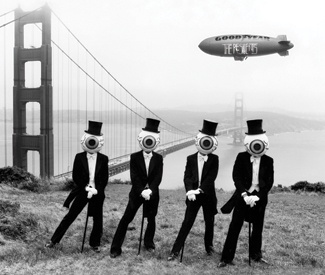
This much is true: the Cole Valley neighborhood resident is part of the band’s two-person management team, Cryptic Corporation. He’s also the art director who created most of their album covers, and who ushered in the concepts for the Residents’ many memorable faceless looks (specifically, and most well-known, the eyeball masks, though his original concept for that was giant silver globes).

The heavy globes were a no-go, so someone suggested eyeballs (the better to see you with).

“It was like, well if you have an eyeball, what goes with that? At this time it was still hippie to some extent. What was in for bands was sloppy and slovenly — which, of course, it still is at this time — so the idea of tuxedos they thought, that’s cool and classy. And then the top hat was just the perfect compliment to the eyeball and the tuxedo.”

He may also be in the band, and the band’s main lyricist, but claims to this day otherwise. It’s been a long debate, as to who is actually a member of the Residents, because, again, they all wear masks.

However Flynn’s connected with the group, he’s certainly been along for the journey — the Shreveport, La.-native has long been in that bumpy Residents bus, not least for this tour, the 40th anniversary special, which began a day before our conversation.

The live show this time around is a retrospective of the Residents entire career, laying out the colorful story of the band, with monologues and musical bits throughout. The show kicks off — where else? — with “Santa Dog.” Flynn says it’s meant to paint a broad and entertaining picture of the band.

To add a punctuation mark to the anniversary, the group is offering an ultimate box set: a 28 cubic-foot refrigerator containing releases from the group’s entire career, 100 different first pressings including 40 vinyl LPs, 50 CDs, DVDs, and a signature eyeball-with-top-hat mask. Asking price? A cool $100,000 to the lucky buyer.

On the road, the group is also bringing more practical merch, such as t-shirts and commemorative coins. Hopefully there’ll be plenty left at the Bimbo’s show near the end of the tour. While there will still be a couple more dates after it, Flynn considers the SF show to be the big return home.

“I’ve traveled around quite a bit, I’ve seen a lot of places that I like, I’ve never seen any place else that I’ve wanted to live. In terms of the Residents, best thing I can say is that they’ve been happy to call the Bay Area home.,” Flynn says dreamily. “I know it will feel really good to pull up in front of Bimbo’s and take all our stuff in, our well-worn crew at that point, coming to play the show.”


GHOST BEACH

Are you familiar with the term “tropical grit-pop.” Neither was I, but listen to the NYC band Ghost Beach’s Modern Tongues EP, and it should all come together. Or better yet, see it live this weekend. It’s all electronic burps and yacht rock vocals, from a pop duo (possibly?) named after a Goosebumps book, with ’90s-baiting lyrics, and ’80s synth layers. With ONUINU, popscene DJs.

Thu/7, 9:30pm, $10. Rickshaw Stop, 155 Fell, SF. www.rickshawstop.com.


BIG FREEDIA

If you’re celebrating Mardi Gras without Big Freedia, you’re doing it wrong. Lights Down Low is bringing the New Orleans bounce queen out especially for you, the sexy people. Oh, and don’t forget to twerk. With MikeQ, Hard French DJs.

Fri/8, 9pm, $16 (advanced tickets). Mezzanine, 444 Jessie, SF. www.mezzaninesf.com.


BEAK>

Beak> is at one once unsettling and charming; its Krautrock backbone and angular guitars create eerie, paranoid grooves, à la Silver Apples — you know the itchy, building beats — but those hushed, mumbly vocals soothe the senses. Drummer-singer Geoff Barrow, keys-guitarist Matt Williams, and bassist Billy Fuller, are all members of other bands (including Barrow’s Portishead), so they split their time between acts, but have already released two albums in the few short years they’ve been able to get together, including critically-lauded 2012 full-length, >>. And their albums are all live recorded improv sessions in the same room, which translates well to shows, making the appearances mesmerizing extensions of previous jam sessions. With Vex Ruffin, Peanut Butter Wolf.

Feb. 13, 8pm, $20. Independent, 628 Divisadero, SF. www.theindependentsf.com

 

Alerts

0

WEDNESDAY 6

Community Kick-off to Save City College

CCSF Mission Campus, Room 109, 1125 Valencia, SF. (415) 412-4183, saveccsfpetition@gmail.com. 6-8pm, free. Join students, faculty and staff at City College of San Francisco in initiating a campus/community coalition to defend the acclaimed school against threat of closure. The college faces severe cuts and sanctions demanded by an accrediting agency. Become part of a united effort to keep CCSF as a key provider of quality education for all communities in the San Francisco Bay Area, and as the primary gateway for poor and working class students and students of color.

SATURDAY 9

Rally Against Genetically Modified Salmon

Justin Herman Plaza, SF. Rachel@labelgmos.com, tinyurl.com/antiGMOsf. 11am, free. The US Food and Drug Administration (FDA) is on the brink of rubber-stamping genetically engineered salmon. Activists are attempting to turn the tide now, during the 60-day comment period before final approval. Environmentalists and those think genetically modified foods should be labeled are calling for supporters nationwide to demonstrate unity against the approval of GE Salmon. Join this march and rally to bring the issue to the front burner.

MONDAY 11

Public Meeting: Speak Out Against Tasers

Bayview Opera House, 4705 Third St., SF. 6-8pm, free. The San Francisco Police Department (SFPD) is once again holding community meetings to talk about arming San Francisco cops with Tasers. The idea has been floated in the past, but community advocates have consistently shot it down, arguing that Tasers can be lethal and are often misused by law enforcement. At this community forum convened by SFPD, an assortment of organizations including the Coalition On Homelessness and the No Tasers Taskforce will turn out against the SFPD’s latest attempt to adopt these so-called nonlethal stun guns.

Is City College’s main critic out of control?

28

The oversight board that’s demanding big, often unpopular changes at City College carries the name of the Accrediting Commission for Community and Junior Colleges of the Western Association of Schools and Colleges, and it’s approval is essential for any school that wants to get taken seriously. Without accreditation, there’s no state funding, students can’t get loans, diplomas don’t count for much — in other words, losing the ACCJA seal of approval is a death sentence.

You’d think a board so important and powerful would have a lot of oversight, be the subject of news stories, get monitored. But that’s not the case with ACCJC; nobody seems to know much about it, except that its board is a fairly obscure group of academics and administrators and its president used to run Berkeley City College and it’s stirred up a bit of anger in past years. The boss, Barbara Beno, seems to like chancellors and presidents a lot more than she likes governing boards — and, from the situation at City College, it’s clear that she’s a big fan of top-down decision-making and doesn’t approve of shared governance.

But there’s a fascinating report done by the former president of the California Federation of Teachers that looks at how ACCJC compares to regional accreditation boards in other parts of the country. Martin Hittelman, an emeritus professor of Mathematics, did a numerical analysis that suggests that ACCJC is a whole lot harsher on schools than its counterparts. Check out the chart below:


As Hittelman notes:

The vast majority of reasons dealt with the adequacy of procedures, reviews of programs, services, and operations as well as whether the college adequately used assessment tools such as student learning outcomes in the evaluation of faculty. Sanctions were rarely, if ever, based on the
actual quality and adequacy of instruction received by students.

He notes:

The ACCJC Commissioners are not representative of the diversity in the California community colleges. The large urban districts such as Los Angeles, San Francisco, San Diego, San Jose – Evergreen, and Long Beach are not represented on the Commission whereas Riverside City College
has two member of the Commission. The faculty of the California Community Colleges are represented by only four of the members of the Commission. The Commission also includes a number of members who were not well respected as administrators at their home campus

For example:

Dr. Sherrill Amador | Chair
Dr. Amador serves as a public member of the Commission. Dr. Amador began her service on the Commission July 1, 2004. She was a very unpopular college president at Palomar College where she received several votes of non-confidence.

Much of the report is academic (not surprisingly), but what I got out of it was that this particular agency, at this particular time, is demanding more from desperately underfunded schools than is normal, and is leaning distinctly toward the side of academia and politics that wants simple tests and hard data to quantify educational outcomes that aren’t always easy to quantify.

Not saying for one second that City College is free of problems. But it’s worth thinking about who the critics are and where they come from.

BTW, I contacted ACCJC for comment on the report, but haven’t heard back.


Feds continue war on California’s medical marijuana industry

12

San Francisco medical marijuana dispensaries may be bouncing back from last year’s crackdown by the federal government, but the industry statewide continues to be besieged by the federal authorities, winning some battles but losing others.

Oakland-based Harborside Health Center, the nation’s largest not-for-profit model medical cannabis dispensary, experienced a big victory last month when a judge refused a federal motion for injunctive relief that would have shut down the club and enforce a forfeiture action and a 30-day notice to evacuate that the feds filed in July 2012.  

The City of Oakland decided to file its own motion against the U.S. attorneys, banks, and landlords that were all trying to evict Harborside, one of the top two tax-payers in Oakland, a first for city to officially back one of its clubs against the feds. But the judge also denied a city motion to dismiss the case, so it continues to work its way toward trial.

Hopes that the November votes in Washington and Colorado to legalize even recreational weed smoking would cause the feds to back off in California haven’t materialized. Aaron Sandusky, a dispensary operator from Southern California, was sentenced to 10 years of federal prison last month for conspiracy and possession with the intent to distribute marijuana. The feds claim the charges were so high because he had upwards of 1,000 plants.

Stockton resident Matthew Davies owned various dispensaries (keepmattfree.org), but they were shuttered after the feds, which charged him with two counts of manufacturing marijuana. U.S. Attorney Benjamin Wagner is offering Davies a plea bargain for a minimum of five years, and threatening 10 years in prison if he doesn’t comply. A recent Politco article makes the point that this case probably won’t be the one to turn over federal law, as it is unclear whether Davies was in compliance with California state law on marijuana.

These harsh examples are just a couple of dozens of dispensaries being shut down across the state. Just last month, in a case filed by Americans for Safe Access, the U.S. Court of Appeals in Washington DC ruled that marijuana has no proven medical value and should still classified as a Schedule I substance. ASA plans to appeal the ruling, hoping the US Supreme Court will take up the issue.

People across the country are signing online petitions and vocalizing their opposition to the contradictory stance on the legality of pot. Joining in on this public debate, Morgan Spurlock, director and star of Supersize Me, is the host of a new CNN documentary series, “Inside Man”, in which Spurlock investigates various issues in American life. In one episode, Spurlock focuses on the state of medical marijuana in California, and the ongoing struggle between federal and state lawmakers. He will feature both the Harborside and the Davies case.

For now, marijuana advocates are waiting on the court decisions on these various cases and if they will affect changes regarding the federal law. The City of Oakland had a hearing last week but no ruling was made. Harborside will continue to remain open and serving patients until its case goes to trial, a date that is uncertain at the moment.


Exploratorium Explainers educate while the city waits for new Pier 15 location

1

The Exploratorium is in the middle of an epic move to its new home at Pier 15 — its new location is set to open April 17th at 330,000 square feet, five times the size of its former digs at the Palace of Fine Arts. But while staff is busy nesting the Explainersthe museum’s science-savvy youth docents, have been hard at work. The volunteers have been hosting pop-up exhibits around the city. Needing a science fix, I stopped by their event last week at the Tenderloin National Forest.

There are two kinds of Explainers: the diverse group of high school Explainers, the museum’s youngest paid employees who engage visitors at exhibits, lead demonstrations, and help run various museum operations. Field trip Explainers perform the same tasks, but as experienced young educators, take more leadership roles.

Both were present on the afternoon of Jan. 31, when I enter the Tenderloin National Forest. I’m greeted to the slice of urban wilderness by the familiar Exploratorium logo printed on black flags, and by lots of friendly folks in orange vests — the Explainers themselves, who had transformed this pocket of urban wilderness into a wonderland of interactive science exhibits. 

The first thing that catches my eye was a fruit and flower dissection demonstration, meant to teach about the various parts of a plant. Senior field trip explainer Kat Stiff asks the students, “does anyone know what a flower is made out of?” One boy in the back proudly shouts, “Cauliflower?” 

Most of the students seem more interested in the giant magnifying glasses on the table than the lesson. As I watch Stiff’s demonstration, a girl with a magnifying glass comes up to me and starts to sift through my hair with her newfound tool. I ask her if she spots anything and to which she responds, “yes. Hair.”

Across from the plant dissection workshop is the outdoor cart – which has gone with the Explainers to most of their recent events. The cart bears a poster illustrating different clouds, and a plastic soda bottle that helps you create your own cumulus formations. Before I can get started on my own personal sky, high school Explainers Zakiya Percy and Terrance Gee quiz me on my cloud knowledge.

What is a cloud made of? I should definitely know this… I know that water is involved… After I fail to pick up on their hints for the other two ingredients, they reveal that a change in pressure and the inclusion of dust particles is also necessary.

Gee does a demonstration for me. With about a half-cup of water at the bottom of the plastic liter soda bottle, he lights a match, blows it out, and places it upside-down over the opening of the bottle. He does this, he says, to add dust particles to the water. Gee caps the bottle, and I help by pumping air into it until it’s about to pop. He takes the cap off, and dollhouse-sized clouds float out. I am then quizzed again on what type of cloud we just made. The answer: fog, because of our low elevation.

As I head towards the back of the forest, Phanna Phay, a high school Explainer supervisor, is sitting down doing card tricks. Smack dab in the middle of the space is a brick oven where Explainers are helping kids heat up pizza donated by Inner Sunset favorite Arizmendi Bakery. All the way in the back, kids paint wooden veggie cut-outs, which will to be used to decorate the nearby Hotel Senator’s rooftop garden.

These pop-up Explainer exhibits have appeared at the Ferry Building and Civic Center farmer’s markets, and even aboard a ferry bound for Jack London Square.

Senior field trip explainer Lia Frantti tells me about these previous events. “We were doing our fruit and flower dissection [at the farmer’s market], so that people who are shopping for those fruits and vegetables can stop and think about where they are coming from and how they are growing. We were on the ferry boat talking about navigation and finding north.” 

When I ask Frantti about the benefits these pop-up exhibits have brought to the Exploratorium she explains, “it’s been really nice because people often put us in this hole of a children’s museum – which we’re not. Adults and children can definitely have an equally amazing experience at the Exploratorium. At some of the other spots we’ve been at, we have had more adults stopping by. So that has been a little bit different to have less youth and more adults spending time with us.”

Looking forward to the museum’s new digs? When it re-opens, the Exploratorium will have triple the exhibition space, and double the number of classrooms. Acclaimed San Francisco chef Loretta Keller of Bon Appétit will head a sidewalk café on the west side of the pier, and there will be a waterfront café on the east side. The event in the Tenderloin was the last full scale Explainer exhibit until the Exploratorium settles into its new space. But the group will be holding outdoor events featuring the plant dissection table, mainly along the Embarcadero.

Avalos to call on SF retirement system to divest from fossil fuels

San Francisco’s city pension fund may have as much as $1 billion tied up in companies that control fossil fuel reserves, such as Exxon, BP, Shell and Chevron. At the Board of Supervisor’s meeting this afternoon, Sup. John Avalos plans to introduce a resolution calling on the San Francisco Employees Retirement System (SFERS) to divest from leading fossil fuel giants. 

The resolution, which urges the San Francisco Retirement Board to stop investing in stocks and and mutual funds with shares in coal, oil and gas companies, was created with input from nationwide environmental organization 350.org. Last year, 350.org launched a campaign calling on universities to divest from 200 targeted fossil fuel companies as a way to tackle global climate change.

“They’re the companies that own the vast majority of the world’s fossil fuel reserves – who actually own the carbon that’s sitting in the ground,” explains Jamie Henn, cofounder and communications director of 350.org. When these fossil fuel reserves are extracted and burned to generate power, they’ll emit greenhouse gases such as carbon dioxide, worsening the impact of global climate change.

Scientists have calculated that from here on out, a total of 565 gigatons of carbon dioxide can be emitted into the atmosphere before the planet’s global average temperature increases by two degrees Celsius. Despite widespread international consensus that crossing this threshold would bring unacceptable consequences, says Henn, the 200 targeted companies can access enough oil and gas reserves to eventually emit five times as much CO2 into the atmosphere.

“Their share prices are based on their ability to burn those reserves,” Henn said. “The only way we can tackle climate change in this country is if we weaken the fossil fuel industry.”

To that end, Avalos is acting locally.

“San Francisco has aggressive goals to address climate change,” the District 11 supervisor noted. “It’s important that we apply these same values when we decide how to invest our funds, so we can limit our financial contributions to fossil fuels and instead promote renewable alternatives.”

Supervisors do not have control over the investment decisions of the San Francisco Retirement Board, which controls the city’s $16 billion pension fund, so Avalos’ resolution would not impose a legal obligation to divest. Yet a Budget & Finance Committee hearing about the proposed resolution could help raise awareness of the issue, noted Jeremy Pollock, a legislative aide to Avalos. The idea is to start a conversation about “what our social investment policy is, with regard to retirement funding,”  he explained.

If Avalos’ resolution to divest in fossil fuels is ultimately approved by the full board, San Francisco would become the second city in the nation to take such a step. Seattle Mayor Mike McGinn called on city retirement funds to abandon stocks in coal, oil and gas companies last December.

In addition to the resolution calling for divestment from fossil fuels, Avalos also plans to introduce a resolution urging the San Francisco Retirement Board to divest from publicly traded manufacturers of firearms and ammunition.

SF’s Cocktails shout ‘Hey Winnie’

4

I’m loving this video by newish San Francisco power-pop (or “power-slop”) band Cocktails for “Hey Winnie,” off the group’s debut self-titled EP.

The video has the playful vibe of 1990s alternative spots (when power-pop was king), and looks to be set in Tenderloin store, Vacation actually was filmed at the No Shop in the Mission.

Released a week from today (Feb. 12) on local Father/Daughter Records, the seven-inch was recorded at Fuzz City Studio with Matthew Melton, of Warm Soda and Bare Wires fame. Cocktails’ next show is Feb. 23 at the Night Light, 311 Broadway, Oak. www.thenightlightoakland.com.

City considers making building owners do seismic upgrades

84

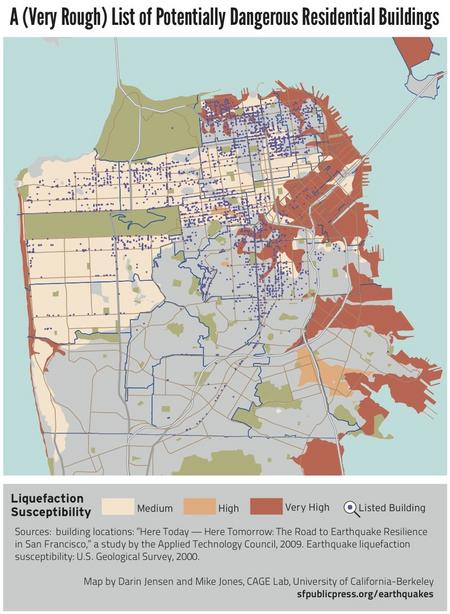
City Hall sources have confirmed the basic details of a San Francisco Public Press report from Friday afternoon that the Board of Supervisors will consider requiring the owners of soft-story buildings of three stories or more to seismically retrofit them by 2020 – at the expense of building owners, something sure to rouse controversy.

The legislation was developed and introduced by the Mayor’s Office and it’s being sponsored by the board’s two most prolific and effective supervisors, Board President David Chiu and Sup. Scott Wiener, which is probably a signal that city officials know this one is going to be “challenging,” as one source told us.

Details are still being hammered out before the measure is introduced at tomorrow’s board meeting, including some of the financing options that would be open to property owners. But after voters in 2010 narrowly rejected Measure A, a bond that would have provided low-cost loans for the seismic retrofits, property owners could be forced to dig deep to ensure their buildings don’t collapse in an earthquake.

Wiener confirmed that the legislation would be mandate on building owners without public money attached: “It would be a mandate that they within a certain time frame do an earthquake retrofit,” Wiener told the Guardian.

As the Public Press reported, the legislation would apply to all wood-framed buildings of three stories or more built before 1978, with smaller buildings and single-family homes exempted. In the most recent print edition of the Public Press, extensive coverage of the city’s earthquake vulnerabilities estimated that about 58,000 San Franciscans live in the nearly 3,000 soft-story buildings deemed dangerous places to be when the next big earthquake hits.

Wiener said city officials have been deeply involved with negotiations with various effected groups, including building owners and their tenants, who could face displacement as the work is done or higher rents if landlords pass through those costs. Wiener said the legislation is bound to evolve as talks and hearings continue: “There are a lot of variables and the introduction is really just a preliminary step.”

Supes call for stronger SRO safety measures

It’s no secret that tenants living in single room occupancy hotels (SROs) often grapple with health and safety issues, from bedbug infestations to plumbing problems.

At a committee hearing this afternoon, members of the Board of Supervisors will consider legislation [PDF] introduced by Sup. Eric Mar that would amend the housing code to require owners of SROs to install grab bars in common-area bathrooms, and to provide working phone jacks in each SRO unit.

These measures may seem relatively small, but Tony Robles of the Senior & Disability Action Housing Collaborative says installing grab bars can go a long way toward preventing falls, a leading cause of injury deaths for people older than 65.

In SROs, “there’s a lot of folks who have mobility problems,” Robles explains. “Many are disabled, or elders.” He said knows an elderly woman living in an SRO who recently fell and now faces hip surgery.

“This legislation is about safety, and it’s about quality of life,” Robles said. “It’s not just affluent folks who deserve to live in reasonably habitable conditions.”

Last June, advocates with Senior Action Network and several SRO collaboratives published detailed findings [PDF] from an in-depth survey of 151 SRO residents living in Chinatown, the Mission, SoMa and the Tenderloin. Most respondents were older than 55, and 62 percent identified as having a disability.

The in-depth study found that safety issues topped the list of residents’ concerns. Many respondents said they feared falling on the stairs or in the shower, and less than half reported having grab bars in their bathrooms.

The legislation, which was co-sponsored by Supervisors Jane Kim, David Campos and David Chiu, would also require SRO operators to install working phone jacks in residents’ rooms, which can be critical for tenants who need a way to communicate in case of an emergency.

According to the study findings, these low-income tenants face a host of other issues too:

“About one-third or more of survey respondents said their hotel had a problem with bedbugs, other infestations, visitor policy violations, electrical problems, unsanitary bathrooms, and harassment/ disrespect. One-fifth of respondents also cited problems with heat, plumbing, personal safety, fire safety, and maintenance and repairs. 
More than half (53%) had no access to a kitchen in their building, and 18% of respondents said they skip meals due to lack of resources or facilities.”

San Francisco has more than 500 residential hotels, according to city records, with more than 19,000 units. An estimated 8,000 seniors and adults with disabilities live in SROs.

Robles remarked that it took courage for the SRO residents to speak up in hopes of improving their living conditions. “Tenants in theses SROs oftentimes are intimidated to say anything,” he said. “Some folks might have feared reprisal.”

Trail to historic gay Boy Scouts vote started in the Bay Area

23

This Wednesday, the Boy Scouts of America’s (BSA) Executive Board will consider removing the controversial ban on gay members and allow each individual troop to adopt its own policy on gay scouts. The board publicly reaffirmed the anti-gay policy just last summer, but recent pressure from gay rights groups, corporate sponsors, and Bay Area troops has forced the governing body to revisit the blanket prohibition on gay members.  

Opposition to the Boy Scout’s ban first surfaced in Northern California in the late 1980s when Tim Curran, an Eagle Scout and aspiring scoutmaster, sued the Mount Diablo Boy Scout Council for discrimination after being denied the position. Curran took the suit to the Supreme Court and lost. The court’s landmark decision in Curran v. Mount Diablo Council of the Boy Scouts of America continues to provide the legal justification for the BSA’s anti-gay policies.

Since the ruling, the San Francisco Bay Area has emerged as a key battleground in the struggle for gay membership in the scouts. Local troops often clash with the national organization over the ban and many local scout leaders publicly denounce the policy as discriminatory and hateful.

In October, openly gay East Bay scout Ryan Andresen was denied his Eagle Scout badge by the Mt. Diablo-Silverado Council due to his sexual orientation. Although officials with the council voiced reservations about denying Andresen, they are bound by BSA national policy that has long maintained homosexuality is inconsistent with the scouts oath to be “morally straight.”  

Andresen’s father resigned his position as an assistant scoutmaster, and Andresen’s mother organized an online petition which collected nearly half a million signatures protesting her son’s expulsion. The incident is sparking a widespread public debate about the Scout’s discrimination policy. Andresen appeared on national TV, and his petition garnered high profile support from California politicians like Lt. Gov. Gavin Newsom and US Sen. Barbara Boxer.

Andresen’s national profile and the publicity surrounding his case inspired outrage among local scouts and adult leaders. Steve Tennant, committee chair of Palo Alto Troop 57, said the parents and volunteers in his troop felt compelled to act. “We were all outraged and we immediately started thinking about how we could go about changing this policy,” he told the Guardian.

The controversy quickly galvanized parents and scouts throughout the Bay Area to more openly challenge the gay ban. From San Francisco to Palo Alto, parents and scouts penned public letters of protest decrying the policy and and urging the local Mt. Diablo-Silverado Council to reconsider Andresen.

Parents in Tennant’s Troop 57, located just a few miles from Andresen’s troop, unanimously adopted a non-discrimination policy both to voice solidarity with Anderson and to avoid potential discrimination in their own troop.

“It was just a matter of time until a kid in our troop faced the same situation as Ryan. I would rather resign my position than kick a kid out of the Scouts for being gay,” Tennant, whose two sons are currently scouts, told the Guardian. “Seeing the reaction of our parents and seeing the support for Ryan convinced me personally to stay involved with the Scouts,” he added.  

Eagle Scouts from Andresen’s district also mobilized against the ban. Trevor Wallace, an Eagle Scout from the nearby Troop 57, helped to organize meetings to pressure the Mt. Diablo-Silverado Council to allow Andresen to earn his badge. “My troop has been completely outraged by what happened to Ryan,” Wallace told the Guardian. “I got my Eagle Scout badge the same time Ryan was supposed to get his… discriminating against him like this is old fashioned and wrong.”

Michael and Andrew Dotson, a father-son scoutmaster duo who lead San Francisco’s Troop 88, echoed the concerns of Wallace and Tennant. “I want the boys to feel safe and be able to be open,” Michael Dotson told the Guardian. “Troop 88 would be very accepting of gay members once the ban is removed. And I hope it is.”

Andrew Dotson, a recent Eagle Scout who now works as his father’s assistant scoutmaster also opposes the ban. Growing up in San Francisco, he encountered plenty of gay scouts. But because of the national policy, the boys in his troop had to stay formally in the closet or risk expulsion. “I just don’t think that’s right,” he told the Guardian. “Scouting should be open to everybody.

Andresen’s case and the outpouring of support from other Bay Area scouts drew the attention of Zack Wahls, founder of Scouts for Equality, a national organization founded last summer to pressure the BSA Executive Board d to revisit the gay-ban.  

Wahls credits Andresen and his supporters with providing the necessary grassroots pressure to potentially change the national policy.

“It’s important to remember that only seven months ago, the Scouts were adamant that this policy was not going to change,” Wahls told the Guardian. “What happened in those seven months was that we harnessed online tools and worked with people like Ryan to highlight the negative impact this ban has on the local level.”

Wahl and Boy Scouts for Equality also targeted corporations and sympathetic members of the BSA board.  Over the summer, board members Randall Stephenson, CEO of AT&T, and James Turley, CEO of Ernst & Young, announced publicly their opposition to the ban. Since September, several major corporate sponsors, including Intel and UPS, announced that they would rescind financial support for the BSA until the national organization lifted the ban.  

Ahead of the board meeting, BSA officials reiterated that lifting the ban would not force any individual troops to change their own membership policies. “The Boy Scouts would not, under any circumstances, dictate a position to units, members, or parents,” BSA spokesperson Deron Smith told the New York Times. “This would mean there would no longer be any national policy regarding sexual orientation.

For many scouts in the Bay Area, however, removing the national ban is just the beginning. The end goal is the adoption of a national non-discrimination policy. But given the Boy Scouts history of strident opposition to gay rights, reconsidering the ban is significant development. “I think a national policy will take time,” reflected Michael Dotson of Troop 88, “but this is a good first step.”


Police gear up for round two on Tasers

On February 4, the San Francisco Police Commission will hold the second of three planned community meetings to gauge support for a pilot program to arm 100 SFPD officers with Tasers. The controversial proposal pits police Chief Greg Suhr, a proponent, against civil liberties organizations and homeless advocates who are mobilizing public opposition to the Taser initiative. 

Shortly after being appointed police chief in 2011, Suhr said arming the SFPD with Tasers would not be a top priority. But following the police shooting of a mentally ill man last July, Suhr has pushed the Police Commission to allow members of the cities Crisis Intervention Team (CIT)—who receive special training to deal with the mentally ill—to carry Tasers.

Since the shooting, Suhr has repeatedly argued that Tasers would help save lives and reduce instances of gun use. “You do have to have as many tools in the tool box before you go to guns,” he said at the first community forum.

The ACLU and local homeless advocates disagree.

“Every time there is an officer-involved shooting, the department uses it as an excuse to outfit officers with Tasers,” ACLU attorney Micaela Davis told the Guardian. “We continue to believe that Tasers are not a good alternative to firearms and we fear that officers run the risk of going to Tasers too early in a confrontation instead of using de-escalation techniques.”

Equipping CIT officers with Tasers would inject the controversial stun guns into already tense confrontations between the mentally ill and the SFPD.

Lisa Marie Alatorre, an organizer with the San Francisco Homelessness Coalition, argues Tasers could have a devastating effect on the city’s homeless population. “The CIT typically deals with people in crisis, people who are mentally ill, and people who are currently destitute and have nowhere to live,” she told the Guardian. “The use of Tasers in the midst of a crisis will cause severe trauma and could inflict significant psychological damage.”

Both the Coalition on Homelessness and the ACLU charge that the SFPD has dragged its feet in implementing the nonviolent components of the CIT program. Less than 75 officers have been trained in nonviolent confrontational strategies since the program’s adoption last summer, and Alatorre charges SFPD has yet to implement protocols that would bring the program to fruition.

Police Commissioner Angela Chan, a longtime proponent of the CIT program, echoed these concerns. “We need to improve our de-escalation tactics with regards to crisis intervention. Many of the steps to train and implement CIT have not yet been implemented and that’s where we need to focus our energies,” she told the Guardian.

Despite strong local opposition to Tasers, they are becoming standard equipment for police departments across the nation. SFPD officers are hopeful that public opposition does not kill this pilot program, like similar attempts before it.

Sgt. Michael Andraychak, a spokesperson with the SFPD, argued that equipping CIT officers with Tasers would give police more flexibility to use force without engaging their firearms.

“On the street, not every situation can be managed in a nonviolent fashion,” he told the Guardian. “CIT is a great program, and the implementation of Tasers would give those officers an additional tool to use before they have to escalate to deadly force.”

Police commissioners will make a final decision about Tasers after the third community meeting, which is scheduled for Feb. 11 at the Bayview Opera House.

The next community forum on the SFPD Taser pilot program will be held on Feb. 4 from 6-8pm at the Scottish Rite Center, 2850 19th Ave, in SF.  

Stallone, Walken, zombies, Oscar shorts, and more: new movies!

0

Yes you can find time to see a movie this otherwise football-y weekend. The ongoing Noir City and Sketchfest still have a lot of great upcoming programming, Sly Stallone is back in evocatively-titled action flick Bullet to the Head, a zombie finds love in Warm Bodies (review below), and all the Academy Award-nominated shorts are now available for big-screen viewing, for anyone who takes winning the office Oscar pool as seriously as … the Superbowl.

And speaking of the big game, the Roxie will be hosting its annual “Men in Tights” viewing party, a benefit for the theater and the upcoming SF IndieFest. So you can have your pigskin, and eat your popcorn too. GO NINERS!


“Oscar Nominated Short Films 2013: Animated” If you caught Wreck-It Ralph, nominated in the Best Animated Feature category, you’ve already seen John Kahrs’ Paperman, about a junior Mad Men type who bumbles through his pursuit of a lovely fellow office drone he spots on his commute. Or, if you saw Ice Age: Continental Drift, you’ve seen Maggie Simpson in The Longest Daycare, starring Homer and Marge’s wee one as she grapples with the social order at the Ayn Rand School for Tots. Among the stand-alones, Minkyu Lee’s Adam and Dog features a quick appearance by Eve, too, but the star is really the scrappy canine who gallops through prehistory playing the world’s first game of fetch with his hairy master. Two minutes is all PES (nom de screen of Adam Pesapane) needs to make Fresh Guacamole — which depicts grenades, dice, and other random objects as most unusual ingredients. The only non-US entry, UK director Timothy Reckart’s Head Over Heels, is about an elderly married couple whose relationship has deteriorated to the point where they (literally) no longer see eye to eye on anything. The program is rounded out by three more non-Oscar-nominated animated shorts: Britain’s The Gruffalo’s Child, featuring the voices of Helena Bonham Carter and Robbie Coltrane; French art-thief caper Dripped; and New Zealand’s sci-fi tale Abiogenesis. (1:28) (Cheryl Eddy)

http://www.youtube.com/watch?v=Z8SbmPhavhs

“Oscar Nominated Short Films 2013: Documentary” Selections include San Francisco filmmaker Sari Gilman’s poignant study of a Florida retirement community, Kings Point; Cynthia Wade’s Mondays at Racine, about a beauty salon that provides free services for women who have lost their hair to cancer treatments; Sean Fine and Andrea Nix’s Inocente, a profile of a young, homeless, aspiring artist; Redemption, Jon Alpert and Matthew O’Neill’s take on New York dumpster divers; and Open Heart, Keif Davidson’s look at Rwandan children who travel to Sudan for high-risk surgery. (3:29)

“Oscar Nominated Short Films 2013: Live Action” Selections include Bryan Buckley’s Asad, about a Somali boy who must choose between fishing and piracy; Sam French’s Buzkashi Boys, about two young friends coming of age in war-torn Kabul, Afghanistan; Shawn Christensen’s babysitting yarn Curfew; Tom Van Avermaet’s supernatural love story Death of a Shadow; and another (sort-of) love story, Canadian Yan England’s Henry. (1:54)

Sound City Dave Grohl adds “documentary director” to his ever-lengthening resume with this tribute to the SoCal recording studio, where the grimy, funky décor was offset by a row of platinum records lining its hallway, marking in-house triumphs by Fleetwood Mac, Tom Petty, Cheap Trick, Neil Young, and others (even, yep, Rick Springfield). Top acts and producers (many of whom appear in the doc to dish and reminisce) were lured in by a unique recording console, installed in the early 1970s, whose legend grew with every new hit it helped engineer. Despite its reputation as a hit factory — and the attraction of its laid-back vibe and staff — old-school Sound City began to struggle once the highly-polished sound of digital technology overtook the music industry. That is, until Grohl and Nirvana recorded Nevermind there, keeping the studio alive until the unstoppable march of Pro Tools hammered the final nails in. Or did it? Sound City‘s final third follows Grohl’s purchase of the studio’s iconic console (“A piece of rock ‘n’ roll history,” he proclaims, though he installs it in a swanky refurbished space) and the recording of an album featuring luminaries from the studio’s past … plus Paul McCartney. The resulting doc is nostalgic, sure, but insider-y enough to entertain fans of classic rock, or at least anyone who’s ever sneered at a drum machine. (1:46) Roxie. (Cheryl Eddy)

Stand Up Guys Call it oldster pop, call it geriatricore, just don’t call it late for its meds. With the oncoming boomer elder explosion, we can Depends — har-dee-har-har — on the fact that action-crime thrillers-slash-comedies like 2010’s Red, 2012’s Robot and Frank, and now Stand Up Guys are just the vanguard of an imminent barrage of grumpy old pros locking and loading, grousing about their angina, and delivering wisdom with a dose of hard-won levity. As handled by onetime teen-comedy character actor Fisher Stevens, Stand Up Guys is a warm, worthy addition to that soon-to-be-well-populated pantheon. It grows on you as you spend time with it — much like the two aging reprobates at its core, Val (Al Pacino) and Doc (Christopher Walken). Val, the proverbial stand-up guy who took the fall for the rest of his gang, has just completed a 25-year-plus stint in the pen. There to meet him is his only pal, and former partner in crime, Doc, who has been leading a humble life but has one last hit to commit for their old boss Claphands (Mark Margolis), who’s inexplicably named after a Tom Waits song. Sex, drugs, and some Viagra commercial-esque bluesy guitars are in order, but first Val and Doc must find their drive, in the form of their old driver buddy Hirsch (Alan Arkin), who they break out of a rest home, and, perhaps, their moral compass, which arrives with the discovery of a victim (Vanessa Ferlito) of baddies much less couth than themselves. The pleasure comes with following these stand-up guys as they make that leap from craven self-preservation to heroism, which might seem implausible to some. But to the cast’s, and Stevens’s, credit, they make it work — and even give the sentiment-washed finale a swashbuckling buddy-movie romanticism, the kind that a young Tarantino might dislike and an older Tarantino would be loathe to begrudge his lovable louses. (1:34) (Kimberly Chun)

http://www.youtube.com/watch?v=1FVyUL1Q06M

Warm Bodies A decade and a half of torrid, tormented vampire-human entanglements has left us accustomed to rooting for romances involving the undead and the still-alive. Some might argue, however, that no amount of pop-cultural prepping could be sufficient to get us behind a human-zombie love story for the ages. Is guzzling human blood really measurably less gross than making a meal of someone’s brains and other body parts? Somehow, yes. Recognizing this perceptual hurdle, writer-director Jonathan Levine (2011’s 50/50, 2008’s The Wackness) secures our sympathies at the outset of Warm Bodies by situating us inside the surprisingly active brain of the film’s zombie protagonist. Zombies, it turns out, have internal monologues. R (Nicholas Hoult) can only remember the first letter of his former name, but as he shambles and shuffles and slumps his way through the terminals of a postapocalyptic airport overrun by his fellow corpses (as they’re called by the film’s human population), he fills us in as best he can on the global catastrophe that’s occurred and his own ensuing existential crisis. By the time he meets not-so-cute with Julie (Teresa Palmer), a young woman whose father (John Malkovich) is commander-in-chief of the human survivors living in a walled-off city center, we’ve learned that he collects vinyl, that he has a zombie best friend, and that he doesn’t want to be like this. We may still be flinching at the thought of his and Julie’s first kiss, but we’re also kind of rooting for him. The plot gapes in places, where a tenuous logic gets trampled and gives way, but Levine’s script, adapted from a novel by Isaac Marion, is full of funny riffs on the zombie condition, which Hoult invests with a comic sweetness as his character staggers toward the land of the living. (1:37) (Lynn Rapoport)

More unregulated cabs on the street

17

So the state regulators have decided that it’s just fine for companies that pretend not to be taxi operators to operate taxis in San Francisco. That means Lyft and Uber can keep picking up passengers, charging them a “recommended donation” and avoiding the regulations that San Francisco wisely put in place to protect the public.

But the fact that the state thinks this is just fine and dandy, for now anyway, doesn’t mean San Francisco has to do the same. This city has the right to put rules in place for people conveying passengers within its 49 square miles — and those rules ought to apply to Lyft and Uber and Sidecar, too.

Cabs have to carry medallions, or permits. There are a limited number, and they can’t be owned by corporations, only by active cab drivers. You can buy one now — for about $200,000 — or you can get in line and wait, for about 15 years. If the city wants more cabs on the streets and likes the Lyft model, fine: The Municipal Transportation Agency can issue more permits, and if the venture capitalists backing Lyft want to pay for them, they can do so.

I’m not against Lyft or anyone else who has a good idea to serve the public in a way that isn’t being offered now, and I agree that this is the kick in the pants a slow-moving industry needs to develop (fairly simple) apps that allow people to figure out where the nearest cab is and when it’s coming.

But right now, we have an unregulated industry operating in competition with a heavily regulated industry, and it’s not fair. The City Attorney’s Office ought to look into this; the supervisors ought to investigate and force the newcomers to follow the rules. Sure: Lyft. But not this way.

‘United in Anger’ reveals ACT-UP’s surprising intricacies

0

In the end, it was the women who saved us — and we, in turn, helped save them.

As a gay man, this was one of the lessons I took from Jim Hubbard and Sarah Schulman’s brilliant, sometimes harrowing film, United in Anger: A History of ACT-UP, which I caught yesterday at the GLBT History Museum in the Castro, and which screens again tonight Fri/1 at 6pm at the San Francisco Art Institute. The 93-minute movie, bristling with mindblowing archival footage, swiftly but effectively traces the AIDS Coalition to Unleash Power movement from its rambunctious beginnings in 1987 in New York, through its major actions like the die-in inside St. Patrick’s Cathedral and the storming of the NIH headquarters in Maryland, to its eventual, sad dissipation under the weight of endless death in the mid-1990s. There is a lot of great retro fashion in this, btw.

But what sets United in Anger apart from other AIDS-related documentaries is its special attention to the broader sociological implications of a movement that united not just middle-class white gay men looking to save themselves (a commonly held view of ACT-UP that is specifically addressed throughout the film) but also lesbians, people of color, the poor, the homeless, trans people, and straight men and women people in general. Still, as firm as it is in its convictions, it’s never strident, letting the facts and footage carry the case in incredibly moving and sometimes, frankly, aesthetically beautiful ways. 

http://www.youtube.com/watch?v=X4ZacAyc4b8  

One particularly effective narrative thread is that of how many women were involved in ACT-UP, who have basically vanished from the common telling of the story. (Another excellent AIDS doc, the SF-centric We Were Here, also directly addresses this point, but not as broadly).

Those women knew this would happen, of course. They even called themselves “Invisible Women.” In United in Anger these women are not just given a voice, in effect the whole movie is turned over to them, fantastically, as it documents not just the early movement when hundreds of lesbians and straight women (mothers, sisters, lovers) joined ACT-UP, but the grueling, four-year struggle to get the Centers for Disease Control to redefine the meaning of AIDS to include the related diseases that women with HIV were experiencing, thus granting those women disability and social security benefits, along with better access to treatment. It’s worth it to remember that for years women died of HIV, but not officially AIDS — mostly because AIDS was then considered a white gay man’s disease, and “womens’ symptoms” were anathema to that stereotype.

This successful attempt at redefinition, which many devoted their last days to making, had huge implications for the fight for universal healthcare (indeed, footage shows some ACT-UP descendants rallying for it in 2007, with an unspoken glance towards Obamacare) and is firmly set in the lineage of women’s rights and the fight for abortion access.  

Another revelation for many will be the conscious inclusion of people of different backgrounds and means in ACT-UP — Asians, African-Americans, the poor, the homeless, the freaks — who are not just highlighted in the film, but shown to be, in the end, ACT-UP’s major impetus. United in Anger doesn’t shy of implying that ACT-UP was an expression of the great liberal impulse to fight for equality and visibility, linking it not just to the Civil Rghts movement (from which ACT-UP explicity borrowed such effective strategies as affinity groups and canny press manipulation) but the epic historical battle to wrest power away from the wealthy yet ignorant and award it back to the people. And ACT-UP did have its practical personal triumphs. As one interviewee says, “I wouldn’t be here — the medicines I take now to stay alive wouldn’t be here if we hadn’t been dragged screaming across the street by police 20 years ago.”

The best part of the movie, for me, was that it takes the time to give every activist it shows a name — and (its own suspense) a set of birth-to-death dates appears all too frequently beneath that name. But beyond immortalizing its players, United in Anger shows ACT-UP to be a classic and inspiring convulsion of the liberal spirit, brought on by tragedy, eventually fading away like a cloud of human ashes, yet living on as an example of what can happen when people join together out of anger and compassion. And it ain’t preachy about it, either.  


Activists slam hollow report on SFPD-FBI spying

108

UPDATE: SUHR APOLOGIZES FOR REPORT The San Francisco Police Department continues to resist meaningful oversight of its partnership with the FBI’s Joint Terrorism Task Force. After last year pressuring Mayor Ed Lee into vetoing a strong oversight measure and signing a weaker version, the SFPD last week issued a required report that activists are slamming as “grossly inadequate.”

The Coalition for a Safe San Francisco – which includes civil libertarians and members of Muslim groups and other targets of racial and religious profiling by the FBI – last May stood with Police Chief Greg Suhr and sponsoring Sup. Jane Kim as Lee signed what they called this “historic civil rights legislation.”

But at the time, the activists told the Guardian that the value of the watered-down legislation depended entirely on how it was implemented, particularly in the annual reports on SFPD-FBI operations that it required. To ensure they were specific enough to be meaningful, the coalition says it communicated with Suhr several times asking him to include the number of joint investigations undertaken, how many times FBI requests were denied by the SFPD, and possible violations of department policy and how they were handled.

Instead, when Deputy Chief John Loftus gave the first of these annual reports to the Police Commission on Jan. 23, he spoke for only a couple minutes and said the SFPD was in “full compliance” with the ordinance and a Suhr general order banning surveillance of law-abiding citizens, offering no further details.

“We were very clear with the chief about what we expected to see,” Nadia Kayyali of the Bill of Rights Defense Committee, a coalition member, told the Guardian. She also said the report “was slipped on the agenda at the last minute,” despite assurances that the coalition would be notified and given a chance to respond. “It does show a lack of regard for the ordinance and the work that went into it.”

The activists say that Suhr broke his promise to them to include the more specific information that they sought, even after they recently followed up with messages reminding him about that assurance. “I was in the meeting where he said he would,” Nasrina Bargzie with the Asian Law Caucus, another coalition member, told us. Bargzie said she was disappointed and dismayed by what the report included, “but we’re going to keep pushing on it.”

The controversy surrounding possible SFPD-FBI spying on people who haven’t violated any laws – which is illegal under local and state law – broke almost two years ago when the American Civil Liberties Union obtained a secret 2007 SFPD-FBI memorandum of understanding placing SFPD officers under FBI command. It seemed to bypass local restrictions adopted after past SFPD scandals involving police spying on political groups.

Suhr tried to quell the controversy by issuing a general order banning officers from participating in surveillance that violates local rules or the state constitution’s privacy protections, but activists pushed for a stronger assurance. The Board of Supervisors then voted 6-5 to codify those protections into city law, but Suhr objected and Lee vetoed the measure. A weaker version calling for annual reports and Police Commission reviews of future SFPD-FBI MOUs was approved unanimously by the board.

Now, it appears the SFPD has done little to soften the “trust us” stance that it has taken from the beginning, frustrating activists who had pushed for more, here and in other cities that do domestic surveillance with the FBI.

“These policies are explicit and unequivocal. San Francisco Police Department members and their Joint Terrorism Task Force supervisors are aware of and familiar with these policies,” Loftus told the commission, explaining that the SFPD did its required quarterly reviews in November and two weeks ago, finding nothing to report.

Police Commissioner Suzy Loftus asked if he could “explain a bit more” and Suhr – who was at the stand giving his report as Deputy Chief Loftus (no relation) gave his from the lectern – answered: “All San Francisco police officers are held to the San Francisco Police Department policies and procedures and the policies and laws of San Francisco, whichever is more strict. So depending on wherever they are, their fallback, if you will, is whatever the policies, procedures, laws, ordinances, and all of San Francisco.”

Suhr’s answer seemed to satisfy the commission, which defended the SFPD’s secretive approach rather than asking any more questions.

“Our officers will not participate in any investigation unless there is a predicate offense that is a violation of the California Penal Code or the United States code, so they will not be involved in random surveillance or random assessments or talking to people,” Commission President Thomas Mazzucco said.

Commissioner Joe Marshall also said he trusts Suhr and we all should too: “I want the public to feel reassured that when the chief says that’s going to be the way it is, that’s the way it is.”

But the coalition, which includes 79 organizations, was less than satisfied with that answer. In a statement issued today, it wrote, “Deputy Chief Loftus’ report completely failed to provide the information required to ensure the accountability and transparency required under the Safe San Francisco Civil Rights Ordinance. The Coalition calls on the Chief of Police to promptly issue a public written report containing the information he promised he would provide.”

Neither Kim – who sponsored both the original legislation and weaker alternative – nor the SFPD have returned Guardian calls for comment yet, but I’ll update this post if and when they do. You can watch the hearing yourself here, with that item beginning at the 48:20 mark.


Restaurant Guide*

0

La Note and Café Clem

Dorothée Mitrani-Bell, owner and proprietor of both La Note and Café Clem in Berkeley, was born in the South of France and grew up in Paris. Daughter of French gourmet cooks, she is no stranger to fine French cuisine, but wanted to bring the rustic and unpretentious side of things to her clientele. “I sell conviviality,” she says, adding with a laugh: “It’s about people – I want people to be together and sit together…and calm down.”

After “Berkeley called, ” a young twenty-something Dorothée arrived on a one-way ticket and $6 in her pocket, attended Cal, and sometime thereafter set up shop in a once dilapidated 1875 building that she completely renovated and restored on her own. La Note opened in 1997 and has been in the same location since.

“As soon as I walked in to the building, I had a vision of what it is today” – that is a charming eatery with a warm and rustic Provençal ambiance. Reclaimed and repurposed furniture like old pews make it feel homemade, like the food. The pancakes are a must-try, as are the eggs. Les Oeufs Lucas and a fresh croissant will not disappoint.

More Paris than French countryside, the new Café Clem opened last April near Berkeley High with much fanfare. “The kids are fans of the Nutella-filled baguette and les pain perdus.” A pain perdus, for the uninitiated, is a pressed stack of challah layered with Nutella, served here with a glass of milk – French comfort food at it’s finest, for students and adults alike. (Jackie Andrews)

La Note, 2377 Shattuck Ave., Berkeley | (510) 843-1535| lanoterestaurant.com

Café Clem, 2020 Kitteredge St., Berkeley | (510) 280-3881 | cafeclem-downtown.com


Taqueria Can-Cun


Voted as “Best Taqueria” in the Best of the Bay for 10-plus years, this taqueria is one of the best in the Mission. Their tacos and burritos are always delicious but if you are looking to mix it up a little try their pastor torta – flavorful pork between two fluffy warm buns with lots of tasty toppings in between. If you are a vegetarian this place will satisfy since they’ve been voted “Best Veggie Burrito” more than once. This small, quaint, authentic taqueria is located in the heart of the Mission at 2288 Mission St. @ 19th with another location at 1003 Market St. @ 6th and their newest one at 3211 Mission St. @ Valencia. Whether you are looking for lunch, dinner or a late night snack, this place deserves consideration. Open Monday through Thursday 10am to1am, Friday and Saturday 10am to 2am, and Sunday from 10am to 1:30am.


Bistro SF Grill


Bistro SF Grill provides the best, always fresh, organic, sustainable, local, and eclectic meats, and with their fresh-baked organic breads they create the most exciting burgers.

If you’re looking for a hearty meat dish – whether a traditional Kobe beef burger, or if you’re feeling funky and want to try grilled ostrich, alligator, buffalo, wild boar, or venison – then this is the place for you. Their wide variety menu also has options for the vegan and vegetarian eaters as well. This restaurant serves a wide variety of beers from around the world and also has wine tastings everyday. Open Monday through Friday, 5 to 10pm and Saturday and Sunday, noon to 10pm, located at 2819 California St. @ Divisadero.


Las Palmeras

This Salvadorian/Mexican/Latin American restaurant is sure to satisfy everyone’s taste buds, even those of the picky eater. They offer all the traditional Mexican food including refried beans, rice, homemade warm flower tortillas, salad, salsa and their famous pupusas – a thick handmade corn tortilla stuffed with a variety of cheese and pork. The menu also includes tamales, soup, finger lickin’ fried chicken and hamburgers. Open seven days a week from 8:30am to 9:30pm daily, located at 2721 Mission @ 23rd  St.


Taqueria El Castillito

This affordable, delicious, and undeniably authentic taqueria may be one of the best in the Mission. This place is best when you are looking for a late night, cheep eat.  They are known for their XXL burritos and bottomless chips and salsa everyday. They also offer a wide variety menu that includes tacos, nachos, and tortas. Whether you want a mild or extra hot salsa, their salsa bar is sure to satisfy whatever your level of spice may be.  El Castillito is pen for lunch, dinner, and late night meals with two locations –2092 Mission St. @ 17th St. and 370 Golden Gate Ave. @ Larkin.


Rainbow Grocery


This locally owned grocery store has been serving San Francisco’s Mission District since 1975. They aim to buy goods from local organic farmers, bakers, dairies, and other local businesses whenever possible. They are most known for having a wide selection specialty items, most of which you cannot find in a chain grocery store – plenty of gluten free, vegetarian, vegan, soy-free and organic products. Customer’s favorite items include the wide variety of cheeses, oils and vinegars that you can package yourself, bulk grains and teas, and a large supplement aisle. Located at 1745 Folsom St., Rainbow Grocery is open everyday from 9am to 9pm. 


Ganim’s Market

If you’re looking for some good comfort food at incredibly reasonable priecs, then Ganim’s is the place to go. With everything from delicious burgers – veggie too – and fries for $6 or less to traditional English fish and chips for the same price, this is a cheep deli-style joint that will not disappoint. Looking for something different to mix it up?  Try their surf and turf burger – a piece of fried fish on top of a bacon cheeseburger. This place has everything from burgers to burritos, and icy cold beers to wash it all down. Here, you can truly enjoy a huge meal for a small price. Located at 1135 18th St. right on the corner, Ganim’s is open Monday through Friday 11am to 9pm and Saturday from 11am to 7pm. Great lunch specials as well!


Blowfish Sushi


Blowfish offers good quality sushi in a modern, upscale environment. The restaurant has a hip club vibe with large TV screens around the dining room and a DJ spinning the latest tracks. With beautiful plating, awesome deserts, and delicious plum wine, this place is sure to satisfy all sushi lovers.  If you’re coming here for lunch make sure to come early or make a reservation as the place is usually packed. Also good to know is that from 2:30-5:30pm, Monday through Friday, it is siesta time. Open for dinner Monday, Tuesday and Sunday from 5:30 to 10pm, Wednesday and Thursday until 10:30 and Friday and Saturdays until 11pm. Located in the Mission at 2170 Bryant St.


Reina’s Taqueria

Fresh, inexpensive, local – Reina’s has all the familiar Mexican menu items you are looking for, like nachos, enchiladas, tamales, al pastor burritos, and tacos, all made with the freshest ingredients at a really great price. Make sure to check out their beer and wine selection as well. Reina’s Taqueria makes for a great lunch spot and can accommodate large groups. Located on the corner of 12th St. and Lafayette at 1550 Howard, this taqueria is very convenient to get to. Stop in for lunch or call your order in at (415) 431-0160.


Eiji Tofu


If you are looking for a low-key, Japanese restaurant in a small, quaint location then this is the place for you. Eiji offers a limited menu but the options are all signature dishes that are simply delicious, like great sushi, okra beef, homemade tofu, and more. Make sure to end your meal with their most famous dessert, the strawberry mochi. The staff is very knowledgeable and attentive to what you need, making this a great place for an un-fussy or casual dinner date night. Located in the Castro at 317 Sanchez. Open Tuesday through Sunday from 11:30am to 2pm and 5:30pm to 10pm.


Don’t just stand there — squat!

59

You know I love this story. I love it so much I am going to be following it for weeks, and I hope for years. A homeless guy takes over a $2 million mansion in Florida, which was sitting empty while Bank of America dicked around and never sold or rented it, and now the bank is going to have a tough time getting rid of him.

Did I say I love this story?

Check it out:

It only gets more complicated. By invoking an obscure but never rescinded nor revised Florida law, Barbosa is using “adverse possession” to justify his claim in the house, as it allows a person to move in and claim title of a property “if they can stay there seven years.” Florida has suffered more than one similar case. The Sun Sentinel makes reference to a “handful” of adverse possession claims making their way through the Palm Beach County Property Appraiser’s Office, but Barbosa’s stands out because the house he’s possessing (adversely) is so valuable. And though Barbosa is certainly eccentric, posting a sign that he is the “living beneficiary to the Divine Estate being superior of commerce and usury” on the front of the home, he isn’t stupid. He even contacted the Appraiser’s Office to alert them that his tenancy had begun, presumably as he intends to stay for the required seven years.

We haven’t had any good high-profile public squats like this in San Francisco in years. Back in the day, my old friend Paul Kangas and his brother John were the kings of squats; Paul found an empty house in the Sunset in the late 1970s, with the paint peeling and the shutters hanging off the windows, moved into it, fixed it up, had the water and power turned on in his name and lived there for years. He didn’t operate in secret or the middle of the night; he got the lock re-keyed, moved all his stuff in, and acted like he owned the place. He fixed it up nicely, took care of the yard — and the neighbors loved him. An empty eyesore was now a clean, inhabited house.

Paul was no fool; he had researched the place and found out that the owner had died without leaving direct descendants or a clear will, and for a long time, nobody in the city or the legal system could figure out who actually did own it. Paul needed a place to live; this one was going to be empty for a long time. Why not use it?

John did the same thing with an abandoned house in the Mission, except that to open the door, he had to climb in a window. Somebody saw him, called the cops …. and he was arrested for burglary (for taking the front door knob, which he was going to replace.) He took the case to trial, and it was spectacular: His lawyer, Jonathan McCurdy, called a bunch of city officials and asked them who John had stolen the door knob from; “who,” he kept asking, “actually owns this property?” The title was unclear; nobody could answer the question.

Then John took the stand and said he wasn’t a burglar at all; he was a squatter, who was planning to take over, fix up, and live in an abandoned house.

The jury took about an hour to come back with a verdict of not guilty.

There are plenty of pieces of property around the Bay Area that are owned by banks and sitting vacant. Some of them are becoming eyesores. Somebody ought to be living there.

As we used to say, Don’t just stand there — squat!


Guerrero gallery bites Zero Graffiti convention

2

“The difference between art and vandalism is permission.” So said Dwight Waldo, retired San Bernadino cop, at the Zero Graffiti convention earlier this month in San Francisco. The event drew law enforcement officials from multiple countries, convening them for lectures on graffiti prevention, on street art’s connection to gangs and hate speech, and on ways to apprehend graffiti artists (“the Internet” figured prominently here, judging from the talks I managed to catch during the convention’s public portion.) In his talk, Waldo prided himself on shutting down a graffiti-inspired legal art show because it was being organized by an illegal graffiti artist. 

But it would appear that the art community isn’t satisfied with allowing those that hold the anti-graffiti wipes to be the arbiters of taste. The folks at Guerrero Gallery have branded their show opening Sat/2 with Zero Graffiti’s imagery to put scrutiny on San Francisco and other cities’ efforts to repress graffiti.

As for stopping graffiti… we should nourish it,” wrote gallery owner Andres Guerrero to me in an email. “The city’s effort to rid us of graffiti is a concern but graffiti will always be around. It’s an inspiring form of creativity that all demographics have accepted and have supported. It’s a growing culture that should be embraced and developed with the help of local communities. It’s a leading contemporary movement.”

The convention’s program, including ad for “spraycan sensor” that SF DPW officials confirmed have been purchased by the city. It’s been announced that next year’s conference will take place in Phoenix

The exhibit’s artists, Tim Diet and Remio, are both established gallery artists who got their start doing illegal graffiti. “It’s an exciting show for all of us at the gallery and they also represent a progressive intelligent community,” wrote Guerrero.

Given the dire state of arts education in the San Francisco Unified School District, perhaps city officials should start looking at graffiti artists in a different light. After all, if young people can’t find canvases elsewhere, why shouldn’t they make their mark on their neighborhood?

Project One opens “Project One Walls,” an indoor mural show, on Feb. 7. It’ll feature the work of current and former street artists and looks real cool. 

Here’s the Guerrero Sat/2 opening’s featured artists, both of whom started developing their art on the street: 

Norweigan-born artist Remio’s cluster faces still drip — but they’re emblematic of his transition from street work to showing in galleries

Bay Area artist Tim Diet’s “Sorry I Party” still embodies the chaos of work born in public space

“Man In Transition” and “This is Me”: Remio and Tim Diet

Through Feb. 23

Opening reception: Sat/2, 7-11pm, free

Guerrero Gallery

(415) 400-5168

www.guerrerogallery.com

Framing devices

0

VISUAL ART Several recent, notable group exhibitions have me thinking a bit more actively about the roles curators play as artists in the shows they assemble. As much as DJs or editors, curators are present in their shows as artists, sometimes demurely, sometimes not.

As curator of the “Disrupt” two-person show at Highlight Gallery, Kelly Huang has shrewdly assembled a pair of artists whose work reinforces each other. Seen together, the paper-based works of London’s Marine Hugonnier and Cairo’s Taha Belal, create a kind of duet of interrelated working styles. Both artists use silkscreen to recast newspaper and magazine pages with intricate designs and blocks of color. Hugonnier tends to work in series, appropriating several consecutive days worth of front pages from the same newspaper during the course of pivotal political events, then blocking out images with bright primary colors in a way that recalls both Ellsworth Kelly and Piet Mondrian. Belal prefers delicate tiled pattern work overlaid on full color ads, applied in a way that confuses, heightens, and twists the intended message on the page. Through Sat/2, Highlight Gallery, 17 Kearny, SF; www.highlightgallery.com.

When a gallery with considerable reach decides to mount a thematic exhibition, it can be both impressive and almost unruly, as with Fraenkel Gallery’s sprawling “The Unphotographable” show, featuring images by Alfred Stieglitz, Man Ray, Richard Misrach, Glenn Ligon, Wolfgang Tillmans, Diane Arbus, and many others. Truthfully, there’s probably too much here, but there are several gems in the gallery, lightly organized to highlight attempted photographic captures of the sublime, the disembodied, the transcendent, and the elusive. The most potent works in the show — among them Gerhard Richter’s September, an image of his 2005 painting, itself a conceptual model for abstract representation — counteract their own assertions of verisimilitude in favor of something more circumspect and self-aware. Through March 23, Fraenkel Gallery, 49 Geary, SF; www.fraenkelgallery.com.

For logistical and practical reasons, it’s fairly uncommon to hear of curators commissioning works for a gallery show, but the results can be intoxicating, as with “Remembering is Everything” at Alter Space. Bean Gilsdorf and A. Will Brown got six artists to contribute a work based on his or her own remembering of the same original video, which was destroyed after viewing. Befitting the premise, the works in the show contribute to a general field of reverberating feedback, each one in this context providing you incomplete points of view on an unknown experience.

Themes of recursion, repetition, and fugue recur, as in Stephen Slappe and Kate Nartker’s looped video works that both posit unresolved narrative chords, and Nancy Nowacek’s performance Circuit (As I Caught), in which mysterious packages filled with objects recalled from the video appear at the gallery each day of the exhibition. The effect is like an enacted Haruki Murakami dream sequence, and you’re immediately drawn into the activity of fabricating and assembling the show’s affects and objects into a kind of tenuous, vague, and poignant gestalt. Through Feb. 23, Alter Space, 1158 Howard, SF; www.alterspace.co.

Sometimes, the curatorial conceit is basically an excuse, as with “While We Were Away” at 941 Geary, which the press release says is “composed entirely of artists [curator Tova] Lobatz has become aware of while traveling.” Despite the throwaway premise, some of the work — especially by Sten Lex — is impressive. Sten Lex, the Italian stencil duo, makes arresting op-art flavored stencil portraits usually on grand scale on the sides of buildings; here on panels. What differs from the street-art norm in their work, aside from the precise Ben-Day rendering, is the not-really-offhand way they leave the painted stencil affixed to the substrate to let it peel or erode over time, a swerve that makes the painting’s correlation to the original photo more precise as it ages. Their four untitled works in the gallery demonstrate various points in that progression. Through March 2, 941 Geary, SF; www.941geary.com.

LOOKING AHEAD:

For “Silence,” curators Toby Kamps (Menil Collection) and Steve Seid (BAM/PFA) dig deep to assemble almost everybody you can think of — Beuys, Duchamp, Klein, Magritte, Warhol, Broodthaers, Manders, Marclay, Roden, Salcedo, others — to address the representation of silence using John Cage’s 4’33” as a point of departure. Jan. 30-April 28, UC Berkeley Art Museum/Pacific Film Archive, 2575 Bancroft, Berk; bampfa.berkeley.edu.

A new series of muralist group shows launches with work by Apex, Casey Gray, René Garcia Jr., and others. Erotic, anaglyphic 3D glitter wallpaper? Sign me up. Feb. 7-July 1, Project One, 251 Rhode Island, SF; www.p1sf.com.

Kehinde Wiley’s flashy, uber-hip portraits have made him the international go-to darling of both the upmarket and Juxtapoz crowds. Expect high craftsmanship and an eye for drama. “The World Stage: Israel,” Feb. 14-May 27, Jewish Contemporary Museum, 736 Mission, SF; www.thecjm.org.

The word “visionary” is perhaps overused in the world of architecture, but the jarring, psychologically charged work of Lebbeus Woods warrants the use. The recently deceased architect’s work will be represented by 175 drawings, renderings, and models in this career survey. Feb.16-June 2, San Francisco Museum of Modern Art, 151 Third St., SF; www.sfmoma.org.

Developer hypes art; screws artists

It’s late afternoon in Building 101 of the Hunters Point Shipyard artists’ colony, and Richard Bolingbroke has his forehead in his hands. The studio complex, which began as a squat in the 1970s, has been an artists’ sanctuary for decades, drawing flocks of curious visitors and housing internationally acclaimed residents. Bolingbroke has been there 17 years. “It’s like a sacred space,” he says.

But now, he and 15 other artists have been snagged in a minor wrinkle of the massive Hunters Point Shipyard redevelopment project—and they’re being told they’ll have to vacate. 

Lennar, the project developer, is using the artists’ presence as a selling point to market homes in the new neighborhood. Billboards touting art line the entrance to the site, where construction is expected to begin soon.

Lennar is obligated to relocate Eclectic Cookery, a commercial kitchen housed in a different shipyard building that’s slated for demolition. Under a scheme that caught many by surprise, the developer intends to demolish artist studios in one wing of Building 101 to make way for the kitchen.

Representatives of Lennar, the project developer, said at a Jan. 23 meeting that displacing 16 of the 150 artists now situated in Building 101 is the only workable solution.

Iconic poet and painter Lawrence Ferlinghetti has a studio there. He won’t be impacted, but he emailed fellow artists expressing disapproval. “As a 32-year resident in Building 101, I am shocked by the way the city and Lennar are evidently willing to break their promise that 101 will be maintained solely as artists’ studios,” he wrote. “Allowing any commercial business to move into 101 opens the flood-gates to further evictions of artists. I hope this is not really the city’s long-range plan!”

The artists have been promised temporary spaces with subsidized rent, and eventual accommodations in newly constructed studios. But their rents are expected to increase in the long term. Beyond their tenancies, the move would trigger a permanent loss of affordable, highly sought-after studio space in Building 101.

Some have had studios in the World-War-II era complex for more than two decades, allowing them to continue practicing their craft in ever-pricier San Francisco.

“If I don’t leave this space, my rent won’t change,” said Travis Somerville, who was preparing for a show at the Crocker Art Museum when the Guardian stopped by his studio. Somerville has been there since 1989, and he’s dedicated himself to making art full-time. Lennar’s proposed arrangement “would not only force me off the shipyard,” he said. “It would force me out of San Francisco.”

At the Jan. 23 meeting, Lennar joined representatives of the San Francisco Redevelopment Agency in hashing out the unpopular plan.

Company representative Jack Robertson broke it down in economic terms. “We’re a profit-motivated company here,” he said. “The city negotiated, very shrewdly, to require us to spend a whole lot of money up front for a whole bunch of community benefits. … We’re not getting anything out of that at all. And we’re not trying to. What we’re trying to do is make it work.”

Stacey Carter, an artist whose work is on display in Sup. Malia Cohen’s City Hall office, alerted Cohen to the issue, since her district includes the shipyard.

“The artists have been at the table, in the discussions, for a very long time. They’re an asset to the community,” Cohen told the Guardian. “We have been in touch with them, and my staff is very aware of their concerns.”

The multi-billion dollar redevelopment project will transform the landscape with 20,000 new homes, parking, and shopping amenities. It’s being financed in part with a $1.7 billion loan from a Chinese bank. Plans to accommodate the artists and the kitchen have been in the works for years, but Lennar realized only recently that its original plan for relocating Eclectic Cookery was unrealistic.

Scott Madison, who runs the commercial kitchen, is a longtime ally of the artists. He serves small businesses that can’t afford their own industrial kitchens, such as a client who cranks out 1,200 empanadas a day.

“We really want to stay on the shipyard,” Madison told the Guardian. “It has been known for a good many years now that Eclectic Cookery would likely need to be relocated. But it seems to be the nature of Lennar’s process that they don’t consider something until it’s right in front of their face.”

When Lennar first approached him about Building 101, Madison said, “We told them that this was not our first choice, because we definitely did not want to [cause] anybody to lose their studio.”

Lennar has indicated that any other option would either be too costly, or would disrupt the construction schedule. Delays translate to lower profitability.

Bolingbroke views the whole snafu as a culture clash between businesspeople and artists, and links it to a broader problem facing San Francisco. “It’s a bit like a tree,” he said. “Artists are like the roots. You can’t see them — but if you cut the roots off, the tree will wither and die.”