RIP

Ding dong, you’re dead

0

TRASH It takes a certain kind of sicko to fall in love with Italian horror, what with all the oozing maggots, spurting jugulars, WTF plot twists, weird zooms, jarring musical cues, and supporting characters who do completely bizarre things that are never explained.

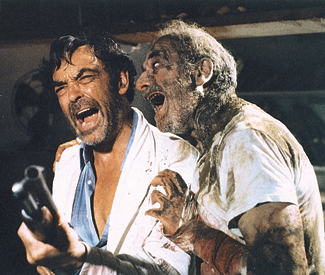
Sickos take note: Yerba Buena Center for the Arts is screening an uncut 35mm print of Lucio Fulci’s 1981 The House By the Cemetery. HUGE. Within the gore-splattered Fulci canon, House is maybe not as well-known as 1981’s The Beyond, 1980’s City of the Living Dead, or 1979’s Zombie (which made a recent local appearance thanks to Blue Underground, the cult champions also responsible for this showing of House). But it’s no less essential or enjoyable than the others, despite suffering from one nearly insurmountable flaw. (More on that that in a minute.)

House‘s story is actually pretty straightforward, as Fulci flicks go. After a mysterious murder-suicide claims his colleague, professor Norman Boyle (Paolo Malco) uproots his family, including wife Lucy (Fulci scream queen Catriona MacColl) and young son Bob (Giovanni Frezza), from New York City to small-town Massachusetts, where he plans to finish the dead man’s research. Fate or something worse means the Boyles will be bunking in “the Freudstein place,” a notorious mansion once occupied by “a certain Dr. Freudstein — a turn-of-the-century surgeon with a penchant for illegal experiments.” Uh-oh. That the family is merely renting this sinister abode is ignored by the film’s ad campaign: “Read the fine print. You just may have mortgaged your life!”

That may be so, but the truth is Bob’s dubbed-over voice is the scariest thing in this movie. Among the House DVD extras is an interview with a grown-up Frezza; the first thing out of his mouth is an apology. (His later filmography includes Lamberto Bava’s ludicriously amazing 1985 Demons, so he’s off the hook as far as I’m concerned.) It’s a distraction that elevates Bob from a mere rip-off of the kid in 1980’s The Shining, an obvious House influence, to eardrum-torturing moppet from hell.

http://www.youtube.com/watch?v=zbIiJeCpCgY

Fortunately, the rest of House is weird enough to cushion this sonic godawfulness, or at least blunt it a bit; it helps that the other kid in the movie — Silvia Collatina as Mae, the Scatman Crothers to Bob’s Danny Torrance — sounds perfectly normal. There are plenty of juicy bits for Italian horror geeks, including Ania Pieroni as a creepy, glaring babysitter (doing a slight variation on her creepy, glaring Mother of Tears in Dario Argento’s 1980 Inferno) and Carlo De Mejo (star of City of the Living Dead) as a helpful librarian. The traditional Fulci cameo casts the director as Dr. Boyle’s bow tie-wearing academic peer, uttering the immortal line “I adore New England!”

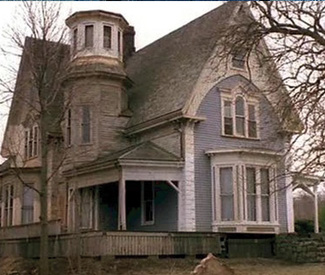
Speaking of, the titular house actually exists, though it’s not actually located by a cemetery as advertised. Also the setting for Umberto Lenzi’s 1988 Ghosthouse (sickos know Lenzi’s name well, thanks to grindhouse nuggets like 1981’s Cannibal Ferox and 1980’s Nightmare City), it’s the historically significant Ellis House in Scituate, Mass. No word, however, if the arts association that now maintains the property accommodates curious horror fans — or if the basement décor is still keepin’ it funky. 


THE HOUSE BY THE CEMETERY

Fri/27-Sat/28, 10 p.m., $8

Yerba Buena Center for the Arts

701 Mission, SF

www.ybca.org

From prison bars to classroom stars

2

culture@sfbg.com

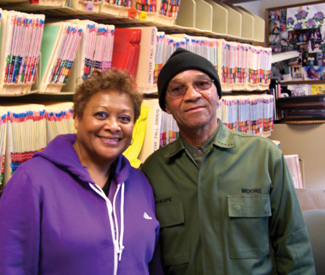
CAREERS AND EDUCATION Wearing a neatly-pressed army uniform in his office at City College of San Francisco Charles Moore, tells a Guardian reporter that he is a warrior for education.

Moore is the recruiter and outreach developer for the college’s Extended Opportunity Program and Services (EOPS) ex-offender counseling program, Second Chance. His team struggles with the fate of underserved refugees from an expanding state prison population (at last count, comprised of 132,887 adults) and the budget cuts that have dug deep into universities and community colleges across California.

Their battle? On a minuscule budget of $150,000 program staff must find a way to help ex-offenders break the incarceration cycle and get a college degree.

And by most counts, they’re winning. Second Chance is fueled by a surprising mix of personal experience, stretched resources, and a steadfast dedication to an underserved student population. It is one of very few such endeavors in the nation.

Moore says one of the recurring problems that ex-offenders face in the school system are Rip Van Winkel moments, inevitable occurrences after years of incarceration. The most minute-seeming technological changes in the world — an automatic-flush toilet for instance, or unfamiliar crosswalk signage — have shaken advisees, sometimes enough to prompt drop-outs.

This kind of culture shock is precisely what Second Chance works to combat, in addition to more traditional academic concerns. Staff wear a number of hats, answering students’ questions about financial aid and programs of study. Peer counselors are also crucial to the program, students who have themselves matriculated with the help of Second Chance and are available to assist those with questions.

“This is a community college,” says Moore. “And we need to be in touch with our community.”

“Second Chance and EOPS really set up a model for similar programs throughout the state and the country,” says Juanita Gray, the program secretary. She has worked from its beginnings as Project Scorpio to the program’s 1981 refashioning under EOPS’ then-director Bill Chin.

Gray remembers the days when inmates would file off the Sheriff Department’s bus and into EOPS, get their handcuffs unlocked, and complete student applications. Nowadays Second Chance, which boasted 120 students last year, sees ex-offenders arrive of their own accord, having already received essential information about the program in prison.

Moore works within Bay Area neighborhoods to spread the word, but more often than not, prospective students seek him out.

“The majority of our referrals come from word of mouth, from within the state’s prison system. People move to the Bay Area for Second Chance,” he says.

Many of the program’s small staff have made it through both a prison sentence and a degree at City College. As Second Chance students they, like their current advisees, received book vouchers, Muni passes, a basic meal plan, priority registration, and advisory support on their journey towards a college degree.

Moore is one of these graduates.

“Those who work in the program are often ‘been there, done that,’ — we understand the struggle of stepping onto a college campus after 25 years in prison,” says Moore.

Like several of his colleagues, Moore passed through California’s penal system multiple times. After one stint, he remembers, “I began to take a serious look at myself. I always had to start over again with nothing once I was released. Things had not changed in my environment.”

But then he found Second Chance. Moore sees the program in stark terms: “education as an alternative to incarceration.”

The program’s staff and tutors say adjusting to a school environment is a major obstacle for ex-offender-students. Jeffrey Masko, who volunteers with eight Second Chance participants each week, tutoring them in English and math, describes the basic challenges for students who are coming from prison time.

“[Second Chance students] sometimes only have one shot, an hour at a library computer, to do their work,” says Masko. “For a lot of these students, there is no ‘later’ — they have to do the work before they get on the bus home, or [maybe if] they have an hour before class [they can do it then].”

If the program’s longevity alone is not enough to prove its effectiveness, statistics help. In the fall 2010 semester, more than 80 percent of students in Second Chance were in good academic standing, according to a 2011 article by program director Ray Fong. Also in that year, students bent on further study transferred to San Francisco State University, University of California at Berkeley, and Mills College.

Second Chancers have gone on to work as drug counselors, social workers, and activists.

“There’s definitely a strange phenomenon [within the Second Chance student body] of giving back,” explains Masko. “Even though they may have spent 10 years in the penitentiary, they look for fields that they can make a contribution within.”

Alumnus Jason Bell heads San Francisco State’s Project Rebound, a similar program geared towards helping the ex-incarcerated towards college degrees. Rudy Corpuz Jr., another graduate, founded United Playaz in 1994 to combat youth violence.

In 2010, students earned certificates in violence intervention, emergency medicine, administration of justice, trauma prevention, and case management skills.

“I haven’t had one person in my office say they didn’t want to give back,” says Moore, “They say it each and every time. And I’m coming up on 15 years.”

Saying goodbye to the Nuns singer Jennifer “Miro” Anderson

1

Jennifer “Miro” Anderson, former co-lead singer and keyboardist of one of SF’s first punk bands the Nuns, died in New York, December 16th, of complications from breast and liver cancer. She was 54.

A striking, statuesque blonde beauty, Ms. Miro began her interest in music as a devoted member of the David Bowie fan club. She joined the Nuns in the mid ’70s and co-authored some of their better known songs, including the punk classic “Suicide Child.” One of the city’s first punk bands, the Nuns became popular rapidly that they were selling out the Mabuhay Gardens on consecutive weekends and subsequently earned the opening slot on the Sex Pistols infamous “farewell” at Winterland.

The Nuns continued into the ’80s and Jennifer pursued a solo career as well. I met Jennifer in 1990 in LA, where she was giving acting a go and found her to be one of the funniest and wittiest people in the scene, endlessly bemused by all of the madness swirling around her. We continued to to see each other when she returned to Marin in the mid ’90s and one of my favorite memories of my own time in the Bay Area was spending the day with her at her place in Belvedere.

Later, she moved to New York and became a dominatrix and would occasionally do Nuns projects – oddly enough, her presence on the Net was somewhat below the radar and so I never did get a chance to say goodbye to her.

So, I do now. To one of the most uproarious companions I ever had, wherever you are now, keep them baffled, my love – you were a gifted, wonderful friend on those rare occasions when I could see you. And no – I don’t have those shiny leather trousers you loved so much; maybe when we see each other again, okay?

J Angel.

Live Shots: Dinosaur Jr. at the Fillmore

0

By Jolene Torr

The nostalgia factor of a night spent at the Fillmore, watching Dinosaur Jr. play the entirety of its classic Bug album while the scents of weed and that cloying old familiar CK One (I shit you not) steeped into my clothes, is hard to ignore. Though I was too young to appreciate Bug in 1988, watching the slacker-rock trio indulge in sprawling guitar solos and dense, chugging bass lines undoubtedly evoked a longing for grunge and those impetuous ’90s.

Former Black Flag frontman and spoken word artist Henry Rollins couldn’t shake that wistful yearning for another time either as he sat on stage with Dino Jr. last Thursday for a pre-show interview. Invoking the spirits of the Fillmore, Rollins declared, “I always get a bit of déjà vu when I come here. This is where Janis [Joplin] and Grace Slick played!”

Slack-jawed, awed in the venue’s music history, he asked, “So what does it mean to play at the Fillmore?” A big, meaty question like that might normally necessitate an equally sentimental response, but J Mascis, rather than trip down memory lane with the rest of us, championed the venue’s acoustics. “The sound’s really good,” he said. “It’s hard to have a bad night here.”

With his bellicose stare, Rollins probed the band for key insights, opining that the “rip-roaring, pedal-to-the-metal” Bug represented a “sharpening of sound” and with it, a sound that “got more heavy.” There was the promise to be loud, that sound was sacrosanct.

The six stacked amps surrounding the band was the temple. When asked how a venue responds to the volume of the guitars, J Masic said, “Once a sound guy came on and turned down my amp.” He laughed, still bewildered that this had once happened, “That’s like sacrilegious to me.”

After the 30-minute-ish interview, the band launched into Bug, playing to a burly male-centric room, aggressive in their hollers and “owwws” through J’s distortion and Murph’s thunderous drums, lumbering along to Lou Barlow’s bass. They played loud, for sure, extended intros and songs that seemed to play longer than they should that really just seeped into one another, for a night of melodics and heroic guitar anthems in quintessential slacker fashion.


All photos by Chris Stevens.

A pitch and a swing

1

le.chicken.farmer@gmail.com

CHEAP EATS We went to see Moneyball. You know: We have soft spots in our hearts for baseball. Additionally, Hedgehog has a wet spot in her panties for Brad Pitt; and I in mine, truth be told, for Jonah Hill.

Before he lost the weight, mind you — although he’s pretty funny after, too.

Anyway, it was a good movie, and Jonah Hill was fat, and the popcorn was quite good, but still I had a nervous breakdown afterwards. No idea why. I think it had something to do with a shot near the end of the movie. Brad Pitt, as Billy Beane, driving on I-880 I believe, and through his window the stacks and stacks of cargo containers down the harbor. Maybe the familiarity was too familiar for comfort (I once had a panic attack on that exact stretch of freeway) or the bounce of the frame or the camera angle. Something. Something took the fight right out of me.

I tried to compose myself in the ladies room after. “I exist, therefore I am,” I wrote, on toilet paper. “Now,” I continued, plagiarizing shamelessly: “Whether I shall turn out to be the hero of my own life …”

No. I composed and composed. I stole, I borrowed, I begged, I vandalized, I unraveled and unraveled, but could not find the little bouncy rubber ball at the center of things. Not even for the life of me. So, after a fairly normal amount of time had passed, I flushed and washed and walked back out into the lobby, all dry-eyed and dignified-like. Hedgehog smiled. We rode down the escalator together.

Nervous breakdowns are hard to explain.

“Sushi, or ramen?” she said. (We were after all in Japantown.)

I would have jumped at either, normally. I love the sushi. I love the ramen. But to give me a choice, at a time like this, was cruel and unusual. Or would have been, if she only knew what I was going through.

Nevertheless, I thought I would have something by the time we reached the bottom. If not an answer, a word. A question. A rubber ball. A look. Anything. But I could not, would not, Sam-I-Am. I was nothing but fear . . . of absolutely nothing. So paralyzed, so empty, that I could not lift my feet and was sucked like a stick-figured cutout into the machinery of it all, the gear and grind, sending me back up, undersided and undecided, crinkle, fold, and rip.

Hedgehog does not have patience for indecision, let alone cartoonery. “Ramen?” she said. “Or sushi.” As if changing the order of things would fix it for me.

I managed to say something. We were standing at the foot of the escalator, by the door. “I’m having a panic attack,” I said.

And — for those of you who can relate, so you know, there is something about calling your panic attack a panic attack, out loud and in the middle of it, that kind of diffuses the situation. Try it.

I was still scared and empty, but I could step again, at least, and think, and imagine food.

“Ramen,” I said. And say.

And we walked very slowly to Suzu. Probably for the best, we had to sit outside, which doesn’t mean outside outside. It means out in Japantown Center, instead of in the small, cozy, bustling restaurant. But at least we could sit right away and have a glass of water.

I had of course warned Hedgehog that anxiety and panic were possible parts of the package, although neither had really attacked me, as such, in a year or two. Now, while we waited on our spicy ramen (me) and Tokyo ramen (her), I tried to gauge whether she still loved me or not, or the same. And all the while I still wasn’t totally convinced that I wasn’t about to drop dead, either.

Love and life notwithstanding, what we learned that day was that, yo, we kinda needed each other. My ramen was so insanely spicy, and hers so ridiculously bland, that the only way either one of us could be quite satisfactorily nourished was to mix the two together.

And as we did, spoon by spoon, we relished the weirdness of eating outside of an indoor restaurant, in a mall, and gradually my heart beat, breathing, and dimensionality came back to me.

New favorite restaurant:

SUZU NOODLE HOUSE

Daily: 11:30 a.m.- 9 p.m

1825 Post St., SF.

(415) 346-5083

MC/V

Beer & wine


Contemplating Appetite

1

virginia@sfbg.com

APPETITE My adventures in food and drink have been the subject of my SFBG Appetite column for nearly three years online at SFBG.com. As of last month, you now also find me in print every week. Many have asked where I am going with this column — some expecting a formal weekly review, others a mix of subjects and directions. The latter is true. I cannot replace former Guardian food critic Paul Reidinger’s eloquence and decades-long experience as a food writer (and I’m glad to say we will continue to hear from him in various articles). I take this opportunity to explain where I’ve come from and my philosophy in covering the edible world.

First and foremost, I bring to the table passion. From mostly Italian and German stock, I’ve eaten heartily since early childhood in Oklahoma and Missouri, 16 total years of my youth in Southern California and New Jersey (just outside LA and NYC respectively), and travel over five continents. As an incessant reader and writer since girlhood, books first opened me up to the world, though I dreamed of having my own adventures to write about. Moving to San Francisco a decade ago, I was wowed not only by its unique, radiant beauty, but by the consistent quality of food, spending spare dollars eating out constantly. Though SF wasn’t the immediate love affair for me New York was, it is a love that has only increased each year, the home I would happily end up in. This city still takes my breath away.

Patricia Unterman’s original San Francisco Food Lover’s Guide was my food bible in those early days. I connected with her quest for the authentic, no matter the cuisine. I ate my way through neighborhoods, marking up her book (and all my dining guides) until I had been to every single restaurant, market, and bar in its pages. Eventually, requests asking me where to go and what to eat reached a fever pitch, so my husband (and partner in taste and travel) helped create my own humble website, The Perfect Spot, to share my reviews and finds. I’ve been sending out a bi-weekly newsletter for nearly four years based on my writings for the site. I also write for an ever-increasing number of magazines and websites.

“Diet,” “lowfat,” and “hold the cream” are words you’ll never hear me say. My hunger for food as adventure means I make it a goal to have no food prejudices. Many say, “I’ll try anything once,” but my philosophy is to keep trying anything I don’t like until I do. The food may not have been prepared properly; it was perhaps of poor quality; maybe the palate wasn’t quite ready for it — dishes still deserve to be known at their best. I spent years trying to overcome my aversion to uni (sea urchin), for example. Eating chef David Bazigran’s brilliant uni flan at Fifth Floor early this year was a revelation. I realized it was uni’s texture, not its of-the-sea flavor, turning me off. I’ve enjoyed uni ever since, though only when ultra-fresh. From personal experience, I know one can change one’s abhorrence of a food, and in so doing expand one’s horizons another inch, uncovering another of life’s simple delights.

Sometimes fear arises around unfamiliar foods — and the unfamiliar in general. Without variety and a vast range of expression, the world loses it color — and its joy. While sameness can be comforting (and there’s a time for that), it is entirely boring. To go through any part of life bored or complacent is simply lazy. As with music or books, one can discover unknown lands with a few new ingredients, enlivened by the hands of a gifted, caring chef. Whether food cart or fine dining, there’s no reason to settle for mediocrity, not with the unreal produce, vision, and talent surrounding us.

Internationally, I’ve fallen in love with black pudding in Ireland, extreme spice in Thailand, Tyrolean food in the Italian Alps. I’ve explored wine chateaus in Bordeaux, agave fields in Mexico, gin distilleries and cocktail labs in London, whisk(e)y houses in Scotland and Ireland. I’ve frequented restaurants, coffee havens, bars, chocolate shops, farmers markets everywhere. I sample obsessively and comparatively. Rather than one single review, I prefer to cover a mixture of highlights in any given week. I’m opinionated, yes, but don’t care much for snark, flippancy, or jadedness. Though honest assessment is crucial, rather than rip apart the few not doing it well, I’d rather focus on the many having fun with or perfecting their craft.

My “holy trinity” of US cities for food and culture, though, consists of New York, New Orleans, and San Francisco. Travel is one of life’s greatest gifts, yet when I cannot afford to go, I am able to travel in my own city. Authentic foods transport me back to the place in which that food was illuminated — anchovies on the coast of Italy, bastilla in Morocco, Creole cream cheese in New Orleans, or bahn mi in Vietnam. It helps to live in a place as international and cosmopolitan as SF. But even in nondescript towns, I uncover gems. The hunt is a key part of the thrill.

Besides travel, you’ll notice I also write about drink… a lot. Whether coffee, spirits, and cocktails (my first love), wine and beer (the ultimate food accompaniments), my knowledge of drink grows along with the culinary. Even at 21, I wanted a grown-up atmosphere in which to imbibe, detesting noisy, crowded “scenes.” Drink, for me, is similar to food: it’s about quality, artistry, and adventure, not buzz or quick consumption. A memorable meal isn’t complete without the right sip to begin, pair, or end with.

As with food, Northern California was instrumental in furthering my taste for fine drink, though global explorations have shaped my standards of comparison. It started with cocktails years ago as SF (and, of course, NYC) lead the way in reviving classics, and creating experimental, culinary drinks. The artistry and history behind these drinks intrigued me, connecting to my Old World, retro, jazz-loving self.

Delving into cocktails inevitably led to my great love of craft spirits, many of our country’s trailblazers and innovators being based right here. (Thank you, St. George, Charbay, Germain-Robin, Anchor Distilling, et. al.) Our local Wine Country and craft beer pioneers like Fritz Maytag likewise have shaped the world, while local personalities such as Kermit Lynch and Rajat Parr in the wine realm are experts on global glories in drink.

What makes a great meal? Service, setting, and, of course, food are crucial. Ultimately, I see eating as a communal ritual. A thoughtfully-prepared meal surprises and nourishes the body and spirit. We engage (or should — put those cell phones away!) over a meal, reflect on our day, truly taste, actually look at and listen to each other. Expect me to share with you the best tastes and backdrops from these moments.

While I don’t expect our tastes to be the same, I do look forward to embarking on delicious adventures together throughout the food realm. *

BEST NEW OPENINGS OF 2011

In the spirit of ushering in my print column, I recap the year with my list of 2011’s best new openings, realizing we still have a few weeks worth of openings left:

CASUAL

Wise Sons Deli www.wisesonsdeli.com. Although not getting a brick and mortar location until 2012, this pop-up deli (every Tuesday at the Ferry Plaza) was one of the year’s great new delights, filling a gaping vacancy of quality Jewish food with excellent babka, bialy, and corned beef.

Hot Sauce and Panko 1545 Clement, SF. (415) 387-1908, www.hotsauceandpanko.com. With an impressive array of hot sauces from around the world, addictive chicken wings in a crazy range of sauces (tequila-chipotle-raspberry jam!), this quirky take-out also has a hilarious blog.

Mission Cheese 736 Valencia, SF. www.missioncheese.net. Mission Cheese serves not only lush cheeses and wines, but some of the best grilled cheese sandwiches around in a chic cafe setting.

MID-RANGE

Bar Tartine 561 Valencia, SF. (415) 487-1600, www.bartartine.com. Though not a new opening, I refer to the complete revamp and Eastern European-influenced menu under chef Nick Balla that happened this year. Unusual dishes, Hungarian and beyond, and Balla’s impeccable technique make this menu unlike any other.

Boxing Room 399 Grove, SF. (415) 430-6590, www.boxingroomsf.com. It’s refreshing to get some New Orleans breezes in SF from a Louisiana chef making his own Creole cream cheese and frying up fresh alligator.

Nojo 231 Franklin, SF. (415) 896-4587, www.nojosf.com. We’ve had a glut of izakayas open over the past few years, but this one stands above in warm, hip atmosphere and consistently delightful food.

Park Tavern 1652 Stockton, SF. (415) 989-7300, www.parktavernsf.com. From the owners of Marlowe, this immediately feels like the buzzing destination restaurant of Washington Square Park for satisfying American food with gourmet edge.

Jasper’s Corner Tap 401 Taylor, SF. (415) 775-7979, www.jasperscornertap.com. All things to all people: comfortable meet-up spot with perfect cocktails, craft beers and wines aplenty, and the food is consistently heartwarming.


Film Listings

0

Film listings are edited by Cheryl Eddy. Reviewers are Kimberly Chun, Max Goldberg, Dennis Harvey, Lynn Rapoport, and Matt Sussman. For rep house showtimes, see Rep Clock.

OPENING

Asylum of Satan and The Devil and Max Devlin The Vortex Room’s penultimate program of Satanic cinema weighs deeper into approximating the torments of hell, starting with the 1972 Asylum. The inevitable young lovely (Carla Borelli) is committed to a mental institution against her will. The other patients dress in white robes with heavy hoods like Klan members — in wheelchairs, yet — and the few other “normal” inmates tend to die horrible deaths under “treatment.” Reaching Andy Milligan-level amateurity of performance and filmmaking (complete with a library-music score), this patience-testing horror was the first feature from William Girdler, who stuck with exploitation genres but managed a steep learning curve. During the next few years he ascended to guilty-pleasure blaxploitation Exorcist rip-off Abby (1974) to competent hairy Jaws (1975) rip-off Grizzly (1976) to a true original, 1978’s berserk all-star The Manitou, in which a 400-year-old evil Native American spirit grows as a tumor from Susan Strasberg’s neck. Sadly, we’ll never know where Girdler could have gone from that zenith — he died in a helicopter crash at age 30 the same year. For maximum incongruity, Asylum‘s co-feature is 1981’s The Devil and Max Devlin, in which Elliott Gould plays a mean L.A. slumlord who’s run over by a bus full of Hare Krishnas. Waking up in Hades, Satan (Bill Cosby — what about that casting seems disturbingly just-right?), offers Max a deal: he can get outta jail free if he delivers three souls by making some innocent kids into selfish brats. One of them is a teen singer who, in a strange in-joke, sounds exactly and looks quite a bit like Barbra Streisand (the former Mrs. Gould). With its non-cute representations of Hell and deliberately humorless Cosby, this ersatz comedy made at the height of Disney’s post-Walt wilderness wandering won the Mouse House one of its first PG (as opposed to G) ratings. Mercifully Beelzebub’s further influence was curtailed before the studio reached the logical end point of this path, producing porn. Vortex Room. (Harvey)

I Think It’s Raining In local film curator Joshua Moore’s first feature, screening on opening night at Cinema by the Bay, a young woman named Renata (Alexandra Clayton) returns to her hometown of San Francisco after unspecified wanderings, replants herself loosely (in a motel), and proceeds to drift across the city, connecting with old friends and with strangers and disconnecting in response to internal impulses like panic attacks and drunken vitriol. The film is filled with evocative moments, like a scene in a nightclub where Renata’s musician friends call her up to perform a song (written and sung by Clayton) that seems to sketch out all the charms and failings and pitfalls and misadventures that make up her mysterious biography — Super 8 images flickering across her face, her own image set off in the darkness and isolated from the life and warmth around her. Renata is clearly moving in an atmosphere of emotional disturbances, and her discomfort and unsteadiness transmit powerfully, leaving the viewer equally uneasy and afraid. The mood temporarily lightens during a random, rainy-day encounter with a young man, Val (Andrew Dulman), who seems tuned in to Renata’s frequency without emitting the same anxious bursts of static — or perhaps simply inspires her to try to tune in to his. But it’s painfully unclear how sustaining such a mode can be for a protagonist who admits to lacking the primary skills for holding on to happiness. (1:32) SFFS New People Cinema. (Rapoport)

*Like Crazy Jacob (Anton Yelchin) and Anna (Felicity Jones) meet near the end of college; after a magical date, they’re ferociously hooked on each other. Trouble is, she’s in Los Angeles on a soon-to-expire student visa — and when she impulsively overstays, then jets home to London for a visit months later, her re-entry to America is stopped cold at LAX. (True love’s no match for homeland security.) An on-and-off long-distance romance ensues, and becomes increasingly strained, even as their respective careers (he makes furniture, she’s a magazine staffer) flourish. Director and co-writer Drake Doremus (2010’s Douchebag) achieves a rare midpoint between gritty mumblecore and shiny Hollywood romance; the characters feel very real and the script ably captures the frustration that settles in when idealized fantasies give way to the messy workings of everyday life. There are some contrivances here — Anna’s love-token gift from Jacob, a bracelet engraved “Patience,” breaks when she’s with another guy — but for the most part, Like Crazy offers an honest portrait of heartbreak. (1:29) (Eddy)

Revenge of the Electric Car The timing is right for Chris Paine to make a follow-up to his 2006 Who Killed the Electric Car?, a celebrity-studded doc examining the much-mourned downfall of GM’s EV1 — with gas prices so high and oil politics so distressing, even drivers who don’t consider themselves radical environmentalists are interested in going electric, as choices aplenty flood the marketplace. The aptly-titled Revenge of the Electric Car makes nice with GM’s Bob Lutz as he readies the release of the Chevy Volt. It also profiles Silicon Valley’s own electric car startup, Tesla; tracks Nissan’s top gun Carlos Ghosn as he pushes the Nissan Leaf into production; and even digs up an off-the-grid mechanical wizard known as “Gadget,” who makes his living converting regular autos (if a Porsche is “regular”) into vehicles with plug-in power. The film makes it clear that for most of these folks, business comes first — sure, it’s great to be green, but you have to make green, too — and there’s some tension when the crash of 2008 threatens the auto industry’s enthusiasm for planet-friendly innovations. But there’s far more optimism here than Paine’s first Electric Car film, not to mention a refreshing lack of Mel Gibson. (1:30) Embarcadero, Shattuck. (Eddy)

*Sutro’s: The Palace at Land’s End Filmmaker Tom Wyrsch (2008’s Watch Horror Films, Keep America Strong and 2009’s Remembering Playland) explores the unique and fascinating history behind San Francisco’s Sutro Baths in his latest project, an enjoyable documentary that covers the stories behind Adolph Sutro, the construction of his swimming pools, and the amazingly diverse, and somewhat strange collection of other attractions that entertained generations of locals that came to Land’s End for amusement. Told through interviews with local historians and residents, the narrative is illustrated with a host of rarely-seen historic photographs, archival film footage, contemporary video, and images of old documents, advertisements and newspapers. The film should appeal not only to older viewers who fondly remember going to Sutro’s as children, and sadly recall it burning down in 1966, but also younger audiences who have wandered through the ruins below the Cliff House and wondered what once stood there. (1:24) Balboa. (Sean McCourt)

Tower Heist Members of the 99% (real-life zillionaires Ben Stiller and Eddie Murphy) team up to get revenge on a sleazy Wall Street 1%-er (Alan Alda). Brett Ratner (also a real-life zillionaire) directs, so don’t actually expect much timely social commentary. (1:45) Balboa, Presidio, Shattuck.

A Very Harold and Kumar 3D Christmas The bros are back in this year’s first, and no doubt stoniest, holiday-themed release. (1:30)

ONGOING

Anonymous Hark, what bosom through yonder bodice heaves? If you like your Shakespearean capers OTT and chock-full of fleshy drama, political intrigue, and groundling sensation, then Anonymous will enthrall (and if the lurid storyline doesn’t hold, the acting should). Writer John Orloff spins his story off one popular theory of Shakespeare authorship — that Edward de Vere, the 17th Earl of Oxford, was the true pen behind the works attributed to William Shakespeare of Stratford-upon-Avon. Our modern-day narrator (Derek Jacobi) foregrounds the fictitious nature of the proceedings, pulling back the curtain on Ben Jonson (Sebastian Armesto) staging his unruly comedies for the mob, much to the amusement of a mysterious aging dandy of a visitor: the Earl of Oxford (Rhys Ifans). Hungry for the glory that has always slipped through his pretty fingers, the Earl yearns to have his works staged for audiences beyond those in court, where Queen Elizabeth I (Vanessa Redgrave as the elder regent, daughter Joely Richardson as the lusty young royal) dotes on them, and out of the reach of his puritan father-in-law Robert Cecil (David Thewlis), Elizabeth’s close advisor, and he devises a plan for Jonson to stage them under his own name. But much more is triggered by the productions, uncovering secret trysts, hunchback stratagems, and more royal bastards than you can shake a scepter at. Director Roland Emmerich invests the production with the requisite high drama — and camp — to match the material, as well as pleasing layers of grime and toxic-looking Elizabethan makeup for both the ladies and the dudes who look like ladies (the crowd-surfing, however, strikes the off-key grunge-era note). And if the inherent elitism of the tale — could only a nobleman have written those remarkable plays and sonnets? — offends, fortunately the cast members are more than mere players. Ifans invests his decadent Earl with the jaded gaze and smudgy guyliner of a fading rock star, and Redgrave plays her Elizabeth like a deranged, gulled grotesque. (2:10) 1000 Van Ness, SF Center, Sundance Kabuki. (Chun)

*The Black Power Mixtape 1967-1975 Cinematic crate-diggers have plenty to celebrate, checking the results of The Black Power Mixtape 1967-1975. Swedish documentarian Göran Hugo Olsson had heard whispers for years that Swedish television archives possessed more archival footage of the Black Panthers than anyone in the states — while poring through film for a doc on Philly soul, he discovered the rumors were dead-on. With this lyrical film, coproduced by the Bay Area’s Danny Glover, Olsson has assembled an elegant snapshot of black activists and urban life in America, relying on the vivid, startlingly crisp images of figures such as Stokely Carmichael and Huey P. Newton at their peak, while staying true to the wide-open, refreshingly nonjudgmental lens of the Swedish camera crews. Questlove of the Roots and Om’Mas Keith provide the haunting score for the film, beautifully historicized with shots of Oakland in the 1960s and Harlem in the ’70s. It’s made indelible thanks to footage of proto-Panther school kids singing songs about grabbing their guns, and an unforgettable interview with a fiery Angela Davis talking about the uses of violence, from behind bars and from the place of personally knowing the girls who died in the infamous Birmingham, Ala., church bombing of 1963. (1:36) Shattuck. (Chun)

*Contagion Tasked with such panic-inducing material, one has to appreciate director Steven Soderbergh’s cool head and hand with Contagion. Some might even dub this epic thriller (of sorts) cold, clinical, and completely lacking in bedside manner. Still, for those who’d rather be in the hands of a doctor who refuses to talk down to the patient, Contagion comes on like a refreshingly smart, somewhat melodrama-free clean room, a clear-eyed response to a messy, terrifying subject. A deadly virus is spreading swiftly — sans cure, vaccine, or sense — starting with a few unlikely suspects: globe-trotting corporate exec Beth (Gwyneth Paltrow), a waiter, a European tourist, and a Japanese businessman. The chase is on to track the disease’s genesis and find a way to combat it, from the halls of the San Francisco Chronicle and blog posts of citizen activist-journalist Alan (Jude Law), to the emergency hospital in the Midwest set up by intrepid Dr. Mears (Kate Winslet), to a tiny village in China with a World Health investigator (Marion Cotillard). Soderbergh’s brisk, businesslike storytelling approach nicely counterpoints the hysteria going off on the ground, as looting and anarchy breaks out around Beth’s immune widower Mitch (Matt Damon), and draws you in — though the tact of making this disease’s Typhoid Mary a sexually profligate woman is unsettling and borderline offensive, as is the predictable blame-it-on-the-Chinese origin coda. (1:42) Shattuck. (Chun)

*Drive Such a lovely way to Drive, drunk on the sensual depths of a lush, saturated jewel tone palette and a dreamlike, almost luxurious pacing that gives off the steamy hothouse pop romanticism of ’80s-era Michael Mann and David Lynch — with the bracing, impactful flecks of threat and ultraviolence that might accompany a car chase, a moody noir, or both, as filtered through a first-wave music video. Drive comes dressed in the klassic komforts — from the Steve McQueen-esque stances and perfectly cut jackets of Ryan Gosling as the Driver Who Shall Remain Nameless to the foreboding lingering in the shadows and the wittily static, statuesque strippers that decorate the background. Gosling’s Driver is in line with Mann’s other upstanding working men who hew to an old-school moral code and are excellent at what they do, regardless of what side of the law they’re working: he likes to keep it clear and simple — his services as a wheelman boil down to five minutes, in and out — but matters get messy when he falls for sweet-faced neighbor Irene (Carey Mulligan), who lives down the hall with her small son, and her ex-con husband (Oscar Isaac) is dragged back into the game. Populated by pungent side players like Albert Brooks, Bryan Cranston, Ron Perlman, and Christina Hendricks, and scattered with readily embeddable moments like a life-changing elevator kiss that goes bloodily wrong-right, Drive turns into a real coming-out affair for both Danish director Nicolas Winding Refn (2008’s Bronson), who rises above any crisis of influence or confluence of genre to pick up the po-mo baton that Lynch left behind, and 2011’s MVP Ryan Gosling, who gets to flex his leading-man muscles in a truly cinematic role, an anti-hero and under-the-hood psychopath looking for the real hero within. (1:40) Bridge, SF Center. (Chun)

50/50 This is nothing but a mainstream rom-com-dramedy wrapped in indie sheep’s clothes. When Adam (Joseph Gordon-Levitt) learns he has cancer, he undergoes the requisite denial, anger, bargaining, depression, and acceptance like a formality. Aided by his bird-brained but lovable best friend Kyle (Seth Rogan), lovable klutz of a counselor Katherine (Anna Kendrick), and panicky mother (Anjelica Huston), Adam gets a new lease on life. This comes in the form of one-night-stands, furious revelations in parked cars, and a prescribed dose of wacky tobaccy. If 50/50 all sounds like the setup for a pseudo-insightful, kooky feel-goodery, it is. The film doesn’t have the brains or spleen to get down to the bone of cancer. Instead, director Jonathan Levine (2008’s The Wackness) and screenwriter Will Reiser favor highfalutin’ monologues, wooden characters, and a Hollywood ending (with just the right amount of ambiguity). Still, Gordon-Levitt is the most gorgeous cancer patient you will ever see, bald head and all. (1:40) Four Star, 1000 Van Ness, SF Center, Sundance Kabuki. (Ryan Lattanzio)

Footloose Another unnecessary remake joins the queue at the box office, aiming for the pockets of ’80s-era nostalgics and fans of dance movies and naked opportunism. A recap for those (if there are those) who never saw the 1984 original: city boy Ren McCormack moves to a Middle American speck-on-the-map called Bomont and riles the town’s inhabitants with his rock ‘n’ roll ways — rock ‘n’ roll, and the lewd acts of physicality it inspires, i.e., dancing, having been criminalized by the town council to preserve the souls and bodies of Bomont’s young people. Ren falls for wayward preacher’s daughter Ariel Moore — whose father has sponsored this oversolicitous piece of legislation — and vows to fight city hall on the civil rights issue of a senior prom. Ren McCormack 2.0 is one Kenny Wormald (prepped for the gig by his tenure in the straight-to-cable dance-movie sequel Center Stage: Turn It Up), who forgoes the ass-grabbing blue jeans that Kevin Bacon once angry-danced through a flour mill in. Otherwise, the 2011 version, directed and cowritten by Craig Brewer (2005’s Hustle & Flow), regurgitates much of the original, hoping to leverage classic lines, familiar scenes, and that Dance Your Ass Off T-shirt of Ariel’s. It doesn’t work. Ren and Ariel (Dancing with the Stars‘ Julianne Hough) are blandly unsympathetic and have the chemistry of two wet paper towels, the adult supporting cast should have known better, and the entire film comes off as a tired, tuneless echo. (1:53) 1000 Van Ness, Presidio. (Rapoport)

Gainsbourg: A Heroic Life Far from perfect, yet imbued with all the playful, artful qualities of the maestro himself, writer-director Joann Sfar goes out of his way to tell singer-songwriter Serge Gainsbourg’s tale the way that he sees it, as that of an artist, and in the process creates a wonderland of cartoonish perversity from the cradle to the grave. The remainder of A Heroic Life is almost eclipsed by the film’s earliest interludes, which trail the already too-clever-for-his-own-good young musician and painter, born Lucien Ginsburg, as he proudly claims his gold star from the Nazis. With echoes of 400 Blows (1959) resounding with every wayward step, the brash young Lucien lives by his active imagination, dreaming up a fat, spiderlike plaything from the monstrous Jew depicted in Nazi propaganda and conjuring an imaginary alter-ego he dubs his ugly Mug. Though Heroic Life‘s adult Serge is seamlessly embodied by Eric Elmosnino, few of the moments from the grown lothario’s life rival those initial scenes, with the exception of his exuberant love affair with Brigitte Bardot (Laetitia Casta) and the fantastic music that came out of it. Still, it’s a joy to hear his music, even in short snatches, with subtitles that clearly spell out Gainsbourg’s talents as a stunning, uniquely talented lyricist. (2:02) Lumiere, Smith Rafael. (Chun)

*Gainsbourg: The Man Who Loved Women Those hungry for more of the real Serge Gainsbourg — after being tantalized and teased by Joann Sfar’s whimsical comic book-inspired feature — will want to catch this documentary by Pascal Forneri for many of the details that didn’t fit or were skimmed over, here, in the very words and image of the songwriter and the many iconic women in his life. Much of the chanson master’s photographic or video history seems to be here — from his blunt-force on-camera proposition of Whitney Houston to multiple, insightful interviews with the love of his life, Jane Birkin, as well as the many women who won his heart for just a little while, such as Brigitte Bardot, Juliette Gréco, Françoise Hardy, and Vanessa Paradis. Gainsbourg may be marred by its somewhat choppy, mystifying structure, at times chronological, at times organized according to creative periods, but overriding all are the actual footage and photographs loosely, louchely assembled and collaged by Forneri; delightful pre-music-videos Scopitones of everyone from France Gall to Anna Karina; and the gemlike, oh-so-quotable interviews with the mercurial, admirably honest musical genius and eternally subversive provocateur. Quibble as you might with the short shrift given his later career—in addition to major ’70s LPs like Histoire de Melody Nelson and L’Homme à tête de chou (Cabbage-Head Man) — this is a must-see for fans both casual and seriously seduced. (1:45) Roxie. (Chun)

The Help It’s tough to stitch ‘n’ bitch ‘n’ moan in the face of such heart-felt female bonding, even after you brush away the tears away and wonder why the so-called help’s stories needed to be cobbled with those of the creamy-skinned daughters of privilege that employed them. The Help purports to be the tale of the 1960s African American maids hired by a bourgie segment of Southern womanhood — resourceful hard-workers like Aibileen (Viola Davis) and Minny (Octavia Spencer) raise their employers’ daughters, filling them with pride and strength if they do their job well, while missing out on their own kids’ childhood. Then those daughters turn around and hurt their caretakers, often treating them little better than the slaves their families once owned. Hinging on a self-hatred that devalues the nurturing, housekeeping skills that were considered women’s birthright, this unending ugly, heartbreaking story of the everyday injustices spells separate-and-unequal bathrooms for the family and their help when it comes to certain sniping queen bees like Hilly (Bryce Dallas Howard). But the times they are a-changing, and the help get an assist from ugly duckling of a writer Skeeter (Emma Stone, playing against type, sort of, with fizzy hair), who risks social ostracism to get the housekeepers’ experiences down on paper, amid the Junior League gossip girls and the seismic shifts coming in the civil rights-era South. Based on the best-seller by Kathryn Stockett, The Help hitches the fortunes of two forces together — the African American women who are trying to survive and find respect, and the white women who have to define themselves as more than dependent breeders — under the banner of a feel-good weepie, though not without its guilty shadings, from the way the pale-faced ladies already have a jump, in so many ways, on their African American sisters to the Keane-eyed meekness of Davis’ Aibileen to The Help‘s most memorable performances, which are also tellingly throwback (Howard’s stinging hornet of a Southern belle and Jessica Chastain’s white-trash bimbo-with-a-heart-of-gold). (2:17) Shattuck. (Chun)

The Ides of March Battling it out in the Ohio primaries are two leading Democratic presidential candidates. Filling the role of idealistic upstart new to the national stage — even his poster looks like you-know-who’s Hope one — is Governor Mike Morris (George Clooney), who’s running neck-and-neck in the polls with his rival thanks to veteran campaign manager (Philip Seymour Hoffman) and ambitious young press secretary Steven (Ryan Gosling). The latter is so tipped for success that he’s wooed to switch teams by a rival politico’s campaign chief (Paul Giamatti). While he declines, even meeting with a representative from the opposing camp is a dangerous move for Steven, who’s already juggling complex loyalties to various folk including New York Times reporter Ida (Marisa Tomei) and campaign intern Molly (Evan Rachel Wood), who happens to be the daughter of the Democratic National Party chairman. Adapted from Beau Willimon’s acclaimed play Farragut North, Clooney’s fourth directorial feature is assured, expertly played, and full of sharp insider dialogue. (Willimon worked on Howard Dean’s 2004 run for the White House.) It’s all thoroughly engaging — yet what evolves into a thriller of sorts involving blackmail and revenge ultimately seems rather beside the point, as it turns upon an old-school personal morals quandary rather than diving seriously into the corporate, religious, and other special interests that really determine (or at least spin) the issues in today’s political landscape. Though stuffed with up-to-the-moment references, Ides already feels curiously dated. (1:51) California, Marina, 1000 Van Ness, Piedmont, Sundance Kabuki. (Harvey)

In Time Justin Timberlake moves from romantic comedy to social commentary to play Will Salas, a young man from the ghetto living one day at a time. Many 12-steppers may make this claim, but Salas literally is, because in his world, time actually is money and people pay, say, four minutes for a cup of coffee, a couple hours for a bus ride home from work, and years to travel into a time zone where people don’t run from place to place to stay ahead of death. In writer-director Andrew Niccol’s latest piece of speculative cinema, humans are born with a digitized timepiece installed in their forearm and a default sell-by date of 25 years, with one to grow on — though most end up selling theirs off fairly quickly while struggling to pay rent and put food on the table. Time zones have replaced area codes in defining social stature and signaling material wealth, alongside those pesky devices that give the phrase “internal clock” an ominous literality. Niccol also wrote and directed Gattaca (1997) and wrote The Truman Show (1998), two other films in which technological advances have facilitated a merciless, menacing brand of social engineering. In all three, what is most alarming is the through line between a dystopian society and our own, and what is most hopeful is the embattled protagonist’s promises that we don’t have to go down that road. Amanda Seyfried proves convincible as a bored heiress to eons, her father (Vincent Kartheiser) less amenable to Robin Hood-style time banditry. (1:55) 1000 Van Ness, SF Center. (Rapoport)

Johnny English Reborn (1:41) 1000 Van Ness, SF Center.

The Legend is Born: Ip Man If you prefer your martial arts movies Zhang Yimou-lush, Jackie Chan-hilarious, or Tsui Hark-insane, you’ll want to skip The Legend is Born: Ip Man, an earnest, unfussy semi-biopic about the early years of Wing Chun grandmaster Yip Man (he taught Bruce Lee … respect). Here, he’s called Ip Man and is played by the bland Dennis To, who might be carved from wood if not for his many nimble fight scenes — playful dispute-settling, grueling training sequences, to-the-death clashes, etc. The Ip Man story has been popular Hong Kong movie fodder in recent years, with the far more charistmatic Donnie Yen playing the lead in a pair of 2008 and 2010 flicks. This apparently unrelated production is less flashier than those films, but purists will appreciate appearances by fightin’ screen legends Sammo Hung and Yuen Bao, plus a cameo by Yip Man’s real-life son. Side note: director Herman Yau co-directed absolutely bonkers crime drama The Untold Story (1993), starring Anthony Wong as a Sweeney Todd type who runs a restaurant famed for its “pork” buns. Worth a look, fiends. (1:40) Four Star. (Eddy)

The Lion King 3D (1:29) SF Center.

*Love Crime Early this year came the announcement that Brian De Palma was hot to do an English remake of Alain Corneau’s Love Crime. The results, should they come to fruition, may well prove a landmark in the annals of lurid guilty-pleasure trash. But with the original Love Crime finally making it to local theaters, it’s an opportune moment to be appalled in advance about what sleazy things could potentially be done to this neat, dry, fully clothed model of a modern Hitchcockian thriller. No doubt in France Love Crime looks pretty mainstream. But here its soon-to be-despoiled virtues of narrative intricacy and restraint are upscale pleasures. Ludivine Sagnier plays assistant to high-powered corporate executive Christine (Kristin Scott Thomas). The boss enjoys molding protégée Isabelle to her own image, making them a double team of carefully planned guile unafraid to use sex appeal as a business strategy. But Isabelle is expected to know her place — even when that place robs her of credit for her own ideas — and when she stages a small rebellion, Christine’s revenge is cruelly out of scale, a high-heeled boot brought down to squash an ant. Halfway through an act of vengeance occurs that is shocking and satisfying, even if it leaves the remainder of Corneau and Nathalie Carter’s clever screenplay deprived of the very thing that had made it such a sardonic delight so far. Though it’s no masterpiece, Love Crime closes the book on his Corneau’s career Corneau (he died at age 67 last August) not with a bang but with a crisp, satisfying snap. (1:46) Lumiere. (Harvey)

*Margin Call Think of Margin Call as a Mamet-like, fictitious insider jab at the financial crisis, a novelistic rejoinder to Oscar-winning doc Inside Job (2010). First-time feature director and writer J.C. Chandor shows a deft hand with complex, writerly material, creating a darting dance of smart dialogue and well-etched characters as he sidesteps the hazards of overtheatricality, a.k.a. the crushing, overbearing proscenium. The film opens on a familiar Great Recession scene: lay-off day at an investment bank, marked by HR functionaries calling workers one by one into fishbowl conference rooms. The first victim is the most critical — Eric Dale (Stanley Tucci), a risk-management staffer who has stumbled on an investment miscalculation that could potentially trigger a Wall Street collapse. On his way out, he passes a drive with his findings to one of his young protégés, Peter (Zachary Quinto), setting off a flash storm over the next 24 hours that will entangle his boss Sam (Kevin Spacey), who’s agonizing over his dying dog while putting up a go-big-or-go-home front; cynical trading manager Will (Paul Bettany); and the firm’s intimidating head (Jeremy Irons), who gets to utter the lines, “Explain to me as you would to a child. Or a Golden Retriever.” Such top-notch players get to really flex their skills here, equipped with Chandor’s spot-on script, which manages to convey the big issues, infuse the numbers with drama and the money managers with humanity, and never talk down to the audience. (1:45) Shattuck, Sundance Kabuki. (Chun)

*Martha Marcy May Marlene If Winter’s Bone star Jennifer Lawrence was the breakout ingénue of 2010, look for Martha Marcy May Marlene‘s Elizabeth Olsen to take the 2011 title. Both films are backwoodsy and harrowing and offer juicy roles for their leading starlets — not to mention a pair of sinister supporting roles for the great John Harkes. Here, he’s a Manson-y figure who retains disturbing control over Olsen’s character even after the multi-monikered girl flees his back-to-the-land cult. Writer-director Sean Durkin goes for unflashy realism and mounds on the dread as the hollow-eyed Martha attempts to resume normal life, to the initial delight of her estranged, guilt-ridden older sister (Sarah Paulson). Soon, however, it becomes clear that Things Are Not Ok. You’d be forgiven for pooh-poohing Olsen from the get-go; lavish Sundance buzz and the fact that she’s Mary-Kate and Ashley’s sis have already landed her mountains of pre-release publicity. But her performance is unforgettable, and absolutely fearless. (1:41) Sundance Kabuki. (Eddy)

Midnight in Paris Owen Wilson plays Gil, a self-confessed “Hollywood hack” visiting the City of Light with his conservative future in-laws and crassly materialistic fiancée Inez (Rachel McAdams). A romantic obviously at odds with their selfish pragmatism (somehow he hasn’t realized that yet), he’s in love with Paris and particularly its fabled artistic past. Walking back to his hotel alone one night, he’s beckoned into an antique vehicle and finds himself transported to the 1920s, at every turn meeting the Fitzgeralds, Gertrude Stein (Kathy Bates), Dali (Adrien Brody), etc. He also meets Adriana (Marion Cotillard), a woman alluring enough to be fought over by Hemingway (Corey Stoll) and Picasso (Marcial di Fonzo Bo) — though she fancies aspiring literary novelist Gil. Woody Allen’s latest is a pleasant trifle, no more, no less. Its toying with a form of magical escapism from the dreary present recalls The Purple Rose of Cairo (1985), albeit without that film’s greater structural ingeniousness and considerable heart. None of the actors are at their best, though Cotillard is indeed beguiling and Wilson dithers charmingly as usual. Still — it’s pleasant. (1:34) Opera Plaza, Shattuck. (Harvey)

Moneyball As fun as it is to watch Brad Pitt listen to the radio, work out, hang out with his cute kid, and drive down I-80 over and over again, it doesn’t quite translate into compelling cinema for the casual baseball fan. A wholesale buy-in to the cult of personality — be it A’s manager Billy Beane or the actor who plays him — is at the center of Moneyball‘s issues. Beane (Pitt) is facing the sad, inevitable fate of having to replace his star players, Jason Giambi and Johnny Damon, once they command the cash from the more-moneyed teams. He’s gotta think outside of the corporate box, and he finds a few key answers in Peter Brand (a.k.a. Paul DePodesta, played by Jonah Hill), who’s working with the sabermetric ideas of Bill James: scout the undervalued players that get on base to work against better-funded big-hitters. Similarly, against popular thought, Moneyball works best when director Bennett Miller (2005’s Capote) strays from the slightly flattening sunniness of its lead actor and plunges into the number crunching — attempting to visualize the abstract and tapping into the David Fincher network, as it were (in a related note, Aaron Sorkin co-wrote Moneyball‘s screenplay) — though the funny anti-chemistry between Pitt and Hill is at times capable of pulling Moneyball out of its slump. (2:13) Four Star, 1000 Van Ness, Presidio, Sundance Kabuki. (Chun)

*My Afternoons with Margueritte There’s just one moment in this tender French dramedy that touches on star Gerard Depardieu’s real life: his quasi-literate salt-of-the-earth character, Germain, rushes to save his depressed friend from possible suicide only to have his pretentious pal pee on the ground in front of him. Perhaps Depardieu’s recent urinary run-in, on the floor of an airline cabin, was an inspired reference to this moment. In any case, My Afternoons With Margueritte offers a hope of the most humanist sort, for all those bumblers and sad cases that are usually shuttled to the side in the desperate ’00s, as Depardieu demonstrates that he’s fully capable of carrying a film with sheer life force, rotund gut and straw-mop ‘do and all. In fact he’s almost daring you to hate on his aging, bumptious current incarnation: Germain is the 50-something who never quite grew up or left home. The vegetable farmer is treated poorly by his doddering tramp of a mother and is widely considered the village idiot, the butt of all the jokes down at the cafe, though contrary to most assumptions, he manages to score a beautiful, bus-driving girlfriend (Sophie Guillemin). However the true love of his life might be the empathetic, intelligent older woman, Margueritte (Gisele Casadesus), that he meets in the park while counting pigeons. There’s a wee bit of Maude to Germain’s Harold, though Jean Becker’s chaste love story is content to remain within the wholesome confines of small-town life — not a bad thing when it comes to looking for grace in a rough world. (1:22) Opera Plaza. (Chun)

Oranges and Sunshine At the center of this saga of lives ripped apart by church and state is Margaret Humphreys, the Englishwoman who uncovered the scandalous mass deportation of children from England to Australia. In one of her most rewarding roles since The Proposition (2005), her last foray to Oz, Watson portrays the English social worker who in the ’80s learns of multiple cases of now-adult orphans in Australia who don’t know their real name or even age but remember that they once lived in the UK. She starts to explore the past of victims such as Jack (Hugo Weaving) and Len (David Wenham) and tries to reunite them with their families, including mothers who were told their youngsters were adopted into real families. In the course of her work, and at the expense of her own family life, Humphreys discovers the horrors that befell many young deportees — as child slave-laborers — and the corruption that extends its fingers into government and the Catholic church. In his first feature film, director Jim Loach, son of crusading cinematic force Ken Loach, turns over each stone with care and compassion, finding the perfect filter through which to tell this well-modulated story in Watson, whose Humphreys faces harassment and post-traumatic stress disorder in her quest to heal the children who were lured overseas in the hope that they would ride horses to school and pick oranges off a tree for breakfast. (1:45) Albany, Embarcadero. (Chun)

*Paranormal Activity 3 A prequel to a prequel, this third installment in the faux-home-movie horror series is as good as one could reasonably hope for: considerably better than 2010’s part two, even if inevitably it can’t replicate the relatively fresh impact of the 2007 original. After a brief introductory sequence we’re in 1988, with the grown-up sisters of the first two films now children (Chloe Csengery, Jessica Tyler Brown) living with a recently separated mom (Lauren Bitter) and her nice new boyfriend (Christopher Smith). His wedding-video business provides the excuse for many a surveillance cam to be set up in their home once things start going bump in the night (and sometimes day). Which indeed they do, pretty quickly. Brown’s little Kristi has an invisible friend called Toby she says is “real,” though of course everyone else trusts he’s a normal, harmless imaginary pal. Needless to say, they are wrong. Written by Christopher Landon (Paranormal Activity 2, 2007’s Disturbia) and directed by the guys (Henry Joost, Ariel Schulman) who made interesting nonfiction feature Catfish (2010), this quickly made follow-up does a good job piling on more scares without getting shameless or ludicrous about it, extends the series’ mythology in ways that easily pave way toward future chapters, and maintains the found-footage illusion well enough. (Excellent child performances and creepy camcorder “pans” atop an oscillating fan motor prove a great help; try to forget that video quality just wasn’t this good in ’88.) Not great, but thoroughly decent, and worth seeing in a theater — this remains one chiller concept whose effectiveness can only be diminished to the point of near-uselessness on the small screen. (1:24) California, 1000 Van Ness. (Harvey)

*Point Blank Not for nothing did Hollywood remake French filmmaker Fred Cavaye’s last film, Anything for Her (2008) as The Next Three Days (2010) — Cavaye’s latest, tauter-than-taut thriller almost screams out for a similar rework, with its Bourne-like handheld camera work, high-impact immediacy, and noirish narrative economy. Point Blank — not to be confused with the 1967 Lee Marvin vehicle —kicks off with a literal slam: a mystery man (Roschdy Zem) crashing into a metal barrier, on the run from two menacing figures until he is cornered and then taken out of the action by fate. His mind mainly on the welfare of his very pregnant wife Nadia (Elena Anaya), nursing assistant Samuel (Gilles Lellouche) has the bad luck to stumble on a faux doctor attempting to make sure that the injured man never rises from his hospital bed. As police wrangle over whose case this exactly is — the murder of an industrialist seems to have expanded the powers of the stony-faced, monolithic Commandant Werner (Gerard Lanvin) — Samuel gets sucked into the mystery man’s lot, a conspiracy that allows them to trust no one, and seemingly impossibly odds against getting out of the mess alive. Cavaye never quite stops applying the pressure in this clever, unrelenting cat-and-mouse and mouse-and-his-spouse game, topping it with a nerve-jangling search through a messily chaotic police station. (1:24) Opera Plaza. (Chun)

Puss in Boots (1:45) 1000 Van Ness, Presidio.

Real Steel Everybody knows what this movie about rocking, socking robots should have been called. Had the producers secured the rights to the name, we’d all be sitting down to Over The Top II: Child Endangerment. Absentee father Charlie Kenton (Hugh Jackman) and his much-too-young son Max (Dakota Goyo) haul their remote-controlled pugilists in a big old truck from one underground competition to the next. Along the way Charlie learns what it means to be a loving father while still routinely managing to leave cherubic Max alone in scenarios of astonishing peril. Seriously, there are displays of parental neglect in this movie that strain credulity well beyond any of its Rock ‘Em Sock ‘Em elements. Fortunately the filmmakers had the good sense to make those elements awesome. The robots look great and the ring action can be surprisingly stirring in spite of the paper-thin human story it depends on. And as adept as the script proves to be at skirting the question of robot sentience, we’re no less compelled to root for our scrappy contender. Recommended if you love finely wrought spectacle but hate strong characterization and children. (2:07) 1000 Van Ness, Shattuck. (Jason Shamai)

The Rum Diary Hunter S. Thompson’s writing has been adapted twice before into feature form. Truly execrable Where the Buffalo Roam (1980) suggested his style was unfilmable, but Terry Gilliam’s Fear and Loathing in Las Vegas (1998) duly captured a “gonzo” mindset filtered through quantities of drugs and alcohol that might kill the ordinary mortal — a hallucinatory excess whose unpleasant effectiveness was underlined by the loathing Fear won in most quarters. Now between those two extremes there’s the curiously mild third point of this Johnny Depp pet project, translating an early, autobiographical novel unpublished until late in the author’s life. Failed fiction writer Paul Kemp (Johnny Depp) thinks things are looking up when he’s hired to an English-language San Juan newspaper circa 1960 — though it turns out he was the only applicant. A gruff editor (Richard Jenkins), genially reckless photographer flatmate (Michael Rispoli) and trainwreck vision of his future self (Giovanni Ribisi) introduce him to the thanklessness of writing puff pieces for the gringo community of tourists and robber barons. One of the latter (Aaron Eckhart as Sanderson) introduces him to the spoils to be had exploiting this tax-shelter island “paradise” without sharing one cent with its angrily cast-aside, impoverished natives. Sanderson also introduces Kemp to blonde wild child Chenault (Amber Heard), who’s just the stock Girl here. Presumably hired for his Withnail & I (1987) cred, Bruce Robinson brings little of that 1987’s cult classic’s subversive cheek to his first writing-directing assignment in two decades. Handsomely illustrating without inhabiting its era, toying with matters of narrative and thematic import (American colonialism, Kemp-slash-Thompson finding his writing “voice,” etc.) that never develop, this slack quasi-caper comedy ambles nowhere in particular pleasantly enough. But the point, let alone the rage and outrageousness one expects from Thompson, is missing. On the plus side, there’s some succulent dialogue, as when Ribisi asks Depp for an amateur STD evaluation: “Is it clap?” “A standing ovation.” (2:00) California, Marina, 1000 Van Ness, Piedmont, Sundance Kabuki. (Harvey)

Sarah’s Key (1:42) Opera Plaza, Shattuck.

The Skin I Live In I’d like to think that Pedro Almodóvar is too far along in his frequently-celebrated career to be having a midlife crisis, but all the classic signs are on display in his flashy, disjointed new thriller. Still mourning the death of his burn victim wife and removed from his psychologically disturbed daughter, brilliant-but-ethically compromised plastic surgeon Robert (played with smoldering creepiness by former Almodóvar heartthrob Antonio Banderas) throws himself into developing a new injury-resistant form of prosthetic skin, testing it on his mysterious live-in guinea pig, Vera (the gorgeous Elena Anaya, whose every curve is on view thanks to an après-ski-ready body suit). Eventually, all hell breaks loose, as does Vera, whose back story, as we find out, owes equally to 1960’s Eyes Without a Face and perhaps one of the Saw films. And that’s not even the half of it — to fully recount every sharp turn, digression and MacGuffin thrown at us would take the entirety of this review. That’s not news for Almodóvar, though. Much like Rainer Werner Fassbinder before him, Almodóvar’s métier is melodrama, as refracted through a gay cinephile’s recuperative affections. His strength as a filmmaker is to keep us emotionally tethered to the story he’s telling, amidst all the allusions, sex changes and plot twists torn straight from a telenovela. The real shame of The Skin I Live In is that so much happens that you don’t actually have time to care much about any of it. Although its many surfaces are beautiful to behold (thanks largely to cinematographer José Luis Alcaine), The Skin I Live In ultimately lacks a key muscle: a heart. (1:57) Embarcadero, Shattuck, Sundance Kabuki. (Sussman)

*Take Shelter Jeff Nichols directed Michael Shannon in 2007’s Shotgun Stories, released right around the time the actor’s decade-plus prior career broke huge with an Oscar nom for 2008’s Revolutionary Road. Their second collaboration, Take Shelter, is a subtle drama that succeeds mostly because of Shannon’s strong star turn, with an assist from Jessica Chastain (suddenly ubiquitous after The Help, The Debt, and Tree of Life). Curtis (Shannon) and Samantha (Chastain) live paycheck to paycheck in a small Midwestern town; the health insurance associated with his construction job is the only reason they’ll be able to afford a cochlear implant for their deaf daughter. When Curtis starts having horrible nightmares, he can’t shake the feeling that his dreams prophesize an actual disaster to come — or are an indicator that Curtis, like his mother before him, is slowly losing touch with reality. Curtis does seek professional help, but he also starts ripping up his backyard, making expensive improvements to the family’s tornado shelter. You know, just in case. Domestic turmoil, troubles at work, and social ostracization inevitably follow. Where will it all lead? Won’t spoil it for you, but Take Shelter‘s conclusion isn’t nearly as gripping as Shannon’s performance, an skillfully balanced mix of confusion, anger, regret, and white-hot terror. (2:00) Lumiere, Shattuck. (Eddy)

The Thing John Carpenter’s 1982 The Thing is my go-to favorite film (that and 1988’s They Live — I’m a little bit Carpenter-obsessed). So this prequel-which-is-actually-more-like-a-remake is already treading on holy cinematic ground with me. My expectations were low. Pleasantly, first-time director Matthijs van Heijningen Jr. doesn’t deliver a total suckfest (as most remakes of sacred movies do, like the abominable 2003 Texas Chainsaw Massacre); his Thing is rated R, is not in 3D, casts a few actual Norwegians to play the inhabitants of Norway’s Antarctic research lab, etc. It also tries to create continuity with Carpenter’s film by ending exactly where the 1982 film begins. However, all that comes before is basically a weak imitation of Carpenter, whose own film was heavily inspired by 1951 sci-fi classic The Thing from Another World (all three versions list John W. Campbell Jr.’s story “Who Goes There?” as source material). Van Heihningen Jr. offers nothing new except for CG (the 1982 organic FX were creepier, though). Oh, there’s also a “we need a final girl” plot device that shoehorns Mary Elizabeth Winstead into the mix. Both this version and Carpenter’s film build up dread with paranoia. But Carpenter’s was also heavy with the Antarctic-long-haul side effects of cabin fever and extreme isolation. Not really a factor when your main character has just jetted in from New York. (1:43) 1000 Van Ness. (Eddy)

The Three Musketeers 3D (1:50) 1000 Van Ness.

The Way (1:55) 1000 Van Ness.

*Weekend In post-World War II Britain, the “Angry Young Man” school excited international interest even as it triggered alarm and disdain from various native bastions of cultural conservatism. Alan Sillitoe’s Saturday Night and Sunday Morning (1958) discomfited many by depicting a young factory grunt who frequently wakes in a married woman’s bed, chases other available tail, lies as naturally as he breathes, and calls neighborhood busybodies “bitches and whores.” Today British movies (at least the ones that get exported) are still more or less divided by a sort of class system. There’s the Masterpiece Theatre school of costumed romance and intrigue on one hand, the pint-mouthed rebel yellers practicing gritty realism on another. Except contemporary examples of the latter now allow that Angry Young Men might be something else beyond the radar once tuned to cocky, white male antiheroes. The “something else” is gay in Weekend, which was shot in some of the same Nottingham locations where Albert Finney kicked against the pricks in the 1960 film version of Saturday Night. The landscape has changed, but is still nondescript; the boozy clubs still loud but with different bad music. It’s at one such that bearded, late-20s Russell (Tom Cullen) wakes up next morning with a hangover next to no married lady but rather Glen (Chris New). It would be unfair to reveal more of Weekend‘s plot, what little there is. Suffice it to say these two lads get to know each other over less than 48 hours, during which it emerges that Russell isn’t really “out,” while Glen is with a vengeance — though the matter of who is more emotionally mature or well adjusted isn’t so simple. Writer-director Andrew Haigh made one prior feature, a semi-interesting, perhaps semi-staged portrait of a male hustler called Greek Pete (2009). It didn’t really prepare one for Weekend, which is the kind of yakkety, bumps and-all romantic brief encounter movies (or any other media) so rarely render this fresh, natural, and un-stagy. (1:36) Embarcadero. (Harvey)

The Woman on the Sixth Floor There is a particular strain of populist European comedy in which stuffy northerners are loosened up by liberating exposure to those sensual, passionate, loud, all-embracing simple folk from the sunny south. The line between multicultural inclusion and condescension is a thin one these movies not infrequently cross. Set in 1960, Philippe Le Guay’s film has a bourgeoisie Paris couple hiring a new maid in the person of attractive young Maria (Natalia Verbeke). She joins a large group of Spanish women toiling for snobbish French gentry in the same building. Her presence has a leavening effect on investment counselor employer Jean-Louis (Fabrice Luchini), to the point where he actually troubles to improve the poorly housed maids’ lot. (Hitherto no one has cared that their shared toilet is broken.) But he also takes an inappropriate and (initially) unwanted romantic interest in this woman, lending a creepy edge to what’s intended as a feel-good romp. (For the record, Verbeke is about a quarter-century younger than Luchini — a difference one can’t imagine the film would ignore so completely if the genders were reversed.) Le Guay’s screenplay trades in easy stereotypes — the Spanish “help” are all big-hearted lovers of life, the Gallic upper-crusters (including Sandrine Kiberlain as J-L’s shallow, insecure wife) emotionally constipated, xenophobic boors — predictable conflicts and pat resolutions. As formulaic crowd-pleasers go, it could be worse. But don’t be fooled — if this were in English, there’d be no fawning mainstream reviews. In fact, it has been in English, more or less. And that ugly moment in cinematic history was called Spanglish (2004). (1:44) Albany, Clay. (Harvey)

Snack time!

0

cheryl@sfbg.com

FILM “We are going to eat you!” Accompanied by a close-up shot of a vile, undead head, the iconic poster for Lucio Fulci’s 1979 Zombie clearly delineates the fate of all human flesh. It’s not a threat — it’s a guarantee, oozing with maggots and emphasized with a follow-up promise: “The dead are among us!”

Like all international cult movies of a certain era, Zombie is known by multiple titles; sometimes you’ll see it called Zombie Flesh-Eaters or Zombi 2, since it was released on its Italian home turf as a sequel-in-name-only to George Romero’s 1978 Zombi (better known stateside as Dawn of the Dead). But Fulci’s film is no Romero rip-off; you’ll find zero social commentary or monsters-as-metaphors here. (Sometimes, a zombie is just a zombie.) Fulci, who’d made his name directing salacious giallo films and the occasional spaghetti western, plunged eagerly into full-bore horror; the film’s skin-crawling, buzzing-fly mise-en-scène is jolted throughout with eyeball-popping moments of both terror and what-the-fuckness (key phrase: zombie vs. shark).

As Stephen Thrower notes in Beyond Terror: The Films of Lucio Fulci (an essential tome for its gore-geous photo plates alone), “Fulci’s zombies [are] far more revolting and putrescent than Romero’s.” I’d agree, even with Dawn‘s epic exploding head. But you know what, horror fan? You don’t have to choose. There’s room enough in the world for two zombie kings. It’s been a whole lot easier for Americans to feast on Romero films over the years, though, which is why the Roxie’s three-day screening of Zombie is such cause for excitement. The theatrical re-release is part of a nationwide rollout by Blue Underground, one of the current leaders in the give-trashy-movies-the-classy-DVD-releases-they-deserve movement (the company was founded by William Lustig, director of 1980 cult classic Maniac — speaking of exploding heads).

It’ll hit the screen “in a new 2K High Definition transfer from the original uncut and uncensored camera negative,” so everything will look extra juicy. As of October 25, you can also snatch up Blue Underground’s two-disc “Ultimate Edition,” featuring the new transfer and quite a few extras (though some seem to resemble the extras from Shriek Show’s 2004 two-disc “25th Anniversary” release; diehards will likely repurchase anyway).

If your only exposure to zombies of late has been TV’s The Walking Dead, you need a dose of Zombie. First shot: a gun aimed at the camera; from that moment it never lets up, as big-eyed Tisa Farrow (Mia’s less charismatic sister) travels in search of her missing father to the cursed island of “Matul” with suave newspaper reporter Ian McCulloch (Fulci, dubbed in Noo Yawk-ese, cameos as his editor). Matul happens to be ground zero for the undead apocalypse — filled to the brim with gushing, goregasmic guts. It makes The Walking Dead look like Disneyland. Best Halloween treat ever.

ZOMBIE

Sat/29, 3 and 5 p.m.; Sun/30, 3, 5, 7, and 9 p.m.; Sun/31, 7 and 9 p.m., $5-$9.75

Roxie Theater

3117 16th St., SF

(415) 863-1087

www.roxie.com


The instruments of my life: Q&A with Beirut’s Zach Condon

1

Zach Condon, the pied piper of Beirut, is known for a great many things – his quavering voice and heart-tugging music (watch the new video for “Santa Fe” and try not to weep, I dare you), the global journeys on which he embarked to gain such a worldly sound, and, perhaps above all else, his skilled takes on an array of string and horn instruments. He employs their use to enable listeners an audio-vacation: the far corners of Eastern Europe and the Balkans, to the chateaus of French chansons, to his mariachi-filled hometown of Santa Fe, New Mexico.

As Beirut’s two Bay Area shows this weekend (at the Fox Theater in Oakland and the Independent in SF) are very, very sold out, I’m assuming there are a few of you out there grasping tickets as you read this. And if not, there are always scalpers (note: we do not condone buying from scalpers).

In a phone call a few weeks back from his current home of Brooklyn, Condon gave me the rundown on the instruments of his life:

San Francisco Bay Guardian: What’s the first instrument you ever played?
Zach Condon: I have to be honest, even though it makes for a jarring twist in the story. It was actually a guitar. When me and my two brothers were really young, my dad bought us an electric guitar. A Peavey Raptor if I remember correctly – it’s kind of a generic Stratocaster or something? I don’t know, I really don’t know guitars very well. And then some sort of cheap amp for it. Then he signed us up for some lessons. And I just remember thinking distortion was really funny and interesting but hating the lessons that I was taking.
SFBG: Why weren’t you interested?
ZC: I guess I’ve always had some sort of problem with authority. But it also felt like I hadn’t chosen the instrument. My dad, it’s really great that he did that, but he was really intense about us learning to play an instrument because his grandfather was a multi-instrumentalist. My dad was an obsessive guitar player so it always felt like, oh I don’t want to do that, that’s what my dad does.
SFBG: So what was the first instrument that you chose?
ZC:
That’s the funny part, I was also supposed to play saxophone, which is what [my dad] also played. My older brother and I signed up for band – this was probably about fifth grade – and I walked in the first day and they asked me what I was going to play. I said trumpet. I went home and told my parents some bullshit story about how they had too many saxophone players and they wanted a trumpet player. I don’t think they believed me but you know how when you’re a kid you kind of think that you got away with something? I think they were just like ‘well if he wants the instrument whatever, let’s just get him an instrument.’ They took me to a shop and I bought a pawn shop box student model trumpet That was an immediate love.
SFBG: What specific instruments did you play on 2006’s Gulag Orkestar?
ZC:
I played my grandmother’s accordion. She had died three or four years before that, and I had asked my grandfather to send me all her instruments that he could pack, which ended up only being the accordion. But she also played bagpipes, piano, organ. She was a good singer too. So he sent me her accordion and I had it fixed up a little, and I had a better trumpet at that point. At this point the family had finally gotten a real piano in the house and I had first bought a ukulele a year before that. Just this really janky little soprano uke from a guitar shop. I bought it as a joke at first then I totally fell in love with it.
Outside of that I had some percussion that I’d assembled from friends and neighbors – weird things. I remember thinking at the time, if I’m going this route then I probably shouldn’t use a general rock drumkit. So I was collecting tambourines and little hand drums. My neighbor in Santa Fe had this really funny conga djembe drum, which ended up being the basis for most of the percussion that Jeremy Barnes didn’t play on the record. Every songs is like eight tracks of me hitting the conga drum and then a bunch of tambourines.
SFBG: And 2007’s The Flying Club Cup?
ZC:
A bunch of the songs were written on this organ that someone had actually donated to me. There was a movie theater I worked at for quite a while, and I ended up developing a relationship with the people there. They were also attached to a theater that would have these weird traveling acts and there was this faux-circus cabaret act that had come through at some point and while they were there, they were taking this beautiful Farfisa organ which had broken down in Santa Fe and the guy just left it. They said, ‘if you can fix it, you can have it.’ I was able to fix it just enough. There are still notes on there that don’t work, so I had to write every song around certain notes, the entire album is almost in the same key. The rest was me picking up new brass instruments, phoneom and French horn, trying to open up on the brass front a little bit. And of course my grandmother’s accordion, although I bought a new one later that year from this mariachi shop, I don’t even remember the brand, because my accordion player can run circles around me blindfolded, so there’s kind of no point.
SFBG: Most recently, on The Rip Tide, what were some of the instruments you picked up for that?
ZC:
Not so much picked up, but went back to. The main one there would be the piano. I actually bought my first piano –I’d never had one of my own. I bought this Yamaha upright from this guy in Jersey and I had it shipped to upstate New York where I was writing, and I just spent a lot of time with this piano, writing these loops and chord progressions and melodies. A lot of this was based on me hammering around on the piano until I felt like I was sufficient. There’s just something cool about the piano, being next to it, it just wraps you up like a warm blanket. It’s such a big instrument. When you start playing the big chords on it, the acoustics are so interesting.
SFBG: Which instrument stands out as the most important to you? Your grandma’s accordion?
ZC:
To an extent yes, because it’s part of me writing songs. But I can’t help but feel like it was the trumpet that made me fall in love with writing and making music in the first place. As a kid it was the first instrument that I connected with. It was the first time I was proud of making a new note. There were a few false starts, between guitar and saxophone, it may never have happened if I hadn’t just randomly stumbled upon an instrument that immediately spoke to me.

Sat/1, sold out
Fox Theater
1807 Telegraph, Oakl.
www.thefoxoakland.com

Sun/2, sold out
The Independent
628 Divisadero, SF
www.theindependentsf.com

Instant replaya

0

SUPER EGO Dear burners,

I am absolutely NOT BITTER that I couldn’t join you this year. And I certainly DID NOT wrap myself in a hot-pink bedsheet, spin around until I saw Ganesh, puke up 23 packets of Tasty Bites, and throw a fistful of chickpea flour in my roommate’s face, screaming “Rites of passage, bitch!” so that I could virtually burn. And then I didn’t fist-pump to vintage Bassnectar, nor construct a 12-foot flashing Alexander Wang Summer 2011 fun-fur ankle strap high-heeled sandal in our foyer out of wire hangers, chicken bones, old Dell motherboards, and tuck tape.

Does anyone have a couch I could crash on? Preferably one of those big red lips-shaped ones?

In a sort-of pathetic attempt to even things out a bit, here’s what you missed: a gaggle of the hottest nerds in the world cruising Zinefest; the best Bloody Mary ever at my new-old favorite bar, Little Shamrock; Optimo DJs blowing minds at Public Works by dropping one of the first industrial tracks, Liasons Dangereuses’ “Los Niños del Parque”; German frenzy-whipper Matthias Tanzmann slaying with Maxwell-sampling summer smash “Entrance Song” by Eats Everything at Mighty, the supernova heat-explosion of Oakland Pride … and I’m not even on Sunday evening yet. So, you know, nyah.

ARAABMUZIK AND DJ FUNK

Young Rhode Islander Abraham Orellano, a.k.a. Araabmuzik, is actually of Dominican-Guatemalan descent – his crew dubbed him Araab when he was a teen. (Why? Because he’s so fine like the rest of us Arab brothers?) But beyond the Google-gold moniker, Araab’s emblematic of a neat trend right now in our frantic niche-crossover times: he’s a hip-hop beatmaker (Cam’ron, Duke Da God) with a touching love for poppy old dance music, using his genius manual dexterity with big-buttoned, retro-looking Music Production Center devices in his live act to melt dance floors into stunned lumps of woah.

This year’s Electronic Dreams album subtly warps goofball “Night at the Roxbury”-type ’90s dance anthems like Future Breeze’s “Why Don’t You Dance With Me” and Starchaser’s “So High” – and even gabber-house noise-blast “Underground Stream” by Nosferatu – into haunting documents of a young man’s often-lonely street life. Araab’s polishing songs I spent a good part of my life running in terror from into weird mirrors of interiority, fusing futuristic bedroom-producer headspace with retro big-room boom. And the dude’s just getting started.

http://www.youtube.com/watch?v=QeJcUz7nSYk

Also headlining this month’s Lights Down Low party is DJ Funk, a Chicago booty-bass legend who pioneered the “ghetto house” sound that still holds the Midwest underground in its filthy, rump-slapping grip. Funk’ll get the panties wet; up to you to rip ’em off.

Fri/9, 9:30 p.m.-3 a.m., $15. SOM, 2925 16th St., SF. www.som-bar.com

VIRGO FOUR

The word “timeless” sure gets thrown around a lot in this retro-minded era. And I’m fine with that, as long as the hype keeps fuelling comebacks like Virgo Four’s. At the moment, timeless, in techno terms, is almost a spatial distinction – and records like the Chicago duo’s wonderful “Vision” from 1989 really do sound like something that steps swiftly out of the distant past and into tomorrow’s speakers.

Merwyn Sanders and Eric Lewis expertly stroked the house-techno-acid nexis of the time with a series of releases that now serve as a few vinyl collectors’ 401ks. They’ve been relatively silent in the 20-odd years since, but from what I’ve heard on the virtual grapevine, their reunion DJ sets are deep and smoking. Honey Soundsystem and the No Way Back boys are pairing up to present this one, so the party should be mixed-crowd, no-attitude bliss.

Fri/9, 10 p.m.-4 a.m., $15. Public Works, 161 Erie, SF. www.publicsf.com

TRUCK RELAUNCH WITH CHRISTEENE

One of San Francisco’s cutest macho gay bars is having a makeover-do-over, with new co-owner Matt Bearracuda from the West Coast’s insane Bearracuda bear dance parties joining already-owner Paul Miller at the helm. Apparently, a new menu, new parties, new faces are in store (and I bet a lot of those faces will be fuzzy in a good way).

http://www.youtube.com/watch?v=QkL9Fpp1FF4

First up, the actually insane trash drag rapper r&b clown-whore Christeene (www.christeene.org) performs some “opening” numbers. I don’t really “get” her, which just might be an endorsement!

Sat/10, 8 p.m., free. 1900 Folsom, SF. www.trucksf.com

Roeg, warrior

0

arts@sfbg.com

FILM It’s grown obvious in ways it couldn’t have been originally that from 1970 to 1980 Nicolas Roeg was the most adventuresome English director, even if then as now his work seems less “British” than just about any colleague you could name. Perhaps not quite knowing where he was coming from — in any sense — made Performance (1970), Walkabout (1971), Don’t Look Now (1973), The Man Who Fell to Earth (1976), and Bad Timing (1980) messy, strange, and interesting in ways that then felt borderline gimmicky, as disjointed as they were deliberately dislocative. Yet all those qualities have helped the films age beautifully. In fact they’ve scarcely dated at all, perhaps because their lateral rather than linear storytelling, seemingly contrary audio and visual cues, and pervasive cultural unease reflect a mindset familiar enough now but very strange those decades ago.

That remarkable run comes to mind because of Earth‘s return in a newly struck 35th anniversary print that offers the complete 139-minute “director’s cut.” That version has in fact been available for years — the heavily-cut original U.S. theatrical release is doubtless harder to find now — but remains full of surprises. Even after so long a span, it’s a science fiction movie unconventional enough to annoy the hell out of many professed sci-fi film fans. But then their template was formed the next year by Star Wars (1977), then shortly thereafter by Alien (1979) — two expressions of sci-fi rooted in comic books and ’50s monster movies respectively, spawning innumerable imitations since equally focused on action over ideas.

The Man Who Fell to Earth, stubbornly, has no interest in spaceships, let alone battles or creatures. Instead, its subject is human society, which from the title character’s viewpoint really is nothing for our planet to brag about. It’s still an alien piece of filmmaking because Roeg wants us to view earthly life with fresh eyes that gradually dim from amused curiosity to the cynicism of a reluctant émigré forced into permanent residency in a land he despises.

In his first major film role, David Bowie plays Thomas Newton, who turns up in the American Southwest out of the blue — no one realizes at first quite how literally — with ideas for “toys” of extraordinary technological advancement that quickly make him a very, very wealthy man. Amassing money seems to be his only real interest, toward a goal he eventually reveals to hand-picked confederates including patent attorney Buck Henry and technician Rip Torn, plus singularly dim companion Mary-Lou (Candy Clark). That goal is constructing a space vehicle capable of returning Newton to his planet, which is dying from drought. (Our protagonist’s decline is charted in his changing beverage choices, from precious water to the cheap consolation of alcohol.) He intends no harm. But despite all efforts at evading notice, he inevitably attracts invasive government attention as a freak of potential scientific, capitalist, or militaristic use.

Taking considerable liberties with Walter Tevis’ novel, Paul Mayerberg’s screenplay and Roeg’s direction enlarge several subsidiary characters, add a number of new incidents, and minimize Newton’s backstory. Yet when Earth was first released in the U.S., its 20-minutes-shorter edit removed much of the more outré inventions — including a whole lotta sex scenes, mostly between college prof Torn and myriad female students — oddly re-asserting the story’s science-fiction emphasis. Yet what remains fascinating about the film, beyond Bowie’s silvery performance and Roeg’s arresting stylistic strategies, is that it’s every bit as much a stunned observation of mid-decade middlebrow Americana as the same year’s Nashville. Like a Tibetan monk transplanted to a papier-mâché dinosaur theme park, Newton is agog at a vigorous garishness that’s as invasive as the probes eventually stuck into his body. Chocolate chip cookies, evangelical hysteria, Elvis musicals, and Mary-Lou’s ever-changing hairdos are all an equal amazement to him. The people around him age decades, but he never does, and strangely neither does the culture; when Clark and Torn visit a record store in their twilight years, it’s still selling Jim Croce records to Me Decade longhairs. Newton’s tragic fate is to be trapped in a space-time warp of alien triviality.

Famously crossing over to direction from cinematography (on movies like 1967’s Far From the Madding Crowd and 1968’s Petulia), Roeg brought a sensibility to his own projects that owed less to film and theater than to modern still photography, experimental cinema, and the literary avant-garde. Before anyone else thought likewise, his soundtracks felt like wildly unpredictable (but apt) mix tapes.

None of his features strictly fit any genre they’re aligned to, when there is one. Don’t Look Now is less interested in the supernatural than the psychological deterioration of a marriage. Bad Timing is still under appreciated as the decade’s more disturbing follow-up to Last Tango in Paris (1972), wherein male control of the female sex object grows increasingly desperate and destructive. Performance, co-directed with the late Donald Cammell, was supposed to be a Swinging London snapshot a la Blow-Up (1966) — fashionable, arty, a little kinky, with Mick Jagger acting as lure. It turned out such a druggy, gender-bending mindfuck that Warner Bros. initially refused to release it. A processing lab destroyed some “obscene” footage without permission; even without that, audiences walked out, demanded refunds, even vomited. Performance no longer shocks, but it’s still subversive.

After 1980, Roeg’s output grew steadily less compelling. After years of silence suddenly there was 2007’s Puffball: The Devil’s Eyeball, a seriocomic semi-fantasy curio based on a Fay Weldon novel. No one saw it; they didn’t miss much. At 82, it’s quite possible Roeg won’t make another feature. Yet that single decade of remarkable work still points forward, and has influenced many of the more interesting younger directors’ approaches to style and storytelling since.


THE MAN WHO FELL TO EARTH opens Fri/9 in Bay Area theaters.

Desolation angels

0

arts@sfbg.com

FILM Wanda (1970) takes a long time to settle into anything resembling a plot, but the wayward scenes at the start of the film have a remarkable exactness to them. In one, the title character (played by director Barbara Loden) walks into a dingy bar looking to end the day early. She’s fresh from divorce court, where she lost her kids, merely acceding to the judgments of her ex-husband and the court. As the bartender puts a bottle of beer and glass on her table, a greasy lump at the bar says he’ll take care of the drink. The unsolicited offer clouds Wanda’s face; she sips her drink resigned to what it means. A rude cut takes us to a spent motel room where Wanda sleeps naked alone in pale afternoon light. The guy from the bar tiptoes around the room to leave, but he makes a noise setting Wanda to hurriedly dress herself, pointlessly calling after him to wait. The plainness of the scene’s despair tells us it’s nothing new for her.

Characterization emerges in the fluidity of situation and behavior, melancholy in an unanchored camera and stark ellipses. Once its protagonist takes up with an amateur thief who radiates nervous energy, Wanda unspools as an inverted Gun Crazy (1950), its unsentimental portrait of a female drifter looking ahead to films like Jeanne Dielman (1975), Vagabond (1985), Safe (1995), and Kelly Reichardt’s River of Grass (1994) and Wendy and Lucy (2008). Wanda screens in a restoration print as part of a bountiful overview at the Pacific Film Archive called “The Outsiders: New Hollywood in the Seventies.”

Drawing inspiration from The Last Great American Picture Show, an excellent anthology edited by Alexander Horwath to accompany an earlier retrospective at the Austrian Film Museum, the PFA series shifts the historical narrative of New Hollywood from movie brats to unnamed margins. Celebrity-driven surveys of the same period (like Peter Biskind’s Easy Riders, Raging Bulls) miss the congruence of by-the-teeth filmmaking and borderline characters that helps to define the PFA series. Ample room is made for those filmmakers whose careers couldn’t hold a straight line (Loden’s career as a director began and ended with Wanda), and familiar landmarks like Mean Streets and Badlands (both 1973) are considered alongside lesser known but no less groundbreaking character studies like Dusty and Sweets McGee (1971), Ice (1970) and The Heartbreak Kid (1972).

The swift scene of Wanda getting picked up at the bar establishes a few leitmotifs for “The Outsiders.” You notice right away that the crummy motel rooms and bars are the real thing, and that an actor’s vanity is never spared a frank look at a character’s worn down body and face. The incidental nature of the camera placement, long duration of scenes, and dispersive spread of sound deepen the melancholy reality of these appearances. A verité-style handheld camera takes single measure of the scene, registering the immediacy of behavior but stopping short of slicing up the conflict into easy points of identification (Wanda cinematographer Nicholas T. Proferes cut his teeth with Robert Drew’s pioneering documentary crew in the early 1960s). Also borrowed from observational documentary is an interest in private, semi-coherent forms of speech; the stories are as much told through gesture and movement. You constantly feel on the precipice of emotions, watching as they form and stagnate in a languid real time that makes a character’s exhaustion palpable in the theater.

Most of these movies are indeed populated by outsiders, though the meaning of the word shifts from film to film. There are plenty of figures of hedonism (memorably, Rip Torn’s hard-driving country western singer in 1972’s Payday), but so too are there close portraits of the lived differences of gender, race, class and age — Wanda, but also Killer of Sheep (1977), Bush Mama (1975), and Over the Edge (1979). Unlike Easy Rider (1969), the film typically cited as launching a hundred New Hollywood productions, these movies don’t valorize the outsider towards an obvious political morality. A film like Killer of Sheep is delicate because it recognizes the social constraints of the central character’s life while at the same time respecting the fullness of his winnowed existence. The same long-take camera style which expresses pessimism is also left open to moments of ragged beauty that escape political allegory.

The exciting vision of radical heroism offered by Sweet Sweetback’s Baadasssss Song (1971) is the exception that makes it easier to imagine how Wanda‘s brittle poetry of despair might have disappointed feminists at the time. Wanda is left alone again at the end of the film, seemingly unable to live with or without a man. There’s a glimmer of hope when another woman invites her inside a raucous roadhouse where mixed company drink and smoke and laugh as a string duo stomp out a joyful sound. But through it all Wanda remains withdrawn, eating and drinking as if someone might at any moment snatch the food out of her hands. The film ends with a freeze frame of her blank face as the music slowly drains away on the soundtrack. The shot holds a mirror up to our desire for her story to mean something, our wish for the succor of tragedy or redemption. Loden’s film instead narrows in on the insoluble nature of the character’s existence, holding the wreckage of her life in view with both pitiless reserve and tender regard.

THE OUTSIDERS: NEW HOLLYWOOD CINEMA IN THE SEVENTIES

Sept. 2-Oct.27, $5.50–<\d>$9.50

Pacific Film Archive

2575 Bancroft, Berk.

(510) 642-5249

bampfa.berkeley.edu

5 Things: August 25, 2011

0

>>COMIC ZEN We just want to breathe deeply and slow our caffiene mainline (ironically) when we read Paul Madonna’s All Over Coffee comic strip (is it a strip when it’s a single panel? More research is needed here). Shit is peaceful. Perhaps that’s why the Zen Center is tapping Madonna for this talk on creative theory, highlighted by a slideshow of his luminous scenes from our city’s vertiginous hills and boring flat parts.

>>PINTXO US, WE’RE DREAMING Next week, our restaurant reviewer Paul Reidinger writes about Txoco, a newish Basque restaurant in North Beach (RIP the similar Iluna Basque, whose Top Chef contestant chef, Mattin Noblia, now helms Rendezvous Tapas Lounge. We’ll leave the overall verdict to Paul, but we simply adore the pintxos — basically an hors-d’oeuvre-sized version of tapas. We had some stellar pintxos in Basque country earlier this year, and these little bites (technically each individual pintxo should last exactly two bites) whisked us back. Do not miss the boquerones (anchovies in olive oil, this version served with quail egg, manchego cheese, thyme, avocado, and aioli). Three dollars for two bites might cause some to balk, but each of those bites is a meal unto itself.  Basque in the glory!     

Vegan Filipino snaxx going mobile. Photo via No Worries

>>SOME WORRIES Before we even had a chance to visit, Oakland’s vegan Filipino restaurant No Worries is transitioning from a brick-and-mortar space to a food truck. “We’re minimizing our waste and we’re using less resources. We’re also more accessible to the community,” says owner Jay Ar-Pugao in this very positive video. September 1 No Worries goes mobile — which will, come to think about it, probably up our chances of every actually eating its food. [via Vegansaurus]

>>NUT YOUR AVERAGE DIVIS DIVE In an attempt to fashion itself into a one-stop shop, tiny KK Cafe on Divisadero began quietly began serving huge burritos last month. The cafe, owned by neighborhood legends Jack and Margaret Chang, already serves a fairly baffling mix of burgers (huge, juicy, and cheap), Chinese hot plate meals, and croissantwiches. But its most well-known product is the peanut milk, a concoction said to have healing powers. The Changs added beef and chicken burritos to their menu at the request of the rabid customers who stop off daily for another jug of Signs and Wonders peanut milk.

>>NO FUNCTION JUNCTION Oh dear, L.A. friends and fans, it looks like this year’s huge annual outdoor Sunset Junction festival in Silver Lake — featuring bands as varied as Butthole Surfers, Hanson(!), and Ozomatli — has been cancelled. War on Fun alert down south! (Well, it would be one, except corporate giant Live Nation was basically bankrolling the thing, until it wasn’t.) Luckily, some lovely DIY souls are trying to save the day with a guerrilla No Function Junction spur-of-the-moment festival of their own in multiple venues near the same spot. If you’d planned to head to head to Silver Lake this weekend, there’s still plenty to go for. Nothing, however, will be able to equal the drama of this absolutely amazing moment with Deneice Williams at Sunset Junction 2007  — she fell right off the stage, but before the ambulances came, she sang her heart out. Now THAT’s rock ‘n roll.


Our Weekly Picks, July 6-12, 2011

0

WEDNESDAY 6

DANCE/THEATER

Project Bust

Malinda LaVelle’s Project Bust tackles tits and ass without A Chorus Line. Presented as part of the San Francisco Conservatory of Dance’s second annual Summer Dance Series, Project Bust is the culmination of 18 months of research and creation with eight women in their 20s. A group of SF Conservatory of Dance-trained performers make up LaVelle’s company, Project Thrust, and for this evening-length dance theater work, they address some of the ups and downs of being young and female. This fresh crew marries athletic prowess with a fearless attitude, and their work is not complete without a competitive pillow fight. (Julie Potter)

Wed/6 and Aug. 3, 8 p.m., $15

Z Space

450 Florida, SF

(415) 626-0453

www.zspace.org


MUSIC

Rosebuds

Honestly, talking about this band at all makes me feel creepy. I blame their publicist. Since the release of The Rosebuds Make Out and over the course of four albums, Ivan Howard and Kelly Crisp were not just a band, they were married. Ideally, they were in love. It’s the sort of biographical information that can’t be glossed, but also overwhelmingly frames the musical relationship. Now that the pair are divorced, is their new album, Loud Planes Fly Low, truly as plaintively sad as it sounds? Onstage is it just an act? Does Howard seem happier in GAYNGS? Maybe Crisp’s latest blog post has the answers. (Ryan Prendiville)

With Other Lives

8 p.m., $14

Independent

628 Divisadero, SF

(415) 771-1421

www.theindependentsf.com


THURSDAY 7

FILM

San Francisco Frozen Film Festival

San Francisco has more film festivals than people I think. But — like the star of Last Fast Ride: The Life, Love, and Death of a Punk Goddess — the San Francisco Frozen Film Festival stands out from the pack. Last Fast Ride, which is screening at the fest, documents the late Marion Anderson: dominatrix, performance artist, and native San Franciscan whose stint as lead vocalist of the Insaints (and arrest at 924 Gilman; hint: it involves nudity and a banana) will forever secure her legacy as one of the wildest and most outspoken women ever to pick up a microphone. Also screening at the festival are several enormously varied collections of short films, as well as other full-length documentaries including Color Me Obsessed: A Film About the Replacements and Ocean Monk, which follows the surfing disciples of weightlifting spiritualist Sri Chinmoy. (Cooper Berkmoyer)

Thurs/7–Sat/9, $11

Roxie Theater

3117 16th St., SF

(415) 863-1087

www.frozenfilmfestival.com


VISUAL ART

“Chroma: About Color”

The summer months call for color and spontaneity; the newest exhibit at Cain Schulte Contemporary Art offers both. Tonight’s opening reception rings in a monthlong show featuring bright hues rendered in all kinds of media by five different artists. The gallery consistently spotlights artists on the rise and those just hitting their stride. This show is no different. Jessica Snow displays pieces on canvas and paper; Carrie Seid uses aluminum and silk; David Buckingham constructs with metal; Joel Hoyer with panel; and Eileen Goldenberg encaustic works. Don’t be blue if you can’t make it tonight: the art is on display for most of the summer. (David Getman)

Through Aug. 20

5:30–7:30 p.m., free

Cain Schulte Contemporary Art

251 Post, SF

(415) 543-1550

www.cainschulte.com


THEATER

Act One, Scene Two

Here’s a unique idea from a theater company that takes its name to heart: Un-Scripted’s Act One, Scene Two, which every night hosts a different playwright wielding an unfinished script. After an onstage debriefing with the author, the company takes the stage to perform the first scene from the first act, reading through the lines for the first time. The flyin’-by-the-seats-of-our-pants theme continues as Un-Scripted shifts to full-on improv mode, finishing out the play using their own wits but guided by information shared by the writer in that on-stage interview about his or her writing process, influences, etc. Sophisticated spontaneity (and likely some decent doses of impulsive humor) awaits. (Cheryl Eddy)

Through Aug. 20

Thurs.–Sat., 8 p.m., $10–$20

SF Playhouse, Stage Two

533 Sutter, SF

(415) 869-5384

www.un-scripted.com


FRIDAY 8

FILM

“Watching Big Brother: A Tribute to the Summer of 1984”

Ah, 1984: “Like a Virgin,” Boy George, Mary Lou Retton, Ronald Reagan — er, anyway. Politics aside, it was a magnificent year if you were an elementary-school kid obsessed with pausing the VCR to better analyze each second of every new Duran Duran video. The movies from 1984 weren’t too shabby, either, with a top 10 filled with now-classics: Ghostbusters, Beverly Hills Cop, Footloose … trust me, you’ve seen ’em all. Midnites for Maniacs salutes one of the greatest years for film (suck it, 1939) with a two-day cinematic throwdown. The event’s title, “Watching Big Brother,” nods to the Orwellian tone of the times, but the films are (mostly) pure fun, from big hits like Gremlins and The Karate Kid to more culty choices: The Pope of Greenwich Village, starring the original faces of Eric Roberts and Mickey Rourke; immortal sci-fi new-wave nugget The Adventures of Buckaroo Banzai Across the 8th Dimension; and a Midnites for Maniacs favorite, Diane Lane punk-noir musical relic Streets of Fire. (Eddy)

Fri/8, 7:30 p.m.; Sat/9, 2:30 p.m., $12–$13

Castro Theatre

429 Castro, SF

(415) 621-6120

www.castrotheatre.com


MUSIC

“Let Her Dance”

How high can your hair go? Like, 1962 high? Better get to back-combing, because “Let Her Dance” is a recreation of a prom circa the early ’60s, with a lineup of local musicians crooning tunes from the era (think Ike and Tina, the Bobby Fuller Four, Curtis Mayfield, and the like). The elegant Verdi Club, which could actually serve as a prom venue, has a big dance floor, so you can twist, mashed-potato, watusi, and frug to the sounds of DJ Primo Pitmo, plus Heidi Alexander and Grace Cooper (the Sandwitches), Shannon “And the Clams” Shaw, Quinn Deveaux, and others breathing new life into retro jams, with back-up help from the Goldstar Band. (Eddy)

8 p.m., $15

Verdi Club

2424 Mariposa, SF

www.letherdance.eventbrite.com


MUSIC

Limp Wrist

As punk rock begins yet another agonizing mutation into a marketable consumer good, a process that seems to ebb and flow with each passing lustrum, it’s easy to forget that bands can still be fierce. With a fearsome live show (I have seen the band rip a microphone cord in half, which, if you’ve ever tried — though I don’t know why you would — ou know is not easy) and songs like “I Love Hardcore Boys, I Love Boys Hardcore” and “Recruiting Time,” Limp Wrist strikes terror into the hearts of homophobes everywhere with wit, intelligence, and wicked-fast power chords. Vocalist Martin, also of the infamous Los Crudos, is a hairy-chested, short-shorts-wearing bomb who goes off when drum blasts start and queercore reaches its blitzkrieg zenith. (Berkmoyer)

With Drapetomania and Brilliant Colors

9 p.m., $7

El Rio

3158 Mission, SF

(415) 282-3325

www.elriosf.com


MUSIC

“The Tipper Sound Experience!”

There is an arms race taking place right now in the electronic music scene. The DJ booth has become a launching pad for a complete sensory assault. Tipper is not new to the fight, having built up a reputation by stuffing cars with a dangerous quantity of speakers (Funktion Ones — only the best), and blowing up crowds. This latest project not only continues the weaponization of glitchy breakbeats and wobbly down- tempo, but escalates it through Tipper’s extensive research into holographic surround sound, for 360 degrees of musical bombardment. (Prendiville)

With VibesquaD, Dov, and Hypnotech; visuals by Johnathan Singer

9 p.m., $25–$40

Regency Ballroom

1300 Van Ness, SF

1-800-745-3000

www.theregencyballroom.com


MUSIC

“A Benefit for Cheb I Sabbah”

Algerian-born DJ turned world musician Cheb I Sabbah been a part of San Francisco’s music scene since the 1980s; he’s the kind of innovative, constantly evolving musician who can’t help but influence other creative types he’s met along the way. That community, as well as his many fans, are uniting to help Cheb I, who is uninsured, cover medical bills after a devastating diagnosis of stage four stomach cancer. As you might suspect, the benefit boasts a massive lineup, with artists drawn from Anon Salon, Hookahdome, Opel Productions, Non Stop Bhangra, and Six Degrees Records, plus Fat Chance Bellydance dancers and DJs Syd Gris, Janaka Selecta, Turbo Tabla, DJ Sep, and many more. There will also be a raffle (win private belly dance lessons!) and if you can’t make the show, you can donate directly to the cause at Cheb I’s website. (Eddy)

9 p.m.–4 a.m., $15 and up

1015 Folsom, SF

www.chebisabbah.com


SATURDAY 9

EVENT

“Ugly Sweater Scavenger Hunt”

CLASH’s Ugly Sweater Scavenger Hunt finally gives you an excuse to bust out that Christmas gift from Grandma on a summer Saturday night. The hunt is stitched together by so-bad-it’s-good fashion, flowing alcohol, and scavenger accomplishments beamed in by social networking. Four to six people team up to complete funky challenges that might include coercing clues from characters planted in the city, thumb wrestling children, and sparking impromptu street dance parties. CLASH (which stands for California League of Adult Scavenger Hunters) pledges to “avoid the raunchy” but warns of a “light suggestive undertone at times” to shake things up. Luckily, anyone age 21 to 87 is welcome, so feel free to bring along the original gifter! (Getman)

8 p.m., $20

Blackthorn Tavern

834 Irving, SF

(415) 623-9629

www.clashsf.com 


The Guardian listings deadline is two weeks prior to our Wednesday publication date. To submit an item for consideration, please include the title of the event, a brief description of the event, date and time, venue name, street address (listing cross streets only isn’t sufficient), city, telephone number readers can call for more information, telephone number for media, and admission costs. Send information to Listings, the Guardian Building, 135 Mississippi St., SF, CA 94107; fax to (415) 487-2506; or e-mail (paste press release into e-mail body — no text attachments, please) to listings@sfbg.com. Digital photos may be submitted in jpeg format; the image must be at least 240 dpi and four inches by six inches in size. We regret we cannot accept listings over the phone.

Terrible news from Rock Rapids, Iowa

5

And so some terrible news went out yesterday and today  from Rock Rapids, Iowa.

I can’t remember such agitation and anguish  amongst the alumni of our little hometown in northwest Iowa.

The emails were hot and heavy and sad because the Sportsman’s Lounge, a landmark institution and the meeting place and local pub  for locals and alumni,  had burned down on Monday and the police were investigating possible arson. As Darryl Freed, class of 1953, ex backshop ace  at the Lyon County Reporter and helicopter pilot in Vietnam, put it in an email update: “This is a catastrophe of biblical proportions.”  It was particularly poignant because the alumni were coming back to town in a few days for Heritage Days, the town’s big annual celebration, and their favorite hangout would be a burned patch off of Main Street.

Here’s the story from Sioux Falls television  station KSFY:

http://www.ksfy.com/category/185294/video?clipId=5930074&autostart=true

Everyone went to the Sportsman’s Lounge, sooner or later.  I say sooner or later because some of the more proper young and older ladies  woiuldn’t set foot in the place, a bit  rowdy and lots of  drinking. Then their alumni friends came back to town and they had to go to the lounge if they wanted to see them.

Everyone had a favorite story about the lounge. My favorite involved Ted Fisch, class of 1952, scrappy center on the 195l football team, member in good standing of the fabled  Hermie Casjens gang. Ted  was back in town for  a class reunion and Heritage Days.   He ambled  up to the bar and asked for a glass of red wine.  The wine was promptly produced and Ted drank it down.  He then asked for another.  Sorry, the bartender said, we don’t have any more wine. So there was Ted Fisch, just in from Redondo Beach, Calif., unable to get more than one glass of wine at his hometown bar.

Next year, Ted showed up and asked for a glass of wine. This time, the lounge folk  were ready for him and they had a shelf  and backroom full of good California wines. Ted had two glasses. This was classic Rock Rapids humor and we told the story again and again through the years, always noting it happened in the bar at the Sportsman’s Lounge.

Losing the Sportsman’s Lounge is like losing an old friend you have known for years or that you played football or basketball with in high school.  This was the case with Doug Peterson, a retired naval officer  now living near Mount Shasta, California, when he got word that the lounge had burned to the ground.  He recalled that he was a halfback and Darrel (Tank) Wilken was the lineman who opened up holes for him back on late 1950s teams. Tank was the guy who founded the lounge, Doug said.   Tank went off to Alaska to work as a guide and rented out the lounge. Tank died when his  plane crashed on takeoff in Alaska. The lounge was sold and changed hands several times through the years.

Doug is bringing his fiancee, Kathryn Thornton, back to Rock Rapids for the first time for Heritage Days and his 50th class reunion. She told me in an email that she is “devastated” that the Sportsman’s Lounge will be gone. She said she’d heard all the stories for so long about the lounge from Doug and me (she was a longtime consultant to the Guardian). Now she feels cheated because she missed by a few days seeing what we were talklng about with such affection.

The good thing is that the lounge  never seemed to change. It always had a musty 1960s look and feel.  I swear that every time I came in through the years that the “Leave it to Beaver”  reruns were  playing on the television set above the  bar.This was a nice  local touch because the star of the show, Jerry Mathers, had been born in Rock Rapids in the late 1940s  when his father Norman Mathers coached high school  football and basketball, including my power house  junior high team.  The tv  scenes of the rambunctious Beaver could have been set in Rock Rapids and  Beaver could have fit in nicely with the  Hermie Casjens gang.   Local columnist Ken Barker has figured this all out and is leading the charge to bring Jerry Mathers back to town for Heritage Days next year.

My favorite  connection to the lounge  was Larry Raddle and basketball.    He and his wife Barb owned and managed the place for years (Larry at the bar and Barb doing fried chicken in the back,) Larry and I played basketball together through junior high and then on the famous high school  teams of l95l-53. We were the same size, 6 foot 4 inches. When  we came out of the locker room, with our band playing “On Rock Rapids,” and Larry would dunk the ball, we often had the game won before the opening whistle.   I couldn’t quite dunk the ball but I had a deadly left hand hook shot.

Whenever I was in town, I would show up at the lounge  for the special martini he would make for me. We would talk about our team and why we never made it to the state tournament.  I always made the same point,  Larry, you needed a jump shot. (Jump shots weren’t used in our day, alas.)

When I first asked if he could make me a good martini,  Larry said, how  about a Pete Appel special? Sure, I replied. I knew  Pete worked at the Rock Rapids State Bank down the street and so I figured I couldn’t go wrong.   The Pete Appel special turned out to be my first triple martini,  light on the vermouth.   Soon, I was staring at five triple martinis stacked up in front me at the bar.   I had became part of the lounge  tradition:  whenever a visiting  alumnus stood at the bar, drinking with gusto,  the locals would buy another of the same drink and send it quietly along the bar to the drinker. I was never quite sure who was buying me triple martinis, so I waved thanks and tried to get them to stop. 

Larry knew the town and he knew his customers.  In the summer, he would have the farmers bring in their sweet corn and pile the ears up on a table near the door.   On Christmas Eve, he would close the lounge at 6 p.m. sharp and kick everybody out.  “I couldn’t stand the wives calling up on Christmas Eve and asking for their husbands to come home,”  he told me. Larry’s customers always got home in time for Christmas Eve.

The Sportsman’s Lounge, RIP.

I hope Editor  Jodie Hoogeveen of  the Lyon County Reporter, the excellent small town weekly  just around the block from the lounge, will figure out how to do a proper obituary. Or maybe it’s a story for the lively newsletter of the Lyon County Historical Society.  I hope the obit will give us the ownership and historical lineage of the lounge and tell us about the life and good  times of this indispensable institution that may be gone for good.  My line is the same as always: You don’t have to go to England to enjoy a good neighborhood pub.  You can  go to the Sportsman’s Lounge in Rock Rapids, Iowa.  b3

Finding the funk

0

arts@sfbg.com

SOUND TO SPARE Every time I’d call Bootzilla Productions, the same sexy-voiced female would intercept the answering machine and say, “You’ve reached the office of Bootsy Collins.” This was after Collins — in his unmistakable, almost cartoon-character voice — doing a weird little recorded skit at the beginning. My last-ditch effort to phone chat was a simple request to talk about “The Funk” with the Ohio-based funkateer, who’s now pushing 60 and coming to the Fillmore Saturday, June 4 for his first Bay Area performance in seven years. I’d have to go elsewhere for answers.

I needed a funk expert, if you will. But my question was: Is there a department for such a thing? It turned out I needed to look no further than Berkeley writer and legitimate funk historian Rickey Vincent. Vincent was able to explain how Collins and his genre-defining space bass is the glue that holds the funk together. It’s easy to get lost in the who’s who of P-Funk All Stars, which saw many incarnations from its roots in the late 1960s — when George Clinton and his doo-wop group the Parliaments found their way to Detroit but ended up as Motown rejects — to the infancy of the 1980s. By then, Parliament-Funkadelic was a full-blown recording and touring enterprise. What I didn’t know was that before he had donned the star shades and outlandish costumes, Collins honed his chops with a man known for running a tight ship when it came to stage performance: it was James Brown himself who would have Collins hold the rhythm down “on the one.”

For your own funkology, the easiest way for me to explain “on the one” is via the chorus to “Give Up the Funk (Tear the Roof off the Sucker).” We’ve all heard it, and its samples in hip-hop have been well-documented. When the Parliaments sing, “We want the funk,” the emphasis is on the we. This is the same technique Brown already had employed in the mid- to late 1960s when he started crafting infectious beats on songs like “Say it Loud — I’m Black and I’m Proud.” By 1970, after Brown’s back-up band had walked out on him over pay, Collina stepped in for a short time, lending licks to some of Brown’s most notable funk tracks.

“The James Brown Revue had to be replaced,” Vincent says. “[Brown] had a highly disciplined approach that had an impact. But Bootsy was a free spirit.” In a short time, according to Vincent, Collins learned the business, including booking, costumes, and organization. “Later on [Collins] became known for outrageousness, but it was always a polished set,” he says. Collins came from the same Ohio funk tradition that produced the likes of Zapp, Lakeside, Slave, and the Ohio Players — who all demonstrated unity in their sounds and color-coordinated looks.

But for all that Collins learned under Brown as his temporary, bass-playing protégé, he flourished even more under the free-form tutelage of George Clinton, who allowed for creativity and experimentation. On Parliament’s 1975 Chocolate City (Casablanca), the writers updated Brown’s anthem of black pride, expanding the notion into a full-fledged theme of black power in places you wouldn’t normally expect. They ask us to envision a black president, complete with a cabinet consisting of secretaries Aretha Franklin and Stevie Wonder. Fortunately this premonition for Washington hasn’t been completely off-base, but I suspect the cabinet is still a bit vanilla for the Mothership’s tastes. (Side note: Washington’s Smithsonian acquired a replica of the Mothership stage prop, which will be a part of its National Museum of African American History and Culture, opening in 2015.)

Vincent was one of those fortunate enough to have been in attendance at the Oakland Coliseum when the Mothership landed during Parliament-Funkadelic’s 1977 tour. He admires Collins’ longevity, calling him one of the only musicians from the original funk era who is not starving. He attributes Bootzilla’s viability as an artist to having such great teachers and for having kept track of publishing rights and royalties. Now, almost 35 years later, he doesn’t exactly expect to see a return of the iconic space prop on the Fillmore’s relatively small stage, but he did say this: “Bootsy is a spectacle in himself. He doesn’t have to rip the thumpasaurus riffs for four hours. Just one slap will have you hooked.”

Bootsy Collins

Sat/4, 9 p.m., $46

Fillmore

1805 Geary, SF

www.livenation.com<


Our Weekly Picks: May 18-24, 2011

0

WEDNESDAY 18

EVENT

Larry Flynt

To some, Larry Flynt is crass smut peddler. For many others, he is a champion for the First Amendment who has engaged in a variety of legal battles defending the freedom of speech since the 1970s, perhaps most infamously against the late Rev. Jerry Falwell. The legendary Hustler publisher comes to the city to discuss his new book, One Nation Under Sex, in which the now 68-year-old media mogul examines the world of politicians and sex scandals — and their impacts on American history. In addition to a book signing, Flynt’s coauthor, Columbia University professor David Eisenbach, will join him in conversation with the San Francisco Chronicle’s Phil Bronstein. (Sean McCourt)

6:30 p.m., $7–$45

Commonwealth Club

595 Market, SF

(415) 597-6700

www.commonwealthclub.org


THEATER

Tales of the City

Armistead Maupin’s San Francisco spirit gets a musical makeover courtesy of American Conservatory Theater in the new production Tales of the City, directed by Jason Moore, with libretto by Tony Award-winning writer Jeff Whitty, music and lyrics by John Garden and Jake Shears of the Scissor Sisters, and choreography by Larry Keigwin. Based on Maupin’s two novels set in 1970s San Francisco, Tales of the City and More Tales of the City, the author’s memorable characters navigate the foggy skies, disco clubs, and legendary 28 Barbary Lane. As A.C.T.’s biggest undertaking ever, the grand musical boasts a large cast and celebrates the glorious oddities of San Francisco. Previews start this week! (Julie Potter)

Through July 10

Check website for dates and times, $35–$98

American Conservatory Theater

405 Geary, SF

(415) 749-2228

www.act-sf.org


MUSIC

Light Asylum

Last year, James Murphy explained that by disbanding LCD Soundsystem, he would free more time to make coffee and produce for bands like Arcade Fire, the Flaming Lips and, er … Light Asylum? With a single EP recalling the goth side of New Wave, Light Asylum has made a strong impression. Bruno Coviello’s synths tend to come in first, playing tight loops that speed up the heart rate, priming it for the emotional impact of Shannon Funchess’ deep, brooding voice. (Drawing Grace Jones comparisons, if you imagine her covering Depeche Mode or Ian Curtis.) It’s ultimately captivating, accompanied by a fog machine and a dark dance floor. (Ryan Prendiville)

With Water Borders, Boyz IV Men, WhITCH, Nako, and Richie Panic

9 p.m., $10

Public Works

161 Erie, SF

(415) 932-0955

www.publicsf.com


THURSDAY 19

PERFORMANCE

Kunst-Stoff arts/fest

Join local dance artists Mary Carbonara, Jesse Hewit, Christy Funsch, Stephen Pelton, Julia Stiefel, Marina Fukushima, and Daiane Lopes da Silva for a robust installment of Kunst Stoff arts/fest, a multi-weekend festival of cross-disciplinary performances selected by Kunst-Stoff artistic director Yannis Adoniou. Recently relocated to Civic Center, the new Kunst-Stoff space offers an intimate venue for performance and continues to champion experimental voices in the field. Come back next week for additional programs by Kunst-Stoff, Rob Bailis, Laura Arrington, Abby Crain, and Margit Galante. Performances range from works in process and improvisations to full completed works, demonstrating a broad range of contemporary expressions. (Potter)

Thurs/19–Sat/21 and May 26–28, 8:30 p.m., $15

Kunst-Stoff Arts

1 Grove, SF

(415) 777-0172

www.kunst-stoff.org


EVENT

“Great Expectations: The Opulence of Alone”

Loneliness is a lot of things, but most folks wouldn’t say that it’s opulent. That’s why Bay Area artists Hannah “Daddy” Cairns, Kari “iamMom” Koller, Angela “MYSDIX” Dix, and Najva Sol are not like most folks. These boundary-bending queers and friends present an interactive gallery spectacle aimed at embracing Alone. Presented in conjunction with SF and New York City collective the Lowbrow Society for Arts (and part of the 100 Days of Spring series at local community space the Schoolhouse) this event promises encounters with life-size Victorian doll-people and wandering portrayals of Mrs. Havisham (that spinster chick from Great Expectations). Plus: video projections of bloody cow-heart romance, an uncanny photo booth, provocative poetics, a try-on costume chest, and overall enchantingly dark vibes that will make you want to go home and listen to Kate Bush alone in your bathrobe. (Hannah Tepper)

Thurs/19–Fri/20, 7 p.m., $3 suggested donation

Schoolhouse

1592 Market, SF

(240) 505-8665

www.lowbrowsociety.org


DANCE

“8x8x8”

Dancers are peripatetic, and not just on stage. Like the wandering minstrels of old, they travel to take their art to the people rather than sitting at home lamenting the absence of audiences. One of the more adventurous along those lines is Rande Paufve’s six-year-old “8x8x8,” which brings dancers, eight at time, to unusual performance venues (clubs, bars) with stages about eight-feet square. This year Paufve and her troupers are offering downtown dance — witty, urban, smart, small-scale — to patrons of Oakland’s Uptown, who will see choreography by Paufve as well as other locals Janet Das, Melecio Estrella and Andrew Ward, Abigail Hosein, Dandelion Dancetheater, Navarette x Kajiyama, Lisa Townsend, and (from Oregon) Gregg Bielemeier. And in the end they’ll be invited to join the dance — drink in hand. (Rita Felciano)

8:30 p.m., $8

Uptown

1928 Telegraph, Oakl.

www.paufvedance.org


EVENT

“San Francisco Cinematheque at 50”

Five decades and thousands of screenings later, San Francisco Cinematheque is having a party. The long itinerant experimental film series dates its anniversary back to the summer afternoon in 1961 when Bruce Baillie rigged a projection space in the East Bay redwoods. Canyon Cinema eventually came down from the hills and split into a distribution co-op and the Cinematheque. Neither is profitable; both are essential. Help pitch in at this festive benefit featuring films by Larry Jordan, Paul Clipson, and Kerry Laitala; live performances by garage rockers Primary Structures and longtime Beastie Boys collaborator Money Mark; and a silent art auction featuring artwork by several first-rate experimental filmmakers. (Max Goldberg)

8 p.m., $25–$45

111 Minna Gallery

111 Minna, SF

(415) 552-1990

www.sfcinematheque.org


DANCE

Oakland Ballet

The renewal of ballet in Oakland seems well on its way. In December the new Artistic Director Graham Lustig’s Nutcracker was a charmer of wit and sentiment. Now he is presenting his first season with choreography by two smart, talented dance-makers. Sonja Delwaide choreographed Mozart’s enchanting glass harmonica music; Amy Seiwert adapted and enlarged her splendid 2009 “Response to Change.” In addition to a new duet, Lustig presents the entirety of his reconstituted Oakland Ballet Company through his “VISTA” with music from the Lounge Lizards. The Laney Foyer is given over to four local artists’ visual responses to watching the dancers at work. Sounds good, all of it. (Felciano)

Thurs/19–Sat/21, 8 p.m. (also Sat/21, 3 p.m.), $15–$38

Laney College

900 Fallon, Oakl.

1-866-711-6037

www.oaklandballet.org


FRIDAY 20

EVENT

Endangered Species Day

Aside from cockroaches, humans are one of the least imperiled species, by sheer numbers at least, on the planet. Which — combined with our big brains, opposable thumbs, and raging self-consciousness — means we have the power and the intelligence to help those less fortunate, right? The Golden Gate National Recreation Area, stretching from Point Reyes to Pacifica, has more plants and animals in federally-listed dire straits than Yosemite, Yellowstone, Sequoia, and King’s Canyon National Parks combined. Join volunteer habitat restoration projects in the Presidio, Muir Beach, and San Mateo’s Milagra Ridge to honor the Senate-designated Endangered Species Day. Save the world? Save yourself? Is there a difference? You are the environment, sweet pea! (Kat Renz)

 Fri/20, 1–4 p.m.; Sat/21, 9 a.m.–1 p.m., free

Various locations

(415) 561-3077

www.parksconservancy.org


SATURDAY  21

EVENT

“World War II: Fighting the War With Ink and Paint”

When the United States was drawn into World War II in December, 1941, the Walt Disney studio began contributing to the war effort in a variety of ways — making training videos for soldiers, designing insignias and logos for different branches of the military, and of course, making cartoons, albeit this time to bolster public morale. Beloved characters such as Mickey, Donald, and Pluto all did their part to comfort and encourage Americans during that difficult time. Disney historian Paul F. Anderson will be on hand for “Fighting the War With Ink and Paint,” a multimedia presentation about that fascinating and important era in the Disney legacy. (McCourt)

3 p.m., $9–$12

Walt Disney Family Museum Theater

104 Montgomery, Presidio, SF

(415) 345-6800

www.waltdisney.org


SUNDAY 22

MUSIC

“Twang Sunday”

Want the most twang for your buck? Pedal or lap steel guitar, an electric or acoustic, or p’haps a banjo or piano? Git ’em all — the strings’ll be vibrating aplenty at Thee Parkside’s weekly dose of variations on the country music theme. The Careless Hearts are up from San Jose, weaving stories through harmonized drawls while blending rock ‘n’ roll, indie, folk, and of course, country, with dusty grace. Locals the GoldDiggers offer alt-country expertise, and Rick McCulley, with a throat of rocks reminiscent of a male Lucinda Williams, is power pop with an Americana edge. The music is free — and for just $5, you can get your tummy in sync with the tunes by chowing down on some pulled-pork barbecue. Yeehaw! (Renz)

4 p.m., free

Thee Parkside

1600 17th St., SF

(415) 252-1330

www.theeparkside.com


MONDAY 23

MUSIC

Bomba Estereo

A specific type of ignorant American, I can’t understand Spanish. But if I did, I probably still wouldn’t know what Liliana Saumet is saying on the mic. Hailing from Bogotá, Colombia, Bomba Estereo combines electro and cumbia to create a sublimely tropical psychedelia. But when singer Saumet really starts to rip, and the staccato drum beats seem to stand still behind her pace, a serious hip-hop element unavoidably shines through. One of the band’s last stops on their North American tour is at the extremely intimate New Parish. (Please: if the lyrics are the Colombian equivalent of the Black Eyed Peas’, don’t tell me.) (Prendiville)

8:30 p.m., $18

New Parish

579 18th St., Oakl.

www.thenewparish.com 


The Guardian listings deadline is two weeks prior to our Wednesday publication date. To submit an item for consideration, please include the title of the event, a brief description of the event, date and time, venue name, street address (listing cross streets only isn’t sufficient), city, telephone number readers can call for more information, telephone number for media, and admission costs. Send information to Listings, the Guardian Building, 135 Mississippi St., SF, CA 94107; fax to (415) 487-2506; or e-mail (paste press release into e-mail body — no text attachments, please) to listings@sfbg.com. Digital photos may be submitted in jpeg format; the image must be at least 240 dpi and four inches by six inches in size. We regret we cannot accept listings over the phone.