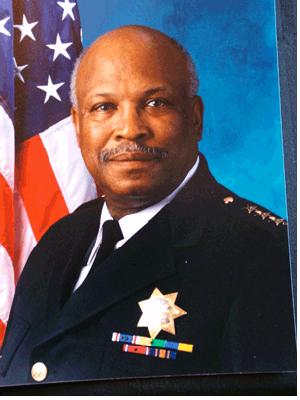
It sounds like the Tennison and Goff story all over again: An innocent man has been locked up for 18 years on the basis of highly flawed testimony from a police informant. I know, I know, Caramad Conley hasn’t been proven innocent — but a Superior Court judge thinks he hasn’t been proven guilty, either. And it all traces back to retired homicide inspector and later police chief Earl Sanders.
District Attorney Kamala Harris is still talking about retrying Conley, but I don’t think that’s going to go anywhere — the one key witness is dead and his testimony has been utterly impeached be revelations that he lied on the stand.
What’s interesting is that none of this would have ever come out it the lawyers at Keker and Van Nest, along with Public Defender Jeff Adachi, hadn’t pursued the Tennison and Goff cases — and even then, a lot of the evidence was (literally) buried. So this makes two cases — so far — in which Sander and his partner, the late Napolean Hendrix, were accused of framing a defendant. I suspect there have to be more.
“When something like this happens, it’s usually a pattern and practice,” Adachi told me.
Dan Purcell, the Keker attorney who represented Conley, told me he thinks the district attorney should go back and review some of the other similar cases involving Sanders and Hendrix. “The documents show that there are other cases where they paid witnesses,” Purcell said. “Now, that’s perfectly fine if you inform the defense, but in this case they clearly didn’t.”
Adachi complained that “nothing happens to the inspectors” — and he’s right. Sanders is comfortably retired on a nice pension and Hendrix died of cancer in 2009. And since the pair handled more than 500 murders, it’s hard to imagine reviewing all of their cases.
But the district attorney can certainly go back and review the other cases in which Sanders and Hendrix paid witnesses — and any others where the evidence was slim. That’s a matter of basic justice.
Philadelphia’s Dr. Dog is the kind of band that can’t seem to get enough of life on the road. Earlier this fall, during the first of two nights at the Fillmore on what is the band’s second full tour in support of April’s Shame, Shame (Anti), fans were treated to a lengthy, lively set of retro-minded indie-rock.
The show kicked off with Shame, Shame opener “Stranger,” which showcased bassist Toby Leaman’s perfectly frayed vocals set amongst some soaring Beatles-esque harmonies and Motown posturing from his band mates. “Slowly I’ve become undone/ a stranger, with a stranger heart,” he yelped with a gruff clip to his voice, sounding like Harry Nilsson during his late, destroyed vocal cord phase.
Shame, Shame material filled most of the band’s set list, with Leaman and guitarist Scott McMicken trading off lead vocal duties nearly song for song. McMicken’s higher-pitched, smoother-around-the-edges voice offered a nice counterpoint to Leaman’s, and led to a couple of the show’s highlights. “The Old Days” from 2008’s Fate (park the Van) started with a slow, snaking piano line courtesy of Zach Miller (the band’s stoically efficient keyboardist/organist) and McMicken singing, “Let go of the old ones/ we’ve got some new ones.” By song’s end, the band was jumping around the stage during a rollicking outro section led by Leaman’s catchy bass line and McMicken’s classic-rock soloing. “The Breeze” offered maybe the best example of how well these guys have locked down their live arrangements, with tambourine, shakers, and three-part harmonies carrying the sparse opening lines before the whole band jumped in. Leaman took over vocals during the song’s breakdown, gazing right through the crowd, singing, “Are there dark parts, to your mind/ Hidden secrets, left behind/ Where no one ever goes/ But everybody knows” with an unsettling stare, finishing with a cathartic “It’s alright!”
Elsewhere, the brand new “Take Me Into Town” sounded like Beggars Banquet-lite, the Architecture in Helsinki cover “Heart it Races” took on a classic soul and R&B feel, and “Worst Trip” from 2007’s We All Belong (Park the Van) was rushed through at a breakneck, almost punk-rock pace. Props must be given to new(ish) drummer Eric Slick, who has stepped in seamlessly and added his own little touches to the band’s live shows.
The encore offered up some unexpected treats for long-time fans. “Say Something” and “Oh No,” two tracks from the 2005 EP Easy Beat (Park the Van) sounded great and far beefier than their lo-fi album counterparts. The highlight, however, was “California,” a stripped-down acoustic ditty with jug band and barbershop quartet touches that really separated itself stylistically from everything that’d come before it.
Tastemakers like Pitchfork have lazily written Dr. Dog off as derivative muggers of ‘60s and ‘70s rock standards, and the band still hasn’t experienced the mainstream success its devout followers know it deserves. But for lovers of good old-fashioned, no-bullshit rock and roll, this is one of the more fun, hardworking live bands around.
Sigh. I guess I’m supposed to be Christmas shopping right now. But all I can focus is on is another week of sweet and wild sex events – what’s a girl to do? In the spirit of at least trying to pretend I give a damn, however, here are five fantastic places to buy sexy somethings for the naughties on your list. And the weekly sex events, of course.
1. Quality SM – run by womens since 1988, this locally based online catalog specializes in British BDSM titles. www.qualitysm.com
2. Dark Garden – the hottest corsets money can buy for the love in your life that needs cinching. 321 Linden, SF. (415) 431-7684, www.darkgarden.com
3.Good Vibrations – duh, if you read this column at all, duh. Various Bay Area locations. www.goodvibes.com
4. Stormy Leather – leather goods for all! 1158 Howard, SF. (415) 626-1672, www.stormyleather.com
5. Big Al’s Adult Super Store – sample Yelp review: “Forget about stoopid goodvibes and their politically-correct-boring-medical-supply-store bullshit!” Great for bachelorette parties! 556 Broadway, SF. (415) 391-8510
—
Good Vibrations Customer Appreciation Night
Surely this night was formulated with the diligent holiday shopper in mind, but really Good Vibes – free wine and chocolate? One-on-one attention from sexperts? This is one shopping event (actually five – Fri/17, Sat/18, Weds/22 and Thurs/23 will see the same perks) that will nurture the sex life of the gifter and giftee in one fell swoop. Pick up a present for you and yours, how bout?
International Day to End Violence Against Sex Workers
Started in SF, this is the day to honor all those that lay down for our bullshit – and bucks – and to speak out against the violence and discrimination heaped on them in return. Friday’s memorial at City Hall features a performance piece entitled “Sex Worker Scream,” a reading of all of 2010’s victims, and a candlelit march to the Center for Sex and Culture for tea and cookies, for real.
Fri/17
Performance and vigil start at 4:17 p.m., march after to Center for Sex and Culture, free
Started by burlesque champion Michelle L’Amour in Chicago, this nudie reading series has spread to cities across the country – and none of the chapters have more sexy indie cred than SF’s franchise. Started by Burly Q beauty-erotica writer Lady Monster, this month’s event will see the women reading literature penned by sex workers. Annie Sprinkle makes a guest appearance, you can augment your literary arsenal, and see some boobies — what could be better, right?
Pansexual play party Pink has made a practice of having sexy pre-event lessons to ease you into a night of swinging and cavorting at Mission Control’s pillow strewn harem rooms. This month, come early for a crash course on flirting: Jasper from The New Eccentrics will be taking it deep and hard into the areas of the brain and the corresponding ways to get them all hot and bothered (in a metaphysical sense).
An encore performance by Ms. San Francisco Leather contestant Ms. Cat, singletail whip-throwing contests, vibrator races, and kinky raffles await you at this decidedly un-cotton candy carnival (although there will be a dessert table on hand). Plus, as befitting the holiday season, The Exiles (SF’s womens-only BDSM educational group) will be holding a children’s toy drive at their get-down.
Will all the big, beautiful, kinky women please stand up? That’s right, now find some car keys and roll to Milpitas, because there’s a far-flung party that’s being held in your honor. Yessir, here in the embrace of mesquite-grilled Southwestern fare you can find a diverse spread of those who’d be honored to engage in some rough play with you – men, women, doms, subs, everything in between. Appetites encouraged, as is street wear (you’ll be in a public room, no need to stress the squares).
Sat/18 11 a.m.-1 p.m., free (purchase of food or drink encouraged)
Unemployed workers and community advocates hoping to secure Mayor Gavin Newsom’s support for Sup. John Avalos’ groundbreaking local hire legislation rallied at City Hall December 14 to meet with Newsom’s chief of staff Steve Kawa. But Newsom and Kawa were said to be in intense negotiations over the Americas Cup bid. So, James Richards, founder of Aboriginal Blacks United, waited until Kawa could see him, along with Florence Kong of the Bayview-based Kwan Wo Ironworkers. Joshua Arce of the Brightline Defense Project, and a group of local residents.
“‘Living in the city is so expensive,” Kong observed. “It’s not fair that a lot of local work is being done by workers from outside the city.”
Kawa finally emerged and shepherded folks out of the Mayor’s Office and into a meeting room close to the supervisors’ office. He was uncomfortable with having media at the meeting. But Richards said the group was OK with a reporter. And then he asked Kawa if Newsom would sign Avalos’ local hire law later that day.
“This is a very complex piece of legislation, and if it does become law, that’s when the work begins,” Kawa said, noting that Newsom will have ten days to review it, after its Dec. 14 reading. “Some folks are still concerned about it, partly on the trades union side,” Kawa added.
But Richards pressed his point. “After the Board acts today, we want to talk to the mayor,” Richards said. “We don’t want to wait around another ten days. We want him to assure us.”
But Kawa refused to give assurances. “At the end of the day, 42,000 San Francisco don’t have a job,” Kawa said, claiming the best local jobs program was Jobs Now, under Newsom. “But the federal government is refusing to extend that program, and now we can’t hire anybody at City Hall and we have to get this economy growing,” he said.
When Joshua Arce of Brightline expressed concern that folks had met privately with Newsom to exert pressure against Avalos’ legislation, Kawa replied that Newsom had concerns that some folks could lose their jobs around San Francisco airport, because, technically, it’s in San Mateo.
“And are we sure this legislation will be successful?” Kawa continued. “The worst thing a government can do is over promise and under deliver. Our question is, you tell me how it will not fail. Because, yes, we want to have local hire, but don’t mislead anybody by saying, we pass this legislation, she gets a job. Our issue is making sure that we are not misleading anyone. Those are the concerns that people have. Will it be successful, as written? Because we can’t mislead your members, James.”
“Tell the mayor, we are here,” Richards said. And then Kawa was shaking his hand and heading back to the Mayor’s Office, presumably to talk about cups and America.
“It’s a good thing, we are here today,” Richards said to the workers who remained sitting in the meeting room long after Kawa was gone. Many of them were young, black and male–and in search of a job. “Give a round of applause for your own self,” Richards continued. “It’s a good thing to let them know you come down here to take care of your own business.Because don’t nobody…”
He paused and the ABU members in the room immediately picked up the “don’t nobody give a damn” refrain, their voices ringing as one.
“Some times when we push too hard, when we get what we want, he get on a roll and tell all the reasons why he not going to sign. ‘I want to do this, but…” Richard added.
And then Richards turned to the issue of local hire at UC Mission Bay.“They gotta know today that we are hot on their trail,” he said. “Let them go tell that. Let Steve go tell that. Then they know we are fighting that.”
An hour later, when the Board gave Avalos’ legislation a veto-proof majority, Richards, Kong and the rest of the group burst into applause. “It’s been quite a road to get here,” Avalos said.
“This is the most substantive policy San Francisco has passed in a generation,” Julian Davis observed, as local hire supporters rejoiced by the Tree of Hope, outside the Board’s Chambers.
Inside the Chambers, the Board was voting unanimously to support the city’s Americas Cup bid.
“To win a sailing race, every member of the crew has to work together,” Board President David Chiu said. And his words could equally have applied to Avalos and the community’s effort to navigate treacherous political seas, get local hire legislation passed and, hopefully, lift everyone’s boat, in the process.
OPINION Who will pay for California’s budget woes? For the last three years, Californians have put up with cuts to programs that are critical to our state’s future and our social safety net. Public education, HIV and AIDS programs, state universities, and CalWORKs have all come under the knife. The elephant in the room, as state and federal governments try to balance budgets on the backs of the working and middle class, is the billions of dollars we are wasting on a misguided war in Afghanistan.
Fresh evidence that the war in Afghanistan is failing rolls in on a daily basis. While the administration justifies the cost in lives and dollars as necessary to fight Al Qaeda, it also acknowledges that there are only 50 to 100 Al Qaeda fighters in Afghanistan. Every soldier in Afghanistan costs U.S. taxpayers $1 million per year. With 100,000 soldiers on the ground, that means we’re spending as much as $2 billion a year on each Al Qaeda fighter.
Would we dream of spending $2 billion on every needy child in California? Or even $1 million? As U.S. and Afghan casualties rise along with the dollar amounts, with little success to show for it, we need to get our priorities in check.
At Governor-elect Jerry Brown’s budget forum this week, we were staring down a $28.1 billion budget deficit over the next 18 months. Compare that to the $46.4 billion Californians have already spent on the war in Afghanistan — $1.2 billion of that right out of San Franciscans’ pockets.
The Obama administration is conducting a strategy review this month that is expected to rubber stamp an approach that keeps soldiers in harm’s way — when doing so is not likely to make Americans or Afghans safer. At the same time, the president’s deficit commission chairs are also passing down recommendations to save money by cutting benefits for our most vulnerable citizens.
I would like to tell the taxpayers in my district who are shelling out these dollars that there’s a light at the end of the tunnel, but the president is now proposing ending the “combat mission” in 2014, which could mean there will be tens of thousands of troops on the ground even after four more years have passed.
I will continue to fight for our real needs in Sacramento. But it’s time for our representatives in Washington to put an end to this disastrous war and bring our troops home as quickly and responsibly as possible. Our tax dollars should be making life in California sustainable and safe for all. We can’t afford any other way.
Assemblymember Tom Ammiano represents the 13th District.
The lame duck Board of Supervisors made history Dec. 7 when it voted 8-3 to approve mandatory local hire legislation for city-funded construction projects. The measure ends a decade-long effort to reach 50 percent local hiring goals through good-faith efforts.
“That’s a sea change in our local hiring discussion,” said Sup. John Avalos, who launched the legislation in October as part of the LOCAL-SF (Local Opportunities for Communities and Labor) campaign, which seeks to strengthen local hiring, address high unemployment rates, and boost the local economy.
The veto-proof passage of Avalos’ measure comes in the wake of a city-commissioned study indicating that San Francisco has failed to meet good-faith local hiring goals for public works projects even as unemployment levels rise in the local construction industry and several local neighborhoods face concentrated poverty.
Although Cleveland also has a local-hire law, the Avalos measure will be the strongest in the nation. Avalos’ legislative aide Raquel Redondiez told the Guardian that Cleveland’s 2003 legislation requires 20 percent local hire.
“This legislation doesn’t just have a mandated 50 percent goal,” Avalos explained, noting that San Francisco will require that each trade achieve a mandated rate and that 50 percent of apprentices be residents.
“This will ensure that our tax dollars get recycled back into the local economy, and that San Franciscans who are ready to work are provided the opportunity to do so,” Avalos said.
Avalos’ groundbreaking legislation phases in mandatory requirements that a portion of San Francisco public works jobs go to city residents and includes additional targets for hiring disadvantaged workers.
WHO GETS $25 BILLION?
The legislation replaces the city’s First Source program, under which contractors were required only to make good faith efforts to hire 50 percent local residents on publicly-funded projects. But the measure begins slowly by mandating levels some contractors are already reaching. According to a study commissioned by the city’s Office of Employment and Workforce Development and released in October, 20 percent of work hours on publicly-funded construction projects are going to San Francisco residents.
Avalos’ legislation, which is supported by a broad coalition of labor and community groups including PODER, the Filipino Community Center, Southeast Jobs Coalition, Kwan Wo Ironworks Inc., Rubecon, and Chinese for Affirmative Action, comes at a critical moment for the recession-battered construction industry.
Under the city’s capital plan, more than $25 billion will be spent on public works and other construction projects in the next decade — and two-thirds of this money will be spent over the next five years.
The measure has environmental benefits too. Transportation still accounts for more greenhouse gas emissions generated in the Bay Area than any other source, and San Francisco residents are more likely to take transit, walk, or bike to work than residents of other Bay Area counties. “When local citizens are able to work locally, there are fewer cars on the road and less air pollution,” Avalos said.
Sup. Ross Mirkarimi said that Avalos’ legislation is “just a start.”
“People have talked a good game about local hiring,” observed Mirkarimi, whose district includes the high unemployment-affected Western Addition.
“We are going to have to go beyond construction and start thinking about delving into the private sector,” Mirkarimi continued, pointing to the need to build 100,000 housing units over the next 25 years if the city is to keep up with a projected population increase. “Who is going to build that housing?” he asked.
Sup. Eric Mar noted that “the Sierra Club endorsed the measure early on because of the environmental benefits of having people work close to where they live.”
Sup. David Campos, whose district includes the Mission, said the measure was one of the most significant pieces of legislation to emerge from the board in recent years. “In the past, a lot of obstacles got in the way, including some legal challenges,” said Campos, who credited Avalos for navigating a complicated legal structure. “At the end of the day, I think this is going to benefit everyone.”
Mike Theriault, secretary-treasurer for the San Francisco Building Trades Council, told the Guardian he remains opposed to the legislation because the union presers to allocate jobs based on seniority, not residency. But he said the amendments make the measure “less harmful and more survivable in the short-term.”
THE ECONOMIC GAP
Termed-out Sup. Sophie Maxwell, who represents the city’s economically distressed southeast sector, has often noted that the construction industry provides a path to the middle class for people without advanced degrees or facing barriers to employment. She thanked Avalos for pushing legislation that promises to provides opportunities for “growing the middle class instead of importing it.”
“This industry closes the economic gap,” she said.
Board President David Chiu and termed-out Sups. Chris Daly and Bevan Dufty also supported Avalos legislation. But Dufty, who is running in the 2011 mayoral race, cast the eighth vote, which gave the measure a veto-proof majority.
The board’s Dec. 7 vote came a few hours after Bayview-based Aboriginal Blacks United founder James Richards and a score of unemployed local residents rallied at City Hall in the hopes of securing Dufty’s vote.
ABU has recently been protesting at UCSF’s Mission Bay hospital buildings site on 16th and Third streets. Its members also triggered a shut down at the Sunset Reservoir last month after a court ruled that locals promised jobs installing solar panels at the plant be replaced by higher-skilled engineers,
“It’s been too long that we have been protesting and fighting this good faith effort,” Richards told the Guardian. “We need a mandatory policy.”
Dufty is also hoping the Avalos measure could spread to other cities and benefit workers nationwide. “At a certain point I looked at labor and said, ‘Yes, I’m going for this legislation. But not just for San Francisco — you want to take this concept to other cities,’ ” Dufty said, as he made good on his promise to Richards to vote to support Avalos’ law.
Dufty seemed hopeful that Mayor Gavin Newsom would get behind the legislation. “But I respect that there may be a little bit of coming together between now and the second reading.”
Newsom spokesman Tony Winniker told the Guardian that the mayor has 10 days to review Avalos’ legislation after its Dec. 14 second reading. “He supports stronger local hire requirements but does want to review the many amendments that were added before deciding,” Winnicker said.
But will Newsom, who is scheduled to be sworn in as California’s next lieutenant governor Jan. 3, issue a veto on or before Christmas Eve on legislation that has been amended to address the stated concerns of the building trades?
That would be ironic since the amended legislation appears to match recommendations that the Mayor’s Taskforce on African American Outmigration published in 2009. The California Department of Finance projected that San Francisco’s black population would continue to decline from 6.5 percent (according to 2005 census data) to 4.6 percent of the city’s total population by 2050 — in part because of a lack of good jobs.
WILL NEWSOM VETO?
Avalos originally proposed to start at 30 percent and reach 50 percent over three years. But after the building trades complained that these levels were unworkable, Avalos amended the legislation to require an initial mandatory participation level of 20 percent of all project work-hours within each trade performed by local residents, with no less than 10 percent of all project work-hours within each trade to be performed by disadvantaged workers.
He also amended his legislation to require that this mandatory level be increased annually over seven years in 5 percent increments up to 50 percent, with no less than 25 percent within each trade to be performed by disadvantaged workers in the legislation’s sixth year.
A Dec. 1 report from city economist Ted Egan estimated that the local hire legislation would create 350 jobs and cost the city $9 million annually. But Egan clarified for the Guardian that this cost equals only 1 percent of the city’s spending on public works in any given year.
Vincent Pan of Chinese Affirmative Action, which supports Avalos’ local hiring policy, suggested that the mayor “check the temperature.”
“It would be leadership on the part of the mayor not to veto legislation that’s about San Francisco,” Pan said.
And Mindy Kener, an organizing member of the Southeast Jobs Coalition breathed a deep sigh of relief when Dufty’s vote made the law veto-proof. “It’s gonna go across the country,” Kener said. “We just made history.”
City officials were poised to finalize an offer to host the 34th America’s Cup after amending a sweetheart deal that had city taxpayers heavily subsidizing Oracle billionaire Larry Ellison’s yacht race. But the question now is whether Ellison will accept the new proposal.
The original deal negotiated between representatives for Ellison and Mayor Gavin Newsom called for ceding 35 acres of city-owned waterfront property to Ellison’s America’s Cup Event Authority (ACEA) rent-free, but it was criticized as too expensive for a city facing massive budget deficits (see "The biggest fish," Nov. 30).
So at the Dec. 8 meeting of the Board of Supervisors’ Budget & Finance Committee, that deal was jettisoned in favor of a cheaper alternative that shifted the race venue to the city’s Northern Waterfront and promised long-term leases on commercially reasonable terms. The new agreement appeared on track for approval at the Dec. 14 Board of Supervisors meeting, after Guardian press time.
At the same time, new doubts arose at the last minute when race organizers stated publicly that they were more likely to reject the new option than the original plan because the financial terms were not as attractive. Although expectations have been high all along that San Francisco would be selected to host the next Cup, the team cast doubt on the outcome by publicly criticizing the new plan. According to a source familiar with negotiations, that move came as a jarring surprise to city officials. Nonetheless, supervisors approved the proposal at a Dec. 13 special meeting and sent it on to the full board.
Newsom’s Office of Economic and Workforce Development (OEWD) spent about four months in negotiations with Ellison’s BMW Oracle Racing Team and the ACEA to hash out a host city agreement. The Northern Waterfront scenario emerged in late November after Budget & Legislative Analyst Harvey Rose cautioned in a fiscal impact assessment that the original deal would have cost the city an estimated $128 million, including impacts to the general fund and losses from entering into rent-free leases.
The fundamental shift in the plan at this late stage, less than three weeks before the deadline for a final decision, reflected some deft maneuvering on the part of the board even in the face of intense pressure to approve a binding long-term agreement on an unusually short timeline. Sup. Ross Mirkarimi and Board President David Chiu, who expressed reservations about the original proposal but strongly favored the idea of bringing the race to San Francisco, were able to deflect a deal that would have harmed the city in favor of a wiser alternative by reshaping the proposal at the 11th hour.
"I was a little bit surprised by some of the recent press," Mirkarimi noted at the Dec. 13 meeting, referencing reports that the team was considering rejecting the bid. He asked everyone to keep in mind that "we’re working with public dollars and purse strings."
But the Mayor’s Office supported the modified deal. Press Secretary Tony Winnicker told the Guardian: "The Northern Waterfront bid is good for the city, great for the port, and will provide a spectacular experience for the America’s Cup. Hosting the America’s Cup will bring more than $1 billion in economic activity and thousands of jobs to San Francisco and showcase the city unlike almost any other event."
Speaking at the Dec. 8 committee meeting, Chiu also voiced his support for hosting the Cup. "Obviously this will have enormous benefits," Chiu said. "If this were to come to San Francisco, this will mean $1 billion and likely $1.2 billion in economic activity during the greatest recession since the Great Depression. We cannot ignore this opportunity."
The difference in the two scenarios amounts to tens of millions of dollars in savings. According to a fiscal feasibility analysis released Dec. 13 by the Budget Analyst, the net loss to the city under the Northern Waterfront alternative would be $11.9 million, compared to $57.8 million under the prior agreement (not including costs relating to the rent-free leases proposed earlier). However, that impact doesn’t account for a $32 million contribution that the America’s Cup Organizing Committee is expected to provide to the city to defray municipal costs.
Under the Northern Waterfront plan, Piers 30-32 and Seawall Lot 330 would be leased to race organizers for 66 and 75 years, respectively, on "commercially reasonable terms" with development rights included. The race organizers would receive a rent credit in exchange for investing an estimated $55 million for infrastructure improvements.
Rose’s office also found that the city would realize a net gain by transferring development rights for Piers 30-32 and Seawall Lot 330 with commercially reasonable rents, generating a net $12.3 million in new tax and lease revenues.
"This deal has significantly improved from the prior deal that went before you," Rose noted at the Dec. 13 Budget & Finance Committee meeting. The main reason for the reduction in costs was that under the original plan, ACEA would have been granted rent-free development rights to Pier 50, a 20-acre waterfront parcel needing costly renovations, for 66 years. Removing that costly improvement and shifting dredging costs from the city to race organizers made the prospect more feasible for San Francisco.
Piers 26 and 28 were added to the equation late in the game, too. Under the new plan, ACEA has the option to spend an additional $25 million renovating those piers in exchange for leasing them for 66 years with rent credits. Ted Egan, an economic analyst with the City Controller’s office, noted that the piers were expected to last for only 15 years if they weren’t renovated.
"Without the America’s Cup stepping forward, we lose them, and we lose any potential development that could take place at those piers," he noted. Port Director Monique Moyer also praised the plan at the Dec. 8 meeting, saying piers that would have continued to deteriorate could now be revitalized.
Chiu amended the agreement to secure greater assurance that the city would receive a $32 million contribution from the America’s Cup Organizing Committee (ACOC), the fund-raising arm of the race organizing team, to defray municipal costs. Prior to Chiu’s amendment, there was no guarantee that the city and county would receive that money, Rose pointed out.
Jennifer Matz, director of OEWD, noted that ACOC was "committed to using best efforts" to raise $32 million over the course of three years. Under the agreement, if the committee hasn’t successfully raised $12 million by one week after the environmental review has been completed, the city reserves the right to call off the deal.
The new plan seemed likely to pass muster even with Sup. Chris Daly, the most vocal opponent of the original plan. "One thing that’s clear is that it’s a whole lot better than the previous proposal," Daly said.
Ellison, who captured the 33rd America’s Cup off the coast of Spain and holds exclusive power to choose which city will host the next sailing match, has set Dec. 31 as the deadline for his final decision. But a source familiar with the negotiations told the Guardian an announcement was expected even sooner.
Ironically, there was little doubt that Ellison would select San Francisco until the very end of the process, when the city finally reached an agreement that seemed to satisfy the Mayor’s Office, the Board of Supervisors, and the economic analysts. At press time, it was still an open question whether Ellison will go for it.
"With this latest bit of vetting by us, I think the city has done the utmost it possibly could do in putting forth the best plan it possibly could craft in such a short period of time," Mirkarimi said at the close of the Dec. 13 meeting. "I think that San Francisco stands to be the best contender for hosting America’s Cup, and let that message ring well toward Mr. Ellison, and around the country, and abroad."
History was made at City Hall on December 7, when the Board voted 8-3 to approve local hire legislation for city-funded construction projects. “This is the strongest local hiring measure in the nation, “ said Sup. John Avalos, the legislation’s chief sponsor. “It doesn’t just have a mandated 50 percent goal. It has a ‘by trade’ mandate. It requires 50 percent of apprentices to be residents. More than anything we are moving away from a good faith policy. That’s a sea change in our local hiring discussion.” Sup. Sophie Maxwell thanked Avalos “for taking up the mantle” and pushing construction industry legislation that will provide opportunities for ”growing the middle class instead of importing it.” “This industry closes the economic gap,” Maxwell said, Board President David Chiu, Sups. John Avalos, David Campos, Chris Daly, Bevan Dufty, Eric Mar, Sophie Maxwell and Ross Mirkarimi voted for the legislation. But Dufty was the eighth vote that gave the measure a veto-proof majority. His vote came after he met ABU (Aboriginal Blacks United) leader James Richards and other advocates of unemployed residents. They see the legislation as a way to invest local tax dollars in local communities, reduce crime and poverty, and lessen pollution by reducing workers’ commutes.
“It’s been too long that we have been protesting and fighting this good faith effort,” Richards said.” We need a mandatory policy.” ABU member Troy, 47, who was born and raised in the Bayview, and has two sons, said he had been unemployed for six months. “If we don’t work, nobody works, that’s ABU’s motto,” Troy said. ‘We can’t have nobody come from Marin, taking our jobs and pushing us back onto the streets, selling drugs. We gotta put the merry back into Christmas.”
“A lot of moving parts had to come together for this legislation to be successful,” Dufty told the Board, a couple of hours after he met ABU’s Richards. “This is very reminiscent of Healthy San Francisco, which was one of the most monumental changes in the city.” Dufty said he believes that, much like Healthy San Francisco, local hire legislation is bigger than just San Francisco. “At a certain point, I looked at labor and said, yes, I’m going for this legislation, but not just for San Francisco,” Dufty said. “You want to take this concept to other cities.”
Dufty was hopeful that Mayor Gavin Newsom will get behind the legislation, before its Dec.14 second reading. “But I respect that there may be a little bit of coming together between now and the second reading,” he said. Newsom spokesperson Tony Winniker told reporters that the mayor plans to review the amended legislation and consult with impacted contractors and unions before deciding whether to veto the legislation. A December 1 report from city economist Ted Egan estimated that the local hire legislation will create 350 jobs and cost the city $9 million annually, or 1 percent of whatever it spends on public works. (San Francisco is set to spend an estimated $27 billion on capital projects over the next decade.) Vincent Pan of Chinese Affirmative Action, which supports Avalos’ local hiring policy, suggested that the mayor “check the temperature.” “It would be leadership on the part of the mayor not to veto legislation that’s about San Francisco,” Pan said.
Arc Ecology filed suit today in federal court against the San Francisco Redevelopment Agency, citing First Amendment issues and the Commission’s alleged retaliation for Arc’s criticism of the Agency’s Candlestick Point/ Hunters Point Shipyard project
Redevelopment commissioners threw Arc under the bus this September, when they rejected the recommendation of Agency staff, an independent interagency selection panel, the Hunters Point Citizens Advisory Committee and dozens of Bayview Hunters Point and San Francisco residents to rehire Arc to provide environmental technical and educational services for the cleanup of the shipyard.
At that same meeting, the Commissioners voted to award the contract to Circle Point, a San Francisco-based consulting company that Commissioner Francee Covington worked for, in support of a bridge project near Sacramento, several years earlier.
During the Commission’s Sept. 21 meeting, Commissioners Leroy King, Francee Covington and Darshan Singh joined Commission President Rick Swig in calling for Arc’s ouster, variously accusing Arc’s executive director Saul Bloom of disloyalty and dishonesty, but failing to support their claims with evidence related to the contract in question.
“I’m opposed to giving the contract to Arc,” Commissioner King said, accusing Bloom of talking, “against Lennar.” But Lennar is the developer for the city’s massive Candlestick Point/Shipyard project, and as such it is not in charge of the Navy’s clean-up of the shipyard.
Commissioner Covington pulled out the city’s response to comments on its EIR (environmental impact report) for Lennar’s redevelopment plans, as alleged evidence of Arc’s malfaisance, even though the non-profit’s Redevelopment contract involved assessing environmental issues related to the Navy’s shipyard clean-up, and not assessing rLennar’s redevelopment proposal.Covington then pointed to, but did not identify, letters she claimed were from individuals who alleged their names were falsely included in a letter supporting Arc’s EIR comments.
(The Guardian subsequently discovered that these missives were form letters. Both were written in identical language. Naim Harrison, who works for Positive Directions, which sent the city one of the form letters, told the Guardian that he signed Arc’s EIR letter, which asked for more time to review the city’s draft EIR. “It seemed a reasonable request,” Harrison said. But Positive Directions director Cedric Akbar, who sent the form complaint letters and was running as a candidate in the hotly contested D10 race, did not return the Guardian’s repeated calls.)
Commission President Swig, a hotel and tourism industry consultant, sought to frame Arc, which was hired as an independent non-profit, as an ungrateful consultant. “As a consultant myself, I don’t agree with all my customers, but I don’t bite the hand that feeds me,” Swig said. Then the Commission voted 4-0 to reject Arc and award the contract to Circle Point, instead.
“The Redevelopment Commission’s punishment of Arc Ecology sends a message to all contractors that they must now lie for the Commission.” Bloom stated in a Dec. 6 press release. “Just listen to the Agency’s own web-audio of the Commission’s September 21st meeting. This unelected, unaccountable legislative body, one of only a handful of such Commissions in California, is attempting to put responsible criticism in the deep freeze.”
“No matter that the subject of our commentary was outside the scope of our contract, no matter that purpose of the contract was to provide the community with an independent view of the decision-making regarding the Shipyard’s cleanup, and no matter that its own staff found our analysis helpful, the Commission’s action states clearly they prefer public relations to transparency,” Bloom continued. “This is a governmental body with a duty to uphold speech not their private business. The Commission has given notice that to contract with the Agency be prepared to kiss the First Amendment goodbye.”
Arc and the First Amendment Project say their lawsuit will also demonstrate that the Office of Economic and Workforce Development “clearly biased the applicant evaluation score against Arc Ecology but failed in its attempt to rig the recommendation of the Selection Panel” and that the Redevelopment Commissioners “falsely stated the Commission’s policy as always awarding contracts to the highest scoring applicant – even if the difference is only two tenths of one percent out of a possible score of 100.”
First Amendment Project staff attorney Geoffrey King told the Guardian that Arc’s suit focuses on two distinct areas of concern.
“First, there was the attachment of an unconstitutional condition to Arc’s contract, and then there was the taking of retalitory action,” King said. “We allege that statements that Arc made were wholly outside the scope of its contract. But even if its statements were inside the scope of its contract, Arc was hired to be a watch dog and not a lap dog. Arc’s role within that process was to be an independent voice. You can’t condition funding on someone’s silence over something they were not contracting for.”
You could impose conditions like that, King says, if the government hired a public relations firm to disseminate an approved message.
‘That’s where you can control the content,” King said. “But if the government is hiring you to be independent, it can’t get mad at you for providing answers it doesn’t like.”
“And nobody accused Arc of a breach of the duty of loyalty,” King continued, noting that Bloom asked Redevelpment Agency staffers if he was in a breach, and was told that he was not.
“It’s pretty stark when you look at the transcripts of that Redvelopment Commission meeting what the real issue was,” King said.
There’s been a lot of discussion at City Hall about the pressing need for mandatory local hire legislation, as opposed to San Francisco’s current “good faith” efforts. And it seems that everyone agrees upon is that something needs to be done, as the Board prepares to vote December 7 on Sup. John Avalos’ local hire proposal, which seeks to ensure that 50 percent of workers hired on city-funded construction projects will be local residents. The move comes at a time of high unemployment in the recession-hit construction industry, but would kick in as San Francisco stands poised to spend $27 billion on public works projects over the next decade. ‘The city needs to leverage its funding position to ensure that our residents benefit from these investments,” Avalos said at a Dec. 1 committee hearing on his legislation, which would require 25 percent of hours on city-funded construction projects, to be worked by local residents in the first year. This rate would rise 5 percent each year to 50 percent. It would also require 50 percent of apprentice hours to be worked by local residents in the first year (with out-of-state workers exempt from these requirements).
These requirements currently apply to each individual construction trade (carpenters, painters, laborers, operators, brick masons, plasterers) and not to overall project hours.
The city would pay incentive bonuses to contractors that exceed the requirements. Contractors who failed to meet the requirements would have the option of paying liquidated damages to the city, or sponsoring apprentices during the project.
But a December 1 report from Ted Egan, the city’s chief economist, estimates the legislation would raise the city’s contracting costs by $9.3 million per year, while creating 350 jobs.
Egan breaks down the city’s estimated $9.3 million in contracting and administrative costs into three distinct piles: $2 million in higher bid costs from hiring the unemployed, $4.5 million in higher bid costs from hiring the already unemployed, and $2.8 million in higher costs associated with penalties.
‘This cost represents approximately 1 percent of the city’s $934 million estimated annual spending on covered projects,” Egan noted, adding that the cost to the city will be lower in early years, because unemployment is high now and labor is widely available.
“This is a conservative estimate,” Egan added, “as it assumes no contractor exceeds the target and receives incentive bonuses from the city, and also excludes any contractor productivity losses caused by breaking up core crews.”
Egan acknowledges that most city expenses are associated with inflated contractor bids. “These will occur because the local supply of skilled trades workers is insufficient to meet the local hiring requirements of the legislation,” he observed. “Contractors will be forced to pay above-the-market wages to workers that already have jobs, and pay the city penalties because resident labor is unavailable in many trades. These costs will be passed on to the city. This excess cost to the city could largely be mitigated by choosing local hiring targets that better reflect local supply.”
“The legislation will increase local employment and associated spending at local businesses, at the cost of higher City contracting costs,” Egan warned. “The legislation creates a net spending and jobs benefit, as written; with recommended mitigations, the positive economic impact can increase, and the cost to the city can decline.”
Egan calculated that estimated costs to the city could be reduced to $2.4 million, if Avalos’ proposed legislation is amended in the following ways:
1. Replace across-the-board 50 percent mandatory requirements with trade-specific mandates to reflect “supply and demand in each trade.” Egan argues that across-the-board requirement would lead to higher contracting costs “for several trades where required demand exceeds current supply.” These impacted occupations include operators, brick masons and plasterers, and represent 50 percent of projected demand for city projects, over the next ten years, Egan said. “Other occupations, such as carpenters, painters, laborers, and drivers are less impacted and can sustain the scheduled mandate, provided goals are set on an industry-wide and not a project-by-project basis,” Egan stated.
2. Require a study every two years “to modify requirements and assess progress to a 50 percent mandatory requirement.” Egan’s report suggests that the city conduct a review for two years, and then set mandatory participation levels for two years for brick masons, block masons, stone masons, cement masons, carpet, floor and tile installers and finishers, concrete finishers and terrazzo workers, construction equipment operators (except paving, surfacing and tamping equipment operators), drywall installers, ceiling tile installers and tapers, electricians, pipe layers, plumbers, pipe fitters and steam fitters, plasterers, stucco masons, roofers and sheet metal workers. Egan’s proposal is that the city assess the length of time required for each of these trades to develop a pool of qualified resident workers to support a 50 percent local hire mandate, and then, if necessary, propose amendments to the mandatory levels for these trades.
3. Allow contractors to transfer credit hours Egan suggests that contractors and sub-contractors could accumulate credit for hiring local residents on non-City funded projects, transfer those accumulated credit hours to other contractors, and apply those credit hours to contracts for covered projects to meet the applicable minimum mandatory hiring requirements, or work off assessed liquidated damages. “Transferred credit hours may only be applied against mandatory hiring requirements for the trade in which they were accumulated,” Egan’s report states.
4. Eliminate incentive payments Egan recommends eliminating incentive payments, “since the ability to transfer accumulated credit hours provides a similar, and more efficient, incentive for contractors to exceed targets.”
Egan notes that his analysis assumes that annual public works spending is equal to the 10-year average in the city’s capital plan, which is $3.1 billion. “60 percent of that will be spent on projects not covered by the legislation, because they are state- or federal-funded,” Egan stated.
He predicts that unemployment in the trades will average 10 percent in the next decade. “Current unemployment in construction is 20 percent in San Francisco,” Egan said.
Egan argued that allowing contractors that exceed local hire requirements to transfer the additional hours, within a trade, to other contractors “would allow the same local hiring targets to be met on an industry-wide basis, not a project-by-project basis.”
He also recommended eliminating proposed incentive payments. ‘Giving contractors the ability to sell their excess hours creates a private incentive to exceed hiring targets. Contractors which do not meet the local hire requirements will compensate those that do,’ Egan wrote.
But at a Dec. 1 hearing by the Board’s Budget and Finance committee, not everyone agreed with Egan’s findings.
Missing from his “economic costs” equation, some speakers observed, were estimated savings from reduced law enforcement costs and poverty rates, if residents got jobs. Egan acknowledged that his report does not factor in socio-economic benefits of the plan. ‘It’s a very fair point, but it’s hard to quantify,” Egan told the Guardian.
And while Avalos’ legislation proposes to phase in the local hiring mandate over the course of six years, Egan’s report simply focuses on costs when the city hits 50 percent.
Egan said he could have broken down his report into a phased-in, year by year, basis. “But it gives the impression of greater certainty,” Egan said, noting that it’s not clear how much the city is going to spend on construction next year. “So, given what we’re planning to spend over the next 10 years, here’s an average estimate,” he explained.
I asked Egan about his report’s claim that there is a 20 percent unemployment rate in the construction industry in San Francisco, given that other city officials, including Mayor Gavin Newsom and Sup. John Avalos, have cited a 40 percent rate.
“The 2009 census figures came out in November and it said that 20 percent of San Francisco residents who are in construction say they are unemployed,” Egan said.
He acknowledged that the 40 percent unemployment rate that Newsom and Avalos cited likely refers to unemployment among folks who work in San Francisco’s construction industry, but live outside the city, where housing prices are cheaper.
Asked if his office was recommending that the local hire percentage start at 20 percent, as some building trades requested during the Budget Committee hearing on Avalos’ proposal Egan indicated this was not the case. “We don’t see a problem in year one,” Egan explained. “There are a lot of unemployed people in year one that are available, so that target is not hard to meet.
The main problem, to Egan’s mind, was not the mandatory 50 percent local hiring goal, per se, but the requirement that it be achieved by every individual trade. “That’s why we recommend doing a process every two years to take a look at how good a job individual trades are doing, and then set targets based on the rates of producing a supply of qualified workers,” he said.
“Some won’t take seven years to achieve a 50 percent rate, but others could take much longer,” Egan explained. ‘Otherwise, contractors, will have to raise bids so they can afford to pull qualified workers off other contracts. That would lead to shuffling people around, and the city paying for it, without new people being trained.”
So, that’s where the conversation seems to be headed going into Tuesday’s Board meeting, with the building trades still pushing for amendments, and Avalos, the chief sponsor of the legislation, reportedly trying to win support from Sup. Bevan Dufty, so that he can pass veto-proof legislation before the end of the month. Stay tuned.
CHEAP EATS My new friends are young and queer and, most important, bikers, so I get to hang out at Benders where the burgers have whiskey and bits of bacon in them. Many of my new friends are vegetarian, which saves me from the awkwardness of having big fat crushes on them. My crushes are small and skinny and eat veggie burgers.
We’re starting a team in the girls football league. Remember, I wrote about them a few years back? I used to go to games on Sundays, and it was inspiring and scary. So scary that I tried to get on a team, but they never called me.
I can’t wait to play that team! It will be a made-for-TV movie made in heaven.
Probably, because I grew up in Ohio, I will have to start out at one of the so-called “skill positions,” such as running back or wide receiver, where I will bide my time making diving one-hand catches and long, slash-and-burn touchdown runs (yawn). But once I have earned everyone’s respect with my off-the-field poetry and appreciation for opera, maybe then they will move me to the offensive line.
Which is, as anyone who has ever played electric football knows, the most important position on the field.
Our coach, whom we call Coach, is such a consummate athlete that she doesn’t need to eat meat or rice. Fueled by air and eagerness, and maybe sometimes whiskey, she routinely wins bike races! And if anyone else enters, she comes in third. She lives in the Mission and owns at least three bikes that I know of, yet dates a motor vehicle. Coach jokes about never leaving the neighborhood, which is bullshit because I met her in a pond in Sonoma County. Interestingly, we were skinny dipping.
Or, I don’t know, maybe that’s not interesting.
How about if I described all my new friends’ bodies in full detail? This way everyone in the world will want to go skinny-dipping with me from now on! I’m kidding, of course. Respectfulness may not be my strong suit, let alone my swimsuit, but there are some lines I know better than to cross.
I’ll only describe Coach’s body — because our friendship I think can handle it, and anyway she’ll be on a three-week bike ride by the time this comes out, somewhere between here and San Luis Obispo, far far from newsstands.
How she does this shit — without fettuccini, I mean — I will never know. But the other day I ate Chinese food with Coach and Fiver, and I swear that all the rice on the table, and all but maybe one or two of the noodles wound up in me. The meat goes without saying.
The restaurant was Mission Chinese Food, which everyone has been singing about since I moved back to the neighborhood. It’s the restaurant inside the restaurant (Lung Shan) on Mission at 18th Street. You can believe what people are singing. It’s pretty special, despite its name.
I mean, where else can you get “thrice-cooked bacon” or “tingly lamb noodle soup”? And the bacon can be vegan, and still damn good, and the soup comes in a “numbing lamb broth.”
Which … they mean it. It’s a Szechwan spice, or herb, that literally numbs your mouth, and it was in the pickled beans and pickled pickles too. I don’t like that. I loved the flavor of everything I ate, even the fake bacon, but I’m sorry, I just don’t understand the point of numbness, except with respect to dentistry.
Folks, I want to feel what I eat. The not-at-all-fake lamb belly in the sizzling cumin lamb, for example, was a heavenly blend of crispy, tender, salty, peppery, game-flavored meat outside with an interior layer of soft, buttery, clouds of juicy joy.
Now I know what you’re thinking: No! There is no way that she’s that sexy.
I’m just saying. My job is to review restaurants. Your job, if you drive a car in California, is to go slow, watch the road, and see bicycles. Thanks for reading.
Before our car ride home discussion of some of our favorite parts of the show, my friend and I had already agreed on something; holy shit that was loud. Playing to a sold-out crowd in its first of two back-to-back San Francisco shows (10/29), Deerhunter put on a raw, visceral, sometimes loose but often amazing set that pierced through the relatively small confines of the Great American Music Hall.
Walking onstage, front man Bradford Cox grabbed the mic and gazed into the crowd. “You guys look like you wanna have fun. I like that in an audience,” he said. After someone screamed out his love for him, Cox quickly replied, “Don’t forget about Lockett Pundt (guitar),” just as the band launched into the Pundt-penned and -sung “Desire Lines.” While Cox usually and deservedly gets a lot of Deerhunter’s press attention, it should be noted that Pundt is a spectacular guitarist and songwriter in his own right, and seems to be a huge part of the band’s sound.
The opener set the tone for what naturally would be a set heavy on tunes from the band’s excellent new album, Halcyon Digest (4AD). What I hadn’t expected was the blistering distortion and pounding drums that a couple of that album’s mellower, poppier songs would take on. The twisted, bubblegum pop of “Don’t Cry” transformed into a grungy monster with a life of its own, while “Memory Boy” sped up a tad to add to the urgency of Cox singing “It’s not a house anymore” in the chorus.
A couple opportunities to show off the band’s more precise, ambient style arose throughout the set. The deceptively dreamy “Helicopter” translated perfectly and drummer Moses Archuleta included what sounded like sampled drum hits coupled with his live kit. Halcyon Digest’s closer, the seemingly African-influenced “He Would Have Laughed” floated along on a repeating, looped guitar line while waves of controlled noise and feedback ebbed in and out.
After a few minutes offstage, Cox came back solo for an encore that started with him covering Scott Walker’s “30 Century Man” with just an acoustic guitar. He played it straight, which was nice and almost surreal to see after the wall of noise throughout the night. Next, the rest of the band rejoined him and launched into a ten-minute jam that had Cox aggressively attacking his guitar to pull out short bursts of dissonant squeals and screeching solos. The song built up tension slowly (maybe a little too slowly) and then eventually released with a closing minute or so of loud thrashing. A little more paring down would have added to the overall effect, but it was still a solid way to end the evening.
Deerhunter’s widening appeal became glaringly obvious as I walked out amongst groups of grungy teenagers, appreciative old-timers, stoic hipsters, and the annoying drunk guy who had been stepping on everyone’s feet and obnoxiously trying to start out-of-rhythm, mid-song clap-along sessions all night (Hey man, you’ve successfully pulled everyone’s attention away from the band and onto you. You win!). But ultimately, even the kid holding his head throughout the show with a look of “I didn’t realize I’d signed up for this eardrum fucking” walked out with a big smile on his face.
A rare flying object has been spotted this weekend at Yerba Buena Center for the Arts, namely Cynthia Hopkins, as intergalactic space pilot Ruom Yes Noremac, a post-human “Druoc” in a floppy silver space suit hovering high above the stage of the Novellus Theatre. She’s returning from the far distant future to, what?, “save the earth, of course.”
The Success of Failure (Or, the Failure of Success), making its Bay Area premiere tonight and tomorrow, makes up part three of the wildly inventive Accidental Trilogy developed by New York–based artist-musician Hopkins and company Accinosco. I caught it last night, and while a full review will have to wait until next week, I can say that the sight of her twirling there before a sprawling spacescape projected across an enormous screen — in a comical operetta musing on “the pros and cons of evolution,” above a stage aglow and twinkling with arch sci-fi phantasmagoria, and in an all-pervading atmosphere of nostalgia and regret — seemed indeed to defy a certain gravity through the power of deft spectacle and ethereal song.
The real high-wire act, however, lays ahead, in the second half of the piece, after the conclusion of the wacky and yearning sci-fi bedtime story narrated from a billion years hence by a silvery flashing orb to her smaller, highly inquisitive offspring. Now the stage empties itself of all pretense and everything but the barest of effects, leaving just the 38-year-old artist, Cynthia Hopkins, and her story. Surrounded by a clutter of musical instruments and backed by a hand-drawn star-chart of personal crisis and loss, Hopkins here manages a feat of confessional theater characterized by uncommon, at times unnerving frankness and poise, as we watch the planetary grief and trepidation resolve into a hauntingly brazen concern with saving herself.
This is a close encounter you want to have.
http://www.youtube.com/watch?v=pOJCgs1px2A
THE SUCCESS OF FAILURE (OR, THE FAILURE OF SUCCESS) Fri/19-Sat/20, 8 p.m., $25 Yerba Buena Center for the Arts Novellus Theater, 700 Howard, SF (415) 978-2787 www.ybca.org
MUSIC It’s easy enough for Corey Cunningham, guitar player for Magic Bullets, to tell that I’m there to interview the band. Although 2200 César Chávez St. is bustling for 8:14 on a Wednesday night, I’m the only one around without an instrument. Magic Bullets practices in Secret Studios, a warehouse full of closets for bands to rehearse. “Lots of bands practice here,” Cunningham said. Through the walls I can hear the muffled sounds of different groups putting work in on something between a hobby and a dream.
We find the rest of the band crammed into its rented space, surrounded by broken amplifiers. Magic Bullets is rehearsing for a show at the Rickshaw Stop, as well as for a trip to the CMJ Music Marathon, a result of songs from its 2010 self-titled album on Mon Amie having received considerable college airplay. The trip is a new opportunity — despite making music for six years, the band had to start over after the recent departures of its drummer, keyboardist, and second guitarist.
According to Cunningham, who founded the band along with singer and lyricist Phil Benson, bringing in a new drummer was the hardest part. “There are no two drummers who sound the same,” he says. “Even if they’re playing the exact same drum beat, their drum sets sound different, the way they play sounds different. It changes your sound drastically.” Once the group decided to leave out a second guitarist, Magic Bullets’ sound, evocative of U.K. guitar pop, has become clearer. In tandem, the rhythm section is less prone to stuttering and has become more propulsive.
Some bands don’t make that transition at all, observes drummer Alex Kaiser. “If everyone leaves except you — like what happened with my old band — and you’re the only person living within 500 miles, [breaking up is] a pretty easy choice,” he said. Kaiser’s last band, Tempo No Tempo, dissolved earlier this year, with one member making the popular musician move to Brooklyn and the other deciding to pursue higher education.
“There was a month or two when we weren’t really doing Magic Bullets,” Cunningham says. The remaining members started a side project, called Terry Malts, “because we didn’t have a drummer.”
“We were like, ‘Let’s just have fun,'<0x2009>” said Benson. Nathan Sweatt, Magic Bullets’ bassist and third surviving member, qualifies Benson’s optimism: “We thought, we’re paying for this practice space, we may as well get some use out of it.” The group rents the rehearsal space monthly, out of pocket, for about the price of a room in West Oakland. And it’s not necessarily cheap.
“We’re day-jobbers,” Cunningham says. Earlier I ask (in a clichéd fashion) Magic Bullets to describe its image, and the answers veer jokingly between “regular Joes” and “cage fighters.” The former is suggested by keyboardist Sean “Shony Collins” McDonnell, the other recent addition, who splits his time away from the band studying animation and kung fu. With a tendency to quip in cartoon voices, it can be hard to take him seriously. But Benson does.
“I knew Sean from being in bands in the Peninsula,” Benson says. “He actually was the lead singer of this punk band Nathan [Sweatt], and I used to go see when I was 15 years old, Jacob Ham — the local heroes. We all kind of looked up to him, and I’ve actually taken cues from his performances. I’ve told him that before, and he’s always like ‘Aww, you.’ But it’s true.”
If the band has any claim to being working class, it comes from Benson and Cunningham (Sweatt is in education; Kaiser is an “engineer for a big-ass government lab.”) Both work retail jobs for a company that will go unnamed. Cunningham: “We try not to give them too much advertising.” Benson: “Let’s just say you can buy stuff there.”
We talk about CMJ. “[It’s] one of the only things on our bucket list we haven’t done,” Cunningham deadpans, “along with a bungee jump show.” They seem excited — the closest thing they can compare it to at this point is South by Southwest, which they played in a previous incarnation. Remembering how one blog described the group as “a noticeably drunk Magic Bullets,” they begin to theorize on the relationship between alcohol and performance. Cunningham looks embarrassed and says, “Maybe we shouldn’t be talking about this.”
While the whole band is quick to be self-effacing, Cunningham appears to be the most self-critical. On Magic Bullets’ MySpace page, a link to the Pitchfork review of its recent album is accompanied by the mood “weird” and an eye-rolling smiley. When I bring it up, Cunningham is eager to talk about it. “That was a weird one, right?” he says. “Did you notice that they gave us a good number? But you wouldn’t think they liked us at all if you read what they wrote.” He has a point. The number is decent (7.2) and the reviewer doesn’t really say a whole lot. Yet the reviewer accuses the band of ripping a riff within its song “Pretend & Descend” straight from the Smiths’ “Bigmouth Strikes Again.”
Cunningham denies this. Even going back to listen to the song, he says he can’t hear the resemblance, and I don’t press it because, personally, I don’t either. What’s likely worse than the accusation of plagiarism (which puts Magic Bullets in the fine company of the Flaming Lips, Elastica, and Joe Meek), is accusing the band of sounding like the Smiths, a familiar reference in writing about the band.
“I don’t think its a bad comparison,” Cunningham says. “I think it’s just sort of a shallow comparison because there are so many other influences that are a little more noticeable. You know that song “Lying Around”? We were listening to this song called “My Old Piano” that Chic played on. It’s a Diana Ross song. If you listen, it has a rhythmic sensibility. That sounds closer [to “Pretend & Descend”] to me than any Smiths song.”
These points of reference have their use, but they also have their limits. During a Magic Bullets show at the Knockout earlier in the year, a girl mentioned to me that they sounded like, surprise, the Smiths, only to immediately begin discussing Robert Smith. The band was on point, working the crowd into a frenzy that mirrored Benson’s ecstatic dancing as he circled around the crowded stage, singing longing lyrics about relationships that had gone awry for no good reason. Right then, surface similarities didn’t matter and the costs of a practice space seemed worth it. The most important thing with a band like Magic Bullets is that they keep giving it a shot.
OPINION San Francisco has two redevelopment commissions that together have broad, sweeping authority over land use and development in the city. The Redevelopment Agency Commission and the Treasure Island Development Authority (TIDA) have more power in some respects than the Board of Supervisors — people you actually vote for.
There is no way to overstate the importance of the power of these commissions. The Candlestick Shipyard and Treasure Island projects by themselves account for an area the size of the Presidio. Over the next decade, the commissions will oversee the outcome of the Schlage Lock parcel in Visitacion Valley, the Bayview-Hunters Point Project Area, the Hunters Point Shipyard and Candlestick Point, India Basin, Mission Bay, South of Market, and Treasure and Yerba Buena islands.
Two important questions these commissions raise are: 1) Is It healthy for our city and county to vest so much authority into two essentially unaccountable authorities; and 2) Would it be better to vest this responsibility in the Board of Supervisors — considering that it’s the norm around the state for these local legislatures to also act as redevelopment commissions?
In San Francisco, redevelopment commissioners are appointed by the mayor and confirmed by the Board of Supervisors. The board cannot select its own representatives. The commissions wield the power of independent financial authority, multimillion dollar agency contracts, and the ability to destroy a community near you. This is a substantial amount of authority for an unelected body.
The mayor and six members of the Board of Supervisors are all that is required to allow a commissioner to serve for life. There are no term limits for commissioners. There are no meaningful criteria to judge a commissioner’s appointment. There is no yard stick by which to measure a panel member’s worthiness for reappointment every four years. The board’s confirmation and reappointment process is more a popularity party than a Supreme Court nominee review.
Other than the courts, there is no recourse to a commission decision. During the recent Candlestick Point-Hunters Point Shipyard debate members of the Board of Supervisors learned they actually has to seek the approval of these political appointees to modify an environmental impact report.
As a consequence, the appointment of commissioners is highly political. The power of the two commissions makes appointments prime objectives for influential sectors of the city’s political establishment. Those commissioners who disagree with the Mayor’s Office over important issues are not reappointed.
There’s no need to abolish the redevelopment authorities, which have unique legal benefits, particularly in project financing. But we can modify the way the city oversees the agencies.
In most counties in California the Board of Supervisors also serves as the Redevelopment Commission. While that could be a bit unnerving in a city as complicated as San Francisco, it is difficult to see how the process could become more politicized, less accountable, and less democratic.
Having the board oversee redevelopment would at least ensure that agency plans reflect the needs and interests of all 11 districts — and an elected body could be held accountable for those plans.
San Francisco deserves a dialogue about whether this is the best way to chart our course into a very foggy future.
On Nov. 5, former BART Police officer Johannes Mehserle was sentenced to two years in state prison for fatally shooting Oscar Grant, a 22-year-old African American rider, on the Fruitvale train platform on New Year’s Day 2009.
Mehserle, who is white, was convicted of involuntary manslaughter in July in an incident that has become charged with racial undertones. He received credit for 292 days served in jail so far, which will considerably reduce his time in prison. It was the lightest prison sentence he could have received for the crime.
Grant supporters gathered in Frank Ogawa Plaza in downtown Oakland to express anger and sorrow upon hearing news of the sentence. “I’m not shocked,” said Cat Brooks, who helped organize an afternoon rally for the Coalition for Justice for Oscar Grant. “But I’m disgusted and distraught. It seems like the justice system didn’t work.”
After the rally came to a close and night fell, protesters spilled into the streets and marched toward the Fruitvale BART Station, the scene of the crime. But after a dozen car windows were smashed along the way, police officers in riot gear corralled the group into a residential neighborhood. Police then placed 152 protesters under mass arrest, mostly on charges of unlawful assembly. Roughly two-thirds of those arrested were Oakland residents, according to the Oakland Police Department, while others were from Berkeley, San Francisco, Hayward, and other local cities.
COMMUNITY RESPONDS
A stage outside Oakland City Hall was transformed into a venue for personal expression in the wake of the sentencing. Community members lined up to air their frustrations and resolve to keep fighting. They piled flowers onto a shrine that had been created with a picture of Grant’s face. Some painted pictures, while others gave spoken word or hip-hop performances. Several told stories of loved ones who’d died in police shootings.
Cephus Johnson, Grant’s uncle, was at the Los Angeles courtroom where Mehserle was sentenced, but shared some thoughts with the Guardian beforehand. Asked what he’d thought when the verdict had been announced, Johnson said, “My first thought was that we’re witnessing the criminal justice system failing to work as it should have worked.” If the sentence fell short of the 14-year maximum, he said, “it will be another slap in the face, signifying that black and brown men are worthless.”
East Bay labor organizer Charles Dubois was among those attending the Nov. 5 rally. “Every black parent, every brown parent, lives with this nightmare of their children being killed by some cops because they thought they had a gun,” Dubois said in an interview with the Guardian. “It’s been happening since I was a kid. It’s been happening then and it’s happening now, and it’s going to keep happening until we do something.”
California Assemblymember Tom Ammiano (D-SF) also weighed in during a phone call with the Guardian. “This verdict is outrageous,” he said. “It’s Dan White all over again.”
JUDGE DROPS GUN ENHANCEMENT
Judge Robert Perry sided with arguments presented by Mehserle’s defense attorney, Michael Rains, when he levied a reduced punishment. Mehserle could have served up to 14 years prison for involuntary manslaughter committed while wielding a gun, but Perry tossed out the firearm enhancement.
“No reasonable trier of fact could have concluded that Mehserle intentionally fired his gun,” the judge was quoted in media reports as saying. But that appears to be what the jury found, as the prosecution argued in a presentencing memorandum.
“The evidence was presented regarding the use of the gun, and in discussing the use of the gun in the jury room, somehow or another the jury decided he had used the gun illegally,” criminal defense attorney and National Lawyers Guild observer Walter Riley told the Guardian. “One has to believe the jury expected him to have exposure to a greater amount of jail time because of that.”
Perry said he believed Mehserle suffered a “muscle memory accident” that led him to draw and fire his service weapon instead of his Taser, a cornerstone of the defense’s case.
Rains wrote to the court prior to sentencing that jurors should never have been allowed to apply the firearm enhancement to an involuntary manslaughter conviction “because in this case, there is no logical way to square a verdict of involuntary manslaughter and a finding that Mehserle intended to use his gun.”
Prosecutor David Stein of the Alameda County District Attorney’s Office countered that the jury’s conviction showed they believed Mehserle intended to shoot, but not to kill, Grant. Yet Perry agreed with the defense, conceding he had mistakenly permitted the jury to enhance Mehserle’s sentence.
Riley said he sympathized with frustrations over the gun enhancement getting dismissed. “The use of guns is too prevalent in circumstances where law enforcement comes in contact with young black people,” he said. “Our society — our civil society, our judicial authority, and our communities — have to hold government and law enforcement officers to a higher level of accountability in their interactions with citizens. When people with guns shoot an inordinate number of people of one group, it’s worth tremendous scrutiny.”
ANOTHER NIGHT IN JAIL
Twice before, activists took to the streets in furious protest over this case. In January 2009, things escalated to the point where cars were set ablaze. In July 2010, a street rally gave way to rioting and looting. So on Nov. 5, many downtown Oakland storeowners boarded up and closed business early in anticipation of a third wave of vandalism.
Yet the turnout was smaller than the previous events. And while there were reports of smashed car windshields and other instances of vandalism along the circuitous path of the march, there was far less property destruction.
The community affair outside Oakland City Hall ended around 6 p.m., when the permit expired. Soon after, activists spilled into the intersection of 14th and Broadway streets, then began advancing down 14th Street chanting “No Justice! No Peace!” and “The whole system is guilty!” The march turned right onto Madison Street, then left onto 10th Street.
A police helicopter with a spotlight kept pace overhead while it progressed, and when protesters reached Laney College, police officers in riot gear blocked them in. So protesters cut through a park and wandered in a pack until they reached the intersection of East 18th Street and Sixth Avenue in a residential neighborhood. Once again, police surrounded the protesters. This time, the crowd was trapped.
Rachel Jackson, an activist who was barricaded in, began sounding off. “We were going to Fruitvale,” she explained. “We wanted to go to the scene of the crime. All night the police have been trying to suppress our free speech.” When a nearby TV news reporter asked her about windows that had been busted along the march, she was incensed. “We will not equate glass with Oscar Grant’s life!” she responded. “If we have to come out ourselves and board up windows, we’ll do that. But what we are concerned with right now is murder.”
Reporters were allowed to exit the confined area, but if anyone else had been inclined to leave peacefully, they were unable to. Police issued a call on a megaphone telling activists, “You are all under arrest. Do not resist arrest.” By the time the mass arrest was underway, public information officer Jeff Thomason told a group of reporters that there were more police officers on the scene than protesters.
“When the rocks were being thrown, it was declared an unlawful assembly,” Thomason explained. He said a dispersal order had been issued simultaneously. Yet it would have been impossible for the trapped crowd to comply with such an order.
Meanwhile, a resident of the Oakland neighborhood who had come outside when the commotion began told the Guardian that she sympathized with the protesters. “The only thing I don’t condone is the vandalism,” said Dyshia Harvey, who surveyed the scene from behind a fence with her six-year-old son.
Harvey had been anticipating word of Mehserle’s sentencing. “I was upset. I was frustrated, angry, and hurt” by the outcome, she said. But she wasn’t surprised. “I already knew we weren’t going to get no justice,” she said. “For taking a life, 14 years isn’t enough. It makes you feel like there’s no justice in the justice system.”
NOT OVER YET
Alameda County District Attorney Nancy O’Malley has not stated whether her office will appeal Perry’s ruling. Rains told reporters in L.A. that he would appeal Mehserle’s involuntary manslaughter conviction.
Meanwhile, the Civil Rights Division of the U.S. Department of Justice released a statement indicating that a federal investigation is in the works. “The Justice Department and the U.S. Attorney’s Office for the Northern District of California have been closely monitoring the local prosecution of this case,” a USDOJ prepared statement notes. “Now that the state prosecution has concluded and consistent with department policy, we will thoroughly review the prosecution and its underlying investigation to determine whether further action is appropriate.”
BART settled a civil lawsuit filed on behalf of Grant’s daughter in January that is likely to total $5.1 million, according to civil rights attorney John Burris’ website. Two other lawsuits, one on behalf of Grant’s mother and one on behalf of five other men on the Fruitvale station platform that night, have been consolidated into a single trial that will begin in May 2011, Burris told the Guardian.
Meanwhile, Grant’s death marked just one of three police shootings that occurred Jan. 1, 2009 — the other two cases also sparked allegations of civil-rights violations, since both victims were African American men. Adolph Grimes, 22, was fatally shot 14 times, including 12 times in the back, by a group of New Orleans police officers, who erroneously believed he was a suspect who’d fled the scene of a shooting.
The same night, Robert Tolan, 23 — the son of a Major League Baseball player — was shot and seriously injured outside his home in an upscale Houston suburb by a police officer who mistakenly believed Tolan had stolen the vehicle he was driving. Sgt. Jeffrey Cotton, the white officer who shot him, was ultimately acquitted.
CREATIVE OUTLET
Not everyone in Oakland reacted to Mehserle’s sentence by charging through the streets. The Oscar Grant Foundation, which facilitated live art performances at Frank Ogawa Plaza Nov. 5, is calling for youth groups, Bay Area schools, and adults to participate in an art and poetry showcase inspired by Grant. Information can be found online at IamOscarGrant.org. The foundation is advertising a $1,000 grand prize. Three artists from the Trust Your Struggle Collective didn’t wait to join a contest, however, and spent the afternoon of Nov. 5 adorning plywood covering the Youth Radio building windows at 17th Street and Telegraph Avenue, a few blocks from Frank Ogawa Plaza.
The mural displayed a prominent image of Grant holding his daughter, Tatiana, who was four years old when Grant was killed. The pair are flanked by the names and figures of more than 20 people killed by police.
“We asked the youth inside what they wanted to see,” Miguel Perez, an artist with the Trust Your Struggle Collective, told the Guardian as he looked over the mural. “They said they wanted to see the names of people killed by police nationwide, not just in the Bay Area. The list is so huge, it’s hard to pick out specific names.”
Perez said Trust Your Struggle is a group of artists and educators with social-justice backgrounds who create art as activism. “Being a person of color, I’ve had racist stuff said to me by the police,” Perez said. “It seems like it’s slowly been changing for the past hundreds of years, but it’s still not enough — enough being fairness.” *
(For a review of Slough Feg’s latest, The Animal Spirits, go here. Read on for an interview with the band’s guitarist-singer, Mike Scalzi.)
San Francisco Bay Guardian: I noticed a clear theological theme running through the album. Was that – the Reformation – an area of historical interest to you? I’m interested in that choice, of a less exciting historical topic than maybe a more violent event…
Mike Scalzi: It’s not as metal, certainly. But in another way, Martin Luther was very metal, in that he was dedicated. Though he was Christian, in his dedication and his rebellion, he was metal. I was reading about all that stuff in an anthology of Western cultures. It was very general – I had to teach it. I’m a teacher. I started teaching Philosophy of Religion a year ago for the first time, and I’m not really that into teaching it, because its not my area of expertise, but I kinda had to.
[Writing music] helps me, actually. If I can write a song about it, it becomes more ingrained in my everyday thought. It becomes more second nature to say “oh, the 95 Theses!” It’s not just as a teaching aid, though. When it comes to Renaissance Christian theologians, he’s the most metal one. He’s out in the world. He’s out doing stuff, being a revolutionary. And a lot of his views are funny, a lot of the things he said were really funny and really extreme.
SFBG: Less metal for being ultimately successful, though. A lot of those so-called heretics were metal in the sense that they died for their principles, or were burnt at the stake or what have you.
MS: But he was the most badass one! Obviously, I don’t agree with him – he was a fundamentalist and all that, and he brought on fundamentalism in a way, I guess. But at least he said that trying to believe that the Bible is literal fact by reason alone is preposterous. That’s why he thought you had to exercise faith – because it’s preposterous. Everything in the Old Testament is preposterous, but you have to believe in it, purely to test your faith.
After seven records, you have to think of new things. I don’t want to repeat myself.
SFBG: What was the rubric for the lyrics that were included in the liner notes?
MS: Oh, those are the lyrics to “Trick the Vicar”
SFBG: Oh, so it’s just the one song?
MS: That was my decision. I’m sick of like…I’ve done that on every record and…
SFBG: People parse your lyrics?
MS: Oh, I don’t care about that. They come up with all sorts of weird interpretations, as if I really care that much. “Oh this means this and that means that. This is the deep meaning in this.” There’s no deep meaning in this shit! At least not that I know about! But at this point, trying to find things to say is a challenge.
With “Trick the Vicar,” I thought the lyrics to that would be important because it’s all one big pun. There’s obviously no deeper meaning, other than just being entertaining. It’s like something from a Benny Hill skit or something. So on the inside of the CD, I had all the puns – I came up with all those puns in the same month. They’re really silly, obviously.
SFBG: Well I did mean to confirm whether or not “boister” was a word.
MS: Good, good! No, its not. But when I say “There’s a boister that goes on in the cloister”…
SFBG: …from context it’s pretty clear.
MS: Yeah. It’s just a bunch of silliness, but it works for the song. I like silliness, and that’s one of the things that’s missing from a lot of metal: a good sense of humor. Metal used to have a sense of humor, in the 70s and 80s.
SFBG: That’s something that I was meaning to ask you about, if there’s a way to account for that sudden lack of humor. You have this form of music that has this potential to be taken seriously, but also the potential to be looked at with a sense of humor, or with an understanding of its many tongue-in-cheek aspects. It seems like a lot of its biggest fans, a lot of the people with the kind of familiarity with it that would enable them to see the humor, are the people least able to see it.
MS: Well, there are a lot of stupid people. You go to a metal show and you run into a lot of morons. Around here, you don’t have as many.
SFBG: I think it’s sort of like a dumbbell shaped-graph. On the one end, it attracts a lot of stupid people, but on the other end, it attracts a lot of people who are discerning and smart.
MS: I think, basically, they’re going to laugh at you one way or another. Being a metal guy, especially when you’re old, or older, or from the last generation of metal, they’re going to laugh at you. You make the choice of whether they’re going to laugh at you or with you. And I choose to laugh with them!
Also, metal, or indeed all rock and roll, is inherently funny. It is! People used to know that!
SFBG: Or inherently fun. That’s what a lot of people seem to lose sight of.
MS: Metal is inherently funny. No matter what! It’s funny. That’s one of the best things about it! It’s ridiculous, and it’s great because it’s ridiculous. People realized that way back. Black Sabbath, maybe not Led Zeppelin — they never had much of a sense of humor – Deep Purple, Judas Priest. The New Wave of British Heavy Metal. Early glam metal – Twisted Sister, Quiet Riot – they all had a sense of humor. Van Halen! Give me a break…that band was all humor until Sammy Hagar came, and it lost its sense of humor, and it started to suck.
The way that these things incorporated humor resembled vaudeville. That was David Lee Roth’s whole thing. Humor is part of entertainment. The most serious, heavy band, Black Sabbath, was also the most funny, because they realized – they were a British band with a British sense of humor.
SFBG: It’s interesting that you mention that. Do you think the trans-Atlantic shift had anything to do with that loss of humor?
MS: No, because Van Halen is the funniest. Maybe they’re not metal. Manowar! I don’t know if you want to open that can of worms. There’s a lot of evidence that they started out as a joke. They started out tongue-in-cheek and got serious as they went along. They know they’re funny; they may not want to acknowledge it, but they are.
SFBG: And the humor is bound up in the fact that everyone knows there is a joke, but no one will actually admit it. You can listen to it and pretend that you’re taking it seriously.
MS: It’s true of hardcore too. It used to be funny, now its all [imitates hardcore singing]. It’s lost its humor – some of it hasn’t, but most of it has. That’s one of my problems with a lot of the metal in this country, or in Germany too – people take it too seriously.
It’s the same thing with entertainment. I’m accused of being too traditionalist and narrow, but I’m bored by anything else. The way that entertainment used to be, in my opinion, was better. Period. It just used to be better. And now, it lacks.
I guess the question you’re asking is “why?” I don’t know why. I think it’s something about the world and the way people see entertainment. It has a much wider scope than it used to. People are much more involved in it as fans, and take it seriously as a statement, which is great, but maybe some of the actual enjoyment of it – from the performance standpoint and the artists’ standpoint – has been diminished by the fact that people hold it too close to their heart. The fragility of their egos and their identity are wrapped up in it in a way that causes problems.
SFBG: Like many discussions about the evolution and history of metal, I blame Nirvana. They taught people, or people took away from them this idea that if a band was trying to entertain you, that was somehow false.
MS: Well, that happened way before Nirvana, but that’s when it hit mainstream.
SFBG: There’s that line in Smells Like Teen Spirit: “Here we are now/Entertain us.”
MS: I don’t know if I have much to say about that. At the time, I didn’t like it. I heard their first album, before they were really popular, and I didn’t like it then. I was playing shows in San Francisco at the time, and I knew that I was not down with what was happening as a result of them. “Don’t try.” “Don’t give a shit.” “Nevermind.” “Be a loser.” I mean, sure, I thought that when I was a teenager. That’s the 14-year-old mentality: “everything sucks, so fuck it, man.” By the time you’re in your twenties you’ve grown out of that, you try to do something, unless you end up like Kurt Cobain, and you just fade off into negative, negative, everything sucks, and then die. [Sarcastically.] That’s great! That’s my hero! [Chuckles ruefully.] What the fuck is that?
SFBG: So, part and parcel of the conversation we’ve been having is the fact that you’re a very opinionated guy…
MS: So you’ve read my blog posts. There’s a new one today! I was just reading the comments.
SFBG: I did read them. I can only imagine what kind of comments you’re going to get on the most recent one. I was wondering if there’s something you can identify about metal that helps it attract opinionated people. Or, to reverse the chicken and the egg, if there’s something about being into metal that makes people opinionated?
MS: Well, I don’t think people get into metal for some other reason, and then get opinionated once they’re into metal. Unless you want to get into the fact that most metal is so bad now that you can get into it and say “oh god I’m so opinionated because there’s so much garbage out there. That’s true of a lot of kinds of music though.
It attracts opinionated people because it is extreme music. It attracts people who are into a certain kind of mentality. It happens from such an early age! I can’t analyze it. I got into metal, like a lot of people, when I was pretty young, and that was a long time ago! I don’t remember exactly. I don’t have immediate access to that feeling first being attracted to it. To me, its something that happened so far back that its like…
SFBG: …it’s like asking “why do you like mac ‘n’ cheese?”
MS: Exactly. And I have more access to what’s happened since then. But I don’t feel like I’m actively opinionated. People take things in, and they call them like they hear them. To me, things assault my sense, not the other way around. Nobody remembers being born into the world of music or food or anything and going “Hmm, I’m going to investigate this thing!” It’s more you hear something and you’re passed into this impression that you have. And some things, you get an impression and you go “Argh, that sucks! That really bothers me!” So my opinions, like those of most people who are opinionated, come from being stimulated by something in a positive or negative way. I would say I call it like I hear it.
I never thought of myself as opinionated until I moved here. People said that if I moved to San Francisco there would be all this great music. They said, “People out there are very enlightened.” And then I got here – 20 years ago – and I thought, “Everybody here’s not really that enlightened. There’s a lot of stupid bullshit going on out here.”
SFBG: Switching tacks completely, I’m curious about your master’s degree in philosophy. I read a little bit in another interview about what you teach, but I’m curious about what you focused on in your studies.
MS: I ended up studying Descartes for my thesis. I was interested in Descartes as a graduate student because his method was very simple and intuitive, and the whole point of it was a do-it-yourself type thing, rather than getting involved in this long academic tradition. Obviously, like anyone else, he comes from an academic tradition, but his point in Meditations [on First Philosophy] was to say “let’s erase everything that happened beforehand in philosophy and science and start on your own, with what you can know by yourself.”
I just found Descartes pretty easy to understand. I was able to maneuver in that ontology. I started taking seminars on Descartes, and I subsequently got interested in German idealism, like Kant and Schopenhauer, and like every metalhead, I was interested in Nietzsche.
In a master’s degree, you end up focusing on major guys because they have these comprehensive exams that test your knowledge of Plato, Descartes, Hume, etc. I stuck to a lot of that, because I knew I would have to take an exam on it.
SFBG: That Kantian or Cartesian originalist thinking – wiping the slate clean, starting with the Categorical Imperative, or something like that…
MS: …well, Kant is much more in the tradition, he’s not trying to wipe the slate clean. He’s just trying to be revolutionary.
SFBG: I’ll admit I’m only tenuously familiar with Kant, but I remember his ethics being founded on a sort “first principle” that ignores cultural baggage and so forth.
MS: Well, that’s what people say, but his point is to come up with something that is not dependent on circumstance in any way at all. Something that’s not empirical, that’s totally dependent on reason. Just like Descartes’ “I think, therefore I am,” in a way.
It’s something that you try to universalize by saying “what if everybody did this?” [Motions toward cookie on the table.] What if I were to steal this cookie? What if everybody did that? If it produces a contradiction – if its unreasonable for everybody to do something – you have to decide if it would be possible. Not if it would be right or wrong.
In order to establish a standard of right and wrong, you have to decide if it’s reasonable – could everyone do it. Suppose I don’t keep a promise – I say I’m going to show up here at 11, and I don’t. If I don’t do that, and I don’t keep my promise, what happens? It undermines the principle of the promise in the first place. If I don’t keep a promise, whatever, no big deal. What if nobody keeps promises. Could everybody do what I did? If no one keeps promises, there wouldn’t be promises in the first place.
SFBG: There’d be no point.
MS: You couldn’t make promises, because there’d be no such thing.
SFBG: Like if everyone stole, there would be no point in having property.
MS: If there were no property, you couldn’t steal. If there were no taking anybody’s word for anything, you couldn’t make a promise. It undermines its own possibility. It’s a contradiction that makes the act itself impossible. If its irrational to that extent, to the point where it makes the act itself a contradiction, then, according to Kant, its not morally permissible. That’s a little bit of a long answer.
SFBG: I’m going to attempt a sort of interviewer Triple Lutz here. Is Descartes’ idea of discarding what has come before, or Kant’s idea of ignoring circumstance to come up with principle…
MS: …Rational principle…
SFBG: …purely rational principle. Can that be applied to your creative process? In the sense that…
MS: No. [Laughs.] I wish I could say that it could. That’d be a brilliant piece of journalism. But as much as I’d love to be able to say that there’s some heavy metal calculus that I use in order to write by sheer principles of reason…no. At least, not for me. It’d be cool if there was some guy, some alchemist songwriter guy who was trying to find the principle of guitar or whatever.
SFBG: You could sort of take a stab at the categorical imperative of metal though, being like Maiden, Priest, and Sabbath, and not being affected by sort of the whims of circumstance.
MS: That’s the problem I’m encountering though. I don’t want to say that everything’s all based on the past. I don’t want to be a heavy metal anachronism. That’s what I’m getting in a lot of these responses to my Invisible Oranges articles. Again, to be philosophical about it, I get this confusion of cause and consequence. A lot of people say to me: “you don’t like death metal because you haven’t explored it.”
I try to keep the analysis somewhat objective, about why I don’t like the cookie monster vocals, the guitar sounds that are very brittle, and the drums that are triggered – clickety, clackety, clickety doesn’t sound “brutal.” It sounds like some bullshit to me.
People say, “You haven’t explored it enough. You haven’t heard the good stuff. You haven’t gone to the lengths that it takes to appreciate it.”
SFBG: If it’s good, it shouldn’t take any “lengths.”
MS: It’s confusing the cause with the consequence. It’s not that I don’t like extreme metal because I haven’t listened to enough of it. I haven’t listened to enough of it because I don’t like it. People think that I’ve come up with some sort of rigid heavy metal calculus and say “I like Priest, I like Maiden, I like Sabbath, Saint Vitus, whatever, some underground stuff too. These are the criteria of what I will listen to.”
It’s not like that! I grew up with the evolution of the whole thing, listening to it happen, and I heard things, and I said “I don’t like that! That’s crap! That sounds like someone who doesn’t care about what they’re doing.” It just sounds like shit to me, for whatever reason. And I heard more and more of it, and I chose not to investigate it.
SFBG: Getting back to philosophy just briefly, I saw in another interview that you described your music as having a Machiavellian aspect. I understand a Nietzschian aspect, but how does Machiavelli come into it?
MS: I was probably joking! I’m not sure. I was just being macho, talking about taking over the world. It’s a very vague characterization of Machiavelli, who I don’t really know shit about anyway.
SFBG: I was struck by the William Blake references in one of your old songs, “Tiger! Tiger!” Blake has always struck me as very metal.
MS: The reason that I put that stuff in there is not because of William Blake. It’s because of Alfred Bester, who quoted him.
SFBG: I noticed that you mentioned that author a lot in other interviews.
MS: A lot of sci-fi fans haven’t read him! This is insane to me. When people read The Stars My Destination – the original title of which was Tiger! Tiger! – they say “that’s the greatest fiction book I’ve ever read.” I was not a sci-fi or fantasy reader until I was 26, and someone got me that book. It was completely a fluke. I got it and I was like, “Ehh, I don’t really like science fiction books,” and then I finished it and said, “This is the best book I’ve ever read in my life.” Only on the basis of that did I get into science fiction.
SFBG: It’s tempting to ask you questions about Slough Feg’s distinctive sound, but seeing where my fellow interviewers have gone before, I was wary. It seems like we journalists want to get you to say “Oh, I choose to write songs with major chords because of this reason which is easy to print,” and your response is to say, “Look, this just my creative process; it’s how it sounds good to me.”
MS: Well, something that sounds good to me vocally sounds good because it’s catchy. If I remember it. I don’t always tape everything that I do. So, why do I remember it? That’s a whole question. Maybe I remember it because it sounds a little bit unique, maybe for some other reason.
SFBG: I think the music stands out to people, whether on record or live, because it makes melodic choices that almost seem like a deliberate subversion of the conventions of metal, like all those major chords. But I’m assuming that wasn’t a choice to subvert. That there wasn’t a point at which you were like, “Heavy metal is in minor keys – I’m going to do it a different way.”
MS: Well maybe there was! Again, it wasn’t a conscious choice. I don’t write Slough Feg songs according to music theory. I don’t say, “Now we’re going to do a song like this; now we’re going to do a song with these chords, or with this type of vocals.” If you do that, it ends up sounding overly stiff and deliberate.
But having said that, that’s not to say that there isn’t some kind of overall approach. When I do write stuff, what do I edit out? What do I keep? Stuff that reaches a certain criteria after the fact. Not when I come up with riffs, or vocals – that just happens. But what do I choose to keep? I don’t think about it consciously – it’s second nature to me now, so its hard to say – but basically, at one point, I wanted to write things that imitated Maiden, Sabbath, Thin Lizzy, Alice Cooper, Saint Vitus, Black Flag, and all that.
It became second nature to say “I want to pick up where Maiden left off,” but not to use major chords. The first “Irish-sounding” song I ever did was called “The Red Branch,” and I was sitting around in my living room, in a place I lived in years and years ago, I was sitting in my living room with an acoustic guitar, just joking around, singing to somebody as a joke, and I thought, “That’s a cool chord change!”
I keep a lot of things that other people would throw away, that they’d be scared to put on a record because it’s too silly-sounding. I say to myself “this is actually something that someone else wouldn’t do, and have the nerve to take seriously.” I think a lot of people are embarrassed to play Slough Feg-type songs. They were 20 years ago, at least. And now we’ve developed the sound to the point that it’s sort of obnoxious. People are like “what the hell man! This guy is willing to do this?!”
That’s what happened in San Francisco in the mid-nineties, playing this music. People would be like “God, you’re willing to get up onstage and play that? That sounds like nursery-rhyme music with metal instruments. It’s major. You’re singing like you’re in a 50s musical!”
Those are the kind of influences that I incorporate, maybe because it was something people weren’t willing to do, and so it sounded fresh to people.
SFBG: That sort of discomfort you describe is interesting, because you have this whole other offshoot of metal that’s built on discomfort. Black metal is based around saying “which chords can I play that will make people uncomfortable, that are the most dissonant.” You’ve come up with an incredibly unique way to do the same thing. You challenge people’s expectations, you make them uncomfortable, you take them out of their comfort zone, but instead of being really really heavy, or really fast, or really dissonant, or really down-tuned, you just have your own personal approach: to write chord changes that are, you know, silly.
MS: Or just really, really, traditional. Not that I intended that. But this is good, I think we hit the nail on the head in sense. When I started developing the sound, in the early nineties, a lot of it was a reaction. I didn’t write these looney tunes in 1989. I wrote them when I got here, and I started playing some shows, and I noticed that all the bands were drab, and all the bands played sort of one-dimensional speed metal. And I was totally nonplussed by it.
What I was writing was a reaction. I was saying “what can be done at this point?” Punk rock and speed metal and grindcore are just an extension of the same dirge – being obnoxious by being a dirge.
SFBG: And it’s an arms race, right? You can only go so fast. And then the next band that comes along has to go faster than that.
MS: And also it’s the attitude that’s so passe after a while. Spitting blood and whatever. I wanted touch on what people inevitably heard – kid’s music, or what your parents were playing – and pose the question: “are you willing to admit that this is enjoyable to you?” Slough Feg songs that do sound like they’re from a 50’s musical. Are you able to admit that this is catchy to you? That’s the punk rock maneuver, that I was able to think of it in those terms. And that’s what set us apart. But in a totally different way, in a way that goes back to like, “This is inherently enjoyable. Are you willing to partake in it, or are you too cool for it?”
SFBG: And it’s diametrically opposed to black metal. Black metal is “I will alienate you by doing something that is not enjoyable.” Your approach is “I will alienate you by doing something that is too enjoyable.”
MS: After the fact, that’s how we can analyze it. I think that’s a proper way to look at it. My songs do assault the listener, and people say “I can’t get it out of my head!” Because it’s written in very simple way – they’re really not that hard to write, but it’s a kind of songwriting that people aren’t willing to do.
Someone said to me in the 80’s, when I liked Venom a lot – they’re a very silly, vaudevillian form of Satanic metal – “Why do you like this? Anybody can do that. Anybody can play Venom songs.” And I said “yeah, that’s true. But nobody is willing to. That’s what makes it special.”
SF Weekly and its chain parent have asked the state Supreme Court to review the precedent-setting victory for small business in our predatory pricing suit. The appeal’s a longshot — the high court only takes a small fraction of the cases presented to it. But the appeal shows that Village Voice Media is still trying to overturn the state’s Unfair Practices Act. I’ve posted our reply brief here; it demonstrates very clearly how the big newspaper chain is trying to twist the law to allow big outfits to crush independent businesses.
The Supreme Court is expected to decide whether to take the case by Nov. 29, but can give itself anothrt 60-day extension.
All good heavy metal strives to challenge the listener, pushing buttons and boundaries. Some of its most successful incarnations make people downright uncomfortable, achieving escalating extremes of tempo, tuning, and tone.
Slough Feg is one of San Francisco’s most unique underground bands, an honorific that stems directly from its unique approach to the challenge of challenging. Eschewing thrash’s BPM arms race, death metal’s knuckle-dragging celebration of “brutality,” and black metal’s dissonant, low-fi navel-gazing, the quartet (now two decades or, if you prefer, five drummers old) manages to discomfit with an unlikely tool: melody. New album The Animal Spiritswas released Tues/26 on Profound Lore Records.
http://www.youtube.com/watch?v=1SJCdqguiyk
Bursting with major-scale chord changes, Celtic-folk influences, and vocal lines that make the tautological adjective “sing-song” suddenly useful, the band’s music is resolutely unlike anything you’ve ever heard before. Some of the heavy metal staples are present – the acrobatic drumming and soaring, dual-guitar harmonies, for example – but that’s where the easy descriptions end.
The Animal Spirits‘ song titles evince an ecclesiastical theme, which is made immediately apparent in the music – album-opener “Trick the Vicar” rampages through two minutes of triplet-driven NWOBHM wordplay, all of it pertaining to clergy. “Out of the frying pan/into the Friar” is but one of many examples.
Though the lyrics are a bewildering mix of the high- and lowbrow, a strand of gleeful silliness is apparent throughout, even when Slough Feg tackles weighty historical subjects like Martin Luther (“The 95 Theses”), alchemy (“Materia Prima”), or trans-pacific feats of seamanship (“Kon-Tiki”). The Alan Parsons Project cover (“The Tell-Tale Heart”), conversely, is defiantly straight-faced. Closer “Tactical Air War” features a guest appearance by Bob Wright, vocalist in cult local metal band Brocas Helm.
No matter how frenzied the music around him becomes, drummer Harry Cantwell never seems to tire, and his versatility is a crucial complement to the band’s idiosyncratic arrangements. Bassist Adrian Maestas excels at the genre’s distinctive low-end gallop, though his forays up the fretboard are also a valuable addition to the sound. Guitarist Angelo Tringali is laden with responsibility, forming one half of the harmonic partnership that lies at the heart of the band’s music.
The complementary half is provided by guitarist-singer Mike Scalzi, who founded the band in his native Pennsylvania. Scalzi’s vaudevillian vocal delivery and incomparable songwriting approach are the defining elements of Slough Feg, and it is his desire to alienate people through melody that makes the band sound the way it does. A charismatic iconoclast, Scalzi has lately begun contributing to metal blog Invisible Oranges, promulgating his strong opinions with the help of a prose style he honed at his day job: teaching community college philosophy courses.
Check back in this space soon for an extensive interview with Scalzi, one of the few people in the world who can discuss Saint Vitus B-sides and use the word “ontology” correctly in a sentence, though, it must be said, not simultaneously.
I had a fascinating discussion this morning with John Dennis, the Repubican candidate running against Nancy Pelosi. He’s not going to win, of course, but he’s gotten some national press, including a nice piece by John Nichols, the veteran liberal editor at the Madison-based Capitol Times and a plug from the Huffington Post. Matt Gonzales has endorsed him.
Dennis is a libertarian Republican, but not a nut job or a conspiracy wacko. He’s intelligent, articulate and makes some very good points. He is, for example, totally against the wars in Iraq and Afghanistan, and calls for an immediate pullout of both quagmires. He supports same-sex marriage (it took me a while to get that out of him, but he does), supports Prop. 19, opposes DADT, and wants the feds to stop cracking down on undocumented immigrants in California. He’s against warrantless wiretaps and torture, and wants to repeal the worst parts of the PATRIOT Act. He thinks we should review all of our military bases abroad — just as we have with domestic bases — and close the ones we don’t really need anymore.
In other words, on Iraq, Afghanistan, the Pentagon budget, social issues, the drug war and civil liberties, he’s way out of synch with his party — and a lot better than Pelosi, the good liberal Democrat. And Arthur Bruzzone, my old pal and the former chair of the Republican Party, came down with Dennis and told me that the Guardian really ought to endorse him.
We’ve said some bad things about Pelosi; after all, she privatized the Presidio. She’s been weak on the wars, weak on same-sex marriage, weak on taxes and corporate welfare — and a lot more interested in raising money for Democrats than in representing her district. She won’t even debate Dennis, which is typical of her arrogance.
On the other hand: Dennis has a problem. He’s a member of a party that’s run by barbarians, and if he got elected, and was part of a GOP majority, some very bad people would be in charge. He knows that, and says he wants to change the GOP from within; good luck with that.
And since I spent much of my time these days talking about the gap between the richand the poor and how utterly unsustainable a nation is when 5,000 families at the top control more wealth than 160 million at the bottom, I have a hard time with libertarians who don’t believe in income taxes.
And that’s Dennis. He told me that he thinks the income tax should be replaced with a consumption tax (that is, a sales tax), which is about the most regressive idea you can imaging. He said he thinks the Bush tax cuts should continue. He thinks government is too big and ought to be dramatically cut back.
I don’t think Pelosi much supports a radical redistribution of wealth in this country, but the Democrats at least are going to let the insane tax cuts for the rich expire. And that’s something.
So I understand Matt Gonzalez, and I had a wonderful talk with Dennis, and I hope you all listen to it (below). And I get the “beyond left and right” thing that the HuffPo talks about. But on the basic economic issues — like wealth redistribution through progressive taxation — the good libertarians and I will never agree. And that’s kind of a deal-breaker.
WRITERS ISSUE So this is my very first book review ever (!) unless you count the book review I had to do in school on The Yearling, so bear with me because I’m a beginner. But anyway the title of the book is A Book of Jean’s Own (St. Martin’s Griffin, 288 pages, $14.99) and the author is Jean Teasdale who lives in an apartment somewhere with her husband Rick and her two cats, one was named Garfield which I’m guessing she took from the comic strip and I forget the name of her other cat. You’ll find out if you read her book!
Now I liked this book very much and someone told me it was supposed to be “satiric” but to me it just felt like meeting an old friend and sharing a little “wit and wisdom.” I must say I got quite a few chuckles from Jean’s stories and now that I’m writing this I remember from The Yearling that the hard part of writing a book review is that you’re not allowed to say exactly what’s in the book because that would spoil it for everyone else so I can’t actually tell you the stories here. Sorry!
I have to tell you one thing because I just can’t resist and it’s that Jean shaved off all her hair one day by accident even “down there” and I had to laugh out loud when I read that. Can you imagine?
Now I don’t know about the guys, but I suspect a lot of the gals that read this book might have a few pieces of advice for Jean.
For one thing, Jean has Type 2 diabetes and still eats rich chocolate desserts and I looked that up on the Internet and found out that it’s a very serious disease and that people who have that should not be eating sweets at all (which is what I thought before I even checked). For heaven’s sake Jean put a few recipes in her book and the “Oooey gooey choco-cocoa-mocha cupcakes with raspberry filling and coconut-cream-cheese-cola frosting” has tons of sugar! Jean even insists that you make the frosting with real cola instead of diet even though I think Coke Zero tastes just as good as Coke and I even like it better than Diet Coke and either one would be a fine substitute although I think Diet Pepsi has a nasty aftertaste and I wouldn’t use that.
And I also thought that Jean could be bit more strict with Rick because he seems to get drunk and stay out after work quite a bit and I gather from Jean that he’s not exactly the romantic type, but girls! You know we’ve got to work on our husbands now and then to get them to “shape up” and I know when Doug seems distracted I have a few tricks up my sleeve like a certain pout that isn’t obvious and it’s kind of hard to do but after 28 years I’ve “got it down” as the kids say and it works!
Anyway Jean’s a doll and I’m planning on reading her book all over again from Page One because sometimes I don’t “get” everything there is to “get” in a book the first time around and it’s helpful to read it twice. And there was one part where Jean was wondering if writing the book was worth it and if she really had anything important to say and my heart went out to her and I wanted to scream through the book into her ear and tell her that she was doing a great job and that you don’t have to have something “important” to say in order for it to be well worth saying!
WRITERS ISSUEWith its vast divide between the rich and poor, its lusty appetite for sex, and its backroom real estate deals, it would seem that even the boutique and completely gentrified San Francisco of today offers to writers of crime fiction a rich vein of noir opportunity. Yet the lone novelist today determinedly probing the dark side of San Francisco’s endless battle to clean up the streets is Peter Plate. His latest novel, Elegy Written on a Crowded Street (Seven Stories Press, 176 pages, $13.95), is Plate’s ninth in a hardboiled writing career that spans the era of out of control gentrification in San Francisco. With little fanfare or support, against the real life backdrop of police sweeps of the homeless and the start of the dot com boom, Plate has produced a shelf of books that represent a lonely, yet noble and deeply radical literary effort to write noir crime fiction in which not the cops but the criminals are the protagonists.
Plate’s novels are full of delicious hooks. They reliably begin with some of the best premises in noir fiction today. Fogtown (Seven Stories Press, 2004) opens as a crowd of Market Street homeless and down and outers witness the crash of an armored Brinks truck at dawn that temporarily fills the desolate street with crisp, new hundred dollar bills. In Police and Thieves (Seven Stories Press, 1999), Doojie, a small-time Capp Street weed dealer, accidently witnesses the murder of a homeless man by a police officer and spends the rest of the book on the run from the murderous cop who seeks to silence him.
Like Doojie, Plate’s characters are always in the wrong place at the wrong time, unwilling spectators as the city changes around them. The free money in Fogtown offers the Market Street dwellers a tantalizing glimpse of the kind of new carefree life being lived all around them by the rich who have newly arrived to the city. Yet, like the upscale new eateries and clubs popping up everywhere, the money is off limits to them, and those who take the money instantly become, like Doojie, hunted by police. Plate’s strength is in conveying the hopelessness and despair of lone characters pitted in Doestoyevskian battle with societal forces far greater than they are. As they are slowly ground down by this struggle, we feel their terror, incomprehension and paranoia. As the drug dealer and SRO hotel manager, Jeeter, says in Fogtown, “Rights? You don’t have any rights. You have choices. That’s all you have. And you made the wrong one.”
In this context, noir fiction for Plate is protest fiction. A longtime street activist, Plate writes with the gut instincts of a protester, taking his novels right to the barricades where different visions of San Francisco violently clash. One Foot Off The Gutter (Incommunicado, 1995), is a mordant postcard from a Mission District just about to enter its gentrification era in which a homeless cop, a Latino gang member, and a yuppie doctor all covet the same Victorian houses at 21st Street and Folsom. Soon The Rest Will Fall (Seven Stories, 2006) is set in the Trinity Plaza Apartments on Market Street at the height of housing activists’ struggle to save the low income housing from demolition. Plate has so reliably found the pulse of change in the city that at times his work has blurred tragically with reality. Police and Thieves ends with a fire at the Crown Hotel on Valencia Street. Just months after the book’s publication, the real life Crown Hotel burned to the ground.
Since Plate finished his Mission Quartet at the close of the dot-com era, he has turned his attention to San Francisco’s Main Street, Market Street. Recently, in its inaugural issue, the incipient local newspaper San Francisco Public Press reported that one lone real estate speculator owns 62% of the vacant real estate between 5th and 6th on Market Street and that he is willfully leaving those properties vacant until he can make the money he thinks he deserves off of the property. Those uselessly abandoned and boarded up buildings at the very heart of the city are the recurring backdrop for much of Elegy Written On a Crowded Street, perhaps Plate’s darkest and most emotional work to date.
Elegy is not so much a traditional crime fiction thriller, but a lyrical roman noir in which police and thieves battle not each other but the stifling conditions of the city. Plate’s latest evokes Don Carpenter’s 1966 classic Hard Rain Falling (reissued this year by New York Review of Books), an unrelenting work that also took place largely on Market Street. Carpenter’s novel brings to life the old dive 24-hour pool halls and dirty hotel rooms of a 1950s San Francisco where the promise of the Gold Rush American West has faded. The novels’ restless young pool hustlers and small time thieves can only shuttle aimlessly back and forth in the new remote control city, like the 8 Ball, waiting to fall. Elegy’s characters are their descendents, still on Market Street and still waiting.
Down this mean street walks May Jones a tough, hard-drinking bail bondswoman, who is nearing forty with no prospects. Like everyone around her, Jones dreams of escape from the city. Even Jones’ clients are leaving for Portland. “It’s got trees. Good people. Cheap housing,” an erstwhile, young crusty-punk bank robber earnestly tells Jones as she prepares to skip bail. But Jones is condemned to remain, while all around her are the undead ghosts of those already disappeared and the soon to be departed. The cleaned up San Francisco is haunted. The living are exhausted. Jones says to herself, “I have pipelines to the lands of the dead.’
Jones echoes the food stamp caseworker, Charlene Hassler from Plate’s welfare reform novel, Snitch Factory (Incommunicado, 1996). Like Hassler, Jones is being worn down between the insatiable needs of her clients and the treacherous intrigues that surround her job. Jones’ client is Mary Anderson, a pregnant twenty-year-old African-American who has killed her boyfriend, the SFPD’s star snitch on Fillmore Street. By keeping her client out of jail, Jones finds herself on the cops’ shitlist and in fear for her life. As in other Plate novels, a police hunt for Jones ensues. As in other recent Plate novels, after the initial hook, the plot soon becomes murky and this hunt becomes elliptical and hard to follow, perhaps even a bit ridiculous. A plot sideline in which Jones has a brief fling with a dyke she meets at the End Up goes nowhere. The ghosts of Lenin and punk rock legend, Will Shatter make surprise cameos that stretch the reader’s credulity. Yet, Plate’s spot on descriptions of Market Street today and the universe of dread his characters inhabit there remains compelling throughout and one never doubts that the unraveling narrative is what life feels like for his characters. Plate writes with a tightly wound urgency throughout and Elegy makes a persuasive case that what is happening at 5th and Market today is happening to the city as a whole.
Fantastical plot aside, it is the weight of the dead that is the true subject of Elegy. The book opens with a dreamy scene, shrouded in fog, in which Jones watches the dead body of one of her former clients as it bobs up and down in the surf, unable to either reach the shore or go under for good. Some policemen have waded into the water to grapple with the dead man and bring him in, but the body proves too difficult to apprehend and the cops are pulled down with the it into the crashing waves.Throughout Elegy, Plate’s characters similarly bob along, paralyzed and unable to take decisive action, only pulling each other down, and as the novel ends, May Jones is more or less back where she started. Sadly, like many of Plate’s recent books, the novel fails to fully satisfy because there is no resolution to the plot. Plate’s characters do not seem changed by their ordeal; they only become more numb. Yet perhaps that is the point. Plate seems to be saying that as long as the city fails to grapple with its own dead, nothing can change, and the city is condemned to go around and around in a sort-of netherworld, reliving its past traumas in new conflicts. “It’s a moment in hell that should be taking place beneath the ground,” Plate writes of a brutal police assault on a drunken derelict in Elegy, and it sums up the whole book. The dead won’t stay buried.
While an elegy is a funeral song, a lamentation for the dead, it also suggests a last word. With Elegy has Plate said all he has to say about San Francisco? One hopes not. Perhaps no writer working today has left such a record of what it feels like to live in the American city in the era of gentrification. Yet, in life as in Plate’s fiction, knowing the truth can take its toll, as Doojie finds out when he is hunted by the police for the truth he alone knows. By the end of Elegy, May Jones has spent so much time wallowing in the murky depths where her clients dwell, that her identification with them is complete and her fate has become inseparable from theirs.
The exhausted tone of Elegy suggests that like Jones, Plate, the lifelong activist and engaged writer, has perhaps stared into the abyss too long. Nonetheless, his nine novels are a significant achievement, the life’s work of a doggedly engaged writer. In each book, I have found scenes that remain unforgettable in my own mind and that have permanently altered my own perceptions of San Francisco and its streets. While Plate’s novels are each flawed in their own way, I love them with the Algren-like compassion he clearly has for his memorable characters, like the homeless cop who lives in his squad car in Gutter, and the ex-con who robs a pot club while dressed like Santa Claus in Soon the Rest Will Fall. Taken as a whole, Plate’s novels offer a compelling and defiant portrait of the psychic toll the disappearance of loved people, places, and opportunity from the city has taken on those left behind.
The prospect of San Francisco turning into an international enclave for billionaires and their custom-built super yachts in 2013 is either electrifying or nauseating, depending on one’s perspective. If San Francisco is selected as the venue for the 34th America’s Cup, the city’s downtown would be transformed into the “America’s Cup Village” during the prestigious match, and placed at the center of an international media spectacle.
Larry Ellison, billionaire CEO of Oracle and backer of the BMW Oracle Racing Team, won the 33rd America’s Cup sailing match in Valencia, Spain earlier this year. His victory grants him unilateral power to choose where the next regatta will be held, and so far, he’s narrowed the choices to Valencia, Spain, an undisclosed port in Italy, and San Francisco. The city’s Golden Gate Yacht Club is the home club of the BMW Oracle Racing Team.
Since July, when Ellison indicated that San Francisco was a finalist, the Mayor’s Office of Economic and Workforce Development (MOEWD) has been scrambling at breakneck speed to produce a term sheet for hosting the Cup so that it can submit a formal bid to Ellison for consideration. On Oct. 5, the term sheet went before the Board of Supervisors, where it was approved on a 9 to 2 vote, with Sups. Chris Daly and John Avalos dissenting.
The mayor’s office, the Port of San Francisco, the Bay Area Council, and other major downtown interests in San Francisco seem feverishly excited about the prospect of hosting the America’s Cup. Sup. Michela Alioto-Pier, who tends to align herself with Mayor Gavin Newsom, proclaimed at the meeting, “I pray to God that Larry Ellison says yes!” A study produced by Beacon Economics suggested that the event would generate $1.4 billion in economic activity, plus create 9,000 jobs. The Port of San Francisco has been deeply involved in the America’s Cup bid because it offers an opportunity to renovate crumbling port infrastructure.
Daly, meanwhile, launched into a rant of dissent against the America’s Cup. “I will bring a white squall onto this race and on to this Cup and I will do everything in my power starting on January 8 to make sure these boats never see that water,” he fumed. (That night, he practiced by bringing a white squall onto the Guardian over Facebook.)
Hyperbole aside, the District 6 supervisor raised some sharp questions about the America’s Cup proposal, and several of his colleagues thanked him at the Oct. 5 board meeting and at an Oct. 4 Land Use Committee hearing for seeking accountability. He was distressed at being asked to sign off on a term sheet on short notice that was not accompanied by a financial feasibility study. He also wondered why key figures — like the price tag for the actual event or the impact on the General Fund — were not clearly outlined in the proposal.
MOEWD director Jennifer Matz noted that the term sheet was meant as a preliminary, non-binding endorsement of the concept, and many details were yet to come. No final agreements can be signed off on until the proposal has cleared the environmental review process. But Daly took issue with the notion that it was just preliminary. “There is really no turning back,” he said. “This will be a rolling stone. Will this be good for San Francisco? I’m not so sure.” He wondered how the race would impact the city’s lower-income residents.
The term sheet outlines a deal in which “the Event Authority,” which essentially refers to Ellison, would get a free long-term lease of port infrastructure in exchange for bringing the race to San Francisco. The lease awards full control of Piers 30 –32 and 50, plus Seawall Lot 330, for up to 75 years (it’s possible that the lease will end just as sea-level rise starts to pose a real problem for San Francisco).
The lease comes with long-term development rights for those parcels, plus the proceeds of any tax-increment financing from the sites. What are now publicly controlled, crumbling piers with relatively low value would get full makeovers, serving as privately controlled hospitality centers, team bases, food and beverage stations, an international broadcasting center, and entertainment venues when yacht owners descend upon San Francisco during the match. Craig Hartman, the architect who is doing the Parkmerced redesign, described his vision for the yacht race venue to the Land Use Committee on Oct. 4.
At the helm of the bid to host the Cup in San Francisco is the America’s Cup Organizing Committee (ACOC) — a nonprofit organization, according to the term sheet. ACOC’s nongovernmental status means it will not be required to hold public meetings or be subject to Sunshine laws. The committee has pledged to help raise $270 million from corporate sponsors for the event. The “working” members of ACOC, who represent the private sector, include billionaire Warren Hellman, who hosts the annual Hardly Strictly Bluegrass festival, billionaire venture capitalist Tom Perkins, who had his own fancy mega yacht too, plus representatives from AT&T, Wells Fargo, a representative from the Clinton Foundation, and others from capital management firms, real-estate development groups, and yacht clubs. Between all of them, it shouldn’t be too tough to scrape together $270 million.
The “honorary” members, who represent the public sector, include House Speaker Nancy Pelosi, Senator Dianne Feinstein, Governor Arnold Schwarzenegger, State Sen. Mark Leno, Assembly Member Tom Ammiano, former and Mayor Willie Brown. Every member of the Board of Supervisors is named as an honorary member of ACOC — except Daly.
Walking up to Bimbo’s and seeing “Jon Spencer Blues Explosion” sprawled across the marquee in big, bold font, I kept thinking how crazy it was that the group hadn’t performed in SF in over eight years. Though just coming off a five-year hiatus, JSBX has been spewing their sweaty mix of punk, blues, and good old-fashioned rock and roll for nearly two decades. With all three members of the New York trio well on their way into middle age, last Wednesday (9/29/10) was a reminder that these guys were doing their thing long before groups like the White Stripes or the Black Keys were even blips on the radar. And beyond that, it proved they haven’t lost a single step.
San Francisco’s Thee Oh Sees opened the evening with a solid set of psych-rock tunes. Sounding like a Nuggets compilation jam-packed along side-squeals of distortion and reverb-drenched vocals, the band set the table nicely for the evening’s headliners. Frontman John Dwyer led the charge, despite dealing with some mic and guitar technical issues. When the band allowed themselves to stretch their legs, like on a tension-building groove late in the set, their attention to dynamics and song structure really came to the foreground. I kept thinking how much better they’d probably sound while bursting eardrums at a dank basement party, but the more posh confines of the Bimbo’s stage still allowed them to get their point across.
Throughout a nearly two-hour set, Jon Spencer Blues Explosion struck a perfect balance between the fragmented, lo-fi blues-rock deconstruction of its early material and the more accessibly polished version found on later albums. As Spencer and Judah Bauer traded off beefy guitar riffs, it became clear why these guys have never needed a bassist. Spencer’s voice sounded just as awesome as on record, and came complete with his trademark rockabilly-style slapback effect on the mic. Drummer Russell Simins was an animal behind the kit, keeping clockwork-perfect time while maintaining patterns as hard-hitting as they were tactful and funky.
My favorite aspect of the show, however, was the way the set was structured. The band went from song to song with a sense of reckless abandon, one song starting immediately after — or segueing into — another. Only Spencer’s pauses to yell “Blues Explosion!!!” (I swear he must’ve uttered those words 75 times) into the mic broke up the flow now and then. At times, a whole song wasn’t even played to completion before the band would suddenly change gears and start playing something different altogether. It all hung together wonderfully — especially during a particularly memorable transition from “Wail” into 2002’s Plastic Fang highlight “She Said” — and brought across a sense of JSBX’s early reputation for wild spontaneity. Other highlights included early hit “Afro” and Bauer taking over vocal duties for “Fuck Shit Up.”
After blowing through close to around two-dozen songs, the set unfortunately lost some momentum during a 30-minute encore. But with eight years between San Francisco sets, it’s tough to blame JSBX for wanting to get their kicks in as long as they could.