Poverty

‘LOOPER’ IS HERE! Plus: a boatload of other new movies

0

Wait, what are you doing reading this? Why aren’t you watching Looper, the best time-travel movie to come out of Hollywood in ages? Check out Lynn Rapoport’s review below, go see the damn thing (it’s gonna be huge, like Inception huge), and start planning your “Gat Man” Halloween costume this instant.

In this week’s film column, I check out the Northern California Action/Sports Film Festival (a new venture from SF IndieFest, which, by the way: just another month or so until DocFest!), let’s-talk-about-our-feelings indie Liberal Arts, and docs Diana Vreeland: The Eye Has to Travel and Peter Ford: A Little Prince

Marke B. takes on another doc, Detropia, and dubs this look at his hometown “important and beautiful;” full review here.

Two more from H-wood open this week (3D animated monster comedy Hotel Transylvania and YA young-angst tale The Perks of Being a Wallflower), as yet unreviewed — but there’s a bunch more short reviews, including Dennis Harvey’s take on the Vortex Room’s “Aerobicide” triple feature, after the jump.

http://www.youtube.com/watch?v=Y6G_AXzOJKY

“Aerobicide Sunday: A Marathon of Murder in Tights” Two things that made the 1980s taste great, slasher movies and aerobic exercise, were each too crassly, promiscuously commercial not to hook up a few times — even if the sub-sub-genre they created together is even less well remembered than the Lambada musical. Sun/30, however, it shall reign as king at the Vortex, where a triple bill of exer-psycho obscurities will really make you feel the burn. First up is 1987’s Aerobicide a.k.a. Killer Workout, in which the fitness emporium owned by Rhonda (Marcia Karrof of 1984’s Savage Streets) — as sour a grape as you’ll find in pastel spandex and pouf-shouldered Valley Girl dresses — experiences a rash of hard bodies being reduced to bloody pulp by an unknown killer wielding a large killer safety pin. Totally gross! We get many close-ups of overexposed thighs and over assisted cleavage gyrating to heinous dance tracks with inexplicable lyrics like “Hey baby! I’ve got your number! Red and juicy, warm and sweet” — plus some feathered-hair beefcake too — before the culprit turns out to be exactly who you think it is.

This was but an early effort among 32 features to date by writer-director David A. Prior, and based on the evidence present there’s a reason why you’ve never heard of any of them. Slightly slicker was 1990’s Death Spa (a.k.a. Witch Bitch), in which a computer automated gym goes all HAL-slash-The Shining, to the mortal danger of its highly toned staff and clientele. We’re talking death by blender, sauna paneling, and reanimated frozen fish products. The facility’s bitchy programmer is played by Merrick Butrick, who’d portrayed Captain Kirk’s son and a Square Peg earlier in the decade, and died of AIDS before this movie was released. Directed by Austrian Michael Fischa, it’s comparatively glossy but definitely senseless nonsense with a Eurotrash-genre feel. Lastly, in the same vein, and even slicker, there’s 1984’s Murder Rock: Dancing Death a.k.a. Giallo a Disco a.k.a. Slashdance (one of, incredibly, no less than three movies with that third name), a lesser exercise by that occasionally great horror director Lucio Fulci. Rather than a health club, the setting here is a dance school where choreography seems less indebted to Balanchine and Martha Graham than Jane Fonda and Shabba Doo. For that crime the punishment is, of course … death by hatpin? Whatever. If you survive this evening, you will be sore, winded, and desperate to sweat the toxins out of your system. Vortex Room. (Dennis Harvey)

http://www.youtube.com/watch?v=nrf8xoQJ5Ms

Backwards Athletic disappointment is not a new feeling for Abi (Sarah Megan Thomas, who also wrote the script), who has just learned she’s been named the alternate for the Olympic crew team — a bench warming role she was also relegated to in the last Olympics. But after she quits the team in a huff and moves home, it’s not long before she realizes that her life off the water is pretty depressing, too. Enter former boyfriend Geoff (James Van Der Beek), now the athletic director at the high school where Abi honed her rowing talents, who gives her a job coaching the talented but undisciplined girls who make up the current team. Will this new venture help Abi finally grow up and regain her self-confidence? Will she re-ignite her spark with Geoff? Will there be a last-act conflict involving yet another chance at the Olympics? Will there be multiple training montages? As directed by Ben Hickernell, Backwards hits all of the expected themes about following one’s heart and Doing the Right Thing. Thomas, a former rower herself, has an ordinary-girl appeal, but even Backwards‘ attention to authenticity can’t elevate what’s essentially a very predictable sports drama. (1:29) Sundance Kabuki. (Cheryl Eddy)

http://www.youtube.com/watch?v=eI3ju17W070

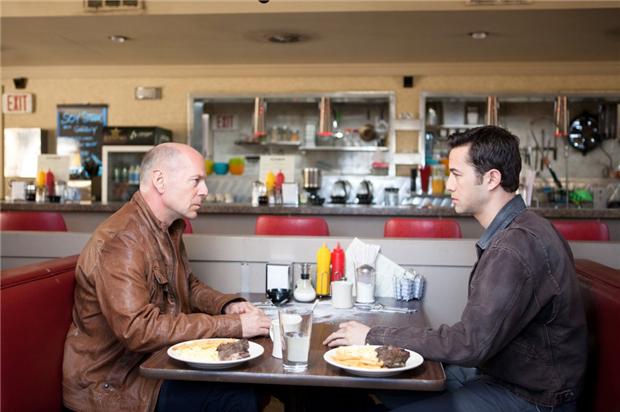
Looper It’s 2044 and, thanks to a lengthy bout of exposition by our protagonist, Joe (Joseph Gordon-Levitt), here’s what we know: time travel, an invention 30 years away, will be used by criminals to transport their soon-to-be homicide victims backward, where a class of gunmen called loopers, Joe among them, are employed to “do the necessaries.” More deftly revealed in Brick (2005) writer-director Rian Johnson’s new film is the joylessness of the world in which Joe amorally makes his way, where gangsters from the future control the present (under the supervision of Jeff Daniels), their hit men live large but badly (Joe is addicted to some eyeball-administered narcotic), and the remainder of the urban populace suffers below-subsistence-level poverty. The latest downside for guys like Joe is that a new crime boss has begun sending back a steady stream of aging loopers for termination, or “closing the loop”; soon enough, Joe is staring down a gun barrel at himself plus 30 years.

Being played by Bruce Willis, old Joe is not one to peaceably abide by a death warrant, and young Joe must set off in search of himself so that — with the help of a woman named Sara (Emily Blunt) and her creepy-cute son Cid (Pierce Gagnon) — he can blow his own (future) head off. Having seen the evocatively horrific fate of another escaped looper, we can’t totally blame him. Parsing the daft mechanics of time travel as envisioned here is rough going, but the film’s brisk pacing and talented cast distract, and as one Joe tersely explains to another, if they start talking about it, “we’re gonna be here all day making diagrams with straws” — in other words, some loops just weren’t meant to be closed. (1:58) (Lynn Rapoport)

http://www.youtube.com/watch?v=siEHekc-1oE

Pitch Perfect As an all-female college a cappella group known as the Barden Bellas launches into Ace of Base’s “The Sign” during the prologue of Pitch Perfect, you can hear the Glee-meets-Bring It On elevator pitch. Which is fine, since Bring It On-meets-anything is clearly worth a shot. In this attempt, Anna Kendrick stars as withdrawn and disaffected college freshman Beca, who dreams of producing music in L.A. but is begrudgingly getting a free ride at Barden University via her comp lit professor father. Clearly his goal is not making sure she receives a liberal arts education, as Barden’s academic jungle extends to the edges of the campus’s competitive a cappella scene, and the closest thing to an intellectual challenge occurs during a “riff-off” between a cappella gangs at the bottom of a mysteriously drained swimming pool. When Beca reluctantly joins the Bellas, she finds herself caring enough about the group’s fate to push for an Ace of Base moratorium and radical steps like performing mashups. Much as 2000’s Bring It On coined terms like “cheerocracy” and “having cheer-sex,” Pitch Perfect gives us the infinitely applicable prefix “a ca-” and descriptives like “getting Treble-boned,” a reference to forbidden sexual relations with the Bellas’ cocky rivals, the Treblemakers. The gags get funnier, dirtier, and weirder, arguably reaching their climax in projectile-vomit snow angels, with Elizabeth Banks and John Michael Higgins as grin-panning competition commentators offering a string of loopily inappropriate observations. (1:52) (Lynn Rapoport)

http://www.youtube.com/watch?v=XSDZNHYLDOY

Solomon Kane Conceived by Conan the Barbarian creator Robert E. Howard, this 16th-century hero is cut from the same sword-and-sorcery cloth, being a brawny brute of slippery but generally sorta-kinda upright morals. Solomon (James Purefoy) is slaughtering his way to a North African treasure trove when demons swallow up his likewise greedy, conscience-free cohorts and damn his soul for a lifetime of bad deeds. Suddenly committed to the greater good, he returns homeward to cold gray England, where Jason Flemyng’s evil sorcerer soon imperils both our protagonist and the Puritan family (complete with love interest) he’s befriended. This movie has been around a while — since 2009, to be exact, yet barely beating director Michael J. Bassett’s new Silent Hill: Revelation 3D to U.S. theaters — and is a good illustration of what can happen when you make a fairly expensive ($45 million) fantasy-action adventure without major stars nor any marketable novelty. Which is to say: not much. There is absolutely nothing wrong with the good-looking, watchable but generic-feeling Solomon Kane, save that nothing about it feels remotely original or inspired. It’s the perfectly okay, like-a-thousand-others mall flick you’ll forget you saw by Thanksgiving, despite being peopled with such normally interesting actors as Max Von Sydow, Alice Krige, and the late Pete Postlethwaite. (1:54) (Dennis Harvey)

http://www.youtube.com/watch?v=4mZIwD4K544

“Stars In Shorts” Outside of the festival circuit, it’s an uncommon feat for shorts to make it to the big screen, so it can’t hurt to make name recognition a prerequisite for selection. In writer-director Rupert Friend’s Steve, Keira Knightley plays an embattled Londoner under siege by her lonely, pathologically odd neighbor (Colin Firth). Written by Neil LaBute, Jacob Chase’s After School Special sets up a semi-flirtation between two strangers (Sarah Paulson and Wes Bentley) at a playground, only to deliver the kind of gut-level punch you might expect from the writer-director of 1998’s Your Friends and Neighbors. LaBute’s own Sexting is an entertaining exercise in stream-of-consciousness monologuing by Julia Stiles. As with most shorts programs, “Stars” is a mixed bag. Robert Festinger’s The Procession, in which Lily Tomlin and Modern Family’s Jesse Tyler Ferguson play reluctant participants in a funeral procession, sounds promising, but the conversation palls during the 10-plus minutes we’re stuck in the car with them. Benjamin Grayson’s sci-fi thriller Prodigal, starring Kenneth Branagh, reaches its predictable crisis points several minutes after the viewer has arrived. More successful are Jay Kamen’s musical comedy Not Your Time, starring Seinfeld’s Jason Alexander as an old Hollywood hand whose writing career has stalled out, and Chris Foggin’s Friend Request Pending, which treats viewers to the sight of Dame Judi Dench gamely wading into the social network in search of a date. (1:53) (Lynn Rapoport)

Won’t Back Down If talk of introducing charter schools into the public education mix tends to give you collective-bargaining-related hives, Daniel Barnz’s Won’t Back Down is unlikely to appeal, unless perhaps as the object of a boycott or a picket line. Two embattled mothers, Jamie Fitzpatrick (Maggie Gyllenhaal) and Nona Alberts (Viola Davis), both with children at a failing Pittsburgh elementary school and the latter a teacher there, join forces to change the institutional culture by leading a parent-teacher takeover, with the goal of creating a charter school. As the bureaucratic process for doing so is described by a school district employee, it should take them three to five years to discover that they’ve been hurling themselves at a brick wall; Jamie, an efficient combination of fireball and pit bull, is determined to pulverize the wall in about two months.

Watching her and Nona try to secure more than a third-rate, treading-water education for their kids, it’s hard not to root for the possibility of a transformation, and even an upper-level teachers’ union staffer played by Holly Hunter finds herself climbing the fence. The details of what lies on the other side (and inside Jamie and Nona’s 400-page proposal) stay fairly fuzzy, though. And while Barnz lets his warring factions — desperate mothers and educators, a union boss (Ned Eisenberg) watching the deterioration of the labor movement, a pro-union teacher (Oscar Isaac) ambivalently engaged in the chartering project — impassionedly debate their way through the film, a little more wonkiness might have clarified the arguments of those done waiting for Superman. (2:00) (Lynn Rapoport)


Tonight, a film that will change how you see mental illness

0

What does it mean to be mentally ill? Mentally well? If a person feels debilitating rage and sadness faced with the realities of the world around them, does the problem lie with the person or with society? What exactly needs fixing?

These are some of the questions raised by Crooked Beauty, a 30-minute film that originated in San Francisco and has been translated and distributed internationally.

Filmmaker Ken Paul Rosenthal will screen Crooked Beauty tonight, along with other footage from his ongoing work exploring alternative ways of seeing mental health.The screening is part of the 10-year anniversary celebration of the Icarus Project, a network of support groups, discussion forums, writers and artists, challening the definition of mental health. In their own words, the Icarus Project “envisions a new culture and language that resonates with our actual experiences of ‘mental illness’ rather than trying to fit our lives into a conventional framework.”

It was some of that new language, lines in a book Rosenthal found lying around his Mission Distrtict apartment one day, that first inspired Crooked Beauty.

“The world seemed to hit me so much harder and fill me so much fuller than anyone else I knew,” the lines read. “Slanted sunlight could make me dizzy with its beauty and witnessing unkindness filled me with physical pain.”

The book was Navigating the Space Between Brilliance and Madness: A Reader and Roadmap of Bipolar Worlds, and the writer of the words was Jacks McNamara, one of the Icarus Project’s founders.

The lines made sense to him. “They spoke so much to my experience of the world,” Rosenthal told me in an interview. “They create such a vivid image for me of relating to the world in a skewed way, as opposed to a very bright, shiny, clear way.”

He found that McNamara lived just across the Bay in Oakland “two days later I was sitting with them, talking and proposing this film.”

Rosenthal did several interviews with McNamara that he used for the film’s narrative. McNamara’s storytelling is unscripted and strikingly poetic.  Images, all shot in San Francisco by Rosenthal, illustrate the story– fog rolling in over hills, birds flocking on power lines and trees shaking in the wind as if trying to escape.

The film, Rosenthal said, is “About using [McNamara’s] crucial and critical narrative as a touchstone for the much broader issue of madness, which is not just a biochemical knot from the neck up. That madness is also a reflection of a social condition.”

As McNamara says in the film: “Saying that it is nothing but a biological brain disorder let’s everybody off the hook. Then you don’t have to look at oppression, and you don’t have to look at poverty and injustice and abuse and trauma, and makes it this situation where it’s just the individual versus his of her inevitable biological madness”

Through getting involved in the Icarus Project, Rosenpaul said, “I’ve been radicalized. But that’s not to say that I’m out on the street burning my bra. Or, you know, burning my prescription bottles.”

Instead, he makes films that explore the complexities of mental health beyond the persciption bottle, what he calls “that idea that wellness exists in a pill.”

Rosenthal’s current project, Mad Dance: A Mental Health Film Trilogy, will use archival footage from educational mental health films, which distance the viewer from the patients that need to be “fixed.”

Tonight, Rosenthal will present some of that footage along with Crooked Beauty.

“Mad Dance film screening and Icarus Project benefit”

Thu/27, 8-10pm, $5-10 suggested donation

Artists’ Television Access

992 Valencia, SF

Facebook invite

Fly, on the wall

1

arts@sfbg.com

DANCE Suspended by a single rope, Jennifer Chien’s bare feet gently push against the white wall of Zaccho Dance Theatre’s studio. The move propels her into space; perhaps she is swimming, perhaps flying, or just floating on Carla Kihlstedt and Matthias Bossi’s finely detailed score.

Chien is rehearsing the finale for Niagara Falling, Flyaway Productions artistic director Jo Kreiter’s latest site-specific outdoor work. It will be performed against the west wall of the Renoir Hotel on Market Street. The dance in the air feels quiet and ever so poetic, particularly for a work that originated in Kreiter’s sense of having been “stung and caught by that whole American economics story.”

Niagara is another of Kreiter’s socially conscious choreographies, in which she examines vital issues through art making. She has called herself a “citizen artist,” a person she describes as someone whose work is “essentially concerned about how we live in the world.” (Poet Adrienne Rich and musician-activist Pete Seeger have been guiding lights.)

“Actually,” Kreiter adds, “any artist does that — except that some of us are more able or willing to talk about the issues.” She has called Niagara Falling “an artistic response to the economic degradation of our current recession.”

As a citizen artist, Kreiter’s choreographies are most frequently performed in public places, free of charge. They are accessible to casual passersby, neighborhood folks, and dancegoers. This is art at the heart of the democratic ideal.

Her works also subtly alter the urban landscape and the way we perceive it. After Singing Praises: Centennial Dances for the Women’s Building, the owners of the Women’s Building confessed that before the piece, they had not even known their Mission District neighbors. Mission Wall Dances honored the old Garland Hotel, an SRO that housed disadvantaged people until it burned and was rebuilt as lodging for tourists. (Painter Josef Norris was inspired to add some of Kreiter’s dancers to the building’s existing mural.) With one of her earliest works, Sparrow’s End, Kreiter created an “urban fantasy” for one of the most drug-infested alleys in the Mission. I still remember its beauty and also the odor that pervaded that sad location.

Niagara happened because Kreiter had admired David and Hi-Jin Hodge’s video setting for Brenda Way’s 2009 In the Memory of the Forest. Talking with the artists, Kreiter realized that the three of them had much in common — particularly when she learned that the Hodges had documented the poverty and decay of David’s hometown, Niagara Falls, NY, by talking with its citizens. Some of what he said sounded all too familiar with what is happening to many people in San Francisco.

Both cities are also surrounded by beautiful but sometimes terrifying bodies of water. The imagery is as ancient as Noah’s bobbing ark and as recent as the videos of Japan’s 2011 tsunami. So it seems appropriate that the first two pieces of equipment Kreiter ordered were a lifeboat and life jackets. The boat is a commissioned steel structure; the vests came off the rack.

Hanging from the wall at the Zaccho studio for the last rehearsal there — the equipment would be moved downtown later that day — three dancers are buffeted by the video’s raging waters and a howling storm on the soundtrack. The women look ever so vulnerable as they try to catch and don the slippery life jackets. Yet gradually in all that chaos they find a common rhythm and can link arms in relative safety.

While Niagara is a piece that gives voice to the reality of the urban poor, it’s also a beacon of hope. The work happened because, Kreiter acknowledges, people — like the Renoir Hotel’s owners and Urban Solutions, the SOMA-based economic development nonprofit — have been supportive of the project. Pointing out that she started working on the piece before the advent of Occupy Wall Street, she observes that “everything is collapsing, and yet in some places there are people who try to pull things forward.” *

“NIAGARA FALLING”

Wed/26-Sat/29, 8:30 and 9:30pm, free

West wall of the Renoir Hotel

Seventh St at Market, SF

www.flyawayproductions.com

The rich, the poor and the state of SF

68

The latest Forbes 400 is out, the list of the richest Americans, and a record number (according to my annual record-keeping) now live in San Francisco. This is a city with 18 people on the top-billionaires list — and since the list cuts off at $1.1 billion, there are a lot of really, really rich San Franciscans who didn’t quite make it this year. School Board candidate Sam Rodriguez told us his research shows that there are 80,000 millionaires in the city, meaning one in ten San Franciscans is worth a cool mil, and while some of that is just homeowners who bought 20 years ago and now have property worth $1 million — and I haven’t verified his data anyway — it’s hard to argue that this is anything but a very wealthy city.

(It also has, according to Forbes, the second-hippest neighborhood in the nation, and that would be the Mission, which is reaching that fully-gentrified stage where nobody young can afford to live there anymore so it won’t be hip much longer.)

The list comes out at the same time that figures show nearly 7 million Californians are living in poverty, and household income for most people has been stagnant — at best — for more than a decade.

It was a great year for the top 400, though — their median income was up rather dramatically. It seems that, whatever Mitt Romney may say in public or in private, the Obama administration hasn’t been bad at all for the 1 percent.

I keep asking, and I know it’s tiresome, but: Why, in a city with 18 billionaires, do we still have to clear out homeless encampments?

Why are the public schools holding (literally) bake sales to buy paper and pencils? Why have we cut the number of acute psychiatric care beds at SF General from 40 to 10? If San Francisco can’t even talk about taxing the billionaires, is there any hope for the rest of the country?

FYI, here’s The SF 18 (complied by Anna Sterling):

    1
    Riley Bechtel
    $2.9 B
    Chairman and CEO, Bechtel Corp.
    2
    Stephen Bechtel, Jr.
    $2.9 B
    Former Chairman, Bechtel Corp.
    3
    Doris Fisher
    $2.9 B
    Cofounder, Gap
    4
    Dustin Moskovitz
    $2.7 B
    CEO, Asana
    5
    Ray Dolby
    $2.4 B
    Founder and director emeritus, Dolby Laboratories
    6
    John Fisher
    $2.3 B
    President, Pisces, Inc.
    7
    William Randolph Hearst, III
    $2.3 B
    Source of Wealth: Hearst Corp
    8
    Marc Benioff
    $2.2 B
    Chairman and CEO, Salesforce.com
    9
    James Coulter
    $2.1 B
    Source of Wealth: Leveraged buyouts, Self-made
    10
    Gordon Getty
    $2 B
    President and Chairman, Ann & Gordon Getty Foundation
    11
    Phoebe Hearst Cooke
    $1.9 B
    Source of Wealth: Hearst Corp
    12
    Michael Moritz
    $1.9 B
    Partner, Sequoia Capital
    13
    John Pritzker
    $1.8 B
    Source of Wealth: Hotels, investments
    14
    Robert Fisher
    $1.7 B
    Director, Gap
    15
    William Fisher
    $1.7 B
    Director, Gap
    16
    Peter Thiel
    $1.4 B
    Partner, Founders Fund
    17
    Thomas Steyer
    $1.3 B
    Founder & Co-Senior Managing Partner, Farallon Capital Management
    18
    Jack Dorsey
    $1.1 B
    CEO, Square, Inc.


How Jerry Brown got us here

46

Jerry Roberts, who has long been among the best political reporters in California, has a nice, detailed piece on CalBuzz about Jerry Brown’s history and legacy — and how California got into the mess that the Guv is trying to get us out of. (It’s a nice complement to this Chron interview, in which Ol’ Jer takes us back to his seminary days and tells us how much he loves austerity: “I took vows of poverty, chastity and obedience. I am ready, OK?”

Jesus, Guv — we all know you’re cheap, but “obedience” really isn’t part of your personality. And chastity? For real?

But let’s get back to austerity. Brown is clearly hanging his governorship on Prop. 30, his tax measure, and is happily warning us all that things will really, really suck if it doesn’t pass. Roberts does a good job explaining how Prop. 13 — which a much-younger Jerry opposed before he supported it — laid the groundwork for the state’s endless budget mess be capping local property taxes and giving the state Legislature control over how much money flows to cities and counties.

The one missing element: Arnold Schwarzenegger.

The state budget was never simple, and California schools in particular never recovered from Prop. 13, but Schwarzenegger instantly made things much worse the day he took office in 2003 when he terminated much of the Vehicle License Fee, costing state and local government about $4 billion a year. Schwarzenegger derided the fee as a “car tax,” but it’s actually a fee that keeps counties from assessing cars as personal property. Either way, that’s a huge chunk of money, and while it was popular, it played into the idea that we can have something for nothing — similar to the Bush tax cuts.

So I guess all we can do is quote Jerry:

There is a lot of magical thinking in Washington and in Sacramento and, maybe, I might even say, Western civilization,” he said. “We had it easy and now the moment of truth is upon us. … We’ve got to pay for what we want. And if we don’t want to pay, then we have to deprive ourselves of that which we would like, and it’s very hard to get people to make that choice.”

Diamond Dave’s report from Romneyville

27

Activists from San Francisco and around the country are descending on Tampa this week to protest the Republican National Convention. I got a call this morning from Diamond Dave Whitaker, the poet who hung with the beats and the hippies in his 75 years, CCSF student senator and San Francisco legend. He’s has been serving food to protesters at election-season conventions for almost three decades. His first was 1984, the Democratic Convention here in San Francisco before he got hooked and headed to Dallas to protest the Republicans. Along with a few hundred others, Diamond Dave braved the rain, but missed the full effects of Hurricane Isaac on the tent city last night. The RNC starts officially starts today (though many of the day’s events have been called off due tot the hurricane warning.)

“I’m talking in the midst of Romneyville,” he said. “Folks came from far and wide to camp out together, cause a ruckus and be here.”

What’s Romneyville? “It’s a homeless camp, a poor peoples camp,” said Dave. He’s been there a week setting up the Food Not Bombs kitchen, and Romneyville grew up around him. It now has few hundred tents, he said. But most people arrived today, so as the convention gets started, it will probably grow. “Two buses from Zuccotti Square came today,” he said.

Romneyville is put together in part by the Poor Peoples Economic Human Rights Campaign. Dave said Green Party vice presidential nominee Cheri Honkala, a formerly homeless mother herself who works with the Poor Peoples campaign, is a fixture around the camp.

“Our demands are housing for all, food for all, healthcare for all, and living wages for all. We call for an end to foreclosures and homelessness, an end to the war on the poor, both here and abroad. An end to criminalization of poverty. Money for jobs and housing, not for war!” says a statement from the group.

More protesters are staying over at the Occupy Tampa encampment.

A permitted march left this morning, and Diamond Dave says there’s another, unpermitted, planned for 3pm est. Many citizen journalists and livestreamers are documenting the events, one can be found at mobilebroadcastnews.com.

But so far, his work has been handing out free meals with Food Not Bombs.

“We fed the masses this morning for sure,” he said.

Good propaganda ain’t cheap. Sorry, no rebates for errors.

27

UPDATED AND CORRECTED BELOW It wasn’t surprising to read Randy Shaw’s misleading praise of Mayor Ed Lee for appointing Rodrigo Santos to the City College board. Much of Shaw’s salary comes from the city contracts that his Tenderloin Housing Clinic administers, so he has turned his Beyond Chron mouthpiece into the equivalent of Pravda in touting the party line of Lee and his supervisorial apparatchiks.

For that blind loyalty, Shaw has been handsomely rewarded. On July 31, the Board of Supervisors even approved a Lee-proposed balloon payout of $91 million to THC for its contract administering the Mayfair Hotel that was retroactive all the way back to 2009. Can anyone imagine another nonprofit that could dig so deeply into city coffers, for work that has supposedly already been done, who wasn’t giving a little something back to these ambitious politicians who sponsored it?

But apparently Shaw – who used to have some progressive credibility before so blatantly selling the movement out a couple years ago – doesn’t need to even get the facts right in his propaganda posts. When I asked him at yesterday’s Lee/Santos press conference whether and why he supported Santos – a villain in most progressive circles – he argued Santos was needed to help win support for Prop. A, the parcel tax for City College.

Shaw said the measure needed a two-thirds vote to be approved, a claim he also made in today’s piece. That didn’t sound right to me, and the Elections Department confirms that it isn’t: Prop. A needs only a simple majority to pass. [[8/23 UPDATE AND CORRECTION: Ernestine at the Department of Elections told me yesterday Prop. A needed only a simple majority, but she called back today to say she was mistaken and that it does indeed require a two-thirds vote.]] Shaw also claimed a couple weeks ago that the Board of Supervisors would delay the Mirkarimi decision until after the election, which also wasn’t true: the Charter requires the board to act within 30 days of receiving the Ethics Commission recommendations.

I sent Shaw a message asking about whether his erroneous beliefs affected his analysis, and to explain the basis for THC’s $91 million kickback, and he hasn’t responded to the questions, as usual. But when you’re a poverty pimp feeding off of political patronage, you’re probably golden as long as you get the politician praise right. Cha-ching!


Dick Meister: The billionaire’s bill of rights

8

By Dick Meister

Dick Meister, former labor editor of the SF Chronicle and KQED-TV Newsroom, has covered labor and politics for more than a half-century. Contact him through his website, www.dickmeister, which includes more than 350 of his columns.

Billionaire corporate interests and other well financed anti-labor forces are waging a major drive to stifle the political voice of workers and their unions in California that is certain to spread nationwide if not stopped – and stopped now.

At issue is a highly deceptive measure, Proposition 32, on the November election ballot, that its anti-labor sponsors label as an even-handed attempt to limit campaign spending. But actually, it would limit – and severely – only the spending of unions while leaving corporations and other moneyed special interests free to spend as much as they like.

Unions would be prohibited from making political contributions with money collected from voluntary paycheck deductions authorized by their members, which is the main source of union political funds.

 But there would be no limits on corporations, whose political funds come from their profits, their customers or suppliers and the contributions of corporate executives. Nor would there be any limit on the political spending of the executives or any other wealthy individuals. What’s more, corporate special interests and billionaires could still give unlimited millions to secretive “Super PACs” that can raise unlimited amounts of money anonymously to finance their political campaigns.

The proposition would have a “devastating impact” on unions, notes Professor John Logan, director of labor and employment studies at San Francisco State University, writing in  the Hill’s Congress blog.  As he says, it would likely all but eliminate political spending by unions while greatly increasing political spending by business interests and wealthy individuals.

 Anti-labor interests are already outspending unions nationwide by a ratio of more than $15 for every $1 spent by unions. Between 2000 and 2011, that amounted to  $700 million spent by anti-labor forces, while unions spent just a little more than $284 million.

 Proposition 32 would even restrict unions in their communications with their own members on political issues. That’s because money raised by payroll deductions pays for the preparation and mailing of communications to union members, including political materials.

Unfortunately, there’s even more – much more –to Proposition 32. It also would prohibit unions from making contributions to political parties and defines public employee unions as “government contractors” that would be forbidden from attempting to influence any government agency with whom they have a contract.

That restriction applies not only to unions. It also would cover political action committees established by any membership organization,  “any agency or employee representation committee or plan,” such as those seeking stronger civil rights or environmental protections.

Proposition 32 seeks to weaken, that is, any membership group which might seek reforms opposed by wealthy individuals or corporations and their Republican allies.  It’s no wonder the measure is actively opposed, not only by organized labor, but also by the country’s leading good-government groups, including Common Cause and the League of Women Voters.

Yet the proposition’s sponsors have the incredible gall to bill their measure as genuine campaign finance reform. They obviously hope that claim, which Common Cause accurately describes as a “laughable deception,” will win over the many voters who have been demanding reforms and who, in their eagerness, will fail to recognize the measure’s true nature.

“This is not genuine campaign finance reform,” as San Francisco State’s John Logan says, “but a bill of rights for billionaires.”

The losers would include teachers, nurses, police, firefighters and other union members and those who benefit from the essential services they provide – students, the elderly, and the ailing, the poverty stricken, those who work and live in unsafe conditions and other needy citizens, and consumers, environmentalists and others who also are neglected by the profit-chasing corporate interests that dominate political and economic life.

Make no mistake: Lots of money is being funneled into the Proposition 32 campaign by some of the same wealthy backers who bankrolled such anti-labor efforts as the campaign that blocked the massive attempt to recall virulently anti-labor GOP Gov. Scott Walker of Wisconsin this year.

Should the anti-union forces also prevail, it will undoubtedly lead to what Logan says “will promote a tsunami of ballot initiatives in 2013 at the local level and in 2014 at the state level designed to drive down working conditions in both the public and private sectors.”

Logan adds, “Lacking the ability to oppose these reactionary measures under the new election rules, California’s workers could soon face the weakest labor standards in the country”. But if the measure is rejected, it “may slow the momentum behind other attempts to increase the corrosive impact of money in politics.”

It’s true that some states already have laws and regulations seriously limiting labor’s influence. But it’s certain that victory by the anti-labor forces in California will slow any attempts at reform in other states and lead as well to attempts to impose anti-union measures elsewhere, as well as expanding those that already exist.

The stakes are huge. If the 1 percent have their way in California, the country’s largest state, other states are certain to follow.

For more from John Logan, check his piece in the East Bay Express, “If you liked Citizen United, you’ll love Prop 32.” http://www.eastbayexpress.com/ebx/if-you-liked-citizens-united-youll-love-prop-32/Content?oid=330613

Dick Meister, former labor editor of the SF Chronicle and KQED-TV Newsroom, has covered labor and politics for more than a half-century. Contact him through his website, www.dickmeister, which includes more than 350 of his columns.

Hate (and free) speech

20

How far can you push free speech? Is it okay for Muni to run ads that are utterly, inexcusably offensive to Arabs and Muslims in the name of political expression?

I’m pretty much always on the side of the First Amendment. And we were furious when a Bay Guardian ad campaign accusing then-mayor WIllie Brown of political corruption suddenly vanished from the sides of the local buses. It’s hard to seek government limitations on any political statement. But if the ads that appeared Aug. 7 on Muni aren’t over the line, they’re pretty close to it.

Here you have an organization described not only by the Southern Poverty Law Center but by the Anti-Defamation League as a hate group buying space on San Francisco buses for ads that effectively disparage a vast religious, ethnic and cultural community as “savages.” The campaign is obviously designed to get publicity; not that many San Franciscans are going to be convinced to join the American Freedom Defense Initiative. Nobody’s opinion on the Middle East will be swayed by this shit.

But this tiny cadre of loonies, led by Pamela Geller, who is really fucking scary, wants attention. In New York, the anti-Muslim group sued when the city tried to take down the same bus ads, and you know they’d love it if that happened here. Muni says it can’t legally pull the ads, which is probably true — although BART has a more restrictive policy.

It’s not just idle rhetoric — this stuff frightens people. “We’re hearing from people that they’re uncomfortable riding Muni,” Zahra Biloo, executive director of the Bay Area office of the Council on American-Islamic Relations, told me.

Obviously, you can’t run ads that enourage someone to engage in violence. Is dehumanizing people and calling them “savages” the same thing? Biloo thinks it’s pretty close: “It’s important for progressive cities to say, ‘not in our city,'” she said.

A change.org petition condemning the ads has more than 2,000 signatures.

On the other hand, I don’t want to give Geller the pleasure of suing San Francisco and making this into a Free Speech cause. Because that’s exactly what she wants, and probably the reason she bought the ads in the first place. So how about this: The supervisors pass a resolution denouncing the ad and the message, and Muni agrees to give CAIR the same number of ads, free, in the same locations (gee, maybe even on the other side of the same buses) to present an alternative message.

At least it’s a start.


Healthy transitions

1

yael@sfbg.com

When the Human Rights Campaign, the national LGBT rights group, released its latest scorecard, rating companies by their support for LGBT issues, the healthcare giant Kaiser scored 100 percent. In June, the company’s float in the San Francisco Pride Parade was packed with happy employees.

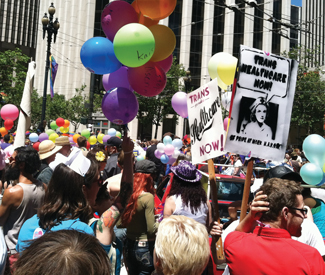
But as the float passed through the streets, it was met by a group of protesters. Pride at Work complained, loudly, that Kaiser — for all its efforts to work with the community — excludes transgender care from its standard policies.

“We said, let’s push Kaiser,” said Sasha Wright, an organizer with Pride at Work. “They say they’re good for the community. Let’s show them that the queer community demands this.”

It was a perfect sign of the city’s struggle with trans health care. In many ways, San Francisco is exemplary — this is a long ways from Chattanooga, Texas, where state legislator Richard Floyd tried to pass a law instituting steep fines for people who can’t prove their genders match the designated genders of public bathrooms.

And with Healthy San Francisco officials’ recent decision to cover transgender and care, it’s likely this city is leading the nation in trans health.

But that’s a limited distinction — because trans people everywhere, even here, still face sometimes daunting obstacles in getting access even to basic care. And the struggle to change that is becoming a high-profile (and increasingly successful) political fight.

TRANSITIONS AND COSMETIC SURGERY

Kaiser’s insurance plans are typical of the industry. In its 2012-2013 “Traditional Plan,” Kaiser lists “transgender surgeries” among the services excluded from coverage, along with massage therapy and cosmetic surgery.

And Kaiser’s not alone.

Medicare, the federal health plan for low-income people, specifically excludes transgender health care. MediCal, the state version, is required to cover trans care — but will often deny individual applications. And many of the doctors and surgeons who accept MediCal (and many don’t) are unfamiliar with transition-related care.

Then there’s plain old discrimination. A troubling number of people report being denied healthcare — not just healthcare related to their gender identity — because the doctor they saw didn’t want to treat a transgender person.

The State of Transgender California, a 2008 survey by the Transgender Law Center, found that 30 percent of transgender people in California reported that they have “postponed care for illness or preventative care due to disrespect and discrimination from doctors or other healthcare providers. Over 40 percent did so because of economic barriers.”

The study also found that 35 percent of respondents “recount having to teach their doctor or care provider about transgender people in order to get appropriate care.”

To make things worse, American health insurance is overwhelmingly employer-based — and unemployment among trans people is epidemic. A 2011 study from the National Center for Transgender Equality found that trans unemployment was double the national rate and that 47 percent of trans people surveyed had been fired or overlooked for a job.

The World Professional Association for Transgender Health (WPATH) sets the international standard for transgender health care. WPATH states that, for many transgender people, “sex reassignment surgery is effective and medically necessary.” Hormone therapy, voice and communication therapy, as well as non-discriminatory primary and preventative care are also necessary.

But with high rates of poverty and discrimination among transgender people, affording these medically necessary procedures can be nearly impossible. Even in San Francisco, where some politicians and powerful organizations advocate tirelessly for transgender rights, many people are forced to go outside the system altogether to take care of themselves.

“We see transgender folks either not being able to make a transition, or having to spend a lot of money,” said Wright. “I don’t know if you’ve ever been to a top surgery party, but they’re common in San Francisco.”

Mia Tu Mutch, a member of San Francisco’s Youth City Services Committee who advocates for LGBTQ rights inside and outside City Hall, recently started a group that supports and raises funds for people who are transitioning.

“Me and my partner have been shocked at trans incompetency in San Francisco,” said Tu Mutch. “We’ve had several really bad instances of doctors refusing to treat us when they found out that we were trans. There’s still education needed.”

Tu Mutch said that, even though she is covered by a high-quality, trans-inclusive insurance plan, she has spent at least $10,000 out of pocket on transition related expenses.

“People are usually told, ‘get a good job, save all your money,'” she said. “But I’ve been spending 80 percent of my money on transgender related care for the past couple of years. I don’t think the whole ‘pull yourself up by your bootstraps’ thing works.”

HOPE ON THE HORIZON

But the situation is starting to change. In fact, trans organizers say that the medical, insurance and political establishments — particularly in California — are beginning to realize how backward the system is and are open to dramatic changes.

“It is an exciting time,” said Dr. Dawn Harbatkin, executive director or San Francisco’s Lyon Martin Health Center, which offers free and low-cost service to trans people “I didn’t think I would see this during my career.”

Nikki “Tita Aida” Calma, program supervisor at Trans: Thrive, echoed that sentiment. Said Calma, “I’m glad to see this in my lifetime.”

Thanks to groups like Pride at Work and the Transgender Law Center (TLC), city workers in San Francisco and Berkeley are now covered by the trans-inclusive version of Kaiser’s plan. The TLC, along with Lyon Martin and Equality California, came together to form Project Health in 2010, which convinced Healthy San Francisco to drop its transgender exclusions.

Tu Mutch has also worked this year to start FEATHER, or Fundraising Everywhere for All Transitions: a Health Empowerment Revolution.

Meanwhile, lawmakers in Sacramento, and even nationally, are also chipping away at the transgender discrimination that plagues the healthcare system.

Harbatkin told us that there isn’t a specific set of services that make up transgender health care.

“Really good transgender medicine means that you are providing good primary care, that you’re treating a patient as a whole person and taking care of all of their health care needs,” she said.

Lyon Martin provides preventative care like pap smears, breast exams, and prostate exams, treatment for chronic issues like hypertension and diabetes, as well as transition-related care—services that assist transgender people in transitioning to a body that reflects their gender identity.

“The bigger part of providing good medicine is about being culturally competent, culturally sensitive,” Harbatkin said. “Knowing how to address people respectfully and with their appropriate name and pronoun. Knowing about their legal name versus preferred name, or gender markers in terms of billing issues.”

One obstacle transgender patients face is doctors who are unfamiliar with transition-related healthcare, such as hormone therapy and surgeries. But often, trans people are denied care that doctors know well and would perform on cisgender patients, simply because of their gender identity.

Then there’s the challenge low-income people face in finding doctors who accept MediCal.

Harbatkin cited the example of an orchiectomy — surgical removal of the testicles, a procedure done by urologists. Finding a urologist who takes MediCal is fairly routine.

“But finding a surgeon who would do a vaginoplasty who accepts MediCal, that is more challenging,” she said.

And some urologists might perform an orchiectomy for someone with testicular cancer — but refuse to do so for someone who is transitioning from male to female.

That type of discrimination has caught the attention of Assemblymember Tom Ammiano, and his office has been working for several years to change it.

Ammiano aide Wendy Hill has been focusing on eliminating transgender health barriers in California for years. Thanks in part to her efforts, the California Department of Insurance now interprets existing gender equity legislation to include transgender people.

“They’ve clarified a set of recommendations and essentially code sections that spell out that for the purpose of transgender, this law requires gender equity,” Hill said. “If you cover pap smears, you have to cover them for everybody. If you cover breast reconstruction or hysterectomy, you have to cover it for everybody, regardless of gender.”

Now Ammiano’s office is taking on the Department of Managed Health Care and has been documenting cases of discrimination.

“When a citizen calls the Department of Managed Health Care, their helpline, they tag the call so that they know what’s going on,” Hill explains.

“They just tagged the calls based on discrimination. But we got them to tag the calls based on gender discrimination, and then even more specifically, discrimination against transgender people.”

The sort of problem she sees: “A person goes in to be treated for what could potentially be pneumonia, but the physician is having trouble seeing this person because their papers say they’re male but they are trying to see a gynecologist.”

Hill said some of her most interesting moments have been outreach meetings with community members and local businesses.

“I’ve gone in to talk with folks and said, how many of you know someone who’s transgender?” Hill recalls. “And in Sacramento, not that many people raise their hands. And then I say, how many of you identity as transgender? And the transgender people raise their hands. A lot of people don’t know that they already knew transgender people.”

Ammiano, who created Healthy San Francisco, said he was thrilled about the program dropping its transgender exclusions. “This has been in the works for a while,” he said. “We always fully intended to make sure that everyone who needed it was covered.”

Nationally, he said, “I think it’s an uphill battle around eradicating the transphobia and getting services provided without any hassle, but there’s light at the end of the tunnel.”

SUPPORTIVE NETWORK

San Francisco offers plenty of support. Lyon Martin is part of a network of organizations providing health-related services to transgender people.

Trans: Thrive, a project of API, serves as a drop-in center for transgender people, including many who show up there as one of their first stops after coming to San Francisco to escape discrimination and danger in their hometowns. Trans: Thrive provides counseling, computer labs, food, activities, and an all-important clothing closet to cut the extensive costs of a whole new wardrobe that better reflects a person’s gender identity.

Lyon Martin is “a federally qualified health center, so we take MediCal, MediCare, and many commercial insurances and Healthy San Francisco,” said Harbatkin. “And for patients who are uninsured, they are put on a sliding scale based on income and family size. And we continue to see people whether they can afford it or not.”

That means even people with little or no income can access transition-related surgery at Lyon Martin. This can be essential for people who otherwise would rely on MediCal.

The situation will actually be improved with the changes to Healthy San Francisco, as people who access healthcare through the program will have more options for surgeons and specialists.

In the 2008 State of Transgender California report, the TLC made a series of recommendations — and to the surprise of even the TLC staff, many have been adopted.

For example, the Affordable Care Act bars discrimination against people with pre-existing conditions — a term used to deny coverage to trans people. Most medical schools still don’t teach transgender healthcare, but on a local scale, Lyon Martin is working to train healthcare professionals and students to provide quality, culturally appropriate care to transgender patients with a residency program.

But one of the key recommendations — “Enact federal and state legislation prohibiting transgender- and gender-specific exclusions that limit access to comprehensive, quality care in public and private insurance plans” — is still a ways off.

As far as state legislation goes, said Hill, “Assemblymember Ammiano is definitely there. But the Legislature is not there yet. We don’t have enough support for that, to get a bill down to the governor.”

Kristina Wertz, director of Policy and Programs at the TLC, says that significant progress has been made on the recommendations that the 2008 report included.

“We’re really getting there,” said Wertz. “Things have changed. The world of transgender healthcare is very different than it was five. years ago.

“Right now there’s a lot of advocacy to build on the good laws that we already have and make sure they’re effectively implemented.”

Mid-century modern

0

arts@sfbg.com

FILM After World War II, the hitherto miniscule U.S. market for foreign language films slowly opened up, partly due to G.I.s returning home curious about the countries they’d been stationed in. But mostly it was because bold new voices in European cinema were delivering a new realism that could be sold (even when cut by censors) as more “shocking,” “frank,” and “shameless” than anything Hollywood would hazard for years yet.

While Sweden, France, and other nations would soon catch up, the first to make a significant impact was Italy, whose artists chronicled the ruination it had to recover from after Axis defeat. Italian Neorealism, as the movement came to be called, looked like nothing else before it; even rare social-issue documentaries had been heavily doctored and sanitized by comparison. Reacting against the increasingly incongruous glamour of studio films made as war and Mussolini’s government wreaked havoc, the neorealists (largely film critics turned makers, as with the French New Wave a decade later) eschewed soundstages and trained actors for the real world. Lines between fiction and nonfiction were willfully blurred.

Leading neorealist films (which fast influenced American film noir and other genres) made a splash. That happened thanks to (or in spite of) misleading adverts for movies that were far from sexy: 1945’s Rome, Open City (resistance fighters caught, tortured, and killed by Gestapo), 1946’s Shoeshine (poor kids scapegoated by corrupt cops, thrown in prison), 1948’s The Bicycle Thief (desperate father and son lose the vehicle that provides their threadbare subsistence), 1952’s Umberto D. (old pensioner gets sick, evicted, suicidal). All these were directed by Roberto Rossellini or Vittorio De Sica, the first star neorealists.

By 1953 Italian cinema was moving on. It had begun to export bombshells (Silvana Mangano from 1949’s Bitter Rice, then Sophia Loren and Gina Lollobrigida); soon would come the sword and sandal epics and international co-productions that would make Rome a crazy hive of commercial filmmaking. Neorealism was on its way out, but as a brand it still had familiarity and a certain market appeal. Ergo a “second generation” of directors were introduced via Love in the City (1953), a recently restored six-part omnibus feature opening for a week at the San Francisco Film Society Cinema (side note: SFFS’s residency at Japantown’s New People ends August 31; the organization plans to shift its fall programming to various local venues).

It isn’t a great film so much as a great curio, and a crystal ball forecasting where the local industry would be head for the next 20 years or more. Little of that was immediately apparent, but just months later Federico Fellini (the sole director here who’d already made several well-received features) would cause a sensation with La Strada (1954). The others, including Michelangelo Antonioni, would eventually follow with breakthroughs of their own. The two surviving today are still active — in fact Francesco Maselli and Carlo Lizzani just contributed to a new omnibus feature last year.

Introduced as “a journal created out of film rather than pen and ink” — love being the topic of its first (and last) “issue” — Love in the City announces its “Raw! Revealing! Shocking!” intentions with Lizzani’s psuedodocumentary opening “article,” a series of interviews with alleged prostitutes. The next similarly surveys women driven to attempted suicide. While the style is as yet unidentifiable, the subject of profound, despairing alienation amid the crowd could hardly be more apt for young Antonioni.

Things lighten up considerably with a delightful set piece of amorous shenanigans in a divey dancehall, demonstrating the wry observation that would make Dino Risi one of Italian cinema’s greatest comedy directors. Fellini’s equally bemused vignette finds a young reporter investigating a matchmaking agency for a humorous story sobered by the plight of the poor, earnest would-be bride he meets.

These breezy episodes are followed by the most devastating. Maselli’s Story of Caterina, co-written by De Sica’s scenarist Cesare Zavattini, follows its plain, forlorn heroine (Caterina Rigoglioso) from bad to worse — impregnated and abandoned, she can neither return to the Sicilian family that’s disowned her or work legally in Rome to support her toddler son. The extremes to which she’s driven are bleakest tragedy.

Even the most frivolous of these segments capture the realities of urban poverty with unblinking authenticity. As if acknowledging that so much realism might be bad for the digestion, Love in the City ends on its silliest (and sole upwardly mobile) note. Future Mafioso (1962) director Alberto Lattuada’s The Italians Turn Their Heads finds all Roman mankind neck craning to leer at a procession of pretty women in tight modern fashions, each granted their own distinct lounge-music theme by composer Mario Nascimbene — thus silencing the chorus of wolf-whistles that would have been their real-life soundtrack.

LOVE IN THE CITY

Aug. 17-23, 2, 4:15, 6:30, and 8:45pm (no 6:30pm show Mon/20), $10-$11

SF Film Society Cinema

1746 Post, SF

www.sffs.org


Meet the finalists in Oakland’s youth poet laureate competition

4

Bay Area, our young people are wrapping words of wisdom around subjects like survival, poverty, oppression, community, life, and death. It’s time to listen up.

“Just like a picture is worth a thousand words, a word can provoke a thousand memories,” says Tele’Jon Quinn, one of seven 16 to 18-year-old Oakland youth poet laureate finalists. “Memorizing goes hand in hand with reflection. If my words can cause someone to reflect on an important issue or event in their life, then my words were worth sharing.” The East Bay bards are now preparing for the first group performance at the Art and Soul Festival in Oakland on Sat/4.

The Oakland Public Library teams up with Youth Speaks, the local youth spoken word nonprofit, to stage the competition. Like any poet laureate, the chosen versifier will officially represent his or her community via the media and public appearances.

A panel of celebrity judges including California poet laureate Juan Felipe Herrera, and Oakland-based poets Kenju Liu, Arisa White, Juliana Spahr, and Joshua Merchant, will select Oakland’s inaugural poet laureate in September. Every finalist will have their work published in an anthology that comes out in 2013, and the ultimate victor will receive a $5000 scholarship as well as the title of youth poet laureate for Oakland.

Take a moment to read up on seven of the most creative young wordsmiths around, and check out snippets from their creative works.

Oakland youth poet laureates at the Art and Soul Festival, festival entrances at 14th St. and Broadway; 16th St. and San Pablo; Promenade beside City Center West Garage, Oakl. www.oaklandpubliclibrary.orgwww.artandsouloakland.com. Performance at Rotunda Building, 300 Frank Ogawa Plaza. Sat/4 5pm – 7pm, $5-$8 seniors and kids, $10-$15 adults

Stephanie Yun, age 18, Skyline High School

Stephanie Yun has always been a writer. “To me, poetry is pure expression. It’s beautiful, and painful, and liberating, and frightening, all at once,” she tells the Guardian. “It’s being vulnerable, and teaches us to better understand things we never could.” Her poem “‘Til Death”, is infinitely more than your stereotypical love poem. Her lines tackle severe insecurities, body image issues, depression, cutting:

… Before my first and current relationship,

I wondered how potential suitors would react

when their fingertips wandered and read my wrists like Braille

Here lies emotionally unstable girl …

Describing her foray into love, her first boyfriend, her first romance, Yun slips in images of her internal battles, questions of existence, identity. 

… Everything may be fine as I speak this

but I’ve envisioned dream wedding

in the spring 

wearing tulle or lace ball gown

with three-tiered chocolate cake     

fewer times and in less detail

than my suicide … 

Yun says she started writing poetry in second grade, but became actively involved two years ago as a high school sophomore with Youth Speaks. She says writing is a release — she writes out of necessity and tells us doesn’t know if she would be alive today without the ability to lay her words down. “There is just something about letting things out, things we have kept so deep inside of us, or things that threaten to burst from our being,” Yun says. “It’s that transition from containing them within ourselves, to their manifestation into the outside world. We make ourselves vulnerable and are forced to face things head-on, and from there our ideas and feelings exist beyond us, and we can share them with others.”

Tele’jon Quinn, age 17, MetWest High School

Tele’jon Quinn is an activist and spoken word artist. He enjoys performing to large crowds, and uses his creative talents to raise consciousness in his community. His wordplay draws attention to social issues like police brutality, classism, poverty, and community. From his poem “Dialouge”: 

… Because Elites are never open minded unless there is lots for sell 

They have packaged us like we’re bots on shelves 

Robotically boxing each other and concocting diabolical plots 

To exile one another to hell …

Quinn says his poetry is not limited to his own emotions or feelings. He draws some of his material from the social programs he participates with, like Heal the Streets, Bay-Peace, and Youth Speaks. He says that for the past two years, poetry has been his outlet for everything he endures. He seeks to educate, liberate, and inspire members of the Oakland community with his words. In the final lines of “Dialogue” he writes:

So if my poetry could walk she’d walk right here

And tell you a story that gives you hope for the future of her home Oakland

The Navajo people once said you can’t wake a person that pretends to be asleep

So lets stop pretending that we do not see our reality

Open our eyes

And transform the reality we live in …

Robin Levy, age 16, Saint Joseph Notre Dame

Poetry, she says, allows Robin Levy to organize the helter-skelter thoughts that run rampant in her brain. Levy has written poetry in earnest for three years now, and says every time she writes a poem, she records another part of herself. 

“Poetry, for me, is collecting all the scraps of beauty or strangeness or whatever I can find and piecing them together so other people can see just how vivid everything is,” she tells the Guardian. Levy is a big fan of Robert Frost, but her favorite poet is a slam poet who calls herself Jasmine Luve. “The way she writes just seems so unthinkingly perfect, like she just wrote down everything she thought that day and it was already poetry,” Levy says. Her own subject matter evolves from little snippets she hears, reads, or thinks. “Just anything that is accidentally amazing, something that probably didn’t mean to be poetic but is,” she says. “The reason I write what I do is that whenever I read or hear something poetic, I just want to elaborate on it and make it into something more, weave that one thread into a full tapestry.”

In her poem “Before You Were You” Levy’s ability to turn a casual phrase into poetry is apparent. The first lines read:

you told me once

that before you were you

you were a stone.

heavy, immobile,

stranded at the ocean floor

by the cruel grip of gravity.

The poem runs full circle to explore questions of identity and shared existence. It ends with:

you told me once

that before you were you,

you poured from my mind

into the sand

you told me once

that before  you were you,

you were me

Levy asks anyone who reads this to write a poem today.

Kerby Lynch, age 17, Oakland School for the Arts

When asked if she reads poetry, Kerby Lynch responds, “Reading poetry is such an understatement. I live, breathe and eat poetry. Life is poetry. The sun, the moon and the truth is poetry. When one realizes that, life is on a path of divinity.” 

In the middle of this creative flight, she interrupts herself. “Enough of that, I’ll answer the question.” 

It turns out Lynch reads, watches, and listens to a whole gamut of poetry from traditional, to contemporary (particularly Ise Lyfe from Oakland), to spoken word (Def Jam Poetry, season 3), to rappers (Jay-Z, Andre 3000, Kendrick Lamar, Nas, and Lauryn Hill), and her teachers and peers at Oakland School for the Arts. Her favorite song, ever, he adds, is “Mathematics” by Mos Def—largely for the lyrics. 

http://www.youtube.com/watch?v=m5vw4ajnWGA

“These are all my favorite poets and people, because they are who I am,” she says. Lynch has written poetry since she was 14, and says she got heavily into the beauty and complexity of poetry and spoken word in the summer of 2011. “Poetry is me, but not in a pretentious way. Poetry is me in a way that it completes me and aides my purpose in life.” Lynch writes about issues of race and separation, class, social and political issues. Her words are progressive, like a call to action:

Watch your brother. Tell him 

no matter what he wears he will fit the description

tell him about Oscar

tell him about Aiyana

Sean

Carlos

Sergio

Danny 

Shaima

tell him about Trayvon and these statistics that define us…

She says she uses poetry to reflect the “messed up workings of the world,” insecurities and vulnerabilities of people, and as a tool to sway the masses. “I strive to write as if I am using political propaganda,” he says, noting the influences of Martin Luther King Jr., and Stokeley Carmichael. “I use words  for me, the same way words have been used against me. Whether it be in the constitution or in a hate speech. Words are the tools for the bigger machine. Who has access to that machine? We all do. Why don’t we all use it? We didn’t know we could.”

Euna Bonovich, age 16, International High School of San Francisco

Euna Bonovich is half-Korean, half-white. She says the confusion and frustration that goes along with finding herself split between two very different cultures and in the middle of adolescence can only be soothed by writing poetry. She wants to provide a voice for those who are prevented from speaking because of the depression and exhaustion of living, and spread the message that no one is emotionally alone. Her writing is hopeful, soulful, and gets to the roots of human connection. The lines of Bonovich’s “The Gossamer of Our Hope” tell of a connection that is able to reawaken feeling and soul. 

The poem begins:

My soul has slipped away like the fleeting moments of a nightingale

Distant memories that can only be recovered by the breath of the wind

Losing my existence within the grains of sand,

But when I sense the warmth of your fingertips 

I know I’ve found it once more

The song of my sleepless night 

The feeling of laying in cold grass as the sun spreads across my skin

The laughter of a falling snowflake

The fragility of a wet moth’s wing …

Bonovich says the importance of poetry is its ability to show someone beauty in the ugliest thing in existence: life.

Jose Saldona, age 18, Envision Academy of Arts and Technology

Jose Saldona says poetry is a piece of clay; it is up to the artisan to decid its shape, color, texture and size. “It’s up to the customer to figure out its use,” he says. “Words are another set of tools: another way to communicate. Another path to enter the untapped emotions of people. Another method to reach the doubts people have.” Saldona says poetry has always been a way for him to express himself, free from speech and grammatical rules. “Sometimes you can even sneak in a few spelling ‘mistakes’ for effect,” he says. Saldona has written poetry since sixth grade, and spoken poetry since he was three. His poetry speaks to life, truth—he describes his inspirations as, “anything from nature to human nature.” 

“I am a reflection of my community, and my community lives within no boundary,” says Saldona, who describes himself as half-Spaniard, half-Tarahumara, but recognizes himself as a whole-hearted, proud Mexican. “I was raised with the idea of corima, sharing and charity. As I approach this unliberated world, I see poetry as a way to remake that world.” Saldona says stories are shared among people to teach lessons in tribes to the younger folk. He views himself as a chief, the storyteller, the ‘back in Mexico’ kid, who in ninth grade refused to write essays because he felt it took the ideas of others. The 18-year-old messenger wrote he poem “Baby’s First Words” as a dedication to his unborn baby boy:

I’m enslaved to this holy string I pull

perhaps a chord that keeps me fed

I have not an idea what it is, but it keeps me alive.


I stretch and barrage my mommy with kicks.

It gets her to speak and I love hearing her distant, soothing voice.

Yes, that marvelous singing in the raindrops, drizzling

with echoes of angelic harmony,

lulling me to sleep … 


My mouth opens wide in a gaping yawn

that quickly closes around my thumb.

Siesta in my warm incubated cove..

Goodnight.

Victoria Kupu, age 18, Mills College

Victoria Kupu has written poetry since fifth grade, but did not tell anyone about it until her sophomore year in high school. The first-generation Polynesian-American says it is her means of self expression during stressful times, as well as a reflection of her experiences and culture. “I see poetry as seeing the beauty in struggles,” she says. “[It is] an art, a way of self expression.  It can be left up to the artist how they want to convey that to the audience.” Kupu writes to tackle issues that affect people of color, and her poem, “Roots”, is an example of the way her words explore generational and cultural gaps.  

… He whispered, Ou’a foki mai, Osi tala atu ka koi 

My love does not speak your language 

A Polynesian growing up in America left my identity an orphan 

Father America was a con-artist, selling the “American Dream”

Mother liberty stood on her pedestal made of sand and dressed herself up in Monopoly money

She sold herself to the white man, capitalism 

That left no nurturing time for this brown child

I turned my back on my roots, so he turned his back too

He spewed words of my biggest fear

Ou’a  foki Mai, Osi tala atu ka koi

Your heart no longer lives here …

Kupu says she is usually sitting on a bus or in class when a line pops into her head. She writes it down and it expands into a poem. “I also usually try to touch upon issues that are not talked about as much,” Kupu says. “One of my poems talks about colorism. I also like to write about issues or marginalized communities, such as the disabled community. … I am Polynesian-American. I am not only writing to represent other Polynesians but also many other people.”

Dick Meister: A sure path to economic health

0

By Dick Meister 

Guardian columnist Dick Meister is former labor editor of the SF Chronicle and KQED-TV Newsroom. He has covered labor and politics for more than a half-century. Contact him through his website, www.dickmeister.com, which includes more than 350 of his columns.

It’s way past time to raise the pitifully low federal minimum wage. That would provide badly needed help to the millions who are living in poverty or near-poverty at the current rate of $7.25 an hour, and would help all Americans by stimulating the sagging economy.

Democratic Sen. Tom Harkin of Iowa and Democratic Rep. Jesse Jackson Jr. of Illinois are carrying bills that would set a new minimum of $10 an hour. They’re pressing hard – as they very well should – to get the general public and their allies in Congress to fully appreciate the widespread good that would come from helping some of the country’s neediest workers.

“We’ve bailed out banks, we’ve bailed out corporations, we’ve bailed out Wall Street, we’ve tried to create sound fundamentals in the economy,” Jackson noted. “Now it’s time to bail out working people who work hard every day and still make only $7.25. The only way to do that is to raise the minimum wage.”

It’s been five years since the minimum was last raised, from $5.15 an hour to the current level. States, cities and counties are allowed to set their own minimums, as long as they at least equal the federal rate, and 18 states and several cities and counties have enacted minimums greater than the federal rate. But even their rates are below what’s needed for a decent living.

About four million workers are now paid at or below the federal minimum and obviously need help if they are to escape poverty. Even those paid at the full minimum earn a mere $15,000 a year before taxes and other deductions.  They are among some 28 million workers whose earnings – and spending  – would immediately increase under the proposed bills.

Legislation to raise the minimum has been called for repeatedly in the years since the last raise in 2007, but has gained only relatively minimal support in Congress and the White House. President Obama pledged during his election campaign to get the rate increased to $9.50 an hour by 2011, but has taken no public action. Mitt Romney, Obama’s Republican opponent in his re-election campaign this year, has wavered. He once voiced support for a raise, but later said he opposed an increase.

Polls have clearly shown strong public support for a raise. That support is likely to grow significantly if the economic benefits that a raise would undoubtedly bring to all Americans can be clearly shown – and it can.

It’s simple: Raise the pay of working people, and as the workers buy more goods and services with their new earnings, the businesses that sell them will hire more people to provide what they want to buy with the extra money they’ve earned at a higher minimum wage.

The National Employment Law Project estimates that the increased consumer spending generated by the proposed raise would create the equivalent of more than 100,000 full-time jobs. Other estimates indicate that every dollar increase in wages for workers at the minimum creates more than $3,000 in new spending after a year.

And so the cycle goes, round and round:  More pay, more spending on goods and services, more hiring of people to provide them, more important government services and the taxes to support them, a healthier and wealthier economy.

Guardian columnist Dick Meister is former labor editor of the SF Chronicle and KQED-TV Newsroom. He has covered labor and politics for more than a half-century. Contact him through his website, www.dickmeister.com, which includes more than 350 of his columns.


Gated communities of hate

32

OPINION “I have been arrested for 3 times in one day for sitting on the street in San Francisco” PoorNewsNetwork panhandler reporter and my fellow “poverty skolar” Papa Bear reported in our monthly community newsroom meeting last week.

As Papa Bear reported on yet another example of being arrested for the sole act of being poor, black and houseless in America, I received a text message from Berkeley that after a second round of seven hours of testimony against the proposal to put a sit-lie measure on the November ballot, it was approved anyway.

From Santa Monica to Santa Cruz, from Atlanta to San Francisco, cities across the US have been sliding towards fascism and the casual criminalization of poor people with the 21st century pauper law known as the sit-lie law.

As I have asked before — and I will ask again with the hope that readers will truly think this through: How did we all buy into the notion, without even realizing it, that emptiness equates with cleanliness, that public space should be empty to be clean and that public really doesn’t mean public anymore, if its filled with the “wrong” people?

When me and my poor Black/Indian mama dealt with houselessness and racist and classist profiling throughout my childhood, we were arrested multiple times for the sole act of sleeping in our car in certain neighborhoods, and eventually I was incarcerated for those poverty crimes — and no matter how many times I was arrested, cited, and incarcerated, my or my mama’s poverty didn’t go away. As a matter of fact, it got worse.

Berkeley, more than these other cities, is pretty ridiculous, because so many activists live there and work on issues of Palestine and immigration and anti-war and economic justice. It just shows the true colors of separatist, grant-guideline-fueled organizing that does not connect and conflate all of these struggles together.

As a poor indigenous mother who struggles on welfare and has been incarcerated and houseless for years for the sole act of being poor, my criminalization is completely connected to my migrant brothers and sisters fighting borders and to my sisters and brothers who struggle with colonization and globalization in the global south and beyond.

I cannot work against the false borders and occupation in Palestine and not work equally on the false borders and occupation by police and ICE in Mexico, Oakland, or Berkeley. I cannot work against the war in Iraq and not also work against the war on the poor.

But corporations and wanna-be corporations — not people — are in control of politricksters in these cities. So the racist and classist lies and mythologies about those dirty, crazy, and dangerous houseless people or young people of color flood the dialogue surrounding the issues of sit-lie, and gang injunctions, and increased police terrorism against poor folks of color. And the real issue — who defines what is public space and who can be considered the public? — is ignored.

I ask readers as this issue comes up on the ballot in Berkeley, as it did in San Francisco, to really think about the kind of world we are becoming, the ease with which we are thinking and incarcerating certain people and the borders and gates and locks we are putting in place that will eventually change our supposedly public and free society into smaller and smaller, gated, racist, communities of hate.

Tiny, aka Lisa Gray Garcia, runs POOR Magazine and is a poverty scholar and activist.


Healing the Hood

3

Fifty people were sitting in a circle July 8, talking about what was weighing on them that week. And the weight was heavy. Poverty, violence, addiction, racism. Crushed by debt, foreclosed and evicted. Seeing family members deported, imprisoned, and killed. Continued repression of the Ohlone and other Native peoples. After telling her story, Vivian Thorp said she got together the money to seek medical treatment.

“So I go to the doctor,” she said. “And they tell me, you’ve got anxiety. I go, no shit.”

The others in the circle understood. This was the second day of Healing the Hood, a weekend of workshops, art, cooking, biking, spirituality, and communtiy building. The Poor Magazine project is aimed at resisting corporate control of food, medicine, the environment, and other survival necessities.

For many of the people present, “anxiety” doesn’t quite describe the oppression caused by abuse and violence, by fear of police and prison, by having not enough money to feed their families, by injuries and stress incurred by working for that money. No pill can cure that anxiety, even if you can afford it.

Healing the Hood is supposed to be some part of the real cure. Day one was spent in the Mission district, where Poor Magazine has it’s office. Day two was in East Oakland on a plot of land that Poor has purchased as part of its Homefulness project.

I arrived around lunchtime. In the hot East Bay sun, Needa Bee was preparing a salad while teaching a workshop on food. As she chopped the lettuce and carrots, she talked about how Monsanto and other agricultural industry giants control most of the food that’s available in supermarkets. She discussed resistance movements to Monsanto, telling of farmers in India and China who burned their GMO fields lest they infect other plants. Her lesson ended at the same moment that she topped off the salad with sesame seeds and coconut vinegar.

“This is all fields, backyard, street, Halal markets, Southeast Asian markets,” she said of the feast, recommending those sources as places where GMOs and factory farmed products can be avoided.

Tiny Gray-Garcia, Poor Magazine’s co-founder, smiled as 50 people lined up to eat. Gray-Garcia helped bring together the many sages present at Healing the Hood. The event is steeped in a deep yearning to preserve and teach cultural and medicinal knowledge, made all the more difficult because, as Gray-Garcia put it, people must “try to do it within this capitalist society, whose oppression is in everything, even our food.”

The weekends teachers were more than cooks; herbalists and nutritionists, gardeners and mothers, poets and dancers. After the food demonstration, nutritionist Tanya Henderson and Poor Magazine scholar Estrella gave a presentation on native herbs and foods and their medicinal properties. Next, youth from 67 Suenos, an organization that rejects not just attempts at harsher immigration laws but the colonial notion of borders in the Americas itself, led a discussion.

“Borders aren’t real. They’re a construct. They’re part of the plantation system,” one of the members said. The group supports the concept of a path to legalization for young people embodied in the DREAM Act, but takes issue with policies that would help successful students– “good immigrants”– while still allowing for families to be torn apart and ignoring the reality of students who are delayed in their success, often by that very fear of deportation of themselves or family members.

“Sadly, no one’s talking about a path towards legalization for every undocumented person in this country,” one of the members noted, recalling protests in 2006 and 2007, when many groups demanded “legalize all.”

Luis Rodriguez, one of the weekend’s special guests, is an author and poet based in the Los Angeles area. He was in town partly to promote his new book, It Calls You Back, and will soon be heading to El Salvador for an event celebrating a gang truce that has more than halved the country’s homicides since it was brokered.

“Earth Mother” Iyalode Kinney, founder of the Richmond urban gardening project Communities United Restoring Mother Earth, passed around leaves of comfrey and sprigs of fragrant German chamomile, plucked from her garden that morning, explaining their medicinal properties. Attendants rode bikes and recited poetry as the sun set.

The Healing the Hood initiative didn’t end Sunday. Poor Magazine will be meeting again August 5 to plant the Pachamama Garden as part of Homefulness.

“We as poor peoples and indigenous peoples are in constant struggle to survive and resist the violence of poverty, racism and colonization and if we are to not only survive but thrive, we most focus some time on healing our bodies, minds and spirits with out lives and ancestral knowledge not tied to the Western Medical Industrial complex, big pharma and corporations,” the Healing the Hood event descriptions reads.

In their many publications and its everyday work, the folks at Poor Magazine speak a sort of revolutionary language. The US is Amerikkka, deals that gentrify and displace are devil-opment, and Mama Scholars and Poverty Scholars spread their knowledge while the merits of establishment “akkkademia” are questioned. It’s a the language of a culture of empowerment and resistance, whose people have found violence and destruction in the things most valued in capitalism.

Rodriguez closed out the healing circle. He said a prayer to the Earth, and each attendant named a suffering or dead loved one as he and ceremonially spilled water on a newly sprouting plant.

The preservance, the survival, the regeneration. The suffering and the healing. As Rodriguez said as he closed it out, “Capitalism can’t reconcile with this circle.”

The man who made 500 movies

0

arts@sfbg.com

FILM In 1969, a lot of silent films unloaded on the Library of Congress by Paramount Pictures was found to include The Canadian, a little-remembered 1926 drama that proved a major rediscovery when shown to new audiences under the American Film Institute’s banner. Its director, William Beaudine, had never seen it — hustling between assignments at different studios, he’d had no time — and would die at age 78 in March of 1970. But the prior month he managed (just out of the hospital, in a wheelchair) to catch a revival screening. Surprised by both the film and his standing ovation afterward, he admitted “Maybe I wasn’t such a bad director after all.”

That wasn’t just false modesty speaking — over the course of six decades in the business, Beaudine no doubt had been called a bottom-rung director, or worse. This wasn’t due so much to the actual quality of his movies (had anyone bothered to evaluate them as a whole) as the assumption that no one so ludicrously, indiscriminately prolific could possibly be good. Upon retiring a couple years earlier, he’d completed some 500 theatrical films (including shorts) and approximately 350 TV programs. No one even knows the precise numbers, as he occasionally worked under pseudonyms. What could you say about a man credited with such titles as Blonde Dynamite (1950), Tuna Clipper (1949), Billy the Kid vs. Dracula (1966), Voodoo Man (1944), Trick Golf (1934), The Girl from Woolworth’s (1929), and Bela Lugosi Meets A Brooklyn Gorilla (1952)? How could a one-man factory be expected to be an artist, too?

The truth was that Beaudine seldom got the chance to be one, and by being so pliant and efficient at directing low-end commercial product he probably helped ensure those chances would be rare. Still relatively unknown, The Canadian was certainly one such exception. It plays Saturday afternoon as part of the 17th San Francisco Silent Film Festival, on a program that will also see an honorary award go to Telluride Film Festival directors Tom Luddy, Gary Meyer, and Julie Huntsinger for their event’s long-standing efforts at preserving and exhibiting silent cinema.

A working-class Manhattan native infatuated with the movies from childhood — Beaudine and his brother actually acted in a 1900 short for Thomas Edison’s company — he began working in the then-NYC-centered early industry while still a teen, performing nearly every job behind (and a few before) the camera. He apprenticed under pioneers D.W. Griffith and Mack Sennett, graduating to the director’s seat shortly after a second, permanent move to Los Angeles in 1914.

Beaudine quickly acquired a reputation for being fast and funny — comedy was considered his forte, alongside working with child actors. It was the latter talent that won the attention of “America’s Sweetheart,” film industry tycoon Mary Pickford. Grudgingly accepting that the public still only wanted to see her in juvenile roles despite the fact that she was pushing 40, she chose him to direct two “comeback” vehicles after a year’s hiatus. Sentimental 1925 entry Little Annie Rooney was a great hit; the next year’s more Gothic Sparrows is still considered by some her best vehicle.

These prestige assignments and several other box-office successes should have lifted Beaudine to the top tier of Hollywood directors — he was already paid accordingly — yet curiously his self-effacing flexibility and ability to deliver the goods under-budget seemed to work against his acquiring the kind of artistic cred that might have let him choose his projects, or be assigned bigger, A-level ones. Frequently loaned out by whatever studio he was currently contracted to, he invariably did a sound job, even if the material was sub-par.

The Canadian itself was an example of his ability to roll with the punches. Sent east by Paramount to make a football picture, he arrived in New York only to find he was now directing a rural drama instead. Improbably based on a W. Somerset Maugham play, it starred Thomas Meighan as an Alberta farmer who marries his neighbor’s sister — a sort of grudge match, as she (Mona Palma) is a European society snob just recently forced here by dwindling family fortunes, and who proposes marriage herself largely to spite the brother and sister-in-law she’s managed to offend.

Sometimes compared today to Victor Sjöström’s 1928 The Wind with Lillian Gish, The Canadian is much less extreme in its style, melodrama, and emotions. (Its heroine doesn’t nearly go mad, for one thing.) The taming-of the-snoot gist is routine, but played out with charming naturalism and restraint. A somewhat difficult, weather-challenged location shoot near Calgary paid off in admiring reviews and good business, although by then Beaudine was already well into other projects, the most immediate being SF-set Frisco Sally Levy (1927).

Beaudine nimbly transitioned into “talkies,” freelancing rather than tying himself down. Yet perversely his adaptability, and knack for getting the most out of a budget, got him typed as a B-pic director rather than promoted to the front ranks. Wiped out in the 1929 stock market crash, he accepted what turned out to be a very successful stint abroad directing some of the top English comedians (notably Will Hays in 1936’s deliciously titled Windbag the Sailor). But those films weren’t seen in the U.S. When he returned home, Beaudine was — for reasons still murky — shut out at every Hollywood major, despite a long track record and being widely liked by coworkers.

His remaining three decades were a testimony to dogged workaholicism, versatility, and solid craftsmanship under sometimes trying circumstances. He worked for all the low-budget “Poverty Row” studios, as well as companies targeting “Negro-only” cinemas, and Protestant church circuits. He chalked up umpteen bottom-half-of-the-bill features in popular series, including dozens starring those aging adolescent cutups the Bowery Boys. He also directed infamous “sex hygiene” film Mom and Dad (1945), which for years played grindhouses and tent shows while fending off as many legal challenges as Deep Throat (1972) years later. Moving into television, he cranked out episodes of everything from The Mickey Mouse Club and Lassie to The Green Hornet — becoming surely the sole person ever to direct both Mary Pickford and Bruce Lee.

This year’s Silent Film Fest contains many more treasures, from two with the “It Girl” Clara Bow (1926’s Mantrap, 1927’s Wings) to films by Ernst Lubitsch, Josef von Sternberg, Georg Wilhelm Pabst, and Buster Keaton; from China, Russia, and Sweden; and with irrepressible cartoon id Felix the Cat. If you loved The Artist, check out The Mark of Zorro (1920) — its leaping, grinning star Douglas Fairbanks was the unmistakable model for Jean Dujardin’s Oscar-winning turn. *

SAN FRANCISCO SILENT FILM FESTIVAL

Thu/12-Sun/15, free-$42

Castro Theatre

429 Castro, SF

www.silentfilm.org

Dick Meister: “We want bread and roses, too”

0

By Dick Meister

Dick Meister, former labor editor of the SF Chronicle and KQED-TV Newsroom, has covered labor and politics for more than a half-century. Contact him through his website, www.dickmeister.com, which includes more than 350 of his columns.

 “Our lives shall not be sweated from birth until life closes;

Hearts starve as well as bodies, give us bread, but give us roses!”

–From a poem by James Oppenheim

Bread and roses. It was the battle cry of the thousands of striking women and their supporters who marched through the streets of Lawrence, Massachusetts, in 1912, in the heart of the textile industry. Although it’s been 100 years since they marched, their militancy and bravery remain among the brightest highlights in the long history of the American labor movement.

The three-months long strike in Lawrence, led by the Industrial Workers of the World (IWW) pitted the 25,000 workers – half of them women under 20, many as young as 14 – against the violently anti-labor textile mill owners, who were strongly backed by the press, politicians , school officials, and clergy.

Striking was difficult for the workers, who had only their poverty-level wages to live on. They had barely enough to pay the rent for the run-down, disease-ridden shacks and tenement flats where most of them lived. Many were constantly in debt, having to borrow money to meet their bare necessities. Health care and other fringe benefits were virtually unheard of, and more than one-third of the workers died in their mid-twenties.

Working conditions were brutal. They commonly worked 12 hours a day in the hot, dusty and dangerous textile mills for but $6 to $8 a week. The workers had neither the leisure time nor the means to improve the quality of their lives, no time or money to enjoy the good things of life – the roses.

They desperately needed the help that unionization could provide them, but that could come only through a strike that would impose even more hardships on the already extremely hard-hit workers.  They hesitated about actually walking off the job, but finally were convinced that striking would bring long-term benefits to them, their families and their communities.

The mill workers moved into action after employers unilaterally cut their already rock-bottom pay even more.  They marched to the mills and throughout Lawrence to the tune of militant labor songs by IWW bard Joe Hill and others, holding high  placards that declared ,”We Want Bread and Roses too,” a demand that soon would be taken up by labor and feminist groups nationwide.

It wasn’t easy, bringing the workers together. They belonged to two-dozen different national groups, speaking 72 languages. They had been purposely kept apart by employers, who kept them in ghettoes by setting up separate housing areas for different nationalities, lest they forget their ethnic differences and join together to challenge their miserable pay and unhealthy conditions.

Employers got their friends in City Hall to enact an ordinance preventing strikers from picketing individual mills, but strikers responded by the extraordinary act of forming a picket line around the perimeters of the entire textile mill district. Thousands of pickets were on the line 24 hours a day throughout the 10-week-long strike.

Some spent part of their evenings hoping to disturb the sleep of strikebreakers who employers had hired to replace them, loudly serenading them with IWW songs.

Thousands paraded through the streets of Lawrence regularly, until the city enacted an ordinance forbidding parades and mass meetings. They switched to sidewalk parades of up to four-dozen strikers and supporters, who locked arms, blocking shoppers and others from entering downtown businesses.

Eventually, martial law was declared, enforced by violent police and militiamen, who charged in to try to break up the marches and other demonstrations. They even tried to block strikers from putting their children on trains that would take them to safety with sympathizers in other cities.  The city called in the Army to block the trains from moving, which led to the killing of a woman striker and the beating of many others, including several children and two pregnant women who had miscarriages.

Then the authorities arrested two of the IWW’s principal leaders for murder, on grounds that their illegal acts had provoked police into the action that led them to kill a striker.

The widespread publicity about the strike finally helped pressure employers to settle. The terms were modest, primarily granting the workers union recognition, a 15 percent pay increase and a 54-hour workweek with overtime pay at double the regular rate.  But the mere recognition of the workers’ right to make and be granted any demands was crucial.  It inspired many other workers, especially women, to also assert their basic rights and brought strong support nationally for many workers who sought decent treatment.

What’s more, many textile mill owners, fearing they also might be struck, granted pay raises totaling almost $15 million to an estimated 438,000 workers throughout New England and elsewhere.

A much longer and lasting result was that the strike put the needs of working women on labor’s agenda for the first time and showed that women could very well provide decisive leadership and indeed win bread – and roses.

Dick Meister, former labor editor of the SF Chronicle and KQED-TV Newsroom, has covered labor and politics for more than a half-century. Contact him through his website, www.dickmeister.com, which includes more than 350 of his columns.


The Feds are watching — badly

9

yael@sfbg.com

So, you’re a law enforcement officer in training for participation on a local Joint Terrorism Task Force. Or a student at the United States Military Academy at West Point, involved in the counterterrorism training program developed in partnership with the FBI. Or you’re an FBI agent training up to deal with terrorist threats.

Get ready for FBI training in dealing with Arab and Muslim populations.

Take note that “Western cultural values” include “rational, straight line thinking” and a tendency to “identify problems and solve them through logical decision-making process” — while “Arab cultural values” are “emotional based” and “facts are colored by emotion and subjectivity.”

Be advised that Arabs have “no concept of privacy” and “no concept of ‘constructive criticism'” and that in Arab culture it is “acceptable to interrupt conversations to convey information or make requests.”

“Westerners think, act, then feel,” an FBI powerpoint briefing notes, while “Arabs feel, act, then think.”

Those are some of the most dramatic examples of racial profiling and outright racist stereotyping revealed in thousands of pages of documents obtained under the Freedom of Information Act by the Bay Guardian, the ACLU of Northern California and the Asian Law Caucus.

The documents show a pattern of cultural insensitivity, sometimes bordering on the ridiculous, not only tolerated by promoted as official instructions by the FBI. The records also show a broad pattern of surveillance of people who have engaged in no criminal activity and aren’t even suspected of crimes, but have been targeted because of their race or religion.

Pieces of this story have come out over the past year as the ACLU has charged the FBI with racial profiling and Attorney General Eric Holder has insisted it’s not happening. And some of the documents — which are not always properly dated — may be a few years old.

But none of it is ancient history: All of the material has been used by the FBI in the past few years, under the Obama administration.

This is the first complete report with the full details on a pattern of behavior that is, at the very least, disturbing — and in some parts, reminiscent of the notorious (and widely discredited) COINTELPRO program that sought to undermine and disrupt political groups in the 1960s.

The information suggests that the federal government is using methods that are not only imprecise and xenophobic but utterly ineffective in protecting the American public.

“This is the worst way to pursue security,” Hatem Bazian, professor of Near East Studies at UC Berkeley, told us.

CULTURAL STEREOTYPES

Dozens of documents attempt to describe “Arabs and Muslims” but other groups aren’t left out of the sweeping stereotyping and blatant racism and xenophobia that the FBI has used in its training guides. One training presentation is titled “The Chinese.” The materials give such tips as “informality is perceived as disrespectful.” The presentation warns “expect your gift (money) to be refused” but advises to give “a simple gift with significant meaning- tangerines or oranges (with stems/leaves.)” But “never give a clock as a gift! (death!)”

And if those in the training on “The Chinese” find themselves in “interactions with the opposite sex,” then “touching, too many compliments, may imply a romantic liaison is desired — be careful!”

The vast majority of the “cultural awareness” training materials imply that the authors believe that the law enforcement personnel receiving the training will never be female or interact with female members of the groups they describe. Some warn repeatedly to never ask Arabs how “females in their family” are doing in polite conversation.

A presentation on “Arab and Muslim culture” compares the western thought process with that of all Arabs. According to the FBI, westerners are “rational” thinkers; Arabs, on the other hand, are “emotion based.” A slideshow on cross-cultural interrogation techniques says, “It is characteristic of the Arabic mind to be swayed more by words than ideas and more by ideas than facts.”

Bazian said the FBI’s generalizations about the Arab intellect are “ideological constructs reflective of the orientalist discourse.”

“Many of these individuals have not done any primary sociological, psychological, or historical work in the Arab/Muslim world,” said Bazian, who works on UC Berkeley’s Islamophobia Research & Documentation Project. “What they basically do is take a text from a particular historical period and pick these points and put it as reflective of contemporary Muslim society. Most of these statements have no basis in any critical analysis. They’re not rooted in any type of research.”

Included in the FBI’s recommended reading list for counterterrorism agents-in-training is the “Politically Incorrect Guide to Islam,” in which “Islam expert Robert Spencer reveals Islam’s ongoing, unshakeable quest for global conquest and why the West today faces the same threat as the Crusaders did.”

It’s not exactly an academically sound piece of work, Bazian told us. Spencer and his cohorts are “political hacks,” the professor said. “They come from neo-con backgrounds. Even saying ‘extreme right wing’ is giving them credit; they’re way down below the cliff. They create this contrast between western society and the rest of the world based on a nostalgic idea of western society.”

Arab culture is often the target these days, but the rhetoric recalls that used during the Chinese Exclusionary Act era, and toward Latinos in the United States today, Bazian said.

“They pick on the weakest, most vulnerable people in western society at a particular time and lay blame on them,” he said.

The FBI’s xenophobic approach to interrogation training—which involves warning new agents that “If an Arab is scared, he will often lie to try to avoid trouble”—is not even productive, Bazian said.

“If you go to people with professional training in interrogation and investigation, they’ll say none of this gives them access to security. If anything, it creates a greater global misunderstanding.”

RACIAL MAPPING

And the creation of misunderstanding doesn’t stop there. The FBI is also involved in an intelligence-gathering method known as racial mapping. Racial mapping involves local FBI offices tracking groups in their “domains” based on race and ethnicity.

In blog post, the ACLU writes, “Empirical data show that terrorists and criminals do not fit neat racial, ethnic, nation-origin or religious stereotypes, and using such flawed profiles is a recipe for failure.” In the Counterterrorism Textbook read by all trainees the FBI seems to agree, warning multiple times that there is no such thing as a typical terrorist and that making assumptions based on stereotypes is dangerous and unproductive.

Yet the FBI files we’ve acquired reveal that the bureau consistently does just that. Though the Department of Justice prohibited race from being “used to any degree” in law enforcement investigations in 2003, a convenient and potentially unconstitutional exception allows racial profiling in national security matters.

When the FBI created its Domestic Investigation and Operations Guide in 2008, it used that loophole to permit the mapping of racial and ethnic demographic information and to keep tabs on “behavioral characteristics reasonably associated with a particular criminal or terrorist element of an ethnic community,” the ACLU reported.

Communities in San Francisco have been the victims of this prejudicial loophole more than once. In 2009, the ACLU reported that the FBI justified mapping and investigating the Chinese American population in the city because “within this community there has been organized crime for generations.” Likewise, the bureau collected demographic data on the Russian population because of the “Russian criminal enterprises” known to exist in San Francisco.

The loophole, however, may not even apply to these investigations in the first place.

According to Michael German, a 16-year veteran of the FBI and senior analyst with the ACLU, these investigations don’t fit the national security description. “In intelligence notes on Chinese and Russian organized crime, those are not national security issues,” German told us. “Those are all clearly criminal investigations.”

German has brought attention to another troubling use of racial mapping — documents revealing that the FBI’s Atlanta bureau tracks Georgia’s African American population.

The stated reason is a threat of black separatist groups; the documents name the New Black Panther Party and the Black Hebrew Israelites as the black separatist groups that pose a threat.

German wrote about this problematic practice in a May 29 article on the website Firedoglake.

“The problem with these documents,” German told us, “is that it’s not black separatists or alleged black separatists who are being tracked — it’s the entire black community in Georgia.”

“Those individuals and those communities are being targeted only for their race,” German said. “Were it not for their race they wouldn’t be part of that assessment. There is no reason to do that, accept to treat that community differently than the way it treats other communities. It’s problematic from a constitutional standpoint.”

The New Black Panther Party was founded in Dallas and has mostly East Coast chapters. According to the Southern Poverty Law Center, which tracks hate United States hate groups, “The group portrays itself as a militant, modern-day expression of the black power movement (it frequently engages in armed protests of alleged police brutality and the like), but principals of the original Black Panther Party of the 1960s and 1970s— a militant, but non-racist, left-wing organization — have rejected the new Panthers as a ‘black racist hate group’ and contested their hijacking of the Panther name and symbol.” The Black Hebrew Israelites is another fringe group, an apocalyptic group whose ideology holds that black Americans are God’s chosen people.

Both groups have written and spoken record of racist and violent rhetoric, but record of violent or criminal acts are hard to find.

“I’d say they’re a fairly small part of the radical right, and generally quite small. As far as we know, there is virtually no connection between these groups and criminal activity,” Mark Potok, a senior fellow with the SPLC, told the Guardian.

According to Potok, the center’s list of hate groups in operation in 2011 includes four organizations classified as black separatist, which, between them, have 140 chapters. Those chapters are counted as 140 of the list’s 1,018 groups.

“Most of the rest of the list are white supremacist groups,” Potok notes. “There are some exceptions — anti-gay groups and anti-Muslim groups.” After a quick count, Potok found 688 groups to be “straight-up white supremacist.”

The majority of these hate groups may be white supremacist — but the FBI is not involved in tracking white populations.

Last October, the FBI’s press office responded to the ACLU’s concerns with racial mapping. “These efforts are intended to address specific threats, not particular communities,” the agency’s statement reads.

“These domain management efforts seek to use existing, available government data to locate and better understand the communities that are potential victims of the threats. There must be an understanding of the communities we protect in order to focus our limited human and financial resources in the areas where those resources are most needed.”

With that defense, resources continue to pour into racial mapping efforts.

Black separatist organizations are not the only groups to be targeted for political beliefs. Groups such as “anarchist extremists” and “animal rights/environmental extremists” are also, according to the FBI, groups to watch out for.

A training presentation for the Bay Area’s Joint Terrorism Task Force includes a list of those groups: “animal rights/eco terrorism, anarchists, white separatists, black separatists, militia/sovereign citizens, and ‘lone offender’.”

How do you spot a potential “animal rights extremist”? According to the documents, “ideology and concepts” found among this group includes a “complete vegan lifestyle,” and activities include the promotion of “anti-capitalist literature.” In other words, your roommate is probably a terrorist.

SPYING ON MUSLIMS

Racial mapping is not the only FBI practice that targets people just for being members of groups “associated with crimes.” The FBI routinely gathers information on Muslims through deceptive “community outreach” programs.

Memoranda we’ve obtained reveal that FBI agents, operating under the guise of community outreach, attended various events hosted by local Muslim organizations in order to gather intelligence between 2007 and 2009.

When agents attended Ramadan Iftar dinners in San Francisco, they wrote down participants’ contact information and documented their conversations and opinions. At an alleged outreach event at CSU Chico, they recorded a conversation with a student about the Saudi Student Association’s activities and even took the student’s picture. That information was sent to the FBI in Washington, DC, the ACLU reported.

Writing down information on individuals’ First Amendment activities—in this case without any evidence that they were notified or asked—violates the federal Privacy Act, the ACLU says. Using access to community events to gather personal information undermines the FBI’s stated effort to form relationships with Muslim leaders and community members.

And covert surveillance can also have an immediate and hazardous impact on the unwitting subjects.

“It’s becoming more of a public discourse that these FBI background checks are affecting immigration status, the ability to send money back home, and generally creating an environment of fear,” said Miriam Zouvounis, membership coordinator with San Francisco’s Arab Resource and Organizing Center.

The organization has helped clients who have been detained for months because their names were mistakenly placed on a no-fly list, and others whose immigration processes have taken up to ten years because they were erroneously perceived as threatening, Zouvounis said.

“The process of information collecting on covert and overt levels is accelerating, and definitely a present reality in San Francisco. People don’t want to be civically engaged if that material’s being used against them,” she said.

ONLINE SPYING

“Extremism online is the most serious international terrorist threat in the world.” Or so says FBI training materials in a presentation entitled “Extremism online,” meant for those training to be online covert employees. The documents teach OCEs to scan through comment threads and enter chat rooms, searching for people whose speech may be “operational.”

This surveillance has led to investigations.

Some of the documents are individual files and summaries of individual files, and many note that the person (often someone who was convicted, so the name isn’t redacted in the documents) was “detected via the Internet.” Some examples: “Mohamad Osman Mohamud, detected via the Internet, discussing Jihad plans” and “Hosam Smadi, detected via the Internet: online chats.” Both men were 19 when they were convicted of crimes.

These men — and the many more who have not been accused of any criminal activity but are likely under surveillance or investigation by OCEs — could have been “detected via the Internet” in a variety of ways, according to German.

“It could be that the chats were open source, or that an informant was in the chat room, or a person participating simply turned them over to the FBI, none of which would require any legal process,” German explained.

“It could also be monitored under FISA [ the Foreign Intelligence Surveillance Act] or traditional criminal wiretaps, which would require court warrants (secret ones under FISA). Finally, the stored chat logs retained on third party servers could have been obtained with Patriot Act Section 215 orders, or what’s called a “D” order under the Stored Communications Act (if held for over 180 days),” German detailed in an email.

So what kind of speech are OCEs looking out for to peg potential terrorist threats? The Extremism Online presentation has a list of “major themes and language used in online extremist writings,” which includes Islam-related terms such as “Caliphate, Al-Ansar, Al-Rafidah, Mushrik, and Munafiq” as well as the Arabic words “Akhi, Uhkti, Ameen, Du’aa, Shari’ah, and Iman” (brother, sister, amen, prayer, Islamic law, and faith.) Other words the agents are told to look out for: “crusaders, hypocrites, dogs and pigs,” and any discussion of “occupation of Muslim lands.”

The FBI can really get into your business if agents confiscate your possessions. Personal computers, cell phones, and other electronic devices, according to the documents, are routinely checked out at Regional Computer Forensics Labs.

The nearest one to San Francisco is in Menlo Park, where employees brag of having investigated thousands of pieces of data.

Law enforcement routinely confiscates property after arrests, and if local cops are involved with the FBI through the Joint Terrorism Task Forces or other partnerships, they may very well send the belongings of those arrested to be checked out at a local RCFL. But there are other ways the FBI can obtain your electronics.

“Certainly the FBI has the authority to obtain computers and other devices with search warrants, either traditional search warrants where the individual is given notice or expedited warrants where the person isn’t aware,” German told the Guardian, noting that the second type of warrant is the preferred method, for obvious reasons, when the Feds plan to search a confiscated computer.

“The FBI also works with immigrations and customs enforcement, so laptops and other devices seized at the border the FBI can gain access to. There are myriad ways they can get them.”

“DISRUPTION”

A 2009 FBI memorandum on investigating suspected terrorists reveals that the Bureau encourages its agents to implement a “disruption strategy” that German wrote is “eerily reminiscent” of the COINTELPRO tactics used to stop political organizers in the1960s. “If the risk to public safety is too great, or if all significant intelligence has been collected, and/or the threat is otherwise resolved, investigators may, with substantive desk coordination and concurrence, implement a disruption strategy,” one memo reads. Investigators can conduct interviews, make arrests, or use any number of other undefined “tools” to “effectively disrupt subject’s [sic] activities.” Such disruption strategies have been used in the past to investigate and shut down First Amendment-protected activity, German said. The reintroduction of such tactics could open the door for a major breach of the subjects’ constitutional rights.

A MATTER OF PRIORITIES 

“After September 11th, 2001, the FBI realigned its mission and purpose to reflect the global and domestic threats that face the US,” begins an orientation packet for members of Joint Terrorism Task Forces. “FBI director Robert M. Meuller III defined the following as the top ten priorities (in order of importance) that confront the Bureau today,” Number one on the list: Protect the United States from terrorist attack.

Indeed, after 9/11, the FBI prioritized terrorism investigations, a shift from the previous focus on criminal investigations. Classified as national security threats, these investigations are not subject to the same type of privacy and anti-racial discrimination protections that other criminal investigations might be.

Terrorist threats, apparently, are to be found in mosques, in online conversations that involve criticism of US foreign policy, in entire populations of African Americans or Chinese Americans in given areas. In recent years, simply speaking Arabic online or being black makes a person a suspect and potential target of surveillance.

Look out America, especially members of that celebrated “melting pot.” The feds are watching.

Poverty Scholars Unite

2

This post has been updated. RYME orientation is July 3, not June 27.

July 3 will begin another session of Poor Magazine’s revolutionary youth media education program, or RYME.

Poor Magazine was founded in 1996 as a way to bring together poor people to produce media, teach and learn, and create community. From their space in the Mission, they have launched the printed Poor Magazine, Poor News Network TV and Poor Radio, published dozens of books at Poor Press, and hold programming throughout the year.

One such program is People Skool, sessions for and by the people. Poor rejects status indicators like degrees and job titles in favor of expertise based on experience. People are esteemed as Indigenous Scholars, Poverty Scholars, Youth Scholars, and Mama Scholars share their knowledge at People Skool.

The RYME session is “a multi-generational , mutli-lingual skool,” according to Tiny Gray-Garcia, Poor Magazine’s co-founder.

The program will “teach our children and families back their stolen indigenous languages through art and project based learning– this summer we will be teaching media, radio, music, art and journalism with a focus on eldership, indigenous herstories and histories ” Gray-Garcia said in an email.

Tuition for the program is based on ability to pay, and can range from $90 – 500. There are full scholarships and stipends provided for youth in poverty.

At tomorrow’s orientation, youth can learn about the program, which runs through July 31, and a “healthy homemade lunch” with “vegan and meat options provided” will be served, Gray-Garcia said.

Revolutionary Youth Media Education orientation/registration

July 3, 4pm, free

Poor Magazine

2940 16th St., #301, SF

www.racepovertymediajustice.org

Youth scholars from last summer’s RYME program conduct interviews outside City Hall

Guardian voices: Outside the Bay Area Bubble

7

This week I’m back in the midwest, where my roots are strong and my mother is approaching her retirement years. I’m thinking about the vast geographic and cultural distance –both real and imagined — between the San Francisco, California where I now live, and the great state of Iowa, which made me so much of who I am.

Here I am, sweating through a ridiculously muggy midwest summer heatwave, thinking about how it is that I am black, a lifelong social justice activist and organizer, and a married, dyke mama who hails from a small, working-class Iowa town where sweet corn and tomatoes once grew in my own backyard.

When I tell people that I’m from Cedar Rapids, Iowa, there is a kind of shocked silence I’ve become accustomed to. I’m used to people’s confusion about how I – given my politics and identities — could possibly be from such a place. And, while I find it extremely problematic, I’ve also gotten used to a dismissive arrogance about Iowa, a comfortable ignorance about the heartland, and a total failure to comprehend why I long for my Nana’s lilac-lined house at 1339 10th Street and why I have so much hope for middle America.

I work, organize and am raising a family in the “Bay Area bubble” but being from Iowa has developed in me core values that are decidedly anti-bubble, and deeply pro-working America. My ancestors built the wealth of this nation, and I consider the whole place mine – to love and rage over, to listen to and understand, to organize and to challenge. I have not committed my life to social change just for a privileged few on the East and West Coasts. This is, fundamentally about all of us, the 99 percent in San Francisco, through the heartland, down South and all the way to upper tip of Maine.

My four-year-old son was born in San Francisco, and he is a proud Frisco kid through and through. We have a multi-racial community that dances and organizes for justice together, he considers Salvadoran pupusas a special treat, and he loves remembering the day the Giants won the World Series and it seemed like everyone in the city was a member of the same big family.

But today, I’m writing from a cramped apartment in a seven-story public housing building in Michigan where my mother now lives with her scores of books, photography equipment and cute dresses from QVC. She and I are from a clan of Gibsons, black folks from working-class Iowa where my great grandparents worked on the railroads, and where my grandfather slaughtered pigs and went on strike with his white coworkers to defend the gains of their union.

We’re from the Iowa, where my mother attended black churches as a child and found Islam as an adult, and where she, as a struggling single mother, read black feminist poetry and first fought battles with Ronald Reagan’s backwards welfare policies.

We’re from the Iowa that is a center of agribusiness and everything that’s bad about corporate food production in this country. We’re from the Iowa that rallied for Jesse Jackson’s run for president, voted for same-sex marriage, and where Obama won the caucuses back in 2008.

But Iowa has also gone from unionized, inter-racial meatpacking plants to non-union poultry factories that exploit undocumented Latino workers from as far away as El Salvador and Guatemela. We’re from the Iowa that is indeed mostly white, where my first best friend grew up – a sweet white working class red head – and our mothers shared survival stories of single, working-poor motherhood. And I’m from the Cedar Rapids, Iowa that, unlike San Francisco, is actually growing its black population and is home to a thriving center of African American community history.

For most of my adult life, as I’ve been marching against war and racism, I’ve also been defending this Iowa, fighting against the tendency toward self-righteous superiority I’ve found among too many activists in the Bay and on the East Coast. It’s the same arrogance that the Right exploits in its scandalous but effective pseudo-populist campaigns against so-called liberal elitism.

It’s my experience that people on the left think they know what it means to be Iowan. Iowans are used as stand-in for a stereotypical idea of backwards, irrationally racist white America that ‘doesn’t vote its class interests’; Iowa is a convenient marker for everything less cool, hip, cosmopolitan and liberal than, well, San Francisco.

This kind of dismissive arrogance leads to a refusal to develop, in any meaningful, long-term way, an organizing agenda for the majority of the country, and has been one of the errors of progressive politics for a long time.

We can change this. When we are thinking about the politics of immigration policy, Occupy Wall Street, gay marriage, the movement against corporate food policy, or the politics of race, poverty and labor unions, we have to think about Iowa. Think about the white working class Republicans. Think about my mom’s friend in Iowa, raised on an old fashioned farm and now leading an organic farming collective there. Think about the proud struggle for small farms, union work, and participatory democracy there.

And think about what it will really take to make the Bay, Iowa and the whole nation a place where we can all develop our full human potential, have true mutual respect for one another, and are able to struggle through our deep divisions without exclusionary moral superiority, top-down “we know what’s best for you” politics and where all of us who want to live out our old age on a quiet lilac-lined porch in Iowa, can do so in peace and dignity.
As we make our plan to build a new progressive majority, let’s stay open-minded and take our organizing to a whole new level.

Chuckle connection: The Bay’s most diverse comedic line-up goes on tour

0

There’s no question that a childhood spent growing up Ethiopian in Haight-Ashbury made fertile ground in which to grow a stand-up career. That’s where Yanye Abeba is coming from. Abeba is performing in Kung Pao Kosher Comedy‘s second Color of Funny comedy tour on Thu/21 and Fri/22. Her schtick will be part of a unique line-up — and afterall, how many other people can pull on the interactions between their first generation African father and the homeless kids on Haight Street for their funny?

The divergent Color of Funny’s line-up can perhaps best be described as a comedic gumbo. Other performers include one of India’s few professional female stand-ups, venture capitalist turned storyteller Dhaya Lakshminarayanan. Joining her, award-winning broadcast journalist Maureen Langan (at the Thu/21 Berkeley show only) will bring tales of being the daughter of an Irish immigrant mother and garbage man father. Recent college graduate Nathan Habib (at the Fri/22 Santa Cruz) grew up in a Jewish-Israeli household with a Latvian mother and an Italian-raised dad. [Editor’s note: we interviewed Habib about pushy moms and Chinese restaurants back when he was a fresh-faced 21 years old.]


“There are so many points of view in this world,” Abeba says of this group of funny people in an interview with the Guardian. “Talking about our experiences in a comedic way gets people interested. They realize that even though their parents are from the ‘burbs and mine are from Africa, we have common experiences.”

Abeba’s acts recurrently discuss the clash between her Ethiopian and American backgrounds. “Ethiopian culture is so different from American culture and it makes for great comedy,” she says, adding that she is still shocked by how many people can’t find Ethiopia on a map but know the region was starving. “Inspired by Whoopie Goldberg,” Abeba employs comedy to combat cultural ignorance. Lately, she says her stand-up is focused increasingly on politics because she is concerned about this country. 

“I worry that people have become apathetic and aren’t really paying attention as their lives slip deeper into poverty,” says the comedian. 

So when the Occupy movement arrived in SF, Abeba was excited and began attending events. But she quickly became disenfranchised when she encountered people whose focus was on personal issues with parents and cops, not capitalism or the banking system. 

That disconnect became punchline fodder. “I just looked at it as another source for material,” she says. “Don’t get me wrong, I believe in the original message of the Occupy movement and I think that it is time things changed so that more people have opportunity. I think this country is for everyone, not just the Koch brothers.”

So she’s not diminished the Occupy ethos – but she is looping its reality in with her own activism of simply being a woman in stand-up. Because there are not many female comedians, and even less female comedians of color, Abeba has had to roll over several gender stereotypes. 

“I have a had a lot of men in this industry tell me that women have no place doing comedy, and that women aren’t funny,” she says. “They think all we do is talk about our periods and dating.”

She adds that if she had a nickel for every time she heard a man talk about anal sex and some hot chick, she would own a Range Rover. 

“Some of my favorite local comedians are different from the mold,” she says. “They are transgender, disabled, Indian, gay, and their point of view matters. As you get to know them through their comedy, you become more accepting of some one who is different because they touched you with their truth.”

“Kung Pao Kosher Comedy Presents the Second (Sorta-Annual) Color of Funny”

Thu/21 8pm, $20

Julia Morgan Theatre

 2640 College, Berk.

www.berkeleyplayhouse.org


Fri/22 8pm, $20

Kuumbwa Jazz Center

320 Cedar, Santa Cruz

www.kuumbwajazz.org

Dick Meister: Dolores Huerta merits our highest honor

0

By Dick Meister

Dick Meister, former labor editor of the SF Chronicle and KQED-TV Newsroom, is co-author of “A Long Time Coming: The Struggle To Unionize America’s Farm Workers” (Macmillan). Contact him through his website, www.dickmeiste.com, which includes more than 350 of his columns.

How fitting it is that Dolores Huerta has been awarded the Presidential Medal of Freedom.  Her many years of hard and invaluable work for union rights and civil rights generally deserve no less than the country’s highest civilian honor, bestowed on her May 30 by President Obama.

Huerta, now a vibrant 80 years old, has had a remarkable career spanning more than a half-century. She’s probably best known for her work with Cesar Chavez in the founding and operations of the United Farm Workers union. But that’s been just part of her lifelong and extraordinarily successful and courageous fight for economic and social justice.

Huerta, five-foot-two, 110 pounds, hardly looks the part. What’s more, she’s had 11 children to raise along the way, much of the time as a single mother. She’s traveled the country, speaking out and joining demonstrations in behalf of a wide variety of causes.

She’s lobbied legislators to win important gains for Latino immigrants and others.  She was a leader in the worldwide grape boycott that forced growers to agree in 1970 to the country’s first farm union contracts. Which she negotiated despite her utter lack of experience in negotiating. She remains a leading Latina, feminist, labor and anti-war activist, and a key role model for women everywhere.

Huerta started out as an elementary school teacher in Stockton, California, in 1955. But she quickly tired of “seeing little children come to school hungry and without shoes.”

That, and her anger at “the injustices that happened to farm workers” in the area, led Huerta to quit teaching to join the Community Services Organization, the CSO, which helped local Chicanos wage voter registration drives and take other actions to win a political and economic voice.

Cesar Chavez, who was general director of the 22-chapter CSO, stressed above all what he called “grass roots organizing with a vengeance.” Huerta agreed, and generally agreed with Chavez on tactics as well. That included an unwavering commitment to non-violence.

But where Chavez was shy, she was bold and outspoken. She had to be if she was to assume the leadership to which her commitment had drawn her. Mexican-American men did not easily grant leadership to women, most certainly not to small, attractive women like Huerta.

She was assigned to the State Capitol in Sacramento as the CSO’s full-time lobbyist. It was an unfamiliar task, but during two years at the capitol, Huerta pushed through an impressive array of legislation, including bills that extended social insurance coverage to farm workers and immigrants and liberalized welfare benefits.

Huerta soon realized, however, that legislation could not solve the real problems of the poor she represented. What they needed was not government aid passed down from above to try to ease their poverty, but some way to escape the poverty.  The way out, Huerta concluded, was farm labor organizing.

Chavez agreed. And in 1962, when the other CSO leaders and members rejected his plans for organizing farm workers, he quit the CSO to start organizing on his own. Huerta soon followed, helping create the organizations that evolved into the United Farm Workers, the United Farm Workers with Chavez as president and Huerta as vice president and chief negotiator, later as secretary-treasurer. She, like Chavez, was paid but five dollars a week plus essential expenses.

Chavez quarreled frequently with Huerta. That was inevitable, given Huerta’s excitable temperament and the harsh discipline Chavez imposed on himself and his close associates. But they were always headed in the same direction. And though Chavez was not entirely immune to the Mexican ideal of male supremacy, he was not the traditional macho leader by any means, He marveled at Huerta for being “physically, spiritually and psychologically fearless – absolutely.”

Like Chavez, she believed fervently in getting people to organize themselves, to get them to set their own goals and decide for themselves how to reach them. Huerta directed the message particularly to the many women among the farm workers.

She joined their picket lines outside struck fields, defying growers, sheriff’s deputies and other sometimes violent opponents.  As one picket said, “Dolores was our example of something different. We could see one of our leaders was a woman, and she was always out in front, and she would talk back.”

Huerta paid a heavy physical price for her militancy. She nearly died in 1988 after being clubbed by a policeman while demonstrating with about 1,000 others outside a fundraiser for the presidential campaign of then Vice President George H.W. Bush, who had ridiculed the UFW and the grape boycott. Huerta’s spleen was ruptured and had to be removed, leading to a near fatal loss of blood.

She was operated on for other serious problems in 2000.  Huerta stepped down as a UAW officer that year to join Democrat Al Gore’s presidential campaign, and has remained active in UFW and Democratic Party affairs, notably by lobbying for immigrant rights, helping train a new generation of organizers and joining campaigns to improve the lot of janitors, nursing home employees and other highly exploited workers.

Dolores Huerta has shown us, beyond doubt, that injustice can be overcome if we confront it forcefully, if we heed the demand she has been known to shout in urging passers-by to join picket lines and other demonstrations: “Don’t be a marshmallow! Stop being vegetables! Work for justice!”

Dick Meister, former labor editor of the SF Chronicle and KQED-TV Newsroom, is co-author of “A Long Time Coming: The Struggle To Unionize America’s Farm Workers” (Macmillan). Contact him through his website, www.dickmeiste.com, which includes more than 350 of his columns.


Guardian Voices: On losing

80

I’m turning 43 today and feeling glad to be alive. I would love to be writing about the joy of raising children and the mysteries of the universe. But instead, today I’m thinking about last week’s elections, about losing and the nature of long-term struggle. I’m thinking about being born black in 1969, and how, in fact, our side has been losing my whole life. And while this sobering reality about the balance of forces in the nation could make a sane person completely despondent, today I’m considering it a challenge to radically rethink the way we progressives try to change the world. 

The truth is that despite historic victories and truly incredible grassroots organizing over the last several decades, we’ve been getting our asses kicked for a long, long time. Since the right and the state got together to crush people’s movements of the 1960s. Since the Republicans built this rightwing coalition, began pushing wedge politics, winning the hearts and minds of white working people, and winning elections all over the country. And since capitalism shifted gears in the 1970s – we call it neoliberalism now — and the war on poverty was pushed aside to make way for the war on poor people specifically and working people generally. Since then, our cities have lost good jobs, union members, safety net services, and in San Francisco, more than half of the entire black population.

Thanks to Fox News, billionaire Republicans, and fragmentation on the left, conservative ideas about government, about individual vs. institutional responsibility, and about the supposed virtues of free markets have taken a powerful hold over the thinking of most Americans. One result: Last week in Wisconsin, despite the truly historic mobilization against the right’s Scott Walker, labor and social justice forces lost a big one. And here in San Francisco, in the heart of the “left coast,” progressives lost control of the Democratic Party to that special brand of “moderate” big-business Democrats who are socially liberal but have been making me embarrassed to be a registered Democrat since – well, since Bill Clinton was in the White House.

Clinton’s “ending welfare as we know it” third-way politics made it ok to talk about ending poverty while at the same time helping people get rich at the expense of poor people all over the world. Gavin Newsom was our local version – more socially liberal, and therefore successfully confusing to a lot of people, but he was nonetheless made of the same cloth.

Are you ready for the good news? Well, not quite yet. I didn’t mention the economic crisis.

If this were a boxing match, I don’t think the referees would have trouble judging this one. The current economic crisis was indeed once a crisis for capitalists — some financial institutions were forced to close shop, other lost billions and Wall Street seemed for a while to be in complete disarray. At one point, one third of Americans supported the Occupy movement and thought socialism was something to consider.

But even taking the ongoing Eurozone crisis into account, the US corporate elites in 2012 are more like a dazed prize fighter momentarily wobbly on his feet than a boxer who’s down for the count. Now, four years after the financial crash, the crisis is primarily a crisis for the rest of us, and our suffering is real. Even the middle class has taken serious punches, and our communities are badly bruised.

Good political spin will not change these real conditions. And the problem is not that organizers and activists, here in the Bay and around the country, aren’t brave and brilliant and working just remarkably hard. And even creating new forms of activism and alliances for the 21st century. But we have to think differently about how we do politics.

Most fundamentally, after so many years of losing in one way or another, too many social justice activists have lost hope of ever winning a truly more just society. Too many of us have settled for short-term gains, defensive fights, and building organizational power.

Don’t get me wrong – I’m deeply committed to local organizing that builds leadership and political power and win’s concrete improvements in people’s lives. But we will certainly never see the society we hold in our dreams without a bold, audacious belief that we can in fact win and govern our city, our state, and the entire country. Like the right – which was, objectively speaking, once weak and playing defense — progressive forces have to share a common belief that we too can build a majority, that we can govern the entire country based on values of racial justice, equity, sustainability and the collective good.  There’s a big difference between losing and feeling, en masse, like losers.

There is so much already in motion to build upon, so much potential to seize the opportunities that this historic moment provides. Inspired by Arab Spring, we too can be bold and audacious in our visions of what’s possible. After we rally against what’s wrong, let’s make plans for how we are really going to solve the crises of the 21st century and make the world a better place. Local political battles are essential opportunities to build new leadership (especially in communities of color), to change everyday people’s consciousness, and defend the ground we’ve already won. Across the nation, more organizations should take lessons from efforts like the National Domestic Workers Alliance, San Francisco Rising, CA Calls, and the national Unity Alliance that are breaking the fragmentation of progressive forces, moving beyond organizational ego, and consolidating people power. But above all, we have to let go of the idea that it’s someone else’s role to run the world or that having power is just for self-serving politicians. Unafraid of power and determined to slug it out, let’s make my next forty years about how we turned it around, had the Right on the run, built a movement and a society that we are proud to leave our children.

We are not down for the count. We are still in the ring swinging. Our opponent is powerful, and we’re already weak from a long fight, but we have the capacity to regroup, take advantage of our opponent’s weaknesses and make the most of our strengths, plot a new offensive strategy, and win — and win decisively. Losing is part of political struggle, it’s part of history, but there are more rounds to go. And what’s even better, unlike boxing, in the real world of building a movement for social justice, we engage in the struggle together. What happens next is up for grabs, and history is ours to make.

N’Tanya Lee was formerly the director of Coleman Advocates and one of the founding members of San Francisco Rising. She’s a veteran organizer with racial justice and LGBT and youth movement struggles in New York City, Michigan and the Bay. She now works on national movement building projects, advises local social justice leaders and is raising a son with her wife in Southeastern San Francisco.