Pot

Meanwhile, in Uruguay

1

caitlin@sfbg.com

HERBWISE Happy Independence Day hangover (yes, still)! I’ll leave aside all discussion regarding the wisdom of the mid-week holiday and head straight into the fact that I spent the evening of the Third of July very, very sadly.

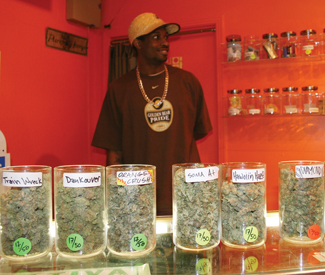
It was for this reason: after work I tore over to my beloved neighborhood dispensary Shambhala Healing Center (www.shambhalasf.com), arriving ten minutes before closing time. It was closed. Peeved, I called in to lightly berate them for shuttering early.

But this was no early start to the staff’s holiday. Just hours after I posted last week’s Herbwise about the Vapor Room going kaput, I found out Shambhala’s brick and mortar location had shut its doors for the last time on June 30.

Now this should not have come as a surprise. I spent time with an indignant Shambhala founder Al Shawa in his dank-smelling dispensary backroom this spring, discussing the letter that US Attorney Melinda Haag sent to his landlord, proclaiming that his storefront was inappropriately close to a playground, and that this landlord faced decades of jail time if he wasn’t evicted (“Shambhala Healing Center next on the federal chopping block,” 3/5/12).

I should have been paying closer attention to Shawa’s predicament, especially since I buy my sativa from him. At least Shambhala will continue to deliver, a move that the last place I used to buy weed from in the Mission, Medithrive, also resorted to when it was forced to close in November. (For the Herbwise column on that mess see “For the kids?” 12/13/11)

For me, the Third of July was a moment when this to-do between the federal government and these local businesses (and more importantly, the patients that depend on cannabis to function) punched me in the gut. My plans for THC consumption over Independence Day had been foiled by the feds, and all at once the sheer idiocy of this whole cannabis crackdown was almost too much to bear. Work on real problems! Go!

(By the way, SF Chronicle columnists Philip Matier and Andrew Ross have it on good authority that Obama is coming back to town on July 23 for his seventh Bay Area fundraising trip this year, who is down for a protest?)

So this week, I’m giving it up for South America. Big ups to Uruguayan president Jose Mujica for proposing a plan to legalize marijuana so that adults could walk into government-run stores and buy weed. He presented it as an anti-crime measure, suggesting that the hundreds of millions of dollars spent on pot by consumers could be better funneled in the government’s pocket than those of illegal drug dealers.

President Mujica is blessed with one of his continent’s most stable countries — plus it’s tiny, at 3.3 million inhabitants — so his plan could prove more manageable to implement than elsewhere in South America. But he’s not the only leader south of Panama to call bullshit on this War on Drugs. This spring at the Summit of the Americas in Cartagena, Colombia, that country’s President Juan Manuel Santos called for an “in-depth discussion” on the War on Drugs’ utility, preferably one “without any biases or dogmas.” He suggested, as many have, that Prohibition has never worked before, and might not be working now.

Our president was there too. “Legalization is not the answer,” said Barack Obama to a conference full of Latin American leaders. Of those who remain focused on this issue, President Obama counseled perspective. He said that this kind of debate seemed “caught in a time warp, going back to the 1950s and gunboat diplomacy, and Yanquis, and the Cold War, and this, and that, and the other. That’s not the world we live in today.”

Anyways, I’m sure that when he gets here — July 23! — he’ll be looking for our opinion on the ways of the world. ¡Hasta pronto!


Beasts of the NorCal movie theaters: new flicks!

0

It’s finally here! And nope, I don’t mean The Amazing Spider-Meh Man, though you can check my unenthused review below the jump. (Seriously, it’s not a bad movie if you can get past the obligatory product placement, but it ain’t amazing, either. New countdown: two weeks ’til The Dark Knight Rises!) Nay, the hotly-anticipated title I’m referring to is Sundance hit with mainstream (and Oscars?) potential, Beasts of the Southern Wild; read Dennis Harvey’s admiring review here.

Another one for indie fans: Sarah Polley’s Take this Waltz, Michelle Williams’ latest why-did-I-get-married-again? weeper. This one has Seth Rogen instead of Ryan Gosling, so proceed accordingly.

Tonight, it’s your civic duty to pack all seats at the Roxie’s kung fu double feature. Seriously, you will have a killer time (what with all the high kicks, insane weaponry, spraying gore, krayzee wigs, and horrific dubbing), and the Roxie will be all, “Hey, kung fu is what the kids want!” and dedicate one of their screens to nightly screenings in Shawscope. DO IT. (But if kung fu isn’t your thing, Midnites for Maniacs is screening a triple-feature of 1995’s Clueless, 2004’s Mean Girls, and my personal favorite, 1994’s Heavenly Creatures, at the Castro. Not a bad alternate.)

http://www.youtube.com/watch?v=50P2mxW0-Tc

And the rest of the n00bs: Spidey (out since Tuesday), two docs about artists, a French neo-noir sleeper with Twin Peaks-esque quirks, and Oliver Stone’s new weed caper.

The Amazing Spider-Man A mere five years after Sam Raimi and Tobey Maguire’s Spider-Man 3 — forgettable on its own, sure, but 2002’s Spider-Man and especially 2004’s Spider-Man 2 still hold up — Marvel’s angsty web-slinger returns to the big screen, hoping to make its box-office mark before The Dark Knight Rises opens in a few weeks. Director Marc Webb (2009’s 500 Days of Summer) and likable stars Andrew Garfield (as the skateboard-toting hero) and Emma Stone (as his high-school squeeze) offer a competent reboot, but there’s no shaking the feeling that we’ve seen this movie before, with its familiar origin story and with-great-power themes. A little creativity, and I don’t mean in the special effects department, might’ve gone a long way to make moviegoers forget this Spidey do-over is, essentially, little more than a soulless cash grab. Not helping matters: the villain (Rhys Ifans as the Lizard) is a snooze. (2:18) (Cheryl Eddy)

Marina Abramović: The Artist is Present Matthew Akers’ sleek and telling doc explores the career and motivations of the legendary Serbian-born, New York-based performance artist on the occasion of 2010’s major retrospective and new work at the New York Museum of Modern Art. Abramović, self-styled the “grandmother of performance art” at an eye-catching 63, steels herself with rare energy — and a determination to gain equal status for performance in the world of fine art — for an incredibly demanding new piece, The Artist Is Present, a quasi-mystical encounter between herself and individual museum patrons that takes the form of a three-month marathon of silent one-on-one gazing. Meanwhile, 30 young artists re-perform pieces from her influential career. Akers gains intimate access throughout, including Abramović’s touching reunion with longtime love and artistic collaborator Ulay, while providing a steady pulse of suspense as the half-grueling, half-ecstatic performance gets underway. A natural charmer, Abramović’s charismatic presence at MoMA is no act but rather a focused state in which audiences are drawn into — and in turn shape — powerful rhythms of consciousness and desire. (1:45) SF Film Society Cinema. (Robert Avila)

Neil Young Journeys Interested in going back further with Neil Young, back beyond 1969’s Everybody Knows This Is Nowhere? With Neil Young: Heart of Gold (2006) and Neil Young Trunk Show (2009) under his belt, Jonathan Demme has clearly earned the trust of the singer-songwriter, who occasionally likes to flex his multi-hyphenate creative muscles as a director himself, working under the name Bernard Shakey. The music-loving filmmaker tails Young as he drives through his hometown of Omemee, Ontario, shares glimpses of his school, named after his newspaper-man father, his small-town streets, and his home, and then takes it back to the stage and performs at Toronto’s Massey Hall. The stories and sights will interest mostly Young fans — you definitely get a feel for Young’s roots, but the place and its tales won’t jump out dramatically; they merely visualize factoids one can cull from sources like James McDonough’s bio Shakey — but performance dominates this concert film. Playing solo on guitar, harmonica, and in at least one memorable instance, pipe organ (for a hammered-home “After the Gold Rush”), the songs range from the still-moving, sprawling “Ohio” to “Love and War” off 2010’s Le Noise. It’s all love here for the Young diehard, though for an insightful, passionate tour doc, one might look to Shakey’s own CSNY/Déjà Vu (2008) or, for the performer’s finest cinematic performances, to Rust Never Sleeps (1979) and The Last Waltz (1978). (1:27) (Kimberly Chun)

http://www.youtube.com/watch?v=h74N3cXZH3s

Nobody Else But You The Marilyn Monroe pop-culture resurgence continues with director and co-writer Gérald Hustache-Mathieu’s appealingly low-key mystery, which pays homage to the iconic blonde while borrowing liberally from a pair of noir Lauras: Vera Caspary’s back-from-the-dead heroine, and Twin Peaks‘ unfortunate Ms. Palmer. Fortunately, Nobody Else But You is original enough to remain both suspenseful and highly entertaining. David (Jean-Paul Rouve), a detective novelist with writer’s block, travels from Paris to a small village where a Monroe-esque local beauty named Candice (Sophie Quinton) has just been found dead in a snowdrift. The official word is suicide, but David suspects something more sinister. With the help of a local cop (Guillaume Gouix), the newly inspired author investigates, urged onward by Candice’s evocative diary entries. Though it tries a little hard at times (drinking game: keep track of how many times the number five appears onscreen), Nobody Else But You is well worth seeking out; it layers European flair (translation: lots of casual nudity) over a plot that wouldn’t be out of place in an American indie — but relocated, memorably, to “the coldest town in France.” (1:42) (Cheryl Eddy)

Savages If it’s true, as some say, that Oliver Stone had lost his way after 9/11 — when seemingly many of his worst fears (and conspiracy theories) came to pass — then perhaps this toothy noir marks his return: it definitely reads as his most emotionally present exercise in years. Not quite as nihilistic as 1994’s Natural Born Killers, yet much juicier than 2010’s Wall Street: Money Never Sleeps, this pulpy effort turns on a cultural clash between pleasure-seeking, honky Cali hedonists, who appear to believe in whatever feels good, and double-dealing Mexican mafia muscle, whose apparently ironclad moral code is also shifting like drifting SoCal sands. All are draped in the Stone’s favored vernacular of manly war games with a light veneer of Buddhistic higher-mindedness and, natch, at least one notable wig. Happy pot-growing nouveau-hippies Ben (Aaron Johnson), Chon (Taylor Kitsch), and O (Blake Lively) are living the good life beachside, cultivating plants coaxed from seeds hand-imported by seething Afghanistan war vet Chon and refined by botanist and business major Ben. Pretty, privileged sex toy O sleeps with both — she’s the key prize targeted by Baja drug mogul Elena (Salma Hayek) and her minions, the scary Lado (Benicio Del Toro) and the more well-heeled Alex (Demian Bichir), who want to get a piece of Ben and Chon’s high-THC product. Folks lose their heads — in classic Mexican drug cartel style — and even zen-goon do-gooder Ben becomes complicit when Chon brings the war home to a decidedly lawless Southland. The twists and turnarounds obviously tickle Stone, though don’t look much deeper than Savages‘ saturated, sun-swathed façade — the script based on Don Winslow’s novel shares the take-no-prisoners hardboiled bent of Jim Thompson while sidestepping the brainy, postmodernish light-hearted detachment of Quentin Tarantino’s “extreme” ‘90s shenanigans. Our only glimpse at weird, wild depths lie in the fathomless eyes of Hayek’s soulful, castrating matriarch and the quotable interludes (“Gimme my money, gimme my money!”) bounding from Del Toro’s psycho-mulleted, striving maniac. (1:57) (Kimberly Chun)

Hot catch

1

le.chicken.farmer@gmail.com

CHEAP EATS Yeah, and part of the idea of going to New York City was to escape New Orleans’s heat, which would best be described (for those who haven’t been) as hot.

Hot hot hot hot hot.

As luck would have it, best laid plans and all, it was even hotter than that in New York while we were there, squeak squeak, fuckity fuck. It was hot hot hot hot hot hot hot. So as soon as we got back home to hot hot hot hot hot, we went camping.

In an air-conditioned camper. With our landlordladypersons, an adorable couple name a Pam and Cindy. Now Cindy, being a tried and true in the wool Cajun, has a brother name a Blaine only everybody calls him Bruno. And this Blaine (only everybody calls him Bruno) is my new favorite person because even though he knew we were crazy for camping on the edge of a swamp during mosquito season, he not only loaned us his trailer but drove it there. And parked it. He’s a truck driver.

Our campsite had been under water the previous weekend, and therefore vacant, so the mosquitos were happy to see us.

We heated our dinner in microwaves that first night. S’mores were not discussed. Next day, though, there was a breeze and we were able to sit outside all day and watch a hawk wrestle with a giant catfish that had been trapped in a puddle.

Hawk won.

Hedgehog took pictures, if anyone wants to see them. She also shot some alligators, and a sweet, tiny red parrot that had fallen in love with our friend Cherry’s roof rack.

I went around pulling dead sticks out of trees, and that night’s dinner happened over a fire. Here’s what I grilled: salmon, swordfish, boudin, turnips, tomatoes, peppers, pineapple, peaches, and garlic. The corn I soaked in its husks and threw on the coals.

On Sunday Blaine Only Bruno (or Bob, as I call him for short) came back and took me, Hedgehog, and Cindy to his crawfish pond. So, yeah, so that was how I spent the last part of my last weekend in Louisiana: having a complete pond-to-table crawfish experience.

We piled into this patchy li’l boat and sat on upside-down buckets. The traps are baited with sweet potatoes! Bob putt-putted us around the pond, pulling them up and dumping the crawfish onto a stainless steel sorting table, where we took turns wiping the angry ones through the square hole into net bags, and tossing the half-eaten or otherwise at-peace ones back into the water.

After, driving along the levee in his pickup truck with probably 50 pounds of crawfish for our dinner and then some, Bob told us about his friend’s crawfishing brother who looks like Z.Z. Top and had recently “caught a heart attack.”

Moments later, we ran into him, sitting in a pick-up truck of his own, eating a bag of potato chips and looking indeed like Z.Z. Top — the whole band. Pleasantries were exchanged. Potato chips were not.

Nevertheless, when we got to Bob and Cindy’s mama’s house, where the crawfish were to be boiled, I caught a stomachache — which is a horrible thing to have when you are about to eat 50 pounds of crawfish.

In a desperate attempt to get good again, I guzzled ginger ale. I ate a piece of dry toast. I sat in a recliner and closed my eyes, and missed the part where we boiled them to death.

Hedgehog was there. She said the secret was to not only add the seasoning to the pot, but to plaster them with it afterwards.

Well, they were spicy, and the best crawfish ever. Once I started eating them, I couldn’t stop. In fact, I’m still eating them. Packing up for the long road ahead: New Orleans to Frisco, by way of Pennsylvania and Ohio, or home to home, via home and home.

When I was there — home home — last time, Crawdad de la Cooter kept wanting to go to all these new Cajun restaurants popping up all over the Bay Area, even in Fairfax. I suppose after I’ve been back for a few months I will need these places, but for now I’d rather be eating pho and watching soccer at my new favorite Vietnamese restaurant and sports bar:

ANH HONG

Lunch: Mon-Sat 11am-2pm; Dinner: Mon-Sun 5-10:30pm

2067 University Ave., Berk.

(510) 981-1789

MC,V

Full bar


Cash your bowl

0

caitlin@sfbg.com

HERBWISE It’s time to get a Discover card. As of July 1, you can no longer use your Visa or Mastercard credit or debit card to buy medical marijuana. And of course, American Express cards have been out of the question since spring 2011. Electronic Merchant Systems, which handles card processing for most of the nation, sent out an announcement last month to its vendors, raising the stakes for dispensaries across the country that seem to be coming under a coordinated federal attack. Cash-only cannabis? That’s pretty bad, maybe just as bad as the next thing I have to tell you about…

MORE BAD NEWS

The Vapor Room is closing. Yes, the perennial Best of the Bay-winning, nine-year old Lower Haight dispensary-lounge (607 Haight, SF. www.vaporroom.com) will be closing its doors as of July 31, according to the nonprofit’s executive director Martin Olive. Olive told the Guardian in a phone interview that the dispensary learned an undisclosed amount of time ago that its landlord had received one of the doom-bearing letters now so familiar to San Francisco dispensaries from US Attorney Melinda Haag declaring that the dispensary was within 1,000 feet of Duboce Park. The city’s permitting laws, Olive told us, are concerned with how far cannabis clubs are from playgrounds, not park grounds. Vapor Room has a long-standing relationship with the Harvey Milk Rec Center that anchors the park — the nonprofit actually sponsors free yoga classes and health counseling that take place in the center itself. Olive wouldn’t confirm rumors that Vapor Room’s stock will continue to be available for delivery, but that’s the word on the street.

PLEASE NO MUNCHIES JOKES

The “bath salts” face-eater didn’t have any bath salts in his system. In fact, the only drug authorities uncovered through post-humous tests was cannabis.

UNDISCLOSED THING

As an events editor, organizations that don’t send us the vital information we need to cover their event are the bane of my existence. It is another thing entirely, however, when an organization requests that vital information be kept out of the newspaper. A sign of the times when it comes to cannabis journalism, I’m afraid. And as such: check out a happy hour benefit at El Rio for “an organization supporting low-income, AIDS-HIV, and cancer patients with free medicine.” Sigh. It’ll be running semi-concurrently with pop-up Mugsy Wine Bar’s hat-tip to Bastille Day (5:30pm-8:30pm). Drown your frustrations with some nice sparkling Blanc de Noir Cremant de Bourgnone, why don’t you.

Fri/13 4pm-6pm, free. El Rio, 3158 Mission, SF. www.elriosf.com

AND FINALLY

Search YouTube for “Conan O’Brien and Martha Stewart Get Crafty with Pot.” Discussion question: for all the weirdness that you just read, is marijuana becoming more or less accepted in mainstream culture?

Appetite: Spring weekend in Los Angeles yields intriguing tastes

0

I recently returned to my old SoCal stomping grounds for yet another long weekend. This time I stayed at funky, restored motel, The Farmer’s Daughter, gazing over a pool filled with giant rubber duckies, the hotel’s birds greeting me each morning in the lobby. Colorful and quirky, the hotel (with welcoming, engaging staff) is a worthwhile home base, ideally located across the street from the original LA Farmers Market. You won’t find farmers here, rather, it’s a permanent, open air mall of food purveyors.

Though not always gourmet, a few newcomers add foodie cred to the market. However, I hope to never see the demise of old school diners, pie shops and vendors selling unnaturally bright red popcorn and the like – it’s a charming slice of LA history.


On the newer side of things, Short Cake is one of the top Farmers Market destinations. I spent every morning there, happily downing shakeratos ($5 – four shots of espresso shaken with ice and simple syrup) and cappuccinos from one of my favorites, Verve Coffee of Santa Cruz. SF local TCHO chocolate shows up in Short Cake’s mochas, while Amy Pressman’s baked goods are among the best in all of LA.

She trained at Spago with friend and partner Nancy Silverton (Mozza, Pizzeria Mozza). At Short Cake she crafts ridiculously good eats like a curry raisin scones or bacon-cheddar-three chili croissant bread pudding. I rarely repeat places, but this one was worth returning to for breakfast three days in a row.

Another pleasing return this trip? A sunny, playful lunch at Roy Choi’s A-Frame, which I reviewed soon after it opened last year and still find an affordable winner.

BIERBEISL, Beverly Hills

I’m a sucker for cuisines done well, particularly the less commonly seen like Scandinavian, Eastern European or Burmese. I don’t get enough Austrian food. The new BierBeisl, just off Rodeo Drive in Beverly Hills (though not at all like Rodeo Drive – instead, it’s casual, spare and cozy), is one of the better Austrian restaurants around.

Starting with a cool BierBeisl carpaccio, thinly sliced pork roast is delicately doused in a Styrian Gold (Austrian pumpkin seed oil) vinaigrette – a unique, elegant starter. Assorted Austrian charcuterie ($18) and cheeses (add $10) are a brilliant example of the best to come out of the country, vivid with house spreads and rustic rye and pretzel breads.

There’s modern, fresh dishes like seared lamb loin with goat cheese polenta (the most expensive dish, a pricey $36), but I veer towards the traditional, like Vienna Schnitzel ($19-25 for pork, turkey or veal) garnished with lemon and lingonberries plus choice of side: potato salad, roasted parsley potatoes, fries, mixed green salad. House sausages from their sausage menu are a highlight, particularly a Swiss cheese-infused Käsekrainer ($10), lightly peppery and similar to a Polish sausage, while a traditional bratwurst with sauerkraut ($9) likewise satisfies.

Sausages come with a slice of rustic bread and dollops of tarragon mustard and fresh horseradish. The bratwurst is particularly zippy with the Radler Grapefruit: half Stiegl Goldbräu beer, half all-natural grapefruit soda ($6 for 10 oz.; $8 for 16.9 oz.)

Something unusual behind the bar? Reisetbauer Austrian Whisky. Yes, Austrian whisky – distilled in copper pot stills from malted barley, aged in Chardonnay and Trockenbeerenauslese oak wine casks. I appreciated the rogue, hearty spirit of this whisky, lively with chocolate, caramel, hazelnut, bread.

FORMOSA, West Hollywood

Formosa is a Hollywood classic bar/restaurant since 1925 with a storied past. There’s John Wayne’s regular booth which was extended a few feet to hold his long frame when he’d crash after a few drinks. Stars like Bette Davis or Dean Martin would take a cocktail break in between filming at the studios next door (once Pickford-Fairbanks Studio and now The Lot), connected to Formosa by underground walkways. Heavy on history and ghost stories of famed patrons whose photographs line the walls, Formosa has not been known for quality food or drink for years.

But this is not your mama’s Formosa. Though still slowly undergoing its transformation (including mischievous new menu offerings like a fried, spicy peanut butter sandwich), visiting the bar a few times in April I witnessed new bar manager Kate Grutman (previously at Sotto) refreshing the menu and bottle selection – not with fussy cocktails but with well-crafted, playful turns on the likes of a banana daiquiri, aka John Cazale ($10), the secret ingredient being a Fernet rinse, adding a minty, herbal layer. Her Bloody Mary twist is brilliant. Duck Down ($11) is Akvinta Vodka washed with duck confit, mixed with Vince’s original Formosa Bloody Mary mix, lime, Siracha hot sauce, and — wait for it — pickled gobo root (crisp, sweet, and earthy, it’s a member of the burdock root family). I tasted the washed vodka on its own: savory confit imparts a meaty, lush, joyously decadent spirit. It makes for a superior Bloody Mary.

Grutman upgrades dive bar favorites with quality ingredients, as with the Formosa Sour ($9), essentially an improved Midori Sour made from her house Midori liqueur: French honeydew, sugar, orange flower water and lychees with a hint of green food coloring to maintain the neon spirit of the junk food liqueur. Start with an aperitif of The Seven Year Itch ($10), referencing Marilyn Monroe’s potato chips and champagne scene in the film – they go one step further serving housemade chips with a cocktail of bubbles, Cynar, sugar, cherry liqueur and lemon. A perfect finish is Joan Crawford’s Chained ($9), essentially a Sherry Flip with Harvey’s Bristol Cream, Punt e Mes sweet vermouth, garnished with cinnamon. Creamy and savory, it’s dessert.

Grutman is clearly having fun with this menu – and drinking it is likewise a pleasure. Her grandfather was once a Formosa regular so she clearly maintains respect for the unique history of the place, studying old menus, celebrity clientele and films they made at the studios next door, which she’s naming cocktails after. Though there are minor updates happening throughout the building, the place retains its musty, classic Hollywood charm with dim lighting, red booths, rooftop bar, and circa 1930’s Chinese decor. You could still call it a dive but one where you don’t have to check taste at the door. I love witnessing one of the remnants of Old Hollywood reinvent itself while retaining its rich character, ready for more decades ahead.

LUKSHON by Sang Yoon, Culver City

Friends and fellow reviewers have found Lukshon http://www.lukshon.com/read uneven. In my experience, there were a couple brilliant dishes intermingled with a couple disappointments, though my overall meal was strong. I’d return.

The outdoor patio is a mellow alternative to a chic but cacophonous dining room. On a gorgeous LA night, the patio, fronted by a modern rock fireplace, becomes an urban respite.

Attentive, relaxed service made me immediately a fan of Lukshon, while a menu of single origin teas (from San Francisco’s special Red Blossom Tea Co.) and expertly-prepared cocktails confirm the restaurant’s “whole package” status. Asian twists on classic cocktails work, like a vividly tart Lukshon Sour ($11 – Michter’s Rye, lemon, tamarind, palm sugar, kumquats), a smoky Fujian Cure ($11 – Isle of Skye 8yr Scotch, lemon, galangal root, lapsang souchong black tea), or the savory, martini-spirited Formosa ($11): Ethereal gin, Lillet Blanc, atomized mizhiu tou (Taiwanese rice wine), and ginger pearl onions.

Green papaya salad ($9) was a less-than-pleasing version of the classic Thai salad, tasting oddly funky though ingredients were fresh. Chiang Mai curry noodles ($13) read as an enticing list of ingredients (coconut, chile, tumeric, lemongrass, chicken, prawn, yu choy, rice noodles), but came off a tad bland though still satisfying.

The kitchen excelled, however, with fantastic sweetbreads fried “orange chicken” style ($11) in a sweet-sour orange sauce, tender and tossed in scallion, ginger, and pickled lettuce. I’m dreaming of returning just for this dish. A side of yu choy ($7 – a Chinese vegetable), cooked in shaoxing wine and garlic with savory, aged ham is quite a pleasurable way to eat your greens. Short rib rendang ($17) is like the ultimate meatloaf, one cooked in malay spices, red chile lemongrass rempah (a spice paste), drizzled with coconut cream. Sigh.

A simple dessert of flan-like palm sugar caramel custard layered with rice krispies is a delicate finish, with a side of candy cap mushroom ice cream. Lukshon is trendy, yes, but talented chef Sang Yoon hints at the joys of California dining, where our dense Asian cultures and year-round, unparalleled produce combine with classic European cooking technique in inventive dishes.

ink.sack, West Hollywood

Top Chef star Michael Voltaggio smartly opened a sandwich shop half block from his casually hip fine dining restaurant ink., cheekily named ink.sack. Sandwiches come on the mini side at a cheap $4-7, though big enough that I’m unable to finish two. I wish all sandwich shops offered mini versions to vary tastes – and had staff as friendly as ink.sack’s.

Miso-cured albacore tuna is dubbed “spicy tuna” though I could have used more Sriracha mayo to make the sandwich actually spicy and offset a bit of dryness to the tuna. I delighted in sandwiches like The Jose Andres, aka “The Spanish Godfather”, a tribute to the man himself (of The Bazaar, one of my top LA restaurants), filled with Serrano ham, chorizo, and Manchego cheese. But my favorite is a twist on a Reuben with thinly shaved corned beef tongue, Swiss, sauerkraut, and Russian dressing.

EVELEIGH, West Hollywood

True: Eveleigh is the moneyed hipster’s hangout, from a bone marrow, charcuterie-heavy food menu to craft cocktails. But it stands out with a gorgeous setting off a trendy stretch of Sunset Boulevard and quality food and drink. You first pass through the front patio, green with trees and astro turf, into an open dining room with a center bar and ubiquitous fireplace, animal heads and book-lined, gastropub décor. The back of the restaurant is a huge patio covered in plastic with LA views. The space enchants, while my perch at the bar interfaced with busy, disengaged (but still professional, mannered) bartenders.

Though I’ve seen the like of these dishes countless times over the years, each one was well-executed and gratifying, whether bright crushed peas, mint, almonds, Arbequina olive oil and burrata cheese ($12) or a juicy, medium-rare Eveleigh burger (expensive at $19) topped with fontina cheese, pickles and tomato-chorizo relish.

Cocktails ($12) likewise are vivid, balanced and worth a stop on their own. Though, like a thousand cocktailian bars these days, they craft fine, spirituous classics, I’m most pleased with the farm fresh, seasonal side of the menu where they shine with fresh California ingredients and drinks like a Lucky Louie: rhum argicole, kumquats, star anise, ginger, fresh lime.

CURRYWURST, Mid-City West

I “heart” currywurst, that Berlin specialty of grilled dogs doused in German curry. Add chips (fries) if you wish. Currywurst, a few steps from my Farmers Daughter hotel base, is an affordable winner in the currywurst realm (like Berlin Currywurst in Silver Lake). With housemade sausages (my tops is the Hungarian pork) topped with satisfying curry (red German curry is akin to an amped-up, curry laden ketchup), friendly staff and cheap prices make this an ideal snack or lunch.

POUR VOUS, Mid-Wilshire

My bar disappointment this visit was Pour Vous, a sexy, French-influenced den with gorgeous décor, particularly a sunken, circular section with fireside seating. I thrilled to a French-heavy spirit menu highlighting Calvados, absinthe, Armagnac, Cognac. In theory, this could be a dream bar – an underdone concept I’d be thrilled to see well-executed. Maybe it is better early on a weeknight or depending on the bartender?

But on a Friday near midnight, it’s cacophonous, mobbed and irritating. The elegant space is dominated by well-dressed, middle-aged guys with young, blonde girlfriends (sporting breast implants, of course) with a pick-up scene of well-heeled 20-40-somethings on the prowl.

Though such a scene is always irritating (that cliché LA, Vegas, Miami feel), the clash of this crowd in such a romantic setting would be slightly lessened if drinks were excellent. At $14-15 a pop for many cocktails, they should be stellar.

Though it sounded amazing, a medicinally sweet, cloying Le Samourai ($14 – Armagnac, framboise, rhubarb, “umami”) was virtually undrinkable, while a Vadouvan Lassi ($15) could have been brilliant with rhum agricole, lime, coconut, falernum, Vadouvan curry and bitters, but ended up tasting like bland, minimally spiced milk on ice, the curry and the agricole lost in the milk. Tasting my friends’ drinks didn’t get me much further, while disengaged bartenders and a costly bill confirmed just how unsatisfying the entire experience was. I left convinced this is not so much a cocktail-spirits aficionado’s destination as a meat market dressed in pretty clothes.

Subscribe to Virgina’s twice-monthly newsletter, The Perfect Spot, www.theperfectspotsf.com

The Feds are watching — badly

9

yael@sfbg.com

So, you’re a law enforcement officer in training for participation on a local Joint Terrorism Task Force. Or a student at the United States Military Academy at West Point, involved in the counterterrorism training program developed in partnership with the FBI. Or you’re an FBI agent training up to deal with terrorist threats.

Get ready for FBI training in dealing with Arab and Muslim populations.

Take note that “Western cultural values” include “rational, straight line thinking” and a tendency to “identify problems and solve them through logical decision-making process” — while “Arab cultural values” are “emotional based” and “facts are colored by emotion and subjectivity.”

Be advised that Arabs have “no concept of privacy” and “no concept of ‘constructive criticism'” and that in Arab culture it is “acceptable to interrupt conversations to convey information or make requests.”

“Westerners think, act, then feel,” an FBI powerpoint briefing notes, while “Arabs feel, act, then think.”

Those are some of the most dramatic examples of racial profiling and outright racist stereotyping revealed in thousands of pages of documents obtained under the Freedom of Information Act by the Bay Guardian, the ACLU of Northern California and the Asian Law Caucus.

The documents show a pattern of cultural insensitivity, sometimes bordering on the ridiculous, not only tolerated by promoted as official instructions by the FBI. The records also show a broad pattern of surveillance of people who have engaged in no criminal activity and aren’t even suspected of crimes, but have been targeted because of their race or religion.

Pieces of this story have come out over the past year as the ACLU has charged the FBI with racial profiling and Attorney General Eric Holder has insisted it’s not happening. And some of the documents — which are not always properly dated — may be a few years old.

But none of it is ancient history: All of the material has been used by the FBI in the past few years, under the Obama administration.

This is the first complete report with the full details on a pattern of behavior that is, at the very least, disturbing — and in some parts, reminiscent of the notorious (and widely discredited) COINTELPRO program that sought to undermine and disrupt political groups in the 1960s.

The information suggests that the federal government is using methods that are not only imprecise and xenophobic but utterly ineffective in protecting the American public.

“This is the worst way to pursue security,” Hatem Bazian, professor of Near East Studies at UC Berkeley, told us.

CULTURAL STEREOTYPES

Dozens of documents attempt to describe “Arabs and Muslims” but other groups aren’t left out of the sweeping stereotyping and blatant racism and xenophobia that the FBI has used in its training guides. One training presentation is titled “The Chinese.” The materials give such tips as “informality is perceived as disrespectful.” The presentation warns “expect your gift (money) to be refused” but advises to give “a simple gift with significant meaning- tangerines or oranges (with stems/leaves.)” But “never give a clock as a gift! (death!)”

And if those in the training on “The Chinese” find themselves in “interactions with the opposite sex,” then “touching, too many compliments, may imply a romantic liaison is desired — be careful!”

The vast majority of the “cultural awareness” training materials imply that the authors believe that the law enforcement personnel receiving the training will never be female or interact with female members of the groups they describe. Some warn repeatedly to never ask Arabs how “females in their family” are doing in polite conversation.

A presentation on “Arab and Muslim culture” compares the western thought process with that of all Arabs. According to the FBI, westerners are “rational” thinkers; Arabs, on the other hand, are “emotion based.” A slideshow on cross-cultural interrogation techniques says, “It is characteristic of the Arabic mind to be swayed more by words than ideas and more by ideas than facts.”

Bazian said the FBI’s generalizations about the Arab intellect are “ideological constructs reflective of the orientalist discourse.”

“Many of these individuals have not done any primary sociological, psychological, or historical work in the Arab/Muslim world,” said Bazian, who works on UC Berkeley’s Islamophobia Research & Documentation Project. “What they basically do is take a text from a particular historical period and pick these points and put it as reflective of contemporary Muslim society. Most of these statements have no basis in any critical analysis. They’re not rooted in any type of research.”

Included in the FBI’s recommended reading list for counterterrorism agents-in-training is the “Politically Incorrect Guide to Islam,” in which “Islam expert Robert Spencer reveals Islam’s ongoing, unshakeable quest for global conquest and why the West today faces the same threat as the Crusaders did.”

It’s not exactly an academically sound piece of work, Bazian told us. Spencer and his cohorts are “political hacks,” the professor said. “They come from neo-con backgrounds. Even saying ‘extreme right wing’ is giving them credit; they’re way down below the cliff. They create this contrast between western society and the rest of the world based on a nostalgic idea of western society.”

Arab culture is often the target these days, but the rhetoric recalls that used during the Chinese Exclusionary Act era, and toward Latinos in the United States today, Bazian said.

“They pick on the weakest, most vulnerable people in western society at a particular time and lay blame on them,” he said.

The FBI’s xenophobic approach to interrogation training—which involves warning new agents that “If an Arab is scared, he will often lie to try to avoid trouble”—is not even productive, Bazian said.

“If you go to people with professional training in interrogation and investigation, they’ll say none of this gives them access to security. If anything, it creates a greater global misunderstanding.”

RACIAL MAPPING

And the creation of misunderstanding doesn’t stop there. The FBI is also involved in an intelligence-gathering method known as racial mapping. Racial mapping involves local FBI offices tracking groups in their “domains” based on race and ethnicity.

In blog post, the ACLU writes, “Empirical data show that terrorists and criminals do not fit neat racial, ethnic, nation-origin or religious stereotypes, and using such flawed profiles is a recipe for failure.” In the Counterterrorism Textbook read by all trainees the FBI seems to agree, warning multiple times that there is no such thing as a typical terrorist and that making assumptions based on stereotypes is dangerous and unproductive.

Yet the FBI files we’ve acquired reveal that the bureau consistently does just that. Though the Department of Justice prohibited race from being “used to any degree” in law enforcement investigations in 2003, a convenient and potentially unconstitutional exception allows racial profiling in national security matters.

When the FBI created its Domestic Investigation and Operations Guide in 2008, it used that loophole to permit the mapping of racial and ethnic demographic information and to keep tabs on “behavioral characteristics reasonably associated with a particular criminal or terrorist element of an ethnic community,” the ACLU reported.

Communities in San Francisco have been the victims of this prejudicial loophole more than once. In 2009, the ACLU reported that the FBI justified mapping and investigating the Chinese American population in the city because “within this community there has been organized crime for generations.” Likewise, the bureau collected demographic data on the Russian population because of the “Russian criminal enterprises” known to exist in San Francisco.

The loophole, however, may not even apply to these investigations in the first place.

According to Michael German, a 16-year veteran of the FBI and senior analyst with the ACLU, these investigations don’t fit the national security description. “In intelligence notes on Chinese and Russian organized crime, those are not national security issues,” German told us. “Those are all clearly criminal investigations.”

German has brought attention to another troubling use of racial mapping — documents revealing that the FBI’s Atlanta bureau tracks Georgia’s African American population.

The stated reason is a threat of black separatist groups; the documents name the New Black Panther Party and the Black Hebrew Israelites as the black separatist groups that pose a threat.

German wrote about this problematic practice in a May 29 article on the website Firedoglake.

“The problem with these documents,” German told us, “is that it’s not black separatists or alleged black separatists who are being tracked — it’s the entire black community in Georgia.”

“Those individuals and those communities are being targeted only for their race,” German said. “Were it not for their race they wouldn’t be part of that assessment. There is no reason to do that, accept to treat that community differently than the way it treats other communities. It’s problematic from a constitutional standpoint.”

The New Black Panther Party was founded in Dallas and has mostly East Coast chapters. According to the Southern Poverty Law Center, which tracks hate United States hate groups, “The group portrays itself as a militant, modern-day expression of the black power movement (it frequently engages in armed protests of alleged police brutality and the like), but principals of the original Black Panther Party of the 1960s and 1970s— a militant, but non-racist, left-wing organization — have rejected the new Panthers as a ‘black racist hate group’ and contested their hijacking of the Panther name and symbol.” The Black Hebrew Israelites is another fringe group, an apocalyptic group whose ideology holds that black Americans are God’s chosen people.

Both groups have written and spoken record of racist and violent rhetoric, but record of violent or criminal acts are hard to find.

“I’d say they’re a fairly small part of the radical right, and generally quite small. As far as we know, there is virtually no connection between these groups and criminal activity,” Mark Potok, a senior fellow with the SPLC, told the Guardian.

According to Potok, the center’s list of hate groups in operation in 2011 includes four organizations classified as black separatist, which, between them, have 140 chapters. Those chapters are counted as 140 of the list’s 1,018 groups.

“Most of the rest of the list are white supremacist groups,” Potok notes. “There are some exceptions — anti-gay groups and anti-Muslim groups.” After a quick count, Potok found 688 groups to be “straight-up white supremacist.”

The majority of these hate groups may be white supremacist — but the FBI is not involved in tracking white populations.

Last October, the FBI’s press office responded to the ACLU’s concerns with racial mapping. “These efforts are intended to address specific threats, not particular communities,” the agency’s statement reads.

“These domain management efforts seek to use existing, available government data to locate and better understand the communities that are potential victims of the threats. There must be an understanding of the communities we protect in order to focus our limited human and financial resources in the areas where those resources are most needed.”

With that defense, resources continue to pour into racial mapping efforts.

Black separatist organizations are not the only groups to be targeted for political beliefs. Groups such as “anarchist extremists” and “animal rights/environmental extremists” are also, according to the FBI, groups to watch out for.

A training presentation for the Bay Area’s Joint Terrorism Task Force includes a list of those groups: “animal rights/eco terrorism, anarchists, white separatists, black separatists, militia/sovereign citizens, and ‘lone offender’.”

How do you spot a potential “animal rights extremist”? According to the documents, “ideology and concepts” found among this group includes a “complete vegan lifestyle,” and activities include the promotion of “anti-capitalist literature.” In other words, your roommate is probably a terrorist.

SPYING ON MUSLIMS

Racial mapping is not the only FBI practice that targets people just for being members of groups “associated with crimes.” The FBI routinely gathers information on Muslims through deceptive “community outreach” programs.

Memoranda we’ve obtained reveal that FBI agents, operating under the guise of community outreach, attended various events hosted by local Muslim organizations in order to gather intelligence between 2007 and 2009.

When agents attended Ramadan Iftar dinners in San Francisco, they wrote down participants’ contact information and documented their conversations and opinions. At an alleged outreach event at CSU Chico, they recorded a conversation with a student about the Saudi Student Association’s activities and even took the student’s picture. That information was sent to the FBI in Washington, DC, the ACLU reported.

Writing down information on individuals’ First Amendment activities—in this case without any evidence that they were notified or asked—violates the federal Privacy Act, the ACLU says. Using access to community events to gather personal information undermines the FBI’s stated effort to form relationships with Muslim leaders and community members.

And covert surveillance can also have an immediate and hazardous impact on the unwitting subjects.

“It’s becoming more of a public discourse that these FBI background checks are affecting immigration status, the ability to send money back home, and generally creating an environment of fear,” said Miriam Zouvounis, membership coordinator with San Francisco’s Arab Resource and Organizing Center.

The organization has helped clients who have been detained for months because their names were mistakenly placed on a no-fly list, and others whose immigration processes have taken up to ten years because they were erroneously perceived as threatening, Zouvounis said.

“The process of information collecting on covert and overt levels is accelerating, and definitely a present reality in San Francisco. People don’t want to be civically engaged if that material’s being used against them,” she said.

ONLINE SPYING

“Extremism online is the most serious international terrorist threat in the world.” Or so says FBI training materials in a presentation entitled “Extremism online,” meant for those training to be online covert employees. The documents teach OCEs to scan through comment threads and enter chat rooms, searching for people whose speech may be “operational.”

This surveillance has led to investigations.

Some of the documents are individual files and summaries of individual files, and many note that the person (often someone who was convicted, so the name isn’t redacted in the documents) was “detected via the Internet.” Some examples: “Mohamad Osman Mohamud, detected via the Internet, discussing Jihad plans” and “Hosam Smadi, detected via the Internet: online chats.” Both men were 19 when they were convicted of crimes.

These men — and the many more who have not been accused of any criminal activity but are likely under surveillance or investigation by OCEs — could have been “detected via the Internet” in a variety of ways, according to German.

“It could be that the chats were open source, or that an informant was in the chat room, or a person participating simply turned them over to the FBI, none of which would require any legal process,” German explained.

“It could also be monitored under FISA [ the Foreign Intelligence Surveillance Act] or traditional criminal wiretaps, which would require court warrants (secret ones under FISA). Finally, the stored chat logs retained on third party servers could have been obtained with Patriot Act Section 215 orders, or what’s called a “D” order under the Stored Communications Act (if held for over 180 days),” German detailed in an email.

So what kind of speech are OCEs looking out for to peg potential terrorist threats? The Extremism Online presentation has a list of “major themes and language used in online extremist writings,” which includes Islam-related terms such as “Caliphate, Al-Ansar, Al-Rafidah, Mushrik, and Munafiq” as well as the Arabic words “Akhi, Uhkti, Ameen, Du’aa, Shari’ah, and Iman” (brother, sister, amen, prayer, Islamic law, and faith.) Other words the agents are told to look out for: “crusaders, hypocrites, dogs and pigs,” and any discussion of “occupation of Muslim lands.”

The FBI can really get into your business if agents confiscate your possessions. Personal computers, cell phones, and other electronic devices, according to the documents, are routinely checked out at Regional Computer Forensics Labs.

The nearest one to San Francisco is in Menlo Park, where employees brag of having investigated thousands of pieces of data.

Law enforcement routinely confiscates property after arrests, and if local cops are involved with the FBI through the Joint Terrorism Task Forces or other partnerships, they may very well send the belongings of those arrested to be checked out at a local RCFL. But there are other ways the FBI can obtain your electronics.

“Certainly the FBI has the authority to obtain computers and other devices with search warrants, either traditional search warrants where the individual is given notice or expedited warrants where the person isn’t aware,” German told the Guardian, noting that the second type of warrant is the preferred method, for obvious reasons, when the Feds plan to search a confiscated computer.

“The FBI also works with immigrations and customs enforcement, so laptops and other devices seized at the border the FBI can gain access to. There are myriad ways they can get them.”

“DISRUPTION”

A 2009 FBI memorandum on investigating suspected terrorists reveals that the Bureau encourages its agents to implement a “disruption strategy” that German wrote is “eerily reminiscent” of the COINTELPRO tactics used to stop political organizers in the1960s. “If the risk to public safety is too great, or if all significant intelligence has been collected, and/or the threat is otherwise resolved, investigators may, with substantive desk coordination and concurrence, implement a disruption strategy,” one memo reads. Investigators can conduct interviews, make arrests, or use any number of other undefined “tools” to “effectively disrupt subject’s [sic] activities.” Such disruption strategies have been used in the past to investigate and shut down First Amendment-protected activity, German said. The reintroduction of such tactics could open the door for a major breach of the subjects’ constitutional rights.

A MATTER OF PRIORITIES 

“After September 11th, 2001, the FBI realigned its mission and purpose to reflect the global and domestic threats that face the US,” begins an orientation packet for members of Joint Terrorism Task Forces. “FBI director Robert M. Meuller III defined the following as the top ten priorities (in order of importance) that confront the Bureau today,” Number one on the list: Protect the United States from terrorist attack.

Indeed, after 9/11, the FBI prioritized terrorism investigations, a shift from the previous focus on criminal investigations. Classified as national security threats, these investigations are not subject to the same type of privacy and anti-racial discrimination protections that other criminal investigations might be.

Terrorist threats, apparently, are to be found in mosques, in online conversations that involve criticism of US foreign policy, in entire populations of African Americans or Chinese Americans in given areas. In recent years, simply speaking Arabic online or being black makes a person a suspect and potential target of surveillance.

Look out America, especially members of that celebrated “melting pot.” The feds are watching.

Dueling pot protests precede rejection of a permit appeal

12

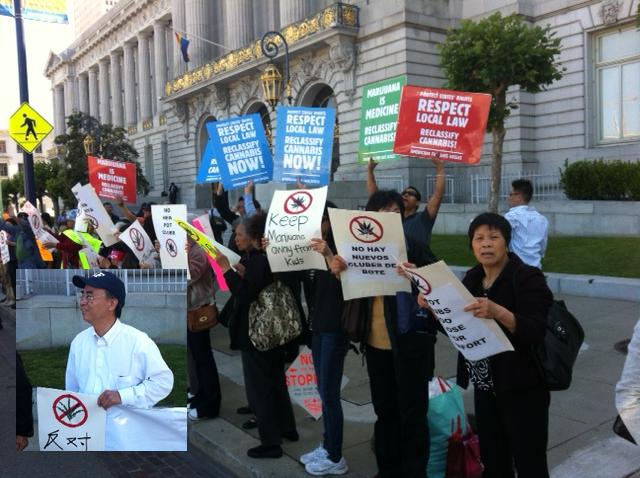
Dueling demonstrations in front of City Hall yesterday afternoon – with one side supporting medical marijuana dispensaries and the other protesting the city’s February approval of three new clubs in the Outer Mission/Excelsior area – preceded the Board of Permit Appeals decision to reject an appeal challenging Mission Organics.

That was the first of the three clubs to pull their building permits to open up shop in a part of the city that currently has no cannabis dispensaries. Yet a group of residents from the region – which includes District 11 supervisorial candidate Leon Chow – has been angrily agitating against the clubs and claiming they expose children to an illegal drug.

Bearing signs that included “Stay away from pot clubs” and “Keep the weeds away from kids” – most in both English and Chinese characters, with a smattering of Spanish translations – the predominantly Asian protesters squared off against a slightly larger crowd of medical marijuana supporters bearing signs that included “Respect Local Law” and “Marijuana is Medicine.” Together, it was a crowd of a couple hundred lining the sidewalk, drawing reactions from passing motorists.

Asked whether he would try to undermine the city’s system of regulating medical marijuana facilities if elected to the Board of Supervisors, Chow told us, “We’re opposing this, but I don’t think it would be my priority.”

Chow said he was “opposing high density,” noting that the Planning Commission approved three dispensaries in the area on Feb. 21, but he also raised concerns that the clubs make it easier for children to get marijuana, that they cater to healthy people just looking to get high, and that city regulations conflict with federal law.

“We don’t want healthy young people to be exposed to people coming out of medical marijuana clubs,” Chow told us. Asked whether he had similar concerns about bars and liquor stores, he said that he did but “there’s nothing I can do” to shut down existing businesses that sell alcohol.

“I don’t want there to be more liquor stores,” he said, although he assured us that, “I’m not a conservative, crazy, church-going Republican.”

Yet supporters of Mission Organics – whose workers will be represented by the United Food and Commercial Workers Union – did call Chow a hypocrite given that he works for SEIU-UHW. “So it’s a union representative opposing a union business,” said Matt Witemyre, an organizer with UFCW who was demonstrating in support of Mission Organics, which he said has agreed to a strict code of conduct that will make them good, responsible members of that community.

“The vast majority of the neighborhood is in support of the project,” Ariel Clark, an attorney representing Mission Organics, told us, characterizing protesters as a small yet vocal part of the neighborhood. The appeal was filed by Steve Currier, president of the Outer Mission Merchants and Residents Association.

Long after most of the protesters on both sides had gone home, the Board of Permit Appeals voted 3-1 to reject the appeal, clearing the way for Mission Organics to open on the 5200 block of Mission Street. But opponents have vowed to continue their fight and appeal the permits for the other two approved clubs – Tree-Med and The Green Cross, a venerable cannabis delivery service – when they apply for building permits.

Appetite: A bright Spring Mountain Sour

0

Subtle mixing at Perfect Puree’s press event, and a sampling Charbay’s new whiskey releases

Thanks to Napa-based Perfect Puree for a recent intimate dinner celebrating Perfect Puree neighbor Charbay Distillery’s new spirits releases at Jasper’s Corner Tap.

The ever-talented Kevin Diedrich (bar manager at Jasper’s) crafted three drinks using Perfect Puree’s fresh, bright purees. In typical Diedrich fashion, subtlety and balance wove together each, from a Thymely Fashioned, vivid with Charbay White Whiskey, Perfect Puree Thyme Citrus puree (one of their new flavors), Galliano and bitters, to a beautifully frothy with egg white Spring Mountain Sour, named after the home of Charbay on Spring Mountain in St. Helena.

The Sour was a mix of the White Whiskey, Marie Brizard Creme de Cacao, Perfect Puree Chipotle Sour puree (a little goes a long way with peppery smoke), Green Chartreuse and aforementioned egg white.

Charbay R5 Whiskeys

As an avowed whiskey lover, Marko Karakasevic’s (Charbay’s distiller, alongside his father, Miles) whiskeys are among the best I’ve had anywhere. But his fantastic beauties, like Release II are out of the price range of many of us at $300+ a bottle, though I would call it one of the few worth a splurge.

Thankfully, his new whiskies are on the way, each actually distilling Bear Republic’s http://www.bearrepublic.com/ finished beer, aging it in oak or stainless steel. Marko has been distilling bottle-ready beers for years, like the pilsner he used for his Release I whiskey in 1999.

Charbay’s new whiskies are well under $100 , the first just-released set (small production, roughly 650 cases) made with Bear Republic’s Racer IPA: think hoppy, herbaceous, redolent of pine, papaya, and malt.

The first, R5 Clear Whiskey ($52), is aged in small stainless steel tanks for 22 months after being distilled in a double copper Charentais alembic pot still. The second is R5 Aged Whiskey ($75), aged in French oak for 22 months, continuing the hoppy, bright, fruity, lychee direction. I tasted this whiskey in its early incarnation at 6 and 12 months – at each stage it was already a winner. Both are unique entries in the American whiskey category, especially approachable in this price range.

I’m particularly excited for Charbay’s upcoming release made from Bear Republic’s stout – again, at early stages of tasting, it is already brilliant. Hopefully, these more affordable whiskies will introduce more to the uniqueness of Charbay’s whiskies. Stay tuned for release dates and where you can find R5 this Summer here http://www.charbay.com/productinfo.aspx?ProductID=WHISKR5A7.

Tequila Tapatio

Tequila fans are thrilled that Tequila Tapatio, one of Mexico’s best quality-for-value tequilas (the blanco retails at $33 per bottle) distilled by delightful tequila master Carlos Camarena, is finally available in the US for the first time through Marko K Spirits, Charbay distiller Marko Karakasevic’s import company.

Tequila Tapatio is already on it’s way to numerous bars, restaurants and stores in California, New York and 7 other states, including being well stocked at Tres http://tressf.com/ here in SoMa (a list of where to find it here).

Although I knew months back Marko would be the importer, it’s taken awhile for the tequila to arrive to the US. Now it’s here and it is smooth, robust, primed to be the savvy bartender’s well tequila of choice.

Subscribe to Virgina’s twice-monthly newsletter, The Perfect Spot

Food trends unite: New Peruvian pop-up on Market Street

1

Could it be that tacutacu is the new taco, and cebiche the new calimari? Places like Mochica, Piqueos, and Destino have us surfing a wave of Peruvian food fandom — and now two SF food trends have merged in happy unity. Chef Christopher Kese have started a weekly gourmet Peruvian pop-up restaurant, perfect for your Wednesday dinner. 

The party takes place at SF Food Lab every Wednesday, where guests will be offered a variety of staple dishes that include mushroom and beef heart skewers, the spicy Afro-Peruvian rice dish tacutacu, and a traditional Peruvian ice cream dessert. Tonight (Wed/20), Gomez and Kese will be whipping up offer sashimi drizzled with a spicy-citrus leche de tigre sauce and a cilantro lamb stew. Afro-Peruvian salsa music that’ll serve as the perfect soundtrack to your .

Kese was studying in Peru’s mountainous regions when he felt the pull from its gastronomic traditions — he actually ditched the history thesis he was working on through the University of Washington in order to study the food more deeply.

Cebiche for what ails you

“Talking with the people there, a lot of people were angry with their government and didn’t feel like a part of Peru,” says Kese in a phone interview with the Guardian. “But when it came to the food, they felt so proud of being Peruvian. I fell in love with the social aspect of the gastronomic movement there. They celebrate the diversity of it.” 

With 11 of the world’s 13 ecosystems at its chefs’ fingertips, Peru’s cuisine exhibits a diversity that may explain its current vogue. Fresh fruits and vegetables are available at the country’s higher elevations, and the coast brings in fish that stands up to the best of Japan’s sushi stock. 

“That’s a part of the basis of Peruvian cuisine,” Kese says. “Any food has a place in it. There’s a really eclectic immigration.” He cites the country’s waves of immigrants from China, Japan, Italy, and Spain — not to mention its rich indigenous heritage — as important contributors to the country’s “melting pot of flavors.”

It’s only natural, then, that the culinarily-eclectic United States would eventually start salivating over Peruvian fare. All signs point to the trend’s longevity — there are currently 80,000 culinary students in the city of Lima alone. 

“[Peruvians] have this huge, domestic, culinary tradition,” says Kese. “They’ve also had a self-defeatist attitude in the past — as many developing countries have. But if you go there today and ask which country has the best food in the world, they’ll say ‘Peru’ very proudly.” 

Kese plans to use the pop-up to build a close relationship with clientele before acquiring his own kitchen space and restaurant front. To our way of thinking, he can take his time: a cilantro-infused, perfectly-skewered pop-up party set to the sound of salsa sounds like fun enough for now.

Lima Peruvian Food pop-up dinner

Every Wednesday 5:30-10:30pm, free entrance 

SF Food Lab

1106 Market, SF

(206) 795-4193

www.limaperuvianfood.com


Psychic Dream Astrology: June 20-26

0

ARIES

March 21-April 19

It is the way that you respond to things that counts now, Aries. When you feel threatened or overwhelmed it’s easy to act defensively and engage in or start stupid fights. No matter how passionately you feel entitled to your feelings, slow down and consider the consequences before you act.

TAURUS

April 20-May 20

Keep your eyes on the prize. You are meant to thrive, and this week you need to stay focused on your goals so that you can do just that! Reach out to others for help, and learn the value of collaborating without diluting your vision or will. Flexibility and vitality will carry you through.

GEMINI

May 21-June 21

This week, clear, unequivocal communication will bring your game to the next level, Gemini. Be direct and compassionate as you assert your needs, or respond to the needs of those around you. Make the kind of deep changes that you need in your relationships by gently asserting your true wishes with others.

CANCER

June 22-July 22

Your gut feelings will guide you to where you need to go if you let them, Moonchild. Your instincts live in a place that requires some stillness to get to. Alone time may feel counter-intuitive this week, but you need to spend some time in a sweet little place called Me. Minimize activity and maximize your receptivity.

LEO

July 23-Aug. 22

When you feel bad, it’s hard to believe that you have any choice in the matter. Heartache and disappointments can be like a sieve for your good vibes, but you should remember that you have options. Look for possibility in even the crappiest of your circumstances and choose to put your energies into that, Leo.

VIRGO

Aug. 23-Sept. 22

Effort, hard work, and patience will bring you to the pot of gold at the end of the rainbow. The kind of success that awaits you this week is most gracefully achieved when you share with others. If you forget to include others in the good of your life, it has a way of eclipsing your abundance, so put yourself out there.

LIBRA

Sept. 23-Oct. 22

You’re looking for love in all the wrong places again, Libra. Until you start with yourself, you are unlikely to get off this carousel. Unplug everything and cancel plans! Quit it with the distractions until you get right with yourself. Only then will you be able to take care of things in a way that makes things good.

SCORPIO

Oct. 23-Nov. 21

When things get stuck you can try to unstick ’em, but what do you do when that isn’t working? There needs to be a point when you accept the limitations of your situation, Scorpio. Stop trying to get your square peg into that round hole, and put your energy where it can thrive instead. Move onwards and upwards, pal.

SAGITTARIUS

Nov. 22-Dec. 21

Where you focus your energies, they multiply! So simple, but easy to forget. This week, your challenge is to be real with yourself about your concerns while not letting them blossom into major fears. If you don’t know what will happen next, try imagining things turning a corner and improving, Sag.

CAPRICORN

Dec. 22-Jan. 19

You are engaged in a process in which you can better get to know yourself, and even let others get closer to you, too. Be patient this week! You can most certainly move through things quickly now, but if you do that, you are unlikely to stay emotionally present. Slow and steady yields the best results, Cap.

AQUARIUS

Jan. 20-Feb. 18

Be open to change, both the kind that you need to create and the stuff that happens out of your control. If you can be your own anchor, you don’t need to define your security or happiness through outside conditions. Bring the best you’ve got to the inevitable in your life this week.

PISCES

Feb. 19-March 20

Remain true to your ideals, even when your moods try to tear you away from them. When you’re freaking out it’s easy to convince yourself that you deserve to do whatever you want, but it isn’t so. Rise to the occasion and act with integrity this week, especially when the going gets rough.

Jessica Lanyadoo has been a Psychic Dreamer for 17 years. Check out her website at www.lovelanyadoo.com or contact her for an astrology or intuitive reading at (415) 336-8354 or dreamyastrology@gmail.com


After the raid

1

caitlin@sfbg.com

HERBWISE It is exceedingly difficult to get Oaksterdam University founder Richard Lee to talk about himself. I have him — the person who drove the Proposition 19 legalization campaign, whose house and cannabis trade school were raided by federal agents in April, who through his businesses’ success has helped revitalize and make safe a previously gloomy stretch of downtown Oakland — on the phone to talk about the lifetime achievement award he will be receiving from High Times at this week’s Cannabis Cup (Sat/23-Sun/24).

I want him to share his emotional journey since government agents poured into his home, what’s it’s like to be the public face of the flashpoint between California and national government over marijuana. High Times editorial director Malcolm MacKinnon calls Lee a “fearless trailblazer,” perhaps he’d like to make grand predictions about the future of pot? At least describe exactly what’s happening with Oaksterdam, post-raid. But Lee prefers to stress the latest poll numbers on legalization.

“All the national polls and the Colorado polls are going our way,” he says. “If you could get the word out about that, that’d be great.” FYI, on June 6 Rasmussen Reports found that 61 percent of Coloradoans support regulating cannabis like alcohol and cigarettes.

Lee has retired from university administration — he’s referred to as a professor emeritus, although he is still teaching classes in cannabis policy, history, and advocacy. In his “big Converse All-Stars” (as she calls them) now stands Dale Sky Jones. She once developed Oaksterdam’s curriculum and now joins a short list of female leaders in the marijuana industry as the university’s president.

“When the federal government came in, they took the curriculum, the computers — everything else that was the blood and breathe, heart and soul of the school short of the tables and chairs and teachers,” Jones says in a phone interview. Under her watch, the finances of “top-heavy” Oaksterdam’s gift shop, dispensary, and university have split and are now under separate ownership. Staff is attempting to rebuild curriculum from email records. 45 employees have lost their job because of the disruption in business affairs. “This was a violation on so many levels for the staff of Oaksterdam,” Jones says, sadly.

But life goes on. Lee says his “students are great, they have lots of energy and enthusiasm.” And the cultural contributions that the school and its founder have hardly been negated by federal intervention. “[Lee] brought the debate about marijuana policy reform to the kitchen table,” says Jones. “Before Prop. 19, the only time parents and kids had conversations around marijuana it was ‘where the hell did you find it? who are your jackass friends?’ It was always a negative discussion. This was the first time that families were able to discuss marijuana as a policy issue.”

This weekend’s Cannabis Cup will bring the pot world’s focus back here, as some of NorCal’s [author’s note: and hence, the world’s] best strains compete for the title of best indica, sativa, edibles, etc. Lee’s lifetime achievement award (presented at 7pm on Sun/24) will just confirm what we all already knew: even when it comes to activists, we grow things better out here.

HIGH TIMES CANNABIS CUP

Sat/23 noon-10pm, Sun/24 noon-9:30pm; one-day pass $40, two-day pass $65 advance, $80 at door

Craneway Pavilion

1414 Harbour Way, Richmond

www.medcancup.com

Appetite: Whiskies of the World tastes and gin tales

1

A better than ever year aboard the SF Belle at Whiskies of the World last month meant some fine, global pours of whisk(e)y from Scotland to Australia. Here were some highlights:

On the fun and interesting tip, Lark Distillery distills single malt whisky in Tasmania, an Australian island – and it’s surprisingly solid. Distilled in copper pot stills, it’s smooth with a modicum of peat, aged five years, yet with a bit of complexity. I appreciated returning to 10-year-old old Masterson’s Straight Rye Whiskey. Aged in charred white oak barrels, this Canadian rye evokes whispers of pepper, vanilla, spice, and a soft sweetness.

Count me smitten with Glenmorangie’s new Artein ($79.50), an elegant whisky of stone fruit, mint, even chocolate and lemon zest, matured in Super Tuscan wine casks. It’s sexy, evening wear without being sweet or dessert-y. Speaking of Glenmorangie, Chef Tyler Stone brought a memorable touch to the evening making boozy, liquid nitrogen bowl after bowl of Glenmorangie’s Nectar D’Or whisky served in a mini-glass with egg white lime foam on top. Brilliant.

Funny enough, my favorite taste of the night, the one I couldn’t get out of my mind (and wanted to linger on my taste buds) was not even a whisk(e)y. It’s a a rare brandy (only 220 bottles out there) of Germain-Robin Small Blend No. 1, blended from a 1990 Austin Ranch Pinot (south of Ukiah), ’94 custom Clos du Val Pinot, ’83 Hildreth Ranch Colombard, and small amount of ’87 Colombard brandy. If you can get your hands on it, it’s a stunner.

GIN TALES

Every time I turn around there’s a new gin. Though not on par with some of the best American gins already out there (Junipero, Death’s Door, St. George’s gins, 209, etc…), these new gins offer yet another gin route for those wanting sweeter gins or to try something new from small producers who care. Here’s two new American gins, and a rare Dutch gin that sells for more than almost any gin in the world.

Greenhook Ginsmiths ($31.99) – As one myself, I value stories of career-changers – Steven DeAngelo left a finance career to launch his own gin, just out in February. Dubbed “ginsmith”, his master distiller is Ed Tiedge who uses very low temperatures, nearly 40 degrees below typical gin distillation temps (approx. 132ºF ) for intense and solidified flavors. It’s non-traditional, with heavy floral, chamomile, coriander, elderflower, orange blossom and ginger notes – a little too sweet for me, but bold and  bright. They’re releasing the first of its kind, a Beach Plum Gin Liqueur http://greenhookgin.com/plum.html soon, a variation of an English sloe gin with plums sourced locally from a beachfront Hamptons’ farm.

Small’s American Dry Gin plays a little more like a London Dry with American roots, made from an 1850’s recipe. Created by the Local Wine & Spirits http://www.localwineandspirits.com/ crew in Oregon who produced Ransom Old Tom Gin and Whipper Snapper Oregon Whiskey, this “American Dry” uses US-grown grains, a mid-19th century recipe and pot-distilled methods. It’s juniper-heavy, a little sweet as well but also sharply herbaceous, with elegant, Colonial-spirited label and convenient screwcap.

NOLET’S Silver Gin is unique gin with botanicals including Turkish rose, peach, raspberry… they recently hosted a private dinner with Carl H.J. Nolet, Jr., who owns the distillery with his father, Carolus and brother, Bob. We dined at one of San Francisco’s best new restaurants in SF, AQ, complete with cocktails from AQ’s stellar bartending crew, like the Contemporarian, mixing NOLET, chamomile peach tea, citric acid and simple syrup.

In a nod to The Aviary in Chicago, they set up a boiler emitting chamomile into the air, rounding out our experience with intense aromas.

A floral Heirloom Rose cocktail (NOLET, simple syrup, lime, rose water) elevated the interplay of botanicals with food alongside Mark Liberman’s gorgeous white tuna cured in beets, hibiscus, and juniper. Best of all, we finished with Carolus Nolet, Sr.’s (a 10th generation distiller who launched Ketel One in the 1980’s) NOLET’S Reserve Dry Gin. Typically selling for over $600 a bottle (K&L has it for $550), this extremely allocated, small production gin is a complex, spicy, verbena-laden imbibement that lingered with me long after dinner was through.

Subscribe to Virgina’s twice-monthly newsletter, The Perfect Spot, www.theperfectspotsf.com

8 Washington isn’t getting much better

30

When the Board of Supervisors approved the environmental impact report for the most expensive condos in San Francisco history, several members of the board said they weren’t entirely happy with the project. Supervisors Christina Olague and Eric Mar both complained about the height and bulk and Olague said she wanted a parking fee.

So now the project is back, and just won approval at the Budget and Finance Commitee — with only a few minor changes. There’s no adjustment to the height and bulk, although the parking has been cut from 255 spaces to 200 and a 50-cent parking surcharge has been added. Sup. Jane Kim wants to be sure that the pool built in the new facility will be open to low-income youth.

But the city’s not getting a dime more than the $11 million in affordable housing money that developer Simon Snellgrove has already offered — despite the fact that the available financial evidence suggests Snellgrove and his partners will make more than $250 million on the deal. Sup John Avalos made clear that the city’s not getting enough out of this project.

So now it goes to the full board June 12 — and if things go according to the normal San Francisco pattern, the developer will get what he wants and the city will get screwed.

See, when you give developers the opening, they take advantage of it. When you let them over the first hurdle with and 8-3 vote, they get pretty confident that they’re going to win. So why would they compromise on more than few details? Why cut the height and bulk when you know you have the votes?

I respect what Eric Mar, Jane Kim and Christina Olague said about their votes on the EIR — but imagine if it had been a 6-5 vote? Snellgrove might have gotten the message that this wouldn’t be easy. He might be calling Olague and Mar and saying: How much less height? How much less bulk? How much more affordable housing? We might have wound up with a much better deal.

Every time — every single time — a developer presents what is supposed to be the last, best deal it’s a scam. Every time the city has said No, the developer has come back and sweetened the pot. That would have happened here, too.

But no. I predict no height and bulk adjustments, no additional affordable housing money — nothing more than what Budget and Finance already got. Which isn’t enough.

Oh, and by the way: Everyone here already knows that I oppose this project because it’s too much housing for rich people, which we don’t need in this city, and puts the city’s housing balance further out of whack. But if we’re going to sell off the waterfront for all the wrong reasons, we should at least get the best deal we can.

Welcome back to SF President Obama! Now, say Supevisors, give us our marijuana

4

Not that it’s ever a good idea, but avoid driving downtown today like the plague — President Obama’s in town! And, (as reported by SFGate), SF supervisors want him to take a stance on pot. Sup. Christina Olague has penned a letter co-signed by Sups. David Campos, and Scott Weiner that is a solid finger-wag at the current federal administrations actions against the medical marijuana industry. Here’s the meat of it:


We believe strongly in addressing medical cannabis as a public health issue, and we will strive to fully implement state law by protecting not only our patients, but our property owners and dispensary operators as well. We want to work with President Obama on a public health solution for medical cannabis at the federal level, once he wins a second term. In the meantime, the Department of Justice must respect our laws and honor the President’s commitment on this issue. Honoring this commitment can start by taking no further action against the nine landlords of City-permitted facilities here in San Francisco.


Those “nine landlords” refer to the property owners of the five SF cannabis dispensaries that have already closed, and the additional four that are set to close this month. The federal government has sent threatening letters to dispensary landlords that posit extensive jail time and civil forfeiture for those landlords that continue to allow federally-illegal drug trafficking on their property. 

Kudos to the new Sup. Olague for taking a stand. Of course, the letter’s premise is that the Sups. are staunch supporters of Obama’s re-election, they’re just asking him to improve on this particular issue. It begs the question: why would he make capitulations to win support that is already in pocket?

Tickets are sold out for his lunch at the Julia Morgan Ballroom (465 California, between Montgomery and Sansome Streets), although his campaign website encourages you to get on the waiting list — be careful, general admission tickets start at $5,000. The President’s only other scheduled stop, says SFGate, is at a “small roundtable” at One Market Plaza. 

Afterwards, the President will head south to Los Angeles to attend the annual fundraising gala for the LGBT Leadership Council, where he will no doubt be greeted affectionately for his “I support gay marriage”isms of last month. 

In the air

3

caitlin@sfbg.com

HERBWISE It’s Sunday afternoon and the hosts of Mutiny Radio’s Cannabis Cuts: The Next Generation have effectively commandeered the smoking lounge at SoMa’s Igzactly 420. They are deep into solving the world’s problems.

The crusade may just involve a pictorial calendar featuring sexy men smoking marijuana — a project which hosts Vaperonica Dee and Merry Toppins staunchly resist any attempts to qualify as frivolous. It’s about achieving parity in cannabis imagery, they say — much like their weekly podcast of marijuana news, product reviews, music, and banter.

“If you look at all the ads [for cannabis businesses and products], it’s sexy nurses or girls holding cannabis leaves over their tits,” Dee says between Volcano puffs. The young radio vet didn’t find that image particularly representative of her experience with the medicine (both she and Toppins are medical marijuana patients), so she jumped at the chance to work with DJ Wiid on his marijuana variety show at Pirate Cat Radio.

Merry Toppins and Vaperonica Dee plot their takeover of cannabis media (that’s not their car.) Guardian photo by Caitlin Donohue

Dee stuck with the project through Pirate Cat’s transformation into Mutiny Radio, the shuttering of its cafe and demise of its infamous maple bacon lattes — “I was excited!” she says. “I wanted to be in radio, I didn’t give a shit about the cafe” — and the exodus of her male co-host.

And when DJ Wiid moved onto new projects, it left the door open for an idea that seems nearly revolutionary in an industry filled with men: a platform for women’s perspectives on the cannabis movement.

Toppins was a natural choice as on-air co-host for Dee. The two had met when chef Toppins appeared on Cuts to hype her marijuana-infused olive oil that she had entered into the High Times Cannabis Cup. Toppins’ ebullience is the perfect compliment to Dee’s well-informed on-air tone. They both have natural radio voices, impeccable banter rhythm. “It was so cool to see a chick doing the news on a weed show,” says Toppins of their initial meeting. “I knew right away I’d either be their intern or host my own radio show.”

Listeners are responding. Toppins volunteers the following stats: 5,000 Cannabis Cuts podcast downloads each week, each one yielding an average of an hour spent with the two-hour long show. And though the women express views that aren’t always in lockstep with the cannabis establishment (a February 14 edition of the show highlighted a disempowering experience with Americans for Safe Access activists at a City Hall hearing and the two are candid about the fact that not all their tokes are strictly medicinal), many of the community’s luminaries have lent their support. They count Proposition 215 co-author Dennis Peron and Cannabis Action Network co-founder Debby Goldsberry as personal friends, and have interviewed Peron on the show.

The enthusiasm that has come their way makes sense — the continued strength of activists to improve cannabis access depends on developing and raising awareness about diverse viewpoints within the movement.

“We’re changing the idea that there could be a profile of a standard cannabis activist,” says Dee, who wants the world to know that it’s not just the grey-ponytailed Deadheads who care about access to pot. “Plus, radio doesn’t have that many women involved in it, cannabis doesn’t have that many women involved in it — the two go together.” 

Cannabis Cuts: The Next Generation Live podcast every Tuesday, 4pm-6pm. www.mutinyradio.org. Also available on www.stitcher.com and www.medicinalmarijuananetwork.org


The Performant: All you can eat

0

Wild Food Walks and Bal Littéraire satisfy imaginative appetites.

“First, the bad news,” says our guide and frequent forager Kevin Feinstein. “Foraging in the Bay Area is illegal.”

Well, swell, I guess it’s a good thing that I packed snacks. “If the land is private, and you have permission from the owners, you can forage,” Feinstein amends, which still doesn’t help me in planning my lunch, but good to know for future reference. I’m attending one of ForageSF’s “Wild Food Walks,” along with about 15 others, hoping to graze upon that freest of foodstuffs, the weeds in our backyards — and yours.

The tour kicks off on the perimeter of Golden Gate Park, and without even taking a step, we’re summarily introduced to common mallow, miner’s lettuce, and stinging nettles. After another reminder about the illegality of *picking* the plants in the park, Feinstein exhaustively details each plant’s properties — their nutritional content, the edible parts of each, identification and preparation tips. Mallow is mucilaginous and anti-inflammatory, and the seed pods or “cheese wheels” can be eaten as well as the leaves, stalks, and everything else. Miner’s lettuce, which looks a bit like a land-locked lily-pad, is native to California, high in Omega-3s, and never gets bitter, even when older. Nettles do sting (which one curious child found out the hard way), but not when crushed or cooked. Extremely high in various minerals and vitamins, nettles are also easily cultivated, making them a good bet for amateur urban farmers as well as foragers.

“One five-gallon nursery pot grows more nettle than one person can handle,” promises Feinstein as visions of pestos and cream soups begin to creep into our collective consciousness.

Two hours and a dozen plants later, we’re all a little overwhelmed, but there’s excitement in it, like people are going to go home immediately and weed the garden, not for the usual reasons, but to make a salad. It almost makes one want to trade one’s wallet for a foraging basket, until reminded that urban foraging has its share of downsides — legal issues, contaminated soil, plant misidentification. Even so, I’m betting that hardly anyone in that group will be able to pass by a big clump of hilltop-dwelling nasturtiums or wild radish without checking for their crunchy, spicy seed pods, or slipping a few leaves in their bag for later.

Another new taste I was introduced to over the weekend was San Francisco’s first ever “Bal Littéraire,” a Parisian concept imported over as part of the French-American translation exchange, the Des Voix Festival. Though I’d been given an idea of the concept ahead of time — an ephemeral, collaborative work created by six playwrights, using pop songs to tie the scenes together and turning the floor into a giant dance party — nothing could have prepared me for the high-spirited spectacle it became.

Seeing a “typical” Bay Area theatre crowd getting down and dirty to hyphy hit “Fast (Like a Nascar)” in the middle of a French-accented, surrealistic serial romantic comedy featuring Liz Duffy Adams as a tough-talking, Jackie-of-all-trades stalking a middle-aged French divorcee, and Marcus Gardley as an octogenarian in drag, was a taste of contemporary France mixed with a Bay Area spice that titillated a cosmic palate, and won’t soon be forgotten. Here’s hoping that either Playwrights Foundation or the Consulate General of France find a way to keep this new theatrical tradition going in SF for years to come.

Seafaring

0

APPETITE Fish makes me happy. Raw, grilled, seared, any which way. One new restaurant and one established favorite are glorifying the fish, and seafood in general, in many formats.

LOCAL'S CORNER


Local's Corner just opened in March on a mellow corner of the Mission's east side. The sunny space is mostly white, evoking a cozy-chic New England seafood restaurant serving exquisite California fare. Dinner service was just launched mid-April, a delicate array of tastes of the mostly seafaring kind, though the menu simultaneously lists a "land" section.

Prior to opening, I was excited for this new seafood restaurant offering the likes of sardines and smaller, more sustainable fish, and they do deliver. The immediate downside is how quickly dishes add up. Small plates hover in the low teens while no dish tops more than the mid-20s, but as you finish each plate, hunger is not exactly satiated. There is little in terms of heartier fare, which is fine — you don't come here for "hearty." But $100 later (for two with a glass of wine), I left a couple dishes away from satisfied.

Crisp and bright as the equally crisp, bright space, a nice range of rosés and white wines pair ideally with fish offerings and rotating oysters ($2.50-3.50 each). A small plate of uni ($14) is alluringly punctuated by English peas, preserved Meyer lemon, and mint leaves, while Dungeness crab ($13) arrives glistening with snap peas, Cara Cara oranges, and spring onion. Cured halibut ($13) dances with radishes, grapefruit, and dill. Each is delicate, slight, tickling the taste buds.

Two flavorsome bites are cured anchovies and guanciale (Italian bacon made from pig's jowl or cheek) on toasts ($10), or a dollop of smoked trout rillettes and crème fraîche ($12), also with toasts. Both delight, but are so small-portioned, one is just hooked when they're gone. For $22, an entree of black cod on top of leeks, carrots, and watercress is likewise minimal and subdued. I was more satisfied with a "land" offering of beef tartare in a small pot, topped with quail egg ($15). Bread is (again) the filler, while the raw beef is glisteningly fresh.

Brunch is such a pleasant experience in the sunny space, it is tough having few seafood choices (just one currently) and a prix fixe only: now $18 for toast, two courses, and coffee or juice. Weekday lunch offers more seafood, which is primarily what one comes here for, though still few options compared to dinner.

Local's Corner is still in its infancy, exhibiting promising meticulousness and fresh tastes. I realize upping portions of the likes of uni and abalone is a costly thing while maintaining delicacy is crucial with such ingredients. It seems a worthy mission: satisfying appetite alongside artistry.

2500 Bryant, SF. (415) 800-7945, www.localscornersf.com

BAR CRUDO


One place that has long cornered artistry and appetite in my estimation is Bar Crudo, one of my top SF restaurants since its early days in the tiny Bush Street space, where Bouche is located now. Though the cavernous but narrow Divisadero space lacks the quirky charm and warm glow of the original location, service remains such that even as the place is packed nightly and waits are common, staff comes by offering wine, keeping me informed of the wait time.

The crudo, essentially Italian-style sashimi, are small and delicate (a sampler is $13 for 4 pieces, $25 for eight) but so uniquely delightful, they're worth every dollar. A visit here would not be complete without a bite of raw arctic char, lively with horseradish crème fraîche, wasabi tobiko and dill, or creamy butterfish crudo topped with apples, pear vinaigrette, and beet saffron caviar.

One easily fills up here, supplementing ethereal crudo with whole-roasted fish. Recently, I enjoyed a branzino ($26) with two friends. With the large fish, two smaller shared plates and a crudo sampler, we left full. The fish is generously sized, buttery, flaky. We devoured the cheeks, the head, every part, resting in butter beans, Swiss chard, oyster mushrooms, poblano peppers, and orange oil.

A flavor explosion comes in large head-on Louisiana prawns ($14) swimming in a spicy red brood, vivid and savory with shishito peppers and fresno chilies. I nearly drank it up. To fill up, there's always Bar Crudo's classic seafood chowder ($7/$14), a creamy, rich bowl of fish, mussels, squid, shrimp, potatoes, and applewood smoked bacon that elicits a moan of pleasure at first spoonful.

Coupled with a strong wine list (by glass or bottle) and equally strong craft and Belgian beer list, Bar Crudo remains not only one of San Francisco's seafood treasures. *

655 Divisadero, SF. (415) 409-0679, www.barcrudo.com

Subscribe to Virgina's twice-monthly newsletter, The Perfect Spot, www.theperfectspotsf.com

Outer Mission opposition

1

steve@sfbg.com

HERBWISE Most medical marijuana dispensaries in San Francisco are clustered around the central part of the city, with the heaviest concentration in SoMa, leaving patients in many outlying parts of the city — such as the Outer Mission and Excelsior districts — with long journeys to visit a cannabis club.

That began to change in February when the Planning Commission approved permits for three new dispensaries to open in the Excelsior: venerable delivery service The Green Cross will open its first brick-and-mortar operation on the 4200 block of Mission, while Tree-Med and Mission Organics each won approval to locate on the 5200 block. All three clubs had been in development for years, delayed by a state case challenging new dispensaries that went all the way to the Supreme Court.

But Steve Currier, president of the Outer Mission Merchants and Residents Association, has appealed the building permit for the first of that trio of clubs to apply for one, Mission Organics, and he allegedly whipped up anti-pot hysteria in the neighborhood that included an April 21 protest march spanning the three dispensary sites.

David Goldman, a member of the city’s Medical Cannabis Task Force, said the Feb. 16 appeal hearing and April 21 demonstration — which he said also included supervisorial candidate Leon Chow — were marked by inaccurate statements that dispensaries attract crime and are harmful to children, even though all three dispensaries are more than 1,000 feet from schools.

“People who are ignorant assume we’re all a bunch of hoodlums or stoners looking to get high,” Goldman said. “We want them to realize that dispensaries don’t bring crime to neighborhood. If anything, it’s the opposite,” he said, citing the value of people, video cameras, and security guards on the street as a crime deterrent, particularly on blocks with vacant storefronts, as is the case with these blocks.

Neither Currier nor Chow returned Guardian calls or emails. Attorney Dorji Roberts, who represents Mission Organics owners Eugene Popok and Mike Mekk, said that he’s also had a hard time reaching project opponents to address their concerns before a Board of Permit Appeals hearing set for June 20.

“We’ve asked them for a meeting recently, but he won’t respond and he can’t articulate any real reasons why he has a problem with it,” Roberts said of Currier and his group.

Roberts said that Popok had attended meetings of the OMMRA to try to integrate into the group and address any concerns it might have, but they were surprised when the project got appealed after being approved 5-2 at the Planning Commission (Tree-Med’s vote was also 5-2, while The Green Cross won unanimous approval), where they saw their first hints of opposition.

“They’re saying it will be a density issue, even though no clubs are out there now,” Roberts said. “They say it will increase crime, which also isn’t true…It’s the same kind of fears and phobias that are offered by people who just don’t like [medical marijuana or its legality].”

Goldman, who had people monitoring the April 21 protest march, said the group would praise businesses along the way while condemning the dispensaries, as one point chanting, “Liquor stores, yes, pot stores, no,” a dichotomy he considers telling of the kind of moralism driving the appeal.

“Fundamentally,” he said, “it’s an attack on patients.”


Obama: gay OK, pot not

0

steve@sfbg.com

HERBWISE President Barack Obama made big news last week when he became the first U.S. president to state his support for same-sex marriage, taking a states’ rights position on the issue and telling supporters “where states enact same-sex marriage, no federal act should invalidate them.” So why is his administration so aggressively going after medical marijuana providers that are fully compliant with state law?

As a presidential candidate, Obama said that his administration wouldn’t go after medical marijuana patients or suppliers that were in compliance with the laws in the 19 states where medical marijuana is legal or decriminalized, a position that his Department of Justice reinforced with a 2009 memo restating that position.

But then last year, the administration reversed course and began a multi-agency attack on the medical marijuana industry in California and other states, with the Drug Enforcement Administration raiding growers, dispensaries, and even Oaksterdam University; the Department of Justice and U.S. Attorneys’ Offices threatening owners of properties involved in medical marijuana with asset seizure; and the Internal Revenue Service adopting punitive policies aimed at shutting down dispensaries that are otherwise paying taxes and operating legally under state law.

Recently, Obama tried to explain his evolving stance on medical marijuana in a Rolling Stone interview: “What I specifically said was that we were not going to prioritize prosecutions of persons who are using medical marijuana. I never made a commitment that somehow we were going to give carte blanche to large-scale producers and operators of marijuana — and the reason is, because it’s against federal law. I can’t nullify congressional law.”

Yet statements like that only reinforce the idea that Obama has a double standard. After all, same-sex marriage is also against federal law, specifically the Defense of Marriage Act that President Bill Clinton signed in 1996. The Obama Administration last year refused to continue defending DOMA in the courts, whereas it has proactively and aggressively expanded enforcement of federal laws against pot.

When I asked Obama’s Press Office to address the contradiction, they referred to the Rolling Stone interview, provided a transcript of a press briefing from last week, and refused further comment.

Press Secretary Jay Carney spent much of that briefing discussing Obama’s “evolving” position on same-sex marriage, and said the president has always been supporter of states’ rights. “He vehemently disagrees with those who would act to deny Americans’ rights or act to take away rights that have been established in states. And that has been his position for quite a long time,” Carney said.

Assembly member Tom Ammiano, who has sponsored legislation to improve protections for those in the medical marijuana industry and criticized Obama’s crackdown on cannabis, said he was happy to hear Obama’s new stance on same-sex marriage. But he said that position of federal non-intervention in state and local jurisdictions isn’t being following with medical marijuana, or on immigration issues, where the federal government has circumvented local sanctuary city policies with its Secure Communities program targeting undocumented immigrants.

“Good move, Mr. President, now let’s work on that states rights issue,” Ammiano told us. “I don’t want to water down the significance of this, but I do want to treat it holistically.”

Ammiano praised House Minority Leader Nancy Pelosi for her May 3 public statement criticizing the federal raids on medical marijuana patients and suppliers, but he said federal leaders should act to remove marijuana from the list of Schedule 1 narcotics, a classification of dangerous drugs with no medical value.

“Pelosi was good to put that statement out, but now we need the next step of changing federal law,” Ammiano said.

David Goldman, a representative of Americans for Safe Access patient advocacy group who serves on the city’s Medical Cannabis Task Force, called Obama’s double-standard hypocritical: “If Obama is affirming federalism and states rights, then he’s inconsistent with state-regulated medical marijuana.”

But Goldman also said, “Why should we be surprised that politicians take contradictory positions on issues?”


Heads Up: 7 must-see concerts this week

0

This week, musicians come from far and wide, from broad plains on the other side of the spinning globe, plucked from different coasts of varying notoriety, and from our very own backyards to entertain us. It’s a veritable Google Earth of sonic endeavors.

Far: exquisite Malian vocalist Khaira Arby. Around the corner: Thee Oh Sees with new Oakland act Warm Soda. Not quite as far as West Africa: Brooklyn’s Light Asylum, and Manhattan’s Emily Wells (different nights). Out of this word: Carletta Sue Kay. Now that’s entertainment. Let’s globe trot together from the comfort of our own venues, shall we?

Here are your must-see Bay Area concerts this week/end:

Light Asylum
Supernatural goth-pop duo Light Asylum is back, this time celebrating the release of its self-titled debut full-length, out now on Mexican Summer. Both gritty and ethereal, the record is a study in straddled extremes. Light Asylum also plays Amoeba at 5pm Monday.
Mon/14, 9pm, $12-$15
Public Works
161 Erie, SF
(415) 932-0955
www.publicworks.com
http://www.youtube.com/watch?v=TTk3R–Heug

Khaira Arby
She’s been hailed as “Mali’s reigning queen of song,” and is revered outside of Timbuktu by fellow world acts, including the Sway Machinery, which asked her to join it on tour a few years back. She writes and sings in indigenous languages of the Sahara desert and in those, her voice has a husky, powerful draw.
Wed/16, 9pm, $10-$15
New Parish
579 18th St., Oakl.
(510) 444-7474
www.thenewparish.com
http://www.youtube.com/watch?v=1UDecjaj4ek

Warm Soda and Thee Oh Sees
The name brings to mind cola burps. But it’s actually a brand new pop band put together by Oakland’s Matthew Melton, formerly of Bare Wires. And this will be your first chance to catch it live. And of course, fellow locals/headliners Thee Oh Sees routinely shred. And that goes for the rest of the lineup as well.
With the Mallard, Burnt Ones
Wed/16, 9pm, $12
Brick and Mortar Music Hall
1710 Mission, SF
(415) 800-8782
www.brickandmortarmusic.com

http://www.youtube.com/watch?v=vSZTJsUWqXA

Emily Wells
Her variable voice is intoxicating, as are her live-looping violin skills. Sure, the video below is old and the multi-instrumentalist/”one-woman orchestra” has a brand album (Mama, Partisan Records) that’s full of endless layers and vigor. But this song’s called “Take It Easy, San Francisco,” and so we will.
With Portland Cello Project
Thu/17, 8pm, $15
Swedish American Hall
2174 Market, SF
(415) 431-7578
www.swedishamericanhall.com
http://www.youtube.com/watch?v=d6e2wOt1E2Y

Alright, here’s one off Mama
http://www.youtube.com/watch?v=7tnMlQcWcsI

Suckers
Riding a sunny art-pop rainbow of sticky, digitally-enhanced highs on newly released sophomore record Candy Salad (French Kiss), Suckers – whom you may know from previous single “It Gets Your Body Movin’”  –  journey to our coast this week from their adopted-home base of Brooklyn. Collective thanks again, Brooklyn, these Suckers are stuck in our heads.
With Young Man, Vanaprasta
Thu/17, 9pm, $12
Bottom of the Hill
1233 17 St., SF
(415) 621-4455
www.bottomofthehill.com
http://www.youtube.com/watch?v=5ZjfpBO_n2w

Carletta Sue Kay
Carletta Sue Kay vocalist Randy Walker has a fancy new (and if you can believe it, debut) album out this week – Incongruent (Kitten Charmer, May 15) – but is already something of a local legend, having opened for the likes of Kurt Vile, Ariel Pink’s Haunted Graffiti, Girls, the Fresh & Onlys, and Kelley Stoltz. Oh, and recently got a damn profile in the New York Times. Go, hear that silky, bluesy four octave vocal range once more, and rightfully fete the singer-songwriter. Carletta Sue Kay also plays Amoeba at 6pm Thu/17.
With Avengers, Erase Errata
Fri/18, 8pm, $15
Cafe Du Nord
2170 Market, SF
(415) 861-5016
www.cafedunord.com
http://www.youtube.com/watch?v=324m9sDQQl8

Black Sabbath’s Paranoid
The next round in a creative ongoing series from UnderCover Presents, “Black Sabbath’s Paranoid” pits more than 50 Bay Area musicians against one monumental heavy metal record. Each band covers one song, then on to the next. Note: there will be heavy metal-themed sandwiches sold outside, courtesy of Brass Knuckles.
With Extra Action Marching Band, Uriah Duffy with the Memorials, Sabbaticus Rex & the Axe-Wielders of Chaos, Tiger Honey Pot with Max Baloian, and more
Sat/19, 9pm, $20 (includes cover CD)
Independent
628 Divisadero, SF
(415) 771-1421
www.theindependentsf.com

East Bay Endorsements for the June 5 election

0

There aren’t a lot of contested races in the Oakland/Berkeley area. Every member of the county Board of Supervisors is running essentially unopposed. When termed-out Assemblymember Sandra Swanson decided not to challenge state Senator Loni Hancock, the East Bay left avoided a bruising primary fight. In essence, voters will be addressing a series of no-contest primaries and two statewide ballot measures. So there’s not a lot to drive the voters to the polls.

But there are two important races — a contest for Swanson’s 18th Assembly seat and a rare election for an open seat on the Alameda County bench. Our recommendations follow.

STATE SENATOR, 9TH DISTRICT

LONI HANCOCK

Always solid on the issues, Hancock has taken a lead role in fighting bogus foreclosures and takes on the often-challenging job of killing bad bills as chair of the Public Safety Committee. She’s been a strong advocate for ending the death penalty.

STATE ASSEMBLY, 15TH DISTRICT

NANCY SKINNER

Another strong progressive, she’s currently pushing to preserve affordable education in the UC system. She’s also a leader in the campaign to tax online sales.

STATE ASSEMBLY, DISTRICT 18

ABEL GUILLEN

Several strong candidates are seeking this seat, which represents one of the most progressive districts in the state. Our choice is Abel Guillen, a member of the Peralta College Board. Guillen has a strong record in the progressive community and the support of the teacher’s and nurse’s unions. He’s a strong advocate for education and speaks about aggressively seeking new revenue (including a split-role modification of Prop. 13). We were a little concerned about his reluctance to support state Sen. Mark Leno’s efforts to allow local government more authority to raise revenue (Guillen’s worried about statewide equity) but on balance, he’s the best candidate.

We were also impressed with Rob Bonta, vice-mayor of Alameda, who is strong on transit issues and understands the needs of local government. But although he told us he would support repeal of the “three-strikes” law, he’s the candidate of law-enforcement and has the support of the Peace Officers Research Association of California, the dangerous statewide cop union that tries to block nearly every piece of progressive criminal-justice reform. He told us that in the past he’s supported the death penalty because “it’s the voters’ choice.” On the relatively simple question of legalizing pot, he said he “probably” would vote for it.

Thanks to the two-two primary system, it’s likely these two will be facing off again in November. Vote for Guillen.

SUPERIOR COURT, OFFICE NUMBER 20

TARA FLANAGAN

Three East Bay lawyers are running for this rare open seat. Our choice is Flanagan, whose progressive credentials and background make her the strongest candidate.

A former prosecutor in Los Angeles who now does civil litigation and family law, Flanagan is a supporter of open courtrooms and told us she would have no objections to cameras and tape recorders. She agreed that the administrative meetings of the county judges should be open to the public. She’s served as a temporary judge, so already has courtroom experience.

The Alameda bench is still mostly a boy’s club — only 30 percent of the judges are women, and a dismal 1.4 percent come from the LGBT community. Flanagan would bring some needed diversity to the court.

COUNTY SUPERVISOR, 5TH DISTRICT

KEITH CARSON

Incumbent Keith Carson has been a stalwart in the Oakland and Berkeley progressive communities for decades. He’s running unopposed.