Politics

End the open primary experiment

21

EDITORIAL

This week’s primary election on June 3 occurred after Guardian press time for this issue, but there’s one conclusion that we can draw about it without even knowing the results: This is a pretty shabby form of democracy that few voters cared about. California’s experiment in open primaries is a disaster, and it’s time for a new model.

Turnout for this election was expected to hit historic lows, and for good reason: There was nothing of any real significance on this ballot, except perhaps for Proposition B on the San Francisco ballot, to require voter approval for height increases on waterfront development projects.

Even the hotly contested Assembly District 17 race between David Campos and David Chiu was simply a practice run for a rematch in November, thanks to an open primary system that sends the top two primary finishers, regardless of party, to the general election.

The system was approved by voters at Proposition 14 in 2010, placed on the ballot by then-Assemblymember Abel Maldonado as part of a deal with then-Gov. Arnold Schwarzenegger to break a budget stalemate caused by their fellow Republicans. Such horse-trading should have been a bad sign that this change wouldn’t live up to its idealistic hopes.

Its backers promised that it would favor more moderate candidates and reduce negative campaigning, but that hasn’t happened. Indeed, at press time it appeared Gov. Jerry Brown would be facing the most radically right-winger in the race, Tim Donnelly, in November.

What it has instead done is reduce the primary election to a boring and meaningless waste of time and money, turning off voters and creating low-turnout elections that are more prone to manipulation by wealthy special interests.

We at the Guardian are all for greater experimentation in our electoral models. We were big supporters of the ranked-choice voting system that is working well in San Francisco and Oakland. We support even more aggressive models for publicly financing campaigns and reducing the role on private money in electoral politics. Hell, we also support a proportional representation system and other wholesale transformations of our political system.

But while we’d love to see even more electoral experimentation, we also need to recognize when experiments are failing, as California’s open primary system now is. It’s time to try something new.


Citizen Agnos comes on strong for Proposition B in support of his Athenian oath

3

By Bruce B. Brugmann  (with the complete  text of Art Agnos speech  to the  May 21 dinner of San Francisco Tomorrow)

When Art Agnos was sworn in as mayor in 1988, he used the Athenian Oath that was taken by young men reaching the age of majority in Athens 2000 years ago.  He shortened the oath (as many did) to say: “I promise…upon my honor…to leave my city better than I found it.”

For Agnos, a Greek steeped in Greek traditions, the oath was a serious matter. “At the heart of our vision,” Agnos said in his inaugural address, “ is a refusal to let San Francisco become an expensive enclave  that locks out the middle class, working families and the poor. At the center of our strategy is a belief in the basic right of people to decent jobs and housing.”  

Twenty-six years later, Citizen Agnos was working hard  in private life to leave his city better than he had found it. He led a citizens’ movement that stopped the monstrous 8 Washington project, knocked the Warriors off the piers, forced the Giants to lower their  highrise expectations,  and promoted Proposition  B that would stop  the Wall on the Waterfront and require a public vote on any increases  to current height limits on port property.

 And Agnos is having the time of his life doing all this, as he made clear in his remarks to San Francisco Tomorrow, the one organization in town that has been manning the barricades in every major Manhattanization battle all these years  on the waterfront and everywhere else.  He enjoys taking on Mayor Lee and “the high tech billionaire political network that wants to control city hall and fulfill their vision of who can live here and where.” And he must relish  the Chronicle’s C.W.Nevius and the paper’s editors and their self-immolating bouts of hysteria.  

Agnos gave a splendid speech and confirms that he really is our best ex-mayor. I particularly liked his point about the “power to decide” on development. “Today that power to decide is in a room In City Hall. I know that room. I have been in that room. 

“You know who is in there? It is the lobbyists,..the land use lawyers…the construction union representatives..the department directors..and other politicians. You know who is not in that room. You.Prop B changes that dynamic and puts you in the room that matters. No more ‘advisory committees’ that get  indulged and brushed off. No more ‘community outreach’ that is ignored. It will all matter.”

Yes, yes, yes, a thousand times yes, on B and stopping the Manhattanization of the waterfront. b3

Agnos remarks to San Francisco Tomorrow 

I am delighted to speak to the members and friends of SFT about the waterfront tonight…and a special shout out to Jane Morrison as one of the pioneer professional  women in the media… and one of the  finest Social Service Commissioners in our City’s history. I also welcome the opportunity to join you in honoring tonight’s unsung heroes…Becky Evans with whom I have worked closely over the past year and half …Tim Redmond  the conscience of the progressive community for the past 35 years…Sarah Short and Tommi Avicolli Mecca from the Housing Rights Committee who stand up every day for poor and working people who need a voice in our city.

Twenty-four years ago in 1990, I made one of the best decisions of my mayoralty when I listened to the progressive environmental voice of San Francisco and ordered the demolition of the Embarcadero Freeway. That freeway was not only a hideous blight but also a wall that separated the city from its waterfront. Hard to believe today…but it was a very controversial decision back then… just 3 years before…in 1987 the voters had defeated a proposal by Mayor Feinstein to demolish it. The Loma Prieta Earthquake gave us a chance to reconsider that idea in 1990. Despite opposition of 22,000 signatures on a petition to retrofit the damaged freeway… combined with intense lobbying from the downtown business community led by the Chamber of Commerce, North Beach, Fisherman’s Wharf and especially Chinatown…we convinced the Board of Supervisors to adopt our plan to demolish the freeway… by one vote.

And the rest is history…until today. 

After a period of superb improvements that include a restored Ferry Building…the Ball park… new public piers where one can walk further out into the bay than ever before in the history of this city… the 
Exploratorium…the soon to be opened Jim Herman Cruise Ship terminal…Brannan Wharf Park…there is a new threat. Private development plans that threaten to change the environment of what Herb Caen first called “our newest precious place” …not with an ugly concrete freeway wall…but with steel and glass hi-rises that are twice as tall.

Today…the availability of huge amounts of developer financing …combined with unprecedented influence in city hall and the oversight bodies of this city…the Waterfront has become the new gold coast of San Francisco. Politically connected developers seek to exploit magnificent public space with hi-rise, high profit developments that shut out the ordinary San Franciscan from our newest precious place. We love this city because it is a place where all of us have a claim to the best of it…no matter what our income…no matter that we are renter or homeowner…no matter what part of the city we come from.

And connected to that is the belief that waterfront public land is for all of us…not just those with the biggest bank account or most political influence. 

That was driven home in a recent call I had from a San Franciscan who complained about the high cost of housing for home ownership or rent…the high cost of Muni…museum admissions…even Golden Gate Bridge tours and on and on. When he finished with his list, I reminded him I was mayor 23 years ago and that there had been 4 mayors since me,  so why was he complaining to me?
“Because you are the only one I can reach!” he said.

Over the past few weeks…that message has stuck with me.  And I finally realized why. This is what many people in our city have been seeking… someone who will listen and understand. Someone who will listen…understands… and acts to protect our newest precious place…our restored waterfront. You see…it was not just about luxury high-rise condos at 8 Washington last year…It was not just a monstrous 
basketball arena on pier 30-32 with luxury high-rise condos and a hotel across the street on public land. It’s about the whole waterfront that belongs to the people of San Francisco…all 7 and half miles of it… from the Hyde Street Piers to India Basin. And it must be protected from the land use mistakes that can become irrevocable. 

This is not new to our time…8 Washington and the Warriors arena were not the first horrendous proposals…they were only the latest. Huge… out of scale… enormously profitable projects… fueled by exuberant boosterism from the Chamber of Commerce… have always surfaced on our waterfront. 50 years ago…my mentor in politics…then Supervisor Leo McCarthy said, “We must prevent a wall of high rise apartments along the waterfront…and we must stop the filling in of the SF bay as a part of a program to retain the things that have made this city attractive.” That was 1964…

In 2014…Former Board of Supervisors President Aaron Peskin said it best this way…”It seems like every 10 years…every generation has to stand up to some huge development that promises untold riches
  as it seeks to exploit the waterfront and our public access to it.” Public awareness first started with the construction of the 18 stories of Fontana towers east and west in 1963. That motivated then Assemblyman Casper Weinberger to lead public opposition and demand the first height limits… as well as put a stop to 5 more Fontana style buildings on the next block at Ghirardelli Square. This was the same Casper Weinberger who went on to become Secretary of HEW and Secretary of Defense under President Ronald Reagan.

In 1970 the Port Commission proposed to rip out the then “rotting piers” of piers 1 – 7 just north of the Ferry Building. They were to be replaced with 40 acres of fill (3 X Union Square) upon which a 1200-room hotel and a 2400 car garage would be built. It passed easily through Planning and the Board of Supervisors. When the proposal was rejected on 22 to 1 vote by BCDC, Mayor Alioto complained, “We just embalmed the rotting piers.” No… we didn’t …we saved them for the right project…and if one goes there today… they see it…the largest surviving renovated piers complex with restaurants, walk in cafes, port offices, free public docking space, water taxis and complete public access front and back. 

In 2002… that entire project was placed on the U.S. National Historic Register. But my favorite outrageous proposal from that time was the plan to demolish another set of “rotting piers” from the Ferry Building south to the Bay Bridge. And in place of those rotting piers… the plans called for more landfill to create a Ford dealership car lot with 5000 cars as well as a new Shopping center. That too…was stopped.

So now it’s our turn to make sure that we stop these all too frequent threats to the access and viability of our waterfront.

In the past 2 weeks…we have seen momentum grow to support locating the George Lucas Museum on piers 30-32 or the sea wall across the Embarcadero.I love the idea…but where would we be with that one be if a small band of waterfront neighbors and the Sierra Club had not had the courage to stand up to the Warriors and City Hall 2 years ago. Once again they used the all too familiar refrain of “rotting piers” as an impending catastrophe at piers 30-32.

Proposition B will help prevent mistakes before they happen. Most of all… Prop B will ensure protection of the port on more permanent basis by requiring a public vote on any increases to current height limits on Port property.All of the current planning approval processes will stay in place…Port Commission…Planning commission…Board of Permit Appeals…Board of Supervisors…will continue to do what they have always done. But if a waiver of current height limits along the waterfront is granted by any of those political bodies…it must be affirmed by a vote of the people. Prop B does not say Yes or No…it says Choice. It is that simple. The people of SF will make the final choice on height limit increases on port property. 

The idea of putting voters in charge of final approval is not new. In the past the people of San Francisco have voted for initiatives to approve a Children’s budget…a Library budget…retaining neighborhood fire stations… minimum police staffing… as well as require public authorization for new runway bay fill at our airport. And at the port itself… there have been approximately 18 ballot measures to make land use and policy decisions.

So…we are not talking about ballot box planning…we are talking about ballot box approval for waivers of existing height limits on public property. Opponents like Building Trades Council, Board of Realtors, 
and Chamber of Commerce are raising alarms that we will lose environment protections like CEQA by creating loopholes for developers. 
Astonishing! 

Prop B is sponsored by the Sierra Club…Tonight we honor Becky Evans of the Sierra Club who sponsored Proposition B. That same set of opponents are joined by city bureaucrats issuing “doomsday” reports stating that we will lose thousands of units of middle class housing… billions of dollars in port revenues…elimination of parks and open space on the waterfront. Astonishing!

These are the same bureaucrats who issued glowing reports a couple of years ago that the America’s Cup would mean billions in revenue for the port and the city. And they wanted to give Oracle’s Larry Ellison 66-year leases to develop on 5 of our port piers for that benefit! Now…how did THAT work out? So far…city hall will admit to $11 million dollars in known losses for the taxpayers.

Another opponent… SPUR says any kind of housing will make a difference and there are thousands in the pipe line… so don’t worry.
Astonishing!

We have not seen one stick of low income or affordable housing proposed on the waterfront since the 80s and 90s when Mayor Feinstein and I used waterfront land for that very purpose. Hundreds of low-income housing dwellings like Delancey Street and Steamboat Point Apartments…affordable and middle class housing like South Beach Marina apartments and Bayside village comprise an oasis of diversity and affordable housing in the midst of ultra expensive condos. For me…that was part of an inaugural promise made in January 1988…I said, “At the heart of our vision is a refusal to let San Francisco become an expensive enclave that locks out the middle class, working families and the poor. At the center of our strategy is a belief in the basic right of people to decent jobs and housing. 

Yes…that was the commitment on public land on the waterfront by 2 mayors of a recent era… but not today. Indeed…San Francisco has been rated the #1 least affordable city in America…including NY Manhattan. That is one of the many reasons we see middle class  people…as well as working poor…being forced to leave San Francisco for Oakland and elsewhere in the bay area. That reality was reinforced in the February 10, 2014 issue of Time Magazine…Mayor Lee said, “I don’t think we paid any attention to the middle class. I think everybody assumed the middle class was moving out.”

Today…An individual or family earning up to $120,000 per year …150 per cent of the median in this city… do not qualify for a mortgage and can’t afford the rent in one of the thousands of new housing units opening in the city. The Chronicle reported a couple of weeks ago that a working family of  3 who have lived in a rent-controlled studio apartment in the Mission is offered $50 K to leave. That is what the purely developer driven housing market offers. And that philosophy is reinforced by a planning commission whose chair was quoted in December 2013 issue of SF Magazine saying, “Mansions are as just as important as housing.”

Prop B changes that dynamic by putting the Citizen in the room with the “pay to play” power brokers. That is what it is all about my friends. Power.

Former SF city planning director and UC School of City Planning Professor…Alan Jacobs recently related what he called the Jacobs Truism of land economics: “Where political discretion is involved in land use decisions…the side that wins is the side with the most power. And that side is the side with the most money.” Prop B will ensure that if developers are going to spend a lot of money to get a height waiver on port property …the best place to spend it will be to involve, inform, and engage the citizen as to the merit of their request…not on the politicians.

Today that power to decide is in a room in City Hall. I know that room…I have been in that room. You know who is there? It is the lobbyists…the land use lawyers…the construction union representatives…the departmental directors… and other politicians. You know who is not in the room? YOU. The hope is that someone in that room remembers you. But if you really want your voice to be heard…you have to go to some departmental hearing or the Board of Supervisors…wait for 3 or 4 hours for your turn… and then get 2 minutes to make your case. Prop B changes that dynamic and puts you in the room that matters. No more “advisory committees” that get indulged and brushed off. No more “community outreach” that is ignored. 

It will all matter. That is why today there is no opposition from any waterfront developer…They get it. We are going to win. It is easy to see how the prospect of Prop B on the ballot this June has changed the dynamics of high-rise development along the waterfront. The Warriors have left and purchased a better location on private land in Mission Bay. The Giants have publicly announced that they will revise their plans with an eye to more appropriate height limits on port land. Forest City is moving with a ballot proposal to use Pier 70 to build new buildings of 9 stories…the same height as one of current historic buildings they will preserve on that site for artists.

The Pier 70 project will include 30 percent low-income…affordable and middle class housing on site… along with low-tech industries, office space and a water front promenade that stretches along the entire shoreline boundary. A good project that offers what the city needs will win an increase in height limits because it works for everybody. A bad one will not. My friends…I have completed my elected public service career. There will be no more elections for me.

And as I review my 40 years in public life…I am convinced of one fundamental truth. The power of the people should… and must… determine what kind of a city this will be. It must not be left to a high tech billionaire political network that wants to control city hall to fulfill their vision of who can live here and where. It starts with you… the people of this city’s neighborhoods… empowered to participate in the decisions that affect our future. You are the ones who must be vigilant and keep faith with values that make this city great. This city is stronger when we open our arms to all who want to be a part of it…to live and work in it…to be who they want to be…with whomever they want to be it with. Our dreams for this city are more powerful when they can be shared by all of us in our time…

We are the ones …here and now… who can create the climate to advance the San Francisco dream to the next generation. And the next opportunity to do that will be election day 
June 3. Thank you.

B3 note: The full Athenian oath: “We will never bring disgrace on this our City by an act of dishonesty or cowardice. We will fight for the ideals and Sacred Things of the City both alone and with many. We will revere and obey the City’s laws and will do our best to incite a like reverence and respect in those above us who are prone to annul them or set them at naught. We will strive unceasingly to quicken the public’s sense of civic duty. Thus, in all ways, we will transmit this City not only, not less, but greater and more beautiful than it was transmitted back to us.”  The National League of Cities publishes the oath and says it “was recited by the citizens of Athens, Greece, over 2,000 years ago. It is frequently referenced by civic leaders in modern times as a timeless code of civic responsibility.” 

(The Bruce blog is written and edited by Bruce B. Brugmann, editor at large of the San Francisco Bay Guardian. He is the former editor and co-founder and co-publisher of the Guardian with his wife Jean Dibble, 1966-2012. He can be reached at Bruoe@sfbg.com) 


Chiu mailer highlights Guardian praise, despite our Campos endorsement

22

Politics is dirty business, and I should never underestimate the willingness of politicians to turn any editorial praise they receive into an electoral advantage, distorting the context as needed, a lesson that I was reminded of this week.

Several Guardian readers have called me this week to complain about a mailer dropped on voters by the David Chiu for Assembly campaign, which includes long quotes from Chiu’s endorsements by the San Francisco Chronicle and Bay Area Reporter, as well as positive quotes from the Bay Guardian and San Francisco Examiner.

Although neither the Guardian nor the Examiner has endorsed Chiu — we enthusiastically endorsed David Campos in that race, while the Examiner is waiting until the fall rematch to do endorsements — our readers said the flyer left the impression that we had.

Chiu campaign spokesperson Nicole Derse disputes that view. “It definitely did not leave that impression,” she told me. “We were very clear about who has endorsed.” She said the Examiner and Guardian were included because “it’s important to highlight objective sources like newspapers.”

The Guardian quote was from a July 23, 2013 blog post in which I indeed wrote, “It is Chiu and his bustling office of top aides that have done most of the heavy legislation lifting this year, finding compromise solutions to some of the most vexing issues facing the city.”

It was certainly true at the time, although I received a lot criticism for what I wrote from the progressive community, which pointed out how Chiu had maneuvered himself into the swing vote position on key issues such as condo conversions and CEQA reform. And the compromises Chiu forged actually allowed fiscal conservatives to erode San Francisco’s standing as a progessive city while burgeoning his own political resume.

So I ran another blog post to air those concerns, and then we ran a hybrid of the two in the next week’s paper that closes with this line, “In the end, Chiu can be seen as an effective legislator, a centrist compromiser, or both. Perspective is everything in politics.” BTW, in that original post, I also noted that the Airbnb legislation Chiu was working on should challenge his political skills and reputation, and indeed it took many more months to introduce and has been met by a storm of criticism, becoming the marquee political fight of the summer at City Hall.

After that first post, I also heard from Campos and his supporters predicting that the Chiu campaign would use my well-meaning praise to convey support from the Guardian in a misleading way, a prophecy that has now proven prescient.

But I also think that Campos has done a good job at undermining Chiu’s greatest strength in this election, that of being an effective legislator, by hammering on the reality that things have gotten worse for the average San Francisco because Chiu and his allies have been most effective on behalf of the tech companies, landlords, and other rich and powerful interests that are undermining the city’s diversity, affordability, and progressive values.

“Effective for whom? That’s what’s important,” Campos told us during his endorsement interview, noting that, “Most people in San Francisco have been left behind and out of that prosperity.”

Chiu’s campaign counters by overtly and in whisper campaigns saying that progressives can’t be effective in Sacramento, blatantly overlooking the fact that the incumbent he’s running to replace, Tom Ammiano, has been both a consistent, trustworthy progressive, and an effective legislator who has gotten more bills signed than most of his colleagues, even as he takes on tough issues like reforms to Prop. 13 and prison conditions.

And Ammiano hasn’t just said good things about David Campos, his chosen successor — Ammiano has actually endorsed Campos. 

Event Listings: May 28-June 3, 2014

0

Listings are compiled by Guardian staff. Submit items for the listings at listings@sfbg.com. For further information on how to submit items for the listings, see Selector.

WEDNESDAY 28

Cassandra Dallett Pegasus Books Downtown, 2349 Shattuck, Berk; www.pegasusbookstore.com. 7:30pm, free. The author celebrates her poetic memoir, Wet Reckless.

Madison Young Booksmith, 1644 Haight, SF; www.booksmith.com. 7:30pm, free. The author and sex-positive activist reads from her memoir, Daddy.

THURSDAY 29

“BiConic Flashpoints: Four Decades of Bay Area Bisexual Politics” GBLT History Museum, 4127 18th St, SF; www.glbthistorymuseum.org. Opening reception 7-9pm, $3-5. A new multimedia exhibit explores the history of bisexual activism in the Bay Area since the 1970s.

“Chemical Reactions NightLife” California Academy of Sciences, 55 Music Concourse, Golden Gate Park, SF; www.calacademy.org. 6-10pm, $12. “Think before you drink” with author Adam Rogers (Proof:: The Science of Booze), get a close-up (like, microscopic) look at beer brewing, dance to disco with DJ BANG!, and more.

SATURDAY 31

“Babylon Salon” Cantina SF, 580 Sutter, SF; www.babylonsalon.com. 6:30pm, free. With readings by Kathryn Ma, Dave “Davey D” Cook, Porter Shreve, and Kirstin Chen, plus a musical performance by singer-songwriter Ying-sun Ho.

Chocolate and Chalk Art Festival Shattuck between Rose and Vine, Berk. www.anotherbullwinkelshow.com/chocolate-chalk-art. 10am-5pm, free. Chalk artists compete for prizes while turning the sidewalks into eye candy — and speaking of candy, sweet tooth-ers can pick up ticket packs ($20 for 20) to sample chocolate items galore, including exotic treats like picante habañero chocolate gelato.

“Ecology Center Farmers’ Markets Family Fun Festival” Civic Center Park, MLK at Center, Berk; www.ecologycenter.org. 10am-3pm, free. Petting zoos (baby goats!), bouncy houses, an obstacle course, puppet-making using recycled materials, a zine-making station, and more green fun.

Maddie’s Pet Adoption Days Pet Food Express, 3868 Piedmont, Oakl; www.mainecoonadoptions.com (check web site for additional locations). 9am-3pm, free. Also Sun/1, 10am-3pm. Nonprofit cat-rescue organization Maine Coon Adoptions offers free adoptions of cats and kittens in honor of Maddie’s Pet Adoption Days, the largest free pet adoption event in the country.

SUNDAY 1

“Poetry Unbound #13” Art House Gallery, 2905 Shattuck, Berk; berkeleyarthouse.wordpress.com. 5pm, $5. Reading with COPUS, Charles Curtis Blackwell, and Kayla Sussell, with a brief open mic hosted by Clive Matson and Richard Loranger.

MONDAY 2

“Invisible Hands: Voices from the Global Economy” David Brower Center, Goldman Theater, 2150 Allston, Berk; www.browercenter.org. 7pm, free. The Brower Center and Voice of Witness partner for this book launch (Invisible Hands) and panel discussion on the state of labor the global economy.

“13 Crime Stories from Latin America: McSweeney’s Quarterly Concern #46” Booksmith, 1644 Haight, SF; www.booksmith.com. 7:30pm, free. Editor Daniel Gumbiner and translators Katherine Silver and Joel Streiker discuss this new collection of work by contemporary writers from 10 different countries.

“Todd Trexler: A Solo Exhibition of His Legendary Portraits” Magnet, 4122 18th St, SF; www.magnetsf.org. Gallery hours: Mon-Tue and Sat, 11am-6pm; Wed-Fri, 11am-9pm. Opening reception June 6, 7-10pm. Free. Legendary poster artist Todd Trexler (the Cockettes, Sylvester, Divine) shows his work in the first exhibit of its kind in over 40 years.

TUESDAY 3

“Creating Children’s Books: An Immigrant’s Story” San Francisco Main Library, 100 Larkin, SF; www.sfpl.org. 6pm, free. Author Yuyi Morales (Niño Wrestles the World) delivers the SFPL’s 18th annual Effie Lee Morris Lecture, discussing the need for diversity in children’s literature.

James Fearnley Booksmith, 1644 Haight, SF; www.booksmith.com. 7:30pm, free. The music biographer discusses Here Comes Everybody: The Story of the Pogues. *


Agnos offers waterfront development history lesson during SFT speech

19

[Editor’s Note: This is the text of a speech that former Mayor Art Agnos gave at San Francisco Tomorrow’s annual dinner on May 21. We reprint it here in its entirely so readers can hear directly what Agnos has been saying on the campaign trail in support of Prop. B]

I am delighted to speak to the members and friends of SFT about the waterfront tonight…and a special shout out to Jane Morrison as one of the pioneer professional women in the media and one of the finest Social Service Commissioners in our City’s history.

I also welcome the opportunity to join you in honoring tonight’s unsung heroes: Becky Evans, with whom I have worked closely over the past year and half; Tim Redmond, the conscience of the progressive community for the past 35 years; and Sara Shortt and Tommi Avicolli Mecca from the Housing Rights Committee, who stand up every day for poor and working people who need a voice in our city.

Twenty-four years ago, in 1990, I made one of the best decisions of my mayoralty when I listened to the progressive environmental voice of San Francisco and ordered the demolition of the Embarcadero Freeway. That freeway was not only a hideous blight but also a wall that separated the city from its waterfront.

Hard to believe today, but it was a very controversial decision back then. Just three years before, in 1987, the voters had defeated a proposal by Mayor Feinstein to demolish it. The Loma Prieta Earthquake gave us a chance to reconsider that idea in 1990.

Despite opposition of 22,000 signatures on a petition to retrofit the damaged freeway, combined with intense lobbying from the downtown business community led by the Chamber of Commerce, North Beach, Fisherman’s Wharf, and especially Chinatown, we convinced the Board of Supervisors to adopt our plan to demolish the freeway, by one vote.

And the rest is history — until today.

After a period of superb improvements — that include a restored Ferry Building, the ball park, two new public piers where one can walk further out into the bay than ever before in the history of this city, the Exploratorium, the soon to be opened Jim Herman Cruise Ship Terminal, Brannan Wharf Park — there is a new threat.

Private development plans that threaten to change the environment of what Herb Caen first called “our newest precious place,” not with an ugly concrete freeway wall, but with steel and glass high-rises that are twice as tall. Today, the availability of huge amounts of developer financing, combined with unprecedented influence in City Hall and the oversight bodies of this city, the waterfront has become the new gold coast of San Francisco.

Politically connected developers seek to exploit magnificent public space with high-rise, high profit developments that shut out the ordinary San Franciscan from our newest precious place. We love this city because it is a place where all of us have a claim to the best of it, no matter what our income, no matter that we are renter or homeowner, no matter what part of the city we come from.

And connected to that is the belief that waterfront public land is for all of us, not just those with the biggest bank account or most political influence. That was driven home in a recent call I had from a San Franciscan who complained about the high cost of housing for home ownership or rent, the high cost of Muni, museum admissions, even Golden Gate Bridge tours, and on and on.

When he finished with his list, I reminded him I was mayor 23 years ago and that there had been four mayors since me, so why was he complaining to me? “Because you are the only one I can reach!” he said.

Over the past few weeks, that message has stuck with me. And I finally realized why. This is what many people in our city have been seeking, someone who will listen and understand. Someone who will listen, understands, and acts to protect our newest precious place, our restored waterfront.

You see, it was not just about luxury high-rise condos at 8 Washington last year. It was not just a monstrous basketball arena on Pier 30-32 with luxury high-rise condos and a hotel across the street on public land. It’s about the whole waterfront that belongs to the people of San Francisco, all seven and a half miles of it, from the Hyde Street Piers to India Basin. And it must be protected from the land use mistakes that can become irrevocable.

This is not new to our time: 8 Washington and the Warriors arena were not the first horrendous proposals, they were only the latest. Huge, out of scale, enormously profitable projects, fueled by exuberant boosterism from the Chamber of Commerce, have always surfaced on our waterfront.

Fifty years ago, my mentor in politics, then-Supervisor Leo McCarthy said, “We must prevent a wall of high rise apartment along the waterfront, and we must stop the filling in of the SF bay as a part of a program to retain the things that have made this city attractive.”

That was 1964. In 2014, former Board of Supervisors President Aaron Peskin said it best this way: “It seems like every 10 years, every generation has to stand up to some huge development that promises untold riches as it seeks to exploit the waterfront and our public access to it.”

Public awareness first started with the construction of the 18 stories of Fontana towers east and west in 1963. That motivated then-Assemblyman Casper Weinberger to lead public opposition and demand the first height limits, as well as put a stop to five more Fontana-style buildings on the next block at Ghirardelli Square. This was the same Casper Weinberger who went on to become Secretary of HEW [formerly the Department of Health, Education, and Welfare] and Secretary of Defense under President Ronald Reagan.

In 1970, the Port Commission proposed to rip out the then “rotting piers” of Piers 1 – 7 just north of the Ferry Building. They were to be replaced with 40 acres of fill (three times the size of Union Square) upon which a 1200-room hotel and a 2400 car garage would be built.

It passed easily through Planning and the Board of Supervisors. When the proposal was rejected on 22 to 1 vote by BCDC [the San Francisco Bay Conservation and Development Commission], Mayor Alioto complained, “We just embalmed the rotting piers.”

No, we didn’t, we saved them for the right project. And if one goes there today, they see it, the largest surviving renovated piers complex with restaurants, walk-in cafes, Port offices, free public docking space, water taxis, and complete public access front and back. In 2002, that entire project was placed on the U.S. National Historic Register.

But my favorite outrageous proposal from that time was plan to demolish another set of “rotting piers” from the Ferry Building south to the Bay Bridge. And in place of those rotting piers, the plans called for more landfill to create a Ford dealership car lot with ,5000 cars as well as a new shopping center. That too was stopped.

So now it’s our turn to make sure that we stop these all too frequent threats to the access and viability of our waterfront. In the past two weeks, we have seen momentum grow to support locating the George Lucas Museum on Piers 30-32 or the sea wall across the Embarcadero.

I love the idea, but where would we be with that one if a small band of waterfront neighbors and the Sierra Club had not had the courage to stand up to the Warriors and City Hall two years ago. Once again, they used the all too familiar refrain of “rotting piers” as an impending catastrophe at Piers 30-32.

Proposition B will help prevent mistakes before they happen. Most of all, Prop. B will ensure protection of the Port on a more permanent basis by requiring a public vote on any increases to current height limits on Port property. All of the current planning approval processes will stay in place — Port Commission, Planning Commission, Board of Permit Appeals, Board of Supervisors, all will continue to do what they have always done.

But if a waiver of current height limits along the waterfront is granted by any of those political bodies, it must be affirmed by a vote of the people. Prop B does not say Yes or No, it says Choice. It is that simple. The people of SF will make the final choice on height limit increases on Port property.

The idea of putting voters in charge of final approval is not new. In the past, the people of San Francisco have voted for initiatives to approve a Children’s budget, a Library budget, retaining neighborhood fire stations, minimum police staffing, as well as to require public authorization for new runway bay fill at our airport. And at the Port itself, there have been approximately 18 ballot measures to make land use and policy decisions.

So we are not talking about ballot box planning, we are talking about ballot box approval for waivers of existing height limits on public property. Opponents like Building Trades Council, Board of Realtors, and Chamber of Commerce are raising alarms that we will lose environment protections like CEQA by creating loopholes for developers. Astonishing!

Prop B is sponsored by the Sierra Club. Tonight we honor Becky Evans of the Sierra Club who sponsored Proposition B. That same set of opponents are joined by city bureaucrats issuing “doomsday” reports stating that we will lose thousands of units of middle class housing, billions of dollars in Port revenues, elimination of parks and open space on the waterfront. Astonishing!

These are the same bureaucrats who issued glowing reports a couple of years ago that the America’s Cup would mean billions in revenue for the Port and the city. And they wanted to give Oracle’s Larry Ellison 66-year leases to develop on five of our Port piers for that benefit! Now, how did THAT work out? So far, City Hall will admit to $11 million in known losses for the taxpayers. Another opponent, SPUR [San Francisco Planning and Urban Research Association], says any kind of housing will make a difference and there are thousands in the pipeline, so don’t worry. Astonishing!

We have not seen one stick of low income or affordable housing proposed on the waterfront since the ‘80s and ‘90s when Mayor Feinstein and I used waterfront land for that very purpose. Hundreds of low-income housing dwellings like Delancey Street and Steamboat Point Apartments, affordable and middle class housing like South Beach Marina apartments and Bayside village, comprise an oasis of diversity and affordable housing in the midst of ultra expensive condos.

For me, that was part of an inaugural promise made in January 1988. I said, “At the heart of our vision is a refusal to let San Francisco become an expensive enclave that locks out the middle class, working families, and the poor. At the center of our strategy is a belief in the basic right of people to decent jobs and housing.”

Yes, that was the commitment on public land on the waterfront by two mayors of a recent era, but not today. Indeed, San Francisco has been rated the #1 least affordable city in America, including NY Manhattan. That is one of the many reasons we see middle class people, as well as working poor, being forced to leave San Francisco for Oakland and elsewhere in the Bay Area.

That reality was reinforced in the February 10, 2014 issue of Time Magazine. Mayor Lee said, “I don’t think we paid any attention to the middle class. I think everybody assumed the middle class was moving out.”

Today, an individual or family earning up to $120,000 per year — 150 percent of the median in this city — does not qualify for mortgage and can’t afford the rent in one of the thousands of new housing units opening in the city. The Chronicle reported a couple of weeks ago that a working family of three who have lived in a rent-controlled studio apartment in the Mission was offered $50,000 to leave.

That is what the purely developer-driven housing market offers. And that philosophy is reinforced by a Planning Commission whose chair was quoted in December 2013 issue of SF Magazine saying, “Mansions are just as important as housing.”

Prop B changes that dynamic by putting the citizen in the room with the “pay to play” power brokers. That is what it is all about my friends: Power.

Former SF city planning director and UC School of City Planning Professor Alan Jacobs recently related what he called the Jacobs Truism of land economics: “Where political discretion is involved in land use decisions, the side that wins is the side with the most power. And that side is the side with the most money.”

Prop B will ensure that if developers are going to spend a lot of money to get a height waiver on Port property, the best place to spend it will be to involve, inform, and engage the citizen as to the merit of their request, not on the politicians. Today that power to decide is in a room in City Hall. I know that room. I have been in that room.

You know who is there? It is the lobbyists, the land use lawyers, the construction union representatives, the departmental directors, and other politicians. You know who is not in the room? You. The hope is that someone in that room remembers you.

But if you really want your voice to be heard, you have to go to some departmental hearing or the Board of Supervisors, wait for three or four hours for your turn, and then get two minutes to make your case. Prop B changes that dynamic and puts you in the room that matters. No more “advisory committees” that get indulged and brushed off. No more “community outreach” that is ignored.

It will all matter. That is why today there is no opposition from any waterfront developer. They get it. We are going to win. It is easy to see how the prospect of Prop B on the ballot this June has changed the dynamics of high-rise development along the waterfront.

The Warriors have left and purchased a better location on private land in Mission Bay. The Giants have publicly announced that they will revise their plans with an eye to more appropriate height limits on Port land. Forest City is moving with a ballot proposal to use Pier 70 to build new buildings of nine stories, the same height as one of current historic buildings they will preserve on that site for artists.

The Pier 70 project will include 30 percent low-income, affordable and middle class housing on site, along with low-tech industries, office space, and a waterfront promenade that stretches along the entire shoreline boundary. A good project that offers what the city needs will win an increase in height limits because it works for everybody. A bad one will not.

My friends, I have completed my elected public service career. There will be no more elections for me. And as I review my 40 years in public life, I am convinced of one fundamental truth: The power of the people should, and must, determine what kind of a city this will be.

It must not be left to a high-tech billionaire political network that wants to control City Hall to fulfill their vision of who can live here and where. It starts with you, the people of this city’s neighborhoods, empowered to participate in the decisions that affect our future. You are the ones who must be vigilant and keep faith with values that make this city great.

This city is stronger when we open our arms to all who want to be a part of it, to live and work in it, to be who they want to be, with whomever they want to be it with. Our dreams for this city are more powerful when they can be shared by all of us in our time.

WE are the ones, here and now, who can create the climate to advance the San Francisco dream to the next generation. And the next opportunity to do that will be election day June 3.

Thank you.


Bay Guardian Community Forum! Bikes, buses, and budgets: How to create the transportation system San Franciscans need

58

Join the San Francisco Bay Guardian as we explore the current swirl of challenges and initiatives that will determine how people get around San Francisco. We’ll discuss transportation funding measures recently placed on the fall ballots this year and in 2016, big ideas such as tearing down I-280 and taking a Bay Bridge deck for bikes and buses, and the gap between political rhetoric and realities on the street along with a panel of key experts and activists. This is a free community event, and attendees will be entered into a raffle for an A2B electric bicycle, with a winner selected at the end of the event.

Panelists:

Supervisor Scott Wiener — Wiener represents San Francisco’s Supervisorial District 8 (Castro, Upper Market) and he has taken the lead role on the Board of Supervisors and Metropolitan Transportation Commission in advocating for dedicated funding sources for transportation project and challenging his colleagues to get serious about the challenges we face.

Professor Jason Henderson — As a geography professor at San Francisco State University, Henderson has focused his research and teaching on urban transportation issues. He’s also the author of Street Fight: The Politics of Mobility in San Francisco and he writes the Guardian’s popular and controversial monthly Street Fight column.

Chema Hernández Gil — Hernández Gil is a community organizer with the San Francisco Bicycle Coalition, San Francisco largest member-based grassroots advocacy organization, which has recently been highlighting funding shortfalls in creating the bicycling infrastructure needed to accommodate a growing number of cyclists. 

Susan King — King coordinates the popular Sunday Streets program, which creates temporary car-free spaces in San Francisco, the latest endeavor in a long history of transportation activism ranging from working for Livable City to helping found WalkSF to serving on the city’s Bicycle Advisory Committee to working on transit justice campaigns.


Moderators: Guardian Editor-in-Chief Steven T. Jones and News Editor Rebecca Bowe


Agenda:

6-7pm: Panel discussion — Prompted by questions from the moderators, panelists will share their insights into what kind of the transportation system San Francisco needs to address a growing population amid global warming and other environmental challenges, how to overcome the multi-billion-dollar funding shortfalls that have been identified, the political/ideological context of this debate, and other issues.

7-7:15pm: Break and networking — Stretch your legs, meet fellow concerned citizens, enjoy snacks provided by the Guardian, sign up for the A2B bike raffle, and prepare your remarks

7:15-8pm: Comments and questions: What do you think San Francisco needs from its transportation system and how do we get it? This is your chance to offer your ideas and/or ask questions of our panelists (note: Wiener has a prior engagement and will only be there for first hour, sorry). This is also a time for panelists to raise big, thought-provoking ideas and get audience feedback.

8pm-?: Haven’t had enough? Join the diehards over at Zeitgeist to continue the discussion over pitchers of beer and burgers. 


The strange, unique power of San Francisco mayors

64

Mayor Ed Lee wields a strange and unique power in San Francisco politics, passed down from Mayor Gavin Newsom, and held by Mayor Willie Brown before him.

No, we’re not talking magic, though mayors have used this ability to almost magically influence the city’s political winds. 

When elected officials leave office in San Francisco and a seat is left vacant, the mayor has the legal power to appoint someone to that empty seat. A study by San Francisco’s Local Agency Formation Commission conducted March last year shows out of 117 jurisdictions in California, and ten major cities nationwide, only seven jurisdictions give their executives (governors, mayors) the ability to appoint an official to a vacant seat. The other jurisdictions hold special elections or allow legislative bodies to vote on a new appointment. 

The power of a San Francisco mayor then is nearly singularly unique, the report found, but especially when seen in the context of the nation’s major cities.

“Of the 10 cities surveyed here,” the study’s authors wrote, “no other city among the most populous grants total discretion for appointments.” 

The study is especially relevant now, as Sup. John Avalos introduced a charter amendment to change this unqiuely San Franciscan mayoral power, and put the power back in the hands of the electorate.

His amendment would require special elections when vacancies appear on public bodies like the community college board, the board of education, or other citywide elected offices. He nicknamed it the “Let’s Elect our Elected Officials Act,” and if approved by the Board of Supervisors it will go to this November’s ballot.

Avalos touched on the LAFCo study while introducing his amendment at the board’s meeting on Tuesday [5/20]. 

“One of the striking results is how unique San Francisco’s appointment process is,” Avalos said. “There’s no democratic process or time constraint when the mayor makes these appointments.”

He pointed to then-Assessor Recorder Phil Ting’s election to California Assembly in 2012. Camen Chu, his successor, was not appointed by the mayor until February 2013, he said, a longstanding vacancy.

So what’s the big deal? Well, voters notoriously tend to vote for the incumbents in any race, so any official with their name on the slot as “incumbent” come election time has a tremendous advantage. In fact, only one supervisor ever appointed by a mayor was ever voted down in a subsequenet district-wide (as opposed to city-wide) election. This dataset of appointed supervisors was culled from the Usual Suspects, a local political-wonk blog:

Supervisor

Appointed

Elected


Terry Francois

1964

1967


Robert Gonzalez

1969

1971


Gordon Lau

1977

1977


Jane Murphy

1977

Didn’t run


Louise Renne

1978

1980


Donald Horanzy

1978

Lost in 1980

Switched from District to

Citywide elections.

Harry Britt

1979

1980


Willie B. Kennedy

1981

1984


Jim Gonzalez

1986

1988


Tom Hsieh

1986

1988


Annemarie Conroy

1992

Lost in 1994


Susan Leal

1993

1994


Amos Brown

1996

1998


Leslie Katz

1996

1996


Michael Yaki

1996

1996


Gavin Newsom

1997

1998


Mark Leno

1998

1998


Alicia D. Becerril

1999

Lost in 2000

Switched from Citywide to

District elections.

Michela Alioto-Pier

2004

2004


Sean Elsbernd

2004

2004


Carmen Chu

2007

2008


Christina Olague

2012

Lost in 2012

Only loss by a district

appointed supervisor.

Katy Tang

2013

2013


So mayoral appointments effectively sway subsequent elections, giving that mayor two prongs of power: the power to appoint someone who may agree with their politics, and the power to appoint someone who will then owe them.

A San Francisco Chronicle article from 2004 describes the power derived from appointees former Mayor Willie Brown infamously enjoyed.

Once at City Hall, Brown moved quickly to consolidate power, and using the skills he honed during his 31 years in the state Assembly, gained control of the Board of Supervisors. Before the 2000 election, he appointed eight of the 11 members, filling vacancies that he helped orchestrate, as supervisor after supervisor quit to run for higher office or take other jobs.

The board majority was steadfastly loyal, pushing through Brown’s policies and budget priorities with little debate. In a 1996 magazine article, he was quoted as likening the supervisors to “mistresses you have to service.”

Voters may soon choose what elected officials they want in offices. The mistresses of the mayor, or the mistresses of the people.

Graph of the LAFCo study produced by Guardian intern Francisco Alvarado. LAFCo looked at California jurisdictions as well as ten major cities nationwide.

The legacy of Harvey Milk, and remembering the “Twinkie Defense”

23

Today is Harvey Milk’s birthday, but are we celebrating the life of a champion for social justice, or only remembering his assassination? As San Franciscans mourn the city supervisor who fought for gay rights and other progressive issues in San Francisco and statewide, we thought we’d share with you selected articles from our “Milk Issue, [11/18/08]” that discussion his death by examining his life. 

The year was 2008, and to commemorate the opening of the biopic film, Milk, we devoted an issue of the Bay Guardian to honoring the man who gave ’em hope.

In the first selected piece, Guardian founding publisher Bruce Brugmann recalls his first brush with Milk, and the last time he saw him alive. In our second piece, the Guardian’s current Publisher Marke B. asks if the LGBT movement canonizes Milk’s death without honoring what his life stood for, an important lesson to remember now. The third selection by current and former Guardian Editors-in-Chief, Steven T. Jones and Tim Redmond respectively, who remember Milk’s progressive politics. Our fourth piece, penned by soon-to-be termed out Assemblyperson Tom Ammiano, a Milk political ally who dissects the oh-too-familiar tone of discrimination rising up from the opposition to naming San Francisco Airport after Milk. Lastly, a reporter who covered the Milk assassination takes us through a first person account of covering the trial of Milk’s killer, Dan White.

And as an extra bonus, we’ve embedded the issue from after the Dan White trial as a PDF at the bottom of this page.

Check them out below, and remember Milk not only as a man who died, but as a man who lived, and raised hell. 

The Bay Guardian “Milk” issue, circa 2008:


I REMEMBER HARVEY

Toward the end of the supervisorial campaign in 1973, I got an intercom call from Nancy Destefanis, our advertising representative handling political ads. Hey, she said, I got a guy here by the name of Harvey Milk who is running for supervisor and I think you ought to talk to him.

Milk? I replied. How can anybody run for supervisor with the name of Milk?

Continued here


THE APATHY AND THE ECSTACY

“OMG! Marriage is the new AIDS!” a friend screeched to me through her cell phone after witnessing West Hollywood’s cop-clashing response to the passage of Proposition 8. She meant, of course, the unexpected, exhilarating, and somewhat clumsy reemergence of queer protest energy that has overtaken many a civic center and public park since the November election and its attendant LGBT letdown.

Continued here.


POLITICS BEHIND THE PICTURE

The new Harvey Milk movie, which opens later this month, begins as a love story, a sweet love story about two guys who meet in a subway station and wind up fleeing New York for San Francisco. But after that, the movie gets political — in fact, by Hollywood standards, it’s remarkably political.

The movie raises a lot of issues that are alive and part of San Francisco politics today. The history isn’t perfect (see sidebar), but it is compelling. And while we mourn Milk and watch Milk, we shouldn’t forget what the queer hero stood for.

Continued here.


MILK’S REAL LEGACY

Ever since Supervisor David Campos announced his proposal to add Harvey Milk’s name to SFO, there’s been an unending string of criticism — mostly from one source — that has an eerily familiar ring to it.

We heard it years ago when we tried to change the name of Douglas School in the Castro to Harvey Milk Civil Rights Academy. Believe it or not, it took seven years before the School Board finally voted for the name change — and there was still bitterness. This was a school in Harvey’s neighborhood that Harvey personally helped when he was alive.

Continued here.


BEHIND THE TWINKIE DEFENSE

This month marks the 30th anniversary of the assassination of San Francisco Mayor George Moscone, who wanted to decriminalize marijuana, and Supervisor Harvey Milk, the first openly gay individual to be elected to public office in America. November also marks the release of a film about the case titled Milk. Although a former policeman, homophobic Dan White, had confessed to the murders, he pleaded not guilty. I covered his trial for the Bay Guardian.

I’m embarrassed to admit that I said “Thank you” to the sheriff’s deputy who frisked me before I could enter the courtroom. However, this was a superfluous ritual, since any journalist who wanted to shoot White was prevented from doing so by wall-to-wall bulletproof glass…

Continued here

San Francisco Bay Guardian after Harvey Milk’s death by FitztheReporter


San Francisco Bay Guardian after Harvey Milk's death by FitztheReporter

This Week’s Picks: May 28 – June 3, 2014

0

WEDNESDAY 21


Brody Dalle

There is a serious deficit of female fierceness in punk rock at the moment. The music industry as a whole is a boys’ club, and it’s incredibly difficult for women to make a name for themselves in rock. Not only has Brody Dalle done this, she’s done it three times over, fronting beloved LA punk bands the Distillers and Spinnerette, and now as a solo artist, with her new record Diploid Love. She’s an inspiration in many ways — as a formidable frontperson, gifted musician, badass artist, and mother — and now, over 15 years since the Distillers began writing and performing, her work is tighter than ever. Diploid Love is a departure from the straightforward punk aesthetic of the Distillers and the pure rock ‘n’ roll of Spinnerette — the songs range from ballads and torch songs to angry rockers, all of them solid and heartfelt. Dalle’s versatility is impressive, but I’m happy to say that through it all she manages to keep her trademarked sonic sneer that made us fall in love with her to begin with. (Haley Zaremba)

$14, 8pm

Slim’s

333 11th St, SF

(415) 255-0333

www.slimspresents.com


‘Milk’

On May 21, 1979, Dan White was convicted of manslaughter and sentenced to just seven years in jail for assassinating Mayor George Moscone and Supervisor Harvey Milk. Thirty-five years ago today, the city took to the streets in outrage over the lenient sentence of a murderer. The White Night riots began with a march down Castro Street, continued into violent protests at City Hall and finished with police retaliation, tear gas, vandalization, and injury. Needless to say, Harvey Milk lived on as a hero of the gay rights movement in San Francisco and around the country. In honor of this anniversary, the Castro Theatre is celebrating Milk’s legacy with a special screening of Gus Van Sant’s Academy Award-winning Milk, starring Sean Penn as our favorite gay rights activist. The film chronicles the last eight years of Milk’s life, and how he changed this city for the better. (Laura B. Childs)

5:30pm and 8pm, $11

Castro Theatre

429 Castro, SF

(415) 621-6350

www.castrotheatre.com


THURSDAY 22


The Acro-Cats

If you attended either the Roxie’s or Oakland’s cat video festival a couple weeks ago and have been in feline withdrawal ever since, have no fear — the cat circus is here. Yes, it’s the Acro-Cats, an all-kitty circus troupe, complete with a cat rock band, that’s touring the country. Feats of derring-do will include cats jumping through hoops, cats jumping on tightropes, cats riding on skateboards, cats balancing on balls…you get the idea. They also arrive in a “Cat Car.” Founder Samantha Martin has taken in over a dozen stray or orphaned cats and found homes for 130 more in her lifetime; a percentage of ticket sales will go to kitty rescue programs. Sounds like a purrr-fect evening to me. (Emma Silvers)

Through Sun/25, 8:30pm, $24

The Southside Theatre at Fort Mason Center, SF

www.circuscats.com


Black Flag

Legendary punk band Black Flag blazed the path for underground music in the United States during the 1970s and ’80s with its rigorous work ethic, groundbreaking recordings, and relentless touring that built a network and foundation for independent artists that still exists today. Recently resurrected by Greg Ginn, the founder-guitarist-primary songwriter and sole continuous member, the band released its first new record in nearly two decades last year, and is once again hitting the road and ripping through the new tunes along with old favorites like “TV Party,” “Six Pack” and “Rise Above.” (Sean McCourt)

With HOR, Cinema Cinema and Violence Creeps

8pm, $20-$25

Brick and Mortar Music Hall

1710 Mission, SF

(415) 800-8782

www.brickandmortarmusic.com


Rock ‘n’ roll history: ‘American Jukebox’

“Plug into this jukebox and see the face and figures behind the greatest American Music,” says the co-founder of City Lights Bookstore, Lawrence Ferlinghetti, about American Jukebox. For Christopher Felver’s newest photography book, 240 photographs from tours and encounters with musicians over the past 25 years have been compiled into a photographic journey chronicling the heritage of American music and capturing its lively spirit. Scattered between playlists, autographed lyrics, record sleeves, and anecdotes are portraits of musicians caught in action on stage or posed under Felver’s lens. From Doc Watson to John Cage and Sonny Rollins to Patti Smith, American Jukebox celebrates the vitality of the music industry and its rich history. The photographer will appear in person to read and sign books. (Childs)

7pm, free

Books Inc. Bookstore Opera Plaza

601 Van Ness, SF

(415) 776-1111

www.booksinc.net


FRIDAY 23


The Avengers

One of the best bands to come out of the San Francisco punk scene in the late 1970s, the Avengers mixed impassioned politics and social commentary into their potent blend of dynamic and invigorated music. Fronted by singer Penelope Houston, they secured themselves a place in history when they opened for the Sex Pistols’ final gig at Winterland in January of ’78 and threatened to steal the show. Though they lasted only a couple of years before they broke up, the group made a lasting impression — and now, 35 years later, Houston and original guitarist Greg Ingraham are back and better than ever. (McCourt)

With Kicker and California

9pm, $15

The Chapel

777 Valencia, SF

(415) 551-5157

www.thechapelsf.com


Rocketship

They might not have ever achieved widespread mainstream success, but the Sacramento-based band Rocketship had enough of a devoted following in the ’90s that news of their reunion for this year’s Popfest caused more than a little ripple of excitement among indie-pop lovers. This Slumberland Records showcase, part of the little indie-fest-that-could’s special weekend of bringing fuzz- and grunge-pop favorites from the ’90s and aughts back together, has a pretty stellar lineup from start to finish — you’re sure to see some cardigan-sporting superfans out in full force. (Emma Silvers)

With The Mantles, Bouracer, and The Softies

8pm, $18-$20

Rickshaw Stop

155 Fell, Sf

www.rickshawstop.com


SATURDAY 24

“The Hop”

Looking for a blast from the past party for this holiday weekend? Then check out Handsome Hawk Valentine’s “The Hop,” which will feature rockabilly bands including guitar slinger extraordinaire Deke Dickerson and his Ecco-Fonics and Kay Marie, along with Sin Sisters Burlesque. Slick back that pomp or put on those stilettos and get gone — but if you don’t have time before you get there, don’t worry: You can get in on some free retro hairstyling and photos, and then hoot and holler for the Bettie Page Clothing “Rockabilly Prom King and Queen” contest before you dance the night away. (McCourt)

9pm, $12

Elbo Room

647 Valencia, SF

(415) 552-7788

www.elbo.com


International Beer Festival

In the 30 years since the first International Beer Festival, a lot has changed. It all began with a selection of five beers (Pabst being one of the highlights) to now over 100 international and local craft brewers. Expect local brews from SF staples and Bay Area bites from local gems like the O-inducing Pizza Orgasmica. For over three decades, this beer festival has served as the perfect excuse to drink for a good cause — two birds, one stone — since the festival is entirely organized and staffed by parents of Telegraph Hill Cooperative Nursery School students. The proceeds are donated to Tel-Hi’s preschool, which will fund the school’s programs for the entire year. Now that’s drinking responsibly. (Childs)

7pm, $75

Festival Pavilion

Fort Mason Center, SF

www.sfbeerfest.com


SUNDAY 25


‘Grease’ Sing-A-Long

Whether you’re more of a fast-talkin’, gum-smackin’ Pink Lady or a dead ringer for Olivia Newton-John’s good girl Sandy, your stylistic choices will be welcome at this Castro Theatre tradition. Get ready for “Summer Lovin’,” “Greased Lightnin’,” “Beauty School Dropout,” and boatloads more overt sexual innuendo — a lot of which sounds pretty damn un-PC by today’s standards (“Tell me more, tell me more, did she put up a fight? Wait, what?!”) — than you probably noticed when you and your friends were all obsessed with this movie and crushing hard on John Travolta back at theater camp. The good news: Frankie Avalon was a teen-dream idol for a reason, Stockard Channing’s Rizzo is still the coolest of them all, and your hair goop is safe here. (Silvers)

2:30pm and 7pm, $16

Castro Theatre

429 Castro, SF

(415) 621-6350

www.castrotheatre.com


MONDAY 26


Perfect Pussy

One of the buzziest bands of 2014, frenetic Syracuse-based punk rockers Perfect Pussy didn’t need the shock-value band name to make headlines — but it hasn’t hurt. The hype around the five-piece reached a fever pitch sometime around SXSW, when it became clear that vocalist Meredith Graves’ unusually confessional, literate writing (for noise punk) and take-no-bullshit delivery translated into a seriously mind-screwing live show, music blog darlings or no. She’s also been pretty articulate about feminism in interviews. In short: probably not a flash in the pan, and well worth seeing live. (Silvers)  

With Potty Mouth, Wild Moth, Crabapple

8pm, $10-$12, all ages

Rickshaw Stop 155 Fell, SF

www.rickshawstop.com


The Guardian listings deadline is two weeks prior to our Wednesday publication date. To submit an item for consideration, please include the title of the event, a brief description of the event, date and time, venue name, street address (listing cross streets only isn’t sufficient), city, telephone number readers can call for more information, telephone number for media, and admission costs. Send information to Listings, the Guardian, 225 Bush, 17th Flr., SF, CA 94105; or e-mail (paste press release into e-mail body — no attachments, please) to listings@sfbg.com. Digital photos may be submitted in jpeg format; the image must be at least 240 dpi and four inches by six inches in size. We regret we cannot accept listings over the phone.

Supervisors play politics with Sunshine appointments

44

The Board of Supervisors today [Tues/20] considers reappointing three Sunshine Ordinance Task Force members after the board’s Rules Committee last week blocked other qualified nominees, including those named by organizations with designated seats on the board, a move critics say undermines the independence of the body.

SOTF is responsible for holding city officials to the open government ideals of the city’s voter-approved Sunshine Ordinance. When government makes backroom deals or shields public records from disclosure, the ordinance allow citizens (and journalists) to appeal to the SOTF, which rules on whether the ordinance was violated.   

Sunshine advocates say the supervisors are stacking the task force with ineffective political appointees and barring the appointments of qualified, independent candidates. The Sunshine Ordinance, which Bay Guardian editors helped create in the ‘90s, gives New American Media, The League of Women Voters, and the Society of Professional Journalists-Northern California direct appointments to SOTF, pending supervisorial approval.

The SPJ appointed Electronic Frontier Foundation staff attorney Mark Rumold, who works on EFF’s Transparency Project and has uncovered documents exposing federal surveillance activities, and Ali Winston, a local journalist who has broken big stories for the Center for Investigative Reporting and other media outlets using public records.

Rumold is considered one of the leading Freedom of Information Act litigators in the country, but was humble in his appointment interview at the Rules Committee. “I’m hoping to apply my experience to the task force to make San Francisco an open and more efficient government,” he said.

But those appointments and others were blocked last week at the Rules Committee by Sup. Katy Tang, who told the Guardian, “Personally, I would have liked to see stronger applicants,” claiming that they didn’t seem to have a good understanding of the Sunshine Ordinance and that she wanted more ethnic diversity on the body.

Yet the backdrop of these blocked appointments is a running battle that the SOTF has had with the Board of Supervisors over the last couple years, stemming mostly from the SOTF finding that some supervisors violated the ordinance in 2011 by not making public a package of late amendments while passing the massive Parkmerced project.

The City Attorney’s Office disagreed with the SOTF interpretation, just as it did earlier that year when the SOTF voted to change its bylaws surrounding how a quorum is calculated. They were the latest battles in a longstanding battle between SOTF and the City Attorney’s Office, which sunshine advocates criticize as being too lenient on city agencies that refuse to release documents.

“I was around when the Sunshine Ordinance Task Force decided to change some of the rules against the advice of the City Attorney’s Office,” Tang told us, calling such actions improper conduct and saying she won’t support any SOTF members who took part in that vote.

Thomas Peele, who co-chairs SPJ’s Freedom of Information Committee, which made the appointments, told us that he understands Tang’s points about diversity, but he doesn’t understand why Rumold and Winston were rejected, calling them strong candidates.

“We put up excellent, well qualified candidates,” he said. “One of the country’s leading FOIA lawyers and a very good police watchdog reporter doing work with Propublica and CIR.”

While critics contend the Tang and other supervisors are trying to weaken SOTF as a watchdog agency, Tang told us it wasn’t about SPJ’s appointments, noting that she also delayed the League of Women Voters appointment of Allyson Washburn. But she said all remain under consideration and could come up for a vote next month.

“I have every intention of supporting someone put forth by those organizations,” Tang told us. “I will have a conversation with both those organizations about their nominees.”

The SOTF has long struggled to fulfill its mandate. It has little means of enforcing its rulings, which usually require further actions by the City Attorney’s Office or the San Francisco Ethics Commission to have teeth.

After the Rules Committee blocked the reappointment of Bruce Wolfe in 2012, citing his role in defying the City Attorney’s Office, it was essentially dormant for more than four months because it couldn’t meet without a seated member from the disability community, until Bruce Oka was finally appointed in November 2012.

Currently, the Sunshine Task Force has a backlog of over 62 complaints against city agencies for not adhering to the city’s sunshine records policies, dating back to 2012. The three re-appointments the Rules Committee did approve, which will go before the Board of Supervisors today, are Todd David, David Pilpel and Louise Fischer — none of whom have much support among longtime Sunshine Ordinance advocates.

“The supervisors,” Peele told us, “appear to have an issue with having a strong Sunshine Task Force.”

Karen Clopton, past president of the League of Women Voters said she was disappointed that Washburn, a former League board member, wasn’t appointed and said the SOTF should be independent: “It’s extremely important for us to make sure we entrust such an important task to an individual who is trustworthy, nonpartisan, and devoted to nonpartisanship.”

Neighborhood papers tell the story of SF

1


By Jessica Lipsky

news@sfbg.com

Before many San Francisco residents traded their newspaper subscriptions for Internet media, a dozen monthly papers covered the beat of the city’s distinct neighborhoods. Nine of these papers, whose heyday came with radical changes in the ’70s and ’80s, are being digitally archived by local historical organization Found SF.

“The papers all have their own personalities,” said Found SF organizer LisaRuth Elliott. “You get a sense of even how those change over time too, whether it’s a hard hitting article or it’s talking about the evolution of how the street businesses changed in Noe Valley. Archiving these papers opens up the gates for all the stuff we don’t know, and that you want to find out about, in San Francisco.”

Over the course of six months, Found SF volunteers will archive two decades’ worth of content from papers published throughout the city — the Noe Valley Voice, Tenderloin Times, Visitation Valley Grapevine, Richmond ReView, Potrero View, the New Fillmore, El Tecolote, North Mission News, and the Glen Park Perspective — in partnership with the Internet Archive and San Francisco Public Library. Since beginning the project in January, Found SF has scanned over 200 issues and tagged each with searchable keywords.


BILINGUAL VOICES

While several of the papers have come and gone, the publication that inspired the project is still going strong. Born from 1968 riots at San Francisco State for relevant ethnic education, the Mission’s El Tecolote was founded in 1970 as a bilingual paper dedicated to social activism. The paper made great inroads in the mid-’70s fighting for equitable health services, such as a bilingual emergency phone system, while covering Latino arts and civil wars in Nicaragua and El Salvador.

“We started El Tecolote to fill the gap of the mainstream media, which wasn’t covering this neighborhood with any real consistency; if it did it was often times negative news,” founder Juan Gonzales said. “The mission was to really be a voice for the neighborhood and hopefully move the spirit of organizing ahead to make some social change.”

In addition to taking a hard line on local politics and immigrant issues, the archives document the evolution of San Francisco from various perspectives. Residents of lower-income neighborhoods were displaced, and many districts leveled, during urban renewal projects in the 1950s and 1960s, while a 1973-75 recession caused further damages. The resulting plight set the stage for journalism driven by demand for hyper-local coverage of LGBT and feminist rights, gentrification, and third-world issues.

“In the mid-’70s there was consciousness around neighborhoods as social centers and places where community organizing was happening,” Elliott said. “People are facing eviction, they’re protesting, there are these vigils happening, and people talking about gaining rights for long-term things. We’re still working with the legacy of some of the housing decisions [San Francisco] made around that time due to the activism,” she added, citing the Tenderloin Times’ advocacy for SROs in the face of hotel development west of Union Square.


RESILIENCE IN HARD TIMES

The New Fillmore — established in 1986 as the city became inflicted with crack and AIDS epidemics, just as Reaganism swept in — was at the heart of socioeconomic changes that transformed parts of San Francisco from what felt like a blue-collar town to an increasingly white-collar city. Approximately 30 blocks in the Fillmore and Western Addition were leveled and left vacant until the ’80s, and the monthly paper played an important role in chronicling the return of businesses to the once thriving neighborhood.

“We ended up with the worst of both worlds in the Fillmore,” said Thomas Reynolds, who took over publishing the New Fillmore in 2006. Redevelopment efforts initially provoked no organized public protest, he said, but later “generated a lot of activism. The New Fillmore managed to capture a lot of the change that was coming to the neighborhood, and a lot of the flavor and history of the neighborhood that was being lost.” The paper encouraged civic engagement through a regular architecture column that featured local homes and helped owners register their historic buildings.

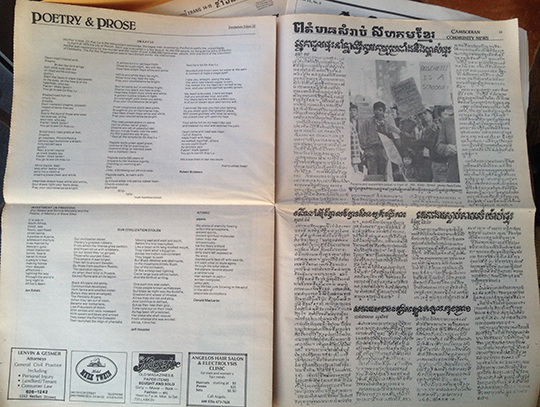
Several papers served neighborhoods with large refugee and immigrant populations, many of whom didn’t speak or read English. The Tenderloin Times promoted social services and encouraged activism through coverage of Southeast Asian and local politics, while publishing simultaneously in English, Lao, Cambodian, and Vietnamese over its two-decade run. Others chronicled changes in demographics, including an influx of Chinese residents into Visitation Valley and a population shift in the Mission from predominately Chicano to more Central Americans.

The Noe Valley Voice also took an international turn when escaped Irish prisoner Liam Carl toured the U.S. to expose harsh conditions in British jails. Carl entered the country illegally and was housed in a Noe Valley home in the fall of 1980, telling the Voice, “If [prisoners] thought that perhaps there was a chance that they could be heard through less drastic measures … and maybe bring about some change without so many people having to die, perhaps I can save lives.”

While the newspapers often differed in their coverage, each featured complementary stories chronicling the 1989 Loma Prieta earthquake. Common features included how to check for damage, profiles on restaurants that fed the neighborhood or, as one Noe Valley Voice headline described the experience of meeting neighbors during a power outage: “We Could See the Stars.” Ahead of the 25th anniversary in October, Found SF has examples of quake coverage online.

“It makes me think that the city is comprised of all these little villages and it’s a little hard to say San Francisco has one direction, one value system,” Elliott said. “The papers show the wide variety of people who live in the city … but it’s all very much at a very personal level. They know each other. They’re telling stories about each other.”

For more information on the neighborhood newspaper archiving project, or to volunteer, visit foundsf.org.


Stored power

0

rebecca@sfbg.com

BASED ON EARTH

For this second installment of our environmental news column, we’re looking at climate change from wildly different perspectives. We’ll explore whether local green-tech manufacturing firms can help wean California off fossil fuels, highlight some key data from the National Climate Assessment, and hear from an Amazonian shaman who’s fed up with white people making a mess of the planet and his home territory.


STASHING ELECTRONS

A new green technology sector in the Bay Area could help find the missing puzzle piece needed to establish a sustainable clean-energy mix for the state’s future.

Californians continue to rely on a majority of electricity sources that are environmentally unfriendly: natural gas, nuclear power, and even coal. Generating electricity by burning fossil fuels contributes to air pollution, consumes vast quantities of freshwater, and releases greenhouse-gas emissions, exacerbating global climate change.

But this is all starting to change. Since California requires utilities to convert one-third of their energy mix to renewable sources by 2020, there’s incentive for investment in carbon-free alternatives, such as wind and solar. Meanwhile, procurement decisions at the California Public Utilities Commission have pushed utilities to purchase more renewable power.

“Solar is succeeding beyond people’s expectations around the world,” because pricing has come down, said Julie Blunden, a consultant and energy-sector expert who formerly served as vice president at SunPower. “California set itself up to say, ‘we’re for changes to our power sector.'”

But renewables have an inherent problem — the power they produce can’t always be tapped just when it’s needed. Without some way to store the electricity generated by a wind or solar array, to be kept on hand for when demand hits a peak, wind and solar are unreliable for primary energy generation because they’re subject to fluctuations in wind and natural light. This is where energy storage comes in.

Throughout the Bay Area, companies specializing in battery manufacturing are starting to gain traction, with 11 regional battery manufacturers enrolling in CalCharge, an accelerator program for energy storage created with help from the U.S. Department of Energy and the California Clean Energy Fund.

CalCharge gives regional energy-storage companies access to national laboratories such as Lawrence Berkeley National Lab, facilities described by DOE renewables expert David Danielson as “science and engineering powerhouses at the forefront of clean energy innovation.”

One of the first grid-scale energy storage firms to join CalCharge is EnerVault, a flow battery manufacturer that’s working on a major installation in Turlock that will be co-located with a tracking solar system and an electric irrigation pump.

“The little dark secret about solar is that it’s intermittent,” explained Tom Steipen, CEO of Primus Power, a flow battery manufacturing firm based in Hayward that recently joined CalCharge.

On cloudy days, solar arrays won’t produce as much power. Wind presents similar challenges: “Wind in North America is stronger at night — but we don’t need it at night, we need it in the afternoon. So anything you can do to de-couple the instantaneous supply from demand is good for the environment, good for the economy, and that’s what energy storage does. … I like to describe it as a warehouse of electrons.”

Primus makes energy pods — an array of batteries that stand about six feet tall, placed in two rows within a shipping container — fed by renewable power arrays and tied in with the grid.

The pods can be stacked in Lego-like fashion, enabling more energy storage. They are then positioned beside a second shipping container, outfitted with equipment to convert stored DC power to AC power that can be sent over transmission lines.

Primus Power plans to make one of its first energy pod shipments to Miramar, the site of a marine base near San Diego where the movie Top Gun was filmed. The base is powered with its own contained micro-grid, but it was impacted by brownouts a couple years ago. With this project, Primus faces a test for its energy pods, which are estimated to last up to 20 years: Can the flow batteries, in combination with solar, produce reliable electricity for three full days?

If the pods can supply a smooth power supply, Primus wins — but more importantly, it will be a vote of confidence for carbon-free energy sources as significant sources of electricity generation.


“MONEY WON’T SAVE THE WORLD”

Davi Kopenawa is sometimes called the “Dalai Lama of the Rainforest.” He’s a shaman, activist, and spokesperson for his Yanomami tribe, the largest relatively isolated tribe in South America, which lives according to traditional indigenous ways in territory located within the Brazilian Amazon.

After years of battling the Brazilian government, Kopenawa and his people won a successful campaign for demarcation of the Yanomami territory in 1992. He co-wrote a book, The Falling Sky, with French anthropologist Bruce Albert, recently published by the Harvard University Press.

Today, the Yanomami are facing new pressures. Mining speculators are encroaching into their indigenous territory, causing fears of displacement, environmental destruction, and disease. In the past, exposure to disease brought dire consequences, resulting in widespread fatalities.

Kopenawa recently made a rare visit to San Francisco, giving talks at the Presidio Trust, UC Berkeley, and City Lights Books — and we got the chance to interview him while he was here.

Speaking via translation provided by Fiona Watson, research director of the human rights organization Survival International, Kopenawa talked about the Yanomami’s looming worries of environmental destruction and displacement that could be ushered in by mining companies.

“People are returning, invading it again, and repeating exactly what happened 20 years ago,” he told us. “These people are mainly gold miners who are looking for the riches of the Earth … They’re looking for oil, diamonds, and other precious materials, which is what white people want.”

He travels in part to seek support from the international community. “The majority of Yanomami have never left their land — they haven’t come out like I have,” he said. “So they don’t really see at close quarters how we are fighting against the politicians. However, the Yanomami and I, we continue to fight.”

Kopenawa had a lot to say about climate change and what has been done so far to address it: “All of you, the governments, the white people, need to listen to us, if you want to control the rich people who are always there … seeking raw materials from the earth, cutting down the forests, destroying the rivers.”

Indigenous leaders have spoken out internationally on the issue of climate change, he added, but the message has fallen on deaf ears. “They had the big UN climate meeting in Copenhagen,” he said. “But that didn’t result in anything. They only wasted money. They made us think that the city people would resolve things, but they couldn’t. The problem is the governments don’t listen. … The problem really is about capitalism, that’s at the root of the problem.”

Kopenawa’s perspective as a shaman in an indigenous culture is radically different from the world of government and politics, and he shakes his head at what he sees as utter complacency when it comes to implementing meaningful change.

“They’re only interested in the Internet, in paper, building more roads, stripping out the riches of the earth, destroying the trees,” he said. “We are different. We see the dangers, and we see that they are getting nearer. The cities are growing, the population is growing, and so the pollution is growing. There’s a lot of money in the world…But money won’t save the world.”

He advocates a new way of thinking about human progress.

“People have to stop thinking about ‘progress,’ which is pulling out the riches of the earth, and negotiating and doing business and having money all the time,” he said. “This is the error of the city people. I’ve tried to tell the city people, you need to minimize this problem of the climate, or else it will stop raining. And it will keep getting hotter.”


MORE WILDFIRES, LESS WATER

The Obama Administration unveiled the third National Climate Assessment on May 6, a hefty document detailing climate change impacts facing every region of the U.S.

Unsurprisingly, California’s own climate-related woes stem from water scarcity. Here are some details:

More money needed for drinking water. “Climate change will increase the cost of maintaining and improving drinking water infrastructure [estimated at $4.6 billion annually as things stand], because expanded wastewater treatment and desalinating water for drinking are among the key strategies for supplementing water supplies.”

Market impacts on delicious agricultural products. “California produces about 95 percent of U.S. apricots, almonds, artichokes, figs, kiwis, raisins, olives, cling peaches, dried plums, persimmons, pistachios, olives, and walnuts, in addition to other high-value crops. Drought and extreme weather affect the market value of fruits and vegetables more than other crops because they have high water content.”

More wildfires. “Numerous fire models project more wildfire as climate change continues. Models project … up to a 74 percent increase in burned area in California, with northern California potentially experiencing a doubling under a high emissions scenario toward the end of the century.”

Based on Earth is a monthly column by Guardian News Editor Rebecca Bowe.

Carmageddon cometh

42

news@sfbg.com

STREET FIGHT

San Francisco — already overwhelmed with private automobiles — faces a grim future of gridlock unless there is a radical change in how we think about city streets, parking, and regional transportation.

The facts are clear. Every day there are 1.7 million private car trips to, from, or within the city, according to the city’s transportation plan. Coupled with almost 10,000 vehicles registered per square mile, San Francisco today has one of the densest concentrations of cars on the planet, more than any peer city in the United States. In the business-as-usual scenario, the streets are forecast to absorb another half-million car trips. By 2040 there will be 2.2 million car trips on the exact same street grid we have today.

This is madness and it is dysfunctional for everyone. If you think Muni is unreliable now, it will be useless in 2040 as it stalls in the morass of 2.2 million car trips jammed onto city streets. Pedestrian injuries and deaths will rise with another 160 cars hitting pedestrians annually, simply due to oversaturation of automobiles. Cyclists might be able to weave around the stalled traffic, but it will be an ugly scene that fouls the air. Motorists will be stuck in their own gridlock, evermore impatient, distracted, honking, lurching through blocked intersections, sneaking through yellow lights, blocking crosswalks, double parking, and irritated with fellow drivers and everyone around. No one will be happy

This does not have to be. The city’s transportation agency hopes to reduce car trips from 1.7 to 1.6 million by 2018, a modest goal but barely holding the line. Reducing existing car trips by 100,000 while also adding thousands upon thousands of housing units and jobs, most coming with more parking, will quickly undo this humble ambition. The city can do more and the data shows us that there are many opportunities.

Consider that 68 percent of car trips within San Francisco are less than three miles. That’s 650,000 car trips per day that are generally pretty short — with a bicycle it’s less than a half-hour ride on relatively even terrain. If the city were able to get half of those car trips to switch to bicycle trips, it would be well on its way to averting carmageddon.

A more ambitious goal, increasing cycling to 20 percent of all trips, is the official city policy adopted by the Board of Supervisors. That’s 500,000-600,000 trips by bicycle every day, most of which can take place within that three-mile range, especially if cleverly arranged “wiggles” (level routes circumventing steeper hills) are laid out on the most logical corridors. But to carry that many cyclists, real space has to be allocated for them.

Out at San Francisco State University, where I teach a new Bicycle Geographies course that aims to increase cycling to the campus, there is tremendous opportunity to shift these kinds of short trips to bicycling. For students, faculty, and staff, bicycling is compatible with rapid transit, particularly for the “last mile” segments, such as between BART and SF State.

Bicycling is also a way to relieve local bus and light rail transit crowding — the 28 bus line on 19th Avenue, for example, is often jam packed and the city has only modest goals to improve that key line. Unlike transit or highways, bicycles do not require costly, long-term capital investment or operating funds and so can be deployed much more quickly.

It will be decades and cost hundreds of millions to improve the M-line, only now in the planning phase. We can lay down cycletracks much more quickly. Bicycling is also among the most equitable forms of urban transportation because it is affordable and accessible to almost everyone. This is obviously relevant to working-class students at SF State.

SF State has a memorandum of understanding with the city that obliges the university to reduce drive-alone automobile trips to campus, and the campus will not build any more car parking. With 4 percent of commute trips to SF State by bicycle (and only 2 percent among faculty) there is potential to increase the mode-share of bicycling as a path to reducing greenhouse gas emissions and auto trips.

The spatial proximity to Daly City and Balboa Park BART stations, as well as the Excelsior and Sunset, all under three miles from campus, means that the bicycle is well-suited to be a substitute for many short-range automobile trips and help the campus meet its goals. Yet what my students have found this semester is that it is all but impossible to bike safely to and from SF State, and the southwestern quadrant of San Francisco is largely left out of current bicycle planning in the city.

Taking multiple bicycle field trips over the past few months, we surveyed the opportunities for making safe routes to campus and envisioned what it would take to increase cycling to 20 percent of trips to and from SF State. Starting with the Balboa Park station, which is next to a deplorable tangle of freeway ramps, we ask what it would look like if fully-separated cycletracks were built on Geneva or Ocean avenues. These could connect City College and the Excelsior, and by way of a westward and southward jog, to a bicycle boulevard on Holloway Avenue, enabling a safe and convenient, 1.7-mile, 15-minute bike ride to SF State. Expanding the nascent Bay Area Bike Share to connect SF State and Balboa Park BART would create even more opportunity for cycling.

To the south of SF State, Daly City BART is a 1.4-mile, 10-minute bike ride that is daunting and poorly signed. It could be made safe and inviting with bicycle boulevards on streets parallel to traffic-clogged 19th Avenue and Junipero Serra. Borrowing from signature bicycle and pedestrian bridges in Pleasant Hill and Berkeley, perhaps there is an opportunity to build a bridge across Brotherhood Way toward the BART station, leveling an otherwise steep climb that discourages cycling.

To the north of campus, describing the designated 20th Avenue bicycle route as “a bit of a challenge” is an understatement. Cyclists must thread a cluttered shopping mall parking lot and overbuilt wide streets, and then confront a median blockading the way across Sloat Boulevard. While the megaproject to improve the M-line could include a cycletrack on this stretch of 19th Avenue, we should not wait a generation to increase cycling between SF State and the Sunset. The 20th Avenue route can be made welcoming now, with a fully-separated cycletrack and fixes on the Sloat intersection.

SF State, probably one of the most diverse campuses in the nation, has highly motivated students seeking real solutions to the huge problems society faces. The students are coming of age under extreme pressure of economic inequity and ecological duress, but they also see ways out of the mess created by the wasteful car culture and its linkages to ecological and social problems. They want to act now, and unlike past generations, they are shunning driving and many of them desire to reside in livable cities that offer choices for how they get around.

But what we have found this semester is that the campus is extremely isolated, difficult to access by bicycle, and walled-off by car sewers. Older, uninviting bicycle lanes are fragmented, disjointed, and seem to be an afterthought. With imagination, ingenuity, and political will, this can be remedied with bicycle improvements that cost far less than adding more car lanes and parking to the campus or surrounding area. And this would go much further at improving quality of life for neighbors who now have to put up with campus-generated traffic. Keeping the status quo, which means even more car trips but within the same space, is a dead end.


TRANSBAY DREAMS

Speaking of dead ends, San Francisco seems to specialize in dead-end train projects. The Central Subway, which is experiencing cost overruns and possible mismanagement, is one of these dead ends. There is no current option to have trains exiting to Geary or onto Columbus and possibly running on Lombard into the Marina, and that is a shame. Having the subway exit to the surface is probably the only way to make this project worthwhile.

There’s another dead end train project at the Transbay Terminal in downtown San Francisco. Yet unlike the Central Subway quagmire, I am impressed with the scale and possibilities for the Transbay Terminal project and there is opportunity to fix this dead end. Going back to the city’s business-as-usual traffic forecast, in 2040 car trips into the city from the Bay Bridge would increase 18 percent, and by 21 percent from San Mateo County. Aside from scratching my head wondering where exactly all of these cars are supposed to go, we simply need to stop this onslaught before the city becomes too dumb to move.

BART cannot solve it alone, as it will probably approach half a million riders per day by 2016, placing many downtown stations at or near capacity. BART also does not run all the way down the peninsula. Sometimes there are back-of-the envelope proposals to build a second BART tunnel under the bay, but this idea should be weighed against another idea. Rather than build a second BART tunnel to Oakland, how about a joint Amtrak California/Caltrain tunnel under the bay, and creating a true Grand Central Station of the West at Transbay? Let’s punch through the dead end currently planned for the east end of the Transbay Terminal “train box” and truly connect Northern California by rail.

This does not need to be high-speed rail, but rather the conventional, off-the-shelf electric rail already planned for Caltrain, of the variety that operates in the Northeastern US and much of Europe — efficient, high capacity trains that can travel 100-120 mile per hour comfortably and safely. In conjunction with a new transbay rail tunnel, the Capitol Corridor should be electrified and right of way captured from the freight railroads. One could take an electrified “baby bullet” from San Jose, through San Francisco, and continue to the East Bay and Sacramento. As Caltrain is electrified to the south, let’s also electrify the Altamonte Commuter Express trains, bring them across a rebuilt Dumbarton Bridge, and run high-frequency rail service into the new Transbay Terminal.

Understanding that this will take time to build, in the short term the Bay Bridge should be reconfigured to have bus-only lanes (and a bicycle lane on the bottom deck of the west span) and a greatly expanded AC Transit service that can relieve the looming BART crowding to the East Bay.

How to pay for these transbay dreams? A transbay rail project could get funding from Amtrak and other federal sources, requiring our congressional delegation to work for it. The state gasoline tax or eventual carbon taxes, and revenue from tolling Bay Area freeways, should be in the mix. The 101 and 280 should be tolled as well as the Caldecott Tunnel and I-80 in the East Bay, with revenue directed at electric rail in the long term and regional buses short term. And while people are talking about reforming Proposition 13 to end the artificially low property taxes on commercial land, let’s remember that transit — whether Muni, BART, or Caltrain — brings massive value to commercial property owners. They should be realistically expecting to pay in. In short, there are possibilities and ways to do this.

Here’s one small additional idea for raising seed money: In the wake of the Google bus controversy, the SFCTA, SFMTA, SF Planning Department, and City Attorney’s Office should assemble a crack team of California Environmental Quality Act experts and send them (on Caltrain and bike share!) down to comment on every large-scale suburban office project proposed in Silicon Valley. For example, Mountain View, where Google has its campus, is effectively displacing part of its transportation and housing responsibility to San Francisco.

As part of the CEQA mitigation for these suburban office projects, San Francisco ought to be demanding that Google/ Mountain View contribute to paying for the Transbay Terminal and electrifying Caltrain (a separate fund would be directed to affordable housing as mitigation for displacement). This is a similar line of reasoning to the May 1 lawsuit against the Google bus pilot, but it draws in those responsible for the poor planning in suburban sprawl. Regardless, the city ought to take a look at a CEQA mitigation angle for addressing the impacts these suburban decisions are having on the city.


PRAYING FOR ENLIGHTENMENT

One last point about transit finance: I sure hope Mayor Ed Lee, his political advisors, and all those religious ministers who complained about paying for metered parking on Sundays (see “Politics over policy,” April 22) have a plan to advocate for the November ballot proposals to help finance Muni.

They sold out sustainable transit advocates, their biggest ally on the November ballot initiatives, and have offered no rational explanation for their strategy, just an emotional hunch that somehow some people can’t cope with Sunday metering, and that making it free again will convince them to support increased public transit funding.

I imagine there is a well-thought-out campaign strategy, whereby every Sunday between now and November, the mayor is visiting all the churches in the city, and cajoling the ministers to use their pulpits to enthusiastically preach the merits of increasing the vehicle license fee (as well as approving a related general obligation bond).

After all, the VLF is a progressive tax — the more expensive your car, the more you pay. The older and cheaper your car, the less you pay. And bringing in $73 million annually would contribute to making God’s green earth cleaner, and help transport God’s children safely to work and on their errands. Praise the Lord and free parking on Sunday! Amen.

Street Fight is a monthly column by Jason Henderson, a geography professor at SF State and the author of Street Fight: The Politics of Mobility in San Francisco.

Politics trumps police oversight

4

EDITORIAL

A proven advocate for the public interest was removed from the San Francisco Police Commission last week. Not only was this a missed opportunity for stronger civilian oversight at a time when the San Francisco Police Department is under federal scrutiny, it raises disturbing implications about how things get done in City Hall.

The Board of Supervisors voted to oust Police Commissioner Angela Chan, voting 7-4 to strike Chan’s name from the appointment and replace it with contender Victor Hwang instead. City Hall insiders privately explained that Chinatown power broker Rose Pak, a friend of Mayor Ed Lee who wields great political influence, pressured supervisors to vote for Hwang specifically because she and her allies wanted Chan to be ousted. Supervisors who could not be relied upon to vote for Hwang were even reportedly cautioned that they shouldn’t be too vocal about their positions.

A civil rights attorney who proved effective and independent as a commissioner, Chan often directed pointed questions at police, for example drilling down on the finer details of officer-involved shootings.

Hwang, also a civil rights attorney, is qualified and respected, but he didn’t need to replace Chan. There’s another vacant seat on the commission — up to Mayor Ed Lee to appoint — so this vote was never about Hwang’s qualifications versus Chan’s. There was room for both.

This was about political patronage, pure and simple. It was about getting rid of an independent voice and replacing her with the former chair of the “Run Ed Run” committee, which urged Lee to break his pledge and run for mayor — a tradeoff that hurts police accountability.

Having two civil rights attorneys on the Police Commission would have sent a strong signal that the city is serious about addressing police misconduct at a time when the SFPD officers are facing federal charges for alleged civil rights violations (see “Crooked cops, March 4).

Supervisors should have called upon Lee to appoint Hwang rather than ousting Chan. Instead, the board majority was unwilling to challenge the consolidated power of Lee and his well-connected allies, who conducted an anti-democratic closed-door lobbying effort.

Board President David Chiu, who is running for Assembly, stated at the meeting that he’d asked Lee about appointing Hwang to the vacant seat, only to be told: “It is not something that will happen.”

So Chiu was unwilling to question the mayor’s bizarre refusal to appoint a candidate that Lee’s own allies were furiously advocating for. Instead of pushing for stronger civilian oversight of police, Chiu and six other supervisors voted to oust a commissioner with a proven track record.

If elected officials are casting votes for personal advancement, or out of fear that they’ll be rendered ineffective as punishment for pissing off the wrong people, then San Franciscans have a big problem: Their local government is beholden to the whims of entrenched power.


Dick Meister: The real May Day

2


By Dick Meister

May Day. A day to herald the coming of Spring with song and dance, a day for
children with flowers in their hair to skip around beribboned maypoles, a
time to crown May Day queens.

But it also is a day for demonstrations heralding the causes of working
people and their unions such as are being held on Sunday that were crucial
in winning important rights for working people. The first May Day
demonstrations, in 1886,  won the  most important of the rights ever won by
working people ­ the right demanded above all others by the labor activists
of a century ago:

“Eight hours for work, eight hours for rest, eight hours for what we will!”

Winning the eight-hour workday took years of hard struggle, beginning in the
mid-1800s. By 1867, the federal government, six states and several cities
had passed laws limiting their employees’ hours to eight per day. The laws
were not effectively enforced and in some cases were overturned by courts,
but they set an important precedent that finally led to a powerful popular
movement.

The movement was launched in 1886 by the Federation of Organized Trades and
Labor Unions, then one of the country’s major labor organizations. The
federation called for workers to negotiate with their employers for an
eight-hour workday and, if that failed, to strike on May 1 in support of the
demand.

Some negotiated, some marched and otherwise demonstrated.  More than 300,000
struck. And all won strong support, in dozens of cities ­ Chicago, New York,
Baltimore, Boston, Milwaukee, St. Louis, San Francisco, Pittsburgh, Denver,
Indianapolis, Cincinnati, Detroit, Washington, Newark, Brooklyn, St. Paul
and others.

More than 30,000 workers had won the eight-hour day by April. On May Day,
another 350,000 workers walked off their jobs at nearly 12,000
establishments, more than 185,000 of them eventually winning their demand.
Most of the others won at least some reduction in working hours that had
ranged up to 16 a day.

Additionally, many employers cut Saturday operations to a half-day, and the
practice of working on Sundays, also relatively common, was all but
abandoned by major industries.

“Hurray for Shorter Time,” declared a headline in the New York Sun over a
story describing a torchlight procession of 25,000 workers that highlighted
the eight-hour-day activities in New York. Never before had the city
experienced so large a demonstration.

Not all newspapers were as supportive, however. The strikes and
demonstrations, one paper complained, amounted to “communism, lurid and
rampant.” The eight-hour day, another said, would encourage “loafing and
gambling, rioting, debauchery, and drunkenness.”

The greatest opposition came in response to the demonstrations led by
anarchist and socialist groups in Chicago, the heart of the eight-hour day
movement. Four demonstrators were killed and more than 200 wounded by police
who waded into their ranks, but what the demonstrators¹ opponents seized on
were the events two days later at a protest rally in Haymarket Square. A
bomb was thrown into the ranks of the police who had surrounded the square,
killing seven and wounding 59.

The bomb thrower was never discovered, but eight labor, socialist and
anarchist leaders ­ branded as violent, dangerous radicals by press and
police alike ­ were arrested on the clearly trumped up charge that they had
conspired to commit murder.  Four of them were hanged, one committed suicide
while in jail, and three were pardoned six years later by Illinois Gov. John
Peter Altgeld.

Employers responded to the so-called Haymarket Riot by mounting a
counter-offensive that seriously eroded the eight-hour day movement’s gains.
But the movement was an extremely effective organizing tool for the
country’s unions, and in 1890 President Samuel Gompers of the American
Federation of Labor was able to call for “an International Labor Day” in
favor of the eight-hour workday. Similar proclamations were made by
socialist and union leaders in other nations where, to this day, May Day is
celebrated as Labor Day.

Workers in the United States and 13 other countries demonstrated on that May
Day of 1890 ­ including 30,000 of them in Chicago. The New York World hailed
it as “Labor’s Emancipation Day.” It was. For it marked the start of an
irreversible drive that finally established the eight-hour day as the
standard for millions of working people.

Bay Guardian columnist Dick Meister, formerly labor editor of the SF
Chronicle and KQED-TV, has covered labor and politics for a half-century as
a reporter, editor, author and commentator. Contact him through his website,
dickmeister.com, which includes several hundred of his columns.

(The Bruce blog is written and edited by Bruoe B. Brugmann, editor at large of the Guardian. He is the former editor of the Guardian and with his wife Jean Dibble the co-founder and co-publisher of the Guardian,1966-2012.)

Political power play unseats SF Police Commissioner who fought Secure Communities

48

Police Commissioner Angela Chan fought the federal government as they unjustly tried to deport undocumented San Franciscans who were guilty of no crimes, and won.

She fought to arm the SFPD with de-escalation tactics instead of Tasers, and won again. 

But at today’s Board of Supervisors meeting, Chan lost.The board denied her reappointment to the Police Commission, and seven supervisors voted to appoint her opponent, Victor Hwang, instead.

I can see the writing on the wall and the way the votes are coming down,” Supervisor Eric Mar said to the board just before the vote. “It’s a sad day for the immigrant rights movement when a strong leader cannot be reappointed. Its a a sad day when a woman standing up for immigrant justice is not reappointed.”

The decision came after heated backdoor politicking by Chinatown political leader Rose Pak, insiders told us. Politicians involved would only speak on background, for fear of reprisal from Pak, but openly told the Guardian that Pak felt Chan spent too much time advocating for other communities of color, instead of just focusing on issues affecting Chinatown.

Chan gained national recognition for her work against Secure Communities, or S-Comm, a program that allows U.S. Immigration and Customs Enforcement to hold undocumented persons they’d later like to deport, often indefinitely.

Pak came out swinging against Chan in the wake of those battles, we were told, because they diverted from efforts relating to Chinatown. Public records requests also show that Pak’s allies operated against Chan, demonstrating Pak’s influence.

A series of public records requests from the Guardian confirmed that Malcolm Yeung, a well-known “hatchet man” for Pak, emailed the Board of Supervisors with scores of support letters for Chan’s opponent, Hwang. One of those support letters came from noted Reverend Norman Fong, a powerful voice in the Chinatown community and the executive director of the Chinatown Community Development Center. 

For a full recap of the nasty politics that came out to slam Chan, check out our post from earlier today.

Sup. Katy Tang introduced the motion to strike Chan’s name from the appointment, and replace it with Hwang’s. 

We are lucky when we have such strong candidates,” Tang said. “However it is because of Victor’s sense of criminal justice and civil rights experience that we bring to a full vote to put Victor to the Police Commission.”

But other supervisors noted the obvious elephant in the room — there was not only one vacant seat on the police commission, but two. One appointed by the supervisors, the other appointed by Mayor Ed Lee.

Supervisor John Avalos suggested the Board of Supervisors make a motion to request the mayor appoint Hwang himself, allowing for both Chan and Hwang to be appointed, a compromise move that would benefit everyone.

[Mayor Ed Lee] could appoint Victor to the committee,” Avalos said to the board. “There’s room for both of them to be on the commission.”

But Board of Supervisors President David Chiu said he asked Mayor Lee that very question, and that he was denied.

“It’s something I asked,” he said. “It is not something that will happen.” He went on to note that both candidates were very well-qualified, but did not explain why he would support one over the other, saying: “It is not the practice of the mayor to solve difficult decisions of the board. It’s up to us.” 

Then Chiu said he would vote for Hwang, a surprising move. Chiu is running for state assembly on the notion that he is the compromise candidate, yet was unable to broker a compromise that was clearly in front of him: there were two vacant police commission seats, and two candidates. 

Chiu’s support for Hwang was especially surprising considering Rose Pak is oft-described as Chiu’s political enemy. One must wonder what political favors he gained for his support of Hwang. 

Kim repeatedly referenced her friendship with Hwang in the discussion leading up to the vote.

In the end, Supervisors Mark Farrell, Scott Wiener, Malia Cohen, London Breed, Jane Kim, Tang and Chiu voted to strike Angela Chan’s name from the appointment, and to vote to appoint Hwang instead.

I had a good four years on the commission,” Chan told the Guardian in a phone interview afterwards. “I was able to accomplish a lot, along with the many people who came out today to support me. People from the mental health, African American, Asian American and Latino communities. Hopefully with this experience they will become more organized and powerful as a community.”

After Victor Hwang’s victory, the Guardian stopped him outside of the board chambers to ask him: If Rose Pak helped you get your seat, are you beholden to Rose Pak?

The simple answer is no,” he told the Guardian. “She’ll have no more sway than anyone else. She’s a leader in the community, and there are many leaders in the community. I’ll make independent decisions for myself.”

His first priorities as a Police Commissioner, he said, would be what he called “the little things” — pedestrian safety by the Broadway tunnel, graffiti enforcement, and making sure calls for matters like break-ins are enforced in a timely manner. 

Hwang doesn’t want to start new projects right away, he said, because there are already big issues with the SFPD on the table. He said the Alejandro Nieto shooting would be a focus moving forward.

In our last story covering the shady politics behind Hwang’s appointment, we likened the political machines supporting him to the Game of Thrones House Lannister (the purported villains of the show). Hwang wanted to set the record straight. 

I think Ivy [his partner and Sup. Kim’s legislative aide] took one of those personality tests for me,” he said, “it came back as Jon Snow.”

Jon Snow is the closest thing Game of Thrones has to a hero.

Image below: A Guardian file photo of Victor Hwang, newly appointed by the Board of Supervisors to the Police Commission.

hwang

Guardian endorsements

139

OUR CLEAN SLATE VOTERS GUIDE TO TAKE TO THE POLLS IS HERE.


Editor’s Note: Election endorsements have been a long and proud part of the Guardian’s 48-year history of covering politics in San Francisco, the greater Bay Area, and at the state level. In low-turnout elections like the one we’re expecting in June, your vote counts more than usual, and we hope our endorsements and explanations help you make the best decisions.


GOVERNOR: JERRY BROWN

There is much for progressives to criticize in Jerry Brown’s latest stint as governor of California. He has stubbornly resisted complying with federal court orders to substantially reduce the state’s prison population, as well as shielding the system from needed journalistic scrutiny and reforms of solitary confinement policies that amount to torture. Brown has also refused to ban or limit fracking in California, despite the danger it poses to groundwater and climate change, irritating environmentalists and fellow Democrats. Even Brown’s great accomplishment of winning passage for the Prop. 30 tax package, which eased the state back from financial collapse, sunsets too early and shouldn’t have included a regressive sales tax increase. Much more needs to be done to address growing wealth disparities and restore economic and educational opportunity for all Californians.

For these reasons and others, it’s tempting to endorse one of Brown’s progressive challenges: Green Party candidate Luis Rodriguez or Peace and Freedom Party candidate Cindy Sheehan (see “Left out,” April 23). We were particularly impressed by Rodriguez, an inspiring leader who is seeking to bring more Latinos and other marginalized constituencies into the progressive fold, a goal we share and want to support however we can.

But on balance, we decided to give Brown our endorsement in recognition of his role in quickly turning around this troubled state after the disastrous administration of Arnold Schwarzenegger — and in the hope that his strong leadership will lead to even greater improvement over his next term. While we don’t agree with all of his stands, we admire the courage, independence, and vision that Brown brings to this important office. Whether he is supporting the California High-Speed Rail Project against various attacks, calling for state residents to live in greater harmony with the natural world during the current drought, or refusing to shrink from the challenges posed by global warming, Jerry Brown is the leader that California needs at this critical time.


LIEUTENANT GOVERNOR: GAVIN NEWSOM

Gavin Newsom was mayor of San Francisco before he ascended to the position of Lieutenant Governor, and we at the Bay Guardian had a strained relationship with his administration, to put it mildly. We disagreed with his fiscally conservative policies and tendency to align himself with corporate power brokers over neighborhood coalitions. As lieutenant governor, Newsom is tasked with little — besides stepping into the role of governor, should he be called upon to do so — but has nevertheless made some worthwhile contributions.

Consider his stance on drug policy reform: “Once and for all, it’s time we realize that the war on drugs is nothing more than a war on communities of color and on the poor,” he recently told a crowd at the Democratic Party convention in Los Angeles. “It is fundamentally time for drug policies that recognize and respect the full dignity of human beings. We can’t wait.” In his capacity as a member of the UC Board of Regents, Newsom recently voted against a higher executive compensation package for a top-level administrator, breaking from the pack to align with financially pinched university students. In Sacramento, Newsom seems to come off as more “San Francisco” than in his mayoral days, and we’re endorsing him against a weak field of challengers.


SECRETARY OF STATE: DEREK CRESSMAN

Although the latest Field Poll shows that he has only single-digit support and is unlikely to make the November runoff, we’re endorsing Derek Cressman for Secretary of State. As a longtime advocate for removing the corrupting influence of money from politics through his work with Common Cause, Cressman has identified campaign finance reform as the important first step toward making the political system more responsive to people’s needs. As Secretary of State, Cressman would be in a position to ensure greater transparency in our political system.

We also like Alex Padilla, a liberal Democrat who has been an effective member of the California Senate. We’ll be happy to endorse Padilla in November if he ends up in a runoff with Republican Pete Peterson, as the current polling seems to indicate is likely. But for now, we’re endorsing Cressman — and the idea that campaign finance reform needs to be a top issue in a state and country that are letting wealthy individuals and corporations have disproportionate influence over what is supposed to be a democracy.


CONTROLLER: BETTY YEE

The pay-to-play politics of Leland Yee and two other California Democrats has smeared the Assembly. Amid the growls of impropriety, a report by the Center for Investigative Reporting has painted Speaker of the Assembly John Perez, a leading candidate for Controller, with a similar brush. CIR revealed Perez raised money from special interest groups to charities his lover favored, a lover later sued for racketeering and fraud.

Betty Yee represents an opportunity for a fresh start. On the state’s Board of Equalization she turned down campaign donations from tobacco interests, a possible conflict of interest. She also fought for tax equity between same-sex couples. The Controller is tasked with keeping watch on and disbursing state funds, a position we trust much more to Yee’s careful approach than Perez’s questionable history. Vote for Yee.


TREASURER: JOHN CHIANG

While serving as California’s elected Controller, John Chiang displayed his courage and independence by refusing to sign off on budgetary tricks used by then-Gov. Arnold Schwarzenegger and some legislative leaders, insisting on a level of honesty that protected current and future Californians. During those difficult years — as California teetered on the brink of bankruptcy, paralyzed by partisan brinksmanship each budget season, written off as a failed state by the national media — Chiang and retiring Treasurer Bill Lockyer were somehow able to keep the state functioning and paying its bills.

While many politicians claim they’ll help balance the budget by identifying waste and corruption, Chiang actually did so, identifying $6 billion by his estimate that was made available for more productive purposes. Now, Chiang wants to continue bringing fiscal stability to this volatile state and he has our support.


ATTORNEY GENERAL: KAMALA HARRIS

Kamala Harris has kept the promise she made four years ago to bring San Francisco values into the Attorney General’s Office, focusing on the interests of everyday Californians over powerful vested interests. That includes strengthening consumer and privacy protections, pushing social programs to reduce criminal recidivism rather than the tough-on-crime approach that has ballooned our prison population, reaching an $18 billion settlement with the big banks and mortgage lenders to help keep people in their homes, and helping to implement the Affordable Care Act and the legalization of same-sex marriage in the state.

Harris has maintained her opposition to the death penalty even though that has hurt her in the statewide race, and she brings to the office an important perspective as the first woman and first African American ever to serve as the state’s top law enforcement officer. While there is much more work to be done in countering the power of wealthy individuals and corporations and giving the average Californian a stronger voice in our legal system, Harris has our support.


INSURANCE COMMISSIONER: DAVE JONES

We’ve been following Dave Jones’s legislative career since his days on the Sacramento City Council and through his terms in the California Legislature, and we’ve always appreciated his autonomy and progressive values. He launched into his role as Insurance Commissioner four years ago with an emergency regulation requiring health insurance companies to use no more than 20 percent of premiums on profits and administrative costs, and he has continued to do what he can to hold down health insurance rates, including implementing the various components of the Affordable Care Act.

More recently, Jones held hearings looking at whether Uber, Lyft, and other transportation network companies are adequately insured to protect both their drivers and the general public, concluding that these companies need to self-insure or otherwise expand the coverage over their business. It was a bold and important move to regulate a wealthy and prosperous new industry. Jones deserves credit for taking on the issue and he has earned our endorsement.


SUPERINTENDENT OF SCHOOLS: TOM TORLAKSON

This race is a critical one, as incumbent Tom Torlakson faces a strong challenge from the charter school cheerleader Marshall Tuck. An investment banker and Harvard alum, Tuck is backed by well-heeled business and technology interests pushing for the privatization of our schools. Tech and entertainment companies are pushing charter schools heavily as they wait in the wings for lucrative education supply contracts, for which charter schools may open the doors. And don’t let Waiting for Superman fool you, charter schools’ successful test score numbers are often achieved by pushing out underperforming special needs and economically disadvantaged students.

As national education advocate Diane Ravitch wrote in her blog, “If Tuck wins, the privatization movement will gain a major stronghold.” California ranks 48th in the nation in education spending, a situation we can thank Prop. 13 for. We’d like to see Torlakson advocate for more K-12 school dollars, but for now, he’s the best choice.


BOARD OF EQUALIZATION: FIONA MA

Fiona Ma was never our favorite member of the San Francisco Board of Supervisors, and in the California Legislature, she has seemed more interested in party politics and leadership than moving legislation that is important to San Francisco. There are a few exceptions, such as her attempts last year to require more employers to offer paid sick days and to limit prescription drug co-payments. But she also notoriously tried to ban raves at public venues in 2010, a reactionary bill that was rejected as overly broad.

But the California Board of Equalization might just be a better fit for Ma than the Legislature. She’s a certified public accountant and would bring that financial expertise to the state’s main taxing body, and we hope she continues in the tradition of her BOE predecessor Betty Yee in ensuring the state remains fair but tough in how it collects taxes.


ASSEMBLY, DISTRICT 17: DAVID CAMPOS

The race to replace progressive hero Tom Ammiano in the California Assembly is helping to define this important political moment in San Francisco. It’s a contest between the pragmatic neoliberal politics of Board of Supervisors President David Chiu and the populist progressive politics of Sup. David Campos, whom Ammiano endorsed to succeed him.

It’s a fight for the soul of San Francisco, a struggle to define the values we want to project into the world, and, for us at the Bay Guardian, the choice is clear. David Campos is the candidate that we trust to uphold San Francisco’s progressive values in a state that desperately needs that principled influence.

Chiu emphasizes how the two candidates have agreed on about 98 percent of their votes, and he argues that his effectiveness at moving big legislation and forging compromises makes him the most qualified to represent us in Sacramento. Indeed, Chiu is a skilled legislator with a sharp mind, and if “getting things done” — the prime directive espoused by both Chiu and Mayor Ed Lee — was our main criterion, he would probably get our endorsement.

But when you look at the agenda that Chiu and his allies at City Hall have pursued since he came to power — elected as a progressive before pivoting to become a pro-business moderate — we wish that he had been a little less effective. The landlords, tech titans, Realtors, and Chamber of Commerce have been calling the shots in this city, overheating the local economy in a way that has caused rapid displacement and gentrification.

“Effective for whom? That’s what’s important,” Campos told us during his endorsement interview, noting that, “Most people in San Francisco have been left behind and out of that prosperity.”

Campos has been a clear and consistent supporter of tenants, workers, immigrants, small businesses, environmentalists — the vast majority of San Franciscans, despite their lack of power in City Hall. Chiu will sometimes do right by these groups, but usually only after being pushed to do so by grassroots organizing and lobbying efforts.

Campos correctly points out that such lobbying is more difficult in Sacramento, with its higher stakes and wider range of competing interests, than it is on the local level. Chiu’s focus on always trying to find a compromise often plays into the hands of wealthy interests, who sometimes just need to be fought and stopped.

We have faith in Campos and his progressive values, and we believe he will skillfully carry on the work of Ammiano — who is both an uncompromising progressive and an effective legislator — in representing San Francisco’s values in Sacramento.


ASSEMBLY, DISTRICT 19: PHIL TING

Incumbent Phil Ting doesn’t have any challengers in this election, but he probably would have won our support anyway. After proving himself as San Francisco’s Assessor, taking a strong stance against corporate landowners and even the Catholic Church on property assessments, Ting won a tough race against conservative businessman Michael Breyer to win his Assembly seat.

Since then, he’s been a reliable vote for legislation supported by most San Franciscans, and he’s sponsoring some good bills that break new ground, including his current AB 1193, which would make it easier to build cycletracks, or bike lanes physically separated from cars, all over the state. He also called a much-needed Assembly committee hearing in November calling out BART for its lax safety culture, and we hope he continues to push for reforms at that agency.


PROPOSITION 41: YES

Over a decade ago, Californians voted to use hundreds of millions of our dollars to create the CalVet Home and Farm Loan Program to help veterans purchase housing. But a reduction in federal home loan dollars, the housing crisis, and a plummeting economy hurt the program.

Prop. 41 would repurpose $600 million of those bond funds and raise new money to create affordable housing rental units for some of California’s 15,000 homeless veterans. This would cost Californians $50 million a year, which, as proponents remind us, is one-tenth of 1 percent of the state budget. Why let hundreds of millions of dollars languish unused? We need to reprioritize this money to make good on our unfulfilled promises to homeless veterans.


PROPOSITION 42: YES

This one’s important. Last year, Gov. Jerry Brown sought to gut the California Public Records Act by making it optional for government agencies to comply with many of the requirements built into this important transparency law. The CPRA and the Ralph M. Brown Act require government agencies to make records of their activities available for public scrutiny, and to provide for adequate notice of public meetings. Had the bill weakening these laws not been defeated, it would have removed an important defense against shadowy government dealings, leaving ordinary citizens and journalists in the dark.

Prop. 42 is a bid to eliminate any future threats against California’s important government transparency laws, by expressly requiring local government agencies — including cities, counties, and school districts — to comply with all aspects of the CPRA and the Brown Act. It also seeks to prevent local agencies from denying public records requests based on cost, by eliminating the state’s responsibility to reimburse local agencies for cost compliance (the state has repeatedly failed to do so, and local bureaucracies have used this as an excuse not to comply).


SF’S PROPOSITION A: YES

Prop. A is a $400 million general obligation bond measure that would cover seismic retrofits and improvements to the city’s emergency infrastructure, including upgrades to the city’s Emergency Firefighting Water System, neighborhood police and fire stations, a new facility for the Medical Examiner, and seismically secure new structures to house the police crime lab and motorcycle unit.

The Board of Supervisors voted unanimously to place Prop. A on the ballot, and a two-thirds majority vote is needed for it to pass. Given that San Franciscans can expect to be hit by a major earthquake in the years to come, upgrading emergency infrastructure, especially the high-pressure water system that will aid the Fire Department in the event of a major blaze, is a high priority.


SF’S PROPOSITION B: YES

As we report in this issue (see “Two views of the waterfront”), San Francisco’s waterfront is a valuable place targeted by some ambitious development schemes. That’s a good thing, particularly given the need that the Port of San Francisco has for money to renovate or remove crumbling piers, but it needs to be carefully regulated to maximize public benefits and minimize private profit-taking.

Unfortunately, the Mayor’s Office and its appointees at the Port of San Francisco have proven themselves unwilling to be tough negotiators on behalf of the people. That has caused deep-pocketed, politically connected developers to ignore the Waterfront Land Use Plan and propose projects that are out-of-scale for the waterfront, property that San Francisco is entrusted to manage for the benefit of all Californians.

All Prop. B does is require voter approval when projects exceed existing height limits. It doesn’t kill those projects, it just forces developers to justify new towers on the waterfront by providing ample public benefits, restoring a balance that has been lost. San Francisco’s waterfront is prime real estate, and there are only a few big parcels left that can be leveraged to meet the needs of the Port and the city. Requiring the biggest ones to be approved by voters is the best way to ensure the city — all its residents, not just the politicians and power brokers — is getting the best deals possible.


SF SUPERIOR COURT JUDGE: DANIEL FLORES

Daniel Flores has an impressive list of endorsers, including the Democratic, Republican, and Green parties of San Francisco — a rare trifecta of political party support. But don’t hold the GOP nod against Flores, who was raised in the Excelsior by parents who immigrated from El Salvador and who interned with La Raza Centro Legal while going to McGeorge School of Law. And he did serve in the Marines for six years, which could explain the broad range of support for him.

Flores is a courtroom litigator with experience in big firms and his own practice, representing clients ranging from business people to tenants fighting against their landlords. Flores told us that he wants to ensure those without much money are treated fairly in court, an important goal we support. We also liked Kimberly Williams and hope she ends up on the bench someday, but in this race, Flores is the clear choice.


CONGRESS, DISTRICT 12: NANCY PELOSI

This was a hard decision for us this year. Everyone knows that Pelosi will win this race handily, but in past races we’ve endorsed third party challengers or even refused to endorse anyone more often than we’ve given Pelosi our support. While Pelosi gets vilified by conservatives as the quintessential San Francisco liberal, she’s actually way too moderate for our tastes.

Over her 21 years in Congress, she has presided over economic policies that have consolidated wealth in ever fewer hands and dismantled the social safety net, environmental policies that have ignored global warming and fed our over-reliance on the private automobile, and military policies that expanded the war machine and overreaching surveillance state, despite her insider’s role on the House Intelligence Committee.

Three of her opponents — Democrat David Peterson, Green Barry Hermanson, and fiery local progressive activist Frank Lara of the Peace and Freedom Party — are all much better on the issues that we care about, and we urge our readers to consider voting for one of them if they just can’t stomach casting a ballot for Pelosi. In particular, Hermanson has raised important criticisms of just how out of whack our federal budget priorities are. We also respect the work Lara has done on antiwar and transit justice issues in San Francisco, and we think he could have a bright political future.

But we’ve decided to endorse Pelosi in this election for one main reason: We want the Democrats to retake the House of Representatives this year and for Pelosi to once again become Speaker of the House. The Republican Party in this country, particularly the Tea Party loyalists in the House, is practicing a dangerous and disgusting brand of political extremism that needs to be stopped and repudiated. They would rather shut the government down or keep it hopelessly hobbled by low tax rates than help it become an effective tool for helping us address the urgent problems that our country faces. Pelosi and the Democrats aren’t perfect, but at least they’re reasonable grown-ups and we’d love to see what they’d do if they were returned to power. So Nancy Pelosi has our support in 2014.


CONGRESS, DISTRICT 13: BARBARA LEE

Barbara Lee has been one of our heroes since 2001, when she was the only member of Congress to vote against the Authorization for the Use of Military Force Against Terrorists, braving the flag-waving nationalism that followed the 9/11 attacks on the World Trade Center and Pentagon to warn that such an overly broad declaration of war was dangerous to our national interests. She endured death threats and harsh condemnation for that principled stand, but she was both courageous and correct, with our military overreach still causing problems for this country, both practical and moral.

Lee has been a clear and consistent voice for progressive values in the Congress for 16 years, chairing both the Congressional Black Caucus and Congressional Progressive Caucus, taking stands against capital punishment and the Iraq War, supporting access to abortions and tougher regulation of Wall Street, and generally representing Oakland and the greater Bay Area well in Washington DC. She has our enthusiastic support.


CONGRESS, DISTRICT 14: JACKIE SPEIER

Jackie Speier has given her life to public service — almost literally in 1978 when she was an aide to then-Rep. Leo Ryan and survived the airstrip shootings that triggered the massacre at Jonestown — and she has earned our ongoing support. Speier has continued the consumer protection work she started in the California Legislature, sponsoring bills in Congress aimed at protecting online privacy. She has also been a strong advocate for increasing federal funding to public transit in the Bay Area, particularly to Muni and for the electricification of Caltrain, an important prelude to the California High-Speed Rail Project. In the wake of the deadly natural gas explosion in San Bruno, Speier has pushed for tough penalties on Pacific Gas & Electric and expanded pipeline safety programs. She has been a strong advocate of women’s issues, including highlighting the epidemic of sexual assault on college campuses and in the military, seeking greater protections, institutional accountability, and recourse for victims. More recently, Speier has become a key ally in the fight to save City College of San Francisco, taking on the federal accreditation process and seeking reforms. Speier is a courageous public servant who deserves your vote.