Politics

Editor’s Notes

1

You want a really bleak picture of the politics of California today? Check out the recent comments of Dan Schnur, GOP political consultant and director of the Jesse Unrush Institute for Politics at the University of Southern California.

In an interview with the Los Angeles Times, Schnur discussed the disconnect between image and reality in this state: "Cut $1 billion out of Medi-Cal and most voters won’t notice," he said. "Take away some cell phones and make legislators sit on a picnic bench, and they pay attention."

Yeah, he’s a Republican who worked for the likes of George W. Bush and John McCain, but his point, while politically sick and wrong, is also sadly accurate. How much money will the state save by getting rid of 48,000 cell phones? About $20 million a year. That’s 0.08 percent of the state’s budget shortfall. What did Brown save by replacing a boardroom-style conference table in his office with a glorified picnic table? Probably a few thousand dollars. How much does the state continue to lose every year to the utter waste of corporate tax breaks? How much could we bring in with an oil-severance tax? Well into the multiple billions.

What got all the press? Jerry’s picnic table and cell phone crackdown.

I’m not against either of those moves. In tough times, it’s important to set the standards at the top, and living cheap and avoiding the imperial trappings of public office is a great way to instill voter confidence. And anything Brown can do to convince the voters that he’s serious about cutting waste — and that they can trust him enough with their money that they should vote yes on his tax plan — can only be good.

But it all seems so silly and shallow.

The truth is, when you cut Medi-Cal, people die. You can’t prove that any specific cut killed any individual, and most of them are poor anyway and the major media don’t make a big fuss every time a poor person dies. It’s not as sexy as some Caltrans worker having to give up a cell phone.

I think I’m going to throw up now.

Early indicators

13

Land use politics and the way development decisions are made at City Hall fed San Francisco’s ascendant progressive movement over the last decade. So in the wake of a still-unfolding political realignment, an early key vote is making some preservationists and developer foes nervous.

At the center of that concern is Sup. Jane Kim, who broke with her progressive colleagues Jan. 25 to be the swing vote in the board’s 6-5 approval of attorney Richard Johns to the historian’s seat on the Historic Preservation Commission. Progressives and preservationists opposed the nomination on the grounds that Johns isn’t a historian and that he has close ties to former Mayor Willie Brown, a friend of developers whose longtime chief of staff was Johns’ wife, Eleanor.

And they’re suspicious of Brown’s support – both overt and stealthy – for Kim’s supervisorial campaign (see “Willie Brown and the accusations of machine politics in D6,” 10/16/10, Guardian Politics blog).

Kim didn’t explain her vote at the full board meeting, and her comments at the Rules Committee (which she chairs) and to the Guardian that Johns “was qualified” and she could “see no reason not to support his nomination” irked many of her progressive supporters who consider development the big issue.

Feeding concerns about the potential blunting of historic preservation and other tools used to scrutinize development projects was the Jan. 25 announcement by Sup. Scott Wiener that he is calling for hearings into whether the commission is improperly hindering development and other policy priorities.

“The Historic Preservation Commission — and I supported the creation of the Historic Preservation Commission — has become an increasingly powerful commission reaching into a lot of different areas of policy in the city,” Wiener said during the discussion of Johns’ nomination, citing housing, parks, and libraries as areas the commission has affected. “It’s important to have a diversity of backgrounds and viewpoints on this commission, and if we’re going to have a committee made up exclusively of advocates for historic preservation, only advocates, that is a problem.”

Former board President Aaron Peskin, who led the effort to create the commission through the voter-approved Proposition J in 2008, disputes the allegation that the commission has become too powerful, as well as the claim that Johns is qualified to serve in the historian’s seat, one of six seats on the commission that now requires professional qualifications.

“The facts do not support Sup. Wiener’s allegations,” Peskin told us, noting that the Board of Supervisors and the mayor retain the authority to decide what is and isn’t historically significant. Yet Wiener said that even commission- and staff-level actions affect other city goals. “The conducting of a survey does have legal impact,” Wiener told us.

But Peskin said San Francisco has very few protected buildings compared with other major U.S. cities, something voters sought to change through Prop. J, and Peskin said he was disappointed that Kim didn’t support the law’s dictates. “This is the second time in 2011 when the slim alleged progressive majority has not stayed together,” he said, referring also to the election of David Chiu as board president.

Peskin and others who fight land-use battles say they don’t yet want to jump to the conclusion that developers might have an easier time with this board. “It’s my profound hope is that this is a learning experience,” Peskin said of Kim’s vote.

Veteran land use attorney Sue Hestor noted that neither Kim nor Wiener has a record on land use issues by which to judge them and she didn’t want to make a big deal of their Jan. 25 actions. Yet she said that development is a huge issue in the Tenderloin, SoMa, and Rincon Hill areas that Kim represents, so there are major tests of her progressive values coming soon.

“In District 6, it’s the defining issue because it’s the most explosive district in terms of growth,” Hestor said. “Land use is about who gets to live in the city.”


WHOSE CITY?

While most of the discussion about the Johns nomination focused on his qualifications as a historian — indeed, that was the basis of most of the opposition to his nomination, by both activists and progressive supervisors — there was some telling subtext focused on Hestor’s point that land use is the most fundamental progressive issue.

At the Jan. 20 Rules Committee meeting, Kim even asked Johns about his “vision for affordable housing as it related to preservation.” But the answer she received wasn’t terribly reassuring to those who see the lack of affordable housing for low-income city residents as a serious problem that the city is failing to address (see “Dollars or sense?” 9/29/10).

“San Francisco is made up of lots of different groups of people with lots of different backgrounds,” Johns said at the hearing, noting that it is important to “preserve the culture and the past that have brought us to where we are. But part of that past is the ability to grow.”

In an interview with the Guardian, Johns expanded on the point, sounding a more pro-growth point-of-view than many of his colleagues on the commission are likely to share. “Development and preservation can go hand-in-hand,” Johns said. “Maybe it’s the development that allows what might be a slowly deteriorating building to be fixed up properly.”

As an example, he cited his 20 years of work on preserving the Old Mint Building — his main claim to expertise as a historian — which was ultimately accomplished as part of the development project that included office and commercial development and the Mint Plaza public space.

“People of all income levels have a right to live in San Francisco,” Johns said, adding, “The real need some people would say is the need for middle class housing.” When we noted that it’s often the low-income residents who are ousted when old buildings get modernized, he said, “You have to think about the desirability of people to live in crummy housing.”

Chiu and Kim both downplayed the importance of the Johns vote. “People are trying to read too much into this,” Chiu said, explaining that he opposed the nomination because he simply felt Johns didn’t meet the criteria as a historian. “What was relevant is what city law says.”

Kim told us that it wasn’t until the full board meeting that she learned how her progressive colleagues felt about the matter, and that she didn’t want to change how she voted in committee. “It was not important enough for me to change my vote based on my verbal commitments,” Kim said later.

Yet on the evening of the vote, Kim told the Guardian that she felt “pressure” to support Johns, although she wouldn’t say from whom. “I was put in a bad position on this issue,” she said. Many progressives have speculated that pressure came from Brown, which Kim denies. “We didn’t talk about this, not once,” she said.

But in his Jan. 30 column in the San Francisco Chronicle, Brown crowed about the victory by “my friend Richard Johns” and called Chiu’s opposition to him “a mistake that could haunt him for some time,” saying Chiu has set up Sups. Malia Cohen and Kim “to be the swing votes on every issue where moderates and progressives split.”

Rebecca Bowe contributed to this report.

Bless this mess

0

arts@sfbg.com

FILM One of the most famous Korean films of its era — and notorious for its near-horror catalog of shocking behaviors — Kim Ki-young’s original 1960 The Housemaid took a caustic view of the new middle class emerging in a nation still crawling out from under the wreckage of war.

Its titular figure is not the sole but the third in a series of young women who bedevil an imperious yet apparently irresistible music professor, this one a smoker (gasp!) and thief hired as a domestic. When she succeeds where the others failed by seducing her employer, all further hell breaks loose. This lurid, recently restored wonder can’t quite make up its mind which is worse: the coldly exploitative bourgeoisie (even their children are obnoxious), or the specimens of youthful femininity who forever seem a heartbeat away from romantic hysteria manifesting itself in blackmail or stab wounds.

By contrast, Im Sang-soo’s extremely loose new remake — more of a complete rethink — has no doubt which side to blame. Its sole titular figure Eun-yi (Jeon Do-yeon) is pure innocent victim, a simple soul who can’t believe her luck at first in finding employment at what might easily be mistaken for a royal palace. But it’s just the humble home for Hoon (Lee Jung-jae), hard-bodied captain of politics and industry, and trophy wife Hera (Seo Woo), who is heavily pregnant with their second child. This job is not unlike being asked to dust at the Louvre, but our awed heroine is relieved to discover that her bosses are cultured and kind; their first child is a little angel; and even the stern chief housekeeper (Yun Yeo-jong, who gets a hilarious drunk scene) is made of softer stuff than she initially lets on.

But all this changes when Eun-yi lets herself be seduced by the master and gets pregnant. This triggers a series of acts (encouraged by Hoon’s particularly fearsome mother-in-law) that grow to encompass near-fatal “accidents,” poisonings, and lines like “How could that bastard do this to me? With the bitch who washes my underwear?!?”

Even farther from genre horror that its predecessor, this Housemaid is a glacially reserved black comedy that regards its characters as figures in a gorgeously expensive Architectural Digest landscape. As such it’s witty and entertaining until the very end, when the urge to go overboard can no longer be resisted (apparently), and an unconvincing final atrocity is followed by some sort of dream sequence that simply, ham-fistedly underlines what we already knew: the filthy rich are, well, in need of a moral wash. *

THE HOUSEMAID opens Fri/2 in Bay Area theaters.


Why I may run for Congress

12

OPINION One of the most inspiring political leaders in recent decades, Sen. Paul Wellstone (D-Minn.), famously declared: “I represent the democratic wing of the Democratic Party.” Today we need progressives in Congress who will represent the progressive wing of the Progressive Caucus.

That’s the largest caucus on Capitol Hill — but having 80 members on the roster won’t do much good if many cave under pressure.

For 18 years, the North Bay has been represented in Congress by Rep. Lynn Woolsey. Her strong antiwar voice and very progressive voting record have endeared her to a lot of constituents. Now she’s publicly saying that she may choose to retire instead of seeking reelection.

This week, after decades of working for progressive social change, I’m announcing a federal exploratory committee for Congress (www.NormanSolomonExploratory.com). If Rep. Woolsey doesn’t run in 2012, I will.

Across the country, alarm is rising as corporate power escalates at the intersection of Wall Street and Pennsylvania Avenue. An egregious factor is the deference to such power from some elected officials who rely on a progressive base for votes but shrug off tangible accountability to that base.

Dysfunctional relationships between liberals in Congress and progressive social movements serve as enablers for endless war, massive giveaways to Wall Street, widening gaps between the rich and the rest of us, erosion of civil liberties, outrageous inaction on global warming, and so much more.

Back in congressional districts, the only way to beat corporate Astroturf is with genuine grassroots activism — committed to creating a very different kind of future for the next generations.

At a time when high unemployment is becoming more protracted in tandem with a gargantuan warfare state, we’re in the midst of what Martin Luther King Jr. called “the madness of militarism.”

So-called moderates are adept at fine-tuning rather than challenging a destructive status quo. But there’s nothing moderate about helping to fuel the engines of social inequity, eco-disaster and perpetual war.

Eight decades ago, much of the U.S. press was hostile to a new president named Franklin D. Roosevelt, and many of his political enemies called him a dangerous radical. But there was — and is — nothing unduly radical about supporting economic fairness and social justice.

Before the end of his first term, FDR denounced “the economic royalists.” He said: “They are unanimous in their hate for me — and I welcome their hatred.” He did not say, “They hate me — and I want them to like me.”

Today, big money and mega-media power are dominant; yet progressives who are principled, determined, and methodical can prevail in a big way. That’s what happened last year when activists defeated PG&E’s monopolistic Proposition 16 despite being outspent by more than 400 to 1.

Living in the North Bay for more than a dozen years, I’ve often been moved by the extent of local progressive passions. Antiwar, environmental, and social justice outlooks are widespread — and deserve forthright representation in Congress.

Paul Wellstone was vitally correct when he said: “In the last analysis, politics is not predictions and politics is not observations. Politics is what we do. Politics is what we do, politics is what we create, by what we work for, by what we hope for, and what we dare to imagine.”


Norman Solomon is national co-chair of the Healthcare Not Warfare campaign, launched by Progressive Democrats of America. His books include War Made Easy: How Presidents and Pundits Keep Spinning Us to Death. For more information go to www.NormanSolomonExploratory.com.

Remembering John Ross

0

P>John Ross — poet, journalist, hell raiser, and iconic San Franciscan — died Jan. 16 of liver cancer, on the shores of Lake Patzcuaro in Mexico. He had been writing for the Guardian fairly consistently since 1982, for the last 25 years as our Mexico City correspondent.

I wrote a fairly lengthy obituary for him that’s posted on the politics blog at sfbg.com. There are so many stories to tell about John that it’s hard even to begin, but my favorite was his tale of the day he left Terminal Island, the federal prison near Los Angeles where he served more than two years for refusing the draft during the Vietnam War.

The warden saw him to the gates, he told me, and than shook his head and said, “Ross, you never learned how to be a prisoner.”

And that was pretty much the story of his life. He lived every day in the spirit of freedom and social justice. He was beaten by the police in the streets of San Francisco and lost an eye. He went to Baghdad to stand in the way of the bombs when George W. Bush invaded. He dodged Gen. Augusto Pinochet’s bullets in Chile. He was madly fearless and would go wherever the story was.

I wanted this page to be about his life, not his death, so I’m reprinting some of my favorite John Ross poems. They were all self-published, some in booklets photocopied and stapled together, some done at cut-rate printers, but none still available from anyone. They are all labeled “anti-copyright.” I just hope my copies aren’t the last ones on Earth.

There will be a memorial in San Francisco soon. I’ll publish the details when I have them. you can also e-mail obispa@gmail.com for updates.

P.S.: John, as I expected, left very specific instructions for his remains. I quote:

I ask that my body be rendered into ashes and the ashes distributed in the following locations: Trinidad, California, both flow from the bluffs and sprinkled atop the gravesite of my old comrade, E.B. Schnaubelt, a noted anarchist.

San Francisco, strewn along the Mission 14 route between 24th and 16th streets and deposited in the planter boxes outside the Café Bohème.

Mexico, some of my ashes can be dumped in the ashtrays outside the Hotel Isabel and on the sidewalk outside the Cafe la Blanca. A handful can be spread in the zócalo plaza. Other ashes can be spread at the Zapatista caracol in Oventik, on the shores of Lake Pátzcuaro, and in the boneyard at Santa Cruz Tanaco, where my first-born, Tristram, is buried, both in Michoacán.

New York City, my place of birth: I ask that my ashes be strewn in Washington Square Park and other pertinent venues in the East and West Village in addition to Union Square. The remainder of my ashes should be rolled into marijuana cigarettes and smoked by participants in these scatterings. *


THE VIEW FROM MISSION ROCK

The big gray ships

They move so powerful slow

It almost seems We are not getting There.

This gives one hope.

(From At The Daily Planet, 1981)


RONCO Y DULCE

Coming out of the underground On the BART escalator, The Mission sky Is washed by autumn, The old men and their garbage bags Are clustered in the battered plaza We once named for Cesar Augusto Sandino. Behind me down below in the throat of the earth A rough bracero sings Of his comings and goings In a voice as ronco y dulce As the mountains of Michoacan and Jalisco For the white zombies Careening downtown To the dot coms. They are trying to kick us Out of here Again They are trying to drain This neighborhood of color Of color Again. This time we are not moving on. We are going to stick to this barrio Like the posters so fiercely pasted To the walls of La Mision With iron glue That they will have to take them down Brick by brick To make us go away And even then our ghosts Will come home And turn those bricks Into weapons And take back our streets Brick by brick And song by song Ronco y dulce As Jalisco and Michaocan Managua, Manila, Ramallah Pine Ridge, Vietnam, and Africa. As my compa OR say We here now motherfuckers Tell the Klan and the Nazis And the Real Estate vampires To catch the next BART out of here For Hell.

(from Against Amnesia, 2002)


PINOCHET MEETS THE PRESS

If the eye

inside the camera

offends thee,

pluck it out,

pluck out the eye

pluck out the film,

smash the camera,

slash the images,

pour gasoline over those

who framed the images

then strike a match.

Make sure there are

no witnesses,

that those who look

for witnesses disappear.

Silence the people,

cut out the tongues

of those who would complain

about being silenced.

Swear on blazing bibles

that none of you

will ever tell anyone

what you have seen here.

Empty out the nation.

Bury those who insist on staying

in unmarked graves.

Pretend that no one

will ever know.

Turn off the lights.

Try to sleep.

(from Heading South, 1986)


11TH SUICIDE POEM IN NOVEMBER

The next child I won’t father we will name

Nomathamba. We will call her Thembi for short

She will be exactly like Pharaoh drew her. She

Will smile several hours each day. Her teeth

Will come on like white Christmas. She will crawl

Into bed with us to see if we

Are fucking. She will never be scared. She will

Speak Xhosa. I will buy her a dog named Mardi Gras

And she will learn what it is to lose something

You love. She will grow up.

(Unpublished, undated)

Historic preservation fight at the board

3

The supervisors will hear a recommendation from the Rules Committee Jan. 25th to appoint Richard Johns to a seat on the Historic Preservation Commission. These things typically aren’t that controversial — but there will probably be a fight over this one. And it’s significant because of what it says about the new board committees appointed by board President David Chiu.


Background: The Historic Preservation Commission was created by the voters with the passage of Prop. J in 2008. Then-Sup. Aaron Peskin authored the ballot measure, which gave the panel real teeth, the ability to prevent the destruction of important pieces of local history — and mandated professional qualifications for six of the seven members. The goal: Prevent a mayor who cared nothing about preservation from appointing hacks and cronies to the board.


Seat number 4, for example, is set aside for a professional historian, someone with exensive academic background in California and Bay Area history.  As Mike Buhler, director of the San Francisco Architectural Heritage foundation, noted in a Jan. 3, 2010 letter to the Rules Committee:


The minimum professional qualifications in history are a graduate degree in history or closely related field; or a bachelor’s degree in history or closely related field plus one of the following:
1. At least two years of full-time experience in research, writing, teaching, interpretation, or other demonstrable professional activity with an academic institution, historic organization or agency, museum, or other professional institution; or
2. Substantial contribution through research and publication to the body of scholarly knowledge in the field of history.


Just before leaving office, Newsom nominated Richard Johns, a lawyer, to that seat. Johns has been active in the movement to restore the Old Mint and create a San Francisco History Museum, and he clearly has more than a passing interest in local history — but he doesn’t even remotely meet the qualifications for this seat.


He also happens to be married to Eleanor Johns, who was chief of staff to Mayor Willie Brown.


Johns has done some good volunteer work, but according to Peskin, he’s a perfect case study in what Prop. J was supposed to prevent. “We wrote the measure to ensure high professional standards and qualifications for each seat,” Peskin told me. “If they can get away with this, the voters got bamboozled.”


Or, as Robert Cherny, an eminent professor and historian at San Francisco state, noted in a Jan. 17 letter to the commitee:


I am concerned that this nomination will set a precedent that the professional qualifications established by the charter can be ignored if a mayor wishes to do so.


The other problem with Johns became clear in his Jan. 20 testimony to the committee, when he talked about the important of the need for change and growth in San Francisco — key words that anyone who has followed local politics knows are the mantra of developers who want to get rid of historic landmarks.


I asked Sup. David Campos, who was on the previous Rules Committee, about Johns’ qualifications, and he told me that you could make a strictly legal argument either way; the charter language could be interpreted by a court to allow Johns to slide in. But he also said he didn’t support the nomination. “I had to ask,” he told me, “is this the best we can do?”


Good point — this is a city full of professional historians. Is Richard Johns the best we can do?


The current Rules Committee — with two conservatives (Mark Farrell and Sean Elsbernd) and one progressive (the chair, Jane Kim), apparently thought so. His nomination was approved unanimously.


It’s only one seat on one commission, but the precedent is important: You can’t set professional standards for commissions then let the mayor ignore them an appoint his political allies. And historic preservation is under attack in the city: Sup. Scott Wiener just announced that he’s calling for a hearing on how the city’s “prioritization of historic preservation is impacting, and possibly undermining, other key policy objectives.” In a press statement, he complained about too many things having to go through the Historic Preservation Commission.


Most nominations that get approval at Rules slide right through the full board. That’s the problem with a Rules Committe stacked with conservative, pro-development supervisors.


In this case, though, we can expect a bit of a fuss. I know the progressives on the board won’t be unanimous in approving Richard Johns. 

Dick Meister: Ronald Reagan’s Law of the Jungle

11

Dick Meister, formerly labor editor of the SF Chronicle and KQED-TV Newsroom, has covered labor, politics and other matters for a half-century.

The 100th anniversary of Ronald Reagan’ s birth is coming up in February, and before the inevitable gushing over what a wonderful leader he was begins, let me get in a few words about what sort of a leader he really was.

Ronald Reagan was, above all, one of the most viciously anti-labor presidents in American history, one of the worst enemies the country’s working people ever faced.

Republican presidents never have had much regard for unions. But until Reagan, no Republican president had dared challenge labor’s firm legal standing, gained through Democratic President Franklin D. Roosevelt in the mid-1930s.

Reagan’s Republican predecessors treated union leaders much as they treated Democratic members of Congress – as adversaries to be fought with at times, but also as people to be bargained with at other times. Reagan, however, engaged in precious little bargaining. He waged almost continuous war against organized labor and the country’s workers from the time he assumed office in 1980 until leaving the presidency in 1988.

Reagan had little apparent reason to fear labor politically. Opinion polls at the time showed that unions were opposed by nearly half of all Americans, and that nearly half of those who belonged to unions had voted for Reagan in both his presidential campaigns.

Reagan, at any rate, was a true ideologue of the anti-labor political right. Yes, he had been president of the Screen Actors Guild, but he was notoriously pro-management in that position. He led the way to a strike-ending agreement in 1959 that greatly weakened the union and finally resigned as union president under heavy membership pressure before his term ended.

Reagan’s war on labor as U.S. president began in the summer of 1981, when he fired 13,000 striking air traffic controllers and destroyed their union.

As Washington post columnist Harold Meyerson noted, that was “an unambiguous signal that employers need feel little or no obligation to their workers. Employers got that message loud and clear, illegally firing workers who sought to unionize, replacing  permanent employees  who could collect benefits with temps who could not, and shipping factories and jobs abroad.”

Reagan gave dedicated union foes direct control of the federal agencies that were originally designed to protect and further the rights of workers and their unions. Most important was Reagan’s appointment of three management representatives to the five- member National Labor Relations Board.

The appointees included NLRB Chairman Donald Dotson, who declared that “unionized labor relations have been the major contributors to the decline and failure of once healthy industries” and have caused “destruction of individual freedom.”

A House committee found that under Dotson, the NLRB abandoned its legal obligation to promote collective bargaining, in what amounted to “a betrayal of American workers.”

The NLRB settled only about half as many complaints about employers’ illegal actions as did the board during the previous administration of Democrat Jimmy Carter. Most of the complaints were against employers who responded to organizing drives by illegally firing union supporters. The employers were well aware that, under Reagan, the NLRB was taking an average of three years to rule on complaints, and the board did no more than order that the discharged unionists be reinstated with back pay – which was much cheaper than if the employers had been operating under a union contract.

The board stalled as long before acting on petitions from workers seeking union representation elections, and generally stalled for another year or two after such votes before certifying winning unions as the workers’ bargaining agents. Also under Reagan, employers were allowed to permanently replace workers who dared exercise their legal right to strike.

Reagan’s Labor Department was as one-sided as the NLRB. It became an anti-Labor Department, virtually ignoring, for example, the union-busting consultants that many employers hired to help them fend off unionization.

Very few consultants and very few of those who hired them were asked for the financial disclosure statements that the law demands, Yet all unions were required to file the statements that the law required of them – and that could be used to the advantage of their opponents. Although the department cut its overall budget by more than 10 percent, it increased the budget for such union-busting activities by almost 40 percent.

Among Reagan’s many other outrages, there were his attempts to lower the minimum wage for younger workers, weaken the child labor and anti-sweatshop laws, tax fringe benefits, and cut back programs to train unemployed workers for available jobs. He also tried to replace thousands of federal employees with temporary workers who would not have civil service or union protection.

Reagan all but dismantled programs that required affirmative action and other steps against discrimination by federal contractors. And he seriously undermined job safety programs.  He closed one-third of the Occupational Safety and Health Administration’s field offices, trimmed the agency’s staff by more than one-fourth and decreased the number of penalties assessed against offending employers by almost three-fourths.

Rather than enforce the laws, Reagan appointees sought “voluntary compliance” from employers on safety matters – and generally didn’t get or expect it. Reagan had so tilted the safety laws in favor of employers that safety experts declared them virtually useless.

The same could have been said of all other labor laws in the Reagan era. A statement issued at the time by the leaders of several major unions concluded that it would have been more advantageous for those who worked for a living to ignore the laws and return to “the law of the jungle” that prevailed a half-century before.

The suggestion came a little late. Ronald Reagan had already plunged the nation’s labor-management relations deep into the jungle.

Yet Reagan will nevertheless be honored in centennial celebrations throughout the United States, in Europe and elsewhere in coming days.  He’s become a much beloved mythical figure, and nothing will change that, certainly not the unheard or unacknowledged facts of his presidency and its disastrous effects on America’s working people, many of whom ironically will be among the celebrants.

Dick Meister, former labor editor of the SF Chronicle and KQED-TV Newsroom, has covered labor and politics for a half-century. Contact him through his website, www.dickmeister.com, which includes more than 250 of his columns.

Alerts

0

alert@sfbg.com

WEDNESDAY, JAN. 19


Money and politics

Alex Gibney’s 2010 documentary Casino Jack: The United States of Money discusses the relationship between politics and money and how the almighty dollar is used to manipulate government decisions. The film uses the well known story of lobbyist Jack Abramoff to illustrate the greed, lies, and corruption in U.S. politics by following Abramoff’s money trail around the world.

7:30–9:30 p.m., $5 suggested

Humanist Hall

390 27th St., Berk.

(510)681-8699


March for Oscar Grant

Join the struggle for justice and reparations for the family of Oscar Grant, who was killed by a BART cop on New Year’s Eve 2009. Meet at the West Oakland BART station and march through the historic sites of Marcus Garvey and the Black Panther movement. A rally is planned for after the march.

Noon ( 2 p.m. rally), free

West Oakland BART station

1451 Seventh St., Oakl.

www.inpdum.org

THURSDAY, JAN. 20


Become a climate leader

Free training for anyone interested in providing climate change workshops. Receive the tools and materials to lead community members in calculating and reducing their carbon footprint and in creating positive change throughout their communities.

6:30–9 p.m. The Ecology Center

2530 San Pablo, Berk. www.ecologycenter.org/climatechange

SATURDAY, JAN. 22


Pro-choice parade

Celebrate and defend the 37th anniversary of Roe v. Wade. March through downtown and rally for the cause — which also happens to be a counter demonstration for the annual pro-life Walk for Life parade. Bring your signs, costumes, creativity, and SF pride.

11a.m.–1 p.m.

Harry Bridges Plaza (in front of the Ferry Building)

Market and Embarcadero, SF

www.bacorr.org


Commemorate the Triangle Fire

Help build and plan the March 2011 events for the 100th anniversary of the Triangle Shirtwaist Factory fire, the most disastrous industrial event in New York City history. The fire led to legislation requiring improved factory safety standards and helped spur the growth of the International Ladies Garment Workers Union.

11a.m.–1 p.m., free

City College of San Francisco, Mission campus

1125 Valencia, Room 277, SF

(415) 867-0628


Talking truth

Cambiz A. Khosravi’s film A Really Inconvenient Truth goes a step beyond Al Gore’s popular documentary by framing the current climate crisis within the context of capitalism.

7–9 p.m., free

Niebl-Proctor Marxist Library

6501 Telegraph, Oakl.

(510) 595-7417

SUNDAY, JAN. 23


Radical roots sing-a-long

Sing along to your favorite old-timey songs of struggle and dissent. This session focuses on songs from the civil rights and labor movements. Don’t know the words? Lyric sheets provided.

5 p.m., donation

Modern Times Book Store

888 Valencia, SF

(415) 282-9246


To Haitian women

Ayana Lobossiere, Judith Mirkinson, and Leslie Mullin — who recently visited Haiti and interviewed hundreds of Haitian women — report on the remarkable grassroots women’s groups working to rebuild Haiti, end the cholera epidemic, fight for democracy, and advocate for the people.

5:30–8:30 p.m., free

Albany United Methodist Church

980 Stannage, Albany

(510) 526-7346 2

Mail items for Alerts to the Guardian Building, 135 Mississippi St., SF, CA 94107; fax to (415) 437-3658; or e-mail alert@sfbg.com. Please include a contact telephone number. Items must be received at least one week prior to the publication date.

Lee should stop the recycling eviction

3

EDITORIAL Mayor Ed Lee needs to demonstrate, as we noted last week, that he’s making a clean break from the politics and policies of the Newsom administration — and there are things he can do immediately to reassure San Franciscans that he’s going to offer more than another 11 months of a failed administration.

He can start by calling off the eviction of the Haight Ashbury Neighborhood Recycling Center.

The move by Newsom to evict the recycling center, on the edge of Golden Gate Park, was part of his administration’s war on the poor. It made no sense from a financial or environmental perspective. The center, which pays rent to the city, would be replaced by a community garden, which would pay nothing. The center creates green jobs that pay a living wage; all the workers would be laid off under Newsom’s plan. The center also operates a native plant nursery and provides a drop-off recycling site for local businesses.

A community garden makes only limited sense in a shady area that gets fog most of the year.

The only reason Newsom was determined to get rid of the place is that low-income people who collect bottles and cans around the city (an environmentally positive activity, by the way) come by the center to drop them off and pick up a little cash. Some of the wealthier residents of the Haight don’t like poor people wandering through their neighborhood. It’s class warfare, declared by the Newsom administration — and Lee, who got his start as a poverty lawyer, doesn’t have to tolerate it.

Lee should direct the Recreation and Parks Department to cease the eviction proceedings and negotiate a long-term lease for the Frederick Street site.

It seems like a small item in the long list of issues the new mayor will have to deal with — but the HANC recycling center has strong symbolic importance. Ending the eviction and allowing the center to stay would be a sign that Lee intends to be a mayor who is willing to work with the progressives and that he’s not going to try to solve all the city’s problems by blaming, harassing, and criminalizing people who are barely surviving in San Francisco.

The new mayor could take another simple step toward broad credibility by opening up his office — to the public and the press. Under Newsom, Room 200 was an unfriendly place to outsiders, and often the news media were treated as enemies. Lee should start holding regular press conferences — not just stage-managed events designed to showcase one issue, but broad-ranging, open sessions where reporters can ask questions about anything his administration is doing. And he ought to direct his press office to make compliance with the Sunshine Ordinance a priority.

For starters, he could release whatever proposed budget cuts Newsom left behind. It’s hard to believe the former mayor just turned them over to Lee without a list of things that were on the chopping block. The sooner the public sees where the previous administration was going, the sooner we can all determine what, if anything, Lee will do differently.

Editor’s Notes

2

Tredmond@sfbg.com

I talk to the Unitarians sometimes. I’m not much for church myself, but the Unitarians are pretty mellow. My neighbor, who grew up Unitarian, tells me that Unitarians “believe in one God … at most.” There’s even an atheist caucus at the Unitarian Church on Franklin Street. That works for me.

So a couple of times a year, they invite me to come and talk to their discussion forum Sunday morning, before services, and I always go — sweet, wonderful people who are about as liberal as religious people get, and they actually listen to me and ask intelligent questions.

So I was there two weeks ago talking about the year ahead in local politics, and after I went on far too long complaining about a city and a society that don’t want the wealthy to pay taxes, a woman walked up to the mic and made a really interesting point.

When you get your property tax bill in San Francisco, she said, there’s a little box you can check to make a voluntary contribution to the arts. Why, she asked, is there nothing about contributing to the public schools?

It’s not an academic point. In most states, local property taxes support local schools. In California, Proposition 13 forced the state to take on that responsibility. Now the state’s broke, and education has taken huge cuts. And even if San Francisco wanted to put more local money into the schools, the local budget has no extra room, either.

But almost everyone who owns property in San Francisco is getting a great deal from Prop. 13. My brother owns a house in upstate New York that cost about $100,000 — and his property taxes are higher than mine, and my house in San Francisco cost a good bit more than that. Warren Buffet complained about it to former Gov. Arnold Schwarzenegger; Buffet’s place in Southern California has lower taxes than his home in Omaha — and the tax bills don’t exactly reflect the comparative assessed values.

Now, I’m not into charity. I mean, I’m fine with charity, and people should be generous and all that, but when it comes to essential public services, charity won’t cut it. Rich people should pay taxes, and elected representatives should decide how to prioritize where the money is spent.

But here we are in San Francisco, with all these wealthy people not paying fair taxes on their property and Prop. 13 seemingly set in stone. So maybe we could start a campaign. It’s not hard to figure out how much you’re getting away with under Prop. 13. Take the actual value of your house (come on, you know what the place down the street just sold for); multiply it by the current tax rate (it’s on the invoice); and subtract the amount of your bill. Yeah, you’re saving a lot of money. Some of you are saving a whole lot of money.

Then the tax collector can put a box on the property tax bill that lets you make a voluntary contribution to the public schools that reflects some of that savings. Just some, a little bit. If we all did it, we’d make a huge difference.

The cruelest cuts

0

By Hannah Deveraux

OPINION Sitting alone in my apartment off Turk and Mason streets in San Francisco’s Tenderloin district, I try not to let myself slip back into depression or anxiety over my finances. My apartment is small, an adjective that makes it sound bigger than it really is. Still, it’s mine. I am able to pay rent through my Supplemental Security Income (SSI) check, and when my disability claim was first approved, I was relieved.

It had been a nearly two-year uphill battle with the Social Security Administration, and even after my benefits were approved, I still spent an additional three months living out of various shelters while I waited on several housing lists. But then the call came from my social worker at the shelter that I had been placed in a hotel in the Tenderloin, and I was excited to be out of shelters once and for all.

I am not someone who is easily given over to making hyperbolic statements, so I cannot say that I was ever happy to have to be living off SSI. Nevertheless, I was happy to have a roof over my head rather than a rain-soaked cardboard box, and I was thankful to have Medi-Cal. After all, San Francisco is just about the only place where transgender woman like myself can get affordable or free healthcare and be treated with dignity from our providers.

Little did I realize that being treated with dignity by our government was no longer in the cards.

It began when many of my friends, also on SSI or Social Security Disability Insurance (SSDI), started complaining about reductions to their checks. Our benefits were cut — but the Social Security Administration wasn’t telling us what had happened. Some checks were cut by as little as $20, some $60, and others as much as $150.

My check was unaffected for a few months, and then the cuts started to hit me as well. I have now seen six separate reductions to my monthly check, which was $964, and is now only $845. Because of the cuts, I no longer have enough to meet all of my basic needs each month. Many days, dinner is a loaf of warmed up garlic bread because it’s all I can afford.

But things got much worse. The government did the most inhumane thing imaginable: it took away vision and dental benefits from our Medi-Cal. Suddenly, three epiphanies about politics dawned on me: the first that the poor are sound bites for politicians; it always looks good for politicians to get their picture in the local newspaper with their arm around a smiling 60-something homeless guy. Second, the poor will always be the first minority group to have their funding for social service programs, essential food services, and low-cost or free medical care targeted in a bad economy.

The last thing I realized is that politicians don’t care if the poor die — as long as they die silently and the politicians don’t get blamed for it.

These days I wonder if I’ll even be able to keep my housing, and I often have anxiety attacks where my heart races and I cry to myself, just out of sheer stress and worry.

The fact is, I shouldn’t have to live this way. I have to wonder how amounts so small in proportion to California’s $25 billion deficit are even going to come close to making a difference.

It’s unconscionable that the first thought of our government would be to steal from those who are already disabled and poor and barely getting by, those who really don’t know how to advocate for themselves, and who have few allies to begin with. *

Hannah Deveraux has a roof over her head — for now.

Ms. Behavior

0

arts@sfbg.com

DANCE Fat chance Aura Fischbeck could have escaped becoming a dancer. Her mother was one of the last students of legendary German Expressionist dancer Mary Wigman; her father is an actor/musician who pioneered multimedia dance theater in the 1960s. Additionally, she had an older sister, also a dancer. “[She] was always a step or two ahead of me,” Fischbeck remembers. “I grew up surrounded by dance, but I didn’t like some of the politics that go with the profession.”

So what’s a gal to do? Fischbeck was drawn to poetry and history, but the pull of “embodying ideas,” as she puts it, was too strong. If you can’t fight ’em, join ’em; Fischbeck became a dancer.

The Philadelphia-born, Naropa University-trained dancer recently met me for an interview at CounterPulse during a break from rehearsing the upcoming world premiere of Bodies That Won’t Behave, to be presented this weekend in a double bill with The Riley Project. Although her company, Aura Fischbeck Dance, is only two years old, she has been dancing, rehearsing, choreographing, studying (with Kathleen Hermesdorf), and producing in SF ever since she hit town seven years ago. She immediately hooked up with Joe Landini when he opened The Garage in 2007. Since then, she has participated in just about all of the various programs that home-for-dancers offers.

As a choreographer, Fischbeck’s work — such as Relay and her solo Compass — has resembled a dialogue between a kind of abandon that looks spontaneous or improvised but isn’t, and a fascination with control and formalized structures. She has managed to put a personal, fresh twist on this common tension between two modes of being. It’s a pull she readily admits to in her own life. “I want to let loose and let go, and then I have to reign myself in.” In Fischbeck’s choreography you can also see a strong conceptual basis, much as you do in the work of people she admires: Miguel Gutierrez, Ralph Lemon, John Jasperse, and Jess Curtis.

In the trio for Bodies, which Gretchen Garnett, Julie Potter and Travis Rowland are rehearsing when I arrive at CounterPULSE, Fischbeck is working with “proper” and “improper” behavior. (An accompanying video by Chris Wise shows the dancers “misbehaving” in Golden Gate Park.) Fischbeck doesn’t make moral judgments about comportment. She wants to explore the body as a vessel for conflicting values.

In an e-mail later the same day, Fischbeck is at pains to articulate the motivating force behind Bodies: “The idea of misbehavior is unpacked in this work as a way of expressing love and acceptance for our imperfections,” she writes, “and for allowing the parts of ourselves that are awkward or unkempt or simply uncontrollable to be witnessed and celebrated.”

What you are likely to see on stage this weekend is comédie humaine: three dancers, with Potter as the smallest one in the middle, on adjacent folding chairs trying to negotiate individual and common spaces. During the rehearsal, this attempt to balance conflicting interests very quickly began to look like a fierce competition. Attempts to navigate and hoard resulted in moments that are frustrating, painful, hilarious, tender, and just plain awkward. When the trio finally broke into spaciously flowing unisons even those soon began to hiccup and disintegrate.

Bodies will be seen in conjunction with two premieres by Leigh Riley, All You Need and DuBeUs. All You Need grew out of Riley’s interest in Aristotle’s concepts of love: philia, eros, storge, and agape. “I grew up in a Christian tradition where we always heard about those four different kinds of love,” Riley explains. “But I really wanted to make four very different duets.” DuBeUs is a collaborative quintet for Caroline Alexander, Jennifer Bennett, Leah Curran, Stacy Swann, and Katharine Vigmostad. It examines the demands on an individual’s identity when belonging to and assimilating into a group, such as happened, for instance, throughout “Don’t ask, don’t tell.” *

AURA FISCHBECK DANCE AND RILEY PROJECT

Fri./21-Sat./22, 8 p.m. Sun./23, 2 p.m.; $12–$20

CounterPULSE

1310 Mission, SF

(415) 626-2060

www.brownpaperickets.com

‘Too Much’ — and more

0

arts@sfbg.com

THEATER/DANCE/PERFORMANCE Too much of a good thing can be a good thing. That became clear to artist/curators Julie Phelps and Keith Hennessy last year with the unexpected success of “Too Much!,” a no-holds-barred marathon of contemporary queer performance originally conceived as a cheeky 20th anniversary celebration of Hennessy’s lauded yet uncompromising career as performer, choreographer, and activist.

The idea of a “queer 20th anniversary” only got the conversation started, says Hennessy, whose company Zero Performance produced last year’s event. “I’m in a really different space than I was 20 years ago. I’m now 50. I made [my breakthrough] piece when I was in my late 20s. Who are those people now? And where is queer performance at? That sort of launched our thinking about putting on a festival, and [the idea] that the thing in itself should be excessive or ‘too much.’ So we crammed everything into 10 hours.”

This spirit of polymorphous plenitude launched a one-off “queer marathon” so momentous it turns into a second annual this Sunday, over the course of another 10 hours. Between 2 p.m. and midnight, three rooms at Dance Mission Theater are given over to the work of more than 50 artists — a mix of performance, installation, video, public discussion, workshops (in street art and queer games), and dinner. It promises to complicate all the usual expectations around identity-based art and politics. The only thing not overflowing is the price: 10 bucks.

This year’s “Too Much!” is more than a reprise, though. Co-curator Phelps — a young artist who recently cofounded queer performance incubator TheOffCenter, which comes on board as coproducer — explains that she and Hennessy have broadened the program. “Last year we only had performance, live installations, or full-length shows,” she says. “This year we were interested in adding this symposium element to it. While we’re all together, we might as well talk to each other, you know? So we’ve added a few workshops. Irina Contreras, for instance, is doing a stenciling workshop aimed at reminding people of the fully accessible tools they can use to express themselves as political beings, people of action.”

The symposia quotient includes a discussion of the controversial use of blackface as a subversive performance tool, a subject both Hennessy and Phelps see as particularly contentious in local identity-based art and academic discourse.

Among some notable returns from last year are Jesse Hewit, Laura Arrington, and Mica Sigourney, who as drag persona VyvvyAnne ForeverMore returns with another installment of her “Work MORE” series. Phelps describes the series, now in its third iteration, as “decentralizing drag out of nightlife bar culture and putting it into a contemporary art scene where it can be questioned and be challenged.” In this edition, Sigourney pairs drag queens with contemporary performance artists and challenges them to come up with a collaborative piece.

Of course, San Francisco has more than the average share of venues and platforms for queer art, so why is “Too Much!” not (despite the suggestion in the name) overkill?

“The Bay Area, obviously, is one of the gayest places on earth,” acknowledges Hennessy. “There are a number of different contexts for LGBT performers to work in. We looked at those and we tried to think of what doesn’t happen there? What if we did something, in a sense, more DIY? We don’t give a fuck what happens — we’re not going to pay anyone anyway. We’re just going to do this one day, organize it all ourselves, and if you want something different you can go somewhere else.”

Hennessy says they got a small grant this year that allows artists a modest remuneration. But the lack of institutional support or control, not to mention profit motive, combines neatly with a desire to include work that slips through the usual categories. “If we’re not beholden to anything, how much could we queer even the idea of an event?” he asks. “I think we’ve pulled [“Too Much!”] even further in the direction of messing with a simple theatrical structure. That means introducing people doing time-based work, or work that doesn’t fit into theatrical contexts for a variety of reasons.”

TOO MUCH!

Sun./23, 2 p.m.–midnight; $10

Dance Mission Theater

3316 24th St., SF

(800) 838-3006

www.brownpapertickets.com

SF’s new political era

31

news@sfbg.com

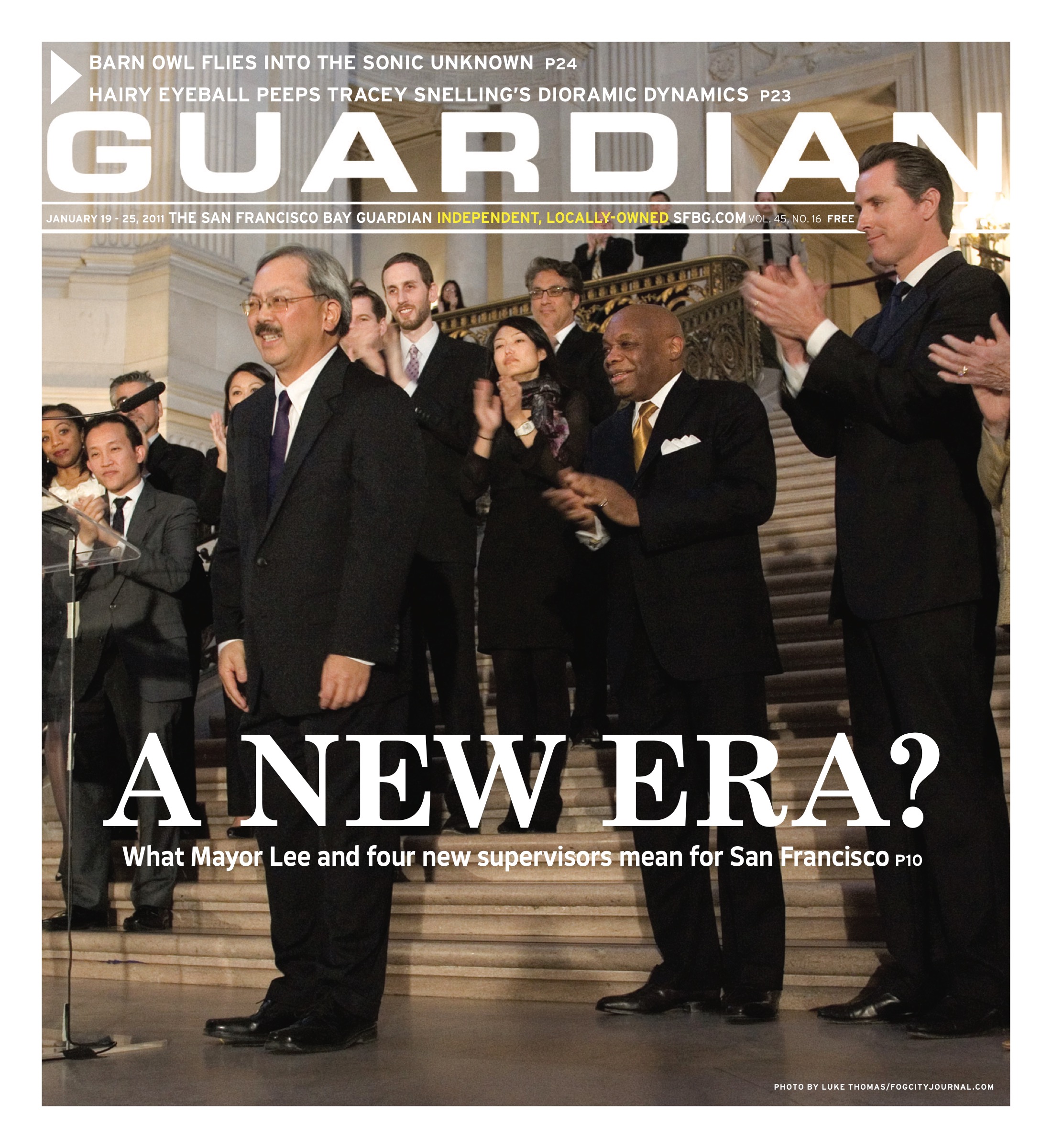
You can argue about what the word “progressive” means, and you can argue about the process and the politics that put Ed Lee in the Mayor’s Office. And you can talk forever about which group or faction has how much of a majority on the San Francisco Board of Supervisors, but you have to admit: this city has just undergone a significant political realignment.

Some of that was inevitable. The last members of the class of 2000, the supervisors who were elected in a rebellion against the sleaze, corruption, and runaway development policies of the Willie Brown administration, have left office. Gavin Newsom, the mayor who was often at war with the board and who encouraged a spirit of rancor and partisanship, is finally off to Sacramento. For the first time since 1978, the supervisors will be working with a mayor they chose themselves.

For much of the past 15 years, progressive politics was as much about stopping bad things — preventing Brown and then Newsom from wrecking the city — as it was about promoting good things. But the “politics of anti,” as San Francisco State political scientist Rich DeLeon describes is, wasn’t a central theme in the November elections, and this generation of supervisors comes into office with a different agenda.

Besides, one of the clear divisions on the board the past seven years was the Newsom allies against the progressives — something that dissipated instantly when Lee took over.

But the realignment goes deeper.

Until recently, the progressives on the board had a working majority — a caucus, so to speak — and they tended to vote together much of the time. The lines on the board were drawn almost entirely by what Newsom disparagingly calls ideology but could more accurately be described as a shared set of political values, a shared urban agenda.

There are still six supervisors who call themselves progressives, but the idea that they’ll stick together was shattered in the battle over a new mayor — and the notion that there’s anything like a progressive caucus died with Board President David Chiu’s election (his majority came in part from the conservative side, with three progressives opposing him) and with Chiu’s new committee assignments, which for the first time in a decade put control of key assignments in the hands of the fiscal conservatives.


A PROGRESSIVE MAJORITY?

The progressive bloc on the board was never monolithic. There were always disagreements and fractures. And, thanks to the Brown Act, the progressives don’t actually meet outside of the formal board sessions. But it was fair and accurate to say that, most of the time, the six members of the board majority functioned almost as a political party, working together on issues and counting on each other for key votes. There was, for example, a dispute two years ago over the board presidency — but in the end, Chiu was elected with exactly six votes, all from the progressive majority that came together in the end.

That all started to fall apart the minute the board was faced with the prospect of choosing a new mayor. For one thing, the progressives couldn’t agree on a strategy — should they look for someone who would seek reelection in November, or try to find an acceptable interim mayor? The rules that barred supervisors from voting for themselves made it more tricky; six votes were not enough to elect any of the existing members. And, not surprisingly, some of the progressives had mayoral ambitions themselves.

When state Assemblymember Tom Ammiano — who would have had six votes easily — took himself out of the running, there was no other obvious progressive candidate. And with no other obvious candidate, and little opportunity for open discussion, the progressives couldn’t come to an agreement.

But by the Jan. 4 board meeting, five of the six had coalesced around Sheriff Mike Hennessey. Chiu, however, was supporting Ed Lee, someone he had known and worked with in the Asian community and whom he considered a progressive candidate. And once it became clear that Lee was headed toward victory, Sup. Eric Mar announced that he, too, would be in Lee’s camp.

A few days later, when the new board convened to choose a president, the progressive solidarity was gone. Sups. David Campos, John Avalos, and Ross Mirkarimi, now the solid left wing of the board, voted for Avalos. Chiu won with the support of Mar, Sup. Jane Kim, and the moderate-to-conservative flank.

Now the Budget Committee — long controlled by a progressive chair and a progressive majority — will be led by Carmen Chu, who is among the most fiscally conservative board members. The Land Use and Development Committee will be chaired by Mar, but two of the three members are from the moderate side. Same goes for Rules, where Sup. Sean Elsbernd, for years the most conservative board member, will work with ideological ally Sup. Mark Farrell on confirming mayoral appointments, redrawing supervisorial districts, and promoting or blocking charter amendments as Kim, the chair, does her best to contain the damage.

You can argue that having independent-minded supervisors who don’t vote as a caucus is a good thing. You can also argue that a fractured left will never win against a united downtown. And both arguments have merit.

But you can’t argue any more that the board has the same sort of progressive majority it’s had for the past 10 years. That’s over. It’s a new — and different — political era.

What happens now? Will the progressives hold enough votes to have an influence on the city budget (and ensure that the deficit solutions include new revenue and not just cuts)? What legislative priorities will the supervisors be pushing in the next year? How will the votes shake out on difficult new proposals (and ongoing issues like community choice aggregation)?

Mayor Lee has pledged to work with the board and will show up for monthly questions. How will he respond to the sorts of progressive legislation — like tenant protections, transit-first policies, immigrant rights measures, and stronger affordable housing standards — that Newsom routinely vetoed?

How will this all play out in a year when the city will also be electing a new mayor?


IDENTITY POLITICS?

When Sups. Chiu, Mar, and Kim broke with their three progressive colleagues to support Chiu for board president — just as Chiu and Mar helped clear the path for Ed Lee to become mayor days earlier — it seemed to many political observers that identity had trumped ideology on the board. There’s some truth to that observation, but it’s too simple an explanation. There’s also the fact that Chiu strongly supported Kim, who is a personal friend and former roommate, in her election, so it’s no surprise she went with him for board president.

And the phrase itself is so laden with baggage and problems that it’s hard to talk about. It has come to signify a wide range of political activity and theorizing founded in the shared experiences of injustice of members of certain social groups. “Rather than organizing solely around belief systems, programmatic manifestoes, or party affiliation, identity political formations typically aim to secure the political freedom of a specific constituency marginalized within its larger context,” says the Stanford Encyclopedia of Philosophy, an ongoing research project by the students and faculty at Stanford University.

Although the notion of identity politics took hold during the social movements of the 1960s and ’70s — when liberation and organizing movements among women and various ethic and other identity groups fed a larger liberal democratic surge that targeted war, economic inequity, social injustice, and other issues — it’s also a political approach that has divided the populace.

“One of the central charges against identity politics by liberals, among others, has been its alleged reliance on notions of sameness to justify political mobilization,” says the Stanford Encyclopedia. “Looking for people who are like you rather than who share your political values as allies runs the risk of sidelining critical political analysis of complex social locations and ghettoizing members of social groups as the only persons capable of making or understanding claims to justice.”

Mar explains that the reality of identity politics and whether it’s a factor in the current politics at City Hall is far more complex.

“With me, David Chiu, and Jane Kim as a block of three progressive Asians — and I still define David Chiu as a progressive though I think some are questioning that — we all come out of what I would call a pro-housing justice, transit-first, and environmental sustainability [mindset],” Mar told us. “But I think because of our ethnic background and experiences, we may have different perspectives at times than other progressives.”

For example, Mar said, many working class families of color need to drive a car so they’ll differ from progressives who want to limit parking spaces to discourage driving. He also has reservations about the proposed congestion pricing fee and how it might affect low-income drivers.\

“I think often when progressive people of color come into office — Jane Kim might be one of the best examples — that sometimes there’s an assumption that her issues are going to be the same as a white progressive or a Latino progressive,” he said. “But I think kind of the different identities that we all have mean that we’re more complex.”

Campos, a Latino immigrant who is openly gay, noted that “as a progressive person of color, I have at times felt that the progressive movement didn’t recognize the importance of identity politics and what it means for me to have another person of color in power.”

But, he added, “I don’t think identity politics alone should guide what happens. A progressive agenda isn’t just about race but class, sexual orientation, and other things. It’s not enough to say that identity politics justifies everything.”

University of San Francisco political science professor Corey Cook told the Guardian that identity has always been a strong factor in San Francisco politics, even if it was overshadowed by the political realignment around progressive ideology that occurred in 2000, mostly as a reaction to an economic agenda based on rapid development and political cronyism.

“I’m not sure that identity wasn’t relevant, but it was swamped by ideology,” Cook told the Guardian. Now, he said, another political realignment seems to be occurring, one that downplays ideology compared to the position it has held for the last 10 years. “I’m not sure that ideology is dead. But the dynamics have definitely changed.”

Cook sees what may be a more important change reflected in Chiu’s decision to put the political moderates in control of key board committees. But he said that shift was probably inevitable given the difficulties of unifying the diverse progressive constituencies.

“It’s hard to hold a progressive coalition together, and it’s amazing that it has lasted this long,” he said.

There’s another kind of identity politics at play as well — that of native San Franciscans, who often express resentment at progressive newcomers talking about what kind of city this is, versus those who see San Francisco as a city of immigrants and ideas, a place being shaped by a wider constituency than the old-timers like to acknowledge.

“I’m honored to join Sups. Elsbernd and Cohen in representing the neighborhoods they grew up in,” Sup. Mark Farrell said during his opening remarks after being sworn in Jan. 8., sobbing when he thanked his parents for their support.

As he continued, he fed the criticism of the notion of ideology-based politics that has been a popular trope with Gavin Newsom and other fiscal conservatives in recent years, telling the crowd he wanted “to turn City Hall into a place based on issues and ideas, not ideology.”

Cohen also placed more importance on her birthright than on her political philosophy, telling stories about entering board chambers through the back door at age 16 when she was part of a youth program created by then-Mayor Frank Jordan, and with former Mayor Dianne Feinstein coming to speak at Cohen’s third-grade class. “I am a San Francisco native, and that is a responsibility I take seriously,” said Cohen, who graduated from the Emerge Program, which grooms women for political office,

“We will have another woman as president of the Board of Supervisors, and we will have a woman as mayor of San Francisco,” she added. And as the sole African American on the board, she also pledged, “I will be working to add more members of the African American community to the elected family of San Francisco.”

But what issues she plans to focus on and what values she’ll represent were unclear in her comments — as they were throughout her campaign, despite the efforts of journalists and activists to discern her political philosophy. In her public comments, her only stated goal was to build bridges between the community and City Hall and let decisions be guided by the people “not political ideologies.”

Oftentimes in recent San Francisco history, identity and ideology have worked in concert, as they did with former Sup. Harvey Milk, who broke barriers as the first openly gay elected official, but who also championed a broad progressive agenda that included tenants rights, protecting civil liberties, and creating more parks and public spaces.

Sup. Scott Wiener, shortly after being sworn into office, acknowledged the legacy of his district, which was once represented by Milk and fellow gay progressive leader Harry Britt, telling the crowd: “I’m keenly aware of the leadership that has come through this district and I have huge shoes to fill.”

Yet Wiener, a moderate, comes from a different ideological camp than Milk and Britt and he echoed the board’s new mantra of collaboration and compromise. “I will always try to find common ground. There is always common ground,” he said.


GETTING THINGS DONE?

Chiu is making a clear effort to break with the past, and has been critical of some progressive leaders. “I think it’s important that we do not have a small group of progressive leaders who are dictating to the rest of the progressive community what is progressive,” he said.

While he didn’t single out former Sup. Chris Daly by name, he does seem to be trying to repudiate Daly’s leadership style. “I think that while the progressive left and the progressive community leaders have had very significant accomplishments over the past 10 years, I do think that there are many times when our oppositional tactics have set us back.”

When Chiu was reelected board president, he told the crowd that “none of us were voted into office to take positions. We were voted into office to get things done.”

Some progressives were not at all happy with that comment. “I thought that was a terrible thing to say,” Avalos told the Guardian, arguing the positions that elected officials take shape the legislation that follows. As an example, he cited the positions that progressive members of Congress took in favor of the public option during the health care reform debate.

Talking about getting things done is “a sanctimonious talking point that fits well with what the Chronicle and big papers want to hear,” Avalos said. He said the Chronicle and other downtown interests are more interested in preserving the status quo and blocking progressive reforms. “It’s what they want to see not get done.”

Campos even challenged the comment publicly during the Jan. 11 board meeting when he said, “It’s important to get things done, but I don’t think getting things done is enough. We have to ask ourselves: what is it that we’re getting done? How is it that we’re getting things done? And for whom is it that we’re doing what we’re doing? Is it for the people, or the downtown corporate interests? I hope it’s not getting things done behind closed doors.”

Chiu said that, for him, getting things done is about expanding the progressive movement and consolidating its recent gains. “I think we all share a political goal. As progressives, we all share a political goal of getting things done and growing mainstream support for our shared progressive principles so that they really become the values of our entire city.”

To do that, he said, progressives are going to need to be more conciliatory and cooperative than they’ve been in the past. “I think it’s easy to slip into a more oppositional way of discussing progressive values, but I’m really pushing to move beyond that.”

The biggest single issue this spring will be the budget — and it’s hard to know exactly where the board president will draw his lines. “I have spoken to Mayor Lee about the need for open, transparent, and community-based budget processes and he’s open to that,” Chiu told us — and that alone would be a huge change. But the key progressive priority for the spring will be finding ways to avoid brutal budget cuts — and that means looking for new revenue.

When asked whether new general revenue will be a part of the budget solution, instead of Newsom’s Republican-style cuts-only approaches, Chiu was cautious. “I am open to considering revenues as part of the overall set of solutions to close the budget deficit,” he said. “I am willing to be one elected here that will try to make that argument.” But with his political clout and connections right now, he can do a lot more than be one person making an argument.

Chiu has always been open to new revenue solutions and even led the way in challenging the cuts-only approach to both the city budget and MTA budget two years in a row, only to back down in the end and cut a deal with Newsom. When asked whether things will be better this year given his closer relationship to Lee, Chiu replied, “I think things are going to be different in the coming months.”

During the board’s Jan. 7 deliberation on Lee, Sup. Eric Mar also said that based on his communications with Lee, Mar believed that the Mayor’s Office is open to supporting new revenue measures. He echoed the point later to us.

In addition to supporting the open, inclusive budget process, Mar called for “a humane budget that protects the safety net and services to the most vulnerable people in San Francisco is kind of the critical, top priority.

“I think it’s going to be difficult working with the different forces in the budget process,” he added. “That’s why I wish it could have been a progressive who was chairing the budget process.”

Mar said progressive activism on the budget process is needed now more than ever. “The Budget Justice Coalition from last year I think has to be reenergized so that so many groups are not competing for their own piece of the pie, but that it’s more of a for-all, share-the-pain budget with as many people communicating from outside as possible, putting the pressure on the mayor and the board to make sure that the critical safety net’s protected.”


CUTS WILL BE CENTER STAGE

But major cuts — and the issue of city employees pay and benefits — will also be center stage.

At the board’s Jan. 11 meeting, before the supervisors voted unanimously to nominate Lee as interim mayor, Sup. Elsbernd signaled that city workers’ retirement and health benefits will once again be at the center of the fight to balance the budget.

Elsbernd noted that in past years he was accused of exaggerating the negative impacts that city employees’ benefits have on the city’s budget. “But rather than being inflated, they were deflated,” Elsbernd said, noting that benefits will soon consume 18.14 percent of payroll and will account for 26 percent in three years.

“Does the budget deficit include this amount?” he asked.

And at the after-party that followed Lee’s swearing-in, Public Defender Jeff Adachi, who caused a furor last fall when he launched the ill-considered Measure B, which sought to reform workers’ benefits packages, told us he is not one to give up lightly.

“We learned a lot from that,” Adachi said. “This is still the huge elephant in City Hall. The city’s pension liability just went up another 1 percent, which is another $30 million”

Chu agreed that worker benefits would be a central part of the budget-balancing debate. “Any conversation about the long-term future of San Francisco’s budget has to look at the reality of where the bulk of our spending is,” she said.

Avalos noted that he plans to talk to labor and community based organizations about ways to increase city revenue. “I’m going to work behind the scene on the budget to make sure the communities are well-spoken for,” Avalos said, later adding, “But it’s hard, given that we need a two-thirds majority to pass stuff on the ballot.”

Last year, Avalos helped put two measures on the ballot to increase revenue: Prop. J, which sought to close loopholes in the city’s current hotel tax and asked visitors to pay a slightly higher hotel tax (about $3 a night) for three years, and Prop. N, the real property transfer tax that slightly increased the tax charged by the city on the sale of property worth more than $5 million.

Prop. N should raise $45 million, Avalos said. “I’ve always had my sights set on raising revenue, but making cuts is inevitable.”


THE IDEOLOGY ARGUMENT

Newsom and his allies loved to use “ideology” as a term of disparagement, a way to paint progressives as crazies driven by some sort of Commie-plot secret agenda. But there’s nothing wrong with ideology; Newsom’s fiscal conservative stance and his vow not to raise taxes were ideologies, too. The moderate positions some of the more centrist board members take stem from a basic ideology. Wiener, for example, told us that he thinks that in tough economic times, local government should do less but do it better. That’s a clear, consistent ideology.

For much of the past decade, the defining characteristic of the progressives on the board has been a loosely shared urban ideology supported by tenants, immigrant-rights groups, queer and labor activists, environmentalists, preservationists, supporters of public power and sunshine and foes of big corporate consolidation and economic power. Diversity and inclusiveness was part of that ideology, but it went beyond any one political interest or identity group.

It was often about fighting — against corruption and big-business hegemony and for economic and social equality. The progressive agenda started from the position that city government under Brown and Newsom had been going in the wrong direction and that substantive change was necessary. And sometimes, up against powerful mayors and their well-heeled backers, being polite and accommodating and seeking common ground didn’t work.

As outgoing Sup. Daly put it at his final meeting: “I’ve seen go-along to get along. If you want to do more than that, if you think there’s a fundamental problem with the way things are in this world, then go-along to get along doesn’t do it.” When Chiu announced that the new progressive politics is one of pragmatism, he was making a break from that ideology. He was signaling a different kind of politics. He has urged us to be optimistic about the new year — but we still don’t know what the new agenda will look like, how it will be defined, or at what point Chiu and his allies will say they’ve compromised and reached out enough and are ready to take a strong, even oppositional, stand. We do know the outcome will affect the lives of a lot of San Franciscans. And when the budget decisions start rolling down the pike, the political lines will be drawn fairly clearly. Because reaching across the aisle and working together sounds great in theory — but in practice, there is nothing even resembling a consensus on the board about how the city’s most serious problems should be resolved. And there are some ugly battles ahead.

They have issues: Members of the new Board speak

20

Board President David Chiu touched off a broad political discussion in recent weeks with his statement that officials were elected “not to take positions, but to get things done.” Delivered just before his reelection as Board President with the solid backing of the board’s moderate faction, Chiu’s comment has been viewed in light of City Hall’s shifting political dynamic, a subject the Guardian explores in a Jan. 19 cover story. Politics aside, Chiu’s statement also begs the question: Just what do members of the board hope to get done, and how do they propose to accomplish the items on their agenda?
Last week, Guardian reporters tracked down every member of the board to find out. We asked, what are your top priorities? And how do you plan to achieve them? Some spoke with us for 25 minutes, and others spoke for just 5 minutes, but the result offers some insight into what’s on their radar. Not surprisingly, getting the budget right was mentioned by virtually everyone as a top priority, but there are sharp differences in opinion in terms of how to do that. Several supervisors, particularly those in the moderate wing, mentioned ballooning pension and healthcare costs. Aiding small business also emerged as a priority shared by multiple board members.

Sup. Eric Mar
District 1

Issues:
*Budget
*Assisting small businesses
*Programs and services for seniors
*Food Security
*Issues surrounding Golden Gate Park

Elected in 2008 to represent D1, Sup. Eric Mar has been named chair of the powerful Land Use & Economic Development Committee and vice chair of the City Operations and Neighborhood Services Committee.

Asked to name his top priorities, Mar said, “A humane budget that protects the safety net and services to the must vulnerable people in San Francisco is kind of the critical, top priority.”

It’s bound to be difficult, he added. “That’s why I wish it could have been a progressive that was chairing the budget process. Now, we have to work with Carmen Chu to ensure that it’s a fair, transparent process.”

A second issue hovering near the top of Mar’s agenda is lending a helping hand to the small businesses of the Richmond District. “There’s a lot of anxiety about the economic climate for small business. We’re trying to work closely with some of the merchant associations and come up with ideas on how the city government can be more supportive,” he said. Mar also spoke about the need to respond to the threat of big box stores, such as PetCo, that could move in and harm neighborhood merchants. “I’m worried about too many of the big box stores trying to come in with an urban strategy and saying that they’re different — but they sure have an unfair advantage,” he noted.

Programs and services for the senior population ranked high on his list. Mar noted that he’d been working with senior groups on how to respond to a budget analyst’s report showing a ballooning need for housing – especially affordable housing – for seniors. “It’s moving from the Baby Boom generation to the Senior Boomers, and I think the population, if I’m not mistaken, by 2020 it’s going up 50 percent,” he said. “It’s a huge booming population that I don’t think we’re ready to address.”

Addressing food security issues through the Food Security Task Force also ranked high on Mar’s list, and he noted that he’s been working with a coalition that includes UCSF and the Department of Public Health to study the problem. “We’ve had a number of strategy meetings already, but we’re trying to launch different efforts to create healthier food access in many of our lowest income neighborhoods,” Mar said.

Finally, Mar talked about issues relating to the park. “I do represent the district that has Golden Gate Park, so I’m often busy with efforts to preserve the park, prevent privatization, and ensure enjoyment for the many residents not just in the Richmond but throughout the city that enjoy the park.” Although it’s not technically in his district, Mar noted that he is very supportive of HANC Recycling Center – and plans to advocate on their behalf to Mayor Lee.

Sup. Mark Farrell
District 2
Issues:
*Pension reform
*Long-term economic plan for city
*Job creation
*Quality-of-life issues

Elected to replace termed-out D2 Sup. Michela Alioto-Pier, Farrell has been named vice-chair of the Government Audits & Oversight Committee and a member of the Rules Committee. A native of D2, Farrell told the Guardian he believes his roots in the city and background as a venture capitalist would be an asset to the city’s legislative body. “I know at the last board, Carmen [Chu] was the only one who had any finance background,” he said. “To have someone come from the private sector with a business / finance background, I really do believe … adds to the dialogue and the discussion here at City Hall.”

Along those lines, Farrell said one of his top priorities is the budget. “I’m not on the budget and finance committee this time around, but given my background, I am going to play a role in that,” he said.

So what’s his plan for closing the budget deficit? In response, he alluded to slashing services. “In the past, there have been views that we as a city don’t provide enough services and we need to raise revenues to provide more, or the perspective that we first need to live within our means and then provide more services. Everyone’s going to disagree, but I’m in the latter camp,” he said. “I do believe we need to make some tough choices right now – whether it be head count, or whether it be looking at …pension reform. I do believe pension reform needs to be part of the dialogue. Unfortunately, it’s unsustainable.”

He also said he wanted to be part of “trying to create and focus on a framework for a long-term financial plan here in San Francisco.”

Secondly, Farrell discussed wanting to put together a “jobs bill.”

“Jobs is a big deal,” he said. “It’s something I want to focus on. There are only so many levers we can pull as a city. I think the biotech tax credits have spurred a lot of business down in Mission Bay.”

Next on Farrell’s agenda was quality-of-life issues, but rather than talk about enforcing San Francisco’s sit/lie ordinance – supported by political forces who organized under the banner of maintaining ‘quality-of-life’ – Farrell revealed that he is incensed about parking meter fines. “It is so strikingly unjust when you are 1 minute late to your parking meter and you have a $65 parking fine,” he said.

Farrell also mentioned development projects that would surely require time and attention. “CPMC is going to be a major dominant issue,” he said. He also mentioned Doyle Drive, and transitional age youth housing projects proposed in D2 – but as far as the housing project planned for the King Edward II Inn, which has generated some controversy among neighborhood groups, he didn’t take a strong position either way, saying he wanted to listen to all the stakeholders first.

Board President David Chiu
District 3
Issues:
*Budget
*Preserving neighborhood character
*Immigrant rights
*Preserving economic diversity
*Transit

Elected for a second two-year term as President of the Board, D3 Sup. David Chiu is rumored to be running in the mayor’s race, after he turned down former Mayor Gavin Newsom’s offer to appoint him as District Attorney. That offer was made after Kamala Harris won the state Attorney General’s race this fall. And when Chiu turned it down, former Mayor Gavin Newsom shocked just about everybody by appointing San Francisco Police Chief George Gascon, who is not opposed to the death penalty and was a longtime Republican before he recently registered as a Democrat, instead.

A temporary member of the Board’s Budget acommittee, Chiu is also a permanent member of the Board’s Government Audits & Oversight Committee.

Asked about his top priorities, Chiu spoke first and foremost about  “ensuring that we have a budget that works for all San Franciscans, particularly the most vulnerable.” He also said he wanted to see a different kind of budget process: “It is my hope that we do not engage in the typical, Kabuki-style budget process of years past under the last couple of mayors, where the mayor keeps under wraps for many months exactly what the thinking is on the budget, gives us something on June 1 for which we have only a couple of weeks to analyze, and then engage in the tired back-and-forth of debates in the past.” Chiu also spoke about tackling “looming pension and health care costs.”

Another priority, he said, was “Ensuring that our neighborhoods continue to remain the distinctive urban villages that they are, and protecting neighborhood character,” a goal that relates to “development, … historic preservation, [and] what we do around vacant commercial corridors.”

*Immigrant rights also made his top-five list. “I was very sad that last November we didn’t prevail in allowing all parents to have a right and a voice in school board elections,” he said, referencing ballot measure Proposition D which appeared on the November 2010 ballot. “I think we are going to reengage in discussion around Sanctuary City, another topic I have discussed twice already with Mayor Lee.”

Another issue for Chiu was  “ensuring again that hopefully San Francisco continues to remain an economically diverse city, and not just a city for the very wealthy.” He spoke about reforming city contracts: “In particular, dealing with the fact that in many areas, 70 to 80 percent of city contracts are awarded to non-San Francisco businesses. … I think there is more significant reform that needs to happen in our city contracting process.” Another economic-diversity measure, he said, was tax policy, “particularly around ensuring that our business tax is incenting the type of economic growth that we want.”

Finally, Chiu spoke about “Creating a transit-first city. This is not just about making sure MUNI is more reliable and has stable funding, but ensuring that we’re taking steps to reach a 2020 goal of 20 percent cycling in the city. Earlier this week I called for our transit agencies to look at pedestrian safety, because we are spending close to $300 million a year to deal with pedestrian deaths and injuries.”

Sup. Carmen Chu
District 4
*Budget
*Core Services
*Jobs
*Economy

Chiu has just named Sup. Carmen Chu as chair of the powerful Board and Finance Committee. And Chu, who worked as a budget analyst for Newsom’s administration, says the budget, core services, employment and the economy are her top priorities.

“My hope is that this year the budget is going to be a very collaborative and open process,” Chu said.

Chu believes workers benefits will be a central part of the budget-balancing debate.
“Any conversation about the long-term future of San Francisco’s budget has to look at the reality of where the bulk of our spending is,” she said.

Chu noted that the budget debate will have to take the state budget into account.
“At the end of the day, we need to take into account the context of the state budget, in terms of new cuts and taxes, because anything we do will be on top of the state level.

“We need to ask who do these measures really impact,” she added, noting that there were attempts to put revenue measures on the ballot last year.

Sup. Ross Mirkarimi
District 5
* Local Hire / First Source / Reentry programs
* Budget / generating revenue
* Infrastructure improvements
*Reversing MTA service cuts

With only two years left to serve on the Board, D5 Sup. Ross Mirkarimi has been named chair of the Board’s Public Safety Committee and vice-chair of the Budget and Finance Committee.

“One of my top priorities is building on and strengthening the work that I’ve already done and that Avalos is doing on mandatory local hire and First Source programs,” Mirkarimi said. He also spoke about “strengthening reentry programs for those coming out of the criminal justice system, because we still have an enormously high recidivism rate.”

The budget also ranked high on Mirkarimi’s list, and he stressed the need for “doing surgical operations on our budget to make sure that services for the vulnerable are retained, and looking for other ways to generate revenue beyond the debate of what’s going on the ballot.

“For instance, I helped lead the charge for the America’s Cup, and while the pay-off from that won’t be realized for years, the deal still needs to be massaged. What we have now is an embryonic deal that still needs to be watched.”

Mirkarimi mentioned safeguarding the city against privatization, saying one of his priorities was “retooling our budget priorities to stop the escalating practice of privatizing city services.”

 He spoke about “ongoing work citywide to make mixed-use commercial and residential infrastructure improvements, which coincide with bicycle and pedestrian improvements.”

Finally, Mirkarimi said he wanted to focus on transportation issues. “As Chair of the Transportation Authority, if I even continue to be chair, to take the lead on signature transit projects and work with the M.T.A. to reverse service cuts.”

Sup. Jane Kim
District 6
Issues:
*Jobs
*Economic Development
*Small Business
*Pedestrian Safety
*Legislation to control bedbug infestations

Elected to replace termed-out D6 Sup. Chris Daly, Kim has been named chair of the Rules Committee and a member of the Budget & Finance committee.

Kim believes that she will prove her progressive values through her work and she’s trying to take the current debate about her allegiances on the Board in her stride.

“The one thing I learned from serving on the School Board was to be really patient,” Kim told me, when our conversation turned to the issue of “progressive values.”

“I didn’t want to be President of the School Board for the first few years, because I loved pushing the envelope,” Kim added, noting that as Board President David Chiu is in the often-unenviable position of chief negotiator between the Board and the Mayor.

But with Ed Lee’s appointment as interim mayor, Kim is excited about the coming year.
“There are a lot of new opportunities, a different set of players, and it’s going to be very interesting to learn how to traverse this particular scene.”

Kim is kicking off her first term on the Board with two pieces of legislation. The first seeks to address bedbug infestations. “Particularly around enforcement, including private landlords,” Kim said, noting that there have also been bedbug problems in Housing Authority properties.

Her second immediate goal is to look at pedestrian safety, a big deal in D6, which is traversed by freeways with off-ramps leading into residential zones.
“Pedestrian safety is a unifying issue for my district, particularly for all the seniors,” Kim said, citing traffic calming, speed limit enforcement and increased pedestrian traffic, as possible approaches.

Beyond those immediate goals, Kim plans to focus on jobs, economic development and small businesses in the coming year. “What can we do to create jobs and help small businesses? That is my focus, not from a tax reduction point of view, but how can we consolidate the permitting and fees process, because small businesses are a source of local jobs.”

Kim plans to help the Mayor’s Office implement Sup. John Avalos’ local hire legislation, which interim Mayor Ed Lee supports, unlike his predecessor Mayor Gavin Newsom.

“Everyone has always liked the idea of local hire, but without any teeth, it can’t be enforced,” Kim observed. “It’s heartbreaking that young people graduate out of San Francisco Unified School District and there’s been not much more than retail jobs available.”

She noted that jobs, land use and the budget are the three overarching items on this year’s agenda. “I’m a big believer in revenue generation, but government has to come half-way by being able to articulate how it will benefit people and being able to show that it’s more than just altruistic. I think we have to figure out that balance in promoting new measures. That’s why it’s important to be strong on neighborhood and community issues, so that folks feel like government is listening and helping them. I don’t think it’s a huge ask to be responsive to that.”

Kim said she hoped the new mayor would put out a new revenue measure, enforce local hire, and implement Sup. David Campos’ legislation to ensure due process for immigrant youth.

“I think Ed can take a lot of the goodwill and unanimous support,” Kim said. “We’ve never had a mayor without an election, campaigns, and a track record. Usually mayors come in with a group of dissenters. But he is in a very unique position to do three things that are very challenging to do. I hope raising revenues is one of those three. As a big supporter of local hire, I think it helps having a mayor that is committed to implement it. And I’m hoping that Ed will implement due process for youth. For me, it’s a no brainer and Ed’s background as a former attorney  for Asian Law Caucus is a good match. Many members of my family came to the U.S. as undocumented youth, so this is very personal. Kids get picked up for no reason and misidentified. People confuse Campos and Avalos, so imagine what happens to immigrant youth.”

Sup. Sean Elsbernd
District 7
Issues:
*Parkmerced
*Enforcing Prop G
*Pension & healthcare costs
*CalTrain

With two years left to serve on the Board, D7 Sup. Sean Elsbernd has been named vice-chair of the Rules Committee and a member of the City Operations & Neighborhood Services Committee. He was congratulated by Chinatown powerbroker Rose Pak immediately after the Board voted 11-0 to nominated former City Administrator Ed Lee as interim mayor, and during Lee’s swearing-in, former Mayor Willie Brown praised Elsbernd for nominating Lee for the job.

And at the Board’s Jan. 11 meeting before the supervisors voted for Lee, Elsbernd signaled that city workers’ retirement and health benefits will be at the center of the fight to balance the budget in the coming year.

Elsbernd noted that in past years, he was accused of exaggerating the negative impacts that city employees’ benefits have on the city’s budget. “But rather than being inflated, they were deflated,” Elsbernd said, noting that benefits will soon consume 18.14 percent of payroll and will account for 26 percent in three years. “Does the budget deficit include this amount?” he asked.

And at the afterparty that followed Lee’s swearing in, Public Defender Jeff Adachi, who caused a furor last fall when he launched Measure B, which sought to reform workers’ benefits packages, told the Guardian he is not one to give up lightly. “We learned a lot from that,” Adachi said. “This is still the huge elephant in City Hall. The city’s pension liability just went up another 1 percent, which is another $30 million.”

As for priorities, Elsbernd broke it down into district, city, and regional issues. In D7, “Hands-down, without question the biggest issue … is Parkmerced,” he said, starting with understanding and managing the environmental approval process. If it gets approved, he said his top concerns was that “the tenant issue. And the overriding concern of if they sell, which I think we all think is going to happen in the near-term – do those guarantees go along with the land?”

Also related to Parkmerced was planning for the traffic conditions that the development could potentially create, which Elsbernd dubbed a “huge 19th Avenue issue.”

Citywide, Elsbernd’s top priorities included enforcing Proposition G – the voter-approved measure that requires MUNI drivers to engage in collective bargaining – and tackling pension and healthcare costs. He spoke about “making sure that MTA budget that comes to us this summer is responsive” to Prop G.

As for pension and healthcare, Elsbernd said, “I’ve already spent a good deal of time with labor talking about it, and will continue to do that.” But he declined to give further details. Asked if a revenue-generating measure could be part of the solution to that problem, Elsbernd said, “I’m not saying no to anything right now.”

On a regional level, Elsbernd’s priority was to help CalTrain deal with its crippling financial problem. He’s served on that board for the last four years. “The financial situation at CalTrain – it is without question the forgotten stepchild of Bay Area transit, and the budget is going to be hugely challenging,” he said. “I think they’ll survive, but I think they’re going to see massive reductions in services.”

Sup. Scott Wiener
District 8
Issues:
*Transportation
*Reasonable regulation of nightlife & entertainment industry
*Pension reform

Elected in November 2010 to replace termed-out D8 Sup. Bevan, Wiener has been named a temporary member of the Board’s Budget and Finance Committee and a permanent member of the Land Use and Economic Development Committee.

“Transportation is a top priority,” Wiener said. ‘That includes working with the M.T.A. to get more cabs on the street, and making sure that the M.T.A. collectively bargains effectively with its new powers, under Prop. G.”

“I’m also going to be focusing on public safety, including work around graffiti enforcement, though I’m not prepared to go public yet about what I’ll be thinking,” he said.

“Regulating nightlife and entertainment is another top priority,” Wiener continued. “I want to make sure that what we do is very thoughtful in terms of understanding the economic impacts, in terms of jobs and tax  revenues, that this segment has. With some of the unfortunate incidents that have happened, it’s really important before we jump to conclusions that we figure out what happened and why. Was it something the club did inappropriately, or was it just a fluke? That way, we can avoid making drastic changes across the board. I think we have been very reactive to some nightclub issues. I want us to be more thoughtful in taking all the factors into consideration.”

“Even if we put a revenue measure on the June or November ballot, we’d need a two-thirds majority, so realistically, it’s hard to envision successfully securing significant revenue measure before November 2012,” Wiener added. “And once you adopt a revenue measure, it takes time to implement it and revenue to come in, so it’s hard to see where we’ll get revenue that will impact the 2012 fiscal year. In the short term, for fiscal year 2011/2012, the horse is out of the barn”

“As for pension stuff, I’m going to be very engaged in that process and hopefully we will move to further rein in pension and retirement healthcare costs.”

Sup. David Campos
District 9
Issues:
*Good government
*Community policing
*Protecting immigrant youth
*Workers’ rights and healthcare

Elected in 2008, D9 Sup. David Campos has been named chair of the Board’s Government Audit & Oversight Committee and a member of the Public Safety Committee. And, ever since he declared that the progressive majority on the Board no longer exists, in the wake of the Board’s 11-0 vote for Mayor Ed Lee, Campos has found his words being used by the mainstream media as alleged evidence that the entire progressive movement is dead in San Francisco.

“They are trying to twist my words and make me into the bogey man,” Campos said, noting that his words were not a statement of defeat but a wake-up call.

“The progressive movement is very much alive,” Campos said. “The key here is that if you speak your truth, they’ll go after you, even if you do it in a respectful way. I didn’t lose my temper or go after anybody, but they are trying to make me into the next Chris Daly.”

Campos said his overarching goal this year is to keep advancing a good government agenda.

“This means not just making sure that good public policy is being pursued, but also that we do so with as much openness and transparency as possible,” he said.

As a member of the Board’s Public Safety Committee, Campos says he will focus on making sure that we have “as much community policing as possible.

He plans to focus on improving public transportation, noting that a lot of folks in his district use public transit.

And he’d like to see interim mayor Ed Lee implement the due process legislation that Campos sponsored and the former Board passed with a veto-proof majority in 2009, but Mayor Gavin Newsom refused to implement. Campos’ legislation sought to ensure that immigrant youth get their day in court before being referred to the federal immigration authorities for possible deportation, and Newsom’s refusal to implement it, left hundreds of youth at risk of being deported, without first having the opportunity to establish their innocence in a juvenile court.
‘We met with Mayor Lee today,” Campos told the Guardian Jan. 18. “And we asked him to move this forward as quickly as possible. He committed to do that and said he wants to get more informed, but I’m confident he will move this forward.”

Campos also said he’ll be focusing on issues around workers’ rights and health care.
“I want to make sure we keep making progress on those fronts,” Campos said.

“It’s been a rough couple of days,” Campos continued, circling back to the beating the press gave him for his “progressive” remarks.“But I got to keep moving, doing my work, calling it as a I see it, doing what’s right, and doing it in a respectful way. The truth is that if you talk about the progressive movement and what we have achieved, which includes universal healthcare and local hire in the last few years, you are likely to become a target.”

Sup. Malia Cohen
District 10
Issues:
*Public safety
*Jobs
*Preserving open space
*Creating Community Benefit Districts
*Ending illegal dumping
Elected to replace termed-out D10 Sup. Sophie Maxwell, Cohen has been named chair of the City & School District committee, vice chair of the Land Use and Economic Development Committee and vice chair of the Public Safety Committee.

Cohen says her top priorities are public safety, jobs, open space, which she campaigned on, as well as creating community benefits districts and putting an end to illegal dumping.

“I feel good about the votes I cast for Ed Lee as interim mayor and David Chiu as Board President. We need to partner on the implementation of local hire, and those alliances can help folks in my district, including Visitation Valley.”

“I was touched by Sup. David Campos words about the progressive majority on the Board,” she added. “I thought they were thoughtful.”

Much like Kim, Cohen believes her legislative actions will show where her values lie.
“I’d like to see a community benefits district on San Bruno and Third Street because those are two separate corridors that could use help,” Cohen said. 

She pointed to legislation that former D10 Sup. Sophie Maxwell introduced in November 2010, authorizing the Department of Public Works to expend a $350,000 grant from the Solid Waste Disposal Clean-Up Site trust fund to clean up 25 chronic illegal dumping sites.
“All the sites are on public property and are located in the southeast part of the city, in my district,” Cohen said, noting that the city receives over 16,000 reports of illegal dumping a year and spends over $2 million in cleaning them up.

Sup. John Avalos
District 11
*Implementing Local Hire
*Improving MUNI / Balboa Park BART
*Affordable housing
*Improving city and neighborhood services

Sup. John Avalos, who chaired the Budget committee last year and has just been named Chair of the Board’s City Operations and Neighborhood Services Committee, said his top priorities were implementing local hire, improving Muni and Balboa Park BART station, building affordable housing at Balboa, and improving city and neighborhood services.

“And despite not being budget chair, I’ll make sure we have the best budget we can,” Avalos added, noting that he plans to talk to labor and community based organizations about ways to increase city revenues. “But it’s hard, given that we need a two-thirds majority to pass stuff on the ballot,” he said.

Last year, Avalos helped put two measures on the ballot to increase revenues. Prop. J sought to close loopholes in the city’s current hotel tax, and asked visitors to pay a slightly higher hotel tax (about $3 a night) for three years. Prop. N, the real property transfer tax, h slightly increased the tax charged by the city on the sale of property worth more than $5 million.

Prop. J secured only 45.5 percent of the vote, thereby failing to win the necessary two-thirds majority. But it fared better than Prop. K, the competing hotel tax that Newsom put on the ballot at the behest of large hotel corporations and that only won 38.5 percent of the vote. Prop. K also sought to close loopholes in the hotel tax, but didn’t include a tax increase, meaning it would have contributed millions less than Prop. J.

But Prop. N did pass. “And that should raise $45 million,” Avalos said. “So, I’ve always had my sights set on raising revenue, but making cuts is inevitable.”


Editorial: New Mayor Ed Lee should stop the recycling eviction

8

Mayor Ed Lee needs to demonstrate, as we noted in last week’s editorial, that he’s making a clean break from the politics and policies of the Newsom administration and there are things he can do immediately to reassure San Franciscans that he’s going to offer more than another 11 months of a failed administration.

He can start by calling off the eviction of the Haight Ashbury Neighborhood Recycling Center.

The move by Newsom to evict the recycling center, on the edge of Golden Gate Park, was part of his administration’s war on the poor. It made no sense from a financial or environmental perspective. The center, which pays rent to the city, would be replaced by a community garden, which would pay nothing. The center creates green jobs that pay a living wage; all the workers would be laid off under Newsom’s plan. The center also operates a native plant nursery and provides a drop-off recycling site for local businesses.

A community garden makes only limited sense in a shady area that gets fog most of the year.

The only reason Newsom was determined to get rid of the place is that low-income people who collect bottles and cans around the city (an environmentally positive activity, by the way) come by the center to drop them off and pick up a little cash. Some of the wealthier residents of the Haight don’t like poor people wandering through their neighborhood. It’s class warfare, declared by the Newsom administration and Lee, who got his start as a poverty lawyer, doesn’t have to tolerate it.

Lee should direct the Recreation and Parks Department to cease the eviction proceedings and negotiate a long-term lease for the Frederick Street site.

It seems like a small item in the long list of issues the new mayor will have to deal with but the HANC recycling center has strong symbolic importance. Ending the eviction and allowing the center to stay would be a sign that Lee intends to be a mayor who is willing to work with the progressives and that he’s not going to try to solve all the city’s problems by blaming, harassing, and criminalizing people who are barely surviving in San Francisco.

The new mayor could take another simple step toward broad credibility by opening up his office to the public and the press. Under Newsom, Room 200 was an unfriendly place to outsiders, and often the news media were treated as enemies. Lee should start holding regular press conferences not just stage-managed events designed to showcase one issue, but broad-ranging, open sessions where reporters can ask questions about anything his administration is doing. And he ought to direct his press office to make compliance with the Sunshine Ordinance a priority.

For starters, he could release whatever proposed budget cuts Newsom left behind. It’s hard to believe the former mayor just turned them over to Lee without a list of things that were on the chopping block. The sooner the public sees where the previous administration was going, the sooner we can all determine what, if anything, Lee will do differently.  

Notes on tragedy in Tucson

A dear friend and former classmate of mine, Sarah “Uppie” Updegraff, recently began working the night shift as a nurse at the NICU, the Tucson hospital where Rep. Gabrielle Giffords is in intensive care.
 
Today, Uppie sent me a link to a blog she recently created to post her personal reflections on life as she makes the transition from nursing school to a career in health care. Just days after she began writing, she found herself processing not only what it’s like to be up all night caring for patients, but doing so in a highly charged atmosphere and media zoo that’s been thrust into the center of a national tragedy. I thought I’d share some excerpts, which offer a real-life, on-the-ground glimpse into what it’s like to be in Tucson in the wake of this horrific incident.

Here are a few of the thoughts and reflections from her blog, “The Uppie Update.”

From an entry titled, Sad Times in Tucson, City that I Love …

“Of course, then there are politics.  Our liberal wild-west gun laws.  The overall culture of dislike for Sarah Palin (with a comparable vigor to any liberal small college town), and my beloved NPR, blaming Republicans as usual. Usually I find it consoling to listen to news that agrees with me, but I’ve been rolling my eyes all morning, exhausted and unsatisfied.

“And then I think about this young man’s parents.  And this little girl’s parents. How terrible. It’s hard for me to understand these actions, to make sense of anything, other than to believe this boy must have had some psychological issues which compelled him. I can’t believe that a ‘regular’ person could just wake up one day and decide to shoot some people they have decided not to like. … I want to know more about this boy. What systems  have failed? I’ve been obsessively listening to the news, as though I’ll find an answer there. Instead, I find just more politics.”

Here’s more, from an entry titled, My First Week of Night Shift Amidst Tragedy.

“I just move through it, making too much eye contact or none – waiting in line to have multiple security people check my badge on my way to my floor. The Obama hospital parade – a pensive fanfare. 

“They show the little girl, smiling with her milk-carton-worthy optimism, making me notice feeling nauseous. 

“In my time off, I’m unable to focus on anything requiring attention. I find myself, wandering Target alone, watching people, eavesdropping. Listening to chatter, chatter about groceries, children, and shootings woven by many mouths – so strange. Is Target always this strange and solemn, or is it just me, in a disconnected haze of exhaustion? And of course everyone knew someone, everyone’s comparing notes on who they knew and how – as they do in newsworthy tragedies like these. Tucson is so small.  I haven’t met anyone yet who had no connection to the people killed or shot. Droning punctuated by sentences that seem to lift out of the shoppers around me: ‘It could have happened here, it could have happened anywhere.’ ‘I had just been at that Safeway the day before.’ ‘My brother works there.’ conversations laced in and out. This is my community after all, even at Target in the middle of the day/night. It feels lonely and connected at the same time.”

George Gascon, longtime Republican

51

One thing I didn’t know when I wrote about former police chief George Gascón’s shocking Jan. 9 appointment as San Francisco’s next district attorney is that he has Republican roots. But then I came across a January 10 Los Angeles Times article that revealed that in 2008, Gascón described himself to the L.A. Times “as a longtime Republican.”

Gascón is now registered as “decline-to-state” but his Republican leanings could become an issue in the D.A.’s race this November, depending on what happens between now and then, in terms of decisions Gascón makes, especially around cases the San Francisco Police Department refer to his new office.

Paul Henderson, who was D.A. Kamala Harris’ chief of staff before she won the Attorney General’s race, was rumored to be Harris’ preferred choice as her replacement. But he now finds himself in the awkward position of reporting to the man he will be running against this fall.

“I respect Gascón as a law enforcement officer and I appreciate that he called me personally to inform me of the mayor’s decision,” Henderson told me. “D.A. Gascón and I will be discussing next steps and I stand ready to help him address the pressing issues facing the office.”

Henderson said the atmosphere over at the D.A.’s office is “a little crazy these days.”

“Everyone is trying to figure out what is going to happen,” Henderson said.  “All of this happened out of the blue, out of left field.”

Or right field, if you consider Gascón’s former voter registration.

“I think a lot of people were expecting something and someone different,” Henderson observed. “That’s the reality and the truth. I know I have a lot of support, but I need a little time to weigh and evaluate things.”

Political consultant Jim Stearns told the Guardian that he believes Gascón and Newsom when they say Newsom’s offer of the post to Gascón was a spur-of-the-moment decision

“I know for a fact that [Board President] David Chiu was offered the D.A. position and that Chiu and Newsom were genuinely confused about whether Chiu was going to take it or not,” Stearns said. “Chiu had discussed it at length a long time ago and rejected the notion. But then, when the offer was actually made, he said ‘I don’t know’ for a few days. Then, when he turned it down, the Mayor’s Office was in a quandary. So, I think Newsom was trying to pull a rabbit out of the hat, but this is one of those appointments that you might not make, if you really thought about it.”

As Stearns notes, Gascón had only been SFPD Chief for 18 months, and before that he was chief in Mesa, Arizona, which as Stearns puts it, “is not what you’d call a big city.”

And while Gascón, who was former high-ranking official in the Los Angeles Police Department, has since scored high marks for reducing violent crime, there were a lot of issues between SFPD and the D.A.’s office during his tenure, leaving him at risk of being accused of conflict of interest in his new role.

Perhaps the biggest of these conflicts is the question of police misconduct, which became a political hot potato during the Attorney General’s race, when attention was brought to a law that’s been on the books since 1963, when the Supreme Court ruled in Brady vs. Maryland that the government has a duty to disclose material evidence to the defense which could tend to change the outcome of the trial.

In 1972, “Brady” was expanded to require District Attorneys to turn over any information that could impeach the credibility or veracity of a police officer’s testimony, or if an officer has a past record of falsifying reports or other conduct that could impact their truthfulness. But it turned out that San Francisco had never formalized a “Brady” policy. It’s true that Gascón as SFPD Chief requested that searches be done as far back as 1980 for any sustained discipline actions that could be interpreted as possible “Brady” issues, but his move to D.A. raises the issue afresh.

“What better way to keep a lid on it,” Stearns opined.

So far, the D.A.’s office has not released a statement on how Gascón intends to handle potential conflicts of interests, but I’ll update this post, if it does.

Stearns speculates that part of the decision to appoint Gascón was a result of the foot-dragging that went on as a result of Chiu’s indecision, allowing lots of competing camps to canvass for their preferred picks.

“The Gettys were pushing Bock,” Stearns said, referring to Alameda County Deputy District Attorney Sharmin Bock, an expert in human trafficking. “Others were pushing for [Assistant D.A.] Andy Clark, Paul Henderson, and [Deputy City Attorney] Sean Connelly [who represented the city in police excessive force cases].”

Other names floated were Chief Assistant District Attorney David Pfeifer, David Onek, senior fellow at the Berkeley Center for Criminal Justice; and San Francisco attorney John Keker.

“Newsom may have concluded that if he pushed for any of these folks, he’d be taking sides, and that if he went for Gascón, he wouldn’t be pissing anyone off,” Stearns said.

But now it seems the whole law enforcement world in San Francisco is in an uproar, as folks start to try and figure out how the appointment impacts the D.A.’s race in November.

‘The politics of a D.A.’s office is unique,” Stearns observed. “You can be thrown a curve ball at any moment. You never know what crime is going to be committed, and all of a sudden you have to make a decision that can impact the race.”

Stearns notes that Gascón has some positives going for him.
“He has fairly well-known name recognition, he had good grades, mostly, from the mainstream press for the work he has done as police chief, and it sounds like he is a pretty good manager and administrator.”

On the downside, there’s his statement that he’s “not philosophically opposed to the death penalty,” and the latest shocker that he’s been a longtime Republican.

And then there are the vagaries of running for elected office under San Francisco’s instant run-off voting (IRV) system.
“He could end up like Don Perata,” Stearns said, referring to Perata’s recent loss to Jean Quan in the race for Oakland mayor. “He could have the most money, the most endorsements and even the most votes, but no second and third place votes, and therefore he loses. But that depends on who else is going to run against him.”

Calls to David Onek, who filed in the D.A.’s race last summer and has already raised over $130,000 and collected a ton of endorsements, went unreturned, but if he gets back, I’ll be sure to post his comments here.

And as Henderson previously stated, he doesn’t plan to make any decisions until he has a substantive conversation with Gascón.

“Paul is pretty anti-death penalty, but like Gascón he came out in favor of sit-lie,” Stearns said, noting that Gascón may not feel he has to actively campaign to win in November.

“It’s a shock to the system what you have to go through to campaign in this city, especially if you believe in authority and hierarchy, and all of a sudden you have to go to every Democratic Club in town and listen to everyone’s questions and comments. But he sounds pretty serious about running, and I certainly believe that every election is competitive, so it remains to be seen what kind of candidate Gascón is and the deals he makes”.

Kim remains mum during Pledge of Allegiance

70

As the old progressive majority on the Board of Supervisors dissolves into uncertain new political dynamics, everyone has been looking for signs of what’s to come, large and small. Do the new committee assignments mean the moderates will have more power? Have identify politics moved to the forefront? If the new marching order is “getting things done,” what kinds of things will get done?

It feels a bit like the end of an era after 10 years of progressives running the show, but there are small signs that progressivism under the dome isn’t dead yet. Here’s one: on Saturday, when the new Board of Supervisors was sworn in, new Sup. Jane Kim stood for the Pledge of Allegiance but remained mum, not saying a word.

When I asked her about it later, Kim said that she doesn’t believe in the pledge and has never said it throughout her tenure on the Board of Education. Her predecessor Chris Daly, as well as Sup. Ross Mirkarimi, generally say the pledge but pointedly drop the words “under God” from it, with Daly sometimes being quite loud and pronounced in his modified lyrics.

There’s no legal requirement for the Board of Supervisors to pledge allegiance to a flag, and there are many political jurisdictions that don’t say it. So, is dropping the pledge from the board agenda one of those things that the new board would like to get done? Don’t bet on it. But personally, it did make my heart go pitter-pat to watch Kim’s lips remain still as her colleagues aligned themselves with a piece of cloth.

And at this point, I plan to savor the small things.

A (not so brief) history of hate

9

Since the horrific shooting of Rep. Giffords and the loss of Judge Roll, Christina Green, and four other innocent bystanders, folks have been grappling with the role of violent rhetoric in triggering the tragedy. And now the National Day Laborer Organizing Network has set up A History of Hate: Political Violence in a Rogue State to chronicle political violence and intimidation in Arizona since 1987, which is when U2’s Bono received a death threat because of his stance on Martin Luther King.

“Something strange happened toward the end of the Joshua Tree tour,” Bono noted in a 2006 interview. “We had campaigned for Martin Luther King Day in Tempe, Arizona, where the tour opened back in April. There was a governor there called Mecham who was holding out against it, and we had got involved in local politics there and took a stand. We went back to Tempe at the end of the tour, in December, to play the Sun Devil Stadium.”

“I was getting death threats throughout the tour,” Bono said. “This character was a racist offended by our work, he thought we were messing in other people’s business and taking sides with the Black man. One night the FBI said: ‘Look, it’s quite serious. He says he has a ticket. He said he’s armed.’… So we played the show, the FBI were around, everyone was a little unnerved. You just didn’t know, could he be in the building?”

A History of Hate’s stated mission is “collecting evidence of intolerance that have been brewing and boiling over in this country.” And it’s asking folks to  contribute their story to this growing archive, “so we can turn the tide from a history of hate to a future of progress.”

 “Our hearts go out to the victims and their families in this horrible tragedy,” NDLON director Pablo Alvarado stated. “We mourn alongside them in part because as day laborers, we understand deeply the experience of being targeted by violent hatred and extremism. If there is one lesson from those who have built the historical rights and privileges we enjoy, it is this: hate must be confronted so it can be overcome by love. It cannot be ignored and the world needs to know,” Alvarado continued. “What Arizona needs, and what all of us need, is to confront the hard truth of our current political environment with unifying steps. After we have paused to comprehend the immeasurable tragedy in Arizona, we must now do our part to make a more just society.”

Sounds like a good idea. Hey, maybe immigrant rights advocates and the communities they represent can submit all the hate mail and death threats they regularly receive –a burden they have so far largely borne alone and in silence.


Chiu stiffs progressives on key committee appointments

21

Belying his repeated claims to being part of the progressive movement, Board of Supervisors President David Chiu has ousted his progressive colleagues from key leadership positions on board committees, placing fiscal conservatives into the chairs and majorities on the three most important committees and giving downtown interests more control over city legislation and projects than they’ve had in a decade.

Most notably, the chair of the Budget & Finance Committee was taken away from Sup. John Avalos – who challenged Chiu for the board presidency on Saturday – and given to Sup. Carmen Chu. While Chu did work on budget issues as a staffer in the Mayor’s Office before being appointed supervisor, which Chiu cited in support of his decision, she has consistently voted with the three-member minority of fiscal conservatives throughout her tenure as supervisor, opposing even the most widely accepted revenue proposals and progressive initiatives.

Chiu also placed himself in the swing vote role on that committee, naming Sups. Ross Mirkarimi and Jane Kim as the permanent committee members and Scott Wiener and himself as the temporary members who serve on the committee from March 1 through budget season. Asked if that was intentional, Chiu told us, “Sure was.” With the city facing a budget deficit of almost $400 million after seven years of budget deficits that were closed almost entirely through service cuts and fee increases – rather than general revenue increases targeted at the city’s richest individuals and corporations – the committee will be a key battleground between progressives and fiscal conservatives this year.

“The makeup of the committee reflects a real need for collaboration at this time of transition,” Chiu said of the Budget Committee. But Sup. David Campos was among the many progressives calling the committee assignments a major political realignment, telling us, “I don’t see how you can look at the committee assignments and not see some kind of realignment. The progressives are no longer in control of the key committees.” Avalos called it, “the price of moderates voting for Chiu.”

Also disappointing to progressives were Chiu’s choices for the Rules and Land Use committees. On the Rules Committee, which confirms mayoral appointments, approves the placement of charter amendments on the ballot, and will play a big role this year in approving the redrawing of supervisorial districts in the wake of the 2010 Census, Chiu named Kim and Sups. Sean Elsbernd and Mark Farrell, the latter two childhood buddies who represent the city’s two most conservative districts.

The committee takes the lead role in proposing the board’s three appointees to a task force that will draw the new legislative lines, as well as reviewing the other six appointees (three each from the Mayor’s Office and Elections Commission) and approving the plan that the task force produces. Downtown groups are expected to use the opportunity to negate the gains progressives have made in electing supervisors, probably in collaboration with Elsbernd and Farrell, a venture capitalist new to politics.

“Sean and Mark understand that if they push things through Rules that are outside the mainstream of who the board is, I expect that the full board will stop them,” Chiu told us. He also emphasized that Kim is chairing the committee, a role that can influence what items the committee considers: “On Rules, Sup. Kim will set the agenda there.”

Chiu sounded a similar rationale in defending a makeup on the Land Use & Economic Development Committee, to which he named new Sups. Scott Wiener and Malia Cohen – who were backed by development interests and opposed by tenant groups in last year’s election – along with Sup. Eric Mar as chair.

“With Eric at the helm, he will do a very good job at fighting for neighborhoods, tenants, and other interests,” Chiu said. But Avalos noted that Mar will have his hands full trying to manage a high-stakes, high-profile agenda with little help from his colleagues. “There’s a lot on Eric Mar’s shoulders. It’s his coming of age moment and he’ll have to step up big time to run that committee,” Avalos said.

Avalos said he was disappointed to be removed from the Budget Committee after working on it for eight of the last 10 years, first as Sup. Chris Daly’s legislative aide and then as a supervisor. “But I’m going to work behind the scene on the budget to make sure the communities are well-spoken for,” he said.

Chiu said he has gotten assurances from both Chu and Mayor Ed Lee “about the need for an open, transparent, and community-based budget process.” Carmen Chu echoed the point, telling us, “My hope is that this year the budget is going to be a very collaborative and open process.”

But on the need for need for revenue solutions, which Avalos has said are vital, David Chiu only went this far: “I am open to considering revenues as part of the overall set of solutions to close the budget deficit.” And Carmen Chu wouldn’t even go that far.

“At the end of the day, we need to take into account the context of the state budget, in terms of new cuts and taxes, because anything we do will be on top of the state level,” she told us, adding this about the revenue measures that she opposed last year, “We need to ask who do these measures really impact.”

For progressives, the only bright spots in the committee appointments were Avalos chairing the City Operations & Neighborhood Services Committees, with Mar and Elsbernd also serving; and Sup. Ross Mirkarimi chairing the Public Safety Committee, with Cohen and Campos on it as well.

“I told people I was going to be fair in committee assignments and I have been,” Chiu said.

Sarah Phelan and Tim Redmond contributed to this report.

Will the “real” progressives please stand up?

Before Ed Lee was unanimously appointed interim mayor at the Jan. 11 Board of Supervisors meeting, Sup. David Campos delivered a speech about the progressive movement in San Francisco.

“Progressives are no longer in control of this Board of Supervisors,” Campos noted. “We have a president of the Board of Supervisors who was elected without a clear progressive majority, and who was elected with a clear backing of the moderate block of supervisors.”

Speaking to the notion that supervisors were not elected to take positions, but to get things done, an idea aired by Board President David Chiu, Campos demurred. “I don’t think it’s entirely accurate to say that none of us are elected to take certain positions,” he said.

“It’s important to get things done,” Campos continued. “But I don’t think getting things done is enough. We have to ask ourselves, what is it that we’re getting done? How is it that we’re getting things done? And for whom is it that we’re doing what we’re doing?”

Would things be done in the interests of the people, Campos wanted to know, “or the downtown corporate interests?”

Would things be done in a transparent way? “I hope we’re not getting things done behind closed doors,” Campos said.

Campos also took issue with the implication that “progressives cannot get things done.” He pointed to district elections, universal healthcare, domestic partner benefits, and police reform as accomplishments of the progressive community.

Despite Campos’ pronouncement that progressives were on the losing end, nearly every elected official who stood to speak throughout the course of the historic day uttered the P-word — including Lee himself.

“I was a progressive,” Lee said during his inaugural speech, “before progressive was a political faction in this town.” Lee pointed to his history of fighting for the rights of African Americans and Latinos, his move to establish a whistle-blower program, and his role in creating a recycling program for the city as evidence of his progressive credentials.

Supervisors Eric Mar, Ross Mirkarimi, and Chiu also touched on the issue of progressive politics in comments delivered before Lee was unanimously appointed. “Progressive politics needs to qualify its new definition,” Mirkarimi said, “which is more than just who we are by name or

by ethnicity or culture but by what we stand for.” Mirkarimi also spoke about the transition representing an opportunity to “inject a level of smart politics, not necessarily branded as a progressive or moderate or conservative, but smart politics that take us forward.”

Mar spoke about “our changing progressive movement,” and Board President David Chiu countered Campos’ charge that progressives had lost their control of the board, saying, “I do believe that the majority of this board shares progressive values.”

Chiu also said he believed that there is “a danger in an overly narrow definition of what is progressive.”

At this point, given so many different opinions and affiliations with the label, the very word “progressive” is starting to take on a confusing quality. Does this stem from a lack of a better term? Is it simply that many people with different sets of alliances and perspectives, sometimes at odds with one another, nonetheless identify as “progressives?”

Or is does this new, more complex version of “progressive” relate to the void left behind by two polarizing figures, who drew definitive battle lines between “progressives” and “moderates” by staking out furious opposition to each other? The transition of power in City Hall was marked not only by the introduction of new elected officials in the board chambers and Room 200, but by the departure of former Sup. Chris Daly and former Mayor Gavin Newsom, both towering white men known for relishing the limelight, delivering long-winded addresses, and waging fierce battles against their enemies.

If those elected officials once viewed as the solidly progressive block – former Sup. Chris Daly and Sups. John Avalos, David Campos, Eric Mar, and Ross Mirkarimi – were swept out of power with this shift, as Campos suggested, their political label seems to have survived intact. Despite the approving nod of the board’s moderates and two business-friendly powerhouses who hold tremendous sway even if they don’t hold office, the city’s top two officials — Chiu and Lee — nonetheless seemed eager to be associated with “progressive” values.

The agenda for Mayor Lee

0

EDITORIAL San Francisco has its first Chinese American mayor, and that’s a major, historic milestone. Let’s remember: Chinese immigrants were among the most abused and marginalized communities in the early days of San Francisco. In 1870, the city passed a series of laws limiting the rights of Chinese people to work and live in large parts of the city. Chinese workers built much of the Transcontinental Railroad — at slave wages and in desperately unsafe conditions that led to a large number of deaths. The United States didn’t even repeal the Chinese Exclusion Act (an anti-immigration law) until 1943, and for years, Chinatown was one of the poorest and most neglected city neighborhoods.

So there’s good reason for Asians to celebrate that the last door in San Francisco political power is now open. And Mayor Ed Lee comes from a civil rights background; he got his start in politics working as a poverty lawyer and tenant organizer.

Unfortunately, his path to Room 200 was badly marred by some ugly backroom dealing involving Willie Brown, the most corrupt mayor in modern San Francisco history. Even Lee’s supporters agree the process was a mess and that it undermines Lee’s credibility. So it’s important for Mayor Lee to immediately establish that he’s independent of Brown and his cronies, that his administration will not just be a Gavin Newsom rerun, and that progressives can and should support him.

He has a tough job ahead. We urge him to make a clean break with the past and set the city in a new direction. Here are a few ways to get started.

Clear out the Newsom operatives and bring some new people with progressive credentials into the senior ranks. Newsom’s chief of staff, Steve Kawa, has been a shadow mayor for the past year while Newsom was on the campaign trail, and is the architect of much of what the outgoing administration has done to sow political division and cripple city government. Lee needs his own chief advisor.

Show up for question time and work with the district-elected supervisors. Newsom was openly dismissive of the board and refused to take the supervisors seriously as partners in city government. Lee should appear once a month to answer questions from the board in public, should meet regularly with all the supervisors and appoint a liaison that the board can work with and trust. He needs to make his administration as transparent and open as possible and ensure that everyone at City Hall follows the letter and spirit of the Sunshine Ordinance.

Make it clear that the next city budget includes substantial new revenue. Newsom offered nothing but Republican politics when it came to city finance; his only solutions to the massive structural deficit involved service cuts.

The deficit will be even worse than projected this year, since Gov. Jerry Brown wants to transfer much of the state’s responsibility for public safety and public health back to local government — and there won’t be enough state money attached to handle the new burden. Lee needs to publicly call on Brown and the Legislature to give cities more ability to raise taxes on the local levee. Then he should start planning for a June ballot package that will raise as much as $250 million in new revenue for the city.

A substantially higher vehicle license fee on expensive cars, a congestion management fee, a significant annual transit impact fee on downtown offices, a restructured business tax, and a progressive tax on income of more than $50,000 a year would more than eliminate the structural deficit.

There are plenty of other revenue ideas out there; not all can or would pass on a single ballot. But Lee needs to make it clear that revenue will be part of the solution — and that he will use all the political capital he can muster to convince the voters to go along.

<\!s> Get serious about community choice aggregation. Newsom loved to talk about his environmental agenda, but when it came to challenging the hegemony of Pacific Gas and Electric Co. and its dirty power portfolio, he ran for cover. His hand-picked Public Utilities Commission director, Ed Harrington, has been an obstacle to implementing the city’s CCA plan. Lee needs to get rid of Harrington or direct him to cooperate with the supervisors and get San Francisco on the path to clean public power.

<\!s> Establish a real affordable housing program. The city plans to build housing for as many as 60,000 new residents in the southeast neighborhoods — but only a fraction of them will be affordable. This city is already well on its way to becoming a high-end bedroom community for Silicon Valley; only a clear policy that limits new market-rate condos until there’s a plan for adequate affordable housing will turn things around.

<\!s> Support Sanctuary City and quit helping federal immigration authorities break up families. Newsom was just awful on this issue; Lee needs to work with Sup. David Campos to implement more humane laws.

<\!s> End the demonization of homeless people and public employees. Newsom came to power attacking the homeless (with Care Not Cash) and went out attacking the homeless (with the sit-lie law). Lee ought to tell the Police Department not to aggressively enforce the ordinance.

<\!s> Take on the sacred cows of the Police and Fire departments. The biggest salary and pension problems in the city are in the two public safety departments. The Fire Department budget has been bloated for years. If everyone else is taking cuts, so should the highest-paid cops and the overstaffed fire stations.

Some of Lee’s supporters insist he’s a solid progressive and that we shouldn’t hold the details of his selection — or the fact that he was chosen by people who are openly hostile to the progressive agenda — against him. We’re open to that — but the progressive community will judge him on his record. And he has to start right away.