Politics

Power and pragmatism

5

steve@sfbg.com

After an epic week at City Hall, the political dynamics in San Francisco have undergone a seismic shift, with pragmatism replacing progressivism, longtime adversarial relationships morphing into close collaborations, and Chinese Americans as mayor and board president.

It was a week of surprises, starting Jan. 4 when City Administrator Ed Lee came out of nowhere to become the consensus choice for interim mayor, and ending Jan. 9 when Mayor Gavin Newsom appointed Police Chief George Gascón to be the new district attorney, Newsom’s last official act as mayor before belatedly taking his oath of office as lieutenant governor on Jan. 10.

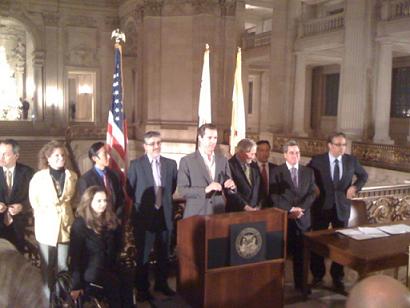
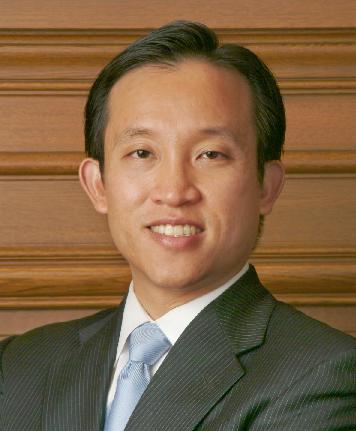
In between, the outgoing Board of Supervisors held a special final meeting Jan. 7, at which progressive supervisors fell into line behind Lee, some of them reluctantly, and accepted the new political reality. The next day, the new Board of Supervisors took office and overwhelmingly reelected David Chiu as board president, with only the three most progressive supervisors in dissent.

After Chiu played kingmaker as the swing vote for making Lee the new mayor, the board and Mayor’s Office are likely to enjoy far closer and more cooperative relations than they’ve had in many years. And the sometimes prickly, blame-game relations between the Police Department and D.A.’s Office should also get better now that the top cop has switched sides. But what it all means for the average San Franciscan, particularly the progressive voters who created what they thought was a majority on the Board of Supervisors, is still an open question.

One thing that is clear is the ideological battles that have defined City Hall politics — what Chiu called the “oppositional politics of personality” during his closing remarks on Jan. 8 — have been moved to the back burner while the new leaders try a fresh approach.

Newsom — with his rigid fiscal conservatism and open disdain for the Board of Supervisors, particularly its progressive wing — is gone. Also leaving City Hall is Sup. Chris Daly, a passionate and calculating progressive leader whose over-the-top antics caused a popular backlash against the movement.

In a way, Newsom and Daly were perfect foils for one another, caustic adversaries who often reduced one another to two-dimensional caricatures of themselves. But they were each strongly driven by rival ideologies and political priorities, despite Newsom’s rhetorical efforts to turn “ideology” into a dirty word applied only to his opponents.

“This year represents a changing of the guard, a transition,” Chiu said, pledging to continue pushing for progressive reforms, only with a more conciliatory approach, a theme also sounded by Sups. Eric Mar and Jane Kim, who each broke with their progressive colleagues to support Chiu over rival presidential nominee Sup. John Avalos.

“I will always support policies that will make our city more equitable and just,” Kim said after being sworn in to replace Daly, although she also made a claim about the new board with which her predecessor probably wouldn’t agree: “I think we have a lot more in common than we don’t.”

With a focus on diversity and compromise, “respect and camaraderie,” Mar said, “I think this new board represents the evolution of the progressive movement in San Francisco.”

If indeed City Hall is enjoying a “Kumbaya” moment, the path to this point was marred by backroom deal-making and old-school power politics, much of it engineered by a pair of figures from the previous era who are by no means progressives: former Mayor Willie Brown and Rose Pak, head of the Chinatown Chamber of Commerce.

Pak was seated front and center — literally and figuratively — during the board’s Jan. 7 vote for Lee and its Jan. 8 vote for Chiu, following media reports that it was she and Brown who persuaded Lee to take the job and city leaders (particularly Newsom, Chiu, and outgoing Sups. Bevan Dufty and Sophie Maxwell) to give it to him.

It all seemed sneaky and unsettling to board progressives, who questioned what kind of secret deal had been cut, even as they voiced their respect for Lee’s progressive roots and long history of service to the city. The sense that something unseemly was happening was exacerbated on Jan. 4 when Dufty abandoned a pledge of support for Sheriff Michael Hennessey — who five progressive supervisors supported for interim mayor — and left the meeting to confer with the Mayor’s Office before returning to announce his support for Lee.

Sups. David Campos, Ross Mirkarimi, and Avalos pleaded with their colleagues for time to at least talk with Lee, who was traveling in China since he reportedly changed his mind about wanting the interim mayor job. Maxwell was the only Lee supporter in the 6-5 vote for delaying the interim mayor item by a few days so the supervisors could speak with Lee by phone.

Pak and other Chinatown leaders put together a strong show of force by the Chinese American community at that Jan. 7 meeting, where the board voted 10-1 for Lee, with only Daly in dissent. Afterward, some of Lee’s strongest supporters — including the Rev. Norman Fong and Gordon Chin with the Chinatown Community Development Center — admitted that the process of picking Lee was flawed.

“Part of the problem was Ed’s because he couldn’t make up his mind. The process was bad,” Fong told the Guardian after the vote. Although Fong said he knows Lee to be a strong and trustworthy progressive, he admitted that the way it went down raised questions: “Some people were concerned about who he’ll listen to.”

Specifically, the concern is that Lee will be unduly influenced Brown and Pak, who each represent corporate clients whose interests are often at odds with those of the general public. And both operate behind the scenes and play a kind of political hardball that runs contrary to progressive values on openness, inclusion, and accountability.

“If there is a phone call from Willie Brown to Rose Pak, Ed Lee is going to go along with it,” predicted a knowledgeable source who has worked closely with all three, recalling the way they did business during Brown’s mayoral administration. “There was no real discussion of issues. The fix was always in.”

But Pak insisted that there was nothing wrong with the process of selecting Lee, and that all concerns about the nomination were driven by anti-Asian racism. “You have a plantation mentality,” Pak told the Guardian as she held court in front of a crowded press box before the Jan. 8 meeting. “The Bay Guardian has never given people of color a fair shot.”

While Newsom, Chiu, and Pak-allied political consultant David Ho all insisted “there was no deal” to win support for Lee, Pak seemed to revel in the high-profile role she played, with Bay Citizen reporter Gerry Shih labeling her “boastful” in his Jan. 6 article “Behind-The-Scenes Power Politics: The Making of Ed Lee,” which ran the next day in The New York Times.

“This was finally our moment to make the first Chinese mayor of a major city,” Pak reportedly told Shih. “How could you let that slip by?”

Chiu downplayed Pak’s influence, telling the Guardian that Lee was his top choice since November, and telling his colleagues before the Jan. 7 vote, “Ed is someone who does represent our shared progressive values.” But he also made it clear that helping the city’s progressive movement wasn’t what drove his decision.

“This is a decision beyond who were are as progressives and who we are as moderates. It’s about who we are as San Franciscans,” Chiu said. “This is a historic moment for the Chinese-American community,” calling it “a community that has struggled, a community that has seen discrimination.”

The next day, shortly after being elected to a second term as board president, Chiu acknowledged the “very real differences” in ideology among the supervisors, “but leadership is about working through those differences.” Ultimately, he said, “none of us were voted into office to take positions. We were voted into office to get things done.”
Michael Mina

24

paulr@sfbg.com

DINE When Michael Mina closed his eponymous restaurant in Union Square last year, I did not mourn. I had visited the place early in its run, toward the end of the summer of 2004, and felt as if I’d been seated inside a giant pillowcase, with awkward ergonomics and over fussy food — good food, of course, but expensive and show-offy. The desire — I might say the lust — of human beings to leave their mark on the world, whether by making rivers run backward or carving radishes into rose blooms, is a constant, for better or worse, and one notes its manifestations with wary neutrality. But as a philosophical matter I subscribe to the Alice Waters school of letting foods speak in their own voices instead of turning them into chefly statements, and in this sense a certain sort of high-style cooking poses issues for me.

In October, Michael Mina reopened in the old Aqua space, and a circle was closed, since Mina had been Aqua’s chef for a decade, through the 1990s and into the new millennium. How, I wondered, did they actually move the restaurant? Did they pack it into moving vans and speed off in the middle of the night, the way the Baltimore Colts did in 1984? However the move was accomplished, it was well worth making. The new space, while vault-like, is softened by curvature of the spine; it’s also quiet enough for comfortable conversation even when full. The ergonomics are much improved.

And the food? Well, Mina still likes his flights, his arrays of one- or two-bite treats, but the general tone of things is more muscular — an amuse-bouche of beluga-lentil soup, say, served in a demitasse with a small square of grilled-cheese sandwich on the side — and at times even rustic, as with the baskets of grilled levain to be spread with ricotta cheese enhanced by honey and pepper.

The smaller courses are mostly wondrous. A platter of hors d’oeuvres ($16/person) was a blitzkrieg of sensory experience, including a sublime crab fritter nested in a lettuce cup, a small filet of cured ocean trout propped on a mini-blini, a sensuous round of blood-red steak tartare, and (tasting mainly of fat), a foie gras “pb&j” with a buckwheat cake and huckleberry preserves.

The spell did weaken some with the main courses; a “five seas” tasting of Japanese fish ($42) could have been an appetizer plate, as could a duo of crispy fish ($39). A frenched rack of Prather Ranch lamb ($39), on the other hand, offered real ooomph, although views were divided about the niçoise-style fregola pasta, mixed with shreds of lamb osso buco served in an elegant little pot on the side — too rustic and not part of the greater whole? Maybe, but I liked it anyway.


Although the eagle-eyed will note that Michael Mina’s prices are top-tier, I hesitate to describe the restaurant as a haven for the rich, if only because an experience there is actually available to people whose incomes don’t reach past the payroll-tax cap. I have no issue with the rich per se — they, like the poor, will be with us always — but I feel no special urge to worship them or their achievements. I leave that task to them, since they seem to be well-equipped for it.

It is a writer’s job to afflict the comfortable and complacent, and so a few weeks ago I noted the absurdity of Senate Republicans’ waging all-out legislative war to extend the so-called Bush tax cuts on adjusted incomes over $250,000 when doing so requires us to borrow yet more money from foreign creditors, chief among them China. This brief noting of the obvious occasioned a hail of furious, invective-laden email — “cheesy,” “socialist” — hurled by web trolls from as far afield as Cape Cod.

I recognize such outbursts of right-wing media thugs because I’ve seen them before. In October 2008, when I dared to mention other obvious absurdities — Sarah Palin, our antediluvian Cuba policy — abuse also poured in from afar and I was even denounced by noted high school graduate James Taranto in the politics blog he writes for The Wall Street Journal. The wing nuts of the right perceive, I guess, that tax cuts for the rich — following bail-outs for reckless Wall Streeters — are politically touchy in a time when the federal deficit has become an aneurysm. They believe that media intimidation, even of small fry like me, is always worth a try. And plainly they believe that the next presidential campaign is already on. There, I agree with them. *

MICHAEL MINA

Dinner: Sun.–Thurs., 5:30–10 p.m.; Fri.–Sat., 5:30–10:30 p.m.

Lunch: Mon.–Fri., 11:30 a.m.–2:30 p.m.

252 California, SF

(415) 397-9222

www.michaelmina.net

Full bar

AE/DS/MC/V

Comfortable noise level

Wheelchair accessible


EDITORIAL: The Agenda for Mayor Lee

6

San Francisco has its first Chinese American mayor, and that’s a major, historic milestone. Let’s remember: Chinese immigrants were among the most abused and marginalized communities in the early days of San Francisco. In 1870, the city passed a series of laws limiting the rights of Chinese people to work and live in large parts of the city. Chinese workers built much of the Transcontinental Railroad at slave wages and in desperately unsafe conditions that led to a large number of deaths. The United States didn’t even repeal the Chinese Exclusion Act (an anti-immigration law) until 1943, and for years, Chinatown was one of the poorest and most neglected city neighborhoods.

So there’s good reason for Asians to celebrate that the last door in San Francisco political power is now open. And Mayor Ed Lee comes from a civil rights background; he got his start in politics working as a poverty lawyer and tenant organizer.

Unfortunately, his path to Room 200 was badly marred by some ugly backroom dealing involving Willie Brown, the most corrupt mayor in modern San Francisco history. Even Lee’s supporters agree the process was a mess and that it undermines Lee’s credibility. So it’s important for Mayor Lee to immediately establish that he’s independent of Brown and his cronies, that his administration will not just be a Gavin Newsom rerun, and that progressives can and should support him.

He has a tough job ahead. We urge him to make a clean break with the past and set the city in a new direction. Here are a few ways to get started.

Clear out the Newsom operatives and bring some new people with progressive credentials into the senior ranks. Newsom’s chief of staff, Steve Kawa, has been a shadow mayor for the past year while Newsom was on the campaign trail, and is the architect of much of what the outgoing administration has done to sow political division and cripple city government. Lee needs his own chief advisor.

Show up for question time and work with the district-elected supervisors. Newsom was openly dismissive of the board and refused to take the supervisors seriously as partners in city government. Lee should appear once a month to answer questions from the board in public, should meet regularly with all the supervisors and appoint a liaison that the board can work with and trust. He needs to make his administration as transparent and open as possible and ensure that everyone at City Hall follows the letter and spirit of the Sunshine Ordinance.

Make it clear that the next city budget includes substantial new revenue. Newsom offered nothing but Republican politics when it came to city finance; his only solutions to the massive structural deficit involved service cuts.

The deficit will be even worse than projected this year, since Gov. Jerry Brown wants to transfer much of the state’s responsibility for public safety and public health back to local government and there won’t be enough state money attached to handle the new burden. Lee needs to publicly call on Brown and the Legislature to give cities more ability to raise taxes on the local levee. Then he should start planning for a June ballot package that will raise as much as $250 million in new revenue for the city.

A substantially higher vehicle license fee on expensive cars, a congestion management fee, a significant annual transit impact fee on downtown offices, a restructured business tax, and a progressive tax on income of more than $50,000 a year would more than eliminate the structural deficit.

There are plenty of other revenue ideas out there; not all can or would pass on a single ballot. But Lee needs to make it clear that revenue will be part of the solution and that he will use all the political capital he can muster to convince the voters to go along.

Get serious about community choice aggregation. Newsom loved to talk about his environmental agenda, but when it came to challenging the hegemony of Pacific Gas and Electric Co. and its dirty power portfolio, he ran for cover. His hand-picked Public Utilities Commission director, Ed Harrington, has been an obstacle to implementing the city’s CCA plan. Lee needs to get rid of Harrington or direct him to cooperate with the supervisors and get San Francisco on the path to clean public power.

Establish a real affordable housing program. The city plans to build housing for as many as 60,000 new residents in the southeast neighborhoods but only a fraction of them will be affordable. This city is already well on its way to becoming a high-end bedroom community for Silicon Valley; only a clear policy that limits new market-rate condos until there’s a plan for adequate affordable housing will turn things around.

Support Sanctuary City and quit helping federal immigration authorities break up families. Newsom was just awful on this issue; Lee needs to work with Sup. David Campos to implement more humane laws.

End the demonization of homeless people and public employees. Newsom came to power attacking the homeless (with Care Not Cash) and went out attacking the homeless (with the sit-lie law). Lee ought to tell the Police Department not to aggressively enforce the ordinance.

Take on the sacred cows of the Police and Fire departments. The biggest salary and pension problems in the city are in the two public safety departments. The Fire Department budget has been bloated for years. If everyone else is taking cuts, so should the highest-paid cops and the overstaffed fire stations.

Some of Lee’s supporters insist he’s a solid progressive and that we shouldn’t hold the details of his selection or the fact that he was chosen by people who are openly hostile to the progressive agenda against him. We’re open to that but the progressive community will judge him on his record. And he has to start right away.

Chiu and pragmatism win over the new board

13

Despite the re-election of David Chiu as president of the Board of Supervisors today, there was a palpable shift in the political dynamics at City Hall. “Ideology” has been deemed a dirty word by a majority of the Board of Supervisors, while the politics of identity and “getting things done” is the new imperative.
That shift was most evident in the 8-3 vote for Chiu, with progressive Sups. John Avalos, David Campos, and Ross Mirkarimi supporting Avalos for the post through two rounds of voting. Chiu won it on the second round after fiscal conservative Sup. Sean Elsbernd withdrew his nomination, with he and his other three backers – Sups. Carmen Chu, Scott Wiener, and Mark Farrell – all supporting Chiu in the second round.
“This year represents a changing of the guard, a transition,” Chiu told us, noting the departure of both Mayor Gavin Newsom and supervisors that include Chris Daly. “We’re going to have to get past the oppositional politics of personality.”
In place of a progressive politics based on principled positions and aggressively challenging the influence that powerful downtown interests still exert on City Hall, Chiu is advocating for more pragmatic solutions to the considerable challenges facing the city, starting with a projected budget deficit of almost $400 million.
“None of us were voted into office to take positions, we were voted into office to get things done,” Chiu said.
His approach has occasionally earned him the scorn of progressives over the last two years, particularly in Chiu’s high-profile compromises with Newsom over cuts to Muni and city programs, business tax breaks, and other issues, as Avalos noted. But as Avalos told Chiu, “Clearly today, you have been validated in your hard work.”
Chiu was backed in both rounds of voting by progressive Asian-American Sups. Jane Kim and Eric Mar, both of whom also struck pragmatic notes in their comments. But they also noted that the board’s new civility and diversity are progressive values. “I think this new board represents the evolution of the progressive movement in San Francisco,” Mar said.
Newsom has been pointedly criticizing the notion of ideology for years – apparently unaware that his anti-tax, pro-business philosophy is an ideology – and it was echoed by several supervisors, including Farrell, who said he wants “to turn City Hall into a place based on issues and ideas and not ideology.”
Now, we’re all left to wait and see what kinds of issues and ideas take root. We’ll have much more on an extraordinary week at City Hall – with a new board and new incoming Mayor-select Ed Lee – in next week’s Guardian.

Chinese community out in force for Lee

5

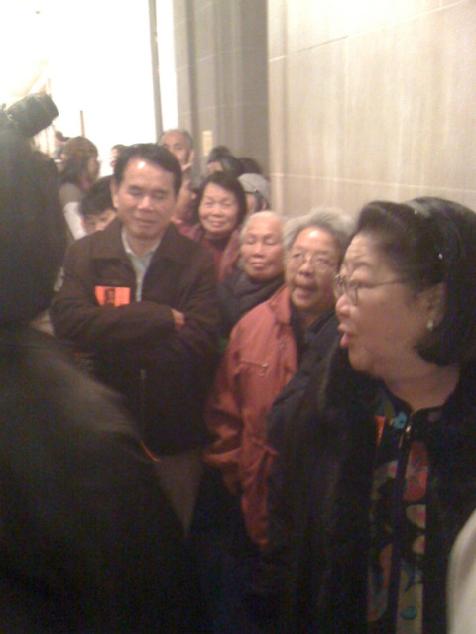
Well, Rose Pak promised a big demonstration and she’s got one: City Hall is mobbed with Ed Lee supporters pushing the supervisors to vote for the city’s first Asian mayor. Lee is still out of town, so he can’t answer questions, although he’s talked to several supervisors by phone. One said he seemed a little overwhelmed by all of this; he wasn’t even sure he wanted the job until Pak and Willie Brown talked him into it.


The revelations that the vote for Lee was a backroom deal orchestrated by Pak and Willie Brown (and from years of Brown watching, I can you this was a classic Brown move) will put Lee supporters like David Chiu and Eric Mar in a tough situation. Aaron Peskin, former supervisor, wasn’t mincing words when I talked to him jost before the meeting started:


“This is no so much about left and right, it’s about democracy and how power is transitioned,” he said. “This is disgusting, not because Ed Lee is or isn’t left or right or a progressive or a liberal. This is about the politics of power, and conservatives and moderates should be just as revolted as anyone.”


Meanwhile, my old friend Rev. Norman Fong, a leading Chinatown progressive, says he supports Ed Lee, as do a lot of progressives in the Asian communtity. I get that, and he’s a decent guy with a good history as a civil rights and housing lawyer, and he might even be a decent mayor. But this process stinks. There’s no other way to put it.

Elsbernd defends Lee (but ducks the Tapas)

4

Well, Sean didn’t stop by for tapas at Que Syrah last night, but he did take the time to send me a long letter answering my questions about why he “mysteriously”  nominated CAO Ed Lee for interim mayor in Tuesday’s Board of Supervisors meeting.

I appreciate the letter and it’s to Sean’s credit that this is his modus operandi with the Guardian (and others) in answering questions, even pesky ones.

I am printing his letter in full below and offering him the opportunity to continue this illuminating conversation since his letter raises even more questions about his nomination of Lee.

For example, the Bay Citizen section of today’s New York Times, on the morning of the followup supervisors’ meeting this afternoon, laid out a detailed story by Gerry Shih  of how former Mayor Willie Brown, Rose Pak, a powerful Chinatown political operative, and Mayor Newsom orchestrated the Lee nomination to keep the mayor’s office safe for PG&E, the downtown gang, and Willie/Pak’s clients and allies.

The headline: “Behind-the-Scenes Power Politics: The Making of a Mayor,” with  pictures of Newsom, Willie, and Pak. The motivation for the orchestration, according to the story, was that on Sunday afternoon “Word had  trickled out that the main contenders for the job were Sheriff Michael Hennessey, former Mayor Art Agnos and former board chairman Aaron Peskin” and the three were “deemed too liberal” by Pak, Brown and Newsom.

Then, the story said that over the next 48 hours, Pak, Brown and the Newsom administration “engaged in an extraordinary political power play, forging a consensus” on the board, “outflanking the board’s progressive wing” and persuading Lee at the last moment  shortly before he boarded  a plane to  Taiwan to agree “to become San Francisco’s first Asian-American mayor, even though he had told officials for months that he had no interest in the job.”

The story noted that Pak was “in a boastful mood the next day, several hours before she planned to have celebratory drinks with Brown at the Chinese Hilton,” (Willie, last time I checked, was on an annual PG&E retainer of $200,000 plus.) The story ended with a telling quote from Pak: “Now you know why they say I play politics like a blood sport.”

So the new questions I have for Sean (and other supervisors who voted for Lee) is what did they know and when did they know it? Or were they even informed about the deal and how it came down? Is this the West Portal supervisor’s idea of how to choose a mayor?

P.S. Sean and his fellow Lee supporters may not think it’s important for the Guardian (or other media or citizens) to be able to ask questions of Lee or other candidates  before making him mayor.

Well, I think  it’s important and I have some basic questions: What is Lee’s position on rent control? On progressive taxation to help solve the crushing budget crisis? On rubberstamping Newsom/Pak/Brown policies as mayor? And on community choice aggregation and public power and kicking PG&E out of the mayor’s office?  The last question on PG&E  is critical, because this is the key litmus test in political San Francisco.  Any politician, elected or appointed or emerging,  who supports PG&E and opposes public power/CCA is not to be trusted.  Did anybody get to ask Lee any of these questions or any others? Let’s lay out the questions and Lee’s answers before making him the reluctant mayor.

Here’s Elsbernds letter to me:

Bruce,

Good to hear from you.  As always, I enjoy the conversation, particularly
with those District 7 constituents who so often and consistently advocate
positions contrary to the vast majority of residents in District 7 (e.g.
the Guardian’s endorsement against Proposition G, which received over 70%
of the vote in District 7), but every now and then, present a fresh
perspective worth analysis.


I believe Ed Lee will make an outstanding Interim Mayor. You asked me the
following questions to justify this.  Let me give it my best shot.

Why did I nominate Ed Lee for Interim Mayor when he was out of town?  His
presence was immaterial to me.  I had the opportunity to discuss his
interest in the position with him prior to the vote, and I have worked with
him for nearly 10 years, and know where he stands on various positions.  I
did not need him in the room on Tuesday evening to answer questions as I
had done my homework before showing up to class.


Why did I nominate Ed Lee when he was not publicly “out there” or “in
public discussion” as a candidate or even known by the Supervisors to be a
legitimate candidate?  Whether or not Ed Lee’s name was known to you, your
readers, or other Supervisors, is not a fact to which I can speak.  After
all, I do not fit any one of those 3 criteria.  Ed was always a candidate
to me, and, most importantly, the qualities of an Interim Mayor were “in
public discussion.”  These qualities, which I heard from residents in
district 7 and throughout the City, were that the individual be someone not
wanting to run for re-election, someone, who had a demonstrated ability to
appeal to all cross sections of the political spectrum, someone who knows
the City (both how it functions as a government as well as its many
neighborhoods), and, someone with demonstrated experience in a variety of
areas of public policy.


Why did I nominate Ed Lee when he has not publicly stated his views on any
of the major issues coming before the Mayor?  Yes, it’s true he has not
filled out a Bay Guardian questionnaire, or been grilled by your editorial
Board.  However, an astute observer of Ed’s career can decipher well his
positions.  Moreover, Ed was most recently confirmed unanimously to serve
as CAO of the City and County, for the second time.  During that
confirmation process, I had the opportunity, as did every other member of
the Board and the public to present issues to Ed for his analysis.  The
tough issues facing the Mayor, are the same tough issues facing the CAO,
the Supervisors, and everyone else charged with the duty of serving the
public.


Why did I nominate Ed Lee when he was not available for questioning by the
Board when the discussion and vote came down?  Yes, Ed was not present.
However, as I stated earlier, Ed had always been available to talk prior to
his departure.  I was able to ask my questions before he left.


Why did I nominate Ed Lee when he is not as qualified for this tough post
in these tough times as the other public candidates?  Well, this question
implies a bit of a comparison to the other candidates.  I respect the other
candidates too much to say anything negative about them.  Simply put, I
believe Ed is the lone candidate with the sufficient breadth, most
relevant, and most timely experience across City government, and the one
who had the greatest ability to bring all sides of the political spectrum
together.


Why did I nominate Ed Lee when he was obviously part of a backroom deal
orchestrated by Mayor Newsom and his downtown allies?  I love questions
based on evidence and fact.  This question, however, is merely a question
based on your opinion.  I disagree with that opinion.  Ed Lee was elected
Interim Mayor because he is the most qualified candidate.


Finally, thanks for the invitation to Que Syrah this evening.
Unfortunately, as a working parent, my weeknight evenings do not belong to
me – they belong to my son.  I’ll be with him tonight.  I hope you’re still
able to enjoy yourself without me.


All the best,
Sean


P.S.  It’s the “Village Grill,” not the “Village Inn .”  Perhaps you need
to get out on West Portal a bit more and learn the name of the
establishments along the street.


City Hall’s mad political swirl

1

It was common knowledge around City Hall that Chinatown power broker Rose Pak and former Mayor Willie Brown were lurking behind the sudden emergence of Ed Lee as the pick for interim mayor, but Bay Citizen reporter Gerry Shih does an excellent job showing how it actually went down in a story that appeared in today’s New York Times.

Pak is also expected to orchestrate a big show of Chinese-American power during this afternoon’s Board of Supervisors meeting, and progressive supervisors tell the Guardian that they have been personally lobbied by Pak to get behind Lee. Some supervisors hold out the hope that Michael Hennessey might still have a shot, or that Ed Harrington might be put back in play, but I wouldn’t bet on it. Lee seems like he’ll be the guy, at least with this board.

In addition, the rumor mill is buzzing that David Chiu will declare his candidacy for mayor in the coming weeks, although other sources indicate he hasn’t made a final decision yet. And given that the new board still has to confirm the current board’s selection, don’t be too surprised if someone makes a play to name Chiu as interim mayor, but that’s a longshot.

Following right on the heels of today’s interim mayor vote will be tomorrow’s swearing in of the new board and vote on president, which Chiu would like to hold onto. But after crossing his progressive colleagues on Tuesday to support Lee over Hennessey, most progressives are expected to push for Sup. John Avalos, while fiscal conservative Sup. Sean Elsbernd is also expected to make a bid for the presidency. None appear to have six votes yet.

Despite media reports about the board’s “progressive majority,” the current political dynamics don’t really give any faction a majority, with identity politics holding heavier sway than ideology right now. So the only prediction that political watchers can make right now is that it’s going to be interesting.

Daly goes down swinging

7

The League of Pissed of Voters made a Daly roast video honoring the “biggest asshole in San Francisco politics”

Between last night’s epic Chris Daly Roast and Daly’s crazy-man antics on Tuesday night, Daly is ending his 10-year tenure on the Board of Supervisors in fitting fashion: as a passionate leader of the progressive movement who has also been its – and his own – worst enemy.

A huge crowd packed The Independent to honor and make fun of Daly and other political figures, and it definitely had the feel of an alcohol-fueled progressive love-fest, right down to conservative Chronicle columnist CW Nevius taking a pie in the face after stepping off the stage for the evening’s most tedious session behind the microphone.

Well, at least it was until Daly took the mike, going on and on in often tasteless fashion and resisting efforts by his wife, Sarah Low, and others to get him to give up the spotlight. Daly just isn’t ready to leave the stage yet, despite buying and running the Buck Tavern, soon to be renamed Daly’s Dive. He’s even half seriously talking about running for mayor.

But for all of Daly’s many accomplishments – he is the most productive supervisor of his era and the most passionately progressive – his personal grudges also create problems for the movement. On Tuesday, Daly led the effort to name Sheriff Michael Hennessey as interim mayor, twisting Sup. Eric Mar’s arm to get him to come along, only to fall one vote short.

Even though Hennessey and Ed Lee are similar figures, Daly turned Board President David Chiu’s support for Lee into an act of epic ideological betrayal, aggressively menacing Chiu at the meeting and shouting at him, “I will haunt you! I will politically haunt you! It’s on like Donkey Kong.” He spoke over his colleagues as they had the floor and tried to talk, including repeatedly yelling at Sup. Michela Alioto-Pier, “You are a representative of the rich!” And when the board reconvened after a short recess, Daly remained in the audience, periodically flipping the bird to the board.

But for all Daly’s current ire toward Chiu, it should be noted that Chiu became board president two years ago because Daly led the opposition to Sup. Ross Mirkarimi becoming board president, giving Chiu far more political power than he would otherwise have. Daly has long prided himself on his good political instincts, and at times he has indeed been a masterful political tactician, but his ego sometimes gets the better of him. He’s hyper competitive and just wants to win, even when victory carries an unacceptable price.

When the new Board of Supervisors takes the oath of office at noon on Saturday, the progressive movement will lose a passionate leader in Chris Daly. But as it elects a new president and its political dynamics take shape, someone will need to take Daly’s role as the whip and conscience of the board, a role even his enemies acknowledged that he played.

“Chris, I think San Francisco is better because you served,” Sup. Sophie Maxwell said on Tuesday, gritting her teeth in praising someone who has at times scorned and belittled her. It will be interesting to see how Daly’s role is filled on the new board, and whether we can still have the passion without its pitfalls.

Chris Daly’s Final Say

18

As part of my effort to compile a list of most roastable moments of Sup. Chris Daly‘s decade-long career at City Hall, I asked the termed-out D6 supervisor if he would sit down for an exit interview. And shortly before Christmas, when there was still hope the Board would select a progressive interim mayor, and Daly had not yet vowed to politically haunt Board President David Chiu with shouts of, “It’s on like Donkey Kong” , we arranged to meet me at the Buck Tavern on Market Street, which Daly, who now holds the liquor license, is threatening to rename “Daly’s Dive.”

As it happens, the lion’s share of our conversation ended up taking place by cell, since Daly got stuck in late afternoon commuter traffic, as he drove to San Francisco from Fairfield, where his wife and children have lived since April 2009, making him a fitting symbol of the East-Bay-and-beyond migration pattern of couples who live in San Francisco, until they have more than one kid.

Except not all couples with two small kids get to move into one of two foreclosed properties that the in-laws bought with $545,000 cash in spring 2009. At the time, Daly’s critics accused him making such a mess of governing the city that he had decided against raising his own family here. Daly predictably disagreed. “There are few people who think about the future of San Francisco and the health of the city more than me,” Daly told reporters, explaining that his wife wanted family support raising their children, so she had moved to the same cul-de-sac as her parents, as Daly continued to live in a condo in San Francisco with roommates and to see his family on weekends.

Anyways, on the dark and stormy night that I interviewed Daly in mid-December, he acknowledged that he was going to be in for one helluva roast at the Independent on Jan. 5. in the worst possible sense of the tradition.
“Will there be controversial subjects, things that on the face of it, are not very nice? Yes,” Daly said.

And then he claimed he had agreed to this ordeal, because, under the roast’s traditional format , he would get to go last—and thus would get to have the last word.
“Why would I want to end my City Hall career like this? Because I get to go last, and can really say what’s on my mind,” Daly said. “Unless the D.J. wants to say something as he’s spinning.”

Daly’s comment suggests that folks who attend his roast at the Independent will witness a historically vicious verbal drubbing on all sides, since no one has ever accused Daly of holding back from saying what was on his mind. Even if it has led to seemingly counterproductive “We are shocked, SHOCKED!” responses. Like the time Sup. Michela Alioto Pier introduced an ultimately doomed etiquette ordinance, after Daly swore at a constituent during a City Hall meeting, in 2004.

Daly said at the time that he comes from a background as a housing-rights organizer on the streets of Philadelphia and San Francisco, where confrontation was an effective political tool. But he also claimed that he had learned an important lesson.
“In the future it’s going to be better for me personally and politically to focus my energy positively on the people I care about instead of negatively on the people I think are doing them harm,” Daly reportedly said.

Fast forward six years, and Daly is unrepentant about his record of fighting for low-income people, while openly defying City Hall’s unwritten rules of etiquette.
“Etiquette always seemed a little silly, something for the ‘other’ San Francisco, for the prim and the proper and that’s not what I am concerned about,” Daly said. “I’m aware of the turn-the-other-check philosophy, and, if I were religious, I’d be out of the Old Testament. I’d be, if someone pokes you in the eye, I’d poke back.”

Daly says he stopped caring about etiquette towards the end of his first year in office. “When those in power use that power to put down those who are less advantaged, when I see that, I respond quickly and with as much force as I can to prevent them from doing that kind of thing again,” he said. “ If you want to attack homeless people for political advantage, I’m going to attack you right back. That’s not ‘proper,’ but I think it’s just.”

Daly says he also soon realized tthat the truth wasn’t the driver.
“I already knew that money, power and significant forces would be pushing back against me but then I discovered that the actual truth wasn’t what played out there in the world of spin. It’s like when the Examiner’s Josh Sabatini asked me how I want to be remembered, and I said, “Not as the caricature the Examiner created of me.”

Daly, who moved to San Francisco in 1993 to work on homeless and affordable housing issues, was at the heart of the movement around Ammiano’s 1999 write-in campaign for mayor, and part of the progressive sweep onto the Board, in 2000.

“For me, it’s never been about being a ‘good’ vote. I breathe leftist progressive politics,” Daly said. “Where I can make more of a mark is in terms of setting the stage for those votes and holding the line in districts that are not progressive. I’m very proud of my attempts to hold the line on issues, but the work doesn’t make any friends.”

Daly noted that after he made comments about Newsom’s alleged cocaine use during the 2007 Mayor’s race, downtown interests threw everything they had left at him.
‘They got a lot of hits in, but no total blows,” he opines. “Last time I checked, I saved the city $150 million on the Americas Cup deal that they were going to ram rod through.”

And so, as he prepares to begin life as a bar owner, don’t expect Daly to pass up opportunities to launch verbal attacks, if he believes they are warranted, political consequences be damned.

“People want to have the power without any of the negativity they associate with all the shit we have to deal with to build this power,” Daly added. “So, it’s all, Daly and [former Board President Aaron] Peskin took control of the Democratic Party at midnight. Well, how did you want us to take over? “

Daly claims if you take away “negatives” attributed to him, you take away his wins. “People call me a lot of things, but I’m not a loser, I win a lot” Daly added, noting that Democrats being nice to Republicans has led to losses in D.C., not gains. “So, yes, I’ve got a lot of negatives, and they’ve clearly been made into a target, but if I can take the hits, and help people I care about, I’m happy to do it. That’s what I’ve done for ten years.”

Daly says he’s become “pretty desensitized to criticism,” even as he admits to being a sensitive person, deep inside. “I don’t think I’d have quite the visceral response to poverty and oppression, if I wasn’t sensitive,” he said. “I care deeply about people’s struggles. That’s why I’m here, but I also have a pretty solid critique of capitalism and I know how to follow the money, so when I get criticized by some downtown mouthpiece, I know what time it is.”

Daly says he started the Daly Blog several years ago, to push back against what he felt was unfair treatment in the media. And he says he endorsed outgoing mayor Newsom for Lt. Governor, despite their long and antagonistic history, so progressives could have a shot at installing a mayor in Room 200.

“My money now is on the selection of the mayor going to the new Board, and Avalos getting it in the 13th round of voting,” Daly said.

Daly made that prediction three weeks before the progressives on the Board seem poised to hand the keys to R.200 to City Administrator Ed Lee—thereby eliciting Daly’s ballistic “Donkey Kong” outburst.

With the outgoing Board set to meet Friday to make a selection, here’s another Daly roastable moment, this time from Peskin, related to the fall-out that ensued after Daly made two appointments to the SFPUC, while serving as acting mayor for one day, while then Mayor Willie Brown was out of the country, on a trip to Tibet.

“When Mayor Willie Brown left office, Charlotte Schultz had an unveiling ceremony of Brown’s picture. Newsom, who by then was mayor, was presiding. And Charlotte had a beautiful easel with a golden drape over it. When she pulled back the curtain there was a picture of Daly, who was listed as “41st and a half” mayor presiding from 9 a.m. to 2 p.m. on October 22,” Peskin recalled, noting that under Daly’s picture there was another curtain that contained Brown’s actual portrait.”

And while Daly’s controversial statements and outbursts always make headlines, there is no denying that he helped make the progressive agenda, including establishing mandatory paid sick days, universal healthcare, and forcing developers to contribute in affordable housing or services for poor, an integral part of city policy.
 “The Chronicle used him as the poster child to try and dissuade anyone from supporting a progressive agenda,” former Sup. Jake McGoldrick observed. “He was used to smear any of our good ideas. And Chris never seemed to understand that some of us needed to be a little more sensitive, since we needed to get re-elected and didn’t represent districts that were as progressive as his. Personal attacks make the whole situation smell bad.”

Sup. John Avalos, who served as Daly’s legislative aide until he was elected as D11 supervisor, acknowledged that a lot of folks have accused Daly of doing irreparable harm to the progressive movement and being a gift to Newsom and the moderates at City Hall.
“People try and make hay out of it,” he said. “But his antics have probably hurt him more than anyone,” Avalos added, noting that he ran in 2008 as Daly’s former legislative aide.
‘And it didn’t hurt me, and I made no bones about where I came from.”

And then there’s the fact Daly defeated the Chamber ’s Rob Black in the 2006 election. “We don’t do enough to have better relationships between ourselves,” Avalos added , reflecting on the divided progressive movement. “It’s more than just one person.”
 
Peskin for his part acknowledges that Daly will be missed on the Board.
 “He sucked the oxygen out of the room and made it all super lefty and caustic, and it certainly did not allow a better conversation to evolve,” Peskin said. “But it’s still going to be a pretty profound loss.”

Backroom Ed Lee mayoral deal raises suspicions

11

Last night’s dramatic eight-hour Board of Supervisors meeting, at which six supervisors suddenly came together around naming City Administrator Ed Lee to succeed Gavin Newsom as mayor, was a classic case of backroom dealing making, the full results of which the public still doesn’t know. And it is those unknowns that have progressives rightfully pissed off and distrustful of the choice.
On the surface, both Lee and the progressives’ preferred pick, Sheriff Michael Hennessey, are similar figures who fit Newsom’s demand for a nonpolitical caretaker mayor. He has publicly said both would be acceptable, and both have some impressive progressive credentials as well.
Lee was a civil rights attorney who help run the Asian Law Caucus before being hired by then-Mayor Art Agnos as an investigator for whistleblower complaints, and he’s worked for the city ever since, serving as executive director of the Human Rights Commission and director of the Department of Public Works. Newsom moved him in the powerful post of city administrator in 2005 and he was recently approved for a second five-term for that job, unanimously approved by the Board of Supervisors.
Sup. Bevan Dufty and other supervisors had even talked to Lee about being interim mayor, and he has consistently said that he didn’t want it – until a couple days ago. That’s when Newsom and the fiscal conservatives on the board suddenly coalesced around Lee, who apparently changed his mind while on a trip to China, from which he is scheduled to return on Sunday, although that might be moved up now that the board has delayed the vote choosing him until Friday afternoon.
That delay was won on a 6-5 vote, with moderate Sup. Sophie Maxwell heeding progressive requests for an opportunity to at least be able to speak with Lee before naming him the city’s 43rd mayor. “I don’t think we should make such a decision blindly,” Sup. John Avalos said.
It was a reasonable request that neither the fiscal conservatives nor Board President David Chiu, the swing vote for Lee in what his progressive supporters angrily call a betrayal, would heed. And the question is why. What exactly is going on here? Because it’s not just progressive paranoia to think that a deal has been cut to maintain the status quo in the Mayor’s Office, as Newsom’s downtown allies have desperately been seeking.
Just consider how all of this went down. Sources have confirmed for the Guardian that Chiu met with Newsom at least twice in recent days, and that Newsom offered Chiu the district attorney’s job, hoping to be able to put a fiscal conservative into the D3 seat and topple a bare progressive majority on the board. Chiu reportedly resisted the offer and tried to influence who Newsom would name to succeed him, and we’ll find out as soon as today who the new district attorney will be.
Closed door meetings also apparently yielded Lee as Newsom’s choice for successor mayor, with both Chiu and Sup. Eric Mar initially inclined to back Lee, who would be the city’s first Chinese-American mayor. After pushing his colleagues for weeks to name a new mayor, Daly tried to thwart the Lee pick by initially seeking a delay, then finally persuading Mar to go with Hennessey as his first choice.
“Politically, he will work for the other side, my progressive colleagues,” Daly said at the hearing, calling it “the biggest fumble in the history of progressive politics in San Francisco.”
As the deliberations began, Mar called Lee his mentor at the Asian Law Caucus and someone whom he respects, but that he preferred to keep Lee in his current post and to support Hennessey, who got five votes on the first round, while Lee got four, including Chiu.
Dufty – who said that he would be supportive of Hennessey for mayor – and Sup. Sophie Maxwell abstained from voting for anyone during the first round. On the second round, Maxwell went with Lee, leaving Dufty as the kingmaker. But rather than decide, he asked for a recess at 8:45 pm, and he and Maxwell went straight to Room 200 to confer with Newsom.
When the board reconvened, Dufty announced his support for Lee. Dufty denies that Newsom offered him anything, but he did confirm that Newsom indicated a preference for Lee and a willingly to help Lee return to his current post next year, which requires some tricky maneuvering around city ethics laws. Similarly, Chiu denies that his support for Lee was anything less than his unconditional preference.
But it’s hard to know. After weeks of Newsom playing games with leaving the Mayor’s Office to assume his duties at lieutenant governor (a stand egged on by his downtown allies and Chronicle editorial writers), it seems likely that Lee has given them some kind of assurance that he won’t rock the boat or side with board progressives on key issues.
Some progressives aren’t ready to accept that Lee will be our next mayor, believing that Chiu, Dufty, or Maxwell can still be shamed into changing their minds, but that seems unlikely. Instead, progressive Sups. John Avalos, David Campos, and Ross Mirkarimi just want to talk to Lee and they hope to be convinced that he’ll work cooperatively with the board and not simply be a Newsom puppet.
“I have been open and I remain open to supporting Ed Lee,” Campos said in support of the motion to continue the meeting to Friday at 3 pm, the day before the new Board of Supervisors is sworn in.
But he and the other progressives are openly questioning the Lee power play. After all, Campos said, his nomination of Hennessey was already an olive branch to Newsom’s side, saying he wasn’t the progressives’ first choice but simply the most acceptable from Newsom’s list. “It was in the spirit of one side of the political spectrum saying to the other side, ‘We want to come together,’” Campos said.
Instead, it was a backroom political deal with carried the day, a deal that Chiu went along with.
“I feel amazingly betrayed right now,” Jon Golinger, Chiu’s campaign manager, told us after the meeting. “It’s a shock…Process-wise, Ed Lee came out of nowhere.”
And that’s antithetical to the progressive values on transparency and public process. So now, it’s up to Lee, Chiu, and the other involved in this deal to fill in a few of the many blanks, and to assure the public that this choice is in the best interests of the whole city.

A swing to Lee — Daly ballistic

45

Bevan Dufty emerged from his meeting in the mayor’s office to say he was ready to vote for Ed Lee. The deal was cut; we don’t know what it is, but that’s what happened. And Sup. Chris Daly is ballistic.

“This is,” he just said, “the biggest political fumble in the history of progressive politics in San Francisco” and he put the blame directly on Board President David Chiu, the sixth progressive vote who went with Lee over Hennessey. As much as he liked Ed Lee as a person, Daly said, “politically, he will work for the other side.” He then told Chiu he would “haunt” him politically and announced, “it’s on like Donkey Kong.”

Then Avalos asked for a recess “to go in some back room” and with minor disagreements, the board is in recess until 10:15.

Wow. What a moment. What a totally bogus way for a new mayor to be chosen for this city. Ed Lee wasn’t even on the radar, wasn’t under consideration, had said he didn’t want the job, until some deal was cut at the last minute. Nothing against Ed Lee, but you can’t be an effective mayor of this city when you jump into things at the last minute, with no chance for anybody to talk about or evaluate your credentials. And he’s clearly the mayor of the conservative board members — and David Chiu has joined them.

I’m not as angry as Chris Daly — that would be hard — but I’m disappointed.


Joining the journey

0

news@sfbg.com

Malcolm X once said “Tomorrow is for those who prepare for it today.” And today, Malcolm Shabazz, the eldest grandson of Malcolm X, says he is trying to carry on the storied legacy of the radical advocate for African American civil rights and leading voice for the Nation of Islam.

Shabazz, 26, was recently in San Francisco discussing that legacy, as well as his own spiritual and personal journeys, which included making the pilgrimage to Mecca for the hajj in November, a requirement for Muslims that his grandfather also undertook in 1964, the year before he was assassinated.

It was the latest chapter in a long and complicated story. At the age of 12, Shabazz started a fire in his Yonkers home that left his grandmother (Malcolm X’s wife, Betty) with burns over 80 percent of her body, which led to her death a few days later. Shabazz has spent more of his adolescence and adulthood in prisons and other institutions than in the real world.

After serving four years in juvenile correctional facilities for arson and manslaughter charges for the fire, Shabazz pleaded guilty to attempted robbery in 2002. He served three and a half years in prison for that crime and then went back to prison months after his release for punching a hole in a store window.

Although he is often portrayed in media accounts as disturbed, Shabazz seemed calm and reflective during a two-hour interview with the Guardian. A soft-spoken man with few but well-chosen words, Shabazz is not unafraid to speak his mind about the state of the country and his grandfather’s legacy.

“If you want to know anything, then go back to the source,” he told us, which is what we did, reviewing his long, twisted journey to Mecca.

As the oldest male heir to Malcolm X, Shabazz was born into a fascinating family. Media accounts have documented him as a troubled young man, shuttled back and forth among family members. Like his grandfather, he spent time on the streets and in jail. Like his grandfather, it was behind bars that he finally regained his faith and found himself fully immersed in Islam. Shabazz explains that while he was born into Islam, he finally began to fee its presence in his life during his most recent incarceration period. While quarantined in Attica Correctional Facility in New York, Shabazz explained that he “didn’t have any hygiene supplies, I didn’t have any reading materials.”

But it was during his time in Attica that he met another prisoner — half Mexican, half Iranian — who identified himself as a Shia Muslim. “He asked me ‘Are you in a lie? Or are you a real Muslim?’ ” Shabazz recalled. He answered that he was a real Muslim. “He gave me reading materials to read in my cell.”

According to Shabazz, this was the man who discussed and poured over religious texts with him during their time together, and the one who inspired him to convert from the Sunni sect to Shia.

“I was raised a Sunni, everyone in my family was Sunni,” he said. There is much antagonism between the two sects, so his conversion caused a backlash akin to when his grandfather left the Nation of Islam in 1964 and declared himself a Sunni, which let to his assassination the following year.

When word spread of Shabazz’s conversion, various Sunni leaders and community members expressed their discomfort with what he had done. He explained that many people wrote to him asking him, “How could you become a Shia?”

After his release, Shabazz decided to move to Syria to study at an Islamic institute and then spent the following eight months teaching English to children. “I came home from prison [and] I wanted to get away for a little while,” he explained.

After arriving back from Syria in April, Shabazz went to Miami and worked on his memoirs, which he said are due to come out this May. The book discusses Shabazz’s life and tribulations, noting that “there are misconceptions that I would like to clear up.”

Once he returned to the United States, Shabazz decided to follow his grandfather’s footsteps and make the pilgrimage to Mecca, where, he said “the air felt different.” But he also explained how the people he saw on the pilgrimage seemed less willing to impose their rules on Americans.

“It seems like they have more fear [of] Americans than they do for Allah,” he said. “If they know you’re American, I don’t know what it is, but they leave you alone.”

Shabazz said he had the experience of a lifetime and proved his intense vigor for the Islamic faith. He circled the Kaa’ba, and despite swollen feet and a bad case of the flu, carried on his pilgrimage like a true believer. “I never saw this many people at one place at one time. It was much more of a struggle than I had anticipated,” he said. “But everything was earned.”

Decades before, his grandfather Malcolm X made his mark on American culture, taking a radical approach to demanding equal rights. When asked if his grandfather would admire President Barack Obama if he were alive today, Shabazz replied, “Definitely not. To me, Obama is no different than [George W.] Bush.”

He said that democracy in this country is a sham, an illusion effectively perpetuated by the ruling elite. “The U.S. is a land of smoke and mirrors, and they’re the best at doing what they do,” he said. “My grandfather? Hah. He wouldn’t have supported any of those dudes.”

Although Shabazz doesn’t particularly admire Obama so far, he does hope that the election of the first African-American president will “boost the esteem of the young black youth.” And he said that the messages of Malcolm X are more important today than ever.

“My grandfather once stated that there are only two types of power that are respected within the United States of America — economic power and political power — and he went on to explain how social power derives from these two. Unfortunately, the majority of the people [today] are economically illiterate and politically naive. They believe most of what they see on television and read in the papers. I say believe half of what you see, and none of what you hear.”

For his own personal politics, Shabazz said change begins with education and unity. “[Education] could be done through music, spoken word poetry, art, preaching from the pulpit, or putting in physical work right in the trenches,” Shabazz said.

In terms of unity, he cited the European Union, explaining that it is an organization “where nations that don’t necessarily like each other [but] have at least enough common sense to come together for a cause, to achieve a common goal, or to stand up against a common enemy. When it’s time to put niggers in check, they know how to come together.”

Almost 10 years after the 9/11 attacks, Shabazz sees growing potential for Islam to exert an influence in the U.S. “After 9/11, a lot of people did not know too much [about Islam]. But they started to investigate and learn more.”

Although many people’s first reaction was to turn away from the religion of jihad, Shabazz feels that many people also felt the need to educate themselves on the matter — and found that there is much more to Islam than the mainstream media portrays. And for a young man who has already led a turbulent life, Shabazz is seeking something basic from his newfound faith: “I want a peace of mind.”

Editor’s Notes

0

tredmond@sfbg.com

Art Agnos spent six terms in the California Assembly and four years as mayor; he doesn’t need my political advice. But I gave it to him anyway the last time I saw him, when he expressed an interest in serving out the remainder of Gavin Newsom’s term.

Agnos and I were not close when he was running San Francisco; the Guardian supported him strongly for the job, but we were quickly disillusioned, not just by his nearly instant sellout to Pacific Gas and Electric Co., but by his apparent disdain for public process. But now he’s retired, and living on Potrero Hill near the Guardian office, and I see him on the streets when I’m going to buy lunch at Hazel’s and he’s walking his dog, and we have pleasant chats about politics. He’s mellowed. At 72, he seems to have a bit more perspective on what he did right — and wrong.

At any rate, when he told me that he’d be willing to serve as a caretaker mayor — and I got a sense that he’d actually like to do it — I told him this: you can’t just talk to me and a few supervisors. You want to be mayor of San Francisco, even for 11 months, you have to go out and talk to the people who spend their lives trying to make this a better place. The same goes for Ed Harrington, Mike Hennessey, and anyone else who wants the job.

Here’s the odd thing about the next mayor: For better or for worse, the person who takes over whenever Newsom finally decides to go to Sacramento will be directly accountable only six supervisors (or seven or eight, in the unlikely event that anyone gets that kind of majority). If the interim mayor is really a caretaker and never seeks reelection, it’s possible that the voters and the activist groups that define San Francisco won’t be part of the next administration’s political calculus.

And that would be a mistake.

The progressive movement in San Francisco is much stronger and more organized than it was when Agnos first ran for mayor in 1987. And if the progressive majority on the board chooses a mayor, there will be high expectations — not just for policy, but for openness and inclusiveness. After being shut out for seven years, a whole lot of people are going to want to be able to walk into the Mayor’s Office and feel welcome.

And that process starts now.

There are all kinds of arcane state laws that limit the ability of the current or incoming supervisors to campaign for the mayor’s job. But we already know who they are — they’ve been campaigning and meeting with groups and constituents regularly over the past couple of years. Not so with the outside candidates.

What mix of new revenue and cuts would Harrington seek to balance the budget? How would Hennessey address pension reform? Where’s Agnos on implementing community choice aggregation? I’m not the only one who wants to know.

There’s this ethos among these guys that it’s unseemly to be trying too hard to get the job, that it’s better to sit back and be asked — and part of that is the reality that it’s going to suck trying to balance the city’s books, and it won’t be a fun 11 months, and some of them would just as soon not bother. But there’s no shame in wanting to be mayor, or interim mayor. If you want it, say so — and tell us all what you’d do.

I’m moderating a Harvey Milk Club panel discussion Jan. 3 and all the prospective candidates are invited. The least any potential mayor can do is show up and answer questions.

Arthur Szyk: beauty in fairy tale… and Stalin

0

Nowadays, being up on the news can actually make us stupider (more stupid, damn!), but when cartoonist Arthur Szyk was sketching his dense, fantastically detailed news caricatures, politics were still in need of explication – and all the more better if it was beautiful to boot. How else can one explain why one of the most whimsical artists of the 1930s and ’40s became best known for his sketches of Hitler and Stalin playing poker?

Szyk’s jewel box of an exhibition is on view through March 2011 at that jewel box of a museum, the Legion of Honor. How lovely is the Legion of Honor? Though its offerings are often obscured by its big box fine art peers like the de Young and the SFMOMA, the Legion itself is a French neo-classic temple compared to the blatant modernism of its more centrally-located brethren. Where else, for pete’s sake, can one find a meticulously transposed Louis-whenever parlor room adjacent to a hall full of Rodin sculptures? 

A multi-media art experience, I reflected, passing under a mudejar ceiling from late 15th century Torrijos region of Spain, on my way to the museum’s corner hideaway gallery no. 1 that housed Szyk. Who was a firecracker, really. Born to a Jewish Polish family, Szyk was one of the first political caricaturist to sketch out against the Führer. His Haggadah series (1932-1938) correlated Hitler’s rise with the traditional story of the Israelites’ biblical flight from Egypt. 

Though his original message was somewhat watered down by the drawings’ group publication in 1940 (the publishers erased all the swastikas from the drawings – que what?), it was still considered one of the most beautiful works of the time. Szyk was also outspoken about his adopted country’s lack of action in the face of evil – the US fell under the wrath of his pencil for its sluggish rise to action during World War II. 

The man’s drawings are pure, extravagant beauts. The drowsy, yet watchful eyes of the Legion security guards (legion guards! Drama!) prevented me from nosing in quite as close as I wanted to them – the sentries probably get sick of wiping off the glass – but even so. Even so, there were his illustrations for a deck of playing cards, his whip-smart rendering of a poker game between Hitler and Stalin — with the Angel of Death looking on intently. His sumptuous creations for the 1955 edition of Arabian Nights Entertainment. His faces are so detailed that they bely the fact that they are portraying fictional characters. His details are so extraordinary its no wonder that a lot of adult children will get a sense of time travel vertigo dipping into his stash of kid’s book illustrations. The flowers with faces Szyk brought into being for the 1945 edition of Andersen’s Fairy Tales — well Walt, you have some explaining to do about Alice’s rose garden buds.

You should be witness to all this, of course. While you’re there, check out the Legion’s marquee showing of Japanese and Californian and French-via-Japan prints in the basement (Japanesque, through Jan. 9). And the Legion cafe, of course, which is always crammed full of old people and is an excellent place to enjoy a cup of coffee or esoteric Asian soda pop. 


Arthur Szyk: Miniature Paintings and Modern Illuminations

Through March 2011

Legion of Honor

100 34th Ave., SF

(415) 750-3600

www.famsf.org


Newsom’s delay tactic would create a legal mess

22

In this week’s Guardian, I lay out the latest political dynamics surrounding who will become San Francisco’s next mayor. But in reporting out that story, I stumbled across some interesting potential implications to Mayor Gavin Newsom’s petulant promise to delay his swearing in as lieutenant governor.

There is little precedent and scant caselaw on the legality of Newsom’s gambit, as most lawyers and political observers have said, so Newsom would be taking the city and state into uncharted territory just the deny his nemesis, Sup. Chris Daly, a chance to vote on the successor mayor. And it could backfire on Newsom.

For example, what if the excitement of returning to the governor’s office gives Jerry Brown, 72, a fatal heart attack after he and the rest of the state constitutional officers (except Newsom) are sworn in on Jan. 3? If Newsom had taken the oath of office as he was supposed to, he would realize his dream of becoming governor.

Instead, here’s what California Government Code 12058 says would then happen: “In case of vacancy in the office of Governor and in the office of Lieutenant Governor, the last duly elected President pro Tempore of the Senate shall become Governor for the residue of the term,” so Darrell Steinberg would become governor. Having covered Steinberg when I worked in Sacramento, I think he’d make a far better governor anyway, so this is probably a good outcome.

Here’s another unlikely scenario I like even better: what if Gov. Jerry Brown suddenly remembers all the nasty things that Newsom said about him while running for the Democratic Party gubernatorial nomination and declares the lieutenant governor’s office vacant because of Newsom’s no-show at the constitutionally mandated swearing-in ceremony and decides to appoint a grown-up to the office.

Newsom’s stand also carries risks for San Francisco, beyond just the sudden transfer of power that Newsom and moderate supervisors have already created. The City Charter calls for the newly elected Board of Supervisors to be sworn into office at noon on Jan. 8. But, as I’ve learned in interviews with officials in the Clerk the Board of Supervisors Office, there’s a strange quirk in the charter that makes it unclear who the president of the board is between when the new supervisors are sworn in and when they elect a new president, which is their first order of business.

After all, oftentimes the outgoing president isn’t even a supervisor anymore, as was the case two years ago when Aaron Peskin yielded his D3 supervisorial seat to David Chiu. This year, the Clerk’s Office says Chiu will preside over the Jan. 8 meeting for ceremonial reasons until a new president is elected (which could take minutes, hours, or days depending on a nominee’s ability to get six votes).

Now, under normal circumstances, the city would have a duly elected or appointed mayor during that transition period, so it’s not terribly important that there is a gap in who serves as president of the board. Even when the mayor moves on to higher office, as is the case this year, the City Charter calls for the president to serve as acting mayor until the board can appoint an interim mayor.

But because of Newsom’s extralegal meddling in city affairs after his scheduled departure, Chiu doesn’t become acting mayor as he should for those five days. So what happens if Brown has his sudden heart attack at 12:05 pm on Jan. 8 and Newsom, seeing that his stunt may cost him the chance to be governor, rushed to Sacramento to take his oath of office before Brown flatlines?

In that circumstance, the Mayor’s Office would be vacant and so would the board presidency, leaving San Francisco leaderless until the board can come up with six votes each for a new mayor and board president.

Now, is any of this likely? No, but this and lots of other hypothetical possibilities illustrate just how selfish and irresponsible that Newsom and the downtown-based instigators of this drama are being, despite their hypocritical public claims to caring about the city and trying to prevent political games.

But as Sacramento Bee columnist Dan Walters recently wrote: “It’s impossible to predict how Newsom’s power play will turn out. It’s a stormy beginning for his new career in state politics – but given the irrelevance of his new office, it may also be the high point.”

Curtain calls

1

arts@sfbg.com

THEATER Freud called dreams wish fulfillment; or reality, disguised, but basically as we’d like it to be. If you asked the Buddha and Heisenberg about reality, you’d get pretty much the same answer. Not that any of these guys went to the theater a lot in 2010. This year oscillated between quasi-documentary fidelity to facts and burrowing hallucinations like those induced by Gysin and Sommerville’s spinning stroboscopic Dreamachine. (A facsimile of one even graced The Burroughs and Kookie Show, Christopher Kuckenbaker’s Fringe Festival winner and definitely a peak stage encounter in 2010.) But it all amounted to an assault of some kind on the sleepwalking world outside. Dreaming in the theater can be much more lucid.

Best political theater riffs: In the Wake (Berkeley Rep) was not a perfect play, but Lisa Kron’s slightly lopsided new political dramedy had a way of upsetting some fundamental and suspect assumptions of mainstream liberals that was at times electrifying. Dan Hoyle’s The Real Americans, while not as politically provocative, also ventured outside the “liberal bubble” into red state territory, bringing back reportage in the form of deft rapid-fire characterizations, comedy, and music by the young but prodigious solo performer–playwright of Tings Dey Happen and Circumnavigator. And finally, the 51-year-old San Francisco Mime Troupe’s reaffirmed that its brand of agitprop is still a going concern. Posibilidad, or the Death of the Worker, set partly in the USA but inspired by the recent factory takeovers by workers in Argentina, was a shrewd, funny, tuneful plea for cooperatives against the grinning, co-opting tendencies of “capitalism with a human face.”

The most hyped production: Terrell Alvin McCraney’s trilogy, The Brother/Sister Plays. The only one that really worked for me was the second, The Brothers Size, which got a very strong production at the Magic under Octavio Solis. It was lean, focused, a small story with subtle, far-reaching reverberations. The other two plays reached consciously for the grandiose without finally grasping much. Nevertheless, the precedent-setting coordination between the Magic, Marin Theatre Company, and American Conservatory Theater in introducing these plays to the Bay Area was an exciting development.

Boldest venture: Berkeley Rep’s London import, Afghanistan: The Great Game, a seven-hour marathon of short scripts by 12 playwrights on the history and politics of this current critical object of U.S. imperial desire. A mixed bag theatrically, though impressively produced, but the historical perspective — boiling down to a dismal pattern of imperial design and hubris, infamy, and failure — was a point well taken. Indeed, the antiwar protest outside the White House on Dec. 16, where 131 arrests were made ahead of President Obama’s declaration of “progress” in Afghanistan, seemed its logical conclusion.

Best solo performances behind a large desk: Paul Gerrior in Krapp’s Last Tape (Cutting Ball); Joel Israel in Reluctant (Brava).

Best Pas de Donut: Howard Swain and Lance Gardner in Superior Donuts at TheatreWorks.

Best mise-en-scène as meaningful, mindful mess: This Is All I Need by Mugwumpin.

Best visiting productions: Japan’s Zenshinza Theatre Company at Zellerbach (Cal Performances); West Side Story at the Orpheum; Jane Austen Unscripted at BATS’ Bayfront Theater.

Best indefinable night in a theater: Dan Carbone at the Dark Room.

Best experiential fare: Etiquette by London’s Rotozaza (hosted by Yerba Buena Center for the Arts at the Samovar Tea Lounge).

Best extraterrestrial fare: Cynthia Hopkins’ The Success of Failure (or, The Failure of Success) at Yerba Buena Center for the Arts.

Best all-around design: The Tempest at Cutting Ball.

Best productions with death references in the title: Don’t Feel: The Death of Dahmer by writer-performer Evan Johnson; and when i die, i will be dead, a pair of dance/theater pieces by Alicia Ohs. Both Don’t Feel and when i die were nurtured and staged at the now-shuttered queer performance incubator Mama Calizo’s Voice Factory. Until some hoped-for resurrection, R.I.P. Mama Calizo’s.

Best (deconstruction of) Shakespeare: Juliet, directed by Mark Jackson at San Francisco State.

Best Bill Murray: Jody Frandle in Caddyshack Live! at the Dark Room.

Best debut by a new company: Symmetry Theatre with Show and Tell at the Thick House.

Best ensemble casts in a comedy: Learn to Be Latina (Impact Theatre); Shotgun Players’ production of The Norman Conquests (with a special nod to Richard Reinholdt in the title role); Man of Rock (Climate Theater); Scapin (ACT).

Best ensemble cast in a drama: Aurora Theatre Company’s Trouble in Mind (with a special nod to Margo Hall).

Best non-singing lead in a comic opera: Patrick Michael Dukeman in Jerry Springer, the Opera (Ray of Light Theatre).

Classic ‘Rock’

0

arts@sfbg,com

THEATER Only the barbarity of these dark dumb days could make someone nostalgic for the Reagan era. A simpler time? Not for most — hairstylists maybe least of all. But in The Man of Rock, New Jersey in 1986 appears mercifully devoid of economic mayhem, quasi-fascist politics, or the doom-shrouded future they portend, which is probably why this lively new music-blasted comedy can rock so well. Heavy metal, yes; heavy going, no.

At the same time, Bay Area playwright Daniel Heath (of Forking fame) shrewdly draws here on George Etherege’s 1676 Restoration comedy, The Man of Mode, or, Sir Fopling Flutter, for a sweet and saucy adaptation that ensures there are brains, too, under all the big hair. One could almost call The Man of Rock (featuring spot-on original music by Ken Flagg) the thinking person’s Rock of Ages.

In Heath and director Jessica Heidt’s sure, evocative transplantation, Etherege’s witty aristocratic rake, Dorimant, becomes a one-hit rocker and multihit lady-killer operating a live-music bar on the trashy tourist boardwalks of the Jersey Shore. Perennially short of rent, Dorimant (played by a smooth Adam Yazbeck) gets a tip from his weary landlady (Arwen Anderson, in the first of several deft turns) about the arrival of a rich, eligible young Connecticut princess, Antoinette (Anderson again), also known as Toni, summering at the shore under the watchful eye of her cheerfully high-strung, busybody mother (a sharp and funny Danielle Levin, in one of several distinct roles).

Never mind that Dorimant already has a girlfriend, singer Suzie Love (a winningly earthy Michelle Maxson), or that he’s working on throwing her over for her best friend, the smart but smitten Missy (a somber, soulful Levin): Dorimant loves only Dorimant.

Until he meets Toni, of course. Then sparks fly in all directions. The brainy, initially icy Toni, for her part, is slower to savor the comical suave of her rock-star suitor. Yazbeck delivers cocksure rogue Dorimant with laid-back cool and a convincing glam-rock literary pretentiousness that is the play’s single overt nod to the lilting language of the original text, while nimbly aligning it with an utterly distinct era. “Your ship of conjecture has left the feeble harbor of your facts,” he tells a suspicious Suzie at one point. It’s a ridiculous phrase, yet Dorimant can get away with it, even amid the more off-the-rack working-class accents and preppy inflections of those around him. At the same time, a good part of the fun between Dorimant and Toni is the latter’s ruthless ability to mock this verbal frippery.

Meanwhile, Suzie smells a rat, Missy wallows in lovelorn guilt, and Dorimant’s fellow musicians — assembled under the choice name Silverwolf (bassist Chadd Ciccarelli, guitarist Joshua Hertel, and keyboardist Dane Johnson, backed on drums by an able and charismatic Lance Gardner in another of the production’s outstanding multirole performances) — cast disapproving glances in his direction.

A couple more significant subplots unfurl as well, the first having to do with the fact that Toni is not as well off as she appears, and her mother is therefore desperate to see her married to eligible childhood chum Harry Bellair (a smart, effortlessly charming Patrick Alparone), son of a wealthy businessman (a hilariously loud, cigar-chomping Gardner), but also secretly gay. Then there’s the arrival of a new band on the scene, Hämmer (conjured by the same backing musicians in different wigs), complete with umlauts and a lead singer named J.J. Rock — a balls-out, over-the-top fop played with sock-puppet falsetto but real panache by Alparone. The cast as a whole convincingly sells the rock numbers scattered throughout the play with a combination of respectable, even exceptional musical ability and pitch-perfect histrionics.

Naturally, everything resolves on the tonic, which is to say on a happy note. And if that’s not reality, it’s not noise pollution either. *

THE MAN OF ROCK

Through Dec. 23

Wed.–Thurs., 8 p.m.; $15-35

470 Florida, SF

(800) 838-3006

www.climatetheater.org

Page street

0

Rebecca Solnit’s Infinite City: A San Francisco Atlas (University of California Press, 158 pages, $24.95) is one of the best ideas a writer has come up with in a long time. By combining private and public support, Solnit was able to give away portions of the atlas in full-color, full-spread map handouts. (My favorite tracked both famous/infamous queer public spaces and the migration of butterflies throughout the city.). In the process, she also gave lectures in public spaces, providing a public service in the name of history and inclusion before dropping this tome on the book-buying masses. Gent Sturgeon’s version of a city-fied Rorschach alone is worth the price of the ticket. From insect habitats to serial killers, Zen Buddhist centers to the culture wars of the Fillmore and South of Market that some call redevelopment; Solnit and her cadre of artists, writers, cartographers, and researchers — Chris Carlsson, Guillermo Gómez-Peña, and Mona Caron among them — give us the infinite depths and limitless potential that can be found in 49 square miles. (D. Scot Miller)

A lot of good and even great books came from the Bay Area this year, but one stands out: a book of poetry, Cedar Sigo’s Stranger in Town (City Lights, 100 pages, $13.95). He is a young writer who improves dramatically each time I hear him read, and his poetry and critical writing are among the wonders of our age. And of the age before, since through him speak the dead poets David Rattray, John Wieners, Robert Creeley, Denton Welch, Philip Whalen, Salvador Dali, Jean Cocteau, Eartha Kitt, Raymond Roussel, Lorine Niedecker, and Cole Porter. When new writers come to San Francisco, they ask me if I’ve met Cedar Sigo. If they don’t know Sigo’s work, then I hand them a copy of the new collection. Don’t have to say much, I just step back a little to avoid the stars and diamonds and apples popping out of their eyes like toast from a toaster, because this crazy work is that crazy good. (Kevin Killian)

Compared with the prosaic grind of the inner city, the Sunset can seem like a — albeit foggy — vacation. Wide streets, surf breaks, dunes fit to get lost in: the neighborhood is just right for an offbeat bohemian getaway. But maybe those are just the reverberations of the past, which western neighborhood historian Woody LaBounty has dug up in Carville-by-the-Sea (Outside Lands Media, 144 pages, $35). This coffee table book illustrates the lives of the Sunset’s first modern-day inhabitants, who constructed a seaside village of retired street cars to inhabit back in the days before the N-Judah. Colorized at times for an Oz-like effect, the photos LaBounty digs up to illustrate “Cartown” reveal a community of artists, families, and enthusiasts — even a women’s cycling club — amid an untamed, oscillating sandscape. Those converted SoMa warehouse apartments suddenly don’t seem quite so rugged, do they now? (Caitlin Donohue)

In a city that boasts literally hundreds of theatrical world premieres per year, it’s astounding how few make it to the printed page. Bravo, then, to EXIT Press, new publishing arm of the venerable EXIT Theatre, for helping to ensure that at least some of our local play-writing talents will be preserved for posterity. And who better to inaugurate the series than Mark Jackson, whose professional development has been closely tied to the EXIT, and to the San Francisco Fringe Festival, which it produces? Far from being merely a collection of “Fringe-y” experimentation, Ten Plays (EXIT Press, 492 pages, $19.95) is a testament to the tenacity of vision. From reimagined Shakespearean classics (R&J, I Am Hamlet) to Jackson’s breakout hit The Death of Meyerhold, the bleakly comedic American $uicide, and the stirring Kurosawa-esque epic The Forest War, what these plays have in common is an audacious commitment to the illimitable possibilities of live theater. Of which, giving these works an opportunity to reach a wider audience is but one. (Nicole Gluckstern)

By any good political standard, John Lescroart’s Damage (Dutton, 416 pages, $26.95) is awful. It’s all about how a criminal uses the technicalities of law to get released (damn liberal judges) and how his family — newspaper publishers with ties to the (damn liberal) political establishment — protects him even as he continues to rape young women. Reminds me of that atrocious movie Pacific Heights, which is supposed to convince you that eviction protection and tenants rights are unfair to the poor landlords. But Lescroart writes about San Francisco, and does a pretty good job describing the city, and his characters are so real and well-crafted that I’m able to set aside the politics. In this case, Ro Curtlee, the rapist, is such an evil, evil bad guy — but a plausible, privileged evil bad guy — that he comes to life in a way that makes you want to kill him yourself. And makes you understand why a cop might feel the same way. And in the world of crime fiction, making you feel pain is half the game. It’ll be out in paper this spring. (Tim Redmond)

What Carl Rakosi was to Objectivism — a significant poet who dropped out of sight only to reemerge an old master — Richard O. Moore is to the SF Renaissance. The 90-year-old Moore was active in Kenneth Rexroth’s libertarian-anarchist circle in the 1940s, but abandoned poetry publishing for the more efficacious mass media of radio and TV, cofounding both KPFA and KQED in the process (and shooting the only footage of Frank O’Hara to boot). But Moore never stopped writing, and his debut volume Writing the Silences (University of California Press, $19.95) offers a brief but tantalizing introduction to more than 60 years of poetic activity. Moore’s diction is spare but memorable; a hawk’s wings, for example, “balance on the blind/ push of air.” Yet his low-key tones are wedded to an experimental sensibility; witness 1960’s “Ten Philosophical Asides,” which might be the first poem in English riffing on Wittgenstein, more than a decade before language poetry. Writing the Silences is thus belated yet ahead of its time. (Garrett Caples)

I commissioned three of the works in Veronica De Jesus’s Here Now From Everywhere (Allone Co. Editions, 130 pages, $26). Her portraits of Michael Jackson and Jay Reatard ran in the Guardian, while I paid out of pocket for her to render a tribute to the poet John Wieners for my boyfriend. Along with just-announced SECA Award winner Colter Jacobsen, who published this book, De Jesus is my favorite creator of drawings in the Bay Area. Like Jacobsen, she delves into memory — her memorial portraits can be seen for free on the windows of Dog Eared Books, where this book is for sale. The charm and value of Here Now From Everywhere is immediate, but the book reveals more of its multfaceted personality with each return visit. De Jesus’ illustrated dictionary of inspirational icons ranges from superstars to half-forgotten pop heroes, from cultural figures to obscure female athletes. It’s a gift. (Johnny Ray Huston)

“I told Micah last night that my new book would be a haunted house.” Berkeley-based poet Julian Poirier’s El Golpe Chileño (Ugly Duckling Presse, 128 pages, $15) is filled with the ghosts of past and present. Essentially a bildungsroman, it tracks Poirier’s protagonist’s growth from youthful journeyman into adulthood though a kind of mixed-genre Theatre of the Absurd. Vaudeville, comics, memoir, film pitch, epistolary, failed novel, poetry, the carnival, and travelogue are all wielded brilliantly in the hands of Poirier, making for a phantasmagoric reading experience where the whole emerges defiantly greater than the sum of its parts. Poirier writes, “I turned my whole brain into a city and wrote down everything I saw happening there.” And indeed it certainly feels that way — the book is ripe with the names of places, of friends living and dead; with lists of dates and years; and with drawings and photographs, making up what Poirier somewhat obliquely labels “The Stolen Universe.” El Golpe Chileño is truly a success of form and content, of the high and low, of pop and elegy. (John Sakkis)

Look forward in anger

0

arts@sfbg.com

HAIRY EYEBALL/YEAR IN ART The year in art is ending on a note both sour and defiant. On Nov. 30, Smithsonian Secretary G. Wayne Clough, caving to criticism voiced by conservative politicians and religious groups, ordered the removal of David Wojnarowicz’s 1987 video A Fire in My Belly from the National Portrait Gallery’s exhibition “Hide/Seek: Difference and Desire in American Portraiture.” It was a cowardly decision; one that ultimately has undermined the credibility of Clough and his institution.

It’s unfortunate that it took an act of censorship to get art — specifically, art by an openly gay artist responding to the darkest hours of the AIDS crisis — back into the national conversation, but the chorus of condemnation coming variously from journalists and critics, art museum associations, and even The New York Times editorial page, has helped to do just that.

Additionally, Wojnarowicz’s piece, which was uploaded to Vimeo by his estate and New York’s PPOW Gallery soon after it had been taken down in Washington, D.C., has undoubtedly been seen by more viewers in the past month than it had at the Smithsonian, or perhaps even in past installations (as of writing this column, the uploaded version has received more than 18,000 views).

This will probably continue to be the case as more galleries and museums across the country, in an impressive show of institutional solidarity, screen and/or install A Fire In My Belly. Locally, SF Camerawork and Yerba Buena Center for the Arts held screenings earlier this month. Southern Exposure will continue to show the piece through mid-February, and SFMOMA is scheduled to screen the full-length version of the video in early January.

While I agree with Modern Art Notes’ Tyler Green that SFMOMA’s commitment to screen A Fire in My Belly is “a turning point” in this whole debacle (New York’s four biggest art museums have remained silent on the matter), I find his characterization of SFMOMA as “America’s most conservative, play-it-safe modern-and-contemporary art museum” a bit harsh. Certainly, this year’s recently revealed SECA winners — three of whom, it must be noted, have been past Goldie recipients, including 2010 winner Ruth Laskey — attest to the fact that, for every groaner of an exhibit (“How Wine Became Modern,” anyone?), SFMOMA is also committed to supporting artists whose work cannot be dismissed as “play-it-safe.” For starters, the memory drawings of Colter Jacobson, one of this year’s SECA winners, certainly fall along the continuum of queer portraiture displayed in “Hide/Seek.”

This is not to encourage wishful thinking. While it’s hard to imagine a San Francisco art institution doing something along the lines of the Smithsonian, I don’t think anyone expected a reignition of decades-old culture wars, let alone in the very city where the Corcoran Gallery infamously canceled a Robert Mapplethorpe exhibit in 1989. The shorter our cultural memory, it seems, the greater is our propensity to repeat the lowest moments of our history.

So, over the past few weeks, I’ve been going over the works, exhibits, and events that I was thrilled did happen here, all glorious reclamations of our Convention and Visitors Bureau’s tagline, “Only in San Francisco.” Here is an in no way complete rundown of some of the art I didn’t cover in this column for a variety of reasons (scheduling conflicts, in-the-moment preference, critical laxity), save for the works themselves.


L@TE, BERKELEY ART MUSEUM, MOST FRIDAY NIGHTS

Turning staid-by-day museums into hip nightspots for hip young folks has been the hip thing for institutions to do for some time now. Thankfully, the Berkeley Art Museum knows how to do it right. Skip the catered canapés and light show, and focus on programming that is truly varied and more often than not, locally-minded — from Terry Riley celebrating his 75th to Xiu Xiu frontman Jamie Stewart improvising film soundtracks, from performance artist Kalup Linzy singing dirty love songs to outré Mexican B cinema— all for next to nothing.


CARINA BAUMANN, UNTITLED (2) (2008-09), 2ND FLOOR PROJECTS, JAN.–FEB.

At first I couldn’t see the woman’s face in Carina Baumann’s Untitled (2). I stared into the slate-like surface (actually, translucent white film developed on aluminum), incrementally adjusting my height, until the blackness stared back. The effect was not one of shock, as with the mirrors at the end of Disney’s Haunted Mansion ride, in which the holographic undead crowd in with your reflection. Baumann’s art asks for patience and slow adjustment, and in return, regifts your sense of sight.


“SUGGESTIONS OF A LIFE BEING LIVED,” SF CAMERAWORK, SEPT.–OCT.

Perhaps most germane to the issues about queerness, identity politics, and representation now being raised (again) by Wojnarowicz-gate and the “Hide/Seek” exhibit, this group show put together by Chicago-based curator Danny Orendorff and SF native Adrienne Skye Roberts took “queerness” out into the desert, helped it cast off the much-tattered coat of identity politics, and asked a group of artists, activists, and filmmakers to record its unfettered visions of things to come (many of which, as the resulting work testified to, are being lived out right now).


MATT LIPPS, “HOME,” SILVERMAN GALLERY, APRIL-JUNE; R.H. QUAYTMAN, “NEW WORK,” SFMOMA, THROUGH JAN. 16, 2011

Although Matt Lipps is a photographer and R.H. Quaytman is a painter, they tweak their respective mediums in these unrelated shows to arrive at a similar kind of flat sculpture, which flickers between abstract prettiness and representational heavy-lifting. Lipps’ densely layered photographs of assemblages — in which variously colored photographs of domestic interiors, cut into facets and taped back together to form the original image, become backdrops for cut-out reproductions of Ansel Adams landscapes — collapse foreground and background, personal space and photographic history. Quaytman, working in dialogue with the poetry of Jack Spicer and SFMOMA’s photo archive, silk-screens images from the museum’s holdings onto beveled, wooden panels of various sizes, augmenting them with flashes of Easter eggs-like color and glittering crushed glass.


ERIK SCOLLON, “THE URGE,” ROMER YOUNG (FORMERLY PING PONG), JULY–AUG.

Although nothing will top his porcelain casts of assholes that littered Ping Pong Gallery like so many discarded sand dollars for the 2009 group show “Live and Direct,” Eric Scollon’s more recent solo exhibit at the gallery, “The Urge,” continued to queer form and function. The 50 or so small porcelain works, painted in the blue and white style of Dutch Delftware and arranged in pun-laden groupings, smartly played off ceramics’ dual cultural status as both a “fine art” and kitsch object, while throwing shade at modern art’s conflicted relationship to ornament. Speaking of which, if only I had a Scollon for my tree.


ANDY DIAZ HOPE, “INFINITE MORTAL,” CATHARINE CLARK GALLERY, THROUGH JAN. 1, 2011

Diaz Hope’s dazzling sculptures owe as much to his engineering background as to, as he puts it in an e-mail, a “revisiting of childhood thoughts about mortality and infinity.” Their mirrored, crystalline exteriors yell “Gaga!” but once immersed in their kaleidoscopic guts, they are, much like Yayoi Kusama’s infinity boxes, meditation chambers built from carnival ride components. Simply beautiful stuff.

Editor’s Notes

3

tredmond@sfbg.com

When the talk comes around to budget politics these days — and these days, nobody in politics can talk about much else — there’s a pretty consistent line out there, from the mainstream left to the far right, and it goes like this:

Public employees have been riding high on great pay and benefits, and they’re going to have to accept that those days are over. We can do it nicely, and negotiate and all, but the people who work for the city and the state are getting a haircut. Pension reform. Health care premium hikes. Two-tiered wage systems. Sorry, folks — there’s no other choice.

And I understand the feeling. There are plenty of unemployed people out there who aren’t happy that they’re still paying taxes to support generous pay and health benefits for workers who are consistently maligned as lazy. There are small business owners who can barely afford minimally adequate health insurance for themselves and their employees. There are underpaid private-sector workers who get jealous when they hear what you make over at City Hall.

I get it, and in terms of political reality, public-sector pensions, pay, and benefits are going to have to be part of any budget resolution in Sacramento or San Francisco.

But let me say something else.

In the past 30 years, while public-sector unions were getting organized, becoming a political force and negotiating decent pay and benefits, the United States economy was shifting radically, in a way that we hadn’t seen since the turn of the Century. From Reagan on through Bush I, Clinton and Bush II, powerful forces in Washington launched a class war in this country, one that has as many victims as most of the traditional wars we’ve fought in the past century. The winners have been a small number of people and businesses that have grown impossibly rich — by taking money away from everyone else.

And they aren’t getting any cuts. In fact, their pay, pensions, benefits, and wealth aren’t even on the table. Which is profoundly unfair.

Of the 400 richest people in America (according to Forbes), 80 live in California. Their combined new worth is $231.8 billion — about 10 times the size of the state’s budget deficit. If they gave up just a modest amount of the benefits they get from living in this state and this country (and yes, the rich got that way in part because of the benefits they get from living here), we wouldn’t have a budget crisis at all.

The people who declared this war were smart enough to figure out how to divide the opposition, to turn us against each other. That’s why they keep winning.

The next district attorney

34

sarah@sfbg.com

By the time District Attorney Kamala Harris declared victory in the razor-close California attorney general race, two candidates had already filed to replace her. And their candidacies further complicate the delicate process of appointing a new district attorney when Harris gets sworn in Jan. 3 as the first woman and racial minority to become attorney general of California.

David Onek, a senior fellow at the Berkeley Center for Criminal Justice and a former police commissioner, filed in July and has raised $130,000 and collected 1,000 signatures.

Paul Henderson, a veteran prosecutor whom Harris tapped in 2007 as her chief administrator, filed Nov. 22 when his boss’ victory in the attorney general’s race looked assured.

And now Alameda County Assistant D.A. Sharmin Bock, a human trafficking expert, is reportedly mulling a bid.

Mayor Gavin Newsom has said that if Harris resigns before him, he’ll heed her recommendation for her successor. But whoever Newsom, or his successor, appoints will have a major advantage as the incumbent if he or she runs in November 2011.

Unlike the interim mayor, who will have to make unpopular cuts to balance the budget, the person who fills out Harris’ term will have a strong presumption of holding onto the office.

So far Harris has been silent on the topic of a replacement to the post she held since 2003, when she defeated two-term incumbent District Attorney Terence Hallinan.

A possible reason for Harris’ silence is that until recently San Francisco Superior Court Presiding Judge Katherine Feinstein, the only daughter of U.S. Sen. Dianne Feinstein, was thought to be a front-runner for the post. This perception was based on the assumption that Sen. Feinstein wanted her daughter appointed, that Newsom would obey the senator’s wishes, and that no one in Democratic circles would dare to challenge Judge Feinstein in November given her mother’s political influence.

But it turns out that Feinstein, 53, whose peers unanimously elected her to succeed James J. McBride for a two-year term effective Jan. 1, 2011 as the Superior Court’s presiding judge, couldn’t legally accept an appointment anyway and would have to run in the November race.

And Superior Court spokeswoman Ann Donlan told the Guardian that Feinstein does not intend to give up her position as presiding judge. “Judge Feinstein has told court employees and her judicial colleagues that she has no intention of relinquishing her judicial duties in San Francisco,” Donlan stated.


THE HEIR APPARENT

That leaves Henderson as Harris’ presumptive heir; Onek, who is married to the daughter of Michael Dukakis, is a political force to be reckoned with; and former prosecutor Bill Fazio and police commissioner and former prosecutor Jim Hammer are possible appointments.

District Attorney’s Office spokesperson Erica Derryck would say nothing on the record about the appointment other than that it’s the mayor’s decision to make. But former D.A. Office spokesperson Debbie Mesloh noted that Harris has outlined the qualities she is seeking.

“Kamala has mentioned publicly that she is looking for someone with integrity who understands how the office works and will take over in such a way that allows people to continue their work,” Mesloh said. “That may sound like small potatoes, but it’s a big deal given how many folks work in the D.A.’s Office.”

Public Defender Jeff Adachi told us he finds it interesting that neither Harris nor Newsom has issued an endorsement in favor of anyone. “The silence is deafening,” Adachi said, “But what’s absolutely missing is a process to select a new district attorney. The D.A’s job involves major responsibilities in terms of running and managing a large law office, so I think there should be some kind of process.”

Adachi said the most important qualification is an understanding of how the D.A.’s Office operates and the respect of line staff. “That’s where trial experience comes in. You want someone with experience of homicide trials and serious cases. You’re overseeing a staff of trial attorneys, investigators, and their support staff — who are all litigators.”

Adachi warns that having a caretaker in that office for 11 months would create havoc. “The best choice would be someone who would allow for a smooth transition and have the qualifications and interest in running for office,” he said.

Sup. David Chiu, who became the first Chinese-American Board of Supervisors president in January 2008 and previously worked as a criminal prosecutor in the D.A.’s Office, has often been mentioned as a candidate. He told the Guardian that he enjoyed his time as a prosecutor but wants to stay put, for now.

“Kamala Harris did a good job in terms of her prosecutorial approach, and I understand she is anxious to make sure her legacy is not repealed,” Chiu said. “I’m happy to serve wherever to further the public interest, and the board is in a fragile and unstable place.”


IT WON’T BE SUP. ELSBERND

Former D.A. Terence Hallinan, who served two terms as a supervisor before being elected D.A., thinks it’s a big advantage to come from the board. “I knew how to use the budget process to get what I needed,” he said. “I held the key to that door.”

But a city insider who asked to remain anonymous said that if Chiu is thinking D.A., he’d be setting his sights too low. “The brass ring is right there for Chiu as mayor,” the source said.

According to the city charter, the D.A. must be a San Francisco resident who has been licensed to practice law in all California courts for at least five years. Sup. Sean Elsbernd, who qualified for the bar in 2000, has been mentioned in some circles. But Elsbernd told us that the rumors that Newsom would appoint him as D.A. and Newsom’s Chief of Staff Steve Kawa as D7 supervisor are baseless.

“They are just saying that because I’m an attorney,” said Elsbernd, who worked as a law clerk with Nielsen, Merksamer, Parinello, Mueller, & Naylor and with the D.A.’s Office prior to his August 2004 appointment to the board by Newsom and his November 2004 election.

So now the money remains on Newsom to appoint Henderson, who is a gay African American. “It’s important to take the diversity of the city into account,” our City Hall source said. “And Henderson can do the job. He’s extremely capable; the lawyer types like him; he reaches out to all groups and political factions; and his appointment would be a signal to the Democratic Party that whoever appoints him takes diversity seriously.”

Hallinan said he thinks Henderson will get the nod. “I think Kamala wants to keep a hand in that office,” Hallinan said. “And Paul is a nice guy, very competent, a good administrator — though not real experienced at trying cases.”

The D.A. doesn’t have time to try cases because there are administrative matters to deal with every day, Hallinan noted. “But trial experience is good because, although the job is administrative, you are selecting who should try what case,” he said. “So unless you have experience, it’s hard to judge what resources you have to be devoted.”

Fazio, who lost to Hallinan in the D.A.’s race in the 1990s, says he wants Henderson to get the appointment. “Henderson has been a loyal deputy. Onek has never been in a courtroom, and he doesn’t even work in San Francisco,” Fazio said.

Fazio doesn’t think Henderson’s bid will be hampered by ongoing crime lab and prosecutorial scandals in the D.A.’s Office since he wasn’t directly involved in the crime lab and police misconduct cases. “The biggest challenge for Paul will be turning all that around and running for office,” Fazio said. Insiders agreed that unless something highly unusual happens, an incumbent Henderson would get widespread political support in November.

But Onek sounds like he’s in the race for the duration, and he downplayed his lack of trial experience. “The bottom line is that I’m not going to be the chief trial attorney,” Onek said. “The role of the D.A. is to set policy, have a vision for the office, manage the office, work collaboratively with the community and law enforcement agencies, and finally, bring resources in from outside.”

“I’m spending my time building a criminal justice movement and not focusing on the politics of it all,” he added. “It’s speculation and the winds change every day.”

Onek observed that his entire career has been about criminal justice reform. “Kamala Harris did a great job of starting on that reform, and we need someone who can step in and continue the reform.”

Chiu, the mayor and the next board

12

Matier and Ross today ran a piece saying exactly what everybody who follows local politics already knew: Board president David Chiu will have considerable influence over the choice of the next mayor. The thing is, Chiu has to make a decision, soon: Does he want to be interim mayor (thus giving up his board seat and risking losing in November) or go for the district attorney job (thus giving Newsom a swing-vote appointment to the board and pissing off the progressive constituency that got him elected and will be critical to his political future) or move to keep his position as board president (which means working some deals with the incoming board)?


He has to decide pretty soon, too.


Chiu can almost guarantee that the current board doesn’t choose a mayor. that will take six votes, and without Chiu, neither the progressives nor the moderates can count to six. That would put his fate (both as a potential mayor and board president) in the hands of the new board.


And while everyone at the Chron seems to accept at face value the notion that the new board will be more centrist, I don’t think we know that yet. The only way this board moves to the center is if Jane Kim, a former Green Party member  who replaces Chris Daly, starts to abondon her progressive principles. If that doesn’t happen, then all this talk of a more centrist new board is bunk.


Remember: D2, Farrell replaces Alioto-Pier — a wash. D4: carmen Chu re-elected. D6: Kim replaces Daly. D8: Wiener replaces Dufty — a wash. D 10: Cohen replaces Maxwell — probably a wash, since Maxwell was never part of the progressive majority.


The only twist is that Chiu supported Kim and they’re close, so she would back him for mayor. But Daly might, too.


The bottom line: Chiu has to decide pretty soon what he wants to do, and let the rest of us know.

The politics of the last great depression

4

The American economy’s worse now than at any time since the Great Depression — and whatever the Republicans say in Congress (and the president signs on to) the private sector alone can’t possible pull us out. The only reason we’re not at 1930s levels of unemployment is that we’ve had some modest federal stimulus money over the past two years.


But we’ve got this dilemma: Although every smart economist agrees that it will take more massive federal spending to turn things around, all we’re getting out of Washington is the worst kind of spending — tax cuts for the rich, which will cost $900 billion and do very little to help the economy.


Part of what’s going on — and Jerry Brown talked about it at his education summit — is that the public doesn’t trust government to spend their money wisely. Brown cited a poll saying that nearly half of Californians still think we can solve most of the budget problems in the state by getting rid of government waste.


The Pew Research Center has put together a couple of fascinating papers on attitudes toward the public sector, and they’re worth a rad. (Thanks, Gabriel Metcalf at SPUR for tipping me off about this.) The first one is called “How a different America responded to the Great Depression.” Researcher Jodie Allen’s conclusion:


Quite unlike today’s public, what Depression-era Americans wanted from their government was, on many counts, more not less. And despite their far more dire economic straits, they remained more optimistic than today’s public. Nor did average Americans then turn their ire upon their Groton-Harvard-educated president — this despite his failure, over his first term in office, to bring a swift end to their hardship. FDR had his detractors but these tended to be fellow members of the social and economic elite.


More:


The most striking difference between the 1930s and the present day is that, by the standards of today’s political parlance, average Americans of the mid-1930s revealed downright “socialistic” tendencies in many of their views about the proper role of government.


True, when asked to describe their political position, fewer than 2% of those surveyed were ready to describe themselves as “socialist” rather than as Republican, Democratic or independent. But by a lopsided margin of 54% to 34%, they expressed the opinion that if there were another depression (and fears of one were mounting), the government should follow the same spending pattern as FDR’s administration had followed before.


And, those surveyed said they supported Roosevelt, the architect of the New Deal’s expansive programs, over his 1936 Republican opponent, Alfred Landon by more than two-to-one (62%-30%).


The charts are fascinating. A full 73 percent of Americans polled in 1936 thought government should provide free medical care to the poor. Sixty-four percent thought government should regulate and control war-time profits. In fact, 59 percent thought the government should take over the electric power industry and 69 percent favored nationalizing the wartime munitions industry.


And the people who were polled in these early surveys were overwhelmingly white, male and relatively well off. They were also socially conservative — 60 percent favored the death penalty and 67 percent wanted to deport all immigrants who were on public relief. Allen:


Is there a message in this for today’s America? Two possible lessons: First, it’s worth remembering that the social programs and banking controls that the New Deal era produced stood the nation in good stead over many decades of unprecedented prosperity. Second, Depression-era Americans’ faith in the country and its guiding institutions steeled them against the challenges of a double-dip recession and, years later, World War II. They had it worse, but they also expected it to get better, faster.


Compare that to a 1983 poll taken in the depth of the Reagan Recession, when 65 percent said that government had gone too far in regulating business, 62 percent rarely trusted the government in Washington and 78 percent opposed raising income taxes.


Fifty years, two generations, and the entire attitude of the American public toward government was turned on its head. It’s one of the fundamental dilemmas of American life, and one of the central reasons we’re in this mess.

Local hiring — and purchasing

1

EDITORIAL The local hire ordinance that the Board of Supervisors approved last week once again puts the city on the cutting edge of progressive policy. San Francisco’s law, sponsored by Sup. John Avalos, is the strongest in the country, and ultimately will mandate that 50 percent of all the people hired on public works projects live in the city.

The politics of the bill were tricky; the local building trades unions opposed it on the grounds that many of their members live out of town and that hiring decisions should be based on seniority, not on residence. But eight supervisors recognized that a local hire law not only benefits the large numbers of unemployed San Franciscans; it’s also good economic policy for the city.

Numerous studies have shown that money paid out to local residents gets spent in town, and circulates in town, and creates more economic activity. That translates into fewer social and economic costs for the city and increased tax revenue.

There are costs to the law. Someone has to monitor compliance, and that requires additional city spending. Training local workers for union jobs may raise the price of some projects. But in the end, the studies all show that keeping money in the community is worth the price.

Avalos deserves tremendous credit for negotiating with labor and other interested parties, accepting compromises that don’t damage the impact of the measure and lining up eight votes to pass it, so even if Mayor Gavin Newsom vetoes it, the board can override the veto.

Now the board ought to apply the same principle to a local purchase law.

One of the major complaints small businesses have in San Francisco is their inability to get city contracts. The qualifying process is complicated and expensive — and when big out of town corporations with plenty of resources to put together bids can also offer lower prices, locals get left out.

The city spends vast sums of money, hundreds of millions of dollars a year, buying goods and services. Every dollar that leaves town translates into far more than a dollar lost to the local economy.

In fact, a 2007 study by Civic Economics showed that 38 percent of the money spent on locally based retailers in Phoenix, Ariz., remained in town and recirculated in the local economy; only 11 percent of the money spent at chain stores stayed in town.

That’s a huge difference, and would translate into many millions of dollars for the San Francisco economy. (Over time, the impact of local hire and local purchasing laws would be much greater than the one-time burst of income expected from the America’s Cup race.)

There are complications with any local purchase law. Not everything the city needs can be bought locally. Nobody in San Francisco, for example, makes train cars or fire engines. But on everything from office supplies and cars to uniforms and consulting contracts, there are (or could be) local companies handling the city’s business.

As with the Avalos law, there would be costs. Some small local suppliers would be unable to match the price that big chains offer. But the overall economic benefits to the city would greatly exceed those price differentials.

San Francisco currently gives a modest preference in bidding to local firms. But if the supervisors applied the Avalos principle and mandated that, within five years, a certain percentage of everything the city buys would have to go to local firms, city officials would be forced to do what they ought to do anyway: look local first.

Every year during the holiday season, the mayor and business leaders urge residents to shop locally. When the new Board of Supervisors takes over in January, the members should start looking beyond rhetoric and start working on legislation that would keep the city’s money in the city.