Photography

[SSEX BOXX] shoots up-skirt

0

Hey hey Monday! It wouldn’t be the start of the week without a totally inappropriate photo gallery!

We caught wind last week about the real life sexuality film project [SSEX BBOX]‘s fundraiser at El Rio and walked away with three words on our mind (well one hyphenated word and one more): up-skirt photobooth. We love. We hollered at the Internet film project’s Priscilla Bertucci, and she sent us the images you’ll see if you click below — the greatest hits of their particularly innovative event photography tactic. Read the background [SSEX BBOX] here — you wanna know how these genital glories came about, right?

CROTCH THIS WAY!

Sticky palms: check out our nug porn gallery

0

I touched base with some of the guys with the toughest job in the world this week in Herbwise, our month-old marijuana column. Yessir folks, meet your professional weed photographers — potographers, if you will. Danny Danko, senior cultivation editor at High Times — who included some indoor growhouse shots that he told me were the trickiest to get due to light wave vagaries — and Ryno Barela, who is in charge of photography and social media over at SF’s Vapor Room were kind enough to send over some of the shots they think best represent their profession. Point, click, pass.

Roeg, warrior

0

arts@sfbg.com

FILM It’s grown obvious in ways it couldn’t have been originally that from 1970 to 1980 Nicolas Roeg was the most adventuresome English director, even if then as now his work seems less “British” than just about any colleague you could name. Perhaps not quite knowing where he was coming from — in any sense — made Performance (1970), Walkabout (1971), Don’t Look Now (1973), The Man Who Fell to Earth (1976), and Bad Timing (1980) messy, strange, and interesting in ways that then felt borderline gimmicky, as disjointed as they were deliberately dislocative. Yet all those qualities have helped the films age beautifully. In fact they’ve scarcely dated at all, perhaps because their lateral rather than linear storytelling, seemingly contrary audio and visual cues, and pervasive cultural unease reflect a mindset familiar enough now but very strange those decades ago.

That remarkable run comes to mind because of Earth‘s return in a newly struck 35th anniversary print that offers the complete 139-minute “director’s cut.” That version has in fact been available for years — the heavily-cut original U.S. theatrical release is doubtless harder to find now — but remains full of surprises. Even after so long a span, it’s a science fiction movie unconventional enough to annoy the hell out of many professed sci-fi film fans. But then their template was formed the next year by Star Wars (1977), then shortly thereafter by Alien (1979) — two expressions of sci-fi rooted in comic books and ’50s monster movies respectively, spawning innumerable imitations since equally focused on action over ideas.

The Man Who Fell to Earth, stubbornly, has no interest in spaceships, let alone battles or creatures. Instead, its subject is human society, which from the title character’s viewpoint really is nothing for our planet to brag about. It’s still an alien piece of filmmaking because Roeg wants us to view earthly life with fresh eyes that gradually dim from amused curiosity to the cynicism of a reluctant émigré forced into permanent residency in a land he despises.

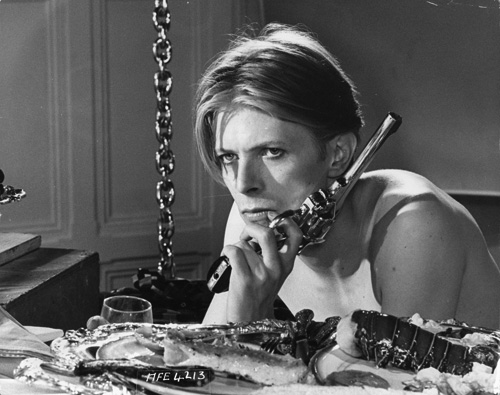
In his first major film role, David Bowie plays Thomas Newton, who turns up in the American Southwest out of the blue — no one realizes at first quite how literally — with ideas for “toys” of extraordinary technological advancement that quickly make him a very, very wealthy man. Amassing money seems to be his only real interest, toward a goal he eventually reveals to hand-picked confederates including patent attorney Buck Henry and technician Rip Torn, plus singularly dim companion Mary-Lou (Candy Clark). That goal is constructing a space vehicle capable of returning Newton to his planet, which is dying from drought. (Our protagonist’s decline is charted in his changing beverage choices, from precious water to the cheap consolation of alcohol.) He intends no harm. But despite all efforts at evading notice, he inevitably attracts invasive government attention as a freak of potential scientific, capitalist, or militaristic use.

Taking considerable liberties with Walter Tevis’ novel, Paul Mayerberg’s screenplay and Roeg’s direction enlarge several subsidiary characters, add a number of new incidents, and minimize Newton’s backstory. Yet when Earth was first released in the U.S., its 20-minutes-shorter edit removed much of the more outré inventions — including a whole lotta sex scenes, mostly between college prof Torn and myriad female students — oddly re-asserting the story’s science-fiction emphasis. Yet what remains fascinating about the film, beyond Bowie’s silvery performance and Roeg’s arresting stylistic strategies, is that it’s every bit as much a stunned observation of mid-decade middlebrow Americana as the same year’s Nashville. Like a Tibetan monk transplanted to a papier-mâché dinosaur theme park, Newton is agog at a vigorous garishness that’s as invasive as the probes eventually stuck into his body. Chocolate chip cookies, evangelical hysteria, Elvis musicals, and Mary-Lou’s ever-changing hairdos are all an equal amazement to him. The people around him age decades, but he never does, and strangely neither does the culture; when Clark and Torn visit a record store in their twilight years, it’s still selling Jim Croce records to Me Decade longhairs. Newton’s tragic fate is to be trapped in a space-time warp of alien triviality.

Famously crossing over to direction from cinematography (on movies like 1967’s Far From the Madding Crowd and 1968’s Petulia), Roeg brought a sensibility to his own projects that owed less to film and theater than to modern still photography, experimental cinema, and the literary avant-garde. Before anyone else thought likewise, his soundtracks felt like wildly unpredictable (but apt) mix tapes.

None of his features strictly fit any genre they’re aligned to, when there is one. Don’t Look Now is less interested in the supernatural than the psychological deterioration of a marriage. Bad Timing is still under appreciated as the decade’s more disturbing follow-up to Last Tango in Paris (1972), wherein male control of the female sex object grows increasingly desperate and destructive. Performance, co-directed with the late Donald Cammell, was supposed to be a Swinging London snapshot a la Blow-Up (1966) — fashionable, arty, a little kinky, with Mick Jagger acting as lure. It turned out such a druggy, gender-bending mindfuck that Warner Bros. initially refused to release it. A processing lab destroyed some “obscene” footage without permission; even without that, audiences walked out, demanded refunds, even vomited. Performance no longer shocks, but it’s still subversive.

After 1980, Roeg’s output grew steadily less compelling. After years of silence suddenly there was 2007’s Puffball: The Devil’s Eyeball, a seriocomic semi-fantasy curio based on a Fay Weldon novel. No one saw it; they didn’t miss much. At 82, it’s quite possible Roeg won’t make another feature. Yet that single decade of remarkable work still points forward, and has influenced many of the more interesting younger directors’ approaches to style and storytelling since.


THE MAN WHO FELL TO EARTH opens Fri/9 in Bay Area theaters.

The Performant New York Edition: Too Much Rain Makes the Baby Go Soggy

0

Neo-Futurists and “Ostalgia” weather the storm

No performance in New York was quite as impactful as the front row seats we had for Hurricane Irene, as subdued as she was in comparison to her North Carolina appearance, and with the MTA not running and theatres large and small shuttering their windows and barring their doors, mostly everyone just stayed home and watched the lightning instead. Good thing I’d gone to see New York’s “only open-run Off-Off-Broadway show”, the Neo-Futurists’ “Too Much Light Makes the Baby Go Blind,” and the “Ostalgia” exhibit the night before, or this week’s installment would be a total washout.


Since 1988 in Chicago and 2004 (plus three years in the ‘90’s) in New York City, “Too Much Light…” has been a weekly event featuring a high-energy ensemble attempting to perform 30 original plays in 60 minutes. Ranging in subject (last weekend) from drunken dancing jellyfish to repression of homosexuals on the African continent to a Shakespearean pie-fight, each play is performed in a random order according to numbers shouted out by the oddience. Though given a “menu” of titles at the door it’s impossible to know what to expect from a play called “portrait of a little town near the top of Maslow’s pyramid” (a brief description of the inhabitants represented by illuminated models of their houses), or “Life I Love You, all is Groovy” (three actors dunking themselves repeatedly to an iconic Simon and Garfunkel tune) until viewed, and to ensure non-repetition of experience, each week dice are rolled to determine how many plays will be dropped from the roster to be replaced with brand-new ones.
   
“Remember,” a smiling cast member reminded the applauding crowd, “if you’ve seen one Neo-Futurists’ show you’ve seen it once.”

Highlights of Friday’s show at Horse Trade’s Kraine Theatre included the snacks (sold-out shows include a free pizza ordered for the entire theatre), the gratuitous display of flesh (it was also the Half-Nekkid edition), the introduction of newest company member, Ricardo Gamboa, a brief shadow play deconstructing the phrase “a murder of crows,” the aforementioned monologue about the repression of African homosexuals (“The African Pig and Dog Report”) performed by company member Nicole Hill, a scripted pickle fight, and “(un)see,” a moody reflection on indelible images branded on the brain which branded itself on mine with bursts of incandescent light punctuated by abrupt blackouts, as a hooded figure (Jill Beckman) crawled across the stage recounting the memory of a tragedy.

Meanwhile, at the shiny, metallic behemoth of the New Museum down Bowery way, an intriguing exhibit of Eastern Bloc reminiscence entitled “Ostalgia,” is combining installation art, video, photography, sculpture, and paintings from a large cross-section of contemporary artists influenced by Soviet occupation.

Taken from the German term “ostalgie” or “nostalgia for aspects of life in East Germany,” “Ostalgia” broadens its borders to include artists from some 20 countries. Members of the “Moscow Conceptualist” movement such as Erik Bulatov, whose triptych of boldly-colored, abstracted landscapes dominate the gallery wall on which they hang, German sculptor Thomas Schütte, whose ominous metal and clay “3 Capacity Men” watch over a series of Michael Schmidt photographs of post-Cold War Germany, Lithuanian videographer Deimantas Narkevicius represented by his quirky video footage of a re-installation of a statue of Lenin, and Russian arts collective Chto Delat? (What is to be done?) with an impressively detailed, interactive timeline of the “Rise and Fall” of the Soviet Union interspersed with strange mythological creatures and wry commentary.

Much like an evening of Neo-Futurist playwriting, the bravery and breadth of subject is as varied as it is irrepressible, gazing forward into the future through the lens of a difficult past.

Our weekly picks: Aug. 31-Sept. 6

0

WEDNESDAY 31

FILM

“Bernal Heights Outdoor Cinema”

Don’t let all those school supplies in Walgreens fool you — summer in San Francisco is still going strong. Hope for one (or more!) of those rare fog-free nights during Bernal Heights Outdoor Cinema, a showcase of over 70 shorts made by residents of the ‘hood and points beyond. Tonight’s way-out-east opening party previews the whole shebang with live music by Stoo Odom and the Odom Poles; other events include a block party on Tiffany Avenue (runs parallel to Mission; access it from 29th St.), a “film crawl” down Cortland Avenue (get drunk on HD videos!), a screening in Precita Park, and a finale party at El Rio. The kick-off has a suggested donation to benefit Bernal History Project, but the rest of the fest is free. (Cheryl Eddy)

6:30 p.m., suggested donation $15

Old Clam House

299 Bayshore, SF

(415) 641-0324

www.bhoutdoorcine.org


FILM

“Cary Grant: Definitive Star”

Cary Grant was the prototypical total-package leading man: suave and dapper, gruff yet dreamy, totally manly (could kick ass atop Mount Rushmore) yet sensitive (could sweep a starlet off her feet without rumpling his hairdo). George Clooney wishes he could measure up. Show your appreciation for one of cinema’s all-time greats — and hey, the films themselves are pretty special, too — during this weeklong appreciation of the Divine Mr. Grant. Selections hew toward his 1930s-40s output of rapid-fire Howard Hawks comedies (1938’s Bringing Up Baby, which screens in a brand-new 35mm print; 1940’s His Girl Friday), but his Hitchcock turns (including 1959’s North By Northwest and, drool, 1946’s Notorious) and 1940’s classic The Philadelphia Story are also represented. (Eddy)

Through Tues/6, $7.50–$10

Castro Theatre

429 Castro, SF

(415) 621-6120

www.castrotheatre.com


THURSDAY 1

MUSIC

Uzi Rash

If your friendly neighborhood punk house grew arms and legs, developed vocal chords, and started a band, said band would probably sound a lot like Uzi Rash. A mad jangle, barely held together by grit and charm, Uzi Rash flourishes on the edge of collapse. No two songs sound the same, and band membership constantly mutates, but the appeal remains. Uzi Rash is Oakland’s answer to the Urinals, bolstered by the avant-garde weirdness of bands like Chrome or Pere Ubu, a combination that has earned a dedicated following in the bay and beyond. Lest you be surprised, an Uzi Rash show is hardly predictable; the energy is organic and the ride is free. Or six bucks. Or something like that. (Cooper Berkmoyer)

With King Lollipop, Buffalo Tooth, and Cool Ghouls

9 p.m., $6

Thee Parkside

1600 17th St., SF

(415) 252-1330

www.theeparkside.com


MUSIC

Peaches

What can you learn from the teaches of Peaches? That sex is good, all types of body hair should be adored not shorn, and if you don’t like her style, you can get the fuck out of the club. Berlin-based artist Peaches (not be confused with our own priestess, Peaches Christ) rose from the ranks during electroclash’s heyday in the early 2000s with a far more distinctive style than others that claimed the genre. She was fierce with taboo lyrics, confusing sexuality, and throbbing beats — and is still nails-tough with followup albums such as 2009’s I Feel Cream. And of that now-rubble of electrocrash, she proudly still remains, standing atop it with arms akimbo, gleaming in shiny gold spandex hotpants, the gender-bending mistress of futuristic trash pop. (Emily Savage)

With Maluca

9 p.m., $20

Mezzanine

444 Jessie, SF

(415) 625-8880

www.mezzaninesf.com


FRIDAY 2

FILM

“Love Exposure”

Sion Sono, the groundbreaking, prolific, and perhaps mad writer/director/poet who notably brought the world Suicide Circle (2001) — a movie that after having watched twice I still can’t really tell you what it’s about — has once again dropped jaws across the globe with his most ambitious feature to date. Love Exposure is a nearly four-hour-long epic about a love smitten devoutly Catholic teenager named Yu Honda as he masters the art of upskirt photography, chases the object of his obsessive desire, and eludes a violent cultist. Released in Japan over three years ago to widespread acclaim, it has only recently made its way to our shores; Sept. 2 will be your first chance to catch this beast of a film in San Francisco but hopefully not your last. (Berkmoyer)

Fri/2 — 9/8

$10

Roxie Theater

3117 16th St., SF

(415) 863-1087

www.roxie.com


MUSIC

Chelsea Wolfe

It’s been one full year since the beginning of based goth club night 120 minutes. As the club puts it: “a year of darkness and based goth… lasers and fog… thizzed out thugz in black throwin’ up occult signs and goth kids sippin’ sizzurp and screamin’ along to waka flocka flame.” To celebrate the anniversary of such mayhem, Los Angeles-based musician Chelsea Wolfe is coming in for a live set, arriving on the heels of her exquisitely haunting new release, Ἀποκάλυψις (pronounced “apokalypsis”). It touches both darkness and light, pain and ecstasy. From the opening beastly howl to the more subdued ethereal end, the album plays out like a black veil-laced journey on-foot through punishing natural elements. Which should fit nicely with the 120 Minutes crowd. (Savage)

120 Minutes anniversary

With DJ Todd Pendu, DJs Nako, and Whitch

10 p.m., $10

Elbo Room

647 Valencia, SF

(415) 552-7788.

www.elbo.com


SATURDAY 3

MUSIC

Dreamdate

What’s your dream date? Perhaps the night would start off with beers, then move on to pizza . . . then more beers? You and your date could take a stroll and talk about life. “You know what I hate?” . . . “Me too!” Maybe you would broach the subject of early-to-mid 90s indie pop. What d’ya know, you both like Cub and Go Sailor! The Popguns too! A match made in heaven. “Hey, have you heard of Dreamdate?” “Who?” “It’s new. It’s a three piece from the bay. It’s sweet and catchy without making you feel like you’re choking on a cube of sugar that’s boring its way into your brain.” “I hate that.” “Me too. But I love Dreamdate.” (Berkmoyer)

With Lilac, the Ian Fays and Wild Assumptions

6 p.m., $6

423 40th St., Oak.

(510) 985-0325

www.1234gorecords.com


DANCE

RawDance Concept Series 9 Why overpay for a 3D movie when you can get live action art with free popcorn to boot? Dance artists Wendy Rein and Ryan Smith of RawDance host Concept Series 9, an intimate salon featuring works-in-progress and dance repertory by Bay Area dance artists. In addition to pieces by RawDance, this installment includes a new solo by former Martha Graham Dance Company performer David Martinez who has crowdsourced content to fold into his choreography, the darkly humorous 13th Floor Dance Theater directed by Jenny McAllister, Tanya Bello’s project.b, Gretchen Garnett and Dancers and punkkiCo, led by Finnish import Raisa Punkki. (Julie Potter)

Sat/3, 8 p.m. and Sun/4, 3 and 8 p.m.9 p.m., $8

66 Sanchez, SF

(415) 686-0728

www.rawdance.org


MUSIC

RTX

With the demise of ’90s indie rock heavyweights Royal Trux in 2001, longtime creative partners Neil Hagerty and Jennifer Herrema parted ways with Hagerty founding Howling Hex and Herrema adopting the name RTX for her own project. Since then, RTX has released scores of records, solidifying Herrema’s reputation as a songwriter and badass of renown while reaching out to a legion of fans, young and old(er) alike, with a lurching amalgam of everything that rocks, from skate punk to old school psychedelia and everything in between; it’s a mystical trip in the desert with nothing but torn jeans, cowboy boots, and a stick-n-poke Camero on your bicep. It makes you want to drink whiskey and say “fuck.” I miss my long hair. (Berkmoyer)

With White Fence, Heavy Cream and Burnt Ones

9 p.m., $8

Thee Parkside

1600 17th St., SF

(415) 252-1330

www.theeparkside.com


SUNDAY 4

EVENT

Star Wars Day

Having won their first World Series title since moving to San Francisco last season, the Giants seemed, as Master Yoda would say, “at one with the Force.” In a fitting tribute to their victory, the team is hosting “Star Wars Day” at the ballpark, complete with a pre-game costume contest and party, a post-game screening of The Empire Strikes Back, and a special “Brian Wilson in Carbonite” giveaway. With his awesome, Jedi-like command of the ball when pitching, Wilson is a most appropriate pick — not to mention the fact that with his epic beard, he’s starting to look a little bit like Obi-Wan Kenobi! (Sean McCourt)

11 a.m.; Pricing varies; see website for current availability

AT&T Park

24 Willie Mays Plaza, SF

(415) 972-2000

www.sfgiants.com/specialevents


MUSIC

Twin Sister Twin Sister makes funky pink frosted cake-making, pinata-swinging, casual party music. Just check out the Brooklyn-via-Long Island band’s video for “Bad Street” off its forthcoming album In Heaven. Shot on location at breathy, sweet-voiced singer Andrea Estella’s family home, the video captures a pretty epic celebratory affair, replete with balloons and metallic streamers. Estrella’s family is made up of Salvadorians and Puerto Ricans, and she says the the video and the lyrics of the song are about Latin American life in New York. While other Twin Sister tunes expose a dreamy ’80s pop bent, this particular track sounds like a funked out ’70s block party. Just pray you get the invite.(Savage)

With Devon Williams, Library Voices

8 p.m., $12 Rickshaw Stop

155 Fell, SF

(510) 861-2011

www.rickshawstop.com


TUESDAY 6

MUSIC

The Mummies

There will only be 40 tickets sold at the door to this notably awesome, already pre-sold out show at the Knockout — I mean, these are the godparents of San Francisco surf punk we’re talking about here. Beginning in 1988, the gauzy white-cloth-wrapped band mixed 1960s-style surf rock riffs with the more modern sounds of clattering garage punk. All the Mummies have since joined other acts, but the band still occasionally regroups for live SF shows. Of course, Russell Quan is most often seen these days behind the DJ booth at twist-crazy club night Teenage Dance Craze at the Knockout, so what better place to host the show? And it should be a good one. The flier teases “Wear white shoes for a special surprise treat. Things will get out of hand.” (Savage)

With the Hondettes, DJ Russell Quan

10 p.m., $15 Knockout

3223 Mission, SF

(415) 550-6994

www.theknockoutsf.com 


The Guardian listings deadline is two weeks prior to our Wednesday publication date. To submit an item for consideration, please include the title of the event, a brief description of the event, date and time, venue name, street address (listing cross streets only isn’t sufficient), city, telephone number readers can call for more information, telephone number for media, and admission costs. Send information to Listings, the Guardian Building, 135 Mississippi St., SF, CA 94107; fax to (415) 487-2506; or e-mail (paste press release into e-mail body — no text attachments, please) to listings@sfbg.com. Digital photos may be submitted in jpeg format; the image must be at least 240 dpi and four inches by six inches in size. We regret we cannot accept listings over the phone.

Vision statement

0

arts@sfbg.com

FALL ARTS You better start doing your stretches and invest in a good pair of walking shoes. There’s as much ground to cover as there is art to see this fall, and if you get to every gallery, studio, and museum on this far-from-comprehensive list your eyes will probably be as sore as your feet. But as any seasoned hiker will tell you, the views are well worth any aches incurred along the way.

Julie Heffernan: Boy Oh Boy II” “Boschian” is an oft-overused adjective in art writing, and Heffernan’s more-is-more paintings, chock-full of twisted allusions to Renaissance art (Bosch included) and all sorts of fantastic razzle-dazzle, will have you scrambling for synonyms. (Sept. 3–Oct. 29, Catharine Clark Gallery; www.cclarkgallery.com)

Pamela Jorden” I’ll leave the question of whether or not painting’s dead up to more qualified coroners, and simply state that the oil-on-linen works of the young, Los Angeles-based Jorden make a powerful case for the continued relevance of gestural abstraction. There are echoes of Richard Diebenkorn or Clyfford Still in Jorden’s fractured cataracts of color (her blues will make you blush), but compositionally her canvases evince an alchemy that’s entirely her own. (Sept. 16-Oct. 15, Romer Young Gallery; www.romeryounggallery.com).

SF Open Studios Artists, they’re just like us! Seriously, though, one of the many pluses of ArtSpan’s annual city-wide event is that it helps demystify and de-romanticize what it means to be a working artist. Get to know the creative types in your neighborhood, see where the magic happens, and maybe help stimulate the local economy (hint, hint). (Oct. 1-18, various venues; www.artspan.org.)

Lionel Bawden: The World of the Surface” The title of Badwen’s American debut is a half-truth. His sculptural works, comprised of hexagonal colored pencils grouped together and shorn, topiary-like, into amorphous shapes, suggest a world far below the surface: caves, fatty tissue, cells. Dive in. (Oct. 1–Nov. 26, Frey Norris Gallery; www.freynorris.com.)

Houdini: Art and Magic” How does a museum escape the confines of the now tired “contemporary artists responding to famous historical figure X” approach to curating? Do like the Contemporary Jewish Museum and put on a show about legendary escape artist Harry Houdini. Come for tributes by Vik Muniz, Jane Hammond, etc. (what, no Matthew Barney?) but stay for a recreation of his famous Water Torture Cell illusion, along with the hundred other bits of Houdiniana. (Oct. 2–Jan. 16., 2012, Contemporary Jewish Museum; www.thecjm.org.)

Ralph Eugene Meatyard” The very banality of Meatyard’s biography — he was a happily married optician in Lexington, Ken. who did photography as a weekend hobby — only makes his singular and startling body of work that much more so: from children creepily posed with dolls and masks to bold experiments with abstraction and “no focus” imagery, Meatyard’s pictures push into territory far more strange and wondrous than the Gothic South. (Oct. 8- Feb. 26, de Young Museum, www.famsf.org.)

“Geoff Oppenheimer” Oppenheimer makes conceptually smart and visually arresting installation and video work that frequently voices the unspoken dynamics behind public performances of controlled discourse, such as press conferences. Be prepared to be discomfited. (Oct. 28–Dec. 11, Ratio 3; www.ratio3.org).

The Air We Breathe” I have some serious reservations about the San Francisco Museum of Modern Art’s decision to organize their first major contemporary group show in a long while around “the cause of marriage equality” (for starters, why not host “Hide/Seek,” the previously censored and now traveling exhibit about same-sex desire and American portraiture currently at the Tacoma Art Museum, instead?). That said, something truly queer, politically risky and aesthetically challenging has gotta happen when you put specially commissioned works by the likes of John Ashbery, Dodie Bellamy, Raymond Pettibon, Ann Hamilton, and Robert Gober (and many others) under one roof, right? For now, consider my tongue held and eyebrow raised. (Nov. 5–Feb. 20, 2012; SFMOMA, www.sfmoma.org.)

Project Dog brings out the purebred in rescue dogs

0

“I once split my pants photographing a Finnish spitz on the cliffs above Sutro Baths,” the lovely, energetic Kira Stackhouse laughed over drinks at Blackbird Bar in the Castro last week. She was recounting some very interesting stories about her ambitious Project Dog — an attempt to meticulously photograph woofy representatives of all 170 official American Kennel Club registered breeds next to purebred counterparts from dog rescue agencies.

“A big part of my mission is to photograph as many of these dogs as I can in iconic San Francisco and Bay Area settings, sometimes I’m trying to shoot five or six dogs a day. It’s not like I travel around with a change of clothes –but apparently there’s no lengths I won’t go to! So I just tried to hold my legs together until I got the shot.”

Stackhouse, who left a high profile job in marketing to expand her Nuena Pets photography business, launched a Kickstarter campaign earlier this month to help fund a full-color coffeetable book that will come out of Project Dog. (The campaign wraps up in three more days.) I asked her to explain the motivations behind the project — which has become a viral hit in the Bay Area and beyond, and has garnered several local accolades —  and what she hoped to accomplish. 

“It was weird how the idea came about. I love pets, but I always thought of myself as more into cats — until I got a dog of my own a couple years ago and fell completely in love. The dog was a purebred from a breeder, a Boston terrier. And when I would take him out, people would give me such shit about not going to an animal rescue place.

“So I thought, ‘You know, most people don’t know that rescued animals can be purebred — or that almost all official breed groups contain rescue organizations.’ It dawned on me that one way to get this message out would be to start a project that gets these dogs side by side in a format that would be instantly recognizable and appealing to people.

A sample layout from the forthcoming Project Dog book, featuring Basenjis — one from a breeder and one from an animal rescue organization.

“On top of that, I wanted this to be a community effort — so I asked people to submit their purebreds for picture consideration and tell stories about them on the Project Dog site. People really got into that — some of the stories are so funny, and we attracted entries from people like the mayor of Carmel! Then I could see what was out there and choose which dogs to photograph.

“But another community function I wanted to fulfill was building a platform to host the debate about purebred rescue dogs. People feel passionately — some owners are afraid rescue purebreds will diminish the ‘brand’ of the dogs, and some rescue dog fans are really vocal about their opposition to breed fetishization. This is somewhere they can all go at it.

And of course, I get to photograph some really beautiful dogs — and get really creative in a way I feel can benefit the community.”

It’s true, she does — some of the photos and test layouts for the book are stunning. But Project Dog, which is partnered with the SPCA, is also helping to enlarge perceptions of rescue dogs, usually knee-jerked as mangy mutts (not that those aren’t cute!), when in fact any kind of dog can find itself in need of a loving home. The Project Dog motto is, “Every dog is a work of art,” and Stackhouse’s dedication is proving that true. 

Preorder the Project Dog book for three more days on the Project Dog Kickstarter.

An unresponsive landlord could mean the end of Sixth Street’s DA Arts

0

All photos by Allison Ekevara / The Aperturist

“When I was growing up, the space was empty the whole time.” And as it stands, Sixth Street resident and photographer Reynaldo Ruetas Cayetano Jr. will be seeing the storefront gallery where his collective Inks of Truth created a community art project stand empty once again. 

“No one’s even been back in to turn off the lights,” he told the Guardian when he stopped by our offices last week. On August 6, Inks of Truth was holding a release party for its new zine – until the owner of 135 Sixth Street (which also houses the Sunshine Hotel, an SRO) stopped by to kick everyone out.

Cayetano grew up across the street from the DA Arts building, which occupies a central space on Sixth and Minna streets. It was once a liaison office for the city’s district attorney, filled with file cabinets. But the space became a creative hub in 2006 when Tenderloin Housing Clinic started leasing it to display art by local residents. 

Years of gallery shows culminated in THC turning artistic control of the space over to Ujima Artists, a group that hosted four to five shows before, THC artistic director Patrick Flanagan remembers, members began squatting in the small space, which faces onto Sixth Street and has massive windows. 

“It was a total party scene,” says Flanagan, who told the Guardian he ignored the misuse until he found crack vials in the gallery. Ujima Artists were kicked out, but the PR damage done to the gallery may have been too late to correct.

But Cayetano was ready for his crack at DA Arts. He contacted Flanagan, and within a month Inks of Truth had cleaned out the space. Mikio “Ears” Rose airbrushed galaxy designs across the walls, and on April 1 of this year, the group held a block party that attracted young artists, older Sixth Street residents, and everyone in between. On the gallery walls: black-and-white photos of the neighbors that rendered Sixth Street in all its grittiness, but also showed all the striving and community on the block.

“Not everyone can just go in there and have this community event. Knowing how my neighborhood is, I wanted [the people that live on Sixth Street] to be comfortable,” says Cayetano. 

Inks of Truth made a concerted effort to include everyone – not just artists and conventional art lovers, but the low-income elderly folk and those dealing with addiction. The gallery became a space for those who’d never shown an interest in art before, passers-by excited by their likenesses on the wall asking collective members where they could get a camera of their own.

Cayetano says his events rendered the neighborhood become a more inclusive place. “Basically, every time we had a show at DA Arts we all had a hood pass.”

But was the gallery’s owner impressed by the changes taking place on his ground floor?

Apparently not. When Flanagan, Cayetano, and Inks of Truth member Chris Beale attempted to set up a meeting with the owner of DA Arts and the Sunshine Hotel about extending THC’s lease on the place past May 28, Surajnaben Indrasinh Solanki was less than enthusiastic. In fact, he would hardly get back to them at all. 

“The guy’s not saying anything. He’s not even giving us an offer,” says Flanagan, who along with the Inks of Truth members left phone numbers and messages for Solanki at the Sunshine Hotel’s front desk to little avail. (The Guardian had a similar experience – Sunshine Hotel staff would hang up on us when we called to speak with Solanki, and leaving contact information in person at the front desk didn’t yield a call back). 

Eventually, the three managed to set up a meeting with Solanki on August 1. When the day came, he stood them up. 

“It reflects his style of overseeing that space,” says Cayetano.

Later that week Flanagan (who lives across Minna Street at the Rose Hotel and flips the lights on at DA Arts every evening to illuminate the corner and the art inside the gallery) ran into Solanki. “He told me not to go into the space, that we weren’t supposed to be in there, and that’d he call the police.”

Which Flanagan could have done – but he didn’t. “The ball’s was in his court,” he told the Guardian, frustrated that Solanki wouldn’t communicate with the Inks of Truth team about the future of the building. “So I said, let’s keep putting on shows.” 

When asked why he thought Solanki didn’t express any interest in the young people holding their events at DA Arts, Flanagan had two theories: that the owner is reluctant to get involved in any more leases because he’d like to be able to sell the building (which is in a SF Redevelopment Agency project area), or maybe because he was wary of Flanagan’s history as a tenant organizer. 

At any rate, Flanagan told Cayetano to go along with the previously-scheduled zine release party. 

So they did – and for a few hours, Inks of Truth and the rest of Sixth Street got to see their images published and bound (you can too – go here for a copy of Sixth Sense). That’s when Solanki finally showed up, yelling for everyone to get out. 

The collective grabbed everything from the gallery – framed photography, boxes of zines, the bottles of red wine that were being shared, everything but the Best of the Bay award they’d won the week before – and migrated across the street to Rancho Parnassus, a cafe that’s hosted Inks of Truth shows in the past. 

There, they rearranged the photos on the cafe tables and regrouped. Cayetano hyped the group up for October’s Sixth Street art walk, and reassured everyone that Inks of Truth would still have a presence on Sixth Street, with or without DA Arts. 

Reflecting on the tribulations the collective has undergone, Cayetano’s not ready to let go of his dream of bringing pride to his neighborhood. “We’re not here just to have a show and disappear,” he says. “Sixth Street is the heart for me.”


BEST OF THE BAY 2011

0

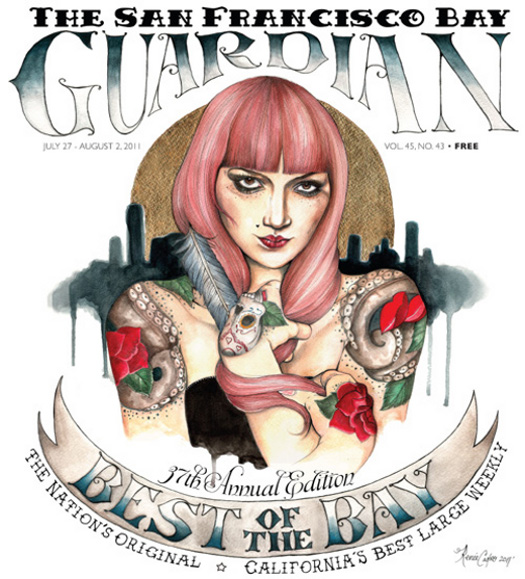
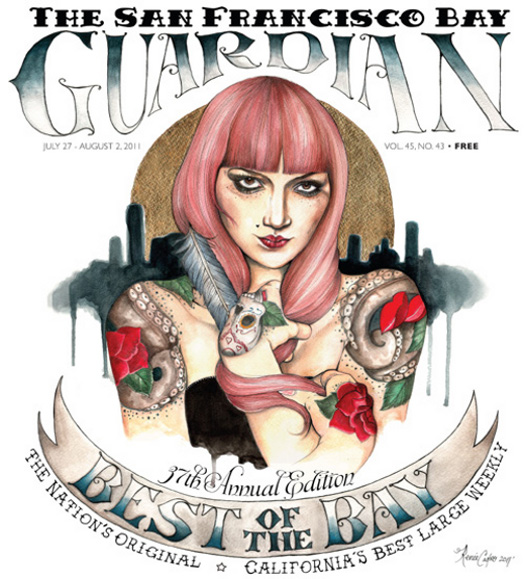
Welcome to the Guardian’s Best of the Bay 2011! This is our 37th annual celebration of the people, places, and things that make living here such a great experience — from Best Burrito and Best Local Band to Best Strip Club, Best Shoe Store, Best Drag Queen, and beyond.

More than 15,000 of our readers voted in our 2011 Best of the Bay Readers Poll for their favorites in more than 200 categories. You’ll find the results inside — as well as 150 Editors Picks that highlight some Guardian favorites, old and new, that we think deserve special recognition for lighting up our lives this year. 

Our theme for 2011 is “Beautiful Rebels” — and inside this year’s Best of the Bay, we’ve highlighted eight of our favorite “beautiful rebels” who we think are helping change the Bay Area for the better.  Throughout its history, the Bay Area has attracted wave upon wave of people looking to create something unique. From Barbary Coast explorers to Belle Epoque, Jazz Age, and Beatnik free spirits, from hippies and queer and civil rights pioneers to tattooed 1990s swing kids and Burning Man visionaries, to today’s global tech innovators and their DIY, local, organic, small-batch counterparts. 

We seem to be living in a time when a certain conservatism and conformity reigns, when speaking out gets you pilloried in the comments section and big-box consumerism squeezes out charming idiosyncrasies. That’s why we wanted to take this Best of the Bay opportunity to celebrate the Bay Area’s proud perseverance in remaining the weirdest, oddest, most interesting and rewarding place in the world, somewhere where “freak” is a compliment and “out there” equals “gorgeous.”

In 1974, Esquire magazine asked us for ideas for its Best of the USA issue, which led to us publish the original Best of the Bay. Made by the people of the Bay Area for the people of the Bay Area, it’s our annual opportunity to celebrate the people and places that make this city great. We were the first weekly paper to publish a regular “best of” issue. Thirty-seven years on — and 45 years after we opened our doors — we’re still going strong.

Editing this year’s installment was a hoot. I shower grateful smooches on all my collaborators, especially my right-hand amiga Caitlin Donohue, creative wiz Mirissa Neff, amazing illustrator Renee Castro, photographer Ben Hopfer, the Guardian staff, and the ever-supportive Hunky Beau, my own personal Best of the Bay.

But most of all I thank you, dear reader, for your generous participation, for making the Bay Area such an astounding place to live, and for turning us on to some great new things this year.

Marke B.,

Best of the Bay 2011 co-editor


ABOUT THE ILLUSTRATOR

Like the Guardian, Renee “Lady Reni” Castro is native to the Bay Area — really. Born in Oakland, Castro’s heritage stems from the Ohlone Native American tribe. (You can’t get more local than that.) Her background serves as inspiration for much of her art, especially her subjects’ clothing and their deeply-rooted connections to the natural world. Her other influences for her illustrations in this year’s “Beautiful Rebels”-themed Best of the Bay include Mexican and Spanish folklore, broken-hearted femmes fatales, disheveled muses, and erotic heroines. Castro’s current projects include commissions for SF companies the Loin and Peasants and Travelers, shows in local galleries, plus an apprenticeship at Amor Eterno Tattoo in Oakland, where you’re welcome to drop by and see her.


BEST OF THE BAY STAFF

BEST OF THE BAY EDITORS

Marke B., Caitlin Donohue

CREATIVE DIRECTOR

Mirissa Neff

ASSISTANT ART DIRECTOR

Ben Hopfer

ILLUSTRATOR

Renee Castro

CONTRIBUTING WRITERS

Jackie Andrews, Emily Appelbaum, Rebecca Bowe, Richard Boyce, Kimberly Chun, Angelina Cravich Cheryl Eddy, Nicole Gluckstern, Sean Hurd, Steven T. Jones, Heather Mack, Virginia Miller, Carly Nairn, Sarah Phelan, Julie Potter, Tim Redmond, Paul Reidinger, Kat Renz, Charles Russo, Amber Schadewald, Ariel Soto-Suver, Diane Sussman, Hannah Tepper, Christopher Trenchard

BEST OF THE BAY PHOTOGRAPHY

Francesca Balaguer, Stephen Heraldo, Ben Hopfer, Eric Lynch, Virginia Miller, Ariel Soto-Suver

COPY EDITORS

Emily Appelbaum, Diane Sussman

Best of the Bay 2011: BEST SIXTH STREET SENSE

1

Does growing up in San Francisco make you an insider in its art scene? Definitely not — but it can be fertile ground for creating a scene of one’s own. Sixth Street resident and Filipino immigrant Reynaldo Cayetano Jr.’s passion for film photography led him to convene Inks of Truth, an art collective of young City College students and SF natives. The group has thrown packed multimedia art openings with live local hip-hop soundtracks all along Sixth Street — Rancho Parnassus, the House Kombucha factory, and Bayanihan Community Center. This year, group members got the keys to DA Arts, the one-time SF district attorney’s office, whose walls they have lined with stunning black and white photography of life on Sixth Street.

DA Arts, 135 Sixth St., SF. www.wix.com/purposebeyondreach/inksoftruth

Sk8 or die! “Tessa & Scott:” a sartorial appreciation

2

Taken as a sports glory confessional, Tessa & Scott: Our Journey from Childhood Dream to Gold (Anansi, 192 pages, $19.95) is pretty standard. It has more than its fair share of inspirational sound bites (“The young couple faced difficult challenges, but they were sustained by their love for skating and the knowledge that they could be champions.”). It’s also packed with glossy photographs and mildly amusing anecdotes. Yet, taken as a study in the evolution of dancing facial expressions, body chemistry, and ice dancing fashion choices, the book becomes exponentially more interesting. 

In terms of facial features, Tessa Virtue and Scott Moir (Canada’s 2010 Olympic ice-dancing champs, among their many accolades) were born to dance to together. They’ve got the distinctive “Are we siblings or are we lovers?” look that’s become a prerequisite for the sport. The fuzzier the line, the better. Ambiguous sexual preference is suggested, but not mandatory. Both Scott and Tessa have creamy skin and thick – slightly wavy – chocolate brown hair. It’s versatile enough to be tightly wound back, gelled, and hair-sprayed into oblivion, pre-show. Yet, they can also rock the slightly mussed-up, sweaty, post-dance routine look. Tessa is a huge fan of ponytails, though her go-to look for the ice is an intricate top bun. She’s got a strict anti-bangs policy. Scott has a fantastic variety of smiles (including a grimace that strikes a fine balance between warm and fierce), though he’s lacking a bit in the upper-lip department.

Tessa & Scott: Our Journey from Childhood Dream to Gold, or TSOJCDG, has about four major categories of photographs. The majority are mid-performance drama shots. The rest are the post-dance glory moments, cutesy childhood pics, and special nature photography shoots with Myra Klarman. Along the way, a few hybrids crop up. For example, take the classic moment when a pre-pubescent Tessa and Scott chomped on their medals to test the veracity of the gold.

The earliest evidence of Scott and Tessa’s signature pose is a photograph from early 2000. It’s an icy and intense glare at the cameras, complimented by the arched scowl of Scott’s eyebrows and a passionate clutching of his partner’s lower thigh or shoulder. Scott has a tendency to shut his eyes in passion, Tessa’s tend to widen for the crowd.

TSOJCDG is peppered with shots from a rustic shoot the couple commissioned from photog Klarman. For some reason, Klarman thought it would be a good idea for the couple to wade knee-deep into a lake, and pose crouched in the water. Tessa and Scott seem oblivious to their soaked clothing, and it’s one of those shots where you think more about what happened before and after than the actual image you’re looking at.

Back on the ice, I’d say Tessa has a great fashion sense, especially considering the track record her peers. She favors shades of pink, crystals, velvet, lace, fringe, pearls, and sheer fabric; usually all of the above at once. Scott tends to go for a more conservative image, with a classic tuxedo or suit. Tessa’s fashion climax probably arrived at the 2010 Olympics during a compulsory Tango Romantica. With her usual dark red lipstick and pulled back hair, Tessa wore a one-shouldered burgundy gown with a black tulle overlay, her bodice decked out in ruffles and intricately webbed pearls, jewels, and floral patterns. Underneath, she went for classic leggings and not much else: it seems the publishers didn’t catch an unfortunate nip-slip captured in some of the images.

Tessa only missteps when she ventures too far deep into Dancing with the Stars territory, as she did when competing earlier in her career in Andorra. She wore a magenta strappy dress, exposing lots of skin and bedazzled within an inch of her life. Not long after, Tessa took a risk with a three tiered, sparkling number – plus fringe and a diamond choker – for the 2009 Nationals, but it looks like one that paid off, landing the jump from tacky sad to tacky fun. 

Tessa & Scott: Our Journey From Childhood Dream to Gold is an enchanting look at the lives of two artistic and athletic champions. It may not be worth reading the 184 pages of copy and biographical detail, but it’s certainly worth a bookstore browse to check out over 171 shiny photographs of “big dreamers” and ice dancers Tessa Virtue and Scott Moir.

BEST OF THE BAY 2011

0

Welcome to the Guardian’s Best of the Bay 2011! This is our 37th annual celebration of the people, places, and things that make living here such a great experience — from Best Burrito and Best Local Band to Best Strip Club, Best Shoe Store, Best Drag Queen, and beyond.

More than 15,000 of our readers voted in our 2011 Best of the Bay Readers Poll for their favorites in more than 200 categories. You’ll find the results inside — as well as 150 Editors Picks that highlight some Guardian favorites, old and new, that we think deserve special recognition for lighting up our lives this year. 

Our theme for 2011 is “Beautiful Rebels” — and inside this year’s Best of the Bay, we’ve highlighted eight of our favorite “beautiful rebels” who we think are helping change the Bay Area for the better.  Throughout its history, the Bay Area has attracted wave upon wave of people looking to create something unique. From Barbary Coast explorers to Belle Epoque, Jazz Age, and Beatnik free spirits, from hippies and queer and civil rights pioneers to tattooed 1990s swing kids and Burning Man visionaries, to today’s global tech innovators and their DIY, local, organic, small-batch counterparts. 

We seem to be living in a time when a certain conservatism and conformity reigns, when speaking out gets you pilloried in the comments section and big-box consumerism squeezes out charming idiosyncrasies. That’s why we wanted to take this Best of the Bay opportunity to celebrate the Bay Area’s proud perseverance in remaining the weirdest, oddest, most interesting and rewarding place in the world, somewhere where “freak” is a compliment and “out there” equals “gorgeous.”

In 1974, Esquire magazine asked us for ideas for its Best of the USA issue, which led to us publish the original Best of the Bay. Made by the people of the Bay Area for the people of the Bay Area, it’s our annual opportunity to celebrate the people and places that make this city great. We were the first weekly paper to publish a regular “best of” issue. Thirty-seven years on — and 45 years after we opened our doors — we’re still going strong.

Editing this year’s installment was a hoot. I shower grateful smooches on all my collaborators, especially my right-hand amiga Caitlin Donohue, creative wiz Mirissa Neff, amazing illustrator Renee Castro, photographer Ben Hopfer, the Guardian staff, and the ever-supportive Hunky Beau, my own personal Best of the Bay.

But most of all I thank you, dear reader, for your generous participation, for making the Bay Area such an astounding place to live, and for turning us on to some great new things this year.

Marke B.,

Best of the Bay 2011 co-editor


ABOUT THE ILLUSTRATOR

Like the Guardian, Renee “Lady Reni” Castro is native to the Bay Area — really. Born in Oakland, Castro’s heritage stems from the Ohlone Native American tribe. (You can’t get more local than that.) Her background serves as inspiration for much of her art, especially her subjects’ clothing and their deeply-rooted connections to the natural world. Her other influences for her illustrations in this year’s “Beautiful Rebels”-themed Best of the Bay include Mexican and Spanish folklore, broken-hearted femmes fatales, disheveled muses, and erotic heroines. Castro’s current projects include commissions for SF companies the Loin and Peasants and Travelers, shows in local galleries, plus an apprenticeship at Amor Eterno Tattoo in Oakland, where you’re welcome to drop by and see her.


BEST OF THE BAY STAFF

BEST OF THE BAY EDITORS

Marke B., Caitlin Donohue

CREATIVE DIRECTOR

Mirissa Neff

ASSISTANT ART DIRECTOR

Ben Hopfer

ILLUSTRATOR

Renee Castro

CONTRIBUTING WRITERS

Jackie Andrews, Emily Appelbaum, Rebecca Bowe, Richard Boyce, Kimberly Chun, Angelina Kravich,  Cheryl Eddy, Nicole Gluckstern, Sean Hurd, Steven T. Jones, Heather Mack, Virginia Miller, Carly Nairn, Sarah Phelan, Julie Potter, Tim Redmond, Paul Reidinger, Kat Renz, Charles Russo, Amber Schadewald, Ariel Soto-Suver, Diane Sussman, Hannah Tepper, Christopher Trenchard

BEST OF THE BAY PHOTOGRAPHY

Francesca Balaguer, Stephen Heraldo, Ben Hopfer, Eric Lynch, Virginia Miller, Ariel Soto-Suver, Erik Anderson

COPY EDITORS

Emily Appelbaum, Diane Sussman


Black and white and red all over

0

Mikhail Kalatozov’s career had a large hole in the middle, one that remains incompletely explained. Why were the two periods of his greatest work separated by roughly three decades? Why did he make almost nothing between? The answer definitely involved Stalin and his fickle cultural watchdogs, even if the full reason for such a long lull (or fall from favor) might never be known.

At least he was spared a permanent gulag vacation, which would have deprived us of a late 1950s reflowering that resulted in three world classics still being discovered in the West — particularly since 1964’s astonishing I Am Cuba got rereleased under Francis Ford Coppola and Martin Scorsese’s auspices 16 years ago. If you’ve seen that or another Kalatozov film, it’s distressing to think he spent any time unwillingly idle, since every feature still accessible today is some kind of masterpiece.

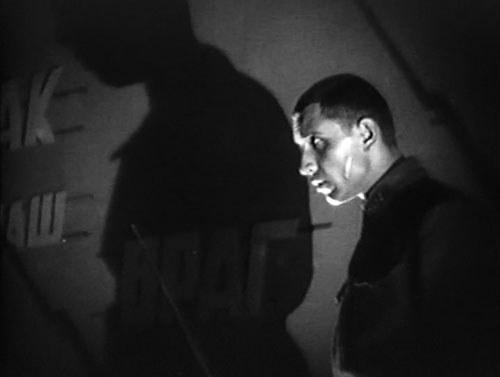
The San Francisco Silent Film Festival’s 16th annual edition offers the last feature he made before that mysterious long withdrawal from the director’s chair. Nail in the Boot (1931) lasts just 53 minutes, but packs in more photographic and editorial ideas than a dozen features twice its length. It’s a dazzling application of sheer stylistic invention to propagandic material. Yet rather than please the apparatchiks upstairs, it ticked them off enough to derail Kalatozov’s career for a good spell.

Born in Tbilisi, Georgia, he began working as an actor, editor, and cinematographer in that (reluctant) Soviet republic’s 1920s film industry, eventually graduating to directing documentaries celebrating the USSR’s industrial, agricultural, and cultural advancement. Little is known about a first narrative feature, 1930’s Little Blind Girl. But the same year’s semi-staged Salt for Svanetia won acclaim for its strikingly poetical imagery of life in a remote Caucasus Mountains village.

That success presumably greased the way for the larger endeavor of Nail in the Boot, which mixes up the epic and the intimate, beautiful shots of lovingly lit machinery and glowing worker faces intercut with striking battle vistas and the proverbial cast of thousands. The story can be reduced to the title’s troublesome metal inch: when enemy forces strand armored train “Guardian of the Revolution” between blown-up track sections, a lone comrade (Aleqsandre Jaliashevili) is dispatched on foot to notify HQ. Running over hill and dale, he’s severely hampered when the poorly made boot from his own factory falls apart, driving a binding nail into his foot. As a result, his trapped compatriots are gassed to death before reinforcements arrive.

At a huge subsequent Party trial, our fallen hero is excoriated as a traitor for stopping to soak his painful, bleeding foot. “You shot them! The undelivered dispatch was like a bullet!” “He spared his feet and destroyed the armored train!” angry comrades shout, calling for his head. But this nameless prole finally defends himself, indicting his footwear’s shoddy workmanship as at least equal in fault. Nail in the Boot was intended as a parable (based in turn on a Russian folk tale) urging Soviets to always perform superlatively for the good of all, whatever their job. A final intertitle accuses lazy bones present: “Among you spectators: are there many like the bootmakers?”

That message seems simple and unimpeachable enough, not to mention spectacularly presented. Yet Nail had the ill fortune to arrive just as USSR arts ideology was changing. The experimentation encouraged in the 1920s was now judged indulgent “formalism” unsuitable for the masses, while a new school of nail-on-the-head “Social Realism” took shape as the sole officially state-sanctioned artistic guideline. Kalatozov’s film was denounced as confusing and unrealistic on petty grounds, as well being guilty of “formalistic aestheticism.” The film was banned, for a long time considered lost, and beyond a couple features at the start of World War II, Kalatozov was kept offscreen — albeit kicked upstairs to various film administrative posts.

He did well enough in those capacities to become the Soviet film industry’s emissary to Hollywood for an extended late 1940s stay. Hobnobbing with stars, he greatly admired the major studios’ streamlined production methods and technical advances — but like a good comrade, returned home to condemn Tinsel Town as the apex of capitalist decadence. (Hell yeah!) Then, finally, he was considered rehabilitated enough to trust behind a camera once again.

The results, after a few more conventional features no longer in circulation, were stupendous: 1957’s The Cranes Are Flying introduced a new Kalatozov, energetic and inventive as ever, director of photography Sergei Urusevsky’s wildly mobile camera replacing rhythmic Eisensteinian montage as his primary instrument. Taken as a cinematic emblem of Khrushchev-era Cold War thawing, it was an international triumph, even if its tragic wartime romance now seems less conceptually unique than two extraordinary (if far less popular) next ventures.

The Unsent Letter (1960) is one of the movies’ great man vs. nature depictions, as Soviet geologists searching for diamond deposits in remotest Siberia fall prey to that land’s geographic and climatic extremes. I Am Cuba, a Soviet-Cuban collaboration depicting the Cuban revolution on a humongous scale, was derided as being “too Russian” by the Cubanos, “too formalist” (or whatever the current ideological phrase was) by Moscow. Forgotten for decades, it’s been much written about lately — suffice to say Roger Ebert thought it contained the single “most astonishing [shot] I have ever seen,” amid 141 minutes full of such wonders.

After less idiosyncratic but impressive 1970 Soviet-European superproduction The Red Tent (1970) — an arctic adventure with international stars like Sean Connery and Claudia Cardinale, shot in locations as frigid as 40 below zero — Kalatozov died at age 70, planning another impossibly ambitious epic. In a perfect world, he’d actually finish it, his cryogenically frozen brain retrieved from some secret polar lab. Imagine what he could do with a Steadicam and 3-D; James Cameron might find himself merely a wee prince of the world by comparison.

SAN FRANCISCO SILENT FILM FESTIVAL

Thurs/14–Sun/17, free–$20

Castro Theatre

429 Castro, SF

(415) 621-6120

www.silentfilm.org

Fake-out

0

arts@sfbg.com

HAIRY EYEBALL It’s not just the title of Stephanie Syjuco’s solo show “RAIDERS” — her first at Catharine Clark Gallery — that brings to mind Indiana Jones. Something of the latter-day swashbuckler comes across in Syjuco’s art, which, like Indy, initially seems to be playing to all sides for the sake of plunder — when in fact this cleverness is the outward expression of a deeper skepticism toward the very institutions it’s engaged with.

But Indiana Jones is also a pop cultural commodity and a franchise that has netted millions for creators George Lucas and Steven Spielberg. This too, I imagine, is not lost on Syjuco, whose work frequently strips Pop Art bare of its smart, slick exterior (as well as Conceptual Art of its pretensions) to access the larger and far less glamorous network of market forces, production processes, and questions of ownership that shape it as a commodity.

Whereas Takashi Murakami installed an actual Louis Vuitton boutique inside Los Angeles’ Museum of Contemporary Art, Syjuco’s project “Counterfeit Crochet” called on hobbyists the world over to knit fake designer bags, complete with logos, and even provided the patterns and instructions. She has also, on more than one occasion, set up detourned versions of shops and marketplaces inside museum walls.

“RAIDERS” opens with an installation of what at first glance appears to be a collection of handsome Asian antiquities — mainly vases and small, decorative vessels — arranged on the very shipping crates they were transported in. It quickly becomes obvious that what we’re looking at is truly a set-piece, and that the “priceless” cache before us is actually an arrangement of life-size photographic reproductions adhered to laser-cut wooden backings.

Raiders: International Booty, Bountiful Harvest (Selections from the A____ A__ M______) — to give the installation its full title — becomes more interesting when you consider that Syjuco used images downloaded from the Asian Art Museum’s online database of its holdings as her source material. Love and theft (if I may poach the title of Eric Lott’s remarkable study of American minstrelsy) are certainly forces that have shaped many a museum’s prized holdings, and it is this history — one so often bound to colonialism and its aftermath — that is also embedded in Syjuco’s fakes.

And Syjuco decidedly, politically, traffics in fakes, not forgeries. Practically every piece in “RAIDERS” has rematerialized online, open source materials — be they digital images or readily accessible canonical texts — into art objects that are themselves parodies of object-ness. Conceptually whip-smart and materially banal (wood, tape, paper, and glue are common ingredients), Syjuco’s pieces continually taunt us with the question, “Why buy the cow when you can get the milk for free?”

In the gallery’s back room, jewel-case-size blocks of wood covered in pixilated digital prints of CD cover art representing Syjuco’s entire collection of “music illegally downloaded or pirated from others” are, as the bright orange stickers adhered to their shrink-wrapped exteriors proclaim, really available for the “blowout price” of $9.99 a piece.” Across from this pile that looks as if it had been airlifted straight from a Tijuana bootlegger, is Phantoms (h__rt _f d__kn_ss) an installation organized around Joseph Conrad’s Heart of Darkness, replete with a table, sawhorses, houseplants, TV monitors, and 10 bound copies of different online, public domain versions of Conrad’s text that are strictly “price upon request.”

Syjuco is certainly not the first artist to take on the art world’s biggest white elephant: value. But she wields her scalpel with a thoughtful precision and economy of gesture that will forever be beyond the abilities of a gaseous giant such as Damien Hirst. And that, to borrow another clichéd bit of market-speak, is truly priceless.


INKSTAINS

If you missed the San Francisco Museum of Modern Art’s excellent Eadweard Muybridge retrospective that closed earlier this month, Matt Bryans has created something of an homage to the early master’s photographic panoramas and doctored views of a not-quite-virginal Yosemite at SF Camerawork.

“Untitled” unfurls along one of the gallery’s walls for nearly 30 feet, a fantastical expanse of ever-shifting landscape seemingly captured from a middle distance. Glaciers give way to snow-capped peaks, which then dip into valleys that ease into rolling plains and finally abut more misty crags. In the piece’s upper half, clouds swirl and dissolve across the arc of the sky as in a Chinese ink painting.

Although the piece has the weathered patina of an old daguerreotype and recalls Muybridge in its staged epicness, Bryans is a collage artist who works solely with a medium whose livelihood has been called into question about as often as film photography’s: newsprint. “Untitled” — which like the other large collage commissioned by SF Camerawork is all explosions and stars wrapped around a support column — was created using only India erasers and inky photographs clipped from newspapers.

Scanning the sky of Bryans’ panorama, you can make out the smudged traces of what was once type. And the closer you look, you start seeing the fissures between the thousands of carefully glued pieces that Bryans has transformed into a seemingly organic whole, which nonetheless appears on the point of disintegration.

The panorama piece is large enough that it sags a little and billows whenever a current of air hits it. It seems to hang heavy with the losses it embodies — photography’s ghosts, newspapers as a disappearing medium, the unknowable contexts of the images themselves — a load that’s almost too much to bear. 

STEPHANIE SYJUCO: RAIDERS

Through July 16

Catharine Clark Gallery

150 Minna, SF

(415) 399-1439

www.cclarkgallery.com

MATT BRYANS: BREAKING THE LAND

Through Aug. 20

SF Camerawork

657 Mission, SF

(415) 512-2020

www.sfcamerawork.org


Punk prophet

0

arts@sfbg.com

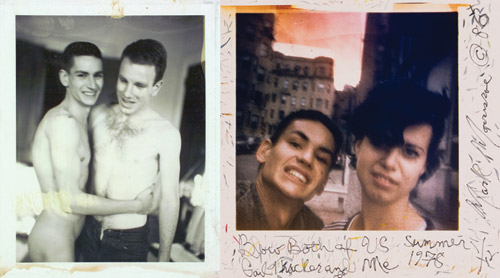
LIT Perhaps the biggest faux pas in critical art writing is using the artist’s first name when addressing his or her work. Countless teachers, critics, and editors have embedded this notion deep into the recesses of the right side of my brain. However, when writing this essay I continuously found myself wanting to address Mark Morrisroe only by Mark — as if I were having a personal conversation with him about his work. It could be that after spending a great deal of time with the artist’s recently published posthumous monograph Mark Morrisroe (JRP-Ringier, 512 pages, $65), that a bond, strong enough to diminish such formalities, seems to have formed between us. I feel as if we would have been the best of friends had Mark survived his untimely death from AIDS in 1989.

This mammoth publication spans the artist’s relatively short but undeniably influential oeuvre and includes 500 impeccably printed reproductions of his photographs, photograms, Polaroids, Super 8mm films, and signature “sandwich prints.” The resulting survey is nothing short of breathtaking. Mark’s dynamic approach to image-making is showcased alongside several poignant theoretical and explanatory essays reminiscent of Felix Gonzales-Torres’ retrospective monograph published by Nancy Spector and the Guggenheim Museum in 1995. As Gonzales-Torres would say, this is a book you would want to bring on leisurely day at the beach.

The monograph is divided into several sections, each encapsulating a portion of Morrisroe’s career and augmented with an essay detailing the importance of the specific subject matter in defining his artistic vision. I found myself spending countless hours examining each section and noting how Morrisroe’s hand is so vividly present throughout. Even in his most straightforward portraits, the notion of his human presence behind the camera — like so many other artists in the history of photography — is not lost. He is not simply producing likenesses of his subjects, he is simultaneously projecting reflections of himself onto the surface of the paper.

To be honest, I have yet to give the literary portion of the book its due diligence because I have been so blindingly seduced by the imagery. There is potential for this to happen to you as well, but keep in mind that the biographical knowledge available greatly informs the work and provides essential historical context that considerably heightens its cultural significance. I won’t go into too much detail of Morrisroe’s biography here because I feel that a few short sentences on the matter won’t do him justice. Besides, it would be far more entertaining for you to discover his story on your own among the pages of drag queens, hustlers, X-ray images, and vintage porn photo montages.

As a young photographic artist myself, I was struck most by Morrisroe’s visceral interest in understanding the alchemical processes of his chosen medium and the unflagging beauty of the individuals and peripheral culture he aligned himself with. Morrisroe’s photographs might be considered off-center — infused with the tumultuous happenings of his extraordinary life story. Yet the immediate sense of tragedy present within much of the work is lyrically transcended through his bold use of color and dreamlike, oftentimes surreal, and pictorial imagery.

Today Morrisroe’s palette could be read as reminiscent of the 1980s, a consciously busted queer-punk aesthetic. But it also serves as an elegiac reminder of dying analog photographic processes. (For those who aren’t photonerds: many of the techniques used by Morrisroe over the course of his career have become nearly extinct with the rise of digital technology and rapidly increasing cost of maintaining a strictly analog practice.)

The last section of the book features installation images from various solo exhibitions of Morrisroe’s work before and after his death. I can’t help but think of the myriad possible trajectories that would have been available had he survived the AIDS epidemic. It seems as if he was just beginning to come into his own and to fully understand his potential as a maker and progenitor of culture. Instead we are left with an impressive and spontaneous collection of work that was light-years ahead of its time. It seems appropriate that a monograph of this caliber would come to fruition now to allow a younger generation to connect with Mark’s spirit found in every lush-hued image.

Our bike falls in love

0

Our bike spotted this super clean tag in the Lower Haight the other day. It was drawn to the piece not just for its subject matter (you know how bikes tend to stick with their own kind), but also because of the composition. Check those lines! Dynamic! Hot. It was in love. 

It’s the work of Jaut Cares — we told our bike — who has been spraying two-wheelers around the Bay for a hot minute. Superlative local street art photography blog Endless Canvas has been tracking the artist since early last year, and Altar of Unanswered Prayers snapped a radtacular shot of a red, white, and blue number Jaut put up. 

Our bike didn’t have much to say in response, just recommenced scouting around for the Macaframa minibike and anything/one ever featured on Erin from Calivintage’s Bike + Babes blog. Fickle, fickle bici.

Two bike photo projects show love for the movement

0

We’re in a moment of bike love. Bikes are hot: in SF the weather’s hot, the Bicycle Music Festival‘s coming up, an extended network of bike paths is on their way – and around the world, there’s a lot of energy surrounding the rise of two-wheeled transport. It’s an important time for bicycles, so let look at how it’s being documented. 

One way: Matthew Finkle and Brittain Sullivan are the authors of a book called – yes – I Love My Bike (Chronicle Books, $16.95, 160 pages) that recently landed in our Guardian mailbox. Finkle and Sullivan, the book’s intro tells me, met on a bike ride on a summer night in Boston and subsquently pedaled across the country with each other, snapping flicks of their bikey buddies along the way.

Theirs is a photo book of bikes and their riders, smattered with terse little quotes from all the pretty things (“when I get pissed off I build gold bikes!” the handlebar-mustachioed, booze-toting Erik Noren of Minneapolis’ Peacock Groove Cycles enigmatically proclaims). America’s lookin’ real good on our bikes, according to I Love My Bike — everyone’s got a bicycle fit to induce heavy breathing among the so-inclined.

I have to admit, I started getting a little hot and bothered over some of the (bike!) specimens – there’s a yellow banana seat cruiser on page 109 for which I die, and I know that according to the bike snob gods I’m not supposed to like those five spoked plastic fixie rims anymore, but Daniel Mueller of Boston’s pink and powder blue creation… I don’t care, want.  

I Love My Bike: Wall to wall wheel walls 

When I shut I Love My Bike, I did so with the impression that the US is a solid mass of trendy, creative (mainly) young people — on bikes. I like those kinds of people – some might say that I am one myself. The book, presented as an aspirational showcase of hipster and high performance bike fashion, works just fine. 

But Finkle and Sullivan need to holler at whoever’s writing their back cover blurb. “Throughout their travels they met cyclists of all kinds…,” it rather hyperbolically shouts. Or maybe they met cyclists of all kinds, but they didn’t publish any photos of them – I’m didn’t see any families in there, and certainly no one with a junker bike that isn’t a hard-to-find, check-my-steez brand of junker. This is a book of bikers that are just a few freeways from having a big ass social ride to a BBQ of local, organic edibles in a park somewhere.

I think that people who bike are more complex than that — in a good way. For a different take on a bike photography project, head south. And east. Really far in both of those directions. 

There you will find South Africa’s Bicycle Portraits, a photo series that was started by Nic Grobler and Stan Engelbrecht to highlight the brave, self-propelled souls on roads where cars aren’t always the friendliest neighbors for meat puppets (to borrow a favorite term from David Byrne’s Bicycle Diaries). You’re not getting the idea that everyone depicted in Bicycle Portraits is a brother from a different mother — but you are getting the feeling that the biking movement is moving away from the “ain’t it cool?” model of awareness-building to the “ain’t it necessary?” school of thought. 

You can’t scroll through Grobler and Engelbrecht’s website without realizing that biking in South Africa may well be a lifestyle, but it’s not a single lifestyle — people aren’t just riding bikes because it’s fun, hip, or social, but because it’s the mode of transportation that makes the most sense for them. Bicycle Portraits purposefully paints a country of bikers as a diverse, important group of citizenry.

Rich people, poor people, old people, kiddos. Ashton May’s black township cruiser, Loza Philani’s well-ridden Raleigh (“my bike is like oxygen to me – it keeps me alive,” he says), and Brandon Searle’s high tech Durban Cannondale. The two also collected in-depth interviews with each subject to help explain how bikes figured in each of the lives they documented.

After two successful Kickstarter campaigns, the Bicycle Portraits team is now accepting pre-orders for what is sure to be a phenomenal book. (Swoop.)

In a land such as our own when bike riding all too often is stereotyped as the domain of flippant and sullen (does that work?) trendoids who refuse to “mature” into taking crowded public transportation and gas-guzzling automobiles, projects like Bicycle Portraits seem incredibly important. If we have proof in front of our eyes that bikes are helping people lead lives that help the planet, city governments are way more likely to invest in bike systems, parents are more likely to encourage their wee ones to take to two wheels, and people who don’t fit the hipster stereotype are more likely to pedal off into the sunset. Fashion is fun, but fashion alone can’t influence urban planning. 

We do the movement a disservice if we paint ourselves as the sole face of biking in today’s cities – but of course, the diehard dandies among us are always going to Love our bikes. Damn Carolyn Ngo of San Diego, where’d you get that metallic blue handlebar tape?


Through the lens of hip-hop

1

Photographer/filmmaker Brian Cross charts a musical map of the African diaspora in the Americas — and opens new Summit Peek Gallery show tonight (6/2), “If It Fits in the Backpack: 10 Years on the Road with Mochilla”

Last year, Los Angeles-based production group Mochilla released Timeless,a trilogy film series documenting three concerts performed in L.A., early 2009. For these concerts, the photographer/filmmaker/DJ duo behind Mochilla, Brian Cross and Eric Coleman, shined light on three composers who have helped influence and shape hip-hop in different ways: the originator of Ethio-jazz, Mulatu Astatke; leftfield Brazilian arranger, Arthur Verocai; and a gutsy rendition of J Dilla’s beats crafted by Miguel Atwood-Ferguson with 60-piece orchestra. The films paint intimate portraits of musical exchange and live performance while paying tribute to some of the overlooked giants of the sprawling African musical diaspora.

In many ways Timeless is a culmination of themes explored in Mochilla’s films from the past decade. Their first project, Keepintime: Talking Drums and Whispering Vinyl (2001), and the follow-up live recording and DVD release in 2004, captured improvisational collaboration between L.A. hiphop producers and DJs, such as Madlib and J.Rocc, among others, with some of the powerhouse session drummers who inspired their sample-based work. Brasilintime: Batucada Com Discos (2007) also navigated the dynamic tension between an older generation of drummers, this time including legendary Brazilian percussionists, and the new school of analog producer/turntablists.


But not only did Mochilla depict creative partnership between these two forms of percussionists, they also translated the cut-up aesthetic of the DJ and rhythmic momentum of the drummer to the inner workings of the films themselves. A pastiche of words, music, and imagery composed of still shots and footage drive forward the fragmented stories, and striking moments of reconciliation, which unfold on screen.

More recently, Cross (known more familiarly as B+) set off to Columbia to document the Petronio Alvarez music festival as well as collaborative work between Will Holland (a.k.a. Quantic) and Ernesto “Fruko” Estrada, who could be credited with forging the rootsy, Afro-Columbian take on salsa. Mochilla also shot a good deal of the footage for Banksy’s street art disaster film from last year, Exit Through the Gift Shop, caught wayward rapper Jay Electronica at the Pyramids in Egypt and recording in South Africa, and documented Nas and Damian Marley on tour. To put it short, the dudes put in work.

“I look more for the off-handed moments that can be sustained as photos in themselves,” Cross tells me over the phone, while working in the dark room basement of his home in Los Angeles. He says that he’s excited to see how the large hand-printed photos will look in the upcoming Mochilla showcase at the new Peek Gallery in the Mission, this Thursday. “I’m trying to be iconic, but at the same time I don’t want to make publicity photos for record companies,” Cross says. “The videos, in a way, can be much more interesting because the fluidity allows for a certain kind of candidness.”

Cross, 44, has quite a history with such candidness in his work. Born in Limerick, Ireland, Cross moved to San Francisco’s Mission district in 1990 before attending CalArts in Southern California to study photography. While still completing his degree, Cross started writing what would become a landmark book on the emergence and socio-political implications of hiphop in L.A., It’s Not About a Salary: Rap, Race, and Resistance in Los Angeles (Verso Books, 1993). He is responsible for a number of iconic album covers of underground hiphop acts, from Freestyle Fellowship to Ras Kass and Mos Def. And Cross also made headway with more than a few magazine photo spreads and music videos throughout the past couple decades, notably including an arresting multi-textured piece for DJ Shadow’s “Midnight in a Perfect World” off Entroducing….. (Mo’ Wax Records, 1996).


Looking over Cross’ ever-growing body of work, some primary themes consistently arise: Through the lens of hiphop, Cross orients a number of conversations, multi-generational interchanges, rhythmic confluences, and resistant divergences that weave through the diaspora of African musical traditions in the Americas. “There’s an anthropological side as well as an ethnomusicologist side to it—an attempt to make a map of the diaspora in terms of the music set by the present,” Cross explains. “The goal is ultimately to document in a way that is not strictly historical, but to let the past speak to now rather than the other way round.”

SFBG I find an interesting dynamic in your film work and the documented live performances. On the one hand, you’ll take hiphop producers and DJs and pair them with percussionists, so as to put the contemporary in tension with the recent past that informed those contemporaries. On the other hand, there’s another element of featuring the music of those composers themselves. In what way do you think the past speaks to the present, as you put it, in both those approaches?

Brian Cross The idea is that somehow you don’t want to frame it off. In other words, for Keepintime, we didn’t want to get Paul Humphrey or Earl Palmer involved in something and frame off the dialogue in terms of, ‘Ok Paul, we want you to play the classic break on “One Man Band (Plays all Alone),” and now we’re going to layer something on top of it and develop a routine.’ But that’s not what’s interesting about Paul Humphrey. Yeah, it’s amazing he did that, and that’s why we’re choosing to work with him. But Paul Humphrey is somebody living and breathing; he’s our past, but he’s also our present. We want to open up a space of dialogue that is open to this series of works but isn’t limited to it.

For the Brasilintime project, we could have gone to Brazil and found obscure musicians who made amazing recordings and complete the narrative in the way that normal Eurocentric or Western versions of the story go: We bring them to Carnegie Hall, we do a concert, venerate them, and show them that Carnegie Hall is in fact the best venue in the world and is the most important place to see music. Whoa whoa whoa, back it up, we’re not going to do that. We’re going to go to there and engage, and try to actually build a bridge to the music. Let’s not have this as a one-sided sentence that leads in a single direction. Generally, what we try to do is to de-center, to find ways in which we can open up, because, invariably, when you do these things, that’s when you make discoveries. Oh, Mamao and Wilson das Neves played on the Jose Mauro record, he died before the record came out, and then Dilla sampled it … that’s when you make these discoveries.

You know I don’t mind the Buena Vista Social Club [1997] record. Ry Cooder is a great producer and a great musician, but the film is fucking awful. It’s so fucking wrongheaded. And that director, Wim Wenders, is smarter than that, man. We’re people of the left, he knows better than that. Of course, everybody got involved and was super happy that these guys were finally discovered, and we can fully appreciate how beautiful their music is and the contributions they’ve made. But then Carnegie Hall is put into the equation; we don’t need to reaffirm the same set of cultural values. We don’t need that. Maybe that’s kind of a trite example, but I’m interested in trying to forge ways to talk about music, or to explore possibilities of music, that don’t fall into the same set of traps that most writing and television and documentaries about music fall into.

SFBG Yeah, there are standard methods for placing outsider music, or the marginal narratives of musical traditions and musicianship, into the mainstream narrative, one of validation internal to our own frameworks of understanding. As a photography and filmmaker, how do you approach a sense of the outsider, or the musician who is resistant, or peripheral to the grand narratives? What techniques do you take up in order to engage these musicians and traditions and make them visible for a broader audience?

BC Well, when it comes to Brazilian music, I’m pretty serious about my shit. I do my research thoroughly. I try to put my best foot into it. But other than that, it’s pure human relationships, man. For me, here’s my pet peeve: Too much of the stuff happening right now is done without real social engagement. It’s through the Internet, whether it’s digital digging, or people paying 800 dollars for an obscure record from Ethiopia or Angola, when you could buy a ticket to go there for the same amount. You should be going. That’s the responsibility. The responsibility is to go there, actually experience it, and see what works on the ground.

To go back to Ry Cooder, when he went to Cuba to make Buena Vista, that wasn’t the music people were listening to in Cuba. People were listening to Timba, and Timba is a completely different thing. I just think there’s a lot more to be gained from actually going to say, Baranquilla, and spending time there in the town—meeting people, buying records, meeting musicians—than there is from surfing the Internet and finding the latest hot cumbia re-groove from Argentina or whatever. If you’re serious about your shit you have to go there, engage on the ground, and see what makes sense. You like Wu-Tang? Go to Staten Island. Go for a walk around the projects. Go visit P.L.O. Liquors where all those songs came from. That’s the kind of compliment you need to be paying people. And there’s ways to do this that aren’t touristic. You can go and feel the vibe there. It might seem obvious, but it gets lost in these discussions.

SFBG Do you see that as your primary motivational force? That your projects are prefaced on this desire to travel, meet these musicians that inspire you where they live and make music; find out what they’re doing, why they’re doing it, and be a part of it?

BC Well, the two things are kind of contingent. It’s cyclical somehow. I’m there, experiencing, helping to build bridges as best as I can, and I’m also thinking about photographs because that’s what I do.

SFBG How do you think this approach fits back into your earlier photo work in Los Angeles and your book, ‘It’s Not about a Salary?’

BC It’s an extension of it, really. You know the book is a very primitive thing, if you actually sit there and read it from cover to cover, which I did for a project a couple years ago, and I was highly embarrassed (laughs). But there was no model. It’s not like Can’t Stop Won’t Stop [Picador, 2005] existed, and someone had put that work down. I was 26, I had been into hiphop since I was 17, and I gave it a stab. And, of course, I put myself into a cultural debate that I didn’t know much about, for my own peril.

Ostensibly, the work isn’t much different. In that book, yeah, it’s about hiphop in Los Angeles, but I also managed to talk to Roy Porter, The Watts Prophets, Kamau Daaoood, Horace Tapscott, and a whole slew of other people who didn’t straightforwardly have anything to do with hiphop in Los Angeles. But in another way, they had everything to do with it. What has always been interesting for me with hiphop is that it has this historical reach. That’s what I tried to bring into the book. There’s definitely things which I don’t agree with now, and suppositions that I made or thought what would happen which didn’t. But it was a critical moment, right before The Chronic [Death Row, 1992], which I think was really a world changer.

The amazing thing about the golden era of hiphop, as they call it now, that era up to ‘95 or ’96, is that it was incredibly inclusive music. There was Japanese Koto, all sorts of rhythms from the Caribbean, rock, jazz, funk, you name it. That sourced people into record stores in different ways. The categories didn’t make sense as they did previously. That’s the magnetic lure of it. Somehow, hiphop allowed this extraordinary ability to look at previously recorded things and make them work in the present. For me, that was a critical modernist moment, or as the prevailing discourse has it a post-modernist moment—the collage and montage.

SFBG That brings up another interesting point in your work in the idea that when listening to hiphop not only is the origin of the break or the sample concealed, but also the artist’s background is concealed. The identity of the artist is mystified. Would you say that your projects aim towards making visible the musician as a person rooted in an environment or social setting?

BC The two-sided sword of the invention of youth culture is that it posits a kind of energy and dynamism to what we call youth. The problem is that the way it’s commodified is made contingent on the exclusion of anything outside youthful values or youthful thinking. I don’t agree with that. And if you look at the music of the diaspora, it’s not there. These kind of generational fishers don’t exist in other traditions of music: not in Latin, not in African-oriented music, and in my understanding of European folk traditions, they’re not there either.

While I find aspects of youth admirable, it shouldn’t ever be considered an exclusive category. For instance, David Axelrod is in his late 70s, and he has as much to contribute, and as many interesting things to say now as he did when he was 30. The thing is we’ve consigned him off to a category as if he doesn’t exist. And that seems ridiculous to me. I mean James Gadson still has fire now as a drummer just as he did when he played with Bill Withers. Why would we decide that he no longer has importance? It’s not like people have stopped listening to Bill Withers. But that’s how our music culture works. We fetishize the appearance of youth, but we’re not entirely clear on the implications of that. So, I like the idea of putting the person in the room if I can. For inclusivity, it has to be that.

And we have to get past the old ways of thinking, too. When I was first doing this, it was all super secretive. No one was supposed to know what your samples were or where your drums came from, because that was your tool kit, and if everyone had the same tool kit, it wouldn’t be interesting anymore. But I don’t buy that. In the end, there’s a deluge of information out there, it’s what you do with it that’s important. Your understanding and ability to manipulate the history is what’s important.

SFBG Even when you put out ‘Keepintime,’ I imagine that people worried that you would unveil the alchemic creative process, otherwise covered up, behind a hiphop record.

BC It goes back even before that. Take the video I did for DJ Shadow’s “Midnight In A Perfect World.” It plots out a series of concerns that I’m still interested in. You know, Earl Palmer is in there, and the sample is from a David Axelrod record. And they didn’t clear the sample. Shadow was terrified that Earl was going to recognize the song. But Earl didn’t even remember David Axelrod the person, let alone the record (laughs). They weren’t hits! Earl wasn’t sitting around listening to Axelrod records. But if you’re going to be too scared to talk to him, we’ll never learn anything from the guy. And then he shows up, and we’re transported to a whole different world: New Orleans before World War II.

You could say rock n’ roll came from the soles of Earl Palmer’s shoes. He was a child vaudeville performer, a tap dancer, and he battled against Sammy Davis Junior, and a lot of cats from that era. But he was never the best dude, and he was always interested in drums, so he taught himself how to play drums. So, that shuffle beat, that swamp beat as they call it, which became the foundation of rock n’ roll drumming, came from a guy who’s a tap dancer in black vaudeville as a child, who figured out a way to transform his tap dancing onto a drum kit. Think of the multi-billion dollar industry that rock n’ roll has become, and we still don’t know these things. We have to sit down and talk to these guys to find out these stories.

If It Fits in the Backpack: 10 Years on the Road with Mochilla
Opening photo exhibition w/ film screenings and Q&A
With Brian Cross and Eric Coleman
Thurs./02, 7p.m.-11p.m., free (thru 06/30)
Peek Gallery (Summit SF)
780 Valencia Ave. @19th St., SF
(415) 861-5330
www.thesummit-sf.com/peekgallery.html

The importance of being self-important

1

arts@sfbg.com

FILM Mainstream American films are so rarely adventuresome that overreactive gratitude frequently greets those rare, self-conscious, usually Oscar-baiting stabs at profundity. Terrence Malick has made those gestures so sparingly over four decades that his scarcity is widely taken for genius. Badlands (1973) was the kind of idiosyncratic, near-brilliant commercial nonentity that period’s commercial flailing allowed executives to fund; 1978’s Days of Heaven was pictorially stunning, but dramatically freeze dried, its 19th-century prairie triangle a melodrama sublimated by a director who worshipped landscapes. People? Not so much.

Yet those films’ cool status as commercial failures and artistic treasures fostered a Malick cult, amplified by his elusiveness in subsequent decades. He became the holy grail — one prodigy who checked out before he could disappoint (unlike, say, Michael Cimino), heightening all expectations by staying nearly as inaccessible an artist and celebrity as Thomas Pynchon.

Were those two in cahoots? Because around the same time Pynchon launched his shockingly unexpected literary return, Malick returned with 1998’s The Thin Red Line, a James Jones novel (à la From Here to Eternity) turned metaphysical spectacular, with half the male stars in Hollywood drafted to prove their artistic cred by working for the master. It was a pretentious, uneven, distractingly starry movie — but also frequently transcendent, the horror of World War II military life and death spun into a frequently rapturous lyric meditation on nature, God, and existence. It provided the hitherto unknown, subsequently not-much-less-so Jim Caviezel with a better Jesus part than The Passion of the Christ (2004). It was a film whose tremendous poetry and heart barely triumphed over self-indulgence. Still, it did.

By contrast, 2005’s The New World was a mess no amount of pretty pictures could sculpt into viable shape. It offered the worst of latter-day Malick — New Age coffee-table-book photography, the endless banal stream-of-consciousness voiceovers in search of a screenplay — with scant narrative or thematic spine.

Now there’s The Tree of Life. Famously delayed over and over again from predicted festival debuts while Malick tinkered, it’s at once astonishingly ambitious — insofar as general addressing the origin/meaning of life goes — and a small domestic narrative artificially inflated to a maximally pretentious pressure-point.

Tree starts (after a quote from Job 38) with a 1950s all-American family getting some very bad news — never specified — about one of its sons. Soon we get a lot of gauzy psychedelia, cosmos views, and miscellaneous FX one gradually perceives are meant to be the mind of God, the big bang, and subsequent evolutionary development of earthly life. Malick does not disappoint with the staggering imagery. Some is gorgeous if predictable in his now-familiar staring-through-trees-at-glinting-sunlight fashion, some space-odyssey fantastical (2001: A Space Odyssey‘s VFX wizard Douglas Trumbell is listed as a consultant).

What’s simplistic is the larger meaning — despite the now-usual Malick excess of affected voice-overs ("Father … always you wrestle inside me, always you will" a child intones) — the gender roles (Jessica Chastain’s ’50s wife is part Donna Reed, part angel of mercy) and aesthetic cliches of his prayerful search for significance beyond the underserved norms of narrative and character development.

The thesis here is a conflict between "nature" (the way of striving, dissatisfied, angry humanity) and "grace" (the way of love, femininity, and God). After a while Tree settles into a fairly conventional narrative groove, dissecting — albeit in meandering, often forcedly "lyrical" fashion — the travails of a middle-class Texas household whose patriarch is sternly demanding of his three young sons. Eldest Jack (Hunter McCracken) eventually comes to hate this alternately affectionate and cruel father.

As the father, a solid Brad Pitt gets the best-defined part here, playing a man who invents arbitrary rules simply to punish petty transgressions. Yet he’s no monster but a conflicted, resentful aspirant toward the American dream taking those frustrations out on his loved ones. The specificity of everyday tyranny, most often practiced at family meal times — the movie’s aesthetically simplest, most emotionally potent scenes — suggest Malick is working through autobiographical demons here.

The Tree of Life is thus like The Great Santini or This Boy’s Life meets Tarkovsky (or, worse, Tarsem); something relatably intimate housed in the most ornately overblown package imaginable. It’s like those James Michener novels in which a simple soap opera is backgrounded by 300 pages of historical errata practically going back to the amoeba from which our protagonists descended. Only Malick, bless him, actually depicts the amoeba.

As a modern-day survivor of that household, Malick’s career-reviving ally Sean Penn has little to do but look angst-ridden while wandering about various alien landscapes. The child actors are excellent. But Chastain, in an expansion of the Eternal Woman roles played by Miranda Otto in The Thin Red Line and Q’orianka Kilcher in The New World, plays not a character but an abstract of ethereal, endlessly giving maternity, forever swanning about in gauzy sundresses, at one point so full of grace she literally floats in midair. I doubt Malick realizes he’s put her on a traditional sexist pedestal that reduces while it exalts. She’s a simple creature — all love! — while the menfolk get to be thorny and complicated.

Set in Waco but also shot in Rome, at Versailles, and in Saturn’s orbit (trust me), The Tree of Life is so astonishingly self-important while so undernourished on some basic levels that it would be easy to dismiss as lofty bullshit. (Malick’s soundtrack of Mahler, Smetana, Holst, Górecki, Berlioz, etc. only heightens his grandiosity.) Its Cannes premiere audience booed and cheered — both factions right, to an extent.

Speaking for the middle ground, I’d say this is a cheeringly daft enterprise by turns extraordinary, masturbatory, and banal. Encouraging slightly loony poets to work on a grand scale is always a good thing, even if the results are this mixed. Malick goes way out on a limb, his attempted philosophical weight often nearly crashing the movie to the ground. But by a hair’s breadth he stays on that branch, wobbling and flapping wings — while most major studio-bankrolled American directors never think of climbing the tree in the first place.

THE TREE OF LIFE opens Fri/3 in San Francisco.

Slick

0

“Surface, surface, surface.” Patrick Bateman’ pithy summation of the dominant aesthetic of his times in American Psycho could easily serve as a subtitle for Takeshi Murata’s colorful still lifes currently hanging at Ratio 3 (Murata’s computer animated short, I, Popeye, which plays in the gallery’s backroom, merits less discussion despite its gallows humor).

Seemingly random groups of objects — fruit, knickknacks, VHS cassette tapes of cult films such as Dario Argento’s Opera or Dawn of the Dead, a cow skull, cans of Coors, and what appear to be forlorn, soft-sculpture likenesses of brass instruments and a tea kettle — are arranged against neutral backgrounds and dramatically lit from a variety of angles.

Murata’s images are large and crisp. Their flawless, hermetically sealed perfection recalls certain advertising photography from (to return to American Psycho) the 1980s. Or, to go back a few years earlier, some of the album art created by British design firm Hipgnosis. The catch is that these images aren’t actually photographs of anything; they aren’t even photographs. Murata created these pigment prints — to call them by their proper name — with a computer, individually rendering each object, light source, shadow, and reflection.

The fact that there’s no there there shouldn’t be alarming. Open any lifestyle magazine and you’ll find countless examples of pictorial illusion promising the world. Murata’s images replicate the logic behind the shell game that advertising firms call doing business and Marxists call commodity fetishism. None of the objects in his compositions really make sense together syntactically, but bathed in the glow of a nonexistent photo studio each thing appears as strangely covetable as it does out of place.

This is not say that Murata’s compositions can’t simply be enjoyed for their pleasing arrangements of shape and color, or for the ways the objects play off each other (in Art and the Future, a replica of the Terminator’s chrome skull is paired with a copy of Douglas Davis’ 1975 treatise of the same name). Rather, these carefully orchestrated moments out of time complicate that enjoyment, asking us to reconsider the pleasures we take in looking at and staging displays of taste.


TAKE ME TO THE FAIR

Starting tomorrow through the rest of the weekend, San Francisco will become home to not one, not two, but three — count ’em, three — art fairs. The largest is the San Francisco Fine Art Fair, which returns to Fort Mason’s cavernous Festival Pavilion after its inaugural run last year. Then there are the two newcomers: ArtMRKT San Francisco at the Concourse Exhibition Center, the first Bay Area event put on by the Brooklyn-based art fair organizers of the same name, and the smaller scale, locally-based ArtPad SF, which takes over the rooms, patio, and even the pool of the Phoenix Hotel.

Art fairs are many things: commercial ventures, networking hubs, forums for and targets of critique, and socio-aesthetic petri dishes in which artists, dealers, gallerists, curators, critics, collectors, and gawkers all rub shoulders and share drinks. This kind of close proximity can be rare in San Francisco, which given its size, has a lot of different places to see art and a lot of different kinds of art to see. Sure, individual openings are their own kind of mixers, but not on the scale or with as diverse an audience as an art fair.

Almost every local gallery worth its salt, along with plenty of out-of-town exhibitors, will have a presence at one of the fairs (and to make taking it all in that much easier ArtMRKT and ArtPadSF will be sharing a shuttle service between venues on Saturday and Sunday). ArtMRKT and ArtPad SF, in particular, have also made it a point to involve community arts orgs and nonprofits. Black Rock Arts Foundation is ArtPad SF’s opening night beneficiary and ArtMRKT is hosting MRKTworks, an online and live auction set to benefit several other local arts nonprofits. ArtPAD SF will also host panel discussions on California art and collecting street art with a who’s who of notable locals and feature live performances and video pieces throughout the weekend.

What this confluence of big events means for the state of art-making and consuming in San Francisco remains up for discussion. Art fairs are one indicator of market growth — or at least of the organizer’s belief in a market’s potential, which in San Francisco’s case would mean having to address the fact that local artists have historically outnumbered local collectors. The proof, I suppose, will be in the attendance records and sales figures.

On the other hand, you can view these fairs as a sign of evolutionary development within the larger ecosystem of San Francisco’s art scene. Before last year’s SF Fine Art Fair, there hadn’t been a comparable event in the city for close to two decades. Maybe these are the sort of events SF needs to slough off of the self-deprecatory framework that regards what is made and what goes on here as “provincial” compared to Los Angeles or New York City. After all, “boosterism” needn’t be a dirty word.

I hope to expand on these issues in the next Eyeball, after I’ve had a chance to make the rounds and cool my feet in the Phoenix’s pool. 


TAKESHI MURATA: GET YOUR ASS TO MARS

Through June 11; free

Ratio 3

1447 Stevenson

(415) 821-3371

www.ratio3.org


ARTMRKT SAN FRANCISCO

Thurs/19– Sun/22; $25 (single day), $45 (3-day)

Concourse Exhibition Center

620 Seventh St., SF

(212) 518-6912

www.art-MRKT.com/sf


ARTPAD SF

May 19–May 22

Phoenix Hotel; $10

601 Eddy, SF

(415) 364-5465

www.artpadsf.com/


SAN FRANCISCO FINE ART FAIR

May 20 –22; $20 (single day), $30 (3-day)

Festival Pavilion

Fort Mason Center, SF

(800) 211-0640

www.sffineartfair.com