Performance

First Person Singular steps into “The Twilight Zone”

0

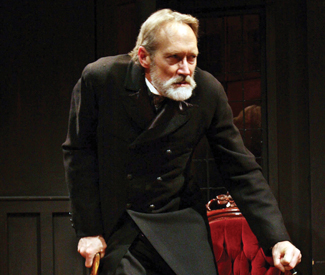
When the narrator walked onto Ashby Stage Monday night with cigarette in hand, head cocked, and eyebrows raised to welcome everyone to The Twilight Zone, the audience let out a collective laugh of recognition for this Rod Serling look-a-like.

First Person Singular‘s Everyday Monsters — despite its inclusion in the ensemble’s “Apocalypse Not Now” season — came dangerously close to doomsday in an imaginative and thought-provoking reading of three classic Twilight Zone episodes.

The company opened with the Armageddon tale “Third from the Sun,” which employs a textbook version of The Twilight Zone’s signature table-turning trick when it’s revealed that the characters are not fleeing from earth but in fact escaping to it. The actors brought the script to life with animated gestures and tones, making it easy for your imagination to take care of the rest. When it came time to depart the planet by space ship, they broke their formation downstage and scrambled to the “landing zone,” dramatizing the act of escape.

Next was up was “It’s a Good Life,” which worked suprisingly well with the dramatic reading format. Anthony, a young monster, terrorizes the inhabitants of a small town in Ohio, turning them into faux-happy drones lest they might be turned into jack-in-the-boxes or three-headed gophers. Reading from the scripts made sense with the characters’ forced positive attitudes. Then, when the characters gathered to watch Anthony’s “TV” (an invention as bad as current day reality TV), the production used an actual audio clip from the episode; this added a layer of complexity to the performance and cleverly paid homage to the original.

The last segment of the evening brought home the political relevance of the show with “The Monsters are Due on Maple Street.” Director Joe Christiano noted before the performance how Rod Serling used his Twilight Zone worlds to play out issues that were relevant in America at the time, and this one was thick with inspiration from Red Scare paranoia. A freak blackout in a small town spurs finger pointing and an alien hunt. This portrayal of how a fear of the unknown can turn people into monsters strikes deeply one of the catalysts for the arms race and stays relevant today with the current war on terror.

First Person Singular has coordinated dramatic readings and literary mash-ups throughout the bay area since its formation in 2010; this year the group has been taken under wing by Berkeley’s Shotgun Players for a series of more formal performances at the Ashby Stage. The only catch about First Person Singular’s performances? They’re one-night-only events — so plan ahead to get your “Apocalypse Not Now” fix. The final two entries are Dec. 3’s Hear Me Now?: Cell Phone Monologues (which Christiano described as, “putting the one-sided conversation where it belongs: onstage”) and Dec. 18’s Schmaltz!: The Genius of Barry Manilow (a holiday sing-a-long).

www.1stpersonsingular.com

Next!

0

arts@sfbg.com

THEATER/DANCE A bobcat sat in the grass beside the main building at Headlands Center for the Arts one quiet morning last week. He (I say he because he’s “bob”) took no notice of me but instead nonchalantly lifted a hind leg over his shoulder and took a short tongue-bath. I was told he’d been seen hanging around a lot over the last few days, closer than usual, clearly trying to pass himself off as an ordinary housecat. Or looking for field mice. Whatever he was up to, he seemed relaxed and in no hurry.

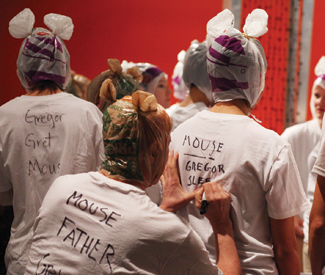
Inside the building — one of the repurposed military barracks comprising the Headlands’ bucolic campus — the mood felt very much the same. Melinda Ring assured me this was an illusion, at least as far as she was concerned. As a small group of fellow resident artists drank coffee and chatted in an opposite corner of the otherwise deserted dining hall, the New York–based and Los Angeles–bred experimental choreographer explained, in a calm and good-natured tone, the amount of work still before her in further developing and preparing two back-to-back sessions of her Mouse Auditions.

This intriguing and thought-provoking meta-dance — in which local performers try out for a work based on Franz Kafka’s Metamorphosis that will never actually be realized — makes its West Coast debut this weekend as part of Headlands’ annual Open House, featuring new works and works-in-progress from this season’s multidisciplinary array of artists-in-residence.

Ring’s Mouse Auditions had its premiere at the 2010 Whitney Biennial as a site-specific live performance built on artist (and Ring’s good friend) Martin Kersels’ 5 Songs sculpture. While she already had had the idea of a performance built out of an endless audition, the opportunity to choreograph around the five-piece sculpture inspired some specifics, including her title.

“It was my most immediate response to Martin Kersels’ sculpture,” she explains, “a rather cartoonish monstrous Playmobil thing. I thought, ‘I see this populated by disaffected mice.’ Then, I’m an experimental choreographer, so mice make sense in that they are often experimented on. Plus, the creature that [Kafka’s character Gregor Samsa] becomes is most directly translated as vermin, not beetle. So I thought that gives me a pass. The word is crossed-out in the title because I’m not certain that finally, in the never-to-be performed work, the performers will be cast as mice.”

Packed inside that set of associations are Mouse Auditions‘ questions and concerns about art and commerce, working bodies, and the pliable nature of social identities and relations. Ring’s project focuses her would-be (but also actual) performers on the moments just before and just after the novella’s opening line, as Gregor awakens “from unsettling dreams” to find himself transmogrified. The exploration undertaken in the room, among strangers, uses a script (posted on Ring’s website) that draws directly from her own longstanding reflections on the economic realities of art making — and specifically those confronting dancers as laboring bodies.

“The two things that I’ve been focusing on with Metamorphosis are this idea of Gregor as a worker, the stress of his being a worker, the relationship with his boss, the obligation he has to his family — somehow mixing that up with the relationship that I’m trying to make with these people who would supposedly be my workers. And the other thing is this confusion and chaos that he experiences; that his body isn’t recognizable to him. It connects very directly to the way I’m working in [my] other highly choreographed dances. That really interests me, that experience he’s having.”

The Headlands residency is part of Ring’s ongoing development of a piece whose potential she feels is still unfolding. Indeed, though it originated in a museum gallery, Ring sees Mouse Auditions as applicable to a wider set of spaces and social settings, since its themes and structure are rooted in a provocative examination of some basic material and social realities.

The Marin setting, with its distinct environment (and competing wildlife), will no doubt set up its own reverberations, not least because the participants (unlike in New York) will be almost entirely strangers to Ring. But wherever it lands next, there’s something in the piercing comedy, subtle negotiation and absurd, Sisyphean optimism of a potentially endless audition — in which every applicant is already a performer in a piece about a piece that will never be made — that sure sounds close to home. *

MOUSE AUDITIONS

Sun/4, noon-5pm, free

Headlands Center for the Arts

Building 961

944 Simmonds, Sausalito

headlands.org/event/mouse-auditions

Film Listings

0

Film listings are edited by Cheryl Eddy. Reviewers are Kimberly Chun, Dennis Harvey, Lynn Rapoport, and Sara Vizcarrondo. For rep house showtimes, see Rep Clock.

OPENING

Amber Alert An audition tape for The Amazing Race quickly turns into an epic chase in this low-budget "found footage" drama. Arizona BFFs Nate (Chris Hill) and Sam (Summer Bellessa, wife of director Kerry Bellessa) — and Sam’s teenage brother, shaky-cam operator Caleb (Caleb Thompson) — notice they’re driving behind the very Honda that’s being sought by an Amber Alert. "Following at a safe distance," as advised when they call the cops, leads to high-decibel arguments about how to handle the situation — and for the next hour-plus, the viewer is trapped in a car with two people communicating only in nails-on-chalkboard tones. Amber Alert‘s nonstop bickerfest is so tiresome that it’s actually a relief when the child molester character starts taking an active role in the story. Not a good sign. (1:20) Rohnert Park 16. (Eddy)

The Bay Top-quality (i.e., realistically repulsive) special effects highlight this otherwise unremarkable disaster movie that’s yet another "found footage" concoction, albeit maybe the first one from an Oscar-winning director. But it’s been a long time since 1988’s Rain Man, and the Baltimore-adjacent setting is the only Barry Levinson signature you’ll find here. Instead, parasites-gnaw-apart-a-coastal-town drama The Bay — positioned as a collection of suppressed material coming to light on "Govleaks.org" — is a relentlessly familiar affair, further hampered by a narrator (Kether Donohue) with a supremely grating voice. Rising star Christopher Denham (Argo) has a small part as an oceanographer whose warnings about the impending waterborne catastrophe are brushed aside by a mayor who is (spoiler alert!) more concerned with tourist dollars than safety. (1:25) (Eddy)

"Don’t Shoot the Player Piano: The Music of Conlon Nancarrow" The late Texarkana-born composer’s birth centenary is celebrated in this two-part (Fri/2 and Sun/4) program of films examining his unique contribution to 20th century music. Frustrated early on by the inability of standard musicians to play his incredibly complicated scores, he turned to composing for player pianos, with their greatly heightened capacity for producing density of notes and rhythms. A member of the American Communist Party, he returned from fighting fascists in the Spanish Civil War to discover the U.S. government had revoked the passports of many citizens with similar political convictions. As a result, in 1940 he moved to Mexico, where he remained until his death 57 years later — his reputation remaining an underground musicologists’ secret until the early 1980s, in large part due to his disinterest in fame and dislike of crowds (he’d always avoided any gathering of over five people). But in his last years he became much more widely known, thanks in large part to fans like fellow composer Gyorgy Ligeti, who in one documentary here calls him "the most important composer of our time," comparing him to Beethoven and saying "his work is completely, totally different from [his contemporaries]." Among the movies screening are Uli Aumuller and Hanne Kaisik’s 1993 German Music for 1,000 Fingers, in which the reclusive, elderly subject allows us into his studio to explain his (still somewhat inexplicable) methodologies. The brand-new, hour-long Conlon Nancarrow: Virtuoso of the Player Piano offers a posthumous appreciation of his life, music and influence. It’s a first film from James Greeson, a professor of music at the University of Arkansas who knew the man himself. Also featured are several international shorts that provide interpretive visual complements to Nancarrow pieces. His widow and daughter, as well as kinetic sculptor Trimpin and composer-former KPFA music director Charles Amirkhanian will appear at both PFA programs. Pacific Film Archive. (Harvey)

The Flat See "Past Lives." (1:37) Albany, Embarcadero.

Flight Robert Zemeckis directs Denzel Washington as an airline pilot whose act of heroism brings to light his secret drinking problem. (2:18) Presidio.

A Late Quartet Philip Seymour Hoffman and Christopher Walken head up a star-spangled cast in this drama about a famous string quartet. (1:45) Embarcadero.

A Liar’s Autobiography: The Untrue Story of Monty Python’s Graham Chapman Blessed with recordings made by Monty Python member Graham Chapman (King Arthur in 1975’s Monty Python and the Holy Grail; Brian in 1979’s Life of Brian) before his death in 1989 from cancer, filmmakers Bill Jones, Jeff Simpson, and Ben Timlett recruited 14 different animation studios to piece together Chapman’s darkly humorous (and often just plain dark) life story. He was gay, he was an alcoholic, he co-wrote (with John Cleese) the legendary "Dead Parrot Sketch." A Liar’s Autobiography starts slowly — even with fellow Monty Python members Cleese, Terry Jones, Terry Gilliam, and Michael Palin lending their voices, much of the bone-dry humor falls disappointingly flat. "This is not a Monty Python film," the filmmakers insist, and viewers hoping for such will be disappointed. Stick with it, though, and the film eventually finds its footing as an offbeat biopic, with the pick-a-mix animation gimmick at its most effective when illustrating Chapman’s booze-fueled hallucinations. In addition to opening theatrically, the film also debuts Fri/2 on premium cable channel Epix. (1:22) Smith Rafael, Sundance Kabuki. (Eddy)

The Loneliest Planet Travel broadens, they say — and has a way of foregrounding anxiety and desire. So the little tells take on a larger, much more loaded significance in The Loneliest Planet when contextualized by the devastatingly beautiful Caucasus Mountains in Georgia. In this film by Russian American director and video artist Julia Loktev, adventuring, engaged Westerners Nica (an ethereal Hani Furstenberg) and Alex (Gael García Bernal) hire a local guide and war veteran (Bidzina Gujabidze) to lead them on a camping trip through the wilderness. They’re globe-trotting blithe spirits, throwing themselves into new languages and new experiences, though the harsh, hazardous, and glorious Georgian peaks and crevasses have a way of making them seem even smaller while magnifying their weaknesses and naiveté. One small, critical stumble on their journey is all it takes for the pair to question their relationship, their roles, and the solid ground of their love. Working with minimal dialogue (and no handlebar subtitles) from a Tom Bissell short story, Loktev shows a deliberate hand and thoughtful eye in her use of the space, as well as her way of allowing the silences to speak louder than dialogue: she turns the outdoor expanses into a quietly awe-inspiring, albeit frightening mirror for the distances between, and emptiness within, her wanderers, uncertain about how to quite find their way home. (1:53) Clay, Shattuck. (Chun)

The Man With The Iron Fists Erstwhile Wu Tang-er RZA directs (and co-wrote, with Eli Roth) this over-the-top homage to classic martial arts films. (1:36)

Miami Connection See "Black-Belt Sabbath." (1:23) Roxie.

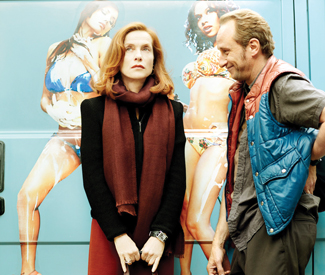
The Other Son The plot of ABC Family’s Switched at Birth gets a politically-minded makeover in Lorraine Lévy’s The Other Son, in which the mixed-up teens represent both sides of the Israel-Palestine conflict. When mop-topped wannabe rocker Joseph (Jules Sitruk) dutifully signs up for Israeli military duty, the required blood test reveals he’s not the biological son of his parents. Understandably freaked out, his French-Israeli mother (Emmanuelle Devos) finds out that a hospital error during a Gulf War-era evacuation meant she and husband Alon (Pascal Elbé) went home with the wrong infant — and their child, aspiring doctor Yacine (Medhi Dehbi), was raised instead by a Palestinian couple (Areen Omari, Khalifia Natour). It’s a highly-charged situation on many levels ("Am I still Jewish?", a tearful Joseph asks; "Have fun with the occupying forces?", Yacine’s bitter brother inquires after his family visits Joseph in Tel Aviv), and potential for melodrama is sky-high. Fortunately, director and co-writer Levy handles the subject with admirable sensitivity, and the film is further buoyed by strong performances. (1:53) Opera Plaza, Shattuck, Smith Rafael. (Eddy)

A Simple Life When elderly Ah Tao (Deanie Ip), the housekeeper who’s served his family for decades, has a stroke, producer Roger (Andy Lau) pays for her to enter a nursing home. No longer tasked with caring for Roger, Ah Tao faces life in the cramped, often depressing facility with resigned calm, making friends with other residents (some of whom are played by nonprofessional actors) and enjoying Roger’s frequent visits. Based on Roger Lee’s story (inspired by his own life), Ann Hui’s film is well-served by its performances; Ip picked up multiple Best Actress awards for her role, Lau is reliably solid, and Anthony Wong pops up as the nursing home’s eye patch-wearing owner. Wong’s over-the-top cameo doesn’t quite fit in with the movie’s otherwise low-key vibe, but he’s a welcome distraction in a film that can be too quiet at times — a situation not helped by its washed-out palette of gray, beige, and more gray. (1:58) Four Star. (Eddy)

Wreck-It Ralph Wreck-It Ralph cribs directly from the Toy Story series: when the lights go off in the arcade, video game characters gather to eat, drink, and endure existential crises. John C. Reilly is likable and idiosyncratic as Ralph, the hulking, ham-fisted villain of a game called Fix-It-Felix. Fed up with being the bad guy, Ralph sneaks into gritty combat sim Hero’s Duty under the nose of Sergeant Calhoun (Jane Lynch), a blond space marine who mixes Mass Effect‘s Commander Shepard with a PG-rated R. Lee Ermey. Things go quickly awry, and soon Ralph is marooned in cart-racing candyland Sugar Rush, helping Vanellope Von Schweetz (a manic Sarah Silverman), with Calhoun and opposite number Felix (Jack McBrayer) hot on his heels. Though often aggressively childish, the humor will amuse kids, parents, and occasionally gamers, and the Disney-approved message about acceptance is moving without being maudlin. The animation, limber enough to portray 30 years of changing video game graphics, deserves special praise. (1:34) Balboa, Presidio, Shattuck. (Ben Richardson)

The Zen of Bennett Landing somewhere between a glorified album making-of and a more depthed exploration, this documentary about famed crooner Tony of "I Left My Heart in San Francisco" fame shows him recording last year’s all-standards Duets II disc. His vocal collaborators are an eclectic — to say the least — mix of mostly much younger artists including Norah Jones, John Mayer, Carrie Underwood, Willie Nelson, and Andrea Bocelli. Some pairings are clearly a matter of commerce over chemistry, while others surprise — Lady Gaga is better than you might expect, while Aretha Franklin is certainly worse. Most touching as well as disturbing is his session with the late Amy Winehouse, whose nervous, possibly hopped-up appearance occasions his most gentlemanly behavior, as well as genuine admiration for her talent. (Others on the record, including Mariah Carey and k.d. lang, do not appear here.) Unjoo Moon’s rather mannered direction includes little displays of temperament from the octogenarian star, and glimpses of his family life (which extends well into his work life, since they all seem to be on the payroll), but just enough to tease — not enough to provide actual insight. Still, fans will find this less than-definitive portrait quite satisfying enough on its own limited terms. (1:24) Vogue. (Harvey)

ONGOING

Alex Cross (1:41) 1000 Van Ness, SF Center.

Argo If you didn’t know the particulars of the 1979 Iranian Revolution, you won’t be an expert after Argo, but the film does a good job of capturing America’s fearful reaction to the events that followed it — particularly the hostage crisis at the US embassy in Tehran. Argo zeroes in on the fate of six embassy staffers who managed to escape the building and flee to the home of the sympathetic Canadian ambassador (Victor Garber). Back in Washington, short-tempered CIA agents (including a top-notch Bryan Cranston) cast about for ways to rescue them. Enter Tony Mendez (Ben Affleck, who also directs), exfil specialist and father to a youngster wrapped up in the era’s sci-fi craze. While watching 1973’s Battle for the Planet of the Apes, Tony comes up with what Cranston’s character calls "the best bad idea we have:" the CIA will fund a phony Canadian movie production (corny, intergalactic, and titled Argo) and pretend the six are part of the crew, visiting Iran for a few days on a location shoot. Tony will sneak in, deliver the necessary fake-ID documents, and escort them out. Neither his superiors, nor the six in hiding, have much faith in the idea. ("Is this the part where we say, ‘It’s so crazy it just might work?’" someone asks, beating the cliché to the punch.) Argo never lets you forget that lives are at stake; every painstakingly forged form, every bluff past a checkpoint official increases the anxiety (to the point of being laid on a bit thick by the end). But though Affleck builds the needed suspense with gusto, Argo comes alive in its Hollywood scenes. As the show-biz veterans who mull over Tony’s plan with a mix of Tinseltown cynicism and patiotic duty, John Goodman and Alan Arkin practically burst with in-joke brio. I could have watched an entire movie just about those two. (2:00) Four Star, Marina, 1000 Van Ness, SF Center, Sundance Kabuki. (Eddy)

Beasts of the Southern Wild Six months after winning the Grand Jury Prize at Sundance (and a Cannes Camera d’Or), Beasts of the Southern Wild proves capable of enduring a second or third viewing with its originality and strangeness fully intact. Magical realism is a primarily literary device that isn’t attempted very often in U.S. cinema, and succeeds very rarely. But this intersection between Faulkner and fairy tale, a fable about — improbably — Hurricane Katrina, is mysterious and unruly and enchanting. Benh Zeitlin’s film is wildly cinematic from the outset, as voiceover narration from six-year-old Hushpuppy (Quvenzhané Wallis) offers simple commentary on her rather fantastical life. She abides in the Bathtub, an imaginary chunk of bayou country south of New Orleans whose residents live closer to nature, amid the detritus of civilization. Seemingly everything is some alchemical combination of scrap heap, flesh, and soil. But not all is well: when "the storm" floods the land, the holdouts are forced at federal gunpoint to evacuate. With its elements of magic, mythological exodus, and evolutionary biology, Beasts goes way out on a conceptual limb; you could argue it achieves many (if not more) of the same goals Terrence Malick’s 2011 The Tree of Life did at a fraction of that film’s cost and length. (1:31) Shattuck. (Harvey)

Chasing Mavericks Sidestepping the potential surf-porn impact of influential docs like The Endless Summer (1966) and Step Into Liquid (2003), Chasing Mavericks directors Curtis Hanson and Michael Apted instead focus on the coming-of-age back story of Santa Cruz surf legend Jay Moriarity, who landed on the cover of Surfer magazine at the very unripe age of 16 while attempting the way-challenging waves at Half Moon Bay’s Mavericks. How did the teenager manage to tackle the mythically massive, highly dangerous 25- to 80-plus-foot waves that have killed far more seasoned surfers? It all started at an early age, a starting point that’s perhaps a nod to Apted’s lifetime-spanning Up documentaries, as Moriarity (Jonny Weston) learned to gauge the size of the waves on his own and grew up idolizing neighbor and surfing kahuna Frosty Hesson (Gerard Butler). After tailing Hesson on a Mavericks surfing jaunt, Moriarity becomes enthralled with the idea of tackling those killer waves — an obsession that could kill the kid, Hesson realizes with the help of his wife Brenda (Abigail Spencer). So the elder puts him through a makeshift big-wave rider academy, developing him physically by having the teen, say, paddle from SC to Monterey and mentally by putting him through a series of discipline-building challenges. The result is a riptide of inspiration that even Moriarity’s damaged mom (Elisabeth Shue) can appreciate, that is if the directors hadn’t succumbed to an all-too-predictable story arc, complete with random bullying and an on-again-off-again love interest (Leven Rambin), plus the depthless performance of a too-cute, cherubic Weston. Too bad Butler, who tasted the ocean’s wrath when he got injured during the production, aged out of the Moriarity role: he brings the fire — and the fury that fuels a drive to do the physically unthinkable — that would have given Moriarity’s story new life. (1:45) Metreon, 1000 Van Ness. (Chun)

Cloud Atlas Cramming the six busy storylines of David Mitchell’s wildly ambitious novel into just three hours — the average reader might have thought at least 12 would be required — this impressive adaptation directed (in separate parts) by Tom Twyker (1998’s Run Lola Run) and Matrix siblings Lana and Andy Wachowski has a whole lot of narrative to get through, stretching around the globe and over centuries. In the mid 19th century, Jim Sturgess’ sickly American notory endures a long sea voyage as reluctant protector of a runaway-slave stowaway from the Chatham Islands (David Gyasi). In 1931 Belgium, a talented but criminally minded British musician (Ben Whishaw) wheedles his way into the household of a famous but long-inactive composer (Jim Broadbent). A chance encounter sets 1970s San Francisco journalist Luisa (Halle Berry) on the path of a massive cover-up conspiracy, swiftly putting her life in danger. Circa now, a reprobate London publisher’s (Broadbent) huge windfall turns into bad luck that gets even worse when he seeks help from his brother (Hugh Grant). In the not-so-distant future, a disposable "fabricant" server to the "consumer" classes (Doona Bae) finds herself plucked from her cog-like life for a rebellious higher purpose. Finally, in an indeterminately distant future after "the Fall," an island tribesman (Tom Hanks) forms a highly ambivalent relationship toward a visitor (Berry) from a more advanced but dying civilization. Mitchell’s book was divided into huge novella-sized blocks, with each thread split in two; the film wastes very little time establishing its individual stories before beginning to rapidly intercut between them. That may result in a sense of information (and eventually action) overload, particularly for non-readers, even as it clarifies the connective tissues running throughout. Compression robs some episodes of the cumulative impact they had on the page; the starry multicasting (which in addition to the above mentioned finds many uses for Hugo Weaving, Keith David, James D’Arcy, and Susan Sarandon) can be a distraction; and there’s too much uplift forced on the six tales’ summation. Simply put, not everything here works; like the very different Watchmen, this is a rather brilliant "impossible adaptation" screenplay (by the directors) than nonetheless can’t help but be a bit too much. But so much does work — in alternating currents of satire, melodrama, pulp thriller, dystopian sci-fi, adventure, and so on — that Cloud Atlas must be forgiven for being imperfect. If it were perfect, it couldn’t possibly sprawl as imaginatively and challengingly as it does, and as mainstream movies very seldom do. (2:52) Balboa, California, 1000 Van Ness, Presidio, SF Center, Sundance Kabuki. (Harvey)

The Dark Knight Rises Early reviews that called out The Dark Knight Rises‘ flaws were greeted with the kind of vicious rage that only anonymous internet commentators can dish out. And maybe this is yet another critic-proof movie, albeit not one based on a best-selling YA book series. Of course, it is based on a comic book, though Christopher Nolan’s sophisticated filmmaking and Christian Bale’s tortured lead performance tend to make that easy to forget. In this third and "final" installment in Nolan’s trilogy, Bruce Wayne has gone into seclusion, skulking around his mansion and bemoaning his broken body and shattered reputation. He’s lured back into the Batcave after a series of unfortunate events, during which The Dark Knight Rises takes some jabs at contemporary class warfare (with problematic mixed results), introduces a villain with pecs of steel and an at-times distractingly muffled voice (Tom Hardy), and unveils a potentially dangerous device that produces sustainable energy (paging Tony Stark). Make no mistake: this is an exciting, appropriately moody conclusion to a superior superhero series, with some nice turns by supporting players Gary Oldman and Joseph Gordon-Levitt. But in trying to cram in so many characters and plot threads and themes (so many prisons in this thing, literal and figural), The Dark Knight Rises is ultimately done in by its sprawl. Without a focal point — like Heath Ledger’s menacing, iconic Joker in 2008’s The Dark Knight — the stakes aren’t as high, and the end result feels more like a superior summer blockbuster than one for the ages. (2:44) Metreon. (Eddy)

Diana Vreeland: The Eye Has to Travel The life of legendary fashion editor Diana Vreeland is colorfully recounted in Diana Vreeland: The Eye Has to Travel, a doc directed by her granddaughter-in-law, Lisa Immordino Vreeland. The family connection meant seemingly unlimited access to material featuring the unconventionally glamorous (and highly quotable) Vreeland herself, plus the striking images that remain from her work at Harper’s Bazaar, Vogue, and the Costume Institute of the Metropolitan Museum of Art. "Narrated" from interview transcripts by an actor approximating the late Vreeland’s husky, posh tones, the film allows for some criticism (her employees often trembled at the sight of her; her sons felt neglected; her grasp of historical accuracy while working at the museum was sometimes lacking) among the praise, which is lavish and delivered by A-listers like Anjelica Huston, who remembers "She had a taste for the extraordinary and the extreme," and Manolo Blahnik, who squeals, "She had the vision!" (1:26) Opera Plaza. (Eddy)

Frankenweenie Tim Burton’s feature-length Frankenweenie expands his 1984 short of the same name (canned by Disney back in the day for being too scary), and is the first black and white film to receive the 3D IMAX treatment. A stop-motion homage to every monster movie Burton ever loved, Frankenweenie is also a revival of the Frankenstein story cute-ified for kids; it takes the showy elements of Mary Shelley’s novel and morphs them to fit Burton’s hyperbolic aesthetic. Elementary-school science wiz Victor takes his disinterred dog from bull terrier to gentle abomination (when the thirsty Sparky drinks, he shoots water out of the seams holding his body parts together). Victor’s competitor in the school science fair, Edgar E. Gore, finds out about Sparky and ropes in classmates to scrape up their dead pets from the town’s eerily utilized pet cemetery and harness the town’s lightning surplus. The film’s answer to Boris Karloff (lisp intact) resurrects a mummified hamster, while a surrogate for Japanese Godzilla maker Ishiro Honda, revives his pet turtle Shelley (get it?) into Gamera. As these experiments aren’t borne of love, they don’t go as well at Victor’s. If you love Burton, Frankenweenie feels like the at-last presentation of a story he’s been dying to tell for years. If you don’t love him, you might wonder why it took him so long to get it out. When Victor’s science teacher leaves the school, he tells Victor an experiment conducted without love is different from one conducted with it: love, he implies, is a variable. If that’s the variable that separates 2003’s Big Fish (heartbreaking) from 2010’s Alice In Wonderland (atrocious), it’s a large one indeed. The love was there for 29 minutes in 1984, but I can’t say it endures when stretched to 87 minutes 22 years later. (1:27) Metreon, 1000 Van Ness. (Vizcarrondo)

Fun Size (1:45) Metreon, 1000 Van Ness, Shattuck.

Here Comes the Boom The makers of September’s Won’t Back Down might quibble with this statement, but the rest of us can probably agree that nothing (with the possible exception of Trapper Keepers) says "back to school" like competitive steel-cage mixed martial arts — particularly if the proceeds from the matches go toward saving extracurriculars at a down-at-the-heels public high school. Kevin James plays Scott Voss, a 42-year-old biology teacher at the aforementioned school, whose lack of vocational enthusiasm is manifested by poor attendance and classroom observations about how none of what the students are learning matters. He’s jolted from this criminally subpar performance of his academic duties, however, when budget cuts threaten the school’s arts programs, including the job of an earnest and enthusiastic music teacher (Henry Winkler) whose dedication Scott lazily admires. It seems less than inevitable that this state of affairs would lead to Scott’s donning his college wrestling singlet and trundling into the ring to get pummeled and mauled for cash, but it seems to work better than a bake sale. Less effective and equally unconvincing are Scott’s whiplash arc from bad apple to teacher-of-the-year; a percolating romance between him and the school nurse, played by Salma Hayek; and the script’s tortuous parade of rousing statements celebrating the power of the human spirit, seemingly cribbed from a page-a-day calendar of inspirational quotes. (1:45) SF Center. (Rapoport)

Hotel Transylvania (1:32) Metreon, 1000 Van Ness, Shattuck.

The House I Live In Much like he did in 2005’s Why We Fight, filmmaker Eugene Jarecki identifies a Big Issue (in that film, the Iraq War) and strips it down, tracing all of the history leading up to the current crisis point. Here, he takes on America’s "war on drugs," which I put quotes around not just because it was a phrase spoken by Nixon and Reagan, but also because — as The House I Live In ruthlessly exposes — it’s been a failure, a sham, since its origins in the late 1960s. Framing his investigation with the personal story of his family’s housekeeper — whose dedication to the Jarecki family meant that she was absent when her own son turned to drugs — and enfolding a diverse array of interviews (a sympathetic prison guard, addicts and their families, The Wire‘s David Simon) and locations (New York City, Sioux City), Jarecki has created an eye-opening film. Particularly well-explained are segments on how drug laws correlate directly to race and class, and how the prison-industrial complex has played a part in making sure those laws remain as strict as possible. (1:48) Sundance Kabuki. (Eddy)

Looper It’s 2044 and, thanks to a lengthy bout of exposition by our protagonist, Joe (Joseph Gordon-Levitt), here’s what we know: Time travel, an invention 30 years away, will be used by criminals to transport their soon-to-be homicide victims backward, where a class of gunmen called loopers, Joe among them, are employed to "do the necessaries." More deftly revealed in Brick writer-director Rian Johnson’s new film is the joylessness of the world in which Joe amorally makes his way, where gangsters from the future control the present (under the supervision of Jeff Daniels), their hit men live large but badly (Joe is addicted to some eyeball-administered narcotic), and the remainder of the urban populace suffers below-subsistence-level poverty. The latest downside for guys like Joe is that a new crime boss has begun sending back a steady stream of aging loopers for termination, or "closing the loop"; soon enough, Joe is staring down a gun barrel at himself plus 30 years. Being played by Bruce Willis, old Joe is not one to peaceably abide by a death warrant, and young Joe must set off in search of himself so that—with the help of a woman named Sara (Emily Blunt) and her creepy-cute son Cid (Pierce Gagnon)—he can blow his own (future) head off. Having seen the evocatively horrific fate of another escaped looper, we can’t totally blame him. Parsing the daft mechanics of time travel as envisioned here is rough going, but the film’s brisk pacing and talented cast distract, and as one Joe tersely explains to another, if they start talking about it, "we’re gonna be here all day making diagrams with straws" —in other words, some loops just weren’t meant to be closed. (1:58) 1000 Van Ness, Piedmont, SF Center, Sundance Kabuki. (Rapoport)

Masquerade (2:11) Metreon.

The Master Paul Thomas Anderson’s much-hyped likely Best Picture contender lives up: it’s easily the best film of 2012 so far. Philip Seymour Hoffman stars as Lancaster Dodd, the L. Ron Hubbard-ish head of a Scientology-esque movement. "The Cause" attracts Freddie Quell (Joaquin Phoenix, in a welcome return from the faux-deep end), less for its pseudo-religious psychobabble and bizarre personal-growth exercises, and more because it supplies the aimless, alcoholic veteran — a drifter in every sense of the word — with a sense of community he yearns for, yet resists submitting to. As with There Will Be Blood (2007), Anderson focuses on the tension between the two main characters: an older, established figure and his upstart challenger. But there’s less cut-and-dried antagonism here; while their relationship is complex, and it does lead to dark, troubled places, there are also moments of levity and weird hilarity — which might have something to do with Freddie’s paint-thinner moonshine. (2:17) Albany, Sundance Kabuki. (Eddy)

Middle of Nowhere All the reasons why movie publicist turned filmmaker Ava DuVernay scored the best director award at the Sundance Film Festival are up here on the screen. Taking on the emotionally charged yet rarely attempted challenge of picturing the life of the loved one left behind by the incarcerated, DuVernay furthers the cause of telling African American stories — she founded AaFFRM (African-American Film Festival Releasing Movement) and made her directorial debut with 2008 LA hip-hop doc This Is The Life — with Middle of Nowhere. Medical student Ruby (the compelling Emayatzy Corinealdi) appears to have a bright future ahead of her, when her husband Derek (Omari Hardwick) makes some bad choices and is tossed into maximum security prison for eight long years. She swears she’ll wait for him, putting her dreams aside, making the long bus ride out to visit him regularly, and settling for any nursing shift she can. How will she scrape the money together to pay the lawyer for Derek’s parole hearing, cope with the grinding disapproval of her mother (Lorraine Toussaint), support the increasingly hardened and altered Derek, and most importantly, discover a new path for herself? All are handled with rare empathy and compassion by DuVernay, who is rewarded for her care by her cast’s powerful performances. Our reward might be found amid the everyday poetry of Ruby’s life, while she wraps her hair for bed, watches Ali: Fear Eats the Soul (1974), and fantasizes about love in a life interrupted. (1:41) Stonestown. (Chun)

Paranormal Activity 4 (1:21) Metreon, 1000 Van Ness.

The Perks of Being a Wallflower Move over, Diary of a Wimpy Kid series — there’s a new shrinking-violet social outcast in town. These days, life might not suck quite so hard for 90-pound weaklings in every age category, what with so many films and TV shows exposing, and sometimes even celebrating, the many miseries of childhood and adolescence for all to see. In this case, Perks author Stephen Chbosky takes on the directorial duties — both a good and bad thing, much like the teen years. Smart, shy Charlie is starting high school with a host of issues: he’s painfully awkward and very alone in the brutal throng, his only friend just committed suicide, and his only simpatico family member was killed in a car accident. Charlie’s English teacher Mr. Andersen (Paul Rudd) appears to be his only connection, until the freshman strikes up a conversation with feline, charismatic, shop-class jester Patrick (Ezra Miller) and his magnetic, music- and fun-loving stepsister Sam (Emma Watson). Who needs the popular kids? The witty duo head up their gang of coolly uncool outcasts their own, the Wallflowers (not to be confused with the deeply uncool Jakob Dylan combo), and with them, Charlie appears to have found his tribe. Only a few small secrets put a damper on matters: Patrick happens to be gay and involved with football player Brad (Johnny Simmons), who’s saddled with a violently conservative father, and Charlie is in love with the already-hooked-up Sam and is frightened that his fragile equilibrium will be destroyed when his new besties graduate and slip out of his life. Displaying empathy and a devotion to emotional truth, Chbosky takes good care of his characters, preserving the complexity and ungainly quirks of their not-so-cartoonish suburbia, though his limitations as a director come to the fore in the murkiness and choppily handled climax that reveals how damaged Charlie truly is. (1:43) Embarcadero, Piedmont, Presidio, Shattuck, Sundance Kabuki. (Chun)

Pitch Perfect As an all-female college a cappella group known as the Barden Bellas launches into Ace of Base’s "The Sign" during the prologue of Pitch Perfect, you can hear the Glee-meets-Bring It On elevator pitch. Which is fine, since Bring It On-meets-anything is clearly worth a shot. In this attempt, Anna Kendrick stars as withdrawn and disaffected college freshman Beca, who dreams of producing music in L.A. but is begrudgingly getting a free ride at Barden University via her comp lit professor father. Clearly his goal is not making sure she receives a liberal arts education, as Barden’s academic jungle extends to the edges of the campus’s competitive a cappella scene, and the closest thing to an intellectual challenge occurs during a "riff-off" between a cappella gangs at the bottom of a mysteriously drained swimming pool. When Beca reluctantly joins the Bellas, she finds herself caring enough about the group’s fate to push for an Ace of Base moratorium and radical steps like performing mashups. Much as 2000’s Bring It On coined terms like "cheerocracy" and "having cheer-sex," Pitch Perfect gives us the infinitely applicable prefix "a ca-" and descriptives like "getting Treble-boned," a reference to forbidden sexual relations with the Bellas’ cocky rivals, the Treblemakers. The gags get funnier, dirtier, and weirder, arguably reaching their climax in projectile-vomit snow angels, with Elizabeth Banks and John Michael Higgins as grin-panning competition commentators offering a string of loopily inappropriate observations. (1:52) Metreon, 1000 Van Ness. (Rapoport)

Samsara Samsara is the latest sumptuous, wordless offering from director Ron Fricke, who helped develop this style of dialogue- and context-free travelogue with Koyaanisqatsi (1982) and Baraka (1992). Spanning five years and shooting on 70mm film to capture glimmers of life in 25 countries on five continents, Samsara, which spins off the Sanskrit word for the "ever-turning wheel of life," is nothing if not good-looking, aspiring to be a kind of visual symphony boosted by music by the Dead Can Dance’s Lisa Gerrard and composers Michael Stearns and Marcello De Francisci. Images of natural beauty, baptisms, and an African woman and her babe give way to the madness of modern civilization — from jam-packed subways to the horrors of mechanized factory farming to a bizarre montage of go-go dancers, sex dolls, trash, toxic discarded technology, guns, and at least one gun-shaped coffin. After such dread, the opening and closing scenes of Buddhist spirituality seem almost like afterthoughts. The unmistakable overriding message is: humanity, you dazzle in all your glorious and inglorious dimensions — even at your most inhumane. Sullying this hand wringing, selective meditation is Fricke’s reliance on easy stereotypes: the predictable connections the filmmaker makes between Africa and an innocent, earthy naturalism, and Asia and a vaguely threatening, mechanistic efficiency, come off as facile and naive, while his sonic overlay of robot sounds over, for instance, an Asian woman blinking her eyes comes off as simply offensive. At such points, Fricke’s global leap-frogging begins to eclipse the beauty of his images and foregrounds his own biases. (1:39) Opera Plaza, Shattuck. (Chun)

Searching for Sugar Man The tale of the lost, and increasingly found, artist known as Rodriguez seems to have it all: the mystery and drama of myth, beginning with the singer-songwriter’s stunning 1970 debut, Cold Fact, a neglected folk rock-psychedelic masterwork. (The record never sold in the states, but somehow became a beloved, canonical LP in South Africa.) The story goes on to parse the cold, hard facts of vanished hopes and unpaid royalties, all too familiar in pop tragedies. In Searching for Sugar Man, Swedish documentarian Malik Bendjelloul lays out the ballad of Rodriguez as a rock’n’roll detective story, with two South African music lovers in hot pursuit of the elusive musician — long-rumored to have died onstage by either self-immolation or gunshot, and whose music spoke to a generation of white activists struggling to overturn apartheid. By the time Rodriguez himself enters the narrative, the film has taken on a fairy-tale trajectory; the end result speaks volumes about the power and longevity of great songwriting. (1:25) Opera Plaza, Shattuck. (Chun)

The Sessions Polio has long since paralyzed the body of Berkeley poet Mark O’Brien (John Hawkes) from the neck down. Of course his mind is free to roam — but it often roams south of the personal equator, where he hasn’t had the same opportunities as able-bodied people. Thus he enlists the services of Cheryl (Helen Hunt), a professional sex surrogate, to lose his virginity at last. Based on the real-life figures’ experiences, this drama by Australian polio survivor Ben Lewin was a big hit at Sundance this year (then titled The Surrogate), and it’s not hard to see why: this is one of those rare inspirational feel-good stories that doesn’t pander and earns its tears with honest emotional toil. Hawkes is always arresting, but Hunt hasn’t been this good in a long time, and William H. Macy is pure pleasure as a sympathetic priest put in numerous awkward positions with the Lord by Mark’s very down-to-earth questions and confessions. (1:35) California, Embarcadero, Sundance Kabuki. (Harvey)

Seven Psychopaths Those nostalgic for 1990s-style chatty assassins will find much to love in the broadly sketched Seven Psychopaths. Director-writer Martin McDonough already dipped a pen into Tarantino’s blood-splattered ink well with his 2008 debut feature, In Bruges, and Seven Psychopaths reads as larkier and more off-the-cuff, as the award-winning Irish playwright continues to try to find his own discomfiting, teasing balance between goofy Grand Guignol yuks and meta-minded storytelling. Structured, sort of, with the certified lucidity of a thrill killer, Seven Psychopaths opens on Boardwalk Empire heavies Michael Pitt and Michael Stuhlbarg bantering about the terrors of getting shot in the eyeball, while waiting to "kill a chick." The talky twosome don’t seem capable of harming a fat hen, in the face of the Jack of Spades serial killer, who happens to be Psychopath No. One and a serial destroyer of hired guns. The key to the rest of the psychopathic gang is locked in the noggin of screenwriter Marty (Colin Farrell), who’s grappling with a major block and attempting the seeming impossible task of creating a peace-loving, Buddhist killer. Looking on are his girlfriend Kaya (Abbie Cornish) and actor best friend Billy (Sam Rockwell), who has a lucrative side gig as a dog kidnapper — and reward snatcher — with the dapper Hans (Christopher Walken). A teensy bit too enthusiastic about Marty’s screenplay, Billy displays a talent for stumbling over psychos, reeling in Zachariah (Tom Waits) and, on his doggie-grabbing adventures, Shih Tzu-loving gangster Charlie (Woody Harrelson). Unrest assured, leitmotifs from McDonough plays — like a preoccupation with fiction-making (The Pillowman) and the coupling of pet-loving sentimentality and primal violence (The Lieutenant of Inishmore) — crop up in Seven Psychopaths, though in rougher, less refined form, and sprinkled with a nervous, bromantic anxiety that barely skirts homophobia. Best to bask in the cute, dumb pleasures of a saucer-eyed lap dog and the considerably more mental joys of this cast, headed up by dear dog hunter Walken, who can still stir terror with just a withering gaze and a voice that can peel the finish off a watch. (1:45) Marina, Metreon, 1000 Van Ness, Piedmont, Sundance Kabuki. (Chun)

Silent Hill: Revelation 3D The husband and adopted daughter of Rosa (Radha Mitchell, star of the 2006 first film and seen briefly here), Harry (Sean Bean) and Heather (Adelaide Clemens) have been on the run from both police and ghouls since mom vanished into the titular nether land some years ago. When dad is abducted, Heather must follow him to you-know-where, accompanied by cute-boy-with-a-secret Vincent (Kit Harington). There she runs screaming from the usual faceless knife-wielding nuns and other nightmare nemeses while attempting to rescue Pa and puzzle out her place in resolving the curse placed on the ghost town. The original 2006 film adaptation of the video game was a mixed bag but, like the game, had splendid visuals; this cut rate sequel lacks even that, despite the addition of 3D (if you’re willing to pay for a premium ticket). It’s pure cheese with no real scares, much-diminished atmosphere, and laughable stretches of mythological mumbo-jumbo recited by embarrassed good actors (Martin Donovan, Deborah Kara Unger, Carrie-Anne Moss, a punishingly hammy Malcolm McDowell). There is one cool monster — a many-faced "tarantula" assembled from mannequin parts — but its couple minutes aren’t worth ponying up for the rest of a movie that severely disappoints already low expectations. (1:34) Metreon, 1000 Van Ness. (Harvey)

Sinister True-crime author Ellison Oswalt (Ethan Hawke) hasn’t had a successful book in a decade. So he uproots wife (Juliet Rylance) and kids (Michael Hall D’Addario, Clare Foley) for yet another research project, not telling them that they’re actually moving into the recent scene of a ghastly unsolved murder in which an entire family — save one still-missing child — was hanged from a backyard tree. He finds a box in the attic that somehow escaped police attention, its contents being several reels of Super 8 home movies stretching back decades — all of families similarly wiped out in one cruel act. Smelling best-sellerdom, Ellison keeps this evidence of a serial slayer to himself. It’s disturbing when his son re-commences sleepwalking night terrors. It’s really disturbing when dad begins to spy a demonic looking figure lurking in the background of the films. It’s really, really disturbing when the projector starts turning itself on, in the middle of the night, in his locked office. A considerable bounce-back from his bloated 2008 Day the Earth Stood Still remake, Scott Derrickson’s film takes the opposite tact — it’s very small in both physical scope and narrative focus, almost never leaving the Oswalt’s modest house in fact. He takes the time to let pure creepiness build rather than feeling the need to goose our nads with a false scare or goresplat every five minutes. As a result, Sinister is definitely one of the year’s better horrors, even if (perhaps inevitably) the denouement can’t fully meet the expectations raised by that very long, unsettling buildup. (1:50) Metreon, 1000 Van Ness. (Harvey)

Tai Chi Zero A little boy dubbed "the Freak" for the curious, horn-like growth on his forehead grows up to be Lu Chan (Jaydan Yuan), who becomes a near-supernatural martial arts machine when the horn is punched, panic-button style. But activating the "Three Blossoms of the Crown," as it’s called, takes a toll on the boy’s health, so he’s sent to the isolated Chen Village to learn their signature moves, though he’s repeatedly told "Chen-style kung fu is not taught to outsiders!" Stephen Fung’s lighthearted direction (characters are introduced with bios about the actors who play them, even the split-second cameos: "Andrew Lau, director of the Infernal Affairs trilogy"), affinity for steampunk and whimsy, engagement of Sammo Hung as action director, and embracing of the absurd (the film’s most-repeated line: "What the hell?") all bring interest to this otherwise pretty predictable kung-fu tale, with its old-ways-versus-Western-ways conflict and misfit hero. Still, there’s something to be said for batshit insanity. (Be warned, though: Tai Chi Zero is the first in a series, which means one thing: it ends on a cliffhanger. Argh.) (1:34) Metreon. (Eddy)

Taken 2 Surprise hit Taken (2008) was a soap opera produced by French action master Luc Besson and designed for export. The divorced-dad-saves-daughter-from-sex-slavery plot may have nagged at some universal parenting anxieties, but it was a Movie of the Week melodrama made on a major movie budget. Taken 2 begins immediately after the last, with sweet teen Kim (Maggie Grace) talking about normalizing after she was drugged and bought for booty. Papa Neeson sees Kim’s mom (Famke Janssen) losing her grip on husband number two and invites them both to holiday in Istanbul following one of his high-stakes security gigs. When the assistant with the money slinks him a fat envelope, Neeson chuckles at his haul. This is the point when women in the audience choose which Neeson they’re watching: the understated super-provider or the warrior-dad whose sense of duty can meet no match. For family men, this is the breeziest bit of vicarious living available; Neeson’s character is a tireless daddy duelist, a man as diligent as he is organized. (This is guy who screams "Victory loves preparation!") As head-splitting, disorienting, and generally exhausting as the action direction is, Neeson saves his ex-wife and the show in a stream of unclear shootouts. Taken 2 is best suited for the small screen, but whatever the size, no one can stop an international slave trade (or wolves, or Batman) like 21st century Liam. Swoon. (1:31) Metreon, 1000 Van Ness. (Vizcarrondo)

The Waiting Room Twenty-four hours in the uneasy limbo of an ER waiting room sounds like a grueling, maddening experience, and that’s certainly a theme in this day-in-the-life film. But local documentarian Peter Nicks has crafted an absorbing portrait of emergency public health care, as experienced by patients and their families at Oakland’s Highland Hospital and as practiced by the staff there. Other themes: no insurance, no primary care physician, and an emergency room being used as a medical facility of first, last, and only resort. Nicks has found a rich array of subjects to tell this complicated story: An anxious, unemployed father sits at his little girl’s bedside. Staffers stare at a computer screen, tracking a flood of admissions and the scarce commodity of available beds. A doctor contemplates the ethics of discharging a homeless addict for the sake of freeing up one of them. And a humorous, ultra-competent triage nurse fields an endless queue of arrivals with humanity and steady nerves. (1:21) Shattuck, Sundance Kabuki. (Rapoport)


Black-belt Sabbath

0

arts@sfbg.com

FILM In the 1970s, movies like Dirty Harry (1971) and Death Wish (1974) surprised and raised a certain amount of controversy for being quite so blatantly pro-law enforcement, and anti-scum of the earth — viewing good and bad in such simplistic terms was no longer fashionable, it being more typical to see films about corrupt cops or saintly criminals. With the arrival of the Reagan era, however, it became all black and white again. There was a certain amount of eye-rolling in liberal quarters when Rocky fought communism (1985’s Rocky IV), Brat Pack teens did likewise (1984’s Red Dawn), Rambo fought practically everybody (in films spanning 1982-88), and in 1986, Top Gun‘s Maverick and Iceman played “Who’s got the biggest balls?” like they wanted to do a taste test.

But times had changed very rapidly, and hardly anyone else — certainly no one filling those seats — questioned this cartooned new ultra-machismo as being a little, uh, stupidsville. We seem to be coming full circle back to that era, given recent re-launches of the above franchises, the Expendables movies (an anti-rest home for still-ready-to-‘roid 80s action stars), and a Red Dawn remake suggesting a whole lot of people are ready to find not-funny what they rather astonishingly didn’t find funny the first time around.

But this stuff is funny, at least if you don’t check your brain like a coat before entering the theater. Probably the world’s greatest as-yet-underappreciated treasure trove of cinematic camp lies in the umpteen cheaper knockoffs that were made of those original major-studio hits for the grindhouse, cable, and VHS rental markets.

OK, many of these machine-gunning-patriotism-set-to-power-ballads exercises were just formulaic dreck. But a surprising number (especially anything from the Cannon Group) were hilarious formulaic dreck, like the MacGruber (2010) movie but meaning it. They starred not Stallone, Schwarzenegger, Norris, or Van Damme but people like Cynthia Rothrock, Lorenzo Lamas, Leo Fong, and a whole lot of people who’d won some martial-arts prize or other but couldn’t touch “acting” with a ten-foot barbell. The likes of Cage II: The Arena of Death (1994), Ted V. Mikels’ War Cat (1987), Low Blow (1986), McBain (1991), American Ninja 3: Blood Hunt (1989), and 1986’s Hell Squad (Vegas showgirls vs. terrorists!) are among the best drinking-game movies ever made.

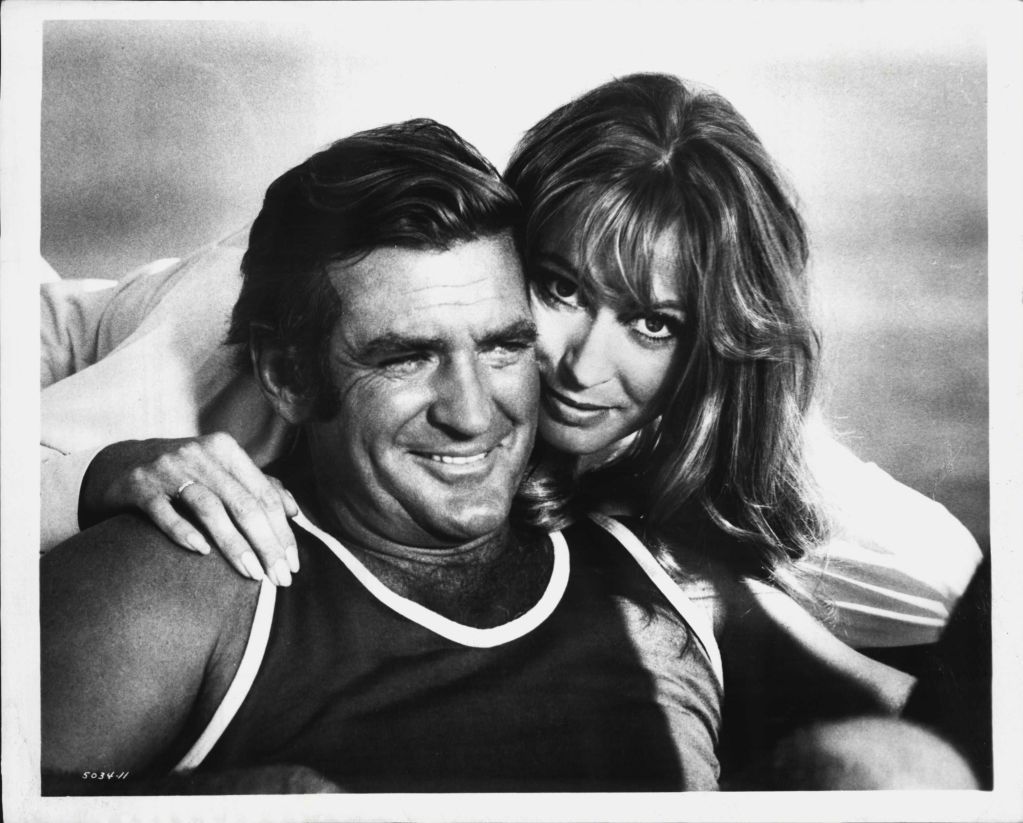
These movies likely have their tiny fan bases. But until recently absolutely no one was a fan of 1986’s Miami Connection — let us just establish the tone by noting this movie takes place in Orlando — because no one had seen it. In the mid-1980s Richard (a.k.a. Woo-sang) Park, an established Korean director who’d recently transitioned to US marital arts movies, saw fellow émigré and taekwondo teacher Y.K. Kim doing a demonstration on TV. He proposed making an action flick together. So the two cooked up a jaw-dropping story, hired a never-to-be-heard-from-again scenarist, cast Kim’s students in most roles, and co-directed what was originally called American Streetfighters. When they were finished, they expected the world to take notice.

The world declined — sales agents and distributors laughed the filmmakers out of their offices. Kim finally arranged Florida bookings himself, yet still Connection died, albeit not before one local critic called it “the worst film of the year.” Even its self-made co-director/star finally had to admit it was at best a big write-off.

But two decades or so later, a curator for Austin’s Alamo Drafthouse Cinema bought a $50 35mm print off eBay, having no idea what it was. It instantly became an object of cult adoration by patrons, and the Drafthouse’s distribution arm now has a midnight phenomenon that’s growing nationwide.

Miami Connection is like 2003’s The Room, in that it’s one of those rare flabbergasting movies which seems to approach its medium as if no one involved had ever seen (let alone worked on) a film before, starring a multi-talent whose performance must be seen to be disbelieved. And who, like Tommy Wiseau, now basks in the belated appreciation of his sole screen vehicle, seemingly oblivious to the precise nature of that appreciation.

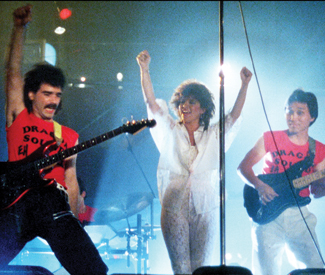
The film really is All That. Suffice it to say that Mark (Kim) is one hell of a taekwondo instructor as well as a member of an electro-rock band called Dragon Sound, a “new dimension in rock ‘n’ roll.” This is due to ideas like (actual line here) “We could write another taekwondo song, then after Tom does one of his guitar solos we can all break boards!” When Jane (Kathy Collier) is caught going out with bassist John (Vincent Hirsch) by her creepily possessive drug lord brother Tom (Angelo Janotti), it’s black belt taekwondo rockers versus kickboxing motorcycle-riding bad guys. Before Good triumphs, there is an “International Programming Contest,” spring break-type comedy, a gym full of people making those show-off weightlifting sounds that announce “I am a giant tool,” gratuitous biker-chick toplessness, terrible songs with power-of-positive-thinking lyrics, and much yelled dialogue leading to countless fights, shootings, and stabbings. There is also the parting onscreen message “Only through the elimination of violence can we achieve world peace.” A bit late, that.

Miami Connection‘s clash between low-end but professional basic craftsmanship and batshit-crazy amateur everything else is a never-ending delight. Kim still operates a taekwondo studio in Florida, and has since also become a “philosopher/author/inspirational speaker.” He will not be attending the Roxie’s screenings this week. But as with Mr. Wiseau’s magnum opus, his movie can only snowball in terms of repeat viewers and fresh converts — so eventually, he’s bound to show up in the flesh to be worshipped.

And worship we will. 

MIAMI CONNECTION

Fri/2-Sat/3, 10:45pm, $6.50-$10

Roxie Theater

3117 16th St., SF

www.roxie.com

Paul Addis, playwright and Burning Man arsonist, dies

55

UPDATED Paul Addis – the San Francisco playwright and performer best known for igniting Burning Man’s eponymous central symbol early in the 2007 event, a crime for which he served two years in a Nevada prison – died Saturday night after jumping in front of a BART train in Embarcadero station. He was 42.

His friend Amacker Bullwinkle told us she was shocked and saddened by the news, first reported by the SF Appeal and confirmed to us by the San Francisco Medical Examiner’s Office, which contacted Addis’ mother. Bullwinkle said she wasn’t sure if there was a suicide note, but given his prolific writings, “I can’t imagine he wouldn’t want to write something.”

After Addis was released from prison in 2010, he came to the Guardian for a three-hour interview to discuss how and why he torched the Man during a Monday night lunar eclipse, another pair of bizarre arrests that followed, and the San Francisco debut of latest one-man play, Dystopian Veneer, which he wrote in prison. That interview was the basis of two Guardian articles and an extended telling of his story in my book, The Tribes of Burning Man, which also draws from an earlier interview with Addis.

“It’s a brand new life and I’ve got all this potential and I want to make the most out of it,” Addis told me in a hopeful moment. But he was also clearly a troubled soul, deeply unhappy with what Burning Man and San Francisco had become and resentful of the role that Burning Man organizers played in supporting his prosecution.

But his frustrations seemed to stem from a desire shake up the city and Burning Man, an event that was personally transformative for him, “to bring back that level of unpredictable excitement, that verve, that ‘what’s going to happen next?’ feeling, because it had gotten orchestrated and scripted.”

Services for Addis are pending.

UPDATE 11/2: Sup. John Avalos adjourned this week’s Board of Supervisors meeting in the memory of Paul Addis and made the following comments about him:

·        Addis was a San Francisco performance artist and playwright who was best known from 2007’s Burning Man when he lit the Man on fire.
·        Addis wrote and performed several one-man plays, including Dystopian Veneerand Gonzo, A Brutal Chrysalis.
·        After years of struggling with mental health issues, Addis took his own life the past weekend. He was forty-two.
·        Addis’ controversial act was viewed by some as a dangerous act of arson and by others as a subversive protest of how Burning Man had strayed from its core principles.
·        Addis served two years in a Nevada prison for burning the Man.
·        On this day when we’re commemorating Mental Health Awareness month, I think it’s appropriate to recognize the loss of Paul Addis, and recognize how our mental health and criminal justice systems failed him, and how they fail so many others who struggle with mental health issues.


Win tickets: Killing My Lobster does not fear the end

0

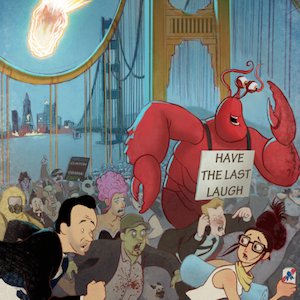
KML turns to a subject that’s in the back of everyone’s mind: the end of the world. The irrepressible comedic stars of KML do not plan on going gentle into that good night. They plan on going out doubled over with laughter, and they want to take as many of us with them as possible. For three weeks in November, they’ll be performing what may very well be the last sketch comedy show on Earth in a fortified concrete bunker at the Intersection for the Arts. And they’re inviting you to have the last laugh with them!

Zombies, the Rapture, bucket lists, and the finer points of post-apocalyptic cuisine are just a few of the subjects this gritty, ragtag band of renegade Lobsters will resurrect from the ashes of our once-proud civilization.

For more information visit this link. Click here to purchase tickets.

To win a pair of tickets to an opening weekend performance, email your full name and preferred show (Fri/2 or Sat/3) to sfbgpromos@sfbg.com by Monday, October 29 at noon. Winners will be notified via email that day.

Thursday, November 1 thru Sunday, November 18  | Thursdays, Fridays & Saturdays at 8pm and Sundays at 7pm; Two shows on November 17 (7pm & 10pm) @ Intersection for the Arts, 925 Mission, SF

Skipping Bridge School: a happenstance Saturday in San Francisco

0

For me, things usually go better when the unexpected happens, like this past weekend when my half-assed plans to attend Saturday’s installment of Neil Young’s Bridge School Benefit Concert fell through. Instead of seeing Axl, as he reportedly flubbed the lyrics to “Welcome to the Jungle,” I stayed local to witness part of a San Francisco tradition and later, one of the more sensory provoking and delightfully weirdo art performances I’ve seen in a while. This surprise night out-on-the town turned out to be a success.

First, I headed to the 20th Annual Clarion Alley Block Party (much later than I had intended) after taking note that both Swiftumz and Apogee Sound Club had daytime sets. By the time I got there, it was nightfall. Most of the bands had already played and I missed the only acts I was familiar with.

In a rush to catch whatever I could, I whizzed by the famously muraled alley’s perimeter so I could enter from Valencia Street. I was surprised to hear what sounded like 1990s grunge leaking from the crevices between crammed houses; I entered the free event and joined the crowd for what was apparently an unannounced performance by Two Gallants.

People perched on a rooftop, much like the audience below, were treated to songs I recognized from their first album in five years, The Bloom and the Blight. I’ve been told their live shows are really good and after listening to them deliver a heavy, yet melodic set for my first time, I too was convinced. The guy standing next to me said it was cool for the duo to come back and play Clarion for free after blowing up, considering they’re both so symbolic of San Francisco.

This, however, would be a mere snack before the main course that was to come. Sure, I stopped off at Arinell’s for a slice, but that’s not even what I’m talking about. My next stop would be The Lab on 16th  Street for night two of San Diego performance project Cathedral X’s weekend residency. My only frame of reference was that I was in for some eerie frequencies and that there was the potential for nudity.

Since I was already in the Mission, I headed to the art space at 9:30 (that unfashionable time when it’s too early for people to go to a show). Right off the bat, I heard ESG rotating from a chic Lucite turntable stand and took it as a good sign of where the night would go. Next to the DJ was a young woman in what looked like a witches hat giving tarot readings. I had time to kill and the vibe was already awkward, so I figured, why the hell not?

I sat down and trusted that the oracle would have some kind of mystical wisdom for me. I ended up paying a hefty price (I didn’t see her $20 suggested donation sign until halfway through the reading) but definitely got some good feedback on how to look into my past in order to move forward. That may sound generic, but it’s because I’m sparing you the in-depth details of what virtually ended up being a therapy session.

Oakland’s Straight Crimes opened; both the drummer and guitarist did a fine job, but I couldn’t help but notice how out of place the duo seemed in such a sterile environment. They admitted it felt like being an art installment (in a sense they were) and said just the night before they’d played a squat in the East Bay; which I assumed matched their punk aesthetic far better.  But the night’s theme was experimentation and by stepping out of those pre-conceived constructs, the event pushed boundaries – and with Cathedral X, that’s exactly what we got.

The spirit of Yoko Ono records from some 40 years ago were recalled when jarring shrieks coming from a blindfolded woman entered the room. She was joined by her fellow blindfolded performers, a man and another woman, as they stumbled around the room while the audience politely moved out of harm’s way. Meanwhile, an unassuming man dressed quite plainly in jeans played drone synthesizer and aforementioned eerie tones from the sidelines.

It took me a while to get into it and I thought I was in for a night of performance art clichés, but once I noticed there was substance to the music and that the interpreters were more than just props going through the motions and were integral to the group’s overall sound, I started to enjoy myself.

Highlights included the climactic moment when two women emerged bare-chested, faces obscured by hoods, but connected by bondage. Music every bit as moody as Tangerine Dream’s soundtrack to Firestarter played in the background while they attempted to separate from one another silently, but the chains would not relent. Ultimately they failed and collapsed out of exhaustion accepting a fate of sensory deprivation and togetherness for what could be eternity.

If it takes a visit from a San Diego group to help keep San Francisco weird, then I’m all for supporting this. The audience seemed to like it too.

Candy apples and razor blades

20

emilysavage@sfbg.com

TOFU AND WHISKEY While I don’t miss living in Long Beach, Calif. too much (save for some particular pals and the endless flat biking roads), I do sorely yearn for the yearly costumed Halloween performance — at steak restaurant/dive bar the Prospector — of the Shitfits, a Misfits cover band made up of local musicians. Luckily, in San Francisco, there are numerous bands-costumed-as-other-bands shows in late October, including at least one Misfits tribute: Astrozombies, a full-time tribute act, which will do the horror-punk legends right at Hemlock Tavern (Oct. 31, 8:30pm, $7. 1131 Polk, SF; www.hemlocktavern.com).

“The band was essentially formed to be a Halloween act,” Astrozombies’ vocalist-guitarist Kevin Amann, a.ka. Doyle Vonn Danzig, tells me.

Because what is Halloween without a Danzig-alike howling “Hallow-e-e-e-e-en?” Prefaced by, “Bonfires burning bright/Pumpkin faces in the night/I remember Halloween.” Doesn’t that make you itchy to slick down your devil-lock, and paint your face like the quintessential skull?

I ask Amann if his band’s Misfits (and some Danzig/Samhain) repertoire is constraining, and he says, nope: “I think, because there is some pretty serious diversity within the Misfits catalog, it really doesn’t ever feel limiting. We can go from a lightening fast punk song like ‘Demonamania’ to a brooding slow tempo rock song like ‘London Dungeon’.”

An aside: The actual Misfits — or, their current incarnation, minus Danzig — are playing the Oakland Metro on Nov. 16, but that’s still a few weeks away.

http://www.youtube.com/watch?v=lpENY3nEAx8

Let’s get back to the Halloween tribute show in general. It’s often the peak of the year’s nights out, the pinnacle when one might revert to early show-going wonder and moshpittery. Everyone is feeling creepy, and the only true nerds are the kids who come in street clothes, or as something “ironic” or “thought-provoking.” This year, some friends and I hope to go out as Pussy Riot, as both a fun fashion choice, and in solidarity. Wait, is that thought-provoking? Well, my partner will be a bearded man in a hot dog suit, so it’s not all politics.

Along with the Astrozombies, another local year-round tribute act, Bob Saggeth, will play Halloween again: two Black Sabbath-ish nights at Amnesia (Oct. 30-31, 10pm, $7–$10. 853 Valencia, SF; www.amnesiathebar.com.).

Then there’s the kind of once-a-year special mashup tribute night I was blathering on about above at Thee Parkside (Oct. 31, 8pm, $8. 1600 17th St., SF; www.theeparkside.com), with Glitter Wizard “Pushin’ Too Hard” as the Seeds, Twin Steps as the Cramps, Meat Market as G.G. and the Jabbers, and excellent new local bluegrass band the Parmesans as the Kinks.

There’s also a few Total Trash Booking monster mashes, which are pretty much always guaranteed to be raucous, punkish blowouts. There’s the pre-party at the New Parish (Nobunny, Shannon and the Clams, who will also be the Misfits, Pangea, Audacity, Uzi Rash. Fri/26, 8pm, $12–$14. 579 18th St., Oakl.; www.thenewparish.com) and two totally exciting Coachwhips reunion shows.

Coachwhips of course being John Dwyer’s pre-Thee Oh Sees noise punk outfit. One of the reunion nights (Sat/27 at Verdi Club) is totally sold out, and you’re bummed because there’s going to be a haunted house inside the venue. I’m stoked because that’s where I’ll be Pussy Riot-ing.

The other (Sun/28, 7pm, $12. Lobot Gallery, 1800 Campbell, Oak.) espouses another epic blend of Total Trash and totally touring bands: the aforementioned Coachwhips, Pangea, Fidlar, Guantanamo Baywatch, and White Mystery. I can only imagine all the blood-soaked costumes and sweaty brows.

You can find tons more freak shows in the Halloween concerts and parties guide elsewhere in this issue. But for an entirely different kind of year-round showmanship (holidays be damned), there’s SSION, performing with House of Ladosha and DJs from High Fantasy at this freaky-colorful installment of Future | Perfect at Public Works (Thu/25, 9pm, $10-$15. Public Works, 161 Erie, SF; www.publicsf.com).

SSION, pronounced “shun,” is hard to take your eyes off of, a confetti-puke electro-art-pop party collective from Kansas City, Missouri, led sultry androgynous vocalist Cody Critcheloe, who now resides in Brooklyn, with the aesthetic of early John Waters oeuvre meets Pee-wee’s Playhouse. While the recorded music is often relegated to pre-party pump-ups, live is where SSION really shines, as some may have witnessed at DNA Lounge’s Blow Up night earlier this year.

CRYPTS

The people were weary at first of Seattle’s Crypts, a synth-based (specifically a rewired CR-8000) darkwave electro act led by Steve Snere. For Snere was already known and beloved as a former member of Kill Sadie and post-hardcore geniuses These Arms are Snakes, in an angular realm of post-punk proficiency. But Crypts is enticing in a new, much gloomier fashion, and yes, Snere still kills it, and it maintains a paranoid frenzy vibe. Check deep, dark, and ghoulish “Breathe,” off the band’s self-titled debut LP (Sargent House, Sept. 4). The band played SF this summer, but this time it’s much closer to Halloween, plus they’re opening for Omar Rodríguez-López, of At the Drive-In and Mars Volta fame.

Wed/24, 8pm, $15

New Parish

579 18th St., Oakl.

www.thenewparish.com

CONVERGE

If you had told me 15 years ago that I’d be almost 30 and still recommending Converge, I’d of called you a liar or a time jumping cheat. And yet, after a forceful return listen, suggested by a fellow music nerd, I too must admit it: new record All We Love We Leave Behind (Epitaph Records, Oct. 9) is the thinking person’s heavy metal album. It’s still the blistering axes of hardcore and heavy metal, with melodic guitar riffs, rapid-fire drums, and pained chants, but with a more grown up, complex sensibility — or maybe that’s just me?

With Torche, Nails, Kvelertak

Fri/26, 8pm, $18

Slim’s

33 11th St., SF www.slimspresents.com

HUNK OF BURNING LOVE

And then there’s Hunx, or H.U.N.X., of Hunx and His Punx. In the past few weeks, Seth Bogart released an insta-classic Halloween music video for his track “I Vant to Suck Your Cock” — full of gothy late night cable access details, sexy vampires, lime-green wigs, and tombstone booty thumping — and announced both a new variety show, Hollywood Nailz, and his own record label, Wacky Wacko Records, which is releasing “I Vant to Suck Your Cock” as a single. According to the release, the label will be “an outlet to release novelty records, children’s music, holiday themed hits, songs from…Hollywood Nailz, and other bizarre things that most labels wouldn’t bother with.” Bogart is currently living in LA (as his variety show moniker would suggest) but still visits his store in the Bay, Down at Lulu’s, often. He’s doesn’t have any local shows booked as of press time, but he knows we vant to see him.

www.wackywacko.com


Film Listings

0

Film listings are edited by Cheryl Eddy. Reviewers are Kimberly Chun, Dennis Harvey, Lynn Rapoport, and Sara Vizcarrondo. For rep house showtimes, see Rep Clock.

Opening

Chasing Mavericks The Bay Area’s big-wave spot hits the big screen, with Gerard Butler and Jonny Weston as real-life surfers Rick “Frosty” Hesson and Jay Moriarity. (1:45)

Cloud Atlas Cramming the six busy storylines of David Mitchell’s wildly ambitious novel into just three hours — the average reader might have thought at least 12 would be required — this impressive adaptation directed (in separate parts) by Tom Twyker (1998’s Run Lola Run) and Matrix siblings Lana and Andy Wachowski has a whole lot of narrative to get through, stretching around the globe and over centuries. In the mid 19th century, Jim Sturgess’ sickly American notory endures a long sea voyage as reluctant protector of a runaway-slave stowaway from the Chatham Islands (David Gyasi). In 1931 Belgium, a talented but criminally minded British musician (Ben Whishaw) wheedles his way into the household of a famous but long-inactive composer (Jim Broadbent). A chance encounter sets 1970s San Francisco journalist Luisa (Halle Berry) on the path of a massive cover-up conspiracy, swiftly putting her life in danger. Circa now, a reprobate London publisher’s (Broadbent) huge windfall turns into bad luck that gets even worse when he seeks help from his brother (Hugh Grant). In the not-so-distant future, a disposable “fabricant” server to the “consumer” classes (Doona Bae) finds herself plucked from her cog-like life for a rebellious higher purpose. Finally, in an indeterminately distant future after “the Fall,” an island tribesman (Tom Hanks) forms a highly ambivalent relationship toward a visitor (Berry) from a more advanced but dying civilization. Mitchell’s book was divided into huge novella-sized blocks, with each thread split in two; the film wastes very little time establishing its individual stories before beginning to rapidly intercut between them. That may result in a sense of information (and eventually action) overload, particularly for non-readers, even as it clarifies the connective tissues running throughout. Compression robs some episodes of the cumulative impact they had on the page; the starry multicasting (which in addition to the above mentioned finds many uses for Hugo Weaving, Keith David, James D’Arcy, and Susan Sarandon) can be a distraction; and there’s too much uplift forced on the six tales’ summation. Simply put, not everything here works; like the very different Watchmen, this is a rather brilliant “impossible adaptation” screenplay (by the directors) than nonetheless can’t help but be a bit too much. But so much does work — in alternating currents of satire, melodrama, pulp thriller, dystopian sci-fi, adventure, and so on — that Cloud Atlas must be forgiven for being imperfect. If it were perfect, it couldn’t possibly sprawl as imaginatively and challengingly as it does, and as mainstream movies very seldom do. (2:52) Balboa, California, Presidio. (Harvey)

Fun Size When a teen (Victoria Justice) is forced to baby-sit her brother the night of the social event of the Halloween season, PG-13 chaos ensues. (1:45) Shattuck.

Masquerade A king hires an actor from the local village (both portrayed by Korean megastar Byung-hun Lee) to be his body double in this historical drama. (2:11) Metreon.

Nobody Walks In Ry Russo-Young’s LA-set film, from a screenplay co-written with Lena Dunham, an alluring young woman named Martine (Olivia Thirlby) is welcomed into the Silver Lake home of psychotherapist Julie (Rosemarie DeWitt) and sound engineer Peter (John Krasinski), who has agreed to help Martine with the soundtrack for her film, destined for a gallery installation back in New York. While Martine’s film constructs a fiction around the fevered activities of the insect world, Russo-Young’s drifts quietly through the lives of its human household, offering glimpses of the romantic preoccupations of a teenage daughter (India Ennenga) and Julie’s interactions with one of her patients (Justin Kirk), and revealing a series of relationships hovering tensely on the border of unsanctioned behavior. The uncomfortable centerpiece is the intimacy that develops between Peter and Martine; tracking their progress through the family’s sprawling home as the two collect sounds for her project, the camera zooms in toward the sources, making the spaces the pair inhabit seem ominously small. Their eventual collision is unsurprising, but Peter hardly comes across as a besieged, frustrated family man. He tells Martine that “marriage is complicated,” but against the warm, appealing backdrop of his and Julie’s home life, it sounds like a pretty flimsy excuse for kissing a pretty, proximal 23-year-old. As for Martine, she seems not to need any rationale. But even factoring out the callousness of youth (or at least the genre of youth presented here), the film offhandedly suggests that the tipping point away from domestic happiness is depressingly easy to reach. (1:22) Bridge, Shattuck. (Rapoport)

Pusher A pusher has been pushed to the limit—this time around in a charm-free, deal-driven London. This remake of the Nicolas Winding Refn’s 1996 hit was given the seal of approval by the Drive (2011) auteur, who took a role here as an executive producer, with Luis Prieto in the director’s seat. Prieto does his best to keep the pressure on at all moments, as small-time heroin dealer Frank (Richard Coyle, resembling Dominic West in urban-hustler safari mode) undergoes the worst week of his life. He appears to have a tidy little existence with goofy, floppy-haired cohort Tony (Bronson Webb) by his side and delicately beautiful stripper Flo (Agyness Deyn) providing sexual healing and safe harbor for his dough. He has just hooked up drug mule Danaka (Daisy Lewis) to bring back a batch from Amsterdam when acquaintance Marlon (Neil Maskell) hits him up for a large order. Frank goes to his supplier Milo (Zlatko Buric, reprising his role in the original), an avuncular sort who pushes baklava in space sprinkled with wedding-cake-like gowns. Frank already owe him money and can’t cover the heroin’s cost, but this is a business built on trust, as fragile as it is, and Milo likes him, so he goes along, provided Frank returns the money immediately. Those tenuous ties of understanding are tested when cops bust Frank and Marlon and the former must dump the dope in a park pond. He refuses to give up his connections to the cops but finds that the loyalty of others is being tested when it comes to threats, cash, and even love. Prieto is a more self-consciously lyrical moviemaker than Refn, choosing to a vaguely Trainspotting-style cocktail of lite surrealism and slightly cheesy low-budg effects like vapor-trail headlights to replicate the highs and lows of Frank’s joyless clubland hustle. Still, he makes us feel Frank’s stress, amid the fatalistic undertow of the narrative, and his sense of betrayal when Pusher’s players turn, despite a smalltime pusher’s workman efforts to shore up against the odds. (1:29) Presidio. (Chun)

Question One Question One goes behind the scenes of the 2009 campaign concerning the referendum which reversed legislature granting same-sex couples the right to marry in Maine. The film investigates both sides of the story, including marriage dreams of queer families and confessions of regret from the appointed leader for the Yes on One Campaign, Marc Mutty. Though listening to preachers and activists devalue love between two men or two women might make you cringe, the inclusion of these moments creates an emotionally tense experience that will remind you how important it is to bounce back from defeat. It shows that the next step will have to be more than just rallying voters, it will require a change in ideology — an understanding that gays who wish to marry deserve equal rights, not religious salvation. As Darlene Huntress, the director of field operations for the No on One Campaign says, “I want to sit down and break bread with these people. I want to sit down and say get to know me — open your mind up enough to get to know me.” (1:53) Vogue. (Molly Champlin)

The Sessions Polio has long since paralyzed the body of Berkeley poet Mark O’Brien (John Hawkes) from the neck down. Of course his mind is free to roam — but it often roams south of the personal equator, where he hasn’t had the same opportunities as able-bodied people. Thus he enlists the services of Cheryl (Helen Hunt), a professional sex surrogate, to lose his virginity at last. Based on the real-life figures’ experiences, this drama by Australian polio survivor Ben Lewin was a big hit at Sundance this year (then titled The Surrogate), and it’s not hard to see why: this is one of those rare inspirational feel-good stories that doesn’t pander and earns its tears with honest emotional toil. Hawkes is always arresting, but Hunt hasn’t been this good in a long time, and William H. Macy is pure pleasure as a sympathetic priest put in numerous awkward positions with the Lord by Mark’s very down-to-earth questions and confessions. (1:35) Embarcadero. (Harvey)

Silent Hill: Revelation 3D Game of Thrones reunion! Sean Bean and Kit Harington both star in this video game adaptation, which may be its only bragging point. (1:34)

Wake in Fright See “Points Of No Return.” (1:54) Opera Plaza, Shattuck. 

Ongoing

Alex Cross (1:41) 1000 Van Ness, SF Center, Shattuck.

Argo If you didn’t know the particulars of the 1979 Iranian Revolution, you won’t be an expert after Argo, but the film does a good job of capturing America’s fearful reaction to the events that followed it — particularly the hostage crisis at the US embassy in Tehran. Argo zeroes in on the fate of six embassy staffers who managed to escape the building and flee to the home of the sympathetic Canadian ambassador (Victor Garber). Back in Washington, short-tempered CIA agents (including a top-notch Bryan Cranston) cast about for ways to rescue them. Enter Tony Mendez (Ben Affleck, who also directs), exfil specialist and father to a youngster wrapped up in the era’s sci-fi craze. While watching 1973’s Battle for the Planet of the Apes, Tony comes up with what Cranston’s character calls “the best bad idea we have:” the CIA will fund a phony Canadian movie production (corny, intergalactic, and titled Argo) and pretend the six are part of the crew, visiting Iran for a few days on a location shoot. Tony will sneak in, deliver the necessary fake-ID documents, and escort them out. Neither his superiors, nor the six in hiding, have much faith in the idea. (“Is this the part where we say, ‘It’s so crazy it just might work?'” someone asks, beating the cliché to the punch.) Argo never lets you forget that lives are at stake; every painstakingly forged form, every bluff past a checkpoint official increases the anxiety (to the point of being laid on a bit thick by the end). But though Affleck builds the needed suspense with gusto, Argo comes alive in its Hollywood scenes. As the show-biz veterans who mull over Tony’s plan with a mix of Tinseltown cynicism and patiotic duty, John Goodman and Alan Arkin practically burst with in-joke brio. I could have watched an entire movie just about those two. (2:00) Four Star, Marina, 1000 Van Ness, SF Center, Sundance Kabuki. (Eddy)

Beasts of the Southern Wild Six months after winning the Grand Jury Prize at Sundance (and a Cannes Camera d’Or), Beasts of the Southern Wild proves capable of enduring a second or third viewing with its originality and strangeness fully intact. Magical realism is a primarily literary device that isn’t attempted very often in U.S. cinema, and succeeds very rarely. But this intersection between Faulkner and fairy tale, a fable about — improbably — Hurricane Katrina, is mysterious and unruly and enchanting. Benh Zeitlin’s film is wildly cinematic from the outset, as voiceover narration from six-year-old Hushpuppy (Quvenzhané Wallis) offers simple commentary on her rather fantastical life. She abides in the Bathtub, an imaginary chunk of bayou country south of New Orleans whose residents live closer to nature, amid the detritus of civilization. Seemingly everything is some alchemical combination of scrap heap, flesh, and soil. But not all is well: when “the storm” floods the land, the holdouts are forced at federal gunpoint to evacuate. With its elements of magic, mythological exodus, and evolutionary biology, Beasts goes way out on a conceptual limb; you could argue it achieves many (if not more) of the same goals Terrence Malick’s 2011 The Tree of Life did at a fraction of that film’s cost and length. (1:31) Shattuck. (Harvey)

Bel Borba Aqui “The People’s Picasso” and “Brazil’s Pied Piper of Street Art” are both apt descriptions of veteran artist Bel Borba, who has spent decades bringing color and imagination to the streets of Salvador — his seaside hometown, and a place already graced with the nickname “Brazil’s Capital of Happiness.” It’s not a stretch to imagine that Borba’s commitment to public art (a giant Christmas tree made of plastic Coke bottles, a rhinoceros sculpture crafted from old boat planks, hundreds of large-scale mosaics, even a painted airplane) has done its share to lift spirits. Bel Borba Aqui isn’t the sort of doc to delve into its mustachioed subject’s history or personal life (despite a few angry cell phone conversations randomly captured along the way); instead, it’s much like Borba himself — freewheeling and spontaneous, and most alive when it’s showing art being created. Great soundtrack, too. (1:34) Roxie. (Eddy)

The Dark Knight Rises Early reviews that called out The Dark Knight Rises’ flaws were greeted with the kind of vicious rage that only anonymous internet commentators can dish out. And maybe this is yet another critic-proof movie, albeit not one based on a best-selling YA book series. Of course, it is based on a comic book, though Christopher Nolan’s sophisticated filmmaking and Christian Bale’s tortured lead performance tend to make that easy to forget. In this third and “final” installment in Nolan’s trilogy, Bruce Wayne has gone into seclusion, skulking around his mansion and bemoaning his broken body and shattered reputation. He’s lured back into the Batcave after a series of unfortunate events, during which The Dark Knight Rises takes some jabs at contemporary class warfare (with problematic mixed results), introduces a villain with pecs of steel and an at-times distractingly muffled voice (Tom Hardy), and unveils a potentially dangerous device that produces sustainable energy (paging Tony Stark). Make no mistake: this is an exciting, appropriately moody conclusion to a superior superhero series, with some nice turns by supporting players Gary Oldman and Joseph Gordon-Levitt. But in trying to cram in so many characters and plot threads and themes (so many prisons in this thing, literal and figural), The Dark Knight Rises is ultimately done in by its sprawl. Without a focal point — like Heath Ledger’s menacing, iconic Joker in 2008’s The Dark Knight — the stakes aren’t as high, and the end result feels more like a superior summer blockbuster than one for the ages. (2:44) Metreon. (Eddy)

Diana Vreeland: The Eye Has to Travel The life of legendary fashion editor Diana Vreeland is colorfully recounted in Diana Vreeland: The Eye Has to Travel, a doc directed by her granddaughter-in-law, Lisa Immordino Vreeland. The family connection meant seemingly unlimited access to material featuring the unconventionally glamorous (and highly quotable) Vreeland herself, plus the striking images that remain from her work at Harper’s Bazaar, Vogue, and the Costume Institute of the Metropolitan Museum of Art. “Narrated” from interview transcripts by an actor approximating the late Vreeland’s husky, posh tones, the film allows for some criticism (her employees often trembled at the sight of her; her sons felt neglected; her grasp of historical accuracy while working at the museum was sometimes lacking) among the praise, which is lavish and delivered by A-listers like Anjelica Huston, who remembers “She had a taste for the extraordinary and the extreme,” and Manolo Blahnik, who squeals, “She had the vision!” (1:26) Embarcadero. (Eddy)

End of Watch Buddy cop movies tend to go one of two ways: the action-comedy route (see: the Rush Hour series) or the action-drama route. End of Watch is firmly in the latter camp, despite some witty shit-talking between partners Taylor (a chrome-domed Jake Gyllenhaal) and Zavala (Michael Peña from 2004’s Crash) as they patrol the mean streets of Los Angeles. Writer-director David Ayer, who wrote 2001’s Training Day, aims for authenticity by piecing together much of (but, incongruously, not all of) the story through dashboard cameras, surveillance footage, and Officer Taylor’s own ever-present camera, which he claims to be carrying for a school project, though we never once see him attending classes or mentioning school otherwise. Gyllenhaal and Peña have an appealing rapport, but End of Watch’s adrenaline-seeking plot stretches credulity at times, with the duo stumbling across the same group of gangsters multiple times in a city of three million people. Natalie Martinez and Anna Kendrick do what they can in underwritten cop-wife roles, but End of Watch is ultimately too familiar (but not lawsuit-material familiar) to leave any lasting impression. Case in point: in the year 2012, do we really need yet another love scene set to Mazzy Star’s “Fade Into You”? (1:49) 1000 Van Ness, SF Center. (Eddy)

Fat Kid Rules the World It really does suck to be Troy (Jacob Wysocki from 2011’s Terri). An XXL-sized high schooler, he’s invisible to his peers, derided by his little brother (Dylan Arnold), and has lived in general domestic misery since the death of his beloved mother under the heavy-handed rule of his well-meaning but humorless ex-military dad (Billy Campbell). His only friends are online gamers, his only girlfriends the imaginary kind. But all that begins to change when chance throws him across the path of notorious local hellraiser Marcus (Matt O’Leary), who’s been expelled from school, has left the band he fronts, and is equal parts rebel hero to druggy, lyin’ mess. But he randomly decrees Troy is cool, and his new drummer. Even if he’s just being used, Troy’s world is headed for some big changes. Actor Matthew Lillard’s feature directorial debut, based on K.L. Going’s graphic novel, is familiar stuff in outline but a delight in execution, as it trades the usual teen-comedy crudities (a few gratuitous joke fantasy sequences aside) for something more heartfelt and restrained, while still funny. O’Leary from last year’s overlooked Natural Selection is flamboyantly terrific, while on the opposite end of the acting scale Campbell makes repressed emotion count for a lot — he has one wordless moment at a hospital that just might bring you to the tears his character refuses to spill. (1:38) Metreon, Smith Rafael. (Harvey)

Frankenweenie Tim Burton’s feature-length Frankenweenie expands his 1984 short of the same name (canned by Disney back in the day for being too scary), and is the first black and white film to receive the 3D IMAX treatment. A stop-motion homage to every monster movie Burton ever loved, Frankenweenie is also a revival of the Frankenstein story cute-ified for kids; it takes the showy elements of Mary Shelley’s novel and morphs them to fit Burton’s hyperbolic aesthetic. Elementary-school science wiz Victor takes his disinterred dog from bull terrier to gentle abomination (when the thirsty Sparky drinks, he shoots water out of the seams holding his body parts together). Victor’s competitor in the school science fair, Edgar E. Gore, finds out about Sparky and ropes in classmates to scrape up their dead pets from the town’s eerily utilized pet cemetery and harness the town’s lightning surplus. The film’s answer to Boris Karloff (lisp intact) resurrects a mummified hamster, while a surrogate for Japanese Godzilla maker Ishiro Honda, revives his pet turtle Shelley (get it?) into Gamera. As these experiments aren’t borne of love, they don’t go as well at Victor’s. If you love Burton, Frankenweenie feels like the at-last presentation of a story he’s been dying to tell for years. If you don’t love him, you might wonder why it took him so long to get it out. When Victor’s science teacher leaves the school, he tells Victor an experiment conducted without love is different from one conducted with it: love, he implies, is a variable. If that’s the variable that separates 2003’s Big Fish (heartbreaking) from 2010’s Alice In Wonderland (atrocious), it’s a large one indeed. The love was there for 29 minutes in 1984, but I can’t say it endures when stretched to 87 minutes 22 years later. (1:27) Balboa, Metreon, 1000 Van Ness. (Vizcarrondo)

Here Comes the Boom The makers of September’s Won’t Back Down might quibble with this statement, but the rest of us can probably agree that nothing (with the possible exception of Trapper Keepers) says “back to school” like competitive steel-cage mixed martial arts — particularly if the proceeds from the matches go toward saving extracurriculars at a down-at-the-heels public high school. Kevin James plays Scott Voss, a 42-year-old biology teacher at the aforementioned school, whose lack of vocational enthusiasm is manifested by poor attendance and classroom observations about how none of what the students are learning matters. He’s jolted from this criminally subpar performance of his academic duties, however, when budget cuts threaten the school’s arts programs, including the job of an earnest and enthusiastic music teacher (Henry Winkler) whose dedication Scott lazily admires. It seems less than inevitable that this state of affairs would lead to Scott’s donning his college wrestling singlet and trundling into the ring to get pummeled and mauled for cash, but it seems to work better than a bake sale. Less effective and equally unconvincing are Scott’s whiplash arc from bad apple to teacher-of-the-year; a percolating romance between him and the school nurse, played by Salma Hayek; and the script’s tortuous parade of rousing statements celebrating the power of the human spirit, seemingly cribbed from a page-a-day calendar of inspirational quotes. (1:45) 1000 Van Ness, SF Center. (Rapoport)

Hotel Transylvania (1:32) Metreon, 1000 Van Ness, Shattuck.

The House I Live In Much like he did in 2005’s Why We Fight, filmmaker Eugene Jarecki identifies a Big Issue (in that film, the Iraq War) and strips it down, tracing all of the history leading up to the current crisis point. Here, he takes on America’s “war on drugs,” which I put quotes around not just because it was a phrase spoken by Nixon and Reagan, but also because — as The House I Live In ruthlessly exposes — it’s been a failure, a sham, since its origins in the late 1960s. Framing his investigation with the personal story of his family’s housekeeper — whose dedication to the Jarecki family meant that she was absent when her own son turned to drugs — and enfolding a diverse array of interviews (a sympathetic prison guard, addicts and their families, The Wire’s David Simon) and locations (New York City, Sioux City), Jarecki has created an eye-opening film. Particularly well-explained are segments on how drug laws correlate directly to race and class, and how the prison-industrial complex has played a part in making sure those laws remain as strict as possible. (1:48) Shattuck, Sundance Kabuki. (Eddy)

Looper It’s 2044 and, thanks to a lengthy bout of exposition by our protagonist, Joe (Joseph Gordon-Levitt), here’s what we know: Time travel, an invention 30 years away, will be used by criminals to transport their soon-to-be homicide victims backward, where a class of gunmen called loopers, Joe among them, are employed to “do the necessaries.” More deftly revealed in Brick writer-director Rian Johnson’s new film is the joylessness of the world in which Joe amorally makes his way, where gangsters from the future control the present (under the supervision of Jeff Daniels), their hit men live large but badly (Joe is addicted to some eyeball-administered narcotic), and the remainder of the urban populace suffers below-subsistence-level poverty. The latest downside for guys like Joe is that a new crime boss has begun sending back a steady stream of aging loopers for termination, or “closing the loop”; soon enough, Joe is staring down a gun barrel at himself plus 30 years. Being played by Bruce Willis, old Joe is not one to peaceably abide by a death warrant, and young Joe must set off in search of himself so that—with the help of a woman named Sara (Emily Blunt) and her creepy-cute son Cid (Pierce Gagnon)—he can blow his own (future) head off. Having seen the evocatively horrific fate of another escaped looper, we can’t totally blame him. Parsing the daft mechanics of time travel as envisioned here is rough going, but the film’s brisk pacing and talented cast distract, and as one Joe tersely explains to another, if they start talking about it, “we’re gonna be here all day making diagrams with straws” —in other words, some loops just weren’t meant to be closed. (1:58) 1000 Van Ness, Piedmont, SF Center, Sundance Kabuki. (Rapoport)

The Master Paul Thomas Anderson’s much-hyped likely Best Picture contender lives up: it’s easily the best film of 2012 so far. Philip Seymour Hoffman stars as Lancaster Dodd, the L. Ron Hubbard-ish head of a Scientology-esque movement. “The Cause” attracts Freddie Quell (Joaquin Phoenix, in a welcome return from the faux-deep end), less for its pseudo-religious psychobabble and bizarre personal-growth exercises, and more because it supplies the aimless, alcoholic veteran — a drifter in every sense of the word — with a sense of community he yearns for, yet resists submitting to. As with There Will Be Blood (2007), Anderson focuses on the tension between the two main characters: an older, established figure and his upstart challenger. But there’s less cut-and-dried antagonism here; while their relationship is complex, and it does lead to dark, troubled places, there are also moments of levity and weird hilarity — which might have something to do with Freddie’s paint-thinner moonshine. (2:17) Albany, 1000 Van Ness, Sundance Kabuki. (Eddy)

Middle of Nowhere All the reasons why movie publicist turned filmmaker Ava DuVernay scored the best director award at the Sundance Film Festival are up here on the screen. Taking on the emotionally charged yet rarely attempted challenge of picturing the life of the loved one left behind by the incarcerated, DuVernay furthers the cause of telling African American stories — she founded AaFFRM (African-American Film Festival Releasing Movement) and made her directorial debut with 2008 LA hip-hop doc This Is The Life — with Middle of Nowhere. Medical student Ruby (the compelling Emayatzy Corinealdi) appears to have a bright future ahead of her, when her husband Derek (Omari Hardwick) makes some bad choices and is tossed into maximum security prison for eight long years. She swears she’ll wait for him, putting her dreams aside, making the long bus ride out to visit him regularly, and settling for any nursing shift she can. How will she scrape the money together to pay the lawyer for Derek’s parole hearing, cope with the grinding disapproval of her mother (Lorraine Toussaint), support the increasingly hardened and altered Derek, and most importantly, discover a new path for herself? All are handled with rare empathy and compassion by DuVernay, who is rewarded for her care by her cast’s powerful performances. Our reward might be found amid the everyday poetry of Ruby’s life, while she wraps her hair for bed, watches Ali: Fear Eats the Soul (1974), and fantasizes about love in a life interrupted. (1:41) Shattuck. (Chun)

Paranormal Activity 4 (1:21) Metreon, 1000 Van Ness, Presidio.

The Perks of Being a Wallflower Move over, Diary of a Wimpy Kid series — there’s a new shrinking-violet social outcast in town. These days, life might not suck quite so hard for 90-pound weaklings in every age category, what with so many films and TV shows exposing, and sometimes even celebrating, the many miseries of childhood and adolescence for all to see. In this case, Perks author Stephen Chbosky takes on the directorial duties — both a good and bad thing, much like the teen years. Smart, shy Charlie is starting high school with a host of issues: he’s painfully awkward and very alone in the brutal throng, his only friend just committed suicide, and his only simpatico family member was killed in a car accident. Charlie’s English teacher Mr. Andersen (Paul Rudd) appears to be his only connection, until the freshman strikes up a conversation with feline, charismatic, shop-class jester Patrick (Ezra Miller) and his magnetic, music- and fun-loving stepsister Sam (Emma Watson). Who needs the popular kids? The witty duo head up their gang of coolly uncool outcasts their own, the Wallflowers (not to be confused with the deeply uncool Jakob Dylan combo), and with them, Charlie appears to have found his tribe. Only a few small secrets put a damper on matters: Patrick happens to be gay and involved with football player Brad (Johnny Simmons), who’s saddled with a violently conservative father, and Charlie is in love with the already-hooked-up Sam and is frightened that his fragile equilibrium will be destroyed when his new besties graduate and slip out of his life. Displaying empathy and a devotion to emotional truth, Chbosky takes good care of his characters, preserving the complexity and ungainly quirks of their not-so-cartoonish suburbia, though his limitations as a director come to the fore in the murkiness and choppily handled climax that reveals how damaged Charlie truly is. (1:43) Balboa, California, Embarcadero, Piedmont, Presidio, Sundance Kabuki. (Chun)

Pitch Perfect As an all-female college a cappella group known as the Barden Bellas launches into Ace of Base’s “The Sign” during the prologue of Pitch Perfect, you can hear the Glee-meets-Bring It On elevator pitch. Which is fine, since Bring It On-meets-anything is clearly worth a shot. In this attempt, Anna Kendrick stars as withdrawn and disaffected college freshman Beca, who dreams of producing music in L.A. but is begrudgingly getting a free ride at Barden University via her comp lit professor father. Clearly his goal is not making sure she receives a liberal arts education, as Barden’s academic jungle extends to the edges of the campus’s competitive a cappella scene, and the closest thing to an intellectual challenge occurs during a “riff-off” between a cappella gangs at the bottom of a mysteriously drained swimming pool. When Beca reluctantly joins the Bellas, she finds herself caring enough about the group’s fate to push for an Ace of Base moratorium and radical steps like performing mashups. Much as 2000’s Bring It On coined terms like “cheerocracy” and “having cheer-sex,” Pitch Perfect gives us the infinitely applicable prefix “a ca-” and descriptives like “getting Treble-boned,” a reference to forbidden sexual relations with the Bellas’ cocky rivals, the Treblemakers. The gags get funnier, dirtier, and weirder, arguably reaching their climax in projectile-vomit snow angels, with Elizabeth Banks and John Michael Higgins as grin-panning competition commentators offering a string of loopily inappropriate observations. (1:52) Metreon, 1000 Van Ness. (Rapoport)

Samsara Samsara is the latest sumptuous, wordless offering from director Ron Fricke, who helped develop this style of dialogue- and context-free travelogue with Koyaanisqatsi (1982) and Baraka (1992). Spanning five years and shooting on 70mm film to capture glimmers of life in 25 countries on five continents, Samsara, which spins off the Sanskrit word for the “ever-turning wheel of life,” is nothing if not good-looking, aspiring to be a kind of visual symphony boosted by music by the Dead Can Dance’s Lisa Gerrard and composers Michael Stearns and Marcello De Francisci. Images of natural beauty, baptisms, and an African woman and her babe give way to the madness of modern civilization — from jam-packed subways to the horrors of mechanized factory farming to a bizarre montage of go-go dancers, sex dolls, trash, toxic discarded technology, guns, and at least one gun-shaped coffin. After such dread, the opening and closing scenes of Buddhist spirituality seem almost like afterthoughts. The unmistakable overriding message is: humanity, you dazzle in all your glorious and inglorious dimensions — even at your most inhumane. Sullying this hand wringing, selective meditation is Fricke’s reliance on easy stereotypes: the predictable connections the filmmaker makes between Africa and an innocent, earthy naturalism, and Asia and a vaguely threatening, mechanistic efficiency, come off as facile and naive, while his sonic overlay of robot sounds over, for instance, an Asian woman blinking her eyes comes off as simply offensive. At such points, Fricke’s global leap-frogging begins to eclipse the beauty of his images and foregrounds his own biases. (1:39) Opera Plaza, Shattuck. (Chun)

Searching for Sugar Man The tale of the lost, and increasingly found, artist known as Rodriguez seems to have it all: the mystery and drama of myth, beginning with the singer-songwriter’s stunning 1970 debut, Cold Fact, a neglected folk rock-psychedelic masterwork. (The record never sold in the states, but somehow became a beloved, canonical LP in South Africa.) The story goes on to parse the cold, hard facts of vanished hopes and unpaid royalties, all too familiar in pop tragedies. In Searching for Sugar Man, Swedish documentarian Malik Bendjelloul lays out the ballad of Rodriguez as a rock’n’roll detective story, with two South African music lovers in hot pursuit of the elusive musician — long-rumored to have died onstage by either self-immolation or gunshot, and whose music spoke to a generation of white activists struggling to overturn apartheid. By the time Rodriguez himself enters the narrative, the film has taken on a fairy-tale trajectory; the end result speaks volumes about the power and longevity of great songwriting. (1:25) Opera Plaza, Shattuck. (Chun)

Seven Psychopaths Those nostalgic for 1990s-style chatty assassins will find much to love in the broadly sketched Seven Psychopaths. Director-writer Martin McDonough already dipped a pen into Tarantino’s blood-splattered ink well with his 2008 debut feature, In Bruges, and Seven Psychopaths reads as larkier and more off-the-cuff, as the award-winning Irish playwright continues to try to find his own discomfiting, teasing balance between goofy Grand Guignol yuks and meta-minded storytelling. Structured, sort of, with the certified lucidity of a thrill killer, Seven Psychopaths opens on Boardwalk Empire heavies Michael Pitt and Michael Stuhlbarg bantering about the terrors of getting shot in the eyeball, while waiting to “kill a chick.” The talky twosome don’t seem capable of harming a fat hen, in the face of the Jack of Spades serial killer, who happens to be Psychopath No. One and a serial destroyer of hired guns. The key to the rest of the psychopathic gang is locked in the noggin of screenwriter Marty (Colin Farrell), who’s grappling with a major block and attempting the seeming impossible task of creating a peace-loving, Buddhist killer. Looking on are his girlfriend Kaya (Abbie Cornish) and actor best friend Billy (Sam Rockwell), who has a lucrative side gig as a dog kidnapper — and reward snatcher — with the dapper Hans (Christopher Walken). A teensy bit too enthusiastic about Marty’s screenplay, Billy displays a talent for stumbling over psychos, reeling in Zachariah (Tom Waits) and, on his doggie-grabbing adventures, Shih Tzu-loving gangster Charlie (Woody Harrelson). Unrest assured, leitmotifs from McDonough plays — like a preoccupation with fiction-making (The Pillowman) and the coupling of pet-loving sentimentality and primal violence (The Lieutenant of Inishmore) — crop up in Seven Psychopaths, though in rougher, less refined form, and sprinkled with a nervous, bromantic anxiety that barely skirts homophobia. Best to bask in the cute, dumb pleasures of a saucer-eyed lap dog and the considerably more mental joys of this cast, headed up by dear dog hunter Walken, who can still stir terror with just a withering gaze and a voice that can peel the finish off a watch. (1:45) Marina, Metreon, 1000 Van Ness, Piedmont, Sundance Kabuki. (Chun)

Simon and the Oaks Despite being gripping or heartwarming at times, Simon and the Oaks, based on the novel by Marianne Fredricksson, fails to cohere, serving as another reminder of the perennial dilemma of converting literature to film. It tells the story of Simon (Bill Skarsgard — son of Stellan, younger brother of Alexander), a boy coming of age in World War II Sweden. He befriends Isak, son of a Jewish bookkeeper who fled Nazi Germany, and their families become close when Isak’s father nurtures Simon’s love of books and Isak begins to heal his emotional scars by diving into carpentry work with Simon’s father. The moments of true human compassion between the two families begin to falter as the story jumps around to follow Simon’s search for love and identity. More missteps: Simon’s discovery of classical music is conveyed via a series of “artsy” montages, and his brief affair with a fiery Auschwitz victim — problematic, to say the least. (2:02) Albany, Clay. (Molly Champlin)

Sinister True-crime author Ellison Oswalt (Ethan Hawke) hasn’t had a successful book in a decade. So he uproots wife (Juliet Rylance) and kids (Michael Hall D’Addario, Clare Foley) for yet another research project, not telling them that they’re actually moving into the recent scene of a ghastly unsolved murder in which an entire family — save one still-missing child — was hanged from a backyard tree. He finds a box in the attic that somehow escaped police attention, its contents being several reels of Super 8 home movies stretching back decades — all of families similarly wiped out in one cruel act. Smelling best-sellerdom, Ellison keeps this evidence of a serial slayer to himself. It’s disturbing when his son re-commences sleepwalking night terrors. It’s really disturbing when dad begins to spy a demonic looking figure lurking in the background of the films. It’s really, really disturbing when the projector starts turning itself on, in the middle of the night, in his locked office. A considerable bounce-back from his bloated 2008 Day the Earth Stood Still remake, Scott Derrickson’s film takes the opposite tact — it’s very small in both physical scope and narrative focus, almost never leaving the Oswalt’s modest house in fact. He takes the time to let pure creepiness build rather than feeling the need to goose our nads with a false scare or goresplat every five minutes. As a result, Sinister is definitely one of the year’s better horrors, even if (perhaps inevitably) the denouement can’t fully meet the expectations raised by that very long, unsettling buildup. (1:50) Metreon, 1000 Van Ness. (Harvey)

Smashed A heartbreaking lead performance from Mary Elizabeth Winstead drives this tale of a marriage tested when one partner decides to get sober. And it’s time: after an epic night of boozing, first-grade teacher Kate (Winstead) pukes in front of her class, then lies and says she’s pregnant, not anticipating the pushy delight of the school’s principal (Megan Mullally). Plus, Kate’s gotten into the habit of waking up in strange, unsafe places, not really remembering how she stumbled there in the first place. Husband Charlie (Breaking Bad’s Aaron Paul) sees no reason to give up partying; he’s a music blogger whose “office” is the home his wealthy parents bought for the couple, and his problem isn’t quite as unmanageable as hers (at least, we never see him peeing in a convenience store). After Kate joins AA, she realizes she’ll have to face her problems rather than drinking them away — a potentially clichéd character arc that’s handled without flashy hysterics by director and co-writer (with Susan Burke) James Ponsoldt, and conveyed with grace and pain by Winstead —an actor probably best-known for playing Ramona Flowers in 2010’s Scott Pilgrim vs. the World, but just now revealing the scope of her talent. (1:25) Opera Plaza, Shattuck. (Eddy)

Tai Chi Zero A little boy dubbed “the Freak” for the curious, horn-like growth on his forehead grows up to be Lu Chan (Jaydan Yuan), who becomes a near-supernatural martial arts machine when the horn is punched, panic-button style. But activating the “Three Blossoms of the Crown,” as it’s called, takes a toll on the boy’s health, so he’s sent to the isolated Chen Village to learn their signature moves, though he’s repeatedly told “Chen-style kung fu is not taught to outsiders!” Stephen Fung’s lighthearted direction (characters are introduced with bios about the actors who play them, even the split-second cameos: “Andrew Lau, director of the Infernal Affairs trilogy”), affinity for steampunk and whimsy, engagement of Sammo Hung as action director, and embracing of the absurd (the film’s most-repeated line: “What the hell?”) all bring interest to this otherwise pretty predictable kung-fu tale, with its old-ways-versus-Western-ways conflict and misfit hero. Still, there’s something to be said for batshit insanity. (Be warned, though: Tai Chi Zero is the first in a series, which means one thing: it ends on a cliffhanger. Argh.) (1:34) Metreon. (Eddy)

Taken 2 Surprise hit Taken (2008) was a soap opera produced by French action master Luc Besson and designed for export. The divorced-dad-saves-daughter-from-sex-slavery plot may have nagged at some universal parenting anxieties, but it was a Movie of the Week melodrama made on a major movie budget. Taken 2 begins immediately after the last, with sweet teen Kim (Maggie Grace) talking about normalizing after she was drugged and bought for booty. Papa Neeson sees Kim’s mom (Famke Janssen) losing her grip on husband number two and invites them both to holiday in Istanbul following one of his high-stakes security gigs. When the assistant with the money slinks him a fat envelope, Neeson chuckles at his haul. This is the point when women in the audience choose which Neeson they’re watching: the understated super-provider or the warrior-dad whose sense of duty can meet no match. For family men, this is the breeziest bit of vicarious living available; Neeson’s character is a tireless daddy duelist, a man as diligent as he is organized. (This is guy who screams “Victory loves preparation!”) As head-splitting, disorienting, and generally exhausting as the action direction is, Neeson saves his ex-wife and the show in a stream of unclear shootouts. Taken 2 is best suited for the small screen, but whatever the size, no one can stop an international slave trade (or wolves, or Batman) like 21st century Liam. Swoon. (1:31) Metreon, 1000 Van Ness, Sundance Kabuki. (Vizcarrondo)

The Waiting Room Twenty-four hours in the uneasy limbo of an ER waiting room sounds like a grueling, maddening experience, and that’s certainly a theme in this day-in-the-life film. But local documentarian Peter Nicks has crafted an absorbing portrait of emergency public health care, as experienced by patients and their families at Oakland’s Highland Hospital and as practiced by the staff there. Other themes: no insurance, no primary care physician, and an emergency room being used as a medical facility of first, last, and only resort. Nicks has found a rich array of subjects to tell this complicated story: An anxious, unemployed father sits at his little girl’s bedside. Staffers stare at a computer screen, tracking a flood of admissions and the scarce commodity of available beds. A doctor contemplates the ethics of discharging a homeless addict for the sake of freeing up one of them. And a humorous, ultra-competent triage nurse fields an endless queue of arrivals with humanity and steady nerves. (1:21) Shattuck, Sundance Kabuki. (Rapoport) 
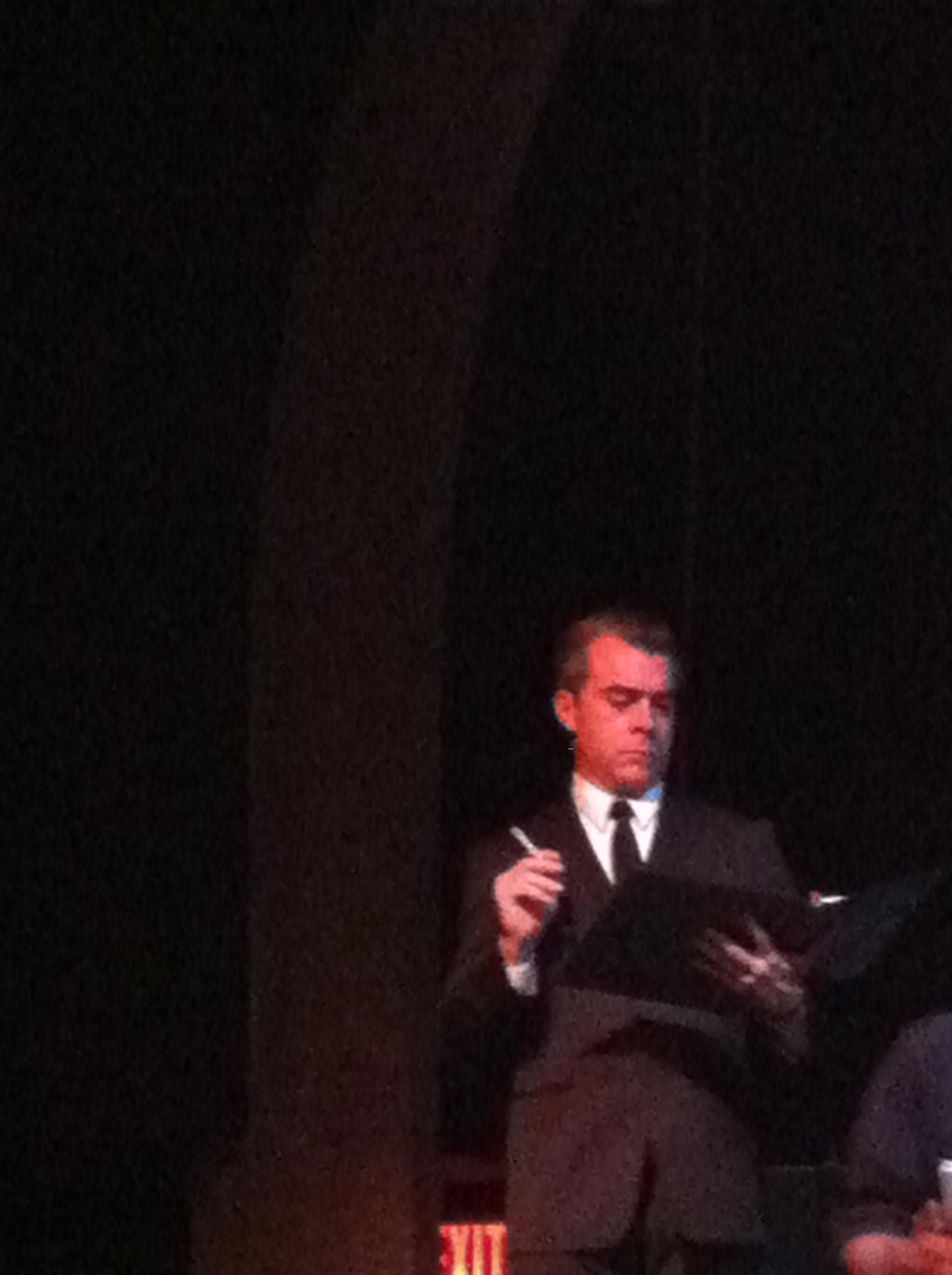
 

Staunch characters

0

cheryl@sfbg.com

FILM Last year’s The Artist is still glowing months after its multi-Oscar triumph — its canine star just released a memoir, Uggie: My Story, and its human star, Jean Dujardin, will appear in Martin Scorsese’s 2013 The Wolf of Wall Street.

But The Artist had more in common with Hollywood — starting with its setting — than most contemporary French films, which don’t always receive stateside theatrical runs (unless Luc Besson is involved). As you bide your time until Leos Carax’s masterpiece of mindfuckery Holy Rollers arrives Nov. 16, hit the Embarcadero for the San Francisco Film Society’s fifth annual “French Cinema Now” series.

It opens with Noémie Lvovsky’s Camille Rewinds, about a fortysomething woman (Lvovsky, who also co-wrote) who gets a chance at a do-over when she inexplicably wakes up as her teenaged self in 1985. (Yes, it’s been called “the Gallic Peggy Sue Got Married.“) Closing night is Ursula Meier’s well-reviewed Sister, Switzerland’s Oscar entry for Best Foreign Language Film, which stars Léa Seydoux as a woman supported by the petty-thief habits of her 12-year-old brother; if you miss it here, it’ll be in theaters Nov. 9.

The series’ female-centric theme extends into My Worst Nightmare, which follows icy art curator Agathe (Isabelle Huppert) as her airless, tightly-controlled world begins to crumble — thanks in no small part to an exuberantly uncouth, down-on-his-luck Belgian contractor named Patrick (Benoît Poelvoorde), whose mere presence in Agathe’s orbit gives rise to the film’s title. Director and co-writer Anne Fontaine (2009’s Coco Before Chanel) injects plenty of offbeat, occasionally raunchy humor into what could’ve been a predictable personal-liberation tale — the sight of Huppert driving through a bikini car wash, for instance.

There’s no such mirth in Louise Wimmer, the first narrative feature for director and co-writer Cyril Mennegun, though the two films do share parallel stories of characters battling bureaucracy to secure public housing. In Louise Wimmer, it’s an increasingly anxious pursuit for the middle-aged title character (Corinne Masiero), who’s been living in her sputtering Volvo for months. She has a (crappy, part-time) job, but it’s not enough to pay her ever-increasing debts; what’s worse, the goodwill of those who’ve been helping her is starting to wear thin. Masiero’s believably weary performance suggests a woman clinging to the only things she has going for her — resourcefulness and an innate elegance, though both are fading by the day. On her car stereo, Nina Simone’s “Sinnerman” plays on a constant loop, a frantic, powerful tune that moves Louise to weep and, in her most desperate moment, flail around in a solo dance that’s equal parts cathartic and depressing.

Jane Fonda, in her first French film since 1972’s Tout Va Bien, plays a woman who conceals her cancer diagnosis from family and friends in Stéphane Robelin’s All Together (literal English translation, according to the subtitles: And If We All Lived Together?). It’s an ensemble film about a group of seventysomethings who decide to “go all hippie” and share a house — an arrangement that also rescues the less-robust among them (including a man with a weak heart, and one who’s increasingly forgetful) from being shunted into nursing homes. Some of All Together‘s plot points feel forced — as when a young anthropology student moves into the communal house to “study” its inhabitants — but Fonda is a standout as a woman who faces the end with remarkable reserves of cheer and dignity. In addition to its “French Cinema Now” appearances, the film also opens Oct. 26 at the Christopher B. Smith Rafael Film Center. 

FRENCH CINEMA NOW

Wed/24-Tue/30

Embarcadero Center Cinema

One Embarcadero Center, SF

www.sffs.org


Intimate company

1

arts@sfbg.com

THEATER With the exception of an occasional Miss Julie, the plays of August Strindberg (and there are more than 60 of them) rarely find productions anymore. Yet the iconoclastic and prolific Swedish writer’s influence on modern drama — including such American playwrights as Eugene O’Neill, Tennessee Williams, and Edward Albee — is considered a given. This year marks 100 years since Strindberg’s death, and San Francisco’s Cutting Ball Theater has gone all out in satisfying a yen for a centennial embrace of this monumental (and definitely temperamental) artist who helped define the terms and concerns of modernism.

Capping a year of readings and discussions of the work and the man, Cutting Ball last week began an audacious program of five late “chamber plays,” to run in repertory through November 18. The project includes five new translations by Yale professor (and former American Conservatory Theater dramaturg) Paul Walsh, and the simultaneous publication of all five in a single volume by Exit Press.

Last week, The Ghost Sonata (1908) began stalking the stage of the Exit on Taylor as the opening gambit in Cutting Ball’s Strindberg Cycle. Its original premiere took place on a stage not too unlike this one, as artistic director Rob Melrose explains in a program note, being written (along with the other plays in the Cycle: Storm, Burned House, The Pelican, and The Black Glove) especially for the opening of Strindberg’s new Intimate Theater in Stockholm. This makes the chamber plays an especially apt choice for Cutting Ball’s stage. A pioneer of the chamber play form, Strindberg meant to foster an immersive experience for his audience with these deeply strange, poetical, dreamlike little plays he modeled on chamber music. The emphasis was thus on coziness, small casts in small houses, without the need for elaborate mise-en-scène. Moreover, a level of invention would dominate in these plays in which form would follow theme, rather than the other way around.

The Ghost Sonata is perhaps the best-known example among the playwright’s chamber works. It concerns a heroic and ambitious young poet named Arkenholz (Carl Holvick-Thomas) who, after saving some people from a burning building, finds himself seduced into the good graces of a fancy upper-class household of an aristo Colonel (Robert Parsons) by the machinations of a mysterious wheelchair-bound old man, Director Hummel (the formidable James Carpenter).

Hummel’s real motives become clearer as the play progresses through three short acts (the entire play runs only about 80 minutes without intermission). But the unfolding of all is like a dream, wherein Arkenholz confers unwittingly with the ghost of a Milkmaid (Ponder Goddard) that Hummel can’t see; pines for the beautiful girl (Caitlyn Louchard) in the fancy apartment building, confined to a sweet-smelling Hyacinth Room; and eventually finds his way into the social circle of the girl’s family, stunned old richies who are variously mad, morose, and generally not what they seem.

There’s an almost hilarious amount of exposition packed into the plot and its several reversals and revelations. But the chamber plays are works of a new era, and for a new era, and The Ghost Sonata — not unlike the naturalistic drama Ghosts by Strindberg’s hated contemporary and countryman Henrik Ibsen — seeks to cast a coruscating light on an older generation and its world, to expose and ridicule its corruption, bemoan its stultifying influence on the young, and generally bleed it out like a pus-filled old sore. As darkly shadowed as The Ghost Sonata is, its formal invention is full of air and light to remake the stage and the age.

That doesn’t mean it’s triumphal, or terribly optimistic. The uncertainties, ambiguities, and pitfalls of patrimony, a deep theme for Strindberg, snake through the surreal story like fissures in a crumbling wall. The Ghost Sonata has a quiet anguish running throughout — even in its touch of sardonic humor, as exemplified by the haughty butler, Bengtsson (played a little too broadly by David Sinaiko) — and it rages under all the delicate and sinister weirdness of its setting and action.

This trembling, contorted energy becomes incarnate, and altogether palpable, in Carpenter’s finely hewn and sensitive performance as Hummel, who even as a central demonic force is ultimately pathetic and even pitiable when his own reversal of fortune finally lands.

Carpenter is the best thing about this uneven if worthwhile production. If the play’s historical influence is one thing, its life on the stage is another, at least here. It does look very striking in the meticulous and persuasive design work of Michael Locher (set), York Kennedy (lighting), and Anna Oliver (costumes). The production also features a pervasive, ethereal score and soundscape by longtime Cutting Ball artistic associate Cliff Caruthers. The stage may be small, for instance, but Locher expertly creates a sense of a marble-cool expanse in which the play’s public street and inner chambers are seamlessly, miraculously evoked. A set of mobile dark-wood closets form a central edifice, first the outside wall of the apartment and then its inner parlor, with graceful economy. Oliver’s fine period costuming adds luxuriously to the dreamy world of the play, as does the vaguely macabre makeup on several characters.

Melrose, moreover, who helms each of the plays in the cycle, has assembled a strong cast, several of whom must carry the play with little or no dialogue and only minute gestures. But while individual performances show flashes of depth and charm, his actors rarely connect forcefully or convincingly. The ensemble may cohere further as the production continues in repertory. But it was plain enough on opening night that this vital element of so intimate and intense a play as this hovers somewhere just out of reach. *


“Strindberg Cycle: The Chamber Plays in Rep”

Through Nov. 18, $10-50 (festival pass, $75)

Exit on Taylor

277 Taylor, SF

www.cuttingball.com

CELLSpace becomes Inner Mission

1

steve@sfbg.com

For the last 17 years, CELLspace has been a hub for unique cultural, artistic, and community events in the heart of the Mission. The bad news is that CELLspace is losing its lease, but the good news is it’s being taken over by creative, resourceful people from its community who plan maintain and expand its mission.

In the process, CELLspace is undergoing a renovation and, beginning in early December, getting a new name: Inner Mission.

"We’re calling it an evolution, and we’re trying to hold to that because the CELLspace has an important history and community," says Eric Reid, one of the four new owners. "We’re drawing from a well that we didn’t dig, so we’re trying to keep the neighborhood involved."

So Inner Mission will continue to offer community-based classes such as tango, Aztec dance, and yoga; and evening gatherings by community groups. But along with its recently upgraded sound and lighting systems and well-done new bar, Inner Mission will draw from the creative projects of its new owners and become a nightclub available to host events by outside promoters.

Reid (who sometimes dons clown makeup as his alter ego Manaze) runs Mad Cap Productions, while co-owner Adrian Zelkski runs New Earth Music, co-owner Zach Carson directs the Sustainable Living Road Show, and co-owner Mike Gaines heads the Vau de Vire Society (see "Cue the clowns," 12/3/08), which has been rehearsing and performing at CELLspace in recent years.

"We want to be a constantly throbbing venue as far as the art is concerned, a place for people to explore their creativity," Gaines told us. "We’ve always had the intention of opening up a venue for ourselves, and we want to really accommodate the community as well."

They plan to activate the space for longer hours, including more active curation of the art gallery space in the front of the venue and adding a daytime smoothie and kombucha bar, while also making the overall venue a better nightclub with more regular events — including experimental dinner theater that Reid is excited about producing — rather than the isolated special events that CELLspace has generally done.

While Inner Mission won’t have the nonprofit designation that CELLspace does, the new owners have incorporated as a Certified B Corporation, or Benefit Corporation, a new designation that carries the expectation of greater environmental sustainability, stronger worker protections, and returning more profits and benefits to the community.

"We are going to be the first B Corporation nightclub in the country," Reid said. "We think this is the way things are going."

Gaines also cited the work that Carson does with Sustainable Living Road Show — entertainers and educators in an "old timey carnival road show" that tour in renewable fuel vehicles to teach sustainability — as a key part of their new ethos.

The stated mission of CELLspace is "to provide a safe and supportive public environment for the exploration of art, education, performance and community building. Through cooperative relationships, CELLspace encourages the celebration of intergenerational, cross-cultural collaborations and the promotion of social justice."

Reid and Gaines say they are committed to that same mission even as they seek to make the space more vibrant and accessible, and with a greater focus on the emerging new global consciousness.
Sup. David Campos, who represents the Mission, said CELLspace is an important community institution and he’s happy to hear the new owners plan to continue its current programming. "It sounds like it’s a positive thing, we’ll reach out to them and get more specifics and see how we can work with them."

Live Shots: Crystal Castles at the Fox

0

Arriving early to the Crystal Castles show Monday at the Fox Theater, discovering that one opener, HEALTH, had canceled its performance, and that the photo pit would be off limits for the other, Kontravoid, I was left with some unexpected time on my hands. Time that I spent trying to recall where I had seen the eerily familiar image hung over the stage, of a veiled figure cradling a fragile, vulnerable looking man in their arms.

Presented without context, it could be potentially tenderly romantic or gothically morbid, an ambiguity which seemed to typically invite the sort of let-me-Google-that mystery that recent bands have found so chic.*

But all that gets into a realm of meaning that is largely irrelevant here, because that’s not really what was on display at the Fox last night. Ask someone about a Crystal Castles show and they will mostly recount the spectacle. A woman walked out into the crowd supported by the hands of her fans, in a messianic rock move, or alternately crowd surfed in their arms.

All the while, she was performing with a near epileptic frenzy, mouth agape, spitting words that were largely drowned out by the barrage of beats produced onstage by her partner and a tour drummer. If singer Alice Glass were ever actually sent into a fit by the painful amount of strobes accompanying the show**, it is likely that her cries would go unnoticed.

The tradeoff with such pounding intensity is that there isn’t a whole lot of variety. The music drives and drives, largely due to the production of Ethan Kath, but rarely opens up (“Not in Love” a track featuring clear vocals from the Cure’s Robert Smith remains the exception in this regard) as Glass’s primary mode is a wrenching scream. New tracks, including one instrumental that had both of the main members at the controls, only seem to further the band’s hard, caustic edge.

I imagine that there are few casual Crystal Castles fans, and only two extreme ways to appreciate them: either in a drunken fury or with a finger twitching, phone tapping obsessiveness***. When I went home I immediately opened my laptop, to find that picture, and to look up the new songs.

* And perhaps Crystal Castles more than any other. It is after all – as anyone with a search engine could tell you – a band that emerged so rapidly from the internet underground that even the singer was late to find out about it.

** “Shoot between the beats,” the band’s handler told the photographers as he lead us to the side of the stage. “Otherwise you won’t get anything.” Quite helpful advice, really. He could be seen later in the show at the front of the pit, pulling Alice off of the audience, and he promised to give us a heads up if the singer was about to throw a mic stand in out general direction.

*** Remember watching Lost and then immediately going online to talk about the smoke monster or the map in the hatch? This is the musical equivalent of that.

Crucial sounds

0

MUSIC Can the declining sales from physical albums ever be replaced by digital music apps and services? Can an independent artist make a decent living from services such as Pandora radio, BAMM.TV, or SoundCloud? Will the starving musician finally get a good meal?

These questions may be answerless for now, but they maintained a heavy presence at the SF Musictech Summit hosted by the Hotel Kabuki — a semiannual conference dedicated to establishing a network among entrepreneurs, developers, record industry figures, and musicians in order to promote digital music business and find solutions for the issues plaguing the modern music industry.

Last week’s installment of the summit featured five talks — in panels with labels like “How Technology Destroyed the Music Industry” and “Artist Revenue Streams.”

It also brought some star power. Actor-musician Jared Leto’s interest with this budding industry brought him to the summit too. And despite the formal nature of the occasion, the 30 Seconds to Mars front person was besieged by attendees eager to get his take on the event, and his autograph. He told me that he’s “curious as to what solutions are being presented.”

But as the summit carried on, it became very became apparent that there are perhaps too many of these solutions being offered. In one of the early morning talks entitled “Artist Tools” moderator Hisham Dahud from Hypebot and Fame House kicked off the conversation by mentioning many of the new ways bands can distribute and promote their music and interact with their fans but also opined that “with new tools comes new responsibilities.”

http://www.youtube.com/watch?v=f7EaMxpKZZU

These new tools were well represented by David Dufresne of Bandzoogle, which designs web pages for bands, Matt Mason of file distributor BitTorrent, and David Haynes of the online audio platform SoundCloud. CEO of Global Digital Impact Taynah Reis and music industry veteran and Incubus manager Steve Rennie rounded out the panel.

During the discussion, Rennie’s stance was welcoming of the technological development, but later, when I asked him if the new digital music business could provide substantial income for the artist, he said, “I sure hope so. The fact is that more people are listening to music than ever but they are doing it different ways, including listening without buying…as people move to other formats like digital downloads and streaming services, we need more people to get comfortable with the idea that music has value and is worth paying for…We need to convince people that their favorite music is worth buying just as much as the beer they’ll spend $10 on at a concert or sporting event.”

The motivation and excitement to transform nearly every aspect of the music business was palpable at the summit. Elevator pitches were as ubiquitous as iPhones and Macbooks. However the fresh idealism was notably absent at the “Artist Revenue Streams” talk where musician Erin McKeown took center stage detailing the sobering situation independent musicians face, explaining that some obvious solutions aren’t so great

“Everyone keeps telling me to tour but the reality is that live performance revenue gets mostly eaten up by the costs and not to mention it’s also extremely taxing on my health”

But more importantly, McKeown emphatically addressed the one crucial issue that was sorely lacking attention throughout the conference: how are musicians suppose to keep up with and derive income from the rapidly evolving environment of music technology? Others on the panel brought up the fact that a lot of artists are unaware of nonprofits such as SoundExchange — an organization with the main goal of compensating artists for their royalties.

The Internet has been lauded as the great democratizer of this generation, and the adage was especially poignant for this specific realm of the digital world. Cellist and composer Zoë Keating, who spoke at the “Artists, Entrepreneurs & Technology,” panel expressed that digital music business caused her to be optimistic and it’s a more level playing field that’s “better for indie artists.” Keating has posted her 2011 income streams on her Tumblr to give her fans a glimpse of the financial situation her and other independent artists are grappling with.

No one seemed more interested in seeing the old music business vanquished than TuneCore founder (and former CEO) Jeff Price, who emphatically declared, “Artists never made any fucking money! What fucking world are you living in?!…The music industry is not collapsing, the traditional music industry is collapsing!” *


UP Festival will locate urban engineering ideas within the best of the SF arts scene

0

Technology-driven “tactical urbanism” will be on display Sat/20 at the Urban Prototyping (UP) Festival. Presented by the Gray Area Foundation for the Arts, the Intersection for the Arts, Rebar, and global design firm IDEO, the UP Festival will feature over 20 projects whose creators hope will be at the forefront of urban innovation. The various projects will be showcased on the streets and in parking lots in a three-block zone centered on the corner of 5th Street and Mission, and soundtracked by a rather stellar lineup of local theater, live music, and DJs. The festival promises to be an explosion of DIY tech meets DIY civic engagement meets SF art scene.

Each digitized urban mashup venture presented will essentially be a miniature replica of the desired development. The projects will include public urinals, reimagined urban gardens, and glowing crosswalks. In addition, one particular display that caught our eye entitled “Faces,” is a facial recognition plan that takes pictures of passing pedestrians and projects them on a nearby wall. Scary? Cool?

Hip-hop collective Felonius performs with theater group Campo Santo this weekend

Expect to see an array of some the best entertainment in the Bay, too. Hot Pocket, the Latin-funk ensemble comprised of Bayonics members will perform, along with Jazz Mafia and a host of other live music groups. Festival goers will get the privilege of a performance by Intersection for the Art’s resident theater company Campo Santo who collaborate on a piece with hip-hop collective Felonius. The GAFTA stage will host DJs from Haceteria’s Tristes Tropiques to Honey Sound System’s DJ P-Play, latter doing a set with visuals by Gabriel Dunne. Kicking off the festivities will be a live graffiti battle, for which artists like Ricardo “Apex” Richey and Jan Wayne Swayze will spray up works of art as you watch (don’t get too close unless you dig aerosol-head.)

UP Festival Expo

Sat/20, free

Mint and Hallidie Plazas

5th St. between Mission and Market, SF

sf.urbanprototyping.org

Drunks, drugs, kung fu, and rock ‘n’ roll: just another week at the movies

0

This week, get thee to the Roxie for “Not Necessarily Noir III” (Dennis Harvey’s preview here), or the wind-whipped moors for Andrea Arnold’s brutal new Wuthering Heights (my chat with Arnold here). Other new stuff we haven’t reviewed yet: the not-screened-for-critics-because-let’s-face-it-these-movies-are-critic-proof Paranormal Activity 4, and Tyler Perry’s first Madea-free enterprise in some time, Alex Cross.

Read on for more new reviews!

Bel Borba Aqui “The People’s Picasso” and “Brazil’s Pied Piper of Street Art” are both apt descriptions of veteran artist Bel Borba, who has spent decades bringing color and imagination to the streets of Salvador — his seaside hometown, and a place already graced with the nickname “Brazil’s Capital of Happiness.” It’s not a stretch to imagine that Borba’s commitment to public art (a giant Christmas tree made of plastic Coke bottles, a rhinoceros sculpture crafted from old boat planks, hundreds of large-scale mosaics, even a painted airplane) has done its share to lift spirits. Bel Borba Aqui isn’t the sort of doc to delve into its mustachioed subject’s history or personal life (despite a few angry cell phone conversations randomly captured along the way); instead, it’s much like Borba himself — freewheeling and spontaneous, and most alive when it’s showing art being created. Great soundtrack, too. (1:34) Roxie. (Cheryl Eddy)

http://www.youtube.com/watch?v=d-SQ0pgjXm0

Fat Kid Rules the World It really does suck to be Troy (Jacob Wysocki from 2011’s Terri). An XXL-sized high schooler, he’s invisible to his peers, derided by his little brother (Dylan Arnold), and has lived in general domestic misery since the death of his beloved mother under the heavy-handed rule of his well-meaning but humorless ex-military dad (Billy Campbell). His only friends are online gamers, his only girlfriends the imaginary kind. But all that begins to change when chance throws him across the path of notorious local hellraiser Marcus (Matt O’Leary), who’s been expelled from school, has left the band he fronts, and is equal parts rebel hero to druggy, lyin’ mess. But he randomly decrees Troy is cool, and his new drummer. Even if he’s just being used, Troy’s world is headed for some big changes. Actor Matthew Lillard’s feature directorial debut, based on K.L. Going’s graphic novel, is familiar stuff in outline but a delight in execution, as it trades the usual teen-comedy crudities (a few gratuitous joke fantasy sequences aside) for something more heartfelt and restrained, while still funny. O’Leary from last year’s overlooked Natural Selection is flamboyantly terrific, while on the opposite end of the acting scale Campbell makes repressed emotion count for a lot — he has one wordless moment at a hospital that just might bring you to the tears his character refuses to spill. (1:38) (Dennis Harvey)

The House I Live In Much like he did in 2005’s Why We Fight, filmmaker Eugene Jarecki identifies a Big Issue (in that film, the Iraq War) and strips it down, tracing all of the history leading up to the current crisis point. Here, he takes on America’s “war on drugs,” which I put quotes around not just because it was a phrase spoken by Nixon and Reagan, but also because — as The House I Live In ruthlessly exposes — it’s been a failure, a sham, since its origins in the late 1960s. Framing his investigation with the personal story of his family’s housekeeper — whose dedication to the Jarecki family meant that she was absent when her own son turned to drugs — and enfolding a diverse array of interviews (a sympathetic prison guard, addicts and their families, The Wire‘s David Simon) and locations (New York City, Sioux City), Jarecki has created an eye-opening film. Particularly well-explained are segments on how drug laws correlate directly to race and class, and how the prison-industrial complex has played a part in making sure those laws remain as strict as possible. (1:48)  (Cheryl Eddy)

http://www.youtube.com/watch?v=i1vOw9ykpQk

Middle of Nowhere All the reasons why movie publicist turned filmmaker Ava DuVernay scored the best director award at the Sundance Film Festival are up here on the screen. Taking on the emotionally charged yet rarely attempted challenge of picturing the life of the loved one left behind by the incarcerated, DuVernay furthers the cause of telling African American stories — she founded AaFFRM (African-American Film Festival Releasing Movement) and made her directorial debut with 2008 LA hip-hop doc This Is The Life — with Middle of Nowhere. Medical student Ruby (the compelling Emayatzy Corinealdi) appears to have a bright future ahead of her, when her husband Derek (Omari Hardwick) makes some bad choices and is tossed into maximum security prison for eight long years. She swears she’ll wait for him, putting her dreams aside, making the long bus ride out to visit him regularly, and settling for any nursing shift she can. How will she scrape the money together to pay the lawyer for Derek’s parole hearing, cope with the grinding disapproval of her mother (Lorraine Toussaint), support the increasingly hardened and altered Derek, and most importantly, discover a new path for herself? All are handled with rare empathy and compassion by DuVernay, who is rewarded for her care by her cast’s powerful performances. Our reward might be found amid the everyday poetry of Ruby’s life, while she wraps her hair for bed, watches Ali: Fear Eats the Soul (1974), and fantasizes about love in a life interrupted. (1:41) (Kimberly Chun)

http://www.youtube.com/watch?v=80_L_LsOexE

Simon and the Oaks Despite being gripping or heartwarming at times, Simon and the Oaks, based on the novel by Marianne Fredricksson, fails to cohere, serving as another reminder of the perennial dilemma of converting literature to film. It tells the story of Simon (Bill Skarsgard — son of Stellan, younger brother of Alexander), a boy coming of age in World War II Sweden. He befriends Isak, son of a Jewish bookkeeper who fled Nazi Germany, and their families become close when Isak’s father nurtures Simon’s love of books and Isak begins to heal his emotional scars by diving into carpentry work with Simon’s father. The moments of true human compassion between the two families begin to falter as the story jumps around to follow Simon’s search for love and identity. More missteps: Simon’s discovery of classical music is conveyed via a series of “artsy” montages, and his brief affair with a fiery Auschwitz victim — problematic, to say the least. (2:02) (Molly Champlin)

http://www.youtube.com/watch?v=QtT1cKo4RX4

Smashed A heartbreaking lead performance from Mary Elizabeth Winstead drives this tale of a marriage tested when one partner decides to get sober. And it’s time: after an epic night of boozing, first-grade teacher Kate (Winstead) pukes in front of her class, then lies and says she’s pregnant, not anticipating the pushy delight of the school’s principal (Megan Mullally). Plus, Kate’s gotten into the habit of waking up in strange, unsafe places, not really remembering how she stumbled there in the first place. Husband Charlie (Breaking Bad‘s Aaron Paul) sees no reason to give up partying; he’s a music blogger whose “office” is the home his wealthy parents bought for the couple, and his problem isn’t quite as unmanageable as hers (at least, we never see him peeing in a convenience store). After Kate joins AA, she realizes she’ll have to face her problems rather than drinking them away — a potentially clichéd character arc that’s handled without flashy hysterics by director and co-writer (with Susan Burke) James Ponsoldt, and conveyed with grace and pain by Winstead —an actor probably best-known for playing Ramona Flowers in 2010’s Scott Pilgrim vs. the World, but just now revealing the scope of her talent. (1:25) (Cheryl Eddy)

http://www.youtube.com/watch?v=_LSX_UH0F9g

Tai Chi Zero A little boy dubbed “the Freak” for the curious, horn-like growth on his forehead grows up to be Lu Chan (Jaydan Yuan), who becomes a near-supernatural martial arts machine when the horn is punched, panic-button style. But activating the “Three Blossoms of the Crown,” as it’s called, takes a toll on the boy’s health, so he’s sent to the isolated Chen Village to learn their signature moves, though he’s repeatedly told “Chen-style kung fu is not taught to outsiders!” Stephen Fung’s lighthearted direction (characters are introduced with bios about the actors who play them, even the split-second cameos: “Andrew Lau, director of the Infernal Affairs trilogy”), affinity for steampunk and whimsy, engagement of Sammo Hung as action director, and embracing of the absurd (the film’s most-repeated line: “What the hell?”) all bring interest to this otherwise pretty predictable kung-fu tale, with its old-ways-versus-Western-ways conflict and misfit hero. Still, there’s something to be said for batshit insanity. (Be warned, though: Tai Chi Zero is the first in a series, which means one thing: it ends on a cliffhanger. Argh.) (1:34) (Cheryl Eddy)

http://www.youtube.com/watch?v=NWIAjsf9Xq0

The Waiting Room Twenty-four hours in the uneasy limbo of an ER waiting room sounds like a grueling, maddening experience, and that’s certainly a theme in this day-in-the-life film. But local documentarian Peter Nicks has crafted an absorbing portrait of emergency public health care, as experienced by patients and their families at Oakland’s Highland Hospital and as practiced by the staff there. Other themes: no insurance, no primary care physician, and an emergency room being used as a medical facility of first, last, and only resort. Nicks has found a rich array of subjects to tell this complicated story: An anxious, unemployed father sits at his little girl’s bedside. Staffers stare at a computer screen, tracking a flood of admissions and the scarce commodity of available beds. A doctor contemplates the ethics of discharging a homeless addict for the sake of freeing up one of them. And a humorous, ultra-competent triage nurse fields an endless queue of arrivals with humanity and steady nerves. (1:21) (Lynn Rapoport)

Party Radar: Rrose, Osunlade, Daniel Wang, Odyssey, more

1

First of all, what the heck are you gonna be for Halloweeeeen?

I’m vacillating between being these amazing but creepy speakers made of artificial muscles — so many of my interests intersecting? — and DJ Paris Hilton (I’ll just stand there like a stunned gazelle with one headphone, and have someone pop up from under my minidress to fiddle with a mixer). In any case, let’s all agree that this can be our Halloween–costume-choosing retro kiki house theme song:

Second, I screwed up someting major in my Super Ego column in the paper this week: The wonderful Odyssey party is actually on FRIDAY (not Saturday as your wasted columnist stupidly put forth — hey at least I’m cute in the dark!) Come and spank me on the dancefloor, loves, it’s gonna be a great one.

Here are more parties.


>>OSUNLADE

Beautifully hypnotic global-tribal, jazzy-deep house from the spiritual master — he’ll be at another installment of Marques Wyatt’s Deep parties, IMHO the most excitingly diverse experiences in SF.

Fri/19, 10pm-4am, $15-$20. Mighty, 119 Utah, SF. www.mighty119.com


>>PEACHES

It’s time to re-up your degree in the teaches of Peaches. Berlin’s bad mama-jamma of electroclash performance art is back for a rare appearance, celebrating the 17th anniversary of local art-tech-music powerhouse Blasthaus.

Fri/19, 9pm, $22.50. Mezzanine, 444 Jessie, SF. www.blasthaus.com


>>RROSE

The mindbending deep techno entity known as Rrose obliterated pretty much everyone when she played here at Public Works several months ago — c’est la vie! Joining Rrose in the blessedly banging, re-abilified Club Six basement is Sensate Focus, another cerebellum twirler. I’m kind of scared, the good scared.

Sat/20, 10pm-late, $15-$20. Club Six, 101 Sixth St., SF. www.clubsix1.com


>>DANIEL WANG

He used to live here, now he lives in Berlin — the US is less cute without him 🙁 but he will be bringing his deliciously breezy underground house magic to Honey Soundsystem 🙂 

Sun/21, 10pm, $5. Holy Cow, 1535 Folsom, SF. hnysndsystm.tumblr.com

Live Shots: David Byrne and St. Vincent at the Orpheum

2

David Byrne opened his show with St. Vincent on Monday night by thanking the Orpheum for breaking its run of The Lion King for their performance. The David Byrne-St. Vincent show wasn’t too far off from the theater’s regular selection though. The eight piece brass band doing choreographed marching behind the duo had a theatrical effect, feeling somewhere between a Stop Making Sense-themed halftime show and an instrument-bearing ensemble in West Side Story.

The 60-year-old musical giant and 30-year-old indie star brought out a diverse crowd. Byrne was carrying on the legacy of art-school punk-turned-pop band, the Talking Heads, but some in the crowd seemed to be wondering “who is this pretty young talent helping espouse his eccentric philosophies?” The scalpers outside were only selling Byrne’s name on the tickets and there was an overabundant amount of “we love you David” cries from the audience.


You’d figure, though, that St. Vincent’s three studio albums of incredibly independent and experimental style, projects with diverse artists including Andrew Bird and Kid Cudi, and wide eyes on the cover of Spin magazine might have tipped these guys off as to who she is. Though St. Vincent did call Byrne at one point, “the resident preacher of the evening,” it was clear they were in equal limelight.

The two took turns performing songs from their collaboration, Love This Giant, as well as their own numbers, occasionally fitting their voices in for the harmony. The songs they picked from their respective catalogs carried themes from their joint album, including Byrne’s dilemma of trying to be human in modern America and St. Vincent’s struggles for freedom.

Though at times incredibly personal, the show had a broader message to its audience; one about people coming together despite their differences to figure out the strangeness of life. This was clearly illuminated in Byrne’s lines, “maybe someday we can stand together/ not afraid of what our eyes may see/ maybe someday I’ll understand it better/weird things inside of me.” Byrne even mimed some of these lyrics from “I Should Watch TV” so you couldn’t miss the point.

http://www.youtube.com/watch?v=DWZpX5dQYkA

Everything about the show fit together like the perfect duet: each one had a distinct personality when you tried to focus on them but usually they flowed together seamlessly. When St. Vincent dropped her voice to fit with Byrne on the album and they gave it the egocentric sounding title, Love This Giant, (a reference to Byrne) a lot of the indie fans might have panicked that she would be overshadowed, but in fact this created really great tension.

It allowed St. Vincent to show off her tough core, like when she stood alone, legs apart, rocking on guitar and belting a cry for help in the song “Marrow” from her album Actor. Meanwhile, the band kept the energy up by standing behind her in two opposing lines, bobbing like the Sharks and Jets preparing to rumble.

Surprisingly, the two didn’t use their collaboration to develop from each other musically in the experimental way that Byrne has worked with others, like with Brian Eno. Aside from the brass band, which functioned more as a fun, symbolic decision, we saw the two employing a lot of styles from their previous work. It seemed like they knew already what they wanted their relationship to be: two people standing together despite their differences. And they pulled it off well (thankfully, without a hint of sexual tension).

In this nature, the two swapped soul-sharing moments throughout the show. It began with St. Vincent’s cries for support among flashing lights and dramatic staging while Byrne’s numbers were much more casual, with the musicians lounging around the stage.

As St. Vincent stepped into a more confident role later in the evening, Byrne began to open up with his self-mocking, “Lazy.” By the end though, both performers emerged from their calls to action and got the house on its feet for a small dance party to a few Talking Heads and St. Vincent solo hits, a rare treat in the formal theater setting.


All photos by Bennett Cox.