Occupy

Alerts

0

WEDNESDAY, FEB. 22


Police graft

This event, part of the Shaping SF Public Talk series, will focus on the 1937 Atherton Report that blew the lid off San Francisco police corruption in that era. Speakers Hank Chapot and Chris Agee will address their research, on the report and on SF policing and crime in the 1950s, respectively.

7:30pm, free

CounterPULSE

1310 Mission, SF

www.counterpulse.org/?tribe_events=shaping-sf-public-talk-police-graft-in-san-francisco/

THURSDAY, FEB. 23

Eviction community forum

A panel discussion and chance to access resources for those affected by and interested in the epidemic of foreclosures and evictions in our neighborhoods. Hear from community organizers, foreclosure lawyers, and affected homeowners and tenants. This is organized by Occupy Bernal and will feature Spanish translation and childcare.

7pm, free

Bernal Heights Community Center

515 Cortland, SF

415-821-7617


Garden for the environment

Enjoy live music, food from Haight Street Market, a raffle, and a celebration of urban permaculture at the fundraiser. The Haight Ashbury Neighborhood Center celebrates the achievements of Garden for the Environment, a group that maintains a one-acre garden in the Sunset demonstrating the educational, environmental and food-security possibilities of permaculture.

6pm, $5

111 Minna, SF

www.hanc-sf.org/urban-farming-fundraiser-and-party.html

FRIDAY, FEB. 24


History of porn

Join author Sam Benjamin and golden age porn star Richard Pacheco for a lively presentation chronicling how porn emerged in its present form by looking back over past decades. The presentation will use non-explicit clips but promises to be funny and informative. Benjamin is the author of American Gangbang: A Love Story.

8pm, $10-30 suggested donation

Center for Sex and Culture

1349 Mission, SF

www.sexandculture.org/

SATURDAY, FEB. 25

Foreclose on Wells Fargo CEO

A demonstration, complete with street theater and education, as activists attempt to foreclose on and evict Wells Fargo CEO John Stumpf. According to Occupy Bernal, this fun community event will feature “street theater to foreclose, auction home, and evict the CEO, music, Pride at Work dance mob, and special surprise bidders.”

1pm, free

1090 Chestnut, SF

www.occupybernal.org/wordpress


Deep Green Resistance

Have you ever felt that to continue to live on the planet, people must actively dismantle industrial systems which are destroying the earth, perhaps by any means necessary? If so, you should hear author Aric McBay speak about his book Deep Green Resistance: Strategy to Save the Planet. In the book, also by Derrick Jensen and Lierre Keith, the authors discuss the philosophies, tactics and implications of this brand of radical environmental activism.

7:30pm, free

Unite HERE Local 2

209 Golden Gate, SF

www.occupysf.org/calendar-2/

Justin Vivian Bond talks Occupy Wall Street, the power of language, and the politics behind the music

1

When Justin Vivian Bond was a little kid, v (more about that unique pronoun below) confidently wore Iced Watermelon lipstick to school and, inspired by feminist movements of the time, brandished a sign reading “Kids Lib!” Adults told the young Mx. Bond that these things were wrong, but v knew how right they felt, and represents for queer pride and radical poltics to this day. The writer, singer and activist is best known for v’s role as Kiki DuRane in Kiki and Herb, a drag cabaret show with partner Kenny Mellman. The show started in San Francisco and made it to Broadway, and was nominated for a 2007 Tony award. V’s memoir Tango: My Childhood, Backwards and in High Heels was released this year (wherein Bond tells the lipstick story and a lot more about growing up gender-free). Bond is still touring and will be back in San Francisco Feb. 23, performing from v’s new album, Dendrophile. I talked with v about the upcoming concert, v’s recent performance at Occupy Wall Street, and how music can bring people together.

SFBG What can people expect at your upcoming concert?

JVB I’m going to be performing songs from Dendrophile. I did my release concert when I was in the Bay Area in the spring. So some songs from that, some others songs, and some monologues about contemporary political observations. Also– 20 years ago I married a local performer by the name of Leigh Crow, aka Elvis Herselvis, and she and her band the Whoa Nellies are going to be opening. So it’s going to be an anniversary celebration.

SFBG You performed at Occupy Wall Street. What was that like?

JVB It was really awesome. I performed for the Trans-form the Occupation rally Nov. 13. It was a lot of trans activists talking about trans issues and establishing a presence of trans people within the revolution. It was so inspiring, empowering and exciting for me to perform my song on the Peoples’ Mic. The song, New Economy, is about the current obsession with whether people have enough and who has it. It was such a great experience.

Of course, the next day the police came in and closed Zuccoti park down. In my show I joked that once the queers and the trans people started making their presence known the police they realized they’d better shut it down. They were probably having flash backs to the ACT UP and Queer Nation days!

SFBG Do you think there has been a good presence of queer and trans issues in the Occupy movement?

JVB There certainly was that day. We didn’t get to see how that manifested within the community at the park. But I do feel that there are a lot of queer and trans people involved in raising awareness about social and economic disparities within our culture, so I think that its an inevitability that the subjects are going to be part of the Occupy conversation. Because trans people are constantly being oppressed and harassed.

SFBG How do you think music can help bring that kind of political awareness?

JVB I think that music is a way of bringing people together, especially people that may not realize how much they have in common, or may not have an excuse to be in the same space. If there’s an artist who starts voicing thoughts, ideas, and political sentiments, that’s one person making a statement, and people all of a sudden find themselves in a room with like-minded people. Community is formed. That community can become a larger voice, and that’s a powerful way of affecting the culture. Historically, music and artists have been a rallying potent for great and powerful change.

SFBG What’s your most powerful political song?

JVB Probably New Economy, this song that I did at occupy Wall Street . There’s also my cover of 22nd Century, which was written by Exuma, whose a Bahamian voodoo priest and spiritual revolutionary writer. That one really seems to get people going.


SFBG What inspired New Economy?

JVB I wrote it when the stock market was collapsing and everybody was freaking out. People were losing their 401k plans or health insurance. As an artist, I’ve never had those things. So seeing people freaking about something I’m so used to dealing with was kind of comforting. It was like, we are all going to be on a similar level for a while and try to figure out how to solve peoples problems. The song is about our commonality. The final line is “take what you need and give a little back,” because I believe there is enough out there for everybody.

SFBG
You’ve been involved with Radical Faeries, a group that celebrates queer sexuality, connection with the earth, and community. Have you been involved recently, and what does it mean to you?
 

JVB I haven’t been to a Faerie Gathering since the fall, but yes, I’m still involved. Its about community, and its about finding alternative economies, and ways of sharing and supporting each other on a very human, person-to-person level. That’s as opposed to having your reality dictated by the mass media and corporations.

SFBG Last year, you announced your official pronoun: V. You also use the honorific Mx. The move raised awareness for genderqueer and non-gender-conforming people, and also created backlash. It’s been a year now—how are you feeling about your pronoun decision?

JVB It’s been really great for me. Of course there’s frustration with people who somehow feel like they know me or my trip better than I do. But in general its been really liberating. And on a social level, I’ve met a lot of wonderful people who are going through similar experiences, that are not interested in being part of a fundamentalist or gender-fascist paradigm. So it’s nice to meet other people who feel this same way, and amazing to find out how many of those people there are out there.

SFBG
I know some writers don’t like using gender-neutral pronouns (some commonly-used pronouns that don’t signify a particular gender include ze and they.) But as a writer who has used the incorrect pronoun for somebody in the past, then edited the piece, I feel– it’s not that hard to respect how people identify!

JVB
I’ve been shocked to find out how heavily invested some writers are are in what they’re used to. For people that make their living using words, I’m almost shocked at how inflexible they can be. As for me, I love language and the power of it. The conversation that the pronoun provokes has been a great conversation to have with so many people. There have been times when people have done that same thing with me, then they fix it online and apologize, so that’s a nice thing.

SFBG Well thank you, and we’re excited for your concert.

JVB It’s going to be really fine show. It’s going to be a celebration, and I’m looking forward to it.

Valentine’s Day dump the banks rally: If only all break-ups involved this much singing (VIDEO)

7

Protesters across the country participated in “break up with your bank” day on Feb. 14. Several protesters happened throughout the Bay Area, including a demonstration organized by Causa Justa :: Just Cause, Occupy Bernal, Occupy SF Housing, and the San Francisco Tenants Union.

In past months those organizations have variously stopped evictions and foreclosures, prevented homes from being auctioned off, and organized mass protests. They’ve created trouble shutting down bank branches, sometimes for hours, on dozens of occasions.

For Valentine’s Day, protesters decided to have a little fun.

“Our intention is not to shut down the banks,” insisted Causa Justa organizer Maria Zamudio. “Just to break up with them.”

About 60 marched through the financial district Feb. 14, presenting large red broken hearts and “dump the banks” banners decorated with pink balloons.

http://www.youtube.com/watch?v=6-f6pHXQkbs

Security guards at the banks that the group approached locked their doors. Protesters, amused, began chanting “the banks shut themselves down.”

Bank of America building locked their doors when they saw the protest approaching. At the Wells Fargo west coast headquarters around the corner, a representative who identified himself as David accepted the card.

Afterwards, a dozen members of the group headed to City Hall for a Board of Supervisors meeting in support of a resolution brought by Supervisor John Avalos and co-sponsored by Supervisor Eric Mar. The resolution supports the city treasurer’s office in its recent efforts to include social responsibility and community reinvestment in its evaluation criteria as it searches for new banks in which to invest San Francisco’s money. The resolution passed.

“It’s not a victory, but a great step in the right direction,” said Zamudio. She hopes that the social responsibility assessment will look at a bank’s history with predatory loans, investment in small businesses, and refinancing mortgages.

“A way to find your people”: the best of Bawdy Storytelling

0

Dixie De La Tour wants you to talk about sex, for the sake of San Francisco’s reputation. “I am still baffled at how a city as cosmopolitan as SF could not realize that perverts tell the very best stories,” says the host of Bawdy Storytelling. That’s why she started the pervy monthly event that gathers up our city’s sex-positive to share their most tawdry tales of love and lust. Recent Bawdy themes have included cheap sex, public sex, cockblocking, and December’s “Dick in a Box” night (holiday sex!) Usually held at the Mission’s Blue Macaw, the five-year anniversary edition of Bawdy will occupy the stage of the Verdi Club on Sat/18.

We asked De La Tour to recount five of her favorites Bawdy stories in honor of the event’s milestone, which she did happily, including this scene-setting by way of introduction:

My career as a sexuality-based raconteur started innocently enough: about six years ago, a friend invited me to hear him tell a story in a café in the avenues…a story from his life, told to friends and strangers. While other cities have events like the Moth, we don’t, and I didn’t understand what I was going to see, but I ended up loving it. I was immediately hooked: all the stories were true, the person who stood in front of me was telling me a story from their life and how they’d made it happen…it seemed like the Ultimate Insider Guide, a roadmap to finding like minds and the way to create that unlisted San Francisco adventure. I saw immediately that storytelling was a way to find your people. 

Except for one thing: My stories were about the u­nderground sex scene… dungeons and sex parties, Craigslist hook-ups. With so many years as a sex event ‘party starter’ (my real superpower), there was not a single story I could share with these storytelling people without using the f-word. The event’s leader suggested I just shy away from profanity and allude to the sex in the story, but I balked: Sex is not an aside, sir; sex is the point of the story. 

So five years ago this month, my life took an interesting turn and I became a Sex and Storytelling show producer. Had anybody else ever seen fit to fill this niche, I would not be doing this today (and how glad I am that they didn’t: I truly love creating Bawdy Storytelling). I am still baffled at how a city as cosmopolitan as San Francisco could not realize that perverts tell the very best stories, but it just takes experiencing it once for many people to realize just how essential these stories are. Sex-related storytelling guarantees interesting true tales, and while Donna Reed is standing onstage recounting an awkward attempt to get laid or figuring out she likes girls after all, you’re ticking off factoids in the back of your head: How to find a sex party? Check. How to write a personal ad that can land you in a threesome? Check. Why a dildo needs to be flanged? Ahhh… got it. 

I truly believe storytelling is the antidote to loneliness and social anxiety – it may sound counterintuitive, but talking about sex is easier than talking about climbing Kilimanjaro; you know the listener is hanging on your every word when you’re talking about sex. So how’s about we all figure out this shit together?

CURTIS

For his 50th birthday, Curtis’ wife surprised him with a trip to Vegas and asked him to tell her his secret fantasy, the one he’d never dared to share. He told her he’d always wanted to have sex with a transgendered sex worker, and they invited Maria to our hotel and shared a night with her. She liked them and stayed after to talk and at one point she told them that at 14, she’d confessed to her mother she wanted to live her life as a woman. She then showed them the scars: six deep stab marks where her mother had tried to kill her. Curtis raised a toast and said they should all live our own lives as who and what we want to be, and asked them to drink to Maria’s bravery and self-knowledge. (There was not a dry eye in the house.)

SAHRA

Sahra was raised Mormon and expected to wait till marriage for sex, but at 18 she decided to lose her virginity to a guy she  was dating. The same week they  broke up, her parents found out and put her out on the street, so she called an older gentleman she knew who had a room for rent. Over dinner, he hit on her and when she got back to his house, he brought out a strap-on, a dominatrix outfit and other accoutrements and talked her through using them. She’d never even seen porn and had no idea what she was doing, but in one night she went from sexually inexperienced (she’d had sex three times, missionary position, period) to performing sexual acts that most people have never heard of. In the three years she lived there, she never slept in that room for rent; they repeated those acts for years and she later married him. [Dixie’s note: The reason I love this story is that Sahra had been coming to the show for 6 months, all the while thinking she had no stories of her own worth telling onstage. How wrong she was!]

CATIE

Catie wanted to go to an all-girl sex party, but didn’t want to go alone so she asked someone she barely knew to attend with her. While talking about not knowing what they were looking for, they were approached by a woman and presented to three pro-dommes, out for a good time on a Saturday night. They bound them, spanked them, used them sexually, and when she  wasn’t experiencing pleasure she was watching my partner-in-crime’s pleasure – until they fisted her, and Catie thought “I could never do that!’ When debriefing later at home, Catie told her this and her friend side-eyed her… Catie had been fisted, her friend insisted. She later tried to find those professional dominants to see if it were true. You’d think you’d know if you were fisted, right? Sometimes, you just don’t know. 

MOLLENA 

A handsome young blond man couldn’t stop staring at Mollena, and they ended up going out on a date. Later in bed during sex, he reached around her and grabbed her belly fat. She was appalled; grabbing her ass, she reasoned, was fine, but not her stomach! After he did it repeatedly, she yelled at him to stop and he replied, “I like it. Shut up.” She quickly learned that she was tiny compared to the type of big black women he lusted after…In fact, he liked her extra pounds so much that eventually, she came to like them, too. If you aren’t born loving your body, find somebody who does and let them pass along a little secondhand appreciation for what you’re packing. It’s not the ideal way to find acceptance, but is anything ideal, really? 

The final story is one that occurred offstage: 

JENNIFER

My husband and I go to Bawdy Storytelling every month, and one night we came home after the show, I sat him on the edge of the bed and announced a final storyteller that night: me. A year before, they’d gone to Burning Man and had given each other a hall pass to do anything without penalty, and then had come home with an unspoken “don’t ask don’t tell” policy in place. After hearing the true stories onstage that night, she felt compelled to tell him about the young cowboy she’d spent the week with and the adventurous “hell, we don’t know each other, so let’s live out our every fantasy together” non-stop sex they’d enjoyed. Her husband sat quietly and then announced “now THAT was the best story all night,” and he told her about his own hall pass adventures. After a year of being with each other every day, it took an evening out gave them the right place to tell each other everything. 

Five Hard[core] Years of Bawdy 

Sat/18 7 p.m., $15 presale

Verdi Club

2424 Mariposa, SF

www.bawdystorytelling.com 


Alerts

0

yael@sfbg.com

WEDNESDAY 15

Which way forward?

Four panelists will speak on their approach to creating progressive change in the United States. Speakers include Rocky Anderson, former mayor of Salt Lake City and presidential candidate with the Justice Party; Margaret Flowers of Physicians for National Health Program and organizer with Occupy DC; Tom Gallagher, former state legislator in Massachusetts; and Dave Welsh of the San Francisco Labor Council. With moderator Rose Aguilar of KALW’s Your Call radio. A forum organized by the 99% Coalition, a group focused on anti-war and non-violence activism working alongside Occupy San Francisco.

7 p.m., $10 suggested donation

Unitarian Universalist Church

1187 Franklin, SF

(415) 710-7464

www.sf99percent.org


Black history film and discussion

A screening of Freedom Riders, the film detailing the story of 400 groundbreaking Civil Rights Movement activists that rode on integrated buses throughout the South despite violent resistance everywhere they turned.

7pm, $5 suggested donation

2969 Mission, SF

415-821-6545

answer@answersf.org


FRIDAY 17

Join the Un-Conference

Reverend Billy Talen, the performance artist pastor of the anti-consumerist Church of Life After Shopping, will give a sermon Friday evening. That part is $10, and all proceeds go to whistleblower Bradley Manning’s defense. But that’s just the first night of a free, three-day “un-conference.” Participants will set their own agenda, and range from experts and stars like Daniel Ellsberg, Annie Sprinkle, and Colonel Ann Wright to your run-of-the-mill folks interested in justice for whistleblowers.

6 p.m., $10

UC Berkeley International House

2299 Piedmont, Berk

www.freshjuiceparty.com


MONDAY 20

Stand with prisoners

A demonstration to protest racism and economic injustice perpetuated by mass incarceration and the prison-industrial complex and to stand in solidarity with prisoners and their families. This event is called by prisoners and sponsored by Occupy Oakland, reminding us that “there are more African Americans under correctional control today — in prison or jail, on probation or parole — than there were enslaved in 1850.” It will feature speakers and musical performances.

10 a.m., free

1540 Market, SF for bus and carpool

www.occupuy4prisoners.org


Occupying elders

The Gray Panthers present a discussion with participants in Occupy Bernal and the Wild Old Women, Occupy Oakland, and Occupy San Francisco. How can elders contribute to Occupy? Come find out from the people on the ground, including Ginny Jordan of the Wild Old Women, who have shut down more banks than any other Bay Area Occupy group, and Tova Fry of Occupy Oakland.

1 p.m., free

Unitarian Universalist Center

1187 Franklin, SF

graypanther-sf@sbcglobal.net

The Obama budget, beyond the politics

3

Man, the way the president’s talking it sounds as if he’s appointed the General Assembly of OccupySF to write his budget plans. He’s going to make everyone pay a fair share of taxes. He’s going to invest in affordable higher education. He’s going to spend $350 billion on jobs programs. Just about everyone in the news media is calling it a “populist budget.

I love the politics. It’s the year Occupy will dominate the national political debate, and for Obama to decide that he wants to hitch his wagon to the tax-the-rich star can only be a positive development. Washington is listening, and is starting to talk. We’re making progress.

But we haven’t made that much. Because the actual Obama budget isn’t such a radical departure from what he and his predecessors have been doing for years: Spending far too much on the military, cutting tax rates for high incomes and leaving largely intact the class divide.

There’s a good NYT analysis here but you have to go through it carefully. Here’s what our populist leader wants to do:

1. He’s going to spend $613.9 billion on the military, more than most other departments combined. When you add in the $64 billion we’re spending to clean up the human costs of former wars (which isn’t enough) and the $40 billion we’re spending on Homeland Security, that’s a big, big number. Yeah, it’s about 2 percent less than last year. It’s still far too large, dwarfing all other federal spending. And we’re supposed to be winding down wars.

2. He’s not going to raise the marginal tax rate on the rich. In fact, he’s talking about lowering it. That’s crazy, that’s criminal, that’s a recipe for continued deficits and increased wealth disparity. All he’s proposing is to raise the tax rate on stock dividends — yeah, that’s something that mostly benefits the wealthy (although also some middle-class retired people), but it’s a tiny fraction of the money that would be available if the top bracket was raised just a little bit. His goal for new taxes? About $20 billion a year. Peanuts.

3. He’s not investing heavily in critical transportation priorities like high-speed rail. The funding for the transpo system of the nation’s future: $47 billion over six years. That’s less than $8 billion a year, which won’t build much track. His annual commitment to a project that would create tens of thousands of jobs and go a long way to end fossil-fuel reliance? About what the Pentagon will spend every four days. Whoopee.

So while I get the rhetoric, and it demonstrates that he’s going to make a few nods to the left during the campaign, I wouldn’t get too excited about this budget. It’s really business as usual.


Hearing today on bizarre Occupy Oakland stay-away order case

8

The first Occupy Oakland protester to allegedly be in violation of a stay-away order has a hearing today.

Joseph Briones, 30, was arrested along with 408 others at an Occupy Oakland protest Jan. 28. He is one of 12 who were apparently issued the restraining orders, and is therefore barred from being within 300 yards of Oakland City Hall, potentially for the next three years, according to Alameda County Deputy District Attorney Teresa Drenick.

But based on a Feb. 8 hearing, Briones and his lawyer understood that he did not have a stay-away order against him, said Occupy Oakland media committee member Omar Yassin.

“That’s why he was at the plaza, carefree, on Wednesday,” said Yassin. That’s when Briones was arrested.

In a Feb. 9 press release, Officer Johnna Watson of Oakland Police media relations said that “Joseph Briones is one of four individuals charged with a violent felony offense stemming from the Jan. 28 protest.” But according to records at the District Attorney’s office, that’s incorrect; Briones is charged with three misdemeanors.

While everyone scrambles to get their story straight, Briones is still in jail. He has a hearing at 2 o’ clock today. If found to have violated a stay-away order, he could face six months in prison.

So far, Briones is legally innocent of any crime; he has not been convicted of any of the charges leveled on him in connection with Jan. 28. None of the other 11 who are prohibited from going near City Hall have been convicted of anything either.

Besides all that, the stay-away orders may be entirely illegal.

According to Jivaka Candappa, one of the attorneys working on the stay-away order cases, “the orders are unconstitutional and unreasonable.”

Most of the charges on the twelve are as benign as blocking the sidewalk and remaining at the scene of a riot (the latter is the same charge that was placed on  hundreds who were cited and released with no bail, and whose charges will likely be dropped—including me.) Even the felony charges, such as assault of a police officer, are common charges leveled on protesters that are usually dismissed. It is highly unusual to ban individuals from any public place, for any reason, let alone City Hall and a public plaza so obviously necessary for access to First Amendment rights, under any circumstances.

“This is legitimate action in, for example, a domestic violence situation. Here, protesters have not attacked anybody and they’re not a physical threat,” said attorney Mike Flynn, president of the San Francisco chapter of the National Lawyers Guild.

Candappa says that he and his colleagues may file motions in the Alameda County Superior Court challenging constitutionality of the stay-away orders.

Said Candappa, “preventing someone from exercising their First Amendment rights doesn’t promote public safety. Courts are very reluctant to restrain someone’s expressive rights, because its really a cornerstone of any democracy and if you want to be able to participate in democracy you’ve got to have a right to express yourself. To take away that fundamental right to express yourself is something courts are very reluctant to do, especially when those conditions are applied against someone who has not yet been convicted.”


Right about now

0

THEATER It’s a rare thing, really too rare, to find an audience eagerly erupting into political discussions between acts of a play. But that’s what Little Brother inspires, and in an unaffected way, without pretension or unwelcome goading. It’s too cool, confident, and contemporary for that. After all, the night I saw the play — adapted by director Josh Costello from the 2008 teen novel by Canadian sci-fi author and activist (and co-editor of Boing Boing) Cory Doctorow — was just one night after Occupy Oakland tried to convert a vacant building into a much-needed community center for the needier of the 99 percent. That didn’t go too well. The street clashes with shock-trooping Oakland police forces led to something like 400 arrests before the night was over.

That latest incident, in an ongoing resistance to systemic and overweening injustice, resonated effortlessly with the proceedings onstage at Custom Made Theatre. There, on an intimate thrust stage, three sharp young actors (Daniel Petzold, Marissa Keltie, and Cory Censoprano) smoothly embodied a fleet series of characters in a story pitting a group of Mission District high school teens against the Department of Homeland Security. The battle takes place in the aftermath of a terrorist attack that levels the Bay Bridge and unleashes an all-out totalitarian crackdown by the federal government. It’s a dramatic, humorous, irreverent, and urgent story all at once. While far from a perfect play (dramatic consistency and verisimilitude are stretched a bit thin by the end), Little Brother is probably the most exciting thing on stage just now, alive like few other productions in its response to the present moment.

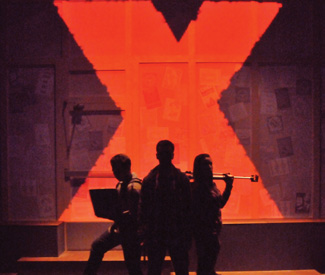
Behind the dynamic trio onstage stands a patchwork wall-projection screen (courtesy of set designer Sarah Phykitt, video designer Pauline Luppert, and video engineer Darl Andrew Packard) papered over with pages seemingly torn from radical histories and revolutionary tracts (it was easy enough to make out Emma Goldman’s visage among the repeated black-and-white pages), and periodically set aglow with live video feed, scene-setting photo montage, text messages, and hacker scrawl across computer and videogame screens.

While DHS is synonymous with Big Brother throughout, and for good reason — the agency is at the forefront of a total invasion of American private life and the Gitmo’ing of American teens — it can also be understood at times as a synonym for the state at large, from high school vice principals on up. As main character Marcus Yallow (a bright, engaging Petzold) explains in an early address to the audience, he’s a senior at a San Francisco public high school. Even before the Bay Bridge attack, “that makes me one of the most surveilled people in the world.”

Before being transformed into an all-out revolutionary by his violent, extra-constitutional encounter with DHS, Marcus and buddy Darryl (a sharp and versatile Censoprano) are fun-loving rebel hackers and gamers often on the receiving end of unwanted attention by the usual authorities. In an early scene, an inept school administrator interrogates Marcus, believing him, correctly, to be the hacker menace “w1n5t0n” (though, hilariously, pronouncing the handle literally instead of the intended “Winston”). Marcus outwits him, and the administrator loses his grip on the free-roaming online hooligan who, among other things, has handily derailed the “snitch tags” the school plants in library books to track the students.

At this point, Little Brother bears a striking similarity to The North Pool, Rajiv Joseph’s psychological two-hander set in a vice principal’s office after school, which had its premiere last year at Palo Alto’s TheatreWorks. But Joseph’s battle, while resonating with a larger political and historical context, ultimately remains more personal than political. Little Brother moves via the next terrorist attack into the realm of all-out political crisis, as short a distance from here as that may seem, and in this way resists reducing its themes to merely personal terms, highlights a tension with the personal throughout — even as it cleaves to a familiar coming-of-age narrative involving Marcus and girlfriend-coconspirator Ange (played compellingly by Keltie).

Costello shrewdly emphasizes this tension in his staging, which begins with the three principal characters recreating the story for a video cam so that it can be posted online. As Marcus begins a first-person account, his cohorts interrupt him almost immediately. “Dude, you can’t make it all about you,” says Darryl, with good-humored conviction. “It’s too big.”


LITTLE BROTHER

Through Feb. 25

Thurs.-Sat., 8 p.m.; Sun., 7 p.m., $25-$32

Gough Street Playhouse

1620 Gough, SF

www.custommade.org

The story of hip-hop

0

By Courtney Garcia

MUSIC From the start, Ice-T was a versatile chameleon, the product of an integrated culture, and a student of the marginalized.

Born in New Jersey, raised in the Crenshaw District of LA, he joined the Crips then pursued the army to pay his bills. His career was blazed in rap, though he once flipped the game to heavy metal. Multifaceted talent that he is, Ice would later grow even more famous on television.

It’s no surprise, then, that he now adds the title of director to his resume, with the debut of his first documentary, Something From Nothing: The Art of Rap, at this year’s Sundance Film Festival. The feature length endeavor is the pioneering artist’s tribute to the culture that bred him, beat him, and made him who he is; it’s a culture he feels is slowly slipping from his grasp. It’s a story as much about the traditions of hip-hop as it is a fervent call to action, told through the eyes of its maker and his impressive posse of friends.

The premise, nevertheless, is simple: this is the story of hip-hop. “It’s a lot of life lessons because you’re not only hearing about rap, but experiences and struggles,” explained Ice during a one-on-one breakfast interview at The Lift in Park City, Utah. He was present for the screenings, along with Grandmaster Caz and Chuck D, both of whom appear in the film.

Other notable feature players include Eminem, Dr. Dre, Kool Moe Dee, Kanye West, Royce da 5’9,” Common, Rakim, KRS-One, Bun B, and Snoop Dogg. “You’re hearing people who you thought woke up successful talk about how they thought about quitting, how they had to find their voice,” Ice said. “I wanted to catch these guys when they were vulnerable, to show they’re real people, and that success doesn’t come without some blows.”

Ice got into rap initially to avoid falling back into gang life, first experimenting with turntables while enlisted in the military. Musically, he made his name as an underground artist before signing with Warner Music/Sire Records, and eventually winning a Grammy for his song, “Back On the Block.” He would follow such success with a branch into acting, currently starring in the primetime series, Law & Order: Special Victims Unit. And while his schedule is more than demanding, he found time between shoots to direct this documentary, a film he believes had to be made to challenge the fallacious imagery of hip-hop in American culture.

“This movie is not about the money or the cars, it’s about the craft,” he says. “The only questions we get asked by the press were, you know, ‘Who are you having sex with?’ ‘How high do you get?’ ‘Who don’t you like?’ They don’t care about your work…I wanted people to see the hip-hop I know, not the hip-hop that’s been given out until now. You’re getting this image that’s not real.”

Something From Nothing begins on the streets of New York, and follows the beat to the sunny coast of Los Angeles. Interviewing the gamut of rap’s finest, Ice catches his friends at the record store, in the studio, on their patio and at the diner. They eat; they smoke; they talk hip-hop. Some, like Kanye, freestyle for the camera; others spit the rhymes they can’t get out of their heads.

In one of the more poignant scenes, Ice speaks with Eminem about his toil to commit to the trade amidst extreme discouragement, and the moment he realized it was his raison d’etre. Equally surreal, the filmmaker travels to Dr. Dre’s lavish estate in the Hollywood Hills, where the two converse about the late, Tupac Shakur.

Because the name ‘Ice-T’ signifies authority, the strength of this film is his access to the inside, exposing tales most people would never have a chance to hear. He hits on every shade of the genre, from gangster rap to native tongue, the poetics of Q-Tip to the in-your-face anarchy of Immortal Technique.

Introducing the film at Sundance, he described his impetus as a dissatisfaction with the current state of hip-hop, and an earnest aim to improve the situation.

Later, he elaborated. “To me, the most pinnacle moment in the movie was when Mos Def quoted Q-Tip saying ‘rap is not pop; rap never had pop ambitions.’ It’s a counterculture. Now it’s become pop, and how you gonna get mad at the kids? They want to eat; they want to make money; they want to live. If you ask me what my dream is, I would love to see a 19 year-old Public Enemy come out of nowhere; I would love to see the new 18 year-old Ice Cube just come kick in the door, and start telling motherfuckers, ‘Fuck the bling, this is what’s good. Let’s talk about Obama, let’s talk about Occupy Wall Street. Let’s go in.'”

He added, “It will never get radio play, but I believe if a young group of kids really nailed it, they could get a movement going. And it’s needed. I took Rage Against the Machine out as my opening act, so of course I want to see that. The terrain is wide open.”

It’s rare to catch Ice-T without his signature shades, and somehow it’s obvious he truly is the OG he claims. Yet his inner sincerity and passion show through in this project, an ode to the first platform to ever give him a voice. He sold the rights to film after the Sundance showings to The Indomina Group for worldwide distribution; a theatrical release is planned for summer.

“Music has that power to give people emotion, and that’s what’s lacking right now,” he reiterated. “They’re not using art form at full power. They’re just rubbing the surface of it.”

Alerts

0

yael@sfbg.com

THURSDAY 9

Occupy Oakland Forum on Police Actions

Oakland’s Citizen Police Review Board had been planning a forum on the Oakland Police and Occupy Oakland for months — until they announced at the last minute that it was canceled. In response, the Occupy Oakland Forum Committee is hosting essentially the same forum, and inviting the same speakers, including Jim Chanin, civil rights lawyer from the Oakland Riders case, and Police Chief Howard Jordan. They hope to give the community a chance to respond to the recent controversy surrounding treatment of Occupy Oakland by police.

6:15 p.m., free

Grand Lake Theater

3200 Grand, Oakl.

oakland@occupyreport.org


Reelect David Campos

District 9 Sup. David Campos and his re-election campaign are throwing their first fundraiser event in the Mission. It will include drinks, appetizers, and a chance to talk with the man himself.

6 p.m., free

Blue Macaw

2565 Mission, SF

(415) 920-0577


FRIDAY 10

Kenneth Harding benefit

A star-studded night of music to benefit the Kenneth Harding Jr. Foundation. Support the foundation created after Harding, an unarmed black 19-year-old, was killed by SFPD officers in an incident spurred by an unpaid $2 train fare. The night’s line-up includes Fly Benzo, BVHP neighborhood resistance leader, emcee and City College student, who faces four years in prison on multiple counts including “videotaping the police” for his responses to the shooting.

9 p.m., $12

330 Ritch, SF

www.330ritch.com/calendar


SUNDAY 12

Move to Amend

David Cobb, spokesperson for the Move to Amend campaign, will speak about corporate personhood. Move to Amend is an effort to amend the constitution to abolish corporate personhood, which saw a large turnout on its national day of action on Jan. 20. Cobb is also a former Green Party presidential candidate.

7 p.m., $5-10

Berkeley Fellowship of Unitarian Universalist’s Hall

1924 Cedar, Berk.

(510) 841-4824

www.movetoamend.org


Harlem is Nowhere

Hear author Sharifa Rhodes-Pitts and organizer Alicia Garza talk about the history and meaning of Harlem as a center for black politics and culture, the effects of gentrification, and the geography of building power for people of color. This event is part of an ongoing “authors in conversation” series at the Museum of the African Diaspora. Rhodes-Pitts is the author of Harlem is Nowhere: A Journey to the Mecca of Black America, and Garza is the co-executive director of People Organized to Win Employment Rights (POWER) in San Francsico.

2 p.m., free

Museum of the African Diaspora

685 Mission, SF

www.moadsf.org/visit/calendar.html

Downtown action: Sex shop Feelmore510 celebrates one year of community pleasure

2

The sex shop Feelmore510 is located on the corner of Oakland’s Telegraph and 17th streets, across from an Obama campaign office, in between a pawn shop and the oldest African-American owned shoe store in town. The neighborhood is in transition, a place with old roots and a lot of new blooms – most businesses on this stretch of Telegraph opened within the last five years. Feelmore510 will celebrate its one-year anniversary Sun/12 when owner Nenna Joiner helps host Town Love, a new party at Hibiscus’ Rock Steady.

But those businesses aren’t the shop’s only neighbors. This fall, Feelmore510 also lived alongside Occupy Oakland’s City Hall encampment. Though many local business owners have expressed anxiety about the effect that protests were having on their sales, Joiner is in full support of the movement. She sometimes walked over to visit friends who were “occupying,” and was happy to donate safe sex supplies to the camp. “Sex is a basic need for survival,” she said in a recent in-store interview with the Guardian. Joiner allows protestors to chill in the store and talk politics — as long as they aren’t running from the cops.

Joiner envisions her store as more than just a place to shop – it’s also a community center. On a recent afternoon, Joiner shook each customer’s hand and asked them their name. Her goal is that all comers can shop for augmentations to their love life in comfort. 

A cross-section of Oakland’s entire population converges in this particular area of downtown. Joiner sees everyone from rich vintage porn collectors — drawn to her extensive selection of old magazines and videos — to people who ask to pay with California welfare benefit cards. 

Her best-selling items, which are taken home by customers who are male, female, straight, bi, and trans, are the queer porn films that Joiner herself directed, edited, and produced. 2010’s Tight Places features diverse actors and she made Hella Brown with a cast of all African American women. Hella Brown is made in a semi-documentary style – Joiner shot interviews with over 50 queer and trans subjects about their sexual proclivities while making the movie. 

Artfully-displayed contraptions at downtown Oakland’s favorite sex shop. 

Joiner’s films are unique in the way that they showcase different sexual practices and different body types from mainstream porn, which is often geared towards a heterosexual male audience. Her films show women of all shapes, having queer sex — fellating strap-ons and other acts you might not catch in other kinds of porn. While the films are not shot with the straight male audience in mind, that group does seem to enjoy them, often buying the first film and then returning for more. Joiner sees her films as educational tools, especially for what she calls the “brown community,” where things like transitioning from one gender to another are often socially stigmatized and restricted by financial limitations. 

“Queer women of color possess a whole different intelligence and mentality,” she says, adding that many women have a certain shyness about “packing,” (wearing a flaccid prosthetic penis underneath clothing) and getting cosmetic gender modification surgery. Joiner fully embraces her role as an educator in the Oakland queer community. 

Joiner refers to dildos as “prosthetics,” – she says that this language is less alienating to those unfamiliar with their usage. She keeps a packer on prominent display, in order to provoke people into asking questions, which can open up a dialogue about passing as a man, transitioning, or simply stuffing one’s jock with something more substantial than a tube sock. She says customer preference in prosthetics can vary. Many want a life-like phallus, while others request dildos that don’t look like penises, going for glass, sculptural, or abstract designs.

Joiner feels that she is at the intersection of several different communities in Oakland. Joiner goes to two church services every Sunday. She buys passing school kids lunch at Ms. Tina’s, the little sandwich shop next door. She’s active in the queer scene, and she’s also a small business owner who encourages other vendors to promote their own businesses by using her store as a launchpad. 

“Having a space allows other people to identify with a vision of opening their own space.” When she first opened her store, naysayers questioned her brick-and-mortar approach over the Internet. But she says a website cannot replace the tactile satisfaction of a place to gather, to talk, to share. She uses her store to hold classes on topics rarely discussed other places, like sex industry work.

Joiner wants the toys she sells to be safe and fun for anyone, and to open up a conversation about sex, gender, and pleasure with Feelmore510. It works – her space encourages one to think of sex in a different, more open way. Joiner’s toys are all just tools for lovers to transfer feeling, power, and energy between each other. There is no single way to have sex, just endless different first-time experiences. It’s a new kind of space in an old part of Oakland, open for all comers to explore their most innovative sexual selves.


Feelmore510 one-year anniversary party at Town Love

Sun/12 5-11 p.m., $5

Rocksteady at Hibiscus

1745 San Pablo, Oakl.

(888) 477-9288

Facebook: Feelmore510 anniversary party at Town Love


Dick Meister: Sit down, punk!

1

By Dick Meister

Dick Meister, former labor editor of the SF Chronicle and KQED-TV Newsroom, has covered labor and politics for more than a half-century. Contact him through his website, www.dickmeister.com, which includes more than 350 of his columns.

I spotted a forgotten hero at the memorial service for SF labor leader Walter Johnson the other day, a true but largely unacknowledged hero of the anti-Vietnam War movement – Art Carter, former head of the AFL-CIO’s Contra Costa Labor Council.

The AFL-CIO, you might recall, was a major and outspoken supporter of that damned war which was waged as a key part of the Cold War against the Soviet Union.  The AFL-CIO held tenaciously to its unqualified support of the war, whether it was being waged by a long-time labor ally, Democratic President Lyndon Johnson, or by his anti-labor Republican successor, Richard Nixon.

It was in 1969, at the AFL-CIO’s national convention in Atlantic City, that Carter, a 28-year-old delegate, dared stand up to oppose a resolution unconditionally supporting the Vietnam War and the Vietnam policies of then-President Nixon, which delegates had loudly cheered when a guest speaker, Defense Secretary Melvin Laird, had spelled them out. The measure was presented by hawkish AFL-CIO President George Meany and ultimately opposed by only six of the 700 delegates – including, of course, Art Carter.

Much to the open disgust and anger of Meany and most delegates, Carter offered a substitute resolution that urged the AFL-CIO “to exercise all possible influence and persuasion on the national administration to effect an immediate major reduction of American military involvement in Vietnam and to bring the Vietnam War to a speedy end. “

Carter called his proposed measure  “a rather modest resolution” that came from his members – “working men whose sons have either just returned from Vietnam or who face going to Vietnam.”

He urged the AFL-CIO ‘s national leaders to take a critical look at the government’s Vietnam policies rather than “giving carte blanche to a president to do anything he regards as in the national interest.” Carter followed that with a proposed resolution condemning the Nixon administration’s Vietnam policies that got but one delegate’s vote – his.

Boy, did the stuff hit the fan, as I and other reporters from around the country rushed forward to question the young renegade from the Bay Area. It was big news, someone inside the AFL-CIO actually challenging the imperious George Meany, who was rarely challenged within labor circles.

Consider the situation. There was Carter, a delegate from a small, nationally obscure labor council, surrounded by hostile men at least twice his age and faced with the barely concealed animosity of a 75-year-old who was known nationwide as “Mr. Labor.” How dare Carter question Meany and the other labor elders?

 Meany, at the convention podium, snapped back at Carter immediately. He derided Carter and others who sought “peace at any price,” equated their suggestion for a reduction of forces in Vietnam with surrender and claimed that would result in “the kind of peace you get in the jail house.” Carter tried to respond, but Meany abruptly ruled him out of order, and Carter was forced to move away from the floor microphone and resume his seat amid noisy catcalls and angry shouts of “sit down! sit down!”

Carter was hardly a wild-eyed radical, just an intelligent young man of liberal bent calling for a peaceful solution to an ugly, futile war that had already left many Americans dead. Yet, he asked reporters, with an air of angry futility, “Did you hear what they called me?  Young punk, that’s what they said: Sit down, punk!”

Although Carter’s brave stand – and, believe me, it was indeed brave – didn’t directly alter the AFL-CIO’s war mongering, or that of others, it couldn’t help but have an impact on millions of Americans both inside and outside the labor movement.

 Just a few days after the AFL-CIO convention adjourned, as many as three million people in more than 200 cities took part in marches and other demonstrations to  demand immediate withdrawal of U.S. troops from Vietnam. It was the largest peace demonstration ever held up to that time.

Although the precise effect of Carter’s courageous stand is not clear, it undoubtedly did help inspire many others to openly oppose or at least seriously question the government’s Vietnam policies and pressure the AFL-CIO and others to at least tone down their support of the war.

In the context of the time, Art Carter’s was indeed a heroic act. Thankfully, today’s AFL-CIO leaders bear little resemblance to Cold Warrior Meany and his cohorts. The AFL-CIO’s current president, Richard Trumka, is an outspoken backer of the Occupy Wall Street Movement, for instance, as are many other AFL-CIO leaders and members who can cite Carter as an inspiration.

Dick Meister, former labor editor of the SF Chronicle and KQED-TV Newsroom, has covered labor and politics for more than a half-century. Contact him through his website, www.dickmeister.com, which includes more than 350 of his columns.

Burning Man ticket fiasco creates an uncertain future

259

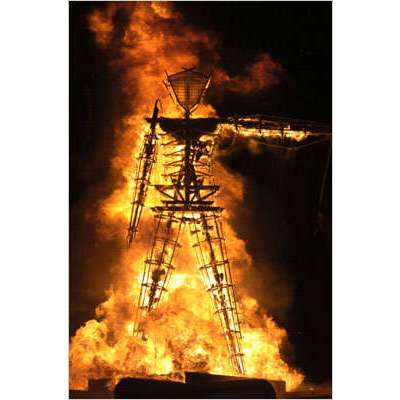
UPDATED WITH LLC RESPONSES BELOW   Is it the end of Burning Man as we know it? That’s certainly the way things are looking to thousands of longtime burners who didn’t get tickets when the results of a controversial new ticket lottery system were announced on Tuesday evening, particularly as big picture information emerged in online discussions yesterday.

[SFBG update: Will theme camps receive the remaining tickets?]

Personally, I was awarded the maximum two tickets I requested at the $320 level (my sister already claimed the other, so don’t even ask), but I’m feeling a little survivor’s guilt as I hear from the vast majority of my burner friends who didn’t get tickets. And if it wasn’t already clear that scalpers have effectively gamed the new system, that became apparent yesterday when batches of up to eight tickets were listed for as much as $1,500 each on eBay and other online outlets.

As I’ve attended Burning Man since 2001 and covered it for the Guardian and my book, The Tribes of Burning Man, I’ve become involved with many camps and collectives over the years. So over the last couple days, I’ve been privy to lots of online discussions and surveys, and it appears that only about a third of burners who registered for tickets actually received them (organizers have refused to say how many people registered for the 40,000 tickets sold this week, so it’s tough to assess whether scalpers were more effective than burners at buying them).

The huge number of burners without tickets is a big problem for theme camps and art collectives that rely heavily on their members to pay dues and work long hours to prepare often elaborate camps, art cars, or installations, some of which are now in doubt. Many people are so frustrated that they’ve pledged not to attend this year, and even those of us that did get tickets are questioning whether we want to go if some of our favorite people aren’t – particularly if they’re replaced by rich newbies willing to spend a grand on a ticket.

Theme camps are the basic building blocks of Black Rock City – a central tenet of my book and regular claim of event organizers – and the work they do to build their camps and plan fundraisers to pay for them has already begun, only with far more uncertainty than usual this year. And that will also exacerbate a tension that already exists between grant-funded art projects (which usually get free tickets for their volunteer builders) and big camps that don’t qualify for tickets, such as sound camps or independently funded art projects.

For now, most burners seem to be willing to wait a beat or two – as Black Rock City LLC is urging, a message that I willingly helped disseminate and that I support – to see whether enough extra tickets purchased by community-minded burners are offered for sale at face value using an aftermarket ticket exchange the LLC is hurriedly setting up right now. Some camps and projects have created internal ticket exchanges to try to take care of their own first. And there’s still the secondary ticket sale with the last 10,000 tickets coming on March 28.

But the frustrations are palpable, and there is widespread concern that Burning Man has jumped the shark and will be changed by the series of official missteps in the last year. Dozens of people have independently asked why, after the event sold out last year and scalpers made a killing, the LLC didn’t require each ticket to be registered to an individual and transferred only through a regulated aftermarket system, which would prevent gouging by scalpers. I’ve asked organizers that same question each of the last two years, and I was only told that it seemed like too much trouble and that things would work out.

Well, most burners don’t think things are working out very well. Many are still willing to wait and see, and this certainly is a resourceful community, so perhaps things seem more bleak now than they will in a month or two when playa preparations really kick into gear. But if not, the LLC could be facing a real crisis of confidence in its leadership of an event that we all help create, and perhaps even an open rebellion of its core members.

Many longtime burners are already making other vacation plans for this year, some are even pondering plans to create alternative events, and there are a significant number of them who have tapped the spirit of these political times and suggested it’s time to “Occupy Burning Man” or “Occupy Black Rock City.”

Whatever happens, the Year of the Dragon seems to have brought with it the old Chinese proverb: may you live in interesting times. I’ll continue covering new developments in this most interesting of years, so stay in touch.

Sincerely, Scribe

UPDATE (5 PM): LLC board member Marian Goodell just returned my call and said the organization leaders huddled up today to work on solutions to problems raised by the ticket shortfalls. “We’re genuinely really putting our heads together today. We’re listening, we really are,” she said. “It’s very real for us, I get it.”

She recognizes that it’s a big problem for established theme camps and art collectives having tickets for only about a third of their members, a figure that she also confirmed. “It’s clear that the theme camps and art projects are a significant part of the community, and this situation is causing problems for them,” she said. “That’s the part that will hurt us if we don’t take another look at this.”

Goodell also acknowledges that it doesn’t appear there are as many tickets available within those established burner networks as she had hoped would be the case: “I doesn’t look like camps are sitting on a lot of tickets.” But she also said that she doesn’t think the lion’s share went to scalpers. “We don’t think there are 10,000 people out there looking to scalp tickets,” she said. “Putting them up for sale is not the same thing as them being sold.” She reiterated her appeal that people don’t use scalpers for tickets but wait for community-based sources and solutions.

But Goodell said it was too late to re-do this week’s lottery — “not possible,” she said — even though the physical tickets won’t be mailed out until June. She said the LLC has divided up information-gathering tasks now and will regroup soon to decide how to proceed, with options including tweaks to the rules for the March 28 ticket sale or working with the BLM to bump up the population cap, an option that would raise other problems.

“We have many different challenges: scalping, community development, and population,” Goodell said, reiterating her concern that increasing the population would make logistical problems like the long exodus wait even worse. But whether that’s even a possibility will depend on the Environmental Impact Statement that is expected to be completed in March.

Gavin Newsom (suddenly) cares about economic justice

37

I was eating my (late) breakfast as I was listening to Gavin Newsom on KQED’s Forum this morning, and at first it was just the usual lofty rhetoric about education … and then Michael Krasny asked the lieutenant governor about the Occupy movement, and I almost threw up my whole wheat bagel and peanut butter.

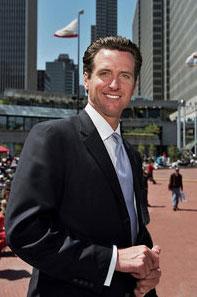
Cuz Gav — the mayor who would never even consider asking the city’s wealthiest to pay more taxes, who ran for governor and then lite gov on a platform that he’d balanced the city budget without raising taxes, the guy who was a great friend of the city’s 1 percent, had the nerve to sing the praises of Occupy and complain about economic injustice.

Seriously: Gav ranted on for about five minutes about how low the taxes are on rich people. He announced that his company just set up a new winery and hired a bunch of people — and taxes were never an issue. He acted like someone who reads my shit.

One of the messages of Occupy — and one of the reasons that the movement exists not just in Washington and Manhattan but in cities all over the country — is that economic injustice needs to be addressed everywhere. It’s not just about the Bush tax cuts or even Jerry Brown’s tax-hike initiative; it’s also about local government trying to address the wealth and income gap and the impacts of 1 percent domination — at home.

Gavin had seven years to do that. He didn’t even try. Worse, when the progressives on the board tried, he’d veto anything that remotely smacked of a tax hike on the rich or a way to force the 1 percent to share the wealth with the 99 percent. (Does anyone think he would have allowed Occupy to stay at Justin Herman Plaza as long as Ed Lee did? Not a chance.) Now he wants to take advantage of the popularity of the movement for his own advancement.

Fucking sick.

Hot sexy events: February 1-7

0

(Insert “saddle friction” joke here.) At the risk of sounding like an episode of Portlandia, we are stoked for the Bike Smut Film Festival, which rides in for its second SF showing in two weeks – the first took place at Bayview’s Cyclecide Swearhouse last weekend – on Fri/3. 

Bike smut: people having sex on bikes, sex with bikes, sex with bikes watching – surely there will be bike couplings in there somewhere (a handlebar penetrating a spoke, well greased). This incarnation of the fresh-from-touring-Europe show has an Oregon Trail theme. Yes, we know you loved that game in elementary school. You know who else did? Everyone.

Anyways, the whole shebang rolls into the art collective OffCenter on Divisadero Street this Friday, led by one-time Lusty Lady dancer and full-time bike slut Poppy Cox and that saint (as ordained by the Church of Bicycle Genius) Reverend Phil. It sounds like it’s gonna be a good time. 

Bike Smut Film Festival

Fri/3 7-10 p.m., $7

TheOffCenter

848 Divisadero, SF

www.bikesmut.com


“From the Collection of Larry Townsend” ongoing art exhibit

I was recently at the premiere of Priscilla Bertucci’s [SSEX BBOX] global sexuality documentary at the Center for Sex and Culture, but I kept looking at the walls. Not because the film wasn’t rad (it was!), but because of all the amazing comic-style drawings of Roman orgies, space orgies, and orgy-orgies currently occupying the sex-positive community center’s walls. I have Larry Townsend to thank for this, and you can too if you head down to the comfy library space of the Center for Sex and Culture, which is adding Townsend’s treasures for a spell to its perma-exhibits of antique vibrators and shelves of queer and sex-positive literature.

Through March 30

Center for Sex and Culture

1349 Mission, SF

www.sexandculture.org


Hard French Winter Ball

Few nights of our lives can match the high-pitched hormonal rush that was high school prom. Outfit agony, whose-your-date torture, the shoes, the corsage – foreplay from hell, really. How could you have known that years later you’d be trying to recreate that same special freak-out with a slutty queer soul party on the Santa Cruz Beach Boardwalk? El Rio’s favorite afternoon dance party takes to the road for the second year in a row this weekend, with Juanita More and the House of Salad drag beauties in tow (check the candidates for the ball’s king and queen, adorable). Will the town of Santa Cruz be the same after tulle-and-tux-encased queers occupy the beachfront? Reserve your hotel room now and pack protection because: no.

Sat/4 7 p.m., $20-$25

Cocoanut Grove

400 Beach, Santa Cruz

hardfrenchwinterball.eventbrite.com


“Bros Before Hos: Masculinity and Its Discontents” film festival

C’mon men, look at yourselves. No really – though masculinity studies is often the subject of yucks and early 1990s primal scream mock-ups, men really don’t get the magnifying glass treatment when it comes to their sexuality. Not so at this film series orchestrated by YBCA – from the story of truck-lifting strong man Stanley “Stanless Steel” Pleskun to a collection of ’20s-’70s stag films, the meat of menfolk (c’mon, not just that part) will be offered up as prime conversation-starters. Today, a look at boundary-pushing filmmaker Bob Mizer of the Athletic Model Guild.

Festival runs through Feb. 26, $8/screening

Sat/4, 7:30 p.m.: The Golden Age of the American Male: Films From Bob Mizer’s Legendary Athletic Model Guild 

Yerba Buena Center for the Arts

701 Mission, SF

(415) 978-2787

www.ybca.org


Good Vibes’ “Ask Our Docs: Intro to Anal Play”

It’s okay not to know about anal sex, Good Vibrations says. So okay, in fact, that the sex toy company is offering this completely free primer on how to get primed, taught by Charles Glickman, that man-about-sex-education-classes-in-town.

Tue/7 7-8 p.m., free

Good Vibrations

3219 Lakeshore, Oakl.

(510) 788-2389

www.goodvibes.com


After the tear gas clears

3

yael@sfbg.com

After a chaotic day of marches and confrontations between police and protesters Jan 28, I was arrested along with about 400 others who were trapped by police in front of the downtown Oakland YMCA. Seven of us were journalists.

The goal of the march was to take over an abandoned building — an the vacant Kaiser Convention Center, a city-owned building that’s been closed since 2005, was a prime target.

I have not yet been able to retrieve my property, including my recorder and notebook, which is being held by the Oakland Police Department. What follows is a pieced-together account and a perspective on what the events of Jan. 28.

I spend 20 hours behind bars, and missed the later parts of the action. But I was able to observe what happened in jail and make some sense of what happened.

Occupy people are constantly debating tactics and goals, and for many, the idea of occupying a vacant building made sense. When Occupy Oakland had a camp in Frank Ogawa Plaza, also known as Oscar Grant Plaza, and commonly shortened to OGP, it created a strong community. That community bridged divides between the homeless and the housed, between students and labor organizers, and between Oakland residents of different races, genders and levels of ability in an unprecedented fashion.

The camp had a kitchen that fed hundreds of people everyday and a network of shared tents and blankets which welcomed in hundreds who otherwise would have slept on the streets, often feeling isolated from other residents of their city and made to feel inferior.

The camp was repeatedly raided, Occupiers were tear gassed and shot with rubber bullets, and when OGP was cleared out, the community no longer had a home. And the police started that violence.

That was the practical reason for wanting to occupy a vacant building: to have a social center for Occupy Oakland.

Of course, there are other reasons. There’s the question that many squatters and homeless advocacy groups have been making for decades: why let buildings lie vacant while people freeze on the street?

Remember: The building that Occupy wanted to occupy is public property, and right now nobody is using if for anything.

In one exchange in jail, a guard asked a protester why the activists thought they had the right to take over a vacant building. “I mean, it’s not yours,” he insisted. The protester replied that many vacant buildings are government-owned and therefore public.

“So it’s the government’s,” the cop said.

“But I pay taxes,” the protester responded.

“Me too!” replied the cop. “It’s mine!”

“It’s both of ours,” smiled the protester. “It’s all of ours.”

That’s what made the convention center action such a clear and easy political decision.

A lot of people in Occupy would go further, saying that at a time of a severe housing crisis, it’s perfectly legitimate to take over privately owned buildings that are sitting there vacant. It’s part of the central argument of Occupy — that corporations and the rich unfairly own and continue to acquire much more wealth than the majority of people. For many people, owning a vacant building and doing nothing with it, while hundreds freeze on the streets, is a crime itself.


UP AGAINST THE COPS

Then there’s the question of the police — and violence.

The word “nonviolent” has a specific meaning in the history of political movements. Martin Luther King Jr. defined it in his essay “The Meaning of Non-Violence”: “If you are hit you must not hit back; you must rise to the heights of being able to accept blows without retaliating … But it also means that you are constantly moving to the point where you refuse to hate your enemy. You are constantly moving to the point where you love your enemy.”

It’s a philosophy but also, in political terms, a tactic.

Many of the people who make up Occupy Oakland get their start as activists organizing against police brutality in a city that has longstanding problems with violent and undisciplined officers.

Police Chief Howard Jordan said in a press release that “It became clear that the objective of this crowd was not to peacefully assemble and march, but to seek opportunity to further criminal acts, confront police, and repeatedly attempt to illegally occupy buildings.”

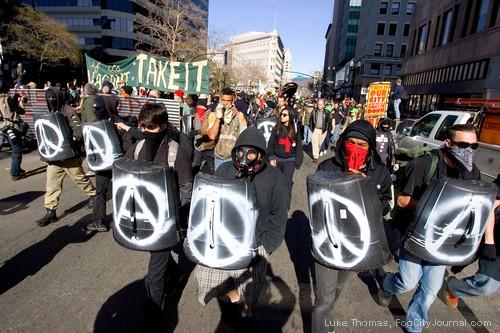
It was certainly clear that the intent of the crowd was to illegally occupy a building. And any honest assessment of Occupy Oakland would have to acknowledge that some members are not wedded to King-style nonviolent civil disobedience. (Neither, by the way, were a lot of the protest movements of the 1960s.) Many protesters wore masks and bandanas to disguise their identities and protect them from tear gas and pepper spray, and the march was led by protesters with makeshift shields, which suggests that they expected to be attacked. You could certainly argue that what those people were doing wasn’t confrontation; it was self-defense.

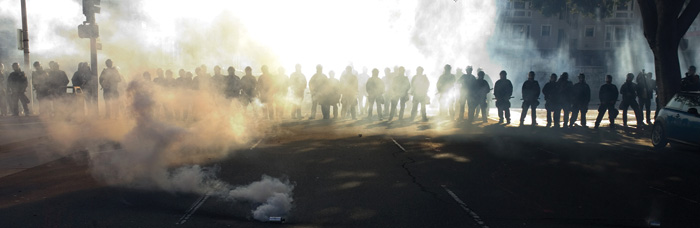
Frankly, it made sense to be prepared: In other Occupy Oakland actions, police have attacked with batons, tear gas, pepper spray, flash-bang grenades, and smoke bombs. And for quite a few Oakland residents, the police have always been seen as an outside force that can’t be trusted.

In fact, violence did break out. Many, including myself, have eyes still stinging from tear gas. I saw several wounds caused by rubber bullets shot at protesters. I spoke individually to at least a dozen people — one of them a pregnant woman — who were struck with police batons.

And protesters did not remain peaceful while this violence was being used against them.

Some picked up tear gas canisters and threw them back towards police; that much I saw. I also saw protesters throw empty plastic bottles at police.

According to the police, they also threw metal pipes, rocks and bricks. According to the protesters, they threw mainly empty plastic bottles and fruit at police. But as protesters often say of the police, “They’re the ones who showed up with the guns.” If the cops didn’t want violence, why unleash such an arsenal of weapons?

People got hurt, protesters and police alike. Several bystanders who had nothing to do with the situation were swept up in the mass arrest.

The city of Oakland, already in dire financial straits, likely spent hundreds of thousands of dollars reacting to the protests. Police claim that they were unable to sufficiently respond to violent crimes over the weekend, including five murders, because they were overwhelmed with Occupy troublemakers.

Of course, city officials were the ones who decided to arrest 400 people — with all the expense that involves.

There are, at this point, no reports of serious injuries to any police officers. However, at least a dozen protesters had welts on their faces or bodies from being beaten by clubs or shot with rubber bullets. One woman was shot in both arms with rubber bullet; one man was shot in the face with rubber bullets while holding a video camera to document the events. Several protesters were shoved to the ground and received wounds on their faces while being arrested. Police raised their rubber-bullet rifles to the faces of protesters throughout the day, threatening attacks. A rubber bullet to the face can cause brain damage and blindness.


DID IT HAVE TO HAPPEN?

How could this have been prevented?

Police say that “while peaceful forms of expression and free speech rights will be facilitated, acts of violence, trespassing, property destruction and overnight lodging will not be tolerated.” But 40 people were arrested during an ongoing Occupy Oakland vigil in the first weeks of January for having “illegal property” at OGP in what many saw as clearly a peaceful expression of First Amendment rights.

On KGO radio Jan. 29, Chief Jordan said that he has allowed Occupy Oakland to protest without a permit and would continue to do so, but those early January raids were ostensibly due to permit violations — violations of the terms of a permit that Occupy Oakland did in fact have.

There’s no question: The police response to Occupy Oakland over the past few months has caused some people in the movement to get more radical.

Many Occupy Oakland-affiliated medics condemned those who threw objects at police, saying that they provoked a backlash that caused more injuries. Many Oakland residents who might be in line with the socio-economic critique presented by the Occupy movement feel endangered and confused by marches that result in the massive use of police weapons in broad daylight. A lot of people would rather protest in a lot of ways that less resemble urban warfare.

On the other hand, there are also ways that Oakland officials could have prevented the consequences of weapons deployed and 400 arrested Jan. 28. They could, for example, have allowed protesters to occupy the vacant building.

When protesters seized a building Jan. 20 in San Francisco, police first attempted to prevent them. They lined up in front of the targeted building. They deployed pepper spray and struck several protesters with batons. When they were unsuccessful, and protesters entered the building from the back, they opted to block the surrounding streets and wait until the time seemed right to enter the situation and make arrests. Police spokesperson Carlos Manfredi told me that the cops were not going to rush into the situation and were trying to prevent injury and violence.

The Kaiser Convention Center has been vacant for years. The city of Oakland recently made plans to sell it to its Redevelopment Agency, but that plan fell into legal limbo when Gov. Jerry Brown signed AB26, a bill that dissolved all California redevelopment agencies.

At this point, nobody at Oakland City Hall has any plans whatsoever for the big, empty structure.

Why not allow Occupy to use the convention center? It’s not downtown, where Mayor Quan says businesses have been adversely affected by Occupy Oakland’s presence. It would give the movement a chance to stop focusing on trying to occupy spaces and start focusing on benefiting the community with food, shelter, and community programs that they provided when they had a camp. It would give the building tenants who could be held responsible for maintaining it. It might even help get Occupy Oakland and the Oakland Police Department out of the cycle of violence that they have been spiraling into for months.

Each time arrests occur, each time violence occurs, both sides blame the other. Both sides are correct that they were provoked. Both sides are correct that something that they think is worth defending was violated — for the cops, it’s the law. For the protesters, it’s the right of the people to assemble.

In fact, many Oakland residents have experienced violence at the hands of the Oakland Police Department for years before Occupy began. There was already a mass movement formed around the murder of Oscar Grant, and thousands of people fed up with police murders of unarmed, often black, suspects.

In recent decades, other radical groups, notably the Black Panthers, insisted that their community lacked basic needs because the city of Oakland refused to prioritize them. The Black Panther free breakfast program served food in a strikingly similar way to Occupy Oakland. Black Panthers were also notorious for carrying guns to defend themselves against police violence.

Occupy Oakland protesters (unlike Tea Party members) certainly don’t carry guns. But, more and more, they cry “fuck the pigs” as much as any Panther.

For much of the Occupy movement’s 99 percent, unjust actions by banks, corporations, and the government officials that they have often bought and paid for are the worst problems facing the United States today. For others, particularly the poor and people of color, these problems are magnified and exacerbated by the fact that they feel the threat of police harassment every day. For years, they’ve understood that police disproportionately do not investigate or solve crimes that happen to them and their families.


THE RADICALS AND THE BROADER MOVEMENT

The Oakland General Assembly Jan. 29 was the biggest it’s been in weeks. While there were still over 300 people in jail, 300 more came out to get involved with the meeting. That happened at the same time that many who felt that inexcusable violence and property destruction occurred Jan. 28 and concluded they could no longer have anything to do with Occupy Oakland.

It’s a challenge for the movement nationally, too: How do you accept and encourage the people whose legitimate anger at economic injustice and police abuse turns them toward more radical responses — and at the same time make room for a people who want nothing to do with the black bloc Fs, vandalism, and confrontation with the police?

There are tactical issues with the way the building occupation was planned. Many who were completely in line with the concept felt unsafe and uncomfortable with the secretive nature of the organizers who planned it. The location of the building targeted for occupation was kept secret for practical reasons; police could easily prevent a successful takeover. Supporters must often be led to the locations of planned takeovers without knowing where the action is and how they’ll get there. But how do you reconcile this with the transparency required when organizers are leading more than 1,000 people who want to use tactics they feel comfortable with and make their own choices?

Occupy Oakland is asking the people to imagine a world where property rights wouldn’t prevent them from doing all the good that they could do with a building like the Kaiser Convention Center. They must also ask themselves to imagine a world in which goals like a building occupation can be achieved in a way that everyone involved is able to consent to their involvement.

These debates continue to occur at Occupy Oakland. Some will leave the movement, some will join. Some will take the ideas and try to manifest them in new and different ways. Participants in Occupy Oakland desperately want basic needs of food and shelter met for their community members, and for the system that governs the city to do so in a way that allows people to thrive when it comes to health, education, and opportunities for creativity and growth. They think that they have the beginnings of a community and a process that can achieve those visions, better than the city government ever has, and they care more about achieving it than respecting the property rights of the owners of abandoned buildings.


Future Twin

6

The two females in Future Twin (www.futuretwin.com) — Jean Yaste and Stephanie Rose — met one another in a moped gang called the Lockits, another member of the band was in a moped crew called Treats of the Loin; I’m not sure if you can concoct a greater back-story than that but I’d be hard-pressed to find one. And the San Francisco fivesome, which formed in December 2010 originally as a trio, makes the equivalent of moped rock on its debut EP cassette, Situation (which is also available for download, for those without a tape player). Released Jan. 31, Situation revs up with roaring guitar, and incorporates field recordings of gunshots and small engines such as lawnmowers and of course, mopeds, but veers from blunt roughness, instead leaning towards powerful girl group-style vocals and multi-part harmonies.

While the first release is a small one, the Mission-based band has chops, brains, and a clear bond. Though perhaps not tight enough to get all its members to a photoshoot — while the drummer Antonio “Tones” Roman-Alcala with strep throat made it, another Future Twin simply texted, “yo, just didn’t feel like going.” No matter, Future Twin celebrates the release of Situation at the Hemlock this Thu/2 (9 p.m., $6. 1131 Polk, SF. www.hemlocktavern.com).

Description of sound: Psychedelic farmageddon grandma rock.

What do you like most about the Bay Area music scene: The things we liked most was the Clarion Alley block party until the damn breeders built their precious condos next door and started their war on fun. These people need to be taken out and the “scene” will heal itself.

What piece of music means the most to you and why: Rap News Occupy 2012. Why? No reason.

Favorite local eatery and dish: Secret Spot has delicious bagels, fresh squeezed juice, and homegrown greens.

Who would you most like to tour with: Bill Murray (as a zombie) and Kool Keith (as himself).

Editor’s notes

13

tredmond@sfbg.com

I used to go to Grateful Dead shows at the Oakland Auditorium, which is now called the Kaiser Convention Center. One night I saw Bill Graham, the late concert promoter, ride a zip line from up near the ceiling to the stage in a giant paper mache joint called the “S.S. Columbian,” which looked like it was going to fall apart at any minute as he swung back and forth 50 feet over the crowd, trying to smile and wave in a bizarre promotional stunt that confused even the deadheads. I bet he shit his pants.

The place was a pretty good venue for a big concert, but it never worked out as a convention center, and the city shut it down in 2005. It needs seismic work and about $5 million in maintenance. It sits near Lake Merritt, on the edge of downtown Oakland, a giant empty building just waiting for something to happen to it.

It’s a perfect spot for an Occupy Oakland headquarters. I’m surprised it took the Occupy folks this long to figure it out.

Look: Oakland’s a working-class city, and it’s having severe financial problems, and sending hundreds of cops to arrest Occupy protesters is sucking up money that’s desperately needed for other things. Mayor Jean Quan complains that police were unable to respond to emergency calls in other parts of the city because they were all downtown dealing with the demonstration.

Understood — and it’s clear that the Oakland Police, whether the Occupy folks like it or not, are going to arrive in mass numbers to make sure that there’s no damage to local businesses or City Hall (where, oddly, there were no arrests, because the cops were elsewhere).

But the empty Kaiser Center, which isn’t even in the downtown center? Why bother?

Seriously: Why not just give it to Occupy Oakland? Tell the group that the city will strictly enforce fire and health codes, that the Occupy people will have to clean the place up and keep it clean, that they can’t damage the place … and hand over the keys?

It’s public property. Nobody using it now. Occupy might actually bring some excitement to the scene. If it became a center for political meetings and organizing, for education and performances, it could be a be a very positive thing.

Declare at truce in the Occupy wars. Let the cops go after murderers; give Occupy the vacant convention center. Nothing else is working. It’s worth a try.

Alerts

0

yael@sfbg.com

THURSDAY 2

Violence in Mexico

How does the war on drugs perpetuate violence in Mexico, and what can be done? Juan Fraire Escobedo, an activist from Ciudad Juarez, will discuss the human cost of the drug war, militarism, and human trafficking.

7 p.m., $5-$10 donation

Eric Quezada Center

518 Valencia, SF

(510) 282 8983


SATURDAY 4

No war on Iran

The ANSWER coalition leads a march and rally demanding “No war on Iran, no sanctions, no intervention, no assassinations.” Dozens of demonstrations around the country will protest the threat of war on Iran.

Noon, free

Powell and Market, SF

www.answercoalition.org/national/news/no-war-on-iran.html


SUNDAY 5

Situationists and the Occupy Movement

Author of “The Joy of Revolution” and celebrated translator Ken Knabb discusses links between the Occupy movement and the Situationists, the revolutionary group that influenced the Paris uprisings of May 1968.

10:30 a.m., free

Niebyl-Proctor Library

6501 Telegraph, Oakl

www.marxistlibr.org


MONDAY 6

LGBTQ Singing Class

The first day of a series of singing workshops, taught in a supportive space for LGBTQ individuals and their allies. The class will focus on solo singing with one group song. Glitter optional but highly encouraged.

6:30 p.m., $25

Women’s Building

3584 18th St., SF

www.eliconley.com/singing-classes.html

Occupy Oakland inmates at Santa Rita attacked- developing story

153

(THIS STORY HAS BEEN UPDATED)

In the aftermath of the mass arrests of Occupy Oakland protesters– and whoever else happend to be on the wrong street at the wrong time– on Jan. 28 in Oakland, there have been loads of reports and rumors about brutality inflicted on those arrested. Most of those arrested were held in Santa Rita jail.


My observations:

I spent 20 hours in jail, and I saw some cruel treatment. I saw people suffering after being denied medication. I saw people with allergies to the food that was provided refused any substitute and unable to eat, sometimes for more than 24 hours. I saw people crammed into holding cells meant for groups a third their size, so that some people had to remain standing, sometimes for more than 24 hours. As many arrestees were wearing clothing coated in tear gas and pepper spray, those chemicals continued to waft through cells and affect all present.

Reports:

I have reports directly from sources of arrested occupiers being beat up in jail with police batons. At least 20 people were ziptied, meaning their hands were cuffed behind their backs– and more often than not, if they happen to be cuffed too tightly and their hands go numb and even blue, police won’t loosen them– for more than eight hours. I know that some people who were denied access to a restroom ended up sitting in their own vomit and urine for at least four hours in some cases.

UPDATE Another report from Joshua Clover, a professor of English at UC Davis, who was released Monday night, :
“I was held for 53 hours for a misdemeanor charge which every single person here, and there, knows will never be brought, and indeed which will be met with a class action suit for wrongful arrest that the city of Oakland will be compelled to settle. I have a perforated peptic ulcer. Early on in the stay I requested non—prescription care — liquid antacid, which the jail keeps on hand — when I began to have an ulcer attack, which is to say, when I began to bleed internally. I was not given such care until an attorney was able to intervene by phone many hours later. I received one capful, which was mildly effective for about three hours. Further requests were ignored. As many will know, a bleeding ulcer attack is both painful and potentially fatal”

UPDATE When I questioned Alameda County Sheriff’s Department Public Information Officer Sergeant JD Nelson about this, he responded that “[Clover] was obviously seen by a medical person, and they said that was enough medicine.”

But accoridng to Clover, via an email, “The one time that I received medication, a deputy came to the cell door accompanied by someone who may have been a nurse, holding a capful of antacid. I asked for more but was not given it.” And was Clover seen by a medical professional to determine the correct amount of medication? He says, “Definitely not.”

Also according to Clover, “Food was often not provided for periods of up to 14 hours. For a long period I shared a cell with 27 other people; it was about ten by ten feet. For a period I was in a cell labeled ‘Maximum Occupancy: Two.’ There were ten of us, three very sick. We stood. One of the people slumped over on the toilet, that being the alternative to standing.”

UPDATE

“Three people I know were denied medication for HIV infections while being held for multiple days, which is a life-threatening choice made by the county”

“two women were denied anti-depressants that they had with them when they went to jail”

UPDATE According to an anonymous source, “My 12×12 cell had 28 people. There was a toilet, a concrete bench, and enough hard floor space for three or four of us to sleep at a time. A girl in the cell across from ours told the guards she needed Lexapro or she would go into withdrawl. They ignored the request. One of my cellmates was HIV-positive. When I last saw him at 2 a.m. on Monday morning he had not yet been given his medications. As I exited the jail I saw a woman who had just been released lying on the floor. She was having a seizure and being tended to by a couple of firemen.”

UPDATE From Alyssa Eisenberg, who has multiple sclerosis:
“I take my medication at least twice a day…without it, the pain is, everything kind of goes numb and tightens up. Somtimes I can’t even see without it. When  had to sign the booking form about noon i couldn’t even see it, my vision was so blurry…I was told they don’t give meds to people that are going to be cited and released, only to people that are going to stay and get charged.”

Unconfirmed reports:

Daily Kos quotes an anonymous source who reports that “prisoners from the Oakland Commune were being denied medications (some had seizures) while the guards said they didnt care if they died. Some people were brutally beaten. The put tear gas in the vents of my cell twice.”
According to Occupy Oakland media spokesperson Omar Yassin, a report that someone was tear gassed in the jail’s hallway is likely credible.

Then there’s the peolpe who were injured during the protests Jan. 28. Also according to Yassin:

At least a dozen people had welts on their faces or bodies from being beaten by clubs or shot with rubber bullets. One woman was shot in both arms with rubber bullet; one man was shot in the face with rubber bullets while holding a video camera to document the events. Several protesters were shoved to the ground and received wounds on their faces while being arrested. Police raised their rubber-bullet rifles to the faces of protesters throughout the day, threatening attacks– a rubber bullet to the face can cause brain damage and blindness.


A spokesperson for the Alameda County Sheriff’s Department refused to comment, although she did say that they’ve “been bombarded with calls about this all day.” Shocker.

UPDATE According to Alameda County Sheriff’s Department Public Information Officer Sergeant JD Nelson, no complaints of mistreatment at Santa Rita have been filed.

Nelson said that peanut butter was made avaliable to vegans those allergic to meat, in direct contrast to what I witnessed in jail.

In response to reports that some detainees were held on buses in the Santa Rita parking lot for up to eight hours, during which time they were refused bathroom access and in some cases made to sit in their own urine and vomit, Nelson said that “Generally when they come to the jail the buses are unloaded fairly quickly. Obviously some people are going to go first, some last.”

He told me that detainees were denied medication because “We do we allow them to take their medication in jail. People will try to smuggle stuff in.”

When asked about reported beating in jail, Nelson replied, “I haven’t gotten any reports of any skirmishes between officers and those arrested. We would report it if  there was any use of force,”

According to Nelson, the Alameda County Sheriff’s Office has video footage of all of the areas in the jail where arrestees were held, and, unless there was a lawsuit preventing its release, he would make the footage available to me soon. For now he said, “I don’t even know if they’ve been developed.” (Is this 1984? Not in the Orwellian sense. In the technology sense.)

More on this soon. Send me information that you have, yael@sfbg.com

Inside the Occupy Oakland protest

57

UPDATE: We’ve corrected a few factual mistakes. We originally reported that protesters forced open the door of the YMCA; in fact, they asked to be let in and they were. We regret the error.

An Occupy Oakland march that turned violent Jan. 28 led to the arrest of 400 people, including me.

The march, which peaked at about 2,000 protesters, was organized with the intention of entering a vacant building — the Kaiser Convention Center — and turning it into a new “Social Center” that participants in Occupy Oakland hoped to use to gather, teach, and organize.

The move was more than symbolic. Occupy activists have engaged in constant debate about tactics and goals, particularly when it comes to violence and property destruction, and it’s hard to argue at this point that Occupy Oakland is a nonviolent movement.

But many thought that the goal of occupying a vacant building made sense. When Occupy Oakland had a camp in Frank Ogawa Plaza, also known as Oscar Grant Plaza, commonly described as OGP, it created a strong community. It’s a community that bridged divides between the homeless and the housed, between students and labor organizers, and between Oakland residents of different races, genders and levels of ability in an unprecedented fashion.

Besides that, the camp had a kitchen that fed hundreds of people everyday. The camp had a network of shared tents and blankets that welcomed in hundreds who would have slept freezing on the streets, often feeling isolated from other residents of their city and made to feel inferior. Now, they had a place to stay that was warmer, more safe and secure, and was embedded in a community bound together by ties of solidarity.

That community was able to thrive in it’s centralized camp location.

That was the practical reason for wanting to occupy a vacant building: to have a social center for Occupy Oakland.

Of course, there are other reasons. There’s the question that many squatters and homeless advocacy groups have been making for decades: why let buildings lie vacant while people freeze on the street?

The march set off from OGP at 1 p.m. Jan. 28. There was no ambiguity about group’s goal: Many pushed carts stacked with furniture, hoping to furnish the new center; others held a large banner reading “Vacant? Take it!” 

Many other Occupy groups around the world, including protesters in Washington DC, London, England, and Belfast, Ireland, have taken over vacant buildings in an attempt to create social centers, house homeless community members and protest injustice symbolized by buildings lying vacant while people live on the street.

In Oakland, the attempts were staved off when riot police lined up in front of the march and declared unlawful assemblies.

In front of the  Convention Center, police threw smoke bombs into the crowd and warned that those who refused to disperse would be arrested. The march continued around the corner to 12th St and Oak, where protesters and police were involved in another confrontation. Police shot smoke bombs and “pepper bombs,” canisters of pepper spray that explode on impact, into the crowd. Some in the march responded by throwing canisters, along with plastic bottles, back at police. Masked protesters in the front of the group brandished makeshift shields. Protesters say the shields were there to protect them from rubber bullets and bean bag rounds.

The cops had a different perspective. “It became clear that the objective of this crowd was not to peacefully assemble and march, but to seek opportunity to further criminal acts, confront police, and repeatedly attempt to illegally occupy buildings,” said Oakland Police Chief Howard Jordan in a press release.

In a tense moment, hundreds knelt to hide behind the frontline shields while police fired rubber bullets into the crowd.
When police began to advance at both the front and back end of the group, protesters retreated, marching on 12th St back to Ogawa/Grant Plaza.

As they marched on 12th street, Occupy Oakland-affiliated street medics treated injuries from tear gas, pepper spray, and rubber bullets. Police followed in the rear of the march, continuing to project exploding flash-bang grenades at the crowd.

At about 5:30, another march left from the plaza, again with the stated attention of occupying a building. Police marched behind protesters. When the march cut through Fox Square in Oakland’s Uptown neighborhood, police filled in all surrounding sides of the march. Protesters have used the term “kettling” to describe a situation in which police line up on all sides of a group, blocking anyone in the group from leaving.
After “kettling” hundreds of protesters at this location, police began to deploy tear gas. Some protesters with makeshift plastic and metal shields, many marked with the “circle-A” anarchy symbol, advanced towards police. Several police beat the shield back with batons and struck some protesters.

One 19-year-old woman who was struck with a baton to the kidneys was brought to the hospital and treated for internal bleeding.
At Fox Square, police announced that the gathering was an unlawful assembly. Minutes later, some protesters knocked over a line of chain-link fencing, allowing the march to exit the “kettle.” The march continued on Telegraph.

When the march arrived at Broadway between 22nd and 23rd streets, protesters asked to be let into the YMCA and someone who was in there opened the doors. Police later closed in on both sides until they had formed a line preventing the approximately 400 protesters from exiting.

On Broadway, there was no dispersal order issued. This is in violation of the Oakland Police Department’s crowd control policy, which states that “If after a crowd disperses pursuant to a declaration of unlawful assembly and subsequently participants assemble at a different geographic location where the participants are engaged in non-violent and lawful First Amendment activity, such an assembly cannot be dispersed unless it has been determined that it is an unlawful assembly and the required official declaration has been adequately given.”

About 6:30 p.m., police announced that all of the blocked-in group was under arrest.

It was more than six hours before the sidewalk was cleared of all detainees. Most are charged with failure to disperse. Some, such as those who entered the YMCA, have been charged with burglary.

Dozens of protesters who had avoided arrest marched back to City Hall. There, they illegally entered the building and committed several acts of vandalism. According to a press release, these included “breaking an interior window to a Hearing Room, tipping over and seriously damaging the historic model of City Hall, destroying a case containing a model of Frank Ogawa Plaza, and breaking into the fire sprinkler and elevator automation closet.” Protesters also report setting off fireworks in the counsel chambers.

Some protesters took an American flag from City Hall and burned it in front of the government building.

Oakland officials have complained about the cost of the protests. The city had reportedly spent $2.4 million policing Occupy Oakland protesters as of November 15, just weeks after announcing the decision to close down five elementary schools to save $2 million.
Occupy activists say the huge — expensive — police presence is an overreaction.

“The amount of property damage by protesters has been minimal next to Mayor Quan’s destruction of the humanitarian Occupy Oakland community and excessive force against peaceful people, said Wendy Kenin, an Occupy Oakland spokesperson. “The City of Oakland’s commitment to militarism far outweighs its investment in schools. 

Kenin said she was back at Occupy Oakland outside City Hall, with her four children, the day after the incidents.
There were no arrests made in the City Hall incident, partly because so many police resources were deployed at the YMCA.

Cities and counties that provided police reenforcements to handle the mass arrests include Alameda County, San Mateo County, Santa Clara County, San Francisco County and Marin County and the cities of Fremont, Hayward, Berkeley, Pleasanton, San Francisco and Union City/Newark; and the University of California-Berkeley, according to an Oakland Police Department press release. 

Dozens of those detained were brought to Glenn Dyer jail, which quickly filled up; the rest were brought to Santa Rita jail in Dublin.
Several members of the press, as well as passers-by who were on their way to work in the area, were swept up in the arrests.

In jail, those detained debated tactics involved in the day’s demonstrations and discussed the future of Occupy Oakland.

The number of injured protesters is unknown, but in the 19-person sampling of arrestees with whom I spent 20 hours, two had bruises from baton strikes, one suffered from an injured foot after a pepper-bomb exploded upon impact with her ankle, and most had irritation in their eyes, ears, and throat from exposure to tear gas and pepper spray.

Oakland police report that three officers were injured.

As of the morning of Jan. 30, about 100 remained in Santa Rita.

Meister: So, what about the state of the unions, Mr. President?

2

By Dick Meister

Dick Meister, former labor editor of the SF Chronicle and KQED-TV Newsroom, has covered labor and politics for more than a half-century. Contact him through his website, www.dickmeister.com, which includes more than 350 of his columns.

Unions? Organized labor? The AFL-CIO? Those words were nowhere to be heard in President Obama’s State of the Union address, despite labor’s vital role in the economy and strong support for Obama. The continued support of the labor movement is essential if the president is to carry out the bold plans he outlined and if he is to be re-elected.

The president’s failure to mention one of the country’s most important economic and political institutions was unfortunate. It was perhaps understandable, however, given the anti-union climate stirred up by attacks on public employee unions and their allies.

Obama’s failure to mention unions and their leaders was ignored in the post-speech pronouncements of AFL-CIO President Richard Trumka and other major unionists. They in fact proclaimed the speech a victory because of its endorsement of policies widely supported by labor.

“It was clear throughout the president’s speech that the era of the one percent is over,” Trumka declared. “We demanded a strong stand on behalf of working families – and the president delivered.”

Trumka cited, in particular, Obama’s promise to thoroughly investigate “misconduct in the mortgage industry that wrecked our economy,” his promise to invest in jobs and infrastructure, and his proposed tax rules that would help the 99 percent.

President Randi Weingarten of the American Federation of Teachers praised Obama for making it clear “that children and our future must be priorities,” and for noting “what America’s teachers have long understood. We can’t test our way to a middle class, we must educate our way to a middle class.”

Praise, too, from President Leo Gerard of the United Steelworkers Union. He singled out Obama’s promise to work “to bring manufacturing back to America.” Gerard said, “The president’s commitment to discourage job outsourcing and promote insourcing is a ticket to a better economy.” It was most welcome news, added Trumka, to the millions of Americans who are unemployed.

President Gerald McEntee of the American Federation of State, County and Municipal Employees described the president’s speech as “a comprehensive plan to move our country forward, bolster job creation and find real solutions for the problems confronting our country.”

McEntee noted that “in today’s political environment, it takes guts to stand strong with working families – even when we make our voices heard, loud and clear, because the toxic influence of money in politics – which the president spoke out against – is powerful.”

So, although Obama made no mention of organized labor in his address, he said much that greatly pleased labor, and made promises to carry out measures high on labor’s economic and political agendas.

As the AFL-CIO’s Trumka declared, Obama showed he “listened to the single mom working two jobs to get by, to the out-of-work construction worker, to the retired factory worker, to the student serving coffee to help pay for college.” The president, in short, “voiced the aspirations and concerns of those who are too often ignored.”

Trumka cited the similarities between Obama’s approach and that of the Occupy Wall Street movement. Like the occupiers, the president is “speaking out forcefully against the staggering increase in inequality” between the one percent and the 99 percent. The president’s speech, Trumka added, demonstrated “a focus on job creation Republican House and Senate leaders should follow.”

It’s clear, certainly, that as long as Obama continues on his current path, he’ll have strong labor support. But should he stray, it’s clear that labor will forcefully remind him of his promises and of the needs of those who work for a living – or who are attempting to work for a living.

Whatever Obama does is certain to be in startling contrast to his Republican predecessor, George W. Bush, one of the most virulently anti-labor presidents in U.S. history. Obama has already rescinded several of Bush’s executive orders that limited the union rights of some workers and has replaced openly anti-labor Bush appointees to labor-related federal agencies, boards and commissions with his openly pro-labor appointees, including Secretary of Labor Hilda Solis.

Imagine Bush, or any of his GOP allies, actually saying, as Obama did, that “we need to level the playing field for workers and the unions that represent their interests because we know you cannot have a strong middle class without a strong labor movement.”

Important words. But they need to be heard – and acted on – by the millions of Americans who know little or nothing of unions and their important position in our economic and political lives.

President Obama failed to take advantage of a great opportunity to explain the true nature of unions and their importance to the country-at-large and make clear the often vicious anti-unionism of his political enemies. He missed a chance to explain the crucial role labor is certain to play in attempts to carry out essential reforms.

Obama needed to speak out forcefully to try to counter the anti-unionism that is limiting the chances of many Americans to find decent jobs at decent pay and a strong voice in workplace and community matters.

Obama missed an important opportunity. But if he stays true to his promises, the president will have plenty of other chances to show the country the true nature of the labor movement and its opponents, to speak out in favor of unions and the importance of their members, leaders and supporters, and to carry out his proposed and much needed reforms designed to help the nation’s working people.

Dick Meister, former labor editor of the SF Chronicle and KQED-TV Newsroom, has covered labor and politics for more than a half-century. Contact him through his website, www.dickmeister.com, which includes more than 350 of his columns.


Can SF follow Berkeley in dumping the big banks?

15

The City of Berkeley is considering dropping its contract with Wells Fargo and moving the city’s money to a credit union or a smaller community bank. That makes perfect sense — the Move Your Money Project has been urging individuals to do that, and there’s no reason why cities (which are huge customers of banking services) can’t do the same.


In fact, San Francisco ought to be next on the list.


This city puts all of its short-term money in Bank of America. It’s a lot of cash — if the city spends more than $6 billion a year, much of that at some point goes into a city account and most of the checks the city issues are paid on that account. We’re talking a plum deal for a big bank — particularly since the city’s checks aren’t going to bounce and the money comes in steadily.


Why B of A? Because the contract is put out to bid, and B of A was able to offer the best deal. But the bidding process didn’t consider the issues that Occupy has brought up — nor did it consider the number of local jobs that could be generated if the city put its money in a local bank that actually makes local loans to small businesses and homeowners instead of foreclosing on people and shipping the profits back to North Carolina every night.


I don’t know if there’s a local credit union or community bank big enough to handle the business of a client the size of San Francisco — but there’s no reason the entire contract has to go to one bank.


Besides, we could always create our own.

America’s Cup moves forward, but economic concerns remain

5

In past weeks, several environmental and community organizations filed two appeals of the Environmental Impact Report (EIR) prepared for the America’s Cup yacht race in 2013.

Jan. 24, the Board of Supervisors rejected the appeal, allowing for construction on the several major projects contained in the America’s Cup proposal to move forward.

But some supervisors say that the many groups with environmental concerns about the America’s Cup brought up important issues, including economic issues that will still need to be addressed.

Organizations involved in the appeals include San Francisco Tomorrow, Telegraph Hill Dwellers, and the Golden Gate Audubon Society.

The biggest concession regards the jumbotron, a giant TV screen that was planned to project the race’s events. The America’s Cup event authority planned to float the jumbotron’s 44-foot wide screen on a 140-foot barge, and anchor it with large concrete blocks, dropped in Aquatic Park. Opponents said that the blocks would stir up potentially toxic sediments and that the whole plan put Aquatic Park, a preferred beach of bay swimmers, at risk of a diesel spill that would have long-term implications for the safety of its swimmers.

After a heated back-and-forth, attorney for the The America’s Cup event authority Mary G. Murphy stated that the Authority would ditch plans for the water-born jumbotron and look into landside options.

President of the Dolphin Club Reuben Hechanova said that the decision on the jumbotron was a clear victory. The club, whose members have been swimming in the cold waters of Aquatic Park since 1877, was vocal in its opposition for plans for the floating TV. Members of the Dolphin Club and their allies had been meeting with city officials for over a year, campaigning against the jumbotron.

Hechanova denied that Dolphin Club members had planned to disrupt the America’s Cup in a swim-in called “Occupy the Bay” if plans for the floating jumbotron proceeded.

“We were always going to continue to work with the governing agencies…we were not going to occupy the bay. The only official spokespersons of the club are the board members,” Hechanova told the Guardian.

Appellants were also concerned about effects on air quality from cruise ship emissions.

The EIR claimed that these air quality issues would be mitigated with a shore-side power source on Pier 70, but appellants questioned the feasibility of these mitigating measures. Michael Martin of the Mayor’s Office on Economic and Workforce Development commented on the issue, stating that since issuing the report the port, along with its shipyard partner, BAE San Francisco Ship Repair, had in fact secured the 5.7 million necessary for the shore-side power project.

Still, several supervisors remained skeptical about the feasibility of paying for all of the mitigating measures crucial to the adequacy and accuracy of the EIR. Supervisors will vote on these and other financial matters associated with the Cup at a Feb. 14 hearing.

“I have questions remaining about finances, about union jobs that will be created for San Franciscans in this project…as well as assuring that there would be no hit to the general fund,” said Supervisor John Avalos at the meeting’s end.

Other environmental concerns, such as impact on sea and shore birds and on neighborhoods adjacent the America’s Cup area, went largely unresolved.

However, in an amendment proposed by Supervisor David Chiu, the Board made clear that they would require additional environmental reviews, including, potentially, more EIRs, for subsequent projects.

Aaron Peskin, former President of the Board of Supervisors and longtime water rights advocate, has been a vocal opponent of many aspects of the America’s Cup. He said these agreements are a step in the right direction.

“I wouldn’t call it a victory, I’d call it a step. It’s a good step,” said Peskin.

After the appeals had been rejected, Campos thanks all parties involved, including the appellants.

“I do believe that the two appeals that have been filed have clearly made this project better, and not only on the environmental piece. I think the appeals have also raised some very important issues about financial terms of this deal,” said Campos.