Occupy

Millionaires Tax merger is a risk and opportunity

40

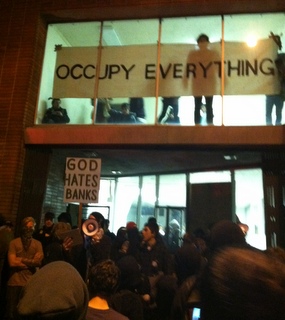
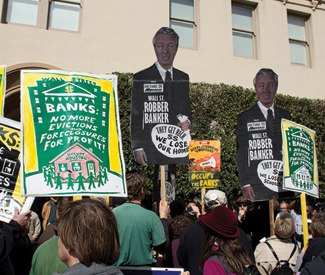
My first reaction to today’s news that the popular Millionaires Tax measure was merging with Gov. Jerry Brown’s broad-based tax measure was “What the fuck!?!?” Taxing millionaires had over two-thirds support in recent polls and seemed to clearly tap the tax-the-rich zeitgeist that animated and was amplified by the Occupy movement.

Now, it’s being married to a measure that increases the regressive sales tax and brings the income taxes increases down to those making $250,000 per year, possibly turning more self-interested voters against it. This just seemed to blow a golden opportunity to do the one simple thing that most Californians agree we need to do to address the state’s perpetual and deepening fiscal crisis: tax the rich.

But then I talked to Assembly member Tom Ammiano, someone with longstanding and unwavering progressive values, and he said, “It’s the art of the deal. It’s acceptable to me, not because it’s perfect.” While he’s not a fan of sales tax increases, he explained how it improves upon the Millionaires Tax in a couple key ways, and that is finally represents some new political cooperation after years of frustrating dysfunction in Sacramento.

“This is something we can build on,” Ammiano told me. “It’s a pretty good coming together.”

Clearly, there is value in creating a functional center-left coalition to counteract the inflexible conservatism that a shrinking minority of Republicans has used to mindlessly block all revenue measures, defund education, and plunge the state into a serious fiscal crisis. And it is good strategy  to reduce the number of competing tax measures on the ballot, and to broaden the coalition of supporters.  

But beyond those tactical benefits, the new measure is worth supporting on its merits. Ammiano notes that it actually raises more money than the Millionaires Tax (about $2 billion per year more) and frees up how that money can be spent (rather than limiting it solely to education).

“We raise more money over more years and we cut back his sales tax increase,” said Steve Hopcraft, a spokesperson for the campaign, noting that Brown’s proposed half-cent sales tax increase is now a quarter-cent increase and the measure now raises $3.3 billion per year from the top 2 percent of wage earners. “It’s a progressive measure that has almost a consensus now…It’s basically what we were proposing but with a quarter percent increase in the sales tax.”

And a expiration date that the Millionaires Tax didn’t have. But while the sales tax increase sunsets in four years, the income tax increases — which range from a 1 percent bump for $250,000 earners to 3 percent for those making more than $1 million — last for seven years.

So Brown’s measure, which had broad institutional support, gets better. And the Millionaires Tax — developed by the California Federation of Teachers and others and receiving strong popular support — gets watered down just a bit. I suppose that alright, if they can still make the ballot and win over voters in November.

That’s a big “if,” perhaps bigger today than it was yesterday. And if supporters of this measure blow this important opportunity — after all, the threshold for approving tax increases drops to a simple majority only during presidential elections, so the stakes now are high — then we’ll all pay a heavy price for this decision. 

Interviewing Anonymous

3

yael@sfbg.com, steve@sfbg.com

There have always been journalists and activists devoted to safeguarding the free flow of information, but the age of the Internet has brought a new set of opportunities and challenges — and a new generation of loosely affiliated online enforcers collectively known as Anonymous.

This network of so-called “hacktivists” from around the world organize operations ranging from physical protests to cyber attacks on corporate websites, involving anything from small groups carrying out someone’s idea to large groups using downloaded software to launch sophisticated attacks on high-profile villains or in defense of embattled heroes.

“We are Anonymous. We are Legion. We do not forgive. We do not forget. Expect us,” is a common tagline members of the group use in announcing its campaigns, often through YouTube videos and accompanied by imagery of a suit with a question mark for a head or someone wearing the Guy Fawkes mask popularized by the film V for Vendetta, with its theme of the masses rising up against injustice, driven by the power of basic ideas about justice (see “Remember, remember the 5th of November,” 11/1/11).

The idea of the online community rising up in collective action under the banner of Anonymous first appeared around 2003, but it really caught on and went viral in the last few years, first when Anonymous organized global protests outside Church of Scientology offices in 2008 and again at the end of 2010 when Anonymous defended Wikileaks’ release of secret diplomatic cables, shutting down the websites of Visa, Amazon, PayPal, and other companies that cooperated with the U.S. government in trying to freeze Wikileaks’ assets.

Here in San Francisco, Anonymous helped organize and coordinate the waves of protests directed at BART in August 2011 after the agency shut down cell phone service to try to disrupt a protest of the latest fatal shooting by a BART police officer. It was through those protests that some of the earliest organizers of Occupy San Francisco say they met and began working together, and Anonymous has shown strong support for the Occupy movement.

So, for this year’s FOI Issue, we decided to chat up an Anonymous member who is active in the group’s discussions on its Internet Relay Chat (IRC) channels, which are hard to find and prone to being shut down whenever someone fears security has been breached. The following are excerpts from that interview:

SFBG Is there a philosophy behind the work Anonymous does?

ANON You should really ask the hive mind. We are all Anon, not just a single person. But I will answer you. There are a few things that bind all of Anon together: Justice, freedom, personal joy. We just want to live our lives normally and happily, and we believe there is a power stopping us from doing so, so we decided to band together and do something about it.

SFBG We’ve written a lot about Occupy and it’s the same thing: Everyone can only represent themselves.

ANON Occupy is the next step, I believe. But that’s just me. Occupy is the forum where people gather transferred into the real world. It’s just one manifestation of the hive mind in reality. There may be another one in the future.

SFBG How is organizing with Anonymous different from organizing in the real world?

ANON Safer I suppose. Convenience. We are only at the mercy of what’s out there in cyberspace. We aren’t going to be beat down by a cop who has gotten drunk on power. In the real world, it’s dangerous to gather in numbers. It’s come to a point where even a little dissent under the First Amendment can turn you into an “enemy” of a country you love so much.

Anon, we are people. We come together. We feel like doing something, we do it. We separate; it’s not always the same people. There is very, very, very little organization.

SFBG How does Anonymous tend to organize? Are raids the most common form of political protest?

ANON Raids can be and cannot be, depends on your mood. Sometimes it is, sometimes it’s not. I have personal views on raids as a protest. But all I can say to that effect is, it is simply one means of a protest. There is no damage. Just an online sit-in.

SFBG Can you describe how that process works, in which some ideas turn into action and some just remain ideas?

ANON People just agree on it, or talk about which is a good idea and which is a bad one. You see it every day on the IRC channel, for example. The bad ones we disagree on. We all input into one another’s conversation. Even if our idea is wrong and we see truth in another, there is no judgment for being wrong.

SFBG What about people who aren’t great with computers or would have no idea how to find this chatroom. Would they be helpful? Would you want them to get involved?

ANON There are Anons everywhere. They talk to people and show them how to get here. I’ve showed people and others in this room have showed people. And this is just one congregation. There are many. Yes we want more people involved. We want the average Joe to be involved. You don’t need computer skills to be a part of anonymous. Just ideas, or questions. Just wanting to search for the truth of the world.

SFBG Does Anonymous have ideas and faith everyone in the group believes in?

ANON No. There are some ideas, but no faith. Faith, I believe, is really personal. But ideas, yes, we have many. And everyone ideas are important, whether they are brilliant or stupid, because they are another person. I guess respect and appreciation for other people for who they are is something we all agree on.

SFBG Websites targetted for recent raids have included those of the Vatican, AIPAC. How would you describe the pattern or category that most targets fit into?

ANON I guess I could say, corrupt. And there is proof of corruption. We don’t ever move without proof. But other than that, I am not at liberty to say.

SFBG It’s not based on corporate greed or crimes?

ANON I am really not at liberty to say. Anons come from all walks. We attack what we think is wrong, as a collective. It doesn’t always have to be corporate greed. It has to be crime. Personally I don’t care how greedy a company is. But when they do something wrong, I react. I’m sure there are some like minds in Anon, but I can’t speak for everyone.

A good example is back when PayPal, Mastercard, and Visa refused to release funds to Wikileaks. The money belonged to Wikileaks and the middle men would not release it. The money was donated, and they refused to release it…We saw it as wrong. It also hurt the free flow of information, of revealing what’s going on behind closed government doors. Who are they to decide those things should be kept secret? The people want to know and they should know. I suppose this brings us to another of Anon’s ideas that we mostly believe in, transparency.

SFBG Is there anything that should be kept secret?

ANON When it comes to governments, no. When it comes to personal life, yes.

SFBG What about personal lives of government officials?

ANON Of course that should be kept private. But when it involves the rest of the country, we are at an impasse. If they want certain details kept private, fine by me. But if they want to make back door deals, that is wrong. People should know what the government is doing. The only place where secrecy can be defended that I see at this moment is military defense, but even that can be easily corrupted. So we want to know.

SFBG What about Bradley Manning’s alleged leaks? Those were about the military.

ANON Personally, I think there is a danger. But as a whole, we want to know. Because secrets left in the hands of a few can become corrupt. We should all understand one another.

It sounds like an ideal, but universal brotherhood, why is it so far off a thought? Why can’t we all just understand one another instead of going out and fighting? A lot of wars in the past have had many secrets, many back door dealings, many deaths that could have been avoided. If people just knew everything that happens all the time, if people just knew the truth, wouldn’t we care more?

SFBG Care more about what?

ANON About others. We are human, we laugh, we love, we share joy, we stand by and help people. This type of society is separating us, the Internet unites us. It’s what being a human being is about. We are a whole as a species, not an individual,

SFBG A sense of community is an important part of it?

ANON I don’t know, but I suppose it does hit our need for belonging. It’s just one place we belong. A community is the side effect I think of just coming together and sharing ideas. Not a bad side effect, but a side effect nonetheless

SFBG How does the concept of diversity factor into this? It could be all old white men in Anon and no one would know, but that could still affect what ideas come out.

ANON Well, because personally I am not old or white — as to my gender, I’ll keep that anonymous — and I am a part of it. I share ideas. I couldn’t care less. It’s the ideas that unite me to other Anons. Some ideas do separate me from some, but there is middle ground everywhere. And true news and an open mind, I believe, can help people find middle ground.

Oakland police keep track of “anarchists”

26

Oakland Police Department’s internal communications about the Occupy Oakland movement, which the Guardian obtained through the California Public Records Act, reveal interesting patterns of what officers deem important to note about protesters.

Officers’ reported observations of the crowd generally concern activity, movement, and sometimes mood. However, there are also mentions of the percieved political affiliations of protesters. In an Oct. 24 briefing, a plainclothes officer, having strolled through the encampment, reports that “the group is diverse, made up of persons including self proclaimed anarchists, labor unions, long term homeless individuals, special cause supporters and others.” 

But by Nov. 2, it seems, all other categories fall away and officers seem interested in reporting on only one perceived type of protester: anarchists. 

Police make several reports in the notes of where and when they’ve noticed “anarchists” or “anarchist behavior.” 

In activity logs reporting “major events” throughout Oct. 25, police include anarchist sightings in that category. In the afternoon, there is “black block (sic) spotted, approximately 12.”

When protesters briefly occupied the Travelers Aid Society building on Oct. 25, police reported “10 anarchists on the roof and inside.”

In an afternoon planning meeting Nov. 3, an officer describes the scene on the streets: “there have been reports that there were 5000 people with relatively no injuries. There seem to be people dressed in regular clothing displaying anarchist behavior.” 

A press release from Nov. 2 also states that “the Oakland Police Department has identified a small group of anarchists roaming through the crowds. OPD is focused on preventing illegal activity while affording the majority their rights to assemble and march.”

It seems that those officers reporting on the crowd equate anarchists with illegal activity, and believe they can identify adherents to anarchism based on appearance and behavior.

Anarchism is a political ideology, and not illegal. Yet officers apparently count out individuals that they perceive as anarchists. 

While popular stereotypes associate illegal activity such as vandalism with anarchism, many who identify with anarchist principles have not broken laws in that fashion. In fact, these documents imply that police may be associated with another illegal activity; targeting some of those they protect and serve based on political belief.

Freeing the information

0

news@sfbg.com

The Society of Professional Journalists, Northern California chapter, will honor champions of the First Amendment at the 27th annual James Madison Awards Banquet on Thursday, March 15, at the City Club of San Francisco.

William Bennett Turner, who has spent his career defending the First Amendment and civil rights, as well as 25 years teaching new generations of journalists and attorneys, is to receive this year’s Norwin Yoffie Award for Career Achievement from the Society of Professional Journalists, Northern California Chapter.

Turner heads a list of a dozen recipients of the James Madison Awards that SPJ NorCal presents annually to champions of the First Amendment and freedom of information.

In his legendary career, Turner has argued three cases before the U.S. Supreme Court, two on First Amendment rights, published more than 40 law review articles and taught First Amendment law at the University of California, Berkeley, for 25 years. He was instrumental in overhauling conditions in the Texas prison system and in 2011 he published the critically-acclaimed book, Figures of Speech: First Amendment Heroes and Villains.

The Yoffie award is named for one of the founders of SPJ NorCal’s Freedom of Information Committee, who as an editor and publisher of the then-family-owned Marin Independent-Journal was a vigorous advocate for transparency and accountability in the public-services sector. Other honorees are:

– Roger Woo, a teacher at Tokay High School in Lodi, California, has forged a strong reputation for quality teaching over decades of instruction. He has seen the work of his students recognized hundreds of times for stories, photos and layout. And in the words of a former student, now a newspaper publisher, Woo taught ethics, pride, and professionalism. Woo will be honored with the Beverly Kees Educator Award, named for a late, former SPJ NorCal president who was an educator and nationally recognized journalist.

– Attorney Cindy Cohn, legal director of the Electronic Frontier Foundation, will receive the Legal Counsel award for her litigation and oversight of countless significant First Amendment and open government cases. She is currently challenging the National Security Agency for alleged spying on the communications of Americans.

– Erin Siegal is being honored in the Author category for her investigation of human rights abuses in Guatemala’s adoption industry, as well as the U.S. government’s role, in which children have been stolen, sold, and offered as orphans to well-intentioned Western parents. Her book, Finding Fernanda, has received wide acclaim.

– The Hercules Patch, the local news site operated by America Online, receives the News Media award for its dogged tracking of the questionable financial management practices in the East Bay city of Hercules. Patch produced more than 13 investigative stories and 100 daily stories, and created 20 databases to follow the money.

– The San Francisco Chronicle, also will be honored in the News Media category for keeping a spotlight on the aftermath of the deadly PG&E natural gas line explosion and fire in San Bruno. The Chronicle’s persistence on the story kept readers abreast of the political fallout, the bureaucratic failings, and reform measures meant to prevent another such disaster.

– Tim Redmond, executive editor of The San Francisco Bay Guardian, receives the Professional Journalist award for his investigation of state agencies’ legally questionable acquisitions of a drug used for lethal injections that is no longer produced in the United States.

– Patrick Monette-Shaw, this year’s Advocacy award recipient, spent nearly two years following a crooked money trail to expose mishandling of millions of dollars at San Francisco’s Laguna Honda Hospital. The scandal he reported in the Westside Observer and his examiner.com articles led to an investigation of the city controller’s Whistleblower program.

– Susie Cagle, a cartoonist and journalist, has earned this year’s Cartoonist Award for her dedicated reporting on Occupy Oakland and for portraying the confrontation through her art. Additionally, she stood up for the rights of all journalists after being arrested at an Occupy Oakland rally that turned violent.

– Citireport.com, produced by Larry Bush, gets the accolade in the Community Media category for shining a bright light not only on San Francisco government but also on the city’s Byzantine political world. Bush, as editor and publisher, has spent nearly 30 years fighting to keep city government publicly accountable.

– Allen Grossman is the recipient of this year’s Citizen award for his efforts over the past several years to advance open government at San Francisco City Hall, whether by prodding the city’s Sunshine Ordinance Task Force to hold agencies and public officials accountable or by prying loose disclosable records that Ethics Commission staff aides wanted to withhold.

– The Bay Citizen, which put campaign finance data to good use, is to receive the Computer-Assisted Reporting award for its detailed political database on the San Francisco mayor’s race in 2011. The Bay Citizen made it easy to track contributions of every stripe. In addition, The Bay Citizen’s use of police records and public input has produced a highly interactive chart of bicycle accidents, letting riders pinpoint the most dangerous routes in the city.

The James Madison Freedom of Information Awards is named for the creative force behind the First Amendment and honors local journalists, organizations, public officials, and private citizens who have fought for public access to government meetings and records and promoted the public’s right to know and freedom of expression. Award winners are selected by SPJ NorCal’s Freedom of Information Committee.

JAMES MADISON AWARDS BANQUET

Thu/15 reception at 5:30 p.m., dinner and awards ceremony at 6:30 p.m., $50 SPJ members and students/$70 general admission

City Club of San Francisco

155 Sansome, SF

www.spjnorcal.org

SFPD-FBI spying restrictions could face mayoral veto

8

If the San Francisco Police Department isn’t working with the FBI to secretly spy on law-abiding local residents – as a secret document released last year indicated they had the authority to do – then why are Police Chief Greg Suhr, Mayor Ed Lee, and others opposing legislation that would ban such surveillance?

That’s the question that longtime police policy expert John Crew of the American Civil Liberties Union of Northern California is asking as he tries to get two more members of the Board of Supervisors to join the six current co-sponsors of the legislation, which the board will consider on Tuesday, in anticipation of having to override a mayoral veto.

“What’s the harm?” Crew told us. “There’s something that doesn’t add up here.”

As we reported at the time, the ACLU last year obtained a 2007 memorandum-of-understanding between the SFPD and the FBI establishing procedures for the Joint Terrorism Task Force, in which SFPD personnel would be under the command of the FBI, circumventing local and state restrictions on domestic surveillance of people who haven’t committed any crimes.

After the ensuring controversy and under pressure from members of the Police Commission, Police Chief Greg Suhr issued Bureau Order #2011-07 to clarify that SFPD personnel are bound by local and state privacy protections. “With this Bureau Order, the language of the 2007 Memorandum of Understanding no longer applies and SFPD personnel are bound by the provisions of the 2011 Order,” SFPD Public Information Officer Albie Esparza told us last month.

Suhr and Lee have each made public statements indicating that the new legislation – developed by the ACLU and carried by Sup. Jane Kim with five progressive supervisors as co-sponsors – is redundant and unnecessary. But Crew and the ACLU made a Sunshine Ordinance request for any modifications to the MOU or communications with the FBI indicating that SFPD’s contractual obligations no longer apply, and there were no such documents.

“When you talk about civil rights, you put it in writing,” Crew said. “This really doesn’t add up. We’re getting conflicting explanations. And the bottom line is this problem has been solved in Portland.”

When a similar issue arose in Portland, Oregon, civil libertarians pressured the city to withdraw from its MOU with the FBI and create a new one that includes restrictions on the surveillance of people who were not suspected of any crimes, but who may have been subjected to FBI attention because they were Muslims or because of their political beliefs. And Crew said it didn’t harm the relationship of the two policing agencies.

At an emotional hearing last week before the Public Safety Committee, a long string of representatives from groups that have been singled out for FBI surveillance that violated protections under the California Constitution – Muslims, anarchists, anti-war activists, Occupy demonstrators, immigrant groups, environmentalists, animal rights activists, etc. – urged supervisors to stand up for them. The legislation has a long and diverse list of organizational supporters.

Sup. Scott Wiener – one of two supervisors that Crew is hoping to win over – told us, “I agree that local surveillance rules should govern. But I’m not convinced that we need this legislation.”

Wiener said he still hasn’t made up his mind, and he plans to speak with Portland’s mayor before Tuesday’s hearing.

So why wouldn’t he support legislation that simply made his position official city policy? Wiener said he’s wary of telling SFPD how to do law enforcement and with “reducing the ability of the department to be flexible in the future.”

Crew said representatives of the Mayor’s Office, which did not respond to our calls for comment, have told him that Lee would defer to the SFPD’s determination of whether to sign the legislation. “That’s a pretty stunning claim,” Crew said, “which does not bode well in terms of reasonable civilian control of the SFPD for the next few years. I sure hope they back off that.”

Kim, who has a good relationship with the Mayor’s Office, also did not return calls for comment. But Crew was incredulous about why anyone who believes in civil liberties would oppose this legislation, telling us, “This is not a radical stand here.”

From bhangra to Brazilian horns: Celebrate International Women’s Day at Yoshi’s

0

International Women’s Day has been around to raise consciousness and support women’s rights since the early 1900s, and this year the party happens Thu/8. Tomorrow morning, people across the Bay Area will be rising up to join women-led demonstrations like Women Occupy and Rally Against Sex Discrimination and Sex Harassment to show our support for the XX-chromosoned all around the world. But after the daytime marches and the protests, Yoshi’s San Francisco Jazz Club invites us all to end the night at International Women’s Day’s official after party — an evening of notable speakers and intimate performances benefiting two upcoming events, Earth Day and Peace Day.

March 8 has become established as the annual date to globally recognize gender issues and celebrate feminism. The United Nations’ official 2012 theme for the day is “Empower Rural Women — End Hunger and Poverty,” and tomorrow night’s celebration at Yoshi’s should evoke that message — seasoned in local context and jazzy flavor. 

Patricia Maginnis, a long-loved activist and cartoonist, is one of the most esteemed feminist pioneers whose work helped the fight for safe, accessible abortions. She helped establish the Association to Repeal Abortion Law in California in 1966, and helped 12,000 women find abortions outside the country by 1969. Maginnis continues to make active contributions to spreading awareness of women’s rights, and will be speaking at Yoshi’s about the latest feminist issues concerning contraception and cosmetic safety. 

Big Brother and the Holding Company headlines tomorrow night’s stunning bill of SF-based musicians. It was Janis Joplin’s original band, and its experimental and raw sounds played a significant role in establishing San Francisco’s psychedelic music scene. 

Non Stop Bhangra, a monthly bhangra dance night in San Francisco that blends traditional Punjab folk and dance music — will also be bringing the party to Yoshi’s. The diverse line up will also feature Brazilian horn-driven funk band, Mondo Loko, sexy and soulful genre-bender Valerie Orth, soul-rock musician and former classical opera singer Pamela Parker, the soulful melodies of the harmonic powerhouse Lesley Grant, and the versatile, exotic vocals of Ziva.  

International Women’s Day Celebration

Thu/8 8 p.m., free for lounge-only; $35 for main stage access 

Yoshi’s San Francisco Jazz Club

1330 Fillmore, SF 

(415) 655-5600

www.yoshis.com


Occupying the Capitol

5

It’s an unseasonably hot day at UC Davis, and student activists are milling around a tent city, set up especially for 100 people arriving from a four-day March on Education. The school, one of the hubs of the Occupy movement, gained notoriety when public safety Officer John Pike casually pepper sprayed a line students during a sit-in back in November. Now, officers bike through the idyllic scene, smiling and chatting up occupiers.

Everyone is preparing for the next day, March 5, the statewide day to defend education that will bring thousands of students and teachers to Sacramento to demand an end to budget cuts and fee hikes at California’s schools, community colleges, and universities.

Those on the march hope to highlight the importance of this issue, marching 79 miles from the Bay Area. The first night, the march stayed in Richmond, and the next day Richmond’s Mayor Gayle McLaughlin came out to welcome them.

Students march annually on Sacramento, and say they won’t stop until education is affordable (or, as some would demand, free). A climate of worldwide protest over disparities in wealth and opportunity, including Occupy protests in the United States, helped fuel a larger than usual turnout this year.

More than 5,000 people converged in Sacramento March 5 and marched to the Capitol building, occupying the Rotunda all day. Many chanted “no cuts, no fees, education must be free.”

Community college student throughout the state are reeling from the cuts, and resulting fee hikes—course units, once free, were raised from $26 to $36 per unit last year, and will be increased another $10 this summer. These costs go towards closing the state budget deficit, and not toward a bigger course catalogue; classes continue to be slashed.

Frances Gotoh of San Bernardino Valley College is back at school after being laid off from her longtime job at Bank of America. She said she desperately needs the retraining; without it her job prospects look dim. She needs to support her family—her 20-year-old son is also a college student—but says she can’t afford the increasing fees. “Why is education being taken away?” asked Gotoh. “It belongs to the people.”

Josselyn Torres, a psychology major at Sonoma State University, felt similarly. “Every year, the fees are getting higher but the class size is getting bigger,” said Torres, who noted that many of her friends won’t be graduating with her because so many of the classes they needed were cut. “The politicians have all gone to college. If they keep cutting our education, how can we make it as far as them?”

When the march reached the Capitol, student and state government leaders spoke on the importance of education. Students demanded an end to fee hikes and budget cuts. Assembly Speaker John Perez (D-Los Angeles) and Senate President Pro Tem Darrell Steinberg (D-Sacramento) praised student activists and expounded on the necessity of accessibility to education. Almost all speakers decried the two-thirds majority needed to raise taxes, allowing just a few Republicans to block them.

Lt. Gov. Gavin Newsom also spoke, describing the need to support education in staunchly free-market terms: “You can’t have an economic development strategy without a workforce development strategy.”

Periodically, the crowd interrupted Newsom and other politicians in the midst of making promises with chants of “show us.” They also chanted this election year threat: “You’ll hear us out or we’ll vote you out!”

Around 12:30 p.m., the permitted rally ended and thousands dispersed. About 400 stayed to “Occupy the Capitol.” The group streamed into the building and into the rotunda. California Highway Patrol officers, responsible for policing the Capitol, blocked more than 150 from entering the central area. So, communicating via the Peoples Mic with several rounds of crowd repetition for every sentence spoken, the group participated in a statewide general assembly.

Some building employees showed support, but the only politician to sit down with the protesters was Newsom, who sits on the UC Board of Regents and CSU Board of Trustees. He chatted with students, some of whom requested that he ask police to stop blocking students from meeting in the same area; he didn’t do so, but was able to convince them to give protesters in the rotunda access to bathrooms.

The group managed to collectively decide on demands of the state: support the Millionaire’s Tax ballot initiative, repeal Prop. 13, cancel all student debt, fund all education through college, and democratize the Board of Regents. When building closed at 6 p.m., officers declared the assembly unlawful and arrested 70 who refused to disperse.

Meanwhile, another 400 or so attended a permitted rally on the Capitol lawn called by several Sacramento labor unions to support Occupy the Capitol.

Over the past five years, education funding in California has been cut drastically. Spending per K-12 student per year has gone down by almost $2,000 and higher education has seen program cuts and tuition hikes. Gov. Jerry Brown’s latest budget proposal includes still more cuts to California colleges and universities.

Several proposed ballot initiatives are designed to address this. An initiative sponsored by Brown would bring spending per student per year up by $1,000, stabilizing at $7,658 (it was $7,096 in 2011-12) and reversing a five-year slide. But it would still be less than 2007-08, according to a report from the California Budget Project (CBP).

That report shows K-12 education spending is the biggest piece of the state budget, although California ranks dismally low compared to other states for spending on K-12 education: 47th in the country.

The governor’s proposal would raise funds with a combination of a tax increase for those earning $250,000 and over per year and a sales tax increase. But critics say the increase in the sales tax, which is notoriously regressive, would hurt lower and middle income families.

The measure is up against other potential ballot initiatives that would raise revenue strictly from the wealthiest Californians. The so-called Millionaire’s Tax, for example, would raise funds for education by increasing taxes on those making $1 million or more per year. The Millionaire’s Tax also has the advantage of resulting in a permanent change in the law, while Brown’s measure would apply only for the next five years.

“California’s problems have also been exacerbated by tax cuts, one-time ‘solutions,’ overly optimistic assumptions, and the fact that the two-thirds vote requirement for the legislature to approve any tax measure has blocked adoption of a balanced approach towards bridging the budget gap,” according to the CBP report.

Teachers’ unions are divided over the best ballot measure. The California Teachers’ Association has endorsed Brown’s measure, emphasizing that it includes a plan to close the budget deficit.

“The governor’s initiative is the only initiative that provides additional revenues for our classrooms and closes the state budget deficit, and guarantees local communities will receive funds to pay for the realignment of local health and public safety services that the Legislature approved last year,” said Dean Vogel, CTA president, in a press release.

But the Millionaire’s Tax was sponsored by the California Federation of Teachers, and it has now been endorsed by this student general assembly. John Rizzo, president of the City College of San Francisco Board of Trustees, also endorsed the measure.

“We’ve got to tell the state of California that we cannot continue this. We cannot continue the cuts to our community colleges, to UCs, to the California State Universities,” said Rizzo, speaking at a March 1 rally in San Francisco.

According to a recent report, of five polls conducted throughout California, each initiative has majority support, but voter prefer the Millionaire’s Tax, with a recent Field Poll showing 63 percent support.

Legislators are also at work trying to increase education funding. Assembly Speaker Perez has introduced a bill that would slash tuition fees by two-thirds at CSU and UC schools for students of families making less than $150,000 per year. The bill would also allocate funding to city colleges throughout the state, for them to determine how to best use the money.

The cost of the plan, about $1 billion, would be paid by eliminating a corporate tax loophole that the Legislature approved in 2009, which would allow companies to choose the cheaper of two formulas for calculating their taxes. Critics have called the legislation bad for business, saying that removing tax incentives would hurt California companies.

“The California Middle Class Scholarship Act is very simple,” Perez told students at UC Davis when he unveiled the bill on Feb. 3. “Too many families are getting squeezed out of higher education. For students whose families make $150,000 a year or less, too much to qualify for our current financial aid system, but not enough to be able to write a check for the cost of education, without feeling that pinch, the Middle Class Scholarship Act reduces fees at the UC system and at the CSU system by two-thirds, giving tremendous assistance to those families to make college affordable again.”

Education advocates say California needs to do something to reverse the spiraling cost of higher education in California, which could do long-term damage to the state, affecting young people and businesses that need skilled workers and spiraling out from there. And these advocates say this short-sighted strategy is easily preventable if there is the political will to address it.

“There are a lot of sources of revenue that are not being taken advantage of,” Lisa Schiff, a member of Parents for Public Schools of San Francisco, told us.

Even if tuitions were lowered or—as the most ambitious of protesters demand—higher education was made free, most former students would still be saddled with massive debt. As costs have risen, debts of hundreds of thousands of dollars are commonplace. With the job market recovery slow and painful, graduates often feel helpless to pay back their debt.

Robert Meister, a professor of Political and Social Thought at UC Santa Cruz and president of the Council of UC Faculty Associations, has long argued that the state’s higher education systems ought to focus on keeping tuitions low and student debt in check (see “In the red,” 1/11/11).

Yet he told us that growing income inequality makes people even more desperate for a college education and willing to accept levels of student debt that limit their ability to become anything more than corporate cogs after graduation. “Their ability to raise tuition is a function of the growth of income inequality,” he told us.

In his speech at UC Davis, Perez cast the issue as one of a disinvestment in the state’s future: “California’s public colleges and universities has been one of our most prestigious institutions, and, unfortunately, because of the collapse of the economy, we’ve moved away from fully investing in those universities and colleges.”

A month later, the school again served as a backdrop for illustrating the problem and calling for reform. Dani Galietti, a MFA student at UC Davis who was setting up a performance art piece when I arrived, greets everyone cheerfully and is thrilled about the Occupy movement.

“I wanted to share myself and my work with the movement,” Galietti tells me while taping a “paper trail” to the sidewalk; she plans to walk on it with home-made stamps attached to the bottoms of her shoes.

But her mood darkens when I ask about her student debt. “I came out of five years of education $100,000 in debt,” says Galietti, “and I’m not the only one.”

She is a first generation college student, she explains, who helped pay for school with McNair scholarships.

“I grew up one of five, with a single mother,” Galietti explains. “We struggled my whole life, as a lot of people have, financially.”

“So many people are graduating with so much debt. There’s this looming fear, fear and hopelessness. The economy’s bad, the job market sucks. I’m so thankful that they’re out here. People are active, they’re making a difference.”

“We need education,” Galietti says. “I mean, knowledge is power.”


Stage Listings

0

Performance times may change; call venues to confirm. Reviewers are Robert Avila, Rita Felciano, and Nicole Gluckstern. Submit items for the listings at listings@sfbg.com. For further information on how to submit items for the listings, see Picks.

THEATER

OPENING

“Celebration of Women’s History Month” Thick House, 1695 18th St, SF; www.3girlstheatre.org. $30. Opens Thurs/8, 7:30pm. Dates and showtimes vary. Through April 1. 3Girls Theatre Company launches its inaugural season with a celebration of new works (in both full-production and staged-reading form) by female Bay Area playwrights.

It’s All the Rage Studio Theater, Marsh San Francisco, 1062 Valencia, SF; (415) 282-3055, www.themarsh.org. $15-50. Opens Thurs/8, 8pm. Runs Thurs, 8pm; Sat, 8:30pm, Sun, 7pm. Through April 15. Longtime comedian and radio host Marilyn Pittman’s solo play wrestles with the legacy of her parents’ violent deaths in a 1997 murder-suicide initiated by her father. It’s disturbing material that Pittman, a stout middle-aged woman with a gregarious and bounding personality, approaches indirectly via a good deal of humor — including recounting the first time she did her growing-up-lesbian bit before her mother in a DC comedy club. But the pain and confusion trailing her for 13 years is never far behind, whether in accounts of her own battle with anger (and the broken relationships it has left in its wake) or in ominous memories of her too complaisant mother or her charming but domineering father, whose controlling behavior extended to casually announcing murderous dreams while policing the boundaries of his marriage against family interference. A fine mimic, Pittman deploys a Southern lilt in playing each parent, on a stage decorated with a hint of their Southwestern furnishings and a framed set of parental photographs. In not exactly knowing where to lay blame for, or find meaning in, such a horrifying act, the play itself mimics in subtler form the emotional tumult left behind. There’s a too brief but eerie scene in which her veteran father makes reference to a murder among fellow soldiers en route to war, but while PTSD is mentioned (including as an unwanted patrimony), the 60-minute narrative crafted by Pittman and director David Ford wisely eschews any pat explanation. If transitions are occasionally awkward and the pace a bit loose, the play leaves one with an uncomfortable sense of the darker aspects of love, mingled with vague concentric histories of trauma and dislocation in a weird, sad tale of destruction and staying power. Note: review from the show’s 2009 run at the Marsh. (Avila)

Julius Caesar Buriel Clay Theater, African American Art and Culture Complex, 762 Fulton, SF; 1-800-838-3006, www.african-americanshakes.org. $10-30. Opens Sat/10, 8pm. Runs Sat, 8pm; Sun, 4pm. Through April 1. African-American Shakespeare Company performs a version of the Bard’s classic set during the ongoing civil wars of West Africa.

BAY AREA

Now Circa Then Lucie Stern Theatre, 1305 Middlefield, Palo Alto; (650) 463-1960, www.theatreworks.org. $19-69. Previews Wed/7-Fri/9, 8pm. Opens Sat/10, 8pm. Runs Tues-Wed, 7:30pm; Thurs-Sat, 8pm (also Sat, 2pm); Sun, 2 and 7pm. Through April 1. TheatreWorks performs Carly Mensch’s comedy about a romance that blooms between two historical re-enactors.

ONGOING

*Blue/Orange Lorraine Hansberry Theatre, 450 Post, SF; (415) 474-8800, www.lhtsf.org. $43-53. Thurs-Sat, 8pm (also Sat, 2pm). Through March 18. Lorraine Hansberry Theater offers an uneven but worthwhile production of British playwright Joe Penhall’s sardonic comedy of ideas and institutional racism, an intriguingly frustrating three-hander about a young doctor (a bright Dan Clegg) at a psychiatric teaching hospital who begins a battle royal with his suave and pompous supervising physician (a comically nimble Julian Lopez-Morillas) over the release of a questionably-sane black patient. Originally brought in by police for creating a disturbance, Christopher (the excellent Carl Lumbly) still exhibits signs of psychosis and his ability to care for himself seems doubtful to the young doctor treating him. The older physician appeals to the patient’s general competence, hospital procedures, the shortage of beds, and the exigencies of career advancement in countering the younger doctor’s insistence on keeping the patient beyond the mandatory 28-day period required by law. For his part, Christopher, nervous and rather manic, is at first desperately eager to be released back to his poor London neighborhood. Competing interviews with the two doctors complicate his perspective and ours repeatedly, however, as a heated debate about medicine, institutionalization, cultural antecedents to mental “illness,” career arcs, and a “cure for black psychosis,” leave everyone’s sanity in doubt. Although our attention can be distracted by a too-pervading sound design and less than perfect British accents, Edris Cooper-Anifowoshe directs a strong and engaging cast in a politically resonant not to say increasingly maddening play. (Avila)

*Fool For Love Boxcar Studios, 125A Hyde, SF; www.boxcartheatre.org. $25. Showtimes vary. Through April 14. Another installment of Boxcar Theatre’s epic Sam Shepard repertory project, Fool for Love inaugurates their newest performance space within their Hyde Street Studios location. A depressingly realistic reproduction of a claustrophobic motel room, the tiny jewel-box theatre provides no refuge for the actors, and certainly not for the audience, each trapped beneath the pitiless gaze of the other. And if that too-close-for-comfort intimacy doesn’t get to you, the intentionally difficult subject matter — a “typical” Shepardian foray into alcohol-fueled ranting, violence, incest, and casual cruelty — probably will. Shepard’s strength in monologue shows itself off to meaty effect from May’s (Lauren Doucette) melancholy description of her mother’s love affair with the Old Man (Jeff Garrett) to Eddie’s (Brian Trybom) candid admittance to May’s timid suitor Martin (Geoffrey Nolan) that he and May are not cousins at all but half-siblings who have “fooled around” with each other. In addition to the reliably strong performances from each of the actors, Fool features a notably clever bit of staging involving the Old Man who appears not as a specter wandering the periphery of the stage, but as a recurring figure on the black-and-white television, interrupting the flow of cheesy Westerns with his garrulous trailer park wisdom and an omnipresent Styrofoam cup filled, one suspects, with something stronger than just coffee. (Gluckstern)

Geezer Marsh San Francisco, MainStage, 1062 Valencia, SF; (415) 282-3055, www.themarsh.org. $25-100. Thurs and Sat, 8pm; Sun, 5pm. Through March 18. Geoff Hoyle’s hit solo show returns.

Glengarry Glen Ross Actors Theatre of San Francisco, 855 Bush, SF; (415) 345-1287, www.brownpapertickets.com. $26-40. Fri-Sat, 8pm. Through March 24. David Mamet’s cutthroat comedy, courtesy of the Actors Theatre of San Francisco.

Maurice New Conservatory Theatre Center, 25 Van Ness, SF; (415) 861-8972, www.nctcsf.org. $25-45. Wed-Sat, 8pm; Sun, 2pm. Through March 25. New Conservatory Theatre Center presents a play about two young men who fall in love in pre-World War I England, adapted from E.M. Forster’s novel.

Merchants Exit Stage Left, 156 Eddy, SF; www.brownpapertickets.com. $10-25. Thurs-Sat, 8pm. Through March 24. No Nude Men Productions performs Susan Sobeloff’s tale of two sisters trying to balance financial stability and career satisfaction.

The Real Americans Marsh Studio Theater, 1062 Valencia, SF; (415) 282-3055, www.themarsh.org. $25-50. Fri, 8pm; Sat, 5pm; Sun, 2pm. Through March 18. Dan Hoyle revives his hit solo show about small-town America.

Scorched American Conservatory Theater, 415 Geary, SF; (415) 749-2228, www.act-sf.org. $10-85. Wed/7-Sat/10, 8pm; Wed/7, Sat/10-Sun/11, 2pm. Lebanese-Canadian playwright Wajdi Mouawad bites off a little more than he can chew, and ACT thus offers a less than satisfying three-hour feast with its stilted production of Mouawad’s 2008 epic about a brother and sister (Babak Tafti and Annie Purcell) sent by their estranged, recently deceased mother’s executor (David Strathairn) on a hunt for her past in her unnamed civil war-torn Middle Eastern homeland. At that point, the story of their mother, Nawal (Marjan Neshat), comes center stage — or rather crisscrosses it with that of her children in a mash-up that only undercuts the potential tension or interest in either plot strand. Director Carey Perloff’s cast also proves unevenly compelling. Strathairn’s Alphonse is a compassionate, slyly wise man who nervously rambles to make up for the extremely laconic and resentful mood of Nawal’s children. But he is of peripheral importance, and his malapropisms are laid on a little thicker than his endearing Quebecois accent, as if betraying the limits of his function onstage. The other characters meanwhile feel too thinly sketched to occupy the middle. As the sad and horrifying details of this Sophocles-inspired tale unfold, there is surprisingly little sense of authentic experience, and much more the feeling of over-indulgence it certain dramatic devices. Between the sententious and ponderous dialogue, strained characterization, and unwieldy storyline is a play flailing away at something beyond its ken or capacity. (Avila)

*Three’s Company Finn’s Funhouse, 814 Grove, SF; www.brownpapertickets.com. $20. Fri/9-Sat/10, 9pm (also Sat/10, 7pm). Some flashbacks are better than the original high. And more real. This time, you can literally “knock on their door” — a beautiful old Victorian in the Western Addition, whose dining room is made up to look like the Santa Monica apartment shared by Jack, Crissy, and Janet, the happy-go-lucky trio at the center of the iconic late ’70s, early ’80s sitcom. Giggly, ribald, and pleasingly stupid, to be sure, the evening also delivers first-class showmanship: Mike Finn (as good-natured goof Jack), D’Arcy Drollinger (as a buxom not to say brawny Chrissy), and former Go-Go’s guitarist Jane Wiedlin (in a spritely turn as Janet) couldn’t be more reminiscent or delightfully arch in their respective roles. Meanwhile, incarnating the Ropers with pitch-perfect inflections, timing, kaftans and sweater vests are the superb duo of Matthew Martin (channeling the frustrated deadpan wit of Mrs. Roper) and Sara Moore (excelling as subdued but occasionally very wacky Mr. Roper). A ticket gets you pilot episode “Man About the House” and “Roper’s Niece” (a suitably randy Laurie Bushman) — plus commercials. Cat Fight and Shoulder Pads’ homey hit, briskly directed by Cindy Goldfield and extended for one more weekend, is must-see reality TV. (Avila)

Tontlawald Exit on Taylor, 277 Taylor, SF; (415) 525-1205, www.cuttingball.com. $10-50. Thurs/8, 7:30pm; Fri/9-Sat/10, 8pm (also Sat/10, 2pm); Sun/11, 5pm. Entering the theater space thought the back door, squeezing alongside a giant fishing net motif, which wraps the entire stage in a fabric grid, almost imperceptibly skews one’s perspective in advance of the show, just a brief twist that sets the tone for this abbreviated epic of abuse, friendship, and revenge. The heroine, an earthy yet somehow fragile maid (Marilet Martinez), inadvertently manages to rile her evil stepmother (Madeline H. D. Brown) for what seems to be the umpteenth time before fleeing into the mysterious wooded Tontlawald, inhabited by joyously frolicking beasts (or boys) and a preternaturally beautiful princess (Rebecca Frank) who immediately adopts her as a friend. Told through snatches of repetitive text, solemnly-intoned and ecstatically sung, and moments of engagingly acrobatic, hyper-stylized movement, Cutting Ball’s Tontlawald meanders through an Estonian fairy tale-hero’s quest, as if told from the perspective of the child protagonist — light on detail, heavy on drama. Inspired by TeatrZAR, the resident company of Poland’s Grotowski Centre, co-directors Paige Rogers and Annie Paladino and choreographer Laura Arrington worked to emulate certain characteristics of its style, notably the emphasis on song. But while there are some gorgeously transcendent moments of musical direction courtesy of Rogers, and of choreography courtesy of Arrington, the work plays out mostly as a disjointed series of striking tableaux, which intrigue the intellect, but somehow fail to inflame the soul. (Gluckstern)

*True West Boxcar Studios, 125A Hyde, SF; (415) 967-2227, www.boxcartheatre.org. $25. Thurs-Sat, 8pm. Through April 7. The first installment of Boxcar Theatre’s four-play Sam Shepard repertory project, True West ushers in the ambitious run with a bang. This tale of two brothers who gradually assume the role of the other is one of Shepard’s most enduring plays, rich with humorous interludes, veering sharply into dangerous terrain at the drop of a toaster. In time-honored, True West tradition, the lead roles of Austin, the unassuming younger brother, and Lee, his violent older sibling, are being alternated between Nick A. Olivero and Brian Trybom, and in a new twist, the role of the mother is being played by two different actresses as well (Adrienne Krug and Katya Rivera). The evening I saw it, Olivero was playing Austin, a writer banging away at his first screenplay, and Trybom was Lee, a troubled, alcoholic drifter who usurps his brother’s Hollywood shot, and trashes their mother’s home while trying to honor his as yet unwritten “contract”. The chemistry between the two actors was a perfect blend of menace and fraternity, and the extreme wreckage they make of both the set (designed by both actors), and their ever-tenuous relationship, was truly inspired. (Gluckstern)

The Waiting Period MainStage, Marsh San Francisco, 1062 Valencia, SF; (415) 282-3055, www.themarsh.org. $15-50. Fri, 8pm; Sat, 5pm. Through March 24. Brian Copeland (comedian, TV and radio personality, and creator-performer of the long-running solo play Not a Genuine Black Man) returns to the Marsh with a new solo, this one based on more recent and messier events in Copeland’s life. The play concerns an episode of severe depression in which he considered suicide, going so far as to purchase a handgun — the title coming from the legally mandatory 10-day period between purchasing and picking up the weapon, which leaves time for reflections and circumstances that ultimately prevent Copeland from pulling the trigger. A grim subject, but Copeland (with co-developer and director David Ford) ensures there’s plenty of humor as well as frank sentiment along the way. The actor peoples the opening scene in the gun store with a comically if somewhat stereotypically rugged representative of the Second Amendment, for instance, as well as an equally familiar “doood” dude at the service counter. Afterward, we follow Copeland, a just barely coping dad, home to the house recently abandoned by his wife, and through the ordinary routines that become unbearable to the clinically depressed. Copeland also recreates interviews he’s made with other survivors of suicidal depression. Telling someone about such things is vital to preventing their worst outcomes, says Copeland, and telling his own story is meant to encourage others. It’s a worthy aim but only a fitfully engaging piece, since as drama it remains thin, standing at perhaps too respectful a distance from the convoluted torment and alienation at its center. (Avila)

BAY AREA

*Body Awareness Aurora Theatre, 2081 Addison, Berk; (510) 843-4822, www.auroratheatre.org. $30-48. Wed/7-Sat/10, 8pm; Sun/11, 2 and 7pm. In Annie Baker’s new comedy, receiving a top-notch Bay Area premiere at Aurora Theatre, peppy psychology prof Phyllis (Amy Resnick) hosts “Body Awareness Week” at her small Vermont college, while back home partner Joyce (Jeri Lynn Cohen) talks to her 21-year-old son Jared (Patrick Russell) about the porn pay-per-view bill he’s racked up. Phyllis contends that Joyce’s introverted, somewhat explosive virgin son (who in addition to bouts of violent anger soothes himself compulsively with an electric security toothbrush) has Asperger’s Syndrome — a diagnosis that Jared, a budding not too say obsessive lexicographer, hotly contests. That same week, the couple hosts a guest artist, Frank (Howard Swain), a breezy man’s man whose career stands squarely on a series of photographs of nude women and girls. The young man seeks sexual advice from the older one, much to Phyllis’s disgust and Joyce’s relief, while also tempting Joyce with the notion of posing for a nude portrait and “reclaiming her body image,” in a well-used phrase. An already delicate balance thus goes right off kilter as, between the poles of Phyllis and Frank, Joyce and Jared chase competing notions and definitions of themselves and the world. In the volatile tension between perspectives, power trips, and extreme personalities, playwright Baker initially pushes a comic form toward an unsettling edge, only to retreat in the end for safer ground and a family-friendly resolution. While that feels like a lost opportunity, Body Awareness is still a stimulating and solidly entertaining evening, brought to life by a warm and dexterous ensemble under fine, lively direction by Joy Carlin. (Avila)

Cabaret Larkspur Café Theater (American Legion Hall Post 313), 500 Magnolia, Larkspur; www.brownpapertickets.com. $25-45. Fri-Sat, 8pm; Sun, 7pm (no show April 8). Through April 15. Independent Cabaret Productions and Shakespeare at Stinson move their production of the Kander and Ebb classic from Fort Mason to the North Bay.

A Doctor in Spite of Himself Berkeley Repertory Theatre, Roda Theatre, 2015 Addison, Berk; (510) 647-2949, www.berkeleyrep.org. $14.50-73. Tues and Thurs-Sat, 8pm (no show March 23); Wed and Sun, 7pm (also Sun, 2pm). Through March 25. Berkeley Rep performs a contemporary update of the Molière comedy.

*The Kipling Hotel: True Misadventures of the Electric Pink ’80s New venue: Marsh Berkeley, 2120 Allston, Berk; (415) 282-3055, www.themarsh.org. $20-50. Sat, 8:30pm; Sun, 7pm. Extended through March 25. This new autobiographical solo show by Don Reed, writer-performer of the fine and long-running East 14th, is another slice of the artist’s journey from 1970s Oakland ghetto to comedy-circuit respectability — here via a partial debate-scholarship to UCLA. The titular Los Angeles residency hotel was where Reed lived and worked for a time in the 1980s while attending university. It’s also a rich mine of memory and material for this physically protean and charismatic comic actor, who sails through two acts of often hilarious, sometimes touching vignettes loosely structured around his time on the hotel’s young wait staff, which catered to the needs of elderly patrons who might need conversation as much as breakfast. On opening night, the episodic narrative seemed to pass through several endings before settling on one whose tidy moral was delivered with too heavy a hand, but if the piece runs a little long, it’s only the last 20 minutes that noticeably meanders. And even with some awkward bumps along the way, it’s never a dull thing watching Reed work. (Avila)

Mesmeric Revelation Berkeley City Club, 2315 Durant, Berk; (510) 558-1381, www.centralworks.org. Thurs-Sat, 8pm; Sun, 5pm. Through March 18. Central Works opens its season of world premieres with Aaron Henne’s Edgar Allen Poe-inspired drama.

The Pirates of Penzance Julia Morgan Center for the Arts, 2640 College, Berk; (510) 845-8542, www.juliamorgan.org. $17-35. Fri-Sat, 7pm (also Sat, 2pm); Sun, noon and 5pm. Through April 1. Berkeley Playhouse performs the Gilbert and Sullivan classic, with the setting shifted to a futuristic city.

Titus Andronicus La Val’s Subterranean, 1834 Euclid, Berk; www.impacttheatre.com. $10-20. Thurs-Sat, 8pm. Through March 31. Impact Theatre takes on the Bard’s bloodiest tragedy.

The World’s Funniest Bubble Show Marsh Berkeley, TheaterStage, 2120 Allston, Berk; (415) 826-5750, www.themarsh.org. $8-50. Extended run: Sun/11 and March 18, 11am. Louis “The Amazing Bubble Man” Pearl returns with this kid-friendly, bubble-tastic comedy.

PERFORMANCE/DANCE

“The Abduction from the Seraglio (Yanked from the Harem)” Marines Memorial Theater, 609 Sutter, SF; www.pocketopera.org. Sun/11, 2pm. Also March 18, 2pm, Berkeley Hillside Club, 2286 Cedar, Berk. $15-39. Pocket Opera performs artistic director Donald Pippin’s witty translation of Mozart’s classic work.

“Arthur in Underland” CounterPULSE, 1310 Mission, SF; www.counterpulse.org. Fri-Sun, 8pm. Through March 24. $15-24. Dandelion Dancetheater performs a new work about a young man whose life is changed when he becomes part of a rock group’s entourage.

“A Circus Celebration Honoring Peggy Ford” Z Space, 450 Florida, SF; www.brownpapertickets.com. Tues/13, 7pm. $20-100. Clowns and other circus performers honor the life and legacy of the late Peggy Ford, a 40-year veteran of the Bay Area and national circus communities.

“Elect to Laugh” Studio Theater, Marsh San Francisco, 1062 Valencia, SF; (415) 282-3055, www.themarsh.org. Tues, 8pm. Ongoing through Nov 6. $15-50. Will Durst and friends perform in this weekly political humor show that focuses on the upcoming presidential election.

“The Eric Show” Milk Bar, 1840 Haight, SF; www.milksf.com. Tues, 8pm (ongoing). $5. Local comedians perform with host Eric Barry.

“Finding the Michaels” Shotwell Studios, 3252-A 19th St, SF; www.brownpapertickets.com. Fri/9-Sat/10, 8pm. Footloose presents Cassie Angley’s solo play about her experiences in post-9/11 New York City.

“Funsch Solos: One on One” Z Space, 450 Florida, SF; www.zspace.org. Thurs/8-Sat/10, 8:30pm; Sun/11, 7:30pm. $15-20. Christy Funsch presents up-close glimpses of her solo dance works, featuring a variety of performers.

“Waters Rising” Dance Mission Theater, 3316 24th St, SF; (415) 273-4633, www.brownpapertickets.com. Fri/9-Sat/10, 8pm; Sun/11, 5pm. $15-18. Locals Zell Dance and dance ceres team up with Boston-based Weber Dance for a weekend showcasing new works.

“The Whole Megillah 2: Uncut” Kanbar Hall, Jewish Community Center of San Francisco, 3200 California, SF. Wed/7, 8pm. Also: Thurs/8-Fri/9, 8pm; Sat/10, 7 and 10pm. Jewish Theatre, 470 Florida, SF; www.jccsf.org. $15-20. The Hub and Killing My Lobster present this Purim-themed sketch comedy show.

BAY AREA

Alvin Ailey Dance Theater Zellerbach Hall, Bancroft at Telegraph, UC Berkeley, Berk; (510) 642-9988, www.calperformances.org. Program A: Tues/13 and March 16, 8pm; Program B: March 14, 8pm, March 17, 2pm, and March 18, 3pm; Program C: March 15 and 17, 8pm. $30-80. The veteran company makes its annual visit with three programs incorporating eight separate works, including the Bay Area premiere of Rennie Harris’ Home (2011).

“The Fortune Project Ch. 2: Atomic Intuition” Envision Academy, 1515 Webster, SF; www.raggedwing.org. Fri/9-Sat/10, 8pm; Sun/11, 5pm. $15-30. Ragged Wing Ensemble performs the second installment in its multidisciplinary, interactive performance series.


The case against 8 Washington

35

tredmond@sfbg.com

In city planning terms, it’s a fairly modest project: 134 condos, no buildings more than 12 stories tall, on a 27,000-square-foot site. It’s projected to meet the highest environmental building standards and offers new open space and pedestrian walkways. It’s near Muni, BART, and ferry lines. And the city will collect millions of dollars in new taxes from it.

But the 8 Washington project, which will come before the Planning Commission March 8, has become a flashpoint in city politics, one of the defining battles of Mayor Ed Lee’s administration — and a symbol of how the city’s housing policy has failed to keep pace with the needs of the local workforce.

Put simply, it will create the most expensive condos in city history, housing for the richest of the 1 percent on the edge of the waterfront — and will further push San Francisco toward becoming a city that caters almost entirely to the very wealthy.

So in a city where the growing divide between the 1 percent and the rest of us has become a central issue and where the lack of affordable housing is one of the top civic concerns, 8 Washington is an important test. By any rational standard, this sort of development is the last thing San Francisco needs.

But some of the best-connected lobbyists in the city are pushing it. One of the mayor’s closest allies, Chinatown powerbroker Rose Pak, is a leading advocate — and the final outcome will say a lot about city politics in the Lee administration.

There are all sorts of half-truths and misleading statements by supporters of 8 Washington. Here are the five main reasons the project shouldn’t be approved.

1. It fills no housing need. San Francisco has no shortage of housing for the very rich; the dramatic need, outlined in both regional planning documents and the city’s own General Plan, is for low- and moderate-income housing for the people who actually work in this city (see “Dollars or sense?” 9/28/10). While San Francisco is getting richer by the day, the core workforce — public employees, workers in the hotel and restaurant industry, service workers, construction and trade workers, and a majority of the people in the lower levels of the finance and tech sector — are being priced out of the city. That means more people working here and living far out of town, often commuting by car, in what everyone agrees is an unsustainable situation. Meanwhile, more and more high-paid workers from Silicon Valley are living in San Francisco — again, commuting to distant jobs, either by car or by corporate bus.

The city’s General Plan states that some 60 percent of all new housing built in the city should be below market rate. San Francisco desperately needs housing for its workforce. This type of project simply puts the city deeper in the hole and further from its housing goals.

2. It’s a reward for bad actors. The main developer of this project is Simon Snellgrove, but one of his partners is, by necessity, Golden Gateway, which owns a significant part of the land — and which has been flouting at least the spirit if not the letter of city and state law and costing San Francisco tens of millions of dollars.

As project opponent Brad Paul has noted in written testimony, when Timothy Foo, the current owner, bought the complex from Perini Corp. about 20 years ago, he used a loophole in state law that allowed him to avoid a formal transfer of ownership. That means the property wasn’t re-assessed, costing the city about $1.5 million a year. According to the Assessor’s Office, the deal wasn’t illegal (and these tricks to avoid reassessment are relatively common) but still: He’s costing the city millions by using a loophole not available to most people.

Golden Gateway, which was built in a redevelopment area as middle-class housing, is now renting out apartments as short-term tourist or corporate rentals. There are dozens of examples right now on Craigslist. City law bars the owners of rental housing from converting it to hotel rooms, but a loophole in that law makes what Foo’s outfit is doing technically legal. But he’s clearly violating the spirit of the city ordinance that seeks to protect rental housing from hotel conversions.

One of the main aesthetic complaints about the area — something Snellgrove’s lobbyists have tried to use to support the project — is the ugly fence that now surrounds the Golden Gateway Tennis and Swim Club. But who do you suppose put that fence there?

Do we as a city want to be giving special zoning benefits to companies that try to circumvent tax and housing laws?

3. It’s an environmental disaster. Snellgrove and his architects, Skidmore Owning and Merrill, are seeking LEED platinum certification for the project, saying that its energy-efficiency, water use, and green building materials will make it one of the most sustainable structures in San Francisco. It is, the project website notes, close to all types of public transit.

But LEED doesn’t take into account what the building is used for (see “Is LEED really green,” 7/5/11) — and in this case, the use makes a huge amount of difference.

People who buy multi-million-dollar condos don’t tend to take Muni or BART when they go places. That’s not conjecture, it’s a proven fact. A 2008 study by the American Public Transportation Association notes, bluntly, that wealthier people are more likely to drive cars. When you move into the stratospheric regions of the ultra-rich, that’s even more true. A 2011 report on the Charting Transport website notes: “The very rich tend to shun public transport.”

The current zoning in the area allows for one parking space for every four residential units. Snellgrove is asking for one space per unit — in other words, he figures every single buyer will have a car.

Many of the people who buy these condos won’t be working or even living most of the time in San Francisco. These are condos for world travelers, second and third homes for people who want to spend a few weeks a year in San Francisco. “They aren’t going to be living here all year,” Christina Olague, a former Planning Commission member who is now the District 5 supervisor, told us last July.

If five of the 165 residents of 8 Washington fly in a private or corporate jet from, say, New York to their SF pad once a month, the project will cause the use of jet fuel equivalent to what a normal family would use driving a car for 330 years, Paul noted.

“How many solar panels are needed compensate for burning 396,000 gallons of jet fuel a year?” he asked.

Then there’s the construction issue. If the developer’s projections are correct, as many as 20,000 dump truck runs will be trundling along the Embarcadero for several months, one every two minutes — and it could be happening right as the traffic nightmare called the America’s Cup is hitting the waterfront.

It also goes against some 40 years of waterfront planning policy, all of which as focused on downzoning and creating open space. This would be the first upzoning of San Francisco waterfront property in decades.

4. It will wipe out what is mostly a middle-class recreation facility. The Golden Gateway Tennis and Swim Club will be closed for three years, then (possibly) reopened later as a smaller facility. The club — with two outdoor pools and six tennis courts — sounds like something for the elite, and it’s managed by the upscale Bay Club, but a lot of the users are longtime Golden Gateway residents and seniors. “I would say 30 or 35 percent of the users are seniors,” Lee Radner, chair of Friends of Golden Gateway, told me. Most, he said, are middle-class people, and the expense isn’t that high. “My wife and I pay $3 a day to use the pool,” he said. “I swim every day, and it would cost more than that to use the public pools in the city.” He added: “There are some wealthier people, of course, but many of us are retired and on fixed incomes.”

We’re talking about 90,000 total square feet of outdoor recreation space — which dwarfs the 20,000 square feet of open space the developer promised to provide.

5. The city doesn’t get much out of the deal. In exchange for upzoning the waterfront, creating a big all of buildings and screwing up the city’s housing balance, what does the San Francisco general fund get? Not a lot. The estimates for new tax revenue run about $1.5 million a year of the next 60 years — and when you translate that to what economist call “net present value,” the cash equivalent today of that revenue stream, it’s about $30 million. The Port of San Francisco is talking about creating a special infrastructure financing district — sort of the equivalent of a redevelopment area — to pull that money out in advance, which may not even be legal (since part of the land is a former redevelopment area, the state law that allows these special finance districts may not apply). But even so, a Jan. 14 Port memo suggests that the agency has plans to spend all that money on its own infrastructure — setting up a potential battle between the supervisors and the Port Commission over where the money, if it actually can be collected up front, will go.

Like any developer, Snellgrove will pay into the city’s affordable housing fund — in this case, about $9 million to pay for the equivalent of 27 units. No affordable units will be on site, of course; that would detract from the uber-wealthy ambience of the place. And it’s not clear when those units would be built. “Nobody builds 27-unit buildings any more,” Paul, a former deputy mayor for housing, said. “We’ll have to wait until there’s enough money for a bigger project, somewhere, sometime down the road. That’s what we’re getting here.”

Either way, it’s not a huge benefit for allowing this disaster of a project — and it’s a terrible statement for San Francisco to make. At a time when the mayor has cleared the Occupy protesters — who are talking about how little the rich pay in taxes — off the waterfront, the city is preparing to move in the exceptionally rich, who aren’t paying anywhere near their fair share in tax revenue to local government.

(Nobody knows for sure whether the costs of servicing high-end residential exceed the revenue the city gets from property taxes. In 1971, the Guardian put together the first-ever cost-benefit study for highrise office development, which showed that commercial buildings cost the city more than they paid; that’s been confirmed and demonstrated over the years to the point where it’s hardly even an argument any more. The supervisors ought to ask the city economist or the budget analyst to do the same sort of analysis for luxury condos.)

There’s another element here: Mayor Lee made a point during his campaign to say over and over again that he was an independent thinker, that powerful and influential allies like Rose Pak would not be calling the shots at City Hall. This will be his first major test: Pak and lobbyist Marcia Smolens are working hard to promote 8 Washington. And we’re already getting some disturbing signals out of the mayor’s office.

Lee told us that he has “no thoughts” about the project and hasn’t been paying any attention to it. That’s an odd stance, considering that his own Port Commission is pushing it and staffers in his office are working with the developer. This is a big priority for Pak, and the notion that she has never mentioned it to the mayor defies reason. Board President David Chiu, who talks to the mayor regularly, opposes the project, which is in Chiu’s district.

It’s hard to imagine that anyone who pays attention to local politics could be missing what will be one of the landmark votes this spring on the Planning Commission — which will take up the project March 8 — and the Board of Supervisors.

The mayor, may, indeed, be ignoring everything that supporters and opponents of 8 Washington have said and may be waiting until the Planning Commission vote to take a position. But if he’s just ducking questions because he’s planning to support it, he’s making a big mistake.

This is a chance for San Francisco to go beyond the platitudes about building housing, go beyond the hype about “green” buildings, see through the fraud about community benefits and consider what this really is: A special favor for a developer who wants to cater to the top 1 percent of the 1 percent and move San Francisco even closer to being a city of, by, and for the elite. The only reasonable vote on 8 Washington is No.

Editorial: The case against the 8 Washington tower

27

Editorial note: In 1971, at the height of the Alvin Duskin anti-highrise battle, the Guardian did a special first ever cost benefit study for high rise office development.

We found that highrises cost the city  more in services than they produce in revenue.  This meant that the commercial high rise boom could be fought on economic grounds, not just aesthietic and environmental grrounds, and the Chamber of Commerce/Big development gang could never adequately refute our findings.  In fact, they are now taken for  granted. So, as the 8 Washington battle is poised to open the floodgates even further for a forest of market rate residential  buildings, it’s time for the city to do its own study to determine the economics of high end  residential buildings.  Does the cost of servicing luxury residential buildings exceed the taxes they pay? We and many others in the neighborhoods are certain that market rate housing doesn’t pay for itself. But the facts are needed and so we urge the supervisors to direct the budget analyst or the city economist to do a similar analysis  for luxury condos.  Below is Executive Editor Tim Redmond’s powerful argument against 8 Washington.

By Tim Redmond

tredmond@sfbg.com

In city planning terms, it’s a fairly modest project: 134 condos, no buildings more than 12 stories tall, on a 27,000-square-foot site. It’s projected to meet the highest environmental building standards and offers new open space and pedestrian walkways. It’s near Muni, BART, and ferry lines. And the city will collect millions of dollars in new taxes from it.

But the 8 Washington project, which will come before the Planning Commission March 8, has become a flashpoint in city politics, one of the defining battles of Mayor Ed Lee’s administration — and a symbol of how the city’s housing policy has failed to keep pace with the needs of the local workforce.

Put simply, it will create the most expensive condos in city history, housing for the richest of the 1 percent on the edge of the waterfront — and will further push San Francisco toward becoming a city that caters almost entirely to the very wealthy.

So in a city where the growing divide between the 1 percent and the rest of us has become a central issue and where the lack of affordable housing is one of the top civic concerns, 8 Washington is an important test. By any rational standard, this sort of development is the last thing San Francisco needs.

But some of the best-connected lobbyists in the city are pushing it. One of the mayor’s closest allies, Chinatown powerbroker Rose Pak, is a leading advocate — and the final outcome will say a lot about city politics in the Lee administration.

There are all sorts of half-truths and misleading statements by supporters of 8 Washington. Here are the five main reasons the project shouldn’t be approved.

1. It fills no housing need. San Francisco has no shortage of housing for the very rich; the dramatic need, outlined in both regional planning documents and the city’s own General Plan, is for low- and moderate-income housing for the people who actually work in this city (see “Dollars or sense?” 9/28/10). While San Francisco is getting richer by the day, the core workforce — public employees, workers in the hotel and restaurant industry, service workers, construction and trade workers, and a majority of the people in the lower levels of the finance and tech sector — are being priced out of the city. That means more people working here and living far out of town, often commuting by car, in what everyone agrees is an unsustainable situation. Meanwhile, more and more high-paid workers from Silicon Valley are living in San Francisco — again, commuting to distant jobs, either by car or by corporate bus.

The city’s General Plan states that some 60 percent of all new housing built in the city should be below market rate. San Francisco desperately needs housing for its workforce. This type of project simply puts the city deeper in the hole and further from its housing goals.

2. It’s a reward for bad actors. The main developer of this project is Simon Snellgrove, but one of his partners is, by necessity, Golden Gateway, which owns a significant part of the land — and which has been flouting at least the spirit if not the letter of city and state law and costing San Francisco tens of millions of dollars.

As project opponent Brad Paul has noted in written testimony, when Timothy Foo, the current owner, bought the complex from Perini Corp. about 20 years ago, he used a loophole in state law that allowed him to avoid a formal transfer of ownership. That means the property wasn’t re-assessed, costing the city about $1.5 million a year. According to the Assessor’s Office, the deal wasn’t illegal (and these tricks to avoid reassessment are relatively common) but still: He’s costing the city millions by using a loophole not available to most people.

Golden Gateway, which was built in a redevelopment area as middle-class housing, is now renting out apartments as short-term tourist or corporate rentals. There are dozens of examples right now on Craigslist. City law bars the owners of rental housing from converting it to hotel rooms, but a loophole in that law makes what Foo’s outfit is doing technically legal. But he’s clearly violating the spirit of the city ordinance that seeks to protect rental housing from hotel conversions.

One of the main aesthetic complaints about the area — something Snellgrove’s lobbyists have tried to use to support the project — is the ugly fence that now surrounds the Golden Gateway Tennis and Swim Club. But who do you suppose put that fence there?

Do we as a city want to be giving special zoning benefits to companies that try to circumvent tax and housing laws?

3. It’s an environmental disaster. Snellgrove and his architects, Skidmore Owning and Merrill, are seeking LEED platinum certification for the project, saying that its energy-efficiency, water use, and green building materials will make it one of the most sustainable structures in San Francisco. It is, the project website notes, close to all types of public transit.

But LEED doesn’t take into account what the building is used for (see “Is LEED really green,” 7/5/11) — and in this case, the use makes a huge amount of difference.

People who buy multi-million-dollar condos don’t tend to take Muni or BART when they go places. That’s not conjecture, it’s a proven fact. A 2008 study by the American Public Transportation Association notes, bluntly, that wealthier people are more likely to drive cars. When you move into the stratospheric regions of the ultra-rich, that’s even more true. A 2011 report on the Charting Transport website notes: “The very rich tend to shun public transport.”

The current zoning in the area allows for one parking space for every four residential units. Snellgrove is asking for one space per unit — in other words, he figures every single buyer will have a car.

Many of the people who buy these condos won’t be working or even living most of the time in San Francisco. These are condos for world travelers, second and third homes for people who want to spend a few weeks a year in San Francisco. “They aren’t going to be living here all year,” Christina Olague, a former Planning Commission member who is now the District 5 supervisor, told us last July.

If five of the 165 residents of 8 Washington fly in a private or corporate jet from, say, New York to their SF pad once a month, the project will cause the use of jet fuel equivalent to what a normal family would use driving a car for 330 years, Paul noted.

“How many solar panels are needed compensate for burning 396,000 gallons of jet fuel a year?” he asked.

Then there’s the construction issue. If the developer’s projections are correct, as many as 20,000 dump truck runs will be trundling along the Embarcadero for several months, one every two minutes — and it could be happening right as the traffic nightmare called the America’s Cup is hitting the waterfront.

It also goes against some 40 years of waterfront planning policy, all of which as focused on downzoning and creating open space. This would be the first upzoning of San Francisco waterfront property in decades.

4. It will wipe out what is mostly a middle-class recreation facility. The Golden Gateway Tennis and Swim Club will be closed for three years, then (possibly) reopened later as a smaller facility. The club — with two outdoor pools and six tennis courts — sounds like something for the elite, and it’s managed by the upscale Bay Club, but a lot of the users are longtime Golden Gateway residents and seniors. “I would say 30 or 35 percent of the users are seniors,” Lee Radner, chair of Friends of Golden Gateway, told me. Most, he said, are middle-class people, and the expense isn’t that high. “My wife and I pay $3 a day to use the pool,” he said. “I swim every day, and it would cost more than that to use the public pools in the city.” He added: “There are some wealthier people, of course, but many of us are retired and on fixed incomes.”

We’re talking about 90,000 total square feet of outdoor recreation space — which dwarfs the 20,000 square feet of open space the developer promised to provide.

5. The city doesn’t get much out of the deal. In exchange for upzoning the waterfront, creating a big all of buildings and screwing up the city’s housing balance, what does the San Francisco general fund get? Not a lot. The estimates for new tax revenue run about $1.5 million a year of the next 60 years — and when you translate that to what economist call “net present value,” the cash equivalent today of that revenue stream, it’s about $30 million. The Port of San Francisco is talking about creating a special infrastructure financing district — sort of the equivalent of a redevelopment area — to pull that money out in advance, which may not even be legal (since part of the land is a former redevelopment area, the state law that allows these special finance districts may not apply). But even so, a Jan. 14 Port memo suggests that the agency has plans to spend all that money on its own infrastructure — setting up a potential battle between the supervisors and the Port Commission over where the money, if it actually can be collected up front, will go.

Like any developer, Snellgrove will pay into the city’s affordable housing fund — in this case, about $9 million to pay for the equivalent of 27 units. No affordable units will be on site, of course; that would detract from the uber-wealthy ambience of the place. And it’s not clear when those units would be built. “Nobody builds 27-unit buildings any more,” Paul, a former deputy mayor for housing, said. “We’ll have to wait until there’s enough money for a bigger project, somewhere, sometime down the road. That’s what we’re getting here.”

Either way, it’s not a huge benefit for allowing this disaster of a project — and it’s a terrible statement for San Francisco to make. At a time when the mayor has cleared the Occupy protesters — who are talking about how little the rich pay in taxes — off the waterfront, the city is preparing to move in the exceptionally rich, who aren’t paying anywhere near their fair share in tax revenue to local government.

(Nobody knows for sure whether the costs of servicing high-end residential exceed the revenue the city gets from property taxes. In 1971, the Guardian put together the first-ever cost-benefit study for highrise office development, which showed that commercial buildings cost the city more than they paid; that’s been confirmed and demonstrated over the years to the point where it’s hardly even an argument any more. The supervisors ought to ask the city economist or the budget analyst to do the same sort of analysis for luxury condos.)

There’s another element here: Mayor Lee made a point during his campaign to say over and over again that he was an independent thinker, that powerful and influential allies like Rose Pak would not be calling the shots at City Hall. This will be his first major test: Pak and lobbyist Marcia Smolens are working hard to promote 8 Washington. And we’re already getting some disturbing signals out of the mayor’s office.

Lee told us that he has “no thoughts” about the project and hasn’t been paying any attention to it. That’s an odd stance, considering that his own Port Commission is pushing it and staffers in his office are working with the developer. This is a big priority for Pak, and the notion that she has never mentioned it to the mayor defies reason. Board President David Chiu, who talks to the mayor regularly, opposes the project, which is in Chiu’s district.

It’s hard to imagine that anyone who pays attention to local politics could be missing what will be one of the landmark votes this spring on the Planning Commission — which will take up the project March 8 — and the Board of Supervisors.

The mayor, may, indeed, be ignoring everything that supporters and opponents of 8 Washington have said and may be waiting until the Planning Commission vote to take a position. But if he’s just ducking questions because he’s planning to support it, he’s making a big mistake.

This is a chance for San Francisco to go beyond the platitudes about building housing, go beyond the hype about “green” buildings, see through the fraud about community benefits and consider what this really is: A special favor for a developer who wants to cater to the top 1 percent of the 1 percent and move San Francisco even closer to being a city of, by, and for the elite. The only reasonable vote on 8 Washington is No.

Green Film Fest shorts: Just Do It

0

Activist ire need a jump start? The Green Film Festival takes over Japantown’s San Francisco Film Society Cinema now through Wed/7. Go for tidings on the fight for our planet around the world — documentaries, expert panel presentations, and short films will be taking place. Check out Ali Lane’s previous reviews from the festival here.

Just Do It

In this intimate peek inside the world of “Environmental Direct Action,” viewers will marvel at the organization and cooperation displayed by the film’s English subjects. Occupy Oakland could really learn a thing or two from these self-proclaimed “domestic extremists,” champions against climate change, who the filmmakers followed for a year. The film starts off in the lead-up to “Climate Camp,” a literal camp-out of protesters in a secret location on a hill above London. From here, the protesters plan an “action.” Their actions seem pretty harmless and whimsical: gluing their hands together and invading the trade floor of RBS to sing songs; putting up posters at the entrance of a bank that says “Undergoing Ethical Renovation”; handcuffing themselves to the front gate of an MP’s home in order to publicly berate his policies. But these protests work. They get the news media to cover topics that were previously ignored.

The subjects of this film are mainly photogenic young people, with a few seasoned veterans as well, like . Some are Cambridge educated. All are uniformly anti-capitalist, as they believe capitalism inevitably leads to exploitation of the environment. They designate spokespeople, meticulously map out their “actions,” and memorize the legal consequences and potential charges faced, making sure to minimize any criminal property damage along the way. Before going out on an action, they write the phone number of their organization’s legal counsel on their forearms. What they’re doing is certainly risky, disobedient, and outside the margins of normal behavior, but the viewer gets the sense that these people have their act together and aren’t much of a threat to civil society.

This is a very sympathetic portrait of a movement, and it’s clear where director Emily James’s heart is. Her subjects’ enthusiasm for the cause, and for activism in general, is infectious. By the end it’s hard not to feel like a lazy bum as one subject intones, “Anyone out there thinking, ‘I wanna do more,’ just do it!” Indeed, this film doesn’t just give an impetus, but also a blueprint for how such things can be done.

The lingering question I had while watching the film, however, remained unanswered: where did these people get their money, for camp tents, and massive amounts of food, and buses, and superglue, and d-locks, and ladders: everything that it takes to protest, and live full-time as a protestor. Where do those funds come from? Perhaps this is a question to ask the filmmakers at the closing night party.

Green Film Festival closing night film and party

Wed/7 7:30 p.m., $12 for film, $15 for film and party

SF Film Society Cinema

1746 Post, SF

(415) 742-1394

www.sfgreenfilmfest.org


Teachers, students demand funding for education

9

People across the Bay Area joined in the National Day of Action to Defend Public Education March 1, with rallies at Berkeley City Hall, UC Berkeley, Oakland City Hall, SF State, and at the State Building on Golden Gate Ave.  Demonstrators at UC Santa Cruz shut down the campus for the day demanding well-funded and quality public education.

At the State building, about 100 engaged in civil disobedience, entering the building’s large lobby for a teach-in on the importance of public education. Speakers included teachers and students from several local schools, including City College of San Francisco, San Francisco State University, and Mission High School.

Around 4 p.m, most left the building to go two blocks down the street to Civic Center Plaza, where about 400 converged to share stories of hardship in affording education and voice demands.

Students from local elementary schools express their concerns at the Civic Center rally to defend public education. Video by Carol Harvey

The day of action was supported and shaped in part by Occupy groups throughout the country, including, here in the city, Occupy SF, Occupy SF State and Occupy CCSF. But unlike most occupy-affiliated demonstrations, speakers March. 1 urged the crowd to support specific policies; initiatives that may go to the ballot in November.

Specifically, the group expressed support for the Millionaire’s Tax measure. If the measure passes, California residents earning $1 million per year would pay an additional three percent in income taxes; those making $2 million or make per year would add five percent. 60 percent of funds raised would go towards education.

There are several competing ballot initiatives to fund education, including one proposed by Governor Jerry Brown. According to a recent Field Poll, the Millionaire’s Tax polls the highest, with 63 percent support.

Some protesters also expressed support for the Tax Oil to Fund Education Initiative.

Support for both measures was one of the demands on a demand letter distributed throughout the events. Activists began the protest with lobbying at the offices of state legislators, and convinced four aides to fax the demand letter to their representatives, including Leland Yee, Mark Leno, Fiona Ma, and Tom Ammiano.

However, some protesters at the State Building teach-in emphasized that legislation would not solve the whole problem.

“This issue is bigger than just taxes. The same power structure that is causing the destruction of our educational system is also destroying the face of the planet that we live on. It’s destroying our personal relationships with one another and all of our brothers and sisters around the world,” said Ivy Anderson, a 2011 SF State graduate and organizer with the environmental group Deep Green Resistance.

The event was peaceful and lasted only a few hours. When the state building closed at 6 p.m., 14 remained inside, continuing to “occupy.” Police issued a dispersal order shortly after six o’ clock, and by 6:40, 13 had been cited on-site and released, according to SF occupier Joshua.

At that point, several raced to board buses down the block, joining about 100 others who began a march to Sacramento. Known as the “99 Mile March for Education,” protesters plan to walk about 20 miles a day until arriving in Sacramento March 5 to take their demands for accessible education to the governor.

According to Joshua, the conflict-free day was a success.

“We had a great rally, and I thought it was an excellent lead-up to Sacramento,” said Joshua.

“But the capitol is obviously going to be a bigger fish.”

Stage Listings

0

Stage listings are compiled by Guardian staff. Performance times may change; call venues to confirm. Reviewers are Robert Avila, Rita Felciano, and Nicole Gluckstern. Submit items for the listings at listings@sfbg.com. For further information on how to submit items for the listings, see Picks.

THEATER

OPENING

Maurice New Conservatory Theatre Center, 25 Van Ness, SF; (415) 861-8972, www.nctcsf.org. $25-45. Previews Wed/29-Fri/2, 8pm. Opens Sat/3, 8pm. Runs Wed-Sat, 8pm; Sun, 2pm. Through March 25. New Conservatory Theatre Center presents a play about two young men who fall in love in pre-World War I England, adapted from E.M. Forster’s novel.

Merchants Exit Stage Left, 156 Eddy, SF; www.brownpapertickets.com. $10-25. Previews Thurs/1-Fri/2, 8pm. Opens Sat/3, 8pm. Runs Thurs-Sat, 8pm. Through March 24. No Nude Men Productions performs Susan Sobeloff’s tale of two sisters trying to balance financial stability and career satisfaction.

ONGOING

*Blue/Orange Lorraine Hansberry Theatre, 450 Post, SF; (415) 474-8800, www.lhtsf.org. $43-53. Thurs-Sat, 8pm (also Sat, 2pm). Through March 18. Lorraine Hansberry Theater offers an uneven but worthwhile production of British playwright Joe Penhall’s sardonic comedy of ideas and institutional racism, an intriguingly frustrating three-hander about a young doctor (a bright Dan Clegg) at a psychiatric teaching hospital who begins a battle royal with his suave and pompous supervising physician (a comically nimble Julian Lopez-Morillas) over the release of a questionably-sane black patient. Originally brought in by police for creating a disturbance, Christopher (the excellent Carl Lumbly) still exhibits signs of psychosis and his ability to care for himself seems doubtful to the young doctor treating him. The older physician appeals to the patient’s general competence, hospital procedures, the shortage of beds, and the exigencies of career advancement in countering the younger doctor’s insistence on keeping the patient beyond the mandatory 28-day period required by law. For his part, Christopher, nervous and rather manic, is at first desperately eager to be released back to his poor London neighborhood. Competing interviews with the two doctors complicate his perspective and ours repeatedly, however, as a heated debate about medicine, institutionalization, cultural antecedents to mental “illness,” career arcs, and a “cure for black psychosis,” leave everyone’s sanity in doubt. Although our attention can be distracted by a too-pervading sound design and less than perfect British accents, Edris Cooper-Anifowoshe directs a strong and engaging cast in a politically resonant not to say increasingly maddening play. (Avila)

52 Man Pick Up Brava Theater, 2781 24th St, SF; (415) 647-2822, www.brava.org. $10-25. Thurs/1-Sat/3, 8pm. Desiree Butch performs her solo show about a deck of cards’ worth of sexual encounters.

Geezer Marsh San Francisco, MainStage, 1062 Valencia, SF; (415) 282-3055, www.themarsh.org. $25-100. Thurs and Sat, 8pm; Sun, 5pm. Through March 18. Geoff Hoyle’s hit solo show returns.

Glengarry Glen Ross Actors Theatre of San Francisco, 855 Bush, SF; (415) 345-1287, www.brownpapertickets.com. $26-40. Fri-Sat, 8pm. Through March 24. David Mamet’s cutthroat comedy, courtesy of the Actors Theatre of San Francisco.

The Pirates of Penzance Julia Morgan Center for the Arts, 2640 College, Berk; (510) 845-8542, www.juliamorgan.org. $17-35. Fri-Sat, 7pm (also Sat, 2pm); Sun, noon and 5pm. Through April 1. Berkeley Playhouse performs the Gilbert and Sullivan classic, with the setting shifted to a futuristic city.

The Real Americans Marsh Studio Theater, 1062 Valencia, SF; (415) 282-3055, www.themarsh.org. $25-50. Fri, 8pm; Sat, 5pm; Sun, 2pm. Through March 18. Dan Hoyle revives his hit solo show about small-town America.

Scorched American Conservatory Theater, 415 Geary, SF; (415) 749-2228, www.act-sf.org. $10-85. Tues-Sat, 8pm; Wed, Sat-Sun, 2pm. Through March 11. Lebanese-Canadian playwright Wajdi Mouawad bites off a little more than he can chew, and ACT thus offers a less than satisfying three-hour feast with its stilted production of Mouawad’s 2008 epic about a brother and sister (Babak Tafti and Annie Purcell) sent by their estranged, recently deceased mother’s executor (David Strathairn) on a hunt for her past in her unnamed civil war-torn Middle Eastern homeland. At that point, the story of their mother, Nawal (Marjan Neshat), comes center stage — or rather crisscrosses it with that of her children in a mash-up that only undercuts the potential tension or interest in either plot strand. Director Carey Perloff’s cast also proves unevenly compelling. Strathairn’s Alphonse is a compassionate, slyly wise man who nervously rambles to make up for the extremely laconic and resentful mood of Nawal’s children. But he is of peripheral importance, and his malapropisms are laid on a little thicker than his endearing Quebecois accent, as if betraying the limits of his function onstage. The other characters meanwhile feel too thinly sketched to occupy the middle. As the sad and horrifying details of this Sophocles-inspired tale unfold, there is surprisingly little sense of authentic experience, and much more the feeling of over-indulgence it certain dramatic devices. Between the sententious and ponderous dialogue, strained characterization, and unwieldy storyline is a play flailing away at something beyond its ken or capacity. (Avila)

Three’s Company Live! Finn’s Funhouse, 814 Grove, SF; www.brownpapertickets.com. $20. Fri/2-Sat/3, 7 and 9pm. Cat Fights and Shoulder Pads Productions (best production company name ever?) brings the classic sitcom to the stage.

Tontlawald Exit on Taylor, 277 Taylor, SF; (415) 525-1205, www.cuttingball.com. $10-50. Thurs, 7:30pm; Fri-Sat, 8pm (also Sat, 2pm); Sun, 5pm. Through March 11. Entering the theater space thought the back door, squeezing alongside a giant fishing net motif, which wraps the entire stage in a fabric grid, almost imperceptibly skews one’s perspective in advance of the show, just a brief twist that sets the tone for this abbreviated epic of abuse, friendship, and revenge. The heroine, an earthy yet somehow fragile maid (Marilet Martinez), inadvertently manages to rile her evil stepmother (Madeline H. D. Brown) for what seems to be the umpteenth time before fleeing into the mysterious wooded Tontlawald, inhabited by joyously frolicking beasts (or boys) and a preternaturally beautiful princess (Rebecca Frank) who immediately adopts her as a friend. Told through snatches of repetitive text, solemnly-intoned and ecstatically sung, and moments of engagingly acrobatic, hyper-stylized movement, Cutting Ball’s Tontlawald meanders through an Estonian fairy tale-hero’s quest, as if told from the perspective of the child protagonist — light on detail, heavy on drama. Inspired by TeatrZAR, the resident company of Poland’s Grotowski Centre, co-directors Paige Rogers and Annie Paladino and choreographer Laura Arrington worked to emulate certain characteristics of its style, notably the emphasis on song. But while there are some gorgeously transcendent moments of musical direction courtesy of Rogers, and of choreography courtesy of Arrington, the work plays out mostly as a disjointed series of striking tableaux, which intrigue the intellect, but somehow fail to inflame the soul. (Gluckstern)

*Tree City Legends Intersection for the Arts, 925 Mission, SF; (415) 626-2787, www.theintersection.org. $20-25. Thurs/1-Sat/3, 8pm. The three surviving Kane brothers — Sum (Juan Amador), Min (Taiyo Na), and Denizen (Sean San José) — come together to remember in pain and ecstasy the life of their fallen fourth, Junie Kane (Dennis Kim), whose voice and shadow come back now and then through a materializing recording session with his band (Dirty Boots: James Dumalo and Rachel Lastimosa). Set in the violent, drug-addled, but tenacious streets of an imaginary Bay Area inner-city neighborhood called Tree City, Campo Santo’s production of Kim’s new play transforms the daytime office space at Intersection for the Arts into an all-embracing mise-en-scene that feels, intentionally, like a memorial service, a concert, a dreamy almost hallucinatory reverie, and an incipient rebellion. The shadow-filled, ritual-like atmosphere (lit by Darl Andrew Packard amid Joan Osato’s lush, all-pervading video installation) suits well the play’s roiling mix of grief, restive anger, defiant humor, and communion — given exquisite expression in both song and extended, persuasive monologues by the fine trio of actors. Directed by Marc Bamuthi Joseph, the production’s ability to envelop the audience in this raucous ceremony lends just the right support to Kim’s strong, flowing, eloquent, and earthy ruminations on the fractious but soulful lives of the oppressed among us. (Avila)

*True West Boxcar Studios, 125A Hyde, SF; (415) 967-2227, www.boxcartheatre.org. $25. Thurs-Sat, 8pm. Through April 7. The first installment of Boxcar Theatre’s four-play Sam Shepard repertory project, True West ushers in the ambitious run with a bang. This tale of two brothers who gradually assume the role of the other is one of Shepard’s most enduring plays, rich with humorous interludes, veering sharply into dangerous terrain at the drop of a toaster. In time-honored, True West tradition, the lead roles of Austin, the unassuming younger brother, and Lee, his violent older sibling, are being alternated between Nick A. Olivero and Brian Trybom, and in a new twist, the role of the mother is being played by two different actresses as well (Adrienne Krug and Katya Rivera). The evening I saw it, Olivero was playing Austin, a writer banging away at his first screenplay, and Trybom was Lee, a troubled, alcoholic drifter who usurps his brother’s Hollywood shot, and trashes their mother’s home while trying to honor his as yet unwritten “contract”. The chemistry between the two actors was a perfect blend of menace and fraternity, and the extreme wreckage they make of both the set (designed by both actors), and their ever-tenuous relationship, was truly inspired. (Gluckstern)

*Vice Palace: The Last Cockettes Musical Thrillpeddlers’ Hypnodrome, 575 10th St, SF; (415) 377-4202, www.thrillpeddlers.com. $30-35. Fri/2-Sat/3, 8pm. Hot on the high heels of a 22-month run of Pearls Over Shanghai, the Thrillpeddlers are continuing their Theatre of the Ridiculous revival with a tits-up, balls-out production of the Cockettes’ last musical, Vice Palace. Loosely based on the terrifyingly grim “Masque of the Red Death” by Edgar Allan Poe, part of the thrill of Palace is the way that it weds the campy drag-glamour of Pearls Over Shanghai with the Thrillpeddlers’ signature Grand Guignol aesthetic. From an opening number set on a plague-stricken street (“There’s Blood on Your Face”) to a charming little cabaret about Caligula, staged with live assassinations, an undercurrent of darkness runs like blood beneath the shameless slapstick of the thinly-plotted revue. As plague-obsessed hostess Divina (Leigh Crow) and her right-hand “gal” Bella (Eric Tyson Wertz) try to distract a group of stir-crazy socialites from the dangers outside the villa walls, the entertainments range from silly to salacious: a suggestively-sung song about camel’s humps, the wistful ballad “Just a Lonely Little Turd,” a truly unexpected Rite of Spring-style dance number entitled “Flesh Ballet.” Sumptuously costumed by Kara Emry, cleverly lit by Nicholas Torre, accompanied by songwriter/lyricist (and original Cockette) Scrumbly Koldewyn, and anchored by a core of Thrillpeddler regulars, Palace is one nice vice. (Gluckstern)

The Waiting Period MainStage, Marsh San Francisco, 1062 Valencia, SF; (415) 282-3055, www.themarsh.org. $15-50. Fri, 8pm; Sat, 5pm. Through March 24. Brian Copeland returns with a new solo show about his struggles with depression.

BAY AREA

*Body Awareness Aurora Theatre, 2081 Addison, Berk; (510) 843-4822, www.auroratheatre.org. $30-48. Tues, 7pm; Wed-Sat, 8pm; Sun, 2 and 7pm. Through March 11. In Annie Baker’s new comedy, receiving a top-notch Bay Area premiere at Aurora Theatre, peppy psychology prof Phyllis (Amy Resnick) hosts “Body Awareness Week” at her small Vermont college, while back home partner Joyce (Jeri Lynn Cohen) talks to her 21-year-old son Jared (Patrick Russell) about the porn pay-per-view bill he’s racked up. Phyllis contends that Joyce’s introverted, somewhat explosive virgin son (who in addition to bouts of violent anger soothes himself compulsively with an electric security toothbrush) has Asperger’s Syndrome — a diagnosis that Jared, a budding not too say obsessive lexicographer, hotly contests. That same week, the couple hosts a guest artist, Frank (Howard Swain), a breezy man’s man whose career stands squarely on a series of photographs of nude women and girls. The young man seeks sexual advice from the older one, much to Phyllis’s disgust and Joyce’s relief, while also tempting Joyce with the notion of posing for a nude portrait and “reclaiming her body image,” in a well-used phrase. An already delicate balance thus goes right off kilter as, between the poles of Phyllis and Frank, Joyce and Jared chase competing notions and definitions of themselves and the world. In the volatile tension between perspectives, power trips, and extreme personalities, playwright Baker initially pushes a comic form toward an unsettling edge, only to retreat in the end for safer ground and a family-friendly resolution. While that feels like a lost opportunity, Body Awareness is still a stimulating and solidly entertaining evening, brought to life by a warm and dexterous ensemble under fine, lively direction by Joy Carlin. (Avila)

Counter Attack! Ashby Stage, 1901 Ashby, Berk; (510) 444-4755, ext. 114, www.stagebridge.org. $18-25. Wed/29-Thurs/1, 7:30pm; Fri/2-Sat/3, 8pm; Sun/4, 2pm. Stagebridge presents the world premiere of Joan Holden’s waitress-centric play.

A Doctor in Spite of Himself Berkeley Repertory Theatre, Roda Theatre, 2015 Addison, Berk; (510) 647-2949, www.berkeleyrep.org. $14.50-73. Tues and Thurs-Sat, 8pm (no show March 23); Wed and Sun, 7pm (also Sun, 2pm). Through March 25. Berkeley Rep performs a contemporary update of the Molière comedy.

*The Kipling Hotel: True Misadventures of the Electric Pink ’80s New venue: Marsh Berkeley, 2120 Allston, Berk; (415) 282-3055, www.themarsh.org. $20-50. Sat, 8:30pm; Sun, 7pm. Extended through March 25. This new autobiographical solo show by Don Reed, writer-performer of the fine and long-running East 14th, is another slice of the artist’s journey from 1970s Oakland ghetto to comedy-circuit respectability — here via a partial debate-scholarship to UCLA. The titular Los Angeles residency hotel was where Reed lived and worked for a time in the 1980s while attending university. It’s also a rich mine of memory and material for this physically protean and charismatic comic actor, who sails through two acts of often hilarious, sometimes touching vignettes loosely structured around his time on the hotel’s young wait staff, which catered to the needs of elderly patrons who might need conversation as much as breakfast. On opening night, the episodic narrative seemed to pass through several endings before settling on one whose tidy moral was delivered with too heavy a hand, but if the piece runs a little long, it’s only the last 20 minutes that noticeably meanders. And even with some awkward bumps along the way, it’s never a dull thing watching Reed work. (Avila)

Mesmeric Revelation Berkeley City Club, 2315 Durant, Berk; (510) 558-1381, www.centralworks.org. Thurs-Sat, 8pm; Sun, 5pm. Through March 18. Central Works opens its season of world premieres with Aaron Henne’s Edgar Allen Poe-inspired drama.

Titus Andronicus La Val’s Subterranean, 1834 Euclid, Berk; www.impacttheatre.com. $10-20. Thurs-Sat, 8pm. Through March 31. Impact Theatre takes on the Bard’s bloodiest tragedy.

The World’s Funniest Bubble Show Marsh Berkeley, TheaterStage, 2120 Allston, Berk; (415) 826-5750, www.themarsh.org. $8-50. Extended run: March 11 and 18, 11am. Louis “The Amazing Bubble Man” Pearl returns with this kid-friendly, bubble-tastic comedy.

PERFORMANCE/DANCE

“The Abduction from the Seraglio (Yanked from the Harem)” Marines Memorial Theater, 609 Sutter, SF; www.pocketopera.org. Sun/4 and March 11, 2pm. Also March 18, 2pm, Berkeley Hillside Club, 2286 Cedar, Berk. $15-39. Pocket Opera performs artistic director Donald Pippin’s witty translation of Mozart’s classic work.

“Alice Superbrain/The Twin Section” Garage, 975 Howard, SF; www.975howard.com. Fri/2-Sat/3, 8pm. $10-20. Andrea Lanza’s multidisciplinary perfomance is inspired by Lewis Carroll’s Alice adventures.

“Arthur in Underland” CounterPULSE, 1310 Mission, SF; www.counterpulse.org. Previews Fri/2-Sun/4, 8pm. Opens March 8, 8pm. Runs Fri-Sun, 8pm. Through March 24. $15-24. Dandelion Dancetheater performs a new work about a young man whose life is changed when he becomes part of a rock group’s entourage.

“Elect to Laugh” Studio Theater, Marsh San Francisco, 1062 Valencia, SF; (415) 282-3055, www.themarsh.org. Tues, 8pm. Ongoing through Nov 6. $15-50. Will Durst and friends perform in this weekly political humor show that focuses on the upcoming presidential election.

“The Eric Show” Milk Bar, 1840 Haight, SF; www.milksf.com. Tues, 8pm (ongoing). $5. Local comedians perform with host Eric Barry.

“Finding the Michaels” Shotwell Studios, 3252-A 19th St, SF; www.brownpapertickets.com. Sat/3 and March 9-10, 8pm; Sun/4, 3pm. Footloose presents Cassie Angley’s solo play about her experiences in post-9/11 New York City.

Nina Haft & Company and Facing East Dance and Music ODC Theater, 3153 17th St, SF; www.odcdance.org. Fri/2-Sat/3, 8pm; Sat/3-Sun/4, 3pm. $18-24. The companies perform this.placed, a dance and multimedia performance about what the body remembers.

“The Whole Megillah 2: Uncut” Jewish Theatre, 470 Florida, SF; www.jccsf.org. Thurs-Fri, 8pm; Sat, 7 and 10pm. Through March 10. Also March 7, 8pm, Kanbar Hall, Jewish Community Center of San Francisco, 3200 California, SF. $15-20. The Hub and Killing My Lobster present this Purim-themedsketch comedy show.

The mortage crimes

5

EDITORIAL The mortgage crisis in San Francisco isn’t just devastating to homeowners and to the southeast neighborhoods where foreclosures are most common — it’s clear evidence that lenders and their affiliates are and have been acting illegally. This city ought to be taking the lead on pressing civil and criminal charges against the mortgage outfits.

City Assessor Phil Ting commissioned a report in February that showed that nearly every one of 382 foreclosures actions in the city between January 2009 and October 2011 had at least some irregularities. In more than 80 percent of the cases, the report identified direct violations of law.

It’s a stunning revelation: In nearly 100 percent of the cases studied, the mortgage companies did something wrong. Homeowners were not notified that they were in default. Properties were seized and sold by companies that didn’t have the proper title to them. Documents were backdated or signed by an entity that didn’t have the authority to sign. In some cases, it wasn’t clear who actually owned the mortgage, because the corporation that filed for foreclosure had never property taken title to the loan.

The report comes as Occupy protesters in San Francisco are moving aggressively to target banks that are tossing people out of their homes and at a time when county sheriffs in other parts of the country are refusing to execute foreclosure orders.

There may not be much San Francisco Sheriff Ross Mirkarimi can do — mortgage foreclosures in California can be done with almost no oversight and by the time the sheriff is called in there’s nothing left but an eviction. But the report makes clear that there were both violations of business regulations and crimes, in some cases felony crimes — and the San Francisco city attorney and district attorney should be moving as quickly as possible to take legal action.

Both City Attorney Dennis Herrera and District Attorney George Gascon have asked for more material from Ting’s office, although neither has announced a formal investigation. But every day that this goes on, more people lose their homes and more crimes are committed — and both offices should move as quickly as possible to take action.

There’s nothing in the federal settlement over fraudulent mortgage activity that prevents local officials from taking this sort of action. There’s nothing preventing Herrera from seeking an injunction against further foreclosures or preventing Gascon from indicting the lenders and their executives.

Meanwhile, Ting told us that he’s asking Attorney General Kamala Harris to investigate, because the pattern of violations almost certainly goes beyond San Francisco.

State Sen. Mark DeSaulnier has introduced a bill that would mandate transparency in foreclosures, so at least homeowners would know who to contact to seek a modification. That’s a good start. But holding these sleazy operators accountable would send a message that San Francisco isn’t going to let this sort of behavior continue.

The losing bets

26

By Darwin BondGraham

news@sfbg.com

Wall Street’s massive taxpayer funded bailout, initiated by the Bush administration and carried forward under President Obama, never really ended — it just shifted from federal to local sources of funding. Even while local and state governments have been forced to cut back on crucial services, wealthy banks and investment firms are being padded with enormous cash flows sucked directly from the already strained budgets of cities, counties, and public agencies.

That’s the message a growing chorus of activists in the Bay Area are bringing before the boards, councils, and commissions that entered into complex financial deals with Wall Street banks, deals that turned toxic in the crash of 2008. Activists want elected officials and the banks to cancel the contracts and refund the public.

The Bay Area is the epicenter of this renewed movement for financial justice. Last week, teachers from Peralta College, organizers with the Alliance of Californians for Community Empowerment (ACCE), Oakland religious leaders, and Occupy Oakland activists organized four protests contesting what they say is bank predation on local communities.

At issue are arcane financial instruments called interest rate swaps. Sold by banks to virtually every sizable government and local agency in the US through the 2000s, rate swaps promised governments the ability to “swap” their potentially costly variable rate payments on bonds into a synthetic fixed rate. Seeking to protect local taxpayers during the volatile 2000s, when floating interest rates were rising, local leaders eagerly signed on.

But the economic meltdown turned those tools into golden handcuffs for local government agencies. Taxpayers are now forced to regularly pay millions to the banks simply because variable interest rates, at the urging of the Federal Reserve, have fallen far below the synthetic rates. These deals might seem numbingly complex, but the effects on local communities are clear and painful.

“The Metropolitan Transportation Commission is paying upwards of $53 million a year on rate swaps,” said Alia Phelps of ACCE at a protest on Feb. 21 outside of the former Bank of America building at 555 California Street. “This is money that isn’t going to keep routes in service, that isn’t paying drivers, nor going to repair buses, or to keep fares lower. We need these swaps renegotiated.”

That protest included visits to half a dozen banks. Activists demanded branch managers fax a letter to their corporate headquarters calling on the banks to voluntarily renegotiate swaps signed with the Metropolitan Transportation Commission (MTC), the Bay Area’s regional transportation authority, which has lost over $100 million on toxic swap deals.

In 2002 the Bay Area Toll Authority (BATA), a state-level agency operated by the MTC, issued more than $1 billion in bonds to pay for repairs and seismic upgrades of regional toll bridges. Three financial giants stepped forward promising to lower MTC’s long-term borrowing costs on these bonds by using interest rate swaps. Ambac, Solomon Smith Barney and Morgan Stanley signed deals with the MTC to cover $300 million in debt.

“With this transaction, we are getting the peace of mind of a fixed debt payment at a significant discount from traditional price levels,” MTC’s Chief Financial Officer Brian Mayhew said at the time of the deal.

Basically the swap agreement had the MTC paying a fixed interest rate of 4.1 percent to the banks, while the banks paid 65 percent of the London Interbank Offered Rate (LIBOR), a key benchmark used in global financial markets. Whichever party’s sum happened to be higher when payments came due would pay the difference. The advantage of the deal, in the eyes of the MTC’s managers, was that it would lock-in a low interest rate on MTC’s debt, potentially saving as much as $45 million.

“We think it’s a good time to lock in these low rates,” Mayhew said in 2002.

Fast forward to 2009. A year into the financial crisis, interest rates collapsed. LIBOR, which had been fluctuating around 5 percent and reached a peak of 5.8 percent in September of 2007, plummeted to virtually zero. The flow of payments became entirely one-sided, from MTC to banks that offered this deal. The advantage of the swap evaporated, and it became a toxic asset. While the Federal Treasury would offload similar toxic assets from the “too big to fail banks” using the TARP program, local governments were stuck with them.

As Ambac careened toward bankruptcy in 2010 due to its absurdly over-leveraged portfolio of credit default swaps, the MTC was forced to terminate its swap agreement with the company, paying the exorbitant sum of $104 million, after already having paid out $23 million in interest. All of this was essentially bridge toll money, surrendered by drivers crossing the seven state-owned bridges administered by BATA: the Bay, Antioch, Benicia-Martinez, Carquinez, Dumbarton, Richmond-San Rafael, and San Mateo bridges.

The drain on MTC funds indirectly affects all of its programs, including operational support for AC Transit, Muni, and other regional bus and train services. According to its most recent Comprehensive Annual Financial Report, MTC and its transit agency partners are on the hook for another $235 million in interest rate payments due on swaps with a rogue’s gallery of banks including Wells Fargo, Morgan Stanley, Citigroup, Bank of America, JP Morgan, Bank of New York, and Goldman Sachs. All of this money will be diverted from the MTC’s various transit infrastructure, planning, and operations accounts.

“The big picture is service cuts, pay cuts, work speed ups, fare hikes, route eliminations, and other things that harm working people who ride transit,” said retired Muni worker Ellen Murray.

The MTC’s quarter-billion dollar rate swap nightmare is only the most obvious part of a more systemic problem. Until at least 2030, given current conditions, San Francisco’s Airport Commission must make costly rate swap payments to numerous banks, including JP Morgan Chase, Goldman Sachs, Depfa, Bank of America, and Merrill Lynch, on agreements associated with more than a half-billion in debt. Much of this is linked to commercial paper issued to pay for infrastructure at the Airport (SFO).

Unlike the MTC, SFO’s financial managers were more prudent in entering swap agreements, and therefore secured better terms that have produced a net savings. “The Airport has saved about $92 million to date,” Assistant Deputy Airport Director Kevin Kone told us, referring mostly to gains made between 2005 and late 2007.

But since 2008, SFO’s swaps have been losing money. When Lehman Brothers collapsed, and Bear Stearns imploded and was absorbed into JP Morgan, SFO was forced to terminate swaps with both companies, costing $6.7 million. Last year SFO paid $6.65 million to terminate a rate swap agreement with Ireland’s Depfa Bank. In September, the Airport paid another $4.6 million to end yet another rate swap with JP Morgan. These specific swap agreements, Kone says, “were functioning as they should have early on, providing savings,” but now they’re draining public funds.

SFO’s seven remaining swaps have a negative value of $67 million, according to San Francisco’s 2011 Comprehensive Annual Financial Report. As with the MTC, SFO’s debts will ultimately be paid by passengers and taxpayers. Kone says nobody really knows how much these swaps could ultimately impact the airport, either in terms of cost or savings.

“If interest rates rise, they could have a positive cost savings impact on the airport,” he said.

Joe Keffer of the Service Employees International Union (SEIU) Local 1021 said at the Feb. 21 rally that Oakland has already paid Goldman Sachs $26 million on a swap that dates back to 1997, and that under current market conditions, the city will have to pay roughly another $25 million until the contract expires in 2021.

Oakland’s toxic deal with Goldman Sachs is now the subject of much scrutiny. The newly formed Coalition for Economic and Social Justice —made up of churches, labor unions, neighborhood groups, and Occupy Oakland activists— took up the issue with the City Council on Feb. 21, packing the chamber with one of the more diverse activist coalitions in recent memory.

“We’re here to implore you to get the City of Oakland out of this toxic relationship,” Rev. Daniel Buford of the Allen Temple Baptist Church told the council.

Members of the Oakland City Council are sympathetic to this message. In a letter sent last June, Council member Rebecca Kaplan implored Goldman Sachs CEO Lloyd Blankfein to spare Oakland’s taxpayers: “By bringing the contract to conclusion with no penalty fees, and negotiating a reasonable exit strategy, you would be demonstrating good faith to public taxpayers in the most substantial way.” At the conclusion of public comment Tuesday night, Oakland Council member Libby Schaaf promised the public action on the swap.

In a Valentine’s Day protest the previous week, 50 activists visited the Oakland offices of Morgan Stanley. Faculty and students from the Peralta Community College system went there demanding the bank renegotiate a rate swap that is estimated to have cost the college $1.6 million last year. The same day the college’s board of trustees discussed the need to cut $12 million more from the budget in 2012. Morgan Stanley CEO James Goreman’s pay for 2011 was $14 million, opponents of the swap point out.

Peralta student and Bay Area transit activist Adam Ross attempted to reach the 9th floor offices of Morgan Stanley in a small delegation to deliver a letter demanding the bank renegotiate the swap: “There were signs on the door saying the office was closed. They probably got tipped off and locked the doors.”

Afterward, Caesar Swaby of Riders for Transit Justice addressed the rally, connecting dots for the different constituencies present: “Morgan Stanley is taking money from Peralta College, causing classes to be cut. Morgan Stanley is also taking money from transit riders. Morgan Stanley has a $3 million rate swap with the MTC, causing cuts to bus and train services.”

A Morgan Stanley representative declined to comment for this report. Goldman Sachs did not return calls and emails. A spokesperson for the MTC was unable to be reached by deadline.

Save our homes

9

yael@sfbg.com


This story has been edited


Bay Area activists, fueled in part by the Occupy movement, have recently taken stands against police brutality, for the rights of the homeless, against the corporate power of banks, and much more. But, arguably, nowhere has the movement been more successful than in the fight against foreclosures and evictions.


With the support of Alliance of Californians for Community Empowerment (ACCE) and the Bayview Foreclosure Fighters, several Bayview residents whose homes had already been sold continue to occupy them, and in some cases sales have been rescinded. Occupy Bernal has used civil disobedience to postpone six housing auctions, keeping their neighbors in their homes that much longer. They secured a meeting with Diana Stauffer, Wells Fargo Home Mortgage senior vice president, and David Campos, District 9 supervisor, to delay foreclosure proceedings.


But the activists are pushing for a full moratorium on foreclosures and evictions in San Francisco. Such a moratorium is not without precedent. In recent years, sheriffs have stopped evictions and foreclosures in Wayne Country, Michigan; Cook County, Illinois; Butler County, Ohio; and Philadelphia County, Pennsylvania.


When Cook County Sheriff John Dart imposed his moratorium in 2010, he said, “I can’t possibly be expected to evict people from their homes when the banks themselves can’t say for sure everything was done properly. I need some kind of assurance that we aren’t evicting families based on fraudulent behavior by the banks.”


San Francisco seems ripe for a similar stance, as Assessor-Recorder Phil Ting recently released a report revealing widespread lawbreaking in foreclosure proceedings. The report found that 84 percent of foreclosures in San Francisco over the last three years involved faulty paperwork, some of it amounting to fraud.


Representatives from the District Attorney’s and the City Attorney’s offices told the Guardian that they are concerned about the report. These bodies may be starting the process of further investigating findings. Last week, Sheriff Ross Mirkarimi, whose office carries out the county’s evictions, said he has begun an initiative to collect and analyze the city’s foreclosure data.


But Mirkarimi’s hands may be tied. As he told Ann Garrison of KPFA radio Feb. 25, “I don’t have the latitude or discretion, much as I would like, because there would need to be a change in state law that empowers municipal sheriffs to be able to use that discretion.”


Occupy Bernal formed just a couple months ago, but it has emerged as a powerful advocate for homeowners facing foreclosure. The neighborhood-based branch of the Occupy movement chose to focus specifically on preventing the evictions of Bernal Heights residents, where over 100 homes face foreclosure.


They kept the pressure up Feb. 25, when a group of supporters convened at 1090 Chestnut Street, the residence of John Stumpf, the CEO of Wells Fargo. That bank owns the majority of mortgages on Bernal homes facing foreclosure.


The protest wasn’t meant to block the street and no one tried to enter the building where Stumpf owns three of the 14 floors. But police decided that the group of about 150 warranted blocking off the entire block to traffic, to the annoyance of many neighbors.


“You collected $43.7 billion in taxpayer money and have since made record profits at the expense of low-income communities, while repeatedly breaking your legal and moral obligations as a creditor. You have failed to comply with loan modification requirements under your own lending agreements,” said a blown-up “foreclosure notice” outside Stumpf’s home.


In the spirited street theater scene, activists dressed as an auctioneer and a larger-than-life John Stumpf played out a fake auction of Stumpf’s property.


Dexter Cato, a father of four whose wife was recently killed in a car crash in the midst of months-long loan modification proceedings, faces foreclosure from his Bayview home of 40 years.


“Stumpf, we want a new address for you,” said Archbishop Franzo King of the Western Additions’ John Coltrane church, “850 Bryant Street!”


The crowd then proceeded to chant this address: the San Francisco Hall of Jusice and County Jail.


“We understand that some of our customers are going through difficult times during this economic recovery,” said Jim Foley, president of Wells Fargo’s Greater Bay Area region, in a press release responding to the Feb. 25 protest. The company plans to hold “Home Preservation Workshops” in Richmond March 7 and 8 to help homeowners facing foreclosure.


Public officials may be a long way from locking up CEOs for foreclosure fraud, but some have taken notice of complaints against the banks. On Feb. 2, the Berkeley City Council voted not to extend its contract with Wells Fargo to manage $300 million in city assets, citing its foreclosures on city residents.


On a national level, activists have been successful in persuading people to transfer their money to local banks and credit unions in recent months. Javelin Strategy and Research came out with statistics that 5.6 million Americans have switched bank service providers in the past 90 days, three times the normal transfer rate. Bank Transfer Day in early October was specifically cited as the trigger by 610,000 of those people.


The recent $25 billion settlement between the five largest banks and attorneys general in California and other states over mortgage fraud made big headlines, but activists note that it allocates a measly $2,000 to some people who have lost their homes to foreclosure. Occupy Bernal’s Buck Bagot said people need more protection from powerful banks. “Banks suckered people into this stuff, and they have made billions,” Bagot said. “We’re not saying people shouldn’t have to pay off the money they borrowed, but it took two to tango.”

Alerts

0

yael@sfbg.com

WEDNESDAY 29

Funeral for capitalism

Occupy Oakland declares capitalism dead with a funeral procession with New Orleans style brass band, eulogy, and “dancing on the grave to follow.” Organizers want you to “use your extra day to bid farewell to a system that brings us meaningless jobs, billionaires, shopping malls, structural poverty, and ecological collapse.” After all, this is a leap year, so celebrate it right!

6 p.m., free

Oscar Grant/ Frank H. Ogawa Plaza

Broadway and 14th, Oakl

www.leapdayaction.org/event/funeral-capitalism


THURSDAY 1

Occupy Education Part 1

As part of a national day of action, join Occupy City College of SF, Occupy SF State, and the Occupy SF Action Council for a teach-in and occupation at the California State Office Building. The event will be followed by a rally at Civic Center Plaza, with speeches and discussions about the causes and effects of deep cuts to the higher education system.

3 p.m., free

California State Office Building

455 Golden Gate, SF

www.occupyed.org


Occupy 4 Prisoners benefit

Legendary activist and professor Angela Davis, along with fellow prison-reform activists Elaine Brown and Barbara Becnel, will speak about the prison-industrial complex, followed by a film screening of Broken on all sides: Race, Mass Incarceration, and New Visions for Criminal Justice in the US.

7 p.m., $10 suggested donation

Grand Lake Theater

3200 Grand, Oakl

www.occupyoakland.org


SATURDAY 3

The Future of Palestine

Dr. Mustafa Barghouti, general secretary of the Palestinian National Initiative and president of the Union of Palestinian Medical Relief Committees, comes to Berkeley. His talk will center on the impact of the Arab Spring on Palestinian politics, and how non-violent struggle there has succeeded in recent years. Proceeds from the event will benefit medical relief for children in Palestine.

7:30 p.m., $10

Martin Luther King Middle School

1781 Rose, Berk.

www.mecaforpeace.org


MONDAY 5

Occupy Education Part 2

Every year, students, teachers and supporters march on Sacramento to demand better access to education. This year, fueled by Occupy momentum, promises to be a big one. Hundreds of protesters plan to march from San Francisco to Sacramento—a four-day journey—for this day of rallies, a general assembly, and non-violent action trainings at California’s Capitol building. Join them, sign up for a seat on the bus, or head to Sacramento yourself.

10 a.m., free

Southside Park

2115 Sixth St, Sacra

www.occupyeducationca.org/wordpress

Guardian editorial: SF should go after mortgage criminals

16

EDITORIAL The mortgage crisis in San Francisco isn’t just devastating to homeowners and to the southeast neighborhoods where foreclosures are most common — it’s clear evidence that lenders and their affiliates are and have been acting illegally. This city ought to be taking the lead on pressing civil and criminal charges against the mortgage outfits.

City Assessor Phil Ting commissioned a report in February that showed that nearly every one of 382 foreclosures actions in the city between January 2009 and October 2011 had at least some irregularities. In more than 80 percent of the cases, the report identified direct violations of law.

It’s a stunning revelation: In nearly 100 percent of the cases studied, the mortgage companies did something wrong. Homeowners were not notified that they were in default. Properties were seized and sold by companies that didn’t have the proper title to them. Documents were backdated or signed by an entity that didn’t have the authority to sign. In some cases, it wasn’t clear who actually owned the mortgage, because the corporation that filed for foreclosure had never property taken title to the loan.

The report comes as Occupy protesters in San Francisco are moving aggressively to target banks that are tossing people out of their homes and at a time when county sheriffs in other parts of the country are refusing to execute foreclosure orders.

There may not be much San Francisco Sheriff Ross Mirkarimi can do — mortgage foreclosures in California can be done with almost no oversight and by the time the sheriff is called in there’s nothing left but an eviction. But the report makes clear that there were both violations of business regulations and crimes, in some cases felony crimes — and the San Francisco city attorney and district attorney should be moving as quickly as possible to take legal action.

Both City Attorney Dennis Herrera and District Attorney George Gascon have asked for more material from Ting’s office, although neither has announced a formal investigation. But every day that this goes on, more people lose their homes and more crimes are committed — and both offices should move as quickly as possible to take action.

There’s nothing in the federal settlement over fraudulent mortgage activity that prevents local officials from taking this sort of action. There’s nothing preventing Herrera from seeking an injunction against further foreclosures or preventing Gascon from indicting the lenders and their executives.

Meanwhile, Ting told us that he’s asking Attorney General Kamala Harris to investigate, because the pattern of violations almost certainly goes beyond San Francisco.

State Sen. Mark DeSaulnier has introduced a bill that would mandate transparency in foreclosures, so at least homeowners would know who to contact to seek a modification. That’s a good start. But holding these sleazy operators accountable would send a message that San Francisco isn’t going to let this sort of behavior continue.

Occupy and Castlewood Workers to join up for “perhaps the biggest and most vibrant march Pleasanton has ever seen”

10

Organizers hope for a big turnout Feb. 25 for the latest protest in a two-year saga to demand a better contract.

Food service workers at Castlewood Country Club were put on lockout on Feb. 25, 2010 when they refused the terms of a contract with the club. The contract stipulated that workers pay $849 per month for health care, a change from the free health care the contract had previously provided.

Lockouts, when employers refuse to let employees come back to work until they agree to contract terms, are a rare but powerful tool used against unions.

“A lockout is the opposite of a strike,” said Sarah Norr, organizer with UNITE HERE local 2850, which represents the Castlewood workers.

Since the lockout began, the club has hired non-union replacement workers and most of the union workers have taken other jobs. But, in order to end the lockout legally, the company must resolve the contract issues.

According to Norr, “It’s illegal to permanently replace locked out workers.”

Workers brought the case to the National Labor Relations Board (NLRB), which filed a complaint against Castlewood August 30, 2010. The complaint states that the club “has been interfering with, restraining, and coercing employees in the exercise of the rights guaranteed in Section 7 of the [National Labor Relations] Act” and “has been failing and refusing to bargaining [sic] collectively and in good faith with the exclusive bargaining representative of its employees.”

An ongoing NLRB hearing on the case is expected to conclude on March 1.

Meanwhile, workers have been picketing daily since the lockout began two years ago. This has sometimes resulted in dramatic clashes with the club members.

One of the workers’ protests last June. Golfers’ reponses, complete with property desctruction, begin around 1:35

“Members of the club harass them on a daily basis. Hitting golf balls at them, throwing racial slurs at them. Some of them are really supportive but some are not so nice,” said Norr.

But workers persevere, and tomorrow they hope for a larch march on the club, joined by OccupySF and Occupy Oakland.

Said Norr, “It’s going to be a big, vibrant march, perhaps biggest and most vibrant march Pleasanton has ever seen. There will be a babies’ and children’s brigade.”

For Occupy organizers, joining up with the protest makes perfect sense.

“Many of Castlewood’s member-owners spent $25,000 for their memberships,” said Ann Worth, a longtime union member and participant in Occupy Oakland, in a press release. “They can justify spending that kind of money to play golf, but they still think it’s okay to squeeze more out of the people who work for them for $10 or $12 an hour. They expect workers to subsidize their expensive game by giving up affordable health care for their kids. It’s a perfect example of what’s been going wrong in this country: the rich are getting richer by denying everyone else their share in the American Dream.”

Dick Meister: The IWW Legacy

0

By Dick Meister

Dick Meister, former labor editor of the SF Chronicle and KQED-TV Newsroom, has covered labor and politics for more than a half-century. Contact him through his website, www.dickmeister.com, which includes more than 350 of his columns.

The Occupy Wall Street Movement and the other anti-capitalist forces of today could find no greater inspiration than the Industrial Workers of the World – the IWW, one of the most influential organizations in U.S. history, that was founded in Chicago in 1905 by a band of fiercely dedicated idealists.

The Wobblies, as they were called, battled against overwhelming odds. Their only real weapon was an utter refusal to compromise in a single-minded march toward a Utopia that pitted them against the combined forces of government and business.

Their weapon, their goals, the power of their opponents, the imperfect world about them made it inevitable that they would lose. But this is not to say the Wobblies failed because they didn’t reach their goal of creating “One Big Union” to wage a general strike that would put all means of production in the hands of workers and transform the country into a “Cooperative Commonwealth of Workers.”

To say the Wobbles failed would be to misinterpret the history of the Wobbly battle that left the world, as few battles leave it, a little less imperfect.

You need not believe in the simple Marxism and direct action techniques of the Wobblies to appreciate their great contribution to democracy, to union theory and practice, to folk music and literature, to the American idiom.

The IWW was founded by a group of socialists and dissident union organizers as an alternative to the American Federation of Labor, which they saw as an elitist and racist handmaiden of the capitalist class that controlled the economy. They denounced the AFL for ignoring the racially and ethnically mixed mass of unskilled workers in favor of the far fewer skilled and semi-skilled white craftsmen who were organized into separate unions according to their crafts.

The Wobblies would bring all workers, all of them members of the working class, into the “One Big Union” regardless of their race, nationality, craft or work skills.

Wobbly organizers crisscrossed the country on freight trains to spread their message. They mounted street corner soapboxes in many cities, often battling police and vigilantes who tried to silence them. They organized lumberjacks, mine workers, farm workers, factory and mill hands. They led strikes.

The speeches, the written statements and the songs of the Wobblies were powerful, simple, direct and moving. So were the cartoons, posters and other material that filled the IWW’s tremendous outpouring of publications, among them a dozen foreign-language newspapers that were distributed among the many unskilled immigrants from European nations where unions had goals similar to those of the IWW.

Much of what was said and sung and written is still with us, a century later. Probably most important are the brilliant insights of the IWW’s chief leaders, Bill Haywood and Elizabeth Gurley Flynn, and the songs of famed IWW martyr Joe Hill, those simple satirical rhymes set to familiar melodies that focused workers on a common body of ideals.

You’ve probably heard at least one of Hill’s songs. Remember? “You will eat, bye and bye/ In that glorious land above the sky/ Work and pray, live on hay/You’ll get pie in the sky when you die.”

The IWW legacy goes far beyond words and song. There’s still much of value that we can draw from its history, sadly including what the IWW’s ultimate fate tells us about how excessively undemocratic our government can be if left unchecked.

The Wobblies’ refusal to support U.S. entry into World War I and their refusal to abandon strikes and other organizational activities during the war were used as an excuse by officials at all levels of government to side with employers. They called out troops and police to attack non-violent IWW strikers and raid IWW offices. They encouraged vigilantism and lynchings and generally raised public hysteria against “IWW terror” that allegedly hampered the war effort.

After the war ended in 1918, officials seized on the IWW’s open support for the Bolshevik revolutionaries in Russia as an excuse to crush Wobbly strikes and organizing efforts by mass arrests and imprisonment of strikers and IWW leaders for engaging in “Bolshevik conspiracies.”

The IWW was all but destroyed. Membership shrank steeply and steadily, to the point that today the organization has only a relative handful of members, most of them employed at coffee shops, bookstores and other small businesses, their message spread primarily via websites.

Make no mistake, though. Employers did make some concessions in response to the IWW, and the very example of the Wobblies, their spirit of protest, their tactics, their history, and their courage continue to inspire labor and political activists worldwide.

As author Joyce Kornbluh notes in her magnificent IWW anthology, “Rebel Voices,” the Wobblies made “an indelible mark on the American labor movement and American society” – laying the groundwork for later mass unionization, inspiring the formation of groups to protect the civil liberties of dissidents, prompting prison and farm labor reforms and leaving behind “a genuine heritage … industrial democracy.”

Dick Meister, former labor editor of the SF Chronicle and KQED-TV Newsroom, has covered labor and politics for more than a half-century. Contact him through his website, www.dickmeister.com, which includes more than 350 of his columns.


After Pressure from Occupy Bernal, Wells Fargo execs fly across country to meet with Bernal Heights man

50

People facing eviction and foreclosure often report hardly being given the time of day by banks and lenders. But yesterday, three top Wells Fargo executives flew to San Francisco to meet with Alberto Del Rio, a Bernal Heights resident facing foreclosure.

Del Rio’s parents purchased their home in 1973. The home was refinanced multiple times, he says “for a better life” for his family. The most recent refinance, in 2007, was a result of lenders convincing Del Rio’s mother that refinancing would be an easy to pay for some of her retirement. 

“It sounded really great because my mother had no monies for retirement. The loan officers told her pull out some cash and reinvest it so she could have a better retirement. They told her, ‘after two years, you’ll be able to refinance out of this,’” said Del Rio.

The loan she got was a pick-a-pay loan, one of the most notoriously predatory loans that banks offered in the years leading up to the 2008 crash.

After continued requests from Bernal resident Alberto Del Rio and support from that neighborhood’s foreclosure-focused branch of the Occupy movement, Del Rio was finally given the time of day- by top executives in the Wells Fargo home preservation department.

The executives, including Sharon Zuniga and Shawn Woods, who flew in from Wells Fargo’s headquarters in Texas, met with Del Rio Feb. 22 at the San Francisco offices of Consumer Credit Counseling Services for about an hour and a half.

Del Rio says they gave him three options: to move out of his home and convert it into rental units, allow a short sale on the house and accept $3,000 to move, or let foreclosure proceedings continue as planned.

“They flew a guy here all the way from Houston to try to bully him into giving up,” said Buck Bagot, an organizer with Occupy Bernal.

But the fact that they took the time to do that was a result of continued pressure from Del Rio and his supporters.

“It was a good thing,” said Del Rio.

“But it also felt like they were trying to pressure us into doing something they wanted us to do rather than what we wanted to do.”

Del Rio says he’s grateful to Occupy Bernal for supporting him thus far. And when the Wells Fargo executives pled with him to give up his home, he refused.

“I’ve made up my mind. I told them, if I’m going to lose the house I’m going to lose the house to a fight, to what I want.”

His perseverance worked to a degree; the bankers agreed to give Del Rio 90 days to “increase his income,” and then, potentially, work towards loan modification. Del Rio, an independent contractor, thinks its possible.

Meanwhile, Occupy Bernal will continue to struggle others who, often, are ignored by banks when they express their need for loan modification.

“Looking at everybody that I’ve been meeting that’s going through foreclosure and eviction, every single person is either a person of a minority group, a senior citizen, disabled, or someone else that would be easily influenced when approached with a better life, a better financial life. It can be seen in all their faces,” Del Rio told me.

Occupy Bernal has help postpone and prevent dozens of evictions, including that of Monica Kenney yesterday morning. They are planning a forum tonight on foreclosures to be held at the Bernal Heights Neighborhood Center.

Occupy 4 Prisoners hits San Quentin

5

About 800 protesters marched to San Quentin’s East Gate in a day to protest what they called inhumane conditions in prison Feb. 20

Protesters called for an end to the practice of trying children as adults, three strikes laws, life sentences, life without the possibility of parole, and the death penalty.They did not call for the dismantling of the prison system or an end to the practice of incarceration, as Chip Johnson implies here.

In San Quentin– and in prisons across the country—inmates are subjected to solitary confinement, sometimes for decades. Kids as young as 13 are tried as adults and sometimes sentenced to life without the possibility of parole. In three-strikes states, people are sentenced to decades in prison for non-violent crimes that sometimes amount to less than a couple hundred dollars in damages. And in death penalty states, state-sponsored execution means that lives, sometimes innocent, are thrown away.

Twenty-four US states do not have three strikes laws, many countries cap prison sentences at 15 years regardless of the severity of the crime, and only one European country- Belarus- continues to impose the death penalty. The United States incarcerates its citizens at a rate that far surpasses any other country in the world; second on the list in Rwanda.

Conditions and laws like these have spurred decades of prison reform and prison abolition activism, both from inmates and supporters on the outside. Feb. 20, this movement joined with Occupy Oakland to protest outside San Quentin prison and demand that these issues be addressed.

As protesters arrived, organizers blasted music, hoping to reach the ears of prisoners. Dozens of prison guards and representatives from the Marin County sheriff’s department were stationed in front of the prison gate, and well as on hills looking down on the protest group.

The loud music continued with a performance from the Brass Liberation Orchestra, and subsequently a drumming ritual.

“As First Nations people, we’re no strangers to occupation. We’re also no strangers to prison. The first prisons were the reservation and the slave plantation,” said George Galvis, Executive Director of Communities United for Restorative Youth Justice.

“We have post-colonial stress disorder in our communities,” added Galvis.

Author, film producer (Redemption: The Stan Tookie Williams Story) and 2006 California gubernatorial candidate Barbara Becnel helped facilitate the event.

In her opening statements, Becnel praised the crowd, packed with Occupy activists, family members of incarcerated people, formerly incarcerated people, and others.

“We should really be proud of ourselves today. Because today, we are history makers. We have merged the prison rights movement with the Occupy movement,” said Becnel to an eruption of applause.

Throughout the program, speakers read solidarity statements addressed to Occupy Oakland from prisoners across the country, including Mumia Abu Jamal, Leanard Peltier, Kevin Cooper, and group statements from Pelican Bay human rights organizers, and those involved in state-wide prison strikes in Georgia.

A movement has coalesced around the claim that Cooper, a death row inmate at San Quentin since 1985, is innocent. Cooper was denied an appeal in 2009 in a ninth-circuit court case in which five judges dissented, declaring that, “the state of California may be about to execute an innocent man.” Their 103-page dissent statement includes descriptions of evidence tampering leading to Cooper’s conviction.

Cooper helped call for the Occupy 4 Prisoners day of action.

Speakers at the rally called for Cooper’s freedom, and for the end of death row entirely.

Becnel related a story about some prisoners, charged with life without the possibility of parole, that she had met while campaigning against the death sentence for Stan “Tookie” Williams.

The men, Becnel said, told her: “We only leave here in a casket also. We are also dead men walking.”

Speakers also decried the use of solitary confinement as a punishment in prisons.

Sarah Shourd, known for her imprisonment in Iran after accidentally crossing the border during a hike, spoke along with fellow imprisoned hikers Josh Fattal and Shane Bauer.

Shourd, who was held in solitary confinement for 14 months, related her experiences.

“After just two months my mind began to slip. I would spend large portions of my day crouched down by a small slot in my door, listening for any sounds from the outside that might distract me from the sheer terror of my isolation.”

A statement from a Texas prisoner, read by an Occupy Wall Street organizer, also addressed solitary confinement.

“We tend to think of man as a collection of individuals, each complete in himself, who just happen to come together to satisfy certain needs. Actually, however, there is nothing distinctly human that can be exhibited by an individual in isolation,” said the philosophical letter.

The Pelican Bay Hunger Strike last year highlighted solitary confinement, and prisoners demanded an end to the practice, in which inmates are held in isolated rooms with no sunlight for 23 hours a day, often for years on end. Some inmates at Pelican Bay have been held in these conditions for over 30 years.

Organizers of the hunger strike called it off when the California Department of Corrections promised to investigate the issue, but started to strike again several months later when no changes had been made to any of the conditions that they were protesting.

Kelly Turner, 42, who was sentenced to 25 years to life for writing a bad check for $146.16 in 1997, was also placed in solitary confinement for one year. However, she focused her speech at the rally on California’s three strikes law, the legislation that turned what would have been a three-year sentence for forgery into a possible life sentence for Turner. Turner said she was lucky that good pro bono lawyers defended her, and would likely still be in prison had they not; she now owns her own business.

Turner, who advocates for Families to Amend California Three Strikes (FACTS), urged the crowd to vote for an initiative to amend the law that is slated to appear on the California ballot this November. 

In her speech, Turner described meeting women in the Central California Women’s Facility is Chowchilla that were also serving decades-long sentences after having been charged with a third strike.

“I am here today for the woman that was on my dorm that had 27 years to life for drinking a 99 cent lemon line soda out of a store. Or the woman who stole a jar of Vaseline, a bottle of vitamins, two pairs of boxers,” said Turner.

Tatiana, a young prisoners rights advocate who spent time in juvenile hall, read a statement from incarcerated youth Veronica Hernandez.

Hernandez, 20, has been imprisoned since age 16.

She was tried as an adult, an outcome that she attributes to a public defender who did not do his best to fight for her.

“There are no law libraries or legal services at juvenile hall, so a juvenile, for better or for worse, is entirely dependent on his or her court-appointed attorney, and must trust that he or she will lead them in the right direction. Unfortunately for me, that direction was to adult court. I now face a life sentence should I be convicted,” said Hernandez in her statement.

No speaker argued for the dismantling of the prison system, instead focusing on what they saw as unjust sentencing and inhumane treatment in prisons.

In a statement calling for Occupy 4 Prisoners, Kevin Cooper connected a call to end the death penalty with struggle for correct racial and economic justice and an end police brutality:

“America has a deep-seeded philosophy in which it only allows for the execution of its poorest people. These seeds have taken root and have grown in such a way that no person who this system sees as a ‘have-not’ is safe from the death machine. Whether they are within (San Quentin) or on a BART platform.”

Bauer also expressed the importance of tying prison rights to the Occupy movement, saying, “This Occupy movement needs to permeate the prisons. God forbid one day some people here will be on the other side of this fence. But when movements get strong, people start getting locked up. We should know this. This happens in every country. Prisons are places where movements are killed. But at the same time, when movements successfully permeate prisons, a space built to break people down, the movement is at its strongest. This is true all over the world.”

Occupy Oakland organizers have already been hit with bizarre and seemingly invalid charges, such as “lyching,” “bike,” “boat,” and umbrella. In one of the most extreme cases, Khali, an Occupy Oakland protester, may face life in prison after being arrested for a allegedly taking a blanket out of a garbage can. Advocates for Khali say that he was denied prescription medications in jail for ten days before allegedly assaulting a police officer; his third strike.

Well-known prison rights advocate and former Black Panther Elaine Brown ended the program. After remarking that “there aren’t enough songs in this movement,” she sang Oh, Freedom as the crowd peacefully exited the site, as several volunteers picked up any trash that was left behind.

“Before I’ll be a slave, I’ll be buried in my grave, and go home to my comrades and be free,” sang Brown.

Compressing the press

6

Journalism in the Bay Area has been in decline for many years, with corporate consolidations, shrinking newsrooms, declining print readership, and struggles with how to pay full-time reporters when content is offered free-of-charge on the Internet. And with its waning institutional strength, the Fourth Estate has lost some of its ability to watchdog the powerful, creating a dangerous situation in a country founded on the belief that a free press is an essential safeguard of liberty and fairness.

One countervailing trend during this time was the creation of robust nonprofit newsrooms, with the two largest ones in the Bay Area being the Berkeley-based Center for Investigative Reporting (CIR) and the Bay Citizen in San Francisco. But now those two entities have announced that they’re in merger talks — and that the combined newsrooms would be led by Phil Bronstein, who presided over the decline of San Francisco’s two major daily newspapers.

Whether this merger bodes well or ill for a journalistic resurgence remains unclear. Both entities have their strengths and flaws, and both of their boards are in the middle of a 30-day review period to determine whether the merger makes sense and what the combined operations would look like.

As the exclusive Bay Area content provider for The New York Times, Bay Citizen made a big splash when it was launched with $5 million in seed money from billionaire financier Warren Hellman in late 2009. As Hellman (who died in December) told me at the time, he was seeking to create an independent, local, public interest alternative to the San Francisco Chronicle, which was being gutted by its New York-based owners, Hearst Corp., and even threatened with closure if its unions hindered the downsizing.

Many were skeptical that a newsroom funded and overseen by Hellman and other uber-wealthy San Franciscans would deliver the kind of public interest journalism that the city needed, but under the leadership of veteran Editor Jonathan Weber, it produced many strong stories, starting on launch day with an investigation of how the richest home owners in the city avoid paying property taxes the city once relied on. And last year, Bay Citizen broke some important stories and created valuable databases on campaign contributions and danger spots for bicyclists, for which it recently won a Society of Professional Journalists award for computer-assisted reporting.

Acting CEO Brian Kelley told us the Bay Citizen has succeeded in creating a strong “three-legged stool” balancing solid journalism, a sustainable business model, and technological innovation. After raising about $17 million in three years, ranging from small donations to the $6 million Hellman contributed, “we’re in a very healthy state from a financial standpoint.”

But sources say the operation has had some tough internal divisions, some of it propagated by an out-of-touch board and an overpaid CEO, Lisa Frazier, who took a reported $457,000 salary to run an operation that she had served as Hellman’s consultant in launching. They say Frazier clashed with Weber and the reporting staff, particularly after it voted to unionize last year, and then with Weber’s successor, Steve Fainaru. Both Weber and Fainaru resigned in the last month, creating a leadership vacuum that was one of the factors that triggered the merger talks.

Meanwhile, CIR has experienced the most dynamic growth period in its 30-year history since 2008, when veteran editor Robert Rosenthal took over as executive director after leaving the Chronicle, where he served directly under Bronstein, who also later left the Chronicle and now serves as president of CIR’s board.

CIR has traditionally had a small staff working on a shoestring budget to produce a handful of big investigative journalism projects per year, including award-winning broadcast segments for “Frontline” and “60 Minutes.” But Rosenthal focused on securing millions of dollars in foundation funding and creating collaborations with media outlets around the state (such as KQED), launching California Watch to beef up coverage of statewide issues, as he describes in his 24-page essay “Reinventing Journalism: An unexpected journey from journalist to publisher” (www.californiawatch.org/project/reinventing-journalism).

“I was deeply frustrated by a lack of vision, ambition, and passion on the business side that was throttling creativity and undermining the crucial role that journalism, and especially investigative reporting, play in our democracy,” Rosenthal wrote in the report that was requested by the John S. and James L. Knight Foundation, one of three foundations that provided more than $1.2 million each to launch California Watch (the others are Irvine and Hewlett foundations).

The Guardian has long raised questions about the trend of foundations increasingly stepping in to fill journalism’s funding voids, arguing that it can compromise journalistic independence and allow wealthy interests to determine what issues get investigative scrutiny (see “Buying the news: How private foundations are quietly underwriting — and shaping — local news coverage of major issues,” 10/8/97).

But in an era when most California newspapers are clinging to life, Rosenthal had used the funding to augment CIR’s investigative reporting staff and get impactful, award-winning stories to run simultaneously in outlets around the state, challenging old journalistic norms about competition and exclusivity.

Rosenthal admits the model has its shortcomings, including the unreliability and often-narrow focus of foundation funding and how CIR’s successes have done little to backfill the loss of local beat reporting (such as covering City Hall or keeping the cops and local power brokers in check), but he thinks the merger might help in those areas.

“It’s exciting for us to be able to address what has been a vacuum in San Francisco for a long time,” Rosenthal told us about reviving local coverage. And on the funding model, he said, “If we can do this right, it’s about creating a local base of people who believe in accountability journalism to give small donations.”

Bronstein told us that many of the shortcomings at his old newspapers were the result of business decisions Hearst made and general trends in the industry. But he acknowledged people’s concerns about whether someone with such a long local history is the best person to turn things around: “I don’t know that I’m the best person to take it over. That’s something other people should determine, not me.”

Both admit that the Chronicle under their tenure could have better covered the consolidation of wealth and power and other economic justice issues, long a Guardian focus and one that the Occupy movement helped highlight. “The Bay Area media could have been a lot more effective on those issues,” Rosenthal said.

But Bronstein said he’s committed to supporting more accountability journalism in the Bay Area, supporting the work of the Bay Citizen, and supplementing work done at papers like the Guardian: “The weeklies do a fine job of writing some in-depth stories and we need more of that, providing context.”

Both said that even if the merger takes place, Bay Citizen would continue to provide local coverage under the brand and model it’s developed, although the New York Times has not yet determined whether it would continue to run its content if it’s not exclusive. The two newsrooms wouldn’t initially be merged, although Bronstein has said that achieving savings of up to $1.9 million is one of his goals, something he’d try to accomplish without reducing journalistic content or quality.

The two entities have slightly different cultures and areas of focus, so the question now is whether they’re compatible. Bay Citizen’s Kelley said he thinks they are: “I personally feel they are very complimentary.”