Oakland

The cost of the death penalty

4

OPINION As a retired police officer, I believe deeply in safety and justice. As a father and a person who has devoted more than 30 years to working with young people, I know what our kids need to become positive members of our communities. I’ve seen the positive changes that come from resources, attention and education. I’ve seen it as a precinct service officer in East Harlem, New York, as a police officer and lieutenant in the Oakland Unified School District.

I can no longer stand by while we tell young people that we care about them while simultaneously undermining their future and safety with poor use of our resources. I can’t stay silent as we talk about tough times and budget cuts, but spend billions on death row inmates who will actually die in prison of illness or old age instead of execution. It’s not right, and it’s not effective.

California’s death penalty is suffocating our resources. A June 2011 study by former death-penalty prosecutor and federal judge Arthur L. Alarcón and law professor Paula Mitchell found that California has spent $4 billion dollars on the death penalty since 1978 and that death-penalty trials are 20 times more expensive than trials seeking a sentence of life in prison without the possibility of parole.

That money is wasted, because the system is so dysfunctional that those death row inmates actually end up serving the equivalent of life without the possibility of parole anyway. California is on track to spend $1 billion dollars in the next five years on the death penalty — all of this while risking the execution of an innocent person.

These irresponsible budget choices are undermining the safety of California families. Despite a horrific unsolved murder rate of 46 percent, we fire homicide investigators and take police off the streets. Even though a shocking 56 percent of reported rapes go unsolved, rape kits all over the state remain untested on shelves because of lack of funding. Budget cuts for crime labs and police mean evidence that can help find and convict criminals is sitting on a shelf while we waste millions on a death row that is broken beyond repair.

We also undermine crime prevention by firing teachers and taking away violence intervention programs — two things I know for sure keep kids out of a life of crime.

Proposition 34 will help us put our priorities into action by replacing the death penalty with life in prison without the possibility of parole. That will save California $130 million dollars a year. Prop. 34 would redirect a portion of those savings for three years to solve open murder and rape cases. By solving more cases and bringing more criminals to justice, we can keep our families and communities safer and hold these people accountable for what they have done.

Murderers deserve tough punishment. But I can tell you from my career as a police officer — lifetime incarceration in prison with no chance of parole is real punishment.

There is no fixing the death penalty, but Prop. 34 will help us fix the funding for our priorities. That is justice that works for young people, and for all of us.

Steve Fajardo is a former police officer.


Friends, love, leftovers

0

le.chicken.farmer@gmail.com

CHEAP EATS Georgie Bundle is my new favorite person. My ever-loving bassist and keeper of my records, he has at various times during our many years of friendship impressed me with his barbecued things and bass lines. His harmonies, his goosey Christmases… He once accepted custody of some hand-me-down chickens of mine and built a coop for them on his lunch break. It was next to the steps, under the avocado tree, as if my old ex-chickens’ existence wasn’t cartoonish enough.

Well, yesterday evening we stood on those steps in North Oakland, after work, and reminisced. We have such a rich and rhythmic history, but the subject of our nostalgic reverie was a fried chicken dinner he’d cooked up two nights before.

I was there! I love it when people make fried chicken, because it’s something I have never myself been able to do. In fact I only know, personally, a handful of people who have managed to fry the chickens in the comfort and coze of their own little kitchens: Kentucky Fried Woman (obviously), Ruberoy “Shortribs” Perrotta, Wayway…

And now this. Now Georgie Bundle. Dude bought $70 worth — in fact, “bought” might not suffice — dude fucking purchased $70 worth of healthy, grass-fed Sonoma County chickens, brined them overnight, dredged them through some kind of fancy-pants specialty gluten-free flour, bathed them in buttermilk, and then flour again before they hit the hot oil.

When we joined his Southern-themed dinner party, with our Hedgehog-made cornbread and my me-made okra and tomatoes, Bundle was three paper towels to the wind, pinballing between the counter, the stove, and the sink, high on peanut oil fumes. He had a thermometer in the oil, and did the breasts all together at one temperature, and then the wings, legs and thighs at an altogether different temperature.

I don’t know if I ever hugged a host or hostess harder.

Long story short, the chicken was the best chicken ever, but this weird anti-Jesus thing happened where, after everyone had cleaned their plates and licked their fingers and (if they were me) their wrists and forearms, there weren’t any seconds.

Hedgehog is a lot of wonderful things, but “the most gracious guest in the world” isn’t one of them. When she came back outside with a second helping of Everything But, her disappointment was palpable.

Sadness, she calls it now. “Mostly I was just sad. I went up there with hope in my heart,” she said, when I interviewed her for this story. Just now, in the kitchen.

Mr. Bundle and our very dear Yoyo were sad too, and confused.

“I don’t know what happened,” Bundle said. “It seemed like so much chicken while I was cooking it.”

“It was the best fried chicken ever in the history of the world,” I said. “That’s what happened. We disappeared it. Everybody got some.”

There were so many great sides, like roasted carrots and greens and mac and cheese, that nobody stayed sad for long and everyone went home happy.

Short story long: Next day I get an email from Georgie Bundle titled, “there was MORE chicken!” He had put a whole tray of it in the oven to keep warm, and then forgot about it. And here’s where the superhero comes out in him. He offered to deliver more chicken to anyone who wanted it. “Even if you don’t email me I might just show up with some chicken,” he said. “You’ve been warned.”

I did email him, of course. I’m not proud. And it really was awesome, awesome fried chicken. But we had been chicken-sitting in Alameda when the dinner happened, or we probably wouldn’t have been invited. In fact, I’m not sure we were, technically, invited. The point is, it was an East Bay thing. And by the next day we were back home in the Mission, so I was sure there was no chance of a Late Night Trans-Bay Leftover Fried Chicken Delivery.

I took a bath.

I fell asleep, as usual, in the bathtub. And when I came back upstairs to get into bed with Hedgehog, my phone was blinking. Georgie Bundle. Are you still up, can I bring chicken? I’m in SF.

So you see what I mean about superhero? Georgie Bundle is my new favorite person.

New favorite restaurant?

Curry Boyzz

Sun.-Thu. noon-11pm; Fri.-Sat. noon-2 am

4238 18th St., SF

(415) 255-6565

www.curryboyzz.com

AE,D,MC,V

Beer and wine


Heads Up: 7 must-see concerts this week

0

The global spectacle of the Olympics is through for now (see you in Russia 2014!); the local frenzy of Outside Lands 2012 has passed. So what’s there to do and see this week? Well, there’s Twin Shadow, Sam Flax, Three Mile Pilot, Midnight Magic, and two free shows: Flosstradamus with Riff Raff and Floating Points, and afternoon with the San Francisco Opera (separate outings).

Here are your must-see Bay Area concerts this week/end:

Sam Flax
Sam Flax has a visionary vibe – out of the noisy norm, beyond genre, new, colorful, and electric. It’s a quality shared with the other acts on this bill. The event – dubbed “An Anthology of Savage illusions,” and hosted by Mashi Mashi – also includes Maus Haus, Seventeen Evergreen, Michael Stasis, Mohani, Warm Leatherette DJs and art (instillations, illustrations, and sculptures) by Carlos A. Etcheverry, Edmundo de Marchena, Slenna DaFonseca.
Thu/16, 7pm, $7-$15
CELLspace
2050 Bryant, SF
Facebook: Mashi Mashi presents
http://www.youtube.com/watch?v=DTVY9K3NkFo

Twin Shadow
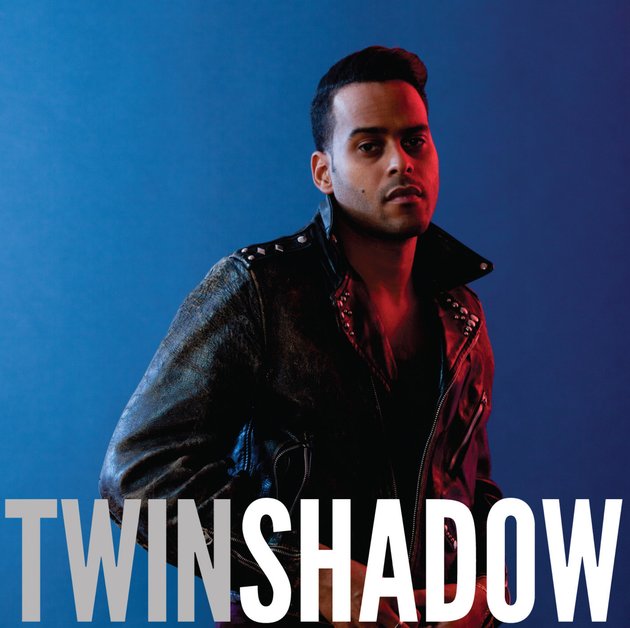
Stylish 1980s-repping R&B/dark new wave crooner Twin Shadow returns to the Great American for a set of headlining shows, this time on the heels of sophomore album, Confess, which saw a proper release July 10 on 4AD. He’s basically Prince in Purple Rain during the video for “Confess,” the titular first single off the album.
Thu/16-Fri/17, 9pm, $21
Great American Music Hall
859 O’Farrell, SF
(415) 885-0750
www.slimspresents.com
http://www.youtube.com/watch?v=HiC9XNQSxFQ

Flosstradamus, Riff Raff, Floating Points
This is like the Internet IRL. British electronic musician Floating Points programs the quality background, Chicago DJ duo Flosstradamus brings the flash, and reality celebrity/royal mess rapper Riff Raff uses MS Paint to spray-paint dicks, dollar signs, and marijuana leafs all over the site. Plus it’s free, and there’ll be opening sets by DJs and producers Ghosts on Tape, Debase vs. Popscene, Dibiase, Groundislava, Elephant & Castle, Richie Panic, Marco De La Vega, DJ Dials, KM/FM, Moziac, D33J, and Tyrell Williams. That’s a lot of pages to bookmark.
Fri/17, 10pm, free
1015 Folsom, SF
www.1015folsom.com
do415.com/event/2012/08/17/scene-unseen

Three Mile Pilot
More than 20 years after its influential San Diego inception, Three Mile Pilot (the emotional lo-fi indie band that spawned Pinback and Black Heart Procession, among others) still knows how to make a guts-pummeling album. 3MP proved this with 2010’s The Inevitable Past Is The Future Forgotten, the first release after 13 years of radio silence, and again this summer with new EP, Maps.
Sat/18, 10pm, $20
Bottom of the Hill
1233 17th St., SF
(415) 621-4455
www.bottomofthehill.com
http://www.youtube.com/watch?v=v7UeBxHFhK4

Midnight Magic
“It’s become apparent that the PR agents have discovered the trick to getting my attention: listing the name of a band next to the words “ex-mems of LCD Soundsystem,” thereby exploiting the hole left in one of my bodily organs by that now defunct group. The connection here is a bit tenuous, referring to former members of Hercules and Love Affair (quite a good name drop on its own) enlisted to play backup at LCD’s last shows. Moving beyond the past, the nine piece disco outfit’s releases so far — “Drop Me a Line” and “Beam Me Up” — have a promising, lively romanticism that’s doing all the influences justice.” — Ryan Prendiville
With Tron Jeremy, Brother Sister, hosted by Ava Berlin and Andy Vague
Sat/18, 10pm, $10-$15
Rickshaw Stop
155 Fell, SF
(415) 861-2011
www.rickshawstop.com
http://www.youtube.com/watch?v=8EaYwmv7hcA

San Francisco Opera
A grand yearly tradition that gives us peons (a.k.a those of us who cannot afford top-shelf liquor or a fancy night out) a shot of upper-crust culture. The program, with conductor Giuseppe Finzi, features soprano Leah Crocetto, tenor Michael Fabiano, and more soloists performing “a selection of operatic favorites.” Pack some cheese and wine, something classy. 
Sun/19, 2pm, free
Stern Grove
19th Avenue at Sloat, SF
(415) 252-6252
www.sterngrove.org
http://www.youtube.com/watch?v=ew3nJW5GzB8

Nashville Pussy
Deep-fried Southern rock meets heavy metal band Nashville Pussy stops by Oakland in between slots on a much higher priced ZZ Top tour.
With Fang, Turbonegra
Sun/19, 8pm, $12-$15
Uptown
1928 Telegraph, Oakl.
www.uptownnightclub.com
http://www.youtube.com/watch?v=gPyd8pO1Lfc

Creating activist scholars: extended interview with Andrej Grubacic

16

For this week’s paper, we talked with with Andrej Grubacic, the new head of the anthropology department at the California Institute for Integral Studies. Here’s the extended interview with Grubacic, where he talks more about the new Anthropology and Social Change program, as well as the history of anarchist schools, how his grandmother influenced his politics growing up in Yugoslavia, and the state of the occupy movement.

San Francisco Bay Guardian: What’s the structure of the new program going to look like?

Andrej Grubacic: It’s going to be called Anthropology and Social Change, and we have two levels. One is MA, the other is PhD. Philosophically speaking and politically speaking, in the age of occupy and all of these movements, the great question for me was how to organize a department that’s actually going to be useful for all of these social struggles and that activism that’s happening outside of education. I’ve been in academia as a scholar-activist for a long time. And what I’ve discovered is the most painful thing in my experience is the separation. The fact of actual separation between the grassroots knowledges, produced outside of the academia, and academic knowledge produced within the universities. So the best things, the way that I was thinking about this was that what we should do on both levels, MA and PhD, is to construct a space of translation of different knowledge. So to put these two knowledges, one produced outside of academia and the other produced in the university, in dialogue.

So we have Boots Riley for example, he’s going to be teaching community organizing, or organizing for social justice. Then we’re going to have Sasha Lilley teaching an eminently practical course on how to create and produce radical radio. So you’re going to get activist media skills. Then we’re going to have a few other people teaching also different skills, and knowledge that’s inspired by art, bringing artists in, and knowledge that’s inspired by people who are thinking about social theory and social emancipation. We’re going to create something really exciting. 

SFBG: Do you think the students who attend are going to be the same kind of mix of academics, artists, activists, and people who want to organize within their own communities here in San Francisco?

AG: I think so. That’s the idea. The idea is to make this department work for the students, but also for the people in San Francisco Bay Area. And we can do that by bringing students who are interested in local work, and I think that’s going to be a pretty amazing. If we are of course able to do things right, but I think that we will be. So Chris Carlsson for example, he’s going to be teaching labor and ecological history of San Francisco, so a very local topic. We’re going to be teaching courses on activist ethnography, and activist ethnography is the center for the whole program, which is how can we relate to community– and this is where we’re also using the term integral– in an integral way? Meaning how do we integrate community into every step of the research process? And the traditional anthropology, as you probably know, is all about participant observation. We would like to have instead observant participants. People who are involved with the communities. People who are trying to dissolve the distinction between the researcher, between who’s on the outside, and who’s on the inside. And they’re creating something together. 

SFBG: I saw when you spoke at the University of the Commons launch. You were talking about how there’s a wave of radical activity going on at schools throughout the world.

AG: Oh yeah.

SFBG: This is obviously very different, because this is an institution putting out something radical, but do you think it fits into that trend right now?

AG: I think it does. Because if you know my biography, I’ve been travelling through all of these experiences in schools for many many years now. I had to leave Yugoslavia where I’m from because of my oppositional political activity and, you know, I finally arrived here to work at New College of California which was also a private institution, and I was very inspired by the department of Activism and Social Change, and I completely fell in love with the history of radical schools in San Francisco. Now I don’t know how much you know about them, but they’re, like, great stuff. There was a liberation school, there were Black Panther schools, of course. There is a great history of alternative schools and experiments. So New College was a private institution, but still, many of my activist friends, who became friends later, have actually been through New College and they got their MA s in activism and social change or media studies. So CIIS actually took many of these people, many of the professors from these programs, and invited them here. So in a certain sense, I think what was done in terms of Activism and Social Change, and orientation to social justice and emancipation, was that at New College we are still keeping that spirit alive. But, in communication- and I think this is the crucial thing for our department- we are doing this in communication with radical educational experiments, movement-based experiments from all over the world. Manolo Callahan, who is going to be teaching here next semester, he is one of the people involved in University of the Earth- Universidad de la Tierra in Oaxaca and in Chiapas, so we are creating relationships with them. Which you know are completely radical experiences outside of institutions, they call themselves deprofessionalized intellectuals. We have already relationships with the Activism and Social Change department in Leeds, in England, they have a great school there. With people in Brazil, the landless workers movements. We’re in touch with people from Ecuador and people form Bolivia. So it’s a whole network of educational, tendency of educational experiences that this department is now creating.

SFBG: Do you have economics courses here?

AG: Yeah.

SFBG: So are there classes that are non-capitalist economics?

AG: Yes, it’s called radical political economy. We are trying to understand political economy from a feminist perspective, from an anarchist perspective, from a post-colonialist- so in that sense we are engaging multiple emancipatory frameworks of understanding social reality. So I myself, I come from the anarchist experience in social science, in politics. We have people who are feminists- Roxanne Dunbar-Ortiz for example. She’s sort of a legend in San Francisco Bay Area and she’s teaching three courses. Roxane Dunbar-Ortiz is going to be teaching about Native American struggles. As it pains me to say, that kind of a focus is mostly missing not only in private but also in public universities now. 

SFBG: So could you tell me a little more about the anarchist background you come from?

AG: I became an anarchist fairly early on, I was 13 or something. Because I was living in Yugoslavia. At that time, Yugoslavia was a socialist state. And because it was a socialist state for me it was a very interesting place to grow up, because you see socialism, real existing socialism, and you see many things that are beautiful about socialism. But you also see many things that are not so beautiful. And I was thinking about the alternatives to it. And for me it was really, sounds cheesy, but a conversation with my grandmother that decided it. She was a communist; she was a Yugoslav revolutionary communist. And Yugoslavia was falling apart, Yugoslavia was in a series of really brutal ethnic wars back in the 90s, and my grandmother, this lifelong communist, told me– my question was, are you still a communist? Do you still believe in communism in the context of this country falling apart? And she said yes, I do, I think that we have chosen a path to communism that was wrong. But I think the responsibility of your generation is to find a different path. The ideal is OK, the ideal is good. It’s a different path that you’re generation needs to find, and you have a great responsibility to do so. And the alternative that I discovered that seemed to me, back when I was 13 years old, and it still does, rational– as an alternative to the Marxist-Leninst way of getting from here to there, right– is anarchism. So for me anarchism, or libertarian socialism is another name that people are using, is a way of organizing for social justice and creating an egalitarian system that takes democracy very seriously. It’s like democracy without a state. 

SFBG: What happened that made you leave Yugoslavia?

AG: I was raised a Yugoslav. So I was raised to be a citizen of a country that doesn’t exist anymore. And on one hand, you had people who were Serbian nationalists, and I couldn’t really get along with those. On the other hand you had people who were neoliberal capitalists, who thought that everything coming from Europe and the United States was great and I couldn’t really agree with those either. And being a young academic, I was a historian at the time and working within the university, there was a great deal of pressure to get me out of the university. So it became very unpleasant. So I already had a relationship with Noam Chomsky, and Chomsky was following everything that was happening to me in Yugoslavia. And he told me at some point OK, it’s time for you to go. So he got me out of Yugoslavia, moved me to the United States or helped me move to the United States, introduced me to a man whose name is Immanuel Wallerstein, a great, amazing sociologist, who helped me get to his program at the Center for the Study of Economics, Historical Systems, and Civilization at SUNY-Binghamton to finish my graduate studies. So that was a– it was a long journey. 

Let’s just say that it was an active disagreement with the political class active at that time in Yugoslav-Serbia. It was actually funnily enough still called Yugoslavia. We only had two countries of the former Yugoslavia, Serbia and Montenegro. But the political cultures and political groups in power were either Serbian nationalists or these hyper-capitalists, right. And going after them, because I was publishing and I was doing a lot of things, was– let’s say, not smart career choice. But it made it possible for me to meet people like Chomsky and some other people. And they liked what I was doing and they were concerned that, for health reasons, United States might be a better environment.

SFBG: Even within these more welcoming academic environments, do you feel your activism or anarchism is stifled in some way?

AG: I had a bad experience here at one university, a local university here in San Francisco, and it wasn’t a good experience. That felt unpleasant and it felt very stifling. CIIS is very different. Actually this is the first place where I think that I was hired because I was an anarchist, or I am an anarchist. It’s kind of funny. But in other places, in Yugoslavia and there was another institution here, I had problems because of my politics. Here, that was exactly the reason I was hired. So it gives you an idea that the school is very different than most other universities. 

SFBG: Could there be such a thing as an anarchist school?

AG: I hope University of the Commons can become something like an anarchist school. Anarchist schools actually used to exist. And they still exist. But the really big one was Francisco Ferrer in Spain. It was called Modern School. It was created in 1904. It became so huge– especially after Francisco Ferrer was killed by the Spanish state in 1909- that there were 60 schools only in Spain and there were I don’t know how many schools in the United States but the last one closed only in 1958 in New Jersey. Modern Schools were amazing places. One could also argue that Yasnaya Polyana of Leo Tolstoy was also an anarchist school. It was in many ways. 

But anarchist schools were schools where you had a few elements. Integral education was number one. Education of the whole person. You don’t only educate somebody as an intellectual but you aim at education of the whole person. The other thing was something that anarchists called reality of the encounter. Which means that all the questions in pedagogical practice needs to come from real questions posed by life itself. So you need to do something that’s practical. Another thing was the complementary role of the teacher, which means the teacher needs to be a facilitator who listens and who offers something in return. But the first thing, the first kind of show of interest, comes from the student. So the role of the teacher is complementary. Another huge thing was something Proudhon called démoédie, or self-government of the school. So school becomes a place where you teach students arts of self-government and self-management. Schools are organized in the spirit of direct democracy. Another thing which was Paul Goodman, famous anarchist educator, his idea was to organize decentralized “teeny schools,” as he called them. So to have a small teaching environment. To have students go to the bank to be taught about mathematics, to go to a museum and then to teach them about geography, to do these things. And then the most important thing for anarchist schools on all levels is the idea of natural motivation and natural learning which was first formulated by Tolstoy. The idea is the students have this natural motivation to learn. And what you do is basically you create an environment where that kind of learning becomes possible. And another thing for anarchist schools was the idea of spontaneous order. So there is no imposed order by the teacher, but there is a spontaneous order that the students themselves discover. In other words, discipline is– I think this is Tolstoy’s, the word that he used– discipline is being discovered, not imposed. What would that mean for a university is a different question. I think the one obvious thing would be that everybody, students and professors, there needs to be a horizontal relationship between them. There needs to be an atmosphere of collective production of knowledge in the classroom. There cannot be a curriculum that’s linear. It needs to be dialogical, it needs to be participatory, you need to talk about this and co-create a syllabus. You need to be as horizontal and participatory as possible. You need to be as imaginative as possible in diminishing your own role as a teacher, which is a very tricky thing, without becoming a populist in the classroom, you know. Empowering students, and finding appropriate structure together with students. Again we are coming back to the idea of listening. We need to listen to the students and together with them, create an atmosphere in the classroom that’s going to be genuinely transformative. 

SFBG: I’d love to ask you more about how this will relate to anarchism and occupy.

AG: In terms of anarchism, we are gonna have- this is going to be one of the few places where anarchism is going to be studied. So anarchist social theory, anarchist education, anarchist ideas in general. We are going to study them, seriously, because they need to be recognized seriously. They’re part of- it’s a beautiful history, it’s a beautiful tradition. How important it is, I think, is revealed, by the recent rediscovery or reinvention of anarchism at occupy. So I think that it’s more relevant than ever to create a space where anarchism will be studied. 

In terms of occupy, occupy is going through the process of fragmentation right now, and they are looking for a new political space of conversation I think. So the way that we can relate to occupy, I think, is to have our students participate in whatever different movements occupy helped. Because you know that occupy now how occupy patriarchy, there is decolonize, there are many different groups. So I expect our students to be involved in occupy, and I expect us to be able to offer a space where many of the debates related to occupy can happen. So, and you know there is an actual affinity. When Silvio Federici comes, or John Holloway, or Michael Hardt, or any of these people, these are the people that occupy people read, and these are some of the bibles of the occupy movement. So what are we going to do is, we are going to make them available and accessible to these people who come here, and we are going to bring here,  and we are going to take them to the occupy movements and we are going to invite people from the occupy movements to come here. But we are also going to do more I think. What we can do, and this is now only a plan an idea, is to invite the movement itself, not only occupy but different movements, and say, OK, please come here and tell us what would you like us to do. And one person from our department had this idea and I think it is brilliant. So to have the movement, different movements– is it food, is it the environment, is it one of the occupy-related movements- come here. We provide the space. And they tell us- social theorist, social scientists, people in the academia, they tell us what do they need us to do. It comes back to this idea of listening. So give a movement or movements a real possibility and opportunity to speak. Because usually academics, we are people who speak. Well we would like to see academics become people who actually listen. 

SFBG: I agree that occupy is basically an anarchist movement and a lot of the tenants of anarchism are being used in it. And I think this is a time when, in the mainstream, people are talking about anarchism more. But for a lot of people it has the image of people who wear black and smash stuff. So I’m curious, how does black bloc, or property damage, relate to the anarchism that’s going to be studied in the department?

AG: It doesn’t relate at all. The anarchism that we are going to study is– in Katrina, the Common Ground collective. That for me is a great example. Common Ground collective is a relief group of activists who went there from all over the place, they went to New Orleans, they were all anarchists and they said OK, we don’t believe in charity, we believe in solidarity. And they built a common ground center and they did relief work with the community for a couple of years. And there is a new book about it by a person who actually came here and spoke, one of the New Orleans activists, Scott Crow. And this is the kind of anarchism I am myself inspired by, the constructive side, not the destructive side. So how to build alternatives in the present for people, what sometimes referred to as prefigurative politics. How to think about positive stuff, constructive stuff. Building alternatives that are going to be persuasive enough– not about breaking windows. I don’t see any particular point in breaking windows. And I think it’s an unfortunate thing that people would reduce anarchism to that. If you think about it, the most important public intellectuals in the United States, one of them recently died, Howard Zinn, and Noam Chomsky thankfully is still alive, they’re both anarchists. So this is the kind of anarchism that I subscribe to, and both of them were my mentors. And I studied with Howard. I studied with Noam, he was the chair of my PhD committee. So these are the people whose anarchism I take very seriously, and this is the kind of anarchism that I like. 

SFBG: But it’s hard to ignore organizing tactics.

AG: But even orgnanizing tactics– black bloc as a tactic comes from the autonomen movement in Germany, which was not an anarchist movement. It comes from the 80s. People dressed in black in Germany, you know, doing property destruction thinking that property destruction is going to contribute to the tactical efficiency of a particular action. Then it went through the environmental movement in particular places, in the environmental movement here in the United States. And it’s being used not only by anarchists, it’s being used by people who would call themselves communists, left, anti-state communists, by different varieties, autonomous Marxists. So it’s not only a tactic that anarchists use. And, you know, it’s a tactic. Anarchism is far broader. 

SFBG: Than just tactics.

AG: Yes. If you would ask me what is the most distinguishing, for me, character of anarchism I would say prefigurative politics– creating the new within the shell of the old—the idea of direct democracy, and the idea of direct action. Direct action being producing alternatives within the present, and direct democracy, behaving in the way that general assemblies are being set up. So that is I think the greatest lesson that anarchism can teach, direct democracy and direct action. 

SFBG: Occupy Oakland, they only had their camp for less than two months, but so much happned.

AG: They did great things. I really feel bad when I read mainstream media completely dismissing that experience. I was there, and the amount of work that went into keeping the medical facilities there, to helping homeless, feeding homeless, helping people with medicine, with immediate healthcare, taking care of children, creating children-friendly spaces, I mean it was amazing. Sure there were problems, of course there are going to be problems. But the stuff that people did there was just incredible. And the general strike, and shutting the port, and all of that, these were great things.

SFBG: And part of the reason the city started cracking down on it was when police tried to enter the space, people wouldn’t let them in.

AG: And they shouldn’t let them in, because the way police behave in Oakland was just outrageous.

This interview has been edited for length.

Outer limits

0

arts@sfbg.com

MUSIC Last year, we thought it couldn’t get better, and then it upped the ante. Outside Lands 2012 takes place this weekend, and the lineup is packed with legendary performers, reunited favorites, and flashy newcomers, pieced together (some overlapping) in a masterful Golden Gate frame, outlined by all that glorious flora and fog.

There’s little to debate; our inboxes have been unequivocally flooded with requests to cover the event from the moment the full list roared onto the web. Who’s to say what sparked the revved up offerings and subsequent queries?

The facts: 72 bands on stage, 15 DJs in the Dome, 25 comedy-variety acts in the Barbary, plus 10 night shows featuring 20 performers. Expected attendance is more than 65,000 people per day, according to the organizers.

It’s a lot to take in, even for the seasoned San Francisco festival-goer (keep hydrated, wear layers, duh). So we’ve whittled down the schedule to the must-sees — those with a certain unscientific combination of vitality and vigor, of historical significance and a very-modern presence.

Of course, if you’ve got a one or three-day pass, you’re likely planning on packing in as many acts as possible, with perfectly timed bathroom, wine, and gourmet food stand breaks. But if you’re of the looser sort, one to wander with feckless abandon among those throngs, keep the below in mind.

Here are your must-see Outside Lands performances:

THE BIG ONES

Headliners and icons

Watching an old friend dance with his bride to iconic folk ballad “Harvest Moon,” it dawned on us: despite his gruff persona, broadly influential singer-songwriter Neil Young & Crazy Horse (8:10-9:55pm Friday, Lands End) is for lovers. And his words — and strumming — are deeply personal for a handful of generations. They’ve left a yearning imprint on our collective pleasure center.

This is a grand return for ’90s indie rockers, Grandaddy (5:10-6:10pm Saturday, Sutro). The Modesto five-piece split in 2006, after a respected career that included touring with Elliott Smith (RIP) and a song, “AM 180,” used in a memorable zombie-less supermarket sweep scene in 28 Days Later.

Kill ‘Em AllAnd Justice For All…okay, and we guess St. Anger. The heavy metal — and then some other stuff — back catalogue of Metallica (7:55-9:55pm Saturday, Lands End) is forever drilled into our brains. In a press call leading up to the fest, drummer Lars Ulrich said, “we’re very proud of our…relation and our history with San Francisco,” (does that mean the band will do us a solid and play early tracks?), later adding, “it’s an amazing thing, 31 years into a career to be able to be as busy as we are and to [see] people give a shit and to be able to still tour.” We give a shit, Lars.

As one fan noted, Mr. Superstition, Steve Wonder (7:20-9:30pm Sunday, Lands End), is likely the most creative choice of a headliner in 2012. And it makes the night-map easy for some of us; in the scheduling contest between dub-monster Skrillex and Motown icon Stevie Wonder, there is no contest.

LOCALS ONLY

Best of the Bay represented

It’s been five years since Two Gallants (1:50-2:40pm Friday, Lands End) released an album, and this fest (along with the OL night show) are the first local shows for the folk-punk duo touring on the new record, The Bloom and the Blight. Seems they’ll have a lot of stowed away energy to release in the park.

Perhaps never has man and computer so beautifully collided than with San Francisco digi-rock act Geographer (2:10-2:55pm Saturday, Twin Peaks). Swelling vocal melodies blend so evenly with darting beeps and blurps and laser synths, sometimes deepened by floating violin. It’s hard-rocking orchestral pop, operatic robot love, and world travel in a machine. The band paid its dues playing Rock Make, Treasure Island, Live 105’s BFD, and now, Outside Lands.

These San Francisco pysch-surf-punks are notorious for their headspinningly prolific songwriting, unpredictable live shows, and spastic energy. Regardless of what happens during Thee Oh Sees (6:05-6:45pm Saturday, Panhandle) set, it’ll be an act people are talking about.

THE ANDY WARHOL FACTOR

Who everyone will be Tweeting about

Having just premiered barely pronounceable single “XP€N$IV $H1T” (“I rub my dick on XP€N$IV $H1T” being actual lyrics) it’s safe to assume that Southern African freak-rap trio Die Antwoord (5:25-6:15pm Friday, Twin Peaks) is going to continue down a path of what-the-fuck-did-I-just-witness trashy splendor. There will be rave wear and Ninja’s inexplicable junk-thrusting dance moves, DJ Hi-Tek records spinning, and Yo-Landi’s hyper-high chirp.

When Father John Misty (2:55-3:35pm Saturday, Panhandle), a.k.a. J. Tillman of Fleet Foxes, stopped by Bottom of the Hill earlier this year, folks didn’t know what hit them. FJM was a wild force on stage, engaging in an ongoing and increasingly odd conversation with the audience, with quips and asides a-plenty in between a hectic set of woozy pop and crunchy-hippie psychedelic jams.

Perhaps not since Janis Joplin, have we heard a lady blues vocalist with pipes this powerful. That wail is a show-stopper. And, four-piece Alabama Shakes (3:50-4:40pm Saturday, Sutro), led by Brittany Howard (she of the powerful pipes), is actually born and raised Alabama, as the band name would imply, meaning its a more authentic experience, it would seem.

After a prolonged break, Santigold (5:10-6pm Sunday, Twin Peaks) dropped long-awaited Master Of My Make-Believe this year, with reggae-flecked party jam single “Disparate Youth,” cut through with a machine-gun guitar riff. Clearly, Santigold is no less bold in her return. Both the sound and her avant-pop style will surely absorb those expansive outdoor stages.

WORLD TRAVEL

Globally relevant bands from far and wide

Sigur Ros is not the only Icelandic band at Outside Lands 2012. If ambient soundscapes aren’t your thing, check out the lesser-known folk sextet Of Monsters and Men (5:25-6:25pm Friday, Sutro), which balances catchy melodies with beautifully harmonized vocals. Amadou & Mariam (3:35-4:25pm Sunday, Twin Peaks) met at Mali’s Institute for the Young Blind. What the African duo lacks in 20/20 vision they make up for in mesmerizing sound — irresistible hip-hop-and blues-inspired world music. We dare you not to dance. Globally recognized Columbian culture-masher band Bomba Estéreo (6-6:40pm Sunday, Panhandle) mixes in the sounds of Latin America, the Caribbean, reggae, dub, and beyond, with bouncy hip-hop beats. Live, lead vocalist Li Saumet (who this year also released a side-project in which she imagines killing her boyfriend) pumps up the energy tenfold.

SONIC BREAK

Explore beyond the music

Imbibe in yeasty concoctions at this year’s first ever Beer Lands (oui, Wine Lands will be there too). And the beer lineup is made up of local craft breweries: 21st Amendment, Anchor Brewing, Magnolia, Pac Brewing Labs, Speakeasy (all San Francisco); Bear Republic (Russian River area), Drakes, (San Leandro) and Linden Street (West Oakland). Oh, and Sierra Nevada is debuting the Outside Lands Saison at the fest, said to be inspired by OL itself. Reggie Watts, Neil Patrick Harris, David Cross, Kristen Schaal, Nerdist Chris Hardwick, the list goes on for The Barbary. The comedy and variety tent keeps getting bigger, and weirder. There are the big names of course (see above) but also some awesome homegrown talent — Jesse Elias, for one. We caught him in the Cinecave last month, and were blown away by his timing. Our cheeks ached from laughing. And he never once looked up at the audience, only moving to push his glasses back up his nose.

OUTSIDE LANDS MUSIC AND ARTS FESTIVAL

Fri/10-Sun/12, noon, $95

Golden Gate Park, SF

www.sfoutsidelands.com

Korean commotion

0

virginia@sfbg.com

APPETITE The nation’s on a kimchi kick. Truth be told, California has long been home to some of the country’s densest Asian populations, so here in the Bay Korean cuisine is at a crossroads — is it a staple? Exotic novelty? With the help of a few new openings, the answer may be shifting. Despite a smattering of Korean BBQ joints in SF and a concentrated Korean population in Oakland, it hasn’t been until the last few years that I’ve witnessed local Korean eateries offering much beyond barbecue.

But now, thanks to the forward-thinking fusion of Namu Gaji and home-cooked joys of To Hyang, Nan, Manna, and Aato, the Bay is getting a crack at more diverse Korean offerings. In Oakland, good times can be had at the “porno bar,” a.k.a. Dan Sung Sa (2775 Telegraph, Oakl. (510) 663-5927), so-called due to the Korean film posters lining its walls, though there’s actually nothing explicit to be seen. Its fried chicken, Korean beers, and comfortably dive-y atmosphere evoke an under-the-radar speakeasy vibe, reminiscent of long-timer Toyose (3814 Noriega, SF. (415) 731-0232), tucked away in a similarly relaxed spot in an Outer Sunset garage.

Here’s two stand-outs in a wave of openings that exemplify the gourmet fun of casual Korean snacking, both an ideal locales for cheap beers with good friends.

ARIA KOREAN AMERICAN SNACK BAR

The Kim family has taken over what was once the Old Chelsea Fish and Chips space in the Tenderloin. Aria Korean American Snack Bar is a closet-sized eatery — still appropriately dingy for its bustling block, but the Kims have infused it with fresh life, greeting visitors with a smile and a record player stocked with Tom Jones and Sinatra LPs. Mom and Pop Kim run the place, though their son and his girlfriend have come up from LA to help them get going.

The family has a hit on its hands with the Korean fried chicken (nine pieces for $6.99-7.99, 16 pieces for $12.99-13.99). It feels like everyone is doing KFC these days, but these boneless, overgrown nuggets are special: crispy-tender and fried in cottonseed oil, with zero trans fat. Dip them into earthy-sweet spicy sauce and an addiction will be born. Mama’s acidic sweet-and-sour radishes are just the right accompaniment to clean the palate and perk up the taste buds.

There’s also an array of fried snacks from mixed veggies (carrots, sweet potato, zucchini, onion) to seaweed rolls packed with potato and glass noodles (eight pieces for $5.99). Hot and spicy rice cakes ($5.99) are another of mom’s recipes. They arrive blessedly chewy, sitting in — what else? — a spicy red sauce. The Kim family good cheer and authentic fried bites make this the kind of snack bar every neighborhood should be so lucky to have.

932 Larkin, SF. (415) 292-6914

FUSEBOX

Tucked away in a sunny courtyard off desolate West Oakland streets sits FuseBOX, a truly exciting haven for Asian fusion. Those looking to categorize its food could satisfy themselves by calling it Korean food served Japanese izakaya style, but the FuseBOX mashup goes above and beyond this simplification.

In the three months it’s been open, this cash-only respite created by Sunhui and Ellen Sebastian Chang offers daily robata specials ($1–$3). Granted, these are merely bites, but there’s real joy in sampling this range of grilled vegetables and meat.

From the spare, industrial interior sparsely dotted with tables to rice purified with binchotan, or Japanese white charcoal ($2), it’s clear this no typical Asian eatery. There is — of course! — KFC ($5), although here it is lightly fried, yielding spicy chicken more akin to buffalo wings than the aforementioned boneless chicken at Aria. Bento box-like “BAP sets” ($6-10) offer meat or veggies alongside rice and banchan or panchan (mini-dishes that often accompany Korean meals that could account for the name of these plates on the menu), which rotate daily. Spinach roots and French breakfast radish crowns are brined in mustard and nori, and sesame leaves are pickled in soy, white zucchini or green mango in vinegar. Kimchi comes in multiple forms, including versions made with bok choy and kale.

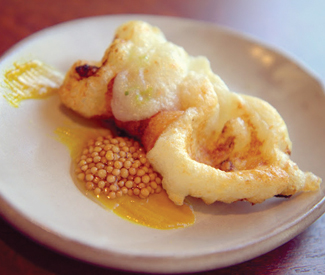
Robata specials are grilled on wood skewers. There’s okra and snap peas and tender chicken “oyster” cuts. The best bite of all? Bacon mochi ($2.50). The mochi is sticky, subtly savory, and gummy, satisfying on its own merit — until you reach the bacon and accompanying mustard seeds. I’d eat this fantastic bite for breakfast, dessert — basically any way at all. For bigger appetites, there’s sandwiches ($8) like a Tokyo po’ boy laden with fried chicken, red cabbage slaw, house mayo, and pickles.

To drink there’s a bracing, cool roasted corn tea ($1), chilled and nearly creamy with fresh corn flavor. Other drink options include Tang (yes, Tang!), house barrel-aged soju, and glasses from the neighbors, like Alameda’s Rock Wall Wines and beer on tap from Oakland’s Linden Street Brewery. FuseBOX is only open Wednesday through Friday, 11:30am—2:30pm, but promises that its dinner menu will soon be operational. As its hours expand, I’ve no doubt it will become even more crowded than its three-day-a-week lunches already are. There’s no place like it.

2311A Magnolia, Oakl. (510) 444-3100, www.fuseboxoakland.com

Subscribe to Virgina’s twice-monthly newsletter, The Perfect Spot, www.theperfectspotsf.com


If you want my advice

0

CAREERS AND ED In July, the unemployment rate in California was 11 percent. Which got us thinking: what’s the smart way to job hunt these days? We’re not the only ones — this month, the Commonwealth Club is hosting a series of lectures and workshops called “The Future of Work.” We tapped two of the series’ experts for email interviews, asking Marty Nemko, author of Cool Careers For Dummies, and Joel Garfinkle, Oakland-based career coach, for their takes on the matter. They offered two points of view on today’s dreary job market. Upside? Nemko, who spoke on August 1, is positive that more workers will be needed to implement upcoming immigration reform. Of course, he also foresaw growth in “bio-chemical terrorism.” Oh, the future.

San Francisco Bay Guardian: Tell us about your Commonwealth Club event.

Marty Nemko: [My focus was] on which careers are likely to burgeon [in] the result of [an] Obama win — which ones polls and Intrade [a speculative, crowd-sourced website] betting suggest will occur. I’ll also talk about how to survive and even thrive during what may be America’s decline and fall.

Joel Garfinkle: Working hard and being good at what you do is not enough to attain the level of success you truly deserve. So what exactly makes one person more successful than another? The answer: leveraging and applying perception, visibility, and influence better than anyone else.

SFBG: What kinds of issues are older workers facing in terms of getting new jobs?

MN: It’s very tough to convince an employer that a 40-year old with no experience is better than a 25-year old with experience. In this job market, the employer doesn’t have to settle.

JG: Mid-life career transitions occur because after years of success, many of my clients find that they lack fulfillment. Success isn’t enough anymore to satisfy them. [But] it’s difficult to make a mid-life career transition due to the lack of financial stability that exists when making the change. Learning of new skills in a different profession can be a daunting and intimidating task.

SFBG: What are some place that are still proving fruitful for job searchers?

MN: Some of my predicted areas for growth are auditing for corporations, the US Treasury, and the IRS; immigration-related bureaucrats that will be needed after Obama gets comprehensive immigration reform after the election; health care advocates to help people get the health care they need as ObamaCare is implemented; and bio-chemical terrorism. Anything mandated will be the last sort of employment to get cut. Lastly, multicultural marketers to address the tastes of the fastest-growing ethnic groups.

JG: Information technology is still growing. About two-thirds of hiring manages have been adding staff this year and will continue to add headcount to the IT departments. Health care is still pretty in-demand due to rising ages in the US. And many employers have had difficulty finding and hiring enough engineers.

SFBG: Should people still be striving for their dream job? Is that idea still relevant?

MN: It’s in the Bay Area’s drinking water. If there was a motto on the San Francisco flag, it would be “Do what you love and who cares if the money follows. My parents will support me.”

JG: The increase in collective desire to love one’s job comes from something missing in a person’s life. Statistics over the years have stayed consistent in stating that over two-thirds of Americans are unhappy in their jobs. The task is to recognize that people are uniquely special, have something to give, have a talent no one else shares in quite the same way.

MARTY NEMKO: “KEYS TO BEATING THE ODDS IN STARTING A BUSINESS”

(next lecture) Thu/9 6pm, $20

Commonwealth Club 

595 Market, Second Floor, SF

JOEL GARFINKLE: “GETTING AHEAD AND TAKING YOUR CAREER TO THE NEXT LEVEL”

Aug. 30, 7pm, $15 

Silicon Valley Bank

3005 Tasman, Santa Clara

(415) 597-6700

www.commonwealthclub.org


Stage Listings

0

Stage listings are compiled by Guardian staff. Performance times may change; call venues to confirm. Reviewers are Robert Avila, Rita Felciano, and Nicole Gluckstern. Submit items for the listings at listings@sfbg.com. For further information on how to submit items for the listings, see Picks.

THEATER

OPENING

A Funny Thing Happened On the Way to the Forum Woodminster Amphitheater, Joaquin Miller Park, 3300 Joaquin Miller Rd, Oakl; www.woodminster.com. $12-56. Previews Thu/9, 8pm. Opens Fri/10, 8pm. Runs Thu-Sun, 8pm. Through Aug 19. Woodminster Summer Musicals presents the Sondheim comedy.

Henry V Sequoia High School, 1201 Brewster, Redwood City; www.redwoodcity.org. Free. Opens Sat/11, 7:30pm. Runs Sat, 7:30pm; Sun, 2pm. Through Aug 26. San Francisco Shakespeare Festival presents the Bard’s history play as part of its "Free Shakespeare in the Park" series.

ONGOING

Absolutely San Francisco Alcove Theater, 414 Mason, Ste 502, SF; www.thealcovetheater.com. $32-50. Thu-Sat, 8pm. Through Aug 18. A multi-character solo show about the unique residents of San Francisco.

Enron Exit Theatre, 156 Eddy, SF; www.enron2012.com. $25. Thu-Sat, 8pm. Through Aug 17. In OpenTab’s production of British playwright Lucy Prebble’s 2009 Enron, tragedy plus time equals comedy plus puppets (in imaginative designs by Miyaka Cochrane), as fast-paced satire delivers a timely reconsideration of yet another infamous financial scandal. Some fictional elements shape the plotline but simplifying strategies serve well to clarify the real-life actions and consequences of Ken Lay (GreyWolf) and Jeffry Skilling’s (Alex Plant) deceptive energy-trading juggernaut, the onetime darling of Wall Street and the financial pages. There’s also much verbatim information (echoing the book and documentary, Enron: The Smartest Guys in the Room) enlivening the quick dialogue and underscoring the reckless, hubristic malfeasance that famously preyed on California’s electricity grid and threw Enron’s own employees under the bus. Director Ben Euphrat gets spirited and engaging performances from his principals, with especially nice work from Plant as a cruelly superior Skilling, Laurie Burke as ambitious straight-shooter Claudia Roe (a fictionalized composite creation of the playwright), and Nathan Tucker as manic sycophant Andy Fastow, feeding poisonous Enron debt into three beloved "raptors" (the pet names for some animated shadow companies arising from Fastow’s fast work in "structured finance"). At the same time, the staging can prove rough between concept and execution, with scenic elements sometimes confusing as well as aesthetically ragged (a red fabric serving as a large profit graph, for instance, just looks like some droopy inexplicable drapery at first; and the first puppets to appear are too small to be very effective either). Despite this messiness in terms of mise-en-scène, however, the play is generally clear-eyed and good for more than easy laughs — since no single villain but rather a system and culture are the proper targets here. As Prebble notes, the strategies developed by Enron, far from remaining beyond the pale, are now standard practices throughout the financial and corporate world. That, in some circles, is known as progress. (Avila)

Humor Abuse American Conservatory Theater, 415 Geary, SF; www.act-sf.org. $25-95. Tue-Sat, 8pm (also Sat, 2pm); Sun, 2pm. Through Aug 19. "This is a show about clowning," advises Lorenzo Pisoni at the outset of his graceful solo performance, "and I’m the straight man." It’s a funny line, actually — funny because it’s true, and not true. In the deft routines that follow, as well as in the snapshots cast on the atmospherically dingy curtain hung center stage, the career of this Pickle Family Circus brat (already alone in the spotlight by age two) never veers far from the shadow of his father. That fact remains central to the winning comedy and wistful reflection in Humor Abuse. Reared in the commotion and commitment of the famed San Francisco circus founded by his parents Larry Pisoni and Peggy Snider, Lorenzo had a childhood both enviable and unusually challenging. The fact that he shares his name with both a grandfather and his dad’s famous clown persona is instructive. His trials and his triumphs are further conflated — along with his father’s — in such elegant catastrophes as falling down a long flight of stairs. And in his good-humored and honest reflections, the existential poignancy at the heart of such artful buffoonery begins to rise to the surface. The spoken narrative feels a little pinched or abbreviated, in truth, but there are no shortcuts to the skill or wider perspective inculcated by the charming Pisoni and (under direction of co-creator Erica Schmidt) set enthrallingly in motion. (Avila)

The Merchant of Venice Gough Street Playhouse, 1622 Gough, SF; www.custommade.org. $25-32. Thu-Sat, 8pm; Sun, 7pm. Extended through Aug 19. Custom Made Theater presents director Stuart Bousel’s generally sharp staging of Shakespeare’s perennially controversial but often-misunderstood play. The lively if uneven production ensures the involved storyline cannot be reduced to the problematical nature of its notorious Jewish villain, Shylock (played with a compellingly burdened intensity by a quick Catz Forsman), but rather has to be seen in a wider landscape of desire in which money, status, sex, gender, political and ethnic affiliations, and human bodies all mix, collide, and negotiate. To this end, this Merchant is set amid a contemporary financial district coterie (given plenty of scope in Sarah Phykitt’s thoughtfully pared-down scenic design), where titular melancholic businessman Antonio (Ryan Hayes) sticks his neck out (or anyway a pound of flesh) for his beloved friend Bassanio (Dashiell Hillman) — no doubt the unspoken source of Antonio’s brooding heart as staged here — as the latter seeks a loan with which to court the lovely and brilliant Portia (a winning Megan Briggs). While the subplot concerning the wooing and flight of Shylock’s daughter, Jessica (Kim Saunders), is less adeptly rendered, fluid pacing and a confident sense of the priorities of the drama overall offer a satisfying encounter with this fascinatingly subtle play. (Avila)

Les Misérables Orpheum Theatre, 1192 Market, SF; www.bestofbroadway-sf.com. $83-155. Tue-Sat, 8pm (also Wed and Sat, 2pm); Sun, 2pm. Through Aug 26. SHN’s Best of Broadway series brings to town the new 25th anniversary production of Cameron Mackintosh’s musical giant, based on the novel by Victor Hugo. The revival at the Orpheum does without the famous rotating stage but nevertheless spares no expense or artistry in rendering the show’s barrage of colorful Romantic scenes (with Matt Kinley’s scenic design drawing painterly inspiration from Hugo’s own oils) or its larger-than-life characters — first and foremost Jean Valjean (a slim but passionate Peter Lockyer), nemesis Javert (Andrew Varela), and rescued orphan beauty Cosette (Lauren Wiley). Chris Jahnke contributes new orchestrations to the rollicking original score by Claude-Michel Schönberg (music) and Herbert Kretzmer (lyrics) in this flagrantly sentimental, somewhat problematic but still-stirring meld of music and melodrama in dutiful overlapping service of box office treasure and powerful humanist aspirations. (Avila)

My Fair Lady SF Playhouse, 533 Sutter, SF; www.sfplayhouse.org. $30-70. Tue-Thu, 7pm; Fri-Sat, 8pm (also Sat, 3pm). Through Sept 29. SF Playhouse and artistic director Bill English (who helms) offer a swift, agreeable production of the Alan Jay Lerner and Frederick Loewe musical, based on George Bernard Shaw’s Pygmalion. The iconic class-conscious storyline revolves around a cocky linguist named Higgins (Johnny Moreno) who bets colleague Colonel Pickering (Richard Frederick) he can transform an irritable flower girl, Eliza Doolittle (Monique Hafen), into a "lady" and pass her off in high society. A battle of wills and wits ensues — interlarded with the "tragedy" of Alfred Doolittle (a shrewd and gleaming Charles Dean) and his reluctant upward fall into respectability — and love (at least in the musical version) triumphs. The songs ("Wouldn’t It Be Loverly," "I Could Have Danced All Night," "Get Me to the Church on Time," and the rest) remain evergreen in the cast’s spirited performances, supported by two offstage pianos (brought to life by David Dobrusky and musical director Greg Mason) and nimble choreography from Kimberly Richards. Hafen’s Eliza is especially admirable, projecting in dialogue and song a winning combination of childlike innocence and feminine potency. Moreno’s Higgins is also good, unusually virile yet heady too, a convincingly flawed if charming egotist. And Frederick, who adds a passing hint of homoerotic energy to his portrayal of the devoted Pickering, is gently funny and wholly sympathetic. (Avila)

The Princess Bride: Live! Dark Room Theater, 2263 Mission, SF; foulplaysf.com/princessbride. $20. Thu-Sat, 8pm. Through Aug 25. Dark Room Productions presents a live tribute to the cult fairy-tale movie.

Project: Lohan Costume Shop, 1117 Market, SF; www.projectlohan.com. $25. Thu-Sat, 8pm; Sun, 7pm. Through Aug 19. D’Arcy Drollinger pays tribute to the paparazzi target with this performance constructed solely from tabloids, magazines, court documents, and other pre-existing sources.

Sweeney Todd: The Demon Barber of Fleet Street Eureka Theatre, 215 Jackson, SF; www.rayoflighttheatre.com. $25-36. Thu/9-Sat/11, 8pm (also Sat/11, 2pm). Halloween comes early this year thanks to Ray of Light Theatre’s production of Sweeney Todd and all its attendant horrors. Set in bleakest, Industrial Revolution-era London, this Sondheim musical pushes the titular Todd to enact a brutal vengeance on a world he perceives as having stolen the best of life from him, namely his family and his freedom. No fey, gothic vampire, ROLT’s Sweeney Todd (played by Adam Scott Campbell) is both physically and psychically imposing, built like a blacksmith and twice as dark. Pushed over the line between misanthropic and murderous, Sweeney Todd methodically plots his revenge on the hated Judge Turpin (portrayed with surprising sympathy by Ken Brill) while the comfortably comical purveyor of pies, Mrs. Lovett (Miss Sheldra), dreams of a sunnier future. Mrs. Lovett’s no-nonsense, wisecracking ways aside, there are few laughs to be had in this slow-burning dirge to the worst in mankind, and as the body count rises, it is made abundantly clear that all hope of redemption is also but a fantasy. Contributing to the dark mood are Maya Linke’s imposing, industrial set, Cathie Anderson’s ghostly green and hellfire amber lighting, and a spare chamber ensemble of six able musicians conducted by Sean Forte. (Gluckstern)

"Un-Abridged: The Best of Ten Years of Un-Scripted" SF Playhouse, 533 Sutter, SF; www.un-scripted.com. $10-20. Thu-Sat, 8pm. Through Aug 18. The veteran Bay Area company celebrates its tenth anniversary season with a four-week retrospective of its favorite long- and short-form improv shows. Check website for schedule.

Vital Signs Marsh San Francisco, 1062 Valencia, SF; (415) 282-3055, www.themarsh.org. $15-50. Sat, 8:30pm. Extended through Aug 25. The Marsh San Francisco presents Alison Whittaker’s behind-the-scenes look at nursing in America.

War Horse Curran Theatre, 445 Geary, SF; www.shnsf.com. $31-300. Wed-Sat, 8pm (also Wed and Sat, 2pm); Sun, 2pm. Through Sept 9. The juggernaut from the National Theatre of Great Britain, via Broadway and the Tony Awards, has pulled into the Curran for its Bay Area bow. The life-sized puppets are indeed all they’re cracked up to be; and the story of a 16-year-old English farm boy (Andrew Veenstra) who searches for his beloved horse through the trenches of the Somme Valley during World War I, while peppered with much elementary humor too, is a good cry for those so inclined. The claim to being an antiwar play is only true to the extent that any war-is-hell backdrop and a plea for tolerance count a melodrama as "antiwar," but this is not Mother Courage and no serious attempt is made to investigate the subject. Closer to say it’s Lassie Come Home where Lassie is a horse — very ably brought to life by Handspring Puppet Company’s ingenious puppeteers and designers, and amid a transporting and generally riveting mise-en-scène (complete with pointedly stirring live and recorded music). But the simplistic storyline and its obvious, somewhat ham-fisted resolution (adapted by Nick Stafford from Michael Morpurgo’s novel) are too formulaic to be taken that seriously. And at two-and-a-half-hours, it’s a long time coming. A shorter war, the Falklands say, would have done just as well and gotten people out before the ride began to chafe. (Avila)

BAY AREA

Circle Mirror Transformation Marin Theatre Company, 397 Miller, Mill Valley; www.marintheatre.org. $20-57. Tue and Thu-Sat, 8pm (also Sat/11, Aug 16, and 25, 2pm); Wed, 7:30pm; Sun, 2 and 7pm. Though Aug 26. Marin Theatre Company and Encore Theatre Company co-present the regional premiere of Annie Baker’s comedy about a drama class.

A Doll’s House Willows Theatre, 1975 Diamond, Concord; www.willowstheatre.com. $20-29. Wed-Thu, 7:30pm (also Wed, 3:30pm); Fri-Sat, 8pm (also Sat, 2pm); Sun/12, 3pm. Through Aug 18. The large stage at Willows Theatre is a sunken living room with walls the color of butterscotch pudding, a long rumpled powder-blue sofa, scattered seasonal decorations, and a single translucent panel that brings to mind a Bob Barker-era game show set. It’s like a cross between a showroom and homeroom without meaning to be either, but that less than winsome amalgam hits the right note for Irish playwright Frank McGuiness’s modern adaptation of Henrik Ibsen’s 1879 play. Here, the Helmers are just a couple of upstate New Yorkers with slightly funny-sounding names circa Christmas 1959: Nora (a captivatingly buoyant yet subtly shaded Lena Hart) is a bubbly young mother of three, and Torvald (a credibly oblivious Mark Farrell) is a smug but affable bank executive on the rise. A secret intervention in Torvald’s career by a devoted Nora, his up-to-now happily caged "little songbird," once saved them from ruin (via a reckless loan borrowed on a forged signature), but now it invites a calamitous mixing of formerly separate spheres as the man who loaned Nora the money, once-disgraced Nils Krogstad (a fine, persuasively desperate yet smooth Aaron Murphy), blackmails her to insure his precarious position at her husband’s bank. A panicked Nora confides in old friend and reluctant single-lady Christine (an impressively stoic, subtly wounded Kendra Oberhauser). Meanwhile, terminally ill family friend Dr. Rank (an initially wooden, later warmer Dale Albright) watches Nora from a devoted but helpless vantage. If the plot feels at times like a mirthless episode of I Love Lucy, that again may speak to the aptness of McGuiness’s transposition as much as the sometimes forced way playwright Ibsen has of rearranging the dramatic furniture. But the generally strong cast under Eric Inman’s able direction offers enough vivid dramatic tension to keep us engaged, while suggesting the continuing relevance and limits of the play’s robust critique of marriage and patriarchy. (Avila)

Happy Hour with Kim Jong Il Cabaret at the Marsh Berkeley, 2120 Allston, Berk; (415) 826-5750,l www.themarsh.org. Free. Fri, 6pm. Through Aug 24. Comedy work-in-progress by Kenny Yun, with live music by cabaret singer Candace Roberts.

Keith Moon/The Real Me TheaterStage at the March Berkeley, 2120 Allston, Berk; www.themarsh.org. $15-50. Fri/10, Aug 17, Sept 13, 20, 27, 8pm. Mike Berry workshops his new musical, featuring ten classic Who songs performed with a live band.

The Kipling Hotel: True Misadventures of the Electric Pink ’80s Marsh Berkeley, 2120 Allston, Berk; (415) 282-3055, www.themarsh.org. $20-50. Sat, 8:30pm; Sun, 7pm. Extended through Aug 26. This new autobiographical solo show by Don Reed, writer-performer of the fine and long-running East 14th, is another slice of the artist’s journey from 1970s Oakland ghetto to comedy-circuit respectability — here via a partial debate-scholarship to UCLA. The titular Los Angeles residency hotel was where Reed lived and worked for a time in the 1980s while attending university. It’s also a rich mine of memory and material for this physically protean and charismatic comic actor, who sails through two acts of often hilarious, sometimes touching vignettes loosely structured around his time on the hotel’s young wait staff, which catered to the needs of elderly patrons who might need conversation as much as breakfast. On opening night, the episodic narrative seemed to pass through several endings before settling on one whose tidy moral was delivered with too heavy a hand, but if the piece runs a little long, it’s only the last 20 minutes that noticeably meanders. And even with some awkward bumps along the way, it’s never a dull thing watching Reed work. (Avila)

A Midsummer Night’s Dream Forest Meadows Amphitheater, 890 Belle, Dominican University of California, San Rafael; www.marinshakespeare.org. $20-35. Check website for schedule. Through Sept 30. Marin Shakespeare Company performs the Bard’s classic, transported to the shores of Hawaii.

Noises Off Live Oak Theatre, 1301 Shattuck, Berk; www.aeofberkeley.org. $15. Fri-Sat, 8pm; Sun/12, 2pm. Through Aug 18. Actors Ensemble of Berkeley performs Michael Frayn’s backstage comedy.

Roald Dahl’s Willy Wonka and the Chocolate Factory Julia Morgan Theatre, 2640 College, Berk; www.berkeleyplayhouse.org. $17-35. Thu and Sat, 7pm (also Sat, 2pm); Sun, noon and 5pm. Through Aug 19. Berkeley Playhouse performs a musical based on the candy-filled book, with songs from the 1971 movie adaptation.

"TheatreWorks 2012 New Works Festival" TheatreWorks at Lucie Stern Theatre, 1305 Middlefield, Palo Alto; www.theatreworks.org. $19-25 (fest pass, $65). Various times, through Aug 19. The 11th annual festival features a developmental production of The Trouble With Doug by Will Aronson and Daniel Maté and staged readings of Sleeping Rough by Kara Manning, The Loudest Man on Earth by Catherine Rush, Being Earnest by Paul Gordon and Jay Gruska, and Triangle by Curtis Moore and Thomas Mizer.

Upright Grand TheatreWorks at Lucie Stern Theatre, 1305 Middlefield, Palo Alto; www.theatreworks.org. $24-73. Wed/8, 7:30pm; Thu/9-Fri/10, 8pm. TheatreWorks launches its 43rd season with the world premiere of Laura Schellhardt’s play about a musical father and daughter.

PERFORMANCE/DANCE

BATS Improv Bayfront Theater, B350 Fort Mason Center, Marina at Laguna, SF; www.improv.org. Thu-Sat, 8pm. Through Sept 8. $10-25. This week: BATS School of Improv Theatresports Championship (Thu/9); Freestyle Improv (Fri/10); Elvis Beach Party Musical (Sat/11).

"Bawdy Storytelling" Verdi Club, 2424 Mariposa, SF; www.bawdystorytelling.com. Wed/8, 7pm. $20. The theme: "Go BIG or Go Home!"

"Comedy Returns to El Rio" El Rio, 3158 Mission, SF; www.elriosf.com. Mon/13, 8pm. $7-20. Comedy with Nathan Habib, Brendan Lynch, Andrea Carla Michaels, and more.

"Elect to Laugh" Studio Theater, Marsh San Francisco, 1062 Valencia, SF; (415) 282-3055, www.themarsh.org. Tue, 8pm. Through Nov 6. $15-50. Veteran political comedian Will Durst emphasizes he’s watching the news and keeping track of the presidential race "so you don’t have to." No kidding, it sounds like brutal work for anyone other than a professional comedian — for whom alone it must be Willy Wonka’s edible Eden of delicious material. Durst deserves thanks for ingesting this material and converting it into funny, but between the ingesting and out-jesting there’s the risk of turning too palatable what amounts to a deeply offensive excuse for a democratic process, as we once again hurtle and are herded toward another election-year November, with its attendant massive anticlimax and hangover already so close you can touch them. Durst knows his politics and comedy backwards and forwards, and the evolving show, which pops up at the Marsh every Tuesday in the run-up to election night, offers consistent laughs born on his breezy, infectious delivery. One just wishes there were some alternative political universe that also made itself known alongside the deft two-party sportscasting. (Avila)

"Electile Dysfunction: The Kinsey Sicks for President" Rrazz Room, 222 Mason, SF; www.therrazzroom.com. Wed/8-Sat/11 and Aug 14-18, 8pm; Sun/12 and Aug 19, 7pm. $35-40. The "dragapella beautyshop quartet" satirizes the upcoming election.

"Indulge! Benefit" ODC Theater, 3153 17th St, SF; www.odctheater.org. Tue/14, 8pm. $35-50. An evening of

desserts and dance to benefit ODC’s future programs.

"Ladies to the Rescue" CounterPulse, 1310 Mission, SF; www.counterpulse.org. Wed/8-Thu/9, 7pm. $7-20. Flyaway Productions and Oasis For Girls present an evening of youth performances, based on the question "Who is Tending the City?"

"Majestic Musical Review Featuring Her Rebel Highness" Harlot, 46 Minna, SF; www.herrebelhighness.com. Sun/12, 5pm. $25-65. A trio of 18th century princesses (the graceful, full-throated, international team of Velia Amarasingham, Linsay Rousseau Burnett, and Maria Mikheyenko), chafing under the patriarchal constraints of their otherwise exalted status, metamorphose into a defiant band of disco queens in this stylish, high-kitsch musical revue by writer-producer Amarasingham and composer–musical director Simon Amarasingham. The action begins in desultory fashion, bar-side in the Harlot lounge, amid scuttlebutt from a pair of chatty housemaids (Meira Perelstein and a tuneful Diana DiCostanzo) overseen by a giddy royal valet (a gregariously foppish Michael Sommers, also the show’s emcee and narrator). When the dallying princesses finally arrive (sumptuously attired in appealing period costumes by Noric Design), they ascend a small stage attended by Lady Lucinda Pilon (a Goth-inflected Amber Slemmer, alternating nights with director Danica Sena), and launch into a slick set of tightly choreographed ‘autobiographical’ numbers as the prerecorded music progresses stylistically from smooth, harpsichord-tinted dance-floor beats to all-out four-on-the-floor Donna Summer–style revelry. Despite a certain static, slightly stark ambiance in the site-specific surroundings, with the right crowd and a couple of drinks this 90-minute revue is easily a doubly retro girl-power party for all. (Avila)

"Measure for Measure" Café Royale, 800 Post, SF; sftheaterpub.wordpress.com. Tue/14, Aug 20-21, and 27, 8pm. Free ($5 suggested donation). SF Theater Pub performs the Shakespeare play.

"On Broadway" San Francisco Conservatory of Music, 50 Oak, SF; www.mandance.org. Fri/10-Sat/11, 8pm. $25-45. The Man Dance Company performs inventive, queer-themed takes on classic Broadway song and dance numbers.

"Soundwave ((5)) Humanities: Revelations: Myths + Meditations" Episcopal Church of St. John the Evangelist, 1661 15th St, SF; www.projectsoundwave.com. Sun/12, 8pm. $12-25. Performances and "experiences" by Michael Elrod, Voicehandler, and Xavier Leonard and Cassidy Rast.

"Summer Sampler" ODC Theater, 3153 17th St, SF; www.odcdance.org. Sat/11, 4 and 7pm. $30-40. ODC’s annual summer event — which doubles as veteran ODC dancer Daniel Santos’ farewell performances — includes KT Nelson’s Cut-Out Guy, Brenda Way’s Unintended Consequences, and Way’s Part of a Longer Story.

"Writers With Drinks" Make-Out Room, 3225 22nd St, SF; www.makeoutroom.com. Sat/11, 7:30pm. $5-10. Readings by Jane McGonigal, Saqib Mausoof, Rachel Swirsky, and Simon Sheppard.

BAY AREA

"Al-Stravaganza: A Burlesque Tribute to the Music of Weird Al" Uptown, 1928 Telegraph, Oakl; www.hubbahubbarevue.com. Mon/13, 9pm. $5. A burlesque journey through the music and comedy of Weird Al. Admit it, you’re curious.

"Magic Jester’s Summer Breeze Show" Temescal Arts Center, 511 48th St, Oakl; www.magicjestertheater.com. Sat/11, 8-10pm. $5-10. Improv comedy performance.

"Mrs. Pat’s House" La Peña Cultural Center, 3105 Shattuck, Berk; www.lapena.org. Fri/10-Sun/12, 8pm. $15. Jovelyn Richards performs her original play about a Great Depression-era brothel, accompanied by a live jazz and blues band. *

We need a hero

0

caitlin@sfbg.com

HERBWISE News coverage of the Olympics have successfully converted the world’s premier sporting event into a gossip fest befitting a British royal family divorce, and talk of record-setting Olympic swimmer Michael Phelps’ pot smoking have ignited the cannabis blogosphere. But not so fast: Phelps hasn’t owned up to smoking weed since 2009, when he was spotted ripping a bong during an extended break from training. He told CNN in an interview that aired just last week that the feeling of having the photo published was “the lowest of the low.” Perhaps the cannabis world should look elsewhere for celebrity endorsement…

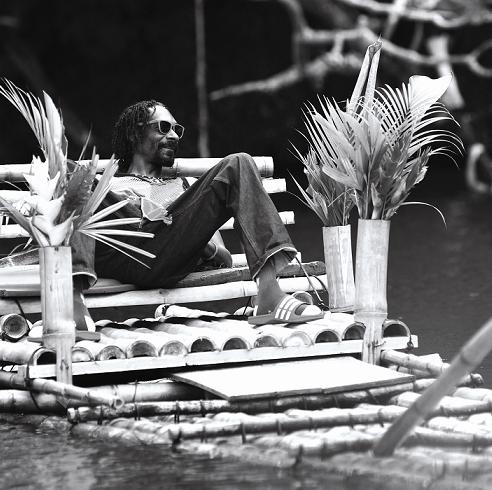
THERE’S ALWAYS SNOOP

“Kids were walking around light-headed. The animals and everything.” Oakland radio DJ cum-MTV News executive producer Sway had the pleasure of introducing Snoop Dogg’s latest reincarnation at a recent press conference (still available online if this abbreviated sum-up doesn’t cut it for you.) But before he introduced Snoop Lion, he wanted us to know Dogg had smoked out Sway’s guest house on a recent visit — so badly, in fact that it took weeks to air out. Think of the children!

Snoop is. He just recorded Reincarnated, a roots album with Diplo. The first single “La La La” already available to buy. The rapper said the project is for his fans that can’t stomach his career’s gangsterisms. “I can’t just keep taking them to a dead end street and dropping them off,” he said. “I got to teach them how to fish, how to plant, how to grow.” Oh, and he’s bored. ” I’m a wise man in this music industry,” he said. Onto the next genre, where he at least has to hustle.

“I’ve always said I was Bob Marley reincarnated,” the Lion mused. The rebirth apparently took place on visit to a Jamaican temple. A priest informed Snoop “you are Brahimi, you are the light, you are the lion.” Said Snoop, “from that moment on, it was like I began to understand why I was there.” Helpfully, Vice cameras were on hand for the meeting, for Snoop getting dreadlocks, and for the creation of the album. A documentary named Reincarnated will be debuting at the Toronto International Film Festival, but surely the intrepids of Vice Media will be happy to bring it your way after that.

When Sway asked him straight up if he’d be converting to Rastafarianism, Snoop said that being a rasta was more about lifestyle than religion. “It’s the way you live, it’s the way you do what you do. I felt like I’ve always been Rastafari. I just didn’t have my third eye open. But it’s wide open right now.”

What his tri-eye see? Will Snoop Lion shake his mane at cannabis Prohibition in the United States? What would Bob Marley do?

WWBMD?

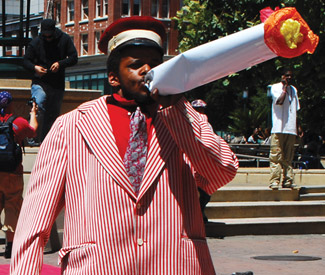
Tuff Gong would certainly not have been stoked had he been in the Bay on July 31, when SF dispensaries Vapor Room and HopeNet shut their doors for the last time after receiving prohibitory letters from US Attorney Melinda Haag. The next day, activists took to the streets in a mock funeral for medical cannabis, touting “Cannabis is Medicine: Let the States Decide” signs, a coffin, and a paper mache version of Haag to the US Federal Building, where she has an office.

BOOK BEAT

New release exploring the complications involved in ending Prohibition: Marijuana Legalization: What Everyone Needs to Know (Oxford University Press, 288pp, $16.95), co-authored by Oakland’s Beau Kilmer. Kilmer is the co-director of RAND’s Drug Policy Research Center, and appears to be recommending a cautious approach to making pot legal — a prospect being voted on in three states in the fall election.

Instrumental duo Silian Rail includes ‘every/one’

0

Do artists need vocals and lyrics to demand audience attention in a place like the Bay Area, where there are new musicians popping up left and right? Eric Kuhn and Robin Landy, better known as instrumental duo Silian Rail, have found the answer to that question to be a resounding “no.”

With a handful of locally well-received releases under its belt and an upcoming headlining show at Bottom of the Hill, Silian Rail has clearly made it work thus far without words. The band’s songs run on a driving rhythm paired with carefully crafted guitar work. The complexity of its sound has continued to kept critics and fans coming back for more – a happy discovery for many, that expansive instrumental music can hold their attention.

For a recent companion piece, however, the band added something somewhat foreign to its repertoire, through collaborations with other artists: vocals. “We do have a couple singers on this album,” Kuhn says.

“Our choice to be an instrumental band is not something we ever really talked about. The way we play together emerged quite naturally – [Landy] plays guitar, I play drums…We thought it would be a fun excuse to collaborate with friends and see what they would contribute.”

Silian Rail’s collaborative recent EP every/one (released in May of this year as a companion to the each/other album) will benefit United Roots Oakland, with all of the proceeds going towards its community engagement programs in the arts and media. That EP includes Lewis Patzner (Judgement Day, the Devotionals), Thao Nguyen, Andrew Maguire (Thao and Mirah, DRMS, the Devotionals), Colleen Johnson (Upside Drown), and Winston Goertz-Giffen (Saything).

“The Bay Area music scene is great – not just to blow smoke up the collective ass of the Bay Area,”  Landy says with a laugh. “It’s non-competitive and very supportive. It seems different than LA or New York in that way… I’m just guessing.”

Kuhn says the title of the album, every/one, is a reflection on the tension and paradox of the strength of a collective or a collaboration versus the importance of individual freedom.

“The songs are more or less all from a similar thematic world, which are various texts, films, experiences relating to non-normative psychological functioning – an attempt at sensitively referring to what is classically termed ‘mental illness’,” Kuhn explains.  

“[We] have a lot of empathy for these perspectives, and relate to them in many ways, and respect the non-normative psychological individual as being someone often possessing of an ability to see beyond the arbitrary limits placed on our experience of the world by the various social codes and ideologies that are part of the status quo. There is a wildness and also a directness and a poetic nonsense clarity that we find inspiring and that generally tickles our fancy.”

The band discovered United Roots Oakland at an Occupy Oakland event, where there were young kids free-styling. “It’s an awesome thing to have a creative outlet for kids, [and] to have competent adults there to coach them,” Landy says.

And since the EP was a collaboration, it seemed strange for the band to personally collect a profit from it, Kuhn says, which is they decided to donate.

Silian Rail has a long history of creative endeavors with other musicians. It first gained attention through its connection with other East Bay acts such as Tartufi, Birds & Batteries, and Low Red Land as the group Thread Productions. Although Thread is no longer active, a lot of what the group used to do still happens informally – the bands frequent each others’ shows, try to spread the word on upcoming concerts, and often perform live together.

“It was a hugely helpful idea at the time,” Landy says. “Lynne Angel from Tartufi still plays with us. Our new record is super lush, so we needed extra instrumentation, and she was kind enough to lend her talents. Tartufi still does a lot of broader community organizing around music. I have no idea how they find the time and energy to do it!”

Yet Silian Rail seems to pack in a lot projects in too. Its working towards scoring more film projects – its music has already turned up in various indie films, short clips, and videos, such as an ad for “Farm Fresh Cocktails” (which both Landy and Kuhn found quite odd). Essentially, the Silian Rail sound seems ideal for soundtracks.

But the band’s own music, of course, always comes first. They’ve both long been drawn to creating music. They were friends who grew up together in North Carolina, and parted ways at 13, only to find one another in California many years later.

“Having a guitar with me through adolescence was a lifesaver, having that emotional outlet.” Landy says, reflecting on the importance of music.
Another charitable activity on the band’s plate: it just finished a session at Bay Area Girls Rock Camp – a nonprofit organization that “empowers girls through music” –  in Oakland before our interview. At the camp, musicians teach workshops, host group activities, and perform live.

“Kids are so honest that we were more nervous to play in front of a group of five to 12-years-olds then we are playing a packed venue in San Francisco,” Landy says, “They asked us why we don’t have a singer.”

“With these arts programs, it’s not like if kids have something to do, their problems will go away, it is clearly more complicated; but music can serve as an outlet.”
Kuhn adds: “Music is a means of expression and communication that transcends a lot of barriers – things like technology – more than just language and culture. It holds a fundamental power to enable communication with people.”

For such a technically impressive band, I was impressed to find out that Landy had no formal training on guitar “I don’t really know what I’m doing at all, which has mostly helped my style evolve. I am free to experiment and do things in a different way. It’s all abut making happy mistakes; of course there are benefits to knowing what you’re doing, but it is also a benefit for me to not know. The way I learn things, it probably would have been a waste of time anyway.”

“I did play flute in band during middle school,” she says. “But guitar is basically the opposite of those instruments.”

While Eric had a moderate amount of formal training (he took guitar lessons in high school and “tried to be a music major in college”), he now learns to write for different instruments for new songs without proper lessons. “I needed to write violin and cello parts for songs I’m doing on the new album, so I sat down with a music book and did that.”

“I’m inspired by painters,” he muses. “The idea of fearlessly exploring new territory and always pushing ourselves to new places.”

Silian Rail
With Shuteye Unison, B. Hamilton
Thu/9, $10, 9pm
Bottom of the Hill
1233 17th, SF
(415) 626-4455
www.bottomofthehill.com

Activists win legal victory just as the circus comes to town

52

Animal welfare advocates and other critics of Ringling Bros. and Barnum & Bailey Circus just won an important free speech court victory against the city of Oakland just as they prepare to protest the circus starting its annual run there tomorrow.

The grassroots group Humanity Through Education announced that it has reached a $500,000 settlement with Oakland to a lawsuit that plaintiffs Pat Cuviello and Deniz Bolbol filed following their 2004 and 2005 arrests while trying to document abuses of elephants by circus employees.

The settlement includes an injunction allowing the activists to freely videotape the circus operations and to distribute literature critical of circus practices, which they will exercise starting tomorrow (Wed/8) at 6:30pm outside Oakland Arena, where Ringling Bros. begins a five-day run.

“Pictures of Ringling Bros. Circus training of baby elephants will be on display and behind-the-scenes video of Ringling elephant handlers beating the animals will be shown on a large screen. The Ringling elephant handlers videotaped beating the elephants are the same handlers working the elephants in Oakland this week,” the group said in a press statement.

To read more about how Ringling Bros. treats its elephants and its critics, read our 8/12/08 cover story “Dirty Secrets Under the Big Top.”

Survivor recounts life of rape and abuse by Your Black Muslim Bakery leader

8

Editor’s Note: This story is part of the Chauncey Bailey Project, a collaboration of Bay Area media outlets (including the Guardian) to investigate Bailey’s murder by members of Your Black Muslim Bakery.

By Louise Rafkin, Center for Investigative Reporting

 In 2002, five years before journalist Chauncey Bailey was murdered by members of Your Black Muslim Bakery, a woman identified only as Jane Doe 1 stepped forward to report decades of sexual abuse, welfare fraud and violence by the bakery’s leader, Yusuf Bey Sr.

She was prepared to hand over to Oakland police DNA from three of her children evidence that Bey had impregnated her, the first time when she was 12 years old.

Given the history of violence by members of Your Black Muslim Bakery, this was a risky move. But the woman was fueled by a mother’s anger. Her daughter, then 18, alerted her that Bey was trying to abuse her – his own daughter.

Now a devout Christian, Jane Doe 1 has decided she no longer wants to be the nameless whistle-blower. Her name is Kowana Banks and, in her first public interview, she said she made the decision to come forward to help other children trapped in similar situations. She hopes to publish a book about her experiences.

“Abused people go one of two ways: Either they are going to self-destruct or they’re going to make a difference,” said Banks, 44. “I’m going to make a difference.”

The violent saga of Your Black Muslim Bakery is fading into Oakland history, but wounds remain among Bey’s victims and family members today marks the fifth anniversary of the murder of Bailey, the Oakland Post editor who had been investigating the bakery’s finances.

The facts behind Banks’ story have been outlined in court proceedings and depositions, but her decision to come forward allows her to detail her unique insider’s perspective as a victim and survivor.

Today, Banks is an optimistic, composed woman who has moved on as best she can. One of her three children by Bey, Yusuf V, 25, is in San Quentin State Prison for his part in the 2007 kidnapping of two Oakland women, one who was tortured, a crime related to the bakery’s demise. The other two are doing well.

Banks considers the three to be the “blessing out of what happened to me.”

Married for 18 years to a man she met after leaving the bakery, Banks says the bitterness and anger that grew from her childhood abuse dissolved when she fell in love. The couple have two children together.

“But it’s difficult to look back and know I was just a child then and that no one cared,” she said.

Throughout her childhood at the bakery, Banks said she felt abandoned by the social welfare system, invisible even to those at local hospitals where she – and many other underage girls at the bakery compound – gave birth to multiple children while still children themselves.

She delivered the first of three children by Bey at Alta Bates Hospital in Berkeley at 13. A social worker questioned Banks about the paternity of her son, she said, but under the watchful eye of one of Bey’s “wives,” Banks kept silent. Later, she said she told a child protection worker that she was working long hours and not going to school.

“She told me she would check into it, and I never saw her again,” Banks said.

Bey, a self-appointed minister who gave himself the title of “Dr.,” was formerly a hairdresser. He opened Your Black Muslim Bakery in the late 1970s, espousing black self-reliance and his own interpretation of Islam, which included racist attacks on whites. Nevertheless, in his more than 30 years in North Oakland, Bey gained the support of local business leaders, clergy and politicians eager to align with the underclass.

In 2003, Bey died before facing trial, setting off the struggle for power and control that escalated into mayhem and multiple murders. Banks said she saw the violence coming.

“You cut off the head,” Banks said, “and the body will go crazy.”

Molestations began at age 8

Banks, who was born in the East Bay, said her father was a drug addict who met Bey’s followers while doing jail time for drug-related crimes. Banks can’t remember her mother, who she said abandoned her as a toddler, along with a younger brother and older sister.

In 1976, Banks’ father brought the children to live at the bakery compound, where he’d gotten a job. A hive of single-family homes, retail storefronts and apartments clustered on the corner of San Pablo Avenue and 59th Street in North Oakland, the compound housed bakery workers and Bey’s sprawling family of children and women he called his wives.

One Sunday night in 1976, Bey invited Banks to spend the night in his apartment, telling her she could play with his baby daughter. Banks was nervous and thought it strange to spend time with Bey, then 41. But her older sister had spent the night there and returned toting candy and new clothes. She said that night marked the first time Bey molested her. She was 8.

Bey told her to tell no one, she said. If she did, she would be killed.

“But he didn’t stop with me,” she said. “He told me he’d murder my whole family, everyone.”

Banks believes her father did not know about the incident, but the family moved away soon after that first molestation. They lived in Hayward for a while, and later, Banks’ father left her and her siblings with a grandmother near Monterey.

In 1978, after another arrest, her father brought them back to the bakery and left them with Bey.

Not long after, Banks said, Bey came into her bedroom above the bakery while she was sleeping, and raped her. She was 10 and remembers wearing one-piece pink zip-up pajamas. After the assault, she sought help from Nora Bey, then 23, one of the minister’s many “wives.” Banks’ father had surrendered his paternal rights so Yusuf Bey could receive welfare for their care; the court appointed Nora Bey, later known as Esperanza Johnson, as their legal guardian.

“ ‘I need you to help me because he’s trying to do things to me,’ ” Banks recalls telling Nora Bey. “And her comment was, ‘Oh, girl, he’s not going to do anything to you that he hasn’t done to anyone else.’ ”

Living in various bakery-owned homes, Banks was kept out of public school. She was smart, though, and soon became an integral part of the bakery, which sold pies and sandwiches from its San Pablo Avenue storefront. She learned bookkeeping and taught basic math and reading at the bakery’s school. Her life was regimented; she baked from 4 to 8 a.m., taught in the bakery’s combined school and day care until 6 p.m., and then wrapped bakery products until 10 p.m.

It was not until several years later that Banks even received a wage, just $25 per week.

At the time, Banks remembers not understanding why those living in the compound all were so isolated from outsiders, why they were punished for sneaking out once to see a movie, “The Wiz.”

“But as an adult, I understand now,” she said, “because he had secrets, and he didn’t want those secrets to get out.”

Learning Bey’s doctrine

In the bakery’s school, Yusuf Bey’s doctrine was drilled into the children. Girls were taught to cover their heads; everyone was addressed as “brother” or “sister.” Bey preached the superiority of men over women and of blacks over whites. Whites, he said, were “the devil” and responsible for all the world’s problems.

“The men were the ceiling, and women were the floor,” Banks said, quoting Bey.

She, however, was hardly subservient, growing into a feisty and hardheaded young woman, often chastised for speaking out against unfair treatment.

“I was known for saying whatever was on my brain,” Banks said.

Once when Banks complained about the long hours of work, she said she was forced to get up even earlier. When one of the other women found Bey with Banks in his bedroom late at night, the woman’s questions were silenced with a beating. Banks was then given a beating herself.

Banks said Bey tried to turn others against her and, because her mother was white, called her “nobody but the devil.”

But he continued to rape her repeatedly. At 13, she gave birth to the first of the three children she would have with Bey.

All the while, Banks said, Bey received – and kept for himself – welfare payments and food stamps intended for Banks, her siblings, others and eventually the children born as a result of the rapes. Bey was said to have more than 40 children and called up to 100 women his wives.

The atmosphere of fear was total, Banks said. In 1986, a young man, Peter Kaufman, who’d spoken out about having seen Bey rape a boy in the bakery’s bathroom, turned up dead on a nearby side street, shot in the head. Beatings – for both women and men in the bakery community – were commonplace.

Bey, Banks said, was a persuasive man who used intimidation, violence and a flashy lifestyle to control his mostly down-and-out followers, many of whom were parolees. There were cameras in the bakery and microphones in every room to monitor conversations. Among the women, the abuse was ubiquitous and unspoken. It was some time before Banks realized that Bey was molesting her sister, too.

Banks said she was instructed by Nora Bey not to identify him as the father of her children on their birth certificates. And Banks wasn’t allowed to choose names for her kids. Particularly painful to Banks was that her second son was named Yusuf by Nora Bey.

Banks said she had nowhere to turn. She blames racism, fear and a hands-off attitude for the lack of oversight by welfare officials and police.

“They were fed Brother Bey’s line that he was doing a lot for the black community,” she said. “No one wanted to intervene.”

Escape from bakery life

For years, Banks dreamed of leaving. But under the constant threat of violence, she waited. She planned to leave at 18, but was again pregnant. In 1988, then 20, she became romantically interested in a man her own age she met at the bakery. Bey caught wind of this and held a meeting at which he directed his other women to teach Banks a lesson by beating her.

Warned of her impending punishment, Banks made her escape that night, Aug. 28, 1988. A cousin on her father’s side agreed to pick her up. As she was collecting her children, Bey confronted her and threw her belongings at her.

“I picked up as much as I could that he threw at me and packed it into the car,” said Banks, laughing at the memory. “I don’t think he realized he was helping me.”

At first, she “felt so free” in a world outside the bakery, but soon she began to live in fear that Bey would send someone to harm her.

“My fear was a stranger that I didn’t even know would walk up to me and do something, because of course they had pictures of me,” she said.

Moving forward with her life was difficult, and keeping hold of the children she had with Bey ultimately proved too much of a challenge. Banks found work at restaurants as a server, but money was always tight. Bey wouldn’t pay child support, and the welfare she received never seemed to be enough.

“I was just a child when my kids were born,” she said. “It would be different if today I was having children, or even 20 years ago.”

Soon, Bey, exerting his power, sent for the kids, and they returned to the bakery. The boys spent most of their childhood there. Banks said her daughter, despite spending some time at the bakery and with foster families, mainly grew up with her.

At the bakery, Bey tried to turn her kids against her, Banks said, telling them she wanted them only for their welfare checks. While still a child, her oldest asked why she didn’t live with them at the bakery, like the parents of the other kids. Banks explained to him that “it wasn’t a good place” for her.

“I felt it was a better environment for men than it was for women,” she said, noting that at the time, she assumed Bey would not molest his own children.

In 1989, she met her husband through an acquaintance. The couple had their two children in the ’90s.

More than a decade passed. Banks took community college classes, found work in restaurants, earned her GED diploma and occasionally visited her boys at the bakery. There was constant intimidation; she feared retribution for leaving and was always looking over her shoulder.

Concern for daughter prompts action

Banks never told her kids about her abuse. It was hard to watch her boys be lured in by Bey’s flashy lifestyle – a Mercedes or Cadillac was always parked curbside – but Banks held out hope that she had been right, that it really was a better place for boys than it was for girls.

In June 2002, her 18-year-old daughter, who was working at the bakery but living elsewhere, told Banks a story that suggested Bey had tried to molest her. Banks was devastated, unable to even ask her daughter for details.

“I prayed, asking God who was going to stop him,” said Banks, then 34. “And then, suddenly, I knew it was me.”

With DNA testing available, she could prove Bey’s paternity. It offered the proof she had always hoped to find. In an angry phone conversation with Bey, she told him her plan.

“You, sir, are a rapist and a child molester, and let me tell you what I’m going to do to you,” she recalls saying. “First, I’m going to go to the police, and I’m going to press charges against you, and then, when I’m done, I’m going to sue you and I’m going to take all your money. And then I won’t have to ask you to help your children, my children, with anything else, because I’m going to have all your money.”

Bey, she said, told her she’d soon be “floating in a river.”

To show Bey her determination, she called him again from a phone at the Oakland Police Department. “He knew from that day forth that it was over for him,” she said.

Three months later, Bey was taken into police custody. With DNA test results in hand, Banks pressed felony criminal charges of rape and assault. Bey posted bail, but died in the hospital a year later before facing the criminal trial.

Banks was disappointed that Bey never faced a trial but took pleasure in knowing that he had at least faced the charges.

“He lived a long life of getting away with it,” she said. “By the grace of Jesus, I know he’s boiling in hell.”

Another Jane Doe revealed

Along with two other women, Banks also filed a civil suit, alleging that Alameda County did nothing to protect them. The county eventually settled with Banks and the two other Jane Does, admitting no liability.

Another of the Jane Does in the suits, a former foster child who worked at the bakery between 1994 and 1996 and was raped by Bey, also has decided to publicly identify herself for the first time.

Malikha Hardy said she reported her abuse on three occasions to a county social worker, to a guidance counselor at juvenile hall and, in 1996, to the Oakland police. No one followed up until seven years later, she said, when an Oakland detective working on Banks’ case turned up at her door.

“The people feared Bey,” Hardy, now 32, said in a recent phone interview. “He had people who would do anything for him.”

To protect the two women, California Watch is not providing information about their current whereabouts or employment. During multiple interviews for this story, a family therapist was present to provide support.

Having wrestled with low self-worth, nightmares, and other aftereffects of childhood trauma, Banks is writing a book about her life with the therapist’s help. She credits her conversion to Christianity with making it possible for her to smile again.

“I’m resilient, and I’m positive,” Banks said. “I say, ‘If people are preying on you, God has chosen you.’ ”

Banks remains in contact with her son Yusuf V, who is imprisoned at San Quentin and serving a 10-year sentence as part of a plea agreement in the kidnapping incident.

“I’m trying to reform my son’s way of thinking,” Banks said. “Him sitting in one spot is the best time for me to do it, because his mind is open.”

During a recent visit to the former bakery compound, Banks said she thinks the reign of terror is now over. Many of the buildings have been sold or renovated; little is left to indicate what went on, outside or inside. The old bakery is a beauty supply store. The former school is a martial arts studio.

As Banks walked through memorable rooms and haunted hallways, she recounted stories both benign and horrific.

“I’ve seen stuff here,” she said, “that will scare me for the rest of my life.

This story was edited by Robert Salladay and Amy Pyle and copy edited by Nikki Frick and Christine Lee.


This story was produced by the independent, nonprofit Center for Investigative Reporting in collaboration with the Chauncey Bailey Project. For more, visit www.cironline.org and www.chaunceybaileyproject.org. Rafkin can be contacted at Louise.Rafkin@gmail.com.


 

Eat these words

1

le.chicken.farmer@gmail.com

CHEAP EATS One by one I am finding my old friends and hugging them. Last night at the Giants game, for example, I found El Centro, who — by the time you read this — will have sailed to Alcatraz and swum back to San Francisco. I’m so proud and impressed, and excited because, assuming she doesn’t drown and/or get eaten by sharks on her way home, there’s going to be a barbecue after at her house.

El Centro will be my second friend to have attempted this feat; not the barbecue, the swim.

How cool is that? To swim from Alcatraz to San Francisco — are you kidding me? It’s so cool, I’d need to wear a wet suit just to write one more sentence about it.

My own adventures have been more pedestrian, of late.

Hedgehog and me needed to get a neighborhood sticker for Angelo Joe, our gigantic and hard-to-park Honda Fit cargo van, and this required a long walk down to Market and South Van Ness. Along the way, we held hands and argued about geometry.

Hedgehog thinks that just because she remembers more words (in particular: hypotenuse) than I do, she is always right about math. I argue that, vocabulary-be-damned, the shortest distance between two points is always a straight line and never turning right on 14th St. and then left on Mission. (Except maybe in rare instances like Market St. has a parade or protest on it.)

BTW, I won that argument — as anyone save the staunchest surrealist and possibly airline pilots will plainly see. Even so, we were late for breakfast.

You know me. I can’t stand in line on an empty stomach, so I had asked Hedgehog to find us something good down there to bite into. She did that magic little thing she does with her thumbs and a cell phone and came back with my new favorite restaurant.

Little Griddle, of course. It’s just one block away from MTA, and they have those donut burgers like at Straw, with bacon and everything. Only their donuts are square. The Lucifer, they call it. They also have a giant double-pattied burger (the Evil Knievel), and one called the Hot Mess, featuring pepper jack cheese and jalapenos, and chipotle sauce. Plus cilantro and onions.

Thankfully it was a very breakfasty hour, or I would have been tempted. Instead, it was the Morning Star omelet that caught my eye — in particular the words “maple smoked bacon chicken sausage,” every single one of which is in my vocabulary.

This omelet comes with green pepper, yellow onion, tomato, and substitute spinach for mushrooms if you’re me. (Pssst. You’re not!) All that, plus cheese, and maple smoked bacon chicken sausage. Which is just one thing, mind you. With five words. Working backwards, it’s a kind of sausage, a chicken sausage. With bacon in it. Maple smoked bacon, to be precise.

Now is a very good time to be alive.

I’m serious. When a kind of sausage can have five words in the name of it, and every single one of those words is your all-time favorite word …

Those are the days. These.

I mean, it wasn’t as good as it sounds; but how could it possibly be?

Hedgehog ordered the Bits & Pieces scramble, which is basically the same ingredients minus cheese, scrambled. And you can get salad instead of hash browns so we got one with each and shared. Very good. Good, crispy hash browns. Good, crispy salad.

The coffee was good.

Coach came down on her bike and met us there, for support, and brought me a box of my favorite welcome home maple cream sandwich cookies from Trader Joe’s, and a black Champion skirt to play football in this season. She takes care of her players like that. Speaking of which …

Giants 3, Padres 2 — but I gotta tell you, even though the Giants are in first place and yeah yeah yeah, something even more exciting, baseballwise, is happening in Oakland these days. And it’s still easier to get to the Coliseum. And cheaper. Just saying.

LITTLE GRIDDLE

Sat-Mon: 7:30am-3pm; Tue-Fri: 7:30am-5pm

1400 Market St., SF.

(415) 864-4292

AE,D,MC,V

No alcohol


Cheaplicious

1

CHEAP EATS I can’t tell you how beside myself I am to be back in San Francisco. I can tell you, but it will sound like it’s coming from over there. It’s not! I’m right here where I belong, typing at you from the warmth of my very own(ish) clawfoot tub in the bowels of my old dungeon-y hovel at 18th and Guerrero.

Upstairs, in the relative sunshine of our other, airier studio apartment, Hedgehog is pacing back and forth and saying to herself: We live in San Francisco. We live in San Francisco. Until finally she can’t take it anymore and shaves off her eyebrows.

You too, dear reader, must be pretty somewhat goddamn happy to hear this. It means instead of me writing about restaurants in Oakland and Berkeley all the time, not to mention points even farther east, I will likely go right back to hardly ever leaving the Mission.

Just last night for example, because neither of our two refrigerators had any food in it yet, we were stuck in one of those where-to-eat thingies, wherein I kept saying: Sichuan Home! And I kept saying: Halu! No, Sichuan Home. No, Halu. And Hedgehog kept sitting on our pretty red couch, looking daggers at me and altogether having eyebrows.

Then she said, “Let’s just go outside and walk around the neighborhood and find something. You haven’t lived here in almost a year. There will be new things.”

“Yeah sure,” I said.

We grabbed our jackets and stepped out into the hallway of our apartment building just as Scotty the House was walking by with a bass. “What?” we all said.

“We’re back!” I said.

He was going upstairs to get Earl Butter to practice for their cute little bandy. But first he wanted to tell us about where he’d just had dinner, and how awesome it was. New place. Small plates. Outside tables. Tacolicious.

Can there be a dumber name for a restaurant?

Please don’t be in the Mission. Please don’t be in the Mission, I repeated to myself.

Scotty the House is a vegetarian.

“Where is it?” Hedgehog asked.

Scotty the House lives in Oakland. “In the Mission!” he said.

It was just around the corner, on Valencia, he said, between 18th and 19th. So OK so that was where we eventually walked to.

We were not the discoverers of Tacolicious. In fact, there was only one table left, and it was outside.

“The heaters are on,” our hostessperson assured us, and we were sold so she led the way.

Outside is a nice little alleyway between buildings, with a big black-and-white mural of the city along one wall. There are words on the mural, too. And the heat was on and the chips were fresh-made and immediate, the salsa spicy and delicious.

Uh-oh. If I’m not careful, I’m going to like this restaurant, I thought.

I wasn’t careful. At $3.95 a pop, 4 for $13, we ordered one of everything, tacowise, give or take the vegetarian one. Give, to be precise. But to make up for it, we tacked on a taco of the week, which was achiote chicken, and a side of drunken beans that promised us both bacon and “pickled things.” Their words, not mine.

Problem being, we couldn’t find anything at all pickled in those beans. It was either an oversight, or a very subtle drunk.

Neverminding that, though, the tacos were, generally speaking, pretty great. Except I don’t much like mole so I let Hedgehog have almost all of that one. And the shot-and-a-beer braised chicken and chorizo-and-potato ones were also not my favorites.

I loved the carnitas, the cochinita pibil and the braised beef short rib tacos. The fried rock cod one was also especially wonderful: one nice-size lump of white fish delicately breaded and bursting with juiciness. Honestly, at first bite I wondered if they had injected the fish with melted butter or something. It was heavenly.

Oh yeah: bistec adobado, with big chunks of actually rare steak and pickled onions. You have to add a buck, it’s so good. Not cheap. But close enough.

Tacolicious

Daily: 11:30 a.m.-midnight
741 Valencia St., S.F.
(415) 626-1344
AE,D,MC,V
Full bar


Stage Listings

0

Stage listings are compiled by Guardian staff. Performance times may change; call venues to confirm. Reviewers are Robert Avila, Rita Felciano, and Nicole Gluckstern. Submit items for the listings at listings@sfbg.com. For further information on how to submit items for the listings, see Picks.

THEATER

OPENING

Humor Abuse American Conservatory Theater, 415 Geary, SF; www.act-sf.org. $25-95. Opens Fri/3, 8pm. Runs Tue-Sat, 8pm (also Sat, 2pm); Sun, 2pm. Through Aug 19. Lorenzo Pisoni performs his autobiographical show about growing up as the youngest member of San Francisco’s Pickle Family Circus.

The Princess Bride: Live! Dark Room Theater, 2263 Mission, SF; foulplaysf.com/princessbride. $20. Opens Thu/2, 8pm. Runs Thu-Sat, 8pm. Through Aug 25. Dark Room Productions presents a live tribute to the cult fairy-tale movie.

BAY AREA

Circle Mirror Transformation Marin Theatre Company, 397 Miller, Mill Valley; www.marintheatre.org. $20-57. Previews Thu/2-Sat/4, 8pm; Sun/5, 7pm. Opens Tue/7, 8pm. Runs Tue and Thu-Sat, 8pm (also Aug 11, 16, and 25, 2pm); Wed, 7:30pm; Sun, 2 and 7pm. Though Aug 26. Marin Theatre Company and Encore Theatre Company co-present the regional premiere of Annie Baker’s comedy about a drama class.

"TheatreWorks 2012 New Works Festival" TheatreWorks at Lucie Stern Theatre, 1305 Middlefield, Palo Alto; www.theatreworks.org. $19-25 (fest pass, $65). Aug 5-19, various times. The 11th annual festival features a developmental production of The Trouble With Doug by Will Aronson and Daniel Maté and staged readings of Sleeping Rough by Kara Manning, The Loudest Man on Earth by Catherine Rush, Being Earnest by Paul Gordon and Jay Gruska, and Triangle by Curtis Moore and Thomas Mizer.

ONGOING

Absolutely San Francisco Alcove Theater, 414 Mason, Ste 502, SF; www.thealcovetheater.com. $32-50. Thu-Sat, 8pm. Through Aug 18. A multi-character solo show about the characters of San Francisco.

Arctic Hysteria Bindlestiff Studio, 185 Sixth St, SF; www.brownpapertickets.com. $10-25. Thu/2-Sat/4, 8pm (also Sat/4, 2pm). SNAP (Some New Arts Project) presents this movement-based dark comedy by Abi Basch, performed by Berlin’s Kinderdeutsch Projekts.

Enron Exit Theatre, 156 Eddy, SF; www.enron2012.com. $25. Thu-Sat, 8pm. Through Aug 17. In OpenTab’s production of British playwright Lucy Prebble’s 2009 Enron, tragedy plus time equals comedy plus puppets (in imaginative designs by Miyaka Cochrane), as fast-paced satire delivers a timely reconsideration of yet another infamous financial scandal. Some fictional elements shape the plotline but simplifying strategies serve well to clarify the real-life actions and consequences of Ken Lay (GreyWolf) and Jeffry Skilling’s (Alex Plant) deceptive energy-trading juggernaut, the onetime darling of Wall Street and the financial pages. There’s also much verbatim information (echoing the book and documentary, Enron: The Smartest Guys in the Room) enlivening the quick dialogue and underscoring the reckless, hubristic malfeasance that famously preyed on California’s electricity grid and threw Enron’s own employees under the bus. Director Ben Euphrat gets spirited and engaging performances from his principals, with especially nice work from Plant as a cruelly superior Skilling, Laurie Burke as ambitious straight-shooter Claudia Roe (a fictionalized composite creation of the playwright), and Nathan Tucker as manic sycophant Andy Fastow, feeding poisonous Enron debt into three beloved "raptors" (the pet names for some animated shadow companies arising from Fastow’s fast work in "structured finance"). At the same time, the staging can prove rough between concept and execution, with scenic elements sometimes confusing as well as aesthetically ragged (a red fabric serving as a large profit graph, for instance, just looks like some droopy inexplicable drapery at first; and the first puppets to appear are too small to be very effective either). Despite this messiness in terms of mise-en-scène, however, the play is generally clear-eyed and good for more than easy laughs — since no single villain but rather a system and culture are the proper targets here. As Prebble notes, the strategies developed by Enron, far from remaining beyond the pale, are now standard practices throughout the financial and corporate world. That, in some circles, is known as progress. (Avila)

The Merchant of Venice Gough Street Playhouse, 1622 Gough, SF; www.custommade.org. $25-32. Thu-Sat, 8pm; Sun, 7pm. Extended through Aug 19. Custom Made Theater presents director Stuart Bousel’s generally sharp staging of Shakespeare’s perennially controversial but often-misunderstood play. The lively if uneven production ensures the involved storyline cannot be reduced to the problematical nature of its notorious Jewish villain, Shylock (played with a compellingly burdened intensity by a quick Catz Forsman), but rather has to be seen in a wider landscape of desire in which money, status, sex, gender, political and ethnic affiliations, and human bodies all mix, collide, and negotiate. To this end, this Merchant is set amid a contemporary financial district coterie (given plenty of scope in Sarah Phykitt’s thoughtfully pared-down scenic design), where titular melancholic businessman Antonio (Ryan Hayes) sticks his neck out (or anyway a pound of flesh) for his beloved friend Bassanio (Dashiell Hillman) — no doubt the unspoken source of Antonio’s brooding heart as staged here — as the latter seeks a loan with which to court the lovely and brilliant Portia (a winning Megan Briggs). While the subplot concerning the wooing and flight of Shylock’s daughter, Jessica (Kim Saunders), is less adeptly rendered, fluid pacing and a confident sense of the priorities of the drama overall offer a satisfying encounter with this fascinatingly subtle play. (Avila)

Les Misérables Orpheum Theatre, 1192 Market, SF; www.bestofbroadway-sf.com. $83-155. Tue-Sat, 8pm (also Wed and Sat, 2pm); Sun, 2pm. Through Aug 26. SHN’s Best of Broadway series brings to town the new 25th anniversary production of Cameron Mackintosh’s musical giant, based on the novel by Victor Hugo. The revival at the Orpheum does without the famous rotating stage but nevertheless spares no expense or artistry in rendering the show’s barrage of colorful Romantic scenes (with Matt Kinley’s scenic design drawing painterly inspiration from Hugo’s own oils) or its larger-than-life characters — first and foremost Jean Valjean (a slim but passionate Peter Lockyer), nemesis Javert (Andrew Varela), and rescued orphan beauty Cosette (Lauren Wiley). Chris Jahnke contributes new orchestrations to the rollicking original score by Claude-Michel Schönberg (music) and Herbert Kretzmer (lyrics) in this flagrantly sentimental, somewhat problematic but still-stirring meld of music and melodrama in dutiful overlapping service of box office treasure and powerful humanist aspirations. (Avila)

Project: Lohan Costume Shop, 1117 Market, SF; www.projectlohan.com. $25. Thu-Sat, 8pm; Sun, 7pm. Through Aug 19. D’Arcy Drollinger pays tribute to the paparazzi target with this performance constructed solely from tabloids, magazines, court documents, and other pre-existing sources.

Sweeney Todd: The Demon Barber of Fleet Street Eureka Theatre, 215 Jackson, SF; www.rayoflighttheatre.com. $25-36. Thu-Sat, 8pm (also Sat, 2pm); Sun, 2pm. Through Aug 11. Halloween comes early this year thanks to Ray of Light Theatre’s production of Sweeney Todd and all its attendant horrors. Set in bleakest, Industrial Revolution-era London, this Sondheim musical pushes the titular Todd to enact a brutal vengeance on a world he perceives as having stolen the best of life from him, namely his family and his freedom. No fey, gothic vampire, ROLT’s Sweeney Todd (played by Adam Scott Campbell) is both physically and psychically imposing, built like a blacksmith and twice as dark. Pushed over the line between misanthropic and murderous, Sweeney Todd methodically plots his revenge on the hated Judge Turpin (portrayed with surprising sympathy by Ken Brill) while the comfortably comical purveyor of pies, Mrs. Lovett (Miss Sheldra), dreams of a sunnier future. Mrs. Lovett’s no-nonsense, wisecracking ways aside, there are few laughs to be had in this slow-burning dirge to the worst in mankind, and as the body count rises, it is made abundantly clear that all hope of redemption is also but a fantasy. Contributing to the dark mood are Maya Linke’s imposing, industrial set, Cathie Anderson’s ghostly green and hellfire amber lighting, and a spare chamber ensemble of six able musicians conducted by Sean Forte. (Gluckstern)

"Un-Abridged: The Best of Ten Years of Un-Scripted" SF Playhouse, 533 Sutter, SF; www.un-scripted.com. $10-20. Thu-Sat, 8pm (also Fri/3, 10pm; no show Sat/4). Through Aug 18. The veteran Bay Area company celebrates its tenth anniversary season with a four-week retrospective of its favorite long- and short-form improv shows. Check website for schedule.

Vital Signs Marsh San Francisco, 1062 Valencia, SF; (415) 282-3055, www.themarsh.org. $15-50. Sat, 8:30pm. Extended through Aug 25. The Marsh San Francisco presents Alison Whittaker’s behind-the-scenes look at nursing in America.

Waiting… Larkspur Hotel Union Square, 525 Sutter, SF; www.brownpapertickets.com. $49-75. Thu/2-Sat/4, 8pm; Sun/5, 2pm. Comedy set behind the scenes at a San Francisco restaurant.

The Waiting Period MainStage, Marsh San Francisco, 1062 Valencia, SF; (415) 282-3055, www.themarsh.org. $15-50. Fri/3, 8pm; Sat/4, 5pm. Brian Copeland (comedian, TV and radio personality, and creator-performer of the long-running solo play Not a Genuine Black Man) returns to the Marsh with a new solo, this one based on more recent and messier events` in Copeland’s life. The play concerns an episode of severe depression in which he considered suicide, going so far as to purchase a handgun — the title coming from the legally mandatory 10-day period between purchasing and picking up the weapon, which leaves time for reflections and circumstances that ultimately prevent Copeland from pulling the trigger. A grim subject, but Copeland (with co-developer and director David Ford) ensures there’s plenty of humor as well as frank sentiment along the way. The actor peoples the opening scene in the gun store with a comically if somewhat stereotypically rugged representative of the Second Amendment, for instance, as well as an equally familiar "doood" dude at the service counter. Afterward, we follow Copeland, a just barely coping dad, home to the house recently abandoned by his wife, and through the ordinary routines that become unbearable to the clinically depressed. Copeland also recreates interviews he’s made with other survivors of suicidal depression. Telling someone about such things is vital to preventing their worst outcomes, says Copeland, and telling his own story is meant to encourage others. It’s a worthy aim but only a fitfully engaging piece, since as drama it remains thin, standing at perhaps too respectful a distance from the convoluted torment and alienation at its center. (Avila)

BAY AREA

For the Greater Good, Or The Last Election This week: Lakeside Park, 666 Bellevue, Oakl; www.sfmt.org. Free (donations accepted). Wed/1-Thu/2, 7pm. Live Oak Park, 1301 Shattuck, Berk; www.sfmt.org. Free (donations accepted). Sat/4-Sun/5, 2pm. Various venues through Sept. 8. "Don’t they understand that without us they don’t have anything?" asks Gideon Bloodgood (Ed Holmes), investment banker at the top of the San Francisco Mime Troupe’s vivisection of the "real" American Dream, For the Greater Good, Or the Last Election. But surely the hero of a Mime Troupe show cannot possibly be a billionaire? Well, sort of. Though Bloodgood enriches himself dishonestly with precarious investments and outright theft in this Occupy-era melodrama, he actually does occasionally spare a sentiment for Mom and apple pie, or anyway his daughter Alida (Lisa Hori-Garcia) and cookies baked by the unsuspecting victim of his ill-gotten gains, the Widow Fairweather (Keiko Shimosato Carreiro) — now living at the last Occupy encampment standing in the city. Alida, however, displays no compunction in throwing aside his affection and her prospective seat in Congress, running off to join the occupiers for reasons that truthfully appear about as politically motivated as her father’s parasitic avarice, leaving him to join forces instead with the most unlikely of allies — the impeccable, ingenuous Lucy Fairweather (Velina Brown), heiress to a stolen legacy, and staunch patriot. Based loosely on 19th century play The Poor of New York, The Last Election attempts to turn a presumptive ode to the free market into its swan song with good-humored, if predictable, results. (Gluckstern)

King John Forest Meadows Amphitheater, 890 Belle, Dominican University of California, San Rafael; www.marinshakespeare.org. $20-35. Sat/4, 10-12, 8pm; Sun/5, 4pm. Marin Shakespeare Company kicks off its 2012 outdoor summer festival season with this history play.

The Kipling Hotel: True Misadventures of the Electric Pink ’80s Marsh Berkeley, 2120 Allston, Berk; (415) 282-3055, www.themarsh.org. $20-50. Sat, 8:30pm; Sun, 7pm. Extended through Aug 26. This new autobiographical solo show by Don Reed, writer-performer of the fine and long-running East 14th, is another slice of the artist’s journey from 1970s Oakland ghetto to comedy-circuit respectability — here via a partial debate-scholarship to UCLA. The titular Los Angeles residency hotel was where Reed lived and worked for a time in the 1980s while attending university. It’s also a rich mine of memory and material for this physically protean and charismatic comic actor, who sails through two acts of often hilarious, sometimes touching vignettes loosely structured around his time on the hotel’s young wait staff, which catered to the needs of elderly patrons who might need conversation as much as breakfast. On opening night, the episodic narrative seemed to pass through several endings before settling on one whose tidy moral was delivered with too heavy a hand, but if the piece runs a little long, it’s only the last 20 minutes that noticeably meanders. And even with some awkward bumps along the way, it’s never a dull thing watching Reed work. (Avila)

A Midsummer Night’s Dream Forest Meadows Amphitheater, 890 Belle, Dominican University of California, San Rafael; www.marinshakespeare.org. $20-35. Fri/3, Sun/5, Aug 12, 18, 24, 26, Sept 7, 9, 15, 28-29, 8pm. Aug 12, Sept 2, 16, 23, and 30, 4pm. Through Sept 30. Marin Shakespeare Company performs the Bard’s classic, transported to the shores of Hawaii.

Noises Off Live Oak Theatre, 1301 Shattuck, Berk; www.aeofberkeley.org. $15. Fri-Sat, 8pm; Aug 12, 2pm. Through Aug 18. Actors Ensemble of Berkeley performs Michael Frayn’s backstage comedy.

Roald Dahl’s Willy Wonka and the Chocolate Factory Julia Morgan Theatre, 2640 College, Berk; www.berkeleyplayhouse.org. $17-35. Thu and Sat, 7pm (also Sat, 2pm); Sun, noon and 5pm. Through Aug 19. Berkeley Playhouse performs a musical based on the candy-filled book, with songs from the 1971 movie adaptation.

Upright Grand TheatreWorks at Lucie Stern Theatre, 1305 Middlefield, Palo Alto; www.theatreworks.org. $24-73. Tue-Wed, 7:30pm; Thu-Sat, 8pm (also Sat, 2pm); Sun, 7pm. Through Aug 10. TheatreWorks launches its 43rd season with the world premiere of Laura Schellhardt’s play about a musical father and daughter.

PERFORMANCE/DANCE

"Café con Comedy: Tales of Restaurant Work" Dolores Park Café, 501 Dolores, SF; www.koshercomedy.com. Fri/3, 8pm. $7-20. Behind-the-scenes restaurant humor with Bob McIntyre, Nick Leonard, Carla Clayy, and Lisa Geduldig.

"Elect to Laugh" Studio Theater, Marsh San Francisco, 1062 Valencia, SF; (415) 282-3055, www.themarsh.org. Tue, 8pm. Through Nov 6. $15-50. Veteran political comedian Will Durst emphasizes he’s watching the news and keeping track of the presidential race "so you don’t have to." No kidding, it sounds like brutal work for anyone other than a professional comedian — for whom alone it must be Willy Wonka’s edible Eden of delicious material. Durst deserves thanks for ingesting this material and converting it into funny, but between the ingesting and out-jesting there’s the risk of turning too palatable what amounts to a deeply offensive excuse for a democratic process, as we once again hurtle and are herded toward another election-year November, with its attendant massive anticlimax and hangover already so close you can touch them. Durst knows his politics and comedy backwards and forwards, and the evolving show, which pops up at the Marsh every Tuesday in the run-up to election night, offers consistent laughs born on his breezy, infectious delivery. One just wishes there were some alternative political universe that also made itself known alongside the deft two-party sportscasting. (Avila)

"Help is on the Way XVIII: That’s Entertainment" Herbst Theatre, 401 Van Ness, SF; www.richmondermet.org. Sun/5, 7pm. $50-150. The Richmond-Ermet AIDS Foundation benefits from this all-star concert, with performances from Helen Reddy, Sam Harris, Rex Smith, Tuck and Patti, Kimberly Locke, and more.

"Majestic Musical Review Featuring Her Rebel Highness" Harlot, 46 Minna, SF; www.herrebelhighness.com. Sun, 5pm. Through Aug 12. $25-65. A trio of 18th century princesses (the graceful, full-throated, international team of Velia Amarasingham, Linsay Rousseau Burnett, and Maria Mikheyenko), chafing under the patriarchal constraints of their otherwise exalted status, metamorphose into a defiant band of disco queens in this stylish, high-kitsch musical revue by writer-producer Amarasingham and composer–musical director Simon Amarasingham. The action begins in desultory fashion, bar-side in the Harlot lounge, amid scuttlebutt from a pair of chatty housemaids (Meira Perelstein and a tuneful Diana DiCostanzo) overseen by a giddy royal valet (a gregariously foppish Michael Sommers, also the show’s emcee and narrator). When the dallying princesses finally arrive (sumptuously attired in appealing period costumes by Noric Design), they ascend a small stage attended by Lady Lucinda Pilon (a Goth-inflected Amber Slemmer, alternating nights with director Danica Sena), and launch into a slick set of tightly choreographed ‘autobiographical’ numbers as the prerecorded music progresses stylistically from smooth, harpsichord-tinted dance-floor beats to all-out four-on-the-floor Donna Summer–style revelry. Despite a certain static, slightly stark ambiance in the site-specific surroundings, with the right crowd and a couple of drinks this 90-minute revue is easily a doubly retro girl-power party for all. (Avila)

Picklewater Clown Cabaret Stage Werx Theatre, 446 Valencia, SF; www.brownpapertickets.com. Mon/6, 7 and 9pm. $15. Circus cabaret benefitting Oakland’s Children’s Fairyland.

"Soundwave ((5)): The Unconscious World" Intersection for the Arts, 925 Mission, SF; www.projectsoundwave.com. Fri/3, 8pm. $12-25. A "lying-down event with audience participatory experiences" with performances by Stephen Hurrel, Andrea Williams, and Lee Pembleton and Jon Porras.

Dab’ll do ya

0

caitlin@sfbg.com

HERBWISE The neatly-dressed line of donors waiting outside the Fox Theatre on July 21 gawked at the procession coming down Broadway Avenue. Was it the impassioned protesters in wheelchairs, the oversized fake joint, or the realization that stoners could be so… vehement that had them transfixed?

"Obama keep your promise!" On the occasion of the President’s fundraising trip to Oakland — his first to the Bay Area since medical cannabis cornerstone Harborside Health Center was ordered to close in a letter from US Attorney Melinda Haag — medical marijuana had turned out for an unwelcoming party. Obama’s administration has been messing with weed, and patients weren’t about to go quietly into the night. A crowd of hundreds took a lap around the theater, starting and ending at Frank Ogawa-Oscar Grant Plaza.

Of course, the President wasn’t there to see it. Obama was hours late for his announced appearance at the Fox at 3pm.

Pre-march, sharing space in an Oaksterdam University classroom with a bank of healthy marijuana plants, OU president Dale Sky Jones welcomed members of the media to a panoramic look at today’s cannabis advocates. Jim Gray, ex-assistant US Attorney and current Libertarian Party vice presidential candidate spoke, and Harborside’s Steve Deangelo asserted that "if the US Attorneys can come after a dispensary like Harborside, no dispensary in this country is safe." Patients finished out this chorus of voices. The father of a medical marijuana patient — his young boy has Dravet Syndrome, a type of infant epilepsy — despaired that, should Harborside go under, his offspring would never get the right kind of medicine.

"What am, going to ask a drug dealer ‘do you have CBD?’" he asked, hands and voice shaking. "You’re going after the wrong drug."

DABBING 101


Oddly enough, considering the drama surrounding its legality, cannabis culture continues to grow unabated. Consider this: there are forms of ingestion that even I, your somewhat-dedicated pot columnist, remain unacquainted with. This is annoying, so upon pot Internet celebrity Coral Reefer’s 1000th tweet regarding "dabbing," I called her out on it. Would she be willing to teach me the ways of this mysterious process?

She would! Dabbing means inhaling the vapor the results from melting butane, or even super-melt cold water-extracted hash. Intriguingly, it resembles nothing so much as smoking crack with a bong, but never you mind, vapor has a lower impact on your lungs and increased potency means its a quicker process than smoking "flower," or regular dried buds.

So: heat up your dabbing surface. Reefer had no less than four kinds of set-ups for dabbing in her apartment, including a "skillet," or flat disc that attaches to any glass-on-glass bong (most dabbing kits will work with your pre-existing water pipe) and various kinds of "nails," or round, rimmed surfaces specifically made for dabbing. Wait until it’s red hot. Take your specially-designed metal pick, or "dabber," and with it rub some concentrate, called "super-melt" or "wax" at most dispensary, onto your post-red-hot surface. Inhale. Clear. Inhale. Repeat process.

Hot mess: Total Trash BBQ Weekend revisited

5

Punks, rockers — whatever you want to call it, the scene in Oakland definitely got more than messy this weekend as the Total Trash BBQ lived up to its name and then some. Between night one’s melee that spilled outside after the show (bloodied lips and all) and night two where MOM mucked up the floor (as she does), it’s safe to say partygoers got more than they bargained for.

Lately though I’ve noticed the East Bay does things a little bit different than San Francisco. For instance, Saturday at the time capsule of a venue called The Continental Club, patrons got infected by the sounds of Russell Quan, DJing oldies on full blast in between band sets.

The dance floor was always full of motion as people weren’t afraid to take advantage of the tunes. Comparatively, SF can sometimes be a little stiff. DJs’ sets at shows are often treated as background music. Then of course the whole scuffle incident was something out of the ordinary as people also weren’t afraid to throw punches.

Night One’s Mess:

The blueprint for things to come was laid down during an insanely intense set by LA’s Intelligence. You couldn’t escape the war call of driving drums and fatal sounding keys — I tried. I loved what I was hearing, but a combination of things inside of me had me seeking one of the club’s luxurious (in its own charmingly trashy way) booths to sit down for a spell.

From that vantage point I could see others in the audience reaching drunken thresholds, performing ninja kicks, and an older woman (who looked like she may have served some hard time) shoving her way through the crowd.

I caught my second wind and headed up front to see Shannon and the Clams. But it was towards the end of their set that I’d witness this one surreal episode: the guitarist-singer was supposed to chime in as usual with a distinct backing vocal, but was silent.

Shannon called him out on stage and simply said, “Cody!?” He was staring off to the side, kind of mesmerized. Seemingly dazed, he uttered into his mic, “uh…there’s a fight happening over there.” Sure enough it was the way-too-drunk ninja kicker and another dude who had gotten a little rambunctious during the last two bands.

From what I recall, there were attempts to bounce them. The crowd outside grew into a major distraction. The night pretty much dissolved into chaos at that point with aforementioned punches thrown. My friend and I high-tailed it out of there in an unfortunately expensive trans-bay cab ride after having seen enough.

But the night shouldn’t be characterized as being marred by violence. Overall it was fun to hang out in what truly was an impressive old soul circuit venue that I hope welcomes future shows. Slobsters did a comedic stink up the stage shtick while Rock N Roll Adventure Kids gave off all kinds of positive energy in their performance. Guantanamo Baywatch continued the good vibes so much that I even purchased their latest Burger cassette, Chest Crawl from the merch table.

Night Two, A Different Kind of Mess:

My friend in tow very accurately reviewed evening two at Eli’s Mile High Club by saying there was “purple drank and beaver everywhere.” While I didn’t try the concoction, plenty of bargoers washed grilled corn on the cob down their throats with the mixture out on the back patio.

The corn may have been tasty, but I have to credit MOM for her less-than-delectable (albeit less sweaty, bloody, and messy in general) antics than the last time I saw her. Sometimes she’d hike up her red dress, revealing that indeed she does go commando, other times her exposure just sort of happened as she’d be caught up in the moment writhing around in her own filth while distorted childrens’ music or the on-acid slow groove version of “Spirit in the Sky” played.

Given MOM’s reputation, it wasn’t surprising to see the audience clear a wide path for her performance. That’s not to say there wasn’t some nervous moments of me perched on a barstool, cornered next to her during Spin the Bottle. The only difference in her game was in true MOM form: victims were smothered in cake and pie. Somehow I made it out unscathed from a memorable messy weekend.


All photos by Dallis Willard

Bay Area activists join in anger over Anaheim police shootings

24

Last weekend in Anaheim, police shot and killed two young men. Every day since, protesters have taken to the streets. This weekend, a national day of protest following the killings helped spread the call for justice in Anaheim spread to the Bay Area. 

Manuel Diaz, 25, was unarmed when he was killed by Anaheim police July 21. When a crowd gathered at the scene as Diaz lay bleeding, police fired rubber bullets and pepper balls into the crowd. One police dog got loose, charged at a baby, and bit the child’s father. Police say they used crowd control because the people had grown rowdy, and that some were throwing rocks. The next day, police shot a 21-year-old, Joel Acevedo, who they say shot at officers while fleeing. 

Anaheim police shot another man the next day, a suspected burglar, marking the eighth officer-involved shooting in Anaheim so far this year. Five of the shootings resulted in death, and all but one of those killed were Latino.

“What’s going on here in Orange County is symbolic of a problem with the system,” Eduardo Perez, a 21-year-old student who attended Sunday’s protest told the Orange County Register. “This wouldn’t happen to white people. This is racism, simple as that.” 

Saturday was a designated a national day of action, and protests in New York, Oakland, Seattle, and Chicago took place, while a smaller group marched Friday in San Francisco. 

Tensions boiled over between protesters and Anaheim police Tuesday. Police say that protesters smashed windows and set fires. They shot at a crowd of hundreds with rubber bullets, beanbags and pepper balls, arresting 24 by the end of the night. That was what an Occupy Oakland medic, who preferred to be quoted as Elle, want to head down. 

“I saw an insane amount of force being used to disperse protesters who I think are rightfully angry. I noticed there was nobody there as a medic, reaching out to do first aid,” Elle said. 

On Sunday, protesters rallied at the APD headquarters and attempted a march to Disneyland. Law enforcement officers in camoflauge uniforms, toting tear gas launchers, blocked them the crowd from getting near Disneyland.

“They were stopped by the SWAT team that apparently wears desert camo,” said Elle, noting that Anaheim police and Orange County sheriff’s deputies, many on horseback, also confronted the march. 

Although Elle says that she did observe mounted police “using their horses almost as batons to shove and hit protesters onto the street,” she only treated minor injuries as a medic. 

”The unfortunate thing about being a medic is that these people who are being arrested need your help the most,” she said.

“The arrests they made were pretty violent, the ones that I saw. They hit one guy over the head with their baton as they were taking them to the van. They carried another woman out from a back alley, and she was crying and terrified. They were pretty brutal to the people they were arresting.”

Elle says she wanted to go help in Anaheim in part to help build a unified movement.

“We’re building a movement in Oakland around a really similar situation,” she said.

“If our state, community, country is going to make these murders stop all these communities need to rise up together and say this is unacceptable, we need to stop. It’s going to take a lot of people getting out there into the streets and building constant popular support to say this is an unacceptable use of our tax dollars.”

That “constant popular support” has been mounting in the Bay Area so far in 2012. Occupy Oakland started off the year with a march to the Oakland City Jail, and, the next day, joined with the Oscar Grant Committee for a march and rally commemorating his death. As officer-involved shootings have continued throughout the year, family and supporters have continued to take to the streets in response. 

“I also wanted to help build a bridge between Oakland and Anaheim,” Elle says of her trip. 

“If every community is issuing statements saying we want police to be held accountable for these deaths, we want to revoke the police officers’ bill of rights, we want active legislation preventing stop and frisk, active legislation to protect people’s fourth amendment rights, I think it could accomplish something,” Elle said.

Heads Up: 8 must-see concerts this week

0

This is a week of ebullient greetings and sorrowful goodbyes. So long Snoop Dogg, welcome Snoop Lion‘s Reincarnated. Back down on earth – and more pertinent to concert-goers in the Bay Area this week – we’ll open our arms to the Yolks, finally on a proper tour. And say nice to see you again to Buraka Som Sistema, and welcome return to Peaking Lights (the duo met here).

And with a single tear rolling down the cheek, we’ll shout bon voyage to the current repertoire of Extra Action Marching Band, in this form at least – they’ll surely regroup with some magical new production soon enough.

Here are your must-see Bay Area concerts this week/end:

Bleached
With the demise of their former band, Mika Miko, LA sisters Jessica and Jennifer Clavin dusted themselves off, imbibed in a steady liquid diet of early melodic punk, girl group pop, and woozy psychedelia, and formed infectious, so-very-California quartet Bleached.
With DIIV, Lenz
Wed/1, 8pm, $12
Rickshaw Stop
155 Fell, SF
(415) 861-2011
www.rickshawstop.com
http://www.youtube.com/watch?v=–PGy31IeI4

Hood Internet
The Chicago-based mashups artists (duo ABX and STV SLV) of Hood Internet have long been hailed as the Next Big Thing in the bridge between hip-hop and alternative rock/indie pop – if you think that sounds like something straight out of ’96 Lollapalooza (or perhaps, Homerpalooza), you wouldn’t be too far off. Recent mashups include Danny Brown vs. Dirty Projectors, and then there’s new single “Won’t Fuck Us Over,” which started as a cover of the National’s “Mr. November,” and features BBU, Annie Hart, and Hart’s screaming baby.
Wed/1, 9pm, $14
Independent
628 Divisadero, SF
(415) 771-1421
www.theindependentsf.com
https://www.youtube.com/watch?v=YQWyqquA_xk

The Yolks
Here’s yet another act from the Windy City. Chicago’s three-chord rock’n’rollers the Yolks are hauling a Hammond Organ out during this, their first actual tour after five years as a band. Though they’ve yet to travel, you may already know their sound thanks to our own Nobunny – he covered “Somewhere New” on his first LP, Love Visions. This week, Nobunny gave the Yolks another boost by enthusiastically noodging social networking fans, “GO SHOW ‘EM SOME LOVE.” You heard the bunny.
With the Okmoniks, the Shrouds
Thu/2, 9:30pm, $7
Knockout
3223 Mission, SF
(415) 550-6994
www.theknockoutsf.com
http://www.youtube.com/watch?v=a_mWgrGCyWQ

Buraka Som Sistema
“Buraka’s a reportedly rough and tumble neighborhood in Lisbon; Som Sistema quickly translates to “sound system”; put it together and you have a partying collective of DJs, producers, MCs, and dancers spreading the Angolan-originated, techno and hip-hop influenced genre of kuduro. Understanding Portuguese is not a prerequisite, as the group’s seemingly competitive desire to hype up a crowd, proves immediate and universal.” – Ryan Prendiville
Thu/2, 9pm, $20
Independent
628 Divisadero, SF
(415) 771-1421
www.theindependentsf.com
http://www.youtube.com/watch?v=wOMe-8Tf1Y0

Judgement Day
Progressive string-metal band Judgement Day should be in high spirits this weekend – the San Francisco trio will be celebrating the release of its third full-length, Polar Shift at Bottom of the Hill. It’s the violin and cello-packed follow-up to 2010’s epic Peacocks/Pink Monsters. Check action-packed single “Forest Battle” below.
With Giant Squid, A Sun That Never Sets
Fri/3, 10pm, $10
Bottom of the Hill
1233 17th St., SF
(415) 621-4455
www.bottomofthehill.com
http://www.youtube.com/watch?v=F_kdTWRDvY0

Peaking Lights
“Originally from the Bay Area, Madison, Wisconsin-based duo Peaking Lights weaves an infectiously stoney web of dub, Krautrock, and loopy, gloopy pop a la Panda Bear, seemingly tailor-made for record collectors and serial name-droppers. “ – Taylor Kaplan
With Woods (co-headlining), Wet Illustrated
Fri/3, 9pm, $16
Great American Music Hall
859 O’Farrell, SF
(415) 885-0750
www.slimspresents.com
http://www.youtube.com/watch?v=HINIs3Sp5Lk

Extra Action Marching Band
Seismic shifts are upon us. As the theatrical, whimsical, horny, and brassy Oakland collective recently stated, “These two shows will be the final performances [of] Extra Action’s current repertoire. We have begun work on an all new show and won’t be performing publicly for quite some time.” Get on that loyal fans, don’t miss the chance to see your favorite “high school marching band on acid.” 
With Itchy-o Marching Band, KROB, Donkey, Staiano
Fri/3, 9pm, $12
Vitus
1410 Ballroom (14th and Broadway), Oakl.
www.vitusoakland.com

With Itchy-O Marching Band
Sat/4, 9pm, $20
Brick and Mortar Music Hall
1710 Mission, SF
(415) 371-1631
www.brickandmortarmusic.com
https://www.youtube.com/watch?v=ffQPG-OjIQc

Drive tour: College, Anoraak, Electric Youth
Are we yet over the chilling, punctuating soundtrack to last year’s Gosselin vehicle, Drive? Nope, not yet ready to shift gears. We’re still very much engulfed in the Krauty, synth-filled drama. Hey Gosling, just keep driving – and check out these performances by bands off the noteworthy soundtrack while you’re at it.
Sat/4, 9pm, $15-$17
Rickshaw Stop
155 Fell, SF
(415) 861-2011
www.rickshawstop.com
http://www.youtube.com/watch?v=BOWPA0oRSd0

Meet the finalists in Oakland’s youth poet laureate competition

4

Bay Area, our young people are wrapping words of wisdom around subjects like survival, poverty, oppression, community, life, and death. It’s time to listen up.

“Just like a picture is worth a thousand words, a word can provoke a thousand memories,” says Tele’Jon Quinn, one of seven 16 to 18-year-old Oakland youth poet laureate finalists. “Memorizing goes hand in hand with reflection. If my words can cause someone to reflect on an important issue or event in their life, then my words were worth sharing.” The East Bay bards are now preparing for the first group performance at the Art and Soul Festival in Oakland on Sat/4.

The Oakland Public Library teams up with Youth Speaks, the local youth spoken word nonprofit, to stage the competition. Like any poet laureate, the chosen versifier will officially represent his or her community via the media and public appearances.

A panel of celebrity judges including California poet laureate Juan Felipe Herrera, and Oakland-based poets Kenju Liu, Arisa White, Juliana Spahr, and Joshua Merchant, will select Oakland’s inaugural poet laureate in September. Every finalist will have their work published in an anthology that comes out in 2013, and the ultimate victor will receive a $5000 scholarship as well as the title of youth poet laureate for Oakland.

Take a moment to read up on seven of the most creative young wordsmiths around, and check out snippets from their creative works.

Oakland youth poet laureates at the Art and Soul Festival, festival entrances at 14th St. and Broadway; 16th St. and San Pablo; Promenade beside City Center West Garage, Oakl. www.oaklandpubliclibrary.orgwww.artandsouloakland.com. Performance at Rotunda Building, 300 Frank Ogawa Plaza. Sat/4 5pm – 7pm, $5-$8 seniors and kids, $10-$15 adults

Stephanie Yun, age 18, Skyline High School

Stephanie Yun has always been a writer. “To me, poetry is pure expression. It’s beautiful, and painful, and liberating, and frightening, all at once,” she tells the Guardian. “It’s being vulnerable, and teaches us to better understand things we never could.” Her poem “‘Til Death”, is infinitely more than your stereotypical love poem. Her lines tackle severe insecurities, body image issues, depression, cutting:

… Before my first and current relationship,

I wondered how potential suitors would react

when their fingertips wandered and read my wrists like Braille

Here lies emotionally unstable girl …

Describing her foray into love, her first boyfriend, her first romance, Yun slips in images of her internal battles, questions of existence, identity. 

… Everything may be fine as I speak this

but I’ve envisioned dream wedding

in the spring 

wearing tulle or lace ball gown

with three-tiered chocolate cake     

fewer times and in less detail

than my suicide … 

Yun says she started writing poetry in second grade, but became actively involved two years ago as a high school sophomore with Youth Speaks. She says writing is a release — she writes out of necessity and tells us doesn’t know if she would be alive today without the ability to lay her words down. “There is just something about letting things out, things we have kept so deep inside of us, or things that threaten to burst from our being,” Yun says. “It’s that transition from containing them within ourselves, to their manifestation into the outside world. We make ourselves vulnerable and are forced to face things head-on, and from there our ideas and feelings exist beyond us, and we can share them with others.”

Tele’jon Quinn, age 17, MetWest High School

Tele’jon Quinn is an activist and spoken word artist. He enjoys performing to large crowds, and uses his creative talents to raise consciousness in his community. His wordplay draws attention to social issues like police brutality, classism, poverty, and community. From his poem “Dialouge”: 

… Because Elites are never open minded unless there is lots for sell 

They have packaged us like we’re bots on shelves 

Robotically boxing each other and concocting diabolical plots 

To exile one another to hell …

Quinn says his poetry is not limited to his own emotions or feelings. He draws some of his material from the social programs he participates with, like Heal the Streets, Bay-Peace, and Youth Speaks. He says that for the past two years, poetry has been his outlet for everything he endures. He seeks to educate, liberate, and inspire members of the Oakland community with his words. In the final lines of “Dialogue” he writes:

So if my poetry could walk she’d walk right here

And tell you a story that gives you hope for the future of her home Oakland

The Navajo people once said you can’t wake a person that pretends to be asleep

So lets stop pretending that we do not see our reality

Open our eyes

And transform the reality we live in …

Robin Levy, age 16, Saint Joseph Notre Dame

Poetry, she says, allows Robin Levy to organize the helter-skelter thoughts that run rampant in her brain. Levy has written poetry in earnest for three years now, and says every time she writes a poem, she records another part of herself. 

“Poetry, for me, is collecting all the scraps of beauty or strangeness or whatever I can find and piecing them together so other people can see just how vivid everything is,” she tells the Guardian. Levy is a big fan of Robert Frost, but her favorite poet is a slam poet who calls herself Jasmine Luve. “The way she writes just seems so unthinkingly perfect, like she just wrote down everything she thought that day and it was already poetry,” Levy says. Her own subject matter evolves from little snippets she hears, reads, or thinks. “Just anything that is accidentally amazing, something that probably didn’t mean to be poetic but is,” she says. “The reason I write what I do is that whenever I read or hear something poetic, I just want to elaborate on it and make it into something more, weave that one thread into a full tapestry.”

In her poem “Before You Were You” Levy’s ability to turn a casual phrase into poetry is apparent. The first lines read:

you told me once

that before you were you

you were a stone.

heavy, immobile,

stranded at the ocean floor

by the cruel grip of gravity.

The poem runs full circle to explore questions of identity and shared existence. It ends with:

you told me once

that before you were you,

you poured from my mind

into the sand

you told me once

that before  you were you,

you were me

Levy asks anyone who reads this to write a poem today.

Kerby Lynch, age 17, Oakland School for the Arts

When asked if she reads poetry, Kerby Lynch responds, “Reading poetry is such an understatement. I live, breathe and eat poetry. Life is poetry. The sun, the moon and the truth is poetry. When one realizes that, life is on a path of divinity.” 

In the middle of this creative flight, she interrupts herself. “Enough of that, I’ll answer the question.” 

It turns out Lynch reads, watches, and listens to a whole gamut of poetry from traditional, to contemporary (particularly Ise Lyfe from Oakland), to spoken word (Def Jam Poetry, season 3), to rappers (Jay-Z, Andre 3000, Kendrick Lamar, Nas, and Lauryn Hill), and her teachers and peers at Oakland School for the Arts. Her favorite song, ever, he adds, is “Mathematics” by Mos Def—largely for the lyrics. 

http://www.youtube.com/watch?v=m5vw4ajnWGA

“These are all my favorite poets and people, because they are who I am,” she says. Lynch has written poetry since she was 14, and says she got heavily into the beauty and complexity of poetry and spoken word in the summer of 2011. “Poetry is me, but not in a pretentious way. Poetry is me in a way that it completes me and aides my purpose in life.” Lynch writes about issues of race and separation, class, social and political issues. Her words are progressive, like a call to action:

Watch your brother. Tell him 

no matter what he wears he will fit the description

tell him about Oscar

tell him about Aiyana

Sean

Carlos

Sergio

Danny 

Shaima

tell him about Trayvon and these statistics that define us…

She says she uses poetry to reflect the “messed up workings of the world,” insecurities and vulnerabilities of people, and as a tool to sway the masses. “I strive to write as if I am using political propaganda,” he says, noting the influences of Martin Luther King Jr., and Stokeley Carmichael. “I use words  for me, the same way words have been used against me. Whether it be in the constitution or in a hate speech. Words are the tools for the bigger machine. Who has access to that machine? We all do. Why don’t we all use it? We didn’t know we could.”

Euna Bonovich, age 16, International High School of San Francisco

Euna Bonovich is half-Korean, half-white. She says the confusion and frustration that goes along with finding herself split between two very different cultures and in the middle of adolescence can only be soothed by writing poetry. She wants to provide a voice for those who are prevented from speaking because of the depression and exhaustion of living, and spread the message that no one is emotionally alone. Her writing is hopeful, soulful, and gets to the roots of human connection. The lines of Bonovich’s “The Gossamer of Our Hope” tell of a connection that is able to reawaken feeling and soul. 

The poem begins:

My soul has slipped away like the fleeting moments of a nightingale

Distant memories that can only be recovered by the breath of the wind

Losing my existence within the grains of sand,

But when I sense the warmth of your fingertips 

I know I’ve found it once more

The song of my sleepless night 

The feeling of laying in cold grass as the sun spreads across my skin

The laughter of a falling snowflake

The fragility of a wet moth’s wing …

Bonovich says the importance of poetry is its ability to show someone beauty in the ugliest thing in existence: life.

Jose Saldona, age 18, Envision Academy of Arts and Technology

Jose Saldona says poetry is a piece of clay; it is up to the artisan to decid its shape, color, texture and size. “It’s up to the customer to figure out its use,” he says. “Words are another set of tools: another way to communicate. Another path to enter the untapped emotions of people. Another method to reach the doubts people have.” Saldona says poetry has always been a way for him to express himself, free from speech and grammatical rules. “Sometimes you can even sneak in a few spelling ‘mistakes’ for effect,” he says. Saldona has written poetry since sixth grade, and spoken poetry since he was three. His poetry speaks to life, truth—he describes his inspirations as, “anything from nature to human nature.” 

“I am a reflection of my community, and my community lives within no boundary,” says Saldona, who describes himself as half-Spaniard, half-Tarahumara, but recognizes himself as a whole-hearted, proud Mexican. “I was raised with the idea of corima, sharing and charity. As I approach this unliberated world, I see poetry as a way to remake that world.” Saldona says stories are shared among people to teach lessons in tribes to the younger folk. He views himself as a chief, the storyteller, the ‘back in Mexico’ kid, who in ninth grade refused to write essays because he felt it took the ideas of others. The 18-year-old messenger wrote he poem “Baby’s First Words” as a dedication to his unborn baby boy:

I’m enslaved to this holy string I pull

perhaps a chord that keeps me fed

I have not an idea what it is, but it keeps me alive.


I stretch and barrage my mommy with kicks.

It gets her to speak and I love hearing her distant, soothing voice.

Yes, that marvelous singing in the raindrops, drizzling

with echoes of angelic harmony,

lulling me to sleep … 


My mouth opens wide in a gaping yawn

that quickly closes around my thumb.

Siesta in my warm incubated cove..

Goodnight.

Victoria Kupu, age 18, Mills College

Victoria Kupu has written poetry since fifth grade, but did not tell anyone about it until her sophomore year in high school. The first-generation Polynesian-American says it is her means of self expression during stressful times, as well as a reflection of her experiences and culture. “I see poetry as seeing the beauty in struggles,” she says. “[It is] an art, a way of self expression.  It can be left up to the artist how they want to convey that to the audience.” Kupu writes to tackle issues that affect people of color, and her poem, “Roots”, is an example of the way her words explore generational and cultural gaps.  

… He whispered, Ou’a foki mai, Osi tala atu ka koi 

My love does not speak your language 

A Polynesian growing up in America left my identity an orphan 

Father America was a con-artist, selling the “American Dream”

Mother liberty stood on her pedestal made of sand and dressed herself up in Monopoly money

She sold herself to the white man, capitalism 

That left no nurturing time for this brown child

I turned my back on my roots, so he turned his back too

He spewed words of my biggest fear

Ou’a  foki Mai, Osi tala atu ka koi

Your heart no longer lives here …

Kupu says she is usually sitting on a bus or in class when a line pops into her head. She writes it down and it expands into a poem. “I also usually try to touch upon issues that are not talked about as much,” Kupu says. “One of my poems talks about colorism. I also like to write about issues or marginalized communities, such as the disabled community. … I am Polynesian-American. I am not only writing to represent other Polynesians but also many other people.”

Win a pair of tickets to the classic Paramount movie, Ghostbusters

0

GHOSTBUSTERS (1985) – The supernatural has never been funnier! Three un-employed paranormal investigators – Dr. Peter Venkman (Bill Murray), Dr. Raymond Stantz (Dan Aykroyd), and Dr. Egon Spengler (Harold Ramis) – find that New Yorkers just can’t get along without their ghost removal service. Setting up shop as the Ghostbusters, their success at ridding the town of occult pests is unparalleled. But when they inadvertently open a portal to another dimension, the Environmental Protection Agency is not amused by the ensuing chaos. Who will save the lovely Dana Barrett (Sigourney Weaver) from the ancient Sumerian god, Gozer? Who will save New York City from a plague of evil spirits? If there’s something strange in your neighborhood, if there’s something weird and it don’t look good, who you gonna call? GHOSTBUSTERS!

Enter to win a pair of tickets by emailing sfbgpromos@sfbg.com with “Ghostbusters” as the subject and provide your name in the message. Five lucky winners will win a pair of tickets to the viewing on Friday, August 3. Winners will be announced Tuesday, July 31.

Friday, August 3, box office opens at 6, doors open at 7, curtain rises at 8pm, Paramount Theatre, 2028 Broadway, Oakland | $5

Localized Appreesh: Rin Tin Tiger

0

Localized Appreesh is our weekly thank-you column to the musicians that make the Bay. To be considered, contact emilysavage@sfbg.com.

San Francisco’s Rin Tin Tiger does it raw. The alt-folk trio just wrapped up recording an organic (no vocal editing here) live album at Tiny Telephone Studios.

The resulting record, Toxic Pocketbook, roars like the soul of a wild cat trapped in a faithful pup’s skin. It scoots along with twangy riffs infused with a rough rock’n’roll edge, and “a good thump” (as the band describes it below), with untouched – and gleefully twangy – vocals pumping up the natural energy. 

In celebration of their respective new releases, the band co-headlines the Great American Music Hall this week with fellow locals Tumbleweed Wanderers. First, Rin Tin Tiger swipes its striped paw across Localized Appreesh’s ruddy cheek.

http://www.youtube.com/watch?v=JpIg0x_w808

Year and location of origin: 2011 – San Francisco, Calif.

Band name origin: Kevin wanted to call the band Rin Tin Tin after the dog but the name was already taken.  As a joke Andrew said Rin Tin Tiger.  We brushed it off and then had nightmares about it for eternity.  Thus, RTT was born.

Band motto: Murk as much as possible.

Description of sound in 10 words or less: High energy, lyric heavy alt folk with a good thump.

Instrumentation: Acoustic guitar, electric bass, drums, harmonica, cries, calls & hollers.

Most recent release: Toxic Pocketbook (2012)

Best part about life as a Bay Area band: Being able to busk the streets of SF as well as play all of the amazing venues in the city and the ability to play different markets like the Oakland or San Jose within a 45 minute drive.

Worst part about life as a Bay Area band: Cost of living/Rent.

First album ever purchased: Kevin: N’Sync, Home for Christmas; Sean: Weird Al Bad Hair Day; Andrew: Michael Jackson, Black Or White.

Most recent album purchased/downloaded: Kevin: I’ve been revisiting Underoath, The Changing of Times; Sean: the amazing new releases from local bands Picture Atlantic, Tumbleweed Wanderers, Owl Paws, Loquat and Dogcatcher!; Andrew: Fleetwood Mac, Rumors.

Favorite local eatery and dish: Indian Pizza at Zantes and The Classic cheeseburger at Burgermeister.

Rin Tin Tiger and Tumbleweed Wanderers
With Ghost and the City
Thu/26, 8pm, $15
Great American Music Hall
859 O’Farrell, SF
(415) 885-0750
www.slimspresents.com