MUNI

BART protests continue (VIDEO)

27

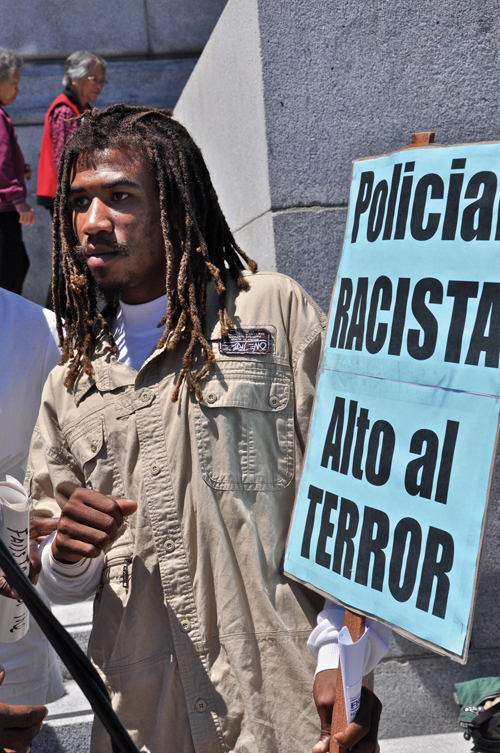
Protesters returned to downtown San Francisco train stations on August 29, vowing to keep up their schedule of Monday evening rush hour protests until the  BART police are disarmed and retrained, or disbanded. This time, howevef, stations remained open and trains ran on schedule in a protest where both BART police and demonstrators took pains to reach out to commuters angered by recent train service disruptions.

A crowd of 200 people gathered outside of Civic Center station, the location of the July 3 fatal shooting of a 45 year old Charles Hill by BART police.

Hill’s physician, Dr. Rupa Marya, joined the protest a day after releasing an open letter on the shooing calling for BART police to re-examine its use of force policies and training.

“Charles was a member of the invisible class of people in SF–mentally ill, homeless and not reliably connected to the help he needed,” read Marya’s letter. “We often have to deal with agitated–sometimes even violent–patients in the hospital. Through teamwork, tools and training, we have not had to fatally wound our patients in order to subdue them.”

The protest made its way down Market Street entering each station briefly but remaining outside the fare gates. BART police have made it clear recently that their policies only allow freedom of expression outside the paid areas of the station. Previous protests on the train platforms have lead to station closures and train delays – delays that protesters and police have accused each other of causing.

Video taken by Josh Wolf, which includes protesters and counterprotesters, including a debate between Dr. Marya and a supporter of the cops.

As the protesters moved down the Market Street corridor they were shadowed by a small army of BART and San Francisco Police Department officers intent on preventing further station closures.

At Montgomery station Deputy BART Police Chief Daniel Hartwig told the Guardian, “Protesters appear to be following BART’s free speech rules and regulations and at this point we are happy they are. We support their right to protest.”

Behind him the station lobby filled protesters chanting, “How can they protect and serve us? BART police just make us nervous.”

At Embarcadero station an organizer with No Justice No BART challenged BART’s free speech rules.

“Right here you can say what you want. The moment you enter that fare gate you can’t say what you want,” he announced over a megaphone before crossing through the fair gates under heavy police presence.

After speaking out briefly in the paid area of the station, he exited of his own accord and was promptly arrested by BART police along with another protester in a Guy Fawkes mask who also had been using a megaphone.

Muni, which shares several downtown train stations with BART, has shifted in recent years away from police patrols to a “community ambassador” program, largely removing armed SFPD officers from those train and bus lines in favor of unarmed fare enforcement personal. The program has been praised from all sides as an appropriate balance of community safety, and fare enforcement on public transportation.

Robin, a young San Francisco native who said it was her first time participating in the police misconduct protests, characterized the gathering as a success. When asked if she found the presence of so many police intimidating she said “It was meant to be intimidating. That they would bring everyone out to police a small protest shows they fell they have something to be ashamed of.”

While the protesters focused on BART’s use of lethal force, civil liberties groups filed a petition Monday with the Federal Communications Commission, as the national fallout continues over BART’s decision to cut cellphone service to thwart a protest that never developed on August 11.

The coalition including Center for Democracy and Technology, Center for Media Justice, and Electronic Frontier Foundation argues that regardless of First Amendment augments for or against the disruption of cell service in the paid areas of BART’s stations, BART exceeded its authority under federal law. The complaint notes that the Communications Act, which governs cell phone service providers, clearly states the no carrier shall discontinue service without authorization from the FCC.

“It has been settled law for decades that law enforcement agencies have no authority to order discontinuation of phone service on mere suspicion of illegal activity without due process,” the complaint states.

The coalition urged the FCC to address the issue immediately in light of BART’s statements attempting to justify the cell service disruption, and the risk that other government agency may consider similar policies if the FCC does not assert its authority in the matter.

BART’s board of directors held an emergency meeting (Wed/25) to begin crafting a policy outlining to what future instances could lead further shutoffs.

BART has staff defended its disruption of service that took place August 11, saying their intent was to protect public safety.

Tonight: the last of five Guardian forums on the issues for the next mayor

0

Join us tonight for the fifth and final installment of the Guardian Forum: a series of panel discussions and participatory debates framing the progressive issues for the mayor’s race and beyond:
 
Forum Five: Environment, Energy and Climate Change
Tonight, August 25 at 5:30PM
Koret Auditorium, San Francisco Main Library, 100 Larkin St., SF
(Civic Center BART and MUNI 5, 19, 47, 49, or F Train)

Featuring:
Tim Redmond, San Francisco Bay Guardian
Antonio Diaz, People Organizing to Demand Environmental and Economic Rights
Alicia Garza, People Organized to Win Employment Rights
Aaron Peskin, former San Francisco supervisor
Saul Bloom, Arc Ecology
 
Cosponsors: Harvey Milk LGBT Democratic Club, San Francisco Tenants Union, SEIU Local 1021, San Francisco Rising, San Francisco Human Services Network, Council of Community Housing Organizations, Community Congress 2010, Center for Political Education, Jobs with Justice
 
All events are free. Sessions will include substantial time for audience participation and discussion. Please join us!
 
Save the Date
On September 21st, we’ll present our platform to the mayoral candidates and see which ones are willing to sign on.

Threats or payback?

1

news@sfbg.com

Officers from the San Francisco Police Department arrested a 21-year-old activist from Hunters Point less than 24 hours after he appeared on a public access television show where he indicted the police for a recent shooting and named officers he says have personally harassed him.

Around 4 p.m. on Saturday, July 23, Debray Carpenter, who is also known as Fly Benzo, was arrested near the intersection of Oakdale Avenue and Lane Street and booked on charges of threatening a police officer and resisting arrest. After spending almost four days in jail, the District Attorney’s Office declined to file any charges and Carpenter was released.

“If they feel like they can charge me, they would’ve,” Carpenter said after his release. “SFPD lies and that’s a fact. I just want the people to see how they lie. Just like they are lying about me, they could be lying about Kenneth Harding. Anything they say needs to be taken with a grain of salt.”

On July 16, police shot and killed Kenneth Harding Jr. while he was running from police. When officers stopped Harding at the 3rd and Oakdale Muni platform and asked him to produce a transfer, he bolted. The official story is that while he was running away, Harding pulled out a gun and fired at least one shot at police before they returned fire. Police later said the shot that killed him pierced his neck on the right side and was fired from his own gun, but some witnesses say that Harding didn’t have a gun, and many people in the community still have doubts about what happened.

Carpenter has spoken out against Harding’s death on the TV news, and he has participated in and organized protests calling for greater police accountability in the weeks following the shooting. On July 22, Carpenter appeared as the only guest on the public access program “CLAER Da Corner,” a 90-minute show hosted by Sharen Hewitt, the executive director of Community Leadership Academy & Emergency Response Project (CLAER), an anti-violence nonprofit.

During his appearance on the program, Carpenter named several SFPD officers who he claimed had harassed him in the past. He also recounted an exchange that took place a few days earlier on July 19. It was during this encounter that police say Carpenter made the criminal threat for which he was later arrested.

The police version of the incident differs significantly from the story that Carpenter shared with Hewitt on her show before his arrest.

According to Carpenter, he was with a group of people having a casual conversation with an SFPD officer as two other officers drove up and aggressively pursued a teenager for no apparent reason. When the group asked the officers about their behavior, one of the officers explained that she’s from New York, said Carpenter.

This prompted Carpenter to bring up Sean Bell, a young man who was gunned down by the NYPD, and the officer replied, “I haven’t shot anyone, yet,” according to Carpenter.

“Ya’ll bleed too. Just how we bleed, ya’ll bleed,” Carpenter shot back.

He told the host that the officer then responded by asking, “Is that a threat?”

“No, that’s a fact,” replied Carpenter. The police then drove away, he said.

But the police say that Carpenter threatened to kill one of the officers and was aggressive from the moment they arrived.

“Carpenter started yelling at them and he said, ‘White pig bitch I’m gonna put one in you,'” SFPD spokesman Lt. Troy Dangerfield told us.

“You bleed like I do. I’m gonna put one in you and show you,” Carpenter allegedly told police after being asked if his previous statement had been a threat, according to Dangerfield.

“There was a large crowd of people that began circling around the officers and they determined it was unsafe to make an arrest at the time,” Dangerfield said. “One of our rules is if you know somebody you don’t have to make an arrest right there and cause a big scene.”

The police arrested Carpenter four days later and booked him for allegedly making terrorizing threats and resisting arrest. While in jail Carpenter told his lawyer, John Hamasaki, that he didn’t know why he had been arrested and Hamasaki said at the time he wasn’t sure either.

“The arrest stinks,” Hamasaki told us. “Just an exercise of power by the police letting folks know if they speak up, they can be locked up.”

The District Attorney’s Office said that it declined to file charges because there was insufficient evidence to secure a conviction but declined to go into further detail.

“It is not uncommon for the District Attorney to drop charges that are against the police,” said Dangerfield, the police spokesman. “Unless there’s injuries, photos and things like that, they rarely want to prosecute a lot of threats against police officers, and even more resisting arrest, because they think that’s the type of business we’re in.”

“That’s bullshit,” said Hamasaki. “(Crimes against police are) the hardest things for us to negotiate to get them to come down. … The DA doesn’t want to upset the rank and file.”

Erica Derryck, a spokeswoman for the District Attorney’s Office, also disagreed with Dangerfield’s assessment.

“We take seriously any threats against San Franciscans whether they are uniformed sworn officers or members of the general public,” Derryck said. “We review every case on a case-by-case basis.”

Carpenter says he isn’t the only one being targeted for his activism in Hunters Point. Police arrested Henry Taylor, 54, as he was on his way to speak up at the July 20 town hall meeting at the Bayview Opera House in which Chief Greg Suhr’s appearance ignited pandemonium (see “Anger erupts over police shootings,” July 27).

Dangerfield said that police arrested Taylor for violating a stay-away order, but Taylor says that he isn’t under a stay-away order for that area and that police arrested him to prevent him from testifying at the town hall meeting.

No recordings are known to exist between Carpenter and the officer, just as no video recordings have revealed exactly what happened between Harding and the police on the 3rd Street Muni platform. There are several videos of the immediate aftermath, including footage of Harding writhing on the ground while police raised their weapons and denied him first aid, but apparently no video of the shooting itself. In Oakland, all officers are now issued small cameras to wear on their uniforms that record every interaction an officer has with the public. In the case of both Carpenter and Harding, such equipment would likely provide answers to what actually transpired, but Dangerfield said the SFPD has no plans to follow Oakland’s lead. “I know the chief of police has said he is looking into cameras for officers who do plain clothes assignments, and warrant arrests, and things like that. For the general patrol force, at this point, that’s not the case,” Dangerfield said. “There are some officers who do carry their own. … There’s no rule that says that can’t be done.”

Ecological rewind

25

rebeccab@sfbg.com

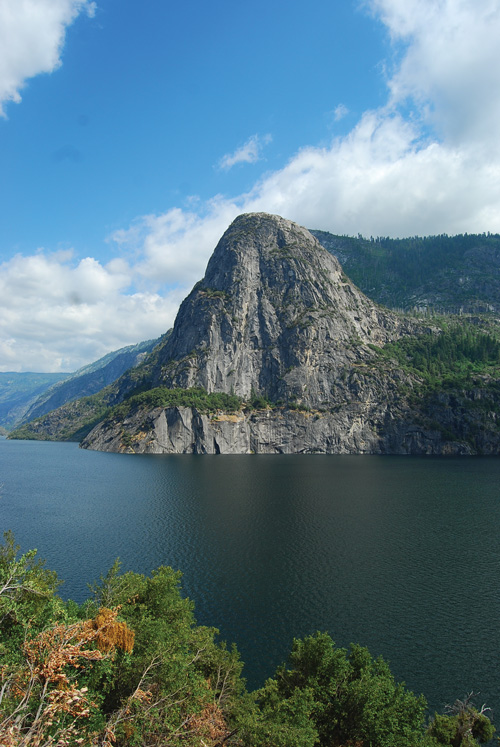
Follow the trail from Yosemite National Park’s Rancheria Falls up along dusty switchbacks and down through a canopy of pines and madrones for roughly three miles, and you will reach Tiltill Valley.

Accessible only to hikers and horseback riders, the backwoods meadow hums with the chatter of birds, bees, and the distant rush of water spilling over rocks. Butterflies dart among wild orchids, lilies, yarrow, and other kinds of flowering plants that thrive there, and a lone sequoia stands along the perimeter. The valley floor is lush and boggy, with the forested hills of the High Sierra as its backdrop.

Tiltill Valley is a real-life example of what Yosemite’s Hetch Hetchy Valley might look like if the reservoir that holds San Francisco’s water supply were drained and the terrain allowed to return to its natural state, according to Mike Marshall, executive director of Restore Hetch Hetchy.

His nonprofit group has a singular mission, as the title suggests. The upbeat, 50-year-old former political consultant wants to place a charter amendment on the November 2012 ballot to ask San Francisco voters if Hetch Hetchy Reservoir should be drained so that the valley, which has been underwater since 1923, can be ecologically restored and turned into an attraction for park visitors.

Yet that simply stated goal belies an extraordinarily difficult and expensive task, one that would fundamentally alter San Francisco’s water delivery system and diminish a city-owned source of inexpensive, green energy.

“The destruction of Hetch Hetchy Valley in the 1920s was the worst environmental disaster to ever besiege the national park system,” Marshall says. “And today, it is completely out of whack with the values of the vast majority of people who live here.”

But most city officials think this idea is just plain crazy. Whether or not it was a good idea to build the dam originally, they say it’s unwise and unrealistic to spend scarce resources to destroy one of city’s most valuable assets.

“While it is an interesting idea, I don’t think that there is yet a credible plan to move forward and actually restore Hetch Hetchy that will ensure that within our budget, we’ll be able to get the water that 2.5 million Bay Area customers need, as well as do everything else that the current Hetch Hetchy system does,” Board President David Chiu told the Guardian.

Based in San Francisco, Restore Hetch Hetchy worked in tandem with the Environmental Defense Fund and a consulting firm to craft a technical analysis describing how the city could continue receiving reliable freshwater deliveries without the reservoir, although it would require filtration because of its lower quality and be less abundant in drought years.

While restoring the valley would be an ecological win in a perfect world, cost estimates range in the billions of dollars at a time when budgets are shrinking and economic turbulence rocks the public and private sectors.

Draining Hetch Hetchy Reservoir and replacing it with other water and power projects would punch holes in an already cash-strapped city budget, first with the high capital costs and then with higher long-term annual costs. The hydro-electric system provides carbon-free electricity to city agencies at basement rates and helps fund local renewable-energy projects, so relinquishing some of that generation capacity would be a step backward when it comes to addressing climate change.

“The loss of Hetch Hetchy Reservoir would fly in the face of every effort San Francisco has made to replace fossil-fuel power generation with renewable energy sources,” City Attorney Dennis Herrera wrote in a 2004 editorial in the Guardian. Losing hydropower from the dam, he wrote, “would force greater dependence on fossil-fuel electricity and impair low-cost hydropower with higher-cost renewables, making San Francisco’s efforts to create a sustainable energy future virtually impractical. And it would devastate our efforts to enact a public power system in San Francisco. Hetch Hetchy was built by people who envisioned a public power system to serve all of San Francisco. We should finish that system before we start tearing it down.”

But when a round of invitations went out to Bay Area journalists to join a three-day backpacking trip in Yosemite and learn about Restore Hetch Hetchy’s vision, I signed up to attend. After all, here was a chance to go backpacking in beautiful terrain and assess one of the most controversial and impactful proposals facing San Francisco.


WATER

Our first stop within park boundaries was a chocolate-colored chalet with a spacious deck overlooking the waterfront. Owned by the San Francisco Public Utilities Commission (SFPUC), it’s notorious in San Francisco politics as a weekend getaway for local elected officials, city commissioners, and favored staffers. Stories of the chalet abound, as it’s rumored to have been the site of private soirees for powerful players and a rendezvous for lovers in extramarital affairs.

The eight-mile long, 300-foot deep Hetch Hetchy Reservoir holds 360,000 acre-feet of water, and the dam itself is an impressive structure, although Marshall scoffs at the popular wisdom casting it as “a marvel of engineering,” and dryly quips, “so was the Titanic.”

Native American remains were buried underwater when it was built, Marshall told us as we peered out over the towering dam wall, and 67 lives were lost during construction. As we rounded the perimeter of the man-made water body, sweating in the summer heat and saddled with gear, he asked us to imagine peering down into a dramatic sloping valley instead of what it looks like in its current state, which is a lake.

“Don’t call it a lake,” he insisted. Restore Hetch Hetchy regards the reservoir as an unnatural blemish that should never have been imposed upon a scenic and biodiverse environment in a national park. According to Mark Cedorborg, an ecological restoration expert with Hanford ARC and a Restore Hetch Hetchy board member who joined the trip, it wouldn’t take long for the natural ecosystem to bounce back if the water were removed, recreating a rare wildlife habitat that would mirror Yosemite Valley.

Sierra Club founding president John Muir would have sided with them, of course. The famous ecologist wrote passionately about the valley and vehemently fought the effort to submerge it. At the time, a chorus of opposition arose against flooding Hetch Hetchy — and that was before modern science documenting the impacts dams have wrought on the environment.

A black-and-white image of Michael O’Shaughnessy, the civil engineer behind the project, is posted on an info kiosk beside the dam, his eyebrows arched in a wizard-like, calculating gaze as he uses a pointer to mark the spot on a map of San Francisco’s watershed.

As things stand today, Hetch Hetchy Reservoir is a crucial storage facility for drinking water. Freshwater flowing from the Tuolumne River through the glacial formation accounts for 85 percent of SFPUC deliveries to about 2.5 million customers in the city and on the peninsula.

Hetch Hetchy is unique in that it’s just one of a handful of water systems nationwide that uses chemical treatment and ultraviolet disinfection, but no filtration, to purify fresh water that is transported along a gravity-fed system down to the city.

SFPUC spokesperson Tyrone Jue said Hetch Hetchy water does not require filtration “because basically, it’s a giant granite basin there in the reservoir, so there’s no sedimentation.” He added that the water quality is exceptionally high. “It’s high up in the watershed. The higher up in the watershed, the better it is.”

Restore Hetch Hetchy has submitted a number of proposals to ensure that San Francisco could still receive adequate supplies without the reservoir, including constructing a new intertie at Don Pedro Reservoir, which lies downstream from Hetch Hetchy, to get drinking water supplies from there instead.

Under this scenario, the SFPUC would continue to get its water from the Tuolumne River — but it would have to build a new filtration system to treat it because the water quality would be worse and the city would lose its federal waiver.

That’s an expensive consideration, particularly at a time when city coffers are depleted, critical services for vulnerable populations have been gutted, and taxpayers are wary of authorizing costly new endeavors.

Marshall defends the cost by asserting that the current system is flawed; the lack of filtration makes San Francisco’s water more susceptible to contamination from nasty microorganisms like cryptosporidium and giardia, he says.

“San Francisco has a unique health demographic in that over 5 percent of the people that live in the city have compromised immune systems, if you just look at people who are HIV positive,” he said. “Ultimately, San Francisco is going to be forced to filter its water, so why are we kicking this can down the road?”

But filtering water at the residential level would be far cheaper than tearing down the dam. Jue pegs the cost of a new filtration system at somewhere between $3 billion and $10 billion, but Marshall rejects that estimate as “just crazy.”

So we called Xavier Irias, director of engineering at the East Bay Municipal Utility District. “Ten looks a little high, but the three sounds very credible,” Irias said, acknowledging that there were many complicating factors that could affect cost. Ultimately, he said, the cost range could be anywhere from half a billion to the single-digit billions of dollars.

“With the filtration costs, not only are you talking about building a facility to filter the water, you’re now talking about increased power consumption to basically power those filtration plants,” Jue noted. “You’d have to start pumping water, which would require additional energy. And then on top of that, there’s the long-term operation.”

What’s more is that the quantity of water that San Francisco now depends on wouldn’t be guaranteed every year. According to an analysis done in partnership with the Environmental Defense Fund, reconfiguring the system to tap Don Pedro would result in 19 percent less water delivered from the Tuolumne in critically dry years, and similar losses would result from alternative proposals like tapping Cherry Reservoir, another storage facility in the SFPUC system.

Restore Hetch Hetchy has suggested that the shortfall could be made up in part with new water-conservation measures, something that cities arguably ought to be practicing anyhow since climate change threatens to bring about drier conditions in California’s watershed. It could also place the city in the position of having to go to the open market to purchase water for customers — just as dwindling water supplies raise the temperature between cities and counties scrambling to secure reliable deliveries.

“The Hetch Hetchy water system is a fully owned public asset,” Jue notes. “At a time when state and federal governments are struggling with even being able to close our budget deficits, to even look at dismantling an environmentally sound, cost-efficient water system that delivers water to 2.5 million people is sort of outrageous.”


POWER

In addition to capturing the flow of pristine Tuolumne River water that eventually makes its way into the city’s plumbing network, O’Shaughnessy Dam is a key component of the SFPUC-owned hydro-electric system, which produced 1.7 billion kilowatt hours of power last year with no greenhouse gas emissions.

If efforts to advance the cause of a public power system resurfaced in San Francisco, having the full capacity of the Hetch Hetchy hydro-electric generation in place would be vital. Juice for city streetlights, Muni’s light rail cars, the chandeliers adorning the Board Chambers in City Hall, and countless other municipal uses are derived from this gravity-fed system, which provides roughly one-fifth of San Francisco’s overall energy needs.

City departments pay three or four cents per kilowatt-hour, less than what it costs to generate the power. If all the hydro-electric power were eliminated and substituted with PG&E power, the city would get pinned with $32 million in additional costs annually, and its carbon footprint would expand by more than 900 million pounds of greenhouse-gas emissions, according to the SFPUC. However, a technical report produced by the Environmental Defense Fund suggests the city would only suffer a 20 percent decline in the hydro-electric output, since operations at other SFPUC reservoirs would continue.

The hydro-electric system also generates revenue through the sale of excess power to Turlock and Modesto irrigation districts, but that would come to an end if the generation capacity fell by 20 percent. Restore Hetch Hetchy estimates this loss to be around $10 million annually.

“Whenever we sell the power to Modesto and Turlock, that revenue then goes to fund programs like GoSolarSF, and all of our energy-efficiency retrofits of municipal facilities,” Jue explains. If the city lost its ability to sell off this excess supply, “We would no longer be getting power revenue at all, which we’re using to help fund community choice aggregation.”

Fraught with problems as it is, the city’s effort to launch a community choice aggregation program offering residential customers an alternative to PG&E nevertheless holds promise as a powerful green shift for a major metropolitan hub. For all the ecological benefits to Yosemite, restoring Hetch Hetchy could wind up undercutting the fledgling green power initiative, and the upshot would be a boon for PG&E. Coupled with the fact that ceding control of the valley back to the National Park Service could strip the city of its mandate for public power, the utility giant would benefit tremendously from this plan.

All of this makes it somewhat surprising that District 5 Sup. Ross Mirkarimi, a longtime champion of the cause of public power, appointed Marshall to serve on the SFPUC Citizens Advisory Committee, a move that rankled SFPUC staff.

“I’ve known Mike many years and have found him to be whip smart when it comes to complicated policy issues,” Mirkarimi told the Guardian when asked about this. “He knows that I am an unwavering supporter for public power and that I’d hope his advocacy on the SFPUC continues to advance and innovate our locally-driven clean energy objectives.”


POLITICS

The concept of bringing back Hetch Hetchy Valley originated with the Sierra Club in 1999, and several mainstream environmental organizations have lent support for the cause although few have made it a high priority. Nevertheless, there’s plenty of financial backing and support from key political players to keep the vision alive.

Democratic County Central Committee Chair Aaron Peskin, a member of Restore Hetch Hetchy’s national advisory board, told me he’s been active with the group for at least a decade, making him a rare exception among the city’s political leaders.

“San Francisco is a remarkably sophisticated town that is technologically advanced and environmentally advanced, and this is an opportunity to right one of the most destructive environmental wrongs,” he said. “It’s time to start a local and national conversation.”

He acknowledged that there were a lot of technical issues to contend with, saying, “It should only be done in a way that makes sure San Francisco and communities that rely on the system are taken care of.”

Major funders backing Restore Hetch Hetchy include retired businesspeople from the financial sector, Patagonia founder Yvon Chouinard, council members of the Yosemite Conservancy, and Lance Olson, a Restore Hetch Hetchy board member and partner in Olson Hagel & Fishburn, LLP, a prominent Sacramento legal firm that represents the California Democratic Party and elected officials.

Other influential and politically connected individuals have joined the effort as well. Marshall assured me that “no one from PG&E has given us a dime.” Yet the project still faces some powerful opponents. “I have opposed removing the O’Shaughnessy Dam in Hetch Hetchy Valley for decades and I remain opposed,” U.S. Sen. Dianne Feinstein told the Guardian. “Draining the reservoir would endanger San Francisco’s water supply, further jeopardize California’s water infrastructure and impose a huge financial burden on the state.”

Replacing the Concourse

4

news@sfbg.com

In one of the few remaining San Francisco neighborhoods untouched by gentrification, there is a proposal to demolish the Concourse Exhibition Center and replace the quintessential Showplace Square building with a market-rate residential project, which the developer says will be rental apartments.

This is the first major project in the new Eastern Neighborhoods Plan that will change the light industrial neighborhood where brick and mortar meet interior design, raising questions about whether the development would be sustainable, transit-oriented, and family-friendly.

Home to annual events like the Green Festival and the KPFA Craft Fair, the Concourse is where mom and pop vendors share their wares in an affordable venue — one of the few remaining in the city.

“Since ’96,” recounted Alan Van De Kamp, director of sales for the Green Festival, “they’ve been trying to sell it, to tear it down. You never know from year to year … You imagine at some point, somebody’s gonna say it’s time.”

Though nothing has been approved, the current proposal by developer and Concourse owner Bay West Development, first introduced in 2000, has come the farthest yet. The project will be considered for approval by the Planning Commission once the environmental review process is complete, which could take up to six months. Public comments on the project will be accepted until August 8.

The proposed project contains two sites, one at 801 Brannan Street and one at 1 Henry Adams Street, which would result in a total development of up to 674 residential units, 43,037 square feet of retail space, and 673 parking spaces. Under the city’s inclusionary housing laws, 221 of those units would be affordable (71 to be built on site and 150 dedicated to the city for development). Of the total parking spaces, 166 spaces would replace existing parking spots at the site.

Bay West, developer of the San Francisco Design Center, has owned the Concourse building for 30 years and wants to demolish and rebuild as part of the Eastern Neighborhoods Rezoning and Area Plans, the blueprint for development in a part of the city dominated by working class residents.

That controversial plan was in development for years, during which there was a moratorium on approval of large projects, and it was finally adopted in 2008. It was created to redevelop The Mission, Showplace Square/Potrero Hill, East SoMa, and the Central Waterfront — 7 percent of the city’s 47 square miles — over 20 years.

“It’s our feeling that the building itself is beyond its use as an exhibit hall and we’re replacing it with housing units,” said Sean Murphy, a partner at Bay West.

The Planning Commission heard the draft Environmental Impact Report for the proposal on July 28. At the hearing, the commissioners expressed interest in seeing the progression of the development, but not all were convinced.

“There is a certain amount of vagueness,” said Commissioner Kathrin Moore. “This EIR is ultimately tempered by the strong policy issues that underlie building in the Eastern Neighborhoods and at this moment I don’t quite see that.”

The proposal has left some questions unanswered, such as, where will the small vendors go to sell their wares? Bay West has suggested exhibition halls like the Cow Palace or Moscone Center, but Green Festival organizers say that isn’t realistic for everyone. “We would lose some of our vendors if we went to Moscone,” said Van De Kamp. “There’s some people that can’t come. A lot of the green economy is about mom and pops. They can’t afford it.”

Sue Hestor, a land-use attorney who opposes the development, asked vendors who use the Concourse how important leaving the center would be. “For a lot of people,” she said, “it meant the difference for them being viable or not.”

It would be a major challenge to move, said Robbie Kowal, the co-director of Sea of Dreams, a huge party and concert that will hold its seventh annual celebration this New Years Eve at the Concourse. “There’s the Cow Palace, and the Design Center, but it’s not that big, not a place where you can put a proper concert on one side and a multitude of different kinds of spaces [on the other]. The Sea of Dreams’ success is attributable to the proper use of the Concourse.”

With 125,000 square feet of space that can be split into its west and east halls and a mezzanine, the Concourse building has catered to annual festivals and events for more than 20 years, holding as many as 6,800 people at once.

“There’s room for so many different communities in there. We love our home,” said Kowal. “It’s a really unique and wonderful space.”

The redwood frame of the Concourse, accented by glass fronts that allow for natural lighting, used to be a furniture mart and then a fashion and jewelry mart before it was an event center. The project proposal’s architect, David Baker and Partners, has already designed many of the new buildings in Showplace Square.

Bay West isn’t worried about where the Concourse shows will go. “Most of our shows use less than 20,000 square feet,” said Murphy. “The larger shows would go to the 100,000 square foot San Mateo County Event Center.”

Tony Kelly of the Potrero Boosters Neighborhood Association says the intention of the plan is to reduce the light industrial area by zoning more of it for residential uses, protecting only about half of it and converting the remainder.

“This is an area where we don’t have enough parks, or transit. The project would double the population, and we don’t have enough new infrastructure to handle it,” he said. “It’s essentially a ticking time bomb that the city’s going to have to get a handle on at some point, or these residents are going to be miserable.”

Though the project would create at least an acre of publicly accessible open space, some residents wonder if it’s enough, and the concern about insufficient transit remains.

“It seems to me that once again there is too much parking near a freeway entrance, inadequate transit that is not likely to improve significantly once the Transit Effectiveness Project [a city plan for improving Muni service] is implemented,” said activist Sue Vaughan, who rides her bike at least part way during her commute from the Richmond District to REI at 840 Brannan Street for work.

“This is exactly the kind of place that attracts (commuters),” said Hestor. “There’s too much parking. There’s crappy transit. It totally undermines any idea of sustainable development.”

But at the commission hearing, Commissioner Hisashi Sugaya didn’t think Hestor’s argument had merit. “Parking is not an environmental impact as far as the city is concerned,” he said.

Vaughan says that Muni managers have been absent from several development meetings in the Eastern Neighborhoods area. “No one from Muni was represented on this panel discussion about the Sustainable Communities Strategy,” she said, referring to a July 6 meeting convened by the Planning Department to discuss the importance of building housing next to accessible transit.

The Concourse is scarcely accessible by bus lines 10 and 19, but with a growing population in Showplace Square, it wouldn’t be enough, says Vaughan. “We’re moving forward with all these projects with lots of parking near freeway entrances, which makes it seems like SF is becoming a bedroom community for Silicon Valley. You have an impact on Muni when that happens. With more cars, there’s more congestion for buses.”

Bay West argues that the apartments it plans to build at the Concourse site would be “workforce housing” with less than 1:1 parking (actual parking would work out to .79:1 at the 801 Brannan site and .64:1 at the One Henry Adams site). More than 40 percent of the units would be larger two-bedroom units intended for families.

Yet Kelly says that that by offering the apartments at market rates, none are appropriate for new families. “For all the talk about keeping families here, then how come we’re not building family housing?”

It’s a max-out project, says San Francisco architect Dick Millet, of the Potrero Boosters Neighborhood Association. “In the end, under their breath, they’re all going to say, I wouldn’t live there myself.”

Guardian forum July 28: Immigration, education and youth

3

The next Guardian Forum on issues in the mayor’s race will take place Thursday, July, when we’ll be talking about immigration, education and youth issues. We’ve got a great panel lined up:


Sherilyn Adams, Larkin Street Youth Services
Angela Chan, Asian Law Caucus
David Campos, Supervisor, District 9
Mario Yedidia, Director, Youth Commission*
Pecolia Manigo, Coleman Advocates


(*for identification only)


It’s at the Bayanihan Community Center, 1010 Mission (at 6th), 6-8 p.m.


(Powell Street BART and MUNI 14, 19, 27, or 31)


As always, plenty of time for audience participation. Hopy you can make it.

Anger erupts over police shootings

11

rebeccab@sfbg.com

As the murky details of two recent police shootings emerge, a palpable anger surging through targeted communities points to a deeper issue than the particular circumstances surrounding each of these deaths. Simply put, many Bay Area communities are fed up with police violence.

For many activists who descended on transit stations to protest the fatal BART police shooting of Oscar Grant III, the 20-year-old unarmed Hayward man who was killed on New Year’s Day 2009, an upwelling of rage was rekindled after BART cops shot and killed a homeless man named Charles Blair Hill on July 3 in Civic Center Station.

Then, on July 16, San Francisco police officers in the Bayview shot 19-year-old Kenneth Wade Harding Jr. multiple times after he ran from the T-Third train platform because he’d been stopped for fare evasion, leaving him dead on the sidewalk.

The recent officer-involved shootings occurred under two different law enforcement bodies, and both incidents remain under police investigation with many questions still unanswered. BART police say Hill was brandishing a knife; the San Francisco Police Department (SFPD) said its response was justified because Harding fired at officers first. The investigation in Harding’s case took a bizarre twist July 21 when SFPD issued a press release based on a medical examiner’s report stating that Harding had died not from rounds fired by police, but a self-inflicted gunshot wound.

But among communities distrustful of the police, the particulars of each case seemed to matter less than the perception that officers are too quick to escalate conflicts into deadly standoffs. Both incidents provoked intense anger because they resulted in marginalized transit passengers suffering sudden, violent deaths following interactions that were initiated by police. The shootings sparked angry protests, prompting standoffs at Civic Center BART Station, along the T-Third line in the Bayview, on Valencia Street, in Dolores Park, inside the Castro Muni Station, and at the cable car turnaround on Powell Street.

A group of activists staged protests in the Mission following the Bayview police shooting, snaking through the streets as they disrupted traffic and public transit service. “The march began at Dolores Park where nearly 200 of us departed,” an anonymous post on the anticapitalist Bay of Rage website recounted, describing the events of a July 19 protest that resulted in 43 arrests. “Upon reaching the Castro Muni Station, all hell broke loose…. What had now become a mob moved effortlessly past the bewildered cops … Trash was set alight and thrown down onto the tracks below … ticket machines, the fare checkpoints, and the agent booth were all smashed with hammers and flags — totally ruined. Smoke bombs and fireworks were thrown throughout the station.”

This display occurred just eight days after protesters shut down BART stations in downtown San Francisco during rush hour to condemn the fatal shooting of Hill, the homeless BART passenger.

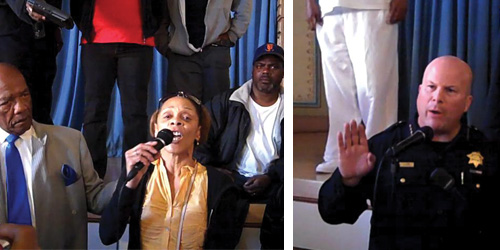
The message from outraged Bayview residents at a chaotic and emotionally charged community forum staged July 20 at the Bayview Opera House was not that people were upset that this had happened to Harding, a Washington state resident, in particular. Instead, people expressed outrage that police had gunned down yet another African American youth, and that unless some complicated and long-standing issues were addressed, it could happen again, to anyone. The forum was organized in partnership with the SFPD and clergy members from the Bayview. Police had prepared a PowerPoint presentation, but never managed to get that far.

At the meeting, Police Chief Greg Suhr tried to provide an explanation for the July 16 shooting. “During this foot pursuit, at some point in time, the suspect … fired at the officers, and the officers returned fire. This is the account that we have so far,” he said. “I cannot tell you how badly that I feel … as captain of this station for two years,” Suhr continued, as an angry crowd shouted him down.

Police escorted Suhr out of the meeting before everyone who had signed up to speak had a chance to be heard. Once outside, the police chief told reporters that he planned to return.

After Suhr and other city officials departed from the meeting, District 10 Supervisor Malia Cohen stayed at the Bayview Opera House and addressed the crowd that remained, she later told the Guardian, and engaged in discussion with Bayview homeowners, merchants, and other community stakeholders.

“We had a very thoughtful conversation,” she said. “People had questions about [Municipal Transportation Agency] policy over the SFPD riding the bus. We talked about the importance of attending Board of Supervisors meetings, Police Commission meetings, and giving public comment. And there will be future conversations, without obstruction.”

Many who attended the meeting voiced concerns that went well beyond the July 16 incident. Several said they believed youth were unduly harassed by law enforcement over Muni fares on a regular basis. Elvira Pollard spoke about how her son was shot 36 times by police and killed seven years ago. Another woman complained that police had used abusive language when she was arrested in the Bayview four years ago.

Mayor Ed Lee told the Guardian that a bigger police presence at the Oakdale/Palou stop on the T-Third line was part of the city’s strategy to prevent violence in that area. “I actually asked the chief to pay more attention to areas that had a history of gun violence and shootings and other kinds of violence … and it just so happens that this particular area, Third and Palou, is a place where there’s a lot of violence,” Lee said. “So we had more uniformed officers on that specifically at not only my request, but with the understanding of the police chief, too.”

Responding to acts of violence by sending in more police sounds simple enough, yet it seems a toxic environment has arisen out of a heightened police presence in a community where tensions between police and residents already run high, fueled by anxiety and bad past experiences. Add to this dynamic a trend of youth who lack other transportation alternatives riding public transit even if they don’t have enough money to pay the fare, and the situation feeds ongoing strife, particularly when fare evaders are asked for identification and searched by police.

Lee, in partnership with Cohen, called a meeting in City Hall July 19 with leaders of the Bayview community. The press was not allowed to attend, but participants said later that officials gave a presentation about the shooting and played an audio of gunfire from the SFPD’s SpotShotter program to offer evidence that Harding had fired first. Later that day, the SFPD reported that gunshot residue had been detected on Harding’s hand, supporting the police account of what happened. Yet the July 21 press release, suggesting that Harding had shot himself because a .380-caliber bullet that police said could not have come from SFPD firearms had entered the right side of Harding’s neck, made it even less clear what really happened.

By July 22, confusion was still swirling over why a gun hadn’t immediately been recovered from the scene of the shooting, and there still wasn’t any clarity on whether an online video of a passerby removing a silvery object from the sidewalk showed a person who retrieved Harding’s firearm after the shooting, as police have claimed. Police recovered a gun that was initially believed to be Harding’s, but later reported that the gun could not have been the same weapon that discharged a .380 caliber round into the victim’s head.

Chris Jackson, a Bayview resident who sits on the board of City College of San Francisco and ran for District 10 supervisor in 2010, said after the City Hall meeting that he felt it had amounted to little more than a lecture from the city’s top officials. Jackson said he perceived a need for a policy shift in terms of how to deal with fare evasion and violence prevention. “We need a better approach,” he said. “We cannot address this with more cops on the T line.”

After Harding’s death, it came to light that the 19-year-old Washington state man had served time for attempting to promote prostitution, and had been named as a person of interest in connection with the fatal shooting of a 19-year-old Seattle woman. Yet a widely circulated online video showing him writhing on the sidewalk in a pool of blood after being shot, while a handful of officers continued to stand around with weapons drawn, sparked outrage. Once the forum at the Bayview Opera House had broken up, LaDonna Callaway condemned the police response, saying, “They didn’t have to shoot him as many times as they did.”

Angelique Mayhem, a Bayview resident who stood nearby, told the Guardian that she didn’t think the meeting had solved anything. “A boy gets gunned down. We don’t know if there was a gun there, but we do know that for 40 damn years, people have been getting gunned down in this community,” Mayhem said. “People are angrier now than when they were when they walked in the door. We’re a community that’s truly in pain, that’s truly frustrated, and really needs some respect.”

Our Weekly Picks: July 27-August 2, 2011

0

THURSDAY 28

FILM

“Marker XC: Three Times Thirty”

Chris Marker is a little older than his nouvelle vague contemporaries, though you wouldn’t know it from his fugitive art. His work is not a career but a universe, one that continues to expand like our own cosmos; at 90, the cat is still grinning. A few minutes of homework on the Internet turns up some of his latest illuminations, but this special birthday tribute focuses on three short films made in years sandwiching 1968, a revolutionary epoch Marker has spent a lifetime observing in quicksilver pasts and futures. Following Marker’s lead, the screening is free. (Max Goldberg)

7:30 p.m., free

McBean Theatre

Exploratorium

3601 Lyon, SF

415-561-0360

www.exploratorium.edu


MUSIC

Fresh Greens

They don’t play Equipto and Mike Marshall’s new booze banger “I Drink Fernet” in SF bars enough. C’mon city — the hook’s stuck in our gray matter all day and when we’re ready to order a beer and a shot of the herbal stuff, we wanna hear our jam. This is not going to be a problem at this week’s installation of Fresh Greens, Showdown’s hip-hop and bass night with DJs Mr. Lucky and Doc Fu. The duo has invited DJ Pause, progenitor of said Fernet anthem, to spin that night — and they’ve coordinated with Fernet Branca to the end that there will be drink giveaways galore. (Caitlin Donohue)

10 p.m.–2 a.m., free

Showdown

10 Sixth St., SF

(415) 503-0684

www.showdownsf.com


FRIDAY 29

MUSIC

Steve Arrington

In one of those head-scratching retro confluences that have been popping up on dance floors lately, two quite different soul-stomping records featuring Steve Arrington — his Wonder-full 1985 “Dancing in the Key of Life” solo release and the 1979 “Just a Touch of Love,” recorded with his classic disco-funk outfit Slave — have become local club hits again. Arrington’s in the air: the smooth-voiced Ohioan is working on a new album with steamy L.A. squelch-funk revivalist Dâm-Funk. And now here he comes live, helping to celebrate the third anniversary of retro-fun and “contemporary boogie” party Sweaterfunk. Sweat or funk? You’ll do both. (Marke B.)

9 p.m.–3 a.m., $15

Som.

2925 16th St., SF

www.stevearringtonsf.eventbrite.com


MUSIC

“Playback: AudioBus”

Every few years, the Soundwave festival inundates the Bay Area with adventurous sonic experiences, like watching tiny solar-powered speakers bloom like flowers on Civic Center trees, or hearing a concrete bunker in Marin reverberate with waves of bass. Missed last year’s Soundwave? The Playback series is giving your experiment-hungry ears another chance. This week, hop aboard the double-decker AudioBus (equipped with state-of-the-art Sennheiser headphones) and explore live music scores “routed to the scenery around you.” Music plus motion equals magic. Bay Area scratch guitarist the Genie guides you audibly through the Mission on Friday; Christopher Willets, who creates “patterns of vibrations with sound and light” takes over Saturday with a trip through Golden Gate Park. (Marke B.)

Fri/29–Sat/30, 7 p.m., $20–$200

Various locations, SF

www.me-di-ate.net


MUSIC

Mean Jeans

“This song is about the economy. It’s called: what the fuck is a 401(k)?!?!” The members of Mean Jeans wax philosophical about lots of things, but mostly they stick to partying and its many and varied intricacies. If you think punk has gotten too cerebral over the years and/or are able to argue with authority and aplomb the ups and downs of the different beers you can buy with pocket change, then Mean Jeans is the band for you. They’re the Ramones on speed, a raging house party manifest as a three piece from Portland, Ore. Pogo to your hearts content, just don’t tell them or the crowd to chill out and take it easy. It’s a punk show, you wimp — have some fun. (Cooper Berkmoyer)

With Black Jaspers, Guantanamo Baywatch, and Teutonics

9 p.m., $10

Thee Parkside

1600 17th St., SF

(415) 252-1330

www.theeparkside.com


PERFORMANCE

“Work MORE!”

Eleven drag queens, 165 costume changes, 60 minutes: put it all together and what do you get? One hell of a rendition of “Bohemian Rhapsody.” Kidding! (Kinda.) You get one of the most ambitious hours of deconstructed gender illusionism you’re likely to see in a while. “Work MORE!,” the brainchild of local firebrand VivvyAnne ForeverMORE!, has been a thrilling series of performances that dramatizes the art of drag by blending performance, storytelling, set design, music, and various challenges reminiscent of It’s a Mad, Mad, Mad, Drag World. This installment, running for two nights, calls on 11 performers to direct each other in interchangeable performance numbers — a kaleidoscope of queens engendering an evening-long mosaic of mimicry. And it might go on tour! (Marke B.)

Fri/29–Sat/30, 8 p.m., $20

CounterPULSE

1319 Mission, SF

(415) 626-2060

www.counterpulse.org


SATURDAY 30

MUSIC

MK at Icee Hot

One of the most astonishing production runs in dance music — or any music, really — occurred when young Detroit producer Marc Kinchen discovered he had a flair for combining cyber-melancholic Detroit techno beats with a soulful New York City garage house vibe. On the strength of his early, driving records, MK soon became one of techno’s first big-time remixers: his genius for chopping up a song’s vocals into completely different, in most cases more appealing, melodies filled floors from 1991-95. Since then, he’s moved on to producing Pitbull and Willow Smith, but he’s back to reap underground propers in the retro-1990’s house craze, DJing with equally famous brother Scott and fellow virtuoso vocal-hacker Todd Edwards at the monthly Icee Hot party. (Marke B.)

With Scottie Deep and Todd Edwards

10 p.m., $10

Public Works

161 Erie, SF

www.publicsf.com


EVENT

“Livin’ La Vida Lambada”

When I first started writing about Burning Man for the Guardian in 2004 — a process that this year culminated in the release of my book The Tribes of Burning Man — the two crews that I most deeply embedded myself with were Opulent Temple and the Flaming Lotus Girls. They each work out of the Box Shop on Hunters Point and were just beginning their meteoric rises to become the event’s premier fire arts collective (FLG) and more enduring large sound camp (OT). Now, as the FLGs work toward completion of its latest ridiculously ambitious project — Tympani Lambada, a representation of the inner ear translated into a massive sculpture of sound, fire, and light — the OT DJs, the burner artists of NIMBY, and others are pitching in to help their hermanas del fuego reach their goal. So come shake your asses and help bring an amazing artwork to life on the playa next month. (Steven T. Jones)

8 p.m.–2 a.m., $20

NIMBY Warehouse

8410 Amelia, Oakl.

www.flaminglotus.com/brownpapertickets


EVENT

Treasure Island Flea Market

Hey, you in the horn-rimmed glasses. You can’t really consider yourself a Bay Area vintage freak without making pilgrimages to all the area’s flea markets — Candlestick, Alameda, Alemany all rev up our barter skills — and as of Memorial Day this year there’s a new kid on the clothing rack-covered asphalt block: the Treasure Island Flea Market, where somewhere among the grassy aisle and hundreds of vendor booths, you are virtually assured of finding something with history and pizzazz. Gadabout spectator shoes, barely-used vintage road bicycles, rusty old bird cages for making garden lanterns — just make sure you can schlep it on the 108 Treasure Island Muni going home. (Donohue)

Through Sun/31

9 a.m.–4 p.m., free

(415) 898-0245

www.treasureislandflea.com


SUNDAY 30

MUSIC

Mattachine Dance Party

Around 2004, when celebrating gay history became all the rage in dance clubs, DJs naturally turned to previously buried disco sounds to accompany the onrush of post-AIDS-era curiosity. But of course gays existed before the 1970s — as recently discovered fossilized size-14 stripper heels and catty hieroglyphics about Top Chef judge selection have proved. Young, queer parties have noticed: our own Hard French reaches back to the 1950s for soul inspiration, while New York City’s Mattachine Dance Party adds 1960s rock and other queer-eared genres to the mix. Now filmmaker and sexual provocateur John Cameron Mitchell is bringing his buoyant Mattachine affair, named for the U.S.’s first gay rights organization, to El Rio for a special daytime installment that will resurrect the hot-pink spirits of yesteryear. (Marke B.)

3–8 p.m., $5

El Rio

3158 Mission, SF

(415) 282-3325

www.elriosf.com


MONDAY 1

COMEDY

Maria Bamford

One-quarter of the dream team Comedians of Comedy tour in 2004 (alongside Patton Oswalt, Zach Galifianakis, and Brian Posehn), Maria Bamford is about as unique a comedic personality as they come. She subscribes to the darker, more surrealist side of stand-up, forgoing traditional punch lines to put all her anxieties and neuroses on full-display through self-deprecation, twisted inner monologues, and a ton of barbed vocal impressions that send up her Minnesota-based family and friends. Yet for all her eccentricities, Bamford never delves into novelty or shtick. Her material is always smart, perfectly nuanced, and balanced with enough of her natural Midwest charm to make even the strangest moments relatable. (Landon Moblad)

With Robert Mac and Nato Green

Through Aug. 3

8 p.m., $22.50

Punch Line Comedy Club

444 Battery, SF

(415) 397-7573

www.punchlinecomedyclub.com


TUESDAY 2

MUSIC

Real Estate

The un-Google-able band name. Is it creative combativeness or audacity in the face of technology’s encroaching hand that led four like-minded musicians from New Jersey to name themselves Real Estate? Search engines aside, Real Estate isn’t an easy band to pin down. Reverb-heavy surf guitar with some folk mixed in begin to paint the picture, but it isn’t simply the sum of its parts. It sounds the way a drive to the beach looks: the stucco strip malls race past in a beige blur and soon recede as the scenery grows increasingly lush. Everyone else in the car is talking, but you’re too busy staring out the open window to notice. Real Estate is surf rock for city folks. (Berkmoyer)

With Dominant Legs and Melted Toys

8 p.m., $15

Independent

628 Divisadero, SF (415) 771-1421 www.theindependentsf.com 


The Guardian listings deadline is two weeks prior to our Wednesday publication date. To submit an item for consideration, please include the title of the event, a brief description of the event, date and time, venue name, street address (listing cross streets only isn’t sufficient), city, telephone number readers can call for more information, telephone number for media, and admission costs. Send information to Listings, the Guardian Building, 135 Mississippi St., SF, CA 94107; fax to (415) 487-2506; or e-mail (paste press release into e-mail body — no text attachments, please) to listings@sfbg.com. Digital photos may be submitted in jpeg format; the image must be at least 240 dpi and four inches by six inches in size. We regret we cannot accept listings over the phone.

Best of the Bay 2011: BEST ATLAS OF OURSELVES

0

We couldn’t pass it around fast enough. Rebecca Solnit’s Infinite City, the SF intellectual’s cartographic wonderpiece of Bay Area history and emotion, swept a large part of the Guardian staff off our feet, so pleased were we by its 22 out-of-the-box renderings of the hills and valleys we work and play on. Sites of gay struggle superimposed with the natural habitats of butterflies; a comparison of how identities shift (in this case, Solnit’s and Mission District performance artist Guillermo Gomez Peña’s) between neighborhoods like Pac Heights and the Sunset — a city can’t be defined by Muni maps alone. Solnit’s book, which features deeply researched essays to accompany each map, showed us new roads toward understanding the Bay Area.

www.rebeccasolnit.com

Harding’s family speaks out

On July 25, the family of Kenneth Wade Harding, Jr. — the 19-year-old who was killed in the Bayview by a gunshot wound after he ran from being detained for MUNI fare evasion by San Francisco police — attended a press conference in Oakland at the law offices of John Burris.

News of Harding’s criminal history quickly surfaced in the days following his death, with reports focusing on how the African American man from Seattle had served time in prison for attempting to promote prostitution, and had been named as a person of interest in connection with the fatal shooting of a 19-year-old Seattle woman.

Harding’s mother, Denika Chatman, presented an alternative profile of her son, describing him as an independent person who cared for his family and dreamed of a music career as a rapper. Chatman said Harding had planned on attending Seattle Central Community College and would have turned 20 on Aug. 5. As for his criminal background and allegations that he violated his parole, “it doesn’t have anything to do with what happened to him,” she said.

Chatman and Pointer asserted that Harding was not in San Francisco because he was on the run. Instead, they said, he was there to visit with family and friends in the Bay Area and meet with his music manager. Chatman said Harding’s older brother is signed on with a record label in San Francisco, but declined to say which label.

Attorney Adante Pointer called Harding’s death “a tragedy and a shocking incident, which has brought us here seeking answers.” While he did not directly address the police account of the shooting thus far — that he was killed not by multiple rounds fired by San Francisco police officers, but a self-inflicted gunshot wound — Pointer did express skepticism.

“Those stories continuously shift,” Pointer said. “That’s nothing that you can build any kind of trust or credibility with.” He added, “This community is seeking some type of logical explanation as to what happened, as opposed to what amounts to be knee-jerk speculation.”

Pointer said his office had met with five eyewitnesses so far and hoped to find more. “There are eyewitnesses, there are persons in that community who’ve said this young man never fired a shot,” he said. “That’s inconsistent with what the police have said … let’s find out what the truth is.”

Pointer and Chatman were joined by members of Harding’s extended family, as well as African American community leaders in the Bay Area including Nation of Islam minister Rev. Christopher Muhammad and Rev. Renard Allen of San Francisco’s Third Baptist Church. Also present was Cephus “Uncle Bobby” Johnson, the uncle of Oscar Grant, the 20-year-old Hayward man who was fatally shot Jan. 1, 2009 by BART police officer Johannes Mehserle in a case which prompted riots. The Law Offices of John Burris represented Grant’s mother in a federal civil rights lawsuit against BART, striking a $1.3 million settlement with the transit agency in late June.  

Video by Rebecca Bowe

Carfree crowd praises SFMTA’s choice of Reiskin

4

Today’s announcement of Ed Reiskin as the new executive director of the San Francisco Municipal Transportation Agency is being warmly welcomed by bicyclists, transit riders, and other advocates for alternatives to the automobile – and not just because Reiskin doesn’t own a car and gets around by bike and Muni.

As the head of the Department of Public Works, Reiskin transformed the agency into one that facilitated the creation of more vibrant public spaces and safer, multi-use streets, overseeing some of the Newsom Administration’s most significant progressive accomplishments.

“He really began the process of turning DPW into a complete streets agency,” says Tom Radulovich, executive director of Livable City and an elected member of BART’s Board of Directors. He noted that Reiskin is widely respected by city staff, department heads, and a variety of community groups.

San Francisco Bicycle Coalition director Leah Shahum said she was “really pleased” with the choice – saying Reiskin has been “lights years ahead” of previous DPW administrators – and said it bodes well for an agency that faces some difficult challenges.

“I think Ed Reiskin has proven himself as a leader and someone who is really involved with San Francisco,” she said. “He will be the MTA director who most understands the real needs that San Franciscans have in terms of mobility.”

For example, she said Reiskin prioritized repaving and filling in potholes on streets that have bike lanes, where bad pavement can cause serious crashes or conflicts with drivers. “The fact is he understands that is a safety issue,” she said.

Radulovich offered two cautionary notes in his praise of the choice. The first was his hope that Reiskin will be allowed to take the bold action the MTA needs to reform Muni and create truly mulit-modal, safe streets, rather than being micromanaged and having the agency turned into a piggybank for other departments, as Mayor Newsom did with former MTA director Nat Ford.

“Is the mayor finally going to allow the MTA director to do what he needs to do to fix the agency?” Radulovich asked.

Secondly, he fears that DPW might backslide to the days before Reiskin took over, when the agency was removing public benches all over the city and making public spaces less inviting, rather than taking the lead on creating new, more inviting public spaces – from parklets to Sunday Streets – as Reiskin did.

“The worst case is you don’t gain anything at the MTA and you lose something at Public Works,” Radulovich said.

For his part, Mayor Ed Lee sounded a note of optimism that Reiskin will transform the agency. “I thank the SFMTA Board of Directors for their thoughtful, deliberative and unanimous support of Ed Reiskin as the new leader of the SFMTA,” Lee in a prepared statement. “Now is the time to focus on the future of the SFMTA and continue to make good on our promise to San Francisco transit riders and taxpayers by creating greater efficiency in our transit system, improving on-time performance, and honoring our City’s Transit First Policy.”

The (unsafe) UCSF shuttles

9

No question: The shuttles used by UCSF (which, is, forgodsake, a health-care organization) ought to have seat belts. So should school buses (actually, full-body restraints in school buses might not be such a bad idea. I want them in my car, too. Shut up and sit down, you little bastards — we’re driving here.) And the UCSF drivers should be more careful.


There are also other safety issues around those shuttles, though. Particularly when they pick up and drop off passengers on city streets.


The UCSF campuses have their own shuttle stops; the ones at Mission Bay are the same as any normal bus stops. But the shuttles don’t just stop on the campuses. They stop, among other places, at 16th and Mission — and typically they use the Muni stop.


Or sort of. Travel west on 16th St. any afternoon, and you’ll see this scene: A UCSF shuttle is halfway in and halfway out of the Muni stop. A Muni bus is stopped behind, unable to pull in. Cars are pulling around the bus and can’t see the (smaller) shuttle as it starts to pull out of the stop (and the bus starts to pull in). Traffic is all backed up waiting for this mess to clear — except for the drivers in a rush, who pull around (sometimes inching into the opposing lane of traffic), typically missing the shuttle bus by inches as it slides back onto the street.


And there are a lot of bicycle riders in the mix. It’s pretty much a bloody accident waiting to happen.


If UCSF gets to use Muni stops (nobody else can — nobody. Not the On Lok shuttle, not the private Genentech buses, not commercial tourist vehicles) then the university ought to pay the city a fee to make the stops big enough, then the drivers ought to be trained to pull forward all the way into the stop to let the Muni bus in behind (and so other cars can see them). And the Muni drivers and everyone else should be trained to treat the shuttles as part of the local transit system.


I get the need for the UCSF shuttles. Without them, all those doctors and medical students might be driving all over town between the campuses (although again: health-care organization. Bicycles are very healthy). But either they’re part of the city system and can use city facilities (properly) — or they aren’t, and they shouldn’t stop in the Muni zones.


Pet peeve of the week.   

Outrage at the Bayview Opera House (VIDEO)

A community meeting July 20 at the Bayview Opera House dissolved into chaotic shouting when Police Chief Greg Suhr attempted to present the San Francisco Police Department’s version of what transpired July 16 when a 19-year-old African American man was shot nine times by police and killed just blocks from where the meeting was held.

“On Saturday afternoon, two officers at the Bayview station … contacted a fare evader whose name ended up being Kenneth Wade Harding, Jr. of Seattle, Washington,” Suhr began. “After asking him for his identification, he became a little bit anxious, and at one point in time he jumped off the platform and ran across the street, and ran through crowded Mendell Plaza. I cannot tell you how badly that I feel … as captain of this station for two years. I love the Bayview community.”

At that point, angry shouts rose up and Suhr started getting booed, but he continued. “During this foot pursuit, at some point in time, the suspect … fired at the officers, and the officers returned fire. This is the account that we have so far.”

Kilo Perry began shouting back at the chief, saying, “You are not a friend of ours. You are the enemy,” before bystanders tried to calm him down. The SFPD had planned on showing a power point presentation about the incident, but that didn’t happen. Instead, Suhr was drowned out, and the microphone was passed to various community representatives and members of the clergy, who’d helped organize the meeting, as they tried to regain control. Lifelong Bayview resident Charlie Walker asked people to sit down and relax.

Several hundred people had gathered at the Bayview Opera House to get answers about the shooting, and most remained seated as people continued to swarm around the police chief. After some time had passed, community leaders managed to set up a question-and-answer session with Suhr.

From this brief exchange and venting session, it became clear that people had come to the meeting with broader concerns than just what transpired Saturday. Elvira Pollard stood to recount how, seven years ago, her son had been shot by police 36 times, and that police had claimed that he’d shot first. She said it took more than nine months to get an autopsy report. “It’s the same scenario!” she charged. “Do you really think they aren’t going to lie about this one?” Suhr said that he couldn’t comment on that case specifically since he didn’t know the details, but offered to meet with her.

As people spoke, police violence against youth emerged as a theme. Harding was not a resident of the Bayview, and it came to light after his death that he had served time for attempting to promote prostitution and was a person of interest in connection with the fatal shooting of a 19-year-old woman. But to many who expressed outrage at the meeting, his death was linked to past instances in which youth had been gunned down by law enforcement. One woman showed up wearing a T-shirt, earrings, and a handbag displaying images of Oscar Grant, the 20-year-old unarmed Hayward man who was shot and killed by BART officer Johannes Mehserle on January 1, 2009.

A concern that was voiced again and again was that people felt the police routinely harrassed youth on the T-Third line. Grilled about why police were constantly stopping young people over MUNI transfers, Suhr responded that police had recovered weapons from T-line passengers while conducting fare inspections in the past.

The meeting broke apart when Suhr was escorted out, surrounded by uniformed officers, news cameras, and angry residents who continued to demand that he release the names of the officers who shot Harding. One simply yelled, “stop shooting black people in the back!” Once outside, with beads of sweat rolling down his face, Suhr told reporters, “I’ll be back.”

Here’s a video of the tense exchanges that took place at the July 20 meeting. 

http://www.youtube.com/watch?v=l3cQwtKMsXM

Video by Rebecca Bowe

Mayor Lee meets with Bayview community leaders about officer-involved shooting

Mayor Ed Lee and officials from the San Francisco Police Department met with Bayview community leaders in City Hall July 19 to discuss the police investigation surrounding a July 16 officer-involved shooting that has prompted intense community anger and protests. While city officials indicated that the meeting was called to provide information and updates for the community, frustrated community members emerging from the City Hall conference room dismissed it as “more of a lecture,” saying city officials weren’t open to hearing broader community concerns that have intensified in the wake of this tragic event.

Reporters were not allowed in the room while the meeting was held because “it’s more of a community meeting,” according to mayoral communications staff member Francis Tsang. Attendees included Bayview community leaders Chris Jackson, Geoffrea Morris, Mike Brown, Charlie Walker, Ed Donaldson, and the Rev. Amos Brown. District 10 Sup. Malia Cohen also issued invitations to the meeting, which was scheduled at the same time as the full Board of Supervisors meeting, and sent a representative.


The shooting victim was Kenneth Harding Jr., 19, from Washington. Police say he fired one round at officers before police fired nine rounds, killing him. However, some witnesses initially reported that they did not see Harding fire a gun, and a firearm wasn’t immediately recovered from the scene. Police initially tried to detain Harding on the station platform of the Oakdale / Palou stop on the T-Third line on suspected fare evasion. After Harding was killed, it came to light that he had a criminal history and had been named as a person of interest in the fatal shooting of a 19-year-old pregnant woman from Washington. The incident, which occurred in broad daylight and was captured on film and witnessed by people who were out on the street, proved to be a traumatizing event for a low-income, predominantly African American community where tensions already run high between police and residents.

Lee indicated to the Guardian that the July 19 meeting had been called primarily to clear up misinformation. “There have been a lot of stories spreading about what did and didn’t occur, and we felt it was necessary to get the community updated as quickly as possible,” Lee said. “Any time there is a death in any community we’re very concerned … this one in particular has been represented in many different ways, and a lot of it has been very inflammatory in terms of what people have said occurred. We’ve heard points like there was no gun, when in fact now we’ve found a gun through police investigation. That there was no shot made at officers when … the officers have at least some evidence through the ShotSpotter program that there was an initial shot made by the suspect.”

Lee added that MUNI staff had reported people relaying “all kinds of stories” while riding the buses. “These are very hard, hard feelings,” he said. “So I felt it necessary that we confront this head on with community leaders. We met with some yesterday, we’re meeting with some today, [Police Chief Greg Suhr] is hosting a town-hall meeting in the Bayview tomorrow to yet again find every opportunity to fully explain what they have uncovered as the evidence, and to make sure people base their views on the facts.” A larger community meeting is scheduled for July 20 at 6 p.m. at the Bayview Opera House.

Meanwhile, Bayview community leaders Chris Jackson and Geoffrea Morris were not pleased when they emerged from the conference room. “The mayor left without hearing one public comment,” Morris said. “It was just a lecture. It wasn’t addressing the police, and how they deal with fare evasion, and harass people along the T train. It was not that. It was just, the mayor said his little thing, did not say goodbye, and ran out.”

Morris went on, “We don’t have grief counselors out there. We don’t have the police saying that they’ll stay off the T-Train platform until the investigation is done. We thought this meeting was going to be for them to go, ‘where do we go from here?’ And the thing that people are missing … whatever demon that boy had, that was a human life.” Concerns are still swirling about how long it took for an ambulance to arrive after the shooting, Morris said, and about how police arrived at the scene with high-powered weapons which they kept drawn even as Harding writhed in a pool of blood on the sidewalk.

Morris and Jackson said that during the meeting, officials showed a Channel 7 TV news broadcast clip and played an audio of gunshots being fired to demonstrate that the suspect had fired an initial shot before police opened fire. “We all have Internet, smart phones, and all the footage as well,” Morris said. “I was there on the site.”

Shortly after the meeting, the San Francisco Police Department issued a statement to announce that gunshot residue had been detected on Harding’s right hand during an investigation. “The presence of gunshot residue on Harding’s right hand supports statements from witnesses that Harding held the gun in his right hand as he fired at the police officers,” the press release stated. It went on to note that the presence of gunshot residue on an individual’s hand could indicate that the individual fired a gun, or was in close proximity to a gun when it was fired, or touched something that was coated with gunshot residue.

Morris and Jackson also voiced concerns that went beyond the details of this particular case. “The response really needs to be a policy shift,” Jackson said. “We need a better approach in terms of violence prevention. We cannot address this with more cops on the T line.”

Jackson, who ran for District 10 supervisor in 2010, also questioned why police officers had been tasked with fare evasion enforcement on the T-Third line in the first place. MUNI also employs fare inspectors, he pointed out, and the city has a specialized program, called the ambassadors program, which was created last year in the wake of violence along the T-Third line directed at members of the Asian community. “Where was the public conversation about putting cops on MUNI trains?” Jackson wanted to know. “Who came up with that idea?”

Asked about this, Lee told the Guardian that he had specifically requested a higher police presence in areas where higher levels of crime were anticipated – and the July 16 shooting occurred in just such an area.

“I actually asked the chief to pay more attention to areas that had a history of gun violence and shootings and other kinds of violence … and it just so happens that this particular area, Third and Palou, is a place where there’s a lot of violence,” Lee said. “So we had more uniformed officers on that specifically at not only my request, but with the understanding of the police chief, too. He’s trying to do his best to keep everybody safe. And that in the summer, with all of the evidence that we have about where the shootings are and where they’re occurring, we naturally focus on areas where we think there’s going to be more violence to have more presence. So circumstances occurred where an individual was stopped because of a fare evasion, and I believe police were there to begin to detain him, and ask him to provide some evidence of who he is and why he did what he did, and that turned out to be a chase. A chase is one thing, but a chase with an opening of a firearm is a completely different thing.”

Meanwhile, Bayview community residents who ride the T-Third line experienced delays in recent days because MUNI operations staff decided to stop running light rail trains into the Bayview, instead dropping people off partway through the route and then directing them to wait for shuttle buses.

On July 18, a little before dark, a T-Third driver stopped at the Marin Street stop and announced that all passengers would have to wait for a shuttle bus. When passengers demanded to know why, she responded, “They’re acting up on Third Street, and our bosses don’t want us in the middle of it.”

According to SFMTA spokesperson Kristen Holland, operations staff began receiving reports around 6:30 or 7 p.m. July 18 that “there were upwards of 50 people walking on the right-of-way for the trains. As a safety precaution, our operations folks deployed buses for that portion of the line. We were told that they started at the southern terminus, and were walking north.”

This Guardian reporter hopped onto a shuttle bus with a notebook in hand after hearing that people were “acting up,” but by the time the bus made its way into the heart of the Bayview, the streets were calm. A MUNI employee who asked not to be named said he’d heard that someone had kicked in a window on one of the T-Third cars, and that was why the trains weren’t going through.

Meanwhile, the unexpected transfer left passengers weary, since for many waiting for the shuttle marked a second or third transfer on public transportation to get home. “People’s kind of frustrated. You go a few blocks, and they say it’s the end of the line. You go a couple blocks and they tell you the same thing,” said Darwin Green.

Another passenger, a youth who was with a friend and seemed concerned about the unfamiliar route the shuttle bus was taking, said, “I think it’s bullshit that they’re issuing citations. And there’s no need to shoot somebody because they didn’t have change for the bus fare.”
 
Another passenger was also disgruntled about the delays. Asked what he thought about everything that had been going on in recent days, he said, “It seems like they spend an awful lot of money in wages chasing down $2 fares.”

Killed for riding while poor

113

OPINION We sat together: elders, youth, workers, students, and folks. We were on our way to a low-paid job, an overpriced university, a pre-gentrified home and a public school. There was laughter and shouts, murmurs and silence. Then suddenly, there were nine heavily armed police officers and fare inspectors walking through the crowded 14 Mission Muni line. One stopped in front of me and my son.

“I don’t have a transfer, I lost it,” I tentatively answered a cop who asked to see my paperwork as I clutched my son’s stroller and tried to see how close I was to the back door of the bus.

“We will have to write you a citation and you will have to step off the bus — now.” He was yelling at me and was flanked by another officer. I knew I couldn’t make a run for it, but I almost tried.

I thought of this moment when I heard about the 19-year-old man shot by the SFPD while running away from a Muni bus because he didn’t have a transfer in the Bayview July 16.

Shot and killed for not having $2 bus fare.

At a press conference held July 18 at the scene of the shooting, Joanne Abernathy from People Organized to Win Employment Rights made the point: “No one should be shot for not having enough money to ride the bus.”

For the last few years, police presence on Muni has increased — as have attacks on poor people and people of color whose only crime is not having enough money to ride the increasingly expensive so-called public transportation known as Muni. From fare inspectors working for Muni to fully armed officers, they form a terrifying mob waiting menacingly at bus stops in the Mission, Ingleside, Bayview, and Tenderloin, and then enter buses to harass, eject, and cite anyone too poor to ride.

The police said the man pointed a gun. That’s what they consistently claim when rationalizing involved shootings. Several eyewitnesses said otherwise.

But before we get caught up in whether he had a gun or not, let’s stay with the real point: this young man was shot for not having a transfer. He was shot for not having $2. How did we get here?

Even if you are a supporter of the police, you have to see the Les Miserables-esque insanity in this shooting.

Police culture enables, allows, and encourages the use of deadly force — so much so that it seems at times as if killing can happen for any old thing. Throw in institutional racism and classism, and more and more people will not only be incarcerated but killed with impunity.

“Don’t get on the bus again if you don’t have the fare or you might be arrested,” the cop on Muni told me. He ended by giving me a citation and kicking me off the bus. He should have added “killed” to his threat of what would happen to us for riding while poor.

Tiny, also known as Lisa Gray-Garcia, is coeditor of POOR Magazine.


Republicans raise taxes

24

Nice piece in the Chron pointing out what a lot of us have been saying for years: The Republicans who hate taxes (on the rich) have actually forced state and local government to raise taxes (on the poor). How? By Calling those taxes “fees.”


When you hike Muni fares, you’re raising taxes on transit riders. When you hike tuition at UC and CSU, you’re raising taxes on college students and their families. And all of those are regressive taxes, hittin harder on the poor and middle class:


“In a crazy place like California, you look for strange and wonderful places to raise revenues – like higher fees for UC students and entrance fees for parks,” said John Ellwood, a professor of public policy at UC Berkeley’s Goldman School of Public Policy.


“We’re nickel-and-diming people because they’re unwilling to pay taxes,” Ellwood said, adding that Republicans are “claiming victory because they hate government.”


Yes, the size of the state government has been cut by 20 percent. But much of that was state funding that would have gone to counties — so now counties are raising taxes (on the poor and middle class) to keep the lights on. So we’re still paying — we’re just paying in a less efficient and less fair way.

By the way: A bill that would potentially change all that and allow counties to raise progressive taxes has passed the state Senate. But the author, Darrell Steinberg, hasn’t sent it over to the Assembly yet; it was caught in the budget limbo. But it’s crucial that local government gets this sort of authority. If you agree with me, you can call Steinberg’s office at (916) 651-4006. The bill is now known as SBX1 23.


Great Bay escapes

0

culture@sfbg.com


AÑO NUEVO STATE PARK

Due to their penis-noses and penchant for lazing about, no animal invites as much tittering as the male elephant seal. We are currently in the thick of their molting season (older males nap and shed on the beach from July until the end of August), the perfect time to hike out to their hangout on the tip of Año Nuevo. Be sure you snag your visitor’s permit — you’ll need one to enter from April-August — from the entrance station.

Open March–Sept., 8 a.m.–6 p.m. 1 New Year’s Creek, Pescadero. (Off Highway 1) (650) 879-2025, www.parks.ca.gov


ALAMEDA BOOZE DISTRICT

On the western edge of the island of Alameda, a one-time naval station has been repurposed into the discerning boozehound’s day trip of choice. Located within a easy block’s stumble of one another lie the tasting rooms of St. George Spirits (boasting absinthe, flavored vodkas, and coffee liqueur on the shelves) and Rock Wall Wine Company, a co-op of local wineries. They’re both a sunny walk from the ferry terminal — stroll by the massive aircraft carriers docked farther down the shore if you need to sober up after, or west to Rosenblum Cellars (2900 Main, Alameda) if you need more tastes.

St. George Spirits, 2601 Monarch, Alameda. (510) 769-1601, www.stgeorgespirits.com; Rock Wall Wine Company, 2301 Monarch, Alameda. (510) 522-5700, www.rockwallwines.com


CANDLESTICK POINT STATE RECREATION AREA

Candlestick Point has gone through a lot of changes in its varied history — but its current incarnation as a well-tended, if sometimes landscaped-feeling, urban refuge perfectly jibes with our times. Refreshing views of the bay, some fantastic hiking trails, and a sense of seclusion (despite the nearness of Highway 101 and the stadium) make this a neato spot to picnic, bird watch, or fish. Don’t forget to bring those layers though becuase sometimes the wind attempts to rifle gently through you.

Candlestick Park exit off Highway 101, SF


CHINA CAMP STATE PARK

Historically this waterfront slice on San Pablo Bay is important as the site of a Cantonese immigrant shrimp-fishing village in the 1800s (there’s a wee museum). For nature, there’s a delightful salt marsh and lazy-day winding paths drenched in sunlight and the calls of waterfowl. But — why hide it? — this is one of the best make-out places on the bay, with couples gladly making hay in the grasses. After the picnic, of course. Wet your whistle for the Annual Heritage Day Celebration on Aug. 27, 11:30 a.m.–4 p.m.

101 Peacock Gap Trail, San Rafael. www.parks.ca.gov


INK WELLS

Damn this SF summer fog! Escape north to Marin, where just past Boonville and just inside the border of Samuel P. Taylor State Park lie these cool pools. The rocky, clothing-optional swimming holes cascade into each other and feature prime jump-off spots for the daredevils among us who can’t be satisfied with a shady forest and some cold water on a hot day. Park your car just past Shafter Bridge (coming from Lagunitas) and walk underneath the copper-colored bridge to arrive. Samuel P. Taylor Park, Sir Francis Drake, Lagunitas


SLACKER HILL

Don’t freak, you don’t have to go far for nature adventures. This inappropriately-named Marin Headlands summit is just a 15 minute — albeit gnarly — hike up a gorgeous trail from a stop on the No. 76 Muni line. Once you’ve peaked, rest in the tall grass with a phenomenal 180 degree view of Sausalito, the bay, the bridges, and the city from downtown to the avenues. It’s like you’re inside one of those awesome Panoramio pics, but it’s not freezing your computer.

Trailhead begins on the right, 100 feet downhill on McCollough from the Conzelman intersection, Marin County.


UPCOMING FESTIVALS

SUNSET CAMPOUT

Three-day dancing and frolicking to superlative house music with thousands of others. With DJ Larry Heard, a.k.a. Mr. Fingers.

Fri/15-Sun/17, $125–>$150, Belden. www.sunsetcampout.com


PAL BLUES FESTIVAL

A smokin’ BBQ competition will satisfy, as will roots and blues music from dozens of performers.

Friday, July 22, 6 p.m.–8 p.m. and Saturday, July 23, 11 a.m.–8 p.m., free.

Courthouse Square, 2200 Broadway, Redwood City. www.palbluesfestival.com


SONOMA COUNTY FAIR

It’s the 75th year for this bonanza of California country living, with carnival rides, turkey races, vaudeville performances, wine tasting, and live music.

July 27–Aug. 14, various times, $9, kids under six and seniors free. Sonoma County Fairgrounds, www.sonomacountyfair.com


WANDERLUST

Bend over backward, outdoors, as yoga meets music with Michael Franti and Spearhead, Girl Talk, Cornflower, MC Yogi, and more.

July 28–31, $24.50–$450, Squaw Valley. squaw.wanderlustfestival.com


GAIA FESTIVAL

Celebrate the earth by getting down (and dirty?) with India.Arie and Idan Raichel, Aaron Neville, the Wailers, Funky Meters, and dozens more.

Aug. 5-7, $5–$180. Black Oak Ranch, Laytonville. www.thegaiafestival.com


GOOD OLD FASHIONED BLUEGRASS FESTIVAL

The Northern California Bluegrass Society goes all out with three days of pickin’ and pluckin’ campground jams and family fun.

Aug. 12–14, $8.50–$65. Bolado Park, Tres Piños. www.scbs.org/events/gov


OUTSIDE LANDS

A revamped food and wine aspect refreshes the massive SF music fest, whose star power includes Muse, Phish, and Arcade Fire.

Aug. 12–14, times and prices vary. Golden Gate Park, www.sfoutsidelands.com


BODEGA SEAFOOD ART AND WINE FESTIVAL

Drink, dine, and shop to your heart’s content. Also: Bodega Seafood Festival rubber duck races!

Saturday, Aug. 27, 10 a.m.–6 p.m. and Sunday, Aug. 28, 10 a .m.–5 p.m., $8–$15. children under 12 free. 16855 Bodega Hwy, Bodega. www.winecountryfestivals.com


LOVEVOLUTION

The Bay’s hugest legal outdoor rave returns, now in Oakland for your fun-fur, hands-in-the-air pleasure. There will be a million DJs.

Sept. 24, price and time TBD. Oakland Coliseum Grounds, Oakl. www.sflovevolution.com


For more summer fairs and festival fun, visit www.sfbg.com/summerfests.


Parks Inc.

6

steve@sfbg.com

Should the city be trying to make money off of its parks, recreation centers, and other facilities operated by the Recreation and Park Department? That’s the question at the center of several big controversies in recent years, as well as a fall ballot measure and an effort to elevate revenue generation into an official long-term strategy for the department.

So far, the revenue-generating initiatives by RPD General Manager Phil Ginsburg and former Mayor Gavin Newsom have been done on an ad hoc basis — such as permitting vendors in Dolores Park, charging visitors to Strybing Arboretum, and leasing out recreation centers — but an update of the Recreation and Open Space Element (ROSE) of the General Plan seeks to make it official city policy.

The last of six objectives in the plan, which will be heard by the Planning Commission Aug. 4, is “secure long-term resources and management for open space acquisition, operations, and maintenance,” a goal that includes three policies: develop long-term funding mechanisms (mostly through new fees and taxes); partner with other public agencies and nonprofits to manage resources; and, most controversially, “pursue public-private partnerships to generate new operating revenues for open spaces.”

The plan likens that last policy to the city’s deal with Clear Channel to maintain Muni bus stops with funding from advertising revenue, saying that “similar strategies could apply to parks.” It cites the Portland Parks Foundation as a model for letting Nike and Columbia Sportswear maintain facilities and mark them with their corporate logos, and said businesses such as bike rental shops, cafes, and coffee kiosks can “serve to activate an open space,” a phrase it uses repeatedly.

“The city should seek out new opportunities, including corporate sponsorships where appropriate, and where such sponsorship is in keeping with the mission of the open space itself,” the document says.

Yet that approach is anathema to how many San Franciscans see their parks and open spaces — as vital public assets that should be maintained with general tax revenue rather than being dependent on volunteers and wealthy donors, subject to entry fees, or leased to private organizations.

That basic philosophical divide over how the city’s parks and recreational facilities are managed has animated a series of conflicts in recent years that have soured many people on the RPD. They include the mass firing of rec directors and leasing out of rec centers, the scandal-tinged process of selecting a new Stow Lake Boathouse vendor, new vending contracts for Dolores Park, the eviction of the Haight Ashbury Neighborhood Center recycling facility, plans to develop western Golden Gate Park and other spots, the conversion by the private City Fields Foundation of many soccer fields to artificial turf, and the imposition of entry fees at the arboretum.

Activists involved in those seemingly unrelated battles united into a group called Take Back Our Parks, recognizing that “it’s all the same problem: the monetization of the park system,” says member John Rizzo, a Sierra Club activist and elected City College trustee. “It’s this Republican idea that the parks should pay for themselves.”

And now, with the help of the four most progressive members of the Board of Supervisors, the group is putting the issue before voters and trying to stop what it calls the auctioning off of the city’s most valuable public assets to the highest bidders.

The Parks for the Public initiative — which was written by the group and placed on the ballot by Sups. John Avalos, David Campos, Eric Mar, and Ross Mirkarimi — is intended to “ensure equal public access to parks and recreation facilities and prevent privatization of our public parks and facilities,” as the measure states. It would prevent the department from entering into any new leases or creating new entry fees for parks and other facilities.

Even its promoters call it a small first step that doesn’t get into controversies such as permitting more vending in the parks, including placing a taco truck in Dolores Park and the aborted attempt to allow a Blue Bottle Coffee concession there. But it does address the central strategy Newsom and his former chief of staff, Ginsburg, have been using to address the dwindling RPD budget, which was slashed by 7 percent last year.

“What a lot of us think the Recreation and Parks Department is actually doing is relinquishing the maintenance of park facilities to private entities,” says Denis Mosgofian, who founded the group following his battles with RPD over the closures and leases rec centers. “They’re actually dismantling much of what the public has created.”

He notes that San Francisco voters have approved $371 million in bonds over the last 20 years to improve parks and recreation centers, only to have their operations defunded and control of many of them simply turned over to private organizations that often limit the public’s ability to use them.

By Mosgofian’s calculation, at least 14 of the city’s 47 clubhouses and recreation centers have been leased out and another 11 have been made available for leases, often for $90 per hour, which is more than most community groups can afford. And he says 166 recreation directors and support staffers have been laid off in the last two years, offset by the hiring of at least nine property management positions to handle the leases.

Often, he said, the leases don’t even make fiscal sense, with some facilities being leased for less money than the city is spending to service the debt used to refurbish them. Other lease arrangements raised economic justice concerns, such as when RPD evicted a 38-year-old City College preschool program from the Laurel Hill Clubhouse to lease it to Language in Action, a company that does language immersion programs for preschoolers.

“Without telling anyone, they arranged to have a private, high-end preschool go in,” Rizzo said, noting that its annual tuition of around $12,000 is too expensive for most city residents and that the program even fenced off part of the playground for its private use, all for a monthly lease of less than $1,500. “They don’t talk to the neighbors who are affected or the users of the park … We’re paying for it and then we don’t have access to it.”

They also refused to answer our questions. Neither Ginsburg nor Recreation and Park Commission President Mark Buell responded to Guardian messages. Department spokesperson Connie Chan responded by e-mail and asked us to submit a list of questions, which department officials still hadn’t answered at Guardian press time. But it does appear that the approach has at least the tacit backing of Mayor Ed Lee.

“In order to increase its financial sustainability in the face of ongoing General Fund reductions, the Recreation and Parks Department continues to focus on maximizing its earned revenue. Its efforts include capitalizing on the value of the department’s property and concessions by entering into new leases and developing new park amenities, pursuing philanthropy, and searching for sponsorships and development opportunities,” reads Mayor Lee’s proposed budget for RPD, which includes a chart entitled “Department Generated Revenue” that shows it steadily increasing from about $35 million in 2005-06 to about $45 million in 2011-12.

And that policy approach would get a big boost if it gets written into the city’s General Plan, which could happen later this year.

Land use attorney Sue Hestor has been fighting projects that have disproportionately favored the wealthy for decades, often using the city’s General Plan, a state-mandated document that lays out official city goals and policies. She also is concerned that the ROSE is quietly being developed to “run interference for Rec-Park to do anything they want to.”

“By getting policies into the General Plan that are a rationalization of privatization, it backs up what Rec-Park is doing,” Hestor said, noting how much influence Ginsburg and his allies have clearly exerted over the Planning Department document. “It’s effectively a Rec-Park plan.”

Sue Exeline, the lead planner on ROSE, said the process was launched in November 2007 by an Open Space Task Force created by Newsom, and that the Planning Department, Neighborhood Parks Council, and speakers at community meetings have all influenced its development. Yet she conceded that RPD was “a big part of the process.”

When we asked about the revenue-generating policies, where they came from, and why they were presented in such laudatory fashion without noting the controversy that underlies them, Exeline said simply: “It will continue to be vetted.” And when we continued to push for answers, she tried to say the conversation was off-the-record, referred us to RPD or Planning Director John Rahaim, and hung up the phone.

The rationale for bringing in private sources of revenue: it’s the only way to maintain RPD resources during these tight budget times. A July 5 San Francisco Examiner editorial that praised these “revenue-generating business partnerships” and lambasted the ballot measure and its proponents was titled “Purists want Rec and Park to pull cash off trees.”

But critics say the department could be putting more energy into a tax measure, impact fees, or other general revenue sources rather than simply turning toward privatization options.

“We need to see revenue, but we also need to stop the knee-jerk acceptance of every corporate hand that offers anything,” Mosgofian said. “Our political leadership believes you need to genuflect before wealth.”

And they say that their supporters cover the entire ideological spectrum.

“We’re getting wide support, everywhere from conservative neighborhoods to progressive neighborhoods. It’s not a left-right issue, it’s about fairness and equity,” Rizzo said.

In sponsoring the Parks for the People initiative and unsuccessfully trying to end the arboretum fees (it failed on a 5-6 vote at the Board of Supervisors, with President David Chiu the swing vote), John Avalos is the one major mayoral candidate that is raising concerns about the RPD schemes.

“Our parks are our public commons. They are public assets that should be paid for with tax dollars,” Avalos told us. He called the idea of allowing advertising and corporate sponsorships into the parks, “a real breach from what the public expects from parks and open space.”

When asked whether, if he’s elected mayor, he would continue the policies and let Ginsburg continue to run RPD, Avalos said, “Probably not. I think we need to make a lot of changes in the department. They should be given better support in the General Fund so we don’t have to make these kinds of choices.”

ROSE will be the subject of informational hearings before the Planning Commission on Aug. 4 and Sept. 15, with an adoption hearing scheduled for Oct. 13. Each hearing begins at noon in Room 400, City Hall, 1 Dr. Carlton B. Goodlett Dr., San Francisco.


Is Ed Reiskin the new MTA chief?

1

It sure looks like it. And he could be the new Muni boss by the end of the week.


Which is not necessarily a bad thing — Reiskin’s well liked around City Hall, the bicyclists and alternative transport people think he’s a decent choice and he’s certainly run a big, complex city agency. But he’s never run a big transit agency — and that’s a very different experience from managing the Department of Public Works.


Sup. John Avalos, who is running for mayor, told me he thinks the MTA ought to take its time and look around a bit. “Nothing against Reiskin, but I think it’s important we make the most thorough effort to find the best person to fun this critical city department,” he said.


But from what I hear, Reiskin’s close to a lock. I just hope the MTA knows better than to offer him one of those five-eyar contracts with a rich buy-out provision. Look how well that worked last time.

One Hundred Days of Spring: As Mid-Market talks, two organizers do

1

All photos by Stephen Heraldo

Just beyond the scope of the perpetual debate of revitalizing Mid-Market — defined as the stretch from Fifth Street to Van Ness Avenue — an extraordinary project is quietly closing its doors on an oblique, no-man’s-land corner of Market near Franklin. There, for one hundred days and nights, an empty glass storefront opened up to spill a swath of light and music onto the cigarette-studded sidewalk — without funding, a business model, or (as founders Will Greene and Sam Haynor are the first to say) much of anything else.

“Ask us our mission statement,” One Hundred Days of Spring organizer Haynor challenges.

“We don’t have one,” Greene, his creative partner, cuts in.

“Well, yes we do,” says Haynor.

“Yeah, that not doing it seemed like a cop-out,” the pair concludes.

“It” was creating more than three months of free and donation-based events, classes, and recorded stories representing a variegated slice of the local population: hipster kids in art collectives, professionals on their Market Street commutes, and low income neighborhood residents, including many who bed down each night on the block.

As part of Central Market Partnership’s ongoing efforts to inject arts and culture into revitalization plans for mid-Market, the San Francisco Office of Economic and Workforce Development is joining with the Arts Commission to hold a series of focus groups exploring ways to engage artists, small businesses and cultural organizations in the making of a thriving creative district.

Five focus groups have already met, according to OEWD’s Jordan Klein, and over the coming weeks, more gatherings — of community residents, transportation advocates, historical preservation advocates, and nonprofit leaders — will provide insight for the Central Market Economic Strategy, to be released in the late summer or early fall.

One Hundred Days of Spring wasn’t on the agenda of any of these meetings. A former boutique clothing store sandwiched between SROs and auto body shops on a strip shadowed by the sheer, block-long face of a Honda dealership, the space’s previous tenants didn’t last long. But transformed into a gypsy-tent-circus-wagon-theater-gallery-cum-classroom, the storefront, reborn as the Schoolhouse, rooted itself in the neighborhood in just a few months.

The hundred days are now over. But if the packed closing ceremony was any indication, Haynor and Greene’s model is one that the community is keen to reproduce. Mark Singer, a research librarian and freelance writer who found the project in what the two founders call the “analog way” — by stumbling across the threshold — told supporters, “I challenge everyone in this room to replicate what we’ve seen here, seen in the last hundred days.”

“The ultimate goal,” Haynor said, “is not only to share and to educate, but at the end of one hundred days, to have created one hundred new ideas for people to carry out into the world.”


Nothing to it

One Hundred Days of Spring was an experiment in community-supported programming. Rather than relying on or waiting for grant money, Haynor and Greene hoped to show that a community space can be self-sustaining — for the benefit of those who can contribute more and those who must contribute less.

“San Francisco is grant rich,” Haynor explains, “but it’s also full of people waiting for grants. They have a bunch of awesome ideas, but by the time the grant cycle comes around, the initial spark is gone. For us, going after a grant would just eat up time, and we wouldn’t end up doing what we wanted.”

Instead, the two 25-year-olds pooled their savings and paid $2,000 a month for rent from March to June, $200 for utilities, plus a few hundred extra for renovations and insurance. Within three weeks of the initial idea, they had moved into the space and populated a calendar of events through friends, friends of friends, and tools like SF Chalkboard. They were running full tilt by day six. 

In just over three months, the team offered more than 250 classes, shows, and tutorials — sometimes five in a day — covering everything from truffle-making and fermentation to bike repairs, aerial silks, and open mics. By collecting donations on a pay-what-you-can basis, Haynor and Greene were able to recover a large portion of their initial output, and also garner an extra $4,000 to reinvest into the project.

Greene on the value of 100 days of events: “If you try to put a value on what we have now, that we didn’t have then, you couldn’t buy it for $4,000.”

Though the Schoolhouse founders ended up $4,000 short, Greene says they “could have broken even” if they had focused more on the project’s revenue-generating components, like filming videos for musicians who performed in the space.

Even so, for Greene the worth of One Hundred Days of Spring was indisputable. “If you try to put a value on what we have now, that we didn’t have then, you couldn’t buy it for $4,000,” he says.

When Judy Nemzoff, community arts and education program director for the Arts Commission, stopped by the Schoolhouse and asked how Haynor and Greene did what they did, the two replied, “Well, we just signed a lease.”


It takes two

Inside the Schoolhouse, the laid-back attitude seemed to likewise shrug “nothing to it but to do it.” But the warm, easy atmosphere belied the late nights and hard work it took to get ‘er done.

Understanding how One Hundred Days of Spring came to be — and why it worked so well — means understanding a bit about its creators

Greene and Haynor, hanging at the Schoolhouse

Haynor and Greene have the kind of friendship people make movies about. Besides the sort-of charming things like finishing each other’s sentences and bragging about accomplishments each knows the other would never mention for himself, there’s the sense that somehow, these two unassuming fellows are going to change the world.

“We’re a good balance,” Greene says. With the air of someone showing how two-plus-two equals four, he explains, “Sam’s a bit spastic, and I can plunge a toilet.”

“We have different skill sets, but we share goals,” he continues. “We keep each other in check. We’re both very often wrong, but we’re rarely both wrong at the same time.”

Coco Spencer, who joined One Hundred Days of Spring as an intern partway through and become an indispensible team member, says she was willing to dedicate so many hours to the Schoolhouse because, “Basically, Sam and Will are the most inspiring people I’ve ever met.”

Haynor and Greene were campers and later counselors together at the Bar 717 Ranch in Trinity County. There, they found each other, and also a passion for teaching — or, as they put it, “helping people to be good versions of themselves.”

Though each has traveled and embarked on sundry individual projects — Greene as a musician and videographer, Haynor as a chess champion and conflict-area journalist — they continue to connect over their drive to educate in unique new ways.


Bathroom, beats, and big ideas

At the Schoolhouse, that meant engaging community members through a service-based approach. “Our main goal is to provide resources to people who need resources,” Greene says. “We’re not interested in providing resources to people who have resources.”

Given the diversity of The Schoolhouse’s participants, “resources” could mean different things.

Haynor explains, “For some people, we’re a bathroom. For some we’re a place to stop in and say ‘hi.’ For some, we’re a place to do events.”

“We’re successful because we’re always doing something fun, and everyone feels invited,” Greene says. “It’s the loose nature of our project. There’s no doorman, no guy with a cash box.”

There were challenges (“Sam’s been trying to put together homeless poetry readings, but he’s scheduled them for the first of the month. That’s when everyone gets their checks, so everyone gets drunk,” Greene says at one point), but there were also many moments — like when a woman from the block walked up and started giving Haynor a massage, or when Greene calmly negotiated with a rowdy, intoxicated visitor, encouraging her to pipe down and eventually leave — that pointed to a deft interface with the surrounding community.

“They respect our storefront more than they do the others,” Greene says. Some locals worked shifts at the Schoolhouse in return for resources. Others stopped in for music, for food and nutrition classes, or to look at the art. Some simply came by to talk about living in the area.

During an “Un-Talent Show”, a performer named SofT humorously described a street-dweller’s perpetual problem: carrying belongings. He showed an in-stitches audience how to bundle objects in an old sweater — a wholly relatable rap on wrapping. Another visit came from Benny, one of SF’s famous itinerant tamale sellers, who lives in an SRO across the street and makes what partakers described as “possibly the world’s best tamales” across town in his girlfriend’s kitchen.

Haynor describes a woman who walked into a sewing workshop — run by SF Social Fabric, a volunteer-staffed bike maintenance and sewing skills collective — with “some trepidation.”

“She was in a room with a bunch of people who were nothing like her,” he says, “but we got to know each other over the fact that we all wear clothes. And they all fall apart.”

Neighborhood connections at the Schoolhouse

“There’s a duality to this corner,” Haynor says. “From doctors to the people who live on the block to all the people in the middle who travel Market Street. Before us, some wouldn’t even cross the street.”

“At our best,” he continues, “we’re a place people from another demographic can discover the old-fashioned way — with their eyes and their feet. They cross the threshold, ask what we’re doing, decide to stay, and learn something. Now, I can’t go five minutes without seeing someone I know, or someone who I recognize, or someone who just popped in.”

Singer, a perfect example of the phenomenon, started stopping by between two and five times a week after his initial discovery. He framed the project’s importance in simpler terms: “This is where we need these things to happen. Where it smells like urine on a hot day.”


Let’s put on a show!

Singer believes that projects like the Schoolhouse can “transform parts of San Francisco” by providing services that are more than “just artists and gallery-talk.” The Schoolhouse, he says, “was something visceral.”

“One Hundred Days of Spring created an infinite possibility for community that can’t be replicated on a screen or keyboard. We’re not talking Internet cafés with white earbuds, but humans breathing in the same space — collaborating, communicating in one room, and that room changing every darn day.”

Indeed, the walls of the Schoolhouse were repainted so many times over the course of the hundred days — with layers of murals, street art, installations, white space for projecting films — that Spencer, who took charge of many of the events’ logistics, joked she was hoping to reduce the interior square footage, and thus, the rent.

The zealous energy required to transform the space again and again was reminiscent — Singer pointed out — of Babes-in-Arms-era Mickey Rooney and Judy Garland exclaiming Hey, kids! Let’s put on a show in this old barn! That down-home, DIY energy may be just what efforts like the Mid-Market revitalization require.

Greene, who attended one of the Central Market Partnership’s focus groups, says the consensus was that knowledge about and access to space were the biggest obstacles to creating and executing programs of any kind.

“People are looking for answers,” he says, “looking for some larger entity to hand them space, or looking tax breaks. There’s the feeling that you can’t just do what you want to do.”

“Rather than saying ‘if you give us space, we’ll fill it with beautiful things,’ you can say ‘I’m just going to do it.’ If you’re willing to make it happen, if you work really hard, if you work with the people you’re trying to reach, then you don’t have to worry about anything else.”

Despite the waiting, wanting, hoping attitudes Greene says he encountered, he points out that plenty of others are “just doing it.” The Schoolhouse helped along a few such visionaries by sponsoring two “Grant Prix Dinners.” During the informal roundtables, entrepreneurs presented project ideas between courses. Participants paid a fee for dinner and a ballot on which to elect their favorite projects – to whom the entry frees were turned over as seed money at the end of the night. 


Bringing together the neighborhood

At times, especially in San Francisco and other urban areas where real estate is costly, amping up a neighborhood’s arts and cultural amenities has acted as a roundabout measure to invite the type of gentrification that sweeps streets clean. That kind of programming is not intended to serve current residents so much as to usher in new ones. 

By contrast, the Schoolhouse made a conscious decision to serve the neighborhood’s existing population — with safer-feeling streets resulting, and much more quickly, at that. 

One Hundred Days of Spring was a bold, direct move to engage the local community. As such, it was highly effective not only at providing needed resources, but at tempering the less-desirable qualities of the neighborhood by creating a sense of community and responsibility among residents and passers-through.

“Coming out of Muni, walking home on Market Street,” Singer had said, “can frankly be pretty scary. There’s substance abuse, drug deals, and people who may or may not be harmless.” The Schoolhouse, he said, helped diffuse that lack of ownership and feeling of “anything goes.” For Singer – and Schoolhouse denizens of all backgrounds — the space managed to help tie a few new knots. 

“The Schoolhouse brought me closer to a world that’s very marginal,” Singer said. “the homeless world.”

Whether or not Mid-Market planners will look to the Schoolhouse for a lesson in effective community building, the project’s two masterminds have undoubtedly developed a model they can draw on in the future.

Haynor and Greene plan to continue working together on community education projects. With One Hundred Days of Spring under their belts, they will be able to approach supporters “not just with an idea, but with a proven concept.”

“We are both in this together to see what we’re both capable of,” Haynor said. “To see if we’re any good at this thing.”

In the style of banter so typical of the pair, Greene added, “So we can figure out the rest of what we’re going to do with our whole darn lives.”


Beyond the Ford severance scandal

0

Supervisor John Avalos and state Senator Leland Yee, who are both running for mayor, picked up on a populist issue last week, blasting away at Muni for paying outgoing chief Nathaniel Ford a whopping $384,000 severance. “With $384,000,” Yee’s website lamented, “the entire city of San Francisco could park free of charge for three days. Muni could be entirely free for a whole day. We could stripe seven miles of new bike lanes.”

In reality $384,000 is a fraction of Muni’s budget — less than half of 1 percent. And it’s a trivial amount compared to what CEOs get in the private sector — Peter Darbee, whose firm killed eight people and wiped out a neighborhood, walked away with $35 million when he left Pacific Gas and Electric Co. in disgrace.

But this is exactly the sort of deal that infuriates the public. When the cost of parking meters and tickets keep rising, and Muni’s on-time performance lags, why is the guy in charge, who’s leaving in part because he isn’t doing the job, getting such a nice golden parachute, courtesy of the taxpayers?

In the end, there’s not a lot Yee or Avalos can do about it. For one thing, the decision was made not by the supervisors but by the San Francisco Municipal Transportation Agency. Beyond that, SFMTA had only limited choices — Ford has an employment contract. And it’s hard to fire someone in the middle of a term of contracted employment without buying out at least part of the deal.

That’s the larger issue here, one that the mayoral candidates ought to be talking about. Why does the head of Muni get a special employment contract? The heads of the Police Department and Fire Department don’t get one. In fact, most department heads don’t get contracts specifying a term of office and including severance pay.

Those contracts can be expensive — Susan Leal got $400,000 when she was dismissed as head of the SF Public Utilities Commission. Arlene Ackerman got $375,000 when she left the San Francisco Unified School District.

No rank-and-file city employees get severance if they’re fired for cause (or if they negotiate a resignation to avoid disciplinary action). City department heads shouldn’t either.

We understand why school superintendents and Muni managers want those sorts of deals: If you work for a political agency, there’s always a chance that the people who hired you will be gone at some point and you’ll be working for people with different visions and political positions. But none of these department heads are paupers — they’re well paid, and, like anyone who takes a management job, they know that their job security depends on performance.

It’s akin, in a much more limited way, to what’s been happening in the private sector, where the top people get compensation that vastly exceeds what even the people immediately below them get. Muni’s assistant general managers don’t get employment contracts with golden parachutes.

San Francisco needs a city policy on special employment contracts — and rules barring excessive severance pay for management-level employees. The supervisors ought to ask the budget analyst for a report on which city employees have contracts, what they call for, and how they compare to what similar-level employees without contracts are paid. There should be hearing on this and legislation that clears up what is now an expensive — and disheartening — hodgepodge of private deals.


Some families don’t flee San Francisco

19

I hate to admit, I take this a little bit personally, all this stuff about how families are fleeing San Francisco and how it might be better to live in Omaha or Louisville. Cuz I have a family and we aren’t leaving. And neither are my friends and neighbors. There are plenty of us who think that San Francisco is a great place to raise kids.


Some of the stories in the recent Chron article are laughably unrepresentative:


For Kearsley Higgins, raising a baby in San Francisco was idyllic. She and her husband owned a small two-bedroom house in the Castro, she found plenty of activities for her daughter, Maya, and made friends through an 11-member mothers’ group.


Now as the mother of an almost 4-year-old, with a baby boy due in September, Higgins has left. A year ago, she and her husband, a digital artist, bought a four-bedroom home with a large backyard in San Rafael. Maya easily got into a popular preschool and will be enrolled in a good public elementary school when the time comes.


Nice: One-income family buys a four-bedroom home in Marin. I’m afraid that’s not the market most of us are in.


The statistics are real:


New census figures show that despite an intense focus by city and public school officials to curb family flight, San Francisco last year had 5,278 fewer kids than it did in 2000.


The city actually has 3,000 more children under 5 than it did 10 years ago, but has lost more than 8,000 kids older than 5.


But the reasons have a lot more to do with the cost of housing than with anything else. The lack of affordable housing for families — and frankly, none of the new market-rate condos the city is allowing offer much of anything to people with kids — drives people to the cheaper suburbs. And in this economy, it’s not as if they just quit their jobs. No: They commute, long distances — and when you have kids, it’s hard to rely on marginal public transportation. What happens if you’re at work in SF and your kid gets really sick at school in Brentwood? Are you going to spend all afternoon trying to get there on BART and buses? No — you’re hopping in the car, by yourself, and driving 80 miles an hour to the school site.


Which means that building dense, expensive, small condos in San Francisco is the opposite of sustainable planning or green building. Sustainable planning means preserving existing affordable family housing and building housing for the San Francisco workforce. San Francisco is doing none of that. Density isn’t smart growth if the housing doesn’t work for people who work in the city. It’s dumb growth.


End of rant.


What I started off to say was that some of us are very happy living in the city. I’m more than happy with our public schools (McKinley and Aptos so far). I really like the idea that my son can get home from school by himself, on Muni — and can go to his martial arts class on Muni, and can walk to music lessons and bike to the park, and when he’s 16 we won’t even have to talk about a car. I love the fact that my kids are growing up with people who are very different from them — and that ethnicity, socioeconomic status, religion, sexual orientation and all the other things that were such a big deal when we were growing up are utterly irrelevant in their circles. They have friends who come from two-dad families, two-mom families, single-parent families, single grandparent families, rich families, poor families, black familes, Asian families, Latino families, families where the parents speak no English … it’s all a big Whatever. It’s San Francisco.


The city is full of cool, fun stuff to do. It’s full of fascinating people and neighborhoods. My kids experience stuff every day that the suburban folks with their big back yards won’t see in a lifetime. It’s not all positive — we see homeless people on the streets, and we give them money and talk about why people are homeless. But it’s real and it’s life and I’m not taking my family and running away.


So there.