MUNI

Editorial: Beyond the Ford severance scandal

4

Supervisor John Avalos and state Senator Leland Yee, who are both running for mayor, picked up on a populist issue last week, blasting away at Muni for paying outgoing chief Nathaniel Ford a whopping $384,000 severance. “With $384,000,” Yee’s website lamented, “the entire city of San Francisco could park free of charge for three days. Muni could be entirely free for a whole day. We could stripe seven miles of new bike lanes.”

In reality $384,000 is a fraction of Muni’s budget — less than half of 1 percent. And it’s a trivial amount compared to what CEOs get in the private sector — Peter Darbee, whose firm killed eight people and wiped out a neighborhood, walked away with $35 million when he left Pacific Gas and Electric Co. in disgrace.

But this is exactly the sort of deal that infuriates the public. When the cost of parking meters and tickets keep rising, and Muni’s on-time performance lags, why is the guy in charge, who’s leaving in part because he isn’t doing the job, getting such a nice golden parachute, courtesy of the taxpayers?

In the end, there’s not a lot Yee or Avalos can do about it. For one thing, the decision was made not by the supervisors but by the San Francisco Municipal Transportation Agency. Beyond that, SFMTA had only limited choices — Ford has an employment contract. And it’s hard to fire someone in the middle of a term of contracted employment without buying out at least part of the deal.

That’s the larger issue here, one that the mayoral candidates ought to be talking about. Why does the head of Muni get a special employment contract? The heads of the Police Department and Fire Department don’t get one. In fact, most department heads don’t get contracts specifying a term of office and including severance pay.

Those contracts can be expensive — Susan Leal got $400,000 when she was dismissed as head of the SF Public Utilities Commission. Arlene Ackerman got $375,000 when she left the San Francisco Unified School District.

No rank-and-file city employees get severance if they’re fired for cause (or if they negotiate a resignation to avoid disciplinary action). City department heads shouldn’t either.

We understand why school superintendents and Muni managers want those sorts of deals: If you work for a political agency, there’s always a chance that the people who hired you will be gone at some point and you’ll be working for people with different visions and political positions. But none of these department heads are paupers — they’re well paid, and, like anyone who takes a management job, they know that their job security depends on performance.

It’s akin, in a much more limited way, to what’s been happening in the private sector, where the top people get compensation that vastly exceeds what even the people immediately below them get. Muni’s assistant general managers don’t get employment contracts with golden parachutes.

San Francisco needs a city policy on special employment contracts — and rules barring excessive severance pay for management-level employees. The supervisors ought to ask the budget analyst for a report on which city employees have contracts, what they call for, and how they compare to what similar-level employees without contracts are paid. There should be hearing on this and legislation that clears up what is now an expensive — and disheartening — hodgepodge of private deals.


Nat Ford’s contract isn’t the only problem

4

I’m glad Leland Yee and John Avalos are criticizing the $384,000 severance package for Muni chief Nat Ford. Yee’s even collecting signatures on a petition. None of which will matter, though — the MTA is going to approve this and Ford (who, in essence, appears to have been fired for doing a bad job) will walk away with the cash.


That’s because the MTA didn’t have a lot of choice. The guy had a contract. And it included, I’m sure, mandatory severance if he was dismissed for any reason before the end of the term.


Why do (some) department heads have employment contractsthat include severance payments? I don’t know. The police chief doesn’t have one. The director of public health doesn’t have one. In fact, most senior city employees don’t get guaranteed golden parachutes.


But the head of Muni does. The head of the Transbay Terminal project does. The last head of the SF Public Utilities Commission did; I don’t know if the current person has one, too, but it’s likely.


This is a problem.


Why should some selected department heads get special contracts, while your average department head gets nothing? Why should city employees at the top get severance when your average working city employee gets none?


There’s no clear definition of which department heads get special deals and which ones don’t. It’s up to the commissions. That’s what Yee and Avalos ought to be working on — changing the rules to get rid of these severance contracts in the first place.


Treasure Island: 11 ayes, no sight

6

On June 7, the San Francisco Board of Supervisors voted 11-0 to reject an appeal of the Treasure Island environmental impact report. The appeal was brought by Arc Ecology and our colleagues the Sierra Club, Golden Gate Audubon Society, Wild Equity, former Sup. Aaron Peskin, and Yerba Buena Island resident Ken Masters.

The board will tell you that the Department of City Planning and the Mayor’s Office of Economic and Workforce Development found the appeal lacking in merit.

In the appeal, we claimed the EIR lacked the specificity to qualify as a project EIR, which means that after it passes, the city will have substantially limited the ability of any future Board of Supervisors to address the project’s actual environmental impacts. But these impacts cannot and will not be known until actual development proposals, none of which presently exist, are made.

Sup. Jane Kim and city planning staffers argued that the EIR had almost too much specificity. For example, without showing a single confirming diagram, project sponsors claimed they could cut as many as 100 stories off the proposed skyscrapers — yet keep the same number of condos without increasing the bulk, height, or number of buildings in the overall project. How? Through the Harry Potter-like magic of “flex buildings and zones.”

The board will tell you that this project presents a vision of a new community unrivaled in the Bay Area and nation — a new Athens. But the supervisors don’t seem to realize that it’s a development with a population larger than Emeryville, about the size of Albany. Indeed, the separate dedicated buildings of affordable homes truly make Treasure Island like Athens of old, with poorer people segregated from the rich.

They don’t see that this is a self-reflecting vision blithely unconcerned about the impacts it will have on the greater Bay Area region, and that it’s a bloated project that will vastly exceed the region’s capacity to support it. It’s a project whose impacts will enslave legions of people to longer commutes as more cars flood the bridge, pushing traffic like rising sea levels into the upper reaches of East Bay freeways. Nor are project proponents particularly concerned about the impacts of air pollution blowing from the bridge and the region’s freeways into Berkeley, Emeryville, and Oakland.

Finally, neither the supervisors, nor the city planners, nor the Office of Economic and Workforce Development seem to be aware that San Francisco currently has 30,000 vacant housing units. It will cost a projected $577,000 to build each Treasure Island unit. But more units could be built on San Francisco’s mainland with almost no impact, simply by allowing rental units in the basements of some of our stock of 130,000 single-family homes.

That kind of housing isn’t as luxurious as a 45-story view of the bay from Treasure Island perhaps — but at a cost of $100,000 to $200,000 per unit, more than half of those in-law apartments could be rented at or below market rate. Infill housing of that sort would also mean greater stability for established home owners, more jobs and business opportunities, and more riders for Muni.

Still, the appellants weren’t trying to halt any project at Treasure Island. The appeal was about was fixing the deficiencies in the EIR and right-sizing the project so it can move forward with its benefits intact.

In the Tarot, the Five of Cups depicts an individual so besotted by that possibilities floating before his eyes that he stands mesmerized, believing they are at hand — of course, in reality he’s fooling himself. In the case of Treasure Island, the supervisors and city officials are intoxicated by the visions floating in the bay — and are thus blinded to the better options of making this city and region more sustainable and affordable.

Behind the all-smiles budget

2

news@sfbg.com

When Mayor Ed Lee released his 2011-12 budget proposal June 1, all was sweetness and light at City Hall.

The mayor delivered the document in person, to the supervisors, in the board chambers. Sup. Carmen Chu, chair of the Budget Committee, was standing to the mayor’s right. Board President David Chiu was to his left. There was none of the imperious attitude we’d come to expect in the Gavin Newsom era — and little of the typical hostility from the board.

As Sup. David Campos, who was elected in November 2008, remarked afterward: “It’s the first time since I’ve been elected that the mayor has taken the time to come to chambers. It’s reflective of how this has been a lot more of an inclusionary process.”

Lee went even further. “This is a pretty happy time,” he said. “There are no layoffs, and instead of closing libraries we’ll be opening them.” That earned him an ovation from assembled city leaders, including mayoral candidates City Attorney Dennis Herrera and Assessor-Recorder Phil Ting along with District Attorney George Gascón. “I think this budget represents a lot of hope.”

It’s true that this year’s cuts won’t be as bad as the cuts over the past five years. It’s also true that the pain is spread a bit more — the police and fire departments, which Newsom, always the ambitious politician, wouldn’t touch, are taking their share of cuts.

But before everybody stands up and holds hands and sings “Kumbaya,” there’s some important perspective that’s missing here.

Over the past half-decade, San Francisco has cut roughly $1 billion out of General Fund spending. The Department of Public Health has eliminated three- quarters of the acute mental health beds. Six homeless resource centers have closed. The waiting list for a homeless family seeking shelter is between six and nine months. Muni service has been reduced and fares have been raised. Recreation centers have been closed. Library hours have been reduced.

In other words, services for the poor and middle class have been slashed below acceptable levels, year after year — and Mayor Lee’s budget doesn’t even begin to restore any of those cuts.

“We’re not ready yet to restore old cuts,” Lee told the Guardian in a June 2 interview. “It was enough for us to accomplish a pretty steady course and keep as much. Particularly with the critical nonprofits that provide services to seniors and youth and homeless shelters, we kept them as close as we could to what last year’s funding was.”

But the current level of funding is woefully inadequate. As Debbi Lerman, administrator of the Human Services Network, noted, the people who work in the nonprofits Lee was talking about haven’t had a pay raise in four years — even though the cost of living continues to rise. “Our costs have gone up with cost of inflation,” she noted.

She said the cuts over the past few years have deeply eroded services for children, homeless people, substance abuse programs, and others. “There have been significant cuts to every area of health and human services.”

And in a city with 14 billionaires and thousands more very wealthy people, Lee’s budget is distinctly lacking in significant new ways to find revenue.


THE GOOD NEWS

Just about everyone agrees that the budget process this year has been far better than anything anyone experienced under Newsom. “He [Mayor Lee] listened to everybody,” Lerman said. “That doesn’t mean they fixed everything. Mayor Lee fixed as much as he could.”

At his press conference announcing the release of the budget, Lee thanked Police Chief Greg Suhr for having already made significant cuts through management restructuring and for considering an additional proposed cut of $20 million.

“We want to thank you for that great sacrifice,” Lee said, addressing Suhr, who sat in front row of public benches, dressed in uniform. Lee next acknowledged that adequate funding for social services also helps public safety. “Without those services, officers on the street would have a harder job,” he said.

Lee also praised the departments of Public Health and Human Services for helping to identify $39 million in federal dollars and $16 million in state dollars, to help keep services open and the city safer.

Lee noted that San Francisco no longer has a one-year budget process and has just released its first five-year financial plan as part of its decision to go in five-year planning cycles.

“To address this, I’ve asked for shared sacrifice, ” Lee continued, adding that he recently released his long-awaited pension reform charter amendment, emphasizing that it was built through a consensus and collaborative-based approach.

Lee also said he would consider asking voters to approve what he called “a recovery sales tax” in November if Gov. Jerry Brown is unable to extend the state’s sales tax. That would bring in $60 million — but it is only on the table as a way to backfill further state budget cuts.

Lee observed that San Francisco is growing, the economy is looking brighter, and unemployment is down from more than 10 percent last January to 8.5 percent today. He plugged the America’s Cup, the city’s local hire legislation, the Department of Public Works’ apprenticeship programs, and tourism, both in terms of earmarking funding in the budget for these programs and their potential to boost city revenues.

He said his budget proposed $308 million in infrastructure investments that include enhanced disability access, rebuilding jails, and energy efficiency, and is proposing a $248 million General Obligation bond for the November ballot to reduce the street repair backlog.

“We will get these streets repaired,” he promised.

“This submission of a budget is not an end at all, it’s the beginning of the process,” he continued, going on to recognize Chu for her work getting the process rolling and thanking Budget Analyst Harvey Rose in advance. “I do know his cooperation is critical.”

And he concluded by thanking each of the supervisors. “I will continue enjoying working with you — we need to keep the city family tight and together.”

The sentiment was welcomed by supervisors. “As he said, this is the beginning of the process, and it’s an important and symbolic step” Campos said. “The budget shows that a lot of good programs have been saved. But there is still work to do.

“There are still gaps in the safety network,” he added, singling out cuts to violence-prevention programs. “It’s my hope they will be restored.”


THE BAD NEWS

But even if the cuts for this year are restored, the city budget is nowhere near where it ought to be. “We still had to make cuts,” Lee acknowledged.

“We did consider very seriously a whole host of revenue ideas that we had,” he said. “They were not off the agenda at all.” At the same time, he noted that state law requires a two-thirds vote for new taxes (although that threshold drops to 50 percent in presidential election years). “We decided that it’s not that they were bad ideas, but that we wouldn’t be able to sell them at this time.”

Lee praised some of the revenue ideas that have been suggested in the past year, including the alcoholic beverage fee proposal by Sup. John Avalos, which Lee called “a pretty good idea.” He said that “a year or two from now” an additional sales tax and a parcel tax (for the police or for schools and open space) might be on the agenda.

The city now has a multiyear budget process and projections are supposed to go beyond a single year. But what’s missing — and what nobody is talking about — is a long-term plan to restore critical city services to a sustainable level. That means talking — now — about tax proposals for 2012 and beyond and including those revenue streams in long-term budget planning.

Because the city parks, the public health system, the libraries, the schools, affordable housing programs, and the social safety net are in terrible condition today, the result of year after year of all-cuts budgets. And while the supervisors and the mayor wrangle over the final details, and advocates try to win back a few dollars here and a few dollars there, it’s important to recognize that this budget does nothing to fix the damage.

“We’re about $10 million short of what we need right now to keep service providers at current levels,” noted Jennifer Freidenbach, who runs the Coalition on Homelessness. “But we also need to restore the health and human services system that was slaughtered under Gavin Newsom.”

Around the bay, around the world

0

arts@sfbg.com

DANCE “When one door closes, another opens” is the kind of cliché that drives you batty when you’ve been fired, or your lover has literally showed you the door. But once in a while even clichés prove their right to exist. Take the San Francisco Ethnic Dance Festival, which last year faced homelessness when Caltrans requisitioned the Palace of Fine Arts’ parking lot for the duration of the Doyle Drive reconstruction. With poor access to MUNI and no parking lot, EDF had no choice but to start a frantic search for another venue. The crisis challenged them to rethink a format that has worked for them since 1989 — potentially very risky, because, to quote another cliché: “Don’t mess with success.”

With a need to move from one temporary shelter to another, EDF took the opportunity to reshape its offerings in a way that might yet prove beneficial to both audiences and performers.

For one group of dancers, however, this year’s EDF is a homecoming. For the first time in more than 200 years, dancers and musicians from the Rumsen Ohlone Tribe will perform on their own land. Decimated by disease and dispersed because of persecution and discrimination, most live in a diaspora in their own country. But they did not, as popular history and the federal government would have it, die out; the tribe is 2,000 members strong. Many, including tribal chief Tony Cerda have settled in the Pomona area. But their ancestors are buried below what is now Yerba Buena Center for the Arts.

On Friday, June 3, in the presence of tribal dancers and musicians, San Francisco Mayor Ed Lee presented Cerda with the EDF’s annual Malonga Casquelourd Lifetime Achievement Award. The homecoming festivities continue on June 18, when a half-dozen other California tribes join the Ohlones for an all-day “California Indian Big Time Gathering” at Yerba Buena Gardens.

Two other aspects of this year’s program deserve special attention. June 11 and 12, eight companies will perform at Zellerbach Hall in Berkeley for the first time. For dancers used to showing their work in community halls, stepping onto a generous professional stage (and in front of a potential audience of 2,000) will be both a challenge and a delight. In January, EDF held its auditions at Zellerbach to an enthusiastic response from the primarily East Bay crowd. The word clearly had gotten out about how much fun these auditions are. In previous years at the Palace, the events regularly sold out.

The Zellerbach lineup aims to offer a similarly broad perspective of world dance. The eight companies will present taiko and Bharatanatyam contextualizing each other; African music and dance as practiced in Benin and Ghana; ancient belly dancing with a modern twist; and theatrically appropriate rituals from the Philippines and Bali. It also includes a barefoot version of flamenco, dances from a multicultural Veracruz, and, to top off the evening, a premiere for 100 celebrating Tahitian culture.

This year’s other innovation relates to performances June 19, 25, and 26 at YBCA’s Forum, where audience members will have the opportunity to enter the world of these dances. It makes sense. Culturally-rooted dance is integral to a community’s sense of well-being. It enhances milestones — courting, funerals, the changing of seasons, coming-of-age ceremonies, and thanksgiving practices.

These dances are not primarily meant to entertain — although of course they do — and many are participatory. When divorced from their contexts and put on a proscenium stage, something is inevitably lost. The Forum performances will restore some of the communal aspect of world dance. Each program offers a different quartet of companies that will perform a short piece, then invite the audience to join them in one aspect of their practice. You can choose among Balinese, Polish, square, Filipino, capoeira or African dance.

Or how about a piece of poppy seed cake served on a sword?

SAN FRANCISCO ETHNIC DANCE FESTIVAL

Through July 3, $18–$58

Various venues

www.sfethnicdancefestival.org


Treasure Island: So “special”

2

Actually, there are a bunch of problems. The Chron says the developers want to make the place “special,” a community of its own:


Developers hope the project, which goes before the Board of Supervisors for approval today, will feel like an urban village in the middle of a bustling metropolitan area. They hope urban farms, plentiful public transit and shared community spaces will give residents of the island a sense of community not found in other developments. …


For Treasure Island to be successful, developers and city planning experts agree that the residents of the island must feel like part of a special, distinct neighborhood where people want to spend time, and not just another community of commuters to San Francisco.


But the numbers don’t add up.

The plans call for 19,000 people living on the island — and there won’t be anywhere near enough employment opportunities for even a fraction of that number. So most of the residents are going to work somewhere else. Which means that twice a day they’ll have to travel — to and from San Francisco or to and from the East Bay — and there’s just no easy way to get that many people off that island to those locations.

Ther Bay Bridge is already beyond capacity during the periods when most of these people are going to be commuting. Yes, you can add a bunch of Muni buses to carry a lot of people, but that’s going to cost a lot of money. So would increasing ferry service to the level that this project would require. And if the past 50 years of San Francisco development is any guide (and it ought to be), the developers won’t pay enough for the transportation and the city won’t have the money to do it right so it won’t happen.

And even if the project meets the developers’ dreams in 30 years, it’s going to be a long, messy slog along the way. 

How, for example, will people who live on the island get their kids to school? Given San Francisco’s school-choice system, and the fact that there won’t be elementary, middle and high schools on the island anyway, and the school district can’t pay for the bus routes it has now, much less for new buses going to Treasure Island, you’re going to have hundreds of parents going to schools all over the city — and there will be only one way to get there: In cars.

(I’m all for no-car travel, but let’s be serious: Who’s got the time to take a kindergartener on the ferry downtown and on one or maybe two bus connections to a school — then turn around and take another bus to work? It isn’t going to happen. And nobody’s sending elementary school kids on Muni to school alone.)

If the supermarket isn’t built before most people move in, then you’ve got the grocery problem: It’s hard to do a week’s shopping on Muni and then a ferry. And what happens when you forget the milk (or run out of beer on the weekend?) No way to walk to the store, so you get in the car.

To make it even worse, 80 percent of the people who live there will be rich (since that’s who can afford market-rate housing). They’ll all have cars (and the developer kindly is providing parking spaces for all of them).

I just don’t see how it’s going to work. 

Muni strike averted as a tenative contract deal is reached

2

After months of contentious negotiations and a vote by Muni workers to authorize a strike if necessary, San Francisco Municipal Transportation Agency and the Transport Workers of America Local 250A have reached a tentative contract deal. But union members still need to review and ratify the deal, which is far from certain for a union whose members have been some of the most militant city workers.

“These contract talks were intense but both sides acted professionally. Ultimately, we arrived at a contract compromise that will produce significant cost savings and will change how Muni is managed over the long term,” MTA negotiator Debra Johnson said in a public statement distributed by the agency about an hour ago.

Local 250A Secretary-Treasurer Walter Scott cautioned that members still haven’t reviewed the deal, which they will vote on in 10-12 days. But he told the Guardian, “I’m glad that we came to a tentative agreement and we don’t have to go to arbitration.”

Among the terms proposed for this three-year contract are a wage freeze, a redefinition of overtime and other structural changes, provisions for hiring part-time workers, and other changes that MTA officials say will save the agency at least $21.3 million over the contract term. This was the first contract negotiation since voters approved Prop. G in November, ending the union’s guarantees of some of the nation’s highest driver salaries, thus giving the city more leverage in the collective bargaining process.

But Muni workers have been frustrated with the pace of negotiations and what they felt was a demonization of Muni workers by officials and media outlets in the city, leading union members to authorize a strike despite the prohibition on such work stoppages in their contract and in the city charter. Union officials had argued that a strike might have been legally permissible after the current contract expires on July 1, but the City Attorney’s Office disagreed.

At a time when public employee pension reform and the city budget are some of the biggest topics at City Hall, most political observers say a shutdown of the Muni system would have been a nightmare for both commuters and the union. Now, we’re all left to wait and see whether members accept the proposed deal or whether they want to keep fighting.

UPDATE (3:17 pm): Local 250A has issued a public statement announcing the deal and expressing irritation with the MTA and its public relations consultant for announcing the terms of the deal. Union President Rafael Cabrera said, “Part of our agreement with SFMTA was not to discuss the terms and conditions with the public until our members have had a chance to review the TA. It’s very disappointing that SFMTA’s outside media consultant Charles Goodyear has already violated the terms of our agreement with a detailed and inaccurate press release earlier today.” The union also said a vote on the deal will take place on June 8.

5 Things: May 12, 2011

0

>>SCOBY SNACKS Lest you think that only barbarians and Bear Grylls eat their food alive, consider the case of fermentation. Sauerkraut, kombucha, bleu cheese, and kim chee are all living foods whose microbial make-ups diversify the tiny critters that live inside you (and we all know diversity is a good thing!) If we didn’t just freak you out, this week is an optimal time to learn more about making and snarfing fermented foods. House Kombucha, Omnivore Books, Cafe Gratitude, and Happy Girl Kitchen are all hosting workshops to teach you the power of a biodiverse kitchen. But the kicker is the Ferment Change festival (May 14-22), a full week of East Bay bike tours to homebrewing abodes, cocktail parties, culture swaps, and appearances by the anointed god of Planet Fermenation, Sandor “Sandorkraut” Katz himself.

>>WHO’S IN CHARGE? We’re big-time boosters of Ride Your Bike to Work Day, so once again we rode, we schmoozed, we accumulated swag — most of it aimed at luring more of us onto the streets with the promise of bigger, better, safer, kinder, gentler bike lanes. Which is why we had to wonder at the cover of the Connecting the City pamphlet, a happy-talk scenario showing a smiling woman and two darling kiddies riding along a reimagined bike lane on Market Street. Sweet — until you notice that the woman (the mother?) isn’t wearing a helmet. And neither is the woman staring off into stage-left space behind her. And that group of huddled people in black hoodies — are they supposed to be chess players? With big plastic bags of garbage at their feet? And what about that guy who appears to be rifling through the garbage? Why do we feel like the sell just got harder.

>>ASSEMBLAGE Collage artist David King was awarded a grant from the Pollock-Krasner Foundation last year, and he’ll be showing new work later this month at the Visual Aid booth at the San Francisco Fine Art Fair, one of three different art showcases taking place in SF during the third weekend of May. He’s also showing work, along with Mark Faigenbaum, at Inclusions Gallery from Saturday, May 14 through June 19. The opening reception is this Saturday from 6 to 8 p.m.

>>CHUCK IT We are all well aware that our days are numbered, and that they are going to be pretty well filled up doing more loads of laundry, cleaning the cat box, working, etc. What we really don’t have time for are any more bucket lists taunting us with 100 more things we have to do, see, eat, and ponder before the old dust to dust thing takes place. That’s why we were disheartened to see that there’s a new bucket list just for Giants fans: Bill Chastain’s 100 Things … . We have nothing against Chastain, but we do wish his publisher had come up with a better marketing scheme than this tired, gimmicky genre. Besides, with post World Series prices what they are, we can barely even afford to cross off item 39, “Attend a Game at AT&T Park,” let alone item 40, “Attend a Spring Training Game in Scottsdale.”

>>THE OUT-OF-TOWNERS If there’s one thing that separates the rubes from the natives, it’s pronunciation. Only a rube-and-proud-of-it would risk the derisive sniggering of Manhattanites by asking directions to Houston Street, pronounced like that city in Texas, or the rolled eyeballs of Show-Me Staters by rhyming the last syllable of their great state with “misery.” That’s why we are mystified that Muni hired such a collection of rubes (who may even be robotic rubes) to announce pending stops on its bus lines. Who approved “Di-VEYE-sa-dero”? And who signed off on “Valen-CHA”? Yo, Muni, you never heard the phrase “hire local”?

City officials pedal and praise on Bike to Work Day

6

photos by Luke Thomas/Fog City Journal

Almost every top city official pedaled up to City Hall this morning for the 17th annual Bike to Work Day, all pledging their support for expanding safe cycling opportunities in San Francisco and declaring the bike to be a vital part of the city’s transportation infrastructure that will only grow in importance in the coming years.

“We should all feel proud that we have more to celebrate than ever in the history of Bike to Work Day,” said Leah Shahum, executive director of the San Francisco Bicycle Coalition, which sponsored the event and facilitated the rides by city officials, including riding Sups. Jane Kim and Carmen Chu to work on tandem bikes. Shahum praised the city for rapidly expanding the network of bike lanes and facilities over the last year.

Shahum accompanied Mayor Ed Lee on a ride along JFK Drive in Golden Gate Park (which Lee announced will soon get the city’s next separated green bikeway), along car-clogged Fell and Oak streets, through the Wiggle, and along Market Street toward City Hall.

Lee told us, “I feel good, exhilarated,” as he neared City Hall, where he and officials gave speeches praising bikes and calling for improvements to the system. “I want to experiment with ways to have detached bike lanes on Fell and Oak,” Lee said to the applause of cyclists familiar with competing with cars on those fast-moving streets.

Lee also declared his support for the goals of SFBC’s Connecting the City initiative, which calls for a system of safe, crosstown bikeways, connecting the bay to the ocean and the northern waterfront to the south side of the city. He also called for continuing the green bike lanes on Market Street all the way to the Ferry Building and said, “I’m dedicated to it.”

Board President David Chiu, who sponsored the legislation that set the goal of achieving 20 percent of all vehicle trips by bicycle by the year 2020, said he was proud to see so many bikes on the streets today. “Thank you for showing the world how we roll,” he told the crowd, also voicing his support for the crosstown bike route plan. “We have to imagine safe enough conditions for 8- and 80-year-olds to bike.”

“It makes us a healthier, happier, and more vibrant city when we bike together,” Sup. Eric Mar told the gathering.

Sup. Sean Elsbernd was the only member of the board not to bike today, but his fellow fiscal conservative Sup. Mark Farrell biked in from District 2 and told the gathering that improving the city’s bicycling infrastructure “is critical to our future.”

Chu doesn’t ride a bike, but she hoped on a tandem bike with SFBC board member Amandeep Jawa and told him, “Thanks for helping me see San Francisco in a new way,” noting her new appreciation for the sights, smells, and small details that opened up along a route to work that she usually drives.

Sup. Ross Mirkarimi called his District 5 the “epicenter” for cycling in the city and declared, “It’s time that we take back Masonic Boulevard…to make sure it’s safe for bicyclists and pedestrians.”

Sup. Jane Kim told the crowd, “I grew up a city girl and I never learned how to ride a bike,” but said that former SFBC director Dave Snyder and others have been trying to teach her recently. In her ride in on the back of a tandem bike, “I got to feel how unsafe it is to have cars and buses jostle around you.”

Sup. Scott Wiener told the gathering, “This was my first Bike to Work Day and it’s not going to be my last.”

Sup. David Campos told us he really enjoyed his ride up Valencia Street, where the stoplights are timed to the pace of bicyclists. “It’s the best ride in the city. If we can make more streets like Valencia we’d be in better shape,” Campos told us.

In his speech, Campos said, “We have so much happening around bicycling, bu we also have a long way to go.”

Sup. Malia Cohen said she biked the longest way in to City Hall, all the way from 3rd Street and Thomas, and that she was happy about both the bike infrastructure improvements and carfree events like Sunday Streets. “I want to encourage you all to come out to the Bayview for Sunday Streets [on June 12],” she said.

For all the celebration and improvements to the system, Sup. John Avalos said it’s important to continue establishing respect on the roads for bicyclists. “We have to change many minds about biking in San Francisco,” he said.

To illustrate the increasingly important role that bicycling is playing in San Francisco, SFMTA Commissioner Cheryl Brinkman cited city studies showing a 58 percent increasing in the number of cyclists on the streets of San Francisco over the last four years, noting a comparable increase in Muni ridership or in motorists on the roads would have resulted in gridlock in those systems.

“It’s a good lesson for us,” Brinkman said, voicing support for the goal to creating 100 miles of dedicated bikeways throughout the city in order to promote safe cycling.

From the bike lane to the bed, ride like a messenger

5

Bulging thighs pump, shiny parts glimmer and sweaty bodies pedal between the loins of the city. Is Bike To Work Day getting you all hot and bothered, too? Steer the excitement of the bike lane straight into the bedroom and take style notes from the ultimate ride professionals: bike messengers. 

Not all bike messengers are the same, but one thing remains true for any and all that claim the profession: these people are sex on two wheels. Average bikers are hot, too, but messengers are the porn stars of bike culture. Badass, fast, and cocky seem like fair stereotypes, perfect characteristics for tending to spring urges. Hop on the saddle and get ready to romp and ride with messenger mentality. 

Be brave: Biking in San Francisco can be terrifying. Muni tracks, lazy drivers, and mean taxis are real threats, but bike messengers puff up their chests and let adrenaline take the reins. Get adventurous in the sack and shake your fears of the unknown. If you’ve got a pre-planned route, veer off and take a backroad. Try role playing the part of a sleazy bike mechanic and service your lover’s bod. Remember: the customer is always right!


mess1

San Francisco Bicycle Messenger Series at www.BerylFine.com


Be assertive: Messengers make decisions on the fly. If you second guess your instincts, you may end up with road rash or an awkward stall in play. Read the signs and listen for your partner’s directions.

Be healthy: Biking is real good for the body. All those miles keep your heart in great shape and keep blood flowing to all the right spots. They make drink a lot of beer, but messengers work it all off on their route. Talk about stamina. Get some exercise to make sure your organs are up to speed and can perform at their full potential. 

Be hard: That ass! Those thighs! Bike bods rock; their extra-toned areas are prime for spanking, grabbing, cupping, riding, and thrusting. Get your own in gear.


mess_2


Be eco-sexy: Dependency on fossil fuels isn’t hot. Do as the messengers do and pedal instead of drive. Take a romantic ride or race to a secluded spot with your fuck buddy for a naked picnic. 

Be dirty: Sweat and grime is a consequence of the job. Don’t be afraid to get rough and smelly under the sheets. Who cares. Lick it up. 

Be safe: Some messengers probably think they’re too cool for helmets, but no penis is too cool for a condom. Unless you really know the road, it’s always better to be cautious and avoid running your tires through a muddy pothole or STD.


mess_3


And finally…

Be prepared: Messenger bags are big for a reason: you can fit all kinds of fun party favors in there. Booze, toys, lube, Advil, kneepads, clean underwear, and anything you could ever need can fit into one of those back sacks. Stock up your stash at home, in the car, the office, your purse, and wherever else you might want some spontaneous spunk. 


Campos urges Lee to implement entire due process law

12

Text by Sarah Phelan. Photographs by Luke Thomas


After the Guardian broke the news that Mayor Ed Lee was planning to only partially implement Sup. David Campos’ due process legislation, we headed to City Hall to witness Lee announce his partial shift during question time. And afterwards, Lee told reporters that he spent the months since he was appointed reviewing the policy and talking with leaders in the city’s juvenile justice departments.


“I looked at the difference between youth with family here and youth who did not,” Lee said, noting that his decision to let youth that have family here to have their day in court is in keeping with his policy of focusing on family reunification and getting families more involved.


Lee stressed that youth with family here will still need to be enrolled in school and not be repeat offenders in order to have their day in court.


“It will be decided upon on a case by case basis,” he said.


Lee said he has had conversations with the federal government and US Immigration and Customs Enforcement (ICE) about the policy shift. “We have discussed this,” Lee said. “And we did get a very strong feeling that the federal government is a bit confused.”


Asked how far he is willing to go to defend this latest policy shift, Lee said, “I’ll take that up as it comes. President Obama is struggling with immigration right now.”


Reminded that his predecessor Mayor Gavin Newsom refused to implement any aspect of Campos’ due process legislation, even though a super-majority of the Board passed the ordinance in 2009, Lee said, “I don’t compare myself with the former mayor.”


Asked what percentage of immigrant youth that end up getting booked are “unaccompanied,” Lee said he did not have those statistics. “Check with Siffermann,” he said, referring to the head of the city’s Juvenile Probation Department.”


Lee’s announcement was met with mixed reviews among immigrant advocates.


Civil rights groups applauded Lee’s decision to immediately begin implementation of Campos’ legislation, which was passed in November 2009, restores due process for immigrant youth in the city’s juvenile justice system and ensures that innocent youth are not torn from their families for deportation.  But they also expressed disappointment that Lee will only be implementing the policy for youth who have immediate family here, and not for unaccompanied youth.  And they all urge him to fully implement what they described as Campos’ “duly-enacting, common-sense law so that all innocent youth receive protections.”


They noted that implementation of Campos’ broadly-supported law, which has been endorsed by over 70 organizations, had been stalled until today due to former Mayor Newsom’s refusal to enact the law. 


Under Newsom’s direction, Juvenile Probation reported over 160 youth to ICE at the point of arrest, prior to the youth receiving due process, based only on a juvenile probation officer’s “reasonable suspicion” that a youth is undocumented. 


Civil rights advocates note that Newsom’s problematic policy was responsible for tearing innocent youth from their families and spreading fear among immigrant residents around coming forward to cooperate with police, either as witnesses or victims of crime.  


And they observe that the policy that Juvenile Probation Department has been enforcing since the summer of 2008, and which involved reporting youth for life-altering deportation at arrest, went well above and beyond any obligations under federal law. 


They noted that, as a cadre of legal scholars, including University of San Francisco Law Professor Bill Ong Hing, have repeatedly made clear, there is no requirement imposed on city officials under federal law to ask about immigration status or to report individuals suspected of being undocumented.”


Ana Perez, executive director of Central American Resource Center, agreed.“While we appreciate Mayor Lee taking action to finally begin implementation, we are concerned that he is only implementing the policy for accompanied youth and not for youth who may be unaccompanied because they are trafficked to this country, are orphans, or are escaping persecution.”


“I’m certain it’s not for all youth,” Pérez continued. “So, it’s a small win. But what about the kids who are victims of human trafficking? The fact is we spent so much time developing a policy that was approved by a majority of the Board. So, this is bitter sweet.”


Asked what became of the criminal grand jury investigation that then US Attorney Joe Russoniello initiated in 2008, when Mayor Gavin Newsom was running for governor, and news first broke that the city was accompanying youth who weren’t here with family back to their home country, Pérez suppressed a snort. “It seems that was a bunch of empty threats to try and get the city to move to a more conservative position,” she said. “It’s been a whole new day with Obama.”


Angela Chan, staff attorney at the Asian Law Caucus said that Juvenile Probation’s prior policy of reporting innocent youth exacerbated the impact of a broken federal immigration system on local immigrant families. “We appreciate that Mayor Lee has taken this long awaited step forward because he values family unity and due process for youth,” Chan said. “However, we ask that the Mayor not exclude unaccompanied youth from receiving due process protections.”


Patricia Lee, managing attorney in the Juvenile Unit at the Public Defender’s Office also supported the demand for complete implementation of Campos’ legislation. “If you want the immigrant community to feel safe enough to cooperate with police and probation, then those agencies should not be viewed as representatives of immigration,” she said. “My clients and their families are scared of probation, they are scared of police. Selective implementation of the due process policy for only accompanied youth and not to unaccompanied youth does not solve this problem.” 


And Charles Washington, the Muni bus driver and longtime San Francisco resident, whose wife and 14 year old son were almost separated from him as a result of the prior Juvenile Probation policy, expressed concern that the policy would only be implemented for some youth. “I’m glad to see Mayor Lee is doing the right thing by implementing the due process policy,” he said. “However, he should not leave any youth, especially those who are most vulnerable, behind.”


Sup. Campos applauded the Mayor for implementing the policy while expressing disappointment that it is only partial implementation. As Campos’ stated during the Board meeting, but after Lee had already left, “This body enacted that law and that law needs to be respected.  It is not up to the executive branch to second guess the legislative branch.” 


Sup. Eric Mar added that he supports full implementation for all youth.


 And Sup. Jane Kim, who asked the Mayor during the Board’s Question Time about his plans for implementation, stated, “My hope is that he will commit to full implementation of this policy.”


But in the end, the burden fell on Campos to explain why partial due process is unjust. “This is a good first step, but it doesn’t go far enough,” Campos explained. “As I understand it, the decision Mayor Lee has taken is, that if you are a minor, and are accused of a felony, you will be given due process if you have family here. But if you are charged with a felony, but don’t have family here, then you will not be given due process. Let me begin by thanking Mayor Lee for at least taking one step in the right direction. That said, we still will not have full compliance with a law that was duly enacted by this body. Full compliance means giving every child that interacts with the juvenile justice system due process. So, {Mayor Lee’s first step] is simply not sufficient.”


Campos noted that when mayors are sworn in, they agree to uphold laws that the Board enacts. “So, the law needs to be respected,” Campos said. “It’s not up to the executive branch to second guess the legislative body. That second guessing can only be done by the courts. Therefore, we, once again, ask the mayor of San Francisco to comply with full implementation.”


Noting that a bedrock of the U.S.’ justice system is the principle that we are innocent until proven guilty, Campos said that if the mayor does not fully implement the law, as approved by the Board, “There’s a very real possibility that children that we are reporting [to ICE for possible deportation] are not guilty of what they have been accused of. So, once again, I ask the mayor to reconsider his opinion.”


Campos also noted that there are already procedures in place, within the existing juvenile justice system, to ensure that “we do not have individuals released who should not be.”


After the meeting, Campos noted that the format for the Board’s question time with the mayor currently leaves something to be desired: an opportunity for the Board to reply.


“It would be better if it would allow for some exchange, though obviously, we don’t want it to be a ‘gotcha’ game. But at this moment, it’s too rigid.”


 Asked who drafted the current Question Time format, Campos replied, “Board President David Chiu.”

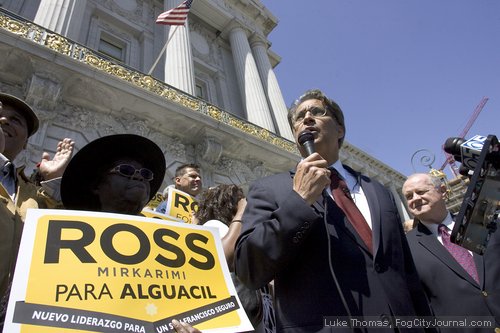
Ross for boss (of the sheriff’s department)

3

City Hall’s steps were awash in multi-lingual black and yellow “Ross Mirkarimi for Sherrif” signs at noon today, as Mirkarimi supporters watched Sheriff Mike Hennessey, who is stepping down after 31 years of service and eight elections, endorse Sup. Mirkarimi as the next sheriff.  “New Leadership for a Safe San Francisco” was printed on the English version of the signs that Mirkarimi’s supporters carried. They included former Mayor Art Agnos, Sups. David Campos and Eric Mar, Tim Paulson of the Labor Council, Debra Walker, Linda Richardson, Sharen Hewitt, Terry Anders, and Mirkarimi’s partner Eliana Lopez and their almost two-year old son Theo. And everyone had plenty of great things to say about outgoing sheriff Hennessey and sheriff candidate Mirkarimi. And Hennessey even pinned a shiny toy sheriff’s badge onto the T-shirt of Mirkarimi’s son Theo, making him the happiest kid in town. At least for the day.

Campos kicked off the event by honoring Hennessey as the “most progressive and most effective sheriff in the country.”
“Mike Hennessey is also my neighbor in District 9. I see him taking out the trash so I know he’s a good neighbor,” Campos joked, as he listed the many achievements in Hennessey’s long career as an elected official in San Francisco. These achievements included Hennessey’s pioneering innovations in criminal justice and culminated in his decision to blow the whistle in 2010 on the federal government’s plan to activate its controversial Secure Communities program in San Francisco—without telling the public.
“He’s not afraid to stand up for what’s right,” Campos said.

‘This is the time for me to move on,” Hennessey announced, as he laid out his reasons for endorsing Mirkarimi as Sheriff, over other candidates in the field.
Hennessey described the Sheriff’s Department as a “large enterprise” that has over 1,000 employees, a $150 million budget and whose jail houses an average population of 2,000 folks in custody, on a daily basis.
“It’s not something that can be handled lightly,” Hennessey said. “That’s why I’m here to endorse Ross Mirkarimi as the next sheriff.”

Hennessey listed the many endeavors that he and Mirkarimi have worked closely on, including a number of criminal justice issues, and he cited Mirkarimi’s extensive law enforcement background, his significant legislative accomplishments in the areas of criminal justice and public safety, and his ability to find innovative solutions and overcome obstacles to progress, as reasons to support Mirkarimi.

Hennessey observed that criminal justice is “one of the thornier issues” that members of the Board of Supervisors are often asked to get involved in, but often duck.”But Ross has not shied away from working on them,” Hennessey said, citing Mirkarimi’s involvement in shaping the “No Violence Alliance Project” and his leadership in creating the Safe Communities Re-entry Council.

Hennessey also noted that in face of AB 109, the Governor’s plan to transfer state inmates to county jails, “it’s vitally important to have person in charge of sheriff’s office that understands these alliances and can make them work more effectively.”

Hennessey concluded by observing that the Sherrif’s Department has to deal with a lot of bureaucracy, so it’s important to understand how the Board, the budget process and other city departments, including the District Attorney’s office and the police, work.
‘And that’s why I’m endorsing Ross as Sheriff,” Hennessey said

Then it was the turn of Mirkarimi, who graduated from the San Francisco Police Academy, did Naval Reserve training and worked for more than 8 years as an investigator for the District Attorney’s office, to speak.

“I have never been at a loss for words,” Mirkarimi acknowledged, as he launched into a speech that began by thanking everyone for showing up at short notice “for one of the most important occasions of my political career.”

Mirkarimi did a great job of giving Hennessey the praise he deserves.
“He is a living legend,” Mirkarimi said. “It’s completely impossible to fill his shoes.”
Citing Hennessey’s integrity and his ability to innovate, Mirkarimi warned that, “Maybe it’s come to the point where we have taken him for granted. He’s the longest serving elected official in the history of San Francisco, and he’s probably the most understated.”

“And the most important endorsement in this race is that of Mike Hennessey,” Mirkarimi added, as he gave Hennessey his commitment “to build upon your legacy as effectively as possible.”

Mirkarimi cited some of the most immediate and serious challenges that face the next sheriff. These include AB 109, which Gov. Jerry Brown just signed, which. Mirkarimi said, threatens to increase the reentry prisoner level by 30 percent in California. “It will take creative ingenuity and resources to make sure we are effective in taking care of this population,” he said.

Mirkarimi also touched on the rising number of veterans that are ending up in the prison system, talked more about the No Violence Alliance Project, and suggested that certified deputy sheriffs could help serve warrants, transfer prisoners, and patrol Muni, “when the police department finds itself understaffed” so as to ensure that San Francisco is safe.

“For every four people arrested and jailed in San Francisco, three out of four are repeat offenders in a three-year period,” Mirkarimi warned, by way of explaining why he wants to advance a more collaborative spirit between SPPD and the Sheriff’s department.

Mirkarimi also noted that one out of every 15 African American males are in jail, at any time in the year, compared to I out of 300 males who are not black or brown. “So, we must step up our game in dealing with poverty,” he said, as he recommended increased access to job training and good jobs, “so work doesn’t become a seasonal hope but a permanent job.” He also made the connections between a lack of good housing, childcare, and schools and a rise in poverty, crime and recidivism.

Mirkarimi concluded by crediting Hennessey for “walking that fine pirouette” between upholding the principles of public safety and understanding the power of redemption at the same time.

I asked Sheriff Mike Hennessey what he considers to be the biggest challenges of running for sheriff/
“Letting people know what you are going to do, and what your issues are,” Hennessey said, noting that San Francisco has an intelligent, issues-driven electorate.

And Mirkarimi’s supporters weren’t shy about letting folks know the issues that the current D5 Supervisor has helped them with, over the years.

“Ross, as a supervisor and me, as someone who comes from a community of color, we know the habits that ex-offenders can bring with them, if there are no safety nets,” said Terry Anders who sits with Mirkarimi on the Safe Communities Reentry Council. “And I believe in what Ross stands for and the integrity of his person. He’s one of the first people to show up when there are crimes and victims, and he attends basketball games and boxing matches.”

Paulette Brown, whose son Aubrey Abraska Jr, was murdered in August 2006, but whose killers have still not been brought to justice.
“We shouldn’t have to run and leave our families, we should be protected,” Brown said. “Ross is my district supervisor and if he can get in, and do something about crime and solve unsolved homicides, then I’m for him. Maybe if he gets in, he’ll have more pull to do something about these unresolved cases.”

And then it was back to work, which for Mirkarimi now includes the somewhat daunting task of trying to raise money in an election year that also includes a mayor’s race, but does not include the help of public financing, at least not for the sherrif’s race….

Our Weekly Picks: May 4-11, 2011

0

WEDNESDAY

MAY 4


MUSIC

Wanda Jackson

Over her 50-plus years in show business, she’s been called “the Queen of Rockabilly” and “the Sweet Lady with the Nasty Voice” — and now fans can rightly call Wanda Jackson a true musical icon, with her recent induction into the Rock and Roll Hall of Fame. Don’t let that enshrinement fool you into thinking she’s retired, though. She can still belt out tunes like nobody’s business, and proved that yet again with the release of The Party Ain’t Over, her Jack White-produced album that came out earlier this year. Forget about the recent big fuss over in England; come to tonight’s show if you want to see some real royalty. (Sean McCourt)

With Red Meat and DJ Britt Govea

8 p.m., $21

Great American Music Hall

859 O’Farrell, SF

(415) 885-0750

www.gamh.com


MUSIC

J Mascis

It has been a good couple of years to be a Dinosaur Jr. fan. In 2005, lead singer J Mascis and bandmate Lou Barlow put aside their grievances enough to play shows as the original lineup, along with drummer Murph. In an era of live record performances from bands well past their prime, that would have been enough, but the band released new albums that were as good as ever. (In the case of 2009’s Farm, maybe better.) So now, almost just to show that he can, between Dinosaur Jr. tours and recording sessions, Mascis releases the solo album, Several Shades of Why. Exchanging shredded electric guitars for (still a little fuzzy) acoustics, it’s another surprise, but in the best way. (Ryan Prendiville)

With Black Heart Procession

8 p.m., $20

Independent

628 Divisadero, SF

(415) 771-1421

www.theindependentsf.com


THURSDAY

MAY 5


MUSIC

Frank Fairfield

Frank Fairfield’s adaptations of blistering American ballads are proudly faithful, but his ability to coax the rightness from battered banjos and fiddles (and to squeeze his voice as if onto fresh shellac) goes way beyond technique. “I don’t even know if [this music] has that much to do with tradition,” Fairfield told one interviewer. “I think it’s just people doing whatever they feel like doing. A lot of this stuff just gets mished and mashed, and that’s the beautiful thing about America.” The fact that he’s a young Angeleno who dresses the old-timey part may raise eyebrows — but trust your ears. He makes an intriguing opener for Cass McCombs, a troubadour cut from a different cloth. (Max Goldberg)

With Cass McCombs

8 p.m., $15

Swedish American Music Hall

2170 Market, SF

(415) 861-5016

www.cafedunord.com


FRIDAY

MAY 6


DANCE

Ahdanco/Abigail Hosein Dance Company

While dance can be described as poetry in motion, Ahdanco’s 2011 home season offers both poetry and motion in a dynamic dialogue. For one of the two new works on the program, the dancers share the stage with spoken word artists from the Bay Area Poetry Slam Circuit, weaving Abigail Hosein’s choreography with powerful narrative stories. The other dance is a trio set to an original score composed of four loop stations, trumpet, cello, upright bass, guitar, and female vocals performed live by ambient band, Entamoeba. Hosein’s strong female dancers (many of whom are Mills College alumni) skillfully balance the physical and theatrical. (Julie Potter)

Thurs/6–Fri/7, 8 p.m.; Sun/8, 6 p.m., $20

Ashby Stage

1901 Ashby, Berk.

(510) 837-0776

www.ahdanco.org


EVENT

“Bikes and Beats”

In response to SF’s burgeoning biking scene — and that empty moment on the first Fridays of the month when you realize that the SF Bike Party is over and the rest of your evening is TBA — comes this night club-bike club. Organizers’ goal for this fundraiser for Sunday Streets and the Wigg Party is to make bike culture as un-scary and fun as possible — even to those without handlebar calluses. Bike crafts and fashion will be on display, as well as a dope, divergent musical lineup featuring the Polish Ambassador, Non-Stop Bhangra, Madrone’s Motown on Mondays crew, and that party on two wheels well known to SF cruisers, DJ Deep. (Caitlin Donohue)

10 p.m.–3 a.m., $6–$10

Public Works

161 Erie, SF

(415) 932-0955

Facebook: Bikes & Beats


DANCE

“SCUBA 2011”

A terrific idea, SCUBA, a small presenters consortium, has been pooling resources for close to a decade to offer gigs to hot young choreographers, whether homegrown or invited from participating venues. So far, ODC Theater director Rob Bailis’ choices have always been worthwhile. The mix has been rich and varied. On this program, SF’s own Katie Faulkner, who will premiere Sawtooth, will be joined by Amelia Reeber from Seattle and Chris Yon from Minneapolis. Reeber is bringing this is a forgery, a multimedia work that examines choices and transformation. Yon draws on husband-wife vaudeville acts for his duet, The Very Unlikeliness (I’m Going to Kill You), with partner with Taryn Griggs. (Rita Felciano)

Fri/6–Sat/7, 8 p.m.; Sun/8, 7 p.m., $15–$18

ODC Theater

3153 17th St. SF

(415) 863-9834

www.odctheater.org


SATURDAY

MAY 7


MUSIC

“Walk Like An Egyptian”

What’s Zambaleta, you say? In Egypt, Zambaleta is a spontaneous chaotic street party that happens when everyone is participating, through music or dance. In the Mission, Zambaleta is a world music and dance school with an inclusive environment and celebratory spirit. This weekend’s “Walk Like An Egyptian” festival captures that spirit, featuring Bay Area music from blues and folk to jug bands and indie. The lineup of 18 bands includes an appearance by Annie Bacon’s Folk Opera — plus, proceeds from the festival support community programs at the world music and dance center. Come walk — and party — like an Egyptian. (Potter)

Sat/7, 1 p.m.–midnight;

Also Sun/8, noon–8 p.m., $5–$20

Restoration Workshop

630 Treat, SF

(415) 341-1333

www.zambaleta.org


EVENT

CELLspace Birthday Benefit Funkathon

Celebrate the 15th birthday of CELLspace, San Francisco’s original hub for artistic work and gatherings, by partying down at a Funkathon featuring Action Jackson and other funky music and dance acts. And this is just one event among many, including an art auction May 5, a swap meet and dance party May 6, and a party May 8 that coincides with the Sunday Streets closure of Mission District streets to automobile traffic. CELLspace, a venerable institution that offers classes on everything from welding to breakdancing, is going through ambitious fundraising efforts as it seeks the permits and resources to expand its nightlife offerings, so come have a funky time while supporting a great cause. (Steven T. Jones) 9 p.m., $10–$20

CELLspace

2050 Bryant, SF

(415) 410-7597

www.cellspace.org


FILM/PERFORMANCE

“Ultimate Mommie Dearest

Oh, I know you’ve already seen 1981’s Mommie Dearest. And I know you can quote all the famous lines (personal favorite: “Tina! Bring me the ax!”) But you’ve never experienced the ultimate Mommie Dearest — because it’s never been attempted until this once-in-a-lifetime event. Marking the cult classic’s 30th anniversary is a dame who surely has never touched a wire hanger in her life, Peaches Christ, and celebrated Peaches cohorts Heklina, Martiny, and (in honor of Mother’s Day), Mrs. Christ herself! A restored print of the film caps a night that also includes the musical stage spectacular Trannie Dearest, a drag tribute to Joan Crawford’s unfailingly dramatic life. Do I even have to add that costumes are encouraged? (Cheryl Eddy)

8 p.m., $25–$40

Castro Theatre

429 Castro, SF

www.peacheschrist.com


EVENT

Urban Cycling Workshop

If I had a nickel for every car devotee or exasperated Muni rider who’s lamented, “Oh, I would totally ride a bike if there weren’t so many scary cars!” I’d be, well, not rich but could certainly buy some fresh handlebar tape ($16 per roll). How awesome, then, that the hardworking bike advocates at the San Francisco Bicycle Coalition are offering a four-hour, in-classroom, free introductory course geared toward newbies and cyclists who want to feel more comfortable riding our tiny but intense peninsula. The class covers all the basics, from choosing the best bike to pulling emergency maneuvers, to knowing your legal rights. Ding, ding! (Kat Renz)

2 p.m., free (preregistration required; ages 14 and up)

Fort Mason Center, Bldg. C, Rm. 362

Laguna at Marina, SF

(415) 431-2453 x312

www.sfbike.org/edu


MONDAY

MAY 9


MUSIC

Mogwai

Much like the mythical creatures from Gremlins (1984) that they are named after, Mogwai’s sound can be soft and serene at one moment, then morph into an entirely different dynamic, with blistering guitars and noisy effects multiplying around you. The Glasgow-bred rockers returned in February with its seventh record, and its first Sub Pop release, Hardcore Will Never Die, But You Will, which continues the band’s mostly instrumental and highly successful approach to making music. Creating lush sonic soundscapes richly textured with a wide array of different riffs and tones, the five-piece group is definitely one to catch live if you can. (McCourt)

With Errors

8 p.m., $23.50–$26

Regency Ballroom

1290 Sutter, SF

1-800-745-3000

www.theregencyballroom.com


TUESDAY

MAY 10


DANCE

Project.B.

If you have seen Tanya Bello dance — Shift Physical Theater, Robert Moses’ Kin, and Janice Garrett + Dancers come to mind — you won’t have forgotten her. She probably was the shortest (but also the fastest and fiercest) tearing across the stage. Bello is small but she dances big. Lately she has taken advantage of the Garage’s RAW (Resident Artist Workshop) program to hone her choreographic skills. Moveable Feast, her first full-evening work, is plugging into her experience working with choreographers both here and on the East Coast. The idea is to show three versions of one piece in which components — lights, dancers, sets, music — get shuffled around. In the end the audience decides which one worked best. (Felciano)

May 10-11, 8 p.m., $15

Garage

975 Howard, SF

(415) 518 1517 www.brownpapertickets.com 


The Guardian listings deadline is two weeks prior to our Wednesday publication date. To submit an item for consideration, please include the title of the event, a brief description of the event, date and time, venue name, street address (listing cross streets only isn’t sufficient), city, telephone number readers can call for more information, telephone number for media, and admission costs. Send information to Listings, the Guardian Building, 135 Mississippi St., SF, CA 94107; fax to (415) 487-2506; or e-mail (paste press release into e-mail body — no text attachments, please) to listings@sfbg.com. Digital photos may be submitted in jpeg format; the image must be at least 240 dpi and four inches by six inches in size. We regret we cannot accept listings over the phone.

Muni strike vote stems from “gigantic mistrust” of the MTA

7

At a time when public employee unions are being demonized, downsized, and degraded by conservatives and much of the general public, it was a bold gesture for Muni drivers to recently authorize their Transportation Workers Union Local 250A to defy city law and go on strike anyway. But following through on that threat and shutting down Muni may only turn the public even more strongly against that union.

Board of Supervisors President David Chiu said a Muni strike would be “a significant mistake” that he’s trying to avert, and City Attorney Dennis Herrera has issued a statement reminding the public and Muni workers that strikes are banned in the union contact and the City Charter and “we will take appropriate legal recourse.”

But the union’s Secretary-Treasurer Walter Scott told us the strike authorization vote was a result of the “gigantic mistrust” by Muni workers of their Municipal Transportation Agency bosses. “They wanted a strike authorization vote,” he said, which “shows that the membership is behind us” as union leaders negotiate a new contract in the wake of November’s Prop. G, which ended the union’s pay guarantees.

Among the recent factors that Scott said have led Muni workers to doubt that the agency is negotiating in good faith were the MTA’s unilateral decisions to withhold Health Care Trust Fund money that had gone to drivers in previous years and the new requirement that drivers bring in doctors’ notes if they call in sick, as well as the agency’s decision to hire public relations specialist Charlie Goodyear to publicize developments in the ongoing negotiations.

But Goodyear said those issues are diversions that haven’t been raised in the current negotiations, that the MTA was acting under authority it has under the charter, and that “we hope that the good work that’s been going on for five or six weeks continues” and the two sides reach an agreement on a new contract.

Scott also expressed hope that the two sides will reach a deal. “Nobody wants to strike, and we’re trying our damnedest to find a happy median in these negotiations,” he said.

As for the right of the drivers to strike, Scott agrees that the current contract prohibits it, but he noted that the contract expires on June 30 and that “on July 1, we have no contract. That’s went the legality [of a strike] comes into question.”

Herrera has noted that the City Charter also declares that “strikes by City employees are not in the public interest,” going on to note that “said employees shall be dismissed.” But Scott says Muni employees have already been so vilified by city officials and the local press that calling a strike wouldn’t hurt their standing with the public much more: “If I’m shot dead and someone stabs me, it doesn’t make that much of a difference.”

Reject the Treasure Island plan

18

EDITORIAL After a long, long hearing April 21, as the San Francisco Planning Commission prepared to vote on an ambitious development plan for Treasure Island, Commissioner Gwyneth Borden acknowledged that the plan wasn’t perfect. But, she said, on balance it ought to be approved: “Twenty five percent affordable housing is better than zero percent.”

That’s not necessarily true.

Treasure Island is an usual piece of real estate, 403 acres of artificial land created in 1937 by dumping sand and dirt on a shallow part of the bay. It’s less than two miles from downtown San Francisco — but there’s no rail service, no BART station. The only way off the island is by boat — or by driving onto a Bay Bridge that’s already jammed way beyond capacity every morning and afternoon.

The soil is unstable, prone to liquefying in an earthquake — and if sea levels rise as high as some predictions suggest, the whole place could be underwater in a few decades.

A strange hybrid agency called the Treasure Island Development Authority, created by former Mayor Willie Brown, cut a deal with Lennar Urban (the same outfit that has the redevelopment deal for Bayview Hunters Point) and several partners to construct a neighborhood of some 19,000 people on the island. Among the features: a 450-foot condominium tower and 6,000 units of high-end housing. The developers brag that a fleet of new ferries will offer a 13-minute ride to the city and that some streets will be designed for pedestrians and bicycles.

But the fact remains that the developers want to add 19,000 new residents — almost all of whom will work off the island somewhere — to a place that has no credible transportation system. City studies show that even with an extensive (and costly) ferry service, at least half the new residents would drive cars to work (and, presumably, to shop, and go to movies, and eat and drink), joining the mob of vehicles heading east or west on the bridge. That’s almost 10,000 new cars each day trying to jam onto a roadway that can’t handle the existing traffic. The backups would stretch well onto San Francisco surface streets and as far back as Berkeley.

A rail line on the Bay Bridge would solve part of the problem. So would bike lanes. Neither option is even remotely possible in the foreseeable future. Free, or heavily subsidized ferries could, indeed, be a positive alternative — but who is going to pay for that service? Nonsubsidized ferries would be far more expensive than current Muni or BART service, a particular burden on the residents of the below-market housing.) And does anybody really think there’s going to be enough ferry capacity to carry 10,000 people a day to downtown SF, the East Bay, and the Peninsula?

The bottom line: this isn’t a good deal for San Francisco. The affordable housing level is too low. The transportation problems are nightmarish. The last thing Treasure Island needs is a 450-foot tower.

There’s no rush to approve this — and no immediate downside to waiting for a better deal. The supervisors should tell Lennar to come back with a project that has fewer residents, better transit options, and more affordable housing. Because zero is looking a lot better than what’s on the table.

PS: The 4-3 Planning Commission vote demonstrated exactly why it’s important to have key commission appointments split between the mayor and the Board of Supervisors. The mayoral appointees all rolled over — but at least the board-appointed members made strong points, forced real debate, and gave the supervisors plenty of ammunition to demand a better deal.

Editorial: Reject the Treasure Island plan

1

After a long, long hearing April 21, as the San Francisco Planning Commission prepared to vote on an ambitious development plan for Treasure Island, Commissioner Gwyneth Borden acknowledged that the plan wasn’t perfect. But, she said, on balance it ought to be approved: “Twenty five percent affordable housing is better than zero percent.”

That’s not necessarily true.

Treasure Island is an usual piece of real estate, 403 acres of artificial land created in 1937 by dumping sand and dirt on a shallow part of the bay. It’s less than two miles from downtown San Francisco — but there’s no rail service, no BART station. The only way off the island is by boat — or by driving onto a Bay Bridge that’s already jammed way beyond capacity every morning and afternoon.

The soil is unstable, prone to liquefying in an earthquake — and if sea levels rise as high as some predictions suggest, the whole place could be underwater in a few decades.

A strange hybrid agency called the Treasure Island Development Authority, created by former Mayor Willie Brown, cut a deal with Lennar Urban (the same outfit that has the redevelopment deal for Bayview Hunters Point) and several partners to construct a neighborhood of some 19,000 people on the island. Among the features: a 450-foot condominium tower and 6,000 units of high-end housing. The developers brag that a fleet of new ferries will offer a 13-minute ride to the city and that some streets will be designed for pedestrians and bicycles.

But the fact remains that the developers want to add 19,000 new residents — almost all of whom will work off the island somewhere — to a place that has no credible transportation system. City studies show that even with an extensive (and costly) ferry service, at least half the new residents would drive cars to work (and, presumably, to shop, and go to movies, and eat and drink), joining the mob of vehicles heading east or west on the bridge. That’s almost 10,000 new cars each day trying to jam onto a roadway that can’t handle the existing traffic. The backups would stretch well onto San Francisco surface streets and as far back as Berkeley.

A rail line on the Bay Bridge would solve part of the problem. So would bike lanes. Neither option is even remotely possible in the foreseeable future. Free, or heavily subsidized ferries could, indeed, be a positive alternative — but who is going to pay for that service? Nonsubsidized ferries would be far more expensive than current Muni or BART service, a particular burden on the residents of the below-market housing.) And does anybody really think there’s going to be enough ferry capacity to carry 10,000 people a day to downtown SF, the East Bay, and the Peninsula?

The bottom line: this isn’t a good deal for San Francisco. The affordable housing level is too low. The transportation problems are nightmarish. The last thing Treasure Island needs is a 450-foot tower.

There’s no rush to approve this — and no immediate downside to waiting for a better deal. The supervisors should tell Lennar to come back with a project that has fewer residents, better transit options, and more affordable housing. Because zero is looking a lot better than what’s on the table.

PS: The 4-3 Planning Commission vote demonstrated exactly why it’s important to have key commission appointments split between the mayor and the Board of Supervisors. The mayoral appointees all rolled over — but at least the board-appointed members made strong points, forced real debate, and gave the supervisors plenty of ammunition to demand a better deal. *


Gascon’s futility

0

news@sfbg.com

If the April 12, 2011 breakfast meet-and-greet featuring appointed District Attorney George Gascón at a West Portal Avenue eatery constitutes a barometer of the campaign for that important public office, San Franciscans are in for a tepid exercise in municipal futility.

Sponsored by a prolific campaign contributor and restaurant owner, a Board of Permit Appeals appointee of former Mayor Gavin Newsom, and the owner of a new public relations/lobbying firm just awarded the $100,000 dollar public relations contract for Muni, the event attracted some 20 people, including Gascón’s campaign manager and fundraiser, and consisted of a stereotypical candidate presentation and a meager number of audience questions.

Revealing he’s “intrigued” by a chief of police becoming the District Attorney, Gascón described a Saturday afternoon meeting in early January with Newsom supposedly about the transition in local law enforcement arising from relinquishment of the DA’s office by the prior officeholder. According to Gascón, he was “really surprised” when Newsom declared he wanted to appoint him to the office — but Gascón had to accept the offer by 5 p.m. (Not a word did he provide his breakfast audience about Willie Brown-Rose Pak’s participation in promulgating the Newsom offer).

After claiming he “got some very good results” in his first year as police chief, Gascón recited the need for “separation” between his role as former chief and execution of prosecutorial duties. But he failed to specify, even by example, cases in which he has or will recuse himself from prosecuting in favor of the state’s attorney general — at added taxpayer cost, to be sure! (The Attorney General’s Office institutionally lacks trained criminal trial lawyers; the office responsibility pertains to defending the people in appeals from criminal trial court convictions.)

Asserting that the D.A.’s office is “understaffed and underfunded,” the political appointee then tried to describe the three sections of responsibility within the office, concentrating on so-called community courts for “low-level offenses” and “diversion courts.”

He referred to a section for “justice integrity” without defining its nature or scope. He proclaimed as novelty ” a pre-preliminary hearing” proceeding to resolve charges by “offers” for defendants pleading no contest or guilty to lesser crimes, an existing standard practice in Superior Court.

Audience questions involved the mentally ill, capital offenses, the Mental Health Court, domestic violence, and prosecution problems caused by a flawed drug laboratory, search and seizure police errors, and the like. Gascón conveyed his personal “misgivings about the death penalty,” asserted that 60 percent of Death Row prisoners are “minorities,” reminded listeners the death penalty is California law and must be followed and concluded: “I can’t say categorically I’d never seek the death penalty.” (There are currently seven cases in the District Attorney’s Office that qualify for capital punishment.)

Gascón finally stated he “is not a fan of” so-called consent searches and that he has established a 24-hour search warrant office capability for police — and he spoke of an unexplained relationship with Public Defender Jeff Adachi, who has criticized several warrantless Police Department searches.

Strikingly absent from the Gascón dissertation was any reference to attacking public corruption of the genre disclosed by the Guardian and many other sources. One also wonders whether punishment represents an object of this prosecutor’s office or whether social outcomes represent the dominant goal.

Never mentioned was the Special Prosecution Unit of the office (which once handled corruption cases), whether it still exists or, if so, what its current mission is. Never mentioned was the method of selecting judges for his proposed Community Courts.

And, as John Shanley, one-time spokesman for ex-District Attorney Terence Hallinan and a former deputy city attorney observes: “Anybody who thinks public corruption ended in San Francisco with the disgraced Ed Jew needs to reduce their dosage of medicinal marijuana.”

Lacking any questions or information on the candidate’s trial experience, prosecutorial successes, or experience as a lawyer, we still don’t know much about political appointee D.A. Gascón after one West Portal meet and greet.

Retired Superior Court Judge Quentin Kopp — a former San Francisco supervisor and state senator — has been engaged as a special correspondent for the Guardian covering selected political events and issues.


Will Muni youth passes be saved?

0

A popular and successful program that gave free group bus passes to summer programs for kids is up for renewal — but nobody knows if Muni officials will approve it.


The Summer Youth Group Pass allowed thousands of children in 50 different nonprofit summer programs access to free rides for field trips. Last year 850 passes were made available and each covered a groups of roughly 20 students.
But despite political support from educators and youth activity leaders, and a official letter from Sup David Campos and City Attorney Dennis Herrera, San Francisco Municipal Transporttion Agency Executive Director Nathaniel Ford remains mute on whether the program will continue.


Herrera and Campos issued the letter March 31 detailing the importance of the passes and urging action. Herrera said, “I’m hopeful [it will be renewed]. It was a tremendous success last year and I see no reason why it won’t continue this year.”
But SFMTA spokesperson Kristin Holland a decision has yet to be made. She said staff must look at the finances of renewing the program and that she has yet had audience with Ford to ask his response to the letter.


The politicians in support of the passes are taking their cues from educators and youth advocates on the ground. Education advocate Margaret Brodkin, for example, said she believes “we need to make summer a much more enriching time for young people, especially for low income people.”


One person she said is working toward that goal is Jeff Feinman, executive director of Mission Graduates. Feinman explained, group passes “allow kids to see different parts of the San Francisco they wouldn’t have opportunity to see otherwise. It’s a reward for the work they do.”


From an organizational perspective, group passes are important for two major reasons. Feinman said, “logistically, they make coming and going easy.” Instead of requiring a pass for each student, one pass can work for an entire group. He added that “the cost saving is huge for our programs that are cash strapped.”


When it comes to public transit, Campos said it is important to not only alleviate funding woes but to move forward with comprehensive support for low-income Muni riders. “[Group passes] is one piece of a larger puzzle,” he said. “We want to make Muni more accessible affordable to students in the public schools.”


He added, “We have been exploring the possibilities of making Muni free for all youth in San Francisco. That’s a long term plan.”

5 Things: March 23, 2011

3

>>PILLOW TALK “Luxury-tech” home furnishings line DQtrs is releasing a really clever collection of limited edition tapestry wall hangings and pillows that links ancient Greco-Roman imagery and Sputnik-era space age fantasies. (Cue the gorgeous Apollo jokes.) Catch the launch tomorrow (3/24) at nifty Hayes Valley store Propeller, 6 p.m.-9 p.m. Plus: Food trucks!

>> SAFETY IN BURGERS? Thai didn’t fly, French didn’t fry, and now, after months of pondering grungy vacant windows, Greenburger’s burger joint has opened at 518 Haight Street. The latest entrant in this ill-fated spot, which looks out onto views of a Muni stop and Toronado street ruckus, is couple-run operation specializing in beef and veggie burgers, sweet potato fries and burger-y sides, milkshakes, salads, and so on, all with a greenish (grass fed, locally sourced, yadda, yadda, yadda) cast. The street has seen its share of flux lately — Pandora’s trunk, gone; Burger Joint, gone; RNM gone — so let’s hope that “sustainable” burgers are the elusive thing that Lower Haightians have been waiting for

>>CLAM-A-RAMA PART I This week’s issue of the Guardian captures the latest wave of Bay Area garage rock, with special attention to what makes it unique and even innovative. When she isn’t rocking the mic with Shannon and the Clams, current Guardian cover star Shannon Shaw is trading vocals with Hunx (a.k.a. Seth Bogart). The most recent addition to Hunx’s colorful music videos, directed by longtime collaborator Justin Kelly, “Too Young to Be in Love” provides an alternate, uptempo version of the title track on the group’s new album. Take a fateful trip to an endangered Coney Island and ride the Cyclone of love with Hunx, Shaw, and a fickle cutie. (Keep an eye out for a cameo by director Kelly — whose editing creates all kinds of architectural rhymes — at the very end.)

>>CLAM-A-RAMA PART II On the subject of Shaw, two YouTube preview clips showcase songs from Shannon and the Clams’ new album Sleep Talk, as well as amazing shots of the band by local photographer (and 2007 Guardian “Flaming Creator” honoree) Keith Aguiar. “The Cult Song” starts out with a harmonic reference to Tod Browning’s Freaks that doubles as a a nod to the Ramones before making a break from mind control. And then there’s Sleep Talk‘s hair-raising title track, which finds Shaw at her most sultry and powerful.

>>YOUCOLLAGE Youtube musical mosaic genius Kutiman just released another stunner …

http://www.youtube.com/watch?v=nIl4LkHYRkg