Media

8 Mile blues

0

There have been a number of documentaries lately reflecting a fascination with Detroit as a ruined giant, our very own (barely) living Pompeii. Local residents have made films lamenting the extreme poverty and the bungled public-corporate policies that largely created it. Non-locals, particularly those state-funded Europeans, have made others whimsically extolling the environ’s pockets of reversion to agrarian culture — seeing utopian futurism there rather than a grimly comic last resort. Or they’ve exploited its accidental status as the world’s largest open-air gallery for the aesthetics of extreme urban decay.

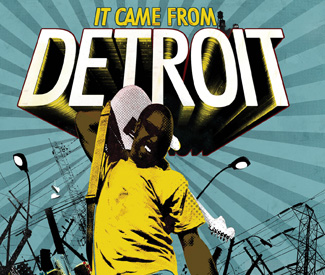
James R. Petix’s It Came From Detroit is like none of the above. In fact the movie it most resembles in some ways is Doug Pray’s 1996 Hype!, which documented the still-fresh boom and bust of grunge — a phenom you may have thought about recently given the, er, hype attendant around Nevermind‘s 20th anniversary. About a decade after Seattle flew the flannel flag high, Detroit too had a musical moment that conquered the nation … or at least was supposed to.

Motor City’s answer to grunge — as framed by a media finally certain it had found the ever-elusive "next Seattle" — was garage, a term that had already gained some new traction from the 1980s Paisley Underground and related ’60s revivalist movements. Sporting chops barely above the Shaggs level when they started out, turbulent trio the Gories’ willfully primitive abandon triggered something, igniting a DIY scene that would eventually encompass such stellar acts as the Wildbunch, the Hentchmen, the Go, Detroit Cobras, the Dirtbombs, Electric Six, and more.

The scene was primed to explode, and when the White Stripes became Cover Boy and Girl on music mags ’round the world, their improbable success seemed sure to spread. A publicity frenzy peaked in 2003, when the Stripes vs. Von Bondies "feud" reached maximum impact via Jack White’s fist on Jason Stollsteimer’s face. But the rough-edged, rootsy focus of Detroit’s disparate new music stalled short of making further commercial inroads; while their sounds ranged from punk blues to goth bluegrass and beyond, nearly all the bands had the kind of live dynamic that can only be muted in the recording studio.

The label-signing frenzy fast over, for most it was back to the drag queen bars, bowling alleys, and coffee shops that had served as Gories venues early on, back to the lowly dayjobs (when found) and sleeping in cars when even rock bottom rent is too much. But the myriad interviewees in It Came don’t seem particularly disillusioned. As more than one points out, when you’re from Detroit you keep your expectations low and make music for love, because nobody’s gonna become a star. Almost nobody, that is.

IT CAME FROM DETROIT

Thurs/5, 7:30 and 9:30 p.m., $6.50-$10

Roxie Theater

3117 16th St., SF

www.roxie.com

Our Weekly Picks: January 4-10

0

WEDNESDAY 4

Starfucker

Reptilians, the latest LP from Portland, Ore.’s Starfucker, shows a clear obsession with death. But, you might not realize it from the opening track, “Born,” which takes a Flaming Lips style approach and brings some rock skuzz to a child-like stare into the abyss. This band keeps getting bigger (as does its audience — this Oakland date was added after two scheduled shows this week sold out,) and now with five touring members, the sounds gotten more expansive: euphoric electronica, Australian/Minogue-ish pop, 8bit arpeggios, Pixies’ bass lines, plus the signature Alan Watts samples. It could be a little much for a synth rock group, but for now, considering impending annihilation, Starfucker doesn’t seem to give a fuck. (Ryan Prendiville)

With Painted Palms, and Feelings

9 p.m., $20–$23

New Parish

579 18th St., Oakl.

(415) 371-1631

www.thenewparish.com


Week End

Yes, there was a standout 2011 movie called Weekend — Nottingham guy meets bound-for-America Nottingham guy for a one-night stand that turns out to be something more — but this screening is of another film with a very similar name, 1967’s Week End. Pro-tip: add Weekend to your Netflix queue and add Week End to your weekend plans. Jean-Luc Godard’s surreal, prescient satire of our ever-declining civilization, featuring cinema’s most epic (and most epically-filmed) traffic jam, unspools on the big screen in the form of a brand-new 35mm print. Oui-kend! (Cheryl Eddy)

Fri/6-Sun/8, 7 and 9:15 p.m. (also Sat/7-Sun/8, 2:30 and 4:45 p.m.), $7.50–<\d>$10

Castro Theatre

429 Castro, SF

(415) 621-6120


Grass Widow

Celebrate the first Friday of 2012 in Oakland with a free performance by San Francisco’s popular harmonizing punk trio, Grass Widow. Traipse through forward-thinking art instillations at nearby galleries as part of Art Murmur, then pop into the Uptown for an early start — doors are at 6 p.m. so there’s ample drinking time before bands. And those bands are high quality. Every time I see Grass Widow live, I’m smacked with its sheer blistering force; last catching the act upon its return from tour at a Public Works show featuring the resurgent Erase Errata, I was again swept up by the pummeling skills of guitarist Raven Mahon, drummer Lillian Maring, and bassist Hannah Lew. Art, drinks, and cheap-o rock’n’roll, it’ll be a solid First Fridays escape from reality. (Emily Savage)

With Culture Kids, Churches, and Wave Array

9 p.m., free

Uptown 1928 Telegraph, Oakl.

(510) 451-8100

www.uptownnightclub.com


Stripmall Architecture

The video for Stripmall Architecture’s “Radium Girls” features a neon-painted Rebecca Coseboom making weird “come hither” faces as she sings into the camera. It’s trippy and alluring, and it’s precisely how I would describe the local quartet’s dark-tinted pop music. Though Stripmall Architecture might be somewhat under your radar, founding couple Rebecca and Ryan Coseboom have worked with DJ Shadow, and Cocteau Twins guitarist Robin Guthrie, and toured the country with Bob Mould. The group wails on guitars and synthesizers, but Rebecca’s angelic voice is the driving force of its sound. After watching “Radium Girls,” I found a bunch of clips of the freaky light show the band puts on for live performances. So, you should probably check them out. (Frances Capell)

With Return to Mono and TIGERcat

9 p.m., $10

Rickshaw Stop

155 Fell, SF

(415) 861-2011

www.rickshawstop.com


FRIDAY 6

Frank & Tony

Francis Harris (a.k.a. Adultnapper) has a gift for building minimal tracks. One of the best songs of the last year, “Idiot Fair (feat. Black Light Smoke)” was a restrained bit of deep tech house released on Berlin’s Poker Flat Recordings. A steady bump with a little shake and some alternating clipped keys and snares for five minute — it didn’t slow build, it pleasantly idled — until a pair of brooding, stressed male vocals dropped into play. While Scissor and Thread — a Brooklyn-based label Harris started with players including French DJ (Tony) Anthony Collins — bills itself as an independent rather than dance imprint, the releases so far from Harris and Black Light Smoke sound quite promising. (Prendiville)

With Adnan Sharif (Forward), Michael Perry (Fedora)

9:30 p.m., $10–$15

Public Works

161 Erie, SF

(415) 932-0955

www.publicsf.com


The Proud

Local playwright Aaron Loeb’s previous work was entitled Abraham Lincoln’s Big, Gay Dance Party and featured a chorus line of dancin’ beardos in stovepipe hats. His latest, The Proud, workshopping at Dance Brigade’s Dance Mission Theater, features a more serious subject matter (presented in collaboration with Iraq Vets Against the War, the play is about post-traumatic stress disorder) — but a no less memorable chorus, in the form of Dance Bridgade’a formidable drummers and dancers. The Proud is drawn from interviews with Bay Area veterans of Iraq and Afghanistan, focusing on both PTSD and — in keeping with Dance Brigade’s commitment to feminist themes — the treatment of women in the military. Even in “staged reading” form, The Proud promises to be powerful stuff. (Eddy)

Sat/7, 8 p.m.; Sun/8, 6 p.m.; Mon/9, 5 p.m., free

Dance Mission Theater

3316 24th St., SF

(415) 826-4441

www.dancemission.com


SATURDAY 7

“Primo”

What gentle vibrations run through a family that produces a plural of career artists? Somewhere back in the generations was a genetic seed planted, later blooming into progeny given to walking the world with paint-spattered paws and dreamy gazes fixed on rooftops or the curvature of a cat’s cheekbones? Pending a scientific conclusion, we can look to the new art exhibition by cousins Hugh and David D’Andrade for clues. Budding geneticists will find comparisons of the two’s bodies of work — Hugh’s illustrative dream world most recently featured on an iconic Occupy flier, David’s sweeps of pigment that seem almost sculpture-like — to be catnip for the dabbler in DNA studies. (Caitlin Donohue)

Through Feb. 18

Opening reception: 6-9:30 p.m., free

a.Muse gallery

614 Alabama, SF

(415) 279-6281

www.yourmusegallery.com


“Accordions with Love II”

This event is actually a double whammy, two full shows of squeezebox pride. First, there’s the early show, “Accordion Babes Review” which kicks off at happy hour and includes accordion-filled sets by Yeti, Amber Lee & the Anomalies, Luz Gaxiola & Circus Finelli, Vagabondage, and more. Next up, there’s “The Big Squeeze,” the nighttime show beginning at 9 p.m. This one features Mark Growden, Gabrielle Ekedal & Angus Matin, Eggplant Casino, and yes, even more. It’s a packed lineup, one that should envitably lead to your perfect come-on for the night, “My, how your accordion bellows.” (Savage)

5 p.m. and 9 p.m., $10 per show

Amnesia

835 Valencia, SF

(415) 970-0012

www.amnesiathebar.com

Phonte and 9th Wonder

It’s a little hard to wrap my head around the notion that Charity Starts At Home, released in September, is the debut solo album from North Carolina Justus League rapper Phonte. One of the most straight-talking, artistically varied artists around, Phonte has done practically everything but a solo album: classic underground records with the group Little Brother, the electronic R&B project Foreign Exchange with Dutch producer Nicolay (hip-hop’s answer to the Postal Service), and alter-egos like Tigallo and the hilariously authentic old school soul singer, Percy Miracles. Among it’s highlights, Charity sees the MC once again collaborating (after a 6 year break) with top-tier producer and former Little Brother member 9th Wonder. (Prendiville)

With Median, Rapsody

9 p.m., $22-40

New Parish

579 18th St., Oakl.

(415) 371-1631

www.thenewparish.com


SUNDAY 8

The Future of Motive Power

Nikola Tesla died at the New Yorker Hotel in 1943, alone and without a cent to his name. In the last years of his life, the “electric wizard” behind wireless communication and the induction motor had been promoting a death ray, subsisting on vegetable potions, and obsessing about pigeons (he claimed to love one pigeon like “a man loves a woman”). Future Motive Power, a play by the local performance ensemble Mugwumpin, is inspired by the inventor-wizard’s life, its peculiarities and myths, and the science that lives in its wake. Created specifically for the historic Old Mint, it’s a self-proclaimed “performative fever dream.” (James H. Miller)

8 p.m., $30 includes drinks and hors d’oeuvres

Old Mint

88 Fifth St., SF

(415) 967-1574

www.mugwumpin.org


MONDAY 9

Soft White Sixties

A congregant at the church of classic, mind-reeling Seventies rock, Soft White Sixties once described its sound as “Rock ‘n’ roll, heavy on the roll, dipped in soul.” This audio-fanatic show is particularly fitting for SWS and its followers for it’s part of Communion, a live music forum began in the UK by Mumford & Sons’ Ben Lovett, Kevin Jones, and noted producer Ian Grimbl. Established in 2006 London, Communion began as a monthly showcase for emerging singer-songwriters, a modern-day creative salon. It came to San Francisco near the end of last year, and continues to produce unique lineups and fanciful collaborations monthly at Cafe Du Nord. (Savage)

With Zane Carney, Big Eagle, Gabriel Kelly, and Amy Blashkie

8:30pm, $12.

Cafe Du Nord

2170 Market, SF

(415) 861-5016

www.cafedunord.com


TUESDAY 10

Thee Cormans

In the grand tradition of costumed surf punk bands that straddle rock’n’roll and comedic timing (Phantom Surfers, Mummies), here comes Thee Cormans, a green-skinned, gorilla-masked, bug-eyed gang of wily monster motorcyclists in ripped vests riding curling waves of reverb. And like its rowdy foreparents, this fuzzed out Southern California based band has a live show that puts tender mumbling indie acts to shame. That exuberance also fits in neatly with Thee Cormans’ label, In the Red, which itself is making waves for a future-retro mishmosh output of eccentric weirdos, cultured punks, and generally genre-less acts. Viva costumery. (Savage)

With the Shrouds, the Khans, and Swiss Family Skiers

8:30 p.m., $6

Hemlock Tavern

1131 Polk, SF

(415) 923-0923

www.hemlocktavern.com 

The Guardian listings deadline is two weeks prior to our Wednesday publication date. To submit an item for consideration, please include the title of the event, a brief description of the event, date and time, venue name, street address (listing cross streets only isn’t sufficient), city, telephone number readers can call for more information, telephone number for media, and admission costs. Send information to Listings, the Guardian Building, 135 Mississippi St., SF, CA 94107; fax to (415) 487-2506; or e-mail (paste press release into e-mail body — no text attachments, please) to listings@sfbg.com. Digital photos may be submitted in jpeg format; the image must be at least 240 dpi and four inches by six inches in size. We regret we cannot accept listings over the phone.

By the roots

0

caitlin@sfbg.com

HERBWISE Where (besides this column, of course) do you get the latest on marijuana? When it comes to distributing accurate information about buds, Steph Sherer, executive director of medical cannabis advocacy group Americans for Safe Access (ASA), makes no bones about her organization’s role. “Most of our members depend on us for news,” she told the Guardian in a recent phone interview.

Even when clashes between marijuana proponents and the government are brought to light — not always a given in this political climate — Sherer finds the one note handling of cannabis issues by the mainstream media troubling. “[Cannabis] gets thrown on [journalists covering] judicial beats instead of getting picked up by the human interest, or the health and science side of things,” she said.

ASA’s response to this dearth of useful reporting on cannabis was to develop a free iPhone application that serves as a media catch-all for medical marijuana advocates. At no cost, anyone concerned with losing their right to access their medicine safely — or who wants to learn the latest about the sticky green — can now download an interface that pulls together news updates, alerts for upcoming political actions, and materials that can add to one’s activism repertoire; things like phone numbers for legal counsel and advocacy training videos.

For Sherer, the app has the potential to empower the people in the crossfire of the ongoing clashes between the federal government and state-legal growing and retail facilities: patients. “We are creating a platform that empowers people to be their own advocate. The people who can advocate for this the best are the people who are affected.” 

ASA EXECUTIVE DIRECTOR STEPH SHERER’S TOP 6 CANNABIS STORIES YOU MIGHT HAVE MISSED IN 2011

1. In March, the National Cancer Institute recognized marijuana’s medical benefit, classifying it as a “complementary alternative medicine.” Days later, the reference was diluted on its website, per the recommendation of the National Institutes on Drug Abuse.

2. After Obama’s Justice Department fought their appeal, Californian breast cancer survivor Dr. Mollie Frye and her husband were sent to prison in April for five years because of their state-legal growing operation.

3. In October, California patient advocates sued the Obama Administration for violating the 10th Amendment by coercing and obstructing local and state officials, preventing them from implementing medical marijuana laws.

4. The governors of Washington State and Rhode Island petitioned the federal government to reschedule cannabis to allow for medical use.

5. In Connecticut and New Jersey, governors continue to move forward with cannabis access legislation despite threats from US Attorneys.

6. 63-year old Norman Smith uses cannabis to mitigate the symptoms of his inoperable liver cancer. Smith is being denied a transplant from Los Angeles’ Cedar Sinai Medical Center until he agrees to stop using cannabis.


Film Listings

0

Film listings are edited by Cheryl Eddy. Reviewers are Kimberly Chun, Max Goldberg, Dennis Harvey, Lynn Rapoport, and Matt Sussman. For rep house showtimes, see Rep Clock. Due to the New Year holiday, theater information was incomplete at presstime.

OPENING

The Conquest Yet another entry in the relatively new, burgeoning genre of mostly comic biopics portraying political figures still or at least recently in office, Xavier Durringer’s film chronicles conservative Nicolas Sarkozy’s rise to the French presidency. As cannily impersonated by Denis Podalydès, Sarkozy (a.k.a. the Midget, to his detractors) is a Napoleon complex-afflicted shark whose need for perpetual careerist motion cancels out enjoyment even for his triumphs — save, perhaps, a momentary gloat over enemies left trampled. At the start he’s already neared the top of the government ladder, albeit not nearly near enough. Several years’ further upward scrambling are framed by flash-forwards to 2007, when he’s on the verge of finally becoming president, albeit at the cost of “top advisor” and long-suffering first wife Cécilia (Florence Pernel) jumping ship. Her earlier lament “Our life has become a TV show” has been ignored by a spouse quite happy living an almost entirely public, media-hounded life. (Although as his popularity continues to sink, Sarkozy almost certainly doesn’t feel that way now.) Without depiction of or insight into the main figure’s background, The Conquest becomes an entertaining but superficial, near-farcical enterprise providing little insight into what makes him tick. But then, that’s the problem with instant biographies — it’s a lot easier to grasp a significant figure’s complexities when enough time has passed for hindsight to clear the immediate fog of scandal, spectacle, and grotesquerie. (1:45) (Harvey) The Devil Inside Another year, another CG-heavy exorcism movie. (1:27)

*Everyday Sunshine: The Story of Fishbone This doc offers a lively, revealing look at SoCal ska-punk rockers Fishbone, a band that formed circa 1979 in a San Fernando Valley junior high newly filled with bussed-in South Central kids. In its heyday, Fishbone enjoyed cult success with hits like “Party at Ground Zero” and the tune that gives the film its title; Everyday Sunshine speaks to Fishbone’s broad appeal, as famous faces chime in to reminisce (and longtime fan Laurence Fishburne narrates), but it also illuminates some of the reasons its members never became megastars. Codirectors Chris Metzler (a San Francisco resident best-known for 2004’s Plagues and Pleasures on the Salton Sea) and Lev Anderson spent months on the road with the band, capturing the infectious energy of its live shows in addition to behind-the-scenes tension. Past members add their voices, but the main protagonists are bassist-vocalist Norwood Fisher and lead vocalist-saxophone player Angelo Moore. Their intertwining stories offer a poignant portrait of creative soulmates who’ve weathered many storms (personality conflicts, legal and money troubles, an industry that didn’t know how to categorize them) without once giving up on their music. In addition to its compelling story, the film’s quirkier stylistic choices, including animation, lift Everyday Sunshine above the crowded field of traditional music docs. The filmmakers will be on hand for Q&As on opening weekend, with the band in person (and performing short sets) at Fri/6 shows. (1:47) Roxie. (Eddy)

In the Land of Blood and Honey See “Lights, Jolie, Action.” (2:07)

It Came from Detroit See Trash. (1:27) Roxie.

King of Devil’s Island When teenaged Erling (Benjamin Helstad) arrives at Bastøy Prison — more labor camp than reform school — he’s more worldly than many of the other boys there, especially Olav (Trond Nilssen), though the newcomer and long-time inmate bond over a shared fascination with seafaring life. That’s about the only happy thing that happens in Bastøy; set in 1915, King of Devil’s Island is based on the Norwegian island prison’s troubled past, and a rebellion that erupts when the boys reach the breaking point. Surprisingly, it’s not the exhausting work (hauling rocks and trees as rain and snow whip across gloomy fjords) that leads to unrest — it’s the failure of the camp’s strict-but-not-sadistic overseer (go-to stern Scandinavian Stellan Skarsgård) to remove a “housefather” with rapey tendencies. An overlong running time enables a few too many climaxes (though the big uprising is well-earned, and cathartic), but director Marius Holst avoids melodrama, and powerful performances, particularly by the glowering Helstad, elevate the grim King above typical hell-is-for-children fare. (1:54) SFFS New People Cinema. (Eddy)

ONGOING

*The Adventures of Tintin Producer Peter Jackson and director Steven Spielberg join forces to adapt the work of Belgian comic creator Hergé, using performance-capture 3D animation (and featuring that new technology’s most prominent performer, Andy Serkis, in a key role). Hergé wrote over 20 volumes following the globe-trotting exploits of intrepid young reporter Tintin (Jamie Bell) and his canine companion, Snowy; The Adventures of Tintin draws from a trio of books dating from the early 1940s, tweaking the tales a bit but retaining the series’ ebullient energy and sharp humor. After he impulsively buys a model ship, Tintin is sucked into a mystery involving a long-lost pirate treasure sought by the sinister Sakharine (Daniel Craig) and, eventually, newfound Tintin ally Captain Haddock (Serkis). Fan favorites Thompson and Thomson (Simon Pegg and Nick Frost — frequent compadre Edgar Wright co-wrote the script) and a certain “Milanese Nightingale” make appearances in a story that careens between exotic locales and high-seas battles, and is packed with epic chase scenes that would leave Indiana Jones breathless. And in case you were worried, Tintin boasts the least creepy, least “uncanny valley” performance-capture animation I’ve seen to date. (1:47) (Eddy)

Alvin and the Chipmunks: Chip-wrecked (1:27)

*The Artist With the charisma-oozing agility of Douglas Fairbanks swashbuckling his way past opponents and the supreme confidence of Rudolph Valentino leaning, mid-swoon, into a maiden, French director-writer Michel Hazanavicius hits a sweet spot, or beauty mark of sorts, with his radiant new film The Artist. In a feat worthy of Fairbanks or Errol Flynn, Hazanavicius juggles a marvelously layered love story between a man and a woman, tensions between the silents and the talkies, and a movie buff’s appreciation of the power of film — embodied in particular by early Hollywood’s union of European artistry and American commerce. Dashing silent film star George Valentin (Jean Dujardin, who channels Fairbanks, Flynn, and William Powell — and won this year’s Cannes best actor prize) is at the height of his career, adorable Jack Russell by his side, until the talkies threaten to relegate him to yesterday’s news. The talent nurtured in the thick of the studio system yearns for real power, telling the newspapers, “I’m not a puppet anymore — I’m an artist,” and finances and directs his own melodrama, while his youthful protégé Peppy Miller (Bérénice Béjo) becomes a yakky flapper age’s new It Girl. Both a crowd-pleasing entertainment and a loving précis on early film history, The Artist never checks its brains at the door, remaining self-aware of its own conceit and its forebears, yet unashamed to touch the audience, without an ounce of cynicism. (1:40) (Chun)

Being Elmo: A Puppeteer’s Journey (1:25)

A Dangerous Method Cool and chatty (unsurprisingly, given its subject matter and the fact that it’s based on a play and a novel), David Cronenberg’s latest begins in 1904 Zurich as a shrieking patient (Keira Knightley) is escorted into the care of psychiatrist Carl Jung (Michael Fassbender). Dr. Jung, an admirer of Sigmund Freud, tests the “talking cure” on the woman, who turns out to be the fiercely intelligent and conveniently beautiful Sabina Spielrein. An attraction, both intellectual and sexual, soon develops, no matter that Jung is Sabina’s doctor, or that he happens to be married to a prim wife whose family wealth keeps him in boats and lake houses. Meanwhile, Jung and Freud (an excellent Viggo Mortensen) begin corresponding, eventually meeting and forming a friendship that’s tested first when Sabina comes between them, and later when Jung expresses a growing interest in fringe pursuits like parapsychology. The scenes between Freud and Jung are A Dangerous Method‘s most intriguing — save those brief few involving Vincent Cassel as a doctor-turned-patient who advises Jung to “never repress anything” — but the film is mostly concerned with Jung’s various Sabina-related dramas. Pity that this is a tightly-wound Fassbender’s least dynamic performance of the year, and that Knightley, way over the top in Sabina’s hysterical scenes, telegraphs “casting mistake” from the get-go. (1:39) (Eddy)

The Darkest Hour (1:29)

*The Descendants Like all of Alexander Payne’s films save 1996 debut Citizen Ruth, The Descendants is an adaptation, this time from Kaui Hart Hemmings’ excellent 2007 novel. Matt King (George Clooney) is a Honolulu lawyer burdened by various things, mostly a) being a haole (i.e. white) person nonetheless descended from Hawaiian royalty, rich in real estate most natives figure his kind stole from them; and b) being father to two children by a wife who’s been in a coma since a boating accident three weeks ago. Already having a hard time transitioning from workaholic to hands-on dad, Matt soon finds out this new role is permanent, like it or not — spouse Elizabeth (Patricia Hastie, just briefly seen animate) will not wake up. The Descendants covers the few days in which Matt has to share this news with Elizabeth’s loved ones, mostly notably Shailene Woodley and Amara Miller as disparately rebellious teen and 10-year-old daughters. Plus there’s the unpleasant discovery that the glam, sporty, demanding wife he’d increasingly seemed “not enough” for had indeed been looking elsewhere. When has George Clooney suggested insecurity enough to play a man afraid he’s too small in character for a larger-than-life spouse? But dressed here in oversized shorts and Hawaiian shirts, the usually suave performer looks shrunken and paunchy; his hooded eyes convey the stung joke’s-on-me viewpoint of someone who figures acknowledging depression would be an undeserved indulgence. Payne’s film can’t translate all the book’s rueful hilarity, fit in much marital backstory, or quite get across the evolving weirdness of Miller’s Scottie — though the young actors are all fine — but the film’s reined-in observations of odd yet relatable adult and family lives are all the more satisfying for lack of grandiose ambition. (1:55) (Harvey)

*Drive Such a lovely way to Drive, drunk on the sensual depths of a lush, saturated jewel tone palette and a dreamlike, almost luxurious pacing that gives off the steamy hothouse pop romanticism of ’80s-era Michael Mann and David Lynch — with the bracing, impactful flecks of threat and ultraviolence that might accompany a car chase, a moody noir, or both, as filtered through a first-wave music video. Drive comes dressed in the klassic komforts — from the Steve McQueen-esque stances and perfectly cut jackets of Ryan Gosling as the Driver Who Shall Remain Nameless to the foreboding lingering in the shadows and the wittily static, statuesque strippers that decorate the background. Gosling’s Driver is in line with Mann’s other upstanding working men who hew to an old-school moral code and are excellent at what they do, regardless of what side of the law they’re working: he likes to keep it clear and simple — his services as a wheelman boil down to five minutes, in and out — but matters get messy when he falls for sweet-faced neighbor Irene (Carey Mulligan), who lives down the hall with her small son, and her ex-con husband (Oscar Isaac) is dragged back into the game. Populated by pungent side players like Albert Brooks, Bryan Cranston, Ron Perlman, and Christina Hendricks, and scattered with readily embeddable moments like a life-changing elevator kiss that goes bloodily wrong-right, Drive turns into a real coming-out affair for both Danish director Nicolas Winding Refn (2008’s Bronson), who rises above any crisis of influence or confluence of genre to pick up the po-mo baton that Lynch left behind, and 2011’s MVP Ryan Gosling, who gets to flex his leading-man muscles in a truly cinematic role, an anti-hero and under-the-hood psychopath looking for the real hero within. (1:40) (Chun)

The Flowers of War (2:21)

*The Girl With the Dragon Tattoo The meeting of Stieg Larsson’s first “Millennium” book and David Fincher promised fireworks, as he’s a director who can be equally vivid and exacting with just the elements key to the series: procedural detail, obsession, violence, tweaked genre conventions, mind games, haunted protagonists, and expansive story arcs. But perhaps because this possible franchise launch had to be rushed into production to ride the Larsson wave, what should have been a terrific matchup turns out to be just a good one — superior in some stylistic departments (notably Trent Reznor and Atticus Ross’ pulsing score), but overall neither an improvement nor a disappointment in comparison to the uninspired but effective 2009 Swedish film version. Daniel Craig plays Mikael Blomkvist, the muckraking Stockholm journalist whose public disgrace after a failed expose of a suspect corporate tycoon makes him the perfect candidate for an unexpected assignment: staying sequestered in the wealthy, warring Vanger clan’s island home to secretly investigate a teenage girl’s disappearance and presumed murder 40 years ago. His testy helpmate is the singular Lisbeth Salander (Rooney Mara), antisocial hacker, researcher, and ex-mental patient par excellence. Nearly three hours long, the compressed, slightly altered (get over it) storyline nonetheless feels rushed at times; Fincher manages the rare feat of making mostly internet research exciting in filmic terms, yet oddly the book’s more shocking episodes of sex and/or mayhem don’t have the memorable impact one might expect from him. The leads are fine, as is the big support cast of recognizable faces (Christopher Plummer, Stellan Skarsgård, Robin Wright, etc.) But the knockout suspense, atmosphere, and urgency one hoped for isn’t present in this intelligent, not entirely satisfying treatment. On the other hand, maybe those who’ve already read the books and seen the prior films have already had so much exposure to this material that a revelatory experience is no longer possible. (2:38) (Harvey)

Le Havre Aki Kaurismäki’s second French-language film (following 1992’s La Vie de Boheme) offers commentary on modern immigration issues wrapped in the gauze of a feel good fairy tale and cozy French provincialism a la Marcel Pagnol. Worried about the health of his hospitalized wife (Kaurismäki regular Kati Outinen), veteran layabout and sometime shoe shiner Marcel (Andre Wilms) gets some welcome distraction in coming to the aid of Idrissa (Blondin Miguel), a young African illegally trying to make way to his mother in London while eluding the gendarmes. Marcel’s whole neighborhood of port-town busybodies and industrious émigrés eventually join in the cause, turning Le Havre into a sort of old-folks caper comedy with an incongruously sunny take on a rising European multiculturalism in which there are no real racist xenophobes, just grumps deserving comeuppance. Incongruous because Kaurismäki is, of course, the king of sardonically funny Finnish miserabilism — and while it’s charmed many on the festival circuit, this combination of his usual poker-faced style and feel-good storytelling formula may strike others as an oil-and-water mismatch. (1:43) (Harvey)

Hugo Hugo turns on an obviously genius conceit: Martin Scorsese, working with 3D, CGI, and a host of other gimmicky effects, creates a children’s fable that ultimately concerns one of early film’s pioneering special-effects fantasists. That enthusiasm for moviemaking magic, transferred across more than a century of film history, was catching, judging from Scorsese’s fizzy, exhilarating, almost-nauseating vault through an oh-so-faux Parisian train station and his carefully layered vortex of picture planes as Hugo Cabret (Asa Butterfield), an intrepid engineering genius of an urchin, scrambles across catwalk above a buzzing station and a hotheaded station inspector (Sacha Baron Cohen). Despite the special effects fireworks going off all around him, Hugo has it rough: after the passing of his beloved father (Jude Law), he has been stuck with an nasty drunk of a caretaker uncle (Ray Winstone), who leaves his duties of clock upkeep at a Paris train station to his charge. Hugo must steal croissants to survive and mechanical toy parts to work on the elaborate, enigmatic automaton he was repairing with his father, until he’s caught by the fierce toy seller (Ben Kingsley) with a mysterious lousy mood and a cute, bright ward, Isabelle (Chloe Grace Moretz). Although the surprisingly dark-ish Hugo gives Scorsese a chance to dabble a new technological toolbox — and the chance to wax pedantically, if passionately, about the importance of film archival studies — the effort never quite despite transcends its self-conscious dazzle, lagging pacing, diffuse narrative, and simplistic screenplay by John Logan, based on Brian Selznick’s book. Even the actorly heavy lifting provided by assets like Kingsley and Moretz and the backloaded love for the fantastic proponents at the dawn of filmmaking fail to help matters. Scorsese attempts to steal a little of the latters’ zeal, but one can only imagine what those wizards would do with motion-capture animation or a blockbuster-sized server farm. (2:07) (Chun)

I Melt With You A lamentation frequently heard is that men don’t know how to express their feelings. At least not the theoretically less “manly” ones of vulnerability, self-doubt, weepiness, affection, “do these board shorts make me look fat?,” etc. Every once in a while, however, there comes an entertainment that makes you think: better to keep those feelings unexpressed, bud. “Entertainment” is a term pretty loosely applied to I Melt With You, which careens drunkenly between the obnoxious, embarrassing, and unintentionally hilarious before really jumping off a cliff of unearned, fatal self importance. Richard (Thomas Jane) is a once-promising novelist whose printed output stalled short of the sophomore slump, and who’s now reduced to teaching actual sophomores. Jonathan (Rob Lowe) has blown his marriage, child custody, and Hippocratic Oath playing Dr. Feelgood to prescription-addicted socialites. Ron (Jeremy Piven) is a symptom of high-flying Wall Street corruption whose lush life is about to collapse under a hailstorm of federal fraud investigation. Tim (Christian McKay) is depressed — hey, somebody has to be fourth-billed and most expendable plot-wise. They’re gathering at shared age 44 — the horror — for their annual week long bacchanal at an impressive cliffside Monterey manse. Faced with the unbearable triteness of their being, these quixotically arrogant self-loathers implode in terms just as meaningful as you’d expect from four reasonably privileged grown white men whose primary source of angst is the fact that life didn’t turn out to be as easy or fun as imagined in their freshman dorm. Credit is due to director Mark Pellington (1999’s Arlington Road) and first-time (possibly last-time) scenarist Glenn Porter for their resolute belief that such crybaby bathos merits tragic grandeur. They take the term “epic fail” seriously, making I Melt the Götterdämmerung of male menopause movies. (1:47) (Harvey)

J. Edgar The usual polished, sober understatement of Clint Eastwood’s directing style and the highlights-compiling CliffsNotes nature of Dustin Lance Black’s screenplay turn out to be interestingly wrong choices for this biopic about one of the last American century’s most divisive figures. Interesting in that they’re perhaps among the very few who would now dare viewing the late, longtime FBI chief with so much admiration tempered by awareness of his faults — rather than the other way around. After all, Hoover (played by Leonardo DiCaprio) strengthened his bureau in ways that, yes, often protected citizens and state, but at what cost? The D.C. native eventually took to frequently “bending” the law, witch-hunting dubious national enemies (he thought the Civil Rights movement our worst threat since the bomb-planting Bolshevik anarchists of half a century earlier), blackmailing personal ones, weakening individual rights against surveillance, hoarding power (he resented the White House’s superior authority), lying publicly, and doing just about anything to heighten his own fame. A movie that internalized and communicated his rising paranoid megalomania (ironically Hoover died during the presidency of Nixon, his equal in that regard) might have stood some chance of making us understand this contradiction-riddled cipher. But J. Edgar is doggedly neutral, almost colorless (literally so, in near-monochrome visual presentation), its weird appreciation of the subject’s perfectionism and stick-to-it-iveness shutting out almost any penetrating insight. (Plus there’s Eastwood’s own by-now-de rigueur soundtrack of quasi-jazz noodling to make what is vivid here seem more dull and polite.) The love that dare not speak its name — or, evidently, risk more than a rare peck on the cheek — between Hoover and right-hand-man/life companion Clyde Tolson (Armie Hammer, very good if poorly served by his old-age makeup) becomes both the most compelling and borderline-silly thing here, fueled by a nervous discretion that seems equal parts Black’s interest and Eastwood’s discomfort. While you might think the directors polar opposites in many ways, the movie J. Edgar ultimately recalls most is Oliver Stone’s 1995 Nixon: both ambitiously, rather sympathetically grapple with still-warm dead gorgons and lose, filmmaker and lead performance alike laboring admirably to intelligent yet curiously stilted effect. (2:17) (Harvey)

*Melancholia Lars von Trier is a filmmaker so fond of courting controversy it’s like he does it in spite of himself — his rambling comments about Hitler (“I’m a Nazi”) were enough to get him banned from the Cannes Film Festival earlier this year, where Melancholia had its debut (and star Kirsten Dunst won Best Actress). Oops. Maybe after the (here’s that word again) controversy that accompanied 2009’s Antichrist, von Trier felt like he needed a shocking context for his more mellow latest. Pity that, for Melancholia is one of his strongest, most thoughtful works to date. Split into two parts, the film follows first the opulent, disastrous, never-ending wedding reception of Justine (Dunst) and Michael (Alexander Skarsgard), held at a lavish estate owned by John (Kiefer Sutherland), the tweedy husband of Justine’s sister, Claire (Charlotte Gainsbourg). Amid the turmoil of arguments (John Hurt and Charlotte Rampling as Justine and Claire’s divorced parents), pushy guests (Stellan Skarsgard as Justine’s boss), livid wedding planner (Udo Kier, amazing), and hurt feelings (Michael is the least-wanted groom since Kris Humphries), it’s clear that something is wrong with Justine beyond just marital jitters. The film’s second half begins an unspecified amount of time later, as Claire talks her severely depressed, near-catatonic sister into moving into John’s mansion. As Justine mopes, it’s revealed that a small planet, Melancholia — glimpsed in Melancholia‘s Wagner-scored opening overture — is set to pass perilously close to Earth. John, an amateur astronomer, is thrilled; Claire, fearful for her young son’s future and goaded into high anxiety by internet doomsayers, is convinced the planets will collide, no matter what John says. Since Justine (apparently von Trier’s stand-in for himself) is convinced that the world’s an irredeemably evil place, she takes the news with a shrug. Von Trier’s vision of the apocalypse is somber and surprisingly poetic; Dunst and Gainsbourg do outstanding work as polar-opposite sisters whose very different reactions to impending disaster are equally extreme. (2:15) (Eddy)

Midnight in Paris Owen Wilson plays Gil, a self-confessed “Hollywood hack” visiting the City of Light with his conservative future in-laws and crassly materialistic fiancée Inez (Rachel McAdams). A romantic obviously at odds with their selfish pragmatism (somehow he hasn’t realized that yet), he’s in love with Paris and particularly its fabled artistic past. Walking back to his hotel alone one night, he’s beckoned into an antique vehicle and finds himself transported to the 1920s, at every turn meeting the Fitzgeralds, Gertrude Stein (Kathy Bates), Dali (Adrien Brody), etc. He also meets Adriana (Marion Cotillard), a woman alluring enough to be fought over by Hemingway (Corey Stoll) and Picasso (Marcial di Fonzo Bo) — though she fancies aspiring literary novelist Gil. Woody Allen’s latest is a pleasant trifle, no more, no less. Its toying with a form of magical escapism from the dreary present recalls The Purple Rose of Cairo (1985), albeit without that film’s greater structural ingeniousness and considerable heart. None of the actors are at their best, though Cotillard is indeed beguiling and Wilson dithers charmingly as usual. Still — it’s pleasant. (1:34) (Harvey)

Mission Impossible: Ghost Protocol No world landmark (the Kremlin, the Burj Khalifia) is too iconic and/or freaking tall for uber-adrenalized Impossible Missions Force agent Ethan Hunt (Tom Cruise) and his team (Jeremy Renner, Paula Patton, Simon “Comic Relief” Pegg) to infiltrate, climb, assume false identities in, use as a home base for unleashing futuristic spy technology that seems almost plausible (with the help of lots of iPads), race a BMW through, etc. One kind of gets the sense that Cruise and company sat down with a piece of paper and were like, “What stunts haven’t we done before, and how many of them can I do with my shirt off?” Celebrated animation director Brad Bird (2004’s The Incredibles) is right at home with Ghost Protocol as his first live-action effort — the film’s plot (set in the present day, it involves a positively vintage blend of Russians and nukes) and even its unmemorable villain take a back seat to Cruise’s secret-agent shenanigans, most of which take the form of a crazy plan that must be altered at the last minute, resulting in an even crazier plan, which must be implemented despite the sudden appearance of yet another ludicrously daunting obstacle, like, say, a howling sandstorm. For maximum big dumb fun, make sure you catch the IMAX version. A warning, though: any time the movie screeches to a halt to explore emotions or attempt characterization … zzz. (2:13) (Eddy)

The Muppets Of course The Muppets is a movie appropriate for small fry, with a furry cast (supplemented by human co-stars Jason Segel and Amy Adams) cracking wise and conveying broad themes about the importance of friendship, self-confidence, and keeping dreams alive despite sabotage attempts by sleazy oil tycoons (Chris Cooper, comically evil in the grand Muppet-villain tradition). But the true target seems to be adults who grew up watching The Muppet Show and the earliest Muppet movies (1999’s Muppets from Space doesn’t count); the “getting the gang back together” sequence takes up much of the film’s first half, followed by a familiar rendition of “let’s put on a show” in the second. Interwoven are constant reminders of how the Muppets’ brand of humor — including Fozzie Bear’s corny stand-up bits — is a comforting throwback to simpler times, even with a barrage of celeb cameos and contemporary gags (chickens clucking a Cee-Lo Green tune — I think you can guess which one). Co-writer Segal pays appropriate homage to the late Jim Henson’s merry creations, but it remains to be seen if The Muppets will usher in a new generation of fans, or simply serve as nostalgia fodder for grown-ups like, uh, me, who may or may not totally still own a copy of Miss Piggy’s Guide to Life. (1:38) (Eddy)

My Week With Marilyn Statuette-clutching odds are high for Michelle Williams, as her impersonation of a famous dead celebrity is “well-rounded” in the sense that we get to see her drunk, disorderly, depressed, and so forth. Her Marilyn Monroe is a conscientious performance. But when the movie isn’t rolling in the expected pathos, it’s having other characters point out how instinctive and “magical” Monroe is onscreen — and Williams doesn’t have that in her. Who could? Williams is remarkable playing figures so ordinary you might look right through them on the street, in Wendy and Lucy (2008), Blue Valentine (2010), etc. But as Monroe, all she can do is play the little-lost girl behind the sizzle. Without the sizzle. Which is, admittedly, exactly what My Week — based on a dubious true story — asks of her. It is true that in 1956 the Hollywood icon traveled to England to co-star with director Sir Laurence Olivier (Kenneth Branagh) in a fluff romance, The Prince and the Showgirl; and that she drove him crazy with her tardiness, mood swings, and crises. It’s debatable whether she really got so chummy with young production gofer Colin Clark, our wistful guide down memory lane. He’s played with simpering wide-eyed adoration by Eddie Redmayne, and his suitably same-aged secondary romantic interest (Emma Watson) is even duller. This conceit could have made for a sly semi-factual comedy of egos, neurosis, and miscommunication. But in a rare big-screen foray, U.K. TV staples director Simon Curtis and scenarist Adrian Hodges play it all with formulaic earnestness — Marilyn is the wounded angel who turns a starstruck boy into a brokenhearted but wiser man as the inevitable atrocious score orders our eyes to mist over. (1:36) (Harvey)

New Year’s Eve (1:58)

*Pariah A teenage girl stands stock-still in a dark nightclub, gazing with desire and fear at the half-naked female dancers on the stage. Later, riding home on the bus, she slowly removes the layers of butch that held her together in the club, stripping down to some version of the person her parents need to see when she walks in the door. Nearly wordlessly, the opening scenes of Dee Rees’s Pariah poignantly depict the embattled internal life of Alike (Adepero Oduye), a 17-year-old African American girl living in Brooklyn with her family and struggling both to be seen as she is and to determine what that might look like. The battles are being waged externally, too, between Alike’s adoring father (Charles Parnell), living in willful ignorance, and angry, rigid mother (Kim Wayans), desperately enforcing a feminine dress code and steering Alike away from openly butch friend Laura (Pernell Walker). Rees’ script beautifully conveys a household of landmines and chasms, which widen as husband and wife and daughter struggle and fail to communicate, asking the wrong questions, fearfully skirting the truth about Alike’s sexuality and her parents’ crumbling marriage. And the world outside proves full of romantic pitfalls and the tensions of longtime friendship and peer pressure. The poems in which the talented Alike takes solace and makes her way toward a more truthful existence are beautiful, but at a certain point the lyricism overtakes the film, forcing an ending that is tidy but less than satisfying. (1:26) (Rapoport)

*Shame It’s been a big 2011 for Michael Fassbender, with Jane Eyre, X-Men: First Class, Shame, and A Dangerous Method raising his profile from art-house standout to legit movie star (of the “movie stars who can also act” variety). Shame may only reach one-zillionth of X-Men‘s audience due to its NC-17 rating, but this re-teaming with Hunger (2008) director Steve McQueen is Fassbender’s highest achievement to date. He plays Brandon, a New Yorker whose life is tightly calibrated to enable a raging sex addiction within an otherwise sterile existence, including an undefined corporate job and a spartan (yet expensive-looking) apartment. When brash, needy, messy younger sister Cissy (Carey Mulligan, speaking of actors having banner years) shows up, yakking her life all over his, chaos results. Shame is a movie that unfolds in subtle details and oversized actions, with artful direction despite its oft-salacious content. If scattered moments seem forced (loopy Cissy’s sudden transformation, for one scene, into a classy jazz singer), the emotions — particularly the titular one — never feel less than real and raw. (1:39) (Eddy)

Sherlock Holmes: A Game of Shadows Maybe Guy Ritchie should’ve quit while he was ahead. Thanks to strong performances from Robert Downey Jr. and Jude Law, the British director’s first Holmes flick proved surprisingly fun. Two years later, it’s clear that Ritchie’s well of creatitivity has run dry. Sherlock Holmes: A Game of Shadows is cliched and overlong, burying a few good ideas under an avalanche of tired action movie stalwarts gone steampunk. To be fair, the set design and art direction are still sumptuous, creating a hyperbolic, detailed vision of Victorian Europe. New cast additions Jared Harris (as Moriarty, maliciously polite) and Stephen Fry (as Mycroft, eccentric and nude) do well with limited material. Noomi Rapace, playing a helpful gypsy, is superfluous. Downey Jr. and Law are still game for some amusing PG-13 homoeroticism, but it’s the former’s disinterested performance that ensures the movie’s downfall. Forced to make do without witty quips or interesting deductions, the Holmes of A Game of Shadows is part bruiser, part buffoon. The game’s a flop, Watson. (2:09) (Ben Richardson)

The Sitter Which lovable schlub do you identify with more — Zach Galifianakis or Jonah Hill? Galiafiankias was already a full-blown standup-of-sorts talent before he broke into the cineplexes, but Hill — son of Richard Feldstein, account to rockers such as Metallica — seems like a natural talent of the kind that wasn’t buffed and bruised onstage, but embodies a kind of Apatow-like organic funniness untied to one-liners and conventional shtick. In a way that musicians like his father’s clients might appreciate, he riffs well, and that talent serves him pretty well in The Sitter, which the actor has described as a mash-up of Adventures in Babysitting (1987) and After Hours (1985), only more punk rock. It’s actually more hip-hop pop, as filtered through a hapless but smartypants college drop-out and pitched to his 20-something peer group rather than the rug rats, but who’s sweatin’? As our tale opens, Noah (Hill) is not-so-busy failing to launch, living with his lovelorn mom, when he gets roped into sitting her pal’s kids as a good deed. The little monsters (Max Records, Landry Bender, and Kevin Hernandez) need a dose of harsh reality, and surprise, Noah is prepared to give it to them, when he goes on a drug run for his bad girlfriend (Ari Graynor). Hill does well with what he’s got to work with, as do such sketched-out figures like Sam Rockwell’s oddball gay dealer, who seems clearly derived from Alfred Molina’s character in Boogie Nights (1997), and though this effort never quite transcends its obvious sound-bite inspirations (and makes sure everyone feels far too good at the end), it delivers some cute-crass pleasure for just a brief sitting. (1:21) (Chun)

The Skin I Live In I’d like to think that Pedro Almodóvar is too far along in his frequently-celebrated career to be having a midlife crisis, but all the classic signs are on display in his flashy, disjointed new thriller. Still mourning the death of his burn victim wife and removed from his psychologically disturbed daughter, brilliant-but-ethically compromised plastic surgeon Robert (played with smoldering creepiness by former Almodóvar heartthrob Antonio Banderas) throws himself into developing a new injury-resistant form of prosthetic skin, testing it on his mysterious live-in guinea pig, Vera (the gorgeous Elena Anaya, whose every curve is on view thanks to an après-ski-ready body suit). Eventually, all hell breaks loose, as does Vera, whose back story, as we find out, owes equally to 1960’s Eyes Without a Face and perhaps one of the Saw films. And that’s not even the half of it — to fully recount every sharp turn, digression and MacGuffin thrown at us would take the entirety of this review. That’s not news for Almodóvar, though. Much like Rainer Werner Fassbinder before him, Almodóvar’s métier is melodrama, as refracted through a gay cinephile’s recuperative affections. His strength as a filmmaker is to keep us emotionally tethered to the story he’s telling, amidst all the allusions, sex changes and plot twists torn straight from a telenovela. The real shame of The Skin I Live In is that so much happens that you don’t actually have time to care much about any of it. Although its many surfaces are beautiful to behold (thanks largely to cinematographer José Luis Alcaine), The Skin I Live In ultimately lacks a key muscle: a heart. (1:57) (Sussman)

*Tinker Tailor Soldier Spy Tomas Alfredson (2008’s Let the Right One In) directs from Bridget O’Connor and Peter Straughan’s sterling adaptation of John le Carré’s classic spy vs. spy tale, with Gary Oldman making the role of George Smiley (famously embodied by Alec Guinness in the 1979 miniseries) completely his own. Your complete attention is demanded, and deserved, by this tale of a Cold War-era, recently retired MI6 agent (Oldman) pressed back into service at “the Circus” to ferret out a Soviet mole. Building off Oldman’s masterful, understated performance, Alfredson layers intrigue and an attention to weird details (a fly buzzing around a car, the sound of toast being scraped with butter) that heighten the film’s deceptively beige 1970s palette. With espionage-movie trappings galore (safe houses, code machines), a returned-to flashback to a surreal office Christmas party, and bang-on supporting performances by John Hurt, Mark Strong, Colin Firth, Toby Jones, and the suddenly ubiquitous Benedict Cumberbatch, Tinker Tailor epitomizes rule one of filmmaking: show me, don’t tell me. A movie that assumes its audience isn’t completely brain-dead is cause for celebration and multiple viewings — not to mention a place among the year’s best. (2:07) (Eddy)

*Tomboy In her second feature, French filmmaker Céline Sciamma (2007’s Water Lilies) depicts the brave and possibly perilous gender experimentations of a 10-year-old girl. Laure (Zoé Héran) moves with her family to a new town, falls in with the neighborhood gang during the summer vacation, and takes the stranger-comes-to-town opportunity to adopt a new, male persona, Mikael, a leap of faith we see her consider for a moment before jumping, eyes open. Watching Mikael quietly observe and then pick up the rough mannerisms and posturing of his new peers, while negotiating a shy romance with Lisa (Jeanne Disson), the sole female member of the gang, is to shift from amazement to amusement to anxiety and back again. As the children play games in the woods and roughhouse on a raft in the water and use a round of Truth or Dare to inspect their relationships to one another, all far from the eyes of the adults on the film’s periphery, Mikael takes greater and greater risks to inhabit an identity that he is constructing as he goes, and that is doomed to be demolished sooner, via accidental discovery, or later, when fall comes and the children march off to school together. All of this is superbly handled by Sciamma, who gently guides her largely nonprofessional young cast through the material without forcing them into a single precocious situation or speech. The result is a sweet, delicate story with a steady undercurrent of dread, as we wait for summer’s end and hope for the best and imagine the worst. (1:22) (Rapoport)

Twilight Saga: Breaking Dawn — Part One Some may have found Robert Pattinson’s stalker-suitor Edward Cullen sufficiently creepy (fits of overprotective rage, flirtatious comments about his new girlfriend’s lip-smackingly narcotic blood) in 2008’s first installment of the Twilight franchise. And nothing much in 2009’s New Moon (suicide attempt) or 2010’s Eclipse (jealous fits, poor communication) strongly suggested he was LTR material, to say nothing of marriage for all eternity. But Twilight 3.5 is where things in the land of near-constant cloud cover and perpetually shirtless adolescent werewolves go seriously off the rails — starting with the post-graduation teen nuptials of bloodsucker Edward and his tasty-smelling human bride, Bella Swan (Kristen Stewart), and ramping up considerably when it turns out that Edward’s undead sperm are, inexplicably, still viable for baby-making. One of the film’s only sensible lines is uttered at the wedding by high school frenemy Jessica (Anna Kendrick), who snidely wonders whether Bella is starting to show. Of course not, in this Mormon-made tale, directed by Bill Condon (1998’s Gods and Monsters, 2004’s Kinsey). And while Bella’s dad, Charlie (Billy Burke), seems slightly more disgruntled than usual, no one other than lovesick werewolf Jacob Black (Taylor Lautner) seems to question the wisdom of this shotgun-free leap from high school to honeymoon. The latter, however, after a few awkward allusions to rough sex, is soon over, and Bella does indeed start showing. Suffice it to say, it’s not one of those pregnancies that make your skin glow and your hair more lustrous. What follows is like a PSA warning against vampire-bleeder cohabitation, and one wonders if even the staunchest members of Team Edward will flinch, or adjust their stance of dewy-eyed appreciation. (1:57) (Rapoport)

*War Horse If the idea of watching heroic horses getting slaughtered amid the brutal trench warfare of World War I fills your heart with disgust, then you might want to applaud Steven Spielberg and his relatively sensitive touch with that material in the heartrending War Horse. The PG-13 rating also gives you some idea that the director will be hewing to the movie’s origins as a children’s book. Spielberg paints this tale about loss of innocence, be it in the fields of the farm or the battle, in broad strokes, but here, you might feel a bit less manipulated by his prowess as a crowd-pleasing storyteller, less conscious about the legacy he draws on, and more immersed in a story that stays as close as it can to its animal protagonist’s point of view, short of pulling a Mr. Ed. War Horse opens with Joey’s birth and follows him as he’s sold to a struggling English farm run by traumatized war veteran Ted (Peter Mullan), his spunky wife Rose (Emily Watson), and his animal-loving son Albert (Jeremy Irvine). Circumstance — and an unyielding landlord (David Thewlis) — sends Joey off to the so-called Great War, first into the care of an honorable captain (Tom Hiddleston), later a French girl (Celine Buckens), and worst, into the arms of the German enemy, where he toils as a disposable beast of burden charged with hauling the literal machines of war uphill. Spielberg shields viewers both young and old from the more explicit horrors, though gracefully imparts war’s terrors, sending fresh chills through a viewer when, for instance, a child riding a horse disappears over a ridge and fails to return. No one’s immune from tears, and you have to wonder how much healing is actually possible at War Horse‘s conclusion, despite its stylized, symbolism-laden beauty. Nonetheless cinephiles will glean a certain pleasure from images that clearly nod to the blood-red skies of Gone With the Wind (1939), the ominous deep focus of Orson Wells, and the too-bright Technicolor clarity-slash-artifice of National Velvet (1944). (2:26) (Chun)

We Bought A Zoo “If you could choose between animals or humans or animals, which would you choose?” is a standard question among passionate critter lovers, and Cameron Crowe and company go out of their way to outline which side of the divide they stand on. The result won’t please animal-centric fans of, say, Rise of the Planet of the Apes. Reporter Benjamin Mee (Matt Damon) has just lost his beloved wife and is so overwhelmed by all the solo dad time he’s had with his two cute kids, Dylan (Colin Ford) and Rosie (Maggie Elizabeth Jones), that he’s ready to do something rash. Despite the advice of his brother (Thomas Haden Church), he quits his newspaper job and throws his lot in with the ultimate child’s amusement: he buys a ramshackle zoo in the boonies and tries his darnedest to fix it. Coming with the property is the fetching if brusque zookeeper Kelly (Scarlett Johansson, slightly bushier of eyebrow — read: homelier — than usual) and a mixed bag of kooky workers (including Elle Fanning and Crowe fave Patrick Fugit). The challenge for Ben is to get the zoo up to speed, with zero previous experience and limited lucre. Unfortunately Crowe takes the human vs. animal choice to heart and errs on the side of the humanoids: there’s way too few animals here and far too little about the zoo itself. Much like an overbearing zookeeper, the filmmaker protects us from this semi-tame kingdom, when really a viewer wants to know is, when are we going to get more stories about the animals? Can we have a real tour of the grounds? Even the comic efforts of Haden Church and J.B. Smoove as Ben’s realtor aren’t enough to whisk away one’s impatience (or the unsettling feeling that Ben’s affinity for a elderly ailing tiger will end with an SF Zoo-style arm removal) with all these damn people standing between us and the creatures, like a crowd of gawkers hogging the view of the lions. (2:03) (Chun)

*Young Adult We first meet Mavis Gary (Charlize Theron) passed out next to last night’s bar pickup, whose name she won’t remember upon waking. You get the feeling this scenario happens a lot to Mavis — she’s the aging Manhattan model who seems like a trophy until the guy realizes she’s an even bigger asshole than he is. Plus, she’s in Minneapolis, on a house-grade scotch budget, where the denizens of the Midwestern home town she’s long abandoned assume she’s living a relatively glittering existence as swinging single and published author (albeit ghost author, of a petering-out tween fiction franchise). But no, her life is empty. Save your sympathy, however — Mavis might feel she’s missing something, but her consumerist values and incredible selfishness aren’t going to be sacrificed in finding it. After getting a courtesy baby announcement from old boyfriend Buddy (Patrick Wilson), she makes a determination as arbitrary as it is adamant: they were always meant to be together, and she needs to reclaim him so they can re-live their glory as King Jock and Queen Bitch of high school. Never mind that Buddy is quite happy where he is — let alone that new baby, and a wife (Elizabeth Reaser) less glam but cooler than Mavis will ever be. Acting as her confidant on this kamikaze mission is ex-classmate Matt (Patton Oswalt), who wants to reverse time about two decades for very different reasons. This reunion for the Juno (2007) duo of director Jason Reitman and writer Diablo Cody puts the latter’s facile wit to more complex, mature, organic use — though this ruthless yet quiet black character comedy is no uptempo crowd-pleaser. Rather, it’s an insidious, incisive commentary on such entertainments, as well as on juvie fiction like Sweet Valley High, whose adaptation is what Cody was developing before this tangent trumped it. It’s a surprisingly nervy movie, more like a 20-years-later sequel to Heathers (1988) than to Juno. (1:34) (Harvey)


OFFIES 2011

0

It was the year of the Rapture (oh, wait, maybe not), the year of the great Republican resurgence (oh wait, maybe not), the year of Anthony Weiner’s penis and Gerard Depardeiu’s piss, the year of the Kardashians and Charlie Sheen … and the Offies in-basket overflows. Here are our favorite choice moments of 2011.


ACTUALLY, HIS THUMBS ON THE PHONE WERE THE ONES DOING DAMAGE

Anthony Weiner, in a sexting conversation with a middle-aged Nevada Democratic volunteer, described his penis as “ready to do some damage.”


AT LEAST SOMEBODY’S DOING SOMETHING ABOUT THE UNEMPLOYMENT RATE

Hustler publisher Larry Flynt offered Weiner a job


GOOD THING EXPERTISE IN THE ENGLISH LANGUAGE HAS NEVER BEEN A PREREQUISITE OF THE JOB

Presidential candidate Herman Cain, in an interview, said he didn’t know the name of the president of Uzbekistan, which he called UBEKE BEKI KEIE BAH BAH STAND O BAN STAN SO WHAT WHAT?


CERTAINLY NOT THE KIND OF FOOD FOR A MIGHTY MAN WHO SEXUALLY HARASSES HIS SUBORDINATES

Cain said that too many vegetable toppings make a “sissy pizza.”


BECAUSE AN ELECTRIFIED CARTOON MOUSE IS AN INSPIRATION TO US ALL

Cain blamed “elites” for derailing his campaign, then quoted from the Pokemon theme song.


NICE TO SEE HERMAN CAIN HAS COMPANY IN THE DEPARTMENT OF QUALITY POLITICAL CANDIDATES

Joe the Plumber announced he would run for Congress


COULD IT BE — THE STUPIDEST REPUBLICAN CANDIDATE EVER?

Rick Perry couldn’t remember which federal agencies he wanted to shut down.


EXCEPT THAT THE ALMIGHTY HASN’T BEEN ABLE TO TELL US WHICH DEPARTMENTS HE WOULD CUT, EITHER

Michelle Bachman said that the East Coast earthquake and hurricane were signs that God thought the country was spending too much money on government services.


IT APPEARS THE CHRISTIAN RIGHT CAN’T GET ITS STORIES STRAIGHT

Rush Limbaugh said that the power of Hurricane Irene, which caused 53 deaths and $15 billion in property damage, was blown out of proportion to promote “the leftist agenda.”


HMMM… SINCE HERS MAKES A BUSINESS OF “CONVERTING” GAY PEOPLE, WE HAVE TO WONDER WHAT HE TELLS HER TO DO

Bachman said wives should be obedient to their husbands


BUT HEY — THOSE GUYS ALL LOOK ALIKE

Bachman praised Waterloo, Iowa as the home of John Wayne, when it’s actually the home of serial killer John Wayne Gacy


AN EXCEPTIONAL NEW INTERPRETATION OF THE INTELLECTUAL ROOTS OF THE SECOND AMENDMENT

Sarah Palin insisted that Paul Revere “warned the British that they weren’t going to be taking away our arms, by ringing those bells.”


UM, RICK, THE SCHOOLS ARE CLOSED ON CHRISTMAS

A Rick Perry campaign ad said that “something’s wrong with America” because “gays can serve openly in the military but our kids can’t openly celebrate Christmas or pray in school.”


DAMN — THAT MEANS HE REALLY IS A DUMB AS HE LOOKS

Perry insisted he wasn’t drunk when he delivered a rambling speech in New Hampshire


OR MAYBE A LITTLE LIKE FINDING OUT THAT SHE WAS JUST USING YOU ALL ALONG

Sup. David Chiu said meeting Mayor Lee — who he helped put in office — after he broke his promise not to run was “a little like meeting an ex-girlfriend after a breakup.”


AND TALK ABOUT BEING USED

Ed Lee said he didn’t want to run for mayor, but he had trouble saying no to Rose Pak and Willie Brown


IT DOESN’T MATTER — AS THE GREAT RONALD REAGAN ONCE SAID, “FACTS ARE STUPID THINGS.”

Sen. John Kyle announced that 90 percent of Planned Parenthood’s business was abortions, and when it turned out he was wrong by a factor of 30, he said his allegation “wasn’t meant to be factual.”


THE U.S. HAS DEPOSED PEOPLE FOR LESS THAN THAT. OH, WAIT …

Moammar Gadafi said his political opponents were on LSD and kept a stash of photos of Condoleeza Rice.


OH WELL, YOU KNOW HOW GOD IS; HE FLAKES OUT ON DATES ALL THE TIME

Oakland radio minister Harold Camping announced that the end of the world would come Oct. 21.


TOO BAD THAT WILL ONLY COVER THE FIRST SESSION OF THE POOR KID’S THERAPY

A woman who created a media frenzy when she said that she had given her young daughter botox admitted she made the story up so a tabloid would pay her $200.


WHEREAS, OBAMA HAS NEVER DEMANDED THAT TRUMP SHOW HIS REAL HAIR

Donald Trump demanded that Barack Obama show his birth certificate.


IF THE JAPANESE WOULD ONLY CUT GOVERNMENT SPENDING SOME MORE, THIS SORT OF THING WOULDN’T HAPPEN

Rush Limbaugh made fun of Japanese people after the earthquake and tsunami, saying “where Gaia blew up is right where they make all these electric cars.”


THE SCHOOL’S ESTEEMED NAMESAKE, ON THE OTHER HAND, HAD 27 WIVES, SOME AS YOUNG AS 15, AND AT LEAST 64 CHILDREN, SO HE WOULD NEVER HAVE APPROVED OF SUCH A THING

Brigham Young University suspended basketball star Brandon Davies because he sex with his girlfriend.


IT’S AWFUL, THE SACRIFICES OUR POLITICAL LEADERS HAVE TO MAKE IN THE NAME OF THE COUNTRY

Newt Gingrich told the Christian Broadcasting Network that he’d cheated on his wife because he loved America so much.


ON THE OTHER HAND, IF YOU WEREN’T SO FULL OF SHIT THE PLUMBING MIGHT FUNCTION A BIT BETTER

Sen. Rand Paul complained to an energy department official that he didn’t like appliance efficiency standards because “we have to flush the toilet 10 times before it works.”


NATURALLY — CLEANLINESS IS NEXT TO GODLINESS. SORT OF LIKE MARITAL FIDELITY

Gingrich told Occupy protesters to take a bath.


WHAT — HE DOESN’T CONSIDER HIMSELF A “FROTHY MIX OF FECAL MATTER AND LUBE THAT IS SOMETIMES THE BYPRODUCT OF ANAL SEX?”

Former Senator and presidential candidate Rick Santorum complained about what turns up when you put his name in a Google search.


AND NEXT, WE’LL REDEFINE “POOR” AND ELIMINATE FOOD STAMPS

House Republicans tried to redefine “rape” to eliminate funding for abortions


OH WELL, THERE GOES THE SEASON

Stanford University stopped giving student athletes special lists of easy classes


DONALD — YOU’RE FIRED

Donald Trump tried to host a presidential debate but gave up when nobody wanted to be there.


THIS FROM A MAN WITH “INVENTED” INTEGRITY

Gingrich called the Palestinians an “invented” people.


GOOD THING ABOUT THE CRACK — THAT SHIT FUCKS UP YOUR BRAIN

Charlie Sheen opened his Violent Torpedo of Truth Tour in Detroit, where he burned a Two and A Half Men T-shirt, told the crowd that he was “finally here to identify and train the Vatican assassin locked inside each and every one of you,” demanded “freedom from monkey-eyed&ldots;sweat-eating whores,” and said he doesn’t do crack anymore.


AT LEAST HE’S GOT ONE THING GOING FOR HIM: HE JOGS WITH A GUN AND SO FAR HASN’T SHOT HIS OWN BALLS OFF

Rick Perry told the Associated Press that he shot a coyote that had threatened him on his morning jog.


KILL ‘EM ALL AND LET GOD SORT ‘EM OUT

The crowd at a Republican debate cheered after moderator Brian Williams noted that Rick Perry had overseen 234 executions.


ANOTHER GREAT MOMENT IN THE ANNALS OF LAW ENFORCEMENT

A Davis police officer pepper sprayed a group of peaceful protesters who were sitting on the ground.


SINCE THERE’S NO NEWS IN THE WORLD OF THE 1 PERCENT

The New York Post investigated sex at Occupy Wall Street


GOOD THING IT DIDN’T WORK — THE WATER FROM HEAVEN WOULD HAVE MADE THE BUNS ALL SOGGY

Perry held a religious rally to pray for rain at Reliant Stadium in Houston, and urged people to fast, although the concession stands sold hot dogs.


BUT WAIT — IF WE SHUT DOWN THE GOVERNMENT, AREN’T WE … OH, NEVER MIND

Michelle Bachman said she opposes same-sex marriage because “the family is the fundamental unit of the government.”


THE FACT THAT WE’RE EVEN WRITING ABOUT A TEENAGER WHO CALLS HER TITS “SNOWBALLS” IS A SIGN OF THE END OF CIVILIZATION

Child bride Courtney Stodden was kicked out of a pumpkin patch for dressing in daisy dukes and making out with her 53-year old husband, Doug Hutchinson, and she madly tweets things like “Squeezing my snowballs inside of a seasonal sexy little lingerie as I begin to swing around the Christmas tree to hot rock ‘n roll hits!”


IT SELLS, BABY, IT’S SELLS

Kim Kardashian made $12 million for doing essentially nothing.


A NEW DEFINITION OF TERROR: WATCHING A 63-YEAR-OLD MAN WHIP OUT HIS DICK

Gerard Depardieu pissed on the floor of an Air France jet after flight attendants told him he’d have to wait to use the bathroom.


WE’RE GOING TO TAKE A BUNCH OF STEROIDS AND THEN LIE ABOUT IT AND MAYBE WE CAN SPEND A MONTH THERE, TOO

The U.S. Justice Department spent millions of dollars and eight years to convince a judge to sentence Barry Bonds to spend a month at his Beverly Hills estate.

Yee offers a package of government sunshine bills

1

California Sen.Leland Yee (D-SF) may have finished in a disappointing fifth place in the mayor’s race, garnering just 7.5 percent of the first place votes. But now he’s back to working in a realm where he’s really distinguished himself as a politician: opening up government agencies to greater sunshine and public scrutiny.

When the California Legislature reconvenes tomorrow (Wed/4) morning, Yee says he will introduce a series of bills giving the public better access to information. That builds on a record for championing sunshine, which earned Yee a James Madison Freedom of Information Award from the Northern California chapter of the Society of Professional Journalists in 2010.

In the past, he’s taken on the University of California and California State University systems, including a measure last year aimed at the latter for trying to keep secret high speaker’s fees paid to Sarah Palin. This time, Yee’s first target is the California Public Utilities Commission (CPUC) and its cozy and secretive approach to regulating Pacific Gas & Electric and other utilities. 

Senate Bill 1000 would subject the CPUC to the same California Public Records Act disclosure requirements as other state agencies, ending special exemptions granted to the agency back in the 1950s. CPUC documents are assumed to be confidential unless overtly made public by the CPUC board — the polar opposite standard of the CPRA, which assumes all documents are public unless they meet specific exemption requirements.

As the Bay Guardian, San Francisco Chronicle, and other media outlets have reported in the wake of PG&E’s deadly gas pipeline explosion in San Bruno, the CPUC has blocked release of incident reports, pipeline safety inspections, audits, and other information that could show what other areas might be at risk of a similar tragedy and evidence of exposed PG&E’s negligence in the explosion, as a federal review panel concluded. A CPUC spokesperson said the agency is studying the legislation and didn’t have an immediate comment. 

“The CPUC is supposed to be there to protect us and not as a barrier to public access,” Yee said in a public statement.

SB 1001 would double the $50 annual registration fee paid by lobbyists in California and use that revenue to improve the Cal-Access campaign finance and lobbying database operated by the Secretary of State’s Office. That system has periodically crashed in recent months because of outdated technology. 

“It is simply unacceptable that the public cannot access basic information on campaign contributions and lobbying activity,” said Yee.  “The crash of Cal-Access not only prevents public access, it means government is not being transparent or being held accountable.”

SB 1002 would require that when government agencies are asked for public documents that are available in electronic form, that they do so using formats that are easily searchable by keyword using current technology. That has been a big issue for years in San Francisco, where sunshine advocates have long called for the city to be more user-friendly when it complies with the Sunshine Ordinance.

“Producing a 2,000 page electronic document that cannot be searched or sorted is inadequate and almost useless,” said Yee. “For too long, many government agencies – either by choice or inertia – have been living in the Stone Age when it comes to producing public documents.”

SF 2003 would amend the Brown Act open meeting law to allow for injunctive or declaratory relief for past violations, thus preventing agencies from repeatedly violating that law. It addresses a loophole created by the court’s interpretation of the act in its McKee v. County of Tulare decision. 

Finally, Yee is also pushing for the Assembly to approve Senate Constitutional Amendment 7, which the Senate approved last year. It would exempt the Brown Act from requirements that the state pay for mandates on local government, which last year caused the Commission on State Mandates to pay out $20 million from the state budget to local governments for acts such as posting agendas and which has caused the Brown Act to be temporarily suspended during past state fiscal crises.

“Our open meeting laws are too important to be made optional every time the state runs short of money,” Yee said. “SCA 7 will ensure government agencies provide the public the information they deserve.”

Peter Scheer, executive director of the California First Amendment Coalition, praised Yee’s efforts.

“It’s a very valuable and important package of measures to plug loopholes, some recently created and some that have been with us for too long,” Scheer told us.

While most of the legislation takes on fairly narrow issues, Scheer said each address very real and important problems that journalists and the general public have encountered. “None would be particularly difficult to implement,” he said. “But collectively, they would make it easier to hold public officials accountable.”

The Iowa Caucuses are silly (but we’re all watching)

18

We all know (or we ought to) that Iowa is radically unrepresentative of the United States and that the Iowa Caucuses are a dumb barometer for choosing a president and that only really insane news media coverage has made this into such a big event. And this year it’s a freak show, complete with Santorum Salad and a weird World War II reference and that creepy guy calling that deadly dull guy a liar and lots of other fun Republican tomfoolery.

But here’s the question for those of us who don’t vote in Iowa (and wouldn’t be hanging out at a Republican caucus anyway): Is it better for one of the major-league wingnuts to win, or should we all hope that Mitt Romney, who is going to be the nominee anyway, comes out ahead and we can stop wasting our time talking about Michelle Bachman, Ron Paul, Newt Gingrich and that guy named Santorum?

Seriously: Is it better for the country to have the Republicans look even crazier than they really are, and have someone who’s gone far off the deep end become the front-runner, and leave Obama looking like the only grownup in the race — or is it better if Iowans dismiss the worst of the worst and go with someone who’s just a typical opportunistic sack of shit but who once managed to run the liberal state of Massachussetts and probably wouldn’t attempt to have half of San Francisco locked in prison on general principles?

I must admit, I’m tempted to root for the nutjobs.

Top 10 of 2011: Moombahton DJ Mr. Lucky’s favorite tracks

0

DJ Mr. Lucky will Moombahton you. The dashing deej (who gracefully took a face full of pinot noir on the cover of our Beer and Wine Issue) held down the weekly Monday night Skylarkin’ reggae smokeout in 2011, and added a roster of other regular nights to his retinue: Showdown’s monthly Urban Tropic tropical bass-electro cumbia sweat session and Fresh Greens, the Sixth Street bar’s hip-hop-dancehall night. He took the time to write out his favorite dancefloor fillers of the year that was, so we figured we’d best pass them along to you and yours.

10. Laza Morgan ft. Movado – “One By One”. This track was the sure fire selection on any dancefloor. So much crossover appeal and a fun track to dance and hold yuh gal to.

9. Juvenile ft. Rick Ross – “Power”. Did anyone else pay attention to this track? It’s been years since Juvenile broke out nationally and this track shows he’s still got it, even with a little help from the Teflon Don (who had a number of tracks that killed this year too). 

8. Boogat – “Esa Mujer”. Reggaeton meets the sample from Dawn Penn’s “No No No”? Yes yes yes please. This was a secret weapon for me this year.

7. Keys + Krates – “Ring the Alarm”. A track off an excellent release from this live-remixing group outta Toronto. Flips Tenor Saw’s track by the same name and takes it to outer space.

6. Kelly Rowland feat. Lil Wayne – “Motivation” (Diplo Remix). The original version of this song is hot, easily one of the sultriest tracks heard in popular media all year. But when Diplo touched on it this track took on a whole new feel, a throbbing dubby beast that was sure to shake loins!

Kelly Rowland Ft Lil Wayne – Motivation ( Official Video ) from GrillzHipHopTv on Vimeo.

5. Vybz Kartel – “Summertime/Go Go Wine”. It’s kind of a cheat on my part, since I’m naming two Kartel songs but lets face it: The World Boss put out so many tunes this year it’d be hard to pick just one. “Summertime” really caught the essence of a summer beach party and got play well into winter. “Go Go Wine” was the perfect pairing of classic Vybz lyricism and Dre Skull’s more traditional dancehall sound.

4. DJ Shadow feat. Little Dragon – “Scale It Back”. I always have my eyes and ears on Shadow, he’ll always be a hero to me. “Scale it Back” shows the continued growth of the MPC master and paired with Yakumi Nagano’s tender vocals make this tune feel both melancholic and hopeful. Cool video too!

3. Kanye West and Jay-Z – “N*ggaz in Paris”. The highly anticipated Watch the Throne album may have been a bit of a let down, but it definitely yielded some solid tunes. For as much as “Otis” may have been the go-to single, this track was the sleeper track that really blew the shit apart on the dancefloor.

2. Goapele – “Play”. She’s always had an enchanting voice that has spoken to the soul, but with “Play” this East Bay songstress took it to another place. The song drips sex, and her singing and lyrics seal the deal. The baby-making anthem for 2011.

1. (Drumroll please) Riot Earp – “Should I Care”. Without a doubt, this song got the most play from me in 2011. Moombah has been a drug of choice for me since I first laid ears on it, and seeing its progression has been exciting. With the release of Moombahsoul V.3 I was introduced to this beauty of a song that samples Isley Bros. “Footsteps in the Dark” and flips it into a cumbia infused dancefloor bomb.

Riot Earp – Should I Care by RiotEarp

Keith Olberman to NY Mayor Bloomberg: Resign!

0


With a link to the video of Keith Olberaman’s scathing commentary on Current TV on  Bloomberg’s  raid on Occupy New York

I have been watching Keith Olberman for years, as a tv sports reporter,  the MSNBC star who opened up broadcast journalism to a bit of liberal advocacy,  and now to his excellent television show at Current TV (channel 107 in San Francisco) carrying on the Olberman tradition.   On Tuesday night (12/27/11), he rousted New York Mayor Michael  Bloomberg from his office with a scathing indictment of his use of pepper-spraying, truncheon-swinging  police against unarmed Occupy protesters in a cowardly early morning raid  in lower Manhattan.

It was one of his best commentaries, the sort of thing Edward R. Murrow would have enjoyed.   Since the media either dismissed or misreported  this important raid and the important next day legal jockeying between the mayor and the  protesters/ National Lawyers Guild  over a temporary restraining order, Olberman’s commentary was all the  more valuable.

Listen to  Olberman’s  complete commentary with this link. And tune in Olberman regularly to get the best continuing Occupy coverage and some of the best invective on television.

http://current.com/shows/countdown/videos/keiths-special-comment-why-occupy-wall-street-needs-michael-bloomberg

Our Weekly Picks: December 25-31

0

WEDNESDAY 28

Doe Eye

When Maryam Qudus — sole member of local indie-pop project, Doe Eye — sings “I Hate You,” it’s hard to believe her. It’s cute as hell. But the point of the song is indeed that. She doesn’t hate the faceless “you,” but is tortured by the affection. It’s that kind of thoughtfulness with an added ear for pop charm that makes Doe Eye a project you can espouse. Doe Eye released the EP, Run, Run, Run, in August, and sure, it’s about as radio-friendly as you can get. But the instrumentation, with its orchestral and wavy synth touches, is undoubtedly inspired by indie-rock acts around today, be it Beach House or St. Vincent. (James H. Miller)

With The Trims, Pounders, and Miles the DJ

9 p.m., $8

Bottom of the Hill

1233 17th St., SF

(415) 621-4455

www.bottomofthehill.com


Mara Hruby

Michael Jackson doing “Ain’t No Sunshine.” Al Green doing “Light My Fire.” Nina Simone doing “Rich Girl.” (Yeah, Hall and Oates, look it up.) While a cover rarely make the original irrelevant, a good one should make it the artist’s own. On From Her Eyes, a free EP she reportedly sang, arranged, recorded, and engineered, Oakland’s Mara Hruby lent her sweet, soulfully agile voice to tracks by Mos Def, Andre 3000, Bob Marley, Jamiroquai, and others, rendering each different and new. Since then Hruby has been at work on her debut album, teasing songs “Lucky (I Love You)” and “The Love Below” online, and will be including new material at this show. (Ryan Prendiville)

With Chris Turner

8 p.m., $15

Yoshi’s Oakland

510 Embarcadero West, Oakl.

(510) 238-9200

www.yoshis.com


THURSDAY 29

The Umbrellas of Cherbourg and A Woman is a Woman

A double bill of The Umbrellas of Cherbourg (1964) and A Woman is a Woman (1961) at the Castro is the stuff cinephilia is made of. Those sweet on The Artist should be sure to check in with these earlier Gallic interpretations of Hollywood razzle dazzle. The first, Jacques Demy’s Umbrellas is the purer confection in many ways, but the film’s tender sentimentalism and radiant color design flow towards a soulful poetry of the everyday. The second, by Jean-Luc Godard, is an early distillation of his complex movie love and a poignant offering to actress Anna Karina. Both films feature scores by Michel Legrand, so they carry their complex register of emotions with a lightness that escapes words. (Max Goldberg)

3:25 and 7 p.m., $10

Castro Theatre

429 Market, SF

(415) 621-6120

www.castrotheatre.com


Pictureplane

What do you get when you cross a gutter punk b-boy with a space goth? Sprinkle him with a little MDMA and you’ve got Travis Egedy, a.k.a. Pictureplane. Egedy works clubby ’90s vocal samples and celestial beats into infectious pop songs, which he sings over in a breathy, lusty moan. With effervescent dance anthems like “Black Nails” and “Trancegender,” Egedy gives goths something to freak to. And you’re just as likely to shake it as you are to wind up in the center of a mosh pit. We should all thank our lucky stars for the weird amalgam of personas that is Pictureplane. Speaking of stars, did I mention he’s really, really into space? (Frances Capell)

With Popscene DJs

10 p.m., $12

Rickshaw Stop

155 Fell, SF

(415) 861-2011

www.rickshawstop.com


Asher Roth

Let’s face it. A lot of us love rap, but many of us can’t relate to carrying guns or moving kilos of cocaine. Luckily there’s Asher Roth, a gifted 26-year-old MC who raps about things the everyman can identify with — like partying with friends and soaking up sunshine. Roth may be a college bro, but he’s legit enough to have earned props from the likes of Ludacris and Slick Rick. Roth prides himself on his live performances and makes them unforgettable by bringing along a full band. If that’s not incentive enough, Thursday is the release show for Roth’s fresh new Pabst & Jazz Sessions mixtape produced by Blended Babies. (Capell)

10 p.m., $25

330 Ritch, SF

(415) 542-9574

www.330ritch.com


FRIDAY 30

Wizard Of Oz

For more than 70 years and counting, The Wizard of Oz has entertained and fascinated viewers; at the time of its original release, the film’s breathtaking color sequences enthralled audiences still stuck on black and white, and the soundtrack’s beloved songs introduced the world to the talents of Judy Garland. For the majority of us who have grown up watching the movie on television, we are in for a special treat tonight when the grand old Paramount hosts a screening, a rare chance to see such a classic piece of cinema on the big screen, the way it was meant to be viewed. Just watch out for flying monkeys! (Sean McCourt)

8 p.m., $5

Paramount Theatre

2025 Broadway, Oakl.

(510) 465-6400

www.paramounttheatre.com


X

Taking the same searing energy that propelled its contemporary punk counterparts then add the rock solid drumming of DJ Bonebrake, the guitar virtuosity of Billy Zoom, and the poetic lyrics and intimate vocal interplay of John Doe and Exene Cervenka. Legendary Los Angeles punk rockers X have always distinguished themselves from the other bands of the genre. This holiday season finds the band celebrating with “The Xmas Traveling Rock & Roll Revival,” where fans are sure to hear all of their favorite iconic tunes, and probably a couple of revved-up holiday favorites as well. (McCourt)

With Sean Wheeler & Zander Schloss, and the Black Tibetans.

8 p.m. Fri.; 9 p.m. Sat/31, $33–$50

Slim’s, 333 11th St., SF

(415) 255-0333

www.slimspresents.com


Agent Orange

In the mid through late 1970s, Southern California was one of the hubs of hardcore punk, with bands like Black Flag, Circle Jerks, and Wasted Youth all forming in the region. It was also a center of skateboarding, thanks to — among other things — a newly developed polyurethane wheel and a drought that left scores of pools empty. The band Agent Orange was a by-product of both of these phenomenons. Formed in Orange County in 1979 by lead singer and guitar player Mike Palm, bassist James Levesque, and drummer Scott Miller, the band took a Dick Dale spin on hardcore and became synonymous with early incarnations of “skate punk.” Skateboarders needed an identity of their own, and Agent Orange helped with that task. Now, 30 years later, you don’t need to know how to do a kick flip to understand why they were so essential. (Miller)

With Inferno of Joy, Tokyo Raid, The Nerv, Suggies

8:30 p.m., $15

330 Ritch, SF

(925) 541-9574

www.330ritch.com


Gavin Russom

“I hear you’re buying a synthesizer and an arpeggiator.” James Murphy tipped his hand when he wrote that a decade ago, but while would-be musicians could have gone straight past the irony to eBay, one thing they wouldn’t have was Gavin Russom. The ace up the sleeve, Russom is the tech wizard, creating analog synths for LCD Soundsystem and others. But more guru than a Radio Shack hobbyist, Russon has performed, DJ’ed, and created music on his own and under the aliases of the Crystal Ark and Meteoric Black Star. His latest “Night Sky,” is an epic, speedily slow building, sexually suggestive track that proves, as usual, he knows what you really want. (Prendiville)

With LA Vampires, Bobby Browser, Magic Touch, and Pickpocket

9:30 p.m., $10

Public Works

161 Erie, SF

(415) 932-0955

www.publicsf.com


SATURDAY 31

Primus

Is one of your New Years’ resolutions to go Sailing The Seas Of Cheese? Do you plan on serving up some Frizzle Fry? Imbibing in some Pork Soda? Well, any way you look at it, the two club shows this week by musical boundary-busting Bay Area rock favorites Primus are a rare treat for local fans to see the band up close and personal. You can choose to ring in the New Year with Les Claypool and company on Saturday, or if you prefer, you can work off your holiday hangover on Sunday with the band, which will be performing two sets each night at its Hawaiian Hukilau-themed parties. (McCourt)

9 p.m.; 8 p.m. Sun/1, $50–$65

Great American Music Hall

859 O’Farrell St., SF

(415) 885-0750

www.slimspresents.com


Thee Oh Sees

There’s no shortage of New Year’s Eve events taking place in the city, but you’re hard-pressed to find a more definitively San Francisco way to spend the evening than with local psych-pop darlings Thee Oh Sees. Though many a band has hopped on the fuzzy garage train in recent years, these guys have been blazing the trail for well over a decade (under various monikers). Each new release, including the spanking new Carrion Crawler/The Dream (In The Red) finds Thee Oh Sees shredding harder and better, but its live shows will melt your face clean off. Enjoy some gnarly guitar riffage, kiss a stranger, and partake in the vices you’ve resolved to quit come sunrise. (Capell)

With The Fresh & Onlys and White Fence

9 p.m., $15–$20

Brick & Mortar Music Hall

1710 Mission, SF

(415) 371-1631

www.brickandmortarmusic.com


“Sea of Dreams NYE 2012”

Part carnivale, part circus, part burn, part Halloween, part massive: the annual Sea of Dreams event takes the promise of a wild New Year’s Eve and adds more. In part it has to do with the crowd, drawing some serious do-it-themself-ers with fantastically creative outfits. But whatever distractions are off stage, there will be hard competition from a triple bill of headliners including local favorites Beats Antique, infectious dance MC Santigold (who has new material to debut live), and the return of Amon Tobin’s deafening, eyeball melting ISAM set. (Prendiville)

With Claude VanStroke, MarchFourth Marching Band, An-ten-nae, Diego’s Umbrella, and more

8 p.m., $75–$145

SF Concourse Exhibition Center

635 8th St., SF

www.seaofdreamsnye.com


SUNDAY 1

Eliza Rickman

With her little toy piano Eliza Rickman makes bewitching alternative folk rock. Listening to her EP, Gild the Lily, is like walking through a life size dollhouse and feeling not sure whether to be frightened or enchanted. There’s something about the nature of the toy piano — its sparkling sound can be at once blood curdling and tender (like John Cages’ Suites for Toy Piano, which popularized the instrument). Similarly, Rickman’s voice has a plucked from the garden pleasantness, but her words tend toward the tragic. This balance between adorable and dreary can even be seen in the titles of her songs, like “Black Rose” and “Cinnamon Bone.” In any event, whether she’s cinnamon, bone, or both, the toy piano under her hands is more than a novelty. (Miller)

7 p.m., free

Amnesia

853 Valencia, SF

(415) 970-0012

www.amnesiathebar.com


The Guardian listings deadline is two weeks prior to our Wednesday publication date. To submit an item for consideration, please include the title of the event, a brief description of the event, date and time, venue name, street address (listing cross streets only isn’t sufficient), city, telephone number readers can call for more information, telephone number for media, and admission costs. Send information to Listings, the Guardian Building, 135 Mississippi St., SF, CA 94107; fax to (415) 487-2506; or e-mail (paste press release into e-mail body — no text attachments, please) to listings@sfbg.com. Digital photos may be submitted in jpeg format; the image must be at least 240 dpi and four inches by six inches in size. We regret we cannot accept listings over the phone. *

Zero for conduct

1

arts@sfbg.com

YEAR IN FILM American cinema lost several of its troubadours this past year: genuine independents like Robert Breer, Owen Land, Adolfas Mekas, Richard Leacock, Jordan Belson, and George Kuchar. Critical appraisal of these sui generis filmmakers tends to rest upon masterpieces and technique, but several were also influential as teachers.

Mekas founded the film department at Bard College, which today boasts a remarkable faculty including Peter Hutton and Kelly Reichardt. German filmmaker Helga Fanderl dedicated her San Francisco Cinematheque show earlier this fall to Breer, her mentor at Cooper Union. Leacock used his post at MIT in the 1970s to develop relatively affordable video systems for student filmmaking. Kuchar brought several generations of San Francisco Art Institute kids into moviemaking laboratories flying under banners like “AC/DC Psychotronic Teleplays” and “Electro-graphic Sinema.” After Kuchar’s passing SFAI professor and administrator Jeannene Przyblyski wrote, “I will very much miss waking up at night worrying about what might be going on in Studio 8.”

Teaching remains an underappreciated aspect of the whole adventure of avant-garde filmmaking. The late 2010 release Radical Light: Alternative Film and Video in the San Francisco Bay Area, 1945–2000 (University of California Press) lovingly detailed the instructional incubators that have contributed to a long-flourishing Bay Area avant-garde, but one still hungers for more particular chronicles along the lines of “Professor Ken,” Michael Zryd’s contribution to Optic Antics: The Cinema of Ken Jacobs (Oxford University Press). Zryd persuasively links Jacobs’ intensive teaching style at SUNY Binghamton to his thrilling feature-length frame analysis, Tom, Tom, the Piper’s Son (1969). The story of the American avant-garde’s alliance with the academy has everything to do with the mid-century college boom and the rise of theory, but this general view doesn’t take into account those outlying autodidact instructors who reoriented the teacher-student exchange in much the same way that they called upon a different kind of spectatorship.

Among the many treasures in the SFAI archive’s George Kuchar file are a couple of his syllabuses: “In this workshop atmosphere we all embark on making a moving picture using the equipment at school and … whatever else falls into our hands.” Class participation is what the class was. It’s also discretionary: “Come as frequently as you wish so that we can showcase your unique talents or specialty acts and help us try to solve the many technical and creative problems involved in making moving pictures.” Asked about his unorthodox teaching materials, Kuchar responded, “Am I going to show the students Potemkin and then talk about our class movies? With the kind of words I use and my accent? It’ll be like sacrilege or something … It’s stupid anyway. Renting movies is expensive as hell, and you can put that money into making a movie.”

Kuchar’s creativity took a liberating form in the classroom. Elsewhere in the SFAI file, the filmmaker reflects upon having to rescue terrible class productions in the editing room. One laughs at first and then is touched that he considered these real movies, imperfect but necessary to see through.


RAY OF LIGHT, RAY OF DARKNESS


One of the year’s most significant film restorations originated in a comparable workshop environment. Nicholas Ray arrived at SUNY Binghamton in 1971 not having directed since 55 Days at Peking (1963). As in Kuchar’s workshops, he took his students as collaborators: everyone rotated production jobs and worked toward the common ends of We Can’t Go Home Again, an unspooled picture of dissolution spanning the election years of 1968 and 1972. The workshop process became central to the psychodrama itself. As in other films of the era by John Cassavetes, Robert Kramer, and Shirley Clarke, the filmmaking style dives deep into breakdown narratives: he and four students charting out self-destructing versions of themselves.

In Leo Tolstoy’s prescriptive essay “Are the Peasant Children to Learn to Write from Us, or Are We to Learn from the Peasant Children?”, the great Russian author dramatizes his teaching experience to show how an attuned instructor can enrich a student’s intrinsic sense of harmony. Ray evinces a similar degree of trust in his pupils, but towards the ends of drawing out their intrinsic disharmony (this was Nixon time, after all). The composition of the drama and the drama itself bleed into one another; performance is inescapable, the film grasping how the phrase “the personal is political” was reversing itself.

We Can’t Go Home Again — which plays in a restored and reconstructed version along with Susan Ray’s contextualizing documentary Don’t Expect Too Much at Yerba Buena Center for the Arts in January 2012 — was long thought unsalvageable for both technical and artistic reasons. Ray conceived the film as a multi-projector performance, with several streams of narration playing simultaneously and various 16 mm/Super 8 mm frames affecting a kind of cinematic Guernica. The limitations of the novice crew are readily apparent, though the amateur acting likely plays differently in our present media environment. Ray continued to tinker long after presenting a version at the 1973 Cannes Film Festival, and the present reconstruction doesn’t claim to be definitive. It does, however, make Ray’s vision a feasible if still challenging theatrical proposition.

As always in the director’s work, the characters’ emotions are primary and sharply defined in space. Vulnerable figures reach across their loneliness; improvised family units emerge from the ashes of corruption and betrayal. The thin veneer of middle-class reality that gives 1955’s Rebel Without a Cause and 1956’s Bigger Than Life their magnificent tension is gone, leaving only the characters’ own psychological mirrors and Ray himself clad in James Dean’s red jacket. Student Tom Farrell is the last of Ray’s boy angels, a bewildered innocent suffering moral estrangement from his policeman father (whom he loves). The agonizing close-up in which he shears his beard in front of both a mirror and Ray’s camera is both visceral and symbolically telling, the beating heart of the film.

Though deeply marked by shame and pain, We Can’t Go Home Again also has a comic streak. The counterculture dream is pictured as eating raw cauliflower without any pants on. As he prepares to act out his suicide Ray mutters to himself, “I made ten goddamned westerns, and I can’t even tie a noose.” Of course this kind of flaunted martyrdom requires its own vanity, which might lead one to wonder about the lasting impact of Ray’s teaching — that is, whether his ferocious movie might have superseded the students’ learning.

His colleague Ken Jacobs certainly thought so: “I had the dumb idea that he would balance the little department, teaching from his narrative/Hollywood experience but he was self-aggrandizing BS throughout, with tantalizing glimpses of a former self.” Don’t Expect Too Much justifiably avoids department politics to focus on the film itself, but knowing this acrimonious background colors Ray’s former students’ awed remembrances of the Great Artist. There’s a lot of talk about the director working by instinct, exactly the kind of mystification Jacobs targets when he draws a distinction between “living through the cinema” and “using film to enrich your engagement with life and the real world”: “One is an experience that dominates while the other condemns you to be free.” The irony is that it’s hard to imagine a public university giving either man so much freedom today — if they even hired them at all.

Occupy and the hostile media

8

OPINION Every progressive movement in U.S. history was portrayed negatively by mainstream media at the time it was happening. It’s no surprise that the media portray the Occupy Wall Street movement in the same light.

During the Montgomery bus boycott, mainstream media outlets interviewed black folks who were against it and talked about how the boycott was misguided and hurt the local economy. The day after the boycott started, the Montgomery Advertiser ran a story featuring the manager of the bus lines saying that bus drivers were being shot at and rocks were being thrown at them.

During the rest of the civil rights movement, protesters who were fire-hosed and otherwise brutalized were called “violent protesters” in the mainstream media, which again featured interviews with people saying that the protests were wrongheaded.

During the Anti-Vietnam War movement, the mainstream media portrayed protesters as out of touch, violent, and dirty. There was a picture in the San Francisco Chronicle of a guy who was throwing back a tear gas canister that had been shot at the peaceful crowd. This was shown as proof of protesters being wild, out of touch, and violent. The Black Panther Party had free breakfast programs and was beloved worldwide — but every mainstream media outlet that covered it, covered it negatively.

There has never been any strike, work stoppage, or union action that was supported by the mainstream media at the time that it was happening.

The mainstream press didn’t support the Anti-Apartheid movement and doesn’t support the boycott, disinvestment and sanctions movement for Palestine.

The mainstream press is always on the wrong side of history because it’s always on the side of the status quo, which is capitalist exploitation and oppression.

Here’s an example: Every article about the port shutdown featured a trucker speaking against the shutdown. However, the Occupy movement received and circulated a letter from an organization representing hundreds of port truckers which thanked us all for this action in support of their struggle. None of those folks were interviewed by media.

Another example: In any movement we will make in the U.S. that is multi-racial, there will be real problems to fix around race. These are good problems, because they come from the fact that a lot of different groups of people who normally wouldn’t work together are doing so now.

But the article in the Chronicle that supposedly showed that Occupy Oakland doesn’t connect with black folks was poor and unethical journalism. The paper quoted only two black folks; one said the answer is to tell other Black folks to “Stop The Violence.” Okay. But the Chron didn’t interview any of the folks in the neighborhood around Gayla Newsome who was put back into her foreclosed home. They didn’t interview anyone from the neighborhood around 10th and Mandela, where the Tactical Action Committee has made a foreclosed Fannie Mae home into a community center with workshops for the community. They didn’t interview anyone involved with Occupy Oakland’s November 19th march, which was 2,000 strong and focused on school closures. They didn’t interview any of the many black union members who have worked with us. They didn’t interview anyone in the People Of Color Caucus, or anyone else who is black and works with Occupy Oakland.

Don’t be surprised at the media’s negative portrayal of our movement. It’s happening because we are growing, we are effective, and we are right. *

Boots Riley is a musician and activist.

Chron picks up gay clergy story, without credit

1

The Chron just picked up the week-old story of how the Catholic archbishop kicked three gay clergy members out of an Advent celebration at Most Holy Redeemer Church in the Castro. John Wildermuth did a fine job getting the details, and while I don’t expect him to have the same approach to the story as I did, it would have been nice — and, I think, journalistically appropriate — to give credit to the publication that broke the story, the Bay Area Reporter.

This isn’t a huge deal, but it’s something of an issue in the media these days, and even the old, traditional New York Times, which never used to mention the names of competitors in news stories (unless they were the subject of the story) now makes it a point to note if a story that appears in the Times first appeared somewhere else.

It’s not hard, and it’s standard fare in the blogosphere. Just add a line that says “as the Bay Area Reporter noted Dec. 15….” A quick phrase, eight words, even if it’s buried in the story, and you’ve done your ethical duty.

I’m glad the story’s getting out, and the archdiocese is going to suffer further embarrassment for a stupid move, but Cynthia Laird, the news editor at the B.A.R., got the scoop on this, and now that it’s all over radio and TV, she’s been ignored.

I asked Wildermuth about it, and he had a thoughtful answer:

I don’t feel a need to credit news stories, i.e., pieces reporting on something that happened and that’s public in nature. Different, of course, with features and investigative pieces, which require credit for fairness sake. And if I had used anything from the BAR piece, I certainly would have credited them. For example, I did credit the California Catholic, since I used quotes from their original story, which predated both the local pieces.And actually, we heard about the incident on KQED, not from the BAR.
 
Anyway, as I’m sure you know, the question of attribution/credit and how/when/where it’s applied is a constantly moving target, particularly at the edges. As someone who has seen my stories grabbed and used without a mention over the years (and experienced the joy of hearing them read, word for word, on local radio stations in days gone by), I’ve got no problem about giving credit and have never had anyone from the Chron complain about giving credit. But my feeling is that news events are public and as long as the new reporting is original, credit isn’t necessary.

But this wasn’t a five-alarm fire or a sports event or a press conference; if Laird hadn’t picked up on the story and pushed it out there, nobody would have known about this. (KQED got it from her.) I realize those of us who are in the alternative press are a little sensitive, since this happens to us all the time, but still: Fair is fair.


The unlikely sheriff

1

Michael Hennessey has served as San Francisco’s sheriff for half of his life, the longest such career in California history — and by all accounts the most progressive. Since taking office in 1980, Hennessey has been an island of liberal enlightenment in a political climate and law enforcement culture where tough-talking conservatism has been ascendant.

Yet in that era, Hennessey pioneered the creation of innovative programs to compassionately deal with drug abuse, violence, recidivism, and lack of education among jail inmates. He proactively brought unprecedented numbers of minorities, women, LGBT employees, and ex-convicts onto his staff. And he sometimes resisted carrying out evictions or honoring federal immigration hold orders, bold and risky social-justice stands.

His stances drew scorn from the local law enforcement community, which never endorsed him in contested elections, and criticism from political moderates and national media outlets. But San Francisco voters reelected him again and again, until he finally decided to retire as his current term ends next month.

He credits his success and longevity to the people of San Francisco, who have also bucked the harsh national attitude toward criminals and the poor. “San Francisco is still largely a liberal voting town,” he told us in his well-worn office at City Hall, “and not many liberals run for sheriff.”

That logic held up in this year’s election when progressive Sup. Ross Mirkarimi — Hennessey’s hand-picked successor — was elected to the post. Mirkarimi, who led a tribute to Hennessey at the Dec. 13 Board of Supervisors meeting, said he’s honored to be able to continue the legacy of someone he called “the most innovative sheriff in the United States.”


LONG RECORD

Hennessey was a 32-year-old Prisoner Legal Services attorney for the Sheriff’s Department in 1979 as he watched then-Sheriff Eugene Brown letting go of reform-minded staffers and ending his predecessor Dick Hongisto’s early experiment with a school in the jail. So Hennessey quit his job and focused on running for the office.

“I said to myself that I’m not sure if I’ll be a good sheriff or not, but I know I’m better than anyone else running,” he told us, later adding, “I certainly never expected to be sheriff for 32 years.”

Rank-and-file deputies — with whom Hennessey has periodically clashed throughout his career — always preferred one of their own in the job. “As seen in this election, they would like to see someone coming from their ranks,” said Hennessey, even though he notes that at this point, he has hired all but three of the department’s nearly 1,000 employees.

But Hennessey’s outsider status allowed him to deal with the inmate population in a way that the average San Franciscan appreciated, even if the average cop didn’t. “When you’re in law enforcement, all you see are criminals, victims, and people in law enforcement. But I would talk to all kinds of people in the community,” Hennessey said, noting that his experience as a jailhouse attorney gave him a holistic view of his job. “I worked in the jail and I got to know prisoners as people.”

They were people who had certain needs and problems, such as substance abuse, a common problem among criminals. And they were people who would be returning to society at some point, as Hennessey constantly reminded those who expected prisoners to be treated harshly or simply warehoused.

So he broke down the wall between the jail and the community, bringing the city’s social service providers and educators to work programs in the jails, and developing anti-recidivism and vocational programs that allowed ex-offenders to re-engage with the local community.

“Take the bold step of inviting the public in, not all the public, but those who can provide services and help address people’s problems,” Hennessey said. “Then we took the same concept and applied it to violent offenders, which is a little riskier.”

But it was a risk that has paid off as recidivism rates among jail inmates has dropped, and it’s been without any serious cases of inmates harming outsiders. Hennessey is particularly proud of the high school he created in the jail, which will graduate its next class on Jan. 3.

He said the school can truly transform those who end up behind bars. “It gives them a leg up and it’s like a booster shot,” Hennessey said. “They’re at the lowest point in their lives when the come to jail, and then they’re given an opportunity to accomplish something they haven’t been able to on the outside.”

One of many controversial moves during Hennessey’s storied career was his decision to allow female inmates to leave the jails and perform in theaters around San Francisco with the Medea Project, which was created by Rhodessa Jones and the Culture Odyssey art collective to turn the stories of female inmates into plays.

“Rhodessa is a very persuasive person who talked me into letting these women out of jail to perform,” Hennessey said, smiling at the memory. “It was very controversial.”


HIRING REFORMERS

Hennessey’s mentor in the Sheriff’s Department — the man who hired him, ran his first campaign, and then became his longtime chief-of-staff — was the late Ray Towbis, a tough activist whose social justice stands on behalf of tenants, prisoners, and other marginalized members of society would sometimes put Hennessey into difficult positions.

“Ray caused me aggravation many times,” said Hennessey, who nonetheless kept a life-sized cutout photo of Towbis in his office long after he was gone, a reminder to fight for the values he believed in.

There was the time when Towbis angrily flipped over a table and cursed at a panel of parole commissioners after failing to win the release of a model inmate, triggering a demand from the presiding judge that Hennessey fire Towbis, which the sheriff ignored.

Later, Towbis adopted a compassionate approach to the evictions that sheriff’s deputies are forced to perform, allowing deputies to spare tenants who were disabled or elderly and personally calling journalists to help publicize cases in which the parties bringing the eviction action might back off. That sensitivity stays with Hennessey today.

“That’s one of the tough spots I’m in is doing these foreclosure evictions,” Hennessey said, clearly troubled by his duty but also aware that it is one that he is required to perform, despite pressure from progressive groups urging him to refuse to carry them out.

As a lawyer, Hennessey said he must respect court orders and avoid being held in contempt of court, as Hongisto was in the mid-1970s for refusing to carry out evictions against tenants in the International Hotel.

Hennessey and his staff have always been willing to help tenants resist eviction. His office has an eviction assistance program, and Towbis would sometimes tip off the media to publicize certain unjust evictions. One time, Hennessey said Towbis even called hotel magnate Leona Helmsley and talked her out of allowing her company to evict an elderly ParkMerced resident. Instead, Helmsley allowed the woman to live rent-free for the rest of her life, an unlikely gesture of kindness from the “queen of mean” that Towbis helped publicize.

Hennessey draws the line at outright refusal to carry out a judge’s eviction order. “The sheriff shouldn’t be a law-breaker,” he says. Yet Hennessey’s lawyerly approach to complex issues also resulted in his recent policy of not honoring federal detention holds on undocumented immigrants in the jail, after discovering that the holds are administrative — different than arrest warrants — so defying them isn’t a crime.

The policy Hennessey created last year was to ignore ICE requests for prisoners who aren’t charged with felonies or domestic violence charges, noting that the latter charges are often brought but eventually dropped against people who are the victims of domestic violence.

Hennessey tapped federal and foundation grant money to fund his new treatment and educational programs, hiring an ex-convict to write his grant proposals, something that particularly irked many of his deputies.

But Hennessey believed that ex-offenders had something to offer the department so he didn’t back down in hiring them, going so far as to elevate Michael Marcum, who had gone to prison for killing his own abusive father, to the top position of undersheriff in 1993.

Police groups were outraged, but Hennessey said he had known Marcum for many years and valued his counsel and perspective on the criminal justice system. “It wasn’t hard because I knew him and I know of his integrity and loyalty,” Hennessey said.

Hennessy also irked conservative cop culture for aggressive efforts to make the department more diverse. “We wanted more minorities, we wanted more women, and we wanted gay people,” said Hennessey, who initiated outreach efforts to each of those communities.

In 1984, when he approved of an outreach event in Chaps, a gay leather bar in the Castro — complete with flyers around the Castro publicizing the event — it generated a furor that made headlines not just locally in the San Francisco Chronicle, but the National Enquirer tabloid as well.

Yet Hennessey was able to ride out each of the controversies, many of which happened to fall years away from his next reelection campaign. “Those are good times to make dramatic changes,” Hennessey said.

And because he also saw to some neglected basics in the Sheriff’s Department — such as improving training and the jails’ physical structures to prevent escapes and instituting policies to reduce violence between inmates and guards — Hennessey endured and became a beloved sheriff.


VICTORY OF PERSISTENCE

“I’ve always felt somewhat isolated in these beliefs,” said Hennessey, who said that the biggest failure of his career was not proselytizing those beliefs to a statewide and national audience more aggressively. Instead, he has focused on San Francisco, quietly turning the city into a national model for a different kind of policing.

Despite his progressive record, Hennessey has won plaudits and respect from across the political spectrum. In the last election, even the cops who sought to replace him and to undermine his endorsement of Mirkarimi — Chris Cunnie, Paul Miyamoto, and David Wong — all praised Hennessey and promised to continue his programs.

During the Dec. 13 board meeting, Sup. Mark Farrell — consistently one of the most conservative votes on the board — said he has known Hennessey almost his entire life (the sheriff and Farrell’s dad were law school classmates). “I cannot think of anyone with more integrity, a more trustworthy and honest person, than I’ve ever know in my life,” Farrell said.

Sup. David Campos said the immigrant community owes Hennessey a tremendous debt of gratitude. “You have been a tremendous champion for civil rights,” Campos said. “For that, history will judge you very kindly.”

It is a history that Mirkarimi pledges to continue. “Who’s going to fill his shoes? It’s impossible,” Mirkarimi said at the board meeting. “But we certainly have an incredible standard to try to live up to.”

As for Hennessey, he has a fairly clear idea of what he plans to do now that his long and unlikely run as one of the city’s top cops is over: “I’m going to goof around.” *

Pre-Occupied

0

arts@sfbg.com

YEAR IN VISUAL ART “Occupy the Empty,” Amanda Curerri’s 2010 solo show at Ping Pong Gallery (now Romer Young Gallery), seems about as appropriate a tag line as any for this past year. It’s not just Curerri’s prescient title that resonated with the occupations at Zucotti Park, Frank Ogawa Plaza, and the Mario Savio steps at U.C. Berkeley’s Sproul Hall, as well as the populist expressions of protest seen throughout the Arab Spring that many involved with the Occupy movement looked to, not always unproblematically, as sympathetic precedents.

“Occupy the Empty” took seriously the question of how art and aesthetics can create a more democratic society, testing the tensions inherent within the question’s very terms by asking viewers who entered Curerri’s deconstructed courtroom to become witnesses. The efficacy of the entire enterprise was predicated on individuals taking the stand, but also placing their testimony against and alongside those who had spoken before about a form of speech no less personal and performative: last words.

Similarly, the tension of the individual voice in relation to the collective it contributed to has been the engine motor of the Occupy movement. At the encampments no one could speak for anyone else and yet everyone was, at the very least, in agreement on the necessity of being present, a message often relayed (without an apparent sense of irony) back to the assembled, via a re-presentational strategy known as “the human microphone.”

One could also point to the whimsical criers and peddlers of Allison Smith’s “Market Day,” a public performance event held on and around Market Street in June as part of her Southern Exposure exhibit “The Cries of San Francisco,” or Stephanie Syjuco’s “Shadow Shop,” a mom-and-pop-style art market that resided for five months at SFMOMA, as other examples of participatory artistic practice that aimed to insert alternative forms of democratic exchange into public life, in some ways anticipating much of the discussions around aesthetics and politics that Occupy generated.

Whether this exploratory, incessantly present dynamic will — or can — continue to “trickle up” further through the art world remains to be seen. Major museums largely played it safe this year going with tried and true blockbusters (locally, Picasso and Impressionism) or spectacular spectaculars that had critics alternately swooning or pointing at the naked emperor’s relentless march, as in the recent retrospectives of Mauricio Catalan and Carsten Höller in New York.

Certainly, the likes of Charles Saatchi grumpily lecturing about cultural capital and the “vulgarity” of new super-elite art collectors in the pages of the UK Guardian doesn’t make the one percent look necessarily any more “in touch.” (Not that any of the moneyed gawkers I encountered at Art Basel Miami would care.) On the other hand, Alice Walton’s recently opened Crystal Bridges Museum of American Art in Arkansas, funded with Wal-Mart cash, can be seen as presenting both a possible new model and a grim augury about how art’s public future will rely even more transparently but no less troublingly on private beneficence. Why must we travel to a major urban center to see outstanding art? Then again, why donate to a museum when you can build you own?

ADDENDA

Although I don’t do regrets, I believe that putting out something “for the record” should still count as as a positive — despite constant abuse of the phrase by those publicly scandalized for their private moral failings. So, following in the tradition of last year’s “year in art” column, here is an incomplete rundown of art, exhibits, and, institutions that didn’t entirely make it in for myriad reasons, none of which had to do with the work itself.


KATHYRN VANDYKE “PAINT” AT STEPHEN WIRTZ GALLERY, MAR. 16-APRIL 23

Who said non-representational collage was done for? VanDyke’s colorful, mixed media mash-ups of paint and paper flaunted the grain of their materials and the elegance of their compositional logics with the disciplined flourish of a master flamenco dancer.


SFMOMA PUBLIC PROGRAMMING

Whereas SFMOMA’s track record in regard to exhibitions has been mixed this year (cheers to the recent Richard Serra and Francesa Woodman retrospectives; good riddance to the slog that was “Exposed”), its public programming has brought an invigorating mix of poets, musicians, performers, and audiences to the institution, making that word seem an awfully staid descriptor for a venue that has consistently hosted such unexpectedly engaging and fun events.


“BALENCIAGA AND SPAIN” AT THE DE YOUNG MUSEUM OF FINE ART, MAR. 26-JULY 4

The sculptural, late 1960s pieces in this quiet stunner of a show highlighted the influence of Spain’s many forms of national costume upon its most gifted native sons, couturier Cristobal Balenciaga — and should shush the grousing of anyone upset over the rise of fashion and textile exhibits at major art institutions. To appropriate a nugget of praise once paid to Yves Saint Laurent, we can debate whether or not fashion is art until the cows come home, but there is no doubt that Balenciaga was an artist. Bring on the Gaultier!


DAVID IRELAND AT GALLERY PAULE ANGLIM, NOV. 2-26

Ireland’s early ’70s canvases of cement, dirt, and rock are slices of time, fragments of place. They are numinous, fragile reminders of being, as well one piece of the legacy of this late, great Bay Area artist.


PACIFIC STANDARD TIME, VARIOUS VENUES, LOS ANGELES

If you haven’t already planned a weekend around the Getty’s massive, multi-institution survey of postwar California art (www.pacificstandardtime.org), you owe it to yourself to head south ASAP. Many of the participating exhibits close in late January, so get!

Warren Hellman, the 1 percent exception

103

San Francisco lost a piece of its soul when Warren Hellman died last night. In a deeply polarized city, where Occupy’s paradigm of the 99 percent versus the 1 percent resonates more than anywhere, Hellman showed how an extremely wealthy investment banker could champion the interests of all San Franciscans.

I first got to know Warren in 2007 when I did a series of in-depth interviews with him for a Guardian cover story. Before that, he had been a bit of a villain to progressives as he worked with his downtown friends, such as the late Gap founder Don Fisher, to fund political initiatives and groups that aggressively pushed a pro-business agenda, from the Committee on Jobs to the parking garage under Golden Gate Park.

Born into the family that founded Wells Fargo Bank, he became the youngest partner to join Lehman Brothers before founding one of San Francisco’s largest investment banking firms, Hellman was solidly in the 1 percent. But he was a curious man with a good heart, compassionate soul, nimble mind, and strong sense of integrity.

So when the progressives he previously battled over the parking garage pushed for more car-free hours in the park – something Hellmann and his allies had pledged to support if the garage was built – he joined them and battled with his former garage allies who had abandoned that pledge, eventually forcing a compromise when it seemed the car-free crowd was headed for defeat.

That was the reason I got to know him and the focus on my “Out of downtown” story, but it was only the beginning. I came to know about how he was spending his money to help the schools and the poor, about his generous/selfish gift of the Hardly Strictly Bluegrass Festival, and about his belief that George W. Bush and other neo-conservatives – those who so shamelessly and short-sightedly helped consolidate this country’s wealth in fewer and fewer hands – were sullying his Republican Party.

So we stayed in touch and had early morning breakfasts together every six months or so, talking about the issues of the day. We talked about Burning Man, an event he loved and one I was covering and writing a book about. He listened as I complained about my shrinking staff at the Guardian and how the contraction of journalism was bad for San Francisco, and we talked through some possible solutions.
It bothered Warren to see the San Francisco Chronicle being decimated by an out-of-town corporation, and he wanted to help. So he took that kernel of an idea, mulled it, and discussed it with a wide variety of people who had expertise on the topic, just as he would do with his myriad investment banking ideas.

And with that steady heat that he applied to this kernel, he popped it into The Bay Citizen, a non-profit professional newsroom that has already done a great service to San Francisco, and which owes its existence to Hellman, who subsidized it with millions of dollars of his own money and encouraged his rich friends to give millions more. That is among his many legacies, although he was probably most proud of the Hardly Strictly Bluegrass Festival, probably the country’s best free concert. Warren loved that music, and he told me it was mostly because it told the stories of common people so beautifully. “The kind of music is the conscience of our country,” he told me. The San Francisco Board of Supervisors last week offered a bit of appreciation for Warren’s gift, renaming the main venue of Speedway Meadows as Hellman’s Hollow.

I’ll let the Bay Citizen and other media outlets write Warren’s full obituary. What I’m choosing to think about now is the man, and he is someone who I will truly miss. San Francisco just won’t be the same place without the example he set, but I hope it lives on in the hearts and minds of those in a position to help San Francisco find its heart and realize its potential.


A different kind of holiday fair: POOR Magazine’s Mercado de Cambio

5

“Welcome to the revolution,” says Mariposa Villaluna as she staffed a table at POOR News Network’s annual holiday market and knowledge exchange on Saturday, Dec. 17. “We’ve been doing this for centuries.”

Villaluna, who has worked with POOR on many of its community art, education, and journalism initiatives geared towards low and no-income San Franciscans, described Saturday’s “Po’ Sto” as an alternative to more widespread – and more consumerism-oriented – holiday sales. 

At the Po’ Sto’, which occupied the third floor of the Mission District’s Redstone Building, she trades her handmade earrings for radical talk and fellow artists’ wares. For barter or sale: cotton onesies boldly disseminate at 62 Occupy sites. 

Villaluna said the guide is a primer of sorts to sustaining an inclusive revolution and provides Occupy encampments with oft-neglected perspectives — those of the elderly, indigenous, and undocumented. 

POOR News Network, a response to corporate control of media, includes a magazine, offers training in alternative journalism, and stages community gatherings like Saturday’s holiday market. 

Twinkling strands of lights hung behind the young men rapping at the front of the market. A huge roast chicken slowly shrank in a corner. And those who hold POOR’s mission close to their hearts –from five-year olds to 60-year olds – called out to each other across the space. 

Next up for POOR, says the magazine’s co-editor Lisa “Tiny” Gray-Garcia, is the realization of a decades-long dream. It will be called Homefulness and it will entail a community-driven space in Oakland that will hold a garden, school, journalism training center, and yes, homes. 

“Poverty is an industry nowadays,” says Gray-Garcia. “Our purpose is to launch microbusiness economies, to collectivize our forces and our traditions.”

End war, bring that money home — a controversial proposition, even in SF?

9

A substantial majority of Americans support ending the war in Afghanistan, decreasing the military budget, and redirecting that money to domestic needs, a position held even more strongly in liberal San Francisco. Yet three members of the Board of Supervisors this week still opposed a resolution in support of that position, a resolution that was mocked on the cover of today’s San Francisco Examiner.

So-called political “moderates” here love to deride progressives and label them out-of-touch with the rest of the country or with what they consider the “real world.” But how sensible and fiscally responsible is it to continue spending more than half of the federal budget on the military, a dollar amount that has more than doubled since Bill Clinton left the White House, when domestic conditions are so bad that tens of thousands of people across the country have been willing to spend months occupying their town squares?

The resolution approved Tuesday on a 8-3 vote – with Sups. Sean Elsbernd, Mark Farrell, and Carmen Chu, consistently the board’s most conservative members, in dissent – was similar to resolutions approved in dozens of jurisdictions across the country, most recently in Los Angeles and Pittsburgh, Penn. In May, a similar resolution was also approved by the U.S. Conference of Mayors, the first such action since the Vietnam War.

The resolution calls for members of Congress to “reduce the military budget, end the wars in Iraq and Afghanistan, and redirect the savings to domestic needs.” In support of that position, it notes that we’re spending almost $1 trillion per year on the military and war debt, more than 50,000 U.S. troops have been killed or injured in the two conflicts, and that everything from schools to public services to the country’s infrastructure needs are severely underfunded.

“It’s a way to signal to the federal government – in this case, particularly [Reps.] Nancy Pelosi and Jackie Speier – that people are fed up with their local economies being plundered to support war,” Janet Weil, who works on resolution like this as part of Code Pink’s Bring Our War Dollars Home campaign, told us. San Francisco’s resolution was developed by the New Priorities Campaign, a nationwide coalition that includes Code Pink.

But during this week’s approval of the measure – which included no discussion and lasted less than a minute – Elsbernd rolled his eyes as the measure came up and then voted against it. Afterward, I asked him why, and he gave a two-pronged answer. He generally opposes local resolutions on international issues, and on this one, he said that pulling all troops out of Afghanistan is an unrealistic position that is out of the national mainstream.

“Is this the appropriate forum to discuss how many troops we should have in Afghanistan? Probably not,” he said.

Yet most people clearly see the connection between lack of resources at home and trying to fight two simultaneous wars and maintain a military presence in 63 countries, something that Weil said has fed the Occupy movement around the country, where signs and public statements have repeatedly made that connection.

“I visited OccupySF and I saw very eloquent anti-war messages on dozens of signs, and that had nothing to do with organizing by Code Pink or other anti-war groups,” Weil said. “For a lot of people, it’s such a no-brainer that people don’t even bring it up.”

Yet she said that many politicians and mainstream media outlets have been out-of-touch with that reality. For example, while there has been some popular outcry over this week’s approval of a provision in the latest defense authorization bill that allows for indefinite military detentions of suspected terrorists captured on U.S. soil, the fact that the bill principally authorizes a whooping $662 billion in new military expenditures has gotten less attention.

“But the Occupy movement has pulsed energy and people into the anti-war movement across the country,” Weil said, predicting that the connection between domestic needs and wasteful military spending will put increasing pressure on the federal government to address the issue.

As for whether local resolutions will help with that process, even moderate political consultant Jim Ross – who mocked this week’s anti-war resolution in the Examiner article – correctly noted that San Francisco helped lead the international effort to boycott South Africa and end its apartheid regime, a movement that began with a resolution approved by the San Francisco Board of Supervisors.

Or, to put it in the bumper sticker mentality that conservatives seem to appreciate: think globally, act locally.

A step forward and step back for SF’s homeless families

26

As San Francisco grapples with a record-high number of homeless families seeking shelter space during the holiday season, a pair of homeless policy discussions at yesterday’s Board of Supervisors meeting highlighted shortcomings and missed opportunities in the city’s approach to the issue.

Mayor Ed Lee announced that he is opening up more shelter space and public housing units for homeless families, finally relenting to weeks of pressure to address the pressing problem. Yet the board also narrowly approved turning surplus city property over to neighborhood residents rather than using proceeds from selling it to benefit homeless families, as city policies call for.

The property in question, 341 Corbett Avenue, is a vegetated hillside near Upper Market that the city declared a surplus property in 2004, transferring it to the Mayor’s Office of Housing to either develop as housing for poor families or to put the proceeds from its sale toward that purpose. Providing housing for the homeless is what city policy calls for surplus property to be used for, according to 2002’s Surplus City Property Ordinance. The property was assessed at $2.2 million, but it wasn’t developed because of costs associated with the steep hillside, nor was it listed for sale.

Neighbors of the property have sought to use the property for open space and a community garden, so the district’s Sup. Scott Wiener authored legislation to facilitate a community garden by transferring it to the Department of Public Works. The transfer would involve no money, leaving homeless advocates concerned about depriving homeless families of any revenues from the property.

“There are a lot of public assets we could sell if we wanted to fund this need or that,” Wiener told his colleagues, noting that neighbors would rather see a community garden on the site and that Upper Market lacks adequate open space.

But Sups. Jane Kim and Eric Mar led the opposition to the move, saying they didn’t object to that kind of community use of this property, but that city policies need to be followed, particularly considering the dire need for more resources to address the needs of homeless families. “I do have concerns about the precedent we set and also being consistent,” she said, arguing for a delay in the action until city officials find a way to compensate MOH for at least some of the property’s value.

“Overriding the surplus property ordinance is not something I want to do right now,” Sup. John Avalos said.

But the board voted 6-5 to approve the transfer, with progressive Sups. Kim, Avalos, Mar, David Campos, and Ross Mirkarimi in dissent. Housing advocates upset by the action directly their ire at the swing vote, one-time progressive Sup. David Chiu, with activist Tommi Avicolli Mecca sending out an e-mail blast saying, “david chiu betrayed us again — he wouldn’t support continuing the 341 Corbett item so that affordable housing advocates could try and work out a better deal with the Mayor’s Office on Housing and others.”

Meanwhile, the skyrocketing number of homeless families has become a big issue in town since the Guardian broke the story on Oct. 13, with repeated stories in the Chronicle, Examiner, and other media outlets, and homeless advocates staging rallies outside City Hall and unsuccessfully pushing for a meeting with Mayor Lee on the issue.

During yesterday’s monthly mayoral question time, Kim asked Lee what he was doing to address the “alarming rate” of homeless families in the city – with 267 families now on a wait list for emergency shelter space, a 356 percent increase since 2007 – specifically challenging him to expand the city’s Rental Subsidy Program by 50 families and open new emergency winter shelters. She also noted three recent suicides in the city by individuals facing homelessness.

“I share your concern about family homelessness in San Francisco. My staff has been hard at work for a long time now trying to proactively respond to this very serious challenge and I’m proud to offer some very constructive, tangible solutions,” Lee said. He announced that his administration had just this week starting expediting the placement of homeless families into vacant public housing units, with 18 families now being processed and a goal of placing about 30 of the 79 families now in shelters into public housing units.

Lee also said that SalesForce.com CEO Marc Benioff is donating $1.5 million to the Home for the Holidays program the city is creating to provide rent subsidies and case management to 160 families, a donation that the city will match. “Their generosity is inspiring,” Lee said.

He also pledged to open up an unspecified number of new family shelter spots and, somewhat bizarrely, tried to wrap this issue into his relentless focus on promoting private sector job creation, mostly through tax breaks that actually cut into the city’s ability to provide direct assistance to homeless families. As Lee said, “The long-term goal is to increase these families’ incomes and to place them into permanent unsubsidized housing.”

Our Weekly Picks: December 14-20

0

WEDNESDAY 14

The Christmas Ballet

Not everyone is nutty enough to celebrate the nuclear family during the holidays. But that’s no reason not to go out and party. Smuin Ballet is a good place to start. The core of the late Michael Smuin’s The Christmas Ballet stays pretty much the same — classical music and (more or less) classical dancing in the first half, and a marvelous-fun, stylistically allover the place second half. Some ingredients have become classics: Santa Baby, Surfer, and Drummer Boy, among others. Every year, however, there are premieres. This December they are by Amy Seiwert and Robert Sund. (Rita Felciano)

Through Dec. 23, times vary

8 p.m., $25–$62

Yerba Buena Center for the Arts

701 Mission St. SF

415-556-5000

www.smuinballet.org


THURSDAY 15

Baths

Baths is 22-year-old electronic musician Will Wiesenfeld. Like many lumped into the chillwave category, Wiesenfeld recorded his debut album Cerulean (Anticon) in his bedroom. Cerulean is a soft and fuzzy collection of melodic, piano-driven love songs endowed with the contemporary flair of inventive rhythms and eclectic samples. The album features lots of strange, distant vocals and some unlikely cameos by clicking pens and rustling blankets. Weisenfeld’s music feels lukewarm, relaxing, laid-back. It’s like, well, warm baths. (Frances Capell)

With Dntel and Raliegh Moncrief

8 p.m., $18

Slim’s

333 11th St., SF

(415) 255-0333

www.slimspresents.com


Emmett Otter’s Jugband Christmas

With the Muppets currently making their highly anticipated comeback in movie theaters, Bay Area fans are in for a special treat, a trip down memory lane to Frogtown Hollow with screenings of 1977’s Emmet Otter’s Jug-Band Christmas. Featuring a cast of beloved furry and felt-covered magical creations of the Jim Henson Company, the film tells the tale of the adorable Ma Otter and her son, who both secretly enter a musical talent contest to win money to buy each other presents for Christmas. Hosted by Kermit the Frog, the talent show is propelled by a variety of foot-stomping musical numbers, and punctuated by the young otter’s heartwarming realization that family is the greatest gift of all. (Sean McCourt)

7:30 p.m.; Dec. 18, 2 p.m., $8

Yerba Buena Center for the Arts

701 Mission, SF

(415) 978-2787

www.ybca.org


Yip Deceiver

Think of Yip Deceiver as Of Montreal’s wicked cousin. Of Montreal multi-instrumentalist Davey Pierce has borrowed the band’s poppiest elements and let them run wild on his electronic side project. Lots of synthesizers and infectious hooks inform the retro dance blow-out that is Yip Deceiver. It’s like an Of Montreal that’s been fed party drugs and handed a glowstick. A naughtier, sweatier Of Montreal. “Dance like you’ve got no soul,” Pierce commands on Yip Deceiver’s “Sadie Hawkins Day.” (Capell)

With Shock, Loose Shus, and Tres Lingerie

8 p.m., $6

Milk Bar

1840 Haight, SF

(415) 387-6455

www.milksf.com


Loco Dice

Dusseldorfer techno DJ Loco Dice is kind of the alpha male of the underground dance scene. Not just because of his sculpted physique, impeccable five o’clock shadow, forceful opinions, and tendency to fill parties up with expensive sunglasses and hot chicks. No, it’s his refreshingly muscular style that elicits awe — he can make anybody’s record sound like his body-pumping own during a set, and his residencies on Ibiza helped add some speaker-engulfing German power to the island’s signature Spanish-samba techno sound. (The party line on this talent is that his years spent playing hip-hop cultivated a certain transformative energy.) Don’t write him off as some Jersey Shore Ibizan, though. Loco Dice also brings a roving ear and polished intelligence to the decks, as well as the kind of improvisatory magic only a live setting, and pulsing psychic conversation with the dancers, can provide. (Marke B.)

10 p.m., $15–$25

Vessel

85 Campton, SF

www.vesselsf.com


Dinosaur Jr.

Of all the pioneering alternative rock groups dragging out their old albums in their entirety, Dinosaur Jr. could easily have kept the past quarantined away. In the seven-odd years since J. Mascis and Lou Barlow put aside a long standing grudge, the band has been operating at peak form, releasing acclaimed albums including 2007’s Beyond and 2009’s Farm. The current tour, however, finds Dino looking back and performing 1988’s Bug, an album remembered for shredded guitars (“Freak Scene”) and destroyed vocal cords (“Don’t”) as much as a tour that resulted in the band’s unceremonious break-up. Former SST labelmate, Henry Rollins, will be on hand for a Q&A looking back on the era, and perhaps lay some issues to rest (Ryan Prendiville)

With Pierced Arrows

8 p.m., $32.50

Fillmore

1850 Geary, SF

(415) 346-6000

www.thefillmore.com


FRIDAY 16

Slow Hands

Slow food, slow cooking, slow money, slow living … why not a slow house movement? Well, at least “slow” in the non-metaphoric sense: NYC DJ Slow Hands was at the vanguard of a dance music moment that a couple of years ago began to slow house music tempos down to a sultry 100 beats per minute from the standard 120bpm. Sometimes he’d play slower tunes from outside the usual dance realm, sometimes he’d actually just slow down the records themselves. (The Moombahton genre followed the second method soon afterwards, slowing Dutch Euro-techno down to reggaeton speed.) But Slow Hands slow never equals boring. His mixes move with the hypnotic complexity of a dream machine, full of dubby effects, chugging momentum, and entrancing riffs. He may not even play slow at all, blasting off into wondrously ecstatic underground pop if the room feels it. Read my interview with him at www.sfbg.com/slowhands (Marke B.)

9 p.m., $15 before midnight, $20 after

Beat Box

314 11th St., SF.

www.ayli-sf.com


SATURDAY 17

A Child’s Christmas in Wales

Dylan Thomas’s prose poem A Child’s Christmas in Wales should stand alongside Dickens’ A Christmas Carol as one of the seasonal classics. It tells the story of a Welsh boy’s Christmas with witty anecdotes and rich language, reviving an earlier time “before the motor car” when everything — even the snow which “came shawling out of the ground and swam and drifted out of the arms and hands and bodies of the trees” — was unspoiled and dreamlike. Originally written for a BBC radio broadcast, the poem became a children’s book after Thomas’s death in 1953. This short film adaptation from 1963 was produced by Marvin Lightner and uses the bold and theatrical original recording by Thomas. (James H. Miller)

2 p.m., $15

Exploratorium

3601 Lyon, SF

(415) 561-0360

www.exploratorium.edu


“One-Minute Play Festival”

One of the shortest plays on record is Samuel Beckett’s Breath — it runs somewhere between 20 and 30 seconds and, from beginning to end, consists purely of sounds of a child crying, followed by heavy breathing, light changes, and a stage cluttered with trash. Not even Beckett attempted to put actors in the terse script. But at the One-Minute Play Festival, they do use actors. With more than 80 one-minute plays written specifically for the occasion, over 30 actors and five directors, the two-day festival provides quite the jarring experience. In 60 seconds, you can probably do little more than read this short article and blow your nose. But by that time at the festival, you would have already seen a contemporary drama. (Miller)

8 p.m.; Dec. 18, 2 and 7 p.m., $20

Thick House

1695 18th St., SF

(415) 626-2176

www.playwrightsfoundation.org


Lagwagon

Growing up, skate-punk trailblazer Lagwagon was a pretty big deal for me. In the band’s heyday, Lagwagon’s frontman Joey Cape was the poster boy for teenage fuck-ups everywhere. The band may have been made up of a bunch of slackers, but its music became the definitive sound of Fat Wreck Chords and inspired countless skate-punk bands to follow in its footsteps. I’d kind of forgotten about Lagwagon until I found out it was re-releasing five of its albums from the ’90s this year. For those of us who downloaded all its music on Napster and spent our allowance money on 40s, it’s payback time. (Frances Capell)

With Druglords of the Avenues and Heartsounds

9 p.m., $22

Slim’s

333 11th St., SF

(415) 255-0333

www.slimspresents.com


Pinback

Pinback tends not to burst into moments of wild intensity, but it doesn’t dwell on the lower end of things either. It finds, rather, a comfortable space between the two, much like the Sea and Cake, with whom it shares a similar texture and mood. Formed in the late 1990s as a side project by Zach Smith and Rob Crow after Smith’s band Three Mile Pilot went on hiatus, the San Diego band released its self-titled debut in 1999. In 2007, the band released Autumn of the Seraphs — an instant classic Pinback album that’s spearheaded by Smith and Crow’s complementary vocals and rhythmic guitar work. Since then, the band has been relatively quiet on the recording end, but it hasn’t yet renounced the tour bus. (Miller)

With Ghetto Blaster

10 p.m., $20

Bottom of the Hill

1233 17th St., SF

(415) 621-4455

www.bottomofthehill.com


SUNDAY 18

“Santa’s Cool Holiday Film Festival”

Something is happening to the children of Mars. Hooked on TV programs beamed from nearby Earth, they can’t eat or sleep — they’ve become fixated on foreign concepts like “playing with toys” and “Christmas.” After consulting with the planet’s resident 800-year-old wise man, Martian leaders come up with a solution: “We need a Santa Claus on Mars.” Interstellar kidnapping ahoy! Forget A Christmas Story (1983) — it’s all about 1965’s Santa Claus Conquers the Martians, an outrageously low-budget fruitcake of spunky kids, robot henchmen, bloop-bloop “space age” sound effects, zapping rays, a German-accented rocket expert, a villain with a mustache, and (naturally) a heartwarming final message about the true spirit of Christmas. This screening also features retro holiday cartoons and trailers, plus a toy drive hosted by the San Francisco Firefighter’s Toy Program. Hooray for Santy Claus! (Cheryl Eddy)

1:30 p.m., $7.50–$10 ($5 admission for children who contribute a new, unwrapped toy)

Castro Theatre

429 Castro, SF

(415) 621-6120

www.castrotheatre.com


TUESDAY 20

Zach Rogue

As an atheist gentile, I don’t know much about Judaism. But I do know that by the midpoint of December the bombardment of everything X-mas has me eyeing all the non-Christian events possible. Luckily, the Idelsohn Society has set up the Tikva Records pop-up shop, a non-red and white, non-ringing of the bells oasis. For the beginning of “the Festival of Lights” (Thanks Wikipedia!), local singing songwriter Zach Rogue, of indie-rock outfit Rogue Wave and recent project Release the Sunbird, will inaugurate the festivities with a performance and candle lighting. Candle lighting? I’ve got to see this. (Prendiville)

7 p.m., donation suggested (RSVP online)

Tikva Records

3191 Mission, SF

(415) 713-0649

www.tikvarecords.eventbrite.com  


The Guardian listings deadline is two weeks prior to our Wednesday publication date. To submit an item for consideration, please include the title of the event, a brief description of the event, date and time, venue name, street address (listing cross streets only isn’t sufficient), city, telephone number readers can call for more information, telephone number for media, and admission costs. Send information to Listings, the Guardian Building, 135 Mississippi St., SF, CA 94107; fax to (415) 487-2506; or e-mail (paste press release into e-mail body — no text attachments, please) to listings@sfbg.com. Digital photos may be submitted in jpeg format; the image must be at least 240 dpi and four inches by six inches in size. We regret we cannot accept listings over the phone.

Guardian editorial: And now we recommend a national Occupy Day

9

EDITORIAL In less than three months, the Occupy movement has changed the national political debate — and possibly the course of U.S. history. A small group of protesters, derided in the mainstream media, grew to a massive outpouring of anger at economic inequality. It’s no coincidence that politicans at all levels have begun to respond. At least five different measures aimed at raising taxes on the rich are in the works in California. In Kansas Dec. 6, President Obama made one of the most progressive speeches of his career, talking directly about the need for economic justice.

While even some supposed allies say the encampments weren’t effective, the truth is that the out-front, in-your-face tactic of holding nonstop protests in the financial heart of places like Manhattan and San Francisco got attention. The visibility of the Occupy camps forced everyone to pay attention. The U.S. economy is in a crisis; less disruptive tactics wouldn’t have worked. But now most of the emcampments are gone, broken up by police forces and scattered from the central areas of major cities. It’s crucial that this growing and powerful national movement not fall apart after the almost inevitable crackdown on one style of protest. Occupy needs to look forward and plan its next steps.

Some of that is already happening, with Occupy activists targeting home foreclosures and marching on West Coast ports. But it’s worth considering another tactic, too: Occupy ought to begin planning now for a massive spring mobilization in Washington and a series of nationwide actions that could bring millions more people into the movement.

Part of the strategy of the Occupy camps was to maintain a presence, day after day — and that made perfect sense when the movement was starting. But single-day events, if organized on a massive scale as part of a larger campaign, can have a profound and lasting impact.

The original Earth Day — April 22, 1970 — involved 20 million people across the United States. There were events in hundreds of cities and thousands of high school and college campuses. It brought together old-school, sometime stodgy conservation groups with radical young environmentalists, the United Auto Workers with people concerned about pollution from car exhaust. It was, by any reasonable account, the birth of the modern American environmental movement.

The other great thing about Earth Day — and the reason it makes a great model for the Occupy movement — is that it was largely a grassroots event. Although there was a national office, most of the work was done spontaneously, in local communities, with no top-down direction.

And everyone — from Washington D.C. to the state capitols and city halls — paid attention.

Mass marches and mobilizations helped end the Vietnam War, spark the Civil Rights Movement and fight the anti-labor politics of the Reagan Administration. None of those events took place in isolation, any more than a national Occupy Day would take place in isolation. The nation’s ready for major economic change — and organizing a national event alone could help make stronger connnections among the broad constituency that is the 99 percent.