Local

Feeding a movement

0

yael@sfbg.com

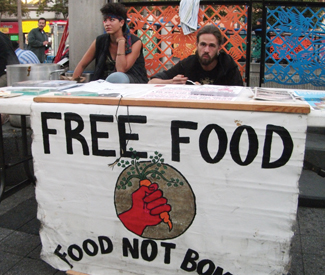
Keith McHenry was in Tampa, feeding fed-up (and hungry) Republican National Convention protesters, when we spoke by phone. Next he’ll head to Charlotte to do the same for those protesting the Democrats, and then to New York for Occupy Wall Street’s anniversary on Sept. 17.

Everywhere he goes, he’ll feed the masses home-cooked vegetarian meals. But unlike the other protesters, McHenry helped invent the system that gets them fed. He helped to found Food Not Bombs, the organization that salvages food that would otherwise be thrown out, cooks it up, and serves free, tasty meals in public squares throughout the world.

McHenry served the first meal in Boston Common in 1980, then moved to San Francisco a few years later, bringing the movement with him. Now, there are 500 chapters in the United States and hundreds more throughout the world.

“We provided food for 100 days at the Orange Revolution in the Ukraine,” McHenry recalls. “We fed a two-year occupation in Sarajevo. We provided food at Camp Casey,” Cindy Sheehan’s anti-war stakeout at then-President George W. Bush’s ranch.

The FNB approach to hunger is pretty simple: There’s enough food to go around, it’s just not distributed right. So activists find ways to distribute food that would otherwise be thrown out. San Francisco FNB gets donations of extra, unsold food from places like Rainbow Grocery and Other Avenues food co-op.

It was started by anti-nuclear activists, thus the “Not Bombs” part. But there’s more to their analysis than a cry for peace. As the group states, “For over 30 years the movement has worked to end hunger and has supported actions to stop the globalization of the economy, restrictions to the movements of people, end exploitation and the destruction of the earth and its beings.”

A typical Food Not Bombs operation features a table with a vegetarian or vegan meal, maybe some produce, and anti-war and other leftist literature and banners. In 1988, this is what was on the table when the San Francisco Police Department cracked down on Food Not Bombs, arresting dozens for serving food at the entrance to Golden Gate Park at Haight and Stanyan.

“We had our sign such that when you walked in at the corner of Haight you would see the words Food Not Bombs for a block and a half,” McHenry recalls. “What was good about that was you had tourists, and local business people, and local workers, and you had the people in the Golden Gate Park, all coming together to eat at that place. It was really perfect.”

FNB still serves there on Saturdays, but that perfection was disrupted by a high profile series of arrests in 1988, then again a few weeks ago, when Parkwide, the Recreation and Parks Department’s new bike rental program, set up in their old spot.

Food Not Bombs still runs into conflicts with police and courts. Last year, McHenry was one of 24 arrested in Orlando, Florida, spending 19 days in jail after protesting an ordinance making it a crime to feed the homeless in the city’s downtown.

Last week, FNB held its world gathering at Occupy Tampa’s tent city, serving daily breakfast and dinner while planning the future of the movement. Occupy Tampa has only grown in recent weeks as it hosts people in town to protest the RNC. Sharing food and shelter, making art, and protesting politicians doing the bidding of greedy corporations is McHenry’s vision made reality — and one he got to see bloom last fall with the birth of Occupy.

As McHenry tells it, he and others from Food Not Bombs have been part of a decade-long buildup to the “occupy” tactics that erupted into the world in 2011. “I was promoting the idea of occupation ever since a meeting that was held in 2003 after Cancun,” he said. Protests at the World Trade Organization meeting in Cancun were part of a growing trend of disrupting international conventions in which political and business leaders make agreements that further exploitation and neo-liberalism. But McHenry says that more was needed.

“There was a group of us that got together and said these one-off events, like summits, were just becoming more disempowering rather than successful,” he said.

After years of calling for occupations, the notion clicked last fall. “We had seen the Arab Spring, so that made it that much easier to imagine the occupation concept. And the Spanish occupations were just then happening.”

“That’s a common thing,” McHenry said. “People try all these different ways of organizing and then all at the same time, the same thing will start to click. And there’s no real way to say, ‘oh, it started here, it started there, this person started it.'”

When Occupy encampments sprang up, Food Not Bombs was behind many of the kitchens and food sharing efforts — it even had a guide to building a tent city kitchen at foodnotbombs.net/occupy_supplies.

“In the beginning of some of the first occupations like Chicago, DC, Wall Street, we made peanut butter and jelly sandwiches, because we didn’t know if we would get busted,” McHenry said. “We ended up behind the scenes helping provide free meals to the occupations.”

McHenry said he hopes the spirit of occupying grows again. “It’s so important,” he said. “It would be great if we could regroup and retake public space.”


Jesus-free food

0

“For I was hungry and you gave me food, I was thirsty and you gave me drink, I was a stranger and you welcomed me,” Jesus supposedly said way back when. In San Francisco, there are a multitude of churches that offer free food to the hungry (find a handy list at www.freeprintshop.org).

But what follows is a list of secular organizations that share food — for the planet, for self-determination and providing for community outside of the system, for healthy food untainted by hormones, pesticides and GMOs, for food not grown by exploited workers, and for many other reasons, these groups bring food straight to the people.

FREE FARM STAND

Where: Parque Niños Unidos, 23rd St. and Treat. When: Sundays, 1-3pm. Numbers given out at around noon. The Free Farm Stand gives out food and flowers grown at the Free Farm on Eddy and Gough, where local volunteers grow and harvest produce. They also share local organic surplus produce left over from several farmer’s markets and produce brought in from neighbors and from locally gleaned fruit trees.

The philosophy of the Free Farm is food sovereignty. Why should anyone go hungry, or go broke, feeding themselves and their kids? Instead, they figure, they should get for free what the earth gives. They facilitate this by offering the farm’s harvest — as well free sprouts and plants, that people can use to grow food themselves.

“The solution to the problem of hunger is to share the abundance that’s out there and to encourage people to grow food and share some with those in need.” said a Free Farm Stand organizer. “We can set up neighborhood networks of people growing food and sharing their surplus.” The Free Farm Stand is a step towards that vision.

BETTER DAYS TO COME

Where: Tuesday, 16th and Mission, Thursday, Turk and Taylor. When: 6pm. Some of the folks at Better Days to Come have God in mind, but the organization’s founder, Leonard Fulgham, came from not the churches but the prisons. As its mission statement says, “Mr. Fulgham began mentoring many of the younger inmates, while having the unique opportunity to hear their stories. Many of their stories outlined how they landed in the prison community and why they continued to return. Being homeless upon release back into society is a commonly known contributing factor to these ex-offenders being hungry while being starved by the lack of job training and vocational skills.” Fulgham passed away March 24, 2012, and in his memory, the organization began serving two hot meals a week.

CURRY WITHOUT WORRY

Where: Civic Center Plaza at Hyde and Market. When: Tuesdays 5:45-7pm. Curry Without Worry serves vegetarian food, mostly Nepali and mostly with five courses, in San Francisco every week. It does the same at its other branch in Kathmandu. Shrawan Nepali once owned a restaurant, Taste of the Himalayas, but used the proceeds to start Curry Without Worry and eventually sold it when “I realized I was not a businessmen.” Instead, he’s a man who feeds people a vegan five-course meal, which includes a sauce made from timur, herbs that grow in his Himalayan hometown but are rare in the US. “Our mantra is healthy food for hungry souls,” says Nepali.

FOOD NOT BOMBS

Where and when: Monday, UN Plaza at 6:30pm and 16th and Mission at 7pm. Wednesday, UN Plaza at 6pm. Thursday: 16th and Mission at 7pm. Saturday: Haight and Stanyan at 5pm. After 30 years, Food Not Bombs still serves almost daily in San Francisco at a few locations throughout the city. Volunteers cook meals then bring them out to the people, bringing home the message that there’s enough to go around and you shouldn’t need money to feed yourself. The Saturday team still shares food at Haight and Stanyan, where Food Not Bombs first parked three decades ago.

FOOD BANK OF AMERICA

Where: In front of the Bank of America at 2701 Mission. When: Thursday, 5pm until food runs out. Occupy-related people, carrying on from the giant Food Bank of America action on Jan. 20, when the Bank of America at the Embarcadero locked its doors after activists set up a food table and hung two interactive banners where passers-by could write what fit under the category “person” and what fit under the category “corporation.” They hung a third banner saying Food Bank of America, hundreds ate a hot meal, and the concept caught on. Now, people who have been gathering food donations for Occupy and otherwise give away fresh produce and hand out information about credit unions weekly in front of the bank.

COMMUNITY FEED

Where: Mendell Plaza, at Third and Oakdale. When: Every third Sunday, 10-2. A few organizations, including the Black Star Riders Coalition and the Kenneth Harding Jr. Foundation, work together to put on this food giveaway every other week. It takes place in Mendell Plaza, the square that some have renamed Kenny’s Plaza after Harding, who was killed in the plaza at 19 years old after a dispute with SFPD officers over bus fare. “First, we definitely want to honor Kenny, that’s why we got there,” said Tracey Bell-Borden, one of the organizers of the Community Feed. “But there’s been a lot of activity in that area for a long time. So it’s really about healing the community,” she said. “We have to take care of our community.”

Parting gift

0

news@sfbg.com

Retirement is knocking at Ed Harrington’s door. But the San Francisco Public Utilities Commission general manager is hesitating, not quite able to muster the will needed to walk out the door. He has something that he wants to finish first.

The sage city veteran has labored for years to launch an historic program so transformative that it would finally allow city residents and businesses to reject a homicidal utility monopoly and the dirty electricity that it sells. Success could be mere weeks away; failure would be a bitter blow.

Twice in the past 27 months, Harrington and his staff have fumbled efforts to launch the city’s long-promised community choice aggregation (CCA) program. The program, CleanPowerSF, would give Pacific Gas & Electric (PG&E) customers the option of switching over to a publicly backed electricity provider selling green, climate-friendly power.

The energy would continue to be ferried into homes and other buildings over PG&E’s electrical grid, and customers who switch would continue to receive their bills from PG&E. Those gas and electricity bills could initially swell by an average of one quarter, but the mix of power that they pay for would jump from 20 percent renewable up to 100 percent renewable.

Harrington’s previous CleanPowerSF launch schemes collapsed in mid-2010 and again early last year without getting off of the ground, largely because nobody — neither the city nor private industry — would shoulder the large financial risks. Unlike those failed efforts, which would have offered a private company virtual carte blanche to sell power to as many PG&E customers as possible, the latest CCA proposal resembles a successful program operating in Marin County. The Marin program started small in early 2010 and is already growing at a rapid clip as it pursues true energy independence.

For the next few weeks, despite having previously planned to retire in August, Harrington will oversee a last-ditch effort to drive approval of his latest iteration of CleanPowerSF by the Board of Supervisors. “I’ve offered to stay into September so that we can have the CCA discussions at the board,” Harrington told the Bay Guardian.

Harrington declined to discuss the latest version of CleanPowerSF, the real and perceived financial risks of which will be hashed out by the Budget and Finance Committee, referring questions to a spokesperson.

But environmentalists and local “green jobs” advocates who just 12 months ago were panning CleanPowerSF, ready to block its passage through the board, are now lauding it. They say the change came about after Harrington met directly with them and seemingly changed his own mind about how the program should be run.

The program would initially see Shell Corp. sell 20 to 30 megawatts of renewable electricity generated in far-flung places to fewer than 100,000 residential customers. Instead of fostering new supplies of renewable energy, San Francisco residents may initially buy power at premium prices from existing wind, solar, and other green facilities. That might make San Franciscans feel warm and fuzzy, but it wouldn’t necessarily reduce the nation’s overall carbon footprint.

The activists agree that it’s a crying shame to get into bed with an evil multinational oil company. But they say it’s an acceptable start, as long as the program evolves into something far more meaningful — into something resembling the Marin Clean Energy model. Like in Marin, the activists want San Francisco to use CleanPowerSF revenues to help build its own solar, wind, and other renewable energy and energy efficiency projects, many of them right here in city limits. They want the city to sell those power and the energy efficiency gains directly to CleanPowerSF customers.

Over the coming years, the SFPUC could gradually add enough clean electricity at competitive rates into the CleanPowerSF mix, generated by its own facilities and purchased off the open energy market, to meet the needs of all the city’s residents and businesses.

The build-out of solar power plants and other renewable energy facilities has always been imagined as an integral element of CleanPowerSF. But until last October, critics say SFPUC officials were treating the build-out as an afterthought, making little effort to lock in plans to move forward with the construction as a structured part of a CCA program.

“The SFPUC staff decided they wanted to do this the easy way and just buy energy,” said Eric Brooks, a regular at City Hall hearings who chairs the San Francisco Green Party’s sustainability committee and has spent years working with the SFPUC on CleanPowerSF. “They wanted to do that because it was easy — you can just declare victory.”

Once the general manager started to meet directly with local activists, Brooks says, “Harrington started hearing what we had been saying to the staff for all these years about how important the build-out is.” Harrington began to understand the importance of a renewable energy build-out that begins as soon as the new program launches. In turn, the activists threw their support behind Harrington and the program.

Brooks said that the build-out of city-owned renewable energy facilities could create thousands of jobs. It could also lead to energy independence in a city where environmentalism is a badge of honor, but where PG&E continues to sell nuclear and polluting fossil fuel energy without facing any competition.

“This is the perfect solution to the climate crisis and the economic crisis,” Brooks said. “We need to create a green New Deal. That’s the depth of crisis that we’re in, economically and environmentally.”

Such a build-out is also expected to build support for the program at the Board of Supervisors. Without it, the City Controller’s Office calculated that the city’s economy could take a hit to the tune of $8 million over five years after CleanPowerSF launches in the spring in additional electricity expenses, potentially jeopardizing about 100 jobs. But that analysis failed to consider the thousands of jobs that could be created laying panels, installing turbines, and performing other tasks if the city develops its own renewable energy supplies as a part of the program.

It’s impossible right now to say precisely what type of renewable energy facilities would be built by San Francisco: A $2 million study that would paint that picture is planned. But Paul Fenn, president of Local Power Inc., which is helping the SFPUC prepare to call for bids from companies interested in building the facilities, said they could include everything from solar panel arrays to customers’ energy efficiency gains to a wave energy plant.

The first CleanPowerSF committee hearing is scheduled Sept. 12, followed at some point thereafter by an historic board vote that will almost certainly prove contentious, likely pitting the board’s progressive members who have long supported public power against some of its fiscal conservatives.

Much of the debate will focus on an initial $19.5 million investment by the city. Of that money, about one-third would be used as collateral — a pool of cash held in escrow and available to reimburse Shell if the program flops. SFPUC spokesperson Charles Sheehan said the $7 million in collateral would gradually be recouped by San Francisco if the program moves forward successfully.

Another $2 million would fund CleanPowerSF customers’ energy efficiency programs; $2 million would help customers install solar panels; and $2 million would be spent on the study to determine how best to build out the portfolio of renewable energy plants owned by San Francisco. The rest of the money would cover operating and startup expenses, and it could be recouped later through power sales.

In a town where PG&E wields tremendous political and financial influence, proposing to gamble public funds establishing a competitor to the company is always sure to be thoroughly scrutinized, if not outright opposed and criticized. Supporters of the program, however, say that the gamble is a safe and necessary one that could have sweeping workforce and economic benefits.

“I don’t think that we can afford not to do CCA,” said Sup. David Campos, the program’s most active supporter on the Board of Supervisors. “So long as something like CCA is not in place, PG&E will continue to be the only game in town. I think it’s important for us to give consumers in San Francisco an alternative to PG&E.”

CleanPowerSF has long suffered an identity crisis that has harmed its prospects of legislative approval. Opponents deride it as a public power scheme and they work on behalf of PG&E to quash it. But ardent public power supporters do not see it that way: They consider CleanPowerSF to be little more than a minor stepping stone toward public power, and they have not rallied around it nearly as much as they have rallied around some of the storied yet unsuccessful public power campaigns of years past.

If Harrington can clinch lawmaker approval for CleanPowerSF before he retires, he will have provided city residents with a lasting choice in what kind of electricity they buy.

“I think that any effort to compete with PG&E is seen as public power,” Campos said. “But this is really about providing a choice.”


Alerts

0


Wednesday 29

Bernal Heights outdoor cinema Roccapulco Supper Club, 3140 Mission, SF; www.bhoutdoorcine.org. 7pm, $10 suggested donation. The first of five nights of film screenings in Bernal Heights. At this kickoff party, enjoy drinks, food and music from the Bernal Jazz Quintet before a lineup of short films celebrating community and organizing in the Bay Area. Films include Berkeley High School students on heritage and identity, “Occupy the Auctions Dance Party!” in which Occupy Bernal and ACCE stop evictions on the steps of City Hall, and a tour of Alemany Farm (also the beneficiary of the event’s ticket price), among others. The event also includes the announcement of winners of the Best of Bernal and Spirit of Bernal Awards and the first-year recipients of the Mauricio Vela Youth Film Scholarship.

Occupy, the state of the movement Mediterranean Café, 2475 Telegraph, Berk; www.occupyoakland.org. 7-10pm, free. Einar Stensson, a sociologist at Stockholm University and activist at Occupy Stockholm during the fall of 2011, studied Occupy Oakland for two months. Why did the movement start and spread so quickly around the globe? How is Occupy organized? Who matters in the movement and why? What is the future of Occupy? Come hear his perspectives on where Occupy is, locally and internationally.

Friday 31

Occupy the Bay The 25th Street Collective, 477 25th St., Oakl; www.occupyoakland.org. 6pm, $25. “This week in Oakland, California will go down as a watershed moment. People across America were disgusted by what they saw here. Average Americans trying to stand up and peacefully assemble, to be brutally savaged and attacked by the police department that they pay for.” So said Michael Moore to a fired up crowd in the wake of the Oct. 26 Occupy Oakland eviction that rained tear gas and rubber bullets on demonstrators. This is just one of the many historic events caught on tape by filmmakers Jonathan Riley and Kevin Pina, whose documentary Occupy the Bay is screening around the Bay Area before it starts showing in film festivals. On Friday, stick around for special musical performances from Jabari Shaw, Shareef Ali and Super Natural.

Enemies of the state: In their own words Station 40, 3030B 16th St., SF; station40events.wordpress.com. 7pm, free. After a year of Occupy and years more of struggle by people who are not down with the state, there are a lot of people in jail and prison. At this event, organizers will read writing from those locked up. Poems and statements from Truth and Kali of Occupy Oakland and a statement from Jesse Nesbitt, the May Day brick-thrower we profiled (“Who is the Brick Thrower?” 5/8/12). As the event description says, “Any effort at anti-repression in the face of lengthy prison terms must be aimed at bringing down separation at all costs.” Come fight the separation and connect.

Original Plumbing birthday celebration Elbo Room, 647 Valencia, SF; www.originalplumbing.com. 10pm, $3-6. Original Plumbing, the trans male quarterly magazine, is throwing a party celebrating its third year on this planet. It now lives in the Brooklyn part of the planet, but it all started in San Francisco, and they’re coming back here to party. “We feel that there is no single way to sum up what it means to be a trans man because we each have different beliefs, life experiences, and relationships to our own bodies,” say the organizers, and they started the magazine to document this diversity of experiences. Celebrate with the editors Amos Mac and Rocco Katastrophe, and performances by Rocco Katastrophe with special guests Billie Elizabeth, Nicky Click & Jenna Riot. Birthday cupcakes available!

Tuesday 4

Rally to save City College City Hall steps, 1 Polk, SF; ProtectOurCityCollege@gmail.com. 12pm, free. A rally in support of Prop A, the local ballot measure that would create a parcel tax for revenue to City College of San Francisco. “If City College is to survive and maintain accessibility, educational quality and the mission of serving low-income and underrepresented students with the best educators and staff, we must pass Prop A,” say organizers of the rally, which include students, teachers, staff and supporters.

Eat to the beat

0

emilysavage@sfbg.com

EAT BEAT Good food was never the part of the concert plan. In high school, the punks and shredders ate giant Pixy Stix, filled to the plastic brim with unnaturally purple sugar dust — purchased from the all-ages venue snack counter — followed by late night Del Taco red burritos slathered in Del Scorcho and stuffed with crinkle fries. Flash forward a decade or so, and the vegan Malaysian nachos with spicy peanut sauce and pickled veggies from Azalina’s were all I could talk about after Outside Lands, save for the requisite “oh my god” Metallica utterance.

I wasn’t the only one. From every corner of that packed festival, people — and of course, bloggers — were raving about The Whole Beast (featuring pop-ups from the Michael Mina Group) tucked away by Choco Lands, Andalu’s fried mac and cheese, and Del Popolo’s massive, industrial-looking rustic pizza truck.

While the higher-end meal options have now been going strong at Outside Lands for a few years — and, granted, food has long been a part of the festival equation — the gourmet pop-up thing, and locally-sourced, quality food offerings are on the menu more and more in brick-and-mortar music venues in San Francisco. Last week, the Great American Music Hall hosted an event dubbed the Great American Pop-Up. Seems it’s more open to experimentation in the slower summer months.

The one-off (for now) event was a family affair for the Great American Music Hall. There were six pop-up food vendors set up in between the grand bronze pillars of the Tenderloin venue, chosen by security guard Drake Wertenberger, who stepped forward at a managers meeting to coordinate. Jessica DaSilva, who works in the box office at both GAMH and sister-venue Slim’s, was there selling imaginative sweet treats for Milk Money/Dora’s Donuts Shut Yer Hole Truck, including a strawberry cheesecake push-pop, and the chewy chocolate raspberry cookie I devoured. There was also local, sustainable sushi by Ricecrackersushi, some colorful Asian fusion dishes via Harro-Arigato & Ronin, and a whole lot of sausages sliced by the Butcher’s Daughter.

It felt nearly illicit to be in the venue without the anticipation of a live set, like we were sneaking in. And the warmer lighting opened up the intricacies of the architectural design. But this event was focused squarely on the food, with the tables pushed out onto the floor, and a flannel-clad DJ spinning inoffensive hip-hop while munching on something from a paper plate.

Last year, Slim’s created something similar, but broke it down to one chef at a time hosting rotating gourmet pop-ups once a week for the month of August. Those too were more about the unique food offerings, less about music. There were dinners served in the venue by Jetset Chef Alex Marsh and Cathead’s BBQ (which now occupies its own legitimate space down the street from the venue).

GAMH and Slim’s both already serve dinner nightly at live shows, but publicist Leah Matanky tells me there were no hard feelings from the in-house restaurant staff.

On regular show nights even, Matanky says she’s seen an increase of interest in gourmet food at the venues. “We have seen our kitchen sales numbers increase noticeably over the last couple of years. We’ve started running nightly food and drink specials that include things we don’t normally offer and people have really responded to that. We still offer the full array of bar food…but you can also get gourmet specialties like the baked polenta pizza with smoked mozzarella or the grilled tri-tip steak with garlic-herb potatoes.”

Mountain View’s infinitely larger Shoreline Amphitheater also recently got an in-house food upgrade. So the story goes, when the GM of Shoreline dined at Calafia in Palo Alto, Chef Charlie Ayers pointed out the stadium’s lackluster food, and was then summoned to create a tastier menu. Ayers now has a “Snack Shack” at Shoreline that generates $8,000 per show, selling vegan lentil bowls, pork bowls, and salad wraps with Dino kale and feta cheese.

At the bars-with-bands level, El Rio seems to also be upping its epicurean pop-ups. Along with the now-frequent Rocky’s Fry Bread (side note: Rocky is also in the band Sweat Lodge, which often plays El Rio) stand, there’s Piadina homemade Italian flat bread, and the occasional Mugsy pop-up wine bar, which offers bubbly and red wine varieties.

There was an entirely separate event that took place Aug. 4 in San Francisco, which combined all of this: the high-end food, the live music, the ubiquitous pop-ups. It was a food and music festival (Noisette) at a brick-and-mortar venue (Public Works, where it moved after switching venues from Speakeasy Brewery).

The event was put on by Noise Pop Industries. The production company, which does Noise Pop and the Treasure Island Festival, began dipping into independent food culture a few years back with the Covers dinners, pairing well-known chefs with corresponding cover songs for a relatively small group. Noise Pop’s Stacey Horne came up with the Noisette concept after talking with DJs Darren and Greg Bresnitz of New York promotion company Finger on the Pulse, who do an event out there called Backyard Barbecue, which also pairs live music and gourmet food.

From the beginning, the Dodos were the first choice of headliners at Noisette. Merrick Long is a “professed foodie,” has worked in the restaurant business, and was on a panel at SXSW talking about food and music. Horne says they chose chefs that do things a little differently, and are more attuned to the pop-up mentality.

“Something that struck me at Noisette that I loved was that we were eating such good food and then were able to wander over and hear amazing music. It wasn’t one or the other. It was nice to have that as an option,” Horne says. “The chefs we’re focusing on are kind of the indie version of that world, and that’s what Noise Pop has always been interested in, independent music, independent film and art. It just seems like a logical extension.”

Noise Pop is also again looking to do a variation on the Covers dinners with the upcoming Treasure Island Festival. Sound Bites is more of a passed appetizer event with little bites inspired by the bands playing at the festival.

So what does it all mean? Are we, as the generalized concert-going public, getting soft, both physically from all those readily available treats, and mentally because we’ve expanded beyond a minimalist punk rock lifestyle? Should we all go back to Pixy Stix and Del Scorcho hangovers?

“Look, the reality is that most nights that you go to hear a band in a club, there’s no food or if there is food, it’s not going to be anything great. So you can still have your punk rock experience, but something like Noisette and other events like ours that are popping up around the country are just offering another type of event, and people are interested in it, as we’re seeing,” Horne says.

I guess, if you want to see your life as a black and white cookie, you’ll see this change as against type. Or maybe if you’re in the teenage angst subset, you’re just getting in to the greasy post-concert routine. But perhaps this mashup is just another trend — participate if you will. It goes far beyond the music scene, to the way Americans eat now, looking for quality, locally sourced food, seeking creative options.

“Speaking for myself personally, I still love going to see shows,” Horne says, “but if I can have both things in one place, it’s win-win.”

www.slimspresents.com

www.noisepop.com

www.elrio.com

shoreline.amphitheatermtnview.com

Appetite: Outside Lands, as seen by a food writer

0

This year’s Outside Lands, the three-day extravaganza of some of the top musical acts in the world and quality food and drink (this is SF, after all) in the beauty of Golden Gate Park, felt more packed than ever. But despite throngs descending on SF from all over the country that turning Golden Gate Park into a sea of trash — thanks clean-up crews! — Outside Lands magic happened each day.

For example on Sunday, when performer Jack White popped up for an impromptu set, surprising fans who happened to be traversing the eucalyptus groves near Choco Lands. It was magic eating local foods in a festival setting, like dreamy Italian Del Popolo (although hour-plus lines and daily sell-outs were a drag) or everything from Ryan Farr’s two 4505 Meats stands sustaining us on those long walks between stages with the perfect “damn good cheeseburger” and “yum yum” fried chicken sandwich. You could feel the magic in the new-this-year Beer Lands, where one could sip craft beers while taking in the Foo Fighters, Regina Spektor, or Beck (Although the training given to those pouring beers was far from magic. One pourer for The Bruery on Saturday told me confidently that this incredible brewery from the O.C. was from San Diego.)

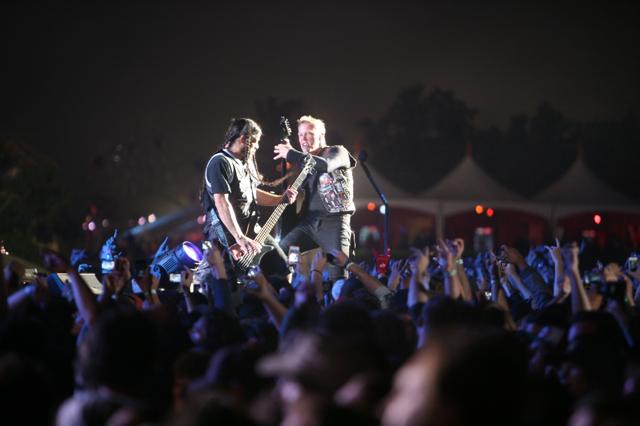
Magic occurred when Metallica, flames, lasers, and all, delivered the tightest, hardest-rocking set of the weekend. Not long after the noon hour, fun. swept up the entire Polo Field in their rousing anthems. Magic reigned at Stevie Wonder’s set on Sunday night. His voice sounded as tight and beautiful as ever, even at age 62. His joy and wisdom radiated from the moment he took the stage, streaming out to a field full of thousands basking in waves of pink, blue, and green lights, foggy Pacific Ocean air, and the voice of a legend.

Full captions: 

1.  Ryan Farr’s ridiculously good Chicken “yum yum” sandwich was one of the festival’s best eats. Watch for it at Ferry Plaza Farmers Market

2. 4505 Meats’ chicharrones bars were like rice krispie treats made with Ryan Farr’s unparalleled chicharrones, puffed rice, marshmallow, and Apple Jacks or Cocoa Puffs

3. Misty, dreamy lighting changes colors, illuminating Golden Gate Park trees at night

4. The hilarious, improvisational Reggie Watts rocked comedy and music Friday afternoon (and here, in the media tent following his set)

5. The Wine Lands tent impressed once again with 49 wineries. 2012 highlights included Villa Creek, Robert Sinskey, Qupe, Kermit Lynch, Palmina, The Scholium Project, and Wind Gap 

6. Beck keeps the crowd happy at the Land’s End stage on Friday

7. The new-this-year Beer Lands hosted 16 California breweries selected by brewmaster Dave McLean of Magnolia Pub. Highlights included the Bruery’s brilliantly bitter Humulus APA and Sierra Nevada’s Outside Lands saison 

8. Under faux Victorian facades, chef John Fink of The Whole Beast grilled eight to 10 whole lambs per day at Lamb Lands, an excellent 2012 addition to Outside Land’s food selection

9. Michael Mina’s RN74 and Bourbon Steak served whole roasted lamb gyros, lamb poutine, sweet corn in lamb sausage crumbs at Lamb Lands

10. Thousands swarm the Polo Fields

11. Saturday in the media tent, Magnolia and Alembic brewer Dave McLean (center) talks Beer Lands and The Whole Beast’s John Fink dishes on lamb

12. Choco Lands was an enchanted, Tim Burton-esque fantasy in the eucalyptus groves, with Day of the Dead accents and an array of chocolate carts and treats

13. Outside Lands ends with best set of all: Stevie Wonder exudes joy and life to thousands in the Polo Field, his voice in top form

Subscribe to Virgina’s twice-monthly newsletter, The Perfect Spot


Dick Meister: Green is good for us all

3

By Dick Meister

Dick Meister, former labor editor of the SF Chronicle and KQED-TV Newsroom, has covered labor and politics for more than a half-century. Contact him through his website, www.dickmeister.com, which includes more than 350 of his columns.

Millions of American workers badly need jobs, and the owners of many thousands of commercial buildings badly need “green retrofitting” to improve their energy efficiency and thus cut operational costs while simultaneously helping clean up the environment.

The conclusion should be obvious: Let the retrofitting begin, for the benefit of everyone – those who need the work, the employers who want it done, and the rest of us , who would benefit greatly from it.

Details of what could and should be done – and why and by whom – are laid out in a new briefing paper from the well-regarded National Employment Law Project, otherwise known as NELP.

Perhaps what’s most important about green retrofitting is that it’s what NELP calls “a powerful job creation tool.”

It can indeed be that. As NELP reported, “Estimates show that a mix of tax credits, new building code requirements and loans for commercial energy efficiency upgrades would create upwards of 160,000 new jobs,” possibly hundreds of thousands more, over the next year.  That certainly would significantly lower the high unemployment rate that has plagued the country for far too long, encourage investment and otherwise jolt the lagging economy.

Construction workers have been hit particularly hard by unemployment, and it is they who have the skills and knowledge “that could be put to work cutting greenhouse gas omissions and making our cities cleaner and more efficient places to live,” notes Christine Owens, NELP’s executive director.

She says many construction workers, as well as other workers, also are needed to improve existing commercial buildings “in a common-sense way while also meeting the challenges of climate change.” NELP says more than three-fourths of all the electricity produced in the United States is used to operate the buildings, “making improved energy efficiency an increasingly recognized part of reducing the nation’s greenhouse gases.”

Simply providing jobs would not be enough.  NELP argues that government policy makers supporting green retrofitting and the jobs it creates should make certain they are “good jobs with strong workplace standards and fair pay and job security.” That’s an absolute necessity if jobs in the retrofit industry are to be truly sustainable. At a minimum, that would call for providing workers increased pay and better chances of being promoted to higher-paying jobs.

NELP cites three cities – Los Angeles, Seattle and Milwaukee – that have developed programs which have won the support of workers, environmentalists and commercial building owners, in large part by backing retrofitting projects that, while creating jobs, also help owners cut their costs and increase their income.

Los Angeles has adopted a city ordinance that calls for retrofits of city-owned buildings, a process for settling labor conflicts that arise during the work, and an effort to ensure that Los Angeles residents have access to training for retrofitting work.

In Seattle, the city has an agreement with retrofit contractors on setting pay and providing job training for their employees.

Milwaukee has a new energy-efficiency program that offers building owners the chance to qualify for financial aid in exchange for using contractors committed to hiring local workers and “adhering to quality workplace standards.”

It’s now time for other cities nationwide to take action. There’s no legitimate reason for inaction. We have a great need to modernize and expand our infrastructure, diminish environmental pollution and provide work for the jobless. We have shown it can be done.  So let’s do it!

Dick Meister, former labor editor of the SF Chronicle and KQED-TV Newsroom, has covered labor and politics for more than a half-century. Contact him through his website, www.dickmeister.com, which includes more than 350 of his columns.


Fiona Ma’s vampire garbage bill

3

State Assembly Member Fiona Ma, who wants to keep 15-year-olds in prison for life, has been trying for a while now to help the big garbage outfits, Recology and Waste Management Inc., avoid running into local laws that could block their use of landfills. So far, she hasn’t been able to get it through the normal commitee process.

But she’s not giving up: As the session winds down, she’s done the ol’ gut and amend and created AB 845, which looks pretty much like the bill she hasn’t been able to get through committee. And she got this reborn Dracula of a bill it through the state Senate, which means she just needs concurrence at the Assembly, and away she goes.

Ma says that garbage is a statewide concern — true, as far as it goes — but she’s also helping Recology avoid problems in Solano County, where local residents want a cap on the amount of outside garbage trucked in from other places (like San Francisco) and buried in Solano landfills.

By the way, she’s also been helping Recology fight those pesky recycling poachers who make a few extra bucks by getting the bottles and cans out of the bins before Recology can.

And the garbage giant hasn’t even been her biggest campaign contributor. Her non-campaign for state Senate got $1,500, her campaign for state Board of Equalization got $500, and she picked up $3,000 more in her Assembly races.

Oh, and she isn’t returning my calls and emails.

Are free Golden Gate Park events fading away?

25

San Francisco’s countercultural community was built at least partly through free concerts and gatherings in Golden Gate Park, including the legendary Human Be-In and Grateful Dead and Jefferson Airplane concerts in the late-’60s. But these days, as corporations starve local government but seize public spaces, grassroots groups and populist performances are being forced out of the park.

Events without expensive tickets and corporate sponsorships (such as this month’s Outside Lands) or endowments from dead billionaires (Hardly Strictly Bluegrass Festival, coming up in early October) just can’t afford the rising fees charged by the Recreation and Parks Department, a reality that is quietly ending an important San Francisco tradition and legacy.

A few weeks ago, organizers of the Power to the Peaceful Festival – a free concert featuring Michael Franti and Spearhead and other big acts, which drew tens of thousands of people to the meadow formerly known as Speedway annually for more than a decade – announced that it was canceling next month’s event because of onerous fees.

“The only way to have produced the festival this year would have been to turn it into a ticketed event,” organizers wrote in their July 31 announcement. RPD officials were going to charge the event $77,000 in permit fees this year, dealing it a death blow after also forcing the cancellation of last year’s event by instituting a strict 40,000 attendee cap, which was nearly impossible to enforce for a free event.

If we accept the neoliberal perspective that has taken hold of San Francisco – which sees government’s role as facilitating whatever corporations want to do and hoping they share some of their profits, or at least create some good jobs – it makes sense. After all, the cash-strapped RPD made $1.7 million in profit-sharing off Outside Lands this year, up from $1.4 million last year.

The same logic has caused RPD, under the mercenary leadership of Director Phil Ginsburg, to rent out its recreation centers to the highest bidders and fire the recreation directors that used to treat them as public resources, and to let the private City Fields Foundation cover many parks in artificial turf. Again, through a strictly economic lens, it makes a certain amount of sense.

“As the steward of our parks, the Department works with event organizers to host diverse events in our parks, it is our shared responsibility to make sure the City and the event organizers have plans and resources in place to care for our park land and ensure public safety. The Department is always ready to work with all event organizers to modify their event planning for safe and successful events,” RPD spokesperson Connie Chan told us.

Power to the Peaceful – ironically, an event celebrating the plight of ordinary people against powerful political and economic interests around the world – just didn’t have the resources to meet the standard, so out they go. Same thing with the venerable Anarchist Book Faire, which was also forced from the park by rising fees this year after 17 years in the park’s County Fair Building.

Again, there’s a note of irony to this exodus, with city officials suddenly deciding the anarchists could no longer police themselves and needed to pay for four Park Police officers to watch over a festival that has been without violent incident throughout its history, unless you count a speaker getting pied last year (which the self-sufficient anarchists easily dealt with on their own).

“We had put this thing on for 17 years and there were no problems until this new guy came,” Joey Cain of Bound Together Bookstore, which puts on a free event whose fees have steadily risen to almost $14,000. “We’ve had to increase our rates every year, and we were starting to lose some vendors.”

On top of that, city officials had also cracked down on free offerings that surrounded the free event, banning Food Not Bombs from serving free meals to visitors and people from setting up information tables outside the main event.

So now the event, coming up in March, will be held at the Armory. Cain admitted that rent on the building they used in Golden Gate Park was still fairly cheap compared to similar sized venues around town, “as it should be, being owned by the city.”

But when city departments like RPD become dependent on corporate contributions, public spaces become commodified, and we begin to lose access to the last places in town where our creator endowed us with the right to assemble freely and pursue our happiness: our public parks.

“My shoe is bigger than this car!” New (and new-ish) movies

0

Of the several films I looked at this week, two must be mentioned up top: The Master and The Expendables 2. These films are notable not just because I spent my own hard-earned dollahs for entry (usually I see stuff for free, being a critic and whatnot), but also because I loved them both, despite one being a bound-for-Oscars effort by one of America’s most exciting filmmakers, and the other being a silly showcase for America’s most beloved aging action heroes. Only one, however, contained a scene with Arnold Schwarzenegger riding in a teeny Smart Car. Your guess which.

Mark your calendar using my guide to fall film happenings in the Bay Area and beyond in this week’s Guardian; and don’t miss Jesse Hawthorne Ficks’ interview with Compliance director Craig Zobel. Jesse’s Compliance review is below the jump, along with more short takes on other films opening (and rep events happening) this week. This week also heralds a pair of horror movies (and, well, Halloween candy has started making appearances in Walgreens aisles…): The Apparition (review below) and Sinister (not screened for critics).

http://www.youtube.com/watch?v=Hj2lR6Yp-gY

Alps Yorgos Lanthimos is well on his way to a reputation for sick yet oddly charming high-concept spectacles. Here, a group calling themselves Alps offers substitution services for the recently bereaved — that’s right, they’ll play your dead loved one to fill that hole in your life. Pitch-black comic moments abound, and the sensibility that made 2009’s Dogtooth so thrilling is distinctly present here, if not quite as fresh. Beyond the absurd logline, the plot is rather more conventional: things get out of hand when Alps member Anna (Aggeliki Papoulia, the eldest daughter from Dogtooth) gets too invested in one of her assignments, and the power structure of Alps turns on her. If Alps is not exactly a revelation, it’s still a promising entry in a quickly blossoming auteur’s body of work. (1:33) Roxie. (Sam Stander)

The Apparition Does this horror flick stand a ghost of a chance against its predecessors? So many bodies, so many mysteriously slammed doors, so many girl ghouls — they all surface in this obviously low-budget cash-in on the coattails of the Paranormal Activity franchise. Look to the signs: the slow build of zero-CGI/bucks tension-building devices like flung-open doors that are supposed to be locked, scarily grainy, nausea-inducing handheld video footage and spastic editing, and screams in pitch blackness—with a dash of everything from 1979’s Phantasm to Fulci to J-Horror. Prefaced by the story of psychics’ attempts to rouse a spirit, then a flashback to a group of college students’ try at recreating the séance by magnifying their brainwaves, The Apparition opens on the cute, perfectly made-up, and way-too-glamorous-for-suburbia Kelly (Ashley Greene) and her boyfriend Ben (Sebastian Stan), who have just moved into a new faceless development in the middle of nowhere, into a house her family has bought as an investment. Turns out they aren’t the only ones playing house, as the building’s alarm is continually bypassed, mysterious mold appears, and the neighbor’s adorable pup whimpers at thin air and obligingly dies in their laundry room. Matters go from bad to worst, as some invisible force does in Kelly’s cactus, messes up her closet, and blows the lights — all of which also sounds like the antics of a lousy roommate. Add in choppy, continuity-destroying editing; throwaway dialogue; music that sounds like it came from Kelly’s favorite store, Costco; overt appropriations like a slithery, long-haired ghoul girl that slimes her way out of a cardboard box; and that important, indelibly spooky image that comes far too late to count — and you’ll find yourself rooting for the fiend to put these kids out of their misery. (1:22) (Kimberly Chun)

http://www.youtube.com/watch?v=WdONydDX44I

Compliance No film at this year’s Sundance Film Festival encountered as much controversy as Craig Zobel’s Compliance. At the first public screening, an all-out shouting match erupted, with an audience member yelling “Sundance can do better!” You can’t buy that kind of publicity. Every screening (public and press) that followed was jam-packed with people hoping to experience the most shocking film at Sundance, and the film does not disappoint. (Beware: every review I have happened upon has unnecessarily spoiled major plots in the film, which is based on true events.) What is so impressive about Zobel’s film is how it builds up a sense of ever-impending terror. In fact, I would go as far as to say that the film steps into Psycho (1960) terrain, specifically in the final act of the film. Compliance aims to confront a society filled with people who are trained to follow rules without questioning them. Magnolia Pictures, which previously collaborated with Zobel on his debut film Great World of Sound (which premiered at Sundance in 2007), picked up the film for theatrical release; if you dare to check it out, prepare to be traumatized. You’ll be screaming about one of the most audacious movies of 2012 — and that’s exactly why the film is so brilliant. (1:30) (Jesse Hawthorne Ficks)

Cosmopolis With end times nigh and the 99 percent battering the gates of the establishment, it’s little wonder David Cronenberg’s rendition of the Don DeLillo novel might rotate, with the stately rhythm of a royal funeral and deliciously tongue-in-cheek humor, around one of the most famed vampire heartthrobs at the cineplex. Sadly, a recent paparazzi scandal threatens to eclipse this latest, enjoyably blighted installment in the NYC urban nightmare genre. Robert Pattinson’s billionaire asset manager Eric Packer takes meetings with his new wife Elise (Sarah Gadon) and staffers like his monetary theorist Vija (Samantha Morton) in his moving office: a white, leather-bound stretch limo that materializes like a sleek, imposing extension of his pale frame. Seriously disassociated from reality on multiple levels, Eric is a 28-year-old boy in a bubble, speaking of himself in third person and willing to spend all day making his way across town to get a haircut at his father’s old barbershop, even though his head of security (Kevin Durand) warns him that at least one “credible threat” has designs on his life. The passing of his favorite Sufi rapper (K’Naan), a possible Rothko for sale, a mad pie-thrower, and an asymmetrical prostate all threaten to capsize those, as it turns out, not-so-humble plans. Warning: the brainier members of Team Edward might plan on finding their minds blown by this thoughtful and mordantly humorous meditation on this country’s cult of money, while Cronenberg watchers will be gratified to pluck out his recurring themes, here dealt with a lighter hand than usual. At this date, rather than telegraphing how one might feel about a scene by way of, say, music, the director is increasingly comfortable with the ambiguity — and the uneasy, pleasing mix of sneaking repulsion and gimlet-eyed humor, of these scenes and their language. Thus the autoerotic-car fetishism of Crash (1996) and hallucinatory culture grazing of Naked Lunch (1991) — and that fascination with how a body intersects sexually or otherwise with a machine or “other” — seems completely natural here. Or perhaps it’s a measure of how much Cronenberg’s preoccupations and cinematic language have made themselves at home in the vernacular. (1:49) (Kimberly Chun)

http://www.youtube.com/watch?v=UwNMGdWyjcc

“Global Threats Film Series” The San Francisco Film Society’s “Global Threats” series continues with a double dose of stuff that’ll kill ya. Though separated by six decades, both features are remarkably similar for their matter-of-fact, location-shot, non-pulp treatment of a prime (if infrequently used) thriller topic: the desperate attempts by health officials to contain a deadly virus before it spreads to the whole population. While in some quarters it was criticized for being too docu-drama-esque and not “thriller” enough, Steven Soderbergh’s Contagion last year was admirably cool-headed in its depiction of various global, national, and local authorities (played by an all-star cast) frantically coping with an outbreak of something that yuppie slut Gwyneth Paltrow brought home from a business trip. A year before A Streetcar Named Desire (which was, contrastingly, almost entirely shot on studio soundstages), Elia Kazan ventured to the real New Orleans for Panic in the Streets (1950), in which another traveler imports an actual plague to the Big Easy. US Public Health Service physician Richard Widmark is tasked with tracking down the rapidly growing number of the infected, which is complicated by the fact that several of them (including Jack Palance and Zero Mostel) are criminal-underground types naturally averse to cooperating with the cops or any other governmental representative. If Contagion irked some for being a little too nuts-and-bolts procedural, the brilliantly black-and-white-shot Panic excited audiences and critics at the time for its unusual realism. That extends to the warmly credible marital relationship between workaholic Widmark (very appealing in one of his few nice-guy leads) and neglected but understanding spouse Barbara Bel Geddes. SF Film Society Cinema. (Dennis Harvey)

Hermano As a child, Julio (Eliu Armas) discovered foundling Daniel (Fernando Moreno) abandoned in a dumpster; taken in by the former’s mom (Marcela Giron), the two boys are raised as brothers. They’re close as can be, even if Julio is physically slight, shy, and straight-arrow, while strapping Daniel is a born leader and survivor quite willing to cross the legal line when it serves his purposes. One area in which they’re of the same mind is the soccer field, where both (especially Daniel) are talented players with hopes of going pro. But that seems a remote dream in their violence-ridden slum. Marcel Rasquin’s Venezuelan sports-crime drama is built on some hoary clichés — the “good” brother/”bad” brother dynamic, the tragedy that sparks revenge that sparks more tragedy, etc. — but is so unpretentious, energetic, sincere. and well-cast that skeptical resistance is futile. It’s a modest movie, but a true, satisfying pleasure. (1:37) (Dennis Harvey)

http://www.youtube.com/watch?v=6nZlXB5okeo

Hit and Run Annie (Kristen Bell) has a Stanford doctorate but is treading in the academic backwaters until the prospect is raised of an ideal department-heading position at UCLA. She’s thrilled, but also conflicted, because live-in beau Charlie (Dax Shepard) is in the Federal Witness Protection program, and can’t leave the nowhere burg he lives in incognito — particularly for Los Angeles — without risking serious personal harm. However, for love he decides he’ll risk everything so she can take the job. Unfortunately, this fast attracts the attention of various people very much interested in halting this exodus, for various reasons: notably Charlie’s inept U.S. Marshall “protector” (Tom Arnold), Annie’s psycho ex (Smallville‘s Michael Rosenbaum), and a guy with an even more serious grudge against Charlie (Bradley Cooper in a dreadlock wig). A whole lot of wacky chases and stunt driving ensues. The second feature Shepard’s co-directed (with David Palmer) and written, this aims for a cross between 1970s drive-in demolition derbies (1977’s Smokey and the Bandit, 1974’s Dirty Mary, Crazy Larry, etc.) and envelope-pushing comedy thrillers like 1993’s True Romance. There’s a lot of comic talent here, including some notable cameos, yet Hit and Run is one of those cases where the material is almost there, but not quite. It moves breezily enough but some of the characters are more annoying than funny; the dialogue is an awkward mix of bad taste and PC debates about bad taste; and some ideas that aim to be hilarious and subversive (naked old people, a long discussion about jailhouse rape) just sit there, painfully. Which makes this only the second-best Dax Shepard movie with incarceration rape jokes, after 2006’s Let’s Go to Prison. (1:38) (Dennis Harvey)

http://www.youtube.com/watch?v=Pn6ie1zCkZU

Premium Rush “Fixed gear. Steel frame. No brakes. Can’t stop … don’t want to.” Thus goes the gear breakdown and personal philosophy of New York City bike messenger Wilee (Joseph Gordon-Levitt), an aggro rider who uses his law school-refined brain to make split-second decisions regarding which way to dart through Midtown traffic. Though bike messengers had a pop culture moment in the 1990s, Premium Rush is set in the present day, with one of Wilee’s numerous voice-overs explaining the job’s continued importance even in the digital era. One such example: a certain envelope he’s tasked with ferrying across the city, given to him by the troubled roommate (Jamie Chung) of the pretty fellow messenger (Dania Ramirez) he’s romantically pursuing. The contents of the envelope, and the teeth-gnashingly evil-cop-with-a-gambling-problem (Michael Shannon, adding some weird flair to what’s essentially a stock villain) who would dearly love to get his mitts on it, are less crucial to Premium Rush than the film’s many, many chase scenes featuring Wilee outwitting all comers with his two-wheeled Frogger moves. Silly fun from director David Koepp (2008’s Ghost Town), but not essential unless you’re a fixie fanatic or a JGL completist. (1:31) (Cheryl Eddy)

http://www.youtube.com/watch?v=EiFqT5-6JQg

Robot and Frank Imagine the all-too-placid deadpan of Hal from 2001: A Space Odyssey (1968) coming out of a home-healthcare worker, and you get just part of the appeal of this very likable comedy debut with a nonrobotic pulse directed by Jake Schreier. Sometime in the indeterminate near future, former jewel thief and second-story man Frank (Frank Langella) can be found quietly deteriorating in his isolated home, increasingly forgettable and unable to care for himself and assemble a decent bowl of Cap’n Crunch (though he can still steal fancy soaps from the village boutique). In an effort to cover his own busy rear, Frank’s distracted son (James Marsden) buys him a highly efficient robotic stand-in (voiced by Peter Sarsgaard), much to his father’s grim resistance (“That thing is going to murder me in my sleep”) and the dismay of crunchy sibling Madison (Liv Tyler). The robot, however, is smarter than it looks, as it bargains with Frank to eat better, get healthier, and generally reanimate: it’s willing to learn to pick locks, participate in a robbery, and even plan a jewel heist, provided, say, Frank agrees to a low-sodium diet. Frank flourishes, like the garden the robot nurtures in a vain attempt to interest his human charge, and even goes on a date with his librarian crush (Susan Sarandon), though can the self-indulgent idyll last forever? A tale about aging as much as it is about rediscovery, Robot tells an old story, but one that’s wise beyond its years and willing to dress itself up in some of the smooth, sleek surfaces of an iGeneration. (1:30) (Kimberly Chun)

http://www.youtube.com/watch?v=d3CaXSIgi4o

$upercapitalist Greed is good … fodder for cinematic drama these days as all assembled struggle to get out from under the Great Recession and look to immerse themselves in the boardroom battlefields of films like 2011’s Margin Call. Spinning off his time working for CNN in Hong Kong in the halcyon mid-’00s, lead actor, writer, and producer Derek Ting stars as a bright, eager-to-please hedge fund trader from New York, transplanted in the wild, wild East, and forced to learn a lesson about unchecked, profit-driven gamesmanship. In Hong Kong, Conner (Ting) only looks as Chinese as the rest — otherwise he’s American through and through. Unlike, say, the old-fashioned family-run corporation he’s assigned to take down, Conner is estranged from his family and has few loyalties, apart from Quentin (Darren E. Scott), the fellow trader who shows him the ropes and gets him hooked on hand-tailored suits, flash cars, and attractive arm candy, and Natalie (Kathy Uyen), a publicist who’s as brainy as she is beautiful. Unfortunately the game Conner’s playing has real costs for the people around him — and he finds himself questioning his loyalties. Ting and director Simon Yin have the makings of a compelling thriller — nothing is more tempting than a peep behind the curtain of a closed world like Chinese big business — and though the overall narrative pulls you in, they get tripped up on the details, namely easy clichés like $upercapitalist’s pampered, playboy son of a business dynasty, or the rote devices like the middle-class family rigged to reveal that Conner does indeed have a soul. Much like their hero, Ting and company take a bit for granted, from the viewer’s patience with tired Hollywood conventions to the very system — capitalist, supercapitalist, or socialist market economy — that supports them. (1:36) (Kimberly Chun)

About the Mirkarimi poll

193

It’s no suprise that lawyers for suspended Sheriff Ross Mirkarimi are calling a recent poll biased. The poll, paid for by a group of local women, many of whom have been in the forefront of the efforts to remove Mirkarimi from office, found that 61 percent of people wanted the sheriff ousted. More significant, it broke the results down for the supervisorial districts where there are contested elections; the goal, of course, was to put pressure on the supes to support the mayor’s removal efforts.

But nobody has published the actual questions in the poll — although I got a call from Greg Kamin, a San Francisco resident who was among those contacted by the robo-poll, and he said it was unusual, to say the least.

“In a normal push poll, they ask you your opinion first, then give you information to see if it changes your view,” he told me. “In this one, there was just a barrage of negative information first, before they asked a single question.”

One question went more or less like this: Which factors would most convince you the sheriff should be removed — the fact that he pled guilty to false imprisonment, the fact that the Ethics Commission ruled against him, the fact that he was involved in domestic violence, or the fact that he’s on probation?

“There was no way to answer the question that didn’t say you wanted him removed,” Kamin said.

Given the way the poll was structured, Kamin told me, “it’s surprising Mirkarimi got as much support as he did.”

Worth considering.

Also worth considering: For all the talk about domestic violence and zero tolerance and the need to remove the sheriff, there’s been very little discussion about the impacts on the people in the county jail — who are overwhelmingly African American and Latino. It makes a difference who the sheriff is. Someone who really believes in rehabilitation and wants to treat inmates in a decent, humane way can change lives — and radically improve public safety in a state with a 70 percent recidivism rate.

Again: Just something that ought to be part of the discussion.


Localized Appreesh: The Seshen

0

Localized Appreesh is our weekly thank-you column to the musicians that make the Bay. To be considered, contact emilysavage@sfbg.com.

As is often the case these days, the Seshen grabbed attention with a video. The Bay Area band’s first official music video – for its song “Oblivion” off the self-titled LP released earlier this year –  has gained more than 10,000 views since it went up in June.

The black and white clip is like a mini art film, with a fuzzy countdown clock ticking off cerebral scenes of shadowy figures, singer Lalin St. Juste in an abandoned alleyway, and close ups of blinking eyes.

And then there’s the song itself, a beat-driven pop song, with these echoing, soulful vocals, bouncy keys, and hypnotic layers of electro effects. Given all those harrowing echoes, you could picture the song (which has a sort of Little Dragon meets Erykah Badu feel) featured in horror flick, as the heroic female lead tears away from the chaos, running to safety. 

This week, the Seshen plays for a good cause in Oakland: a fundraiser for the Women’s International Fund for Education (W.I.F.E).

http://www.youtube.com/watch?v=gOkubxzD4gY

Year and location of origin: March of 2010 in El Cerrito, Calif. We all met or re-connected at Aki (bass player and producer)’s and his girlfriend Lalin (lead singer)’s house parties in El Cerrito. Lots of like minded musicians jamming in their basement led to the first incarnation and lineup of the Seshen.
 
Band name origin: Egyptian for blue lotus, a symbol of the sun and creation or rebirth. That, and it also sounds like “session”.
 
Band motto: In the absence of an official motto, we’d say “Roast Beef”.
 
Description of sound in 10 words or less: Beat driven electronic music that balances pop and abstraction.

Instrumentation: Vocals, keyboards, bass, drums, percussion and samples. Almost everybody has some kind of MIDI device or effects pedal in order to reproduce the layered electronic sounds of the studio album in a live situation.
 
Most recent release: Our self-titled debut dropped on February 28, 2012. It streams for free here.
 
Best part about life as a Bay Area band:
Eclectic audiences, amazing musicians, great venues, different scenes (East Bay vs. San Francisco).
 
Worst part about life as a Bay Area band: Trying to be heard and remembered amongst all the other awesome musicians the Bay produces.
 
First album ever purchased: (Aki) I think the first album I purchased was Green Day’s Dookie, which I got in the 5th grade.
 
Most recent album purchased/downloaded: (Aki) The last album I downloaded was TNGHT by Hudson Mohawke and Lunice.
 
Favorite local eatery and dish: In the year and a half it took to record the first album, we ordered the large veggie from Americana Pizza and Taqueria in San Pablo probably a million times. Honorable mention to the multiple bottles of Sriracha we topped them with.

Seshen
With Fast Piece of Furniture, DJ Black
Fundraiser for Women’s International Fund for Education
Fri/24, 9pm, $10-$20 sliding scale
Geoffrey’s Inner Circle
410 14th St., Oakl.
www.wifeducation.org


Tradition

2

virginia@sfbg.com

APPETITE Despite its Future Bars group provenance, Tradition is not Bourbon and Branch part two. Although I continue to bring visitors and locals who’ve never been to the still-magical, speakeasy-like B and B, Tradition is a more relaxed entrant in the Future line-up, which also includes Wilson and Wilson, Rickhouse, Swig, and Local Edition.

I’ve been to Tradition multiple times since its June opening. Part of me misses the divey fun (and cheesy movie nights — Top Gun! Tony Scott, RIP) of the former Mr. Lew’s Win-Win Bar and Grand Sazerac Emporium. The location is unrecognizable from those days. Yet I’m a fan of the dramatically altered, high-ceilinged space with numerous areas to enjoy a drink: small upstairs bar overlooking the action (dedicated to house blends and barrel-aged spirits), giant, rectangular center bar where you can sit or stand, in a cozy back nook reminiscent of an English pub, or in one of eight “snugs,” which are essentially booths (reserve ahead). Each booth varies in size, seating two to eight, themed along with a visually striking artistic menu: New Orleans, Prohibition, Tiki, American dive bar, English, Irish, Scottish, and Grand Hotel. Themes are established with vintage ads, signs, and barware in each booth.

Impressively, owner Brian Sheehy and beverage director Ian Scalzo created an extensive house-blended and barrel-aged spirits program. They are storing and experimenting with countless barrels, grouped by spirits from gin to whiskey. Options imaginatively run the gamut, while menu tasting notes appeal to spirits geeks or help narrow down options served neat or on the rocks. One could sip Four Roses bourbon finished in Pinot Noir wine casks or Four Roses Single Barrel in apple brandy casks. Russell’s Rye in a Green Chartreuse cask thoroughly intrigued me though I didn’t get as much herbal emphasis as I was hoping for from the Chartreuse.

My beloved Redbreast 12-year Irish Whiskey (cask strength) is poured from a barrel washed with Guinness. Flor de Cana rum is finished in a sweet vermouth barrel, an “Autumn Blend” of bourbon and apple brandy in an Arabica coffee cask, Auchentoshan 12-year Scotch in a puer tea cask — combinations are fascinating. I have not seen the likes of this in any city… yet. There are likely to be many imitators forthcoming.

Each themed cocktail menu also includes a couple beers in keeping with categories from English to Irish, all of it generally unfussy. With so many cocktails and barrel-aged spirits, some fare better than others. Pitchers and volcano bowls are ideal for groups, although those craving more intricate sips might steer clear, as these either get watered down quickly or aren’t as nuanced as individual drinks.

After sampling more than 30 drinks in my visits, my barrel favorite is Espolon Reposado tequila finished in an arabica coffee cask. Coffee and tequila impart a chocolate-orange spirit with notes of cedar, slate, citrus — a fascinating tipple. On the cocktail side, I’m most smitten with Kona Kope ($9) in the exotic-Tiki category. Diplomatico Reserva Exclusiva and barrel-aged spiced rums intermingle with coffee syrup, a touch of coconut cream, and barrel-aged Angostura for a lively bit of elegance, bracing with coffee and whispers of the tropics.

Multiple Sazerac variations on the New Orleans or Speakeasy menus haven’t quite gripped me. I prefer the chicory coffee sour from the former (do you see a coffee theme developing?) or a classic Hanky Panky from the latter. On the Scottish menu, Hebrides Flip ($9) is a savory finish for those who like flips (i.e. whole egg): Black Bottle scotch, Dry Sack sherry, gomme syrup, whole egg, and a little Cynar for bitter roundness.

At Bourbon and Branch, patrons of the otherwise enchanting Library Bar in the back are limited to an abbreviated cocktail list (a downside, in my book), compared to a full menu in the front room. Similarly, walk-ins to the left side of the bar at Tradition are also offered a limited list, while those seated at the right or in snugs get the full book of options. It’s therefore a good idea to make reservations — although I haven’t had trouble securing a seat on weeknights without one.

Tradition adds to the excellent little cocktail district developing near Union Square, which includes Jasper’s Corner Tap, Bourbon and Branch, Wilson and Wilson, and Rye), and provides a convenient Tenderloin meet-up spot with a little something for everyone, from cocktail geek to British pub fan. despite many gems, it doesn’t serve the most exquisite cocktails in town — but its unique barrel program and relaxed vibe certainly make it a downtown destination.

TRADITION

441 Jones, SF.

(415) 474-2284

www.tradbar.com

Subscribe to Virgina’s twice-monthly newsletter, The Perfect Spot, www.theperfectspotsf.com


Styles for miles

0

arts@sfbg.com

FALL ARTS Most folks going to dance performances have a sense of how they want to spend their time and dollars. For some, a show must be conceptually edgy. For others, it’s got to be ballet. Still others want choreography that resonates with socio-political implications — or they only want to see choreography grounded in indigenous traditions. I’m more of an omnivore: show me a piece, no matter its style, in which the forces at work arise from some internal necessity and play off each other convincingly, and I’m in.

The next three months are bursting with dance offerings. In downtown San Francisco, many are free. Zaccho Dance Theatre reprises its hauntingly poetic Sailing Away (Sept. 13-16, Powell and Market, SF; www.zaccho.org); it pays tribute to the exodus of a remarkable group of African Americans. In only three years, the Central Market Arts Festival (Sept. 28-Oct. 21, various locations, SF; www.centralmarketarts.org) has exploded into a major event with dozens of performances that have probably contributed just as much to the area’s revitalization as those high-rent dot coms. Not to be missed is the world premiere of Jo Kreiter and Flyaway Productions’ Niagara Falling (Sept. 26-29, Seventh St. and Market, SF; www.flyawayproductions.com), projected and danced on an exterior wall of the Renoir Hotel. And how about the easy-riding Trolley Dances (Oct. 20-21, various locations, SF; www.epiphanydance.org) that offer unexpected site-specific encounters?

If you are willing to take another look at what may be already familiar, and your budget allows it, the Mariinsky Ballet and Orchestra (Oct. 10-14, Zellerbach Hall, Berk; www.calperformances.org) brings Swan Lake to Berkeley. It may be the most popular ballet in the world, and it is also one of the greats. Another old-timer, the 40-year-old Mummenschanz (Nov. 23-23, Zellerbach Hall, Berk; www.calperformances.org), can’t be beat for its skill, magic, and gentle humor. Take a kid. If your taste oscillates between new and old, check out Na Lei Hulu I Ka Wekiu (Oct. 20-28, Palace of Fine Arts, SF; www.naleihulu.org); its mix of traditional and new-style hula — which this year includes hip-hop — will be time and money well spent.

Keith Hennessy, probably the Bay Area’s most radical theatrical thinker, moves his pulverizing Turbulence (a dance about the economy) from COUNTERPulse to Yerba Buena Center for the Arts (Sept. 27-29, YBCA Forum, SF; www.ybca.org). There you will be invited to participate in the concept’s actualization.

Ticket-buying decision time kicks into high gear in October, with the season’s most intense concentration of big-time artists both local and visiting. Making its Bay Area premiere with the full-evening After Light (Oct. 13-14, YBCA, SF; www.performances.org) will be another of San Francisco Performances’ finds, Britain’s Russell Maliphant Company. The work, set on three performers to Erik Satie’s Gnossiennes, is inspired by dance genius Vaslav Nijinsky’s photographs, choreography, and drawings. Margaret Jenkins Dance Company (Oct. 18-21, Kanbar Hall, Jewish Community Center of San Francisco, SF; www.mjdc.org) presents a first look at Times Bones, for which the choreographer excavated ideas in her rep to re-examine for new content.

Alonzo King LINES Ballet‘s collaboration with musicians and lighting designer Axel Morgenthaler are well known. Increasingly, King seems to be searching also for innovative scenic collaborators to contextualize his mythic choreography. A preview last spring of the as yet un-named premiere (Oct. 19-28, YBCA, SF; www.linesballet.org), at the very least, promised that Jim Campbell’s set of hundreds of LED globes will create its own rhythmic motion.

African and African American voices will be heard at YBCA as part of its commitment to showcasing contemporary dance from that continent. Voices of Strength (Oct. 19-20, YBCA, SF; www.ybca.org) is a quartet of four African women — among them Mozambique’s well-known Maria Helena Pinto — who will show one work each. New YBCA Program Director Marc Bamuthi Joseph concocted “Clas/sick Hip Hop” (Nov.30-Dec.1, YBCA, SF; www.ybca.org) for which he matches a violinist with five radically different hip-hop artists, including the legendary Rennie Harris, who 20 years ago pioneered the art’s theatrical potential.

Others I will try not to miss: smart dance with RAWDance‘s Burn In/Fall Out, (Nov. 2-4, ODC Theater, SF; www.rawdance.org); Deborah Slater’s in progress collaboration with dancer-vet Private Freeman, Private Live (Nov. 2-3, CounterPULSE, SF; www.deborahslater.org); and Sebastian Grubb‘s Workout (Dec. 14-15, CounterPULSE, SF; www.counterpulse.org). At the Garage (Garage, SF; www.715bryant.org), it will be Human Creature Dance Theatre for Halloween (Oct. 31), neo-Finnish punkkiCo (Nov. 16-17), and contemporary Congolese, now SF-based dancer Byb Chanel-Bibene (Dec. 5-6). Perhaps I’ll also return to the Garage for Burlesque Basquiat, Dorian Faust‘s birthday tribute to the late painter (Dec. 21-22).

Howdy, strangers

0

arts@sfbg.com

FALL ARTS Gemma Paintin and James Stenhouse were obsessed with Americana long before the two Bristol-based performance makers (known collectively as Action Hero) ever set their cowboy boots in the United States. In fact, they’d performed their site-specific first piece, a barroom exploration of the Western (called simply A Western) for years before lobbing it into the belly of the beast, where it appeared as part of Austin, Texas’ Fusebox Festival in 2010.

“We were shitting it,” remembers Paintin, in a British phrase meaning mighty fretful. But the crowd loved it; Paintin calls it their best audience ever. She and Stenhouse have worked together since 2005 on pieces that engage the audience as co-conspirators as well as subjects in their own right. A good example is their piece, Watch Me Fall, which had the audience cheering on a series of ridiculous, slightly risky stunts from either side of a long runway, a work that Paintin explains was inspired by the duo’s interest in motorcycle daredevil Evel Knievel.

>>VIEW OUR FULL FALL ART 2012 PREVIEW

A diminutive woman with bright blond bangs, Paintin spoke last week at a sidewalk table outside BrainWash Café, fresh from a rehearsal at CounterPULSE, where she and James were in the fifth day of leading a collaborative performance workshop with a selected group of Bay Area–based American artists (Laura Arrington, Andrea Hart, Xandra Ibarra, Richie Israel, Elizabeth McSurdy, Mica Sigourney, and Ernesto Sopprani).

Stenhouse was not able to join the conversation — rehearsal had run long and he was following its willy-nilly course to a local karaoke bar, where he and the rest of the group were planning to take turns singing Tammy Wynette’s “Stand by Your Man.” A couple of days earlier, the group had gone tailgating at a pre-season NFL game in Oakland. Such are the trails, happy or otherwise, down which the adventurer in Americana must travel. (You can follow some of the research results thus far — in a process McSurdy calls “aesthetically polyamorous” — in the group’s blog posts at www.counterpulse.org.)

The workshop sets out to investigate American cultural mythologies using the concept of the stranger or outsider as starting point. Hosted by CounterPULSE with leadership from program director Julie Phelps, the program is part of a major cultural exchange project by CounterPULSE’s collaborator on Stranger in a Strange land, the arts-based University of Chichester in the South of England.

“All the work of the Department of Performing Arts is about making radical new work, and we have a reputation for working with exciting and challenging artists, hence our connection to Action Hero,” explained Ben Francombe, head of the department, by email. “The University of Chichester has instigated this overall project as a way to explore different interdisciplinary working methods,” he continues, “which involve the idea of exchange.” Francombe adds that the University is keen to continue having a presence in the Bay Area.

“It’s been really fun actually,” enthuses Paintin, clearly pleased with how experienced and open-minded her American counterparts have proven with collaboration. “We’re trying to just be about the process.”

STRANGER IN A STRANGE LAND

Mon/27, 8 p.m., $10-$20

CounterPULSE

1310 Mission, SF

www.counterpulse.org


TAKE ANOTHER BOW, LAZARUS

The fall theater season includes several worthy returns (in addition to shiny new premieres) worth keeping in déjà view:

Chinglish The new comedy about East-West miscommunication from David Henry Hwang (M. Butterfly) has already been to Hong Kong but rebounds to the West Coast courtesy of Berkeley Rep. Aug. 24–Oct. 7; www.berkeleyrep.org

San Francisco Fringe Festival It’s a phoenix, really, rising each September like a sassy, gangling, 41–headed bird of play. Sept. 5–16; www.sffringe.org

Invasion! Crowded Fire delivers its own politically pointed comedy of miscommunication and cultural misconceptions in its West Coast premiere of Jonas Hassen Khemiri’s 2011 Obie-winner. Sept. 6–29; crowdedfire.dreamhosters.com

Geezer and The Real Americans The Hoyle boys — veteran clown and physical actor Geoff Hoyle and bounding son Dan, a theater sensation in his own right — return to the Marsh for re-runs of their respective, wildly popular solo shows. The Real Americans: Sept. 7–29; Geezer: Oct. 6–Nov. 18; www.themarsh.org

The Normal Heart Larry Kramer’s 1985 play returns (in the new Broadway revival directed by George C. Wolfe) at a time when the history of the AIDS crisis has become endangered by a vague “normalizing” narrative of American progress, or what Sara Schulman aptly calls “the gentrification of the mind.” Here’s an opportunity to remember lots of things, not least those who died and fought, a great play, a vital movement, a continuing health emergency, and the importance of mass resistance. Sept. 13–Oct. 7, www.act-sf.org

Roughin’ It 2: Theater. Oysters. Campfire. Booze. Again. Fresh from sold-out success with Duck Lake, PianoFight heads back up to Point Reyes for a second season of woozy waddling, shucking and jiving along the shore of Tamales Bay, featuring everything in the subtitle including brand new short plays harvested from a bed of delicious local playwrights. Sept. 15 and 22; www.pianofight.com

Assassins Shotgun Players mount the Sondheim musical about presidential recalls made and attempted from John Wilkes Booth onward, an election-year favorite directed by Susannah Martin. Sept. 26–Oct. 28; www.shotgunplayers.org

Rhinoceros Paris-based Theatre de la Ville’s production of the Ionesco play — a modernist classic on individual resistance to tyrannical conformity — is a remounting of the company’s acclaimed 2004 production, making its first US tour. Sept. 27–28, www.calperformances.org

Acid Test: The Many Incarnations of Ram Dass “Be Here Now” all over again in Lynne Kaufman’s new play — not so much a theatrical return as a serious flashback — starring the exceptional Warren David Keith as the titular giant of 1960s counterculture, a Harvard prof turned LSD advocate and spiritual teacher. Oct. 4–Nov. 24, www.themarsh.org  

Einstein on the Beach Composer Philip Glass and director Robert Wilson reinvented the opera in 1976 as an enthrallingly weird-ass piece of avant-garde spectacle and the world has not been the same since. This remounting —overseen by the original team of Glass, Wilson, and choreographer Lucinda Childs — marks the first performances of the five-hour formalist extravaganza in 20 years. The international tour takes its highly anticipated Bay Area bow courtesy of co-commissioner Cal Performances. Oct. 26–28, www.calperformances.org

Our Weekly Picks: August 22-28

0

WEDNESDAY 22

Time Stands Still

The Tony-nominated (Best Play 2010) play Time Stands Still comes to Theatreworks Mountain View, after the hugely successful Broadway run starring Laura Linney. The play, written by Pulitzer Prize winner Donald Margulies, is the intriguing story of a couple traumatized by their work in Afghanistan — one as a photojournalist, one as a print journalist. Margulies explores how they attempt, through their professions, to bring insight into the US occupation. The central theme explored is the division between the professional and personal, and how nonexistent the line between the two can become, when a journalists’ foreign correspondent work is so emotionally taxing. While the play works on a larger political scope about the implications of US foreign policy, soldiers, and civilian deaths, the perspective is told through the couple, exploring what drives them to this dangerous profession. (Shauna C. Keddy)

8pm, $31–$51

Mountain View Center for the Performing Arts

500 Castro, Mountain View

(650)- 903- 6000

www.theatreworks.org


AM and Shawn Lee

London-based musician-producer Shawn Lee has established himself as one of the foremost retro-futurists currently in on the scene. Recalling the prolificacy of John Zorn, the aesthetic consistency of Stereolab, and the endearingly hokey escapism of a Martin Denny record, Lee has stumbled upon a winning balance between exotica and funk. Based in LA, indie-popster AM takes a similarly exotic approach, and having toured with Air and Caetano Veloso, he seems due for a Lee collaboration. So, things should get interesting when the two join forces on the Cafe Du Nord stage, cranking out space-age-bachelor-pad music with a singer-songwriter’s touch. (Taylor Kaplan)

With Nina Moschella

8pm, $12

Cafe Du Nord

2170 Market, SF

(415) 861-5016

 www.cafedunord.com


THURSDAY 23

Kool A.D.

Victor Vazquez, a.k.a. Kool A.D., represents one third of Das Racist, the politico-rap genius group that brought us the viral hit “Combination KFC and Taco Bell” in 2008. Though Das Racist hails from Queens, Kool A.D. grew up in San Francisco, and lately he’s been getting back to hit roots on the best coast. 51, Kool A.D.’s brand new mixtape, was recorded in Oakland and features an impressive array of local talent, including budding rap duo Main Attraktionz and longtime artist and activist Boots Riley. The lyrics, which continue Das Racist’s tradition of quick wit and scathing sociopolitical criticism, are peppered with Bay-centric references. Victor, it’s good to have you back. (Haley Zaremba)

With Fat Tony, Main Attraktionz, Trackademics, Kech Phrase

9pm, $20

New Parish

579 18th St., Oakl.

(510) 444-7474

www.thenewparish.com


The Iguanas

Formed in New Orleans back in 1989, the Iguanas quickly started blending a host of musical and cultural influences, drawing inspiration from each of the members’ backgrounds, ranging from Latin and Mexican sounds to the deep rooted styles of Southern blues and country, all boiled together in a rockin’ gumbo befitting their adopted hometown. Their latest record, Sin To Sin, came out this past April, full of the same fiery spirit and attitude that kept them going even after having to leave the Big Easy for a time after Hurricane Katrina. (Sean McCourt)

With Beso Negro

8pm, $16

Great American Music Hall

859 O’Farrell, SF

(415) 885-0750

www.slimspresents.com


FRIDAY 24

Mica Sigourney’s Work MORE! #5

This latest iteration of the searching, always surprising drag performance event curated by VivvyAnne ForeverMORE! (drag alter ego of artist Mica Sigourney) promises to be one of the coziest, most unusual, maybe least comfortable, maybe more exciting yet. Again blurring the line between nightlife and theater realms, this weekend’s show divides the stage into quadrants, in each of which unfolds a distinct time-based performance as audiences press in and rotate through sort of haunted-house style. In addition to ForeverMORE!, the drag queens, dancers, visual artists, and designers participating include Diamanda Callas, John Foster Cartwright, Liz Tenuto, Mona G. Hawd, Tessa Wills, and Martha T. Lipton (the failed actress). (Robert Avila)

Fri/24-Sun/26, 8pm, $15–$20

CounterPULSE

1310 Mission Street, San Francisco

(415) 626-2060

www.counterpulse.org


Cannibal Corpse

Buffalo, New York’s death metal deity Cannibal Corpse is about to celebrate 25 years of brutality, and the band is gearing up for the anniversary with the Summer Slaughter tour, a national run that includes a laundry list of some of death metal’s biggest and blackest names. The tour coincides with the release of its 12th album Torture, a seamless continuation of the group’s signature pounding cacophony and ultra-violent lyrical content. Cannibal Corpse’s flair for all things horrific has lead to its music being banned in several countries throughout its career. So metal. (Zaremba)

With Between the Buried and Me, The Faceless, Periphery, Veil of Maya, Job for a Cowboy, Goatwhore, Exhumed, Cerebral Bore

2:30pm, $32.50

Fillmore

1805 Geary, SF

(415) 346-6000

www.thefillmore.com


The Very Best

The Very Best’s latest album MTMTMK represents the first time the band recorded as a duo, following the departure of original member, Parisian producer Etienne Tron. If anything, Malawian singer Esau Mwamwaya and London-based producer Johan Hugo have turned up the intensity, setting an uplifting tone throughout the album. Mwamwaya alternates between English and his native Chewan, and his ascending vocals provide a sharp contrast to Hugo’s quick and bass-heavy club beats. Hugo adds in enough Afrobeat and reggae to keep listeners engaged. Renowned African musicians K’Naan, Baaba Maal and Amadou a Mariam all make supportive cameos. (Kevin Lee)

With Seye, Palner, Miles the DJ

9pm, $15

Mezzanine

444 Jessie, SF

(415) 625-8880

www.mezzaninesf.com


SATURDAY 25

Foreverland

Michael Jackson might be moonwalking around the giant amusement park in the sky, but Foreverland won’t stop ’til we get enough. This time, SF’s premiere tribute act to the King of Pop is going all out, adding a string section to its 14-piece lineup, and for good reason; this August marks not only MJ’s 54th birthday, but the 25th anniversary of Bad (1987), as well. Ever wanted to hear “Smooth Criminal,” embellished by a team of six percussionists? Or, “The Way You Make Me Feel,” with the dynamics of a live band replacing the, arguably, dated ’80s production sound? (Sorry, Quincy Jones.) Then, jump on it! (Kaplan)

9pm, $22

Bimbo’s 365 Club

1025 Columbus, SF

(415) 474-0365

www.bimbos365club.com


Rock the Bells

With an impressive list of both up-and-coming acts and long prevailing hip-hop royalty, this weekend’s Rock the Bells fest is bound to be a titillating conglomerate of endless styles and sounds. Look to A$AP Rocky chanting effortless swag while transforming the typical rhythm and rhyme in to a codeine-infused fusion of his favorite regional influences. Or J Cole to worry earnestly aloud about 21st-century problems, set to 1990s jazz beats. But at the end of the night, leave it to masters like DMX and Bone Thugs-n-Harmony, who have stood the test of the Internet boom and Tumblr rap-craze, to show how certain thematic and lyrical concerns have continued to stay in focus throughout the last decade in hip-hop. (Soojin Chang)

11am, $265 for two-day tickets

Shoreline Amphitheatre

1 Amphitheatre, Mountain View

www.rockthebells.net


Slaughter By The Water

Looking for a real “heavy metal” festival? How about one that takes place on 33,000 tons of floating steel? Hosted by Testament’s Chuck Billy, Slaughter By The Water 3 features Bay Area thrash legends Exodus, along with Autopsy, Impaled, Philm, Fog of War, Severed Fifth and more, all performing on the USS Hornet, a World War II era aircraft carrier that is now a museum in Alameda. In addition to the Hornet’s legendary combat service, it is also purportedly one of the most haunted ships in the world — will a day and night of blasting metal be enough to wake and raise the dead? Find out at one of the most unique shows to come along in some time. (Sean McCourt)

Pier Stage: noon-9pm, free

Main Stage: 5:30-12:30am, $35–$45

USS Hornet

707 W. Hornet Ave., Pier 3, Alameda

www.slaughterbythewater.com


SUNDAY 26

Theophilus London

The charismatic and eclectic Theophilus London gained notoriety by splicing together a few clever bootleg compilations. The Trinidad-born, New York-based emcee rhymes over Bill Withers and Kraftwerk while slipping in some original works on 2009’s “This Charming Mixtape.” In last year’s debut LP “Timez Are Weird These Days,” (Warner Bros.) London crooned over indie pop, new wave, and electro-tinged productions. Latest mixtape “Rose Island Vol. 1” sees London switch back to rhymes, while borrowing from Wang Chung, Marvin Gaye and Big Boi. Confused yet? Outside of music, London is setting trends and foraying into fashion design. London’s recently released $360 rose-embroidered velvet slippers could describe the tastemaker himself — smooth, stylish, and perhaps just a touch showy. (Lee)

With Iamsu and Antwon

8pm, $20 Mezzanine

444 Jessie, SF

(415) 625-8880

www.mezzaninesf.com


MONDAY 27

Maurya Kerr/tiny pistol

This coming Monday at Z Space will be both depressing and exhilarating. Maurya Kerr, a 12-year Alonzo King Lines Ballet dancer whose career in 2006 prematurely ended due to injury, will present the first full evening of her own choreography. At the same time, her concert will be the curtain call for San Francisco’s long running WestWave Dance Festival, which, during its 21 years, presented 523 choreographers, 393 world premieres and 2,092 performances. Kerr, who has been choreographing around the country, made her WestWave debut last year with “Billy Tate,” a finely crafted solo whose thrust strongly communicated Kerr’s artistic intent. For this concert she and her nine tiny pistol dancers are preparing three works: “Buck” (2011), “Sick with Joy” (2011), and the world premiere of “FreakShow”, an exploration of otherness. (Rita Felciano)

8pm, $18–$23

Z Space

450 Florida, SF

www.zspace.org

www.brownpapertickets.com


Bomb the Music Industry!

New York’s Bomb the Music Industry! likes to do things its own way. Since 2004, the band has been recording its spastic ska-punk in basements and bedrooms, releasing it for free, encouraging fans to make their own T-shirts and bring their own instruments to shows, and generally just doing its best to stir things up. Beyond the DIY charm, Bomb the Music Industry! produces some of the funniest, most poignant music you’ll never hear. The songs are a little too heavy on inside jokes and the recordings a little too raw for the band to ever reach mass appeal, making it one of independent music’s best-kept secrets. Sadly, being this underground is not exactly lucrative. The band has announced that this summer likely marks its final tour. You won’t want to miss it. (Zaremba)

With Classics of Love, Street Eaters, Point of View

8:30pm, $9

Bottom of the Hill

1233 17th St., SF

(415) 626-4455

www.bottomofthehill.com


Clipd Beaks

Post-punk? Indie rock? Industrial? Like TV on the Radio, or Liars, Oakland’s Clipd Beaks like to keep us guessing, and for that reason, they’re one of the most fascinating outfits the Bay Area has to offer. Taking thorny, decidedly un-hooky hooks, and drowning them in dense layers of reverb and noise, Clipd Beaks is much more production-focused than your average five-piece rock band. (Kaplan)

With Creepers, Feral Kizzy, Disappearing People, DJ Longhairs

9pm, $5

Elbo Room

647 Valencia, SF

(415) 552-7788

www.elbo.com


The Guardian listings deadline is two weeks prior to our Wednesday publication date. To submit an item for consideration, please include the title of the event, a brief description of the event, date and time, venue name, street address (listing cross streets only isn’t sufficient), city, telephone number readers can call for more information, telephone number for media, and admission costs. Send information to Listings, the Guardian Building, 135 Mississippi St., SF, CA 94107; fax to (415) 487-2506; or e-mail (paste press release into e-mail body — no text attachments, please) to listings@sfbg.com. Digital photos may be submitted in jpeg format; the image must be at least 240 dpi and four inches by six inches in size. We regret we cannot accept listings over the phone.

Stage Listings

0

Stage listings are compiled by Guardian staff. Performance times may change; call venues to confirm. Reviewers are Robert Avila, Rita Felciano, and Nicole Gluckstern. Submit items for the listings at listings@sfbg.com. For further information on how to submit items for the listings, see Picks.

THEATER

OPENING

Daughter of the Red Tzar Thick House Theatre, 1695 18th St, SF; www.thickhouse.org. $30. Opens Fri/24, 8pm. Runs Sat-Sun and Aug 31, 8pm. Through Sept 2. ScolaVox and First Look Sonoma present the world premiere of Lisa Scola-Prosek’s chamber opera about a meeting between Churchill, Stalin, and Stalin’s teenage daughter.

BAY AREA

The Elaborate Entrance of Chad Deity Aurora Theatre, 2081 Addison, Berk; (510) 843-4822, www.auroratheatre.org. $32-60. Previews Fri/24-Sat/23 and Aug 29, 8pm; Sun/26, 2pm; Tue/28, 7pm. Opens Aug 30, 8pm. Runs Tue and Sun, 7pm (also Sun, 2pm); Wed-Sat, 8pm. Through Sept 30. Aurora Theatre Company opens its 21st season with Kristoffer Diaz’s comedy about pro wrestlers.

The Fisherman’s Wife La Val’s Subterranean, 1834 Euclid, Berk; www.impacttheatre.com. $10-20. Previews Thu/23-Fri/24, 8pm. Opens Sat/25, 8pm. Runs Thu-Sat, 8pm. Through Sept 29. Impact Theatre performs Steve Yockey’s tentacle-porn-inspired sex farce.

Time Stands Still TheatreWorks at the Mountain View Center for the Performing Arts, 500 Castro, SF; www.theatreworks.org. $23-73. Previews Wed/22-Fri/24, 8pm. Opens Sat/25, 8pm. Runs Tue-Wed, 7:30pm; Thu-Sat, 8pm (also Sat, 2pm); Sun, 2 and 7pm. Through Sept 16. TheatreWorks performs Donald Marguelis’ drama about a couple — one a photojournalist, one a war correspondent — struggling with their recent experiences covering a war.

ONGOING

Believers Stage Werx, 446 Valencia, SF; www.wilywestproductions.com. $20-25. Thu/23-Sat/25, 8pm. As a couple of research scientists and a former couple to boot, Rocky Wise (Casey Fern) and Grace Wright (Maria Giere Marquis) are simply mad about love in Wily West’s world premiere of local playwright Patricia Milton’s exuberant but patchy comedy. Employed by a small, less than scrupulous pharmaceutical firm reeling from a product recall and attendant lawsuits, reclusive Rocky toils away after a formula for a drug that will inoculate the user against love — a secret agenda of his own inspired by the broken heart Grace left him with several years earlier. His boss (a comically brassy Jon Fast) thinks he’s working on a commissioned "love activator," and to that end woos back former employee Grace to keep the fires burning in the lab. The strained reunion does the trick, if not exactly in the way intended. Meanwhile, a wacky born-again receptionist (Kate Jones) —"only recently come to the Lord" (and her Texan drawl by the sound of it) — fields calls from desperate people in a world despoiled by corporate greed and seemingly already in the throes of the end times. There are some moments worthy of a titter or two, but director Sara Staley’s cast is less than precise or compelling with dialogue that is already hit-and-miss. Despite a promising scenario, Believers remains too uneven and muddled to generate much love beyond the stage. (Avila)

Dog Sees God Boxcar Playhouse, 505 Natoma, SF; www.boxcartheatre.org. $16. Wed/22-Sat/25, 8pm. There was always a lightly subversive if not latently radical bent to Charles M. Schulz’s Peanuts strip, with its implicit championing of nonconformity, its restless and half-confused longing, and its convincing blend of gentleness and cruelty. Playwright Bert V. Royal mines it all with inspired confidence and fighting spirit in his portrait of the Peanuts gang as a fractured set of contemporary fucked-up if formidable teens. First among them is a sullen but resilient CB (Andrew Humann), blockhead of the title, reeling from the death of his dog and his awakened love for broodingly gifted, deeply estranged pal Beethoven (Bobby Conte-Thornton). In Boxcar’s winning production, the boisterous, often hilarious and poignant story — which includes real-life issues of grief, abuse, abortion, homophobia, and suicide — comes animated by a talented and thoroughly persuasive young cast under beautifully calibrated direction by artistic director Nick A. Olivero. (Avila)

Les Misérables Orpheum Theatre, 1192 Market, SF; www.bestofbroadway-sf.com. $83-155. Wed/22-Sat/25, 8pm (also Wed/22 and Sat/25, 2pm); Sun/26, 2pm. SHN’s Best of Broadway series brings to town the new 25th anniversary production of Cameron Mackintosh’s musical giant, based on the novel by Victor Hugo. The revival at the Orpheum does without the famous rotating stage but nevertheless spares no expense or artistry in rendering the show’s barrage of colorful Romantic scenes (with Matt Kinley’s scenic design drawing painterly inspiration from Hugo’s own oils) or its larger-than-life characters — first and foremost Jean Valjean (a slim but passionate Peter Lockyer), nemesis Javert (Andrew Varela), and rescued orphan beauty Cosette (Lauren Wiley). Chris Jahnke contributes new orchestrations to the rollicking original score by Claude-Michel Schönberg (music) and Herbert Kretzmer (lyrics) in this flagrantly sentimental, somewhat problematic but still-stirring meld of music and melodrama in dutiful overlapping service of box office treasure and powerful humanist aspirations. (Avila)

My Fair Lady SF Playhouse, 533 Sutter, SF; www.sfplayhouse.org. $30-70. Tue-Thu, 7pm; Fri-Sat, 8pm (also Sat, 3pm). Through Sept 29. SF Playhouse and artistic director Bill English (who helms) offer a swift, agreeable production of the Alan Jay Lerner and Frederick Loewe musical, based on George Bernard Shaw’s Pygmalion. The iconic class-conscious storyline revolves around a cocky linguist named Higgins (Johnny Moreno) who bets colleague Colonel Pickering (Richard Frederick) he can transform an irritable flower girl, Eliza Doolittle (Monique Hafen), into a "lady" and pass her off in high society. A battle of wills and wits ensues — interlarded with the "tragedy" of Alfred Doolittle (a shrewd and gleaming Charles Dean) and his reluctant upward fall into respectability — and love (at least in the musical version) triumphs. The songs ("Wouldn’t It Be Loverly," "I Could Have Danced All Night," "Get Me to the Church on Time," and the rest) remain evergreen in the cast’s spirited performances, supported by two offstage pianos (brought to life by David Dobrusky and musical director Greg Mason) and nimble choreography from Kimberly Richards. Hafen’s Eliza is especially admirable, projecting in dialogue and song a winning combination of childlike innocence and feminine potency. Moreno’s Higgins is also good, unusually virile yet heady too, a convincingly flawed if charming egotist. And Frederick, who adds a passing hint of homoerotic energy to his portrayal of the devoted Pickering, is gently funny and wholly sympathetic. (Avila)

The Princess Bride: Live! Dark Room Theater, 2263 Mission, SF; foulplaysf.com/princessbride. $20. Thu/23-Sat/25, 8pm. Dark Room Productions presents a live tribute to the cult fairy-tale movie.

Rights of Passage New Conservatory Theatre Center, 25 Van Ness, SF; www.nctcsf.org. $25-45. Previews Wed/22-Fri/24, 8pm. Opens Sat/25, 8pm. Runs Wed-Sat, 8pm; Sun, 2pm. Through Sept 16. New Conservatory Theatre Center presents the world premiere of Ed Decker and Robert Leone’s multimedia play, inspired by global human rights laws in relation to sexual orientation.

Vital Signs Marsh San Francisco, 1062 Valencia, SF; (415) 282-3055, www.themarsh.org. $15-50. Sat/25, 8:30pm. The Marsh San Francisco presents Alison Whittaker’s behind-the-scenes look at nursing in America.

The Waiting Period MainStage, Marsh San Francisco, 1062 Valencia, SF; (415) 282-3055, www.themarsh.org. $15-50. Fri, 8pm (starting Sept 6: also Thu, 8pm); Sat, 5pm. Extended through Sept 29. Brian Copeland (comedian, TV and radio personality, and creator-performer of the long-running solo play Not a Genuine Black Man) returns to the Marsh with a new solo, this one based on more recent and messier events` in Copeland’s life. The play concerns an episode of severe depression in which he considered suicide, going so far as to purchase a handgun — the title coming from the legally mandatory 10-day period between purchasing and picking up the weapon, which leaves time for reflections and circumstances that ultimately prevent Copeland from pulling the trigger. A grim subject, but Copeland (with co-developer and director David Ford) ensures there’s plenty of humor as well as frank sentiment along the way. The actor peoples the opening scene in the gun store with a comically if somewhat stereotypically rugged representative of the Second Amendment, for instance, as well as an equally familiar "doood" dude at the service counter. Afterward, we follow Copeland, a just barely coping dad, home to the house recently abandoned by his wife, and through the ordinary routines that become unbearable to the clinically depressed. Copeland also recreates interviews he’s made with other survivors of suicidal depression. Telling someone about such things is vital to preventing their worst outcomes, says Copeland, and telling his own story is meant to encourage others. It’s a worthy aim but only a fitfully engaging piece, since as drama it remains thin, standing at perhaps too respectful a distance from the convoluted torment and alienation at its center. (Avila)

War Horse Curran Theatre, 445 Geary, SF; www.shnsf.com. $31-300. Wed-Sat, 8pm (also Wed and Sat, 2pm); Sun, 2pm. Through Sept 9. The juggernaut from the National Theatre of Great Britain, via Broadway and the Tony Awards, has pulled into the Curran for its Bay Area bow. The life-sized puppets are indeed all they’re cracked up to be; and the story of a 16-year-old English farm boy (Andrew Veenstra) who searches for his beloved horse through the trenches of the Somme Valley during World War I, while peppered with much elementary humor too, is a good cry for those so inclined. The claim to being an antiwar play is only true to the extent that any war-is-hell backdrop and a plea for tolerance count a melodrama as "antiwar," but this is not Mother Courage and no serious attempt is made to investigate the subject. Closer to say it’s Lassie Come Home where Lassie is a horse — very ably brought to life by Handspring Puppet Company’s ingenious puppeteers and designers, and amid a transporting and generally riveting mise-en-scène (complete with pointedly stirring live and recorded music). But the simplistic storyline and its obvious, somewhat ham-fisted resolution (adapted by Nick Stafford from Michael Morpurgo’s novel) are too formulaic to be taken that seriously. And at two-and-a-half-hours, it’s a long time coming. A shorter war, the Falklands say, would have done just as well and gotten people out before the ride began to chafe. (Avila)

BAY AREA

Circle Mirror Transformation Marin Theatre Company, 397 Miller, Mill Valley; www.marintheatre.org. $20-57. Wed/22, 7:30pm; Thu/23-Sat/25, 8pm (also Sat/25, 2pm); Sun/26, 2 and 7pm. Annie Baker has enjoyed a wave of Bay Area premieres this year, beginning with Aurora’s sharp staging of Body Awareness, followed by SF Playhouse’s triumph with The Aliens. Now Marin Theatre Company and co-producers Encore Theatre Company offer Baker’s other "Vermont play," set in a community center drama therapy class run by baby-boomer groovy lady Marty (Julia Brothers). She’s joined in a series of drama exercises (and ill-masked personal convolutions) by her husband James (L. Peter Callender), fretting over his estrangement from his daughter by his first marriage; Schultz (Robert Parsons), a middle-aged recent divorcé smitten with the cute girl in the class; Theresa (Arwen Anderson), said cute girl, a nubile 30-something and recent New York transplant; and Lauren (Marissa Keltie), a reluctant, cloudy teen perpetually absent her mother’s check for the class. If Boxcar Theatre’s current production, Dog Sees God, builds flesh and bone from a comic strip, Baker’s amusing, bite-sized scenes (separated by blackouts) tend to lean in the other direction. Despite elaboration of a certain dramatic metaphor flagged in the title, the play’s thematic possibilities are restrained by an easy if highly palatable humor that flirts knowingly with caricature but to only middling affect. There’s a move in the final scene that nicely expands the reach of the action, but that limited if affecting turn is two hours in the making. That said, this fine production insures it’s no great burden getting there. The cast under director Kip Fagan is uniformly enjoyable. Brothers is terrific in giving Marty a bounding personality and just enough ambiguity to make her positive vibes suspect, and Callender finds wonderful opportunities for fleshing out the character of a charming but frustrated man who has not realized his potential. Parsons’ at first foolishly giddy then bitterly imploded Schultz is wholly convincing opposite Anderson’s zany but compelling Theresa. And Keltie’s sly and sullen teen is rightly the smartest tool in the shed. (Avila)

For the Greater Good, Or The Last Election This week: Montclair Ball Field, Montclair; www.sfmt.org. Free (donations accepted). Thu/23, 7pm. Willard Park, Berk; www.sfmt.org. Free (donations accepted). Sat/25-Sun/26, 2pm. Various venues through Sept. 8. "Don’t they understand that without us they don’t have anything?" asks Gideon Bloodgood (Ed Holmes), investment banker at the top of the San Francisco Mime Troupe’s vivisection of the "real" American Dream, For the Greater Good, Or the Last Election. But surely the hero of a Mime Troupe show cannot possibly be a billionaire? Well, sort of. Though Bloodgood enriches himself dishonestly with precarious investments and outright theft in this Occupy-era melodrama, he actually does occasionally spare a sentiment for Mom and apple pie, or anyway his daughter Alida (Lisa Hori-Garcia) and cookies baked by the unsuspecting victim of his ill-gotten gains, the Widow Fairweather (Keiko Shimosato Carreiro) — now living at the last Occupy encampment standing in the city. Alida, however, displays no compunction in throwing aside his affection and her prospective seat in Congress, running off to join the occupiers for reasons that truthfully appear about as politically motivated as her father’s parasitic avarice, leaving him to join forces instead with the most unlikely of allies — the impeccable, ingenuous Lucy Fairweather (Velina Brown), heiress to a stolen legacy, and staunch patriot. Based loosely on 19th century play The Poor of New York, The Last Election attempts to turn a presumptive ode to the free market into its swan song with good-humored, if predictable, results. (Gluckstern)

Happy Hour with Kim Jong Il Cabaret at the Marsh Berkeley, 2120 Allston, Berk; (415) 826-5750,l www.themarsh.org. Free. Fri/24, 6pm. Comedy work-in-progress by Kenny Yun, with live music by cabaret singer Candace Roberts.

Henry V Sequoia High School, 1201 Brewster, Redwood City; www.redwoodcity.org. Free. Sat/25, 7:30pm; Sun/26, 2pm. San Francisco Shakespeare Festival presents the Bard’s history play as part of its "Free Shakespeare in the Park" series.

Keith Moon/The Real Me TheaterStage at the March Berkeley, 2120 Allston, Berk; www.themarsh.org. $15-50. Sept 13, 20, and 27, 8pm. Mike Berry workshops his new musical, featuring ten classic Who songs performed with a live band.

The Kipling Hotel: True Misadventures of the Electric Pink ’80s Marsh Berkeley, 2120 Allston, Berk; (415) 282-3055, www.themarsh.org. $20-50. Sat, 8:30pm; Sun, 7pm. Extended through Oct 14. This new autobiographical solo show by Don Reed, writer-performer of the fine and long-running East 14th, is another slice of the artist’s journey from 1970s Oakland ghetto to comedy-circuit respectability — here via a partial debate-scholarship to UCLA. The titular Los Angeles residency hotel was where Reed lived and worked for a time in the 1980s while attending university. It’s also a rich mine of memory and material for this physically protean and charismatic comic actor, who sails through two acts of often hilarious, sometimes touching vignettes loosely structured around his time on the hotel’s young wait staff, which catered to the needs of elderly patrons who might need conversation as much as breakfast. On opening night, the episodic narrative seemed to pass through several endings before settling on one whose tidy moral was delivered with too heavy a hand, but if the piece runs a little long, it’s only the last 20 minutes that noticeably meanders. And even with some awkward bumps along the way, it’s never a dull thing watching Reed work. (Avila)

A Midsummer Night’s Dream Forest Meadows Amphitheater, 890 Belle, Dominican University of California, San Rafael; www.marinshakespeare.org. $20-35. Check website for schedule. Through Sept 30. Marin Shakespeare Company performs the Bard’s classic, transported to the shores of Hawaii.

Our Country’s Good Redwood Amphiteatre, Marin Art and Garden Center, 30 Sir Francis Drake, Ross; www.porchlight.net. $15-30. Thu-Sun, 7:30pm. Through Sept 8. Porchlight Theatre Company presents an outdoor performance of Timberlake Wertenbaker’s play about Royal Marines and prisoners in an 18th century New South Wales prison colony.

Precious Little Ashby Stage, 1901 Ashby, Berk; www.shotgunplayers.org. $18-25. Wed-Thu, 7pm; Fri-Sat, 8pm (also Sept 1 and 8, 3pm); Sun, 5pm. Through Sept 16. Shotgun Players presents Madeleine George’s new play about an expectant mother who studies near-dead languages and befriends a "talking" gorilla.

PERFORMANCE/DANCE

"Along the Way" Dance Mission Theater, 3316 24th St, SF; www.caitlinelliotdance.com, www.detourdance.com. Fri/24-Sun/26, 8pm. $15-30. Caitlin Elliott Dance Collective and Detour Dance present this evening of world premieres, including performances Fancy and Imitations of Intimacy, and the dance film Pedestrian Crossing.

BATS Improv Bayfront Theater, B350 Fort Mason Center, Marina at Laguna, SF; www.improv.org. Thu-Sat, 8pm. Through Sept 8. $10-25. This week: "Original Broadway Cast and Moments of Transition" (Thu/23); "Double Feature" (Fri/24); "The Naked Stage" (Sat/25).

Circus Finelli 50 Mason Social House, 50 Mason, SF; www.circusfinelli.com. Thu/23, 7-10pm. $6. Clowns, cocktails, comedy, and klezmer rule in this performance of "Big Time and Little Something’s Big Adventure."

"Elect to Laugh" Studio Theater, Marsh San Francisco, 1062 Valencia, SF; (415) 282-3055, www.themarsh.org. Tue, 8pm. Through Nov 6. $15-50. Veteran political comedian Will Durst emphasizes he’s watching the news and keeping track of the presidential race "so you don’t have to." No kidding, it sounds like brutal work for anyone other than a professional comedian — for whom alone it must be Willy Wonka’s edible Eden of delicious material. Durst deserves thanks for ingesting this material and converting it into funny, but between the ingesting and out-jesting there’s the risk of turning too palatable what amounts to a deeply offensive excuse for a democratic process, as we once again hurtle and are herded toward another election-year November, with its attendant massive anticlimax and hangover already so close you can touch them. Durst knows his politics and comedy backwards and forwards, and the evolving show, which pops up at the Marsh every Tuesday in the run-up to election night, offers consistent laughs born on his breezy, infectious delivery. One just wishes there were some alternative political universe that also made itself known alongside the deft two-party sportscasting. (Avila)

"Jump Into Dance! ODC School Family Day Open House" ODC Dance Commons, 351 Shotwell, SF; www.odcdance.org. Sun/26, 8:45am-3:30pm. Free. Children, teens, and their families are invited to check out the ODC School Youth and Teen Program, with sample dance classes and faculty on hand to answer questions.

Rome Kanda Main Pagoda Stage, Japantown’s Peace Plaza, Geary and Buchanan, SF; www.j-pop.com. Sat/25, 2:30pm; Sun/26, 1pm. Free. The Japanese comedian stops by the J-Pop Summit Festival for a stage appearance and signing of his new digital manga series, Samurai Spirit: The Story of Rome Kanda.

Maurya Kerr/tinypistol Z Space, 450 Florida, SF; www.brownpapertickets.com. Mon/27, 8pm. $18-23. WestWave Dance presents this evening of works, including world premiere FreakShow.

"Measure for Measure" Café Royale, 800 Post, SF; sftheaterpub.wordpress.com. Mon/27, 8pm. Free ($5 suggested donation). SF Theater Pub performs the Shakespeare play.

"San Francisco Drag King Contest" DNA Lounge, 375 11th St, SF; www.sfdragkingcontest.com. Thu/23, 9pm. $20-35. The popular, raucous contest returns for its 17th annual incarnation.

"San Francisco Improv Festival" Eureka Theater, 215 Jackson, SF; www.sfimprovfestival.com. Wed/22-Sat/25. $5-35. With local improv talent including BATS Improv, Un-Scripted Theater Company, San Jose ComedySportz, and more.

"Sea Music Festival" San Francisco Maritime National Historic Park, Hyde Street Pier, SF; nps.gov/safr. Sat/25, 9:30am-5pm. $5 (15 and under, free). Singers, intrumentalists, and dance troupes perform in celebration of maritime heritage to coincide with the America’s Cup races.

"Soundwave 5: Revelation Zen" San Francisco Zen Center, 300 Page, SF; www.projectsoundwave.com. Sat/25, 6-9pm. $12-25. Performances by En, Sean McCann, and Marielle V. Jakobsons.

"Work More!" CounterPULSE, 1310 Mission, SF; www.counterpulse.org. Thu/24-Sat/26, 8pm. $15-20. Theater performance meets nightlife experience in this drag installation with Mica Sigourney/VivvyAnne ForeverMORE and Ox.

Film Listings

0

Film listings are edited by Cheryl Eddy. Reviewers are Kimberly Chun, Max Goldberg, Dennis Harvey, and Lynn Rapoport. For rep house showtimes, see Rep Clock.

OPENING

Alps Yorgos Lanthimos is well on his way to a reputation for sick yet oddly charming high-concept spectacles. Here, a group calling themselves Alps offers substitution services for the recently bereaved — that’s right, they’ll play your dead loved one to fill that hole in your life. Pitch-black comic moments abound, and the sensibility that made 2009’s Dogtooth so thrilling is distinctly present here, if not quite as fresh. Beyond the absurd logline, the plot is rather more conventional: things get out of hand when Alps member Anna (Aggeliki Papoulia, the eldest daughter from Dogtooth) gets too invested in one of her assignments, and the power structure of Alps turns on her. If Alps is not exactly a revelation, it’s still a promising entry in a quickly blossoming auteur’s body of work. (1:33) Roxie. (Sam Stander)

The Apparition A couple with a ghost problem (Ashley Greene and Sebastian Stan) hire Slytherin’s own Tom Felton to help clean house. (1:22)

Compliance No film at this year’s Sundance Film Festival encountered as much controversy as Craig Zobel’s Compliance. At the first public screening, an all-out shouting match erupted, with an audience member yelling "Sundance can do better!" You can’t buy that kind of publicity. Every screening (public and press) that followed was jam-packed with people hoping to experience the most shocking film at Sundance, and the film does not disappoint. (Beware: every review I have happened upon has unnecessarily spoiled major plots in the film, which is based on true events.) What is so impressive about Zobel’s film is how it builds up a sense of ever-impending terror. In fact, I would go as far as to say that the film steps into Psycho (1960) terrain, specifically in the final act of the film. Compliance aims to confront a society filled with people who are trained to follow rules without questioning them. Magnolia Pictures, which previously collaborated with Zobel on his debut film Great World of Sound (which premiered at Sundance in 2007), picked up the film for theatrical release; if you dare to check it out, prepare to be traumatized. You’ll be screaming about one of the most audacious movies of 2012 — and that’s exactly why the film is so brilliant. For an interview with Zobel, visit www.sfbg.com/pixel_vision. (1:30) Bridge, Shattuck. (Jesse Hawthorne Ficks)

Cosmopolis David Cronenberg directs Robert Pattinson in this Don DeLillo adaptation. (1:49) Embarcadero, Shattuck.

"Global Threats Film Series" The San Francisco Film Society’s "Global Threats" series continues with a double dose of stuff that’ll kill ya. Though separated by six decades, both features are remarkably similar for their matter-of-fact, location-shot, non-pulp treatment of a prime (if infrequently used) thriller topic: the desperate attempts by health officials to contain a deadly virus before it spreads to the whole population. While in some quarters it was criticized for being too docu-drama-esque and not "thriller" enough, Steven Soderbergh’s Contagion last year was admirably cool-headed in its depiction of various global, national, and local authorities (played by an all-star cast) frantically coping with an outbreak of something that yuppie slut Gwyneth Paltrow brought home from a business trip. A year before A Streetcar Named Desire (which was, contrastingly, almost entirely shot on studio soundstages), Elia Kazan ventured to the real New Orleans for Panic in the Streets (1950), in which another traveler imports an actual plague to the Big Easy. US Public Health Service physician Richard Widmark is tasked with tracking down the rapidly growing number of the infected, which is complicated by the fact that several of them (including Jack Palance and Zero Mostel) are criminal-underground types naturally averse to cooperating with the cops or any other governmental representative. If Contagion irked some for being a little too nuts-and-bolts procedural, the brilliantly black-and-white-shot Panic excited audiences and critics at the time for its unusual realism. That extends to the warmly credible marital relationship between workaholic Widmark (very appealing in one of his few nice-guy leads) and neglected but understanding spouse Barbara Bel Geddes. SF Film Society Cinema. (Harvey)
Hermano As a child, Julio (Eliu Armas) discovered foundling Daniel (Fernando Moreno) abandoned in a dumpster; taken in by the former’s mom (Marcela Giron), the two boys are raised as brothers. They’re close as can be, even if Julio is physically slight, shy, and straight-arrow, while strapping Daniel is a born leader and survivor quite willing to cross the legal line when it serves his purposes. One area in which they’re of the same mind is the soccer field, where both (especially Daniel) are talented players with hopes of going pro. But that seems a remote dream in their violence-ridden slum. Marcel Rasquin’s Venezuelan sports-crime drama is built on some hoary clichés — the "good" brother/"bad" brother dynamic, the tragedy that sparks revenge that sparks more tragedy, etc. — but is so unpretentious, energetic, sincere. and well-cast that skeptical resistance is futile. It’s a modest movie, but a true, satisfying pleasure. (1:37) Metreon. (Harvey)

Hit and Run Annie (Kristen Bell) has a Stanford doctorate but is treading in the academic backwaters until the prospect is raised of an ideal department-heading position at UCLA. She’s thrilled, but also conflicted, because live-in beau Charlie (Dax Shepard) is in the Federal Witness Protection program, and can’t leave the nowhere burg he lives in incognito — particularly for Los Angeles — without risking serious personal harm. However, for love he decides he’ll risk everything so she can take the job. Unfortunately, this fast attracts the attention of various people very much interested in halting this exodus, for various reasons: notably Charlie’s inept U.S. Marshall "protector" (Tom Arnold), Annie’s psycho ex (Smallville’s Michael Rosenbaum), and a guy with an even more serious grudge against Charlie (Bradley Cooper in a dreadlock wig). A whole lot of wacky chases and stunt driving ensues. The second feature Shepard’s co-directed (with David Palmer) and written, this aims for a cross between 1970s drive-in demolition derbies (1977’s Smokey and the Bandit, 1974’s Dirty Mary, Crazy Larry, etc.) and envelope-pushing comedy thrillers like 1993’s True Romance. There’s a lot of comic talent here, including some notable cameos, yet Hit and Run is one of those cases where the material is almost there, but not quite. It moves breezily enough but some of the characters are more annoying than funny; the dialogue is an awkward mix of bad taste and PC debates about bad taste; and some ideas that aim to be hilarious and subversive (naked old people, a long discussion about jailhouse rape) just sit there, painfully. Which makes this only the second-best Dax Shepard movie with incarceration rape jokes, after 2006’s Let’s Go to Prison. (1:38) (Harvey)

Premium Rush Joseph Gordon-Levitt stars as a New York City bike messenger who accidently runs (cycles?) afoul of some dirty cops. (1:31)

Robot and Frank Imagine the all-too-placid deadpan of Hal from 2001: A Space Odyssey (1968) coming out of a home-healthcare worker, and you get just part of the appeal of this very likable comedy debut with a nonrobotic pulse directed by Jake Schreier. Sometime in the indeterminate near future, former jewel thief and second-story man Frank (Frank Langella) can be found quietly deteriorating in his isolated home, increasingly forgettable and unable to care for himself and assemble a decent bowl of Cap’n Crunch (though he can still steal fancy soaps from the village boutique). In an effort to cover his own busy rear, Frank’s distracted son (James Marsden) buys him a highly efficient robotic stand-in (voiced by Peter Sarsgaard), much to his father’s grim resistance ("That thing is going to murder me in my sleep") and the dismay of crunchy sibling Madison (Liv Tyler). The robot, however, is smarter than it looks, as it bargains with Frank to eat better, get healthier, and generally reanimate: it’s willing to learn to pick locks, participate in a robbery, and even plan a jewel heist, provided, say, Frank agrees to a low-sodium diet. Frank flourishes, like the garden the robot nurtures in a vain attempt to interest his human charge, and even goes on a date with his librarian crush (Susan Sarandon), though can the self-indulgent idyll last forever? A tale about aging as much as it is about rediscovery, Robot tells an old story, but one that’s wise beyond its years and willing to dress itself up in some of the smooth, sleek surfaces of an iGeneration. (1:30) Albany, Embarcadero, Piedmont. (Chun)

Sinister A true-crime writer (Ethan Hawke) encounters a demon who looks an awful lot like a refugee from Norway’s 1990 black metal scene. (1:50)

$upercapitalist Greed is good … fodder for cinematic drama these days as all assembled struggle to get out from under the Great Recession and look to immerse themselves in the boardroom battlefields of films like 2011’s Margin Call. Spinning off his time working for CNN in Hong Kong in the halcyon mid-’00s, lead actor, writer, and producer Derek Ting stars as a bright, eager-to-please hedge fund trader from New York, transplanted in the wild, wild East, and forced to learn a lesson about unchecked, profit-driven gamesmanship. In Hong Kong, Conner (Ting) only looks as Chinese as the rest — otherwise he’s American through and through. Unlike, say, the old-fashioned family-run corporation he’s assigned to take down, Conner is estranged from his family and has few loyalties, apart from Quentin (Darren E. Scott), the fellow trader who shows him the ropes and gets him hooked on hand-tailored suits, flash cars, and attractive arm candy, and Natalie (Kathy Uyen), a publicist who’s as brainy as she is beautiful. Unfortunately the game Conner’s playing has real costs for the people around him — and he finds himself questioning his loyalties. Ting and director Simon Yin have the makings of a compelling thriller — nothing is more tempting than a peep behind the curtain of a closed world like Chinese big business — and though the overall narrative pulls you in, they get tripped up on the details, namely easy clichés like $upercapitalist‘s pampered, playboy son of a business dynasty, or the rote devices like the middle-class family rigged to reveal that Conner does indeed have a soul. Much like their hero, Ting and company take a bit for granted, from the viewer’s patience with tired Hollywood conventions to the very system — capitalist, supercapitalist, or socialist market economy — that supports them. (1:36) Opera Plaza. (Chun)

ONGOING

Ai Weiwei: Never Sorry Unstoppable force meets immovable object — and indeed gets stopped — in Alison Klayman’s documentary about China’s most famous contemporary artist. A larger than life figure, Ai Weiwei’s bohemian rebel persona was honed during a long (1981-93) stint in the U.S., where he fit right into Manhattan’s avant-garde and gallery scenes. Returning to China when his father’s health went south, he continued to push the envelope with projects in various media, including architecture — he’s best known today for the 2008 Beijing Olympics’ "Bird’s Nest" stadium design. But despite the official approval implicit in such high-profile gigs, his incessant, obdurate criticism of China’s political repressive politics and censorship — a massive installation exposing the government-suppressed names of children killed by collapsing, poorly-built schools during the 2008 Sichuan earthquake being one prominent example — has tread dangerous ground. This scattershot but nonetheless absorbing portrait stretches its view to encompass the point at which the subject’s luck ran out: when the film was already in post-production, he was arrested, then held for two months without official charge before he was accused of alleged tax evasion. (He is now free, albeit barred from leaving China, and "suspected" of additional crimes including pornography and bigamy.) (1:31) Shattuck, Smith Rafael. (Harvey)

The Amazing Spider-Man A mere five years after Sam Raimi and Tobey Maguire’s Spider-Man 3 — forgettable on its own, sure, but 2002’s Spider-Man and especially 2004’s Spider-Man 2 still hold up — Marvel’s angsty web-slinger returns to the big screen, hoping to make its box-office mark before The Dark Knight Rises opens in a few weeks. Director Marc Webb (2009’s 500 Days of Summer) and likable stars Andrew Garfield (as the skateboard-toting hero) and Emma Stone (as his high-school squeeze) offer a competent reboot, but there’s no shaking the feeling that we’ve seen this movie before, with its familiar origin story and with-great-power themes. A little creativity, and I don’t mean in the special effects department, might’ve gone a long way to make moviegoers forget this Spidey do-over is, essentially, little more than a soulless cash grab. Not helping matters: the villain (Rhys Ifans as the Lizard) is a snooze. (2:18) Metreon. (Eddy)

The Awakening In 1921 England Florence Cathcart (Rebecca Hall) is a best-selling author who specializes in exposing the legions of phony spiritualists exploiting a nation still grieving for its World War I dead. She’s rather rudely summoned to a country boys’ boarding school by gruff instructor Robert (Dominic West), who would be delighted if she could disprove the presence of a ghost there — preferably before it frightens more of his young charges to death. Borrowing tropes from the playbooks of recent Spanish and Japanese horror flicks, Nick Murphy’s period thriller is handsome and atmospheric, but disappointing in a familiar way — the buildup is effective enough, but it all unravels in pat logic and rote "Boo!" scares when the anticlimactic payoff finally arrives. The one interesting fillip is Florence’s elaborate, antiquated, meticulously detailed arsenal of equipment and ruses designed to measure (or debunk) possibly supernatural phenomena. (1:47) Sundance Kabuki. (Harvey)

Beasts of the Southern Wild Six months after winning the Grand Jury Prize at Sundance (and a Cannes Camera d’Or), Beasts of the Southern Wild proves capable of enduring a second or third viewing with its originality and strangeness fully intact. Magical realism is a primarily literary device that isn’t attempted very often in U.S. cinema, and succeeds very rarely. But this intersection between Faulkner and fairy tale, a fable about — improbably — Hurricane Katrina, is mysterious and unruly and enchanting. Benh Zeitlin’s film is wildly cinematic from the outset, as voiceover narration from six-year-old Hushpuppy (Quvenzhané Wallis) offers simple commentary on her rather fantastical life. She abides in the Bathtub, an imaginary chunk of bayou country south of New Orleans whose residents live closer to nature, amid the detritus of civilization. Seemingly everything is some alchemical combination of scrap heap, flesh, and soil. But not all is well: when "the storm" floods the land, the holdouts are forced at federal gunpoint to evacuate. With its elements of magic, mythological exodus, and evolutionary biology, Beasts goes way out on a conceptual limb; you could argue it achieves many (if not more) of the same goals Terrence Malick’s 2011 The Tree of Life did at a fraction of that film’s cost and length. (1:31) California, Embarcadero, Smith Rafael. (Harvey)

Beloved There is a touch of Busby Berkeley to the first five or so minutes of Christophe Honoré’s Beloved — a fetishy, mid-’60s-set montage in which a series of enviably dressed Parisian women stride purposefully in and out of a shoe shop, trying on an endless array of covetable pumps. As for the rest, it’s a less delightful tale of two women, a mother and a daughter, and the unfathomable yet oft-repeated choices they make in their affairs of the heart. It helps very little that the mother is played by Ludivine Sagnier and then Catherine Deneuve — whose handsome Czech lover (Rasha Bukvic) is somewhat unkindly but perhaps deservedly transformed by the years into Milos Forman — or that the daughter, as an adult, is played by Deneuve’s real-life daughter, Chiara Mastroianni. And it helps even less that the film is a musical, wherein one character or another occasionally takes the opportunity, during a moment of inexplicable emotional duress, to burst into song and let poorly written pop lyrics muddy the waters even further. The men are sexist cads, or children, or both, and if they’re none of those, they’re gay. The women find these attributes to be charming and irresistible. None of it feels like a romance for the ages, but nonetheless the movie arcs through four interminable decades. When tragedy strikes, it’s almost a relief, until we realize that life goes on and so will the film. (2:15) Opera Plaza. (Rapoport)

Bernie Jack Black plays the titular new assistant funeral director liked by everybody in small-town Carthage, Tex. He works especially hard to ingratiate himself with shrewish local widow Marjorie (Shirley MacLaine), but there are benefits — estranged from her own family, she not only accepts him as a friend (then companion, then servant, then as virtual "property"), but makes him her sole heir. Richard Linklater’s latest is based on a true-crime story, although in execution it’s as much a cheerful social satire as I Love You Philip Morris and The Informant! (both 2009), two other recent fact-based movies about likable felons. Black gets to sing (his character being a musical theater queen, among other things), while Linklater gets to affectionately mock a very different stratum of Lone Star State culture from the one he started out with in 1991’s Slacker. There’s a rich gallery of supporting characters, most played by little-known local actors or actual townspeople, with Matthew McConaughey’s vainglorious county prosecutor one delectable exception. Bernie is its director’s best in some time, not to mention a whole lot of fun. (1:39) Smith Rafael. (Harvey)

The Bourne Legacy Settle down, Matt Damon fans — the original Bourne appears in The Bourne Legacy only in dialogue ("Jason Bourne is in New York!") and photograph form. Stepping in as lead badass is Jeremy Renner, whose twin powers of strength and intelligence come courtesy of an experimental-drug program overseen by sinister government types (including Edward Norton in an utterly generic role) and administered by lab workers doing it "for the science!," according to Dr. Rachel Weisz. Legacy‘s timeline roughly matches up with the last Damon film, The Bourne Ultimatum, which came out five years ago and is referenced here like we’re supposed to be on a first-name basis with its long-forgotten plot twists. Anyway, thanks to ol’ Jason and a few other factors involving Albert Finney and YouTube, the drug program is shut down, and all guinea-pig agents and high-security-clearance doctors are offed. Except guess which two, who manage to flee across the globe to get more WMDs for Renner’s DNA. Essentially one long chase scene, The Bourne Legacy spends way too much of its time either in Norton’s "crisis suite," watching characters bark orders and stare at computer screens, or trying to explain the genetic tinkering that’s made Renner a super-duper-superspy. Remember when Damon killed that guy with a rolled-up magazine in 2004’s The Bourne Supremacy? Absolutely nothing so rad in this imagination-free enterprise. (2:15) Balboa, 1000 Van Ness, Presidio, SF Center, Sundance Kabuki. (Eddy)

Brave Pixar’s latest is a surprisingly familiar fairy tale. Scottish princess Merida (voiced by Kelly Macdonald) would rather ride her horse and shoot arrows than become engaged, but it’s Aladdin-style law that she must marry the eldest son of one of three local clans. (Each boy is so exaggeratedly unappealing that her reluctance seems less tomboy rebellion than common sense.) Her mother (Emma Thompson) is displeased; when they quarrel, Merida decides to change her fate (Little Mermaid-style) by visiting the local spell-caster (a gentle, absent-minded soul that Ursula the Sea Witch would eat for brunch). Naturally, the spell goes awry, but only the youngest of movie viewers will fear that Merida and her mother won’t be able to make things right by the end. Girl power is great, but so are suspense and originality. How, exactly, is Brave different than a zillion other Disney movies about spunky princesses? Well, Merida’s fiery explosion of red curls, so detailed it must have had its own full-time team of animators working on it, is pretty fantastic. (1:33) 1000 Van Ness, Shattuck. (Eddy)

The Campaign (1:25) California, 1000 Van Ness, Presidio, SF Center, Vogue.

Celeste and Jesse Forever Married your best friend, realized you love but can’t be in love with each other, and don’t want to let all those great in-jokes wither away? Such is the premise of Celeste and Jesse Forever, the latest in what a recent wave of meaty, girl-centric comedies penned by actresses — here Rashida Jones working with real-life ex Will McCormack; there, Zoe Kazan (Ruby Sparks), Zoe Lister Jones (Lola Versus), and Lena Dunham (Girls) — who have gone the DIY route and whipped up their own juicy roles. There’s no mistaking theirs for your average big-screen rom-com: they dare to wallow harder, skew smarter, and in the case of Celeste, tackle the thorny, tough-to-resolve relationship dilemma that stubbornly refuses to conform to your copy-and-paste story arc. Nor do their female protagonists come off as uniformly likable: in this case, Celeste (Jones) is a bit of an aspiring LA powerbitch. Her Achilles heel is artist Jesse (Andy Samberg), the slacker high school sweetheart she wed and separated from because he doesn’t share her goals (e.g., he doesn’t have a car or a job). Yet the two continue to spend all their waking hours together and share an undeniable rapport, extending from Jesse’s encampment in her backyard apartment to their jokey simulated coitus featuring phallic-shaped lip balm. Throwing a wrench in the works: the fact that they’re still kind of in love with each other, which all their pals, like Jesse’s pot-dealer bud Skillz (McCormack), can clearly see. It’s an shaggy, everyday breakup yarn, writ glamorous by its appealing leads, that we too rarely witness, and barring the at-times nausea-inducing shaky-cam under the direction of Lee Toland Krieger, it’s rendered compelling and at times very funny — there’s no neat and tidy way to say good-bye, and Jones and McCormack do their best to capture but not encapsulate the severance and inevitable healing process. It also helps that the chemistry practically vibrates between the boyish if somewhat one-note Samberg and the soulful Jones, who fully, intelligently rises to the occasion, bringing on the heartbreak. (1:31) Metreon, Shattuck, Sundance Kabuki. (Chun)

The Dark Knight Rises Early reviews that called out The Dark Knight Rises‘ flaws were greeted with the kind of vicious rage that only anonymous internet commentators can dish out. And maybe this is yet another critic-proof movie, albeit not one based on a best-selling YA book series. Of course, it is based on a comic book, though Christopher Nolan’s sophisticated filmmaking and Christian Bale’s tortured lead performance tend to make that easy to forget. In this third and "final" installment in Nolan’s trilogy, Bruce Wayne has gone into seclusion, skulking around his mansion and bemoaning his broken body and shattered reputation. He’s lured back into the Batcave after a series of unfortunate events, during which The Dark Knight Rises takes some jabs at contemporary class warfare (with problematic mixed results), introduces a villain with pecs of steel and an at-times distractingly muffled voice (Tom Hardy), and unveils a potentially dangerous device that produces sustainable energy (paging Tony Stark). Make no mistake: this is an exciting, appropriately moody conclusion to a superior superhero series, with some nice turns by supporting players Gary Oldman and Joseph Gordon-Levitt. But in trying to cram in so many characters and plot threads and themes (so many prisons in this thing, literal and figural), The Dark Knight Rises is ultimately done in by its sprawl. Without a focal point — like Heath Ledger’s menacing, iconic Joker in 2008’s The Dark Knight — the stakes aren’t as high, and the end result feels more like a superior summer blockbuster than one for the ages. (2:44) Metreon, 1000 Van Ness, Sundance Kabuki. (Eddy)

Diary of a Wimpy Kid: Dog Days (1:34) Metreon.

The Expendables 2 (1:43) Metreon, 1000 Van Ness.

Farewell, My Queen (Benoît Jacquot, France, 2012) Opening early on the morning of July 14, 1789, Farewell, My Queen depicts four days at the Palace of Versailles on the eve of the French Revolution, as witnessed by a young woman named Sidonie Laborde (Léa Seydoux) who serves as reader to Marie Antoinette (Diane Kruger). Sidonie displays a singular and romantic devotion to the queen, while the latter’s loyalties are split between a heedless amour propre and her grand passion for the Duchess de Polignac (Virginie Ledoyen). These domestic matters and other regal whims loom large in the tiny galaxy of the queen’s retinue, so that while elsewhere in the palace, in shadowy, candle-lit corridors, courtiers and their servants mingle to exchange news, rumor, panicky theories, and evacuation plans, in the queen’s quarters the task of embroidering a dahlia for a projected gown at times overshadows the storming of the Bastille and the much larger catastrophe on the horizon. (1:39) Albany, Opera Plaza. (Rapoport)

Hope Springs Heading into her 32nd year of matrimony with aggressively oblivious Arnold (Tommy Lee Jones), desperate housewife Kay (Meryl Streep) sets aside her entrenched passivity in a last-ditch effort to put flesh back on the skeleton of a marriage. Stumbling upon the guidance of one Dr. Bernard Feld (Steve Carell) in the self-help section of a bookstore, Kay (barely) convinces Arnold to accompany her to a weeklong session at Feld’s Center for Intensive Couples Counseling, in Hope Springs, Maine. The scenes from a marriage leading up to their departure, as well as the incremental advances and crippling setbacks of their therapeutic sojourn, are poignant and distressing and possibly familiar. Some slow drift, long ago set in motion, though we don’t know by what, has settled them in concrete in their separate routines — and bedrooms. It’s the kind of thing that, if it were happening in real life — say, to you — might make you weep. But somehow, through the magic of cinema and the uncomfortable power of witnessing frankly depicted failures of intimacy, we laugh. This is by no means a wackiness-ensues sort of sexual comedy, though. Director David Frankel (2006’s The Devil Wears Prada and, unfortunately, 2008’s Marley & Me) and Jones and Streep, through the finely detailed particularities of their performances, won’t let it be, while Carell resists playing the therapeutic scenes for more than the gentlest pulses of humor. More often, his empathetic silences and carefully timed queries provide a place for these two unhappy, inarticulate, isolated people to fall and fumble and eventually make contact. (1:40) Four Star, Marina, 1000 Van Ness, Piedmont, SF Center, Shattuck, Sundance Kabuki. (Rapoport)

Ice Age: Continental Drift (1:27) Metreon.

The Imposter A family tragedy, an international thriller, a Southern-fried mystery, and a true story: The Imposter is all of these things. This unique documentary reveals the tale of Frédéric Bourdin, dubbed "the Chameleon" for his epic false-identity habit. His ballsiest accomplishment was also his most heinous con: in 1997, he claimed to be Nicholas Barclay, a San Antonio teen missing since 1994. Amazingly, the impersonation worked for a time, though Bourdin (early 20s, brown-eyed, speaks English with a French accent) hardly resembled Nicholas (who would have been 16, and had blue eyes). Using interviews — with Nicholas’ shell-shocked family, government types who unwittingly aided the charade, and Bourdin himself — and ingenious re-enactments that borrow more from crime dramas than America’s Most Wanted, director Bart Layton weaves a multi-layered chronicle of one man’s unbelievable deception. (1:39) Lumiere, Shattuck. (Eddy)

The Intouchables Cries of "racism" seem a bit out of hand when it comes to this likable albeit far-from-challenging French comedy loosely based on a real-life relationship between a wealthy white quadriplegic and his caretaker of color. The term "cliché" is more accurate. And where were these critics when 1989’s Driving Miss Daisy and 2011’s The Help — movies that seem designed to make nostalgic honkies feel good about those fraught relationships skewed to their advantage—were coming down the pike? (It also might be more interesting to look at how these films about race always hinge on economies in which whites must pay blacks to interact with/educate/enlighten them.) In any case, Omar Sy, portraying Senegalese immigrant Driss, threatens to upset all those pundits’ apple carts with his sheer life force, even when he’s shaking solo on the dance floor to sounds as effortlessly unprovocative, and old-school, as Earth, Wind, and Fire. In fact, everything about The Intouchables is as old school as 1982’s 48 Hrs., spinning off the still laugh-grabbing humor that comes with juxtaposing a hipper, more streetwise black guy with a hapless, moneyed chalky. The wheelchair-bound Philippe (Francois Cluzet) is more vulnerable than most, and he has a hard time getting along with any of his nurses, until he meets Driss, who only wants his signature for his social services papers. It’s not long before the cultured, classical music-loving Philippe’s defenses are broken down by Driss’ flip, somewhat honest take on the follies and pretensions of high culture — a bigger deal in France than in the new world, no doubt. Director-writer Olivier Nakache and Eric Toledano aren’t trying to innovate —they seem more set on crafting an effervescent blockbuster that out-blockbusters Hollywood — and the biggest compliment might be that the stateside remake is already rumored to be in the works. (1:52) Clay. (Chun)

Jiro Dreams of Sushi Celebrity-chef culture has surely reached some kind of zeitgeist, what with the omnipresence of Top Chef and other cooking-themed shows, and the headlines-making power of people like Paula Deen (diabetes) and Mario Batali (sued for ripping off his wait staff). Unconcerned with the trappings of fame — you’ll never see him driving a Guy Fieri-style garish sports car — is Jiro Ono, 85-year-old proprietor of Sukiyabashi Jiro, a tiny, world-renowned sushi restaurant tucked into Tokyo’s Ginza station. Jiro, a highly-disciplined perfectionist who believes in simple, yet flavorful food, has devoted his entire life to the pursuit of "deliciousness" — to the point of sushi invading his dreams, as the title of David Gelb’s reverential documentary suggests. But Jiro Dreams of Sushi goes deeper than food-prep porn (though, indeed, there’s plenty of that); it also examines the existential conflicts faced by Jiro’s two middle-aged sons. Both were strongly encouraged to enter the family business — and in the intervening years, have had to accept the soul-crushing fact that no matter how good their sushi is, it’ll never be seen as exceeding the creations of their legendary father. (1:21) Four Star. (Eddy)

Killer Joe William Friedkin made two enormously popular movies that have defined his career (1971’s The French Connection and 1973’s The Exorcist), but his resumé also contains an array of lesser films that are both hit-and-miss in critical and popular appeal. Most have their defenders. After a couple biggish action movies, it seemed a step down for him to be doing Bug in 2006; though it had its limits as a psychological quasi-horror, you could feel the cracking recognition of like minds between cast, director, and playwright Tracy Letts. Letts and Friedkin are back in Killer Joe, which was a significant off-Broadway success in 1998. In the short, violent, and bracing film version, Friedkin gets the ghoulish jet-black-comedic tone just right, and his actors let themselves get pushed way out on a limb to their great benefit — including Matthew McConaughey, playing the title character, who’s hired by the Smith clan of Texas to bump off a troublesome family member. Needless to say, almost nothing goes as planned, escalating mayhem to new heights of trailer-trash Grand Guignol. Things get fugly to the point where Killer Joe becomes one of those movies whose various abuses are shocking enough to court charges of gratuitous violence and misogyny; unlike the 2010 Killer Inside Me, for instance, it can’t really be justified as a commentary upon those very entertainment staples. (Letts is highly skilled, but those looking for a message here will have to think one up for themselves.) Still, Friedkin and his cast do such good work that Killer Joe‘s grimly humorous satisfaction in its worst possible scenarios seems quite enough. (1:43) Lumiere, Shattuck, Sundance Kabuki. (Harvey)

Love in the City By 1953 Italian cinema had begun to export bombshells (Silvana Mangano from 1949’s Bitter Rice, then Sophia Loren and Gina Lollobrigida); soon would come the sword and sandal epics and international coproductions that would make Rome a crazy hive of commercial filmmaking. Neorealism was on its way out, but as a brand it still had familiarity and a certain market appeal. Ergo a "second generation" of directors were introduced via Love in the City (1953), a recently restored six-part omnibus feature opening for a week at the San Francisco Film Society Cinema. It isn’t a great film so much as a great curio, and a crystal ball forecasting where the local industry would be head for the next 20 years or more. Little of that was immediately apparent, but just months later Federico Fellini (the sole director here who’d already made several well-received features) would cause a sensation with La Strada (1954). The others, including Michelangelo Antonioni, would eventually follow with breakthroughs of their own. The two surviving today are still active — in fact Francesco Maselli and Carlo Lizzani just contriburted to a new omnibus feature last year. (1:45) SF Film Society Cinema. (Harvey)

Moonrise Kingdom Does Wes Anderson’s new film mark a live-action return to form after 2007’s disappointingly wan Darjeeling Limited? More or less. Does it tick all the Andersonian style and content boxes? Indubitably. In the most obvious deviation Anderson has taken with Moonrise, he gives us his first period piece, a romance set in 1965 on a fictional island off the New England coast. After a chance encounter at a church play, pre-teen Khaki Scout Sam (newcomer Jared Gilman) instantly falls for the raven-suited, sable-haired Suzy Bishop (Kara Hayward, ditto). The two become pen pals, and quickly bond over the shared misery of being misunderstood by both authority figures and fellow kids. The bespectacled Sam is an orphan, ostracized by his foster parents and scout troop (much to the dismay of its straight-arrow leader Edward Norton). Suzy despises her clueless attorney parents, played with gusto by Bill Murray and Frances McDormand in some of the film’s funniest and best scenes. When the two kids run off together, the whole thing begins to resemble a kind of tween version of Godard’s 1965 lovers-on the-lam fantasia Pierrot le Fou. But like most of Anderson’s stuff, it has a gauzy sentimentality more akin to Truffaut than Godard. Imagine if the sequence in 2001’s The Royal Tenenbaums where Margot and Richie run away to the Museum of Natural History had been given the feature treatment: it’s a simple yet inspired idea, and it becomes a charming little tale of the perils of growing up and selling out the fantasy. But it doesn’t feel remotely risky. It’s simply too damn tame. (1:37) Four Star, Metreon, 1000 Van Ness, Piedmont, Shattuck, Sundance Kabuki. (Michelle Devereaux)

The Odd Life of Timothy Green (2:05) 1000 Van Ness, Presidio, SF Center.

Painted Skin: The Resurrection A sort-of sequel to 2008’s Painted Skin (which one need not have seen to enjoy Resurrection), this lavish fantasy stars two of China’s most glamorous leading ladies and follows the adventures of fox demon Xiaowei (Xun Zhou), who can become human only if someone voluntarily offers up his or her heart (as in, the actual blood-pumping muscle). Though she’s been rampaging cross-country trying to find a suitable man-donor, she spots a likelier candidate in Princess Jing (Vicki Zhao), who wears a delicate gold mask to conceal her scarred face. Jing has fled her royal duties to confront her true love, General Huo (Chen Kun), who is a generally nice guy and most excellent archer, but not a huge fan of the messed-up face. But wait! Supernaturally pretty Xiaowei has just the solution, and it definitely involves swapping bodies (and all-important internal organs). But Huo is secondary here. Less a love story than the tale of a toxic friendship, Resurrection adds levity with a subplot about a demon hunter (William Feng) who falls for Xiaowei’s bird-demon sidekick (Mini Yang), and has plenty of over-the-top flair, with abundantly obvious CG and Kris Phillips’ campy performance as an evil wizard. It was a huge hit in China but will probably only reach a small audience here, so don’t miss your chance. (2:11) Metreon. (Eddy)

ParaNorman (1:32) Balboa, Metreon, 1000 Van Ness, Presidio.

The Queen of Versailles Lauren Greenfield’s obscenely entertaining The Queen of Versailles takes a long, turbulent look at the lifestyles lived by David and Jackie Siegel. He is the 70-something undisputed king of timeshares; she is his 40-something (third) wife, a former beauty queen with the requisite blonde locks and major rack, both probably not entirely Mother Nature-made. He’s so compulsive that he’s never saved, instead plowing every buck back into the business. When the recession hits, that means this billionaire is — in ready-cash as opposed to paper terms — suddenly sorta kinda broke, just as an enormous Las Vegas project is opening and the family’s stupefyingly large new "home" (yep, modeled after Versailles) is mid-construction. Plugs must be pulled, corners cut. Never having had to, the Siegels discover (once most of the servants have been let go) they have no idea how to run a household. Worse, they discover that in adversity they have a very hard time pulling together — in particular, David is revealed as a remote, cold, obsessively all-business person who has no use for getting or giving "emotional support;" not even for being a husband or father, much. What ultimately makes Queen poignantly more than a reality-TV style peek at the garishly wealthy is that Jackie, despite her incredibly vulgar veneer (she’s like a Jennifer Coolidge character, forever squeezed into loud animal prints), is at heart just a nice girl from hicksville who really, really wants to make this family work. (1:40) Lumiere, Smith Rafael. (Harvey)

Ruby Sparks Meta has rarely skewed as appealingly as with this indie rom-com spinning off a writerly version of the Pygmalion and Galatea tale, as penned by the object-of-desire herself: Zoe Kazan. Little Miss Sunshine (2006) directors Jonathan Dayton and Valerie Faris helm this heady fantasy about a crumpled, geeky novelist, Calvin (Paul Dano), who’s suffering from the sophomore slump — he can’t seem to break his rock-solid writers block and pen a follow-up to his hit debut. He’s a victim of his own success, especially when he finally begins to write, about a dream girl, a fun-loving, redheaded artist named Ruby (scriptwriter Kazan), who one day actually materializes. When he types that she speaks nothing but French, out comes a stream of the so-called language of diplomacy. Calvin soon discovers the limits and dangers of creation — say, the hazards of tweaking a manifestation when she doesn’t do what you desire, and the question of what to do when one’s baby Frankenstein grows bored and restless in the narrow circle of her creator’s imagination. Kazan — and Dayton and Faris — go to the absurd, even frightening, limits of the age-old Pygmalion conceit, giving it a feminist charge, while helped along by a cornucopia of colorful cameos by actors like Annette Bening and Antonio Banderas as Calvin’s boho mom and her furniture-building boyfriend. Dano is as adorably befuddled as ever and adds the crucial texture of every-guy reality, though ultimately this is Kazan’s show, whether she’s testing the boundaries of a genuinely codependent relationship or tugging at the puppeteer’s strings. (1:44) California, Four Star, Piedmont. (Chun)

Searching for Sugar Man The tale of the lost, and increasingly found, artist known as Rodriguez seems to have it all: the mystery and drama of myth, beginning with the singer-songwriter’s stunning 1970 debut, Cold Fact, a neglected folk rock-psychedelic masterwork. (The record never sold in the states, but somehow became a beloved, canonical LP in South Africa.) The story goes on to parse the cold, hard facts of vanished hopes and unpaid royalties, all too familiar in pop tragedies. In Searching for Sugar Man, Swedish documentarian Malik Bendjelloul lays out the ballad of Rodriguez as a rock’n’roll detective story, with two South African music lovers in hot pursuit of the elusive musician — long-rumored to have died onstage by either self-immolation or gunshot, and whose music spoke to a generation of white activists struggling to overturn apartheid. By the time Rodriguez himself enters the narrative, the film has taken on a fairy-tale trajectory; the end result speaks volumes about the power and longevity of great songwriting. (1:25) Embarcadero. (Chun)

Sparkle What started as a vehicle for American Idol‘s Jordin Sparks will now forever be known as Whitney Houston’s Last Movie, with the fallen superstar playing a mother of three embittered by her experiences in the music biz. Her voice is hoarse, her face is puffy, and her big singing moment ("His Eye Is on the Sparrow" in a church scene) is poorly lip-synced — but dammit, she’s Whitney Houston, and she has more soul than everything else in Sparkle combined and squared. The tale of an aspiring girl group in late-60s Detroit, Sparkle‘s other notable points include flawless period outfits, hair, and make-up (especially the eyeliner), but the rest of the film is a pretty blah mix of melodrama and clichés: the sexpot older sister (Carmen Ejogo) marries the abusive guy and immediately starts snorting coke; the squeaky-clean youngest (Sparks, sweet but boring) is one of those only-in-the-movie songwriters who crafts intricate pop masterpieces from her diary scribblings. As far as Idol success stories go, Dreamgirls (2006) this ain’t; Houston fans would do better to revisit The Bodyguard (1992) and remember the diva in her prime. (1:56) Marina, Metreon, 1000 Van Ness. (Eddy)

Ted Ah, boys and their toys — and the imaginary friends that mirror back a forever-after land of perpetual Peter Pans. That’s the crux of the surprisingly smart, hilarious Ted, aimed at an audience comprising a wide range of classes, races, and cultures with its mix of South Park go-there yuks and rom-commie coming-of-age sentiment. Look at Ted as a pop-culture-obsessed nerd tweak on dream critter-spirit animal buddy efforts from Harvey (1950) to Donnie Darko (2001) to TV’s Wilfred. Of course, we all know that the really untamable creature here wobbles around on two legs, laden with big-time baggage about growing up and moving on from childhood loves. Young John doesn’t have many friends but he is fortunate enough to have his Christmas wish come true: his beloved new teddy bear, Ted (voice by director-writer Seth MacFarlane), begins to talk back and comes to life. With that miracle, too, comes Ted’s marginal existence as a D-list celebrity curiosity — still, he’s the loyal "Thunder Buddy" that’s always there for the now-grown John (Mark Wahlberg), ready with a bong and a broheim-y breed of empathy that involves too much TV, an obsession with bad B-movies, and mock fisticuffs, just the thing when storms move in and mundane reality rolls through. With his tendency to spew whatever profanity-laced thought comes into his head and his talents are a ladies’ bear, Ted is the id of a best friend that enables all of John’s most memorable, un-PC, Hangover-style shenanigans. Alas, John’s cool girlfriend Lori (Mila Kunis) threatens that tidy fantasy setup with her perfectly reasonable relationship demands. Juggling scary emotions and material that seems so specific that it can’t help but charm — you’ve got to love a shot-by-shot re-creation of a key Flash Gordon scene — MacFarlane sails over any resistance you, Lori, or your superego might harbor about this scenario with the ease of a man fully in touch with his inner Ted. (1:46) Metreon. (Chun)

To Rome with Love Woody Allen’s film legacy is not like anybody else’s. At present, however, he suffers from a sense that he’s been too prolific for too long. It’s been nearly two decades since a new Woody Allen was any kind of "event," and the 19 features since Bullets Over Broadway (1994) have been hit and-miss. Still, there’s the hope that Allen is still capable of really surprising us — or that his audience might, as they did by somewhat inexplicably going nuts for 2011’s Midnight in Paris. It was Allen’s most popular film in eons, if not ever, probably helped by the fact that he wasn’t in it. Unfortunately, he’s up there again in the new To Rome With Love, familiar mannerisms not hiding the fact that Woody Allen the Nebbish has become just another Grumpy Old Man. There’s a doddering quality that isn’t intended, and is no longer within his control. But then To Rome With Love is a doddering picture — a postcard-pretty set of pictures with little more than "Have a nice day" scribbled on the back in script terms. Viewers expecting more of the travelogue pleasantness of Midnight in Paris may be forgiving, especially since it looks like a vacation, with Darius Khondji’s photography laying on the golden Italian light and making all the other colors confectionary as well. But if Paris at least had the kernel of a good idea, Rome has only several inexplicably bad ones; it’s a quartet of interwoven stories that have no substance, point, credibility, or even endearing wackiness. The shiny package can only distract so much from the fact that there’s absolutely nothing inside. (1:52) Opera Plaza, Shattuck, Sundance Kabuki. (Harvey)

Total Recall Already the source material for Paul Verhoeven’s campy, quotable 1990 film (starring the campy, quotable Arnold Schwarzenegger), Philip K. Dick’s short story gets a Hollywood do-over, with meh results. The story, anyway, is a fine nugget of sci-fi paranoia: to escape his unsatisfying life, Quaid (Colin Farrell) visits a company capable of implanting exciting memories into his brain. When he chooses the "secret agent" option, it’s soon revealed he actually does have secret agent-type memories, suppressed via brain-fuckery by sinister government forces (led by Bryan Cranston) keeping him in the dark about his true identity. Shit immediately gets crazy, with high-flying chases and secret codes and fight scenes all over the place. The woman Quaid thinks is his wife (Kate Beckinsale) is actually a slithery killer; the woman he’s been seeing in his dreams (Jessica Biel) turns out to be his comrade in a secret rebel movement. Len Wiseman (writer and sometimes director of the Underworld films) lenses futuristic urban grime with a certain sleek panache, and Farrell is appealing enough to make highly generic hero Quaid someone worth rooting for — until the movie ends, and the entire enterprise (save perhaps the tri-boobed hooker, a holdover from the original) becomes instantly forgettable, no amnesia trickery required. (1:58) California, Metreon, 1000 Van Ness. (Eddy)

2 Days in New York Messy, attention-hungry, random, sweet, pathetic, and even adorable — such is the latest dispatch from Julie Delpy, here with her follow-up to 2007’s 2 Days in Paris. It’s also further proof that the rom-com as a genre can yet be saved by women who start with the autobiographical and spin off from there. Now separated from 2 Days in Paris‘s Jake and raising their son, artist Marion is happily cohabiting with boyfriend Mingus (Chris Rock), a radio host and sometime colleague at the Village Voice, and his daughter, while juggling her big, bouncing bundle of neuroses. Exacerbating her issues: a visit by her father Jeannot (Delpy’s real father Albert Delpy), who eschews baths and tries to smuggle an unseemly selection of sausages and cheeses into the country; her provocative sister Rose (Alexia Landeau), who’s given to nipple slips in yoga class and Marion and Mingus’ apartment; and Rose’s boyfriend Manu (Alexandre Nahon), who’s trouble all around. The gang’s in NYC for Marion’s one-woman show, in which she hopes to auction off her soul to the highest, and hopefully most benevolent, bidder. Rock, of course, brings the wisecracks to this charming, shambolic urban chamber comedy, as well as, surprisingly, a dose of gravitas, as Marion’s aggrieved squeeze — he’s uncertain whether these home invaders are intentionally racist, cultural clueless, or simply bonkers but he’s far too polite to blurt out those familiar Rock truths. The key, however, is Delpy — part Woody Allen, if the Woodman were a maturing, ever-metamorphosing French beauty — and part unique creature of her own making, given to questioning her identity, ideas of life and death, and the existence of the soul. 2 Days in New York is just a sliver of life, but buoyed by Delpy’s thoughtful, lightly madcap spirit. You’re drawn in, wanting to see what happens next after the days are done. (1:31) Embarcadero, Shattuck, Smith Rafael. (Chun)